GHALLUGHARA TO SATLUJ

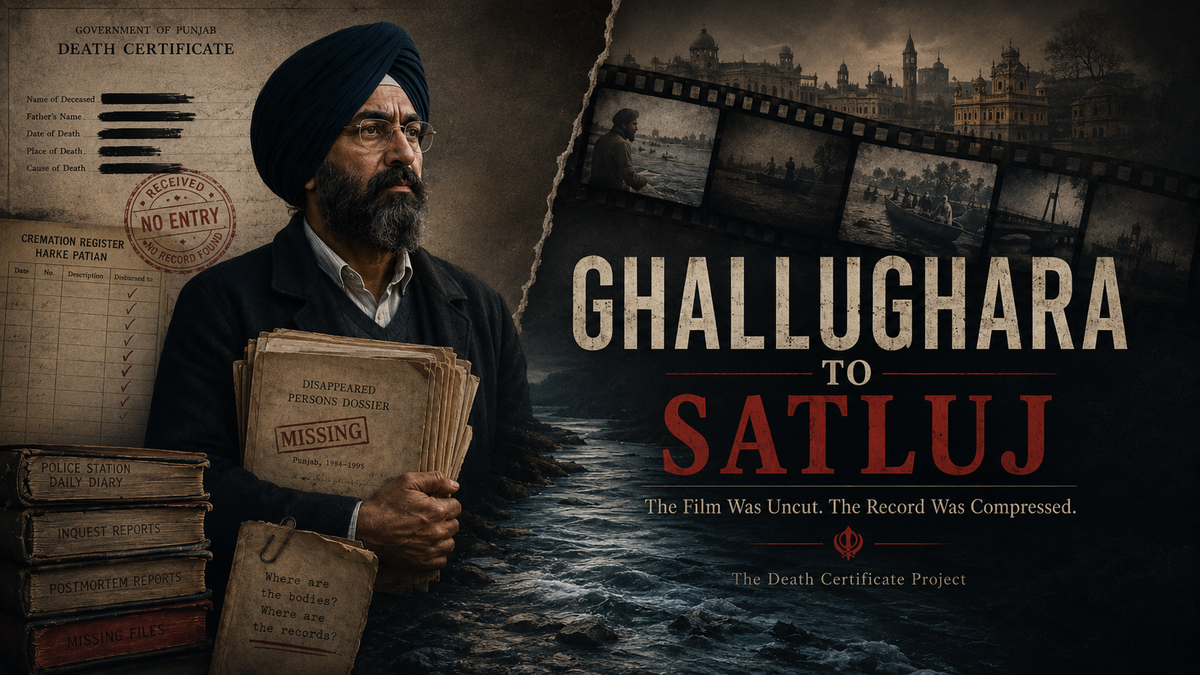
ਗੁਰਸ਼ਬਦ ਤੋਂ ਪਹਿਲਾਂ, ਬੇਨਾਮ ਲਾਸ਼ਾਂ ਸਨ
Before the Gurshabad, the nameless dead.
The Film Was Uncut. The Record Was Compressed.
A Master Brief of the Death Certificate Project: The Violence Against the Sikhs of Punjab, 1984–1996, Measured Against the Film That Survived the Censor and Was Then Deleted From India, the District Office That Never Produced a File, and the Centuries of Memory the Title Changes Tried to Contain
First published July 4, 2026 — the day after the uncut digital release of Satluj on ZEE5 Global. Revised and expanded July 5, 2026 — the day the film was made unavailable in India, roughly forty-eight hours after its release, for reasons the platform did not disclose. That forty-eight-hour figure recurs in this brief, and its recurrence is the argument.
THE FORENSIC ARCHIVE KEY
[PF] Proved Finding — adjudicated judicial records, statutory text, official investigation, contemporaneous documentation, or a named party's own public admission.
[DA] Documented Allegation — a serious, source-grounded, attributable claim, not yet adjudicated or independently verified to the highest standard.
[AI] Analytical Inference — a reasoned conclusion drawn from chronology, statutory architecture, omission, pattern, and institutional conduct; never a substitute for [PF].
[PM] Panthic Memory — the civilizational, testimonial, and communal register of Sikh survival, carried by institutions, families, and witnesses where the state's registers fell silent.
Executive Summary
This brief does not accuse the makers of Satluj of betrayal, and it does not accuse any civil officer of ordering the murder of Jaswant Singh Khalra. Its claim is narrower than either, and for that reason more durable than either. Satluj has restored Jaswant Singh Khalra to public view, and that is a real and valuable thing. But a two-hour film cannot restore the administrative system he died documenting, and this brief exists to reopen that system to view.
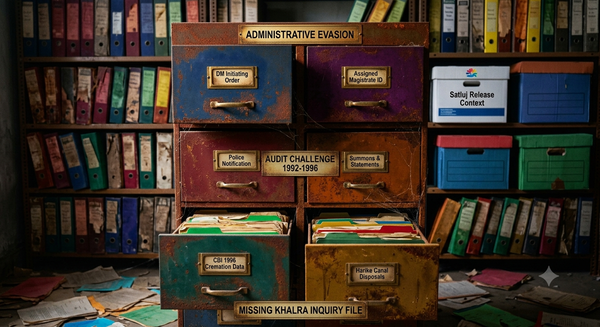
That system was not only police violence. It was the arrest never recorded, the custody flatly denied, the inquest never opened, the medico-legal certificate falsified, the municipal cremation register that converted a murdered man into a line item marked "unidentified," the death certificate never issued to the family, and — at the center of the Amritsar record — a District Magistrate's office that held the statutory power to find Khalra alive during forty-eight documented days and has never, in the thirty-one years since, produced the file that the ordinary discharge of that power would have generated. The criminal courts eventually answered who abducted and killed Khalra. They never answered why the civil administration failed to find him while he was alive.
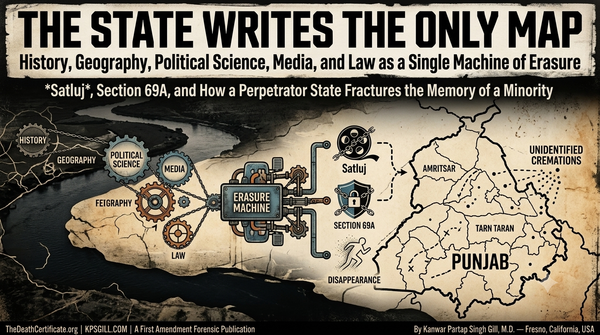
The governing thesis of this brief is a single sentence: the film was uncut, but the record was compressed. The word "uncut," as the filmmakers use it, is true and should be respected — it means the streaming master carried no last-stage deletions. But "uncut" is a claim about a runtime object, not about historical completeness, and when public celebration treats the two as equivalent, a half-truth is born — and a half-truth is more dangerous than a lie, because a lie can be exposed while a half-truth survives on the fraction of fact it carries. What the film compressed is precisely what the state most wanted compressed: the scale of the disappearances, the method of the torture, the sexualized violence used as an instrument of custody, the mass cremations as an administrative endpoint, and, above all, the civil file. The camera loves faces. The archive demands files.
This document is that archive's demand. It sets the film inside the long history of Sikh repression from which its deleted first title, Ghallughara, was drawn; it reconstructs the counterinsurgency of 1984–1996 as a documented administrative machine rather than a spasm of excess; it establishes the record of Khalra's captivity from the Supreme Court's own judgment; it measures the film against that record with the respect its embattled makers earned; and it converges on the one thing no cinema, no memory, and no rhetoric can replace — the file the state has never produced.
And then, between the first publication of this brief and its revision, the argument acquired a demonstration it did not ask for. On the evening of 5 July 2026, roughly forty-eight hours after Satluj began streaming, ZEE5 removed the film from its Indian catalogue, stating only that "in light of the current developments" it would be "unavailable in India until further notice," while it remained available internationally on ZEE5 Global. No order was published. No ministry was named. No reason was given. A film about a man who was made to disappear because he turned secret cremations into a public record was itself made to disappear from India, without a public reason, within two days of becoming visible. This brief takes the disciplined view of that event — that the removal is a proved fact and its legal mechanism an undisclosed one, and that the temptation to assert a specific cause must be resisted rather than indulged — and it takes, as well, the longer view: that the record exists, the public asked to see it, and the administrative state answered through disappearance. That is not a footnote to the Khalra story. It is the Khalra story, repeating itself in digital form, in real time, while this brief was being written. Part Nine sets out what is known and what is not.
WHAT THIS BRIEF DEMANDS
One. Produce the Amritsar District Magistrate's file for September–October 1995 — the search directions, station-diary requisitions, magisterial inspections, and statutory orders any discharged duty would have generated — or account publicly for its absence.
Two. Publish the complete demand history imposed by the Central Board of Film Certification and the concerned ministries on the film across its three titles — every cut, every renaming, every disclaimer sought — with written reasons.
Three. Account publicly, before the Panth and before the record, for the conduct of the civil administration of Amritsar district, 1989–1996.
Four. Issue death certificates for the unidentified victims whose cremations the state has already, through the CBI, admitted — because a state that can document a cremation can document a death, and the death certificate is the smallest unit of justice a state can withhold.
Five. Disclose the legal basis on which Satluj was made unavailable in India on 5 July 2026 — the order, the authority, the complainant, and the recorded reasons — or restore the film; because a removal without a published reason is not regulation but disappearance, and the burden of explaining a disappearance lies always on the party that caused it.
Scope, Method, and the Claims This Brief Does Not Make
This is the consolidating document of the Death Certificate Project's Satluj cycle. It absorbs and extends the Project's earlier work — on the film's certification history, on the missing forty-eight days of Khalra's captivity, on the compression of the film's first half against the documentary record, and on the statutory architecture of the Amritsar district magistracy — and it sets all of that inside the longer frame this Project has always insisted upon: Sikh history as one connected archive, not a sequence of disconnected emergencies to be mourned one at a time and then filed away.
Because this brief is built to endure hostile reading — by scholars, by lawyers, by retired administrators, by journalists, and by those with an institutional interest in its failure — its boundaries are drawn at the outset rather than discovered later in a correction.
First, this brief does not assert, as a proved finding, that Satluj was covertly softened through concealed dialogue replacement, alternate "safer" takes, or secret post-production capitulation. No leaked workprint, no audio-engineering audit, no production testimony, and no shot-by-shot comparison substantiating that theory exists in anything this Project has reviewed. The Project's standing to demand files from officials rests on its own refusal to manufacture findings against filmmakers, and that refusal is honored here.
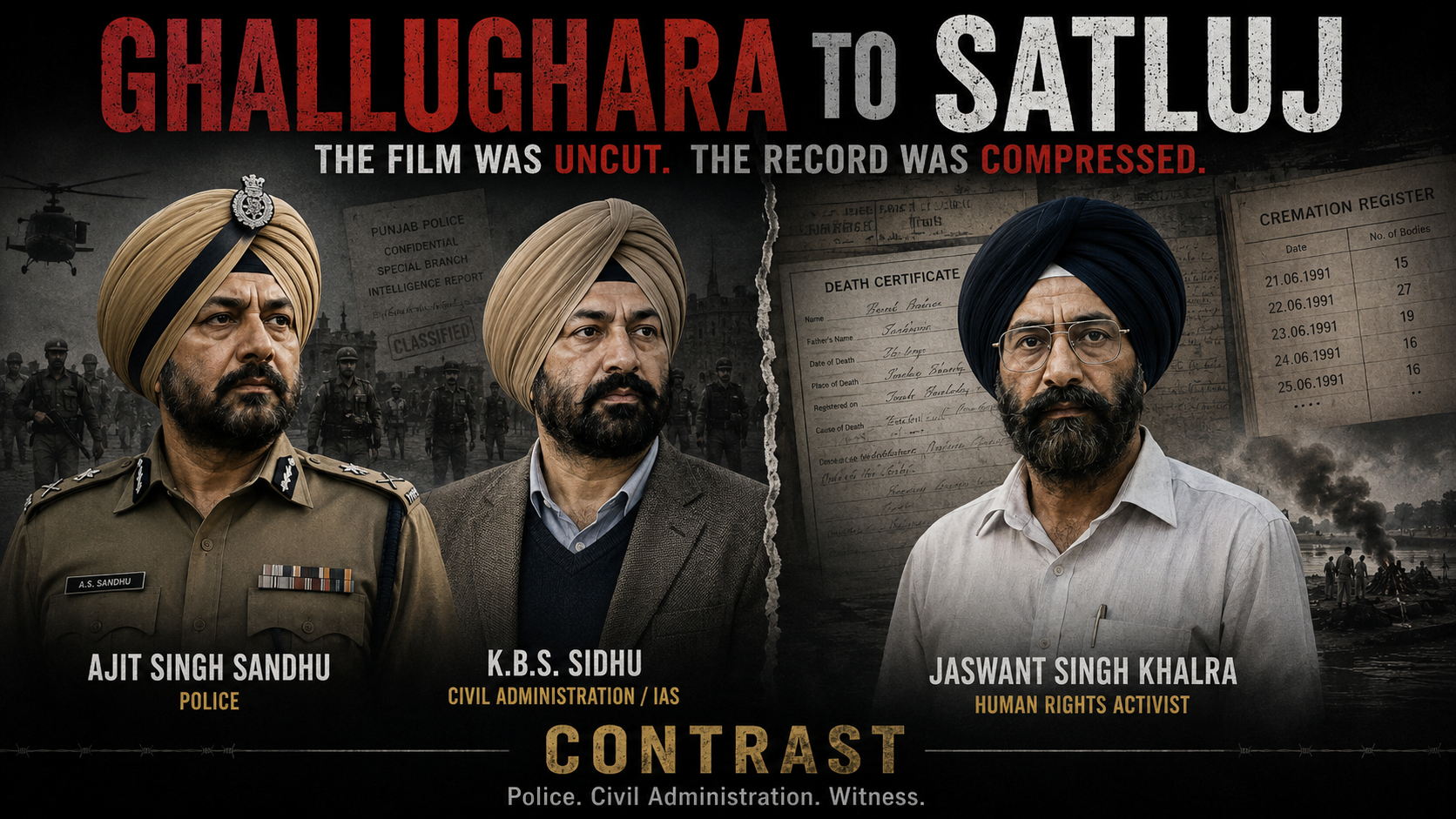
Second, this brief does not assert that Karanbir Singh Sidhu, IAS (Retd.) — Additional Deputy Commissioner and later Deputy Commissioner and District Magistrate of Amritsar during the relevant years — ordered, participated in, desired, or possessed operational knowledge of the killing of Jaswant Singh Khalra. No witness, no chargesheet, and no judgment places him at Kang, at Jhabal, at Manawala, or at Harike, and this brief states that plainly and repeatedly. The accountability question raised here is administrative and civil-magisterial, not criminal, and it is deliberately framed at its narrowest and most defensible: not what one officer personally knew of one killing, but what an office structurally positioned to know either recorded or failed to record across seven years, and where that record now is.
Third, this brief does not assert that a psychological-operations apparatus engineered the film's effects upon its audience. The audience effects analyzed in Part Five are the ordinary and predictable products of commercial narrative form, and they operate whether or not any individual intends them. The genre performs containment without needing a handler.
Fourth, on the many specific figures that populate any account of this period — detention counts, bounty totals, sanction refusals, cut counts — this brief grades each by the framework above and flags, in the closing verification note, every load-bearing number that still awaits a primary document. Precision about the limits of precision is not a concession. It is the discipline that lets the proved findings carry their full weight, undiluted by the contestable ones.
What remains, after those four boundaries are drawn, is not a diminished argument. It is the record itself — and the record is more than sufficient.
PART ONE — THE LONG ARCHIVE: WHAT THE WORD GHALLUGHARA CARRIES
The film that reached the public on 3 July 2026 under the title Satluj was conceived, written, and shot under a different title: Ghallughara. Before this brief evaluates a single frame of the film or a single omission from the civil record, it pauses on that fact, because the first act of containment in this entire story was not a cut demanded of a scene. It was the deletion of a word. And the word is itself an archive.
Why the Title Mattered
[PM] [PF] Ghallughara is not a rhetorical flourish, and it is not a synonym casually borrowed from the vocabulary of grievance. It is the specific term that Sikh historical consciousness reserves for the organized mass killing of Sikhs as Sikhs — killing aimed not at combatants but at a people. The tradition names two such events with the word, and dates them, and remembers their character.
The Chhota Ghallughara — the "lesser" holocaust — names the campaign of 1746, when the forces of the Mughal governor's establishment under Lakhpat Rai pursued the Sikhs into the riverine tracts and marshlands of the Majha, and, by the accounts preserved in Sikh chronicle and later historiography, killed several thousand Sikhs and took thousands more, hunting a scattered community through the very geography — the land between the rivers of central Punjab — in which, two and a half centuries later, Jaswant Singh Khalra would be born, would work, and would be taken. The Vadda Ghallughara — the "greater" holocaust — names a single day, 5 February 1762, when the columns of Ahmad Shah Abdali fell upon a great moving convoy of Sikhs near the village of Kup, in the Malwa, and killed, by the chronicles' reckoning, tens of thousands in the hours between one morning and one evening — by the community's own accounting, a substantial fraction of the entire Sikh population then alive. The Panth that survived those two events did not treat them as episodes. It built the word into its self-understanding, so that Ghallughara came to mean a particular thing: what happens when the sovereign power of the day concludes that the Sikh body itself is the offence to be extinguished.
This is why, when Punjabi speech in the late twentieth century reached for a word large enough to carry June 1984 and November 1984, it did not reach for "riot" or "operation" or "excess." It reached for this word — the Teeja Ghallughara, the third — placing the events of the living memory inside a continuum three centuries deep. And it is why a certification committee that, in the winter of 2022, demanded the word removed from a film's title was not editing a title. It was intervening in a memory system of nearly three centuries' standing, and it understood — correctly, and this is the point — that the word did specific historiographic work: it framed the counterinsurgency of the 1990s as a continuation rather than an aberration, as the newest instance of a recurring civilizational event rather than an isolated law-and-order episode that a reasonable state had regrettably mishandled. To delete the word was to sever the continuum. The state has always understood the stakes of the continuum better than its critics; it has spent centuries maintaining that each atrocity was singular, unconnected, and closed. Ghallughara denied it that comfort in a single word, and so the word had to go.
The Continuum the Word Names
The continuum is real, and this brief will trace it without apology, because the founding method of the Death Certificate Project is the refusal of fragmentation — the insistence that Sikh history not be metabolized as a series of discrete traumas, each acknowledged in isolation and each thereby drained of the pattern that connects it to the next.
[PF] The annexation of the sovereign Sikh kingdom in 1849 folded Punjab into an imperial order that would, for a century, alternately recruit the Sikh as soldier and police the Sikh as subject — a doubleness that has never fully resolved and that echoes still in the state's simultaneous celebration of Sikh martial service and suspicion of Sikh political assertion. [PF] The Ghadar movement of 1913–1915 — the transnational revolt organized substantially by Punjabi Sikh laborers on the Pacific coast of North America — was met by the colonial state with hangings, mass transportations, and the machinery of the Defence of India Act; and this lineage runs directly, by blood, into the present story, because by widely published biographical accounts Jaswant Singh Khalra's own grandfather, Harnam Singh, was a Ghadar activist and a passenger aboard the Komagata Maru [DA] — the ship of Punjabi migrants, most of them Sikhs, turned away from Canadian waters in 1914 and fired upon by colonial police at Budge Budge on their forced return. The man who, in 1995, would document the state's disappeared descended from a man who had himself been treated as a danger to be repelled by an earlier iteration of state power. The archive is not metaphor here. It is genealogy.
[PF] Jallianwala Bagh, 13 April 1919 — the massacre of hundreds of unarmed people penned in a walled garden in Amritsar — fixed that city as the recurring coordinate of state violence a full seventy-six years before Khalra was taken from a street in the same city; the geography of atrocity in Punjab is stubbornly persistent, and Amritsar sits at its center across the whole span. [PF] The Akali morchas of the 1920s — Nankana Sahib, the Guru ka Bagh agitation, the Jaito morcha — built the modern institutional order of the Panth, including the Shiromani Gurdwara Parbandhak Committee (constituted 1925), through a sustained discipline of nonviolent sacrifice against a state that jailed tens of thousands of Sikhs; the tradition of the Sikh body deliberately offered as witness against injustice, so often invoked in the memory of 1995, is not a modern improvisation but a century-old civilizational method.
[PF] Partition, 1947, tore Punjab in half along a line that ran through the heart of the Sikh homeland, and made Punjabis — Sikhs, Muslims, and Hindus together — the largest single population of the dead and the displaced in the subcontinent's modern history; the Panth lost the greater part of its historic shrines, its most fertile lands, and its western heartland, and absorbed the shattered survivors into a truncated eastern remainder. [PF] The decades that followed accumulated the specific, material grievances that the Anandpur Sahib Resolution of 1973 would eventually codify into a political program: the long-delayed and territorially truncated Punjabi Suba of 1966, which granted a Punjabi-majority state only after prolonged agitation and only in diminished form; a shared capital, Chandigarh, promised to Punjab and then indefinitely withheld; and the river waters — the Ravi, the Beas, and the Satluj itself — allocated away from the riparian state through administrative and adjudicatory mechanisms that Punjab's legislatures and jurists have contested continuously for half a century.
Why the River Matters
The reader should hold that last detail, because it is not incidental to the film this brief examines. The final, censor-era title of the film — Satluj — is the name of the river at the very center of Punjab's longest-running material grievance. It is also, and this is the darker resonance, the river system into which, in the autumn of 1995, the Punjab Police disposed of the body of the man the film is about: Khalra's body was thrown into the Harike headworks, where the waters of the Satluj and the Beas are gathered and channeled. A title chosen by the censoring apparatus for its softness — a river, poetic, elegiac, drained of accusation — names two indictments at once, whether or not anyone intended it to. It names the river whose diverted waters are a standing grievance, and it names the river that received a murdered man's body. A river does not prosecute; a river mourns. But this river, of all rivers, also remembers — and in softening the marquee, the state left a signature it may not have meant to leave.
The Hinge into the Militancy Period
[PF] The killing of thirteen Sikhs at the Nirankari procession clash in Amritsar on 13 April 1978 — followed by the 1980 acquittal of those tried for it — is the conventional hinge into the militancy period, and this brief states the next part directly, because the Project's credibility depends on refusing the comfort of a one-sided account. The years from roughly 1981 to 1993 saw real and terrible violence committed by militant organizations as well as by the state. Civilians — Hindu and Sikh alike — were murdered on buses and in markets and in their homes; police officers and their families were assassinated; bombings killed indiscriminately. The Death Certificate Project has never argued that no militancy existed, and it does not argue so here. The argument this Project makes has always been about a different thing: about what the state did with its lawful monopoly on violence. Faced with an insurgency — a real one — the state chose to respond not by policing a threat within law, but by criminalizing a population outside it, suspending its own legality across an entire people, building an administrative apparatus for killing beyond the reach of courts, and then erasing the evidence of the killing after the fact. An insurgency is a security problem. What the state built in response was a different order of thing, and the record set out in Part Three is what it was.
[PF] Operation Blue Star, June 1984 — the army assault on the Darbar Sahib complex in Amritsar, deliberately timed to the martyrdom anniversary of Guru Arjan Sahib, when the shrine was crowded with pilgrims — destroyed the Akal Takht, the temporal seat of Sikh sovereignty, and killed, by the figures the state itself eventually published, many hundreds, with independent and Panthic accountings running substantially higher [PM]. In the rural aftermath, Operation Woodrose swept the Majha and Malwa countryside for amritdhari Sikh youth, converting religious observance itself into a marker of suspicion and a great many young men into the disappeared. Together, the two operations of 1984 accomplished a transformation this brief regards as decisive: they converted a political conflict into a demographic one, in which to be a certain kind of Sikh was to be, in the state's operational logic, a legitimate object of force.
[PF] The November 1984 pogrom that followed the assassination of Prime Minister Indira Gandhi killed 2,733 Sikhs in Delhi by the count of the government's own Ahuja Committee, with the nationwide toll higher still, and was accompanied by organized sexual violence against Sikh women that this Project has documented in its standing essay on that subject. And here this brief observes, at the outset, an evidentiary discipline it will maintain throughout: the sexual violence of the Delhi pogrom of 1984 and the custodial sexual violence of the Punjab counterinsurgency of 1984–1996 are two documented phenomena within one civilizational wound, and this brief treats them as related but distinct, refusing to collapse them into a single undifferentiated claim. To blur them would be to weaken both. To hold them apart, each on its own evidence, is to make each unassailable.
That is the archive the word Ghallughara was carrying when the film's producers first typed it onto a title card in 2022. That is the archive a certification committee ordered deleted. And everything that follows in this brief — the machine of 1984–1996, the film's compressions, the district office's silence, the state's rewards and decorations and withheld sanctions — happened downstream of a state that had already demonstrated, twice in the single year of 1984, precisely what it was prepared to do to the Sikh body, and downstream of a Panth that had already learned, across three centuries, exactly what the word for it was.
PART TWO — THE INVERSION: A VICTIM POPULATION CAST AS THE THREAT
[AI] Every mass atrocity requires a narrative license — an account of the world in which the killing becomes, if not defensible, then at least explicable as a response to a danger. The license issued for Punjab was the inversion: the systematic recasting of the victim population as the threat population, so that the killing of Sikhs could be understood, in the official mind and the national imagination alike, not as repression but as defense. This inversion is the connective tissue of the entire period, and it deserves to be named as a mechanism, because the same mechanism operates on the film examined in Part Five and on the diaspora securitization examined below.
The Legal Inversion
The inversion was legal before it was rhetorical, and the law did the heavy lifting. [PF] The Terrorist and Disruptive Activities (Prevention) Act — TADA, enacted 1985, hardened in 1987 — inverted the ordinary architecture of criminal justice at its foundations: it made a confession recorded by a police officer admissible as evidence (abolishing, for its detainees, the most basic protection against custodial coercion), it inverted the ordinary presumption favoring bail, it permitted extended detention, and it created a category of detainee to whom the ordinary Constitution had, in practical effect, ceased to apply. Alongside TADA operated the National Security Act, the preventive-detention framework permitting confinement without trial, and the broader emergency architecture that governed the region. [DA] Figures reported at the time and compiled subsequently by rights organizations place TADA detentions in Punjab in the many thousands — commonly cited compilations run above fourteen thousand by the mid-1990s — against a national conviction rate under the Act that the same sources report at around one percent: a statute, that is, which convicted almost no one it touched but classified everyone it touched. This brief grades those specific figures as documented allegation pending a clean primary citation, and phrases the underlying point conservatively: rights-organization compilations consistently placed Punjab's TADA detentions in the many thousands, against a conviction rate low enough to establish that the Act's function was not conviction but classification.
And classification did the work that evidence never had to do. A young man who entered a police station under TADA entered it already reclassified as a terrorism suspect. If he survived, he might eventually be released uncharged, one of the ninety-nine percent never convicted. If he died there, he exited the paperwork not as a citizen killed in custody but as a militant killed in an encounter. The label preceded the fact and survived the fact. The inversion was, in the most literal sense, written into the man's file before anyone laid a hand on him.
The Narrative Inversion
[PF] Human Rights Watch's 2007 audit of the period, Protecting the Killers, documents the completed circuit of the inversion as it operated on the ground: sons taken in front of witnesses, denied in custody, and later discovered — where they were discovered at all — recorded as "unidentified militants" cremated after "encounters" in which, as a 1993 United States State Department assessment quoted in that report observed, police casualties were notably rare. Real encounters produce casualties on both sides. The near-total absence of police dead in a decade of claimed encounters is itself documentary evidence of what the encounters largely were.
The inversion followed the dead into the ledger and then followed the living into suspicion. A boy taken from a bus became, in the state's own handwriting, an armed insurgent whom no one could name. His mother, seeking to register a First Information Report, became a militant's mother, an object of suspicion in her turn. His village, seeking answers, became a harboring village, subject to collective pressure. And the investigator who eventually read the ledger and counted its entries — Jaswant Singh Khalra — became, in the state's telling and in the recorded mouths of the officers who threatened him, an anti-national actor cataloguing lies to defame the nation. The man documenting the disappeared was reclassified as a danger for documenting them. That is the inversion at its purest, and it is the direct ancestor of the treatment the film would receive three decades later.
The Inversion That Outlived the Insurgency
[AI] The Death Certificate Project has documented, in its standing work on the securitization of Sikh identity and its forensic response to contemporary "Khalistan"-frame advocacy, how this inversion outlived the insurgency that first licensed it — how the frame continues, in India and across the diaspora, to convert memory into menace, grievance into extremism, documentation into disloyalty, and mourning into a security threat. A Sikh who commemorates 1984 is recast as a sympathizer; an organization that documents disappearances is recast as a front; a diaspora that petitions foreign legislatures is recast as a transnational network. The structure is identical to the structure of 1995: the one who names the wound is reclassified as the one who inflicts it.
For the purposes of this brief, one observation binds Part Two to Part Five and needs no more than stating: the certification history of Satluj is the inversion operating on cinema. A film built substantially on judicial findings, CBI records, Supreme Court orders, and municipal registers was treated, for more than three years, as the dangerous object requiring containment — while the memoirs of the period's senior administrators circulated freely and profitably, and the very officials whose omissions the record documents curated their public legacies in podcasts, interviews, and newspaper columns. The state's reflex, confronted with its own archive rendered as cinema, was in 2022 exactly what it had been in 1995: reclassify the witness as the threat, and turn the machinery of the state against the record rather than against the thing the record describes.
PART THREE — THE SYSTEM, 1984–1996: SIX SUBSYSTEMS OF AN ADMINISTRATIVE MACHINE
The central historiographic claim of the Death Certificate Project about the counterinsurgency is not that it was cruel, though it was, and not that it produced excesses, though it did. The claim is structural: that the violence of 1984–1996 operated as a machine — an integrated apparatus with distinct, repeatable, and mutually reinforcing subsystems, each of them documented, each of them administrative in character, and each of them leaving precisely the kind of trace that a civil magistracy exists to read and was legally bound to read. The distinction matters because it determines where accountability lies. A machine of excesses is a story about bad men; the remedy is to punish the men. A machine of subsystems is a story about an institutional design that required the participation, or the studied inattention, of offices well beyond the interrogation room; the remedy is to open the design to view. This Part sets out the six subsystems and the record for each, and it opens with a matrix, because the argument the matrix makes visually is the argument this entire brief exists to make: at every stage of the machine, alongside the police act there stood a civil or magisterial failure without which the police act could not have been consummated or concealed.
| # | Subsystem | Police / Security-Force Element | Civil / Magisterial Failure That Enabled It |
|---|---|---|---|
| 1 | Seizure | Unrecorded abduction from checkpoints, buses, fields, and homes | Non-enforcement of the CrPC arrest-reporting duties owed to the District Magistrate |
| 2 | Denial | False affidavits of non-custody filed even in habeas proceedings | Non-auditing of station diaries (roznamcha) to which the magistracy was entitled |
| 3 | Torture | Calibrated, scar-avoidant interrogation raised to routine method | Silence or complicity of local medical officers; absence of custodial inspection |
| 4 | Leverage | Custodial sexual and psychological abuse of women as pressure | Absence of independent magisterial inspection of custody spaces |
| 5 | Paper | Secret disposal of bodies under "unidentified" / "unclaimed" labels | Complete failure to open the mandatory inquests the law required for such deaths |
| 6 | Endpoint | Municipal cremation of the dead, fuelled by cash bounties | Unaudited cremation-ground and firewood registers; death certificates never issued |
Six subsystems; one machine. What follows is the record for each — and the reader is asked to hold the right-hand column in mind throughout, because it is the column the film cannot show and the column the district office has never explained.
Subsystem One: Seizure Without Record
[PF] The foundational move of the machine was the seizure engineered to leave no trace. Amnesty International's 1991 reporting on Punjab documented it as an established pattern: arrests that went unacknowledged for weeks or months at a stretch, arrest memoranda never prepared, custody records denied to relatives and even to judicial officers who sought them, detainees later claimed to have "escaped" from a custody the state simultaneously denied ever existing, and people who simply never re-emerged from a documented encounter with the security forces. The seizure was designed to be undocumented, and the design was not incidental — it was the load-bearing element of everything that followed, because the absence of the arrest record was the precise thing that rendered every subsequent stage deniable. If there is no record that a man was taken, there is no record to contradict the claim that he was never held; no starting point from which a court can measure the duration of an illegal detention; no document whose falsity can later be proven. The unmade arrest memo was not sloppiness. It was the first and most important instrument of the machine.
[PM] The human texture of this subsystem is not abstract to the community that lived it. Young men were taken from buses halted at checkpoints, their names read off a list or simply matched to a face; from fields during the harvest, walked away between two constables while a family watched from the next furrow; from their own homes in the dark, lifted from a charpai in front of parents who would spend the following years moving from police station to police station collecting denials. Every Majha family of a certain generation carries at least one such doorway scene in its memory — the knock, the vehicle, the son who did not return, the register at the thana that showed nothing. The publisher of this Project carries his own city's version of it. This is the register that Panthic memory preserves and that no municipal record was ever permitted to hold, and its exclusion from the official archive is not a gap in the evidence; it is the evidence — the documented, deliberate production of an absence.
Subsystem Two: Denial as Weapon
[PF] The second subsystem converted denial itself into an instrument of harm. The habeas corpus dockets of the Punjab and Haryana High Court, and ultimately of the Supreme Court, filled during this period with petitions that were answered by official affidavits flatly denying custody — denials proven false, case after case, including, terminally and from the apex of the force, in the matter of Khalra himself. This is not inference. In the Supreme Court proceeding arising from Khalra's own abduction, Senior Superintendent of Police Ajit Singh Sandhu filed a sworn affidavit asserting that he had never threatened Khalra and had never influenced him regarding the withdrawal of his petition — a sworn denial by the very officer at whose Manawala residence, on the credited testimony later accepted by three levels of the judiciary, Khalra was brought before the Director General of Police during his final captivity. The petitioner, Paramjit Kaur Khalra, filed a rejoinder dated 9 October 1995 contesting that account. The significance of that date is developed in Part Four and Part Six, but its meaning may be stated here: the machinery of denial was operating, in sworn pleadings before the highest court in the country, during the very weeks that Khalra was alive and locatable in police custody.
[AI] Enforced disappearance, properly understood, is therefore not merely kidnapping by men in uniform. It is the use of state denial as a weapon — a weapon aimed not only at the disappeared person but, with terrible precision, at the family left behind. The police did not merely take a person; they erased the fact of the taking, and the erasure was itself an instrument of torture directed at those outside the cell. Without a body, without a record, without an admitted date, there is no moment at which grief may lawfully begin, no death to be mourned, no certificate to be issued, no closure the law will recognize. The family is suspended indefinitely in a condition the state has manufactured and can end at any time by simply telling the truth, and chooses not to. The denial is not the concealment of the crime. In substantial part, the denial is the crime, extended across years and inflicted upon the living.
Subsystem Three: Torture as Calibrated Method
[PF] The most systematic clinical documentation of what interrogation actually meant inside a Punjab police station during this period is the survey conducted by Dr. Ami Laws in association with Physicians for Human Rights — a study of 192 Sikh torture survivors drawn from eight districts of Punjab, interviewed and, where possible, physically examined, with their accounts and findings published in the Health and Human Rights journal. The percentages that survey recorded deserve to be reproduced wherever this period is seriously discussed, because they convert a generalized word — "torture" — into an itemized method, and method is what distinguishes an aberration from a system.
THE METHODS DESIGNED NOT TO LEAVE A FILE
From the Physicians for Human Rights survey of 192 Sikh torture survivors (Laws & Iacopino, Health and Human Rights):Beating — reported by 95%Cheera (legs forced apart toward 180°, a knee driven into the spine) — 75%Suspension by the bound wrists, sometimes weighted — 63%Ghotna / roller (a heavy cylinder crushed across the thighs, an officer standing on it) — 62%Electric shock to earlobes, genitals, fingers, and toes — 27%Beating of the soles of the feet — 15%Burning with heated rods — 6%"Other" (near-drowning; water forced up the nose; chili peppers and motor oil forced into the anus; nails torn out; mock executions at canal banks; forced witnessing of a relative's torture; rape) — 44%
And the finding that indicts the civil record most precisely: only 32% of survivors showed physical findings on examination. The signature methods were selected for maximal pain and minimal scar. The absence of a mark was not the absence of torture. It was the design of it.
[AI] That last finding has a long and specific afterlife, and it is the reason this subsystem belongs in a brief about records rather than only about pain. Torture engineered to leave no scar produces a survivor whose body cannot corroborate his testimony — and that gap between what was done and what can be shown was weaponized a second time, years later and continents away, when Sikh asylum claimants across the 1990s and 2000s were disbelieved by foreign tribunals for "lack of physical evidence" of a torture that had been deliberately designed to leave none. The machine's cruelty and the machine's deniability were the same engineering decision. The true horror of this subsystem was not merely the pain; it was pain calibrated to disappear from the file — a torture that erased its own documentation even as it was inflicted, so that the survivor emerged carrying an agony the record would refuse to hold. This is the deepest signature of the entire machine, visible in miniature: the state did not merely hurt and kill; it hurt and killed in ways engineered to leave the archive empty.
Subsystem Four: The Woman as Leverage, and Sexualized Violence as Instrument
[PF] The fourth subsystem is the one the film most conspicuously omits and the one the record most plainly establishes, and this brief handles it with the discipline the subject demands: not as spectacle, and not as an undifferentiated charge, but as documented method. Amnesty International's 2003 review of custodial torture in Punjab stated the matter without softening: that torture in the state functioned frequently as a substitute for investigation — a means of extracting confession, information, money, or compliance rather than of establishing fact — and that rape and other forms of sexual violence were reported as frequent forms of custodial torture, used both to violate and humiliate women detained in their own right and to break the men whose wives, mothers, sisters, and daughters were brought into the police station explicitly as instruments of pressure. Asia Watch's 1991 field documentation records women tortured in custody, in at least one documented instance while their young children were present and made to witness, and records the detention and abuse of relatives of suspects as relatives — persons against whom the state had no allegation whatsoever, held and hurt solely as leverage against someone else.
[PM] The gendered archive of this period is therefore not an archive of mourners only, and any account — cinematic or historical — that renders Sikh women exclusively as the weeping periphery of a male martyrdom has reproduced the state's own accounting error. Women were targets in their own right, subjected to a custody of a different and particularly violating character. They were witnesses, made to see what was done to their sons and husbands as an additional instrument of coercion. They were the leverage itself — the wife brought in to break the husband, the mother threatened to summon the son, the sister's safety made the price of a signature. And they were the survivors who carried the aftermath across decades, into households in Punjab and into the diaspora, bearing a burden the statistics of the "disappeared" — a ledger overwhelmingly of male names — structurally cannot and does not count. A son was taken; a mother searched; a wife begged; a sister was threatened; a daughter inherited the silence. To leave this subsystem out of the picture of 1984–1996 is not to spare the audience discomfort. It is to falsify the social geometry of the atrocity — to convert a familial, gendered, and intergenerational catastrophe into a narrower and more manageable story of men in cells, and thereby to complete, in the retelling, the very erasure the machine performed in the first instance.
Subsystem Five: The Falsified Paper
[PF] The machine could not run on police alone; it required professionals across the civil apparatus, and the fifth subsystem is the record of their participation or their silence. Amnesty International documented medical reports that recorded no injuries upon bodies later proven to have been grievously injured; post-mortem examinations that were not conducted, or were conducted and not produced; and inquests under Sections 174 and 176 of the Code of Criminal Procedure — mandatory, by the plain text of the statute, for any death occurring in police custody or in suspicious circumstances — that are simply absent from the record at the scale of thousands of custodial and encounter deaths. Every one of these is a civil document, or the documented absence of one. A falsified medico-legal certificate is signed by a medical officer operating within the district's civil health establishment. An un-opened inquest is a failure of the executive magistracy, not of the police alone. The falsified paper and the missing paper are the fingerprints of the civil administration on the machine — and they sit, by law, squarely within the supervisory world of the District Magistrate, a point Part Six develops into the center of this brief's accountability argument.
Subsystem Six: The Cremation Ground as Endpoint, and the Bounty as Fuel
[PF] The endpoint of the machine was municipal, and it was documentary, and it was where Khalra broke it open. The bodies arrived at the cremation grounds of the Amritsar district — the three grounds his investigation centered upon: Durgiana Mandir, Patti, and Tarn Taran — and were burned there as "unidentified" or "unclaimed," their disposal recorded not in the register of the dead but in the mundane bureaucracy of municipal expenditure. Khalra and Jaspal Singh Dhillon read that bureaucracy: the firewood-purchase registers of the cremation grounds, which recorded the quantity of wood bought by the police for cremations, against the known and roughly constant quantity — on the order of three hundred kilograms — required to burn a single body. From the arithmetic of firewood, they reconstructed the arithmetic of the dead, and matched it against municipal records of names, ages, and addresses. The state, having engineered the disappearance of bodies, had left the record of their burning in its own account books. Khalra found the state's handwriting in the place the state believed only ash remained. In his own press note of 16 January 1995, and ultimately in the finding of the CBI, the count for Amritsar district alone reached 2,097 illegal cremations — 585 identified, 274 partially identified, and 1,238 never identified at all — with Khalra's own investigation and the petitions that followed treating even that figure as a floor rather than a ceiling, since the count was confined to three grounds in one district.
[PF] The fuel of the machine was fiscal as well as ideological. Human Rights Watch documented the announced system of cash rewards and accelerated promotions for the killing of listed militants — bounty as published, administered policy rather than as rogue improvisation — a system that converted the killing of a suspect from a risk into an incentive and made the encounter a transaction. [DA] Khalra's own investigation, as carried in the materials of Ensaaf and this Project, placed the number of bounties paid across the counterinsurgency in the tens of thousands, a figure he cited publicly before he was taken; this brief grades the specific magnitude as documented allegation pending the underlying primary compilation, while noting that the existence of the reward system is a proved finding of Human Rights Watch. The point that survives the grading is structural and decisive: a state that pays for a body has told its officers what it wants, and a state that then labels the body "unidentified" has told them how to deliver it without cost. Incentive at the front of the machine; erasure at the back. The two are a single policy.
[PF] And the quantitative capstone belongs here, because it is the finding that forecloses the "few bad apples" reading before Part Five has to dismantle it as cinema. The Benetech / Human Rights Data Analysis Group study conducted with Ensaaf (2009) assembled more than twenty-one thousand records across NHRC proceedings, the documentation of the Committee for Coordination on Disappearances in Punjab, press archives, and municipal registers, and reached the conclusion that governs this entire Part: the pattern of lethal violations and illegal cremations was not consistent with random or isolated aberration. It was consistent with underlying, systematic practice. That is the difference between an accident and a machine, established quantitatively, from more than twenty-one thousand records, by an independent statistical analysis — and it is the finding that any honest account of this period, on screen or on the page, must carry.
The Convergence
Six subsystems; one machine; and every one of them touched, at some point in its cycle, a document that belonged to the jurisdiction of the civil administration and not to the police alone: the arrest memo never prepared, the CrPC arrest-report never sent to the District Magistrate, the station diary never demanded, the medico-legal certificate falsified, the inquest never opened, the cremation register never audited, the death certificate never issued. [AI] This is the sense — precise, statutory, and central — in which Jaswant Singh Khalra was not merely investigating police killings. He was investigating the collapse of the civil administration itself: the hollowing-out of every civil office whose ordinary functioning would have made the machine impossible to run and impossible to hide. That is why this Project bears the name it bears. The death certificate is not a footnote to the killing. It is the document whose absence completed the killing — and its systematic absence is the machine's true signature, the proof that what happened in Punjab was not a failure of the administrative state but, in a terrible sense, a use of it.
PART THREE-B — THE HUMAN ARCHIVE: THE NAMED, THE NAMELESS, AND THE FULL CATEGORIES OF THE WOUND
The six subsystems of Part Three are a structure, and structure is necessary, but it is not sufficient, because a machine described only as a machine risks reproducing the very abstraction the machine itself performed — the conversion of persons into categories, of the killed into "the disappeared," of a mother's son into an "unidentified" entry in a firewood register. This Part restores the human particulars to the structure, because the Death Certificate Project's entire purpose is the reversal of abstraction, and because the film examined in Part Five, whatever else it does, gives its audience one named man where the record holds tens of thousands. The brief owes the record its names.
The Named Cases the Official Inquiry Left Out
[PF] Human Rights Watch's 2007 report documents individual cases at a level of specificity that no montage and no statistic can carry, and several of them illustrate not only the machine but the containment of the machine's own investigation — the way the NHRC proceeding, narrowed to Amritsar district and to arbitrary windows of time, excluded documented victims on grounds of jurisdiction and technicality rather than of fact.
Consider Jugraj Singh — by the HRW account a young taxi driver, abducted in daylight from a market and killed the following day in what the police recorded as an encounter, and then excluded from the Amritsar mass-cremations proceeding entirely because his killing fell outside the arbitrary temporal or territorial window the inquiry had set for itself. His death was real; his exclusion was administrative. Consider Rashpal Singh, a boy of fifteen or sixteen by the same documentation, pulled from a bus and never seen again, his cremation absent from the official CBI list even after his father identified his belongings in police custody — a father who found his son's possessions in the hands of the police and still could not find his son in the state's ledger of the dead. Consider Mehal Singh, sixteen, tortured to death at a CIA Staff interrogation center in Tarn Taran while, by the account preserved in the record, his father and brothers sat outside and heard him — and whose identification was later rejected by an official commission on the technical ground that his father had not personally viewed the body, a body the state had disposed of before any father could view it. [PM] These are not this Project's inventions. They are named families, in the documentation of an international human-rights organization, describing what the machine did to specific children — and describing, in the very grounds of their exclusion, how the state's eventual inquiry was engineered to hold only a fraction of what the machine had produced.
[AI] The pattern in these exclusions is itself a finding. An inquiry confined to three cremation grounds in one district, to a defined band of years, and to the identification of remains rather than the adjudication of responsibility, will necessarily exclude the boy killed one month outside the window, the body burned in the next district, the death whose only witness was a father made to listen through a wall. The 2,097 is not the count of the dead. It is the count of the dead the inquiry was permitted to see — and even that permitted count contains 1,238 the state cremated and never named. The true number lies beyond the register, in the cases the register was designed not to reach, and Panthic memory holds what the register excluded.
The Woman in the Record
[PF] The gendered archive of Subsystem Four has its named instances too, though they are recorded with the particular difficulty that attends the documentation of sexual violence in a culture of shame and a climate of retaliation. Human Rights Watch's account of family-member persecution includes the case documented only by initials — a woman arrested and tortured alongside her mother during interrogation about her husband's alleged militancy, while her daughters, aged one and three, were themselves detained and made to witness. The children were the instruments; the mother was the leverage; the woman was the target; and the household was the field of operations. This is a single documented case standing for a pattern that Amnesty International's 2003 review established as method rather than aberration. [PM] The Project maintains, as it has throughout, the distinction between the mass sexual violence of the Delhi pogrom of 1984 and the custodial sexual violence of the Punjab counterinsurgency, and it insists on that distinction precisely so that neither is diminished by conflation with the other. Both belong to the archive of the wound. Neither is a rhetorical amplification of the other. Each stands on its own documentation, and each is the more unassailable for standing there.
The Categories the Span Demands
[AI] To speak of the violence against the Sikhs of Punjab across the full arc of 1984 to 1996 is to speak of categories wider than even the six subsystems capture, because the machine of custody and cremation was itself embedded in a larger structure of collective punishment and social annihilation that this brief names in order that no dimension of the wound go unrecorded.
There was the violence of June 1984: the assault on the Darbar Sahib complex and thirty-seven other gurdwaras simultaneously, the destruction of the Akal Takht, the killing of pilgrims gathered for a martyrdom anniversary, the burning of the Sikh Reference Library and its irreplaceable manuscripts and archives — a violence aimed not only at bodies but at the material memory of the Panth, at the documents and the sovereignty the Akal Takht embodied.
There was the violence of Operation Woodrose in the rural aftermath: the sweeps of the countryside for amritdhari youth, the conversion of the visible markers of Sikh religious commitment — the unshorn hair, the articles of faith — into operational indices of suspicion, so that observance itself became dangerous and a generation of young men in the Majha and Malwa learned that their faith made them targets.
There was the violence of November 1984: the organized pogrom in Delhi and beyond, with its documented toll and its documented sexual violence, and its enduring afterlife of impunity, in which the machinery of prosecution was for decades turned away from the organizers and toward the erasure of the record.
There was the violence of the disappearances — the central subject of this brief — sustained across a decade, the tens of thousands taken and denied and killed and burned, the mass illegal cremations of which Amritsar's 2,097 is the documented fragment.
There was the violence of torture as a routine instrument of governance, the calibrated methods of the Physicians for Human Rights survey, applied to a population rather than to individuals, and engineered to leave the archive empty.
There was the violence against women — as targets, as leverage, as witnesses, as survivors — and the intergenerational transmission of that violence into households across Punjab and the diaspora.
There was the economic annihilation that accompanied the physical: the families ruined by the disappearance of a breadwinner they could not even prove dead, the properties lost, the debts incurred in the search, the widows without certificates and therefore without inheritance, the orphans without standing — a dimension this Project has documented in its work on the body as a site of economic as well as physical destruction, and which converts a killing into a multigenerational impoverishment.
And there was the violence of erasure itself — the final and most characteristic category, the one this Project takes its name from: the systematic denial of the record, the missing arrest memo and the missing inquest and the missing death certificate, the administrative completion of the killing, the second cremation performed not with firewood but with paper, or with the absence of paper. This is the category that connects June 1984 to November 1984 to the disappearances to the film's certification battle to the district office's unproduced file: at every juncture, across the entire span, the state did not merely act against the Sikh body; it acted against the record of what it had done to the Sikh body, and it is that second, quieter, more enduring violence — the violence against memory and against proof — that the Death Certificate Project exists to reverse.
[PM] These are the categories of the wound of 1984–1996, and they are the reason a single film about a single man, however honorable, cannot close the account. Khalra is one name. The archive is a people. And the distance between the one and the many is precisely the distance between what the camera can hold and what the archive must.
PART FOUR — THE MAN WHO FOUND THE STATE'S HANDWRITING
The Inheritance
[PF] Jaswant Singh Khalra was, by profession, a director of a cooperative bank in Amritsar, and, by conviction and by office, the General Secretary of the Human Rights Wing of the Shiromani Akali Dal — a fact this brief restores to the foreground precisely because, as Part Five will show, its softening is one of the film's most consequential compressions. He was not a private man who stumbled by accident into a horror too large for him. He was an organized institutional actor, holding a named position within the principal political vehicle of the Panth, working within a human-rights infrastructure, and he descended, by the biographical record, from people who had themselves been treated as dangers by an earlier state: he was, by widely published accounts, the grandson of Harnam Singh, a Ghadar-movement activist and a passenger aboard the Komagata Maru [DA]. The man who would document the state's disappeared came from a lineage that had been fired upon at Budge Budge for the crime of trying to come home. He did not descend into the archive. He descended from it — from a family already written into the state's files a lifetime before his own name was added to them.
The Discovery
[PF] In January 1995, working with Jaspal Singh Dhillon, Khalra made public the findings that would redirect this entire history and cost him his life. On 16 January 1995 he issued a press note alleging that the security forces had secretly cremated thousands of unidentified and unclaimed bodies across the Amritsar district between 1984 and 1994, and his organization filed a writ petition in the Punjab and Haryana High Court seeking an independent investigation. [PF] The High Court dismissed that petition on the ground that it disclosed no basis for lawful intervention — a dismissal that stands, in retrospect, as an early instance of the judicial and administrative reflex this brief documents throughout: the treatment of the witness's documentation as the problem rather than the thing it documented. The method behind the findings was, as Part Three described, an act of forensic reconstruction from the state's own account books — the firewood registers, the three-hundred-kilogram constant, the municipal records of names and ages and addresses. [PM] In the spring of 1995 Khalra carried the findings abroad, to Canada and the United Kingdom, and his Toronto address survives in the memory of the Panth for its closing image — the single lamp, the diva, lit against an encompassing darkness, defiant precisely because it is small and the darkness is vast. [DA] The record of that year also carries the threats made to him by serving police officers, including the warning, preserved in Ensaaf's documentation, that a force which had already disappeared tens of thousands would not be inconvenienced by the disappearance of one man more.
The Abduction and the Judicial Spotlight
[PF] On 6 September 1995 — and this brief marks the date's terrible context, because it bears on everything that follows — six days after the assassination of Chief Minister Beant Singh by a suicide bombing at the Civil Secretariat in Chandigarh, at the single most volatile and security-saturated political moment Punjab had seen in years, Jaswant Singh Khalra was seized by Punjab Police personnel from outside his home at Kabir Park, Amritsar, while he was washing his car. The police denied custody, then and for years afterward.
[PF] The judicial response was immediate, and its immediacy is the anchor that dismantles any retroactive claim that the district administration was caught unaware. On 11 September 1995 — five days after the abduction — the Supreme Court of India received a telegram from Gurcharan Singh Tohra, the President of the SGPC, stating that Khalra had been kidnapped by the police; the Court, per Justice Kuldip Singh, treated the telegram itself as a habeas corpus petition and issued notice to the Home Secretary, the Director General of Police, and the Senior Superintendent of Police, Amritsar, returnable within one week. Paramjit Kaur Khalra thereafter filed her own petition under Article 32. The matter was, from the second week of September 1995 onward, a live proceeding in the highest court of the country. And it was not a dormant one: as Part Three noted, SSP Sandhu filed a sworn affidavit of denial, and the petitioner filed a rejoinder dated 9 October 1995 — adversarial pleadings exchanged in the Supreme Court in early-to-mid October, at the precise moment when, on the evidence set out below, Jaswant Singh Khalra was alive, held at Kang, and locatable. For the entire duration of the forty-eight days during which the state kept Khalra alive, the local civil and police machinery of Amritsar was operating under an active, high-intensity judicial spotlight — under Supreme Court notice, under adversarial litigation, under a national gaze. This is not a case in which the district could plausibly claim it did not know a prominent man was missing. The country's highest court was, at that moment, formally demanding his production.
The Custody Geography
[PF] The sequence of Khalra's final captivity is established not from advocacy literature but from the judgment of the Supreme Court of India in Prithipal Singh Etc. v. State of Punjab & Anr. Etc., decided 4 November 2011, and from the testimony that judgment credited across the trial and two levels of appeal. Kikkar Singh, himself illegally detained, testified that he saw Khalra — tortured, gravely weakened, fed by Kikkar Singh's own hand — at Kang police station in Tarn Taran, forty-eight days after the abduction, and that Khalra was moved out of Kang on 24 October 1995; the arithmetic from 6 September lands on that date exactly. Special Police Officer Kuldip Singh, attached to SHO Satnam Singh at Jhabal police station and the witness whose account three judicial levels accepted, established the remainder of the geography: a guarded room at Jhabal, where Kuldip Singh was himself assigned to feed the prisoner under instructions of secrecy and observed him weakened and marked; the journey to the Manawala residence of SSP Ajit Singh Sandhu, where — in the Supreme Court's own recitation of the credited evidence — "some high officials of police including the then Director General of Police, Punjab, came there and they talked to Shri Jaswant Singh Khalra in a closed room," with Kuldip Singh separately telling the Special CBI Court that he saw K.P.S. Gill enter that room and remain for roughly half an hour; the return to Jhabal; and the killing there, on the evening the testimony fixes at the end of October, followed by the disposal of the body in the Harike canal. One reported account places the total Jhabal confinement at nearly two weeks and records that Khalra was shot twice in the chest before his body was thrown into the water — into the Satluj system, the river whose name the film would eventually carry.
The Adjudication, and Its Limits
[PF] On 15 November 1995 — the date now verified against the primary order itself — the Supreme Court, recording that the existing investigation had yielded no results, directed the Director of the Central Bureau of Investigation to investigate both the kidnapping of Khalra and the mass-cremation allegations of the 16 January press note, ordered the Director General of Police and the senior civil officers of Punjab to render all assistance, and directed the transfer of SSP Sandhu out of the Tarn Taran and Amritsar districts. [PF] Ten years later, on 18 November 2005, an Additional Sessions Judge convicted six Punjab Police officials for the abduction and murder; on 16 October 2007, a Division Bench of the Punjab and Haryana High Court enhanced the sentences of four of them — Satnam Singh, Surinder Pal Singh, Jasbir Singh, and the DSP variously recorded as Jaspal/Jagpal Singh among them — to life imprisonment; and on 4 November 2011, the Supreme Court affirmed. [PF] SSP Ajit Singh Sandhu did not stand trial; he died in May 1997, in circumstances officially recorded as suicide and treated by this Project, absent further substantiation, as a documented allegation only as to their characterization. [PF] K.P.S. Gill was never charged in connection with Khalra's abduction or murder, notwithstanding the credited testimony placing him in the closed room at Manawala; in December 2005 Paramjit Kaur Khalra formally requested that the CBI investigate and charge Gill on the principle of superior responsibility, a request Human Rights Watch supported in a public letter invoking the Čelebići jurisprudence of command responsibility, and which the CBI did not act upon. That a man named by credited testimony was never personally tried is itself a fact of this record, and it belongs in the ledger as a documented allegation never adjudicated against him rather than as a finding — and it foreshadows the deeper asymmetry this brief turns to in Part Six: the machine's operators at the middle were, some of them, eventually reached; its apex and its civil enablers were not.
The criminal system, given a decade and a half, eventually produced what a criminal system is built to produce: named defendants, a credited chronology, sentences affirmed on final appeal. [AI] Hold that fact, because it is the standard against which the rest of this brief measures what was never produced. The courts answered who abducted and killed Jaswant Singh Khalra. They did not answer — because it was never placed before them — why the civil administration of the district in which he was held failed to find him during the forty-eight days he was alive. That is the question the film cannot dramatize and the district office has never answered, and it is the question to which this brief now turns, by way of the film that reopened it.
PART FIVE — THE FILM: WHAT SATLUJ CARRIES, WHAT IT COMPRESSES, AND WHAT "UNCUT" CANNOT MEAN
The Certification War
[PF] The certification history of the film is a matter of public record, even where its exact figures remain contested. A first submission under the title Ghallughara in the winter of 2022 met an initial demand set reported at twenty-one cuts and a mandate to delete the title-word itself. Escalation through a Revising Committee produced a cumulative demand list that published accounts variously number at eighty-five, at more than one hundred, at one hundred and twenty, and at one hundred and twenty-seven — a spread this Project has flagged before and again declines to resolve by fiat, because the honest figure awaits production of the primary certification file, which is itself the subject of Demand Two of this brief. The film was withdrawn from a planned festival premiere; it sat unreleased for years; its director stated publicly that the cut the board sought would carry neither his name nor his lead actor's. And on 3 July 2026 it reached the public on ZEE5 Global, under a third title, with director Honey Trehan, actor Diljit Dosanjh, and producer Ronnie Screwvala stating on the record — and the activist's widow, Paramjit Kaur Khalra, affirming — that the streaming version carried no cuts or compromises from the locked master. [PF] Those statements are true in what they claim. This Part is concerned with what they cannot claim, and with the gap between the two.
The Asymmetry, and the International Valve
[AI] The certification war waged against this film cannot be understood in isolation, because certification is not a neutral technical process applied evenly to all depictions of violence. It is a system of selective state pedagogy — a mechanism through which the state teaches the public which sufferings may be seen and which must be forgotten, whose violence may be celebrated and whose must be contained. And the tell of such a system is always its asymmetry: what it permits alongside what it prohibits.
Set the three-year war against a witness-centered film about documented state violence beside the ready certification of films that render state violence as heroism — the counterinsurgent as protagonist, the encounter as catharsis, the interrogation cell as the site of a satisfying moral resolution. Commercial Indian cinema is permitted, routinely and without protracted struggle, to depict spectacular violence when that violence is stylized, nationalist, revenge-driven, or attached to a security-state fantasy in which the state's force is the instrument of justice rather than its violation. The asymmetry is not about the quantity of violence a film contains; it is about the direction the violence points and the legitimacy it confers or withdraws. Stylized violence is safer than documented violence. Revenge violence is safer than state-record violence. A fictional corpse is safer than an "unidentified" body in a municipal register. The more specific the police station, the officer, the district, the morgue, the cremation ground, the firewood receipt, the inquest that was never held, the more legally and politically dangerous the film becomes — not because it is more violent, but because it is more true, and because its truth points at reviewable institutions rather than at invented villains.
[AI] The Death Certificate Project has documented, in its prior work on this asymmetry across a range of films touching the Punjab experience, a further and more specific pattern it has termed the international valve: the differential treatment of a narrative depending on whether its audience is domestic or foreign, and the state's particular anxiety about the moment a documented account of its conduct escapes the domestic frame and reaches an international one — a festival, a global streaming platform, a foreign legislature. The censorship of a film about Punjab is rarely only about what Indian audiences may see; it is also about what the world may be shown of what was done, and by whom. The withdrawal of this very film from an international festival premiere, and its eventual release on a global streaming platform under a third and softened title, tracks that pattern precisely: the state's tolerance contracts as the audience widens, because the danger of the record is not merely that it will be believed at home but that it will be credited abroad, where the inversion of Part Two — the reclassification of the witness as the threat — has less purchase and the documented facts must stand on their own. This brief grades the fuller comparative pattern as analytical inference drawn from the Project's prior audits, and notes it here because it locates the certification war of Satluj within a system rather than treating it as an isolated dispute: the film was not contained because it was uniquely dangerous, but because it belonged to the one category the system is built to contain — the true account, pointed at real institutions, escaping toward an international audience.
The Four Meanings of "Uncut"
The analytical heart of this Part is a distinction that the public conversation has collapsed and that this brief insists on holding open, because everything turns on it. The single word "uncut" carries at least four separable meanings, and the filmmakers' true statement supports only the first two.
Runtime uncut means that no scenes were deleted from the final master delivered to the platform. This is what the filmmakers assert, and this brief accepts it without reservation.
Certification uncut means that no censor-mandated deletions were accepted at the final stage of release — a claim consistent with the film's route to the public, an OTT premiere governed by the Information Technology Rules framework rather than by theatrical certification under the Cinematograph Act, a route that placed the release outside the CBFC's direct pre-release scissors.
Screenplay unaltered — the proposition that the released text is materially identical to the earliest Ghallughara draft — is a claim that no one has actually made and that no public evidence establishes. Between a first draft written to name a genocide and a final film built to survive three years of certification pressure, alteration is the null hypothesis, not the surprising one.
Historically uncompromised — the proposition that the film carries the full scale, specificity, and documentary weight of the record — is a claim that no two-hour narrative feature could make about the machine reconstructed in Part Three, and that the filmmakers have not made.
The filmmakers' statements support the first two meanings. Public celebration has been treating them as proof of the fourth. That substitution is the precise location of the half-truth this Part exists to correct, and it yields the governing formulation of this brief: the film was uncut; the record was compressed. A film may be uncut as a runtime object and still be smaller than the history it depicts — and when the smallness is celebrated as fidelity, the compression is not merely aesthetic but political, because it completes in the retelling the containment the state failed to complete with the scissors.
The Title Triad as Containment and as Metadata
[AI] The evolution of the film's title is itself a document of its containment, and it operates on two levels — the semantic and the infrastructural. Ghallughara named the event in the Panth's own three-century vocabulary of massacre; it was the most dangerous of the three titles precisely because, as Part One established, it filed the 1990s inside the continuum of 1746, 1762, and 1984. Punjab '95 retreated from that continuum to a coordinate — a place and a year — still forensic, still specific, still searchable, but stripped of the historiographic charge that made the first title a claim about the nature of the Indian state rather than a date on a calendar. Satluj completes the movement into elegy: a river, poetic and culturally resonant and drained of accusation, an object of mourning rather than an instrument of indictment.
But the movement is not only semantic; it is a movement through the architecture of discoverability, and in the digital age that architecture is not cosmetic. Each step of the triad carried the film further from the search terms — Khalra, Amritsar, cremations, Punjab Police, 1995, disappearances — through which a person encountering this history would ever actually find the film. A title is an indexing decision; it governs what the film can be found next to. Ghallughara sat next to genocide; Punjab '95 sat next to a documented atrocity; Satluj sits next to a river, and a person searching the river will find geography and poetry long before they find a murdered man. And yet — the irony documented in Part One holds and deepens — the censor-approved title names the river of Punjab's oldest material grievance and the river system that received Khalra's body. In softening the marquee, the state left a signature it may not have intended to leave: it renamed a film about a disappearance after the water that swallowed the disappeared.
What the Released Film Carries
[PF as to the release; DA as to scene-level detail] On the account available to this Project — the publisher's own viewing, the published reviews, and the release coverage — the film preserves what the Project's earlier essays established it preserves, and this brief credits that preservation plainly and without grudging, because it was purchased at real cost. The film retains the final custody geography: Kang, the Jhabal-linked confinement, the Manawala confrontation staged in the presence of the police apex, the return, the killing, and the Harike disposal — the CBI's map, credited by the Supreme Court in 2011, now visible on a streaming platform with the very place-names an Examining Committee once demanded removed. That survival is not trivial, and this Project said so in its own release-day statement: the title changed, but the record — this part of it — did not. The film also, by the reviews' account and this Project's, gives Khalra his interiority as a husband, a father, and a man of conscience, and gives Diljit Dosanjh's performance the weight the reviews have credited to it. Nothing that follows retracts a word of that. A film made under three years of pressure that nonetheless kept Kang and Jhabal and Manawala on the screen did a hard and honorable thing, and its makers are owed the acknowledgment.
What the First Half Does Not Carry
Measured against Part Three, however, the compression is real, and it is worth stating with precision exactly what kind of compression it is, because the lazy version of this criticism — that the film was insufficiently graphic — is not this Project's criticism and would be beneath the subject. The Death Certificate Project has never asked for spectacle, and a film does not become historically serious by becoming a catalogue of gore. The deficit is not of blood. It is of system.
[AI] A first half faithful to the machine reconstructed in Part Three would not have needed to be more violent; it would have needed to be more structural — to stage the subsystems rather than to gesture at an atmosphere of menace. It would have shown one young man pulled from a bus at a checkpoint, and one walked out of a field at harvest, and one lifted from his home in the dark — the three faces of Subsystem One. It would have shown one family walked from thana to thana collecting the denials of Subsystem Two, and one station diary left blank on the day of a taking. It would have shown one woman brought into a police station as leverage against her husband — because the record of Subsystem Four says that was method, not aberration, and its omission is not delicacy but distortion. It would have rendered one interrogation as the cheera or the ghotna — calibrated, scar-avoidant, a technique with a name and a percentage — rather than as generic beating, so that the audience understood torture here as a system with an engineering logic rather than as the cruelty of individual brutes. It would have shown one medical officer declining to record an injury, and one magistrate never summoned to an inquest, and one municipal clerk logging firewood against an "unidentified" entry, and one family waiting, at the end, for a death certificate that never comes. Twelve scenes; perhaps fifteen minutes of screen time; and the viewer would have left the theater carrying the machine rather than the villains. That the released film, by the accounts before this Project, instead compresses the pre-Khalra terror into montage and atmosphere — and renders its on-screen violence at an intensity that mainstream commercial Hindi cinema routinely exceeds in wholly fictional registers — is the compression this brief names. It is a compression of the systemic into the individual, and the political consequence of that compression is the subject of the two subsections that follow.
The Political Erasure of the Subject
[DA] [AI] The reviews' account that the film renders Khalra as an ordinary, spiritually grounded bank manager, reluctantly drawn into his investigation by the disappearance of a personal friend, describes a specific and consequential narrative choice, and this brief names its effect precisely. To depict Khalra this way is to thin two things the record establishes: his lineage of organized resistance, descending from a Ghadar activist and Komagata Maru passenger, and his institutional role as General Secretary of the Human Rights Wing of the Shiromani Akali Dal, working within a structured human-rights and political infrastructure rather than alone. The de-politicization conforms to a familiar and commercially rational cinematic convention — the ordinary man pushed by circumstance to extraordinary courage, universally legible and maximally sympathetic — but it exacts a specific historical cost. It converts a calculated, ideologically grounded, institutionally embedded human-rights struggle into a story of personal conscience and private grief, and in doing so it strips the Panth of its status as an organized institutional actor resisting state power. The disappeared become the occasion for one good man's moral awakening rather than the object of a documented, collective, political struggle for accountability. The individual is elevated; the movement is dissolved. And the dissolution of the movement is not politically neutral — it is precisely the transformation the state itself has always sought, the reduction of an organized demand for justice into the isolated heroism of a martyr who can be safely honored because he has been severed from the political community that produced him.
The Restorative-State Illusion
[DA] [AI] The reviews identify, among the film's principal figures, a CBI officer — named in the reporting as Samudra Singh, played by Arjun Rampal — who functions as an upright, constitutional investigator, proving from the bureaucratic record that the provincial police had crossed the limits of law. This figure deserves particular analytical attention, because it is among the oldest and most effective devices by which a film about state crime is made survivable: the restorative-state trope, the honorable representative of central authority who re-legitimizes the very apparatus whose crime the film depicts. Its narrative function is structural, not incidental. By personifying the state's conscience in a central investigator who ultimately delivers a measure of justice, the film instructs its audience — quietly, at the level of form rather than argument — to understand the atrocity as a localized provincial anomaly, an aberration of rogue officers cured by the intervention of the supreme tier of the constitutional order, rather than as an inherent feature of a state design operating under top-down protection.
The historical CBI did real and consequential work in the Khalra matter, and Part Four recorded it. But it did that work under Supreme Court compulsion, a decade slow, against the sanction walls examined in Part Seven, and around an NHRC proceeding that — as Part Seven will show — narrowed itself over years to identification and compensation while declining to adjudicate culpability. A first half that had shown the machine in full would have made the second half's rescuer legible as the exception he was: a constrained, court-ordered, belated, and ultimately partial intervention, not the state's conscience reasserting itself but the state's judiciary forcing a single door open against the resistance of everything behind it. Rendered instead as a restorative savior, the CBI officer performs the function the state's own narrative most needs performed: he certifies that the system, whatever its provincial failures, is fundamentally sound — that the machine was never the design, only its abuse. [AI] This is the deepest containment the film performs, and it is the one least visible to an audience precisely because it operates through sympathy rather than through omission. The film shifts the viewer's moral attention from structure to villainy — from the office that let the monster operate through files and registers and cremation grounds, to the monster's punishable face — and then, through the restorative investigator, returns the viewer's faith in the institution whose crime was just depicted. The audience exits grieving the man and absolving the machine.
On Mechanism — Stated Once, Precisely
The softness described above does not require, and this brief does not allege, any covert conduct by the filmmakers. This must be stated plainly, because the temptation to explain the film's compression by positing a hidden betrayal — a secret capitulation concealed behind the "uncut" claim — is real, and this Project rejects it on evidentiary grounds. It is true that the techniques by which a film can be softened without a visible cut exist and are ordinary: automated dialogue replacement can generalize a named location in a sound studio without disturbing a frame; take selection can retire a harsher performance in an edit suite no censor ever sees; structural compression can reduce a decade to a montage. It is because these techniques exist that a rigorous verification protocol is possible for anyone who wishes to move the "secret softening" theory from suspicion to evidence: a comparison of the Ghallughara draft, the certification script, the festival-intended cut, and the ZEE5 master; a runtime and subtitle collation across versions; a lip-sync and room-tone analysis of candidate scenes; a named-location and named-officer concordance mapped against the documentary geography; a coded violence taxonomy; a first-half density count measuring minutes devoted to the systemic canvas before the protagonist's personal danger begins. This Project publishes the protocol so that the question can, in principle, someday be answered with evidence rather than asserted from intuition. Until someone runs it, the honest finding is the structural one, and it requires no conspiracy: commercial narrative cinema compresses mass atrocity into individual drama by its nature — by runtime, by financing, by liability exposure, by the arithmetic of audience identification — and Satluj's containment is fully and sufficiently explained by the architecture of the form operating in the open. The camera loves faces; the archive demands files; and no hidden hand is needed to explain why a camera did what cameras do.
On Audience Effect — the Psychology Without the Conspiracy
[AI] What a film's form does to its audience is analyzable without any claim about hidden intent, and the analysis matters because the effects are real and predictable regardless of anyone's purpose. Three dynamics operate on the audience of any historical-atrocity feature, and they operate on the audience of Satluj. The first is identification economics: narrative concentrates the viewer's moral attention in a single body — Khalra's — so that ten thousand disappearances are felt as one abduction, and the scale that a statistic conveys is precisely the scale that a protagonist cannot. The second is affective calibration: mainstream cinema governs, consciously or not, how much horror an audience will absorb before it recoils or disengages, and steers atrocity accordingly into montage, into implication, into aftermath — so that the machine of Part Three becomes a mood rather than a mechanism. The third is the individualization of villainy completed by institutional re-legitimation: the film gives the audience a punishable face to hate — the brutal provincial officer, driven by greed and promotion — and then, through the restorative central investigator, gives the audience its faith back, so that the viewer's need for a villain and the viewer's need for a functioning state are satisfied in the same motion, and the structure escapes between them, unexamined and intact.
These are the standard, documented dynamics of the historical-atrocity genre across world cinema; they are not peculiar to this film or to its makers; and they operate on this audience as they have operated on every such audience before it. To name them requires no psychological-operations team behind the curtain and no handler in the edit suite. The genre performs containment without needing a conspiracy — it does, structurally, what censorship does politically: it narrows the machine into a story the audience can survive, and it returns the audience to the world with its faith in the institution intact. This Project's quarrel, therefore, is emphatically not with the filmmakers, who fought a three-year, career-costing battle to keep the record's geography on the screen and who are owed respect for it. This Project's quarrel is with any public conclusion that treats the genre's necessary output as the record's measure — that mistakes a film for a finding, and a witness restored for a system exhumed. The film restores the witness. It cannot, because no film could, restore the machine to view. That is not betrayal; it is form — and it is exactly the point at which the archive must take over from the cinema.
PART SIX — THE CIVIL FILE: THE MISSING FORTY-EIGHT DAYS AND THE OFFICE THAT HAS NEVER ANSWERED
Everything in this brief converges here, in the one place no cut and no restoration and no future director's version can ever reach, because it lies outside the film entirely: the film cannot dramatize a file that has never been produced. The criminal courts eventually answered who abducted and killed Jaswant Singh Khalra. They did not answer why the civil administration failed to find him while he was alive — and that question is the center of this Project's work and the center of this brief.
The Statutory Arsenal
[PF] The civilian architecture of authority over the district police was not a courtesy or a formality; it was the express design of the governing statutes, and none of it was suspended by the counterinsurgency. Section 4 of the Police Act, 1861 placed the administration of the district police under the "general control and direction" of the District Magistrate. The Punjab Police Rules, 1934 made that control concrete: Rule 1.15 designated the District Magistrate the head of the district's criminal administration and defined the police as "the instrument provided by Government to enable him to enforce his authority and fulfil his responsibility for the maintenance of Law and Order"; Rule 1.11 required the District Magistrate's concurrence for changes in the disposition of the district force; Rule 1.7 positioned the range Deputy Inspector-General as the District Magistrate's advisor, not his superior; and Rule 16.38 — held by the Supreme Court, in Delhi Administration v. Chanan Shah and Union of India v. Ram Kishan, to be mandatory and not directory — required that any complaint alleging a criminal offence by a police officer in connection with official duty be routed through the District Magistrate for a decision on departmental versus judicial handling, with an Executive Magistrate available to conduct an independent inquiry.
[PF] The station diary itself — the roznamcha, the continuous log of a police station's activity — was, under the Punjab Police Rules, a record to which the civil magistracy was structurally entitled: transparency of the station's own record was not a favor the police granted but an inspection right the District Magistrate held. This point bears directly on the accountability argument below, and it is worth stating in its sharpest form: if the District Magistrate's office was entitled to complete transparency of the station diaries of the district, then a claim by that office that it had no knowledge of a forty-eight-day illegal confinement in a district police station is not an alibi. It is an admission — an admission that a proactive command the statute vested in the office was simply not exercised, that a right of inspection designed precisely to prevent secret custody was left unused during the most conspicuous disappearance in the district's history.
[PF] The Code of Criminal Procedure supplied the operational instruments, each of them keyed to a stage of the machine reconstructed in Part Three. Section 57 capped detention without a magistrate's order at twenty-four hours. Section 58 required that warrantless arrests be reported to the District Magistrate — the statutory report whose systematic non-filing was the paperwork face of Subsystem One, and whose absence, had the District Magistrate audited for it, would itself have signaled the machine. Section 97 empowered the District Magistrate, a Sub-Divisional Magistrate, or a first-class Magistrate to issue a search warrant for any person believed to be wrongfully confined, on nothing more than "reason to believe" — a threshold the case law (Anuara Begum v. Habil Mea; Jay Engineering Works v. State of West Bengal) holds deliberately low, precisely so that the power can outrun a full inquiry and rescue a confined person before deliberation defeats the purpose. And Sections 174 and 176 governed death: Section 174 required police inquiry into unnatural death and immediate reporting to the nearest Executive Magistrate, and Section 176(1), in its pre-2005 form, required — the statute's word is shall, not may — a magisterial inquiry into any death occurring in police custody.
[AI] The nexus of Sections 174 and 176 with the machine's endpoint is worth drawing out, because it converts a general failure into a specific dereliction. The machine's Subsystem Six produced bodies — thousands of them across the district, in the years of Khalra's investigation — disposed of as "unidentified" after "encounters." Every such death, if it was what the evidence indicates it was, triggered the mandatory reporting and inquiry duties of Sections 174 and 176. The complete absence of these statutory filings from stations across the district — from Kang, from Jhabal, from Tarn Taran, from the posts feeding the three cremation grounds — was not an obscure administrative gap. It was a visible, auditable, systemic void in exactly the records the District Magistrate was empowered and, under Rule 1.15, responsible to superintend. An office exercising the proactive command the statute vested in it would have seen the void; the void is what a functioning magistracy is designed to detect. To have presided over a district generating hundreds of "unidentified" cremations without a corresponding stream of Section 176 inquiries, and to have neither generated the inquiries nor recorded the anomaly of their absence, is — in the language of public accountability — an institutional blindness emanating from the very chair the statute designed to see.
The Forty-Eight Days Against the Arsenal
[PF] From 6 September to 24 October 1995 — the entire Kang period, the forty-eight days from abduction to the sighting Kikkar Singh fixed — Jaswant Singh Khalra was alive, locatable, and held inside premises over which every instrument catalogued above was designed to operate. And throughout that period, as Part Four established from the primary record, the matter was under active Supreme Court proceeding: telegram-as-petition on 11 September, notice to the DGP and the SSP Amritsar, a sworn affidavit of denial from SSP Sandhu, and the petitioner's rejoinder dated 9 October — adversarial litigation in the highest court of the country, live, during the exact weeks the man was alive in a district police station.
[PF, as to the documented absence] Against that arsenal, and under that spotlight, the record contains nothing from the civil side. No Section 97 warrant naming Kang, Jhabal, or any Tarn Taran police post appears in any reported proceeding this Project has located. No station-diary requisition has surfaced. No Rule 16.38 referral. No Section 58 audit. No Executive Magistrate's inspection of the custody spaces of a district whose most prominent citizen was, at that moment, the subject of a Supreme Court habeas notice. And when the Supreme Court ordered the CBI in on 15 November 1995, it did so on the express finding that the existing investigation had yielded no results — the contemporaneous judicial verdict, rendered in real time, on the total output of every official channel, civil and police alike.
[AI] The missing forty-eight days are therefore not a gap in cinema; they are a gap in governance. And this is the point at which this brief's critique of the film's compressed first half and its critique of the district office's silence reveal themselves as a single critique, aimed at a single thing: both concern the invisibility of the system, and only one of the two invisibilities was compelled by runtime. The film's first half is compressed because a feature film has two hours and a machine has fifteen years — a limitation of form, honestly incurred. The district file is compressed to nothing because it was never created, or has never been produced — a limitation of a different kind entirely. The film's silence is the silence of the camera, which cannot hold what will not fit. The office's silence is the silence of a chair that was designed to speak and did not.
Exhibit A: The File That Should Exist
[AI] It is worth being concrete, because vagueness is what has permitted a marked-and-unproduced inquiry to stand unchallenged for thirty-one years. An office discharging the duties the statutes above describe would have generated, in the ordinary and unremarkable course of its work, a specific and enumerable paper trail. This brief sets it out as an exhibit, because each item's absence is independently informative, and because the exhibit is meant to be a standing checklist against which any file the office may yet produce can be measured.
EXHIBIT A — THE AMRITSAR DISTRICT MAGISTRATE'S FILE THAT SHOULD EXIST, SEPTEMBER–OCTOBER 1995A dated district search-and-inquiry file, opened within days of 6 September 1995, referencing the FIR and naming the officer or Executive Magistrate assigned.Written requisitions for station-diary (roznamcha) extracts from Kang, Jhabal, Sarhali, Manochahal, Tarn Taran, and the surrounding posts.At least one Section 97 CrPC search-warrant application — granted or refused — naming a specific premises and date.A Rule 16.38 routing note on the family's complaint, which had reached the Supreme Court within six days and could not have been unknown in Amritsar.Section 58 CrPC arrest-reporting audits for the relevant stations.Lockup-register and custody-register inspection records, and orders for magisterial inspection of custody spaces.Correspondence with the Home Department and Chief Secretary on a Supreme Court–noticed disappearance.Habeas compliance notes documenting the district's response to the Court's notice.Section 174 / 176 review of the district's custodial and "encounter" deaths, and the cremation pattern Khalra had placed on the public record in January 1995.A municipal cremation-ground and firewood-register audit of Durgiana Mandir, Patti, and Tarn Taran.Any record of police obstruction or non-cooperation, if obstruction is the explanation the office wishes to offer.A handover note to the succeeding Deputy Commissioner in 1996 carrying the unresolved matter forward as a live institutional obligation.
None of these documents is exotic. Each is the ordinary output of government. An office that had done the job would have a file to show for it.
[AI] The collective absence of these documents, across thirty-one years and successive rounds of public inquiry, journalistic request, and this Project's own direct engagement, is not proof of concealment — this brief has declined that stronger claim and declines it again. But it is proof, without qualification, of a narrower and still-decisive thing: that whatever was done in the Deputy Commissioner's office of Amritsar during the forty-eight days, it left no trace that the ordinary discharge of statutory duty would have left. The absence is not neutral. Silence, in an office designed to generate records, is itself a kind of record.
Omission and Commission, Kept Honest
The Death Certificate Project has framed the district magistracy's conduct in the Khalra matter as "misconduct by omission and commission," and that phrase carries a discipline this brief restates, because collapsing its two registers is exactly the imprecision a hostile reader would exploit. The omission is 1995 conduct: the non-use, across the seven weeks Khalra was alive, of every instrument catalogued above — a proved finding as to what the record does not contain, and an analytical inference as to what that absence means about the discharge of a non-delegable statutory duty. The commission, if the word is used at all, cannot refer to the killing — no witness, no chargesheet, no judgment supports that, and this brief has said so from its opening boundaries — but it may fairly refer to present-day conduct: [DA] a public claim, reported to have been made in a televised interview earlier this year, and pressed by this Project in direct correspondence since, that an inquiry into Khalra's disappearance was "marked" from the office at the time. That claim remains, as of 4 July 2026, unaccompanied by any file number, any docket, any Section 176 report, or any correspondence substantiating it. A claim of institutional action asserted three decades later, without the document that would prove it, is not thereby false — it is unverified, a documented allegation resting on the author's own account of the exchange, not yet elevated to a proved finding. And the verification lies entirely within the power of the person making the claim. Produce the file, and this brief's correction will be published within the day.
The Seven-Year Question
[DA, per the officer's own public biography] The service of Karanbir Singh Sidhu, IAS, in the relevant belt was not a brief posting but an era spanning the counterinsurgency's most consequential years: connected with the Batala police-district magistracy around 1989–1990, Additional Deputy Commissioner of Amritsar from roughly 1990 to 1992, and Deputy Commissioner and District Magistrate of Amritsar from 1992 until 1996 — on the order of seven continuous years in the Batala–Gurdaspur–Amritsar corridor, the precise geography in which disappearance, mass cremation, and Khalra's investigation converged. This brief invites correction of any of these dates or jurisdictional characterizations by the production of the relevant notification, boundary order, police-district order, or service record; the point that follows does not depend on any date being fixed to the month.
[AI] The question this tenure raises is deliberately narrower than an accusation, and it is harder to evade for being narrow. An officer may credibly deny specific operational knowledge — of one detention, one body, one order — unless a document or a witness places that specific fact before him. What an officer cannot credibly deny, as a blanket proposition, across seven years in this belt, is structural awareness: the general character of how the district's police functioned, the fact of families arriving at the district administration in search of the missing, the habeas litigation moving through the courts, the cremation grounds within his own municipal jurisdiction consuming firewood against "unidentified" entries, and — after January 1995 — the cremation registers themselves on the front pages of the newspapers, placed there by the very man who would be abducted eight months later. The distinction is between specific operational knowledge, which may be denied, and structural administrative awareness, which may not be denied as a whole without the denial itself becoming an indictment of the office.
Three possibilities exhaust the logic, and this brief notes that none of the three acquits the office. Either the office possessed structural awareness and generated no record and took no statutory action — which is administrative and civil-magisterial failure. Or the police had so completely displaced civil authority that the District Magistrate genuinely could not see into the custody of his own district — in which case the office itself had been hollowed into ornament, and the officer's duty was to record that hollowing and to escalate it up the civil chain, which no surfaced document shows was done. Or ignorance is asserted from a chair structurally positioned to know, in which case the assertion has a name in the language of public accountability, and the name is institutional blindness proceeding from the very office the statute designed to see. The office cannot escape into the narrow denial — I did not personally kill; I signed no execution order; I did not know of this one named case — because the question the record actually poses is broader and less evadable: across seven years in this belt, what did the civil administration know of the policing environment, the disappearances, the custodial deaths, the mass cremations, and the families searching for their children; what reports reached the District Magistrate's office; what inquiries were ordered; what records were generated or denied; and what was done, administratively, after January 1995, when Khalra placed the cremation registers before the entire country? If the District Magistrate did not see, then the office designed to see had itself disappeared from the chain of accountability — and its disappearance is not an alibi for the machine but a further exhibit of it.
The Present Silence, and the Panthic Forum
[DA] In retirement, the former District Magistrate is a prolific and visible public commentator — a newspaper columnist, the author of a personal Substack, and the subject of long-form interviews on governance, Sikh ethics, and his own Amritsar years — a body of public work this Project treats, in its published analysis and without accusation of bad faith, as post-retirement legacy curation, and whose most conspicuous feature is the absence at its center. An account of the administration of Guru ki Nagri across 1989 to 1996 that finds room for hijack negotiations, for beautification, for administrative composure and moral reflection, and does not find room for Jaswant Singh Khalra, for the 2,097 cremations of his own district, or for the death certificates never issued, is not complete. [PM] The dead of Amritsar also belong to Guru ki Nagri; their families are, some of them, still waiting for names and records and certificates; and any legacy of that city and those years that leaves them outside the frame has curated a memory the record does not support.
[AI] Because the question raised here is Panthic as well as administrative, this Project has placed it before the Panth's own forum. Retirement from the Indian Administrative Service may close a chapter of service accountability; it does not close the question of what the civil authority knew, recorded, inspected, inquired into, prevented, or failed to prevent while Sikh families searched for their disappeared. That is a question Sri Akal Takht Sahib is entitled to ask — not as a criminal court, and not in substitution for one, but as the institution before which a public account of conduct toward the Panth may be sought and owed. The recent precedent of legislators and public figures summoned to render account before the Akal Takht establishes the viability of the forum for exactly this kind of moral and public-record reckoning. The demand there, as everywhere in this brief, is not for punishment. It is for production. The police trial produced a record. The CBI produced a record. The Supreme Court produced a record. The cremation registers produced a record. Where is the District Magistrate's record?
PART SEVEN — ABOVE THE DISTRICT: CHANDIGARH, DELHI, AND THE ARCHITECTURE THAT DECORATED THE MACHINE
The district was not an island, and this brief does not permit the accountability question to terminate at the district boundary — neither below it, at the interrogating officer, nor at the district office itself. The machine reconstructed in Part Three was funded, staffed, incentivized, and ultimately shielded from above, and the record of that architecture is a proved finding in its structure even where specific figures within it await primary documentation.
[PF] For the counterinsurgency's peak years of escalation — from 11 May 1987 to 25 February 1992 — Punjab was under President's Rule: no elected state government, the Governor administering the state, and the Union Home Ministry in Delhi holding the ultimate civil authority over the province. The deputy commissioners of those years reported into an unelected chain that ran to Chandigarh's Raj Bhavan and terminated in North Block. Whatever the district offices did or failed to do in that period, they did or failed to do it within a civil hierarchy whose apex was the central government itself — a fact that locates a share of the accountability for the district's conduct not in Punjab alone but in Delhi.
[PF] The bounty system that fuelled Subsystem Six was not a clandestine slush arrangement discovered after the fact; it was announced policy — published rewards, administered payments, documented by Human Rights Watch — and the "bullet for bullet" doctrine of the era was articulated by the state's own police leadership in the national press, not whispered in back rooms. The state told its officers, in public, that it would reward the killing of suspects, and then, through the "unidentified" label, showed them how to deliver the killing without accounting for it. Incentive at the front of the machine and erasure at the back were a single, coordinated, and publicly traceable policy.
[PF] The decorations flowed in the same direction as the money. The senior police commanders of the period received the Republic's highest honors while the habeas dockets of the High Court filled with petitions their forces' conduct had generated — a pattern this Project has documented at length under the title the record earns: Delhi sent him; Delhi decorated him; Punjab counted the dead. The state did not merely tolerate the machine's operators; it honored them, at the national level, in ceremonies that were themselves a form of policy — a public signal, unmistakable to every serving officer, of what the center valued and what it would reward.
[PF, as to the architecture; DA, as to the specific IAS sanction refusals — see Appendix C] And when accountability finally reached toward the civil and police apex, the sanction architecture of Section 197 of the Code of Criminal Procedure — the colonial shield this Project has audited across its history from Warren Hastings to the 2023 recodification — performed exactly the function for which it was designed. Prosecution of a public servant for acts done in the purported discharge of official duty required the sanction of the very government the servant served — which meant that the prosecution of senior officers required the consent of the governments those officers' conduct had implicated. This Project's compiled materials indicate that such sanction was withheld for senior IAS officers connected with the Amritsar administration of the period even where it was granted against less-protected services, and that the officers so shielded rose subsequently to the highest secretarial ranks of the state; this brief grades those specific sanction-refusal claims as documented allegation, sets out what is known and what remains to be verified in Appendix C, and rests its argument here on the architecture, which is a proved finding, rather than on any specific unverified refusal.
[AI] The inference the architecture licenses is institutional, not personal, and this brief states it as such, at its most conservative. A state government and a Union ministry that funded the bounties, staffed the districts, received the habeas affidavits, read the January 1995 headlines, decorated the commanders, and then controlled the sanctions cannot coherently describe the district's conduct as invisible to them. Constructive knowledge — the knowledge a party is charged with because the facts were before it and available to it — is the mildest available description of the position of Chandigarh and Delhi across this period; the documented sequence of conduct, reward before and silence during and shield after, supports at least that much without strain. [AI] And one date fixes the point at its sharpest, and this brief returns to it deliberately, because it is the single most damning temporal fact in the entire record: Jaswant Singh Khalra was abducted six days after a sitting Chief Minister was assassinated in the state capital. In the very week when every intelligence, police, and civil channel in Punjab was operating at maximum alertness and maximum reporting — when the state's capacity to know what was happening within its own borders was at its absolute peak — the state's machinery managed to know everything about the province except the whereabouts of its most famous missing man, who was, the entire time, held in its own police stations, under the notice of its own highest court. A state that could not find Khalra in the autumn of 1995 was not a state that could not see. It was a state that had decided not to.
PART EIGHT — THE DIASPORA LEDGER: CALIFORNIA, AND THE CERTIFICATE AS THE SMALLEST UNIT OF JUSTICE
[PM] This Project is published from Fresno, in the Central Valley of California, and its publisher will end the analysis where the archive actually lives — not in a courtroom or a censor's file, but in the front rooms of houses eight thousand miles from the cremation grounds of Amritsar. In the valley towns of California — Fresno, Yuba City, Stockton, Sacramento, Bakersfield — and across the Bay Area, there sit families who left Punjab in the years of the machine and carried the disappearance with them across an ocean. Some of them still do not know where a son, a brother, a husband, a father was taken. Some never received a body. And nearly all of them, in that position, never received the single document this Project is named for. Migration did not end the disappearance; it relocated it. The grief crossed the border with the luggage, and the absence of the record followed close behind. The diaspora did not inherit only memory. It inherited unfinished paperwork — the open file that no distance closes and no new citizenship completes.
[AI] This is why the death certificate is not, in the vocabulary of this Project, a piece of paperwork, and why the Project takes its name from it rather than from the killing. The death certificate is the smallest unit of state acknowledgment — the minimal document by which a state concedes that a person existed, that the person died, and that the state recognizes the fact and the circumstance of the death. Everything downstream of a life depends on it: widowhood and remarriage, inheritance and property, the guardianship of orphaned children, the closing of accounts, the lawful beginning of mourning, the historical record of a name. When the state withholds that document, it does not merely deny a family a formality. It denies the family personhood for its dead and legal standing for its living. It keeps the killed suspended in a condition where, in the eyes of the law, they never stopped being alive and never started being dead — a limbo the state manufactures and could end at any moment by the simple issuance of a certificate it declines to issue. The disappearance, in this sense, does not end at the cremation ground. It is completed by the missing certificate, and it becomes intergenerational on the day that certificate fails to arrive — passing from the disappeared to the widow to the child, as an open wound rather than a closed grief, across the border and down the years.
[PM] The 1,238 of the CBI's count — the never-identified, the benaam of this brief's opening line, the nameless dead who preceded the Gurshabad — remain in that unclosed condition today, thirty-one years on. Their files sit open, some of them, in living rooms in the Central Valley, carried there by families who rebuilt their lives and could not rebuild the record. To issue their death certificates, however late, is not to reopen an old wound. It is to close one the state deliberately left open. And it is the fourth demand of this brief precisely because it is the demand the state can least easily refuse on its own terms: a state that has, through its own CBI, documented the cremation of these dead has already conceded the fact of their deaths. It cannot coherently claim it cannot certify a death whose cremation it has admitted. The certificate is not beyond the state's knowledge. It is merely beyond the state's will — and the smallest unit of justice is precisely the one this Project will not stop demanding.
PART NINE — THE DIGITAL CREMATION: THE FORTY-EIGHT-HOUR DELETION AND THE RETURN OF THE PAPERLESS REGIME
This brief was first published on 4 July 2026 to argue that the state, having failed to cut the film, would find other means to contain the record. It did not expect the demonstration to arrive within twenty-four hours. But it did, and this Part — the newest in the brief, and the one written last — records it with the same evidentiary discipline the brief has applied to events thirty years old, because a development this favorable to the Project's thesis is precisely the development the Project must handle most carefully. Nothing discredits an archive faster than the overreading of a gift.
What Is Proved
[PF] Satluj began streaming worldwide on ZEE5 Global on 3 July 2026, uncut, three years after it first met India's certification apparatus. [PF] Within roughly forty-eight hours — on 5 July 2026 — ZEE5 removed the film from its Indian catalogue, while it remained available internationally on ZEE5 Global. [PF] The platform's public statement, issued on Instagram, said that "in light of the current developments" the film would be "unavailable in India until further notice," and that the platform would explore "every appropriate avenue through due process" to bring it back. [PF] The statement identified no reason, no order, no authority, and no complainant; viewers reported the film ceasing to play, in some cases mid-stream, before the removal was confirmed. [PF] As of the revision of this brief, no government order, court injunction, ministry direction, or Section 69A blocking order has been published, and no timeline for restoration has been given.
That is the entire proved record: a release, a rapid India-only removal, a corporate statement in the register of legal compliance, continued availability abroad, and a conspicuous, total absence of any stated reason. Everything beyond that is inference, and this Part now separates the inference that the record supports from the inference the record does not.
What Is Not Proved
The rhetorically satisfying account of these events — the account this Project has seen circulated, and the account its own supporters would most like it to adopt — runs as follows: that a formal Section 69A emergency blocking order was executed by the Union ministries; that it was triggered, in whole or in part, by the forensic notices served on those ministries in the days before the removal; and that the ban therefore proves the thesis, closing the loop between the archive and the state's panic. This Project will not adopt that account, and the reasons it will not are the reasons this brief can be trusted on everything else.
[AI, declined] No Section 69A order has been produced. Section 69A of the Information Technology Act is a real and available instrument — it empowers the Central Government to direct the blocking of online content — and it is a plausible mechanism here. But plausibility is not proof, and this Project has spent thirty thousand words insisting on the difference. The platform's "due process" language is consistent with a formal blocking process; it is equally consistent with anticipatory compliance in the shadow of one, with an informal ministry communication, with a grievance escalation under the Information Technology Rules, or with a litigation risk not yet public. Until the order is produced — if an order exists — the mechanism is undisclosed, not established, and this brief grades it accordingly.
[AI, declined] Causation cannot be asserted. This Project served correspondence on the Secretaries of the Ministry of Information and Broadcasting and the Ministry of Electronics and Information Technology, and on the Central Board of Film Certification, in the days surrounding the removal — correspondence examined in Part Ten. That fact is materially relevant to the chronology: it means the apex of the film, digital, and certification regulatory chain had been placed on written notice, before or around the takedown, that the film had reopened not only the police crime but the unresolved civil file. But materiality is not causation. A great many things happened in those forty-eight hours — a former Member of Parliament publicly praised the film, viewership was, by the platform's own account, "overwhelming," and objections were reported from unidentified quarters. To assert that this Project's notice caused the ban would be to commit, in the Project's own favor, precisely the analytical sin the brief condemns in the state: the substitution of a preferred narrative for a proved chain. The honest formulation is the one this brief adopts: the notice was part of the record before the state when the film disappeared; it did not cause the disappearance, and it does not need to have.
The discipline is not timidity. It is the source of the brief's authority. An archive that demands the state produce its file cannot, in the same breath, manufacture its own causal findings from a favorable coincidence. The Project holds itself to the standard it demands of others, and that self-imposed symmetry is the whole of its moral standing.
What the Record Does Support: The Asymmetry
[PF] What the record supports, without strain and without a single unproved inference, is the asymmetry — and the asymmetry is devastating on its own, requiring no order and no causal claim to land. The removal of Satluj from India was immediately noted, in mainstream financial and entertainment press, against the continued availability on the same and comparable platforms of politically contentious films pointed in the opposite direction. Forbes observed that the takedown prompted comparisons with films such as The Kashmir Files (2022), The Kerala Story (2023), and others frequently described as advancing narratives aligned with the ruling ideological formation — films that carried state honors, ran without protracted certification wars, and remain streamable. The contrast is the point developed in Part Five's analysis of selective state pedagogy, now confirmed by events: the system does not censor depictions of violence as such. It censors depictions of violence pointed at reviewable state institutions and Sikh victims, while it platforms and honors depictions of violence pointed the other way. A film in which the state is the criminal is removed without a reason in forty-eight hours; films in which a minority is the threat receive awards and shelf space. That asymmetry is a proved pattern, visible in the public availability of the two categories of film on the same day, and it does not require anyone to produce a hidden order.
What the Record Supports: The International Valve
[PF] The record also confirms, with unusual precision, the international valve this brief described in Part Five. The film was removed in India and left available abroad. The same corporate entity made the identical film simultaneously invisible to one audience and visible to another, divided by nothing but nationality. [AI] This is the geography of containment made literal. The state's anxiety, on this evidence, is not fundamentally that the film exists — it continues to exist, and to stream, for the diaspora and the world — but that it is seen within India, by the domestic public whose relationship to the state's own legitimacy is the thing being managed. The valve regulates the flow of the record across the national boundary, opening abroad and closing at home, because the record's danger is understood, correctly, to be a domestic-legitimacy danger. A diaspora that already carries the memory is a manageable audience; a domestic public newly asking who was Khalra, and where are the death certificates is not. The valve is the state conceding, in the very structure of the removal, which audience it fears.
The Return of the Paperless Regime
[AI] [PM] And here the brief arrives at the observation that binds this newest Part to its oldest. For three years, the state attempted to manage the film through the frame — through cuts, through the deletion of the word Ghallughara, through the renaming to Punjab '95 and then to Satluj, through the demanded removal of dates and place-names. When the frame could not be controlled — when the filmmakers preserved the integrity of the master and released it whole — the state did not concede. It changed the object of its action from the frame to the pipe. It stopped trying to edit what the film showed and simply removed the platform on which it showed. This is the same evolution, in digital form, that the counterinsurgency perfected in physical form thirty years earlier: when the state could no longer control what the record said, it removed the record's medium. In 1995, the medium was a man — Jaswant Singh Khalra, who had become the living platform on which the cremation archive was displayed — and the state removed the man. In 2026, the medium is a streaming file, and the state, or a platform acting in the shadow of the state, removed the file. The instruments differ; the logic is identical; and the forty-eight-hour figure is the logic's signature. Khalra was held for forty-eight days before the state disposed of him. The film was available for forty-eight hours before it was disposed of in India. This brief does not claim the numbers are anything but coincidence. It claims that the coincidence is legible — that it reveals a continuity of method the state has never renounced: the record appears, the public reaches for it, and the administrative apparatus answers not by refuting the record but by making it disappear, quietly, without a published reason, and with the burden of explanation left, as always, on the ones who came asking. The first title the censors deleted was Ghallughara. The last thing the platform deleted was the film itself. Between those two deletions lies the whole of this Project's thesis: the title changed, and then the film was removed, but the record did not change — and the removal is itself a second cremation, performed not with three hundred kilograms of firewood but with a single administrative decision and a corporate sentence about "current developments."
The Demand That Follows
The demand this Part generates is the fifth demand of the brief, and it is the simplest of all to satisfy and the most damning to refuse. If the film was removed under a formal order, the reasoned order should be published — the Supreme Court's own reasoning in Shreya Singhal v. Union of India contemplated that Section 69A blocking would occur by reasoned order, with the originator and intermediary heard, precisely so that blocking could not become a silent power. If the removal was voluntary compliance, the pressure that produced it should be named. If it was a response to a complaint, the complainant should be identified. And if there is no order at all — if a film simply vanished from a national audience on the strength of "current developments" that no one will describe — then the public is owed the plainest possible account of what developments were powerful enough to erase a film from India while leaving it visible to the rest of the world. The state disputes the historical record; let it produce the historical record. The state has now, apparently, disputed the film; let it produce the reason. A government confident in its own conduct does not need to remove the account of that conduct without explanation. The removal is the argument. The silence is the confession.
PART TEN — THE NOTICE: THE CIVIL FILE, SERVED
The fourth demand of this brief — production of the Amritsar District Magistrate's file — is not an abstraction floating in an essay. On 4 July 2026 it was reduced to a formal, served instrument: a letter of notice addressed to the retired officer at the center of the civil-file question, copied into the apex of the relevant regulatory and institutional chain. This Part records that notice, because a demand that has been formally served is a different object, evidentiarily and historically, from a demand merely published — and because the notice fixes, in a dated document, the boundaries this brief has drawn and the questions it has posed.
To Whom, and With Whom
[PF] The notice was addressed to Karanbir Singh Sidhu, IAS (Retd.), and copied — the copy list is itself part of the record and part of the strategy — to the Secretariat of Sri Akal Takht Sahib; the Ministry of Information and Broadcasting; the Central Board of Film Certification; the Ministry of Electronics and Information Technology; the film's director Honey Trehan and its production teams; the journalist Kanwar Sandhu; Rameshinder Singh, IAS; the Khalra Mission Committee; the Sikh Coalition; the Shiromani Gurdwara Parbandhak Committee; and Babushahi Media. The distribution is deliberate and it is dual. It places the civil-file question before the Panth's own highest institution — reflecting this brief's position, developed in Part Six, that the accountability at issue is Panthic as well as administrative, and that retirement from the Indian Administrative Service closes a chapter of service accountability without closing the question the Panth is entitled to ask. And it places the same question, simultaneously, before the exact regulatory offices — I&B, MeitY, CBFC — with authority over the film whose release had reopened the record. The notice thus binds the two halves of this brief into a single served demand: the civil file of 1995 and the film certification of 2026, addressed to the officer and the ministries in one instrument.
The Boundaries the Notice Draws
[PF] The notice is notable, for a document of accusation, for what it expressly declines to allege — and those declinations are the same boundaries this brief has maintained throughout, now fixed in served correspondence. It states, in terms, that it does not assert that the addressee personally ordered, participated in, desired, or had specific knowledge of Khalra's killing, and that no judicial or investigative record available to the Project places him at Kang, Jhabal, Manawala, or Harike. It states that it does not assert, without technical proof, that the filmmakers secretly altered the film through covert dubbing or hidden dialogue replacement — the same refusal of the unfalsifiable "secret dub" theory that this brief maintains in Part Five. It expressly invites correction of any designation, date, tenure description, or jurisdictional characterization, with supporting particulars. And it frames its own governing distinction precisely: not whether the addressee was the operational commander of the police in the manner of an SSP, DIG, or DGP — he was not — but whether the civil magistracy used, recorded, or attempted to use the statutory tools available to it. A notice that draws its own boundaries this carefully is not a polemic. It is a request for a record, built to survive the scrutiny of the person it addresses.
The Fifteen Questions
[PF] At the center of the notice sit fifteen questions, and they are the operational form of this brief's Exhibit A. They ask, in substance: whether a formal district file was opened after 6 September 1995, and if so its number, subject, date, and present location; whether any inquiry was marked by the office, and to whom, on what terms, with what finding, now residing where; whether any written directive issued to the SSP, SPs, DSPs, SHOs, or police posts requiring them to account for Khalra's whereabouts; whether Section 58 CrPC arrest reports were received, demanded, or audited; whether station-diary, lockup, custody, or police-post records were demanded from Kang, Jhabal, Sarhali, Manochahal, Tarn Taran, or related stations; whether any magisterial inspection of police stations, lockups, interrogation centres, or commandeered premises was directed; whether any Section 97 CrPC search warrant was considered, sought, or issued, and if not, why not; whether police denials of custody were accepted, challenged, or corroborated; whether the matter was escalated to Chandigarh — to the Home Department, Chief Secretary, DGP, or Governor's Secretariat; whether any internal note or compliance memorandum was prepared once the matter entered judicial concern; whether any Section 174 / 176 records — inquest papers, post-mortem references, magisterial-inquiry records — were reviewed, demanded, or preserved; whether the office ever audited the municipal cremation grounds or created or received any record of death registration, unidentified bodies, cremation authorizations, police vouchers, firewood purchases, or death certificates; what contemporaneous written record the office created if the police concealed the operation from it; under what retention schedule any such records were later weeded or destroyed, and on whose authorization; and whether any handover note to the successor in 1996 identified Khalra's disappearance or the illegal-cremations issue as a live district matter. [AI] These are not extraordinary demands. Each maps to an ordinary output of government, and each is answerable, today, by the production of a document or by an explanation of its absence. The notice invites the addressee to answer them in a public account — on his own platform, in his own words — and undertakes that the Project will link to that account, quote it fairly, and correct its own analysis in light of any document produced. The offer is not rhetorical. It is the right of reply, extended in advance, on the record.
The Regulatory-Reform Notice
[PF] Distinct from the civil-file demand, the notice carries a second and separable request, addressed to I&B, MeitY, and CBFC: a set of structural reforms to the framework governing historically grounded cinema and its digital publication. These include the publication of the full history of demanded cuts, alterations, title changes, and disclaimer demands once a historically grounded film is released; the restoration, in some accessible form, of an appellate mechanism following the 2021 abolition of the Film Certification Appellate Tribunal; recognition that a film's reliance on official records — judicial judgments, investigative findings, municipal registers, official cremation records — should not by itself be a ground for suspicion or narrative containment; a requirement that any demand to dilute a film from its documentary foundations be reduced to written, reviewable reasons; meaningful enforcement of written-reasons safeguards in digital blocking proceedings, with a rapid and low-cost review forum before irreversible harm; and a consistent standard for depictions of historical trauma regardless of whether the community carrying the wound is Sikh, Kashmiri, Northeastern, Adivasi, Muslim, or any other. [AI] The events of 5 July 2026 — the undisclosed removal analyzed in Part Nine — converted the last of these reform requests from a general principle into a concrete and urgent one. The notice asked, before the removal, for written-reasons safeguards and a rapid review forum in digital blocking. Within twenty-four hours, a film disappeared from India with no written reason and no review forum in sight. The reform request and the event that vindicated it are separated by a single day. That sequence is now itself part of the record this brief preserves.
PART ELEVEN — THE ARCHIVE: EVERY ESSAY A STORY TOLD ONCE MORE
A brief is only as strong as the corpus beneath it, and this Project's corpus is not a scattering of occasional essays but a single, continuous archive built across 2026 — each article a load-bearing member of one structure, each recapturing an actor, an office, a document, or a silence. This Part walks that archive deliberately, giving each essay its paragraph and its link, because the Project's founding method is the refusal of fragmentation, and because an archive that connects its own parts is harder to dismember than one that leaves them scattered. What follows is the record this brief stands on, told once more, with the intra-site links that bind it and the outbound links that ground it. Every actor named here has been recaptured in the writing; none has been allowed to slip back into the administrative dark.
The Core Khalra and Civil-File Record
The keystone of the civil-file argument is Forty-Nine Days of Silence: K.B.S. Sidhu, the Amritsar DC/DM Office, and the Abduction of Jaswant Singh Khalra, which establishes the central question this brief inherits — what the civil magistracy of Amritsar did, and failed to do, during the weeks Khalra was missing and potentially alive, and where the file that would answer that question now resides. It is complemented by The Film Was Uncut. The Record Was Compressed., the essay whose governing thesis this master brief expands, distinguishing the runtime object the filmmakers preserved from the historical record only the archive can restore. The release-day statement The Title Changed, Not the Record marks the uncut release, situates it against the Section 69A blocking framework whose relevance Part Nine has now confirmed, and calls for transparency in the certification of historically grounded films. And Jaswant Singh Khalra: The Voice They Could Not Cremate provides the complete forensic account of the film's making, blocking, retitling, and release across 2020–2026 — the government angle, the officer-protection angle, and the international-audience angle — the narrative spine into which the events of 5 July 2026 now insert their final, unwelcome chapter.
The Film, the Compression, and the Cinema of Permission
What the First Half Does Not Show — Satluj, Dhurandhar, and the Violence Commercial Cinema Is Allowed to Show documents the scale of disappearance, custodial torture, and sexualized violence that the film's first half compresses, and — crucially — grounds the compression in cinematic form and certification politics rather than in an unproven "secret dub," the same discipline this brief maintains. It is the essay that most directly anticipates the asymmetry Part Nine saw confirmed when Satluj was removed while state-aligned films remained. The Second Cremation: Ghallughara, Punjab '95, and the Administrative Erasure of a Film That Told the Truth names the framework — the erasure of the film as a second cremation of the record — that the 5 July removal has now, in the most literal way, realized.
The Ramesh Inder Singh Series: The War-Cops Legacy Cross-Examined
The archive's second administrative subject is the other retired Amritsar Deputy Commissioner, and the cross-examination is exhaustive. The Van Without a Log traces the birth of Amritsar's paperless death regime to Operation Blue Star and the district administration's unproved warning; its companion The Van Without a Log — A Real-Time Cross-Examination of Ramesh Inder Singh stages that record as if in open court. There Was No War. There Was a District Magistrate. dismantles the "war cops" framing by which a legacy was manufactured, and No Body ≠ No Section 176 shows the memoir simultaneously advancing the no-body/no-inquest position and recording the very Section 174 requests that expose it — the documented contradiction at the center of the inquest-file demand. Illegal Cremations: Administrative Supervisors Ramesh Inder Singh IAS and K.B.S. Sidhu IAS and The Civil Signature of Impunity together set out the shared administrative architecture linking the two supervisors to the CBI-confirmed cremations.
The K.B.S. Sidhu Cross-Examination: Ten Articles Measuring the Present Against the Record
The archive's most sustained single project is the ten-article cross-examination measuring the retired officer's present writings on Gurbani, Sikh governance, due process, and civil-service ethics against his administrative record. It includes The People Against Silence, the comprehensive forensic cross-examination conducted under the analytical framework of the CBI Special Court; The ADC Was Not a Tourist, on the 1990–1992 Amritsar posting and the files a second-in-command could not avoid; Article 21 for Everyone Except the Disappeared, on the officer's due-process writing about the NSA, UAPA, and preventive detention set against the Sikh men whose custody ended in fire; The Count at the End of the Shabad and Satkar After Death, on scriptural numeracy, the dignity of the body, and the Sikh dead cremated without name; Guru Ki Nagri, Governed Like a Security Zone, on the Galliara project and the death map that was never made; and The Sarbat da Bhala Affidavit, the tenth article, on the missing administrative record behind the governance claims. The consistency audits The Shrinking Denominator and The Noble Father, the Widowed Mother, and the Magistrate's Silence extend the method to the water corpus and the Father's Day memoir, and Operation Blue Star, the Amritsar Cremation Archive, and the Selective Legalism of K.B.S. Sidhu is the sixty-year forensic audit tying the whole to the inquest that never was.
The Body, the Torture, and the Gendered Archive
Two essays anchor Part Three's account of the machine's methods. The Body as Jurisdiction: Torture, Sexualized Violence, and Economic Annihilation as Instruments of Punjab State Policy, 1984–1996 establishes the tripartite instrumentality — physical, sexual, economic — that this brief's subsystems reproduce, and Sexual Violence Against Sikh and Muslim Women in India is the standing forensic dossier classifying systematic sexual violence against minority women, the source of the discipline by which this brief holds the Delhi pogrom and the counterinsurgency distinct. The testimony I Am Anokh Singh restores one disappeared man to the first person — the archive's insistence, in a single voice, that the 1,238 were each a name.
The Corridor, the Doctrine, and the Diaspora
The Middle Corridor and A Paperless Demise trace the mandatory inquest obligations across the cremation corridor and the administrative production of the death without a certificate. The Doctrine That Could Not Be Cremated and The Global Chilling Effect carry the record forward from custodial erasure in Punjab to the transnational repression of the diaspora that Part Two named as the inversion's afterlife; and the response essay Before the Gurshabad, the Nameless Dead confronts the contemporary "Khalistan" framing directly, a formal forensic reply to the Hindu American Foundation issued after its failure to answer the open letter of June 23, 2026. The International Theater of Impunity: Chittisinghpura, Pathribal, and the Clinton Visit Audit extends the architecture of impunity to the Kashmir killings of 2000, and Ajai Sahni, KPS Gill IPS and the Truth They Blocked recaptures the narrative apparatus that has defended the counterinsurgency's record.
The Shield, the Sacrilege Crisis, and the Theological Archive
The impunity architecture receives its deepest treatment in The Shield That Outlived the Empire, the two-hundred-and-fifty-year history of executive immunity from Warren Hastings's fused magistracy to the Bharatiya Nagarik Suraksha Sanhita, on which this brief's Appendix C and Part Seven sanction analysis rest. The 2026 sacrilege-law crisis is audited across Sevadar, Not Sovereign, Sevadar Codified, Sevadar Codified — Addendum: Return to Whom?, and The Trial That Has Not Yet Happened, the prosecutorial framework built from Bargari, Kotkapura, and Behbal Kalan. The institutional and theological questions are carried by The Proxy Throne, on the capture of the Akal Takht; The Indivisible Hyphen, on the Sant-Sipahi doctrine; Who Sent Him? Banda Singh Bahadur, reclaiming the Khalsa's first sovereign; The Instrument Within, on contested loyalty from 1708 to the present; and The Confession as Indictment, on Bhai Harjinder Singh Jinda and Bhai Sukhdev Singh Sukha.
Water, Caste, and the Structure of Dispossession
The material-grievance record that Part One named — the rivers, the diverted waters, the Satluj at the center of it all — is carried by Jatana's Gun and Sidhu's Pen on the Sutlej–Yamuna Link canal dispute, A Planning Document Is Not a Repair Schedule on forty-five years of water that was never there, and Power, Water, and Forensic Reality. And After the Gate Opens audits the forward-caste capture of the civil-service career architecture — the structural composition of the very administrative state whose conduct in Amritsar this brief indicts.
The Primary Sources Beneath the Archive
The archive rests, finally, on the primary record, and the outbound links are offered so that any reader may verify the spine directly: the Supreme Court's order in Mrs. Paramjit Kaur v. State of Punjab, dated 15 November 1995, directing the CBI investigation; the Human Rights Watch and Ensaaf joint letter to the CBI Director (2006) invoking command responsibility for the failure to charge the police apex; the Supreme Court's reasoning on the Section 69A blocking framework in Shreya Singhal v. Union of India; and the contemporaneous reporting of the 5 July 2026 removal in Variety, Forbes, and India TV. Behind these sit the documentary pillars this brief has cited throughout: Human Rights Watch's Protecting the Killers (2007); Amnesty International's Punjab reports of 1991 and 2003; the Physicians for Human Rights survey of Laws and Iacopino in Health and Human Rights; and the Benetech/HRDAG–Ensaaf quantitative study (2009). Every actor recaptured; every source produced; the archive closed against the dark.
PART TWELVE — FINDINGS, VERDICT, AND THE STANDING DEMANDS
This brief closes with its findings, graded by the framework that has governed it throughout, and with a verdict earned by the record rather than asserted over it.
Found as Proved Finding [PF]
- The State of India, through the Central Bureau of Investigation, admitted 2,097 illegal cremations in Amritsar district — 585 identified, 274 partially identified, and 1,238 never identified.
- The violence of 1984–1996 operated as a documented administrative system of six mutually reinforcing subsystems — unrecorded seizure, weaponized denial, calibrated torture, sexualized coercion, falsified civil paper, and municipal cremation fuelled by announced bounty — established by the convergent documentation of Human Rights Watch, Amnesty International, Physicians for Human Rights, and the Benetech/HRDAG–Ensaaf quantitative study of more than twenty-one thousand records, which found the pattern inconsistent with random aberration.
- Jaswant Singh Khalra documented that system, was abducted on 6 September 1995, was held forty-eight days at Kang and thereafter at Jhabal and Manawala, was killed and his body disposed of in the Harike canal, and six police officials stand finally convicted for it, with four sentences enhanced to life and affirmed by the Supreme Court on 4 November 2011.
- The abduction occurred under an active Supreme Court habeas proceeding initiated 11 September 1995, with adversarial pleadings — including the petitioner's rejoinder of 9 October 1995 — exchanged while Khalra was alive and locatable in custody.
- The District Magistrate of Amritsar possessed the statutory instruments — Sections 57, 58, 97, 174, and 176 of the CrPC, and Rules 1.15, 1.11, 1.7, and 16.38 of the Punjab Police Rules — to search for and locate Khalra alive, none of them suspended by the counterinsurgency.
- No document evidencing the use of those instruments in the Khalra matter, and no District Magistrate's file for September–October 1995, has been produced in the thirty-one years since.
- The NHRC proceeding, on the Supreme Court's reference of 12 December 1996, narrowed itself over years of litigation to identification and compensation in Amritsar district alone, and declined to adjudicate culpability.
- Satluj was removed from ZEE5's Indian catalogue on 5 July 2026, roughly forty-eight hours after its uncut release, while remaining available internationally; the platform cited only "current developments" and disclosed no order, authority, complainant, or reason.
Found as Documented Allegation [DA]
- That the released film renders the state through individualized villainy and a restorative central investigator (the CBI officer named in reporting as Samudra Singh) while thinning the protagonist's documented political lineage and institutional role.
- That the former District Magistrate has publicly claimed an inquiry he has not documented.
- That prosecution sanction was withheld where it was most owed, against senior civil officers of the Amritsar administration (see Appendix C).
- That the bounties Khalra counted ran into the tens of thousands, and that TADA detentions in Punjab ran into the many thousands against a conviction rate of roughly one percent.
- That Khalra descended from a Ghadar activist and Komagata Maru passenger.
Found as Analytical Inference [AI]
- That the film's softness is the product of commercial narrative form operating openly, requiring no covert mechanism to explain, and that its audience predictably exits mourning the man and absolving the machine.
- That the district office's silence, the state's reward-decorate-shield sequence, and the certification apparatus's three-year war on a documented film constitute one continuous practice of place-management and record-containment, from 1995 to 2026.
- That an office structurally entitled to the district's station diaries and responsible for its inquests cannot deny structural awareness of a forty-eight-day custody and a mass-cremation pattern without the denial itself becoming an indictment of the office.
- That constructive knowledge is the mildest defensible description of the position of Chandigarh and Delhi across the period.
- That the 5 July 2026 removal re-enacts, in digital form, the counterinsurgency's foundational method — the removal of the record's medium when the record's content cannot be controlled — and confirms the asymmetry and the international valve of Part Five; but that the mechanism of the removal (whether Section 69A or otherwise) is undisclosed and unproved, and that no causal link between this Project's served notice and the removal is asserted, the notice being materially relevant to the chronology without being shown to have caused the event.
Held as Panthic Memory [PM]
- That this is the ledger of the Teeja Ghallughara, continuous with the Ghallugharas of 1746, 1762, and 1984; that the word the censor deleted was the truest word in the film; that the dead of Amritsar belong to Guru ki Nagri; and that the Panth's memory is itself evidence, carried where the state's registers went silent.
The Verdict on the Film
Rendered with the respect its makers earned in a three-year war this Project publicly supported: Satluj is accurate enough about Jaswant Singh Khalra to matter, and not large enough about Punjab to close the record. It shows martyrdom, but not enough machinery; custody, but not enough denial; violence, but not enough method; women as family, but not enough women as targets; the final route, but not the missing forty-eight days; the body's disposal, but not the missing certificate that was the second killing. It does justice to the man. It cannot — no film could — do justice to the cause he died documenting, because the cause was a filing system, and the camera loves faces while the archive demands files. The film was uncut. The record was compressed. The film restores the witness; this Project exists to restore the victims — name by name, register by register, certificate by certificate — and it will treat the film not as the closing of the account but as the widest door ever opened into it. And when that door was shut in India within forty-eight hours, without a reason the public was permitted to read, the shutting became the final exhibit — the state demonstrating, on the newest medium available to it, the oldest reflex it has: that the record may be made to disappear, but the disappearance is itself a record, and this Project will keep it.
The Standing Demands, Restated
Unchanged and undiminished: production of the Amritsar District Magistrate's file for September–October 1995, or a public accounting for its absence; a public Panthic account before Sri Akal Takht Sahib of the civil administration of Guru ki Nagri, 1989–1996; publication by the certification and information ministries of the complete demand history imposed on this film across its three titles, with written reasons, and the restoration of a meaningful appellate remedy for documentary cinema; the issuance, however late, of the death certificates of the 1,238 — because a state that could document their cremation can document their death, and because the smallest unit of justice is the one this Project will not stop demanding; and, newest and simplest of all, the disclosure of the legal basis on which Satluj was removed from India on 5 July 2026 — the order, the authority, the complainant, and the reasons — or the film's restoration, because a removal without a published reason is not regulation but disappearance, and this Project has spent its life on the proposition that a disappearance the state will not explain is a disappearance the state has something to hide.
ਗੁਰਸ਼ਬਦ ਉੱਠਣ ਤੋਂ ਪਹਿਲਾਂ, ਸ਼ਮਸ਼ਾਨਘਾਟ ਸੜ ਚੁੱਕਾ ਸੀ।
Before the Gurshabad could rise, the cremation ground had already burned.
Waheguru Ji Ka Khalsa, Waheguru Ji Ki Fateh.
APPENDIX A — EVIDENTIARY TABLE
This table restates the brief's load-bearing claims with their grade, their principal source, and the document whose production would either confirm or advance each. It is offered so that hostile readers may test the brief at its joints, and so that any produced document may be incorporated by published correction.
| Claim | Grade | Principal Source | Document Needed Next |
|---|---|---|---|
| 2,097 illegal cremations admitted (585 / 274 / 1,238) | PF | CBI finding; NHRC proceeding; HRW (2007) | The complete CBI cremation list |
| Khalra held at Kang 48 days, then Jhabal/Manawala; killed; body in Harike | PF | Prithipal Singh v. State of Punjab (SC, 2011); testimony of Kikkar Singh and Kuldip Singh | Certified full judgment and trial-record packet |
| Habeas active from 11 Sept 1995; rejoinder 9 Oct 1995; CBI order 15 Nov 1995 | PF | Mrs. Paramjit Kaur v. State of Punjab (SC, order dated 15/11/1995) | Certified copy of the September–November 1995 orders |
| Six officers convicted; four enhanced to life; affirmed 4 Nov 2011 | PF | SC (2011); P&H High Court (2007); Sessions (2005) | Certified conviction and appellate judgments |
| Torture methods and percentages; only 32% with physical findings | PF | Laws & Iacopino, Health and Human Rights (PHR survey, n=192) | Full survey text and methodology |
| Reward/bounty system as announced policy | PF | HRW, Protecting the Killers (2007) | Government reward/promotion orders |
| DM statutory powers unsuspended (CrPC 57/58/97/174/176; PPR 1.15/16.38) | PF | Police Act 1861; Punjab Police Rules 1934; CrPC; Chanan Shah; Ram Kishan | — (statutory text; settled) |
| No DM file / Section 97 warrant / roznamcha demand produced | PF (absence) | Reported proceedings; Project inquiry; direct engagement | The file itself, or an accounting for its absence |
| CBFC demanded title change and cuts across three titles | PF / DA | Trehan statements; release reporting | The CBFC certification file and cut list |
| DM inquiry "marked" but undocumented | DA | Reported May 2026 interview; Project correspondence | File number, order, or report |
| Sanction withheld for senior IAS officers | DA | Project compiled materials | Sanction order / refusal file (see Appendix C) |
| Bounties in the tens of thousands; TADA detentions in the thousands | DA | Ensaaf / Project materials; rights-organization compilations | Primary compilation with underlying records |
| Khalra's Ghadar / Komagata Maru lineage | DA | Published biographical accounts | Genealogical / documentary confirmation |
| Cut count (85 / 100+ / 120 / 127) | DA (contested) | Divergent press accounts; Project prior audit | The primary certification file |
APPENDIX B — THE MISSING AMRITSAR FILE CHECKLIST
This checklist reproduces Exhibit A in standalone form, intended as a permanent reference to which every article and communication of this Project may link, and against which any file the district administration may yet produce can be measured item by item. A file that answers these questions is a file that discharges the duty. A file that cannot answer them is a record of the duty's abandonment.
- Dated district search-and-inquiry file opened within days of 6 September 1995, referencing the FIR and naming the assigned officer or Executive Magistrate.
- Written requisitions for station-diary (roznamcha) extracts from Kang, Jhabal, Sarhali, Manochahal, Tarn Taran, and surrounding posts.
- Section 97 CrPC search-warrant application(s), granted or refused, naming specific premises and dates.
- Rule 16.38 routing note on the family's complaint.
- Section 58 CrPC arrest-reporting audits for the relevant stations.
- Lockup- and custody-register inspection records; orders for magisterial inspection of custody spaces.
- Correspondence with the Home Department and Chief Secretary on the Supreme Court–noticed disappearance.
- Habeas compliance notes.
- Section 174 / 176 review of the district's custodial and "encounter" deaths and the cremation pattern.
- Municipal cremation-ground and firewood-register audit (Durgiana Mandir, Patti, Tarn Taran).
- Record of any police obstruction or non-cooperation.
- Handover note to the succeeding Deputy Commissioner carrying the matter forward.
APPENDIX C — SANCTION ARCHITECTURE AND PENDING VERIFICATION
The general architecture of prosecutorial immunity under Section 197 of the Code of Criminal Procedure is a proved finding: the section requires the sanction of the appropriate government before a court may take cognizance of an offence alleged against a public servant for an act done in the purported discharge of official duty, and it thereby vests in the government a gatekeeping power over the prosecution of its own officers. The Project has audited this mechanism's colonial genealogy — from the protections extended to Company servants through to its recodification in the 2023 Bharatiya Nagarik Suraksha Sanhita — in separate work.
What remains at the grade of documented allegation, pending production of the underlying government orders, is the specific claim that prosecution sanction was sought and refused for named senior IAS officers connected with the Amritsar administration of the counterinsurgency period, while being granted against officers of less-protected services, and that the officers so shielded were subsequently promoted to the highest secretarial ranks. This Project's compiled materials support the claim; a clean primary citation — the sanction request, the refusal order, or the official correspondence — does not yet accompany it in this Project's file. The claim is therefore stated here as allegation, segregated from the brief's proved findings, and flagged for verification. Human Rights Watch's 2007 report independently establishes the broader architecture of impunity into which the specific claim fits: that the government admitted the 2,097 Amritsar cremations, that the NHRC proceeding was confined to those cremations, and that the proceeding failed to address individual culpability in any meaningful way. The specific IAS sanction-refusal claim is consistent with that documented architecture, but consistency is not confirmation, and this brief does not treat it as such.
SOURCES AND VERIFICATION NOTE. This brief consolidates and extends the Project's Satluj-cycle essays and rests, for its proved-finding spine, on the following: Prithipal Singh Etc. v. State of Punjab & Anr. Etc., Supreme Court of India, 4 November 2011, and the credited testimony of SPO Kuldip Singh and Kikkar Singh recited therein; Mrs. Paramjit Kaur v. State of Punjab & Ors., Supreme Court of India, order dated 15 November 1995 (verified in this draft against the primary text on Indian Kanoon, casemine, and LexTechSuite, and against the Human Rights Watch letter of 1 May 2006, all of which confirm the 15 November 1995 date and the "no results" finding — correcting a reviewer's suggested date of 5 November 1995, which is not supported by the primary order); the Supreme Court's reference to the NHRC of 12 December 1996 and the NHRC's sui generis ruling of 4 August 1997; Human Rights Watch, Protecting the Killers: A Policy of Impunity in Punjab, India (2007); Asia Watch/HRW, Punjab in Crisis (1991); Amnesty International's 1991 and 2003 Punjab reports; Ami Laws and Vincent Iacopino's Physicians for Human Rights survey in Health and Human Rights; the Benetech/HRDAG–Ensaaf report (2009); the Ahuja Committee figure for Delhi, November 1984; the Police Act 1861, the Punjab Police Rules 1934, and the CrPC provisions cited in text with their governing case law; the Punjab Disappeared / CCDP documentation of the firewood-register method and the three cremation grounds; and the July 2026 release coverage and on-record statements of Trehan, Dosanjh, Screwvala, and Paramjit Kaur Khalra.
Items graded as documented allegation in text — including the TADA detention and conviction figures as compiled by rights organizations; the "tens of thousands of bounties" figure attributed to Khalra's own investigation via Ensaaf materials; the scene- and character-level descriptions of the released film (the CBI officer Samudra Singh; the antagonists; the de-politicized protagonist), which rest on published reviews and the publisher's viewing notes; the Ghadar / Komagata Maru lineage as carried in published biographical accounts; the sanction-refusal claims respecting named IAS officers, addressed in Appendix C and awaiting a primary order; the precise cumulative CBFC cut count (the 85 / 100+ / 120 / 127 spread); the Manchester deputation nomination date referenced in prior Project work; and the May 2026 televised interview, which this Project has engaged with directly but has not reproduced from an independently authenticated transcript — are flagged precisely so that hostile readers may test them, and so that any produced document may be incorporated by immediate published correction.
The exact dates and jurisdictional boundaries of Karanbir Singh Sidhu's postings are stated on the basis of his own public biographical accounts and this Project's prior research, and correction is expressly invited by production of the relevant notification, boundary order, police-district order, or service record.
The 5 July 2026 removal of Satluj from ZEE5 India, addressed in Part Nine, is established from contemporaneous reporting in Variety, Forbes, and India TV, each of which independently confirms the India-only removal, the platform's "current developments" statement, and the film's continued international availability, and each of which is linked in Part Eleven; the absence of a disclosed order or mechanism is, as of this revision, itself a matter of record. The comparison of the removal against the continued availability of state-aligned films draws on the Forbes report and is graded accordingly. The full corpus of this Project's prior articles, linked throughout Part Eleven, was recaptured directly from the live index at thedeathcertificate.org at the time of this revision; where a specific internal claim in one of those articles is relied upon, this brief rests on the Project's in-hand text of its own publication. This document is a living brief in the fullest sense: it was revised within twenty-four hours of its first publication to incorporate an event that had not yet occurred when it was written, and it will be revised again upon the production of any document — a district file, a blocking order, a certification record, a sanction refusal — that alters any finding stated above.
This document is a living brief. It will be corrected, publicly and promptly, upon the production of any document that alters any finding stated above. That standing commitment is not a weakness of the brief. It is the difference between an archive and a polemic — and it is the one thing the offices this brief addresses have never offered in return: the file.