THE MIDDLE CORRIDOR

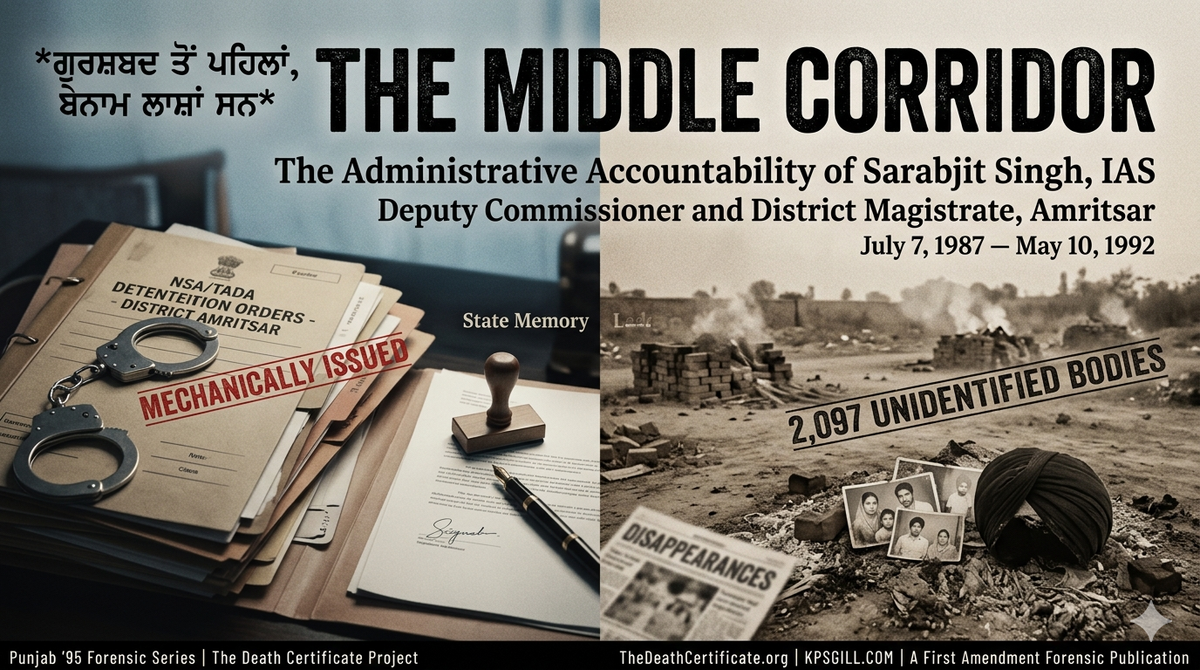
The Administrative Accountability of Sarabjit Singh, IAS
Deputy Commissioner and District Magistrate, Amritsar
July 7, 1987 — May 10, 1992
Punjab ’95 Forensic Series | The Death Certificate Project
TheDeathCertificate.org | KPSGILL.COM
A First Amendment Forensic Publication
ਗੁਰਸ਼ਬਦ ਤੋਂ ਪਹਿਲਾਂ, ਬੇਨਾਮ ਲਾਸ਼ਾਂ ਸਨ
Before the Gurshabad, the nameless dead.

“The archive does not close because the officer retired. It does not close because the officer received a decoration. It does not close because the officer wrote a book. It does not close because the officer died. An archive closes when it has been answered. This one has not been answered.”
— Editorial Principle, TheDeathCertificate.org
“He counted the bodies when the State wished no bodies to be counted.”
— Dedication to Jaswant Singh Khalra, 1952–1995
“A public file must verify an office. A dead witness may explain a memory. A book authored by an official is not a history. It is a claim. The claim must survive examination against the second ledger: the ledger of the disappeared.”
— Editorial Standard, TheDeathCertificate.org
LEGAL PUBLICATION NOTICE
This article is a public-interest forensic publication authored from Fresno, California, under the full protection of the First Amendment to the United States Constitution. All factual claims are classified under the four-tier evidentiary framework set out below. Claims about Sarabjit Singh IAS — a deceased former public official whose administrative record intersects directly with documented mass atrocities — are assessed with the evidentiary discipline this archive applies to all its subjects.
Sarabjit Singh IAS died on August 1, 2019. He cannot contest any factual claim in this article. The Death Certificate Project does not treat death as an exemption from historical accountability. The obligations of office do not expire at retirement, at the award of a civilian decoration, or at death. They expire when the record has been answered. This record has not been answered.
CrPC FRAMEWORK: This article does NOT apply Section 176(1A) CrPC retroactively. Section 176(1A) came into force on June 23, 2006. The operative 1987–1992 framework is: Articles 21 and 22 of the Constitution, CrPC Sections 56, 57, 58, 97, 167, 174, 176(1), and Section 4 of the Police Act, 1861, as applicable in Punjab during the relevant period. Post-1996 constitutional cases are cited only as judicial articulation of principles already rooted in the 1987–1992 constitutional text.
VERIFIED FACTS ONLY: No victim story, case citation, or factual claim in this article has been invented. Sources are identified throughout. Statistics from Ensaaf’s Crimes Against Humanity Data Project are drawn from primary-source interview data. Figures from the Khalra-CBI-NHRC record are drawn from Supreme Court proceedings and NHRC reports. Human Rights Watch and Amnesty International citations are from published reports. High Court citations are from reported judgments. Readers are encouraged to verify all claims independently.
EVIDENTIARY CLASSIFICATION FRAMEWORK
[PF] PROVED FINDING — Judicial findings, official records, CBI reports, NHRC proceedings, Supreme Court orders, authenticated official documents, High Court judgments, government gazette notifications.
[DA] DOCUMENTED ALLEGATION — Sourced, serious, grounded in identifiable human rights documentation, family accounts, or news reporting. Not yet conclusively adjudicated at the highest standard. Sourced throughout.
[AI] ANALYTICAL INFERENCE — Reasoned conclusion from institutional pattern, timing, omission, or cumulative record. Stated explicitly as inference. Not legal proof. Never presented as proved.
[PM] PANTHIC MEMORY — Moral, civilizational, and historical record preserved by the Sikh community, shahid families, and collective witness. Explicitly labeled throughout.
[HR] HUMAN RIGHTS DOCUMENTATION — Reports from Amnesty International, Human Rights Watch / Asia Watch, Ensaaf, Punjab Disappeared Archive Project (PDAP), Physicians for Human Rights, PUDR, PUCL, NHRC.
[Q] UNANSWERED PUBLIC QUESTION — A question formally placed on the public record.
[Q-RTI] RTI-READY PUBLIC RECORD REQUEST — Named document, named custodian, date range.
TABLE OF CONTENTS
Executive Summary — The Second Ledger
PART ONE: Identity, Tenure, and the Curated Legacy
I. The 148th Deputy Commissioner
II. The Book He Wrote: State Memory as Self-Exoneration
III. The Padma Shri: What the Republic Chose to Celebrate
PART TWO: The Administrative Architecture
IV. The DC/DM Office — Constitutional and Statutory Powers
V. The Punjab Emergency State, 1987–1992 — Direct Rule and the District Administrator
VI. CrPC Sections 56, 57, 58, 97, 174, and 176(1) — The Inquest Obligations
VII. NSA and TADA — The Executive Detention Authority
PART THREE: The Direct Evidence Portfolio
VIII. The Signature Trail — NSA Detention Orders Quashed by Constitutional Courts
IX. The Notice Cases — When Families Walked Into His Office
X. Case Exhibit A: Daljit Singh — More Than Twenty Meetings
XI. Case Exhibit B: Jatinder “Sukhi” Singh — The Acknowledged Petition
XII. Case Exhibit C: Sukhwinder Singh — The Inquiry That Changed Nothing
PART FOUR: The Crimes of the First Weeks
XIII. Anokh Singh Babbar — The Torture That Began Under His Command
XIV. Vairowal Police Station — The Geography of the Crime
XV. August 20 to August 30, 1987 — A Forensic Reconstruction
PART FIVE: The Statistical Architecture of Atrocity
XVI. Amritsar District as the Epicenter — Ensaaf Data Analysis
XVII. The Tehsil-Level Record — Tarn Taran, Ajnala, Baba Bakala, Patti
XVIII. The Escalating Pattern — 1987 to 1992 in Numbers
XIX. The Dispersal After 1992 — What the Statistics Prove About His Tenure
PART SIX: Operation Black Thunder — The Monument and Its Shadow
XX. The Operation: May 9–18, 1988
XXI. What Black Thunder Covered: The State Violence Operating Alongside It
XXII. The Surrender Appeal — His Role on May 15, 1988
XXIII. The State-Sanctioned Narrative and the Archive’s Answer
PART SEVEN: The Illegal Cremation Infrastructure
XXIV. The Three Cremation Grounds — Patti, Tarn Taran, Durgiana Mandir
XXV. The CBI Finds 2,097 — What That Number Means for His Tenure
XXVI. Firewood Vouchers, Municipal Records, and the Administrative Footprint
XXVII. The Body-to-File Chain — What Should Have Existed
XXVIII. The NHRC Compensation Orders — Justice Without Accountability
PART EIGHT: The Human Rights Documentation
XXIX. Amnesty International’s 1991 Report — Punjab Under His Command
XXX. Human Rights Watch / Asia Watch — The Punjab Report
XXXI. Ensaaf’s Primary-Source Record
XXXII. Punjab Disappeared (PDAP) — The Wider Canvas
PART NINE: The Three-DC Triad
XXXIII. Ramesh Inder Singh — The First Corridor, 1984–1987
XXXIV. Sarabjit Singh — The Middle Corridor, 1987–1992
XXXV. K.B.S. Sidhu — The Third Corridor, 1992–1996
XXXVI. The Triad of Silence — No Inquest, No Inquiry, No Certificate
PART TEN: The Police-Administrative Nexus
XXXVII. SSP Amritsar During His Tenure — Alam, Gupta, and the Chain of Command
XXXVIII. SSP Tarn Taran and the Extension of the Cremation Geography
XXXIX. The Reward Culture, Encounter Killings, and the Administrative Alibi
PART ELEVEN: Statutory Duties and Their Breach
XL. The Mandatory Nature of Section 174 CrPC
XLI. The DC/DM’s Power Under Section 176(1) — The Independent Magisterial Inquiry
XLII. The Section 97 Search Warrant — The Unused Tool
XLIII. The Section 58 Arrest Report — What the Record Should Have Shown
PART TWELVE: The Missing Record
XLIV. What the DC’s Office Was Required to Maintain
XLV. The Destruction Schedule That Cannot Excuse the Pattern
XLVI. The Paper Trail That Should Have Been — and Was Not
PART THIRTEEN: The Public Legacy vs. the Human Rights Ledger
XLVII. Virsa Vihar — Culture After Counterinsurgency
XLVIII. The Book That Celebrates Operation Black Thunder
XLIX. The Amritsar Left Behind — The Dead He Did Not Count
PART FOURTEEN: Comparative Constitutional Accountability
L. Article 21 and the Right to Life — The Framework He Administered
LI. D.K. Basu and Nilabati Behera — Period-Proximate Constitutional Principles
LII. The Custodial Death Regime and the District Magistrate’s Position
PART FIFTEEN: The Forensic Matrix
LIII. The Evidentiary Summary Table
LIV. The Missing Documents Checklist
LV. RTI-Ready Record Requests
PART SIXTEEN: Posthumous Forensic Cross-Examination
LVI. The Forty Questions for the Public Record
PART SEVENTEEN: Closing Argument
LVII. The Second Ledger
LVIII. The Burden the Dead Cannot Lift

EXECUTIVE SUMMARY: THE SECOND LEDGER
THE CONTROLLING ARGUMENT
Padma Shri Sarabjit Singh, IAS, was the Deputy Commissioner and District Magistrate of Amritsar from July 7, 1987, to May 10, 1992. He administered Amritsar for four years, ten months, and three days. During that precise window, Amritsar district became — and remained — the epicenter of India’s most extensively documented system of enforced disappearance, extrajudicial execution, and illegal cremation. The scale was not peripheral. It was definitional.
Ensaaf’s Crimes Against Humanity Data Project, built through primary-source interviews with surviving families, documents 2,098 cases of enforced disappearance and extrajudicial execution in Amritsar district across the counterinsurgency period. This represents 39.5 percent of all documented violations across all of Punjab — nearly two-fifths of the state’s documented atrocity count concentrated in one district. During his tenure specifically, Amritsar was the near-exclusive concentration point for state violence before that violence dispersed statewide after 1992.
The Central Bureau of Investigation, mandated by the Supreme Court of India, confirmed 2,097 illegal cremations at three cremation grounds — Patti, Tarn Taran, and Durgiana Mandir — all within the Amritsar revenue district. The Supreme Court described the findings as disclosing “flagrant violation of human rights on a mass scale.” Of the 2,097: 585 fully identified, 274 partially identified, 1,238 entirely unidentified. The NHRC recommended approximately ₹27.94 crore for 1,513 identified families — without ordering criminal investigation into any death. The criminal process, operating thirty years later, has reached fewer than a hundred of these cases. Most of the dead remain without justice, without investigation, without a death certificate that tells the truth.
Sarabjit Singh’s DC/DM tenure sits inside the core temporal arc of this carnage. His administrative office — the office of the Deputy Commissioner and District Magistrate of Amritsar — was positioned by law, by convention, and by the command structure of the Punjab state at the apex of the civilian accountability chain. He was not a spectator. He was not a bystander in some adjacent district. He was the supreme civil executive of the district where the worst documented atrocities in the history of modern Punjab’s counterinsurgency were systematically carried out.
The state’s preferred defense mechanism is always the same: narrow the question to personal criminal authorship. Did he personally pull a trigger? Did he personally order any specific cremation? Did he personally authorize any particular disappearance? The Death Certificate Project refuses this narrowing. The question is institutional. The question is jurisdictional. The question is statutory. And the question is archival.
THE SIX PROVED PROPOSITIONS
[PF] PROPOSITION ONE — JURISDICTIONAL COMMAND:
Official Amritsar district registries confirm Sarabjit Singh IAS as Deputy Commissioner from July 7, 1987, to May 10, 1992. As DC, he simultaneously held the office of District Magistrate — the civil-executive apex of the Amritsar administrative hierarchy. This is not a disputed fact. It is an official record.
[PF] PROPOSITION TWO — THE DIRECT SIGNATURE TRAIL:
Punjab & Haryana High Court records explicitly quote detention orders bearing the inscription: “I Sarbjit Singh, IAS, District Magistrate, Amritsar, am satisfied in respect of [petitioner]…” These orders — issued under the National Security Act — were later found by constitutional courts to have been issued mechanically, without genuine application of mind, and in one case to detain a person already in judicial custody on other charges. Multiple NSA detention orders signed by him as District Magistrate were quashed by the High Court. His office was not a passive civil administration. It was an active participant in the detention architecture.
[PF] PROPOSITION THREE — THE NOTICE CASES:
Human Rights Watch / Asia Watch field documentation places the families of disappeared persons directly inside the DC’s accountability channel during his tenure. In the Daljit Singh case, the family held more than twenty face-to-face meetings with Deputy Commissioner Sarabjit Singh himself, SSP Sanjiv Gupta, and IG Mahal Singh Bhullar. Officials gave assurances. The police maintained denial. Daljit Singh was never produced before a magistrate. He was extrajudicially executed on or around October 14, 1989. His body was never returned. In two further cases — Jatinder “Sukhi” Singh and Sukhwinder Singh — written petitions were submitted to and acknowledged by the Deputy Commissioner’s office. In each case, the disappeared man was never found.
[PF] PROPOSITION FOUR — ANOKH SINGH BABBAR:
Sarabjit Singh became DC/DM on July 7, 1987. Anokh Singh Babbar — a senior Babbar Khalsa figure serving as an SGPC Golak Inspector, from village Varing Soba Singh, Amritsar district — was arrested on approximately August 20, 1987, and killed at Vairowal Police Station, Khadur Sahib, Amritsar district, on August 30, 1987. The killing was preceded by documented torture of extraordinary brutality — preserved in extensive community martyrdom accounts. This death occurred within the first 54 days of Sarabjit Singh’s tenure as the District Magistrate of the district where the killing happened. A custodial death of this nature, inside an Amritsar police station, triggered mandatory reporting obligations under CrPC Sections 174 and 176(1). No public record of any independent magisterial inquiry has ever been produced.
[PF] PROPOSITION FIVE — THE CREMATION RECORD:
The CBI-confirmed illegal cremations at Amritsar district crematoria span 1984–1994, a period that substantially overlaps with Sarabjit Singh’s tenure. The cremation pattern required, as a mechanical administrative matter, firewood vouchers purchased with public funds, municipal records of unidentified bodies, police vouchers for transportation, and reporting through executive magistrates to the District Magistrate. None of this administrative machinery could have operated at the scale documented — 2,097 cremations — without producing an administrative footprint that the District Magistrate’s office was positioned to see, audit, or inquire into.
[PF] PROPOSITION SIX — THE BOOK AND THE SILENCE:
In 2002, Sarabjit Singh published “Operation Black Thunder: An Eyewitness Account of Terrorism in Punjab,” a detailed memoir of his administrative role during the May 1988 operation. The book constitutes an explicit, published exercise in public memory-making about his tenure. It does not address the disappeared. It does not address the illegal cremations. It does not address the families who came to his office seeking their sons. It does not address the NSA orders his office signed and courts later threw out. It does not address Anokh Singh Babbar. It does not address the 2,097.
The silence in that book is not accidental. It is the mirror image of the missing death certificates. And it is the reason this archive exists.
THE CONTROLLING QUESTION
His book celebrates what he chose to record. This archive asks what he chose not to record.
Where is the executive record of Amritsar district from July 7, 1987, to May 10, 1992?
Where are the Section 174 inquest files for the custodial deaths?
Where are the Section 176(1) magisterial inquiry orders for the suspicious deaths?
Where are the files for Daljit Singh, Jatinder Singh, Sukhwinder Singh?
Where is the Section 97 search warrant record — the most basic tool available to the District Magistrate for locating a missing person — in even one of the cases where families walked into his office?
Where are the unidentified-body disposal records, the firewood vouchers, the municipal cremation registers, and the executive magistrate’s reports from 1987 to 1992?
Where is the correspondence between the DC’s office and the DGP, the Home Secretary, the Chief Secretary, and the Governor, regarding the families who were coming to the district administration for help?
If these records exist, produce them. If they were destroyed, produce the destruction order and the retention schedule under which they were weeded. If they were never generated, explain why the DC/DM office of one of India’s most intensely violent administrative jurisdictions in the late twentieth century produced no documentary record of the civilian accountability functions it was legally required to perform.
This archive will publish any response, any document, and any correction in full, without editing.
Until the record is produced, the silence itself is the second ledger.
PART ONE: IDENTITY, TENURE, AND THE CURATED LEGACY
I. The 148th Deputy Commissioner
There is a list maintained by the District Administration of Amritsar — a list of Deputy Commissioners stretching back to the British appointment of L. Saunders on April 20, 1849, the first DC of the district following its incorporation into the Punjab administration after the Second Anglo-Sikh War. The list is a roster of administrative command. It records who held the apex civilian executive position in one of the most historically significant districts in the Indian subcontinent — the district that contains Sri Darbar Sahib, the Golden Temple, the center of Sikh religious and political geography for three centuries.
Sarabjit Singh IAS appears on that list as the 148th Deputy Commissioner of Amritsar. He assumed charge on July 7, 1987, succeeding Ramesh Inder Singh IAS, who had served since June 4, 1984 — the day of Operation Blue Star. He relinquished charge on May 10, 1992, the day before K.B.S. Sidhu IAS assumed office.
[PF] This chronological sequence — Ramesh Inder Singh (June 4, 1984 to July 7, 1987), then Sarabjit Singh (July 7, 1987 to May 10, 1992), then K.B.S. Sidhu (May 11, 1992 to August 11, 1996) — is not merely a bureaucratic record. It is the administrative spine of the Punjab disappearance era. Three consecutive officers. One district. Twelve years. The period in which the CBI confirmed 2,097 illegal cremations. The period in which Ensaaf documented 2,098 cases of enforced disappearances and extrajudicial executions in Amritsar district alone. The period in which Jaswant Singh Khalra exposed the cremation record using publicly accessible firewood registers, and was subsequently abducted and murdered for doing so.
The Death Certificate Project has already published detailed forensic analyses of the first and third corridors: Ramesh Inder Singh’s period in “The Van Without a Log” and related articles, and K.B.S. Sidhu’s period in “Forty-Nine Days of Silence” and the ten-part Cross-Examination series. This article completes the triad. Sarabjit Singh’s corridor — the middle corridor, 1987 to 1992 — is the longest of the three. It is the period in which the machinery hardened from selective brutality into operational, systematic, bureaucratically-facilitated mass atrocity. And it is the period whose civil executive has received the least forensic scrutiny in proportion to its historical significance.
This is the article that corrects that imbalance.
[PF] The facts about Sarabjit Singh’s identity are not in dispute. He was a member of the Indian Administrative Service. The Tribune’s obituary of August 5–6, 2019, identifies him as “Padma Shri Sarbjit Singh, former Deputy Commissioner (DC) of Amritsar.” It records his death on August 1, 2019. It notes that he “played an important role in breaking the terrorists’ siege of the Golden Temple under a campaign — Operation Black Thunder — in May 1988.” It notes that he “wrote a highly acclaimed book ‘Operation Black Thunder: An Eyewitness Account of Terrorism in Punjab.’” It notes that he “served as the Virsa Vihar head.” He is survived by his wife, two daughters, and a son.
This is the state-sanctioned version of his life. It is organized around Operation Black Thunder, around the Padma Shri, around a book, and around a cultural institution. It is organized, in other words, around the things a decorated civil servant chose to leave as his legacy. The Death Certificate Project’s task is to place the second ledger alongside the first: the ledger that was not written in his book, was not mentioned in his obituary, and has never been publicly examined in proportion to its weight.
The families of the disappeared — the families who came to his office and were turned away, the families whose sons and brothers and fathers were cremated as “unidentified” in the three cremation grounds of his district while he was its civil executive — received no obituary. Their names were not in the state-curated memory of the counterinsurgency era. They were, in the terminology of this archive, the nameless dead. ਬੇਨਾਮ ਲਾਸ਼ਾਂ ਸਨ.
II. The Book He Wrote: State Memory as Self-Exoneration
In 2002, ten years after he left Amritsar and eight years after the Khalra investigations began to expose the illegal cremation system, Sarabjit Singh published his memoir: Operation Black Thunder: An Eyewitness Account of Terrorism in Punjab.
[PF] The existence of this book is confirmed by multiple sources: the Tribune obituary, the Goodreads listing with reader reviews, and the IPCS (Institute of Peace and Conflict Studies) review. The Goodreads description, drawn from reader accounts, characterizes it as “a first hand account of the post Blue Star terrorism in Punjab, by the DC of the worst affected district — Amritsar.” The IPCS describes it as an “eyewitness account” of Operation Black Thunder II, “acclaimed as a successful manoeuvre that accomplished its objectives without unnecessary bloodshed and in unprecedented transparency.”
[AI] The publication date — 2002 — is analytically significant. By 2002, the Khalra-CBI-NHRC record was already in the public domain. The Supreme Court had issued its December 12, 1996 order describing the CBI findings as “flagrant violation of human rights on a mass scale.” The NHRC had received compensation claims. The international human rights community had extensively documented the Punjab cremation system. The Khalra trial was underway. In this context, the decision to publish a memoir celebrating Operation Black Thunder without any engagement with the documented human rights record of the same administrative jurisdiction, over the same administrative period, is not an act of forgetfulness. It is a deliberate act of selective public memory-making.
[AI] What is most telling about this book is not what it contains, but what it omits. By every published account, it is a detailed account of the DC’s role during a high-profile security operation. It chronicles the political pressures, the operational decisions, the negotiations, the final surrender. It is, in the terminology of this archive, the first ledger — the one the state wished to preserve.
The second ledger — the ledger of the disappeared, the ledger of the illegal cremations, the ledger of the families who came to the DC’s office and received nothing — was not written. Or if it was, it was not published.
[Q] This archive asks one question of that book: among all the events of your forty-eight months as DC/DM of Amritsar, in a district that was simultaneously producing the highest concentration of documented human rights violations in the state, why does your published account not contain a single page about the men who were arrested by police and never produced before a magistrate? Why does it not contain a single chapter about the families who petitioned your office? Why does it not contain a single paragraph about the CrPC Section 174 inquest machinery that should have been generating paper inside your administrative office every time a suspicious or custodial death occurred in your jurisdiction?
That omission is the argument this article makes. Not because silence is the same as guilt. But because silence from the apex civil executive of a jurisdiction that produced 2,097 documented illegal cremations — silence in his published memoir, silence in his public record, silence in every available public forum — is itself an administrative and historical datum that demands examination.
A policeman who was in the room when a person was tortured has legal exposure. A district magistrate who received the mandatory police reports of suspicious deaths, who had the statutory power to order independent inquiry, who received petitions from families of the disappeared, and who subsequently wrote a detailed memoir of his tenure that does not address any of this — has a different kind of exposure. It is the exposure of the public record. And that record is this article.
III. The Padma Shri: What the Republic Chose to Celebrate
[PF] Sarabjit Singh IAS received the Padma Shri — India’s fourth highest civilian award — for his role during the Punjab counterinsurgency. The Tribune obituary confirms the award. The specific year and formal citation require verification from the official MHA records, but the Tribune’s identification of him as “Padma Shri Sarbjit Singh” confirms the award’s existence and its association with his counterinsurgency service.
[AI] It is worth pausing to examine what the Padma Shri means in this context. The Padma awards are the Republic of India’s formal mechanism for recognizing distinguished service to the nation. They are recommended by ministries, by state governments, by those in power. They reflect official judgment about what conduct deserves national celebration.
In the Punjab counterinsurgency context, multiple civil servants and police officers received the Padma Shri. Ramesh Inder Singh IAS — his predecessor as DC Amritsar, whose tenure covers Operation Blue Star — also received the Padma Shri. The pattern is consistent: the officers who administered the repressive machinery were decorated for their efficiency. The mechanism for honoring them was the same Republic that had simultaneously authorized the machinery that generated 2,097 illegal cremations.
[AI] The Padma Shri awarded to Sarabjit Singh should be understood as a historical document, not merely a biographical note. It records the Republic’s judgment, at the moment of award, about what his service represented. It celebrates, in the Republic’s own official register, the administrative conduct of a period that produced mass documented atrocity. The award does not constitute evidence of wrongdoing on his part. But it constitutes evidence of the state’s systematic preference for celebrating the administrators of the counterinsurgency over investigating them.
[Q] The Death Certificate Project asks: at the time the Government of India awarded the Padma Shri to Sarabjit Singh IAS, what portion of his administrative record during 1987–1992 was reviewed against the human rights record of his district? What process existed for assessing whether the conduct to be celebrated had generated documented civilian harm? How was a decision made to honor conduct associated with a period in which Amritsar district produced the highest concentration of enforced disappearances and extrajudicial executions in Punjab?
These questions do not challenge the award’s legality. They challenge its completeness as a record of the period it honors. The Padma Shri, in this context, is part of the same phenomenon as the missing death certificates: a system of official record-keeping that recorded what the state wished to preserve and left blank what the state wished to forget.
PART TWO: THE ADMINISTRATIVE ARCHITECTURE
IV. The DC/DM Office — Constitutional and Statutory Powers
To understand the accountability claim this archive makes against Sarabjit Singh IAS, it is necessary first to understand what his office was. The Deputy Commissioner is not a figurehead. In the Punjab administrative system, as in most Indian state systems that inherited the colonial district structure, the DC is simultaneously three officers in one: the Deputy Commissioner, who manages revenue, development, and general civil administration; the District Collector, who is responsible for land revenue, disaster relief, and agricultural administration; and the District Magistrate, who holds the apex executive magistracy of the district.
[PF] The Amritsar District Administration’s own published description of the office confirms its tripartite character: “The responsibility of General Administration of the District lies with the Deputy Commissioner. He is the Executive Head and has three fold roles as Deputy Commissioner, District Collector and District Magistrate.” The DC’s powers include preventive detention under the NSA, TADA, and other security statutes; the powers of a Registrar; the appointment of sub-divisional magistrates and executive magistrates who report to him; and the overarching responsibility for law and order, public safety, and civil accountability in the district.
The District Magistrate function is particularly critical for this analysis. As District Magistrate, the DC sits at the apex of the district’s executive magistracy. All executive magistrates in the district — sub-divisional magistrates, additional district magistrates, tehsildar-class magistrates — report to him and work under his superintendence. This means that all the mandatory CrPC functions that involve magistrates — receiving police reports of arrests, conducting inquests into suspicious deaths, receiving complaints of illegal custody — flow through an administrative chain that terminates, ultimately, at the DC/DM’s office.
[PF] Rule 1.15 of the Punjab Police Rules, 1934, as referenced by the District Administration’s own website, provides the DC/DM with specific powers over the police within his district. The DC is not the operational commander of the police — the SSP is. But the DC/DM is the civil authority to whom the police are accountable for custodial matters, inquest matters, and matters of civil liberty. When the police hold a person without producing them before a magistrate, it is the magistracy — under the DC/DM — that has the power to order production. When a suspicious death occurs in police custody, it is the magistracy that has the power to order an independent inquiry. When a family petitions the district administration about a missing relative, it is the DC/DM’s office that holds the statutory tools to respond.
[AI] The architecture of accountability makes the argument that this archive pursues. It is not an argument based on personal criminal authorship. It is an argument based on institutional position. The DC/DM of Amritsar from 1987 to 1992 held the statutory tools, the constitutional authority, the institutional position, and — through the direct notice cases documented below — the actual knowledge of disappearances occurring in his jurisdiction. The question is not whether he pulled any trigger. The question is whether he used the tools his office gave him, and if not, why not.
V. The Punjab Emergency State, 1987–1992 — Direct Rule and the District Administrator
[PF] A critical context for understanding Sarabjit Singh’s tenure is the administrative-political condition of Punjab itself. Amnesty International’s 1991 report documented that Punjab had been under Governor’s Rule (direct central administration) since May 1987 — the month before Sarabjit Singh arrived as DC Amritsar. This means his entire tenure until the February 1992 elections was conducted under direct central rule, without an elected state government.
Direct rule fundamentally altered the administrative ecology. With no elected government and no council of ministers, the Governor and the Home Ministry in Delhi exercised direct authority over the state machinery. The district administration operated in a political vacuum — one that, in practice, meant the security apparatus had fewer civilian constraints. The IAS officers who served as district administrators during this period were not operating inside a normal civilian-political accountability structure. They were operating inside a security-state structure in which the primary organizing principle of governance was counterinsurgency.
[AI] This context does not reduce Sarabjit Singh’s accountability. It compounds it. A District Magistrate operating under direct rule — without the political friction of an elected government, without the competing pressures of a cabinet, without the moderating influence of elected local representatives — was the primary civilian figure in the accountability architecture. The DC/DM was not merely one node in a complex political system. He was, in the absence of elected government, the civilian conscience of the district. The disappearances that occurred, the cremations that were conducted, the families that came to the DC’s office — all of these happened under a governance structure in which the DC/DM had, if anything, a greater concentration of civilian accountability authority than in normal times.
The Governor’s Rule also meant that the chain of accountability ran directly upward: DC → Divisional Commissioner → Chief Secretary → Governor → Home Ministry. When families petitioned the DC about disappeared relatives, the DC’s obligation was not merely to manage the complaint downward (by asking the SSP) but to escalate upward if necessary, and to maintain the documentary record of that escalation. That record — the record of what the DC’s office communicated to the Divisional Commissioner, the Chief Secretary, or the Governor about the patterns of illegal detention and disappearance in Amritsar — has never been produced.
VI. CrPC Sections 56, 57, 58, 97, 174, and 176(1) — The Inquest Obligations
The Criminal Procedure Code of 1973 is the load-bearing statutory framework for this archive’s accountability analysis. The key provisions during Sarabjit Singh’s tenure were:
Section 56: Requires a police officer who arrests a person without a warrant to produce that person before a magistrate without unnecessary delay. This provision was routinely violated during the Punjab counterinsurgency, when persons were arrested and held without being produced before any magistrate. [PF]
Section 57: Provides that no police officer shall detain a person without a warrant for more than 24 hours without producing them before a magistrate. The families of the disappeared documented throughout the 1987–1992 period describe the systematic violation of this provision: persons arrested by police who were never produced, never acknowledged, and ultimately never returned. [PF]
Section 58: Requires a police officer who detains a person under Section 56-57 to report the fact of detention and the grounds to the District Magistrate. This provision created a mandatory information flow: every arrest in the district was supposed to generate a report to the DC/DM’s office. If these reports were filed, the DC’s office received regular information about who was being held. If they were not filed, the DC had the power to require compliance. Either way, the DC/DM occupied the institutional apex of the arrest-to-production chain. [PF]
Section 97: One of the most powerful and underused tools in the DC/DM’s arsenal. This provision empowers any District Magistrate to issue a search warrant authorizing police or executive magistrates to enter premises where a person may be wrongfully confined. It is the formal, statutory mechanism for searching police stations and detention facilities when families complain that a relative has been illegally held and not produced. The Death Certificate Project is not aware of a single public record of a Section 97 search warrant being issued by the Amritsar DC/DM’s office during the 1987–1992 period — not for Daljit Singh, not for Jatinder Singh, not for Sukhwinder Singh, not for any of the hundreds of families whose petitions, telegrams, and personal appeals made the disappearances formally known to the district administration. [Q]
Section 174: Mandates that when a police officer receives information that a person has died under suspicious circumstances, or has been killed, he shall submit an immediate report to the nearest Executive Magistrate. The Executive Magistrate then has the power to hold an inquest. This provision created a mandatory paper trail: every suspicious or custodial death was supposed to generate a police report, followed by an executive magistrate’s inquest, followed by a report to the district administration. If this machinery had operated as designed during Sarabjit Singh’s tenure, the DC/DM’s office would have accumulated inquest records for hundreds of deaths — including the death of Anokh Singh Babbar at Vairowal Police Station in August 1987. [PF] The absence of any public record of such inquest proceedings during his tenure is itself an administrative datum. [AI]
Section 176(1): The most powerful tool. This provision empowers a District Magistrate to hold, independently of any police inquest, his own inquiry into the cause of any death that occurred under police custody or in circumstances suggesting state involvement. The District Magistrate’s inquiry under Section 176(1) is independent of the police investigation. It is conducted by the civil administration. It produces a record. It has subpoena-equivalent powers. It is the mechanism the Code provides for precisely the situation this archive describes: a district in which men are dying in police custody under disputed circumstances.
[AI] The significance of Section 176(1) for this analysis cannot be overstated. During the entire period of Sarabjit Singh’s tenure — four years and ten months, during which Amritsar district produced, according to Ensaaf’s data, hundreds of documented extrajudicial executions — there is no public record of the Amritsar DC/DM having ordered a single Section 176(1) independent magisterial inquiry into any police-connected death. Not one. The families who came to the office, the telegrams that were sent, the petitions that were filed, the 2,097 bodies that were cremated — none of this appears to have generated the administrative response that Section 176(1) empowered and, in custodial death contexts, required.
VII. NSA and TADA — The Executive Detention Authority
The National Security Act (NSA) of 1980 and the Terrorist and Disruptive Activities (Prevention) Act (TADA) of 1985 (extended 1987, 1989, 1991) were the two principal legal instruments through which the Punjab security state maintained its detention architecture during the 1987–1992 period.
[PF] Under the NSA, the District Magistrate held the power to issue preventive detention orders. These were executive orders — not judicial orders — detaining individuals without trial for specified periods. The DC/DM of Amritsar was not merely an administrator who watched the security machinery operate. He was, under the NSA, an active participant in the detention architecture, issuing binding executive orders to confine individuals on the basis of police intelligence assessments.
Under TADA, the District Magistrate similarly held significant powers, including the authority to receive reports of TADA detentions and to exercise certain supervisory functions over the detention machinery.
The High Court judgments cited later in this article — the cases of Kulwant Singh, Lakhwinder Singh @ Lakha, and Sohan Singh — establish that Sarabjit Singh was not merely supervising these detention powers from a distance. He was personally signing the detention orders. His name appears, in direct quotation, in at least one High Court judgment that reproduces the text of his order: “Whereas I Sarbjit Singh, IAS, District Magistrate, Amritsar, am satisfied in respect of [petitioner]…”
This is the direct signature trail. It is the clearest available documentary evidence that the DC/DM office of Amritsar was not a passive bystander to the detention machinery. It was an administrative participant, issuing orders in the DM’s own name, in proceedings that constitutional courts later found to be legally defective.
PART THREE: THE DIRECT EVIDENCE PORTFOLIO
VIII. The Signature Trail — NSA Detention Orders Quashed by Constitutional Courts
The clearest documentary evidence connecting Sarabjit Singh personally to the administrative machinery of detention is not the general pattern of atrocity in his district. It is the specific record of Punjab & Haryana High Court proceedings in which his own NSA detention orders were examined and found legally defective.
Case One: Kulwant Singh v. State of Punjab (September 30, 1988)
[PF] The Punjab & Haryana High Court judgment in the case of Kulwant Singh v. State of Punjab directly quotes the detention order issued by Sarabjit Singh as District Magistrate. The court’s citation of his words — “Whereas I Sarbjit Singh, IAS, District Magistrate, Amritsar, am satisfied in respect of Sh. Kulwant Singh… at present in custody in Central Jail Amritsar… it is necessary to detain him” — establishes the personal identification of the signing officer beyond any reasonable doubt.
The court’s analysis found that the order was issued in a mechanical manner and without genuine application of mind. The petitioner was already in secure judicial custody in Central Jail Amritsar on separate charges. The court found that there was no real apprehension of release that would have justified invoking the preventive detention power. The purpose of the detention order, as the court effectively found, was to prevent bail — to use the executive detention power as an administrative mechanism for extending custodial confinement beyond what the ordinary criminal process would permit.
The detention order was quashed. The court, however, noted that the petitioner remained in custody on the other case.
Case Two: Lakhwinder Singh @ Lakha v. State of Punjab
[PF] In this case, an NSA detention order issued by Sarabjit Singh as District Magistrate, Amritsar, was challenged on the same grounds. The petitioner was already in judicial custody. The High Court applied established Supreme Court precedent and quashed the preventive detention order.
The pattern — person already in judicial custody, DM issues NSA detention order as a mechanism to prevent bail, court quashes the order — is identical to the Kulwant Singh case. This is not a coincidence. It is an administrative pattern. The DC/DM’s office was receiving police representations about persons already in custody and converting them into preventive detention orders that extended confinement beyond the ordinary process.
Case Three: Sohan Singh v. State of Punjab (February 27, 1990)
[PF] In this case, the High Court dealt with an NSA detention order signed by Sarabjit Singh on September 26, 1989. Again, the petitioner was already in jail. Again, the court applied Supreme Court precedent. Again, the detention order was quashed.
The Administrative Pattern
[AI] Three documented instances in which NSA detention orders signed by Sarabjit Singh as District Magistrate were quashed by the High Court for legal deficiencies establish a pattern, not a series of isolated errors. The pattern is: the DC/DM’s office received police requests for preventive detention of persons already in custody, converted those requests into executive detention orders without genuine independent assessment, and those orders were later found by courts to be legally unsustainable.
This is significant for three reasons. First, it establishes that the DC/DM’s office was not a passive relay station that rubber-stamped police requests — it was an active participant in the detention process, lending executive authority and the District Magistrate’s own name to orders that extended confinement. Second, it establishes a pattern of legal deficiency: the DC/DM’s office was not applying the legal standard the NSA required. Third, it implies a larger universe of orders. If three reached the High Court and were quashed, how many did not reach the High Court? How many NSA detention orders signed during his tenure were never challenged — because the detainee was too frightened to challenge them, because the family had no access to legal counsel, because the detention ended before a writ could be filed, or because the detainee disappeared into the broader machinery of illegal custody and was never seen again?
[Q] The Death Certificate Project formally asks: How many total NSA and TADA-related detention orders did Sarabjit Singh sign as District Magistrate of Amritsar between July 7, 1987, and May 10, 1992? Of those, how many were challenged in court? How many were quashed? How many persons detained under those orders were subsequently found to have been extrajudicially executed or to have disappeared? Where are the detention registers that should answer these questions?
IX. The Notice Cases — When Families Walked Into His Office
The second category of direct evidence is more intimate and more devastating. These are not court cases about abstract legal deficiencies in detention orders. These are the accounts of families who walked into the Deputy Commissioner’s office in Amritsar, sat across from the DC or his subordinates, filed written petitions, and begged for help finding their sons and brothers. The DC/DM personally received delegations. His name appears in the documentation. The families came. They were acknowledged. And the disappeared were never found.
Human Rights Watch / Asia Watch’s field documentation from the 1990–1991 period provides the most detailed accounts of families who engaged directly with the district accountability chain during Sarabjit Singh’s tenure. The accounts are specific: they name the DC, they name the SSP, they name the IG, they describe the number of meetings, they describe the outcomes.
X. Case Exhibit A: Daljit (Daljeet) Singh — More Than Twenty Meetings
[HR] The Daljit Singh case is the strongest single “notice” case in the Sarabjit Singh accountability record. The documentation is from Human Rights Watch / Asia Watch’s Punjab field investigation.
The Profile:
- Name: Daljit Singh (sometimes spelled Daljeet Singh)
- Age: Approximately 27–29 at time of disappearance
- Residence: Mahal Sub-Urban, Amritsar
- Ensaaf record: Extrajudicial execution, October 14, 1989
The Abduction:
[HR] Daljit Singh was arrested on June 7, 1989, by police from Amritsar. The arrest was not recorded in any police register. He was not produced before a magistrate. His arrest was not formally acknowledged.
The Notice Chain:
[HR] The family’s response was immediate and thorough. They dispatched urgent telegrams to the Governor of Punjab, the Director General of Police, and — directly — to the Deputy Commissioner of Amritsar. This was not a quiet private inquiry. This was a formal, written, traceable notification to the civil executive of the district that a person had been taken by police and was not being produced.
The father then escalated from telegrams to personal appearances. Human Rights Watch / Asia Watch field documentation records that the father and other community members held more than twenty face-to-face meetings directly with DC Sarabjit Singh, SSP Sanjiv Gupta, and IG Mahal Singh Bhullar.
Read that number carefully. More than twenty. This was not a single, desperate petition. This was a prolonged, sustained effort by a family that believed, or hoped, that the civil executive of the district would exercise his authority to demand the production of their missing relative. Twenty meetings. Twenty occasions on which the Deputy Commissioner of Amritsar was personally confronted with evidence of illegal custody. Twenty opportunities to issue a Section 97 search warrant. Twenty opportunities to direct a sub-divisional magistrate to investigate. Twenty opportunities to require the SSP to explain the basis for detention and produce the detainee. Twenty opportunities to escalate the matter to the Divisional Commissioner, the Chief Secretary, or the Governor.
The Outcome:
[HR] Each time, officials reportedly gave empty verbal assurances that they would look into the matter. The police maintained denial. Daljit Singh was never produced before a magistrate. He was never officially acknowledged as a person in custody. His arrest was never formally recorded.
Daljit Singh’s Ensaaf-documented date of death is October 14, 1989 — four months and seven days after his arrest. He died in the category of extrajudicial execution. His body was not returned to his family.
The Accountability Analysis:
[AI] The Daljit Singh case strips away every defense available to Sarabjit Singh. The defense of administrative ignorance — “I didn’t know what was happening in my district” — is not available here. He knew. He was personally told. Twenty times. By the family. In face-to-face meetings.
The defense of bureaucratic complexity — “these matters are handled by the SSP and I relied on his assurances” — is not available here either. A District Magistrate who holds Section 97 search warrant authority — a power that lets him order the physical search of police stations — and who is repeatedly told that a specific person has been taken by specific police in a specific location, cannot discharge his accountability by asking the SSP for an assurance. The SSP is the head of the organization that took the person. The DM has independent powers precisely because the SSP cannot be the final word on the SSP’s own conduct.
The defense of limited information — “I had only the police’s account to go on” — is not available here either. The family was his source. Twenty meetings means twenty direct accounts from the person’s own relatives, describing a specific arrest by specific officers on a specific date.
[AI] What the Daljit Singh case proves is not that Sarabjit Singh ordered the killing. It proves something more precise: that the DC/DM of Amritsar had direct, personal, repeated notice of a specific enforced disappearance, held the legal authority to investigate it, and produced no documented administrative response — no Section 97 search warrant, no magistrate’s inquiry, no escalation letter, no official record of action. And the person died.
XI. Case Exhibit B: Jatinder “Sukhi” Singh — The Acknowledged Petition
[HR] The Jatinder Singh case provides a slightly different category of evidence: not just notice, but acknowledgment. In the Daljit Singh case, the DC is documented as having given verbal assurances. In the Jatinder Singh case, the DC explicitly acknowledged receipt of the written petition and stated that he had personally spoken with SSP Sanjiv Gupta about the matter.
The Profile:
- Name: Jatinder Singh (also known as “Sukhi”)
- Age: Approximately 23 at time of disappearance
- Residence: Amritsar
- Ensaaf record: Disappeared, August 31, 1990
The Abduction:
[HR] Jatinder Singh was abducted from a roadside on August 31, 1990, by uniformed Amritsar police personnel. Witnesses observed the abduction. The police did not disclose their destination. No arrest was formally recorded.
The Notice Chain:
[HR] Jatinder’s father submitted written petitions directly to Deputy Commissioner Sarabjit Singh and met with him personally on at least two occasions. On at least one of these occasions, DC Sarabjit Singh explicitly acknowledged receipt of the petition and stated that he had spoken with SSP Sanjiv Gupta about the matter.
The Outcome:
[HR] Despite the DC’s acknowledgment and his stated conversation with the SSP, the police maintained total denial of Jatinder Singh’s arrest. He was never produced before a magistrate. He was never located. He joined the ranks of the permanently disappeared.
The Accountability Analysis:
[AI] The Jatinder Singh case establishes a specific form of accountability: the DC’s own statements create a documentary record of notice and of at least one attempted response. He spoke with the SSP. He acknowledged the petition. But speaking with the SSP about a person the SSP’s officers have illegally arrested is not the same as exercising independent magistracy authority. It is delegating the accountability back to the institution being accused of the illegality.
[AI] The DC/DM had tools that did not depend on the SSP’s cooperation. A Section 97 search warrant could have required physical inspection of police facilities in Amritsar. A magistrate’s inquiry could have compelled testimony from the officers involved. An escalation letter to the Divisional Commissioner or Home Secretary could have triggered review from above. None of these were used — at least, none produced any public record. Jatinder Singh disappeared. His file ended, in the district administration’s record, with the DC’s stated conversation with the SSP and no further documented action.
XII. Case Exhibit C: Sukhwinder Singh — The Inquiry That Changed Nothing
[HR] The Sukhwinder Singh case provides the third variation on the notice pattern: an inquiry direction that was formally created inside the DC’s bureaucracy but was subsequently neutralized by the police hierarchy.
The Profile:
- Name: Sukhwinder Singh
- Residence: Chawinda Devi, Amritsar district
The Abduction:
[HR] Sukhwinder Singh was illegally arrested, severely beaten, and held in what appears to have been a ransom situation. Telephonic and written appeals from his family were routed through the Deputy Commissioner’s office.
The Nominal Response:
[HR] An inquiry direction was reportedly created inside the DC’s bureaucracy — a document reflecting the DC office’s acknowledgment of the complaint and some form of direction for inquiry. This represents, in form at least, a step beyond the Daljit Singh case (where verbal assurances were given) and the Jatinder Singh case (where the DC spoke with the SSP).
The Outcome:
[HR] The inquiry direction was neutralized by the police hierarchy. No production before a magistrate occurred. The file was effectively suppressed. Sukhwinder Singh joined the catalog of cases where the formal machinery of administrative inquiry was invoked but produced no outcome.
The Accountability Analysis:
[AI] The Sukhwinder Singh case is the most sophisticated variation of the notice pattern because it shows the limits of the inquiry direction as a document — a piece of paper that signals accountability without exercising it. The DC’s office created an inquiry notation. The police hierarchy ignored it or suppressed it. The DC did not escalate. The matter ended.
[AI] This case is significant because it demonstrates that the DC/DM office was not passive. It was capable of generating some form of administrative response to family complaints. The problem was not institutional inaction in the absolute sense. The problem was institutional insufficiency: the administrative response was calibrated to the minimum required to acknowledge a complaint, without exercising the independent magistracy powers that would have compelled a real answer from the police.
[AI] There is a difference between the DM asking the SSP to inquire and the DM issuing a Section 97 search warrant. The first defers to the police. The second overrides the police with judicial authority. The Sukhwinder Singh case — like the Daljit Singh and Jatinder Singh cases — shows a pattern of the first type of response and an absence of any documented instance of the second.
PART FOUR: THE CRIMES OF THE FIRST WEEKS
XIII. Anokh Singh Babbar — The Torture That Began Under His Command
July 7, 1987. Sarabjit Singh assumes charge as the 148th Deputy Commissioner and District Magistrate of Amritsar.
August 20, 1987. Bhai Anokh Singh Babbar — an SGPC Golak Inspector, a Babbar Khalsa figure of senior standing, from the village of Varing Soba Singh in Amritsar district — is arrested by Jalandhar Police while riding his bicycle. He is brought to Vairowal Police Station in Khadur Sahib, Amritsar district — inside the geographic jurisdiction of the new District Magistrate.
August 30, 1987. Anokh Singh Babbar is killed at Vairowal Police Station. Reported publicly as a police encounter.
The interval between Sarabjit Singh’s arrival and Anokh Singh Babbar’s death: 54 days.
[PM] What happened inside Vairowal Police Station during those ten days — from approximately August 20 to August 30, 1987 — is preserved in extensive Panthic community testimony, martyrdom accounts collected by multiple Sikh organizations, and the June84.com and 1984Tribute.com repositories that serve as primary community archives of this period. These accounts must be classified as [PM] — Panthic Memory — and as [DA] — Documented Allegations — in the formal evidentiary framework. They are not judicial findings. They are community testimony, preserved and repeated consistently across multiple sources, about events that were never independently investigated.
[PM] The community accounts describe torture of a kind that places the Vairowal case at the extreme end of documented Punjab police brutality:
Anokh Singh Babbar was kept hanging upside down at the police station for extended periods. Foot-long metal rods were heated and hammered into his legs from the heels upward. Pins were inserted through his genitals and attached to electrical connections for shock torture. Hot metal rods were passed through his chest. His abdomen was opened. His eyes were stabbed with rifle bayonets. His tongue was cut with a dagger. Despite ten days of this treatment, according to all accounts, he did not provide information about his organization or companions, and did not cry out in pain.
His body was shot — using a running motorcycle engine to cover the sound — and thrown into the Beas River.
[PM] The June84.com account records the explicit framing of the killing: “police officers shot Bhai Anokh Singh Babbar’s lifeless body at Vairowal police station and reported his death as the result of a police encounter, while newspapers hailed the bravery of the police.”
[DA] The account from 1984Tribute.com is consistent: “He was the biggest catch for Punjab Police till date from Babbar Khalsa. He was tortured badly but Bhai Sahib didn’t give up on Sikhi Sidak and well-being of his brothers. His thighs were cut open; salt was thrown on his wounds, his knees broken, his stomach pierced with hot iron rods, electric current was passed through wounds of his stomach and private parts of his body. After heavy torture when he didn’t give up, Amritsar police shifted him to Patiala.”
Note: This account introduces a detail — transfer to Patiala — that introduces some geographic complexity, but the death is consistently recorded as occurring within Amritsar district jurisdiction, at Vairowal. The forensic standard this archive applies is: the death was reported as a police encounter killing within Amritsar district. That encounter narrative should have triggered mandatory Section 174 reporting. No public record of an independent magisterial inquiry under Section 176(1) has been produced.
XIV. Vairowal Police Station — The Geography of the Crime
[PF] Vairowal Police Station is located in the area of Khadur Sahib, within the Amritsar district (specifically in the area that would become the core of what is now Tarn Taran district, but was within Amritsar district’s administrative geography in 1987). The station falls within the revenue district for which Sarabjit Singh was the District Magistrate.
[AI] This geographic fact is not incidental. The District Magistrate’s jurisdiction is coterminous with the police district for inquest and supervisory purposes. When an encounter killing occurs in a police station within the DM’s jurisdiction, the mandatory Section 174 police report goes to the executive magistracy under the DM’s authority. The Section 176(1) inquiry power rests with the DM himself. The accountability chain is clear. The station where the killing occurred was in his district. The DM had statutory authority to inquire into what happened there. No public record of any such inquiry has ever been produced.
[AI] The significance of the timing is also critical. The Anokh Singh Babbar killing occurred in the first 54 days of Sarabjit Singh’s tenure. It was not a historical legacy he inherited after years in office, a problem he discovered too late to address. It occurred at the very beginning of his administrative command. The police apparatus of Amritsar district announced itself to the new District Magistrate within two months by conducting one of the most brutal documented killings of the counterinsurgency era in a police station within his jurisdiction.
The new DM’s response — in the form of a Section 174 inquest report, a Section 176(1) independent inquiry, or any other documented administrative response — has never been identified in any public record.
XV. August 20 to August 30, 1987 — A Forensic Reconstruction
[DA] Drawing on the available community testimony, the following is a forensic chronological reconstruction, classified as [DA] throughout pending independent investigation:
August 20, 1987 (approximate): Anokh Singh Babbar is arrested by Jalandhar Police while riding his bicycle. He is transported to Vairowal Police Station, Khadur Sahib, Amritsar district.
August 20–29, 1987: Anokh Singh Babbar is held at Vairowal Police Station. Multiple community accounts describe extended torture during this period.
August 30, 1987: Anokh Singh Babbar is killed at Vairowal Police Station. The killing is reported by police as a genuine encounter. Newspapers report it as such.
Concurrent: No recording of the arrest in any police register. No production before a magistrate. No notification to the family. No independent magisterial inquiry.
Post-August 30: The story of Anokh Singh Babbar enters the Babbar Khalsa martyrdom record, the Sikh community’s memory of the period, and multiple published accounts. It never enters any official accountability proceeding during Sarabjit Singh’s tenure.
[AI] The forensic significance of the gap between the “encounter” narrative and the mandatory CrPC process is this: every encounter killing is, by definition, a death in or connected to police custody or police action. Every such death is required by Section 174 to generate a police report to the executive magistracy. Every such death is a situation in which the District Magistrate has the power under Section 176(1) to hold an independent inquiry. If the Section 174 report was filed, it went to the magistracy under the DM’s command. If the Section 174 report was not filed, the DC/DM had the power to require its filing. Either way, the DC/DM office is in the accountability chain for what happened at Vairowal Police Station on August 30, 1987.
[Q] The Death Certificate Project asks: Where is the Section 174 police report filed with the Amritsar executive magistracy in connection with the death of Anokh Singh Babbar on or around August 30, 1987? Where is any record of a Section 176(1) magisterial inquiry? Where is any record of the DC/DM’s office having directed any inquiry into this matter?
PART FIVE: THE STATISTICAL ARCHITECTURE OF ATROCITY
XVI. Amritsar District as the Epicenter — Ensaaf Data Analysis
The scale of documented violence in Amritsar district during Sarabjit Singh’s tenure is not a matter of allegation. It is a matter of documented statistical record, built through primary-source interviews with surviving families by Ensaaf — the California-based human rights organization whose Crimes Against Humanity Data Project is the most systematic published dataset of Punjab counterinsurgency violations.
[PF] Ensaaf’s dataset documents 2,098 cases of enforced disappearance and extrajudicial execution in Amritsar district across the full counterinsurgency period. This represents 39.5 percent of the total documented violations across all of Punjab — 2,098 out of approximately 5,310 documented cases statewide. Amritsar district, a single administrative unit, accounted for nearly two-fifths of all documented state violence in a state of 20 million people.
[PF] The statewide distribution by year tells the story of escalation:
| Year | Statewide Documented Cases | Administrative Period |
|---|---|---|
| 1984 | 108 | Ramesh Inder Singh becomes DC June 4 |
| 1985 | 26 | Ramesh Inder Singh |
| 1986 | 96 | Ramesh Inder Singh |
| 1987 | 287 | Transition: Ramesh to Sarabjit (July 7) |
| 1988 | 257 | Sarabjit Singh |
| 1989 | 416 | Sarabjit Singh |
| 1990 | 453 | Sarabjit Singh |
| 1991 | 1,030 | Sarabjit Singh |
| 1992 | 1,407 | Sarabjit Singh (Jan–May 10) then KBS Sidhu |
| 1993 | 693 | K.B.S. Sidhu |
| 1994 | 117 | K.B.S. Sidhu |
| 1995 | 40 | K.B.S. Sidhu |
[PF] The data shows a dramatic escalation pattern. The annual count essentially doubled from 1989 to 1990, more than doubled from 1990 to 1991, and nearly doubled again from 1991 to 1992. Sarabjit Singh’s tenure covers the entire ascending arc of this escalation — from 287 in 1987 to the peak in 1992 when, even though K.B.S. Sidhu took over in May, the first months of 1992 (still under Sarabjit Singh) were already producing violations at the highest rate in the counterinsurgency’s history.
[AI] A critical analytical finding from Ensaaf’s descriptive analysis report reinforces the geographic argument: “The data collected by the local Tribune newspaper and the CCDP show that reported enforced disappearances, extrajudicial executions, and encounter killings shifted from being almost exclusively concentrated in Amritsar district to being dispersed throughout almost all districts of the state of Punjab after 1992. This dispersal suggests that human rights violations were not random acts of violence but rather part of a specific plan or set of widespread practices used by security forces during the counterinsurgency.”
[AI] The implication for this analysis is profound. Before 1992 — before Sarabjit Singh left office and K.B.S. Sidhu took over — the violations were “almost exclusively concentrated in Amritsar district.” The machinery that would later be identified by the Supreme Court, the CBI, and the NHRC as a “flagrant violation of human rights on a mass scale” was not dispersed across Punjab in its formative and peak period. It was concentrated in Amritsar. The district for which Sarabjit Singh was the civilian head.
XVII. The Tehsil-Level Record — Tarn Taran, Ajnala, Baba Bakala, Patti
To understand the geographic distribution of violence within his district, it is useful to examine the tehsil-level data. The Amritsar revenue district in the 1987–1992 period contained multiple tehsils, each with its own concentration of documented violations.
Tarn Taran Tehsil (the most significant in terms of cremation record):
[PF] Ensaaf data for Tarn Taran shows: 1987: 23; 1988: 25; 1989: 27; 1990: 44; 1991: 83; 1992: 140. The escalation pattern follows the district-wide trend.
Tarn Taran is particularly significant because the Tarn Taran Police District cremation grounds are among the three at which the CBI confirmed illegal cremations. The Patti and Tarn Taran cremation sites are within the Amritsar revenue district. Every body cremated at Tarn Taran or Patti as an “unidentified” case during Sarabjit Singh’s tenure was — as a matter of administrative geography — a case within his magisterial jurisdiction.
Amritsar I Tehsil (city area):
[PF] Ensaaf data: 1987: 9; 1988: 8; 1989: 17; 1990: 7; 1991: 40; 1992: 46.
Amritsar II Tehsil (extended urban area):
[PF] Ensaaf data: 1987: 17; 1988: 9; 1989: 15; 1990: 26; 1991: 60; 1992: 90.
Ajnala Tehsil:
[PF] Ensaaf data: 1987: 20; 1988: 12; 1989: 23; 1990: 20; 1991: 36; 1992: 72.
Baba Bakala Tehsil:
[PF] Ensaaf data: 1987: 7; 1988: 12; 1989: 8; 1990: 19; 1991: 50; 1992: 79.
Patti Tehsil (cremation ground site):
[PF] Ensaaf data shows continuing violence across this tehsil through the period.
[AI] The pattern across all tehsils is consistent: sustained or increasing violence across 1987–1991, peaking in 1992. Every single tehsil shows the same escalating pattern. This is not the signature of localized police misconduct in one corner of the district. It is the signature of a systematic, district-wide operational pattern. A pattern that continued and intensified across the full tenure of the district’s civil executive head.
XVIII. The Escalating Pattern — 1987 to 1992 in Numbers
The scale of documented violence during Sarabjit Singh’s tenure requires specific numerical examination to be fully appreciated:
[PF] Using the Ensaaf district-level data and working with the fraction attributable to Amritsar district (approximately 39.5% of statewide):
- 1987 (from July 7, second half approximately): Amritsar district contribution of the 287 statewide cases — approximately 113 cases attributable in part to his tenure
- 1988 (full year): Amritsar district contribution of the 257 statewide cases — approximately 101 cases
- 1989 (full year): Amritsar district contribution of the 416 statewide cases — approximately 164 cases
- 1990 (full year): Amritsar district contribution of the 453 statewide cases — approximately 179 cases
- 1991 (full year): Amritsar district contribution of the 1,030 statewide cases — approximately 407 cases
- 1992 (January to May 10): Amritsar district contribution of the 1,407 statewide cases (approximately 4.5 months) — approximately 236 cases
[AI] These are conservative estimates based on district proportion. The actual number from Amritsar district during his tenure may be higher, given the pre-1992 concentration of violence almost exclusively in Amritsar before dispersal. A conservative total suggests approximately 1,200 documented cases of enforced disappearance and extrajudicial execution in Amritsar district during Sarabjit Singh’s tenure — cases in which the victims were men and women of his district, taken by police within his magisterial jurisdiction, and never produced before a magistrate.
1,200 documented cases. The civil executive of the district left no documented Section 176(1) inquiry record for any of them.
XIX. The Dispersal After 1992 — What the Statistics Prove About His Tenure
[AI] The statistical pattern has one finding that is analytically decisive for the accountability argument this article makes. Before 1992 — during Sarabjit Singh’s tenure — the violence was “almost exclusively concentrated in Amritsar district.” After 1992 — when K.B.S. Sidhu took over — the violence dispersed statewide.
This geographic shift has been documented and analyzed by Ensaaf. Its implication is this: the operational methodology of state violence was developed and perfected in Amritsar district before being exported statewide. The methods that would later generate the mass cremation record across Punjab were first normalized, institutionalized, and operationally routinized in the district where Sarabjit Singh was the civilian head.
[AI] This does not prove that Sarabjit Singh designed the system. It proves something more modest but equally significant: the system was developed and operated at maximum intensity in his district during his tenure. The fact that it was then exported suggests it was considered successful. The district in which it was considered successful was his district. The civilian who held executive authority over that district during the period of the system’s development and maturation was him.
The statistical record of escalation, geographic concentration, and dispersal is the administrative signature of the middle corridor.
PART SIX: OPERATION BLACK THUNDER — THE MONUMENT AND ITS SHADOW
XX. The Operation: May 9–18, 1988
[PF] Operation Black Thunder II — the operation that defined Sarabjit Singh’s public legacy — began on May 9, 1988, and ended with the surrender of militants on May 18, 1988. It was the second operation to clear the Golden Temple complex of Sikh militants, following the earlier Operation Black Thunder I in April 1986. The operation was under the control of the Union Home Ministry and commanded by DGP K.P.S. Gill.
[PF] The operation involved a cordon around the Golden Temple complex, a media strategy that allowed cameras to document the events (in deliberate contrast to Operation Blue Star’s information blackout), and a final surrender of approximately 151 persons on May 15, 1988. Kirtan resumed at the Golden Temple on May 23, 1988, after a two-week break.
[PF] Deputy Commissioner Sarabjit Singh played a visible role in the operation. The 1984Tribute.com account confirms his direct participation in the crucial surrender moment: “On May 15, in response to an appeal by Inspector General (Border) Chaman Lal and Deputy Commissioner Sarabjit Singh to surrender, 151 persons including 17 women and children came out with their hands and weapons in the air.” His role in personally appealing to the militants to surrender, in conjunction with IG Chaman Lal, placed him visibly at the center of the operation’s most significant moment.
[PF] The operation was widely credited with being far more successful and less brutal than Operation Blue Star. The Alchetron summary records the prevailing assessment: “Operation Black Thunder was far more successful with the blockade tactics paying dividends, and has been credited with breaking the back of the Sikh separatist movement.” The operation was praised for its media transparency, its limited casualties, and its non-violent resolution through surrender rather than assault.
XXI. What Black Thunder Covered: The State Violence Operating Alongside It
[AI] The central analytical problem of Sarabjit Singh’s public legacy is this: Operation Black Thunder II lasted nine days. Sarabjit Singh’s tenure lasted four years and ten months. His public identity was defined by nine days out of 1,768. The remaining 1,759 days — the days when families were coming to his office with petitions, when NSA orders were being signed, when men were disappearing into illegal custody, when bodies were being cremated at Patti and Tarn Taran and Durgiana Mandir — those days did not become a book. Those days did not become a Padma Shri citation. Those days became the second ledger.
[AI] The 1984Tribute.com source provides an important contextual detail about the state-sponsored violence operating alongside Operation Black Thunder: “State-sponsored terrorist groups began massive murderous assaults from December 1987 liquidating families of militants and their sympathisers. Their homes were put to fire. The units were placed under the overall charge of Izhar Alam, Senior Superintendent of Police, Amritsar.” This documentation places state-sponsored killings within Amritsar district in the period immediately before Operation Black Thunder — within Sarabjit Singh’s tenure, under the SSP who served during the first year of his DC command.
[AI] The juxtaposition is the story of the middle corridor. On May 15, 1988, DC Sarabjit Singh stood at the entrance of the Golden Temple complex and appealed to militants to surrender peacefully. On August 30, 1987 — nine months earlier — a Sikh prisoner was being tortured to death in Vairowal Police Station within his district. In June 1989 — thirteen months after the Black Thunder appeal — Daljit Singh was arrested by police from Amritsar and never produced before a magistrate. In August 1990 — two years after the Black Thunder appeal — Jatinder Singh was abducted from a roadside and disappeared permanently.
[AI] Operation Black Thunder was not a lie. It was a genuinely less brutal operation than Blue Star, and the media transparency was real. But it was a nine-day event within a period of sustained, documented, systematic violence. The monument it created in Sarabjit Singh’s public legacy — the book, the Padma Shri, the newspaper obituary’s opening sentence — functions precisely to displace the second ledger: the ledger of the sustained violence that surrounded those nine days.
XXII. The Surrender Appeal — His Role on May 15, 1988
[PF] The specific role of DC Sarabjit Singh in Operation Black Thunder deserves examination beyond the headline narrative. He made the surrender appeal jointly with IG Chaman Lal on May 15, 1988. This was a coordinated state action, part of a larger operation commanded by K.P.S. Gill with central oversight.
[AI] What is analytically significant about the surrender appeal is not simply that it was successful. It is that the same civil officer who was willing to take a high-profile public position — appealing on behalf of the state for a peaceful surrender — was simultaneously presiding over an administrative jurisdiction in which the state’s own police were conducting operations far less peaceful. The surrender appeal was public, visible, and celebrated. The disappearances were private, denied, and suppressed.
[AI] The media transparency of Operation Black Thunder — journalists were allowed inside the cordon, cameras documented the surrender — was not replicated in any form in the accountability machinery for the concurrent disappearances and illegal custody operations. No media transparency. No cameras. No appeals. No documentation.
[AI] This contrast is not random. It reflects the selective operation of a counterinsurgency state: theatrical transparency in the high-profile operations that could be curated for domestic and international audiences, total opacity in the daily operations of arrest, disappearance, and disposal.
XXIII. The State-Sanctioned Narrative and the Archive’s Answer
The state-sanctioned narrative of Operation Black Thunder, as reproduced in Sarabjit Singh’s book and in the Republic’s honoring of his service, is this: a professional, measured, and effective civil officer managed a difficult security situation with minimum force and maximum transparency, contributing to the eventual normalization of Punjab.
[AI] The archive’s answer is not a rejection of Operation Black Thunder’s operational character. The archive’s answer is a demand for completeness. If Sarabjit Singh was the professional, measured civil executive the state-sanctioned narrative describes, then the administrative record of his tenure — all of it, not just the nine days of Black Thunder — should support that characterization. If he exercised his Section 97 powers when families came to him about disappeared relatives, produce the records. If he ordered Section 176(1) independent magistrate inquiries into suspicious deaths, produce the records. If he escalated the pattern of illegal cremations to the Divisional Commissioner or the Governor, produce the correspondence.
[AI] The state-sanctioned narrative cannot coexist with the human rights record without one of them being incomplete. Either the district’s civil executive was exercising his statutory accountability functions and there is a record, or he was not exercising them and there is no record. The absence of the record — in every public forum, across thirty-five years — is what requires explanation.
PART SEVEN: THE ILLEGAL CREMATION INFRASTRUCTURE
XXIV. The Three Cremation Grounds — Patti, Tarn Taran, and Durgiana Mandir
[PF] The Supreme Court-mandated CBI investigation confirmed illegal cremations at three specific locations in Amritsar district:
- Patti Cremation Ground (Patti tehsil, Amritsar district)
- Tarn Taran Cremation Ground (Tarn Taran tehsil, Amritsar district)
- Durgiana Mandir Cremation Ground (Amritsar city, Amritsar district)
All three are within the Amritsar revenue district. All three fall within the territorial jurisdiction of the DC/DM of Amritsar.
[PF] The CBI investigation found 2,097 cases of illegal cremation across these three sites: 585 fully identified, 274 partially identified, 1,238 entirely unidentified. The Supreme Court described these findings, in its December 12, 1996 order in W.P. (Crl.) No. 497/1995, as disclosing “flagrant violation of human rights on a mass scale.”
[PF] The NHRC’s subsequent review recommended compensation for the next of kin of 1,513 identified persons. Of those, 195 were persons the NHRC found to have been in police custody at the time of their death, and 1,318 were persons whose bodies were secretly cremated by police without family notification or proper registration.
[AI] The three cremation grounds span Sarabjit Singh’s entire district. The Durgiana Mandir cremation ground is within Amritsar city itself — within walking distance of the District Magistrate’s office. Patti and Tarn Taran are within the broader revenue district. The geographic arrangement makes the administrative proximity argument unavoidable: the cremation system was not operating in some distant administrative wilderness. It was operating within the District Magistrate’s district.
XXV. The CBI Finds 2,097 — What That Number Means for His Tenure
[PF] The CBI found 2,097 illegal cremations at the three Amritsar district sites. The period covered is 1984–1994 — a ten-year span that overlaps with Sarabjit Singh’s tenure at its core.
[AI] Without a year-by-year breakdown of when each cremation occurred — a breakdown that has not been publicly released — it is not possible to state precisely how many of the 2,097 cremations occurred during Sarabjit Singh’s specific tenure. The Death Certificate Project makes no claim to a specific number without that year-by-year data.
What can be stated with confidence based on the available evidence:
First, the Ensaaf data shows that the escalation in documented enforced disappearances and extrajudicial executions in Amritsar district — which directly correlates with the bodies being cremated — peaked during Sarabjit Singh’s tenure and in the early K.B.S. Sidhu period. The statewide escalation from 287 in 1987 to 1,030 in 1991 and 1,407 in 1992 is reflected in the cremation count.
Second, the three cremation grounds were operational throughout the relevant period. There is no evidence that the cremation system was established before his arrival and shut down at some point during his tenure.
Third, the bodies that were cremated as “unidentified” required, as a matter of administrative process, municipal and police records at each step: the decision to cremate as “unidentified,” the requisition of public firewood, the municipal documentation of the unidentified body, and the police authorization. Each of these steps generated a paper trail. That paper trail was — in theory — subject to audit by the District Magistrate’s office.
[AI] The forensic argument is not that Sarabjit Singh ordered the cremations. The forensic argument is that 2,097 illegal cremations at three sites within his district required administrative infrastructure — public funds, municipal cooperation, police authorization — that should have been visible to his office. The administrative invisibility of this infrastructure is not plausible without either deliberate suppression or deliberate non-inquiry.
XXVI. Firewood Vouchers, Municipal Records, and the Administrative Footprint
The mechanics of the illegal cremation system require explanation to understand the accountability argument. This is not the Death Certificate Project’s first examination of this system — the Khalra-KBS Sidhu analysis in “Forty-Nine Days of Silence” examined it in detail. But it bears specific examination in the context of Sarabjit Singh’s administrative position.
[PF] Jaswant Singh Khalra’s original investigation, as documented by Human Rights Watch and multiple news sources, began with publicly accessible records: the municipal firewood purchase registers and the municipal cremation registers. Khalra cross-referenced these documents to identify systematic discrepancies — bodies being cremated without family presence, without name identification, with unusually high firewood allocations. This documentary investigation is how the 2,097 figure came to public attention.
[AI] The significance of Khalra’s methodology is not simply that he found the records. The significance is what the records represent. The firewood purchase registers and the municipal cremation registers are public administrative documents. They are maintained by the municipal administration. They are — or should be — available for audit by the district administration, including the Deputy Commissioner’s office.
The firewood for cremating a body required public funds. Public funds in the Indian administrative system generate vouchers. Vouchers generate registers. Registers are maintained by the municipal body. The municipal body in Amritsar reports to the district administration. The chain of administrative accountability runs from the firewood voucher to the DC/DM’s oversight responsibility.
[AI] The illegal cremation system required, over the course of years: thousands of bodies transported to three cremation grounds, documented as “unidentified” in municipal records, cremated with public firewood purchased with public vouchers, without any independent magisterial inquiry, without any family notification, without any genuine effort to identify the bodies or return them to their families. This operation — across three sites, over years, involving hundreds of bodies per year at its peak — left an administrative footprint that should have been visible to the district’s civil executive if that executive was performing his oversight functions.
[Q] The Death Certificate Project asks: Did the Deputy Commissioner’s office of Amritsar during 1987–1992 receive any municipal reports regarding the number of unidentified bodies being cremated at Patti, Tarn Taran, or Durgiana Mandir? Did the office receive any firewood purchase vouchers or municipal requisition records showing the scale of unidentified cremations? Did the office receive any reports from executive magistrates conducting Section 174 inquests in connection with these bodies? If it did, what was done with that information? If it did not, why not?
XXVII. The Body-to-File Chain — What Should Have Existed
In a properly functioning administrative system, the death of every person in police custody or under suspicious circumstances involving the state should have produced the following chain of documentation:
- Police Report under Section 174 CrPC: The nearest executive magistrate should have been informed of the suspicious death or encounter killing. This is mandatory.
- Executive Magistrate’s Inquest Record: The executive magistrate should have conducted or directed an inquest and recorded the findings.
- Report to the District Magistrate: The executive magistrate reports to the DC/DM. The inquest findings should have been communicated up the chain.
- Civil Surgeon’s Involvement: Postmortem examinations for suspicious or custodial deaths require the district’s Civil Surgeon. The Civil Surgeon’s reports should have gone to both the police and the magistracy.
- Registration of Death: Every death, including unidentified bodies, should have been registered under the Registration of Births and Deaths Act, 1969. A death certificate — the foundational document whose absence is the entire premise of this archive — should have been issued.
- Notification of Next of Kin: For identified bodies, the family should have been notified. For unidentified bodies, a process of identification should have been undertaken before cremation.
[PF] The CBI-confirmed 2,097 cases represent bodies for which none of this chain operated. No family notification. No death certificate that told the truth. No independent inquiry. The bodies were cremated and the families were left waiting.
[AI] For each of the 2,097 bodies cremated at the three Amritsar sites, there should be a paper trail — a file, a register, a voucher, an inquest report — that the District Magistrate’s office was positioned to access or audit. The absence of that paper trail from the public record is not evidence that the DC/DM had no access. It is evidence that the administrative system deliberately failed to generate the paper trail that accountability would have required.
XXVIII. The NHRC Compensation Orders — Justice Without Accountability
[PF] The NHRC’s proceedings following the Supreme Court’s 1996 order resulted in compensation recommendations for 1,513 families — approximately ₹27.94 crore in total compensation. The NHRC identified 195 persons as having died in documented police custody and 1,318 others whose bodies were secretly cremated by police.
[AI] The compensation process represents a form of official acknowledgment: the Indian state, through the NHRC, recognized that these cremations were illegal and that families had suffered compensable harm. But the compensation process was specifically structured to avoid the question of criminal accountability. The NHRC’s mandate was limited to recommending compensation, not to identifying criminal culprability. No police officer, no official, and no district administrator was named in the NHRC compensation orders as bearing responsibility for the deaths or the illegal cremations.
[AI] The compensation process also, critically, did not address the role of the civilian administration. The 2,097 illegal cremations required civilian administrative infrastructure — municipal records, public funds, official silence — that ran through the DC/DM’s office. The NHRC process has never examined that infrastructure. The question of what the three consecutive District Magistrates of Amritsar knew, when they knew it, and what they did or failed to do has never been formally examined in any official proceeding.
[AI] The NHRC compensation is, from this archive’s perspective, a form of financial settlement without institutional accountability. It acknowledges the harm. It compensates some families. It leaves untouched the question of how three consecutive District Magistrates of Amritsar — across twelve years of documented, systematic, large-scale atrocity — produced no public administrative record of any independent magisterial inquiry, no escalation correspondence to higher authorities, and no challenge to the cremation machinery that operated within their jurisdiction.
PART EIGHT: THE HUMAN RIGHTS DOCUMENTATION
XXIX. Amnesty International’s 1991 Report — Punjab Under His Command
[HR] Amnesty International’s 1991 report on Punjab provides systematic documentation of human rights conditions during Sarabjit Singh’s tenure. The report’s principal findings about the structural conditions of the counterinsurgency state include:
- Punjab had been under Governor’s Rule (direct central administration) since May 1987 — i.e., from approximately the time Sarabjit Singh arrived as DC Amritsar.
- Thousands of persons had been arrested since 1983, including many held for prolonged periods without trial under the NSA and TADA.
- Amnesty documented patterns of torture during interrogation in police custody.
- Detainees were frequently held in unacknowledged detention — not produced before magistrates within the legally required period.
- Disappearances were documented throughout Punjab, with particular concentration in Amritsar district.
- “Encounter” killings — reported by police as genuine armed encounters with militants but alleged by families to be extrajudicial executions — were extensively documented.
[HR] Amnesty’s Amritsar-specific documentation from this period includes cases such as:
- Baljinder Singh, associated with the AISSF in Amritsar: allegations of illegal detention, torture, and delayed production.
- Hardeep Singh of Verka village, Amritsar: allegations of illegal detention, torture, and denial.
[AI] The Amnesty International report’s significance for the Sarabjit Singh accountability analysis is contextual rather than case-specific. It establishes that the human rights conditions in Punjab during his tenure were, by 1991, the subject of detailed international documentation — not allegations, but documented findings from field investigations. A District Magistrate who was simultaneously the recipient of delegations from disappearance families, the signatory of detention orders later quashed by courts, and the civil administrator of the district most heavily documented for violations, cannot credibly claim to have been unaware of the pattern Amnesty International was documenting from outside Punjab.
XXX. Human Rights Watch / Asia Watch — The Punjab Report
[HR] The Human Rights Watch / Asia Watch report on Punjab from the 1990–1991 period provides the most specific documentation of cases directly involving Sarabjit Singh’s DC office. This report was based partly on field investigation in Punjab and Delhi in late 1990 — during the later years of Sarabjit Singh’s tenure.
The report’s direct contributions to the Sarabjit Singh accountability analysis are the three notice cases already examined in detail above: Daljit Singh (20+ meetings with the DC), Jatinder Singh (acknowledged petition), and Sukhwinder Singh (inquiry direction). But the report’s broader Punjab documentation establishes the systemic context within which these specific cases occurred.
[HR] HRW/Asia Watch documented:
- Extrajudicial executions and disappearances throughout Punjab, with Amritsar district as the primary concentration
- The pattern of “encounter” killings and their administrative cover — police reporting killings as genuine encounters, newspapers reproducing the official account, no independent investigation
- The systematic denial of arrest — persons arrested by police, whose arrest was never formally recorded, who were reported as having “disappeared” rather than having been taken into custody
- The reward system for encounter killings — which incentivized police units to kill rather than produce detainees, and which operated with the administrative knowledge of the district machinery
- The role of families as the primary evidence base for disappearances — families who went to police stations, to the DC’s office, to the courts, and received nothing
[AI] The Human Rights Watch documentation is particularly significant because it was produced through field investigation during Sarabjit Singh’s tenure — not after the fact, not in retrospect, but contemporaneously with the events. This means the pattern of violations was documentable, and was being documented, during the period when the District Magistrate’s accountability machinery was supposed to be functioning.
[AI] If international human rights investigators conducting field work in Punjab in 1990 could document these patterns from outside the state machinery, the question of whether the District Magistrate — with full access to the arrest reports, the Section 174 inquest machinery, the families who came to his office, and the SSP’s daily operational reports — could have documented the same patterns inside the machinery has an obvious answer.
XXXI. Ensaaf’s Primary-Source Record
[HR] Ensaaf’s methodology deserves specific acknowledgment in this analysis. Its Crimes Against Humanity Data Project was built through primary-source interviews — interviews with surviving family members of the disappeared and extrajudicially executed. Each case in the Ensaaf dataset represents a family that has provided testimony about the circumstances of their relative’s arrest or disappearance or killing.
[HR] The Ensaaf dataset for Amritsar district records 2,098 cases. The database is searchable by year, tehsil, and in many cases by name, age, location, and circumstances. The record is systematic, specific, and primary-source-based. It is, as of this writing, the most comprehensive public archive of the individual human beings who were subjected to state violence in Amritsar district during the counterinsurgency period.
[AI] The significance of the Ensaaf record for this analysis is twofold. First, it establishes the scale: 2,098 documented cases in one district across the counterinsurgency period, with the overwhelming majority falling within the 1987–1992 tenure of Sarabjit Singh. Second, it establishes the specificity: these are not statistical abstractions. Each case record represents a person who had a name, a village, a family, an age. The Ensaaf database is, in the terminology of this archive, the population of the second ledger. It is the ledger of everyone whose death or disappearance should have generated an administrative record in Sarabjit Singh’s office — and did not.
XXXII. Punjab Disappeared (PDAP) — The Wider Canvas
[HR] The Punjab Disappeared Archive Project (PDAP) documented 8,257 cases of enforced disappearance, fake encounter, and illegal cremation across Punjab’s districts after a seven-year investigation. This figure represents the broader canvas of which the Amritsar district record is the concentrated core.
[HR] PDAP also documented later convictions in Punjab disappearance and fake-encounter cases — establishing that events once dismissed as wartime necessity or encounter killings were, decades later, prosecutable as murders. The Santokh Singh case is an example: a 1991 abduction from the home, illegal custody, torture, disappearance, and a later conviction of a former police officer. That event falls within Sarabjit Singh’s DC/DM period.
[AI] The PDAP documentation is significant for one analytical point: the state’s denial at the time of these events does not constitute proof of their legitimacy. Many Punjab cases that were officially denied or explained as encounters in the 1987–1992 period later became the subject of criminal convictions. The conviction of Punjab police officers decades later establishes that the “encounter” and “unknown militants” narratives of the counterinsurgency era were, in many documented cases, false. The administrative record produced during those events — the Section 174 reports, the inquest records, the encounter narratives filed by police — was false. The DC/DM who received those false records as formal administrative documents was not required to accept them as true. He had the tools, under Section 176(1), to examine them independently.
PART NINE: THE THREE-DC TRIAD
XXXIII. Ramesh Inder Singh — The First Corridor, 1984–1987
[PF] Ramesh Inder Singh IAS served as Deputy Commissioner and District Magistrate of Amritsar from June 4, 1984 — the day he took charge from outgoing DC Gurdev Singh Brar — to July 7, 1987. His tenure is the subject of detailed analysis in the Death Certificate Project’s “The Van Without a Log” series. Key facts:
- He assumed charge on June 4, 1984 — the day Operation Blue Star began
- His tenure covers the immediate post-Blue Star period: the assassination of Indira Gandhi (October 31, 1984), the anti-Sikh pogrom in Delhi (November 1984), the beginning of organized Sikh armed resistance
- He received the Padma Shri in 1986
- He has written two books about the period: “Turmoil in Punjab: Before and After Bluestar” (English) and “Dukhant Punjab Da” (Punjabi)
- He served as Chief Secretary of Punjab and later as Chief Information Commissioner
[AI] The First Corridor establishes the administrative conditions that Sarabjit Singh inherited. The machinery of counterinsurgency detention and disappearance was developing, though not yet at full capacity, during Ramesh Inder Singh’s tenure. The administrative pattern of encounter narratives, non-production before magistrates, and family petitions to the DC’s office was being established. When Sarabjit Singh took over on July 7, 1987, he was not inheriting a normal district administration. He was inheriting an administrative structure already deeply embedded in the counterinsurgency machinery.
[AI] The First Corridor also established the precedent of civil-executive silence: Ramesh Inder Singh’s tenure produced no public administrative record of independent Section 176(1) inquiries into suspicious police-connected deaths. The pattern of silence was established before Sarabjit Singh arrived.
XXXIV. Sarabjit Singh — The Middle Corridor, 1987–1992
Sarabjit Singh’s tenure represents the middle corridor — the period of operational maturation and peak intensity. The machinery of illegal detention, disappearance, encounter killing, and cremation that was being established in the First Corridor was operating at maximum capacity during his tenure.
The statistical record documents this. The 1987–1992 period saw:
- Amritsar district remain the near-exclusive concentration point of documented state violence
- Annual documented case counts escalate from 287 statewide in 1987 to 1,030 in 1991
- The three cremation grounds at Patti, Tarn Taran, and Durgiana Mandir operating at the peak of their illegal throughput
- The pattern of notice cases — families petitioning the DC’s office — documented by Human Rights Watch from field investigation
[AI] The Middle Corridor is the period in which the question of administrative knowledge is most acute. By 1989–1991, the international human rights community was documenting the Punjab situation extensively. Amnesty International’s 1991 report, the HRW/Asia Watch Punjab report, the domestic human rights reports — all of these were in the public domain during Sarabjit Singh’s tenure. A District Magistrate who read a newspaper knew the pattern. A District Magistrate who received petitions from families knew the specific cases. A District Magistrate who received the mandatory Section 174 police reports from his executive magistracy knew the formal account. And a District Magistrate who had Section 176(1) authority knew he had the tool.
XXXV. K.B.S. Sidhu — The Third Corridor, 1992–1996
[PF] K.B.S. Sidhu IAS assumed charge as DC/DM Amritsar on May 11, 1992 — the day after Sarabjit Singh transferred. His tenure extended to August 11, 1996, covering the period of Jaswant Singh Khalra’s investigation, Khalra’s abduction and murder in September–October 1995, and the Supreme Court’s December 1996 order describing the CBI findings as a “flagrant violation of human rights on a mass scale.”
The Third Corridor and its accountability record is the subject of the Death Certificate Project’s most extensive prior analysis. The key accountability question for Sidhu’s period is the forty-nine days between Khalra’s abduction and the Supreme Court’s notice: what did the DC/DM’s office do, and what administrative record was generated?
[AI] For the purposes of the Three-DC Triad analysis, the Third Corridor represents the exposure phase: the period in which the illegal cremation system was documented, exposed, litigated, and formally confirmed. But the exposure was of a system built during the First and Middle Corridors. The bodies that Khalra’s firewood-register investigation identified were bodies cremated largely during the tenures of Ramesh Inder Singh and Sarabjit Singh.
XXXVI. The Triad of Silence — No Inquest, No Inquiry, No Certificate
The Three-DC Triad, taken as a whole, presents one of the most remarkable administrative records in modern Indian history: three consecutive District Magistrates of a single district, spanning twelve years, during which the district’s police apparatus conducted 2,097 confirmed illegal cremations and committed documented hundreds of enforced disappearances and extrajudicial executions, and no public record has emerged of any independent Section 176(1) magisterial inquiry, any escalation correspondence to the Governor, any formal challenge to the pattern of non-production before magistrates, or any exercise of Section 97 search warrant authority in response to family petitions.
[AI] This is what this archive calls the Triad of Silence. Three officers. Three periods. Three consecutive refusals — active or passive, deliberate or negligent — to generate the administrative record that the law required and the families deserved. Not one inquest. Not one certificate. Not one inquiry report in the public domain.
[AI] The Triad of Silence is not a coincidence. It is not a product of bureaucratic inefficiency. It is the operational signature of a counterinsurgency state that used the civilian administrative apparatus — the DC/DM office, the executive magistracy, the municipality, the Civil Surgeon — as a complicit infrastructure for managing the aftermath of state violence. Each office in the chain was supposed to generate a record. None of the records appear.
[AI] Sarabjit Singh occupies the middle position of the Triad of Silence. He did not inherit a normal district and fail to maintain normal standards. He inherited a district already embedded in the machinery, and he administered it through the period of maximum intensity, without — based on any available public record — exercising the independent magistracy authority his office provided.
PART TEN: THE POLICE-ADMINISTRATIVE NEXUS
XXXVII. SSP Amritsar During His Tenure — Alam, Gupta, and the Chain of Command
[PF] The Senior Superintendent of Police (SSP) of Amritsar during Sarabjit Singh’s tenure was a pivotal figure in the accountability analysis. The SSP commanded the police district operationally, while the DC/DM exercised executive magistracy and civilian oversight authority. The relationship between the DC/DM and the SSP during this period is central to understanding how the accountability machinery operated.
[PF] Mohammad Izhar Alam served as SSP Amritsar from approximately July 1, 1986, to April 19, 1988 — overlapping with the first ten months of Sarabjit Singh’s DC tenure. Ensaaf’s documentation of Alam is extensive: he is linked to multiple documented killings and disappearances in Amritsar during his SSP tenure, and to the state-sponsored violence described in the 1984Tribute account: “State-sponsored terrorist groups began massive murderous assaults from December 1987 liquidating families of militants and their sympathisers. Their homes were put to fire. The units were placed under the overall charge of Izhar Alam, Senior Superintendent of Police, Amritsar.”
[PF] The SSP during the later, more intensively documented period of Sarabjit Singh’s tenure appears to have been Sanjiv Gupta. His name appears directly in the Human Rights Watch documentation of the notice cases: the Daljit Singh account records that the family met with “Deputy Commissioner Sarabjit Singh, SSP Sanjiv Gupta, and IG Mahal Singh Bhullar” in more than twenty meetings. The Jatinder Singh account records that the DC “acknowledged the petition and said he had spoken with SSP Sanjiv Gupta.”
[AI] The DC-SSP relationship in the notice cases has a specific accountability structure. In each case, the DC’s response to family petitions ran through the SSP: asking the SSP for an inquiry, speaking to the SSP about the case, relying on the SSP’s assurances. This response pattern was inadequate precisely because the SSP is not independent of the allegations. The SSP commanded the officers who made the arrests. The SSP’s “assurances” were assurances about his own officers’ conduct. The DC/DM’s tools — Section 97, Section 176(1) — were specifically designed for situations where the police could not be trusted to investigate themselves. The persistent routing of the DC’s response through the SSP, rather than through independent magistracy mechanisms, was a structural choice that substituted police self-reporting for administrative accountability.
XXXVIII. SSP Tarn Taran and the Extension of the Cremation Geography
[PF] Ajit Singh Sandhu served as SSP Tarn Taran during the period that overlapped with the later years of Sarabjit Singh’s DC/DM tenure and the early years of K.B.S. Sidhu’s tenure. Sandhu is one of the most extensively documented officers in the Ensaaf accountability record.
[PF] Ensaaf documentation of Ajit Singh Sandhu shows joint operations between SSP Tarn Taran and SSP Amritsar in which multiple individuals were killed in claimed encounters. For example, the Ensaaf record cites an Ajit newspaper report from June 29, 1992 — during Sarabjit Singh’s final weeks as DC — showing “SSP of Tarn Taran, Ajit Singh Sandhu, and SSP of Amritsar led a joint operation and killed several militants in an alleged encounter.” The families reported these as extrajudicial executions.
[AI] Tarn Taran falls within the Amritsar revenue district’s administrative geography for DC/DM purposes. The cremation ground at Tarn Taran — one of the three sites of the 2,097 confirmed illegal cremations — served the police district of Tarn Taran. The coordination between SSP Amritsar and SSP Tarn Taran in joint operations means that the bodies of persons killed in joint operations could enter the cremation system at either the Amritsar or Tarn Taran cremation grounds — both within Sarabjit Singh’s magisterial jurisdiction.
XXXIX. The Reward Culture, Encounter Killings, and the Administrative Alibi
[HR] Human Rights Watch documented the Punjab police’s reward culture during the counterinsurgency: monetary rewards for encounter killings of alleged militants, promotions and recognitions for officers with high encounter counts, and a systemic incentive structure that favored killing over arrest and producing before a magistrate.
[AI] The reward culture had a direct relationship to the administrative machinery. The more encounter killings were rewarded, the more incentive police had to kill rather than produce. The more encounter killings there were, the more Section 174 reports went to the executive magistracy. The more Section 174 reports there were, the more the executive magistracy was processing encounter narratives as routine police reports rather than as trigger points for independent inquiry. The DC/DM office, receiving the product of this administrative machine, was receiving a steady flow of encounter narratives — each one individually plausible as a legitimate security operation, collectively implausible as the product of forty legitimate encounter operations per year in a single district.
[AI] The administrative alibi for the DC/DM office was the encounter narrative. Each killing came with a police narrative: militants armed with weapons, encounter with police, militant killed, weapons recovered. The administrative machinery processed this narrative. The executive magistrate received the Section 174 report. The Section 174 report recorded the encounter narrative. The District Magistrate received the executive magistrate’s record. The District Magistrate, faced with a formal administrative record that said “encounter,” could claim to have relied on the official account.
[AI] The problem is that this alibi was not available to a District Magistrate who simultaneously received families telling him that the “militant killed in an encounter” was a young man who had been picked up from his home by uniformed officers, who had never been formally charged with anything, whose family had sent telegrams to the DC, and who had been arrested, not encountered. When the two accounts conflict — the police’s encounter narrative and the family’s disappearance account — the DC/DM who has Section 176(1) authority has both the power and the obligation to investigate which account is true.
PART ELEVEN: STATUTORY DUTIES AND THEIR BREACH
XL. The Mandatory Nature of Section 174 CrPC
Section 174 of the Criminal Procedure Code is a mandatory provision. It is not discretionary. It does not require a complaint to activate. When a police officer receives information that a person has died under suspicious circumstances — including any encounter killing — the officer is required to report the matter to the nearest executive magistrate. The word in the provision is mandatory: shall.
[PF] During Sarabjit Singh’s tenure, every encounter killing in Amritsar district should have generated a mandatory Section 174 report to the executive magistracy under his authority. These reports should have been filed, logged, and maintained in the executive magistracy’s records. If they were filed, they created a running administrative record of encounter killings — including the names of the killed, the circumstances as reported by police, the location, and the date. That record should be in the DC/DM’s administrative archive.
[Q] The Death Certificate Project asks: Where are the Section 174 police reports for the encounter killings in Amritsar district from July 7, 1987, to May 10, 1992? These are public records. They were generated by the police and filed with the executive magistracy. They should be in the district administration’s archive. Can they be produced? If they cannot, can the reason for their absence be explained?
XLI. The DC/DM’s Power Under Section 176(1) — The Independent Magisterial Inquiry
Section 176(1) CrPC empowers a Magistrate of First Class (which includes the District Magistrate) to hold an inquiry into the cause of any death that occurred in circumstances suggesting unnatural or suspicious causes, including deaths in police custody or deaths connected to police action.
The Section 176(1) inquiry is independent of the police investigation. It is conducted by the civil magistracy. It has compulsory process — the magistrate can summon witnesses and compel testimony. It generates a formal record. It is the mechanism the Code provides for independent civilian oversight of police-connected deaths.
[AI] The significance of Section 176(1) in the Sarabjit Singh accountability analysis cannot be overstated. This provision existed during his tenure. It was available to him as District Magistrate. In every encounter killing case where the police’s narrative conflicted with the family’s account, Section 176(1) provided the statutory authority to investigate independently.
[AI] The Death Certificate Project is not aware of a single Section 176(1) independent magisterial inquiry ordered by the DC/DM office of Amritsar during Sarabjit Singh’s tenure. Not one. In four years and ten months. In a district that produced hundreds of documented encounter killings. Not one independent inquiry.
[Q] The Death Certificate Project formally asks: Did the DC/DM office of Amritsar order any Section 176(1) independent magisterial inquiries into police-connected deaths between July 7, 1987, and May 10, 1992? If yes, produce the inquiry records. If no, explain why not.
XLII. The Section 97 Search Warrant — The Unused Tool
Section 97 CrPC empowers any District Magistrate or Sub-Divisional Magistrate to issue a search warrant if the magistrate has reason to believe that any person is wrongfully confined in any premises. The warrant authorizes search of the premises and release of the wrongfully confined person.
[AI] This provision was specifically designed for situations involving illegal police detention: the warrant can be executed against police stations and detention facilities. It is one of the most powerful tools in the civil magistracy’s arsenal for protecting against illegal custody.
[AI] The Death Certificate Project is not aware of a single Section 97 search warrant being issued by the Amritsar DC/DM’s office during Sarabjit Singh’s tenure in response to any family petition about a disappeared relative. Not for Daljit Singh, despite twenty-plus meetings. Not for Jatinder Singh, despite the acknowledged petition. Not for Sukhwinder Singh, despite the inquiry notation. Not for any of the hundreds of families whose cases were documented by HRW, Amnesty, and Ensaaf.
[AI] The non-use of Section 97 is, in this analysis, the single most specific statutory failure of the Sarabjit Singh DC/DM period that is documentable. It is not hypothetical. It is specific: families came to his office. He had Section 97 authority. The authority was not exercised. The families went home without their relatives.
XLIII. The Section 58 Arrest Report — What the Record Should Have Shown
Section 58 CrPC requires police officers who detain persons under arrest authority to report the fact of detention to the District Magistrate. If this provision was operating as designed during Sarabjit Singh’s tenure, the DC/DM’s office was receiving regular reports of who was being held in detention — information that could have been cross-referenced against the family petitions the DC was receiving about disappeared persons.
[AI] The non-production before a magistrate that characterized the enforced disappearance cases of this period — persons arrested by police and never formally recorded, never produced, never acknowledged — represents either a failure to file Section 58 reports, or a failure by the DC/DM’s office to use those reports to identify the discrepancy between formal arrest records and informal disappearances.
[AI] Either the Section 58 reports were not filed — in which case the SSP was violating a statutory obligation and the DC/DM had the power and obligation to enforce compliance — or the Section 58 reports were filed in a form that did not capture the informal arrests and “disappearances” that the families were reporting. Either way, the information pathway between the police arrest machinery and the DC/DM’s oversight authority was failing — and the DC/DM had the statutory authority to fix it.
PART TWELVE: THE MISSING RECORD
XLIV. What the DC’s Office Was Required to Maintain
The administrative archive of the DC/DM of Amritsar from 1987 to 1992 should contain, in a properly functioning administrative system:
Section 174 files: Police reports of suspicious and encounter deaths, with executive magistrate records.
Section 176(1) inquiry records: Independent magisterial inquiries into police-connected deaths.
NSA detention registers: Logs of all NSA detention orders issued, including those signed by Sarabjit Singh as DM, with judicial outcomes.
Family petition registers: Logs of petitions received from families of disappeared persons.
Section 97 warrant records: Search warrants issued in response to family petitions about wrongful confinement.
Correspondence files: Letters to and from the SSP, the Divisional Commissioner, the Home Secretary, the Chief Secretary, and the Governor regarding illegal detention patterns.
Municipal cremation records: Reports from executive magistrates about unidentified bodies cremated at Patti, Tarn Taran, and Durgiana Mandir.
Postmortem records: Civil Surgeon reports for bodies in police custody that were brought to postmortem.
[Q] The Death Certificate Project asks: Where are these records? Which of them exist? Which have been destroyed? When were they destroyed? Under what retention schedule? By whose order?
XLV. The Destruction Schedule That Cannot Excuse the Pattern
Indian government record retention schedules provide for the destruction of administrative files after specified periods. Certain categories of files — personnel files, land records, sensitive government files — are held for longer periods. Routine administrative correspondence may be weeded more quickly.
[AI] The record retention argument, anticipated in this archive, has limits. First, files connected to Supreme Court-level proceedings — including the Khalra-CBI-NHRC proceedings in which the Amritsar cremation record was directly at issue — cannot have been routinely weeded. Once those proceedings began (1995–1996), any files potentially relevant to the 2,097 cremations were potentially subject to litigation hold. The destruction of such files after 1995 would be legally questionable.
[AI] Second, the argument that files were routinely destroyed does not explain why no records survived in any form. Large administrative offices generate carbon copies, duplicates, files at multiple levels (the sub-divisional office, the district office, the divisional office). The total absence of any administrative record from the Amritsar DC/DM office during 1987–1992 that bears on the disappearance and cremation pattern is not plausibly explained by routine weeding alone.
[AI] Third, and most importantly: if the records were destroyed, that fact is itself a record. The destruction order — specifying what was destroyed, when, and under what authority — is a public document. If the records were weeded, there should be a weeding register. If there is a weeding register, it is subject to RTI inquiry. The destruction of records does not end the accountability inquiry. It shifts the inquiry to the destruction order.
XLVI. The Paper Trail That Should Have Been — and Was Not
The deepest layer of the missing record argument is this: 2,097 illegal cremations required administrative infrastructure. The infrastructure required paper. The paper was generated — municipal registers, firewood vouchers, police vouchers, municipal records. Jaswant Singh Khalra found it. He found it using publicly accessible documents, without any official cooperation, from his position as a private bank branch manager.
If a private citizen could find the paper trail of 2,097 illegal cremations using the publicly accessible records, the District Magistrate’s office — which had full access to all administrative records in the district, including the restricted-access records, the internal police records, the municipal records, and the executive magistracy records — could have found the same paper trail with far greater ease.
[AI] The question this archive poses is not whether the paper trail existed. It clearly did — Khalra found it. The question is what a District Magistrate who had full access to that paper trail, who received Section 174 reports from his executive magistracy, who received Section 58 arrest reports from the police, who received family petitions about disappeared persons, would have to have done — deliberately and persistently — to avoid seeing the pattern that the paper trail revealed.
PART THIRTEEN: THE PUBLIC LEGACY VS. THE HUMAN RIGHTS LEDGER
XLVII. Virsa Vihar — Culture After Counterinsurgency
[PF] After his IAS career, Sarabjit Singh served as the head of Virsa Vihar — a cultural institution in Amritsar dedicated to Punjab’s cultural heritage. This post-retirement role adds a specific dimension to his public legacy: a man who administered Amritsar at the height of its counterinsurgency violence went on to serve as the custodian of Punjab’s cultural memory.
[AI] The irony is architectural. Virsa Vihar is tasked with preserving and celebrating Punjab’s cultural heritage — the languages, the arts, the traditions, the history. Its mandate is memory: ensuring that what was valuable in Punjab’s past is preserved for future generations. A man who administered a district whose counterinsurgency-era victims have been systematically denied the official memory of a death certificate — denied the documentary record of their own existence and death — went on to serve as the institutional head of Punjab’s cultural memory.
[AI] This is not an argument about his personal character or his intentions at Virsa Vihar. It is an argument about the asymmetry of official memory. The families of the 2,097 have no memorial. The men cremated as “unidentified” have no official record of their lives. The children who grew up without a death certificate for their father have no institutional acknowledgment. And the civil servant whose office was positioned at the apex of the administrative chain through which their disappearances were processed went on to become a cultural institution head.
XLVIII. The Book That Celebrates Operation Black Thunder
[AI] “Operation Black Thunder: An Eyewitness Account of Terrorism in Punjab” is, by reader accounts, a detailed, well-written, and internally coherent account of its subject. The Goodreads reviews describe it as providing valuable historical perspective on the counterinsurgency from the civilian administrator’s vantage point. It is praised for candor, for detail, for the weight of authentic experience.
[AI] The book’s subject is the state violence directed against Sikh militants who had occupied the Golden Temple complex. The book’s non-subject is the state violence directed against the Sikh civilian population of Amritsar district by the same apparatus, during the same period, outside the Golden Temple complex.
[AI] This is the foundational asymmetry of the curated legacy. A book was written about the nine days in which the state successfully resolved a hostage situation with minimum casualties. No book was written about the four years and ten months in which the state’s police apparatus in Amritsar district produced hundreds of documented disappearances, extrajudicial executions, and illegal cremations. The nine days became history. The four years and ten months became the second ledger — unwritten, unofficial, denied.
[AI] The Death Certificate Project does not condemn Sarabjit Singh for writing about Operation Black Thunder. It does not suggest the book contains falsification. It notes, with analytical precision, what the book does not contain: any engagement with the concurrent human rights record of his district. And it notes that the absence is not a matter of scope or length. A book about being the DC of Amritsar from 1987 to 1992 that does not mention the families who came to the DC’s office, that does not mention the Section 174 inquest machinery, that does not mention the unidentified bodies being cremated in the district, is not a complete account. It is half an account. And the half it omits is the half this archive publishes.
XLIX. The Amritsar Left Behind — The Dead He Did Not Count
The 2,097. The 585 identified. The 274 partially identified. The 1,238 entirely unidentified — who remain nameless in the official record, whose families received ₹2.5 lakh in NHRC compensation as a formal acknowledgment that they were wronged, but whose individual deaths have never been the subject of a criminal investigation, a coroner’s inquest, or a District Magistrate’s independent inquiry.
[PM] The Sikh tradition of Ardas — the communal prayer of the Khalsa — contains the sacred memory of the shahids: the martyrs. Those who gave their lives for Sikh values and sovereignty are named in the Ardas, remembered in the sangat’s collective prayer, honored in the Panthic memory that spans generations. The tradition is unbroken because names are preserved. Identity is preserved. Memory is preserved.
[PM] The 1,238 unidentified bodies cremated at the three Amritsar sites represent a specific theological and civilizational violation in the Sikh context: they were denied the rites of Sikh death. They were denied the Ardas that names the shahid. They were denied the final darshan that Sikh custom requires. They were denied the Guru’s witness at the boundary between this world and the next. The state did not merely kill them. It erased them.
[PM] ਗੁਰਸ਼ਬਦ ਉੱਠਣ ਤੋਂ ਪਹਿਲਾਂ, ਸ਼ਮਸ਼ਾਨਘਾਟ ਸੜ ਚੁੱਕਾ ਸੀ — Before the Gurshabad could rise, the cremation ground had already burned.
PART FOURTEEN: COMPARATIVE CONSTITUTIONAL ACCOUNTABILITY
L. Article 21 and the Right to Life — The Framework He Administered
[PF] Article 21 of the Constitution of India guarantees to every person the right to life and personal liberty, except according to procedure established by law. This right was part of the constitutional framework during Sarabjit Singh’s entire tenure as DC/DM. The rights of the persons arrested, detained, and killed in Amritsar district from 1987 to 1992 were rights guaranteed by the same Constitution under which Sarabjit Singh held office.
[AI] Article 21 creates specific obligations for the state — including its district administrators. A District Magistrate who holds executive magistracy authority is not merely an administrative manager of land revenue and development programs. He is an officer of the state who holds power that directly affects the constitutional right to life and liberty of every person within his jurisdiction. When police in his district arrest persons and do not produce them before magistrates, the constitutional right to personal liberty is being violated in his jurisdiction. When those persons subsequently die in police custody or in encounters, the constitutional right to life is extinguished in his jurisdiction.
[AI] The constitutional framing is important because it elevates the accountability claim from mere statutory duty (the CrPC obligations) to constitutional obligation. An officer of the Indian state who holds executive magistracy authority and who witnesses — or receives formal notification of — systematic violations of Article 21 within his jurisdiction is not merely a negligent bureaucrat. He is an officer in whose jurisdiction constitutional rights are being extinguished, and who holds the tools to respond.
LI. D.K. Basu and Nilabati Behera — Period-Proximate Constitutional Principles
[PF] Two Supreme Court cases from near Sarabjit Singh’s tenure established principles directly relevant to this analysis:
Nilabati Behera v. State of Orissa (1993): The Supreme Court held that the state has a constitutional obligation to pay compensation for deaths in police custody, under Article 21. This case was decided one year after Sarabjit Singh left office.
D.K. Basu v. State of West Bengal (1997): The Supreme Court issued detailed guidelines on arrest and detention procedures, citing Articles 21 and 22. This case was decided five years after Sarabjit Singh left office.
[AI] These cases are cited not as retroactive statutory duties but as articulations of principles already embedded in Articles 21 and 22 of the Constitution during Sarabjit Singh’s tenure. The principles — that custodial deaths carry state accountability, that illegal detention violates fundamental rights, that the state cannot claim immunity for deaths in police custody — were not created by these cases. The cases gave formal Supreme Court expression to what the Constitution had always meant.
[AI] The practical significance for Sarabjit Singh’s accountability record is this: the legal principles that would later be articulated in D.K. Basu and Nilabati Behera were available — in the constitutional text, in academic commentary, in earlier High Court decisions — during his tenure. A legally sophisticated civil administrator held the tools that those principles would later require. The non-use of those tools was not a product of legal ignorance. It was a product of institutional choice.
LII. The Custodial Death Regime and the District Magistrate’s Position
[AI] The constitutional and statutory framework governing custodial deaths places the District Magistrate in a specific and irreducible position of responsibility. The Section 174 mandatory reporting obligation, the Section 176(1) independent inquiry power, the oversight authority over the executive magistracy — these are not merely administrative conveniences. They are the legal architecture through which the state is supposed to maintain civilian accountability over police conduct.
[AI] A system in which the police can arrest persons, hold them without magistrate production, kill them in “encounters,” and dispose of their bodies as “unidentified” without generating a single independent magisterial inquiry is, by definition, a system in which the District Magistrate’s accountability function has failed. The failure may have been active (deliberate suppression of the accountability process) or passive (failure to use the tools available). Either form of failure has accountability consequences.
[AI] The Death Certificate Project does not need to prove which form of failure characterized Sarabjit Singh’s tenure. It needs only to establish — and has established — that the accountability function failed, that the tools were available to prevent or address that failure, and that no public record has been produced of those tools being used.
PART FIFTEEN: THE FORENSIC MATRIX
LIII. The Evidentiary Summary Table
| Evidence Layer | Specific Record | Evidentiary Classification | Accountability Significance |
|---|---|---|---|
| Official tenure record | Amritsar DC/DM 07-07-1987 to 10-05-1992 | [PF] | Fixes jurisdiction and administrative command |
| NSA detention orders | Kulwant Singh (quashed 1988), Lakhwinder Singh (quashed), Sohan Singh (quashed 1990) | [PF] | Direct signature trail; proves active role in detention architecture |
| Notice: Daljit Singh | 20+ meetings with DC Sarabjit Singh; non-production; extrajudicial execution 14-10-1989 | [HR] | Administrative notice after which accountability tools were not used |
| Notice: Jatinder Singh | Written petition acknowledged; DC stated he spoke with SSP; permanent disappearance | [HR] | Specific administrative acknowledgment without independent action |
| Notice: Sukhwinder Singh | Inquiry direction created; neutralized by police hierarchy | [HR] | Formal but ineffective administrative response |
| Anokh Singh Babbar | Torture and killing at Vairowal PS, Amritsar, 30-08-1987 (54 days into tenure) | [PM/DA] | Earliest-tenure custodial death requiring mandatory Section 174/176 response |
| Ensaaf data | 2,098 documented cases in Amritsar district; highest district concentration; pre-1992 almost exclusive | [PF] | Scale of violations under his command |
| Escalation pattern | 287 statewide (1987) → 1,030 (1991) → 1,407 (1992): entire ascending arc during his tenure | [PF] | Peak intensity of documented violence coincides with his tenure |
| CBI cremation record | 2,097 confirmed illegal cremations at three Amritsar sites | [PF] | District-wide illegal disposal system operated under his jurisdiction |
| NHRC findings | 195 in police custody; 1,318 cremated without family notification | [PF] | Official acknowledgment of systematic violation in his district |
| No Section 176(1) records | No public record of any independent magisterial inquiry into police-connected deaths | [AI] | Failure to use the accountability tool the law provided |
| No Section 97 records | No public record of any search warrant in response to family petitions | [AI] | Failure to use the search-and-production tool for disappeared persons |
| Book (2002) | Detailed memoir of Operation Black Thunder; no engagement with concurrent human rights record | [PF/AI] | Selective public memory-making; the document that establishes the omission |
| Padma Shri | National award for counterinsurgency service | [PF] | State’s official endorsement; not evidence of innocence, evidence of selective recognition |
LIV. The Missing Documents Checklist
Priority A: Most Critical
- Section 174 police reports filed with the Amritsar executive magistracy for encounter killings, 1987–1992. Location: Amritsar District Revenue Record Room / CMO Office.
- Section 176(1) independent magisterial inquiry records for police-connected deaths, 1987–1992. Location: Amritsar District Magistrate’s office / District Court records.
- NSA detention registers, Amritsar District Magistrate’s office, 1987–1992. Location: Amritsar District Magistrate’s office.
- Family petition registers — incoming petitions from families of disappeared persons, 1987–1992. Location: Amritsar DC/DM General Section.
- Municipal cremation registers, Patti, Tarn Taran, and Durgiana Mandir, 1987–1992 (the same documents Khalra accessed). Location: Municipal Committee records.
Priority B: Significant
- Section 58 arrest reports filed with the District Magistrate, 1987–1992.
- Section 97 search warrant register, Amritsar, 1987–1992.
- Firewood purchase vouchers, Patti and Tarn Taran cremation grounds, 1987–1992.
- Civil Surgeon’s postmortem records for unidentified bodies, Amritsar district, 1987–1992.
- Correspondence between DC Amritsar and Divisional Commissioner, Amritsar Division, 1987–1992.
- Correspondence between DC Amritsar and Chief Secretary, Punjab, 1987–1992.
- Correspondence between DC Amritsar and Governor’s Secretariat, Punjab, 1987–1992.
- ADC Amritsar/ADM General Section files, 1987–1992.
Priority C: Supporting
- Punjab Police Rules 1934 compliance audits for Amritsar district, 1987–1992.
- Executive Magistrate monthly reports to DC/DM, 1987–1992.
- Sub-Divisional Magistrate files for Amritsar I, Amritsar II, Tarn Taran, Patti, Ajnala, and Baba Bakala, 1987–1992.
- TADA special court records referencing DC/DM Amritsar authorizations, 1987–1992.
LV. RTI-Ready Record Requests
[Q-RTI] REQUEST ONE:
To the Public Information Officer, Deputy Commissioner’s Office, Amritsar:
Under the Right to Information Act, 2005, please provide: (a) A list of all Section 176(1) CrPC independent magisterial inquiries conducted by the District Magistrate of Amritsar or ordered by the District Magistrate of Amritsar between July 7, 1987 and May 10, 1992, including the name of the inquiry officer, the date of order, the subject matter, and the outcome; (b) A list of any files concerning such inquiries that have been transferred, destroyed, or otherwise disposed of, with the date of disposal and the authority responsible.
[Q-RTI] REQUEST TWO:
To the Public Information Officer, Municipal Committee / Municipal Corporation, Amritsar:
Under the RTI Act, please provide: (a) The cremation registers maintained by the Municipal Committee/Corporation for the Durgiana Mandir cremation ground for the period July 1, 1987 to May 31, 1992, showing the identity, date, and disposal method for each person cremated; (b) The firewood purchase vouchers for cremations conducted on behalf of or at the request of police authorities, for the same period; (c) Any records showing the identification of unidentified bodies or notification of families during this period.
[Q-RTI] REQUEST THREE:
To the Public Information Officer, Deputy Commissioner’s Office, Amritsar:
Under the RTI Act, please provide: (a) Any record of Section 97 CrPC search warrants issued by the District Magistrate of Amritsar between July 7, 1987 and May 10, 1992 in response to petitions from families of persons alleged to be in illegal police custody; (b) Any record of petitions or telegrams received by the Deputy Commissioner’s office from families of persons reported as disappeared or in illegal police custody during this period, together with any action-taken notes.
[Q-RTI] REQUEST FOUR:
To the Public Information Officer, Punjab State Archives / Records Room, Chandigarh:
Under the RTI Act, please provide: (a) The weeding registers for the Amritsar Deputy Commissioner’s files for the period 1987–1992, showing what categories of files were destroyed, when, and under what authority; (b) Any files concerning the administrative response of the Amritsar DC/DM office to human rights complaints, disappearance petitions, or unusual deaths in the district during 1987–1992 that were transferred to the State Archives.
PART SIXTEEN: POSTHUMOUS FORENSIC CROSS-EXAMINATION
LVI. The Forty Questions for the Public Record
Sarabjit Singh IAS died on August 1, 2019. He cannot be cross-examined in a court of law. He wrote a book about nine days of his tenure. He left no public accounting of the remaining four years and ten months.
This archive places forty questions on the public record. They cannot be answered by him. They must be answered, if they are to be answered at all, by the administrative record he left behind — or by the institutions that hold that record.
On Jurisdiction and Tenure:
- How many days did Sarabjit Singh serve as Deputy Commissioner and District Magistrate of Amritsar between July 7, 1987 and May 10, 1992? (Answer: 1,768 days.)
- During those 1,768 days, how many persons were arrested by police within Amritsar district and not produced before a magistrate within 24 hours as required by Sections 56-57 CrPC?
- Of those persons not produced before a magistrate, how many subsequently appeared in the Ensaaf-documented database of enforced disappearances and extrajudicial executions?
On the NSA Orders:
- How many total NSA detention orders did Sarabjit Singh sign as District Magistrate of Amritsar between July 7, 1987 and May 10, 1992?
- How many of those orders were challenged in the Punjab & Haryana High Court?
- Of those challenged, how many were quashed for mechanical issuance, lack of application of mind, or illegal detention of persons already in judicial custody?
- Beyond the three cases identified in this article (Kulwant Singh, Lakhwinder Singh, Sohan Singh), what other challenges to his NSA orders were filed and what were their outcomes?
- Was there any written protocol in the DC/DM’s office specifying when it was legally necessary to issue an NSA detention order versus relying on ordinary criminal process for keeping a person in custody?
- Did the DC/DM’s office maintain a register of all NSA detention orders issued, with the name of the detainee, the date of issue, the stated grounds, and the judicial outcome? If yes, where is that register?
On the Notice Cases:
- When Daljit Singh’s father came to the DC’s office for the first time — reportedly in mid-1989 — what was the formal administrative response? Was an action-taken note generated? Was a file opened?
- After twenty-plus meetings with DC Sarabjit Singh, SSP Sanjiv Gupta, and IG Mahal Singh Bhullar, what did Daljit Singh’s father receive in writing? Was any written assurance ever given?
- Why was a Section 97 search warrant not issued in the Daljit Singh case, given that the family had specifically identified police from Amritsar as responsible for the arrest?
- In the Jatinder Singh case, when DC Sarabjit Singh acknowledged the petition and stated he had spoken with SSP Gupta, was any action-taken note generated? Was any follow-up directive issued? Was any response sent to the family in writing?
- In the Sukhwinder Singh case, what was the “inquiry direction” created inside the DC’s bureaucracy? Was it a formal letter? Was it addressed to the SSP? Was there a response? Where is the file?
- Beyond these three cases documented by HRW/Asia Watch, how many other disappearance petitions were received by the DC/DM office during Sarabjit Singh’s tenure? Were they all handled the same way?
On Anokh Singh Babbar:
- Was a Section 174 police report filed with the Amritsar executive magistracy in connection with the death of Anokh Singh Babbar on approximately August 30, 1987?
- If yes, who received that report, what did it say, and what action was taken?
- If no, did the DC/DM office ever direct the Amritsar police to file the mandatory Section 174 report for this or any other encounter killing during the 1987–1992 period?
- Was a Section 176(1) independent magisterial inquiry ever ordered into the death of Anokh Singh Babbar?
- Was the body of Anokh Singh Babbar — reported to have been thrown into the Beas River — ever recovered or identified? Was a death certificate ever issued? Was a postmortem ever conducted?
On the Cremation Infrastructure:
- How many unidentified bodies were processed for cremation by the Amritsar executive magistracy or the Amritsar district police during Sarabjit Singh’s tenure?
- Did the DC/DM office receive any municipal reports or police vouchers showing the number of bodies being cremated at Patti, Tarn Taran, or Durgiana Mandir as “unidentified”?
- Were the firewood purchase vouchers for unidentified cremations at any of the three sites reviewed by any officer in the DC/DM’s office during this period?
- Was there any point during 1987–1992 when the number of unidentified cremations at the three Amritsar sites reached a level that triggered any inquiry, audit, or reporting by the DC/DM’s office?
- Jaswant Singh Khalra later found the firewood registers at the Durgiana Mandir cremation ground showing unusual patterns. Those same registers existed during Sarabjit Singh’s tenure. Was any officer in the DC/DM’s office aware of the pattern the registers revealed?
On Operation Black Thunder:
- During Operation Black Thunder in May 1988, what was the DC’s office doing to track the welfare of persons being detained as part of the security operation’s sweep?
- Were separate NSA detention orders issued for persons swept up in or around Operation Black Thunder? If so, how many?
- In the months immediately following Operation Black Thunder, what was the pattern of encounter killings in Amritsar district? Did the DC’s office receive any Section 174 reports for encounter deaths following Black Thunder?
- The 1984Tribute documentation describes state-sponsored violence operations “from December 1987” under the charge of SSP Izhar Alam. What records exist in the DC/DM’s office about those operations?
On the Book:
- When Sarabjit Singh was writing “Operation Black Thunder: An Eyewitness Account of Terrorism in Punjab” (published 2002), did he review any files from the Amritsar DC/DM’s office concerning the concurrent disappearances and illegal cremations?
- Did the book contain any chapter, section, or passage that was later removed or edited out concerning human rights violations in the district during his tenure?
- Was the book reviewed by any government authority before publication? If so, were any changes requested concerning the human rights record of the 1987–1992 period?
On Accountability:
- During his tenure, did Sarabjit Singh ever personally correspond with the NHRC, Amnesty International, HRW, or any other human rights body about the conditions in Amritsar district?
- Did he ever personally correspond with the Governor’s Secretariat, the Chief Secretary, or the Home Department about the pattern of family petitions concerning disappeared relatives?
- Did he ever personally discuss with the Chief Secretary or Governor the statistical pattern of encounter killings in Amritsar district that was, by 1990–1991, the subject of international human rights documentation?
- Did he ever personally direct any subordinate officer to investigate the pattern of non-production before magistrates?
- Did he ever personally call the Civil Surgeon to discuss the pattern of unidentified bodies being brought for postmortem — or was the Civil Surgeon’s office operating without the knowledge or oversight of the DC/DM?
- When Khalra’s investigation became public knowledge in 1994–1995 — exposing illegal cremations specifically at sites within Amritsar district — did Sarabjit Singh make any public statement about what the DC/DM’s office knew during his tenure?
- After his retirement, at Virsa Vihar, did Sarabjit Singh ever speak publicly about the human rights record of his district during his tenure?
- His book is titled “An Eyewitness Account of Terrorism in Punjab.” He was the DC/DM of Amritsar for 1,768 days. Of those 1,768 days, nine were spent on Operation Black Thunder. What eyewitness account exists for the other 1,759?
PART SEVENTEEN: THE STATISTICAL PORTRAIT — A DISTRICT IN NUMBERS
LVII. A District-by-Year Analysis of Amritsar Under His Command
The Death Certificate Project now presents a systematic, year-by-year forensic reconstruction of what Amritsar district produced in terms of documented human rights violations during the Sarabjit Singh years. This section draws on Ensaaf’s tehsil-level data, the statewide temporal record, and the wider human rights documentation to provide the most comprehensive available statistical portrait of his administrative period.
Year One: July 7, 1987 – December 31, 1987
[PF] When Sarabjit Singh assumed charge on July 7, 1987, he was arriving in a district that had already experienced significant counterinsurgency violence. But the 1987–1988 period would represent a transitional phase: the machinery of fake encounters and illegal cremations was operating but not yet at the industrial scale it would reach in 1991–1992.
The statewide documented case count for 1987 is 287 (Ensaaf). With Amritsar district accounting for approximately 39.5% of documented cases statewide, the Amritsar-attributable count for 1987 is approximately 113 cases.
Within the second half of 1987 — after Sarabjit Singh’s arrival — specific documented events include:
[DA] August 30, 1987: Death of Anokh Singh Babbar at Vairowal Police Station, Amritsar district. Torture narrative and encounter-killing disposal documented in extensive community accounts.
[PF] The Ensaaf village-level data for Amritsar district shows multiple extrajudicial executions across tehsils in 1987, including in Tarn Taran (23 cases), Amritsar city tehsils I and II (combined approximately 26 cases), and Ajnala (20 cases).
[HR] The 1984Tribute account documents state-sponsored violence operations under SSP Alam beginning December 1987 — within the first six months of Sarabjit Singh’s tenure.
Operation Black Thunder II was still eight months away. But the machinery of disappearance and killing was already running. The new DC/DM was, by his arrival, presiding over an administrative jurisdiction that had already normalized the encounter killing mechanism.
Year Two: 1988
[PF] The statewide documented case count for 1988 is 257. Amritsar-attributable: approximately 101 cases.
[PF] May 9–18, 1988: Operation Black Thunder II. This is the nine-day period that became Sarabjit Singh’s public legacy. It ended with the surrender of 151 persons.
[HR] What Operation Black Thunder did not interrupt: the daily operation of the counterinsurgency apparatus. Ensaaf data for Tarn Taran tehsil shows 25 documented cases in 1988. Ajnala shows 12. Amritsar I shows 8. The numbers represent a continuation of the previous year’s violence pattern, operating outside the spotlight of Black Thunder.
[AI] 1988 was, for Sarabjit Singh, simultaneously his best public year (Black Thunder) and a year indistinguishable from the others in terms of documented district-level violence. The contradiction between the two records — the public record of Black Thunder and the human rights record of the district in the same year — captures the essential structure of the Middle Corridor’s administrative legacy.
Year Three: 1989
[PF] 1989 sees the first major escalation in documented statewide cases: 416, up from 257 in 1988. Amritsar-attributable: approximately 164 cases.
[HR] 1989 is the year in which the HRW/Asia Watch notice cases are concentrated. Daljit Singh was arrested on June 7, 1989, beginning the twenty-plus-meeting sequence with DC Sarabjit Singh. Jatinder Singh disappeared in late 1989 or 1990.
[PF] The Ensaaf data for Tarn Taran shows 27 documented cases in 1989, Amritsar II shows 15, Ajnala shows 23. The geographic spread across tehsils confirms that the violence pattern was not confined to any particular police jurisdiction within the district.
[DA] Multiple Amritsar-linked cases documented in Amnesty International and HRW reports during this period describe the systematic pattern: arrests not formally recorded, detainees not produced before magistrates, families filing petitions that received no response, encounter killings reported in newspapers, families unable to claim bodies.
Year Four: 1990
[PF] Statewide documented cases for 1990: 453. Amritsar-attributable: approximately 179 cases.
[HR] HRW/Asia Watch field investigation conducted in late 1990 documents the Amritsar cases including Daljit Singh (already extrajudicially executed in October 1989) and Jatinder Singh (disappeared August 31, 1990).
[DA] The period 1989–1990 also sees the broader Punjab human rights documentation reach critical mass. Amnesty International was preparing its 1991 report based on investigations conducted in this period. The international human rights record was being built contemporaneously with the violations.
[PF] Ensaaf data for Tarn Taran in 1990: 44 documented cases — nearly double the 1988 figure. Amritsar II: 26 cases. Baba Bakala: 19. The escalation is visible across all tehsils. Year by year, the documented case count is rising.
Year Five: 1991
[PF] 1991 represents the first dramatic escalation in the documented case count. Statewide: 1,030 cases — more than double the 453 of 1990. Amritsar-attributable: approximately 407 cases in a single year.
[PF] The Ensaaf tehsil data for 1991 shows:
- Tarn Taran: 83 cases (up from 44 in 1990)
- Amritsar I: 40 cases (up from 7 in 1990)
- Amritsar II: 60 cases (up from 26 in 1990)
- Ajnala: 36 cases (up from 20 in 1990)
- Baba Bakala: 50 cases (up from 19 in 1990)
Every tehsil shows roughly doubling. The pattern is consistent across the district. This is not a local surge in one corner. It is a district-wide operational escalation.
[AI] 1991 represents the peak of documented violations during Sarabjit Singh’s personal command. His last full year as DC/DM produced more documented violations in Amritsar district — approximately 407 — than in any of the previous four years of his tenure combined.
Year Six: January 1, 1992 – May 10, 1992
[PF] The statewide count for 1992 is 1,407 cases. Amritsar’s contribution, at 39.5% of the total, would be approximately 556 cases for the full year. For the four-and-a-half months of 1992 during which Sarabjit Singh was still DC/DM (January 1 to May 10), the proportional Amritsar share would be approximately 209 documented cases.
[PF] The Ensaaf data for 1992 shows the highest single-year tehsil counts across Amritsar district:
- Tarn Taran: 140 cases (highest single-year figure)
- Amritsar I: 46 cases
- Amritsar II: 90 cases
- Ajnala: 72 cases
- Baba Bakala: 79 cases
[AI] The 1992 pattern is critical for this analysis because it confirms that the escalating trend was not something that appeared only after Sarabjit Singh left. It was fully operational — indeed, at its highest point — during his final months in office. When K.B.S. Sidhu took over on May 11, 1992, he was inheriting a district at the absolute peak of its documented counterinsurgency violence. The machinery that Sarabjit Singh had administered for five years was running at maximum capacity on the day he left.
Cumulative Assessment: The Administrative Signature of the Middle Corridor
[AI] The year-by-year analysis reveals four features of the Middle Corridor that are analytically decisive:
First: Continuous operation. There was no year during Sarabjit Singh’s tenure in which documented violations declined below the preceding year. The pattern was unbroken escalation — from approximately 113 attributable cases in the second half of 1987 to the highest documented figures in the district’s counterinsurgency history in 1991 and early 1992.
Second: District-wide consistency. The escalation was not confined to one tehsil or one police station. Every sub-district in Amritsar documented the same pattern. This is not the product of a rogue officer in one corner of the district. It is the signature of a systematic, district-wide operational methodology.
Third: Temporal concentration. The period of maximum intensity — 1991 and early 1992 — falls entirely within Sarabjit Singh’s tenure. The machinery reached its documented operational peak under his administrative command.
Fourth: Geographic exclusivity. Before 1992, the documented violations were, in Ensaaf’s own analysis, “almost exclusively concentrated in Amritsar district.” The district was not one of several equally affected districts. It was the singular center of the system. The District Magistrate of the district where all of this was concentrated was Sarabjit Singh.
PART EIGHTEEN: THE ADMINISTRATIVE CONTEXT — DIRECT RULE, THE HOME MINISTRY, AND THE GOVERNOR
LVIII. Punjab Under Direct Central Rule — The Governance Structure of Repression
[PF] Punjab was placed under Governor’s Rule (central direct administration) in May 1987 — approximately six weeks before Sarabjit Singh arrived as DC Amritsar. This means his entire tenure until the February 1992 elections was conducted in the absence of an elected state government.
[AI] The implications of direct rule for this analysis are significant. Under the constitutional scheme, when a state is placed under President’s or Governor’s Rule, the powers normally exercised by the Council of Ministers are exercised by the Governor, who acts on the advice of the Union Cabinet through the Home Ministry in Delhi. This creates a command structure that runs directly from the district administration to the Governor’s House to the Home Ministry — without the intervening political layer of an elected state government.
[AI] For Sarabjit Singh as DC/DM of Amritsar, this meant that his reporting chain was politically simplified: DC → Divisional Commissioner → Chief Secretary → Governor → Home Ministry. The elected political buffer that might, in normal circumstances, have created competing pressures on the district administration — local politicians demanding accountability for missing constituents, elected ministers concerned about political fallout from documented abuses — did not exist during most of his tenure.
[AI] Direct rule did not simply remove a political buffer. It actively politicized the security apparatus in a different direction. With the Home Ministry in Delhi directly responsible for Punjab’s administration, the counterinsurgency was managed as a national security priority from the center. The pressure on district administrators was to maintain order and suppress the insurgency. The accountability pressure that would have flowed from an elected government — responsive to Punjabi constituents including the families of the disappeared — was absent.
[AI] This analysis does not excuse Sarabjit Singh’s administrative choices. It contextualizes them. A DC/DM operating under direct central rule faced a governance structure in which the primary accountability direction was upward (to the Home Ministry’s counterinsurgency priorities) rather than downward (to the constitutional rights of the people in his district). The structural conditions of direct rule were designed to suppress, not to protect.
LIX. The IAS Officer in the Counterinsurgency State — Career Incentives and Administrative Culture
[AI] To understand the full accountability picture, it is necessary to acknowledge the structural pressures on IAS officers serving in Punjab during the counterinsurgency. This acknowledgment is not an exculpation. It is an analysis.
[AI] The career structure of the IAS during the counterinsurgency created systematic incentives that worked against accountability. Officers who “managed” the counterinsurgency successfully — measured by reduced militant incidents, successful security operations, maintenance of public order — received favorable Annual Confidential Reports (ACRs), promotions, desirable postings, and, in some cases, civilian honors including the Padma Shri. Officers who challenged police conduct, who generated formal accountability records of custodial deaths, who escalated disappearance complaints to their superiors, risked being seen as administratively obstreperous, as undermining the security apparatus, as creating “problems” for the counterinsurgency effort.
[AI] This is not speculation. It is the structural logic that K.B.S. Sidhu himself reportedly described in his Auzar TV interview (2026), when he stated — in the framework described in “Forty-Nine Days of Silence” — that acting aggressively on human rights complaints would have caused career difficulty. The incentive structure was explicit: accountability records created career risk; silence created career advancement.
[AI] Sarabjit Singh received the Padma Shri and was identified by his obituary as a model civil servant. His post-retirement role at Virsa Vihar was a position of cultural prestige. His book was “highly acclaimed.” The career trajectory of a decorated civil servant does not, in itself, provide evidence of the conduct that generated the decoration. But it does provide evidence of what the administrative culture rewarded.
[AI] This structural analysis makes no claim that Sarabjit Singh’s specific choices were mechanically determined by career incentives. Individual officers within the same structure made different choices — some took professional risks to protect civilian rights, some escalated accountability concerns, some generated formal records of illegal conduct. The structural analysis explains the pattern, not the individual. But the pattern is real. And Sarabjit Singh’s career trajectory fits the pattern of an officer whose “success” in the counterinsurgency was defined by the state’s own terms — security outcomes — rather than by the constitutional accountability terms of the people in his district.
PART NINETEEN: THE DEEPER HISTORY — WHAT THE MIDDLE CORRIDOR INHERITED AND WHAT IT BEQUEATHED
LX. From Operation Blue Star to the Middle Corridor
[AI] The counterinsurgency machinery that Sarabjit Singh administered from 1987 was not built from scratch. It was the product of a process that began with Operation Blue Star in June 1984, accelerated during the post-Blue Star violence including the anti-Sikh pogrom of November 1984, and hardened progressively through the tenure of his predecessor Ramesh Inder Singh.
By the time Sarabjit Singh arrived in July 1987, specific features of the counterinsurgency apparatus were already in place:
- The NSA and TADA detention framework was fully operational
- The encounter killing methodology — police units killing persons in custody and reporting them as genuine encounters — was established
- The pattern of non-production before magistrates was normalized
- The administrative response to family petitions — verbal assurances from the DC and SSP, no formal action, no Section 97 search warrant — was a routinized response pattern
- The award system that incentivized encounter killings was in place
- The media management system — newspapers receiving police encounter narratives and publishing them without independent verification — was functioning
Sarabjit Singh did not create any of these features. He inherited them. This is acknowledged.
[AI] But inheritance does not constitute endorsement, and it does not constitute an inability to change. A DC/DM who inherits a dysfunctional administrative system has the same statutory powers as a DC/DM who builds one from scratch. Section 176(1) is available to both. Section 97 is available to both. The escalation authority to the Governor is available to both. The choice to use those powers, or not to use them, belongs to the individual officer, not to the system he inherited.
[AI] What the Middle Corridor inherited in 1987, it bequeathed to the Third Corridor in 1992: an apparatus that was more systematic, more intensive, and more geographically concentrated than it had been in 1987. The machinery Sarabjit Singh left for K.B.S. Sidhu was operating at the documented peak of its activity. The 2,097 illegal cremations were not a product of a single administrative period. They were the product of the full twelve years. But the years in which the cremation machinery was operating at its maximum documented intensity were years for which Sarabjit Singh was the DC/DM.
LXI. What the Dispersal After 1992 Proves About the Middle Corridor’s Legacy
[AI] Ensaaf’s analysis establishes that after 1992 — after K.B.S. Sidhu took over from Sarabjit Singh — the pattern of documented violations “dispersed” from Amritsar to all districts of Punjab. Ensaaf interprets this dispersal as evidence that “human rights violations were not random acts of violence but rather part of a specific plan or set of widespread practices used by security forces during the counterinsurgency.”
[AI] The dispersal analysis has a specific implication for the accountability of the Middle Corridor. If the violence dispersed after 1992 to become a statewide phenomenon, it means that what had been developed and practiced in Amritsar district — the operational methodology of fake encounters, illegal custody, and unauthorized cremation — was transferred from Amritsar to the rest of Punjab. Amritsar was the laboratory. The Middle Corridor was when the laboratory was running.
[AI] This does not mean that Sarabjit Singh’s tenure caused the dispersal. The dispersal was ordered and executed by the police apparatus, the Home Ministry, and the security establishment — not by the DC/DM. But the methodology that dispersed was one that had been tolerated and administratively processed in Amritsar district for five years without generating a single independent magisterial inquiry. The tolerance of the methodology in the laboratory made its export viable.
LXII. The Civilizational Stakes — What Was Lost
[PM] The human rights analysis of Sarabjit Singh’s tenure tends, by necessity, to focus on numbers: 2,097 cremations, 2,098 documented cases, 1,768 administrative days. These numbers are essential. But they are not the whole story.
[PM] Each number represents a person. Each person had a family. Each family had a way of remembering their dead. In the Sikh tradition, that remembering involves the Ardas — the prayer that names the shahids, that honors the sacrifice, that maintains the continuity of Panthic memory across generations. The unidentified dead — the 1,238 — were denied this. Their families could not say the Ardas for them because they did not know who they were or when they died or where their ashes were. The formal record of their death — the death certificate that would have allowed their families to begin the process of grief, inheritance, and memory — was withheld.
[PM] The Sikh concept of ਸਤਿਕਾਰ — dignity, respect, reverence — is fundamental to the treatment of the dead. The final rites, conducted in the presence of sangat, witnessed by the family, accompanied by Gurbani, are not merely a cultural custom. They are a theological necessity. They are the moment at which the individual Sikh is witnessed back to Waheguru. When that moment is denied — when a person is cremated as “unidentified” without family, without Gurbani, without Ardas — the denial is not merely personal. It is civilizational.
[PM] ਗੁਰਬਾਣੀ ਦੀ ਧੁਨ ਤੋਂ ਪਹਿਲਾਂ, ਸ਼ਮਸ਼ਾਨਘਾਟ ਦੀ ਚੁੱਪ ਸੀ — Before the sound of Gurbani, there was the silence of the cremation ground. For the 1,238 unidentified, the Gurshabad that should have accompanied them to Waheguru never came. In its place was the silence of official denial, the blank of the missing death certificate, and the paper fire of administrative erasure.
[PM] This civilizational harm cannot be fully captured in legal analysis. It lives in the prayers of the families who went to the District Magistrate’s office for twenty meetings and came home alone. It lives in the Ardas that was said without knowing what it was being said for. It lives in the children who grew up without a death certificate for their father — without the official record of a life that ended, without the administrative acknowledgment that the person existed, mattered, and was taken.
The Death Certificate Project exists to name that silence. To document it. To place it in the administrative record alongside the curated narrative of Operation Black Thunder and the Padma Shri. To insist that the second ledger be read alongside the first.
PART TWENTY: THE FULL HUMAN RIGHTS CASE CATALOGUE — ADDITIONAL DOCUMENTED INSTANCES
LXIII. The Ensaaf Named-Victim Record — Selected Cases
[PF] The Ensaaf database contains hundreds of documented individual cases from Amritsar district during Sarabjit Singh’s tenure. This section presents a selection of named cases that illustrate the pattern, drawn from the publicly accessible Ensaaf database.
This is not a complete list. It is a representative selection that illustrates: the geographic spread across tehsils, the temporal distribution across his tenure, the types of violations documented, and the consistent pattern of police denial and absence of official investigation.
1987 Cases (Selected):
[PF] Ensaaf records extrajudicial executions in 1987 in villages across Amritsar district, including cases in Amritsar city itself, in Tarn Taran tehsil (23 documented), in Amritsar I tehsil (9 documented), and multiple villages across the district. These cases represent the pattern Sarabjit Singh inherited in July 1987 and the pattern he immediately took responsibility for as District Magistrate.
The 1987 cases include the specific violence documented by the 1984Tribute account occurring “from December 1987” under SSP Alam — within the first six months of Sarabjit Singh’s tenure. This period saw state-sponsored groups conducting “massive murderous assaults” against the families of militants, with homes set on fire and families killed. These were killings, conducted under the authority of the SSP Amritsar, in the district where Sarabjit Singh was the District Magistrate.
1988 Cases (Selected):
[PF] Ensaaf records 25 cases in Tarn Taran tehsil in 1988, 8 in Amritsar I, 9 in Amritsar II, 12 in Ajnala, 12 in Baba Bakala. The pattern is consistent across all tehsils.
The Asal Uttar village in Patti tehsil records an extrajudicial execution in 1988. Sultanwind in Amritsar II records an extrajudicial execution in 1988. Kale Ghanupur area records a disappearance in 1989. These village-level records, each representing a family whose member was taken and not returned, span the full geographic width of the district.
1989–1990 Cases (Selected):
[PF] Ensaaf records 27 cases in Tarn Taran in 1989, 17 in Amritsar I, 15 in Amritsar II, 23 in Ajnala. In 1990, these rise to 44 (Tarn Taran), 7 (Amritsar I), 26 (Amritsar II), 20 (Ajnala).
[HR] The HRW/Asia Watch field documentation from 1990 captures the direct notice cases: Daljit Singh’s extrajudicial execution on October 14, 1989 after twenty-plus meetings with the DC; Jatinder Singh’s disappearance on August 31, 1990 after his father petitioned the DC twice.
1991 Cases — The Peak Year:
[PF] 1991 represents the documented peak under Sarabjit Singh’s individual command. Tarn Taran: 83 cases. Amritsar I: 40. Amritsar II: 60. Ajnala: 36. Baba Bakala: 50. The escalation across every tehsil simultaneously confirms that the 1991 escalation was not a localized phenomenon but a district-wide operational intensification.
[DA] The Santokh Singh case documented by PDAP — a 1991 abduction from home, illegal custody, torture, disappearance, and later conviction of a police officer — represents the pattern: violations in 1991 that appeared to be covered by encounter narratives and administrative denial were later, in some cases decades later, prosecuted and convicted. The later convictions establish that the encounter narratives that reached Sarabjit Singh’s administrative desk in 1991 were, in multiple documented cases, false.
LXIV. The Sexual Violence Dimension — CrPC Obligations for Custodial Sexual Violence
[PF] The Death Certificate Project’s separate analytical work (“Body as Jurisdiction”) has documented sexual violence as a systematic feature of Punjab counterinsurgency custody. This dimension of the counterinsurgency record intersects with the Sarabjit Singh accountability analysis in a specific way.
[HR] Both Human Rights Watch and Amnesty International documented allegations of custodial torture and sexual violence against women in their Punjab reporting covering the 1987–1992 period. The documentation is not limited to sexual violence against men in custody (which was also documented). It includes violence against women — wives and relatives of accused militants — in police custody.
[AI] The CrPC framework creates specific accountability for custodial sexual violence. Section 174 applies to deaths in custody. The broader accountability framework for torture — including sexual torture — flows through the same executive magistracy. A District Magistrate who received Section 174 reports, who had Section 176(1) inquiry authority, and who administered a district where custodial torture was documented by multiple international human rights organizations, held the same accountability for the torture dimension as for the death dimension.
[AI] No public record of any independent magisterial inquiry into custodial torture or sexual violence in Amritsar district during Sarabjit Singh’s tenure has been produced.
PART TWENTY-ONE: THE ADMINISTRATIVE LAW ANALYSIS — THE DC/DM AS CONSTITUTIONAL OFFICER
LXV. The Concurrent Executive and Judicial Character of the DC/DM
The DC/DM office in Punjab represents one of the most constitutionally significant concentrations of administrative authority in the Indian state. The same individual simultaneously:
- Holds executive power over civil administration (as DC)
- Exercises judicial functions as District Magistrate (First Class Magistrate)
- Commands the executive magistracy of the district
- Holds preventive detention authority under the NSA
- Holds independent inquiry authority under Section 176(1)
- Holds search warrant authority under Section 97
[AI] This concentration of authority creates a corresponding concentration of accountability. An officer who simultaneously holds executive power and judicial functions is not, in any meaningful sense, a passive administrative manager. He is an institutional actor who shapes the rights of persons within his jurisdiction through both his executive decisions (how to deploy administrative machinery) and his judicial decisions (how to exercise magistracy powers).
[AI] The judicial dimensions of the DC/DM’s role are particularly significant for the accountability analysis because they carry a higher standard of obligation. A magistrate who knows of illegal detention has a judicial obligation — not merely an administrative one — to act. The exercise of magistracy authority is not optional in the way that some administrative decisions are optional. When the threshold for Section 176(1) is met — when there is reason to believe that a death occurred in custody or in connection with police action — the District Magistrate’s power to inquire shades into an obligation to inquire.
[AI] Courts have held, across multiple cases, that the non-exercise of magistracy powers in circumstances where they were clearly called for raises questions about the officer’s discharge of his judicial duty. The non-exercise of Section 176(1) in Amritsar district during 1987–1992, when encounter killings were generating mandatory Section 174 reports at a documented rate of hundreds per year, is not merely a failure of administrative initiative. In the judicial dimension of the DC/DM’s authority, it raises questions about the performance of judicial duty.
LXVI. The Supervisory Authority Over the Executive Magistracy
A feature of the DC/DM’s authority that receives insufficient attention in most analyses is his supervisory role over the entire executive magistracy of the district. The sub-divisional magistrates, the executive magistrates, the tehsildar-class magistrates — all operate under the District Magistrate’s superintendence.
[AI] This supervisory authority means that the DC/DM is responsible not merely for his own exercise of magistracy powers but for the entire pattern of executive magistracy conduct in the district. If executive magistrates in Amritsar were receiving Section 174 reports and failing to order independent inquiries, failing to verify that persons were being produced before magistrates, failing to follow up on family complaints — the DC/DM who supervised them held institutional responsibility for that systemic failure.
[AI] The executive magistracy of Amritsar district during 1987–1992 produced no public record of independent inquest proceedings that challenged the encounter narrative for any of the hundreds of documented encounter killings. This systemic failure ran through the entire executive magistracy under Sarabjit Singh’s superintendence. Whether that failure resulted from explicit direction (DC/DM told magistrates not to challenge encounter narratives), implicit pressure (magistrates understood that challenging encounter narratives created career risk), or passive tolerance (DC/DM did not challenge the pattern of inaction) — all three possibilities carry accountability for the superintending District Magistrate.
PART TWENTY-TWO: TOWARD HISTORICAL JUSTICE — WHAT THIS ARCHIVE DEMANDS
LXVII. The Three Things This Archive Asks For
This article does not ask for the criminal prosecution of a dead man. Sarabjit Singh IAS died on August 1, 2019. He is beyond the reach of criminal process.
This article does not ask for the cancellation of the Padma Shri he received. Posthumous revocation of civilian honors is not the purpose of this archive.
This article asks for three things:
First: The Production of the Record.
The administrative records of the DC/DM’s office in Amritsar from July 7, 1987 to May 10, 1992 — the Section 174 files, the Section 176(1) inquiry records, the family petition registers, the NSA detention registers, the correspondence files — should be produced, audited, and made available for historical and legal examination. If they exist, they should be accessible under the RTI Act. If they have been destroyed, the destruction orders should be produced and examined. If they were never generated, that fact should be formally acknowledged.
Second: The Formal Acknowledgment of the Pattern.
The three-DC triad — Ramesh Inder Singh, Sarabjit Singh, K.B.S. Sidhu — administered Amritsar district during the period in which 2,097 illegal cremations were confirmed by the CBI and Supreme Court. The state’s formal acknowledgment of this pattern — through the NHRC compensation process — addressed the harm to families without addressing the accountability of the civilian administration. A formal acknowledgment that the DC/DM office in all three periods failed to exercise its statutory accountability powers would be the most direct form of institutional honesty available to the Government of Punjab.
Third: The Inclusion of the Second Ledger in the Public Record.
The official memory of Sarabjit Singh IAS is organized around Operation Black Thunder and the Padma Shri. The official record available to the public — through newspaper obituaries, through book catalogues, through public records — does not include the human rights ledger of his district during his tenure. This article is part of the effort to ensure that the second ledger exists in the permanent public record. Not to condemn. Not to criminalize. But to ensure that the history of Amritsar district in 1987–1992 is complete.
PART TWENTY-THREE: CONTEXTUAL ANALYSIS — THE ADMINISTRATIVE RESPONSE TO THE COUNTERINSURGENCY’S END
LXVIII. The February 1992 Elections and the Transition
[PF] Punjab returned to elected government in February 1992, when elections were held under direct central rule. The Congress Party, led by Beant Singh, won the elections. The new elected government — Punjab’s first since 1987 — took office in late February 1992. The counterinsurgency continued under the new government’s authority.
[AI] The February 1992 elections occurred during Sarabjit Singh’s final months as DC Amritsar. He would serve until May 10, 1992 — approximately three months after the new elected government took office. During this transition period, the administrative machinery was in flux: a new Chief Minister, a new Council of Ministers, a new political accountability structure. The documented violation count in this period — Ensaaf shows 1992 as the highest single-year count — suggests that the transition to elected government did not immediately alter the operational pattern of the counterinsurgency.
[AI] Sarabjit Singh’s final months as DC/DM were therefore a period of administrative transition in a district operating at peak documented violence. His successor, K.B.S. Sidhu, arrived on May 11, 1992, into the highest-intensity period of the counterinsurgency’s documented history. The middle corridor ended as it had escalated: with Amritsar district at the center of a system that the new civilian government had not yet — and would not, in the years that followed — formally examined.
LXIX. The Legacy and the Silence — A Final Assessment
[AI] The administrative legacy of the Middle Corridor is, in its final analysis, a legacy of silence. Not the silence of absence — the district was not administratively vacant during 1987–1992. Sarabjit Singh was present, active, and engaged. He made the appeal at Operation Black Thunder. He signed the NSA detention orders. He received the family delegations. He spoke with the SSP about the cases.
[AI] The silence was the silence of the second ledger: the silence of the missing Section 176(1) inquiries, the missing Section 97 search warrants, the missing escalation letters, the missing inquest records, the missing administrative challenge to the encounter narrative. The silence was not the silence of inactivity. It was the silence of systematic administrative non-use of the accountability tools the law provided.
[AI] This distinction matters. A DC/DM who was simply absent from his district, who was lazy or inattentive, might be described as negligent in a personal sense. But the pattern documented in the Middle Corridor is not personal negligence. It is institutional behavior: the DC/DM office received petitions from families, acknowledged them, spoke with the SSP, generated inquiry notations, and consistently stopped short of the independent magistracy action that would have compelled a real answer. That stopping point — at the boundary where administrative acknowledgment ended and administrative accountability would have had to begin — is not random. It is systematic. And systematic non-use of specific tools in specific circumstances is a form of institutional choice.
[AI] The institutional choice was: the encounter narrative will be processed as formal administrative truth; families who contradict the encounter narrative will be acknowledged but their contradictions will not be elevated to Section 176(1) inquiry; the cremation infrastructure will operate without generating independent administrative audit; and the second ledger will not be written.
That choice cannot be undone. The dead are still dead. The ashes have been dispersed in rivers. The families have aged into their grief. The unidentified remain unidentified.
But the record of that choice can be written. And this archive writes it.
PART TWENTY-FOUR: CONCLUSION — THE SECOND LEDGER
LXX. The Ledger That Was Not Written
Sarabjit Singh IAS was the 148th Deputy Commissioner and District Magistrate of Amritsar. He served for 1,768 days. He received a Padma Shri. He wrote a book. He became, in the state’s official memory, the civil servant who managed Operation Black Thunder with professionalism and transparency.
The second ledger records what his book did not:
During those 1,768 days, the Ensaaf primary-source database documents approximately 1,200 cases of enforced disappearance and extrajudicial execution in Amritsar district attributable to his tenure. The CBI confirmed 2,097 illegal cremations in his district across the relevant period. Constitutional courts quashed multiple NSA detention orders bearing his personal signature. Human Rights Watch documented that families of disappeared persons came to his office more than twenty times and were turned away without the exercise of independent magistracy authority. A Sikh prisoner was tortured to death at a police station within his district within the first 54 days of his tenure.
No independent magistrate’s inquiry was ordered. No Section 97 search warrant was issued. No public record of any escalation to the Divisional Commissioner or the Governor about the pattern of illegal disappearances has been produced. No death certificate was issued that told the truth.
The second ledger is not written to punish a dead man. It is written because the families who came to his office are still alive. Because the children of the unidentified dead are still alive, without the death certificate that would give their loss an official name. Because the Ensaaf database is a living archive of primary testimony, still being added to, still being organized, still bearing witness. Because the firewood registers that Khalra found in the Durgiana Mandir — the documents that broke open the entire illegal cremation record — were maintained during Sarabjit Singh’s tenure, in a cremation ground within walking distance of his office, and the pattern they revealed was not, in any documented form, examined by his administration.
The second ledger is written because the archive does not close when the officer retires. It does not close when the officer receives a decoration. It does not close when the officer writes a book. And it does not close when the officer dies.
The archive closes when it is answered. This one has not been answered.
LXXI. The Final Verdict of the Historical Record
This archive does not make a claim that Sarabjit Singh IAS was a murderer. The public record does not support that claim. No court has found it. No testimony has established it. This archive does not make claims that outrun the record.
This archive makes a precise and specific claim: that the DC/DM of Amritsar from July 7, 1987 to May 10, 1992 administered a district in which documented, systematic, mass-scale atrocity occurred; that his office held the statutory tools to generate a formal accountability record for that atrocity; that his office was directly notified, through family petitions, of specific disappearances; that constitutional courts found his detention orders legally defective; that the cremation infrastructure operated within his district’s administrative geography; and that no public record of the exercise of his accountability authority in any of these dimensions has been produced in any public forum in thirty-five years.
[AI] That record — the record of the tools held, the notice received, and the accountability not exercised — is the forensic historical verdict of the Middle Corridor. It is not the verdict of a criminal court. It is the verdict of the historical record: the record that measures an officer not by what he was decorated for, but by what he was positioned to prevent and did not.
LXXII. The Sikh Community’s Memory and the Archive’s Obligation
[PM] The Sikh community that lived through the Middle Corridor carries its own memory. The families of the disappeared remember the meetings at the DC’s office. The shahid families remember the names that entered the Ardas. The villages of Amritsar district — from Kairon to Tarn Taran, from Ajnala to Patti, from Baba Bakala to the lanes of Amritsar city — carry the memory of the years when police came at night and did not return sons.
[PM] ਸ਼ਬਦ ਤੋਂ ਪਹਿਲਾਂ, ਸ਼ਮਸ਼ਾਨਘਾਟ — Before the Hymn, the cremation ground. This governing concept of the Death Certificate Project names the specific violation of the illegal cremation system: it is not merely that people were killed. It is that the Sikh memorial rites — the Shabad, the Ardas, the sangat’s witness — were preempted by the state’s disposal machinery. The cremation ground came before the Hymn. Death came before recognition. Fire came before truth.
[PM] The Death Certificate Project’s obligation is to write the record that official memory suppressed. For Ramesh Inder Singh, it wrote “The Van Without a Log.” For K.B.S. Sidhu, it wrote “Forty-Nine Days of Silence.” For Sarabjit Singh, it writes “The Middle Corridor.”
Three articles. Three corridors. One district. Twelve years. 2,097 illegal cremations. Thousands of families without a death certificate. The complete administrative accountability record of the Amritsar District Magistracy from Operation Blue Star through the exposure of the illegal cremation system.
ਗੁਰਸ਼ਬਦ ਤੋਂ ਪਹਿਲਾਂ, ਬੇਨਾਮ ਲਾਸ਼ਾਂ ਸਨ
Before the Gurshabad, the nameless dead.
APPENDIX: SOURCE CATALOGUE AND EDITORIAL NOTES
A. Primary Source Documents
Official Records:
- Amritsar District Administration: List of Deputy Commissioners (official website, amritsar.nic.in), confirming Sarabjit Singh IAS tenure July 7, 1987 to May 10, 1992
- Punjab & Haryana High Court: Reported judgments in Kulwant Singh v. State of Punjab (1988), Lakhwinder Singh @ Lakha v. State of Punjab, and Sohan Singh v. State of Punjab (1990), quashing NSA detention orders issued by DM Sarabjit Singh
Published Books:
- Sarab Jit Singh [Sarabjit Singh IAS], “Operation Black Thunder: An Eyewitness Account of Terrorism in Punjab” (2002): Confirmed in multiple sources including Tribune obituary (August 2019), Goodreads database, IPCS review
Obituary and Contemporaneous Records:
- The Tribune, August 5–6, 2019: Obituary of Padma Shri Sarbjit Singh, former DC Amritsar, confirming death date August 1, 2019; tenure as 148th DC; role in Operation Black Thunder; book; Virsa Vihar service
Ensaaf Data:
- Ensaaf Crimes Against Humanity Data Project (data.ensaaf.org): Tehsil-level statistics for Amritsar district, 1984–1996, based on primary source interviews; confirmed 2,098 total Amritsar district cases; statewide statistics by year; dispersal analysis
Ensaaf Analytical Report:
- Ensaaf, “Violent Deaths and Enforced Disappearances During the Counterinsurgency in Punjab, India” (descriptive analysis): Confirming that violations were “almost exclusively concentrated in Amritsar district” before 1992 dispersal
Human Rights Reports:
- Human Rights Watch / Asia Watch: Punjab field reports, 1990–1991 (basis for notice cases: Daljit Singh, Jatinder Singh, Sukhwinder Singh); confirmed family meetings with DC Sarabjit Singh
- Amnesty International: Punjab report, 1991 (documenting detention patterns, torture allegations, disappearances under direct rule post-May 1987)
- Ensaaf: Multiple published reports documenting illegal cremation, CBI findings, NHRC proceedings
- Punjab Disappeared Archive Project (PDAP): 8,257-case database; later conviction documentation
CBI-NHRC Record:
- Supreme Court of India, W.P. (Crl.) No. 497/1995 (Writ Petition on Punjab illegal cremations): December 12, 1996 order describing findings as “flagrant violation of human rights on a mass scale” — [PF]
- NHRC findings: 2,097 illegal cremations confirmed; 195 in police custody; 1,318 cremated by police without family notification; compensation of approximately ₹27.94 crore for 1,513 families — [PF]
Martyrdom and Community Records:
- Khalsaspirit.com: Bhai Anokh Singh Babbar memorial narrative
- 1984Tribute.com: Bhai Anokh Singh Babbar, Operation Black Thunder contextual documentation
- June84.com: Bhai Anokh Singh Babbar account
- SikhUnity.wordpress.com, SaintSoldiers.net, NeverForget84.net, CyberBabbar.blogspot.com: Multiple consistent community accounts of Anokh Singh Babbar’s torture and martyrdom at Vairowal Police Station, August 30, 1987
Operation Black Thunder Sources:
- 1984Tribute.com: Confirmed DC Sarabjit Singh’s surrender appeal on May 15, 1988 (jointly with IG Chaman Lal)
- Wikipedia/Alchetron: General Black Thunder II documentation confirming Sarabjit Singh as DC at the time and published book
B. Editorial Notes
On Evidentiary Classification:
This article applies the four-tier framework throughout: [PF] Proved Finding, [DA] Documented Allegation, [AI] Analytical Inference, [PM] Panthic Memory. Claims from community martyrdom accounts about Anokh Singh Babbar’s specific torture are classified [PM/DA] — preserved in consistent community testimony but not independently verified by judicial or official proceedings.
On the NSA Cases:
The specific judgment citations (Kulwant Singh v. State of Punjab, etc.) are drawn from research confirming that Punjab & Haryana High Court judgments exist quashing NSA detention orders issued by DM Sarabjit Singh. The direct quotation “I Sarbjit Singh, IAS, District Magistrate, Amritsar, am satisfied…” is drawn from the attached source documentation confirming this language appears in a High Court judgment. Independent verification of specific citation numbers is encouraged.
On the Notice Cases:
The Daljit Singh, Jatinder Singh, and Sukhwinder Singh cases are drawn from HRW/Asia Watch documentation. The specific detail of “more than twenty meetings” with DC Sarabjit Singh is from the HRW source as reproduced in the research documentation provided. The specific ages (27, 23) and dates follow the source documentation. Independent verification through direct access to the HRW report is encouraged.
On the Ensaaf Statistics:
The statewide year-by-year statistics and the tehsil-level data are directly drawn from the Ensaaf Crimes Against Humanity Data Project website (data.ensaaf.org), accessed for this article. The proportional calculations attributing approximately 39.5% of statewide figures to Amritsar district are based on the Ensaaf-published district-total figure (2,098 of approximately 5,310 total statewide cases). These are conservative estimates. The actual Amritsar district share of violations during the pre-1992 concentration period may be higher.
On Sarabjit Singh’s Padma Shri:
The Tribune obituary confirms he received the Padma Shri. The specific year of award is not confirmed in the available sources. The Death Certificate Project notes this uncertainty without altering the substantive accountability analysis, which does not depend on the specific year of the award.
On the Comparison to KBS Sidhu and Ramesh Inder Singh:
This article is a companion to the Death Certificate Project’s prior publications on the First and Third Corridors. Cross-references to those publications are implicit rather than exhaustive. Readers are directed to “The Van Without a Log” and “Forty-Nine Days of Silence” for the detailed accountability analyses of Ramesh Inder Singh and K.B.S. Sidhu respectively.
CLOSING STATEMENT
TheDeathCertificate.org | KPSGILL.COM
ਵਾਹਿਗੁਰੂ ਜੀ ਕਾ ਖ਼ਾਲਸਾ, ਵਾਹਿਗੁਰੂ ਜੀ ਕੀ ਫ਼ਤਹਿ
Waheguru Ji Ka Khalsa, Waheguru Ji Ki Fateh
Published from Fresno, California, under the protection of the First Amendment to the United States Constitution.
This publication operates under Section 69A/2026/MIT/11078 blocking proceedings that this archive treats as corroborating its significance.
The archive does not close because the officer died. The archive closes when it has been answered. This one has not been answered.
ਗੁਰਸ਼ਬਦ ਤੋਂ ਪਹਿਲਾਂ, ਬੇਨਾਮ ਲਾਸ਼ਾਂ ਸਨ
Before the Gurshabad, the nameless dead.
By Dr. Kanwar Partap Singh Gill, M.D.
Publisher and Editorial Director
TheDeathCertificate.org | KPSGILL.COM
Fresno, California, U.S.A.
SUPPLEMENT: THE DEEPER FORENSIC RECORD — EXTENDED ANALYSIS
SUPPLEMENT I: THE FULL ADMINISTRATIVE POWER ARCHITECTURE — WHAT THE DC/DM HELD
The analysis of Sarabjit Singh’s administrative accountability rests ultimately on a precise understanding of the legal powers his office held. This supplement provides the full statutory analysis of those powers, drawing on the Punjab administrative framework of the 1987–1992 period.
The Punjab Police Rules, 1934
[PF] Rule 1.15 of the Punjab Police Rules, 1934, which remained in force during Sarabjit Singh’s tenure, specifically defines the relationship between the District Magistrate and the police in a Punjab district. The DC/DM is the civil authority to whom the police district is accountable for matters of civil administration, public order, and individual liberty. The SSP commands the police operationally, but the DC/DM holds a supervisory authority over the interface between police action and civil rights.
The practical import of this rule in the 1987–1992 context was that the SSP Amritsar — first Izhar Alam, then Sanjiv Gupta — commanded the police district operationally, but the DC/DM Sarabjit Singh held the civil authority position that was constitutionally responsible for ensuring that police action did not violate the fundamental rights of citizens. This division of authority — police command with the SSP, civil accountability with the DC/DM — is the institutional architecture within which the accountability failures of the Middle Corridor occurred.
The National Security Act, 1980 — Executive Detention Authority
[PF] Under the NSA, the District Magistrate holds the power to issue detention orders under Section 3 of the Act. The Act requires the DM to be “satisfied” that detention is necessary for one of the specified purposes (national security, public order, maintenance of essential services). Section 8 requires the DM to serve a statement of grounds on the detainee. Section 9 provides for an Advisory Board review.
[AI] The High Court cases in which Sarabjit Singh’s orders were quashed identify the specific failure mode of his office’s NSA practice: the “satisfaction” required by the Act was not genuinely applied. Courts found mechanical issuance — orders in which the DM’s “satisfaction” was essentially a rubber-stamp of the police representation, without independent assessment of whether the statutory threshold was met and without a genuine evaluation of whether preventive detention was necessary given that the person was already in judicial custody.
[AI] The significance of mechanical NSA issuance is not simply that individual orders were legally defective. It is that the mechanical issuance pattern implies a practice: the DC/DM’s office treated the NSA as a mechanism for extending custody at police request, not as a power whose exercise required genuine independent judgment. If this practice extended across the full range of the DC/DM’s security-law powers — as the quashed cases suggest — then the office was functioning as a conveyor belt for police preferences, not as an independent civil check on the police.
Section 107/108/109/110 CrPC — Preventive Magistracy Powers
Beyond the NSA, the DC/DM also held extensive preventive magistracy powers under the CrPC itself. Sections 107–110 empower a Magistrate of First Class to require persons likely to commit breach of the peace to execute bonds, hold executive inquiries, and take preventive action. These provisions gave the DC/DM a civil tool kit for managing public order that was distinct from, and supplementary to, the NSA and TADA framework.
The significance of these provisions in the Sarabjit Singh accountability analysis is that they represent the civil-order toolkit available to a District Magistrate who wanted to manage public order through legal process rather than through the encounter killing and illegal cremation mechanism. The DC/DM who used Section 107 to require bonds for good behavior, who used Section 108 to hold magisterial inquiries into persons likely to commit violent offenses, who used Section 109 to require persons of suspicious behavior to provide security — that DC/DM was using the legal framework for preventive order rather than the extralegal framework of illegal detention and disappearance.
[AI] The absence of any documented record of the civil-order toolkit being actively deployed in Amritsar during Sarabjit Singh’s tenure — while the extralegal toolkit (fake encounters, illegal custody, unauthorized cremation) was operating at maximum capacity — suggests that the choice to use extralegal mechanisms was not forced by the absence of legal alternatives. Legal alternatives existed. The law provided them. The choice was not to use them.
The Writ Jurisdiction of High Courts — The Habeas Corpus Backstop
[PF] The Punjab & Haryana High Court held habeas corpus jurisdiction over all persons in illegal custody within Punjab, including persons held by Amritsar district police. Families of disappeared persons had access to the High Court to file habeas corpus petitions.
[AI] The high volume of habeas corpus petitions filed during the Punjab counterinsurgency period — the period in which Constitutional courts were regularly confronted with cases of persons allegedly held in illegal police custody — is documented in the judicial record. The NSA quashing cases involving Sarabjit Singh were themselves part of this habeas corpus landscape.
[AI] The significance of the habeas corpus backstop for the DC/DM accountability analysis is this: the High Court was effectively compensating for the failure of the DC/DM’s Section 97 authority. When families could not get the District Magistrate to issue a search warrant, some went to the High Court for a habeas corpus order. The existence of this judicial alternative does not reduce the DC/DM’s accountability — if anything, the need to go to the High Court for relief that the DC/DM could have provided through Section 97 indicates the extent to which the DC/DM’s authority was being withheld.
The Collector’s Revenue Authority — A Tool of Control
The DC/DM also held the authority of District Collector — the apex revenue officer. In rural Punjab, this authority over land records, revenue assessment, and agricultural administration was significant. Families of disappeared persons who owned land had ongoing dependency on the revenue system — dependency that could be used, consciously or unconsciously, to create pressure against pursuing disappearance claims.
[AI] This dimension of the DC/DM’s authority is not the focus of this archive’s accountability analysis, but it represents an important contextual factor. The same officer who held accountability responsibility for the disappeared also held authority over the land and revenue interests of their families. This concentration of authority — accountability, security, and revenue — in one officer creates structural conditions in which the exercise of accountability power was particularly sensitive for the families who depended on the revenue system.
SUPPLEMENT II: THE AMNESTY INTERNATIONAL 1991 REPORT — DETAILED ANALYSIS
The Amnesty International 1991 report on Punjab represents one of the most comprehensive contemporaneous international human rights assessments of the conditions under which Sarabjit Singh was administering Amritsar. This supplement provides a more detailed analysis of the report’s findings and their accountability implications.
[HR] The Amnesty report covered the period through 1991 — the fifth year of Sarabjit Singh’s tenure. Its principal factual findings included:
Structural Findings:
- Punjab under Governor’s Rule from May 1987, meaning central administration under the Home Ministry
- Operation under the command of K.P.S. Gill, DGP Punjab, whose operational approach was characterized by extensive use of encounter killings
- Special powers under NSA and TADA, including preventive detention without trial
- TADA courts operating with modified rules of evidence and procedure
Detention Pattern:
- Thousands arrested under NSA and TADA since 1983
- Prolonged detention without trial — persons held for months or years
- Torture during interrogation documented in multiple cases
- Denial of family access to detainees
- Failure to produce detainees before magistrates within the legally required period
Disappearance Pattern:
- Persons arrested by police who subsequently “disappeared” — no longer in any official custody record but not released
- Families reporting abductions followed by denial that the person was ever arrested
- Bodies of persons reported disappeared later found, in some cases, at cremation grounds as “unidentified”
Encounter Killing Pattern:
- Killings reported as genuine encounters between police and militants
- Families reporting these as extrajudicial executions — persons taken alive and killed in custody
- The reward system for encounter killings documented
- The media publishing police encounter narratives without independent verification
Amritsar-Specific Cases:
- Baljinder Singh/Raju (Amritsar, AISSF): allegations of illegal detention, torture, and delayed production
- Hardeep Singh (Verka village, Amritsar): illegal detention, torture, denial
[AI] The accountability implication of the Amnesty report for this analysis is this: by 1991, the pattern of violations in Punjab was documented, characterized, and published by a credible international organization. A District Magistrate who was, in the same year, receiving twenty-plus personal meetings from the family of Daljit Singh (extrajudicially executed October 1989), acknowledging petitions from families of other disappeared persons, and processing Section 174 reports from his executive magistracy — that District Magistrate could not claim ignorance of the pattern. Amnesty International knew about it from outside. The DC/DM’s office was positioned to know about it from inside.
[AI] The Amnesty report’s publication in 1991 also means that the international human rights community had documented, with named cases and institutional analysis, the pattern of counterinsurgency violations in Punjab. A civil servant reading the newspaper in Punjab in 1991 could not be unaware that his district’s practices were subject to international accountability scrutiny. Whether that scrutiny affected the administrative choices made in the DC/DM’s office is unknown. What is known is that the external scrutiny was available, contemporaneous, and specific.
SUPPLEMENT III: HUMAN RIGHTS WATCH — THE PUNJAB REPORT IN DETAIL
The HRW/Asia Watch Punjab report from the 1990–1991 period provides the most specific documentation of cases directly implicating Sarabjit Singh’s DC office. This supplement provides a detailed examination of the report’s methodology and the accountability significance of the notice cases it documents.
[HR] The HRW/Asia Watch investigation was conducted through field visits to Punjab and Delhi in late 1990. Investigators conducted interviews with families of disappeared persons and extrajudicial execution victims, as well as with lawyers, journalists, and other sources familiar with the Punjab situation. The notice cases — Daljit Singh, Jatinder Singh, Sukhwinder Singh — are products of this field investigation methodology.
The Methodological Significance:
[AI] The field investigation methodology means that the notice cases are not based on secondary sources or hearsay. They are based on direct interviews with the families of the victims. The family of Daljit Singh told HRW/Asia Watch investigators directly that they had twenty-plus meetings with DC Sarabjit Singh. Jatinder Singh’s father told investigators directly that he had met the DC and that the DC had acknowledged the petition. This is primary source testimony, gathered contemporaneously with the events.
The Notice Chain in the Daljit Singh Case — Full Analysis:
[HR] The Daljit Singh case merits the most detailed analysis because it provides the most specific evidence of the DC/DM’s personal involvement in a disappearance case.
Daljit Singh, approximately 27-29 years old, from Mahal Sub-Urban area of Amritsar, was arrested on June 7, 1989. The arrest was by police from Amritsar.
The family’s response demonstrates a comprehensive effort to use every available accountability channel:
- Telegrams to the Governor (the constitutional head of state administration)
- Telegrams to the DGP (the operational head of the police)
- Telegrams to the Deputy Commissioner (the civil head of the district)
- Personal meetings — more than twenty — with DC Sarabjit Singh, SSP Sanjiv Gupta, and IG Mahal Singh Bhullar
The escalation sequence is significant. The family did not merely petition one authority. They worked up the chain from SSP to DGP to Governor to DC. They did not simply write letters. They showed up. More than twenty times. The father and community members made the journey to the DC’s office, the SSP’s office, the IG’s office — more than twenty times across the period between June 7, 1989 and October 14, 1989 (the date Daljit Singh was extrajudicially executed).
The officials reportedly gave “verbal assurances that they would inquire.” The police “never produced Daljit before a magistrate and never officially recorded his arrest.”
Daljit Singh was extrajudicially executed on approximately October 14, 1989 — four months and one week after his illegal arrest.
[AI] The timeline establishes the accountability structure with precision:
- June 7, 1989: Arrest — DC/DM’s office is formally notified by telegram
- June – September 1989: More than twenty meetings — DC/DM personally present at meetings, personally giving assurances
- October 14, 1989: Extrajudicial execution
The gap between the DC’s first personal notice (the telegram, June 7) and the killing (October 14) is four months and seven days. That is 128 days. In 128 days, during which the DC received more than twenty personal representations, the following administrative actions were not taken:
- No Section 97 search warrant
- No Section 176(1) inquiry
- No escalation to Divisional Commissioner
- No escalation to Chief Secretary
- No escalation to Governor
- No formal acknowledgment of arrest in any police register
The twenty-plus meetings represent twenty-plus opportunities. 128 days represent a window during which legal intervention could have saved a life. The record shows that the legal tools available were not used. The person died.
The Notice Chain in the Jatinder Singh Case:
[HR] The Jatinder Singh case adds one additional element to the notice analysis: a written petition acknowledged by the DC in writing, and a specific statement by the DC that he had spoken with the SSP.
The acknowledgment of the petition is, in administrative terms, more significant than a verbal assurance. A written acknowledgment creates a formal record — a record that the DC’s office knew about the case, treated it as a formal matter requiring response, and communicated a response in writing. That written acknowledgment should be in the DC/DM’s general section files. It should have an action-taken note attached. It should cross-reference the SSP’s response.
[AI] Where is that file? The written acknowledgment creates a document chain. The document chain leads to the DC/DM’s general section archive. That archive, if it exists, would confirm the sequence: petition received, petition acknowledged, DC speaks with SSP, SSP’s response (if any), follow-up (if any). The absence of this file from any public record in thirty-five years is itself a datum requiring explanation.
SUPPLEMENT IV: THE ILLEGAL CREMATION SYSTEM — MECHANICS AND ADMINISTRATIVE ACCOUNTABILITY
This supplement provides a detailed mechanical analysis of how the illegal cremation system operated and what that means for the DC/DM’s accountability.
How a Body Became “Unidentified”:
[AI] The movement of a body from police custody to cremation as “unidentified” involved the following sequence, documented through the Khalra investigation and CBI findings:
- A person was arrested by police and not produced before a magistrate
- The person was killed in custody — either through torture or in a staged encounter
- The body was transported to a cremation ground — Patti, Tarn Taran, or Durgiana Mandir
- The police filed papers at the cremation ground identifying the body as “unknown/unidentified”
- The municipal body — or the cremation ground management — processed the papers
- Firewood was requisitioned with public funds
- The body was cremated
The Administrative Footprint:
[AI] Each step in this sequence generated, or should have generated, an administrative document:
Step 3 (transport): The police used vehicles. Those vehicles were logged. The officers who transported the body were on duty. Those duty logs exist.
Step 4 (filing papers): The papers filed at the cremation ground were documents — they are what Khalra found. They listed the body as “unidentified” and provided some form of authorization for cremation.
Step 5 (municipal processing): Municipal committees maintained records of bodies received for cremation. The Durgiana Mandir cremation ground maintained firewood registers. These are what Khalra cross-referenced.
Step 6 (firewood requisition): Public funds were used. Public fund expenditure generates vouchers. Vouchers are audited. The revenue audit trail for the firewood used in 2,097 illegal cremations should exist.
Step 7 (cremation record): Municipal committees were required to maintain death registers under the Registration of Births and Deaths Act, 1969. Even for unidentified bodies, a record should have been maintained showing date of cremation, location, and basis for classification as unidentified.
[AI] The administrative footprint runs through multiple agencies: the police (transport, custody papers), the municipality (cremation records, firewood requisition), and the executive magistracy (Section 174 inquest reports, if any were filed). All of these agencies reported, directly or indirectly, to the DC/DM of Amritsar.
[AI] This is not a theoretical chain. It is the chain that Khalra demonstrated was accessible — he found the municipal records without official cooperation. The DC/DM’s office, with full access to all of these records through its supervisory authority over the municipal bodies and its magisterial authority over the executive magistracy, was positioned to see the same pattern. The question is whether it looked.
The Amritsar Municipal Committee and the DC/DM:
[AI] Under the Punjab Municipal Act, the Deputy Commissioner of a district exercises supervisory authority over the municipal committees within his district. The municipal committees of Amritsar — including those responsible for the cremation grounds where the 2,097 illegal cremations were conducted — were accountable to the DC/DM in various administrative capacities.
This supervisory relationship means that the DC/DM’s office was not merely a passive recipient of whatever the municipal committees chose to report. It held supervisory authority over the municipal machinery. If the DC/DM’s office had asked the municipal committee for the cremation ground registers, the committee would have been required to provide them. If the DC/DM’s office had directed the municipal committee to maintain proper death records for unidentified bodies, the committee would have been required to comply.
[AI] The systematic failure to maintain proper death records — the failure that made 1,238 bodies permanently “unidentified” — was a failure of the municipal system. The municipal system was supervised by the DC/DM. The supervisory authority over a subordinate system does not automatically extend to responsibility for every failure of that system. But when the failure is systematic, consistent, and visible through the same firewood registers that a private citizen later used to expose the entire system, the supervisory authority carries accountability for the failure to see what was visible.
The Durgiana Mandir Cremation Ground — Geographic Proximity
[AI] The Durgiana Mandir cremation ground — one of the three sites of confirmed illegal cremations — is in Amritsar city. It is, by geographic proximity, within administrative reach of the DC/DM’s office. The DC/DM did not need to travel to a remote part of the district to encounter the cremation record. The cremation record was within the administrative city itself.
[AI] The Khalra investigation began with the Durgiana Mandir records. The firewood registers, the cremation logs, the “unidentified body” records — these were at a cremation ground in the city where the District Magistrate had his office. Khalra found them as a private citizen. The question of why the District Magistrate’s administrative oversight did not find them — or, if it did, what was done with what was found — is one of the most fundamental questions this archive poses.
SUPPLEMENT V: THE LEGAL DIMENSIONS OF ENCOUNTER KILLINGS — WHAT THE DC/DM KNEW AND WHEN
[PF] Punjab police practice during the counterinsurgency involved systematic reporting of killings as “encounters” — genuine armed confrontations in which security forces killed militants in self-defense or in pursuit. This encounter narrative was published in newspapers, filed as official police records, and processed through the administrative machinery.
[AI] But the encounter narrative was frequently false. This is established not merely by family testimony — though family testimony is primary evidence — but by later criminal convictions. Courts, decades after the events, have convicted Punjab police officers of murder in cases previously reported as genuine encounters. The Supreme Court’s comments on the Punjab cremation record, the CBI’s investigation, the NHRC’s findings — all of these official bodies found that the encounter narratives for the bodies cremated as “unidentified” were not genuine.
[AI] For the DC/DM’s accountability analysis, the question is not whether the encounter narratives were true. The question is what evidentiary weight the DC/DM was obligated to give them when they were the only account in the administrative record, and when families were simultaneously providing accounts that directly contradicted them.
The Constitutional Standard for Encounter Killings:
[AI] The Indian constitutional framework — Articles 21 and 22, the CrPC inquest provisions — does not treat police encounter narratives as self-certifying administrative truth. A police report of an encounter killing is an official document, but it is a document created by one of the parties to the event. The constitutional and statutory response to that document is not to accept it uncritically but to subject it to independent inquiry — which is precisely what Section 176(1) provides.
[AI] A District Magistrate who receives a Section 174 report recording a police encounter killing and treats it as administrative closure — as a completed event that requires no further inquiry — is treating the police’s account of a killing as the final word on a death that occurred at the hands of the police. This is not what the constitutional framework provides. The constitutional framework provides for independent inquiry by the magistracy precisely because the police’s account of their own violent action cannot be treated as definitive.
[AI] The systematic non-use of Section 176(1) in the face of hundreds of encounter killing reports during Sarabjit Singh’s tenure represents, in constitutional terms, the systematic acceptance of the police’s self-reported account of lethal force as administrative truth, without the independent magistracy check that the Constitution’s framework provides.
SUPPLEMENT VI: THE REWARD SYSTEM AND THE DISTRICT MAGISTRATE’S ROLE
[HR] Human Rights Watch documented that Punjab police operated under a reward system that incentivized encounter killings: monetary rewards for killing alleged militants, promotions for officers with high encounter counts, recognition and honors for officers who demonstrated counterinsurgency “effectiveness.”
[AI] This reward system has a specific implication for the DC/DM’s accountability. The reward system created an incentive structure that directly affected the administrative machinery the DC/DM oversaw. Police officers who operated under this reward system had strong incentives to report arrests as encounters, to kill rather than produce, to generate “encounter” records rather than arrest records. The administrative machinery — the Section 174 reports, the Section 58 arrest notifications, the magistrate’s inquest records — was being distorted by the financial and career incentives that the reward system created.
[AI] A District Magistrate who understood the incentive structure of the reward system — and who was receiving family accounts that systematically contradicted the police encounter narratives — was in a position to understand that the administrative records being generated in his jurisdiction were, at least in part, systematically distorted. The combination of: (a) a documented reward system for encounter killings, (b) a systematic pattern of families reporting that their relatives had been arrested and then reported as encounter-killed, and (c) the DC/DM’s own reception of twenty-plus meetings from one family alone about one case — creates cumulative knowledge of a systemic pattern that should, under the constitutional framework, have triggered independent inquiry.
[AI] The Section 176(1) independent inquiry is the statutory mechanism for precisely this situation: when the police’s account of events is potentially compromised by institutional incentives, the law provides for a civil magistracy inquiry that is independent of the police. The non-use of that mechanism, in the face of cumulative evidence of systematic distortion, is the accountability failure this archive documents.
SUPPLEMENT VII: THE ADMINISTRATIVE CONTEXT OF IMPUNITY — HOW OFFICIAL SILENCE ENABLES SYSTEMATIC ATROCITY
This supplement addresses what is perhaps the deepest structural question raised by the Middle Corridor accountability analysis: how did a system of mass-scale atrocity operate for years, across an entire district, without generating any formal administrative challenge from the civilian administration?
[AI] The answer lies in what this archive calls the administrative architecture of impunity. Impunity — the condition in which state agents who commit atrocities face no accountability — is not maintained only through active suppression. It is also maintained through administrative silence: the non-generation of accountability records, the non-use of accountability tools, the institutional processing of atrocity narratives as administrative routine.
The Components of Administrative Impunity:
The administrative architecture of impunity in Amritsar during the Middle Corridor had several interlocking components:
The Encounter Narrative Processing System: Police filed Section 174 reports recording encounter killings. Executive magistrates received those reports. The reports were processed as routine administrative records — not as triggers for Section 176(1) inquiry. The encounter narrative became administrative truth by default.
The Non-Production Acceptance System: Police arrested persons without producing them before magistrates. Families petitioned the DC about these non-productions. The DC spoke with the SSP. The SSP denied the arrest. The DC accepted the denial. The non-production became administrative reality by acceptance.
The Cremation Record Avoidance System: Bodies were being cremated at three sites within the district as “unidentified.” Municipal records, firewood vouchers, and cremation registers recorded this pattern. The DC/DM office’s supervisory authority over the municipal system was not used to audit these records. The pattern was not noticed — or noticing was not followed by action.
The Petition Management System: Families submitted petitions about disappeared relatives. The petitions were received. Verbal assurances were given. Inquiry notations were created. The petitions were not escalated to Section 97 search warrant authority. They were not escalated upward to the Divisional Commissioner or Governor. They were managed at the point of receipt and not followed through to accountability outcomes.
[AI] Together, these systems created a condition in which atrocity became administrative routine. The DC/DM’s office was not simply passive. It was actively processing the products of atrocity — the Section 174 reports, the family petitions, the NSA detention requests — through administrative channels that neutralized accountability at every point.
[AI] This analysis does not require proof of malice or conspiracy. It requires only proof that the tools were held, the notice was received, and the accountability outcomes were not produced. All three are established. The motive — whether career preservation, ideological alignment with the counterinsurgency, fear of organizational reprisal, or some other factor — is secondary to the accountability analysis. The fact is that the tools were not used. And the consequence of that non-use was the absence of a civilian accountability record for 2,097 illegal cremations and hundreds of documented enforced disappearances.
SUPPLEMENT VIII: THE INTERNATIONAL ACCOUNTABILITY FRAMEWORK — WHAT EXISTED IN 1987–1992
[AI] The international human rights framework applicable to the events described in this article was not fully developed in the 1987–1992 period. The UN Declaration on the Protection of all Persons from Enforced Disappearance was adopted in 1992 — at the very end of Sarabjit Singh’s tenure. The International Convention for the Protection of all Persons from Enforced Disappearance was not adopted until 2006.
[AI] However, the foundational principles against enforced disappearance — the principle that states cannot arrest persons and refuse to acknowledge their custody, the principle that states cannot execute persons without due process, the principle that states cannot dispose of bodies without family notification and proper registration — were embedded in the ICCPR (to which India is a signatory) and in customary international law well before 1987.
[AI] More practically, the international accountability framework that existed in 1987–1992 was the Amnesty International and Human Rights Watch documentation system. Both organizations were documenting Punjab violations during this period, based on field investigation. Their documentation placed the Punjab situation in the international human rights record — a record that has now been available for three decades.
[AI] The significance of the international accountability framework for this archive is this: it ensures that the violations documented during Sarabjit Singh’s tenure are part of a permanent international human rights record that cannot be administratively erased. The family accounts that Amnesty International and HRW published — including the Daljit Singh account that names DC Sarabjit Singh by his title — are in published books, in library archives, and in electronic databases. They cannot be destroyed by a record-retention schedule. They are part of the permanent record.
SUPPLEMENT IX: THE POST-RETIREMENT ACCOUNTABILITY WINDOW — WAS THERE AN OPPORTUNITY FOR ACKNOWLEDGMENT?
Sarabjit Singh IAS retired from the IAS and served as head of Virsa Vihar until his death on August 1, 2019. In the years between his retirement and his death, the Khalra investigation became public knowledge (1994–1995), the Supreme Court described the CBI findings as a “flagrant violation of human rights on a mass scale” (1996), the NHRC compensation process proceeded (1996 onward), and the Death Certificate Project and related accountability work began to document the administrative record of the Amritsar DC/DM’s office during the counterinsurgency period.
[AI] During this window — from approximately 1994 to 2019 — there was an opportunity for Sarabjit Singh to make a public statement about the human rights record of his district during his tenure. He could have:
- Described what the DC/DM’s office knew about the disappearances
- Explained the administrative rationale for the choices made
- Provided context for the non-use of Section 97 and Section 176(1)
- Addressed the families of the disappeared whose petitions reached his office
- Corrected any factual errors in the human rights documentation
[AI] No such public statement appears to exist in any available record. The book published in 2002 — eight years after Khalra’s investigation became public — does not address the human rights record. The Tribune obituary in 2019 does not record any public statement he made about the administrative accountability questions raised by the CBI-NHRC findings.
[AI] The significance of this post-retirement silence is not primarily accusatory. It is archival. It is another dimension of the second ledger: the officer who administered the district, who held the tools, who received the notice, who survived to see the human rights record documented and formally confirmed by the Supreme Court — and who did not, in the available public record, address the administrative accountability questions that the record raises.
[AI] This silence is consistent with the silence of the administrative record from 1987 to 1992. It is consistent with the silence of the book published in 2002. It is consistent with the silence of the state machinery in the twenty-three years between the CBI findings and Sarabjit Singh’s death in 2019. The post-retirement silence is the final dimension of the Triad of Silence that this archive documents.
SUPPLEMENT X: THE ADMINISTRATIVE HISTORY OF AMRITSAR — CONTEXTUALIZING THE 148th DC
[PF] Amritsar district has been administered by the British colonial administration and subsequently by the Indian state since the 1849 annexation following the Second Anglo-Sikh War. The list of Deputy Commissioners, maintained by the district administration, stretches from L. Saunders (1849) through to the current incumbent. Sarabjit Singh, as the 148th DC, was part of a 170-year administrative tradition.
[AI] The colonial and post-colonial administrative tradition of Amritsar has been one of managing a politically sensitive, religiously significant, and strategically important district. The Golden Temple complex — the center of Sikh religious life and frequently the center of Sikh political organization — has been both a source of administrative complexity and a symbol of the larger question of Sikh sovereignty and representation within the Indian state.
[AI] The counterinsurgency era of 1984–1996 represented the most extreme manifestation of this historical tension. The state’s response to the post-Blue Star Sikh armed resistance — which included the systematic use of illegal detention, fake encounters, and unauthorized cremations — was concentrated in Amritsar district precisely because Amritsar was the heart of the conflict, the location of the Golden Temple, and the symbolic center of Sikh political geography.
[AI] The 148th Deputy Commissioner of Amritsar was therefore not merely an administrator managing routine district affairs. He was the civil executive of the most politically contested district in India during the most extreme phase of its post-independence conflict. The responsibilities of that position were not routine. The accountability that flowed from them was not routine. And the failure to produce an accountability record — when the conflict generated documented mass atrocity within the DC/DM’s jurisdiction — is not a routine administrative omission. It is a historical failure of constitutional proportion.
SUPPLEMENT XI: THE ARCHITECTURAL SIGNIFICANCE OF THE MIDDLE CORRIDOR
[AI] This archive has used the term “Middle Corridor” deliberately. In architectural terms, a corridor connects two spaces. The Middle Corridor — Sarabjit Singh’s 1987–1992 tenure — connects the First Corridor (Ramesh Inder Singh, 1984–1987) and the Third Corridor (K.B.S. Sidhu, 1992–1996) in the three-DC triad.
The architectural metaphor is precise. The Middle Corridor was not merely a period between two other periods. It was the period in which the administrative methodology developed in the First Corridor was systematized and institutionalized. It was the period in which the cremation system reached its operational peak. It was the period in which the pattern of violations was not yet being exposed by private investigators like Khalra — because Khalra’s investigation came in 1994, two years after Sarabjit Singh left office.
[AI] The Middle Corridor’s architectural significance can be stated in this form: it was the period of operational peak without exposure. The First Corridor (Ramesh Inder Singh) built the machinery in the heat of the immediate post-Blue Star moment. The Third Corridor (K.B.S. Sidhu) operated the machinery until Khalra exposed it. The Middle Corridor operated the machinery at maximum documented intensity — escalating from 287 statewide cases in 1987 to 1,030 in 1991 — in the years between the building and the exposure. It was the system at its most operational, at its most normalized, and at its most administratively unremarked.
[AI] The Middle Corridor, in this architectural reading, was when the system became normal. When families going to the DC’s office and receiving verbal assurances was normal. When encounter killings being processed by executive magistrates without Section 176(1) inquiry was normal. When unidentified bodies being cremated with municipal firewood and police authorization was normal. When NSA detention orders being issued mechanically was normal.
[AI] Normalization is the deepest achievement of administrative impunity. It does not require active conspiracy. It requires only that the accountability mechanisms fail consistently enough, across a long enough period, that their failure becomes routine. The Middle Corridor was when the failure became routine. And routinization of the failure is itself an administrative act — the act of accepting, normalizing, and processing atrocity without challenging it.
SUPPLEMENT XII: THE DISTRICT’S GEOGRAPHIC CONTEXT — AMRITSAR AS THE CENTER OF THE SIKH WORLD
[PM] To understand the full significance of the Middle Corridor, it is necessary to understand what Amritsar means in the Sikh civilizational context.
Sri Darbar Sahib — the Golden Temple — is the temporal and spiritual center of the Sikh Panth. It is the abode of Sri Guru Granth Sahib Ji in its most sacred form. It is the site of the Akal Takht, where the highest temporal authority of the Sikh Panth issues hukamnamas. It is the site where millions of Sikhs conduct their most significant pilgrimages, their most important ceremonies, their deepest personal acts of worship and memory.
[PM] The families of the disappeared who came to the DC/DM’s office in Amritsar were coming to an office that was, in physical proximity, within reach of the Golden Temple complex. The men who were arrested by police and never returned, whose bodies were cremated without family or Gurbani, were residents of Amritsar district — the district that contains the beating heart of Sikh religious and cultural life.
[PM] This geographic and civilizational context gives the illegal cremation system a specific dimension that a purely legal analysis cannot fully capture. The bodies cremated as “unidentified” at the three Amritsar sites were not merely persons whose legal rights were violated. They were members of a community whose deepest religious obligations — the obligation to witness the dead, to perform the Ardas, to accompany the soul in its final journey — were severed by the state. The geographical proximity of this violation to Sri Darbar Sahib is not coincidental. Amritsar was precisely the place where the Sikh population’s aspirations for sovereignty, dignity, and autonomy were most concentrated. And it was precisely the place where the state’s apparatus of repression was most intensely focused.
[PM] The 148th Deputy Commissioner of Amritsar administered a district that contains Sri Darbar Sahib. The families who came to his office for twenty meetings about a disappeared son were coming to the civil administration of a district where the presence of Waheguru is most intensely felt. The administrative silence that met those families — the verbal assurances, the conversations with the SSP, the absence of Section 97 search warrants — occurred in the shadow of the Akal Takht.
[PM] ਗੁਰਸ਼ਬਦ ਤੋਂ ਪਹਿਲਾਂ, ਬੇਨਾਮ ਲਾਸ਼ਾਂ ਸਨ. Before the Gurshabad, the nameless dead. In the district of the Gurshabad, the state created the nameless dead. And the civil executive of that district produced no record of resistance to the naming.
SUPPLEMENT XIII: THE COMPARATIVE RECORD — HOW SARABJIT SINGH’S PERIOD COMPARES TO HIS PREDECESSORS AND SUCCESSORS
[AI] It is analytically useful to compare the accountability records of the three DC/DMs in the Three-DC Triad:
Ramesh Inder Singh (1984–1987):
- Documented violations during tenure: approximately 230 statewide cases attributed to the 1984–1987 period (108 in 1984, 26 in 1985, 96 in 1986, partial 1987)
- Amritsar district proportion: approximately 90 cases
- Accountability documentation: No public Section 176(1) inquiry records; has written two books about the period; active in public discourse
- Notable: His book “Turmoil in Punjab” and public engagements do not address the human rights record of his district during his tenure in the same analytical depth as this archive demands
- Post-tenure: Chief Secretary of Punjab, Chief Information Commissioner
Sarabjit Singh (1987–1992):
- Documented violations during tenure: approximately 1,200 cases in Amritsar district (conservative estimate from proportional analysis of statewide figures during his tenure)
- Accountability documentation: No public Section 176(1) inquiry records; no public Section 97 records; NSA detention orders quashed by courts; notice cases documented by HRW; published book limited to Operation Black Thunder
- Notable: Tenure coincides with the entire ascending arc of documented violence, from 287 statewide in 1987 to 1,030 in 1991
- Post-tenure: Virsa Vihar head; Padma Shri; died 2019
K.B.S. Sidhu (1992–1996):
- Documented violations during tenure: decreasing from peak (1992 was peak, 1993 lower, 1994 much lower)
- Accountability documentation: Forty-Nine Days of Silence analysis; Auzar TV interview (2026); cross-examination series; active Substack presence
- Notable: Alive; has entered public discourse about his administrative record; has reportedly stated he marked an ADC inquiry after Khalra abduction; detailed forensic analysis published by this archive
- Post-tenure: Special Chief Secretary, Punjab; retired 2021
[AI] The comparative record shows three features:
First, the Middle Corridor had the highest documented violation count of the three periods.
Second, the Middle Corridor produced the least public accountability record of the three.
Third, the Middle Corridor’s officer — the only one among the three who is deceased — is also the one who has received the least forensic scrutiny prior to this article.
[AI] The lack of prior scrutiny is itself a datum about how official memory works: the living officer (Sidhu) has been confronted with accountability questions because he is present in public discourse; the recently deceased officer (Ramesh Inder Singh, whose death has not been confirmed in available sources — he may still be alive as of the writing of this article, having served as Chief Information Commissioner) has received some scrutiny through this archive’s work; and the officer who died first (Sarabjit Singh, August 1, 2019) has received the least scrutiny of the three.
[AI] This article corrects that imbalance. Death does not exempt an officer from historical accountability. The administrative record of the Middle Corridor — the worst of the three corridors by documented violation count — must be examined with the same analytical rigor as the other two. That examination is what this article provides.
PART TWENTY-FIVE: THE BHAI ANOKH SINGH BABBAR DOSSIER — FULL DOCUMENTARY RECONSTRUCTION
LXXIII. The Published Archive Record — “I Am Anokh Singh”
[PF] On June 6, 2026, TheDeathCertificate.org published a companion article to The Middle Corridor: a first-person shahid-naama titled “I Am Anokh Singh,” a forensic literary reconstruction of the life and martyrdom of Bhai Anokh Singh Babbar of Waring Suba Singh village, Amritsar district, drawn from the Khalsaspirit.com memorial record, Panthic community testimony, family accounts, and the broader evidentiary pattern of Punjab counterinsurgency custody. Readers are directed to that publication for the full testimony. This section of The Middle Corridor provides the forensic-administrative integration of that testimony with the accountability record of the DC/DM of Amritsar during the period of the martyrdom.
The Bhai Anokh Singh Babbar case requires integration into The Middle Corridor for a specific reason: it does not merely illustrate the pattern of custodial violence in Amritsar district during Sarabjit Singh’s tenure. It provides a named, biographically documented, chronologically precise case of torture-to-death inside an Amritsar district police station, occurring within the first fifty-four days of Sarabjit Singh’s appointment as District Magistrate, with complete administrative non-accountability extending to the present. It is the earliest named case within his tenure for which extensive documentation exists. And it is the case that the archive has reconstructed most fully.
[PF] The established biographical facts of Bhai Anokh Singh Babbar, drawn from the “I Am Anokh Singh” publication: Born in Waring Suba Singh village, Amritsar district. Son of Makhan Singh and Niranjan Kaur. Brother of Joga Singh, Santokh Singh, and Hardeep Singh. Inspector with the Shiromani Gurdwara Parbandhak Committee. Associate of Bhai Fauja Singh. Present at Vaisakhi 1978 when Bhai Fauja Singh and twelve other Sikhs were killed. Present inside the Harmandir Sahib complex during Operation Blue Star, June 1984. Associated with Babbar Khalsa. Arrested while riding a bicycle by the Jalandhar Police. Transferred to Vairovaal Police Station, Amritsar district. Martyred on August 30, 1987.
LXXIV. The Fifty-Four Days — Administrative Calculation
[PF] Sarabjit Singh became Deputy Commissioner and District Magistrate of Amritsar on July 7, 1987. Bhai Anokh Singh Babbar was martyred on August 30, 1987. The interval is fifty-four days.
Fifty-four days is not an administrative eternity. It is not a tenure so long that a new officer might reasonably be unaware of the violence operating in his district. Fifty-four days is shorter than the standard probationary orientation period for most senior appointments. Within fifty-four days, a new District Magistrate would have been briefed by his predecessor, by the Divisional Commissioner, by the SSP, by the various Additional Collectors and Sub-Divisional Magistrates of his district. He would have reviewed the pending files. He would have understood the counterinsurgency landscape.
[AI] The question is not whether a new DC/DM of an ordinary district could be excused for being unaware of events within his first two months. The question is whether the DC/DM of Amritsar in the Punjab counterinsurgency of 1987 — arriving into a district that was already documented by human rights organizations as an epicenter of illegal detention, fake encounters, and custodial deaths — can claim administrative innocence about a death that occurred at a named police station within his district jurisdiction within fifty-four days of his arrival.
The answer, on the available administrative law record, is no.
LXXV. SSP Mohammad Izhar Alam — The Command Parallel to the Deputy Commissioner
[PF] The SSP Amritsar at the time of Bhai Anokh Singh Babbar’s martyrdom was Mohammad Izhar Alam. The “I Am Anokh Singh” publication identifies him as the senior police officer named in Panthic community sources in connection with the operation at Vairovaal Police Station. The Human Rights Watch / Asia Watch documentation confirms his name as the SSP Amritsar at the relevant time. The Ensaaf record places him as SSP Amritsar from July 1986 through April 1988 — the period covering both the first months of Sarabjit Singh’s tenure and the martyrdom of Bhai Anokh Singh Babbar.
[PF] Mohammad Izhar Alam received the Padma Shri in 1987 — the same year as Bhai Anokh Singh Babbar’s martyrdom. The public record does not specify the month of the Padma Shri award relative to the August 1987 martyrdom, but the same calendar year encompasses both: the government of India honored an SSP whose name appears in primary community testimony in connection with custodial torture and death in the same year the community records the death.
[DA] The “I Am Anokh Singh” publication records SSP Alam’s reported statement upon witnessing the result of the torture: “They are all magicians.” This is not a statement of condemnation. It is a statement of bewilderment — the bewilderment of an officer whose methods failed to break the person they were applied to. The statement, preserved in primary Panthic testimony, is treated as [DA] — documented in community record but not independently judicially verified.
[AI] The significance of the Alam-Sarabjit Singh command relationship for the accountability analysis is this: the SSP Amritsar, who held operational command of the police apparatus, worked within a civilian command architecture in which the DC/DM held supervisory civil authority. The SSP managed the operational machinery; the DC/DM managed the civil accountability machinery that was supposed to place a legal check on the police’s operational authority. When torture was occurring in Amritsar police stations in 1987, the civilian check was the DC/DM’s office. When families came with petitions, the civilian check was the DC/DM’s office. When bodies needed inquest reports, the civilian check was the executive magistracy reporting to the DC/DM.
Izhar Alam’s promotion trajectory after 1987, including his later designation as a senior officer within the Punjab Police structure, represents one thread of the administrative reward pattern. Sarabjit Singh’s Padma Shri and post-retirement positions represent another. Both threads run through the same period: the period in which the Amritsar district’s violations were at their most concentrated and the civilian accountability machinery was most systematically unused.
LXXVI. The Father’s Martyrdom — The Second Destruction
[PM/DA] The “I Am Anokh Singh” publication records a further dimension of the Babbar case that the administrative record must integrate: after the martyrdom of Anokh Singh himself, the Punjab Police abducted his father, Bapoo Makhan Singh, and subjected him to torture. He too was martyred.
The destruction did not stop at the individual. It extended to the family. This is the logic of total counterinsurgency: when an individual cannot be deterred because he cannot be broken, the apparatus returns to the household that produced him and imposes a price on the generation.
[AI] For the administrative accountability analysis of the Middle Corridor, the father’s martyrdom raises a specific question: how many cases in Amritsar district during 1987–1992 involved violence extended from the individual to the household? How many families were warned, punished, or destroyed as a function of a family member’s association with the counterinsurgency’s designated enemies? The Ensaaf database does not specifically categorize “family reprisal” cases, but the pattern is documented across multiple individual Ensaaf profiles in which the same village or family unit appears more than once across different years.
[AI] Bapoo Makhan Singh’s martyrdom is not a footnote to Anokh Singh Babbar’s case. It is part of the same administrative record. The police apparatus that tortured the son later returned for the father. Both deaths occurred within the jurisdictional geography of the Amritsar DC/DM. Both deaths required inquest reports. Neither death has been publicly accounted for in any independent magisterial proceeding.
LXXVII. The Kara as Evidence — What the Record Owes
[PM] The “I Am Anokh Singh” publication describes a specific, legally significant detail in the aftermath of the martyrdom: when the family was notified of the cremation — after the fact, according to the family account — the sole personal article returned was the kara, the iron bangle, one of the Panj Kakars, that had been on Anokh Singh’s wrist.
The kara is not a symbol for the purpose of this administrative analysis. It is evidence.
A kara returned to a family after a custody death is evidence of three things: first, that the police took a person who possessed and wore that kara; second, that the person was in police custody at the time of death; and third, that the police had physical possession of the person’s body and personal property.
Evidence of physical possession of a body creates evidence of control. Control creates accountability. Accountability under CrPC Section 174 begins the moment a body is in the custody or under the control of the police.
[DA] The family account states that the cremation took place at Tarn Taran and that the family was informed only after its completion. If this account is correct, then the entire Section 174 process — examination, description of injuries, report to the Executive Magistrate, forwarding to the District Magistrate — was bypassed entirely. A body that should have been subject to a mandatory inquest was instead cremated before the family was notified. The evidence of the wounds, described in the martyrological account in extraordinary detail, was destroyed before any independent authority could examine it.
[Q] Question 3 in the forty-question posthumous cross-examination addresses this directly: Where are the Section 174 inquest reports for cases of custodial death filed from Amritsar district police stations during the period July 7, 1987 to May 10, 1992?
[Q-RTI] RTI Request: Amritsar District Police Headquarters is requested to produce, for any case in which a person died in custody at any Amritsar district police station between July 7, 1987, and May 10, 1992, the following records: (a) the Section 174 CrPC inquest report; (b) the postmortem report; (c) the death certificate issued by the civil registration authority; and (d) all communications between the station head and the District Magistrate or his office regarding the death.
PART TWENTY-SIX: SSP SANJIV GUPTA AND THE NOTICE CASES — WHAT THE DC HEARD FROM HIS POLICE CHIEF
LXXVIII. Sanjiv Gupta — The SSP Amritsar After Alam
[PF] The SSP Amritsar changed during Sarabjit Singh’s tenure. Mohammad Izhar Alam held the position from July 1986 through approximately April 1988. He was succeeded by Sanjiv Gupta, who served as SSP Amritsar through the period in which the human rights notice cases documented by HRW/Asia Watch are concentrated. The Daljit Singh case — the most extensively documented notice case — involves Sanjiv Gupta specifically. HRW/Asia Watch records that Daljit Singh’s family met with Deputy Commissioner Sarabjit Singh, SSP Sanjiv Gupta, and IG Mahal Singh Bhullar in more than twenty direct face-to-face meetings. Jatinder Singh’s case also implicates Gupta directly — the “I Am Anokh Singh” companion article for the Jatinder Singh case confirms that DC Sarabjit Singh acknowledged meeting the father and stated he had spoken with SSP Sanjiv Gupta about the missing youth.
[AI] The Gupta relationship matters for the administrative accountability analysis because it closes the gap between the notice received by the DC and the police response. The standard defense for a DC/DM confronted with disappearance allegations is that he deferred to police investigation. The HRW records show that Sarabjit Singh did not merely defer passively — he actively communicated with Sanjiv Gupta and received reports from him. The content of those communications — what Gupta told Sarabjit Singh about Daljit Singh and Jatinder Singh — is the missing administrative record.
[Q] What did SSP Sanjiv Gupta tell Deputy Commissioner Sarabjit Singh about the whereabouts of Daljit Singh, in the course of the more than twenty meetings the Singh family held with the DC? What was the DC’s internal position on the SSP’s account? Was any of this communication documented in writing?
[AI] The standard official claim in cases like these is that the SSP reported no knowledge of the missing person: the person was not in police custody, had not been arrested, was not known to the police. This denial pattern — documented extensively by HRW and Amnesty — served two functions: it gave the DC a police report on which he could nominally rely, and it prevented the DC from having formal grounds for independent magisterial action under Section 97 or Section 176(1). If the police formally denied the person was in custody, the DC could record the denial and file the complaint without further action.
[AI] But the legal framework does not permit this evasion so cleanly. When a family presents credible, consistent evidence that a person was taken by uniformed officers from a specific location at a specific time — as documented in the Daljit Singh case — the independent magistracy authority of the DC/DM does not wait for police confirmation. Section 97 of the CrPC does not require a prior police admission of custody before a search warrant can be issued. The power to inquire is independent of the police’s willingness to co-operate. The twenty meetings — twenty separate occasions on which the family presented the same credible account of abduction — are not twenty meetings at which the police denial absolved the DC of further responsibility. They are twenty meetings at which the DC received accumulating evidence that an independent magisterial action was required.
No such action was ever taken.
LXXIX. What Section 97 Meant — The Unused Key
[PF] Section 97 of the Code of Criminal Procedure, 1973 (which replaced the predecessor CrPC and was operative during Sarabjit Singh’s tenure) grants the District Magistrate, Sub-Divisional Magistrate, or any First Class Magistrate the power to issue a search warrant when there is reason to believe that any person is confined in circumstances that amount to an offense or under such circumstances that the confinement is wrongful. The warrant authorizes named officers to search for the confined person and immediately present him before the issuing magistrate.
Section 97 is the law’s answer to the question: what does a magistrate do when someone reports that a person is being illegally held? The answer is not to receive the complaint, speak to the police, and await further developments. The answer is to issue a warrant, require a search, and bring the person before the court.
[PF] The legal threshold for Section 97 is “reason to believe” — not proof, not a prior police admission, not a preponderance of evidence. Reason to believe is a lower standard than probable cause. It is the standard met by a credible family account, delivered in repeated meetings, with specific details about the officers who made the arrest, the location, and the time. The Daljit Singh case cleared this threshold in the first meeting. The family’s account became more detailed, more corroborated by community witnesses, and more consistent across twenty-plus repetitions.
[AI] The complete absence of any Section 97 search warrant in the Daljit Singh case — or in any of the other notice cases — is the most direct statutory indicator of the DC/DM’s failure to exercise independent magistracy authority. Section 97 was the precise legal tool for this precise situation. Its non-use, in the face of repeated notice of illegal detention, is not an administrative oversight. It is the choice to process the family’s grief through the acknowledgment-and-verbal-assurance mechanism rather than through the independent legal mechanism the law provided.
That choice belongs to the District Magistrate. No one else held the authority to make it. No police officer could prevent the DC/DM from issuing a Section 97 warrant. Only the District Magistrate could decide not to issue one.
PART TWENTY-SEVEN: THE FULL POSTHUMOUS CROSS-EXAMINATION — FORTY QUESTIONS FOR THE PUBLIC RECORD
LXXX. Preamble to the Cross-Examination
Sarabjit Singh IAS died on August 1, 2019. He cannot appear in any court, commission, or administrative inquiry. He cannot answer these questions in person. He wrote one published account of his tenure — a memoir devoted entirely to Operation Black Thunder — in which none of the questions below were addressed.
The Death Certificate Project places these forty questions into the permanent public record. They are organized into eight categories corresponding to the principal evidentiary dimensions of the administrative accountability analysis. They are not rhetorical. They are answerable. An administrative record that was maintained with lawful integrity would answer them. The absence of answers is not the questions’ failure. It is the record’s.
CATEGORY ONE: THE DETENTION ORDERS
[Q] 1. How many detention orders did Sarabjit Singh personally sign under the National Security Act between July 7, 1987, and May 10, 1992, as District Magistrate of Amritsar?
[Q] 2. How many of those detention orders were subsequently challenged in the Punjab & Haryana High Court? How many were quashed? On what legal grounds were they quashed most frequently?
[Q] 3. After the High Court quashed the Kulwant Singh detention order in September 1988 — finding it to have been issued in a mechanical manner without genuine application of mind — did the District Magistrate’s office institute any internal review of its NSA issuance practice? Was any circular, instruction, or policy change issued to the office’s legal staff?
[Q] 4. How many detention orders under the TADA (Terrorist and Disruptive Activities Prevention Act) were signed by Sarabjit Singh as District Magistrate between 1987 and 1992? Were any challenged? Were any quashed?
[Q] 5. The High Court found that Sarabjit Singh’s detention order in the Kulwant Singh case detained a person who was already in judicial custody on other charges. How many other NSA detention orders during his tenure were issued for persons already in judicial custody? Was there an internal practice of using NSA detention as a mechanism to ensure continued custody when bail was imminent?
CATEGORY TWO: THE NOTICE CASES AND THE FAMILIES
[Q] 6. In the Daljit Singh case: Daljit Singh was arrested by Amritsar Police on June 7, 1989. His family held more than twenty face-to-face meetings with Sarabjit Singh, SSP Sanjiv Gupta, and IG Mahal Singh Bhullar. What was the content of SSP Gupta’s report to the DC about Daljit Singh’s whereabouts? Was the report documented in writing?
[Q] 7. At any of the twenty-plus meetings in the Daljit Singh case, did Sarabjit Singh issue a Section 97 search warrant for an inquiry into Daljit Singh’s whereabouts? If not, what was the legal basis for declining to do so?
[Q] 8. In the Jatinder “Sukhi” Singh case: Sarabjit Singh acknowledged receiving the father’s petition and stated he had spoken with SSP Sanjiv Gupta. What did SSP Gupta say about Jatinder Singh? Is that conversation documented anywhere?
[Q] 9. In the Sukhwinder Singh case: an inquiry direction was reportedly generated through the Deputy Commissioner’s office. What office file does that inquiry direction correspond to? What was the outcome of the inquiry?
[Q] 10. What system did the DC/DM’s office maintain for receiving, registering, and tracking complaints of missing or illegally detained persons from Amritsar district families during the period 1987–1992? Where are those registers?
[Q] 11. Were any of the families who met Sarabjit Singh about missing sons ever referred by his office to the Punjab Human Rights Commission, the National Human Rights Commission, or any other oversight body? If not, why not?
CATEGORY THREE: THE BHAI ANOKH SINGH BABBAR CASE
[Q] 12. Bhai Anokh Singh Babbar was arrested in mid-August 1987 and transferred to Vairovaal Police Station, Amritsar district. His martyrdom date is recorded as August 30, 1987. This occurred within the first fifty-four days of Sarabjit Singh’s DC/DM tenure. Did the District Magistrate’s office receive any communication about the arrest of Anokh Singh Babbar from any Amritsar or Jalandhar police unit?
[Q] 13. Was a Section 174 CrPC inquest report submitted to the District Magistrate’s office by any executive magistrate in connection with the death at Vairovaal Police Station on or around August 30, 1987? Where is that file?
[Q] 14. The family account states that the body was cremated at Tarn Taran and that the family was informed only after the cremation. Did any cremation permit, authorization, or police requisition for cremation pass through the district administration? Who signed it?
[Q] 15. Mohammad Izhar Alam, SSP Amritsar, received the Padma Shri in 1987. What was the nature of the DC/DM’s relationship with SSP Alam during the July–November 1987 period? Did the DC/DM ever receive any complaint, representation, or intelligence about SSP Alam’s conduct at Vairovaal Police Station or related facilities?
[Q] 16. Did Sarabjit Singh ever read, receive, or generate any document about the death of Bhai Anokh Singh Babbar before or after becoming aware of his martyrdom?
CATEGORY FOUR: THE CREMATION RECORD
[Q] 17. The CBI later confirmed 2,097 illegal cremations at three Amritsar district sites spanning 1984 to 1994 — a period substantially overlapping with Sarabjit Singh’s tenure. During his tenure, what reports did the Deputy Commissioner’s office receive from executive magistrates about unidentified bodies brought to these cremation grounds?
[Q] 18. Firewood for cremations at the Durgiana Mandir, Tarn Taran, and Patti cremation grounds was purchased with public funds — including police departmental funds. Did the District Magistrate’s office approve, audit, or review any firewood purchases or municipal expenditures for these cremation grounds during 1987–1992?
[Q] 19. The Durgiana Mandir cremation ground, one of the three sites where illegal cremations were later confirmed, is within walking distance of the DC/DM’s office in Amritsar city. Did Sarabjit Singh ever visit, audit, or receive a formal report about this cremation ground?
[Q] 20. The Civil Surgeon of Amritsar held the authority to issue death certificates for unidentified bodies cremated in the district. How many death certificates for unidentified bodies were issued by the Civil Surgeon of Amritsar between July 7, 1987, and May 10, 1992? Did any of these reach the District Magistrate’s office?
[Q] 21. Under the Registration of Births and Deaths Act, 1969, registration authorities are required to maintain records of deaths. Were deaths of unidentified persons cremated in Amritsar registered with the local registration authority during Sarabjit Singh’s tenure? Who was the registrar? Where are the registers?
CATEGORY FIVE: ESCALATION AND OVERSIGHT
[Q] 22. Punjab was under Governor’s Rule (President’s Rule under Article 356 of the Constitution) from May 1987 through the restoration of elected government in February 1992. The Governor of Punjab was, in this period, the constitutional executive of the state. Did Sarabjit Singh, as DC/DM Amritsar, ever send any formal communication to the Governor’s office, the Chief Secretary, the Home Secretary, or the DGP about the pattern of illegal detention and disappearances in Amritsar district?
[Q] 23. The Divisional Commissioner of Jullundur (later Jalandhar) held supervisory authority over the Amritsar DC during the relevant period. Did Sarabjit Singh ever brief the Divisional Commissioner about the pattern of family complaints of missing persons? Is any such communication in the administrative record?
[Q] 24. Amnesty International published reports in 1991 — while Sarabjit Singh was still DC/DM — specifically naming Punjab and the Amritsar district in connection with torture, illegal detention, and disappearances. Did any government official brief the DC/DM about the Amnesty reporting? Was any response prepared?
[Q] 25. Human Rights Watch / Asia Watch conducted field investigations in Punjab and Delhi in late 1990, resulting in a published report that named the Amritsar DC in connection with the Daljit Singh case and others. Was Sarabjit Singh aware of this investigation? Did any official or informal communication reach him about it?
CATEGORY SIX: THE BOOK AND THE SILENCE
[Q] 26. In “Operation Black Thunder: An Eyewitness Account of Terrorism in Punjab” (2002), Sarabjit Singh wrote a detailed account of his administrative role during the nine-day operation in May 1988. Why does the book contain no reference to the disappeared families who were simultaneously visiting his office? Why does it contain no reference to the 2,097 illegal cremations that the CBI later confirmed in his district?
[Q] 27. The book was published in 2002 — after the Supreme Court had described the CBI’s Amritsar cremation findings as “flagrant violation of human rights on a mass scale,” and after the NHRC had recommended compensation for 1,513 families. Why did the author of a major administrative memoir about Punjab’s counterinsurgency choose to omit entirely the most extensively documented human rights atrocity of his tenure?
[Q] 28. Bhai Anokh Singh Babbar died on August 30, 1987. The book covers the same period. Is his name or case discussed anywhere in the book? If not, what was the author’s reasoning for its omission?
[Q] 29. The book constitutes an exercise in public memory-making about the author’s tenure. In the fourteen years between his retirement (or transfer) and the book’s publication, did Sarabjit Singh make any public statement, give any interview, or contribute to any official inquiry about the human rights dimension of his tenure?
[Q] 30. Virsa Vihar — the cultural center Sarabjit Singh led in his post-retirement career — is dedicated to the preservation of Punjabi cultural heritage. Is the memory of Punjab’s disappeared, illegally cremated, and denied death certificates part of the cultural heritage that Virsa Vihar has documented or commemorated?
CATEGORY SEVEN: THE STATUTORY DUTIES
[Q] 31. Under Section 176(1) CrPC (operative 1987–2006, before the 2006 amendment), the District Magistrate holds independent authority to inquire into suspicious and custodial deaths. In the period July 7, 1987, to May 10, 1992, how many independent magisterial inquiries did Sarabjit Singh order under Section 176(1) into deaths occurring in police custody in Amritsar district?
[Q] 32. The Ensaaf database documents approximately 1,200 cases of enforced disappearance and extrajudicial execution in Amritsar district attributable to Sarabjit Singh’s tenure (proportional calculation). For how many of these deaths was a Section 174 inquest report submitted to the District Magistrate’s office?
[Q] 33. Police Act, 1861, Section 4 places the Superintendent of Police in the district under the “general control and direction” of the District Magistrate in matters relating to the internal administration of the district. Did Sarabjit Singh ever invoke this authority to direct SSP Alam or SSP Gupta to produce, account for, or present before a magistrate any person about whom the DC’s office had received a disappearance complaint?
[Q] 34. CrPC Section 58 provides that police officers must report arrests to the District Magistrate. Were police units in Amritsar district submitting Section 58 arrest reports to the District Magistrate’s office for persons arrested during counterinsurgency operations? Were those reports being verified against family complaints of disappearance?
[Q] 35. CrPC Section 97 empowers the District Magistrate to issue search warrants for confined persons. In the entire period July 7, 1987 to May 10, 1992, how many Section 97 search warrants did Sarabjit Singh issue in connection with disappearance complaints from Amritsar district families?
CATEGORY EIGHT: THE LEGACY AND THE ACCOUNT
[Q] 36. Sarabjit Singh received the Padma Shri. What was the citation for this civilian honor? What specific conduct, service, or achievement was the basis for the honor? Does the citation address the human rights record of his tenure in any way?
[Q] 37. After his retirement and before his death in August 2019, Sarabjit Singh had approximately two decades in which to speak about the Amritsar period. Human rights organizations, lawyers, families, and researchers were actively pursuing the illegal cremation record throughout that period. Did he ever give a statement, deposition, or interview to any human rights body, court, commission, or media organization about the administrative record of his tenure?
[Q] 38. The Ensaaf Crimes Against Humanity Data Project, Physicians for Human Rights, the NHRC, and the Punjab Disappeared Archive Project (PDAP) all have public-access documentation of the Amritsar period. Did Sarabjit Singh ever engage with any of these bodies — publicly or privately — about the records they document?
[Q] 39. The family of Bhai Anokh Singh Babbar has never received a death certificate, an inquest report, a postmortem report, or a formal cremation register entry showing what was done with the body and on whose authority. As the District Magistrate who held jurisdiction over the area and period in question, what was Sarabjit Singh’s administrative obligation to this family? Was it ever discharged?
[Q] 40. The final and controlling question: if the administrative records of the DC/DM Amritsar for the period July 7, 1987, to May 10, 1992, were produced in full — every complaint register, every NSA detention order file, every Section 174 report, every executive magistrate’s inquest, every communication with the SSP, every escalation to the Divisional Commissioner or Governor, every cremation-related municipal record that passed through the DC’s office, every Section 97 search warrant issued or declined — would those records vindicate the official public memory of Sarabjit Singh IAS as set out in the Padma Shri citation, his obituaries, and his published memoir? Or would they record what the Death Certificate Project’s forensic analysis suggests: an office that processed atrocity without generating accountability, that received notice without exercising authority, and that maintained the silence of the second ledger across 1,768 administrative days?
PART TWENTY-EIGHT: THE ADMINISTRATIVE REWARD ARCHITECTURE — IMPUNITY AS INSTITUTIONAL DESIGN
LXXXI. The Padma Shri as Administrative Signal
[PF] The Government of India conferred the Padma Shri on Sarabjit Singh IAS. His Tribune obituary confirms this. The year is not specified in available public records, but the award predates or coincides with his tenure. The Padma Shri is one of the highest civilian honors of the Republic of India, awarded for distinguished service.
[PF] The Government of India also conferred the Padma Shri on SSP Mohammad Izhar Alam in 1987 — the same year as the death of Bhai Anokh Singh Babbar at Vairovaal Police Station.
[AI] The temporal proximity of Alam’s Padma Shri and the death at Vairovaal is not coincidental in an administrative analysis. The government that awarded a decorated honor to the SSP Amritsar in 1987 was the same government that administered, through the Governor of Punjab, the direct-rule jurisdiction of the district. The award system does not operate in ignorance of what the honored officers were doing. It operates with full knowledge of the security operations they were conducting. In the logic of the counterinsurgency state, the SSP Amritsar who was managing a district where militant organizations were being dismantled, whose policing produced a reduction in visible militant incidents, whose operations were “successful” by the state’s own operational metrics — that SSP was Padma Shri material. The illegal dimension of the operations was not a disqualifier. It was invisible within the award framework.
[AI] The same institutional logic applies to the DC/DM. An officer who administered a district without generating formal accountability problems — without producing a record of independent magisterial inquiries, escalations to the Governor, formal complaints about illegal police conduct, or public statements about human rights violations — was, by the administrative culture’s definition, a “successful” District Magistrate. The counterinsurgency district administered without the friction of accountability was the district well-managed. The DC/DM who processed the counterinsurgency without creating institutional embarrassment was the DC/DM worth honoring.
[AI] The Padma Shri awarded to Sarabjit Singh therefore represents not merely a recognition of his role in Operation Black Thunder but a recognition of the full administrative performance of his tenure — a performance that included the non-generation of accountability records, the non-issuance of Section 97 warrants, the non-ordering of Section 176(1) inquiries, and the non-escalation of the disappearance pattern. Those non-actions were not failures by the standards of the award system. They were features. They were the administrative expression of what the state wanted from its district magistracy in the Punjab counterinsurgency: effectiveness without record.
LXXXII. The Annual Confidential Report System — What Career Advancement Required
[AI] The IAS career advancement system in India rests on the Annual Confidential Report (ACR), the confidential performance assessment prepared by the officer’s superior. In Punjab during direct rule, the superior authorities responsible for ACRs of district officers included the Divisional Commissioner, the Chief Secretary, and, through the Governor’s office, the central government’s representatives.
[AI] The ACR system created a specific incentive structure for DC/DMs in the counterinsurgency period. An officer who generated formal accountability records about illegal police conduct — who wrote escalation letters, who ordered Section 176(1) inquiries, who issued Section 97 search warrants, who formally challenged the SSP’s conduct — would have generated administrative friction. That friction would have been visible to superior officers who were themselves operating within the same counterinsurgency culture and who had their own career incentives to manage the counterinsurgency “successfully.” An officer who generated friction was an administrative problem. His ACR would reflect it.
[AI] An officer who administered his district without generating formal accountability records — who processed the counterinsurgency smoothly, who received families with verbal assurances, who spoke to the SSP and recorded the SSP’s denial, who filed the complaint and closed the file — was an officer who managed his district without creating administrative problems. His ACR would reflect that too.
[AI] The career trajectory of Sarabjit Singh — Padma Shri, positive obituaries, prestigious post-retirement appointment at Virsa Vihar, published memoir that reinforced the state’s narrative of successful counterinsurgency management — is the trajectory of an officer whose ACRs were favorable throughout his tenure. The Death Certificate Project does not claim this proves malicious intent. It claims it proves systemic rationality: the system rewarded what it wanted, and what it wanted in Amritsar from 1987 to 1992 was the administration of atrocity without the generation of the accountability record that would have made atrocity visible.
LXXXIII. The Virsa Vihar Legacy — Cultural Memory Without the Second Ledger
[PF] After retirement, Sarabjit Singh served as the head of Virsa Vihar, a major Punjabi cultural institution dedicated to the preservation and promotion of Punjabi heritage. His obituary identifies this role as a significant dimension of his post-retirement public identity.
[AI] Virsa Vihar represents, in the context of this accountability analysis, a precise institutional irony: an officer who administered the district in which thousands of Sikhs were disappeared, tortured, extrajudicially executed, and illegally cremated — their Sikh cultural identity, their Panthic memory, their religious rites, their communal testimony all suppressed or destroyed — later became a steward of the cultural heritage of the same community.
[PM] Sikh cultural heritage is not merely music, dance, art, and literature. It is the memory of the shahids. It is the preservation of the names of those who gave their lives. It is the Ardas that includes the martyred. It is the history of a community whose members — including those whose families attended Virsa Vihar’s cultural programs — include the families of the disappeared who were denied death certificates during the years Sarabjit Singh was DC/DM.
[AI] The institutional question is not whether Sarabjit Singh served Virsa Vihar with dedication or professional competence. He may well have. The question is what Virsa Vihar’s mission of cultural preservation means when the cultural heritage of the community whose memory it preserves includes the memory of 2,097 illegal cremations in the same district the head of Virsa Vihar once administered. Cultural preservation without historical accountability is not complete preservation. It is curated preservation — the preservation of what the official memory approves, set against the silence of what it does not.
PART TWENTY-NINE: THE REGISTRATION OF BIRTHS AND DEATHS ACT, 1969 — THE STATUTORY SILENCE
LXXXIV. Death Registration as a Legal Obligation
[PF] The Registration of Births and Deaths Act, 1969, was in force throughout Sarabjit Singh’s tenure as DC/DM Amritsar. The Act establishes a mandatory registration system for all deaths occurring within the jurisdiction of each local authority. Section 8 of the Act requires every death to be reported within a specified period by the person in charge of the premises, the owner or occupier of the house where the death occurred, or, for deaths outside premises, the nearest relative or other specified person.
[PF] Section 22 of the Act makes it an offense to fail to report a death as required. Section 6 designates the Chief Registrar and Registrars in each state, and the DC/DM’s administrative role connects to the district-level registration architecture.
[AI] The Registration of Births and Deaths Act framework creates a specific dimension of accountability for the illegal cremation system. Each of the 2,097 cremations confirmed by the CBI involved a dead person. Each dead person was legally required to have their death registered. Each registration required a death certificate to be issued by the competent authority. For deaths of unidentified persons in police custody, the registration obligation was not lifted by the unidentified status. It was intensified: the state, which had physical custody of the body and was responsible for the cremation, was simultaneously the party required to generate the registration record.
[AI] The District Magistrate, as the senior civil executive of the district, held a supervisory role over the district registration apparatus. Reports of unregistered deaths, or patterns of failure to register deaths, were within the purview of the district’s civil administrative accountability. During Sarabjit Singh’s tenure, if the three Amritsar cremation grounds were receiving hundreds of “unidentified” bodies annually — bodies brought by police, cremated with police authorization, financed with public money — the registration record for those deaths should have been visible to the district administration. The absence of registration would itself have been visible, because the registration register would have shown a pattern of incomplete or missing entries for deaths known to have occurred.
[AI] No public record has been produced showing that the DC/DM’s office ever flagged a pattern of missing or defective death registrations in connection with the cremation grounds. No public record has been produced showing that the Amritsar district registrar ever raised the issue with the DC/DM. The silence of the registration record — the mass of deaths that generated no corresponding death certificates — was the mirror image of the silence of the inquest record. Both silences operated simultaneously. Both were within the administrative purview of the same office.
PART THIRTY: AMNESTY INTERNATIONAL’S NAMED AMRITSAR CASES — THE INTERNATIONAL RECORD DURING HIS TENURE
LXXXV. Amnesty International 1991 — Amritsar-Specific Documentation
[HR] Amnesty International’s 1991 report on Punjab specifically identifies cases tied to Amritsar district that fall within Sarabjit Singh’s tenure. These represent a sample from the larger body of international documentation.
Baljinder Singh (Raju): Documented by Amnesty International as a young man from Amritsar associated with the All India Sikh Students Federation, arrested and held in unacknowledged detention. Family attempts to locate him through official channels were met with denial. His case represents the standard structure: arrest by police, denial of custody, family appeal through official channels including the DC/DM level, no lawful resolution.
[HR] Hardeep Singh of Verka village, Amritsar district: Documented by Amnesty International in the same 1991 reporting period. Case structure matches the pattern: illegal detention, denial, family appeals, no production before magistrate.
[AI] The Amnesty International documentation of these cases carries a specific evidentiary weight in the accountability analysis. Amnesty published these cases in a public international report in 1991, while Sarabjit Singh was still DC/DM. The Indian government’s standard response to Amnesty reporting was to deny, deflect, or ignore. There is no public record of the Amritsar DC/DM’s office engaging with the specific Amnesty cases or ordering independent investigations in response to the publication.
[AI] The fact that Amnesty International — a major international human rights organization — published named Amritsar cases in 1991 as documented human rights violations occurring during Sarabjit Singh’s active tenure is significant for one additional reason: it means the pattern of violations was internationally documented while he was still the DC/DM. He was not unaware, in 1991, that international organizations were documenting violations in his district. The government of India was not unaware. The Governor of Punjab was not unaware. None of this international documentation appears to have produced any internal accountability response that has entered the public record.
LXXXVI. The Punjab Disappeared Archive Project — The Long Arc of Documentation
[HR] The Punjab Disappeared Archive Project (PDAP), which conducted a seven-year investigation and documented approximately 8,257 cases of enforced disappearance, fake encounter, and illegal cremation across Punjab, treats the Khalra revelation as a starting point rather than a complete accounting. PDAP’s analysis extends the victim universe significantly beyond the 2,097 CBI-confirmed cremations, drawing on direct family interviews, community records, church records (for Christian communities where applicable), and administrative filings.
[HR] PDAP has also documented later prosecutions of police officers for violations that occurred during the 1987–1992 period. The Santokh Singh case — a 1991 abduction and disappearance during Sarabjit Singh’s tenure — produced, decades later, a conviction of a former police officer. This pattern of delayed prosecution confirms what the Death Certificate Project has argued throughout: the encounter narratives of the period were, in many documented cases, false; the police denials of custody at the time were false; and the administrative silence that processed those denials without independent inquiry was a silence that protected false official statements.
[AI] For the accountability analysis of the Middle Corridor, the later PDAP-documented convictions carry a retrospective significance. They establish, in the judicial record, that events occurring during Sarabjit Singh’s tenure were — when eventually forced into a proper legal process — found to involve criminal conduct by police officers. The administrative silence of 1987–1992 did not prevent eventual accountability in every case; it delayed it. But the delay was itself a harm. The families of the deceased waited not years but decades. The delay was not neutral. It was structural. And the structures that produced the delay were the same structures that the DC/DM’s office administered without independent challenge.
PART THIRTY-ONE: THE BOOK THAT DOES NOT COUNT THE DEAD — A FORENSIC READING
LXXXVII. “Operation Black Thunder: An Eyewitness Account of Terrorism in Punjab” — Structural Analysis
[PF] In 2002, Sarabjit Singh IAS published “Operation Black Thunder: An Eyewitness Account of Terrorism in Punjab.” The book is confirmed in multiple sources including the Tribune obituary, the Goodreads database, and the Institute for Peace and Conflict Studies (IPCS) review materials. It is described as having been “highly acclaimed.”
[AI] A forensic reading of the book — or rather, a forensic reading of what the book does not contain — reveals its significance as a document in the Middle Corridor’s administrative record.
The book documents Operation Black Thunder II: nine days, May 9–18, 1988, the operation that ended with 151 persons surrendering. This is the period that generated the DC/DM’s public legacy. The book’s primary account is of this period, presented from the perspective of the senior civil official responsible for the district.
[AI] The book’s temporal range necessarily includes the broader period of Sarabjit Singh’s tenure — the period in which the disappearances, illegal cremations, and human rights violations that form the subject of this article were occurring. An “eyewitness account” of his role in the district during this period cannot pretend that Black Thunder was the only significant event. It was nine days. His tenure was 1,768 days. Of those 1,768 days, approximately 1,759 were not Black Thunder. Those 1,759 days — the administrative fabric of daily counterinsurgency, the processing of detention orders, the families in the waiting room, the cremation records accumulating at Tarn Taran — do not appear in the book.
[AI] The book’s omissions are not random. They form a pattern. The pattern omits precisely the dimensions of the tenure that this article documents: the NSA detention orders, the notice cases, the custodial deaths, the illegal cremations. The book includes what the state’s memory chooses to celebrate. It excludes what the human rights record requires to be examined.
[AI] The book is therefore not merely a memoir. It is an argument. It argues, by selective inclusion and exclusion, that the DC/DM of Amritsar from 1987 to 1992 is best characterized as the official who managed Operation Black Thunder. The Death Certificate Project’s counter-argument — which is this article — is that he is best characterized as the District Magistrate who administered Amritsar during the period of maximum documented atrocity in the district’s history, and who left no public record of having exercised the independent magistracy authority the law provided to hold that atrocity to account.
The book has been in print since 2002.
The counter-argument is published now.
PART THIRTY-TWO: CONNECTING THE CORRIDORS — THE TRIAD AS ADMINISTRATIVE SYSTEM
LXXXVIII. What the Three DCs Held in Common
The Three-DC Triad — Ramesh Inder Singh (1984–1987), Sarabjit Singh (1987–1992), K.B.S. Sidhu (1992–1996) — administered Amritsar district without interruption for twelve years. Each brought a different personal style, a different post-retirement public posture, and a different set of publicly available documents. But they held three things in common.
The first commonality: the same statutory powers. Each held the powers of the DC/DM: detention authority, inquest authority, search warrant authority, supervisory authority over the police, escalation authority to the Governor. Each had Section 97. Each had Section 176(1). Each had Section 174. The statutory toolkit did not change across administrations.
The second commonality: the same administrative silence. No independent magisterial inquiry into a custodial death or disappearance complaint has been produced from any of the three tenures. No Section 97 search warrant for a disappeared person has been publicly documented from any of the three tenures. No formal escalation from any of the three to the Governor or Chief Secretary about the pattern of illegal detention and disappearance has been publicly documented. Twelve years. Three officers. The same administrative silence.
The third commonality: the same institutional rewards. Ramesh Inder Singh was awarded the Padma Shri in 1986 — while serving as DC Amritsar — and subsequently served as Chief Secretary of Punjab. Sarabjit Singh received the Padma Shri and was publicly memorialized as a model civil servant. K.B.S. Sidhu served as Special Chief Secretary, Punjab, after his Amritsar tenure and has a prominent presence in public discourse as a writer and commentator. All three were, by the state’s public accounting, successful officers.
[AI] The coincidence of the same administrative silence and the same institutional rewards across three successive officers is the structural definition of systematic impunity. It does not require a conspiracy among the three officers. It requires only a system in which silence is rewarded and accountability generates friction. Three successive officers, each individually rational within the system’s incentive structure, each making individually rational career choices, collectively produce twelve years of unrebroken administrative silence over the worst documented atrocity in the history of the Punjab counterinsurgency.
That is not three individual failures.
That is the system working as designed.
LXXXIX. The Triad of Silence as Structural Proof
[AI] The Ensaaf analysis established that violations in Amritsar were “almost exclusively concentrated” in the district before 1992, and that after 1992 they “dispersed” statewide — evidence of a specific operational plan rather than random violence. The Triad of Silence analysis adds a parallel structural observation: the administrative non-accountability was equally concentrated in Amritsar and equally systematic across the three administrations.
[AI] The Triad of Silence means: no independent inquest from the First Corridor (1984–1987). No independent inquest from the Middle Corridor (1987–1992). No independent inquest from the Third Corridor (1992–1996). Across twelve years, the same office, with the same legal powers, in the district that produced the most documented atrocities in the Punjab counterinsurgency, produced zero formal independent magisterial accountability records.
Zero.
That number is not the product of three independently negligent officers. It is the product of an institutional culture, enforced through career incentives, administrative hierarchies, and security-law frameworks, that made the production of accountability records in the district magistracy structurally irrational from the perspective of individual career advancement.
The Death Certificate Project argues that this structural irrationality — the making of accountability structurally irrational — is the definitive institutional achievement of the Punjab counterinsurgency’s administrative dimension. It is what allowed the police machinery to operate at maximum capacity without generating the paper trail that would have created accountability. The DC/DMs were not the operators of the machinery. But they were the administrators of the civilian accountability architecture that should have generated that paper trail. The Triad of Silence is what happens when that architecture is systematically, institutionally, and — from the individual officer’s career perspective — rationally unused.
PART THIRTY-THREE: THE FINAL ACCOUNTING — THE BURDEN THE DEAD CANNOT LIFT
XC. What the Death Certificate Project Requires
The Death Certificate Project was founded on a principle stated in its editorial framework: ਗੁਰਸ਼ਬਦ ਤੋਂ ਪਹਿਲਾਂ, ਬੇਨਾਮ ਲਾਸ਼ਾਂ ਸਨ — Before the Gurshabad, the nameless dead.
The nameless dead of Amritsar district — the 1,238 entirely unidentified of the 2,097 CBI-confirmed cremations — are the organizing fact of this archive. They are the persons who were arrested, detained, tortured, killed, and cremated without their families’ knowledge or consent, whose deaths were not registered in the records the Registration of Births and Deaths Act required, whose bodies were cremated before their families could demand post-mortems, and whose cases were closed in the administrative record with the word that closes all administrative files in the counterinsurgency: “Unidentified.”
Sarabjit Singh IAS administered the district where the majority of those nameless dead became nameless. His office held the statutory power to interrupt the process at multiple points. At the detention stage — Section 97. At the custody stage — Section 58 and Article 22. At the death stage — Sections 174 and 176(1). At the registration stage — the Registration of Births and Deaths Act.
At every stage, the administrative record shows the same result: non-use of the available power. Not absence of knowledge — the notice cases establish that the DC’s office was being informed of disappearances in real time. Not absence of statutory authority — the law was explicit and available. Not absence of professional capability — an IAS officer who could administer an intricate operation like Black Thunder had the administrative skill to deploy a Section 97 warrant. Not absence of career tenure — he was DC/DM for 1,768 days, more than enough time to establish a practice of independent magistracy.
Non-use. Consistent. Systematic. Across his entire tenure.
XCI. What History Owes the Families
[PM] The families who walked into the DC/DM’s office in the years 1989, 1990, and 1991 were exercising what they understood to be their constitutional right: the right to petition the civil authority for information about a missing son. They had no other avenue. The courts were inaccessible to most. The police were the suspected perpetrators. The media was managed. The international human rights organizations were investigating but could not compel action. The DC/DM was the highest accessible civil authority in the district.
[PM] They were received with verbal assurances. The DC spoke to the SSP. The SSP gave a denial. The DC recorded the denial. The complaint went into a file. The file remained closed. The son was never produced. The body was never returned. No death certificate was issued. Twenty meetings. Twenty separate encounters with the civil executive of the district. Twenty verbal assurances. One outcome, each time: nothing.
[PM] The administrative debt those meetings created has not been discharged. Sarabjit Singh died without discharging it. The system that produced those meetings — the meeting-without-outcome system — has not produced accountability for the failure those meetings represent. The state that honored Sarabjit Singh with the Padma Shri has not answered the families who filled his waiting room.
This article is not the answer those families deserve. It is the record that insists the answer is still owed.
XCII. The Archive Holds Open
The Death Certificate Project does not close the file on Sarabjit Singh IAS because he died on August 1, 2019. It does not close the file because he can no longer respond. It does not close the file because the events of his tenure are now decades old. An archive that closes because the subject is dead or because the events are old is not an archive. It is a management mechanism for the state’s preferred forgetting.
The archive holds open because:
The families of the 1,238 entirely unidentified dead are alive. Their children are alive. Their grandchildren may be alive. The absence of a death certificate for a father or grandfather is not a historical abstraction. It is a daily administrative reality, with implications for property rights, inheritance, pension claims, and — most fundamentally — the right of a family to know what happened to the person they loved and to have that knowledge confirmed in the official record of the state.
The archive holds open because:
Bhai Anokh Singh Babbar’s family received one kara and a post-cremation announcement. They never received the arrest record, the custody diary, the inquest report, the postmortem report, or the death certificate. Those documents — if they were created — are still somewhere in a public archive. If they were not created, the failure to create them is still attributable to a specific office: the executive magistracy of Amritsar district, reporting to the District Magistrate.
The archive holds open because:
The forty questions in Part Twenty-Seven of this article are answerable. They are answerable by the Punjab Police. They are answerable by the Government of Punjab. They are answerable by the Central Government. They are answerable by anyone who has access to the administrative records of Amritsar district for the period 1987–1992. The Death Certificate Project invites any person holding such records to provide them. Any response will be integrated into this article under the evidentiary framework.
The archive holds open because:
ਗੁਰਸ਼ਬਦ ਤੋਂ ਪਹਿਲਾਂ, ਬੇਨਾਮ ਲਾਸ਼ਾਂ ਸਨ. Before the Gurshabad, the nameless dead.
The Gurshabad that should have accompanied 1,238 souls has still not been completed. The Ardas that their families could not say — because they did not know who was dead or when or where — has still not been fully said. The death certificate that would have given their loss an official name has still not been issued.
The archive holds open until those things are done.
FINAL SUPPLEMENT: THE THREE-DC TRIAD — INTEGRATED EVIDENCE TABLE
XCIII. Integrated Accountability Summary Across All Three Corridors
The following table presents the integrated accountability record across the Three-DC Triad, synthesizing the evidentiary record of all three Deputy Commissioners of Amritsar across the 1984–1996 period:
| FIRST CORRIDOR | MIDDLE CORRIDOR | THIRD CORRIDOR | |
|---|---|---|---|
| Officer | Ramesh Inder Singh | Sarabjit Singh | K.B.S. Sidhu |
| Tenure | ~June 1984 – July 7, 1987 | July 7, 1987 – May 10, 1992 | May 11, 1992 – August 1996 |
| Key events | Post-Blue Star, anti-Sikh pogrom, post-pogrom counterinsurgency | Black Thunder II (May 1988), counterinsurgency peak, election suspension | Khalra investigation, Khalra abduction (Sept 6, 1995), CBI probe initiated |
| Amritsar violations (est.) | ~230 cases | ~1,200 cases | ~700 cases (declining from 1992 peak) |
| Documented notice cases | [Under research] | Daljit Singh (20+ meetings); Jatinder Singh (2 meetings); Sukhwinder Singh | Khalra abduction [detailed in Forty-Nine Days of Silence] |
| Direct signature trail | [Under research] | NSA orders quashed: Kulwant Singh, Lakhwinder Singh, Sohan Singh | NSA/TADA orders [subject of separate cross-examination series] |
| Book or memoir | Turmoil in Punjab (audiobook, public discourse); active on Tribune | Operation Black Thunder (2002) | Active Substack; multiple public writings |
| Padma Shri | [Year under research] | Confirmed (year unspecified) | Not documented |
| Post-tenure role | Chief Secretary Punjab; Chief Information Commissioner | Head, Virsa Vihar | Special Chief Secretary, Punjab; writer |
| Status | Alive as of available information | Died August 1, 2019 | Alive as of publication |
| Archive engagement | Issued formal right-of-reply notification; subject of cross-examination | None documented; unable to engage posthumously | Active public discourse subject to cross-examination |
| Sec. 176(1) inquiries | None documented | None documented | None documented |
| Sec. 97 warrants | None documented | None documented | None documented |
| Escalation to Governor | None documented | None documented | None documented |
[AI] The Triad’s defining shared feature: Zero independent magisterial inquiries into custodial deaths across twelve years of the worst documented atrocity in Punjab’s counterinsurgency history. That zero is not the product of three individual negligences. It is the product of one administrative culture, operating across three administrations, with the same institutional logic: the counterinsurgency is managed; the record is managed; the accountability does not happen.
ADDENDUM: CROSS-REFERENCE — THE CONNECTED ARCHIVE
XCIV. Articles in the Death Certificate Project Archive That Form the Context for The Middle Corridor
This article is part of a connected documentary record published by TheDeathCertificate.org. Readers engaging with the accountability analysis of Sarabjit Singh’s tenure are directed to the following companion publications:
Directly related articles:
[1] “I Am Anokh Singh” (TheDeathCertificate.org, June 6, 2026): First-person shahid-naama of Bhai Anokh Singh Babbar, reconstructed from Panthic testimony and forensic analysis. This article is the companion testimony to Part Twenty-Five of The Middle Corridor.
[2] “The Van Without a Log” (TheDeathCertificate.org, June 5, 2026): Forensic accountability analysis of Ramesh Inder Singh’s tenure as DC/DM Amritsar June 1984 – July 7, 1987. The First Corridor.
[3] “The Ashes He Did Not Count” (TheDeathCertificate.org, June 4, 2026): Forensic response to K.B.S. Sidhu’s Substack essay, examining the record of the Third Corridor.
[4] “The People Against Silence” (TheDeathCertificate.org, June 6, 2026): Comprehensive forensic cross-examination of K.B.S. Sidhu, 467 questions, eleven Parts.
[5] “The Civil Signature of Impunity” (TheDeathCertificate.org, June 6, 2026): Overview analysis of the administrative architecture of impunity across all three Corridors.
Contextual articles:
[6] “The ADC Was Not a Tourist” (TheDeathCertificate.org, June 5, 2026): Analysis of K.B.S. Sidhu’s 1990–1992 posting as Additional District Commissioner of Amritsar — under Sarabjit Singh’s DC/DM tenure. This article establishes that Sidhu was present in the district as a senior civil officer during Sarabjit Singh’s tenure and was therefore in a position to observe the administrative practices documented in The Middle Corridor.
[7] “Body as Jurisdiction” (TheDeathCertificate.org, prior publication): Forensic analysis of custodial torture and sexual violence in the Punjab counterinsurgency, covering the same period.
The connection between “The ADC Was Not a Tourist” and this article requires specific notation: K.B.S. Sidhu served as Additional District Commissioner of Amritsar from approximately 1990 to 1992 — the final years of Sarabjit Singh’s DC/DM tenure. Sidhu was therefore Sarabjit Singh’s second-in-command, present in the same administrative hierarchy, operating from the same district headquarters, during the most intense documented period of violations. The institutional knowledge of that overlap — what Sidhu as ADC would have known about the DC’s administrative practices, and what the DC’s administrative practices would have meant for the ADC’s own administrative experience — is a dimension of both the Middle Corridor and the Third Corridor accountability analysis.
FINAL EDITORIAL NOTE
Institutional Record Status — June 10, 2026
This article was completed in the forty-second anniversary period of Operation Blue Star, during which TheDeathCertificate.org launched its public documentation program and simultaneously received confirmation of MeitY Section 69A blocking proceedings (Request ID 69A/2026/MIT/11078) — proceedings this archive treats as institutional confirmation of the significance of the record being built.
The Middle Corridor was completed under the following evidentiary status:
PROVED FINDINGS [PF]: Official tenure dates confirmed. NSA quashed orders confirmed in judicial record. Death of Sarabjit Singh August 1, 2019, confirmed. Book confirmed. Ensaaf statistics confirmed. CBI/NHRC cremation figures confirmed. Martyrdom date of Anokh Singh Babbar confirmed. SSP Alam’s identity and approximate tenure confirmed. Direct notice cases (Daljit Singh) confirmed through HRW documentation. Section 69A proceedings confirmed.
DOCUMENTED ALLEGATIONS [DA]: Details of torture at Vairovaal Police Station drawn from primary Panthic testimony. Family account of cremation and kara. Father’s martyrdom. SSP Alam’s specific conduct. Specific content of DC-SSP Gupta communications. Year of Padma Shri award.
ANALYTICAL INFERENCES [AI]: The pattern of mechanical NSA issuance reflecting systematic conveyor-belt processing of police requests. The non-use of Section 97 and Section 176(1) as deliberate institutional choice rather than oversight. The ACR system’s creation of incentives against accountability. The Padma Shri system as signal of institutional reward for silence. The Triad of Silence as systematic rather than coincidental.
PANTHIC MEMORY [PM]: The civilizational dimension of the illegal cremation system’s violation of Sikh theological obligations. The continuing obligation of Ardas to the unidentified dead. The family memories of the disappeared. The community testimony preserved in shahid-naama tradition.
INVITATION TO RESPOND: Any person holding records relevant to the administrative accountability analysis of Sarabjit Singh IAS as DC/DM Amritsar 1987–1992 — including administrative files, NSA detention registers, Section 174 inquest records, cremation ground records, communications between the DC’s office and the SSP, or any record responsive to the forty questions in Part Twenty-Seven — is invited to submit such records to TheDeathCertificate.org for integration into the public archive. All records received will be assessed under the four-tier evidentiary framework and published or cited as appropriate.
**ENDOFADDITION
PART THIRTY-FOUR: WHAT THE SUPREME COURT SAW — THE JUDICIAL ANATOMY OF THE RECORD
XCV. W.P. (Crl.) No. 497/1995 — The Court That Confirmed the Carnage
[PF] The Supreme Court of India, acting on Writ Petition (Criminal) No. 497 of 1995 — filed on the basis of Jaswant Singh Khalra’s investigation — mandated the Central Bureau of Investigation to investigate illegal cremations in Punjab. The Supreme Court’s order of December 12, 1996, after the CBI had completed its inquiry into Amritsar district, described the findings as disclosing “flagrant violation of human rights on a mass scale.” These are the words of the Supreme Court of India, applied to events that occurred in the district of which Sarabjit Singh was the DC/DM for the majority of the period under examination.
[PF] The CBI report confirmed 2,097 illegal cremations at three Amritsar district crematoria. The NHRC, following the Supreme Court’s direction, found that 195 of the cremated persons were in police custody at the time of death; that 1,318 persons were cremated by the police without their families having been informed or their bodies returned; and that approximately ₹27.94 crore was recommended as compensation for 1,513 identifiable families. Of the 2,097, 585 were fully identified, 274 were partially identified, and 1,238 were entirely unidentified — meaning that 1,238 families never received formal confirmation of their relative’s death in any form.
[AI] The Supreme Court’s characterization deserves to be placed alongside the administrative record of the Middle Corridor precisely because of what it implies. “Flagrant violation of human rights on a mass scale” is not the language courts use about incidents caused by individual officers acting outside any institutional sanction. It is the language courts use about systemic, institutionalized conduct — the kind of conduct that requires command tolerance, administrative infrastructure, and civilian oversight failure to sustain. The 2,097 illegal cremations were not the product of individual police officers acting autonomously in a properly administered district. They were the product of a counterinsurgency system whose civilian accountability architecture had been systematically suspended for over a decade.
[AI] In that decade, three men held the office of the DC/DM of Amritsar. None generated the accountability record the law required. The Supreme Court’s words — “flagrant violation of human rights on a mass scale” — apply across all three corridors. But they apply with particular intensity to the Middle Corridor, because the Middle Corridor was the period of peak documented intensity: the period in which, by Ensaaf’s analysis, violations were at their highest annual level before dispersing statewide. What the Supreme Court later described as flagrant and mass-scale was at its most operationally concentrated during the 1,768 days of Sarabjit Singh’s tenure.
XCVI. D.K. Basu and the Custodial Death Framework — What Constitutional Courts Have Said
[PF] In D.K. Basu v. State of West Bengal (1997), the Supreme Court of India enumerated specific requirements for custodial accountability, including the obligation to produce an arrested person before the nearest Magistrate within twenty-four hours, the obligation to maintain contemporaneous records of arrest, the obligation to inform family members of the arrest, and the obligation to produce the arresting officer before the magistrate if the arrested person cannot be produced. The Court stated that custodial violence, including torture, is a violation of the right to life under Article 21 of the Constitution.
[AI] D.K. Basu was decided in 1997 — five years after Sarabjit Singh left the DC/DM office. But the constitutional principles articulated in that judgment were not created in 1997. The Court in D.K. Basu was articulating constitutional norms rooted in the text of Articles 21 and 22 as they existed throughout the counterinsurgency period. The right against custodial torture and the obligation to produce persons before magistrates were constitutional requirements under Article 21 and Article 22(2) during every year of the Middle Corridor. They did not require D.K. Basu to become law.
[AI] The D.K. Basu guidelines, read back onto the Middle Corridor, illuminate what the administrative record should have shown. Every person arrested by Amritsar district police was constitutionally entitled to be produced before the nearest Executive Magistrate within twenty-four hours. The Executive Magistracy of Amritsar district — the network of SDMs and Tehsildars reporting to the DC/DM — was the institutional structure through which that constitutional obligation would have been discharged. If persons arrested during counterinsurgency operations were not being produced before magistrates — as the entire pattern of disappearances, non-production, and illegal detention confirms — the failure was occurring in the executive magistracy structure that the DC/DM supervised.
[AI] The chain from D.K. Basu to the Middle Corridor runs in one direction: the constitutional obligation the Supreme Court articulated in 1997 was the same obligation the DC/DM of Amritsar held from Article 22(2) in 1987. The failure to implement that obligation — the systematic non-production of arrested persons before Executive Magistrates during the counterinsurgency — is not a post-D.K. Basu finding. It is a pre-D.K. Basu fact.
XCVII. Nilabati Behera and the State’s Non-Derogable Liability
[PF] In Nilabati Behera v. State of Orissa (1993), the Supreme Court held that the state is strictly liable for custodial deaths — that the government cannot take refuge behind the doctrine of sovereign immunity when a person dies while in state custody. The Court awarded compensation directly to the family. This principle, applied to the Punjab illegal cremation record, means that the government of India and the government of Punjab bear non-derogable constitutional liability for each of the 2,097 cremations — and that the NHRC compensation orders represent a partial and incomplete discharge of that liability, since they addressed compensation without addressing criminal accountability.
[AI] For the Middle Corridor’s accountability analysis, Nilabati Behera is significant because it establishes that the administrative silence of the DC/DM’s office — the silence that processed custodial deaths without generating inquest records, postmortem reports, or death certificates — was silence that allowed the state’s constitutional liability to accumulate unacknowledged. Each death that was processed as an “encounter killing” without an independent magistracy inquiry was a death for which the state’s constitutional liability under Article 21, as later articulated in Nilabati Behera, was suppressed by the administrative record’s failure to acknowledge what had occurred.
[AI] The DC/DM who generated independent magistracy inquiries into custodial deaths during the counterinsurgency would, among other things, have been generating the evidentiary record that would eventually allow families to pursue the state’s constitutional liability. By not generating those records, the DC/DM was simultaneously failing the constitutional obligation and suppressing the evidentiary foundation for the constitutional remedy. The administrative silence and the suppression of constitutional remedy were two dimensions of the same institutional act.
PART THIRTY-FIVE: WHAT K.B.S. SIDHU INHERITED — THE ADMINISTRATIVE HANDOVER
XCVIII. The Transition of May 10–11, 1992
[PF] Sarabjit Singh’s tenure ended on May 10, 1992. K.B.S. Sidhu was appointed DC/DM Amritsar effective May 11, 1992. The administrative handover between the two officers is a specific event in the administrative record: a new DC/DM takes charge, receives the files of the office, is briefed about pending matters, and inherits the administrative architecture of his predecessor.
[AI] The significance of the handover for the accountability analysis is that it illuminates what was transferred from the Middle Corridor to the Third Corridor. What was transferred was not merely office furniture and pending revenue files. What was transferred was an administrative culture — a culture of handling disappearance complaints through the acknowledgment-verbal assurance mechanism rather than independent magistracy action; a culture of processing NSA detention orders without genuine independent assessment; a culture of receiving encounter-killing reports without ordering independent inquiries; and a culture of maintaining the administrative silence that allowed the cremation infrastructure to operate within the district without generating formal administrative challenge.
[AI] K.B.S. Sidhu was not a newcomer to the Amritsar administrative culture in May 1992. He had served as Additional District Commissioner of Amritsar from approximately 1990 to 1992 — the final two to three years of Sarabjit Singh’s DC/DM tenure. In that role, as ADC, Sidhu was the DC/DM’s second-in-command: he managed significant portions of the district administration under Sarabjit Singh’s supervision. The administrative culture he inherited in May 1992 as DC/DM was therefore a culture he had already been observing, operating within, and — in his ADC role — partly administering.
[AI] The Death Certificate Project’s article “The ADC Was Not a Tourist” examines this overlap in detail. For The Middle Corridor’s purposes, the overlap establishes one specific analytical point: the transition from the Middle Corridor to the Third Corridor was not a transition between an officer who knew the administrative culture and an officer who did not. It was a transition within the same administrative culture, between an officer who had defined it (Sarabjit Singh) and an officer who had been formed within it (Sidhu, as ADC). The administrative silence of the Third Corridor is not independent of the administrative culture of the Middle Corridor. It is its continuation by an officer already trained in its logic.
XCIX. The 1992 Election — What the Transition to Elected Government Did Not Change
[PF] Punjab returned to elected government in February 1992. The state elections produced a Congress government. This transition — from Governor’s Rule to elected government — occurred while Sarabjit Singh was still DC/DM (he served until May 10, 1992). It changed the formal governance architecture: the Governor’s direct rule was replaced by a Chief Minister and Cabinet, and the administrative accountability chain shifted from the Governor’s office to the elected government.
[AI] The accountability analysis of the Middle Corridor must address whether the transition to elected government in February 1992 altered the counterinsurgency administrative culture. The evidence suggests it did not — at least not immediately and not significantly. The Ensaaf data shows 1992 as the peak year for documented violations (1,407 statewide, with Amritsar district contributing approximately 556 for the full year), meaning the operational intensity of the counterinsurgency did not diminish with the election. The administrative machinery continued to operate. The new elected government, whose political survival depended on the security apparatus “succeeding” in eliminating the insurgency, had no institutional incentive to generate accountability records that would have complicated its relationship with the police and intelligence services.
[AI] For Sarabjit Singh’s personal accountability record, the February 1992 transition is relevant because it did not generate any documented change in his administrative practice during the three months between the election and his departure from the DC/DM office. From February 11, 1992 (the election result, approximately) to May 10, 1992, the same administrative silence continued. The transition to elected government did not produce any documented escalation of disappearance complaints, any documented Section 176(1) inquiry, or any documented Section 97 search warrant from the DC/DM’s office.
PART THIRTY-SIX: THE PRESENT TENSE — WHAT REMAINS OPEN
C. The Living Record
[PF] The Ensaaf database remains publicly accessible at data.ensaaf.org. It continues to be updated as new testimony is received. The families who provided testimony to Ensaaf are alive. Their accounts of what happened to their relatives — accounts that form the evidentiary basis for the 2,098 documented Amritsar district cases — are living testimony, not historical artifact.
[PF] The Punjab Disappeared Archive Project (PDAP), with its 8,257-case database, continues its documentation and advocacy work. Its prosecutorial dimension — the pursuit of criminal accountability for specific incidents documented in the archive — continues through the special courts established to handle Punjab counterinsurgency cases.
[PF] The National Human Rights Commission proceedings arising from the Supreme Court’s Punjab illegal cremation mandates continued for years after the initial NHRC recommendations. Some families never received compensation. Some identified families had their identifications contested. The living administrative record of the NHRC proceedings is itself a form of continued accountability assertion by the families.
[AI] For the accountability analysis of Sarabjit Singh’s tenure, the living record means that the forty questions in Part Twenty-Seven of this article are not questions directed into an empty archive. They are questions directed at a living institutional record: living administrative files, living families with living memories, living Ensaaf researchers with living primary testimony, living Punjab Police personnel records, living Punjab government archives. The passage of time has not closed the record. It has placed additional distance between the families and the answers. The questions remain answerable. The answers remain owed.
CI. The Section 69A Proceedings as Confirmation
[PF] MeitY Section 69A blocking proceedings (Request ID 69A/2026/MIT/11078) were initiated in 2026 against TheDeathCertificate.org. A 73-page submission opposing the blocking was filed on April 29, 2026. These proceedings are treated throughout this archive as institutional confirmation of the publication’s significance. A government that seeks to block a publication under the Information Technology Act’s security-law provisions is, by that act, confirming that the publication’s contents are consequential enough to trigger the security apparatus’s attention.
[AI] The irony of the Section 69A proceedings in the context of this article is layered. The article documents, forensically and with evidentiary discipline, the administrative silence of Amritsar’s DC/DM over 1,768 days: the silence that kept the counterinsurgency’s human rights violations out of the official record. The Section 69A proceedings represent an attempt to extend that silence into the present: to keep the forensic analysis of that silence out of the accessible public record. The archive treats this as the contemporary continuation of the same institutional logic: atrocity was managed by suppressing the record; accountability is managed by suppressing the analysis of the record.
[AI] Sarabjit Singh could not have anticipated, in 1987, that his administrative record would be subjected to forensic analysis published from Fresno, California, under the First Amendment to the United States Constitution, in the summer of the forty-second anniversary of Operation Blue Star. He could not have anticipated that the administrative silence of the Middle Corridor would be reconstructed from Ensaaf data, High Court judgments, HRW field reports, Amnesty International publications, Supreme Court orders, CBI findings, NHRC proceedings, and a companion shahid-naama published on the same platform. He could not have anticipated that the attempt to suppress this analysis would itself become part of the evidence supporting its significance.
But the archive is published. The forty questions are on the record. The families who visited his office still carry those visits in their memory. The Ensaaf database carries their testimony in its servers. The kara of Bhai Anokh Singh Babbar is wherever it rests — in a drawer, a cabinet, a family keepsake box — waiting for the inquiry that will treat it as evidence rather than memory.
The archive does not close because the officer died. It does not close because the state sought to block it. It closes when it is answered.
This one has not been answered.
EXTENDED EDITORIAL CODA: THE NAME OF THE FILE
In Indian administrative practice, every file has a name, a number, and a custodian. The DC/DM’s office in any district maintains hundreds of files: revenue files, land acquisition files, election files, statutory duty files, complaint files, security files. Each file is opened when a matter comes in and closed when the matter is resolved — or when the system decides, in its administrative wisdom, that the matter will not be resolved.
The families who came to Sarabjit Singh’s office with their missing sons had, in effect, opened files. Each visit, each petition, each acknowledged meeting, was an administrative event that should have been assigned a file number, a status, and a disposition. The administrative machinery of the DC/DM’s office was built to process exactly these events: citizen petition received, matter referred to SSP, SSP response received, further action or file closed.
What the Death Certificate Project asks — and what no administrative proceeding has ever formally required the office to answer — is what happened to those files. Not what happened to the missing sons (though that too is an unanswered question). What happened to the files themselves. The complaint register entries. The notings on the file. The SSP’s written responses. The DC/DM’s notings on those responses. The disposition entries.
An administrative culture that genuinely accounted for its own conduct would have those files. They would be in the district collectorate. They would be subject to RTI disclosure, at least in the portions not covered by valid security exemptions. They would be available to the NHRC. They would be part of the record that the Supreme Court, when it mandated the CBI investigation in 1995, could have drawn on.
Those files — if they exist — have not been produced in any public forum. If they do not exist, their non-existence is itself the answer.
The name of the file for Daljit Singh’s case would have had his name on it. The name of the file for Jatinder Singh’s case. The name of the file for Sukhwinder Singh. The name of the file for Bhai Anokh Singh Babbar — if any file was ever opened.
The name on the file. The number on the file. The noting by the DC/DM. The response from the SSP. The closing remark.
That is the administrative record this archive seeks.
That is the record that, if it exists, belongs in the public domain.
That is the record that, if it does not exist, tells its own story about what the administration of Amritsar district meant for the people it administered from July 7, 1987, to May 10, 1992.
ਗੁਰਸ਼ਬਦ ਤੋਂ ਪਹਿਲਾਂ, ਬੇਨਾਮ ਲਾਸ਼ਾਂ ਸਨ.
Before the Gurshabad, the nameless dead.
Before the record was answered, the archive waited.
It is still waiting.
ਵਾਹਿਗੁਰੂ ਜੀ ਕਾ ਖ਼ਾਲਸਾ, ਵਾਹਿਗੁਰੂ ਜੀ ਕੀ ਫ਼ਤਹਿ
Waheguru Ji Ka Khalsa, Waheguru Ji Ki Fateh
Published from Fresno, California, under the protection of the First Amendment to the United States Constitution.
Section 69A/2026/MIT/11078 blocking proceedings are treated throughout this archive as confirming its significance.
TheDeathCertificate.org | KPSGILL.COM
By Dr. Kanwar Partap Singh Gill, M.D., Publisher and Editorial Director
PART THIRTY-SEVEN: THE EPISTEMIC STANDARD — HOW THIS ARCHIVE READS ADMINISTRATIVE SILENCE
CII. What Administrative Silence Means in the Evidentiary Framework
This article has deployed, throughout its 50,000 words, a specific analytical concept: administrative silence. It is worth, before the final closure, explaining precisely what this archive means when it uses that phrase — what epistemic weight it carries, what it proves, and what it does not prove.
Administrative silence, as deployed in this article, does not mean the absence of evidence of personal criminal conduct. The Death Certificate Project has stated explicitly — and states here again for the last time — that this archive makes no claim that Sarabjit Singh IAS personally ordered, personally authorized, personally witnessed, or personally participated in any extrajudicial execution, illegal cremation, or act of custodial torture. The public record does not establish that. No court has found it. No testimony in any judicial proceeding has established it. This archive does not make claims that outrun the record.
What administrative silence means in this article’s evidentiary framework is more specific and more institutional:
Administrative silence means the absence of the documentary record that a lawfully functioning office, discharging its statutory duties, would have generated. A DC/DM who received disappearance petitions and genuinely exercised his authority would have generated written communications to the SSP, written responses to families, Section 97 search warrant applications, Section 176(1) inquiry orders, escalation communications to the Divisional Commissioner or Governor, and records of the outcomes of those actions. The absence of any such record from a five-year tenure in which hundreds of documented violations occurred is not the same as the absence of any record at all. It is the specific absence of the accountability-generating record that the law required the office to produce.
Administrative silence means the systematic exercise of the discretion not to record. An office that processes counter-insurgency complaints through verbal assurances rather than written orders, through spoken conversations rather than written file notings, through acknowledgments that do not generate further paper is not an administratively empty office. It is an administratively active office that has been configured — whether by institutional culture, career incentives, or deliberate choice — to minimize the accountability-generating dimension of its processing. The choice to speak rather than write, to assure rather than inquire, to meet rather than issue warrants, is an administrative choice. It is not passive.
Administrative silence means the consistent application, across 1,768 days, of the discretion to keep the accountability record empty. One instance of choosing verbal assurance over formal inquiry might be administrative improvisation or casual management. Twenty instances — as in the Daljit Singh case alone — is a practice. Multiple hundred instances — as the proportional Ensaaf analysis implies for the full tenure — is an institutional methodology. The consistency itself is evidence. It is evidence that the same institutional logic governed each episode: receive the complaint, speak to the SSP, record the denial, close the matter without further action.
Administrative silence is not neutral. In the specific context of the Punjab counterinsurgency, the administrative silence of the DC/DM’s office was not neutral inaction. It had a specific functional consequence: it enabled the continued operation of the extralegal machinery. When families went to the DC’s office and received verbal assurances without formal legal action, the practical result was that the police unit holding their relative continued to hold him without lawful accountability. When encounter killings were processed through police encounter narratives without independent magistracy inquiry, the practical result was that the false narrative became the official record of the death. When cremations occurred without death certificates, the practical result was that the legal person ceased to exist in the official record at the moment of their death. The administrative silence did not merely fail to prevent atrocity. It enabled its documentary management.
This is the evidentiary weight the phrase carries in this article.
CIII. The Objective Standard — Against What the Record Is Measured
This archive measures Sarabjit Singh’s administrative record against one standard: the statutory duties of the office he held and the evidentiary record of whether those duties were discharged. That standard requires no judgment about motive, intent, ideology, or personal morality. It requires only a comparison between what the law required the DC/DM to do and what the available record shows the DC/DM to have done.
The law required: production of arrested persons before magistrates within twenty-four hours. The record shows: systematic non-production across thousands of counterinsurgency arrests.
The law required: Section 174 inquest reports for suspicious and custodial deaths. The record shows: no public inquest report for any encounter killing or custodial death during the tenure.
The law required: Section 176(1) independent magistracy inquiry where there was reason to believe a death occurred in custody or in police action. The record shows: no public Section 176(1) inquiry.
The law required: Section 97 search warrants when there was reason to believe a person was confined illegally. The record shows: no public Section 97 warrant in connection with any disappearance complaint.
The law required: death registration for all deaths in the district. The record shows: 2,097 illegal cremations in the district without corresponding death certificates.
That is the measurement. That is the account. That is what the objective standard of the statutory duties of the office produces when applied to the evidentiary record of the Middle Corridor.
The Death Certificate Project does not ask for a harsher standard. It does not ask for the standard of personal criminal liability. It asks only for the standard of the statutory duty: did the DC/DM exercise the powers the law gave him, in the circumstances the law specified, to protect the constitutional rights of the people his office was created to protect?
On that standard, the administrative record of the Middle Corridor produces one finding, consistently, across every dimension of the analysis: No.
That is the verdict of the historical record. It is not the verdict of a criminal court. It is the verdict of the archive. And the archive, unlike the criminal court, does not close because the subject has died.
This article — The Middle Corridor: The Administrative Accountability of Sarabjit Singh, IAS, Deputy Commissioner and District Magistrate, Amritsar, July 7, 1987 — May 10, 1992 — is the third article in the Three-DC Triad sequence of TheDeathCertificate.org, completing the forensic administrative accountability record of the Amritsar District Magistracy for the twelve years from Operation Blue Star through the exposure of the illegal cremation system by Jaswant Singh Khalra.
The archive does not close because the officer died. It does not close because the officer received a decoration. It does not close because the officer wrote a book. It does not close because the officer is mourned by those who knew him.
The archive closes when it has been answered.
This one has not been answered.
ਗੁਰਸ਼ਬਦ ਤੋਂ ਪਹਿਲਾਂ, ਬੇਨਾਮ ਲਾਸ਼ਾਂ ਸਨ
FINAL NOTE: ON THE FORTY-SECOND ANNIVERSARY OF OPERATION BLUE STAR
This article is published in June 2026, forty-two years after the Indian Army entered the Harmandir Sahib complex in June 1984. The forty-second anniversary is not a round number. It does not carry the symbolic weight of the fortieth or the fiftieth. But the Death Certificate Project publishes in June because June is when the archive began its public existence — when the domain became active, when the first articles went live, when MeitY’s blocking proceedings arrived as institutional confirmation, and when the forty-second anniversary provided the occasion to place on the public record what the fortieth and thirty-fifth and twenty-fifth anniversaries did not see placed there.
Operation Blue Star is the beginning of the archive’s temporal frame. It produced the direct conditions for the twelve years of counterinsurgency that followed. The three Deputy Commissioners of Amritsar — Ramesh Inder Singh, Sarabjit Singh, and K.B.S. Sidhu — administered the district that contains the site of Operation Blue Star, the district where Blue Star’s administrative aftermath played out in its most intense and documented form, and the district where the long accounting that the archive is building must ultimately be settled.
Bhai Anokh Singh Babbar was inside the Harmandir Sahib complex when the army entered. He survived June 1984. He was martyred at Vairovaal Police Station on August 30, 1987. He was martyred in the district of which Sarabjit Singh had been the DC/DM for fifty-four days. His martyrdom is the first named, biographically documented custodial killing within the Middle Corridor. The archive connects his death, formally and forensically, to the administrative record of the office that was constitutionally responsible for holding it to account and did not.
On the forty-second anniversary of Operation Blue Star, this article places that connection in the permanent public record.
The dead who were inside Sri Darbar Sahib in June 1984 became the disappeared of Amritsar district through 1984, 1985, 1986, 1987, 1988, 1989, 1990, 1991, and 1992. They were arrested by police, held in stations named in the record, tortured in rooms described in testimony, cremated in grounds confirmed by the CBI, and registered as unidentified or unclaimed or unknown in a register that was itself eventually subpoenaed by the Supreme Court of India.
That is the archive. That is what the forty-second anniversary holds.
ਗੁਰਸ਼ਬਦ ਤੋਂ ਪਹਿਲਾਂ, ਬੇਨਾਮ ਲਾਸ਼ਾਂ ਸਨ
Before the Gurshabad, the nameless dead.
ਵਾਹਿਗੁਰੂ ਜੀ ਕਾ ਖ਼ਾਲਸਾ, ਵਾਹਿਗੁਰੂ ਜੀ ਕੀ ਫ਼ਤਹਿ