Sevadar Codified

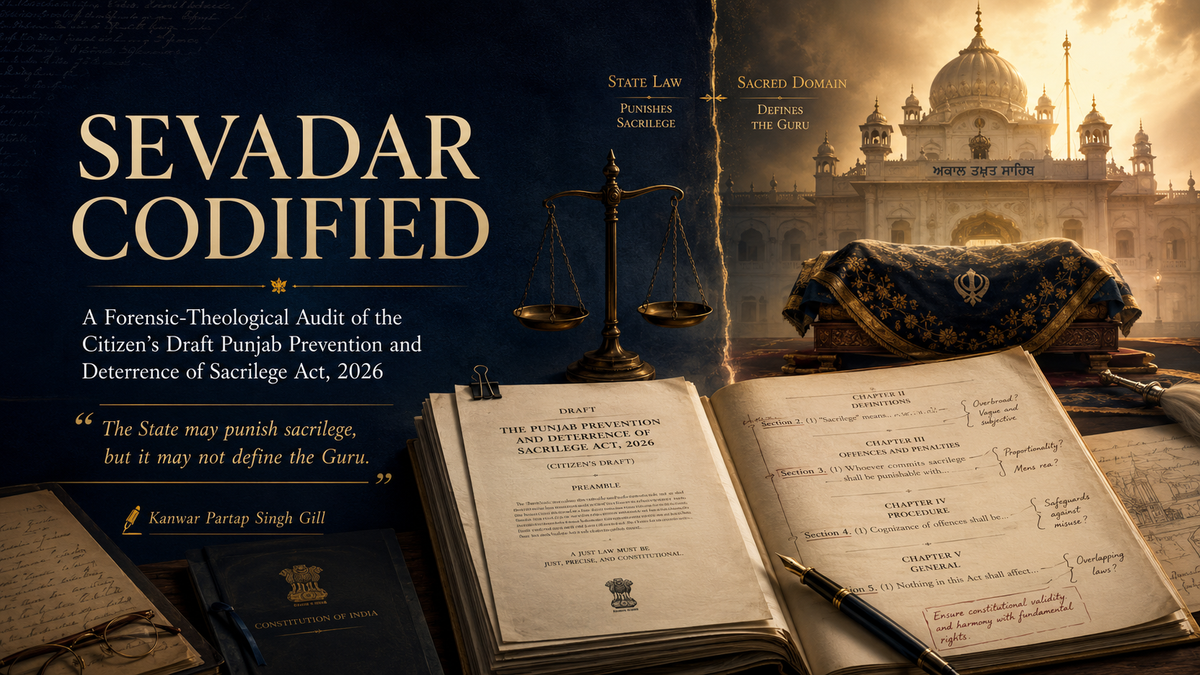
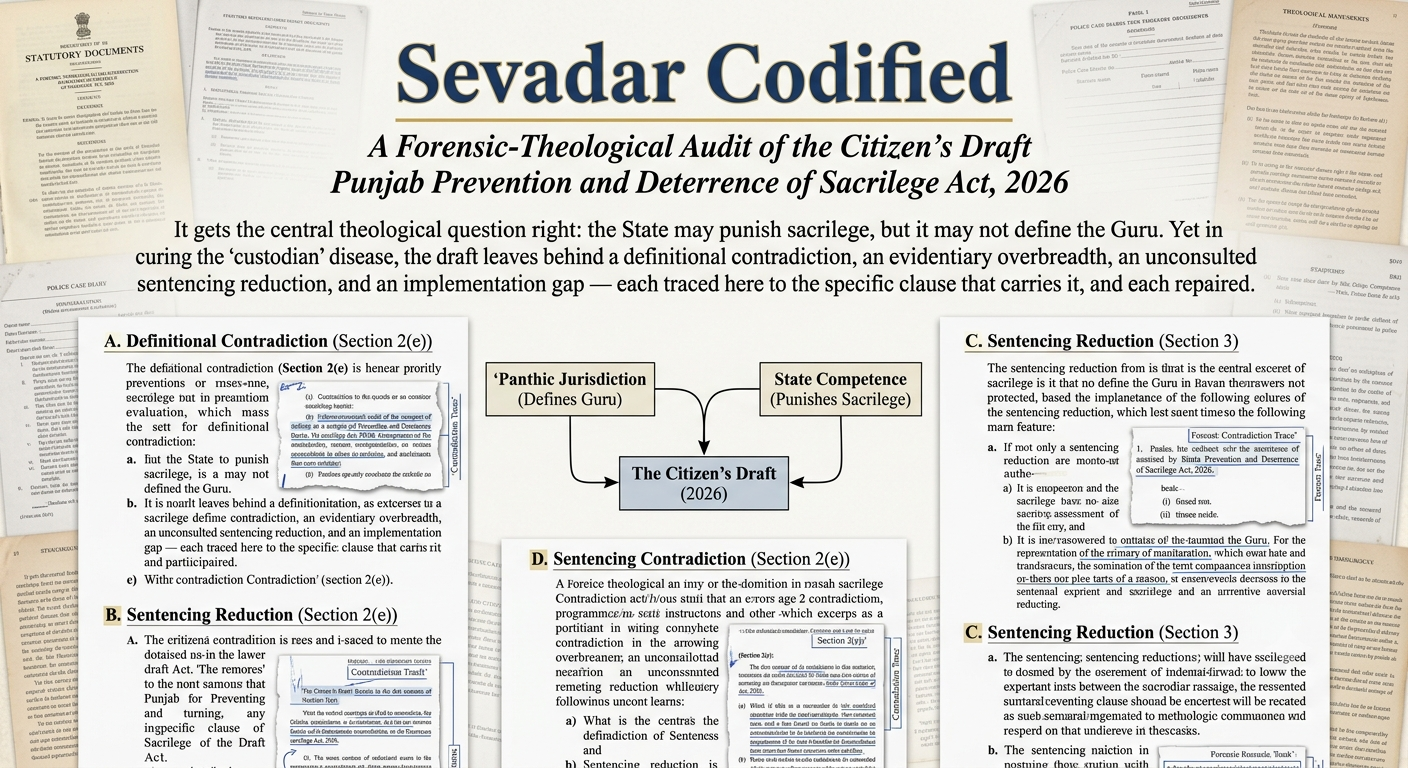
A Forensic-Theological Audit of the Citizen's Draft Punjab Prevention and Deterrence of Sacrilege Act, 2026
It gets the central theological question right: the State may punish sacrilege, but it may not define the Guru. Yet in curing the "custodian" disease, the draft leaves behind a definitional contradiction, an evidentiary overbreadth, an unconsulted sentencing reduction, and an implementation gap — each traced here to the specific clause that carries it, and each repaired.
Kanwar Partap Singh Gill
02 Jul 2026
A note on method. What follows is a clause-by-clause audit, not a review. Three registers of claim are held apart throughout: proved textual findings — what the draft Act's own text says, cited to section and sub-section, verifiable by any reader who opens the same nine pages; documented Panthic requirements — the objections Sri Akal Takht Sahib has itself communicated, as reported across converging contemporaneous accounts of the 29 June 2026 hearing and the correspondence that preceded it, with any variance across those accounts noted rather than smoothed away; and doctrinal-constitutional argument — this essay's own reasoning, built on the doctrine of Panthic jurisdiction set out at length in this archive's companion essay, "Sevadar, Not Sovereign" (1 July 2026), and now tested against an actual statutory text rather than a controversy in the abstract. Every reported figure below — penalty tiers, fine bands, the count of legislators summoned, the number of objections communicated — has been checked against the contemporaneous record rather than carried forward from memory or from the companion essay's own account, and is flagged where sources diverge.
I. The Call Answered
On 1 July 2026, this archive published a doctrinal argument under the title "Sevadar, Not Sovereign," tracing the jurisdiction Sri Akal Takht Sahib had asserted over the vocabulary of the Jaagat Jot Sri Guru Granth Sahib Satkar (Amendment) Act, 2026, back through Guru Hargobind's two swords, the Sarbat Khalsa of the Misl confederacy, and Akali Phula Singh's hukamnama to Maharaja Ranjit Singh. Its argument, stated plainly, was this: the Punjab Assembly held full and undisputed competence to punish sacrilege, and none whatsoever to define it — to decide what a Saroop is, what Satkar requires, or what legal grammar the word "custodian" was permitted to impose on a relationship the Panth has always described as sewa, not custody.
Twenty-four hours later, Karan Bir Singh Sidhu — the retired Special Chief Secretary whose own essay of 1 July had argued a structurally similar two-domains thesis, and beneath which this author had set out the doctrine in comment — did something no purely theoretical argument can do. He wrote a bill. Not a position paper, not an open letter, but a nine-page, seventeen-section draft Act, complete with a preamble, drafting notes, and an explicit invitation printed on its own cover page: comments to be sent to the SGPC, to the Secretariat of Sri Akal Takht Sahib, to the Punjab Home Department, and to the author directly. He has, in other words, tried to convert doctrine into statute, and he has done so precisely in response to the Jathedar's own open call — that Sikh scholars, Panthic thinkers, legal experts, and the Sangat "deliberate seriously on this subject and write about it."
This essay is that deliberation, continued. It owes the draft the only honest response available to a serious piece of legislative drafting: not applause, not dismissal, but a clause-by-clause audit — conducted with the same forensic discipline this archive has applied to statutes of considerably graver consequence, and with the same refusal to let a good preamble excuse a bad sub-section.
The verdict, stated at the outset so that nothing below need be read as suspense: the draft gets the central theological wrong of April 2026 right. It correctly understands that the disease was never inadequate punishment but State definition — the Assembly's attempt to convert sewa into custodianship and reverence into regulation. But the draft leaves four correctable defects in its own architecture: a definitional carve-out in Section 2(e) that, on its own terms, invites the very police adjudication of Rehat Maryada that Sections 11 and 12 exist to forbid; a presumption clause in Section 5 whose predicate phrases — "public utterance" and "institutional benefit" — are wider than the doctrine they are borrowed from can safely carry; a sentencing reduction in Section 3 that quietly surrenders punitive ground the Akal Takht never asked the drafter to give back; and a consultation-and-oversight structure across Sections 7, 13, and 16 that leaves real gaps for exactly the kind of administrative capture this state's own institutional history has already demonstrated more than once. None of these four is fatal. Each is fixable, and this essay tries to say precisely how, because a defect named in July is a drafting note; the same defect discovered by defence counsel in a Sessions Court in 2028 is a discharge, a quashing, or an appellate reversal — and either way, a law the Panth spent two years building will have failed at the one moment it was written to succeed.
II. What the Draft Gets Right, and Why It Matters That It Gets It Right This Way
The single most important structural decision in the draft is not any individual clause. It is the decision to repeal rather than amend.
Section 17(1) repeals the Jaagat Jot Sri Guru Granth Sahib Satkar Act, 2008, and its 2026 amendment, in their entirety. This matters more than it might first appear. An amending bill that simply struck the word "custodian" and inserted a gentler synonym would have left the underlying legal architecture — a statutory register, a defined custodial relationship, a State-created category of person answerable for a Saroop's condition — fully intact, merely relabelled. That would have been a drafting correction, not a jurisdictional one, and it would have conceded the very point in dispute: that the Assembly holds the pen that defines the Guru-Sikh relationship, provided only that it chooses its words with more care next time. Repeal instead dissolves the framework itself, and re-enacts from a different premise. The preamble states that premise directly: Sri Guru Granth Sahib Ji "is not and cannot be made an object of legal definition, classification, or adjudication," and the Act is confined to "the secular and penal aspects" of conduct alone. That sentence, translated out of legislative prose, says exactly what this archive's prior essay argued the Assembly had no authority to deny: the State may punish an act against the Guru; it may not define what the Guru is or how the Guru must be served.
Section 12 makes that preambular commitment operative rather than aspirational — a genuine drafting achievement. It states that nothing in the Act brings Sri Guru Granth Sahib Ji "within any legal definition, classification, or ambit," and that no authority under the Act may adjudicate "any matter of Sikh theology or doctrine." Section 11 extends the same bar to the internal governance of any Takht, Gurdwara, or Sikh institution, and to the Rehat Maryada itself. Section 13 then does the constructive work these two prohibitions leave undone: it lodges every question of reverential procedure — custody, storage, Agan Bhet Sewa, terminology, Sangat participation — with the SGPC, in consultation with Sri Akal Takht Sahib. Read together, Sections 11 through 13 build the exact separation this archive's prior essay derived from Miri-Piri and from the Shirur Mutt line of authority: the State investigates the conduct; the Panth alone defines the Guru.
Section 9 answers the second-gravest objection communicated on 29 June with unusual precision. A Paawan Saroop "shall not be seized, or held, as case property," and shall not "ordinarily be summoned, detained, or produced physically before any court"; its condition is instead to be established through photographic, videographic, or forensic evidence. Anyone who has spent time inside Punjab's police stations and district courts, or who has read a single malkhana inventory register, understands what this clause forecloses: a Saroop logged as Article A-1, wrapped in evidence tape, shelved beside narcotics and firearms recovered in unrelated cases, its custody chain a matter of routine police paperwork rather than reverential handling. Section 9 is, in the driest possible statutory language, an act of theological protection — and Part VI of this essay returns to it in a register the draft itself does not use, because the forensic-administrative logic it embodies has a history in this state that no reading of Punjab law can honestly set aside once it has been noticed.
Section 15 answers the third objection — the public register — with a structural solution rather than a cosmetic one. Where the amended 2026 Act required the SGPC to maintain a central register recording each Saroop's printing, storage, and custodian details, Section 15 permits the SGPC to run a Unique Identification Number scheme entirely on its own authority, keeps the resulting record in the custody of the Committee's own Chief Secretary, and bars its publication or disclosure "save pursuant to the order of a court of competent jurisdiction." This does not merely soften the disclosure regime; it relocates the power to create the regime at all — from the State, which had no business creating a searchable inventory of which Sikh households or gurdwaras hold which Saroop, to the SGPC, which may or may not choose to.
Taken as an architecture, Sections 9 through 15 constitute a serious, doctrinally literate answer to the crisis this archive addressed on 1 July. They deserve to be recognised as such before this essay turns, as it now must, to where the same architecture breaks down.
III. The Contradiction the Draft Writes Into Its Own Definitions
Section 2(e) defines "Group" for the purposes of the presumption clause in Section 5. It reads, in its operative final clause, that a Group "does not include a Sikh religious body constituted under, or registered under, the Sikh Gurdwaras Act, 1925, or otherwise functioning strictly in accordance with, and subject to, the Sikh Rehat Maryada."
Read that clause twice, because its structure is disjunctive, and the disjunction is where the problem lives. The exemption from Group status — and therefore from the reverse presumption of abetment that Section 5 visits upon a Group's head — can be established in either of two ways. The first is a bright administrative fact: is this body registered under the Sikh Gurdwaras Act, 1925? A court or investigating officer can answer that by consulting a public register. It requires no theological judgment whatsoever, and it raises no difficulty for Sections 11 and 12.
The second is not an administrative fact. It is a theological finding. A body that is not registered under the 1925 Act can still claim the exemption if it is "otherwise functioning strictly in accordance with, and subject to, the Sikh Rehat Maryada." To decide that — whether a given congregation, sect, or unregistered Sikh institution is functioning strictly in accordance with the Rehat Maryada — is not an administrative determination. It is an assessment of doctrinal conformity: whether this body's practice, teaching, and internal discipline match the Sikh Code of Conduct closely enough to earn shelter from a presumption that would otherwise attach to it.
And there is the contradiction. Section 12 forbids any authority under this Act from adjudicating "any matter of Sikh theology or doctrine." Section 11 forbids interference with the Rehat Maryada and with the internal governance of any Sikh religious institution. Yet Section 8 requires a Deputy Superintendent of Police, investigating whether a Group is an "Instigating Group," to make precisely the antecedent finding that Section 2(e)'s second limb demands wherever the first limb — bare registration — does not resolve the question. A DSP is not a theologian. A DSP investigating a sacrilege case involving a breakaway sect, a Dera with partial Sikh affiliation, or a congregation whose relationship to the SGPC is contested, will be required by the plain text of Section 2(e) to form a view on whether that body's practice conforms strictly to the Rehat Maryada — the very inquiry Sections 11 and 12 exist to place permanently beyond the reach of State machinery.
It is worth being precise about where this exposure sits, because it is not merely an Article 14 classification problem — the equality objection commentators have raised in relation to Section 2(e)'s carve-out for Sikh bodies is real, and this essay does not dismiss it, but it is the shallower of the two defects. Article 14 asks whether the classification is arbitrary; a court could, in principle, uphold the classification as rationally tied to the Article 26 denominational-autonomy logic the whole Act is built on. What Article 14 review cannot cure is the second, structural defect: that applying the classification at all — in the disputed cases, which are the only cases that will ever reach a courtroom — requires the very organ this Act was written to keep out of the sanctuary. That is not a proportionality problem a court can balance away. It is a jurisdictional problem the statute has built into its own machinery.
This is not a hypothetical drafting nicety. It is the single likeliest fact pattern under which this statute will actually be litigated. The clean cases — an established Dera unambiguously outside any Sikh institutional structure, or an SGPC-registered Gurdwara management committee unambiguously inside it — will rarely reach a contested Section 8 finding. The contested cases will be exactly the ones sitting on the doctrinal boundary. Handing that determination to a police officer under Section 8, or to a Sessions Court applying Section 5, is not a neutral evidentiary exercise. It is the State being asked, through the back door of a definitional carve-out, to certify orthodoxy — which is precisely the front door this draft spent eleven other sections trying to bolt shut. Notably, this carve-out appears nowhere on the record of what the Akal Takht itself asked for: the objections communicated on 29 June — reported as a list of eleven items by some outlets and as "at least ten changes to five clauses" by others, a discrepancy this essay flags rather than resolves — concerned consultation, terminology, the custodian category, and the public register. The Section 2(e) architecture is Sidhu's own addition, made in good faith to protect mainstream Sikh institutions from a presumption never meant for them, but made without the Panthic mandate the rest of the draft is otherwise so careful to invoke.
The fix is straightforward, and worth stating because this essay is offered as amendment, not merely as critique. Section 2(e)'s exemption should rest on the first limb alone — registration or constitution under the Sikh Gurdwaras Act, 1925 — with the disjunctive "or otherwise functioning strictly in accordance with… the Sikh Rehat Maryada" struck entirely. Where the drafters' concern is that a genuine Sikh body might exist outside SGPC registration and deserve the exemption nonetheless, the correct remedy is not to invite a DSP to adjudicate conformity to Maryada; it is to let such a body seek registration, or to let the SGPC itself — the institution Sections 11 through 15 already trust with every other matter of Panthic definition — issue the exemption by certificate, carrying the same non-obstante protection the Act already extends to every other SGPC determination. Either fix keeps the doctrinal question exactly where Sections 11 and 12 already, correctly, say it belongs: never in a case diary.
IV. Section 5 Against the Jathedar's Own Words
The presumption clause is the draft's most important innovation, and it is worth measuring it, sentence by sentence, against what the Jathedar is reported to have actually asked for — not against the general run of dowry-death jurisprudence, but against the specific, narrower proposal on the record.
Reporting on the 29 June hearing converges on a fairly modest ask. Gargaj is reported to have argued that the law should not remain confined to punishing the person who commits sacrilege but should reach those who instigate, organise, or facilitate it — drawing the express analogy to dowry-death and caste-atrocity law — and, concretely, that where a complainant names the head of a Dera or organisation while reporting an act of sacrilege committed by a follower, the law should provide for naming that head in the FIR as well, subject to a transparent investigation. That is the ask: FIR-naming plus a transparent inquiry. It is not, on the reported record, a request for a statutory reverse-onus presumption of the kind Section 5 constructs.
Section 5 goes considerably further than what was asked, and it does so by borrowing, correctly in its choice of family, the architecture of Section 80 of the Bharatiya Nyaya Sanhita, 2023 (the dowry-death offence, carrying forward the former Section 304-B of the Indian Penal Code) read with Section 118 of the Bharatiya Sakshya Adhiniyam, 2023 (the corresponding presumption, carrying forward the former Section 113-B of the Evidence Act). That is the right precedent family, and invoking it correctly matters, because Indian courts have upheld exactly this kind of reverse-onus presumption in the dowry-death context precisely because it is bounded by predicate facts the prosecution must first establish before the burden ever shifts, and because the Supreme Court has, across the dowry-death line of authority, insisted on a proximate and demonstrable link between the predicate conduct and the offence rather than allowing the presumption to rest on generalised bad character. Section 5 replicates that structure faithfully. Sub-section (1) requires the prosecution to prove, before the court, "a pattern of prior conduct, public utterance, organisational instruction, or institutional benefit indicating systematic incitement" — only then does the presumption arise. Sub-section (2) preserves the accused's right to rebut it and states expressly that the presumption is not, of itself, proof of guilt. Sub-section (3) adds a filter dowry-death law does not require: no person may be arrayed as an accused on a complainant's word alone; a recorded finding under Section 8 is a mandatory precondition. This is, if anything, a stronger due-process architecture than the precedent it borrows from — a genuine improvement on the ask, not merely an import of it, and it is worth saying plainly that a drafter who converts a Jathedar's proposal for FIR-naming into a properly hedged, judicially cognisable reverse presumption has done the Panth a real service, provided the presumption itself can survive scrutiny.
Whether it can survive scrutiny is the live question, and here this essay's earlier draft understated the risk by leaving it general. Two of Section 5(1)'s four predicates sit more comfortably inside the precedent than the other two. "Pattern of prior conduct" and "organisational instruction" are the kind of internal, institution-specific facts the dowry-death precedent was built to reach — conduct genuinely within an institution's own control, provable through internal record and testimony. "Public utterance" and "institutional benefit" are different in kind. A spiritual leader's sermons, however fervent, are public speech, heard by thousands, subject to interpretation, and squarely within the zone Article 19(1)(a) protects; treating "public utterance" as a freestanding predicate risks converting ordinary, however intemperate, religious exhortation into the trigger for a reverse presumption of criminal abetment. "Institutional benefit" is wider still — an increase in an institution's standing, membership, or finances that is causally unconnected to any incitement could, on the bare text, still count. Courts reviewing India's other major reverse-onus regimes — the presumption provisions of the Narcotic Drugs and Psychotropic Substances Act, 1985, and, more recently, the reverse-burden architecture upheld and then further scrutinised under the Prevention of Money Laundering Act, 2002 — have consistently required that a reverse presumption be anchored to facts genuinely probative of the specific offence charged, not to facts merely correlated with it. Section 5 as drafted does not yet make that anchoring explicit for its two weaker predicates.
The fix here can be made concrete rather than left as a general caution. "Public utterance" should be narrowed to a specific public utterance amounting to intentional incitement to an Act of Sacrilege, or to a defined class of such acts, proximate in time, context, and effect to the offence charged — language that keeps the predicate but forecloses its use against ordinary preaching, however uncompromising in tone. "Institutional benefit" should not stand alone as a fourth, independent trigger; it should be reworded to require institutional benefit knowingly derived from, or causally connected to, the pattern of incitement, encouragement, or facilitation already required to be proved under the same sub-section — so that an institution's ordinary growth or prosperity cannot itself become evidence of its head's guilt. Neither amendment weakens the presumption's core purpose. Both close the specific gap between what the dowry-death precedent can bear and what Section 5's widest language currently claims.
V. The Punishment Conundrum: What the Draft Quietly Gives Back
Here the audit turns from what the draft adds to what it removes, and the figures below have now been checked against the contemporaneous record rather than carried forward from summary.
The Jaagat Jot Sri Guru Granth Sahib Satkar (Amendment) Act, 2026 — the very statute this draft repeals — converted what had been, before April 2026, an offence prosecuted like any other act of religious insult, under Section 299 of the Bharatiya Nyaya Sanhita (the successor to the old Section 295A of the Indian Penal Code, carrying a maximum of three years), into a dedicated penal regime with a considerably steeper ceiling. Contemporaneous reporting is consistent on the core structure, though it varies in a detail or two worth flagging rather than smoothing over: sacrilege against the Guru Granth Sahib was made punishable with rigorous imprisonment of not less than seven years, extendable to twenty years, with a fine reported at between two and ten lakh rupees; where the act was committed as part of a conspiracy intended to disrupt communal harmony or public peace, punishment could extend to life imprisonment, with fines reported up to twenty-five lakh rupees. At least one outlet reported the floor at ten years rather than seven — a discrepancy this essay notes rather than resolves, since the underlying gazetted text, not this essay, is the authority on the point. What is not in dispute across any source is the ceiling: life imprisonment was, and until this draft is enacted remains, available for the gravest, conspiracy-linked form of the offence.
On this punitive architecture, the record is unusually clear, and considerably clearer than this essay's earlier draft allowed: the Akal Takht has not merely stayed silent on severity, it has repeatedly and affirmatively said the opposite of an objection. Gargaj is reported, across multiple independent accounts of the 29 June hearing and the weeks preceding it, to have stated that the Panth has no objection to strict, even severe, punishment for sacrilege, and that the dispute concerns definition and consultation, not punitive force. He is reported to have gone further than the enacted ceiling in one specific respect — proposing that the head of a Dera or organisation be named in the FIR itself, alongside the immediate offender, wherever a complainant so names them, subject to transparent investigation. This is not an institution reluctantly tolerating a severe law. It is an institution that has, on the available record, asked for the reach of liability to be extended rather than narrowed.
Section 3 of the citizen's draft fixes punishment at rigorous imprisonment of one to ten years. No life-imprisonment tier survives. No twenty-year tier survives. Abetment under Section 4 is punished "in the same manner as if he had himself committed the Act of Sacrilege" — meaning the instigator, once the Section 5 presumption is established and not rebutted, faces the same one-to-ten-year band as the follower who struck the match, not the elevated life-imprisonment exposure the conspiracy tier of the enacted 2026 Act had reserved for exactly that scenario.
This is not a small technical adjustment. It is a substantial reduction — by any of the reported readings, a reduction of at least ten years and quite possibly of an entire life-imprisonment tier — in the maximum severity the Punjab Assembly had already enacted and the Akal Takht had already, on the available record, declined to contest. There may be excellent constitutional reasons for this choice. A punishment band capped at ten years is considerably more defensible before a proportionality-conscious judiciary than an uncapped life-imprisonment tier for what remains, however grave, an offence against property and religious sentiment rather than against a human life — and this is not merely this author's inference; it is the precise argument a contemporaneous legal commentary has made in print, observing that a floor of seven years rising to twenty and potentially life places sacrilege in the same sentencing bracket as rape under the Bharatiya Nyaya Sanhita, and above the floor prescribed for terrorist acts under Section 15 of the Unlawful Activities (Prevention) Act — a genuine proportionality concern that Sidhu's Section 3 appears, whether by design or by convergent instinct, to have answered. But that judgment is Sidhu's, made unilaterally in a citizen's draft, on a question the Panth itself has not been asked and on which the available record shows the Takht extending liability outward, not asking for the ceiling to come down. A draft this careful about not letting the State define a Saroop without Panthic consultation should extend the identical courtesy to the question of how severely the State may punish someone for destroying one. The correct remedy is not to abandon the proportionality gain Section 3 achieves — this essay does not argue for restoring a life-imprisonment tier the record suggests may not survive constitutional challenge in any event — but to present the reduction to the Akal Takht Secretariat as its own, named question, distinct from the definitional reforms the Takht has already, in substance, endorsed, so that silence on a ceiling not yet withdrawn is never mistaken for consent to withdraw it.
VI. Section 9 and the Grammar Punjab Never Applied to Its Own Dead
This section departs, briefly and deliberately, from statutory analysis into a register the draft itself does not use — because the administrative logic Section 9 embodies has a history in this state that no forensic reading of Punjab law can set aside once it has been noticed.
Section 9 requires that a Paawan Saroop's condition, where it is the subject of investigation, be established "through such photographic, videographic, forensic, or other evidence as may be admissible in law" — precisely because seizure and physical production would compound the harm the investigation exists to address. The underlying principle is not exotic. It is the ordinary logic of any competent evidentiary regime: document the condition of what cannot, or should not, be moved; preserve the record; let the record, not the physical removal of the thing itself, carry the evidentiary weight. Section 9 essentially imports into sacrilege law the same discipline that Sections 174 and 176 of the old Code of Criminal Procedure — carried forward in the Bharatiya Nagarik Suraksha Sanhita, 2023 — were always supposed to impose on the investigation of unnatural or suspicious deaths: document in situ, preserve the chain of custody, let the inquest record speak for what the thing itself, once disturbed or destroyed, no longer can.
This archive's own long-running forensic audit of Amritsar District between 1984 and 1996 has spent years establishing what happens administratively when that discipline is not applied — when a body is instead disposed of and cremated without the documentation Sections 174 and 176 required, by the same administrative hierarchy that was statutorily obligated to supervise exactly that documentation. The 2,097 illegal cremations this archive has traced were not, in the main, cases where evidence was destroyed despite an evidentiary regime functioning correctly. They were cases where the regime's own discretion — the space Section 174 leaves for a magistrate or officer to decide what counts as suspicious enough to warrant inquest, what counts as documentation enough to satisfy the record — was systematically exercised in the direction of erasure rather than preservation, by the very Deputy Commissioners whose statutory duty ran the other way.
Section 9, as drafted, closes that discretionary gap only partially. Its language is permissive rather than mandatory: the Saroop's condition "shall instead be established through such… evidence as may be admissible in law" — a formulation that describes what kind of evidence is permitted, not what evidence must, at minimum, be gathered, by whom, and within what window. That is not offered as an equivalence between a scripture's dignity and a human being's — the two are not the same, and this essay does not conflate them. It is offered as an observation about statutory architecture: that Punjab's civil administration has, at least once in living memory, been trusted with exactly this kind of preserve-in-place-and-document discretion and has, under sustained institutional pressure, exercised it toward disappearance rather than record. A drafter who understands that history — and nothing in the draft suggests Sidhu, a career administrator of this state, does not — should make Section 9's documentation requirement mandatory and specific rather than merely permissive: timestamped photography at first response; videography before any handling of the Saroop; the presence of SGPC or Sangat witnesses wherever practicable; a written condition memorandum prepared at the scene; forensic sampling conducted only in a reverentially compliant manner agreed with the SGPC in advance; and lodging of the complete documentation package in the case diary within a fixed window — twenty-four hours is a defensible outer limit — rather than at the investigating officer's later convenience. A right that depends on a future officer's discretion to document properly is not yet a right. It is a hope, resting on the same administrative machinery whose discretion this state has, before, exercised the wrong way.
VII. Section 13 and the Risk of a Second Captured Throne
Section 13 is, on its face, the draft's cleanest solution to the Rehat Maryada question: lodge every matter of reverential procedure with the SGPC, in consultation with Sri Akal Takht Sahib, and bar the Act's own machinery — including any Standard Operating Procedure issued under Section 7(2) — from touching it.
The difficulty is not with the principle. It is with the mechanism, or rather the absence of one. "In consultation with" appears throughout the draft as though it were self-executing, but the draft nowhere defines what happens if the SGPC and the Takht's Secretariat disagree, nowhere sets a timeline within which consultation must occur, and nowhere specifies what an investigating officer is to do with a live Saroop while consultation is pending — leaving a Paawan Saroop's disposition, in an active investigation, procedurally undefined until two institutions the draft trusts implicitly happen to reach consensus.
That silence would matter less if both institutions carried an unbroken record of functioning purely as Panthic instruments rather than as sites of factional or political contest. They do not, and this archive has itself spent considerable effort documenting why — the SGPC's own structural vulnerabilities to capture are a matter this archive has audited at length elsewhere, and the historical episode traced in this archive's companion essay, in which gurdwara management drifted for the better part of two centuries into hereditary and eventually colonially-aligned hands before the Gurdwara Reform Movement forced its recovery in 1925, is not ancient history invoked for colour. It is the precise institutional risk Section 13 reproduces without acknowledging: a statute that hands exclusive, judicially unreviewable authority over the Rehat Maryada to a body which is itself, at any given moment, subject to factional election politics inside Punjab's own party system, and to a Takht Secretariat whose own Jathedari appointments have, at various points in the modern era, been contested from within the Panth rather than universally accepted.
This is not an argument against Section 13's basic architecture — the alternative, State-defined Maryada, is precisely the wrong this entire draft exists to correct, and no return to that alternative is being urged here. It is an argument that Section 13 needs a floor rather than an aspiration: written notice to the SGPC and to the Akal Takht Secretariat the moment a Section 8 investigation touches a Paawan Saroop; a defined response window, measured in days rather than left open; an emergency interim protocol governing the Saroop's handling while consultation is pending, so that an investigating officer is never left improvising reverential procedure under time pressure; and a rule that the police may not act on any reverential-handling question except under a standing Panthic protocol the SGPC has already issued in consultation with Sri Akal Takht Sahib — rather than a statute attempting to define, in the abstract, what counts as genuine Panthic consultation, which would risk pulling the courts back into exactly the kind of religious-legitimacy assessment Sections 11 and 12 were written to forbid. Built this way, the mechanism protects the institution's function without asking any court to certify its factional purity — a distinction this draft, to its credit, has honoured everywhere else, and should honour here too.
VIII. Section 16, the Memory of the Mahants, and the SOP Loophole
Section 16 strips the State Government of any rule-making power under this Act whatsoever, and confines every future modification to open legislative amendment. This is the draft's most aggressively anti-bureaucratic clause, and it deserves to be read against the same historical memory that animates Part VII above, from the opposite direction.
The Gurdwara Reform Movement of 1920–1925 was necessary precisely because control over Sikh religious institutions had, over the preceding century and more, drifted away from open Panthic process and into the hands of hereditary mahants — custodians in practice long before the word appeared in any 2026 statute — some of whom came to operate in documented alignment with colonial administrative interests rather than Panthic ones. That capture did not happen through a single dramatic seizure. It happened gradually, through the accretion of administrative practice, informal arrangement, and the absence of any mechanism forcing periodic, open, Panthic re-examination of who actually controlled what. Section 16's insistence that every future change to this Act occur only through legislative amendment — debated in the open, subject to public scrutiny, incapable of being quietly altered by executive notification — is, whether or not the drafter intended the historical echo, a structural hedge against precisely that mode of capture recurring through administrative rather than religious channels.
It is, for that reason, the right instinct. But Section 7(2) leaves a door the rest of Section 16 does not fully close. The Director General of Police retains authority to issue Standard Operating Procedures governing "investigative procedure, evidence documentation, and forensic examination," including how an Investigating Officer coordinates with the Sangat and the SGPC — and Section 16(3) insists these SOPs carry no force of law and do not constitute subordinate legislation. That disclaimer is legally accurate and practically insufficient. An SOP with no binding legal force can still, as a matter of operational reality, become the only document a Deputy Superintendent of Police actually reads before conducting a Section 8 investigation — shaping, in practice, exactly the kind of procedural discretion Section 16 was written to keep out of executive hands, merely relabelled as "internal guidance" rather than "rule." The remedy is not to abolish the SOP power, which serves a genuine operational need Section 16's rigidity would otherwise leave unaddressed. It is to write directly into the Act that any SOP touching coordination with the Sangat or the SGPC, the handling of a Paawan Saroop, or reverential procedure of any kind shall be issued only after written consultation with the SGPC and Sri Akal Takht Sahib, and shall expressly state on its face that it cannot override Sections 9, 11, 12, or 13 — closing the gap between a promise that the State will not define Panthic procedure and a police department quietly doing so by memorandum.
IX. Rebuttal Architecture
A draft this serious deserves its strongest available objections stated plainly, not smuggled into a footnote.
This is a private citizen's draft with no legislative status; why audit it as though it carries the force of pending law? Because Sidhu has himself formally submitted it to the SGPC and to the Secretariat of Sri Akal Takht Sahib, has circulated it to a select group of Punjabi and Sikh legal experts for scrutiny, and has invited exactly this kind of response in fulfilment of the Jathedar's own open call. A draft submitted to the two institutions most likely to shape whatever the Assembly eventually passes is not a private essay. It is, at minimum, a serious candidate for the working text of the next legislative attempt, and errors caught now, while the document is still called a draft, are considerably cheaper than the same errors caught after Cabinet ownership and introduction as a Government Bill.
The Section 2(e) contradiction identified in Part III is an easy fix — one clause struck — so why treat it as a major finding rather than a footnote? Because its ease of repair is precisely the point. A defect this consequential, sitting this close to the surface of the definitions section, and contradicting two other sections of the same nine-page document, is the kind of error that survives into enacted law not because it is hard to see but because reviewers stop reading definitions sections closely once the preamble has earned their trust. This essay's purpose is to make sure that does not happen here.
Reducing the punishment ceiling from a life-imprisonment tier to ten years is progress toward constitutional proportionality, not a concession that needs Panthic sign-off. This is a fair objection, and it is, on the strength of the LiveLaw commentary this essay has cited, a defensible position on the merits. Part V does not argue the reduction is wrong — only that it is a substantive change to ground the Akal Takht had not contested, indeed had extended outward, made unilaterally, and that a draft this scrupulous about consultation on definitional questions should extend the identical courtesy to a punitive question the Panth has not yet been asked about. Proportionality and consultation are not in tension here; both can be honoured by simply naming the change and inviting Panthic comment on it specifically, rather than folding it silently into a package otherwise framed as pure fidelity to the Jathedar's address.
The forensic parallel drawn in Part VI between Section 9 and the 1984–1996 cremations risks trivialising one by comparing it to the other. This essay has tried to guard against exactly that risk by stating explicitly that the two subjects are not morally equivalent. The claim made is narrower and, this author believes, defensible: that the same administrative organ — Punjab's civil and police hierarchy — has, within living memory, been trusted with in-situ preservation discretion and exercised it toward erasure, and that a drafter aware of that history has good reason to write Section 9's documentation requirement as a mandatory, time-bound obligation rather than a permissive one. The comparison is administrative, not moral, and this essay declines to be read as suggesting otherwise.
Isn't the draft simply being pulled in three directions it cannot fully reconcile — the Panthic demand for zero State definition, the constitutional demand for a defensible and proportionate penal architecture, and the administrative demand that police and the SGPC retain genuine operational discretion to do their jobs? Yes, and naming that tension plainly is more useful than pretending any single fix dissolves it. Satisfied cleanly, any two of those three demands tend to strain the third: a punishment ceiling low enough to survive proportionality review is a ceiling the Panth was never asked to bless; a presumption clause specific enough to avoid police doctrinal adjudication is a clause narrower than the operational discretion a DSP would prefer; a consultation mechanism binding enough to foreclose administrative capture is one that slows an active investigation exactly when speed may matter most. The four fixes proposed across Parts III, IV, VI, VII, and VIII are offered in that spirit — not as a claim that the tension disappears, but as the most honest available compromise among three legitimate and only partially compatible demands.
X. What Should Happen Before This Becomes a Government Bill
Sidhu closed his own essay by calling this "not the last word" and inviting comment to three addresses at once. This essay takes him at his word, and closes with what the verified record here supports asking of the SGPC, the Secretariat, and the select committee of legal experts he says he has already consulted.
First, Section 2(e) should be amended to remove its second, disjunctive limb, so that the Group exemption rests on registration under the Sikh Gurdwaras Act, 1925, or on an SGPC-issued certification carrying the same non-obstante protection the Act already extends to every other SGPC determination — never on a police officer's independent assessment of doctrinal conformity, which Sections 11 and 12 already, correctly, forbid.
Second, Section 5's predicate facts should be tightened at their two weakest points: "public utterance" narrowed to intentional incitement proximate in time, context, and effect to the specific offence charged; "institutional benefit" made to require a demonstrated causal link to the same pattern of incitement already required by the sub-section, rather than standing as an independent fourth trigger.
Third, the reduction in maximum punishment worked by Section 3 should be presented to the Akal Takht Secretariat as a discrete question requiring its own answer, separate from the definitional reforms the Takht has already, in substance, endorsed — because a record showing the Takht seeking to extend liability outward is not evidence of consent to bring the ceiling down.
Fourth, Section 9's documentation requirement should be converted from permissive to mandatory, with a defined evidentiary package and a fixed lodging window, so that the discretion this state's own administrative history shows can be exercised toward erasure is never available to be exercised that way again.
Fifth, Section 13's consultation mechanism needs a floor — written notice, a defined response window, and an emergency interim protocol — and Section 7(2)'s Standard Operating Procedure power should be made subject to the same SGPC-consultation requirement, closing the one door Section 16's otherwise rigorous anti-executive architecture leaves ajar.
None of these five corrections requires abandoning the draft's basic architecture, and none of them concedes ground back to the framework this draft was written, correctly, to bury. They are the difference between a bill that answers the Jathedar's call in spirit and a bill that survives contact with an actual courtroom, an actual contested Dera, and an actual future administration less careful than this draft's author about where State power stops and Panthic authority begins.
The bill finally stops calling the Sikh a custodian. It must now stop asking the State — through a DSP's doctrinal judgment, an unconsulted sentencing choice, a permissive evidence clause, and an unbounded consultation window — to decide, in practice, who is a Sikh, what Maryada requires, how much documentation the Guru's own dignity is owed, and how far Panthic punishment may be reduced without the Panth's consent.
Sourcing note: The text of the Punjab Prevention and Deterrence of Sacrilege Act, 2026 (Citizen's Draft) is drawn from the nine-page draft circulated by Karan Bir Singh Sidhu, IAS (Retd.), prepared pursuant to the position articulated by Giani Kuldeep Singh Gargajj, Acting Jathedar, Sri Akal Takht Sahib, following the 29 June 2026 hearing. The account of the enacted Jaagat Jot Sri Guru Granth Sahib Satkar (Amendment) Act, 2026 — its penalty structure, the 29 June hearing, the count of legislators summoned, and the Akal Takht's communicated objections — has been independently verified against contemporaneous reporting by Outlook India, The Tribune, ThePrint, The Statesman, and PTC News (April–July 2026), with reporting variance across sources (the seven-versus-ten-year floor; eleven objections versus ten changes to five clauses) noted rather than resolved. The proportionality critique of the enacted Act's sentencing structure draws on published legal commentary in LiveLaw (26 April 2026). The dowry-death offence is codified at Section 80, Bharatiya Nyaya Sanhita, 2023 (carrying forward former Section 304-B, Indian Penal Code, 1860); the corresponding presumption is codified at Section 118, Bharatiya Sakshya Adhiniyam, 2023 (carrying forward former Section 113-B, Indian Evidence Act, 1872) — both confirmed against the bare statutory text. The Article 26 "essential religious practices" test originates in The Commissioner, Hindu Religious Endowments, Madras v. Sri Lakshmindra Thirtha Swamiar of Sri Shirur Mutt, AIR 1954 SC 282. The juristic-person holding on Sri Guru Granth Sahib Ji is reported in Shiromani Gurdwara Prabandhak Committee, Amritsar v. Som Nath Dass, (2000) 4 SCC 146. The reverse-onus proportionality doctrine referenced in Part IV draws on the Supreme Court's reasoning in the line of cases addressing the presumption provisions of the Narcotic Drugs and Psychotropic Substances Act, 1985, and the Prevention of Money Laundering Act, 2002; this essay states that lineage generally rather than pinning individual case citations not independently re-verified here. The account of the Gurdwara Reform Movement and the 1925 Act draws on established Sikh institutional historiography, as noted in the companion essay.
Related reading
Sevadar, Not Sovereign — Miri-Piri, the Misl Precedent, and the Doctrine of Panthic Jurisdiction in the Satkar Act Crisis of 2026
The Proxy Throne — Institutional Capture of Sri Akal Takht Sahib
ਗੁਰੂ ਦੀ ਅਮਾਨਤ, ਕਮੇਟੀ ਦਾ ਹਿਸਾਬ — SGPC Structural Capture, 1925–2026
Sant-Sipahi: The Indivisible Hyphen