Placeholder draft -Who Paid for the Fire?

The Death Certificate Project
Evidentiary key: [PF] Proved Finding · [OR] Official Record · [DA] Documented Allegation · [AI] Analytical Inference · [PM] Panthic Memory
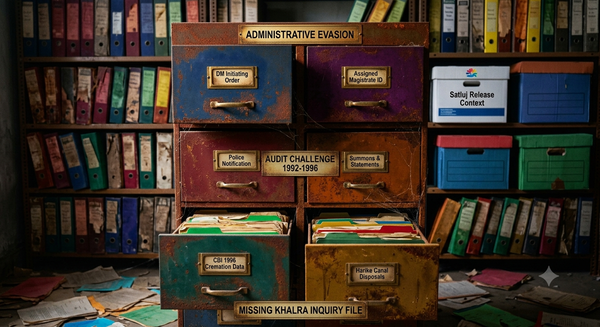
Jaswant Singh Khalra did not begin his investigation with a bullet, a body, or a confession. He began it with a ledger. What he examined, systematically, were the firewood-purchase registers that Punjab's municipal committees were required to maintain — ordinary accounting documents, created for the ordinary purpose of an audit trail, never designed to survive as evidence of anything except how many rupees a municipality spent on fuel. [PF] It was in that mundane record, cross-referenced against police claims of "unidentified" bodies, that the shape of a mass atrocity first became visible to a private citizen willing to do the arithmetic. This archive proposes to finish the arithmetic Khalra started, and to make the case that the financial record — not the forensic record, not even the testimonial record — may be the single hardest category of evidence for any institution to explain away, because money moves through documented channels even when bodies are made to move through undocumented ones.
What Cremation Actually Requires
Strip the act of its horror for one paragraph and consider it only as logistics. A cremation at a public ground requires fuel — firewood, in the practice of the period, purchased or requisitioned in bulk by the operating authority. It requires labor: attendants to prepare the pyre, tend the fire, and manage the remains. It typically requires cloth. Where police delivered a body rather than a family, it may have required transport and an escort. And because the site itself — Durgiana Mandir, Patti, Tarn Taran — was a municipally regulated facility, not an informal clearing, each of these inputs should, under ordinary municipal practice, have left a documentary footprint: a purchase order, a wage entry, a receipt, a line in a cash book. [AI] The CBI's confirmed figure of 2,097 illegal cremations across these three sites is not, in other words, only a body count. It is also, necessarily, a procurement record waiting to be reassembled. [PF]
Who Could Plausibly Have Paid
This archive does not assume, and explicitly warns against assuming, that any single entity bore every cost. At least four plausible funding channels existed simultaneously, and distinguishing among them is itself part of the inquiry rather than a foregone conclusion: municipal committee funds, which would ordinarily cover cremation of genuinely unclaimed indigent bodies as a routine public-health function and would generate the most conventional audit trail; police imprest or contingency accounts, which could have funded cremations police themselves arranged without routing the expense through the municipality's normal procurement process; informal or charitable arrangements with the operating trusts at sites like Durgiana Mandir, which might have absorbed costs without any government accounting at all; and some combination of the three, varying by site and by year. [AI] Each of these channels, if it existed, would leave a different kind of record — and the absence of a record in one channel is itself informative about which channel was actually used.
An Analytical Model — Explicitly Labeled as Such
This archive will not manufacture numbers it cannot source. What follows is a method, not a finding, offered so that the records demanded below — if and when produced — can be tested against it rather than accepted or dismissed on faith. A forensic accountant reconstructing this record would ordinarily proceed by establishing, for each municipality, a baseline: the ordinary annual volume and cost of indigent cremations in the years immediately preceding 1984, drawn from surviving municipal budgets, against which the actual recorded volume and cost during the 1984–1996 window could be compared. A statistically abnormal spike in wood procurement, labor costs, or cremation-ground throughput — relative to that municipality's own pre-conflict baseline, not to some invented national average — would constitute genuine evidence of scale. Its absence would be equally informative, since it would suggest costs were being absorbed outside the municipality's ordinary accounts altogether, which raises a different and no less serious question about which authority was paying informally and why. [AI] This archive takes no position on which outcome the actual records would show, because this archive does not have the actual records. That is precisely the point of demanding them.
What Should Exist and Has Not Been Produced
Purchase orders and wood-supply contracts for the relevant municipal committees across the relevant years; contingent bills and reimbursement vouchers; police imprest account records for the concerned police stations; the operating trusts' own receipt books, where cremations occurred on trust-managed ground such as Durgiana Mandir; municipal audit objections, if any were ever raised internally about unusual cremation volumes; and tender notices or supplier ledgers for firewood procurement during the period. None of these categories of record has, to this archive's knowledge, been placed in the public domain.
The Strongest Defense, Stated Fairly
A municipal committee operating a public cremation ground has a genuine, lawful, and unremarkable duty to cremate unclaimed indigent bodies — a function entirely independent of any counterinsurgency context, performed in ordinary times as a matter of public health and dignity. Volume alone, without a demonstrated deviation from a municipality's own historical baseline, proves nothing, and this archive explicitly declines to use a word like "industrial-scale" unless and until quantified frequency and resource data support it. [AI] It is entirely possible that some proportion of the 2,097 confirmed cremations reflect this ordinary function operating alongside, and administratively indistinguishable from, the pattern Khalra uncovered — which is precisely why the financial record, properly disaggregated, matters more than a body count alone.
Right of Reply
The Municipal Corporation of Amritsar, the Punjab Department of Local Government, and the Durgiana Committee are each invited to produce or account for the records described above. Any substantive response will be appended to this archive in full.
Closing
Khalra read a firewood register and found a massacre. This archive is not claiming a comparable discovery — it is asking why, three decades later, no comprehensive version of that same register has ever been assembled, audited, and released by the state whose own municipal officers kept it. A body can be burned. A purchase order, in a functioning bureaucracy, is rather harder to make disappear.
This is not a verdict. It is a summons to the record.
Sources: Khalra's use of municipal firewood-purchase registers as primary investigative method per sikhchic.com; CBI cremation figures per Paramjit Kaur v. State of Punjab, Supreme Court of India, order dated 12.12.1996. The resource-and-audit model presented here is explicitly analytical [AI] and contains no invented figures presented as fact.