Operation Blue Star, the Amritsar Cremation Archive, and the Selective Legalism of K.B.S. Sidhu — A Sixty-Year Forensic Audit, 1966–2026

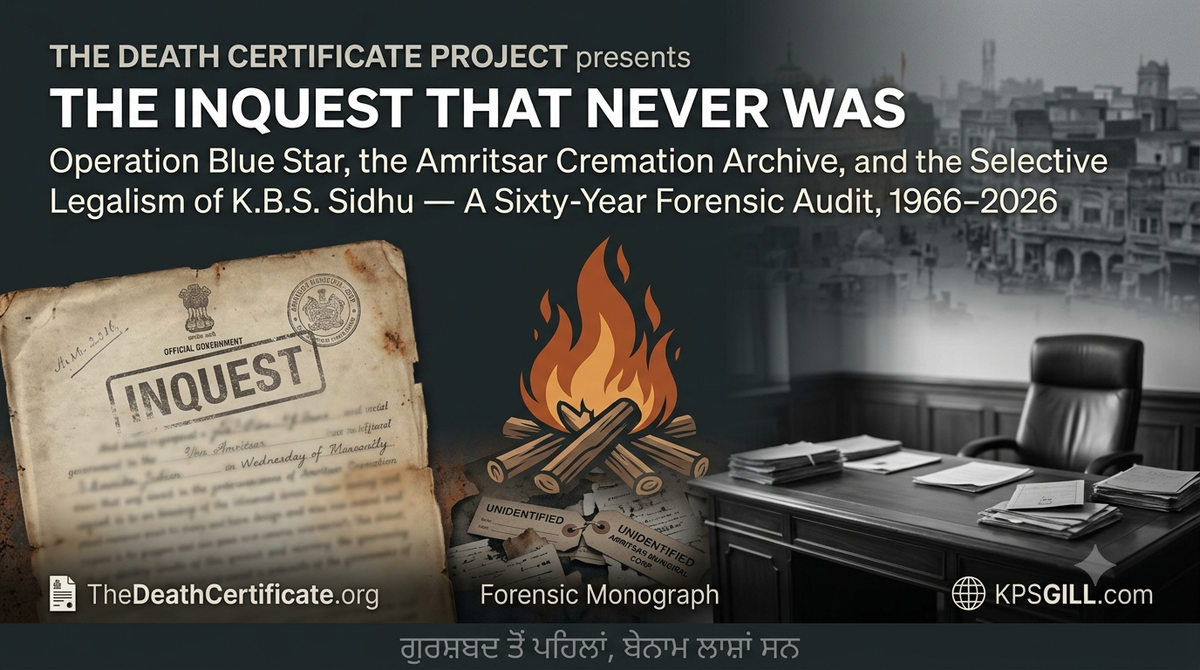
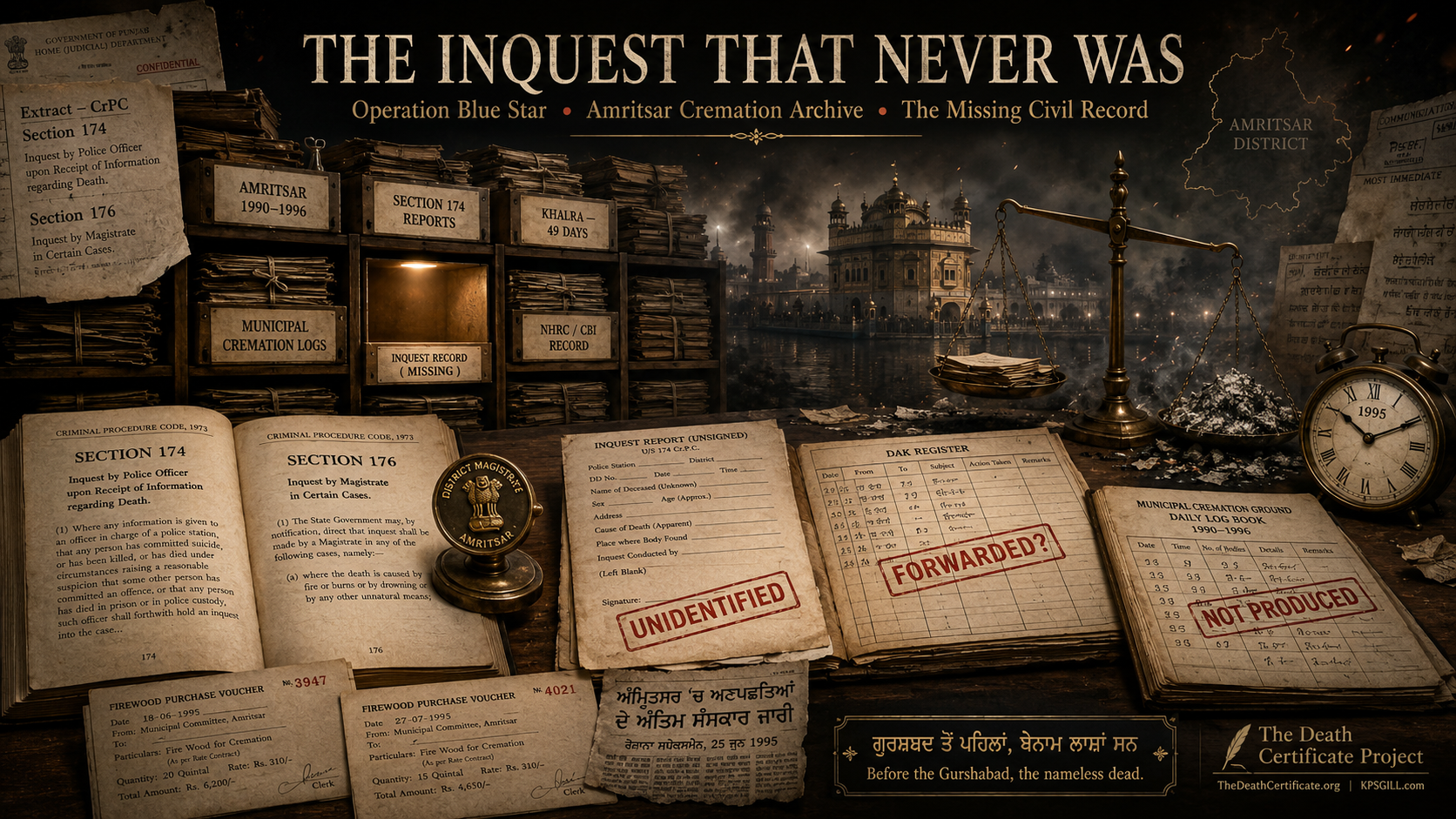
The Inquest That Never Was
Operation Blue Star, the Amritsar Cremation Archive, and the Selective Legalism of K.B.S. Sidhu — A Sixty-Year Forensic Audit, 1966–2026
A Death Certificate Project forensic monograph
By Kanwar Partap Singh Gill, M.D. — TheDeathCertificate.org | KPSGILL.COM
Evidentiary Standard
This monograph applies the Project's four-tier evidentiary framework throughout. [PF] Proved Findings are facts established by statute text, official tenure records, Supreme Court and NHRC orders, or the subject's own published writing. [DA] Documented Allegations are serious claims, sourced to identifiable records, that have not been tested to the standard of a criminal conviction. [AI] Analytical Inferences are reasoned conclusions drawn from the structure, timing, and pattern of the record, marked as inference rather than fact. [PM] Panthic Memory denotes the moral and civilisational register — lived Sikh memory and inherited understanding — invoked without being asked to do the work of legal proof.
One source requires a specific note. This monograph cites, at [DA] tier only, a 6 May 2026 Auzar TV interview of K.B.S. Sidhu (host Jagseer Singh Buckan, 2 hours 17 minutes 23 seconds), as reviewed and classified in this Project's companion publication, Forty-Nine Days of Silence: An Administrative Indictment of K.B.S. Sidhu, IAS (TheDeathCertificate.org, 8 May 2026). Every claim drawn from that interview is introduced with "Sidhu reportedly stated," is classified [DA], and is treated as pending authenticated transcript and certified translation. No conclusion in this monograph depends exclusively on that interview, and the statutory case in Parts II, VI, VII, and X stands independently of it.
The Narrow Thesis: A Documentary Burden, Not a Criminal Accusation
This monograph is not a prosecution brief alleging that K.B.S. Sidhu personally ordered, concealed, authorised, or falsified any killing, cremation, or death record. No document before this Project supports such a finding, and none is claimed. The thesis is narrower, and for that reason harder to evade: Sidhu's own published doctrine — most explicit in his Blue Star FIR essay, but recurring across his writing on the 1966 Reorganisation and the 2026 Satkar Amendment — is that the State's first obligation, prior to any question of conviction, sanction, or political consequence, is to generate and preserve a threshold legal record. The Amritsar question this monograph asks is whether that same standard was met by the one civil office Sidhu personally held. During his years in the Amritsar civil line — first as Additional Deputy Commissioner, then as Deputy Commissioner and District Magistrate — did the statutory death-reporting chain contemplated by CrPC Sections 174 and 176 function in relation to police-delivered unidentified bodies; and, separately, what did his office do with the tools available to it — Articles 21 and 22, and CrPC Sections 56, 57, and 58 — during the forty-nine days Jaswant Singh Khalra was alive and in illegal custody within his district? These are two distinct legal questions, addressed separately below, and this monograph does not collapse them.
For the avoidance of doubt, this monograph does not apply the post-2005 custodial-death and custodial-disappearance language of Section 176(1A) CrPC retroactively to 1990–1996; that provision was inserted by the Code of Criminal Procedure (Amendment) Act, 2005, in force from 23 June 2006, nearly a decade after Sidhu left the Amritsar chair. Where Section 176(1A) or its BNSS successor is cited below, it is cited only as Parliament's later, explicit acknowledgment of the structural problem this monograph traces in the earlier period — not as a duty that bound Sidhu's office at the time.
Part I — 1966: The Reorganisation and the Office That Would Inherit the Dead
[PF] The Punjab Reorganisation Act, 1966, came into force on 1 November 1966, dividing the post-1956 composite Punjab into a Punjabi-speaking Punjab, a Hindi-speaking Haryana, the Union Territory of Chandigarh held jointly as capital, and the transfer of certain hill tracts to Himachal Pradesh. The Act was the negotiated end-point of the Punjabi Suba movement, pursued for over a decade by Akali Dal leaders including Master Tara Singh and Sant Fateh Singh.
[AI] The 1966 settlement matters to this audit for an institutional reason. It produced the modern district of Amritsar as a self-contained unit of civil administration — a single Deputy Commissioner's office, vested under the Code of Criminal Procedure and the Punjab Police Rules with both revenue and magisterial authority over a compact, religiously and politically central territory. Every subsequent argument in this monograph about the men who held that office between 1984 and 1996 depends on the fact that 1966 had already concentrated extraordinary, unified civil power in a single chair — the same chair Ramesh Inder Singh, Sarabjit Singh, and Karan Bir Singh Sidhu would successively occupy.
[DA] The same decade that gave Punjab its linguistic settlement left the harder question — the status of Chandigarh, the sharing of river waters, and the unresolved demand for greater state autonomy — to fester. These grievances were compiled into the Akali Dal's 1973 Anandpur Sahib Resolution, a document repeatedly mischaracterised by the Union government as a secessionist charter in the political run-up to the 1980s.
[PF] Sidhu addressed this period directly in a 19 June 2026 essay co-authored with Lt. Gen. T.S. Shergill, PVSM (Retd.), titled "The Rewari Signboard and the Punjab That Was." The essay argues that the 1966 Reorganisation was a self-inflicted catastrophe engineered by the Akali leadership of the Punjabi Suba Morcha, who, in the authors' words, bear "a moral and political liability... that amounts to criminal negligence in the stewardship of a people's interests." It demands that Punjab undertake "the honest reckoning it has never had," beginning with "naming what was done, who did it, and what it cost" — sixty years after the fact, against men Sidhu did not know personally and never supervised.
[AI] This is one of three instances, examined across this monograph, of the same rhetorical structure: a demand for named, documented, retrospective accountability directed at others across deep time, by an author whose own administrative tenure — Amritsar, 1990–1996 — has not yet been subjected, by him, to the same standard. This monograph does not contest the substance of his case against the architects of 1966. It asks why the instinct that produces that case has not yet turned on his own desk.
Part II — 1973: The Statute That Already Existed
[PF] The Code of Criminal Procedure, 1973 ("CrPC"), in force from 1 April 1974, supplied the statutory machinery this monograph holds the Amritsar magistracy to. Three provisions matter:
- Section 154 required the officer in charge of a police station to reduce information disclosing a cognizable offence to writing — the First Information Report.
- Section 174 required that, upon information of a suicide, an accidental, suspicious, or unnatural death, the police officer "shall immediately give intimation thereof to the nearest Magistrate empowered to hold inquests" and forward the report to the District Magistrate or the Sub-Divisional Magistrate.
- Section 176(1) empowered the Magistrate so notified to hold an independent inquiry into the cause of death, instead of, or in addition to, the police investigation.
[PF] Under the Police Act, 1861, and under Rule 1.15 of the Punjab Police Rules, 1934, the District Magistrate is "the head of the Criminal Administration of the District," and the police force is, by the Rule's own language, the instrument provided by government to let him discharge that responsibility. The Deputy Commissioner of Amritsar was, simultaneously and by the same Rule, District Magistrate of Amritsar. This is the printed text under which every DC/DM of Amritsar, including Sidhu, held office. This monograph does not characterise that office as direct operational command of the police — the SSP commanded operationally — but as general civil-supervisory authority, statutory recipient of reports, and head of criminal administration.
[AI] The legal architecture did not leave death administratively orphaned. It built a forwarding chain — police to Executive Magistrate to District Magistrate — whose purpose was to prevent precisely what later occurred in Amritsar: a body becoming ash before it became a record. Section 174 did not require the District Magistrate to win the counterinsurgency. It required a report to travel.
Part III — 1978–1984: The Road Narrows
[PF] On 13 April 1978, a clash between the Nirankari sect and Akhand Kirtani Jatha/Akali activists in Amritsar left thirteen dead, an event widely treated as a hinge in the radicalisation of Sikh politics. Over the following six years, the rise of Jarnail Singh Bhindranwale, the militarisation of factional politics within the Akali Dal and the SGPC, and a worsening cycle of violence converged on the Golden Temple complex, which by 1984 had become a fortified position.
[PM] This Project does not narrate that six-year descent as inevitable, nor does it accept any framing that reduces it to a story of religious extremism without state complicity, political miscalculation on multiple sides, and the failure of ordinary civil and political institutions to arrest the slide. The civilisational weight of what was lost in June 1984 is treated here as established Panthic memory.
Part IV — June 1984: Operation Blue Star and the FIR That Was Never Filed
[PF] Operation Blue Star — the Indian Army's assault on the Darbar Sahib complex, executed 1–8 June 1984 while Punjab was under President's Rule — resulted in extensive civilian casualties, the death of Jarnail Singh Bhindranwale, and structural damage to the Akal Takht. No First Information Report specific to the planning or execution of the operation has, to this date, been registered by any police station in India.
[PF] This omission is the subject of K.B.S. Sidhu's own essay, "Why an FIR on Operation Blue Star Is Long Overdue," published on his Substack, The KBS Chronicle, on 13 October 2025, in response to remarks by former Union Home Minister P. Chidambaram. Sidhu — IAS (Retd.), 1984 batch (All-India Rank 2), Punjab cadre, who served as District Magistrate, Police District Batala (1989–1990), Additional Deputy Commissioner, Amritsar (1990–1992), Deputy Commissioner and District Magistrate, Amritsar (1992–1996), and later Special Chief Secretary, Punjab (2017–2021) — argues that the absence of an FIR across four decades constitutes "a glaring failure of the Indian State, cutting across successive central and state governments, political parties and dispensations." He observes that the requirement of prior sanction under Section 197 CrPC to prosecute a public servant "does not bar the registration of an FIR," because the sanction question arises at the stage of a court taking cognizance, not at the stage of recording information. He proposes a judicially supervised Special Investigation Team empowered to examine command responsibility, civilian casualties, custodial abuses, and "evidence management: control of the site, preservation (or loss) of proof, and contemporaneous documentation."
[AI] Every element of that argument is a legal mirror this monograph turns back on its author. An FIR is the State's threshold admission that a death matters enough to investigate. Sidhu is right that withholding that admission for forty years is a constitutional failure. The narrower and more uncomfortable question is what the threshold admission looked like — what intimation, inquest, and forwarding to the District Magistrate looked like — in the one Punjab district where Sidhu himself held that office, at the moment its own death-disposal apparatus was being exposed as a police-municipal cremation record of judicially recognised scale.
Part V — 1984–1996: The Three-DC Triad — One Office, Three Tenures, One Template
[PF] Three officers held the unified office of Deputy Commissioner and District Magistrate, Amritsar, across the twelve years between Operation Blue Star and the height of the Khalra litigation:
| DC/DM, Amritsar | Tenure |
|---|---|
| Ramesh Inder Singh, IAS (West Bengal cadre) | 4 June 1984 – 6 July 1987 |
| Sarabjit Singh, IAS | 7 July 1987 – 10 May 1992 |
| Karan Bir Singh Sidhu, IAS | 11 May 1992 – 11 August 1996 |
[PF] Both predecessors were honoured with the Padma Shri — India's fourth-highest civilian award — for their service in this period. Ramesh Inder Singh received it in 1986, age thirty-six, while still serving as DC/DM Amritsar; he later served as Chief Secretary of Punjab and as Chairman of the Punjab State Information Commission, 2009–2014. Sarabjit Singh received it for his role in the Punjab counterinsurgency, confirmed in his Tribune obituary of August 2019 as "Padma Shri Sarbjit Singh, former Deputy Commissioner (DC) of Amritsar"; he died on 1 August 2019. Neither award constitutes evidence of wrongdoing. Both record the Republic's contemporaneous judgment that the conduct of the office during this period merited national celebration rather than inquiry.
[PF] Sidhu's own service record, independently confirmed, extends the continuity further. Before Amritsar, he served as District Magistrate, Police District Batala, from 1989 to 1990 — Batala being a town and a distinct police district within the neighbouring Gurdaspur revenue district, in the same Majha region as Amritsar and policed in close coordination with it. He then served as Additional Deputy Commissioner, Amritsar, from 1990 to 1992 — under Sarabjit Singh, in the office whose institutional practices he would inherit as DC two years later — before becoming DC/DM himself in May 1992. Counting Batala, Sidhu's continuous administrative service in the Majha policing corridor ran from 1989 to 1996: seven years, six of them in the Amritsar DC/DM office itself, first as deputy, then as principal.
[AI] This continuity removes the most obvious defence available to a District Magistrate confronted with an inherited crisis: that he arrived new to the district with no institutional memory of how it functioned. Sidhu cannot plausibly claim that defence for the two years he served as the District Magistrate's own statutory deputy before becoming District Magistrate himself, let alone for the year immediately preceding that, spent as District Magistrate of a neighbouring police district where the same regional police formations operated.
[PF] The other two members of the Triad are not abstractions. Ramesh Inder Singh published a 500-page memoir, Turmoil in Punjab: Before and After Blue Star (HarperCollins India, 2022). Sarabjit Singh published Operation Black Thunder: An Eyewitness Account of Terrorism in Punjab (2002) and is deceased; he cannot be examined, and the handover note he would have prepared for his incoming ADC, K.B.S. Sidhu, in 1990, has not been publicly produced.
Part VI — K.B.S. Sidhu in the Amritsar Civil Line, 1990–1996
[PF] Sidhu's own published biography records that his Amritsar tenure encompassed the Beautification (Galiara) Project around Sri Darbar Sahib, undertaken in the years following Operation Black Thunder (1988) — work he has himself described as reshaping the post–Black Thunder landscape with dignity and sensitivity. This monograph takes no issue with that project's architectural or civic merit. It notes only that the same officer who, in his own telling, exercised close personal supervision over the physical and symbolic restoration of the Darbar Sahib complex during these years held, simultaneously and under the same office, statutory authority over Section 174 and Section 176 inquests for every suspicious or unidentified death in the district — authority whose exercise, in relation to the unidentified-body cohort, has not been publicly documented.
[AI] A District Magistrate capable of directing a multi-year heritage and beautification programme around the holiest site in the Sikh world cannot credibly be described, for the same years, as administratively incapable of directing his Sub-Divisional Magistrates to review inward inquest registers. The capacity for sustained civil attention is not in dispute; only its allocation is.
Part VII — The Cremation Archive and the Khalra Case, 1995–1996
[PF] In 1995, the human rights defender Jaswant Singh Khalra — having obtained from the Amritsar Municipal Corporation cremation-ground records and Punjab Police firewood-purchase vouchers documenting the disposal of bodies described only as "unidentified" or "unclaimed" — went public with evidence of mass illegal cremation. On 6 September 1995, Khalra was abducted outside his home at House No. 8, Kabir Park, Amritsar, by Punjab Police personnel later identified in criminal proceedings, acting under the territorial command of Senior Superintendent of Police Ajit Singh Sandhu. FIR No. 72 was registered at PS Islamabad, Amritsar district, on 7 September 1995 at 9:30 a.m., under Section 365 of the Indian Penal Code. He was held in illegal police custody, including at Jhabal police station in the Tarn Taran sub-district, for forty-nine days before his murder — a window during which he was alive and in custody within the district administered by K.B.S. Sidhu. He was never seen alive again.
[PF] The Supreme Court moved with conspicuous speed. On 11 September 1995, a telegram reporting the abduction was treated by the Court as a habeas corpus petition, and notice issued to the Punjab Home Secretary, DGP, and SSP Amritsar. Paramjit Kaur Khalra's own Article 32 petition was registered as Writ Petition (Criminal) No. 497 of 1995; a companion petition was registered as No. 447 of 1995, and the two were heard together throughout the proceedings. On 15 November 1995, the Court transferred investigation of both the abduction and the January 1995 cremation-record allegations to the CBI and directed the Punjab DGP, Home Secretary, and Chief Secretary to assist. The CBI registered RC No. 14/S/95/SCB-I/Delhi on 18 December 1995. By its order of 12 December 1996, the Court described the CBI's findings as disclosing "flagrant violations of human rights on a mass scale." The matter of the dead was referred to the National Human Rights Commission, while the CBI continued the culpability-related investigation into Khalra's own murder.
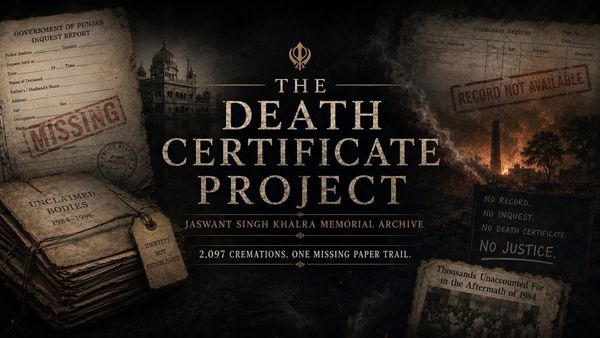
[PF] The scale certified by the NHRC and cited in Supreme Court proceedings: 2,097 bodies cremated by police across the Amritsar, Majitha, and Tarn Taran police districts between June 1984 and December 1994, of which, at the point of judicial remittance, 585 were fully identified, 274 partially identified, and 1,238 entirely unidentified — approximately 59 percent of the total. The NHRC's subsequent compensation proceedings classified 195 cases as deemed police custody and 1,318 as wrongful non-procedural cremation, and ultimately recommended compensation of approximately ₹27.94 crore for 1,513 identified families, leaving 532 permanently unidentified as of 2012. That later identification work, performed years afterward by a quasi-judicial body working from secondary evidence, does not weaken the audit question; it sharpens it. Identity had to be reconstructed after the fact precisely because the contemporaneous Section 174 machinery — whose purpose was to record identity at the time of death — did not perform that function when it mattered.
[PF] In Prithpal Singh v. State of Punjab, decided in 2011, the Supreme Court — recounting the CBI's findings in upholding the Khalra murder convictions — observed that police had been eliminating young persons under the pretext of militancy and disposing of their bodies without maintaining records, and that the practice might never have come to light but for the Court's own intervention. That is a judicial finding, not an inference of this Project's own: the recordlessness this monograph audits at the level of the District Magistrate's office is the same recordlessness the Supreme Court identified as the operative mechanism of the underlying killings.
[PF] SSP Ajit Singh Sandhu was found dead on railway tracks near Bhakharpur village on 23 May 1997, while out on bail and facing prosecution in connection with the Khalra case; his death was officially recorded as suicide. The trial court — Additional Sessions Judge, Patiala — convicted multiple accused on 18 November 2005 under Sections 364/34, 302/34, and 201/34 of the Indian Penal Code; the Punjab and Haryana High Court enhanced the sentences of four appellants from seven years' imprisonment to life on 16 October 2007; the Supreme Court upheld the convictions in 2011.
[AI] Sidhu's tenure as DC/DM (1992–1996) and his prior tenure as ADC (1990–1992) overlap the entire exposure phase of the cremation archive — Khalra's research, his abduction, the forty-nine-day custody window, the Supreme Court's intervention, and the CBI's case registration — within the district for which Sidhu held statutory inquest authority. This is not proof that he personally ordered, concealed, or participated in any killing. It is proof that the district's civil hinge was occupied, continuously, by the same officer throughout the precise weeks and months in which the State's own courts were finding mass-scale human rights violations inside his jurisdiction.
[AI] Two legal questions arise from this record, and this monograph keeps them separate. For the 1,238 unidentified cremated bodies, the operative statutory chain is CrPC Sections 174 and 176 as they stood in 1990–1996, addressed in Parts II, VI, and VIII. For Jaswant Singh Khalra himself, alive and in illegal custody for forty-nine days, no body had yet been recovered through any ordinary channel during that window, and Section 174 is therefore not the precise hook; the relevant duties instead arise from Articles 21 and 22 of the Constitution, the habeas corpus jurisdiction the Supreme Court was actively exercising, and CrPC Sections 56, 57, and 58 governing arrest production and arrest reporting to the District Magistrate. The two questions converge on the same office and the same years but are not doctrinally collapsed here.
Part VIII — The Forensic Audit: What the Record Has Not Yet Answered
[AI] The documents below are framed as open documentary questions directed at the District Magistrate's office of the relevant years — not as proved facts of personal wrongdoing. For each, a three-possibility test applies: the file exists, in which case it should be produced; the file existed and was destroyed, in which case the retention schedule, weeding order, and authorising officer should be produced; or the file was never generated, in which case that non-generation requires a written explanation from the one office positioned to give one.
| Document Sought | Statutory Basis | Forensic Significance |
|---|---|---|
| Inward registers / dak books recording Section 174 reports forwarded to the DM/SDM, 1990–1996 | CrPC s.174 | Did suspicious and unidentified deaths reach the civil record at all? |
| Orders specially empowering Executive Magistrates to hold inquests, and any Section 176 inquiry files | CrPC s.176 | Was independent magisterial scrutiny ever invoked for any unidentified body? |
| Municipal Committee firewood-purchase vouchers and cremation-ground logbooks for Majitha Road / Durgiana Mandir grounds, cross-referenced against DC office correspondence | Punjab Municipal Act, 1911 | Were these records ever requisitioned or audited by the district administration itself, rather than discovered independently by a private citizen? |
| Any file, note, or order issued by the DC/DM's office concerning Jaswant Singh Khalra between 6 September and 24 October 1995 | Arts. 21, 22; CrPC ss.56, 58, 97; Police Act 1861 s.4 | What, if anything, did the District Magistrate's office record, request, or order during the period of Khalra's illegal custody within the district? |
| Civil Surgeon's post-mortem requisition registers for police-delivered unidentified bodies, 1990–1996 | CrPC s.174 | Connects inquest claims to actual medical examination |
| Handover notes prepared when Sidhu assumed charge as District Magistrate, Batala, in 1989; as ADC Amritsar in 1990; and as DC/DM Amritsar in May 1992 | General administrative practice | What was the incoming officer formally told, on each occasion, about pending matters and known irregularities? |
[DA] This Project's 8 May 2026 publication, Forty-Nine Days of Silence, adds a further evidentiary layer, sourced to the Auzar TV interview and classified there as Documented Allegation pending authenticated transcript: Sidhu reportedly stated that his DC/DM office was informed of Khalra's abduction and that he "marked an ADC/ADM-level inquiry" in response; and, separately, that he visited police stations only on receipt of a "credible complaint," because acting more aggressively risked career consequences, reportedly citing the case of SSP Ajaypal Singh Mann — removed from his post as SSP Amritsar in March 1984, amid his and DC Gurdev Singh Brar's resistance to the Army option in the run-up to Operation Blue Star, with dismissal proceedings against him from the Punjab Police Service finalised in January 1985. If authenticated, the first statement establishes Sidhu's own account of notice and response, which the documentary requests above are designed to test against the file. The second statement, if authenticated, is independently significant: Sections 58 and 174 CrPC impose no "credible complaint" threshold. Both are framed in mandatory, complaint-independent terms — arrest reports were to reach the District Magistrate automatically, suspicious-death reports were to be forwarded "immediately." A self-imposed complaint-threshold, reportedly applied to duties Parliament wrote as unconditional, is not a neutral administrative style choice; it is, on its own terms, an act of statutory pre-screening.
[AI] That last point connects directly to Sidhu's own Blue Star essay, and is the sharpest single point in this audit. Sidhu writes, of Section 197 CrPC sanction requirements, that police "are neither constitutionally nor statutorily permitted to impose a pre-screening based on anticipated sanction" before recording information of a cognizable offence. If the Auzar TV account is authenticated, Sidhu's reported words would describe the precise pre-screening problem his own essay condemns: a "credible complaint" filter, calibrated to his own career exposure, substituted for the unconditional reporting duties Sections 58 and 174 actually impose. This monograph does not assert that this is what happened. It asserts that this is what Sidhu's own reported words, if authenticated, would establish — and that the man who now insists an officer's caution about consequences cannot lawfully narrow a statutory duty owes the public an account of whether he applied that same insistence to himself.
[AI] This monograph does not assert that the documentary requests above have gone unanswered because no record exists, nor that they prove an absolute "zero" of compliance. It asserts that their absence from the public record — thirty years after the events, and several years into Sidhu's own prolific public commentary on Punjab governance — is itself a fact requiring explanation from the surviving public actor uniquely positioned to explain what his office received, marked, ordered, reviewed, or escalated, and where such records would have been maintained.
Part IX — The Memoir and the Mirror: Father's Day, 2026
[PF] On Father's Day, 20–21 June 2026, Sidhu published a personal memoir, "The Untold Story of a Noble Father," commemorating his father, Sardar Gursharan Singh Sidhu, PCS, who died suddenly in Gurdaspur in the early hours of 30 January 1972, leaving a 35-year-old widow and two children. The memoir recounts the elder Sidhu's wartime and flood-relief service, his unrealised hope that his son would join the IAS, and the younger Sidhu's tribute — "I owe everything to her" — to the mother who raised the family alone.
[PM] This Project honours that grief without qualification. There is no forensic value in treating a son's love for his late father and surviving mother as anything other than what it plainly is. The point of placing the memoir beside the administrative record is not to weaponise private loss. It is to observe that the officer who writes, with such precision and tenderness, about what it meant for his family to receive clear, named, documented notice of death is the same officer who, for six years, held statutory authority over a district in which more than half of the dead the State was later forced to count had no name, no notice, and no document at all.
[AI] The standard a man sets for his own family's grief is, fairly, the standard by which his public office should be measured. That is not an accusation. It is the application of his own moral instinct to the people who were never permitted the dignity his mother received.
Part X — Selective Legalism: Applying Sidhu's Own FIR Doctrine to the Inquest Gap
[AI] Sidhu's Blue Star essay rests on a single, defensible legal proposition: that a State which refuses to commence the lawful, threshold act of recognising a death as a death — whatever the political cost — is committing an ongoing constitutional failure, not merely a historical one. Applied evenly, that proposition does not stop at June 1984. It runs directly into the inquest gap of Amritsar district, 1990–1996.
[AI] An FIR under Section 154 CrPC and an inquest under Sections 174–176 are different instruments, and this monograph does not collapse them. An FIR opens a criminal investigation into a disclosed offence. An inquest is something logically prior and, in conditions of mass disappearance, more urgent: it is the State's first acknowledgment that a body in its custody chain is a person who died, rather than an entry on a firewood voucher. Sidhu is correct that India never crossed the FIR threshold for Blue Star. The documentary record raises, at minimum, a grave and unanswered question about whether the Amritsar magistracy — including during Sidhu's own ADC and DC/DM tenure — crossed the prior and more basic inquest threshold for the more than twelve hundred people whose bodies passed through its municipal cremation grounds with no name attached.
[AI] Sidhu's essay proposes that sanction under Section 197 CrPC cannot be used to pre-empt even the recording of information. The same logic forecloses any defence of the Amritsar magistracy on the ground that "it was wartime," "the militancy made oversight impossible," or "the police controlled the field." Section 174 did not ask the District Magistrate to defeat the insurgency. It asked him to require that a piece of paper travel from a police station to his own desk every time a body was burned. The statute's threshold was administrative, not military — precisely Sidhu's own argument about Blue Star, applied with no greater force than he applies it himself.
Part XI — Anticipated Defenses and Answers
[AI] A forensic audit that does not anticipate its own rebuttal is a polemic wearing an audit's clothes. The following are the strongest defenses available to Sidhu or his advocates, stated in their best form, with this Project's response.
| Likely defense | This Project's answer |
|---|---|
| "The DC/DM did not directly command the police; the SSP did." | Correct, and this monograph does not claim direct operational command. The claim is narrower: statutory receipt of arrest and death reports (ss.56, 58, 174), general civil-supervisory authority over the district police under s.4 of the Police Act, 1861, and the unexercised — or at least undocumented — power to order an independent inquiry under s.176. |
| "Sidhu inherited a system already in motion; he did not create it." | True, and stated plainly in Part V. But Sidhu was ADC Amritsar — the District Magistrate's own statutory deputy — for two years before becoming DM himself, and District Magistrate of the neighbouring Batala police district for a year before that. The audit concerns institutional continuity and handover, not authorship of the original system. |
| "Khalra disappeared; no body was recovered through ordinary channels during his captivity, so Section 174 cannot apply to his case." | Correct, and this monograph does not apply it. Part VII expressly separates the Khalra disappearance, governed by Arts. 21–22 and CrPC ss.56–58, from the unidentified-body cohort, governed by ss.174–176. |
| "The custodial-disappearance provisions of Section 176(1A) did not exist until 2005–06; you cannot judge 1995 by 2006 law." | Agreed, and stated explicitly in the opening section and Part X. This monograph's claims rest on the CrPC provisions in force at the time — Articles 21–22 and ss.56–58 for Khalra; ss.174–176 as they then stood for unidentified bodies — not on the later amendment. |
| "The NHRC later identified hundreds more bodies, so the 59 percent figure is overstated." | The later identification is recorded in Part VII. It does not weaken the audit; it relocates the question. Identity had to be reconstructed years afterward by a quasi-judicial body working from secondary evidence — precisely because the contemporaneous Section 174 machinery, whose purpose was to record identity at the time of death, did not perform that function. |
| "Sidhu cannot produce thirty-year-old government files from retirement; he no longer has custody of them." | True, and this monograph does not demand that he personally hand over files he does not hold. It asks him, as the surviving public actor with first-hand knowledge of the office, to state what he recalls receiving, marking, ordering, or escalating, and to identify where such records would have been kept. |
| "The Auzar TV interview is not authenticated; none of this should be treated as established." | Agreed without qualification. Every interview-derived claim is classified [DA] throughout, using "reportedly stated" in every instance. The statutory case in Parts II, VI, VII, and X does not depend on the interview and stands without it. |
Part XII — 1996–2026: From CrPC to BNSS, and the Register Amritsar Has Not Produced
[PF] The Code of Criminal Procedure, 1973, was repealed and replaced by the Bharatiya Nagarik Suraksha Sanhita, 2023 ("BNSS"), in force from 1 July 2024. Section 154 CrPC (FIR) is now Section 173 BNSS. Sections 174 and 176 CrPC (inquest reporting and magisterial inquiry) are now, respectively, Sections 194–196 BNSS. The most significant change for this audit is a small one: Section 194(1) BNSS now requires the inquest report to be forwarded to the District Magistrate or Sub-Divisional Magistrate within twenty-four hours — a fixed statutory clock that did not exist under the 1973 Code, which required only that the report be sent "forthwith," undefined.
[AI] Parliament's 2024 decision to convert "forthwith" into a hard twenty-four-hour deadline is itself an implicit, after-the-fact legislative finding: that the old Code's silence on timing was a structural defect capable of being exploited — exactly the defect this monograph has traced through Amritsar district between 1990 and 1996, where the question was never how fast a report reached the District Magistrate, but whether one was generated at all.
[PF] On 13 April 2026 — Vaisakhi — the Punjab Vidhan Sabha convened a special session at Sri Anandpur Sahib and unanimously passed the Jaagat Jot Sri Guru Granth Sahib Satkar (Amendment) Bill, 2026, published in the Punjab Government Gazette on 12 April 2026 as Bill No. 5-PLA-2026 and assented to by the Governor later that month. The Bill amends the original 2008 Satkar Act, which regulates the printing, custody, and reverential handling of Saroops of Sri Guru Granth Sahib.
[PF] The operative core of the 2026 Amendment, set out in newly inserted Section 3A, requires the Shiromani Gurdwara Parbandhak Committee to maintain a Central Register of Saroops, in physical and electronic form, published on SGPC's own website, containing for every Saroop: a unique identification number; the date of printing and publication; the date and place of supply; the place of storage; and the name and address of the custodian responsible for it. The register must be operational within forty-five days of commencement and updated monthly, with every update certified by an authorised SGPC officer. A companion Section 3B fixes affirmative custodial duties — safe-keeping, and immediate reporting to police of any damage, disappearance, or suspected sacrilege. The penal core enhances sentencing for sacrilege to a minimum of seven years, rising to life imprisonment for conspiracy offences intended to disrupt communal harmony.
[PF] Sidhu engaged with the Amendment directly in a 3 June 2026 essay, "Do Not Write Off the Satkar Act," written as a considered response to a Tribune op-ed by Justice R.S. Sodhi (Retd.) of the Delhi High Court. Sidhu defends the penal core as constitutionally sound, citing Ramji Lal Modi v. State of U.P. on the link between deliberate religious insult and public disorder, and arguing that the Sikh Panth's distinctive understanding of Sri Guru Granth Sahib Ji as a living, perpetual Guru rather than a text gives the legislature an intelligible basis to treat it differently under Article 14. His objection is narrower: that mandating, by State statute, a Central Register with unique identification numbers, custodian duties, and public disclosure of custodians' identities — without first consulting Sri Akal Takht Sahib or the SGPC — intrudes on the religious autonomy the Constitution reserves to the Panth under Articles 25 and 26.
[AI] This monograph states plainly what the comparison that follows is not. It is not a comparison between the sanctity of Sri Guru Granth Sahib Ji and the sanctity of a human body — the two are not equivalent. It is a comparison between two systems of public accountability, separated by thirty years and governing entirely different subject matter, addressed in writing by the same author. In 2026, the State and its critics could debate, in granular constitutional detail, whether a sacred Saroop should carry a unique identifier, a named custodian, a recorded place of storage, and a monthly certified update. Between 1990 and 1996, the families of Amritsar's police-delivered unidentified dead have not been shown a comparable civil architecture for human remains: no publicly identified unique number for any of the 1,238, no named custodian, no monthly certification, no accessible register, and no public account of whether the District Magistrate's office received or reviewed the statutory reports Section 174 required for each of them.
[AI] This is, in 2026, the most granular and fluent statement in Sidhu's published corpus of what a documentary-accountability regime should look like: a named custodian, a unique number, a place of storage recorded, an update certified monthly, a register published where it can be checked. It is worth setting beside Part VIII of this audit. The capacity for this kind of precise administrative imagination was demonstrably present in the author by 2026. This monograph does not claim to know whether that capacity was present, and unused, in 1992. It asks the question the comparison raises, and notes that the answer lies in records that have not been publicly produced, identified, or explained.
Conclusion — The Mother as the Standard, Not the Shield
[PM] Sidhu's mother deserved, and received, the precise things a lawful State owes the bereaved: a named officer at her door, a death recorded, a certificate issued, a body to mourn over. That is not a privilege this Project begrudges her. It is the floor every family is owed.
[AI] The families of Amritsar between 1990 and 1996 did not receive that floor. Fifty-nine percent of the dead the State was later forced to count had no name attached to their ash. The man who now writes, correctly, that India's forty-year silence on an FIR for Operation Blue Star is a constitutional failure held, across seven years in the Majha policing corridor and six of them in the Amritsar DC/DM chair itself, the one civil office in India statutorily positioned to prevent exactly that kind of silence from happening again, in his own district, to other people's fathers.
[AI] This monograph does not conclude that K.B.S. Sidhu personally ordered a killing, concealed a body, or falsified a record — no document before this Project supports that finding, and none is claimed. It concludes something narrower, and for that reason harder to evade: that the same legal seriousness Sidhu now brings to 1984 is owed, by his own logic, to 1990–1996; that the files which would resolve the open questions in Part VIII and the Evidentiary Appendix have not been publicly produced, identified, or explained; that Sidhu's own reported account of substituting a "credible complaint" threshold for his unconditional statutory duties would, if authenticated, raise the precise problem of unauthorised pre-screening his own Blue Star essay condemns when police do it under Section 197; and that until the files are produced, his public advocacy for an FIR on Blue Star will sit, uncomfortably and visibly, beside an unanswered audit of his own desk.
Let him honour his father. Let him honour his mother. Let him name the guilty men of 1966, and demand the FIR of 1984, with whatever force his conscience requires. But let him also answer Amritsar — not with another essay, and not with a register for the scriptures alone, but with an account of the registers his own office has not publicly produced, identified, or explained.
Evidentiary Appendix — Documents Requested
- DC/DM Amritsar inward registers and dak books, 1990–1996, for Section 174 reports.
- Any Section 176 inquiry orders or proceedings issued by Executive Magistrates in Amritsar district, 1990–1996.
- Municipal Committee, Amritsar — firewood purchase vouchers and cremation-ground registers (Majitha Road, Durgiana Mandir), with any record of district-administration audit or requisition.
- Any file generated by the office of the DC/DM, Amritsar, between 6 September and 24 October 1995, referencing Jaswant Singh Khalra, including any order marking an ADC/ADM-level inquiry, the examination record of Paramjit Kaur Khalra, and any resulting inquiry report or action-taken note.
- Civil Surgeon's post-mortem requisition and receipt registers for police-delivered unidentified bodies, 1990–1996.
- Correspondence between the DC/DM Amritsar and the Punjab Home Department or Divisional Commissioner concerning the CBI inquiry, Supreme Court orders, or NHRC remit, 1995–1996.
- The handover notes prepared when Sidhu assumed charge as District Magistrate, Batala, in 1989; as ADC Amritsar in 1990; and as DC/DM in May 1992.
This Project formally invites K.B.S. Sidhu, or any custodian of these records, to produce them. Absence of production, after this audit's publication, will itself be recorded as part of the evidentiary file.
Sources
Sidhu, K.B.S., "Why an FIR on Operation Blue Star Is Long Overdue: From Evasion to Accountability," The KBS Chronicle, 13 October 2025. · Sidhu, K.B.S., "Untold Story of a Noble Father," Father's Day 2026. · Sidhu, K.B.S. and Shergill, T.S. (Lt. Gen., Retd.), "The Rewari Signboard and the Punjab That Was," The KBS Chronicle, 19 June 2026. · Sidhu, K.B.S., "Do Not Write Off the Satkar Act," The KBS Chronicle, 3 June 2026. · Sidhu, K.B.S., published biographical notes and byline, The KBS Chronicle; Babushahi.com (31 July 2021) (1984 batch, IAS, AIR-2, confirmed). · Gill, Kanwar Partap Singh, "Forty-Nine Days of Silence: An Administrative Indictment of K.B.S. Sidhu, IAS," TheDeathCertificate.org, 8 May 2026. · Gill, Kanwar Partap Singh, "The Middle Corridor: The Administrative Accountability of Sarabjit Singh, IAS," TheDeathCertificate.org, 10 June 2026. · Gill, Kanwar Partap Singh, "The Unbroken Front: How Brar and Mann Blocked New Delhi's Backdoor to Amritsar," TheDeathCertificate.org, 7 June 2026. · Gill, Kanwar Partap Singh, "There Was No War. There Was a District Magistrate," TheDeathCertificate.org, 19 June 2026. · Gill, Kanwar Partap Singh, "The Doctrine That Could Not Be Cremated," TheDeathCertificate.org, 14 June 2026. · Gill, Kanwar Partap Singh, "Punjab '95 and the Silence of KBS Sidhu," KPSGILL.COM. · The Tribune, obituary of Sarabjit Singh, IAS, August 2019. · Wikipedia, "Ramesh Inder Singh" (1986 Padma Shri, independently cross-checked). · Auzar TV (host: Jagseer Singh Buckan), interview with K.B.S. Sidhu, 6 May 2026, 2:17:23 — cited throughout at [DA] tier via Forty-Nine Days of Silence; not independently authenticated by this Project. · The Punjab Reorganisation Act, 1966. · The Code of Criminal Procedure, 1973, ss.56, 58, 97, 154, 174, 176, 197; Arts. 21, 22 of the Constitution of India. · The Police Act, 1861, s.4; Punjab Police Rules, 1934, r.1.15. · Paramjit Kaur v. State of Punjab, Writ Petitions (Criminal) Nos. 447 and 497 of 1995, Supreme Court of India, orders of 15 November 1995 and 12 December 1996. · National Human Rights Commission, Punjab Mass Cremation Case records (2,097 bodies; 585/274/1,238; 195/1,318 classification; 1,513 compensated, 532 unidentified by 2012). · Prithpal Singh v. State of Punjab, Supreme Court of India, 2011. · Contemporaneous press reports of Ajit Singh Sandhu's death, 23 May 1997. · The Bharatiya Nagarik Suraksha Sanhita, 2023, ss.173, 194–196. · The Jaagat Jot Sri Guru Granth Sahib Satkar (Amendment) Act, 2026, Punjab Vidhan Sabha Bill No. 5-PLA-2026, Punjab Government Gazette (Extraordinary), 12 April 2026. · Justice R.S. Sodhi (Retd.), "Keep the Altar and the Assembly Apart," The Tribune, 2 June 2026.
ਗੁਰਸ਼ਬਦ ਤੋਂ ਪਹਿਲਾਂ, ਬੇਨਾਮ ਲਾਸ਼ਾਂ ਸਨ
Before the Gurshabad, the nameless dead.