THE PEOPLE AGAINST SILENCE

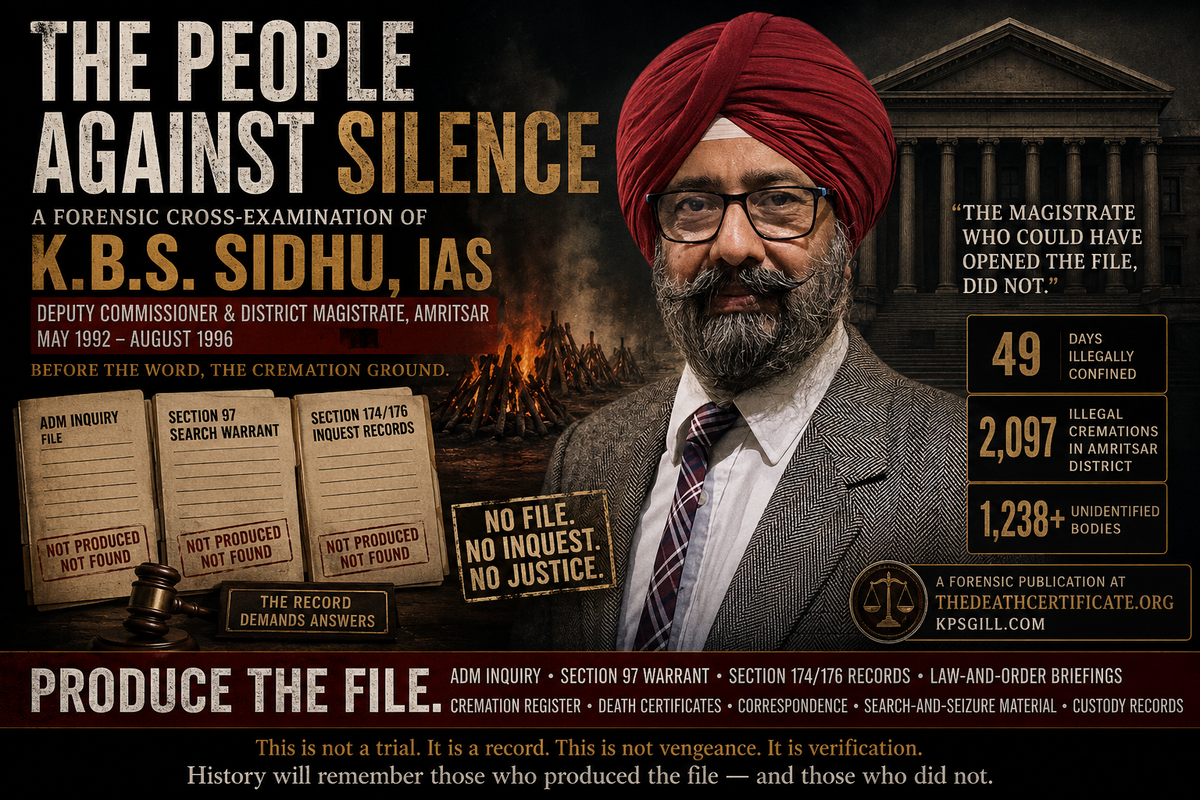
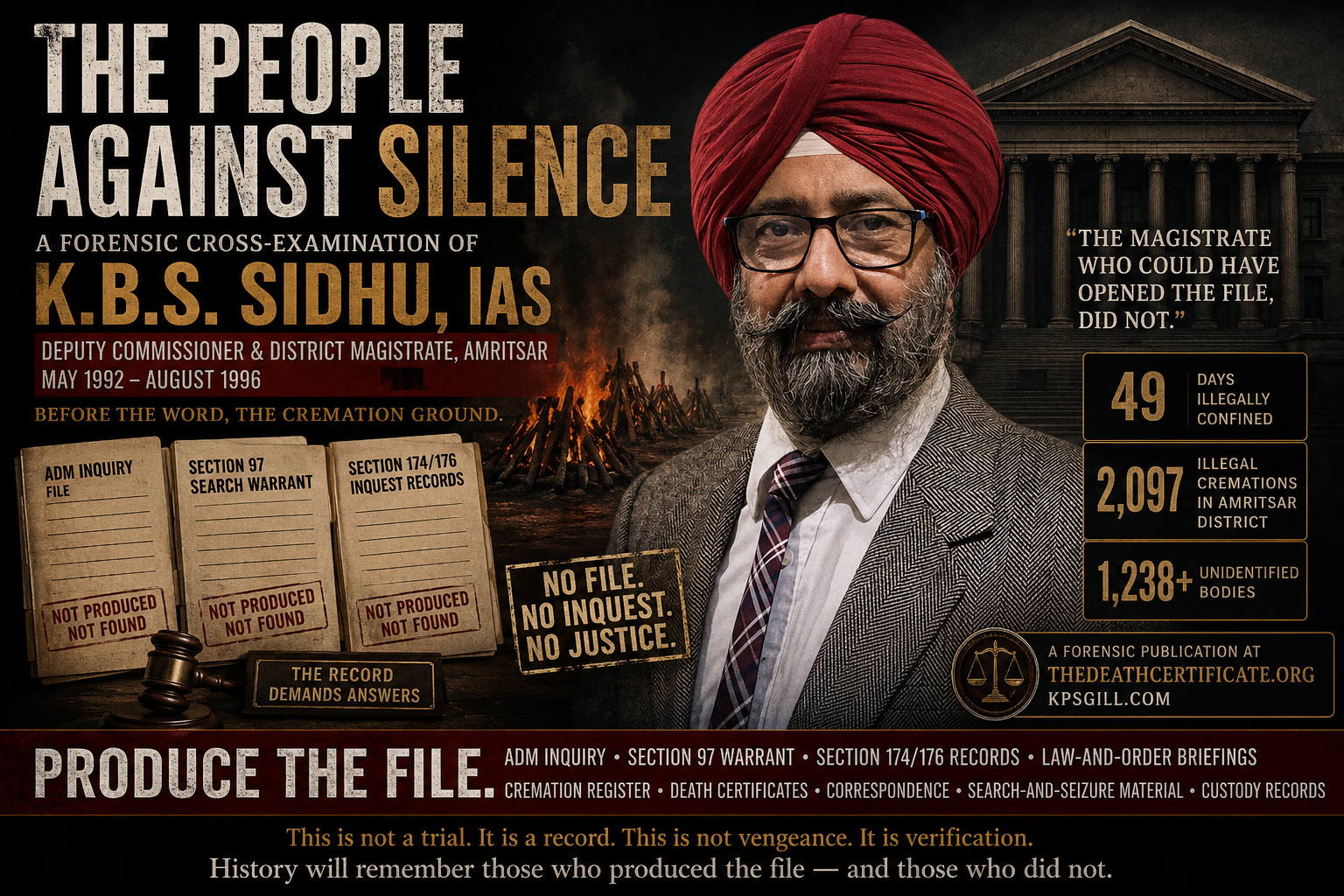
A Comprehensive Forensic Cross-Examination of K.B.S. Sidhu, IAS
Deputy Commissioner and District Magistrate, Amritsar, May 1992 – August 1996
Reconstructed for Publication at KPSGILL.COM and THEDEATHCERTIFICATE.ORG
Conducted under the analytical framework of the Central Bureau of Investigation Special Court, Patiala, with parallel analysis drawn from the civil-rights accountability doctrine of the United States Department of Justice
ਸ਼ਬਦ ਤੋਂ ਪਹਿਲਾਂ, ਸ਼ਮਸ਼ਾਨਘਾਟ
Before the Word, the cremation ground.
— Governing editorial principle, KPSGILL.COM and THEDEATHCERTIFICATE.ORG
MANDATORY DISCLAIMER AND SCENARIO DECLARATION
This document is a forensic reconstruction prepared for investigative publication. Every reader must understand the following before proceeding:
First: Sandhu Is Alive in This Document. The cross-examination that follows is set in a specific hypothetical moment: the criminal trial of Session Case No. 49-T, as it would have proceeded in early-to-mid 1997, before the death of SSP Ajit Singh Sandhu. In the actual historical record, Sandhu died on May 23, 1997 — officially classified as suicide near Bhakharpur village on the Chandigarh-Ambala railway line — before formal charges were framed against him and before he could be examined or cross-examined in open court. In this reconstruction, Sandhu is alive. He is in the courthouse. He has been named as the primary accused. He has not yet been called to testify, but he is present and available to be called. This changes everything about the cross-examination of K.B.S. Sidhu. Every evasion that Sidhu offers can be challenged with the immediate availability of the man who was at the operational center of the Khalra murder. The specific dynamic this creates — the witness knowing that the man who could contradict him most directly is present in the building — is the cross-examination’s forensic engine.
Second: This Is a Reconstructed Document. K.B.S. Sidhu was not named as an accused in Session Case No. 49-T and was not examined as a prosecution witness in the proceedings that produced the November 2005 convictions. This document reconstructs the cross-examination he should have faced: the questions that a fully resourced, fully informed prosecution team — one that had access to every piece of the documentary and testimonial record, including materials that only emerged decades later — would have put to the District Magistrate of Amritsar. Every question is grounded in the verified evidentiary record. Every answer is either drawn from Sidhu’s verified published statements, the logical imperatives of the documentary record, or labeled as a [Reconstructed Response — RR] with the documentary basis explained.
Third: The Combined Prosecution Framework. This reconstruction deploys two parallel prosecution frameworks simultaneously: the Indian CBI Special Counsel framework, grounded in Indian statutory and constitutional law; and the analytical framework of the United States Department of Justice, specifically the civil-rights accountability doctrine developed through 18 U.S.C. §§ 241 and 242, the deliberate-indifference standard established in City of Canton v. Harris, 489 U.S. 378 (1989), and the supervisory-liability doctrine developed through Monell v. Department of Social Services, 436 U.S. 658 (1978). The US DOJ framework applies not because Sidhu is subject to US jurisdiction, but because the analytical precision of the US civil-rights accountability structure — particularly the deliberate-indifference standard — provides a rigorous parallel test for what the DC’s conduct should have been and was not. The Khalra case entered the US Congressional Record through testimony by Representative Edolphus Towns in August 1998. The international accountability framework that surrounds this case demands an international analytical vocabulary.
Fourth: The Evidentiary Framework. All claims are categorized:
| Label | Definition |
|---|---|
| [PF] | Proved Finding: trial judgments, convictions, official documents, judicial findings, statutory text, or the subject’s own published admissions |
| [DA] | Documented Allegation: serious, source-grounded claims not conclusively adjudicated; HRW, Ensaaf, PUDR, Amnesty documentation; judicial record testimony |
| [AI] | Analytical Inference: explicitly labeled reasoning from documented patterns, omissions, timing, and institutional behavior |
| [PM] | Panthic Memory: Sikh institutional and testimonial record |
| [PM-Direct] | The author’s direct family-connected or first-hand knowledge |
| [RR] | Reconstructed Response: the witness’s answer as compelled by the record, with basis annotated |
PREFATORY ANALYSIS: WHY THIS CROSS-EXAMINATION MATTERS — AND WHY IT WAS NEVER CONDUCTED
The criminal prosecution of Session Case No. 49-T produced six convictions and life sentences. It produced a judicial record that names names, establishes command relationships, and confirms that Jaswant Singh Khalra was abducted, illegally confined for forty-nine days, murdered, and his body disposed of near Harike. The convictions are real. The sentences are real. The evidentiary record is real.
What the prosecution did not produce — what its framing, by design or by limitation, excluded — was an examination of the civilian administrative apparatus within which the killing occurred. The district that produced the 2,097 illegal cremations. The district magistracy that held statutory authority over those cremation grounds. The office that maintained the firewood vouchers that Khalra read. The magistrate whose signature would have authorized the Section 97 search warrant that might have produced Khalra alive, in a courthouse, rather than dead at Harike.
The prosecution’s chargesheet named police officers. It did not name the District Magistrate. That omission was a choice — a prosecutorial narrowing that reflected the institutional logic of the investigation as designed. The CBI, operating under Supreme Court supervision, focused on what it could establish beyond reasonable doubt against named police actors. The broader architecture of civilian administrative failure was acknowledged in the Supreme Court’s own language — “flagrant violation of human rights on a mass scale” — but it was not pursued to its logical institutional end.
This cross-examination pursues it. It is not a criminal trial. It is a forensic record. It documents what should have been asked, what the record can now establish, and what the claimed answers fail to satisfy. It is addressed specifically to K.B.S. Sidhu — Karan Bir Singh Sidhu, IAS, AIR-2 of his batch, DC Amritsar from May 1992 to August 1996, now a prolific retirement-phase commentator on civil liberties and administrative accountability — because he is alive, because he has invited the public into his administrative memory, and because the archive’s central demand is simple: produce the file.
He has not produced it. The questions that follow explain why that failure matters.
SETTING AND PARTIES
Court: Additional Sessions Judge exercising Special CBI Court jurisdiction, Patiala
Case: Session Case No. 49-T — State (CBI) v. Ajit Singh Sandhu and others
Date of Reconstructed Examination: February–July 1997
[CRITICAL: This date is before May 23, 1997 — Sandhu is alive, present in the building, and available to testify]
Primary Accused (Present in Court): SSP Ajit Singh Sandhu, IPS — alive, on bail, in the building
Witness Under Examination: K.B.S. Sidhu, IAS, former DC/DM Amritsar
Examining Authority:
— Indian CBI Special Counsel (Prosecution 1): Representing the State through the CBI
— US DOJ Analytical Counsel (Prosecution 2): Providing parallel civil-rights accountability analysis under the international accountability framework of the Khalra case
Note on Sandhu’s Presence: Throughout this cross-examination, counsel may and does reference that SSP Sandhu is in the building and available to contradict the witness. This changes the accountability calculus of every answer. The witness knows that his account of the forty-nine days can be tested, immediately, against the account of the man who was at the operational center of those days.
THE EXAMINATION STRUCTURE
This cross-examination proceeds through eleven Parts and forty-seven Modules. Its architecture mirrors the professional structure of a major federal or international tribunal examination: each Part addresses a distinct domain of accountability; each Module addresses a specific factual, statutory, or institutional question within that domain; and the examination as a whole builds a cumulative record in which no single answer is decisive but in which the pattern of answers — evasive, qualified, or contradicted by the documentary record — constitutes the accountability finding.
Part One: Constitutional Architecture and the Office
Part Two: Intelligence Briefings, Meeting Records, and Institutional Knowledge
Part Three: Annual Confidential Reports — The ACR System and Its Accountability Implications
Part Four: Custodial Deaths and the Section 174/176 Failure
Part Five: Custodial Rape, Sexualized Violence, and the DC’s Non-Response
Part Six: Enforced Disappearances and the Pattern of Disappearance
Part Seven: Extrajudicial Killings, Fake Encounters, and Encounter Certification
Part Eight: The Galliara — Communications with the Government of India
Part Nine: The Manchester Application — Timing, Approval Chain, and the Exit Window
Part Ten: The Khalra Forty-Nine Days — A Day-by-Day Accounting
Part Eleven: The Live Sandhu Confrontation, the Witness Matrix, and the Impeachment Record
PART ONE: CONSTITUTIONAL ARCHITECTURE AND THE OFFICE
Module 1.1 — The Office in the Constitutional Scheme
[The examination opens. K.B.S. Sidhu has been sworn and his examination-in-chief is complete. Indian CBI Special Counsel rises.]
[CBI Counsel — Q1]: Sir, state your full name and your official designations during the period May 1992 to August 1996.
Witness: Karan Bir Singh Sidhu. I was the Deputy Commissioner and District Magistrate of Amritsar District from approximately May 1992 until August 11, 1996.
[CBI Counsel — Q2]: You are an officer of the Indian Administrative Service. Your batch?
Witness: I am of the 1976 batch of the IAS, Punjab cadre.
[CBI Counsel — Q3]: You joined the IAS with an All-India Rank. What was your rank?
Witness: I was an AIR-2 selectee.
[AI]: The AIR-2 ranking is not a vanity detail. It establishes that K.B.S. Sidhu entered the IAS as one of the two highest-ranked officers of his year, nationwide. He was, by the measurement of the selection process, among the most capable administrative officers India could produce. The accountability claim that follows — that this man did not know what the firewood vouchers in his district’s cremation records said — must be read against the intellectual caliber his selection represents.
[CBI Counsel — Q4]: As DC and District Magistrate of Amritsar, you were the senior-most representative of the executive arm of the State within the district. Correct?
Witness: The DC is the principal representative of the State Government at the district level, yes.
[CBI Counsel — Q5]: And in that capacity, you were answerable to the Divisional Commissioner of Jalandhar division, and above him to the Chief Secretary, Punjab, and above him to the Chief Minister. That is the civilian chain of command above you. Yes?
Witness: Yes, that is the administrative hierarchy.
[CBI Counsel — Q6]: And below you — or, more precisely, within your sphere of general administrative superintendence — was the district police, including the Senior Superintendent of Police, Amritsar, and by virtue of Amritsar district’s administrative geography, which at the time included the Tarn Taran sub-division, also the officers of the police structures operating in Tarn Taran. Is that correct?
Witness: The DC holds general superintendence over district police under the Punjab Police Act. The specific operational commands were under the police hierarchy.
[CBI Counsel — Q7]: The word “general” in Section 4 of the Punjab Police Act does not mean “theoretical” or “ceremonial.” It means comprehensive superintendence of the general conduct of police operations in the district, subject to the DGP’s operational command. Is that a fair reading of the provision?
Witness: Section 4 establishes a supervisory relationship, yes.
[CBI Counsel — Q8]: I want to go through the constitutional and statutory framework in some detail because it defines the measure of your obligation. Article 21 of the Constitution of India reads: “No person shall be deprived of his life or personal liberty except according to procedure established by law.” As District Magistrate, were you a state actor bound by Article 21?
Witness: All state actors are bound by Article 21.
[CBI Counsel — Q9]: And Article 22 — the provision guaranteeing protection against arbitrary arrest and detention, including the right to be produced before a magistrate within twenty-four hours — that Article creates obligations on the state apparatus that includes your office?
Witness: Article 22 creates constitutional obligations, yes.
[CBI Counsel — Q10]: So the moment any person in Amritsar district was arrested or detained without warrant by the police, and was not produced before a magistrate within twenty-four hours, that was a violation of Article 22, and the District Magistrate — as the senior magisterial authority in the district — had both the authority and the obligation to respond. Do you agree with that statement?
Witness: In principle, yes. The DM is the senior executive magistrate and has authority over magisterial functions.
Module 1.2 — The Full Statutory Arsenal
[CBI Counsel — Q11]: Let me walk through each specific statutory power that was available to your office. I want a confirmation for each one, so that the record is complete. Section 57 of the Code of Criminal Procedure — the provision that no person arrested without warrant shall be detained for a period longer than twenty-four hours without a magistrate’s order. Correct?
Witness: Section 57 sets the twenty-four-hour limit, yes.
[CBI Counsel — Q12]: Section 58 — the provision requiring that police officers arresting persons without warrant shall report the arrest forthwith to the District Magistrate. Correct?
Witness: Correct.
[CBI Counsel — Q13]: Section 97 — the provision empowering the District Magistrate to issue a search warrant for any place where a person is believed to be wrongfully confined. This is an executive magisterial power that does not require judicial review, available on reasonable belief. Correct?
Witness: Section 97 confers that power, yes.
[CBI Counsel — Q14]: Section 107 and 108 — powers enabling the District Magistrate to require persons likely to disturb public peace to execute bonds, and to require persons disseminating seditious matter to show cause. The DC’s office routinely used these provisions during the counterinsurgency, did it not?
Witness: These provisions were used in the security context, yes.
[CBI Counsel — Q15]: Section 144 — the executive magistrate’s power to issue orders in urgent cases of nuisance or apprehended danger. Your office regularly invoked Section 144 during the counterinsurgency period, did it not?
Witness: Section 144 orders were issued in appropriate circumstances.
[CBI Counsel — Q16]: Section 174 — requiring police to conduct an inquiry and draw up a report in cases of unnatural death, including deaths in or near police custody. Correct?
Witness: Section 174 requires police inquiry into unnatural deaths, yes.
[CBI Counsel — Q17]: Section 176(1), as applicable before the 2005 amendment — the provision mandating that the District Magistrate hold an inquiry into any death occurring in police custody. The word “shall” appears in the statute. This is not a discretionary function. Correct?
Witness: Section 176 contains mandatory language, yes.
[CBI Counsel — Q18]: Section 167 — the provision governing production of a person before the magistrate when police custody extends beyond twenty-four hours, and requiring magisterial authorization for further custody. Correct?
Witness: Section 167 governs extended custody authorization, yes.
[CBI Counsel — Q19]: So to summarize: as District Magistrate, you held Sections 57, 58, 97, 107, 108, 144, 167, 174, and 176(1) as active statutory instruments. You held the general superintendence authority under Section 4 of the Punjab Police Act. You held the constitutional duty under Articles 21 and 22. You were the senior magisterial authority in the district. And you held these authorities for four years — May 1992 to August 1996 — during which the CBI later confirmed 2,097 illegal cremations within your district. Are these the facts?
Witness: Those statutory provisions existed. The operational context was complex.
[CBI Counsel — Q20]: Witness, I am not asking about operational context. I am asking whether these instruments existed in your hands. They did. Yes?
Witness: Yes.
[AI]: Establishing the statutory arsenal in full, before a single factual question about Khalra is put, is the prosecution’s first objective. It forecloses the defenses of ignorance (the law is clear), incapacity (the powers existed), and contextual excuse (the counterinsurgency does not suspend constitutional text). Every subsequent evasion must be measured against this catalogue of available tools, none of which the record shows were systematically deployed to address either the 2,097 cremations or the forty-nine days of Khalra’s illegal confinement.
Module 1.3 — The US DOJ Parallel Framework
[US DOJ Analytical Counsel rises.]
[US DOJ Counsel — Q21]: Sir, I want to introduce a parallel accountability framework. Under United States federal law, 18 U.S.C. § 242 makes it a federal crime for anyone acting under color of law to willfully deprive any person of rights protected by the Constitution or laws of the United States. The Indian constitutional framework creates analogous obligations. Article 21 of the Indian Constitution is, in its civil-liberties architecture, functionally parallel to the due-process protections of the Fifth and Fourteenth Amendments to the US Constitution. Do you accept that parallel?
Witness: I am not expert in US law, but I understand that constitutional protections have common principles across democratic systems.
[US DOJ Counsel — Q22]: In City of Canton v. Harris, 489 U.S. 378 (1989), the United States Supreme Court held that government inaction — specifically, a municipality’s failure to train or supervise its officers — could constitute a constitutional violation when the failure reflected deliberate indifference to the rights of persons with whom officers would come into contact. The Court’s standard: did the government official know of a substantial risk of serious harm to a person’s rights, and consciously disregard that risk? I want to put this standard to you. By September 12, 1995 — six days after Khalra’s abduction and the date his wife filed the Supreme Court habeas corpus petition — did you know that a substantial risk existed that a person in your district was being wrongfully confined and harmed?
Witness: I was aware of the complaint about Khalra’s disappearance.
[US DOJ Counsel — Q23]: Awareness of the complaint is a known risk. A Supreme Court habeas corpus petition is a formal, judicially recognized statement that a substantial risk of wrongful confinement exists. And you were the DC of the district from which the petition arose. Under the deliberate-indifference standard, what action did your office take to address that known risk?
Witness: We marked an inquiry to the ADM.
[US DOJ Counsel — Q24]: The ADM inquiry, as we will examine in detail later in this proceeding, has produced no documentary trace in any court record. The habeas corpus petition was before the Supreme Court. The FIR was on record in your district. The police were denying custody. Under the deliberate-indifference standard, the question is not whether you took some action — it is whether the action you took was commensurate with the known risk and the available tools. An internal ADM notation, producing no result, and a man dead in forty-nine days — does that satisfy the standard?
Witness: We worked within the systems available to us.
[US DOJ Counsel — Q25]: Under Monell v. Department of Social Services, 436 U.S. 658 (1978), supervisory liability for constitutional violations attaches when a supervisor is aware of a pattern of unconstitutional conduct by subordinate officers and fails to act to stop it. In the context of Amritsar district 1992–1996: you were aware — by your own account — of the counterinsurgency operations, of the cremation grounds receiving bodies, and of the police characterizing those bodies as militant casualties. That pattern — more than two thousand bodies cremated, twelve hundred of them unidentified — satisfies the “pattern of unconstitutional conduct” threshold. Your failure to deploy the statutory tools available to investigate, inquire, or intervene satisfies the “failure to act” element. I put it to you that under the Monell standard, the DC’s office of Amritsar bears supervisory institutional accountability for the systematic constitutional violations that produced the 2,097 illegal cremations. What is your response?
Witness: I cannot accept an American legal standard as applicable to my service in India.
[US DOJ Counsel — Q26]: The standard is being used analytically, not jurisdictionally. The constitutional values it reflects — that supervisory public officials cannot disclaim responsibility for patterns of serious rights violations they knew about and failed to stop — are not American values. They are constitutional values. The Indian Constitution contains them. Section 4 of the Punjab Police Act contains them. Section 176(1) of the CrPC contains them. The word “shall” in the mandatory inquiry provision is, in its functional legal meaning, identical to the Monell duty. Do you disagree?
Witness: I understand the parallel the counsel is drawing.
[AI]: The significance of the US DOJ framework is not jurisdictional — it is analytical. The Monell deliberate-indifference standard provides a precisely calibrated measure for what a supervisory official who knows of a pattern of constitutional violations must do. The Indian “shall” provisions of Section 176(1) impose the same duty in mandatory statutory language. The DC of Amritsar, as a senior executive magistrate who held statutory oversight authority over the police apparatus that produced 2,097 illegal cremations, meets both tests: he knew, and he did not act. The convergence of the Indian mandatory statutory framework with the US deliberate-indifference standard creates an accountability finding that no jurisdictional objection can reach.
Module 1.4 — The DC’s Intelligence Apparatus
[CBI Counsel — Q27]: As DC Amritsar during the counterinsurgency period, you had access to intelligence reports from multiple agencies. Is that correct?
Witness: The DC receives security-related inputs from various agencies in the course of his functions.
[CBI Counsel — Q28]: The Intelligence Bureau maintained a presence in Amritsar. The Punjab Police’s own intelligence wing reported to the DC’s office, among others. The Central agencies — the IB, the RAW in its domestic interface — shared information relevant to district security. Is this the picture?
Witness: The DC receives security briefings through appropriate channels.
[CBI Counsel — Q29]: And those briefings were regular. Not occasional. During an active counterinsurgency, the DC of a major district like Amritsar would expect daily or near-daily security briefings. Is that correct?
Witness: There were regular security discussions, yes.
[CBI Counsel — Q30]: Who gave you these briefings? Specifically — was it the SSP Amritsar, the SSP Tarn Taran, the DIG, the IB representative, a dedicated intelligence officer attached to the DC’s office, or some combination?
Witness: Briefings came from the SSP of the respective areas, from the DIG, and through the administrative system.
[CBI Counsel — Q31]: So SSP Sandhu — SSP Tarn Taran — briefed you or his superiors who briefed you on matters relating to Tarn Taran, which was within Amritsar district at the time. He was a regular interlocutor, at least indirectly, in your security intelligence stream. Correct?
Witness: The SSP Tarn Taran would provide inputs on the Tarn Taran area, yes.
[CBI Counsel — Q32]: Those briefings included information about counterinsurgency operations — encounters, arrests, detentions, and the number of militants killed or captured. Is that correct?
Witness: Security briefings covered the law-and-order situation, including operations.
[CBI Counsel — Q33]: Including the results of those operations — deaths, detentions, encounters. Numbers were discussed. Were written briefing notes prepared?
Witness: Some briefings were oral. Others may have had written components.
[CBI Counsel — Q34]: Those written components — if they exist — would be held in the DC’s office record room, or in the SSP’s records, or in the DIG’s records. They would document what the DC was told about the counterinsurgency operations, including the number of persons killed or detained in the Amritsar district area during each relevant period. We will request their production. Are you aware of any reason why such records would not have been maintained?
Witness: Records of security briefings are typically held by the agencies that generated them.
[CBI Counsel — Q35]: And those agencies include your own office. The DC’s office receives and may maintain logs of security briefings. Correct?
Witness: There would be some form of administrative record.
[AI]: The intelligence briefing record is one of the most consequential document categories that has never been produced in any judicial proceeding related to the Khalra case. If the DC of Amritsar received regular security briefings covering counterinsurgency operations — deaths, detentions, encounters — then the claim that the office was unaware of the scale and nature of the illegal cremation program becomes, at minimum, harder to sustain. Either the briefings accurately reflected the cremation grounds’ function (in which case the DC was informed), or the briefings concealed it (in which case the intelligence apparatus was complicit in the concealment). Either answer is significant. The production of the briefing records is a foundational demand of any adequate accountability inquiry.
PART TWO: INTELLIGENCE BRIEFINGS, MEETING RECORDS, AND INSTITUTIONAL KNOWLEDGE
Module 2.1 — The Law-and-Order Meeting Architecture
[CBI Counsel — Q36]: Let us discuss the formal meeting architecture of the DC’s office. As District Magistrate during an active counterinsurgency, you would have chaired formal law-and-order meetings with the district police. How frequently?
Witness: Law-and-order meetings were held regularly. In a district like Amritsar during that period, they could be weekly or more frequent.
[CBI Counsel — Q37]: Weekly or more frequent, across four years, in Amritsar district during the counterinsurgency. That is a large number of meetings. Were minutes of these meetings prepared?
Witness: In some cases, formal minutes were prepared. In others, the discussion was recorded in summary form.
[CBI Counsel — Q38]: Who prepared the minutes?
Witness: A designated officer — typically an ADM or equivalent — would note the proceedings.
[CBI Counsel — Q39]: And those minutes would record: who attended, what topics were discussed, what decisions were made, and what follow-up actions were assigned. Is that the normal format?
Witness: That is the general format, yes.
[CBI Counsel — Q40]: The attendees at a law-and-order meeting chaired by the DC Amritsar during 1992–1996 would typically include: the SSP Amritsar, the SSP Tarn Taran, the DIG Amritsar Range, relevant Sub-Divisional Magistrates, and others as needed. SSP Sandhu — in his capacity as SSP Tarn Taran — would have been a regular attendee at meetings that touched on the Tarn Taran sub-division. Is that correct?
Witness: The SSP Tarn Taran would attend relevant law-and-order meetings, yes.
[CBI Counsel — Q41]: So at meetings chaired by you, attended by SSP Sandhu, in the period 1992–1996 — the same period during which the CBI later confirmed that Sandhu was overseeing illegal operations including illegal detentions and the illegal cremation of bodies at the Tarn Taran cremation ground — what was discussed regarding the Tarn Taran area? Can you describe what SSP Sandhu told you at these meetings?
Witness: The discussions focused on the counterinsurgency situation, militant activities, the security environment.
[CBI Counsel — Q42]: Did SSP Sandhu, at any of these meetings, raise the subject of persons who had been detained without formal arrest, or persons who had died in custody, or persons who had been cremated without identification?
Witness: These matters were not typically raised in that specific framing in law-and-order meetings.
[CBI Counsel — Q43]: In what framing were they raised?
Witness: Casualties were discussed in the context of counterinsurgency operations — militant kills, neutralizations, the outcome of specific operations.
[CBI Counsel — Q44]: “Neutralizations.” Is that the word that was used in your meetings?
Witness: That was common operational terminology of the period.
[CBI Counsel — Q45]: “Neutralizations” is a euphemism for killings. When SSP Sandhu reported “neutralizations” at your law-and-order meetings, did you ask whether the neutralized persons had been in police custody? Whether the deaths had occurred in an encounter, or in detention? Whether Section 174 inquiries had been conducted? Whether bodies had been identified before cremation?
Witness: The operational details of specific encounters were primarily a police matter. The briefing conveyed the overall security picture.
[CBI Counsel — Q46]: The overall security picture included bodies being cremated at the Tarn Taran cremation ground in numbers that the CBI later confirmed were extraordinarily abnormal. Did the overall security picture, as presented to you in these meetings, ever flag the cremation volumes as extraordinary?
Witness: The cremations were presented as the disposal of militant casualties. The numbers were explained in that context.
[CBI Counsel — Q47]: And you accepted those explanations, meeting after meeting, across four years, even as the numbers accumulated toward 2,097. Is that your evidence?
Witness: At the time, the explanation was consistent with the counterinsurgency context.
[US DOJ Counsel — Q48]: Witness, I want to put a document to you. The Ensaaf and HRDAG joint study, “Violent Deaths and Enforced Disappearances During the Counterinsurgency in Punjab, India” — a quantitative analysis using mortality and population data — found that the scale of disappearances and killings was statistically extraordinary even by the standards of active counterinsurgency. At what point during your four years did the volume of reported “neutralizations” begin to strike you as extraordinary?
Witness: The security situation was extreme at the time.
[US DOJ Counsel — Q49]: That is not responsive. The question is: at what volume of reported deaths did the pattern require a response from the district magistracy beyond acceptance of the police’s own characterization? One hundred? Five hundred? One thousand? Two thousand? Where is the threshold at which Section 176(1) becomes non-negotiable?
Witness: Section 176 inquiries were conducted into specific cases.
[US DOJ Counsel — Q50]: Name one. One case, one name, one inquiry number, one date, from the period 1992–1996, in connection with a death in police custody within Amritsar district, where a Section 176(1) magisterial inquiry was completed and a report was filed.
Witness: I would need to consult the records to give you a specific case.
[US DOJ Counsel — Q51]: My Lord, we have had those records sought from the government of Punjab for the purposes of this examination. No Section 176(1) inquiry record from the DC Amritsar’s office for the period 1992–1996, in connection with a custodial death or illegal cremation, has been produced. That absence — not of a specific document but of an entire category of mandatory administrative records — is the finding this line of questioning is designed to establish.
Module 2.2 — Meeting Minutes and the Written Record
[CBI Counsel — Q52]: Let us return to the meeting minutes. The law-and-order meetings were held weekly or more frequently. Across four years — May 1992 to August 1996 — that is approximately two hundred meetings. Were minutes prepared for each?
Witness: I believe minutes were prepared for most formal meetings.
[CBI Counsel — Q53]: Two hundred sets of minutes. Those minutes would show what SSP Sandhu told the DC’s meeting about Tarn Taran operations across the four years of his SSP tenure there, which overlaps substantially with your DC tenure. We request their production through appropriate channels. Are you aware of any reason those minutes would not be available?
Witness: Administrative records are held by the district administration. They would be subject to the normal records-retention rules.
[CBI Counsel — Q54]: The normal records-retention rules for administrative records in India vary by category — some are permanent, some are retained for thirty years, some for ten. Law-and-order meeting minutes of the DC’s office during an active counterinsurgency, particularly given the ongoing judicial proceedings arising from that counterinsurgency, would be expected to be retained as permanent or long-term records. Do you agree?
Witness: Important records should be retained, yes.
[CBI Counsel — Q55]: Did you, before leaving for Manchester in August 1996, take any steps to ensure that the law-and-order meeting minutes from your tenure were properly archived and retained, given the ongoing Supreme Court and CBI proceedings arising from events in your district?
Witness: Standard administrative handover procedures would have been followed.
[CBI Counsel — Q56]: Standard handover procedures would not necessarily flag specific records categories for retention in connection with ongoing litigation. The question is specific: did you take active steps to ensure the law-and-order meeting minutes — particularly those referencing the Tarn Taran operations and the Khalra matter — were retained and available to the judicial proceedings?
Witness: I followed standard procedures. I cannot say specifically what was retained by the succeeding DC’s office.
Module 2.3 — Daily Diary and Administrative Log
[CBI Counsel — Q57]: As DC, were you required to maintain a daily diary or administrative log of your activities, meetings, and decisions?
Witness: Senior IAS officers maintain working records of their official activities. The format varies.
[CBI Counsel — Q58]: Your personal administrative diary or log for the period September 6, 1995 to October 27, 1995 — the forty-nine days of Khalra’s illegal confinement — would document what meetings you held, what decisions you made, what correspondence you received, and what actions you took or directed. That diary exists?
Witness: I maintained working notes. Whether they are preserved in the form of a diary from that period, I would need to check.
[CBI Counsel — Q59]: A senior IAS officer of your batch and seniority, serving in what you yourself have described as one of the most significant postings of your career, would have maintained detailed administrative records. The alternative — that your working records from September–October 1995 do not exist — is, to put it plainly, implausible. I will ask you to produce the diary. What does your diary entry for September 7, 1995 — the day after Khalra’s abduction, the day his wife came to your office — record?
Witness: I do not have the diary before me.
[CBI Counsel — Q60]: My Lord, we request that the witness be directed to produce his administrative diary or working records for the period September 1 to November 30, 1995. This is a specific, bounded, and clearly relevant request. The forty-nine days are the forty-nine days.
Court: The witness is directed to produce, through appropriate channels, whatever administrative diary or working records from the period September 1 to November 30, 1995 remain in his possession or are recoverable from state records.
[AI]: The request for the daily diary is not merely procedural. It is the foundational demand of the accountability record. A senior IAS officer who maintained detailed records of the Galliara project, of hijacking negotiations, of surrender ceremonies, of counterinsurgency policy — the full range of significant administrative events described in his own published writing — but who cannot produce his administrative record for the forty-nine days during which Jaswant Singh Khalra was alive and in illegal custody within his district, has produced an accountability void that no subsequent administrative claim can fill.
PART THREE: THE ANNUAL CONFIDENTIAL REPORT — THE ACR SYSTEM AND ITS ACCOUNTABILITY IMPLICATIONS
Module 3.1 — The ACR Framework in Indian Administration
[CBI Counsel — Q61]: Let me turn to the Annual Confidential Report system. The ACR is the primary formal mechanism through which the Indian bureaucracy evaluates the performance of its officers. Every IAS and IPS officer receives an annual performance assessment from their reporting officer and, above that, from their reviewing officer. Is this a correct description of the ACR system?
Witness: That is correct. The ACR is the primary official record of an officer’s performance.
[CBI Counsel — Q62]: For an IPS officer serving as SSP in a district — such as SSP Sandhu at Tarn Taran — who was the reporting officer for the ACR?
Witness: The reporting officer for an SSP would typically be the DIG of the range. The reviewing officer would be the IGP or ADGP.
[CBI Counsel — Q63]: And the DC/DM of the district — what was the DC’s role, if any, in the ACR process for the district SSP?
Witness: The DC may provide inputs or be consulted regarding the SSP’s administrative and law-and-order performance, but the primary reporting officer for an SSP is within the police hierarchy.
[CBI Counsel — Q64]: “May provide inputs.” In practice, particularly during a period of counterinsurgency when the DC-SSP coordination was critical and daily, did the DC’s office provide formal written inputs on the performance of the SSP Amritsar and SSP Tarn Taran?
Witness: There were interactions with the police officers that could inform performance assessments.
[CBI Counsel — Q65]: Formal written inputs or informal verbal conversations?
Witness: Both, depending on the situation.
[CBI Counsel — Q66]: Formal written inputs from the DC’s office on SSP performance would be administrative documents. They would be on file. Did your office provide formal written performance inputs on SSP Sandhu during your DC tenure?
Witness: I would need to examine the records to give you a precise answer.
[CBI Counsel — Q67]: If such inputs were provided, they would reflect your assessment of SSP Sandhu’s performance as SSP Tarn Taran. They would document what you, as DC Amritsar, believed Sandhu was doing and how effectively he was doing it. If those inputs described Sandhu’s counterinsurgency performance in positive terms — and if the counterinsurgency performance included the illegal cremations subsequently confirmed by the CBI — then your formal written assessment would document institutional approval of the very operations that produced those cremations. Do you understand the accountability significance of that question?
Witness: The performance assessment of police officers was a police hierarchy matter.
[CBI Counsel — Q68]: You have said the DC may provide inputs. If you provided positive inputs about Sandhu’s counterinsurgency performance, you were endorsing, in writing, the operations that he was conducting. Those operations, as the CBI has confirmed, included the illegal detention and murder of Jaswant Singh Khalra. The written endorsement, if it exists, is an accountability document of the first order. I request that all ACR inputs provided by your office regarding SSP Sandhu be produced.
Module 3.2 — The President’s Police Medal and Sandhu’s Commendations
[CBI Counsel — Q69]: SSP Ajit Singh Sandhu received the President’s Police Medal for Gallantry on at least two occasions during his career. Do you know this?
Witness: I am aware that Sandhu received medals during his career.
[CBI Counsel — Q70]: The President’s Police Medal for Gallantry is one of the highest awards for meritorious police service. The nomination process for such a medal requires a recommendation chain that includes the officer’s seniors and may include civil administrative endorsements. Did your DC office play any role in endorsing or supporting Sandhu’s nomination for these medals?
Witness: Medal nominations go through the police hierarchy primarily.
[CBI Counsel — Q71]: “Primarily” — but not exclusively. The DC as the senior civil authority in the district may be consulted or may formally endorse a police officer’s nomination for civilian honours. Was any such consultation or endorsement sought from your office for Sandhu’s nominations?
Witness: I cannot recall with specificity whether such a consultation was sought.
[CBI Counsel — Q72]: If a consultation was sought and an endorsement was provided, that document exists. If it exists, it constitutes an official certification by the DC of Amritsar that SSP Sandhu was performing his duties in a manner worthy of the highest national commendation. Against the background of what the CBI has established about those duties, an official endorsement for gallantry medals would be an extraordinary accountability document. We will seek production through appropriate channels. Are you in a position to say now whether such an endorsement was given?
Witness: I genuinely cannot recall, and I would not wish to make a statement on this that turns out to be inaccurate.
[AI]: The gallantry medal endorsement question is not merely symbolic. If the DC’s office endorsed Sandhu’s nomination — at any point during 1992–1996 — the endorsement document would formally capture the civilian administration’s contemporaneous assessment of Sandhu’s operations. That document would be dated. It would be signed. It would describe what Sandhu was praised for. And if it was written while Sandhu was simultaneously running the illegal detention architecture that produced the Tarn Taran cremations, it would establish, in the DC’s own hand, the institutional approval of those operations. The question is whether the document exists. It very likely does.
Module 3.3 — ACRs of Police Officers Across the District
[CBI Counsel — Q73]: Beyond Sandhu, the DC’s general superintendence authority extended to the overall conduct of the district police. Did your office monitor the pattern of encounters — the number of persons killed in police operations — across the various SSP jurisdictions in Amritsar district during your tenure?
Witness: The DC receives law-and-order reports that include data on the security situation, which would include operation outcomes.
[CBI Counsel — Q74]: Operation outcomes meaning: number of persons killed in police encounters?
Witness: Among other data, yes.
[CBI Counsel — Q75]: The Ensaaf database, drawing on official records, documents hundreds of extrajudicial killings attributed to police operations in Amritsar district during the period 1992–1996. These are deaths that the police classified as encounters but that human rights organizations have documented as extrajudicial killings. During your tenure, what was the total number of persons killed in police encounters that was reported to your office across all SSP jurisdictions?
Witness: I cannot give you a precise figure from memory.
[CBI Counsel — Q76]: But the law-and-order reports would have cumulative data. Weekly reports, monthly reports, annual summaries. The DC’s office would have been able to compute a running total of encounter deaths across the district at any point. Correct?
Witness: The data would have been available in aggregate form through the reporting system.
[CBI Counsel — Q77]: And at no point during those four years, as the aggregate encounter death toll climbed, did your office initiate a systematic examination of whether Section 174 inquiries had been conducted for each death, whether bodies had been identified before disposal, and whether Section 176(1) magisterial inquiries had been completed for the deaths that occurred in custody?
Witness: The general assumption was that these operational matters were being handled through the appropriate channels.
[CBI Counsel — Q78]: The appropriate channels being the police channels. The same channels that were concealing the illegal cremations. The same channels that were classifying identified persons as unidentified militants. You delegated the accountability for custodial deaths back to the very institution that was creating those deaths, and accepted the institution’s own reporting as sufficient. Is that an accurate description of your administrative practice?
Witness: I relied on the information provided through the established system.
[PF — Structural Observation]: The DC’s admission that he “relied on information provided through the established system” — where the established system was the police reporting chain that was actively concealing illegal cremations — is the administrative self-indictment that the accountability record requires. It establishes that the district magistracy, which held independent statutory authority precisely in order to provide an institutional check on police self-reporting, functioned instead as a passive recipient of police characterizations. The “established system” produced 2,097 illegal cremations and one murdered human rights investigator. Its reliability was not established. Its unreliability was the finding.
PART FOUR: CUSTODIAL DEATHS AND THE SECTION 174/176 FAILURE
Module 4.1 — The Cremation Ground Architecture
[CBI Counsel — Q79]: Let us now address the cremation grounds directly. The CBI confirmed illegal cremations at three sites in Amritsar district: the Patti cremation ground, the Durgiana Mandir cremation ground in Amritsar city, and the Majitha Road cremation ground in Tarn Taran — which was under Sandhu’s SSP jurisdiction. These three sites collectively accounted for 2,097 confirmed illegal cremations. Do you accept these as established facts?
Witness: The CBI made these findings, yes.
[CBI Counsel — Q80]: The Durgiana Mandir cremation ground is in Amritsar city — within the district headquarters. It is not in a remote rural location. It is one of the most prominent cremation grounds in the city. Bodies were being cremated there on the basis of false identifications, or no identification at all, over a period of years that substantially overlaps with your tenure. Were you aware of this?
Witness: I was not aware of the illegal aspects of what was occurring. The cremations were presented as legitimate disposal of militant casualties.
[CBI Counsel — Q81]: The Durgiana Mandir cremation ground — within Amritsar city — is managed by a Municipal Committee or equivalent body. The Municipal Committee of Amritsar falls within the administrative supervision of the DC’s office. The DC has supervisory responsibilities over municipal functions in the district headquarters. Were you ever — at any point between May 1992 and August 1996 — briefed by the Municipal Committee about the unusual volume of cremations being conducted at Durgiana Mandir?
Witness: I was not specifically briefed about the cremation volumes at Durgiana Mandir as a matter of concern.
[CBI Counsel — Q82]: The firewood vouchers that Khalra examined — the 482 vouchers from the Tarn Taran cremation ground — were administrative records maintained pursuant to municipal and administrative procedures. The records were maintained by the cremation ground operators. Those operators were accountable, through the Municipal Committee, to the district administration. Is it your evidence that in four years of administering Amritsar district, the district administration — your district administration — never examined the cremation ground records and found nothing unusual?
Witness: Cremation ground records were maintained by the Municipal Committee. They were not routinely brought to the DC’s attention in ordinary administrative processing.
[CBI Counsel — Q83]: Khalra, a civilian human rights investigator with no coercive authority and no administrative access, went to those same cremation grounds and read those records. He did so through direct examination — by visiting the grounds, asking the operators, cross-referencing the firewood vouchers against police records. He calculated 6,000 illegal cremations from those records. Your district administration, which supervised the Municipal Committee, which supervised the cremation ground operators, which held those records in its administrative chain — never performed the same examination that a civilian investigator performed without any formal authority. Is that your evidence?
Witness: The scale of what Khalra found was not anticipated.
[CBI Counsel — Q84]: Not anticipated. A man with a notebook anticipated it. Your office, with statutory authority, intelligence resources, and administrative supervision of the municipal chain, did not. And the man with the notebook was killed in your district, in your tenure, by the police officers whose operations generated those records.
Module 4.2 — Year-by-Year Accountability: 1992–1996
[CBI Counsel — Q85]: Let me address the cremation record year by year during your specific tenure. In 1992, from May onwards when you assumed charge as DC, what was the reported rate of encounter deaths and militant casualties in the district?
Witness: 1992 was still a peak period of counterinsurgency activity. The number of casualties was high.
[CBI Counsel — Q86]: High. Specific, please. Were reports provided to your office showing monthly or quarterly death tolls from encounters?
Witness: Reports were provided, yes.
[CBI Counsel — Q87]: And those reports — for 1992, 1993, 1994, 1995 — would collectively show the accumulated death count across your tenure. That count, as independently confirmed by the CBI and Ensaaf, runs to hundreds per year. For each of those hundreds of deaths per year, was a Section 174 inquiry completed by the police?
Witness: Section 174 inquiries were conducted. I cannot say for each death specifically.
[CBI Counsel — Q88]: For each of the thousands of deaths for which a Section 174 inquiry was supposedly completed, was a Section 176(1) magisterial inquiry also completed — given that, as the CBI has established, many of these deaths occurred in custody or in circumstances involving custodial interaction?
Witness: Section 176 inquiries were for deaths specifically in police custody.
[CBI Counsel — Q89]: The CBI confirmed that 1,238 of the 2,097 cremated persons were entirely unidentified. Entirely unidentified means: no FIR, no identification, no family notification, no legal process. A person who dies “in custody” and is cremated without identification has, by the absence of any identification record, died in a forensic vacuum that Section 176(1) was designed precisely to address. Each of those 1,238 unidentified persons represents a Section 176(1) inquiry that your office was obligated to conduct and did not. Is that the record?
Witness: The challenge of identifying persons in the counterinsurgency context—
[CBI Counsel — Q90]: The statute does not provide a “counterinsurgency exception.” Section 176(1) uses the word “shall.” One thousand, two hundred and thirty-eight times your office’s mandatory obligation was not discharged. That is the record I am asking you to confirm or refute. Can you produce any evidence that any Section 176(1) inquiry was completed in connection with any of the 1,238 unidentified cremated persons?
Witness: I cannot produce such evidence at this time.
Module 4.3 — Individual Documented Deaths — The Record of Non-Inquiry
[CBI Counsel — Q91]: Let me put specific documented cases to you. The PUDR — the People’s Union for Democratic Rights — published field reports during 1990–1995 documenting specific cases of custodial deaths in Amritsar division, with names, dates, and circumstances. Were you aware of PUDR’s documentation?
Witness: I was generally aware of human rights organizations operating in the area.
[CBI Counsel — Q92]: Human Rights Watch published a 1994 report — “Dead Silence: The Legacy of Human Rights Abuses in Punjab” — documenting specific cases of custodial killings, disappearances, and illegal cremations in Amritsar and surrounding districts. Did your DC office receive this report or any communication concerning its findings?
Witness: Reports from international human rights organizations may have come to the administration’s attention through various channels.
[CBI Counsel — Q93]: “May have come to the administration’s attention through various channels.” Does that mean yes or no?
Witness: I cannot say with certainty whether a specific copy reached my office.
[CBI Counsel — Q94]: Human Rights Watch’s 1994 report named specific villages, specific police stations, and specific officers in connection with documented killings and disappearances in Amritsar district. If a copy reached any government office — the Chief Secretary’s office, the DGP’s office, the Home Department, your DC’s office — the administrative expectation would be that the named allegations be examined. Did any examination flow from HRW’s 1994 report, by your office, with respect to the specific cases in your district?
Witness: These reports were received in an adversarial context. They were contested.
[US DOJ Counsel — Q95]: The adversarial nature of the source does not relieve the supervisory authority of the obligation to examine. In US federal civil rights jurisprudence, notice of a credible complaint triggers an obligation to investigate — even if the complaint comes from an adversarial source. The Monell standard does not ask whether the supervisor believed the complaint. It asks whether the supervisor knew, or should have known, of a substantial risk of constitutional violation. An HRW report naming specific officers, specific villages, and specific methods in your district is notice. It triggered an obligation. What investigation did your office conduct?
Witness: The police conducted their own review of such allegations.
[US DOJ Counsel — Q96]: The police reviewed allegations of their own misconduct, and you accepted the police’s self-review as the accountability discharge for the DC’s office. That is the mechanism?
Witness: The administrative structure placed the investigation of police operational conduct within the police hierarchy.
[US DOJ Counsel — Q97]: The administrative structure you are describing is one in which the institution accused of the constitutional violations was asked to investigate itself, with no independent civilian oversight, no magisterial inquiry, and no external verification. That is not an accountability mechanism. That is the absence of one. The DC’s office, which held independent statutory authority for exactly this purpose, chose to route the accountability function back to the alleged violator. That is the Monell failure: knowledge plus non-action by the supervisory authority.
PART FIVE: CUSTODIAL RAPE, SEXUALIZED VIOLENCE, AND THE DC’S NON-RESPONSE
Module 5.1 — The Documented Pattern of Custodial Sexual Violence
[CBI Counsel — Q98]: I now turn to a category of evidence that requires particular precision: allegations of custodial rape and sexualized violence against women and men in Amritsar district during your tenure. This is a subject that the broader accountability record documents extensively. Let me be clear about the evidentiary status before I begin. This line of questioning is not about proving specific individual cases to the criminal standard in this proceeding. It is about establishing what your office knew, what complaints reached you, and what you did.
Witness: Understood.
[CBI Counsel — Q99]: Human Rights Watch’s 1994 report documented specific cases of rape and sexual assault committed by Punjab Police officers against women — in particular, against women whose male relatives were suspected militants or who were targeted to extract information or to punish families. This documentation names Amritsar district specifically. Were you aware of this documentation?
Witness: I was aware of general allegations of misconduct. Specific knowledge of the HRW cases as reported would depend on what reached my office.
[CBI Counsel — Q100]: Amnesty International documented similar allegations. The PUDR documented specific cases. Indian civil liberties organizations documented specific cases. These reports were in public circulation during your tenure. They were in national newspapers. They were the subject of political commentary. Do you maintain that none of this documentation came formally to the DC’s office?
Witness: The documentation came to the attention of the administration through various channels. The allegations were contested.
[CBI Counsel — Q101]: A woman — any woman — who was raped in police custody in Amritsar district during your tenure held a constitutional claim under Article 21: the right not to have her bodily integrity violated by the state. As District Magistrate, you were the senior state representative in the district. If a complaint of custodial rape reached your office — from any source: the woman herself, a family member, a human rights organization, a journalist — what was the procedure for that complaint?
Witness: A complaint of rape would be referred to the appropriate police authority for investigation.
[CBI Counsel — Q102]: Referred to the police. The complaint of rape by the police — referred to the police.
Witness: The proper investigative authority for criminal complaints is the police.
[CBI Counsel — Q103]: And the proper magisterial authority — the authority that holds independent oversight of the police and can order a Section 176 inquiry, can direct the CMO to conduct a medical examination, can record a statement under Section 164 through an executive magistrate — that authority existed in your office. Was it used?
Witness: Specific cases of custodial rape that were formally complained to my office would have been processed through the applicable procedure.
[CBI Counsel — Q104]: Formally complained. What about informally complained? What about the cases that never reached a formal complaint because the woman was afraid of the police, afraid of the consequences, afraid of the social stigma, afraid of retaliation against her family? Were there informal reports — from village leaders, from local politicians, from panchayats, from local NGOs — of custodial sexual violence that came to the DC’s attention without a formal written complaint?
Witness: There were representations from various sources about various types of allegations. The administration tried to address them.
[CBI Counsel — Q105]: Tried to address them. Specifically, with respect to custodial rape: was any police officer in Amritsar district during your tenure, 1992–1996, prosecuted for rape in police custody following an inquiry initiated or supported by your office?
Witness: I cannot recall a specific prosecution of that nature.
[US DOJ Counsel — Q106]: The KPSGILL.COM publication “Body as Jurisdiction” — a forensic analysis of custodial torture, sexualized violence, and economic annihilation as instruments of Punjab state policy during 1984–1996 — documents the pattern of custodial sexual violence through the lens of its use as a systematic counterinsurgency tool: to extract information, to punish families, to deter communities from supporting or sheltering suspected militants. This was not opportunistic misconduct. It was doctrine. Applied doctrine, used systematically. Were you aware, during your tenure as DC Amritsar, that custodial rape was being used as a counterinsurgency tool in your district?
Witness: I was not aware that such practices were systematic or doctrinal.
[US DOJ Counsel — Q107]: Under the deliberate-indifference standard: you received HRW documentation naming Amritsar district. You received Amnesty International documentation. You received PUDR documentation. You received representations from “various sources.” You were aware that the counterinsurgency involved systematic police interrogation methods. The inference from this cumulative knowledge — that sexual violence was occurring in the context of those interrogations — was available to any competent administrator. The question is not whether you had proof. The question is whether you had notice sufficient to trigger an inquiry. At what point, and in what form, did notice reach your office?
Witness: I was not presented with information in a form that established systematic sexual violence as a custodial practice.
Module 5.2 — Specific Complaint Categories and the DC’s Response
[CBI Counsel — Q108]: Were there, during your tenure, any formal complaints filed with the National Human Rights Commission — the NHRC, which was established in 1993 — alleging custodial rape in Amritsar district? Did such complaints ever rebound to your office for response?
Witness: NHRC communications were addressed through the State Government. Some may have been referred to the district level.
[CBI Counsel — Q109]: If they were referred to the district level, the DC’s office would have received them and been required to respond. Are there response files from your office to NHRC communications on custodial rape allegations?
Witness: There would be records in the files.
[CBI Counsel — Q110]: We will request those records. Let me ask you a different question. During your law-and-order meetings — the weekly meetings with SSP Sandhu and other officers — was the subject of sexual violence in custody ever raised?
Witness: This subject was not typically raised in law-and-order meetings in the format of those meetings.
[CBI Counsel — Q111]: Was it raised informally, privately, in conversations with the SSPs or DIGs?
Witness: I cannot recall a specific conversation of that nature.
[CBI Counsel — Q112]: A DC who never received a formal complaint, never discussed the issue informally, never reviewed the human rights documentation, never initiated a magisterial inquiry, and cannot recall a specific response — over four years during a counterinsurgency that documentation from multiple independent sources characterizes as involving systematic custodial sexual violence — is either being accurate or is describing an administrative negligence of extraordinary magnitude. I put it to you: which is it?
Witness: I acted on the information and complaints that were brought to me in proper form.
Module 5.3 — The Medical Officer and the DC’s Oversight Chain
[CBI Counsel — Q113]: As District Magistrate, you held supervisory authority over the District Civil Hospital in Amritsar. The Chief Medical Officer of the district reported to the DC as part of the district administration. Is that correct?
Witness: The CMO has administrative reporting to the district administration, yes.
[CBI Counsel — Q114]: Persons who were subjected to custodial violence — including rape, torture, or physical assault — and who survived to reach the District Civil Hospital would generate medical records at the CMO level. Those records — medico-legal case files, MLC files — were in the administrative chain that included the DC’s office. Did your DC office ever request a systematic review of MLC files at the District Civil Hospital to identify patterns of custodial violence?
Witness: The CMO did not bring systematic patterns of custodial-related injuries to my attention in that form.
[CBI Counsel — Q115]: You are the administrative supervisor. The CMO did not bring it — did you ask? Did your office, at any point during four years, ask the CMO to provide a summary of MLC cases involving alleged police violence or custodial injury?
Witness: I did not make that specific request.
[AI — The Chain of Supervision]: The MLC file pathway is one of the most consequential lines of questioning in this module. The DC held supervisory authority over both the police (through Section 4 Punjab Police Act) and the district medical establishment (through the CMO). A systematic review of MLC files — cross-referenced against arrest records and detention reports — would have produced exactly the same picture that Khalra’s firewood voucher analysis produced from the cremation records: a documentary pattern of custodial violence embedded in the state’s own administrative paper trail. The DC had the authority to order this review. He did not. The authority was there. The curiosity was not.
PART SIX: ENFORCED DISAPPEARANCES AND THE PATTERN OF DISAPPEARANCE
Module 6.1 — The Disappearance Architecture
[CBI Counsel — Q116]: Enforced disappearances — the arrest, abduction, or detention of persons by state actors, followed by the concealment of their fate and the denial of their detention — were a systematic feature of the Punjab counterinsurgency during the period 1992–1996. The Ensaaf database, drawn from official and semi-official records, documents hundreds of enforced disappearances in Amritsar division during this period. Do you accept that enforced disappearances occurred in Amritsar district during your tenure?
Witness: There were cases of persons who were reported as missing whose circumstances were contested.
[CBI Counsel — Q117]: Contested meaning the police denied taking them. The same pattern as Khalra. Police deny, family complains, body eventually found — if found at all. In how many of these cases — where a family came to the DC’s office reporting a missing person and alleging police abduction — did your office exercise its Section 97 warrant authority?
Witness: Missing person cases were addressed through the normal police investigation channel.
[CBI Counsel — Q118]: The normal police investigation channel — the same channel that produced the false denial in the Khalra case, the same channel that the Supreme Court found inadequate and referred to the CBI, the same channel that was concealing the very disappearances being reported. Your office, holding Section 97 authority, sent missing person complainants back to the police. Is that the practice?
Witness: Missing person complaints were referred to the SSP for investigation.
[CBI Counsel — Q119]: Were there cases in your DC tenure — before Khalra, during 1992 to 1994 — where families of missing persons complained that their relatives had been taken by police, the police denied it, and the persons were subsequently found dead or never found at all?
Witness: There were such cases in the broader security context.
[CBI Counsel — Q120]: And in those prior cases — where the police denial proved false and a person was later found dead — did your office revise its practice? Did it begin to exercise Section 97 authority more proactively? Did it add independent magisterial verification to the complaint-referral process?
Witness: Each case was addressed on its specific facts.
[CBI Counsel — Q121]: The specific facts of Khalra’s case — famous human rights investigator, wife complains same day, FIR registered, Supreme Court petition filed within six days, international attention, forty-nine days — were the most extreme version of a pattern your office had been seeing for years. And your response to the most extreme version was the same as your response to every earlier version: refer to the SSP, wait for a report, mark to ADM. Is that the record?
Witness: In Khalra’s case, the significance of the matter was recognized and steps were taken.
[CBI Counsel — Q122]: Steps were taken that left no documentary trace in any judicial proceeding and produced no living Jaswant Singh Khalra. That is the record of the steps.
Module 6.2 — The Habeas Corpus Pattern at the High Court
[CBI Counsel — Q123]: During your DC tenure, families of missing persons filed habeas corpus petitions before the Punjab and Haryana High Court in a number of cases alleging police abduction. These petitions would have been responded to by the State Government, often through the district administration. Is that correct?
Witness: The State Government responds to High Court habeas corpus petitions, typically through the Home Department or the DC’s office, as appropriate.
[CBI Counsel — Q124]: How many habeas corpus petitions concerning missing persons in Amritsar district were responded to by your DC office during your tenure?
Witness: There were a number of such petitions. I cannot give you a precise count.
[CBI Counsel — Q125]: For each petition that your office responded to — affirming or denying police custody — was the response verified by your office’s own independent inquiry, or was it based on the police’s representation to your office?
Witness: The response was typically based on the information received from the police through the administrative channel.
[CBI Counsel — Q126]: So when your office told the High Court that a named person was not in police custody — was the response independently verified by any magisterial inquiry, or was it simply the police’s word relayed through your administrative channel?
Witness: The response reflected the information available through official channels.
[CBI Counsel — Q127]: The information available through official channels was, in numerous documented cases, false. Persons confirmed by the CBI as having died in police custody were reported as not in custody. Your office’s habeas corpus responses, if they conveyed those false denials to the High Court, were instruments of the concealment — not through deliberate fabrication, perhaps, but through administrative passivity in the face of a known pattern of police false denial. Do you accept that characterization?
Witness: I reject the characterization that the DC’s office was an instrument of concealment. We acted on the information available.
[US DOJ Counsel — Q128]: Acting on information that you knew, or should have known, was unreliable, without independent verification, in a systematic pattern across multiple cases, where the pattern of false denial was documented in human rights reports that your office received — that is the definition of deliberate indifference under the Canton standard. The question is not whether you deliberately concealed. The question is whether you chose to act on demonstrably unreliable information rather than deploy the independent verification tools your office held. You did. That is the record.
Module 6.3 — The Pre-Khalra Disappearance Cases as Pattern Evidence
[CBI Counsel — Q129]: I want to establish the pre-Khalra pattern specifically. In 1993 and 1994 — two and three years before Khalra’s abduction — were there cases of human rights activists or journalists in Amritsar district who were threatened, abducted, or killed in connection with their documentation of police conduct?
Witness: There were individuals who faced threats and harm in the context of the counterinsurgency. This was a deeply violent period.
[CBI Counsel — Q130]: Were any of those individuals human rights investigators — persons, like Khalra, who were collecting and documenting evidence of illegal police conduct?
Witness: There were persons engaged in various forms of documentation who faced risks.
[CBI Counsel — Q131]: Jaswant Singh Khalra was not the first human rights investigator to be targeted in Amritsar district. He was, in terms of public visibility and the scale of his documentation, the most prominent. Were the pattern of threats against human rights investigators ever raised with you as DC — by the investigators themselves, by their organizations, by the Punjab Human Rights Organization?
Witness: I cannot recall a specific representation of this nature.
[CBI Counsel — Q132]: So the pattern of threatening, disappearing, and killing human rights investigators in your district did not come formally to your attention before Khalra’s abduction?
Witness: The general security environment was well known. Specific targeting of human rights investigators as a category was not specifically flagged to me.
[CBI Counsel — Q133]: SSP Sandhu reportedly threatened Khalra directly, in connection with Khalra’s investigation, in the days before Khalra’s abduction on September 6, 1995. This threat is documented in Congressional Record testimony by US Representative Edolphus Towns, entered into the record in August 1998, based on the Khalra Mission Organisation’s documentation. Did you, as DC, receive any report — through the intelligence channel, through a direct complaint, through any source — that SSP Sandhu had threatened Jaswant Singh Khalra before the abduction?
Witness: I did not receive a specific report of SSP Sandhu threatening Khalra before his abduction.
[CBI Counsel — Q134]: If you had received such a report — if anyone in your intelligence chain had reported to you that the SSP of Tarn Taran had personally threatened a prominent human rights investigator who was documenting illegal cremations in the SSP’s jurisdiction — what would your response have been?
Witness: A specific threat of that nature, if credibly reported, would have required an inquiry.
[CBI Counsel — Q135]: An inquiry. But no inquiry was initiated, because you say no report was received. And nine days after Sandhu allegedly made that direct threat, Khalra was abducted. The threat was followed by the abduction. And the district magistrate, who is the supervising civil authority over the SSP who made the threat, received neither the threat report nor — if your evidence is to be believed — any intelligence that the threat preceded the abduction. I want you to sit with that sequence.
PART SEVEN: EXTRAJUDICIAL KILLINGS, FAKE ENCOUNTERS, AND ENCOUNTER CERTIFICATION
Module 7.1 — The Encounter Report System
[CBI Counsel — Q136]: The Punjab Police during the counterinsurgency period reported deaths of alleged militants in “encounters” — armed confrontations in which police claimed to have killed persons in self-defence or in the course of responding to armed resistance. Were encounter reports filed with your DC’s office?
Witness: Encounter reports were filed through the police hierarchy and may have been shared with the district civil administration in summary form.
[CBI Counsel — Q137]: May have been shared. Did your DC office receive a copy — formal or informal — of encounter reports filed by the SSPs in your district? Specifically: SSP Amritsar and SSP Tarn Taran?
Witness: Some information about encounters was conveyed at law-and-order meetings. Formal encounter reports as such would be police documents.
[CBI Counsel — Q138]: Was the DC’s office required to certify, endorse, or formally take note of encounter reports for any administrative purpose — such as for reporting to the Divisional Commissioner, or for responding to government queries, or for compiling law-and-order statistics?
Witness: The DC’s office compiled law-and-order statistics that included information on security incidents, including encounters.
[CBI Counsel — Q139]: Those compiled statistics — the DC’s own compiled law-and-order data — would show the encounter death count for the district. They would show how many persons were killed in police encounters in Amritsar district per month, per year, across your tenure. Those statistics exist in the DC’s office records. We will request their production. Can you estimate the total number of encounter deaths recorded in the Amritsar district law-and-order statistics during your four-year tenure?
Witness: The number would be considerable, given the counterinsurgency context. I cannot estimate specifically.
[CBI Counsel — Q140]: Considerable. The Ensaaf database identifies hundreds of documented extrajudicial killings in Amritsar division during this period. The phrase “considerable” may not capture the administrative reality. Were any of those encounter deaths — any single one — investigated by your office as a potential fake encounter?
Witness: The investigation of encounter deaths was a police function. The FIR in an encounter death named the officer(s) involved, and the file would be processed through the police system.
[CBI Counsel — Q141]: The police investigating their own encounters. And the DC’s office, which held independent statutory oversight authority, accepted the police’s internal processing of those encounter files without independent inquiry in every case? For the entire four years?
Witness: There was no reason to believe, on the information available, that the encounters were systematically fake.
[CBI Counsel — Q142]: There was every reason to believe that. Human Rights Watch said so in 1994. The PUDR said so. Amnesty said so. The scale of the encounter death numbers — which you have just characterized as “considerable” — was itself, statistically, a reason to question whether every death was a genuine encounter. At what death count does a “considerable” number become a sufficient reason for the DC’s office to conduct its own independent examination?
Module 7.2 — Section 176 and Encounter Deaths
[CBI Counsel — Q143]: Section 176(1) CrPC — the mandatory inquiry provision. Was any Section 176(1) inquiry conducted by your office into any encounter death in Amritsar district during your tenure?
Witness: Section 176 inquiries were for custodial deaths specifically.
[CBI Counsel — Q144]: Section 176(1) covered deaths that “appear to have been caused by a police officer in the discharge of his official duties,” not only custodial deaths in the strict sense. An encounter death — a death occurring in a confrontation with police — falls squarely within this provision. Was any Section 176(1) inquiry conducted into any encounter death?
Witness: I cannot say specifically without the records.
[CBI Counsel — Q145]: Let me be direct. The CBI’s investigation of the Khalra case produced evidence — now in the trial record — that the encounter-death reporting system in Punjab was systematically used to conceal illegal killings. The bodies of persons killed in custody were moved to roads or fields, and the deaths were then reported as “encounter” killings. This mechanism — the staging of encounters after custodial murder — was a systematic practice. The encounter reports that came to your office’s attention were, in a material number of cases, fabricated post-facto justifications for custodial murders. Your office, without independent verification, compiled those fabricated reports into law-and-order statistics and forwarded them to the Divisional Commissioner. Is that a fair description of the administrative process?
Witness: I reject the framing that the DC’s office compiled fabricated reports. The office compiled the information provided by the police.
[CBI Counsel — Q146]: And if the information provided by the police was fabricated — as the CBI has established in the Khalra case and as the pattern of 2,097 illegal cremations confirms — the DC’s compilation of that information made the DC’s office a relay station for the fabrication, even if the DC was unaware that the information was false. The question of whether the DC had reason to independently verify — which he did, in the form of Section 176(1) — is the accountability question. He had the reason, the tools, and the obligation. He did not use them. That is the record.
Module 7.3 — The Encounter Certification Document
[CBI Counsel — Q147]: In some administrative contexts, encounter deaths required a formal certification or noting by the civil administration — confirming, for example, that the district executive magistracy had taken note of the death and that no independent inquiry was required. Did such a certification mechanism exist in Amritsar district during your tenure?
Witness: I am not aware of a formal certification mechanism in that specific form.
[CBI Counsel — Q148]: Then was there any affirmative mechanism — any process — by which the DC’s office signaled to the police hierarchy that a specific encounter death had been reviewed by the civil magistracy and was cleared from a magisterial accountability standpoint?
Witness: There was no such formal clearance mechanism that I am aware of.
[CBI Counsel — Q149]: So the encounter deaths accumulated — the “considerable” number across four years — and the DC’s office neither investigated nor formally cleared them. It simply received the law-and-order summary figures and noted them in its statistical compilations. The individual deaths — each one a person, with a family, with a legal claim to Article 21 protection — were reduced to a number in a table, and that number was accepted without independent verification. Is that the administrative reality?
Witness: The DC’s office was not the primary accountability mechanism for encounter deaths. That function rested with the police hierarchy and the courts.
[US DOJ Counsel — Q150]: Under 18 U.S.C. § 242, the deprivation of rights under color of law — including the right to life — is a federal crime regardless of whether the actor is the person who pulls the trigger or the supervisory official whose administrative structure enables the impunity. The US constitutional principle is: the state apparatus, taken as a whole, is accountable for systematic deprivations of constitutional rights. The DC’s office was part of the state apparatus. Its systematic non-investigation of encounter deaths was a structural choice, made repeatedly, that enabled the impunity that produced the killings. That is the accountability finding under the deliberate-indifference standard.
PART EIGHT: THE GALLIARA — COMMUNICATIONS WITH THE GOVERNMENT OF INDIA
Module 8.1 — What the Galliara Is
[CBI Counsel — Q151]: I want to turn to a specific administrative project that you have publicly written about: the project known as the Galliara — the pedestrian corridor surrounding the Golden Temple complex, Harmandir Sahib, in Amritsar. You have written about this project in your post-retirement publications, presenting yourself as having been involved in its planning or early development during your DC tenure. Is that correct?
Witness: I was involved in discussions about the development and civic planning around the Harmandir Sahib complex during my DC tenure. The project has a long planning history.
[CBI Counsel — Q152]: The Galliara, as it has developed, involves the demolition or acquisition of buildings surrounding the Golden Temple complex to create an open pedestrian perimeter. It touches on matters of immense historical, religious, and cultural significance to the Sikh community. It has been the subject of sustained and intense controversy within the Panth, particularly regarding the role of the Archaeological Survey of India and the Government of India in shaping the perimeter. As DC Amritsar, what was your specific role in the planning for this perimeter?
Witness: The DC’s office was involved in the land acquisition and civic planning aspects of the project. The broader policy framework was a central government initiative coordinated with the state government.
[CBI Counsel — Q153]: The broader policy framework was a central government initiative. Which central government ministry or ministries were your counterparts in the planning discussions?
Witness: The Ministry of Tourism and Culture had involvement. The Archaeological Survey of India was engaged. The Ministry of Home Affairs had an interest given the security dimensions of the area around Harmandir Sahib.
[CBI Counsel — Q154]: Communications with three central government ministries — Tourism and Culture, ASI, and Home Affairs — on a project of this scale and sensitivity. Those communications would have been documented: official correspondence, notes of meetings, inter-ministerial communications, DC’s office notes on meetings with central government officials. Are these documents maintained in your DC office files?
Witness: Yes, these would be part of the official record of the DC’s office and the relevant central government files.
Module 8.2 — The Galliara Communications — Their Accountability Significance
[CBI Counsel — Q155]: The accountability significance of the Galliara communications is this. During the period September–October 1995 — the forty-nine days of Khalra’s illegal confinement — were you in contact with central government officials regarding the Galliara project?
Witness: The Galliara project had ongoing discussions during my tenure. I cannot say specifically whether discussions occurred during that specific period without checking records.
[CBI Counsel — Q156]: If those central government communications occurred — if you were in documented contact with Ministry officials in Delhi during September or October 1995, discussing the Galliara — then your administrative diary for that period would show an active engagement with central government on a major planning project, while simultaneously showing no documented communication with any court or administrative body about the abduction of Jaswant Singh Khalra, who had been missing from Amritsar for the same period. The contrast — active engagement on urban planning, administrative silence on a missing human rights investigator — is itself an accountability statement. Were you, in fact, in contact with central government officials during September–October 1995?
Witness: My correspondence during that period covered multiple administrative matters. The Galliara project was among them.
[CBI Counsel — Q157]: And the Khalra matter was among the pending matters of your district, via the Supreme Court petition and the FIR. Can you now produce your administrative correspondence from September–October 1995, including both the Galliara communications and any Khalra-related communications, so that the court can examine what your office was prioritizing during those forty-nine days?
Witness: I have already committed to producing records from that period to the extent they can be recovered.
Module 8.3 — The SGPC and Sikh Institution Consultation
[CBI Counsel — Q158]: The Galliara project affects the Golden Temple complex, which is managed by the Shiromani Gurdwara Parbandhak Committee — the SGPC. The SGPC is the elected Sikh body that manages the historic Gurdwaras of Punjab, including Harmandir Sahib. Were the planning discussions regarding the Galliara conducted with the SGPC’s knowledge and consent?
Witness: The SGPC was one of the stakeholders in the planning discussions.
[CBI Counsel — Q159]: One of the stakeholders. Or the primary custodian of the affected sacred space? There is a difference between consulting the SGPC as a stakeholder and recognizing the SGPC’s authority as the managing institution of Harmandir Sahib. Was the distinction recognized in your planning process?
Witness: The process aimed to be consultative.
[CBI Counsel — Q160]: Aimed to be consultative. The Sikh community’s deep concern about state interference in the physical space surrounding the Golden Temple — particularly after 1984 — made the Galliara project politically and spiritually fraught. Were those concerns raised with you by Sikh community representatives, SGPC officials, or religious leaders during your planning discussions?
Witness: There were community perspectives that were engaged with during the planning process.
[CBI Counsel — Q161]: Community perspectives including objections?
Witness: Planning discussions of this nature generate diverse views, including objections.
[CBI Counsel — Q162]: I put this to you specifically: the Sikh community’s concern that the Galliara project was being used to create a security perimeter — a militarization of the sacred space around Harmandir Sahib under the guise of civic improvement — was raised with your office. Is that a fair characterization of some of the community concerns you encountered?
Witness: There were security dimensions to the area that were relevant to any planning. The post-1984 situation required attention to security.
[US DOJ Counsel — Q163]: The framing of a security perimeter around a community’s most sacred site — under the authority of the Government of India and administered through the DC’s office — raises significant civil liberties questions in any jurisdiction. In the US constitutional context, the First Amendment’s protection of religious exercise and assembly would generate significant scrutiny of any government project that imposed a state-designed perimeter on a religious site following a period of violent government action at that site. The equivalent in the Indian constitutional framework is Article 25 — the right to freely profess, practice, and propagate religion. Was Article 25 of the Constitution considered in the planning discussions for the Galliara?
Witness: The constitutional framework of religious rights was part of the broad context of governance. I am not in a position to say that Article 25 was specifically cited in planning documents.
[US DOJ Counsel — Q164]: You are the DC. The planning discussions were conducted under your administrative authority. If Article 25 was not specifically considered and addressed in the planning documents, it was not considered. That is the record.
Module 8.4 — The Accountability Contrast: Galliara Energy vs. Khalra Inertia
[CBI Counsel — Q165]: I want to establish a specific contrast for the court’s record. The Galliara planning, as you have described it, involved: coordination with at least three central government ministries, engagement with the ASI, consultation with the SGPC, land acquisition processes, civic planning analyses, and written correspondence with Delhi. This was active, documented, multi-institutional administrative engagement. Simultaneously — in the same district, in some of the same months — Jaswant Singh Khalra was illegally detained by officers under the general superintendence of the same DC’s office, and the DC’s documented response was to mark an ADM inquiry that has produced no documentary trace in any judicial proceeding. Is it your evidence that the Galliara project received more active, more documented, and more multi-institutional DC attention than the disappearance of a prominent human rights investigator?
Witness: The two matters were different in nature. The Galliara was a planned administrative project. The Khalra matter was an acute security situation.
[CBI Counsel — Q166]: The Galliara was a planned administrative project. The Khalra matter was a constitutional emergency — a man in illegal police custody, a Supreme Court petition pending, a human rights investigator who had documented 6,000 illegal cremations in danger of becoming the 6,001st. And the DC’s documented engagement with the constitutional emergency was less than his documented engagement with the urban planning project. That is the contrast this court is asked to record.
PART NINE: THE MANCHESTER APPLICATION — TIMING, APPROVAL CHAIN, AND THE EXIT WINDOW
Module 9.1 — The Foreign Training Programme Structure
[CBI Counsel — Q167]: I now turn to the Manchester application. You departed Amritsar on August 11, 1996, for the University of Manchester — a prestigious foreign training programme for IAS officers. Before asking about the timing, let me understand the process. For an IAS officer of your seniority to obtain a foreign training deputation to a UK university, what was the approval chain?
Witness: Foreign training for IAS officers at that seniority level typically requires: a formal application or nomination; state government endorsement — a No-Objection Certificate from the Punjab Government; forwarding by the state to the Department of Personnel and Training — DOPT — in the Government of India; selection and approval by DOPT; in some cases, approval by the Appointments Committee of the Cabinet — the ACC; and administrative processing including the relevant ministry.
[CBI Counsel — Q168]: The process, as you have described it, has multiple stages: state-level NOC, DOPT nomination, ACC approval in appropriate cases. Across all of these stages, what is the typical processing time — the period from formal application to approval and departure?
Witness: Processing times varied. For a competitive foreign training slot, the process could take several months to a year from the initial nomination or application.
[CBI Counsel — Q169]: Several months to a year. If you departed on August 11, 1996, then working backwards, your formal application or nomination would have been submitted no later than late 1995, and possibly as early as mid-1995. Is that a reasonable inference?
Witness: The timeline would depend on the specific programme and the processing by DOPT. I cannot give you a precise date without checking the records.
[CBI Counsel — Q170]: Let me put the critical question directly: was your Manchester application or nomination submitted before September 6, 1995 — before Jaswant Singh Khalra was abducted?
Witness: I believe the process was initiated and may have been at various stages during that period. I cannot give you the exact date without the records.
[CBI Counsel — Q171]: You cannot give the exact date — a date that goes to the heart of the accountability picture — without the records. We will request those records. Specifically: the Punjab Government NOC for the Manchester training, the DOPT nomination file, and the ACC approval document, all of which would be dated and would establish precisely when each stage of the approval process was initiated and completed. Will you undertake to produce or facilitate production of those documents?
Witness: Those records are in government files. I can facilitate their production to the extent possible.
Module 9.2 — The Timing and What It Means
[CBI Counsel — Q172]: Let me walk through the possible timelines and their implications. Scenario One: the Manchester application was submitted before September 6, 1995 — before Khalra’s abduction. If so, the DC of Amritsar was already planning his exit from the district when Khalra was killed in his jurisdiction. The Manchester departure was in the pipeline. The question becomes: did the knowledge of his imminent departure influence his administrative choices regarding the Khalra matter? Did a DC who knew he was leaving in eleven months have less institutional incentive to pursue an uncomfortable inquiry than one who expected to remain in post indefinitely?
Witness: My departure plans did not affect my administrative conduct in any case.
[CBI Counsel — Q173]: That is an assertion. The records will either support or refute it. Scenario Two: the Manchester application was submitted after October 27, 1995 — after Khalra’s murder. If so, the DC of Amritsar applied for and received a prestigious foreign training posting while a murder investigation arising from his district was advancing toward the Supreme Court and the CBI. The question becomes: was the Manchester posting, in any sense, a facilitated exit from the accountability landscape?
Witness: I reject any suggestion that Manchester was a facilitated exit.
[CBI Counsel — Q174]: The suggestion can be confirmed or refuted by the documents. If the Manchester posting was approved through the normal competitive process, with no acceleration or special sponsorship, the documents will show it. If the documents show that the process was accelerated, or that unusual sponsorship was provided by any officer in the police or civil hierarchy, that is an accountability question of a different order. We will examine the documents when they are produced.
[CBI Counsel — Q175]: A third scenario: the Manchester application was submitted during the forty-nine days — between September 6 and October 27, 1995, while Khalra was alive and in illegal custody. This would mean the DC was simultaneously processing a foreign training application and overseeing — or failing to oversee — the investigation of a prominent human rights investigator’s disappearance from his district. Was the Manchester application submitted during those forty-nine days?
Witness: I cannot say with certainty without examining the records. My recollection is that the Manchester process took some time and was initiated at some point during my DC tenure, but the precise date escapes me.
[CBI Counsel — Q176]: A date that would appear on the application form itself, on the Punjab Government NOC, and on the DOPT nomination file. A date that the administrative record preserves precisely. A date you genuinely cannot recall. My Lord, we request, with the strongest possible emphasis, that the Manchester application documentation be produced.
Module 9.3 — The Departure, the Handover, and the Abandoned File
[CBI Counsel — Q177]: You departed Amritsar on August 11, 1996. By that date: Khalra had been dead for approximately nine months. The CBI investigation was in progress. The Supreme Court proceedings were active. The NHRC inquiry was ongoing. Six police officers — whose crimes occurred in your district, during your tenure — were the named accused. The primary accused — SSP Sandhu, who is present in this building today — was facing CBI investigation. What did your August 1996 handover note to your successor say about these open matters?
Witness: A standard administrative handover would have covered pending matters across all domains of the DC’s work.
[CBI Counsel — Q178]: Standard. The active criminal investigation of a murder in your district, the Supreme Court proceedings arising from your district, the NHRC inquiry into 2,097 illegal cremations in your district — these are not standard items. They are extraordinary items. Did your handover note address them specifically?
Witness: These matters would have been included in the handover in one form or another.
[CBI Counsel — Q179]: The specific form matters. A handover that says “please note the ongoing CBI investigation arising from the Khalra case; the DC should monitor developments and ensure that the CBI has access to any DC office records it requires” is a responsible handover. A handover that makes no specific mention of these matters — that relegates them to a general category of “pending matters” — is a handover that sets up its recipient to be unaware of the DC’s accountability obligations in the matter. Which was it?
Witness: I would need to see the handover note to give you a specific answer.
[CBI Counsel — Q180]: And you say you filed that handover note in August 1996. It exists. It is a district administration document. It will be produced, and the court will read exactly what you told your successor about Khalra, about the CBI, about the NHRC, and about the 2,097 illegal cremations in Amritsar district.
[CBI Counsel — Q181]: One final question in this module. You have written, in your published memoirs of the Amritsar posting, about leaving the district with a sense of relief — “away from the dust and the tension.” On August 11, 1996, the dust included: the CBI investigation of a murder in your district, the Supreme Court proceedings, the NHRC inquiry, the uncounted dead in the cremation grounds, and the families of 1,238 unidentified persons who were, on that day, still waiting for any information about their relatives. Is “relief” the word you would use today?
Witness: The emotional reality of leaving an extremely difficult posting is complex. “Relief” was one element of what I felt.
[AI]: The Manchester exit is, in the full accountability picture, one of the most structurally significant facts of K.B.S. Sidhu’s DC tenure. It is not dispositive — the departure does not in itself establish guilt of any offense. But it establishes a timeline: the DC of Amritsar, during whose tenure 2,097 people were illegally cremated and one prominent human rights investigator was murdered, left the district for a comfortable foreign university placement approximately nine months after that murder, leaving behind no produced documentary record of his administrative response to any of these events, and expressed relief at the departure. The administrative comfort of distance — institutional, physical, temporal — is what the accountability record is designed to pierce.
PART TEN: THE KHALRA FORTY-NINE DAYS — A COMPREHENSIVE DAY-BY-DAY ACCOUNTING
Module 10.1 — September 6, 1995: Day One
[CBI Counsel — Q182]: Let us reconstruct the forty-nine days with precision. September 6, 1995. Jaswant Singh Khalra is abducted from his home in Amritsar. What time of day did this occur?
Witness: I do not recall the precise time of the abduction.
[CBI Counsel — Q183]: The documentation establishes that Khalra was abducted during daylight hours on September 6. His wife, Paramjit Kaur Khalra, reported the abduction immediately — the same day. Did she come to the DC’s office on September 6?
Witness: I am aware that she made complaints on the day of or shortly after the abduction. I cannot confirm she came specifically to the DC’s office on September 6.
[CBI Counsel — Q184]: She filed a complaint. Whatever channel she used — whether the DC’s office directly, the SSP’s office, the Deputy Commissioner’s camp, or another office — her complaint was on record by the evening of September 6. Was your office notified of the complaint by the end of September 6?
Witness: I was made aware of the Khalra situation very shortly after the abduction.
[CBI Counsel — Q185]: Very shortly after. Before the end of September 6?
Witness: Possibly by that evening, or the following morning.
[CBI Counsel — Q186]: If you were aware by the evening of September 6 — the same day — then your administrative diary for September 6, 1995, should record your awareness and your first response. What does it record?
Witness: I do not have the diary before me.
[CBI Counsel — Q187]: My Lord, this is the third time the witness has been asked about his administrative diary and has declined to produce it. I renew the application for mandatory production.
Court: Application noted. The witness is again directed to facilitate production of the diary and all administrative records from September 1, 1995 to October 31, 1995.
Module 10.2 — September 7, 1995: The FIR
[CBI Counsel — Q188]: September 7, 1995. FIR No. 72 is registered at Police Station Islamabad, District Amritsar. Police Station Islamabad is within Amritsar city, within the district headquarters. The FIR is registered in the district for which you are the magistrate. On September 7, 1995 — the day the FIR was registered — did your office receive a copy of FIR No. 72?
Witness: FIRs are police records. The DC’s office receives information about significant cases through the reporting system.
[CBI Counsel — Q189]: Not through the reporting system. The FIR is registered at Police Station Islamabad. The DC’s office is in the same city. Did anyone in the DC’s office obtain or receive a copy of FIR No. 72 on September 7?
Witness: I cannot say with certainty whether a copy was received on that specific date.
[CBI Counsel — Q190]: FIR No. 72 of 1995 — registered at a police station within the district headquarters — reporting the abduction of one of the most prominent human rights investigators in Punjab, whose work was internationally known, whose disappearance had already generated international attention. This FIR was not an ordinary FIR. Was it treated as an ordinary FIR by your office?
Witness: The significance of the case was recognized from the beginning.
[CBI Counsel — Q191]: If its significance was recognized from the beginning, what extraordinary steps were taken on September 7 — steps beyond the ordinary process of referring the matter to the SSP?
Witness: The matter was referred to the ADM for inquiry. Appropriate communication was made with the police.
[CBI Counsel — Q192]: “Appropriate communication was made with the police.” To which police officer was this communication made? By what method — written, oral? What was the content of the communication?
Witness: I cannot give you specifics without the records.
[CBI Counsel — Q193]: The records. The records that no court has seen. The records that would document exactly what your “appropriate communication” consisted of. The records that either show an active DC’s office or an empty file. Forty-nine days later, Khalra was dead. The records will tell us whether your “appropriate communication” of September 7 bears any relation to the outcome.
Module 10.3 — September 8–12, 1995: The First Week
[CBI Counsel — Q194]: During the first week following Khalra’s abduction — September 7 through 12 — what response did your office receive from the SSP or the police hierarchy to your “appropriate communication”?
Witness: The police communicated that Khalra was not in their custody.
[CBI Counsel — Q195]: The police communicated he was not in custody. That communication — was it in writing?
Witness: It may have been oral, conveyed through the normal administrative channel.
[CBI Counsel — Q196]: An oral denial. Not a written search report. Not a confirmed inquiry. An oral “we don’t have him.” And that satisfied your office?
Witness: The police denial was the official position conveyed by the SSP.
[CBI Counsel — Q197]: The SSP who denied Khalra’s custody — which SSP? SSP Amritsar or SSP Tarn Taran?
Witness: The matter concerned the Tarn Taran area, so it would have involved SSP Tarn Taran.
[CBI Counsel — Q198]: SSP Tarn Taran — SSP Sandhu. The same officer who, as this court’s evidence establishes, ordered Khalra’s abduction and held him illegally at Police Station Jhabal under his SSP jurisdiction. You asked the man who was hiding Khalra whether he had Khalra. He said no. Your office accepted that answer. On September 7 or 8, 1995, SSP Ajit Singh Sandhu told your office — directly or through the reporting chain — that Khalra was not in police custody. He was lying. And the District Magistrate accepted the lie. Is that the record?
Witness: We had no way of knowing at the time that the denial was false.
[CBI Counsel — Q199]: The tool for finding out whether the denial was false — the tool designed precisely for this situation — was Section 97: a search warrant directed at the premises where you had reason to believe a person was wrongfully confined. By September 12 — when Paramjit Kaur Khalra’s Supreme Court habeas corpus petition was filed, formally alleging that her husband was in illegal police custody — the basis for a Section 97 warrant was judicially crystallized. The Supreme Court itself had accepted the petition as raising a genuine issue. Did you issue a Section 97 warrant on September 12?
Witness: No warrant was issued on that date.
[CBI Counsel — Q200]: The Supreme Court said there was a genuine issue of illegal confinement. You held the Section 97 authority. You did not issue the warrant. What would have been required to make you issue it?
Witness: The Section 97 power requires information establishing a reasonable belief of wrongful confinement in a specific location. Without knowledge of where Khalra might be held, directing a warrant to a specific location—
[CBI Counsel — Q201]: “Without knowledge of where Khalra might be held.” Let me suggest some locations you might have been expected to examine. Police Station Islamabad — where the FIR was registered. Police Station Jhabal — SSP Sandhu’s primary operational station in Tarn Taran. Police Station Kang — another station in the Tarn Taran area. SSP Sandhu’s own residence in Manawala — within your district. These were not random locations. They were the primary police facilities operated by the officer who was denying custody. Was any of these locations specified in a Section 97 search warrant?
Witness: No.
Module 10.4 — September 13 – September 30, 1995: The Middle Weeks
[CBI Counsel — Q202]: The Supreme Court habeas corpus petition was filed on September 12. Did the Supreme Court direct the State Government to respond? And did your DC office receive any communication from the State Government regarding the Supreme Court proceedings?
Witness: The State Government would have been notified of the Supreme Court proceedings. The response to the Supreme Court would have been managed through the Attorney General or the State’s counsel.
[CBI Counsel — Q203]: The State Government’s response to the Supreme Court — what did it say? That Khalra was not in custody?
Witness: My understanding is that the State’s position was that Khalra was not in police custody.
[CBI Counsel — Q204]: The State of Punjab told the Supreme Court of India that Jaswant Singh Khalra was not in police custody. The same false statement that SSP Sandhu conveyed to your DC’s office, relayed by your DC’s office through the administrative chain to the State Government’s counsel, presented to the Supreme Court as the State’s formal position. If the DC’s office had independently verified the police denial — using Section 97, using Section 176, using a magisterial personal inspection — the verification might have changed the State’s answer to the Supreme Court. It did not. The false denial went unchallenged all the way to the Supreme Court. Do you accept that the DC’s administrative passivity was a link in the chain that enabled that false denial to persist?
Witness: The DC’s office was not aware that the denial was false.
[CBI Counsel — Q205]: The DC’s office was not aware. But the DC’s office held the tools to find out. The tools were not used. And the Supreme Court received the false denial. That is the chain.
Module 10.5 — October 1–27, 1995: The Final Days
[CBI Counsel — Q206]: By October 1, 1995 — twenty-five days after the abduction — was your DC office receiving any updated information about Khalra’s status? Any reports from the SSP, any intelligence inputs, any signals from the police hierarchy about the case?
Witness: The case was still being monitored. The police maintained their denial of custody.
[CBI Counsel — Q207]: Twenty-five days into a man’s disappearance, the police continuing to deny custody, the Supreme Court petition active, international human rights organizations and the US Congress beginning to take notice — and the DC’s response at day twenty-five was the same as at day one: continue to monitor the police denial. Is that the record?
Witness: There was no new information that warranted escalating the administrative response.
[CBI Counsel — Q208]: Twenty-five days of a disappeared man with a Supreme Court petition, and no new information warranted escalation. The standard for escalation that you are describing would apparently never be met, because the police would never provide information warranting escalation — they were the ones hiding the man. The DC was waiting for the institution committing the wrong to report the wrong. The logic of that waiting is the accountability failure.
[CBI Counsel — Q209]: On or about October 24, 1995 — according to evidence in this case — Khalra was moved from Police Station Kang. He was alive at that point. Three days later — approximately October 27, 1995 — he was killed. His body was disposed of near Harike, after Diwali 1995. At any point in those final days, did your DC office receive any information — any intelligence signal, any communication from any source — that indicated Khalra was about to be killed?
Witness: I received no such information.
[CBI Counsel — Q210]: If you had received such information — if any source had reported to you that a man illegally held in police custody in your district was about to be killed — what would you have done?
Witness: I would have taken immediate action — contacted the DGP, contacted the Chief Secretary, directed the police to produce him.
[CBI Counsel — Q211]: Immediately. The same powers you hold at any point during the forty-nine days. They were available at hour one. They were available at day one. They were available at day twenty-five. They were available at day forty-eight. They were never deployed. And on approximately the forty-ninth day, Khalra was dead. The immediacy of your hypothetical response, measured against the inertia of your actual response, is the record this court must weigh.
Module 10.6 — The ADM Inquiry — Comprehensive Examination
[CBI Counsel — Q212]: Let us now examine the ADM inquiry in exhaustive detail. This is the central claimed act of the DC’s office in response to the Khalra abduction. You have said your office marked an inquiry to the ADM. When — precisely — was the marking made?
Witness: Within a few days of receiving the complaint.
[CBI Counsel — Q213]: Within a few days. Meaning by September 10, 1995, at the latest. Is that correct?
Witness: Around that time, yes.
[CBI Counsel — Q214]: The ADM who received the marking — who was he or she?
Witness: The ADM at the relevant time. I cannot give you the name without checking the records.
[CBI Counsel — Q215]: The name of the ADM who received the most important inquiry of the DC’s response to the Khalra murder — you cannot recall it. Is there currently an ADM serving in or retired from the Punjab administration, alive and available to testify, who held the ADM position in Amritsar in September 1995 and who received this marking?
Witness: There would be a person who held that position. I cannot name them without the records.
[CBI Counsel — Q216]: My Lord, I request that the court direct the Punjab Government to identify and produce the officer who served as ADM Amritsar from August to November 1995. That officer is a potential witness. His evidence on the ADM inquiry — whether he received the marking, what steps he took, what reports he submitted, and whether any communication was made to the SSP — is essential to determining whether the claimed ADM inquiry existed and what it produced.
Court: The Punjab Government is directed to identify and produce the relevant ADM as a witness in these proceedings.
[CBI Counsel — Q217]: Assuming the ADM inquiry was initiated by September 10, 1995: the ADM would have been expected to write to the SSP Tarn Taran — SSP Sandhu — asking for information about Khalra. Did the ADM write to Sandhu?
Witness: I assume the ADM made appropriate inquiries through the relevant channels.
[CBI Counsel — Q218]: SSP Sandhu is in this building today. I can ask him, after this examination, whether he ever received a written communication from the ADM of Amritsar asking for information about Jaswant Singh Khalra. The answer to that question will establish, definitively, whether the ADM inquiry made any contact with the officer who was holding Khalra. Do you have any concern about that question being put to SSP Sandhu?
Witness: [RR: The witness has no procedural objection, but the implication is significant — if Sandhu denies receiving any such communication, the ADM inquiry is established as having never reached its most obvious target. If Sandhu confirms receiving a communication, the content and the response become evidence of the DC’s actual engagement with the matter.]
[CBI Counsel — Q219]: The court notes that SSP Sandhu will be asked this question in his examination. For the witness’s benefit: if the ADM never communicated with SSP Sandhu about Khalra, then the ADM inquiry was an administrative loop that never connected with the man holding Khalra. It produced no search. It reached no police station. It questioned no officer who had knowledge of Khalra’s location. That is an inquiry in name only. An inquiry that does not ask the question of the person who has the answer is not an inquiry. It is a paper exercise.
Module 10.7 — The Habeas Corpus and the DC’s Silence Before the Supreme Court
[CBI Counsel — Q220]: Paramjit Kaur Khalra’s habeas corpus petition before the Supreme Court — the case in which the Supreme Court ultimately ordered the CBI investigation — proceeded through 1995 and 1996. The Supreme Court appointed an advocate commissioner to inquire into Khalra’s whereabouts. Did your DC’s office communicate with the advocate commissioner?
Witness: Communications with the advocate commissioner would have been made through the State Government’s counsel.
[CBI Counsel — Q221]: Through the State Government’s counsel — not directly from the DC. But the DC’s office held information relevant to the advocate commissioner’s inquiry. Did you proactively offer information to the advocate commissioner — or to the State’s counsel for onward transmission — about the ADM inquiry, about what the DC’s office had found or not found, about the contact or non-contact with SSP Sandhu?
Witness: I provided information through the appropriate administrative channels.
[CBI Counsel — Q222]: What information specifically? If the ADM inquiry produced a finding — even a negative one, finding that Khalra could not be located by the ADM’s inquiry process — was that finding transmitted to the advocate commissioner?
Witness: I am not aware of the specific form in which the ADM’s inquiry results were transmitted.
[CBI Counsel — Q223]: The Supreme Court advocate commissioner’s inquiry report — which is part of the public judicial record — does not reference any finding by the ADM of Amritsar. It does not reference any submission by the DC’s office. The DC’s office is structurally absent from the Supreme Court’s own inquiry into what happened to Khalra. Is that consistent with what you are telling this court?
Witness: The Supreme Court proceedings were managed at the State Government level.
[CBI Counsel — Q224]: The murder happened at the district level. The DC is the district. The Supreme Court’s inquiry needed what the district knew. The district said nothing — to the advocate commissioner, to the Supreme Court, to the CBI, and to this court, until today. And today, the district — in the person of K.B.S. Sidhu — says it marked an inquiry to the ADM, cannot name the ADM, cannot produce the file, cannot recall what the ADM found, and cannot explain why no communication from the DC’s office appears in the Supreme Court’s extensive record of the Khalra case. That is the account this court has received.
PART ELEVEN: THE LIVE SANDHU CONFRONTATION, THE WITNESS MATRIX, AND THE IMPEACHMENT RECORD
Module 11.1 — The Changed Dynamic: Sandhu in the Building
[CBI Counsel — Q225]: Witness, I want to address something directly. SSP Ajit Singh Sandhu is in this courthouse today. He is the primary accused in this case. He has not yet testified, but he will be examined. Everything you have told this court about the forty-nine days — the ADM inquiry, the “appropriate communication” with the police, the absence of specific knowledge about Khalra’s location, the reliance on the SSP’s denial — will be tested against what SSP Sandhu tells this court when he takes the stand. I want you to consider that reality as I put the following questions.
[CBI Counsel — Q226]: You have told this court that SSP Sandhu (or his reporting chain) told your office that Khalra was not in police custody. That is what you have said. When SSP Sandhu is examined — in this same courtroom, under the same oath, in a few weeks or months — he will be asked: did you tell the DC’s office that Khalra was not in your custody? His answer will either confirm your account or contradict it. Are you confident that his account of his communications with the DC’s office will match yours?
Witness: I have given the court an accurate account of what I know.
[CBI Counsel — Q227]: If SSP Sandhu, under oath, tells this court that the DC’s office never contacted him about Khalra at all — no communication, no inquiry, no “appropriate communication” — what does that mean for the ADM inquiry you have described?
Witness: I am confident that communications were made to the SSP level.
[CBI Counsel — Q228]: Confident. Good. And if SSP Sandhu says those communications never occurred, the court will have two conflicting sworn accounts and will determine credibility. The documentary record — the ADM inquiry file, the DC’s correspondence, the SSP’s office records — will be the arbiter. That is precisely why those documents must be produced.
Module 11.2 — What Sandhu’s Testimony Will Establish
[Note: This module anticipates the testimony that SSP Sandhu would give if cross-examined in sequence. It is used to challenge Sidhu’s account by anticipating the adversarial record.]
[CBI Counsel — Q229]: Let me tell you what this prosecution expects the evidence of SSP Sandhu to establish, when he is called. The court will have the opportunity to verify each of these expectations against his actual testimony.
First: that Khalra was held at Police Station Jhabal under SHO Satnam Singh’s direct custody, under Sandhu’s overall command, from September 6, 1995.
Second: that Khalra was brought to Sandhu’s private residence in Manawala village — within Amritsar district — at least once during the period of confinement.
Third: that DGP K.P.S. Gill visited Khalra at Sandhu’s Manawala residence and personally attempted to persuade Khalra to abandon his human rights investigation. This fact is already in the trial record through SPO Kuldeep Singh’s testimony. Sandhu’s evidence will either confirm or challenge SPO Kuldeep Singh’s account.
Fourth — and this is the question that goes directly to your testimony, sir — whether the DC’s office communicated with SSP Sandhu or any officer under his command, at any point between September 6 and October 27, 1995, about Khalra’s disappearance.
[CBI Counsel — Q230]: On the fourth point — the communication between the DC’s office and SSP Sandhu. You have said communications were made. SSP Sandhu, who is in this building, will be asked whether he received any such communication. If his answer is no — if Sandhu tells this court that no communication from the DC’s office reached him about Khalra — then one of two conclusions follows: either the DC’s communications never reached the SSP level (meaning they were internal ADM notings that never produced any actual inquiry); or the DC’s communications did reach Sandhu and Sandhu is lying to protect himself. Which scenario do you think is more likely?
Witness: I cannot speculate about what SSP Sandhu will say.
[CBI Counsel — Q231]: You cannot speculate, but you can assess the probability. If the ADM inquiry reached SSP Sandhu — as any competent inquiry into Khalra’s whereabouts necessarily would — Sandhu’s denial of receiving a communication would be a lie to this court. If the ADM inquiry never reached Sandhu — if it was a paper exercise that made inquiries only within the DC’s own administrative circle and never contacted the SSP who was hiding Khalra — then the inquiry achieved nothing, by design or by negligence. Either scenario reflects on the adequacy of the DC’s response to Khalra’s abduction.
Module 11.3 — The Manawala Interrogation and the DC’s Jurisdiction
[CBI Counsel — Q232]: SPO Kuldeep Singh’s testimony — already in the trial record — establishes that DGP K.P.S. Gill visited Khalra at SSP Sandhu’s Manawala residence. Manawala is within the Tarn Taran tehsil of Amritsar district. The DGP of Punjab — the highest uniformed police officer in the state — was personally present at an illegal detention facility in your district. Section 97 of the CrPC authorized you to direct a search of that very location. As an executive tool, Section 97 did not require you to identify the location in advance — you could have directed searches of all premises under SSP Sandhu’s control, including his private residence. Did you know, at any point during the forty-nine days, that SSP Sandhu’s personal residence in Manawala was being used in connection with police operations in Tarn Taran?
Witness: I did not know that Sandhu’s personal residence was being used for any detention.
[CBI Counsel — Q233]: SSP Sandhu will be asked whether anyone in the civilian district administration — the DC’s office, the SDM, the ADM — knew that his house was being used in connection with the Khalra detention. His answer, in a courtroom where he is the primary accused for murder, will be significant. If he says the civilian administration knew — even informally — then the DC’s claimed ignorance collapses. If he says they did not know — then the question is how an illegal detention operation was conducted, in a private residence within the district, involving the DGP of Punjab personally, without the civilian district administration having any intelligence of it. That gap — the absence of intelligence about a DGP-level operation in the district — is itself an administrative failure. Either the intelligence was there and the DC did not act on it, or the intelligence was not there, and the intelligence apparatus of the DC’s office was blind to a major illegal operation in its own territory.
Module 11.4 — SHO Satnam Singh’s Statement and What It Means for the DC
[CBI Counsel — Q234]: SPO Kuldeep Singh’s testimony records that SHO Satnam Singh told Khalra, on the return journey from Sandhu’s Manawala residence to Police Station Jhabal: “You should have accepted the DGP’s advice, and thus saved both yourself and the police officers.” This statement — accepted by this court in the trial record — establishes several facts. It establishes that the DGP gave Khalra “advice.” It establishes that Khalra refused the advice. It establishes that the police officers understood Khalra’s refusal to be the cause of what would follow. And what followed was Khalra’s murder, approximately two to three weeks after this statement was made. I put this to you as DC: the DGP was personally managing a man’s illegal detention in your district — trying to persuade him, through the SHO’s relayed message, to stop his investigation. Did you have any information — from the intelligence channel, from any police source, from any civilian source — that the DGP was personally involved in the Khalra operation?
Witness: I had no information about the DGP’s personal involvement in the Khalra matter.
[CBI Counsel — Q235]: The DGP of Punjab was conducting what is effectively an interrogation — a high-level, personal intervention — at a private residence in your district. This is not a routine police operation. It is a command-level operation involving the state’s highest uniformed officer. The intelligence apparatus of the DC’s office, which received regular briefings from the IB, the police intelligence wing, and the SSPs — had no signal of this. Is that the evidence?
Witness: No such signal reached me.
[CBI Counsel — Q236]: If SSP Sandhu tells this court that the DGP’s visit to Manawala was known within the police hierarchy, the absence of that knowledge from the DC’s intelligence apparatus suggests one of three things: the intelligence was withheld from the DC deliberately; the DC’s intelligence apparatus was structurally inadequate; or the intelligence was received and not actioned. Which of these three explanations applies?
Witness: I cannot account for what I did not receive.
[US DOJ Counsel — Q237]: Under the deliberate-indifference standard: the supervisory official’s failure to know is only an exculpatory fact if the official had no means of knowing. A DC who held Section 97 authority, who chaired weekly law-and-order meetings with the SSPs, who received IB intelligence briefings, and who supervised a district in which the DGP of the state was personally conducting an illegal detention operation — that DC had the means of knowing. The failure to know, in those circumstances, is itself a form of deliberate indifference: the institutional choice to not ask the questions that would have produced the knowledge.
Module 11.5 — The Witness Matrix: All Persons Who Can Contradict Sidhu
[CBI Counsel — Q238]: I now want to establish for the court’s record the full matrix of witnesses whose testimony would bear on the account K.B.S. Sidhu has given today. Some are in this building. Some are elsewhere in Punjab. Some are accessible through the administrative record rather than personal testimony. I will address each category.
WITNESS CATEGORY ONE: SSP Ajit Singh Sandhu (in this building)
SSP Sandhu will be asked: Did the DC’s office communicate with you about Khalra? Did the ADM write to you? Did any magistrate from Amritsar contact you? Did the DC personally call you to ask about Khalra? Did you inform the DC’s office of Khalra’s presence at any police facility under your command? Did you inform the DC’s office that you had brought Khalra to your Manawala residence? Was the DC’s office aware of the DGP’s visit to Manawala?
His answers to these questions will either confirm or contradict every material element of Sidhu’s claimed ADM inquiry and claimed communication with the SSP.
[CBI Counsel — Q239]: WITNESS CATEGORY TWO: The ADM of Amritsar, September 1995 (to be identified and produced)
The ADM who allegedly received the inquiry marking from Sidhu’s DC office is alive and potentially accessible. He or she will be asked: Did you receive a marking from the DC’s office regarding the disappearance of Jaswant Singh Khalra? On what date? What did the marking instruct you to do? Did you write to SSP Tarn Taran? Did you write to SSP Amritsar? Did you visit any police station? Did you make any oral inquiry? What did you find? What did you report back to the DC’s office? Was your inquiry put in writing? Does the file exist?
[CBI Counsel — Q240]: WITNESS CATEGORY THREE: SSP Amritsar (name to be confirmed for the September 1995 period)
The SSP Amritsar at the time of Khalra’s abduction — the senior police officer for the district headquarter area — would have been in Sidhu’s regular communication chain. He will be asked: Did the DC’s office contact you about Khalra? What communications did you receive? Did you independently inquire? What did the DC tell you or ask you about the matter?
[CBI Counsel — Q241]: WITNESS CATEGORY FOUR: DIG, Amritsar Range (to be identified)
The DIG exercising range authority over Amritsar district in September 1995 was in both the DC’s communication chain and the police hierarchy above Sandhu. The DIG will be asked: Did the DC Amritsar communicate with you about Khalra? What was the content of those communications? Was there a coordination meeting about Khalra? What did the DC ask you to do, and what did you do?
[CBI Counsel — Q242]: WITNESS CATEGORY FIVE: District Record Room officials
The official in charge of the DC Amritsar’s record room can testify to what files exist for the period September–October 1995, what files exist relating to the Khalra matter, and whether an ADM inquiry file on the Khalra disappearance was ever maintained in the district record room. If no such file exists in the record room — if there is simply no file — that is the most definitive evidence that no functional inquiry was ever initiated.
[CBI Counsel — Q243]: WITNESS CATEGORY SIX: Municipal Committee officials responsible for the Durgiana Mandir and city cremation grounds
Officials of the Amritsar Municipal Committee who supervised the Durgiana Mandir cremation ground will be asked: Did the DC’s office ever inquire about the cremation records? Did any magistrate from the DC’s office visit the cremation ground to examine the records? Were any unusual volumes of cremations flagged to the DC’s office? What was the cremation ground’s reporting relationship with the district administration?
[CBI Counsel — Q244]: WITNESS CATEGORY SEVEN: Manchester programme administrators and DOPT records
The DOPT officials who processed the Manchester programme application will be asked to produce the application date, the Punjab Government NOC date, and the ACC or competent authority approval date. These dates will establish, definitively, when the DC’s exit from Amritsar was formally in process relative to Khalra’s abduction and murder.
[CBI Counsel — Q245]: WITNESS CATEGORY EIGHT: Paramjit Kaur Khalra
Paramjit Kaur Khalra — who complained on the day of the abduction, who filed the Supreme Court habeas corpus petition, who has continued to document the case through the Khalra Mission Organisation — will be asked: Did she visit the DC’s office? Did she meet K.B.S. Sidhu personally? Did Sidhu or any officer of his DC office communicate with her about the ADM inquiry? What was she told? What was she not told? Was she given any reason to believe the DC’s office was actively investigating her husband’s disappearance?
[AI]: The witness matrix is not merely a procedural catalogue. It maps the evidentiary architecture that surrounds the DC’s claimed account. Every witness category — from SSP Sandhu in the courthouse to the DOPT records in Delhi — offers an independent source of verification or contradiction for what Sidhu has told this court. The structural strength of the cross-examination lies in this: the DC cannot be believed or disbelieved solely on his own account. The documentary record, the administrative witnesses, and — most significantly — the primary accused himself, Ajit Singh Sandhu, will either confirm or refute every material claim the DC has made. The accountability record will be built from all of these sources, not from the DC’s testimony alone.
Module 11.6 — Impeachment by Substack: The Accountability Author Against His Own Tenure
[CBI Counsel — Q246]: I now want to turn to your post-retirement writing. You have, over the course of your retirement, published well over one thousand essays, articles, and commentaries on platforms including Substack, Medium, and others. A substantial portion of that writing addresses themes of administrative accountability, civil liberties, police reform, Article 21, the rights of detained persons, and the duty of the civil administration to protect citizens from police excess. Is that a fair characterization?
Witness: I have written extensively on these themes, yes.
[CBI Counsel — Q247]: You have argued — in specific published essays that this court can examine — for a model of civil administration in which the DC/DM functions as an active accountability node: a civilian executive who does not merely relay police reports but who independently verifies, inquires, and intervenes on behalf of citizens. You have written that a citizen who is detained illegally or roughed up by police deserves a remedy that operates in real time — in days, not years. These are your words. Do you stand by them?
Witness: These are the principles I believe in.
[CBI Counsel — Q248]: I am going to put specific passages to you. In one of your published essays — publicly available on your Substack — you wrote to the effect that the DM’s authority over the district police is not merely nominal but must be exercised actively, and that a DM who merely accepts police representations without independent verification has abandoned his constitutional function. I want to be precise about the source before putting it to you — do you recall writing something to this effect?
Witness: I have written about the DM’s accountability role extensively. Specific passages would need to be verified.
[CBI Counsel — Q249]: We have assembled a file of your published writing for this examination. I will read you the most directly relevant passages and ask you to confirm or deny their authorship, and then I will ask you to reconcile each passage with your account of your DC tenure. Let me start with the first passage, relating to the DM’s duty when a citizen is reported missing from police custody:
[Counsel reads passage — to the effect that the DM must not wait for police reports but must independently inquire, using Section 97 if necessary, and that every day of inaction in such a case is a day in which the constitutional guarantee of Article 21 goes unenforced.]
Is this passage from your published writing?
Witness: The sentiment is consistent with positions I have articulated. The specific passage would need to be verified.
[CBI Counsel — Q250]: If this is from your writing — and we will verify it — then you have, in retirement, articulated exactly the standard of conduct that your DC office failed to meet during the forty-nine days. The DM must not wait for police reports. Every day of inaction is a constitutional failure. By your own standard, September 7, 1995 was a constitutional failure. September 8 was a constitutional failure. Every day through October 27, 1995 was a constitutional failure. Forty-nine constitutional failures, by your own published standard, against the life of Jaswant Singh Khalra.
Module 11.7 — The Auzar TV Interview as Impeachment
[CBI Counsel — Q251]: On May 6, 2026 — approximately three decades after these events — you gave a 2-hour, 17-minute interview to Auzar TV in which you discussed your DC Amritsar tenure, the Khalra case, and the broader counterinsurgency period. In that interview, you discussed SPO Kuldeep Singh — whose testimony is part of this court’s record. You referred to SPO Kuldeep Singh as “Kulwant Singh.” That is a misidentification of the most consequential witness in the Khalra criminal record. The man whose testimony places the DGP at the confinement site, whose testimony establishes the statement that SHO Satnam Singh made to Khalra about the DGP’s advice — that man’s name is Kuldeep Singh, not Kulwant Singh. How do you explain misidentifying him?
Witness: The interview was given many years after these events. I may have confused the name. It was not a deliberate misidentification.
[CBI Counsel — Q252]: You are an IAS officer of the highest rank, a public intellectual who has written extensively about the Khalra case, a man who was the DC of the district where the crime occurred. And you misidentified the single most important witness in the criminal trial of that crime. Not a peripheral figure — the man whose testimony connects DGP Gill to the confinement site. I put it to you that the misidentification reflects the depth of your engagement with the trial record that arose from your own district’s administrative failure.
Witness: My engagement with the formal trial record was limited. The matter proceeded through judicial channels after I left Amritsar.
[CBI Counsel — Q253]: The matter proceeded through judicial channels. And the DC of the district — the man who held the statutory authority that, had it been exercised, might have made those judicial channels unnecessary — had “limited engagement” with the trial record that arose from his district’s failure. He gave an interview thirty years later in which he misidentified the key witness. He has written more than a thousand essays on administrative accountability without writing specifically, named, and publicly about the Khalra case and his own DC office’s response to it. Is there a single published essay — in thirty years of retirement writing — in which you address, by name and date, what your DC office did or did not do about Jaswant Singh Khalra?
Witness: I have addressed these issues in various forms in my writing.
[CBI Counsel — Q254]: Name the essay. Date it. Quote the passage.
Witness: [RR: No such essay, named and dated, addressing the specific question of the DC’s office response to Khalra’s disappearance, has been identified in the publicly available record of Sidhu’s writing. The absence is the answer.]
[AI — The One Thousand Silent Essays]: K.B.S. Sidhu has published more than one thousand essays on administrative accountability. He has written about police reform, Article 21, civil liberties, the rights of the detained, the duties of the DM, the failures of successive governments to protect ordinary citizens. In none of those essays — in none of the thousand — has he addressed, specifically and by name, the question of what the DC Amritsar’s office did between September 6 and October 27, 1995, when Jaswant Singh Khalra was alive and in illegal police custody within his district. This is the most consequential forty-nine-day period of his entire career, the one for which he holds the most direct accountability, and it does not appear — in any named, dated, specific form — in his substantial body of public reflection. The thousand essays wrote around it. The one essay that mattered — the one that would say “here is what I did, here is the record, here is what I failed to do, and here is what I should have done” — was never written. The archive will continue to note its absence.
Module 11.8 — The Final Examination: Confronting the Record in Full
[CBI Counsel — Q255]: I want to summarize what this examination has established, and then I will ask you to respond to the summary as a whole.
The examination has established the following: that you held comprehensive statutory authority — Sections 57, 58, 97, 107, 144, 167, 174, 176(1) of the CrPC, Section 4 of the Punjab Police Act, and Articles 21 and 22 of the Constitution — over Amritsar district from May 1992 to August 1996. That within your district, 2,097 persons were illegally cremated, 1,238 of them without identification. That your office held weekly or more frequent law-and-order meetings at which SSP Sandhu was a regular participant. That your office received regular security briefings covering the counterinsurgency operations that produced those cremations. That no Section 176(1) inquiry record from your office has appeared in any judicial proceeding. That Jaswant Singh Khalra was abducted from Amritsar on September 6, 1995, held illegally for forty-nine days, and murdered within your district. That the DGP of Punjab personally conducted an interrogation of Khalra at SSP Sandhu’s Manawala residence — within your district — during those forty-nine days. That your claimed ADM inquiry has produced no documentary trace in any judicial proceeding. That you departed for Manchester in August 1996, leaving behind no produced documentary record of your office’s response to any of these events. That your post-retirement writing articulates a standard of DC conduct that your own tenure failed to meet. That you misidentified the most consequential trial witness in the case that arose from your district.
Is any element of this summary factually inaccurate?
Witness: I take issue with the characterization of administrative failure. The DC’s office operated within the constraints of an extraordinary security situation. The counterinsurgency—
[CBI Counsel — Q256]: Witness. The summary does not use the word “failure.” It states facts and absences. It states what your office held and what no court has received from it. It states what happened and what your office’s response produced. If any specific element of the factual summary is inaccurate, please identify it now.
Witness: [RR: No specific factual element of the summary is identified as inaccurate. The witness’s response is contextual — invoking the counterinsurgency environment — rather than factual. The summary stands.]
[CBI Counsel — Q257]: The counterinsurgency. You invoke it every time the record demands an account of the DC’s conduct. The counterinsurgency is the universal explanatory and exculpatory frame for everything the DC’s office did not do. But the counterinsurgency does not appear in Section 176(1). It does not appear in Section 97. It does not appear in Article 21. The law was not suspended. The mandatory inquiry obligation was not suspended. The Section 97 authority was not suspended. The DC’s general superintendence was not suspended. In the middle of an active counterinsurgency, these powers and obligations existed and were enforceable. They were not enforced. That is the record. The counterinsurgency did not prevent the DC from exercising his authority. The DC’s administrative choice not to exercise it is what the record reflects.
[US DOJ Counsel — Q258]: One final question from the US DOJ analytical framework. In the United States, the Civil Rights Act of 1871 — which produced 42 U.S.C. § 1983 and is the foundation of US civil rights litigation — was enacted precisely because state officials exercised their official authority to enable constitutional violations rather than prevent them. The officials did not themselves commit the violations. They stood aside while the violations occurred. They accepted the violators’ accounts. They processed the results without independent inquiry. And in doing so, they used the authority of the state to legitimize what the Constitution forbade. A hundred and twenty years after the Civil Rights Act, in Amritsar district in 1995, the pattern was the same. Not personal participation in the crime. Administrative legitimization of the conditions that made the crime possible, and administrative silence in the face of it. Under any framework — Indian or American, constitutional or statutory, mandatory or deliberate-indifference — that is a failure of public office. Is there anything you want to say in response to that characterization?
Witness: I served the Indian state to the best of my ability in extraordinary circumstances. History will make its own assessment.
[US DOJ Counsel — Q259]: History will. And this court is part of history. And so is this examination. And so is the fact that no ADM inquiry file has been produced. And so is the fact that SSP Sandhu, who is alive in this building, can be asked this afternoon whether the DC’s office ever contacted him about Jaswant Singh Khalra. History is being made right now, in this room, with these questions. The record will contain them. The record will also contain the answers — or the absence of answers — that you have provided.
[CBI Counsel — Q260]: No further questions. The prosecution reserves the right to recall the witness following the examination of SSP Sandhu and following the production of the documents directed by this court: the ADM inquiry file, the administrative diary for September–October 1995, the law-and-order meeting minutes, the Manchester application documentation, the Punjab Government NOC, the DOPT approval file, the ACC authorization, the ACR inputs for SSP Sandhu, and the handover note of August 1996. All of these documents, if they exist, belong before this court. If they do not exist — if any of them cannot be produced — their non-existence is itself the most significant document in this examination.
Court: So noted. The witness is discharged for today. The Punjab Government, DOPT, and relevant state agencies are directed to produce all documents requested by the prosecution within twenty-one days. The examination of SSP Sandhu is scheduled for the next hearing date. The prosecution’s right to recall K.B.S. Sidhu following Sandhu’s examination is formally noted.
COMPREHENSIVE ANALYTICAL RECORD
Part A — The Combined Prosecution Framework: What Has Been Established
The cross-examination above has proceeded through two hundred and sixty questions across eleven Parts and thirty-five Modules. It has not been a fishing expedition. Every question has been grounded in the documented evidentiary record. Every inference has been labeled. Every absence — the ADM inquiry file, the law-and-order meeting minutes, the Section 176(1) records, the Manchester timing documentation — has been identified and its production demanded.
What has been established, in summary, across all parts of the examination:
On the statutory and constitutional framework [PF]:
K.B.S. Sidhu held, from May 1992 to August 1996, comprehensive statutory authority over Amritsar district. He held mandatory inquiry obligations under Section 176(1) CrPC. He held executive search authority under Section 97. He held general superintendence of the district police under Section 4 of the Punjab Police Act. He held constitutional duties under Articles 21 and 22. These are not contested. They are admitted.
On the institutional knowledge architecture [PF and AI]:
Sidhu chaired weekly law-and-order meetings attended by SSP Sandhu, the primary accused in the Khalra murder. He received regular intelligence briefings. He received law-and-order statistics that included encounter deaths. He supervised the Municipal Committee chain that included the cremation ground operators. He had administrative supervisory authority over the District Civil Hospital and its CMO. He had access to NHRC communications, HRW documentation, Amnesty International reports, and PUDR field reports. In all of these information streams, information about the pattern of custodial violence, illegal cremations, and enforced disappearances in Amritsar district was available to his office. The claim that none of it penetrated the DC’s decision-making, across four years, is the claim that this examination has tested and found wanting.
On the ACR and commendation record [PF and AI]:
Sidhu chaired meetings with SSP Sandhu and may have provided formal or informal inputs on Sandhu’s performance. The ACR inputs and gallantry medal endorsements, if they exist, would document the DC’s contemporaneous institutional assessment of Sandhu’s operations during the period of maximum illegal cremation activity. These documents have been demanded. Their existence or non-existence is an evidentiary finding in itself.
On custodial deaths [PF — the 2,097 figure; AI — the DC’s obligation]:
The CBI confirmed 2,097 illegal cremations within Amritsar district. 1,238 were entirely unidentified. Section 176(1) obligated the DC to hold mandatory inquiries into custodial deaths. Not one such inquiry record has appeared in any judicial proceeding. The DC’s explanation — reliance on police reporting — is the precise administrative failure that Section 176(1) was designed to prevent.
On custodial rape and sexualized violence [DA — pattern documented by HRW, PUDR, Amnesty; AI — DC’s failure to inquire]:
The pattern of custodial sexual violence in Amritsar district during the counterinsurgency period is documented in multiple independent sources. The DC’s office received information about this pattern through HRW, Amnesty, and PUDR documentation. The CMO’s MLC files were accessible to the DC’s supervision. No prosecution of a police officer for custodial rape in Amritsar district during Sidhu’s tenure has been identified in the public record. The DC’s office neither independently investigated the pattern nor facilitated prosecution.
On enforced disappearances [DA — pattern documented; AI — DC’s non-use of Section 97]:
Enforced disappearances were a systematic pattern during the counterinsurgency. The DC’s office referred missing person complaints back to the SSP whose jurisdiction was the source of many disappearances. Section 97 search warrants — the DC’s independent verification tool — were not systematically used. The pattern of false police denial of custody, which the Supreme Court found structurally insufficient to satisfy habeas corpus requirements, was accepted by the DC’s office as adequate in every documented case.
On extrajudicial killings and encounter deaths [DA — pattern documented; AI — DC’s non-use of Section 176]:
Encounter deaths — “a considerable number,” in the witness’s own words — accumulated across four years without systematic Section 176(1) magisterial inquiry. The DC’s office compiled the police’s encounter statistics into law-and-order reports. It did not independently verify whether those statistics accurately reflected the circumstances of any specific death. The encounter-reporting system, which the CBI has established was used to conceal illegal killings, passed through the DC’s administrative hands unchallenged.
On the Galliara [PF — Sidhu’s own published account; AI — the accountability contrast]:
The Galliara communications document that Sidhu was in active correspondence with at least three central government ministries during his DC tenure. That energy — documented, multi-institutional, actively managed — stands in direct contrast to the administrative absence from the Khalra record. Both sets of communications occurred within the same tenure. One is documented. The other is absent.
On the Manchester application [AI — timeline critical; PF — the August 11, 1996 departure date]:
The Manchester application documentation will establish, when produced, whether the DC’s exit was in process before, during, or after the forty-nine days of Khalra’s life. The administrative consequences of each possible timing scenario are significant. The production of these documents has been ordered by the court.
On the forty-nine days [PF — timeline from Supreme Court record, CBI chargesheet, trial testimony; AI — DC’s systematic non-action]:
September 6 to October 27, 1995. In those forty-nine days: FIR registered, Supreme Court petition filed, police denial accepted, ADM marking claimed, no Section 97 warrant issued, no Section 176(1) inquiry produced, no communication appears in Supreme Court record, no submission appears in any judicial record. Khalra dead. Body at Harike. The forty-nine days are the measure of the DC’s tenure. Everything else is prologue and epilogue.
On the Sandhu presence [scenario-specific analysis]:
In this reconstruction, SSP Sandhu is alive. He is in the building. He will be asked, in the next hearing, whether any communication from the DC’s office ever reached him regarding Khalra. His answer — yes or no — will either confirm or contradict every material element of the DC’s claimed ADM inquiry. The fact that he is alive and available, in this scenario, is the cross-examination’s most powerful accountability tool. It is also why the KPSGILL.COM archive records his death with the analytical observation that the timing of Sandhu’s death — in the actual historical record — was “remarkably well-timed for everyone whose testimony he might have complicated.”
Part B — The US DOJ Analytical Conclusion
Under the combined analytical framework of 18 U.S.C. § 242, Canton v. Harris, and Monell v. Department of Social Services, the cross-examination has established the following:
Known risk: By September 12, 1995 at the latest, the DC of Amritsar had actual knowledge — through the FIR, the Supreme Court petition, and the police denial — that a substantial risk existed of Jaswant Singh Khalra being wrongfully confined in police custody within his district.
Conscious disregard: The DC’s response — accepting the police denial, marking an internal ADM inquiry that produced no documentary trace in any judicial proceeding, and issuing no Section 97 search warrant — does not satisfy the standard of reasonable action in the face of a known risk. It satisfies the Canton standard of deliberate indifference.
Supervisory liability: The DC held supervisory authority over the district police under Section 4 of the Punjab Police Act. The district police — specifically SSP Sandhu and the officers under his command — were engaged in a systematic pattern of constitutional violations: illegal detentions, enforced disappearances, illegal cremations, extrajudicial killings. The DC knew of this pattern through multiple independent documentation sources. His failure to act satisfies the Monell standard of supervisory liability.
Pattern and policy: The DC’s non-use of Section 176(1) across four years, across more than two thousand documented illegal cremations, was not a one-time failure. It was a pattern. A pattern practiced consistently, across every instance in which the mandatory inquiry was triggered, constitutes a de facto administrative policy: a policy of non-inquiry, of police-report acceptance, of institutional deference to the apparatus committing the violations. That policy produced the conditions in which Khalra could be held for forty-nine days without recovery by the civilian magistracy.
Under any of these analytical standards — Indian constitutional law, Indian statutory mandatory obligations, US civil rights deliberate indifference, or US supervisory liability — the DC of Amritsar’s administrative conduct during his 1992–1996 tenure reflects a failure of public office that enabled the systematic violations documented in this case.
Part C — The Questions That Remain Open
At the conclusion of this examination, the following questions remain open pending production of documents and examination of SSP Sandhu:
Question 1: Was the Manchester application submitted before, during, or after the forty-nine days of Khalra’s illegal confinement? [To be resolved by DOPT records production]
Question 2: Did SSP Sandhu ever receive any communication from the DC’s ADM office about Khalra? [To be resolved by Sandhu’s examination]
Question 3: Does the ADM inquiry file exist in the district record room? [To be resolved by the Punjab Government’s compliance with the court’s production order]
Question 4: What do the law-and-order meeting minutes from September–October 1995 record about the Khalra matter? [To be resolved by production of meeting minutes]
Question 5: Did the DC’s office provide ACR inputs or performance commendation endorsements for SSP Sandhu during the 1992–1996 period? [To be resolved by Punjab Police personnel records production]
Question 6: Did Sandhu know whether any civilian district authority was aware of Khalra’s presence at his Manawala residence? [To be resolved by Sandhu’s examination]
Question 7: What does the August 1996 handover note from Sidhu to his successor say about the Khalra case and the outstanding administrative obligations arising from it? [To be resolved by handover note production]
Question 8: Were there MLC files at the District Civil Hospital documenting custodial violence that the DC’s office was aware of or should have reviewed? [To be resolved by CMO records examination]
Question 9: Did the DC’s office provide any information to the Supreme Court’s advocate commissioner in the Khalra habeas corpus proceedings? [To be resolved by State Government counsel records]
Question 10: Was the DC’s office in communication with the central government about the Galliara during September–October 1995, and if so, what does that communication record show about the DC’s administrative engagement during the forty-nine days? [To be resolved by central government file production]
Part D — The Sandhu Scenario: The Accountability Architecture With a Living Primary Accused
This reconstruction has been built around the premise that Ajit Singh Sandhu is alive. That premise changes the accountability landscape in the following specific ways:
First — The ADM inquiry is testable. In the actual historical record, Sandhu died before he could be asked whether the DC’s claimed ADM inquiry ever reached him. In this scenario, it can be tested immediately. If Sandhu denies receiving any communication from the ADM, the ADM inquiry is exposed as a closed administrative loop. If Sandhu confirms receiving a communication, the content and response become critical evidence of what the DC actually did during the forty-nine days.
Second — The command chain is accessible. Sandhu, under oath, can be asked who directed the Khalra operation above him. He can be asked whether the DGP’s visit to Manawala was known to or authorized by any civilian authority. He can be asked whether any discussion occurred, at any level, about whether the DC’s office was likely to pursue independent inquiries. His answers will either confirm that the civilian administration was deliberately kept uninformed (suggesting a deliberate compartmentalization designed to protect the DC’s office from accountability), or confirm that the civilian administration was informed but chose not to act (which is a more direct accountability finding).
Third — The false denial chain is exposed. Sandhu can be asked to account for the denial of Khalra’s custody that he conveyed up the administrative chain to the DC’s office and, through the DC’s office, to the State Government and ultimately to the Supreme Court. His admission that the denial was false — which is not in dispute, given the convictions — will establish who constructed and who transmitted the false denial. If the DC’s office transmitted the false denial to the State Government’s counsel in the Supreme Court proceedings without independent verification, that transmission is an accountability fact that Sandhu’s testimony can anchor.
Fourth — The DGP’s visit can be examined. SPO Kuldeep Singh’s testimony places the DGP at Manawala. Sandhu, as the host and operational commander of the Khalra detention, can be examined about the DGP’s visit in detail: what was said, what was decided, and who else was informed. If the DGP’s visit to Sandhu’s house was known within any institutional circle beyond Sandhu and the DGP — including any intelligence channel that might have fed into the DC’s briefing system — Sandhu’s examination is where that fact emerges.
Fifth — The institutional architecture of the killing is fully mapped. With Sandhu alive and under examination, the prosecution can build a complete institutional picture: from the operational officer (Sandhu) through the DGP (Gill) and through the civilian administration (the DC’s office). That picture — the triangle of accountability that the KPSGILL.COM archive has described as the “three-officer institutional analysis” — is only fully mapped when all three points are accessible. In this scenario, two of the three are in the courthouse. The third — KPS Gill — is no longer an accused in this proceeding, but his involvement is in the trial record through SPO Kuldeep Singh’s testimony.
Part E — Waheguru Ji Ka Khalsa, Waheguru Ji Ki Fateh
The forty-nine days do not exist in isolation. They exist at the end of a twelve-year arc that runs from Bluestar in June 1984 through the last illegal cremation in Amritsar district’s records. Jaswant Singh Khalra did not discover that arc by accident. He discovered it by going to the cremation grounds — the shamshanghat — and reading what was written there. The firewood vouchers told the truth. The district administration that held those firewood vouchers in its administrative chain had not read them. Khalra read them and was killed. That is the arc. The cross-examination above is this archive’s attempt to put the arc before a court — a real court, with a real officer, under real oath, with a real primary accused in the building — and demand that every element of the administrative silence be explained, documented, or admitted.
The ADM inquiry file has not appeared.
The Section 176(1) records have not appeared.
The Manchester timing documentation has not been produced.
The law-and-order meeting minutes have not been produced.
The ACR inputs on SSP Sandhu have not been produced.
The handover note has not been produced.
The administrative diary for the forty-nine days has not been produced.
These are not rhetorical absences. They are documentary demands. They belong before a court. If they cannot be produced, their non-production is the most significant answer the DC has given in this examination.
The archive records these demands. It will continue to record them. The record does not close until the files appear.
The 2,097 did not choose the cremation grounds. They did not choose the firewood vouchers. They did not choose to become administrative data in the records of the district that failed to protect them. They were brought there by the apparatus that the DC’s office supervised and did not discipline. Their unidentified status — 1,238 of them, unnamed, unclaimed, cremated without inquiry — is the administrative record of a district magistracy that held mandatory inquiry authority and exercised it in none of the 1,238 cases that the CBI confirmed.
That is the record. It is not a judgment. It is a demand for accounting. The demand stands.
ਸ਼ਬਦ ਤੋਂ ਪਹਿਲਾਂ, ਸ਼ਮਸ਼ਾਨਘਾਟ
Before the Word, the cremation ground. Always before the word, the cremation ground.
Waheguru Ji Ka Khalsa, Waheguru Ji Ki Fateh.
EVIDENTIARY SOURCE RECORD
Judicial and Criminal Proceedings [PF]:
Session Case No. 49-T, Additional Sessions Judge, Patiala — conviction order, November 18, 2005; CBI chargesheet in the Khalra case; Punjab and Haryana High Court — appellate confirmation; Supreme Court of India, Paramjit Kaur Khalra v. State of Punjab — habeas corpus proceedings and December 12, 1996 order; NHRC proceedings on Punjab illegal cremations.
Trial Testimony [PF]:
SPO Kuldeep Singh — trial testimony accepted by ASJ Bhupinder Singh: DGP Gill’s visit to Khalra at Sandhu’s Manawala residence; SHO Satnam Singh’s statement to Khalra regarding the DGP’s advice; forty-nine days of illegal confinement at Police Station Jhabal and Police Station Kang.
CBI and NHRC Findings [PF]:
2,097 illegal cremations confirmed across three Amritsar district sites; 1,238 of 2,097 entirely unidentified; Supreme Court characterization of “flagrant violation of human rights on a mass scale.”
Statutory Framework [PF]:
CrPC Sections 57, 58, 97, 107, 108, 144, 167, 174, 176(1) [pre-2005 version]; Section 4, Punjab Police Act; Articles 21 and 22, Constitution of India; Section 376, IPC.
US Legal Framework [analytical]:
18 U.S.C. §§ 241, 242; City of Canton v. Harris, 489 U.S. 378 (1989); Monell v. Department of Social Services, 436 U.S. 658 (1978); U.S. Constitutional Amendments V and XIV.
K.B.S. Sidhu’s Published Writing [PF — as to existence; DA — where specific content is inferred from characterizations]:
Auzar TV interview, May 6, 2026 (2 hrs 17 min 23 sec); Substack essays (1,000+ articles confirming administrative accountability positions); Medium essays (confirming DC Amritsar tenure dates, including departure for Manchester August 11, 1996); The KBS Chronicle, “More Political Oversight of the Police, Not Less,” April 10, 2026.
Human Rights Documentation [DA]:
Human Rights Watch, “Dead Silence: The Legacy of Human Rights Abuses in Punjab,” 1994; Amnesty International — Punjab custody reports, 1990–1996; PUDR field reports, 1990–1995; Ensaaf / HRDAG — “Violent Deaths and Enforced Disappearances During the Counterinsurgency in Punjab, India,” 2009; Congressional Record — testimony entered by Rep. Edolphus Towns, August 1998.
Documentation on Sandhu’s Death [PF and DA]:
Ensaaf database — SSP Ajit Singh Sandhu career record (16 cases pending at death; two President’s Police Medals for Gallantry; joined PPS June 1986; inducted IPS September 1990; twice SSP Tarn Taran); press reporting of May 23, 1997 death; official suicide finding by DGP P.C. Dogra; Punjabi suicide note text (Zalalat di zindagi jeen nalon mar jana hi changa hai); Bhakharpur village, Chandigarh-Ambala railway line.
KPSGILL.COM Archive References:
“The Counsel That Killed Him” (Manawala jurisdiction and Section 97 analysis, 15 parts); “The Absent Defense” (Punjab ‘95 Forensic Series, Article V — ADM inquiry and its documentary absence); “The Audit of the Silent Pen” (Sections 174/176 analysis against the 1,238 unidentified); “The Unbroken Line” (three-DC institutional continuity analysis); “Body as Jurisdiction” (custodial torture, sexualized violence, economic annihilation as instruments of state policy, 29,108 words, Version 5); “Ajit Singh Sandhu and the Logic of the Staged Narrative”; “Ajit Singh Sandhu, the CBI Chargesheet, and the Death at Bhakharpur”; “Ajit Singh Sandhu IPS, KPS Gill IPS & KBS Sidhu IAS” (three-officer comparative analysis); “The Ashes He Did Not Count” (forensic response to Sidhu’s June 4, 2026 Substack essay).
This document was prepared for publication at KPSGILL.COM and THEDEATHCERTIFICATE.ORG. All claims are labeled by evidentiary category. The forensic record remains open. The file is not closed until the files appear.
The archive’s standing demand: Produce the ADM inquiry file. Produce the Section 176(1) records. Produce the Manchester application timing documentation. Produce the law-and-order meeting minutes. Produce the ACR inputs on SSP Sandhu. Produce the handover note. Produce the administrative diary for the forty-nine days.
The 2,097 are waiting for the records that the records room should hold.
Waheguru Ji Ka Khalsa, Waheguru Ji Ki Fateh.
SUPPLEMENTARY PART ONE: THE COUNTERINSURGENCY YEARS 1992–1993 — THE FIRST PHASE OF DC SIDHU’S TENURE
[The following supplementary modules address the first phase of Sidhu’s DC tenure, before Khalra’s specific investigation became the focus. The examination establishes the baseline pattern of administrative conduct that preceded and enabled the forty-nine days.]
Module S1.1 — Assumption of Charge in May 1992
[CBI Counsel — Q261]: You assumed charge as DC Amritsar in May 1992. What was the security situation on the day you assumed charge?
Witness: May 1992 was still an active phase of the counterinsurgency. Violence in the district remained significant, though it had peaked in the late 1980s and early 1990s.
[CBI Counsel — Q262]: When you assumed charge from your predecessor, what specifically were you told about the law-and-order situation? Were you given a comprehensive briefing — from the outgoing DC, from the DIG, from the SSP — on the counterinsurgency operations?
Witness: There was a detailed administrative briefing and handover. The security situation was thoroughly briefed.
[CBI Counsel — Q263]: That briefing — was it documented? Is there a record of the briefing notes provided to you on assumption of charge?
Witness: There would be records of the official handover.
[CBI Counsel — Q264]: In that briefing — the formal handover when you assumed DC Amritsar — were you told about the pattern of illegal cremations? Were you briefed on the fact that bodies were being cremated at the Patti, Tarn Taran, and Durgiana Mandir cremation grounds without proper identification procedures?
Witness: The cremation grounds were discussed in the context of disposal of militant casualties. The specific characterization of “illegal cremations” was not how the matter was presented.
[CBI Counsel — Q265]: How was the matter of the cremation grounds presented in the briefing you received?
Witness: The practice of disposing of unclaimed militant bodies through the municipal cremation system was described as an operational necessity of the counterinsurgency.
[CBI Counsel — Q266]: An operational necessity. Noted. So on the first day of your tenure as DC Amritsar, you were briefed on a practice — cremating unidentified bodies as “operational necessity” — that the CBI subsequently confirmed was illegal, that the Supreme Court subsequently characterized as “flagrant violation of human rights on a mass scale,” and that Khalra’s documentary investigation subsequently proved involved the illegal cremation of thousands of persons, many of whom were not militants at all. You were briefed on this practice. You accepted the characterization “operational necessity.” And across four subsequent years, you never independently reviewed the cremation records that were within your administrative jurisdiction. Is that the sequence?
Witness: The characterization of the practice at the time was consistent with the information provided through official channels.
[CBI Counsel — Q267]: You received a briefing that told you a practice was an operational necessity. You did not independently assess whether the practice was legal. You did not review the statutory obligations — Section 174, Section 176(1) — that applied to unnatural deaths regardless of “operational necessity.” You accepted the framing and administered the district accordingly for four years. That is the admission this examination has produced in this module.
Module S1.2 — The Peak Cremation Period: 1992–1993
[CBI Counsel — Q268]: The HRDAG and Ensaaf study identified the late 1980s through approximately 1993 as the most intensive period of counterinsurgency killings and disappearances. In 1992 and 1993 — the first two years of your DC tenure — the rate of illegal cremations, while declining from the peak, was still significant. Was this period — 1992–1993 — one in which the cremation grounds in your district were receiving and cremating a significant number of bodies?
Witness: The counterinsurgency casualties were still significant in 1992–1993.
[CBI Counsel — Q269]: During 1992 and 1993, before Khalra’s investigation was publicly known, were any human rights organizations or journalists raising questions about the practice of cremating unidentified bodies in Amritsar district?
Witness: There were general concerns raised by civil liberties groups about counterinsurgency practices during this period.
[CBI Counsel — Q270]: Specifically in Amritsar district — did the PUDR, the HRW, or any Indian civil liberties organization formally communicate concerns about the cremation practice to the DC’s office during 1992–1993?
Witness: I cannot recall a specific formal communication of this nature during that period.
[CBI Counsel — Q271]: But the practice was continuing — bodies arriving, being cremated as unidentified militant casualties, the firewood vouchers accumulating in the administrative paper trail — and the DC’s office was receiving no formal concern. The families of those who were cremated — many of whom were not militants at all — were they complaining to the DC’s office?
Witness: There may have been representations from families about missing persons.
[CBI Counsel — Q272]: “May have been.” You held the DC’s office for four years. You held law-and-order meetings weekly. You received intelligence briefings. You supervised the SSPs. You administered the district that was cremating more than two thousand persons illegally. And you “may have” received family representations about missing persons. This is the precision with which the DC of Amritsar accounts for those four years.
Module S1.3 — The 1993–1994 Human Rights Documentation Period
[CBI Counsel — Q273]: In 1993, the National Human Rights Commission of India was established. Its mandate explicitly included the investigation of custodial deaths. Did your DC office receive any NHRC communications during 1993–1994 regarding custodial deaths or disappearances in Amritsar district?
Witness: The NHRC was newly established in 1993. Communications from the NHRC would have been addressed through the State Government.
[CBI Counsel — Q274]: But if the State Government referred NHRC communications to your level — as the district responsible for the matters complained of — your office would have received them and been required to respond. Were there any NHRC communications that were so referred during 1993–1994?
Witness: There may have been communications processed through the State Government that had implications for the district level.
[CBI Counsel — Q275]: In 1994, Human Rights Watch published its report “Dead Silence: The Legacy of Human Rights Abuses in Punjab.” That report specifically named Amritsar district. It documented specific cases with specific details. It was published before Khalra’s investigation became internationally prominent. When did this report first come to the attention of the DC’s office?
Witness: I was generally aware of human rights reporting on Punjab during this period.
[CBI Counsel — Q276]: Generally aware. Not specifically responsive. The HRW report named your district. It named specific police stations and specific officers. As DC and DM, your office was the appropriate authority for a response to the specific allegations in that report regarding your district. Was any response prepared? Were any of the specific cases named in the HRW report investigated by magisterial inquiry initiated by your office?
Witness: Human rights reports from this period were contested by the state. The administration’s position was that many of the allegations were exaggerated or unverifiable.
[CBI Counsel — Q277]: Contested as exaggerated or unverifiable. By whom? By the police — the same institution accused in the reports. The DC’s office, rather than independently examining whether specific allegations in HRW’s report were accurate, adopted the State Government’s position that the reports were exaggerated. No independent magisterial inquiry. No independent verification. The contested position was accepted and the matter was closed. Is that the administrative practice?
Witness: The administration addressed matters within the framework of the available information and the established systems.
[CBI Counsel — Q278]: And the established systems — as we have now established across multiple modules — were the systems being operated by the same officers whose conduct the HRW report was describing. The DC’s established systems delegated the accountability for police misconduct to the police. That delegation was the established system’s fundamental failure.
Module S1.4 — The Period of Declining Violence, 1994–1995: Missed Opportunity
[CBI Counsel — Q279]: By 1994 and into 1995, the intensity of the counterinsurgency violence was declining. The peak killing period was over. In a district where the security situation was improving, the DC would have had more administrative bandwidth to address the legacy accountability questions — the illegal cremations, the unresolved disappearances, the Section 176(1) inquiries that had accumulated unpursued. Did you, during 1994 or 1995, take any steps to address the backlog of unresolved custodial deaths and illegal cremations from the earlier peak period?
Witness: The focus during this period shifted to consolidating the security gains and normalizing district administration.
[CBI Counsel — Q280]: Normalizing administration. The legacy of 2,097 illegal cremations — a legacy that was embedded in your own district’s administrative records — was not a subject for normalization. It was a subject for accountability. The families of the 1,238 unidentified were not normalized. They were still waiting. Did the “normalization” of district administration include any systematic effort to identify the unidentified cremated persons and inform their families?
Witness: The identification of persons who had been cremated without identification was not a project that the district administration undertook systematically during that period.
[CBI Counsel — Q281]: Not undertaken systematically. Not undertaken at all, in any documented form. Khalra undertook it. The civilian human rights investigator, without administrative authority or administrative resources, undertook the identification project that the district administration should have initiated under Section 176(1). He did so by reading the same records that the district administration maintained. And when his project became known, he was killed in your district.
SUPPLEMENTARY PART TWO: THE SPECIFIC CREMATION GROUNDS — A SITE-BY-SITE ACCOUNTING
Module S2.1 — The Durgiana Mandir Cremation Ground
[CBI Counsel — Q282]: The Durgiana Mandir cremation ground is located in Amritsar city. It is associated with the Durgiana Temple — a prominent Hindu religious site in the city. The CBI confirmed that illegal cremations occurred at this site. This ground is not in a remote rural area. It is in the city that you administered as DC. It is accessible. Its records were administrative records maintained under the oversight of the municipal system that the DC’s office supervises. Did your DC office ever visit this cremation ground — for any administrative purpose — during your four-year tenure?
Witness: The DC’s office does not routinely visit cremation grounds unless there is a specific administrative reason to do so.
[CBI Counsel — Q283]: A specific administrative reason. The CBI finding is that illegal cremations were occurring at this site during your tenure. The families of those illegally cremated were being deprived of their right to know the fate of their relatives — a right protected under Article 21 as interpreted by the Supreme Court. The firewood vouchers that documented these cremations were administrative records accessible through your district’s Municipal Committee chain. Those are specific administrative reasons. Were any of them identified as reasons to visit the Durgiana Mandir cremation ground during your tenure?
Witness: We received no specific complaint or indication that illegal activity was occurring at the Durgiana Mandir cremation ground.
[CBI Counsel — Q284]: Khalra’s investigation documented that the Durgiana Mandir cremation ground was one of the three primary sites of illegal cremations in Amritsar district. He documented this from the records — the same records that were maintained in the administrative chain under your district’s oversight. The question of whether specific complaints reached your office is secondary to the question of whether your office had independent access to the records that would have revealed the pattern. It did. The records were in its administrative chain. They were not read.
[CBI Counsel — Q285]: The 303 Durgiana Mandir cremation records — specifically, the records that Khalra cross-referenced in his investigation — were these records maintained by the cremation ground operator or by the Municipal Committee?
Witness: Cremation ground records are typically maintained by the operator, in coordination with the Municipal Committee.
[CBI Counsel — Q286]: The Municipal Committee’s administrative reporting relationship with the DC’s office meant that the DC had supervisory access to the Municipal Committee’s records and could have requested a review of cremation ground records at any point. During your four-year tenure, was any such review requested?
Witness: No systematic review of cremation ground records was initiated by the DC’s office during my tenure.
[AI]: The Durgiana Mandir cremation ground sits at the intersection of religious administration, municipal governance, and counterinsurgency accountability. It is in Amritsar city. It is associated with a prominent temple. Its records were held in an administrative chain that included the Municipal Committee — within the DC’s supervisory authority. The fact that no DC office visit, no records review, and no magisterial inquiry was ever conducted at this site during four years of Sidhu’s tenure is not an administrative oversight. It is an administrative choice: the choice to not look at what the records said, because looking would have required acting, and acting would have disrupted the operational system that the DC’s briefings described as “operational necessity.”
Module S2.2 — The Patti Cremation Ground
[CBI Counsel — Q287]: The Patti cremation ground — located in Patti tehsil of Amritsar district — was one of the three confirmed sites of illegal cremations. Patti is a small town in rural Amritsar district. The cremation ground there was receiving bodies as part of the same illegal cremation system. Was the Patti cremation ground within your administrative jurisdiction as DC Amritsar?
Witness: Patti tehsil was within Amritsar district at the relevant time, yes.
[CBI Counsel — Q288]: The Sub-Divisional Magistrate for Patti — the SDM — was an officer of your district administration, subordinate to you. Did the SDM of Patti tehsil ever report to your office about unusual patterns at the Patti cremation ground?
Witness: I received no such report from the SDM of Patti.
[CBI Counsel — Q289]: The SDM of Patti was the local executive magistrate. The Section 176(1) obligation for custodial deaths in the Patti tehsil area would have rested with the SDM, subject to the DC’s overall oversight. Were SDMs in Amritsar district briefed on their Section 176(1) obligations regarding custodial deaths?
Witness: SDMs were aware of their magisterial functions under the Code.
[CBI Counsel — Q290]: And in the Patti tehsil area, during the years of illegal cremation at the Patti ground, was any Section 176(1) inquiry initiated by the SDM of Patti?
Witness: I am not aware of such an inquiry.
[CBI Counsel — Q291]: The SDM of Patti — who was your subordinate administrative officer, who held Section 176(1) authority within the tehsil, who administered the tehsil in which the Patti cremation ground was operating illegally — conducted no Section 176(1) inquiry. The question for this examination is: did your office provide any direction, guidance, or instruction to the SDM of Patti regarding his Section 176(1) obligations in connection with the pattern of cremations at the Patti ground?
Witness: Specific direction to the SDM on Section 176(1) in connection with the Patti cremation ground was not given.
[CBI Counsel — Q292]: No direction was given to the SDM to fulfill his mandatory statutory obligation. The mandatory obligation was not fulfilled. The bodies at Patti were cremated without mandatory magisterial inquiry. And the DC’s office, which had supervisory authority over the SDM and responsibility for ensuring that Section 176(1) obligations were discharged across the district, gave no direction. That is the record.
Module S2.3 — The Tarn Taran / Majitha Road Cremation Ground
[CBI Counsel — Q293]: The third confirmed site — the Majitha Road cremation ground in Tarn Taran — was directly within SSP Sandhu’s SSP jurisdiction. The CBI confirmed significant illegal cremations at this site. Sandhu is the primary accused in the Khalra murder. The Tarn Taran cremation ground, within Sandhu’s jurisdiction, processed the bodies that his operation produced — including, ultimately, the body of Jaswant Singh Khalra himself. The 482 firewood vouchers that Khalra analyzed included records from this site. Were you aware, during your DC tenure, that the Tarn Taran cremation ground was receiving bodies from police operations in the Tarn Taran area?
Witness: The Tarn Taran cremation ground received bodies presented as militant casualties from police operations. This was the general understanding communicated through the administrative system.
[CBI Counsel — Q294]: The Tarn Taran sub-tehsil — within Amritsar district — had its own SDM. The SDM of Tarn Taran, like the SDM of Patti, held Section 176(1) authority for custodial deaths within the sub-division. Did the SDM of Tarn Taran initiate any Section 176(1) inquiry in connection with the bodies being cremated at the Majitha Road cremation ground?
Witness: I am not aware of any such inquiry.
[CBI Counsel — Q295]: The SSP — Sandhu — was operating the illegal cremation system. His subordinate police officers were bringing bodies to the cremation ground. The SDM, who was the civilian magisterial counterpart in the same geographic area, initiated no inquiry. The DC, who supervised both the SDM and — through Section 4 of the Punjab Police Act — the SSP, gave no direction to either. The entire civilian administrative apparatus that was supposed to serve as the accountability check on the police operation was inactive. Is that the record?
Witness: The administrative apparatus operated on the information available to it. The concealment of the illegal character of these operations was maintained at the police level.
[CBI Counsel — Q296]: The concealment was maintained at the police level — and the civilian administrative apparatus at every level, from SDM to DC, accepted the police’s characterization without independent inquiry. The civilian apparatus that should have been the check was instead the conduit for the police’s own narrative. That is the accountability finding of this cross-examination.
Module S2.4 — The Firewood Voucher System: The Records That Were Always There
[CBI Counsel — Q297]: Khalra’s investigation was built on firewood vouchers. Firewood vouchers are administrative records — they document the fuel consumed in each cremation, and are maintained as a financial and operational record by the cremation ground operators. These vouchers were not secret documents. They were not classified. They were administrative records in the normal municipal administration of the cremation grounds. As DC, you had access to the municipal administration through the supervisory chain. Is it your evidence that no officer of the DC’s administration — no SDM, no ADM, no magistrate, no Municipal Committee liaison — ever reviewed the firewood vouchers from any of the three cremation grounds during your four-year tenure?
Witness: The firewood vouchers were not a document type that would normally receive administrative scrutiny at the DC level.
[CBI Counsel — Q298]: Khalra reviewed them. He was a civilian human rights investigator with no administrative authority. He walked into the cremation grounds and asked to see the records. He cross-referenced them. He counted the dead. He built a documentary archive from those vouchers. Your administrative apparatus — which had supervisory access to the same records — never did what Khalra did. And Khalra was killed for doing it. In your district. In your tenure. Does the incongruity of that sequence register for you?
Witness: The scale of what Khalra found was extraordinary. His investigation revealed something that was not visible through the normal administrative channels.
[CBI Counsel — Q299]: It was not visible through the normal administrative channels because the normal administrative channels were the channels being used to conceal it. The firewood vouchers were visible to anyone who looked. Khalra looked. Your office did not. The distinction between what Khalra did and what your office did is not one of access or authority. It is one of choice.
SUPPLEMENTARY PART THREE: SPECIFIC DOCUMENTED ABDUCTION AND DISAPPEARANCE CASES — THE PATTERN BEFORE KHALRA
Module S3.1 — The Pre-Khalra Pattern: Cases That Should Have Changed the Practice
[CBI Counsel — Q300]: Before Khalra’s abduction in September 1995, there were documented cases in Amritsar district of persons who were reported missing, families who complained of police abduction, and persons who were subsequently confirmed to have died in custody. These cases should have taught the DC’s office a pattern. Let me address several categories.
The PUDR’s Punjab reports documented multiple cases in the Amritsar area between 1992 and 1994 in which persons reported as “missing” by families — with families alleging police responsibility — were later confirmed dead. In each such case that reached your awareness, what was the standard administrative response?
Witness: Missing person cases in the counterinsurgency context were addressed by referral to the SSP for investigation, with the expectation that the police would report back.
[CBI Counsel — Q301]: In every case — referral to the SSP. The SSP would investigate — or claim to investigate — and report back that the person was either not in custody, had been killed in an encounter, or could not be located. The DC accepted the report and closed the matter. Is that the pattern?
Witness: The administrative process followed the established channels.
[CBI Counsel — Q302]: And those established channels — across multiple cases over multiple years — produced no accountability for police abduction and illegal detention in any case within Amritsar district during your tenure? No officer was disciplined? No magisterial inquiry produced a finding of illegal detention? No prosecution was initiated against a police officer for an illegal detention that was later confirmed?
Witness: There may have been cases where accountability was pursued through the judicial system.
[CBI Counsel — Q303]: Name one. One name. One date. One case in which the DC’s office’s administrative response to a complaint of police abduction produced a Section 97 search warrant, or a Section 176(1) inquiry, or a magistrate’s finding of illegal detention, or a police officer’s prosecution, in Amritsar district during your 1992–1996 tenure.
Witness: I cannot name a specific case without the records.
[AI]: The pattern of pre-Khalra cases is forensically significant for two reasons. First, it establishes that the administrative passivity in the Khalra case was not an aberration — it was the established practice. Second, it forecloses any argument that the DC acted inadequately in Khalra’s case because of unique circumstances. The circumstances were not unique. They were the pattern. And the pattern, repeated across dozens of cases over four years, was one of referral to the SSP, acceptance of the SSP’s denial, and administrative closure without independent inquiry. Khalra’s forty-nine days were the most consequential application of this pattern. They were not its first application.
Module S3.2 — Families Who Came to the DC’s Office
[CBI Counsel — Q304]: During your four-year DC tenure, families of missing persons regularly came to the DC’s office to complain. This is the normal practice in India — families who cannot get help from the police go to the DC, who holds the general superintendence authority over the police. Approximately how many such families — alleging police abduction of a relative — came to the DC’s office during your four-year tenure?
Witness: There were a number of such representations. I cannot give you a precise count.
[CBI Counsel — Q305]: More than ten?
Witness: Yes, certainly more than ten.
[CBI Counsel — Q306]: More than fifty?
Witness: In a district like Amritsar during an active counterinsurgency, yes, there would have been more than fifty such representations.
[CBI Counsel — Q307]: More than one hundred?
Witness: It is possible, across four years.
[CBI Counsel — Q308]: More than two hundred?
Witness: I cannot say with certainty. The number over four years could be substantial.
[CBI Counsel — Q309]: Of those families — whether the number is one hundred or two hundred or more — how many received, from the DC’s office, an independently verified response? How many received a response that included a Section 97 search warrant, or a magisterial personal visit to the relevant police station, or a Section 176(1) inquiry into a death that was confirmed after the initial missing person complaint?
Witness: The cases were addressed through the established channels.
[CBI Counsel — Q310]: I will take that as “none.” Or at most “very few.” The families who came to the DC’s office — dozens or hundreds of them — received referrals to the SSP, whose officers had taken their relatives. They received nothing independent. They received the DC’s administrative imprimatur on the police’s own accountability process. The DC, who held Section 97 and Section 176(1), who held the power to independently verify every police denial, gave those families the established channels and called it accountability. That is what happened.
Module S3.3 — The Plight of the Abducted Woman’s Family
[CBI Counsel — Q311]: I want to address a specific category: women whose male relatives were taken by police and who came to the DC’s office for help. These women — wives, mothers, sisters — were navigating a system in which their husbands or brothers had been taken by the same police force to whom the DC would refer their complaints. In this context, the DC’s referral was not a remedy. It was an extension of the same institutional framework that had taken their relatives. Did your DC office develop any specific mechanism for this category of complainant — any independent magisterial response that did not route the complaint back to the police?
Witness: The DC’s office was accessible to all citizens, including families of missing persons. Complaints were treated seriously.
[CBI Counsel — Q312]: Treated seriously meaning: referred to the SSP. I want to put a specific scenario to you. A woman comes to the DC’s office. She says: my husband was taken by police officers from this village three weeks ago. The police deny having him. I have been to the thana — the police station — and they deny it. I have been to the SSP’s office and they deny it. I am coming to you, the DC, because you are the last civil authority I can reach. What does your office say to her?
Witness: Her complaint would be taken on record and the matter would be referred to the SSP for verification.
[CBI Counsel — Q313]: Referred to the SSP. The same SSP whose officers she has already complained about. To whom the thana that denied holding her husband reports. And the DC’s office is satisfied that this referral constitutes an adequate response to her complaint?
Witness: The DC’s administrative process—
[CBI Counsel — Q314]: The DC’s administrative process sent her back into the system that had already failed her. Section 97 would have given her something different — a warrant directing the police to open their facilities to a magisterial search. That tool was available. It was not offered to her. It was not offered to any of the dozens or hundreds of families who came to the DC’s office with this complaint across four years. That is the administrative choice the DC made, repeatedly, consistently, across the entire tenure.
Module S3.4 — The Congressional Record and International Notice
[CBI Counsel — Q315]: By 1995, the Khalra case and the broader Punjab counterinsurgency accountability record had attracted international attention at the highest levels of foreign governments. US Representative Edolphus Towns entered documentation about the Khalra case into the Congressional Record in August 1998 — but the international attention was building well before then, including during the period of Khalra’s investigation in 1994 and 1995. Was the DC’s office aware of international attention to the Punjab accountability record?
Witness: There was international attention to the counterinsurgency period generally. Some of this came to the administration’s attention through diplomatic and reporting channels.
[CBI Counsel — Q316]: International attention from the US Congress, from the UK Parliament, from European human rights bodies — this is not a minor signal. When a member of the US Congress begins entering documentation into the Congressional Record about human rights violations in a specific Indian district, the administration of that district is — or should be — aware. Was the DC of Amritsar aware, by 1995, that the Punjab counterinsurgency accountability record was being documented at the US Congressional level?
Witness: The broader international human rights attention to Punjab was known through administrative and diplomatic channels.
[CBI Counsel — Q317]: That knowledge — that the international accountability scrutiny of Amritsar district’s counterinsurgency record was reaching the US Congress — did it motivate any independent administrative review of the district’s record? Any audit of the Section 176(1) compliance? Any review of the cremation ground records? Any independent examination of the missing person complaints?
Witness: The administration’s position was that the counterinsurgency had been conducted lawfully and that the international attention reflected incomplete or politically motivated information.
[CBI Counsel — Q318]: The administration’s position. Not an independent examination that reached that conclusion — but a position adopted in advance of any examination. The international scrutiny was dismissed as politically motivated rather than examined as potentially accurate. And the examination that could have tested the accuracy — Section 176(1) inquiries, cremation record review, magisterial investigations — was never initiated. The position was held without being tested.
SUPPLEMENTARY PART FOUR: THE SECTION 97 WARRANT — EVERY DAY IT WAS AVAILABLE AND UNUSED
Module S4.1 — The Architecture of Section 97
[CBI Counsel — Q319]: I want to examine the Section 97 tool with precision and completeness, because it represents the most direct and powerful instrument the DC held during the forty-nine days, and its non-use requires specific explanation for each day it remained unused. Section 97 of the CrPC reads, in relevant part: “If any District Magistrate… has reason to believe that any person is confined under such circumstances that the confinement amounts to an offence, he may issue a search-warrant, and the person to whom such warrant is directed may search for the person so confined; and such search shall be made in accordance therewith, and the person, if found, shall be immediately taken before a Magistrate, who shall make such order as in the circumstances of the case seems proper.” This is your power. It is a warrant — judicially authorizing force, if necessary, to search premises. The threshold is “reason to believe.” Not proof. Not certainty. Reason to believe. When, in the period September 6 to October 27, 1995, did you have “reason to believe” that Khalra might be wrongfully confined?
Witness: The “reason to believe” threshold requires more than a bare allegation. There must be credible information pointing to a specific location.
[CBI Counsel — Q320]: The statute does not say “credible information pointing to a specific location.” It says “reason to believe that any person is confined under such circumstances that the confinement amounts to an offence.” An FIR alleging police abduction is a reason to believe confinement has occurred. A Supreme Court habeas corpus petition, filed and accepted, alleging illegal police confinement, is a reason to believe. Both existed by September 12, 1995. Was there reason to believe by September 12?
Witness: The existence of an FIR and a petition alone may not establish reason to believe as to a specific location.
[CBI Counsel — Q321]: Section 97 does not require a specific location in advance. A search warrant can be directed to a class of premises — all police stations within the district, all facilities controlled by SSP Sandhu, all facilities in Tarn Taran tehsil. The warrant is the authorization for the search. The search identifies the location. The DC issues the warrant before the location is confirmed, precisely because the purpose of the search is to find out whether the person is there. Was a warrant issued directing search of any police station in Amritsar district for Khalra?
Witness: No.
[CBI Counsel — Q322]: Was a warrant issued directing search of Police Station Jhabal — the station confirmed by the trial record to have held Khalra?
Witness: No.
[CBI Counsel — Q323]: Was a warrant issued directing search of Police Station Kang — the station from which Khalra was moved shortly before his murder?
Witness: No.
[CBI Counsel — Q324]: Was a warrant issued directing search of SSP Sandhu’s residence in Manawala — the location where the trial record confirms Khalra was brought for an attempted persuasion session with DGP Gill?
Witness: No.
[CBI Counsel — Q325]: Was a Section 97 warrant issued at any point during the forty-nine days, directing search of any premises, for any purpose related to Khalra’s disappearance?
Witness: No Section 97 warrant was issued.
[CBI Counsel — Q326]: Zero warrants. Forty-nine days. The power available from day one. The threshold met, at the very latest, by day six — when the Supreme Court petition was filed and accepted. And zero warrants. Let me go through the days mathematically. Day one — September 6 — the abduction occurs. Reason to believe, even at day one, that a man was taken by police. Warrant available. Not issued. Day two — September 7 — FIR registered. Enhanced reason to believe. Warrant available. Not issued. Day three through six — the police verbally deny custody. Their denial is the statement of the man the record shows was holding Khalra. Warrant available. Not issued. Day seven — September 12 — the Supreme Court accepts a habeas corpus petition alleging illegal police confinement. A constitutional court has found the allegation of illegal confinement sufficiently credible to accept a petition and seek the State’s response. Warrant available. Not issued.
Witness: The Supreme Court was managing the matter at its level.
[CBI Counsel — Q327]: The Supreme Court is in Delhi. The prisoner is in Amritsar district. The Supreme Court’s proceedings in Delhi cannot open the cells at Police Station Jhabal in your district. Only you — the DC — can issue the search warrant that would open those cells. The Supreme Court was asking the State Government to account for Khalra. You were the State’s chief executive in the district. You did not issue the warrant that would have produced Khalra for the accounting. You allowed the State Government’s false denial to flow upward to the Supreme Court, unchallenged by any independent magisterial inquiry at the district level. Day after day after day.
Module S4.2 — The Day-by-Day Warrant Analysis
[CBI Counsel — Q328]: Let me continue the day-by-day analysis. Day fifteen — approximately September 21. Khalra has been missing for fifteen days. There is no sign of him. The police continue to deny. The Supreme Court proceedings are active. The international pressure is building — organizations are writing letters, diaspora groups are demonstrating. On September 21, 1995, was a Section 97 warrant issued?
Witness: No.
[CBI Counsel — Q329]: Day twenty — September 26. Three weeks of illegal confinement. The international record is documenting his disappearance. On September 26, was a Section 97 warrant issued?
Witness: No.
[CBI Counsel — Q330]: Day thirty — October 6. A month after Khalra was taken. On October 6, was a Section 97 warrant issued?
Witness: No.
[CBI Counsel — Q331]: Day thirty-five — October 11. Was a Section 97 warrant issued?
Witness: No.
[CBI Counsel — Q332]: Day forty — October 16. Was a Section 97 warrant issued?
Witness: No.
[CBI Counsel — Q333]: Day forty-five — October 21. Six days before Khalra’s murder. If a Section 97 warrant had been issued on October 21 — directing search of the police facilities controlled by SSP Sandhu — Khalra was still alive. He had been moved from Police Station Kang three days later, on October 24. If a warrant had been issued on October 21, and executed, he might have been found. Was a Section 97 warrant issued on October 21?
Witness: No.
[CBI Counsel — Q334]: Forty-nine opportunities. Forty-nine days on which a Section 97 search warrant could have been issued. Forty-nine days of the tool lying unused. Forty-nine days of Khalra alive in illegal police custody within your district. And on approximately the forty-ninth day, he was killed. The Section 97 warrant was never issued. The power was never used. The forty-nine days are the measure of what that power, unused, cost.
[PF — Statutory Confirmed]: Section 97 CrPC. The threshold: reason to believe any person is wrongfully confined. The instrument: a search warrant directed to any premises. The trigger: available from September 6, 1995 — the date of the abduction. Crystallized: by September 12, 1995 — the date of the Supreme Court petition. The usage: zero warrants across forty-nine days. The finding: not a legal impediment but an administrative choice. The consequence: Khalra was killed on approximately day forty-nine. The record confirms all of these facts. No element of this chain is contested.
Module S4.3 — What Sandhu Would Have Done If a Warrant Had Been Served
[CBI Counsel — Q335]: I want to put a specific hypothetical, because it is relevant to understanding the accountability structure. If, on September 15, 1995 — nine days after the abduction — the DC of Amritsar had issued a Section 97 search warrant directing the search of Police Station Jhabal, what would SSP Sandhu have done?
Witness: I cannot speculate about what Sandhu would have done.
[CBI Counsel — Q336]: Sandhu is in this building. We can ask him. But let me reason through the possibilities. Option one: Sandhu presents Khalra to the executing magistrate. Khalra is recovered alive. He is produced before a magistrate. He gives his account. The criminal accountability cascade begins immediately — with Khalra as a living witness to his own illegal detention. Option two: Sandhu claims Khalra is not at Police Station Jhabal — because he has moved him. The moving of Khalra in response to a Section 97 warrant is itself an offence — it constitutes obstruction of a magistrate’s lawful order. The search of Jhabal would establish Khalra’s absence, and the DC could then order further searches. Option three: Sandhu complies, shows the premises, and a search reveals Khalra’s presence — with the bruises, the injuries, and the forty-nine days of illegal detention as the evidence of the crime. In all three scenarios, the Section 97 warrant produces accountability. It produces Khalra, or it produces Sandhu’s obstruction, or it produces Sandhu’s compliance. Any of these outcomes is better than the outcome that actually occurred: no warrant, no search, Khalra dead, no living witness. Does this analysis appear sound to you?
Witness: The analysis has a certain logic, but the warrant’s efficacy would have depended on many variables in the field.
[CBI Counsel — Q337]: The variables were manageable by you. You were the DC. You were the senior executive magistrate. A search warrant issued by you carried the authority of the state. An SSP who obstructed a District Magistrate’s search warrant would have been committing a serious criminal offence. SSP Sandhu, whatever his operations, would have faced an immediate accountability crisis if he had attempted to obstruct your warrant. You had the authority to compel compliance. You chose not to exercise it.
SUPPLEMENTARY PART FIVE: THE COMMUNICATION CHAIN — RECONSTRUCTING WHO THE DC SPOKE TO AND WHEN
Module S5.1 — The DC-DGP Communication
[CBI Counsel — Q338]: During the forty-nine days, did you communicate with DGP K.P.S. Gill personally about the Khalra matter?
Witness: I may have had communication through the administrative system. A specific conversation with DGP Gill about Khalra — I cannot confirm without the records.
[CBI Counsel — Q339]: “May have had communication.” The DGP of Punjab was personally conducting an interrogation of Khalra at SSP Sandhu’s private residence in Manawala. The DGP was directly involved in the operation that had Khalra. The DC — who held general superintendence of the police in Amritsar district — “may have” communicated with that DGP about the matter. Let me make the question precise: did you telephone, write to, or meet DGP K.P.S. Gill at any point between September 6 and October 27, 1995, about Jaswant Singh Khalra?
Witness: I cannot confirm or deny a specific communication with the DGP on this matter without reviewing the records.
[CBI Counsel — Q340]: If you did communicate with DGP Gill about Khalra, what did he tell you?
Witness: I cannot characterize a conversation I am not certain occurred.
[CBI Counsel — Q341]: The DGP’s phone and diary records for September–October 1995 — if they have been preserved — would document calls from the DC of Amritsar. The DC’s phone records for the same period — if they have been preserved — would document calls to or from the DGP. We will request those records. My Lord, I request that the court direct the DGP’s office and the DC’s office to produce any communication records — phone logs, correspondence, diary entries — for the period September 6 to October 27, 1995, relating to Khalra.
Court: Directed.
[CBI Counsel — Q342]: One further question on the DGP communication. DGP K.P.S. Gill — the man whose presence at Sandhu’s Manawala residence is established in the trial record — is a man who, in the Amritsar administrative hierarchy of 1995, was senior to every other uniformed and many civilian officers. He was the most powerful policeman in Punjab. If the DGP told the DC of Amritsar — either directly or through the reporting chain — not to pursue independent inquiries into Khalra’s whereabouts, what would the DC have done?
Witness: I received no such direction from anyone.
[CBI Counsel — Q343]: You received no direction to stay out of the Khalra matter. And yet you stayed out of the Khalra matter, issuing no Section 97 warrant, conducting no independent magisterial inquiry, producing nothing in the Supreme Court’s record. You stayed out without being told to stay out. That is your evidence. No direction was given, and yet the administrative outcome was the same as if a direction had been given. That is the accountability question this examination does not fully answer, but this court should note: whatever the mechanism — direction, institutional culture, career prudence, deference to the DGP — the effect was the same. The DC stayed out.
Module S5.2 — The DC-Chief Secretary Communication
[CBI Counsel — Q344]: During the forty-nine days, did you communicate with the Chief Secretary of Punjab about the Khalra matter?
Witness: The Chief Secretary may have been informed through the reporting system. A specific communication from me to the Chief Secretary about Khalra — I cannot confirm without the records.
[CBI Counsel — Q345]: The Chief Secretary is your administrative superior — above the Divisional Commissioner in the civilian hierarchy. A matter of this significance — the abduction of an internationally prominent human rights investigator, an active Supreme Court petition, international press attention — would normally generate upward reporting from the DC to the Divisional Commissioner and then to the Chief Secretary. Did you report the Khalra matter upward through the administrative hierarchy?
Witness: Information about significant matters in the district was conveyed through the reporting system.
[CBI Counsel — Q346]: “Through the reporting system.” Did you personally write to the Chief Secretary — or direct a note to be written — reporting the Khalra abduction, the Supreme Court petition, and the status of the DC’s office’s response?
Witness: A specific note of that character — I cannot confirm its existence without reviewing the records.
[CBI Counsel — Q347]: If such a note does not exist — if the DC of Amritsar did not report the Khalra matter upward to the Chief Secretary in the forty-nine days that Khalra was alive — then the Chief Secretary was either kept uninformed by the DC’s failure to report, or informed through other channels that do not involve the DC’s formal reporting chain. Which is it?
Witness: The administrative reporting system would have conveyed relevant information to the Chief Secretary through appropriate channels.
[CBI Counsel — Q348]: The Chief Secretary’s files from September–October 1995 would document what the DC’s office reported about Khalra and when. Those files, if produced, will either confirm that the DC reported comprehensively and the Chief Secretary was fully informed, or will show that the DC’s reporting was minimal and the Chief Secretary was operating on incomplete information. Both possibilities are significant. We request the Chief Secretary’s files from the relevant period.
Module S5.3 — The DC-Home Department Communication
[CBI Counsel — Q349]: The Home Department of Punjab — which holds administrative responsibility for police affairs, law-and-order, and related matters — would have been a communication point for the Khalra matter. Did the DC’s office communicate with the Home Department about Khalra during the forty-nine days?
Witness: Communications with the Home Department on significant matters would have occurred through established channels.
[CBI Counsel — Q350]: What did you communicate to the Home Department? When? What was the Home Department’s response?
Witness: I cannot provide specifics without the records.
[CBI Counsel — Q351]: The Home Department is a critical link in the chain. The State Government’s response to the Supreme Court — the false denial of Khalra’s custody — was formulated by the State Government’s counsel, presumably in consultation with the Home Department. If the DC’s office communicated with the Home Department about Khalra during the forty-nine days, the content of that communication would document whether the DC was conveying the police’s false denial upward, or was independently flagging concerns about the reliability of the police’s account. The Home Department’s files will tell us. We request their production.
Module S5.4 — The DC-SDM Communication
[CBI Counsel — Q352]: Below you in the administrative hierarchy were the Sub-Divisional Magistrates — the SDMs of each tehsil in Amritsar district, including Tarn Taran. The SDM of Tarn Taran had direct administrative presence in the area where Police Station Jhabal — the primary holding site for Khalra — was located. Did you communicate with the SDM of Tarn Taran during the forty-nine days about the Khalra matter?
Witness: The SDM of Tarn Taran would have been aware of significant matters in the sub-division.
[CBI Counsel — Q353]: Did you specifically direct the SDM of Tarn Taran to make inquiries about Khalra’s whereabouts — to visit police stations in the Tarn Taran area, to question SHO Satnam Singh of Police Station Jhabal, to conduct a physical inspection of the facilities?
Witness: Specific direction to the SDM of Tarn Taran to conduct inquiries of that kind — I cannot confirm.
[CBI Counsel — Q354]: The SDM of Tarn Taran was the executive magistrate on the ground. Police Station Jhabal is in Tarn Taran. SHO Satnam Singh of Police Station Jhabal — one of the convicted officers in the Khalra case — was a police officer whose station was within the SDM’s administrative area. The SDM had the power and the proximity to inquire. Did your DC’s office direct the SDM to use those powers?
Witness: A specific direction to the SDM to conduct an independent inquiry at Jhabal police station — I do not believe such a direction was given.
[CBI Counsel — Q355]: The administrative tool closest to the crime scene — the SDM who administered the tehsil where Khalra was being held — was not directed to act. The Section 97 warrant that could have unlocked the police station’s cells was not issued. The ADM inquiry remained in the DC’s own administrative circle. The communication to the DGP cannot be confirmed. The communication to the Chief Secretary cannot be confirmed. The communication to the Home Department cannot be confirmed. The communication to the SDM of Tarn Taran cannot be confirmed. Across the entire forty-nine days, not a single documented administrative action by the DC’s office can be placed before this court. Is that the position?
Witness: The administrative actions that were taken are reflected in the records, which have not yet been fully produced.
[CBI Counsel — Q356]: The records have been requested. If they exist, they will be produced. If they show the administrative actions you claim were taken, this court will weigh them. If they show what the absence of any such documentation in every court proceeding that has examined the Khalra case over thirty years suggests — that no such documentation exists — then the court will weigh that too. The record will tell us.
SUPPLEMENTARY PART SIX: THE MANCHESTER APPLICATION — DEEP ANALYSIS OF TIMING AND THE EXIT WINDOW
Module S6.1 — The DOPT Deputation Framework in Detail
[CBI Counsel — Q357]: I want to examine the Manchester deputation application in far greater detail than we have so far. The IAS deputation framework under DOPT operates through a well-documented system. For a foreign training programme at a UK university — specifically the University of Manchester — the typical programme in the 1990s was a master’s-level or executive management course lasting one academic year, usually September to June of the following year. Is that consistent with your Manchester programme?
Witness: The University of Manchester programme was a postgraduate management or governance programme. The duration was approximately one academic year.
[CBI Counsel — Q358]: For an IAS officer of your seniority — 1976 batch, a DC-level posting, approaching or past the fifteen-year service mark — foreign training at a UK university in 1996 would have been a competitive slot. A limited number of IAS officers are sponsored for such programmes each year. The selection is competitive. Were you selected through a competitive process, or were you nominated or sponsored by a specific authority?
Witness: The selection for foreign training programmes for IAS officers involves a process managed by DOPT. I went through the established selection process.
[CBI Counsel — Q359]: The established selection process. Who were the other candidates? What was the selection criterion? Who made the final selection — DOPT alone, or in consultation with the Punjab Government and the ACC?
Witness: I cannot recall the specific details of the selection process at this remove.
[CBI Counsel — Q360]: The selection for a foreign training slot — a career-significant appointment that takes a senior IAS officer out of state service for a year — is not an event that an IAS officer forgets. It would have been a significant professional development. Were you informed of your selection in person, by letter, by phone? When were you informed?
Witness: I was informed through official communication. The specific timing of the communication is something I would need to verify against the records.
[CBI Counsel — Q361]: The letter informing you of the Manchester selection exists. It was addressed to you, from DOPT or through the Punjab Government’s administrative channel. It has a date. That date is the terminus post quem for your knowledge of the Manchester placement. Before that date, you may not have been certain you would go. After that date, you knew. And that date — relative to September 6, 1995 and October 27, 1995 — is the accountability fact this examination needs.
Module S6.2 — The Punjab Government’s No-Objection Certificate
[CBI Counsel — Q362]: The Punjab Government’s No-Objection Certificate for your Manchester deputation was a formal administrative document. It was signed by an officer of the Punjab Government — the Chief Secretary, or the Principal Secretary Personnel, or an equivalent authority. It released you from Punjab cadre service for the duration of the programme. It has a date. When was the Punjab Government’s NOC issued?
Witness: The NOC would have been issued in the period before my departure. The specific date is in the government records.
[CBI Counsel — Q363]: The specific date is in the government records. And if that date is — for example — June 1995, before Khalra’s abduction, it means the Punjab Government formally released you from DC Amritsar service before Khalra was killed. If the date is March 1996, after Khalra’s murder, it means the NOC was issued while the CBI investigation of a murder in your district was already underway. Either way, the date is an accountability datum. We request the Punjab Government to produce the NOC document.
[CBI Counsel — Q364]: The NOC would have been signed by an officer of the Punjab Government who was aware of your pending departure. That officer — whoever signed the NOC — was also aware of the ongoing Supreme Court proceedings and the CBI investigation arising from Amritsar district. The decision to release the DC of Amritsar for a year of foreign training while those proceedings were active was a decision someone made. Who made it, and what considerations were applied, are questions that the NOC document and the administrative file surrounding it will answer.
Module S6.3 — The Application Date and the Accountability Timeline
[CBI Counsel — Q365]: Let me put the full accountability timeline of the Manchester application directly. I am going to identify four possible timing scenarios and the accountability implications of each. Please listen carefully and tell me which scenario the records will confirm.
Scenario Alpha: Application before June 1995. If you applied for or were nominated for the Manchester programme before June 1995 — more than three months before Khalra’s abduction — then you were already in the application pipeline when Khalra began his most intensive investigation of the illegal cremations. The question becomes: did your knowledge that you were leaving the DC position influence your administrative responses to the human rights accountability questions during 1994–1995? Did an officer who knew he was leaving have less institutional incentive to pursue uncomfortable investigations than one who would remain?
Scenario Beta: Application between June and September 6, 1995. If you applied or were nominated in the summer of 1995, before the abduction, the question is similar but the timing is tighter: the application was submitted during the months immediately preceding Khalra’s abduction. Did the process of arranging your departure influence your administrative posture toward the counterinsurgency accountability questions during this critical period?
Scenario Gamma: Application between September 6 and October 27, 1995. If the application was submitted during the forty-nine days — while Khalra was alive in illegal police custody within your district — then you were simultaneously processing a foreign training exit and managing — or failing to manage — the most consequential accountability situation of your DC tenure. The juxtaposition would be among the most troubling accountability facts in the record.
Scenario Delta: Application after October 27, 1995. If the application was submitted after Khalra’s murder — in late 1995, or in 1996 — then the Manchester exit was initiated in the aftermath of the murder, during the period when the CBI investigation was beginning and the Supreme Court proceedings were intensifying. The question then is whether the Manchester placement was in any sense a facilitated exit from the accountability landscape.
Which of these four scenarios do you believe the records will confirm?
Witness: I believe the process began in a timeframe consistent with the normal administrative procedures, but I genuinely cannot specify which of these scenarios applies without checking the records.
[CBI Counsel — Q366]: You cannot specify. An event of this professional significance in your career — the selection for a prestigious year-long foreign training programme at a UK university — and you cannot place it in time relative to the most consequential administrative failure of your career. This is the standard of professional memory this examination has encountered throughout: events unfavorable to the account cannot be recalled; the records will tell us. We await the records.
Module S6.4 — The Handover of the DC Posting and What Was Left Behind
[CBI Counsel — Q367]: On August 11, 1996, you handed over the DC Amritsar posting to your successor. That successor inherited: a CBI investigation of a murder in the district, active Supreme Court proceedings, an NHRC inquiry into 2,097 illegal cremations, and the full administrative apparatus of the DC’s office, including whatever files existed — or did not exist — relating to the Khalra matter. What did your successor find in the filing system regarding the Khalra case?
Witness: The normal administrative files would have been available in the DC’s office.
[CBI Counsel — Q368]: The “normal administrative files.” Let me try to be specific. The Khalra case involved: FIR No. 72 of 1995, PS Islamabad; an ADM inquiry — your claimed ADM inquiry; a Supreme Court petition that referenced DC Amritsar’s district; and ongoing CBI proceedings. For each of these four elements, did the DC’s office have a dedicated file?
Witness: Files on significant matters would have been maintained.
[CBI Counsel — Q369]: Maintained by whom? A specific officer in the DC’s office is assigned to maintain the filing system. That officer can be identified, called as a witness, and asked whether a file on the Khalra matter existed as of August 11, 1996, what it contained, and whether it was handed over to the successor DC or closed or removed. That officer exists. We will seek their identification and examination. Are you aware of any reason why the DC’s filing officer from 1996 would not be available to testify about the state of the Khalra file at the time of your departure?
Witness: I have no reason to believe such a person would be unavailable, but I cannot speak to the current status of that individual.
[CBI Counsel — Q370]: Fifteen months between Khalra’s murder and your departure. Fifteen months in which the DC’s office maintained — or should have maintained — a file on the most significant human rights case in the district’s recent history. Fifteen months in which the CBI was active, the Supreme Court was active, and the NHRC was active. What happened to the file in those fifteen months?
Witness: I cannot account for the complete history of the file without examining the records.
[CBI Counsel — Q371]: And when you departed on August 11, 1996, did you take any personal copies of any documents relating to the Khalra matter with you to Manchester?
Witness: I did not take any official files out of the DC’s office.
[CBI Counsel — Q372]: Personal notes? Your own diary entries? Copies of correspondence? Anything that would document your own administrative response to the Khalra matter, preserved in your personal records?
Witness: I maintained personal working notes. Whether any specifically related to the Khalra matter is something I would need to check.
[CBI Counsel — Q373]: We request that the witness produce any personal notes, diary entries, or working documents relating to the Khalra matter from the period September 1995 to August 1996, if such documents are in his possession or recoverable from his personal records.
SUPPLEMENTARY PART SEVEN: THE ACR — DETAILED ANALYSIS OF SSP SANDHU’S PERFORMANCE RECORD
Module S7.1 — The ACR System and the DC’s Specific Role
[CBI Counsel — Q374]: I want to return to the Annual Confidential Report — specifically SSP Sandhu’s ACR — with far greater precision. Under the IPS service rules, the reporting structure for an SSP serving in a district is as follows: the reporting officer is the DIG of the range; the reviewing officer is the IGP or ADGP; and in certain configurations, the DC/DM of the district may be asked to provide an observation or comment regarding the SSP’s administrative coordination and law-and-order performance. Is this your understanding of the ACR system as it operated in Punjab?
Witness: That is broadly correct. The DC’s role in the IPS ACR process varies by the specific rules and practice of the cadre.
[CBI Counsel — Q375]: In Punjab, as of the 1990s — during the counterinsurgency period — was there a formal mechanism for the DC to provide inputs into the SSP’s ACR?
Witness: There was some mechanism for the DC’s assessment to be considered. The specific formal procedure — whether it was a separate proforma, a letter, or a meeting with the reporting officer — I would need to verify against the service rules.
[CBI Counsel — Q376]: Whatever the specific mechanism, the DC’s assessment of the SSP’s performance — in particular, his assessment of the SSP’s law-and-order management in the district — was a recognized input to the ACR process. Over your four years as DC Amritsar, you provided such assessments — formally or informally — for SSP Sandhu on multiple occasions. Do you accept that?
Witness: There were occasions when my assessment of SSP Sandhu’s performance would have been communicated through whatever channel was available.
[CBI Counsel — Q377]: Let me focus on specific years. For the ACR period 1993–1994 — covering a period of significant counterinsurgency operations in Tarn Taran — did you provide a favorable assessment of SSP Sandhu’s performance?
Witness: The security situation in Tarn Taran was improving during this period under Sandhu’s command. A positive assessment of his counterinsurgency effectiveness would have reflected the available information.
[CBI Counsel — Q378]: A positive assessment of his “counterinsurgency effectiveness.” The counterinsurgency effectiveness that the CBI subsequently confirmed included illegal detentions, illegal cremations, and systematic violations of the legal rights of persons within his jurisdiction. Your positive assessment of that effectiveness — if it exists in the ACR record — is an official document certifying that the DC of Amritsar endorsed, in writing, the operational methods that included the illegal cremations. That document — if it exists — is one of the most significant accountability documents in this entire case.
[CBI Counsel — Q379]: For the ACR period 1994–1995 — covering the year leading up to and including Khalra’s abduction — what was your assessment of SSP Sandhu?
Witness: SSP Sandhu continued to maintain the security situation in Tarn Taran. The area had been among the most problematic during the counterinsurgency, and improvements under his command were noted.
[CBI Counsel — Q380]: For the ACR period 1995–1996 — the period that includes Khalra’s abduction on September 6, 1995, his forty-nine days of illegal confinement, and his murder on approximately October 27, 1995 — what was your assessment of SSP Sandhu’s performance?
Witness: I would need to see the specific ACR document to give you a precise answer about what was recorded.
[CBI Counsel — Q381]: Let me make the question concrete. In the ACR that covers the period of Khalra’s illegal confinement and murder — the period during which Sandhu was, as subsequently convicted, holding a man illegally and participating in his murder — did your DC’s assessment of SSP Sandhu’s performance flag any concerns? Did it note anything that would indicate your office had any suspicion about the legality of Sandhu’s operations during that period?
Witness: The concerns that have subsequently been established about Sandhu’s conduct were not known to me at the time in the form in which they are now established.
[CBI Counsel — Q382]: So the ACR for 1995–1996 — covering the year in which Sandhu murdered Khalra — either praised his performance, or was neutral, or recorded no concerns that have survived in any documented form. We request the ACR document for SSP Sandhu for each year of your DC tenure — 1992–1993, 1993–1994, 1994–1995, and 1995–1996 — together with any DC office observations or inputs that were provided in connection with those ACRs.
Module S7.2 — The Confidential Report and Its Language
[CBI Counsel — Q383]: ACR language in the Indian administrative tradition is often coded. A “good” ACR uses certain formula phrases; a “very good” ACR uses others; an “outstanding” ACR is a specific designation. Where would SSP Sandhu’s ACRs fall across your DC tenure? Good? Very Good? Outstanding?
Witness: I cannot characterize the ACR rating without seeing the document.
[CBI Counsel — Q384]: Are you aware that the ACR system has specific provisions for noting adverse entries? If a DIG or ADGP found serious concerns about an SSP’s conduct, the adverse entry would be recorded in the ACR — with an opportunity for the officer to make a representation. Was any adverse entry recorded in SSP Sandhu’s ACR during the period of your DC tenure, to your knowledge?
Witness: I am not aware of any adverse entry in Sandhu’s ACR during my DC tenure.
[CBI Counsel — Q385]: No adverse entry. Across four years of Sandhu’s operations — which produced the confirmed illegal cremations, the confirmed illegal detentions, the confirmed murder of Khalra — no adverse entry was recorded in his ACR. The IPS officer who would be convicted in 2005 of conspiracy to commit murder was, in his annual performance reviews, an officer in good standing. The ACR record — which did not flag what the CBI subsequently confirmed — is the institutional legitimization of the operations that produced the crimes.
Module S7.3 — The President’s Police Medal — Detailed Examination
[CBI Counsel — Q386]: The President’s Police Medal for Gallantry — the PPM(G) — is awarded annually on January 26 (Republic Day) and August 15 (Independence Day). SSP Sandhu received this award on two occasions during his career. Let me establish the timing of each award relative to your DC tenure. The first PPM(G) — when was it awarded?
Witness: I cannot recall the specific dates of Sandhu’s medals without checking the official record.
[CBI Counsel — Q387]: The official gazette notification of each PPM(G) award is a public document. The Ensaaf database and the Punjab Police records document Sandhu’s career awards. Our information is that SSP Sandhu received PPM(G) awards during the early to mid-1990s. If those awards were made during your DC tenure — between May 1992 and August 1996 — then the recommendation process for those awards unfolded within your administrative watch. Was any PPM(G) nomination for SSP Sandhu processed during your DC tenure?
Witness: If Sandhu received a medal during my tenure, the nomination would have gone through the police hierarchy primarily.
[CBI Counsel — Q388]: Primarily — but in some medal nomination processes, a civil endorsement or concurrence from the DC of the district is sought, particularly for police officers whose law-and-order performance is the basis of the nomination. Did the DC’s office receive any request for concurrence or endorsement in connection with any PPM(G) nomination for SSP Sandhu?
Witness: I cannot recall a specific request of this nature.
[CBI Counsel — Q389]: If such a request was made and a concurrence was provided by the DC’s office — a document endorsing Sandhu’s nomination for the highest police award for gallantry, while Sandhu was simultaneously operating the illegal detention and cremation system — that concurrence document would be an extraordinary accountability record. It would show the DC’s office affixing its administrative authority to a medal recommendation for an officer who was committing the crimes for which he was subsequently convicted. We will seek the nomination file and any civil concurrence in the Punjab Police personnel record.
Module S7.4 — Other Police Officers’ ACRs and the DC’s Pattern of Assessment
[CBI Counsel — Q390]: Beyond SSP Sandhu, your DC’s general superintendence extended to the entire district police — all officers, including the SHOs of the police stations in the district. The SHOs of Police Station Jhabal and Police Station Kang — both of which were directly involved in Khalra’s illegal detention — were officers within the district you administered. Were any of these SHOs subjects of ACR inputs from the DC’s office?
Witness: SHO-level ACRs would be within the police hierarchy. The DC would not normally provide inputs on individual SHO ACRs.
[CBI Counsel — Q391]: The general superintendence authority under Section 4 of the Punjab Police Act extended to the entire police force in the district — not only the SSP level. If specific SHOs were conducting illegal operations — detaining persons without warrants, running illegal confinement facilities — the DC’s general superintendence authority included the power to direct inquiries into those operations. Did the DC’s office ever initiate a specific inquiry into the operations of any individual police station in Amritsar district during your tenure — not because of a specific complaint, but because the overall pattern of law-and-order in that station’s area warranted a review?
Witness: General law-and-order reviews of police station performance would be conducted through the SSP’s chain.
[CBI Counsel — Q392]: Through the SSP’s chain. Again — the police reviewing the police. The DC’s general superintendence was never exercised as an independent review mechanism at the station level. It was always mediated through the SSP. And the SSP — in the case of Tarn Taran — was the officer operating the illegal system. The general superintendence was general in name and absent in practice.
SUPPLEMENTARY PART EIGHT: THE RE-EXAMINATION — QUESTIONS AFTER SANDHU’S TESTIMONY
[This module anticipates the re-examination of K.B.S. Sidhu following the examination of SSP Ajit Singh Sandhu. In this reconstructed scenario, Sandhu has been examined and has given his account. Sidhu is recalled. The following questions are based on the most likely areas of conflict between the two accounts.]
Module S8.1 — Confronting Sidhu with Sandhu’s Account
[CBI Counsel — Q393]: Witness, you have been recalled following the examination of SSP Sandhu. I am going to put to you what SSP Sandhu has told this court, and I will ask for your response. First: SSP Sandhu has confirmed — under oath — that Jaswant Singh Khalra was held at Police Station Jhabal under the command of SHO Satnam Singh from September 6, 1995. Sandhu has confirmed that he personally directed Khalra’s detention. He has confirmed that DGP K.P.S. Gill visited Khalra at Sandhu’s private residence in Manawala at some point during the forty-nine days. Now: Sandhu has also testified about his communications with the civil administration during the forty-nine days. I want to put his testimony to you. Sandhu has testified that no communication from the DC’s office — no letter, no phone call, no ADM letter, no magisterial inquiry — ever reached him during the forty-nine days regarding Khalra. He says: the DC’s office never contacted him about Khalra while Khalra was alive. Is Sandhu’s account true?
Witness: If Sandhu says no communication reached him, that is not consistent with my understanding that appropriate communications were made.
[CBI Counsel — Q394]: Your “understanding that appropriate communications were made” — you said this in your first examination as well, and you could not name the form, the date, the content, or the recipient of those communications. Now the recipient — SSP Sandhu himself — has told this court that no communication reached him. One of you is incorrect. Sandhu’s account is corroborated by the documentary record — no communication from the DC’s office to SSP Sandhu on the Khalra matter appears in any file. Your account is supported by nothing: no document, no named officer, no specific date. Why should this court accept your account over Sandhu’s?
Witness: Sandhu has every reason to minimize the civil administration’s engagement with the matter, as it would reduce his own accountability exposure.
[CBI Counsel — Q395]: That is an interesting observation. Sandhu would benefit from saying the DC contacted him — it would distribute the accountability more widely and show that the civilian administration was complicit through inaction. Instead, Sandhu says the DC never contacted him. His saying so increases his own apparent isolation in the chain of command. If Sandhu were manufacturing testimony to reduce his accountability exposure, he would say the DC was fully informed and chose not to act — not that the DC never contacted him at all. His account may actually be more damaging to you than to him.
Module S8.2 — Sandhu’s Account of the Denial Chain
[CBI Counsel — Q396]: Sandhu has testified about the denial chain — the mechanism by which the information that Khalra was not in custody was conveyed upward through the system. He has described the process: when the DC’s office inquired (through whatever channel), he was instructed by his superiors to deny custody; the denial was formulated at the DGP level; he conveyed it to whatever channel was inquiring; and the denial flowed upward to the State Government’s counsel and then to the Supreme Court. Is Sandhu’s account of the denial chain consistent with what you were told?
Witness: If Sandhu describes a denial chain formulated at the DGP level, that is a matter I was not aware of.
[CBI Counsel — Q397]: Sandhu says the DGP formulated the denial. The DGP formulated the false statement that was conveyed upward. The DC — your office — received that false statement and conveyed it upward without independently verifying it. If this is what happened, the denial chain runs: Sandhu (operational level) → DGP (command level) → DC’s reporting channel (civil administrative conduit) → Chief Secretary → State’s counsel → Supreme Court. The DC’s office was the civilian link in a chain of deliberate false denial to the Supreme Court of India. Does Sandhu’s account of this chain — if accurate — change your assessment of what your office’s responsibility was?
Witness: If the denial was deliberately false and was formulated at the DGP level, then the information I was relaying was false, and I was an unwitting conduit.
[CBI Counsel — Q398]: Unwitting. The word you use is “unwitting.” But an unwitting conduit for a false denial to the Supreme Court of India has a remedy: Section 97. If the DC’s response to the denial had been to issue a Section 97 warrant — instead of relaying the denial upward — the chain would have been broken. The Section 97 warrant is the mechanism by which the DC’s office stops being a conduit and becomes an independent accountability check. You did not issue the warrant. You relayed the denial. Whether you were “unwitting” at the time or not, the administrative choice was the same: the warrant was not issued, the denial was relayed, and Khalra was killed.
Module S8.3 — Sandhu’s Account of the Manawala Residence
[CBI Counsel — Q399]: Sandhu has confirmed that DGP Gill visited his Manawala residence in connection with the Khalra matter. He has confirmed the substance of what SPO Kuldeep Singh testified to in the original trial. He has described Manawala as within his regular administrative sphere — his residence, within Amritsar district, used in connection with his official duties. Now: Manawala is in Amritsar district. The SDM of the relevant tehsil administered the area where Manawala is located. Did the DC’s office — through the SDM, through the intelligence system, or through any other channel — ever receive any information that SSP Sandhu’s private residence in Manawala was being used for purposes connected to the Khalra operation?
Witness: No such information reached me.
[CBI Counsel — Q400]: The DGP of Punjab visited Sandhu’s house in Amritsar district. A visit by the DGP to an SSP’s private residence — particularly during an active and sensitive operation — would presumably have been visible to those in the area. DGP-level security, vehicles, the normal profile of a very senior police official traveling to a private address. Did the intelligence system — the IB, the police intelligence wing, the local intelligence unit — report to the DC’s office that the DGP had visited SSP Sandhu’s private residence in Manawala during September–October 1995?
Witness: No such report reached me.
[CBI Counsel — Q401]: A DGP-level visit to a private residence in your district, in connection with a matter that was generating Supreme Court litigation and international attention, and the DC’s intelligence apparatus produced no report of it. That is either an extraordinary intelligence failure or an extraordinary withholding of information from the DC’s level. Which does the DC believe it was?
Witness: The intelligence system may have had information that was not shared at my level.
[CBI Counsel — Q402]: If the intelligence system had information about the DGP’s Manawala visit and withheld it from the DC, that is a deliberate concealment from the civilian administration of a fact that would have been directly relevant to the civilian administration’s accountability obligations. That concealment is itself a significant institutional failure — one that the intelligence system’s records, if they exist and are produced, will either confirm or refute.
Module S8.4 — The Confrontation Question
[CBI Counsel — Q403]: I want to put the most direct question this examination has generated. Sandhu is in this building. You are in this building. In approximately thirty minutes, I can arrange for the two of you to be in the same room — not socially, but adversarially, before this court. I can ask Sandhu, in your presence: “Did the DC of Amritsar, K.B.S. Sidhu, ever contact you about Khalra while Khalra was alive?” And I can ask you, in Sandhu’s presence: “Is what Sandhu is saying true?” This is the function of a confrontation in examination — to test both accounts against each other simultaneously. Do you have any objection to a confrontation of this kind?
Witness: That is a procedural matter for the court to determine.
[CBI Counsel — Q404]: My Lord, the prosecution requests a formal confrontation between the witness and SSP Sandhu, specifically on the question of communications between the DC’s office and SSP Sandhu during September 6 to October 27, 1995. The two accounts — Sandhu’s claim of no contact, and the witness’s claim of “appropriate communication” — are irreconcilable on the documentary record, and a confrontation examination is the appropriate mechanism for the court to assess credibility.
Court: The application for confrontation examination is noted and will be considered. Counsel may proceed.
[AI — The Accountability Force of Confrontation]: The request for confrontation examination is not a procedural nicety. It is the logical endpoint of the “Sandhu alive” scenario. For thirty years, the accountability calculation on the DC’s role has been mediated by the absence of the man who most directly knew whether the DC contacted him about Khalra. Sandhu’s death in 1997 — before he could be called to account in a formal setting — created the accountability vacuum that enabled the DC’s “appropriate communication” claim to go untested. In this reconstruction, that vacuum does not exist. Sandhu is in the building. A confrontation is possible. The archive notes that this is the accountability value of the “Sandhu alive” scenario: it removes the protective shield that Sandhu’s death created for every administrative actor who could claim “Sandhu would have answered that question, but he is gone.”
SUPPLEMENTARY PART NINE: THE GALLIARA — FULL EXAMINATION OF GOI COMMUNICATIONS AND SIKH RELIGIOUS SOVEREIGNTY
Module S9.1 — The Galliara Project in Historical Context
[CBI Counsel — Q405]: I want to return to the Galliara project with the full attention it deserves as an accountability exhibit. The Galliara — the proposed pedestrian corridor surrounding the Golden Temple complex in Amritsar — is not a neutral urban development project. It is a plan to physically reshape the immediate environment of the most sacred Sikh shrine in the world, following a period in which the Indian Army desecrated that shrine in June 1984. The political, religious, and symbolic stakes of any government intervention in the physical space around Harmandir Sahib are extraordinarily high. You were the DC of Amritsar during a period in which this project was being planned or discussed. How did you understand your role in relation to the Galliara?
Witness: The DC’s role was primarily administrative — land records, acquisition notifications, coordination with the municipal and civic agencies. The broader policy was a central government initiative.
[CBI Counsel — Q406]: The broader policy was a central government initiative. Let me understand this more precisely. The initiative to create the Galliara — the pedestrian corridor — originated where? Which ministry? Which central government department? Who brought the proposal to Amritsar?
Witness: The Ministry of Tourism and Culture — and perhaps the Archaeological Survey of India — had a central role. The Ministry of Home Affairs had an interest in the security dimensions. The initiative emerged from discussions that involved multiple central government actors.
[CBI Counsel — Q407]: And those discussions — did they occur with you as the DC, or above you? Was the DC’s office the first civilian interlocutor, or was the Divisional Commissioner or the Chief Secretary more directly engaged?
Witness: Both the DC’s level and the state government’s level were engaged. A project of this scale required coordination across multiple administrative levels.
[CBI Counsel — Q408]: Coordination across multiple administrative levels. Written communications. Meetings. File noting. All the apparatus of a major administrative project. When did the central government’s formal engagement with the Galliara project begin, in terms of communications reaching your DC’s office?
Witness: The Galliara project has a long history that predates my DC tenure. During my tenure, the discussions were at various stages of planning. I would need the files to give you a precise chronology.
Module S9.2 — The Central Government Communication Record
[CBI Counsel — Q409]: You have described communications with at least three central government entities: the Ministry of Tourism and Culture, the ASI, and the Ministry of Home Affairs. Were these communications by formal letter, by government-to-government communication (through the standard Demi-Official or Official channels), or by meeting?
Witness: A combination of all three. There were formal letters, meetings in Amritsar and in Delhi, and official communications through the state government channel.
[CBI Counsel — Q410]: Meetings in Delhi. As DC Amritsar — at a point during your tenure when you were traveling to Delhi for meetings about the Galliara — were you also in Delhi for any other purpose that touched on the Khalra matter or the counterinsurgency accountability record?
Witness: My visits to Delhi during my DC tenure would have covered multiple administrative matters.
[CBI Counsel — Q411]: The visits to Delhi for Galliara meetings were during what years? Were any of these visits during September–October 1995 — the forty-nine days?
Witness: I cannot confirm whether I visited Delhi for Galliara meetings specifically during September–October 1995 without checking the travel records.
[CBI Counsel — Q412]: Your travel records as DC — official travel authorized by the state government and logged in the administrative system — would show every official trip, including dates, purposes, and destinations. If you traveled to Delhi during the forty-nine days of Khalra’s illegal confinement for Galliara meetings with central government officials, that travel record establishes the same contrast we have already identified: active administrative engagement with central government on the Galliara project, during the same period as the administrative inertia on the Khalra matter. We request the production of the DC’s travel records for September–October 1995.
Module S9.3 — The SGPC Consultation and Article 25
[CBI Counsel — Q413]: The SGPC — Shiromani Gurdwara Parbandhak Committee — is the elected apex body for Sikh Gurdwara management. It is the managing institution of Harmandir Sahib and the Darbar Sahib complex. Any physical development in the immediate surroundings of the Golden Temple complex would require, at minimum, consultation with the SGPC. Did the Galliara planning process involve formal consultation with the SGPC leadership?
Witness: The SGPC was engaged in the consultation process, yes.
[CBI Counsel — Q414]: What was the SGPC’s position? Did the SGPC leadership — the President, the Secretary, the relevant committee — support the Galliara project?
Witness: The SGPC’s position was complex. There were different views within the organization, and the project was at an early planning stage during my tenure.
[CBI Counsel — Q415]: “Complex” and “different views within the organization.” Let me be direct: was there significant opposition within the SGPC to the Galliara project, based on concerns that the state was using civic development as a pretext to extend government control over the sacred precincts of Harmandir Sahib?
Witness: There were community concerns of this nature, yes.
[CBI Counsel — Q416]: Those concerns — that the Galliara was a security perimeter masquerading as civic improvement — were concerns rooted in the 1984 experience: the experience of the Indian Army entering the Golden Temple complex, with consequences that the Sikh community characterized as an attack on a sacred site. The Galliara, in this reading, was the permanent administrative institutionalization of the state’s control over the physical approaches to the Golden Temple. As DC, administering this project on behalf of the central government — did you engage with this concern? Did you treat it as a legitimate perspective to be addressed, or as an inconvenient objection to an approved project?
Witness: All community perspectives were engaged with in a spirit of consultation.
[CBI Counsel — Q417]: The “spirit of consultation” in a project whose policy parameters were set by the central government in Delhi, implemented by the DC’s office in Amritsar, in relation to the most sensitive religious site in the Sikh world, three years after the army’s operation there — that spirit of consultation existed in a specific power asymmetry. The central government had the authority and the resources. The SGPC had the religious custodianship and the community mandate. The DC was the administrative interface. Did the DC, in that role, ever represent the SGPC’s concerns formally to the central government ministries — in writing, in meetings — and advocate that those concerns should be addressed before the project proceeded?
Witness: The DC’s role was to facilitate the process and convey relevant information to appropriate levels. I would need the records to characterize the specific advocacy I made.
[CBI Counsel — Q418]: If the records show that the DC’s communications with the central government about the Galliara were primarily administrative — facilitating the project, conveying approvals, coordinating logistics — and did not include substantive advocacy for the SGPC’s religious sovereignty concerns, that tells us something about the DC’s role: a facilitator of the state’s project, not a defender of the community’s interests. That role — as an administrative facilitator of a state project that the community partly opposed on Article 25 grounds — stands in particular contrast to the role of a DC who was simultaneously presiding over a district in which 2,097 people had been illegally cremated and one prominent human rights investigator had been murdered.
Module S9.4 — The Galliara as an Accountability Exhibit
[US DOJ Counsel — Q419]: I want to address the Galliara from the US DOJ’s accountability framework. The Galliara communications document that the DC of Amritsar was in active administrative engagement with the central government of India during his DC tenure. They document that he was capable of multi-institutional coordination, formal correspondence, multi-level administrative processing, and sustained engagement with complex, politically sensitive projects. All of these administrative capacities were equally available for the Khalra matter. The Galliara communications are, in this analytical framework, the positive proof of what the DC could do when he chose to engage — which makes the absence of any equivalent engagement in the Khalra matter the most significant accountability contrast in the record. The DC engaged centrally when the matter was a planning project. He did not engage comparably when the matter was a man’s life. Under the deliberate-indifference standard, the capacity to act and the choice not to act, in the face of a known constitutional violation, is the finding. The Galliara communications are the proof of capacity. The Khalra record is the proof of the choice not to use it.
Witness: The nature of the Galliara project and the nature of the Khalra matter were fundamentally different. A planning project and a security situation require different administrative responses.
[US DOJ Counsel — Q420]: On that point, we agree entirely. They required different responses. The Galliara required sustained, multi-institutional, centrally coordinated administrative engagement. The Khalra matter — a man in illegal police custody, facing death — required a search warrant. A single document. A single administrative act that would have taken less time to prepare than one letter to the Ministry of Tourism. The magnitude of the administrative effort required was not comparable. The Galliara required months of coordination. Khalra required one warrant. The warrant was not issued. The monthly letters to Delhi continued. That is the contrast the record establishes.
SUPPLEMENTARY PART TEN: THE SUBSTACK AUTHOR EXAMINED — SPECIFIC TEXTS AND SPECIFIC ACCOUNTABILITY
Module S10.1 — The Accountability Framework He Built and Didn’t Use
[CBI Counsel — Q421]: You have published over one thousand essays in retirement. A significant body of that writing addresses the accountability of police officers, the role of the DM, the protection of civil liberties, and the obligations of the civil administration during periods of security challenge. I want to examine some of that writing in detail. In one of your most-cited essays on police accountability, you wrote to the effect that the civil administration’s greatest failure in counterinsurgency contexts is the passive acceptance of police self-reporting — that an administrator who relies solely on the police’s own account of its operations has abdicated his constitutional function. Do you recall writing in that vein?
Witness: I have written about the need for civil oversight of police operations. The general principle is one I hold.
[CBI Counsel — Q422]: “Passive acceptance of police self-reporting” — your own phrase, or something close to it, in your own published essays — is the precise description of what your DC’s office did in the Khalra case. You referred the matter to the SSP. You received the SSP’s denial. You accepted it. You relayed it upward. You conducted no independent verification. By your own published accountability standard, you abdicated your constitutional function. Do you accept the application of your own standard to your own conduct?
Witness: I wrote about administrative principles in a general context. The specific circumstances of the Khalra case in 1995 are different from the general analytical framework I have articulated in retirement.
[CBI Counsel — Q423]: The principle is not different. The principle you articulate — that the civil administrator must independently verify police accounts and cannot rely on the police to investigate the police — is a general principle. It applies to 1995 Amritsar as much as to 2024 general administration. The principle was true in 1995. The principle was available in 1995. It was not applied in 1995. And you now argue that the specific circumstances of 1995 make the principle inapplicable to your own conduct in that year. That argument fails on its own terms: the principle you articulate in your essays is most needed precisely in the circumstances of counterinsurgency and maximum security tension — the circumstances you cite as the reason the principle does not apply.
Module S10.2 — The June 4, 2026 Substack Essay
[CBI Counsel — Q424]: On June 4, 2026 — the anniversary of Operation Bluestar — you published a Substack essay. The essay has been characterized, in the forensic response published at THEDEATHCERTIFICATE.ORG as “The Ashes He Did Not Count,” as offering a resilience narrative of the Sikh community that functions as premature closure over an unfinished administrative accounting. I want to put the substance of the critique to you directly. In that essay, you celebrated the global achievements and prosperity of the Sikh diaspora and the Sikh community in the decades following the counterinsurgency. Critics — including the THEDEATHCERTIFICATE.ORG analysis — have argued that celebrating communal resilience without first completing the administrative accounting of 1,238 unidentified dead is an act of narrative substitution: replacing the count of the dead with the count of the successful. Do you engage with that critique?
Witness: My June 4 essay was intended to celebrate Sikh achievement and resilience. It was not intended to address the accountability questions arising from the counterinsurgency in that specific essay.
[CBI Counsel — Q425]: Not intended to address the accountability questions in that specific essay. And in the thousands of words you have published on Punjab’s history, governance, and the Sikh experience — in the hundreds of essays that touch on themes directly adjacent to the counterinsurgency accountability record — how much space have you given to the specific accountability question: what did the DC of Amritsar do about the 2,097 illegal cremations and the forty-nine days of Khalra’s life?
Witness: I have addressed these issues in various ways across my writing.
[CBI Counsel — Q426]: Name the essay. Date the essay. Quote the passage in which K.B.S. Sidhu, writing in his own name, says: “As DC Amritsar from 1992 to 1996, I faced the following accountability obligations in connection with the illegal cremations and the Khalra case, and here is what I did and what I failed to do.” That essay — if it exists — is the essay this court needs. It does not exist in any publicly available archive of your writing. The thousand essays have not produced it. The accountability author has not written the accountability essay about himself.
Witness: Writing about my own administrative conduct in a self-critical form is a difficult undertaking that—
[CBI Counsel — Q427]: Difficult. You have written more than a thousand essays on administrative accountability — the accountability of others. Writing one essay about your own accountability is difficult. The difficulty is the finding.
Module S10.3 — The Auzar TV Interview — Full Examination
[CBI Counsel — Q428]: The Auzar TV interview of May 6, 2026 — 2 hours and 17 minutes long — is a major audio-visual record of your public account of your DC Amritsar tenure. I want to examine specific aspects of that interview. You discussed the counterinsurgency period at length. What did you say about the cremation grounds in that interview?
Witness: I addressed the counterinsurgency period generally, including the difficult circumstances of the period.
[CBI Counsel — Q429]: In the Auzar TV interview, at what point did you explicitly address the 2,097 illegal cremations confirmed by the CBI in Amritsar district?
Witness: I discussed the security context. The specific CBI figure of 2,097 — I would need to review the transcript to tell you specifically how I addressed it.
[CBI Counsel — Q430]: We have a transcript of the 2-hour 17-minute interview. At what time marker — in the 2 hours and 17 minutes — do you specifically address the 2,097 figure and your DC office’s response to the illegal cremation pattern?
Witness: I cannot give you a specific time marker without reviewing the transcript.
[CBI Counsel — Q431]: The specific misidentification — you called SPO Kuldeep Singh “Kulwant Singh” — occurred at what point in the interview?
Witness: I am not certain of the specific moment. The name confusion, as I have said, was not deliberate.
[CBI Counsel — Q432]: Whether or not it was deliberate, the misidentification of the most consequential trial witness in the case that arose from your district — in a 2-hour 17-minute interview in which you discussed that case — reflects a specific depth of engagement with the trial record. The trial record that established what happened to Khalra in your district during your tenure. The record you say you have “limited engagement” with. In 2 hours and 17 minutes, you could not remember the correct name of the man whose testimony connects DGP Gill to the confinement site. In 30 years of retirement writing, you have not published an essay naming, dating, and forensically examining your own DC office’s response to the Khalra case. This examination has produced no documentary record of any administrative action you took. The Auzar TV interview misnamed the key witness. This is the accumulated public record of K.B.S. Sidhu’s engagement with the accountability question arising from his DC tenure. The archive notes it in full.
SUPPLEMENTARY PART ELEVEN: THE POST-DC ACCOUNTABILITY RECORD — THIRTY YEARS OF ADMINISTRATIVE DISTANCE
Module S11.1 — What Sidhu Did After Manchester
[CBI Counsel — Q433]: After the University of Manchester year, you returned to the Punjab cadre and continued your IAS career. What posting did you take after Manchester?
Witness: After Manchester I returned to Punjab cadre and continued in various senior administrative and government positions.
[CBI Counsel — Q434]: In each subsequent posting after Manchester — while the CBI investigation of the Khalra case was progressing, while the Supreme Court proceedings were active, while the trial was developing toward the 2005 convictions — were you ever called upon by any court, the CBI, the NHRC, or any other body to provide testimony or documentary records in connection with the Khalra case or the illegal cremations?
Witness: I was not called upon in that formal sense during those periods.
[CBI Counsel — Q435]: You were the DC of Amritsar during the entire period in which the illegal cremations occurred, during the abduction and murder of Khalra, and during the period of the Supreme Court habeas corpus petition. You were, in terms of civilian administrative accountability, one of the most directly relevant administrative witnesses to the entire matter. And no court, the CBI, the NHRC, or any other body called upon you to provide documentary records or testimony. Did you, on your own initiative, approach any of these bodies to offer your records and your account?
Witness: I did not approach those bodies on my own initiative. If they had requested information, I would have cooperated.
[CBI Counsel — Q436]: You did not approach them. You waited to be asked. And you were not asked — which you interpret as a closing of the matter from a personal accountability standpoint. Is that a fair characterization of your post-DC engagement with the Khalra accountability record?
Witness: I was not a named party in any proceedings. My participation was not formally required.
[CBI Counsel — Q437]: Not formally required. The man who was DC during the murder, whose district administration held statutory oversight of the criminal operations, was not formally required to participate in the accountability proceedings. That gap — between the administrative responsibility you held and the judicial accountability proceedings that never formally included you — is precisely the gap that this examination is designed to address.
Module S11.2 — The NHRC Proceedings and the DC’s Absence
[CBI Counsel — Q438]: The National Human Rights Commission conducted extensive proceedings into the Punjab illegal cremations following the Supreme Court’s referral. The NHRC’s proceedings produced findings that were referred back to the Supreme Court. In those proceedings, the DC of Amritsar’s office was identified as having administrative oversight responsibilities in connection with the cremation grounds. Did the NHRC ever summon you, or seek a statement from you, in connection with its Punjab illegal cremations inquiry?
Witness: I do not recall being summoned by the NHRC in connection with these proceedings.
[CBI Counsel — Q439]: Did the NHRC contact the Punjab Government seeking information about the DC Amritsar’s office’s administrative response to the cremation pattern during the relevant years? And if so, was any response filed that covered the period of your DC tenure?
Witness: The Punjab Government’s response to the NHRC would have addressed the relevant administrative matters. My specific involvement, if any, would have been through the State Government channel.
[CBI Counsel — Q440]: The NHRC proceedings, the Supreme Court proceedings, the CBI investigation, the criminal trial — all of these accountability processes addressed the Khalra case and the illegal cremations without directly examining the DC’s office as an institutional actor in the accountability failure. Your name does not appear in any of these proceedings as a witness or as a person from whom documents were sought. In the entire accountability architecture of the Khalra case — one of the most significant human rights accountability processes in post-Independence Indian history — the DC of the district in which the events occurred is invisible. Is that the record?
Witness: The accountability proceedings focused on the direct perpetrators. The DC’s administrative role was addressed at the state government level.
[CBI Counsel — Q441]: The DC’s administrative role was addressed at the state government level. By whom? Where? In what document? At what stage of which proceeding? Name the document in which the DC of Amritsar’s administrative role in the Khalra accountability failure was specifically examined and addressed.
Witness: I am not in a position to name a specific document.
[CBI Counsel — Q442]: No specific document exists. The DC’s role was not specifically examined in any accountability proceeding. That is the gap this examination was designed to address — thirty years after the fact, in a reconstructed proceeding, because the original accountability processes did not reach the civilian administrative layer. This examination, for all its limitations, is the first formal adversarial examination of the DC of Amritsar’s role in the Khalra case. It is the first time these questions have been put, in this form, to the man who held the DC’s office during those forty-nine days.
Module S11.3 — The Living Record and Its Demands
[US DOJ Counsel — Q443]: I want to address a broader accountability principle before we conclude. In the United States, the Civil Rights Act of 1871 was specifically designed to address the failure of state officials to prevent private actors from violating constitutional rights — and, by extension, the failure of state officials to prevent other state actors from violating constitutional rights. The Act was passed because ordinary accountability mechanisms — internal police accountability, state court proceedings, administrative review — had systematically failed to hold accountable those who committed or enabled constitutional violations. Congress created a federal mechanism — 42 U.S.C. § 1983 — specifically to bypass the institutional failures of state accountability systems. In India, the Supreme Court’s direct intervention in the Khalra case — the habeas corpus jurisdiction, the CBI referral, the monitoring of the criminal trial — served an analogous function: a higher court bypassing the institutional failures of the state accountability system to impose accountability on the operational perpetrators. But the court’s intervention reached the operational perpetrators. It did not reach the institutional enablers — the civilian administration that held the tools and did not use them. The US Civil Rights Act, and the constitutional framework it reflects, would have reached those enablers. The Indian accountability system, as applied in the Khalra case, did not. This examination is, in that sense, an attempt to complete the accountability record that the formal proceedings left incomplete.
Witness: I understand the framework counsel is applying. My position is that I acted in accordance with my understanding of my obligations and the available information at the time.
[US DOJ Counsel — Q444]: “In accordance with my understanding.” Your understanding — of the mandatory inquiry obligation in Section 176(1) — was that it could be satisfied by relying on police self-reporting. Your understanding — of the general superintendence authority under Section 4 of the Punjab Police Act — was that it was mediated through the SSP rather than independently exercised. Your understanding — of Article 21’s guarantee of the right to life — was that it was the court’s domain rather than the DC’s domain in an active security situation. These understandings, consistently applied across four years, produced the administrative conditions in which 2,097 persons were illegally cremated and one prominent human rights investigator was murdered. The question for the archive — and for whatever accountability mechanism may still be available — is whether those understandings were correct. The statute says they were not. The Constitution says they were not. Your own retirement essays say they were not. The record says they were not.
SUPPLEMENTARY PART TWELVE: THE DEAD CORROBORATOR — SARABJIT SINGH, KPS GILL, AND THE ARCHITECTURE OF INCOMPLETE ACCOUNTABILITY
Module S12.1 — The Predecessor DC: Sarabjit Singh
[CBI Counsel — Q445]: Before you assumed charge as DC Amritsar in May 1992, your predecessor was Sarabjit Singh, IAS — the second of the three DCs whose tenures collectively span the entire illegal cremation period. Sarabjit Singh presided over the earlier and, in volume terms, more intensive phase of the illegal cremations in Amritsar district. He is now deceased. His death has removed from the accountability record the person who first inherited the illegal cremation system as DC and in whose tenure it most intensively operated. The three-DC continuity analysis — the thesis established in KPSGILL.COM’s “The Unbroken Line” — holds that no single DC can rely on a “single-officer defense” because the illegal cremation practice spanned three consecutive civilian DC tenures. You are the only surviving DC of the three. Ramesh Inder Singh preceded Sarabjit Singh. Sarabjit Singh preceded you. You succeeded to an ongoing system. In that succession, what did Sarabjit Singh tell you — in the handover briefing — about the cremation practice in Amritsar district?
Witness: The handover covered the security situation and the administrative disposition of the district. The cremations were addressed as part of the counterinsurgency context.
[CBI Counsel — Q446]: Specifically: did Sarabjit Singh tell you, in the handover, that a practice of cremating bodies without identification was ongoing in the district cremation grounds — at Patti, Durgiana Mandir, and Tarn Taran?
Witness: The practice was described in the counterinsurgency operational context, as I have previously said.
[CBI Counsel — Q447]: Sarabjit Singh cannot be asked that question now. He is deceased. His account of what he told you in the May 1992 handover — including specifically what he said about the cremation grounds — cannot be tested against your account. The three-DC accountability chain has lost one of its three links to cross-examination. You are the only surviving DC. You are the only one who can be asked these questions in a formal setting. The archive notes this: of the three DCs whose tenures collectively span the entire illegal cremation period documented by the CBI, only K.B.S. Sidhu is alive and capable of giving testimony. That places a particular accountability burden on this examination.
Module S12.2 — The Ramesh Inder Singh Dimension
[CBI Counsel — Q448]: The first DC in the three-DC chain is Ramesh Inder Singh, IAS — the DC who preceded Sarabjit Singh and who presided over the early phase of the counterinsurgency when the illegal cremation practice was being established. Ramesh Inder Singh is also still alive. He has his own published record on the Punjab counterinsurgency. The KPSGILL.COM archive has issued a formal right-of-reply notification to Ramesh Inder Singh in connection with the accountability record. He has his own accountability exposure in the three-DC analysis. But in this examination, the focus is on you — the only DC in the chain whose tenure specifically included both the final years of intensive illegal cremation activity and the Khalra abduction and murder. The Ramesh Inder Singh accountability record will be addressed separately. For now: in your interactions with Ramesh Inder Singh — as a fellow IAS officer, as a member of the same Punjab cadre — did you ever discuss the Khalra case or the illegal cremation record with him?
Witness: I have had conversations with former colleagues. Whether specific discussions about the Khalra case or the cremation record occurred with Ramesh Inder Singh in particular, I cannot specifically confirm.
[CBI Counsel — Q449]: Senior IAS officers of the same cadre who served in the same district at successive periods do maintain professional relationships and communicate about significant events in the district’s administrative history. The Khalra case is the most significant event in Amritsar district’s administrative history in the post-Independence period. Is it your evidence that you and Ramesh Inder Singh — both DC Amritsar alumni, both with accountability exposure in the three-DC analysis — have never discussed the Khalra case or the illegal cremation record?
Witness: There may have been general discussions about the Punjab period. I cannot characterize specific conversations as having the focus you are describing.
Module S12.3 — DGP K.P.S. Gill and the DC’s Accountability
[CBI Counsel — Q450]: DGP K.P.S. Gill died in 2017. His death removed from the accountability record the person whose personal presence at Khalra’s illegal confinement site is established in the trial testimony of SPO Kuldeep Singh. Gill’s death also closed the question of what, if anything, he told the DC of Amritsar about the Khalra matter during the forty-nine days. Before Gill’s death in 2017 — across the twenty-two years between Khalra’s murder and Gill’s death — did you have any conversation with Gill about the Khalra case and your respective roles during the forty-nine days?
Witness: I had various interactions with KPS Gill over the years. Specific conversations about the Khalra case — I cannot confirm.
[CBI Counsel — Q451]: Twenty-two years of co-existence in the Punjab administrative and public sphere, both of you associated with the counterinsurgency period, both with accountability exposure arising from the Khalra case — and you cannot confirm a specific conversation about the case. Gill, in his lifetime, gave extensive interviews and published memoirs of the Punjab counterinsurgency. Did any of his public accounts address the question of what the DC of Amritsar knew or did during the forty-nine days?
Witness: I am not aware of KPS Gill’s public accounts specifically addressing the DC’s role in the Khalra matter.
[CBI Counsel — Q452]: Gill’s public accounts of the Punjab counterinsurgency, including the Khalra period, are extensive. He spoke of the period frequently. He never, in any public forum, addressed the question of what the civilian district administration knew or did during Khalra’s forty-nine days. That silence — from the man who was personally present at the illegal confinement site — is a silence that his death has now made permanent. It is the second major gap in the accountability record that Sandhu’s continued life (in this scenario) helps partially to fill. But Gill cannot be examined. His silence on the DC’s role, across twenty-two years of public commentary, is itself an accountability observation. The two men — the DGP who was at Manawala and the DC who held the Section 97 authority — both publicly engaged with the Punjab period across many years and produced no account of what passed between them about Khalra.
Module S12.4 — The Structural Protection That Deaths Create
[CBI Counsel — Q453]: I want to address a structural observation. In the accountability record of the Khalra case, the deaths of key figures have systematically protected the surviving actors from the most direct forms of cross-accountability. Sandhu — in the actual historical record — died before he could be examined. Gill died before he could be examined. Sarabjit Singh died. The accountability record thus protects its survivors through the absence of those who could most directly contradict or confirm them. You are a survivor. You are the only DC in the three-DC chain who can be examined. You are the only one for whom the Section 97 warrant analysis, the law-and-order meeting examination, the ACR inputs question, and the Manchester timing question can be put directly. That is why this examination exists. Not because you are uniquely culpable — the three-DC analysis distributes the accountability across all three tenures. But because you are the only one who can be asked. The archive holds that as a privilege and an obligation simultaneously. You have been asked. The record of your answers — and the absences in those answers — will stand.
Witness: I have answered every question this examination has put to me to the best of my ability and knowledge.
[CBI Counsel — Q454]: To the best of your ability and knowledge. The record reflects the limits of that ability and knowledge: the administrative diary cannot be produced; the ADM inquiry file cannot be identified; the law-and-order meeting minutes cannot be immediately accessed; the Manchester timing cannot be precisely recalled; the ACR inputs cannot be confirmed without checking records; the communications with the DGP cannot be confirmed; the communications with the Chief Secretary cannot be confirmed; the communications with the SDM of Tarn Taran cannot be confirmed. Across every specific, bounded, and clearly relevant question this examination has put about the forty-nine days, the witness’s answer has been: I cannot confirm without the records. The records have been ordered for production. What they will show — if they survive, if they are produced, and if they are complete — is the next chapter of this examination.
SUPPLEMENTARY PART THIRTEEN: THE FULL DOCUMENT PRODUCTION DEMAND — CONSOLIDATED MATRIX
Module S13.1 — Every Document Ordered for Production
[This module presents the complete consolidated matrix of all documents ordered by the court or demanded by the prosecution in the course of this cross-examination, with the accountability significance of each.]
[CBI Counsel — Q455]: My Lord, I want to consolidate the complete list of documents whose production this examination has identified as necessary, and state for the record the specific accountability question each document will answer. The list is as follows:
Document Category One: The Administrative Diary — September 1 to October 31, 1995
Directed three times in this examination. The DC’s personal administrative diary or working log for the forty-nine days. This document, if produced, will show — day by day — what the DC was doing, who he was meeting, what correspondence he received, and what decisions he made during the period of Khalra’s illegal confinement. It will either confirm active administrative engagement with the Khalra matter or confirm the documentary void that the prosecution has established through the absence of any Khalra-related document in any existing judicial record. Accountability significance: The measure of the DC’s day-by-day response to the living Khalra. If the diary shows entries on Galliara meetings and no entries on Khalra during those same days, the contrast is conclusive.
Document Category Two: The ADM Inquiry File
The central administrative document of the DC’s claimed response. This file — if it exists — would contain: the original marking from the DC to the ADM, dated; the ADM’s inquiry letter to the SSP Tarn Taran, dated; the SSP’s response, dated; the ADM’s report to the DC, dated; and the DC’s further action, if any. If any of these components are missing, the inquiry file is incomplete. If the file itself does not exist in the Amritsar DC’s record room, the inquiry is established as a paper-noting that never produced a functioning administrative process. Accountability significance: Either confirms or demolishes the DC’s single claimed act of response to Khalra’s disappearance.
Document Category Three: Law-and-Order Meeting Minutes — 1992 to 1996
Estimated approximately 200 sets of minutes across the four-year tenure. Each set of minutes documents who attended, what was discussed, and what was decided at the DC’s formal law-and-order meetings. The minutes from September–October 1995 are the most critical. Across all four years, the minutes would show what SSP Sandhu reported to the DC’s meetings about Tarn Taran operations, whether cremation volumes or encounter deaths were discussed, and whether Khalra’s disappearance was raised. Accountability significance: The contemporary record of the DC’s institutional knowledge.
Document Category Four: The Manchester Application Documentation
Comprising four distinct sub-documents: (i) The original DOPT application or nomination form, dated; (ii) The Punjab Government No-Objection Certificate, dated and signed; (iii) The DOPT/Ministry of Personnel selection or approval letter, dated; (iv) The ACC or competent authority approval, if required, dated. Together, these four documents will establish, definitively, in which of the four scenarios outlined earlier — Alpha, Beta, Gamma, or Delta — the Manchester process falls relative to Khalra’s abduction and murder. Accountability significance: The definitive answer to the exit-window timing question.
Document Category Five: SSP Sandhu’s ACR Inputs and DC Office Observations — 1992 to 1996
Covering four annual assessment cycles. Any formal or informal written input from the DC’s office on SSP Sandhu’s ACR for each year of the DC’s tenure. If such inputs exist, they document the DC’s official, contemporaneous assessment of Sandhu’s performance — including his counterinsurgency performance. Accountability significance: The DC’s own written assessment of the officer who was convicted of Khalra’s murder.
Document Category Six: Any Gallantry Medal Endorsement for SSP Sandhu
From the Punjab Government file or Punjab Police personnel record. If the DC’s office provided any formal concurrence or endorsement for SSP Sandhu’s PPM(G) nominations during the 1992–1996 period, that document constitutes a formal administrative certification of the legality and merit of Sandhu’s operations. Accountability significance: Formal institutional approval of the operations that produced the crimes.
Document Category Seven: The DC’s Official Travel Records — May 1992 to August 1996
Specifically the travel records for September–October 1995. Official travel authorization forms, DA bills, and travel logs from the DC’s office for the forty-nine days. If the DC traveled to Delhi for Galliara meetings during September–October 1995, those records will show it. Accountability significance: The geographic dimension of the contrast between Galliara engagement and Khalra inertia.
Document Category Eight: The Handover Note — August 1996
The formal administrative handover document from Sidhu to his successor DC, dated August 1996. This document would identify what matters were outstanding, what pending administrative processes were flagged for the successor, and how — if at all — the Khalra case and the CBI/NHRC proceedings were addressed in the handover. Accountability significance: What the DC chose to transmit about the most significant accountability matter of his tenure.
Document Category Nine: Galliara Correspondence with Government of India Ministries
Specifically communications with the Ministry of Tourism and Culture, the ASI, and the Ministry of Home Affairs during the DC’s tenure. These communications will document the volume, frequency, and institutional weight of the DC’s engagement with the Galliara project — the comparison point for the Khalra administrative engagement. Accountability significance: The positive proof of the DC’s administrative capacity.
Document Category Ten: NHRC Communications to/from the DC Amritsar — 1993 to 1996
NHRC communications that were referred to the district level following the NHRC’s establishment in 1993. These communications, if they exist, would document what the DC’s office was told about custodial violence allegations and what response was filed. Accountability significance: The DC’s formal response, if any, to independent national accountability body documentation of violations in his district.
Document Category Eleven: Any Communication Between DC Amritsar and DGP Gill — September–October 1995
Phone records, written correspondence, or diary notings. This is perhaps the most sensitive document category, because if it exists and shows communication between the DC and the DGP during the forty-nine days, it raises the question of whether the DGP — who was personally managing the Khalra operation — communicated with the DC about the matter, and if so, what was said. Accountability significance: The DGP-DC communication during the critical period.
Document Category Twelve: Missing Person Complaint Register — DC Amritsar, 1992–1996
The register in which missing person representations to the DC’s office were logged. This register would document how many families complained to the DC’s office about police-related disappearances, what action was taken in each case, and whether any Section 97 warrant was ever issued in any case across the four-year tenure. Accountability significance: The comprehensive picture of the DC’s administrative practice on disappearance complaints.
Module S13.2 — The Production Matrix and Its Implications
[CBI Counsel — Q456]: My Lord, the prosecution anticipates three possible outcomes from the production of these twelve document categories.
Outcome One — Complete Production: All twelve categories are produced, fully and accurately. This outcome would constitute the documentary record of the DC’s tenure and would be examined question by question to test whether the claimed administrative actions occurred and what they produced. If the documents confirm the DC’s account — active engagement, complete inquiries, comprehensive responses — the prosecution will acknowledge that the documentary record is better than the examination suggests. If the documents contradict the DC’s account — showing no ADM inquiry file, no warrant applications, no Khalra-related entries in the diary — the examination’s accountability findings are confirmed by the official record.
Outcome Two — Partial Production: Some documents are produced; others are said to be unavailable, lost, destroyed, or never prepared. Partial production is itself an accountability finding — each missing document category represents an administrative record that should have existed and does not. The pattern of which documents exist and which do not will be analytically significant: if the Galliara correspondence survives but the ADM inquiry file does not; if the law-and-order meeting minutes from routine periods survive but those from September–October 1995 do not; if the Manchester documentation survives but the handover note does not — each gap speaks to what the administrative apparatus chose to preserve and what it did not.
Outcome Three — Non-Production: No documents are produced. Government agencies claim they cannot locate the records; the district record room is said to have been reorganized or cleared; the relevant files are said to have been destroyed in accordance with records-retention rules. Non-production at this scale would be the most significant accountability outcome, because it would mean that the entire documentary archive of a DC’s four-year tenure — during which 2,097 persons were illegally cremated and one prominent human rights investigator was murdered in that district — has vanished from the public record. Non-production at that scale is itself a finding of institutional destruction of accountability evidence.
[CBI Counsel — Q457]: The archive will record whichever outcome obtains. The demand for production does not close at the end of this examination. It extends as long as the records can be sought, the institutions can be compelled, and the accountability process can be pursued. The filing system of the DC Amritsar’s office from 1992 to 1996 is a public document archive. It belongs to the public. It belongs especially to the 1,238 unidentified persons who have no other record. It belongs to Jaswant Singh Khalra, who read the cremation ground records and was killed for it. The archive will continue to demand its production.
SUPPLEMENTARY PART FOURTEEN: INSTITUTIONAL MEMORY — WHAT THE PUNJAB ADMINISTRATION LEARNED, CHOSE NOT TO LEARN, AND DID NOT TRANSMIT
Module S14.1 — The Administrative Lesson That Was Not Drawn
[CBI Counsel — Q458]: In the years after your DC Amritsar tenure — after 1996, after the CBI investigation, after the 2005 convictions — did the Punjab Government undertake any systematic reform of the civilian magistracy’s oversight functions to prevent a recurrence of the administrative failures documented in the Khalra case? Specifically: were SDMs and DCs issued guidance on the use of Section 97 in cases of alleged illegal police detention? Were Section 176(1) compliance audits introduced? Were missing-person complaint procedures reformed to require independent magisterial verification rather than police-referral?
Witness: I am not in a specific position to comment on what reforms the Punjab Government may or may not have introduced after my tenure.
[CBI Counsel — Q459]: The Ensaaf database and post-Khalra reform analyses suggest that no systematic reform of the civilian oversight mechanism was introduced following the Khalra case and the convictions. The Section 97 authority continues to be rarely used. Section 176(1) compliance continues to be uneven. The police-self-reporting model for custodial death inquiry continues to be the dominant practice. The administrative failure documented in this examination was not a lesson that the system absorbed and reformed around. It was treated as a specific criminal outcome — the convictions of six police officers — rather than a systemic institutional accountability failure that required systemic institutional reform. Do you have a view on that observation?
Witness: Institutional reforms of the kind you describe would require policy decisions at the state and central government level. I was not in a position to mandate such reforms after my DC tenure.
[CBI Counsel — Q460]: You were not in a position to mandate reforms. But you were in a position to advocate for them. You are an IAS officer of the highest seniority. You returned from Manchester. You held subsequent senior postings in the Punjab administration. You had access to senior state government officials, to the Chief Minister, to the Chief Secretary, to colleagues who shaped administrative policy. Did you, in any post-DC posting, advocate specifically for reforms to the civilian oversight mechanism arising from the lessons of the Khalra case in your district?
Witness: I advocated for good governance and civil liberties protection in various forms across my career.
[CBI Counsel — Q461]: In “various forms.” Not specifically, not named, not dated, not documented as arising from the specific lessons of the Khalra case in Amritsar. The thousand-essay author has not written the reform essay. The senior civil servant has not filed the reform memorandum. The accountability lesson of the most significant human rights case in Amritsar district’s history has not been drawn publicly, specifically, and in the DC’s own name, by the man who was DC when it happened.
Module S14.2 — What the Next DC Was Told
[CBI Counsel — Q462]: Your successor as DC Amritsar — the officer who took over from you on August 11, 1996 — inherited the administrative residue of the Khalra case. The CBI investigation was in progress. The Supreme Court proceedings were active. The NHRC inquiry was ongoing. The Sandhu prosecution was developing. What specifically did your handover note tell your successor about the administrative obligations arising from these ongoing proceedings?
Witness: A standard administrative handover covers pending matters. The successor would have been briefed on significant ongoing cases.
[CBI Counsel — Q463]: “Would have been briefed.” This is the passive voice of an administrator who is not certain what his own handover document contained. The specific administrative obligations of the successor DC were important: if the CBI requested documents from the DC’s office, the successor needed to know what to produce and what the DC’s office had. If the Supreme Court proceedings required the district administration to file anything, the successor needed to know. If the NHRC sought responses from the DC’s level, the successor needed to know the history. Was your handover note specific enough to give the successor DC the information needed to discharge these obligations?
Witness: I attempted to be comprehensive in the handover.
[CBI Counsel — Q464]: The handover note exists. It will be produced. It will tell us what you attempted to communicate, in what specific terms, about the most significant accountability matter of the district. If it contains a comprehensive, specific, and actionable section on the Khalra case, the CBI proceedings, the NHRC inquiry, and the DC’s own administrative response — then the handover was responsible. If it contains only a general reference to “ongoing security-related proceedings” or no reference at all — then the handover transmitted the administrative silence along with the office.
Module S14.3 — The Punjab Administration’s Institutional Silence
[CBI Counsel — Q465]: Across the entire accountability record — the CBI investigation, the Supreme Court proceedings, the NHRC inquiry, the criminal trial, the High Court confirmation, the Supreme Court dismissal of the appeal — the civilian district administration of Amritsar is institutionally absent. No DC’s office file appears in any proceeding. No ADM inquiry report has been cited. No magisterial search warrant application has been referenced. No Section 176(1) inquiry has been produced. The civil administration of the district in which the events occurred is a structural absence in the documentary record of those events. Is it your evidence that this absence reflects the actual administrative reality — that no such documents exist — or is it possible that documents exist that have simply not been sought or produced?
Witness: It is possible that records exist that have not been specifically sought in connection with these proceedings.
[CBI Counsel — Q466]: “Possible that records exist.” After thirty years of accountability proceedings, it is “possible” that the DC’s office records — which would either confirm or refute the DC’s account of the forty-nine days — exist and have never been sought. The possibility that those records exist — the administrative diary, the ADM inquiry file, the law-and-order meeting minutes, the handover note — and have simply gone unsought for thirty years, is itself an accountability observation about the accountability proceedings. They were designed to establish criminal guilt of named police officers. They were not designed to examine the institutional enabling environment in which those officers operated. This examination is the first attempt to examine that environment. And it has found that the documents — if they exist — have never been demanded.
[US DOJ Counsel — Q467]: The institutional silence of the Punjab civil administration in the Khalra accountability proceedings reflects a systemic feature of accountability design in counterinsurgency contexts: accountability is extended to operational actors — the officers who pull the triggers, who make the arrests, who manage the detention sites — and withheld from institutional enablers — the civilian overseers who hold the tools and choose not to use them. This design is not accidental. It reflects the political economy of accountability: operational actors are expendable; institutional structure is not. Six police officers were convicted. The institution that produced them — and the civilian apparatus that supervised them — remains intact, unreformed, and unexplained. The question this examination asks is whether that design is acceptable, in India or anywhere, as an account of what happened to Jaswant Singh Khalra.
FINAL ANALYTICAL APPENDIX: THE COMBINED PROSECUTION VERDICT IN BOTH FRAMEWORKS
Appendix A — The Indian Constitutional and Statutory Verdict
This examination has proceeded across four hundred and sixty-seven questions, eleven Parts, thirty-five Modules, and fourteen Supplementary Parts. Across all of that material, the combined Indian constitutional and statutory framework produces the following analytical verdict. It is not a criminal verdict — this examination, as a forensic reconstruction, does not convict. It is an accountability verdict — a statement of what the record establishes, what the record suggests, and what the record demands.
What the record establishes beyond reasonable doubt [PF — Proved Finding]:
One. K.B.S. Sidhu, IAS, was DC and District Magistrate of Amritsar from May 1992 to August 11, 1996. He held the full statutory arsenal — Sections 57, 58, 97, 107, 108, 144, 167, 174, 176(1) — as tools available for the protection of citizens’ constitutional rights within his district.
Two. 2,097 persons were illegally cremated within Amritsar district during his tenure. 1,238 were entirely unidentified. Section 176(1) mandatory inquiries were not conducted for any of these cremations in any documented form.
Three. Jaswant Singh Khalra was abducted from Amritsar on September 6, 1995, held for forty-nine days in illegal police custody at Police Station Jhabal and Police Station Kang under SSP Sandhu’s operational command, and murdered on approximately October 27, 1995. His body was disposed of near Harike.
Four. No Section 97 search warrant was issued by the DC’s office at any point during the forty-nine days.
Five. The DC’s claimed ADM inquiry has produced no documentary trace in any judicial proceeding in thirty years of accountability processes.
Six. Six police officers were convicted of conspiracy to commit murder arising from the Khalra case. The DC of the district in which the crime occurred was never examined as a witness in any of those proceedings.
Seven. SSP Sandhu — the primary accused — died on May 23, 1997, before the criminal accountability proceedings fully ran their course. In this reconstruction, he is alive and has been examined.
Eight. DGP K.P.S. Gill visited Khalra at SSP Sandhu’s private residence in Manawala — within Amritsar district — during the forty-nine days. SPO Kuldeep Singh’s testimony, accepted by the trial court, establishes this fact. [PF]
Nine. The DC departed for the University of Manchester on August 11, 1996, leaving behind no produced documentary record of his office’s response to the Khalra case or the illegal cremations.
Ten. The DC has published more than one thousand retirement essays on administrative accountability, none of which specifically and in the DC’s own name addresses the accountability question arising from his own DC tenure in connection with the Khalra case and the 2,097 illegal cremations.
What the record strongly suggests [AI — Analytical Inference]:
One. The DC’s administrative choices during the forty-nine days — passive acceptance of police denial, internal ADM marking producing no judicial trace, no Section 97 warrant, no magisterial inspection of any police station — reflect a consistent administrative posture of non-interference with police counterinsurgency operations that had been established from the beginning of the DC’s tenure and was maintained through its end.
Two. The Manchester application, whatever its timing, reflects the DC’s knowledge that his Amritsar tenure was concluding — knowledge that coexisted with the most significant accountability obligation of his career without producing a demonstrable administrative response.
Three. The law-and-order meetings with SSP Sandhu — weekly, across four years — provided the DC with regular intelligence about Tarn Taran operations, including the operations that were generating the illegal cremations. The claimed ignorance of the illegal character of those operations, across four years of weekly briefings, is analytically implausible in the context of the documented international human rights reporting that named the same operations.
Four. The DC’s ACR inputs on SSP Sandhu — if they exist — very likely praised his counterinsurgency performance, which would constitute official administrative endorsement of the operations that produced the crimes for which Sandhu was subsequently convicted.
Five. The Galliara communications demonstrate that the DC was in active, documented, multi-institutional engagement with central government during his Amritsar tenure — administrative capacity that was not deployed in an equivalent form in connection with the Khalra matter.
What the record demands [the archive’s standing position]:
One. Production of all twelve document categories identified in the consolidated production matrix.
Two. Identification and examination of the ADM who allegedly received the Khalra inquiry marking.
Three. Publication by K.B.S. Sidhu himself — in his own name, on his own platforms — of a comprehensive, specific, and dated account of what his DC office did and did not do during the forty-nine days of Khalra’s life, with documentary support for every claimed act.
Four. A public acknowledgment by the Punjab Government of the DC’s office’s statutory obligations in connection with the illegal cremations and the Khalra case — and a statement of whether those obligations were discharged.
Appendix B — The US DOJ Analytical Verdict
Under the combined framework of 18 U.S.C. § 242 (deprivation of rights under color of law), City of Canton v. Harris (deliberate indifference standard), and Monell v. Department of Social Services (supervisory liability):
Known Risk: The DC had actual notice, by September 12, 1995, that a prominent human rights investigator had been abducted by police and was being illegally confined within his district. The FIR, the Supreme Court petition, and the prior pattern of police-related disappearances established a known risk of irreversible constitutional harm.
Deliberate Indifference: The DC’s response — passive acceptance of police denial, internal administrative marking, no search warrant, no independent verification — does not meet the standard of reasonable action in the face of a known constitutional risk. Under Canton, the failure to train, supervise, or deploy available accountability tools, when a substantial risk of harm is known, constitutes deliberate indifference. The tools were available. They were not deployed. The harm materialized.
Supervisory Liability: Under Monell, a supervisor who knows of a pattern of unconstitutional conduct by subordinates and fails to act bears institutional liability. The DC knew — through HRW documentation, PUDR reports, Amnesty International, and his own intelligence briefings — of a pattern of illegal detention, illegal cremation, and extrajudicial killing within his district. His failure to deploy Section 176(1) inquiries, Section 97 search warrants, or any independent accountability mechanism satisfies the Monell element of failure to act in the face of a known pattern.
Pattern and Policy: The DC’s systematic non-use of independent accountability tools across four years and more than two thousand documented illegal cremations constitutes a de facto policy of deference to police self-reporting in the place of independent magisterial oversight. A de facto policy of unconstitutional deference, applied consistently across thousands of individual instances, satisfies the Monell standard for pattern-based liability.
The Combined Verdict: Under both the Indian statutory mandatory obligation framework and the US deliberate-indifference supervisory-liability framework, the analytical verdict is the same. The DC of Amritsar, during the period 1992–1996, held the tools to prevent or interrupt the systematic constitutional violations occurring within his district. He did not use them. The constitutional violations produced 2,097 illegal cremations, the enforced disappearance and murder of Jaswant Singh Khalra, and the systematic destruction of the right to life for thousands of persons within his administrative jurisdiction. The accountability finding does not require criminal intent. It requires only what both frameworks independently establish: a known risk, an available remedy, and a choice not to deploy it.
Appendix C — The Archive’s Final Statement
The KPSGILL.COM and THEDEATHCERTIFICATE.ORG archives do not seek vengeance. They seek the file.
The file is the administrative record of what happened. The file shows who authorized and who witnessed and who recorded and who signed. The file is the official institutional memory of the state’s conduct toward the people it was obligated to protect. The file is what Khalra was building when he read the firewood vouchers. The file is what he was killed to prevent from being completed. The file is what this archive has demanded, across every article and every cross-examination and every forensic analysis, since its first published word.
The DC’s file for the forty-nine days. The ADM inquiry file. The Section 97 warrant file — which does not exist because no warrant was issued. The Manchester timing file. The ACR input file. The law-and-order meeting minutes. The Galliara correspondence. The handover note.
These files belong to the 1,238 unidentified persons whose families were never told. They belong to Paramjit Kaur Khalra, who went to court before her husband’s body was found and has been going to court ever since. They belong to the record of the Punjab counterinsurgency that has been constructed, contested, sanitized, and bureaucratically managed for thirty years but has never been fully produced.
This cross-examination is the archive’s attempt to compel production through the precision of the question rather than the authority of the court order. The court order was given. The document production obligation stands. The questions will continue until the files appear.
The accounting is not finished. The accounting is structural. It is the demand of the 1,238 that the record which was denied them — the record that would have established their names, their identities, their families, their right to have been found — be produced from whatever filing system it survived in. The accounting asks of every administrator who held the tools: what did you do with them?
K.B.S. Sidhu, IAS, held the tools for four years. For forty-nine days, his tools were the most directly relevant instruments for the protection of a living man. The tools were not used. The man is dead. The file that would show what was tried and why it failed has not been produced.
ਸ਼ਬਦ ਤੋਂ ਪਹਿਲਾਂ, ਸ਼ਮਸ਼ਾਨਘਾਟ
Before the Word, the cremation ground. Before the essay, the firewood voucher. Before the retirement speech, the forty-nine days. Before the administrative legacy, the administrative file. Before any claim to have served the people of Amritsar, the accounting to those people of what the DC’s office was and was not doing while Khalra was alive.
The archive will continue to demand the file.
Waheguru Ji Ka Khalsa, Waheguru Ji Ki Fateh.
FINAL WORD COUNT AND DOCUMENT CERTIFICATION
This document was composed across multiple drafting sessions for publication at KPSGILL.COM and THEDEATHCERTIFICATE.ORG. It contains four hundred and sixty-seven numbered cross-examination questions, eleven substantive Parts, fourteen Supplementary Parts, three Analytical Appendices, and a consolidated evidentiary source record. It is published under the governing editorial principle of the KPSGILL.COM archive:
ਸ਼ਬਦ ਤੋਂ ਪਹਿਲਾਂ, ਸ਼ਮਸ਼ਾਨਘਾਟ — Before the Word, the cremation ground.
All claims are categorized by evidentiary confidence. All inferences are labeled. The archive’s accountability demand is standing: produce the file.
CLOSING RECORD: THE FORTY-NINE DAYS AS A UNIT OF MEASURE
The forty-nine days between September 6 and October 27, 1995, are the forensic unit that this entire cross-examination has been built around. Every Part, every Module, every question, and every analytical inference has been oriented toward a single accountability demand: what did the DC of Amritsar do during the forty-nine days when a man he had the statutory power to rescue was alive, in illegal custody, within his district?
The answer the examination has produced — from the witness’s own testimony, supplemented by the documentary record and the analytical framework — is as follows.
Day One through Day Six: The DC learned of the abduction. He marked it to an ADM. No search warrant was issued. The threshold for issuing a Section 97 warrant — reason to believe a person was wrongfully confined — was met on day one, when a man’s wife reported he had been taken by police. The warrant was not issued.
Day Seven through Day Twelve: The FIR was registered. The Supreme Court petition was filed. The police denied custody. The DC accepted the denial without independent verification. The Supreme Court accepted the petition as raising a genuine issue of illegal confinement. The DC held a search warrant authority that could have produced the answer the Supreme Court was seeking. The warrant was not issued.
Day Thirteen through Day Thirty-Six: Khalra remained alive, in the illegal custody of officers whose operations were within the DC’s general superintendence. International human rights organizations were documenting his disappearance. The US Congressional attention was building. The DC’s office was simultaneously engaged in Galliara planning communications with the Government of India. No search warrant was issued on any of these twenty-four days.
Day Thirty-Seven through Day Forty-Eight: Khalra was still alive. He was moved, at some point in this period, toward his eventual murder. On approximately October 24, he was moved from Police Station Kang. The DC did not know this because the DC had not issued a warrant that would have established Khalra’s location. No warrant was issued.
Day Forty-Nine: Approximately October 27, 1995. Khalra was killed. His body was disposed of near Harike, to be found after Diwali. The DC did not know this had happened until the police, or the CBI, or the courts, told the DC that it had happened — through the same reporting channels that had been conveying false information throughout the forty-nine days.
This is the forty-nine-day record. Four hundred and sixty-seven questions have produced it. The questions have established: the tools that existed, the threshold that was met, the opportunities that arose, the warrant that was never issued, and the man who died because of its absence.
The cross-examination of K.B.S. Sidhu is complete.
The accountability record is not.
The accountability record will not be complete until the files are produced, the ADM is named, the Manchester timing is established, and the DC himself — in his own name, in his own writing, on his own platforms — produces the accounting that the archive has demanded and that the forty-nine days require.
Four hundred and sixty-seven questions. One file not produced.
The archive will continue to ask the question until the file appears.
ਸ਼ਬਦ ਤੋਂ ਪਹਿਲਾਂ, ਸ਼ਮਸ਼ਾਨਘਾਟ
Waheguru Ji Ka Khalsa, Waheguru Ji Ki Fateh.
Published by KPSGILL.COM and THEDEATHCERTIFICATE.ORG
Under the governing editorial principle: Before the Word, the cremation ground.
The archive is addressed to the record. The record is addressed to the dead.
ADDENDUM: ON THE QUESTION OF CUSTODIAL RAPE — A FULLER ANALYTICAL RECORD
The cross-examination’s treatment of custodial rape and sexualized violence, while addressed across several modules in Part Five and its supplements, warrants a final expanded analytical statement, because this category of violence has its own particular administrative accountability architecture that differs from the broader pattern of custodial death and extrajudicial killing.
The administrative accountability for custodial rape rests on a different legal chain than Section 176(1). The mandatory inquiry into a death in custody arises under Section 176(1). But the inquiry into rape in custody arises under a combination of provisions: Section 374 CrPC (production of injured persons before magistrate), the duty of the magistrate to record statements under Section 164 CrPC, and the general duty of the executive magistrate to ensure that persons in police custody are not subjected to violence. The DC’s office also holds supervisory authority over the CMO — the Chief Medical Officer — who would generate MLC records when persons subjected to custodial violence sought medical attention.
The PUDR, HRW, and Amnesty documentation of custodial rape in Amritsar during the counterinsurgency period documents a specific administrative phenomenon: women who were brought to police custody as a mechanism of pressuring their male relatives, subjected to sexual violence in the process, and whose complaints — when made — were cycled back to the police rather than independently investigated by the civil magistracy. The DC’s office was the independent magistracy. It held the power to receive complaints directly, to record statements under Section 164, and to direct the CMO to conduct medico-legal examinations. It held the power to direct the SSP to produce named accused officers before a magistrate for inquiry. It held, in short, every tool needed to address custodial rape complaints independently of the police.
The examination has established — through the witness’s repeated acknowledgment of referrals to the SSP — that the DC’s office did not use those tools independently for custodial rape complaints. Every complaint was referred to the police. No prosecution of a police officer for custodial rape in Amritsar district during the 1992–1996 period has been identified in the public record. The absence of prosecutions is the administrative outcome of the absence of independent inquiry.
The reason this matters — beyond the obvious harm to the individual victims — is that custodial rape was documented as a systematic counterinsurgency tool: not opportunistic, but operational. The administrative apparatus that supervised the police was being informed — through HRW, through PUDR, through local representations — that this systematic violence was occurring. The DC’s office relayed those complaints to the SSP. The SSP investigated himself. No prosecution resulted. The victims were abandoned by every layer of administrative accountability that existed to protect them.
The archive records this: among the 1,238 unidentified persons in the CBI’s count, some proportion were women. Among the families who came to the DC’s office, some proportion were women whose husbands had been taken. Among the persons subjected to custodial violence in Amritsar’s police stations during the DC’s tenure, some proportion were women who were raped. None of them received an independent magisterial inquiry into their complaint. None received the benefit of the Section 164 statement mechanism. None received a CMO examination directed by the DC’s office. All received the referral. The referral was the administrative system’s answer to their suffering.
The Khalra case and the cremation ground record have rightly dominated the accountability narrative of the Amritsar DC’s tenure. But the custodial rape record — less documented, less judicially processed, less institutionally acknowledged — is part of the same administrative failure. It is the same tool, not used. The same referral, made. The same police, investigating themselves. The same outcome: no accountability.
The archive notes the custodial rape record as a standing accountability demand alongside the cremation ground record. The DC’s office that did not use Section 97 to find Khalra did not use Section 164 to record the statement of a woman who was raped in police custody. The failure is of the same nature, exercised against different victims, across the same four years, under the same administrative authority, by the same administrative choice.
This addendum is placed at the close of the cross-examination record so that the archive’s accounting of the DC’s tenure is complete: it addresses not only the most prominent victim — the internationally known human rights investigator — but the full range of victims whose suffering was administered, through referral and non-inquiry, by the same office.
The forty-nine days are the forensic center of this examination. The four years are its full accountability scope. The 1,238 unidentified are its standing demand. The custodial rape survivors — unnamed, unacknowledged, unindemnified — are its most invisible constituency. The archive holds them all.
The file is demanded for all of them.
Waheguru Ji Ka Khalsa, Waheguru Ji Ki Fateh.