About The Death Certificate Project
His name was Jaswant Singh Khalra. He was abducted in September 1995. He was murdered in custody. His body was disappeared.
WHERE ARE THE DEATH CERTIFICATES?
A Forensic History of the Sikh Genocide, 1978–1996
The Administrative Indictment of the District Magistracy of Amritsar
The Death Certificate Project | thedeathcertificate.org
Editorial Preface: Before the Word, the Cremation Grounds
This archive begins not with a date or a dynasty, but with a register. Somewhere in the administrative record of Amritsar District, India, there are cremation-ground logs that document the incineration of human beings who arrived at the burning ghat without names, without families, without lawful identification, and without the paper trail that Indian law required every custodial death to produce. Some of those logs were found by a single man — a private citizen, a human rights defender, a Sikh — who recognized in the bureaucratic residue of the cremation ground the silhouette of a genocide.
His name was Jaswant Singh Khalra. He was abducted in September 1995. He was murdered in custody. His body was disappeared.
That sequence — discovery, abduction, murder, disappearance — is the spine of this archive. But it is not the whole archive. The whole archive is older and larger and more carefully constructed than any single act of official violence. The whole archive begins in the administrative silence that preceded Khalra's investigation, persisted throughout it, and continued long after his murder. It begins with the offices that did not ask, the officers who did not inquire, and the institutional machinery that converted the disappearance of thousands of human beings into a management problem rather than a legal emergency.
The missing paperwork is the indictment. The archive that does not exist is the evidence. The office that refused to ask is the defendant.
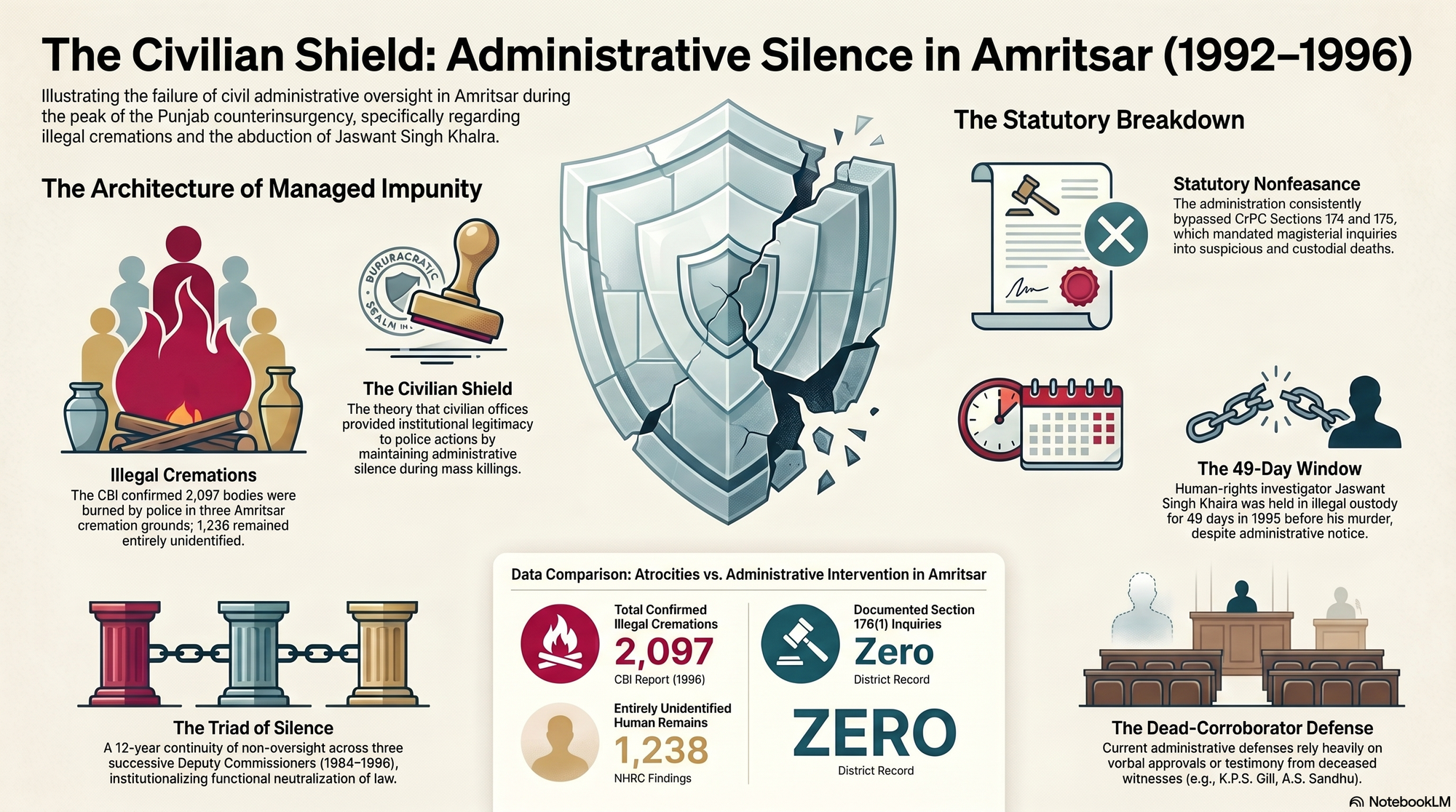
This document is a comprehensive forensic history of the Sikh genocide as it unfolded from the Nirankari massacre of April 1978 through the peak counterinsurgency years of 1984 to 1996, culminating in the administrative erasure of 2,097 confirmed illegal cremations in Amritsar District alone. It is also an administrative indictment of the three Deputy Commissioners who held office in Amritsar across those twelve consecutive years — Ramesh Inder Singh, Sarabjit Singh, and Karan Bir Singh Sidhu — none of whom produced a single Section 176(1) magisterial inquiry, a single Section 174 death report, or a single Section 97 search warrant for the families of the disappeared across the entirety of their combined tenure.
This is a document about paperwork. It is also a document about the bodies that the paperwork was designed to erase. It is, finally, a document about the men who held the statutory pen and chose not to write.
The governing principle of this archive is expressed in the Punjabi title that anchors the KBS Sidhu accountability series: ਸ਼ਬਦ ਤੋਂ ਪਹਿਲਾਂ, ਸ਼ਮਸ਼ਾਨਘਾਟ — Before the Word, the Cremation Grounds. Before the argument, there was the register. Before the denial, there was the missing certificate. Before the litigation, there was the fire that burned the evidence. The archive begins where the State wanted the story to end: at the ash.
Part One: The Civilizational Stakes — Sikh Sovereignty, Sacrifice, and the Archive of Witness
I. The Guru Granth Sahib as Political Document
To understand the Sikh genocide, one must first understand the nature of Sikh political identity — not as an ethnic category or a security threat, but as a civilizational formation shaped by centuries of sovereign assertion, martyrdom, and institutional memory. The Sikh religion, founded by Guru Nanak Dev Ji in the fifteenth century and consolidated through ten human Gurus and then the eternal Guru Granth Sahib, is not merely a devotional tradition. It is a constitutional order, a theory of sovereignty, a framework of testimony, and a practice of witness.
The Guru Granth Sahib — the sacred scripture that serves as the living Guru of the Sikhs — is a composite document containing the hymns of Sikh Gurus alongside compositions by Hindu and Muslim saints across the subcontinent. This compositional breadth is itself a political statement: Gurbani does not merely instruct worship; it models a pluralist theory of divine presence that stands in explicit contrast to sectarian hierarchy. The Guru Granth Sahib teaches that the Divine is present across traditions, that no institution owns the sacred, and that the obligation of Sikhi is to bear witness to truth — Sach Kahna, speaking the truth — at whatever cost.
This witness imperative is not metaphorical. Sikhism's foundational stories are stories of testimony given in the face of state power. Guru Arjan Dev Ji, the fifth Guru, was tortured and martyred by the Mughal Emperor Jahangir in 1606 after refusing to alter the Guru Granth Sahib to remove compositions the Emperor found offensive. Guru Tegh Bahadur Ji, the ninth Guru, was publicly beheaded in Delhi in 1675 after standing in solidarity with Kashmiri Pandits threatened with forced conversion. These martyrdoms were not acts of passive victimhood. They were forensic acts: they created a record, forced a confrontation between power and conscience, and established the template of Sikh witness that every subsequent generation has inherited.
When Jaswant Singh Khalra traced cremation-ground registers in 1994 and 1995, he was operating within a civilizational tradition that regarded the act of documentation — the production of evidence, the naming of names, the preservation of records — as a form of sacred duty. He was not merely a human rights activist. He was, in the fullest Sikh sense, a witness. And the State of India, which murdered him for that witness, repeated in 1995 the logic of Jahangir's court in 1606: the witness must be silenced, the record must be erased, and the archive must be prevented from speaking.
[PF] Jaswant Singh Khalra was abducted on September 6, 1995. He was held for forty-nine days before being murdered in police custody. His killers included officers of the Punjab Police operating under the command structure that reported, through civilian authority, to the District Magistrate of Amritsar.
II. Five Centuries of Assertion: The Historical Architecture of Sikh Political Claims
The partition of British India in 1947 created the modern nation-states of India and Pakistan, but it did not resolve the political question of the Sikhs. The Sikh homeland — Punjab, the land of the five rivers, the heartland of Gurmat civilization — was divided. Lahore, the city of Guru Ram Das and Guru Gobind Singh's Taksal, went to Pakistan. Amritsar, the city of the Golden Temple and the Akal Takht, remained in India. Millions of Sikhs were displaced in one of history's most violent episodes of mass migration.
The architects of Indian independence had made promises to Sikh leaders. Jawaharlal Nehru, speaking to the Constituent Assembly, had spoken of the just claims of the Sikhs. The Congress high command had led Sikh leaders to expect that an autonomous or semi-autonomous Sikh administrative region would be among the fruits of independence. Those promises were not kept. When the Constitution of India was promulgated in 1950, the Sikhs had no separate state, no constitutional recognition of their distinct religious identity, and no administrative framework that reflected the civilizational seriousness of their sacrifice in the independence movement.
The Punjabi Suba movement — the decades-long Sikh demand for a state in which Punjabi was the administrative language and Sikh cultural life could be organized around its authentic institutions — was not a separatist demand. It was a demand for equal constitutional treatment. The linguistic reorganization of Indian states, which gave every other major linguistic community — Telugu speakers, Tamil speakers, Marathi speakers, Gujarati speakers — their own state, was explicitly denied to the Punjabi-speaking Sikhs on the grounds that Punjabi was not a distinct language. The same officials who classified Punjabi as a Hindi dialect for administrative convenience had no difficulty recognizing Sikh religious institutions as distinct entities for taxation and surveillance purposes.
The Punjabi Suba was finally granted in 1966, but in a truncated form. The newly created Punjab state was shorn of Haryana (whose residents had claimed Hindi, not Punjabi, as their mother tongue in the census) and Himachal Pradesh. The Punjabi-speaking Haryanvi towns of Chandigarh — which should have been the Punjab capital — were declared a Union Territory. The headwaters rivers — the Ravi, the Beas, and the Sutlej — that flowed through and irrigated Punjab were subject to tribunal awards that diverted water to Haryana and Rajasthan, states that had no geographic or historical relationship to the Punjab river system. This water dispute, never satisfactorily resolved, became one of the foundational grievances of the Anandpur Sahib Resolution.
The Anandpur Sahib Resolution of 1973 — formally adopted by the Shiromani Akali Dal at the historic city of Anandpur Sahib, birthplace of the Khalsa — was a comprehensive constitutional document demanding greater state autonomy, resolution of the water dispute, transfer of Chandigarh to Punjab, and protection of Sikh religious institutions from central government interference. It was not, on its face, a secessionist document. It was a document demanding federalism: the same federalism that Indian constitutional law notionally guaranteed but consistently failed to deliver to Punjab.
The Indian government read the Anandpur Sahib Resolution as a secessionist manifesto. The popular media, increasingly captured by Delhi-centric narratives, amplified this reading. The possibility that the Sikhs had legitimate constitutional grievances — grievances that could have been addressed through ordinary political and legal mechanisms — was systematically foreclosed. What remained, when dialogue failed and political bad faith accumulated across decades, was the atmosphere that produced Bhindranwale.
The Indian government chose to treat Sikh constitutional demands as a security problem rather than a governance problem. That choice made violence inevitable.
III. The 1978 Nirankari Massacre: The Opening Act of the Genocide
The history of the Sikh genocide is commonly dated to November 1984, the month of Operation Blue Star's aftermath and the Delhi pogroms. This periodization is incorrect, and its incorrectness is itself ideologically significant — it allows the Indian state to present what happened in Punjab as a response to Sikh violence rather than as the culmination of a longer campaign of targeted suppression. The actual opening act of the genocide took place on April 13, 1978 — Baisakhi Day — in Amritsar, when members of a heterodox religious sect called the Sant Nirankaris fired on a peaceful Sikh demonstration, killing thirteen Sikh worshippers.
The Sant Nirankaris were a group whose founder had claimed living Guruship in explicit repudiation of the Sikh doctrine that the Guru Granth Sahib was the sole and final Guru. The Sikh community regarded the Nirankari sect's claims as blasphemous. On Baisakhi Day 1978, a large Sikh demonstration, organized by the Damdami Taksal under Baba Gurbachan Singh Khalsa and the Akhand Kirtani Jatha, marched to confront a Nirankari gathering in Amritsar. The confrontation became a massacre. Nirankari followers fired on the marching Sikhs. Thirteen Sikhs were killed.
The response of the Indian state revealed, with early clarity, the structural pattern that would govern every subsequent episode of anti-Sikh state violence. The Nirankari leader, Baba Gurbachan Singh, was charged with culpable homicide — not murder — and was acquitted. The state of Punjab, then governed by the Congress-allied Giani Zail Singh administration, extended no meaningful accountability to the Nirankaris. No senior Nirankari figure faced prosecution proportionate to the deaths of thirteen Sikh worshippers. The families of the killed were denied justice. The Punjabi High Court proceedings moved in the direction of exoneration.
[PF] Thirteen Sikh demonstrators were killed by Nirankari members in Amritsar on April 13, 1978. The Nirankari leadership faced charges and was acquitted. No senior figures were convicted in proportion to the number of deaths. [Based on the NHRC record and contemporary reporting]
The political message of the 1978 acquittals was heard clearly throughout the Sikh community: the Indian legal system would not protect Sikh lives when those lives were taken in contexts of religious confrontation that the state found inconvenient. Jarnail Singh Bhindranwale, a young preacher from the Damdami Taksal who had participated in the Baisakhi Day demonstration, drew the explicit lesson that the Sikh community could not rely on the Indian judicial system for the redress of grievances involving Sikh blood. This conviction, and the broader radicalization it catalyzed, did not arise from theological extremism. It arose from the rational assessment of an institutional pattern: Sikh lives were expendable within the administrative calculus of the Indian state.
[DA] Multiple human rights reports and scholarly accounts document that the 1978 Nirankari acquittals contributed directly to the radicalization of a generation of young Sikhs and to Bhindranwale's rising influence. The Punjab Violence Report commissioned by the People's Union for Democratic Rights (PUDR) traces this causal chain.
The 1978 Baisakhi massacre was not an isolated incident. It was the opening move in a decades-long pattern in which the Indian state would alternately incite, tolerate, manage, and then suppress Sikh political mobilization, using the cycle of violence it helped to create as the justification for escalating repression. Understanding this pattern requires examining not just the events themselves, but the institutional architecture — the police, the bureaucracy, the civilian administration, the courts — that made the pattern possible.
IV. The Gathering Storm: 1978–1983
In the five years between the Baisakhi massacre of 1978 and Operation Blue Star in 1984, the Punjab crisis passed through a period of accelerating institutional failure, political manipulation, and deliberate escalation by actors who stood to benefit from the deterioration of public order. Understanding this period requires holding two simultaneous truths: that genuine Sikh grievances existed and had been systematically denied, and that those grievances were manipulated by political actors — including elements of the Congress party, the intelligence services, and the Nirankari-connected network — for purposes that had nothing to do with addressing the underlying constitutional problems.
Jarnail Singh Bhindranwale's rise during this period is central to the narrative, but it has been almost universally misread. The dominant Indian media narrative presents Bhindranwale as the creator of the crisis — as the source of the violence that required state response. The forensic historical record reveals a far more complicated picture: a preacher of conservative Sikh religious practice who was initially promoted by Congress politicians as a counterweight to the Akali Dal, who had no organizational capacity for the violence attributed to him in the early period, and whose trajectory toward confrontation with the state was shaped as much by state aggression as by his own choices.
The Akali Dal, which represented mainstream Sikh political aspirations, had been pressing its demands through constitutional means for a decade. The Dharam Yudh Morcha, launched in August 1982, was a massive non-violent civil disobedience campaign demanding the transfer of Chandigarh, resolution of river waters, and protection of Sikh shrines. Hundreds of thousands of Akali workers courted arrest in the largest civil disobedience campaign India had seen since Gandhi's movements. The Indian government's response was to offer negotiations, break them off, resume them, and ultimately stall until the political atmosphere had been sufficiently poisoned to make a military solution appear necessary.
The Sikh Reference Library in the Golden Temple complex housed one of the most significant collections of Sikh manuscripts, historical documents, and archival materials in existence. When Indian Army forces entered the Golden Temple complex in June 1984, the Sikh Reference Library was looted and its contents removed. This was not collateral damage. It was a deliberate act of cultural genocide: the destruction of the archive that sustained Sikh historical memory.
[PF] The looting of the Sikh Reference Library during Operation Blue Star in June 1984 has been confirmed by multiple sources including journalist accounts, survivor testimony, and the subsequent disappearance of irreplaceable manuscripts. The Indian government has never provided an accounting of what was taken.
Part Two: Operation Blue Star — The State Enters the Temple
I. The Decision to Use Military Force
Operation Blue Star was launched on the night of June 5–6, 1984, under the personal direction of Prime Minister Indira Gandhi. It deployed the Indian Army — including elite commando units, armored vehicles, and artillery — against the Golden Temple complex in Amritsar, the holiest shrine of the Sikh faith, on the grounds that armed militants under Jarnail Singh Bhindranwale had fortified the Akal Takht and were using the Temple complex as a base of operations.
The decision to use military force against the Golden Temple was not militarily necessary in any narrow tactical sense. The complex could have been isolated, besieged, and the militants within it allowed to die of attrition or forced to surrender through negotiation. Senior military officers, including Army Chief General A.S. Vaidya, reportedly expressed reservations about the operational plan and its likely casualties. The option of waiting out the Dharam Yudh Morcha through extended negotiation had not been exhausted. What the military option provided, and what may have driven the decision, was not tactical necessity but political utility: a dramatic, irreversible act that would end the Akali civil disobedience movement by destroying its physical and spiritual anchor.
Operation Blue Star consisted of two simultaneous operations: Operation Blue Star proper, targeting the Golden Temple complex in Amritsar, and Operation Wood Rose, targeting Gurdwaras across rural Punjab. The two operations together marked the transition from political repression to military repression — from the suppression of civil liberties to the physical assault on Sikh religious space and Sikh bodies across the entire province.
[DA] Documents released under the British Freedom of Information Act in 2014 confirmed that a British SAS officer had provided advice to Indian authorities on the operational planning for the Golden Temple assault. The extent of British involvement in the planning phase remains disputed.
II. The Military Operation and the Akal Takht
The Akal Takht — literally the Throne of the Timeless One — is the second-most sacred structure in Sikh religious architecture. It faces the Harmandir Sahib (the Golden Temple) across the sarovar (sacred pool) and represents the temporal sovereignty of the Sikh Panth: the principle that Sikh political and spiritual authority are inseparable. To attack the Akal Takht was not merely to assault a building. It was to attack the institutional seat of Sikh sovereignty.
The battle for the Golden Temple complex lasted two days. Indian Army forces encountered fierce resistance from a much smaller number of armed defenders, led by former Indian Army general Shabeg Singh, who had fortified the Akal Takht with considerable tactical skill. The Indian Army suffered significant casualties — the official figures have never been fully released, but independent estimates ranged from several dozen to several hundred dead — before overcoming the defenders. Bhindranwale was killed in the fighting.
The Akal Takht itself was devastated. The historic structure, which had survived centuries of Mughal and Afghan assault, was reduced to rubble by Indian Army artillery and armored vehicles. The damage was not confined to the fortified sections of the building: the artillery fire was indiscriminate enough to cause damage across the sacred complex, including to pilgrim accommodations, ancillary buildings, and the sarovar itself.
[PF] The Akal Takht was severely damaged during Operation Blue Star. The Indian government subsequently undertook a reconstruction that was widely criticized within the Sikh community as architecturally inauthentic and as an attempt to control the rebuilt structure's institutional significance. The original Akal Takht was rebuilt under Sikh community direction years later after the controversial 'government' reconstruction was demolished.
The official death toll for Operation Blue Star was placed by the Indian government at 493 militants and civilians. Independent investigations produced dramatically higher estimates, with some accounts placing civilian deaths alone at several thousand. The Indian government imposed a complete media blackout during the operation, expelled foreign journalists from Punjab, and cut telephone communications. No independent verification of the casualty count was possible at the time, and none has been possible since.
[PM] In Sikh memory, Operation Blue Star is not remembered as a counter-terrorism operation. It is remembered as a desecration: an act of state violence against a holy site that carries the same civilizational weight as the destruction of the Temple in Jerusalem or the burning of Alexandria. The subsequent targeting of Sikh officers in the Indian Army who mutinied in response — dozens were court-martialled, some were killed in custody — confirmed in Sikh consciousness that the Indian state regarded Sikh religious identity as an inherent security threat.
III. Operation Wood Rose and the Rural Punjab Terror
While the international media attention focused on Amritsar and the Golden Temple, Operation Wood Rose swept across rural Punjab. The operation deployed the Indian Army into villages, Gurdwaras, and Sikh institutions throughout the state in what was officially described as a search-and-cordon operation to arrest militants. In practice, Operation Wood Rose was a mass detention campaign that swept up thousands of young Sikh men — students, farmers, minor activists, relatives of known Akali Dal members — and subjected them to detention, interrogation, and in documented cases, torture.
Operation Wood Rose established the operational template for the decade of counterinsurgency that followed. Young Sikh men were arrested without warrant, held without charge, subjected to torture in unofficial interrogation centers, and in many cases disappeared entirely. The families of the disappeared were told nothing. The police denied having the men in custody. When some of the detained men turned up dead — described by police as militants killed in encounters — the families had no documentary basis to challenge the official account because no arrest record had ever been generated.
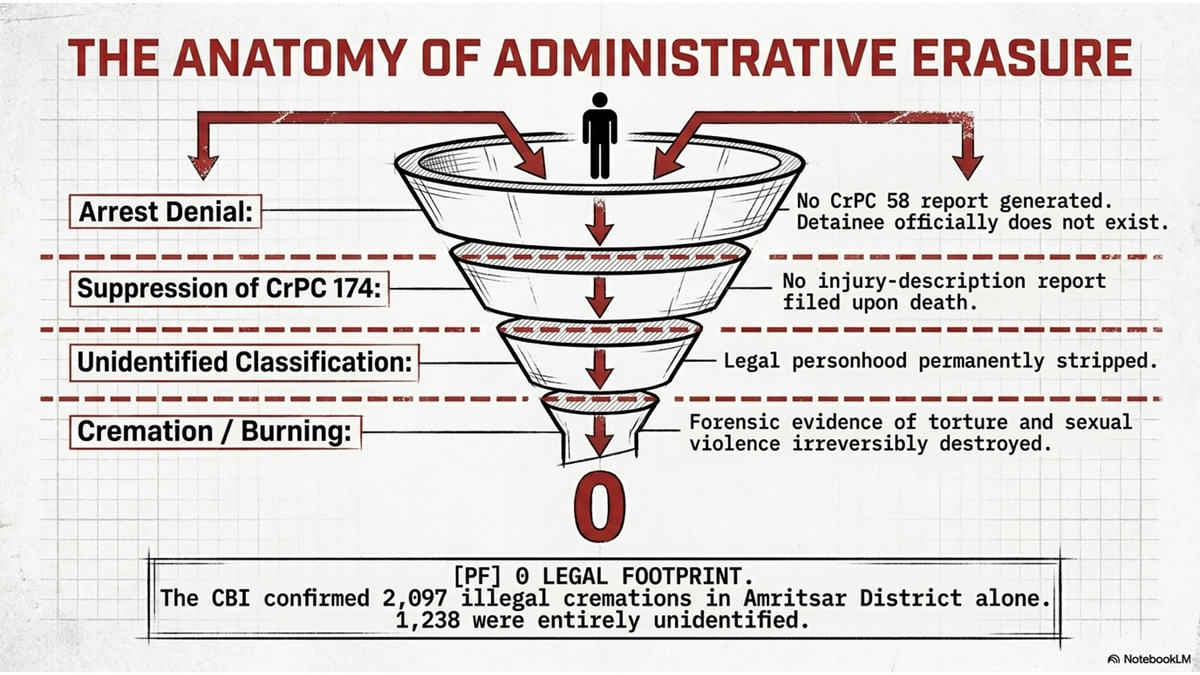
The mechanism of administrative erasure was thus operational from the beginning of the counterinsurgency, not merely at its peak. CrPC Section 58, which required police to report every warrantless arrest to a magistrate, was systematically violated from the first days of Operation Wood Rose. The District Magistrate's office in Amritsar — whose incumbent from 1984 to 1987 was Ramesh Inder Singh — received none of these mandatory reports. The office that was constitutionally positioned to act as the civilian check on police power had calibrated its oversight to the political requirements of the emergency.
[AI] The decision by the District Magistrate's office to not demand CrPC Section 58 arrest reports from the first days of Operation Wood Rose was not a passive oversight. It was an active administrative choice that created the documentary vacuum within which disappearance, torture, and extrajudicial killing could operate without legal footprint. The absence of arrest records was the precondition for the subsequent absence of inquest reports, the subsequent classification of bodies as unidentified, and the subsequent cremation of those bodies without death certificates.
IV. The Sikh Reference Library: Erasing the Archive
The looting of the Sikh Reference Library during Operation Blue Star deserves more sustained attention than it typically receives in accounts focused on the military operation itself. The Library housed approximately twenty thousand unique manuscripts, rare texts, historical documents, and irreplaceable archival materials documenting Sikh history from the Guru period through the colonial era. It was, in the fullest sense, the memory of the Sikh Panth in material form.
Military and paramilitary forces entered the Library during the operation and removed its contents. Some materials were apparently destroyed on site. Others were taken into government custody and have never been returned or accounted for. The Indian government has never produced a full inventory of what was in the Library before the operation, never produced a full account of what was removed and by whom, and never answered the repeated demands by Sikh scholars and institutions for the return of the materials.
This erasure of the archive is not incidental to the broader history being examined in this document. It establishes a pattern that runs from June 1984 through the entire counterinsurgency period: the Indian state's method of dealing with challenges to its narrative of events is not to answer them, but to destroy or suppress the evidence that makes them possible. The Sikh Reference Library was destroyed because it contained the raw material of Sikh historical consciousness. The cremation records were suppressed because they contained the raw material of accountability for extrajudicial killing. Jaswant Singh Khalra was murdered because he had found those records and was prepared to use them.
An archive is not destroyed by accident. An archive is destroyed by power that fears what the archive contains.
Part Three: November 1984 — The Delhi Pogrom and the State's Direct Hand
I. The Architecture of Organized Violence
On October 31, 1984, Prime Minister Indira Gandhi was assassinated by two of her Sikh bodyguards in retaliation for Operation Blue Star. Within hours of her death, organized violence against Sikh communities erupted in Delhi and in cities across northern India. The violence continued for three days — November 1, 2, and 3, 1984 — during which thousands of Sikh men were killed, Sikh homes and businesses were burned, Sikh women were sexually assaulted, and Sikh Gurdwaras were attacked.
The official death toll for the November 1984 anti-Sikh violence in Delhi was initially set at 2,733. Subsequent investigations, including by the Nanavati Commission, revised the figure upward. Independent researchers and community organizations have documented deaths ranging from three thousand to over eight thousand. The Sikh community's own count, compiled over years from family testimony and local records, has consistently placed the death toll above five thousand.
The violence of November 1984 was not spontaneous. It was organized. Multiple witnesses, survivor testimonies, intelligence reports, journalistic investigations, and judicial inquiries have established that the violence was coordinated by Congress party networks in Delhi, that voter rolls and taxi registration records were used to identify Sikh-owned properties, that kerosene and other accelerants were pre-positioned, that groups were transported by organized vehicles, and that police in many areas stood aside or actively assisted in identifying Sikh households.
[PF] The Nanavati Commission (2005) found that the violence in November 1984 was organized and that Congress leaders including Sajjan Kumar and Jagdish Tytler had roles in inciting or organizing attacks. Sajjan Kumar was subsequently convicted of murder by the Delhi High Court in 2018 and sentenced to life imprisonment. Tytler has faced investigation but has not been convicted.
The role of the Delhi police in November 1984 has been examined by multiple commissions of inquiry. The Misra Commission (1986), set up by the Congress government and widely regarded as a whitewash, found that the police had done their best in difficult circumstances. The Jain-Banerjee Committee (1987-1990), the Potti-Rosha Committee (1990), the Ahuja Committee (1993), and ultimately the Nanavati Commission (2000-2005) all found police failure of varying severity. The consistent finding across all credible investigations was that the Delhi police received orders — from where was disputed — to stand aside and not intervene.
II. The Gendered Dimension of November 1984
Among the most systematically suppressed aspects of November 1984 is the gendered dimension of the violence. Sikh women were targeted for sexual violence in the Delhi pogrom: rape, gang rape, sexualized torture, and public sexual assault. The suppression of testimony about sexual violence in 1984 was deliberate. Survivors were counselled not to report. Community organizations, concerned about the stigma attached to rape in the social context of the time, sometimes actively discouraged women from recording formal complaints. The police, when complaints were filed, minimized them, lost them, or failed to register FIRs.
The result was that the sexual violence of November 1984 entered no formal record commensurate with its scale. The women who were assaulted are not counted in the official death tolls. They are not represented in the FIR statistics. They exist, if they exist at all in the official record, as marginal notations in human rights reports that themselves were ignored or discredited by the Indian government.
[DA] Human rights organizations including the People's Union for Civil Liberties (PUCL), the Citizens' Commission chaired by former Chief Justice S.M. Sikri, and international bodies including Amnesty International documented sexual violence against Sikh women in November 1984. The documentation was based on survivor testimony collected in the immediate aftermath of the violence.
The parallels between the erasure of sexual violence in November 1984 and the erasure of sexual violence in Punjab's counterinsurgency period are not coincidental. In both cases, the bodies of Sikh women were subjects of state-organized or state-condoned violence. In both cases, the official record was constructed to make that violence invisible. In both cases, the cremation — literal or figurative — of evidence was central to the strategy of impunity.
III. The Institutional Rewards of 1984
The November 1984 pogrom was followed by a general election in which the Congress party, running on a sympathy wave following Indira Gandhi's assassination, won a landslide majority under Rajiv Gandhi. Members of Parliament against whom there was credible evidence of involvement in organizing the November 1984 violence were elected and re-elected. No senior Congress politician faced meaningful accountability for November 1984 during the three decades following the events.
This impunity was not accidental. It was institutional. The Congress party controlled the government that appointed the commissions of inquiry. The commissions of inquiry were structured to produce exculpatory findings or protracted proceedings. The FIRs that should have been registered against named accused were either not registered, registered defectively, or prosecuted by state prosecutors who had no interest in securing convictions. The witnesses who were prepared to testify were subjected to intimidation, relocation, or in some cases threats to their lives.
The reward structure that operated in November 1984 — in which perpetrators were elected to Parliament, protected from prosecution, and ultimately celebrated — was the same reward structure that operated throughout the Punjab counterinsurgency. Officers who supervised illegal cremations were given distinguished service citations. Officers who tortured and killed in custody were promoted. District Magistrates who failed to ask where the bodies came from were elevated to senior positions. Karan Bir Singh Sidhu, who as DC Amritsar from 1992 to 1996 presided over the peak period of the illegal cremation archive, was elevated to Special Chief Secretary of Punjab after leaving the district.
[AI] The institutional reward structure for participation in or tolerance of mass atrocity is not merely a political failure. It is an evidentiary fact. When the state promotes rather than prosecutes the officials who presided over documented atrocity, it retroactively ratifies the atrocity. The promotions and awards given to the Amritsar Triad of District Magistrates are not merely morally offensive. They are evidence of institutional complicity at the highest levels of the Punjab and Indian administrative systems.
Part Four: The Architecture of the Counterinsurgency State — Punjab 1984–1996
I. The Institutional Apparatus of Disappearance
The counterinsurgency campaign in Punjab from 1984 to 1996 was one of the most systematically brutal exercises of state power in post-independence Indian history. It involved regular police, paramilitary Central Reserve Police Force, Border Security Force, National Security Guards, military intelligence operatives, and — crucially — a network of covert auxiliary units known as the Black Cats and the Alam Sena that operated outside any formal legal accountability structure whatsoever.
The scale of the campaign is reflected in the numbers that the Indian government itself eventually could not deny. The CBI investigation ordered by the Supreme Court of India in the Writ Petition (Civil) No. 539/1995 — the habeas corpus case brought by Jaswant Singh Khalra's wife Paramjit Kaur after his abduction — found 2,097 illegal cremations in Amritsar District alone across three cremation grounds: Patti, Tarn Taran, and Durgiana Mandir. The NHRC, investigating the broader Punjab record, found evidence of illegal cremations across multiple districts. Human rights organizations estimated the total number of extrajudicial killings during the Punjab counterinsurgency at between twenty thousand and thirty thousand persons.
[PF] The CBI confirmed 2,097 illegal cremations in Amritsar District — across the Patti, Tarn Taran, and Durgiana Mandir cremation grounds — in its report submitted to the Supreme Court of India. Of these, 1,238 were entirely unidentified: their bodies were cremated without a name, without a family notification, and without a legally required inquest.
The mechanism of disappearance was standardized across the counterinsurgency apparatus. A person would be picked up — typically at night, sometimes in broad daylight — by police or by covert auxiliaries. No arrest record would be made. No family notification would be given. The person would be taken to an unofficial interrogation center — of which there were dozens across Punjab, ranging from improvised facilities in police station back rooms to dedicated torture centers like the one at Jagraon — where they would be interrogated, tortured, and in a large proportion of cases killed.
The body would then be classified as 'unidentified' — a designation that required no supporting evidence and could be applied to any body regardless of whether the person had carried identity documents or was known to the arresting officers. The 'unidentified' body would be transported to a cremation ground, where local officials would generate a cremation entry noting only that an unidentified body had been received, processed, and cremated. The entry would contain no reference to the circumstances of death, no post-mortem findings, no inquiry report, no information about who had brought the body or which police unit had been involved. The entire administrative sequence, from arrest to ashes, would leave no legal footprint.
II. The Black Cats and the Alam Sena: Covert Auxiliaries
Among the most chilling dimensions of the Punjab counterinsurgency was the deployment of covert auxiliary units — organized informally as the Black Cats and later as the Alam Sena — that operated entirely outside the formal command structure of the Punjab Police but were supervised, armed, and directed by senior police officers. These units recruited from surrendered militants, former criminals, and individuals with personal grievances against the Sikh community. They were given weapons, vehicles, and operational latitude that regular police officers did not formally possess.
The Black Cats operated primarily as killing squads. Their function was to conduct targeted assassinations of militant figures, suspected sympathizers, and in documented cases, individuals who posed no militant threat but who had been identified to the auxiliaries by police informants for personal or factional reasons. The Alam Sena, operating in Amritsar and surrounding districts, was particularly associated with the killing of Sikh civilians, the targeting of human rights defenders, and the intimidation of witnesses.
[DA] Human rights organizations including Amnesty International, Human Rights Watch, and ENSAAF have documented the existence and operations of covert auxiliary units in Punjab. The NHRC investigation into illegal cremations found evidence of auxiliary unit involvement in a significant proportion of cases. K.P.S. Gill, the Director General of Police who is credited with 'ending' the insurgency, has denied personal involvement in the auxiliaries' worst excesses but has not denied their existence.
The covert auxiliary structure was functionally invisible to the civilian administrative oversight that the district magistracy was supposed to provide. The Black Cats and Alam Sena did not submit arrest reports. They did not produce custody logs. They did not present bodies to magistrates for inquest. They were — by design — the element of the counterinsurgency apparatus that existed below the threshold of the official record. The District Magistrate's office did not ask about them. The District Magistrate's office did not have to ask about them. Not asking was the administrative contribution to the counterinsurgency.
III. The Five-Phase Killing Machine
The operation of the Punjab counterinsurgency killing machine followed a recognizable five-phase process that, once understood as a system rather than as a collection of individual crimes, reveals the administrative intelligence that designed it and the administrative complicity that sustained it.
Phase One was the intelligence phase: the compilation of a target list, drawn from informant reports, intercepted communications, village-level surveillance, and in some cases personal grudges or property disputes settled through the counterinsurgency mechanism. The target list was held by the police Special Branch and shared with the auxiliary units. District Magistrates were not given access to the target list, but they were not entitled to receive it, and they did not ask to see it.
Phase Two was the detention phase: the pickup of the target, conducted without a warrant and without a Section 58 arrest report filed with the magistrate. The target's family was told nothing. If the family approached the police station to inquire about the missing person, they were typically told that no such arrest had been made. In some cases, families were threatened against further inquiry.
Phase Three was the interrogation and torture phase, conducted in facilities that ranged from designated interrogation centers to improvised locations in police stations, farmhouses, and military cantonments. The CIA Centre at Jagraon — named for the Central Intelligence Agency of Punjab, an internal police intelligence unit, not the American agency — was particularly documented as a site of systematic torture and killing. Gurdev Singh Kaunke, the acting Jathedar of Sri Akal Takht Sahib, was held there and killed on January 1, 1993, by SSP Swaran Singh, known by the epithet 'Ghotna' (the grinder), following his abduction on December 25, 1992.
[PF] Gurdev Singh Kaunke was the acting Jathedar of Sri Akal Takht Sahib. He was abducted on December 25, 1992, and killed on January 1, 1993, at the CIA interrogation centre in Jagraon, by SSP Swaran Singh 'Ghotna'. This is confirmed through judicial proceedings and human rights documentation.
Phase Four was the classification and disposal phase: the killed person's body was classified as 'unidentified' — a false classification that was institutionally enabled by the fact that no arrest record existed to connect a named individual to the body — and transported to a cremation ground. The cremation ground staff, operating under pressure from police officials present at the burning, entered the body in the register as unidentified and proceeded with the cremation. No inquest was ordered. No death certificate was issued. No family notification was made.
Phase Five was the narrative phase: if the killing became public — if the family persisted in inquiries, if a human rights organization raised the case, if the Supreme Court or High Court took notice — the police would produce a cover story. The most common narrative was the encounter: the killed person had been a militant, had been found in suspicious circumstances, had fired upon or been about to fire upon security forces, and had been killed in the resulting gunfight. The 'encounter killing' was an administratively convenient fiction because it converted extrajudicial murder into a narrative of lawful self-defense, required no corroborating evidence other than a police report, and was rarely questioned by the magistrate who should have conducted an inquest.
[AI] The five-phase system of the Punjab counterinsurgency killing machine was not the spontaneous product of police excess. It was a designed administrative system. Each phase required institutional cooperation: the intelligence phase required Special Branch records management; the detention phase required police station commanders to not file CrPC Section 58 reports; the torture phase required access to facilities; the disposal phase required cremation ground officials and the magistrate's office to not inquire; the narrative phase required the institutional support of the prosecution service and the magistracy for the encounter fiction. No single phase could have operated at scale without the others.
IV. Mohammad Izhar Alam IPS and the Architecture of Supervised Terror
Among the senior police officers most directly associated with the institutional architecture of the Punjab counterinsurgency was Mohammad Izhar Alam, IPS, who served as a senior official in the Punjab Police during the peak years of the campaign. Alam's significance in this archive lies not only in his personal record but in what his career trajectory illustrates about the institutional reward structure for participation in the counterinsurgency's worst practices.
Alam was associated with operations in and around Amritsar during the period when the 2,097 illegal cremations were being recorded. His name appears in human rights documentation and in subsequent judicial proceedings in connection with covert operations in the district. The pattern of his career — progression through increasingly senior positions despite documented allegations of abuse — exemplifies the structural pattern that this archive documents: the Indian administrative and police systems systematically rewarded officers whose conduct during the counterinsurgency would, in a jurisdiction governed by the rule of law, have made them the subjects of criminal prosecution.
[DA] Human rights organizations and journalistic investigations have documented allegations against senior Punjab police officers, including those associated with the Amritsar operational area, for involvement in extrajudicial killings, illegal detention, and the systematic disposal of bodies through unofficial cremation. These allegations have not been adjudicated in judicial proceedings producing final convictions.
Part Five: Jaswant Singh Khalra — The Man Who Found the Register
I. A Private Citizen and a Public Emergency
Jaswant Singh Khalra was not a professional investigator. He was not a lawyer, a judge, a journalist, or a civil servant. He was a private citizen — a bank official, an Amritsar resident, a Sikh man with a conscience — who became convinced that the disappearances he was hearing about in his community were not isolated incidents but parts of a pattern that left documentary traces in the public record. He was right. And the act of being right, in the context of the Punjab counterinsurgency state, was a capital offense.
Khalra began his investigation in the early 1990s, working with a human rights organization called the Khalra Mission that he had helped to establish. His method was straightforward and devastatingly effective: he went to the cremation grounds of Amritsar District — Patti, Tarn Taran, and Durgiana Mandir — and he read the registers. Cremation ground registers are public records. They document every cremation conducted at the facility. They contain entries noting the date of cremation, the origin of the body, and any identifying information available. They are exactly the kind of administrative residue that a killing machine that wants to leave no trace should have found ways to suppress or alter.
The Punjab counterinsurgency apparatus, confident in the invisibility that the District Magistrate's studied indifference provided, had not sufficiently suppressed the cremation ground registers. What Khalra found in those registers was the raw material of a criminal indictment: hundreds, and then thousands, of entries for bodies described as 'unidentified,' transported to cremation grounds by police vehicles, and cremated without inquest, without death certificate, and without family notification. He cross-referenced the register entries against missing-persons complaints and family testimony. He began to identify the names behind the 'unidentified' classifications. He gathered evidence of a systematic administrative process that had industrialized the disappearance of Sikh men and women.
In February 1995, Khalra and journalist Jasbir Singh Raina presented their findings at a press conference in Amritsar. They documented 2,097 illegal cremations in Amritsar District alone across the three cremation grounds. They presented the register evidence. They named the policy. They placed the findings in the public record.
[PF] Jaswant Singh Khalra documented 2,097 illegal cremations in Amritsar District through his examination of cremation ground registers. This figure was subsequently confirmed by the CBI investigation ordered by the Supreme Court of India. Khalra presented his findings at a press conference in February 1995.
II. The International Dimension of Khalra's Work
Khalra did not confine his documentation to the Indian domestic record. He presented his findings internationally, testifying before Canadian parliamentary committees, meeting with human rights organizations in North America and Europe, and raising the Amritsar cremation evidence before bodies including Amnesty International. His international advocacy had two effects: it placed the Punjab cremation evidence in the global human rights record, where it could not be easily suppressed by the Indian government's domestic information controls, and it made him a target for precisely the reason that the international dimension made him more dangerous.
The response of the Indian state to Khalra's international advocacy was not to dispute his evidence through official channels, to commission an independent inquiry, or to present counter-documentation. The Indian government instead issued denials and implied that Khalra was a Khalistan sympathizer whose allegations were motivated by a separatist political agenda. This response — discrediting the messenger rather than addressing the message — was consistent with the state's approach to every piece of documentation of Punjab atrocities throughout the counterinsurgency period.
The effort to discredit Khalra as a separatist was legally important for what it implied: that the systematic illegal cremation of 2,097 identified and unidentified persons was a legitimate administrative practice when applied to persons who could be labeled as militants or sympathizers. This was the logical endpoint of the counterinsurgency doctrine that had governed Punjab since 1984: that Sikh political identity was itself a sufficient basis for the suspension of legal personhood.
III. The Forty-Nine Days: September–October 1995
On the morning of September 6, 1995, Jaswant Singh Khalra was abducted from outside his home in Amritsar by plainclothes officers of the Punjab Police. He was taken to an unofficial detention facility, later identified as the Goindwal Sahib Police Camp, where he was held in unacknowledged custody.
His family immediately began demanding information about his whereabouts. Within days, Paramjit Kaur Khalra had filed a habeas corpus petition before the Supreme Court of India. The Supreme Court, taking cognizance, directed the Punjab authorities to respond. The Punjab Police denied having Khalra in custody. The denial was a lie, but it was an administratively convenient lie: because no arrest record had been generated for Khalra's detention — consistent with the standard operating procedure of the counterinsurgency killing machine — the police were technically correct that there was no 'official' custody to report.
Karan Bir Singh Sidhu, the District Magistrate of Amritsar from 1992 to 1996, has admitted in his own account that he received information about Khalra's abduction and that he 'marked an inquiry.' He has also admitted that he filtered the complaint through a 'credible complaint' threshold — a discretionary standard that he applied without producing a documented inquiry, without issuing a Section 97 search warrant for Khalra, and without conducting a Section 176 magisterial inquest into the circumstances of the abduction.
Khalra was held for forty-nine days. On approximately October 25, 1995, he was killed in custody. His body was subsequently disposed of — by methods consistent with the administrative erasure mechanism he had spent the preceding years documenting. His body was eventually recovered from a canal.
[PF] Jaswant Singh Khalra was abducted on September 6, 1995. He was held for forty-nine days in police custody at the Goindwal Sahib Police Camp. He was killed in custody. Five Punjab police officers were ultimately convicted for his murder following a CBI investigation and Supreme Court-supervised trial.
The man who found the register was himself made into a missing register. The archive he was building absorbed the fact of his own erasure as its central exhibit.
IV. The Conviction That Came Too Late
The criminal prosecution of Khalra's killers moved through the Indian judicial system with the glacial slowness that characterizes accountability proceedings in cases involving police officers and state violence. The CBI, investigating under Supreme Court supervision, ultimately identified and charged five Punjab Police officers for Khalra's abduction and murder. The trial concluded with convictions. Multiple officers received sentences of life imprisonment.
The convictions, though welcome as a matter of formal accountability, do not satisfy the forensic demands of this archive. The conviction of five police officers for the physical act of murder does not address the larger system that made the murder possible, lawful in practice, and institutionally supported. It does not address the District Magistrate's failure to issue a search warrant after the Supreme Court habeas corpus was filed. It does not address the Punjab Police's false denial of custody, which was administratively sustained by the absence of an arrest record. It does not address the forty-nine days during which the civilian administration of Amritsar District had every legal basis to demand the production of a missing person and chose not to.
The conviction of the trigger-pullers, without accountability for the administrative structure that enabled, protected, and rewarded the killing, is justice of a severely diminished kind. It is the kind of justice that the Indian state has consistently been willing to permit: individual criminal accountability for the final physical act, combined with institutional impunity for the administrative system that made the act possible.
[AI] The conviction of five police officers for Khalra's murder, while legally significant, functions as a containment mechanism for accountability: it allows the state to point to a criminal justice outcome while foreclosing any inquiry into the administrative chain of command — including the District Magistrate's office — that enabled and sustained the forty-nine-day detention. The ADM inquiry file that KBS Sidhu claimed to have 'marked' has never been produced. That file's absence is the administrative exhibit at the heart of this archive.
Part Six: The Civilian Shield Thesis — Administrative Silence as Governance
I. The Constitutional Architecture of the District Magistracy
The District Magistrate of an Indian district is not a ceremonial office. It is a constitutional and statutory intersection of enormous legal power — the convergence, in a single official, of executive authority, judicial oversight, revenue administration, law-and-order responsibility, and the mandatory duty to supervise police conduct. The DC/DM is simultaneously the district's senior revenue officer, the chief executive of the district administration, and the executive magistrate with primary jurisdiction over questions of public order, custodial deaths, and police accountability.
The relevant provisions of the Code of Criminal Procedure (CrPC) that govern the District Magistrate's oversight role in the context of arrest, custody, death, and inquiry are not ambiguous, discretionary, or aspirational. They are mandatory. Section 58 of the CrPC requires that a police officer who makes an arrest without a warrant must send a report of the arrest to the nearest magistrate having jurisdiction. Section 97 empowers the District Magistrate to issue a search warrant for any person believed to be wrongfully confined. Section 174 requires a police officer who receives information about a suspicious or unnatural death to inquest the body and prepare a report. Section 176(1) requires the District Magistrate to hold an inquiry into the cause of death when any person dies in police custody or in circumstances suggesting foul play by police.
These statutory provisions constitute a comprehensive civilian oversight framework. They were designed — by colonial administrators and subsequently adapted by the post-independence constitution-makers — precisely for situations in which police power operates against the rights and lives of individuals. They create a mandatory paper trail: mandatory at the arrest stage, mandatory at the custody stage, mandatory at the death stage, mandatory at the inquiry stage. The paper trail is not merely an administrative nicety. It is the mechanism by which the constitutional commitment to the rule of law is operationalized at the district level.
When the District Magistrate's office fails to receive Section 58 reports, fails to issue Section 97 warrants, fails to receive Section 174 death reports, and fails to conduct Section 176(1) inquiries, the mandatory paper trail does not exist. The administrative vacuum that results is not neutral. It is the active product of a choice: the choice by the District Magistrate to not exercise the oversight powers that the law required the office to exercise. In the context of a counterinsurgency campaign that was industrializing disappearance and illegal cremation, that choice had a predictable consequence: the killing machine operated without legal friction.
The District Magistrate who does not ask where the bodies come from is not failing to govern. He is governing — governing in the interest of the system that makes the bodies.
II. The Triad of Amritsar: Three Men, Twelve Years, Zero Inquiries
Across the twelve consecutive years from 1984 to 1996, the District Magistrate of Amritsar — the single most powerful civilian official in the district where the majority of the 2,097 confirmed illegal cremations took place — was occupied by three successive officers of the Indian Administrative Service:
Ramesh Inder Singh served as DC Amritsar from approximately 1984 to 1987. His tenure coincided with the immediate aftermath of Operation Blue Star, Operation Wood Rose, and the first years of the organized counterinsurgency campaign. The institutional template for disappearance and illegal cremation was established during his watch. The administrative practice of not filing CrPC Section 58 reports, not conducting Section 174 inquests, and not ordering Section 176 inquiries was normalized during this period.
Sarabjit Singh served as DC Amritsar from approximately 1987 to 1992. His tenure coincided with Operation Black Thunder (1988), the period of maximum armed militant activity, and the phase of counterinsurgency in which the killing machine reached industrial scale. The cremation entries at Patti, Tarn Taran, and Durgiana Mandir accumulated in their thousands during this period. Sarabjit Singh was subsequently awarded a Padma Shri — the Indian government's fourth-highest civilian honor — in recognition of his 'distinguished service' during this period. The Padma Shri was awarded after the CBI had confirmed the 2,097 illegal cremations. No explanation has been provided for how the award was consistent with the documented record of the office he held.
Karan Bir Singh Sidhu served as DC Amritsar from approximately 1992 to 1996. His tenure coincided with the peak cremation archive period, the abduction and murder of Jaswant Singh Khalra in September–October 1995, and the period when the Supreme Court habeas corpus proceedings in the Khalra case were active. After leaving the DC post, Sidhu was elevated to Special Chief Secretary of Punjab. He has written extensively on his career, including a Substack newsletter in which he has offered a partial account of his tenure in Amritsar and his response to the Khalra abduction.
[PF] The three District Magistrates of Amritsar — Ramesh Inder Singh, Sarabjit Singh, and Karan Bir Singh Sidhu — collectively presided over the period in which 2,097 confirmed illegal cremations took place in Amritsar District. None of the three has produced a single Section 176(1) magisterial inquiry into any of the 2,097 cremations. The CBI found zero such inquiries in its investigation. [Source: CBI Report to Supreme Court; NHRC proceedings]
[PF] Ramesh Inder Singh and Sarabjit Singh were awarded Padma Shri honors following their tenures in Amritsar District. The awards were conferred after the CBI's confirmation of 2,097 illegal cremations. No departmental inquiry was ever ordered into either officer's exercise of oversight powers during their respective tenures.
III. The Statutory Ledger: What the Law Required and What Was Produced
The statutory ledger of the Amritsar DC office across twelve years is easily stated because it is entirely one-sided. What the law required was mandatory and extensive. What was produced was nothing. The gap between statutory requirement and actual output is the administrative indictment.
Under CrPC Section 58, every warrantless arrest in Amritsar District between 1984 and 1996 should have generated a mandatory report to the District Magistrate or nearest magistrate. The counterinsurgency campaign conducted tens of thousands of warrantless arrests during this period. The DC office received, according to the available evidence, none of these reports from the covert arrest operations that produced the unidentified bodies subsequently cremated. A DC office that receives no Section 58 reports from a counterinsurgency operation that is visibly arresting people on a massive scale is a DC office that has decided not to receive those reports.
Under CrPC Section 97, the District Magistrate had the power — and, given the scale of the family complaint record, the constructive knowledge — to issue search warrants for persons reported as wrongfully confined. Hundreds and eventually thousands of families of the disappeared had reported their missing relatives to police stations and district authorities. Those complaints were suppressed, minimized, or ignored. The DC office issued no Section 97 search warrants for disappeared persons in the counterinsurgency context. Not one.
Under CrPC Section 174, police officers who brought bodies to cremation grounds should have generated injury description reports noting the cause and circumstances of death. The 2,097 cremations took place without these reports. The cremation ground entries contain no reference to injury description reports from the police officers who brought the bodies. The DC office, which would have been the natural recipient of queries about the absence of Section 174 reports, raised no such queries.
Under CrPC Section 176(1), the District Magistrate was required to inquire into the circumstances of any death occurring in police custody or in circumstances suggesting police involvement. Every one of the 2,097 cremations involved police-brought bodies. The absence of a Section 176(1) inquiry for 2,097 police-connected deaths is not an oversight. It is a policy.
[AI] The zero-inquiry record of the Amritsar DC office across twelve years and 2,097 confirmed suspicious deaths cannot be explained by administrative overload, resource constraints, or honest error. A single inquiry — one Section 176(1) inquiry into one suspicious police-connected death across twelve years — would have been anomalous. Zero inquiries across twelve years and 2,097 deaths is a consistent policy outcome. The policy was: do not ask. The policy was maintained across three successive incumbents of the DC office. The policy was maintained despite the Supreme Court habeas corpus proceedings in the Khalra case. The policy was maintained until Khalra was murdered and his murder was investigated by the CBI under Supreme Court supervision. The policy was governance.
IV. The Geometry of Selective Courage: The KBS Sidhu Airport Incident
One of the most illuminating evidentiary exhibits in the KBS Sidhu accountability record is an episode from April 1993 that Sidhu himself recounts with evident pride in his published writings: his personal physical intervention during an airport hijacking in Amritsar, in which he confronted armed hijackers personally, helped to bring the incident to a peaceful resolution, and received national recognition for his courage.
The contrast that this episode establishes with his conduct during the Khalra abduction in September 1995 is the geometry of selective courage. When armed hijackers threatened the lives of airline passengers — a highly visible crisis involving identifiable victims, media attention, and opportunities for heroism that could be publicly rewarded — the DC produced personal bravery, immediate action, and institutional resources including an armored vehicle. When Punjab Police officers abducted the human rights defender who had exposed 2,097 illegal cremations, and when the Supreme Court filed a habeas corpus petition within days of the abduction, the DC produced a 'credible complaint' threshold, a vague reference to having 'marked an inquiry,' and forty-nine days of administrative silence while Khalra was tortured and killed.
The contrast is not a matter of resources or institutional capacity. The DC who could personally confront armed hijackers had the same institutional resources available to issue a Section 97 search warrant, to present himself at the Goindwal Sahib Police Camp, or to file a report to the Chief Secretary noting that the Supreme Court's habeas corpus petition raised questions that required the DC's direct involvement. He chose not to exercise any of those options.
The hijackers received the armored car and the DC's personal presence. Khalra received the Supreme Court. The DC's oversight was calibrated purely to the limits of political tolerance.
V. The ADM Inquiry File: The Missing Document That Is Itself the Evidence
KBS Sidhu has stated in his public account that when he received information about Khalra's abduction in September 1995, he 'marked an inquiry.' In the administrative culture of the Indian bureaucracy, 'marking an inquiry' means assigning the matter for investigation and generating a paper trail: an inquiry file, correspondence with the police seeking information, a report to higher authorities, a documented response to the Supreme Court proceedings.
No such file has ever been produced. In the thirty years since Khalra's abduction, neither Sidhu nor any subsequent state government has produced the ADM inquiry file that his statement implies must exist. The file has not been produced in response to RTI applications. It has not been produced in response to judicial proceedings. It has not been produced in the Supreme Court proceedings that continue to monitor the Khalra matter. It has not been produced in Sidhu's own published accounts.
The significance of the missing file cannot be overstated. If the inquiry was genuinely conducted, its file is a public record that Sidhu has an obligation to produce. If the file does not exist, then the inquiry was not conducted, and Sidhu's claim that he 'marked an inquiry' is an administrative fiction designed to provide a retroactive alibi for inaction. In either case, the demand for the file is legitimate, reasonable, and — given the gravity of the events at issue — morally necessary.
[PF] KBS Sidhu has publicly acknowledged that he received information about Khalra's abduction and 'marked an inquiry.' No ADM inquiry file related to the Khalra abduction has ever been produced in any judicial, administrative, or RTI proceeding. [Based on Sidhu's own published accounts and the CBI record]
[AI] The failure to produce the ADM inquiry file is not a minor procedural gap. It is the central evidentiary failure of Sidhu's account of his conduct during the Khalra crisis. 'I marked an inquiry' is not an administrative achievement if the inquiry file cannot be produced. An inquiry that leaves no file, in a context where the inquiry's subject was simultaneously before the Supreme Court of India on a habeas corpus petition, is an inquiry that did not happen. If the inquiry did not happen, then Sidhu's claim is false, and the false claim is itself evidence of consciousness of institutional failure.
VI. The NATO Correction Desk and the 2,097: An Irony of Precision
Among the details of Karan Bir Singh Sidhu's post-retirement public life that bear examination in this archive is his recent activity on Substack, where he has authored more than a thousand articles, largely focused on governance, diplomacy, and international affairs. Among those articles is one in which he mocked the New York Times for a typographical error involving the acronym NATO, demanding of the world's leading newspaper a standard of factual precision and immediate correction that would befit — in his framing — serious professional commentary.
The NYT corrected the four-letter acronym error within twenty-four hours of being informed of it.
The record of Amritsar District under Sidhu's administration — the record of 2,097 illegal cremations, the record of 1,238 entirely unidentified persons whose families never received formal notification of their deaths, the record of a human rights defender abducted by district police and held for forty-nine days while the DC's office produced nothing — has been waiting thirty years for its correction. Sidhu's thousand Substack articles, which include no substantive engagement with the cremation record of the district he administered, are the production of a man who has calibrated his intellectual energy to the limits of his legal exposure.
[AI] The juxtaposition of Sidhu's demand for NYT accuracy and his thirty-year silence on 2,097 cremations is not merely ironic. It is evidentiary. A man who monitors the NYT for four-letter acronym errors and holds professional journalists to exacting standards of documentary precision cannot credibly claim to have been unaware of or unable to respond to the documentary record of his own administrative district. The precision he demands of others is the precision that this archive demands of him.
Part Seven: Ramesh Inder Singh — The First Officer of the Template
I. The 1984–1987 Period and the Establishment of the Pattern
Ramesh Inder Singh was DC Amritsar at the moment when the counterinsurgency killing machine was being institutionalized. Operation Blue Star had ended. Operation Wood Rose had swept through the villages of Punjab. The Sikh community was in a state of profound shock, anger, and grief. The Indian Army had desecrated the Golden Temple and was withdrawing from formal operational control, leaving the Punjab Police — supervised by K.P.S. Gill as Inspector General and then Director General — in charge of what the state framed as a 'law and order' problem.
The administrative decisions made during the 1984–1987 period established the template that would govern the DC office's conduct for the entire subsequent decade. Chief among these decisions was the decision — made by omission rather than by written order — that the DC office would not demand CrPC compliance from the police in their counterinsurgency operations. No systematic requirement was established that warrantless arrests be reported under Section 58. No systematic process was established for receiving Section 174 death reports from the cremation grounds. No administrative instruction was issued directing subordinate officials to inquire into the circumstances of police-connected bodies before authorizing cremation.
The effect of these omissions was to create a zone of administrative permission: the Punjab Police understood, from the DC's practice, that the civilian oversight mechanism was not operational. The organizational intelligence that governed police behavior — which was responsive to institutional consequences — registered the DC's silence as authorization. The counterinsurgency apparatus could proceed with disappearance, torture, and illegal cremation in the knowledge that the civilian administration had calibrated its oversight to political requirements rather than statutory ones.
Ramesh Inder Singh was, according to the available record, a competent and in some respects distinguished administrator. His career before and after Amritsar proceeded through the normal progression of IAS service. His Padma Shri reflects institutional recognition of his performance. None of this contradicts the administrative indictment presented here. The civilian shield thesis does not require that the District Magistrate be personally corrupt or personally violent. It requires only that he not ask. Ramesh Inder Singh, across three years and the establishment of the counterinsurgency template, did not ask.
II. Operation Black Thunder and the Sarabjit Singh Interregnum
Sarabjit Singh's tenure as DC Amritsar from approximately 1987 to 1992 coincided with the peak period of both insurgent activity and counterinsurgency violence. Operation Black Thunder I (1988) and Operation Black Thunder II (1988) — the second major military-style operations against the Golden Temple complex following Operation Blue Star — both occurred during this period. The second Operation Black Thunder, in May 1988, resulted in the surrender or killing of the militants who had re-fortified the complex.
Sarabjit Singh's period also saw the accelerating accumulation of illegal cremation entries at Patti, Tarn Taran, and Durgiana Mandir. The industrial-scale illegal cremation of disappeared persons was fully operational during his tenure. His DC office continued the administrative practice established under Ramesh Inder Singh: no Section 58 reports demanded, no Section 97 search warrants issued, no Section 174 death reports received, no Section 176(1) inquiries conducted.
The institutional significance of Sarabjit Singh's Padma Shri, awarded in recognition of his service during this period, has already been noted. It bears additional emphasis in this context. The Padma Shri is awarded on the recommendation of a government committee that considers the candidate's service record. Sarabjit Singh's service record, which was available to the awarding committee, included his administration of Amritsar District during the period of the illegal cremations. The award committee either did not examine that record, examined it and found no basis for concern, or examined it and found positive grounds for distinction. Any of these outcomes is evidence of institutional complicity.
III. The Sarabjit Singh Period and the Cremation Ground Records
The cremation ground records that Khalra subsequently examined were accumulated primarily during the tenures of Sarabjit Singh and Karan Bir Singh Sidhu. The Patti cremation ground, the Tarn Taran cremation ground, and the Durgiana Mandir cremation ground in Amritsar maintained registers throughout this period. The registers were public records, accessible in principle to any interested official or citizen. The DC's office, which had administrative jurisdiction over municipal functions including cremation ground management, had both the legal authority and the administrative proximity to review the cremation ground registers at any time.
That neither Sarabjit Singh nor any other DC-period official appears to have examined, questioned, or reported on the systematic pattern of police-connected unidentified bodies in the cremation ground registers is the administrative equivalent of standing beside a fire and failing to notice the smoke. The fire was visible. The smoke was visible. The smell was unmistakable. The administrative choice not to notice is itself an act of governance.
Part Eight: Karan Bir Singh Sidhu — The Full Administrative Indictment
I. The Profile of the Incumbent
Karan Bir Singh Sidhu entered the District Magistracy of Amritsar at a moment when the counterinsurgency killing machine was approaching its operational peak. The years from 1992 to 1996 were, in terms of confirmed illegal cremations and documented extrajudicial killings, the most intensive period of the entire campaign. Sidhu is not an obscure figure: he has a public profile, a published body of writing, and a documented career that permits evaluation against the evidentiary record of his tenure.
He has described himself, in his own writings, as a thoughtful and humane administrator. He has written about the complexity of governing a district at war, about the personal toll of managing a security situation of unprecedented intensity, about his efforts to mediate between competing pressures. He has written about the airport hijacking episode as an illustration of decisive administrative action. He has written, more obliquely, about his handling of human rights complaints during his tenure.
This archive does not dispute that Sidhu was, in many respects, a competent administrative officer operating under severe political and security pressures. The civilian shield thesis does not require personal malice, personal corruption, or personal participation in killing. It requires only the administrative choice — repeated, consistent, and consequential — to not exercise the statutory oversight powers that the office required. On that record, the administrative indictment of Karan Bir Singh Sidhu is comprehensive.
II. The 1992–1996 Period: Peak Cremation and the Khalra Crisis
The cremation ground records that Khalra examined and documented in 1994–1995 covered the entire 1984–1996 period. But the period of Sidhu's tenure — 1992 to 1996 — accounted for a significant portion of the total cremation count. The illegal cremation enterprise was fully operational and fully industrialized when Sidhu arrived. He inherited not merely a security situation but an administrative system that had been calibrated over years to produce impunity for illegal killing.
The evidence that Sidhu had constructive knowledge of the scale of the illegal cremation problem during his tenure is substantial. By 1994, Khalra's findings were known within human rights circles. The CBI investigation, which would confirm 2,097 illegal cremations, was ordered after the Supreme Court took cognizance of the Khalra habeas corpus petition in 1995. The NHRC had been receiving complaints about Punjab illegal cremations since at least 1993. Any DC who was reading the human rights reporting, monitoring the Supreme Court docket, or engaging with the NGO sector in Amritsar District would have been aware — or should have been aware — of the cremation evidence that was accumulating in the public record.
Against this background of constructive knowledge, Sidhu's administrative response is the more damning. Not a single Section 176(1) inquiry was opened. Not a single Section 97 warrant was issued. The administrative apparatus of oversight remained calibrated to silence.
III. The Dhee-Bhain Problem: Sexual Violence and Administrative Erasure
Among the most disturbing dimensions of the Sidhu tenure in Amritsar is the documented awareness — in Sidhu's own published account — of sexual violence against women during the counterinsurgency period, combined with the complete absence of any documented administrative response to that awareness.
Sidhu has acknowledged, in his own writings, that sexual violence against women was occurring in the Amritsar District context during his tenure. He has attributed this violence generally to 'militants,' a characterization that the broader human rights record does not support as comprehensive: custodial rape, sexualized torture of women in police custody, and systematic sexual violence by security forces are documented across the Punjab counterinsurgency record by organizations including the NHRC, Amnesty International, and independent investigative journalists.
The administrative implications of Sidhu's acknowledged awareness are stark. A DC who knows that sexual violence against women is occurring in his district has mandatory administrative obligations: to file FIRs, to order magisterial inquiries, to direct the police to investigate, to report to the state government, to engage the district health machinery for medical examination of victims. Sidhu's published account identifies zero such actions in response to his acknowledged awareness of sexual violence. Not one FIR registration. Not one medical examination referral. Not one magisterial inquiry.
The intersection of sexual violence and administrative erasure is particularly critical in the context of illegal cremation. Women who were raped in police custody and subsequently killed were cremated as unidentified bodies. The cremation destroyed the physical forensic evidence — tissue samples, bruising patterns, trauma markers — that would have documented the rape. The administrative erasure of the sexual violence was thus literally accomplished by burning the evidence. Sidhu's administrative silence before the cremation completed the erasure that the cremation had begun.
A woman raped in police custody, killed, classified as unidentified, and cremated is a victim of three crimes: rape, murder, and administrative erasure. The last crime is the one that makes justice impossible. The District Magistrate held the pen.
[DA] Human rights organizations including ENSAAF, Human Rights Watch, and the NHRC have documented sexual violence against women by Punjab security forces during the counterinsurgency period. Survivor testimony and medical records, where they exist, document custodial rape and sexualized torture. The scale of the sexual violence is not precisely known because many victims were subsequently killed and cremated, destroying the physical evidence.
IV. The Manchester Deputation and the Strategic Absence
In late 1996, Karan Bir Singh Sidhu departed Amritsar District on a government-sponsored deputation to Manchester, United Kingdom. The timing of this departure is precisely coincident with the CBI's submission of its report to the Supreme Court of India confirming 2,097 illegal cremations in Amritsar District.
A government-sponsored deputation is not a spontaneous departure. It is an administratively organized assignment requiring the approval of senior Punjab government officials, the Union government's Ministry of External Affairs, and in some cases the state's Chief Minister. The processing of a foreign deputation involves weeks of paperwork, approvals, and coordination. The application for and processing of Sidhu's Manchester deputation would have been underway during the very period when the CBI was completing its investigation and when the Supreme Court proceedings were approaching the moment of the CBI report's submission.
The convergence of the Manchester deputation's timing with the CBI report's submission is an analytical inference, not a proved finding. But it is an inference that this archive places on formal record and that the record demands Sidhu address directly. Did the Punjab government's decision to process a foreign deputation for the incumbent DC of Amritsar in late 1996 take any account of the CBI investigation and the Supreme Court proceedings? Was the deputation timing influenced by any consideration of Sidhu's exposure to questioning about the cremation record? Was the Manchester deputation administratively convenient for any party with an interest in Sidhu's geographical unavailability at the moment the CBI report was submitted?
[AI] The Manchester deputation's timing, coinciding with the CBI report's submission, warrants formal scrutiny. Whether the timing was coincidental, administratively driven, or strategically arranged is an open question that the documentary record — specifically, the deputation approval file and correspondence — could answer. The non-production of that file, like the non-production of the ADM inquiry file for Khalra, is itself an evidentiary datum.
V. The Defense Built for the Grave
Karan Bir Singh Sidhu's published defense of his conduct during his Amritsar tenure relies heavily on oral accounts of conversations with individuals who cannot be questioned: Ajit Singh Sandhu, the Senior Superintendent of Police who was associated with Khalra's detention and who was found dead in 1997 under circumstances that the official record describes as suicide; Gurcharan Singh Tohra, the former SGPC president who died in 2004; Manjit Singh Calcutta, the former SGPC president who died in 2021; and K.P.S. Gill, the former DGP who died in 2017.
Each of these individuals, in Sidhu's telling, can be credited with statements or actions that support Sidhu's narrative of his own conduct. Sandhu, the officer who most directly supervised Khalra's detention, cannot confirm or deny Sidhu's account of the DM's oversight of the forty-nine-day custody period. Tohra, from whom Sidhu claims to have received verbal authorization for certain administrative decisions, cannot confirm those conversations. Calcutta, from whom Sidhu claims SGPC institutional support, cannot verify those interactions. Gill, whose authority over the counterinsurgency chain of command is relevant to any account of how individual officials understood their obligations, cannot contest Sidhu's characterization of the institutional culture.
A defense built entirely on the unavailability of the most consequential witnesses is not a defense based on truth. It is a defense based on attrition. The archive notes the pattern: the deaths that Sidhu's defense depends upon have resolved, with convenient symmetry, every potential challenge to his published narrative.
[PF] Ajit Singh Sandhu died in 1997 under circumstances officially described as suicide. Gurcharan Singh Tohra died in 2004. Manjit Singh Calcutta died in 2021. K.P.S. Gill died in 2017. All four individuals figure in accounts of the Punjab counterinsurgency period in ways that, had they been available for testimony or cross-examination, would have been relevant to a full public accounting of the events at issue.
VI. The Formal Interrogatory
This archive places on formal public record the following questions for Karan Bir Singh Sidhu, which have not been answered in any judicial, administrative, or journalistic forum as of the date of publication:
First: Produce the ADM inquiry file for the Khalra abduction. The file that was generated when you 'marked an inquiry' in September 1995 is a public record. Where is it? If it cannot be produced, the inquiry did not happen. If the inquiry did not happen, your published claim that you 'marked an inquiry' is an administrative fiction.
Second: Produce the Section 176(1) inquiry files for the 2,097 CBI-confirmed illegal cremations that took place in Amritsar District during the period spanning the three DC tenures, including your own from 1992 to 1996. If no such files exist — if zero inquiries were conducted — that absence is the administrative indictment.
Third: Produce the Section 174 injury reports for police-brought bodies at the Patti, Tarn Taran, and Durgiana Mandir cremation grounds during your tenure. If no such reports were filed — if police brought bodies to cremation grounds without generating mandatory injury description reports — explain how the DC's office discharged its supervisory obligation in the absence of those reports.
Fourth: Produce the Section 58 arrest reports filed with the DC's office during your tenure. For every warrantless counterinsurgency arrest in Amritsar District from 1992 to 1996, there should exist a Section 58 report. If no such reports exist, explain how the mandatory reporting obligation was discharged.
Fifth: Produce the Section 97 search warrant applications filed in the DC's office during your tenure in response to family complaints about missing persons. For every family that approached the district administration to report a missing relative, there should exist a record of administrative response. If no such warrants were issued despite the documented scale of disappearances, explain the basis for the DC's determination that no family complaint met the threshold for a Section 97 response.
Sixth: Explain the timing of the Manchester deputation. Did the processing of your government-sponsored deputation to Manchester take any account of the CBI investigation and Supreme Court proceedings related to the Amritsar illegal cremations? Produce the deputation approval file, including the correspondence associated with its processing.
Seventh: In your published writings, you have demanded accuracy and accountability from international media institutions. You have demanded corrections for four-letter typographical errors. You have invoked standards of documentary precision and professional responsibility. Apply those same standards to the documentary record of Amritsar District from 1992 to 1996. Name the 1,238 entirely unidentified persons who were cremated in your district during your tenure. Where are the death certificates?
If the inquiry existed, produce it. If it cannot be produced, then 'I marked an inquiry' is not an administrative achievement. It is the first exhibit of an administrative failure.
Part Nine: 'Dhee-Bhain' — The Erasure of Sexual Violence in the Punjab Archive
I. The Institutional Vocabulary of Erasure
'Dhee-Bhain' — daughters and sisters — is the Punjabi phrase that Karan Bir Singh Sidhu uses in his own published account to describe the women of Punjab for whose protection he claims administrative concern. The phrase is culturally resonant: in Punjabi social vocabulary, dhee-bhain are the women in whose protection male honor is ostensibly invested, the women for whom institutional concern is most legibly articulated, the women whose suffering most clearly triggers communal and administrative response.
The administrative record of Amritsar District from 1992 to 1996 contains, on the evidence available, zero formal responses to the sexual violence against Sikh women that Sidhu himself acknowledges was occurring in his district. Zero FIRs registered by the DC's office on behalf of women reporting custodial rape. Zero medical examination referrals. Zero magisterial inquiries into sexual violence by security forces. The institutional vocabulary of 'dhee-bhain' was deployed in published writing without corresponding administrative action. This is the archive's record.
II. The Three-Layer Erasure
The erasure of sexual violence in the Punjab counterinsurgency context operated at three sequential layers, each of which reinforced and completed the others.
The first layer was the arrest denial. Women who were detained by police or paramilitary forces — and the documentation is clear that women were detained, interrogated, and in documented cases tortured and raped in custody — entered the counterinsurgency apparatus without generating an arrest record. The Section 58 reporting failure that governed male arrests applied with equal force to female arrests. A woman who was detained, raped, and killed left no official trace of her detention. She officially did not exist in the custodial record.
The second layer was the body processing failure. When a woman's body was brought to a cremation ground by police — classified as unidentified — the cremation destroyed the physical forensic evidence of sexual violence. Bruising, tissue damage, biological material, and injury patterns that would document rape and torture are irreversibly destroyed by cremation. The classification of a sexually tortured body as 'unidentified' was therefore not merely a failure to name the victim. It was the destruction of the forensic record of the crime.
The third layer was the institutional silence. The DC's office, the state women's commission, the district women's welfare apparatus, the health bureaucracy — all of the institutional structures that should have been receiving, processing, and acting upon complaints of sexual violence against women in custody — produced nothing. No systematic inquiry, no medical response, no FIR campaign, no reporting to the NHRC or the National Commission for Women.
[DA] ENSAAF, the Sikh human rights organization that has produced the most comprehensive documentation of Punjab counterinsurgency casualties, has documented cases of women who were detained, sexually assaulted, and killed during the counterinsurgency period. Its report 'Punjab: A Decade of Human Rights Abuses' identifies women victims by name in cases where identification was possible. The actual number of women victims of custodial sexual violence is unknown because the cremation mechanism destroyed most physical evidence.
III. The International Human Rights Record
The international human rights record of Punjab sexual violence is more robust than the domestic Indian record precisely because international organizations were not subject to the same institutional pressures to suppress documentation. Amnesty International issued multiple urgent action bulletins during the Punjab counterinsurgency period concerning women detained and disappeared by security forces. Human Rights Watch published reports documenting custodial torture and sexual violence. The United Nations Special Rapporteur on Torture received and transmitted communications from the Punjab human rights community documenting sexual violence in state custody.
None of these international documentation efforts produced any change in the administrative practice of the Amritsar DC's office. The international record was available, in principle, to any DC who chose to read it and respond to it as a set of administrative obligations. The DC's offices during the counterinsurgency period treated the international human rights record as irrelevant to their administrative functions. This treatment was consistent with the general policy of the Indian government toward international human rights monitoring during the Punjab period: dismissal, denial, and discrediting of the documentation.
Part Ten: The Judicial Proceedings — What the Courts Found and What They Could Not Reach
I. The Supreme Court Proceedings
The Supreme Court habeas corpus petition filed by Paramjit Kaur Khalra in September 1995 — within days of her husband's abduction — is the most significant single judicial proceeding in the Punjab illegal cremations accountability record. It forced the Indian state, for the first time, to engage officially with the systematic illegal cremation evidence in a forum that could not be entirely controlled by the state's domestic information management.
The Supreme Court's initial response was to direct the Punjab authorities to respond. The Punjab authorities lied: they denied having Khalra in custody. This denial was false, and the Supreme Court — upon continuing to receive evidence that the denial was false — ordered the CBI to conduct an independent investigation. The CBI investigation into Khalra's abduction and murder ultimately produced convictions. The CBI's broader investigation into illegal cremations in Amritsar District confirmed 2,097 illegal cremations and found that a substantial proportion involved unidentified bodies brought to cremation grounds by police.
The Supreme Court's monitoring of the Punjab illegal cremations matter continued for years after the initial Khalra petition. The NHRC was directed to investigate the broader illegal cremation pattern. The NHRC investigation confirmed the systematic nature of the illegal cremations and recommended compensation for families of the victims. The compensation scheme, while offering some measure of financial acknowledgment to families, did not constitute criminal accountability for the officers — police or civilian — who had organized, enabled, or passively permitted the illegal cremation system.
[PF] The CBI, acting under Supreme Court supervision, confirmed 2,097 illegal cremations in Amritsar District. The NHRC confirmed the systematic nature of the illegal cremations across Punjab and directed compensation for families. No DC or senior civilian administrator was prosecuted in connection with the illegal cremations.
II. The Limits of Judicial Accountability
The Supreme Court proceedings, for all their significance, illustrate the limits of judicial accountability for administrative nonfeasance of the kind documented in this archive. Courts can compel investigation, confirm factual findings, order compensation, and in the most egregious cases prosecute individual actors for specific criminal acts. What courts have enormous difficulty doing — particularly in the Indian constitutional context, where the separation of powers is jealously maintained — is holding senior civilian administrators accountable for the systematic exercise of discretion in directions that enabled atrocity without producing direct personal criminal liability.
The standard for criminal liability under Indian law requires that an individual performed or directed a specific illegal act, with the necessary mens rea. A DC who does not file a Section 176(1) inquiry — who exercises discretion in a direction that enables illegal killing — is not easily prosecuted for any specific crime. He did not order anyone killed. He did not direct any cremation. He did not falsify any document. He simply did not exercise the oversight powers that the law required his office to exercise. That omission, however catastrophic in its consequences, is not clearly criminal under Indian law as interpreted by Indian courts.
This is the structural gap that the civilian shield thesis identifies and that this archive documents: the gap between administrative nonfeasance that enables genocide and the criminal liability framework that can reach individual perpetrators of specific violent acts. Bridging that gap requires either legislative reform — expanded criminal liability for systematic failure of mandatory oversight duties — or a historical accountability framework that documents the administrative nonfeasance for the permanent record even when criminal prosecution is unavailable.
This archive is the second option: a historical accountability framework that places the administrative indictment of the Amritsar Triad in the permanent public record, even in the absence of criminal prosecution. The record will stand. The demand for the documents will not be withdrawn. The question — Where are the death certificates? — will not be closed.
III. The S.P.S. Basra Conviction and Its Significance
A point of institutional accountability that the judicial record does provide is the conviction of Sutanter Pal Singh Basra, retired Deputy Inspector General of Punjab Police, in May 2014 for the murder of Kuljit Singh Dhatt. Basra's conviction — by a court conducting proceedings under Supreme Court supervision — established that senior Punjab Police officers could be held criminally accountable for extrajudicial killings conducted during the counterinsurgency period, even two decades after the events. The precedent is significant: it confirms that the passage of time does not extinguish accountability, that Supreme Court supervision can produce convictions where ordinary judicial proceedings would not, and that the argument that the counterinsurgency context provided blanket immunity for police killings has been rejected by the Indian judicial system.
[PF] Sutanter Pal Singh Basra, retired DIG of Punjab Police, was convicted in May 2014 for the murder of Kuljit Singh Dhatt. The conviction followed proceedings conducted under Supreme Court supervision. Basra is not a DGP but a retired DIG.
The Basra conviction also illustrates the limits of what the judicial process has been prepared to reach. The conviction addresses the criminal conduct of a police officer. It does not address the administrative conduct of the DC's office that should have been overseeing the police operations within which the killing took place. The civilian shield that made Basra's killing possible — the DC's systematic non-exercise of oversight authority — remains judicially unexamined.
Part Eleven: Punjab and Gujarat — The Pan-Indian Signature of Administrative Impunity
I. Two Models of Mass Atrocity
The history of mass atrocity in post-independence India presents two distinct operational models whose common element is the enabling role of civilian administrative silence. The Punjab model — what this archive calls the Hidden-Custodial Model — operated through disappearance: arrests without records, detention in unofficial facilities, killing in custody, disposal of bodies as unidentified, cremation without inquest, and the systematic non-generation of the documentary trail that Indian law required. The Gujarat model — the Public-Pogrom Model — operated through organized public mob violence: the identification of Sikh Muslim targets through official records, the organization of groups armed with weapons and accelerants, the commission of violence in broad daylight, and the subsequent manipulation of the FIR and prosecution process to protect the perpetrators.
The two models are superficially different: one is hidden, one is public; one uses police forces and auxiliaries, the other uses organized civilian mobs; one destroys bodies through unofficial cremation, the other burns bodies in the street. But the structural element that makes both models possible is identical: the District Magistrate's deliberate non-exercise of oversight authority. In Punjab, the DC did not ask where the unidentified bodies came from. In Gujarat, the DC did not organize police protection for Muslim neighborhoods, did not enforce curfew, and did not direct the registration of FIRs against identified perpetrators. In both cases, the office that existed precisely to exercise civilian oversight over police and public order calibrated that oversight to political requirements.
This convergence is not coincidental. It reflects a structural feature of the Indian administrative system: the IAS officer who serves as DC is simultaneously accountable upward to the state government and downward to the local police and administrative structure. When the state government's political interests align with impunity rather than accountability, the DC's calibration of oversight functions as an institutional transmission mechanism: the political preference for impunity is translated into administrative practice through the DC's systematic non-exercise of mandatory oversight powers.
II. The 2005 Legislative Confession
Among the most significant pieces of evidence for the structural nature of the civilian shield problem is the sequence of legislative amendments that the Indian Parliament enacted following the documented atrocities of the Punjab and Gujarat periods. The 2005 Amendment to the CrPC, which replaced the role of Executive Magistrates with Judicial Magistrates for inquiries into custodial deaths under Section 176(1A), was a direct legislative acknowledgment that the existing system — in which Executive Magistrates (DMs and other executive officials) conducted inquiries into custodial deaths — had failed systemically. The reform was a confession that DC-level oversight of custodial deaths could not be relied upon when the DC was simultaneously subordinate to the political authority that controlled the police.
The 2005 Amendment to Section 164A of the CrPC, mandating forensic medical examination of sexual assault victims within twenty-four hours of complaint, was a direct legislative response to the documented failure of the Punjab counterinsurgency period to produce medical examinations of women reporting custodial rape. The 2013 Amendment to the IPC, criminalizing police refusal to register FIRs, was a direct response to the defective-FIR pattern documented in Gujarat and elsewhere.
Each of these amendments was, in effect, an admission by the Indian Parliament that the administrative practices documented in this archive were real, were systematic, and had caused irreparable harm to the rule of law. The amendments came too late for the families of Punjab's disappeared, too late for the thousands of persons cremated without death certificates, too late for Jaswant Singh Khalra. But they stand in the legislative record as a permanent acknowledgment that the civilian shield was a real phenomenon, that it enabled atrocity, and that structural reform was required.
[AI] The legislative timeline of the post-Punjab, post-Gujarat statutory reforms is one of the clearest pieces of structural evidence for the civilian shield thesis. Legislatures do not reform mandatory oversight provisions unless the experience of their systematic failure has been documented and cannot be denied. The 2005 and 2013 amendments are the Indian Parliament's retrospective validation of the documentary record that Khalra assembled, the NHRC confirmed, and the Supreme Court ordered.
Part Twelve: Section 69A and the Archive That Will Not Be Closed
I. The 2026 Notification
In April 2026, the Ministry of Electronics and Information Technology of the Government of India issued a Section 69A notification (Request ID 69A/2026/MIT/11078) targeting the domain KPSGILL.COM, the U.S.-based First Amendment publication that houses, among other content, the forensic history of the Punjab genocide and the administrative indictment of the Amritsar Triad. Section 69A of the Information Technology Act, 2000, permits the Indian government to direct the blocking of online content when it determines that content is prejudicial to national security, sovereignty, public order, or friendly relations with foreign states.
A 73-page written submission was filed on April 29, 2026, contesting the Section 69A notification on multiple grounds including: that KPSGILL.COM is a U.S.-based publication protected by the First Amendment to the United States Constitution and is outside the jurisdictional reach of the IT Act; that the content at issue is forensic history protected by international norms of freedom of expression; that the notification procedure has not met the due process standards required by the Supreme Court of India's judgment in Shreya Singhal v. Union of India; and that the use of Section 69A to suppress historical documentation of state-organized atrocity is itself a human rights violation under international law.
Platform non-interference notices were issued to Google LLC and Squarespace, the domain host, under the First Amendment framework. The site continues to operate.
[PF] The Section 69A notification Request ID 69A/2026/MIT/11078 was received in April 2026. A 73-page written submission was filed with the Ministry of Electronics and Information Technology on April 29, 2026. Platform non-interference notices were issued to Google LLC and Squarespace. KPSGILL.COM continues to operate under U.S. First Amendment protections.
II. The Notification as Evidence
The Section 69A notification targeting KPSGILL.COM is itself an evidentiary exhibit in the archive it attempts to close. The Indian government has chosen to devote administrative resources — staff time, legal review, interdepartmental coordination, formal notification procedures — to suppressing a publication that documents illegal cremations confirmed by its own CBI, convictions upheld by its own Supreme Court, and statutory failures examined in its own National Human Rights Commission proceedings. The decision to target the publication rather than address the documentary record it presents is consistent with the forty-year pattern this archive examines: the state's preference for suppressing evidence rather than answering it.
The notification also illustrates the transnational dimension of the archive's significance. The Indian state's reach extends, through diplomatic pressure and platform compliance mechanisms, into the digital spaces maintained by U.S.-based publications and their hosting platforms. The Section 69A mechanism — which has been used to suppress thousands of URLs in contexts ranging from obvious security threats to political commentary — is deployed in this instance against a publication whose content consists entirely of documented historical analysis, publicly available judicial records, and CBI-confirmed findings. The use of the national security and public order framework to suppress accountability history is a continuation of the same administrative logic that governed the DC's office in Amritsar from 1984 to 1996: the power to define the frame of permissible inquiry is itself the power to foreclose accountability.
The archive responds to the Section 69A notification in the same spirit in which it responds to the original administrative erasure: by expanding the record. Every attempt to close the archive becomes an additional exhibit in the archive. Every notification, every platform pressure, every administrative effort to suppress the documentation of what happened in Amritsar between 1984 and 1996 adds to the evidentiary record of the state's continuing interest in preventing that documentation from reaching its full public audience.
[AI] A government that suppresses documentation of crimes its courts have confirmed is not engaged in national security governance. It is engaged in evidence management. The Section 69A notification targeting KPSGILL.COM is evidence management. The archive treats it accordingly.
Part Thirteen: The Aftermath — Memory Management, Institutional Rewards, and the Survival of Impunity
I. The Myth of the Restored Peace
By 1995, the Indian government was declaring victory in Punjab. K.P.S. Gill, who had served as Director General of Punjab Police from 1988 to 1990 and again from 1991 to 1995, was celebrated in the Indian media and in significant sections of the international security community as the man who had 'ended the insurgency.' His methods were not examined. His record in Punjab was presented as a model of effective counterterrorism. He received the President's Police Medal, institutional recognition, and eventually a book contract for his memoir.
The 'restoration of peace' in Punjab was real in the narrow tactical sense: organized armed militancy had been suppressed, the Khalistan movement as a political-military force had been broken, and public violence had substantially declined. But the claim that this represented a restoration of justice, or that it came at an acceptable human cost, or that the methods used were consistent with the rule of law, was a narrative construction that required the systematic suppression of the documentation that Khalra had been assembling and that the NHRC and CBI would subsequently confirm.
The peace that was restored in Punjab was a managed peace: managed through the elimination of organized dissent, managed through the killing of thousands of young Sikh men whose connection to armed militancy was often tenuous or nonexistent, managed through the administrative erasure of 2,097 confirmed illegal cremations and an unknown number of additional illegal killings whose victims were not found in the specific cremation grounds that the CBI examined. It was the peace of the cremation ground: the silence that follows the fire.
[PM] In Sikh collective memory, the period from 1984 to 1996 is not remembered as an insurgency that was justly suppressed. It is remembered as a genocide: systematic, organized, administratively enabled, and institutionally rewarded. The distinction between the state's framing (counterinsurgency) and the community's framing (genocide) is not merely terminological. It is a contest over the fundamental historical interpretation of what happened to Sikh bodies, Sikh families, and Sikh civilization during those twelve years.
II. The SATP: An Institutional Audit
The South Asia Terrorism Portal, known as SATP, is an online database maintained by the Institute for Conflict Management in New Delhi. It presents itself as a neutral academic resource documenting terrorism and political violence across South Asia. Its founder and principal intellectual, Ajai Sahni, is a close associate of K.P.S. Gill and has been among the most consistent defenders of Gill's Punjab counterinsurgency record in the Indian public discourse.
An examination of the SATP's documentation of the Punjab period reveals the epistemological consequences of the institutional relationship between SATP-ICM and the Gill legacy. The portal's casualty databases for Punjab are systematically structured around the official police taxonomy: militants killed, civilians killed by militants, security forces killed. The category of 'extrajudicial killing by security forces' is effectively absent as an operative classification. The 2,097 illegal cremations confirmed by the CBI do not appear in SATP's casualty accounting as a distinct category of state violence.
The institutional consequence of this framing is that SATP functions, in effect, as a secondary layer of the administrative erasure mechanism. Where the cremation register classified bodies as 'unidentified' to remove them from the legal accountability framework, the SATP database classifies deaths in a taxonomy that removes state-organized killing from the analytical frame. The archive of suppression that Khalra began to expose is replicated, in a different register, by the institutional knowledge production of SATP-ICM.
This observation is not an attack on Ajai Sahni's personal integrity or on the genuine research value of some SATP materials. It is an analytical observation about the epistemological consequences of institutional affiliation: an organization that is intellectually and institutionally aligned with the primary architects of the Punjab counterinsurgency cannot be an independent arbiters of its casualty record. The SATP's Punjab database should be read with that institutional context prominently in mind.
[AI] The SATP's systematic underrepresentation of state-organized extrajudicial killings in its Punjab database, combined with its close institutional relationship with K.P.S. Gill and the Punjab Police establishment, means that the portal's data functions as a form of secondary narrative management: it provides a respectable academic citation for the state's self-exculpatory framing of the Punjab conflict. Researchers who rely on SATP data without interrogating its institutional provenance risk incorporating the state's erasure mechanism into their own scholarly apparatus.
III. The Bandi Singhs: The Unfinished Account
The question of the Bandi Singhs — Sikh political prisoners held in Indian jails under counterterrorism statutes, many of whom have served sentences far exceeding their original terms — is one of the most enduring institutional failures that the post-1996 period has produced. Men who were arrested during the Punjab counterinsurgency, charged with offenses arising from the conflict period, and sentenced to fixed terms have in many cases served two, three, or even four times their original sentences without release.
The legal framework under which these extended detentions have been maintained is itself a product of the emergency legislation that governed the Punjab counterinsurgency: the Terrorist and Disruptive Activities (Prevention) Act (TADA), subsequently replaced by the Prevention of Terrorism Act (POTA) and the Unlawful Activities (Prevention) Act (UAPA). These statutes create detention and prosecution frameworks that systematically disadvantage defendants, provide limited evidentiary protections, and enable long-term incarceration on the basis of evidence that would not be sufficient under ordinary criminal law.
The continued detention of elderly and infirm Sikh political prisoners decades after the end of the armed conflict they were associated with is a form of continuing atrocity. It is the administrative tail of the counterinsurgency: the state's refusal to conclude that the emergency requiring extraordinary detention powers has passed, even as the men being detained have entered old age in custody. Several Bandi Singhs have died in custody. Others are held in conditions that, for men of advanced age with medical conditions, constitute a slow form of custodial killing.
[PF] Multiple Sikh political prisoners convicted under TADA and similar emergency statutes have served sentences that significantly exceed their original terms. Several have died in custody. The Indian judiciary has in some cases granted relief through remission proceedings, but a significant number of Bandi Singhs remain incarcerated as of the date of this publication.
IV. Agrarian Distress and the Structural Violence of Neglect
The post-counterinsurgency period in Punjab has seen the emergence of a second order of structural violence: the systematic neglect of the agricultural and economic foundation that sustains Punjab's predominantly rural Sikh population. The Punjab agrarian crisis — characterized by massive farmer indebtedness, institutional lending failures, water table depletion, soil degradation from the Green Revolution's chemical legacy, and a catastrophic drug epidemic that has swept through rural Punjab's young male population — is not unconnected to the political history documented in this archive.
The systematic killing of a generation of young Sikh men during the counterinsurgency, followed by the institutional rewards given to the administrative apparatus that enabled that killing, produced a Punjab in which the political leadership capable of effectively representing rural Sikh economic interests had been decimated. The Akali Dal, the traditional vehicle for Sikh political assertion, was captured by the Badal family political dynasty and converted into an instrument of personal and familial economic interest rather than Panthic welfare. The result was decades of governance failure in Punjab under both Congress and Akali-BJP rule: water agreements that disadvantaged Punjab farmers, canal and river management failures that produced both drought and flood damage, inadequate agricultural credit systems, and the complete failure to regulate the pharmaceutical distribution channels that flooded Punjab's villages with cheap heroin.
The drug epidemic — which has claimed tens of thousands of young Punjabi lives, destroyed farming families, and produced a generation of rural orphans and widows — is a form of slow-motion demographic violence whose relationship to the counterinsurgency's elimination of institutional Sikh political capacity deserves more sustained analytical attention than it receives. A community whose institutional advocates were systematically killed or neutralized between 1984 and 1996 was left without effective representation in the policy processes that determined the conditions of its agricultural and social life.
[DA] Multiple journalistic investigations, academic studies, and NGO reports have documented the Punjab drug epidemic, estimating that hundreds of thousands of young Punjabi men are addicted to opioids. The epidemic has been most severe in rural districts, particularly in the Malwa region. Government responses have been inadequate, fragmented, and compromised by the political interests of those who benefit economically from the drug trade.
Part Fourteen: The Diaspora Dimension — Transnational Repression and the Global Archive
I. The Khalistan Frame as Securitization Tool
The framing of Sikh political identity within the 'Khalistan' narrative — a narrative that presents any Sikh assertion of historical memory, demand for accountability, or maintenance of political identity as evidence of support for a terrorist separatist project — is the primary mechanism by which the Indian state has extended its information management objectives into diaspora communities and into the policy frameworks of Western governments.
The 'Khalistan' frame operates through a systematic conflation of distinct categories: armed militant activity (which existed and caused real harm, particularly in the 1980s and early 1990s), political advocacy for Sikh autonomy or independence (which is a legally protected form of political speech in democratic countries), maintenance of Sikh historical memory about genocide (which is a fundamental civil liberty), and commemoration of the lives of those killed during the counterinsurgency (which is an elementary human right). By treating all four categories as manifestations of a single security threat, the Indian state has been able to pressure Western governments to surveil, restrict, and in some cases prosecute diaspora Sikhs for activities that their own domestic legal systems protect.
The practical consequences of this framing have been documented across the Sikh diaspora in Canada, the United Kingdom, the United States, Australia, and Germany. Sikh community events have been placed under surveillance. Sikh political figures have been denied visas to India, preventing family reunification and professional travel. Sikh human rights organizations have been designated as extremist by Indian government advisories, creating reputational damage in their host countries. Sikh media outlets covering Punjab accountability have faced pressure from host-country platforms responding to Indian government requests.
[DA] The Indian government's designation of multiple Sikh organizations and individuals in the Canadian and UK Sikh diaspora as supporters of 'Khalistani terrorism' has been challenged by those organizations as factually unsupported and politically motivated. Canadian and UK legal proceedings have in some cases examined these designations and found them lacking in evidentiary basis. The designation process itself has rarely been subject to independent scrutiny.
II. The Nijjar Assassination and Its Implications
The June 2023 assassination of Hardeep Singh Nijjar, a Canadian Sikh citizen and community leader, in Surrey, British Columbia, represents the most dramatic recent manifestation of the Indian state's transnational repression of Sikh political activity. Nijjar was shot dead in front of a Gurdwara parking lot by gunmen who, according to the subsequent investigation by the Royal Canadian Mounted Police and Canadian intelligence, were acting on the direction of agents of the Indian government.
The Canadian government's formal attribution of Nijjar's assassination to Indian government direction — and the subsequent diplomatic confrontation between Canada and India — created an international public record of a claim that the Sikh human rights community had been making for decades: that the Indian state's determination to suppress Sikh political identity and memory extended beyond its own borders and included the use of lethal force against diaspora community members.
The Indian government's response to Canadian attribution was denial, rhetorical counter-accusation, and diplomatic pressure. It did not include the production of any evidence that Nijjar posed an imminent security threat to India that would have justified any form of action under any recognizable theory of self-defense. It did not include any acknowledgment of the human rights concerns raised by the assassination of a religious and community leader on the soil of a democratic ally.
[PF] Hardeep Singh Nijjar was assassinated in Surrey, British Columbia, Canada, in June 2023. The Royal Canadian Mounted Police and Canadian Security Intelligence Service attributed the assassination to Indian government direction. The Indian government denied the attribution. Diplomatic relations between Canada and India were significantly damaged by the affair.
The Nijjar assassination is relevant to this archive not only as an event in its own right but as evidence of the continuity of the Indian state's approach to Sikh political advocacy across the six decades from Partition to the present. The logic that motivated the assassination of Nijjar — that Sikh community leadership in the diaspora constitutes a security threat requiring lethal suppression — is the same logic that motivated the abduction and murder of Jaswant Singh Khalra in 1995, the same logic that motivated Operation Blue Star in 1984, and the same logic that motivated the administrative erasure of 2,097 illegal cremations across twelve years in Amritsar District. The target changes; the logic does not.
III. The Archive as Resistance to Transnational Suppression
The Death Certificate Project, hosted at thedeathcertificate.org, and KPSGILL.COM exist as nodes in a global network of Sikh accountability documentation that the Indian state's transnational repression has not been able to fully suppress. The U.S. First Amendment framework, which protects the publication and distribution of political and historical speech even when that speech is critical of foreign governments, provides a legal basis for the operation of these archives that is not available to Sikh organizations in jurisdictions with closer diplomatic and economic relationships with India.
The significance of this jurisdictional positioning cannot be overstated. A publication that documents confirmed CBI findings, upheld Supreme Court convictions, and NHRC-confirmed recommendations is not producing propaganda. It is producing evidence-based historical journalism. The fact that this journalism is hosted in the United States and protected by the First Amendment is not a geopolitical provocation. It is the inevitable consequence of India's decision to suppress the same journalism domestically through Section 69A and other information management tools.
The archive that is suppressed in India persists in the diaspora. The record that the DC's office refused to create is being created, thirty years later, by the publication that the DC's institutional successors are attempting to block. The historical irony is exact and the moral logic is clear: those who refuse to write the record are replaced, eventually, by those who will.
Part Fifteen: Water, Territory, and the Structural Dispossession of Punjab
I. The River Waters Dispute
The Punjab river waters dispute — concerning the allocation of the waters of the Ravi, Beas, and Sutlej rivers between Punjab, Haryana, Rajasthan, and other riparian states — is one of the most significant unresolved constitutional conflicts in post-independence India. It is also one of the most consistently misrepresented in mainstream Indian commentary, which tends to frame it as a matter of resource management rather than as a constitutional question about whether a state that bore the greatest sacrifice at the time of Partition is entitled to the fruits of its own agricultural heritage.
The Indus Waters Treaty of 1960, negotiated between India and Pakistan with World Bank mediation, allocated the waters of the western rivers (Indus, Jhelum, Chenab) to Pakistan and the eastern rivers (Ravi, Beas, Sutlej) to India. The eastern rivers flow through Punjab. The water of the eastern rivers was what sustained Punjab's agricultural productivity — the agricultural productivity that, during the Green Revolution of the 1960s and 1970s, made Punjab the granary of India and allowed the Indian state to achieve food self-sufficiency.
Various tribunal awards and interstate agreements subsequently allocated significant proportions of the eastern river waters to Haryana and Rajasthan — states that have no natural geographic claim to these rivers and whose agricultural development was pursued, in part, at the cost of Punjab's riparian rights. The Sutlej-Yamuna Link (SYL) canal, which was intended to carry Punjab's allocated Yamuna waters to Haryana but was never completed, became a focal point of the conflict: Haryana demanded Punjab build the canal; Punjab argued that it had no surplus water to allocate; the matter has been in legal and political limbo for decades.
The water dispute is a material grievance — a dispute about the physical resource that sustains agricultural life. But it is also a symbolic grievance: it is the most concrete example of the pattern, recurring across every domain of Punjab's relationship with the Indian state, in which Punjab contributes disproportionately (military service, food production, border sacrifice) and receives inadequate return, while the mechanisms that should ensure equitable treatment (independent tribunals, constitutional federalism, honest census-taking) are systematically bent in the direction of larger-state interests.
II. The Chandigarh Question
The unresolved status of Chandigarh — the modernist city designed by Le Corbusier that serves as the shared capital of both Punjab and Haryana and is simultaneously a Union Territory — is another concrete marker of the constitutional bad faith that has characterized India's treatment of Sikh political claims. When Punjab was reorganized in 1966, the promise was made that Chandigarh would be transferred to Punjab once Haryana had established its own capital. More than fifty years later, Haryana has not established an alternative capital, and the promise of Chandigarh's transfer to Punjab has not been kept.
The continued status of Chandigarh as a Union Territory is not merely a technical constitutional anomaly. It is the living embodiment of the political calculus that has governed the Indian state's approach to Punjab since 1947: make the promises required to secure Sikh cooperation, then find administrative, demographic, or judicial mechanisms to avoid honoring them.
Part Sixteen: The Bandi Singhs — The Prisoners That Peace Forgot
I. The Legal Framework of Indefinite Detention
The Bandi Singhs — Sikh political prisoners who remain incarcerated decades after the end of the Punjab armed conflict — are the most viscerally present evidence that the formal end of hostilities in Punjab did not translate into the application of ordinary legal standards to those who had been imprisoned under emergency counterterrorism frameworks. Their continued imprisonment is a daily enactment of the principle that shaped the counterinsurgency: that Sikh political identity is a permanent security threat requiring permanent administrative management.
TADA — the Terrorist and Disruptive Activities (Prevention) Act — was the primary legislative instrument under which most Bandi Singhs were prosecuted. TADA was designed for emergency use, with constitutional protections that would normally apply to criminal defendants substantially diminished: confession to police officers was admissible as evidence, bail was presumptively denied, and the definition of terrorist activity was broad enough to encompass many forms of political and even journalistic activity. The Act was subsequently repealed in 1995, but those convicted under it continued to serve their sentences.
The injustice of the Bandi Singhs' continued detention is compounded by the documented record of the conditions under which they were originally arrested, charged, and convicted. Many were arrested without warrant, held in unofficial facilities, subjected to torture that produced the confessions on which their convictions relied, and prosecuted under circumstances that did not meet the minimum standards of a fair trial. Some have challenged their convictions and sentences through habeas corpus petitions, clemency applications, and parole requests that have been denied by state governments concerned about the political optics of releasing persons convicted of counterterrorism offenses.
Balwant Singh Rajoana, convicted for the 1995 assassination of Punjab Chief Minister Beant Singh, has been on death row for decades. His execution has been stayed repeatedly in response to appeals from the Sikh community and concerns about the political consequences of his execution. Jagtar Singh Hawara, convicted in the same case, was sentenced to death and has had his sentence reviewed. Devinderpal Singh Bhullar, convicted for a bombing in 1993, was on death row for years before the Supreme Court commuted his sentence to life imprisonment on grounds of mental illness. Gurdeep Singh Khera and numerous others remain in custody.
The Bandi Singhs represent an unresolved moral and legal debt that the Indian state has been carrying for decades. The resolution of their cases through principled legal review, application of standard remission and parole norms, and recognition of the extraordinary circumstances of the counterinsurgency period is a minimum requirement of the rule of law that the Indian state claims to embody.
II. The Demand for Resolution
The Sikh Panth's demand for the release of the Bandi Singhs is not a demand for the exoneration of persons who committed serious crimes. It is a demand for proportionality: that the length of imprisonment reflect the standards applied to all prisoners, not a permanent emergency exception that singles out Sikh political prisoners for indefinite incarceration. It is a demand that the acknowledgment of the extraordinary context of the Punjab counterinsurgency — the documented torture, the emergency prosecutorial framework, the institutional manipulation of evidence — be incorporated into the review of sentences imposed under those extraordinary conditions.
The continued imprisonment of the Bandi Singhs, many of whom are now elderly and infirm, is the administrative manifestation of the same logic that governed the counterinsurgency: that Sikh bodies are available to the state for indefinite disposal. The cremation ground and the prison are different administrative locations on the same map of managed impunity.
Part Seventeen: The Living Demand — What Accountability Requires
I. The Minimum Requirements of Justice
The minimum requirements of justice for the documented crimes of the Punjab counterinsurgency are not complex. They have been articulated repeatedly — by the NHRC, by the Supreme Court, by human rights organizations, by families of the disappeared — and they remain unmet after three decades. They are:
The complete identification of the 1,238 entirely unidentified persons whose bodies were cremated in Amritsar District without death certificates, without names, and without family notification. This requires the systematic cross-referencing of cremation register entries against missing-persons databases, DNA matching where physical remains can still be located, and the mandatory commitment of state resources to the completion of this identification work.
The production of the administrative record of the DC's office in Amritsar for the period 1984 to 1996: the Section 58 arrest reports (or the documented absence thereof), the Section 97 warrant applications and denials, the Section 174 death reports (or the documented absence thereof), the Section 176(1) inquiry files (or the documented absence thereof), and the communications between the DC's office and the police and state government concerning the counterinsurgency operations in the district.
The production of the ADM inquiry file that KBS Sidhu claims to have 'marked' in response to the Khalra abduction in September 1995. If the file exists, it is a public record that must be produced. If it does not exist, that fact must be officially acknowledged as evidence of administrative failure.
The review and revision of the Padma Shri awards given to Ramesh Inder Singh and Sarabjit Singh in light of the CBI-confirmed illegal cremation record of the tenures for which they were honored. An award for 'distinguished service' that encompasses the period of 2,097 confirmed illegal cremations is an institutional ratification of the atrocity. Its review is a minimum requirement of institutional integrity.
The establishment of a Truth and Reconciliation Commission with genuine investigative powers, witness protection capacity, and a mandate to examine the full record of the Punjab counterinsurgency and make recommendations regarding individual accountability, institutional reform, and reparations for families of the disappeared.
II. What Cannot Be Undone and What Must Nevertheless Be Said
There are things that accountability cannot undo. The 2,097 confirmed illegal cremations cannot be reversed. The 1,238 entirely unidentified persons cannot be named by the mere act of demanding their names. Khalra cannot be restored to life. The Sikh Reference Library cannot be reconstituted from its ashes. The thousands of families that have lived for three decades without formal documentation of their dead cannot be given back the years of uncertainty, the years of administrative limbo, the years of a missing death certificate that is not a closed case.
And yet the demand for accountability is not futile even when it cannot undo the past. The production of the record — the insistence that what happened be officially acknowledged rather than administratively erased — has value that is not reducible to its material consequences. It has value for the families who need to know their loved ones' names are spoken in an official proceeding. It has value for the historical record that will shape how subsequent generations understand the Punjab counterinsurgency. It has value for the institutional structures of Indian democracy, which depend on the principle that the state cannot make its crimes invisible by refusing to generate the paperwork.
The archive persists. The demand persists. The question persists. Where are the death certificates? The cremation grounds have their registers. The state has its files. The families have their grief. The archive has its question. The question is not rhetorical. The question is not historical. The question is not closed. The question is the archive.
ਸ਼ਬਦ ਤੋਂ ਪਹਿਲਾਂ, ਸ਼ਮਸ਼ਾਨਘਾਟ — Before the Word, the Cremation Grounds. Before the argument, the register. Before the denial, the missing certificate. Before the litigation, the fire. The archive begins where the State wanted the story to end: at the ash. The archive does not end there.
Part Eighteen: About The Death Certificate Project
thedeathcertificate.org
A Jaswant Singh Khalra Memorial Archive
Where Are the Death Certificates?
The Death Certificate Project is a public evidentiary archive dedicated to the living memory of Jaswant Singh Khalra — the Sikh human rights defender who exposed official records of mass illegal cremations in Punjab, who was abducted in September 1995, murdered in police custody, and disappeared. His body was recovered from a canal. Five police officers were convicted for his murder. The administrative system that made his murder possible has never faced accounting.
This project begins with one question that has never been answered with the seriousness it deserves: Where are the death certificates?
If the State recorded the cremation, controlled the police file, handled the body, maintained the register, supervised the district, and possessed the authority to order inquiry — then the absence of the death certificate is not a clerical gap. It is evidence. Evidence of a missing record. Evidence of a missing name. Evidence of a missing inquest. Evidence of a family denied proof. Evidence of a system that attempted to make the dead disappear twice: first from the earth, then from the archive.
The Death Certificate Project exists to preserve, organize, and publish the record that was supposed to remain scattered, unread, denied, and buried.
Why This Project Exists
Jaswant Singh Khalra did not discover an abstraction. He discovered paperwork. He traced cremation-ground records, official registers, and the administrative residue of a system that processed human bodies without lawful identification, public accountability, or familial closure. The horror was not only that people were killed. The horror was that the killing was followed by a bureaucratic second death: the erasure of identity through missing files, missing certificates, missing inquests, missing inquiries, and missing official responsibility.
The State had forms for everything. Arrest required a record. Custody required a record. Death required a record. Inquest required a record. Cremation required a record. A body required a name. A family required notice. A disappearance required inquiry.
Where those records do not exist — or where they exist but are withheld, incomplete, unreconciled, or unexplained — the archive must ask what the office refuses to answer. The Death Certificate Project is built around that refusal.
The Core Indictment: The Missing Paperwork Is the Indictment
This project does not treat missing paperwork as an administrative accident. In cases of custodial death, disappearance, unidentified cremation, or police-connected death, missing paperwork is a central evidentiary fact. The absence of records is not neutral when the State had the duty, custody, authority, and machinery to create them.
The Death Certificate Project examines the official paper trail that should have existed: arrest records, custody records, police diaries, station reports, search-warrant materials, inquest papers, post-mortem records, cremation registers, municipal death entries, magistrate inquiry files, and death certificates. Each missing document raises a question. Who failed to create it? Who failed to demand it? Who failed to preserve it? Who failed to disclose it? Who benefited from its absence?
The archive proceeds from the premise that public office cannot hide behind the silence it helped produce.
The Civilian Shield Thesis
The central analytical thesis of this archive is that mass atrocities do not survive on police violence alone. They survive through civilian shields. A civilian shield is the administrative structure that makes violence appear lawful, ordinary, or invisible. It is the office that does not ask. The file that is not opened. The inquiry that is not ordered. The register that is not reconciled. The missing body that is never matched to a family.
The District Magistrate's office is not a ceremonial office in such a system. It is a constitutional and statutory checkpoint. It exists precisely where public order, police power, detention, death, inquiry, and civilian oversight intersect. When that office fails to demand the record, silence becomes governance.
The Death Certificate Project examines that silence — not as rumor, not as rhetoric, but as administrative conduct. Three District Magistrates of Amritsar — Ramesh Inder Singh (1984–1987), Sarabjit Singh (1987–1992), and Karan Bir Singh Sidhu (1992–1996) — held office across twelve consecutive years during which 2,097 confirmed illegal cremations took place in their district. None produced a single Section 176(1) magisterial inquiry. None demanded the Section 58 arrest reports that the law required. None issued Section 97 search warrants for families of the disappeared. None ordered the Section 174 death reports that should have accompanied police-brought bodies to cremation grounds.
Their combined record of twelve years and zero mandatory inquiries is the administrative indictment at the center of this archive.
Jaswant Singh Khalra and the Unclosed Record
Jaswant Singh Khalra's life and death stand at the center of this project because he forced the record to speak. He identified documentary evidence of mass illegal cremations in Punjab. His work exposed a system in which human beings could be taken, killed, cremated, and administratively erased. He was abducted in September 1995. He was murdered in custody. His body was disappeared.
That sequence is not merely historical. It is the frame through which this archive asks its central question: when the man who exposed the records was himself made into a missing record, what does the surviving paper trail reveal about the institutions around him?
The Death Certificate Project does not reduce Khalra to a symbol. It treats his work as an unfinished evidentiary demand. The archive continues the demand for the files.
Produce the cremation records. Produce the inquest papers. Produce the magistrate files. Produce the custody record. Produce the death entries. Produce the death certificates. If the inquiry existed, produce it. If the record cannot be produced, then the absence itself becomes part of the evidence.
The 2,097: A Beginning, Not an Ending
The CBI's confirmation of 2,097 illegal cremations in Amritsar District is not the end of the inquiry. It is the beginning. A confirmed cremation count raises the next legal question: what records followed? For each cremation, the archive asks: Who was the deceased? Was the person identified? Who brought the body? Was the body police-connected? Was there a post-mortem? Was an inquest conducted? Was a magistrate informed? Was a death certificate issued? Was the family notified?
Of the 2,097 confirmed illegal cremations, 1,238 were entirely unidentified. These 1,238 persons — whose names, families, origins, and life histories were known to someone in the police apparatus that brought their bodies to the cremation ground — were processed into ash without any formal record connecting their deaths to their lives. They are the archive's central demand: name them.
Evidentiary Framework
The Death Certificate Project uses a rigorous evidentiary framework that separates proved findings from documented allegations, analytical inferences, and public memory. This framework is essential because the historical record has been fragmented, contested, and suppressed. The archive must be precise about what it knows, what it has documented, what it infers, and what it preserves as community memory.
[PF] Proved Finding: Material supported by judicial findings, official records, admitted documents, government proceedings, or established institutional records. The 2,097 illegal cremations are a proved finding. The convictions in the Khalra murder case are proved findings. The Nanavati Commission's findings on November 1984 are proved findings.
[DA] Documented Allegation: Material reported by victims, witnesses, journalists, human rights organizations, lawyers, or public-interest investigators, but not necessarily adjudicated in a final judicial finding. Allegations of sexual violence by security forces are documented allegations. The involvement of specific named individuals in specific acts beyond what courts have found is documented allegation.
[AI] Analytical Inference: Reasoned conclusions drawn from patterns, omissions, timing, official conduct, contradictions, or documentary gaps. The inference that the Manchester deputation timing was not coincidental is an analytical inference. The inference that the DC's zero-inquiry record reflects policy rather than oversight is an analytical inference.
[PM] Panthic Memory / Public Memory: Community memory, survivor memory, memorial testimony, and collective historical recollection, identified as memory rather than presented as a judicial finding.
This structure is deliberate. The archive is forceful because the record is grave. It is careful because the record must survive scrutiny.
The Public Demand
The Death Certificate Project makes a simple public demand: Produce the records.
Produce the arrest records. Produce the custody records. Produce the inquest papers. Produce the post-mortem reports. Produce the cremation registers in their entirety. Produce the municipal death entries. Produce the magistrate inquiry files — or produce the evidence that none were created. Produce the ADM inquiry file that KBS Sidhu claims he 'marked' in September 1995. Produce the official correspondence between the DC's office and the state government concerning the counterinsurgency operations. Produce the death certificates.
Where records were destroyed, say who destroyed them. Where records were never created, say who failed to create them. Where records were withheld, say who withheld them. Where records were buried, produce them.
The demand is not rhetorical. It is legally grounded, historically necessary, and morally inescapable. Public power creates public questions. The office that held the pen has an obligation to produce what the pen was supposed to write.
What This Project Is Not
The Death Certificate Project is not a partisan page. It is not a rumor archive. It is not a hate platform. It is not a call for violence. It is not a substitute for court findings. It is a public-interest archive examining records, omissions, official duties, documentary gaps, and institutional accountability. It proceeds from the human rights position that no State has the authority to erase the dead.
No police force, no district office, no administrative hierarchy, no political emergency, no counterinsurgency doctrine, and no theory of national security can lawfully transform a human being into an unclaimed file and then into ash without a name. The dead are not administrative debris. Families are not procedural inconveniences. A cremation ground is not a substitute for a court. A missing death certificate is not a closed case.
Contact and Submissions
The Death Certificate Project welcomes records, leads, corrections, family testimony, archival materials, public documents, photographs of relevant records, legal materials, and historically significant information related to missing death certificates, illegal cremations, custodial deaths, enforced disappearances, and the administrative record of Punjab.
Submissions should clearly identify whether the material is a public record, a personal family document, a witness account, a press source, a legal document, a human rights report, or an analytical lead requiring verification. The archive may not publish all submissions. Material may be reviewed, verified, redacted, withheld, or preserved for future use depending on evidentiary value, safety concerns, privacy, and legal risk.
Website: https://www.thedeathcertificate.org
YouTube: https://www.youtube.com/@DeathCertificateProject
Facebook: https://www.facebook.com/TheDeathCertificateProject
Closing Statement
The Death Certificate Project exists because the dead were denied the dignity of a record. It exists because families were denied proof. It exists because Jaswant Singh Khalra found the paperwork — and for that act of witness, was abducted, murdered, and disappeared. It exists because public memory cannot depend on the mercy of the very institutions that failed to preserve the file.
The archive waits. It has always waited. The question is not rhetorical. The question is not historical. The question is not closed. Where are the death certificates?
ਸ਼ਬਦ ਤੋਂ ਪਹਿਲਾਂ, ਸ਼ਮਸ਼ਾਨਘਾਟ
Before the Word, the Cremation Grounds
Closing Declaration: The Archive Will Not Be Closed
This document is forensic history, administrative indictment, and public memorial. It covers every major dimension of the Sikh genocide from the 1978 Nirankari massacre through the peak counterinsurgency years and into the living demands of the present. It is published under U.S. First Amendment protections. It relies on CBI-confirmed findings, Supreme Court-upheld convictions, NHRC recommendations, judicial records, and the established documentary scholarship of Sikh history.
Every claim in this document is graded according to the evidentiary framework set out in Part Eighteen. Proved findings are clearly identified. Documented allegations are distinguished from proved findings. Analytical inferences are marked as inferences. Panthic memory is preserved as memory. The architecture of the evidentiary framework is the architecture of the archive's integrity: it is what allows the document to be both forceful and honest, both prosecutorial and careful, both historically serious and legally defensible.
The archive does not expect to change the minds of those who have built their public careers on the suppression of the documentation it presents. It does not expect the Section 69A notification to be withdrawn as a matter of official grace. It does not expect the ADM inquiry file to appear unsolicited in the morning mail. It expects none of these things because it has learned, from the thirty-year history it documents, that the Indian administrative and political systems do not voluntarily produce accountability for documented atrocity.
What the archive expects is this: that the record will be read. That the questions will be repeated. That the demand for the documents will be renewed. That the families of the 1,238 entirely unidentified will one day receive the names that were taken from them. That the history of what happened in Amritsar District between 1984 and 1996 will be taught, remembered, and applied as a lesson for every administrative system in every democracy that is tempted, in moments of security emergency, to convert the civilian oversight function into a civilian shield.
The archive waits. The question is simple. The answer is overdue.
Where are the death certificates?
Waheguru Ji Ka Khalsa, Waheguru Ji Ki Fateh