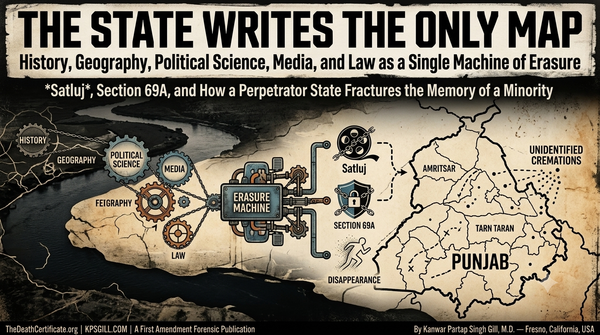
WHAT THE FIRST HALF DOES NOT SHOW - SATLUJ, DHURANDHAR, AND THE VIOLENCE COMMERCIAL CINEMA IS ALLOWED TO SHOW


ਗੁਰਸ਼ਬਦ ਤੋਂ ਪਹਿਲਾਂ, ਸ਼ਮਸ਼ਾਨਘਾਟ
Before the Gurshabad, the Cremation Ground
The Documented Scale of Disappearance, Custodial Torture, and Sexualized Violence in Punjab — and Why Satluj’s Softness Is Better Explained by Cinematic Compression and Certification Politics Than by an Unproven “Secret Dub” Theory
By Dr. Kanwar Partap Singh Gill, M.D.
Publisher and Editorial Director, TheDeathCertificate.org and KPSGILL.COM
(No relation to the late Kanwar Pal Singh “K.P.S.” Gill, IPS, Director General of Police, Punjab.)
Evidentiary Framework
[PF] Proved Finding — established by judicial record, statutory text, official investigation, contemporaneous documentation, reputable human-rights reporting, or named public record.
[DA] Documented Allegation — a serious claim supported by named reporting, testimony, institutional record, or credible secondary documentation, but not treated here as finally adjudicated fact.
[AI] Analytical Inference — my own reasoning drawn from the record, clearly separated from what the record itself proves.
[PM] Panthic Memory — the moral, communal, and historical register in which Sikh memory preserves what the state did not certify.
I. What I Am, and Am Not, Claiming
This essay answers a narrow but important question: why does Satluj feel softer than the history it depicts?
I have now watched Satluj and Dhurandhar frame by frame. When I compare the two films, I am not relying on trailers, social-media clips, secondhand summaries, or a general impression formed from publicity material. I am speaking from close viewing.
That matters because the comparison is not merely aesthetic. It raises a serious question about Indian cinema, censorship, and state violence: why can mainstream commercial cinema show graphic violence at length when the violence belongs to the vocabulary of spy thrillers, gangsters, covert operations, or fictionalized national-security spectacle, while a film centered on Jaswant Singh Khalra and Punjab’s disappeared dead arrives with a far more restrained visual grammar?
That is the question this essay can fairly ask.
What I do not claim is that the makers of Satluj secretly softened the film through hidden dubbing, covert ADR, alternate “safer” takes, or some undisclosed post-production deception. The public record, as presently available to this Project, does not support that claim. On the contrary, current reporting records that Satluj, previously known as Ghallughara and Punjab ’95, was released on ZEE5 on July 3, 2026 after a prolonged CBFC struggle, and that Diljit Dosanjh and Honey Trehan publicly maintained that the released version was uncut and unaltered. (The Times of India)
A claim that the film was secretly altered would require direct evidence: a leaked earlier cut, a verified script-to-screen comparison, technical audio analysis, lip-sync discrepancies at specific moments, testimony from the sound team, or documentary proof from the certification process. I have not seen that evidence.
The stronger claim is also the more defensible one: Satluj is soft not because I can prove a hidden edit, but because commercial narrative cinema compresses atrocity by design, and because Indian certification practice appears far more permissive toward spectacularized fictional violence than toward historically specific violence committed by named state institutions.
That is not a conspiracy theory. It is an argument about form, power, and what a censorial culture can tolerate.
II. Why the “Secret Dub” Theory Should Not Be the Center of the Critique
The “secret dub” theory has an understandable emotional origin. Many viewers, especially those familiar with the Punjab record, expected Satluj to carry the full brutality of enforced disappearances, torture, illegal cremations, and police impunity. When the first half of the film did not visually approach that scale, the mind naturally searched for an explanation.
But a plausible feeling is not the same as proof.
[AI] The problem with the secret-dub theory is that it explains the absence of visible evidence by proposing a mechanism that would, by design, leave little visible evidence. That makes the theory difficult to falsify and therefore weak as a public claim. If the argument is that the edit is invisible because ADR made it invisible, the absence of evidence becomes part of the theory rather than a check against it. That is not how this Project should handle a claim of misconduct against living filmmakers, actors, producers, and technicians.
Honey Trehan’s public account of the certification fight has been read by some as evidence that the film may have quietly complied with censor demands. I read it differently. When a director says the board wanted names changed, place names removed, references to Punjab Police avoided, or the identity of Khalra blurred, that does not prove he secretly complied. It proves the censorial pressure existed. The distinction matters.
[AI] The public record can support this: the CBFC pressure was real; the title history was real; the long delay was real; the eventual release under the title Satluj was real. Current reporting states that the film had earlier titles, faced CBFC demands, and was finally released on streaming after years of delay. (The Times of India) But the additional claim — that the makers secretly changed the film while publicly denying compromise — remains unproved.
This Project does not need that unproved claim.
The record is already devastating without it.
III. The Better Explanation: Compression, Form, and State Sensitivity
[AI] A two-hour narrative film cannot carry a fifteen-year record of mass human-rights violations. It can represent, condense, symbolize, and dramatize. It cannot reproduce the scale.
That is true of every mass-atrocity film. It is true of Holocaust cinema, genocide cinema, and counterinsurgency cinema. It is also true of Satluj. A feature film about one investigator’s courage cannot show every police station, every cremation ground, every missing son, every tortured father, every threatened mother, every wife left without a death certificate, and every file that never existed because the state’s method depended on the absence of files.
The real criticism, therefore, is not that Satluj hides the truth. The better criticism is that its chosen form — the biographical procedural centered on one heroic investigator — structurally cannot carry the full documentary record unless the film deliberately supplements that form with statistical epilogues, documentary inserts, named-case montages, or a closing roll of verified numbers.
[AI] That is where Satluj remains vulnerable. It gives the audience Khalra. It does not fully give the audience the scale of what Khalra found.
IV. What the Record Shows: Disappearance and Extrajudicial Killing at Scale
[PF] Human Rights Watch and Ensaaf stated in 2007 that Indian security forces killed, “disappeared,” and tortured thousands of Sikhs during the Punjab counterinsurgency, and that the abuses occurred in the context of a broader campaign from 1984 to 1995. Their report, Protecting the Killers: A Policy of Impunity in Punjab, India, examined the institutional failures that prevented accountability. (Human Rights Watch)
[PF] The same Human Rights Watch release states that Sikh separatists also committed serious abuses, including massacres of civilians and attacks on Hindu minorities, but it distinguishes those crimes from the state’s own obligation to act within law. That distinction is central. A state does not acquire the right to disappear citizens because militants commit crimes. (Human Rights Watch)
[PF] The mass-cremations case remains central to the Khalra record. Human Rights Watch described it as a case in which security services were implicated in thousands of killings and secret cremations, and noted that the National Human Rights Commission’s process was limited to three crematoria in one district rather than a full statewide accounting. (Human Rights Watch)
[AI] This is the scale problem Satluj cannot solve through conventional drama. The film can show one abduction. The record concerns a system of abduction. The film can show one man tortured. The record concerns a method of rule in which torture, illegal custody, disappearance, and denial formed a single administrative sequence.
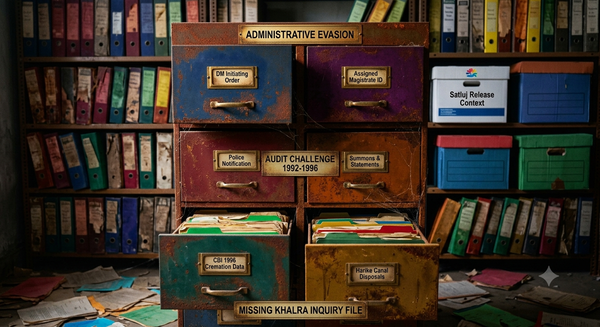
The most frightening part of the Punjab record is not only that people were killed. It is that they were made administratively unreal before they were made physically dead.
No arrest entry.
No custody record.
No postmortem worth the name.
No body returned.
No death certificate.
No accountability.
That is why this Project exists.
V. What the Record Shows: Torture as Method, Not Excess
[PF] The Punjab torture record should not be described only in general language. “Torture” can become an abstraction unless the methods are named.
The clinical and human-rights record describes repeated methods: beatings, leg-stretching, suspension, roller torture, electric shock, falanga, burning, forced submersion, chili or oil forced into the body, threats against relatives, mock executions, and sexualized humiliation or assault. The significance of these methods is not only their cruelty. It is their deniability.
[AI] The methods most useful to a police state are not always the most visibly bloody. They are the methods that produce maximum pain and minimum recordable injury. That is why the absence of scars never meant the absence of torture. It often meant the sophistication of torture.
This matters for Satluj. A film that shows custodial violence through conventional beating scenes may communicate brutality, but it does not necessarily communicate the clinical intelligence of a system designed to hurt the body while preserving deniability.
[AI] The true image of Punjab’s torture regime is not only the bloodied prisoner. It is the prisoner whose joints have been damaged, whose nerves have been shocked, whose family has been threatened, whose body may not carry the kind of scar that an asylum officer, magistrate, journalist, or later court expects to see.
That is a harder thing for cinema to show. It is also the thing that must be remembered.
VI. Sexualized Violence, Cinematic Permission, and the Limits of Satluj’s First Half
[PF] The record supports a careful claim, not an inflated one. The best-documented mass sexual violence against Sikh women belongs primarily to the November 1984 anti-Sikh pogroms, which are related to but distinct from the Punjab counterinsurgency period centered in Satluj. For the counterinsurgency period specifically, the defensible claim is narrower but still grave: sexualized violence, the threat of rape, and the targeting of women relatives were documented as tools of intimidation, interrogation, and coercion. This Project’s own draft record already separates those categories carefully: rape appears within the documented torture record, threats of rape and sexual abuse appear as named interrogation techniques, and family-member persecution appears as part of the wider coercive machinery.
[AI] That distinction matters. This Project should not collapse Delhi 1984 and Punjab 1984–1995 into one undifferentiated claim merely because both belong to the wider Sikh wound. Precision is not weakness. Precision is what makes the indictment harder to dismiss. The counterinsurgency record does not require exaggeration. It already shows enough: women relatives were vulnerable not only as victims in themselves, but also as pressure points against detained, disappeared, suspected, or hunted men.
The comparison with Dhurandhar: The Revenge is revealing. In that spy-action universe, the protagonist Jaskirat Singh Rangi’s trauma is built around a brutal family backstory: public plot summaries describe his father being killed, his sisters being sexually assaulted, the elder sister being murdered, and the younger sister being abducted before his transformation into a vengeance-driven operative. The point is not to equate the two films morally or historically. The point is to ask why commercial cinema can use sexualized violence against women as a dramatic engine for masculine vengeance, undercover mythology, and national-security spectacle, while Satluj — a film rooted in a real human-rights record — does not fully enter the documented zone where women relatives were used as instruments of custodial pressure.
[PF] Dhurandhar: The Revenge was certified for adult audiences after CBFC-mandated edits, including trims to extreme violence, while still remaining a long mainstream commercial release. Reporting described the certified Indian runtime as roughly 3 hours and 49 minutes, with cuts to scenes involving extreme bodily violence such as eye-smashing, beheading, and head injuries.
[AI] That contrast matters. Indian commercial cinema can make room for sexualized violence when it serves revenge. It can make room for graphic violence when it serves action. It can make room for trauma when the trauma turns a man into an instrument of state or national power. But when the violence points back toward the state itself — toward police stations, illegal custody, interrogation rooms, disappeared bodies, unclaimed cremations, and families crushed by official denial — the visual grammar becomes more restrained.
A film attempting to show the full moral structure of the Punjab counterinsurgency would need at least one scene showing how the state used mothers, wives, sisters, and daughters as pressure points against detained or suspected men. Not because cinema needs spectacle, but because the record shows that family persecution was part of the machinery. A responsible depiction would not need to eroticize, sensationalize, or linger. It would need only to show the fact that the threat existed, that it was understood by families, and that the police knew exactly how to weaponize it.
[AI] Satluj, as I watched it frame by frame, does not fully enter that zone. That is a fair criticism. It is also a more precise criticism than alleging hidden audio edits that I cannot prove. The issue is not that Satluj lacked courage. The issue is that even a courageous film may still be constrained by the difference between violence as spectacle and violence as evidence. Dhurandhar can turn violated sisters into the emotional fuel for revenge. Satluj cannot fully show violated families without forcing the audience to confront the institutions that made that violence possible.
That is the deeper asymmetry. Fictional violence is permitted to entertain. State violence is managed when it begins to testify.
VII. The Dhurandhar Comparison: What Indian Cinema Is Allowed to Show
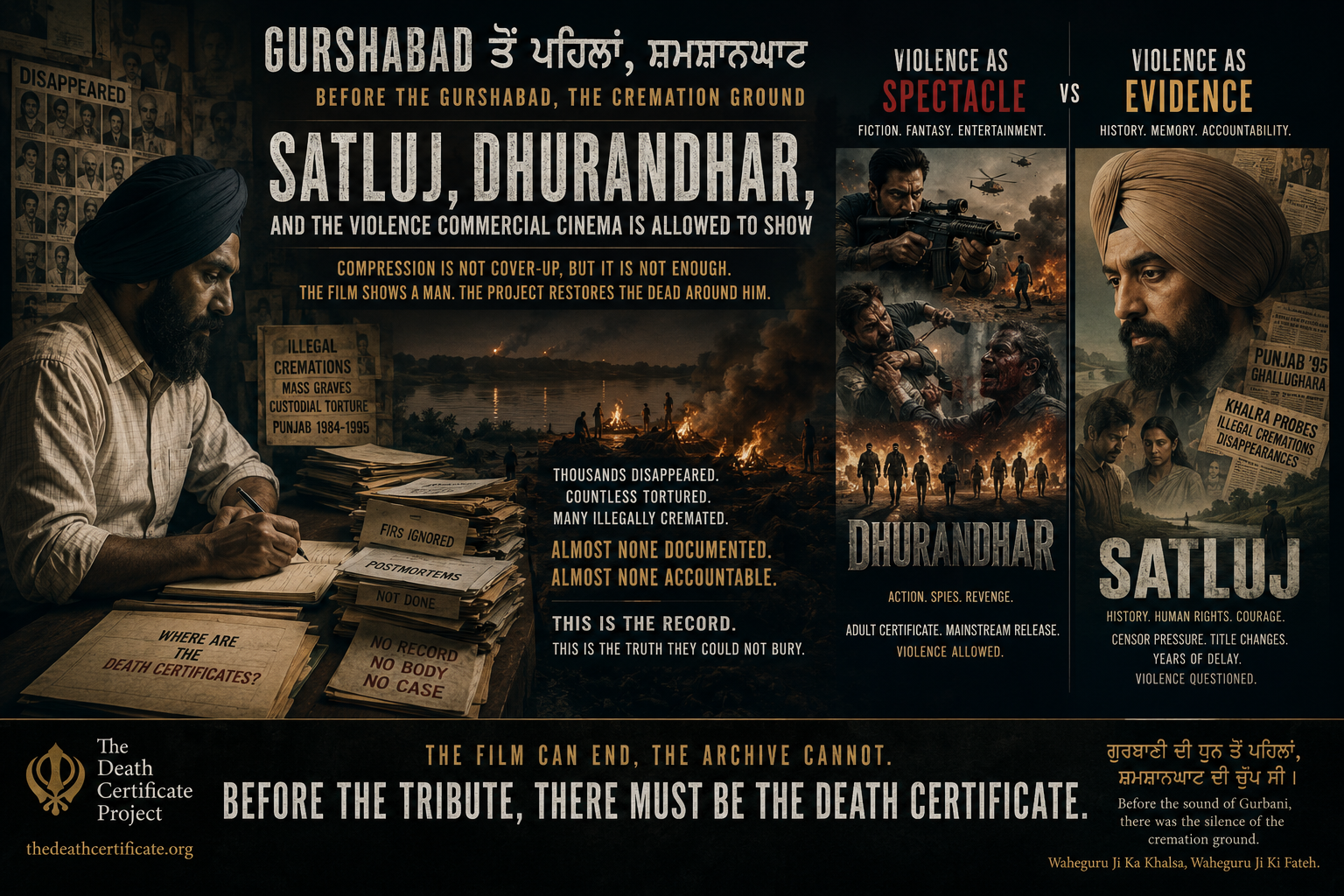
I have watched Dhurandhar and Satluj frame by frame. My comparison is not that the two films are morally, politically, or historically equivalent. They are not. The comparison is about cinematic permission.
[PF] Dhurandhar received an adult certificate, carried a very long runtime, and underwent CBFC-related changes involving violent visuals and profanity. Current reporting records a 214-minute final runtime and an “A” certificate after violence was toned down. (The Times of India) Reporting on Dhurandhar: The Revenge similarly records an “A” certificate and modifications to graphic violent scenes, including cuts to violent imagery. (The Economic Times)
[AI] The point is not that Dhurandhar escaped censorship entirely. It did not. The point is that commercial cinema built around fictionalized national-security violence, covert operations, gangland brutality, and action spectacle is still allowed to exist as a large, muscular, adult-rated entertainment product. The state may trim it. The market still receives it as spectacle.
Satluj occupies a different category. Its violence is not generic. Its violence is not safely fictional. Its violence points toward named institutions, named history, named victims, named perpetrators, named police structures, and a human-rights activist whose work implicated the state’s own record.
[AI] That is the real contrast. Dhurandhar asks the censor to tolerate violence as entertainment. Satluj asks the censor to tolerate violence as evidence.
Those are not treated the same.
The Indian censorial imagination is more comfortable with blood when the blood serves the nation-state’s fantasy of power than when the blood exposes the nation-state’s abuse of power.
That is the sentence this comparison is really trying to reach.
VIII. Measuring Satluj Honestly
[AI] Measured against ordinary commercial cinema, Satluj is courageous. Measured against the record of Punjab, it is necessarily incomplete.
Both things can be true.
It matters that the film was made. It matters that Diljit Dosanjh played Jaswant Singh Khalra. It matters that Paramjit Kaur Khalra’s struggle reached a global streaming audience. It matters that the words “illegal cremations,” “Punjab Police,” “Khalra,” and “disappeared” are now attached to a mainstream film that ordinary viewers can watch at home.
But it also matters that the film’s first half does not visually equal the record. It does not show the full machinery of illegal custody. It does not show the full range of torture methods. It does not show the statewide scale of mass cremations. It does not show, in sufficient historical density, how disappearance required the cooperation of police stations, cremation grounds, magistracies, doctors, clerks, and silence.
[AI] That is not necessarily a failure of sincerity. It is a failure of form. The film gives the audience a protagonist. The archive gives us a system.
This Project belongs to the archive.
IX. The Strongest Public Position
The strongest public position is therefore this:
I accept, unless contrary evidence emerges, that Satluj was released without the cuts its makers publicly resisted. I do not accuse the filmmakers of secret dubbing or covert compromise without proof.
But I also say this: an uncut film can still be a compressed film. An honest film can still be an incomplete film. A courageous film can still be softer than the history it depicts.
The question is not whether Satluj should be condemned for failing to show everything. No film could show everything.
The question is whether the audience, after watching Satluj, will be allowed to stop at the film — or whether the film will become an entry point into the record.
That is where The Death Certificate Project enters.
The film shows a man.
The Project restores the dead around him.
The film shows courage.
The Project names the administrative silence that made courage necessary.
The film shows disappearance.
The Project asks for the death certificate.
X. Conclusion: Compression Is Not Cover-Up, But It Is Not Enough
The record does not need an unproved theory about hidden dubbing to be devastating.
It needs only to be read.
A film that shows one man tortured must be read against the clinical and human-rights record of torture as method. A film that shows one abduction must be read against thousands of disappearances and secret cremations. A film that shows one family’s grief must be read against a generation of families denied bodies, death certificates, and legal truth.
Measured against that record, Satluj is not a cover-up. It is a compression.
But compression has consequences.
When atrocity is compressed into biography, the audience remembers the hero more easily than the system. When state violence is compressed into a few scenes, the machinery behind it becomes harder to see. When the dead remain unnamed, the film can end before the archive has even begun.
That is why the work cannot end with Satluj.
Before the Gurshabad, there was the cremation ground.
Before the tribute, there must be the death certificate.
Before closure, there must be the record.
ਗੁਰਬਾਣੀ ਦੀ ਧੁਨ ਤੋਂ ਪਹਿਲਾਂ, ਸ਼ਮਸ਼ਾਨਘਾਟ ਦੀ ਚੁੱਪ ਸੀ।
Before the sound of Gurbani, there was the silence of the cremation ground.
Waheguru Ji Ka Khalsa, Waheguru Ji Ki Fateh.
Source Note for Publication
Core sources to footnote directly before publication:
Human Rights Watch and Ensaaf, Protecting the Killers: A Policy of Impunity in Punjab, India; Human Rights Watch release, “India: Time to Deliver Justice for Atrocities in Punjab”; Ensaaf / HRDAG, Violent Deaths and Enforced Disappearances During the Counterinsurgency in Punjab, India; Dr. Ami Laws and Vincent Iacopino, “Police Torture in Punjab, India: An Extended Survey”; Jagrup Singh Sekhon and Nirmal Singh, “Rise, Dynamics, and Decline of Violence in Punjab”; reporting on Satluj’s July 3, 2026 ZEE5 release and title history; reporting on Dhurandhar and Dhurandhar: The Revenge CBFC certification, runtime, and violence-related edits.