The Fire Left Receipts: Why K.B.S. Sidhu’s Context Can’t Clear the Archives

THE ANATOMY OF INSTITUTIONAL EVASION
A Comprehensive Point-by-Point Rebuttal to K.B.S. Sidhu on the Satluj Release and the Punjab Mass Cremations
The number 2,097 is not a slogan, an extrapolation, or a cinematic claim. It is the number of police-conducted cremations recorded by the Central Bureau of Investigation in its final report to the Supreme Court of India on 9 December 1996. The Supreme Court reviewed that report, recorded its findings, and held that it disclosed a flagrant violation of human rights on a mass scale.
K.B.S. Sidhu does not answer this record by disproving it. He argues instead that the film Satluj should have devoted more of its three hours to Pakistan-sponsored terrorism, the militant killing of Hindu and Sikh civilians, and the sacrifice of Punjab Police personnel and their families. Those histories are real, and every one of them deserves complete, permanent documentation. None of them rebuts a single entry in the CBI's cremation record, identifies a single one of the 532 bodies that remain unidentified, or produces the magisterial inquiry file Sidhu says he ordered the day after Jaswant Singh Khalra was abducted from his district.
The question this dossier holds open is therefore not whether Punjab suffered terrorism. It did. The question is whether that terrorism extinguished the State's obligation to account for the people its own police took into custody and the bodies its own officers cremated. It did not.
EXECUTIVE SUMMARY & CONTEXTUAL OVERVIEW
Over the past three weeks, the discourse surrounding the release of the film Satluj has polarized digital spaces across YouTube, Facebook, and internal analytical review pipelines. The commentary splits along a predictable fault line: public demands for historical accountability on one side, a standardized bureaucratic and law-enforcement vocabulary of context, balance, and public order on the other.
The primary institutional voice in this recent wave of commentary is K.B.S. Sidhu, who served as Deputy Commissioner (DC) and District Magistrate (DM) of Amritsar from 1992 to 1996 — the precise jurisdiction and timeframe encompassing Khalra's abduction and murder.
This dossier proceeds point by point through the defensive vocabulary Sidhu and the broader retired bureaucracy have deployed against Satluj, and answers each argument on its own terms before returning, always, to the same unanswered administrative question. It applies one discipline throughout: no claim is asserted with more certainty than the underlying record supports. Where the CBI and the Supreme Court have made a finding, this dossier says so plainly. Where a figure comes from a pending petition, a press report, or Sidhu's own recollection, it is labeled as such. An argument that claims more than its record can support is an argument its subject can dismiss with a single accurate objection — and this dossier is built to leave him none.
Police was judge and executioner
Blood Soaked Truth
SECTION 1: THE CORE CONTRADICTION
The foundational vulnerability in K.B.S. Sidhu's public position is a paradox he has stated in his own words. In his fullest essay to date, he writes that fake encounters and custodial killings "were unlawful then, are unlawful today, and can never be justified," and that allegations of illegal cremation "cannot be dismissed merely because the State was confronting terrorism." Yet the same essay treats the film's central failure as a failure of context — an absence of the killing of Hindu and Sikh civilians, the assassination of police officers, and the record of Pakistani sponsorship — and frames free expression as properly weighed against public order and against the "additional responsibility" a filmmaker bears in depicting a period younger audiences do not remember firsthand.
A judicially established human rights crime does not lose its claim to be told plainly because a different, separately documented set of crimes, committed by different people through different institutional channels, is not told in the same film. Sidhu is entitled to insist that the wider history be written. He is not entitled to make that a precondition for telling this one.
The question this dossier will not let go unanswered:
What did the Deputy Commissioner and District Magistrate of Amritsar do when Jaswant Singh Khalra was abducted from his district, and where is the verifiable administrative record of that response?
SECTION 2: THE COMPREHENSIVE POINT-BY-POINT REBUTTAL
1. The "Proxy War" Fallacy: Foreign Involvement Cannot Legalize State Crimes
- The Bureaucratic Argument: Pakistan engineered a cross-border proxy war in Punjab, involving sophisticated weaponry, terrorism, and the widespread targeting of civilians, including Hindus. The security forces therefore operated under extreme, unprecedented duress.
- The Rebuttal: the security environment of the 1990s explains the pressure the state faced. It does not authorize the abduction, torture, custodial killing, secret cremation, and deliberate destruction of identity of Indian citizens by Indian public servants.
- The Constitutional Fact: foreign sponsorship of an insurgency does not suspend Article 21 or Article 22 of the Constitution, and it does not repeal the CrPC. When police officers abduct a citizen, hold him in secret custody, kill him, and incinerate his remains as "unidentified," they commit murder as agents of the state. The Supreme Court held that police officers abducted Khalra because he was exposing illegal cremations, and it characterized the toleration of such conduct as systematic erosion of the rule of law.
2. The "Both Sides" Argument as a Category Error
- The Bureaucratic Argument: Satluj is one-sided. A complete picture requires the "full spectrum" — militant atrocities, the targeted killing of Hindus, the sacrifice of police personnel, and the state's economic losses.
- The Rebuttal: this is a category error. Satluj is a specific film about the work and murder of Jaswant Singh Khalra. It is not a general history of the Punjab conflict, and no single film about one documented crime is obliged to also document every other crime of the period in order to be honest about the one it addresses.
- The Distinction: a narrative about one custodial disappearance does not become dishonest because it omits an unrelated massacre. To demand that a film about police-conducted illegal cremation be balanced against militant violence is to treat victims as entries on a political ledger. The atrocities committed by insurgent groups deserve their own complete accounting. They do not bear on the separate factual question of whether the Amritsar police illegally cremated thousands of citizens, and what the district administration's own record shows it did in response.
+--------------------------------------------------------------------------+
|                       THE BALANCING LEDGER FALLACY                       |
+----------------------------------------+----------------------------------+
| Insurgent Atrocities                    | Police-Conducted Illegal          |
| (Targeted killings, massacres, terror)  | Cremations (Abduction, custody,   |
|                                          | undocumented disposal)            |
+----------------------------------------+----------------------------------+
|   [ Deserves Independent Accounting ]   |  [ Demands State Accountability ] |
|                                          |                                    |
|   CRIMES BY NON-STATE ACTORS DO NOT DISCHARGE THE STATE'S OWN RECORD-    |
|   KEEPING AND ACCOUNTABILITY OBLIGATIONS                                 |
+--------------------------------------------------------------------------+
3. The Myth of Moral Symmetry Between State and Insurgent
- The Bureaucratic Argument: excesses occurred on all sides in a chaotic, civil-war-like environment; police and militants both engaged in violence, and state conduct must be judged within that matrix.
- The Rebuttal: the state cannot claim moral or legal symmetry with an outlawed insurgent organization. The State holds a monopoly on lawful force, together with arrest powers, prisons, magistrates, forensic facilities, and municipal death registers. A militant group is by definition unlawful. When a state official acts outside the law to kill a prisoner secretly and destroy the body, he corrupts the legal system from within it. Sections 97, 174, and 176 of the CrPC obliged the district administration to record arrests, investigate suspicious deaths, hold inquests, preserve identities, and return bodies to families. Failing to do so is an institutional collapse, not an "excess."
4. The Public-Order Qualification Cannot Replace a Particularized Case
- The Bureaucratic Argument: the film's exhibition implicates public order, national security, and the "constitutional responsibilities of the State," and freedom of expression, while fundamental, is not absolute under the Indian Constitution.
- The Rebuttal: this Project does not dispute the general constitutional proposition. Reasonable restrictions on speech in the interest of public order are real, and preventive administration acting on a reasonable apprehension of disorder is a recognized standard, not an invention of this controversy. What the public-order qualification cannot do is stand in for a particularized case. It requires the state, or anyone invoking it, to identify the specific scene, statement, or circumstance that gives rise to the apprehension of disorder — not the generalized proposition that an accurate account of a judicially confirmed state crime is inherently destabilizing.
- By his own account, Sidhu concedes the narrative in Satluj is true and consistent with the CBI's findings. Once that concession is made, an argument for delaying or qualifying the film's exhibition is no longer an argument about accuracy. It is an argument that a true, judicially confirmed account should be released only alongside a state-preferred supplementary narrative — a condition attached to the truth rather than a correction of it.
5. The "Justice Has Already Been Served" Illusion
- The Bureaucratic Argument: the legal system worked. The CBI investigated, officers were prosecuted and convicted, and the Khalra family received justice. The matter is closed.
- The Rebuttal: convicting the immediate perpetrators of one murder is a genuine judicial outcome. It is not the same as institutional accountability for the wider system of mass illegal cremation that made that murder possible and containable.
- The Scope of the Unresolved Record, set out as a chronology, because the official record itself developed in stages:
1996 — CBI's final report placed 2,097 cremation records before the Supreme
        Court of India. The Court held the report disclosed a flagrant
        violation of human rights on a mass scale.
2006 — NHRC re-examination reconciled the record to 2,059 unique cases
        after removing duplicates.
2012 — NHRC recommended compensation in relation to 1,513 identified
        deceased. 532 bodies remained completely unidentified.
- The conviction of Khalra's immediate killers did not, on its own, extract the missing administrative records, identify the remaining unidentified dead, or provide death documentation to the families still waiting for one.
6. The Magisterial Inquiry Assertion: A Verbal Claim and the Document Trail It Would Have Left
- The Bureaucratic Argument: Sidhu states that, as District Magistrate, he ordered a formal magisterial inquiry the day after Khalra's disappearance, and he has repeated this claim across multiple recent interviews and essays.
- The Rebuttal: a District Magistrate does not govern by oral tradition. A magisterial inquiry is not a state of mind; it is a mandatory statutory proceeding that generates a specific, serialized paper trail. By stating that an inquiry was ordered, Sidhu is not offering an explanation. He is identifying a public record that must, if his account is accurate, exist somewhere in the state's own files.
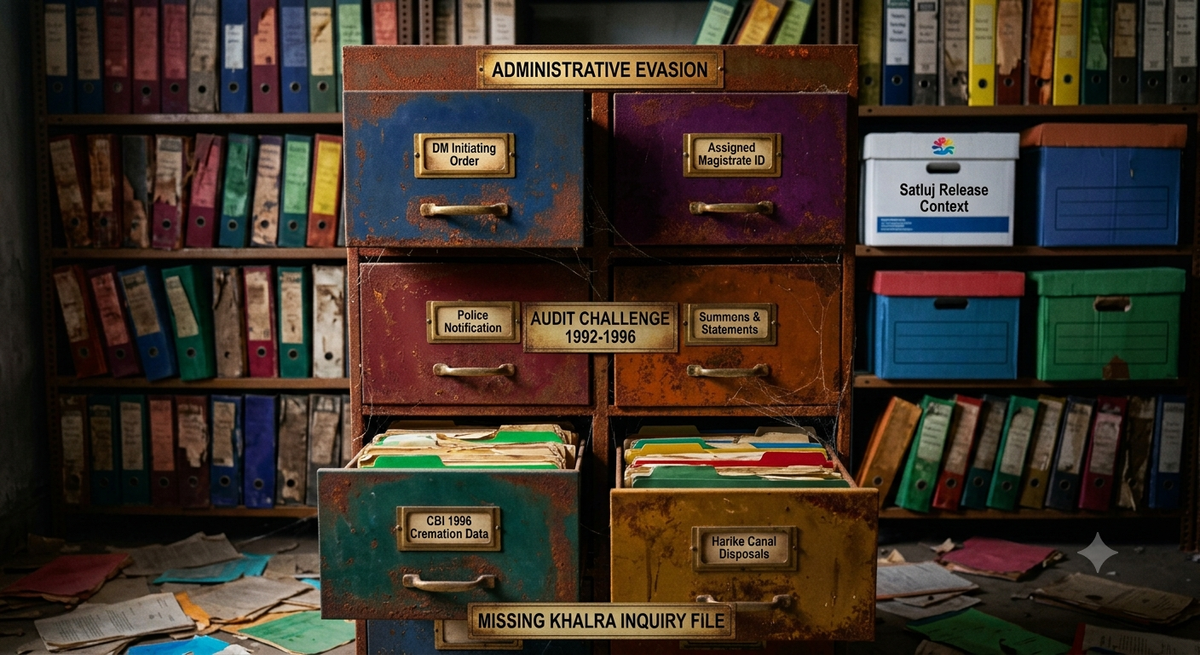
- The Institutional Audit — the baseline components that proceeding would necessarily have produced, and their current status in the public record this Project has reviewed:
| Required Document | Legal Significance | Status in Public Record |
|---|---|---|
| Signed, dated initiating order | Establishes the date and statutory authority invoked | Not in public record |
| Order number, diary and dispatch-register entry | Confirms the order actually entered the administrative system | Not in public record |
| Name, designation, and jurisdiction of the assigned magistrate | Identifies the officer responsible for the inquiry into a citizen's disappearance | Not in public record |
| Written terms of reference | Defines the scope of what was actually investigated | Not in public record |
| Summonses and statements of complainant, family, and witnesses | Shows whether the inquiry actually took evidence | Not in public record |
| Requisitions to Tarn Taran and Amritsar police | Shows whether the police were formally called to account | Not in public record |
| Daily order sheets and interim correspondence | Shows whether the inquiry was active during the forty-nine days Khalra was alive in custody | Not in public record |
| Final signed report and Action Taken Report | Shows what was concluded and what followed from it | Not in public record |
| File number, record-room accession number, retention schedule | Allows the file to be located even decades later | Not in public record |
| Any weeding or destruction order, with date and authorizing officer | Would explain a genuine absence without abandoning the claim that the inquiry occurred | Not in public record |
- No complete initiating order, inquiry proceeding, final report, or Action Taken Report has been cited in Sidhu's essays, produced in his recorded interviews, or located in the public judicial or administrative record this Project has reviewed. If the file still exists, the appropriate response is to release it. If it no longer exists, the appropriate response is to identify its file number, its record-room entry, and the order — with date and authorizing officer — under which it was destroyed. A claim that an inquiry was ordered is not the end of this question. Under the state's own record-keeping rules, it is the beginning of a traceable chain, and the chain has not yet been produced.
7. The Unreachable SSP, and the District Magistrate's Own Statutory Authority
- The Bureaucratic Argument: contact could not be established with Ajit Singh Sandhu, SSP of Tarn Taran, in the period immediately following the abduction, which is offered as an explanation for the absence of an immediate civil response.
- The Rebuttal: an unreachable police chief, in a case alleging that his own subordinates abducted a prominent human-rights investigator, was not an obstacle to civil action. It was itself a piece of material information that a functioning administration would have documented and escalated in writing, in real time.
- The Scope of the District Magistrate's Authority: this Project does not claim, and has never claimed, that Sidhu personally commanded police operations or personally disciplined individual officers; that authority ran through the police chain of command. But Rule 1.15 of the Punjab Police Rules, 1934 — in force throughout Sidhu's tenure, and still cited today on the Amritsar district administration's own website among others — designates the District Magistrate as the head of the criminal administration of the district, and places the district police force under his general control and direction for exactly this purpose: to enable him to enforce his authority and fulfil his responsibility for the maintenance of law and order. The legally relevant question, then, is not whether Sidhu personally commanded the officers implicated. It is whether he exercised the reporting, inspection, direction, search, and escalation powers his office indisputably possessed once credible allegations of a police abduction reached him.
- Those powers point to a specific, answerable set of questions: where is the written record of the attempt to contact SSP Sandhu? Where is the report of his non-response? When were the Home Secretary, the DGP, and the Chief Secretary informed in writing? What independent step — a Section 97 search, an inspection of suspected detention sites, an escalation to state government — was taken once the police chain implicated by the complaint itself failed to respond? The absence of a produced answer to any of these questions is a documentary gap, not a settled conclusion about what Sidhu did or did not do. It is a gap only the contemporaneous file, not memory, can close.
8. The Inversion of the "Rule of Law"
- The Bureaucratic Argument: distributing or releasing the film outside approved certification channels undermines legal institutions and the rule of law.
- The Rebuttal: this inverts constitutional priorities. It elevates administrative film-regulation procedure above the human rights violations the film depicts. The rule of law in Punjab did not break down over how a film was certified in 2026. It broke down when police officers abducted citizens, killed them, incinerated their bodies as "unclaimed," and when the civil administration failed to keep the statutory registers meant to prevent exactly that.
9. "Healing" vs. Compulsory Forgetting
- The Bureaucratic Argument: Punjab has moved on; revisiting this history reopens wounds and disrupts three decades of healing.
- The Rebuttal: an argument for "healing" without truth is an argument for compulsory, state-managed forgetting. The wounds remain open because hundreds of families still lack an official death certificate, still do not know their relative's fate, and have never seen a complete institutional account of the chain of command that ordered these killings.
10. The Reasonable-Apprehension Standard Still Requires a Particular Basis
- The Bureaucratic Argument: preventive administration is entitled to act on a reasonable apprehension of a breach of public order, and need not wait for actual violence before restricting a film's exhibition.
- The Rebuttal: as a matter of constitutional doctrine, that standard exists and this Project does not contest it in the abstract. What it cannot do is substitute a generalized, retrospective judgment — that any accurate account of a proven state crime carries some risk of misuse — for the specific scene, claim, or circumstance the doctrine actually requires. A rule under which any judicially confirmed account of state wrongdoing may be restricted on the anticipatory judgment of institutions implicated in that wrongdoing is not a public-order standard applied case by case. It is a standing veto applied by the party with the least incentive to see the account told.
11. The Illusion of the Neutral Commentator
- The Bureaucratic Argument: Sidhu offers his recent interviews and essays as a considered, first-hand account of what he "saw, heard, attempted, resisted, and learned" during his tenure.
- The Rebuttal: Sidhu is not a detached historian; he was the highest-ranking civil official in the district where the illegal cremations occurred, from 1992 to 1996. His account is valuable precisely because he held that office — and for the same reason, it must be tested against the documents his own office did or did not generate, not accepted as the final word on what happened there. This is not a personal attack. It is the ordinary scrutiny due to a former public official speaking about events inside his own jurisdiction.
12. Retrospective Recollection vs. Contemporaneous Record
- The Bureaucratic Argument: his 2026 interviews and essays offer an authentic, first-hand account of conditions on the ground in the mid-1990s.
- The Rebuttal: an account delivered in 2026 about events from 1995 is a retrospective recollection, not a contemporaneous record, unless it is anchored to notes, orders, diaries, or files created at the time. Memory can explain a record. It cannot substitute for one. An account offered thirty years later cannot carry more evidentiary weight than a missing inquiry order, dispatch register, or Action Taken Report.
The Death Certificate Project offers memory no privileged status over documents. Where Sidhu offers recollection, context, and a call for narrative balance, this Project asks for dates, signatures, official stamps, registers, and files that can be checked against each other.
13. The "Missing Context" Demand as a Claim on the Historical Record, Not a Rebuttal to It
- The Bureaucratic Argument, in its fullest form (K.B.S. Sidhu, "Satluj: History Must Be Told—but Not Without Its Context," The KBS Chronicle, 15 July 2026): Sidhu does not argue that extrajudicial killing was justified. He states that fake encounters and custodial killings "were unlawful then, are unlawful today, and can never be justified," and that allegations of illegal cremation "cannot be dismissed merely because the State was confronting terrorism." His narrower claim is that the film's "greatest weakness is not necessarily what it shows, but what it leaves out": the killing of Hindu and Sikh civilians on buses and trains, the assassination of police officers and their families, and Pakistan's sponsorship of the insurgency. A three-hour film, he argues, had space to include this, and without it a young viewer may conclude the era's violence "originated almost entirely with the State." He also distinguishes, correctly as a matter of law, between genuine encounters, unidentified bodies recovered after armed operations, custodial deaths, enforced disappearances, and staged encounters — categories he calls "not legally or morally interchangeable."
- The Rebuttal: Sidhu's taxonomy is correct in the abstract, and this Project does not need to dispute it to answer him. This Project does not claim that the CBI or the NHRC formally adjudicated each of the 2,097 cremations as a staged encounter rather than a genuine one; the public record does not support that claim, and asserting it would be an overreach this dossier will not make. What the record does support is narrower and, for that reason, harder to escape: whatever category a given death falls into, a lawful killing does not make its owner a legally ownerless body. A genuine armed encounter, properly conducted, generates more documentation, not less — an FIR, a recovery memo, a weapons record, an inquest, a post-mortem, an identification effort, a reasoned disposal record. Sidhu's own point that not every unidentified cremation proves a fake encounter does not answer the documentary question raised by these cases. It sharpens it: if the killings were genuine, where are the encounter reports? If the deaths were natural or unavoidable, where are the post-mortems? Either way, why were bodies entered as "unidentified" and cremated without the identification effort the State's own rules required, and why were families turned away empty-handed? The taxonomy Sidhu offers does not supply an answer. It multiplies the number of missing documents that would be needed to supply one.
- Nor does the demand for context answer on its own terms. If fake encounters and custodial killings "can never be justified," and if the Khalra case's underlying facts are, on Sidhu's own account, established and true, then the only question a film about Khalra owes its audience is what happened to Khalra and what the office responsible for his district did about it. What Sidhu adds beyond that is a demand that the same film also carry a different set of crimes, committed by different people, addressed through different institutional channels entirely. That is not a factual correction to Satluj. It is a request for a different film — a demand, in substance, that no single account of the State's own conduct may be told on its own terms, but only bundled with an officially adequate supplementary narrative. That is a demand for narrative control dressed in the vocabulary of completeness.
- The asymmetry exposes the demand for what it is. For decades, films, official statements, and state-aligned commentary on Punjab's insurgency have been published without a corresponding requirement to append a documentary account of the 2,097 illegal cremations, the CrPC provisions left unenforced, or the missing inquiry files of the districts they describe. The demand for "full spectrum" context is invoked, in practice, exactly and only when the State's own institutional conduct is the subject under examination — not when militant violence is. A standard applied only in one direction is not a standard of historical completeness. It is a filter.
- Sidhu's own essay, finally, undercuts the "erasure" framing on which the demand depends. He writes that the killing of Hindu and Sikh civilians and the assassination of police "must not disappear from the historical narrative" — a narrative he elsewhere describes as one he personally witnessed and has written about at length, and which is amply documented elsewhere in the public record, including by this Project. A film that narrows its lens to a specific, comparatively less-told strand of that same history — one that has taken thirty years, a CBI investigation, an NHRC proceeding, and a Supreme Court judgment merely to partially document — does not erase a history Sidhu's own essay confirms is otherwise remembered, litigated, and written about. It fills a documentary gap whose existence Sidhu, in the end, does not deny.
14. Canal and River Disposals: What the Absence of a Register Actually Proves
- The Bureaucratic Argument, implicit wherever the 2,097 figure is treated as the outer boundary of the state's accounting obligation: the CBI-confirmed cremations at three Amritsar crematoria, and the NHRC's subsequent identification and compensation process, represent the scope of what the record can show, and the state's disclosure obligation is substantially met by that record.
- The Rebuttal: the 2,097 figure was never a total. It is a documented subset, bounded precisely by the fact that three named crematoria kept the municipal firewood-purchase registers Khalra was able to obtain and cross-reference. It says nothing about disposals that never passed through a crematorium, and therefore never generated a register, a wood token, or any document capable of being reconstructed thirty years later. Treating that bounded record as a ceiling rather than a floor mistakes what made the figure provable for what makes it complete.
- Khalra's own case makes the point without requiring any disputed or estimated figure. The Supreme Court's 2011 judgment and Human Rights Watch's 2007 report, Protecting the Killers, both record that Khalra — after weeks of illegal detention — was killed and his body driven to Harike and thrown into the canal, specifically because his own investigation had shown the state exactly how a cremation register could later be traced. If the case of Jaswant Singh Khalra — internationally watched, the subject of an active Supreme Court habeas petition at the moment of his death — did not produce a cremation-ground record, the assumption that ordinary, unwatched disappearances routinely did is not a safe one.
- This is not confined to a single case. It is a documented pattern, corroborated across independent sources of varying evidentiary weight, which this dossier states plainly rather than blur together:
+---------------------------------------------------------------------------+
|      BEYOND THE THREE CREMATORIA — WHAT EACH SOURCE ACTUALLY ESTABLISHES  |
+---------------------------------------------------------------------------+
| Rajasthan state government's formal complaint to Punjab's Chief          |
| Secretary, March 1992: contemporaneous inter-government allegation,      |
| reported in the press at the time, that bodies with hands and feet       |
| bound were surfacing in canals entering Rajasthan when water flow was    |
| stopped for repairs. A documented contemporaneous allegation, not a      |
| judicial finding.                                                        |
+---------------------------------------------------------------------------+
| Khalra's own 1995 Supreme Court petition: alleged approximately 25,000   |
| bodies cremated statewide as "unidentified" or "unclaimed." Khalra's own |
| claimed scale, not an independently adjudicated count.                   |
+---------------------------------------------------------------------------+
| Punjab & Haryana High Court PIL (Punjab Documentation & Advocacy         |
| Project, filed 2019): 6,733 alleged disappearances and encounter         |
| killings statewide, expressly including bodies "thrown into rivers and   |
| canals"; an earlier PIL from the same petitioners cited 8,257. Pleaded   |
| allegations that have entered formal litigation and drawn a High Court   |
| notice — not an adjudicated count, and not proof that every pleaded case |
| occurred exactly as alleged.                                             |
+---------------------------------------------------------------------------+
| On-record counsel testimony reported by The Caravan (2021): describes    |
| "thousands" of comparable cases in which bodies were "disappeared and    |
| not handed over to the families," and "even death certificates were not |
| issued." Reported, attributed testimony from counsel in a specific,      |
| named case — not a verified statewide count.                             |
+---------------------------------------------------------------------------+
- None of these figures is a CBI-confirmed finding, and this Project's own evidentiary discipline forbids treating a pending petition's allegation as a proved fact. That distinction is exactly what makes the underlying point stand rather than collapse: a canal disposal, by design, leaves no wood-purchase voucher and no municipal register to cross-reference later. It defeats the very kind of documentary reconstruction that made the 2,097 figure provable in the first place. The resulting absence of a precise count for river and canal disposals cannot rationally be read as evidence that the practice was rare or insignificant. It is the foreseeable evidentiary consequence of a disposal method that was, by its nature, harder to trace than a crematorium ledger — nothing more, and nothing less, should be claimed for it than that.
- The honest formulation is therefore not a mirrored or estimated figure alongside the 2,097. It is this: the cremation registers could be audited because fire left receipts. The canals did not. The CBI-confirmed cremations are very likely a floor, not a ceiling, on the true scale of enforced disappearance in Punjab during this period — and any inquiry Sidhu says he ordered, however diligent, could only ever have certified what happened at institutions willing to keep a record. It could not certify the water.
15. Acknowledged Homicide and Engineered Disappearance Produce Different Records
- The Bureaucratic Argument: Hindu families who lost relatives to militant violence during this period suffered no less than Sikh families affected by police custodial disappearance, and a serious accounting of the era must treat both experiences with equal administrative weight — including, on some versions of the argument, the suggestion that Hindu families were in practice denied the same access to bodies, last rites, and documentation that this Project attributes to the police's Sikh victims.
- The Rebuttal: the relevant distinction is not Hindu victim versus Sikh victim. It is acknowledged homicide versus state-engineered disappearance. This Project does not dispute, and has never disputed, that Hindu civilians were deliberately and repeatedly targeted by militant groups during this period — on buses and trains stopped and searched by identity, in markets, in individual assassinations — and that this history belongs permanently in the public record alongside every other strand of Punjab's 1980s and 1990s. Sidhu is right that it must not be forgotten.
- A Hindu or Sikh civilian killed by militants suffered an equally grave loss. But where the body was recovered and the killing entered the ordinary criminal process, the State could generate an FIR — even against unknown assailants — a recovered body, a post-mortem, a police diary entry, and, once a death certificate issued, access to the ordinary civil consequences that follow any registered death: probate, insurance, succession, survivor benefits, and whatever ex-gratia relief existed under the state and central compensation schemes for civilian victims of terrorist violence during this period. This Project has not audited, and does not here claim to have audited, how completely or promptly that machinery actually reached every Hindu family in Punjab in the 1980s and 1990s. That would be a legitimate and separate inquiry, and any documented failure of that machinery — for a family of any community — falls squarely within this Project's mandate.
- In a police disappearance, by contrast, the alleged perpetrating institution controlled every point at which a record should have been created: the arrest, the custody, the inquest, the post-mortem, the identification, the notification, and the disposal. No FIR was filed by the men who carried out the killing. No post-mortem reached a family through lawful process. The "unidentified/unclaimed" cremation entry was not an administrative oversight; on the CBI's own findings, it was the mechanism of concealment. This is not confined to the 2,097. Counsel for one family, in a matter reported by The Caravan and separate from the Khalra case, described "thousands" of comparable cases in which bodies were never returned and death certificates were never issued, because no FIR, inquest, or acknowledged death existed for the state to certify.
- Sidhu's invocation of Hindu and Sikh civilian suffering does not answer the Khalra record. It confirms the need for a complete victim archive covering every community, which this Project does not oppose and would welcome contributing to. But it cannot transform an acknowledged militant homicide, processed through the ordinary criminal system, and an officially denied police disappearance, processed through none of it, into administratively identical events simply because both left grieving families behind. The correct response to this argument is therefore not a rhetorical challenge to an entire community. It is a standing evidentiary invitation, extended on the same terms this Project applies to every claim in its archive: if a documented case exists of a Hindu family whose relative was abducted and killed by state actors and disposed of outside any FIR or inquest — rather than killed by a militant assailant in an investigated criminal incident — that case belongs in this record, graded by the same four-tier standard as every Sikh case examined here, and this Project will treat it accordingly.
SECTION 3: TRANSCRIPT-DEPENDENT CRITICAL ANGLES
(Pending finalized, timestamped verification of the Auzar TV interview and the approximately 25-minute News9 conversation with Kartikeya Sharma referenced in Sidhu's 15 July 2026 essay)
Once the transcripts are fully authenticated, three supplementary arguments become available:
The "Credible Complaint" Threshold — the statutory reporting systems governing suspicious deaths and illegal detentions under Sections 174 and 176 of the CrPC operate automatically. They do not depend on a private complainant first satisfying a bureaucrat's own credibility test.
The Career-Protection Defense — fear of professional or political consequence may explain institutional hesitation. It does not supply a legal justification for failing to uphold constitutional duties when a citizen's life is at risk.
Capacity Without Accountability — a narrative of high administrative competence and functioning intelligence networks makes it harder, not easier, to explain how large numbers of bodies could be cremated using state wood supplies without the DM's office noticing, documenting, or intervening.
SECTION 4: PRESS-READY SYNTHESIS
Headline
K.B.S. SIDHU DEMANDS MORE "CONTEXT" FROM SATLUJ — THE DEATH CERTIFICATE PROJECT DEMANDS THE MISSING KHALRA INQUIRY FILE
Closing Argument
K.B.S. Sidhu is entitled to insist that the terrorism, assassinations, and civilian killings of Punjab's violent years must also be remembered. This Project agrees, and has never argued otherwise. But historical context is not rebuttal evidence. Pakistan's role does not identify one unidentified body. The murder of a police officer does not supply one missing post-mortem. The killing of a Hindu civilian on a bus does not produce the magisterial inquiry Sidhu says he ordered — and it does not explain why Khalra's own body was found not in a crematorium register but in the Harike canal, disposed of by a method that leaves nothing to register at all.
The 2,097 figure is not a cinematic invention. It came from the CBI, was recorded by the Supreme Court, and generated a decades-long NHRC proceeding that has still not accounted for 532 of the dead. The Supreme Court held that Khalra was abducted and killed because he persisted in exposing police killings and unidentified cremations. Sidhu says his office responded by ordering a magisterial inquiry. That claim creates a specific, traceable obligation: produce the order, name the magistrate, disclose the proceedings, release the report, and show the action taken while Khalra was still alive — or, if the file no longer exists, show the destruction order and the officer who signed it.
This Project is not asking K.B.S. Sidhu for a more persuasive memory. It is asking the former District Magistrate to identify the contemporaneous public record his own office was legally required to create. Until that record is produced, context remains a narrative. The missing file remains evidence.
SOURCES & CITATIONS
- K.B.S. Sidhu, "Satluj: History Must Be Told—but Not Without Its Context," The KBS Chronicle (Substack), 15 July 2026 — https://kbssidhu.substack.com/p/satluj-history-must-be-toldbut-not
- Supreme Court of India, final CBI report placed before the Court, 9 December 1996, and judgment of 4 November 2011 upholding convictions in the Khalra case, including the finding that his body was dumped in the Harike canal — as reported by ThePrint: https://theprint.in/past-forward/jaswant-singh-khalra-truth-punjab-disappearances/2986064/
- Human Rights Watch, Protecting the Killers: A Policy of Impunity in Punjab, India, 2007 — https://www.hrw.org/reports/2007/india1007/india1007.htm
- Punjab Disappeared (punjabdisappeared.org), "About," on the March 1992 Rajasthan government complaint and a 2003 report on canal disposals
- The Caravan, "HC petition demands enquiry into 6,733 disappearances, illegal cremations in Punjab," 2021 — https://caravanmagazine.in/news/hc-petition-demands-enquiry-into-6-733-disappearances-illegal-cremations-in-punjab
- The Tribune, "Punjab and Haryana High Court notice on plea to probe 6,733 encounter killings" — https://www.tribuneindia.com/news/punjab/punjab-and-haryana-high-court-notice-on-plea-to-probe-6-733-encounter-killings-588457
- Rule 1.15, Punjab Police Rules, 1934, as currently stated on the Amritsar and Ludhiana district administration websites — https://amritsar.nic.in/district-administration/
- NHRC chronology (1996 CBI report / 2006 re-examination / 2012 compensation order): reconciled across published NHRC records cited above. Secondary sources vary slightly on the exact sub-figures within the 2,097–2,059 range; the figures used throughout this dossier are the ones most consistently corroborated across independent sources.
As with every other actor named in this archive, an unconditional right of reply is extended to Mr. Sidhu.
Waheguru Ji Ka Khalsa, Waheguru Ji Ki Fateh.