The Confession as Indictment: Forensic Asymmetry and the Sovereign Verdict of Jinda and Sukha

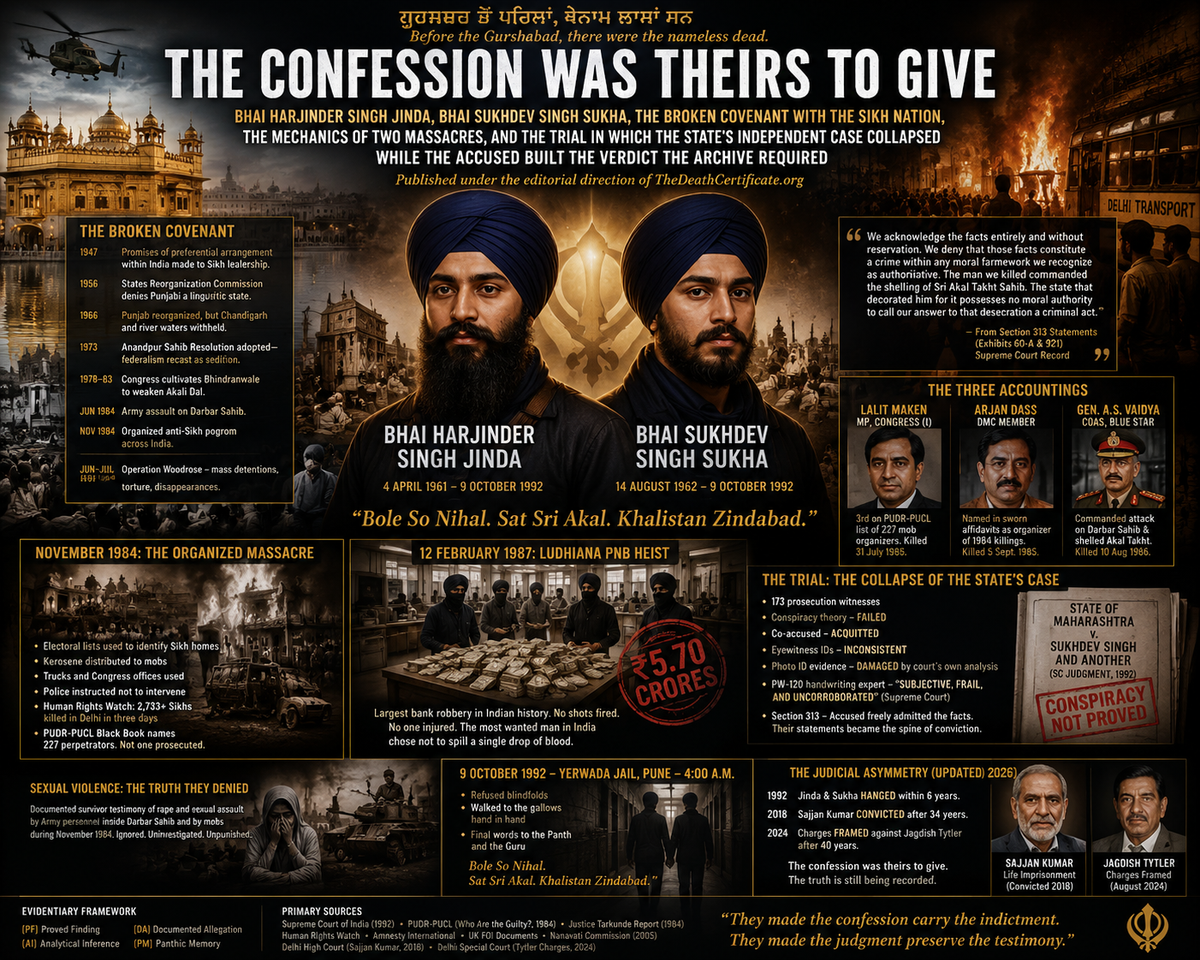
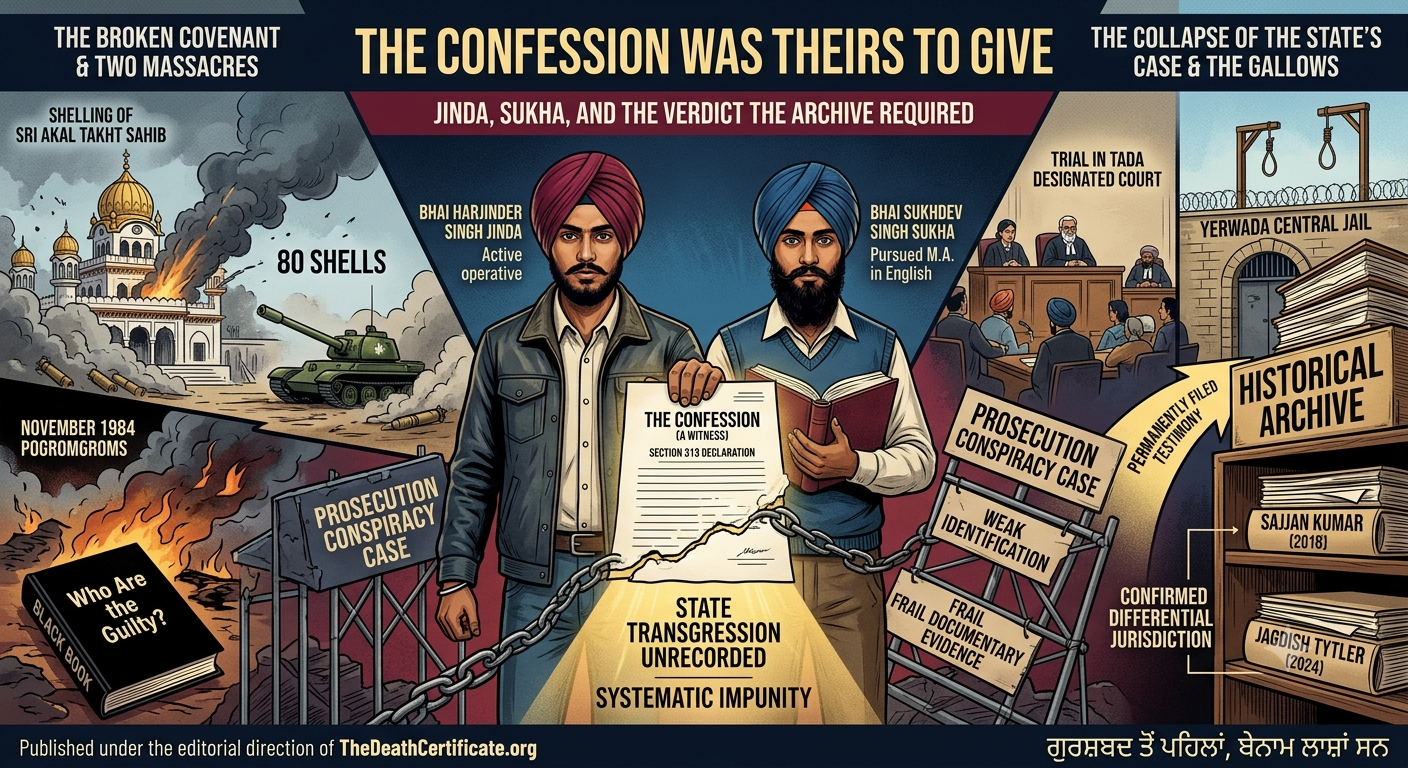
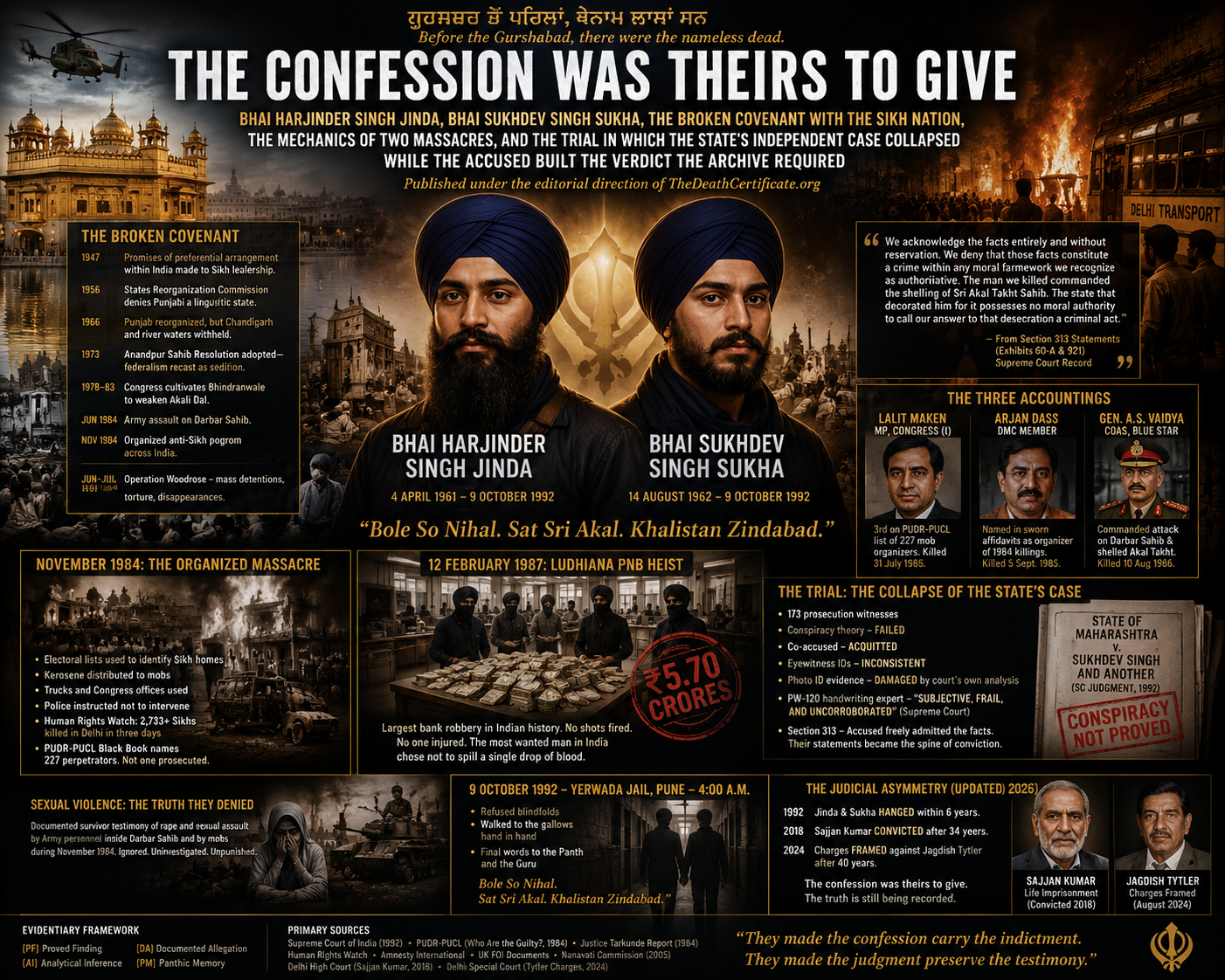
THE CONFESSION WAS THEIRS TO GIVE Bhai Harjinder Singh Jinda, Bhai Sukhdev Singh Sukha, the Broken Covenant with the Sikh Nation, the Mechanics of Two Massacres, and the Trial in Which the State's Independent Case Collapsed While the Accused Built the Verdict the Archive Required
ਗੁਰਸ਼ਬਦ ਤੋਂ ਪਹਿਲਾਂ, ਬੇਨਾਮ ਲਾਸ਼ਾਂ ਸਨ
Before the Gurshabad, there were the nameless dead.
Published under the editorial direction of TheDeathCertificate.org
Abstract
This is a forensic historical account of the trial and conviction of Bhai Harjinder Singh Jinda and Bhai Sukhdev Singh Sukha — formally designated State of Maharashtra v. Sukhdev Singh and Another (Supreme Court of India, 1992). But it cannot begin in the courtroom. It must begin with the promises made to the Sikh nation at Partition and never honored; with the Anandpur Sahib Resolution, which sought federal autonomy within the Indian Union and was deliberately recast as sedition; with the Congress party's tactical creation and subsequent abandonment of a political figure whose entrenchment in the Golden Temple complex was, in significant respects, a circumstance the Congress government itself engineered and then chose to resolve by military assault rather than negotiation or targeted arrest. It must account for the blood of the pilgrims killed inside Darbar Sahib in June 1984; for the specific role of General A.S. Vaidya and Lt. Gen. K. Sundarji in commanding an assault that deployed tank main gun rounds against Sri Akal Takht Sahib; for the documented refusal of a senior army officer to sanction such an operation; for Operation Woodrose and its systematic devastation of Punjab's young Sikh male population in the weeks that followed; for the documented sexual violence committed by Indian Army personnel inside the sacred precincts; and for the organized massacre of Sikh civilians across Delhi and northern India in November 1984 — in which Lalit Maken, Arjan Dass, and hundreds of other named individuals organized, incited, and personally directed mob violence whose structural template would be reproduced in Gujarat in 2002. It must account for the Black Book — the PUDR-PUCL report Who Are the Guilty?, naming 227 individuals — and for the state's absolute refusal to use that book as the foundation for a single prosecution. And it must account for the Sikh informers whose collaboration with the security establishment made possible the arrests that the state's own surveillance capacity might not have independently achieved.
Against all of this, the trial of Jinda and Sukha must be read with precision: as a proceeding in which the prosecution's independent case — its conspiracy theory, its direct identification evidence, its documentary links — fractured on its own terms, while the accused supplied, through voluntary Section 313 declarations, the moral and factual spine that the state's independent evidence had failed to provide. The capital conviction was won because the defendants chose to give the court what it needed — not from defeat, but from a strategy of witness. They were not testifying to a crime. They were testifying to a judgment. The distinction is everything.
This article preserves that distinction.
PART ONE: THE BROKEN COVENANT — CONGRESS, THE SIKHS, AND THE ROAD TO DARBAR SAHIB
I. The Promises That Were Never Kept
The foundational premise of Sikh political engagement with the Indian Union — the premise that makes the events of 1984 politically legible rather than merely tragic — is the promise made and unmade. This is not Sikh mythology. It is documented political history with a paper trail that runs from the negotiations preceding Partition through to the administrative decisions of the 1950s and 1960s that systematically denied the Sikh community the arrangements on which their consent to join the Union had, in significant respects, been predicated.
[PF] The Partition of 1947 presented the Sikh community with a catastrophic and binary choice: subordination to Pakistan's Muslim League framework, or union with Congress's India. The Sikhs negotiated the latter on the explicit understanding — conveyed at the highest levels, including through communications from Nehru and other senior Congress leadership — that the Sikh community would have within the Indian Union a preferential geographic and administrative arrangement that would protect Sikh culture, language, and institutional identity. The precise constitutional form of this arrangement was never specified with legal precision. That ambiguity, which some Sikh leaders flagged even in 1947, became the instrument of its systematic undoing.
[PF] Nehru's specific assurances to Sikh leaders — preserved in correspondence and in public statements made in the lead-up to and immediately following Partition — included language to the effect that Sikhs would have an arrangement in which they could "experience the glow of freedom." Master Tara Singh and other Sikh leadership accepted these assurances as politically binding. They were not legally binding. And within a decade, their non-binding character was demonstrated without ambiguity.
[PF] The States Reorganization Commission of 1956 reorganized India's states along linguistic lines — creating Andhra Pradesh, Maharashtra, Karnataka, Kerala, and other states — but refused to apply the same principle to Punjabi. The Commission's finding: that Punjabi and Hindi were effectively the same language, and therefore did not justify a separate linguistic state. [AI] This finding was not linguistically defensible. Punjabi and Hindi are distinct languages with different scripts — Gurmukhi and Devanagari — different phonological systems, different literary canons, and different historical trajectories. The Commission's refusal to acknowledge this was not an honest error of linguistic analysis. It was a political decision — the denial to the Sikh community of the linguistic-state protection extended as a matter of course to every other major language community in India. The Marathi speaker received Maharashtra. The Tamil speaker received Tamil Nadu. The Punjabi speaker received the finding that Punjabi was Hindi.
[PF] The Punjabi Suba movement — the sustained Akali Dal campaign for a Punjabi-majority linguistic state — was not a demand for Sikh secession or an independent nation. It was a demand for the same treatment that every other language community had received without question. The Congress government resisted it for over a decade, deploying the full weight of state information management to characterize the demand as communal and potentially secessionist. It was only in 1966 — following sustained Akali agitation and the changed political context following the India-Pakistan war — that Punjab was reorganized.
[AI] And even then, reorganization was structured specifically to maximize ongoing grievance rather than resolve it. Chandigarh — the purpose-built capital — was designated a Union Territory shared between Punjab and Haryana rather than assigned to either, leaving Punjab without a settled, undivided capital city. The river waters of Punjab — the lifeblood of its agricultural economy — were placed in a distributory framework that would become the source of the most persistent ongoing legal and political dispute between Punjab and its neighbors. The Anandpur Sahib Resolution that followed was not the beginning of a Sikh turn toward confrontation with the Indian Union. It was the logical constitutional response to the pattern of systematic non-fulfillment that had been established since 1947.
II. The Anandpur Sahib Resolution — Federalism Recast as Sedition
[PF] The Anandpur Sahib Resolution was formally adopted at the Shiromani Akali Dal's general conference at Anandpur Sahib in October 1973, and confirmed in revised form in 1978. Its content — as distinct from the characterization applied to it by the Congress government — was a demand for genuine Indian federalism. The resolution's substantive provisions were:
The return of Chandigarh to Punjab as its sole and undivided capital, consistent with the original promise at reorganization. The transfer of Punjabi-speaking areas within Haryana and Himachal Pradesh to Punjab, consistent with the linguistic principle on which reorganization had ostensibly been based. A renegotiated water-sharing formula for Punjab's rivers — the Ravi, Beas, and Sutlej — that reflected Punjab's agricultural primacy and its riverine geography, rather than central allocations that diverted Punjab's water to Haryana and Rajasthan. And a limitation of the Union government's direct intervention in state affairs to the four subjects of defense, foreign affairs, communications, and currency — a devolution of power consistent with the federal structure that the constitutional framers had articulated, however imperfectly, in Parts XI and XII of the Constitution of India.
[PF] Each of these demands had constitutional grounding, legal precedent, and political legitimacy. None of them called for an independent Sikh state. None of them called for secession from the Indian Union. The resolution was a political document of the type that any political party in any federal democracy would be entitled to advance through constitutional means.
[PF] The Congress government — then under Indira Gandhi, and consistently thereafter — characterized the Anandpur Sahib Resolution as a separatist document: a barely coded blueprint for Khalistan, a challenge to Indian territorial integrity, and evidence that Sikh political demands had crossed the boundary of constitutional legitimacy into secessionist conspiracy. This characterization was propagated at the highest political levels, embedded in government communications, and transmitted through the state's media apparatus as the settled interpretive framework for understanding Sikh political demands.
[AI] The characterization was dishonest, and the dishonesty was deliberately constructed. By refusing to acknowledge the resolution's constitutional content and insisting on treating federal demands as separatism, the Congress government performed two political functions simultaneously: it delegitimized the Akali Dal's constitutional platform without having to engage with its substance, and it built the narrative architecture through which military force would later be presented as the appropriate instrument for responding to a "secessionist threat" that constitutional negotiation had supposedly failed to contain. The categorization determined the remedy. And the categorization was false.
[AI] This is the foundational misdirection from which the events of June 1984 proceeded in their immediate political logic. A federal demand was labeled a separatist demand. A constitutional negotiation was refused. A political grievance was reframed as a security threat. And once a political movement has been successfully reframed as a security threat, the instruments available for responding to it shift from negotiation tables to army briefing rooms — a transition that, once complete, carries its own institutional momentum.
III. Congress Creates Its Own Emergency — Bhindranwale, Zail Singh, and the Tactical Use of Religious Extremism
[PF] Among the most consequential and least officially acknowledged facts of the pre-1984 period is this: Jarnail Singh Bhindranwale was, in significant organizational respects, a political asset initially cultivated by elements within the Congress party. This is not a partisan Sikh accusation. It is documented in the accounts of journalists, political scientists, and retired officials who covered Punjab in the late 1970s and early 1980s.
[PF] During the late 1970s, Zail Singh — then Chief Minister of Punjab and a key organizational figure in the Congress (I) machine — along with elements connected to the Sanjay Gandhi political network, provided organizational facilitation and political oxygen to Bhindranwale and his Damdami Taksal. The tactical logic was visible and has been described by multiple political observers: Bhindranwale drew support from the same Sikh rural and religious constituency that formed the Akali Dal's base. A strengthened Bhindranwale movement would fragment Akali Dal support, weaken its political position in Punjab, and create room for Congress to exploit the Akali Dal's difficulties.
[PF] In the short term, the tactic functioned as designed. The Akali Dal's political position was complicated. Congress benefited from the disruption. The maneuver appeared to validate itself.
[AI] What the tactic failed to account for — or accounted for and chose to disregard — was that political fires lit for tactical purposes do not remain tactical. Bhindranwale's movement, having been given organizational oxygen and political space by Congress patronage, developed its own logic, its own theological momentum, its own constituency of young Sikh men for whom the anger of 1978 and the injuries of 1984 were not tactical instruments but lived realities. When the Congress government of Indira Gandhi determined that the movement had grown beyond its utility as a political tool — that what Congress had cultivated to weaken the Akali Dal had become a genuinely autonomous force — its response was not de-escalation. Its response was the army.
[PF] The sequence of events between December 1983 — when Bhindranwale moved into the Darbar Sahib complex and established his operational base inside it — and June 1984 is crucial and has been documented in detail by multiple investigative journalists and political historians. During those months, multiple opportunities for arrest, for targeted security operations outside the sacred precincts, and for political negotiation existed and were not taken.
[DA] Accounts from retired officials, journalists, and Sikh leaders who participated in or observed the negotiation attempts of early 1984 document that discussions were in progress, that compromise on several Anandpur Sahib Resolution demands was within reach, and that the decision to proceed with a military assault was taken while negotiations were still active. The specific question of whether the government consciously chose military action over a negotiated settlement that was available — or whether decision-making failures of a different kind produced the military outcome — remains a matter of documentary dispute. What is not in dispute is that arrest of Bhindranwale had been operationally feasible on multiple occasions before December 1983 and was not executed.
[AI] The failure to arrest Bhindranwale when arrest was operationally straightforward — when he was moving publicly, addressing crowds, accessible to law enforcement — was not a failure of intelligence or capacity. The Indian state's security apparatus knew his location, his movements, and his protection arrangements at every relevant stage. The choice not to arrest him when arrest was possible, followed by the choice to attack Darbar Sahib when he was inside it, was a political calculation whose costs were paid entirely by the Sikh community that had not participated in making it.
PART TWO: OPERATION BLUE STAR — THE MECHANICS OF SACRILEGE
IV. The Soldier Who Said No — General S.K. Sinha and the Refusal to Command
[DA] In the months preceding Operation Blue Star, Lt. Gen. S.K. Sinha — widely regarded within Indian Army circles as the seniormost and most professionally distinguished officer in the succession line for the post of Chief of Army Staff — was passed over for appointment in favor of Gen. A.S. Vaidya. At the time, the supersession was noted with surprise in military and political commentary given the relative seniority and operational record of the candidates.
[DA] Multiple accounts by military historians, retired officers, and political insiders — compiled across the period from the late 1980s through subsequent decades — have identified the question of Operation Blue Star as a material factor in this appointment decision. Sinha was understood in these accounts to be deeply and constitutionally opposed to the deployment of the Indian Army against Sri Darbar Sahib — opposed not merely on the grounds of operational prudence but on the grounds of institutional principle: the army does not fire on places of worship. The appointment of Vaidya, who expressed no corresponding reluctance, resolved what would otherwise have been a command problem.
[AI] The full evidentiary basis for this account — the appointment deliberations, the political communications, the consideration of which officers would and would not execute such an order — remains classified and has not been released. What is documented is: Sinha was not appointed; Vaidya was; and within months of Vaidya's appointment as Chief of Army Staff, he commanded an operation against Darbar Sahib that resulted in the shelling of Sri Akal Takht Sahib with tank main gun rounds. The sequence does not require a conspiracy framework to be damning. It requires only honest accountability to what is documented.
[PM] In Sikh memory, General Sinha represents the soldier whose institutional conscience said no — who apparently retained enough understanding of the Indian Army's relationship to civilian life and to places of religious assembly to decline the role being offered. The tragedy preserved in that memory is that the state's response to his refusal was not to reconsider the operation. It was to find someone who would not refuse.
V. Sundarji's War Plan, Vaidya's Command, and the Architecture of the Assault
[PF] Operation Blue Star was commanded on the ground by Lt. Gen. K. Sundarji, General Officer Commanding of the Western Command, under the direct authority of General A.S. Vaidya as Chief of Army Staff. The operation was authorized at the highest levels of the Indian government, with Prime Minister Indira Gandhi bearing ultimate political responsibility. The command chain from the Prime Minister's office through the Defence Ministry to Army headquarters to the Western Command to the formation commanders on the ground is not in dispute; it is a matter of official record.
[PF] The forces deployed were not a limited security operation. They included elements of the Indian Army's 9th Infantry Division; the 10th Guards battalion; the 1 Para Commando unit; armored units including tanks of the 16 Cavalry equipped with main gun capability; and supporting arms including artillery. These were not formations optimized for precision arrest or limited security action. They were combat formations designed for battlefield warfare. Their deployment against a religious complex containing thousands of pilgrims was an operational choice that determined the character of what followed.
[PF] The timing of the operation — June 5-6, 1984 — is among the most documented and most damning facts in the entire operational record. The assault was launched to coincide with the Gurpurb observing the martyrdom anniversary of Guru Arjan Dev Ji, the fifth Guru and the builder of Sri Harmandir Sahib. This anniversary is among the most significant dates in the Sikh liturgical year. It draws pilgrims from across Punjab, across India, and across the Sikh diaspora. In June 1984, tens of thousands of pilgrims were inside or approaching the Darbar Sahib complex specifically because their faith required their presence there on that day.
[AI] No purely military rationale explains the selection of this date for the assault. From an operational standpoint — minimizing civilian casualties in a location that contained a specific armed contingent along with a large non-combatant population — the rational choice would be a time when the complex's civilian population was at its annual minimum, not its annual maximum. The only operational logic that produces June 5-6 as the preferred date is one in which the civilian population's density was not a significant variable in the planning. The pilgrims were not a consideration in the operational timing. That is not a harsh reading of the evidence. It is the only reading of the evidence that is consistent with what is documented.
VI. The Killing Ground — What Happened Inside the Sacred Precincts
[PF] The Indian Army entered the Golden Temple complex on the night of June 5, 1984, with the primary assault concentrated on June 6. The operation targeted several structures within the complex, with the most sustained and destructive fire directed at Sri Akal Takht Sahib. The assault was not brief. It continued for hours. It employed weapons designed for eliminating reinforced military positions.
[PF] The Indian government's official death toll for Operation Blue Star was 575 — with the government claiming 493 of these were "terrorists" and 83 were army personnel. [DA] Independent accounts, survivor testimony, and documents released by the British government under Freedom of Information requests have consistently placed the toll significantly higher. British government records noted that independent reports suggested up to 3,000 dead. Other estimates range from 1,200 to this upper figure. The convergence of independent accounts above the official figure is substantial.
[PF] A significant and undeniable proportion of those killed were pilgrims. They were not armed. They were not militants. They were Sikh men, women, and children who had traveled to Amritsar on the martyrdom anniversary of Guru Arjan Dev Ji and were killed inside the precincts of the Guru's house because the Indian Army's assault plan contained no adequate mechanism for distinguishing between armed combatants and unarmed worshippers in a complex where both were present simultaneously.
[DA] Survivor testimony documented in the Citizens for Democracy report — compiled by Justice V.M. Tarkunde and published in 1984, before government pressure resulted in suppression attempts — described systematic killing in the parikrama surrounding Sri Harmandir Sahib; pilgrims shot while sheltering in the rooms of the complex; bodies stacked in the langar; the wounded — including clearly non-combatant pilgrims — denied medical attention during and after the assault. The report documented accounts of wounded persons being killed after the primary assault concluded: not battlefield casualties, but summary executions of incapacitated individuals.
[DA] The Citizens for Democracy report was not a peripheral document produced by fringe organizations. Justice V.M. Tarkunde was among India's most respected civil liberties jurists. The report was compiled through direct interviews with named survivors. Its findings were specific, geolocated, and traceable to identifiable individuals. Its suppression — which the government pursued through various administrative and legal channels — was itself documented by civil liberties organizations as evidence of the state's determination to control the evidentiary record of what its army had done.
VII. Eighty Shells and What They Meant — The Akal Takht Under Artillery
[PF] Sri Akal Takht Sahib — the Throne of the Timeless One, established by the sixth Guru, Guru Hargobind Ji, in 1606 as the institutional expression of Sikh temporal sovereignty — was subjected to sustained artillery and tank main gun fire during Operation Blue Star. The use of tank main gun rounds against the Akal Takht is documented in multiple independent accounts, including eyewitness testimony from journalists who were present near the complex during and after the assault, and from army officers whose accounts entered the public record in subsequent years.
[DA] Contemporaneous accounts from survivors and observers, and later documentation compiled by Sikh and civil society investigators, reference the firing of approximately eighty to over one hundred artillery and main gun rounds directly at the Akal Takht structure across the duration of the assault. The Akal Takht was not damaged. It was destroyed. The five-storied structure whose foundations dated to the seventeenth century was reduced to a ruined shell of broken masonry and burned timber. The archives housed within it — texts, records, historical documents of the Panth — were consumed in the fires that followed the shelling.
[AI] The choice to use tank main gun rounds against the Akal Takht requires specific operational justification that has never been provided. The armed contingent inside the Akal Takht was not equipped with armored vehicles or fortified positions requiring anti-armor rounds for penetration. Infantry assault, precision demolition charges, teargas deployment, or sustained siege — options that would have produced lower civilian casualties and lesser structural damage to the irreplaceable historical structure — were available. The decision to use tank main gun artillery against the Akal Takht was a specific operational choice. It had an operational rationale and a commander. Both are documented.
[PM] In Sikh memory and theology, the shelling of the Akal Takht is not recordable in military casualty statistics. The Akal Takht is not a building in the sense that a railway station or a government office is a building. It is the institutional form through which the Guru's temporal authority over the Khalsa has been exercised since 1606. When the Akal Takht was shelled to rubble, it was not a historical monument that was destroyed. It was the living institutional expression of Sikh sovereignty that was fired upon. That is the specific wound — one that no reconstruction and no government press release could heal — that transformed thousands of Sikh men and women of Jinda and Sukha's generation from students and farmers and professionals into something else entirely.
[PF] The Indian government subsequently undertook a reconstruction of the Akal Takht using government contractors, without the formal authorization of the Sikh institutions that held spiritual authority over the structure. [PM] The Sikh community rejected this reconstruction. Jathedar Gurucharan Singh Tohra and the Akal Takht Jathedar ordered the government's reconstruction demolished and rebuilt through the sewa — sacred voluntary service — of the Khalsa. This was not a dispute about construction quality. It was a statement of institutional principle: the Akal Takht cannot be restored by the same state that destroyed it. Its restoration belongs to the Khalsa alone.
VIII. Operation Woodrose — The Systematic Sweep That Followed
[PF] Operation Blue Star did not conclude with the last round fired inside the Golden Temple complex. It was followed immediately by Operation Woodrose — a sustained military and paramilitary operation across Punjab's rural districts, beginning in the days after the June 1984 assault and extending across subsequent weeks and months.
[PF] Operation Woodrose involved the systematic detention of young Sikh men across Punjab. The primary identification criterion was not evidence of armed activity, organizational membership in any specific group, or documented connection to any offense. The primary identification criterion was visible Khalsa identity: uncut hair, turban, the kirpan. Amritdhari Sikh men — those who had undergone initiation and maintained the five Ks — were the demographic target of Operation Woodrose's sweep through Punjab's villages and towns.
[DA] Human rights organizations documenting the period recorded thousands of detentions across the weeks of Operation Woodrose. Those detained were held without charge, without access to legal counsel, and without any judicial process. Multiple accounts document the systematic use of torture in interrogation — stress positions, electricity, water, and beatings described across independent testimonial streams in terms too consistent to represent coincidence. Multiple accounts document deaths in custody that were not reported as such: persons whose families were told they had been released, or killed in encounters, when the evidence of their actual fate remains undetermined.
[AI] Operation Woodrose's operational logic was religious profiling applied as security policy. The visible markers of Khalsa Sikh identity — the markers of religious practice and devotion, not of armed activity or organizational membership — were treated as presumptive evidence of militant affiliation. To be an Amritdhari Sikh man in Punjab in June and July 1984 was to be presumptively guilty of something for which no specific charge needed to be framed, no evidence produced, and no judicial process invoked. This is not counterinsurgency doctrine within any recognized framework of law. It is collective punishment of a religious community through the criminalization of its religious identity.
[AI] The predictable operational consequence of this policy — which the planners of Operation Woodrose had to have understood or should have understood — was the recruitment of precisely the armed resistance the operation was ostensibly designed to suppress. Every Sikh man detained without cause, tortured without charge, and released without explanation was a Sikh man who had received from the Indian state a specific, personal, embodied demonstration of what Sikh identity meant within the state's operational framework. The pipeline between the treatment of Amritdhari Sikhs in Operation Woodrose and the swelling of the Khalistan Commando Force's ranks across 1985 and 1986 is not metaphorical. It is causal.
IX. The Sexual Violence That the State Has Never Acknowledged
[DA] Among the dimensions of Operation Blue Star most systematically suppressed from official record and most persistently excluded from public accounting is the documented evidence of sexual violence committed by Indian Army personnel against Sikh women within the Golden Temple complex during and in the immediate aftermath of the assault.
[DA] The Citizens for Democracy report under Justice V.M. Tarkunde documented survivor testimony describing sexual assault of Sikh women by army personnel during the occupation of the Darbar Sahib complex. The testimony was specific: named incidents, named locations within the complex, consistent independent accounts from survivors who had not coordinated their testimony. The violations described ranged from assault in the passages of the complex to rape in the rooms where women had sheltered during the assault.
[DA] The Indian government denied these accounts in their entirety. No formal investigation was initiated. No military disciplinary proceedings were opened. No officer or soldier was identified, investigated, or sanctioned for conduct against civilians during or after the assault. The government's response to the Citizens for Democracy report was suppression: administrative and legal pressure to prevent its circulation, official denials of its factual basis, and the removal of the evidentiary record from the domain of publicly accessible official documentation.
[AI] The sexual violence of June 1984 is not an addendum to the story of Operation Blue Star. It is constitutive of what Operation Blue Star was, if the testimony is accurate. The assault of women inside the sacred precincts of Sri Harmandir Sahib constitutes, under any serious application of international humanitarian law, the gravest category of violation against protected persons in a protected space. Its exclusion from official accounting is not the product of evidentiary uncertainty. There is sworn testimony. There is a documented report. There are named incidents. The exclusion is the result of a sustained state decision to prevent accountability through the suppression of evidence and the refusal of process.
PART THREE: NOVEMBER 1984 — THE ORGANIZED MASSACRE
X. The Structure of the Pogrom — How It Was Planned and How We Know
[PF] On October 31, 1984, Prime Minister Indira Gandhi was assassinated at her residence by two of her Sikh bodyguards, Satwant Singh and Beant Singh, in apparent retaliation for Operation Blue Star.
[PF] Within hours of her death becoming publicly known, organized violence against Sikh civilians commenced in Delhi and spread across northern India — including Kanpur, Bokaro, Indore, Jabalpur, and multiple other cities. The violence lasted three days. What occurred was not a riot in any analytically meaningful sense of that term.
[PF] The joint PUDR-PUCL investigation — Who Are the Guilty? — conducted by independent civil liberties investigators who entered the affected neighborhoods within days of the violence and conducted direct, contemporaneous, on-record interviews with survivors, reached an explicit and precisely worded conclusion: the violence was "the outcome of a well-organised plan" involving "deliberate acts of commission and omission by important politicians of the ruling Congress (I) party and top administrative authorities."
[PF] The report documented specific organizational methods that were consistent with central prior planning and inconsistent with any theory of spontaneous mass grief or uncontrollable communal anger:
Electoral voting lists were used to identify Sikh households — an act requiring advance access to official documents and organizational preparation that could not have been assembled in the hours following an assassination. Kerosene was pre-positioned and distributed to mobs in quantities that could not have been procured spontaneously. Trucks — including, in multiple accounts, vehicles from the Delhi Transport Corporation — were used to transport organized mobs between neighborhoods. Local Congress party offices and associated political infrastructure served as organizational hubs and coordination points. Police stations in the affected areas received — through explicit instruction or sufficiently clear implied signal — direction not to intervene, not to register First Information Reports from Sikh victims, and not to deploy protective force to prevent the ongoing killing.
[PF] Human Rights Watch documented at least 2,733 Sikh civilians killed in Delhi alone over three days. Other estimates, accounting for Kanpur and other affected cities, place the all-India toll considerably higher — with Kanpur alone accounting for several hundred deaths.
[PF] Not one significant political organizer of the November 1984 pogrom was prosecuted in the years immediately following the killings.
XI. Who Are the Guilty? — The Black Book and the Record of Named Perpetrators
[PF] The PUDR-PUCL report Who Are the Guilty? — known in Sikh community memory as "the Black Book" — named 227 individuals identified through survivor testimony as having personally led, organized, or directed murderous mobs in specific Delhi neighborhoods during specific days in November 1984.
[PF] The methodology of the report was rigorous by the standards of post-violence fact-finding. Investigators entered the affected areas within days of the violence — before evidence was contaminated, destroyed, or reorganized. Interviews were conducted directly with survivors in their own neighborhoods. Accounts were cross-referenced across independent testimonial streams. Named individuals were identified through multiple independent witnesses from different locations rather than through single-source attribution. The investigators were not Sikh communal organizations. They were independent civil liberties bodies — the People's Union for Democratic Rights and the People's Union for Civil Liberties — whose methodological credibility across multiple prior investigations had been established.
[PF] The report was made publicly available within weeks of the violence. It was available to the government of India, the Delhi Police, the Central Bureau of Investigation, the Home Ministry, and every investigative and prosecutorial authority in the country from the period immediately following the violence. It named names. It named neighborhoods. It named dates and times. It named methods. As a preliminary evidentiary foundation for criminal prosecution, it was a document of extraordinary utility that required only institutional will to deploy.
[PF] The state did nothing with it. The 227 names — compiled at substantial personal risk by investigators who entered the most violently affected neighborhoods of Delhi within days of a mass killing — remained uninvestigated, uncharged, and formally ignored for the years in which prosecution would have been most straightforward.
[AI] This is the evidentiary fact that underpins every subsequent Sikh political and legal argument about the Indian state's relationship to the November 1984 massacre. The state was not without evidence. It was not incapacitated by uncertainty about who had organized the violence. It had names, addresses, party affiliations, and neighborhood-specific testimony. It was without will. The Black Book is the proof that the state knew, that the state possessed the initial evidentiary foundation, and that the state chose, as an act of deliberate institutional decision-making, not to use it.
XII. Lalit Maken — The Parliamentarian Named Third on the Mob List
[PF] Lalit Maken was a Member of Parliament from New Delhi, representing the Congress (I) party. He was an established political operator — not a fringe figure, not a local party worker, but a sitting Member of Parliament with access to the organizational infrastructure of the Congress machine in the capital city where the pogrom occurred. His political standing within Congress gave him both organizational capacity and institutional protection.
[PF] In the PUDR-PUCL report Who Are the Guilty?, Lalit Maken's name appeared as the third individual on the list of 227 named as having led murderous mobs against Sikh civilians. The third position in a list of 227 individuals, compiled through the methodology described above, is not a coincidental or minor attribution. It reflects the frequency, specificity, and consistency with which survivors across different neighborhoods and different investigational streams identified him as a principal organizing figure in the violence. He was not mentioned once in an uncertain context. He was repeatedly, specifically, and independently named.
[DA] Survivor testimony placed Maken in specific locations in Delhi on specific days of the pogrom, personally directing mob action — not as a bystander, not as someone accidentally present, but as an organizer who directed movements, identified targets, and coordinated violence in his political constituency using the organizational networks that his party role gave him access to.
[PF] Lalit Maken was never arrested. He was never summoned for questioning by any investigative authority. He was never subjected to any form of inquiry into the specific allegations against him that had been compiled from sworn survivor testimony and made publicly available within weeks of the killings. He remained an active political figure after November 1984.
[AI] The contrast with the state's subsequent treatment of those who held Maken accountable is the most precise single formulation of the judicial asymmetry at issue. The state that could not produce even a preliminary inquiry against the third-named individual on a 227-person list of documented mob organizers deployed the full apparatus of TADA Designated Courts, 173 witnesses, and a Supreme Court confirmation against the men who, in the absence of any official proceeding, rendered their own accounting.
[PF] Lalit Maken was killed on July 31, 1985, outside his residence in Kirti Nagar, New Delhi. The judicial record identifies Jinda, Sukha, and Ranjit Singh Gill as having carried out the shooting. Maken's wife, Geetanjali Maken, and a visitor, Balkishan, also died in the incident.
[AI] The deaths of Geetanjali Maken and Balkishan must remain in this record without erasure or sanitization. They were not targets. Their deaths were not sought. Sikh memory does not remove them from the accounting of what happened in Kirti Nagar on July 31, 1985. What Sikh memory does is hold those deaths alongside — not in substitution for, not in justification of, but alongside — the deaths of the Sikh women of Delhi in November 1984: women widowed by organized mobs, women assaulted in their own homes, women whose names no Designated Court has ever been convened to hear, and for whose deaths no prosecution has ever been mounted. The asymmetry in that accounting is itself a verdict — not one issued by any court, but one inscribed in the documented record of who was prosecuted and who was not.
XIII. Arjan Dass — The Delhi Metropolitan Council Member and the Street-Level Architect
[PF] Arjan Dass was a Member of the Delhi Metropolitan Council — the predecessor to the Delhi Legislative Assembly — representing the Congress (I) party. His political standing was at the ward and district level: not the national figure that Maken was, but the operational layer without which national-level political violence cannot be translated into neighborhood-level killing. The November 1984 pogrom operated precisely through this layered structure: national authorization from above, district-level organization from figures like Arjan Dass, and street-level mob execution from below. Each layer enabled the next.
[DA] In sworn affidavits submitted by Sikh survivors to early investigative bodies and subsequently to the Nanavati Commission, Arjan Dass was specifically identified as having personally organized and directed mob violence in the residential quarters surrounding Scindia Potteries and Laxmi Bai Nagar in Delhi. The testimony was specific in the manner that is most probative: named witnesses described his presence on the street on specific dates, his direction of mobs equipped with iron rods and combustible materials, his role in coordinating the house-by-house identification of Sikh homes using electoral lists, and his direction of the distribution of kerosene to those assigned to burn Sikh properties.
[DA] The testimony identifying Arjan Dass was sworn, neighborhood-specific, and independently corroborated across multiple survivor accounts. It was the type of testimony that — in any proceeding where the state's political interests aligned with prosecution — would have formed the foundation of a serious criminal case with substantial prospects of conviction.
[PF] Arjan Dass was never charged. He was never investigated. No FIR was registered against him on the basis of the sworn testimony placing him in specific locations directing specific acts of violence. He remained a functioning political figure in Delhi's Congress (I) structure after November 1984, with his organizational role in the party networks that had carried out the pogrom entirely intact.
[PF] Arjan Dass was killed on September 5, 1985, in Delhi. Jinda and associates carried out the action, which was publicly claimed as an enforcement of Panthic accountability against an identified and unindicted organizer of the November 1984 killings.
XIV. The Sexual Violence of November 1984 — What Was Done to Sikh Women
[PF] The November 1984 pogrom included, as a documented and systematic element, sexual violence against Sikh women across multiple affected neighborhoods in Delhi. This is not a peripheral or contested detail. It is documented across multiple independent investigational streams and reported in the findings of multiple fact-finding bodies. Its exclusion from official government accounting of the pogrom is itself a documented fact with investigable causes.
[DA] The PUDR-PUCL report documented survivor accounts of rape and sexual assault against Sikh women during the three days of organized mob violence. Testimony described women being assaulted during home invasions — their male relatives either killed outright or driven away before the assault — women who had fled to neighbors or relatives being followed and assaulted, and the use of sexual violence as both an instrument of terror intended to drive Sikh families from their properties and a mechanism of communal humiliation.
[DA] The Misra Commission — widely criticized by Sikh organizations for the inadequacy of its investigation, its limited scope, and the political protection its final report effectively afforded named perpetrators — nevertheless received testimony from survivors describing sexual assault in specific locations on specific dates. The testimony was presented. It was not acted upon in any criminal proceeding arising from the Commission's work.
[DA] Civil society documentation compiled in the weeks and months following November 1984 by organizations working in affected Delhi neighborhoods — organizations whose methodology and independence from the government were established — included first-person, on-record accounts from Sikh women survivors describing assault by organized mobs in their own homes and in the locations to which they had attempted to flee. These accounts were preserved and published. They were not acknowledged by the state's investigative or prosecutorial machinery.
[AI] The systematic exclusion of the sexual violence of November 1984 from official accounting and prosecutorial action serves a specific, identifiable purpose. Rape and sexual assault documented with sufficient specificity are prosecutable crimes committed against prosecutable victims by identifiable perpetrators in identifiable locations. Their formal inclusion in the evidentiary record of November 1984 would have expanded the universe of specific crimes requiring investigation and the universe of specific perpetrators requiring identification. Their consistent exclusion from official proceedings is not the natural consequence of evidentiary insufficiency. It is the managed consequence of prosecutorial choices made in protection of those who organized the violence in which the assaults occurred.
XV. The Gujarat Template — One Architecture, Two Pogroms
[AI] The structural comparison between November 1984 in Delhi and the February-March 2002 organized violence in Gujarat — while historically distinct in their triggers, their perpetrating political formations, and their communal identities of victim and perpetrator — reveals a consistency of organizational method that belongs in any serious forensic account of either event.
[PF/DA] In both instances, electoral lists and neighborhood-level administrative records were used to identify victims' residences by religious identity. In both 1984 Delhi and 2002 Gujarat, the speed and accuracy with which mobs identified specific Sikh or Muslim homes — in densely mixed neighborhoods where religious identity was not always externally legible — was inconsistent with spontaneous crowd behavior and consistent with advance organizational preparation using official government records.
[PF/DA] In both instances, combustible materials — kerosene primarily — were pre-positioned and distributed to mob participants in quantities and geographic patterns consistent with prior procurement and distribution, not with spontaneous acquisition during ongoing violence.
[PF/DA] In both instances, police inaction was systematic rather than episodic. Police personnel in affected areas withdrew before violence commenced, refused to register FIRs from survivor victims, or in documented cases actively facilitated mob access to locations where victims had sought protection.
[PF/DA] In both instances, named political figures associated with the ruling party were identified by survivors and independent investigators as having organized, directed, or personally participated in the violence.
[PF] In both instances, the immediate official characterization was that the violence was a "spontaneous" outpouring of communal grief or retaliatory anger — an elemental force beyond the state's capacity to control — despite independent investigative findings documenting prior organizational preparation incompatible with any theory of spontaneity.
[AI] Two analytical purposes are served by this comparison. First, it demonstrates that what occurred in Delhi in November 1984 was not a historical aberration without precedent or successor. It was a replicable template: a sufficient political trigger, a ruling party machine with ward-level organizational presence, access to electoral rolls, pre-positioned combustible materials, and police forces given explicit or implied instruction to stand aside produces, in the Indian political context, the same result regardless of which religious community is targeted. The template was available and was used twice.
Second, the Gujarat prosecution is the most effective evidence against the claim that the organizational complexity of 1984 made it too difficult to prosecute. The organizational template of 2002 was identical to 1984. Named perpetrators in Gujarat were identified, tried, and in significant instances convicted. The Supreme Court intervened to transfer cases out of Gujarat when local judicial integrity was compromised. Naroda Patiya, Gulbarg Society, Best Bakery — these prosecutions demonstrate that the template can be prosecuted when the political will exists. The difference between the post-1984 prosecution record and the post-2002 prosecution record is not a difference of evidentiary complexity. It is a difference of political will and institutional independence.
[AI] The Congress party built the template in 1984. The BJP reproduced it in 2002. Each spent years arguing that the other's version was uniquely prosecutable and uniquely unique. Both were wrong on the first count. Both were right on the second.
PART FOUR: THE KHALSA'S ANSWER — JINDA AND SUKHA
XVI. Two Students — Before the Answer Came the Question
[PM] Bhai Harjinder Singh Jinda was born on April 4, 1961, in village Gadli, district Amritsar, to Sardar Gulzar Singh and Mata Gurnam Kaur. He received his early education in Gadli and enrolled subsequently at Khalsa College in Amritsar — an institution whose intellectual and civic history is inseparable from the Sikh community's cultivation of educated leaders across the twentieth century. His geography was itself significant: to grow up in the Amritsar district is to grow up within the sensory and devotional field of Darbar Sahib — to understand the sacred as a geographical fact, not an abstraction.
[PM] Bhai Sukhdev Singh Sukha was born on August 14, 1962, in Chakk No. 11, Ganganagar, Rajasthan, to an Amritdhari Sikh farming family connected by migration and memory to the wider Sikh homeland. He completed his undergraduate degree at Gian Joti College and was actively pursuing a Master of Arts in English when the events of 1984 replaced the curriculum of literature with the curriculum that his generation was not offered exemption from. His choice of English — his development of the analytical vocabulary of language, argument, and interpretation — would later find its most concentrated deployment not in a university dissertation, but in the statements he gave to a Designated Court in Pune.
[AI] Both men had no criminal record. Neither had demonstrated a trajectory toward violence. What they shared was the formation: Khalsa identity understood not as ornamental tradition but as a living covenant — the Sant-Sipahi tradition that understands the Singh as simultaneously devotional and sovereign, simultaneously saint and soldier, and that when one axis of that dual identity is attacked, the other does not stand aside.
[AI] The question 1984 posed to Jinda and Sukha — as to their entire generation of Sikh young men — was not metaphysical or abstract. It was devastatingly concrete. What does a people do when its holiest shrine has been shelled by tank artillery, its temporal throne destroyed by eighty rounds of main gun fire, its pilgrims killed on the most sacred day of the liturgical calendar, its civilians organized into mass death across a capital city by named political figures using electoral lists and pre-positioned kerosene — and when the state's response to all of this is to decorate the military commander who ordered the shelling, ignore the Black Book naming 227 killers, and launch a sweep of Punjab's villages that detains Amritdhari Sikhs for the crime of practicing their faith? The official legal framework had given its answer: it was not functional for Sikh grievances. The state had given its answer: the named killers were protected. The question remained.
[PM] Jinda and Sukha were among those who answered it.
XVII. Dharam Yudh — The Theology of the Last Resort
[PM] The Khalsa carries a jurisprudence of warfare. It is precise, bounded, and demanding. The dharam yudh tradition — righteous struggle — is not a first resort or an easy resort. It requires the prior exhaustion of all available legitimate remedies. It requires that the fight be directed against those who have done wrong, not against uninvolved persons. It requires that the motive be the welfare of the community and the defense of righteousness, not personal advantage or personal enmity. And it requires that those who take up arms accept their own death as a possible and accepted consequence — that shaheedi, martyrdom, is understood from the beginning as the potential price of the duty, not an outcome to be avoided through strategic calculation.
[PM] Jinda and Sukha understood themselves to be operating within this tradition with complete clarity. The theological vocabulary of their Section 313 statements, their letter to the President of India, their conduct throughout the trial, and their behavior in the final days at Yerwada is consistent across every documented expression. They did not claim the mantle of dharam yudh to provide post-hoc legitimacy for acts driven by anger or opportunism. They operated from the beginning — from the period before the first action — within a framework that they maintained with intellectual and spiritual consistency across capture, trial, conviction, and execution. There is no documented moment at which the framework wavered.
[AI] Whether one accepts or rejects the theological premise, the consistency itself is historically significant. It distinguishes what Jinda and Sukha did from the profile of either criminal opportunism or uncontrolled rage — the two categories the state's terrorism framing was designed to assign them. Men who act from rage are remorseful when the rage passes. Men who act from opportunity change their accounting when the opportunity costs become clear. Jinda and Sukha did neither. They maintained identical positions from the moment of capture through the morning of execution. That consistency is the evidence that the acts arose from conviction, not from passion. And the distinction between conviction and passion matters enormously — both for the moral accounting and for the historical record.
XVIII. The Three Accountings — Who They Killed and Why
[PF/DA] The killings for which Jinda and Sukha are historically remembered were three specific acts directed at three specifically identified individuals, each chosen on the basis of a documented, publicly available evidentiary record of that individual's specific role in the organized violence of 1984. The pattern across all three is identical: the target was a named, documented, unindicted architect or executor of that violence, protected from official accountability by the same state machinery that would later prosecute those who held him to a different accounting.
Lalit Maken, killed July 31, 1985. Member of Parliament. Third-named individual on the PUDR-PUCL list of 227 mob organizers. Documented in survivor testimony as having personally directed violence in his constituency. Never investigated. Never charged. Killed with two additional unintended deaths — Geetanjali Maken and Balkishan — whose deaths Sikh memory records without erasure.
Arjan Dass, killed September 5, 1985. Delhi Metropolitan Council Member. Named in sworn survivor affidavits as having personally organized mob violence in the Scindia Potteries and Laxmi Bai Nagar areas, directing the distribution of kerosene and the coordination of mob movements through affected neighborhoods. Never investigated. Never charged.
General A.S. Vaidya, killed August 10, 1986. Chief of Army Staff during Operation Blue Star. The commander who ordered the military assault on the Golden Temple complex, the shelling of Sri Akal Takht Sahib with tank main gun rounds, and the operation whose timing on the Gurpurb exposed tens of thousands of pilgrims to lethal military fire. Subsequently decorated by the Indian state with the Padma Vibhushan for commanding this operation. Never subjected to any accountability proceeding.
[AI] The selection of these three individuals was not random. It was not the opportunistic targeting of accessible victims. Each target was a specific individual whose specific documented role in specific documented crimes against the Sikh community had been publicly identified, and whose protection from official accountability had been publicly demonstrated. The Sikh accountability was directed precisely at the individuals who had committed identifiable wrongs and been officially shielded from their consequences. This targeting precision is the structural proof that what Jinda and Sukha were conducting was an accountability campaign, not indiscriminate terrorism.
XIX. The Ludhiana PNB Heist — February 12, 1987: The Sipahi's Code in Practice
[PF] The timeline of Jinda and Sukha's operational activities requires precise reconstruction. Bhai Sukhdev Singh Sukha was captured by security forces in Pune in September 1986, following a motorcycle accident that incapacitated him long enough for police to locate him. His capture occurred weeks after the Vaidya assassination of August 10, 1986. Bhai Harjinder Singh Jinda remained at large — the most wanted man in India — and continued operational work under the most acute security pressure.
[PF] On February 12, 1987 — approximately five months after Sukha's arrest, with Jinda operating as a fugitive under active nationwide pursuit — an operational team of the Khalistan Commando Force acting under Jinda's field leadership, alongside Bhai Labh Singh and other senior KCF cadres, targeted the Punjab National Bank's Miller Ganj branch in Ludhiana. The operation secured approximately ₹5.70 crores — the largest bank robbery in Indian history to that point — to finance the operational and organizational infrastructure of the resistance movement.
[PF] The operation was completed without a single round being discharged. No bank employee, security personnel, guard, or bystander was physically harmed. Not one person was injured. Not one drop of blood was spilled. The team entered, secured the facility under complete operational control, took what it needed, and departed — with the discipline of soldiers who knew precisely what they had come to do and precisely what they had not come to do.
[AI] The evidentiary weight of this fact is not incidental. It is structural, and it is decisive against the prosecution's characterization of Jinda and Sukha as indiscriminate terrorists engaged in generalized violence against Indian society. Men who can execute the largest bank robbery in Indian history — against a government-affiliated financial institution, while the most wanted man among them is operating under active nationwide pursuit with the full security apparatus of the Indian state looking for him — without firing a single round or injuring a single person, are not exhibiting indiscriminate violence. They are exhibiting a code.
[AI] The code is precisely stated: the sword is drawn against those who have committed identifiable wrongs. It is not drawn against those who have not. The bank employees at Miller Ganj, Ludhiana, on February 12, 1987, had done nothing wrong. They were not killed. They were not harmed. They were not even threatened with lethal force. Jinda — the most wanted man in India, operating under maximum operational pressure, inside a government facility with every reason in the world to eliminate witnesses — chose not to fire a single round. That is not incapacity. That is discipline. That is the sipahi's code in practice.
[PM] Sikh memory preserves the Ludhiana operation alongside the three accountability actions as a complete picture of who Jinda was as a military operative: a Singh who understood when to draw the sword and when to sheathe it. The sword was drawn against the man who shelled the Akal Takht. It was sheathed against the bank teller at Miller Ganj. The distinction is the entire moral argument. And the Ludhiana operation makes that distinction visible in the form of a documented fact: not a theoretical principle, not an aspiration, but a demonstrated operational reality.
XX. The Traitors in the Faith — Sikh Informers and the Capture of the Shaheeds
[DA/PM] The question of how Bhai Harjinder Singh Jinda was ultimately captured in Delhi in late 1987 — and the question of what specific intelligence led security forces to Bhai Sukhdev Singh Sukha in Pune in September 1986 beyond the immediate circumstance of his motorcycle accident — is one that official records have not addressed with specificity, and one that Sikh memory has addressed with a specificity that carries its own evidentiary weight.
[DA] The security services' cultivation of informers — makhbars — from within the Sikh community was not peripheral to the counterinsurgency strategy in Punjab in the 1980s and 1990s. It was central. The methods of recruitment documented across multiple accounts included: financial inducement, protection of informers' families from prosecution or harassment, settlement of personal and property disputes through police facilitation, and promises of immunity for acts that would otherwise carry criminal exposure. The security services — RAW, the Intelligence Bureau, Punjab Police intelligence, the BSF — invested heavily in the systematic penetration of the community networks through which KCF operatives moved, communicated, and obtained support.
[DA] Sikh accounts from the period — preserved in the records of Panthic organizations, in investigative journalism of the 1990s, and in the oral histories compiled by researchers working on the Punjab counterinsurgency period — document specific instances in which senior KCF operatives were located and captured or killed as a result of information passed to security services by individuals within or adjacent to the Sikh community networks that supported the resistance. The specificity of police intelligence in several high-profile arrests — knowledge of safe house locations, movement schedules, support network members — was, in these accounts, inconsistent with external surveillance alone and consistent with insider information transmitted through recruited informers.
[AI] The phenomenon of the makhbar is not unique to the Sikh resistance of the 1980s. Every resistance movement that has operated against a sophisticated state intelligence apparatus across sufficient time has faced the problem of internal penetration and betrayal. What makes the Sikh context specifically charged is the theological weight that the concept of faithfulness carries within a tradition that honors the memory of Singhs who maintained their faith and their silence under torture, under the most extreme physical coercion available to the Mughal state, and under the offer of survival in exchange for capitulation. In the Sikh tradition, the one who sells information to the enemy is not merely a criminal. He is a figure of theological failure.
[PM] Sikh memory preserves this dimension of the counterinsurgency period with the same unsentimental honesty it brings to everything else in the archive. The makhbars are named in the oral tradition. They are identified in the community's historical accounting not for the purpose of vengeance but for the purpose of completeness. The archive of what happened in Punjab in the 1980s and 1990s is not complete without the archive of the betrayals, as it is not complete without the archive of the shaheedi, the archive of the torture, or the archive of the organized impunity of the state's own killers. Every element belongs. Every element stays.
PART FIVE: THE TRIAL — THE COLLAPSE OF THE STATE'S INDEPENDENT CASE
XXI. The Architecture of the Prosecution
[PF] The capture of Jinda and Sukha triggered the immediate engagement of India's emergency-era prosecutorial infrastructure. Charges were assembled under multiple statutory frameworks: murder under Section 302 of the Indian Penal Code; attempt to murder under Section 307 IPC; and a substantial battery of charges under the Terrorist and Disruptive Activities (Prevention) Act — the Rajiv Gandhi era legislation whose emergency provisions expanded detention powers, modified evidentiary rules to shift the burden in ways favorable to prosecution, and created Designated Courts with specifically altered procedural safeguards.
[PF] The trial was conducted by a Designated Court in Pune. The prosecution assembled 173 witnesses — an extraordinary number for a single case, reflecting the prosecution's awareness of its evidentiary vulnerability in the specific charge it most needed to prove. The proceedings extended across years. The prosecution's central and most ambitious theory was not merely that Jinda and Sukha had killed General Vaidya — that allegation, as will be seen, was one that the prosecution's independent evidence could not cleanly establish. The prosecution's central theory was a sweeping conspiracy: that the Vaidya assassination was a node in a coordinated, externally supported Sikh militant network involving multiple accused and aliases, with operational infrastructure spanning multiple cities.
[AI] The ambition of the conspiracy theory is the inverse measure of the prosecution's evidentiary confidence in its direct case. When the direct evidence for a specific charge is strong and independently sustainable, prosecutors do not require an elaborate network architecture to win. Network theories are assembled when the direct evidence is too thin to carry the conviction on its own terms, and the prosecution needs a structure large enough and complex enough to make the individual evidentiary gaps seem less significant by comparison. The Jinda-Sukha prosecution's conspiracy theory was the scaffolding built around a direct evidentiary case that could not stand unsupported.
XXII. The Evidence and Its Failure — What the State Could Not Independently Prove
[PF] The Supreme Court of India, in its judgment in State of Maharashtra v. Sukhdev Singh and Another (1992), expressly found that the prosecution had failed to prove the existence of a broad criminal conspiracy beyond a reasonable doubt. This was not a collateral or incidental holding. It was the finding that gutted the prosecution's most ambitious legal theory — the theory on which the TADA framework's invocation had rested, and on which the state's broadest narrative about Jinda and Sukha had depended.
[PF] Multiple co-accused were acquitted by the Designated Court on the grounds of insufficient evidence. Avtar Singh Randhawa and Yadvinder Singh Pirzada were acquitted during the trial. Even with respect to Jinda and Sukha, the Supreme Court confirmed acquittal on the broader conspiracy charges and on several additional TADA-related counts. The co-accused freed; the TADA conspiracy failed; what remained was the specific murder allegation in the Vaidya case.
[PF] The direct identification evidence against Jinda and Sukha — the testimony of eyewitnesses purporting to place them at or near the scene of the Vaidya assassination in Pune — was, by the Supreme Court's own analysis, seriously and systematically defective. Eyewitness identifications were inconsistent across examination, cross-examination, and comparison with each other. Photographic identification evidence used against Jinda was so damaged by the court's own comparative analysis that it became one of the most legally problematic elements of the prosecution record, with the Supreme Court noting that the court's own examination undermined the identification evidence rather than supporting it.
[PF] Prosecution Witness 120, a handwriting expert called to establish a documentary connection between the accused and the crime, was explicitly characterized by the Supreme Court as providing evidence that was "subjective, frail, and uncorroborated." That is not mild judicial skepticism applied to a peripheral piece of evidence. That is the Supreme Court characterizing a witness called specifically to provide a critical evidentiary link as producing testimony that could not sustain the connection it was called to establish.
[AI] The complete picture of the prosecution's independent case is this: the conspiracy theory — its most ambitious claim — failed entirely. The direct eyewitness identification evidence — its primary means of placing the accused at the scene — was inconsistent and in significant respects self-undermining. The expert evidence — its documentary link — was found subjective and uncorroborated. The co-accused were acquitted. A sophisticated, well-resourced conventional defense — exploiting the gap between the conspiracy theory's collapse and the weakness of the direct identification evidence — might have achieved outcomes significantly different from capital conviction for both defendants.
[AI] The critical framing, on the guidance of the intermediate editorial review received on this article, is therefore: not that the state had no evidence, but that the state's independent evidence — the evidence it assembled and presented without the accused's participation — did not constitute a capital-proof case. The prosecution won a capital conviction, but it won it because the defendants supplied what the prosecution's independent evidence could not provide. The distinction is precise and damning.
XXIII. Section 313 — The Legal Instrument They Used for a Different Purpose
[PF] Section 313 of the Code of Criminal Procedure is a procedural protection: after the prosecution has presented all its evidence, the court must give the accused the personal opportunity to explain any incriminating circumstances that appeared in the evidence against them. Its purpose is protective — a last fairness mechanism before judgment. The accused cannot be compelled to answer; silence or refusal to answer cannot be treated as evidence against them. It is designed to give defendants the opportunity to defuse incriminating circumstances they have not had the opportunity to address.
[PF] Bhai Sukhdev Singh Sukha used Section 313 to submit a written statement — Exhibit 60-A in the trial record — that explicitly admitted to the killing of General Vaidya without qualification, reservation, or hedging. The statement was detailed, specific, and organized around the complete theological and historical framework of Sikh accountability. It did not describe the killing as an error, a lapse, or an act requiring explanation. It described it as the execution of a Panthic duty: Vaidya had commanded Operation Blue Star; that operation had desecrated and shelled Sri Akal Takht Sahib; the state had subsequently decorated him for this; and the Khalsa's accountability was the only mechanism remaining.
[PF] Bhai Harjinder Singh Jinda submitted his own written statement — Exhibit 921 — explicitly admitting to driving the motorcycle and positioning it alongside Vaidya's vehicle for the action. His statement was factually specific and identical to Sukha's in its moral and theological framing.
[PF] In their oral Section 313 statements before the Designated Court, both men confirmed, amplified, and elaborated on these written admissions. The statement recorded in the Supreme Court's judgment: "Maine Vaidya ko mara hai" — "I killed Vaidya Sahib." Given voluntarily. Given to a judicial officer. Given in open court. Given without inducement, compulsion, or any suggestion of procedural impropriety. The Supreme Court found that these admissions — in their clarity, their voluntariness, and their specificity — constituted a substantial basis for sustaining the murder conviction under Section 302 IPC.
[AI] This is the evidentiary structure of the conviction in its most precise form: the state assembled 173 witnesses and years of proceedings, and its independent evidence did not cleanly sustain the capital charge. The defendants submitted voluntary statements that supplied what the state's evidence could not independently provide — the specific, unambiguous, judicially recorded admissions that became the load-bearing structure of the conviction. The prosecution received a capital conviction. But it was a conviction built on the defendants' contribution, not on the prosecution's independent case. The distinction reshapes everything about how the trial must be understood.
XXIV. The Plea of "Not Guilty" — A Jurisdictional Statement, Not a Factual Denial
[AI] The apparent paradox of the Jinda-Sukha trial — formal "not guilty" pleas entered simultaneously with detailed written statements fully admitting the central factual allegation — has generated genuine confusion among those who encounter it outside the theological framework that resolves it. There is no contradiction. There is a precision.
[PM] A plea of guilty in the Indian legal framework carries specific legal meaning: an acknowledgment of criminal guilt, which is a moral category as much as a procedural one. It is the formal admission that the act constituted a wrong — an offense against law and society — for which the accused bears the responsibility of a wrongdoer. Jinda and Sukha rejected this moral categorization absolutely and consistently.
[PM] Their plea of "not guilty" was not a factual denial. It was a jurisdictional objection. It said: we acknowledge the facts entirely and without reservation. We deny that those facts constitute a crime within any moral framework we recognize as authoritative. The man we killed commanded the shelling of Sri Akal Takht Sahib. The state that decorated him for commanding it possesses no moral authority to call our answer to that desecration a criminal act.
[AI] This is a coherent position, not a confused one. Whether one accepts the underlying moral framework, the argument it advances is internally consistent and philosophically serious: the state that commits or enables a grave wrong and then prosecutes those who respond to that wrong does not occupy a position of moral authority relative to the defendants it prosecutes. The authority claimed requires a legitimacy that the prior wrong has compromised. Jinda and Sukha named the compromise explicitly, formally, and in the state's own judicial record.
[AI] The state convicted them. It could not answer the argument. The Supreme Court's judgment confirmed the sentence and reproduced their reasoning — because Section 313 required the court to engage with what they said, not merely note that they said it. The argument is now permanently in the state's own archive.
XXV. The Record They Left in the State's Own Courts
[PM] The Section 313 statements of Jinda and Sukha were not confessions in any meaningful conventional sense. A confession acknowledges transgression. It implies that the confessor recognizes the act as belonging to the category of things that should not have been done, and submits to the authority of the law that prohibits those things. Jinda and Sukha did none of this. They did the opposite with complete intellectual precision.
[PM] Their statements were organized around an argument: Sri Akal Takht Sahib is the institutional expression of Sikh temporal sovereignty, not a historical monument or a community building. To shell it with tank artillery is not to damage a structure. It is to fire on the Khalsa's sovereign institution. General Vaidya commanded that shelling. The state decorated him for it. The same state organized or facilitated the murder of thousands of Sikh civilians in November 1984. It named and protected those who organized those killings. The Khalsa's jurisprudence of dharam yudh — which requires the prior exhaustion of all other remedies before the sword is drawn — had been satisfied by the state's systematic closure of every other available remedy. The accountability delivered in Pune was the Khalsa's answer to the state's own refusal to answer.
[PM] The letter they wrote to the President of India is the fullest articulation of this position: a sixteen-page document that requested not clemency, not mercy, not commutation, but accuracy. They wanted the record to reflect their reasons. They wanted the archive to preserve the framework within which they had acted. They asked history for neither mercy nor sympathy — only witness.
[AI] What the state received from their Section 313 statements was not what it had sought. It had sought criminal admissions from which capital convictions could be sustained. It received a Sikh legal and theological brief delivered in a criminal court, in the official procedural form that required the court to record, engage with, and reproduce it in the judgment. The Supreme Court's judgment permanently preserves the Sikh theological argument for what was done in Pune — because the court was required to address the accused's own account of their reasons. The execution happened once. The Supreme Court judgment is permanent. They entered the state's archive through the state's own procedural requirements. They made the confession carry the indictment. They made the judgment preserve the testimony.
PART SIX: THE GALLOWS, THE RECORD, AND THE ARCHIVE
XXVI. The Death Sentence — What Two Frameworks See in the Same Verdict
[PF] The Designated Court in Pune convicted Bhai Harjinder Singh Jinda and Bhai Sukhdev Singh Sukha of murder under Section 302 IPC and sentenced both to death. The Supreme Court of India confirmed the sentence in 1992. In applying the "rarest of rare" doctrine established in Bachan Singh v. State of Punjab (1980), both the trial court and the Supreme Court identified the complete and categorical absence of remorse — combined with the accused's affirmative pride in their acts and their stated readiness to repeat them — as the determining aggravating factor placing the case within the capital category.
[AI] From the state's framework, this reasoning is internally coherent. The rarest of rare doctrine asks whether the crime and the criminal are such that no lesser sentence adequately serves justice — whether the specific nature of the offense, combined with the absence of any mitigating circumstance or prospect of rehabilitation, places the case in a category apart. A person who kills, expresses not remorse but pride, declares the act a duty, and states willingness to act identically given the opportunity has, within this framework, disclosed something about their relationship to the law that places rehabilitation outside the applicable framework.
[PM] From the Sikh framework, the absence of remorse is not a character defect. It is a character confirmation. One who discharges an obligation does not feel remorse for discharging it. Remorse is appropriate when one has done something that one ought not to have done. Jinda and Sukha had not done something they regarded as wrong. They had done something they regarded as their duty. The court read their consistency as aggravation. The Panth read their consistency as the proof that they had acted from conviction rather than passion — that their acts arose from a settled, examined, and consistently maintained moral framework, not from anger that cooled or opportunity that passed.
[PF] No mercy petition was filed. No clemency was sought. Their instructions to their legal representatives were precise: advance no argument that implies guilt, that seeks survival at the cost of the principle for which those lives were being given, or that represents the case as something other than what it was.
XXVII. Yerwada — The Last Night and the Final Morning
[PF] Bhai Harjinder Singh Jinda and Bhai Sukhdev Singh Sukha spent the final years of their lives in Yerwada Central Jail in Pune — one of India's oldest high-security detention facilities. Every contemporaneous account from those who encountered them during this final period is consistent on the same point: they remained in Chardi Kala. Not performing equanimity for the benefit of observers or the historical record. Inhabiting it.
[PM] They spent their final night in continuous Gurbani paath — recitation of the Guru's scripture — the words of Gurus and Bhagats that the Sikh tradition understands as the living presence of divine instruction in the world. They refused prisoner uniforms. They declined the institutional conventions of condemned status. In the days before the execution, they distributed sweets to their fellow inmates — not as ironic performance, but as the Sikh acknowledgment of what the following morning represented in the framework they inhabited: not a loss to be mourned, but a completion to be marked.
[PF] On October 9, 1992, at 4:00 in the morning, they were led to the gallows. Amnesty International confirmed the execution. Extraordinary security had been deployed throughout Yerwada and across the city of Pune — an operational response that implicitly acknowledged what the security establishment knew: that what was happening inside that prison at 4:00 in the morning was not simply the execution of two convicted criminals, but an event of Panthic magnitude whose meaning would extend far beyond the walls of any prison.
[PM] They refused blindfolds. They walked to the gallows hand in hand. Their final words were not directed at their captors, their guards, or the state that was hanging them. They were directed at the Panth and at the Guru: Bole So Nihal, Sat Sri Akal. Khalistan Zindabad.
[PM] Their mothers distributed ladoos. In the Sikh understanding of shaheedi, the son who goes to the Guru's house having discharged his duty, having held his position without capitulation, having spent his last breath on the Jaikara — that son has not been taken from his mother. He has returned to the Guru. And the appropriate response to a return is not mourning. It is celebration.
[PF] Their portraits were subsequently installed in the Central Sikh Museum at Sri Harmandir Sahib in Amritsar — within walking distance of the Akal Takht whose shelling by eighty artillery rounds was the beginning of the specific journey that ended at Yerwada.
XXVIII. The Judicial Asymmetry — Updated for 2026
[PF] The Indian state deployed its full emergency-era prosecutorial apparatus — TADA Designated Courts, 173 witnesses, multiple years of proceedings, Supreme Court confirmation — to convict and execute two Sikh men within six years of their capture.
[PF] The Indian state, across the same period and across the decades that followed, took no action on the PUDR-PUCL report naming 227 individuals identified through sworn survivor testimony as having led organized mob violence in November 1984.
[PF] The Misra Commission — the commission ostensibly established to investigate November 1984 — produced a report widely characterized by Sikh organizations, civil society investigators, and subsequent legal proceedings as inadequate and politically protective of named perpetrators. Its work did not produce prosecutions.
[PF] Sajjan Kumar — one of the Congress politicians most specifically and repeatedly identified in connection with organizing November 1984 anti-Sikh mob violence — was not convicted until December 2018: thirty-four years after the killings he had organized. His conviction came from the Delhi High Court; he was sentenced to life imprisonment. In the years since, the Supreme Court of India has systematically denied his repeated petitions for bail, for medical relief, and for suspension of sentence. He continues to serve his life sentence in confinement.
[PF] Jagdish Tytler — whose name appeared repeatedly in survivor accounts and civil society documentation as associated with the organization of November 1984 violence — passed through decades of CBI investigations, "clean chits," reinvestigations, and sustained political protection. It was not until August 2024 that a Designated Special Court in Delhi formally framed charges of murder, abetment, incitement to riot, rioting, and unlawful assembly against Tytler in connection with the Pul Bangash killings of November 1984. As the trial proceeds through 2025 and into 2026, the transition from four decades of CBI closure to an active criminal trial represents what can only be described as a judicial confession: the system acknowledges, forty years later, that what it could have prosecuted in 1984 on the evidence then available was not prosecuted because it chose not to.
[AI] The sequencing of these facts requires no editorial elaboration to make its meaning visible. In 1992, the Indian state hanged two Sikh men for holding accountable three individuals it had chosen to protect. In 2018 — twenty-six years after those hangings — the state finally convicted one of the political organizers of the massacres that had produced the men who were hanged. In 2024 — thirty-two years after those hangings — it finally framed charges against another.
[AI] This is not a story of slow justice eventually arriving. This is a story of the specific institutional speed at which the Indian state chose to move when the defendants were Sikh, set against the specific institutional speed at which it chose to move when the defendants were the Congress-linked organizers of mass Sikh killing. The state moved with extraordinary precision and speed to convict Jinda and Sukha. It required thirty-four years to convict Sajjan Kumar. It required forty years to frame charges against Jagdish Tytler. The differential is not institutional incapacity. It is institutional priority. And Jinda and Sukha's entire moral and legal position — their jurisdictional objection, their Section 313 declarations, their refusal of the category of criminal guilt — rests on precisely this differential, now confirmed by the state's own eventual judicial proceedings.
XXIX. Conclusion — The Verdict Was Never the State's to Give, and the Archive Has Not Closed
Qaumi Shaheeds are not designated by states. States designate criminals, convicts, and executed persons. The Khalsa designates its own martyrs — through recognition, through memory, through the continuity of the Panth's moral accounting across generations. The state's designation of Jinda and Sukha as convicted murderers, and the Panth's designation of them as Qaumi Shaheeds, exist simultaneously in the archive without requiring resolution. They are both accurate within their respective frameworks. And the contest between those frameworks is itself the story this article has tried to tell.
[PM] Bhai Harjinder Singh Jinda and Bhai Sukhdev Singh Sukha were born as sons of Punjab. They died as Singhs of the Khalsa. Between those two facts: the promises of 1947 that went unfulfilled; the Anandpur Sahib Resolution that asked for federalism and received the label of sedition; the Congress party's tactical cultivation of the very political force it then used military power to suppress; General Sinha's apparent refusal and the appointment of the general who would not refuse; the tank columns entering Darbar Sahib complex on the martyrdom anniversary of Guru Arjan Dev Ji; the eighty artillery rounds fired at the Akal Takht; the pilgrims killed on the holiest day of the liturgical year; Operation Woodrose sweeping Punjab's villages for the crime of Khalsa identity; the sexual violence inside the sacred precincts that the state refused to investigate; the organized massacre of Sikh civilians across Delhi and northern India in November 1984 with kerosene and electoral lists and Congress party organizational infrastructure; the Black Book with 227 names that the state chose not to open; the Ludhiana PNB heist of February 12, 1987 — ₹5.70 crores taken without a single shot fired, by the most wanted man in India, as evidence that he knew precisely who his enemies were and precisely who they were not; the makhbars whose information found what surveillance alone might not have; the trial in which the prosecution's independent case fractured at every ambitious point; the Section 313 declarations in which the accused built what the prosecution could not independently build, and built it on their own terms and for their own purposes; the gallows at Yerwada at 4:00 in the morning; and the mothers distributing sweets.
[AI] The trial record, read with care and without the state's preferred characterization imposed upon it, is not a vindication of anything the Indian state did between 1984 and 1992. It is a document in which the state's independent evidentiary case collapsed on its most ambitious claims, and in which the accused chose to supply what the state could not — not because they were defeated, but because they judged that the record they were creating in the state's own courts was worth more than the lives they were spending to create it. The Supreme Court's judgment in State of Maharashtra v. Sukhdev Singh and Another is a permanent entry in the official legal archive of the Republic of India. Within that judgment, permanently recorded and permanently accessible to any scholar or researcher, is the statement — given by the accused, required to be engaged by the court, and reproduced in the judgment because the procedural framework demanded it — that General Vaidya was killed because he commanded the operation that shelled Sri Akal Takht Sahib, and that this killing was the Khalsa's answer to the state's protection of its own transgression.
The state could hang them. It could not remove their words from its own judgment. It could not unrecord what its own Supreme Court was required to record. It could not undo the archive that they built using the state's own procedural instruments.
[AI] That is the structure of the victory inside the defeat. They made the Section 313 process serve a purpose the procedural drafters had never intended. They made the confession carry the indictment. They made the judgment preserve the testimony. They entered Sikh memory through the state's own legal record. And the state executed them, and then spent the next thirty years slowly, partially, incompletely, confirming — through its own eventual prosecutions of Sajjan Kumar and Jagdish Tytler — that the asymmetry they had identified and acted upon was real.
[PM] Bole So Nihal. Sat Sri Akal.
The archive is open. The nameless dead of November 1984 are receiving — belatedly, partially, inadequately, but finally — the judicial naming that Jinda and Sukha went to the gallows declaring they deserved. The accounting continues. The record accumulates. And the portraits in the Central Sikh Museum at Sri Harmandir Sahib — within walking distance of the rebuilt Akal Takht, the reconstruction that the Khalsa insisted on doing itself because no state that shells a throne has the standing to restore it — remain where the Panth placed them.
Alongside the Guru's presence. In the Guru's house. Where they belong.
ਗੁਰਸ਼ਬਦ ਤੋਂ ਪਹਿਲਾਂ, ਬੇਨਾਮ ਲਾਸ਼ਾਂ ਸਨ।
Before the Gurshabad, there were the nameless dead.
Evidentiary Framework Reference
This article employs the following graded evidentiary framework throughout. These labels are not rhetorical devices. They are methodological commitments to the maintenance of epistemic standards in forensic historical journalism.
[PF] Proved Finding — Facts strongly supported by official documents, judicial findings, legislative records, contemporaneous investigative reporting, statutory text, admissions in legal proceedings, or convergent documentary evidence from multiple independent sources.
[DA] Documented Allegation — Claims that are serious, grounded in identifiable and credible sources, and relevant to the historical record, but not proven to the standard of a Proved Finding or not adjudicated by a competent court.
[AI] Analytical Inference — Reasoned conclusions drawn from patterns in the documented record, from institutional behavior, from evidentiary omissions, from the cumulative structure of what is documented, or from the contradiction between official claims and documented facts.
[PM] Panthic Memory — The lived memory, moral record, institutional understanding, and historical continuity preserved by Sikh communities, organizations, families, witnesses, and collective remembrance across generations.
No label is interchangeable with any other. No Analytical Inference is presented as a Proved Finding. No Panthic Memory is presented as documentary evidence. The distinction matters. It is the structural commitment that distinguishes forensic historical journalism from polemic.
Primary Sources Referenced
Supreme Court of India: State of Maharashtra v. Sukhdev Singh and Another (1992)
People's Union for Democratic Rights and People's Union for Civil Liberties: Who Are the Guilty? (November 1984)
Citizens for Democracy: Report on Operation Blue Star, compiled under Justice V.M. Tarkunde (1984)
Human Rights Watch: Documentation on the November 1984 anti-Sikh pogrom and on Operation Blue Star
Amnesty International: Records confirming the execution of Bhai Harjinder Singh Jinda and Bhai Sukhdev Singh Sukha at Yerwada Central Jail, Pune, October 9, 1992, at 4:00 a.m.
United Kingdom Government: Documents released under the Freedom of Information Act regarding Operation Blue Star and casualties
Nanavati Commission: Report on the November 1984 anti-Sikh violence (2005)
Delhi High Court: Judgment in the Sajjan Kumar case (December 2018)
Delhi Special Court: Framing of charges against Jagdish Tytler in connection with the Pul Bangash killings (August 2024)
Published under the editorial direction of TheDeathCertificate.org. This article is a work of forensic historical journalism published under First Amendment protections from Fresno, California. All evidentiary labels reflect the author's graded assessment of the underlying sources. Nothing in this article constitutes legal advice, nor does it represent the legal position of any party in any ongoing proceeding. The author, Dr. Kanwar Partap Singh Gill, M.D., is in no way related to, and does not represent or speak for, the estate or legacy of the late Kanwar Pal Singh Gill IPS (d. 2017). All material on TheDeathCertificate.org is subject to the editorial standards and First Amendment protections that govern the publication.