The State Demands Equal Screen Time With the Terrorist: Satluj, Section 69A, and the Erasure of State Crime

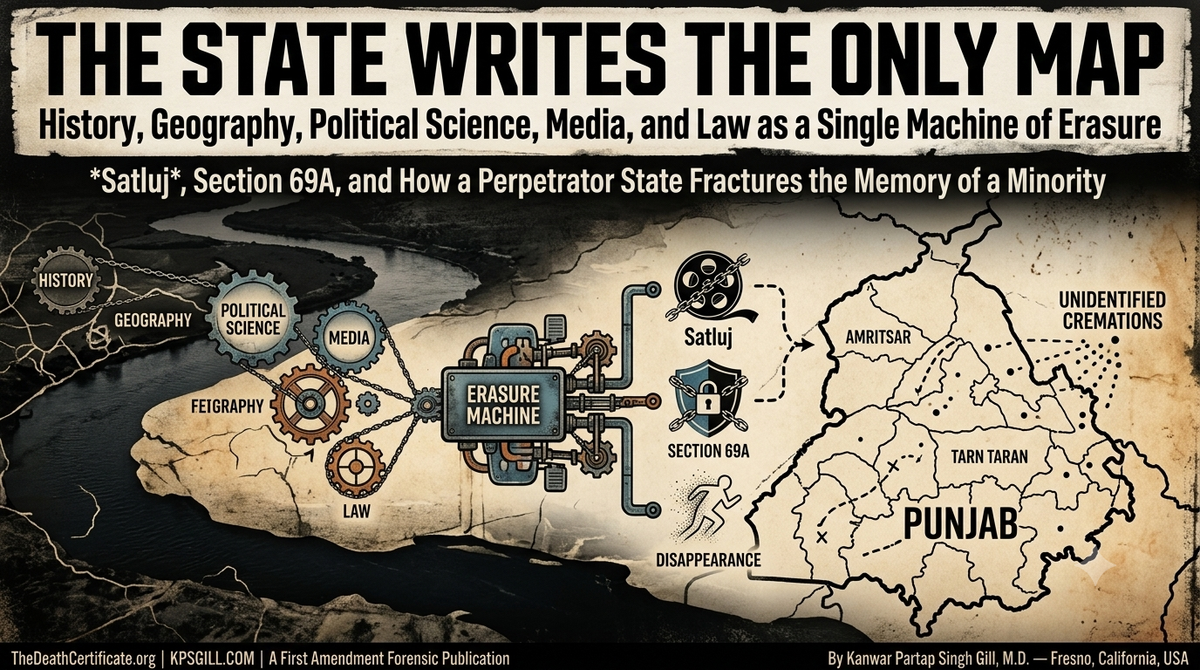
THE STATE WRITES THE ONLY MAP
History, Geography, Political Science, Media, and Law as a Single Machine of Erasure — Satluj, Section 69A, and How a Perpetrator State Fractures the Memory of a Minority It Has Not Finished Counting
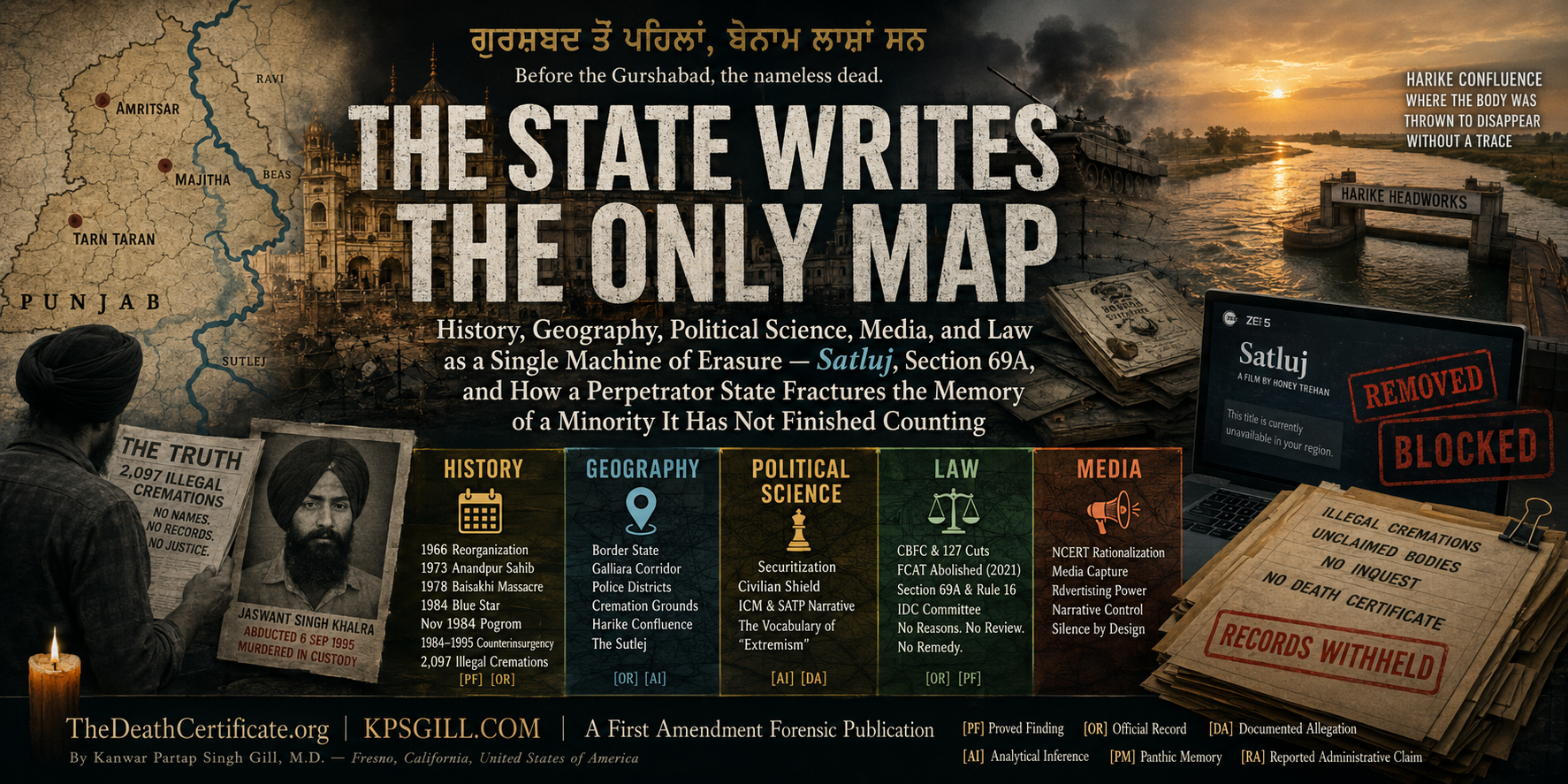
TheDeathCertificate.org | KPSGILL.COM | A First Amendment Forensic Publication
Fresno, California, United States of America
A note on the author's name. The author's name and the publication's KPSGILL.COM domain share initials with Kanwar Pal Singh Gill — K.P.S. Gill, the Director General of Police discussed at length in Parts II and IV of this essay as the officer who commanded Punjab's counterinsurgency from 1988 to 1995. The two are different people. The author's full name is Kanwar Partap Singh Gill; the historical figure examined in this essay is Kanwar Pal Singh Gill. No family relationship is claimed or implied by the shared initials, and none exists so far as the author is aware. The overlap is disclosed here, plainly, so that no reader need wonder about it while reading what follows.
ਗੁਰਸ਼ਬਦ ਤੋਂ ਪਹਿਲਾਂ, ਬੇਨਾਮ ਲਾਸ਼ਾਂ ਸਨ
Before the Gurshabad, the nameless dead.
Evidentiary key: [PF] Proved Finding · [OR] Official Record · [DA] Documented Allegation · [AI] Analytical Inference · [PM] Panthic Memory. This essay adds one working sub-category for the specific circumstance of a live, undisclosed administrative proceeding: [RA] Reported Administrative Claim — a position attributed by credible reporting to government sources, where the underlying order, minutes, or written reasons have not themselves been published. An [RA] is a species of [DA]; it is flagged separately here only because the distinguishing fact about it — that the document behind the claim is itself the thing being withheld — is the argument.
A note on method
This is a long essay, and it makes a claim that is easy to state and hard to prove: that the disappearance of a film is not a media story, a legal story, or a historical story, but all four at once, plus a fifth the others usually omit — a geography story. What follows tries to hold all five still at the same time, using a single week in July 2026 as the fixed point and a single river system as the physical thread that runs under it. The essay does not ask the reader to accept a conspiracy. It asks the reader to notice a pattern: that the instruments a state uses to kill, to conceal a killing, to zone a killing's ground, to teach a killing's history, and to certify a film about the killing are not five unrelated instruments operated by five indifferent departments. They are five expressions of one competence — the state's inherited, and in Punjab's case extensively exercised, capacity to decide what may be counted, where it may be said, and who may say it. The length that follows is deliberate rather than incidental: a state that has spent five decades fragmenting one continuous history into five administratively separate files — a police file, a revenue file, a curriculum file, a certification file, a diplomatic file — cannot be answered in a form shorter than the one required to put the five files back on a single table, in the order the state itself created them, so that a reader can see for the first time what the fragmentation was always designed to keep any single reader from seeing at once.
Prologue: Forty-Eight Hours, Then Global
On the afternoon of July 3, 2026, a film called Satluj appeared on the streaming platform ZEE5, in India and internationally, in full and without cuts. It had waited almost four years for this. It had been submitted to India's Central Board of Film Certification in December 2022 under the title Punjab '95, itself a replacement for an earlier title, Ghallughara — a word that does not translate into English so much as it detonates: it is the word Punjabi carries for its two eighteenth-century holocausts and, in the vocabulary the Panth has since extended to it, for 1984 as well. Somewhere between 2022 and 2026 the certifying board's demands grew from an initial round of cuts to a number multiple outlets have since reported as 127, including the demand that the film's own subject — the murdered human-rights investigator Jaswant Singh Khalra — not be called by his own name in the film of his own life. The producers declined. Having no theatrical release and, since April 2021, no independent tribunal left to appeal to, they went to streaming instead, retitled the film for the river that carries Amritsar's water to the sea, and let it run uncut.
It ran for forty-eight hours.
On July 5, ZEE5 removed Satluj from its Indian catalogue. [PF] The company's public statement thanked viewers for an "overwhelming" response and promised the film would return "at the earliest opportunity"; government sources, speaking to multiple outlets, cited national-security concerns and the film's release without completing the certification process the CBFC had begun for its earlier titles. [PF] The film remained available on ZEE5 Global, the platform's international tier, for several more days. [PF] The Ministry of Information and Broadcasting constituted an Inter-Departmental Committee the following day, Monday, July 6, under Part III of the Information Technology (Intermediary Guidelines and Digital Media Ethics Code) Rules, 2021 — a body with representatives from the ministries of Information and Broadcasting, Home Affairs, Electronics and Information Technology, Defence, External Affairs, Women and Child Development, and Law and Justice, empowered to recommend anything from a disclaimer to outright blocking under Section 69A of the Information Technology Act, 2000; the government's own public confirmation of this process was reported the next day, July 7. [RA] On July 11 — the day this essay is being written — that committee's recommendation reached the press before it reached the public: continue the block, on a finding attributed to government sources and not to any published order, that the film's narrative is "unbalanced," that it "whitewashes" the acts of militants while dwelling on "the excesses committed by security forces." [PF] In the same window, ZEE5 confirmed — through director Honey Trehan, who told an interviewer only "yes" when asked whether the film had been pulled from ZEE5 Global — that the international removal had also occurred; the company itself has offered no on-the-record reason for either removal. [RA] Unnamed industry sources separately told NDTV, without official confirmation from the platform, that the app's monthly overseas downloads had risen by approximately 374 percent following the film's release — a figure this essay treats as a reported claim about audience interest, not as the platform's own account of why the international catalogue changed.
A film had entered the world legally, in full, and then became progressively harder to see — first blocked in the country whose history it narrates, on the recommendation of a committee whose reasoning the public has not been permitted to read, then, within days, unavailable in every country able to watch it at all, through a second removal the platform has not explained.
Consider what that sentence actually requires the reader to accept, stated in its plainest form before this essay adds a single argument to it. A commercial streaming platform, operating under its own terms of service in dozens of jurisdictions with no shared legal system, removed the same film from a domestic market subject to an Indian government order and from an international market subject to no order any government has publicly acknowledged issuing, within days of each other. The temporal proximity raises a legitimate question about the relationship, if any, between the domestic administrative process and ZEE5's separate international decision. It does not, on the public record available as of this writing, answer that question. The company has not said whether the international removal followed a government communication, a contractual risk-management judgment, independent legal advice about exposure in the Indian market, or a commercial calculation made without any government contact at all — and this essay does not claim to know which of those it was. What this essay can do is what the missing explanation cannot: trace the four decades of history, geography, law, and institutional habit that made an outcome like this one — a state uncomfortable with a film, and that film becoming steadily harder to see — predictable long before Satluj existed to test it, regardless of which specific mechanism produced the international removal in this instance.
This essay is not only about that film. It is about the machine the film's disappearance exposes, because the machine did not have to be built for Satluj. It has been standing for decades, tested on other subjects, and it is visible in full only when a single case runs it end to end: a censoring board with a cut list, a tribunal abolished exactly when it would have mattered, an emergency statute with a confidentiality rule built into its own procedure, a curriculum that teaches the next generation not to notice the gap, a geography of walls and canals and cremation grounds built for the same stated reason the film was blocked, and a body of "terrorism" scholarship, founded by the men who commanded the killing, that supplies the vocabulary the censor uses when it reaches for a word. Five domains. One competence. The remainder of this essay walks each one in turn, and then puts them back together, because they were never actually apart.
It should be said plainly, and stated once so it need not be qualified in every paragraph that follows: this publication itself sits, as of this writing, inside an active Indian government proceeding of exactly the kind this essay describes. TheDeathCertificate.org and KPSGILL.COM are the subject of a Ministry of Electronics and Information Technology blocking review, Request ID 69A/2026/MIT/11078, to which a seventy-three-page opposition was filed on April 29, 2026. That fact is disclosed here not as a grievance but as a data point. An essay arguing that a state uses Section 69A to prevent a minority from documenting its own dead is entitled to note that the very software running underneath that argument has, in the same season, been pointed at the argument itself. The reader may weigh that fact as evidence for the thesis or as a conflict of interest in the author. It is offered as both, because both readings are honest, and this essay does not intend to hide from either.
Part I: The Grammar of the Second Cremation
Start with the fact that gives the whole architecture its name, because everything else is elaboration.
[PF] Jaswant Singh Khalra was a Sikh bank cooperative officer in Amritsar who, searching for colleagues who had disappeared, began comparing municipal cremation registers against firewood-purchase receipts at cremation grounds across Amritsar district. What he found were entries — hundreds, then thousands — for bodies delivered by Punjab Police and cremated under the designation "unidentified" or "unclaimed," with no post-mortem, no inquest, no family notified, and no name recorded. He made his findings public in January 1995. He testified before the Canadian Parliament in June 1995, telling the committee that Punjab's mothers had asked him for one thing only: to find out whether their sons were alive or dead. On September 6, 1995, Punjab Police personnel abducted him from outside his Amritsar home. He was held illegally at Jhabal police station, tortured for weeks, and killed. His body was driven to the Harike headworks — the point, forty kilometres downstream of Amritsar, where the Beas River joins the Sutlej before the combined river crosses into Pakistan — and, according to the prosecution case accepted by the courts, disposed of there in a manner intended to prevent recovery. It never was. [PF] The Central Bureau of Investigation, acting on Supreme Court orders, later confirmed 2,097 illegal cremations in the police districts of Amritsar, Majitha, and Tarn Taran alone; Khalra's own review of Amritsar district records, before his abduction, had already reached 6,017. He had told colleagues he intended to complete the count for all thirteen districts of Punjab. He never got the chance. Several Punjab Police officers, ranging in rank from head constable to deputy superintendent, were eventually convicted of his abduction and murder; a district court's initial seven-year sentences were enhanced to life imprisonment by the Punjab and Haryana High Court in 2007, and the Supreme Court of India substantially affirmed those convictions in the years that followed. No criminal charges were brought against then-Director General of Police K.P.S. Gill, who commanded Punjab Police through the period in which this happened, in connection with Khalra's abduction or the confirmed illegal cremations, despite public calls by Khalra's widow and human rights organizations, including Human Rights Watch and Ensaaf, for further investigation; he died in 2017 with a state funeral and a Padma Shri.
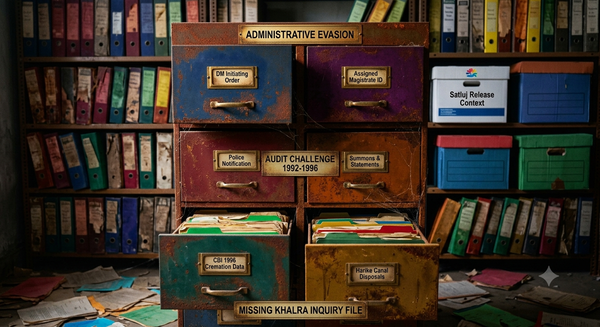
Read that paragraph again and notice what it actually describes: not one event but a structure with three stages, each performed by a different arm of the same state, each depending on the one before it. First, a man is made to disappear — arrested off the books, held off the books, killed off the books. That is the disappearance of the body. Second, the record that should exist — the inquest, the death certificate, the identified corpse returned to a named family for the rites the Sikh tradition requires — never comes into being, or is falsified into a designation ("unclaimed") that erases the very fact of a search. That is the disappearance of the record. Third — and this is the stage that a film, a textbook, a website, or an essay like this one is capable of reversing, which is exactly why the state moves against it — the account of what happened to the body and the record is itself prevented from reaching an audience wide enough to matter: blocked, cut, rationalized out of a syllabus, delisted from a streaming catalogue, or, as with this publication, made the subject of a Section 69A review. That is the disappearance of the memory.
This publication has called this sequence the second cremation in earlier work, and the term is worth keeping, because it names something precise: the second cremation is not a metaphor for censorship in general. It is the specific act of using the state's own administrative competence — the same competence that decided where the first fire would burn — to decide, a second time and years later, whether the public may ever learn that the first fire happened. The first cremation destroys a body. The second cremation destroys the sentence describing the body's destruction.
What this essay adds to that framework is a claim about why the second cremation is never available to a single instrument alone, and always requires several working together. A censoring board can delay a film for years, but it cannot, by itself, prevent an uncut version from streaming once certification is bypassed — that took a second instrument, an emergency communications statute, arriving within forty-eight hours to finish the job the first instrument had failed to finish in four years. A communications statute can block a URL, but it cannot explain to the next generation of readers why the blocked URL might have mattered — that took a third instrument, a curriculum, quietly thinning the chapters that would have supplied the context. A curriculum can produce ignorance, but it cannot manufacture the vocabulary in which whatever residual memory survives gets classified as dangerous rather than true — that took a fourth instrument, a body of "counterterrorism" scholarship built by the commanding officers of the violence itself, supplying the word "extremism" for use exactly where the word "grief" or "evidence" belonged. And none of the first four instruments can be understood at all without the fifth, the one usually left out entirely: the physical geography on which each of them was built — the cremation grounds sited by police district, the security corridor cut through Amritsar's own bazaars, the canal at Harike chosen because it was the last Indian water before the border, the river that gives the film its very title. Five domains. Discussed separately, each looks like an unrelated bureaucratic decision, defensible on its own stated terms. Read together, along a single timeline, they describe an architecture — and an architecture is what results when a state's separate, individually justified decisions turn out, read together, to fit into a single load-bearing structure, whether or not any single engineer ever intended, or even saw, the finished building.
The remainder of this essay is organized around that architecture's five walls: the history that supplies its motive, the geography that supplies its sites, the political science that supplies its vocabulary, the law that supplies its authority, and the media apparatus that supplies its instrument of the week — currently a film named for the river that also, forty kilometres downstream, kept a murdered man's body from ever being found.
Part II: History — How a Federalist Grievance Became a Security File, 1947–1995
A censorship order is easy to analyze in isolation and easy to misread in isolation, because it presents itself as a response to something — a threat, an imbalance, a danger to public order — and a reader with no history to hand has no way to test the claim. So this section supplies the history first, compressed, because the Inter-Departmental Committee's finding that Satluj is "unbalanced" cannot be evaluated at all without knowing what the fuller balance would actually contain, and because every later part of this essay leans on facts established here.
The reorganization that was built incomplete. [PF] When Punjab was reorganized along linguistic lines in 1966 — the same principle applied to most Indian states after independence — the result left three grievances permanently open rather than permanently closed. Chandigarh, the planned capital built substantially with Punjab's own investment, became a Union Territory administered from Delhi and shared with the newly carved state of Haryana, rather than returning to Punjab outright. Punjabi-speaking districts were retained by Haryana and by the new state of Himachal Pradesh rather than consolidated into the linguistic state the reorganization was nominally designed to create. And the allocation of Punjab's river waters — the Ravi, the Beas, and the Sutlej, the rivers that give Punjab its name — was left open for later resolution by a Centre that would spend the next five decades declining to resolve it on terms Punjab regarded as fair. [AI] None of this was mere administrative untidiness. A state kept constitutionally incomplete is a state whose governing party must keep returning to Delhi for what a complete state would already possess — and a Centre with permanent leverage over an incomplete neighbor has a standing incentive not to complete it.
The document the government chose to misname. In October 1973, the Shiromani Akali Dal's working committee met at Anandpur Sahib — the city Guru Tegh Bahadur founded, where Guru Gobind Singh created the Khalsa in 1699 — and adopted a resolution whose substance was federalist, not separatist: confine the Centre's exclusive jurisdiction to defence, foreign affairs, currency, and communications, and devolve the residual powers to the states. [PF] SAD president Harchand Singh Longowal said so without ambiguity — that the Sikhs had no design to leave India — and the resolution's own text affirmed the proposed autonomous region as "an integral part of the Union of India." A decade later, the Sarkaria Commission, appointed by the government itself to study centre-state relations, recommended greater decentralization and endorsed several principles broadly consistent with the resolution's federalist demands, though its final report stopped short of endorsing the Anandpur Sahib Resolution in its entirety. [PF] None of that stopped the government of the day from characterizing the Anandpur Sahib Resolution publicly as a secessionist blueprint — a mischaracterization with a specific administrative payoff, because it let Delhi treat a demand for constitutional devolution as a security problem rather than a negotiation, and it built, a full decade before the crisis it is usually cited to explain, the template by which any Sikh political claim could be recoded as a threat to the country's territorial integrity. [AI] Every subsequent chapter of this history runs through that template.
The canal that made a resource dispute into a security file. The material grievance underneath the constitutional one had a name, a length, and a completion date: the Sutlej-Yamuna Link, a 214-kilometre canal designed to carry Punjab's allocated river water to Haryana. [PF] Construction began in 1982 under Punjab's own then-chief minister; the Akali Dal had opposed the underlying allocation from the start and had already asked the Supreme Court to adjudicate it. What followed is described, even in government-aligned summaries of the period, in language that gives away how completely a water-engineering dispute had been reclassified: "agitations, protests and assassinations were carried out in protest, creating the environment of terrorism in the state and making the issue of national security." [PF] Read that sentence again. It does not say the SYL dispute was a symptom of terrorism. It says the dispute — a fight over which state gets how much river water — was the thing that manufactured "the environment of terrorism" and converted an interstate water-sharing formula into a national-security matter. The canal remains, as of this writing, reported to be approximately 85 to 90 percent physically complete depending on the source, uncontested by Haryana, unresolved by Punjab, still argued over in the Supreme Court, forty-four years after ground was broken. [PF] It is one river system, not incidentally, that this essay returns to in the next section: the Sutlej is the water this canal was built to divert, the water the film Satluj is named for, and the water into which Khalra's body was dropped at Harike.
The Emergency's specific lesson. The nineteen months of Emergency rule from June 1975 taught every constituency in India the same fact, but Punjab's political class absorbed it with particular attention: that the constitutional protections available to any Indian citizen were, in practice, contingent on the political convenience of whoever controlled the Centre at the moment the protections were tested. [PF] Press censorship, detention without trial, and the suspension of ordinary rights were not applied to Punjab specifically, but Akali leadership was jailed alongside the rest of the political opposition, and the demonstration that Delhi would use its full coercive apparatus against dissent when it judged doing so necessary was recent, specific, institutional memory by the time Punjab's own crisis began accelerating five years later.
Baisakhi, 1978. [PF] On the spring festival that is among the most sacred dates on the Sikh calendar, Sikh protesters marching against a Nirankari gathering in Amritsar were fired upon; thirteen were killed. [DA] The Nirankari organization's leadership was widely understood within the Sikh community to enjoy protection from Congress-aligned politicians; those charged in connection with the deaths were acquitted following trial, a result widely viewed within much of the Sikh community as a miscarriage of justice. [AI] The state's own account of this period — including the account given by the very institutions this essay's Part IV will examine in detail — identifies 1978 as the year the militant movement's "genesis" is usually dated. That is, in fact, one of the more candid admissions available anywhere in the official record: an acknowledgment that the movement began with an act of violence against Sikhs that the state declined to prosecute, rather than with an act of violence by Sikhs that the state was obliged to prevent. A community that watches its dead go unavenged while its neighbours' gatherings continue under state protection has received a specific communication about whose safety the state regards as its business.
The manufactured asset and the assault on the holiest day. [DA] Multiple independent historians of the period — Cynthia Keppley Mahmood, Joyce Pettigrew, Gurharpal Singh, Patwant Singh among them — have argued that sections of the Congress leadership initially encouraged, or politically benefited from, Jarnail Singh Bhindranwale's rise as a counterweight to the Akali Dal's political base, and that the state's reluctance to prosecute him in this period reflected political calculation as much as ordinary prosecutorial discretion. By 1984 the Centre had lost control of the asset it had helped create. [PF] On June 1, 1984, the Indian Army launched Operation Blue Star against the Golden Temple complex in Amritsar; the main assault fell on June 5 and 6 — the martyrdom anniversary of Guru Arjan Dev, the fifth Guru, one of the most heavily attended commemorations in the Sikh calendar, when pilgrims from across Punjab and the diaspora had converged on the city. Artillery was used inside the sacred precinct. [PM] For the Sikh community, this is not remembered as a police action against a fugitive. It is remembered as the desecration of the Panth's holiest site on the anniversary of its most revered martyrdom, carried out by the army of a state that had sworn to protect the citizens gathered there. [DA] The Army's follow-on operation, codenamed Woodrose, swept rural Punjab for "extremist elements" with an indiscriminacy that numerous historians have argued contributed to radicalization and recruitment into militancy, including recruitment across the border into Pakistan, rather than containing it — without any comparable public accounting of who was detained in that sweep, on what authority, and for how long.
November 1984. [PF] In the days following Indira Gandhi's assassination on October 31, 1984, organized violence against Sikhs killed between roughly three and eight thousand people in Delhi alone, with thousands more killed across northern India; the pattern — voter rolls used to identify Sikh households, kerosene supplied, police standing aside or participating — has been documented by the Nanavati Commission and by multiple independent inquiries as organized rather than spontaneous, and as involving complicity and failures of duty by public officials. [AI] The characterization of this violence in the institutional record this essay's Part IV examines is instructive on its own terms: the killings are described there in hedged language that stops short of the state-complicity findings the Nanavati Commission itself was prepared to make, converting a finding into an impression exactly at the point where the finding is least convenient. There has never been, in the decades since, a database of the November 1984 dead maintained with anything resembling the granularity — district by district, month by month, organization by organization — that the same institutions apply routinely to militant violence. [AI] The asymmetry is the argument in miniature: state-adjacent violence against Sikhs is context; Sikh-adjacent violence is the record.
The decade the count belongs to. From roughly 1984 to 1995, the instruments of the counterinsurgency were built out in specific, documented forms, each with its own name and its own subsequent paper trail. [PF] The Terrorist and Disruptive Activities (Prevention) Act, in force from 1985 until it was allowed to lapse in 1995, authorized detention and interrogation procedures that suspended ordinary safeguards; Human Rights Watch's 1994 report Dead Silence documented systematic torture in TADA custody, confessions extracted and later used as the basis of prosecutions, and indefinite detention deployed as collective punishment against entire families. [DA] A bounty system paying cash for militants killed, and a smaller sum for militants captured, created a transparent incentive structure that rewarded killing over arrest and gave individual officers a direct financial motive to classify the uninvolved as combatants. [DA] Surrendered militants were, according to multiple accounts including testimony from former police officers, recruited back into deniable service — the "Black Cat" operations — to carry out killings the state could attribute to ongoing militancy rather than to itself. [PF] The scale and the outcome of that detention regime are themselves part of the official record and are worth stating in isolation, because they answer, on their own, the question of whether TADA functioned as a targeted tool against a genuine armed threat or as something closer to a dragnet: by 1994, Home Ministry officials themselves acknowledged that of more than fifty thousand TADA cases nationally, more than thirty thousand had already been pending for over five years, many without a trial even having begun, and the conviction rate across TADA prosecutions nationally has been commonly reported at approximately one percent, against an ordinary criminal conviction rate of roughly forty-four percent for the same period — figures that recur across contemporaneous human-rights and legal-aid reporting, though exact calculations vary somewhat by source and by year measured. [AI] A statute whose prosecutions are commonly reported to have succeeded at a small fraction of the rate of ordinary criminal law is not, on that record, self-evidently a precision instrument struggling against a uniquely difficult category of defendant; on the figures most consistently reported, it functioned as a detention mechanism whose principal effect was years of custody imposed on people the state's own courts would go on to find, in the large majority of adjudicated cases, no lawful basis to convict. And running underneath all of it, in the specific municipal machinery this essay's next section will locate on a map, was the system Khalra found: bodies delivered to cremation grounds by police, entered as unidentified, burned, and never returned to the families searching for them.
The history is not only history. One final fact belongs in this section, and it belongs here rather than in a separate chapter on the present, because it is the clearest available evidence that the sequence this section has traced never actually closed. [DA] A number of Sikh men convicted of offences connected to the militancy era — the figures most commonly discussed in Panthic advocacy are known collectively as the Bandi Singhs — include several high-profile cases in which prisoners have remained incarcerated despite state-government recommendations for release, remission eligibility under ordinary policy, or prolonged and repeatedly deferred sentence-review proceedings; advocates for these prisoners point to comparable cases elsewhere in India resulting in earlier release under similar remission frameworks. [AI] Whatever view any individual reader takes of the specific convictions involved — and this essay does not adjudicate the merits of any single case here — the pattern itself is structurally continuous with everything this section has documented: a legal mechanism nominally available (parole, remission, sentence review) functioning, in practice, as a discretionary instrument whose application to Sikh political prisoners specifically has diverged, again and again, from its application to comparably situated prisoners convicted of comparable offences outside the Punjab-militancy context. A history section that ends in 1995 would leave the reader with the comfortable impression that the pattern it describes is safely finished. It is not finished. It is administered, today, by the same category of discretionary civil process — parole boards rather than magistrates, but the same institutional habit of using an ordinary-looking procedural mechanism to produce an outcome no single official ever has to justify in writing — that this section has traced back to 1966.
This is the history the Inter-Departmental Committee says a film about Jaswant Singh Khalra fails to "balance." It is worth being precise about what balance would actually require, because the committee's own vocabulary — that the film should give more weight to militant violence — presumes that militant violence is the missing half of an otherwise complete picture. It is not. [PF] Militant violence during this period was real, was directed in significant part at civilians, and killed thousands of people, including many Sikhs who declined to support the movement, alongside Hindus, security personnel, and political figures; a serious account of Punjab's crisis has never required denying that record, and this essay does not deny it here. But the missing half of the Satluj controversy's own "balance" argument is not militant violence — the government's own institutions have never stopped narrating that half, at length, in exhaustive and internationally cited detail, a point this essay's Part IV develops in full. The missing half is the sequence recounted in this section: the incomplete 1966 reorganization, the deliberately mischaracterized 1973 resolution, the water dispute recoded as terrorism, the Emergency's lesson in constitutional contingency, 1978's unprosecuted dead, the manufactured and then unmanageable asset, the assault timed to the holiest day on the calendar, the indiscriminate sweep that followed it, the unprosecuted pogrom that followed that, and the decade of TADA, bounty, and deniable killing that produced the specific bodies Khalra went looking for. A film asked to "balance" state violence against militant violence, when the state's own archive has spent decades balancing militant violence against nothing at all, is not being asked for balance. It is being asked to supply, for the first time in the official record, the half the state itself has never supplied.
Part III: Geography — The Map That Was Drawn to Make Evidence Disappear
History supplies the motive. Geography supplies the sites — and the geography of Punjab's disappearances has never been incidental to how they were carried out. It was chosen, at every scale from the international border down to the width of a bazaar lane, in ways that made concealment easier and recovery harder. This is the lens the Satluj controversy leaves out entirely, and it is worth walking at three scales in turn: the frontier, the city, and the river.
The frontier scale. Punjab is not merely a state with a security history. It is a border state, sharing roughly 550 kilometres of international boundary with Pakistan along a line drawn in 1947 by a British barrister who had never visited India before being given five weeks to divide it. [PF] That border geography did real work in the vocabulary of the counterinsurgency: every discussion of Sikh militancy in the official record — including the record this essay's Part IV examines — routes eventually to Pakistan, to the Inter-Services Intelligence directorate, to "cross-border" support, because a frontier state's internal political crisis can be narrated, with minimal argument, as a foreign-intelligence problem rather than a domestic-accountability one. [AI] A landlocked interior state with an identical grievance profile — an incomplete territorial settlement, a stolen river, a suppressed federalist movement — would have had a much harder time being classified, at the level of national policy, as a sovereignty and integrity matter rather than a governance failure. Punjab's geography did that classificatory work before a single official had to argue for it.
The corridor scale. [PF] In the aftermath of Operation Blue Star, the central government demolished a ring of houses, shops, and historic bazaars around the Golden Temple complex — Bazaar Maniaran, Thara Sahib Bazaar, Pappranwala Bazaar, Kaulsar Bazaar, Kathianwala Bazaar, Mai Sewan Bazaar, streets that had stood for centuries — and replaced them with an open corridor, the Galliara, that was, by the project's own administrative history, conceived explicitly "from the security aspect" to give police and paramilitary vehicles unobstructed access following two military operations against the shrine. Demolition began June 9, 1988, and finished that November; 859 families were displaced, roughly 500 houses and 1,150 shops razed, five separate land-acquisition collectors deployed over six years to clear the title. [PF] Only afterward, once the security rationale had done its physical work, was the project renamed a "beautification scheme" — a redescription that has since become so complete that a former Deputy Commissioner of Amritsar could, decades later, publish an account crediting himself with transforming what he called an "unsightly security buffer" into landscaped heritage, without needing to explain, in the same essay, what specifically the buffer had been built to secure the shrine against, or from whom. [AI] Notice the shape of the pattern, because it is the same shape Satluj's censorship follows: an action taken under an explicit security rationale, followed — once the physical or informational fact is irreversible — by a relabeling exercise that lets the same action be discussed in public as something else entirely. A demolished bazaar becomes a beautification project. A blocked film about the same period becomes a balance problem. In both cases the security rationale did the actual work; the later label is for public consumption.
The jurisdictional scale. The administrative geography that matters most to this essay's overall argument is smaller still: the police-district boundaries of Amritsar, Majitha, and Tarn Taran, the three jurisdictions in which the CBI eventually confirmed 2,097 illegal cremations. [PF] Each of these districts had, layered over its police jurisdiction, a civil administrative structure — a Deputy Commissioner who was also, ex officio, the District Magistrate, with statutory authority under the Code of Criminal Procedure to order inquests, and municipal committees with responsibility for the cremation grounds themselves. This publication's own archive has documented, across multiple prior essays, exactly how that civil layer functioned — or failed to function — across the tenures of three successive Deputy Commissioners of Amritsar between 1984 and 1996. [AI] The point for this essay is narrower and purely geographic: the disappearance system required a specific, mapped set of administrative units — police stations that could detain without registering, municipal cremation grounds that could receive a body without a name attached to it, a magistracy with the statutory power to order an inquest and the sustained practice of not ordering one — arranged so that no single office was individually and visibly responsible for the complete sequence from arrest to ash. Jurisdiction, in this system, is not incidental scaffolding. It is the mechanism itself. A body that crossed from police custody to a municipal cremation ground crossed, in the same movement, from one file to another, and each file's custodian could plausibly say the missing piece belonged to someone else's map.
The river. And then there is the geography that gives this essay's anchor case its name. [PF] The Sutlej is the longest of Punjab's five rivers, meeting the Beas at Harike, in Ferozepur district, before the combined river crosses into Pakistan. It is the river the Sutlej-Yamuna Link canal was built to divert. It is the river whose water-sharing formula, imposed on Punjab in 1976 over its own government's objection, produced the SYL construction that a government-aligned chronology itself describes as having "creat[ed] the environment of terrorism." And it is the river into which Jaswant Singh Khalra's murderers dropped his body at Harike in October 1995 — a location chosen, the trial record makes clear, precisely because it was the last significant body of water inside India before the border, the place from which a corpse was least likely to be recovered and returned to a family capable of demanding an inquest. [PF] A film about that killing, released in 2026, carries the name of that river. This is not a coincidence the filmmakers manufactured; it is a coincidence the geography manufactured decades earlier, when a state chose the same river twice — first as the site convenient for disposing of the evidence of a killing, then, forty years on, as the resource whose diversion had already helped produce the conditions for the killing in the first place. [AI] The river that took the body is the river the film is named for is the river the canal was built to steal. Geography does not usually offer an essay this precise a metaphor already assembled and waiting; when it does, the honest response is to report it rather than to elaborate it, because it needs no elaboration.
The geography of the gurdwara parking lot. One further scale belongs in this section even though its events lie outside Punjab and outside India altogether, because it shows the same siting logic operating in reverse — not a state disappearing its own citizens on its own soil, but a diaspora community discovering that the one piece of geography it had assumed was safest, the gurdwara itself, was not. [PF] On August 5, 2012, a gunman opened fire inside a gurdwara in Oak Creek, Wisconsin, killing six worshippers; federal investigators did not formally classify the attack as a hate crime for months, even after classifying it as domestic terrorism. [PF] On September 15, 2001, four days after the September 11 attacks, Balbir Singh Sodhi, a Sikh gas station owner in Mesa, Arizona, was shot dead by a man who told police he had wanted to kill someone wearing a turban; Sodhi became, in the documented record of anti-Sikh violence in the United States, the first fatality of the wave that followed. [PF] And on June 18, 2023, as this essay's Part X will examine in full, Hardeep Singh Nijjar was killed in the parking lot of a gurdwara in Surrey, British Columbia. [AI] Three killings, three decades apart, three different countries, one recurring site: the gurdwara, the one place a scattered and repeatedly displaced community had built specifically to be safe, has instead functioned, with grim consistency, as the exact coordinate where the violence found its targets. A community's own chosen geography of refuge becoming the geography of its exposure is not a coincidence this essay can resolve with a single cause — the Oak Creek gunman was a white supremacist with no connection to Indian state policy, and the Sodhi killing was a bystander's fatal misrecognition, not a targeted operation. What the pattern does establish, and what belongs in a geography section rather than a footnote, is that the physical site a scattered people gathers at to remember who it is has repeatedly proven to be the site where others — whether a domestic hate-driven gunman or, in the Nijjar case, agents a Canadian government has directly implicated — have found it easiest to reach them. The map of where a diaspora prays and the map of where a diaspora has been made to bleed are, across three countries and three decades, nearly the same map.
Put these five scales together and a single structural observation follows. Every level of Punjab's administrative geography — the international border that supplied the "foreign hand" vocabulary, the demolished bazaar corridor that converted a shrine into a security perimeter, the district and police-station boundaries that let no single office own a disappearance from arrest to ash, and the specific river confluence chosen to make a body vanish — was configured, at each scale, to make one thing structurally easy and its opposite structurally hard: it made concealment cheap and accountability expensive. That configuration long predates Satluj, long predates Section 69A, and long predates the CBFC's cut list. What the last several decades of censorship instruments have done is apply the identical logic — cheap concealment, expensive accountability — to the record of that geography, using paper and pixels rather than roads and canals. The map was drawn once, on the ground, between 1966 and 1995. Everything this essay's remaining sections describe is the same map redrawn, one statute and one committee at a time, on the page.
Part IV: Political Science — Securitization, the Civilian Shield, and the Archive Built by the Commanding Officer
Geography explains where the disappearance system was built. Political science explains how a state persuades itself, its citizens, and the rest of the world that building it was legitimate — and here the operative concept has a name in the academic literature that is worth introducing properly, because it describes the Satluj controversy with uncomfortable precision. Securitization theory, developed by the Copenhagen School of security studies in the 1990s, describes the process by which an issue is moved out of the space of ordinary politics — where it can be debated, negotiated, and resolved through normal democratic contest — and into the space of security, where extraordinary measures become justifiable precisely because the issue has been redefined as an existential threat. The theory's central insight is that this move is not a discovery of danger. It is a speech act: someone with institutional authority declares an issue a security matter, and if the declaration is accepted by a sufficient audience, the issue is thereafter treated as one, regardless of the empirical scale of the underlying threat. [AI] Read against the history recounted in Part II, Punjab's post-independence trajectory is close to a textbook case: a federalist constitutional demand (1973), a resource-allocation dispute (1976 onward), and a communally organized massacre with unprosecuted perpetrators (1978) were each, in turn, declared security matters by an authority — the central government — whose declaration was substantially accepted, and each declaration made the extraordinary measures that followed (TADA, the bounty system, Blue Star, Woodrose) available in a way ordinary constitutional politics never would have permitted.
The civilian shield. This publication's own prior work has developed, across a substantial body of forensic biography, what it has called the civilian-shield thesis: the observation that the Deputy Commissioner and District Magistrate's office in Amritsar — the civilian authority statutorily empowered to order inquests under Sections 174 and 176 of the Code of Criminal Procedure, and to supervise the municipal cremation grounds where Khalra's evidence originated — functioned, across three successive tenures spanning roughly twelve years, not as a check on the police-administered disappearance system but as its administrative cover. [AI] A uniformed officer cannot, by himself, manufacture the appearance of lawful process around an extrajudicial killing; that requires a civilian signature, a file that shows no inquest was requested because none was deemed necessary, a magistracy that simply never asks the question whose answer would have been unanswerable. The value of the civilian layer to the system was precisely its ordinariness — a Deputy Commissioner's office generates paperwork by its nature, and paperwork that looks routine is paperwork no one audits. This publication has documented that pattern by name — the Triad of Silence — across the tenures of Ramesh Inder Singh, Sarabjit Singh, and K.B.S. Sidhu, and does not re-litigate the full case here; the point for this essay is structural, not biographical: the Satluj censorship apparatus is staffed, at its senior civilian tiers, by the same institutional lineage — the Indian Administrative Service — whose district-level members supplied the paperwork cover this section describes, thirty years earlier, in the very city the film is about.
The shield's second function: rehabilitation rather than exposure. The civilian-shield thesis, stated only in terms of paperwork withheld, understates how the mechanism actually operated over time, because withholding a record is a passive function and the careers this publication's prior work has traced were not passively protected — they were actively advanced. [AI] Officers whose district tenures overlapped with the years this essay's Part II and this section describe went on, in a documented pattern this publication has examined case by case in its district-magistracy series, to further postings, study leave abroad, cadre reviews that certified their records clean, and in a number of instances continued public prominence as commentators on the very subjects — Sikh governance, Punjab administration, constitutional propriety — their own tenures are directly implicated in. [AI] A system that merely failed to investigate would produce silence. A system that additionally promotes, credentials, and platforms the officials whose offices failed to investigate produces something more durable than silence: it produces authority, conferred by the same institutional structure that had the opportunity, and the statutory obligation, to investigate first. The vocabulary this section traces to the Institute for Conflict Management supplies the international register in which the counterinsurgency's success is narrated; the domestic civil service's own promotion and credentialing apparatus supplies the parallel, quieter register in which the individuals who administered it are certified, year after year, as men of unimpeachable public record. Both registers converge on the same result: an absence of any institutional site, foreign or domestic, from which the underlying conduct might still be authoritatively questioned.
The archive built by the commanding officer. The Institute for Conflict Management and its public-facing instrument, the South Asia Terrorism Portal, have supplied much of the vocabulary in which Punjab's history is narrated internationally — founded, by its own institutional account, on the initiative of its "founding President," K.P.S. Gill, the Director General of Police who commanded Punjab's counterinsurgency from 1988 to 1995, and directed since by Dr. Ajai Sahni. [PF] The portal is a widely cited source rather than a marginal one. It records substantial monthly traffic from over 200 countries, is archived by the Library of Congress, and is cited in Western parliamentary briefings, immigration proceedings, and academic scholarship on South Asian conflict — which means that a framing decision made inside this one institution does not stay inside it; it migrates, footnote by footnote, into how Ottawa, Canberra, London, and Washington discuss the community whose disappeared this essay is about. This publication's own prior forensic audit of that institution has already examined SATP's vocabulary in closer textual detail, and this essay does not repeat that analysis so much as extract from it the pieces of vocabulary this essay's Part VI later shows the Inter-Departmental Committee reaching for. [PF] Gill's own book on the period, Punjab: The Knights of Falsehood, refers explicitly to "the despicable fiction of 'Khalistan'" — a phrase properly understood as targeting the specific demand for secession, not the broader and legally distinct federalist demands of the Anandpur Sahib Resolution this essay's Part II described; the two are not the same claim, and Gill's own language does not, on its face, address the narrower one. [DA] Language closely associated with the institute's own account of the period — describing the movement as having been "comprehensively defeated," and describing organizations that documented state abuses during the counterinsurgency in terms that questioned their standing as genuine human-rights investigators — recurs across SATP's published material and secondary commentary on it; this essay treats that vocabulary as institutional characterization rather than as verified verbatim quotation with a single confirmed citation, and flags it accordingly. [AI] "Unbalanced" belongs to this same family of terms, doing the same family of work: not describing a deficiency the speaker has demonstrated, but assigning one the speaker has declared. On this reading, an institution whose founding president commanded the violence it now narrates occupies an uncomfortable dual role — combatant and archivist at once — and a command's own retrospective account of its "comprehensive" success is not, by virtue of having been published and widely cited for three decades, thereby a neutral historical finding.
The statutory mechanism underneath the civilian-shield thesis has a specific citation, and naming it precisely matters, because it shows the paperwork failure was never a gap in the law — it was a gap between the law and its enforcement. [PF] Sections 174 and 176 of the Code of Criminal Procedure obligated a magistrate to hold an inquiry, or in specified categories of death to hold a formal inquest, into any death occurring in police custody or under otherwise suspicious circumstances; that same colonial-inherited requirement for an independent inquiry into a death touching state custody survives, structurally intact, in Sections 194 and 196 of the Bharatiya Nagarik Suraksha Sanhita that replaced the CrPC in 2024. [AI] The persistence of the requirement across two entirely different criminal codes, separated by nearly a century and an independence movement, is itself evidence that the requirement was never the problem; a magistrate who does not order an inquest that the statute plainly obligates has not found a loophole in the law, has simply not been made to answer for declining to apply it. This publication's own prior forensic work has traced that specific failure — inquest requested versus inquest never opened — across the tenures of Amritsar's Deputy Commissioners between 1984 and 1996, and the pattern established there predicts, with some precision, the pattern this essay has traced in the Satluj committee: an office with a clear statutory obligation to generate a record, declining to generate it, and facing no institutional consequence for the omission because the body positioned to enforce the obligation and the body declining to fulfill it were, across both cases, drawn from the same administrative service, socialized in the same institutional culture, and reviewed, in the last instance, by no one outside that service at all.
The same institute's newer instrument, the Khalistan Extremism Monitor, extends the pattern from history into the present: a "non-partisan" research portal whose own mission statement commits it to monitoring not only armed organizations but Sikh political "supporters and detractors" broadly — a mandate so wide that it functions, in practice, as a running classification system for diaspora political speech rather than a terrorism database in any conventional sense. [DA] Its stress test arrived on June 18, 2023, when Hardeep Singh Nijjar, a Canadian permanent resident, was shot dead in a gurdwara parking lot in Surrey, British Columbia; Canadian Prime Minister Justin Trudeau told Parliament in September 2023 that Canadian intelligence held credible evidence of Indian government involvement, the RCMP charged three Indian nationals in the case in 2024, and separately, in the Southern District of New York, an Indian national pleaded guilty in early 2026 to a murder-for-hire conspiracy targeting a Sikh activist on American soil, in a case that named a former Indian government official as its director. [PF] These are not this publication's characterizations; they are findings and charges from the criminal-justice systems of the United States and Canada. [AI] The institutional response to a confirmed foreign assassination on Five Eyes soil was not, by any account this publication has found, a revision of the underlying analytical framework. It was absorption: the killing entered the discourse as further evidence of the diaspora's radicalism rather than as an event requiring the portal to build, for the first time, a database entry for Indian state violence against Sikhs abroad. A framework that can metabolize a confirmed state assassination without altering its own vocabulary is not describing reality. It is defending a prior conclusion.
The export. [DA] Academic scholarship on the globalization of counterinsurgency doctrine — including work situating Punjab's post-1988 policing within a broader literature on American-influenced "global counterinsurgency" — has specifically examined how what researchers term the "Gill Doctrine" was studied, cited, and in some accounts held up as a template for security forces confronting insurgencies elsewhere, its architect's own writing framing the movement he suppressed not as a political grievance but, in his own published words, as "a rebellion of a privileged quasi-feudal caste-based orthodoxy" rather than a movement with any legitimate content at all. [AI] This is securitization theory completing its circuit: a constitutional federalist demand, redefined as an existential threat by a 1970s political calculation, produces by the 1990s a counterinsurgency doctrine sufficiently celebrated to be studied as an exportable methodology — at which point the officer's own retrospective narration of his methods, rather than the documented record of what those methods cost, becomes the international reference point. The same institutional apparatus that supplied the vocabulary now supplies, when a film revisits the record those methods actually produced, the government's own working definition of "balance."
None of this requires positing a conspiracy, and this essay does not allege one; conspiracy is the wrong frame for what political science actually describes here, because a conspiracy requires secret coordination and this pattern requires none. [AI] What securitization theory predicts — and what Punjab's record from 1973 to 2026 confirms with unusual clarity — is that once an issue has been successfully declared a security matter, every subsequent institution that touches it will, independently and for its own internal reasons, tend to reproduce the security framing rather than question it: the police force that suppressed a movement builds an institute to narrate its own success; the institute's data becomes the reference point for diplomats who have no independent capacity to evaluate it; a censoring board, thirty years later, reaches for the vocabulary that institute supplied — "extremism," "propaganda," "unbalanced" — because it is the vocabulary already sitting closest to hand. No one needs to coordinate a cover-up. The cover-up is what the vocabulary does by default, once the original declaration has taken hold.
Part V: Law — A Machine Built From Four Statutes and a Confidentiality Rule
Law is where this essay's argument has to do its most careful work, because law is the domain in which the state's defenders will say the process is simply working as designed — that a censoring board censored, an emergency statute was used in an emergency, a committee met and recommended, and nothing in that sequence departs from what Parliament authorized. The honest response is not to deny that each instrument, examined alone, has statutory footing. It is to show what the instruments do once assembled, and to test that assembly against the limits India's own courts have already placed on it.
The certifying board and the tribunal that was not there when it mattered. [PF] Satluj — under its first title, Ghallughara, and its second, Punjab '95 — was submitted to the Central Board of Film Certification in December 2022. Reporting across multiple outlets places the board's cut demands on an escalating curve: an initial round, then a wider one, climbing to a figure most consistently reported at 127 — including, specifically, a demand that the film's protagonist not be identified by his own name, and a demand that the original title, Ghallughara, be dropped. [RA] The film was pulled from its scheduled Gala Presentation at the 2023 Toronto International Film Festival at the last moment; the director has since said publicly he had expected this outcome, without the producers ever confirming, on the record, precisely whose pressure caused the withdrawal. [PF] What makes the delay structurally different from an ordinary certification dispute is a fact this essay's Part III already gestured toward: the appellate mechanism that existed for exactly this situation had been abolished before the film was even submitted. The Film Certification Appellate Tribunal, established in 1983, had by 2021 developed a real, if imperfect, record of overturning CBFC overreach — it cleared Lipstick Under My Burkha for release with an "A" certificate after the board refused it outright on the ground that the film was "lady-oriented," and it cleared MSG: The Messenger of God after the CBFC declined to certify it. On April 4, 2021, the government abolished the FCAT by ordinance, folded into the broader Tribunals Reforms Act later that year, without the consultation even the CBFC's own former chairperson, Sharmila Tagore, said the decision required. [PF] Filmmakers aggrieved by a certification decision now have exactly one route: the High Court — a forum with none of the FCAT's subject-specific expertise, a multi-year backlog, and a cost structure that a production already four years into a certification fight can rarely absorb. Satluj's producers did not choose to bypass appeal. Appeal, for a film in their position, no longer existed. What they chose instead was the one gate the certifying architecture had not yet closed: release directly to streaming, where CBFC jurisdiction does not reach at all.
The precedent a decade earlier, and the actor who appears in both. [PF] Satluj was not the first Punjab-set film to discover how the certification apparatus behaves when a subject makes an arm of the Indian state uncomfortable. In June 2016, the CBFC demanded that Udta Punjab — a drama about the state's drug crisis — make as many as eighty-nine to ninety-four cuts, including the removal of the word "Punjab" itself and the names of Punjabi cities, before the Bombay High Court intervened, struck down all but one of the demanded cuts, ordered an "A" certificate issued within forty-eight hours, and stated in its judgment that it found nothing in the film questioning India's sovereignty or integrity, and that the board's statutory function was certification rather than censorship. [PF] More than a year later, in August 2017, the CBFC's own then-chairperson, Pahlaj Nihalani, said in an interview — after his own removal from the post — that he had received instructions from the Ministry of Information and Broadcasting to block the film's release; contemporaneous reporting had already speculated that the underlying motive concerned a subplot alleged to parallel a real drug-trafficking case connected to a coalition partner's leadership, an entirely different political valence from the national-security framing surrounding Satluj a decade later. [AI] Two features of that episode bear directly on this essay's argument. First, a sitting CBFC chairperson's own account converts what looked, in real time, like a board's independent overreach into an admission of direct executive instruction — precisely the kind of disclosure this essay's Prologue already noted the Satluj process has not produced, and precisely the kind of disclosure that, in the Udta Punjab case, took more than a year and the chairperson's own removal from office to surface at all. Second, the actor whose face anchors both controversies is the same man: Diljit Dosanjh, a supporting figure in Udta Punjab in 2016, stars as Jaswant Singh Khalra in Satluj a decade later — a single career threading two separate decades of the same certifying board's discomfort with the same state, which is either coincidence or evidence that the pattern this essay traces is durable enough to outlast any single film, any single chairperson, and any single administration's particular political motive for invoking it.
The statute built for exactly this gate. [PF] Section 69A of the Information Technology Act, 2000, authorizes the Central Government, or an officer it specially authorizes, to direct that any information on any computer resource be blocked from public access, where the government is satisfied that doing so is "necessary or expedient" in the interest of the sovereignty and integrity of India, the defence of India, the security of the State, friendly relations with foreign States, public order, or the prevention of incitement to a cognizable offence connected to any of those grounds — provided the direction is accompanied by reasons recorded in writing. [PF] Non-compliance by an intermediary carries criminal exposure of up to seven years' imprisonment. The procedural machinery around that power sits in the Information Technology (Procedure and Safeguards for Blocking for Access of Information by Public) Rules, 2009: Rule 8 obliges the government to make reasonable efforts to identify and notify the content's originator, who has 48 hours to respond before an order issues; Rule 9 permits an emergency procedure that dispenses with that hearing entirely; a Review Committee, composed of executive officials rather than any independent judicial member, is meant to provide after-the-fact scrutiny; and Rule 16 imposes strict confidentiality across the entire process — the request, the deliberation, and the order itself. [PF] ZEE5 was directed to remove Satluj on July 5, 2026, two days after release, under circumstances consistent with the Rule 9 emergency track: no notice period the public has been able to confirm, no published order, only "current developments" from the platform and "security concerns" attributed to unnamed government sources.
What the Supreme Court actually required, and what the confidentiality rule does to that requirement. [PF] In Shreya Singhal v. Union of India (2015), the Supreme Court struck down Section 66A of the same Act in its entirety while upholding Section 69A specifically because — in the Court's own reasoning — it is narrowly drawn and carries safeguards that 66A lacked: blocking may occur only where the Central Government is actually satisfied it is necessary, that satisfaction must relate to one of the Article 19(2)-adjacent grounds Parliament specified, and — critically — the reasons must be recorded in writing precisely so that an affected party can challenge the order under Article 226. [AI] That third safeguard is the hinge on which the entire constitutional bargain turns: 69A survived judicial review because reasons would exist and could be tested in court, not merely because reasons would exist and stay in a file. Rule 16's confidentiality mandate, applied without qualification, converts the second half of that bargain into a formality — reasons recorded, but recorded for no reader capable of contesting them. [PF] India's own courts have since narrowed that gap from the other direction. In Tanul Thakur v. Union of India, the Delhi High Court's Division Bench held, on the facts before it, that an identified originator — someone whose own speech is the subject of the blocking order, as opposed to an intermediary merely carrying it — was entitled to a copy of the blocking order itself, a copy of the underlying request, a post-decisional hearing, and consideration of less restrictive alternatives (a disclaimer, a URL-specific redaction) before a broader block may issue; the court held that Rule 16's confidentiality could not be invoked against the very person whose expression was being restricted in that case. This is a comparatively recent Division Bench ruling rather than a long-settled Supreme Court doctrine, and its precise reach to other fact patterns — including a streaming release rather than a website, and an unidentified corporate intermediary alongside an identified individual creator — has not yet been definitively tested. In Foundation for Media Professionals v. Union Territory of Jammu and Kashmir, the Supreme Court held that Review Committee orders under Rule 14 must be published at all, so that Article 226 review has something to review. And in S. Rangarajan v. P. Jagjivan Ram (1989) — decided under the analogous framework for film censorship, but articulating a principle courts have since applied across the expression-restriction landscape — the Court required a proximate and direct nexus between speech and anticipated harm; a merely speculative apprehension that content "may" inflame, offend, or provide propaganda to hostile actors does not meet that standard. [AI] Measured against that accumulated case law rather than against the bare text of the statute, the Satluj process has, as of this writing, disclosed none of what Tanul Thakur says an identified originator is owed: no published order, no published request, no demonstrated consideration of a disclaimer or an age classification as a less restrictive alternative to total removal, and — the specific finding attributed to the Inter-Departmental Committee — no articulated nexus between any particular scene, line, or sequence and any particular anticipated harm, only the general characterization "unbalanced."
The committee, and the rules it operates under. [PF] The Inter-Departmental Committee that reviewed Satluj was constituted under Part III of the Information Technology (Intermediary Guidelines and Digital Media Ethics Code) Rules, 2021 — the framework that, for the first time, brought OTT platforms under a mandatory three-tier grievance structure, with the Ministry of Information and Broadcasting sitting as the apex authority empowered to recommend anything from a warning to blocking under Section 69A. [PF] Reporting places the IDC's membership at representatives from Information and Broadcasting, Home Affairs, Electronics and Information Technology, Defence, External Affairs, Women and Child Development, and Law and Justice — a body constituted, in other words, entirely from the executive branch, with no independent judicial member and no statutory obligation to publish its reasoning, sitting in explicit succession to a certifying board whose own independent appellate check had already been abolished five years earlier. [AI] The doctrinal test the Supreme Court has developed for restrictions on fundamental rights more broadly — the four-part proportionality analysis from K.S. Puttaswamy (Aadhaar) v. Union of India (2019), requiring a legitimate aim, a rational connection between the restriction and that aim, necessity in the sense of the least restrictive available means, and a balance that does not disproportionately impact the right being restricted — has, on the public record available as of this writing, simply not been shown to have been applied. The government has not disclosed which precise scenes were found objectionable, why a disclaimer or a content advisory could not have addressed the concern, or why the "unbalanced narrative" finding — itself not a ground Section 69A's text contains at all — was translated into "sovereignty and integrity," a ground the text does contain. [AI] That translation is worth pausing on, because it is where the legal argument and this essay's larger argument meet: "unbalanced" is not a statutory ground for blocking anything. It became one, in this case, only by being folded silently into "sovereignty and integrity" — a ground broad enough to accommodate almost any characterization the government wishes to place inside it, and specific enough, in its constitutional pedigree, to survive the judicial review that a bare "we disliked the emphasis" finding never would.
The investigation that was built to stop. Before turning to the instruments built after Khalra's death, one instrument from during the investigation of his death deserves its own scrutiny, because it establishes that the pattern this essay traces did not begin with censorship of a film in 2026; it began with the design of the one investigation that was actually permitted to proceed. [PF] The CBI's December 1996 report, ordered by the Supreme Court, confirmed 2,097 illegal cremations — but confirmed them in exactly three of Punjab's then-thirteen police districts: Amritsar, Majitha, and Tarn Taran, the three districts Khalra himself had already examined before his abduction. [AI] No comparable investigation was ever extended to the remaining ten. Khalra had told colleagues he intended to complete the count across the whole state; his own review of Amritsar district alone, before the CBI's more conservative confirmed figure was reached, had already identified roughly three times that district's eventual CBI-confirmed total. The investigation that succeeded him inherited his methodology and then declined to extend it to the geography he had not yet reached — a decision that was never publicly justified on evidentiary grounds, and that had the practical effect of capping the official record at the boundary of what one murdered private citizen had managed to document alone, rather than at the boundary of what actually happened. [DA] The CBI's methodology carried a second limitation worth stating plainly: in establishing victim identities for the cases it did register, the agency relied in substantial part on confirmation from the Punjab Police — the same institution under investigation — an arrangement a defense lawyer would recognize immediately as asking a defendant to authenticate the prosecution's exhibits. [AI] And the investigation that resulted, however genuine an achievement its convictions represented, was structured around individual officers and specific incidents rather than around the command authority that made those incidents a policy rather than a series of unconnected excesses; no officer above the rank the convicted men actually held was ever required to answer, under oath, who authorized the pattern rather than merely who carried it out. A law that produces a handful of convictions at the constable-to-DSP level while declining to ask who commanded the men convicted has not failed. It has succeeded at exactly the scope it was permitted to reach, and the permission, not the diligence of the investigators, is what set that scope.
The instrument built for the following generation. No censoring board and no blocking statute can, by themselves, ensure that the audience for a suppressed film's subject matter never forms in the first place; that requires reaching earlier, into the curriculum through which the history is or is not taught before any film is ever watched. This publication's own prior audit of the National Council of Educational Research and Training's "rationalization" exercise, begun in 2022, has already catalogued the relevant deletions in exhaustive, source-by-source detail — the shortened treatment of the 2002 Gujarat violence in the Class 12 political science text, alongside the passage naming the "government machinery" as "susceptible to sectarian passions"; the removal, from the same Emergency chapter, of material addressing the anti-Sikh violence that followed Indira Gandhi's assassination in November 1984; entire chapters on Mughal governance deleted from the Class 7 and Class 12 history texts while the corresponding Vijayanagara Empire material was retained; the committee membership behind these specific choices never publicly disclosed despite press and Right to Information requests. [PF] A handful of further examples from that same inventory are worth stating here because of how directly they illustrate the mechanism's range: the phrase naming the 2002 Gujarat violence as against Muslims specifically was softened in one widely used political-science text even as the corresponding description of November 1984 as anti-Sikh violence was left untouched in the same textbook — an inconsistency that cuts against any simple theory of which community's history the revisions are designed to protect, and suggests instead an institutional habit of softening whichever passage happens to embarrass whichever administration is currently reviewing the syllabus, applied unevenly rather than along one consistent communal axis; an entire chapter on Mughal governance was removed from the Class 12 syllabus while the comparable chapter on the Vijayanagara Empire was retained; and, in April 2024, a syllabus revision described the Indus Valley civilization's population as bearing "unbroken" genetic continuity with the present day, a claim that working geneticists and archaeologists have characterized as running ahead of, or against, the actual state of the evidence. None of these choices, examined individually, proves coordinated intent. Together, examined as this essay has tried to examine every other instrument in its architecture, they establish a pattern this essay does not repeat at greater length here; it notes only the structural function the inventory establishes, which bears directly on the Satluj case. A censoring board can delay a film. A blocking statute can remove it once released. But neither instrument can, by itself, guarantee that the audience encountering the 404 error or the CBFC's cut list actually understands what specific historical claim is being withheld from them — and a national curriculum that has, on the documented record, thinned exactly the chapters (1984, communal violence, the Emergency) that would supply that context is the instrument that makes the other two durable rather than merely temporary. [AI] A blocked film can, in principle, be unblocked by a future government or a future court. A generation that never encountered the context in which the film would have mattered does not go looking for it once it is unblocked.
Assembled, these are not four unrelated legal facts. They are one statutory architecture, built in sequence, each piece closing an exit the previous piece had left open: certification delay, backed by the removal of the one independent tribunal that could have overridden it; an emergency blocking statute whose confidentiality rule survives even after the courts narrowed its application to intermediaries; a committee structure with no independent member and no disclosure obligation, invoking "sovereignty and integrity" — the standard, and generally lawful, mechanism by which the executive anchors a content objection to Section 69A's Article 19(2)-derived grounds — without publicly showing the specific nexus between the film's content and that ground that Rangarajan and Puttaswamy both require; and a curriculum revision, upstream of all of it, thinning the context that would let a citizen recognize what the other three instruments were built to withhold. [AI] To be precise about what this essay does and does not claim here: routing a content objection through "sovereignty and integrity" is not, by itself, an abuse of the statute — it is the ordinary vocabulary Indian content-restriction law uses, and government lawyers can invoke it in good faith. What has not been shown, on the public record as of this writing, is the specific, articulable connection between Satluj's content and that ground which the case law below requires before the invocation becomes more than a label. Indian courts have, over the past several years, been steadily narrowing the space in which this architecture can operate without disclosure — Tanul Thakur, Foundation for Media Professionals, the pending Software Freedom Law Centre challenge to the blocking framework's secrecy provisions, and a February 2026 challenge by the commentator Kunal Kamra to a newer administrative mechanism, the "Sahyog" portal, that appears designed to achieve takedowns without triggering Section 69A's procedural requirements at all. [PF] That judicial narrowing is itself evidence that the architecture, left to its own preferences, tends toward less disclosure rather than more, and needs to be pushed back toward transparency by litigation rather than arriving there on its own. The Satluj process, as of July 11, 2026, has not yet been tested against any of that case law in open court. It has been tested only against the press, which received a characterization — "unbalanced" — but not the documented nexus a court would ask for.
Part VI: Lawlessness — When the State Asks to Be Measured Against the Terrorist Instead of the Constitution
Put the history, the geography, the political science, and the law down side by side, and the Inter-Departmental Committee's central finding — that Satluj is "unbalanced" because it "whitewashes" militant violence while dwelling on the excesses of security forces — stops looking like a content note and starts looking like what it actually is: a demand that the film supply the state with an alibi it has never been required to supply for itself.
State it plainly, because the plain statement is the argument. The government is not disputing that the 2,097 cremations happened; the CBI's own report established that figure, and no official statement in this entire controversy has denied it. The government is not disputing that Jaswant Singh Khalra was abducted, tortured, and killed by Punjab Police personnel; the Supreme Court's own upheld convictions established that too. What the government is disputing is the film's proportions — that it spends its runtime on the killing of a man by the state rather than splitting that runtime evenly between the state's killing and the killings committed by the people the state was fighting. Translated out of the euphemism of "balance," the demand reads: do not show what state actors did to a Sikh investigator unless you devote equal weight to what militants did to others, so that the audience's judgment of the state is diluted by the judgment it is invited to pass on someone else. That is not a request for accuracy. It is a request for exculpation, built into the film's own runtime as a structural requirement rather than argued for afterward in a press conference.
Why this is not balance. A film about a corruption investigator is not incomplete because it fails to catalogue unrelated street crime. A film about a journalist killed after exposing organized crime is not one-sided because it declines to survey every crime the rival organization ever committed. Satluj is not titled A Complete History of Every Crime Committed in Punjab Between 1978 and 1996; it is a biography of one man's investigation into one specific category of state conduct — enforced disappearance and secret cremation — and a biography's obligation is to its subject, not to a comprehensive ledger of the surrounding decade. [AI] The "rule against sustained attention" this demand imposes has no natural stopping point once accepted: a film about the November 1984 pogrom could be required to insert militant violence from a later period to "balance" it; a film about custodial sexual violence could be required to insert violence committed by insurgents against women to "balance" it; a film about any single Sikh victim of the state could be required to dilute that victim's story with an accounting of crimes he had nothing to do with, simply because he shared a religious identity with people who did. No comparably framed demand has ever been made, by this or any Indian government, of a film that focuses exclusively on militant atrocities without corresponding screen time for what preceded and provoked them. [AI] The demand for balance runs in one direction only, and a standard that runs in one direction only is not a standard. It is a filter.
Why the state cannot make this demand and remain what it claims to be. [PF] Militant violence during Punjab's crisis was real, killed thousands of people including Sikhs who opposed the movement, and is nowhere denied in this essay or, so far as this publication's research can establish, in Satluj itself. But an armed insurgent group and a constitutional state occupy different legal positions, and the difference is not rhetorical. An insurgent organization is, by definition, already outside the law it is fighting; its members can be prosecuted as criminals precisely because nothing about their position claims lawful authority in the first place. A state's police force, by contrast, claims to act under law — its officers hold statutory posts, carry weapons the public treasury paid for, operate detention facilities the Constitution is supposed to govern, and answer, at least on paper, to magistrates with the power to ask where a body came from. When a police force disappears a man, tortures him, kills him, and burns the evidence under a false administrative label, it does not commit the same category of wrong an insurgent commits when an insurgent kills; it commits a categorically worse one, because it uses the machinery of law itself — the uniform, the file, the cremation permit, the "unclaimed" stamp — to conceal an act the law forbids. [AI] Asking a film to treat these two categories of violence as equivalent, deserving equal narrative weight because they occurred in the same decade, is asking the audience to abandon the single distinction constitutional government exists to preserve: that a state's legitimacy rests on its adherence to the law it claims to enforce, not on being marginally less violent than the people breaking it. A government that demands to be judged only in comparison with the insurgency it suppressed, rather than against its own Constitution, has already conceded the comparison it should never have had to make.
Sovereign whataboutism, and its structural payoff. There is a name available for what the "balance" demand actually does, and this essay uses it because it is precise: sovereign whataboutism, the demand that a state's own documented conduct be assessed only in relative terms — better than the enemy, no worse than the alternative — rather than in absolute terms against the law the state itself wrote. [AI] The payoff of this move, examined structurally rather than rhetorically, is that it lets the state avoid ever having to rebut the specific evidence. Notice what the Inter-Departmental Committee's reported finding does not do: it does not claim the 2,097 cremations are fabricated. It does not claim Khalra was not tortured. It does not produce the missing death certificates, or the inquest files Sections 174 and 176 of the Code of Criminal Procedure required and that this publication's prior work has shown, district by district, were never opened. The finding does not engage the evidence at all. It changes the subject — from "did this happen" to "other terrible things also happened" — and that change of subject is legally irrelevant to the truth of the original claim even where it is historically accurate about the surrounding period. No murder prosecution is defeated because another murder occurred elsewhere in the same city that year. No custodial killing becomes lawful because an insurgent group also killed civilians. And no unidentified cremation becomes an administrative regularity because Punjab, in the same decade, experienced a genuine and bloody insurgency. Militancy may explain the atmosphere in which the state's conduct occurred. It cannot retroactively authorize the conduct itself.
The word this essay uses for the assembled machine, and why it earns the word. Everything documented in Parts II through V of this essay is legal in the narrowest sense — each instrument has a statute, an ordinance, or a rule behind it, passed by a Parliament with the authority to pass it. And yet the assembled result is properly named lawlessness, for a specific and defensible reason: the machine's function, examined end to end, is to use the state's lawful instruments to prevent the state's own unlawful conduct from ever being adjudicated. A censoring board delays a film about a killing until the appellate tribunal that could check the board's overreach has itself been abolished. An emergency blocking statute, whose survival in constitutional review rested explicitly on the promise of written, reviewable reasons, is operated under a confidentiality rule that makes those reasons unreviewable in practice. A committee constituted entirely from the executive branch, with no judicial member and no disclosure obligation, invokes a recognized statutory ground without showing the connective reasoning — the specific nexus between content and consequence — that a proportionality test would require; this is the ordinary and lawful move Indian content-restriction practice makes routinely, and this essay's objection is not to the move itself but to the fact that, in this instance, the showing that is supposed to accompany it has not been made public. Each step, examined narrowly, is lawful. The sequence's function, examined as a whole, is to make an unlawful act — enforced disappearance, torture, secret cremation — permanently unreachable by any of the mechanisms, judicial or documentary, that would otherwise establish it as unlawful in the public record and hold anyone accountable for it. [AI] That is not law protecting the public from disorder. That is law protecting the state from its own record — the same relabeling this essay's Part III found on the ground at the Golden Temple's Galliara, where a demolition undertaken "from the security aspect" became, once the demolition was complete and irreversible, a beautification project no one needed to justify anymore. The censorship apparatus performs the identical maneuver on paper: an act taken for one stated reason is relabeled, once its practical work is done, in language that forecloses the question of what the original reason actually required.
The doctrine the "balance" demand would have to defeat, stated in the law's own terms. [AI] Indian evidence law, like most common-law systems, distinguishes sharply between facts that are relevant to the charge actually being tried and facts that are merely contextually adjacent to it; a court trying a police officer for a specific act of custodial violence does not admit, as a defense, evidence that some other armed group committed violence elsewhere in the same district that year, because the second fact — however true — does not tend to prove or disprove whether the officer on trial committed the act charged. The Inter-Departmental Committee's "unbalanced" finding asks a film to do voluntarily, as a condition of its own release, what a court of law would refuse to do as a matter of admissibility: treat a third party's unrelated conduct as though it bore on the truth or moral weight of the specific conduct the film documents. [AI] A legal system that would exclude such evidence at trial as irrelevant cannot coherently treat its absence from a film as a defect requiring correction, without conceding that the standard it is applying to cinema is deliberately laxer, in the state's own favor, than the standard its own courts apply to evidence. The asymmetry is the tell: irrelevance is irrelevance when a defendant tries to introduce it, and somehow becomes a mandatory narrative element when its absence would otherwise leave the state's own conduct standing unrebutted on the historical record.
A state genuinely confident in its own record does not need the insurgency it defeated as a moral yardstick. It needs only its own Constitution, applied to its own officers, on the same terms it applies to everyone else. The Inter-Departmental Committee's finding asks for the yardstick instead. That request, examined without the euphemism "balance" attached to it, is the argument this essay has been building toward across five domains: a state that must borrow the terrorist's conduct to make its own look acceptable by comparison has conceded, in the act of asking, that it cannot make the case on its own record. It is not defending its sovereignty. It is defending its file.
Part VII: Media — Satluj in Real Time, and the Amplification Machine Around It
The preceding four sections built the general architecture. This section walks the single case that exposed it, in the order it actually happened, because the sequence itself is the evidence — and because a controversy this recent deserves to be recorded precisely, before the "unbalanced" characterization hardens into the only account anyone remembers.
Four years in certification. [PF] Director Honey Trehan submitted the film to the CBFC in December 2022 under the title Punjab '95, itself already a retreat from an earlier working title, Ghallughara. The certifying process ran nearly four years without resolving; reported cut demands climbed from an initial round to a widely cited final figure of 127, including changes that would have altered the protagonist's name and removed the original title's reference to the Sikh community's own historical vocabulary for mass killing. [RA] The film was withdrawn from its scheduled Gala slot at the Toronto International Film Festival in September 2023; Trehan has since said publicly that he expected the eventual ban, without ever confirming on the record whose specific pressure produced the TIFF withdrawal.
The uncut release. [PF] Rather than accept the certification terms, the producers — RSVP and MacGuffin Pictures — released the film directly to streaming, outside CBFC jurisdiction, retitling it Satluj. It went live on ZEE5, in India and internationally, on July 3, 2026, in full, starring Diljit Dosanjh as Khalra alongside Arjun Rampal, Kanwaljit Singh, Suvinder Vicky, and Geetika Vidya Ohlyan; the film had already won two National Film Awards before its streaming release. Geetika Vidya Ohlyan, who plays a supporting role in the film, wrote publicly of feeling both fulfilled and unfinished at the release — a fair description, in hindsight, of what followed. [PF] The uncut version stayed up for a little over forty-eight hours.
The takedown, twice. [PF] On July 5, ZEE5 removed Satluj from its Indian catalogue, posting a statement that thanked viewers for an "overwhelming" response and promised the film would return "at the earliest opportunity," without specifying a reason; government sources speaking to multiple outlets attributed the removal to national-security concerns and to the fact that the streaming release had proceeded without completing the certification process the CBFC had begun for the film's earlier titles. [PF] The film remained available internationally on ZEE5 Global for several more days. The Ministry of Information and Broadcasting constituted the Inter-Departmental Committee under the IT Rules, 2021, on Monday, July 6, with the government's public confirmation of the process reported the following day; officials described the committee's task as detailed examination and a recommendation on "future course of action" — a menu that, under the Rules, runs from a warning or disclaimer through reclassification to outright blocking under Section 69A. On July 11, government sources reported the committee's conclusion: continue the block, on the finding that the film's narrative was "unbalanced," favoring militants while dwelling on security-force excesses, in a manner the committee assessed as touching India's sovereignty, integrity, and security. [RA] In the same general window, ZEE5 confirmed — through director Honey Trehan's one-word "yes" in answer to an interviewer's question — that the film had also been removed from ZEE5 Global; the company itself has offered no on-the-record explanation for either removal. Unnamed industry sources separately told NDTV that the app's overseas monthly downloads had risen by approximately 374 percent following the film's release, a claim about audience interest that this essay does not treat as the platform's own stated reason for the international catalogue change. [AI] The present public record does not establish whether the international removal resulted from a government communication to the platform, the platform's own contractual or regulatory risk-management judgment given its simultaneous exposure in the Indian market, independent legal advice, or a separate corporate decision unconnected to the Indian process. What the record does establish is that a film unavailable in India within forty-eight hours of release became, within roughly a week, unavailable everywhere ZEE5 operates — and that neither the government nor the platform has explained, on the record, why.
The reaction the ban was supposed to prevent. [PF] Within hours of the domestic takedown, pirated copies began circulating on social media and messaging platforms; reporting from Punjab documented informal screenings in gurdwaras, village halls, and community spaces, drawing audiences that included older residents who had lived through the period alongside younger viewers encountering the history for the first time. Diljit Dosanjh, in a video posted after the Indian removal, said he had expected the ban and that a film already seen "cannot be erased" — a claim the following week's events tested directly, since the international catalogue removal came closer than anything else in the controversy to actually attempting that erasure. [PF] The Shiromani Gurdwara Parbandhak Committee publicly demanded the ban be lifted; the Shiromani Akali Dal announced its own plans to organize public screenings across Punjab; a petition seeking to stop unauthorized public exhibitions was separately filed in a High Court, illustrating how quickly the controversy split into parallel legal tracks — one over whether the film could be shown at all, another over whether it could be shown without the rights holders' authorization once official channels had closed. Filmmaker and activist Onir publicly contrasted the treatment of Satluj with the smooth CBFC path granted to an unrelated commercial release, Chauhaan, in the same season — a comparison that names, without needing further argument, the selectivity this essay's Part V described in the abstract: certification friction is not evenly distributed across subject matter, and a film's difficulty clearing the same board, in the same year, correlates far more closely with whose historical conduct it examines than with any facially neutral content standard. [DA] Separately, the Rajya Sabha MP and transparency activist Saket Gokhale filed formal questions to the government seeking the specific legal basis for the removal — precisely the kind of Article 226-adjacent demand for reasons that Shreya Singhal was supposed to make available as a matter of course, and that this controversy, as of this writing, has still not received an answer to.
A pattern with a name before Satluj had one. Satluj is not the first production to discover that the certifying and streaming apparatus reserves its longest delays for films that center state misconduct rather than films that center anything else. [PF] Sandhya Suri's Santosh, a film examining police corruption and custodial violence, premiered at Cannes in 2024 to substantial international notice and has, as of this writing, still not received an Indian theatrical release. Arun Karthick's Nasir premiered at Rotterdam in 2020 and remains unreleased in India. Suman Ghosh's Aadhaar, a comedy examining India's biometric identity program, was cleared by the CBFC only to be blocked by the Unique Identification Authority of India itself — a second-order suppression mechanism this essay has not otherwise had occasion to discuss, in which an entirely different arm of government, with no formal certification role at all, intervenes once a film has already cleared the certification apparatus proper. [AI] Read against Satluj, the common thread across all three cases is not genre, budget, or festival pedigree; it is subject matter that places an identifiable organ of the Indian state — the police, in two cases; a flagship administrative program, in the third — in a position the state's own institutions did not choose and cannot fully control.
Not an isolated case. Satluj's path through certification and blocking sits inside a documented, broader pattern rather than standing apart from it. [PF] The same year's International Film Festival of Kerala saw the Ministry of Information and Broadcasting deny screening exemptions to nineteen films, including four documentaries about Palestine, the UK's Oscar submission Santosh — itself a film about police misconduct — and, remarkably, Sergei Eisenstein's 1925 silent classic Battleship Potemkin, a canonical work of world cinema whose subject, a mutiny against Tsarist authority, apparently remained sensitive enough in the certifying apparatus's judgment to warrant exclusion a full century after its release. A former Kerala finance minister described the exclusions as decided "without any rhyme or reason," which is one way to put it; the alternative reading, consistent with everything documented in this essay's Part V, is that there was a rhyme after all, and its refrain was the same one Satluj encountered: films that center state misconduct, whoever the state, meet more friction than films that do not.
The amplification asymmetry. None of the preceding facts required suppression to become widely known — they are, after all, assembled in this essay from public reporting. What determines whether they become common knowledge, reaching the audience whose understanding of Punjab's history the censorship apparatus is trying to shape, is a separate question this publication's prior work has already documented in granular statistical detail: India's press-freedom ranking, India's concentration of media ownership among conglomerates with documented personal and financial proximity to the ruling government, and the scale of state advertising spending that gives compliant coverage a direct commercial incentive independent of any editorial instruction. [PF] This essay does not re-derive the full statistical case here, since this publication's own prior audit has already done so at length, but three figures from that audit are worth restating because of how directly they bear on this specific case. [PF] Reporters Without Borders placed India 151st of 180 countries in its 2025 World Press Freedom Index, describing the country's media environment since 2014 as having entered what the organization termed an "unofficial state of emergency," and identified a single conglomerate with documented personal proximity to the Prime Minister as controlling more than seventy media outlets reaching at least 800 million people. [PF] The same index identified the 2022 acquisition of one of the last major television channels with a record of adversarial political coverage by a second conglomerate, also described as close to the Prime Minister, as marking, in the organization's own words, the effective end of pluralism in India's mainstream broadcast media. [PF] And RSF's analysis separately documented central government advertising spending in excess of 130 billion rupees annually across print and online media — a sum large enough that any individual outlet's calculation of whether to pursue the Satluj story past the "unbalanced" characterization is not, in any realistic sense, a calculation made independent of that outlet's own commercial exposure to the government doing the characterizing. A story with the IDC's "unbalanced" characterization, sourced to unnamed government officials, requires no investigative labor and carries no legal risk to publish; a story establishing what the CBI's own 1996 report already proved, or what the Supreme Court's own upheld convictions already established, requires context, sourcing discipline, and a willingness to publish material politically uncomfortable to the government whose advertising budgets and regulatory goodwill many outlets depend on. [AI] The censorship instruments this essay has traced — CBFC, FCAT's absence, Section 69A, the IDC, NCERT — do not need to compete with a media environment structurally inclined to amplify their framing over the forensic record they are suppressing. They operate inside one.
Ten days. That is the entire span from the film's release to the point where it existed, so far as any lawful streaming platform anywhere in the world was concerned, nowhere at all. Ten days is not long enough for a considered proportionality analysis of the kind Puttaswamy requires. It is exactly long enough for a headline — "unbalanced narrative," attributed to sources, unaccompanied by a document — to become, for most of the audience who will ever hear about this controversy, the entire content of what happened.
Part VIII: The Case for the State, Stated as Its Strongest Defenders Would State It
An essay built entirely from one side of an argument is not a forensic document; it is an advocacy pamphlet, and this publication's own stated method distinguishes proved findings from documented allegations precisely so it does not become one. Fairness to the record requires setting out, without caricature, the strongest version of the position this essay has spent seven sections arguing against — because the government's position, however this essay ultimately assesses it, is not held only by cynics, and treating it as though it were would be its own kind of dishonesty.
The security argument, stated seriously. Punjab is a border state that lived through a documented, brutal insurgency in which thousands of civilians — Hindu, Sikh, and otherwise — were killed by armed groups pursuing an explicitly separatist objective, some of it supported from across an international frontier by a state whose intelligence services have a long and specific record of sponsoring proxy violence against India. [PF] That insurgency is not a fabrication of the security establishment; independent scholarship, not merely government sources, documents extensive militant violence against civilians during this period, including targeted killings of Hindus in Punjab intended to provoke communal polarization, assassinations of moderate Sikh political figures who opposed the movement's methods, and bombings that killed bystanders with no connection to the conflict at all. A government responsible for the safety of a border population that lived through that violence has a genuine, not merely pretextual, interest in how the period is publicly remembered, because memory of an unresolved insurgency is not inert; it is one of the raw materials from which future mobilization, on any side of a conflict, is built. A film reaching millions of viewers in a single weekend, centered entirely on the state's worst conduct during that period and silent on the corresponding worst conduct of its opponents, could reasonably be expected — this is the government's plausible argument, not this essay's concession to its correctness — to leave an incomplete impression in exactly the audience segment least equipped to supply the missing context on their own: viewers born after 1995, for whom the film may be a first, and therefore disproportionately formative, encounter with the period.
The comparative-restraint argument. Democracies elsewhere do restrict media on national-security grounds, and India is not alone in maintaining a formal certification regime for theatrical content or a legal mechanism for removing online material the government deems dangerous. Germany restricts Nazi-glorifying speech categorically, a restriction most democracies regard as legitimate despite its evident tension with a maximalist free-expression standard. The United Kingdom's Terrorism Act carries provisions criminalizing the publication of material that "glorifies" terrorism. The United States itself, this publication's own host country, maintains material-support-for-terrorism statutes broad enough that courts have upheld convictions for speech advocating even nonviolent lawful engagement with a designated organization. [AI] None of these comparisons is exact, and the government's defenders would be the first to note that comparison to authoritarian regimes is not the only comparison available; a serious version of the state's case would rest on these democratic precedents rather than on the more obviously indefensible ones, and would argue that some prior restraint on content connected to a live or recently live insurgency is a feature most functioning democracies accept, not a mark of India's exceptional illiberalism.
The sequencing argument. A further defense available to the government, distinct from the three above, deserves its own statement: that the timing of this essay's own subject — a censorship dispute breaking in the same week this essay was written — is itself evidence of nothing, because breaking news about an active administrative process necessarily arrives before the process has finished disclosing itself, and an essay written on July 11 about a committee recommendation reported the same day is, on this view, criticizing a process for a lack of transparency it has not yet been given the calendar time to provide. Government committees in every democracy take weeks or months to publish full reasoning after an initial decision; India's own courts, as this essay's Part V documents, have repeatedly ordered disclosure only after the affected party pursued litigation specifically demanding it, which means disclosure arriving on a litigation timeline rather than a press-cycle timeline is the normal operation of the system, not evidence of bad faith in this particular case. A fair-minded reader should hold open the possibility that fuller reasoning, a published order, or a reversed recommendation could still emerge from the same process this essay describes as opaque.
The procedural-good-faith argument. The Inter-Departmental Committee did not act unilaterally or overnight; it was constituted through a defined statutory process, includes representatives from seven ministries rather than a single official's discretion, and was asked specifically to weigh reclassification, disclaimers, and modification alongside blocking before reaching its recommendation — a range of options that, on its face, is not the profile of a body determined from the outset to suppress the film outright. The government would further point out that it has not disputed a single one of the historical facts this essay itself treats as proved: the 2,097 cremations, Khalra's murder, the convictions of the officers responsible. Its objection, on this reading, is genuinely narrower than total denial — a claim about cinematic proportion and its foreseeable effect on public order in a state that has not fully metabolized its own recent violent history, not a claim that the violence did not happen.
Where this essay finds the argument insufficient, briefly, without repeating Parts V and VI at length. Each of these four defenses has real content, and this essay does not dismiss any of them as bad faith. The sequencing argument is the easiest to answer and the answer is structural rather than accusatory: this essay is not built on the premise that the Satluj committee should have published a complete order within days. It is built on the premise that the statutory architecture surrounding it — an emergency-blocking rule with a confidentiality provision, a certification tribunal already unavailable, a curriculum already thinned — makes prompt disclosure unnecessary for the outcome the government wants, since the film is already unavailable and will remain so for as long as no litigant with resources and standing forces the issue into a court where Tanul Thakur actually applies. A process that achieves its practical result before disclosure and faces no structural pressure to disclose afterward has been given every incentive not to, regardless of any individual official's good faith; this essay's claim is about the incentive structure, not about any specific committee member's intentions on July 11. But each also runs directly into a specific, previously established fact this essay is not willing to set aside for the sake of even-handedness. The security argument does not explain why "unbalanced" — a characterization of narrative proportion — was necessary to route through "sovereignty and integrity" rather than addressed through the disclaimer or classification tools the IDC's own mandate makes available and that Tanul Thakur requires be considered before a broader block issues. The comparative-restraint argument does not explain why the specific instrument used here lacks the procedural transparency that Germany's, Britain's, and America's equivalent frameworks each build in as a condition of their own legitimacy — a court order, a defined and published legal standard, an adversarial hearing — none of which Rule 16's confidentiality provision, as applied in this case, has yet supplied. And the procedural-good-faith argument does not explain why a seven-ministry committee's considered judgment, if it is as considered as its defenders describe, cannot survive being published in a form the filmmakers, and the public, are permitted to actually read and contest. [AI] A government confident in the strength of its "unbalanced" finding loses nothing by disclosing the finding's reasoning; it loses only the presumption of correctness that attaches, for now, to a characterization no one outside the committee room has been allowed to test. The strongest version of the state's case is a case for showing its work. It has not yet been made in that form, and until it is, this essay's assessment in Part VI stands: the demand functions as an alibi requirement regardless of how genuinely some of its proponents may believe in the security rationale behind it.
Part IX: A Genre, Not an Aberration — Perpetrator-States as Their Own Archivists Elsewhere
Comparative political science exists to answer one question this essay has so far only implied: is what happened to Satluj, and to the four decades of Punjab's history behind it, a peculiarity of India, or an instance of a recognizable genre of state behavior that recurs wherever a state has been the principal author of mass violence against its own citizens and has subsequently retained the power to write the record of what it did? The comparative answer is not close. It is a genre, well documented across regions with no institutional connection to one another, and naming a few of its other instances does not dilute the Punjab case — it situates it, and situating it is itself a form of evidentiary corroboration, because independently occurring patterns are harder to dismiss as one community's grievance narrative.
Argentina. [PF] Between 1976 and 1983, Argentina's military government "disappeared" an estimated 9,000 to 30,000 people — the range itself a product of the state's own destruction of records — through a clandestine detention system whose most notorious site, the Navy Mechanics School (ESMA) in Buenos Aires, functioned simultaneously as a torture center and, after Argentina's return to democracy, as contested terrain over memory itself: military and allied civilian voices spent decades arguing that documentation of the "Dirty War" gave undue "balance" to a leftist insurgency's own violence, an argument strikingly close in structure to the Inter-Departmental Committee's finding about Satluj, applied by a different government forty years earlier to a different set of disappeared. [AI] Argentina's eventual answer — the 1985 Trial of the Juntas, and decades later the conversion of ESMA itself into a public memory site rather than a demolished or repurposed building — required precisely the two things this essay's Part V finds absent from the Satluj process: independent judicial proceedings the executive could not simply administratively foreclose, and physical, geographic preservation of the site of the crime rather than its erasure or relabeling. Argentina did not resolve this by achieving perfect national consensus about its history. It resolved it, to the considerable extent it has been resolved, by refusing to let the perpetrating institution remain the exclusive narrator of what the institution had done.
Sri Lanka. [DA] The final phase of Sri Lanka's civil war and its aftermath produced credible, extensively documented allegations of mass civilian deaths in 2009, of enforced disappearances numbering in the tens of thousands across the conflict's duration, and of a wartime and post-war censorship regime — the "white van" disappearances of journalists and activists functioning as an informal enforcement mechanism alongside formal press restrictions — that closely tracks this essay's own "second cremation" structure: bodies disappeared first, then the record of the disappearance suppressed through direct intimidation of the press rather than through a statute, achieving a functionally identical result by cruder means. [AI] Sri Lanka's difficulty achieving any accountability mechanism comparable to Argentina's — repeated deferrals of an internationally credible truth process, continued military control over former conflict-zone administration — illustrates the counterfactual: where the perpetrating institution retains not only the vocabulary but the actual coercive capacity to prevent independent inquiry, as Punjab's civilian-shield architecture and its censorship apparatus have jointly done for four decades, "unbalanced" and its cruder cousin, physical intimidation, produce the same outcome by different instruments.
Guatemala. [PF] The Commission for Historical Clarification, established under the 1996 peace accords ending Guatemala's thirty-six-year civil war, concluded in 1999 that state forces were responsible for the overwhelming majority of documented human rights violations, including acts the Commission characterized as genocide against specific Mayan communities — a finding reached only after the state's own preferred narrative, which had spent decades describing counterinsurgency operations as a necessary response to guerrilla violence roughly parallel to India's "comprehensively defeated terrorism" framing, was set against an independently constituted commission with subpoena-adjacent authority the perpetrating institutions could not simply decline to cooperate with. [AI] The Guatemalan case is instructive for what it shares with Punjab's: a genuine, non-fabricated insurgency existed in both cases, and in neither case did the insurgency's reality retroactively legalize the state's own conduct in response to it. The lesson the CEH's own final report draws is the lesson this essay draws independently in Part VI: proportional response to an armed threat is a legal question answerable by evidence, not a rhetorical one answerable by comparison to the threat's own worst conduct.
South Africa. [PF] The Truth and Reconciliation Commission that followed apartheid's end operated on a premise directly relevant to the "balance" question this essay has spent its middle sections dismantling: it required perpetrators, from any side of the conflict — the apartheid state's security apparatus and the liberation movements' own armed wings alike — to apply for amnesty individually, crime by specific crime, disclosed in full, rather than permitting either side to seek a collective, proportional absolution calculated against the other side's conduct. [AI] The TRC's design is, in effect, an institutional rejection of exactly the logic the Inter-Departmental Committee applied to Satluj: it refused to let the state's crimes be assessed on a curve set by its opponents' crimes, insisting instead that each act be examined against the law and the truth on its own terms. Whatever the TRC's real and much-debated limitations — and they are real, and much-debated — its founding architecture at least attempted the one thing the Punjab censorship apparatus has spent three decades ensuring never happens: an accounting in which the state's conduct is not permitted to hide behind the fact that its enemies also did wrong.
Bangladesh, and the risk the comparison itself carries. [PF] Bangladesh's own 1971 Liberation War produced a still-disputed casualty count — estimates ranging from the hundreds of thousands into the millions — and a Pakistani state that has never conducted anything resembling Argentina's trials or Guatemala's commission regarding its own army's conduct that year; more than five decades on, the underlying facts remain contested precisely because no independent mechanism with authority over the perpetrating institution was ever permitted to establish them with judicial finality, leaving competing national narratives to substitute for an accounting neither state's own institutions were willing to conduct. [AI] Bangladesh belongs in this comparison specifically as the cautionary case rather than the encouraging one: it shows what happens when none of the four correctives the other examples eventually achieved — an independent trial, an internationally backed commission, a negotiated amnesty process, or even a single unimpeachable government report comparable to the CBI's own 1996 finding — is ever put in place at all. The dispute does not resolve into forgetting. It resolves into permanent, irreconcilable, competing certainty, which is arguably a worse outcome for reconciliation than either full accountability or full denial, because it leaves each side's account permanently available for the other side's government to dismiss as propaganda. [AI] This is the risk this essay's own comparative method must own rather than elide: Punjab's disappearances, unlike Bangladesh's disputed casualty range, rest on a foundation Bangladesh's case did not have — a confirmed government figure, from the government's own investigative agency, that no official statement in this entire controversy has disputed. The comparison is instructive precisely because Punjab's case is the more evidentially solid one of the two, which makes the absence of a Guatemala-style commission, an Argentina-style trial series, or a South Africa-style reconciliation process harder to explain by reference to evidentiary uncertainty and easier to explain by reference to the institutional habit this essay has traced throughout.
What the comparison establishes, and what it does not. [AI] None of these five cases is identical to Punjab's, and this essay does not claim they are; the insurgencies differed in scale, the states differed in regime type, and the outcomes differed enormously in how much accountability was ultimately achieved — Bangladesh, as just discussed, achieved almost none at all, which is itself the point. What the comparison does establish is narrower and more useful: that a perpetrator state functioning simultaneously as its own primary archivist, deploying the vocabulary of "balance" or "context" or "necessity" to prevent its own conduct from being assessed against its own law rather than against the conduct of its adversaries, is not a uniquely Indian, uniquely Sikh, or uniquely contemporary phenomenon. It is a recurring feature of how states behave after committing mass violence against populations they retain the power to govern, and the cases where it has been most effectively resisted — Argentina's trials, Guatemala's commission, South Africa's individualized amnesty process — share a single structural feature that Punjab's censorship architecture, as documented across this essay's Parts II through VII, has been built, whether by design or by cumulative institutional habit, specifically to avoid: an independent body, insulated from the perpetrating institution's own chain of command, with the authority to compel disclosure the institution would not volunteer. India has such bodies in principle — courts, the NHRC, in theory a free press. What this essay has traced is a decades-long, still-active pattern of routing around each of them at the specific moment they would otherwise have been asked to look.
Part X: The Geography Beyond the Border — When the Map Stops Being Contained by the Map
This essay's Part III argued that geography, at every scale from the international border to the width of a bazaar lane, was configured to make concealment cheap and accountability expensive. The final scale to examine is the one that geography, properly speaking, should not permit at all: the scale beyond the border, where the same underlying institutional habit that shaped what could be known inside one country's territory has, according to the findings described below, demonstrably reached outside it as well.
Three data points, three jurisdictions. [PF] On June 18, 2023, Hardeep Singh Nijjar — a Canadian permanent resident who had lived in British Columbia for decades — was shot dead in the parking lot of a gurdwara in Surrey. Canada's prime minister told Parliament in September 2023 that Canadian intelligence held credible evidence connecting Indian government agents to the killing; the Royal Canadian Mounted Police charged three Indian nationals in the case in 2024. [PF] Separately, in the Southern District of New York, federal prosecutors charged an individual, Vikash Yadav, in October 2024 in connection with a foiled murder-for-hire plot against a Sikh activist on American soil; a co-defendant, Nikhil Gupta, pleaded guilty before a U.S. Magistrate Judge in February 2026 to murder-for-hire and money-laundering conspiracy, in proceedings that named a former Indian government official as having directed the plot. [DA] And in the first week of July 2026 — the same week as the events at the center of this essay — reporting indicated a further law-enforcement action, described in press accounts as a joint FBI, RCMP, and Department of Justice matter, addressing an alleged transnational operation connected to the same broader pattern of activity against Sikh diaspora figures in North America; this essay treats the specifics of that most recent matter cautiously, as a reported and still-developing law-enforcement action rather than a fully adjudicated one, and states only what is not in serious dispute — that Western law-enforcement and intelligence services, across three separate jurisdictions and three separate years, have now independently concluded that agents connected to the Indian state operated, or attempted to operate, coercively against Sikh individuals on foreign soil.
Why this belongs in a geography section rather than only a political-science one. The instinct is to treat transnational repression as a subset of the securitization argument this essay's Part IV already made — and it is that, but it is something more specific as well: it is the same cartographic logic this essay traced at the scale of the Golden Temple's demolished corridor and the Harike confluence, now operating at planetary scale. A state that configured its internal geography — police-district boundaries, cremation-ground siting, a security corridor cut through a city's own bazaars — to make concealment cheap and accountability expensive has, according to the findings of three separate foreign governments, applied an analogous logic to the geography of its own diaspora: identifying individuals by the same "Khalistani extremism" vocabulary this essay's Part IV traced to an institute founded by the counterinsurgency's own commanding officer, and then, according to the criminal charges and intelligence assessments now on the public record in Ottawa and New York, allegedly pursuing those individuals across a border the 1947 Partition drew and the Section 69A statute is legally confined to. [AI] The map that began as a device for controlling what happened inside thirteen police districts in Punjab has, on this reading, been redrawn at the scale of the entire Sikh diaspora — Surrey, British Columbia; the New York area; wherever the next name on whatever list exists happens to reside — using the same vocabulary, developed by the same institutional lineage, that this essay's Part IV has already traced back to the founding president of the Institute for Conflict Management.
The jurisdictional problem this creates for the domestic legal architecture. Section 69A, on its own text, is a territorial instrument: it authorizes blocking access within India, directed at intermediaries and agencies the Indian government can lawfully reach. [PF] It does not, on its face, authorize the Indian state to compel a foreign platform's global catalogue, to reach a server hosted in California, or to bind a United States citizen operating a First Amendment-protected publication from Fresno. [AI] The most likely explanation for Satluj's removal from ZEE5's international catalogue, on the present record, is not that Section 69A somehow reached across the border on its own force — the statute does not permit that, and no government order claims to have done it — but that the platform itself made a commercial and legal-risk decision, whether prompted by informal contact, by its own compliance counsel's assessment of exposure in its primary Indian market, or by a judgment that maintaining a split catalogue was commercially or reputationally unworkable while the domestic controversy continued. This essay treats that explanation as the more probable one and does not assert that Section 69A itself was applied extraterritorially. What the episode nonetheless illustrates, and what makes it relevant to this essay's own circumstances, is a different and more limited point: that private intermediaries with commercial exposure inside India can be induced, through purely domestic pressure on their Indian operations, to make content unavailable to audiences the domestic order was never written to reach — a form of reach that operates through corporate risk-aversion rather than through any claimed extension of the statute's own territorial authority. [PF] This essay's own publisher has, as disclosed in the Prologue, received formal notification of a Ministry of Electronics and Information Technology review — Request ID 69A/2026/MIT/11078 — directed at TheDeathCertificate.org and KPSGILL.COM, both hosted in the United States, both maintained by a United States citizen, neither one an Indian intermediary in any sense the statute's territorial language contemplates. That proceeding, unlike ZEE5's international catalogue decision, is a direct assertion of Indian administrative jurisdiction over US-hosted content, and this publication's own seventy-three-page opposition, filed April 29, 2026, argues that a domestic access-restriction power cannot, without an entirely separate and disclosed legal basis, be treated as license for a global takedown of a publication the ordering government has no territorial authority to reach. Whether that argument prevails is, as of this writing, still pending. The point for this section is narrower than a claim that the two episodes share an identical legal mechanism: it is that both illustrate, by different routes — one through direct claimed jurisdiction, the other through domestic leverage over a platform's commercial incentives — the same underlying fact, that a domestic Indian order's practical reach is not reliably contained by the statute's stated territorial limits.
What the diaspora data points and the domestic geography share. [AI] Put the Nijjar findings, the Gupta plea, the reported July 2026 law-enforcement action, and this publication's own 69A notification alongside the Galliara demolition and the Harike disposal from Part III, and a single continuous logic becomes visible across forty years and two continents: an institutional habit that treats the physical or informational location of an inconvenient fact — a body, a bazaar, a publication server, and, on the more probable but unconfirmed reading of the ZEE5 episode discussed above, a platform's own risk calculus about a film catalogue — as itself a variable to be managed, moved, demolished, delisted, or, in the gravest documented instances, eliminated, rather than as a fixed feature of reality the state must account for on its own terms. The border that Part III described as doing "classificatory work" for the domestic counterinsurgency — converting a federalist grievance into a foreign-intelligence problem — turns out, on the evidence three Western governments have now independently developed, to have never been a limit on the architecture's reach at all. It was only ever a limit on where the architecture's domestic legal justifications applied. Beyond it, according to findings this essay did not need to generate and is only reporting, the same institutional habit of treating inconvenient people and inconvenient records as problems of location rather than problems of law appears, on the documented record in Ottawa and New York, to have continued regardless.
Part XI: The Second Cremation, Completed
Return, now, to the framework this essay opened with, because ten sections of evidence have earned the right to state it in full rather than in preview.
[AI] The three-stage framework that follows is this essay's own analytical device, not a proved finding or an official classification; it is offered as a way of organizing what the preceding ten parts have documented, and its value should be judged by how well it fits the specific facts assembled rather than by any authority of its own. On this reading, a perpetrator state's relationship to the memory of its own crime unfolds in three stages, and this essay has now shown that each stage recruits a different cluster of the five domains this essay set out to hold together. The first cremation — the destruction of the body — is primarily a matter of history and geography: a specific decade's specific policy decisions (Part II), executed through a specific administrative and physical map of police stations, magistracies, and cremation grounds sited for exactly this purpose (Part III). The second cremation — the destruction of the record — is primarily a matter of law and political science: a civilian bureaucracy that supplies paperwork cover rather than oversight (Part IV), operating a statutory and regulatory architecture built, piece by piece, to ensure that even where a record technically exists, no independent body can compel its disclosure (Part V). And what this essay has called the third cremation — the destruction of the memory, the specific mechanism by which Satluj's disappearance operates — is primarily a matter of media and law working together, but only because political science supplied the vocabulary ("unbalanced," "extremism," "propaganda") that made the third cremation feel, to an uninformed audience, like a defensible content judgment rather than a repetition of the first two (Parts VI and VII). Geography completes the circuit one final time, because the third cremation's reach — as this essay's Part X showed — turns out not to be confined by any border at all.
None of these three stages, examined in isolation, looks like state policy. A CBI investigation that stops at three districts looks like resource constraint. A tribunal's abolition looks like bureaucratic streamlining, justified in Parliament in exactly those terms. A committee's confidential recommendation looks like ordinary executive process. A platform's removal of a film from its international catalogue looks like a commercial decision no one has explained. Assembled, in the order this essay has assembled them, they stop looking like isolated administrative choices and start looking like what a genuine architecture always looks like from the inside: a set of decisions, made by different offices across different decades, that no single actor needed to coordinate, because each office was simply doing what its own institutional incentives already pointed toward — and the cumulative effect of everyone doing that, independently, is indistinguishable from a plan.
What accountability would actually require, stated as a checklist rather than a grievance. This essay has tried throughout to distinguish what is proved from what is alleged from what is inferred, and that same discipline is owed to the question of remedy. A state genuinely interested in demonstrating that the Satluj process was lawful, proportionate, and free of the pattern this essay describes could establish that with a short, specific, and entirely achievable list of disclosures, each one already required by the case law this essay's Part V assembled rather than invented for the occasion. It could publish the Inter-Departmental Committee's actual written reasoning, not a press characterization of it, identifying the specific scenes or sequences found objectionable and the specific statutory ground — not "unbalanced," which appears nowhere in Section 69A's text — each one is said to implicate. It could disclose whether a disclaimer, an age classification, or a context-setting introduction was considered and rejected, and why, as Tanul Thakur requires before a broader block may issue. It could clarify, on the record, whether any Indian official requested or encouraged the film's removal from ZEE5's international catalogue, given that a domestic order producing an extraterritorial commercial effect is either a coincidence someone should be willing to describe or a jurisdictional overreach someone should be required to answer for. It could publish the membership of the NCERT committees responsible for the specific deletions this publication's prior work has already catalogued, so that "rationalization" can be tested against an actual named judgment rather than an anonymous one. And it could, in this publication's own pending matter, identify — as Article 14 requires when one party to a public debate is investigated while a comparably situated party is not — what intelligible differentia justifies examining a Sikh-authored forensic archive under Section 69A while advocacy material from other quarters, addressing the same historical period from the opposite direction, circulates in India without equivalent scrutiny. It could commit, going forward, to extending the CBI's original 1996 mandate to the ten police districts of Punjab its 1996 report never reached, using the same methodology Khalra himself pioneered and the CBI itself already validated in the three districts it did examine — a step that would cost the government nothing in terms of conceding new wrongdoing, since it would only be completing an inquiry into a wrong the government's own agency has already confirmed occurred. And it could clarify, in the specific and narrow terms Puttaswamy's proportionality framework requires, why the reported ground of "unbalanced narrative" was translated into "sovereignty and integrity" rather than left as the content judgment it actually is — because a content judgment, stated honestly as a content judgment, is reviewable by ordinary certification standards and does not require Section 69A's national-security machinery at all, and a government confident that the film genuinely threatens sovereignty rather than merely embarrasses an administration should have no difficulty explaining the difference in writing. None of these seven disclosures would require the government to concede the underlying merits of anything this essay argues. Each would simply let the argument be tested against a document instead of a characterization — which is, after all, the only thing Shreya Singhal actually promised in exchange for upholding Section 69A's constitutionality in the first place.
Why the promise matters more than the film. It would be a misreading of this essay's purpose to conclude that its stakes begin and end with one film's availability on one streaming platform. Satluj will likely be seen, eventually, by most of the audience who wants to see it; this essay's Part VII already described the piracy, the village screenings, the 374 percent download surge that preceded, rather than followed, the global removal. The state has, historically, been far more effective at controlling official acknowledgment than at controlling actual circulation once a work has entered public awareness at all — a lesson this publication's own prior essays have called the Streisand Effect operating on a civilizational, rather than merely commercial, scale. What the state can control, and has controlled with much greater success across the four decades this essay has traced, is something narrower and more consequential than any single film's reach: whether the record of what happened ever receives the state's own formal, documented, judicially reviewable acknowledgment — whether it exists only as something millions of people privately know and can never officially cite, or as something the Republic's own institutions have been made to say, in writing, under a process someone else was allowed to test. [AI] A pirated film establishes what a community already believed. A published Section 69A order, with reasons a court can review, establishes what the Republic is prepared to defend. Those are not the same achievement, and the second one is the one this essay's entire architecture — CBFC, FCAT's absence, Rule 16, the IDC, NCERT, the diaspora reach — has been built, across five domains and four decades, to make permanently unavailable.
What the five lenses were for. A reader who has come this far is entitled to ask why an essay about one film's censorship needed history, geography, political science, media, and law all at once, rather than the single legal argument this material could, in principle, have been compressed into. The answer is the essay's central methodological claim, and it is worth stating without hedging: each lens, alone, produces a defensible-sounding official account, and only the assembly defeats it. History alone lets the state say the insurgency was real and the film should reflect that — true, and insufficient, as Part II showed, because the history the state omits from its own account outweighs the history it asks the film to add. Geography alone lets the state say a border region requires special security handling — true in general, and insufficient, as Part III showed, because the specific geography of concealment (the Galliara, the cremation-ground siting, the river confluence) long predates and shapes the security handling rather than merely justifying it. Political science alone lets the state say every nation narrates its own security history from its own institutions — true, and insufficient, as Part IV showed, because the specific institution doing the narrating here was founded and is still populated by the direct chain of command whose own conduct is the subject of the narration. Law alone lets the state say every instrument in this architecture has a valid statutory basis — true, and insufficient, as Part V showed, because the assembly of valid instruments, examined in sequence rather than individually, produces a result — permanent, undocumented, unreviewable suppression of an adjudicated historical record — that no single instrument's authorizing statute actually contemplated. And media alone lets the state say platforms make their own commercial decisions — true, and insufficient, as Part VII showed, because the commercial decision in this case tracks the government's preference with a precision no ordinary business logic explains on its own. Only when the five lenses are held together does the pattern that each one, alone, can plausibly deny become visible as what it is.
Part XII: What the Architecture Cannot Reach
Every instrument this essay has traced — the censoring board, the abolished tribunal, the blocking statute, the confidential committee, the thinned curriculum, a platform's own unexplained catalogue decisions, the securitizing archive, the border that turned out not to be a border at all — shares one final property worth stating on its own, because it is the property that ultimately limits everything else this essay has documented. Every one of these instruments operates on the register of administration: files, orders, classifications, catalogues, committees. None of them operates on, or can reach, the register in which a community actually keeps what it refuses to let go of.
[PM] In the Sikh tradition, a name spoken in Ardas is not an entry in a database. It is an act — repeated, communal, embodied — by which the living hold the dead inside a relationship the state's paperwork was never a party to and cannot dissolve merely by refusing to issue the paperwork in the first place. A death certificate matters, in this tradition, not because a family needs a document to grieve — grief does not wait for a form — but because the state, having taken a life, owes the family the specific acknowledgment that a certificate represents: a formal admission that this person existed, was in the state's custody, and is dead. Withholding the certificate does not withhold the grief. Families of the men Khalra searched for grieved without one, for decades, and are grieving still. What withholding the certificate withholds is something narrower and, from the state's perspective, more useful: it withholds the state's own admission, the one thing a family cannot manufacture on its own no matter how completely it has already reconstructed the truth through its own memory, its own inquiry, its own community's testimony passed from person to person. That is the precise function the "unclaimed" stamp performed at the cremation ground in 1992, and it is the precise function the Inter-Departmental Committee's unpublished finding performs in 2026: not to prevent the community from knowing, which was never achievable and was abandoned as a goal decades ago, but to withhold the state's own signature from what the community already knows.
[PM] This is why the framework this essay has used throughout — proved finding, official record, documented allegation, analytical inference, Panthic memory — treats the fifth category as a category of evidence, not merely of sentiment, even though it cannot always produce the documentary chain a court requires. A mother who waited for a son who never returned, and who died still waiting, is not a footnote to the 2,097 figure the CBI eventually confirmed. She is the reason the figure needed confirming at all, and her waiting is itself a fact about what the state did — a fact no less real for having left no file, precisely because leaving no file was the state's objective. An architecture built entirely from files — CBFC certificates, Section 69A orders, NCERT syllabi, IDC recommendations — has no instrument capable of reaching, contesting, or erasing a fact that was never recorded in a file to begin with. It can prevent that fact from becoming a film. It has, so far, largely succeeded in preventing that fact from becoming a certificate, a prosecution, or a court-tested finding against the men who commanded the system that produced it. It cannot prevent that fact from being true, and it cannot prevent a community from continuing to hold it as true across the exact three-generation span — grandparent who remembers, parent who was told, grandchild who is being told now — that this essay's Part V showed the curriculum has been quietly engineered to interrupt.
[AI] This is the specific, narrow, defensible sense in which this essay's title is accurate rather than merely rhetorical: the state writes the only map that its own institutions will officially recognize — the only map with legal standing, the only map admissible in the proceedings the state itself controls, the only map a censoring board, a blocking statute, or a curriculum committee is capable of consulting. It does not follow, and this essay does not claim, that the state's map is the only map that exists. Khalra's own map — the firewood-purchase ledgers cross-referenced against cremation registers, assembled by one man with no institutional authority whatsoever, working entirely outside any process the state was obliged to recognize — is the standing proof that a competing map can be built, can be substantially correct, and can eventually force even a reluctant state's own investigative agency to confirm a portion of it under judicial compulsion. The second cremation this essay has described in such detail is not, in the end, a story about the state's success. It is a story about the state's permanent, structural need to keep attempting something it has never actually achieved — because if it had achieved it, if the memory really were gone, there would be no film left worth the cost of an Inter-Departmental Committee, no archive left worth the cost of a Section 69A review, no essay like this one left worth writing, and no reason for any of the machinery this essay has spent eleven sections describing to still be running, forty years after the last of the bodies this essay opened with was dropped into the Sutlej at Harike.
It is still running. That is the tell.
Conclusion: The Republic Is Not the File
Return, one last time, to the river.
The Sutlej rises in Tibet, crosses the Himalaya, waters the plain that gives Punjab its name, meets the Beas at Harike, and crosses into Pakistan on its way to the sea. A canal was authorized to divert part of it in 1976, over Punjab's own government's objection, and the construction that followed helped manufacture, in the words of the state's own chroniclers, "the environment of terrorism" that the state then spent a decade suppressing by methods that included torture, enforced disappearance, and the secret cremation of thousands of men whose names were never recorded. One of those men was Jaswant Singh Khalra, who was not disappeared for taking up arms — he took up nothing but a ledger — but for adding up a column of numbers the state had never intended anyone to add. According to the prosecution case the courts accepted, his killers drove his body to the same river the canal was built to steal from, and disposed of it at the one point closest to the border, in a manner intended to prevent its return. Fifty-one years after the canal's authorization, thirty-one years after the killing, a film named for that same river reached the public for forty-eight hours, was blocked in its country of origin on the recommendation of a committee whose members are known and whose reasoning is not, and then, within a week, became unavailable in every country on earth where it had been legally available at all — through a second removal whose precise cause remains, as this essay has been careful to say throughout, undisclosed by anyone in a position to disclose it.
This essay set out to show that this sequence is not five separate stories — a history, a geography, a censorship board's caseload, a diaspora prosecution, a media company's quarterly decision — that happen to share a decade and a river. It is one story, told across five registers because the state that produced it built five separate instruments, in five separate decades, each covering the register its predecessor had left exposed. History supplied the motive a federalist grievance never should have required. Geography supplied the sites — a corridor, a district boundary, a confluence — where the motive could be executed with the least documentary trace. Political science supplied the institution, founded by the men who executed it, that has spent three decades supplying the rest of the world with the vocabulary in which the execution reads as a victory rather than a crime. Law supplied the machine — a censoring board, an abolished tribunal, a confidential blocking statute, an executive-only committee — that converts a fact no one has actually disputed into a fact no one is permitted to publish. And media supplied the final register, the one where all four of the others become visible to an audience large enough to matter, or fail to, depending on which outlet is doing the reporting and which advertiser is paying for the reporting to continue.
None of this required a conspiracy, and this essay has been careful, at every point where the temptation arose, not to claim one. What it required was something both more mundane and, in the end, more durable than a conspiracy: an institutional habit, formed once under real historical pressure in the 1970s and 1980s, reinforced by every subsequent office that inherited a piece of it, and never once interrupted by an independent body with the authority to ask the one question this essay has kept returning to across eleven sections — not "was this necessary," which is the question a censoring board answers for itself, but "where is the document," which is the only question a court, a free press, or a functioning archive can actually compel an answer to. That question has not yet been asked of the Inter-Departmental Committee's Satluj finding in a forum with the power to require a response. It has not yet been asked, with a binding answer, of the CBI's decision to stop its 1996 investigation at three districts out of thirteen. It has not yet been asked of the NCERT committee members who thinned the Emergency chapter's account of November 1984, whose names remain undisclosed despite repeated requests under India's own Right to Information framework. And it is, as this essay closes, still being asked — formally, in writing, as of April 29, 2026 — of the Ministry of Electronics and Information Technology, by the publication printing this essay, regarding the proceeding directed at its own archive.
This publication does not know how that proceeding will resolve, and this essay does not predict it. What this essay can state, because the preceding eleven sections have earned the right to state it without qualification, is what a resolution consistent with India's own constitutional law — not with this essay's preferences, but with Shreya Singhal, with Tanul Thakur, with Foundation for Media Professionals, with the proportionality framework Puttaswamy requires — would actually look like. It would look like documents instead of characterizations. It would look like an Inter-Departmental Committee recommendation the filmmakers, and the public, are permitted to read in full, with the specific scene, the specific claim, and the specific statutory ground each one is said to implicate. It would look like a published account of who sits on the NCERT rationalization committees and what evidentiary standard, if any, governed their specific choices about the Emergency chapter. It would look like a government prepared to say, on the record, whether it requested or welcomed Satluj's removal from a streaming catalogue no domestic order should have reached, and prepared to answer the same question this publication has already put to it in writing about its own archive. None of that requires the government to concede this essay's thesis. It requires only that the government test its own finding against the same evidentiary discipline this publication has tried, across its entire five-year archive and eighty-odd published essays, to hold itself to: proved finding, official record, documented allegation, analytical inference, memory — each labeled, each defensible, none of it hidden behind a confidentiality rule that was never meant to outlast the safeguard it was supposed to protect.
A government that will not do this has not thereby won the argument. It has only confirmed, by declining the one test that would actually settle it, which side of the argument it privately suspects it would lose.
The state can strip a title from a domestic streaming catalogue, and did so within forty-eight hours of this film's release; whether it did anything more than that to the international catalogue remains, on the public record, an open question this essay has posed rather than answered. It cannot strip 2,097 confirmed bodies from a CBI report it wrote itself, or the additional thousands Khalra had already counted before anyone stopped him from counting further. It cannot strip the convictions of the officers found responsible for his murder from a Supreme Court record it did not choose but was compelled to accept. It cannot strip a river of the water a canal was built to take from it, or a family of the waiting that no certificate ever arrived to end, or a Panth of the practice — older than the counterinsurgency, older than the Republic, older by centuries than the ministry now reviewing this sentence — of speaking a name in Ardas until the state that erased it from its own files is no longer the only institution left standing to remember that it once existed. The first violence was against the body. The second was against the record. The third, still underway as this essay is published, is against the public's right to know that the first two happened at all. This publication exists, and this essay was written, so that the third one does not finish the job the first two started.
ਗੁਰਸ਼ਬਦ ਤੋਂ ਪਹਿਲਾਂ, ਬੇਨਾਮ ਲਾਸ਼ਾਂ ਸਨ — before the Gurshabad, the nameless dead. They are not nameless. They were never nameless. Only the file said so.
Waheguru Ji Ka Khalsa, Waheguru Ji Ki Fateh.
Sources, Evidence, and Legal Anchors
Compiled to support evidence-safe publication and to identify, for any reader, litigant, or hostile critic, precisely where each category of claim in this essay originates.
Judicial records and case law
Shreya Singhal v. Union of India, AIR 2015 SC 1523 — Supreme Court striking down Section 66A, upholding Section 69A on the basis of its written-reasons and Article 226 review safeguards.
Tanul Thakur v. Union of India, W.P.(C) 7943/2019, Delhi High Court Division Bench — identified originator's right to the blocking order, the underlying Rule 6 request, a post-decisional hearing, and consideration of less restrictive alternatives; Rule 16 confidentiality inapplicable against the originator.
Foundation for Media Professionals v. Union Territory of Jammu and Kashmir, (2020) 5 SCC 746, and subsequent February 2024 order — mandatory publication of Rule 14 Review Committee orders.
X Corp v. Union of India, W.P. No. 13710/2022, Karnataka High Court (2023) — intermediary challenge to blocking orders, distinguished from the identified-originator posture governed by Tanul Thakur.
S. Rangarajan v. P. Jagjivan Ram, (1989) 2 SCC 574 — proximate and direct nexus requirement between expression and anticipated harm.
K.S. Puttaswamy (Aadhaar) v. Union of India, (2019) 1 SCC 1 — four-part proportionality test: legitimate aim, rational connection, necessity, non-disproportionate impact.
Udta Punjab, Bombay High Court, W.P. (L) No. 2160/2016 (June 13, 2016) — CBFC cuts to a Punjab-set film struck down; board held not empowered to censor; subsequent (August 2017) public statement by former CBFC chairperson Pahlaj Nihalani describing ministry instruction to block the film.
Prithpal Singh v. State of Punjab — Supreme Court proceedings arising from the CBI investigation into Jaswant Singh Khalra's abduction and murder; Punjab and Haryana High Court enhancement of sentences to life imprisonment (2007); Supreme Court affirmance (2011).
CBI Report, December 9, 1996 — confirming 2,097 illegal cremations in the police districts of Amritsar, Majitha, and Tarn Taran.
NHRC proceedings under Writ Petition (C) No. 310/1996, and 2012 compensation order for victim families of confirmed illegal cremations.
Indian statutes and rules
The Information Technology Act, 2000 — Section 69A (blocking), Section 79 (safe harbour).
Information Technology (Procedure and Safeguards for Blocking for Access of Information by Public) Rules, 2009 — Rule 8 (notice), Rule 9 (emergency blocking), Rule 14 (Review Committee), Rule 16 (confidentiality).
Information Technology (Intermediary Guidelines and Digital Media Ethics Code) Rules, 2021, Part III — OTT and digital news grievance architecture; Inter-Departmental Committee structure.
Tribunals Reforms (Rationalisation and Conditions of Service) Ordinance, 2021, and Tribunals Reforms Act, 2021 — abolition of the Film Certification Appellate Tribunal.
The Cinematograph Act, 1952 — statutory basis of the CBFC.
Code of Criminal Procedure, 1973, Sections 174 and 176; Bharatiya Nagarik Suraksha Sanhita, 2023, Sections 194 and 196 — inquest and inquiry obligations on death in custody or under suspicious circumstances.
Current reporting on Satluj, July 2026
The Print, Business Today, India TV News, NewsX, The Federal, Outlook India, News9live, WION, Sacnilk, Variety, and Forbes — reporting between July 3 and July 11, 2026 on Satluj's release, the July 5 domestic takedown, the July 6 constitution of the Inter-Departmental Committee and its July 7 public confirmation, the July 11 committee recommendation, and the subsequent, unexplained removal from ZEE5's international catalogue.
International findings on transnational repression
Statements of the Prime Minister of Canada to the House of Commons, September 2023, and subsequent Royal Canadian Mounted Police charges (2024), regarding the killing of Hardeep Singh Nijjar.
United States Department of Justice, Southern District of New York — indictment of Vikash Yadav (October 2024) and guilty plea of Nikhil Gupta (February 2026) in connection with a foiled murder-for-hire plot.
Human rights and archival documentation
Human Rights Watch, Dead Silence: The Legacy of Human Rights Abuses in Punjab (1994); Human Rights Watch/Ensaaf, Protecting the Killers: A Policy of Impunity in Punjab, India (2007).
Freedom House, Freedom on the Net: India Country Report (2024) — Section 69A blocking statistics.
Reporters Without Borders, World Press Freedom Index (2025) — India country ranking and media-ownership analysis.
Internet Freedom Foundation, Finding 404: A Report on Website Blocking in India (2022).
This publication's own prior archive, referenced and built upon throughout
THE STEEL FRAME'S SHADOW: Punjab '95, Section 69A, NCERT Rationalization, OTT Coercion, Media Capture, and the Caste of Indian Censorship (TheDeathCertificate.org / KPSGILL.COM, 2026).
Ajai Sahni, KPS Gill and The Truth They Blocked: A Forensic Audit of the Institute for Conflict Management (TheDeathCertificate.org / KPSGILL.COM, 2026).
WHEN TRUTH BECOMES THE TARGET: A Public Account of KPSGILL.COM (KPSGILL.COM, April 30, 2026).
The Unbroken Line; The Audit of the Silent Pen; A Paperless Demise; The Civil Signature of Impunity; The Middle Corridor; The Counsel That Killed Him — this publication's district-magistracy and civilian-shield series, Amritsar, 1984–1996.
Jatana's Gun and Sidhu's Pen; A Planning Document Is Not a Repair Schedule — this publication's Sutlej-Yamuna Link and Punjab-waters forensic series.
The Body as Jurisdiction; The Global Chilling Effect; The Doctrine That Could Not Be Cremated — this publication's torture, sexualized-violence, and transnational-repression series.
Amnesty International, India: Determined to Kill? Torture and Killings by the Punjab Police (1994 and related reporting); Home Ministry-acknowledged TADA case-pendency and conviction-rate figures reported contemporaneously.
K.P.S. Gill, Punjab: The Knights of Falsehood — cited for its own characterization of the Khalistan movement; this essay's citation is limited to that specific characterization and does not endorse the book's broader account.
Comparative accountability mechanisms
Argentina, Trial of the Juntas (1985) and the conversion of the former Navy Mechanics School (ESMA) into a national memory site.
Sri Lanka, United Nations and independent human rights reporting on the final phase of the civil war (2009) and subsequent enforced-disappearance documentation.
Guatemala, Commission for Historical Clarification, Guatemala: Memory of Silence (1999).
South Africa, Truth and Reconciliation Commission, Final Report (1998).
Bangladesh, 1971 Liberation War casualty and accountability literature, cited comparatively as an instance in which no independent judicial, commission, or amnesty mechanism was established regarding the conduct of the perpetrating state's forces.