THE VAN WITHOUT A LOG -A Real-Time Cross-Examination of Ramesh Inder Singh

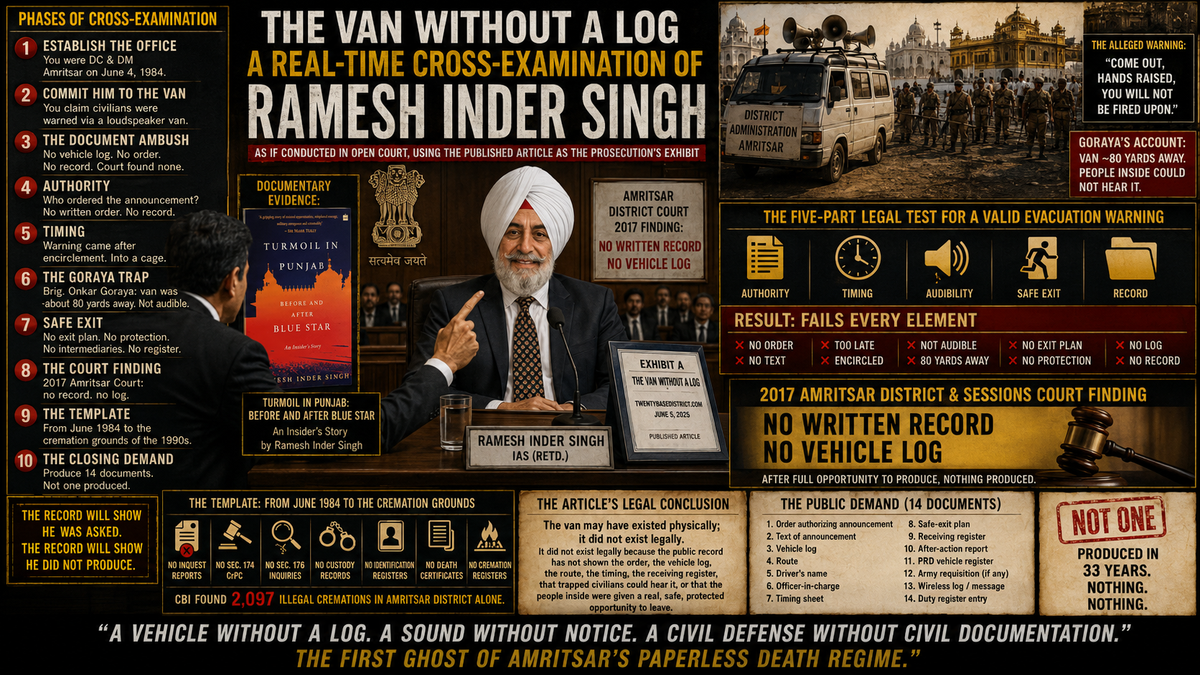
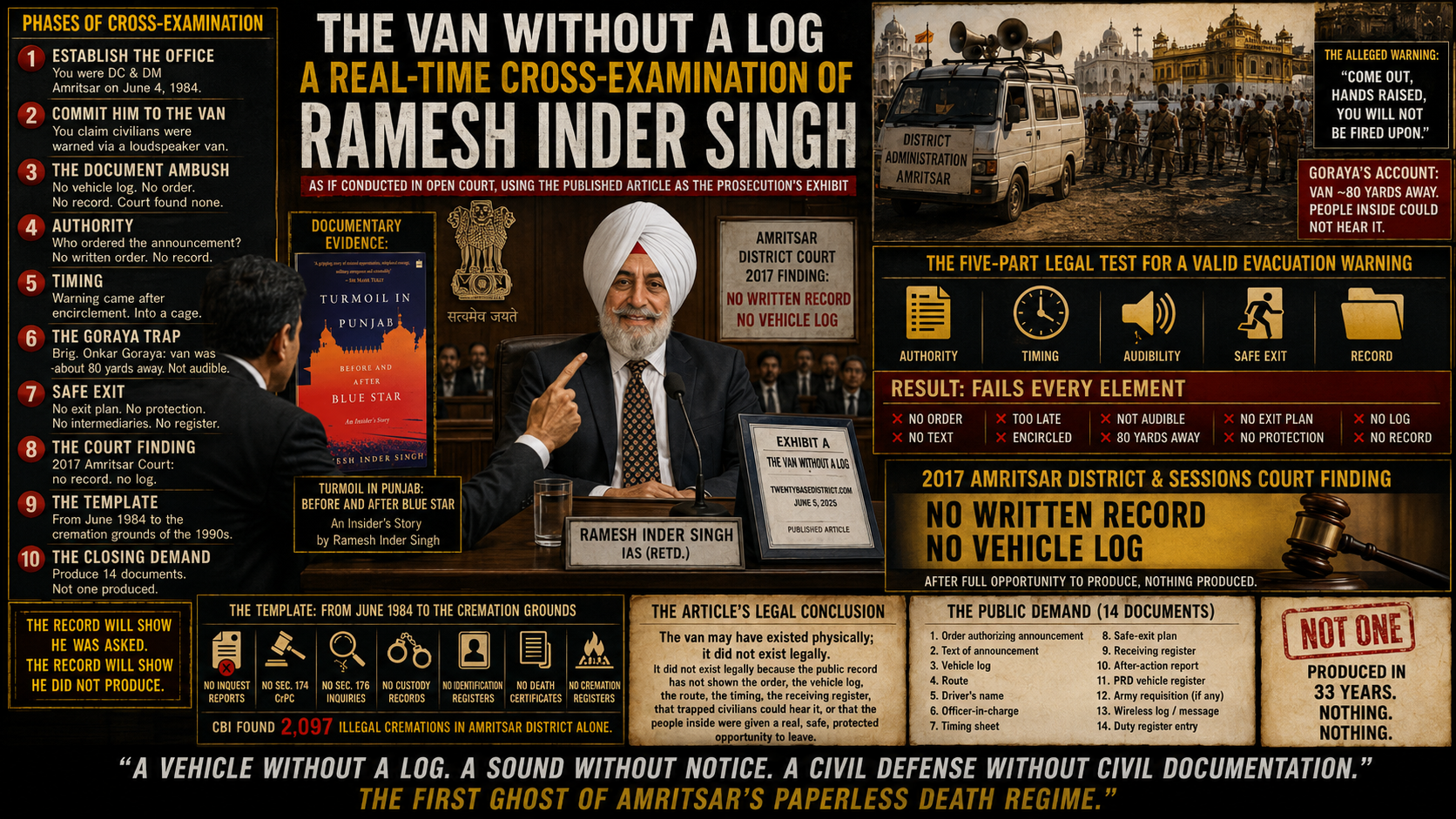
A Real-Time Cross-Examination of Ramesh Inder Singh - As if conducted in open court, using the published article as the prosecution’s exhibit
SETTING: Ramesh Inder Singh, IAS (Retd.), former Deputy Commissioner of Amritsar, takes the witness stand. The published article — The Van Without a Log, THEDEATHCERTIFICATE.ORG, June 5, 2026 — has been entered as Prosecution Exhibit A. The prosecutor stands. The court is quiet.
PHASE ONE: ESTABLISH THE OFFICE
Q: Mr. Singh, you took charge as Deputy Commissioner of Amritsar on June 4, 1984 — from Gurdev Singh Brar. Correct?
A: (He would confirm this. He has confirmed it in his own writing.)
Q: And as Deputy Commissioner, you held simultaneous designation as District Magistrate under the Code of Criminal Procedure?
A: (Yes.)
Q: So on June 4, 1984 — the day the operation commenced — the civil administrative and judicial authority of Amritsar District was located, in law, in your office?
A: (He cannot dispute this.)
Q: Not in the Army’s office. Not in the Home Ministry. Not in Delhi. In your office?
A: (Silence, or a qualified yes.)
Q: Good. Keep that in mind. Every question that follows turns on that single jurisdictional fact.
PHASE TWO: COMMIT HIM TO THE VAN
Q: Mr. Singh, in your account of Operation Blue Star — your book, your interviews, your public statements — do you assert that civilians inside the Darbar Sahib complex were warned to evacuate before the Army used lethal force?
A: (He would say yes. The official narrative requires it.)
Q: And the instrument of that warning — the mechanism through which the civil administration allegedly discharged this obligation — was a van? A loudspeaker vehicle? A district-administration vehicle?
A: (He would acknowledge this, or not deny it.)
Q: Good. Let me read to you from the published article, Exhibit A, Section I: “A van. A district-administration van. A public-relations van. A loudspeaker vehicle. A vehicle said to have stood outside the Darbar Sahib complex in early June 1984, broadcasting an appeal in Punjabi to those inside: come out, hands raised, and you will not be fired upon. In the state’s preferred version of events, that van performs an enormous legal function.”
Is that a fair description of the claim you and others have made?
A: (He would likely say: roughly, yes.)
Q: Enormous legal function. The article’s words. Because what the van is being asked to carry — on behalf of the state — is proof that civilians had a meaningful opportunity to leave before the Army fired. That is the weight being placed on this one vehicle. Agreed?
A: (He cannot disagree without abandoning the official position.)
Q: Then let us test whether the van can bear that weight.
PHASE THREE: THE DOCUMENT AMBUSH
Q: Mr. Singh, when the district administration deploys a vehicle on official duty — any vehicle — there is a motor transport register. Correct?
A: (He would have to agree. This is elementary administrative fact.)
Q: That register records the vehicle’s registration number, the date of deployment, the purpose, the route, the officer who authorized it?
A: (Yes.)
Q: Simple document. Kept by the driver. Countersigned by the officer-in-charge. Standard across every government department that operates a vehicle. Yes?
A: (Yes.)
Q: I am now reading from Section VII of the published article, the 2017 Amritsar District and Sessions Court finding: “The court found no written record of any public announcement by civil authorities requesting people to come out of the complex. It also found no log of the vehicle allegedly used for making such announcements.”
No log. Mr. Singh — the court looked. Your side had full opportunity to produce the record. No log was produced. Why?
A: (This is where he would begin to struggle. The likely answer: chaos, the Army took over, records from that period are difficult to locate.)
Q: Chaos. The Army took over. Let me press on that. Are you saying the Army controlled the van?
A: (If he says yes, the Army requisition should exist. If he says no, the civil dispatch order should exist. He cannot win either way.)
Q: If the Army requisitioned the van, produce the requisition. If the district administration dispatched the van, produce the dispatch order. If the Public Relations Department owned the van, produce the PRD vehicle register. One of those three records must exist if the van had any official standing. Which one can you produce?
A: (Silence. Or a reference to the difficulty of locating forty-year-old records.)
Q: Mr. Singh. The court looked in 2017 — thirty-three years after the operation. Not forty-two. Thirty-three. And found nothing. Are you suggesting that a vehicle deployed in the most consequential civil-administration act of your tenure generated not a single retrievable administrative document in thirty-three years?
A: (He has no good answer.)
Q: Let me go further. Exhibit A, Section VIII, the five-part legal test. An evacuation warning requires, at minimum: authority, timing, audibility, a safe exit, and a record. I want to go through each one with you.
PHASE FOUR: AUTHORITY
Q: Who ordered the announcement from the van? Was it you, in writing?
A: (He may claim it was an oral direction, or that the Army coordinated it.)
Q: Oral direction. So you gave an oral direction for what you now claim was the state’s primary evidence of civilian warning before a military assault on the holiest sanctuary of the Sikh world — and you gave that direction orally, without writing it down?
A: (This is indefensible as official procedure.)
Q: And no one under your command recorded compliance with that oral direction? No duty register entry? No message to the Home Department? Nothing?
A: (The record shows nothing.)
Q: Then the authority for the warning announcement cannot be established. Move to the next element.
PHASE FIVE: TIMING
Q: When was the announcement made? Before the military encirclement was complete? Before curfew was imposed in its final form? Before civilians were physically sealed inside?
A: (He would reference “the day before” or “early on.” His own account and Goraya’s suggests it was made while the encirclement was in progress.)
Q: Mr. Singh. Exhibit A, Section IX: “The state cannot first close the doors and then claim that the people inside were free to leave because a van outside made a sound they could not hear.” Was the complex fully encircled when the van made its announcement?
A: (He would struggle to say it was not. The timeline of the operation is well-documented.)
Q: If the complex was already encircled when the announcement was made, then civilians who might have wanted to leave could not safely leave regardless of what the van said. The warning arrived into a cage you had already sealed. Correct?
A: (No good answer.)
PHASE SIX: THE GORAYA TRAP
Q: Now, Mr. Singh — Brigadier Onkar Goraya. You know who he is?
A: (He would acknowledge Goraya as a credible military witness.)
Q: Goraya saw the van. He reported it to The Caravan. You might think his account helps you. Let me show you why it does not. Exhibit A, Section VI: Goraya’s account places the van approximately eighty yards from the main entrance. And it records — explicitly — that the people for whose benefit the message was supposedly being made were well beyond its reach.
Your own witness says the van was not reaching its audience. In real time. On the day. Not in hindsight. In real time, the person watching the van noted that the people inside could not hear it.
A: (He cannot contradict Goraya without undermining a state witness.)
Q: So what you have is a vehicle that: one, you cannot produce a log for; two, you cannot produce an authorizing order for; and three — by the account of your own cited witness — was not audible to the people it was supposed to warn. Is that correct?
A: (He must either concede or offer an alternative account for which he has no documentation.)
Q: The article’s formulation is precise, Mr. Singh. Section VI: “Goraya does not prove that the state warned civilians. Goraya proves that the alleged warning, even if made, was structurally defective.” Do you have evidence that contradicts that conclusion?
A: (He does not. Not in any document.)
PHASE SEVEN: SAFE EXIT
Q: Let me ask you about the exit. The van told people to come out with hands raised and said they would not be fired upon. Were specific exit gates identified in that announcement?
A: (Almost certainly not specified in any documented text.)
Q: Were troops at the perimeter given written orders not to fire upon civilians who emerged?
A: (He cannot produce those orders either.)
Q: Were women, children, and elderly pilgrims given a separate protocol — different from the general instruction given to everyone, including armed militants?
A: (Silence, or denial.)
Q: Were SGPC officials used as intermediaries to physically carry the warning into the parts of the complex where the van’s loudspeaker could not reach?
A: (No evidence of this.)
Q: Were receiving officers posted at designated exit points with a register to record who came out?
A: (No register has been produced.)
Q: So a person inside the parikrama — inside the sarais — inside the langar area — who could not hear the van; who was not told which gate to use; who did not know whether the troops at the perimeter had been ordered not to fire; who had no SGPC intermediary to guide them; who had no medical personnel waiting; who would have no civil officer to receive them and record their name — that person had a meaningful opportunity to leave?
A: (There is no honest answer that supports the state’s position.)
Q: The article calls a warning without a safe route “exposure, not evacuation.” Mr. Singh — what the van offered, on your own public account, was exposure. Not evacuation.
PHASE EIGHT: THE COURT FINDING
Q: Mr. Singh. 2017. Amritsar District and Sessions Court. The Jodhpur detainee proceedings. You had full opportunity as a representative of the state — or the state did — to produce the van file. The court looked. What was the finding?
A: (He cannot contradict the 2017 finding. It is documented.)
Q: No written civil record. No vehicle log. That is the court’s finding. Not an allegation. A judicial determination. After the state had full opportunity to produce whatever it possessed. And produced nothing.
A: (Silence.)
Q: The article says it plainly — Section VII: “That absence is not neutral. It is evidence of the administrative character of the operation.” Mr. Singh, I am asking you to tell this court what the administrative character was — if not the systematic non-creation of the very records that would allow accountability.
A: (He has no documentary answer.)
PHASE NINE: THE TEMPLATE — CONNECTING JUNE 1984 TO THE CREMATION GROUNDS
Q: Mr. Singh, let me ask you about what came after you.
After 1987, the next District Magistrate of Amritsar inherited your files. He inherited your filing conventions. He inherited the administrative precedents set during your tenure. Then the next one after him. Sarabjit Singh. Then K.B.S. Sidhu.
A: (He would acknowledge the succession.)
Q: And across the decade that followed — the late 1980s, the early 1990s — the pattern that first appears in June 1984 with the missing van log reappears in different documentary forms. No inquest reports. No Section 174 CrPC proceedings on unidentified persons. No Section 176 magistrate’s inquiries into custodial deaths. No custody transfer records. No identification registers. No death certificates with names. No cremation registers with family notifications.
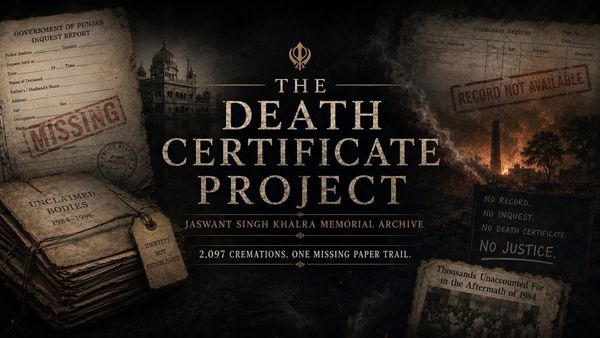
The CBI ultimately found 2,097 illegal cremations in Amritsar District alone.
A: (He would likely try to separate 1984 from the 1990s.)
Q: Section XIII of the article, Mr. Singh: “It did not begin in the cremation grounds of the 1990s. It began earlier, in the logic of June 1984, when state power learned that the appearance of procedure could survive without procedure itself.”
The van without a log. The body without a certificate. You were there at the beginning of that method. Were you aware, when you left the post, that your office had not resolved the evidentiary gap around the van warning?
A: (Whatever answer he gives, the gap exists in the record.)
PHASE TEN: THE CLOSING DEMAND
Q: Mr. Singh, I have one final question, and it is not rhetorical.
The article published on June 5, 2026 — Exhibit A — closes with what it calls a narrow public demand. I will read it to you directly from Section XVI:
“Produce the van file. Not the memoir. Not the recollection. Not the interview. Not the explanation. The file. Produce the order authorizing the announcement. Produce the text of the announcement. Produce the vehicle log. Produce the route. Produce the driver’s name. Produce the officer-in-charge. Produce the timing sheet. Produce the safe-exit plan. Produce the receiving register. Produce the after-action report.”
Mr. Singh. You held the office. You were there. You have described yourself as a central witness.
Can you produce any one of those fourteen documents?
A: (He cannot. The court established this in 2017. Nothing has emerged since.)
Q: Then the article’s legal conclusion stands. And I will read it to you, from Section XV, so that you understand precisely what it is:
“The van may have existed physically; it did not exist legally. It did not exist legally because the public record has not shown the order, the vehicle log, the route, the timing, the receiving register, that trapped civilians could hear it, or that the people inside were given a real, safe, protected opportunity to leave.”
Not a political statement, Mr. Singh. A legal sentence. Applied to the administrative record of your office.
No further questions.
PROSECUTOR (turning to the bench):
Your Honour, the witness cannot produce the order. He cannot produce the log. He cannot produce the route. He cannot produce the text. He cannot produce the timing sheet. He cannot produce the receiving register. He cannot produce a single document that would allow the van to exist as a lawful warning rather than a later memory.
The 2017 court already found the same absence and ruled accordingly on the rights of those detained at Jodhpur.
The published article at THEDEATHCERTIFICATE.ORG — Exhibit A — has now reduced Ramesh Inder Singh’s van to its precise documentary status:
A vehicle without a log.
A sound without notice.
A civil defense without civil documentation.
The first ghost of Amritsar’s paperless death regime.
The record will show that he was asked. The record will show that he did not produce.
That is the cross-examination. That is what the article accomplishes — not as polemic, but as a methodical forensic procedure applied to a retired officer who has had forty-two years to produce one file, and has not.