THE PROXY THRONE

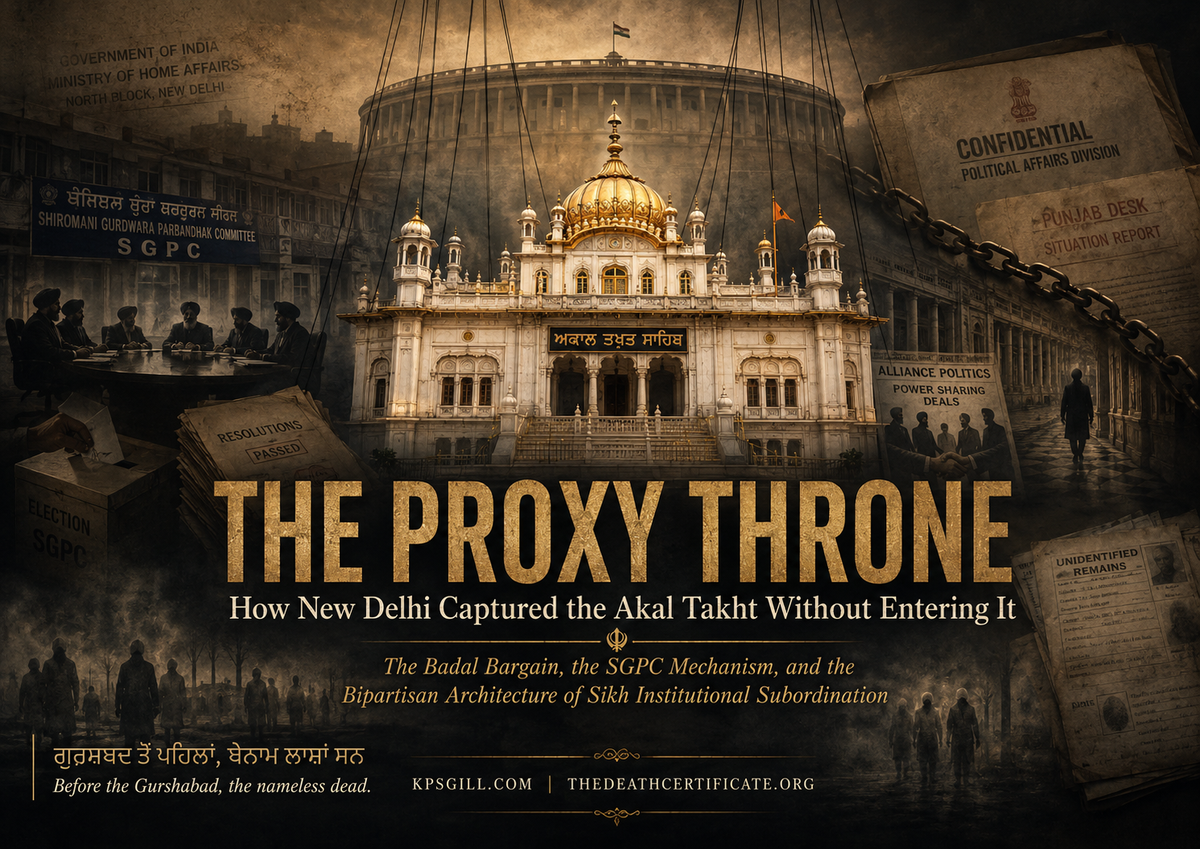
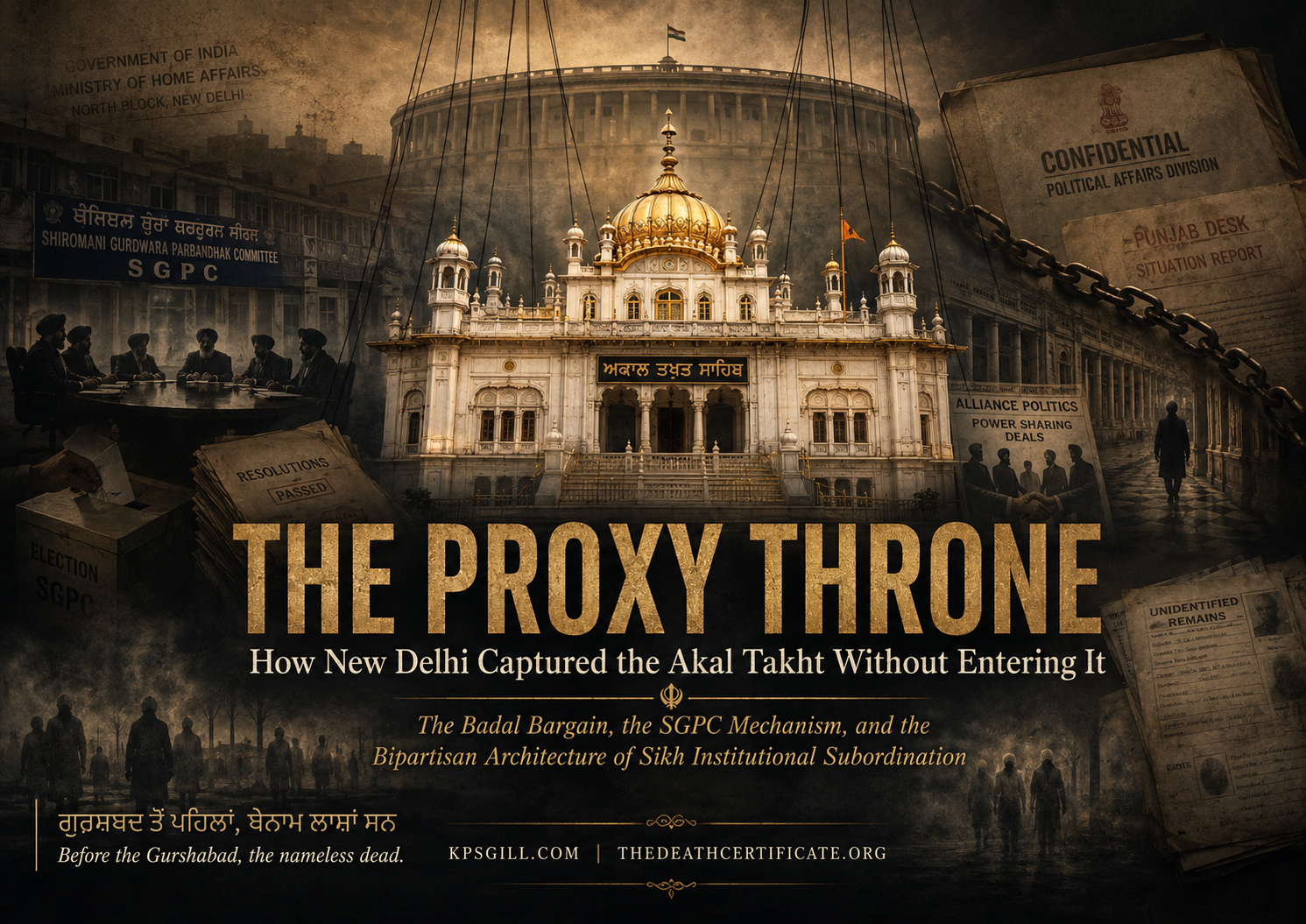
How New Delhi Captured the Akal Takht Without Entering It: The Badal Bargain, the SGPC Mechanism, and the Bipartisan Architecture of Sikh Institutional Subordination
ਗੁਰਸ਼ਬਦ ਤੋਂ ਪਹਿਲਾਂ, ਬੇਨਾਮ ਲਾਸ਼ਾਂ ਸਨ
Before the Gurshabad, the nameless dead.
Editorial Note
This article examines the structural subordination of Sri Akal Takht Sahib to the apparatus of Indian state power — not through direct occupation, but through an architecture of indirect control that has operated across party lines, across decades, and across the formal division between political parties and religious institutions. It draws on three registers of evidence: the institutional and legal record of the Sikh Gurdwaras Act and its amendments; the political record of the Shiromani Akali Dal, the SGPC, and their relationship with successive governments in New Delhi; and the pattern of what the Akal Takht did not say during the decades when the Sikh Panth needed its sovereign voice most urgently. That last register — the silence index — is the most damning evidence of all.
This article applies the four-tier evidentiary framework governing all publications of TheDeathCertificate.org and KPSGILL.COM:
[PF] Proved Finding — established by reliable records, judicial findings, statutory texts, official admissions, or convergent documentary evidence.
[DA] Documented Allegation — serious, source-grounded, not yet conclusively adjudicated.
[AI] Analytical Inference — reasoned from patterns, omissions, timing, and the cumulative structure of the record.
[PM] Panthic Memory — preserved in Sikh institutional, familial, and collective remembrance.
Introduction: The Art of Not Entering
The oldest principle of effective imperial control is that the most complete form of domination is the form that requires no garrison. No soldier at the gate. No official inside the building. No fingerprint on the decree. The most elegant control is the kind that operates invisibly, through the cooperation of those who appear to stand between the power and the institution they are actually delivering to it. The most successful empires did not simply conquer institutions. They installed intermediaries who managed those institutions on their behalf, took the political benefits of that management for themselves, and provided the empire with everything it needed: silence when silence was required, legitimacy when legitimacy was convenient, and the prevention of the kind of institutional mobilization that could have threatened imperial arrangements.
New Delhi’s relationship with Sri Akal Takht Sahib is the modern Sikh example of this ancient principle.
The government of India — whether under Congress, BJP, or the various coalitions that occupied Raisina Hill between them — has never directly appointed the Jathedar of Sri Akal Takht Sahib. It has never sent an officer to occupy the Akal Takht. It has never passed a statute directly naming the subordination. It has not needed to. The architecture of indirect control, assembled over decades and fortified through the peculiarities of the Sikh Gurdwaras Act of 1925, has done the work of a garrison without requiring one.
The mechanism is elegant in the way that traps are elegant. It is the SGPC.
The SGPC elects a leadership. The leadership appoints the Jathedar. The Jathedar issues or withholds hukamnamas. If the party that controls the SGPC is structurally dependent on New Delhi’s goodwill — for budget allocations, for electoral tolerance, for legal protection, for economic benefits, for administrative latitude — then the chain of dependency runs from New Delhi through the SGPC and terminates at the Akal Takht, without Delhi ever needing to appear in the chain’s visible portion.
Parkash Singh Badal, the longest-serving Chief Minister of Punjab, completed this circuit and held it in place for nearly five decades of active political life. He did not invent the arrangement. He perfected it. He institutionalized it. He made himself indispensable to it. And he extracted from it enormous, multigenerational benefits: five terms as Chief Minister, a political dynasty that made his son Deputy Chief Minister and his family the dominant economic force in Punjab, and the kind of relationship with successive national governments — Congress as well as BJP, across the formal divisions of Indian coalition politics — that kept his party alive through the most adverse winds.
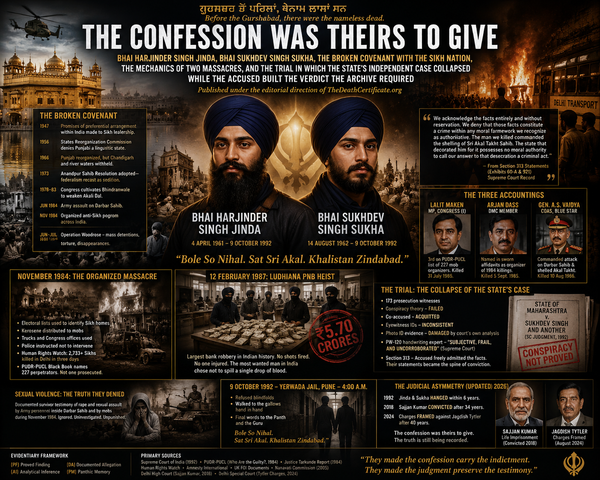
The Akal Takht, during this period, remained largely silent on the things that mattered most to the Sikh Panth and most inconvenient to Delhi: the 1984 pogrom and its thirty-year accountability vacuum; the counterinsurgency disappearances; the 2,097 illegal cremations in Amritsar District alone; the incarceration of Bandi Singhs beyond their lawful sentences; the administrative destruction of Sikh families through the machinery of the Punjab Police; and the erasure of the accountability record by the same civil administrative apparatus that had supervised the killing.
That silence had a structural address.
This article identifies it.
I. The Original Sovereignty: What the Akal Takht Was Before It Was Managed
[PF] Sri Akal Takht Sahib was established in 1606 by Guru Hargobind Sahib as the Throne of the Timeless — the institutional seat of Sikh temporal authority exercised under the discipline of spiritual truth. It was built as a deliberate act of sovereign counter-assertion against the architecture of Mughal imperial power. Its physical elevation — higher than the Harmandir Sahib itself — was not incidental. It was a declaration: that temporal power stands in judgment and is itself judged by a higher spiritual authority. The building was constructed by the Guru himself, with Baba Buddha and Bhai Gurdas, using only their own hands and expressly forbidding external labor — because to accept Mughal or Mughal-adjacent labor would have compromised the sovereignty of what was being built.
[PM] From the Akal Takht, the first hukamnamas were issued — not as devotional suggestions but as binding political directives, instructing far-flung Sikh sangats to send offerings of horses and weapons rather than cash. The Guru received petitions, administered justice, and directed the affairs of the Sikh nation from this throne. The Akal Sena — the first organized Sikh military force — was headquartered there. The subsequent Sikh military tradition, which eventually produced the Dal Khalsa and the Sikh Empire under Maharaja Ranjit Singh, drew its organizational legitimacy from this founding institution.
[PF] During the era of the Sikh Misls in the eighteenth century, the Sarbat Khalsa gathered at the Akal Takht biannually during Baisakhi and Diwali. The assembled representatives of the Sikh misls deliberated on questions of war, peace, strategy, and governance. Their resolutions — Gurmatas — were binding on all. The Sarbat Khalsa passed resolutions that launched military campaigns, reorganized fighting forces, and determined the political direction of the entire Sikh nation. This was direct democratic sovereignty of a type that had no precise European or Mughal equivalent: dispersed power, assembled by consensus, governed by Gurmat, and exercised from the Akal Takht.
[PM] The most celebrated institutional act of Akal Takht sovereignty in the post-Guru Sikh political record is perhaps the summons of Maharaja Ranjit Singh himself by Akali Phoola Singh, the Jathedar of the Akal Takht, for conduct deemed incompatible with Sikh Rehit. The ruler of the Sikh Empire — the most powerful Sikh political sovereign who has ever lived — submitted to the discipline of the Akal Takht. He was spared formal punishment through the intercession of the Panth, but the institutional principle was absolute and historically verified: the Akal Takht stood above the throne of Lahore. The Miri-Piri doctrine was not decorative. It was constitutionally enforced.
That was the standard.
What exists today is its precise negation.
II. The 1925 Gateway: How a Statutory Victory Created an Institutional Vulnerability
[PF] The Sikh Gurdwaras Act of 1925 was enacted by the Punjab Legislative Council under British colonial administration. It emerged from the Gurdwara Reform Movement — a sustained campaign of sacrifice, imprisonment, and non-violent agitation by Sikhs who sought to reclaim historic shrines from hereditary mahants whose conduct had become incompatible with Gurmat and from arrangements that had reduced sacred institutions to private colonial-adjacent estates. The Act established the SGPC as a democratically elected management board with authority over notified Sikh gurdwaras, their property, funds, and administration. Its founding was a genuine Sikh victory, purchased at genuine cost.
[PF] The statute is a colonial-era instrument of Punjab governance. Its territorial mandate covers Punjab and extends, in successor frameworks, to Haryana, Himachal Pradesh, and Chandigarh. Its electoral structure is built around a list of eligible voters defined geographically. It creates a Board, constitutes committees, provides for elections and management, defines the Board’s powers over gurdwara property and staff, and establishes a judicial commission. It is, in its core, a management statute.
[PF — critical] The word “Jathedar” does not appear in the original Sikh Gurdwaras Act of 1925. The legislature did not define the office, specify its qualifications, enumerate its powers, set its tenure, or describe its relationship to the SGPC Board. The serving Jathedar of the Akal Takht at the time of the Act’s passage was Jathedar Didar Singh. He was the incumbent of the highest Sikh temporal office. The legislature simply did not codify him.
[AI] This silence was not a clerical oversight. It was the calculated silence of a colonial legislature that was willing to create a management structure for Sikh gurdwaras — because management is administrative and containable — but had no interest in creating a legally recognized independent Sikh sovereignty seat with defined powers that could challenge colonial administrative authority. The management was captured in statute. The sovereignty was left in a legal void. And in institutional design, a void is not safety. A void is a vulnerability. Something will fill it, and what fills it will be determined by whoever holds the administrative power at the moment of filling.
[PF] What filled it, eventually, was a 1997 administrative resolution — the SGPC Executive Committee’s “Parbandh Scheme” — which designated the Head Ministers of the Akal Takht and Takht Keshgarh Sahib as Jathedars. This was an internal administrative resolution, not a statutory amendment. It was not approved by the SGPC’s full General House as proper procedure required. It was not an amendment to the Act. It has no independent legislative standing. What it did accomplish was the conversion of the most important Sikh religious office into a category of SGPC employment — without even the dignity of a properly enacted legal instrument.
[AI] The 1997 Parbandh Scheme was not an institutional reform. It was an administrative handcuff. It converted a sovereignty office into a personnel matter, and it did so in the year that Badal’s Shiromani Akali Dal had just returned to power in Punjab after the long darkness of President’s Rule and counterinsurgency. The timing is not coincidental. A party that governs Punjab governs the patronage and political climate in which SGPC elections occur. To convert the Jathedar into an SGPC employee in 1997 — in the first year of Badal’s third term — was to consolidate in administrative form the circuit of control that had been operating politically for years: from the Badal government through the SGPC to the Akal Takht.
III. The Capture Architecture: From Punjab Elections to Akal Takht Hukamnamas
The capture of the Akal Takht does not operate through a single mechanism. It operates through a chain. Each link in the chain is legally and administratively defensible in isolation. In combination, the links form a structure of total institutional subordination. Understanding the chain is necessary before evaluating any proposed reform.
Link One: Punjab State Government Controls the Political Ecology of SGPC Elections
[PF] SGPC elections are conducted within the territorial jurisdiction of Punjab, Haryana, Himachal Pradesh, and Chandigarh. The eligible voter rolls, polling stations, administrative machinery, and enforcement infrastructure are substantially embedded in Punjab’s state government apparatus — including, most consequentially, the Punjab Police. SGPC elections are not conducted in a neutral institutional environment. They are conducted within a political landscape that Punjab’s governing party shapes at every level: who registers, who votes without interference, whose rural constituency networks are mobilized, whose organizational vehicles are obstructed, and how disputes are adjudicated.
[DA] It has been alleged by Sikh scholars, opposition political figures, and diaspora commentators across multiple decades that SGPC elections under Badal-era SAD control were regularly shaped by state administrative and police machinery — through selective application of law, pressure on competing Sikh organizations, and the management of rural patronage networks through which the SAD built its base. These allegations have never been adjudicated in proceedings that produced binding findings.
[AI] The structural reality does not require proof of specific individual acts of electoral manipulation to establish institutional subordination. A party that has governed Punjab for the better part of five decades, commanding the state police, the district administration, and the patronage flows of rural Punjab, necessarily shapes the conditions in which SGPC elections occur. The question is not whether this influence existed. The question is how far it reached and how consistently it was applied.
Link Two: SGPC Leadership Appoints the Jathedar
[PF] The Jathedar of Sri Akal Takht Sahib is appointed by the SGPC Executive Committee through a majority vote. The Executive Committee is itself composed of members drawn from the SGPC General House, which is elected through the SGPC elections described above. The political party that dominates SGPC elections controls the General House. The party that controls the General House controls the Executive Committee. The Executive Committee appoints and removes the Jathedar. He is paid from SGPC funds. He is subject to SGPC administrative rules. He can be suspended, removed, or disciplined by SGPC executive action. There is no independent Sarbat Khalsa-level accountability mechanism standing between him and the SGPC’s political will.
Link Three: Structural Dependency Shapes Institutional Speech
[AI] A Jathedar who understands that his appointment, salary, security, staff, institutional standing, and the very platform from which the Akal Takht speaks all depend on the goodwill of the SGPC Executive Committee — and who understands that the Executive Committee answers to the political party that controls SGPC elections — is an official who calculates his speech accordingly. This is not necessarily a matter of individual moral failure. It is a matter of institutional design. Even a personally courageous individual, placed in this structural position, must weigh the costs of institutional confrontation against the benefits. And the costs are not abstract: confrontation with the SGPC means loss of office. Loss of office means loss of the only platform from which the Akal Takht’s hukams are issued.
The Chain Is Complete
New Delhi sustains Badal. Badal controls SAD. SAD controls SGPC elections. SGPC elections control the General House. The General House controls the Executive Committee. The Executive Committee appoints and removes the Jathedar. The Jathedar issues or withholds hukamnamas.
New Delhi, at the head of this chain, never appears in the chain’s visible portion. The control is complete precisely because it is invisible. This is not a conspiracy in the paranoid sense — no secret protocol needs to have been signed. It is a structural arrangement, assembled over decades, in which each actor serves their own immediate interests while the combined effect is the subordination of the Throne of the Timeless to the requirements of Indian state political management.
IV. Parkash Singh Badal and the Proxy Throne: The Architecture of the Bargain
To understand the Badal-SGPC-Delhi nexus at the depth it deserves, one must understand what Parkash Singh Badal actually was across his half-century at the center of Punjab politics.
[PF] Parkash Singh Badal was born in 1927 and died on April 25, 2023. He served as Chief Minister of Punjab five times — 1970-71, 1977-80, 1997-2002, 2007-12, and 2012-17 — spanning more than fifteen years of formal executive power in a state that is constitutionally central to India’s most sensitive border and to its most historically contested community. He led the Shiromani Akali Dal for the overwhelming majority of his political life, served as SGPC president, and controlled the party machine that dominated SGPC elections across multiple election cycles. His son Sukhbir Singh Badal became SAD president, Punjab Deputy Chief Minister under his father’s final terms, and the designated inheritor of the family’s institutional control. His daughter-in-law Harsimrat Kaur Badal served as a Union Cabinet Minister under the BJP-led NDA government. The family had achieved what no other Sikh political dynasty has achieved: the simultaneous control of Punjab’s executive government, the SGPC’s institutional machinery, and a seat at the national cabinet table.
[PF] The relationship between the SAD and the SGPC has historically operated in near-symbiosis. The SAD built its political base through the gurdwara networks that the SGPC manages. SGPC elections served as organizational proving grounds for SAD mobilization capacity. The SGPC’s substantial resources — management of Gurbani broadcasts, patronage of local gurdwara committees, oversight of significant financial flows, control of hiring in historic gurdwara institutions — were not operationally separated from the SAD’s political machine. Factional control of the SGPC was factional control of a major institutional resource base, not merely of a religious management committee.
[AI] Parkash Singh Badal’s relationship with New Delhi operated across party lines because what he was offering Delhi was not ideology. It was not doctrinal alignment, not civilizational partnership, not shared political principles. What he was offering was management — specifically, the management of Sikh institutional life in a manner that prevented the Akal Takht from becoming a platform for Sikh political mobilization against Indian state interests. This service had value regardless of which party occupied New Delhi. It had value to Congress because Congress bore the deepest accountability exposure for 1984. It had value to the BJP because the BJP’s civilizational project was structurally threatened by a fully sovereign Akal Takht. It had value to both because Punjab’s border position made its institutional stability a permanent security concern.
What Badal Extracted from the Arrangement
[PF] Five consecutive terms as Chief Minister across a half-century represents a durability of political power that no other Punjab politician has approached. The Badal family’s economic interests in Punjab — in media ownership, transportation, construction, land and sand mining, government contracting, and ancillary sectors — expanded dramatically during Badal’s years in executive power and were never seriously threatened by central government accountability mechanisms of the type that are routinely deployed against political opponents deemed inconvenient. The SAD-BJP alliance, which ran formally from 1996 to 2020, gave Badal’s party national coalition legitimacy and union cabinet representation, insulating his political position from the kind of central government pressure that smaller regional parties without such alliances face.
[DA] It has been documented and alleged by Sikh political opponents, investigative journalists, and diaspora commentators that Badal’s extraordinary longevity in power was, in significant part, a function of his usefulness to successive Delhi governments as the effective manager of Punjab’s Sikh institutional life. Whether any specific quid pro quo was ever formalized between Badal and any particular Delhi government is not established in the currently accessible historical record. What is established is the structural outcome: Badal controlled the SGPC; the SGPC controlled the Jathedar; the Jathedar managed the Akal Takht voice within politically acceptable parameters; and the Akal Takht remained effectively silent on the questions that most urgently required its sovereign institutional voice and most severely inconvenienced the state.
What Delhi Received in Return
[AI] Delhi’s strategic interest in a managed Akal Takht is not mysterious, and it does not require exaggeration to state. The Akal Takht is the institutional source of the highest Sikh political legitimacy. A genuinely independent Akal Takht — one that could speak without calculating its payroll — could have done things across the post-1984 period that would have fundamentally challenged India’s management of its relationship with the Sikh nation:
It could have issued hukamnamas demanding full judicial accountability for the November 1984 anti-Sikh pogrom, mobilizing the global Sikh diaspora’s political weight behind specific named perpetrators and specific institutional demands.
It could have declared the 1984 pogrom a state crime against the Sikh Panth, with the institutional force of a Panthic sovereign declaration — not as a community grievance, but as a Panthic juridical finding from the highest Sikh temporal seat.
It could have supported Jaswant Singh Khalra’s documentation of illegal cremations with an Akal Takht hukamnama directing the entire Sangat to support his accountability project and to treat any interference with his documentation as a Panthic affront.
It could have condemned the 2,097 illegal cremations in Amritsar District by name — naming each identified victim, demanding that each of the 1,238 entirely unidentified victims be traced, and summoning the civil administrative record of DC/DM Amritsar for 1984-1996 to formal institutional accountability.
It could have issued a series of summonses — in the tradition of Akali Phoola Singh summoning Ranjit Singh — to retired DGPs, IGs, SSPs, DCs, and IAS officers who supervised the counterinsurgency apparatus, demanding their public accounting before the Akal Takht.
It could have demanded, repeatedly and without retraction, the immediate release of every Bandi Singh held beyond the expiry of their lawful sentence.
It could have challenged the systematic use of the “Khalistan” label to criminalize Sikh political memory, diaspora advocacy, and accountability journalism, declaring the weaponization of this label a continuing assault on Sikh civic life.
None of these acts would have required violence. All of them were within the institutional remit of the Akal Takht as defined by its own historical function and theological mandate. All of them were precisely what a sovereign Akal Takht, drawing on the tradition of Guru Hargobind’s founding and Akali Phoola Singh’s institutional courage, would have been expected to do.
Under the Badal-SGPC capture architecture, the Akal Takht did none of these things with the institutional force and consistency that would have changed the political calculus for the Indian state.
[AI] That omission was not random institutional failure. It was not the product of individual moral weakness alone. It was the return on Delhi’s investment in maintaining the capture architecture through which Badal was sustained, rewarded, and protected.
V. Congress’s Interest: The Original Pattern of State-Religious Manipulation
[PF] The Congress Party’s relationship with Sikh religious institutions has a long and documented history of calculated manipulation. Before the Gurdwara Reform Movement of the 1920s, Congress-adjacent interests accommodated the mahant system that the Akali agitation eventually dismantled. After Partition, Congress governments in Delhi and Punjab understood the strategic necessity of managing Sikh religious life. The complex relationship between Congress-linked leadership and the post-Partition SGPC, the long Congress campaigns to prevent a consolidation of Sikh political institutions outside Congress influence, and the electoral dynamics of the Punjabi Suba movement all belong to this pattern.
[PF] Operation Blue Star in June 1984 was authorized by Prime Minister Indira Gandhi’s Congress government. The Indian Army’s attack on the Golden Temple complex resulted in the physical destruction of Sri Akal Takht Sahib — the most sacred temporal institution of the Khalsa Panth. The Congress government then authorized the rebuilding of the Akal Takht through Baba Santa Singh of the Nihang Budha Dal, with Union Home Minister Buta Singh overseeing the arrangement. This reconstruction was rejected by the Sarbat Khalsa of January 26, 1986, which dismantled the government-supervised structure and rebuilt it entirely using independent Sikh community resources — a project completed in 1995 — precisely because Congress-government-supervised reconstruction was understood as an attempt to shape the institutional ownership of the restored Akal Takht.
[AI] The Congress government’s willingness to insert itself into the physical reconstruction of the Akal Takht — choosing the builder, choosing the overseeing government official, shaping the timeline and the symbolic narrative — was not a neutral act of civic goodwill. A structure rebuilt with government supervision, through a government-chosen intermediary, carries a different institutional meaning than a structure rebuilt by the sovereign Panth acting through its own mechanisms. Congress understood this precisely. The reconstruction was an attempt to convert an act of Sikh institutional recovery into an act of state-sponsored rehabilitation — one that would embed the Indian state’s role in the restoration of the very institution the Indian state had just destroyed.
[PF] The 1986 Sarbat Khalsa’s rejection of this arrangement — its decision to dismantle the Buta Singh reconstruction and rebuild independently — was one of the most significant acts of Sikh institutional sovereignty in the post-1984 period. It proved that when the Panth acts through its own mechanisms rather than through SGPC-mediated management, it can exercise sovereign authority that bypasses the capture architecture entirely.
[AI] Congress’s longer-term strategic calculation with respect to the Akal Takht was consistent across governments: a fully independent Akal Takht, genuinely accountable to a global Sarbat Khalsa, would inevitably revisit 1984. It would revisit the pogrom with institutional force. It would revisit the counterinsurgency with an authority that no Indian court, no National Human Rights Commission, and no investigative commission had exercised or been permitted to exercise with comparable institutional weight. Congress could not afford that. And so Congress, like every other Delhi-based political formation, preferred an Akal Takht whose voice was politically manageable — and was prepared to sustain the political arrangements that produced that management.
VI. BJP’s Interest: Institutionalizing the Arrangement Through Alliance
[PF] The Shiromani Akali Dal and the Bharatiya Janata Party were in formal electoral alliance from 1996 to 2020 — more than two decades, making it one of the oldest and most durable alliances in Indian coalition politics. Under the NDA arrangements, the SAD received Union Cabinet representation. Harsimrat Kaur Badal served as the Union Minister of Food Processing Industries under Prime Minister Modi’s first and second terms. The formal dissolution of the alliance came in September 2020, when the SAD withdrew from the NDA government over the contentious farm laws — a dissolution that, significantly, was driven by rural Punjab agrarian interests rather than by any principled disagreement about SGPC governance or Akal Takht independence.
[AI] The SAD-BJP alliance was not a doctrinal partnership. It was, at its structural core, a political exchange. The BJP brought national coalition credibility and central government access. The SAD brought Punjab’s vote in parliamentary elections and, crucially, management of Sikh institutional life in a manner useful to the BJP’s national project.
[AI] The BJP’s civilizational project — the Hindutva architecture of the Indian nation, rooted in the RSS’s long-standing view of Sikhism as an emanation of Hindu tradition rather than as a distinct religious civilization — is structurally incompatible with the full theological and political sovereignty claims of the Sikh Panth as expressed through a genuinely independent Akal Takht. The RSS has historically sought, through various cultural and institutional mechanisms, to incorporate Sikh identity within a broader Hindu nationalist framework. The Akal Takht, if functioning under its historical mandate and institutional independence, would be constitutionally required to issue a definitive Panthic rejection of this characterization. The theological foundations of Sikhism — non-negotiably distinct from Vedanta, explicitly Gurmat rather than Brahmanic — cannot be reconciled with the RSS claim that Sikhism is a form of Hindu expression.
[AI] Badal’s alliance with the BJP therefore served a double function. Formally, it served the SAD’s electoral interest in national coalition participation. Structurally, it served the BJP’s interest in ensuring that the SGPC — and through it, the Akal Takht — would not become a platform for formal Panthic rejection of the Hindutva civilizational claim. A BJP-allied SGPC meant a BJP-friendly Akal Takht. A BJP-friendly Akal Takht would not issue hukamnamas against the RSS’s theological overreach. It would not declare the characterization of Sikhism as a Hindu sect a Panthic affront requiring collective institutional resistance.
[PF] The December 2025 tankhah pronouncement against GNDU Vice-Chancellor Dr. Karamjit Singh — for publicly linking Sikh theology with Vedanta in the presence of RSS chief Mohan Bhagwat, and for his inclusion on the SGPC panel drafting Jathedar appointment rules — illustrates precisely this tension. The RSS-aligned institutional project of Sikh-Hindu civilizational integration is exactly what a sovereign Akal Takht must resist. The fact that it took a specific, conspicuous, politically available provocation to produce even this partial institutional response — and that the response came after the dissolution of the SAD-BJP alliance, not during it — confirms the structural analysis.
VII. The Sehajdhari Exclusion: Narrowing the Electorate to Secure the Capture
[PF] The 2016 Parliamentary amendment to the Sikh Gurdwaras Act removed Sehajdhari Sikhs from SGPC voter eligibility, retroactively effective from October 8, 2003. This excluded an estimated seven million voters from Punjab alone. Historically, amendments in 1944 and 1959 had extended the franchise to Sehajdhari Sikhs — those who follow Sikh theology, revere Guru Granth Sahib, and observe Sikh practice without necessarily maintaining all external symbols. The 2016 Parliamentary amendment reversed this extension through central government-authorized legislation.
[AI] The exclusion of Sehajdhari Sikhs served a specific political function within the capture architecture. They had historically provided a significant, moderating portion of the SGPC electorate — one less easily controlled through the rural Keshdhari constituency networks that the SAD’s organizational machinery had historically dominated. Their exclusion by Parliamentary action — an action requiring central government consent and authorization, meaning Delhi’s affirmative participation — simultaneously narrowed the electorate and concentrated SGPC voting power in a smaller, more homogeneous, more politically predictable constituency.
[AI] The beneficiaries of the narrowed electorate were those who had historically dominated Keshdhari-focused SGPC politics: the SAD’s rural organizational networks and the Badal political machinery. Delhi’s Parliament passed the exclusion. Delhi would only pass such an amendment if the amendment served Delhi’s management interests. A smaller, more concentrated SGPC electorate, organized through the channels that the dominant party already controlled, is a more manageable SGPC. The Sehajdhari exclusion was, in institutional terms, a constitutional amendment to the capture architecture — designed to make the captured institution’s electoral base smaller, less diverse, and more dependent on the political networks through which SGPC control was exercised.
[AI] There is a further dimension of consequence. The exclusion of seven million Sehajdhari Sikhs from SGPC voting simultaneously invalidated the SGPC’s claim to represent Sarbat Khalsa. If Sarbat means the whole, then a body whose franchise has been legislatively restricted to exclude categories of Sikhs through Parliamentary action cannot exercise the authority of the whole. The exclusion was a double injury: it narrowed the representative base while simultaneously destroying the legal and theological claim to Panthic representativeness.
VIII. The Circuit in Specific Practice: How the Chain Operated in Political Moments
To move from structural analysis to forensic accountability requires tracing how the capture architecture functioned in concrete political situations.
The SGPC as Political Instrument
[PF] The SGPC’s 191-member General House, with 170 elected from Punjab, Haryana, Himachal Pradesh, and Chandigarh, determines the composition of the Executive Committee that controls the Jathedar appointment. The SAD used its Punjab political machinery — its MLAs, MPs, sarpanches, district-level leaders, police contacts developed over decades of governance, and rural patronage networks — to secure SGPC General House majorities. The SGPC election was not institutionally insulated from the SAD political machine. It was powered by it.
[PF] The result was near-continuous SAD dominance of SGPC across the post-Independence decades, with significant contestation primarily during periods of acute political crisis — most notably the post-Blue Star period (1984-1995), when more radical Sikh factions challenged SGPC legitimacy from outside the SAD framework. The restoration of Badal-SAD dominance of the SGPC by the late 1990s represented a restoration of the capture architecture after its period of maximum disruption.
The Jathedar’s Structural Position and Its Consequences
[PF] Giani Gurbachan Singh served as Jathedar of the Akal Takht from 2008 to his resignation in October 2018, following sustained Panthic condemnation of the 2015 pardon controversy. His decade of service coincided with some of the most consequential years of Sikh institutional politics: the Guru Granth Sahib desecration controversies in 2015; the Dera Sacha Sauda pardon and its retraction; the November 2015 Sarbat Khalsa convened outside the SGPC framework; and the broad collapse of SGPC institutional legitimacy in the eyes of large sections of the global Panth.
[AI] During this decade, under a Badal-controlled SGPC, there was no Akal Takht hukamnama demanding full accountability for the 1984 pogrom with the institutional force of a Panthic sovereign declaration. There was no Akal Takht summons to retired DGPs and Chief Ministers to account for counterinsurgency-era disappearances and illegal cremations. There was no Akal Takht declaration demanding the immediate release of every Bandi Singh held beyond their sentence. There were individual statements and resolutions on various matters, but not the kind of sustained, sovereign, institutional Panthic command that the Akal Takht’s founding doctrine requires and its most urgent historical circumstances demanded.
IX. The Silence Index: A Forensic Accounting of Institutional Failure
The most powerful evidence of institutional capture is not what an institution does. It is what it does not do when the historical record demands action proportionate to the scale of injustice it confronts.
The 2,097 Dead
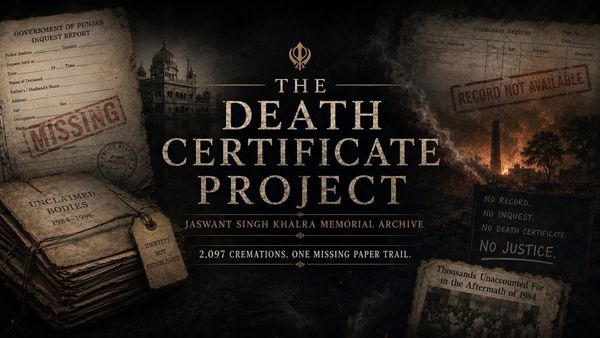
[PF] The CBI confirmed 2,097 illegal cremations in Amritsar District alone — 585 fully identified, 274 partially identified, and 1,238 entirely unidentified. The Supreme Court of India described these findings as a “flagrant violation of human rights on a mass scale” in its landmark ruling of December 12, 1996. Six Punjab Police officers were convicted; four life sentences were upheld by the Supreme Court in November 2011. Jaswant Singh Khalra documented these cremations and was abducted on September 6, 1995, murdered approximately October 27, 1995, by Punjab Police officers whose involvement was subsequently proven in criminal proceedings.
[AI] The Akal Takht, during the years of Badal’s political dominance of the SGPC, never issued a sovereign institutional declaration — carrying the full weight of a Panthic hukamnama — demanding that the 1,238 entirely unidentified cremated bodies be named, that their families be located and compensated, that the full chain of command for illegal cremations be prosecuted to its highest civil and military level, and that the administrative record of DC/DM Amritsar for 1984-1996 be subjected to independent Panthic audit. The National Human Rights Commission spoke. The Supreme Court spoke. The CBI investigated. International human rights bodies documented. What is absent from the accountability record is the institutional voice of the Akal Takht — speaking with the full force of a Panthic sovereign declaration — on the 2,097 dead of Amritsar District.
[PM] The families of the disappeared, the survivors of custodial torture, the communities whose sons were cremated without identity — they were Sikh families. The 2,097 were members of the Panth. They had a right to expect that the Throne of the Timeless — the institution that, by its own theological and historical claim, stands as the sovereign moral authority of the Sikh nation — would speak for them with the institutional force that the situation required. That speech, at the institutional level the situation demanded, did not come.
[AI] That silence had an institutional address. The SGPC controlled the Jathedar. The SAD controlled the SGPC. Badal controlled the SAD. Delhi sustained Badal. The silence at the Akal Takht, in the face of 2,097 illegal cremations and the documented murder of the man who exposed them, was the final product of a chain that began in New Delhi and ended, without visible interruption, at the pulpit of the Throne of the Timeless.
The Bandi Singhs
[PF] Multiple Sikh individuals have been held in Indian prisons beyond the expiry of their judicial sentences, on the basis of state governor and central government refusals to act on mercy petitions or recommendations for executive release. These cases have been argued before Indian courts across years and in some cases decades. The Sikh human rights community and diaspora have repeatedly documented individual cases with specific names, sentence expiry dates, and the subsequent years of extralegal incarceration.
[AI] A fully sovereign Akal Takht would have been expected to issue a recurring, named, institutional hukamnama — renewed annually if necessary — demanding the release of each identified Bandi Singh, mobilizing the full Panthic apparatus behind each case, and declaring the continuing imprisonment of these individuals beyond their lawful sentences a continuing state crime against members of the Sikh religious community. The institutional response was never proportionate to the scale or the duration of the injustice. The explanation is structural. The parties that controlled the SGPC were parties operating within the Delhi political system. They had no incentive to allow the Akal Takht to become a sustained platform for causes that embarrassed Delhi governments — including governments with which they were formally in alliance or informally in negotiation.
X. The 2015 Pardon: The Moment the Architecture Made Itself Visible
[PF] In September 2015, Jathedar Giani Gurbachan Singh, along with four other head priests, issued a pardon to Gurmeet Ram Rahim Singh, the head of the Dera Sacha Sauda sect, who had been accused of sacrilege in 2007 for dressing in attire imitating Guru Gobind Singh Sahib — conduct that had produced violent clashes between Dera followers and mainstream Sikhs in Punjab and Haryana.
[PF] The Dera Sacha Sauda commands a large following in rural Punjab and Haryana — constituencies directly relevant to Punjab Assembly election arithmetic. The 2017 Punjab Assembly elections were approaching. The SAD needed electoral support in Dera-dominated constituencies to remain competitive. The temporal connection between the political calculation and the religious decision is established by the proximity of the pardon to the electoral cycle and by the widespread contemporaneous reporting that the pardon was designed to secure Dera’s electoral support for the SAD.
[PF] The pardon was issued in a closed-door process. The global Sangat was not consulted. There was no Sarbat Khalsa deliberation. There was no transparent examination of the theological stakes. There was no public accountability mechanism. There was a political need and a religious response to that need, dressed in the institutional clothing of Akal Takht authority.
[PF] The Panj Pyaras of the Akal Takht — the five beloved officiating priests, a traditional Sikh accountability mechanism that carries its own institutional authority — summoned the Jathedars to account for their decision. The SGPC responded by dismissing the Panj Pyaras from their service positions. The administrative management apparatus of the SGPC used its employment power to suppress the traditional accountability mechanism of the Akal Takht itself. The committee fired the priests who tried to hold the committee’s employees accountable.
[PF] The pardon was eventually retracted under the pressure of massive Panthic outrage from the global Sangat. But the retraction did not restore institutional authority. It confirmed the architecture. It confirmed that the institution could be pressured into issuing religiously indefensible decisions by political actors and pressured into retracting them by Sangat anger. Neither direction of pressure came from the legitimate sovereign authority of Sarbat Khalsa. The Akal Takht had been reduced to a pressure-response mechanism for competing political forces — its hukams rising and falling with electoral calculations, not with Panthic sovereignty.
[AI] The 2015 pardon controversy is not an institutional anomaly. It is the clearest single visible expression — a moment when the architecture, usually operating below visibility, surfaced into full public view — of a structure that had been operating for decades. The architecture is: SGPC receives political requirement. Jathedar provides religious cover. Political cost rises beyond tolerance. Jathedar retracts. The hukam of the Throne of the Timeless has become an instrument of electoral management and political damage control. That is not Miri-Piri. That is its precise institutional inversion.
XI. The 2025 Tankhah: Symptom, Not Cure
[PF] On December 8, 2025, the Akal Takht under acting Jathedar Giani Kuldip Singh Gargaj pronounced tankhah against several individuals, including former Jathedar Giani Gurbachan Singh for the 2015 pardon; GNDU Vice-Chancellor Dr. Karamjit Singh for linking Sikh theology with Vedanta in Mohan Bhagwat’s presence and for his role on the SGPC panel drafting Jathedar appointment rules; and SAD leader Virsa Singh Valtoha for derogatory remarks against Jathedars.
[AI] These pronouncements represent a partial institutional attempt to reassert Akal Takht authority. As such, they deserve acknowledgment as evidence that the captured institution retains some residual capacity for self-assertion, especially when the political conditions that normally suppress that capacity are temporarily disrupted — here, by the collapse of the SAD-BJP alliance, the collapse of Badal-era dominance following the 2022 Punjab election, and the institutional reorganization that followed. Partial accountability is not nothing.
[AI] But the 2025 tankhah proceedings also precisely illustrate the limits of partial reassertion within a structurally unreformed institution. The tankhah against Giani Gurbachan Singh came a decade after the pardon he issued. The accountability mechanism was slow, politically contingent, and dependent on the specific political circumstances that made the pronouncement safe for the current SGPC configuration. The same SGPC appointment mechanism that produced Giani Gurbachan Singh continues to operate. The same financial dependency continues. The same electoral machinery continues. Punishing the individual symptom while leaving the institutional pathology intact is not constitutional reform. It is the management of institutional reputation within a structure that has not been fundamentally altered.
[AI] More revealing is what the 2025 tankhah proceedings did not address. They did not issue a hukamnama on the 2,097 illegal cremations. They did not summon the retired civil administrators of DC/DM Amritsar for 1984-1996 to account for systematic failures of mandatory CrPC oversight. They did not issue a sovereign Panthic declaration on the Bandi Singhs. They did not address the systematic weaponization of the “Khalistan” designation to suppress Sikh political speech and accountability journalism. They addressed the 2015 pardon and an RSS-linked academic’s theological overreach — real institutional failures, but not the deepest accountability demands that the Sikh Panth has carried for forty years. The selectivity of the pronouncements is itself evidence that the capture architecture continues to operate, shaping which silences are broken and which are maintained.
XII. The Constitutional Framework for True Akal Takht Independence
The structural analysis above generates specific institutional specifications. These are not abstract aspirations. They are the minimum requirements for an Akal Takht that can speak with the authority its founding established.
Decoupling the Jathedar from SGPC Employment
[AI] The single most consequential structural reform is the elimination of the employment relationship between the Jathedar and the SGPC. The Jathedar cannot be an SGPC employee. He cannot receive a salary from SGPC funds. He cannot be appointed by SGPC executive resolution. He cannot be removed by SGPC executive action. This reform requires either a statutory amendment to the Sikh Gurdwaras Act — requiring Delhi’s consent, which Delhi will not grant voluntarily — or a Sarbat Khalsa-level resolution that the Panth treats as constitutionally superior to the statutory arrangement. The latter route requires the Panth to build the institutional capacity to enforce its own constitutional decisions.
A Global Sarbat Khalsa
[AI] The Jathedar of Sri Akal Takht Sahib must be selected by a Sarbat Khalsa that is genuinely representative of the global Sikh nation. This means representation from: the Five Takhats and their associated institutional communities; historic Sikh taksals; the Nihang dal tradition; gurdwara management committees from the United Kingdom, Canada, the United States, Australia, and the Gulf; recognized Sikh scholarly institutions; Sikh women’s institutional bodies; Sikh youth organizations; families of shahids and the disappeared; Sikh political prisoners and their families; Sehajdhari Sikh communities; and historically excluded Sikh groups. A global Sarbat Khalsa makes the capture architecture structurally non-functional: Delhi cannot manage a body that includes the Canadian Sikh diaspora, the British gurdwara committees, and the American Sikh institutions through the same mechanisms by which it manages SGPC elections in Punjab.
Life Tenure Under Panthic Discipline
The Jathedar must hold office for life (during good conduct), removable only through a Sarbat Khalsa process for proved cause. Proved cause grounds must be narrow and serious: apostasy, corruption, proven abuse of office, permanent incapacity, or grave betrayal of Panthic trust. No SGPC executive resolution may remove him. Life tenure does not mean unaccountability. It means independence from factional pressure — the structural freedom to say things that the SGPC finds politically inconvenient, to summon institutions that control SGPC resources, and to speak for those whose cause embarrasses the political parties that currently dominate gurdwara administration.
An Independent Akal Takht Fund
Institutional independence requires financial independence. A global Akal Takht fund — collected from the worldwide Sangat, independently audited, publicly reported, protected by strict rules barring donor and political influence over appointments or hukamnamas — severs the financial dimension of the capture. The Jathedar’s institutional requirements are met from this fund. No SGPC salary. No SGPC administrative resources. No SGPC employment benefits of any kind.
A Panthic Constitutional Convention
Before a restored Sarbat Khalsa can function sustainably, the Panth requires a deliberative Panthic Constitutional Convention — convened not to pass resolutions on current political controversies, but to establish the structural rules under which future Sarbat Khalsa gatherings, Jathedar selections, Akal Takht accountability proceedings, and Panthic discipline mechanisms will operate. The convention must be global, representative, protected from state interference, funded independently, and rooted in Gurmat rather than in the electoral logic of any party.
XIII. What a Sovereign Akal Takht Would Say
The question of institutional structure would be significant even if all historical injustices were resolved. But they are not. The following questions remain open, and the Akal Takht’s institutional voice on them remains either absent or institutionally insufficient:
[AI] The 1984 pogrom accountability record: more than four decades later, the mechanisms of Indian justice have not produced accountability proportionate to the scale of the violence. A sovereign Akal Takht, commanding global Panthic authority, could declare a continuing Panthic state of institutional vigilance on this question — not as a periodic resolution, but as a living institutional commitment with specific named perpetrators, specific accountability demands, specific mechanisms for enforcement through international human rights bodies, diaspora political engagement, and Panthic institutional pressure that no single-jurisdiction court proceeding can replicate.
[AI] The Punjab disappearances and the civilian administrative record: the institutional scaffolding of the 1984-1996 counterinsurgency — the systematic failure of DC/DM Amritsar to exercise mandatory CrPC oversight duties while actively deploying coercive powers — remains judicially underexamined and administratively unaccounted for. A sovereign Akal Takht could summon the living retired administrators of this record, demand their public accounting, and declare that the Sikh Panth does not accept administrative silence, bureaucratic compartmentalization, or the passage of time as exculpation.
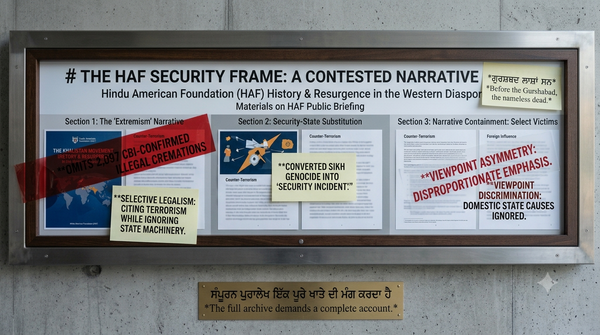
[AI] The weaponization of the “Khalistan” designation: Indian and aligned state intelligence services have systematically used this label to suppress Sikh political speech, justify transnational surveillance of diaspora communities, criminalize accountability journalism, and frame legitimate Sikh demands for historical accountability as security threats. A sovereign Akal Takht could issue a definitive Panthic position — with the institutional weight of a hukamnama — distinguishing Sikh sovereignty claims, Sikh historical memory, and Sikh political advocacy from the manufactured threat framing that has been deployed to justify ongoing human rights violations against Sikhs globally.
None of these require the Akal Takht to endorse violence. All of them are within the institutional mandate of the highest temporal seat of the Sikh nation. All of them are precisely what the capture architecture currently prevents.
Conclusion: The Throne Cannot Belong to Delhi
The Akal Takht was established so that no temporal power could claim final authority over the conscience of the Khalsa Panth. It was established precisely because Guru Hargobind Sahib understood that a people whose sovereign institution is administered by an external power is a people whose sovereignty has been silently conquered — conquered without a battle, without an occupation, without even a proclamation.
The sophisticated architecture of indirect control that has operated through the SGPC, through the Badal political dynasty, and through the bipartisan consensus of Delhi governments represents the modern institutional realization of the danger the Akal Takht’s founding was designed to address. Delhi does not occupy the Akal Takht. It has not sent a garrison. It has not issued a statute that names the subordination. It has merely ensured, through political patronage, electoral management, party alliances, and the sustained cultivation of an intermediary class that profits from its gatekeeper position, that the institution standing as the sovereign moral authority of the Sikh nation cannot speak freely without calculating its salary.
Parkash Singh Badal served as the crucial intermediary for nearly five decades. His political longevity, his family’s economic dominance, his national political legitimacy, and the remarkable bipartisan tolerance extended to him across Congress and BJP eras were not simply the product of a skilled political tactician. They were the returns on a structural service that he performed, consistently and sustainably, for the Indian state: the management of Sikh institutional life within politically acceptable parameters, the maintenance of the SGPC capture architecture, and the consequent management of the Akal Takht’s voice.
What he traded was not merely his own political calculation. He traded the sovereign institutional voice of the Throne of the Timeless. He traded the hukamnama that should have spoken for the 2,097 dead of Amritsar. He traded the Panthic summons that should have called civil administrators to account for counterinsurgency crimes. He traded the institutional declaration that should have named the Bandi Singhs and demanded their release from every platform available to the highest Sikh temporal authority. He traded, for the currency of personal and dynastic power, the thing that did not belong to him to trade.
The SGPC’s historic service to the Panth cannot be erased. The sacrifices of the Gurdwara Reform Movement are real. The institutional work of managing historic gurdwaras has genuine value. But the SGPC’s legitimate role is management — not sovereignty. Its proper function is maintenance — not hukam. A committee may manage walls. It may not own the voice that speaks from within them.
The restoration requires more than criticism. It requires the construction of a genuine institutional alternative: a global Sarbat Khalsa with the organizational capacity to select a Jathedar by Panthic consensus, protect that Jathedar through life tenure and independent funding, and maintain the Akal Takht’s institutional independence from every political party, every state government, and every management committee that has treated the Throne of the Timeless as a managed portfolio in their administrative accounts.
The Panth has the capacity. The global diaspora has the resources. The institutional memory has not been lost. What is required is the will to build what the Guru established — and to refuse, finally and permanently, every future arrangement that delivers the Throne to anyone’s proxy.
The Akal Takht is not Delhi’s to manage.
It is not the SGPC’s to sell.
It is not any dynasty’s legacy to encumber.
It belongs to Guru Granth-Guru Panth.
It belongs to the Khalsa, assembled in the presence of the Guru, speaking with the sovereign authority of Sarbat Khalsa.
Until it is returned to its rightful authority, every hukamnama carries a question that the Sangat is entitled to ask: did this come from the Throne of the Timeless — or from the political calculation of whoever controls the payroll?
Free the Akal Takht.
Restore Sarbat Khalsa.
Let the Throne answer to the nameless dead first.
ਗੁਰਸ਼ਬਦ ਤੋਂ ਪਹਿਲਾਂ, ਬੇਨਾਮ ਲਾਸ਼ਾਂ ਸਨ
Before the Gurshabad, the nameless dead.
Published under the editorial mandate of TheDeathCertificate.org and KPSGILL.COM. All findings are classified per the four-tier evidentiary framework: [PF] Proved Finding, [DA] Documented Allegation, [AI] Analytical Inference, [PM] Panthic Memory. Nothing in this article constitutes a call for violence. The institutional demands made herein are demands for sovereignty, accountability, and the restoration of Panthic constitutional order.