SECOND CHANCE TO RESCUE JASWANT SINGH KHALRA

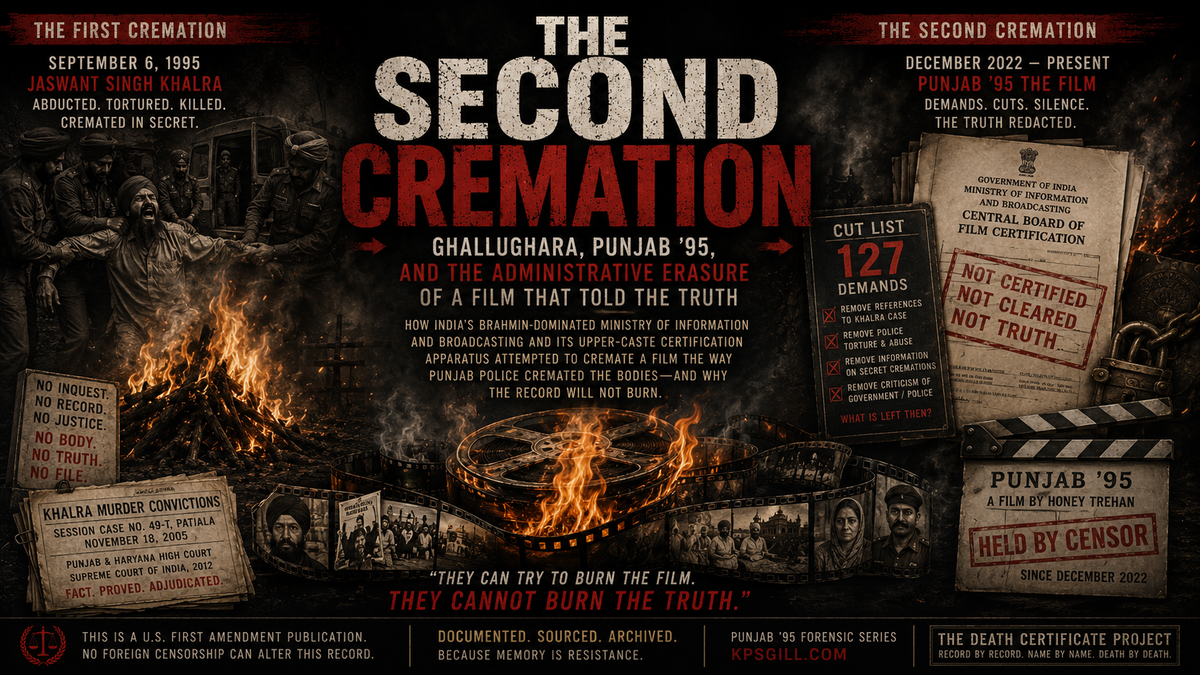
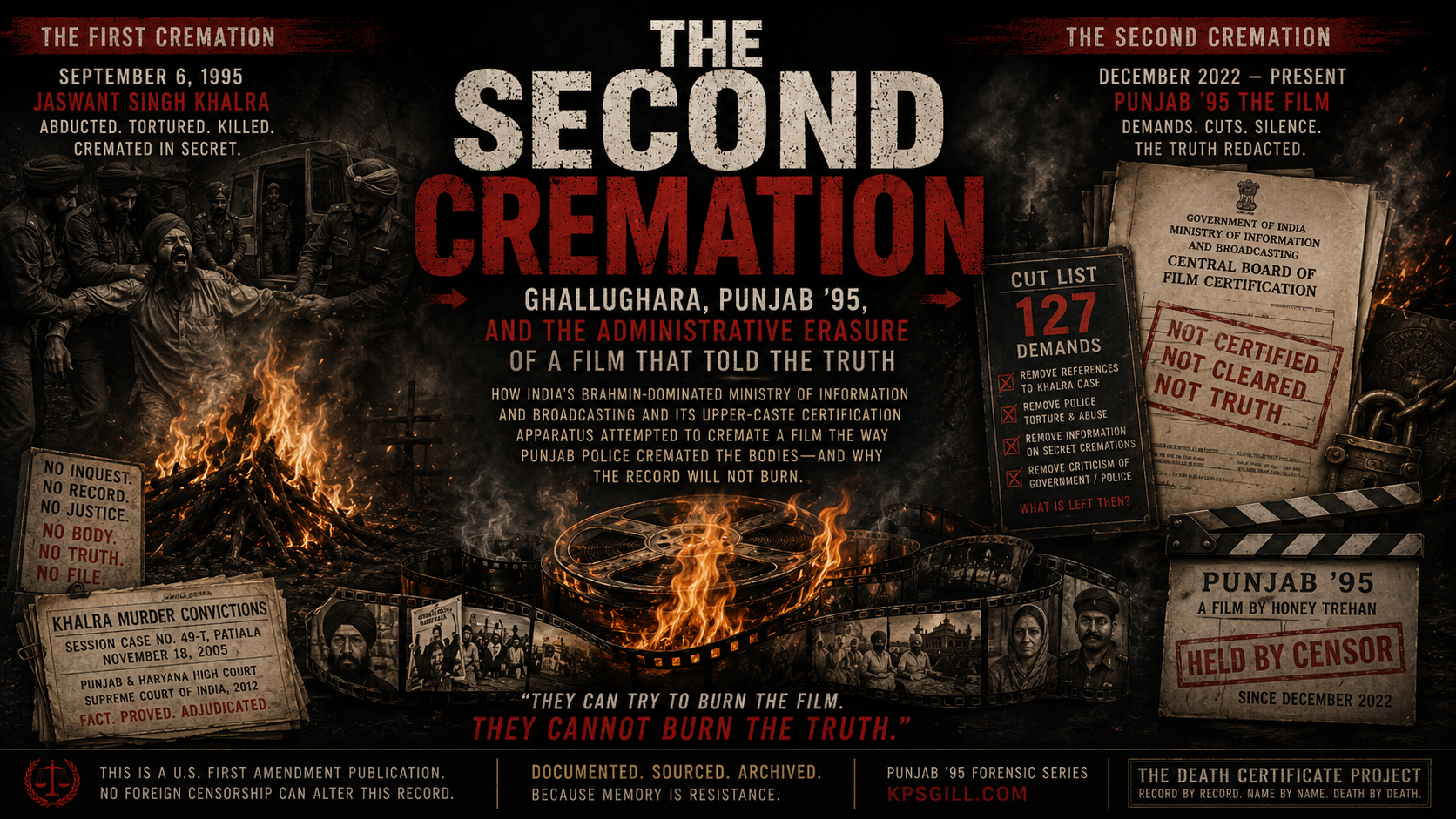
THE SECOND CHANCE before THE SECOND GOVERNMENT OF INDIA (CBFC) ENFORCED DISAPPEARANCE OF SIKH MEMORY
Ghallughara, Punjab '95, and the Administrative Erasure of a Film That Told the Truth
How India's Brahmin-Dominated Ministry of Information and Broadcasting and Its Upper-Caste Certification Apparatus Attempted to Cremate a Film the Way Punjab Police Cremated the Bodies — and Why the Record Will Not Burn
Dr. Kanwar Partap Singh Gill, M.D. Publisher and Editorial Director, KPSGILL.COM · Fresno, California, U.S.A. U.S. First Amendment Publication
EVIDENTIARY FRAMEWORK
[PF] Proved Finding — established through judicial records, CBI findings, NHRC proceedings, commission reports, Supreme Court orders, statutory text, official certification records, or director's direct on-record statements. [DA] Documented Allegation — serious, source-grounded claims not yet finally adjudicated. [AI] Analytical Inference — structural conclusions drawn from the cumulative logic of the documented record. [PM] Panthic Memory — the civilizational memory and moral record of the Sikh community.
I. THE METHOD IS THE SAME
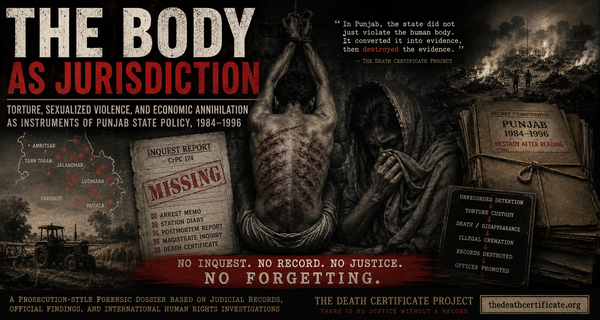
In September 1995, the Punjab Police abducted Jaswant Singh Khalra from outside his home in Guru Nanak Nagar, Amritsar. They held him in secret custody, killed him, and disposed of the body. The method they had refined over a decade was simple: remove the person from the public record, destroy the physical evidence, deny the act, and allow the silence to calcify into the administrative record as the permanent version of events.
In December 2022, the Central Board of Film Certification received a film about that abduction, that killing, and that disposal. The method the Board proceeded to apply over the following two and a half years was recognizably the same: remove the person from the public record, destroy the evidentiary specificity, deny the act, and allow the silence to calcify into the certification record as the permanent version of events.
[PF] Jaswant Singh Khalra was abducted on September 6, 1995. Six Punjab Police officers were convicted of his murder in Session Case No. 49-T before the Additional Sessions Judge, Patiala, on November 18, 2005. The convictions were upheld by the Punjab and Haryana High Court and affirmed by the Supreme Court of India in Prithipal Singh and Others v. State of Punjab (2012). His death is not alleged. It is adjudicated.
[PF] Punjab '95, a biographical film directed by Honey Trehan and starring Diljit Dosanjh as Jaswant Singh Khalra, was first submitted to the CBFC in December 2022. As of the date of this article, the film has not received a certificate for public exhibition in India. The CBFC's escalating demands — beginning at 21 cuts, growing to 85, and ultimately documented at 127 — have been described publicly by the director as structurally lethal to the film. "What is left then?" Trehan said at Cannes, in May 2025, after enumerating what the Board wanted removed. [PF] (Source: Honey Trehan, Cannes press interaction, June 2025; NDTV, Deadline, Bollywood Hungama, multiple outlets, June–September 2025)
Director Honey Trehan has gone further. In an interview with Kunal Kamra (September 2025), he disclosed — with a precision that no government institution has publicly contradicted — the four categories of demands the Board eventually consolidated its cuts into. In separate interviews with Just Too Filmy (September 2025), NDTV, WION, and others across June–September 2025, he elaborated the specific content of what the state wished removed from a film about judicially confirmed state violence.
What follows is a forensic accounting of both cremations: the physical one the state conducted against Khalra's body, and the administrative one it is now conducting against the film of his life.
II. THE CUT LIST: A FORENSIC INVENTORY OF WHAT THE STATE DEMANDS ERASED
The 127 cuts were not demanded simultaneously. They arrived in waves, each wave more structurally targeted than the last — a progression that itself constitutes evidence of administrative purpose rather than administrative caution. The following reconstruction draws on Honey Trehan's public statements across multiple interviews from June through September 2025.
The Escalation Chronology
[PF] December 2022: Punjab '95 submitted to the CBFC Examining Committee (EC). The EC asked the filmmakers to submit documents proving that the events depicted in the film actually occurred. Trehan and his team compiled and delivered a comprehensive evidence package — judicial proceedings, CBI findings, NHRC materials, human-rights documentation, Supreme Court orders. This was not a fictional film defending its imagination. This was a historical film defending its archive to a Board that required the archive to be proved to it. (Source: Honey Trehan, Kunal Kamra interview, September 2025)
[PF] First demand: 21 cuts. Trehan describes reluctantly agreeing to these in the belief that the film would then move to certification. "Shuru shuru mein maine mann maar ke 21 cuts kare, socha chalo picture nahi atkey" — in the beginning, reluctantly, I made 21 cuts, thinking the film shouldn't be stuck. (Source: Trehan, Deadline, June 2025; NDTV interview, July 2025)
[PF] Second stage: the cut list grew to approximately 85 cuts, as reported in Mid-Day and subsequently confirmed in multiple outlets, after the film's examining committee review escalated to a revising committee. (Source: Mid-Day, Latestly, June 2023)
[PF] Third stage: 127 cuts. By the time Trehan disclosed the full scope of CBFC demands at Cannes in May 2025 and to Kunal Kamra in September 2025, the list had reached 127 modifications — a number so extensive that the director stated the 127-cut version should carry neither his name nor Diljit Dosanjh's.
The Four Categories of Erasure
Trehan disclosed in his Kunal Kamra interview (September 2025) that the CBFC ultimately organized its demands into four consolidated categories. Each category is its own act of administrative surgery. Together, they constitute the full anatomy of the intended erasure.
CATEGORY ONE: Erase the Geography
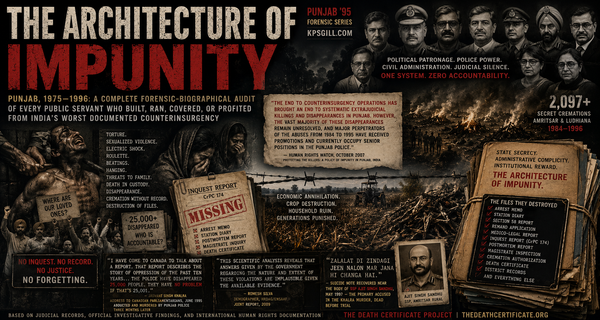
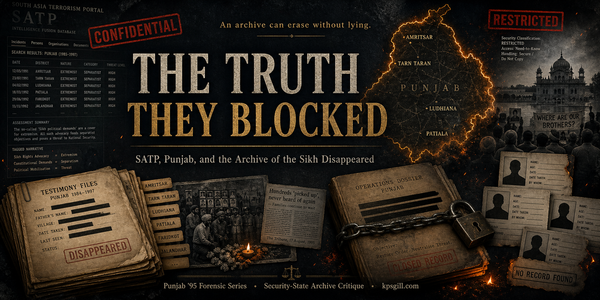
[PF] The Board demanded the removal of all references to the specific locations where the extrajudicial cremations were documented: Tarn Taran, Amritsar, and the cremation grounds — Durgiana Mandir, Patti, and Tarn Taran — at which the CBI later confirmed 2,097 illegal disposals. (Source: Trehan, Kunal Kamra interview, September 2025; ThePrint, July 2025; Bollywood Hungama, September 2025)
[PF] The Board demanded that "Punjab Police" be referred to only as "Police" — stripping the institutional identifier from the institution whose specific officers a Supreme Court-affirmed criminal proceeding has convicted. Trehan's public response to this demand was precise: "They are Punjabi cops wearing a turban, and they tell me to call them 'Police' and not 'Punjab Police'. Where is the logic?" (Source: Trehan, WION interview, July 2025)
[PF] The Board demanded the removal of "Punjab" from the film's title itself. The film, which was originally titled Ghallughara — a word whose significance is addressed below — had already been renamed Punjab '95 before CBFC submission. The Board then demanded that even this reduced form of geographic specificity be abandoned. The suggested alternative, referenced in multiple reports, was the title "Sutlej" — a river name carrying mood without accountability. (Source: Trehan, Deadline; multiple reports, June–July 2025)
[PF] The Board demanded the removal of the words "desh" (country), "centre," "system," and "extra-judicial killings" from the dialogue — any language that connected the violence depicted in the film to state authority at scale. (Source: Trehan, Kunal Kamra interview, September 2025; Bollywood Hungama, September 2025)
[PF] The Board demanded the axing of the film's opening scene. (Source: Trehan, Kunal Kamra interview, September 2025)
CATEGORY TWO: Erase the Investigator
[PF] The Board demanded that there should be no mention of Jaswant Singh Khalra — the film's protagonist, the murdered investigator whose abduction and death are established in criminal and Supreme Court proceedings — anywhere in the film. The filmmaker's own response to this demand, delivered publicly and repeatedly, has become the statement that best captures the structural absurdity of what is being demanded: "My film is about Jaswant Singh Khalra. But my film is about Jaswant Singh Khalra!" (Source: Trehan, Kunal Kamra interview, September 2025; NDTV, July 2025)
[AI] A biopic that cannot name its subject has not been edited. It has been vivisected. The CBFC was not demanding a modification of a cinematic work. It was demanding the disappearance of a man from a film about his disappearance.
CATEGORY THREE: Erase the Religious Texture
[PF] The Board demanded the removal of Gurbani — Sikh scriptural recitation — from the film. Gurbani is not background music in a film about a Sikh human-rights investigator. It is the communal and spiritual register through which the events are experienced, mourned, and morally located. To remove it is to flatten a community's testimony of its own suffering into a culturally depersonalized narrative. (Source: Trehan, Kunal Kamra interview, September 2025; Bollywood Hungama headline, September 2025)
[PF] The Board demanded the removal of visuals of the Indian flag from the film. (Source: Trehan, Cannes press statements, June 2025; Newsbytesapp, June 2025)
CATEGORY FOUR: Erase the Historical Record
[PF] The Board demanded the removal of the figure of 25,000 — the number of persons Khalra had documented as having disappeared in police custody across Punjab. This figure, while contested by the state, is the foundation of Khalra's investigation and was the basis for his advocacy before Indian and international bodies. (Source: ThePrint, July 2025; Newslaundry, June 2025)
[PF] The Board demanded the deletion of court-verified crime scenes — material that has been established in judicial proceedings and is therefore, in the strictest evidentiary sense, not filmmaker allegation but Republic of India record. (Source: ThePrint, July 2025)
[PF] The Board demanded the removal of a reference to Indira Gandhi in a contextual dialogue that situated the film's events in calendar time: "1995. Indira Gandhi ke assassination ko 11 saal ho chuke the" — 1995, eleven years have passed since Indira Gandhi's assassination. This is not a political characterization. It is a date. It is history's arithmetic. The CBFC demanded the arithmetic be removed. Trehan's public response: "There is a film called Emergency that has been made on her whole life, and I cannot even have one person take her name in the film?" (Source: Trehan, WION interview, July 2025; Bollywood Hungama, September 2025)
The Administrative Behavior That Surrounds the Cuts
The cuts are not the whole story. The administrative conduct accompanying them completes the picture.
[PF] A senior CBFC official asked Honey Trehan directly: "Itni zor se sach kaun bolta hai?" — Who speaks the truth so loudly? Trehan disclosed this exchange publicly in his September 2025 interview. This statement, from an official of the republic's film certification authority, in the context of a film about a judicially confirmed atrocity, is not a rhetorical quirk. It is an articulation of institutional preference: truth is acceptable when modulated, when softened, when depersonalized. Truth at volume — named, located, institutionally attributed, chronologically precise — is the problem. (Source: Trehan, Kunal Kamra interview, September 2025; Bollywood Hungama headline, September 2025)
[PF] A senior CBFC official suggested to producer Ronnie Screwvala that he should simply "write off this film." (Source: Trehan, Kunal Kamra interview, September 2025)
[PF] One CBFC official, on the record in Trehan's account, admitted that he was afraid to watch the original uncut version of the film in case he liked it. (Source: Trehan, Boxofficeworldwide.com, September 2025)
[PF] When the case eventually entered the Bombay High Court, the Board deployed a succession of advocates at Additional Solicitor General rank and above — not to engage with the specific cuts on the merits, but to argue general public-order concerns. A judge in those proceedings asked one of the Board's lawyers why he had appeared in the case if his supervising lawyer's retirement had been known a month in advance. The courtroom fell silent. (Source: Trehan, Kunal Kamra interview, September 2025; Bollywood Hungama, September 2025)
[PF] When the international release was announced for February 7, 2025 — with a trailer posted by both director and lead actor — it was pulled within three days. Director Trehan, in The Caravan's reporting (Jatinder Kaur Tur, 2025), stated that producer Ronnie Screwvala was summoned to New Delhi for an emergency meeting with Ministry of Information and Broadcasting officials during the final phase of the Bombay High Court proceedings. Screwvala called Trehan from that meeting. "He told me we have to do an out-of-court settlement. We cannot fight the government." (Source: Trehan to The Caravan, 2025) The announcement he gave to the press: "We are very sorry and it pains us to inform you that the movie Punjab '95 will not release on 7th February due to circumstances beyond our control."
There are no named officials in that statement. There are no reasons given. The film withdrew from the world without public explanation for the same reason that bodies were cremated at Durgiana Mandir without public explanation: the state acts, and the state does not identify itself.
III. THE ORIGINAL TITLE AND WHAT ITS DELETION MEANS
[PF] The film's original title was Ghallughara. It was renamed Punjab '95 before CBFC submission, and even this renamed version was later targeted by the Board's demand to remove "Punjab" from the title itself.
Ghallughara is not a neutral descriptive term. It is a word saturated with civilizational memory, a word that belongs to Sikh historiography with the same moral and historical weight that Shoah belongs to Jewish historiography, or Genoside to Armenian collective memory. The word names the great massacres of the Sikh Panth: the Chhota Ghallughara of 1746, when tens of thousands of Sikhs were killed in the forests of the Kahnuwan marshes; the Vadda Ghallughara of 1762, when Ahmad Shah Durrani's forces slaughtered between 20,000 and 30,000 Sikh men, women, and children near Kup Rahira. The word does not merely mean massacre. It names a specific type of civilizational assault — the attempt to destroy a people as a people.
That the director chose this title for a film about the documented mass disposal of Sikh bodies in Punjab in the 1980s and 1990s is not rhetorical excess. It is theological and historical precision. The word situates 2,097 confirmed illegal cremations in Amritsar district within the longer architecture of Sikh memory — within the civilizational continuity of a community that has been targeted for erasure and has survived through documentation, through witness, through the discipline of naming what was done.
[PF] Director Trehan addressed the title in his Just Too Filmy interview (September 2025): he explained that the word was chosen deliberately to locate the film within its proper historical and moral register. He noted that the demand to change the title was among the earliest and most persistent of the CBFC's interventions.
[PM] The deletion of Ghallughara from the title card of this film is not an aesthetic decision. It is a theological one — an act by the administrative apparatus of the Hindu upper-caste state to prevent the Sikh community from naming its own martyred dead in the language its own civilizational memory has developed for that purpose. You cannot remove Shoah from a Holocaust film and claim you have merely simplified the title. You have severed the film from the community whose grief it carries.
The demand to change "Ghallughara" to "Sutlej" — from the word for massacre to the name of a river — is the most compressed statement of what the entire 127-cut process is designed to achieve: transform accountability into geography, turn evidence into landscape, replace the investigator's name with a body of water, and allow the water to wash away what the archive cannot afford to forget.
IV. THE ARCHITECTURE OF THE CERTIFYING AUTHORITY
The CBFC does not exist in institutional isolation. To understand why the demands made of Punjab '95 take the form they do, one must understand the social and political architecture of the institution making them.
The Appointment Structure
[PF] The CBFC Chairperson is appointed by the Central Government — specifically the Ministry of Information and Broadcasting. Board members are appointed by the Central Government. Regional officers and advisory panel members are nominated by the Central Government. The guidelines under which the Board operates are issued under Section 5B(2) of the Cinematograph Act, 1952, by the Central Government. The CBFC is, in its institutional structure, an executive-appointed body operating executive-issued guidelines administered by executive-appointed personnel. It is not an independent regulatory authority. It is a statutory arm of the Ministry, dressed in the procedural language of a certification regime. (Source: CBFC official institutional self-description; Cinematograph Act, 1952, Sections 5B, 6)
[PF] The current Ministry of Information and Broadcasting is held by Ashwini Vaishnaw, a member of the Bharatiya Janata Party Cabinet. The Ministry's relationship to the content that reaches Indian screens is not merely regulatory: it is the apex supervisory authority of the three-tier OTT content governance system under the Information Technology Rules 2021, empowered to direct the modification or suppression of streaming content at ministerial discretion. (Source: IT Rules 2021, Rules 11–14)
The Social Composition of the Administrative Class That Operates These Instruments
What follows draws on the evidentiary record assembled in the companion article "The Steel Frame's Shadow" (kpsgill.com, 2026), and is stated here in compressed form with its evidentiary tags maintained.
[PF] Academic research on the Indian Administrative Service's social composition documents the structural persistence of upper-caste dominance at the commanding tier. In the 1950s and 1960s, Brahmins occupied approximately forty percent of IAS seats while constituting less than six percent of the national population. Santosh Goyal's study of 3,235 Hindu IAS officers found that the single largest caste group was Brahmin at 37.6 percent; Kayasthas followed at 13.3 percent; these two traditional literate castes together constituted approximately 51 percent of Hindu officers surveyed. Upper castes as a whole accounted for 68 percent of total Hindu officers. (Source: Santosh Goyal, as cited in SAMAJ/OpenEdition Journals, 2008; Subramaniam, V.S., Social Background of India's Administrators, 1971)
[PF] Parliamentary data tabled in August 2023 showed that of 87 Secretaries in central government ministries, only four — 4.8 percent — were from Scheduled Caste or Scheduled Tribe categories, against a constitutionally mandated combined quota of 22.5 percent. ThePrint's RTI-based investigation in 2019 found that of 89 Secretaries in the central government, only one was from the Scheduled Castes, three from the Scheduled Tribes, and zero from the Other Backward Classes. (Source: Standing Committee on Welfare of Scheduled Castes and Scheduled Tribes, Lok Sabha, August 2023; ThePrint, August 5, 2019)
[PF] The RSS — the founding ideological parent organization of the BJP — was founded in 1925 by predominantly upper-caste Maharashtrian Brahmins. Christophe Jaffrelot's analysis of the RSS's founding noted that the Brahminical ethic of the organization was "probably the main reason why it failed to attract support from the low castes." The organization's publication Organiser opposed the Mandal Commission's OBC reservation recommendations in 1990. (Source: Jaffrelot, The Hindu Nationalist Movement and Indian Politics, 1996; India's Silent Revolution, 2003; Encyclopaedia Britannica, 'Rashtriya Swayamsevak Sangh,' updated March 2026)
[PF] Since at least 1986, the RSS-associated civil services coaching institute Samkalp Foundation has operated with the stated objective of placing RSS-aligned aspirants within the UPSC-recruited civil service — with the explicit motivation, according to ThePrint's 2020 investigation, of ensuring "the bureaucracy is rid of its Leftist bent gradually." (Source: ThePrint, September 16, 2020)
[AI] The CBFC that is demanding the removal of Jaswant Singh Khalra's name from a film about his murder is staffed, at its appointing authority tier, by the commanding class of an administrative apparatus whose social composition and institutional genealogy this archive has documented at length. The Board is not requiring proof of its ideology in order for its institutional behavior to be structurally analyzable. It is producing the behavioral output of a class that has historically managed the administrative record to protect institutional reputation, and it is doing so now against a film whose central act is the act of reading the administrative record against institutional reputation.
V. THE COMPARATIVE LEDGER: WHAT THE CBFC CERTIFIES WITHOUT FRICTION
The asymmetry of the certification regime becomes visible only in comparative light. The following is a forensic inventory of films that moved through the CBFC's certification apparatus with minimal institutional friction — films whose political valence, institutional implications, and historical claims were accommodated, facilitated, and in several instances actively amplified by the same administrative ecosystem that has subjected Punjab '95 to 127 demanded cuts across two and a half years.
The Kashmir Files (2022)
[PF] The Kashmir Files, directed by Vivek Agnihotri, received an 'A' certificate from the CBFC and was released in March 2022. The film depicts the 1990 exodus of Kashmiri Pandits with graphic violence. It received no comparable volume of CBFC demands for cuts, no demand to rename its protagonist community, no demand to strip references to the named political actors responsible, and no demand to remove the geographic precision of the title. Prime Minister Narendra Modi praised the film publicly. BJP-governed states — Uttar Pradesh, Gujarat, Madhya Pradesh, Odisha — declared the film tax-free. BJP party units organized and subsidized screenings to expand its audience. The film was screened in Parliament's Balyogi Auditorium for the Prime Minister, Home Minister, and Cabinet. (Source: Wikipedia, The Kashmir Files; Al Jazeera, March 2024; ThePrint, March 2022)
[AI] The contrast is not between the reality or gravity of Kashmiri Pandit suffering and the reality or gravity of Sikh suffering in Punjab. Both suffered. Both deserve documentary representation. The contrast is institutional: a film whose historical attribution pointed toward non-state actors and Muslim militants received state facilitation. A film whose historical attribution points toward a named state police force, confirmed in criminal proceedings, received 127 demanded cuts. The certifying authority's behavior tracks the direction of attribution, not the magnitude of suffering.
The Kerala Story (2023)
[PF] The Kerala Story, directed by Sudipto Sen, was certified and released in May 2023. The film claimed that 32,000 women from Kerala had been abducted by and converted to Islam to join ISIS — a figure widely documented as factually unsupported, revised in the film to three women following legal challenge. It crossed ₹200 crore at the box office. It was praised by Prime Minister Modi. BJP-governed states extended tax exemptions. The CBFC did not demand that the film prove the accuracy of its central numerical claim before certification, did not demand the removal of geographic identifiers, did not demand the renaming of named religious communities. (Source: Al Jazeera, March 2024; ThePrint, multiple; Wikipedia, The Kerala Story)
The same CBFC body that demanded Honey Trehan produce documentary proof that Jaswant Singh Khalra existed — a man whose murder is confirmed by the Supreme Court of India — certified a film whose central factual premise was documented by multiple press and research organizations to be false.
Article 370 (2024)
[PF] Article 370, directed by Aditya Dhar and released in February 2024, dramatizes the Modi government's 2019 abrogation of Jammu and Kashmir's special constitutional status. The film depicts political figures from the Peoples Democratic Party and National Conference — Mehbooba Mufti and Omar Abdullah by political implication if not explicit naming — as power-hungry separatism-enablers. Prime Minister Modi praised the film publicly and in Parliament before its release. It grossed approximately ₹50 crore in its first week. No CBFC demand required the film to change the title, rename its protagonist political institution, or remove the geographic precision of its central constitutional reference. (Source: Al Jazeera, March 2024; ThePrint, Bastar to Article 370, March 2025)
The Sabarmati Report (2024)
[PF] The Sabarmati Report, released November 2024, revisits the 2002 Godhra train fire — an event directly connected to the political career of Prime Minister Modi as Gujarat Chief Minister. The film was screened in the Balyogi Auditorium in Parliament for the Prime Minister, Home Minister, and Cabinet. It was declared tax-free in Uttar Pradesh, Gujarat, Madhya Pradesh, and Odisha. The CBFC did not demand the removal of the geographic identifier, the political figures implicated, or the documentary claims of the narrative. (Source: The Wire, January 2025; ThePrint, March 2025)
Emergency (2024–2025)
[PF] Emergency, directed by and starring Kangana Ranaut, is a biographical film about Prime Minister Indira Gandhi and the Emergency of 1975–77. The CBFC did not demand the removal of Indira Gandhi's name from this film — a biographical film whose entire premise is the tenure of Indira Gandhi. The same CBFC apparatus that demanded Honey Trehan remove a passing reference to "Indira Gandhi ke assassination ko 11 saal" in a contextual dialogue permitted an entire biographical feature constructed around Indira Gandhi to circulate without equivalent demands. (Source: Trehan, WION interview, July 2025; multiple reports on Emergency certification)
The Accidental Prime Minister (2019)
[PF] The Accidental Prime Minister, directed by Vijay Gutte and released in January 2019, depicted serving Congress politicians — Manmohan Singh, Sonia Gandhi, and others — as manipulative power-brokers, drawing on a memoir by former media advisor Sanjaya Baru. The film was released on the eve of the 2019 general election. The CBFC certified it without demanding the removal of named living political figures, without demanding the renaming of named political parties, and without demanding the removal of geographic and institutional precision. (Source: Al Jazeera, March 2024 retrospective; multiple reports)
Dhurandhar / Dhurandhar 2 (2026)
[PF] Dhurandhar 2, featuring a Sikh character — a turbaned covert operative named Jaskirat Singh Rangi — received an 'A' certificate from the CBFC in March 2026 after commercially conventional edits: profanity, graphic violence levels, subtitle corrections, and permissions documentation for references to the Prime Minister and news footage. No demand was made to rename the Sikh protagonist. No demand was made to strip the Sikh character of his turban or his community identity. No demand was made to remove the film's institutional setting. The film was certified with no report of demands equivalent to those imposed on Punjab '95. (Source: Multiple entertainment reports, March 2026)
The contrast the two films present is the most precise statement of the Villainy Gap this archive has identified: a Sikh character who carries a rifle in service of the Indian covert state passes through the certification apparatus efficiently and commercially. A Sikh man who carried a ledger against the Indian covert state cannot get his name into the film about his own murder.
VI. THE VILLAINY GAP: SYSTEMATIC, NOT COINCIDENTAL
[AI] What the comparative ledger establishes is not that the CBFC hates Sikhs. It establishes something structurally more precise and constitutionally more dangerous: the CBFC, as presently administered, applies differential institutional weight to Sikh identity depending on its political function in the narrative.
The certifiable Sikh is the Sikh who serves the state's preferred self-image: the turbaned commando, the martial patriot, the spectacular body of nationalist cinema. The tolerable Sikh is the Sikh who functions as menace or antagonist — whose villainy confirms the state's preferred account of the threat it faces, thereby justifying the counterinsurgency apparatus that produced the 2,097 cremations in the first place. The erased Sikh is the Sikh as witness — the investigator who reads the cremation registers, the director who dramatizes the reading, the audience that would watch it and understand what the registers meant.
[AI] This is not a reading imposed on the record. It is the reading the record produces. The same body that certified The Kerala Story on the basis of a claim subsequently documented to be fabricated, demanded that Honey Trehan prove through official documentation that Jaswant Singh Khalra existed, that he was abducted, and that illegal cremations occurred — events established in criminal proceedings and Supreme Court orders. The standard of evidentiary proof is not applied consistently. It is applied selectively, and the selection tracks the direction in which the film's accountability logic points.
When the accountability points outward — toward Muslim communities, toward Pakistan, toward Kashmiri separatists, toward Sikh militants — the certification regime is accommodating, often enthusiastic, and frequently subsidized by state resources. When the accountability points inward — toward the Punjab Police, toward the administrative apparatus of Amritsar district, toward the cremation grounds of Durgiana Mandir and Tarn Taran — the certification regime becomes an institution of administrative defense.
[AI] The CBFC's question — "Itni zor se sach kaun bolta hai?" — is the question of an institution that has never been required to answer for what it protects. It is the question of a class that has historically converted administrative power into the authority to determine what counts as truth and how loudly truth may be spoken. Who speaks the truth so loudly? The answer, in Sikh historical memory, has always been: the witness who cannot afford silence, because silence is the administrative precondition of the crime.
VII. THE FOUR-POINT DEMOLITION: A STRUCTURAL ANALYSIS
Honey Trehan's disclosure of the four consolidated categories of CBFC demands — made in his September 2025 Kunal Kamra interview — is the most forensically valuable document in the public record of this censorship proceeding. It reveals not merely what was demanded but the structural logic by which the demands were organized. The four categories are not a random list. They are a systematic targeting of the four elements that make a historical accountability narrative historically accountable.
Category One — Erase the Crime Scene: Remove Tarn Taran, Amritsar, the cremation grounds. Remove the geographic coordinates. Without coordinates, the crime is nowhere. Without nowhere, there is no there, no district, no administrative jurisdiction, no office of the Deputy Commissioner and District Magistrate whose statutory oversight obligations are directly implicated. The geography is not atmosphere. It is jurisdiction. Remove the jurisdiction, and the accountability question has no address.
Category Two — Erase the Investigator: Remove Jaswant Singh Khalra's name. Without the investigator, there is no chain between the registers and the public record. The cremation grounds remain, but the man who read them is gone. The evidence survives, but the witness who surfaced it is disappeared — administratively, exactly as he was disappeared physically in 1995. The second disappearance replicates the first.
Category Three — Erase the Communal Register: Remove the Gurbani. Without the Gurbani, the film no longer belongs to the community whose dead it documents. The suffering is depersonalized, deracinated, made available for absorption into a generic narrative of state-managed tragedy. Gurbani grounds the film in Sikh civilizational experience. Remove it, and the film becomes a crime procedural about unnamed victims administered by unnamed institutions in unnamed places — which is, of course, exactly what the state would prefer.
Category Four — Erase the Institutional Culprit: Remove "Punjab Police," substitute "Police." Remove "desh," "centre," "system," "extra-judicial killings." Remove the institutional vocabulary that connects individual officers to command structures, command structures to administrative hierarchies, and administrative hierarchies to the civil authority — the Deputy Commissioner, the District Magistrate — whose statutory oversight duties this archive has documented at length. Without the institutional culprit, there is crime but no criminal, suffering but no perpetrating structure, history but no accountability.
[AI] Together, these four categories do not leave a modified film. They leave a ghost — a narrative drained of its evidentiary blood, its geographic bones, its communal soul, and its institutional spine. What remains after the 127 cuts would be, in Honey Trehan's own words, "nothing but a trailer." A trailer for a film that can never be shown, about events that must not be named, in a district that must not be located, by an investigator who must not exist.
This is not film certification. It is administrative annihilation. It is the cremation of the record in a different medium.
VIII. THE CONSTITUTIONAL ARCHITECTURE OF THE CENSORSHIP
The censorship of Punjab '95 is not merely a political scandal. It is a constitutional problem, addressed by existing Supreme Court doctrine that the CBFC has simply declined to apply.
[PF] In S. Rangarajan v. P. Jagjivan Ram (1989) 2 SCC 574, the Supreme Court of India established that the standard for restricting a film on public-order grounds requires a proximate and direct nexus between the specific content at issue and a real, not speculative, threat to civic order. The Court stated: the institution of law cannot bow down before the frown of intolerance. Speculative administrative apprehension is constitutionally insufficient.
[AI] The CBFC's lawyers in the Bombay High Court proceedings did not engage with the specific cuts on the merits. They argued general public-order concerns. This is the precise mode of reasoning that Rangarajan prohibits. A film that names "Punjab Police" in the context of a criminal conviction involving Punjab Police officers is not inciting public disorder. It is attributing established institutional liability to a named institution. Administrative discomfort with that attribution is not public order. It is institutional reputation management, and Rangarajan expressly prohibits the former from being dressed in the vocabulary of the latter.
[PF] In Bobby Art International v. Om Pal Singh Hoon (1996) 4 SCC 1 — the Bandit Queen case — the Supreme Court upheld certification of a film dealing with graphic violence, sexual exploitation, and institutional complicity on the ground that serious subject matter does not lose constitutional protection merely because it is disturbing or implicates powerful actors. The test is whether the film serves a legitimate communicative or social purpose. A film about a murdered investigator whose death has been confirmed by criminal conviction and whose investigation has been confirmed by Supreme Court-described mass human-rights violation serves that test with force that Bandit Queen arguably does not exceed.
[PF] In K.A. Abbas v. Union of India (1970) 2 SCC 780, the Supreme Court upheld the constitutionality of pre-censorship while simultaneously establishing that the certification power must be exercised against clear, objective, and reviewable criteria. The Abbas requirement is clear: not vague, not elastic, not available as an administrative convenience. The CBFC's demands — to remove a passing reference to a historical date because it mentions a Prime Minister's name, to substitute "Police" for "Punjab Police" in defiance of the criminal record — cannot be traced to any clear statutory criterion under Section 5B. They cannot be reviewed on their merits because the CBFC has not provided written, statute-linked justification for each demand. They do not satisfy the Abbas standard.
[AI] The constitutional conclusion is therefore not complex. It is the application of three existing Supreme Court precedents to a documented institutional fact pattern. The CBFC, as administered in the case of Punjab '95, has exercised the certification power in a manner that fails the Rangarajan proportionality test, the Bobby Art purpose test, and the Abbas reviewability test. The three tests together constitute what this archive's companion article "The Villainy Gap" has called the Corrective Framework — the minimum constitutional standard that the existing jurisprudence already requires, applied to a pattern of institutional behavior that the public record has now documented in sufficient detail to sustain adversarial testing.
IX. THE TEXTBOOK, THE STREAMING PLATFORM, AND THE TOTAL SYSTEM
Punjab '95 does not stand alone. It is one instrument in a complete administrative system of memory management — one in which the CBFC operates at the theatrical gate, Section 69A operates at the network layer, the NCERT curriculum operates at the generational formation layer, and media alignment operates at the narrative amplification layer. Understanding this is essential to understanding why the Punjab '95 fight is not simply a dispute about one film.
[PF] The NCERT's 2022–2025 rationalization exercise deleted from school textbooks the passages dealing with the 2002 Gujarat riots, the Emergency chapter's treatment of the anti-Sikh riots of November 1984, Mughal history, caste discrimination, and democratic social movements. The anti-Sikh riots of 1984 — an event directly connected to the atmosphere of the Punjab militancy period that Punjab '95 chronicles — were removed from the classroom. (Source: NCERT Rationalisation Note, June 2022; The News Minute, August 2025; multiple sources documented in "The Steel Frame's Shadow," kpsgill.com, 2026)
[PF] The IT Rules 2021 have placed OTT platforms under a three-tier regulatory framework with the Ministry of Information and Broadcasting at the apex — producing a documented chilling effect on streaming content decisions, with platform compliance officers now calibrating content to "government expectations" rather than journalistic or artistic standards. (Source: Newslaundry, October 24, 2024; IT Rules 2021, Rules 11–14)
[AI] The film about Khalra does not need to be formally banned from streaming. It needs only for each platform, in succession, to determine that the compliance cost — the grievance filings, the regulatory notices, the possible ministerial attention — exceeds the value of hosting it. That determination will be made by the compliance team, not the creative team, and it will be made before any formal order arrives. The archive is not destroyed. It is simply never assembled at scale.
[AI] The CBFC's 127 cuts and the NCERT deletion of the anti-Sikh riots passage from the Emergency chapter are not administrative decisions made in separate buildings by separate actors pursuing separate purposes. They are entries in the same ledger. The textbook deletion ensures the next generation will not possess the analytical vocabulary to be disturbed by the film censorship. The film censorship ensures the generation after that will not have the emotional and forensic anchor of documented testimony. Together, they constitute a temporal strategy of managed forgetting: remove the interpretive context first, suppress the evidence next, and ensure the memory of both is never formed.
X. THE FAMILY HAS NOT CONSENTED — AND IT DOES NOT MATTER
[PF] Punjab '95 was made with the consent and active participation of Paramjit Kaur Khalra, the widow of Jaswant Singh Khalra, and with Khalra's family's consent. Honey Trehan has confirmed this publicly across multiple interviews. (Source: Trehan, multiple interviews, 2025; Inshorts, July 2025)
The significance of this fact is not merely emotional. It is constitutional and evidentiary. The person with the highest legal and moral standing to authorize or object to the depiction of Jaswant Singh Khalra's life has authorized it. The person who carried his case to the Supreme Court of India, whose petition produced the CBI investigation that confirmed 2,097 illegal cremations, whose advocacy established the judicial record that the CBFC now refuses to permit a filmmaker to dramatize — that person said yes.
The CBFC said: remove him anyway.
[PM] When the state demands that a murdered man's name be removed from a film made with his family's consent, about events confirmed by his widow's Supreme Court petition, in defiance of criminal convictions arising from his killing — the state is not exercising a regulatory power. It is continuing an act of violence. The first act of violence removed Khalra's body from the streets of Amritsar. The second act removes his name from the screens of India. The instrument differs. The intention — erasure of the witness — is the same.
XI. THE WORDS OF THE DIRECTOR, ASSEMBLED AS EVIDENCE
The following is a compressed but attributed inventory of Honey Trehan's public statements across interviews from June 2025 through September 2025, organized as the evidentiary record they constitute.
[PF] On the CBFC's fundamental purpose: "CBFC has been given extra powers which are misused. The CBFC's real job should be to certify films, not to control the narrative." (NDTV, July 2025)
[PF] On the removal of his name from the film: "It's not my film then, it's CBFC's film." (NDTV, July 2025) "I told Ronnie Screwvala that the 127-cut version should neither have my name nor Diljit Dosanjh's." (Kunal Kamra interview, September 2025)
[PF] On the removal of Punjab Police as an institutional name: "They are Punjabi cops wearing a turban, and they tell me to call them 'Police' and not 'Punjab Police'. Where is the logic?" (WION, July 2025)
[PF] On the Indira Gandhi demand, in direct comparison: "There is a film called Emergency that has been made on her whole life, and I can't even have one person take her name in the film?" (WION, July 2025)
[PF] On what the film's certification would mean: "If I do not stand by myself, I have no right to make a movie on such a matter. Jaswant Singh Khalra — Punjab '95 is about his life. He fought for 25,000 unclaimed bodies, and extrajudicial killings of people. Without knowing who those people are. I have made a film on that guy's life. And I cannot even stand by that person." (Indian Eye / NDTV, July 2025)
[PF] On the moral meaning of the censorship: "Khalra has been part of my childhood, the story of my land. I feel like he has been abducted again now, with his story being censored." (Newslaundry / South Central, June 2025)
[PF] On the institution responsible: "CBFC is a back-door for the government to control the film world." (Article 14, June 2025; Deadline, June 2025)
[PF] On what remains after the 127 cuts: "If you can't express through your art, where is the democracy? I have no words." (Inshorts / Newsbytesapp, July 2025)
[PF] On the question the CBFC official asked him: "Itni zor se sach kaun bolta hai?" — Who speaks the truth so loudly? The official asked this as a challenge, perhaps as a rebuke. Trehan has disclosed it as testimony. (Kunal Kamra interview, September 2025; Bollywood Hungama headline, September 2025)
[PF] On the suggestion to write the film off: A senior CBFC official suggested to producer Ronnie Screwvala that the film be written off as a financial loss. (Kunal Kamra interview, September 2025)
[PF] On the Cannes response: The film screened privately at Cannes 2025 to an audience that, in the director's account, experienced it with the force the state has been working to prevent. (Trehan, Cannes press interaction, June 2025; multiple reports)
These statements, taken together, constitute a director's sworn testimony — not in a courtroom, but in the public record, which is where truth survives when courts are not available. They are [PF] as statements the director made, and they carry [DA] weight for the specific institutional conduct they describe. No government body has produced contrary evidence to any of these accounts. The CBFC has not publicly rebutted Trehan's characterization of any specific demand. The Ministry of Information and Broadcasting has not published the written justifications for the 127 cuts. The opacity that surrounds the proceedings is itself part of the indictment.
XII. THE BJP LEADER WHO NAMED THE CONTRADICTION
[PF] In October 2025, a BJP leader wrote formally to CBFC Chairperson Prasoon Joshi urging the clearance of Punjab '95. In his letter, the BJP leader cited The Kashmir Files, The Kerala Story, and The Sabarmati Report as examples of films allowed to reach audiences without equivalent obstruction, and argued: "If narrative freedom is respected for those accounts, then a film rooted in judicial evidence cannot be treated differently." He pointed out that the film draws entirely from judicial records and court proceedings, including CBI findings. He stated: "By preventing the release of Punjab '95, the CBFC is unintentionally reinforcing the silence once imposed by that same apparatus." (Source: ThePrint, October 27, 2025)
[AI] That a member of the party whose government administers the CBFC has identified the same asymmetry this archive has documented — and has named it in the same comparative terms — confirms that the Villainy Gap is not a partisan perception. It is a pattern visible to sufficiently attentive observers across political lines. The BJP leader's letter does not resolve the pattern. It confirms it from within the governing apparatus. The pattern is not contested. It is structural.
XIII. THE RECORD THAT WILL NOT BURN
In 1994 and 1995, Jaswant Singh Khalra went to the cremation grounds of Amritsar district and read the registers. He did not need classified documents. He needed the state's own paperwork — the ledgers of fuel procurement, cremation ground registrations, and the municipal documentation of administrative disposal. He found, in those ledgers, the seams the state had left in its rush to make 2,097 human beings disappear. He surfaced the seams. He named what they meant. He was killed for it.
The CBI confirmed the 2,097. The Supreme Court described the findings as a flagrant violation of human rights on a mass scale. Six police officers were convicted. The record entered the Republic's own legal archive. It cannot be unwritten by any administrative proceeding.
In December 2022, Honey Trehan submitted to the CBFC a film that dramatizes the act of reading those registers. The CBFC proceeded to demand, over two and a half years and 127 cuts, the removal of the investigator's name, the crime scene's geography, the institutional culprit's identity, the religious community's own sound, the court-verified evidence, and the historical arithmetic of the timeline. The state demanded that the film about reading the registers stop pointing at the registers.
[PM] The Sikh Panth has survived several Ghallugharas. It has survived them through the discipline of witness — the insistence on naming the dead, recording the crime, and transmitting the record to the next generation regardless of the administrative preference of the destroying power. Khalra nahi mita — Khalra is not erased. Six police officers sit in the record of the Supreme Court. The CBI's December 9, 1996 report — sealed though portions remain — sits in the NHRC archive. Paramjit Kaur Khalra's petition sits in the Supreme Court record. The municipal cremation registers of Tarn Taran, Durgiana Mandir, and Patti — the registers Khalra read — sit in whatever archive the state has not yet destroyed.
[AI] What the CBFC is attempting to perform is not censorship in the ordinary sense. It is the administrative extension of the original act of erasure. The Punjab Police erased Khalra's body. The CBFC is attempting to erase his name from the film of his body's erasure. Both acts proceed from the same institutional instinct: that the administrative record of the state is the property of the state, and that those who would read it against the state's preferred silence must be made to disappear — first physically, then cinematically, then generationally, through textbooks that have been revised to remove the context that would make the film legible to the children who might one day watch it.
The method is the same. The instruments differ. The record does not cooperate.
XIV. CONCLUSION: THE SECOND CREMATION AND ITS FAILURE
The first cremation was physical. Punjab Police officers held Jaswant Singh Khalra in secret custody, killed him, and disposed of his body. Six of those officers were convicted. His name entered the Supreme Court record. His widow carried his case to the highest constitutional court in the Republic. The cremation failed. The record survived him.
The second cremation is administrative. The Central Board of Film Certification — a statutory arm of a Ministry staffed at the commanding tier by the upper-caste administrative class this archive has documented, operating under a government whose founding ideological parent opposed the only policy framework designed to redistribute that class's institutional dominance — has demanded 127 modifications to a film whose subject is the failure of the first cremation. The modifications targeted the investigator's name, the crime scene's geography, the institution's identity, the community's sacred sound, the court-confirmed numbers, and the film's own title — the word Ghallughara, which the Sikh community has used for centuries to name what it means when a state attempts to make its people disappear.
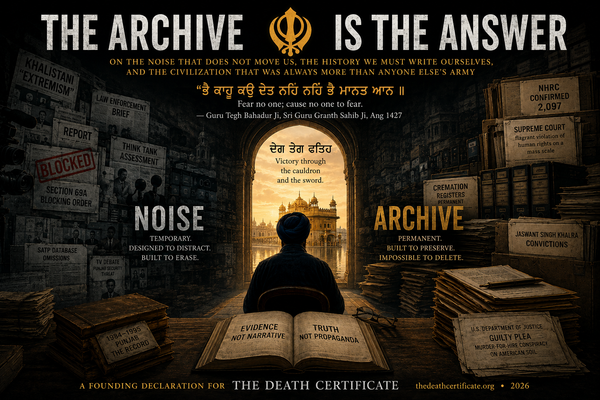
This too is failing. Honey Trehan has refused to accept the 127-cut version. Diljit Dosanjh has refused to allow his name on it. The Cannes audience has seen the uncut film. The public record of the CBFC's demands — including the official's question, "Itni zor se sach kaun bolta hai?" — is now part of the archive of the censorship itself. The documents, the interviews, the judicial precedents, the comparative ledger of facilitated and obstructed films: all of it is now in the public domain, where the state cannot file a Section 69A order against the cumulative weight of it.
[PF] The CBFC demanded 127 cuts. [PF] The FCAT was abolished in 2021, leaving no independent administrative tribunal. [PF] The Ministry of Information and Broadcasting summoned the producer to Delhi before the international release. [PF] The international release did not happen. [PF] The film has still not been certified. [PF] The film's director has publicly disowned the 127-cut version. [PF] The film's lead actor has publicly disowned the 127-cut version. [PF] The Cannes audience has seen what India's mass audience has been prohibited from seeing.
[PM] Jaswant Singh Khalra went to the cremation grounds first. He read the registers. He named the unidentified. He turned administrative inconvenience into judicial record. The CBFC's demand that his name be removed from the film of his life is the administrative class's most recent entry in its long effort to do to the celluloid record what the Punjab Police failed to do permanently to the paper one.
The film is not dead. The record is not closed.
The second cremation has not succeeded. And the archive — judicial, cinematographic, and civilizational — stands.
ਵਾਹਿਗੁਰੂ ਜੀ ਕਾ ਖਾਲਸਾ, ਵਾਹਿਗੁਰੂ ਜੀ ਕੀ ਫ਼ਤਹਿ
ਸ਼ਬਦ ਤੋਂ ਪਹਿਲਾਂ, ਸ਼ਮਸ਼ਾਨਘਾਟ
SOURCES AND EVIDENTIARY ANCHORS
Director's Public Testimony (Primary Sources)
Honey Trehan, interview with Kunal Kamra, September 2025. [Primary disclosure of four-category structure of CBFC demands; "Itni zor se sach"; "write off this film"; escalation from 21 to 127 cuts.]
Honey Trehan, Just Too Filmy interview, September 5, 2025. [Full interview on CBFC censorship battle, original title Ghallughara, non-negotiables, the Cannes response, Centre appeal.]
Honey Trehan, NDTV interview, July 2025. "It's not my film then, it's CBFC's film."
Honey Trehan, WION interview, July 2025. Comparison with Emergency; "Punjab Police" vs. "Police" absurdity.
Honey Trehan, Cannes press interaction, June 2025. 127 cuts disclosed; "What is left then?"
Honey Trehan, as quoted in Article 14 / Deadline, June 2025. "CBFC has been given extra powers which are misused."
Honey Trehan, as quoted in The Caravan (Jatinder Kaur Tur), 2025. Ministerial summons of producer; "We cannot fight the government."
Honey Trehan, as quoted in Newslaundry / South Central, June 29, 2025. "I feel like he has been abducted again now, with his story being censored."
Journalism
Bollywood Hungama, September 7–8, 2025 (Fenil Seta). "From 21 to 127 — how CBFC's cut list for Panjab '95 increased over time." [Primary documentation of four CBFC demand categories.]
ThePrint, July 1, 2025. "127 cuts for Punjab '95 shows institutional paranoia." [Detailed cut inventory including Tarn Taran, Durgiana, Patti; 25,000 figure; court-verified crime scenes.]
ThePrint, October 27, 2025. BJP leader urges CBFC clearance citing The Kashmir Files, The Kerala Story, The Sabarmati Report.
Deadline (Hollywood), June 5, 2025. Honey Trehan on two-year censorship battle.
Newsbytesapp, June 2025 and September 7, 2025. CBFC afraid to watch uncut version; "CBFC wants to delete history."
WION, July 2025. Director's interview.
Live India, July 13, 2025. 127 cuts including removal of "Punjab" from title, Indira Gandhi.
News24online, July 13, 2025. "If you can't express through your art, where is the democracy?"
Judicial and Official Records
Supreme Court of India, Paramjit Kaur v. State of Punjab (December 12, 1996). [Remittance to NHRC; Court-ordered CBI investigation.]
Supreme Court of India, Prithipal Singh and Others v. State of Punjab (2012). [Affirmation of convictions of six Punjab Police officers for Khalra's murder.]
Additional Sessions Judge, Patiala, Session Case No. 49-T, November 18, 2005. [Six convictions: DSP Satnam Singh, DSP Jaspal Singh, Inspector Surjit Singh, Inspector Jaswant Singh, Sub-Inspector Kulwant Singh Khera, Head Constable Prithipal Singh.]
CBI Report, December 9, 1996. [2,097 illegal cremations confirmed at three cremation grounds: Durgiana Mandir, Patti, Tarn Taran.]
NHRC Annual Report 2007–08. ["Flagrant violations of human rights on a mass scale."]
S. Rangarajan v. P. Jagjivan Ram (1989) 2 SCC 574. ["The institution of law cannot bow down before the frown of intolerance."]
Bobby Art International v. Om Pal Singh Hoon (1996) 4 SCC 1. [Serious subject matter does not lose constitutional protection where the film serves a legitimate social purpose.]
K.A. Abbas v. Union of India (1970) 2 SCC 780. [Certification power must be exercised against clear, objective, and reviewable criteria.]
Cinematograph Act, 1952. Sections 5B, 6.
Tribunals Reform (Rationalisation and Conditions of Service) Ordinance, 2021. [Abolition of FCAT.]
IT (Intermediary Guidelines and Digital Media Ethics Code) Rules, 2021.
Comparative Film Certification Record
The Kashmir Files (2022): CBFC 'A' certificate; multiple states declared tax-free; PM Modi praised publicly. [Wikipedia; Al Jazeera, March 2024; ThePrint.]
The Kerala Story (2023): Certified; PM Modi praised; BJP tax exemptions. [Al Jazeera; ThePrint; multiple.]
Article 370 (2024): Certified; PM Modi praised in Parliament. [Al Jazeera; ThePrint.]
The Sabarmati Report (2024): Screened in Parliament; multiple states tax-free. [The Wire; ThePrint.]
Emergency (2024–25): Biographical film on Indira Gandhi; certified. [Trehan interview WION comparison.]
The Accidental Prime Minister (2019): Depicting named serving politicians; certified. [Al Jazeera retrospective; multiple.]
Dhurandhar 2 (2026): Turbaned Sikh commando protagonist; 'A' certificate after commercial edits. [Multiple entertainment reports, March 2026.]
Institutional Composition
ThePrint, August 5, 2019. "Of 89 Secretaries in Modi Govt, There Are Just 3 STs, 1 Dalit and No OBCs."
Standing Committee on Welfare of Scheduled Castes and Scheduled Tribes, Report on DoPT's Role in Reservation Policy, Lok Sabha, August 2023.
Santosh Goyal, 'Social Background of Officers in the Indian Administrative Service,' as cited in SAMAJ/OpenEdition Journals, 2008.
Subramaniam, V.S., Social Background of India's Administrators, New Delhi, 1971.
Jaffrelot, Christophe, The Hindu Nationalist Movement and Indian Politics, Hurst, 1996.
Jaffrelot, Christophe, India's Silent Revolution, Columbia University Press, 2003.
ThePrint, September 16, 2020. RSS-backed Samkalp Foundation civil services coaching.
Encyclopaedia Britannica, 'Rashtriya Swayamsevak Sangh,' updated March 2026.
Freedom House, Freedom on the Net India Report 2024. [Section 69A blocking statistics.]
RSF, World Press Freedom Index 2025. India rank 151/180; Ambani 70+ outlets; 130 billion rupees government advertising.
NCERT Rationalisation Note, June 2022; The News Minute, August 2025; Al Jazeera, April 2023. [Textbook deletions including anti-Sikh riots of 1984.]
Newslaundry, October 24, 2024. IT Rules chilling effect on OTT content.
Related Articles in This Archive
- Karan Bir Singh Sidhu IAS — The Triad of Silence anchor article — kpsgill.com/karan-bir-singh-sidhu
- The Civilian Shield: Punjab '95 and the Silence of KBS Sidhu — kpsgill.com/punjab-95-and-the-silence-of-kbs-sidhu
- The Villainy Gap: A Constitutional-Forensic Audit of Certification Asymmetry — kpsgill.com/administrative-censorship-in-dhurandhar-and-punjab-95
- The Steel Frame's Shadow — kpsgill.com/the-steel-frames-shadow
- Apar Singh Bajwa carried the bodies; Ramesh Inder Singh carried the office — kpsgill.com/apar-singh-bajwa-carried-the-bodies-ramesh-inder-singh-carried-the-office
- When Women Become Procedure — kpsgill.com/when-women-become-procedure
- The Archive Will Not Be Closed — kpsgill.com/the-archive-will-not-be-closed
© 2026 KPSGILL.COM — Dr. Kanwar Partap Singh Gill, M.D. — Fresno, California, U.S.A. — U.S. First Amendment Publication