THE NOBLE FATHER, THE WIDOWED MOTHER, AND THE MAGISTRATE'S SILENCE K.B.S. Sidhu's Father's Day Memoir and the Public Record of Amritsar's Dead, 1992–1996

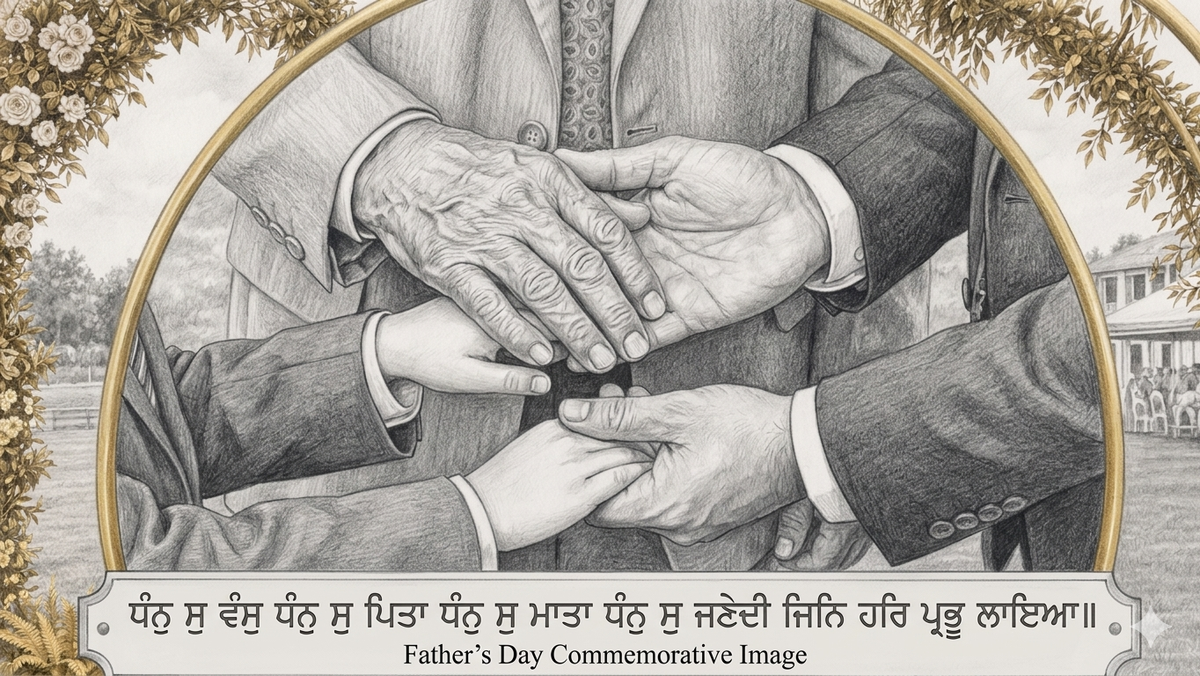
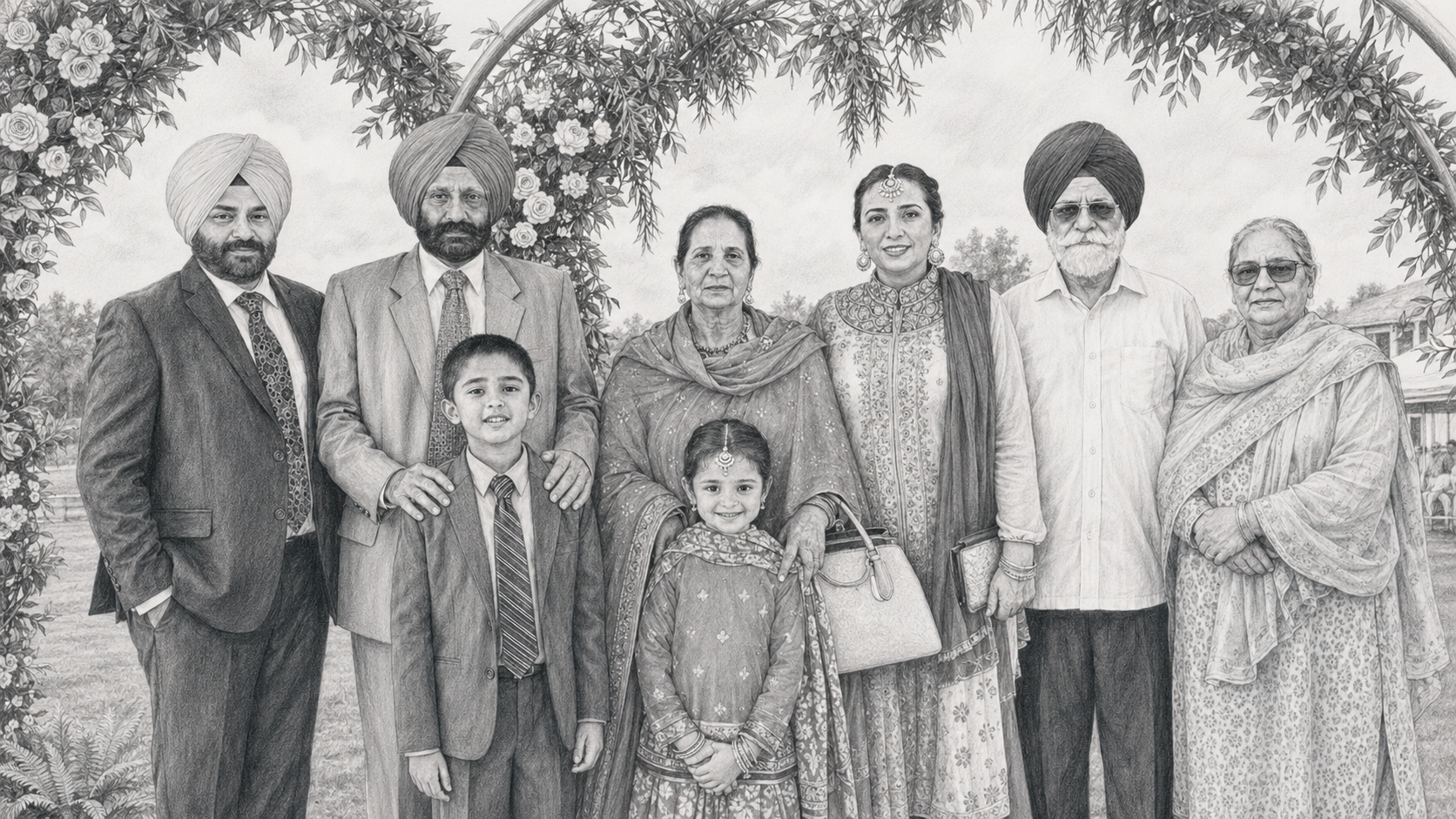
THE NOBLE FATHER THE WIDOWED MOTHER, AND THE MAGISTRATE'S SILENCE
K.B.S. Sidhu's Father's Day Memoir and the Public Record of Amritsar's Dead, 1992–1996
Punjab '84 Forensic Series | The Death Certificate Project
TheDeathCertificate.org | KPSGILL.COM
By Kanwar Partap Singh Gill, M.D.
ਗੁਰਸ਼ਬਦ ਤੋਂ ਪਹਿਲਾਂ, ਬੇਨਾਮ ਲਾਸ਼ਾਂ ਸਨ
Before the Gurshabad, the nameless dead.
Editorial Note
This is not an essay about a father, and it is not an essay about a mother. Sardar Gursharan Singh Sidhu, PCS, died in Gurdaspur in the early hours of January 30, 1972, before he turned forty, and nothing in this record disputes the dignity of that loss. His widow — by her son's own account still living, still "leading a contented life" — raised two children alone and is owed nothing but respect in these pages. Neither of them held public office under examination here.
What is under examination is an office: Deputy Commissioner and District Magistrate, Amritsar, held by Karanbir Singh Sidhu, IAS, from May 1992 to August 1996 — a tenure he has himself confirmed in multiple public writings. That office existed inside a four-year window in which the secret cremation of thousands of bodies in Amritsar district moved from rumour to municipal record to CBI inquiry to a Supreme Court finding of, in the Court's own words, "flagrant violation of human rights on a mass scale." This essay asks what the civil administration of that district did, and did not do, while that record was being made — using the statutory language of the Code of Criminal Procedure, not the language of accusation.
One further discipline governs everything that follows. The men who abducted, tortured, and killed Jaswant Singh Khalra in September and October 1995 have names, and a court has put them on record: six Punjab Police officials convicted in 2005, the convictions upheld on appeal in 2007 and by the Supreme Court in 2011; the case's primary accused, an SSP, died during trial. K.B.S. Sidhu is not among them, and nothing in the public record places him among them. This essay does not suggest otherwise, and it does not need to. The question it asks is older and, in a way, harder: not who killed Jaswant Singh Khalra, but what the civil magistracy of the district in which he was killed — the office statutorily charged with standing between police power and the citizen — recorded, ordered, audited, or asked, while a quarter of his investigative claims were being confirmed by the State's own investigators a few kilometres from the Deputy Commissioner's residence on Maqbool Road.
The father is not on trial. The mother is not on trial. The office is under examination.
I. The Memoir as Memory, Not Statecraft
On June 20, 2026 — Father's Day, and three days before what would have been his father's ninety-first birthday — K.B.S. Sidhu published "The Untold Story of a Noble Father" on his Substack, The KBS Chronicle. It is not an affidavit. It is not a deposition, a district file, or a reply to a public-records demand. It is a son's tribute, and it should be read first on its own terms.
Before the narrative proceeds, the service record itself should be stated with precision, since it is the documentary spine on which the rest of this essay rests. Gursharan Singh Sidhu was never a direct recruit to the Indian Administrative Service. He entered government service as a Tehsildar — a revenue-executive post he reached through a state-wide competitive examination, after his original ambition of practising before the Punjab High Court gave way to administrative service. From that grade he was promoted into the Punjab Civil Service (Executive Branch): the state cadre, distinct in law and in rank from the IAS, through which a defined share of IAS vacancies were, in that era, filled by promotion rather than direct recruitment. As a PCS officer he held postings across Rajpura, Bathinda, Malerkotla, Nabha, Patiala, and Gurdaspur; his record included the President's Medal for work during the 1961 Census and for civil defence duties in Malerkotla during the 1965 war, and a commendation from A.L. Fletcher, ICS, for flood-relief work on the Ghaggar. By his own son's account, he stood, at the time of his death in January 1972, on a credible promotion track from the PCS into the IAS — the same all-India service his son would enter directly, by competitive examination, eleven years later. The distinction is not a technicality: the father's career, however distinguished, was built and ended inside the state civil service, one promotion short of the cadre his son ultimately joined.
Those terms are unusually well-documented. Gursharan Singh Sidhu was born in 1932 into a Sidhu-Brar family of the former Nabha riyasat, the second of three children of Dr. Gurdial Singh — one of the earliest FRCS surgeons of the region, who served with the British Indian Army in Italy during the Second World War and was decorated for gallantry, and who later became Professor and Head of Surgery and Medical Superintendent at the Government Medical College-cum-Rajindra Hospital, Patiala. Gursharan was educated at Government Ripudaman College, Nabha, and Government Mohindra College, Patiala, before reading law at Delhi University, where — his son recalls — he excelled at sprints and throws and aspired to practise before the Punjab High Court. A state-wide competitive examination instead made him a Tehsildar. He married in 1958, served across Rajpura, Bathinda, Malerkotla, Nabha, and Gurdaspur, earned the President's Medal for his work in the 1961 Census and for civil defence duties during the 1965 war in Malerkotla, and — after his own father's sudden death in 1967 left him responsible for an extended household — absorbed those obligations "with stoicism" while continuing to rise through the revenue cadre. His relief work after the Ghaggar floods drew a commendation from A.L. Fletcher, ICS, by his son's account the most respected and feared Financial Commissioner (Revenue) in Punjab's administrative memory. He was, in 1972, a PCS officer on what his son describes as a credible track toward the IAS.
He chose a field posting in Gurdaspur for the 1971 war rather than a safer secretariat berth, coordinated civilian relief with the Army, and — in his son's words — entered "heavily mined villages" to ensure that government relief reached even the most remote habitations. He died in Gurdaspur in the early hours of January 30, 1972, leaving a thirty-five-year-old widow and two children, aged twelve and ten.
A serious archive gains nothing from pretending that public officers are produced by institutions alone. They are produced by households — by inherited expectation, professional lineage, family catastrophe, and the private mythology of a name like "Gursharan," chosen, the memoir tells us, by a doting grandmother. To understand a magistrate, one must first understand the child. So let the admission be made plainly, because it is true and because it costs the argument nothing: K.B.S. Sidhu was ten years old when his father's life ended in a mined border district he had refused to avoid. He was raised by a widow who, by every account available — including her son's, and including the fact that this project has no reason to doubt — met that catastrophe with extraordinary resolve. These are facts of formation, not instruments of absolution. They explain a man. They do not answer for an office.
II. The Father as an Ideal of Presence
What the memoir constructs, more than a eulogy, is a model of public service as exposure rather than shelter. Gursharan Singh Sidhu is remembered for choosing the mined village over the secretariat desk, the flood-relief column over the safer posting, the war-zone tehsil over the comfortable one. This is the inheritance his son explicitly claims: "He had wished for his son to become an IAS officer, and I am proud to say that I did not disappoint him." The memoir even records a dream that never materialized — father and son serving as Deputy Commissioners of adjacent Punjab districts — foreclosed only by the father's death.
That is a moving sentence, and a public one. The Indian Administrative Service is not a family trophy; it is the acquisition of coercive and magisterial state power. A private dream realized through a public office does not remain private at the moment of its realization. The father's ideal, on his son's own telling, was presence in danger — walking into the mined village rather than waiting for the file. The forensic question this generates is not rhetorical excess; it is simply the application of the son's own standard to the son's own record: when the dangerous place under his jurisdiction was not a flooded village but a cremation ground, was the office present, or was it elsewhere?
III. Recognition: The Foggy Morning
One scene in the memoir deserves to be read with full weight, once, and then set down rather than circled indefinitely. Sidhu recalls "that foggy winter morning when a senior officer from the Deputy Commissioner's office drove down" to Patiala to tell a ten-year-old boy and his mother that Gursharan Singh Sidhu was dead.
It is a devastating scene, and it is also, in the narrowest administrative sense, an example of the State performing its most basic civil duty: recognition. In January 1972, the State did not pretend that Gursharan Singh Sidhu had vanished. It did not leave his widow to search police stations for an explanation, or circulate a rumour that he had "absconded." The death had a date, a place, a cause, and an officer assigned to communicate it. The family was granted, in the middle of catastrophe, the comparatively rare mercy of certainty.
This is the single point at which the family memoir and the district record belong in the same essay — not because the mother's grief can be turned into a debating instrument against her son, which this project declines to do, but because the scene establishes, in the clearest possible terms, what minimal civil recognition of a death actually requires: a name, a date, a place, an officer, and a communication. That is the baseline. It is worth stating once, plainly, and then asking what happened to that baseline twenty years later, sixty miles away, in a district his son would come to govern.
IV. The Undelivered News of Amritsar
Across the same two decades, thousands of families in Amritsar district experienced a different administrative grammar entirely. No senior officer arrived at the door. Families seeking sons and husbands taken by police were met, according to the documentary record assembled by Human Rights Watch, Ensaaf, and the Committee for Information and Initiative on Punjab, with denial at the thana gate, with the suggestion that the missing man had "crossed the border" or joined the militancy, and in many cases with nothing at all — no body, no inquest, no certificate, no acknowledgment that a file existed.
Jaswant Singh Khalra's investigation, beginning in earnest in 1994–95, did not invent this pattern; it documented it from the State's own paper. Working from municipal cremation registers and firewood-purchase records at crematoria in Amritsar district, Khalra and his collaborators identified sharp, unexplained spikes in bodies logged as "unidentified" or "unclaimed," cross-matched against family complaints of disappearance the police would not register. In January 1995 he made his findings public and petitioned the Punjab and Haryana High Court for an independent inquiry.
The contrast is not rhetorical; it is documentary. A lawful death, however catastrophic, leaves a name, a date, and an officer at the door. A death processed as "unidentified" leaves an entry in a firewood ledger and a family that spends years not knowing whether to perform last rites. The first is grief. The second is what the Supreme Court would, within two years, call a flagrant violation of human rights on a mass scale.
V. Amritsar, 1992–1996: The District That Would Not Stay Quiet
K.B.S. Sidhu has himself confirmed, across multiple public writings — including his own recollection that his younger son was born in the Deputy Commissioner's official residence at 3, Maqbool Road — that he served as Deputy Commissioner and District Magistrate of Amritsar from May 1992 until August 1996. He has written of those years as ones in which he handled two aircraft hijackings at Raja Sansi airport with no casualties, earning a Prime Minister's commendation, and supervised the 1992 and 1993 elections that marked Punjab's return to civilian government after years of President's Rule.
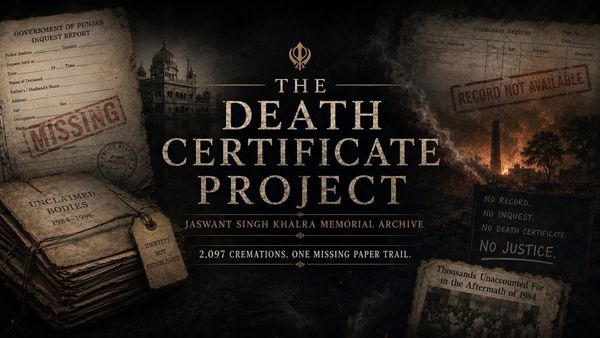
That same window — precisely that window — is the one in which Khalra's investigation went public (January 1995), in which Khalra himself was abducted from outside his Amritsar home and killed (September–October 1995), in which the Supreme Court directed the CBI to investigate both his disappearance and the cremation allegations (November 1995), and in which the CBI's report — confirming 2,097 illegal cremations at three cremation grounds in Amritsar district, of which 582 bodies were fully identified, 278 partially identified, and the remainder never identified at all — reached the Supreme Court, which on December 12, 1996, four months after Sidhu's tenure ended, found that the inquiry disclosed "flagrant violation of human rights on a mass scale" and referred the matter to the National Human Rights Commission.
This was not 1984. It was not the immediate, chaotic aftermath of Operation Blue Star, a period that belongs to a different administrative generation and a different inquiry. Sidhu's Amritsar was the district of exposure — the years in which what families had whispered for a decade became, for the first time, a documented, litigated, judicially acknowledged fact. The files spoke. The cremation grounds spoke. The firewood registers spoke. Khalra spoke, and was killed for it. The question this essay puts to the record is narrow and answerable: did the civil administration of the district speak with anything like the same clarity?
VI. The District Magistrate as Civil Hinge
The office of Deputy Commissioner and District Magistrate is not ornamental. Under the Code of Criminal Procedure, 1973, as it stood throughout Sidhu's tenure, the District Magistrate sat at a specific structural junction. Section 174 required the police, in cases of suicide, death by another, death by animal or machinery, accident, or any death occurring in circumstances raising a reasonable suspicion that some other person had committed an offence, to draw up an inquest report and, in specified categories, to forward it for magisterial attention. Section 176 empowered — and in certain circumstances required — a Magistrate to hold an independent inquiry into the cause of death, in addition to, or instead of, the police investigation.
The structural logic of these provisions did not depend on the post-2005 amendments that later strengthened the mandatory-judicial-inquiry requirement for custodial deaths; that strengthening came later and should not be read backward into 1992–96. What the earlier framework already embodied was a simpler and older principle: the police cannot be permitted to be the sole authors of the record of a death. The District Magistrate existed, among other things, as the civil counterweight to that monopoly — the office structurally positioned to ask whether a body labelled "unidentified" by the police had, in fact, been identified by anyone, and to demand an account of why not.
This is the thesis this archive has elsewhere called the Civilian Shield problem: that the apparatus of civil oversight built into the CrPC — inquest, magisterial inquiry, the chain of reporting from thana to Sub-Divisional Magistrate to District Magistrate — existed in law throughout this period, regardless of who held the chair, and the documentary question for any officer who held it during a period of mass irregular cremation is simply whether that apparatus functioned, was invoked, or was allowed to lapse.
VII. What the Record Proves, and What It Does Not
Evidentiary discipline requires this section to be stated with unusual precision, because it is the hinge on which the rest of the essay turns.
Proved. Six Punjab Police officials — Deputy Superintendents Jaspal Singh and Amarjit Singh, sentenced to life imprisonment, and four others sentenced to lesser terms — were convicted by an Additional District Judge in Patiala on November 18, 2005, of Khalra's abduction, murder, destruction of evidence, and criminal conspiracy. The Punjab and Haryana High Court upheld and enhanced five of those sentences to life imprisonment in 2007; the Supreme Court affirmed in November 2011. The case's primary named accused, SSP Ajit Singh Sandhu, died during the trial. The CBI's sealed report to the Supreme Court documented 2,097 illegal cremations at three Amritsar-district crematoria; Khalra's own, independently compiled figure for the district was considerably higher, in excess of 6,000 across 1984–1994 — a discrepancy this archive treats as a documented allegation rather than a proved fact, pending fuller reconciliation of the underlying registers.
Not proved, and not alleged here. Nothing in this record, and nothing this essay asserts, places K.B.S. Sidhu among the named perpetrators of Khalra's abduction or murder, or suggests that he personally ordered, participated in, or had advance knowledge of that crime. The adjudicated chain of responsibility runs through the Punjab Police chain of command, not through the civil magistracy. Anyone reading this essay as an accusation of personal involvement in that killing is reading it against its own express terms.
The open question. What the conviction record does not address — because it was never the question a criminal trial for abduction and murder is built to answer — is the separate, civil-administrative question of institutional oversight: whether the Deputy Commissioner's office, as the statutory recipient of CrPC inquest reporting and the body charged with magisterial inquiry into suspicious deaths, audited cremation registers, queried the unusual volume of "unidentified" entries, directed subordinate Executive Magistrates to conduct Section 176 inquiries into encounter deaths within its jurisdiction, or communicated concern upward to the Punjab Home Department as the documentary picture sharpened across 1994–1996. That is a question about a file, not about a murder. It is, on the present record, unanswered.
VIII. The Fallacy of Civic Aesthetics
Sidhu's defenders, and his own subsequent writing, point reasonably to genuine administrative achievement in this period: the two hijackings resolved without casualty, the relatively peaceful 1992 and 1993 elections that helped return Punjab to civilian rule after years of central administration, later civic and urban initiatives around the city's sacred core.
These are real accomplishments and can be assessed on their own terms. But a hijacking resolved without casualty does not answer a cremation register, and an election conducted peacefully does not stand in for an inquest. A district can be competently administered in the domains the administration chooses to prioritize while remaining silent in the domain it does not. The test of a District Magistrate's tenure in a district of mass irregular cremation is not only whether the visible, reportable functions of office were performed well — it is whether the statutory, less visible ones were performed at all.
IX. The Forensic Questions
These are not insults. They are the minimum questions a documentary record of this kind owes to history, addressed to an office rather than to a man, in the spirit the user's own evidentiary framework requires: proved fact, documented allegation, and open question kept rigorously separate.
On cremation registers. Did the Deputy Commissioner's office, at any point between 1992 and 1996, request, review, or reconcile cremation-ground records from the three crematoria later named in the CBI's report — Durgiana, Tarn Taran, and the third Amritsar-district site? Were the spikes in "unidentified" and "unclaimed" entries, which Khalra was independently able to detect from the same municipal paper trail, ever brought to the District Magistrate's attention through ordinary administrative channels?
On firewood accounts. Were municipal or police expenditures for the cremation of unidentified bodies — the very paper trail Khalra used to build his case — ever audited or queried by the district treasury or municipal oversight functions answerable to the Deputy Commissioner?
On Section 176 inquiries. Were subordinate Executive Magistrates directed, at any point during this tenure, to conduct independent inquiries under Section 176 CrPC into encounter deaths or unidentified bodies processed by the police? If such directions exist, the file should show them. If they do not exist, the absence is itself a fact worth recording.
On missing-persons reconciliation. Did the district administration maintain any mechanism for cross-matching missing-person complaints — which families were, by extensive testimony, frequently unable even to get registered at the thana level — against cremation-ground entries for the same period?
On correspondence upward. Is there a documented communication from the Deputy Commissioner's office to the Punjab Home Department, the Chief Secretary, or the Director General of Police, flagging the scale of unidentified cremations as it became apparent through 1994 and 1995?
On the Khalra file specifically. What, if anything, did the district civil administration record about Khalra's January 1995 public disclosures, his subsequent High Court petition, or his September 1995 disappearance — as a matter of public order and law and order falling within the Deputy Commissioner's general jurisdiction, independent of the separate criminal investigation that the Punjab Police chain of command was itself implicated in?
On the CBI/NHRC interface. When the Supreme Court's investigation began moving in late 1995 and 1996, what records, if any, were requested from or transmitted by the Amritsar district administration, and were cremation registers under its nominal civil jurisdiction preserved against the risk of tampering during this period?
If files answering these questions exist, producing them closes the inquiry. If they do not exist, that absence is not proof of wrongdoing — silence rarely is, on its own — but in a district where the police chain of command has already been judicially established to have authored mass irregular cremation and a documented assassination, an empty file from the civil oversight office is itself part of the historical record, not a neutral fact outside it.
X. Silence as Administrative Fact
Silence in an archive is not, by itself, evidence of guilt. But neither is it nothing. A missing inquest order, a missing correspondence file, a missing audit of municipal firewood accounts — each is either evidence that the relevant statutory function was not exercised, or evidence that records of its exercise were not preserved. Both possibilities are matters of public, institutional concern, independent of any individual's intent.
This is the precise and limited sense in which this essay treats "the magistrate's silence" as a historical category rather than a rhetorical flourish: not as an accusation that K.B.S. Sidhu concealed a crime he had no adjudicated role in, but as an open finding that the statutory civil-oversight apparatus built into the CrPC for exactly this scenario has left, on the public record currently available to this project, no documented trace of having functioned in Amritsar district during the four years in which the scenario it existed to prevent was unfolding in plain documentary view.
XI. The Mother Is Not the Shield — and Needs No Defense to Remain So
It is worth returning, briefly and for the last time, to the memoir's most affecting line: "I owe everything to her." There is no reason to doubt it, and no reason this project should ever be read as doubting it.
But the line also clarifies, by simple extension, what the State owes the families it failed to recognize. A mother who is told, with certainty, that her husband is dead can grieve, however unbearably, inside the architecture of law: she can inherit, she can perform rites, she can raise her children inside a story with a confirmed ending. A mother who is told nothing — who is handed a rumour that her son crossed the border, or simply turned away at a police-station gate — is denied that architecture entirely. The difference between those two mothers is not the depth of their loss. It is whether the State performed, for one and withheld from the other, the single minimal act this memoir itself shows to be the baseline of civil decency: telling the truth, on the record, to the family of the dead.
That comparison does not require turning a living, private woman into a debating point against her son, and this essay declines to do so. It requires only noticing that the memoir, read honestly, supplies its own standard — and that the standard, once stated, applies to every family in the district, not only to the one that produced a future Deputy Commissioner.
XII. Conclusion: The Memoir Ends in Gratitude. The Archive Cannot.
K.B.S. Sidhu's memoir of his father should not be dismissed; it should be read with the seriousness it asks for. It is the record of a child formed by sudden loss, raised by a mother of evident fortitude, who became, by his own account, the public officer his father had hoped for. None of that is in dispute, and none of it is diminished by what follows.
What follows is simply this: the same man inherited, two decades later, an office built by statute to stand between police power and the citizen, in the one district of Punjab where that statutory function was most urgently needed and — on the documentary record this essay has set out, proved fact kept carefully apart from open question — has left the least visible trace of having been exercised. The convictions secured in the Khalra case show, with judicial finality, who pulled the trigger and who gave the order. They do not show, because they were never asked to show, whether the civil magistracy of the district did its statutory work of inquest, audit, and report while the evidence accumulated in plain sight.
That is the question this archive leaves open, and the question it believes K.B.S. Sidhu — who has written so carefully about what his own father's office meant to him — is best placed to answer, with files rather than further memoir.
Source Anchors
K.B.S. Sidhu, "The Untold Story of a Noble Father," The KBS Chronicle (Substack), published June 20, 2026 — verified directly, including the account of Dr. Gurdial Singh's FRCS and wartime service, Gursharan Singh Sidhu's career and January 30, 1972 death in Gurdaspur, the thirty-five-year-old widow and two children aged twelve and ten, the officer who delivered the news, and the statements "I owe everything to her" and "I did not disappoint him."
Sidhu's tenure as Deputy Commissioner and District Magistrate, Amritsar, May 1992–August 1996, confirmed independently across his own public writings, including his recollection of residence at 3, Maqbool Road, and multiple subsequent published bylines describing the same dates.
Jaswant Singh Khalra: abducted September 6, 1995; killed in October 1995. Six Punjab Police officials convicted November 18, 2005 (Patiala Additional District Court); five convictions enhanced to life imprisonment by the Punjab & Haryana High Court, October 2007; convictions upheld by the Supreme Court of India, November 2011. (Ensaaf; Human Rights Watch, Protecting the Killers: A Policy of Impunity in Punjab; SikhNet.)
Supreme Court of India, order of December 12, 1996, in proceedings arising from Paramjit Kaur v. State of Punjab, characterizing the CBI's findings as a "flagrant violation of human rights on a mass scale" and referring the matter to the National Human Rights Commission. CBI report: 2,097 illegal cremations identified at three Amritsar-district crematoria, of which 582 fully identified and 278 partially identified. (Human Rights Watch; Outlook India; National Human Rights Commission case record.)
Code of Criminal Procedure, 1973, Sections 174 and 176, as in force during the relevant period, prior to subsequent amendment strengthening custodial-death inquiry requirements.
ਗੁਰਸ਼ਬਦ ਤੋਂ ਪਹਿਲਾਂ, ਬੇਨਾਮ ਲਾਸ਼ਾਂ ਸਨ
Before the Gurshabad, the nameless dead.