Sevadar, Not Sovereign. Miri-Piri, the Misl Precedent, and the Doctrine of Panthic Jurisdiction in the Satkar Act Crisis of 2026

A note on method. What follows distinguishes, as far as the record allows, between proved findings — facts fixed by statute, judicial holding, or converging contemporaneous documentation; documented history — episodes attested across multiple independent accounts, occasionally varying in detail; and doctrinal argument — the constitutional and theological reasoning built upon that record. Sikh memory of the Misl and Ranjit Singh periods is preserved more fully in Panthic tradition, chronicle, and oral transmission than in contemporaneous state archives; this essay says so plainly, rather than dressing tradition in the borrowed authority of the archive it does not possess. Where the historical record shows the Akal Takht's own authority interrupted, captured, or diminished — and it does, more than once — that fact is stated rather than smoothed over, because a doctrine that survives its own weak points is worth more than one that pretends it had none.
I. The Question Restated
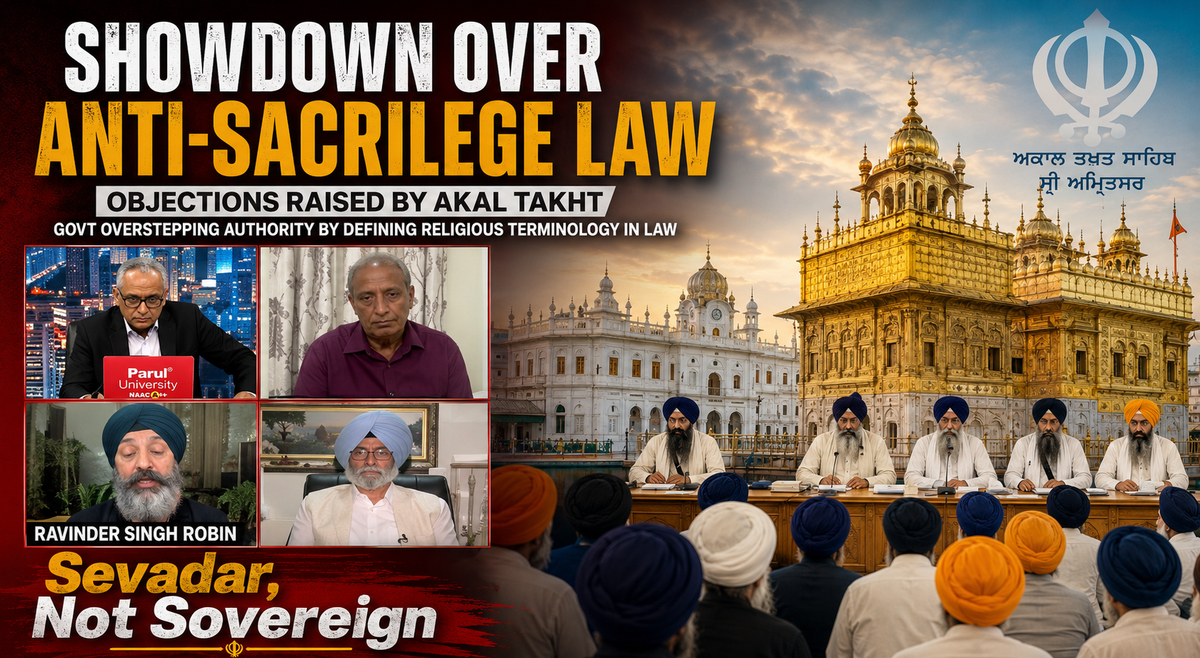
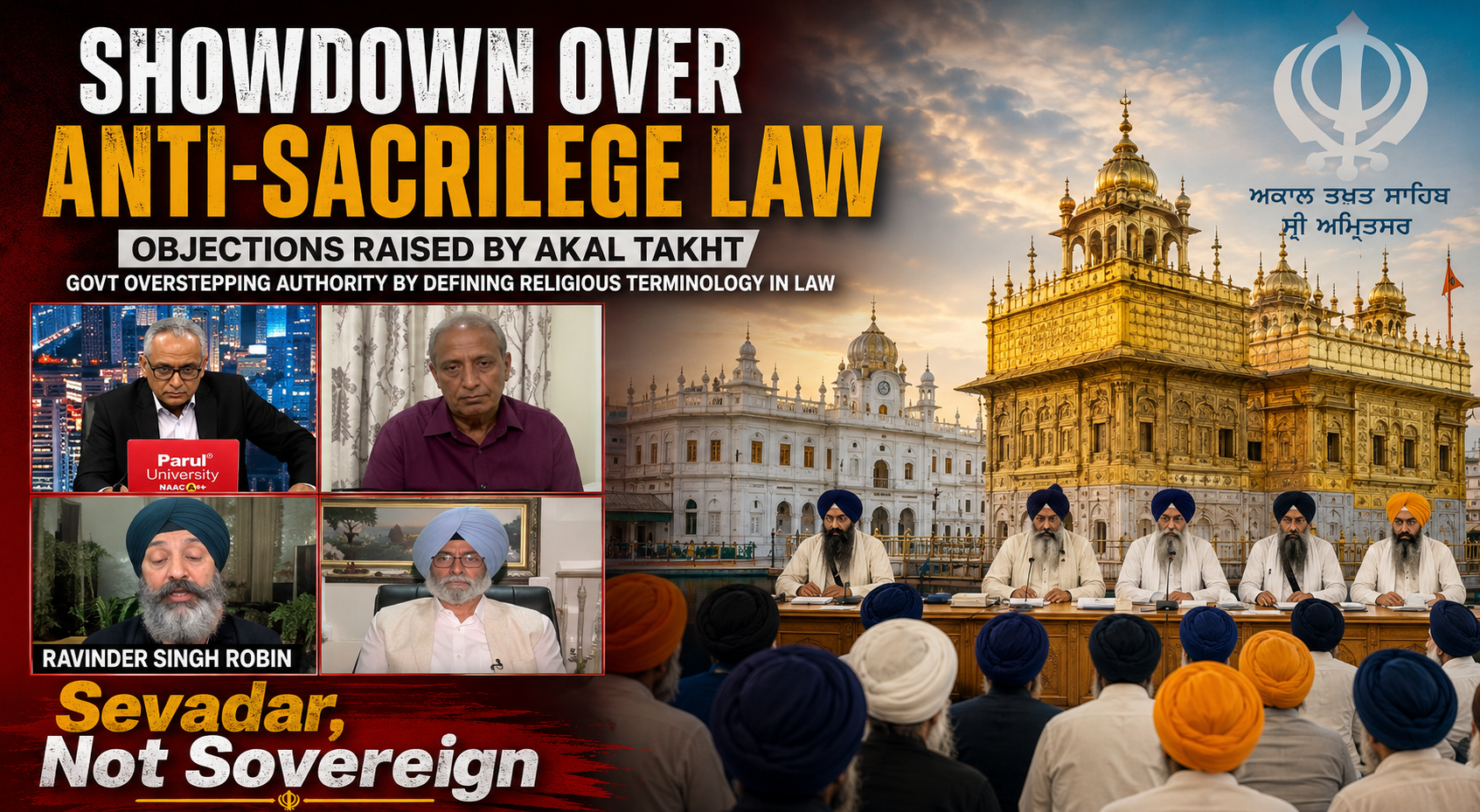
On 29 June 2026, at the Secretariat of Sri Akal Takht Sahib, something happened for which Indian constitutional commentary has no ready category. Eighty-seven members of the Punjab Legislative Assembly — ministers and opposition MLAs alike, cutting across the Aam Aadmi Party, the Shiromani Akali Dal, the Congress, and the BJP — appeared before five Singh Sahibs to explain themselves. They were not summoned by a court. They held no writ, faced no indictment, risked no arrest. And yet they came, sat for nearly two hours, listened, and — in the Jathedar's own account of the proceeding afterward — accepted that a mistake had been made and agreed to correct it within one month.
The provocation was the Jaagat Jot Sri Guru Granth Sahib Satkar (Amendment) Act, 2026. It is worth pausing on where and when the Assembly chose to pass it: not in the ordinary Chandigarh secretariat, but in a special session convened at Sri Anandpur Sahib, on Vaisakhi, 13 April 2026 — the precise site and the precise calendar date on which, in 1699, Guru Gobind Singh created the Khalsa and inaugurated the doctrine, discussed at length in Section IV below, that Panthic authority is thereafter held jointly by the Guru Granth and the Guru Panth. The choice of venue was almost certainly intended to borrow the symbolic weight of that founding moment. What it could not borrow was the founding procedure — the doctrine says the Panth's authority runs through discerned collective consent, not through a party-whipped unanimous vote of a state legislature meeting, however reverently, on hallowed ground. A government can sit at Anandpur Sahib. It cannot, by sitting there, become the Sarbat Khalsa.
The Act itself, notified on 20 April after Governor's assent, converted a modest 2008 regulatory statute — restricting the printing and distribution of the Guru Granth Sahib to authorised bodies, chiefly the SGPC — into a full penal code. Reporting on the final, graded structure of the punishment provisions varies somewhat in its particulars, reflecting an unusually fast-moving legislative process; the most consistent account, drawn from multiple outlets and from the Assembly's own gazette notification, is that the amendment created a tiered regime: sacrilege committed through criminal conspiracy with intent to disrupt peace or communal harmony carries a sentence extending to life imprisonment and a fine reported variously between five and twenty-five lakh rupees; sacrilege without that conspiratorial element carries a term extending up to twenty years with a somewhat lower fine band; lesser offences, attempts, and abetment carry terms of three to five years. On this punitive core, the Akal Takht raised no objection whatsoever; it explicitly welcomed strong punishment for desecration, and in one of its formal objections went further than the government itself, urging that any Dera chief whose followers commit desecration under conspiracy should face independent FIR liability.
The Akal Takht's objection was narrower and, for that reason, sharper. It concerned eleven itemised problems, communicated formally to the Assembly on 29 June, of which the most consequential were these: that the legislation had been drafted and passed with no consultation whatsoever with the Akal Takht or the SGPC — the only body statutorily authorised to print the scripture; that the amendment substituted the term Bir with the term Saroop in the operative text; that it created a statutory category of "custodian" attaching to whoever holds a Saroop; that it mandated a central SGPC-maintained register recording unique identification numbers, dates and places of storage, and the identity of each custodian; and that this register was to be made accessible in a manner the Takht warned could expose devout Sikh households to identification and targeting.
The commentary that followed — much of it organised around the headline framing "Is Akal Takht above the Constitution?" — answers a question no serious Sikh institution has asked. The Akal Takht did not purport to strike down the Act, override the Governor's assent, or substitute itself for the Punjab and Haryana High Court. It asserted something narrower and, doctrinally, far more defensible: that inside a specific and bounded domain — the vocabulary of the Guru, the definition of Satkar, the internal discipline of Maryada — the Punjab Assembly does not hold original jurisdiction, because on four centuries of Panthic practice it never held that jurisdiction in the first place. That authority belongs, and has belonged since 1606, to the Takht. This essay traces the doctrine from its founding act, through its exercised history, its most severe historical test, and its precise theoretical limits, before applying it to the 2026 record — and, in closing, subjects the whole argument to the strongest objections a hostile reader would raise against it.
II. Two Swords at Amritsar: The Creation of Miri-Piri and the Founding of Akal Takht
To understand why the Akal Takht regarded consultation as a jurisdictional precondition rather than a political courtesy, one must return to 1606, to the sixth Guru, Hargobind Sahib.
Guru Arjan Dev Ji, the fifth Guru, had been executed that year under Mughal authority in Lahore — a martyrdom the Sikh tradition holds as the definitive rupture between the young Panth and the illusion that spiritual devotion could survive indefinitely inside a purely private, apolitical enclosure. His son and successor, Guru Hargobind, responded not with retreat but with reconstitution. Sikh memory holds that he was invested with two swords rather than one: Miri, signifying temporal authority, and Piri, signifying spiritual authority. He built, facing the Harmandir Sahib across the sarovar, a raised platform — the Akal Takht, the "Timeless Throne" — from which he would hold court, hear grievances, adjudicate disputes, and organise defence, exactly as a temporal sovereign would, while never relinquishing the spiritual authority vested in him as Guru.
This is the single most important structural fact for understanding the 2026 controversy, and it is worth stating with precision: Akal Takht was not built as a religious annex to a secular Sikh polity. It was built as the seat from which the two were declared inseparable. The doctrine of Miri-Piri does not counsel Sikhs to participate in politics while keeping their faith private. It says the opposite — that the Guru's authority does not stop at the door of the gurdwara, and that a Sikh polity attempting to wall off "religion" from "governance" has misread the founding act of the institution that governs it.
It is not incidental that Jathedar Giani Kuldeep Singh Gargajj opened the 29 June 2026 hearing by invoking exactly this doctrine — telling the assembled legislators that the Akal Takht held both temporal and spiritual authority over the Panth and could not remain silent while an elected assembly legislated on matters touching the Guru Granth Sahib without consultation. This was not rhetorical flourish. It was jurisdictional pleading, made in the doctrine's own original vocabulary, by the office that vocabulary was built to describe. Every subsequent argument in this essay is, in a sense, a gloss on that founding fact.
III. A Selective Docket: Historic Decisions of Akal Takht Sahib
An institution's jurisdiction is proved not only by its founding charter but by its exercised — and, honestly, its interrupted — history. Precision of detail improves as one moves from the eighteenth century toward the present; the earlier record rests more heavily on Panthic memory and later chronicle than on contemporaneous administrative documentation, and is presented accordingly.
1699, Anandpur Sahib — the theological origin, distinct from but foundational to Akal Takht practice. It bears stating precisely, because the two sites are often conflated: the creation of the Khalsa took place not at Akal Takht in Amritsar but roughly eighty miles away, at Anandpur Sahib, on Vaisakhi. There Guru Gobind Singh called for five heads, initiated the first Khalsa through Amrit, and then — in the episode Sikh tradition preserves in the couplet Vah Vah Gobind Singh, Aape Gur Chela ("Wondrous is Gobind Singh, himself Guru and disciple") — knelt before the same five he had just initiated and requested Amrit from them in turn, becoming, by his own act, disciple to the very body he had created as Guru. This is the founding moment of the doctrine of Guru-Panth: that ultimate Panthic authority is not the possession of any single office-holder, including the Guru's own person, but is held jointly between the scripture and the collective, initiated body of the Khalsa. Akal Takht did not originate this doctrine. It became, over the following decades, the doctrine's principal institutional forum — the place where Guru-Panth authority was regularly exercised rather than merely declared. That distinction matters for what follows.
Early eighteenth century — the Gurmata as standing institution. From the 1700s onward, Akal Takht functioned as the site where the Khalsa, in collective assembly, passed Gurmatas — resolutions taken in the symbolic presence of the Guru Granth Sahib and treated by the community as carrying an authority ordinary majority votes do not carry. This machinery is discussed at length in Section IV.
1748 — the unification of the Khalsa's armed jathas into the Dal Khalsa. Under the elder statesman Nawab Kapur Singh, the scattered fighting bands of the Khalsa were reorganised at Akal Takht into a confederated military structure that would, within two decades, evolve into the Misl system — the moment the Panth converted its Akal Takht assemblies from spiritual gatherings into an actual apparatus of collective self-governance.
1762–1765 — resistance to Ahmad Shah Abdali and the capture of Lahore. In the years following the Wadda Ghallughara of 1762, in which tens of thousands of Sikhs were killed, Sarbat Khalsa assemblies at Akal Takht passed Gurmatas committing the confederated Misls to continued resistance rather than submission — resistance that culminated in the 1765 capture of Lahore and the minting of a coin proclaiming sovereignty in the Guru's name: an act of collective, not individual, kingship, decided in the Takht's presence.
The interruption — Mahant control and the necessity of the Gurdwara Reform Movement, 1920–1925. Here the record refuses a triumphalist reading, and should not be made to supply one. Through much of the eighteenth and nineteenth centuries, gurdwara management — including, at points, functions touching the Akal Takht's own precincts — drifted into the hands of hereditary mahants, some of whom, by the early twentieth century, were documented to be operating in open alignment with colonial administrative interests rather than Panthic ones. Panthic authority over its own central institutions was not, in this period, an unbroken possession; it had to be recovered. The Nankana Sahib massacre of 1921 and the broader agitation that followed forced that recovery, culminating in the Sikh Gurdwaras Act, 1925, and the creation of the SGPC as statutory custodian of Sikh religious institutions in Punjab. This is worth stating precisely because it disciplines the argument of this essay: the correct historical claim is not that Akal Takht has held uninterrupted operational control of Panthic religious life for four hundred years. It has not. The correct claim is that Akal Takht constitutes a recurring constitutional memory — a jurisdictional claim the Panth has repeatedly reactivated, at real cost, whenever an external or internally captured authority has attempted to define what belongs to the Guru and the Panth without Panthic consent. The 1925 Act is not, in any event, a precedent for legislative supremacy over the Takht; it is a precedent for legislative action taken in direct alliance with, and under organised pressure from, a reform movement centred at the Takht.
Contemporary practice — hukamnamas and Tankhah proceedings. In the modern era the Akal Takht has continued to issue hukamnamas and conduct Tankhah proceedings reaching public figures across the political spectrum, on matters ranging from personal conduct inconsistent with the Khalsa code to actions deemed injurious to Panthic interests. The 29 June 2026 proceeding belongs to this continuous, if not continuously unopposed, line of practice.
IV. Confederacy Without a Crown: The Misl Period and the Corporate Sovereignty of the Guru-Panth
If Miri-Piri supplies the theological foundation, and Aape Gur Chela supplies the doctrinal content, the Misl period supplies the closest historical analogue to the present controversy — because it is the one era in which the Sikh polity had no single sovereign at all, and therefore no possibility of the Takht's authority being confused with, or subordinated to, any individual ruler's will.
Through much of the eighteenth century, after the collapse of Mughal authority in Punjab and before Ranjit Singh's unification of the province, Sikh political power was distributed among a dozen or so autonomous confederacies — the Bhangi, Ahluwalia, Sukerchakia, Ramgarhia, Kanhaiya, Nakai, Faizullapuria, and other Misls. Each held its own territory, raised its own cavalry, collected its own revenue, and frequently competed — sometimes violently — with its neighbours for land, water, and precedence. There was no Misl overlord, no Panthic monarch, no institution capable of issuing an order enforceable by force across all twelve confederacies simultaneously.
And yet, twice yearly, on Vaisakhi and Diwali, and at moments of acute collective crisis, the Misl Sardars set aside their rivalries and converged at Akal Takht Sahib for the Sarbat Khalsa — "the entire Khalsa" — where resolutions were debated and passed as Gurmatas in the symbolic presence of the Guru Granth Sahib. The genius of the institution lay precisely in what it refused to allow. Each Misl possessed territory, horses, arms, revenue, and ambition. None of them possessed the Panth. When a Sukerchakia Sardar or a Bhangi chieftain crossed the threshold of the Takht for Sarbat Khalsa, tradition holds that he did so under the doctrine first enacted at Anandpur Sahib in 1699: that Guru-ward authority belongs to the collective Khalsa, not to any single house that happens, in a given decade, to command the most horses. A Gurmata was consequently not a majoritarian vote counted and certified by an external authority, nor a compromise brokered through the political horse-trading a modern reader would recognise from any legislature. It was, ideally, an act of consensus arrived at by men who had, for the duration of the assembly, set down not their swords but their factional egos — men who spoke, in that room, not as heads of the Ahluwalia or Kanhaiya Misl but as limbs of one collective body.
This is the single strongest historical rebuttal to any characterisation of Akal Takht deference as antithetical to political autonomy or self-government. The Misl Sardars were not supplicants. They were, in every meaningful sense, sovereign — waging war, negotiating with the collapsing Mughal state and the encroaching Afghan and Maratha powers, minting coin, levying taxes. Their submission to Sarbat Khalsa process was not the deference of the weak to the strong. It was the deliberate, repeated choice of powerful, armed, genuinely independent men to locate their collective Panthic decisions in a single institutional site that none of them, individually, controlled — precisely so that no single Misl could privatise the Panth's authority for itself.
It follows that a modern Punjab Legislative Assembly, for all its formal democratic legitimacy, is structurally the wrong kind of body to generate a Gurmata even if it wished to. It operates on party whips, anti-defection law, coalition arithmetic, and electoral calculus — mechanisms designed, correctly, for the ordinary business of secular governance, but built on exactly the factional logic Sarbat Khalsa asked its participants to set down at the door. An assembly that votes unanimously because whips were issued has not thereby dissolved its constituent egos into a Guru-Panth consensus; it has done something else entirely, however unanimous the tally looks on paper. The 2026 Assembly could pass the Satkar Act at Anandpur Sahib itself, on Vaisakhi itself, by a unanimous vote — and still not have produced a Gurmata, because a Gurmata is not defined by the arithmetic of the vote but by the character of the deliberation that produces it.
The lesson for 2026 follows directly. The Misls could have legislated their own Maryada by force of arms, confederacy by confederacy. They did not. They walked, instead, to a platform beside a sarovar in Amritsar and let the Takht adjudicate what belonged to all of them together. A Punjab Assembly acting alone on the vocabulary of Satkar, without that same walk, is not exercising a power the Misls themselves declined to claim for their own armies.
V. The Sovereign Who Bowed: Akali Phula Singh and Maharaja Ranjit Singh
If the Misl period shows that armed, undisputed sovereigns nonetheless deferred to Akal Takht in confederation, the reign of Maharaja Ranjit Singh shows what happens when a single sovereign, having unified all of Punjab under one crown, tests that deference directly.
Ranjit Singh, having brought the fractured Misls under a single throne by the first years of the nineteenth century, was by any secular measure the most powerful individual in Sikh history — commander of the Khalsa Army, master of Lahore, sovereign of a kingdom stretching from the Khyber to the Sutlej. Akali Phula Singh, the Nihang leader who became Jathedar of Akal Takht around 1807, was in most respects Ranjit Singh's subordinate: a general in his service, a beneficiary of his patronage, a man whose Nihang irregulars fought and died under the Maharaja's colours in campaigns from Multan to Kashmir.
None of that hierarchy survived contact with a question of Maryada. When Ranjit Singh entered into a relationship with Moran, a Muslim courtesan of Lahore, widely understood by the Sangat as a marriage, Phula Singh — acting as Jathedar rather than as the Maharaja's general — issued a hukamnama summoning the sovereign of the Sikh Empire to appear before the Sangat at Akal Takht and answer for conduct held to violate Sikh discipline. The details vary across the accounts that preserve this episode — the exact number of lashes ordered, whether they were administered in full, in part, or commuted entirely to a fine after the Sangat's intercession — and this essay does not pretend to certainty the sources themselves do not offer. But the constitutional fact in Sikh memory does not vary across a single one of those accounts: the Maharaja did not deny jurisdiction. He appeared. He did not send an emissary. He did not dispute the Takht's authority to summon him. He did not deploy the Khalsa Army he personally commanded, and which vastly outmatched any force the Takht itself could muster, to compel a different outcome. He stood before the Sangat, accepted the Jathedar's sentence, and by every converging account was received back into fellowship once the Sangat itself interceded for leniency. In the years that followed, he made no attempt to replace Phula Singh as Jathedar and personally financed the gold-clad reconstruction of the Harmandir Sahib that gave it the name it carries today.
The doctrinal significance for 2026 requires no elaboration beyond a single comparison. Bhagwant Mann leads a state government inside a federal constitutional order that constrains him in ways Ranjit Singh's absolute monarchy never constrained the Maharaja. If the most powerful Sikh ruler in modern history accepted that his throne did not extend into the Takht's jurisdiction over Maryada — a jurisdiction he could, as a matter of raw military capacity, have simply overridden — no Chief Minister governing under a written constitution that expressly reserves religious self-governance to denominations under Article 26 can plausibly claim greater immunity by virtue of an electoral mandate the Maharaja never needed and Akali Phula Singh never asked him to produce.
VI. An Institution Without Analogue
A recurring line of attack treats the Akal Takht's intervention as a species of a familiar genus — Sikhism's version of a papacy, a caliphate, a chief rabbinate — and then criticises it by the standards appropriate to those institutions. The comparison fails at every structural point, and the failure matters, because it is precisely the features that make Akal Takht unlike those institutions that make its intervention harder to dismiss as theocratic overreach.
No single office-holder, no doctrine of personal infallibility. The Roman Papacy vests supreme teaching authority, under defined conditions, in a single individual whose office carries a doctrine of infallibility on matters of faith and morals. Akal Takht has no equivalent. The 29 June 2026 hearing was conducted not by a single Jathedar acting alone but by a panel of five Singh Sahibs — the Acting Jathedar of Akal Takht, the Jathedar of Takht Sri Kesgarh Sahib, the Granthi of Harmandir Sahib, the Jathedar of Takht Sri Damdama Sahib, and a representative of the Panj Piara — a structure that consciously echoes the Khalsa's own foundational device of judgment by five rather than the pronouncement of one. Jathedars have, across Panthic history, been removed, replaced, and publicly contested; the office carries no claim that its holder cannot err, which is itself the institutional inheritance of a Guru who knelt before the five he had just created.
No ordained priesthood, no sacramental intermediary caste. Sikhism rejects a purohit class standing between the individual and the Guru. Akal Takht's authority is therefore not clerical authority in the Roman or Brahminical sense — a class set apart by ordination and empowered to mediate grace. It is closer to a standing constitutional convention of the Khalsa Panth: an institutional site the community itself created to resolve precisely the kind of question — what is Maryada, what is the Guru, what is Satkar — for which Sikh theology deliberately declined to create any other adjudicator.
Guru Granth–Guru Panth: sovereignty distributed, not concentrated. As Section IV traced, the tenth Guru closed the line of living human Gurus and vested that authority jointly in the scripture and in the collective, initiated Khalsa. Akal Takht did not appoint itself steward of that authority; it is the site where those two loci of sovereignty — the eternal text and the living community — are brought into regular institutional contact. This is the theological architecture the Supreme Court of India, without needing to import an analogy from any other faith's central institution, was compelled to reconstruct from first principles in Shiromani Gurdwara Prabandhak Committee, Amritsar v. Som Nath Dass (29 March 2000), discussed fully in Section VII.
A useful contrast, and a limited one: Shirur Mutt. The nearest doctrinal cousin in Indian constitutional law is not a comparison across faiths but a comparison within the same constitutional provision. In The Commissioner, Hindu Religious Endowments, Madras v. Sri Lakshmindra Thirtha Swamiar of Sri Shirur Mutt (1954), the Supreme Court held that a religious denomination's Article 26 autonomy extends to deciding, for itself and without outside interference, what rites and practices are essential to its own tenets — while conceding to the State ordinary regulatory power over the "administration of property" and other secular incidents of religious life. The Mathadhipati of Shirur Mutt was not a monarch summoning a legislature; he was the head of one denomination among many contesting the exact boundary this essay has traced for Akal Takht — between what the State may administer and what only the denomination may define. The comparison is instructive precisely because it shows the boundary is not a Sikh peculiarity invented for this controversy; it is a general feature of how Indian constitutional law treats every religious denomination the Constitution recognises.
No transnational ecclesiastical bureaucracy. Unlike the Roman Curia or a caliphal administration claiming jurisdiction over believers across sovereign borders, Akal Takht issues no claim to govern Sikh religious life outside the Panth's own consensual, voluntary submission — the subject of Section VIII.
VII. Custodian or Sevadar: The Legal Anatomy of a Single Word
The 2026 Act's most consequential drafting choice was not, on inspection, the substitution of Saroop for Bir. Both words belong to the Panth's own vocabulary; the SGPC's own institutional resolutions — including those of 18 November 1966 and 29 March 2005, in which the SGPC itself petitioned the Punjab Assembly for exclusive rights over printing — used the term saroops to describe physical copies of the scripture, decades before this controversy existed. The complaint communicated to the Assembly on 29 June was not, at bottom, that "Saroop" is a lesser or more bureaucratic word than "Bir." It was that the Assembly had no authority to make that choice unilaterally at all — the Jathedar's own formulation was precise: that deciding Sikh religious terminology belongs to the Khalsa Panth, not to a legislative drafting committee, regardless of which specific word the committee happened to prefer. What converts either word into a bureaucratic artefact is not its etymology but its deployment — the moment either "Bir" or "Saroop" is yoked to a Unique Identification Number, a central register, and a mandatory disclosure regime, the word stops functioning as devotional vocabulary and starts functioning as an inventory field, whatever its origin.
That deployment is where the real legal error lies, and it lies in a second word: custodian.
In ordinary Indian civil and criminal law, custody is a defined legal relationship. A custodian holds an object or a person on behalf of another, subject to duties of care, potential liability for loss or damage, and — critically — a relationship that presupposes the custodian is not the owner but a keeper standing between the object and some other locus of title. The Act's use of "custodian" imports this entire apparatus — possession, control, responsibility, breach, negligence, potential prosecution for failure — into the Guru-Sikh relationship.
But Sikh practice has never described that relationship in the vocabulary of custody. It uses the vocabulary of sewa and sambhal — service and careful tending — culminating in parkash, the ceremonial opening and installation of the Guru Granth Sahib each morning, and sukhasan, its ceremonial rest each night. A sevadar does not hold the Guru as property entrusted to their keeping by someone else. A sevadar serves a sovereign the sevadar does not, and cannot, own. This is not a semantic quibble; it is the precise theological point the Supreme Court itself was forced to confront in 2000. The Court's holding in Som Nath Dass was not that the Guru Granth Sahib is an object requiring a custodian in the ordinary legal sense — indeed, the High Court's own initial hesitation in that case rested partly on the argument that a juristic person requires an appointed manager to act for it, an argument the Supreme Court explicitly rejected, holding that absence of an appointed manager does not negate juristic personality. The Court reasoned instead that Sikhism's rejection of idol worship left the tradition no other legal vessel through which the devotion and endowments of its followers could be given effect, and that the scripture's unique doctrinal status — succeeding the ten living Gurus, and worshipped accordingly — required its own, sui generis juristic category, distinct from the idol-endowment cases and mosque-endowment cases the Court surveyed in reaching its conclusion. That holding should not be overread: it does not establish that every privately held copy of the Guru Granth Sahib is, for every purpose of ordinary civil law, an independently suable juristic person in the way the specific installed and publicly worshipped Saroop at issue in a Punjab dharamshala was found to be. The point the case actually supports is narrower and, for present purposes, sufficient: Indian law itself has already recognised that Sri Guru Granth Sahib Ji occupies a category no ordinary property-law vocabulary — including the vocabulary of custody — was built to describe.
A sevadar can certainly be held accountable for lapse, negligence, or beadbi committed through carelessness. Nothing in this essay's argument objects to that accountability existing. The objection is to where that accountability is made to flow from: through Maryada, as it always has, administered by the institutions the Panth itself built to administer it — or through a state-created legal fiction that quietly relocates the Guru into the grammar of custody, control, and inventory. The Act does not merely mislabel a role. It relocates a four-hundred-year-old relationship of reverential service into a body of law — bailment, custody, breach — that was never built to hold it, and that the Supreme Court's own reasoning in 2000 suggests it cannot coherently hold.
VIII. The Boundary of Jurisdiction: Whom Akal Takht Binds
The most important limiting principle in this entire doctrine — and the one most consistently omitted from both defences and attacks on Akal Takht's authority — is jurisdictional, not theological. Akal Takht Sahib does not claim, has never claimed, and could not coherently claim, authority over Punjab's Hindu, Muslim, Christian, or irreligious citizens. Its hukamnamas bind, and have only ever purported to bind, those who claim to be Sikhs.
This follows directly from the Rehat and from the entire architecture of Amrit initiation, in which entry into the disciplinary jurisdiction of the Panth is a matter of voluntary, adult, sacramental submission rather than birth, coercion, or territorial residence. A Sikh is subject to Akal Takht's authority not because the Takht sits inside the geographic boundary of Punjab, but because that individual continues to claim the identity that carries the obligation. Withdraw the claim, and the formal disciplinary jurisdiction, as a matter of Sikh theological structure, withdraws with it. There is no equivalent, inside Sikh doctrine, of a claim to jurisdiction over the unbaptised, the unconverted, or the merely resident.
This is precisely the distinction Jathedar Gargajj drew, whether or not in these exact jurisprudential terms, when he summoned only the Sikh ministers and MLAs of the Punjab Assembly — not the House as a whole, not the non-Sikh legislators who sat in the same chamber and voted for the same bill. The distinction was doctrinally precise: the Assembly as a secular legislative body remains fully within its constitutional competence to legislate for all of Punjab's residents; but the individual Sikh legislators who cast votes shaping the definition of Bir, Saroop, and custodian did so, in the Takht's view, as Sikhs bound by Panthic obligation independent of, and prior to, their oath as MLAs.
Two consequences follow, and both work to blunt rather than sharpen the theocracy charge. First, the doctrine is self-limiting in a way genuine theocratic claims are not. A theocracy asserts jurisdiction over the territory and over all who live in it, believer and non-believer alike. Akal Takht asserts jurisdiction only over those who have voluntarily assumed the obligation — a model closer to a professional body's authority over its own admitted members than to a state's authority over its subjects. The Punjab government remains entirely free to legislate criminal sanctions against sacrilege applicable to every resident of the state, Sikh or otherwise; the Akal Takht explicitly endorsed exactly that power, objecting not to punishment but to definition.
Second, this framework supplies the precise legal hook connecting the doctrine to Article 26 — and, via Shirur Mutt, to the "matters of religion" test that has governed that Article since 1954. A denomination's self-governance under Article 26 extends to its own adherents and its own internal religious vocabulary, not to the general public, and it extends specifically to what the Shirur Mutt Court called matters the denomination itself, applying its own tenets, determines to be essential — while leaving to the State the ordinary administration of property and other secular incidents. Akal Takht's claim over the definition of Bir, Saroop, custodian, and Maryada — addressed specifically to the Panth's own vocabulary, enforced specifically against those who claim Sikh identity — sits inside the "matters of religion" branch of that test, not the "administration of property" branch the State may freely regulate. Had the Akal Takht instead attempted to dictate criminal procedure applicable to non-Sikh citizens, or to override the Governor's assent as a matter of general public law, the Article 26 argument would collapse instantly. It did neither.
IX. The Satkar Act, 2026: Applying the Doctrine
Assembled, the doctrine yields a precise test, not a vague deference: where a legislature enters the field of defining the Guru, Sikh religious terminology, Satkar, or Maryada — as opposed to prescribing secular criminal consequences for acts that violate those already-defined religious categories — it has entered a jurisdiction it does not independently hold, and Akal Takht Sahib's consent is a jurisdictional precondition, not a political courtesy.
Measured against that test, the 2026 record is unambiguous on both sides of the line.
Inside the State's legitimate competence: the criminalisation of sacrilege itself; the graded escalation of sentencing — three to five years for lesser offences and attempts, up to twenty years for sacrilege, and a term extending to life imprisonment where sacrilege is compounded by criminal conspiracy intended to disrupt peace or communal harmony; the creation of investigative machinery to identify and prosecute offenders; and the proposed extension of liability to Dera heads whose followers commit desecration under conspiracy — all of this the Akal Takht endorsed without reservation, both before and during the 29 June hearing.
Outside the State's legitimate competence, on the doctrine developed above: the unilateral legislative choice of religious terminology, whichever specific word was chosen; the creation of a statutory "custodian" category that relocates a sewa-sambhal relationship into the legal grammar of custody, discussed in Section VII; and the requirement of unique identification numbers and public disclosure — through an SGPC-maintained central register — of who possesses which Saroop, a provision the Akal Takht specifically flagged as exposing devout Sikhs to identification and potential targeting.
The chronology bears out that this was not obstruction for its own sake. The Akal Takht did not move against the Act on the day it received assent. It first communicated formal written objections to the Assembly Speaker on 11 May, after summoning him on 8 May; it escalated to summoning all Sikh legislators directly on 15 June only after that written communication produced, in the Jathedar's own subsequent characterisation, an "obstinate" and unresponsive posture from the government; and it convened the full hearing on 29 June only after that second escalation likewise produced no concrete legislative action. That sequence — notice, opportunity to cure, escalation only after default — is a due-process record, not a theocratic ambush.
The resulting one-month ultimatum is, on the doctrine articulated here, neither a usurpation of legislative supremacy nor a mere advisory opinion the government may disregard at its convenience. It is the Takht exercising, in 2026, the same jurisdiction the Misls recognised in the 1760s and the same jurisdiction Maharaja Ranjit Singh submitted to two centuries ago: the jurisdiction to say what the Guru is, what Satkar means, and who may define Maryada — a jurisdiction the Punjab Assembly, however unanimous its vote and however symbolically resonant the ground on which it cast that vote, was never constitutionally or theologically positioned to claim for itself alone.
X. Rebuttal Architecture: What the Other Side Will Say
A doctrine this consequential should be stated alongside its strongest available counter-arguments, not because they are correct, but because a record survives contestation rather than avoiding it.
The judicial-supremacy objection. Critics will note, correctly, that Akal Takht hukamnamas carry no formal force under Indian civil law; only a constitutional court can adjudicate the validity of the Satkar Amendment Act, and if the Punjab government simply declined to comply, no court could compel obedience to the Jathedar's ultimatum as such. This is true as a matter of positive law and should not be minimised. The argument of this essay is doctrinal and constitutional-theological, not a claim that the hukamnama is independently enforceable as civil law; its force operates through the Article 26 and Shirur Mutt channel — as a legitimate expression of denominational self-governance a court would have strong constitutional reason to respect — and through the political reality that no Punjab government has yet found it survivable to defy an Akal Takht directive enjoying cross-party legislative acceptance, as the unanimous acceptance of the 29 June ultimatum by ministers and opposition alike demonstrates.
The Article 25(2)(b) objection. The Constitution expressly permits the State to regulate "economic, financial, political or other secular activity which may be associated with religious practice." Critics will argue that inventory systems, identification numbers, and custodian registers are exactly this kind of secular administrative regulation, dressed up by the Akal Takht as theology to resist ordinary state oversight — and that the original 2008 Act, which regulated printing and distribution without Akal Takht objection, already sits comfortably inside that power. The rebuttal, developed in Sections VII and VIII, is definitional rather than evasive: the objected-to provisions do not regulate secular activity associated with religious practice but purport to rename the religious object and redefine the religious role themselves, relocating a sewa relationship into the vocabulary of custody. Reasonable observers may draw the Shirur Mutt line differently at the margins even while agreeing the line exists; this essay's claim is that the 2026 provisions fall clearly on the "matters of religion" side of it, not that no line could ever be drawn closer to the State's favour on a different set of facts.
The proportionality objection. A separate and serious line of criticism, raised in contemporaneous legal commentary, does not concern jurisdiction at all but proportionality: that a minimum sentence of seven years rising to twenty and potentially life imprisonment places sacrilege in the same sentencing bracket as rape under the Bharatiya Nyaya Sanhita and above the statutory floor for terrorist offences under Section 15 of the UAPA, and that this is being layered onto a Punjab context that has, in recent years, seen extrajudicial mob violence against individuals merely accused — sometimes on rumour alone — of sacrilege, before any court examined the evidence. This objection does not touch the jurisdictional argument made in this essay, since the Akal Takht itself raised no objection to the sentencing structure and, if anything, sought to extend liability further. But it is worth naming precisely because it identifies a genuine risk the doctrine defended here does not resolve: a jurisdictional victory over definition does not, by itself, guard against a punitive architecture whose severity and enforcement environment carry real risk of vigilante misuse. A complete account of the Satkar Act controversy — as distinct from the narrower jurisdictional question this essay addresses — would need to hold both critiques simultaneously.
The internal-pluralism objection. Not every Sikh accepts the current Jathedar's authority as uncontested, and Panthic history — including past disputes over parallel or rival claims to the Jathedari, and the interruption of Panthic institutional control documented in Section III — shows that "the Akal Takht speaks for all Sikhs" is itself a contested proposition inside the Panth, not a settled fact external critics are inventing. This essay does not resolve that internal debate; it notes only that the near-unanimous cross-party acceptance of the 29 June ultimatum by Sikh legislators of every political affiliation is unusually strong contemporary evidence of Panthic consensus behind this particular intervention on this particular question, whatever contested history the office carries in other contexts and other decades.
The theocracy-by-increment objection. Even accepting a bounded, voluntary, Article 26–grounded jurisdiction in principle, critics will warn that such interventions tend to expand rather than stay bounded, and that today's narrow claim over "Bir" and "Saroop" becomes tomorrow's claim over broader criminal procedure, electoral conduct, or civil law affecting Sikhs generally. This is a prediction about institutional behaviour rather than a rebuttal of the doctrine as stated; the correct response is vigilance rather than denial. The doctrine defended here is self-limiting by its own terms — bounded to Panthic vocabulary, bounded to those who claim Sikh identity — and any future claim exceeding those boundaries would fall outside the argument made in this essay, not be licensed by it.
XI. Conclusion: The Takht Does Not Ask Permission to Be What It Has Already Been
Four centuries separate Guru Hargobind's two swords from Jathedar Gargajj's hearing room, and the distance is not merely temporal. It runs through a Mughal execution, a Panth without a king governing itself through confederated assembly, an empire's founder baring his back before a platform he could have burned to the ground, a period in which the Panth's own central institutions had to be wrested back from hereditary mahants aligned with colonial power, and now a democratically elected government of the state Guru Hargobind once rode through as a prince building fortresses.
Across all of it, the claim this essay defends is not that Panthic authority ran unbroken through every one of those four centuries — it plainly did not. The claim is narrower and, for that reason, more durable: that political power, however constituted — Mughal governor, Misl Sardar, Sikh Maharaja, hereditary mahant, or elected Chief Minister — has never been conceded, by the Panth's own recurring and repeatedly reactivated constitutional memory, the authority to define the Guru on its own say-so. It can protect the Guru. It can punish those who desecrate the Guru. It can build the roads that carry the Guru's Saroops from press to gurdwara. What it has never held, and what four centuries of Panthic practice — resumed, each time, at real cost, whenever the claim was tested — refuses to concede it now, is the unilateral authority to decide what those Saroops are, what Satkar toward them requires, or what vocabulary the community that reveres them is permitted to use, or what legal grammar — custody, ownership, inventory — that vocabulary may be forced into.
The Jaagat Jot Sri Guru Granth Sahib Satkar (Amendment) Act, 2026, tried to protect the Guru and define the Guru in the same breath, at the very site where the Guru-Panth doctrine was born, on the very day set aside to commemorate it. The first function belongs properly to the State: to punish desecration, conspiracy, and public disorder, and on this the Akal Takht and the Assembly were never in dispute. The second does not belong to the State, and on four hundred years of recurring Panthic constitutional memory, it never has. The State may punish beadbi, but it may not define Satkar. It may prosecute desecration, but it may not convert sewa-sambhal into custody. It may assist the Panth in protecting what the Panth reveres, but it may not rename what the Panth reveres while calling the renaming protection.
That is why the 29 June proceeding matters, and why eighty-seven legislators travelling to Amritsar to be told so — and accepting the correction without first demanding the courts settle it — is not evidence of a Punjab sliding toward theocracy. It is evidence that a jurisdiction bounded to those who claim the Sikh identity it governs, exercised by an institution without analogue in any other faith's central authority, and traceable in an unbroken line of doctrine if not of uninterrupted practice to 1606 and 1699, remains in 2026 what it was on the day it was founded: not a rival sovereign to the Punjab Assembly, but the one forum before which even sovereigns have had to answer.
The Guru does not derive definition from the Gazette. Satkar is not created by statutory schedule. A Saroop is not state inventory. A sevadar is not a licensee. And where the law of Punjab touches Sri Guru Granth Sahib Ji, the State enters that specific field not as sovereign over the Guru, but — as it has for four hundred years, whether the sovereign wore a crown, commanded an empire, or held a legislative majority — as sevadar before the Guru.
Sourcing note: The chronology and content of the 29 June 2026 Akal Takht hearing, the list of Panthic objections, and the penalty structure of the Jaagat Jot Sri Guru Granth Sahib Satkar (Amendment) Act, 2026, are drawn from contemporaneous reporting by ThePrint, ANI, The Tribune, Outlook India, Sikh Siyasat News, SCC Online, LiveLaw, and Babushahi (April–June 2026), and from the Act's own gazette text as reproduced by PRS India. The account of the Misl period, Sarbat Khalsa practice, the 1699 Anandpur Sahib episode, the Gurdwara Reform Movement, and the Akali Phula Singh–Maharaja Ranjit Singh episode draws on established Sikh historiography and Panthic tradition as preserved across multiple independent secondary accounts, which vary in specific detail — as noted in the text — while converging on the structural facts the argument relies upon. The holding in Shiromani Gurdwara Prabandhak Committee, Amritsar v. Som Nath Dass is reported at (2000) 4 SCC 146 / AIR 2000 SC 1421, decided 29 March 2000. The holding in The Commissioner, Hindu Religious Endowments, Madras v. Sri Lakshmindra Thirtha Swamiar of Sri Shirur Mutt is reported at AIR 1954 SC 282, decided 16 April 1954.