I AM ANOKH SINGH

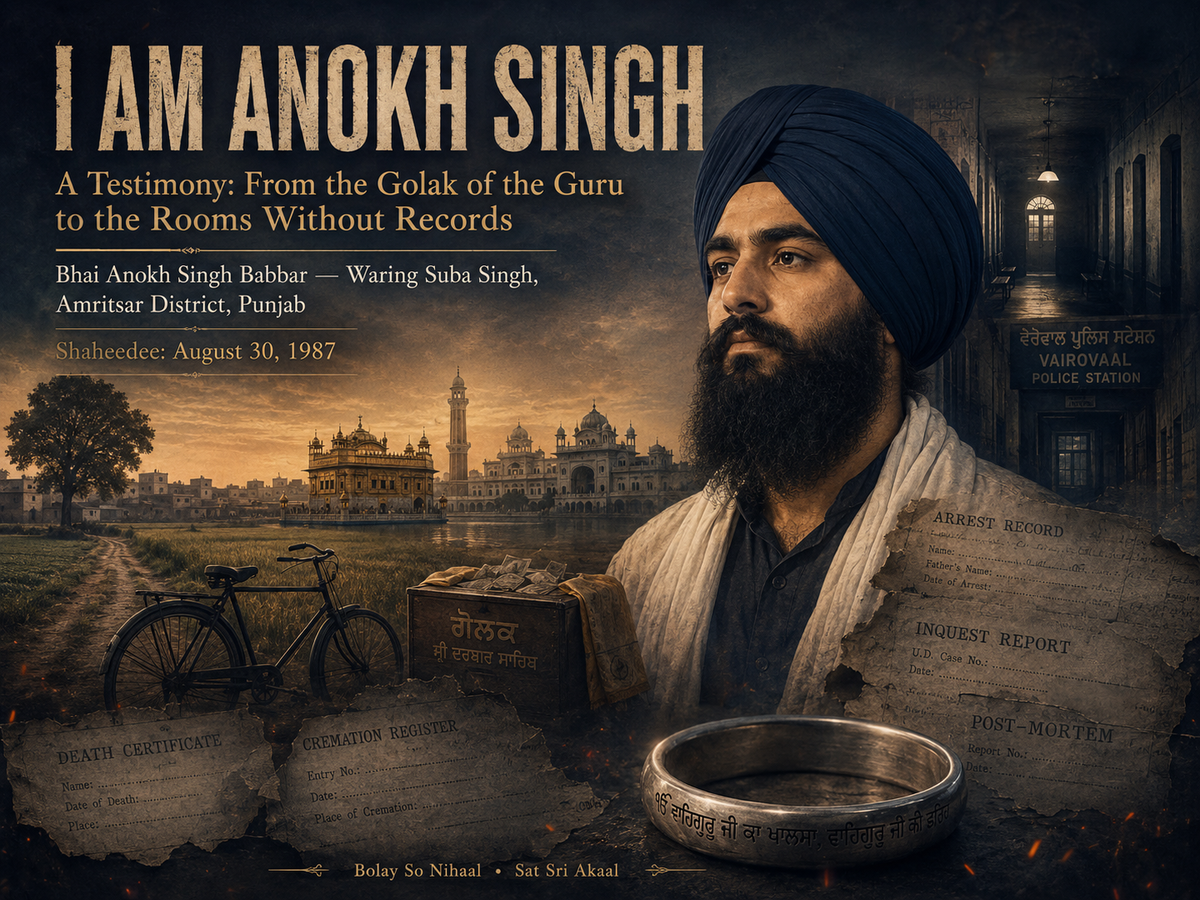
A Testimony: From the Golak of the Guru to the Rooms Without Records
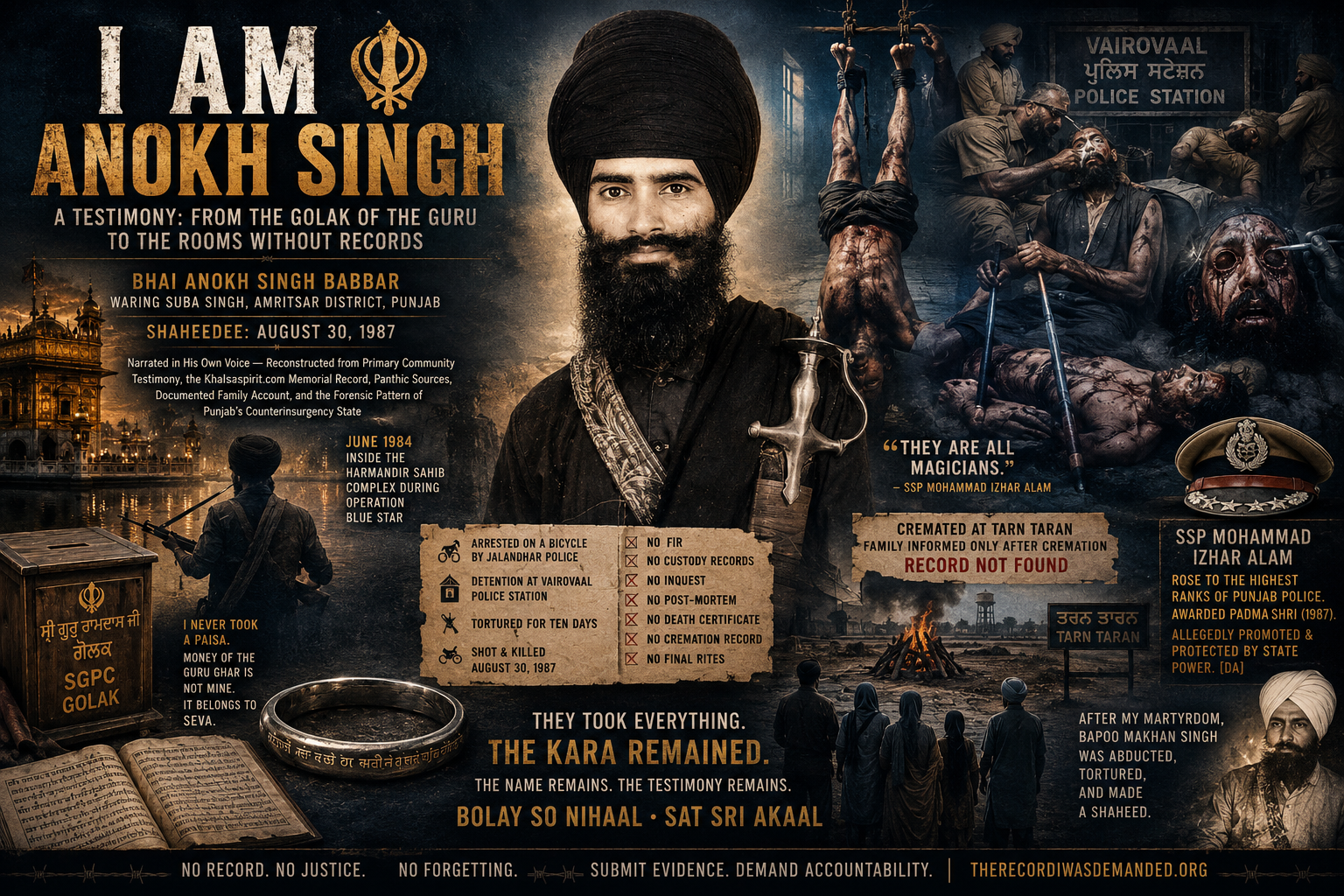
Bhai Anokh Singh Babbar — Waring Suba Singh, Amritsar District, Punjab. August 30, 1987
Narrated in His Own Voice — Reconstructed from Primary Community Testimony, the Khalsaspirit.com Memorial Record, Panthic Sources, Documented Family Account, and the Forensic Pattern of Punjab’s Counterinsurgency State
For readers encountering Sikh martyrology for the first time: the shahid-naama — the testimony of a martyr — preserves two realities at once. It does not soften what was done to the body. It does not diminish what the soul answered. Both are the testimony. Both are required. To reduce torture into administrative language is to assist the state in making murder appear procedural. This article does not do that.
Editorial Note on Evidentiary Basis and Family Correction
What follows is a literary reconstruction of the life and martyrdom of Bhai Anokh Singh Babbar. The biographical foundations — his village of Waring Suba Singh, his parents Bapoo Makhan Singh and Mata Niranjan Kaur, his brothers Joga Singh, Santokh Singh, and Hardeep Singh, his service as an inspector with the Shiromani Gurdwara Parbandhak Committee, his association with Bhai Fauja Singh, his presence during the Vaisakhi 1978 massacre, his association with Babbar Khalsa, his presence inside the Harmandir Sahib complex during Operation Blue Star, his final arrest, detention at Vairovaal Police Station, torture, martyrdom on August 30, 1987, and the later abduction and martyrdom of his father — are drawn from the Khalsaspirit.com memorial record, Panthic community testimony, and family/local accounts. Within this publication’s evidentiary framework, those sources are treated as [PM] Panthic Memory unless independently documentary proof is produced; where a claim is supported by public reporting or documentary material but not yet judicially adjudicated, it is treated as [DA] Documented Allegation.
A factual correction must be made at the threshold. Some accounts, including the Khalsaspirit.com memorial record and certain Panthic oral traditions, state that my body was thrown into the River Beas. This article acknowledges those accounts. They are part of the community record. However, the more specific family and local account used here as the controlling narrative is that, after my custodial killing, I was cremated at Tarn Taran; my family was informed only after the cremation had already been completed; my body was not returned for identification or final Sikh rites; and the sole personal article returned was my kara — the iron bangle of Khalsa identity. That controlling version is marked here as [PM, family account] until the cremation register or police records are produced.
The difference matters. A body thrown into a river and a body cremated without notice both represent criminal disposal outside lawful process. But a cremation followed by notification after the fact carries a particular legal and spiritual injury. The family is told of the death only after the evidence has been reduced to ash. There is no body to identify. There are no wounds to witness. There is no post-mortem to demand. There is only the announcement of an irreversible fact already managed by the state.
A note on the 1978 proceedings: The post-trial legal history of the Vaisakhi 1978 killings — including what appeals were filed, by whom, and what political decisions followed — remains contested across public accounts. This article therefore uses Panthic memory language where appropriate and does not rely on the weakest procedural version as a proved fact.
A note on SSP Mohammad Izhar Alam: Public records and human-rights sources describe Mohammad Izhar Alam as a senior Punjab Police officer who rose to the highest ranks, was awarded the Padma Shri in 1987, and later became known in connection with allegations surrounding the “Alam Sena” or “Fauj-e-Alam.” Some public accounts describe him as a former DGP; other records specify DGP Prisons or highest-rank police service rather than Director General of Police, Punjab, in the narrowest sense. This article therefore uses the careful formulation that Alam rose to the highest ranks of the Punjab Police structure and that his subsequent promotions and public honors require examination in light of the allegations attached to his name. Where the text refers to promotion, it is marked [DA] unless the exact personnel order is produced.
PART ONE: THE VILLAGE, THE FAMILY, THE NAME
I am Anokh Singh.
I was born in the home of Bapoo Makhan Singh and Mata Niranjan Kaur in the village of Waring Suba Singh, in Amritsar district, in Majha — the central Sikh heartland of Punjab. Majha is not merely a region on a map. For those born into it, it is land, memory, discipline, and inheritance. The language of the fields, the sound of Gurbani before dawn, the memory of shaheeds, the presence of the Guru’s house — these things do not stand apart from one another there. They form the child before the child knows he is being formed.
My family was amritdhari. My father organized our household around the discipline of the Khalsa. My mother woke before dawn for Amrit Vela, the stillness before first light when the Naam can be heard before the world begins speaking over it. I was one of four brothers: Joga Singh, Santokh Singh, myself, and Hardeep Singh.
From childhood, those who knew me said I was quiet and spiritually inclined. It was not the quietness of fear. It was the quietness of an inwardly ordered mind. While working around the house, I recited Gurbani. The ordinary tasks of the home — sweeping the courtyard, drawing water, helping in the fields, serving the family — were not separate from remembrance. If the mind was with the Guru, every action had paath inside it.
I completed my education. In Punjab in those years, an educated Sikh youth from a committed family could choose several paths. I chose the one that placed me closest to the Guru’s house.
PART TWO: THE GOLAK INSPECTOR — INTEGRITY BEFORE THE ALTAR
I became an inspector with the Shiromani Gurdwara Parbandhak Committee.
For readers outside the Sikh world: the SGPC is the elected body created to administer many historic Sikh gurdwaras and related institutions. The Golak is the donation box placed before the Guru Granth Sahib, where the Sangat gives what it can. Some give coins. Some give notes. Some give the earnings of a week’s labor. Some give from hunger. Some give from gratitude. But whatever enters the Golak is not ordinary money. It is offered before the Guru.
The work required trust. Money moved through many hands. Temptation was structural. A man in that position could excuse himself easily. He could say that no one would know. He could say everyone takes something. He could say the institution is large and one small diversion does not matter.
I never accepted that reasoning.
I never diverted a paisa.
More than that, I told others not to do so. Wherever I did my duty, I encouraged those near me to work without greed, without embezzlement, without bribes. Money from the Guru Ghar was poison for a Gursikh if taken for personal use. It belonged to seva — to langar, to the poor, to the Sangat, to the maintenance of sacred places, to the needs of the Panth. A hand that stole from the Golak did not merely steal from an institution. It interrupted an offering between the Sangat and the Guru.
When my brother Santokh Singh’s wife gave birth to a son, I went to see the newborn. I took two rupees from my pocket and placed them as a gift. My bhabhi looked at me with affectionate disbelief and said, “Brother Anokh Singh, you are such a big jujhaaroo Singh, and at the birth of your brother’s son you are giving only two rupees?”
I answered, “Bhabee ji, even this seems too much. These two rupees are the Panth’s property. I do not want my family’s newborn to be celebrated with the Guru’s money.”
I would also visit home to collect dasvandh from the family’s agricultural earnings. Dasvandh — the tenth — is not the earner’s possession once it has been set aside for the Guru. If Bapoo ji or another family member mentioned household difficulty and suggested withholding it that season, my answer did not change: “Keep an account to every penny. Dasvandh is the Guru’s. You have no right to it.”
This is the man the Punjab Police would later torture in a police station.
A man who would not spend two rupees of the Panth’s money on his own nephew.
A man who feared misuse of the Golak more than death.
The machinery that later destroyed my body was never brought before a court, commission, or public inquiry to answer for what it did. That absence is not a minor defect in the record. It is the central fact.
PART THREE: KHALSA FARM — BHAI FAUJA SINGH AND THE PATH THAT FORMED ME
Through my work, I came into contact with Bhai Fauja Singh.
Bhai Fauja Singh was a Gurmukh: a man whose face was turned toward the Guru, whose life was shaped by Gurbani rather than worldly calculation. He understood the Khalsa not as sentiment but as discipline. At his farmhouse, known in memory as Khalsa Farm, young Singhs gathered for sangat, for Gurbani, for Amrit Vela, and for training in gatka and shastar vidya.
His personality had a deep effect on me. I began walking the path he walked. We rose before dawn. We recited banis. We practiced the movements of the shastar. We ate simply. We spoke about the Panth, about the Guru’s vision, and about what it meant to remain Khalsa when the pressure to compromise was growing.
In that sangat I formed deep bonds with Bhai Sulakhan Singh and other Singhs. These were not ordinary friendships. They were bonds made in Amrit Vela, in practice, in shared discipline, and in the knowledge that faith without readiness can be reduced to words.
Before I went underground, Bhai Surinder Singh Nagokay held an Akhand Paath at his home. An Akhand Paath is the uninterrupted reading of the Sri Guru Granth Sahib Ji from beginning to end, usually completed over about forty-eight hours. I sat through it in one position. From beginning to end. Not as a display of endurance. Not as a performance. Because when the Guru’s Word is being read in the presence of the Sangat, a Sikh should not treat it as background sound.
Only later did I understand that this Akhand Paath was a farewell to one form of life. After it, the road ahead led away from ordinary service and toward the underground. After it, the Jalandhar Police, Vairovaal Police Station, SSP Mohammad Izhar Alam, and August 30, 1987, lay waiting.
PART FOUR: VAISAKHI 1978 — I WAS THERE
On April 13, 1978 — Vaisakhi — the Nirankari confrontation took place in Amritsar.
I was there.
I was with Bhai Fauja Singh.
For readers outside Sikh memory: Vaisakhi is not merely a spring festival. Vaisakhi is the day of the Khalsa’s birth. On Vaisakhi 1699, at Anandpur Sahib, Guru Gobind Singh Ji asked the assembled Sangat for heads. The Panj Pyare answered. The Khalsa was formed. Since then, Vaisakhi has asked every Sikh, in every generation, what he or she is prepared to give.
In 1978, on that day, in Amritsar, Bhai Fauja Singh and twelve other Sikhs were killed. I stood in the same current of events. I had trained with Bhai Fauja Singh. I had sat in his sangat. I had seen the discipline he carried. To see him fall on Vaisakhi in Amritsar was not merely to witness a death. It was to receive an education in what the law would protect and what the Panth would have to remember without the law’s help.
The trial that followed was moved outside Punjab to Karnal. The accused were acquitted. Panthic memory has never received that outcome as neutral. Whether later appeals were filed, allowed to lapse, withdrawn, or inadequately pursued remains contested in public accounts. What is not contested in Panthic memory is the result: thirteen Sikhs were killed in Amritsar on Vaisakhi, and no one was convicted for killing them.
After 1978, violence and reprisals followed in Punjab. My name began to appear in police and community accounts connected to that period. I do not need to romanticize those years to tell the truth about them. From 1978 onward, the quiet SGPC inspector from Waring Suba Singh became someone the state began to mark.
PART FIVE: BHAI SUKHDEV SINGH BABBAR — CHICKPEAS AND NAAM
In the years after 1978, I became close to Bhai Sukhdev Singh Babbar.
We lived together for periods during the underground years. The memory preserved about us is simple: chickpeas and Naam. It is not an embellishment. Underground life was spare. Chickpeas were food that could be carried, kept, and eaten without a household. They sustained the body. Naam sustained what the body could not sustain by itself.
The morning banis. Rehraas in the evening. Kirtan Sohila before sleep. Simran moving beneath the surface of ordinary consciousness. That is what held us. Ideology alone cannot hold a human being under pressure. Anger cannot hold him. Revenge cannot hold him. Only practice, repeated until it becomes deeper than fear, can hold him when the machinery of the state begins its work.
The Babbar tradition drew its name from the Babbar Akalis of the 1920s, who resisted British colonial rule and went to the gallows without renouncing their commitments. That history was not a costume for us. It was a lineage of consequence. It taught that when a Sikh gives his word, the test of that word may come through prison, torture, and death.
I did not find that romantic.
I found it true.
PART SIX: THE FIRST ARREST — “DO NOT SELL MY BLOOD”
My first arrest was by the Dehlon police.
At a court appearance in Ludhiana, my brother Santokh Singh came to meet me. I called him close and gave one instruction:
“If the police make me a shaheed, do not sell my blood. Do not try to profit from my death.”
Those words say more about me than many longer speeches. I had already thought through what might come. I was not worried that I would die. I was worried that death could be converted into currency by people who had not lived by the principles for which it was given.
I used to say, “If I am made a shaheed, and if the enemy cuts me piece by piece, even then no cry of pain should come from me.”
This was not ordinary toughness. It was not pride. It came from the Sikh martyrological memory. Bhai Mani Singh Ji, the great scholar and Granthi of Harmandir Sahib, was executed by being cut joint by joint. He did not stop in remembrance. That history was not remote to me. It was instruction.
When my companions freed me from Ludhiana, what I felt was not relief alone. I said, “After so long, shaheedee came near, and I had to run. I was tested, and I failed.”
I also told my father, Bapoo Makhan Singh: “Bapoo ji, when the Sikh Sangat blocks a road or surrounds a police station in protest, you should also go. If a bullet strikes you there, you will receive martyrdom. Shaheedee comes only with great fortune.”
My father absorbed those words. After my martyrdom, the Punjab Police abducted him and subjected him to torture. He too was martyred. The state that killed the son returned for the father.
This is not legend. This is the family record of what the counterinsurgency state did to the house of Makhan Singh of Waring Suba Singh.
PART SEVEN: JUNE 1984 — INSIDE THE HARMANDIR SAHIB COMPLEX
I was one of the Singhs inside the Harmandir Sahib complex when the Indian Army entered.
For readers who have never stood there: Harmandir Sahib is not merely a beautiful shrine. It is the spiritual center of the Sikh world. The Amrit Sarovar gives Amritsar its name. The Akal Takht, facing the Harmandir Sahib, is the temporal throne of the Khalsa Panth. To enter that complex with military force is not, for Sikhs, an ordinary military operation. It touches the deepest point of Sikh civilizational memory.
In June 1984, the Indian Army’s operation unfolded around the complex and across Punjab. The central assault came in the first week of June, with the most intense fighting around June 5 and 6. The political authorization came from the Government of India under Prime Minister Indira Gandhi. The military command included Lt. Gen. Kuldip Singh Brar and other senior officers.
I was inside. I helped move pilgrims and others out of danger where it was possible. The complex held not only armed men and political actors; it held ordinary Sikh families, elderly people, women, children, and pilgrims who had come for prayer and found themselves inside a military assault. Those of us inside helped whom we could.
Maj. Gen. Shabeg Singh was killed inside the complex. He had once served India with distinction and had helped train forces in the Bangladesh war. His death inside the Akal Takht theatre of battle is one of the unbearable ironies of Punjab’s history.
Sant Jarnail Singh Bhindranwale was also killed inside the complex. Whatever position one takes on his ministry, methods, or politics, his death inside the Darbar Sahib complex became part of the permanent memory of the Panth.
The Sikh Reference Library and other repositories of Sikh historical material were destroyed, seized, removed, or never fully accounted for. Public accounts differ on precise sequence and responsibility, but the Panth remembers the loss as the destruction of a people’s record. Manuscripts, hukamnamas, handwritten texts, and historical materials cannot be replaced by later explanation. A community whose archives are burned, removed, or withheld has not merely suffered collateral damage. It has suffered an attack on memory.
After June 1984, I was not the same. Vaisakhi 1978 had taught me what the legal system could fail to punish. June 1984 taught me what the state could do to the center of Sikh sovereignty. Together, those two events formed a complete education in the relationship between the Sikh Panth and the Indian state at its most exposed.
I received that education in full.
PART EIGHT: THE COUNTERINSURGENCY STATE — WHAT PUNJAB BECAME
There are two histories of the Punjab counterinsurgency.
The official history speaks of law and order restored, terrorism defeated, and peace returned. It speaks in the language of medals, promotions, press briefings, and administrative success.
The other history is the history Bhai Jaswant Singh Khalra was documenting when the Punjab Police abducted him in September 1995. Khalra examined cremation records from Amritsar district and helped expose evidence of mass illegal cremations of people described as “unidentified” or “unclaimed.” He connected registers to families who had been reporting sons, fathers, and brothers missing while receiving no lawful answer.
He brought the evidence public. He prepared to take it further. Then he was abducted, illegally detained, tortured, and murdered. Police officials were later convicted in connection with his abduction and murder, one of the rare cases in which the protective wall around the counterinsurgency machinery was pierced. But Khalra’s own body was never returned. The state that disappeared bodies also disappeared the man who documented disappearance.
My case belongs inside that pattern.
The machinery that produced my death operated through methods documented across Punjab: arrest without lawful record, detention without station diary entry, torture outside judicial oversight, death described in false language or concealed entirely, bodies cremated or disposed of without post-mortem, and families informed too late to preserve evidence. Such a pattern requires more than individual cruelty. It requires command tolerance, operational coordination, administrative silence, and political cover.
In 1987, when I was arrested, tortured, and killed, my case was not an aberration inside a system that otherwise functioned correctly. My case was the system functioning in the manner for which it had been allowed to exist.
PART NINE: THE FINAL ARREST — ON A BICYCLE
The final arrest was ordinary in form.
I was riding a bicycle when the Jalandhar Police took me.
Not in a dramatic raid. Not in a final battle. A man on a bicycle, stopped by officers who knew who he was and took him without the procedural protections the law required.
I was transferred to Vairovaal Police Station in Amritsar district.
Vairovaal — also written as Vairowal or Verowal — lies within the landscape of Majha. It was not far from the territory of my own origin. A man raised in that land knows these distances not as map measurements but as body knowledge. I was brought back into the district from which I came, into a police station under the civil and magisterial jurisdiction of Amritsar.
At the time of my martyrdom in 1987, Tarn Taran was not a separate district. It formed part of Amritsar district. Tarn Taran district would be created later, in 2006. That means the police station where I was held and the cremation ground where the family account says my body was taken were within the same district jurisdiction: Amritsar.
That geographic fact is legally important.
It means the civilian accountability chain ran directly through the district administration. It means the Deputy Commissioner, as District Magistrate, cannot be treated as outside the event merely because the police did the physical killing.
No one in that chain produced the lawful record.
PART TEN: VAIROVAAL POLICE STATION — TEN DAYS
“The path of the devotees is difficult.”
I was held at Vairovaal Police Station from approximately August 20, 1987. My martyrdom date is recorded as August 30, 1987.
Ten days.
Do not let that number pass casually. Ten days is not a moment of excess. It is not a sudden beating. It is a sustained program of destruction applied to a human body by officers who believed that pain could produce names, addresses, confessions, or surrender.
I will tell you what was done because Sikh martyrology does not permit the body of the shaheed to be erased into abstraction. Bhai Mani Singh Ji’s joints are in the record. Bhai Mati Das Ji being sawn alive is in the record. Bhai Dyala Ji being boiled alive is in the record. These accounts are not preserved for sensation. They are preserved because the measure of what was endured is part of the testimony.
To say only that I “died in police custody” would serve the state’s purpose.
I will not serve it.
For many days, I was kept hanging upside down. Inverted suspension causes blood to pool in the head. Pressure rises behind the eyes. Breathing becomes difficult. Time distorts. The body begins to lose its ordinary relationship to direction, pain, and control. This is not anger alone. This is method.
My hip was broken. A broken hip destroys movement. It turns every position into punishment. When I was later left on the ground unable to rise, that broken bone was part of the state’s work.
My eyes were removed with a bayonet, according to the primary Panthic account. This was not incidental injury. It was deliberate targeting of sight. The sentry who later came near me saw the empty sockets and asked, “What has happened to your eyes?” His question belongs to the record because it is the question of a man suddenly forced to see what his own institution had produced.
While I was doing Simran, my tongue was cut. In one account, the cutting is described in the sequence of torture; in another, it follows the recitation of Rehraas and the sentry’s resignation. This article preserves both memory streams and treats the exact sequence as unresolved unless police or medical records are produced. What both accounts agree on is the meaning: the state attempted to silence Naam by attacking the body’s instrument of speech.
Heated metal rods were driven into my legs from the soles upward. The accounts describe rods hammered from heel toward knee. Heated rods were also passed through my chest, and one account states that a rod was put through my skull. My abdomen was torn open. Pins were inserted into my genitals and electricity applied. These details are preserved in the Panthic record and are consistent with the broader pattern of torture documented in Punjab during that period.
Through all of this, what the officers heard was:
Waheguru.
Waheguru.
Waheguru.
No name given.
No confession.
No cry accepted as victory.
No betrayal.
The primary memorial record says I did not utter a word or sound of pain, and that I remained in remembrance of Waheguru. Whether every physical detail can now be forensically verified depends on records the state has never produced. But the testimony of the Panth is clear on the central fact: the police did not break me.
SSP Mohammad Izhar Alam — named in the primary community account as “Azhar Alam,” the senior police officer associated with the operation — is said to have been shocked by what he witnessed. The account records his words: “They are all magicians.”
He meant it as contempt.
He was wrong about the cause but right about the result. It was not magic. It was practice. Amrit Vela. Gurbani. Akhand Paath. Chickpeas and Naam. The Golak’s two rupees that were too much to take. A life disciplined before the test arrived.
By the time the rods, shocks, bayonet, and saw reached the body, the Naam was already deeper than the instruments could go.
PART ELEVEN: THE SENTRY WHO COULD NOT STAY — REHRAAS AT VAIROVAAL
After one torture session, I was left on the ground.
I could not move. My hip was broken. My legs had been destroyed. My body was bleeding. I had asked the Guru that my Sikhi and Kesh remain with me until my final breath.
Evening came.
I no longer knew evening by sight. I knew it by sound — the change in the station, the movement of men, the rhythm of the day lowering itself into night.
I called to the sentry: “Santry! Bhai Sahib ji, what time is it?”
He came near. He saw my face. The primary account records his answer: “It is 7:15. What has happened to your eyes?”
Seven fifteen.
It was time for Rehraas Sahib.
I began with Sodar:
“Sodar tera kehaa, so ghar kehaa…”
What is that Gate? What is that Home where You sit and all Your servants meditate on You?
I recited lying on the floor of a police station. The record says I recited in a sweet voice.
Not a whisper.
A sweet voice.
The sentry listened and felt vairaag — that spiritual trembling that comes when the heart recognizes truth before the mind can explain it.
After Sodar, I began Ardaas. I remembered the Ten Gurus, the Panj Pyare, the Chaar Sahibzaade, the Guru’s flags and seats, and all those who gave their heads for the faith.
Then I made my own supplication:
“O Akaal Purakh, True Sovereign, Guru Nanak Dev Ji, protector of the poor: the day that rose in Your bhaana has passed in happiness, meditating on Your Naam. Night has arrived. May it also pass in Your remembrance and Your will. Satguru, make me a shaheed. Save me from becoming a traitor. May the Sikhi and Kesh You have given me remain with me until my final breath. Have mercy on all. Bolay So Nihaal — Sat Sri Akaal.”
The Jaikara echoed through the police station.
The sentry could not remain where he was. He went to the station head, surrendered his rifle, and resigned.
“I cannot do this job that forces people to kill saints,” he said. “I cannot.”
The account records that SSP Alam responded: “They are all magicians. Another of our officers has left the service because of this paath.”
Another.
Not the first.
The men who operated the torture chambers of Punjab had already seen that Sikh prayer could disturb the conscience of those ordered to participate in destruction. They called it magic because they could not call it what it was.
The power of a discipline the state could not process.
The officers then returned. The account states that my tongue was cut with a metal saw. Blood flowed down my beard. I raised my hands in Ardaas and thanked Waheguru.
At that point the state had reached the limit of what it could do to the body.
The body’s answer was gratitude.
PART TWELVE: THE LAST MOMENT — A MOTORCYCLE ENGINE
In the end, the police grew tired.
Not ashamed.
Not repentant.
Tired.
Tired of failing to break what they had spent ten days trying to break. Tired of the Naam. Tired of the resignations. Tired of the spectacle of their own power meeting something it could not defeat.
They shot me.
The primary account says they started a motorcycle engine to cover the sound of the gunshot.
That detail must not be lost. A motorcycle engine started not to travel but to conceal. Its purpose was noise. It was meant to prevent the shot from being heard outside the station by anyone who might remember it, report it, or use it as evidence.
That engine is an admission.
It says the police knew the sound needed cover.
It says the killing was not lawful enough to be allowed to echo.
The memorial record says that by then, through the power of Naam, the shaheed’s soul had already been liberated from the body. That is the theological claim at the center of this testimony. The police shot what remained of the body. The person they sought to break had already gone where their instruments could not follow.
The account compares my shaheedee to Bhai Mani Singh Ji’s martyrdom. The comparison is not a claim that the details are identical. It is a statement of continuity: the Khalsa that the Mughal state could not break through joint-by-joint dismemberment was the same Khalsa the counterinsurgency state could not break through ten days at Vairovaal.
The motorcycle engine covered the gunshot.
The Naam did not stop.
PART THIRTEEN: TARN TARAN — THE KARA THAT REMAINED
They did not take my body home.
They did not call my father and mother while there was still a body to see. They did not bring my brothers — Joga Singh, Santokh Singh, and Hardeep Singh — to stand before me and perform the Ardaas Sikh tradition requires. They did not allow my family to identify the body, see the wounds, demand a post-mortem, or insist on an inquest.
According to the controlling family account used here, they took my body to Tarn Taran and cremated it. My family was informed only after the cremation had been completed.
That was not notification.
It was announcement.
Notification before cremation gives a family legal and spiritual rights. The family can identify the body. The family can see the injuries. The family can demand a post-mortem. The family can insist that the law be followed. The family can perform Antim Sanskaar.
Announcement after cremation gives the family ash and finality.
The body is gone.
The wounds are gone.
The evidence is gone.
The state’s work is complete before grief is allowed to begin.
In Sikh life, Antim Sanskaar is not disposal. It is the final seva of the living toward the one who has died. To deny it is not merely to mishandle a body. It is to strike the family at the point where love, law, and faith meet.
All of that was denied.
What remained was one kara.
The kara is the iron bangle worn by a Sikh as one of the Panj Kakars. It is circular, without beginning or end, a sign of discipline and remembrance. The kara had been on the wrist of the body taken by police, tortured, killed, and cremated. It was the one thing returned.
The kara said what the records refused to say.
It said there was a body.
It said the body had a name: Anokh Singh, son of Makhan Singh, of Waring Suba Singh.
It said the body was in state custody.
It said the body was destroyed without lawful process.
It said the family was denied identification, post-mortem, inquest, and final rites.
It said the state did not merely kill. It controlled the timing and conditions of grief.
The kara is the record the police did not intend to leave.
PART FOURTEEN: THE SECOND MARTYRDOM — BAPOO MAKHAN SINGH
After my martyrdom, the Punjab Police came for my father.
Bapoo Makhan Singh had taught us dasvandh, Amrit Vela, Gurbani, and the integrity of the Golak. He had heard me say that he too should stand with the Sangat, even if a bullet found him there.
After I was killed, he was abducted.
He was tortured.
He was martyred.
The state that killed the son returned for the father who had raised him. That is the logic of counterinsurgency when it becomes total. It does not punish only the individual. It sends a message to the family, the village, and the generation behind him.
Bapoo Makhan Singh’s martyrdom belongs in the same account as mine. The family of Waring Suba Singh did not lose one man. It was made to understand that the cost of producing a Singh would be imposed on the household itself.
No proper public accounting has been made.
No officer has answered.
No file has been opened to the family.
PART FIFTEEN: SSP MOHAMMAD IZHAR ALAM — THE MACHINERY THAT ROSE
The primary community sources name SSP Mohammad Izhar Alam — rendered in some accounts as “Azhar Alam” — as the senior police officer associated with my torture and martyrdom at Vairovaal Police Station.
This article does not claim more than the evidence can bear. It states the allegation plainly: Panthic sources place Alam within the command structure of the operation that tortured and killed me. The exact station records, command logs, personnel orders, wireless messages, and custody entries have not been produced. Their absence is itself part of the indictment.
What is publicly known is that Mohammad Izhar Alam rose to the highest ranks of the Punjab Police structure, was honored by the Government of India with the Padma Shri in 1987, and later became associated in public human-rights reporting with allegations surrounding the “Alam Sena” or “Fauj-e-Alam.” His wife, Farzana Alam, later entered electoral politics and was elected from Malerkotla as a Shiromani Akali Dal legislator.
Those facts require one question: how did a police officer whose name appears in Panthic memory in connection with torture, enforced disappearance, and extrajudicial killing rise through the very system that should have investigated him?
The issue is not merely one man.
It is the architecture of reward.
A police officer accused by victims’ communities of grave crimes is not prosecuted. He is promoted, honored, protected, and absorbed into public life. Political formations that speak in the name of Sikh dignity find ways to live with the officers whose careers were built during the destruction of Sikh bodies.
The kara on the table.
The officer in the chair.
These are not separate facts.
They are the same sentence.
PART SIXTEEN: THE DEPUTY COMMISSIONER OF AMRITSAR — THE CIVILIAN OFFICE THAT DID NOT INTERRUPT THE KILLING
For readers outside Indian administration: the Deputy Commissioner is not merely a bureaucrat. In Punjab’s district structure, the Deputy Commissioner also functions as District Magistrate. That office carries civil, executive, and magisterial authority. It is meant to stand between police power and unlawful disposal of human life.
Two legal provisions matter here.
Section 174 of the Code of Criminal Procedure requires the police, in cases of suspicious or unnatural death, to notify the nearest Executive Magistrate empowered to hold inquests, examine the apparent cause of death, describe wounds and injuries, and forward the report to the District Magistrate or Sub-Divisional Magistrate. Where there is doubt about the cause of death or other reasons requiring examination, the body is to be forwarded for medical examination if possible.
Section 176 addresses magisterial inquiry into the cause of death, including deaths in police custody. The precise form and mandatory nature of such inquiry have developed over time, but the principle was already clear: a death in police custody required magisterial attention, not secret disposal.
In 1987, Tarn Taran was not a separate district. It was part of Amritsar district. Vairovaal Police Station was in Amritsar district. The cremation site identified by the family account was in Amritsar district. The Deputy Commissioner/District Magistrate of Amritsar therefore sat over the civil jurisdiction in which custody, death, and disposal all occurred.
No lawful arrest record has been produced.
No inquest report has been produced.
No post-mortem report has been produced.
No death certificate has been produced.
No cremation register entry has been produced to the family or public.
No record has been produced showing that the family was notified before cremation.
The silence of the civil administration is not a clerical gap. It is the absence of the very record the law existed to create.
A police station can torture.
A police station can kill.
But without the silence of the civil record, the killing cannot disappear so easily.
That is why the Deputy Commissioner’s office matters. The question is not only which police officer struck, cut, shocked, shot, or ordered. The question is also which civilian office failed to interrupt the process, failed to demand the body, failed to require the inquest, failed to issue or account for the death certificate, and failed to preserve the rights of the family.
The file is not empty by accident.
The file is empty because someone allowed it to be empty.
PART SEVENTEEN: THE RECORD THE STATE OWES
I do not speak here as a ghost asking for sentiment.
I speak as a legal subject whose rights were violated at every stage: arrest, detention, torture, killing, cremation, and notification.
If I was arrested, where is the FIR or station diary entry recording the arrest? Which officer made it? What time was I taken? What was the stated ground? Who received me at Vairovaal Police Station?
If I was detained for approximately ten days, where are the daily entries recording my presence, condition, interrogation, meals, medical needs, and movement?
If I was examined at the time of arrest, where is the medical record? If I was not examined, who permitted that violation?
If I was interrogated, where are the interrogation notes, authorizations, officer names, dates, and times?
If I died in police custody, where is the inquest report?
Where is the post-mortem?
Where is the death certificate?
If my body was cremated at Tarn Taran, which cremation ground received it? What date? What name was entered? Was I listed as unidentified or unclaimed? Who brought the body? Which officer authorized the cremation? Which civil authority permitted it?
Who returned the kara?
Was a property inventory prepared when I was arrested?
Was the kara recorded as personal property?
Who decided that my family would be informed only after the cremation?
Who carried that message?
What words were used?
These are not symbolic questions. They are administratively answerable questions. A lawful system produces answers. An unlawful system produces silence and then calls the silence history.
The silence has lasted almost four decades.
That is long enough for the state.
It is not long enough for the Panth.
CLOSING: WHAT REMAINS WHEN THE FILE IS EMPTY
My name is Anokh Singh.
Son of Makhan Singh and Niranjan Kaur.
Brother of Joga Singh, Santokh Singh, and Hardeep Singh.
Of Waring Suba Singh village, Majha, Amritsar district, Punjab.
Inspector with the Shiromani Gurdwara Parbandhak Committee.
Servant of the Golak.
Companion of Bhai Fauja Singh.
Witness to Vaisakhi 1978.
Companion of Bhai Sukhdev Singh Babbar.
Present inside the Harmandir Sahib complex in June 1984.
Member of Babbar Khalsa.
Arrested while riding a bicycle.
Taken by the Jalandhar Police.
Held at Vairovaal Police Station.
Tortured for days.
Martyred on August 30, 1987.
According to the family account, cremated at Tarn Taran.
Family informed only after the cremation.
No body returned.
No final rites allowed.
One kara left.
No lawful arrest record produced.
No custody diary produced.
No medical record produced.
No interrogation log produced.
No inquest report produced.
No post-mortem produced.
No death certificate produced.
No cremation register entry produced.
No officer held publicly accountable.
My father, Bapoo Makhan Singh, later abducted and martyred after torture.
Every essential record missing, withheld, or never created.
And still here.
Still speaking.
The sentry who resigned is part of this testimony. He heard Rehraas in that police station and could not continue. His conscience belongs to the record.
The officer who said, “They are all magicians,” is part of this testimony. His words are an admission that the machinery encountered something it could not break.
The motorcycle engine is part of this testimony. Its sound was the state confessing that the shot required cover.
The kara is part of this testimony. Wherever it rests, it has been waiting to be held before a proper inquiry and identified for what it is: the physical evidence of a life the state tried to reduce to administrative ash.
Do not light a candle for Bhai Anokh Singh Babbar if you will not ask for the file.
Do not say his name in Ardas if you will not ask for the death certificate.
Do not call him shaheed if you will not demand the name of the officer, the record of the custody, the register of the cremation, and the account of the promotion.
My shaheedee was not private.
It occurred in a police station funded by public money, staffed by public officers, within a district administered by public authority.
The crime was public.
The accounting must be public.
When the Vairovaal Police Station records are produced, when the Tarn Taran cremation register is opened, when the Amritsar Deputy Commissioner’s files for August 1987 are examined, when Mohammad Izhar Alam’s personnel history is read beside the testimony of the families, when the kara is no longer treated as memory but as evidence — then the state’s project of erasure will have failed.
Until then, the name has not been erased.
The kara has not been lost.
The Jaikara has not been silenced.
Bolay So Nihaal.
Sat Sri Akaal.
ਵਾਹਿਗੁਰੂ ਜੀ ਕਾ ਖ਼ਾਲਸਾ।ਵਾਹਿਗੁਰੂ ਜੀ ਕੀ ਫ਼ਤਿਹ।
Publication Note and Forensic Accountability Call
This testimony is published under the First Amendment editorial framework of TheDeathCertificate.org. It is a literary reconstruction of a documented martyrdom, drawing from the Khalsaspirit.com memorial record, Panthic testimony, family/local accounts, and the known human-rights pattern of custodial killing and secret cremation in Punjab.
This publication calls on the Punjab Police, through the office of the Director General of Police, to produce or account for the Vairovaal Police Station records for August 1987, including station diary entries, FIRs, custody records, interrogation records, property inventories, wireless communications, and any internal communications relating to Bhai Anokh Singh Babbar.
This publication calls on the Tarn Taran cremation ground administration and the civil registration authorities of the former Amritsar district jurisdiction to produce cremation register entries for August and September 1987, especially any body received from police custody around August 30, 1987.
This publication calls on the Punjab Government to produce the personnel and promotion records of Mohammad Izhar Alam from 1987 through retirement, including the basis for honors, promotions, postings, and post-retirement appointments.
This publication calls on the National Human Rights Commission to account for whether any complaint, file, or review relating to Bhai Anokh Singh Babbar was ever received, registered, transferred, or closed.
This publication calls on the Supreme Court of India record process arising from the Punjab mass-cremation litigation to account for whether the case of Bhai Anokh Singh Babbar was ever identified, reviewed, excluded, or left unexamined.
Any family member, witness, retired police officer, retired civil servant, former court official, cremation-ground employee, journalist, researcher, or community member possessing documentary evidence relating to this case is invited to submit it for integration into the forensic record under this publication’s four-tier evidentiary framework:
[PF] Proved Finding[DA] Documented Allegation[AI] Analytical Inference[PM] Panthic Memory
The kara is waiting for the accountant who will op