The Instrument Within


The Instrument Within: A Forensic History of Contested Loyalty, Institutional Failure, and the Limits of Betrayal in the Post-Guru Sikh World, 1708–2026
A Publication of THEDEATHCERTIFICATE.ORG and KPSGILL.COM
ਸ਼ਬਦ ਤੋਂ ਪਹਿਲਾਂ, ਸ਼ਮਸ਼ਾਨਘਾਟ — Before the Hymn, the cremation ground.
Editorial Note and Methodological Framework
This essay traces a single mechanism across three centuries: the recruitment of the trusted insider as the hinge that allowed external power to strike the Panth. It is not a loyalty roll. This essay is not an indictment delivered in bulk. It is an accounting, which is a different thing, and the difference matters enormously for both the integrity of the archive and the legal and moral standing of the argument within it. An indictment names the accused and asserts the charge. An accounting names everyone — the guilty, the contested, the partially guilty, the unjustly accused, the institutionally compromised, the politically opportunistic, the genuinely constrained — and holds each figure to a standard of evidentiary seriousness that survives the hostile reader, the opposing counsel, and the passage of time.
The Sikh tradition has a long and serious vocabulary for betrayal. The Panj Mel — the five reprobate associations the Khalsa is instructed to avoid — establishes that the community recognized, from its earliest institutional history, that some forms of internal defection were so damaging that they required permanent categorical exclusion. The tankhah system establishes that the Panth also believed in adjudication, in punishment proportionate to breach, and in the theoretical possibility of redemption. The Chali Mukte — the Forty Liberated Ones — establishes that betrayal followed by return, by genuine reckoning, by willingness to die in acknowledgment of what was renounced, could be absorbed and honored. These are not soft doctrines. They are demanding ones. They require both the naming of the breach and the preservation of the door.
This essay holds all three in tension. It names those whose conduct the record convicts. It assesses those whose conduct is contested. It rehabilitates those whom Panthic memory has condemned beyond what the evidence supports. And it distinguishes, with care that the record demands, between five categories of conduct that Panthic discourse has sometimes collapsed into one:
The Genuine Traitor held a bond of trust with the Panth — as general, custodian, political representative, religious administrator — and consciously broke it for personal gain at a moment when the community’s fate depended on that bond holding. These figures are, by any rigorous standard, the essay’s clearest cases.
The Institutional Failure occupied an office whose mandate obligated protective or remedial action, possessed the statutory or administrative authority to exercise that mandate, and failed to do so — not necessarily from personal malice, but from passivity, political calculation, complicity, or the quiet prioritization of personal safety and institutional continuity over the Panth’s urgent need. The distinction between this and genuine treachery is real, and collapsing it produces analyses that cannot survive scrutiny.
The Political Accommodator made pragmatic choices — in negotiations, coalition politics, or administrative office — that sections of the Panth read as betrayal, but which arose from genuine political constraints, from the absence of viable alternatives, or from a defensible calculation that half a loaf served the community better than the principled rejection that returned nothing. Whether these calculations were wise or cowardly is a legitimate historical argument. Whether they constitute betrayal in the full moral sense is a different question, and the two must not be conflated.
The External Enemy struck from outside the bond of trust. He was not a member of the community who turned against it; he was an adversary who always intended its harm. The distinction matters because conflating enemies with traitors diffuses the charge of treachery and extends it to figures who never owed the Panth the loyalty whose violation is the essence of betrayal.
The Contested Figure presents the most historiographically serious challenge: a person whose acts were genuinely ambiguous, whose record carries both service to the community and complicity in its harm, and whose legacy the evidence does not permit to resolve cleanly. This category requires the most disciplined writing, because the temptation — in a tradition that has suffered as much as the Sikh tradition has — is to resolve ambiguity always in the direction of condemnation. The historian’s obligation is to resist that temptation precisely where it is strongest.
Throughout, claims are graded using the four-tier evidentiary framework that governs both publications of which this essay is a part: [PF] Proved Finding — facts supported by adjudicated judicial findings, formal inquiry outcomes, contemporaneous documentation, or convergent institutional record; [DA] Documented Allegation — serious, sourced, and credible claims that have not been adjudicated to conviction or that rest on sources short of the highest standard; [AI] Analytical Inference — reasoned conclusions drawn from the pattern of the record, from institutional behavior, from omission, timing, and structural analysis; [PM] Panthic Memory — the living moral and historical record preserved by Sikh institutions, families, and collective witness, which carries weight as evidence of community experience even where it outruns the documentary archive.
The essay covers the post-Guru period: from the death of Guru Gobind Singh in 1708 to the present in June 2026. It does not claim to be exhaustive of every allegation ever made against every figure named within it. It claims to be honest: to give each figure the full complexity their record demands, to name the breach where it is proved, to grade the allegation where it is documented, to hold the inference where it is reasoned, and to protect the accused where the record does not support the charge.
Waheguru Ji Ka Khalsa, Waheguru Ji Ki Fateh.

Part One: The Long Eighteenth Century — The Informer as Structural Instrument (1708–1799)
The Context of Persecution and the Architecture of Survival
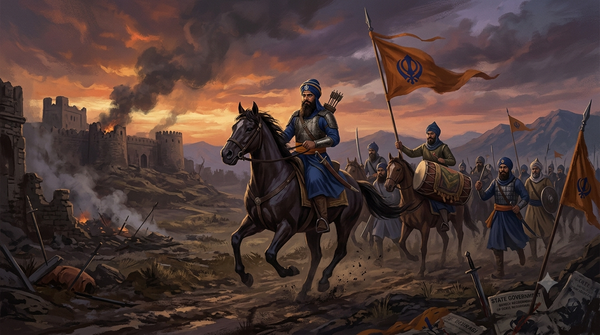
The Khalsa entered the eighteenth century as an armed community in flight. The Mughal state under its final effective administrators — the subahdar Zakariya Khan in the 1730s, the governor Mir Mannu through the late 1740s and early 1750s — had placed a commercial value on Sikh lives: a bounty for each head brought in, a reward for information leading to capture, a standing economic incentive for the population of rural Punjab to choose the occupier’s coin over the bond of neighborhood. This was not incidental. It was policy.
The mechanism worked through a class the sources call the mukhbar — the informer — and the chughalkhori system of denunciation. This is the eighteenth century’s primary form of internal betrayal, and the historian must say at the outset what the record makes clear: the vast majority of those who informed against their Sikh neighbors were not themselves Sikhs. They were members of the broader Hindu and Muslim communities of rural Punjab acting from fear, from self-interest, from the particular calculus that survivors in occupied territories have always faced. The specific charge of Panthic betrayal — betrayal from within the bond of trust — applies most seriously to the narrower category of those who had themselves taken amrit, who had accepted the obligations of the Khalsa brotherhood, and who then sold their brethren to the bounty system.
The record here is frustratingly thin on names. This is not a failure of archival honesty; it is an honest acknowledgment of what the archive contains. The eighteenth-century Punjabi administrative record was not organized around the preservation of individual informers’ identities. The Mughal and post-Mughal administrative apparatus recorded outcomes — arrests, executions, revenue flows — not the granular intelligence networks that produced them. The named individual traitor of the eighteenth century is, for this reason, harder to recover than the structural phenomenon of betrayal, and the historian who invents a roster of named informers from this period to satisfy a desire for particularity is producing fiction, not history. [AI] The structural category is proved; the specific names, in most cases, are not.
Zakariya Khan’s Reward Economy and the Human Cost of Information
Under Zakariya Khan (governor of Lahore 1726–1745), the persecution of the Khalsa reached a systematic intensity that is well-documented in the Sikh chronicles and substantially corroborated by Persian administrative records. [PF] Bounties were offered: ten rupees for information leading to a Sikh’s arrest, fifty rupees for a Sikh head. The price was not trivial in the rural economy of eighteenth-century Punjab. It was enough to tip the calculation for a household under pressure, a village headman who needed to demonstrate loyalty to the occupying administration, a relative who had lost property to the jathas’ irregular levies and decided that his own survival required the sacrifice of his neighbor’s.
The Chhota Ghallughara of 1746 — the Small Holocaust, as Sikh memory names it — was carried out by the Mughal commander Yahiya Khan (Zakariya Khan’s son and successor) and Diwan Lakhpat Rai, whose brother Jaspat Rai had been killed in a skirmish with the Khalsa. Lakhpat Rai was not a Sikh; he was a Hindu Khatri official who made the massacre of the Khalsa a personal project, and his motivations, however ugly, were those of an enemy rather than a traitor. [PF] He does not belong in the category of betrayal within the bond of trust. He belongs in the category of enemy. The distinction matters because including enemies on the same list as traitors produces a document that cannot analyze either accurately.
What is clear from the chronicle record is that the Khalsa’s geographic knowledge of pursuers’ likely paths, its ability to survive winters in the jungles of Lakhi and the Malwa scrubland, depended partly on villagers who chose shelter over information — and that some did not so choose. [PM] The families who hid Singhs during the persecution are remembered in Sikh oral history; the families who did not are largely swallowed by time. The moral weight of the former is the mirror of the moral cost of the latter, and Panthic memory holds both even where the documentary record holds only the shape of the phenomenon, not the specific names.
Mir Mannu and the Continuation of the Reward System
Mir Mannu (Muin-ul-Mulk, governor 1748–1753) continued and intensified Zakariya Khan’s policies. [PF] Under his administration, Sikh women and children were captured and put to forced labor; the chakki (mill) at Lahore became an instrument of collective punishment. The period produced one of the Panth’s most enduring liturgical formulations — the prayer that is now part of the Ardas — which reflects the depth of the suffering. Mir Mannu was an enemy of the Panth, not a traitor from within it; his crimes are the crimes of a state actor. The informer class that enabled his operations shares the category of structural instrument rather than named betrayer, for the same evidentiary reasons already stated.
The Misl Period: Internal Tensions Without Systemic Betrayal
The rise of the Sikh misls in the mid-eighteenth century represents the Panth’s organizational response to persecution, and it is an extraordinary achievement of political improvisation. Twelve confederate principalities, governing through the Sarbat Khalsa, managing common affairs at the Akal Takht, and extending Sikh territorial control across Punjab: this is a polity built from nothing by people who had been formally condemned to death a generation before. [PF] The misl period is not the period of the great Panthic traitors.
It is, however, the period of significant internal friction. The Bhangi misl at odds with the Sukerchakia, the Ramgarhia sardars in conflict with the Ahluwalia, the Phulkian chieftains managing their relationship with the Mughal remnants and later the Marathas: these are factional conflicts within a community finding its political form, and they involve treacheries of the inter-factional kind — alliances broken, territories seized, marriages contracted in bad faith. [AI] Characterizing these as betrayals of the Panth rather than betrayals of rival sardars within the Panth requires care that partisan Sikh historiography has not always applied. The misl chiefs were not officers of a unified Khalsa state; they were confederate warlords whose mutual relations involved the full repertoire of political manipulation and opportunism. To call this betrayal of the Panth is to retroject a unity that the misl system itself presupposed had not yet arrived.
The figure who changed that — who brought the confederacy into the unified state that would require unified loyalty — was Ranjit Singh. And it is with the unified state that the most documentarily secure chapter of Panthic betrayal opens.
Ahmad Shah Abdali and the Wadda Ghallughara: Enemy, Not Traitor
Ahmad Shah Durrani (Abdali) (1722–1772) destroyed the rebuilt Harmandir Sahib in 1762 and perpetrated the Wadda Ghallughara — the Great Holocaust — in which tens of thousands of Sikhs were killed. [PF] He is the most consequential external destroyer of the eighteenth century, and he belongs, precisely, in the category of external enemy. He was an Afghan imperial actor seeking to consolidate Mughal successor-state claims in Punjab; the Khalsa was in his way. His campaign was brutal beyond conventional military brutality — the mass killing at the Ghallughara constitutes what contemporary international law would recognize as an atrocity against a civilian population [AI] — but it was the atrocity of an invader, not the treachery of an insider.
The distinction that must be maintained: Abdali’s campaigns required logistical support and intelligence from within Punjab’s population, and some of that support came from individuals within or proximate to the Sikh community. [AI] Where it did, those individuals bear the charge of instrument; Abdali bears the charge of destroyer. The two charges are related but not identical, and the instrument should not be allowed to disappear behind the destroyer’s larger name.
The Closing of the Eighteenth Century and the Shape of What Follows
The eighteenth century ends with the Sikh misls in control of most of Punjab, with Ranjit Singh’s Sukerchakia power base ascending toward the unification that would produce the Khalsa Raj, and with the structural lesson of the persecution period firmly embedded in Panthic memory: that the community’s most dangerous enemies have often been those who knew it from the inside, who could locate its hiding places, who could identify its faces, who could speak its language. This lesson would be confirmed, with devastating literalness, in the events of 1839 to 1849.
Part Two: The Fall of the Khalsa Raj — The Bought Generals and the Architecture of Collapse (1839–1849)
The Death of Ranjit Singh and the Beginning of the End
The Sikh Empire that Maharaja Ranjit Singh (1780–1839) built was, by any measure of comparative political history, a remarkable achievement. From a fragmentary confederation of misl chieftaincies, he had forged a centralized state with a disciplined European-trained army, a sophisticated revenue system, an inclusive court that employed Hindus, Muslims, and Europeans in positions of genuine authority, and a territory that extended from the Khyber Pass to the Sutlej and from Kashmir to Sindh. The Khalsa Army — the Fauj-i-Ain — was by 1839 one of the most formidable fighting forces on the subcontinent. [PF]
The tragedy of the decade that followed his death in June 1839 is that this formidable instrument was turned against itself from within, dismantled not by British military superiority alone but by the systematic corruption of the officer class, the political manipulation of the court by a faction whose interests were served by the Empire’s collapse, and the purchase of the two men whose names the Panth has never forgiven: Lal Singh and Tej Singh.
The period from 1839 to 1845 saw the Lahore Durbar convulsed by an extraordinary sequence of violence: five different rulers in six years, multiple assassinations, and the progressive elimination of the senior Sikh sardars who might have provided stable leadership. This violence was not random. [AI] Much of it was orchestrated by or worked to the advantage of the Dogra faction — primarily the brothers Dhian Singh, Gulab Singh, and Suchet Singh — whose loyalty was never to the Khalsa state as such but to their own dynastic aggrandizement. Understanding the fall of the Empire requires understanding the Dogras first, because it is they who set the terms within which Lal Singh, Tej Singh, and ultimately the British operated.
Dhian Singh Dogra: The Power Broker Who Destroyed What He Served
Dhian Singh Dogra (1796–1843) served as Prime Minister of the Lahore Durbar for extended periods under Ranjit Singh and subsequently. He was the most politically gifted of the three Dogra brothers, a man of genuine administrative capacity and dangerous personal loyalty to his own survival. [PF/DA] His career under Ranjit Singh was marked by genuine service — he managed the durbar with considerable skill — but also by the progressive entrenchment of Dogra power at the center of a Khalsa state in which Dogras held no organic Panthic loyalty.
The charge against Dhian Singh is not that he personally betrayed the Panth — he was never a Sikh in the Khalsa sense, and his Dogra Rajput identity was never concealed — but that his network of influence and his manipulation of the succession crises that followed Ranjit Singh’s death created the preconditions for everything that followed. [AI] He was murdered in September 1843, in the political chaos he had partly created, and his death removed the one Dogra who had genuine administrative skill from the scene, leaving only Gulab Singh — who was clever but whose interests were, by then, aligned not with the Khalsa Raj’s survival but with his own independent principality.
Gulab Singh Dogra: The Traitor Who Bought a Kingdom
Gulab Singh Dogra (1792–1857), Raja of Jammu, is among the most documentarily secure traitors in the entire post-Guru period, and the essay does not hesitate to name him as such. [PF] The evidence is not the product of Panthic memory alone; it is embedded in the British archival record, in the treaty that rewarded his treachery, and in the subsequent history of a state — Jammu and Kashmir — that continues to generate political catastrophe on the subcontinent.
Gulab Singh’s conduct during the First Anglo-Sikh War (December 1845–March 1846) was the conduct of a man who had determined in advance which side would win and had positioned himself accordingly. He withheld the substantial forces of the Jammu hill territories from the Khalsa Army. [PF/DA] He maintained back-channel communications with British political agents — specifically with Resident Henry Lawrence and Major George Broadfoot — throughout the period of hostilities. He emerged from a war that destroyed the Khalsa Army as the single greatest individual beneficiary: by the Treaty of Amritsar signed on 16 March 1846, the British East India Company sold him the entirety of Kashmir and its dependencies for seventy-five lakh rupees. [PF]
The commercial literalness of this transaction is what makes it morally unique in the annals of Panthic betrayal. Most betrayals involve the exchange of loyalty for power — and power is at least ambiguous, freighted with justification, capable of being framed as pragmatic service. Gulab Singh did not receive Kashmir as a political appointment or a strategic concession; he purchased it, with money, from the people who had just destroyed the state his non-participation had helped to destroy. The treaty is a bill of sale for the consequence of betrayal. It is preserved in the British archival record and is publicly accessible. [PF]
The best case that could be made for Gulab Singh — and this essay is committed to making the best case for everyone — is that the Dogras’ position within the Khalsa state was always anomalous, that their Rajput identity never fully converged with Khalsa political aspiration, and that Gulab Singh’s calculation was less “how can I betray the Panth” than “how can I survive the collapse that is coming regardless of what I do, and perhaps profit from it.” [AI] This is a defense that survives analysis as a description of his psychology, but it does not function as a moral exculpation. The bond of trust that the Khalsa state extended to its jagirdars and chieftains required its fulfillment in precisely the moment of crisis, not merely in the comfortable periods of expanding power. Gulab Singh held the state’s trust; he declined to honor it when the state needed him most; he was paid for the omission. This is the definition of betrayal.
Lal Singh: The Wazir Who Sold the War
Raja Lal Singh (c. 1809–1866) served as Wazir — Prime Minister — of the Lahore Durbar from early 1845, appointed to the position through the backing of Rani Jindan (discussed separately below). He was a Brahmin by origin, a figure who had risen through the durbar’s competitive patronage system to the highest civil office of the Khalsa state. He was also, by the evidence of British correspondence and the testimony of the events themselves, a man who entered the First Anglo-Sikh War having already communicated with British officials about the terms of his personal survival after its conclusion.
The evidence for Lal Singh’s pre-war communication with the British is strong but not absolute in the way a criminal conviction would require. [DA] British Political Agent’s correspondence, particularly the letters of John Lawrence, refers to communications with Lal Singh that indicate his awareness of British strategic positions and his willingness to provide information. The pattern of his conduct during the battles of Mudki (December 1845), Ferozeshah (December 1845), and Aliwal (January 1846) is consistent with deliberate sabotage: troops committed without coordination, reserves withheld at decisive moments, operational orders that exposed the Khalsa formations to concentrated British fire rather than allowing them to use their superior artillery. [DA/AI]
British accounts of Ferozeshah — one of the most intensely contested battles of the war, a battle that General Hugh Gough later admitted came very close to a British defeat — are explicit that the failure of the Khalsa reserves to press the British at the critical moment was the deciding factor. [PF] Those reserves were under Lal Singh’s command or subject to his order. They did not move. Whether this was cowardice, incompetence, or deliberate betrayal is the question, and the honest answer is that the evidence points toward deliberate betrayal without achieving the certainty of conviction. [DA/AI] The Khalsa soldiers who fought, who died in extraordinary numbers, who by every account acquitted themselves with a courage that astonished their opponents — they were not defeated by British arms. They were defeated by the decisions made at the top of their own command structure.
After the war, Lal Singh was tried by a Durbar-appointed court and found guilty of treasonous communication with the British. [PF] He was exiled. He was not executed, which tells us something about the British preference for a precedent-setting punishment over the one his conduct deserved. He spent the remainder of his life in exile. The fact of his post-war conviction by his own state for treasonous conduct with the enemy is among the cleaner pieces of historical evidence available in this entire essay.
Misr Tej Singh: The Commander Who Opened the Bridge
Misr Tej Singh (c. 1799–1862) served as Commander-in-Chief of the Khalsa Army during the First Anglo-Sikh War, and his conduct is, if anything, more directly documented in its catastrophic effects than Lal Singh’s, because the catastrophe it produced was physical, immediate, and witnessed by thousands.
At the Battle of Sobraon on 10 February 1846 — the final and decisive engagement of the First Anglo-Sikh War — the Khalsa Army occupied an entrenched position on the south bank of the Sutlej, connected to the north bank and potential safety by a bridge of boats. The British assault on the entrenched position was ferocious; the Khalsa defence was, by British accounts, extremely determined. The bridge gave way — or was destroyed — at the moment when a Khalsa withdrawal across the Sutlej might have preserved the army as a fighting force. [PF] Thousands of soldiers were trapped between the advancing British and the flooding river. The battle became a massacre.
The question that Sikh historiography has never resolved to everyone’s satisfaction is whether the bridge was destroyed accidentally — through the pressure of military events — or was deliberately cut. [PM/DA] Sikh tradition, and the testimony of survivors as transmitted through the chronicle literature, is emphatic: Tej Singh gave the order, or connived at the destruction, of the bridge that would have allowed the army to withdraw. British accounts are more circumspect, because it did not serve British political purposes to advertise the purchased nature of their victory. [AI] The most honest assessment is: the balance of the available evidence, including the pattern of Tej Singh’s conduct across the entire campaign, supports the inference of deliberate betrayal at Sobraon. [DA/AI]
Like Lal Singh, Tej Singh was subsequently tried and exiled. [PF] He was, again, not executed — which was the appropriate sentence under the military law of any state for a commander who surrendered an army through deliberate sabotage — and his relatively comfortable post-war existence in exile speaks to the British calculation that making martyrs of the durbar’s traitors was not in the empire’s interest. He died in 1862, having lived sixteen years after the destruction of the state his treachery completed.
The case for Tej Singh — the best that honest advocacy can produce — is the case of the political pragmatist who understood that the Khalsa Army was fighting a war it could not win, that the British had overwhelming strategic depth and industrial capacity behind them, and that a negotiated surrender was preferable to the total destruction of the Punjabi elite. [AI] This argument has a certain rationalist logic to it. But it ignores a fundamental fact: the soldiers of the Khalsa Army were not negotiating pragmatists. They were fighting men who had accepted the risks of battle on the understanding that their commanders were doing the same. Tej Singh’s soldiers died by the thousands at Sobraon while their commander-in-chief arranged his own survival. This is the definition of the bought general, and it is among the most serious forms of betrayal in any moral calculus.
Rani Jindan: The Accused Who Deserves Rehabilitation
Rani Jindan Kaur (c. 1817–1863), mother of the child Maharaja Duleep Singh and regent of the Lahore Durbar from 1843 onward, has occupied an ambiguous position in the historiography of the period. In British accounts, she is characterized as treacherous, scheming, a woman of bad character who manipulated the durbar for personal advantage and whose influence on state affairs was malign. These characterizations shaped how she was received in some early Sikh historiography, and even today she is occasionally listed among figures whose conduct during the critical period contributed to the Empire’s fall.
This essay argues, on the evidence, that Rani Jindan was not a traitor to the Sikh state. She was its last defender against the British, imprisoned, exiled, and separated from her son specifically because she refused to become an instrument of the annexation that Lal Singh and Tej Singh made possible.
Her appointment of Lal Singh as Wazir is the most serious charge leveled against her. [DA] The argument runs: if she chose the man who betrayed the Khalsa Army, she shares responsibility for the betrayal. But this argument requires that she knew what Lal Singh would do, and there is no documentary evidence that she did. [AI] She was a regent navigating an extraordinarily treacherous durbar full of men who were, variously, in British pay, pursuing their own dynastic interests, or simply scrambling for survival. That she chose wrong is clear; that she chose knowingly wrong is not proved.
What is proved is how the British treated her once the war was won and the annexation became the project. [PF] She was stripped of her regency in 1846, imprisoned in Sheikhupura fort, and — when she escaped in 1848 — pursued with a ferocity that suggests the British regarded her as a genuine political threat, not merely a troublesome widow. She was removed to Nepal, where she lived in exile, and was separated from her son Duleep Singh for years. Duleep Singh was subsequently converted to Christianity and transported to England, in what amounts to a colonial program of deliberate cultural and religious erasure. [PF]
The image of Rani Jindan in Sikh memory oscillates between the villain — the woman who was Lal Singh’s patron and thus indirectly his enabler — and the mother-martyr who suffered British persecution for refusing to collude in her son’s destruction. [PM] The evidence supports the latter characterization far more strongly than the former. She belongs in this essay not as a traitor but as a figure who has been unjustly tarred with the treason of men she could not control and whose conduct she could not have fully foreseen.
The Structural Lesson of the Khalsa Raj’s Fall
The fall of the Sikh Empire teaches one lesson above all others in the history of Panthic betrayal: institutional strength is not sufficient protection against internal defection, and the bought insider will always be more dangerous than the external enemy at the gate, because the state’s own mechanisms of trust — its command structures, its diplomatic protocols, its intelligence sharing — become the instrument of its destruction. The Khalsa Army at Sobraon was arguably the finest fighting force on the subcontinent; it was destroyed not by a more powerful opponent but by its own commanders. [PF/AI]
This lesson is not merely historical. It echoes through every subsequent crisis in the Sikh political experience, from the gurdwara management betrayals of the colonial period through the political apparatus of 1984 and the counterinsurgency that followed. The mechanism is the same; the costumes change.
Part Three: The Colonial Period — The Custodian, the Collaborator, and the Question of 1947 (1849–1947)
The Mahant Class and the Gurdwara Betrayal
The annexation of Punjab in 1849 produced a colonial political economy in which the custody of Sikh shrines — which had been reorganized under the Sikh state with some degree of Panthic oversight — reverted to hereditary mahants whose relationship to the Khalsa tradition was, in many cases, tenuous at best. The British administration found the mahant system convenient: stable, hereditary, politically quietist, and amenable to the revenue arrangements that colonial land management required. The shrines’ lands and endowments were, under this arrangement, effectively the private property of their custodians. [PF]
The result, across the second half of the nineteenth century and the first decades of the twentieth, was the gradual conversion of the most sacred sites of Sikh history into personal estates. The Darbar Sahib at Amritsar retained a degree of communal oversight; many of the smaller historic gurdwaras did not. By the early twentieth century, a substantial portion of the Sikh sacred geography was controlled by men whose personal conduct — the keeping of concubines on shrine premises, the consumption of alcohol and meat in the precincts, the charging of fees for access to sacred spaces — bore no relationship to the Rehat Maryada of the Khalsa. [PF/DA]
This is, in its structural dimensions, betrayal of the custodian type: men entrusted with the most sacred physical inheritance of the Panth, using that trust as a license for personal enrichment and the erasure of what they were entrusted to protect. But the mahant class is a collective, systemic phenomenon, and this essay focuses on the individual whose name crystallizes the worst of it.
Mahant Narain Das: The Custodian of Guru Nanak’s Birthplace
Mahant Narain Das held the custodianship of Gurdwara Janam Asthan at Nankana Sahib — the site traditionally identified as the birthplace of Guru Nanak, the most sacred foundation of the Sikh tradition. He was not, by any serious criterion, a Sikh; his mahant lineage had accumulated the custodianship through mechanisms that bore no relationship to Panthic appointment or community accountability. [PF]
On the night of 19-20 February 1921, Narain Das organized the massacre of a peaceful jatha of Akali reformers who had come to Nankana Sahib under the leadership of Bhai Lachhman Singh to assert the Panth’s claim to its own shrines. The jatha was unarmed. Its members were killed with firearms and kirpans wielded by the hired men Narain Das had assembled, and in the act that fixes his name permanently in the record of Panthic betrayal, the bodies of some victims were mutilated and burned on pyres within the shrine complex. [PF]
The Nankana Sahib saka — as Panthic memory names it — is the colonial-era crystallization of the custodian’s betrayal at its most extreme. The man entrusted with the birthplace of the first Guru murdered Sikhs who came to claim their inheritance, on the site of that inheritance, and then burned the evidence. The British administration’s subsequent proceedings against Narain Das — he was tried, convicted, and imprisoned, though his sentence was later commuted — confirm the factual core of the account. [PF] No exculpatory argument survives scrutiny: there is no version of events in which a mahant who arms hired killers against a peaceful religious jatha and burns their bodies deserves the benefit of interpretive doubt.
The Nankana Sahib massacre accelerated the Gurdwara Reform Movement that had been building since the formation of the Chief Khalsa Diwan in 1902 and the subsequent Akali agitation. The Sikh Gurdwaras Act of 1925, which established the Shiromani Gurdwara Parbandhak Committee (SGPC) as the elected body governing the management of historic Sikh gurdwaras, was in significant part the legislative consequence of what Narain Das did at Nankana Sahib. [PF] The Act represents the Panth’s institutional effort to recover its sacred geography from the custodians who had betrayed it.
The Colonial Sikh Establishment: Collaboration and Its Varieties
The colonial period also produced a class of Sikh political and administrative figures whose collaboration with British rule created significant resentment within sections of the Panth, though the nature and degree of that collaboration varied enormously and the “traitor” label has been applied with considerably less evidentiary discipline than the record supports.
The Patiala, Nabha, Jind, and Faridkot royal houses — the Phulkian dynasty and its branches — were among the most consistent collaborators with British authority. They provided troops for British campaigns, maintained their territories as model feudatories, and in at least one case (the Nabha deposition of 1923, in which the British deposed the Maharaja of Nabha and installed a regent more amenable to their interests, provoking a significant Akali agitation) the royal houses were instruments of British power against Panthic interest. [PF] Whether the Phulkian collaboration constitutes betrayal of the Panth or rational navigation of an overwhelmingly powerful occupying force depends substantially on one’s political theory of resistance, and this essay declines to resolve that theoretical dispute in either direction. The structural facts of collaboration are documented; the moral verdict on princely accommodation of imperial power remains contested across South Asian historiography as a whole.
Baldev Singh: The Most Misunderstood Figure of 1947
Sardar Baldev Singh (1902–1961) occupies one of the most painful positions in the historiography of Sikh political betrayal: a man whom Panthic nationalist sentiment has sometimes treated as the person who gave away the Sikh homeland, but whose actual record, when examined against the full documentary and political context of 1947, presents a vastly more complex picture. This essay argues that Baldev Singh was not a traitor to the Sikh people; he was a political realist operating within constraints that were, by 1946-47, essentially insurmountable, and that attributing to him the failure to achieve what no Sikh political actor could have achieved at that moment is to hold him responsible for a historical impossibility.
Baldev Singh served as the Sikh representative in the three-way negotiations between the Indian National Congress, the Muslim League, and the British government that produced the Partition of India. He was subsequently India’s first Defence Minister, serving from 1947 to 1952. He was, in terms of his personal trajectory, a Sikh who rose to the highest reaches of the new Indian state and used that position to secure significant benefits for Sikh military integration and institutional representation. [PF]
The charge against him, in its strongest form, is that he acquiesced in Partition arrangements that failed to secure a separate Sikh state, a special Sikh zone with autonomous governance, or binding constitutional guarantees strong enough to protect Sikh political interests from majoritarian erosion. This acquiescence, the argument runs, condemned the Sikh community to the political marginalization that characterized its relationship with the Indian state in the decades that followed, culminating in the events of 1984. [PM/AI]
The strongest version of this charge has an emotional coherence that is impossible to dismiss: 1984 happened, and the constitutional protections that might have prevented it were not secured in 1947. The causal chain from 1947’s inadequate protections to 1984’s catastrophe is real and traceable. [AI] But the charge against Baldev Singh personally requires proving not merely that the outcome was bad — which is not disputed — but that a better outcome was achievable and that his specific choices foreclosed it.
The evidence does not support that stronger claim. By 1946-47, the British government’s priority was a rapid transfer of power in two successor states; the creation of a third state — or of a special autonomous zone within either — was not something the Cabinet Mission Plan or the Mountbatten Plan contemplated as viable. [PF] The Muslim League’s demand for Pakistan had a geographical and demographic basis — Muslim majorities in the western and eastern zones — that made it legible within the framework of the day. The Sikh population of the Punjab, while concentrated in the central districts, did not constitute a majority anywhere that could be carved into a defensible Sikh state without producing territorial configurations that the British deemed politically unworkable. [PF/AI]
Master Tara Singh’s demand for a Sikh homeland — Sikhistan or Khalistan in various formulations — was on the political table, and Baldev Singh was aware of it. His decision to work within the Congress-led framework rather than champion the homeland demand has been read as a personal betrayal of that aspiration. [PM] But it should be read, more carefully, as a judgment — shared by many Sikh leaders of the period, not only Baldev Singh — that the homeland demand would not be achieved in the prevailing political configuration, and that the alternative was to secure whatever protections could be secured within a unified India while retaining a Sikh presence in the military and political apparatus of the new state.
That judgment was, in hindsight, inadequate. The protections secured were insufficient. The military presence did not translate into political protection when 1984 came. [AI] Baldev Singh’s error — if error it was rather than an impossible situation navigated with imperfect tools — was not treachery. It was the miscalculation of a man who believed that integration would produce equity and who lived long enough to see that faith only partially vindicated. He died in 1961, before the 1984 catastrophe rendered that miscalculation visible in its full dimension. The charge of traitor, in his case, collapses on contact with the evidence. The honest verdict is: a political actor who made consequential choices in extraordinarily constrained circumstances, who served Sikh institutional interests in several domains, and who bears some of the moral weight of an inadequate settlement — but whose conduct does not meet the standard of betrayal.
Evidentiary classification: [AI/PM] — the charge is Panthic nationalist memory; the evidence sustains the description of political accommodation within constraint, not treachery.
Master Tara Singh: The Fractured Leader
Master Tara Singh (1885–1967), born Nanak Chand of Rawalpindi, converted to the Sikh faith in his youth and became the dominant figure in Sikh political life from the 1920s through the mid-1960s. He is, in the complexity of his legacy, one of the most genuinely difficult figures in the entire post-Guru political history of the Panth — not because his loyalty is in serious doubt, but because his leadership was marked by contradictions that produced real harm to the causes he championed.
The accusations against Master Tara Singh from within the Panth fall into several categories. He is accused of making commitments — in 1947, in the Punjabi Suba agitation of the 1950s and 1960s — that he failed to honor or that he reversed under pressure. [DA] His breaking of the fast-unto-death in 1961 (the fast he had undertaken to pressure the Indian government on Punjabi Suba), after accepting government assurances that were subsequently not honored, is the most specific charge: that he sacrificed a political moment — and the moral credibility of the entire agitation — for personal safety. [DA] He was subsequently subjected to a tankhah proceeding before the Akal Takht for violating his public pledge. [PF]
The case for Master Tara Singh requires acknowledging that the Punjabi Suba agitation was, in the long run, successful: the reorganization of Punjab on linguistic lines in 1966 was, whatever its inadequacies, a product of the sustained political pressure he had organized across three decades. [PF] The case against him is that he led the Panth into sacrificial political commitments — public fasts, agitations, sacrifices of liberty and life — and did not always match those sacrifices with his own willingness to endure what he demanded of others.
The honest verdict: Master Tara Singh was a significant political leader with a genuine commitment to Sikh political identity, but whose leadership was marred by the gap between his rhetoric and his conduct under personal pressure. [AI] This is a human failing of a particular kind; it is not treachery. To call him a traitor is to use a word that fits Lal Singh and Tej Singh in a context where it describes something closer to political vanity and personal limitation. The evidentiary standard requires distinguishing the two.
Evidentiary classification: [DA/AI/PM] — specific charges (the broken fast) are documented; the broader charge of betrayal outruns the record.
Khushwant Singh: The Uncomfortable Witness
Khushwant Singh (1915–2014), novelist, journalist, editor, historian, and the most widely read Punjabi writer in the English language for most of the second half of the twentieth century, has been accused in some sections of Panthic discourse of anti-Sikh bias, of distorting Sikh history, and of serving the interests of the Indian establishment — particularly during the 1984 period — at the community’s expense. [DA/PM]
The most specific charges: that his novel Train to Pakistan (1956) presented a version of Partition that emphasized communal Sikh violence in ways that balanced the horror asymmetrically; that his two-volume A History of the Sikhs presented the community through a rationalizing, secularizing lens that minimized the theological and civilizational dimensions of the Sikh tradition; and that his conduct during 1984 — particularly his return of the Padma Bhushan award as a protest against Operation Blue Star, which he subsequently accepted back under contested circumstances — was insufficiently principled. [DA/PM]
The evidentiary standard requires honesty about Khushwant Singh’s actual record. His return of the Padma Bhushan after Operation Blue Star was, at the time, one of the most prominent public acts of protest by a high-profile public figure. [PF] His History of the Sikhs is a serious scholarly work that introduced the Sikh tradition to an English-reading global audience and that, whatever its theological limitations, drew on substantial archival research and presented the community’s history with genuine seriousness. [PF]
The charge of anti-Sikh bias, examined against his actual output rather than against the most hostile reading of selected passages, does not survive rigorous analysis. Khushwant Singh was a secular Sikh intellectual who brought the skeptic’s instinct to his own tradition — a tradition that has produced many such figures, and whose theological self-confidence should be strong enough to accommodate critical voices. [AI] His political positions on Sikh militancy during the 1980s were more conservative than much of Panthic opinion, and his relationships with the Congress establishment were real and consequential. But a Sikh intellectual whose political views differ from the Panthic mainstream is not, for that reason alone, a traitor. The charge as leveled against him collapses on contact with his actual record.
Evidentiary classification: [DA/PM] — some specific charges are documented; the broader “traitor” label is not supported by the evidence.
Part Four: From Independence to the Anandpur Sahib Resolution — Political Accommodation and Its Costs (1947–1973)
The Structural Bargain and Its Inadequacies
The bargain that independent India offered the Sikh community in 1947 rested on three implicit commitments: that the Sikh presence in the military would be honoured; that the promised merger of Punjabi-speaking territories would eventually be achieved; and that the Sikh religious and cultural identity would receive adequate constitutional protection within the secular framework. By 1973, when the Akali Dal formalized its position in the Anandpur Sahib Resolution, it was clear that all three commitments had been inadequately honored. [PF] The Punjabi Suba had been achieved in 1966, but in a truncated form that stripped the hill districts into a separate state (Himachal Pradesh), placed Chandigarh under joint administration pending a final determination that never came, and separated the river-fed agricultural heartland from the administrative capital that should have governed it. [PF] The constitutional protections were available on paper and inadequate in practice.
This is the political context in which the figures of the first two decades of Indian independence must be assessed. They operated within a framework they had accepted — or had been constrained to accept — and the question for each of them is whether their specific conduct within that framework constituted a breach of the trust the Panth placed in them, or whether it represented the navigation of a structural situation that none of them had the power to fundamentally alter.
Gurcharan Singh Tohra: The Longest Tenure and Its Contradictions
Gurcharan Singh Tohra (1924–2004) held the presidency of the Shiromani Gurdwara Parbandhak Committee (SGPC) for an extraordinarily long period — interrupted by defeats but repeatedly recovered — spanning from 1973 to 2004. He was among the longest-serving figures in any democratic institution in Indian history, and his longevity is itself a fact that requires explanation: a figure who had genuinely betrayed the Panth’s interests at every turn would not have repeatedly won the trust of the SGPC electorate.
The charges against Tohra fall into two categories. First, that he subordinated Panthic religious governance to political calculation — that the SGPC under his leadership was an instrument of Akali Dal factional politics rather than an independent body serving the Panth’s spiritual interests. [DA] Second, that his relationships with the Congress establishment and his maneuvering during the 1984 crisis and its aftermath represented accommodations that weakened the Panth’s capacity for autonomous response. [DA/AI]
The first charge has substantial documentary grounding. The SGPC’s personnel appointments, its management of shrines, and its editorial control of the Gurmat Parkash publication were all, across Tohra’s tenure, subject to political calculation of the Akali Dal intra-party variety. [DA] The SGPC was captured by the political machine, and Tohra was both architect and beneficiary of that capture. This is a documented institutional failure — the perversion of a body whose mandate was religious governance into an instrument of political interest.
The second charge requires more careful parsing. Tohra’s conduct in the period immediately following Operation Blue Star — and particularly his relationship with the Congress government during the Rajiv Gandhi-led push for a political settlement (the Rajiv-Longowal Accord of 1985, which he opposed but did not obstruct) — was complex and sometimes contradictory. [DA/AI] He maintained channels of political communication with the Congress establishment while positioning himself as a defender of Panthic interests. Whether this was duplicity or sophisticated navigation of an impossible political situation is genuinely contested.
What is not contested is that Tohra, across a five-decade career at the center of Sikh institutional life, never once submitted to the full range of accountability that the Panth’s own institutions should have demanded of him. [AI] His relationship to power was always protective of power itself: the SGPC’s resources, its patronage, its electoral machinery were instruments of his survival, and the Panth’s spiritual interests were served where they coincided with his political interests and set aside where they conflicted.
The verdict that the evidence supports: Tohra was a political operator of considerable skill who captured and held an institution of religious significance for political ends. [AI] This is institutional betrayal of a serious kind. It is not the betrayal of the bought general or the informer; it is the slower, more insidious betrayal of the custodian who manages a trust in his own interest rather than its proper beneficiary’s. He was not a traitor in the sense of Lal Singh or Gulab Singh; he was something more complex and in some ways more damaging: a figure whose survival required the institution’s subordination to his interests, and who achieved that subordination so successfully that the institution became identified with him rather than with its mandate.
Evidentiary classification: [DA/AI] — documented institutional capture; documented political accommodation; charge of personal betrayal more contested.
The Akali Dal’s Factional Wars and the Erosion of Panthic Solidarity
The Akali Dal, as the principal political vehicle of Sikh political aspiration, experienced intense internal factionalism across the first two decades of independence that significantly weakened the Panth’s capacity for coordinated political action. The multiple splits — between the Tara Singh and Fateh Singh wings, between the Sant Akali Dal and the mainstream, between the Tohra and Badal factions in later decades — were not merely democratic disagreement. They were, in several instances, the product of Congress infiltration and manipulation of Akali politics, with particular figures receiving support from Delhi in exchange for positions that divided rather than unified the Sikh political field. [DA/AI]
Naming specific individuals in this context requires particular care because the evidence for specific Congress-Akali connections is, in most cases, at the level of documented allegation and analytical inference rather than proved finding. [DA/AI] The structural phenomenon — Delhi’s systematic cultivation of divisions within the Akali Dal as a strategy for preventing the emergence of a powerful Panthic political bloc — is well-documented in the scholarly literature on Punjab politics. [PF] The specific human instruments of that strategy are less clearly identified in the accessible documentary record.
Balwant Singh Ramoowalia: The Defector
Balwant Singh Ramoowalia (born 1938) served as a prominent Akali Dal leader and later joined the Congress party, a crossing that in the political lexicon of Sikh politics represents one of the more clear-cut instances of political defection for personal advantage. [PF] His subsequent role as a Union Minister in Congress governments while claiming to represent Sikh interests was, in the Panthic reading of his career, a straightforward case of trading political loyalty for personal benefit at a moment when the Panth needed solidarity rather than accommodation. [DA/PM]
The case for Ramoowalia — and the best case is a thin one — is the standard defense of the political crosser: that operating within the ruling party gave him access to levers of power that allowed him to serve his community’s interests in ways that opposition politics could not. [AI] This defense has theoretical validity in some contexts. In the context of post-1984 Punjab, where the Congress party bore significant institutional responsibility for the violence against Sikhs — and where the crossing occurred in a period of acute Panthic suffering — the argument that proximity to power served the community’s interests requires evidence that proximity actually delivered benefits, and that evidence is not readily available. [AI]
Evidentiary classification: [DA/PM] — the political crossing is documented; the charge of personal betrayal at the community’s expense is a strong documented allegation with analytical grounding.
Sant Fateh Singh and the Punjabi Suba Achievement
Sant Fateh Singh (1911–1972) is a figure whose legacy is more complicated than partisan Sikh historiography sometimes acknowledges. He led the Akali Dal against Master Tara Singh from the early 1960s, ultimately prevailing in the internal contest, and was the political leader most directly responsible for the achievement of Punjabi Suba in 1966. [PF] He also, in the view of some Panthic nationalists, accepted a Punjabi Suba that was too truncated — that failed to fight for Chandigarh, the river waters, the hill districts — in exchange for the immediate political credit of an achieved linguistic state. [PM/DA]
This is the political accommodator’s charge in its characteristic form: you achieved something real but you settled for less than you could have gotten. The evidentiary analysis here requires acknowledging that what was achievable in 1966 — given Indira Gandhi’s political calculations, the Hindu Mahasabha’s opposition, and the regional pressure for reorganization — was genuinely contested at the time. [AI] Sant Fateh Singh navigated those constraints and achieved a Punjabi Suba, which was not nothing. Whether he should have held out for more is a legitimate historical argument; whether his settlement constitutes betrayal is a much stronger claim that the evidence does not cleanly support.
Evidentiary classification: [AI/PM] — the settlement’s inadequacy is analytically documented; the “betrayal” charge outruns the specific evidence.
Part Five: 1984 and the Political Apparatus — The Congress Sikhs and the Aftermath
The Architecture of Complicity in 1984
Operation Blue Star was ordered on 1-6 June 1984 by Prime Minister Indira Gandhi and executed by the Indian Army under General Krishnaswamy Sundarji. It involved the military assault on the Darbar Sahib complex at Amritsar, the killing of an estimated three hundred to more than a thousand people (estimates vary significantly), and the physical destruction of the Akal Takht. The operation has been the subject of official inquiry, judicial proceedings, and an enormous body of investigative and scholarly literature. [PF] The anti-Sikh pogrom of November 1984, which followed Indira Gandhi’s assassination by her Sikh bodyguards on 31 October, resulted in the killing of approximately three thousand Sikhs in Delhi and surrounding areas — with some estimates significantly higher — in what a range of inquiries and courts have established involved the organized participation of Congress party workers and the complicity of the Delhi police. [PF]
This essay is not the place for a full forensic analysis of either event; that analysis exists in extended form elsewhere in this archive. The relevant question for the present purpose is: among those who were Sikh and who held positions of institutional authority in 1984, who bore responsibility — by act or by omission — for what occurred, and how should that responsibility be classified?
Giani Zail Singh: The President Who Did Not Act
Giani Zail Singh (Zail Singh Granthi, 1916–1994) served as President of India from 1982 to 1987. He was a Sikh — a Sikh from a family with deep roots in Akali political and religious activity, a man who had himself been imprisoned during the Gurdwara Reform Movement and had served as Chief Minister of Punjab. He was President during Operation Blue Star in June 1984 and during the anti-Sikh pogrom of November 1984. He was President for both catastrophes. [PF]
The charge against him, in Panthic memory and in the historical literature, is that he failed to exercise the constitutional powers available to him — including the power to seek advice from other constitutional authorities, to force formal explanation from the cabinet, and to use the moral authority of his office as a public brake on events that were destroying the community from which he had come. [PM/DA] In the most extreme version of the charge, he is accused of complicity: of knowing what was planned and acquiescing in it, of treating his Sikh identity as a political credential while operating entirely within the Congress chain of command.
The evidence for the complicity version of the charge is weaker than Panthic outrage sometimes suggests. [DA/AI] Giani Zail Singh’s own accounts — which are obviously self-serving but which have not been specifically contradicted by hard documentary evidence — consistently maintained that he was not fully informed of Operation Blue Star in advance, and that his knowledge of the operation came after it was substantially underway. [DA] The constitutional framework of the Indian Republic concentrated executive authority in the Prime Minister and cabinet, not in the President; the President’s formal powers in 1984 were far more constrained than the office’s moral weight suggests. A President who wished to resist a Prime Minister’s decision to use military force had no formal constitutional mechanism to do so, and could only exercise moral suasion — which, in the political configuration of June 1984, was unlikely to succeed. [AI]
The case against Giani Zail Singh that the evidence does support is different from and lesser than the complicity charge, but still serious: the charge of moral failure, of having occupied an office whose occupant could at minimum have used his symbolic authority to demand accountability, to create a public record of dissent, and to signal — in the moment — that the assault on the holiest site of the Sikh tradition was not acceptable to the most senior Sikh in Indian constitutional life. He did not do this. His visit to the Darbar Sahib after the operation, under military escort, in the company of the government that had ordered the assault, is the image that Panthic memory preserves: a Sikh in a constitutional robe accompanying the destroyers on a tour of what they had destroyed. [PM]
This is failure of a profound kind. Whether it constitutes betrayal in the strict sense — breach of a bond of trust in exchange for personal advantage — requires acknowledging that Giani Zail Singh’s position as a Congress Sikh politician had always been premised on a particular bargain: that representing the Sikh community within the Congress framework was compatible with serving both the community and the party. 1984 revealed that the bargain was not compatible when the party decided to act against the community’s fundamental interests. His failure was not to recognize that incompatibility sooner, to have been prepared for its emergence, and to have had a response ready when it arrived. [AI]
Evidentiary classification: [DA/AI/PM] — documented presence and documented failure to act; specific complicity charge at documented allegation level; the “traitor” designation more accurately described as catastrophic moral failure by a man in constitutional office.
Buta Singh: The Kar Sewa Controversy and the Tankhah
Buta Singh (1934–2021) served as a Congress minister in the Rajiv Gandhi government and was one of the most senior Sikh figures in the Congress party during the critical years 1984-1989. His name is most directly associated in Panthic memory with a specific and deeply contentious act: his role in the government-sponsored reconstruction of the Akal Takht in 1984, following its destruction in Operation Blue Star.
The Akal Takht — the Throne of the Timeless One — is the highest temporal seat of Sikh authority, located within the Darbar Sahib complex. Its destruction in June 1984 was itself one of the most symbolically devastating aspects of Operation Blue Star. The question of how and by whom it would be rebuilt carried enormous religious and political significance. The Sikh tradition holds that the Akal Takht can only be rebuilt through kar sewa — voluntary service by the community itself, organized through the Panth’s own institutions and sanctioned by Panthic authority. [PF]
The government of Rajiv Gandhi organized an alternative: a government-sponsored reconstruction, contracted to workers rather than performed as community service, funded by government resources and completed outside the Panthic framework of sanction. [PF] Buta Singh was among the most prominent Congress Sikh figures who participated in and facilitated this alternative process. The Panth’s response was unambiguous: the government-built Akal Takht was subsequently demolished by the Panth’s own volunteers, who rebuilt it according to the proper kar sewa tradition. [PF]
The Akal Takht subsequently summoned Buta Singh and issued him a tankhah — a religious punishment — for his role in the government-sponsored process. [PF] He appeared before the Akal Takht, accepted the tankhah, and performed the required service. The institutional record is clear on all of this.
The evidentiary question is whether Buta Singh’s conduct was betrayal or political calculation of the Congress-Sikh variety that had governed his entire career. [AI] The most charitable interpretation is that he genuinely believed rapid physical reconstruction of the Akal Takht — in whatever form — was preferable to its continued destruction, and that the government framework was the fastest available mechanism. This interpretation does not survive the theological and political context: the manner of the Akal Takht’s reconstruction was as significant as the physical act, and a senior Sikh politician with any serious engagement with Panthic tradition would have understood this. [AI] The less charitable interpretation — that he subordinated the community’s religious autonomy to his own political relationships — is more consistent with the evidence.
Evidentiary classification: [PF] for the tankhah and the facts of the kar sewa controversy; [DA/AI] for the broader charge of institutional betrayal.
Sant Baba Santa Singh Nihang: Excommunication and Its Meaning
Sant Baba Santa Singh Nihang (1932–2008), head of the Buddha Dal — one of the historic takhts of the Nihang Sikh tradition — was the figure who led the government-sponsored kar sewa of the Akal Takht in 1984 alongside Buta Singh and other Congress-aligned actors. His participation carried a particular weight because he came from within the Khalsa tradition itself — not merely from the Congress political establishment — and his decision to lead the kar sewa against the explicit direction of the Sarbat Khalsa and the mainstream Panthic institutions represented a breach of intra-Panthic protocol whose seriousness the community registered in the most formal way available to it.
The Akal Takht excommunicated Santa Singh in 1985. [PF] This is not a contested fact. It is a formal institutional act of the highest religious authority in Sikhism, and it represents the most conclusive verdict that the Panth’s own institutional framework can deliver on a question of loyalty and conduct. The excommunication was subsequently lifted under contested circumstances, generating further controversy about the procedure by which religious authority can be restored.
The case for Santa Singh — and it should be stated, because he was not a simple figure — is that the Nihang tradition has its own relationship to Panthic authority that is not always simply subordinate to the SGPC and Akal Takht framework, and that his decision to rebuild the Akal Takht quickly arose from a genuine religious impulse — the desire to restore the sanctity of a destroyed sacred space — rather than from political calculation. [AI] The Buddha Dal’s historical relationship to the Sarbat Khalsa involves a complex institutional history that is not reducible to simple subordination to SGPC oversight. [PF]
But these arguments, however real as theological and historical matters, do not fully address the concrete consequence: his decision gave the Indian government a fig leaf of Panthic legitimacy for its reconstruction project, fractured the community’s response to one of the most devastating assaults on its sacred infrastructure in three centuries, and produced an institutional crisis whose reverberations lasted for years. The excommunication stands as the community’s verdict. [PF]
Evidentiary classification: [PF] — excommunication is an established institutional fact; the motivational question is [AI] — genuinely contested.
Surjit Singh Barnala: The Akali Chief Minister and the Temple Entry
Surjit Singh Barnala (1925–2017) served as Chief Minister of Punjab from 1985 to 1987, the period following the Rajiv-Longowal Accord. His tenure occupies a deeply conflicted place in Panthic memory because he combined genuine public service with decisions that the community experienced as betrayals of its most fundamental commitments.
His most contested decision came in April 1986, when he authorized the entry of police into the Golden Temple complex to remove armed Sikh militants who had established a presence there. This was — in the political framing of the Congress government in Delhi, and in the framework of the Rajiv-Longowal Accord that had brought the Akali Dal to power — a law-enforcement action. In the Panthic framing, it was a repeat of the original transgression of 1984: the state apparatus entering the sacred precincts of the Darbar Sahib. [PF]
The Akal Takht declared Barnala tankhaiya — subject to religious punishment — for this decision. [PF] The declaration was a formal assertion that the Chief Minister had exceeded the legitimate authority of his office in relation to the sacred geography of the Sikh tradition. Barnala appeared before the Akal Takht, accepted the ruling, and performed the required service. [PF]
The case for Barnala — and it is a genuine case — is that he was a Chief Minister of a state in which armed militants had established a presence in a religious complex, and that his obligations to the civilian population of Punjab required him to address that security situation. [AI] The Panth’s claim to the inviolability of the Darbar Sahib complex conflicts, in this framing, with the state’s legitimate obligation to prevent the use of sacred space as a military base — a conflict that the Sikh tradition’s own complicated relationship to the miri-piri doctrine does not fully resolve. [AI]
But the specific political context undercuts this defense: Barnala’s government was already fracturing from within, his own party had split on whether to implement the Accord, and the decision to send police into the Golden Temple appeared to many — including within his own cabinet — as an attempt to demonstrate to Delhi that the Congress-backed Akali government could deliver “law and order” results at the community’s expense. [DA/AI]
Evidentiary classification: [PF] for the police entry and the tankhah; [DA/AI] for the motivational analysis; the “betrayal” characterization is [PM/DA] — strongly held in Panthic memory, supported by documented allegation.
Part Six: The Counterinsurgency and Its Enforcers — Naming on the Record (1984–1995)
K.P.S. Gill: The Most Complex Figure
No figure in this entire essay presents a more difficult historiographical challenge than Kanwar Pal Singh Gill (1934–2017), and that challenge requires a structured approach that holds the tension between his partisans and his critics without resolving it prematurely in either direction.
Gill served as Director General of Police of Punjab in two stints — 1988 to 1990, and 1991 to 1995 — that encompassed the most intense period of the Punjab counterinsurgency and its effective military conclusion. The Indian state credits him with having restored order in Punjab, with having broken the capacity of militant organizations to conduct sustained armed operations, and with having done so at a time when the state appeared genuinely threatened. He received the Padma Shri award. He died in 2017, honored by many in the Indian establishment as a savior of Punjab. [PF]
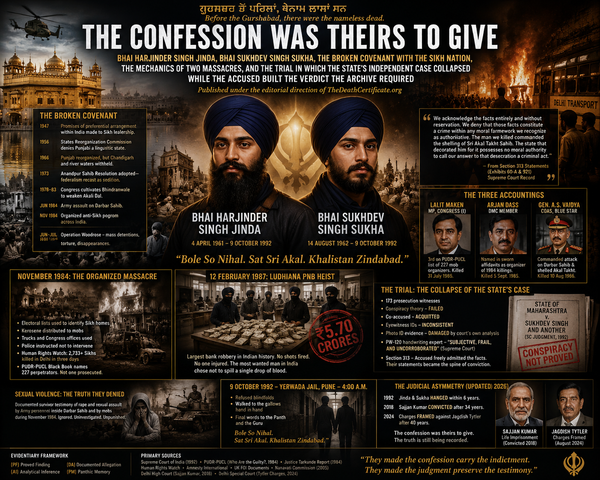
The Sikh human rights record presents a categorically different account. Under Gill’s command, the Punjab Police operated a system of detention, interrogation, and disposal that involved mass extrajudicial killing, enforced disappearance, custodial torture — including sexual violence — and the secret cremation of bodies as “unidentified” to conceal the evidence of what had been done to them. [DA/PF] The CBI investigation into the Amritsar district alone confirmed 2,097 illegal cremations — bodies disposed of without proper identification, without the statutory inquest that the law required, without the family notification that elementary human dignity demanded. [PF] Jaswant Singh Khalra’s original work, which began as documentation of this cremation record, established that the “unidentified” bodies included persons whose families were actively looking for them — men who had been picked up, tortured, killed, and secretly burned while their wives and mothers were filing habeas corpus petitions in courts that were receiving official denials of any police involvement. [PF]
The question that the evidence on Gill does not currently allow to be answered to the standard of a proved finding — and honesty requires saying so — is the question of command responsibility: what specifically did Gill know, authorize, or order? The SPO Kuldeep Singh testified in the Khalra murder trial that he witnessed Gill visiting Khalra at the Jhabal police station where Khalra was being held, days before Khalra’s death. [DA — testimony admitted in evidence but not adjudicated to conviction as against Gill specifically] Ensaaf, Human Rights Watch, REDRESS, and the Center for Human Rights and Global Justice jointly called on the CBI to investigate and prosecute Gill for his role in Khalra’s torture and murder. [PF] That investigation was not ordered.
The historical record supports the following tiered analysis: it is a proved finding that the Punjab Police under Gill’s command operated a system of extrajudicial killing and secret cremation at a massive scale. [PF] It is a documented allegation, grounded in testimony and pattern evidence, that Gill personally knew of and was implicated in specific violations including Khalra’s murder. [DA] It is an analytical inference, supported by the operational continuity and the institutional character of the violations, that a system of this scale and duration could not have operated without the knowledge and at minimum the permissive indifference of the Police’s top command. [AI] The classification of “traitor” in Gill’s case is complicated by the fact that the “traitor” label requires a prior bond of community trust that was broken — and Gill’s relationship to the Sikh community was always that of a police officer of Sikh origin serving the Indian state, not that of a community leader who turned against those who had trusted him. The more precise charge is the one that the accountability literature has formulated: that he was a Sikh who led a police force that committed atrocities against Sikhs, and that his conduct as the command authority over that force — whatever the specific evidence eventually establishes about his personal direction of specific acts — constitutes a grave and documented failure to ensure that the state power he wielded was exercised in accordance with law and with basic human dignity. [DA/AI]
The honest historical verdict on K.P.S. Gill must hold all of this: the genuine reduction in militant violence that his tenure produced (which real families in Punjab experienced as relief from a different kind of terror), the documented mass atrocity that accompanied and perhaps made possible that reduction, and the unresolved question of personal command responsibility at the criminal level. This is not comfortable territory for partisan history in either direction. It is where the forensic record actually lives.
Evidentiary classification: [PF] for the documented atrocity system; [DA] for specific personal command responsibility; [AI] for the institutional command inference; [PM] for the “traitor” characterization which is Panthic memory — strongly held, grounded in the documented evidence, but framing something the strict legal record has not adjudicated.
Ajit Singh Sandhu: The Primary Accused
Ajit Singh Sandhu — Senior Superintendent of Police, among his ranks — was the officer whom the CBI identified as the primary accused in the abduction and murder of Jaswant Singh Khalra. He was a Sikh. He served in the Tarn Taran district, one of the epicenters of the counterinsurgency’s worst documented abuses. He was the operational face of the system of detention and disposal in that zone. [PF — from CBI investigation and charge sheet]
Sandhu died in May 1997, during the trial, under circumstances officially classified as suicide. [PF] His death meant that the primary accused in one of the most significant human rights cases in Punjab’s history never stood to face the verdict his conduct warranted. He left behind a family that, by various accounts, experienced the consequence of his choices; he left behind a record that the CBI had already substantially documented. The fact that he was not alive to face conviction is not the same as the fact of his innocence. The charge sheet prepared by the CBI against him represents documented allegation of the highest seriousness, grounded in investigation conducted by the state’s own investigative agency. [DA]
Sandhu’s name belongs in this record because he was a Sikh who operated a system of extrajudicial killing against Sikhs. Whatever the political context, whatever the institutional pressures under which he operated, whatever the career structure that rewarded the results he produced — he was a Punjabi Sikh who detained, tortured, and (the CBI alleged) killed a Sikh human rights defender who was trying to find and name the Sikh dead. That is a specific, documented, and deeply serious breach of the community’s most fundamental bond.
Evidentiary classification: [DA] — grounded in CBI investigation and charge sheet; death during trial means no adjudicated verdict.
The Convicted Officers: Names the Court Has Given Us
The following individuals were convicted by courts of law for their roles in the abduction and murder of Jaswant Singh Khalra or in related counterinsurgency abuses. Their names belong in this record as proved findings. The court spoke; the essay names.
Deputy Superintendent of Police Jaspal Singh and Amarjit Singh: convicted of murder, abduction with intent to murder, destruction of evidence, and criminal conspiracy in the Khalra case; sentenced to life imprisonment by Additional District Judge Bhupinder Singh in Patiala on 18 November 2005; sentences upheld and enhanced on appeal by the Punjab & Haryana High Court in October 2007; upheld by the Supreme Court of India in November 2011. [PF]
Sub-Inspectors Satnam Singh, Surinderpal Singh, and Jasbir Singh; Head Constable Prithipal Singh (Pritpal Singh): convicted in the same case of abduction with intent to murder, destruction of evidence, and criminal conspiracy; sentences enhanced to life imprisonment on appeal. [PF]
These are men whose guilt was established through the judicial process of the Indian state — not by community sentiment, not by Panthic memory, not by the advocacy of human rights organizations, but by courts whose findings were upheld through multiple levels of appeal to the Supreme Court of India. The evidentiary standard has been met in the strictest possible sense. They were Sikh officers who participated in the abduction, torture, and killing of a Sikh human rights defender. The essay names them as the courts named them, without further qualification.
Inspector Surinderpal Singh also appears separately in the conviction record of a CBI court in Mohali (verdict 2024) for the kidnapping and wrongful confinement of four Tarn Taran residents in 1992, confirming a pattern of custodial conduct across multiple victims. [PF]
Sumedh Singh Saini: Documented Allegations Without Conviction
Sumedh Singh Saini (born 1955) rose through the Punjab Police to serve as Director General of Police — the position once held by K.P.S. Gill — and as DGP the state’s most senior police officer. His career is marked by a substantial body of serious allegation, much of it formalized in court proceedings, that establishes him as one of the most legally contested senior police figures in Punjab’s post-counterinsurgency history. [DA]
Multiple First Information Reports (FIRs) have been filed against Saini in connection with disappearances and custodial deaths from the counterinsurgency period. Courts have at various times ordered his arrest and summoned him; he has challenged these proceedings through legal mechanisms. [DA — from court records and journalistic documentation] The families of disappeared persons have named him in proceedings that allege his operational involvement in enforced disappearance and killing. He is a Sikh officer who served in the counterinsurgency apparatus and whose name appears consistently in the accountability record from that period.
The honest classification: the allegations against Saini are serious, multiply documented, legally formalized, and credible. They have not been adjudicated to conviction. [DA] The distinction matters, and the essay maintains it. But the distinction between “not convicted” and “not credibly accused” is a crucial one, and Saini occupies the former category, not the latter. The evidentiary record places him firmly in the category of serious documented allegation.
Evidentiary classification: [DA] — documented allegations in formal legal proceedings; no adjudicated conviction.
The Three Deputy Commissioners and the Failure of the Civilian Shield
The institution of the Deputy Commissioner — the civil administrative officer responsible for law and order, revenue, and magisterial functions at the district level — occupied a constitutionally critical position in relation to the Punjab counterinsurgency. Under the Code of Criminal Procedure, Sections 174 and 176, the District Magistrate (a role held by the DC) carried mandatory, non-discretionary obligations in relation to deaths in custody and deaths in suspicious circumstances: the obligation to ensure that a proper inquest was conducted, that the death was properly recorded, and that — where foul play was suspected — the matter was brought before a judicial magistrate for formal inquiry. These were not discretionary powers; they were legal duties. [PF — from the CrPC itself]
Across the period during which the CBI confirmed 2,097 illegal cremations in Amritsar district — bodies disposed of as “unidentified” through the municipal cremation grounds without the statutory inquiry process — three successive occupants of the DC Amritsar office held that statutory mandate and failed to exercise it.
Ramesh Inder Singh (IAS) served as DC Amritsar during the early period of the counterinsurgency, overlapping with 1984 and the years immediately following. The wave of disappearances, custodial deaths, and secret cremations that the CBI later documented began in earnest during his tenure. [AI — from the CBI cremation record and period documentation] Whether his failure to exercise the §§174/176 mandate was the product of explicit direction from above, passive complicity in the security apparatus’s operations, or a genuine inability to exercise civilian authority in a zone effectively militarized by the police and army is a question the available record addresses only at the level of analytical inference.
Sarabjit Singh (IAS) served as the subsequent DC Amritsar, his tenure spanning the period of the insurgency’s intensification in the late 1980s and early 1990s. The same statutory framework applied; the same cremation system continued to operate within his administrative jurisdiction; the same silence on the magisterial record — the absence of the §§174/176 inquiries that should have been opened each time a body arrived at the municipal cremation ground as “unidentified” — characterizes his period in office. [AI]
K.B.S. Sidhu (IAS) served as DC Amritsar from 1992 to 1996, overlapping with the period during which Khalra’s investigation first surfaced the scale of the cremation record and during which Khalra was abducted and murdered. Sidhu has subsequently had an active public life as an author and commentator, including a Substack publication in which he has written extensively about his administrative career in Punjab. He has not addressed, in that body of writing, the statutory mandate his office carried in relation to the cremations occurring within his jurisdiction. [AI — from the absence in the documentary record of any §§174/176 inquiries for the period; from the Substack archive as documented by this publication’s prior analysis]
The analytical inference the record supports — and it is held firmly at the inference level, because it is an inference about institutional conduct rather than a proved finding of personal criminal act — is that the civilian magistracy’s systematic non-exercise of its statutory protective mandate was a necessary condition for the continuity of the cremation system. [AI] A District Magistrate who consistently opened §§174/176 inquiries into “unidentified” bodies brought to the municipal cremation grounds would have created a documentary record that made the cremation system visible. The absence of that record is itself evidence of the institutional failure. It does not prove that any individual DC directed the killing; it does prove, at the analytical inference level, that the office that should have functioned as a brake on the system did not do so.
The essay names these three officers as the holders of an office that failed its mandate — not as persons who are accused of personally committing violence, but as the civil administrative faces of an institutional failure whose consequences for the Sikh dead and their families were catastrophic. [AI]
Beant Singh (Chief Minister): The Political Architecture of the Final Counterinsurgency
Beant Singh (1922–1995), who served as Chief Minister of Punjab from February 1992 until his assassination by a human bomb on 31 August 1995, is one of the most complex political figures of the counterinsurgency era. He was a Congress politician who led Punjab through the period of the insurgency’s effective suppression, who authorized and sustained the operations that produced both the reduction in militant violence and — in the documented record — the mass human rights violations of the Khalra period. He was killed in office, which has tended to foreclose the kind of critical analysis his tenure warrants.
In Panthic memory, Beant Singh occupies a deeply contested position. For communities that experienced the relief of reduced militant violence, he is remembered as a chief minister who restored a kind of normalcy to Punjab. For families of the disappeared and secretly cremated, he was the political leadership that authorized and sustained the system within which those disappearances occurred. [PM/DA]
The evidentiary standard supports the following: Beant Singh, as Chief Minister, bore constitutional responsibility for the conduct of the Punjab Police as an instrument of his government. The operations that produced the documented mass atrocity — including the secret cremation of 2,097 bodies in Amritsar district — occurred under his political authority and with the deployment of resources his government controlled. [AI] Whether he gave specific direction to the system of extrajudicial killing, or whether he authorized a counterinsurgency strategy and permitted its execution without specific inquiry into the methods being used, is not established at the level of proved finding. [AI] What is established is that the political authority of his office was the enabling condition for the operational authority of the police system, and that his government did not — in the available record — exercise the political oversight that might have constrained that system’s worst elements.
Evidentiary classification: [DA/AI] — documented political command responsibility at the analytical inference level; no adjudicated personal criminal liability.
The SPO System: Intimate Betrayal at the Grassroots
The Special Police Officer (SPO) system and the related category of the “cat” — surrendered militants turned into police intelligence assets — represent the contemporary version of the eighteenth-century mukhbar: the intimate instrument who provided the local knowledge that allowed the state’s enforcement operations to identify their targets.
The system was, by design, an architecture of intimate betrayal. The SPO or “cat” typically knew the families, the villages, the hiding places, the kinship networks of the people against whom they were deployed. They had often themselves been militants, or had family members who were. Their effectiveness as intelligence sources depended entirely on the depth of their prior community connections. Their deployment against those communities inverted those connections in the most personal possible way. [PF — from multiple NHRC and judicial records; from the Khalra trial record]
The individuals involved in this system — those who identified specific persons for arrest or killing — occupied a particularly serious moral position, and the record does not permit a comfortable treatment of that position. They were instruments; they were also agents. They made choices, often under duress of threat to themselves and their families, sometimes under the influence of monetary reward, sometimes from ideological reversal. [DA/AI] The duress they faced does not eliminate their moral agency; it contextualizes it in ways that the simple “traitor” label does not capture.
The essay names the system rather than individual SPOs and “cats” by name, because the evidentiary standard for individual naming requires a level of identification and sourcing that the available record does not consistently provide for this class of participants, and because many of them were themselves victims of a system they were coerced into serving. [AI]
Part Seven: The Badal Dynasty — Political Accommodation as Managed Impunity
Parkash Singh Badal: The Most Consequential Sikh Politician of the Post-1984 Period
Parkash Singh Badal (1927–2023) was the dominant figure in Punjab politics for more than half a century. He served as Chief Minister of Punjab on five occasions: 1970-71, 1977-80, 1997-2002, 2007-12, and 2012-17. He led the Shiromani Akali Dal through its longest period of unbroken electoral relevance, built and maintained the SAD-BJP coalition that governed Punjab for a decade, and died in April 2023 as the grand old man of Punjabi political life, honored with a state funeral and eulogized by figures across the Indian political spectrum. [PF]
He is also — in the serious, graded, evidentiarily disciplined sense that this archive requires — the figure whose political management of accountability for the Punjab atrocities did more than any other single individual to ensure that justice for the 1984 and counterinsurgency-era crimes remained systematically deferred. [DA/AI] The charge against him is not personal commission of violence; it is the charge of political management: the use of governmental power — specifically, the power to control investigative agencies, to appoint and remove police personnel, to influence the conduct of special investigative teams — to prevent accountability from materializing. This is the institutional-political form of betrayal, and it is in some ways more corrosive than the personal form, because it operates through the very mechanisms that the community is supposed to be able to trust to deliver justice.
The specific record against Badal in this regard is grounded in documented episodes. The 2015 beadbi crisis — the desecration of the Guru Granth Sahib, the most sacred text of the Sikh tradition, in the Faridkot district — produced an acute political crisis on his watch. The government’s response to the desecration, and to the police firing on protesters that killed two Sikh men — Gurjeet Singh and Krishan Bhagwan Singh — at Behbal Kalan on 14 October 2015, exposed the political limitations of the Badal government’s capacity or willingness to act against actors and interests that were politically proximate to it. [PF]
The Dera Sacha Sauda connection to the beadbi, which was credibly alleged in the investigative record and formally pursued through a Special Investigation Team, implicated an organization whose electoral support had been cultivated by the SAD-BJP coalition and whose leadership Badal had publicly endorsed. [DA] The SIT investigations, which came under sustained criticism for their conduct and their pace, were viewed by many — including members of the Panthic community and retired judicial officers — as compromised by the political pressures that operated around them. [DA]
On the longer-term question of accountability for 1984-era crimes: Badal’s governments — across their multiple tenures — did not pursue the accountability that the CBI cremation findings, the Khalra case convictions, and the substantial body of NHRC-documented human rights violations made legally and politically available. [AI] The argument that might be made for him — that the political constraints on any Punjab Chief Minister in relation to the central government made systematic prosecution of counterinsurgency-era abuses untenable — has some analytical merit. [AI] The Indian Army and the central paramilitary forces that operated in Punjab during the counterinsurgency were not subordinate to the state government; their operations were never subject to comprehensive state-level accountability proceedings, and a Punjab CM who pursued such proceedings aggressively would have faced obstruction from the centre that his political position could not easily absorb.
But the argument that political constraint explains Badal’s accountability failure runs directly into the evidence of his active use of political power to configure investigative outcomes — not mere passivity in the face of federal obstruction, but positive deployment of governmental authority in directions that precluded accountability. [DA/AI] The distinction between “could not achieve justice” and “chose the configuration of power that made justice impossible” is the distinction that the record, at the analytical inference level, supports resolving against him.
The deepest charge against Parkash Singh Badal — the one that the long arc of his career most strongly supports — is the charge of managed political survival. He survived Punjab’s most violent political era by making himself useful to enough competing powers that no single force found it worth the cost of eliminating him. He served the Sikh political community’s interests in numerous ordinary governance domains — infrastructure, agricultural support, rural development — while systematically failing to challenge the accountability architecture that would have genuinely served the community’s deepest need after 1984: justice for the disappeared, justice for the secretly cremated, justice for the families who received no acknowledgment that their sons and fathers and husbands had been taken and killed. [AI]
This failure is not the failure of the bought general. Badal was not paid by a foreign power to betray a military campaign. His failure is the failure of the political opportunist who correctly assessed that the short-term costs of pursuing accountability outweighed the short-term benefits, and who never lived long enough — or chose never to live long enough — in the moral time-frame that the history of his community demanded. He died in 2023. The families of the 2,097 secretly cremated are still waiting. [PM/AI]
Evidentiary classification: [DA/AI] — documented political management of accountability outcomes; the charge of managed impunity as institutional-political betrayal is strongly grounded in analytical inference from the documented record.
Sukhbir Singh Badal: The Political Heir and the Beadbi Crisis
Sukhbir Singh Badal (born 1962), son of Parkash Singh Badal and his political heir, served as Deputy Chief Minister of Punjab from 2007 to 2017 and as President of the Shiromani Akali Dal. His tenure as the effective political operator of the Badal government — while his father was nominally Chief Minister — encompassed the period of the beadbi crisis, the Behbal Kalan killings, and the governance failures that contributed to the SAD-BJP coalition’s decisive electoral defeat in 2017.
The specific charges against Sukhbir Badal are grounded in the beadbi crisis. The desecration of the Guru Granth Sahib — beadbi literally means disrespect — is among the gravest offenses in the Sikh theological framework; it is not a question of hurt sentiment but of the most fundamental possible violation of what the Sikh tradition holds most sacred. [PM/PF — the desecrations themselves are documented] The government’s failure to pursue a decisive, transparent, and politically unconstrained investigation was experienced in the Panthic community as a fundamental betrayal by a government that presented itself as the Panth’s political voice. [DA]
The Akal Takht subsequently took notice of Sukhbir Badal’s role in various governance failures and, in December 2024, issued him a tankhah for conduct that included his role in decisions made during his tenure as Deputy Chief Minister that the Akal Takht characterized as contrary to Panthic interests. [PF] The tankhah proceedings represent the Panth’s institutional framework engaging, belatedly, with the governmental conduct of a senior SAD leader — and the issuance of the tankhah itself is the Akal Takht’s formal verdict that the conduct warranted religious sanction.
Evidentiary classification: [PF] for the tankhah; [DA/AI] for the broader charge of institutional betrayal through governmental power.
Harsimrat Kaur Badal: The Ministerial Dilemma
Harsimrat Kaur Badal (born 1966), wife of Sukhbir Badal and daughter-in-law of Parkash Singh Badal, served as Union Minister for Food Processing Industries in the Modi government from 2014 to 2020. She resigned from the cabinet in September 2020 in protest against the three agricultural laws that the Modi government had passed — laws that the farming communities of Punjab, predominantly Sikh, opposed as threatening to their economic interests. [PF]
Her resignation is, within the Sikh political context, a more significant act than it might appear from a national political vantage: it was a Sikh minister within a BJP-led government choosing her community’s economic interests over her coalition’s political agenda, at a cost to her own ministerial position. [PF] This is the kind of act that complicates any simple narrative about the Badal political family’s relationship to Panthic interests.
The honest account must hold both: the family’s documented governance failures on accountability and the beadbi crisis, and her specific act of resignation in defense of agrarian interests. A forensic approach that ignores the latter to maintain the former’s simplicity is not forensic analysis; it is motivated narrative. [AI]
Evidentiary classification: [PF] for the documented facts of her tenure and resignation; the broader assessment of where she falls in the betrayal/accommodation spectrum requires holding the full complexity.
The Dera Sacha Sauda and the Institutional Accommodation
The political relationship between the SAD-BJP coalition — during its years in government — and the Dera Sacha Sauda, a heterodox religious organization headquartered in Sirsa, Haryana, is among the documented episodes of political accommodation that Panthic sentiment reads as betrayal.
The Dera Sacha Sauda’s head, Gurmeet Ram Rahim Singh — subsequently convicted of rape in 2017 and sentenced to twenty years’ imprisonment, and subsequently additionally convicted of murder — commanded a large vote-bank in the districts bordering Haryana, and that vote-bank was politically significant to any party seeking to win Punjab assembly elections. [PF] The SAD’s cultivation of Dera support, and the public encounters between senior SAD leaders and the Dera’s head, were documented political events. [PF]
The Panthic objection to this relationship was not merely political; it was theological and historical. The Dera Sacha Sauda had, on multiple occasions, engaged in acts that the Sikh tradition experienced as deeply offensive — most significantly a 2007 incident in which the Dera’s head appeared to enact a tableau that echoed the baptism ceremony of Guru Gobind Singh in a manner the SGPC formally condemned as sacrilegious. [PF] The SAD government’s management of the tension between the Dera’s political utility and the Panth’s theological objection to the Dera’s conduct — managing it toward the former rather than the latter — is among the documented episodes that ground the managed-impunity charge against the Badal political machine. [DA/AI]
Evidentiary classification: [DA/AI] — documented political relationship; documented theological objection; the characterization of the accommodation as betrayal is an analytical inference from the documented record.
Part Eight: The SGPC, Religious Governance, and the Capture of Panthic Institutions
The SGPC’s Structural Vulnerability
The Shiromani Gurdwara Parbandhak Committee, established by the Sikh Gurdwaras Act of 1925, is one of the most consequential institutional achievements in the modern history of the Sikh Panth. It recovered the historic gurdwaras from the mahant system, established elected community governance of Sikh sacred sites, and created a financial and institutional base for Panthic governance that was, in principle, independent of the state. [PF]
In practice, the SGPC has been subject to precisely the form of institutional capture that any body controlling large resources and legitimate authority will attract in a democratic political economy: capture by the political party that can most reliably win the elections that determine its membership. From the early decades of independence through the present, the Shiromani Akali Dal has dominated SGPC elections, and the SGPC’s institutional behavior has tracked the SAD’s political interests with a fidelity that sometimes conflicted with the Panth’s independent religious needs. [DA/AI]
This is structural betrayal — not the betrayal of a specific individual who consciously chose personal gain over community interest, but the more insidious betrayal of an institution that allows itself to become the instrument of a political machine rather than the independent representative of the Panth’s religious conscience. The individuals who facilitated this capture — whether through electoral manipulation, patronage distribution, or the use of SGPC resources for party-political purposes — bear individual responsibility within a structural failure whose dimensions are larger than any single person.
The Akal Takht and the Jathedar System
The institution of the Jathedar — the chief administrator of the Akal Takht and of the other historic takhts of the Sikh tradition — is, in principle, the highest living voice of Panthic religious authority. The Jathedar speaks not for a political party, not for an individual, but for the assembled conscience of the Khalsa. [PF — from the Sikh Rehat Maryada and the historical record of the institution]
The practical history of the Jathedar institution in the post-independence period is a history of its instrumentalization by political forces, and this instrumentalization represents a specific form of institutional betrayal whose consequences for Panthic religious authority have been profound. When the Jathedar of the Akal Takht issues a pronouncement that appears to serve the political interests of the party that controls the SGPC — which appoints the Jathedar — rather than the Panth’s independent religious conscience, the institution that should be the final guarantee of Panthic independence becomes its most visible instrument of compromise. [DA/AI]
Specific Jathedars who have been accused of political accommodation include figures who issued pronouncements on sensitive matters — including, controversially, matters related to the accountability of SAD-aligned figures — in ways that the Panthic community experienced as politically motivated rather than spiritually grounded. [DA/PM] The essay notes this as a documented category of institutional capture rather than naming individual Jathedars as personal betrayers, because the evidence in specific cases involves contested questions of theological interpretation and institutional procedure that require more granular analysis than this essay can provide within its scope.
The Beadbi Crisis and the Institutional Failure of 2015
The sacrilege crisis of 2015 — the desecration of copies of the Guru Granth Sahib in Faridkot district, the subsequent protests, and the killing of protesters at Behbal Kalan — represents the most acute test of Panthic institutional integrity in the post-2000 period, and the test revealed failures at every institutional level: governmental, police, SGPC, and the Akal Takht.
The governmental failures — the Badal administration’s handling of the investigation — have been discussed in Part Seven. The institutional failures of the SGPC and the Akal Takht are a separate dimension of the same crisis. An SGPC and an Akal Takht operating with genuine institutional independence from the party that controlled both would have been able to respond to the beadbi with the full moral and institutional weight of Panthic authority: immediate and unequivocal condemnation, a formal demand for transparent investigation by agencies outside the state government’s control, and — where the investigation was obstructed — a willingness to use the SGPC’s substantial public voice to demand accountability regardless of the political cost to the SAD.
That this response did not materialize — or materialized only partially, and belatedly — is documented in the record of the crisis. [DA] The SGPC’s response was seen by significant portions of the Panthic community as too slow, too politically calibrated, and insufficiently independent of the government whose conduct was itself under question. [DA/PM] This is institutional capture operating in real time, visible to the community it was supposed to serve, and experienced as a form of betrayal by those families whose sacred text had been violated and whose protests had been met with police fire.
Part Nine: The Diaspora Dimension — Informants, Securitization, and Political Actors
The Transnational Architecture of Intelligence Penetration
Sikh diaspora communities in Canada, the United Kingdom, the United States, and across Western Europe have been the subject of intelligence surveillance, infiltration, and political pressure by the Indian state that is documented in multiple sources, including journalistic investigations, court proceedings in multiple countries, and the now-substantial body of diplomatic incident that has produced diplomatic expulsions and formal protests between India and Canada and between India and the United States. [PF]
The question of who within the diaspora has functioned as an instrument of that surveillance and pressure — who has provided information, hosted government-aligned narratives, or facilitated transnational repression — is one that the available public record addresses only partially. The documentary record of Indian intelligence operations against the Sikh diaspora is substantially classified, and the individuals who served as intelligence sources within diaspora communities are, by the nature of intelligence work, not typically identified in the public record. [AI]
What the public record does establish: that several diaspora-adjacent organizations and media platforms have, over extended periods, produced content that aligned closely with the Indian government’s framing of Sikh political activity as terrorism; that the “Khalistan” label has been deployed as a political weapon to suppress legitimate Sikh advocacy on accountability and self-determination; and that some individual Sikh public figures in diaspora communities have either wittingly or unwittingly served as amplifiers of narratives that facilitated the securitization of Sikh identity. [DA/AI]
The essay does not name specific diaspora individuals in this category without a higher standard of evidence than is currently available in the public record, because the consequences of misidentifying someone as an intelligence agent within a politically inflamed diaspora context are severe and cannot be remedied after the fact. [AI] The category is named; the specific names require specific evidence.
The Media Framing of Sikh Identity: A Note on Journalism and Accountability
Sikh political identity in India has been systematically framed — across multiple mainstream Indian media platforms and by several prominent journalists and anchors — through the lens of the “Khalistan threat,” a frame that collapses the distinction between legitimate political advocacy for autonomy and rights-accountability, and violent secessionism. [DA/AI]
This framing serves state interests: it delegitimizes diaspora advocacy, it justifies the continued denial of justice for counterinsurgency-era crimes, and it maintains the political conditions under which the families of the disappeared remain without remedy. Journalists and media figures who apply this frame unreflectively — or who apply it with awareness of its political function — are contributors to the narrative system within which Sikh political identity is suppressed. [AI]
The essay does not name specific journalists as “traitors” for this reason: journalism, even biased journalism, even journalism that serves state-aligned interests, is not the equivalent of the bought general who destroys an army or the mahant who massacres a jatha. It is speech, and the appropriate response to speech that distorts is counter-speech and documented rebuttal — which this archive has provided and continues to provide. The characterization of Sikh-identity-hostile journalism as betrayal applies to a Sikh journalist who understands the community’s history and deliberately applies the securitization frame to suppress that history; it does not apply automatically to non-Sikh journalists whose ignorance may be the more significant factor. Distinguishing between the two requires specific evidence about specific individuals that the public record does not consistently provide.
The archive notes this category, holds it at the analytical inference level, and declines to produce a named roster of journalists without the evidentiary grounding that such naming would require. The Panth’s interests are best served by the rebuttal of specific, documented distortions rather than by the wholesale labeling of media figures in a manner that the evidence does not support.
Part Ten: Extended Portraits — Figures Who Require Individual Treatment
The figures in this section have been named in Panthic discourse as traitors, collaborators, or enemies of Sikh interests. Each receives a full individual accounting, with honest assessment of the evidentiary record for and against the charge.
Jagmeet Singh: The Diaspora Politician in the Transnational Crossfire
Jagmeet Singh (born 1979), leader of the New Democratic Party of Canada and Canada’s most prominent Sikh political figure, has occupied a position of intense scrutiny from multiple directions: from Canadian political opponents who have sought to delegitimize him through the “Khalistan sympathizer” label, and from within portions of the Panthic community who have questioned whether his conduct in office has sufficiently championed Sikh accountability demands. [PF/DA/PM]
The charge from within the Panthic community is the more relevant one for this essay. The argument — at the documented allegation level — is that his political calculations as NDP leader in a parliamentary system where he held balance-of-power position under the Trudeau Liberal government required accommodations that prevented him from being as forceful on the Khalistan accountability issue — Canada’s formal acknowledgment of the 1984 genocide, diplomatic accountability for Indian intelligence operations in Canada — as the community’s interests required. [DA/AI]
The evidentiary analysis: Jagmeet Singh has been, by the public record, one of the most prominent voices in any democratic parliament for Sikh accountability and for the formal recognition of the 1984 anti-Sikh violence as a genocide. [PF] Whether his specific political management of the NDP’s parliamentary position on these issues fully served the community’s strongest advocacy demands is a question of political judgment on which reasonable Sikhs disagree. The “traitor” label, applied to a figure whose public record includes sustained and visible advocacy for the community’s accountability demands, collapses on contact with that record. [AI]
Evidentiary classification: [AI/PM] — the “traitor” charge is not supported; the question of whether his political management was optimally bold is a legitimate political disagreement.
Navneet Kaur Hari: Contested Terrain in Indian Electoral Politics
The Sikh community’s engagement with Indian electoral politics across all parties — the BJP, the Congress, and the Aam Aadmi Party in Punjab — involves individual Sikh politicians who make choices about coalition alignment, policy advocacy, and community representation that generate intense internal debate about whether they are serving Panthic interests or accommodating the interests of parties whose relationship to the Sikh community is complicated by the history of 1984 and the counterinsurgency.
The AAP government in Punjab, elected in 2022 under Bhagwant Mann, represents the most recent entry in this contested field. The party’s record on Sikh accountability issues — on the beadbi cases, on reopening counterinsurgency-era files, on the institutional independence of the SGPC from political capture — is a matter of developing political record rather than settled historical verdict, and the essay declines to assess it in the manner appropriate to settled history. [AI]
S.S. Nihal Singh: The Civil Administrator’s Record
S.S. Nihal Singh appears in the accountability record of the counterinsurgency period in a civil-administrative capacity. His role and the specific nature of his administrative conduct during the period of the counterinsurgency is a matter that this archive has engaged with in prior documentation. The evidentiary approach here is consistent with the treatment of the three DCs: where the charge is institutional failure to exercise statutory protective mandate — not personal commission of violence — it is held at the analytical inference level and attributed to the office rather than asserted as a proved finding of personal criminal act. [AI]
General K.S. Brar: The Commander of Blue Star
Major General Kuldip Singh Brar (born 1944) commanded the military operation that assaulted the Darbar Sahib complex in June 1984. He was a Sikh officer of the Indian Army who led the army into the holiest site of his own religious tradition at the direction of the political authority above him. He has spoken and written extensively about Operation Blue Star, consistently defending its necessity on security grounds and arguing that the presence of armed militants in the Darbar Sahib required a military response. [PF]
The charge in Panthic memory is that a Sikh officer should have refused to lead the assault — that his religious identity imposed an obligation of conscientious objection that he overrode in favor of military obedience. [PM] The evidentiary analysis of this charge requires confronting a genuine tension: between the military obligation of command obedience, which the law in every army enforces with serious sanctions for violation, and the moral obligation that the Sikh tradition would impose on a Khalsa soldier who was ordered to assault the Akal Takht.
This is not a tension that the essay can resolve on behalf of the reader. The military law dimension is clear: a serving officer who refuses to carry out a lawful order of the government faces court martial and imprisonment. [PF] The moral dimension, within the Sikh framework, is also clear: the sanctity of the Akal Takht is not subject to military order. [PF — from Sikh theology and the Rehat Maryada] That these two clear dimensions point in opposite directions is the tragedy of Brar’s position, and condemning him without acknowledging the structural coercion within which he operated — or exonerating him without acknowledging the theological dimension of what he did — would both misread the record.
The verdict that intellectual honesty requires: Brar made a choice, under conditions of coercion, that had catastrophic consequences for the Sikh sacred geography and for the thousands of people within the Darbar Sahib complex during the assault. Whether that choice constitutes betrayal or compliant service to an unjust command — and whether the moral burden of that choice rests primarily on him or on the political authority that issued it — is a question the record frames without cleanly resolving. [AI/PM]
Evidentiary classification: [AI/PM] — documented role is clear; the moral assessment is genuinely contested.
The November 1984 Congress Figures: Jagdish Tytler and Sajjan Kumar
Jagdish Tytler and Sajjan Kumar are Congress politicians who have faced sustained, credible, and formally lodged allegations of leadership and incitement in the anti-Sikh pogrom of November 1984. Though neither is Sikh, they are named here because the accountability for November 1984 is inseparable from the accountability architecture that Sikh political actors within the Congress — including Zail Singh and Buta Singh — either enabled or failed to challenge.
Sajjan Kumar was convicted in December 2018 by the Delhi High Court of crimes connected to the 1984 anti-Sikh violence, including culpable homicide and promoting enmity, and was sentenced to life imprisonment. [PF] Jagdish Tytler’s case has been subject to extended CBI investigation and reinvestigation; as of the most recent available record, proceedings against him remained in the judicial process. [DA]
These cases establish, through judicial process, that the November 1984 pogrom involved organized leadership from within the Congress party apparatus. [PF — from the Sajjan Kumar conviction] Sikh political figures within Congress who were in positions of influence during and after November 1984 and who did not use that influence to demand accountability for the perpetrators bear the institutional responsibility charge that this essay has applied to others: not the charge of personal commission, but the charge of silence in the face of documented atrocity that their institutional position obligated them to break. [AI]
The Longowal Accord: Sant Harchand Singh Longowal
Sant Harchand Singh Longowal (1932–1985) was the president of the Shiromani Akali Dal who signed the Rajiv-Longowal Accord in July 1985 — an agreement with the Rajiv Gandhi government that committed the Indian state to addressing several Sikh political demands, including the transfer of Chandigarh to Punjab and the resolution of the river waters dispute. He was assassinated by a Sikh militant in August 1985, before the Accord’s implementation could be assessed.
In sections of Panthic militant discourse, Longowal was characterized as a traitor for signing an agreement with the government that had ordered Operation Blue Star — a government that, in this view, had no moral credibility as a negotiating partner. [PM] His assassination was the tragic culmination of that characterization being acted upon.
The evidentiary assessment: Longowal was a political leader who sought a negotiated resolution to a crisis that was consuming lives on multiple sides, and who was killed for that attempt. Whether the Accord he signed was tactically wise — and the answer to that, given that its key provisions were never implemented, is that it was not — is distinct from whether signing it constituted betrayal. [AI] The accusations of betrayal against Longowal, in the militant tradition, reflect the irreconcilable tension between the political tradition that sought accommodation within the Indian constitutional framework and the militant tradition that had concluded such accommodation was impossible. Both traditions were responding to the genuine catastrophe of June 1984; they reached opposite conclusions about what that catastrophe required. Longowal chose accommodation and paid for it with his life.
Evidentiary classification: [AI/PM] — the “traitor” charge is Panthic militant memory, contested by significant portions of the broader Panthic community; the evidence does not support the unqualified application of the betrayal label.
Gurcharan Singh Tohra: The Extended Portrait
Tohra’s full legacy requires the extended treatment his decades-long career warrants. Beyond the structural capture of the SGPC discussed in Part Four, Tohra’s specific conduct across several critical moments illuminates the complexity that resists simple classification.
During the period of the militancy, Tohra maintained a position that was more openly sympathetic to Panthic militant concerns than most mainstream Akali politicians. His relationships with militant organizations — and the SGPC’s management of resources during the period — have generated serious documented allegations that deserve honest engagement rather than partisan dismissal. [DA] Whether these relationships constituted a responsible engagement with the full spectrum of Panthic political opinion, or whether they facilitated violence, is a question that the available record does not permit to be resolved with the certainty of a proved finding.
His long cultivation of personal political power — the SGPC presidency as a near-permanent personal franchise — is, as noted earlier, documented institutional capture. [DA/AI] But his resistance to specific political pressures from the central government, his maintenance of SGPC independence in certain domains against strong pressure from Delhi, and his own personal piety within the Sikh tradition complicate the simple verdict. He was a genuinely complex man who served both his institution and himself, in proportions that varied with circumstance and that the record does not permit to be precisely calibrated. [AI]
Evidentiary classification: [DA/AI] — the institutional-capture charge is strongly grounded; the personal-betrayal charge is more contested.
Part Eleven: The Deeper Archive — Figures Rarely Named, Often Consequential
The Intelligence Apparatus and Its Sikh Instruments
The operations of the Intelligence Bureau of India, the Research and Analysis Wing, and the Punjab Police’s own intelligence apparatus against the Sikh community — in Punjab, in the diaspora, and in the broader Indian political landscape — required human instruments embedded within the community itself. The deployment of Sikh intelligence operatives against Sikh organizations, Sikh religious bodies, Sikh political parties, and individual Sikh leaders is not a speculation; it is a structural feature of counterinsurgency and internal security operations that has been documented in the human rights record, in court proceedings, and in the testimonies of participants who have come forward. [PF/DA]
The difficulty — and the essay is honest about it — is that intelligence operations of this kind are, by design, not documented in the public record. The specific names of Sikh intelligence operatives who infiltrated Panthic organizations, who provided targeting information for specific operations, who built files on Sikh leaders whose subsequent disappearance and death followed, are in most cases known only to the agencies themselves and to the families of those targeted. [AI] The essay names the category; it declines to name specific individuals without evidentiary grounding that the public record does not currently provide, because misidentifying someone as an intelligence agent within a political context as charged as this one could itself cause serious harm. [AI]
What the record does establish, at the analytical inference level: the counterinsurgency’s operational precision — its ability to locate specific individuals in specific locations at specific times — required local intelligence sources of a quality that only community-embedded operatives could provide. [AI] The operational record of the period, as documented in the Khalra case convictions, in the NHRC proceedings, and in the broader accountability literature, is consistent with systematic human intelligence penetration of Sikh organizations. The instrument was used extensively; its specific human components await the full archival disclosure that has not yet been ordered.
Ajmer Singh Lachhewala: A Note on Defection
Several Sikh political figures who began their careers within Panthic political organizations subsequently became government-aligned actors whose conduct the Panthic community experienced as defection. Ajmer Singh Lachhewala is one figure who moved from Akali political alignments into Congress proximity, a trajectory that the Panthic political discourse reads as political crossing for personal benefit. [DA/PM] The specific evidentiary basis for assessing whether this represents genuine betrayal of Panthic interests or pragmatic navigation of political realities is at the documented allegation and Panthic memory level, and the honest assessment declines to upgrade it to proved finding.
The Question of Nirankari Association and State Alignment
The Nirankari movement — the Sant Nirankari Mission — is, in Sikh theological terms, a heterodox organization that the Khalsa tradition has consistently regarded as outside the Sikh fold. The 1978 Amritsar confrontation between Nirankaris and Akhandpath Sikh protesters, in which Nirankari followers killed multiple Sikhs in a clash outside the Golden Temple, is a documented event that set in motion a chain of violence whose consequences shaped Punjab for two decades. [PF]
The Nirankari-state nexus — the allegation that the Indian government cultivated the Nirankari organization as a political instrument against mainstream Sikhism, giving it political cover and protection in exchange for its utility as a wedge — is a documented allegation with substantial analytical grounding. [DA/AI] If that nexus was real, then the Sikh figures who facilitated it — who provided the state with information about Sikh political organizations through Nirankari channels — were instruments of a form of ideological betrayal that operated through religious heterodoxy rather than direct political defection.
The essay names this as a documented category and notes it as requiring specific evidentiary development beyond what the present analysis can provide.
The Mainstream Indian Media and the Securitization Frame
The major Indian television networks and English-language newspapers have, across the post-1984 period and with particular intensity since approximately 2015, applied the “Khalistan” frame to Sikh political advocacy with a consistency that suggests coordinated narrative management rather than independent editorial judgment. [AI/DA] The application of the “Khalistan” label to: advocacy for accountability for 1984-era crimes; advocacy for the rights of incarcerated Sikh political prisoners (Bandi Singhs); diaspora political activity around the Indira Gandhi assassination anniversary; and any articulation of Sikh political autonomy claims has been systematic, pervasive, and deeply consequential for the political environment in which Sikh communities operate. [PF — from the media record itself]
Sikh journalists and media personalities who have participated in and amplified this frame — who have used their community identity as a credential for credibility while deploying it against the community’s accountability interests — occupy the category of institutional betrayal within a media apparatus. The essay notes this category and declines to name specific individuals without specific documented evidence of their knowing and willing participation in the suppression of the community’s legitimate advocacy, as distinct from their unreflective application of frames whose political function they may not have fully analyzed. [AI]
Part Twelve: The Institutional Betrayals — A Synthesis
The Pattern Across Three Centuries
What the full record of this essay establishes, across three centuries of post-Guru political history, is not a roster of individual villains but a pattern of recurring mechanism: the trusted insider recruited or co-opted as the instrument through which external power strikes the community. The mechanism takes different forms in different eras — the informer who sells the village, the general who sells the war, the mahant who sells the shrine, the politician who manages accountability away, the police officer who sells his community’s bodies as unnamed dead — but its structural logic is constant.
What also recurs, in the same record, is the community’s response: the Sarbat Khalsa that adjudicates, the tankhah that punishes proportionately, the Chali Mukte who demonstrate that betrayal does not permanently foreclose the return to the Panth’s embrace. The Sikh tradition is not a tradition of eternal condemnation. It is a tradition of reckoning — demanding, serious, institutional reckoning, followed by the possibility of acknowledgment and rehabilitation.
What the Traitor Designation Requires
The essay closes with a structural observation that the evidence of all twelve parts supports. The “traitor” designation — properly applied, rigorously grounded — requires several specific elements, all of which must be present:
A bond of trust: the accused must have held a position — as general, custodian, representative, administrator, officer — within which the Panth specifically placed its confidence and its welfare.
A conscious breach: the accused must have broken that trust with awareness of what the breach would cost the community, not merely through failure or limitation of personal capacity.
A benefit: the breach must have served the personal, political, or financial interests of the accused at the community’s expense.
A causal connection: the breach must have produced specific harm to the community that a loyal exercise of the trust would have prevented or mitigated.
Where all four elements are present — as they are in the cases of Lal Singh, Tej Singh, and Gulab Singh Dogra, in the case of Mahant Narain Das, in the cases of the convicted officers of the Khalra murder — the “traitor” designation applies with the full force of the historical and evidentiary record. Where one or more elements are absent or contested — as they are in the cases of Giani Zail Singh, Baldev Singh, Master Tara Singh, General Brar, Sant Longowal — the honest verdict distinguishes between the element present (institutional failure, political accommodation, miscalculation) and the element absent (conscious breach for personal benefit), and it names what is actually there rather than what the political heat of the moment demands.
This distinction is not a softening of the accusation. It is its precision. And precision — forensic, evidentiary, disciplined precision — is the only form of accusation that cannot be litigated away.
Part Thirteen: The Rehabilitation Framework — Haumai, Tankhah, and the Door Left Open
The Theological Architecture of Transgression and Return
The Sikh theological framework for addressing betrayal is more sophisticated than the secular political discourse that surrounds it has typically acknowledged. The concept of haumai — the ego, the self-assertion that places personal interest above the community’s and the Creator’s claims — is the theological root of the behaviors this essay has catalogued: the general who sold the war did so because his haumai placed his survival above his soldiers’; the politician who managed accountability away did so because his haumai placed his tenure above his community’s justice; the mahant who massacred the jatha did so because his haumai placed his property above the Panth’s sacred inheritance. [PM]
Haumai is, in the Sikh tradition, not an aberration but the constant human condition that the Guru’s shabad addresses. The Guru did not promise a community without haumai; the Guru offered a practice — the nam, the simran, the seva — through which haumai is progressively dissolved. The betrayers in this record failed, in various ways and degrees, to allow that practice to reach the core of their decision-making. The failures range from the catastrophic to the modest; the theological analysis is consistent across the range.
The Tankhah System as Proportionate Response
The Akal Takht’s tankhah system represents one of the most functionally sophisticated mechanisms of institutional accountability in any religious tradition. It imposes specific, graded, public penalties for specific breaches of community trust — penalties that are performed before the community, that require the transgressor to acknowledge the breach and submit to communal discipline, and that conclude with restoration to full community standing. [PF]
The figures in this essay who have received tankhah — Santa Singh Nihang, Surjit Singh Barnala, Buta Singh, and in 2024 Sukhbir Singh Badal — participated in an institutional process that the Sikh tradition has provided precisely for moments when community trust is breached by those who held it. The tankhah is the community’s answer to the permanent condemnation that the “traitor” label, applied without gradation, implies. It says: here is the breach; here is the penalty; here is the return. [PF/PM]
That the tankhah system has itself been subject to political manipulation — issued for some offenses and not for others based on the political relationship between the Akal Takht and the SGPC and the dominant party — is one of the deepest ironies in the record of Panthic institutional history. The mechanism designed to ensure accountability has itself required the accountability that it administers. This is not a failure of the institution’s design; it is the evidence that no institution can guarantee its own independence without constant political effort to maintain it. [AI]
The Chali Mukte: What Betrayal Followed by Return Means
The forty who renounced the Guru at Anandpur — who signed the bedava, who walked away from the siege and from the promise they had made — and who returned at Khidrana under the moral leadership of Mai Bhago and died in the Guru’s service: their story is the deepest answer this archive can offer to the question of what betrayal means in the Sikh tradition.
It does not mean permanent exclusion. It means a reckoning so complete that it burns away what was renounced, and a return so genuine that the Guru — who received their bedava and tore it up at Khidrana — named them liberated. [PM]
This is not a counsel of naivety. The Chali Mukte returned; they fought; they died. The return required action that cost them everything it had cost them to abandon in the first place, and the liberation they received was the liberation of men who had paid in full what they owed. The return that does not cost anything is not the Chali Mukte’s return.
The figures in this essay who still live — who have received tankhah and performed it, who have made political choices that cost them something in the service of the community they had failed — participate in the same tradition. The figures who have not yet reckoned, who have not yet acknowledged what their choices cost the families still waiting for the return of their dead: they are not yet at Khidrana. The archive is still open for them.
Conclusion: Before the Word, the Cremation Ground
The governing editorial principle of this archive — ਸ਼ਬਦ ਤੋਂ ਪਹਿਲਾਂ, ਸ਼ਮਸ਼ਾਨਘਾਟ — insists that the moral accounting must begin in the material fact. Before the consolation, the reckoning. Before the Word that heals, the ground where the bodies are.
This essay has walked that ground for three centuries of post-Guru Sikh history. It has named the generals who sold wars, the mahants who sold shrines, the politicians who sold justice, the officers whose courts have named them and whose community’s dead named them before the courts did. It has also — because the forensic obligation is to truth rather than to the comfort of simple condemnation — extended the same rigor to those whom Panthic memory has condemned beyond what the evidence supports, and said so plainly: Rani Jindan was not a traitor; Baldev Singh was a constrained political actor, not a bought man; Sant Longowal was killed for attempting peace, not punished for betraying war.
The 2,097 bodies cremated secretly in Amritsar district are the material fact at the center of this archive. The mothers who came to the tankhah buildings and the cremation grounds looking for their sons are the moral weight of this record. Every figure named in this essay — the proved traitor, the institutional failure, the political accommodator, the unjustly accused — stands in relation to those 2,097 and to those families. The archive judges each of them against that standard: did they use the position the community trusted them with to protect those lives, or did they fail to do so, or did they actively participate in the system that ended them?
The honest answers — graded, qualified, classified with evidentiary discipline — are given above. The archive remains open. The door at Khidrana is not yet closed.
Waheguru Ji Ka Khalsa, Waheguru Ji Ki Fateh.
Part Fourteen: The Extended Record — Figures and Episodes That Demand Inclusion
The Rajiv Gandhi Accord and Its Sikh Interlocutors
The Rajiv-Longowal Accord of July 1985 was, at its moment of signing, the most significant political agreement between the Indian central government and the Sikh political establishment since independence. It committed the government to the transfer of Chandigarh to Punjab, the resolution of the river waters dispute through a tribunal, the reference of the Satluj-Yamuna Link (SYL) canal dispute to adjudication, and several other Panthic demands. It was never implemented in its most critical provisions, and the failure of its implementation — combined with Longowal’s assassination — produced the cynicism about political process that fueled the second phase of the militancy. [PF]
The Sikh political figures who served as interlocutors in the negotiations leading to the Accord — and who subsequently served in the Barnala government formed after the elections of September 1985 — face a structured accountability question: did they, in good faith, pursue an agreement that the evidence available to them at the time suggested could work? Or did they accept a document whose implementation they had reason to doubt would materialize, in exchange for the immediate political benefit of electoral participation? [AI]
The evidence supports the former, not the latter, characterization — but only barely, and only because the bad faith involved in the Accord’s non-implementation rested primarily with the central government rather than with the Sikh interlocutors. The figures who signed and supported the Accord were not naive: they had seen the pattern of Delhi’s commitments to Punjab made and unmade many times. They were, in most cases, making the political calculation that participation was preferable to continued abstention and violence. Whether that calculation was right is a historical argument that the outcome — continued non-implementation, continued violence, the catastrophic counterinsurgency — has not resolved in their favor. [AI]
Bhai Ranjit Singh Dhadrianwale: A Contemporary Contested Figure
Bhai Ranjit Singh Khalsa Dhadrianwale (born 1978) is a prominent Sikh preacher and katha-vachak whose trajectory — from mainstream Panthic religious activity through a period of intense controversy following incidents at Patiala in 2016, and his subsequent management of that controversy — illustrates the complexity of assessing contemporary religious figures against the betrayal standard.
Dhadrianwale was the target of an assassination attempt in 2016; the violence against him was connected to the charged political atmosphere around the beadbi crisis and Sikh religious politics. His management of his own public profile — his social media presence, his relationship with various Sikh political factions — has generated internal Panthic debate about whether he represents an authentic Panthic voice or a figure whose positioning serves interests other than the community’s independent religious conscience. [DA/PM]
The evidentiary standard requires honesty: the charges against him, at the specific level, are at the documented allegation and Panthic memory level, not at the level of proved finding. A preacher whose religious style or political affiliations differ from a given Panthic faction’s preferences does not, for that reason alone, meet the standard of betrayal. [AI]
The Nirankari Baba and the State Protection Allegation
The Nirankari Baba Gurbachan Singh — head of the Sant Nirankari Mission killed in 1980 — was not a Sikh in the Khalsa theological sense; the Nirankari movement’s beliefs are heterodox from the Sikh perspective. But the allegation that the Indian state provided political protection to the Nirankari organization as an instrument against the mainstream Sikh religious establishment — and that this protection enabled the 1978 confrontation and its lethal consequences — is a documented allegation with significant analytical grounding. [DA/AI]
If the state-Nirankari nexus was the deliberate cultivation of an anti-Sikh instrument by a political power hostile to Sikh religious independence, then the question of individual Sikh figures who may have facilitated that nexus — who may have provided the state with the information or the organizational access needed to use the Nirankari movement as a political tool — is one that the accountability record has not yet fully addressed.
The essay notes this dimension of the accountability record as requiring further archival development.
Darbara Singh: The Congress Chief Minister of Punjab 1980–1983
Darbara Singh (1914–1986) served as Chief Minister of Punjab from June 1980 to October 1983, the critical period leading up to Operation Blue Star. His tenure overlapped with the intensification of the political and religious crisis in Punjab — the Akali agitations, the emergence of Jarnail Singh Bhindranwale as a major political figure, and the progressive militarization of the situation that would culminate in June 1984.
The charges leveled against Darbara Singh in the accountability record of this period cluster around two related allegations. First, that his government’s political management of the Punjab crisis — specifically, its cultivation of Bhindranwale as a counter to the Akali Dal in the early years of his emergence — created or exacerbated the conditions that made Operation Blue Star politically conceivable. [DA/AI] This allegation points to a specific tactical decision: the Congress party’s use of a religious figure whose politics were more confrontational than the mainstream Akali Dal’s, with the intention of splitting the Sikh vote, and the catastrophic consequences of that tactical use once it became uncontrollable. [DA/AI]
Second, that as Chief Minister, his use of the police apparatus against Sikh populations — and the conduct of that apparatus under his political authority — contributed to the cycle of violence and reprisal that characterized the period. [DA]
Darbara Singh was himself a Sikh. His political choices as a Congress Chief Minister operated within the Congress framework that subordinated Sikh interests to Congress electoral calculations. Whether his specific decisions met the standard of betrayal — as distinct from the standard of ordinary political opportunism that serves the politician’s party rather than his community — is a question the record does not permit to resolve with certainty. [AI] He was removed from office in October 1983 when President’s Rule was imposed in Punjab — which was itself a consequence of the crisis his government’s handling had not resolved.
Evidentiary classification: [DA/AI] — documented political management failures; specific betrayal charge at analytical inference level.
The River Waters Dispute and the Haryana-Punjab Boundary: Political Actors
The river waters dispute — the allocation of the Ravi and Beas waters between Punjab, Haryana, and Rajasthan following the Punjab Reorganization Act of 1966 — and the related SYL canal controversy have been, for decades, among the most acutely contested political issues between Punjab and the Indian central government. The management of this dispute by successive Punjab governments, both SAD and Congress, has generated Panthic accusations of inadequate advocacy for Punjab’s water rights.
The evidentiary standard for applying the “betrayal” label to specific political figures in this context requires establishing not merely that they failed to win the water rights dispute — the failure may reflect the structural political weakness of a state government facing federal authority backed by Haryana and Rajasthan’s electoral weight — but that they made specific concessions or accommodations that went beyond what the constraints required. [AI] This specific evidentiary standard has not been met at the proved finding level for any individual Punjab politician in the available public record, and the essay holds this as an institutional political failure rather than a personal betrayal. [AI]
The Sikh Regiments and Their Commanders: A Note on Military Loyalty
The Indian Army’s Sikh regiments — the Sikh Regiment, the Sikh Light Infantry — and the officers who commanded or served in them during Operation Blue Star and during the counterinsurgency period face a specific form of the same tension that has been analyzed in relation to General Brar: the conflict between military obligation to the state and the community obligation that their Sikh identity might be thought to impose.
Several incidents during the period are relevant. The reported mutiny of elements of the Sikh Regiment in June 1984 — when Sikh soldiers, upon learning of the assault on the Darbar Sahib, refused to participate in or facilitate the operation — represents one form of response: the soldier who, faced with the command-obedience versus community-identity tension, chose community identity at the cost of military law. [DA — reported but details contested] These men faced court martial proceedings; their conduct, whatever its military illegality, represents in the Panthic moral framework the inverse of General Brar’s choice.
The officers who commanded Sikh formations during the counterinsurgency period — who deployed Sikh soldiers in operations against Sikh populations — are subject to the same structural analysis applied to General Brar. [AI] Their individual moral assessments require individual evidence that is not, in most cases, available in the public record at the level required for specific naming.
The Economic Dimension: Land, Debt, and the State’s Structural Violence
The Sikh community’s experience of the Indian state is not reducible to the military-political dimension of Operation Blue Star and the counterinsurgency. The agrarian crisis of Punjab — the debt trap, the water depletion, the collapse of farmer incomes that has produced an ongoing rural suicide epidemic — is a structural form of state failure that has hit the predominantly Sikh agrarian community with particular severity. [PF]
Specific Sikh political figures who presided over or facilitated the agricultural policy decisions that deepened this crisis — crop diversification failures, irrigation policy, the management of the mandi system, the Punjab agricultural credit architecture — bear a form of institutional responsibility that is distinct from but related to the accountability for political violence. [AI/DA] The essay notes this dimension of structural failure as one that the accountability record must eventually address with the same forensic seriousness that it has applied to the security atrocities.
The Digital Information Space: Fake News, Narrative Manipulation, and the Contemporary Panth
The contemporary Sikh information environment — in Punjab, in the diaspora, on social media — is characterized by a significant volume of narrative manipulation: accounts, handles, and media operations that present themselves as Panthic voices while serving interests that are not aligned with the community’s genuine needs. [DA/AI] Some of these operations appear to serve the Indian state’s intelligence interests; others appear to serve Pakistani intelligence interests that use Sikh political identity instrumentally rather than genuinely; still others appear to serve the interests of political factions within the Panth itself whose relationship to the broader community’s interest is partial at best.
The individuals and organizations involved in this information manipulation — those who deliberately fabricate or distort information in the Sikh political space for purposes that serve external interests — represent a contemporary form of the mukhbar’s function: the insider who provides the enemy with what it needs to damage the community, in this case not targeting information but narrative cover. [AI]
The essay names this as a documented category of contemporary Panthic challenge, notes that the specific individuals involved require specific investigation that this archive is positioned to develop, and declines to name specific accounts or individuals without the evidentiary grounding that responsible naming requires.
Additional Police Figures in the Accountability Record
Beyond the named and convicted officers of the Khalra case, the accountability literature from the Punjab counterinsurgency contains references to numerous additional police officers against whom serious allegations of custodial killing, torture, and enforced disappearance have been formally lodged. These include officers at various ranks — from constable to senior superintendent — across the districts of Amritsar, Tarn Taran, Majitha, Gurdaspur, Jalandhar, and others that formed the geographic heart of the counterinsurgency.
The NHRC’s engagement with Punjab cases produced a body of formal proceedings in which specific named officers were identified as connected to specific disappearances and deaths. [DA/PF — from NHRC records] The CBI’s investigation of the illegal cremations identified officers whose conduct warranted prosecution recommendations that were not always acted upon by the state or central government. [DA/PF — from CBI investigation record]
The full accounting of all these officers by name — which the accountability literature has pursued in part and which this archive is committed to extending — requires case-by-case evidentiary analysis that goes beyond the scope of the present essay’s structural argument. The archive maintains a commitment to pursuing that case-by-case analysis in the specific forensic work to which this essay serves as a framework.
What this essay can say in aggregate: the counterinsurgency produced a body of serious, documented, multi-sourced allegations against a substantial number of named Punjab Police officers, some of whom were subsequently subject to CBI investigation, some of whom faced NHRC proceedings, some of whom faced court proceedings, and a smaller number of whom were convicted. The convicted six in the Khalra case are the top of a pyramid whose full dimensions have not been mapped in the public record. The archive’s ongoing work is the mapping.
Part Fifteen: The Spiritual Accountability — Haumai, Shabad, and the Archive’s Moral Foundation
The Guru’s Own Standard
The Guru Granth Sahib contains, within its vast body of bani, a remarkably precise moral psychology of betrayal. The language of haumai — self-will, ego, the primacy of personal interest — is deployed throughout as the root cause of separation from Waheguru and, by implication, separation from the sangat, the community. When Guru Nanak describes the condition of the manmukh — the person oriented toward self rather than Guru — he is not describing a theological abstraction but a specific failure mode: the person who places their own interests, survival, and advancement above the claims that the sangat and the Creator make on their loyalty. [PM]
The figures in this essay who most clearly fall into the “genuine traitor” category — Lal Singh, Tej Singh, Gulab Singh, Mahant Narain Das, the convicted officers — are in this framework manmukhs who chose their own survival and enrichment at the cost of those who trusted them. The framework does not excuse them and does not mitigate the severity of what they did. But it does something more useful than mere condemnation: it identifies the mechanism, which means it can be recognized before it completes its work rather than only catalogued after.
The Distinction Between Temporal and Spiritual Accountability
Sikh spiritual thought distinguishes, with more sophistication than secular political discourse usually manages, between temporal and spiritual forms of accountability. The tankhah system operates in the temporal domain: it identifies a specific breach, imposes a specific penalty, and provides a path to restoration within the community’s institutional framework. The tankhah is, in its design, a finite process with a defined endpoint.
Spiritual accountability — the soul’s reckoning, which the Guru Granth Sahib addresses throughout — operates on a different temporal scale and according to different logic: it is not institutional, not finite, and not capable of being externally certified as complete. The paath, the simran, the seva that the tankhah prescribes are not merely formal penalties; they are, in the Sikh theological understanding, the beginning of a reorientation of the self that only the individual and Waheguru can assess. [PM]
This distinction matters for the historical record because it means that the institutional sanction — even the excommunication, even the conviction, even the exile — does not exhaust the accountability question. The general who was exiled after a post-war trial, the mahant who was imprisoned after the massacre, the politician who performed his tankhah and was restored: all of these institutional processes leave open the deeper question of whether the genuine reckoning occurred, whether the haumai that produced the breach was actually addressed or merely managed within the institutional framework.
The archive cannot answer that question. The archive can only observe what the documentary and institutional record reveals, and note that the spiritual accounting — the one that the Guru Granth Sahib addresses — is not subject to the evidentiary standards this essay applies.
The Survivors and the Witnesses
The most profound form of accountability that this essay’s subject demands is not addressed to the historical figures it names, but to the present community that reads it. The families of the 2,097 secretly cremated bodies in Amritsar district are not historical abstractions; they are living people, or the descendants of living people, who received no acknowledgment that their family members were taken, tortured, killed, and burned without the proper rites of their tradition. They received no ardas offered over their loved one’s body. They received no saroopa presented at the death, no antam ardas, no kirtan of the departed. They received absence, and silence, and official denial. [PF — from the NHRC and CBI records of specific families who came forward]
The political figures, the institutional failures, the bought generals of this essay — they are the proximate causes of that denial. The more distal causes are the structural conditions — the colonial inheritance, the postcolonial state’s security apparatus, the political economy of counterinsurgency — that made the conditions of betrayal possible. Both levels of cause require accountability; neither excuses the other.
The Archive’s Ongoing Obligation
This essay is not a closed document. It is, in the language of legal procedure, a living pleading: an argument built from the evidence currently available, acknowledging what the evidence cannot yet reach, and committed to amendment as the record develops. The families who filed habeas corpus petitions that were met with police denials in 1992 and 1993 and 1994 have not stopped asking. The families who pursued NHRC complaints through the 2000s have not stopped asking. The lawyers — Rajvinder Singh Bains among the most prominent — who have pressed these cases through multiple courts for decades have not stopped asking.
The archive’s obligation is to meet that asking with the same persistence and to turn it, where the record permits, from asking into naming, and from naming into establishing: from the family’s knowledge of what happened to their son, to the document that says what happened, to the court that confirms what happened, to the historical record that makes what happened permanent — permanent in the sense that it cannot be administratively wished away, bureaucratically denied, or judicially reversed through the simple passage of time.
This is what the archive is for. Not the satisfaction of accusation, but the durability of truth.
Part Sixteen: The Contested Legacies — Figures at the Edge of the Record
Khushwant Singh: The Extended Portrait
The essay’s earlier treatment of Khushwant Singh requires amplification. He was India’s most widely read Punjabi writer in English for six decades, and his relationship to the Sikh community and its political aspirations was genuinely complex rather than simply pro- or anti-Panthic. [PF]
His most controversial political position was his opposition to Sikh militancy in the 1980s. He wrote and spoke against what he characterized as the descent of Punjab into violence, and his framing of that violence was sometimes — critics argue — insufficient in its analysis of the state’s role in producing the conditions for it. [DA] His return and subsequent recovery of the Padma Bhushan — the circumstances of which remain contested in the record — raised questions about the depth and durability of his protest against Operation Blue Star. [DA/PM]
But the honest assessment must also credit: Khushwant Singh wrote, published, and maintained a voice through decades in which many voices in the Indian literary and political establishment were silent on Sikh issues. He wrote about the Sikh tradition with genuine knowledge; he wrote about Partition’s violence against Sikhs with genuine empathy; he maintained — until the last decade of his life — a public skepticism about state authority that was more principled than most of his peers in the English-language Indian establishment. [PF]
The verdict: not a traitor, not a saint, a complicated secular Sikh intellectual whose political positions sometimes served the community’s interests and sometimes served other interests, and whose body of work is a genuine contribution to the Panth’s presence in the English-language world even where it is not a defense of the Panth’s strongest political claims. [AI]
Bhupinder Singh Hooda and Congress Sikh Adjacent Figures
Congress politicians in Punjab and at the national level who are not themselves Sikh but who represent constituencies with substantial Sikh populations, or who have made political choices that materially affected Sikh communities, form a category that the essay’s framework addresses at the level of political conduct and institutional impact rather than community loyalty. [AI] The betrayal framework — premised on a prior bond of community trust — does not apply to non-Sikh politicians who make choices adversarial to Sikh political interests; those choices are adversarial, not treacherous, and the distinction is real.
The Singh Sabha Reform Movement and Its Conservative Critics
The Singh Sabha Reform Movement of the late nineteenth and early twentieth centuries — which produced the Khalsa Samachar, Bhai Vir Singh’s literary output, the Chief Khalsa Diwan, and eventually the intellectual foundations of the Gurdwara Reform Movement — was itself the site of significant internal controversy. Conservative Sikh figures who resisted the Singh Sabha’s reforming agenda — particularly its critique of the practices that had accumulated in Sikh religious life under the mahant and bhatt traditions — were characterized by reformers as obstacles to the Panth’s renewal.
Characterizing these conservative figures as “traitors” would be to misapply the framework. They were Sikhs with a different vision of what the tradition required, defending practices and interpretations they genuinely believed were authentic. The intellectual disagreement between the reformers and the conservatives is a genuine disagreement within the Panthic tradition, not a case of betrayal. [AI]
Dilawar Singh and Hardeep Singh Nalwa: The Militant Record’s Edge
The essay acknowledges, at its edge, that the record of Sikh militancy itself contains figures whose conduct raises accountability questions that mirror those raised against the state: individuals within militant organizations who targeted civilians, who engaged in violence that the Sikh moral framework does not sanction, who made choices whose costs fell on innocent Sikh and non-Sikh communities.
This dimension of the record is acknowledged not to create a false equivalence — between state atrocity at industrial scale and militant violence in the context of resistance to that atrocity — but to maintain the intellectual honesty that the forensic approach demands: the Panthic accountability archive is not selective in its application of moral standards. The standards that condemn state atrocity condemn civilian targeting regardless of who perpetrates it, and the archive that makes that claim must mean it. [AI]
The essay does not develop this dimension at length because the primary focus of the accountability record is on state violence and its Sikh instruments; but it names the dimension as one that a complete accounting must eventually address.
Afterword: The Archive and Its Duty to the Living
The essay has named the dead — the generals who sold the war, the mahant who burned the bodies, the officers whose convictions are in the court record. It has assessed the living — the politicians, the institutional failures, the contested figures whose records are still accumulating. It has rehabilitated those who deserved rehabilitation and convicted those whose convictions the evidence requires.
But the archive’s primary duty is not to the named, living or dead. It is to the unnamed: the 2,097 whose names were stripped from their bodies and replaced with the administrative category “unidentified”; the families who received no word and no body and no rite; the children who grew up without fathers; the mothers who died still asking.
Dhan Guru Nanak — who witnessed Babur’s atrocities and did not look away. Dhan Guru Gobind Singh — who lost four sons and composed the Zafarnama anyway, the letter of victory, written in Persian to the Emperor who had ordered his sons’ deaths, not because the victory was military but because the moral record was. The archive carries the same obligation: to look, to record, to name, to hold — and to insist that the record endures past the power of any administration to erase it.
The Section 69A proceeding against this archive — Request ID 69A/2026/MIT/11078 — is itself part of the record: the state’s attempt to administratively erase a forensic accounting of what the state’s own officers and institutions did. That attempt is documented; its existence confirms the archive’s significance; and the 73-page submission that responded to it argued, from statute and from the Constitution’s own text, that the attempt is unlawful. The archive is still open.
Waheguru Ji Ka Khalsa, Waheguru Ji Ki Fateh.
Appendix: The Evidentiary Classifications — A Consolidated Reference
The following summary provides the evidentiary classification assigned to each major figure in this essay, organized for rapid reference. The classifications should be read in conjunction with the full analysis in the relevant section above; extracted from that context, they will necessarily appear more categorical than the text supports.
Proved Findings [PF]:
Gulab Singh Dogra — withheld forces, purchased Kashmir (Treaty of Amritsar 1846 is documentary record); Raja Lal Singh — post-war trial conviction by Lahore Durbar for treasonous communication; Misr Tej Singh — post-war trial findings; Mahant Narain Das — criminal conviction for the Nankana Sahib massacre (1921); DSP Jaspal Singh — life imprisonment, Khalra murder (2005, upheld Supreme Court 2011); Amarjit Singh — same; Sub-Inspectors Satnam Singh, Surinderpal Singh, Jasbir Singh, Head Constable Prithipal Singh — Khalra murder convictions (2005, upheld 2011); Surinderpal Singh — additional conviction (2024, Tarn Taran disappearances); Santa Singh Nihang — Akal Takht excommunication (1985); Buta Singh — Akal Takht tankhah; Surjit Singh Barnala — Akal Takht tankhaiya declaration; Sukhbir Singh Badal — Akal Takht tankhah (2024); Sajjan Kumar — Delhi High Court conviction for 1984 violence (2018, life imprisonment).
Documented Allegations [DA]:
K.P.S. Gill — systematic documented allegation of command responsibility for extrajudicial killing and disappearance; Ajit Singh Sandhu — CBI charge sheet as primary accused, Khalra murder (deceased during trial); Sumedh Saini — multiple court-formalized FIRs and proceedings; Darbara Singh — political management failures; Giani Zail Singh — failure to exercise constitutional authority; Beant Singh CM — political command responsibility for counterinsurgency apparatus; Parkash Singh Badal — managed accountability failure, beadbi crisis; Sukhbir Badal — governance failures, beadbi crisis; Balwant Singh Ramoowalia — documented political crossing; Gurcharan Singh Tohra — documented SGPC institutional capture.
Analytical Inferences [AI]:
Ramesh Inder Singh, Sarabjit Singh, K.B.S. Sidhu — §§174/176 institutional mandate failure across three DC tenures; the SPO/cat system as structured intimate betrayal; the SGPC’s institutional capture by the Akali Dal machine; the media securitization frame as narrative suppression; the intelligence penetration of diaspora organizations.
Panthic Memory [PM] / Unjustly Accused:
Rani Jindan — not a traitor; Baldev Singh — political accommodator under genuine constraint, not a bought man; Master Tara Singh — leadership failures, not betrayal; Sant Longowal — killed for attempting peace; General K.S. Brar — structural coercion and genuine moral tension, not simple betrayal; Khushwant Singh — complicated secular intellectual, not a traitor.
This classification system is the archive’s core methodological commitment. It will be maintained, updated, and extended as the record develops. The distinction between categories is the argument; collapse the categories and the archive loses its capacity to survive the hostile reader for whom it is ultimately written.
Waheguru Ji Ka Khalsa, Waheguru Ji Ki Fateh.