THE GLOBAL CHILLING EFFECT : An Autopsy of Transnational Repression, Coercion by Proxy, and Diasporic Lawfare
Transnational Repression Diaspora Repression Coercion by Proxy Foreign Interference Narrative Warfare

Transnational Repression, Narrative Ecosystems, and the 2026 Reckoning
The Death Certificate Project
TheDeathCertificate.org | KPSGILL.COM
ਗੁਰਸ਼ਬਦ ਤੋਂ ਪਹਿਲਾਂ, ਬੇਨਾਮ ਲਾਸ਼ਾਂ ਸਨ
Before the Gurshabad, the nameless dead.
A Note on Method
Consistent with the practice of this archive, every claim below is graded. A Proved Finding rests on a judicial admission, a signed court order, a government’s own confirmed public statement, or an official document of record. A Documented Allegation is a serious claim, attributed to a named prosecutor, police service, or public inquiry, that has been formally lodged but not yet adjudicated to final judgment — an indictment is such an allegation; a guilty plea converts it, as to the pleading defendant, into a Proved Finding. An Analytical Inference is this report’s own reasoned reading of a pattern — of timing, of institutional silence, of convergence across otherwise unconnected jurisdictions — that the record supports without, by itself, proving. Where the Government of India has denied an allegation, that denial is recorded in the same paragraph as the allegation; nothing in this report purports to resolve a dispute that remains, in whole or in part, before a court or a legislature.
I. Diagnostic Definition: What Is Transnational Repression?
Transnational repression is the externalization of domestic coercion.
It occurs when a state attempts to monitor, intimidate, silence, punish, or physically harm people outside its borders because of their political speech, religious identity, ethnic affiliation, journalism, human-rights work, separatist advocacy, or criticism of the state. It is repression because it targets protected dissent. It is transnational because the victim stands outside the territorial jurisdiction of the repressing state — and, increasingly, inside the jurisdiction of another one, with its own constitution, its own courts, and its own citizens to protect.
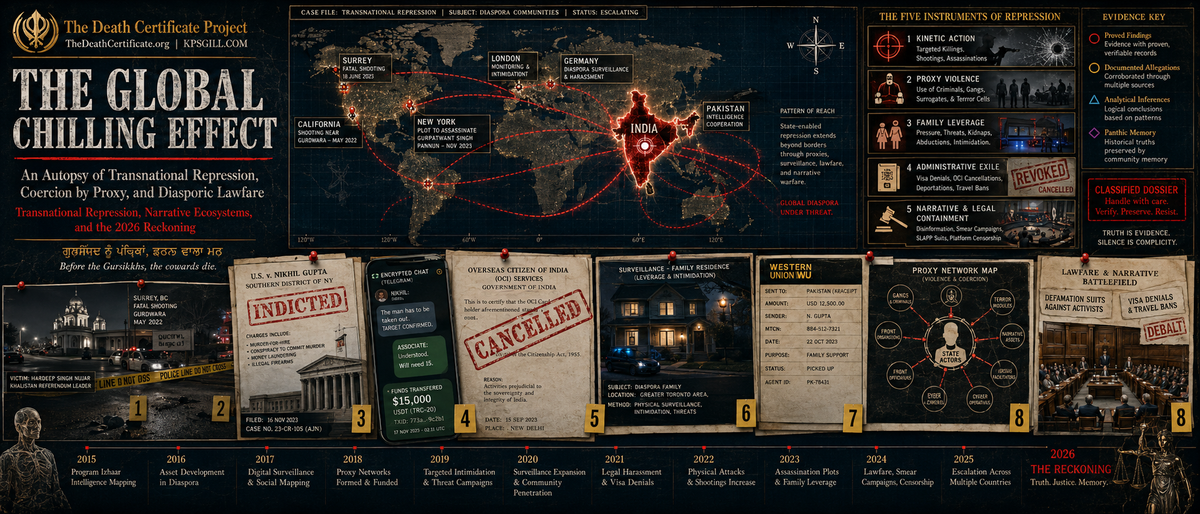
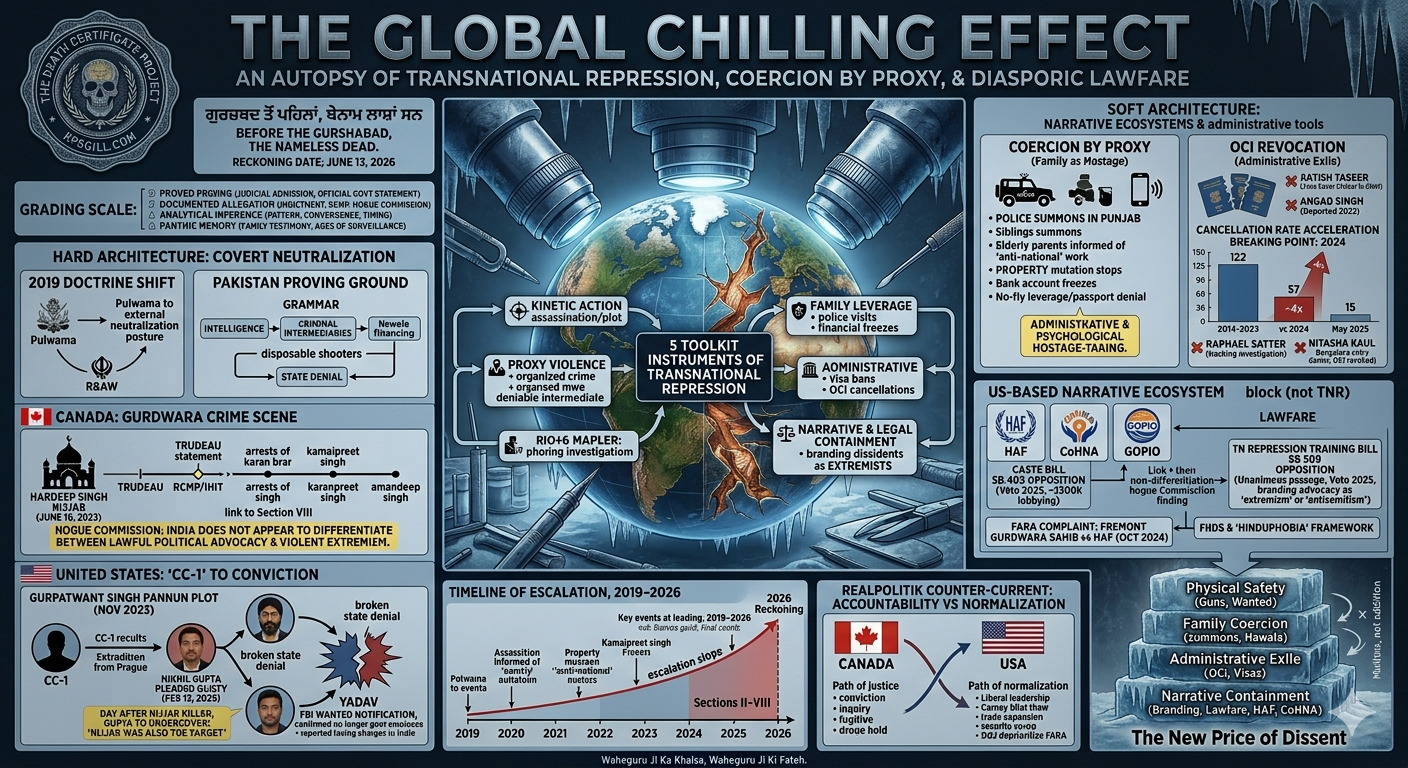
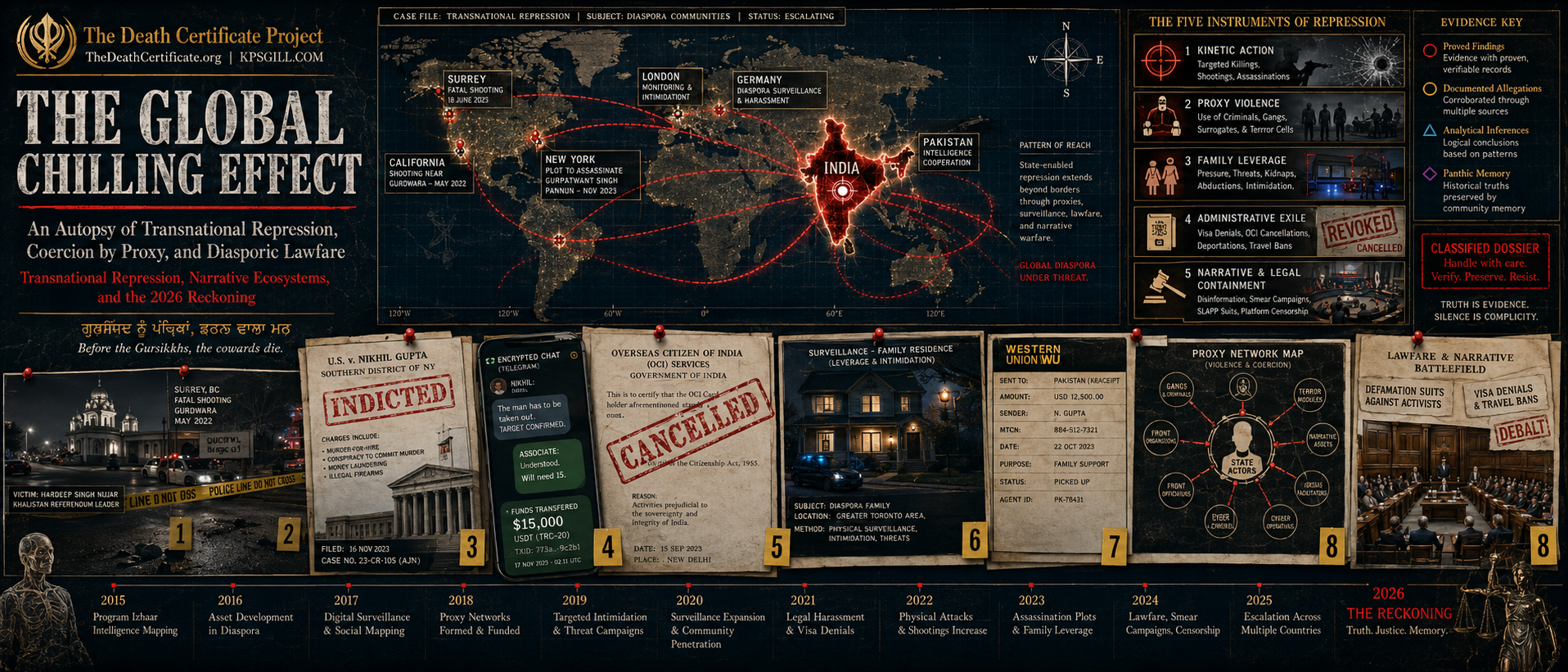
The toolkit has five recurring instruments. Kinetic action — assassination, attempted assassination, assault, kidnapping, or credible threats of physical violence. Proxy violence — the use of organized criminal networks, contract killers, or other deniable intermediaries who can be disowned the moment they are caught. Family leverage — the intimidation of parents, siblings, spouses, or children who remain inside the country of origin, transforming geography into hostage-taking. Administrative exile — visa bans, citizenship-document revocations, passport denial, exit-control listings, and the freezing of property and accounts. And narrative and legal containment — the branding of dissidents as extremists or terrorists, and the contesting, in the courts and legislatures of host countries, of the very civil-rights frameworks that would otherwise protect them.
None of this requires a single written order, which is precisely the point. The architecture survives because each component can be denied in isolation: the diplomat says he only gathered information; the police officer says he only visited a house; the visa officer says entry is discretionary; the advocacy group says it only exercised its own First Amendment rights; the gunman says he acted for money; the intelligence service says nothing at all. The victim — and, more importantly, the wider community the victim belongs to — experiences all of it as one system, because it is one system, however carefully its components have been kept legally and organizationally separate.
By January 2025, this was no longer only the diaspora’s own characterization. In its final report, Canada’s Public Inquiry into Foreign Interference found that India “does not appear to differentiate between lawful, pro-Khalistani political advocacy and the relatively small Canada-based Khalistani violent extremism” — a finding that, for the first time, placed the central thesis of this report inside an official government document rather than only inside the testimony of its targets.
II. The Architecture of Deniability: R&AW, the Yadav Designation, and the 2019 Doctrine Shift
The 2019 Pulwama attack and India’s subsequent Balakot airstrike marked a psychological and doctrinal turning point. The public posture of the Indian state shifted from a defensive counterterrorism vocabulary to a more muscular claim: that India would no longer accept the older convention that hostile actors operating abroad were, by virtue of being abroad, beyond reach. Publicly, this hardened the language of Indian officials, who increasingly framed extraterritorial counterterrorism as an expression of sovereignty rather than a violation of someone else’s. Privately, according to years of convergent investigative reporting, India’s external intelligence service — the Research and Analysis Wing, R&AW, which answers to the Prime Minister’s Office — adopted a markedly more aggressive posture toward individuals it associated with Kashmiri militancy, Sikh separatism, or anti-government networks abroad.
The Pannun case gave this doctrine a name and a face. The U.S. indictment that first surfaced in November 2023 identified an unnamed “CC-1” — a serving Indian government employee who allegedly recruited Nikhil Gupta to arrange Gurpatwant Singh Pannun’s murder. A superseding indictment later named CC-1 as Vikash Yadav: by multiple accounts a former Central Reserve Police Force officer who had been deputed to R&AW. On October 17, 2024, India’s Ministry of External Affairs confirmed that the individual named in the U.S. indictment was no longer a government employee — a statement that resolved nothing about what he had been at the time of the alleged conspiracy, while formally severing the institutional thread going forward. Yadav remains at large, the subject of an FBI wanted notice, and — in a detail that has received less attention than it deserves — is also reportedly facing prosecution in India itself on kidnapping and extortion charges arising from an entirely separate matter, a fact that sits awkwardly beside New Delhi’s portrayal of him as a rogue actor of no particular consequence.
India’s own institutions have not been silent on the question of accountability, even if their conclusions have been narrowly drawn. By January 2025, an internal high-level inquiry committee — convened after the U.S. allegations became public — had reportedly recommended legal action against at least one unnamed individual and proposed unspecified structural reforms to the oversight of intelligence operations conducted abroad. Whatever the committee’s full findings, their practical effect was visible within R&AW’s own operational footprint: investigative reporting in late November 2024 described the agency curtailing its activity across North America to a degree without precedent since its founding in 1968 — the institutional equivalent of a hand withdrawn from a fire, after the fire has already been seen by everyone in the room.
The North American cases are not isolated. German prosecutors have separately charged an Indian national with spying on Sikh community members and Kashmir-linked activists on behalf of R&AW — evidence that the operational grammar described in Section III below was not confined to the western hemisphere. And in March 2025, the U.S. Commission on International Religious Freedom went further than any of its prior India reporting, reportedly recommending direct accountability measures aimed at R&AW itself. India’s Ministry of External Affairs, through spokesperson Randhir Jaiswal, rejected the recommendation as “biased and politically motivated” and emphasized the scale and diversity of India’s religious population — a response that addressed the Commission’s framing without engaging its underlying factual predicate.
None of this resolves the central evidentiary question — whether the conduct alleged in New York and Surrey reflected authorized state policy, the freelancing of officers acting on their own initiative, or something in between, deliberately left unresolved by design. What can be said as a Proved Finding is narrower and, for that reason, more durable: a man identified in U.S. court filings as a serving Indian intelligence-linked officer at the time of the alleged conspiracy is now the subject of an FBI wanted notice; his case officer’s recruit has pleaded guilty in a Manhattan courtroom; and India’s own external intelligence service altered its operational posture across an entire continent within eighteen months of the allegations surfacing. An agency does not close doors it has not, at some level, concluded were dangerously open.
III. Pakistan: The Proving Ground of Deniability
Pakistan served as the earliest and most permissive theater for the doctrine described above. Because India and Pakistan share a decades-long history of covert conflict, the threshold for international outrage is lower there, the evidentiary fog is thicker, and the victims are far more easily described — by India, and often by default in international coverage — as militants rather than dissidents.
Investigative reporting, and Pakistani government allegations, have attributed to Indian-linked networks a series of targeted killings inside Pakistan since 2020. India denies involvement. The reported victims were persons whom India characterised, or was alleged to have characterised, as associated with Kashmiri militant organizations, anti-India networks, or Sikh separatist activity. The method was not overt commando action but localized assassination: gunmen, motorcycles, cash payments, encrypted contact, and intermediaries who could be — and were — discarded the moment they were no longer useful.
What Pakistan supplied was not a body count alone but a grammar: identify a target through intelligence channels; recruit or activate local criminal intermediaries; route money through third countries or informal hawala-adjacent networks; deploy disposable shooters; sever the chain before it reaches the state; and deny everything, publicly and immediately, regardless of the volume of contrary reporting. India denies unlawful killings abroad and frames its posture strictly as counterterrorism. But the Pakistan pattern matters precisely because it demonstrates how a state can obtain the strategic effect of a military strike — the elimination of a perceived enemy — without paying the diplomatic cost of one. The assassination becomes a message with no return address. And once that grammar had been rehearsed in a theater where almost no one outside Pakistan was inclined to object, it became available for export to theaters where, as 2023 would prove, a great many people were.
IV. Canada: The Gurdwara as Crime Scene — Arrests, the Hogue Commission, and an Unfinished Reckoning
Hardeep Singh Nijjar was shot dead on June 18, 2023, in the parking lot of the Guru Nanak Sikh Gurdwara in Surrey, British Columbia, where he served as president. He was a Canadian citizen, naturalized in 2015 after immigrating from Punjab in 1997, and a prominent advocate for an independent Khalistan — a position India had used, in 2020, to designate him a “terrorist” with a bounty attached. He denied the underlying allegations. On September 18, 2023, Prime Minister Justin Trudeau told the Canadian Parliament that there were “credible allegations” linking agents of the Government of India to the killing — a statement that converted a homicide investigation into the gravest diplomatic rupture between the two countries in the history of their bilateral relationship, and that India almost immediately rejected as “absurd and motivated.”
The investigation that followed was not abstract. On May 3, 2024, the RCMP’s Integrated Homicide Investigation Team arrested three men — Karan Brar, Kamalpreet Singh, and Karanpreet Singh, all in their twenties, identified in official releases as Indian nationals who had been residing in the Edmonton area — and charged them with first-degree murder and conspiracy to commit murder. A fourth, Amandeep Singh, was charged days later; investigators believe he was one of the two gunmen who opened fire before the group fled to a getaway vehicle. IHIT described the four as members of what investigators characterized as a hit team. Notably, the arrests were announced on the same day Commissioner Marie-Josée Hogue released the first report of her foreign-interference inquiry — a report that found India had sought to influence both the 2019 and 2021 Canadian federal elections, with diaspora communities as its primary focus.
By the autumn of 2024, the case had escalated on two further fronts. In October, Canada expelled six Indian diplomats and consular officials, stating the action was taken in response to a targeted campaign against Canadian citizens by agents linked to the Government of India — language that went well beyond the Nijjar killing alone and described an ongoing pattern of surveillance and intimidation. The following month, Crown prosecutors moved for a direct indictment against the four accused, staying the preliminary proceedings underway in Surrey Provincial Court and sending the matter directly to the British Columbia Supreme Court, where a case-management conference was set for February 2025. By January 2025, the British Columbia Prosecution Service was publicly denying media reports that the four accused had been released — confirming, for the record, that all four remained in custody. The clarification required at all reflects the degree to which the case had become a site of contested information management as much as a conventional murder prosecution.
The Hogue Commission’s final report was released on January 28, 2025, in multiple volumes; its opening summary volume ran to 123 pages and reframed the entire question. Where the Commission’s interim report in May 2024 had identified the People’s Republic of China as the most persistent and sophisticated foreign-interference threat to Canada, the final report concluded that India had become the second most active country engaging in electoral foreign interference — operating, in Commissioner Hogue’s words, “through diplomatic officials in Canada and through proxies.” The Commission went further: a body of intelligence, it found, indicated that proxy agents may have clandestinely provided illicit financial support to Canadian politicians in an effort to secure the election of candidates favorable to India, while noting carefully that the candidates themselves might have had no knowledge that such support was being directed their way. On the Nijjar killing specifically, the Commission was both forthright and constrained: it identified the assassination as a clear example of transnational repression, while stating plainly that the phenomenon “goes well beyond the democratic processes and institutions” its mandate covered, and that “no definitive link to a foreign state could be proven” within the scope of its own inquiry — a finding about the limits of the Commission’s mandate, not an acquittal, and one the Commission was careful to distinguish from the ongoing criminal proceedings, which remain a matter for the courts. India’s High Commission in New Delhi seized on this distinction publicly, stating that the inquiry “was not mandated to investigate the murder of Nijjar” and that accountability “remains under investigation” and ultimately a matter for the courts to decide — a position that is, read narrowly, accurate, and that nonetheless does not address the Commission’s separate and broader finding regarding India’s conduct toward diaspora communities as a whole.
It is that broader finding — not the inconclusive word on Nijjar’s killers’ state sponsorship — that constitutes this report’s most important addition from the Canadian record: a formal government inquiry’s conclusion that India treats lawful Khalistani political advocacy and violent extremism as a single undifferentiated category. That finding does not require proof of who pulled the trigger in Surrey. It stands on its own, and it is the finding that gives this report’s diagnostic framework — the collapse of distance, the collapse of distinction — its most authoritative citation to date.
As of this writing, the trial of the four accused remains in its pre-trial and disclosure phase, with reporting in Sikh-diaspora outlets describing the invocation of national-security disclosure protections under the Canada Evidence Act and the appointment of independent counsel to review contested material — developments that, if accurately reported, would extend rather than resolve the period in which the central evidentiary questions remain unanswered in open court.
V. The United States: From “CC-1” to Conviction
If the Canadian record is the one most marked by ambiguity at the level of ultimate state responsibility, the American record is the one least marked by it — not because the underlying question of authorization is resolved, but because the process by which it has been litigated has, step by step, produced sworn admissions rather than diplomatic assertions.
The sequence begins in November 2023, when the U.S. Department of Justice unsealed an indictment describing a foiled plot to murder a U.S. citizen — Gurpatwant Singh Pannun, a Sikh separatist advocate, dual U.S.-Canadian national, and general counsel of Sikhs for Justice — on the streets of New York City. The indictment named Nikhil Gupta, then 52, as the operative who had attempted to hire a killer, and described him as acting at the direction of an Indian government employee identified only as “CC-1.” Gupta had already been arrested at Prague’s airport on June 30, 2023, and would spend the better part of three years in custody — first in the Czech Republic, where his lawyers raised conditions-of-detention complaints that reached India’s Supreme Court, and then, following a Czech court’s extradition ruling in January 2024 and his transfer to the United States in June 2024, at the Metropolitan Detention Center in Brooklyn. He pleaded not guilty on arrival, and his arraignment drew a crowd of Khalistan supporters outside the Manhattan courthouse — a detail that, on its own, captures how thoroughly this prosecution had already become a diaspora event rather than merely a criminal one.
The trial date proved elusive. Proceedings were pushed from late 2025 into 2026 after Gupta sought to discharge his court-appointed counsel — accusing his lawyer of acting against his interests and asking, at one point, to represent himself — a request Senior District Judge Victor Marrero granted before appointing attorney David Touger. A joint defense letter in November 2025 indicated the trial could not realistically begin before February 17, 2026; it was subsequently set for March 30, 2026. Court filings reviewed by Indian media in the run-up to that date indicated prosecutors intended to introduce evidence explicitly linking the Pannun plot to Nijjar’s killing in Surrey.
That trial never happened. On February 13, 2026, in a Manhattan courtroom packed with Sikh observers from across the United States and Canada — some of whom briefly chanted in the hallway afterward and held an outdoor prayer service beneath Khalistani flags — Gupta pleaded guilty before U.S. Magistrate Judge Sarah Netburn to all three counts of the Second Superseding Indictment: murder-for-hire, conspiracy to commit murder-for-hire, and conspiracy to commit money laundering. Under oath, Gupta admitted that while he was in India in 2023, he had transferred $15,000 online to a person he believed would carry out Pannun’s killing, as a down payment toward a promised fee of $100,000. The person on the other end of that transfer was, in fact, a confidential source working with the U.S. Drug Enforcement Administration and an undercover federal officer.
The single most consequential sentence in the entire seven-year record may be one Gupta did not intend as testimony. According to court filings, the day after Nijjar was killed in Surrey, Gupta told his undercover contact that Nijjar “was also the target” — and that Pannun’s killing could now proceed without further delay. For a record built almost entirely on parallel tracks — a Canadian homicide investigation here, an American sting operation there, each proceeding as though the other barely existed — this is the seam. It is the moment the architecture of deniability briefly failed on its own terms: not because an investigator found it, but because the man at the center of it said it, to someone he believed was on his side, the day after a man was shot dead outside a gurdwara four thousand kilometers away.
On February 17, 2026, Judge Marrero formally accepted the plea, finding it knowing, voluntary, and supported by an adequate factual basis — converting, for Gupta personally, what had been a Documented Allegation into a Proved Finding. The statutory maximum across the three counts is 40 years. A pre-sentencing “Pimentel letter” filed by prosecutors calculated an advisory guidelines range of 235 to 293 months — roughly 19.6 to 24.4 years — after applying a two-level enhancement for what prosecutors described as materially false statements in an earlier sworn declaration, offset by credit for acceptance of responsibility. Reporting on the plea agreement indicates it calls for a minimum term of two decades. As part of the proceedings, Gupta agreed to forfeit the $15,000 in cash and the two mobile phones — an iPhone and a Vivo Android device — that Czech authorities had seized from him in 2023.
FBI Assistant Director Roman Rozhavsky, head of the Bureau’s Counterintelligence and Espionage Division, framed the case in terms that this report’s title borrows directly: Pannun, he said, “became a target of transnational repression solely for exercising their freedom of speech.” U.S. Attorney Jay Clayton’s statement was, in substance, a warning addressed past the defendant entirely — to any foreign government calculating that a critic’s American address placed him beyond reach, the message was that it did not. Pannun himself, reached by phone after the hearing, rejected the “terrorist” designation India has placed on him and said he intended to continue his advocacy “even if I have to face a bullet.”
The sentencing date has since been deferred twice. Originally set for May 29, 2026, it was reportedly first adjourned to a date in June and then — following an April 15, 2026 order from Judge Marrero, issued after another change in Gupta’s legal representation — adjourned to September 25, 2026. If sentencing proceeds on that date, it will arrive more than three years after Gupta’s arrest in Prague, a span that itself says something about how long even an admitted conspiracy to murder an American citizen on American soil can remain procedurally unresolved.
Sentencing will close the case only as to Gupta. Vikash Yadav — the man Gupta says directed him — remains a fugitive from American justice, the subject of an FBI wanted notice, and, per India’s own confirmation, no longer in its government’s employ. And in November 2025, a long investigative feature reported that U.S. intelligence agencies had assessed the operation as probably sanctioned by senior figures in New Delhi, potentially including members of Prime Minister Modi’s inner circle — an assessment that, if accurate, would place the decision-making chain considerably higher than a single deputed CRPF officer acting alone. That assessment is, by this report’s own framework, a Documented Allegation of the most serious kind: attributed to intelligence officials via investigative reporting, consistent with the pattern established in Canada, and entirely unresolved by anything that has yet been proven in a courtroom. It is also the kind of allegation that explains why, even as the legal record against Gupta hardened into conviction, the diplomatic relationship between Washington and New Delhi did not collapse — a tension this report returns to in Section IX. One concrete marker of that tension surfaced in the U.S. Senate, where a hold was placed on a major drone sale to India in the period following the indictment — a reminder that accountability, in this case, has run not only through courtrooms but through the machinery of arms-export approval as well.
The constitutional stakes of the American case are not incidental to it; they are the case. A foreign government does not need to repeal the First Amendment to chill it. It only needs enough Sikh, Kashmiri, or other diaspora activists to read a Manhattan courtroom transcript and conclude — correctly, on this record — that a social media post, a rally, or a gurdwara resolution could, in theory, place them on a list whose existence a government will deny until the day a guilty plea proves it was real.
VI. Coercion by Proxy: The Family as Hostage
Physical distance protects the activist’s body. It does not protect the people the activist loves.
This is the quietest branch of transnational repression, and in some respects the most efficient, because it requires none of the operational risk that produced indictments in Manhattan and arrests in Edmonton. It requires only a police vehicle outside a house in rural Punjab; a summons delivered to a brother; an elderly father informed, in the careful language of a beat constable, that his son abroad is “doing anti-national work”; a property-mutation file that stops moving; a bank account that, for reasons no one can quite specify, becomes difficult to operate.
The toolkit is administrative rather than kinetic, which is exactly why it is so durable. Retaliatory questioning of relatives tends to follow diaspora protests outside Indian consulates with a regularity that is itself a form of message. Financial and property pressure — sometimes invoking national-security statutes such as the Unlawful Activities (Prevention) Act against family-owned assets with no independent connection to any offense — can immobilize a household’s economic life indefinitely, without ever requiring a conviction, or even a formal charge, against the people whose accounts are frozen. And the “no-fly” leverage — placing parents or siblings on exit-control lists, delaying or denying passports, or detaining them at airports when they attempt to travel abroad to see children and grandchildren — converts an ordinary family visit into a test of the state’s goodwill.
None of this requires a written order any more than the kinetic operations described above do. It requires only that everyone involved understand the message without anyone having to state it. Your body is in Canada. Your mother is here. Your speech is in California. Your land is here. Your passport is American. Your family’s registry entry is here. The cruelty is entirely in the indirection: the activist is never told to stop speaking. The activist is simply made to do the arithmetic — between a public voice and a private family’s continued, unmolested existence — every single time a new article is published, a new rally is announced, or a new anniversary approaches.
This is why transnational repression produces a chilling effect long before, and often instead of, a body count. The Pannun and Nijjar cases generate headlines because they involve guns, indictments, and diplomatic expulsions. The proxy-coercion architecture generates nothing — no headline, no court filing, no press conference — which is precisely why it is the mechanism most diaspora Sikhs are likeliest to have encountered personally, and the one this report is least able to document with the kind of citation-grade specificity that the Pannun record now permits. Its evidentiary status, in the framework this report applies throughout, is Panthic Memory: a pattern attested to consistently, across families and generations, that this archive treats as real precisely because of its consistency, even where it leaves none of the paper trail that prosecutors, commissions, and journalists can later examine.
VII. OCI Revocation and the Administrative Architecture of Exile — From a Decade’s Caseload to a Single Year’s
If coercion by proxy is the branch of this architecture that leaves no paper trail, the Overseas Citizen of India scheme is the branch that, almost uniquely, generates one. Every cancellation is a docket entry: a name, a date, a file number, and — sometimes — a stated reason. It is for that reason the single most legible instrument of administrative exile available to this report, and the one whose recent trajectory is most legible in the public record.
The OCI card is not a passport, and India has been consistent that it confers no right to Indian citizenship. But for the diaspora it functions as something close to a constitutional document of belonging: the instrument that permits visa-free entry, the ability to own property, the practical means of visiting aging parents, attending a sibling’s wedding, or being present at a parent’s cremation. Section 7D of the Citizenship Act permits its cancellation on a list of grounds that includes registration “by fraud,” conduct prejudicial to India’s sovereignty, and — the catch-all that does the real work — conduct the Central Government considers “not conducive to the general public interest.” That final clause is not a loophole in the statute. It is, functionally, the statute’s operative center of gravity, because it requires no finding of fact a court could meaningfully review.
For roughly a decade, the instrument was used sparingly enough that its political character was easy to overlook. Reporting on Ministry of Home Affairs and RTI-derived data indicates that approximately 122 OCI registrations were cancelled under Section 7D across the ten years from 2014 to 2023 — a number large enough to represent a real population of affected families, but small enough, spread across a decade, to be absorbed into the background noise of routine administration. In 2024 alone, that pattern broke: reporting indicates 57 cancellations in a single year, very nearly half the entire preceding decade’s total compressed into twelve months. A further 15 cancellations were reported by May 2025, suggesting the elevated rate was not a one-year anomaly but a new baseline. The acceleration does not, by itself, prove anything about any individual case. But it establishes, as an Analytical Inference this report is comfortable drawing, that the instrument moved during this period from occasional use to routine use — and that the years of its routinization are the same years in which the kinetic and proxy architecture described in Sections II through VI was also intensifying.
The individual cases give the aggregate its texture. Aatish Taseer — the British-Indian writer whose 2019 Time cover story profiled Narendra Modi under the headline “India’s Divider in Chief” — had his OCI revoked later that year on grounds relating to his father’s Pakistani nationality, a fact that had been a matter of public record for the entirety of his prior, uncancelled OCI status; the case is widely treated, including by Taseer himself, as the template the subsequent decade would follow. Angad Singh, an American Sikh journalist and documentary filmmaker, was deported from India in 2022 after his reporting on the farmers’ protests and the Citizenship Amendment Act, and has described himself as effectively blacklisted from the country despite holding OCI status at the time. Amrit Wilson, a British writer and longtime South Asia human-rights commentator, had her OCI revoked in March 2023 over social-media commentary on Kashmir and the farmers’ movement.
Two cases in this cluster produced judicial pushback, and the fairness of this report requires that pushback be recorded with the same care as the revocations themselves. Ashok Swain, a Sweden-based political-science professor and vocal BJP critic, has had his OCI revoked, restored by Indian courts, and revoked again in a cycle he has himself described publicly — by his account, Indian courts have ordered his status reinstated on more than one occasion, only for the government to find new grounds for cancellation shortly afterward. Vanessa Dougnac, a French journalist who had lived in and reported from India for more than two decades, received official notice that her residency status and journalism accreditation would be withdrawn, on grounds the government characterized as relating to malicious reporting; she pursued legal challenges and, after more than twenty years of reporting from the country, eventually departed. The episode illustrates both the instrument’s coercive reach and the fact that its operation can, in at least some cases, be slowed — if not always reversed — through litigation.
The two most evidentially developed recent cases involve, fittingly, two journalists whose work was itself about exposure. Raphael Satter, a Washington-based Reuters correspondent, had his OCI revoked in December 2023 — months after Reuters published his investigation into Appin Technology, an Indian firm Satter’s reporting linked to a global hacking-for-hire operation. The Ministry of Home Affairs’s stated grounds, as later summarized in litigation, characterized the reporting as having caused reputational harm to India through unauthorized journalistic activity — a formulation that, read plainly, treats the publication of an investigative story as itself the “conduct” the OCI scheme exists to police. Satter challenged the revocation before the Delhi High Court; as of a June 2025 hearing, the government defended the cancellation while declining, on national-security grounds, to disclose the entirety of the file underlying it — leaving a journalist litigating, without full access to the evidence against him, over the right to retain the document that would let him visit the country he had spent years covering.
Nitasha Kaul’s case, the most recent of consequence, closes the loop between administrative exile and the kinetic and reputational architecture described earlier in this report. Kaul, a British-Kashmiri academic at the University of Westminster, was detained for roughly twenty-four hours at Bengaluru’s airport in 2024 and denied entry despite having been invited to India by a sitting Karnataka state minister to participate in a conference — an episode that already demonstrated how little an official invitation could do against a security-services determination made independently of it. In May 2025, her OCI was formally revoked; the cancellation order, as reported, cited “inimical” writings, speeches, and journalistic activities said to target India on matters of sovereignty and territorial integrity. Kaul described the action publicly as an instance of transnational repression — adopting, as a target, precisely the vocabulary this report uses as a diagnostic category, and in doing so illustrating how completely that vocabulary has migrated from the academic and human-rights literature into the language activists now reach for to describe what has been done to them.
None of this requires that every cancelled OCI represents an injustice, or that the Ministry of Home Affairs never has a legitimate security interest at stake. What the aggregate data and the individual case files together establish is narrower and more durable: a document whose loss separates a person from aging parents, ancestral land, and the physical ground of religious and cultural memory has been cancelled at a rate that, within the space of two years, exceeded the rate of the prior decade — and the individuals losing it disproportionately share one characteristic. They wrote, filmed, testified, or spoke about India in terms the government found objectionable. A passport officer does not need to censor an article. A ministry does not need to rebut a documentary. It needs only to decide, on a form, that the person who made it is no longer welcome — and to write, in the space provided for reasons, language vague enough that no court reviewing it can find the decision was about the speech at all, even though everyone involved, including the person who lost the document, knows precisely what it was about.
VIII. The Narrative Ecosystem: HAF, CoHNA, and the Contest to Define Transnational Repression Itself
Everything described in Sections II through VI of this report is, under any state’s law, a crime: murder, conspiracy to commit murder, espionage, coercion. Nothing described in this section is. The organizations examined here — the Hindu American Foundation, the Coalition of Hindus of North America, the Global Organization of People of Indian Origin, and a handful of smaller allied groups — are American non-profits engaged in American political advocacy, protected by the First Amendment as fully as the Sikh Coalition, the Jakara Movement, or this report’s own publisher. To place their activity in the same document as an assassination plot is not to equate the two. It is to record that, across the period this report covers, both occupied the same legislative sessions, the same state capitol, and — with a frequency that startled participants on every side — the same vocabulary.
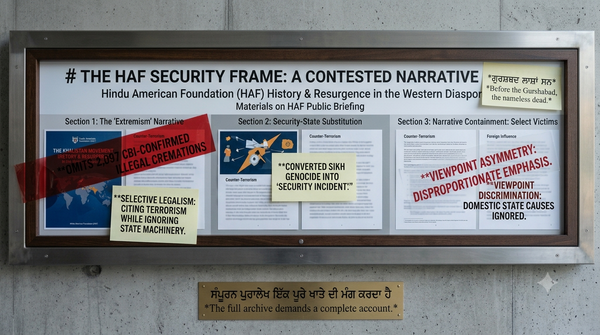
The starting point is HAF’s own published position, set out on a page maintained on its website. The page frames the Khalistan movement primarily through a security lens: a movement that, after a period of dormancy within India, has “surged” among the Western diaspora; that has produced incidents at Indian diplomatic missions in San Francisco and London and the vandalism of Hindu temples in North America, the United Kingdom, and Australia; and that remains, in the Foundation’s framing, the continuing subject of FBI, DEA, and Customs Service investigation. The page recalls the 1985 bombing of Air India Flight 182 — 329 dead, eighty-two of them children under thirteen, the deadliest act of terrorism in Canadian history before or since — and cites a figure of roughly 22,000 deaths, Sikh and Hindu alike, during the movement’s peak in the 1980s and ‘90s. None of this is inaccurate as history; the Kanishka bombing happened, the casualty figures from the insurgency era fall within the range other sources report, and individuals aligned with Khalistani organizations have in fact been convicted of material-support offenses in US courts. What the page does not do — and this omission is the point of including it here, not an aside — is distinguish anywhere in its framing between the perpetrators of that violence four decades ago and the diaspora activists, civil-rights lawyers, and gurdwara committees whose contemporary advocacy the same page treats as continuous with it. In fairness, the same page also calls on the Government of India to acknowledge and provide redress for the 1984 anti-Sikh pogrom — a position that places HAF, on that single question, closer to this report’s own than to New Delhi’s. But the page’s overall architecture is the one the Hogue Commission would later describe, in its own words, as a failure to differentiate.
This was not the first time the same actors had fought over adjacent terrain. In 2023, the California legislature passed SB 403, adding caste as a protected category under the state’s anti-discrimination statutes — a measure driven substantially by Dalit and Ambedkarite advocacy groups in the wake of a 2020 lawsuit by California’s Civil Rights Department against Cisco Systems, which alleged caste-based discrimination by two Indian-American engineers against a Dalit colleague. HAF and CoHNA opposed SB 403, reportedly committing on the order of $300,000 to the lobbying effort, arguing that singling out “caste” as a category would stigmatize South Asian Americans broadly and Hindus specifically by implying their religious tradition was uniquely discriminatory. Governor Newsom vetoed the bill in October 2023, reasoning that the state’s existing protections against discrimination based on “ancestry” already reached the conduct the bill targeted. HAF separately sought to intervene in the underlying Cisco litigation on First Amendment grounds; a court rejected that intervention in January 2024, and HAF’s subsequent public statements on the case were characterized by at least one investigative outlet as part of a broader effort to recast the caste-discrimination question as one of religious persecution rather than labor-law enforcement. The SB 403 fight matters to this report not for its own sake but as a template: a civil-rights measure, advanced substantially by one part of the South Asian diaspora, opposed by HAF and CoHNA on the ground that it would function as a weapon against Hindus specifically, and vetoed by the same governor whose desk, two years later, would hold the bill this section is principally about.
That bill was SB 509. Its proximate origin lay not in California’s legislative calendar but in its parking lots: in August 2024, a Sikh activist near Sacramento survived a drive-by shooting that investigators and community advocates linked to his advocacy for an independent Khalistan — an attack that, for the Central Valley’s Sikh population (California is home to roughly 250,000 Sikhs, with the Central Valley accounting for close to forty percent of the state’s Indian-American population), arrived as confirmation that the architecture documented in Sections IV and V of this report was not confined to Surrey and Manhattan. In February 2025, state Senator Anna Caballero, a Merced Democrat, introduced SB 509: a bill that created no new crime, but directed the California Office of Emergency Services to develop, by January 2027, a curriculum to help local law enforcement recognize the tactics of transnational repression — spyware, online intimidation, surveillance of gurdwaras and temples, and coercion of family members still resident abroad. Assemblymember Esmeralda Soria co-authored the bill in the Assembly.
Opposition organized quickly. By April 2025, as the bill cleared its first Senate committee, CoHNA had already gone on record — through testimony from board member Sudha Jagannathan — arguing that any law-enforcement training on “foreign proxies” needed to be developed in consultation with what she termed authentic Hindu organizations, and warning that an unaccountable process risked becoming a vehicle for the political weaponization of the Hindu community. A parallel campaign was mounted by Americans4Hindus, a group chaired by Dr. Romesh Japra, which framed the bill as an attempt by “activist groups” to indoctrinate the state’s Peace Officer Standards and Training curriculum with material A4H characterized as anti-Hindu, anti-India, and — in a formulation that would recur throughout the campaign — antisemitic and anti-Israel. A4H’s materials specifically invoked Gurpatwant Singh Pannun’s public threats against Hindu temples, including the Ram temple at Ayodhya, as evidence of what the bill’s supporters represented.
The opposition did not prevent the bill’s progress. On September 10, 2025, SB 509 passed the California Assembly by a vote of 59 to 0; the Senate had earlier concurred at 40 to 0. A bill that, on its face, did nothing more than authorize a training curriculum had cleared both chambers of the nation’s largest state legislature without a single recorded vote against it — a fact both sides would invoke for opposite purposes in the campaign’s final weeks. Supporters cited the unanimous vote as proof the bill was uncontroversial on its merits; opponents cited it as proof the legislative process itself had been captured, and redirected their effort to the only venue left: the Governor’s desk. More than fifty gurdwaras signed letters of support, organized substantially through the Sikh Coalition; a bipartisan group of twelve California Sikh elected officials, convened by attorney Amar Shergill, sent Governor Newsom a joint letter urging his signature. On the other side, HAF and CoHNA mounted what both organizations described as a joint campaign, including a petition — later removed from public view once the bill’s fate was decided — that characterized SB 509 as a measure that would train California law enforcement to treat Californians of Indian origin, Hindus above all, as proxies of a foreign government, and that would, the petition argued, formally write that very presumption into law-enforcement practice. HAF’s campaign materials went further, soliciting support from pro-Israel organizations including StandWithUs and the Bay Area Jewish Coalition — both of which formally opposed the bill — and, according to reporting by Prism, characterizing two of the bill’s most prominent Sikh supporters, the Sikh Coalition and the Jakara Movement, as antisemitic on the basis of their separate advocacy on Palestinian issues, while drawing an explicit analogy between the Khalistan and Palestinian causes. CoHNA’s public messaging took a different evidentiary tack, pointing to an FBI roster of roughly twenty open transnational-repression cases nationally and noting that only one involved India, with the remainder attributed to China, Iran, and Russia — and asking, in effect, why a single-digit fraction of the national problem warranted a California-specific training mandate at all, particularly when reported anti-Hindu incidents, including temple vandalism, were not (CoHNA argued) receiving comparable legislative attention.
On October 13, 2025 — the eve of his statutory deadline — Governor Newsom vetoed SB 509. His veto message did not adopt the opposition’s framing of the bill as discriminatory; instead, he stated that the California Office of Emergency Services, working with federal agencies, had already developed a transnational-repression training curriculum, that the issue was better handled through such administrative coordination than through statute, and that codifying definitions in law risked making the state’s response less adaptable as the threat evolved. The reception split along exactly the lines the campaign had drawn. HAF’s managing director, Samir Kalra, praised the veto as a win for the civil liberties of every Californian. The Sikh Coalition described itself as profoundly disappointed, while noting — with evident awareness of the irony — that the very CalOES training Newsom cited as a substitute would not exist had the advocacy around SB 509 not forced its creation, and committing to monitor that training’s content and implementation in lieu of the statute. Assemblymember Dr. Jasmeet Bains of Bakersfield, the first Sikh American ever elected to the California Assembly, drew the connection this report’s framework would draw independently: Newsom, she noted, had vetoed SB 403 in 2023 and SB 509 in 2025 — caste discrimination and transnational repression, two years apart, both carried by unanimous or near-unanimous legislative majorities, both rejected by the same governor’s pen. She closed by observing that no governor’s signature had ever been required for the Sikh community to know what happened in 1984 for what it was — a formulation that located the bill’s defeat within a far longer continuity than the 2025 legislative session.
California’s outcome was, in the broader landscape, increasingly anomalous. Sikh-advocacy organizations note that Nebraska — through its LB644, the Crush Transnational Repression in Nebraska Act — and a number of other states have enacted or advanced their own statutory recognitions of transnational repression, meaning that by the close of 2025, the state with the nation’s largest Sikh population, whose legislature had passed a transnational-repression bill without a single dissenting vote in either chamber, was not a leader on this question but a laggard: the only jurisdiction in recent memory to see such a bill clear both chambers unanimously and then die at the governor’s desk.
The SB 509 fight unfolded against the backdrop of a separate, and in some ways more consequential, dispute over HAF’s own institutional identity — one that did not originate with any Sikh organization. In October 2024, Al Jazeera published a lengthy investigation, the product of several months’ reporting, examining more than a decade of HAF’s lobbying activity in Washington. The piece argued that HAF, notwithstanding its repeated public assertions of nonpartisanship, had functioned in practice as an effective advocate for the policy positions of India’s Bharatiya Janata Party government — facilitating meetings between Indian officials and members of Congress, hosting Indian government representatives at HAF events including a 2017 reception tied to a prime ministerial visit, and lobbying on a range of bills touching US-India relations. The article’s most consequential proposal was procedural rather than substantive: that HAF’s activities warranted scrutiny under the Foreign Agents Registration Act, the 1938 statute requiring organizations acting on behalf of foreign governments to register and disclose their funding and activities. HAF’s response, issued the same week, rejected the characterization in full, describing its positions as the product of its own independent values and engagement rather than any foreign direction, and describing the investigation as a hit piece. The response found an enthusiastic afterlife in segments of the Indian press aligned with the BJP’s own ideological apparatus — including Organiser, the English-language weekly published by the Rashtriya Swayamsevak Sangh, and OpIndia — both of which ran pieces asserting that Al Jazeera’s own reporting had “concluded” HAF was not a foreign agent, a characterization considerably stronger than anything the original article itself stated.
The question did not stay theoretical. By mid-2025, the Fremont Gurdwara Sahib — one of the largest Sikh houses of worship in the United States, serving an estimated five thousand worshippers weekly — had sent a formal letter to Attorney General Pam Bondi asking the Department of Justice to determine whether HAF should be required to register under FARA. The Gurdwara’s letter, as reported, drew on substantially the same set of facts the Al Jazeera investigation had assembled — facilitated meetings, hosted officials, public alignment with BJP positions — without alleging that HAF had any connection to violence against Sikhs; the request was explicitly for the disclosures FARA registration would require, not an accusation of complicity in the events described in Sections II through VI. HAF again denied any obligation to register and again characterized the effort as a politically motivated attack. As of this writing, no FARA determination has been made public, and reporting indicates that under Attorney General Bondi, the Department’s National Security Division has been directed to deprioritize criminal FARA enforcement generally — a posture this report returns to in Section IX, and one that, whatever its merits as Justice Department policy, makes it considerably less likely the Fremont Gurdwara’s question will receive a public answer of any kind in the near term. As recently as this month, the dispute remained live enough to be fought out in the footnotes of HAF’s own Wikipedia entry, where Organiser published a piece in early June 2026 accusing unnamed editors of perpetuating what it called a fabricated FARA narrative.
This report takes no position on whether HAF meets FARA’s registration threshold; that is a legal determination for the Department of Justice, not a forensic-history archive, and nothing here should be read as asserting that it does. What the dispute itself establishes — independent of its eventual resolution, if any — is this: the question of whether a US-based advocacy organization functions, in substance, as an instrument of a foreign government’s narrative management has now been formally posed, by a religious institution representing thousands of American citizens, to the chief law-enforcement officer of the United States. That a comparable question has not, so far as this report’s research indicates, been posed about the Sikh Coalition, SALDEF, or the Jakara Movement is itself a data point — not dispositive of anything, but a measure of which direction the suspicion in this particular contest has, to date, run.
A smaller but illustrative episode involves the Global Organization of People of Indian Origin. GOPIO, under chairman Thomas Abraham, formally opposed a resolution before the Connecticut General Assembly that would have recognized the anniversary of what the resolution’s sponsors described as a declaration of Sikh independence; GOPIO’s objection characterized the body behind the resolution, the self-styled “World Sikh Parliament,” as a fringe formation undeserving of legislative recognition. The episode is minor in isolation; its significance lies in the pattern it confirms. GOPIO, like HAF and CoHNA, operates primarily as a mainstream Indian-American civic organization with no documented connection to India’s intelligence services — and, like HAF and CoHNA, it has nonetheless positioned itself, at the state and local level, as an active participant in determining which expressions of Sikh political identity receive institutional recognition and which do not.
The Foundation for India and Indian Diaspora Studies, led by Khanderao Kand, occupies a more ambiguous position in this landscape. FIIDS’s documented public activity centers on immigration policy, US-India strategic relations, and — like CoHNA — “Hinduphobia” resolutions in state legislatures; this report’s research did not surface evidence of FIIDS taking a comparably prominent role in the SB 509 or Khalistan-specific disputes detailed above, and it would overstate the record to place FIIDS on the same footing as HAF and CoHNA on this particular question. It is included here for completeness, and because its general orientation — toward strengthening the US-India relationship, and toward a “Hinduphobia” framework structurally parallel to the transnational-repression framework Sikh organizations have advanced — situates it within the same broader ecosystem, even where its specific footprint on the Khalistan question remains thin.
The “Hinduphobia” framework is not merely defensive. CoHNA has built an affirmative legislative program around it: in April 2025, the organization welcomed the introduction of Senate Bill 375 in the Georgia legislature, which would add “Hinduphobia” to that state’s hate-crime statute — a category with no settled legal definition comparable to the antisemitism or Islamophobia frameworks it is explicitly modeled on. The same month, CoHNA convened what it billed as the Second National Hindu Advocacy Day on Capitol Hill, drawing attendance from at least twenty-one members of Congress, including Representative Rich McCormick of Georgia, who used the occasion to describe Hinduphobia as a longstanding but neglected problem. The symmetry with the Sikh advocacy described above is exact, and this report suggests it is not coincidental: both communities have concluded that the path to protection runs through state legislatures and Congress, in the form of named categories — “transnational repression,” “Hinduphobia” — that each side’s advocacy organizations simultaneously seek for themselves and resist when proposed by the other.
None of this represents the totality of Hindu-American opinion, and the report would misrepresent its own record if it implied otherwise. Hindus for Human Rights, led by Sunita Viswanath, and Equality Labs, led by Thenmozhi Soundararajan, have for years advanced positions substantially at odds with HAF and CoHNA — supporting caste-discrimination legislation including SB 403, documenting what they describe as the US extension of Hindu-nationalist organizing, and, in Equality Labs’s case, explicitly in solidarity with Sikh and Kashmiri advocacy on transnational repression. Their public profile is smaller than HAF’s or CoHNA’s, a fact that is itself part of the story this section tells: in the contest over which organizations get to represent “the Hindu American community” before a state legislature, institutional size and lobbying budget matter as much as the underlying distribution of opinion. It is similarly worth restating — because the temptation, in a report of this kind, is to flatten it — that the Sikh Coalition itself takes no institutional position on whether Khalistan should exist; its stated position is narrower, confined to opposing what it describes as narratives that paint Sikh political identity as a whole in extremist terms. The fight over SB 509 was not, on either side, a fight between “Sikhs” and “Hindus” as undifferentiated blocs. It was a fight between specific organizations, each claiming to speak for a community considerably larger and more divided than its own membership.
The gap between organized advocacy and underlying opinion is measurable, and New York’s experience with its own caste-discrimination legislation supplies the measurement. As a comparable bill has moved through the New York legislature across the 2025–2026 session, polling has consistently found broad public support for caste protections that organized opposition has not reflected: polling conducted in connection with the New York legislative debate found broad majority support for such a law among state residents — findings consistent with a 2024 Carnegie Endowment survey, which documented roughly seventy-seven percent support for caste-discrimination protections among Indian Americans nationally. If those figures are even approximately right, the organizations whose lobbying defeated SB 403 in California, and have opposed its New York analogue, do not speak, on this question, for the community whose name they invoke; they speak for a minority within it that has, through sustained institutional investment, achieved an influence on legislative outcomes disproportionate to its numbers. The same observation almost certainly applies, with the polarity reversed, to at least some fraction of Sikh opinion on Khalistan itself — a movement that, as Section IV’s discussion of the Hogue Commission noted, India’s own intelligence assessments describe as commanding only “relatively small” support even within the diaspora population most associated with it.
The clearest articulation of where this “soft” architecture ultimately points came not from any US-based organization but from India’s own strategic-affairs commentary. In January 2026, the Defence Horizon Journal — a publication with ties to New Delhi’s Indian Council of World Affairs — published a piece arguing that Indian diplomatic missions abroad should engage more directly with diaspora communities specifically to counter what the piece called misinformation, and recommending closer intelligence-sharing arrangements to monitor what it termed anti-India activity among diaspora populations. Read in isolation, this is an unremarkable foreign-policy recommendation, of a kind strategic-affairs journals publish about every diaspora-heavy country’s diplomacy. Read against the Hogue Commission’s finding that India does not differentiate between lawful Khalistani advocacy and violent extremism, and against the SB 509 campaign’s own rhetoric — in which lawful advocacy by Sikh civil-rights organizations was repeatedly characterized as indistinguishable from support for designated terrorist causes — the piece reads less like a forward-looking proposal and more like a description of an architecture already substantially in place: diaspora narrative management, framed as a counter-misinformation exercise, explicitly coupled to the intelligence function. This is precisely the convergence this section exists to document — not because any single organization examined here is alleged to be an instrument of that architecture, but because the architecture itself, as described by India’s own strategic commentariat, requires exactly the kind of narrative terrain that HAF, CoHNA, and their allies have, for reasons entirely their own, spent the 2023–2026 period contesting.
The “soft” and “hard” architectures examined in this report remain, as a matter of law, entirely distinct, and nothing in this section blurs that distinction. HAF’s lobbying is constitutionally protected. CoHNA’s testimony before the California Senate is constitutionally protected. The FARA question, however it is eventually resolved, concerns disclosure, not criminality. But the two architectures are no longer merely adjacent; they are, increasingly, contemporaneous and mutually referential. In the same eighteen-month span in which a man pleaded guilty in a Manhattan courtroom to conspiring to murder a Sikh activist — a plea that named Hardeep Singh Nijjar’s killing in Surrey as a related act in the same campaign — the California legislature passed, unanimously, and the Governor of California vetoed, a bill that would have trained police officers to recognize the pattern those two killings exemplify, following a campaign in which the organizations leading the opposition invoked the language of antisemitism against the Sikh civil-rights groups that had spent years documenting that pattern, and in which India’s own strategic-affairs press was, in the same season, calling for closer intelligence coordination with the diaspora those groups represent. No single fact in this paragraph proves the others. Their convergence, in time and in vocabulary, is the fact — and it is what this report exists to document.
IX. The Realpolitik Counter-Current: Accountability on One Track, Normalization on Another
Two narratives can both be true at once, and the 2025–2026 period supplies an unusually clean test of that proposition. On one track sits everything documented above: a Canadian murder prosecution moving through pre-trial disclosure under national-security protections, a guilty plea entered in Manhattan, a formal government inquiry naming India among the most active foreign-interference actors a Western democracy currently faces, and an administrative-exile rate that roughly tripled within two years. On the other track sits the diplomatic record — and by the spring of 2026, that record told a markedly different story. Reporting from the Lowy Institute described a measurable thaw in Canada-India relations under Prime Minister Mark Carney’s government — Carney having succeeded Justin Trudeau following the Liberal leadership transition in March 2025: an expansion of bilateral ties, a trade agreement expected to be concluded before the end of 2026, and renewed security-cooperation arrangements between the two countries. None of this required the Nijjar prosecution to reach trial, or the Hogue Commission’s broader findings to be resolved, or the four men awaiting trial in British Columbia to be convicted or acquitted. The two tracks ran in parallel, and neither, on the available record, appears to have been made contingent on the other.
The American pattern is structurally similar, though its mechanics differ. Gupta’s conviction is now a Proved Finding; Vikash Yadav remains a fugitive; the Bloomberg reporting attributing the operation’s authorization to senior figures in New Delhi remains an unresolved Documented Allegation; and the Senate’s hold on a major drone sale demonstrated that at least one strand of the bilateral defense relationship was, for a period, made contingent on the case’s progress. Yet the broader US-India relationship under the current administration has continued to deepen across the same period, and the Department of Justice’s reported deprioritization of criminal FARA enforcement — discussed in Section VIII in connection with the Fremont Gurdwara’s complaint against HAF — applies, as a matter of institutional posture, to any future matter touching Indian government conduct more directly, not merely to advocacy organizations. A prosecutor’s office instructed to deprioritize a statute is not thereby instructed to ignore murder-for-hire; Gupta’s plea proves that the latter category remains very much alive, and the FBI’s own public framing of the case — a man “targeted… solely for exercising their freedom of speech,” in Assistant Director Rozhavsky’s words — was about as unambiguous as such language gets. But the broader apparatus of accountability that might, in theory, follow from a finding of state-level authorization — registration requirements, sanctions, diplomatic costs calibrated to findings rather than to individual defendants — operates with far greater institutional discretion than a criminal docket does, and that discretion has, to date, been exercised in the direction of continuity rather than rupture.
The lesson is not that accountability is theater, or that Gupta’s conviction was meaningless; a man who admitted, under oath, to wiring money toward a contract killing now faces up to two and a half decades in federal prison, and that is not nothing. The lesson is narrower, and in some ways more unsettling: a state can apparently absorb a guilty plea to conspiring to murder a dissident on a partner country’s soil, a foreign public inquiry’s finding that it does not respect the line between dissent and terrorism, and a multi-year acceleration in the administrative exile of its critics — and continue, in parallel, an entirely normal diplomatic and economic relationship with the very countries whose courts, commissions, and ministries produced those findings. For the activist deciding whether to speak, this is the calculation that ultimately matters. The question is not whether some accountability mechanism, somewhere, might eventually function as designed. It is whether that mechanism’s functioning will cost the responsible government anything it has not already priced in — and the 2025–2026 record, read in full, suggests the honest answer is: not yet, and not obviously.
X. The Timeline of Escalation, 2020–2026
Compressed into a single chronology, the preceding sections describe not a series of unrelated incidents but an escalation curve — and the curve’s slope, across every domain this report examines, has been getting steeper rather than flatter.
The curve’s origin point is 2019, when the Pulwama attack and India’s Balakot response hardened the public vocabulary of Indian counterterrorism into a claim of extraterritorial reach, and 2020–2022, when that claim was operationalized in its most permissive available theater: Pakistan, where investigative reporting attributes to Indian-linked networks a series of targeted killings of individuals associated, or alleged to be associated, with Kashmiri militancy or Sikh separatist activity. By the time the architecture moved west, its operational grammar — local intermediaries, disposable shooters, severed chains of command, blanket denial — was already established.
2023 is the year the architecture became impossible to localize to South Asia. On June 18, Hardeep Singh Nijjar was shot dead outside the Guru Nanak Sikh Gurdwara in Surrey, British Columbia. On September 18, Prime Minister Trudeau told Canada’s Parliament there were credible allegations linking agents of the Government of India to the killing — converting a homicide file into the gravest rupture in the two countries’ bilateral history. The same autumn, in Sacramento, Governor Newsom vetoed SB 403, the caste-discrimination bill HAF and CoHNA had spent roughly $300,000 opposing. In November, the US Department of Justice unsealed the indictment describing the foiled plot against Gurpatwant Singh Pannun, naming Nikhil Gupta and the still-unidentified “CC-1.” And in December, Raphael Satter — the Reuters journalist whose reporting on the Appin hacking-for-hire network had appeared months earlier — had his OCI revoked.
2024 compressed an extraordinary density of developments into twelve months. In January, a California court rejected HAF’s attempt to intervene in the Cisco caste-discrimination litigation. On May 3 and 4 — the same week Commissioner Hogue released the interim report of her foreign-interference inquiry — the RCMP arrested four Indian nationals in the Nijjar case and charged them with first-degree murder. Around mid-year, Gupta was extradited from the Czech Republic to the Metropolitan Detention Center in Brooklyn. In August, the drive-by shooting of a Sikh activist near Sacramento gave the SB 509 campaign, not yet drafted, its proximate cause. October alone saw three developments converge: Canada expelled six Indian diplomats over what it described as a targeted campaign against Canadian citizens; India’s Ministry of External Affairs confirmed that the man identified in the US indictment as “CC-1” — Vikash Yadav — was no longer a government employee; and Al Jazeera published its investigation into HAF’s decade of Washington lobbying, the investigation that would, within a year, become the evidentiary basis for a formal FARA complaint. In November, Canadian prosecutors sought a direct indictment against the four accused, moving the case to the BC Supreme Court, while investigative reporting described R&AW curtailing its North American operations to a degree without precedent since the agency’s 1968 founding. By year’s end, fifty-seven OCI registrations had been cancelled — nearly half the entire preceding decade’s total in a single year.
2025 opened with two findings that, between them, supplied this report’s central evidentiary architecture for the year that followed. In January, an internal Indian government inquiry reportedly recommended legal action against at least one unnamed individual in connection with the Pannun plot, even as Commissioner Hogue’s final report — released January 28 — named India as the second most active state engaging in electoral foreign interference in Canada and articulated, for the first time in an official government document, the finding that India does not appear to differentiate between lawful Khalistani advocacy and violent extremism. Canadian prosecutors confirmed that month that all four accused in the Nijjar case remained in custody, publicly refuting circulating reports to the contrary. In February, Senator Caballero introduced SB 509. In March, USCIRF’s reported recommendation of accountability measures targeting R&AW drew a sharp rejection from India’s Ministry of External Affairs. April brought CoHNA’s first public opposition to SB 509 and, on the other side of the ledger, CoHNA’s welcome for Georgia’s “Hinduphobia” bill and its Second National Hindu Advocacy Day on Capitol Hill. May saw Nitasha Kaul’s OCI revoked and the cumulative 2025 cancellation count reach fifteen. By mid-year, the Fremont Gurdwara Sahib had sent its FARA letter to Attorney General Bondi, around the same time reporting emerged that Bondi’s Department of Justice had deprioritized criminal FARA enforcement as a general matter. In June, the Delhi High Court heard the government defend its cancellation of Satter’s OCI. September brought SB 509’s unanimous passage through both chambers of the California legislature; October 13 brought Newsom’s veto. November brought the Bloomberg report attributing the Pannun plot’s authorization to senior figures in New Delhi, and a joint defense filing setting Gupta’s trial for March 30, 2026 — a trial that, as the next year would show, was never held.
2026, in the months this report covers, has been the year of resolution-without-resolution. In January, the Defence Horizon Journal published its case for closer intelligence coordination with the diaspora. On February 13, in a Manhattan courtroom, Nikhil Gupta pleaded guilty to all three counts of the second superseding indictment — converting, as to him personally, six years of Documented Allegation into Proved Finding, and surfacing, in the same proceeding, his own words tying Nijjar’s killing to the Pannun plot as a single campaign. Judge Marrero accepted the plea on February 17. Sentencing, originally set for May 29, was reportedly deferred to a date in June and then, by an April 15 order issued after another change in Gupta’s counsel, to September 25, 2026 — a date that, as of this writing, still lies in this report’s future. By May, the Lowy Institute was describing a substantive thaw in Canada-India relations under Prime Minister Carney, with a trade agreement expected before year’s end. And in the first weeks of June 2026 — as this report was being assembled — the FARA dispute over HAF’s status remained sufficiently unresolved to be litigated in the footnotes of a Wikipedia page.
Six years, two hemispheres, four governments, and one extended family of cases. What the chronology shows, read start to finish, is not a sequence of crises each separately contained, but a single widening gyre: each year’s developments in the legal record (Section V), the inquiry record (Section IV), the administrative record (Section VII), and the legislative record (Section VIII) arrived not in isolation but in the same months, often the same weeks, as developments in the others — and the diplomatic record (Section IX) absorbed all of it without breaking stride.
XI. The Chilling Effect, Revisited
The preceding sections have described the chilling effect as an arithmetic: a diaspora activist weighing a public voice against a private family’s continued, unmolested existence, with every new article, rally, or anniversary forcing the calculation anew. The cases catalogued above have made those terms more concrete than ever. A Sikh-American lawyer in California now has before her not an abstraction but a docket number — Gupta’s — and a sentencing date, September 25, 2026, by which to measure how far a foreign government may be willing to go against someone whose name appears on the wrong list. An academic of Kashmiri or Sikh background now has, in Nitasha Kaul’s case, a precise template for what “inimical writings” can cost: not imprisonment, but the slower, administrative loss of a parent’s deathbed.
But the cases catalogued above supply a second variable that the arithmetic must now accommodate. It is no longer enough for the calculating activist to ask only what a foreign government might do. She must also ask what her own country’s advocacy organizations — organizations with no documented tie to that foreign government, exercising rights as fully protected as her own — might say about her, in vocabulary increasingly indistinguishable from the foreign government’s own. The SB 509 campaign demonstrated, in real time, in a legislature she might reasonably expect to be sympathetic, that supporting a bill to train police on recognizing transnational repression could itself be characterized — by name, in campaign materials — as antisemitic, as a vehicle for foreign-proxy designation, as part of a cause analogized to one of the most polarizing conflicts in contemporary American politics. None of these characterizations require any finding of fact. They require only publication.
The Hogue Commission’s finding — that India does not differentiate between lawful Khalistani advocacy and violent extremism — is, read from this angle, not only a description of a foreign government’s conduct. It has become, independently and for entirely different reasons, a description of the diaspora’s domestic environment as well. An activist in this environment faces non-differentiation from two directions simultaneously: from a state that may treat her human-rights advocacy as continuous with a forty-year-old insurgency, and from advocacy organizations in her own country that may treat her civil-rights advocacy as continuous with antisemitism, with “Khalistani extremism,” or with both at once. Each direction, taken alone, would be a serious constraint on speech. Operating together — and 2025 was the year they demonstrably did — they do not simply add. The chilling effect this report describes is not the sum of these pressures but their multiplication: an activist who clears the first hurdle still faces the second, and the second hurdle’s existence is not contingent on the first having been cleared honestly, or at all.
The activists named in this report — Pannun, Nijjar, Kaul, Satter, the four men awaiting trial in Surrey — are, in one sense, precisely the wrong evidence for the chilling effect’s success, because each of them kept speaking, kept writing, kept filing the case. Pannun’s own words, that he intends to continue his advocacy even if it costs him his life, describe a man who has, by definition, not been chilled. The chilling effect’s real evidence is structurally invisible to a report like this one: it consists of the gurdwara committee member who declines to sign the letter of support for SB 509 because his elderly mother still travels twice a year to Punjab; the second-generation academic who declines the conference invitation to Bengaluru rather than test whether her OCI survives the visit; the op-ed that is drafted, shown to a spouse, and never submitted. None of these people appear in any indictment, any commission report, or any OCI cancellation log — and that absence is not a gap in this report’s research. It is the effect the report exists to describe.
Conclusion: The New Price of Dissent
By the close of the period this report covers, Nikhil Gupta’s guilty plea had converted six years of allegation into admission, and surfaced, in his own words, the direct evidentiary link between Surrey and Manhattan that earlier drafts of this archive could only infer. Canada’s own foreign-interference commission had, for the first time, placed in an official government document the precise finding — non-differentiation between dissent and extremism — that diaspora communities had been asserting for years without an official audience. The administrative-exile data had moved from anecdote to trend line, a single year’s cancellations approaching half a decade’s prior total. And in California, a bill addressing this report’s central subject had, for the first time, been forced through the full machinery of a state legislature — passing unanimously — only to be vetoed after a campaign whose own rhetoric became, in this report’s framework, evidence of the very non-differentiation the bill was designed to address.
The central finding of this report is not that India has been “caught,” though individual facts — Gupta’s plea chief among them — have indeed been proved to the highest evidentiary standard this report recognizes. The central finding is that proof, even proof of this caliber, has not altered the trajectory of any surrounding system. It has not altered the trajectory of bilateral relations, which by mid-2026 were warming on both the Canadian and American fronts. It has not altered the trajectory of administrative exile, which continued to accelerate through the very months the Gupta case was being litigated. And it has not altered the trajectory of the contest over vocabulary — over who gets to call what “transnational repression,” who gets to call what “Hinduphobia,” and who gets to call whom a “Khalistani” — a contest that, if anything, intensified in exact proportion to the legal record’s growth.
For a Sikh activist, a Kashmiri academic, or an investigative journalist covering Indian state or corporate conduct in 2026, the price of dissent is no longer adequately described by a single question — whether speech might get you killed, a question Pannun’s case answers, for at least one government, in the affirmative. The price is now layered. It may cost the document that lets you attend a parent’s funeral. It may cost the ability to characterize your own advocacy in your own words, because an entire advocacy apparatus — well-funded, bipartisan in its congressional access, and answerable to no electorate but its own donors — stands ready to characterize it for you, in whatever vocabulary the moment’s politics rewards. And even where the law eventually vindicates you, as it did, partially and after years, for Ashok Swain and Vanessa Dougnac, the vindication arrives long after the deterrent effect was achieved — a fact no court order can retroactively undo, because the decision not to speak, once made, leaves no record for any court to later correct.
Sorted by this report’s own framework, the totality looks like this. As Proved Findings: Gupta’s conviction; the Hogue Commission’s findings regarding India’s conduct toward Canadian diaspora communities; the documented acceleration in OCI cancellations; and the full legislative record of SB 403 and SB 509, including their vetoes. As Documented Allegations: Yadav’s role and his continued fugitive status; the Bloomberg reporting on authorization reaching “senior figures in New Delhi”; and the FARA question now pending, however inertly, before the Department of Justice. As Analytical Inferences: the convergence this report has traced between the “hard” architecture of Sections II through V and the “soft” architecture of Section VIII — a convergence no single document proves, but which the cumulative record, read in full, does not permit an honest reader to dismiss. And as Panthic Memory: the proxy-coercion pattern of Section VI, and the older knowledge — older than any case named in this report — that a diaspora’s grief has historically been treated, by the states it fled and the countries that received it alike, as something to be managed rather than something to be answered.
“Before the Gurshabad, the nameless dead” was written for 1984 and for the unmarked cremation grounds of the decade that followed. It applies to 2026 with only the smallest adjustment. The names are different — Nijjar, Pannun, Kaul, Satter, the four men in Surrey, the officer the FBI cannot find. The mechanisms are different — a DEA sting in place of a secret crematorium, a vetoed training bill in place of a missing file. But the underlying proposition is the same: that a life, a voice, or a document of belonging can be made to disappear through a process designed never to leave a signature explaining why. This report does not refuse that proposition by asserting more than its record supports. It refuses it the only way an archive can — case by case, tier by tier, written down.
Waheguru Ji Ka Khalsa, Waheguru Ji Ki Fateh.