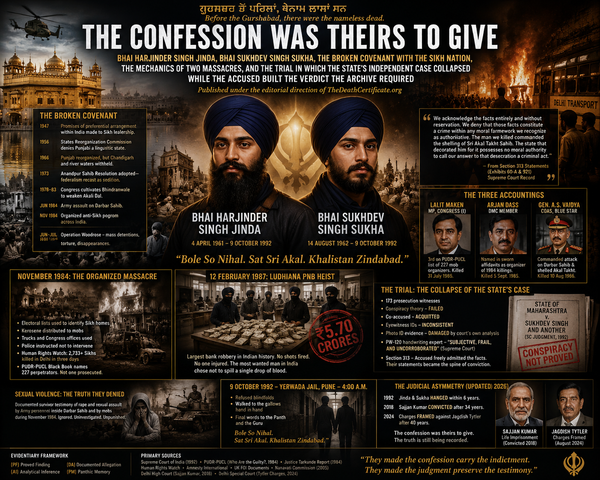
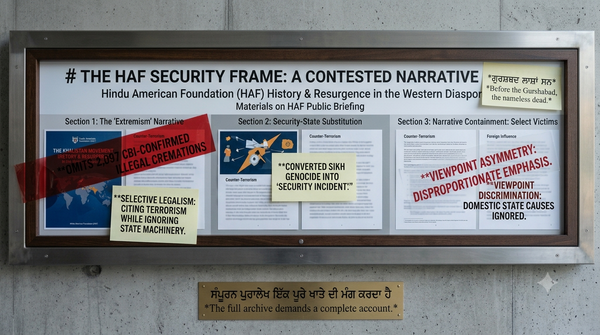
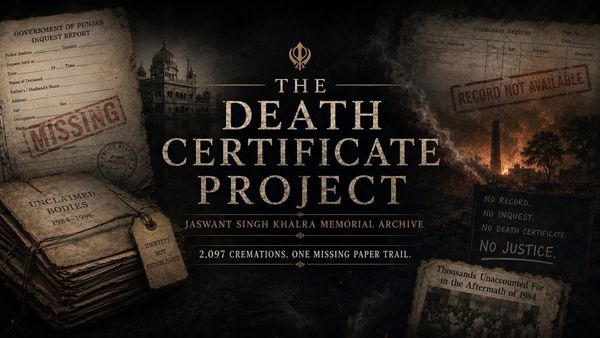
Illegal Cremations: Administrative Supervisors Ramesh Inder Singh IAS and KBS Sidhu IAS Deputy Magistrates of Amritsar 1984-1996

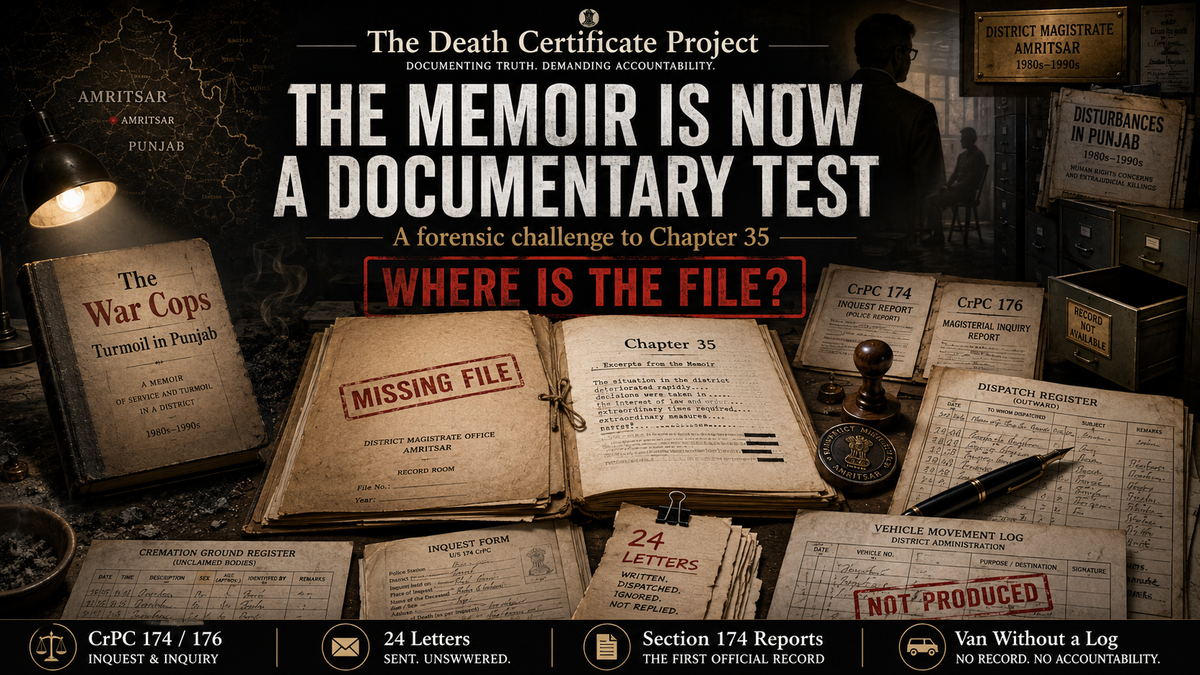
FORENSIC CHALLENGE TO RAMESH INDER SINGH IAS’ CHAPTER 35 OF TURMOIL IN PUNJAB
Press release from: The Death Certificate Project Amritsar 1984-1996
Administrative Supervisors of CBI confirmed Illgeal Cremations : Ramesh Inder Singh IAS and KBS Sidhu IAS Deputy Magistrates and Deputy Commissioners of Amritsar 1984-1996
FOR IMMEDIATE RELEASE
THE MEMOIR IS NOW A DOCUMENTARY TEST: THE DEATH CERTIFICATE PROJECT ISSUES FORENSIC CHALLENGE TO RAMESH INDER SINGH’S CHAPTER 35 OF TURMOIL IN PUNJAB
Former Amritsar District Magistrates asked to produce the District Attorney’s name, CrPC Section 174/176 legal advice, alleged twenty-four Home Secretary communications, Section 174 report requests, loudspeaker-van records, and the missing administrative file behind his published account
FRESNO, CALIFORNIA - June 2026 - The Death Certificate Project, a U.S.-based First Amendment forensic accountability publication focused on Punjab’s unresolved record of extrajudicial killings, enforced disappearances, custodial deaths, custodial torture, custodial sexual violence, illegal cremations, and missing death certificates between 1984 and 1996, has issued a comprehensive public forensic challenge to Chapter 35, “The War Cops,” from Ramesh Inder Singh’s Turmoil in Punjab: Before and After Blue Star - An Insider’s Story, authored by the former Deputy Commissioner and District Magistrate of Amritsar, IAS (Retd.).
The Project’s newly released analysis, titled “There Was No War. There Was a District Magistrate,” examines Chapter 35 not merely as a memoir chapter, but as a retrospective administrative defense by the civil officer who held magisterial authority in Amritsar during one of the most consequential opening periods of Punjab’s mass-violence record: Operation Blue Star, Operation Woodrose, the early counterinsurgency years, alleged encounter deaths, disputed emergency civil-administration measures, auxiliary policing structures, and the beginning of the illegal-cremation architecture later exposed by human-rights defender Jaswant Singh Khalra.
The Project states that Chapter 35 has now converted itself into a public-record event.
It is no longer enough to read the chapter as memory.
It must now be tested as file.
The central question is direct:
If the District Magistrate had statutory concerns, where is the file?
The Death Certificate Project is asking Shri Ramesh Inder Singh to produce, identify, or clarify the records behind his published account: the District Attorney or legal officer he says he consulted, the legal advice he says he received, the communications he says he sent to Punjab and Union authorities, the Section 174 reports he says he sought from police officers, and the administrative records that should exist if his account is accurate, complete, and contemporaneously grounded.
The Project emphasizes that this release is not a criminal accusation, indictment, or judicial finding against Ramesh Inder Singh. It is a public forensic challenge to a published administrative account. It asks for documents that should exist if the account is accurate and complete.
A memoir may explain a man’s memory.
It cannot substitute for the records of the office he held.
⸻
I. THE CENTRAL PREMISE: A MEMOIR CANNOT ANSWER A STATUTORY FILE
The Death Certificate Project states that Chapter 35 must now be read through the discipline of public-record analysis.
Ramesh Inder Singh was not a private observer in Amritsar. He was the Deputy Commissioner and District Magistrate. He was the civil authority through whom law-and-order administration, curfew orders, magisterial functions, police reporting, preventive detention, official correspondence, and death-related statutory duties passed.
His memoir therefore carries a different legal and historical character from the recollections of a journalist, soldier, politician, or civilian witness.
When a District Magistrate publishes an account of his own conduct during a period of mass death, disappearance, police violence, curfew, military deployment, alleged encounter killing, custodial abuse, and subsequent illegal cremation findings, the account cannot remain merely literary. It becomes a documentary claim about an office.
The Death Certificate Project’s position is simple:
The office had files. The files had numbers. The numbers had dates. The dates had recipients. The recipients had designations. The documents either exist, once existed, were destroyed, were withheld, or were never created. Each possibility is evidentiary.
A District Magistrate’s recollection is not an inquest report.
A memoir paragraph is not a dispatch number.
A legal justification without the lawyer’s name is not legal advice.
A claimed letter without a date, recipient, file number, or office copy is not a documentary defense.
A humanitarian van without a vehicle log is not an evacuation record.
A later explanation cannot replace a contemporaneous administrative file.
⸻
II. THE LEGAL CORE: CrPC SECTIONS 174 AND 176
The forensic challenge focuses on one narrow but decisive legal issue: what did the District Magistrate of Amritsar understand, record, and do regarding deaths, alleged encounter deaths, alleged staged encounters, missing persons, unidentified bodies, police-delivered bodies, custodial deaths, and the operation of Sections 174 and 176 of the Code of Criminal Procedure?
Section 174 CrPC concerns the statutory inquest process into suspicious, unnatural, violent, or otherwise reportable deaths.
Section 176 CrPC concerns magisterial inquiry in categories including deaths in custody and related circumstances requiring independent scrutiny.
The Death Certificate Project states that these provisions were not ceremonial. They were the statutory gateways through which a human body became a legal case, a case became an inquiry, an inquiry became an official record, and an official record became the possibility of prosecution.
The Project does not assert that every missing-person report automatically produced a completed Section 174 inquest. It does not oversimplify the law. It does not claim that the absence of a body creates the same procedural mechanics as the presence of a body.
The Project’s position is narrower and more legally serious:
The disappearance or non-production of a body did not eliminate the District Magistrate’s broader civil and magisterial responsibilities. It intensified them.
If a body was missing, the question did not disappear.
It changed.
Who last had custody?
Which police station was involved?
Was an arrest memo made?
Was the detainee produced before a Magistrate?
Was the station diary inspected?
Was the family’s complaint recorded?
Was the SSP asked for a written explanation?
Was the Divisional Commissioner informed?
Was the Home Department notified?
Was a search or production mechanism considered?
Was a file opened?
The Death Certificate Project states that a legal interpretation allowing the State to avoid inquest obligations by ensuring that the body never reaches the Magistrate would invert the purpose of law. It would reward disappearance. It would convert concealment into immunity. It would allow the destruction or non-production of the body to become the very reason no inquiry occurred.
The law cannot be read to reward disappearance.
If the body is missing because the State failed to preserve it, the legal question does not end.
It begins.
⸻
III. THE CHAPTER 35 CLAIMS THAT NOW REQUIRE DOCUMENTARY VERIFICATION
According to The Death Certificate Project’s reading of Chapter 35, Ramesh Inder Singh advances, implies, or relies upon several specific claims that now require documentary verification.
These include:
That where a body was not physically found, produced, or available, he understood that no operative obligation arose under Section 174 or Section 176 CrPC.
That he consulted a District Attorney, Public Prosecutor, or equivalent legal officer in Amritsar regarding that position.
That this legal officer agreed, or substantially agreed, with his interpretation.
That he repeatedly wrote to Punjab and Union authorities seeking guidance on deaths, missing persons, encounter claims, and legal uncertainty under these provisions.
That approximately twenty-four written communications were sent by him to superior authorities, including Punjab and Union Home Secretaries or equivalent officials.
That no clear policy guidance was provided by the Punjab Government or the Government of India.
That he requested Section 174 reports from senior police officers, including SSP Mohammad Izhar Alam.
That those requests were obstructed, ignored, delayed, or not complied with.
The Project states that these claims, if accurate, do not close the accountability record.
They open it.
If Singh consulted a District Attorney, the name of that officer should be produced.
If written legal advice existed, the file should be identified.
If the advice was oral, the file note recording that advice should be identified.
If twenty-four letters were sent to Home Secretaries or equivalent officials, the dates, dispatch numbers, recipients, and office copies should exist.
If Section 174 reports were demanded from senior police officers, the written directions should exist.
If no reply was received from Chandigarh or Delhi, that non-response should have been recorded.
If police officers failed to comply with the District Magistrate’s request, that failure should have been escalated.
The public is not being asked to choose between accusation and memory.
The public is being asked to inspect the record.
⸻
IV. THE CENTRAL CONTRADICTION: “NO BODY, NO DUTY” VERSUS REQUESTS FOR SECTION 174 REPORTS
The Death Certificate Project identifies what it calls the central internal tension in Chapter 35:
If the former District Magistrate believed that Sections 174 and 176 were not triggered unless a body was physically available, why did he request Section 174 reports from police officials?
Conversely:
If he requested Section 174 reports from SSPs, then his own conduct appears to confirm that he understood the existence of a statutory or administrative reporting duty.
The Project states that this is not a minor inconsistency. It goes to the heart of the legal architecture of impunity.
A District Magistrate who claims no inquest was legally possible must explain why he was seeking inquest-related reports.
A District Magistrate who claims he sought such reports must explain what happened when the police refused, delayed, ignored, or failed to comply.
Chapter 35 cannot simultaneously function as proof of legal helplessness and proof of administrative diligence unless the documents support both claims.
The Project is therefore asking for the surviving administrative trail:
The name of the District Attorney, Public Prosecutor, or legal officer consulted.
The date and form of the consultation.
The text, file reference, or office note of any legal advice received.
The dates of the alleged twenty-four communications.
The names and designations of the Punjab and Union officials contacted.
Dispatch numbers, diary numbers, receipt numbers, or file numbers.
Any reply, acknowledgment, refusal, or recorded silence.
Any written direction issued to SSPs regarding Section 174 reports.
Any reminder sent after non-compliance.
Any internal note recording police non-compliance.
Any escalation to the Divisional Commissioner, Punjab Home Department, Governor, or Union Ministry of Home Affairs.
Any register maintained by the District Magistrate’s office for encounter deaths, missing persons, police-delivered bodies, unidentified bodies, custodial deaths, illegal-custody complaints, or allegations of custodial sexual violence.
The Project’s challenge is therefore not rhetorical.
It is archival.
⸻
V. THE “TWENTY-FOUR LETTERS” PROBLEM
One of the most significant claims attributed to Chapter 35 is that Ramesh Inder Singh wrote approximately twenty-four times to state or central authorities regarding legal uncertainty, encounter deaths, missing bodies, or the operation of Sections 174 and 176 CrPC.
The Death Certificate Project states that this claim is important because it either strengthens or weakens the former District Magistrate’s account depending on whether the letters can be identified.
If the letters exist, they may show that the District Magistrate recognized a legal problem, attempted to seek guidance, and was ignored by higher authority.
If the letters do not exist, or cannot be identified, then the memoir’s defense becomes far weaker because it rests on an unverified retrospective claim of administrative resistance.
If the letters existed but were destroyed, that destruction is itself a matter requiring explanation.
If the letters were sent but no replies were received, the file should contain reminders, acknowledgments, receipt entries, or notings recording the non-response.
The Project therefore asks Ramesh Inder Singh to identify each alleged communication by date, recipient, designation, department, subject line, file number, dispatch number, diary number, method of transmission, office copy, reply, acknowledgment, reminder, or later reference in another file.
A claim of twenty-four letters is not a metaphor.
It is an audit trail.
If the letters existed, the record has twenty-four doors.
The Project is asking where those doors lead.
⸻
VI. THE DISTRICT ATTORNEY PROBLEM
Chapter 35’s reported reliance on legal consultation with a District Attorney, Public Prosecutor, or equivalent law officer creates another documentary test.
The Project asks:
Who was the law officer?
What was his exact designation?
When was he consulted?
Was the advice oral?
Was the advice written?
If written, where is the opinion?
If oral, why was the advice not reduced to a file note, especially given the gravity of the issue?
Did the advice address only cases where no body was physically available?
Did it address encounter deaths?
Did it address alleged staged encounters?
Did it address custodial deaths?
Did it address unidentified bodies delivered by police?
Did it address bodies cremated without postmortem?
Did it address families reporting illegal custody?
Did it address missing persons whose last known custody was police custody?
Did it address the District Magistrate’s duty to demand station diary entries, arrest registers, custody records, or police explanations?
Did it address complaints of custodial torture or custodial sexual violence?
The Project states that the identity of the District Attorney is not a peripheral matter. It is the foundation of the legal defense attributed to the memoir.
If legal advice is invoked to explain why a District Magistrate did not initiate or require certain forms of inquiry, the public is entitled to ask:
Who gave the advice?
What exactly did the advice say?
Was it competent?
Was it recorded?
Was it relied upon in good faith?
Was it challenged?
Was it sent upward?
A nameless lawyer cannot carry a statutory defense.
A legal opinion without a file cannot answer the dead.
⸻
VII. THE SECTION 174 REPORTS FROM SSPs
The Project’s analysis gives particular attention to the reported claim that Ramesh Inder Singh requested Section 174 reports from senior police officers, including SSP Mohammad Izhar Alam.
If true, the Project states, this is one of the most important factual claims in Chapter 35.
It would mean that the District Magistrate understood that police-declared deaths, encounter deaths, or related incidents required reporting through a statutory or quasi-statutory framework.
It would also mean that senior police officers failed, delayed, or refused to comply with the civil authority’s request.
Either possibility is consequential.
The Project asks:
Were the requests oral or written?
If oral, were they recorded afterward?
If written, what were the memo numbers?
Were reminders sent?
Was non-compliance reported upward?
Was the Home Department notified?
Was the Divisional Commissioner informed?
Was the Governor informed during President’s Rule?
Were any adverse remarks entered in the SSP’s record?
Were any disciplinary consequences recommended?
Were any proceedings initiated?
Were any encounter-death files opened?
Were any police explanations preserved?
If the District Magistrate demanded Section 174 reports and the police refused, then the next file should be the escalation file.
Where is it?
⸻
VIII. THE LOUDSPEAKER VAN: “THE VAN WITHOUT A LOG”
The forensic challenge also revisits one of the most consequential civil-administration narratives associated with Operation Blue Star: the alleged deployment of a public-announcement van to warn civilians or facilitate evacuation from the Darbar Sahib complex before the military assault.
The Project refers to this as:
The Van Without a Log.
According to the Project’s analysis, the van narrative has been used to support an implied civil-administrative alibi: that the administration attempted to warn civilians before the assault and therefore discharged some measure of humanitarian or legal responsibility.
The Project argues that if the van was a meaningful administrative operation, it should have left a record.
The Project asks:
Where is the written order authorizing the van?
Who requisitioned the vehicle?
What was the vehicle number?
Who was the driver?
Who were the civil officials, police officers, or employees assigned to the van?
What route did it take?
At what time did it leave?
At what time did it return?
Was a loudspeaker script approved?
Who wrote the script?
Who approved the script?
Was the announcement recorded in any district, police, Army, municipal, or vehicle movement log?
Did the Army acknowledge receipt of the civil-administration announcement plan?
Did any civilian inside the Darbar Sahib complex report hearing the announcement?
Did any officer certify that the announcement was audible from the relevant locations?
Was any fuel entry preserved?
Was any vehicle register entry preserved?
Was any movement register entry preserved?
Was any driver duty slip preserved?
Was any return report prepared?
Was any after-action note written?
Was the van mentioned in any contemporaneous civil-administration report?
The Project does not assert that the absence of a public record alone proves the van never moved.
The Project asserts something narrower:
The van cannot bear legal, moral, humanitarian, or historical weight unless the State or the former District Magistrate can produce the records that would normally accompany such an operation.
A van without a written order is not an administrative plan.
A van without a driver log is not an operational record.
A van without a route is not an evacuation measure.
A van without evidence of audibility is not a warning.
A van without a file cannot answer for civilians who died inside a sealed complex.
⸻
IX. “THE WAR COPS” AND THE DISAPPEARING CIVIL OFFICE
The Death Certificate Project states that the title of Chapter 35 - “The War Cops” - itself requires scrutiny.
The Project argues that framing the period as a war-police narrative risks removing the central civil office from the scene.
Amritsar in June 1984 was not a legal vacuum.
It had a District Magistrate.
It had a Deputy Commissioner.
It had a civil administration.
It had curfew orders.
It had detention paperwork.
It had statutory registers.
It had police reporting obligations.
It had law-and-order correspondence.
It had military-civil interfaces.
It had families.
It had bodies.
It had, or should have had, records.
The Project’s position is that the issue is not only whether police actors committed violence. The issue is whether the civil administration recorded, questioned, inquired, restrained, reported, escalated, or documented that violence as the law required.
There was no war in the legal sense that suspended the District Magistrate’s statutory duties.
There was a district.
There was a magistrate.
There were bodies.
There were families.
There should have been records.
⸻
X. APAR SINGH BAJWA AND THE DISTRIBUTION OF BURDEN
The Project’s related article, “Apar Singh Bajwa Carried the Bodies; Ramesh Inder Singh Carried the Office; the Republic Rewarded the Office,” examines what the Project calls the unequal distribution of physical burden and institutional reward.
The Project argues that during the violence of the period, lower-level functionaries, cremation-ground workers, local officials, police constables, families, municipal employees, and ordinary citizens physically encountered the bodies and consequences of state action.
High civil officials, by contrast, carried the office: the title, statutory authority, institutional command, social prestige, and later respectability attached to the State.
The Project does not treat this as proof of individual criminal guilt.
It treats it as a forensic question about institutional design.
Why did the physical burden of the dead move downward while the prestige of office moved upward?
Why did the people who touched the bodies become footnotes while the people who held the files became memoirists, commissioners, and custodians of public memory?
Why did the human weight of the violence fall on clerks, cremation workers, families, and field officers, while the historical explanation was later authored from the altitude of senior bureaucracy?
This is not a rhetorical question.
It is an administrative question.
The dead passed through offices.
The offices produced careers.
The careers produced memoirs.
The memoirs now require files.
⸻
XI. FROM DISTRICT MAGISTRATE TO INFORMATION COMMISSIONER
The Project also notes that Ramesh Inder Singh later served as Chairman of the Punjab State Information Commission, an institution associated with transparency, public access, and the Right to Information.
The Project argues that this later role intensifies the public importance of the missing administrative record from his Amritsar tenure.
A former District Magistrate who later presided over an information-access institution is uniquely positioned to understand the importance of file numbers, dispatch records, office copies, movement registers, diary entries, receipt acknowledgments, legal opinions, public-record preservation, administrative traceability, and documentary accountability.
The Project therefore asks whether the records invoked in Chapter 35 exist, where they are held, and whether they can be produced.
If they exist, they should be identified.
If they were transferred, the custodian should be named.
If they were destroyed, the destruction order should be produced.
If they were never created, that fact should be stated.
The former head of an information commission cannot be surprised when the public asks for information.
⸻
XII. THE 34 PUBLIC QUESTIONS TO RAMESH INDER SINGH
The Death Certificate Project places the following questions before Ramesh Inder Singh as formal public questions for file:
- Who was the District Attorney, Public Prosecutor, or legal officer consulted regarding Sections 174 and 176 CrPC?
- What was the date or approximate period of that consultation?
- Was the advice oral or written?
- If oral, was the advice recorded in any file note, diary note, official memorandum, confidential report, or communication to superior authority?
- If written, will Singh produce the opinion or identify its file number and custodian office?
- Did the legal advice apply only to cases where no body was available?
- Did the legal advice also apply to encounter deaths, alleged staged encounters, missing persons, police-delivered bodies, unidentified bodies, or custodial-death complaints?
- What were the dates of the approximately twenty-four communications Singh says he sent to Punjab or Union authorities?
- Who were the recipients of those communications?
- What were the subject lines, file numbers, dispatch numbers, or diary numbers?
- Did any official acknowledge receipt?
- Did any official respond substantively?
- If no response was received, was the non-response recorded in any file note or reminder?
- Did Singh send reminders after non-response?
- Did Singh report non-compliance by police officers to the Divisional Commissioner?
- Did Singh report non-compliance to the Punjab Home Department?
- Did Singh report non-compliance to the Governor during President’s Rule or to any authority acting on behalf of the Union Government?
- Did Singh ever order or request an inquiry into any encounter death?
- Did Singh ever direct a police station to register an FIR based on a family’s illegal-custody complaint?
- Did Singh ever use, seek, recommend, or refer for use Section 97 CrPC in response to allegations of wrongful confinement?
- Did Singh ever inspect, or order inspection of, police lockups, interrogation centers, or unofficial custody locations?
- Did Singh maintain any encounter-death file?
- Did Singh maintain any missing-persons file?
- Did Singh maintain any police-delivered-body file?
- Did Singh maintain any cremation-ground correspondence file?
- Did Singh maintain any record of civilian complaints concerning sexual violence, custodial torture, illegal detention, or denial of medico-legal examination?
- Did Singh ever correspond with military authorities regarding civilian casualties during or after Operation Blue Star?
- Did Singh ever prepare or receive an official civilian-casualty assessment?
- Did Singh ever certify, dispute, or revise the number of civilian deaths?
- Did Singh ever order reconciliation between bodies recovered, bodies cremated, bodies identified, and families notified?
- Did the alleged loudspeaker van have a vehicle number, driver, log, written order, route plan, fuel entry, movement register, or return report?
- If the van was a real administrative measure, why has no publicly produced administrative record been identified?
- If Singh’s Chapter 35 account is based on contemporaneous documents, will he identify those documents?
- If Singh’s Chapter 35 account is based on memory alone, will he state that clearly?
⸻
XIII. RIGHT OF DOCUMENTARY REPLY
The Death Certificate Project invites Ramesh Inder Singh to provide a documentary reply.
The Project states that any verified correction, document, file reference, contemporaneous correspondence, legal opinion, official clarification, dispatch number, acknowledgment, register entry, or administrative record received from Singh will be preserved, reviewed, and incorporated into the continuing public record.
The Project will record documentary replies, verified corrections, formal denials, explanations, refusals, non-responses, newly identified file custodians, and newly produced primary records.
The Project states that silence is not treated as proof of guilt.
It is treated as a fact in the record: a public question was asked, and no answer was received.
“The question is not whether Shri Ramesh Inder Singh has a right to tell his story,” said Dr. Kanwar Partap Singh Gill, M.D., publisher of The Death Certificate Project. “He does. The question is whether a memoir can answer a statutory file. If he consulted a District Attorney, name the officer. If he wrote twenty-four letters, produce the dates and dispatch numbers. If he asked for Section 174 reports, produce the request. If the police refused, produce the record of refusal. This is not a demand for confession. It is a demand for the file.”
⸻
XIV. NO CRIMINAL ACCUSATION OR JUDICIAL FINDING
The Death Certificate Project emphasizes that this release is not a criminal accusation, indictment, or judicial finding against Ramesh Inder Singh.
It is a public forensic challenge to a published administrative account.
It asks for documents that should exist if the account is accurate and complete.
It distinguishes between proved findings, official records, documented allegations, analytical inferences, formal questions for file, and right-of-reply requests.
The Project states that it will not present any claim at a higher evidentiary level than the record supports.
The Project’s core publication method is documentary: if a claim rests on a court order, it is identified as such; if a claim rests on human-rights documentation, it is identified as such; if a claim rests on inference from institutional pattern, statutory duty, or missing records, it is identified as analytical inference; if a document is being demanded, it is identified as a formal question for file.
This is not a verdict.
It is a summons to the record.
⸻
XV. THE BROADER CONTEXT: THE DEATH CERTIFICATE PROJECT
The Chapter 35 release is part of a broader public archive.
The Death Certificate Project is a U.S.-based First Amendment forensic accountability publication focused on Punjab’s unresolved record of illegal cremations, enforced disappearances, custodial deaths, custodial torture, custodial sexual violence, and missing death certificates between 1984 and 1996.
The Project’s central proposition is:
A missing death certificate is not a neutral absence. It is an administrative event.
The Project seeks to identify the offices, officers, laws, registers, files, and omissions through which human beings were removed from legal existence:
Detained without production.
Tortured without medico-legal record.
Killed without inquest.
Cremated without certificate.
Remembered by families without the State ever naming them.
The Project asks a question that has remained unanswered for decades:
Where are the death certificates?
⸻
XVI. THE LEGACY OF JASWANT SINGH KHALRA AND THE 2,097 CREMATIONS
The Project builds upon the unfinished work of human-rights defender Jaswant Singh Khalra, who exposed secret cremations in Punjab before he was abducted, illegally detained, tortured, murdered, and disappeared in 1995.
Khalra’s work forced the Indian State’s own cremation-ground records into the public and judicial record. The documented proceedings around the Punjab Mass Cremations Case and the CBI’s 2,097 illegal-cremation figure remain the administrative floor of the record, not the ceiling of Punjab’s dead.
The Project also notes the public human-rights record describing the Supreme Court’s recognition that the CBI inquiry into mass cremations disclosed a flagrant violation of human rights on a mass scale.
The Death Certificate Project treats that number not as the total count of Punjab’s dead, but as the minimum proved administrative footprint of a wider pattern.
Khalra exposed the first ledger: the cremation-ground record.
The Death Certificate Project is building the second ledger: the public record of the files that should have existed, the files that survived, the files that remain missing, and the offices responsible for producing them.
⸻
XVII. THE SEXUAL-VIOLENCE RECORD AND THE SILENCE AROUND SIKH WOMEN
The Project states that any serious archive of Punjab’s mass-violence record must include custodial sexual violence, sexual humiliation, denial of medico-legal documentation, survivor silence, and the erasure of Sikh women from official narratives.
The question is not only who was killed.
It is who was detained, who was tortured, who was violated, who was medically examined, who was denied examination, who was forced into silence, and which office failed to record the complaint.
Survivor-centered literature such as The Kaurs of 1984: The Untold, Unheard Stories of Sikh Women underscores why any death-record archive that excludes women’s testimony remains incomplete.
The Death Certificate Project therefore seeks not only death certificates, inquest reports, cremation registers, and police records, but also medico-legal records, hospital entries, complaint registers, magistrate notes, and correspondence concerning allegations of custodial torture and sexual violence.
The Project states:
A missing death certificate erases the dead.
A missing medico-legal report erases the living survivor.
Both are administrative events.
Both belong in the archive.
⸻
XVIII. THE THREE-DC TRIAD AND WHY RAMESH INDER SINGH MATTERS
The archive organizes much of its Amritsar work around what it calls the Three-DC Triad - the three successive District Magistrates and Deputy Commissioners whose tenures span the period from Operation Blue Star through the illegal-cremation record.
The Project’s published work examines:
Ramesh Inder Singh, IAS - Deputy Commissioner/District Magistrate, Amritsar, June 4, 1984 to July 1987.
His tenure includes Operation Blue Star, Operation Woodrose, the early counterinsurgency period, the disputed loudspeaker-van narrative, early encounter-death questions, and Chapter 35 of Turmoil in Punjab.
Sarabjit Singh, IAS - Deputy Commissioner/District Magistrate, Amritsar, July 7, 1987 to May 10, 1992.
His tenure includes the middle period of the counterinsurgency, President’s Rule, preventive detention, allegations of illegal custody, the expanding illegal-cremation architecture, and the administrative corridor analyzed in “The Middle Corridor.”
K.B.S. Sidhu, IAS - Deputy Commissioner/District Magistrate, Amritsar, May 1992 to August 1996.
His public writings, including K.B.S. Sidhu’s Substack account of Punjab, 1984, civil administration, Operation Blue Star, Operation Black Thunder, and Darbar Sahib, form part of the broader public-record debate over how retired civil servants narrate the period.
The Project does not claim that the three officers bear identical personal responsibility.
It states that each held a statutory office whose records must be examined.
Ramesh Inder Singh matters because he held the office at the beginning of the corridor.
His Chapter 35 matters because it is his own public account of that office.
The Project’s position is that the first corridor cannot be closed by memoir.
It must be opened by file.
⸻
XIX. THE DOCUMENTS THE PROJECT SEEKS
The Project seeks records relating to Ramesh Inder Singh’s Amritsar tenure, including:
Section 174 CrPC inquest reports.
Section 176 CrPC inquiry records.
Encounter-death files.
Missing-person complaints.
Police custody records.
Station diary entries.
Lockup inspection records.
District Attorney opinions.
Public Prosecutor opinions.
Legal advice notes.
Home Secretary correspondence.
Dispatch registers.
Diary registers.
Reminder letters.
SSP correspondence.
Mohammad Izhar Alam correspondence.
Records concerning auxiliary formations.
Military-civil correspondence during Operation Blue Star.
Curfew orders.
Civilian-casualty assessments.
Loudspeaker-van authorization records.
Vehicle movement logs.
Driver duty slips.
Fuel entries.
Route records.
Cremation-ground correspondence.
Unidentified-body registers.
Police-delivered-body registers.
Medico-legal records.
Complaints of custodial torture or sexual violence.
Death certificates.
Postmortem reports.
Municipal cremation records.
Firewood purchase vouchers.
Treasury reimbursement files.
The Project invites families, survivors, retired officials, former clerks, lawyers, journalists, researchers, municipal workers, and public servants to submit documents confidentially.
Survivor privacy will be protected.
The Project will not publish private survivor-identifying information without consent.
⸻
XX. LEGAL PUBLICATION NOTICE
The Death Certificate Project is published from Fresno, California, under the protections of the First Amendment to the Constitution of the United States.
The Project is a public-interest forensic accountability publication. It does not provide legal advice. It does not issue criminal judgments. It publishes historical research, document analysis, evidentiary classifications, formal questions for file, right-of-reply opportunities, and public-interest commentary grounded in judicial records, official proceedings, human-rights documentation, and clearly labeled analytical inference.
No claim is stated at a higher evidentiary level than the primary record supports.
Every living official, institution, successor government, family representative, public body, or person named or implicated in the Project’s work has a standing right of documentary reply.
Corrections supported by primary evidence will be published.
Denials will be recorded.
Documents will be preserved.
Silence will be noted.
⸻
XXI. STATEMENT FROM THE PUBLISHER
“The Death Certificate Project is not asking for memory. It is asking for records,” said Dr. Kanwar Partap Singh Gill, M.D. “The dead do not need another commission. They need the documents that should have existed when they were taken, tortured, killed, cremated, and erased. Where is the inquest? Where is the postmortem? Where is the death certificate? Where is the station diary? Where is the medico-legal report? Where is the family notification? Until those questions are answered, the archive remains open.”
Dr. Gill added:
“Ramesh Inder Singh’s Chapter 35 is now a documentary test. If he consulted a District Attorney, name him. If he wrote twenty-four letters, produce the dates. If he asked for Section 174 reports, produce the requests. If the police refused, produce the refusal. If the civil administration was helpless, show the file of helplessness. Without the file, the memoir remains a narrative. With the file, history can be tested.”
⸻
XXII. MEDIA CONTACT
Publisher: Kanwar Partap Singh Gill, M.D.
Fresno, California
Waheguru Ji Ka Khalsa, Waheguru Ji Ki Fateh.
The Death Certificate Project
8408 N Ann Ave
Fresno CA 93720
USA
This release concerns the unresolved governmental human-rights record of Punjab between 1984 and 1996: alleged and documented extrajudicial killings, enforced disappearances, custodial torture, custodial sexual violence, illegal cremations, missing death certificates, and the State’s failure to preserve or produce the statutory records through which the dead and disappeared should have entered law.
The Death Certificate Project does not issue criminal judgments. It asks documentary questions. Where the record concerns government custody, police-delivered bodies, unidentified cremations, custodial death, sexual violence, missing persons, or denial of medico-legal documentation, the issue is not private memory. It is state accountability.
Ramesh Inder Singh’s Chapter 35 of Turmoil in Punjab is therefore not treated merely as memoir. It is treated as a public administrative account by a former District Magistrate whose office sat at the intersection of civil power, police reporting, curfew administration, magisterial duty, death inquiry, and the government record. If that account is accurate, the file should exist. If the file does not exist, its absence is itself a human-rights fact.
This release was published on openPR.