A PLANNING DOCUMENT IS NOT A REPAIR SCHEDULE

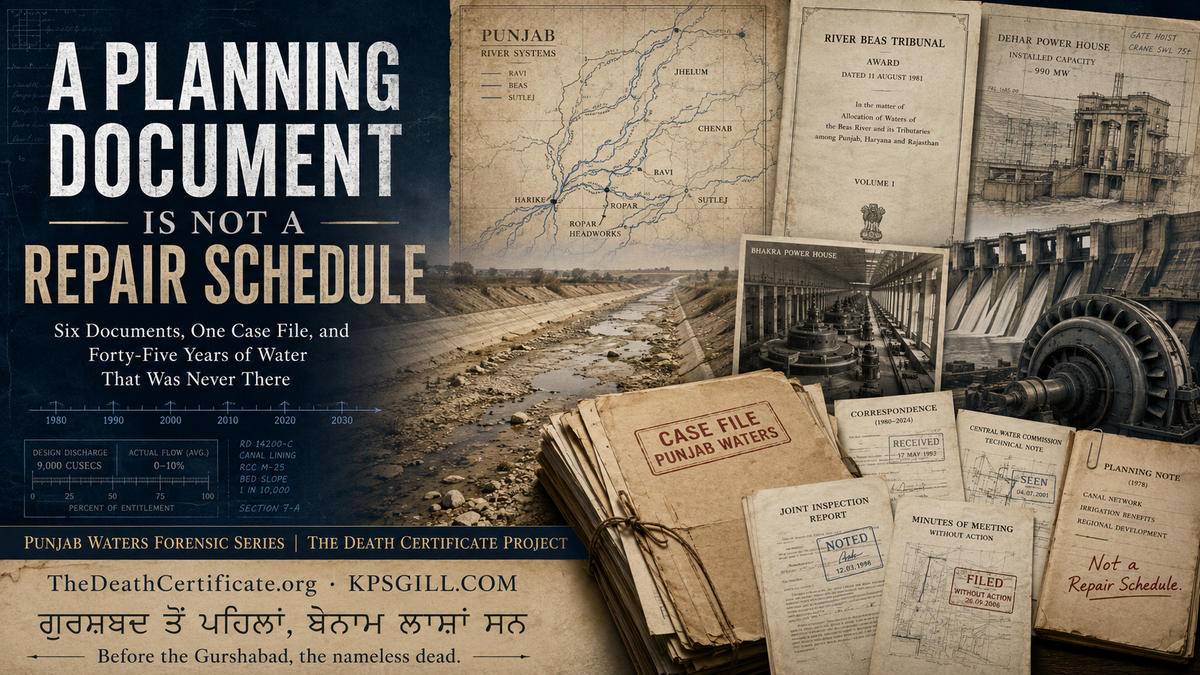
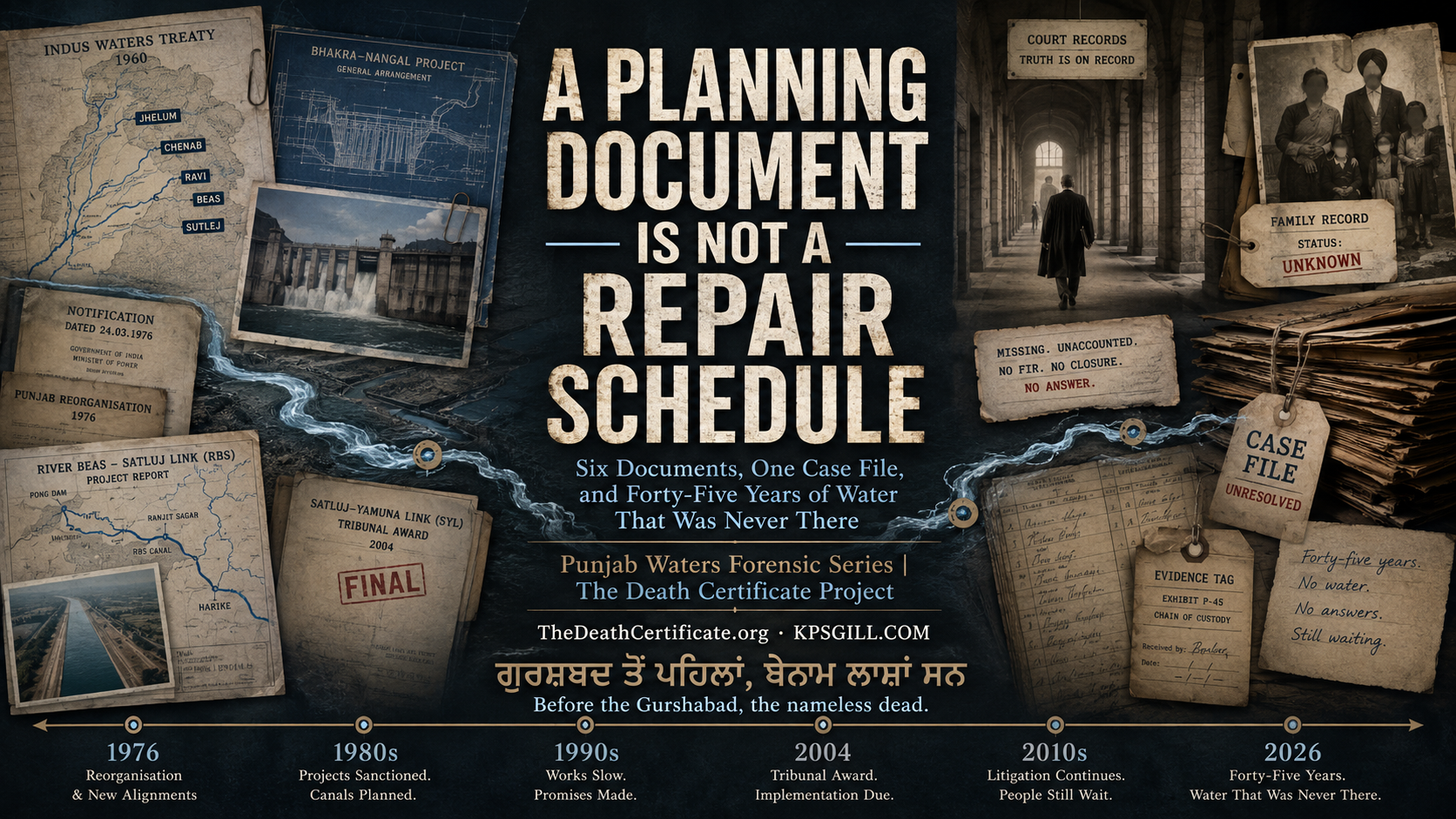
Six Documents, One Case File, and Forty-Five Years of Water That Was Never There
Punjab Waters Forensic Series | The Death Certificate Project
TheDeathCertificate.org · KPSGILL.COM
ਗੁਰਸ਼ਬਦ ਤੋਂ ਪਹਿਲਾਂ, ਬੇਨਾਮ ਲਾਸ਼ਾਂ ਸਨ
Before the Gurshabad, the nameless dead.
Case File Index
This essay reads eight records together. Seven are water documents; the eighth is not, and that is the point.
- The 24 March 1976 notification, issued under Section 78 of the Punjab Reorganisation Act, allocating 3.5 MAF to Haryana with a pro-rata adjustment mechanism tied to Beas availability at Mandi.
- The 31 December 1981 tripartite agreement, fixing the Ravi-Beas “net surplus” at 17.17 MAF.
- The 1987 Eradi Tribunal interim report and the clarification references that remain pending.
- The July 1990 stoppage of SYL construction.
- The 2004 Punjab Termination of Agreements Act and the 2016 Presidential Reference advisory opinion.
- The November 2016 land-restoration notification, implemented through the revenue machinery.
- The 2025–2026 Sidhu corpus on IWT abeyance, Bhakra, Dehar, the Chenab-Beas and Marhu Tunnels, and “reclaimed waters.”
And separately:
- Ensaaf’s case file on the killing of Manpreet Kaur and her family (August 1991) — and, this draft adds, the Multani case file against then-SSP Sumedh Singh Saini, which began in the same district in the same year and is, as of the most recent reporting located, still working its way through the Sessions Court in Mohali thirty-five years later.
Record 8 is not a water document. Its importance to this essay is precisely that the other seven cannot contain it — and that, on the evidence below, Record 8 has its own thirty-five-year history of being filed without being resolved, which turns out to be the same history this essay tells about Records 1 through 7.
A Note on Source Hierarchy
This article treats Supreme Court judgments, the 1981 agreement’s text, and Lok Sabha replies as primary record; K.B.S. Sidhu’s Substack as a public authorial corpus, read for what it says and does not say; The Tribune and other contemporaneous newspaper reporting as the record of events as they happened; and Ensaaf as a human-rights case-file archive, built from family testimony and documented to a standard this article does not independently re-adjudicate. Where these registers diverge — where a fact is documented in one sense and merely reported or alleged in another — that divergence is not smoothed over. In several places below, it is the subject of the paragraph.
The Sentence
On June 12, 2026, K.B.S. Sidhu wrote one sentence about the Dehar Power House that this essay borrows as its title. BBMB, asked by Punjab for a timeline to repair the six turbines that had moved Beas water into the Sutlej system since 1977 — all six down since March 4, transfer through the Beas-Sutlej Link at zero for over a hundred days, according to Sidhu’s account citing Tribune reporting — had produced a report on “Renovation, Modernisation, Uprating and Life Extension.” Sidhu’s verdict: “A planning document is not a repair schedule.”
He was right, and he meant it about one powerhouse, on one day. This essay asks a larger question: how many of the documents that have governed Punjab’s water — and, as it turns out, Punjab’s accounting for what happened to people near that water — for the last fifty years would survive being read the same way? Six water documents, by the count below, between 1976 and 2026, each arriving with the implicit promise that this one would finally align law with river. None of them was a repair. And running underneath all six, in the same district, in the same year — 1991 — is a seventh and an eighth record: one un-filed by any of the six, the other filed, eventually, and still — as of the most recent date this essay could verify — unresolved.
This is the order in which they arrived.
Document One: 1976, 1981, and a Clause That Moved
Properly read, Document One is two records four years apart that looser accounts collapse into one.
The 24 March 1976 notification, issued under Section 78 of the Punjab Reorganisation Act, allocated 3.5 MAF to Haryana from the Ravi-Beas system — and, per the Supreme Court’s 2002 judgment in State of Haryana v. State of Punjab, contained an explicit pro-rata adjustment: if the Beas’s flow at Mandi rose or fell from the figure assumed, Haryana’s allocation would rise or fall with it. Whatever else can be said about 1976, it was a formula that adjusted.
The 31 December 1981 tripartite agreement did not preserve that structure. It fixed the Ravi-Beas “net surplus” at an absolute number — 17.17 MAF — divided 4.22 to Punjab, 3.50 to Haryana, 8.60 to Rajasthan, 0.20 to Delhi, 0.65 to Jammu & Kashmir, derived from the 1921–1960 flow series, a thirty-nine-year window that closed two decades before anyone was charting Himalayan glacial retreat. What 1981 did, in other words, was take an adjusting formula and freeze it into a fixed distribution — and it is that fixed distribution, not the 1976 formula, that has anchored every subsequent agreement, statute, and notification on this list.
It has not been revised since. Not in 1987, when the Eradi Tribunal’s interim report reportedly recommended different shares — roughly 5 MAF for Punjab, 3.83 for Haryana — and was never formally notified, owing to clarification petitions still pending thirty-nine years later. Not in 2013, when an academic review records Punjab’s own position that availability had fallen to roughly 13.38 MAF. Not in 2021, when Sidhu’s own May 18, 2026 essay puts the figure at “around 13 MAF” and argues, correctly, that Punjab’s strongest case is the gap itself: “SYL is politically resonant but legally narrow,” and litigating the canal while the underlying number erodes is “disputing the bill while someone else quietly changes the menu.”
A 2025 Lok Sabha answer from the Ministry of Jal Shakti confirms the 1921–1960 provenance of the 17.17 MAF figure. Whether the 1981 agreement itself reproduces 1976’s pro-rata logic in some form not visible in the 2002 judgment’s summary is a question this essay leaves open rather than assert either way; what the 2002 judgment does attribute to 1976, and does not clearly attribute to 1981, is the adjustment mechanism. If that attribution holds, then Document One’s flaw is not merely that it failed to anticipate its own obsolescence. It is that an earlier instrument — 1976 — had already built in a way of not becoming obsolete, and 1981 is the document that let that go.
One numbers-discipline note belongs here too. Sidhu’s May 23, 2026 piece states that “Punjab’s share of Ravi-Beas waters” was “fixed at 7.19 MAF by the 1981 award” — a figure that does not match the 4.22 MAF surplus share the 1981 agreement assigns Punjab, as recorded in the same 2002 judgment. The two numbers may describe different things — 7.19 MAF could be a total-entitlement figure, pre-Partition use plus the 1981 surplus — but neither piece says so, and a reader holding both has no way to know “Punjab’s share” meant two different things five days apart.
The Undocumented Ledger
Between Document One and Document Two sits a ledger that generated no document at all — and on the figures available, it may be the largest entry on this list.
In February 1997, weeks into Parkash Singh Badal’s term, Punjab moved agricultural electricity to a fully free tariff. This was an energy and agrarian policy; no instrument in the Ravi-Beas file was ever amended to account for what it would do to the resource that file was busy dividing in millions of acre-feet. A 2025 Ministry of Jal Shakti reply states Punjab’s annual groundwater extraction at 27.66 BCM, of which 26.24 BCM goes to irrigation — roughly five times the entire 1981 surplus, expressed in comparable units — and that of 153 assessment blocks, 115, or 75.16 percent, are over-exploited. The academic literature (Gupta, Agricultural Economics, 2023, using Haryana as a control) credits the 1997 policy with measurably accelerating this depletion; a 2009 statute restricting paddy-sowing dates was a later, partial, bipartisan attempt at mitigation.
Sidhu’s May 19, 2026 piece is right that this belongs inside the surface-water case: “Punjab alone cannot bear the entire burden” of scarcity. But every other resource on this list eventually got a document — an agreement, a tribunal, an act, a notification, an abeyance, a proposal. The aquifer got a tariff structure, and the tariff structure was never asked to plan for anything except the next election.
Document Zero: The File That Is Not Sidhu’s — and the File That Took Thirty-Five Years
Here the chronology has to change registers, because the next record is not a water document, and the one after that is a record of what happens when a similar record is eventually opened.
How SYL’s Construction Ended, on the Record That Exists
Sidhu’s account — stable across 2023, 2025, and 2026 — runs: violence in 1990 “forced the Punjab Government to halt the nearly completed construction”; the canal was, by 2023, “dead, for all intents and purposes”; in 2016, Punjab “with great difficulty” thwarted Haryana after an adverse Supreme Court ruling. The 2016 Presidential Reference itself records that SYL work came to a halt after the killings of the Chief Engineer and Superintending Engineer in July 1990 and was never resumed by Punjab. Contemporaneous and later press reporting (Indian Express among others) identifies the date as July 23, 1990, the victims as M.L. Sekhri and Avtar Singh Aulakh, and the operation with militants reportedly led by Balwinder Singh Jatana of Babbar Khalsa, from village Jatana, Ropar — an identification that, in the accounts available, traces to public reporting and an associate’s statement rather than to a completed judicial verdict, since the principal suspect did not survive to stand trial. A reward of ₹16 lakh was placed on Jatana afterward.
What Followed, on the Record That Exists Elsewhere
What followed is preserved not in any of the seven water records, but in Ensaaf’s case file (data.ensaaf.org/profile/5668). On August 31, 1991, security forces from Chandigarh — Ensaaf’s record names then-SSP Sumedh Singh Saini as commanding, with an associate identified in the file as a “black cat” (a police-recruited agent), Ajit Singh Poohla — came to a house in village Jatana and killed four people. Ensaaf’s profile identifies Manpreet Kaur, 13, a schoolgirl with no record of detention or militant involvement, among them; its summary describes the victims as Manpreet, her grandmother — recorded elsewhere as Dewarki Kaur — her mother, and another young family member, with bullet wounds and burn marks on the bodies. Police attributed the killings to “militants.” The family did not pursue legal remedies — fear of retaliation, no clear process, no funds. Manpreet Kaur’s uncle, in the account Ensaaf preserves: “What bad thing did my family members do to anyone?” Within days, Balwinder Singh Jatana himself was killed in a police encounter.
Within Sikh commemorative literature, the same sequence is remembered with the weight reversed: Jatana is “Shaheed Bhai Balwinder Singh Jatana,” and the August 1991 killing of his family is a “massacre,” in some accounts additionally naming an aunt, Jasmer Kaur, and a young cousin, Simranjit Singh, among the dead. This essay does not adjudicate between Ensaaf’s enumeration and the commemorative literature’s; both may be describing the same four people under different relationship-labels, or the toll may have extended further than either single account states. What both agree on — the date, the district, the security-force attribution, the proximate cause — is what matters here.
This is Document Zero because every one of the six water documents on this list treats July 1990 as a closed historical point. None of them is wrong that, for a water-policy corpus, July 1990 is the relevant fact. But Ensaaf’s file exists because, in the thirteen months that followed, in the same district, “the relevant fact” kept producing consequences no water document was built to hold.
The File That Did Get Opened — Thirty Years Late, and Still Open
Sumedh Singh Saini’s name does not end with the Manpreet Kaur file. It is also the name on the Balwant Singh Multani case — a different 1991 incident, same officer, same Chandigarh-area command, and the only one of the parallel files from this period that this essay can trace through a documented, decades-long judicial record. It is worth tracing in full, because its shape is this essay’s argument, transposed from engineering into law.
In December 1991, Balwant Singh Multani — a junior engineer with the Chandigarh Industrial and Tourism Corporation — was, according to the case as it now stands, picked up by police after a terrorist attack on Saini, then SSP Chandigarh, that killed three policemen and injured Saini. Police records of the time stated Multani had “escaped from custody.” He was never seen again.
For sixteen years, that was the record. Then:
- 2007–2008: The Punjab and Haryana High Court ordered registration of a case and directed the CBI to investigate within four months. A CBI FIR followed, alleging Saini’s involvement in what the High Court’s order treated as a fake encounter. In July 2008, the Supreme Court stayed the CBI investigation — at a moment when Saini, then a serving IG and Director of the Vigilance Bureau under the Akali-BJP government, was himself probing cases against the then-opposition leader, Capt. Amarinder Singh. The stay held for over a decade.
- May 2020: After Amarinder Singh’s Congress government took office, Mohali police registered a fresh FIR against Saini and six others for Multani’s “kidnapping.”
- August 2020: Murder charges under Section 302 IPC were added after two co-accused former policemen — then-Inspector Jagir Singh and then-ASI Kuldeep Singh — turned approver.
- September 2020: A Mohali court dismissed Saini’s anticipatory bail; the High Court dismissed both his anticipatory-bail plea and his petition to quash the FIR or transfer the case to CBI, with the bench, per counsel’s account of the order, noting that Saini “used to intimidate the victim” and that a person “succumbed to his injury after being inhumanly treated by Saini.” A Mohali court issued a non-bailable arrest warrant; Saini, having left behind his Z-plus security detail, was reported by Punjab Police to have “absconded,” and SIT teams raided locations in Punjab, Haryana, Himachal Pradesh, and Delhi without locating him.
- Separately, the same week: the High Court stayed investigation and arrest in all other pending or future cases against Saini until February 2022, citing the proximity of state elections — an order that explicitly carved out the Multani case as the one matter still proceeding.
- September–December 2020: The Supreme Court granted Saini interim protection from arrest, directing him to cooperate with the investigation, and in December 2020 granted anticipatory bail. The Supreme Court also later declined to quash the fresh FIR, on the basis that a chargesheet had by then been filed.
- November 2024: Saini and a co-accused, Kanwal Inder Pal Singh, were supplied the main and a supplementary chargesheet.
- December 2024: A judicial magistrate issued a commitment order, finding the offences — Sections 302 (murder), 364 (kidnapping), 201 (destroying evidence), 344 (wrongful confinement), 330 (causing hurt to extort a confession), 219 (a public servant framing an incorrect record to save a person from punishment), and 120-B (criminal conspiracy) — triable only by a Sessions Court, and committed the case to the Sessions Judge, Mohali, with a first date in January 2025.
- The same month, on a separate petition: the High Court directed that “arguments on charges” in the case would not be heard pending disposal of that petition — Saini’s counsel having argued the May 2020 FIR amounted to “malicious prosecution” arising from “declared political vendetta.”
That is the most recent verifiable status this essay located: a case committed to Sessions Court on seven IPC sections including murder, with a January 2025 date — and, in the same window, a separate order pausing the hearing of charges. Whether the case has moved further in the eighteen months since is not something this essay can confirm; if it has, the correction belongs in any future draft, with a citation.
What can be said is this. The Multani file took sixteen years to produce a CBI FIR, and that FIR was stayed for twelve more before a differently-constituted state government revived the matter from scratch in 2020. Even then, it took until late 2024 — thirty-three years after Multani disappeared — to reach a Sessions Court commitment, at which point a separate stay paused the next step. Saini’s own consistent defence across this entire span — recorded in his counsel’s filings — is that each stage of the process is itself a “political vendetta,” a planning document about a planning document, in this essay’s terms, all the way down.
This is the file this essay set out to find when asked to look beyond Sidhu’s corpus for Saini’s record. It is not a second indictment of the Manpreet Kaur case — the two are formally separate matters, and this essay does not merge them. It is, instead, the clearest available demonstration that “a planning document is not a repair schedule” is not a metaphor unique to water infrastructure. Applied to the machinery that is supposed to adjudicate what officers from this era did, it has — on the documented record — taken over three decades to produce a single Sessions Court commitment order, with the next hearing itself paused.
Documents Three and Four: The Act That Was Voided, the Notification That “Thwarted”
By 2002, the unfinished canal was also a part-funded one: ₹499.12 crore advanced by the Centre to Punjab by March 1994, per the Supreme Court’s record in State of Haryana v. State of Punjab. The Court pushed toward an order for completion.
Document Three, 2004: the Punjab Termination of Agreements Act, purporting to legislate the entire 1981 framework out of existence. A Presidential Reference followed, and in 2016 the Supreme Court’s advisory opinion held that the Act could not be considered legal and valid — that Punjab could not, by its own statute, absolve itself of the 1981 agreement’s obligations or nullify the Court’s earlier decree. As Sidhu’s May 18, 2026 piece notes, because this was an advisory opinion rather than a direct strike-down, the result is a “complex legal grey zone.” A statute that voids an agreement, voided in turn only in an advisory sense, is a planning document about a planning document.
Document Four, November 2016: facing that advisory opinion four months before an election, the Badal government — with Sidhu, as Financial Commissioner (Revenue), the implementing officer — issued an executive notification returning the acquired SYL land to its original owners. Sidhu’s own 2023 account does not call this a resolution. It calls it Punjab having, “with great difficulty,” thwarted Haryana — a word that only makes sense if what was thwarted was an entitlement the Supreme Court had just confirmed. Document Four’s function, on its own author’s telling, was defensive: it converted the physical absence of a canal (1990, Document Zero) into a legal absence of the land (2016). It repaired nothing Document Zero had not already settled in the field twenty-six years earlier.
Document Five: “A Decent Burial,” and Three Days Later, a Reshuffle
Three days after India announced the Indus Waters Treaty’s abeyance following the April 2025 Pahalgam attack, Sidhu published Document Five: Indus Waters Treaty Is a Dead Letter of Law: Time to Give It a Decent Burial — subtitled, in funeral imagery, “a moment in history to cremate the agreement and immerse its ashes in the Jhelum to flow on to Pakistan.”
The register is unlike anything before or after it. Suspension is “not the ‘weaponising’ of water; it is the simple act of ending charity — turning off a lifeline that an enemy nation has long used to stab India with a thousand cuts.” Pakistan, facing “dwindling canal flows,” will return to the table “begging bowl in hand, figuratively on its knees.” Of execution: “a bold, resurgent India has the technical skill, financial muscle and political will to launch — and complete — this national mission.” Bursar, Sawalkot, the Marhu Tunnel, and Ujh are named — fourteen months before any would resurface — as schemes that “can now advance without procedural vetoes,” with the formal inauguration of Shahpur Kandi Dam, due in June 2025, offered as “proof of intent.” The piece also states, once, a figure no later piece revisits: India’s “realistic” annual entitlement from the western rivers under the treaty is 3.6 MAF.
Three days later, the domestic ledger answered. On May 1, 2025, BBMB resolved to release an additional 8,500 cusecs to Haryana — a state Punjab and Rajasthan said had already drawn 104 percent of its annual quota — over Punjab’s formal objection in a five-hour meeting that ended in walkout. In its wake, BBMB transferred Akashdeep Singh, Punjab’s Director of Water Regulation, replacing him with a Haryana-cadre engineer with no water-regulation background, without consultation. Sidhu records Chief Minister Bhagwant Mann’s response — “[Punjab] will not allow even a single drop of its rightful water to be snatched” — and that BJP Union Minister Ravneet Singh Bittu agreed Punjab’s concerns “must be respected.” The same piece records that only 27 percent of Punjab’s irrigated area is canal-fed — the rest drawing on the aquifer filed above as undocumented.
A treaty “cremated” on Monday, ashes dispatched downriver as a gesture of strength; on Thursday, the institution managing the domestic river removed the one Punjab official positioned to monitor it, the moment Punjab objected to a release. Document Five’s confidence was external. The pool did not wait for it to finish circulating.
Document Six: June 12, 2026 — The Document That Reviews Itself
Fourteen months later, Document Six arrived in two parts, hours apart.
Not a Drop Shall Flow — But Which Projects Will Stop It, Mr Minsiter? is the corpus’s most ambitious proposal: roughly a dozen named projects across the Indus, Jhelum, and Chenab — Leh Arch Dam (4–5.7 MAF, 2 GW), Zanskar Cascade, a redesigned Kishanganga, the Jhelum–Ravi Gravity Tunnel, Bursar, Sawalkot, the funded Chenab–Beas Link Tunnel, and a scaled-up Marhu Tunnel at 4 MAF/year, which Sidhu writes would impose on Pakistan “an engineering fact that no tribunal can reverse.” It calls for a National Reclaimed Waters Act and a National Indus Basin Authority, neither existing, on an eighteen-month timeline with “zero tolerance for procedural delay” — and states plainly that rhetoric “will not impound a single cusec.” SYL, the Eradi Tribunal, 1981, 2004, 2016 — do not appear. Yet the Baramulla Lift Scheme (1.2 MAF, Jhelum to Pong) plus the Marhu Tunnel are said to add “over 5 MAF to the Ravi-Beas system” — the same Bhakra pool Document One was written to divide.
Hold the 4 MAF Marhu Tunnel against Document Five’s 3.6 MAF “realistic” ceiling, stated fourteen months earlier and never mentioned again. A single project now exceeds the entire prior entitlement framework — before Baramulla Lift, Leh, Bursar, or Sawalkot. The Marhu Tunnel was named in Document Five, yet is absent from the May 23, 2026 piece that most needed it — the one assessing Chenab-basin diversion via Senior Advocate Mohan Katarki, cited there calling a sub-1 MAF tunnel’s impact “bounded” and “minor.” Twenty days later, the same advocate is cited calling the Marhu Tunnel — four times the size — “most capable of converting the IWT’s abeyance… into a hydrological reality.” Different projects; perhaps rightly different verdicts. Neither piece flags that they are different projects.
Shahpur Kandi closes the loop on Document Five’s “proof of intent.” April 2025: inauguration “due… June 2025.” June 12, 2026: “Civil works are substantially complete. The power component must be commissioned without further delay.” Twelve months on, the same author cites the same unfinished step as evidence of resolve.
The second half of Document Six — Bhakra’s Inflow Crisis — is, in the form this essay has worked from, preserved by this project; the live page could not be independently re-located during this drafting pass, and any future version should archive or screenshot it directly. As preserved, it records Bhakra’s June 11 inflow at 16,527 cusecs against a 32,706 average, with the May 21–June 11 cumulative at 0.74 BCM against 1.45, driven by a Sutlej snowpack of 2.2 BCM against a normal 4 — citing the same-day Tribune reporting (Lalit Mohan) that does independently confirm the inflow figures. And then Dehar: six 165 MW turbines, 990 MW total, commissioned 1977, a maintenance need BBMB has “known… since commissioning” — all six down since March 4, 2026, zero transfer for over a hundred days, BBMB’s response a report titled “Renovation, Modernisation, Uprating and Life Extension.” And the sentence this essay is named for.
The first half of Document Six proposes that BBMB-administered infrastructure will move more than 5 MAF of new water within eighteen months. The second half, hours later, documents that BBMB’s existing transfer asset on that same system — simpler, older than the Eradi Tribunal’s mandate, with a known maintenance cycle — has been dead for over a hundred days, and that the institution’s paperwork is, in the author’s own word, a plan.
Questions the File Requires
A case file this size does not end with a conclusion. It ends with what is still owed.
For K.B.S. Sidhu:
- The May 23, 2026 piece states Punjab’s Ravi-Beas share as 7.19 MAF “fixed by the 1981 award.” The 1981 agreement, per the 2002 judgment, fixed Punjab’s surplus share at 4.22 MAF. Is 7.19 MAF a total-entitlement figure (pre-Partition use plus the 1981 surplus)? If so, why is that reconciliation absent from the piece that uses it?
- Does Chenab-origin water transferred via the Beas into Gobind Sagar fall within the Eradi Tribunal’s current evidentiary frame, or outside it — and if outside, under what authority is it allocated?
- If the Marhu Tunnel creates “an engineering fact that no tribunal can reverse” with respect to Pakistan, does the same reasoning apply to inter-basin transfers reaching the Ravi-Beas allocation pool with respect to Haryana and Rajasthan?
- Is the November 2016 land-restoration notification, in the author’s own assessment, a resolution, a defensive obstacle, or a tactical maneuver — and does that assessment change anything about how the 1981 ledger should now be read?
For BBMB:
- What is the verified operational status, as of the most recent date available, of all six Dehar units?
- On what date did Beas-Sutlej Link transfer fall to zero, and on what date — if any — did it resume?
- What is the repair schedule for Dehar — as distinct from the renovation, modernisation, and life-extension planning document on record?
For Punjab, Haryana, and the Union:
- Why has the 1976 notification’s pro-rata adjustment logic — whatever its relationship to the 1981 agreement — never been operationalised against current flow data?
- Why has groundwater depletion been managed as an agrarian-subsidy question rather than folded into the river-waters case, as Sidhu’s own May 19, 2026 piece argues it should be?
- What is the current status, as of mid-2026, of the Multani case committed to the Sessions Court, Mohali, in December 2024 — and of the High Court petition that, as of the same period, was pausing arguments on charges?
Conclusion: Six Documents, One File, and a File That Took Thirty-Five Years
Line them up. 1976: a formula that adjusted. 1981: a number that didn’t, and that has governed everything since. 1987: a tribunal report never notified. 2004: an act voided by advisory opinion. 2016: a notification that “thwarted” rather than resolved. 2025: a treaty given “a decent burial,” three days before the domestic institution it was meant to strengthen removed the one official watching it on Punjab’s behalf. 2026: a proposal for more than 5 MAF of new transfers, published hours before its own author’s report that the existing transfer asset on the same pool had been silent for a hundred days.
Running underneath all six, in the same district, in 1991: a file that none of the six cites, because none of them was built to — and, this draft has added, a second file, opened in the same district against the same officer, that was eventually built to, and that took thirty-three years to reach a single Sessions Court commitment order, with the next hearing itself stayed.
“A planning document is not a repair schedule” was written about six turbines at Dehar. It is also, on the evidence assembled here, the most accurate sentence available for a water ledger that runs from 17.17 MAF in 1981 to “over 5 MAF” in 2026 — and for an accountability ledger that, for the one case from the same year and district this essay could trace to a documented judicial record, has spent longer in motion than the canal itself spent under construction.
Water does not wait for committees to meet. On the record above, neither does anything else — except the file.
Dual-Track Timeline, 1976–2026
| Year | Water File | Parallel Record |
|---|---|---|
| 1976 | Notification under Reorg. Act §78; pro-rata clause (per 2002 judgment) | — |
| 1981 | Tripartite agreement; 17.17 MAF fixed | — |
| 1982 | SYL construction inaugurated | — |
| 1985 | Rajiv-Longowal Accord | — |
| 1987 | Eradi Tribunal interim report; clarifications pending | — |
| 1990 | SYL construction halted (July) | Sekhri/Aulakh killed (Document Zero) |
| 1991 | — | Multani disappearance (Dec.); Manpreet Kaur and family killed (Aug. 31) |
| 2002 | SC orders SYL completion; ₹499.12 cr. advanced | — |
| 2004 | Punjab Termination of Agreements Act | — |
| 2008 | — | P&H HC orders CBI FIR re: Multani; SC stays CBI probe |
| 2016 | Advisory opinion on 2004 Act; Nov. land-restoration notification | — |
| 2020 | — | Fresh Multani FIR; murder charge added; arrest warrant; SC anticipatory bail |
| 2024 | — | Multani chargesheet; commitment to Sessions Court (Mohali), Jan. 2025 |
| 2025 | IWT abeyance; “decent burial” piece; Akashdeep Singh transferred (May) | Multani: arguments on charges stayed pending HC petition |
| 2026 | Eradi Tribunal resurfaces; Bhakra/Dehar crisis; Marhu Tunnel proposal | (status post-Jan. 2025 not verified in this pass) |
Numbers Discipline — Reference Table
| Figure | What it measures | Source / status |
|---|---|---|
| Pro-rata clause | Adjustment mechanism tied to Beas flow at Mandi, for Haryana’s share | 1976 notification, per 2002 SC judgment — not clearly attributed to 1981 |
| 17.17 MAF | Total Ravi-Beas “surplus,” 1921–1960 flow series | 1981 agreement; 2025 Lok Sabha answer |
| 4.22 / 3.50 / 8.60 / 0.20 / 0.65 MAF | Punjab / Haryana / Rajasthan / Delhi / J&K shares | 1981 agreement; 2002 SC judgment |
| ~5 / ~3.83 MAF | Recommended revised Punjab/Haryana shares | Eradi Tribunal, 1987 — never notified |
| ~13 / ~13.38 MAF | Current-availability estimates (2021 / 2013) | May 18, 2026; 2021 academic review |
| 7.19 MAF | “Punjab’s share… fixed by the 1981 award” | May 23, 2026 — does not match 4.22 MAF; unreconciled |
| 27.66 / 26.24 BCM | Punjab groundwater extraction / for irrigation | 2025 Jal Shakti reply |
| 115 of 153 (75.16%) | Over-exploited assessment blocks | Same |
| 27% | Punjab’s canal-fed irrigated share | May 1, 2025 |
| ₹499.12 crore | Central funds for SYL to March 1994 | 2002 SC judgment |
| 3.6 MAF | India’s “realistic” western-river IWT entitlement | Apr 28, 2025 — never revisited |
| 4 MAF/yr | Marhu Tunnel — named Apr 2025, absent May 23 2026, central Jun 12 2026 | Apr 28 2025 / Jun 12 2026 |
| < 1 MAF | Chenab–Beas Link Tunnel — “bounded” per Katarki | May 23, 2026 |
| “Over 5 MAF” | Combined Jun 12 proposals into “the Ravi-Beas system” | Jun 12, 2026 |
| 990 MW / 6×165 MW | Dehar capacity, commissioned 1977 | Jun 12, 2026 |
| 16,527 vs 32,706 cusecs | Bhakra inflow Jun 11 vs average | The Tribune (Lalit Mohan), Jun 12, 2026 |
| 33 years | Multani disappearance (1991) to Sessions Court commitment (2024) | Tribune reporting, 2008–2024 |
Sources
Sidhu corpus (kbssidhu.substack.com): Please Don’t Resurrect the SYL Canal Ghost (2023)/Exorcising the SYL Ghost (Oct 4, 2023); The River Waters Issue (SYL) (Oct 7, 2023); Indus Waters Treaty Is a Dead Letter of Law (Apr 28, 2025); Punjab and Haryana Should Bury the Bhakra-Beas Basin Barbs (May 1, 2025); The Ghost of the Eradi Tribunal Resurrected (May 18, 2026); The Untold Story of How Punjab Was Robbed of Its Own River Waters (~May 19, 2026); The Tunnel and the Indus Waters Treaty (May 23, 2026); Bhakra Dam Is Tilting Beyond Safe Limits (Jun 4, 2026); The Silent Thief of Precious Waters (~Jun 6, 2026); Not a Drop Shall Flow (Jun 12, 2026); Bhakra’s Inflow Crisis (Jun 12, 2026, as preserved — independent re-verification pending).
External: State of Haryana v. State of Punjab, SC 2002; 2016 Presidential Reference advisory opinion; Ministry of Jal Shakti, Lok Sabha reply, 2025; Ensaaf, Profile of Manpreet Kaur (data.ensaaf.org/profile/5668); The Tribune — Bhakra/Dehar reporting (Lalit Mohan, Jun 2026) and Multani-case reporting (2008, 2020, 2024); Indian Express, Jul 1990 SYL reporting; Gupta, Agricultural Economics, 2023; 2021 academic review of the SYL dispute.
A note on method. The identification of Balwinder Singh Jatana with the 1990 SYL killings reflects public reporting and an associate’s account, not a completed judicial verdict — the principal suspect did not survive to stand trial. The August 1991 killings of Manpreet Kaur and her family reflect Ensaaf’s documented case file, including its identification of then-SSP Sumedh Singh Saini; co-victim names and relationships are given as Ensaaf’s summary states them, with the commemorative literature’s additional names noted separately rather than merged into one list. The Multani case against Saini is a separate matter, included because its documented thirty-three-year procedural history — FIR, stay, fresh FIR, chargesheet, commitment, further stay — is the clearest available judicial-record analogue to this essay’s central claim. Its status after January 2025 is not verified here. Violence on any side of the events described is reported, not endorsed.