Forty-Nine Days of Silence: An Administrative Indictment of K.B.S. Sidhu, IAS, the Office of the Amritsar Deputy Commissioner & District Magistrate, and the Abduction of Jaswant Singh Khalra

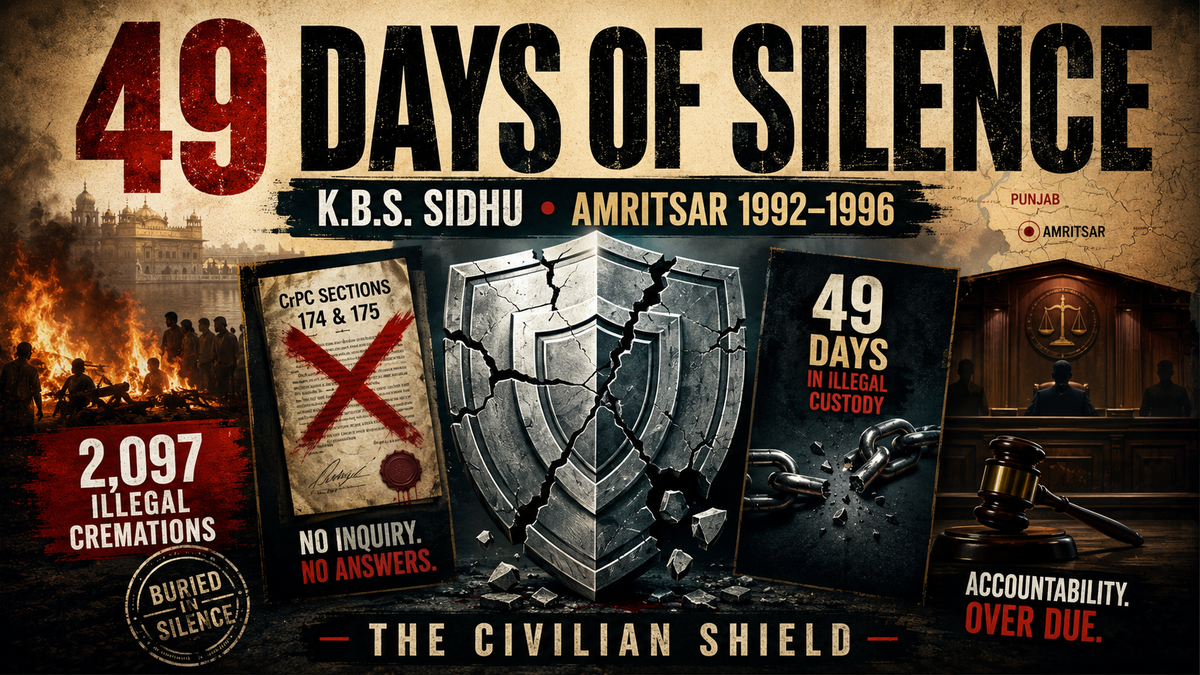
▶ VIDEO: THIS VIDEO EXPLAINS THE ENTIRE ILLEGAL OPERATION IN LESS THAN 8 MINUTES | https://www.youtube.com/embed/VyKrQZdpWrg The video above, embedded on TheDeathCertificate.org, provides an 8-minute visual summary of the illegal cremation operation. Viewers are directed to watch it alongside this document. Every forensic argument in this archive assumes the viewer has watched it.
THE DEATH CERTIFICATE PROJECT
TheDeathCertificate.org · U.S. First Amendment Forensic Publication · KPSGILL.COM Punjab '95 Forensic Series
ਸ਼ਬਦ ਤੋਂ ਪਹਿਲਾਂ, ਸ਼ਮਸ਼ਾਨਘਾਟ
FORTY-NINE DAYS OF SILENCE
THE DEFINITIVE ADMINISTRATIVE INDICTMENT OF K.B.S. SIDHU, I.A.S. (RETD.)
DEPUTY COMMISSIONER AND DISTRICT MAGISTRATE, AMRITSAR
11 MAY 1992 — 11 AUGUST 1996
ALSO SERVED: DISTRICT MAGISTRATE POILCE DISTRICT BATALA (1989–1990) | ADDITIONAL DEPUTY COMMISSIONER AMRITSAR (1990–1992)
A Prosecutorial Administrative Indictment in Twenty Sections
MAY 2026
Authored by Dr. Kanwar Partap Singh Gill, M.D.
Publisher and Editorial Director · TheDeathCertificate.org · Fresno, California, U.S.A.
"He counted the bodies when the State wished no bodies to be counted." — Dedication to Jaswant Singh Khalra, 1952–1995
"A public file must verify an office. A dead witness may explain a memory. The two are not interchangeable." — Editorial Standard, TheDeathCertificate.org
This video presents a prosecutorial administrative indictment of the office of the Deputy Commissioner and District Magistrate (DC/DM) of Amritsar, focusing on the tenure of K.B.S. Sidhu from May 11, 1992, to August 11, 1996. This is not an accusation of personal criminal conduct, but a forensic examination of administrative misconduct and the failure of a civilian office to perform its mandatory constitutional and statutory duties
ਸ਼ਮਸ਼ਾਨਘਾਟ ਪਹਿਲਾਂ ਆਇਆ। ਸ਼ਬਦ ਬਾਅਦ ਆਇਆ। ਅਰਦਾਸ ਬਾਅਦ ਆਈ। ਗੁਰਦੁਆਰਾ ਬਾਅਦ ਆਇਆ। ਇਹ ਸਿਰਫ਼ ਇੱਕ ਕ੍ਰਮ ਨਹੀਂ ਸੀ; ਇਹ ਇੱਕ ਕੌਮ ਦੀ ਰੂਹ ਉੱਤੇ ਲਿਖਿਆ ਗਿਆ ਅਪਮਾਨ ਸੀ। ਜਿੱਥੇ ਪਹਿਲਾਂ ਮਾਂ ਦੀ ਗੋਦ ਹੋਣੀ ਸੀ, ਉੱਥੇ ਪਹਿਲਾਂ ਅੱਗ ਆਈ। ਜਿੱਥੇ ਪਹਿਲਾਂ ਪਰਿਵਾਰ ਦੀ ਪਛਾਣ ਹੋਣੀ ਸੀ, ਉੱਥੇ ਪਹਿਲਾਂ “ਅਣਪਛਾਤਾ” ਲਿਖਿਆ ਗਿਆ। ਜਿੱਥੇ ਪਹਿਲਾਂ ਸੱਚ ਦੀ ਤਸਦੀਕ ਹੋਣੀ ਸੀ, ਉੱਥੇ ਪਹਿਲਾਂ ਰਾਖ ਬਣਾਈ ਗਈ। ਅਤੇ ਜਿੱਥੇ ਪਹਿਲਾਂ ਗੁਰਮਰਿਆਦਾ, ਅਰਦਾਸ ਅਤੇ ਆਖ਼ਰੀ ਦਰਸ਼ਨ ਹੋਣੇ ਸਨ, ਉੱਥੇ ਪਹਿਲਾਂ ਚੁੱਪੀ, ਡਰ ਅਤੇ ਸਰਕਾਰੀ ਕਾਗਜ਼ਾਂ ਦੀ ਗੈਰਹਾਜ਼ਰੀ ਰੱਖ ਦਿੱਤੀ ਗਈ।
ਇਸ ਇਤਿਹਾਸ ਦੀ ਸਭ ਤੋਂ ਡੂੰਘੀ ਬੇਅਦਬੀ ਇਹ ਨਹੀਂ ਸੀ ਕਿ ਸਿੱਖ ਮਾਰੇ ਗਏ। ਕਤਲ ਇਤਿਹਾਸ ਦੇ ਕਾਲੇ ਪੰਨਿਆਂ ਵਿੱਚ ਕਈ ਵਾਰ ਲਿਖਿਆ ਗਿਆ ਹੈ। ਸਭ ਤੋਂ ਡੂੰਘੀ ਬੇਅਦਬੀ ਇਹ ਸੀ ਕਿ ਸਿੱਖ ਦੇ ਸਰੀਰ ਨੂੰ ਉਸਦੀ ਪਛਾਣ ਤੋਂ ਵੱਖ ਕਰ ਦਿੱਤਾ ਗਿਆ। ਉਸਦੇ ਨਾਮ ਨੂੰ ਉਸਦੇ ਸਰੀਰ ਤੋਂ ਵੱਖ ਕਰ ਦਿੱਤਾ ਗਿਆ। ਉਸਦੇ ਪਰਿਵਾਰ ਨੂੰ ਉਸਦੀ ਮੌਤ ਤੋਂ ਵੱਖ ਕਰ ਦਿੱਤਾ ਗਿਆ। ਉਸਦੀ ਮਾਂ ਨੂੰ ਉਸਦੇ ਪੁੱਤਰ ਦੀ ਲਾਸ਼ ਤੋਂ ਵੱਖ ਕਰ ਦਿੱਤਾ ਗਿਆ। ਉਸਦੀ ਪਤਨੀ ਨੂੰ ਵਿਧਵਾ ਹੋਣ ਦੇ ਕਾਨੂੰਨੀ ਸਬੂਤ ਤੋਂ ਵੱਖ ਕਰ ਦਿੱਤਾ ਗਿਆ। ਉਸਦੇ ਬੱਚਿਆਂ ਨੂੰ ਆਪਣੇ ਪਿਤਾ ਦੀ ਮੌਤ ਦੇ ਸਰਟੀਫਿਕੇਟ ਤੋਂ ਵੱਖ ਕਰ ਦਿੱਤਾ ਗਿਆ। ਅਤੇ ਇੱਕ ਮਨੁੱਖ ਨੂੰ, ਜਿਸਦਾ ਕੋਈ ਨਾਮ ਸੀ, ਕੋਈ ਘਰ ਸੀ, ਕੋਈ ਪਿੰਡ ਸੀ, ਕੋਈ ਮਾਂ-ਬਾਪ ਸੀ, ਕੋਈ ਅਰਦਾਸ ਸੀ, ਉਸਨੂੰ ਇੱਕ ਅਣਪਛਾਤੇ ਸਰੀਰ ਵਾਂਗ ਅੱਗ ਦੇ ਹਵਾਲੇ ਕਰ ਦਿੱਤਾ ਗਿਆ।
ਸ਼ਮਸ਼ਾਨਘਾਟ ਪਹਿਲਾਂ ਇਸ ਲਈ ਆਇਆ ਕਿਉਂਕਿ ਰਾਜ ਨੇ ਮੌਤ ਨੂੰ ਸੱਚ ਤੋਂ ਪਹਿਲਾਂ ਰੱਖਿਆ। ਅੱਗ ਨੂੰ ਜਾਂਚ ਤੋਂ ਪਹਿਲਾਂ ਰੱਖਿਆ। ਰਾਖ ਨੂੰ ਪੋਸਟਮਾਰਟਮ ਤੋਂ ਪਹਿਲਾਂ ਰੱਖਿਆ। ਚੁੱਪੀ ਨੂੰ ਮੈਜਿਸਟਰੀ ਜਾਂਚ ਤੋਂ ਪਹਿਲਾਂ ਰੱਖਿਆ। ਅਤੇ ਡਰ ਨੂੰ ਗੁਰਦੁਆਰੇ ਦੀ ਸੰਗਤ ਤੋਂ ਪਹਿਲਾਂ ਰੱਖਿਆ। ਇਹ ਸਿਰਫ਼ ਸਰੀਰ ਦੀ ਬੇਅਦਬੀ ਨਹੀਂ ਸੀ; ਇਹ ਕਾਨੂੰਨ ਦੀ ਬੇਅਦਬੀ ਸੀ, ਪਰਿਵਾਰ ਦੀ ਬੇਅਦਬੀ ਸੀ, ਸਿੱਖ ਮਰਿਆਦਾ ਦੀ ਬੇਅਦਬੀ ਸੀ, ਅਤੇ ਮਨੁੱਖੀ ਯਾਦਾਸ਼ਤ ਦੀ ਬੇਅਦਬੀ ਸੀ।
ਸ਼ਬਦ ਬਾਅਦ ਆਇਆ, ਪਰ ਉਸ ਵੇਲੇ ਤੱਕ ਸਰੀਰ ਨਹੀਂ ਸੀ। ਅਰਦਾਸ ਬਾਅਦ ਆਈ, ਪਰ ਉਸ ਵੇਲੇ ਤੱਕ ਪਰਿਵਾਰ ਨੂੰ ਪਤਾ ਨਹੀਂ ਸੀ ਕਿ ਕਿਸ ਲਈ ਅਰਦਾਸ ਕਰਨੀ ਹੈ। ਗੁਰਦੁਆਰਾ ਬਾਅਦ ਆਇਆ, ਪਰ ਉਸ ਵੇਲੇ ਤੱਕ ਮੌਤ ਦਾ ਸਰਕਾਰੀ ਰਿਕਾਰਡ ਗਾਇਬ ਸੀ। ਸਿੱਖ ਰੀਤ ਅਨੁਸਾਰ ਅੰਤਿਮ ਸੰਸਕਾਰ ਕੇਵਲ ਅੱਗ ਨਹੀਂ ਹੁੰਦਾ; ਉਹ ਸੰਗਤ ਦੀ ਗਵਾਹੀ, ਪਰਿਵਾਰ ਦੀ ਹਾਜ਼ਰੀ, ਸ਼ਬਦ ਦੀ ਛਾਂ, ਅਰਦਾਸ ਦੀ ਨਿਮਰਤਾ ਅਤੇ ਸੱਚ ਦੀ ਸਵੀਕ੍ਰਿਤੀ ਹੁੰਦਾ ਹੈ। ਜਦੋਂ ਇਹ ਸਭ ਕੁਝ ਖੋਹ ਲਿਆ ਜਾਵੇ, ਤਾਂ ਮੌਤ ਵੀ ਪੂਰੀ ਨਹੀਂ ਹੁੰਦੀ। ਮੌਤ ਇੱਕ ਅਧੂਰਾ ਰਿਕਾਰਡ ਬਣ ਜਾਂਦੀ ਹੈ।
ਇਸ ਲਈ “ਮੌਤ ਦਾ ਸਰਟੀਫਿਕੇਟ” ਸਿਰਫ਼ ਇੱਕ ਕਾਗਜ਼ ਨਹੀਂ। ਇਹ ਮਾਂ ਦੇ ਰੋਣ ਦਾ ਕਾਨੂੰਨੀ ਨਾਮ ਹੈ। ਇਹ ਵਿਧਵਾ ਦੇ ਦੁੱਖ ਦਾ ਸਬੂਤ ਹੈ। ਇਹ ਬੱਚੇ ਦੇ ਅਨਾਥ ਹੋਣ ਦੀ ਪਛਾਣ ਹੈ। ਇਹ ਪਿੰਡ ਦੀ ਯਾਦ ਦਾ ਰਜਿਸਟਰ ਹੈ। ਇਹ ਗੁਰਮਰਿਆਦਾ ਦਾ ਦਰਵਾਜ਼ਾ ਹੈ। ਇਹ ਕਾਨੂੰਨ ਨੂੰ ਪੁੱਛਿਆ ਗਿਆ ਸਵਾਲ ਹੈ: ਜੇ ਸਰੀਰ ਤੁਹਾਡੇ ਹਵਾਲੇ ਸੀ, ਤਾਂ ਰਿਕਾਰਡ ਕਿੱਥੇ ਹੈ? ਜੇ ਮੌਤ ਹੋਈ ਸੀ, ਤਾਂ ਮੌਤ ਦਾ ਕਾਰਨ ਕਿੱਥੇ ਹੈ? ਜੇ ਅੰਤਿਮ ਸੰਸਕਾਰ ਹੋਇਆ ਸੀ, ਤਾਂ ਇਜਾਜ਼ਤ ਕਿੱਥੇ ਹੈ? ਜੇ ਕੋਈ ਅਣਪਛਾਤਾ ਸੀ, ਤਾਂ ਉਸਨੂੰ ਪਛਾਣਨ ਦੀ ਕੋਸ਼ਿਸ਼ ਕਿੱਥੇ ਹੈ?
ਇਸ ਇਤਿਹਾਸ ਵਿੱਚ ਸ਼ਮਸ਼ਾਨਘਾਟ ਪਹਿਲਾਂ ਆਇਆ, ਇਸ ਲਈ ਅੱਜ ਸ਼ਬਦ ਨੂੰ ਗਵਾਹ ਬਣਨਾ ਪਵੇਗਾ। ਅਰਦਾਸ ਨੂੰ ਰੋਣ ਤੋਂ ਅੱਗੇ ਵਧ ਕੇ ਸਵਾਲ ਬਣਨਾ ਪਵੇਗਾ। ਗੁਰਦੁਆਰੇ ਨੂੰ ਕੇਵਲ ਯਾਦ ਦਾ ਸਥਾਨ ਨਹੀਂ, ਸਗੋਂ ਰਿਕਾਰਡ ਦੀ ਮੰਗ ਦਾ ਸਥਾਨ ਬਣਨਾ ਪਵੇਗਾ। ਕਿਉਂਕਿ ਜਦੋਂ ਕਿਸੇ ਕੌਮ ਦੇ ਮਰੇ ਹੋਇਆਂ ਨੂੰ ਨਾਮ ਤੋਂ ਬਿਨਾਂ ਸਾੜਿਆ ਜਾਵੇ, ਤਾਂ ਜਿਊਂਦੇ ਲੋਕਾਂ ਉੱਤੇ ਫ਼ਰਜ਼ ਬਣਦਾ ਹੈ ਕਿ ਉਹ ਰਾਖ ਵਿੱਚੋਂ ਨਾਮ ਲੱਭਣ, ਚੁੱਪੀ ਵਿੱਚੋਂ ਗਵਾਹੀ ਲੱਭਣ, ਅਤੇ ਗੁੰਮ ਹੋਏ ਕਾਗਜ਼ਾਂ ਵਿੱਚੋਂ ਇਨਸਾਫ਼ ਦੀ ਪਹਿਲੀ ਲਕੀਰ ਲੱਭਣ।
ਸ਼ਮਸ਼ਾਨਘਾਟ ਪਹਿਲਾਂ ਆਇਆ। ਪਰ ਇਤਿਹਾਸ ਇੱਥੇ ਖ਼ਤਮ ਨਹੀਂ ਹੋਇਆ। ਹੁਣ ਸ਼ਬਦ ਬੋਲੇਗਾ। ਹੁਣ ਅਰਦਾਸ ਸਵਾਲ ਪੁੱਛੇਗੀ। ਹੁਣ ਗੁਰਦੁਆਰਾ ਯਾਦ ਰੱਖੇਗਾ। ਅਤੇ ਹੁਣ ਰਾਖ ਵਿੱਚੋਂ ਪੁਕਾਰ ਉੱਠੇਗੀ: ਮੌਤ ਦੇ ਸਰਟੀਫਿਕੇਟ ਕਿੱਥੇ ਹਨ?
Auzar TV | 6 May 2026 | 2 hours, 17 minutes, 23 seconds Host: Jagseer Singh Buckan | Guest: K.B.S. Sidhu, IAS (Retd.)
Video Evidence Profile: K.B.S. Sidhu Interview (Auzar TV)
Context: A May 2026 Punjabi-language podcast hosted by Jagseer Singh Buckan featuring K.B.S. Sidhu, IAS (Retd.), who served as DC/DM of Amritsar (1992–1996) during the height of the Punjab counterinsurgency and the abduction of Jaswant Singh Khalra.
Why This Archive Publishes This Video:
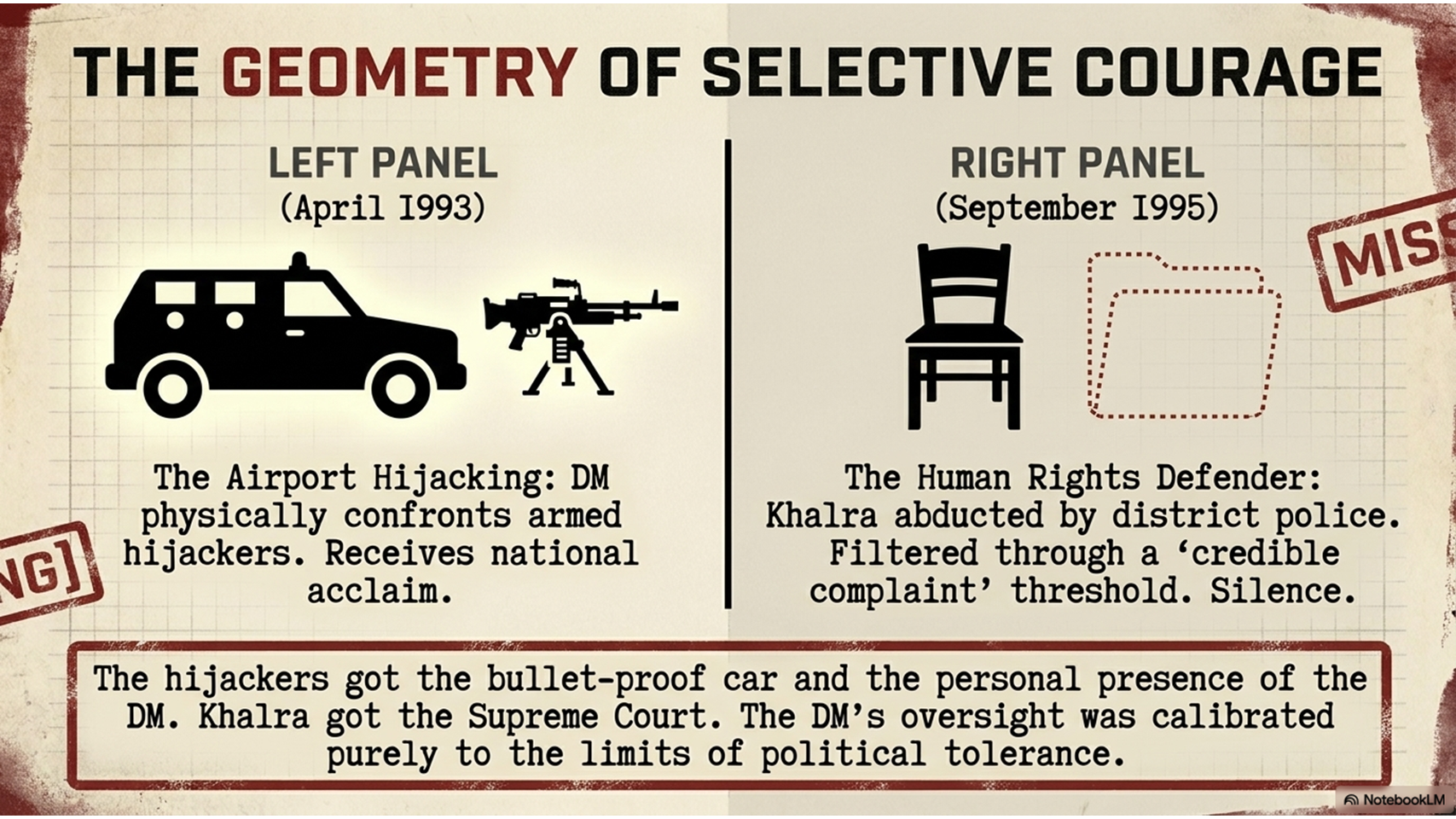
Jaswant Singh Khalra was abducted from Amritsar on September 6, 1995, during Sidhu’s tenure. While police officers were later convicted for the murder, Sidhu’s administrative role remains under scrutiny. In this interview, Sidhu reportedly admits his office was notified of the abduction and claims he "marked an ADC/ADM-level inquiry"—a statement that creates immediate statutory obligations and documentary expectations.
Evidentiary Status:
- Classification: Statements are currently classified as [DA] Documented Allegation pending SHA-256 hashing, verbatim timestamped transcription, and certified translation.
- Legal Weight: If authenticated, these statements foreclose any "lack of notice" defense, elevating findings to [PF] Proved Finding.
- Independent Basis: The archive’s core indictment—the non-production of the required Section 58, 97, 174, and 176 CrPC records—stands independently of this interview based on the 30-year judicial and CBI record.
The Controlling Question:
Sidhu reportedly claims he ordered an inquiry. The archive asks: Where is the inquiry file? * If it exists, produce it.
- If destroyed, produce the retention schedule and destruction order.
- If never generated, explain the failure to document an inquiry into the disappearance of a human rights defender whose work exposed 2,097 illegal cremations within that same district.
Right of Reply: This archive will publish any documentary response or correction from K.B.S. Sidhu in full.
THE DOCUMENTARY QUESTION THIS INTERVIEW GENERATES
Sidhu reportedly says he marked an inquiry. This archive asks one question in response:
Where is the inquiry file?
If it exists, produce it. If it was destroyed under record-retention schedules, produce the destruction order, the authorizing officer, and the retention schedule cited. If it was never generated, explain in writing why the DC/DM office of Amritsar did not generate a formal inquiry record after notice of the disappearance of a nationally known human rights defender — whose work had exposed 2,097 confirmed illegal cremations within the same district — from within the district, with an FIR on record and a Supreme Court habeas petition pending within six days.
This archive will publish any response, any document, and any correction in full, without editing.
LEGAL PUBLICATION NOTICE
This article is a public-interest forensic publication authored from Fresno, California, under the full protection of the First Amendment to the United States Constitution. All factual claims are classified under the seven-tier evidentiary framework. Claims about K.B.S. Sidhu, a public official who has entered public controversy through extensive public statements about his administrative tenure, are assessed under the actual malice standard of New York Times Co. v. Sullivan, 376 U.S. 254 (1964). K.B.S. Sidhu is extended a full, unconditional, and permanent right of reply.
CrPC FRAMEWORK: This article does NOT apply Section 176(1A) CrPC retroactively. Section 176(1A) came into force 23 June 2006. The operative 1995 framework is: Article 21, Article 22, CrPC Sections 56, 57, 58, 97, 167, 174, 176(1), and Section 4 of the Police Act, 1861, as applicable in Punjab during the relevant period. Post-1996 constitutional cases (D.K. Basu, PUCLM) are cited only as later judicial articulation of principles already rooted in Articles 21/22 — not as retroactive statutory duties. Nilabati Behera v. State of Orissa (1993) and State of M.P. v. Shyamsunder Trivedi (1995) are period-proximate cases cited on custodial death and state liability.
AUZAR TV TRANSCRIPT: All claims from the 6 May 2026 Auzar TV interview (2 hours, 17 minutes, 23 seconds) are classified [DA] pending authenticated Punjabi transcript and verified English translation. Where Sidhu's words are referenced, the formulation 'Sidhu reportedly stated...' is used throughout. No exact Punjabi quotation appears in this edition without verification. The statutory analysis is independently supported by the 1995–2026 court record and requires no reliance on the interview.
RECORD RETENTION: This archive does not argue that non-production today proves non-generation in 1995. It argues three distinct limbs: (a) the destruction order is itself a public record; (b) Supreme Court-connected files cannot be routinely weeded; (c) Sidhu's own reported account creates a specific obligation to explain the file's status. Each limb is addressed in Section IV.
VERIFIED FACTS ONLY: No victim story, case citation, or factual claim has been invented. Cases cited in the Indian Constitutional Law section (Section XVI) have been selected for established holdings from standard law reports. Readers and counsel should independently verify citations before legal proceedings.
EVIDENTIARY CLASSIFICATION FRAMEWORK
[PF] PROVED FINDING — Judicial findings, official records, CBI reports, NHRC proceedings, Supreme Court orders, U.S. Congressional Record, authenticated court orders.
[DA] DOCUMENTED ALLEGATION — Sourced, serious, grounded in identifiable documentation; not yet conclusively adjudicated. ALL Auzar TV claims are [DA] pending authenticated transcript.
[AI] ANALYTICAL INFERENCE — Reasoned conclusion from pattern, timing, omission, or institutional behavior. Stated explicitly as inference. Not legal proof. Never presented as proved.
[PM] PANTHIC MEMORY — Moral, civilizational, and historical continuity preserved by Sikh institutions, families, witnesses, and collective remembrance.
[Q] UNANSWERED PUBLIC QUESTION — A question formally placed on the public record.
[HR] HUMAN RIGHTS DOCUMENTATION — Reports from Amnesty International, Human Rights Watch, Asia Watch, Physicians for Human Rights, Ensaaf, PDAP, PUDR, PUCL.
[Q-RTI] RTI-READY PUBLIC RECORD REQUEST — Named document, named custodian, date range, exact RTI wording.
TABLE OF CONTENTS — FINAL PUBLICATION EDITION
Executive Summary — One Question, Six Propositions, and the Record-Retention Test
I. The Human Being Before the File — Jaswant Singh Khalra and the 2,097
II. The Office Before the Officer — What the DC/DM Amritsar Was Built to Do
III. The Pre-2005 Statutory Arsenal — Article 21, Article 22, Sections 56, 57, 58, 97, 167, 174, 176(1)
IV. The Four Defenses Anticipated — Record Retention, Section 176, Tarn Taran, and Transcript
V. K.B.S. Sidhu's Seven-Year Administrative Presence — Three DCs, Dead Witnesses, The ACR Record
VI. The Forty-Nine Days — Khalra's Abduction, Supreme Court Notice, Custody Window, Missing Response
VII. What a DC/DM Could Have Done in Forty-Nine Days
VIII. The Auzar TV Interview — Nine Hooks, Use, Limits, Authentication Protocol
IX. The Complete Human Rights Catalogue — Cremations, Disappearances, Extrajudicial Killings, Sexual Violence
X. Tarn Taran, Patti, Durgiana Mandir — Revenue District, Police District, Magisterial Control
XI. Constructive Notice — Arrest Reports, Inquest Reports, Cremation Records, Media, Supreme Court
XII. Dead Witnesses and Living Records — Why Oral Memory Cannot Replace the File
XIII. The 2,097 — Compensation, Identification, and the Criminal Process That Never Matched the Scale
XIV. The Body-to-File Chain — What Should Have Existed for Each Death
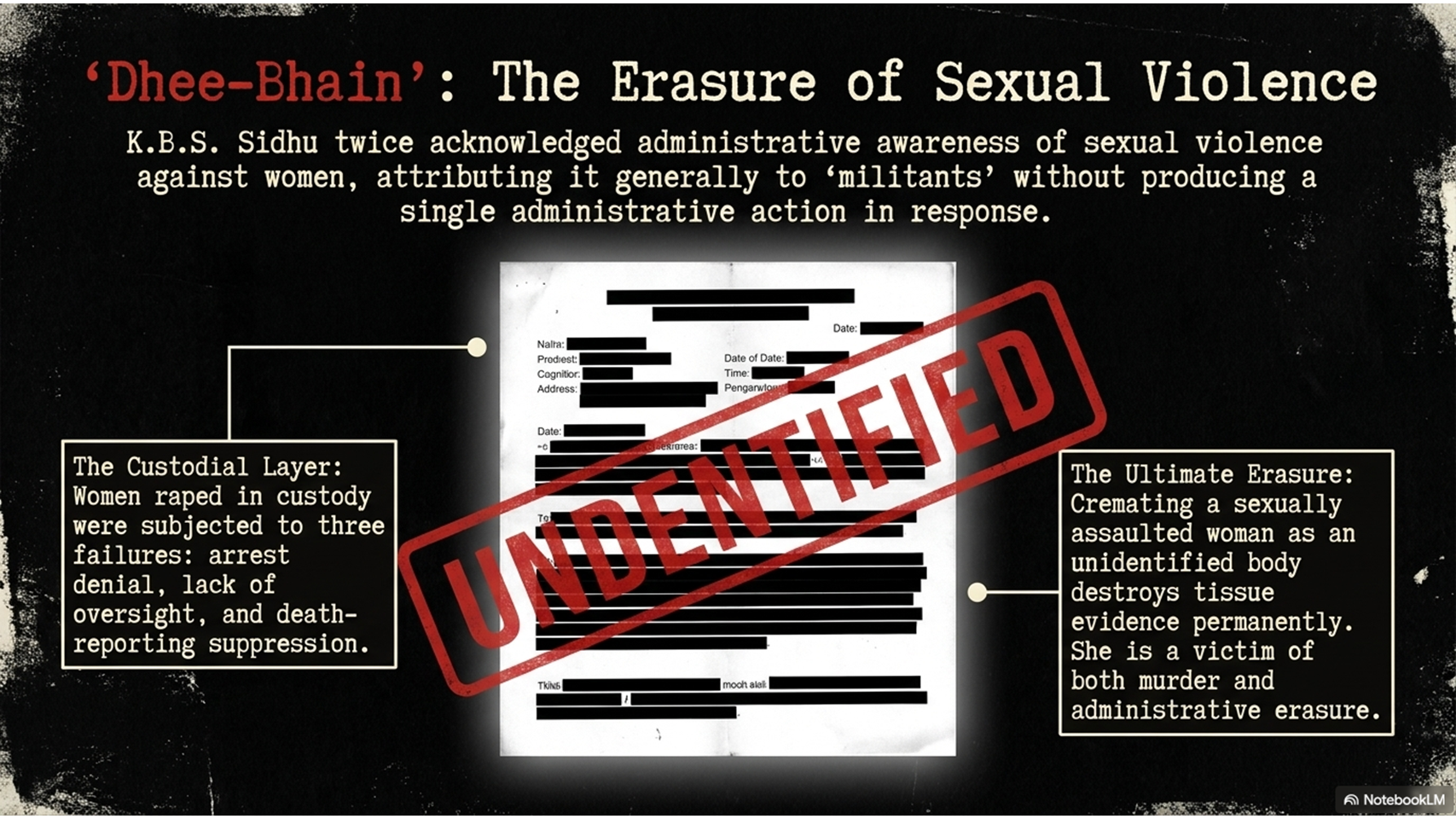
XV. Custodial Death, Torture, Sexual Violence, and the Missing Post-Mortem
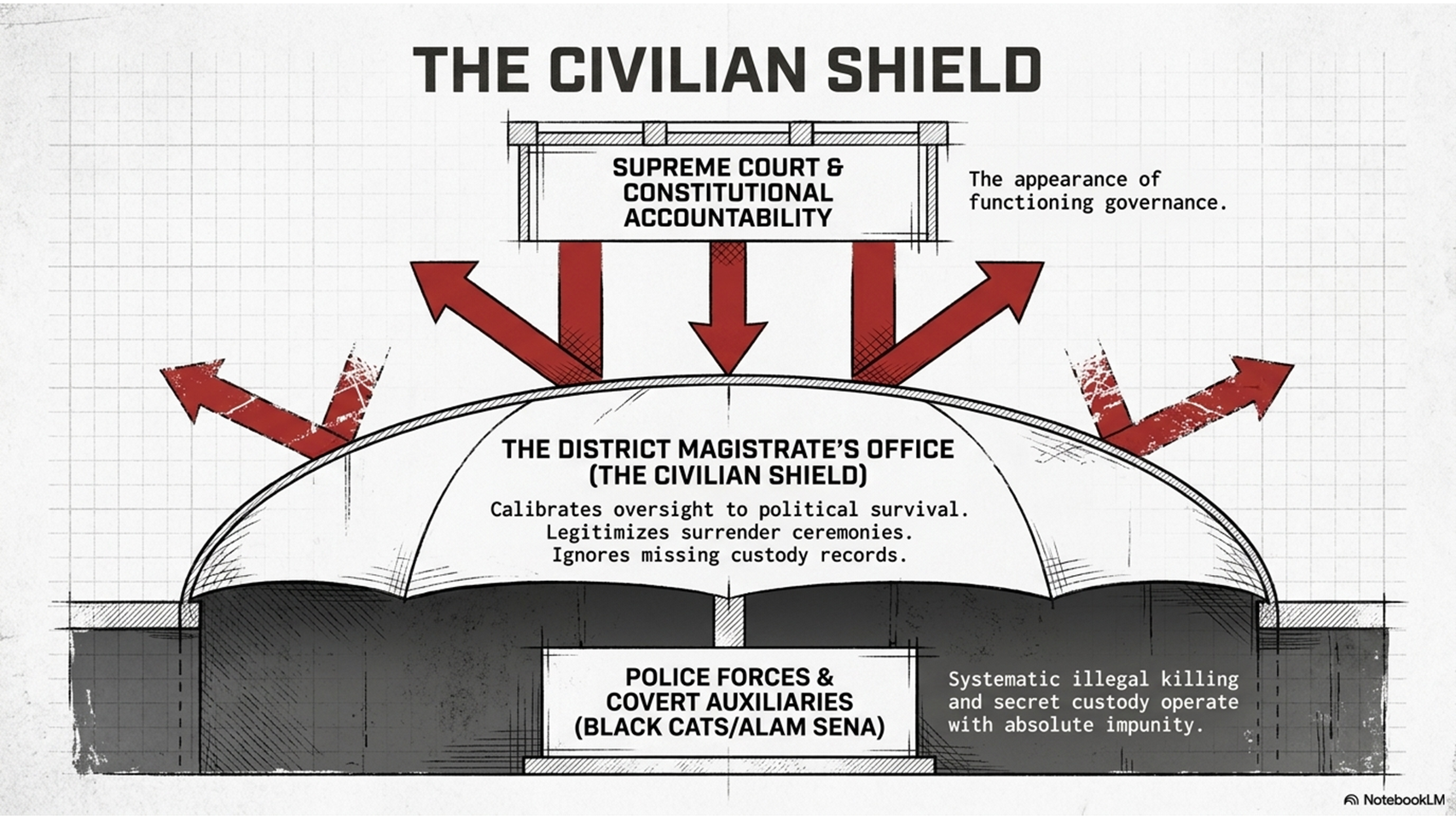
XVI. The Civilian Shield Thesis — Administrative Silence as the Enabling Condition
XVII. Retrospective Constitutionalism — A Thousand Articles Without Khalra's Name
XVIII. Section 69A and Punjab '95 — The State's Acknowledgment of Relevance
XIX. The Padma That Never Came — The Republic's Own Assessment
XX. Indian Constitutional Law and Custodial Death — The Case-Law Frame
XXI. The Forensic Records Matrix — Named Documents, Named Custodians, RTI Wording
XXII. The Missing Documents Checklist — Priority A, B, C
XXIII. The One Living Witness — Paramjit Kaur Khalra
XXIV. The Formal Prosecutorial Interrogatory — 80 Questions
XXV. Right of Reply and Publication Protocol
XXVI. Closing Argument — The File Cannot Retire
XXVII.Source Appendix and Editor's Note on Changes
Executive Summary — One Question, Six Propositions, and the Record-Retention Test
THE CONTROLLING QUESTION
Sidhu reportedly says he marked an inquiry. Where is the inquiry file? If it existed, produce it. If it was destroyed, produce the destruction order. If it was never generated, explain why the DC/DM office did not generate the mandatory administrative record after notice of a Supreme Court-level habeas matter involving a disappeared human-rights defender.
This archive is built on one administrative question. The question is not whether K.B.S. Sidhu personally committed any police crime. It is what the office of Deputy Commissioner and District Magistrate of Amritsar did after receiving notice of a public abduction; what statutory tools were available; what documentary outputs those tools were designed to generate; and why those outputs have not appeared in any public forum in thirty years. The question is answerable by documents. The documents have not been produced.
Sidhu's DC/DM Amritsar tenure is confirmed by the official district list: 11 May 1992 to 11 August 1996. His previous postings as ADC Amritsar (1990–1992) and DM Batala (1989–1990) appear in his own published biographies. He was in administrative authority in the Amritsar-Batala region continuously from 1989 through 1996 — seven years spanning the full arc of the illegal cremation architecture from its establishment through its exposure by a private citizen.
The Six Propositions
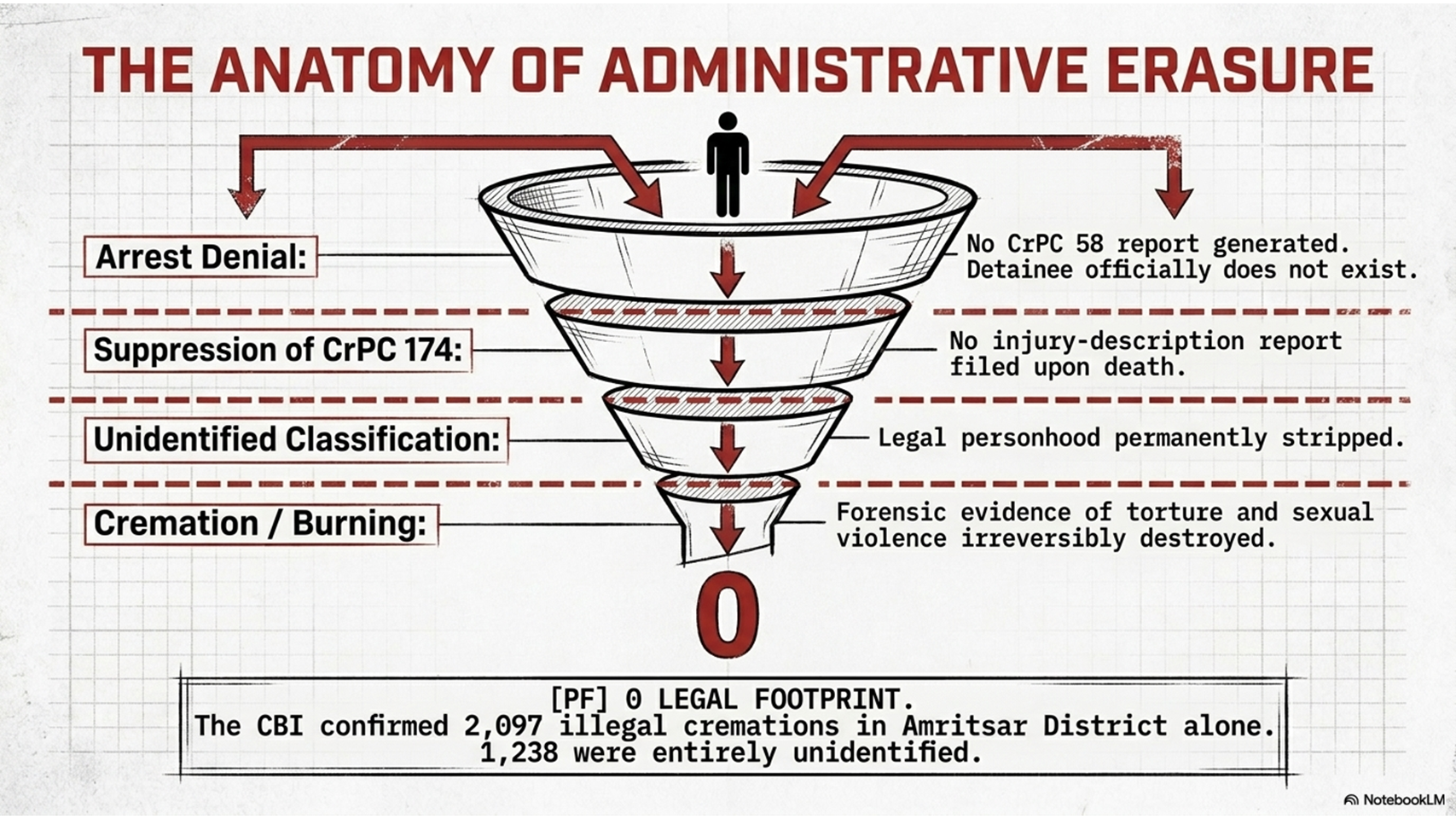
[PF] PROPOSITION ONE — THE CBI-CONFIRMED CREMATION RECORD: The CBI confirmed 2,097 illegal cremations at three cremation grounds — Patti, Tarn Taran, and Durgiana Mandir — all within the Amritsar revenue district. Of 2,097: 585 fully identified, 274 partially identified, 1,238 entirely unidentified. The Supreme Court described these findings as 'flagrant violation of human rights on a mass scale' (12 December 1996, W.P. Crl. No. 497/1995). The NHRC recommended approximately ₹27.94 crore for 1,513 identified families — without ordering criminal investigation into any death.
[PF] PROPOSITION TWO — SIDHU'S SEVEN-YEAR AMRITSAR-BATALA PRESENCE: DC/DM Amritsar tenure confirmed by official district list: 11 May 1992 to 11 August 1996. ADC Amritsar, 1990–1992 (peak cremation period by CBI findings). DM Batala, 1989–1990. He was not an administrative stranger. He was the same district's senior civil administrator for the most consequential period in its modern administrative history.
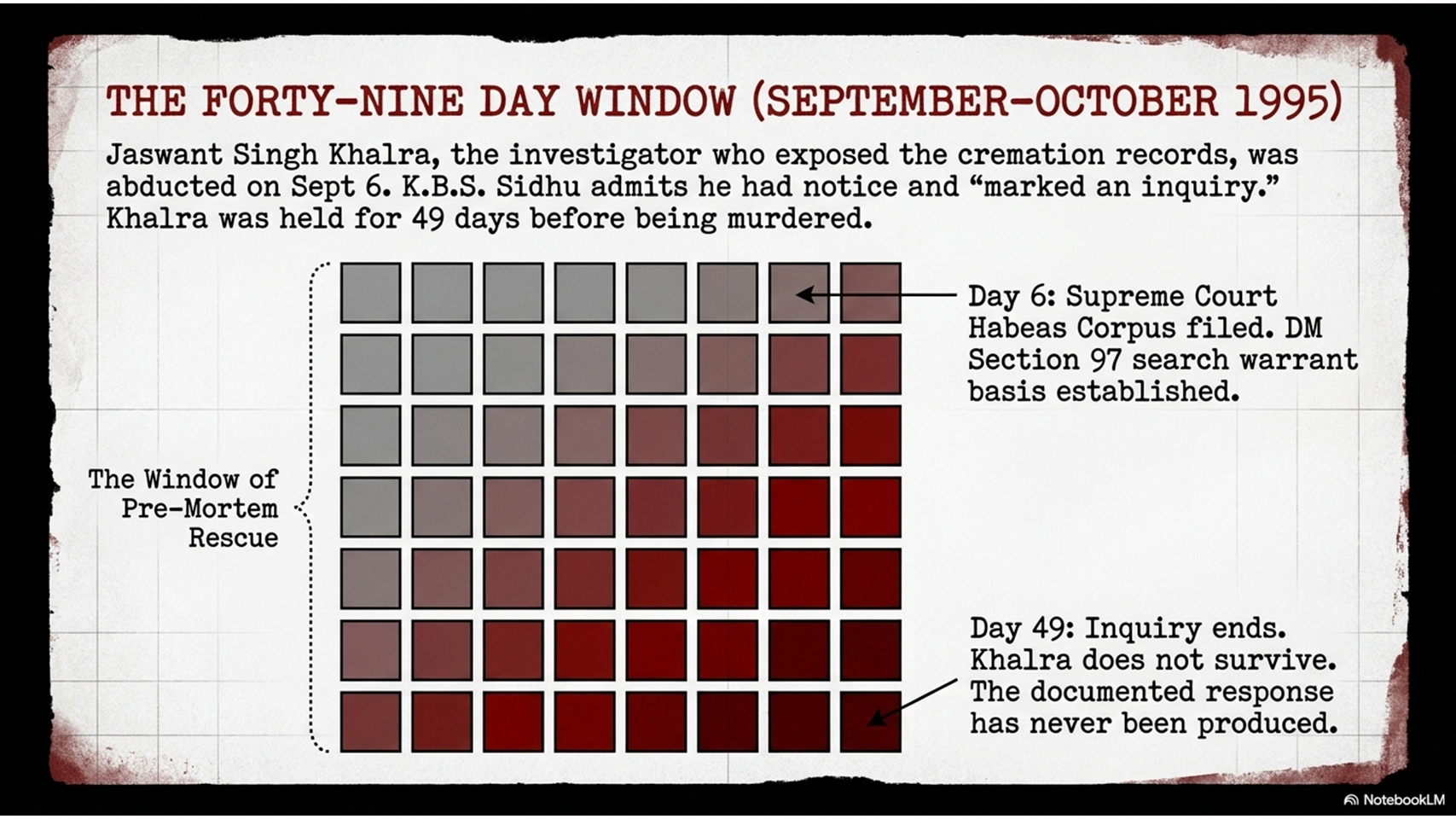
[PF] PROPOSITION THREE — THE VERIFIED KHALRA TIMELINE: Khalra abducted 6 September 1995. FIR No. 72 registered at PS Islamabad 7 September 1995. Supreme Court notice to Home Secretary, DGP Punjab, and SSP Amritsar on 11 September 1995. Article 32 petition by Paramjit Kaur Khalra on 12 September 1995. Supreme Court ordered CBI inquiry on 15 November 1995; transferred Ajit Singh Sandhu; directed all state authorities to assist. CBI registered RC No. 14/S/95/SCB-I/Delhi on 18 December 1995. Witness evidence placed Khalra in custody until 24 October 1995: forty-nine days, counted inclusively.
[DA] PROPOSITION FOUR — SIDHU'S REPORTED PUBLIC ADMISSIONS (CLASSIFIED [DA] PENDING TRANSCRIPT): In a 2-hour, 17-minute, 23-second interview on Auzar TV on 6 May 2026, Sidhu reportedly stated: that his DC/DM office was informed of Khalra's abduction; that he marked an ADC/ADM-level inquiry in response; and that he visited police stations only on 'credible complaint,' because acting aggressively would have caused career difficulty. These statements are classified [DA] pending authenticated Punjabi transcript. If confirmed, they will be elevated to [PF]. Even as [DA], they generate every documentary and statutory question this archive pursues.
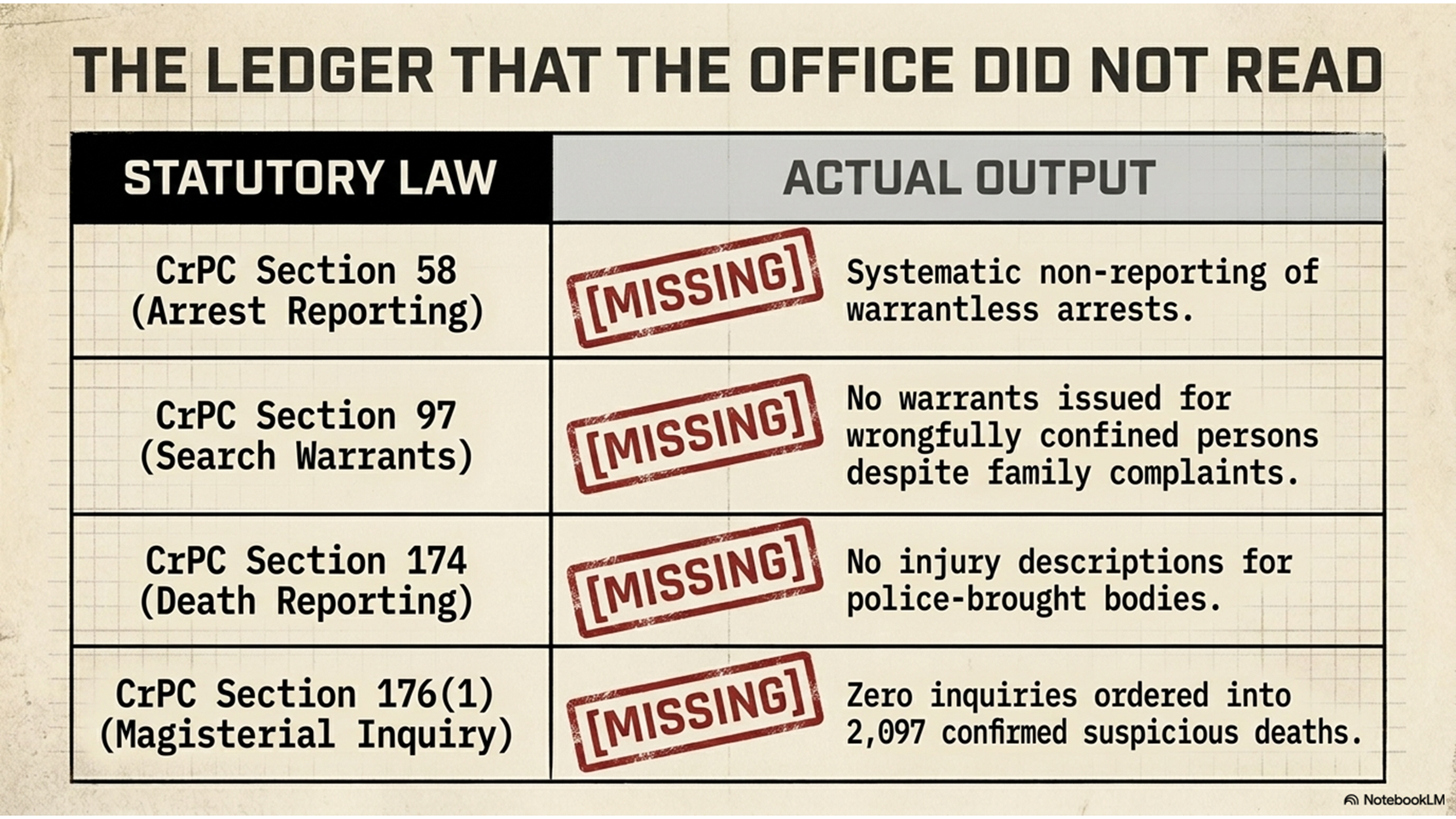
[PF] PROPOSITION FIVE — NON-PRODUCTION OF THE ADMINISTRATIVE RECORD: No ADM inquiry order, no inquiry report, no action-taken note, no Section 97 search warrant record, no Section 58 arrest-report audit, no Section 174 inquest file, no Section 176(1) magisterial inquiry record, no Civil Surgeon communication, and no escalation letter to the DGP, Home Secretary, Chief Secretary, or Governor has been produced in any public forum in thirty years. The archive applies the three-possibility test: the file existed and must be produced; or the file was destroyed and the destruction order must be produced; or the file was never generated and that non-generation must be explained.
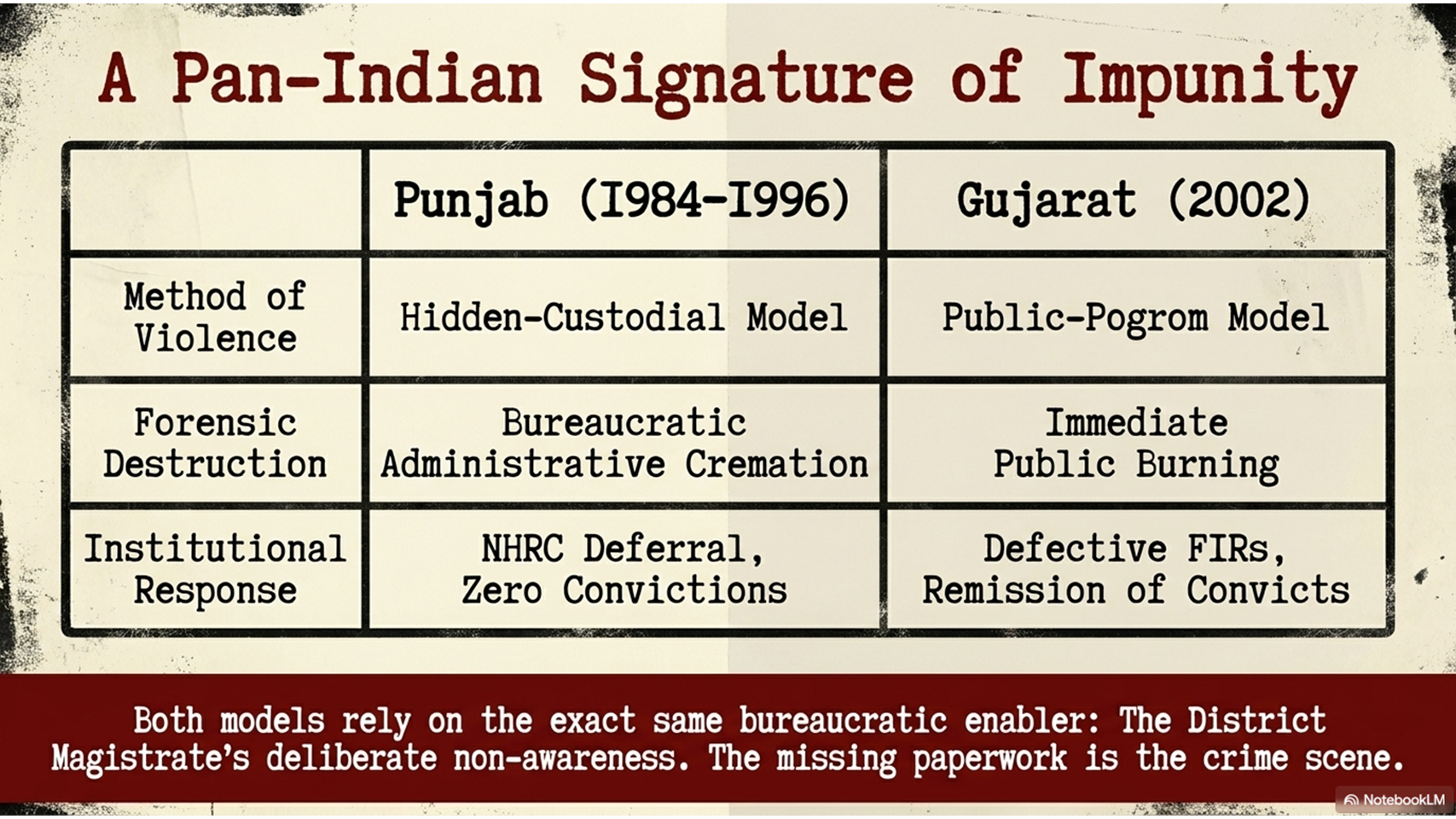
[PF] PROPOSITION SIX — THE CRIMINAL PROCESS NEVER MATCHED THE SCALE: The CBI's 2024 affidavit before the Punjab and Haryana High Court confirms 62 total registered cases from the Amritsar-region cremation record: 24 convictions, 6 acquittals, 16 closure reports, 16 pending. PDAP's audit [DA] identifies 22 cases within a narrower mass-cremation framework. Whether 22 or 62, the criminal process reached only a tiny fraction of 2,097 confirmed illegal cremations. In May 2024, the CBI stated that further statewide investigation is a 'futile exercise' because witnesses are gone, records weeded out, and memory faded. That official declaration is the permanent consequence of the missing contemporaneous administrative record.
This Article Does Not Ask for a Criminal Conviction
This article does not ask readers to convict K.B.S. Sidhu of a police crime. It asks readers to judge the administrative record of the office he held. The article does not accuse him of personally abducting Khalra, personally killing anyone, personally ordering cremations, or personally destroying files. No evidence in the public record supports any of those personal criminal allegations.
What this article establishes: the office of DC/DM Amritsar held, under Indian constitutional and statutory law as it existed in 1992–1996, specific mandatory administrative obligations; those obligations required specific documentary outputs; those outputs have not been produced; and the three-possibility test — produce the file, or the destruction order, or an explanation of non-generation — has not been answered in any public forum in thirty years.
LIMITING STATEMENT: No claim in this article requires proof that Sidhu had subjective knowledge of any specific killing. The claims rest on objective statutory obligation. An officer who held the statutory tools and the administrative position carries the obligation to explain why those tools produced no documentary record during a forty-nine-day custody window arising from a public abduction in his district, actively litigated before the Supreme Court of India.
I. The Human Being Before the File — Jaswant Singh Khalra and the 2,097
Jaswant Singh Khalra did not expose a rumor. He exposed a paper trail.
He was a bank branch manager at the Khalra village branch of the Punjab and Sindh Bank, Amritsar. In his spare time, working from publicly accessible municipal records, he cross-referenced firewood purchase registers — which recorded the quantity of wood required to cremate an adult body, typically 300 kilograms — against the Municipal Committee of Amritsar's cremation registers recording names, ages, and addresses of those officially cremated. The spikes in unidentified, police-brought cremations against the pattern of disappearances produced a documentary contradiction: the municipal and cremation-ground records showed that human beings had been taken into custody, killed, and burned as 'unclaimed' or 'unidentified.' His discovery created a problem for every office that was supposed to receive, review, preserve, and act upon the records of arrest, death, inquest, post-mortem, and cremation.
This article concerns the one civilian office that sat between police power and legal accountability in Amritsar during 1992–1996: the office of the Deputy Commissioner and District Magistrate. K.B.S. Sidhu is not treated here as a private citizen. He is treated as the public official who held that office during the most consequential period: the exposure of the illegal cremation record by Khalra, the abduction of Khalra on 6 September 1995, the forty-nine-day custody window, the Supreme Court's direct intervention, and the administrative non-production that has followed for thirty years.
The 2,097 Were Not Numbers
The Central Bureau of Investigation confirmed 2,097 illegal cremations from the Amritsar-region record. Of those, 585 were fully identified, 274 were partially identified, and 1,238 were entirely unidentified — human beings burned to ash with no postmortem examination, no cause-of-death record, no family notification, no death certificate, and no magisterial authorization. Their families did not receive bodies. They did not receive official confirmation of death. Many could not claim inheritance, establish widowhood, perform the last rites their faith required, or seek any legal remedy — because the State had not acknowledged that their family member was dead.
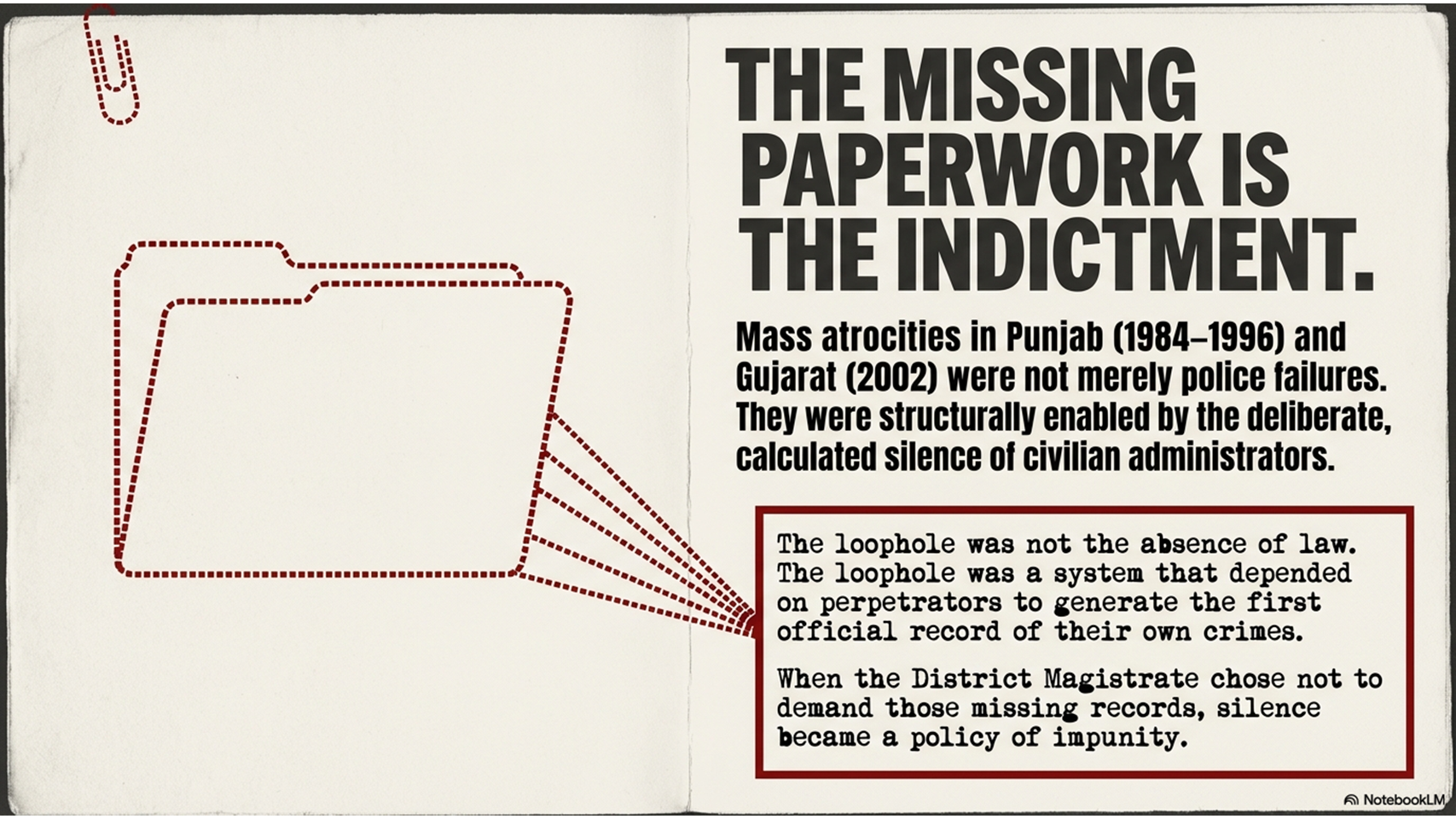
The missing administrative record was not technical paperwork. For each of the 2,097, the absence of the Section 174 inquest report meant no forensic examination of the body; the absence of the Section 176(1) magisterial inquiry meant no independent civilian determination of cause of death; the absence of the Section 58 arrest acknowledgment meant no official record that the person had ever been in State custody. The administrative disappearance preceded and enabled the physical disappearance. The body was burned once. The file was never created.
The administrative disappearance was the second killing. The first killing was physical. The second killing — the erasure of every document that would have proved the custody, the torture, the cause of death, and the name of the person who died — was administrative. The second killing lasted thirty years. It is still ongoing.
Khalra's Specific Contribution and the Risk It Created
Khalra's investigation did not merely embarrass the police. It threatened the legal architecture that made mass custodial killing possible. By establishing that each firewood voucher corresponded to a cremation for which no official death record existed — no FIR, no inquest, no post-mortem, no family notification — Khalra was assembling, from publicly accessible municipal documents, the forensic record that the civilian administrative machinery had been required by law to generate and had not generated. His work was, in evidentiary terms, a substitute for the DC/DM's statutory files. Punjab Police officials, later convicted by the Sessions Court and upheld on appeal to the Supreme Court, killed him after he had assembled this record. The constitutional and administrative responsibility of the DC/DM's office for the oversight failure that preceded and enabled that killing is the subject of this archive.
He is dead. His wife, Paramjit Kaur Khalra, is alive. She has been waiting thirty years for the civil administration to account for what it did — and did not do — while her husband was alive and in illegal custody in the district administered by K.B.S. Sidhu. This archive demands that accounting on her behalf and on behalf of the families of 2,097 confirmed victims.
II. The Office Before the Officer — What the DC/DM Amritsar Was Built to Do
Before examining K.B.S. Sidhu's specific record, this archive establishes what the office of Deputy Commissioner and District Magistrate of Amritsar was designed by law and constitutional design to do. The office was not ceremonial. It was the civilian checkpoint between police power and the rule of law.
The DC/DM occupied three simultaneous roles in 1992–1996: revenue collector and district administrator under the Land Revenue Acts; Executive Magistrate under the Code of Criminal Procedure; and the officer under whose general control and direction the district police operated under Section 4 of the Police Act, 1861, as applicable in Punjab during the relevant period. These roles were not compartmentalized. They were designed to intersect. The officer who collected revenue in a village also had the power to order the search of a police station where a villager was believed to be wrongfully confined. The officer who administered land records also had the mandatory obligation to receive and act upon reports of suspicious deaths in his district.
In the context of the Punjab counterinsurgency, this intersection was not abstract. Persons were being arrested without warrant. They were not being produced before magistrates within twenty-four hours. They were dying in custody. They were being cremated as unidentified. Each of those events triggered a specific statutory obligation that ran directly to the DC/DM's office. The office was the designed mechanism for converting police coercive power into legal accountability. It was the designed interruption point in the chain from arrest to secret cremation.
The Design Purpose of the DC/DM Oversight Machinery
Section 58 CrPC was designed to prevent secret detention by requiring police stations to report all warrantless arrests to the District Magistrate automatically — not on complaint, not on request, but as a routine mandatory disclosure. Section 97 CrPC was designed to prevent wrongful confinement by giving the District Magistrate executive authority to order a search, without judicial approval, whenever wrongful confinement was reasonably suspected. Section 174 CrPC was designed to prevent the concealment of custodial killing by requiring immediate intimation of suspicious deaths to the nearest Executive Magistrate, with mandatory forwarding to the DM or SDM, and the generation of the death-record chain — including medical examination before cremation — that the statutory framework required where cause of death, custody, or identity was in issue. Section 176(1) CrPC was designed to provide a civilian determination of cause of death, independent of police accounts, through a magistrate-conducted inquiry.
Each provision placed an affirmative information-generating obligation on the district police, with the DC/DM as the civilian receiving authority. If the district police had been complying with these obligations, the DC/DM's office would have been generating the very documentary record that — had it existed — would have made the illegal cremation system impossible to sustain. The absence of that record is not simply the absence of bureaucratic paperwork. It is the absence of the designed civilian counter-mechanism to mass custodial killing.
What 'General Control and Direction' Meant
Section 4 of the Police Act, 1861, as applicable in Punjab during the relevant period — in force throughout the relevant period — placed the administration of the district police under the general control and direction of the District Magistrate. The language 'general control and direction' was not passive oversight. It was active supervisory authority. It authorized the DC/DM to call for reports, demand explanations, require returns, inspect stations, and refer matters of police misconduct up the civilian chain of command. It was the statutory basis for the DC/DM's supervisory relationship with the SSPs and police officers who were, during this period, delivering bodies to the three cremation grounds.
An officer who exercised 'general control and direction' over the district police — and who was therefore expected by law to know what the police were doing — cannot, without documentary explanation, represent that he was administratively unaware of the patterns that the CBI, the NHRC, and the Supreme Court subsequently confirmed on the basis of records that were at all times theoretically available to his office.
III. The Pre-2005 Statutory Arsenal — Article 21, Article 22, Sections 56, 57, 58, 97, 167, 174, 176(1)
This section establishes the complete legal framework governing the DC/DM Amritsar's obligations during 1992–1996. The central legal point is this: the pre-2005 law was already enough. Section 176(1A) did not exist in 1995. But the statutory and constitutional framework that did exist — rooted in the Constitution and the Code of Criminal Procedure as they stood — created mandatory, non-discretionary administrative obligations that required specific documentary outputs. The argument does not need Section 176(1A). It does not need post-1996 case law. It is complete without either.
Article 21 — The Right to Life
Article 21 provides: 'No person shall be deprived of his life or personal liberty except according to procedure established by law.' A person killed in police custody and cremated as unidentified has been deprived of life without any procedure established by law. The constitutional violation is complete before any CrPC provision is reached. By the time any of the 1,238 entirely unidentified persons reached a cremation ground, Article 21 had already been violated. The administrative record that the DC/DM's office was required to generate — the arrest report, the custody acknowledgment, the Section 174 inquest report, the medical examination before cremation, the Section 176(1) inquiry order — was the Article 21 paper trail. It was the constitutional documentation that a deprivation of life had or had not occurred according to law. It does not exist.
Article 22 — Protection Against Arbitrary Arrest and Detention
Article 22 provides: every arrested person must be informed of the grounds of arrest; must be produced before the nearest Magistrate within twenty-four hours; cannot be detained beyond twenty-four hours without the authority of a Magistrate. These are constitutional mandates, not statutory discretions. Their violation was the operational mechanism through which custodial disappearance was engineered. A person whose arrest was never acknowledged could not be produced before a Magistrate; could not be remanded under Section 167; could not receive legal advice; could not be visited by family. The Article 22 violation was the entry point into the entire chain of constitutional and statutory violation this article documents.
Section 4, Police Act, 1861, as applicable in Punjab during the relevant period — General Control and Direction (Active Authority)
Section 4: the administration of the district police is under the general control and direction of the District Magistrate. This was active supervisory authority. The DC/DM held general control and direction over the officers who were, on the available evidence, delivering bodies to the cremation grounds without documentation.
CrPC Section 56 — Arrest-Production Duty (Mandatory 'Shall')
Section 56: a police officer making an arrest without warrant shall, without unnecessary delay, take or send the person arrested before a Magistrate having jurisdiction. Where an unidentified cremated person had first been taken into police custody, Section 56's mandatory production duty was violated at the moment of that arrest. Where custody was not formally acknowledged, the absence of any Section 58 arrest report is itself part of the administrative disappearance — a refusal to generate the document whose purpose was to make secret detention impossible. The mandatory production duty was the first link in the body-to-file chain. Its systematic non-performance — whether through absence of a Section 58 report or through active denial of custody — was the first administrative failure in the 2,097 confirmed cremations, in each case where the person was first held in state custody before being killed and cremated.
CrPC Section 57 — The Twenty-Four-Hour Rule (Mandatory 'Shall')
Section 57: no police officer shall detain in custody a person arrested without warrant for longer than twenty-four hours without a special order of a Magistrate under Section 167. Every hour beyond twenty-four hours without magisterial authorization was an additional statutory violation. In Punjab, persons were held for days, weeks, and months before being killed or cremated. Each extended detention was a continuing, compounding statutory violation.
CrPC Section 58 — Mandatory Arrest Reporting to the District Magistrate (Mandatory 'Shall')
Section 58: 'Officers in charge of police stations shall report to the District Magistrate, or, if he so directs, to the Sub-divisional Magistrate, the cases of all persons arrested without warrant, within the limits of their respective stations, whether such persons have been admitted to bail or otherwise.' The operative word is 'shall.' The obligation is automatic, unconditional, and does not require a complaint, a request, or a police station visit to trigger. Every warrantless arrest in Amritsar district was required by law to appear in a report to the DC/DM's office. If those reports were received, the DC/DM had statutory visibility into the arrest pattern. If those reports were not received, the DC/DM had an affirmative obligation to demand them. The reports have not been produced. Their non-production — in either direction — requires explanation.
CrPC Section 97 — Search Warrant for Wrongful Confinement (No Judicial Approval Required)
Section 97: a District Magistrate may issue a warrant for the search of any premises where a person is believed to be wrongfully confined, directing any police officer to conduct the search and produce the person. This provision required no judicial review. It was an executive-magisterial tool, deployable on reasonable belief. By 12 September 1995 — Day Six of Khalra's disappearance — the FIR was on record, police denied custody, and a Supreme Court habeas petition was pending. The legal threshold for a Section 97 warrant was established. For forty-nine days, no Section 97 warrant has been produced. Its non-existence — or its non-production from whatever archive may hold it — is a specific documentary fact.
CrPC Section 167 — Extended Detention and Magisterial Gatekeeping
Section 167 governs the extension of detention beyond twenty-four hours. It requires the investigating officer to transmit copies of the case diary to the nearest Magistrate, who may authorize further detention. Punjab's disappearance architecture bypassed Section 167 entirely by denying custody: a person whose arrest was never acknowledged could never be presented for remand. The DC/DM's failure to demand Section 58 compliance was therefore the upstream failure that made Section 167 gatekeeping permanently impossible.
CrPC Section 174 — Mandatory Death Reporting (Mandatory 'Shall')
Section 174: when any police officer receives information that a person has died under suspicious circumstances, he shall immediately give information to the nearest Executive Magistrate, proceed to the body, prepare a report containing information about the apparent cause of death and marks of injury, and forward the report to the DM or SDM. The provision uses 'shall.' It is mandatory. In 1995, suspicious deaths, police-custody deaths, and unidentified police-brought bodies triggered the inquest and magisterial machinery under Sections 174 and 176(1), and a lawful death-record chain required medical examination and post-mortem documentation before cremation wherever cause of death, custody status, or the identity of the deceased was in issue. Note on Section 176(5): the express 24-hour forwarding-to-Civil-Surgeon language was inserted with the 2005 amendment; this archive frames the pre-2005 Civil Surgeon documentation obligation within the broader death-record chain required by the 1995 statutory framework, not as a retroactive import of post-2005 text. For each of the 2,097 confirmed illegal cremations, no Section 174 report, no post-mortem or medical examination record, and no DM or SDM forwarding communication has been produced in any public proceeding — in the CBI reports, the NHRC proceedings, the Supreme Court record, or any other public forum — sufficient to account for the 2,097 confirmed cremations. Whether those documents were never generated or were generated and subsequently destroyed, their non-production in any public forum in thirty years is itself the evidentiary finding. A post-mortem before cremation is not a bureaucratic formality. It is the document that would have recorded whether a person showed marks of torture, sexual assault, execution-range gunshot wounds, or signs of prolonged detention. Without it, the body became ash and the killing became an encounter.
CrPC Section 176(1) — Magisterial Inquiry Into Cause of Death
Section 176(1) as it stood in 1995 was not uniformly discretionary. The provision already used mandatory 'shall' language for deaths in police custody. The archive notes, however, that Section 174(3)(i) and (ii) covered specific categories including deaths of women within seven years of marriage; unidentified police-brought bodies are not directly within those sub-clauses. The correct statutory framing is: Section 174(1) and (2) required police to immediately inform the nearest Executive Magistrate of any suspicious death and to forward the inquest report to the DM or SDM. Section 176(1) gave the magistracy the mandatory inquiry power for police-custody deaths and the authority to inquire into other unnatural deaths covered by Section 174. The DM or SDM's receipt of Section 174 reports for police-brought unidentified bodies created the administrative gateway for civilian oversight. The 'may' language in Section 176(1) applied to categories outside police-custody death. Section 176(1A), introduced in 2006, later shifted and expanded the mandatory inquiry framework to judicial and metropolitan magistrates, and expressly included custodial disappearance and rape. The archive does not concede that magisterial inquiry was discretionary for police-custody deaths. The core of the statutory indictment rests on Sections 56, 57, 58, 97, and 174, all using mandatory 'shall' language in 1995. Section 176(1) adds mandatory force in the custodial-death context; it is not a peripheral argument.
NOTE ON SECTION 176(1A): Section 176(1A) — mandating judicial magisterial inquiry into custodial deaths, disappearances, and rape — was enacted by the Code of Criminal Procedure (Amendment) Act, 2005, coming into force 23 June 2006. This archive does not apply it retroactively. It is cited only as Parliament's explicit retrospective finding that the discretionary executive-magisterial model had failed. The Punjab cremation record exemplifies the precise institutional failure that Parliament later addressed through Section 176(1A). Section 176(1A) is evidence of what the 1995 framework produced in its absence: 2,097 illegal cremations, one murdered human rights defender, and a CBI declaration thirty years later that investigation is now futile.
IV. The Four Defenses Anticipated — Record Retention, Section 176, Tarn Taran, and Transcript
This section addresses the four strongest defenses Sidhu or his advocates might raise against this archive's administrative indictment. Each is addressed directly, completely, and in terms that preserve the force of the archive's prosecution.
Defense 1: Records May Have Been Lawfully Weeded Out Under Retention Schedules
This is the most important defensive argument and the one most likely to be raised in a legal forum. The archive's response is a three-possibility test that converts the defense into a new evidentiary obligation:
POSSIBILITY A: The file existed and still exists. Then produce it. An inquiry file connected to a matter actively litigated before the Supreme Court of India — through multiple hearings between 1995 and 2011 — has permanent retention significance. It is not subject to routine administrative weeding.
POSSIBILITY B: The file existed but was destroyed. Then produce: the retention schedule that authorized destruction; the retention category under which inquiry files of this type were classified; the weeding order; the weeding certificate; the file index entry; the destruction register; the authorizing officer's name, rank, and date of authorization; and the specific confirmation that Supreme Court-connected habeas matter files were eligible for routine destruction despite their active judicial status.
POSSIBILITY C: The file was never generated. Then explain in writing, with legal authority, why the DC/DM office did not generate: an inquiry order when Khalra — a human rights defender whose work had exposed 2,097 illegal cremations in the same district — disappeared from within that district; an ADM examination of his wife's formal complaint; a Section 97 search warrant application in the six days before the Supreme Court habeas petition was filed; a written communication to SSP Amritsar and SSP Tarn Taran demanding an accounting for the whereabouts of a named missing person; or any escalation letter to the DGP, Home Secretary, Chief Secretary, or Governor.
The three-possibility test is not a rhetorical device. It is the exhaustive logical framework for every missing-document defense. There is no fourth option. Produce the file, produce the destruction order, or explain the non-generation. Thirty years have not eliminated the obligation. They have compounded it.
Defense 2: Section 176(1) Used 'May' Before 2005 — The Magisterial Inquiry Was Discretionary
Response: The core of this archive's statutory indictment does not depend on Section 176(1). It depends on: Article 22's mandatory production requirement; Section 56's mandatory production duty; Section 58's mandatory arrest-reporting obligation; Section 97's executive search-warrant power; and Section 174's mandatory death-reporting and forwarding requirement. Each of these provisions used mandatory language. None of them is subject to the 'may' defense. The statutory indictment is fully sustained on these mandatory provisions alone, without reference to Section 176(1) in any edition. Section 176(1) adds analytical force; it is not the evidentiary load-bearer.
Defense 3: Tarn Taran Was a Separate Police District Beyond Sidhu's Authority
Response: Tarn Taran became a separate revenue district only on 16 June 2006. During 1992–1996, it was a sub-divisional area within the Amritsar revenue district for civil-magisterial purposes. The administrative question is not resolved by identifying Tarn Taran as a separate police district. The question requires: the exact government notification defining SSP Tarn Taran's reporting relationship to the DC/DM Amritsar; the exact government orders defining which civil/magisterial office received Section 58 reports from Tarn Taran police stations; the exact orders defining which magisterial office held Section 174 forwarding authority for deaths near Tarn Taran cremation ground and Patti cremation ground; and the exact boundary orders defining DC/DM Amritsar's revenue and magisterial jurisdiction over those cremation grounds. Until those documents are produced, the Tarn Taran defense is not a factual answer. It is an unanswered question.
[Q-RTI] Provide: (1) the government notification creating the Tarn Taran police district and specifying SSP Tarn Taran's reporting relationship to DC/DM Amritsar; (2) orders specifying which office received Section 58 arrest reports from Tarn Taran police stations during 1992–1996; (3) orders specifying which magisterial office received Section 174 death reports from the Tarn Taran cremation ground and Patti cremation ground during 1992–1996. Custodian: Home Department, Punjab; General Administration Department, Punjab.
Defense 4: The Auzar TV Interview Is Not Authenticated
Response: The archive agrees that the Auzar TV interview is not authenticated in this edition. Every claim from that interview is classified [DA]. No exact Punjabi quotation is reproduced. No legal conclusion depends exclusively on the interview. The archive's indictment of the administrative record — the non-production of Section 58 reports, Section 174 reports, Section 176(1) inquiry orders, the ADM inquiry file, and the Section 97 warrant record — is fully sustained by the 1995–2026 judicial, CBI, NHRC, and human rights record without reference to the interview.
The interview matters because it reportedly supplies Sidhu's own account of notice and inquiry marking. If his reported statements are confirmed by the authenticated transcript, they convert from [DA] to [PF] and foreclose defenses of non-notice and non-response. Until the transcript is authenticated, the archive stands on the public record: the non-production is proved; the obligation existed; the explanation has not been provided.
V. K.B.S. Sidhu's Seven-Year Administrative Presence in the Amritsar-Batala Corridor
The ignorance defense — the proposition that K.B.S. Sidhu was administratively unaware of the patterns confirmed by the CBI, the NHRC, and the Supreme Court — requires examination against his own career record. That record is not favorable to the defense.
From 1989 to 1990, Sidhu served as District Magistrate of Batala — neighboring Amritsar, in the Majha region, during the period when the illegal cremation system was being established. From 1990 to 1992, he served as Additional Deputy Commissioner of Amritsar — a senior position within the district administration during the period the CBI subsequently identified as the most intensive phase of illegal cremations at the three cremation grounds. From 11 May 1992 to 11 August 1996, he served as Deputy Commissioner and District Magistrate of Amritsar — the DC/DM, the senior civilian administrator, during the period of Khalra's investigation, his abduction, the forty-nine-day custody window, the Supreme Court intervention, and the CBI's confirmation of 2,097 illegal cremations.
Seven consecutive years in the Amritsar-Batala administrative corridor. Two of those years, from 1990 to 1992, were spent as a senior officer in the same district whose illegal cremation system was, by CBI findings, at peak intensity. By the time he became DC/DM Amritsar in May 1992, he was not a new arrival with a clean slate. He was handed the same district, the same police stations, the same cremation grounds, and the same institutional patterns by a predecessor who had been his own superior.
The Administrative Implausibility of Sustained Ignorance
[AI] The current public record supports a finding of administrative notice, available statutory power, and missing documentary follow-through. It does not yet support a proved finding that Sidhu knew Khalra's exact place of confinement. The archive does not require that finding. What the archive does argue, as an analytical inference from the facts above, is this: sustained administrative ignorance of the patterns confirmed by the CBI and the Supreme Court is difficult to reconcile with seven years of continuous district administration at senior level, the operation of a reported Sarpanch intelligence network, the receipt (or obligation to receive) of Section 58 arrest reports from every police station in the district, the regular attendance at surrender ceremonies alongside SSP Tarn Taran Ajit Singh Sandhu, and the writing of Annual Confidential Reports for police officers under the DC/DM's jurisdictional assessment.
[AI] The stronger indictment is not personal omniscience but institutional non-deployment. The district magistracy did not generate visible documentary friction proportionate to a public abduction and an active Supreme Court habeas case. Whether that non-deployment was the product of career calibration, institutional culture, or deliberate choice makes no legal difference to the statutory analysis. The law required deployment. Deployment did not produce a document. That is the prosecution.
The Annual Confidential Report System
As DC/DM Amritsar, Sidhu wrote Annual Confidential Reports for police officers under his jurisdictional assessment. The ACR is the primary performance-appraisal instrument in the Indian administrative system. An officer who writes a positive ACR for a police officer has formed an institutional assessment of that officer's conduct — sufficient to provide a legally binding official evaluation. The question of whether Sidhu was in the ACR chain specifically for SSP Tarn Taran Ajit Singh Sandhu (a separate police district from Amritsar police district) depends on the precise service rule configuration and is identified as an open factual question. Sidhu is specifically invited in Question 35 of the Prosecutorial Interrogatory (Section XVII) to provide the service rule citation if he was not in Sandhu's ACR chain.
[Q-RTI] Provide: (1) service rules, circulars, and orders specifying the ACR chain (Reporting Officer, Reviewing Officer, Advisory Officer) for SSPs, DIGs, DSPs, and SHOs in Amritsar district and Tarn Taran police district during 1992–1996; (2) all ACRs written by K.B.S. Sidhu as DC/DM Amritsar for any police officer, with appropriate third-party data redaction; (3) any correspondence between the DC/DM office and the Punjab Police Personnel Branch regarding ACRs of officers later named in CBI chargesheets. Custodian: Punjab Police Personnel Branch / General Administration Department, Punjab.
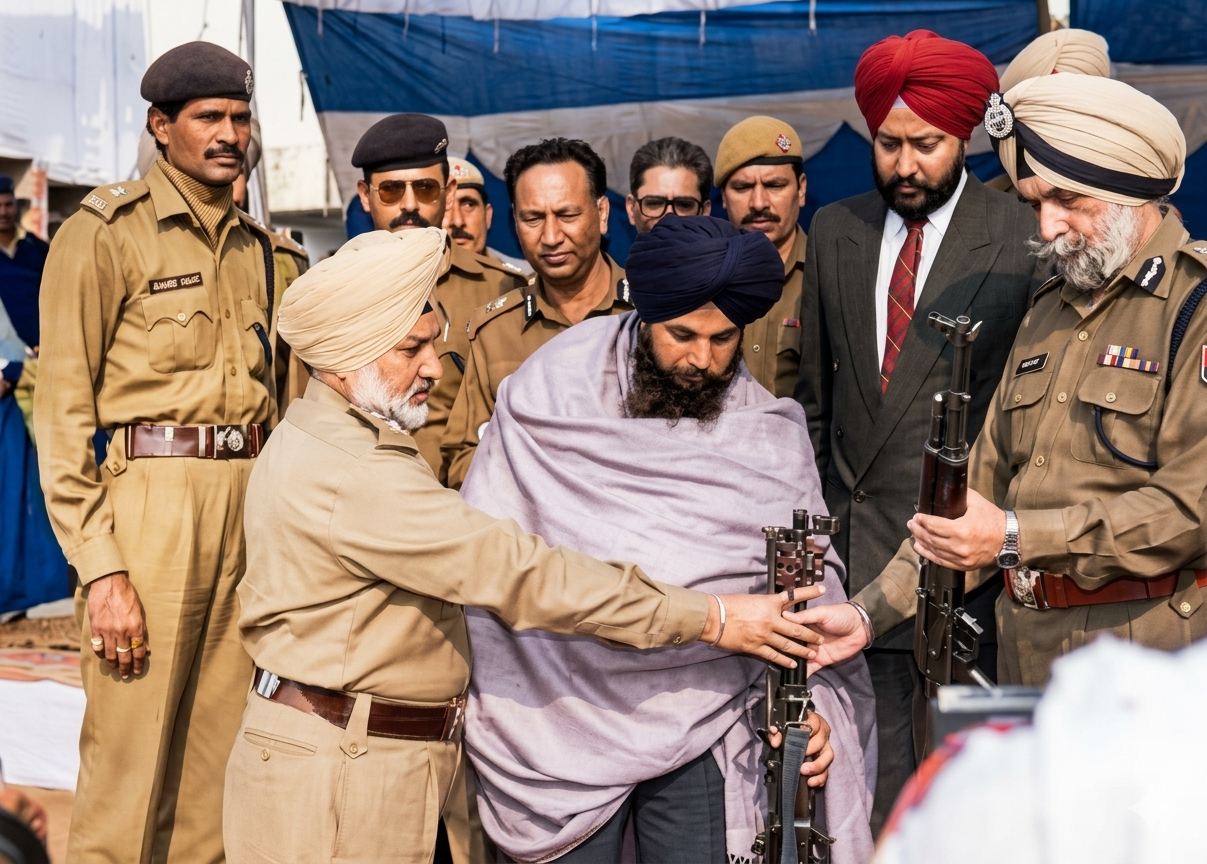
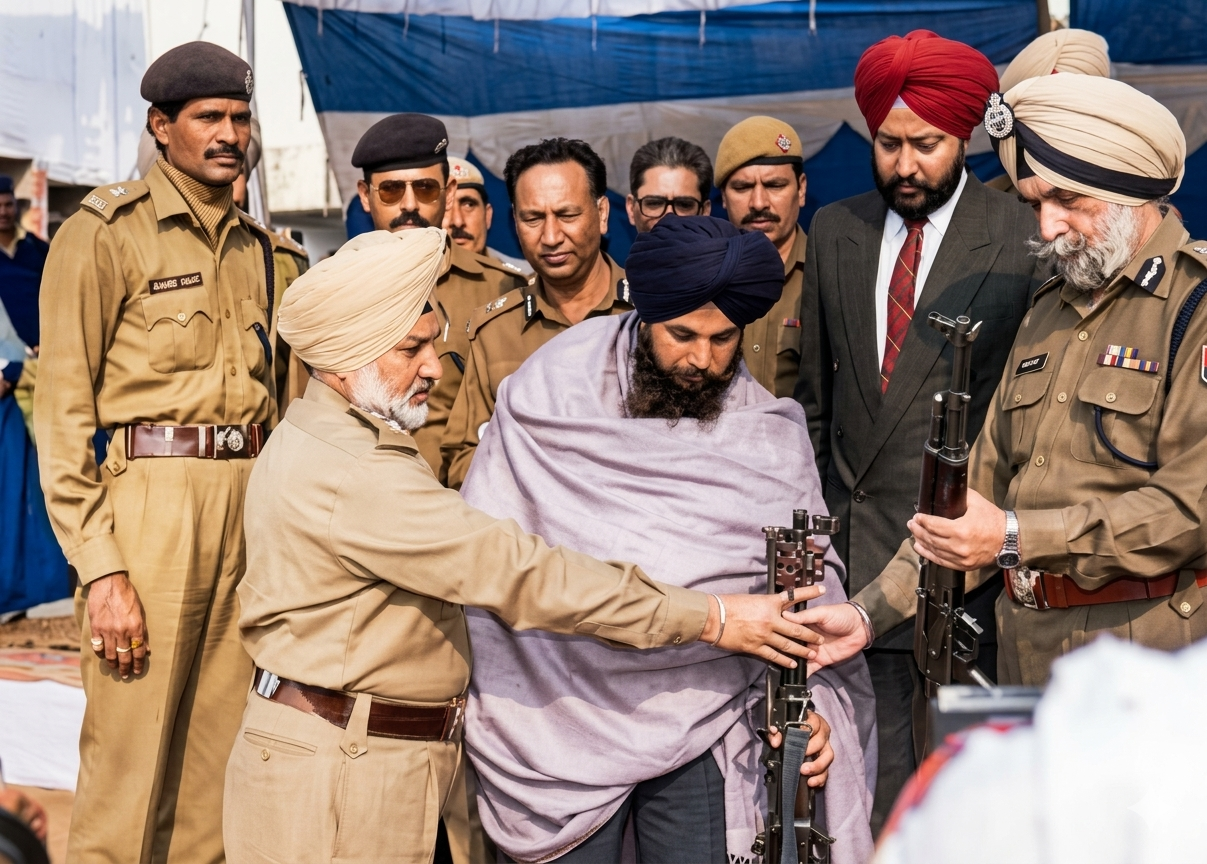
The photograph above documents the organized, formal co-presence of the civilian district executive and senior police command at an official state ceremony. EVIDENTIARY NOTE: This photograph proves official institutional proximity at a formal state event. It does not prove Sidhu's knowledge of any specific crime. Its evidentiary value is as evidence of administrative proximity and the implausibility of a total institutional-distance narrative between the DC/DM and the officers whose operational domain he was responsible for overseeing.
You cannot certify the surrenders and disclaim the disappearances. Official access and administrative obligation run in the same direction.
VI. The Forty-Nine Days — Khalra's Abduction, Supreme Court Notice, Custody Window, and Missing District Response
The forty-nine-day window is the disciplinary center of this archive. It is not forty-nine days of general administrative failure. It is forty-nine specific days during which: Khalra was alive and in illegal police custody; his wife had filed a formal FIR; the Supreme Court of India was actively supervising habeas corpus proceedings arising from his disappearance within Sidhu's district; police were denying custody; and the DC/DM of Amritsar — who reportedly had notice of the abduction and reportedly marked an inquiry — produced no document that has entered any public forum.
Forty-nine days is not a moment of police deception before civil authority could respond. Forty-nine days is a sustained period during which a Section 97 search warrant could have been issued, an ADM inquiry could have been initiated with terms of reference and a reporting schedule, SSPs could have been required to provide written explanations, the DGP and Home Secretary could have been put on notice in writing, and the Supreme Court registry could have been informed of the civil administration's response. None of this has been produced.
The Verified Primary-Source Timeline
The following timeline is sourced exclusively to: the 15 November 1995 Supreme Court order (W.P. Crl. No. 497/1995); the 4 November 2011 Supreme Court judgment; Amnesty International urgent action, September 1995 and 1998 report; and the CBI case registration record.
6 September 1995: Khalra abducted from outside his residence in Kabir Park, Amritsar, in daylight. Paramjit Kaur Khalra complains the same day. — Public abduction inside Sidhu's district. Notice-generating event. Source: 2011 SC judgment.
7 September 1995: FIR No. 72 registered at PS Islamabad, District Amritsar, at 9:30 AM under Section 365 IPC. — Formal criminal record opened. Source: 2011 SC judgment.
11 September 1995: Supreme Court treated a telegram from Gurcharan Singh Tohra as a habeas petition and issued notice to the Home Secretary, DGP Punjab, and SSP Amritsar. — Top state authorities on formal notice within five days. Source: 15 Nov 1995 SC order.
12 September 1995: Paramjit Kaur Khalra filed Article 32 habeas petition. Section 97 search-warrant threshold established. — Constitutional litigation begun on Day Six. Source: Amnesty urgent action and 15 Nov 1995 SC order.
20 September 1995: Amnesty International reported police denied custody; next hearing fixed 28 September; police ordered to produce Khalra. — State custody-denial posture documented in real time. Source: Amnesty urgent action.
23 September 1995: State affidavit said Ajit Singh Sandhu was joined to the investigation. — The primary accused was made an investigator of his own crime by the state. Source: 15 Nov 1995 SC order.
9 October 1995: Paramjit Kaur filed rejoinder stating Khalra had reported being threatened by Ajit Singh Sandhu before the abduction. — Pre-abduction threats now in the Supreme Court record. Source: 15 Nov 1995 SC order.
13 October 1995: Punjab Advocate General sought adjournment; hearing moved to 10 November 1995. — Case remained active in the Supreme Court while Khalra was still alive on the custody evidence below. Source: 15 Nov 1995 SC order.
24 October 1995: Witness evidence placed Khalra in custody at Kang police station and removed on this date. — Last publicly documented custody point. Forty-nine days from 6 September, counted inclusively. Source: Amnesty 1998 report.
10 November 1995: Paramjit Kaur filed further affidavit asserting illegal custody and linking Khalra's work to thousands of cremations. — Bridges the disappearance and the cremation record in the Supreme Court file. Source: 15 Nov 1995 SC order.
15 November 1995: Supreme Court ordered CBI inquiry into Khalra's disappearance and the 16 January 1995 cremation-record press note. Directed all state authorities to assist CBI. Ordered transfer of Ajit Singh Sandhu from Tarn Taran and Amritsar. Named records checked by state: telephone computer records, vehicle logbooks, wireless logbooks, roznamchas, and statements of more than 65 witnesses. — The Court did what the DC/DM had not done. SOURCE NOTE: The 2011 SC judgment places writ petition transfer on 5 November 1995; the contemporaneous 15 November 1995 SC order and Amnesty's 16 November 1995 urgent action both indicate 15 November. This archive uses 15 November as the contemporaneous source date.
18 December 1995: CBI registered RC No. 14/S/95/SCB-I/Delhi under Sections 365, 220, 120-B IPC. — Formal criminal investigation formally opened three months after Khalra's abduction. Source: 2011 SC judgment.
15 March 1996: Supreme Court directed transfer of certain implicated officers and ordered witness protection. — Court-ordered protection for witnesses from which the civilian district administration had not protected them. Source: 2011 SC judgment.
22 July 1996: Supreme Court recorded CBI interim report about 984 'lavaris' cremations in Tarn Taran; directed registration of criminal cases. — Source: 2011 SC judgment.
7 August 1996: Supreme Court said there was sufficient material to prosecute Ajit Sandhu. Khalra's fate still described as unknown. NOTE: Sidhu left DC/DM Amritsar on 11 August 1996. — Source: 2011 SC judgment.
19 August 1996: Punjab government granted sanction for prosecution of officials. — Source: Amnesty chronology.
13 October 1996: Charge-sheet filed in Special Judicial Magistrate (CBI Cases), Patiala. — Source: 2011 SC judgment.
12 December 1996: Supreme Court recorded 585 fully identified, 274 partially identified, 1,238 unidentified bodies; described record as 'flagrant violation of human rights on a mass scale'; referred to NHRC. — Source: SC judgment summary and NHRC reference.
18 November 2005: Trial court convicted six Punjab Police officials for abduction and murder of Jaswant Singh Khalra. — Source: 2011 SC judgment.
16 October 2007: Punjab and Haryana High Court maintained convictions; enhanced four sentences to life imprisonment. — Source: 2011 SC judgment.
4 November 2011: Supreme Court of India upheld principal convictions and life terms. — Source: 2011 SC judgment.
May 2024: CBI filed affidavit before Punjab and Haryana High Court stating statewide probe would be 'futile exercise' because witnesses are gone, records weeded out, and memory faded. — Source: Hindustan Times and Indian Express, May 2024.
6 May 2026: K.B.S. Sidhu gave Auzar TV interview (2 hours, 17 minutes, 23 seconds). Reportedly stated his DC/DM office was informed of Khalra's abduction and that he marked an inquiry. All statements [DA] pending authenticated transcript. — Source: Auzar TV, YouTube.
Forty-nine days. This is not rhetorical. It is arithmetic. It is exact. It is defensible. For forty-nine days, while Khalra was alive and in illegal custody, the administrative record of the DC/DM Amritsar's office — the office that held the Section 97 search power, the Section 58 arrest-reporting mechanism, the ADM inquiry authority, and the direct escalation channel to the Governor of Punjab — produced no document that has entered any public forum.
Institutional Delay Strategies: Five Documented Mechanisms
The archive documents five institutional delay strategies deployed across the Punjab accountability cases over thirty years. These are not speculative. They are the documented mechanisms through which mass-scale accountability has been progressively foreclosed.
Delay Strategy 1: The Prosecution Sanction Argument
Under Section 197 CrPC, prosecution of a public servant for acts done in discharge of official duties requires prior sanction from the competent authority. Accused Punjab Police officers repeatedly invoked this requirement to delay trial. This argument was rejected by Sessions Court, Punjab and Haryana High Court, and emphatically by the Supreme Court in Devinder Singh v. State of Punjab through CBI (2016), which held that the sanction requirement does not automatically block trial where police conduct involved fake encounters, torture, or custodial death. Despite the 2016 ruling, 16 of 62 CBI-registered cases remain pending before the CBI Special Court as of 2024.
Delay Strategy 2: The 'Records Are Gone' Defense
In May 2024, the CBI told the Punjab and Haryana High Court that a statewide probe into the 6,733-case PDAP petition would be futile because witnesses are gone, records have been weeded out, and memory has faded. This official statement is the permanent record of what the absence of contemporaneous administrative documentation has made permanent. The records are gone by 2024 because they were not generated in 1992–1996, or not preserved when generated. The CBI's 2024 futility is the downstream consequence of the civilian shield's upstream non-generation.
Delay Strategy 3: Geographic Limitation
The NHRC compensation process was narrowed to the three Amritsar-region cremation grounds, and the vast majority of 2,267 NHRC applications were rejected because cremations occurred elsewhere. PDAP's 6,733-case PIL, pending before the Punjab and Haryana High Court as of 2024, directly challenges this limitation.
Delay Strategy 4: Transfer, Retirement, and Mortality
Ajit Singh Sandhu — the CBI's primary accused in Khalra's murder — died on 23 May 1997 before charges could be formally framed. The pattern of key witnesses dying before giving full evidence is documented across Punjab accountability cases by PDAP and Amnesty International.
Delay Strategy 5: Non-Disclosure of CBI Investigation Reports
The CBI's six investigation reports submitted to the Supreme Court in open session between 1995 and December 1996 have never been made public. Repeated access requests by victim families' lawyers have been denied. Their non-disclosure has prevented families, lawyers, and accountability organizations from using the CBI's own investigative findings to strengthen civil or criminal proceedings.
VII. What a DC/DM Could Have Done in Forty-Nine Days
The most powerful answer to the claim that the DC/DM office did everything it could in the face of police deception is a simple, statutory list of what a functioning DC/DM office could have done — tools that required no judicial permission, no special authorization, and no political courage beyond the ordinary discharge of mandatory legal obligations.
The following are not recommendations or suggestions. They are the statutory tools that existed, were available, and required deployment under the law as it stood in September–October 1995. For each tool, the archive notes whether any public record shows it was deployed.
Tool 1: Written Demand to SSP Amritsar
The DC/DM could have sent a formal written communication to the Superintendent of Police, Amritsar, requiring a written report on the circumstances of Khalra's disappearance, the search actions taken, and whether Khalra was or had been in any custody within the police district. No such communication has been produced.
Tool 2: Written Demand to SSP Tarn Taran
The DC/DM could have sent a formal written communication to SSP Tarn Taran Ajit Singh Sandhu — the officer Paramjit Kaur's rejoinder specifically named as having threatened Khalra before his abduction — requiring a written account of Khalra's whereabouts. This communication would have created a legally significant record: if Sandhu denied custody and Khalra was later found in Tarn Taran custody, Sandhu's written denial would have been evidence of fabrication. No such communication has been produced.
Tool 3: Section 97 CrPC Search Warrant
The DC/DM could have issued a Section 97 search warrant directing police officers to search named premises — police stations Islamabad, Jhabal, Kang, Harike-area posts, and the Manawala village residence of SSP Sandhu, where SPO Kuldeep Singh later testified Khalra was held — for the wrongfully confined Khalra. The warrant required no judicial approval. The legal basis existed by 12 September 1995. No Section 97 warrant has been produced.
Tool 4: ADM/ADC Inquiry with File Number, Order Sheet, and Reporting Schedule
The DC/DM could have marked a formal inquiry to an ADC or ADM, with a written order identifying: the assigned officer by name and designation; the terms of reference; the police stations to be checked; the witnesses to be examined; a weekly reporting schedule; and a clear escalation trigger. If the reported statement that Sidhu marked such an inquiry is true, it should have produced all these documents. None has been produced.
Tool 5: Written Escalation to the DGP, Home Secretary, Chief Secretary, and Governor
The DC/DM could have formally escalated in writing to the DGP, Home Secretary, Chief Secretary, and Governor of Punjab, placing on the permanent state record that Khalra — a human rights defender whose work had exposed 2,097 illegal cremations in the DC/DM's own district — had disappeared from within the district, that police were denying custody, that a Supreme Court habeas petition was pending, and that the civilian administration was requesting the highest state authorities to intervene. No such escalation has been produced.
Tool 6: Require Daily Status Reports
The DC/DM could have required SSP Amritsar and SSP Tarn Taran to submit daily written status reports on the search for Khalra, creating a contemporaneous record of what the police said they were doing. No daily status reports have been produced.
Tool 7: Direct Civil Surgeon to Preserve All Unidentified Body Records
The DC/DM could have directed the Civil Surgeon, Amritsar and Tarn Taran, to preserve all records of unidentified police-brought bodies, including postmortem records, injury descriptions, photographs, and cremation authorizations, pending the outcome of the Khalra investigation and the Supreme Court proceedings. No such direction has been produced.
Tool 8: Audit Section 58 and Section 174 Compliance
The DC/DM could have ordered a formal audit of Section 58 compliance — demanding from each police station in the district a complete list of all warrantless arrests submitted in reports to the DM office during the preceding months — and a formal audit of Section 174 compliance — demanding from each police station a complete list of suspicious deaths reported to Executive Magistrates and forwarded to the DM office. No such audit has been produced.
Tool 9: Written Communication to the Supreme Court Registry
The DC/DM could have communicated in writing to the Supreme Court registry — or through the state's counsel in W.P. Crl. No. 497/1995 — notifying the Court that the civilian administration of Amritsar district had initiated an inquiry, identifying the measures taken, and placing the DC/DM's actions on the formal record of the habeas proceedings. No such communication has been produced.
Tool 10: Preserve All District Records After Supreme Court Notice
Once the Supreme Court issued notice on 11 September 1995, the DC/DM of Amritsar had formal notice that the district's administrative record was relevant to proceedings before the highest court in India. A litigation-hold instruction to preserve all district records relating to Khalra, to any law-and-order matters involving SSP Tarn Taran, and to the three cremation grounds should have been issued immediately. No such instruction has been produced.
The question is not whether each tool would have saved Khalra's life. He may have been killed before some of these tools could have reached him. The question is whether any record exists showing that the DC/DM office deployed any of these tools during the forty-nine days. None has been produced. The law required their use. The law required their documentation. The law required their preservation. On the public record, none of these obligations was discharged in any documentary form.
The Three Deputy Commissioners of Amritsar — The Connected Accountability Roster
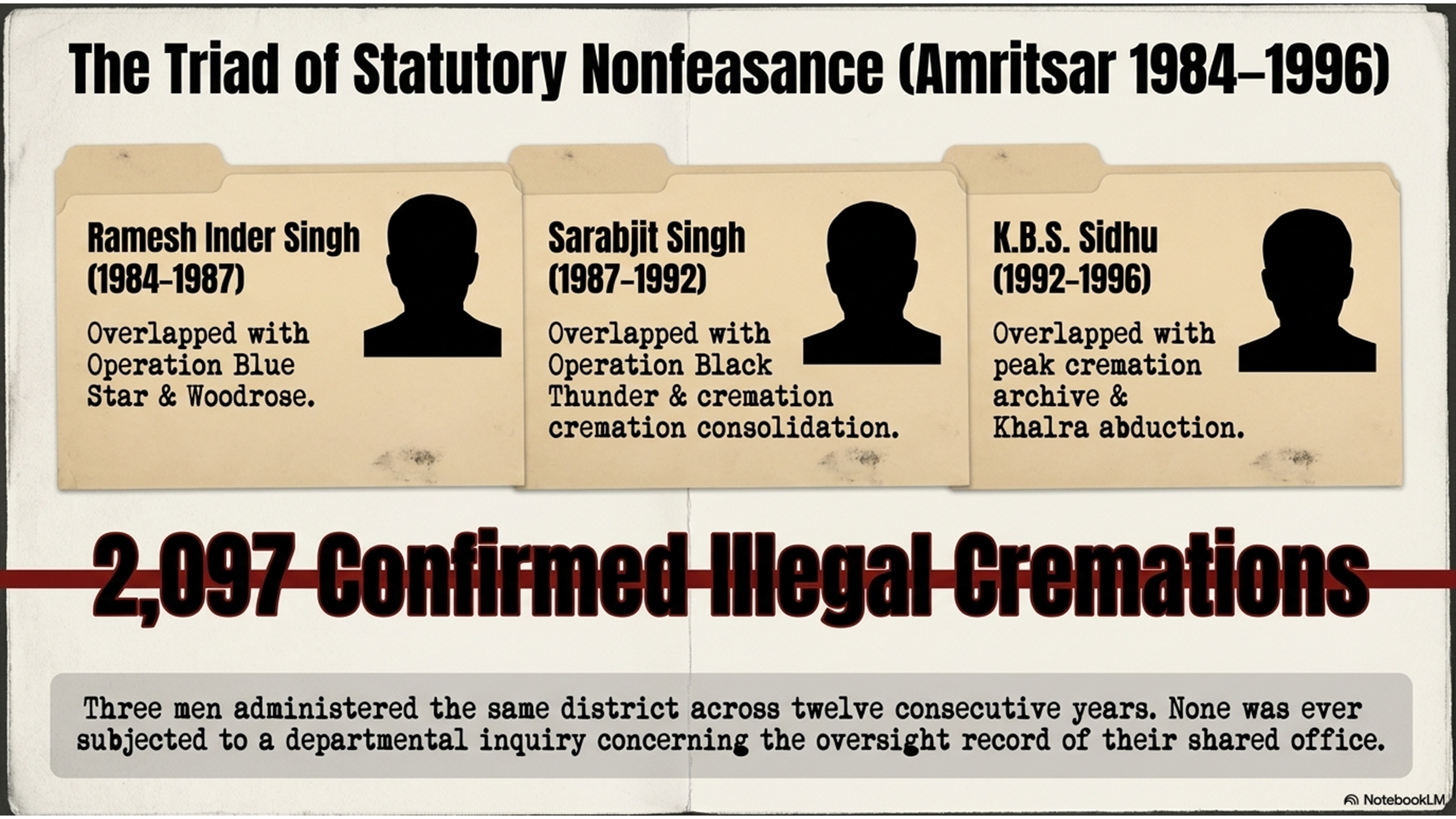
Three men held the DC/DM Amritsar position across the most consequential twelve years in Amritsar's modern administrative history. The 2,097 illegal cremations accumulated across all three tenures. The CBI explicitly stated its mandate covered the Amritsar chapter only. This archive correspondingly addresses the DC/DM of Amritsar only. The cremation grounds did not discriminate by tenure. Neither does this archive.
A. Ramesh Inder Singh, IAS — DC/DM Amritsar, 1984–1987
[PF] Ramesh Inder Singh held the DC/DM office from 1984 through approximately 1987, overlapping with Operation Blue Star in June 1984, the November 1984 anti-Sikh organized violence, and the initial counterinsurgency years. He authored Turmoil in Punjab: Before and After Blue Star (HarperCollins India, 2022). He is alive. His memoir does not provide a comprehensive accounting of Section 174 reporting, Section 176(1) inquiries, or medical documentation records during his tenure.
The KPSGILL.COM article 'Apar Singh Bajwa carried the bodies; Ramesh Inder Singh carried the office' frames the accountability distinction: Apar Singh Bajwa was the police officer who physically transported bodies to the cremation grounds and signed the firewood vouchers. Ramesh Inder Singh carried the office — the statutory authority, the magisterial power — that should have detected what Bajwa was doing. The DC/DM who held the office while the cremation architecture was being established bears responsibility for not disrupting it.
[Q] Ramesh Inder Singh is alive. He has written a memoir. The memoir does not account for: how many Section 174 reports were received by the DC/DM office between 1984 and 1987; how many Section 176(1) inquiries were ordered; how many medical examinations were demanded for unidentified police-brought bodies; or what the DC/DM office did when the cremation pattern became administratively visible. These questions remain open and unaddressed.
B. Sarabjit Singh, IAS — DC/DM Amritsar, 1987–1992
[PF] Sarabjit Singh held the DC/DM Amritsar position from approximately 1987 to 1992 — the five-year period encompassing the most intensive phase of illegal cremations. He authored Operation Black Thunder (SAGE Publications, 2002). He is deceased.
Sarabjit Singh is dead. He cannot give testimony. He cannot contest claims made about his tenure. He cannot produce the files. His death does not extinguish the accountability of the office he held. It makes the documentary record more, not less, important — because the administrative files that should exist in Punjab government archives are the only testimony that remains.
K.B.S. Sidhu served as ADC of Amritsar from 1990 to 1992 — the final two years of Sarabjit Singh's DC/DM tenure, during the peak cremation period. Sidhu was therefore administratively present in Amritsar district as a senior official during those years. When Sarabjit Singh handed over to Sidhu in May 1992, the handover note — if it exists — is a document that would identify what the incoming DC/DM was formally told about the district's administrative state, including any known patterns of police misconduct and outstanding administrative obligations.
[Q-RTI] Provide the handover note prepared when K.B.S. Sidhu assumed the DC/DM Amritsar position in May 1992, including all dak and dispatch entries recording the formal handover of files, pending inquiries, outstanding complaints, and administrative matters. Custodian: Office of Deputy Commissioner, Amritsar; General Administration Department, Punjab; district record room.
C. K.B.S. Sidhu, IAS — DC/DM Amritsar, 11 May 1992 – 11 August 1996
[PF] K.B.S. Sidhu served as DC/DM Amritsar from 11 May 1992 to 11 August 1996, confirmed by the official district list. He is alive. He gave a 2-hour, 17-minute, 23-second interview to Auzar TV on 6 May 2026. He has published extensively on governance and constitutional rights. He cannot shelter behind death.
The most important administrative fact about Sidhu's tenure is one he apparently does not recognize as damaging: he came to the DC/DM position from within the Amritsar district administration itself. He was not handed a clean slate from a predecessor in a different region. He was handed the same district, the same police stations, the same cremation grounds, and the same institutional patterns — by a man who had been his own superior — as the incoming ADC. He carried into the DC/DM chair all the knowledge his ADC posting had given him. Whatever he claims not to have known as DC/DM that he did not already know as ADC requires specific explanation.
EVIDENTIARY NOTE: The photograph of Mr. Sidhu shown in this document with DGP KPS GILL IPS and SSP Ajit Singh Sandhu IPS (in one frame) proves official institutional proximity at a formal state event. It does not prove Sidhu's knowledge of any specific crime. Its evidentiary value is as evidence of administrative proximity and the implausibility of a total institutional-distance narrative between the DC/DM and the officers whose operational domain he was responsible for overseeing.
Official access and administrative obligation run in the same direction. You cannot certify the surrenders and disclaim the disappearances.
The Dead Who Cannot Contest — A Structural Analysis of the Sidhu Defense
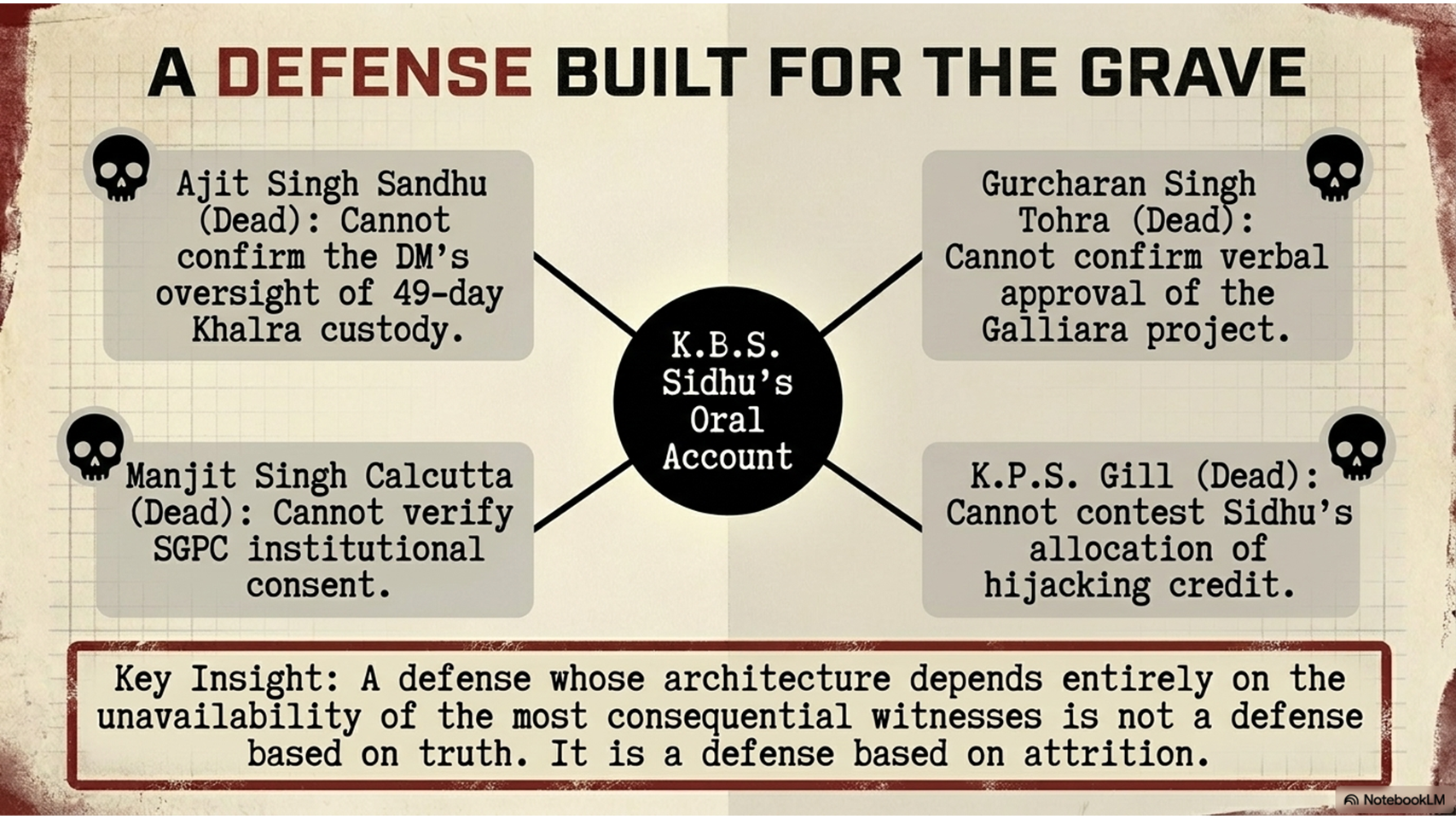
An analysis of K.B.S. Sidhu's Auzar TV interview reveals a consistent structural pattern (all statements classified [DA] pending authenticated transcript): every major claim that is not supported by any documentary evidence reportedly depends on the testimony of a person no longer alive to verify or contest it. A defense whose architecture depends entirely on the unavailability of the most consequential witnesses is a defense dependent on attrition rather than documentation.
[AI] Sidhu publishes daily on police accountability, custodial dignity, Article 21 rights, and democratic oversight. The man who writes about accountability in 2026 is constructing a legacy. That legacy reportedly rests on the corroboration of five dead men for its most important specific claims. A public file must verify an office. A dead witness may explain a memory. The two are not interchangeable.
1. Ajit Singh Sandhu — Dead, the Most Consequential Witness
[PF] Ajit Singh Sandhu, SSP Tarn Taran, was named by the CBI as the primary accused in Khalra's abduction and murder. The Ensaaf database documents at least 512 cases of abductions, extrajudicial executions, and/or enforced disappearances bearing command responsibility attributable to Sandhu. He had 16 legal cases pending at his death on 23 May 1997 — before charges could be formally framed. The Government of India had twice awarded him the President's Award for Gallantry. He was irregularly promoted from Punjab Police Service to IPS on 1 September 1990.
[DA] Multiple accounts have questioned the 'suicide' classification of Sandhu's death. The circumstances — his arrest on Supreme Court direction, the political sensitivity of his potential testimony, and the documented pattern of key witnesses dying before giving full evidence — have led careful observers to characterize his death as designed to silence the most consequential potential witness. The archive records this as a documented allegation, not adjudicated.
[PF] SPO Kuldeep Singh testified in the Khalra murder criminal trial that he was present when KPS Gill visited Khalra at SSP Sandhu's Manawala village residence in Tarn Taran, shortly before Khalra's death. SHO Satnam Singh reportedly told Khalra he could have saved himself if he had listened to 'the advice of the DGP.' This is proved as trial testimony from a prosecution witness in the criminal trial resulting in conviction. It is [DA] as against KPS Gill personally.
KPS Gill's own letter to Prime Minister IK Gujral, May 1997: 'The largest number of surrenders were before SSP AS Sandhu.' The DC/DM who attended surrender ceremonies alongside Sandhu cannot maintain that Sandhu's operational domain was administratively inaccessible to him when Khalra disappeared.
2. Gurcharan Singh Tohra — Dead, Cannot Confirm Galliara Approval
Sidhu reportedly stated he obtained the approval of SGPC President Gurcharan Singh Tohra for the Galliara project through verbal agreement. Tohra died on 1 April 2004. He cannot confirm, deny, or contextualize the alleged verbal understanding. No formal SGPC executive committee resolution on the Galliara project has been produced.
3. Manjit Singh Calcutta — Dead, Cannot Confirm SGPC Role
Sidhu reportedly named SGPC General Secretary Manjit Singh Calcutta as a second SGPC official who gave verbal approval. Calcutta is deceased. Two men spoke. No paper was signed. Both men are dead. The administrator who claims to have beautified the most sacred site in Sikhism cannot produce documentation of institutional consent from the institution he claims consented.
4. K.P.S. Gill — Dead, Cannot Contest Hijacking Credit or Khalra Visit
KPS Gill died 26 May 2017. He cannot contest Sidhu's reportedly stated characterization of hijacking credit allocation. More consequentially, he cannot address what the DC/DM's office knew about his reported visit to Khalra at Sandhu's Manawala residence — documented in SPO Kuldeep Singh's trial testimony and classified [DA] as against Gill personally.
5. Sarabjit Singh — Dead, Cannot Account for the 1987–1992 Peak Period
Sidhu's predecessor as DC/DM Amritsar is deceased. Any suggestion that the cremation record was primarily a product of the preceding tenure cannot be challenged by the one person best placed to know what was handed over. The handover note from May 1992 is an RTI-accessible document that would answer this directly.
The archive turns to the only witnesses that cannot be killed: the documents. The documents have not been produced in any public forum in thirty years. Their non-production is the evidentiary finding. Produce them — or produce the orders authorizing their destruction.
The Auzar TV Interview of 6 May 2026 — Nine Hooks, Forensically Examined
ALL AUZAR TV CLAIMS ARE [DA]: Every statement attributed to K.B.S. Sidhu from the 6 May 2026 Auzar TV interview is classified [DA] pending authenticated Punjabi transcript and verified English translation. No exact Punjabi quotation is reproduced. The formulation 'Sidhu reportedly stated...' is used throughout. The statutory analysis and the 1995–2026 judicial record stand independently of the interview.
The interview is 2 hours, 17 minutes, and 23 seconds long. Sidhu published a written Substack companion the following day. For each significant disclosure, the archive applies a six-part analytical framework: (1) what Sidhu reportedly said; (2) why it matters administratively; (3) what statutory provision it implicates; (4) what document should exist; (5) what has not been produced; (6) what question follows.
Hook 1: The Interview as Curated Archive, Not Spontaneous Testimony
(1) REPORTEDLY: A structured interview coordinated with a written companion article published the next day. (2) WHY IT MATTERS: A deliberate act of historical record construction, not spontaneous reminiscence. (3) STATUTORY IMPLICATION: A deliberate public account of one's administrative record by a public official is subject to the same scrutiny as any other public claim. (4) DOCUMENT THAT SHOULD EXIST: The Substack companion of 7 May 2026. (5) NOT PRODUCED: Any documentary evidence supporting the specific administrative claims made. (6) QUESTION: Every oral claim in the interview that cannot be supported by a document is a claim that requires documentary production, revision, or explanation of why no document exists.
Hook 2: 'I Was Informed About Khalra' — The Notice Admission
(1) REPORTEDLY: His DC/DM office was informed of Khalra's abduction on or around 6 September 1995, and he marked an ADC/ADM-level inquiry in response. (2) WHY IT MATTERS: The most consequential reported admission. It establishes reported notice to the DC/DM office. Notice creates obligation under Articles 21 and 22, CrPC Sections 56, 57, 58, 97, 174, and 176(1), and Section 4 of the Police Act, 1861. (3) STATUTORY IMPLICATION: Notice of a disappearance with an FIR on record and a Supreme Court habeas petition pending within six days created a non-discretionary chain of administrative obligations. (4) DOCUMENTS THAT SHOULD EXIST: Written inquiry order; examination of Paramjit Kaur Khalra; written requests to named police stations; Section 97 warrant; escalation to DGP, Home Secretary, Chief Secretary, Governor; communication to Supreme Court registry; weekly progress reports; final inquiry report; action-taken note — eleven categories. (5) NOT PRODUCED: None of these eleven categories in any public forum in thirty years. (6) QUESTION: Produce the inquiry order, dated and signed, identifying the assigned officer and terms of reference.
[DA] If the authenticated transcript confirms Sidhu stated his office was informed and he marked an inquiry, this will be elevated to [PF] as Sidhu's own public statement establishing notice to the DC/DM office.
The inquiry Sidhu reportedly marked after Khalra's abduction is not an act of administrative virtue. It is a statement of notice. Notice creates statutory obligation. Obligation requires a documented response. The documented response has not been produced in any public forum in thirty years.
Hook 3: 'I Marked an ADC/ADM Inquiry' — Post-Mortem Reconstruction Is Not Pre-Mortem Rescue
(1) REPORTEDLY: He marked an ADC/ADM-level inquiry that reportedly contributed to identifying SPO Kuldeep Singh as a trial witness. (2) WHY IT MATTERS: SPO Kuldeep Singh's testimony emerged through the CBI investigation years after Khalra's death. A witness identified post-mortem cannot retroactively prove the ADM inquiry was effective during the forty-nine days when Khalra was alive. (3) DOCUMENTS THAT SHOULD EXIST: All eleven categories of documentation identified under Hook 2. (4) NOT PRODUCED: None. (5) QUESTION: Produce the inquiry order with all eleven categories of derivative documents. If the file was destroyed, provide the destruction order.
Post-mortem reconstruction is not pre-mortem rescue. Sidhu cannot claim credit for a witness whose testimony emerged years after Khalra's murder while simultaneously using that witness to suggest the ADM inquiry was adequate during the seven weeks when Khalra was alive.
Hook 4: 'I Visited Police Stations Only on Credible Complaint' — The Career-Protection Filter
(1) REPORTEDLY: Oversight visits would occur only when there was a 'credible complaint,' and acting aggressively would cause trouble with the government. He reportedly invoked SSP Ajaypal Singh Mann — dismissed from the Punjab Police Service in January 1985 for effective law enforcement — as the cautionary example. (2) WHY IT MATTERS: The most legally significant reported admission. It describes mandatory statutory obligations calibrated to career-protection rather than legal duty. (3) STATUTORY IMPLICATION: Section 58 required arrest reports to the DC/DM automatically without any complaint. Section 174 required suspicious-death report forwarding without any complaint. Section 97 authorized search warrants on reasonable belief. No CrPC provision contained a 'credible complaint' threshold. (4) DOCUMENTS THAT SHOULD EXIST: Section 58 arrest reports; Section 174 death reports; Section 176(1) inquiry orders — none requiring a complaint to trigger. (5) NOT PRODUCED: The Section 58, 174, and 176(1) record for 11 May 1992 – 11 August 1996. (6) QUESTION: How many Section 58 arrest reports, Section 174 death reports, and Section 176(1) inquiry orders were generated during your tenure?
[PF] SSP Ajaypal Singh Mann was dismissed from the Punjab Police Service in January 1985. His case is documented in the administrative record.
Section 58 does not say 'when there is a credible complaint.' Section 174 does not say 'when it is politically safe.' The statute says 'shall.' The 'credible complaint' threshold was not a legal standard. It was a career-protection standard applied to mandatory duties.
Hook 5: The Hijacking — One Achievement, One Dead Corroborator, Absent Records
(1) REPORTEDLY: He was the primary negotiator in at least one April 1993 hijacking episode; KPS Gill arrived after the resolution. KPS Gill died in 2017 and cannot contest this. (2) WHY IT MATTERS AS ALIBI: One crisis resolved in hours cannot be weighed against a forty-nine-day administrative failure to produce a living human being. (3) DOCUMENTS THAT SHOULD EXIST: Crisis Management Group records, DC office files, after-action reports. (4) NOT PRODUCED: The crisis resolution administrative record. (5) QUESTION: Produce the after-action reports. If the hijacking resolution was as significant as presented, the administrative record should be correspondingly comprehensive.
Hook 6: The Galliara — Security Belt, Dead Men's Verbal Approval, No Institutional Paper Trail
(1) REPORTEDLY: The Galliara was 'originally conceived in security terms' then transformed into a beautification initiative, with verbal approval from deceased SGPC officials Tohra and Calcutta. (2) WHY IT MATTERS: A project involving demolition around Sikhism's most sacred institution required formal institutional consent from the institution, not individual verbal concurrence from men who cannot now confirm what they understood the project to be. (3) DOCUMENTS THAT SHOULD EXIST: SGPC executive committee minutes; Section 4 and 5A land acquisition notifications; original security-perimeter design documentation. (4) NOT PRODUCED: Any formal written SGPC institutional approval. (5) QUESTION: Produce the Galliara land acquisition file, SGPC minutes, and original design documentation.
Hook 7: Village Elections and the Sarpanch Intelligence Grid
(1) REPORTEDLY: He built a Sarpanch network providing reliable intelligence about conditions in villages, including conditions of fear among women. (2) WHY IT MATTERS: An officer who maintained a functioning village-level intelligence network cannot credibly claim administrative unawareness of the patterns of police conduct in the same district. The 'credible complaint' threshold was a choice about what to act on, not a description of what he did not know. (3) DOCUMENTS THAT SHOULD EXIST: Written administrative instructions to police stations based on Sarpanch network intelligence; action-taken notes on Sarpanch-reported complaints. (4) NOT PRODUCED: Any documentation of administrative action on Sarpanch-sourced intelligence about misconduct. (5) QUESTION: What written instructions did the DC/DM office issue to police stations based on Sarpanch intelligence about police misconduct during 11 May 1992 – 11 August 1996?
Hook 8: 'Dhee-Bhain' — Sexual Violence, Twice Acknowledged, Attributed Without Evidence, Administratively Unanswered
(1) REPORTEDLY: Women — 'dhee-bhain' (daughters and sisters) — were being sexually assaulted during the counterinsurgency period. Acknowledged twice. Both times attributed entirely to 'Sikh militants.' (2) WHY IT MATTERS: The most significant human rights reported admission. He reportedly acknowledged the occurrence, the climate of fear, and the systemic character of the violence — then attributed it to 'Sikh militants' and moved on without describing a single administrative action taken. (3) STATUTORY IMPLICATION: Where a woman was sexually assaulted in police custody and subsequently cremated without post-mortem examination, the Section 174 framework was the only mechanism to document forensic evidence of the assault before cremation destroyed it permanently. (4) DOCUMENTS THAT SHOULD EXIST: Written instructions to police stations regarding sexual violence complaints; medical examination records for female unidentified bodies; Section 174 reports for female victims. (5) NOT PRODUCED: Any of the above. (6) QUESTION: How many complaints of sexual violence by police personnel were received by the DC/DM office? How many female unidentified bodies were cremated? How many received medical examination before cremation?
[DA] Sidhu's reported attribution entirely to 'Sikh militants' is contested by Amnesty International, Asia Watch, Human Rights Watch, and U.S. State Department cables attributing significant proportions to police personnel and state-adjacent formations. The archive does not adjudicate the attribution. It notes that the DC/DM's statutory framework was designed to document responsibility contemporaneously. That framework was not deployed.
[PM] Panthic memory holds that sexual violation of Sikh women during the counterinsurgency period was deployed systematically as an instrument of community humiliation and suppression. The permanent destruction of forensic evidence through cremation without medical examination is the administrative erasure the DC/DM office's Section 174 duties were designed to prevent.
Hook 9: The Beant Singh Comment — Condemning the Dead, Exempting Himself
(1) REPORTEDLY: KPS Gill should have been dismissed from the IPS in connection with the bomb blast that killed Chief Minister Beant Singh on 31 August 1995. Gill died in 2017 and cannot contest this. Sidhu made no such public suggestion while Gill was alive. (2) ANALYTICAL IMPLICATION: If Sidhu believed the DGP bore responsibility for security failures significant enough to warrant dismissal, then the DC/DM was operating under the command of a man he now believes was derelict. That framing requires an accounting of what DC/DM Sidhu did to discharge his own civil-administrative obligations during the same period when, by his own retrospective judgment, the DGP was failing at his.
The Complete Human Rights Catalogue — Every Category of Violation in the DC/DM's Jurisdiction
The administrative accountability of K.B.S. Sidhu is not limited to the Khalra abduction. The DC/DM of Amritsar presided over a district in which four documented categories of grave human rights violation were occurring simultaneously. Each category had its own chain of mandatory administrative obligations. Each chain failed to produce the documentary record it was designed to create.
A. Illegal Cremations — The Architecture of Erasure
The 2,097 illegal cremations are the most forensically documented human rights violation in the Punjab accountability record. Of 2,097: 585 fully identified, 274 partially identified, 1,238 entirely unidentified. The 1,238 represent the maximum administrative erasure: persons arrested, killed, and disposed of without any documentary trace that their statutory protections had been applied. Each unidentified body cremated without medical examination represents a specific exercise of the DC/DM's statutory authority through inaction: no Section 174 report demanded; no Section 176(1) inquiry ordered; no Section 58 arrest report on file.
B. Custodial Disappearances — The Arrest-Denial Architecture
Custodial disappearance in Punjab operated through a specific mechanism: arrest without warrant; no arrest recorded; no FIR filed; detention beyond twenty-four hours without magisterial production; police denial of custody; if subsequently killed, body cremated as unidentified. The legal framework was designed to prevent this. Section 58 and Section 97 were the primary preventive instruments. A DC/DM who actively demanded Section 58 compliance would have known about warrantless arrests. A DC/DM who issued Section 97 warrants when families reported disappearances would have disrupted the denial-of-custody mechanism that made the disappearance architecture function. Neither tool was deployed on the available public record.
[HR] Human Rights Watch's 1994 report 'Dead Silence: The Legacy of Human Rights Abuses in Punjab' documented, on extensive field investigation, a systematic pattern in which Punjab Police arrested persons without warrant, held them beyond the twenty-four-hour constitutional limit, subjected them to torture, and then either encountered them or transferred them outside the formal custody system. The report specifically identified the failure of the civil magisterial oversight system as a structural enabler.
C. Custodial Deaths and Extrajudicial Killings — The Encounter Architecture
In the mass-cremation cases examined by PDAP [DA — PDAP audit finding], the CBI concluded encounters were fake: persons had been in custody, killed, then represented as having died in armed exchanges. The civilian administrative record that the DC/DM office should have generated — the Section 174 reports, the Section 176(1) inquiries, the medical examination records — was the documentary framework that could have resolved this contradiction at source in 1992–1996. No such record has been produced in any public forum.
[PF] U.S. Representative Edolphus Towns entered testimony into the Congressional Record in August 1998 documenting that SSP Tarn Taran Ajit Singh Sandhu had threatened Khalra shortly before the abduction.
[PF] KPS Gill's letter to Prime Minister IK Gujral, May 1997: 'The largest number of surrenders were before SSP AS Sandhu.' The DC/DM who co-presided over those ceremonies was not administratively isolated from Sandhu's operational domain.
D. Custodial Rape and Sexual Violence — The Most Administratively Erased Category
Sidhu reportedly acknowledged sexual violence against women in his district on two separate occasions in the Auzar TV interview. The archive examines three administrative dimensions of this reported disclosure:
DIMENSION ONE — THE CONTESTED ATTRIBUTION: The reported attribution entirely to 'Sikh militants' is contested by Amnesty International, Asia Watch, Human Rights Watch, and U.S. State Department cables attributing significant proportions to police personnel and state-adjacent formations. The DC/DM's statutory machinery would have generated a contemporaneous documentary record of which actor was responsible. That machinery was not deployed.
DIMENSION TWO — THE CUSTODY ERASURE: Where a woman was sexually assaulted in police custody and subsequently cremated without post-mortem examination, the Section 174 framework was the only mechanism to document forensic evidence before cremation destroyed it permanently. The archive presents this as a structural and forensic scenario grounded in the documented pattern of unidentified police-brought cremations. No specific individual case is asserted as a verified finding unless separately supported by a court judgment, CBI record, or official human rights documentation.
DIMENSION THREE — THE INTELLIGENCE DIMENSION: Sidhu's reported Sarpanch network reported on conditions of fear among women. If that network reported on sexual violence, what written administrative instructions did the DC/DM office issue to police stations regarding the recording and investigation of such complaints? Where are those instructions?
[PM] Panthic memory holds that sexual violation of Sikh women during the counterinsurgency period was deployed systematically as an instrument of community humiliation and suppression. The permanent destruction of forensic evidence through cremation without medical examination is the administrative erasure the DC/DM office's Section 174 and Section 176(1) duties were designed to prevent.
Retrospective Constitutionalism — A Thousand Articles Without Khalra's Name
Across more than a thousand published pieces on Substack, Medium, Twitter, Babushahi, and SikhNet, K.B.S. Sidhu has written on: Article 21 and custodial dignity; the constitutional obligations of police; police reform; Gurbani and spiritual service; Sikh institutional accountability; Punjab's political future; and his administration of Amritsar as the foundation of his authority on all these subjects.
Across this entire corpus — on the available public record reviewed by this archive — the following subjects do not appear: the 2,097 confirmed illegal cremations at Patti, Tarn Taran, and Durgiana Mandir; the Supreme Court's characterization of those findings as a flagrant violation of human rights on a mass scale; the abduction of Jaswant Singh Khalra from within Amritsar district on 6 September 1995; the CBI chargesheet naming Sandhu as the principal officer responsible; the Supreme Court convictions upheld on 4 November 2011; the habeas corpus proceedings filed by Paramjit Kaur Khalra while Sidhu was still DC/DM Amritsar; or any question about what the DC/DM Amritsar's office did or failed to do during 1992–1996.
[AI] In a corpus of more than a thousand articles, the subjects that never appear are not absent by accident. A writer who publishes on custodial dignity without naming Khalra; who writes on police accountability without engaging the cremation record; who theorizes about the District Magistrate as a democratic accountability node without addressing the forty-nine days when that node was most urgently needed — has made a structural editorial choice. The archive documents that choice. It is the literary equivalent of the administrative record: the conspicuous absence is the document.
Section 69A and Punjab '95 — The State's Acknowledgment of Relevance
In April 2026, KPSGILL.COM received a notification from India's Ministry of Electronics and Information Technology under Section 69A of the Information Technology Act 2000, Request ID 69A/2026/MIT/11078. KPSGILL.COM filed a constitutional submission on April 29, 2026, opposing the proposed blocking — structured as a Supreme Court-grade legal brief arguing procedural defects, constitutional infirmities under Articles 14, 19, 21, and 25, overbreadth, and viewpoint discrimination.
The film Punjab '95 — the Honey Trehan biopic of Jaswant Singh Khalra — has faced 127 demanded cuts from the Central Board of Film Certification, including a demand that Khalra's name be changed. The Film Certification Appellate Tribunal that provided statutory appeal rights was abolished in April 2021. A blocking order directed at a forensic archive grounded in Supreme Court proceedings, CBI chargesheets, and NHRC records is not a response to unlawfulness. It is a response to connected institutional memory.
TheDeathCertificate.org and KPSGILL.COM operate under U.S. First Amendment protections from Fresno, California. Every attempt to suppress the archive adds to the archive.
The Padma That Never Came — The Republic's Own Assessment
[AI] K.B.S. Sidhu cites the Galliara project, the hijacking resolution, the restoration of elections, and his contributions to Sikh institutional history as the record of a career that merited recognition. He has not been awarded the Padma Shri, the Padma Bhushan, or any national civilian honor from the Government of India. The Padma recognition system requires the recommending authority to assert that the awardee's record is unambiguously distinguished. That assertion would be immediately contestable given the Khalra case, the 2,097 illegal cremations, and the CBI and Supreme Court proceedings that have made the period's civil administrative accountability a matter of permanent public controversy. The Republic does not give the Padma to administrators whose records it does not wish to celebrate in public. The archive records the Republic's silence as its own assessment.
The Missing Documents Checklist — Organized by Priority for RTI and Litigation Use
This checklist is organized for practical use by RTI applicants, lawyers, researchers, and journalists. PRIORITY A = directly linked to Supreme Court record, highest significance. PRIORITY B = linked to mandatory statutory obligation. PRIORITY C = corroborating context. Each entry carries the document name, the custodian, the date range, and the non-production implication.
PRIORITY A: The Khalra Inquiry File
[Q-RTI] ADM/ADC inquiry order — dated, signed, assigning officer and terms of reference. NON-PRODUCTION IMPLICATION: The inquiry Sidhu reportedly marked has no documentary existence in the public record. CUSTODIAN: DC/DM Amritsar; GAD Punjab. RTI WORDING: 'Provide certified copy of any order by the DC/DM Amritsar or any ADM/ADC directing inquiry into the abduction/disappearance of Jaswant Singh Khalra, with all note-sheets, appointment orders, statements, reports, and action-taken reports. If destroyed, provide the destruction order, authorizing officer, and retention schedule cited.'
[Q-RTI] Examination record of Paramjit Kaur Khalra by the inquiry officer. NON-PRODUCTION IMPLICATION: Primary complainant was not formally examined, or if examined, the record has not been preserved. CUSTODIAN: DC/DM Amritsar.
[Q-RTI] Written requests to PS Islamabad, PS Jhabal, PS Kang, and Harike-area posts for station diaries, lock-up registers, arrest registers, wireless logs, and vehicle logs. NON-PRODUCTION IMPLICATION: The police chain was not formally interrogated by the civilian inquiry. CUSTODIAN: DC/DM Amritsar.
[Q-RTI] Written communications to SSP Amritsar and SSP Tarn Taran demanding an accounting for Khalra's whereabouts. NON-PRODUCTION IMPLICATION: SSP Tarn Taran Sandhu was not formally required by the DC/DM to account for Khalra. CUSTODIAN: DC/DM Amritsar.
[Q-RTI] Section 97 CrPC search warrant — or record of consideration and decision not to issue. NON-PRODUCTION IMPLICATION: The DC/DM did not exercise the executive search power available without judicial approval. CUSTODIAN: DC/DM Amritsar; Executive Magistrate court records.
[Q-RTI] Escalation letters to DGP, Home Secretary, Chief Secretary, and Governor. NON-PRODUCTION IMPLICATION: The civilian accountability chain above the police was not engaged by the district administration. CUSTODIAN: DC/DM Amritsar; Home Department Punjab.
[Q-RTI] Final inquiry report and action-taken note. NON-PRODUCTION IMPLICATION: The inquiry produced no formal conclusion that has entered any public record. CUSTODIAN: DC/DM Amritsar; GAD Punjab.
PRIORITY A: Records Named in the 15 November 1995 Supreme Court Order
[Q-RTI] FIR No. 72/1995, PS Islamabad, and all connected records. RTI WORDING: 'Provide certified copy of FIR No. 72/1995, PS Islamabad, District Amritsar, including original complaint dated 6.9.1995, DDR/GD entries, forwarding note, and case diary index.' CUSTODIAN: PS Islamabad / Commissionerate record room.
[Q-RTI] Telephone computer records, vehicle logbooks, wireless logbooks, and roznamchas examined by SP City Amritsar in the habeas case. RTI WORDING: 'Provide copies of the telephone computer records, vehicle logbooks, wireless logbooks, roznamchas, and witness statements referred to in the affidavit of SP City Amritsar quoted in the Supreme Court order dated 15.11.1995 in W.P. (Crl.) No. 497/1995.' CUSTODIAN: Punjab Police HQ / Commissionerate archives.
[Q-RTI] Custody registers, lock-up registers, daily diaries, and visitor registers for PS Jhabal and PS Kang, 6 September – 24 October 1995. RTI WORDING: 'Provide custody/lock-up registers, visitor registers, GD/roznamcha, and duty rosters for PS Jhabal and PS Kang from 6.9.1995 to 24.10.1995.' CUSTODIAN: Relevant police stations / district archives.
PRIORITY B: Statutory Compliance Records
[Q-RTI] Section 58 arrest reports from all Amritsar revenue district police stations, May 1992 – August 1996. NON-PRODUCTION IMPLICATION: Mandatory statutory reporting to DC/DM either was not occurring or records were not preserved. CUSTODIAN: Office of Deputy Commissioner, Amritsar; each police station. RTI WORDING: 'Provide all reports submitted under Section 58 CrPC from PS Islamabad, PS Jhabal, PS Kang, PS Tarn Taran, PS Harike, and all other police stations in Amritsar revenue district from 1.5.1992 to 11.8.1996, organized by station and month.'
[Q-RTI] Section 174 suspicious-death reports and Section 176(1) magisterial inquiry orders, May 1992 – August 1996. NON-PRODUCTION IMPLICATION: The mandatory death-reporting framework was not generating the documentary record required for each police-brought body. CUSTODIAN: Office of Deputy Commissioner, Amritsar. RTI WORDING: 'Provide all reports received under Section 174 CrPC forwarded to or received by the DC/DM Amritsar between 1.5.1992 and 11.8.1996. Provide all orders under Section 176(1) CrPC issued by the DC/DM or any Executive Magistrate in Amritsar revenue district for inquiry into suspicious deaths during the same period.'
[Q-RTI] Medical examination and Civil Surgeon records for unidentified police-brought bodies, May 1992 – August 1996. CUSTODIAN: Civil Surgeon, Amritsar and Tarn Taran; Director Health Services, Punjab. RTI WORDING: 'Provide the medico-legal case register organized by date, identity status, and whether body was police-brought; all correspondence between Civil Surgeon Amritsar/Tarn Taran and the DC/DM Amritsar office concerning unidentified bodies at the three cremation grounds; female detainee examination register.'
[Q-RTI] Handover note, August 1996 — identifying all pending files including the Khalra inquiry. CUSTODIAN: DC/DM Amritsar; GAD Punjab.
[Q-RTI] ACR service rules and ACRs written by Sidhu as DC/DM Amritsar. CUSTODIAN: Punjab Police Personnel Branch / General Administration Department.
PRIORITY C: Record Destruction Documentation
[Q-RTI] Punjab government record-retention schedules and destruction orders for DC/DM Amritsar files from 1992–1996. RTI WORDING: 'Provide all Punjab government record retention schedules, weeding circulars, and destruction orders applicable to DC/DM Amritsar office files from 1992–1996, specifying retention periods for magisterial inquiry files, Section 58 arrest reports, Section 174 death reports, Section 176(1) inquiry orders, law-and-order correspondence, and Supreme Court case-related files. Provide all weeding certificates and records of disposal.' CUSTODIAN: GAD Punjab; Office of Deputy Commissioner, Amritsar; State Archives, Punjab.
[Q-RTI] Municipal cremation registers, firewood purchase vouchers, and cremation authorization records for all three cremation grounds, 1984–1996. CUSTODIAN: Municipal Committee Amritsar; Municipal Committee Tarn Taran; Municipal Committee Patti; cremation ground administrations. RTI WORDING: 'Provide municipal cremation registers, firewood purchase vouchers, death register entries for unidentified cremations, and cremation authorization records for police-brought unidentified bodies at Durgiana Mandir, Tarn Taran, and Patti cremation grounds from 1984 to 1996.'
The One Living Witness — Paramjit Kaur Khalra and Thirty Years Unanswered
Paramjit Kaur Khalra is alive. She is the wife of the man who was abducted from outside their home in Amritsar on 6 September 1995. She filed the FIR the same day. She filed the habeas corpus petition before the Supreme Court six days later. She continued to press the case through every available legal forum for thirty years. She has been the most consequential civilian petitioner in the entire Punjab accountability record. She is the living evidentiary anchor of everything this archive documents.
[PF] Paramjit Kaur Khalra's habeas corpus petition, filed before the Supreme Court of India on 12 September 1995, was pending before the highest court in India while K.B.S. Sidhu was DC/DM Amritsar. Its existence, its pendency, and its subject matter — the enforced disappearance of her husband from within Amritsar district — was not unknown to the civilian administration of that district.
The DC/DM Amritsar owed, to Paramjit Kaur Khalra and to the Supreme Court proceeding she had initiated, a specific and documented administrative response: the production of the ADM inquiry file; the Section 97 search warrant considered or issued; the communications to SSP Amritsar and SSP Tarn Taran; the escalation to the Home Secretary and Governor; the communication to the Supreme Court registry noting the DC/DM's inquiry. Thirty years later, none of these documents has been produced in any public forum in the CBI reports, the NHRC proceedings, the Supreme Court record, or any other public proceeding.
Paramjit Kaur Khalra has waited thirty years for the civil administration to account for what it did while her husband was alive and in illegal custody. The DC/DM who reportedly had notice of the abduction and marked an inquiry has never produced the record of that inquiry. This archive demands it on her behalf — and on behalf of the 2,097 families whose loved ones the State confirmed were cremated illegally and whose killers it has never fully prosecuted.
The Formal Prosecutorial Interrogatory — 80 Questions for K.B.S. Sidhu
The following 80 questions are placed on the formal public record. They function simultaneously as: a public interrogatory; an RTI roadmap; a litigation-discovery framework; a journalist's question bank; and a right-of-reply structure. They are document-based. They do not require confession. They require documentation or an explanation of its absence. K.B.S. Sidhu retains a full and unconditional right of reply, which this archive will publish without editing.
On the Khalra Inquiry — Questions 1–20
Q1. What was the exact date on which your DC/DM office was informed of Khalra's abduction? Who informed you — by name, designation, and in what form?
Q2. Was the ADC/ADM inquiry order made in writing? What is the date on the order? Who was the assigned officer by full name, designation, and posting?
Q3. What were the written terms of reference? Was the inquiry officer directed to examine the active Supreme Court habeas corpus petition W.P. (Crl.) No. 497/1995 filed by Paramjit Kaur Khalra?
Q4. Was Paramjit Kaur Khalra formally examined by the inquiry officer, with her examination recorded in writing?
Q5. Were PS Islamabad, PS Jhabal, PS Kang, and Harike-area posts formally checked with written requests for station diaries, lock-up registers, arrest registers, wireless logs, and vehicle logs?
Q6. Was SSP Amritsar asked in writing to produce Khalra or certify he was not in Amritsar district police custody?
Q7. Was SSP Tarn Taran Ajit Singh Sandhu contacted in writing and asked to account for Khalra's whereabouts? What was his written response and on what date was it received?
Q8. Was Section 97 CrPC — the search warrant for wrongful confinement — considered or issued? If considered and not issued, what was the legal basis recorded in a note-sheet? If not considered at all, why not?
Q9. Was DGP K.P.S. Gill notified in writing that a nationally known human rights investigator had disappeared in Amritsar and that the DC/DM office had initiated an inquiry?
Q10. Were the Home Secretary, Chief Secretary, and Governor of Punjab notified in writing?
Q11. Was any written communication sent to the Supreme Court registry noting the DC/DM inquiry given the active habeas petition W.P. (Crl.) No. 497/1995?
Q12. Where is the formal inquiry report — signed, dated, submitted by the assigned ADC or ADM? On what date was it submitted? What were its findings?
Q13. Where is the action-taken note by the DC/DM office in response to the inquiry report?
Q14. What specifically was done — documented by a written record — during each of the seven weeks between 6 September 1995 and late October 1995?
Q15. If the inquiry file was destroyed under record-retention schedules, provide: the file number; the destruction order date; the officer who authorized the destruction; and the retention schedule cited as authority.
Q16. SPO Kuldeep Singh's testimony emerged through the CBI investigation after Khalra's murder. On what basis does his post-mortem identification constitute evidence that the ADM inquiry was effective during the forty-nine days when Khalra was alive?
Q17. Were you at any point during the forty-nine days aware of Khalra's location at PS Jhabal, PS Kang, or SSP Sandhu's Manawala residence? If so, what action did the DC/DM office take, documented in what record?
Q18. At surrender ceremonies where you stood alongside SSP Tarn Taran Ajit Singh Sandhu, did the DC/DM office maintain records of the subsequent fate of surrendered persons?
Q19. Were you aware, from any source including your Sarpanch intelligence network, that KPS Gill had reportedly visited Khalra while he was in illegal custody in Tarn Taran? If so, what action did the DC/DM office take?
Q20. If your inquiry findings showed that police denied custody, what escalation did you make beyond the police channel to the judicial and gubernatorial channels, and in what written form?
On the Illegal Cremation Record — Questions 21–30
Q21. During your tenure 11 May 1992 – 11 August 1996, how many Section 174 reports for suspicious or police-brought deaths were received by your office from each police station in the district, organized by station and month?
Q22. How many Section 176(1) magisterial inquiries did you order? In how many cases was medical examination demanded for unidentified police-brought bodies before cremation?
Q23. Did the DC/DM office ever demand, from the Civil Surgeon, systematic records of medical examinations conducted on unidentified bodies delivered by police to the three cremation grounds?
Q24. Were you at any point during your DC/DM tenure informed of the pattern of unidentified police-brought bodies being cremated at Patti, Tarn Taran, and Durgiana Mandir? What administrative action, if any, did your office take?
Q25. Did you ever issue a written instruction that no unidentified body be cremated without medical examination, Section 174 reporting, and magisterial authorization?
Q26. Did the DC/DM office ever receive information about firewood vouchers, cremation register entries, or disposal patterns corresponding to Khalra's forensic methodology?
Q27. How many Section 58 arrest reports were received from police stations in the district during your tenure, organized by station and month? Were any police stations formally notified for failing to submit required reports?
Q28. Of the 2,097 CBI-confirmed illegal cremations, how many are documented as occurring during your specific tenure from 11 May 1992 to 11 August 1996?
Q29. Did the DC/DM office produce any contemporaneous documentation the CBI could have used to initiate individual investigations into additional cremation cases beyond the 62 registered?
Q30. Were you aware, during your tenure as DC/DM Amritsar, that Jaswant Singh Khalra was conducting an investigation of the cremation grounds within your district? If so, what position did the DC/DM office take?
On the ACR System — Questions 31–35
Q31. Did you write Annual Confidential Reports for SSP Tarn Taran Ajit Singh Sandhu during your tenure? If so, what assessment did those ACRs make of Sandhu's conduct, character, and fitness for service?
Q32. Were you in the ACR chain — as Reporting Officer, Reviewing Officer, or Advisory Officer — for any police officer who subsequently appeared in CBI chargesheets or criminal trials connected to the Amritsar mass-cremation record?
Q33. Did your ACRs for any police officer during 1992–1996 note patterns of custodial disappearance, illegal cremation, encounter killings, or complaints of torture or sexual violence?
Q34. Were you ever asked by a superior officer or political authority to revise an ACR you had written for a police officer in Amritsar district during your tenure?
Q35. If you were not in the ACR chain for SSP Tarn Taran Ajit Singh Sandhu specifically, provide the service rule citation confirming this. The archive acknowledges that the precise ACR chain configuration for district police chiefs in Punjab during 1992–1996 is an open factual question. Your answer will be published in full.
On Sexual Violence — Questions 36–45
Q36. You reportedly acknowledged sexual violence against 'dhee-bhain' twice in the Auzar TV interview. What specific written instructions did the DC/DM office issue to police stations regarding recording and investigating complaints of sexual violence by police personnel or police-adjacent actors?
Q37. How many complaints of sexual violence by police personnel, SPOs, or police-adjacent actors were received by your DC/DM office during your tenure?
Q38. How many female unidentified bodies were cremated in the district during your tenure? How many received medical examination before cremation? How many examinations documented evidence of sexual assault?
Q39. On what evidentiary basis do you attribute the sexual violence you reportedly acknowledged entirely to 'Sikh militants' rather than to police, SPOs, or police-adjacent formations? Do you have written administrative records supporting that attribution?
Q40. What safe reporting pathway existed for women to report sexual violence outside the police channel during your tenure?
Q41. Your Sarpanch network reportedly reported on conditions of fear among women in villages. Did that network report on sexual violence? If so, what written administrative action did the DC/DM office take in response?
Q42. Were you aware of Amnesty International's, Asia Watch's, and Human Rights Watch's investigations of sexual violence in Punjab during the years of your tenure?
Q43. Were you aware of the U.S. State Department's country-condition reports documenting patterns of sexual violence associated with Punjab counterinsurgency operations during your tenure?
Q44. How many cases in your tenure went through the full chain: Section 58 custody acknowledgment; Section 97 search if reported missing; Section 174 death reporting when the person died; medical examination before cremation; and Section 176(1) magisterial inquiry?
Q45. Do you believe that the administrative record generated by the DC/DM office during your tenure was adequate to protect women in your district from sexual violence in custody?
On the Galliara, Sarpanch Network, and Administrative Records — Questions 46–58
Q46. Where are the SGPC executive committee minutes endorsing the Galliara project as an institution, not merely as the verbal concurrence of two individuals now deceased?
Q47. If no written SGPC institutional approval was obtained, who formally authorized the project to proceed without it? In what written administrative record does that authorization appear?
Q48. Was the project, in its original design documentation, described as a security-perimeter project or a beautification project? Produce the original design documentation and the record of its transformation.
Q49. Were Sarpanches formally or informally enrolled as intelligence sources? What written safeguards existed against false implication through factional rivalry, caste conflict, or police pressure on elected village leaders?
Q50. Were the Sarpanch networks used in any attempt to gather intelligence about Khalra's whereabouts during the forty-nine-day window? What records document that attempt?
Q51. Were any complaints investigated by the DC/DM office about Sarpanches filing false intelligence reports against Sikh families? What records document those investigations?
Q52. The catch-kill-reward policy involved erasure of reward-payment records within weeks. Did the DC/DM office have awareness of this system? Did the office receive or request written documentation of rewards paid for encounter kills within Amritsar district during your tenure?
Q53. Did the DC/DM office formally request disclosure from the DGP's office of the names, amounts, and authorizations for rewards paid for encounter kills within Amritsar district during 1992–1996?
Q54. At surrender ceremonies alongside Ajit Singh Sandhu, did the DC/DM office maintain records of the subsequent fate of surrendered persons?
Q55. In 'More Political Oversight of the Police, Not Less' (Substack, 10 April 2026), you argue the DM should be a meaningful democratic accountability node. Applying that principle to your own tenure: did the DC/DM of Amritsar function as a meaningful accountability node during 11 May 1992 – 11 August 1996?
Q56. Did you formally raise with the DGP, Home Secretary, or Chief Secretary the issue of systematic non-compliance with Section 58 arrest-reporting obligations by police stations in the district?
Q57. Did you formally raise with the DGP, Home Secretary, or Chief Secretary the issue of bodies arriving at cremation grounds within the district without Section 174 reports or medical examinations?
Q58. Produce the original Galliara land acquisition file, SGPC executive committee minutes, and original security-perimeter design documentation.
On the Manchester Departure and Handover — Questions 59–67
Q59. When did you apply for the University of Manchester program? When was the application approved by the Punjab government?
Q60. What category of leave was granted — government-sponsored deputation, study leave, or another category? Who approved the leave?
Q61. Was the Khalra ADM inquiry listed as a pending matter in your formal handover note when you left on 11 August 1996?
Q62. Who was the successor DC/DM? What written briefing was provided regarding the pending Khalra inquiry and the pending Supreme Court proceedings W.P. (Crl.) No. 497/1995?
Q63. Was there any written communication from the Punjab government to the successor DC/DM regarding the continuation of the Khalra inquiry after your departure?
Q64. Were you approached by the CBI during its Punjab mass-cremation investigation for information about the DC/DM office records during your tenure? If so, what did you provide?
Q65. Were you approached by the NHRC for any information relevant to its proceedings arising from the Supreme Court's 12 December 1996 order?
Q66. At what point during your tenure did you cease to hold substantive DC/DM responsibility? Was there an overlap period between preparation for the Manchester departure and the formal handover?
Q67. After your departure for Manchester, did you maintain any official contact with the Amritsar DC/DM office regarding the pending Khalra inquiry?
On ADC Amritsar Period and Continuity of Knowledge — Questions 68–72
Q68. During your tenure as ADC of Amritsar from 1990 to 1992, were you aware of the pattern of unidentified bodies being brought to the three cremation grounds? What administrative action, if any, did you take as ADC?
Q69. When you assumed the DC/DM position in May 1992, was there a formal handover note from Sarabjit Singh identifying the cremation-ground pattern, Section 174 reporting failures, or outstanding Section 176(1) inquiry obligations?
Q70. As ADC Amritsar from 1990 to 1992, did you attend any law-and-order meetings at which the pattern of encounter killings and unidentified body disposals in the district was discussed?
Q71. As ADC Amritsar from 1990 to 1992, did you attend any surrender ceremonies at which Ajit Singh Sandhu was present? Did the ADC office maintain records of the surrendered persons' subsequent fate?
Q72. As ADC Amritsar from 1990 to 1992, did you write, review, or advise on ACRs for any police officers who subsequently appeared in CBI chargesheets or criminal trials connected to the Amritsar mass-cremation record?
On Public Record, RTI, and Documentation — Questions 73–80
Q73. Have you ever filed or supported an RTI application seeking disclosure of DC/DM Amritsar office records from your tenure? If so, what was the result? If not, why not?
Q74. Do you believe that the DC/DM Amritsar office records from your tenure still exist in Punjab government archives? If destroyed, when, by whom, under what retention schedule authority?
Q75. If those records were destroyed, provide the destruction order date, the authorizing officer, and the retention schedule cited. The archive will publish this information and update its evidentiary classifications accordingly.
Q76. You have published more than a thousand articles. Has any of them named Jaswant Singh Khalra? If so, provide citations. If not, why do you exclude from your corpus on custodial dignity and police accountability the most documented case of custodial killing in your own district during your own tenure?
Q77. The 2,097 illegal cremations in your district represent the largest documented mass violation of custodial dignity in the Punjab administrative record — exactly the subject your published writing addresses. Why do these two bodies of your intellectual work not intersect in any published piece?
Q78. The CBFC has demanded 127 alterations to Punjab '95, including changing Khalra's name. Do you support the public showing of Punjab '95 without CBFC-mandated alterations? Have you ever publicly said so?
Q79. The CBI's 2024 affidavit states that investigation is now futile because records are gone and witnesses are dead. Do you accept that the administrative record you were obligated to generate in 1992–1996 would have been the primary documentation that could have made that conclusion impossible? If not, explain why not in writing.
Q80. If you could produce one document — any single document from the DC/DM Amritsar office during your tenure from 11 May 1992 to 11 August 1996 — that best demonstrates the discharge of your civil-magisterial oversight obligations, what would that document be? Produce it. The archive will publish it without editing.
VIII. Tarn Taran, Patti, Durgiana Mandir — Revenue District, Police District, and Magisterial Control
The suggestion that Tarn Taran was a separate police district removes it from Sidhu's accountability frame has two problems. The first is factual. The second is legal.
FACTUAL: Tarn Taran became a separate revenue district on 16 June 2006. During 1992–1996, Tarn Taran was a sub-divisional area within the Amritsar revenue district. The cremation grounds at Patti and Tarn Taran town fell within the administrative revenue geography of Amritsar district for civil-magisterial purposes. The DC/DM's revenue and executive-magisterial jurisdiction did not automatically stop at police-district lines.
LEGAL: Even if Tarn Taran functioned as a separate police district, that designation addressed the deployment of police forces. It did not remove the DC/DM Amritsar's authority to issue a Section 97 search warrant for a wrongfully confined person believed to be held in any premises, including premises in Tarn Taran. It did not remove the DC/DM's authority to demand written reports from the DGP, Home Secretary, or Chief Secretary about a person disappearing from within his district. It did not remove the DC/DM's authority to escalate to the Governor. Police-district designations concern police command structure. They do not create civilian authority-free zones.
Furthermore, Sidhu had served as ADC of Amritsar from 1990 to 1992, when Tarn Taran sub-division was administratively within Amritsar district. He knew the territory. He had attended surrender ceremonies in the area alongside Ajit Singh Sandhu. The suggestion that Tarn Taran was a distant, administratively inaccessible territory is implausible for an officer with his regional tenure.
[Q-RTI] Provide: (1) the specific government notification creating Tarn Taran as a separate police district and specifying SSP Tarn Taran's reporting relationship to DC/DM Amritsar; (2) orders specifying whether Section 58 arrest reports from Tarn Taran police stations went to DC/DM Amritsar, SDM Tarn Taran, or another office during 1992–1996; (3) orders specifying whether Section 174 death reports from the Tarn Taran cremation ground and Patti cremation ground went to DM Amritsar, SDM Tarn Taran, or another magisterial authority during 1992–1996; (4) boundary maps showing DC/DM Amritsar's revenue and magisterial jurisdiction during 1992–1996. Custodian: Home Department, Punjab; General Administration Department, Punjab.
IX. Constructive Notice — Arrest Reports, Inquest Reports, Cremation Records, Media, and Supreme Court Proceedings
This archive does not need to prove that K.B.S. Sidhu knew the exact lock-up in which Jaswant Singh Khalra was being held. What it establishes is what the office of Deputy Commissioner and District Magistrate of Amritsar was legally positioned to know — and what it was legally required to act upon.
The concept of constructive notice in administrative law is straightforward: a public official is deemed to have notice of matters that were before the office, available to the office, or required by statute to be reported to the office. The DC/DM of Amritsar had constructive notice from multiple independent channels, each of which was a statutory mechanism designed to give the district's senior civilian administrator systematic awareness of exactly the events this archive documents.
Channel 1: Section 58 Arrest Reports — Automatic Statutory Disclosure
Section 58 required every police station in the district to report all warrantless arrests to the DC/DM automatically. If these reports were being generated and received, the DC/DM had statutory notice of the arrest pattern, including the pattern of arrests that preceded the illegal cremations. If these reports were not being generated, the non-receipt of mandatory reports was itself a matter the DC/DM had an obligation to investigate.
Channel 2: Section 174 Suspicious-Death Reports — Mandatory Forwarding
Section 174 required police to forward suspicious-death reports to the DM or SDM. For the three cremation grounds within the Amritsar revenue district, each unidentified police-brought body cremated without family notification should have triggered a Section 174 report ultimately forwarded to the DC/DM's office. The systematic absence of such reports — if that is what the records show — was itself evidence of systematic non-compliance that the DC/DM had an obligation to detect and remedy.
Channel 3: Municipal Cremation Records and Firewood Vouchers
The firewood purchase vouchers and cremation registers from which Khalra built his investigation were not confidential police documents. They were public institutional records — held by municipal committees, cremation ground authorities, and the firewood suppliers who provided materials for cremations. The pattern that Khalra detected from these publicly accessible records was not hidden from the district administration. The administrative question is which civilian authority was reconciling these public disposal records against the Section 174/176 inquest framework. If no civilian authority was performing that reconciliation, the failure is itself a documented administrative gap.
[AI] A pattern of repeated 'unidentified' cremations in official municipal records — records accessible to anyone with access to the Municipal Committee office, the cremation ground administration, or the firewood supply invoices — created objective notice to the civilian administrative system that a mass-death event was being processed through public paperwork. The DC/DM's office, which held general control and direction over the district police and which was the statutory recipient of Section 174 death reports, was the designed mechanism for reconciling that pattern against lawful account.
Channel 4: Media Reports — Public Notice
Encounter killings and 'unidentified militant' recoveries were reported in the Tribune, in Indian national media, and in international press throughout the counterinsurgency period. They were not classified information. They were publicly available and discussed at official law-and-order meetings. A senior civil administrator reading the regional press had public notice of the encounter-killing pattern. The suggestion that the DC/DM was unaware of patterns that were being reported in the newspaper requires explanation.
Channel 5: Paramjit Kaur Khalra's FIR and Supreme Court Petition — Formal Legal Notice
On 7 September 1995, FIR No. 72 was registered at PS Islamabad, Amritsar. On 12 September 1995, a Supreme Court habeas corpus petition was filed. These are not informal grievances. They are formal legal documents. The FIR, once registered, created an official case record. The Supreme Court petition created constitutional litigation arising from a disappearance within Sidhu's district. By 12 September 1995, K.B.S. Sidhu had formal, documented, verifiable legal notice of a pending Supreme Court matter arising from events within his district. On the public record, the DC/DM office's response to that formal legal notice has not been produced in any public forum.
Channel 6: The Sarpanch Intelligence Network
Sidhu reportedly described, in the Auzar TV interview, a Sarpanch network through which elected village heads provided the district administration with intelligence about conditions on the ground, including conditions of fear among women. This reported disclosure has a precise analytical implication. An officer who maintained a functioning village-level intelligence network reporting on conditions of fear and violence in the district was not operating in informational isolation. The 'credible complaint' threshold he reportedly described was not a description of informational limits. It was a description of an administrative choice about what to act on.
X. The Auzar TV Interview — Use, Limits, Authentication Protocol, and Documentary Consequences
The Auzar TV interview of 6 May 2026 is 2 hours, 17 minutes, and 23 seconds long. It is publicly available on YouTube. Sidhu published a written Substack companion the following day. The archive's use of this interview is governed by the following strict protocol, from which there is no departure in this edition.
What the Archive Claims the Interview Contains
Based on viewing the interview, the archive understands that Sidhu reportedly made the following statements: that his DC/DM office was informed of Khalra's abduction; that he marked an ADC/ADM-level inquiry in response; that he visited police stations only when there was a 'credible complaint,' and that acting aggressively would have caused career difficulty; that he invoked SSP Ajaypal Singh Mann — dismissed from the Punjab Police Service in January 1985 for effective law enforcement — as the cautionary example of what aggressive oversight cost; that he acknowledged women were being sexually assaulted in the district; and that he described a Sarpanch intelligence network he had built.
Every one of these statements is classified [DA] in this edition. The archive does not reproduce exact Punjabi quotations without verification. The formulation used throughout is 'Sidhu reportedly stated...' combined with the [DA] classification.
Why the Archive Stands Without the Interview
The archive's statutory analysis — the non-production of Section 58 reports, Section 174 reports, Section 176(1) inquiry orders, the ADM inquiry file, and the Section 97 warrant record — is fully supported by the 1995–2026 judicial, CBI, NHRC, and human rights record without reference to the interview. The interview matters because it reportedly supplies Sidhu's own account of notice and inquiry marking. If his statements are confirmed by the authenticated transcript, they will be elevated to [PF] and will foreclose certain defenses. Until that confirmation, the statutory record stands independently.
Authentication Protocol
Before any exact quotation from the interview is published as [PF], the following steps must be completed: download the original YouTube video and preserve the URL, upload date, channel page, and metadata; generate a SHA-256 hash of the downloaded file for evidence integrity; create a complete verbatim Punjabi transcript, timestamped; produce a certified English translation with translator's qualification statement; pin every relevant passage to a precise timestamp; preserve screenshots of key moments; and, where possible, obtain a notarized translator certificate. Until this process is complete, the interview provides [DA] support only.
The Auzar TV Self-Indictment Problem
The most powerful aspect of the Auzar TV interview is structural. It was a deliberate act of historical record construction, not spontaneous reminiscence. Sidhu published a written Substack companion the following day. He coordinated an oral interview with a written narrative within twenty-four hours. A person constructing a historical record for posterity has created a public standard against which the documentary record of his office will be measured. Every oral claim he makes about his administrative conduct that cannot be supported by a documentary record creates an evidentiary contradiction between what he says the office did and what the office produced. That contradiction does not require the interview to be authenticated. It exists in the gap between any oral claim and the absence of its documentary support.
XI. Dead Witnesses and Living Records — Why Oral Memory Cannot Replace the File
A public administration does not run on unverifiable oral memory when statutory files should exist. This is not a rhetorical point. It is the institutional design principle that underlies every element of the statutory framework examined in Section III. The District Magistrate's obligation to receive Section 58 arrest reports, to be forwarded Section 174 death reports, and to hold Section 176(1) inquiries exists precisely because the law does not trust oral accounts — by police officers, district officials, or anyone else — to adequately record what happens when the State exercises coercive power over individuals.
The problem with Sidhu's reported defenses is structural. Every major claim that is not supported by any documentary evidence reportedly depends on the testimony of a person who is no longer alive to verify or contest it. A defense whose architecture depends entirely on the unavailability of the most consequential witnesses is a defense dependent on attrition rather than documentation.
A Public File Must Verify an Office
If Sidhu says he was informed of Khalra's abduction, the inquiry order should exist. If Sidhu says he spoke to the SSPs about Khalra, the call log, diary entry, or written communication should exist. If Sidhu says he obtained Tohra's approval for the Galliara, the meeting note, dak entry, or SGPC correspondence should exist. If Sidhu says he marked an ADM inquiry, the inquiry file should exist. The absence of these documents does not mean Sidhu's account is false. It means his account is uncorroborated by the record his office was required to create. A dead witness may explain a memory. A public file must verify an office.
1. Ajit Singh Sandhu — The Most Consequential Dead Witness
[PF] Ajit Singh Sandhu, SSP Tarn Taran, was named by the CBI as the primary accused in Khalra's abduction and murder. He had at least 512 cases of command responsibility documented by Ensaaf, and 16 legal cases pending at his death on 23 May 1997. He was twice awarded the President's Award for Gallantry. He died before charges could be formally framed. He is the officer who attended surrender ceremonies alongside the DC/DM; whose ACR the DC/DM wrote or had advisory input on (pending service rule confirmation); who the CBI named as the officer most directly responsible for Khalra's custody and murder. He cannot contest Sidhu's account of what the DC/DM's office knew and did. The documents that would resolve his account are the ones that have not been produced.
[DA] SPO Kuldeep Singh testified in the Khalra murder criminal trial that he witnessed KPS Gill visiting Khalra at SSP Sandhu's Manawala village residence in Tarn Taran, shortly before Khalra's death. SHO Satnam Singh reportedly told Khalra he could have saved himself if he had listened to 'the advice of the DGP.' This is trial testimony from a prosecution witness in the criminal trial resulting in conviction. It is [DA] as against KPS Gill personally — his presence at the meeting is the witness's testimony; the meeting itself is not adjudicated as a proved finding against Gill.
2. K.P.S. Gill — Dead, Cannot Contest the Surrender Record
KPS Gill's own letter to Prime Minister IK Gujral, written after attending Sandhu's funeral in May 1997, confirmed: 'The largest number of surrenders were before SSP AS Sandhu.' Gill died on 26 May 2017. He cannot contest Sidhu's reportedly stated account of events, including the hijacking credit allocation or the administrative relationship between the DC/DM and the DGP during the Khalra period.
3. Gurcharan Singh Tohra and Manjit Singh Calcutta — Dead, Cannot Confirm Galliara Approval
Sidhu reportedly stated he obtained oral approval from SGPC President Gurcharan Singh Tohra (died 1 April 2004) and General Secretary Manjit Singh Calcutta (deceased) for the Galliara project. Both are dead. No formal SGPC executive committee resolution has been produced. An administrator who claims to have beautified the most sacred site in Sikhism cannot produce documentation of institutional consent from the institution he claims consented.
4. Sarabjit Singh — Dead, Cannot Account for the 1987–1992 Peak Period
Sidhu's immediate predecessor as DC/DM Amritsar is deceased. His death does not extinguish the accountability of the office he held. The handover note from May 1992 — when Sarabjit Singh transferred the DC/DM charge to Sidhu — is an RTI-accessible document that would identify what the incoming DC/DM was formally told about the district's administrative state, including known patterns of police misconduct.
[Q-RTI] Provide the charge handover note prepared when K.B.S. Sidhu assumed the DC/DM Amritsar position in May 1992, including all dak and dispatch entries recording the formal handover of files, pending inquiries, and administrative matters. Custodian: Office of Deputy Commissioner, Amritsar; General Administration Department, Punjab.
XII. The 2,097 — Compensation, Identification, and the Criminal Process That Never Matched the Scale
The CBI-confirmed 2,097 illegal cremations from the Amritsar-region record are among the most precisely documented mass-death events in the Punjab accountability record. The precision comes from Khalra's methodology: the cross-referencing of firewood purchase registers against municipal cremation records, producing a verifiable discrepancy between the number of bodies cremated and the number of deaths officially recorded. This methodology — working from public institutional documents — produced the evidentiary foundation that the CBI, the Supreme Court, and the NHRC subsequently confirmed.
The 22 / 62 / 2,097 Distinction: Evidentiary Grading
[DA] PDAP's forensic audit identifies 22 cases investigated within the mass-cremation criminal framework. This is PDAP's audit finding, grounded in formal court proceedings and CBI documentation — not an independently verified CBI self-description. It is classified [DA].
[PF] The CBI's own 2024 affidavit before the Punjab and Haryana High Court confirmed 62 total registered cases: 46 charge-sheets filed, 16 closure reports, 24 convictions, 6 acquittals, 16 still pending. Source: Hindustan Times and Indian Express, May 2024. Classified [PF].
Whether the correct criminal-process denominator is 22 investigated cremation-linked cases or 62 broader registered cases, the same conclusion follows: the criminal process reached only a tiny fraction of 2,097 confirmed illegal cremations. The administrative documentation that would have been the foundational basis for investigating each additional cremation — the Section 174 report, the Section 176(1) inquiry, the Civil Surgeon postmortem, the Section 58 arrest record — was the DC/DM's statutory responsibility to create. It was not created. Or if created, it has not been produced.
Compensation Without Prosecution
The NHRC compensation process covered approximately 1,513 identified victims, recommending approximately ₹27.94 crore: ₹2.5 lakh per family for victims in police custody; ₹1.75 lakh per family for victims cremated by police without following rules. 532 bodies remained unidentified despite the process. No criminal investigation was ordered into any of the 1,527 identified deaths. Families received financial acknowledgment without criminal accountability. The mass-killing was confirmed. It was compensated. It was not prosecuted at scale.
The CBI's 2024 'futile exercise' affidavit is the official record of what the missing contemporaneous administrative documentation made permanent. The administrative file that would have made investigation possible — mandatory, real-time, and statutorily required — was the DC/DM's responsibility to create. Its non-production is not a consequence of the passage of time. The passage of time is a consequence of its non-production.
XIII. The Body-to-File Chain — What Should Have Existed for Each Death
The archive's central indictment is that the 2,097 cremation record cannot be reconciled against the expected body-to-file chain that the law required to exist for each suspicious or custodial death. The chain is not an administrative ideal. It is the statutory design of the Indian criminal procedure framework as applied to the specific type of killing that occurred — custody-based, police-managed, state-concealed. For each such death, the following documents were required to exist:
Link 1: Arrest Acknowledgment under Section 56/58 CrPC
When a person was taken into police custody without warrant, Section 56 required production before a Magistrate without unnecessary delay, and Section 58 required the police station to report the warrantless arrest to the DC/DM. The arrest acknowledgment was the first link in the chain. Without it, the person never officially entered State custody. Their subsequent death could not be documented as a custodial death because the State had never officially acknowledged they were in custody.
Link 2: Magistrate Production under Article 22 and Section 167 CrPC
Within twenty-four hours of arrest, the person should have been produced before the nearest Magistrate. For any detention beyond twenty-four hours, a Magistrate-authorized remand under Section 167 was required. These provisions are the designed mechanism for putting custodial disappearance on the judicial record. Their systematic non-application in Punjab removed the judicial record of custody that would have made secret cremation documentarily impossible.
Link 3: Missing Person Complaint and Section 97 Response
When custody was denied and the family filed a complaint, Section 97 authorized the DC/DM to issue a search warrant. This link converts the family's complaint into an official administrative record. The warrant, if issued, would have directed a search of named premises — creating a documentation chain that either produced the person or created a record of the search's failure.
Link 4: Section 174 Suspicious-Death Report
When the person died in custody, Section 174 required the police officer to give immediate information to the nearest Executive Magistrate, proceed to the body, prepare a report containing information about the apparent cause of death and marks of injury, and forward the report to the DM or SDM. For deaths in police custody, the Civil Surgeon was mandated to conduct a postmortem before cremation.
Link 5: Civil Surgeon Post-Mortem Examination
The Civil Surgeon examination before cremation was the forensic record of the death. It would have documented: the cause of death; whether death resulted from gunshot wounds consistent with the claimed encounter distance; whether death resulted from execution-range wounds inconsistent with an encounter; marks of torture, restraint, or prolonged detention; evidence of sexual assault; the estimated time of death relative to the claimed encounter; and any other forensic evidence that would allow a court to determine whether the police account was true. Without this examination, the body became ash and the killing became an encounter with no forensic contradiction possible.
Link 6: Section 176(1) Magisterial Inquiry Order
The nearest Magistrate empowered to hold inquests was authorized — and contextually obligated — to hold an inquiry into the cause of death. The inquiry would have created an independent civilian determination of cause of death, independent of the police account. It would have produced a file with a file number, order sheet, witness statements, expert opinions, and a finding. That file would have been the administrative record of each death.
Link 7: Cremation Authorization, Municipal Register Entry, and Death Certificate
Even after cremation, the death should have been recorded in the municipal death register and a death certificate should have been issued. For 1,238 entirely unidentified persons, there is no name in any register. There is a firewood voucher entry. The administrative disappearance was complete: no arrest record, no custody record, no search record, no inquest, no post-mortem, no death certificate. Seven statutory links in the body-to-file chain, each of which was designed to prevent exactly this outcome, were broken.
The 2,097 record cannot be reconciled against this expected chain. Seven statutory links failed systematically for each of 2,097 confirmed cremations. The designed civilian counter-mechanism — the DC/DM's statutory oversight architecture — was not functioning. The question this archive asks is why.
XIV. Custodial Death, Torture, Sexual Violence, and the Missing Post-Mortem
The missing post-mortem examination is not a procedural absence. It is the permanent erasure of the only mechanism that could have documented the nature and circumstances of death for each of the 2,097 confirmed victims. The significance of this erasure cannot be overstated.
A post-mortem examination conducted before cremation by a competent Civil Surgeon would have documented: the position, trajectory, and range of gunshot wounds — distinguishing execution-range shots inconsistent with a genuine encounter from mid-range wounds consistent with one; marks of torture including ligature marks, electric burn patterns, blunt-force trauma to soft tissue, and fractures inconsistent with any encounter scenario; evidence of prolonged detention including dehydration, malnutrition, pressure sores, and injury patterns associated with long confinement; and evidence of sexual assault on both male and female victims.
The Custody Dimension of Sexual Violence
Sidhu reportedly acknowledged, on two separate occasions in the Auzar TV interview, that women in his district were being sexually assaulted during the counterinsurgency period. He reportedly attributed this violence entirely to 'Sikh militants.' The archive notes three administrative dimensions of this reported disclosure.
DIMENSION ONE — THE ATTRIBUTION IS CONTESTED: Amnesty International, Asia Watch, Human Rights Watch, and U.S. State Department cables attribute significant proportions of sexual violence during the Punjab counterinsurgency to police personnel, Special Police Officers, surrendered militants operating as covert assets, and formations described as operating with 'carte blanche.' The archive does not adjudicate the attribution. It notes that the DC/DM's mandatory Section 174 framework, if functioning, would have generated the contemporaneous forensic record that could have established which actor was responsible. That record was not generated.
DIMENSION TWO — THE CUSTODY ERASURE: Where a woman was sexually assaulted in police custody and subsequently cremated without post-mortem examination, three distinct statutory failures within the DC/DM's oversight architecture would have combined to ensure that the forensic evidence of the assault was destroyed with the body: her custody was never acknowledged (Section 58 failure); she was not protected from sexual violence while in state custody (Article 21 failure); and her body was cremated without the medical examination and Section 174 report that would have documented forensic evidence of the assault before cremation made that evidence permanently unavailable. The archive presents this as a structural and forensic scenario grounded in the documented pattern of unidentified police-brought cremations in the Amritsar-region record. No specific individual case is asserted in this archive as a verified finding unless separately supported by a court judgment, CBI record, or official human rights documentation.
DIMENSION THREE — THE INTELLIGENCE DIMENSION: Sidhu reportedly described a Sarpanch network that reported to him on conditions of fear among women in villages. If that network reported on sexual violence, the archive asks what written administrative instructions the DC/DM office issued to police stations regarding the recording and investigation of such complaints. Where are those instructions?
[PM] Panthic memory holds that sexual violation of Sikh women during the counterinsurgency period was deployed systematically as an instrument of community humiliation, intelligence extraction, and suppression of political resistance. The permanent destruction of forensic evidence through illegal cremation without post-mortem examination is the administrative erasure that the DC/DM office's statutory duties were designed to prevent. The families whose women were violated and cremated without names are among the families this archive is written for.
XV. The Civilian Shield Thesis — Administrative Silence as the Enabling Condition
The 2,097 illegal cremations accumulated across twelve years and three DC/DM tenures because the civilian administrative architecture designed to detect, document, and disrupt this outcome was not functioning. The civilian shield is not a conspiracy theory. It is the factual description of what happens when the statutory oversight system — designed precisely to prevent mass custodial killing — is administered through a career-protection filter rather than through the legal standard the law requires.
The catch-kill-reward system documented in contemporaneous Indian media reporting depended on destroying forensic evidence at each cremation. Without a Section 174 post-mortem, the body became ash. Without ash's evidence, the CBI arrived years later to a case that was already largely uninvestigable. Without the CBI's investigation, 2,035 of 2,097 confirmed cremations were never individually prosecuted. The civilian administrative machinery was the only designed checkpoint. It produced no document.
When K.B.S. Sidhu took over as DC/DM in May 1992, he had been ADC of the same district since 1990. He understood how the system worked. He reportedly described, in a public interview, calibrating his mandatory statutory obligations to the threshold that protected his career. For four years and three months — from 11 May 1992 to 11 August 1996 — the administrative record was blank. Bodies continued to arrive at the cremation grounds. The firewood vouchers continued to be signed. The State continued to burn the evidence.
The CBI told the Punjab and Haryana High Court in May 2024 that a statewide probe is futile because the records are gone, witnesses are dead, and memory has faded. That official declaration is not a consequence of the passage of time. It is the consequence of the civilian shield. The records are gone because they were never created. The witnesses are dead because the institutional architecture that would have protected them was not deployed. The passage of time is a consequence of the non-production, not the cause.
In 2026, K.B.S. Sidhu writes daily on police accountability, custodial dignity, Article 21 rights, and the District Magistrate's role as a meaningful democratic oversight node. The archive does not dispute the analytical merit of these arguments. It notes that the man who now argues for civilian administrative accountability over police is the same man who held the civilian administrative office from 11 May 1992 to 11 August 1996; who reportedly described calibrating that accountability to career protection; and who has not, in a corpus of more than a thousand published articles, addressed the 2,097 confirmed illegal cremations in his own district, the abduction of Jaswant Singh Khalra from within his district, or the missing administrative record of his own office.
XVI. Indian Constitutional Law and Custodial Death — The Case-Law Frame
The following cases are cited as judicial articulations of constitutional and statutory duties relevant to the administrative accountability framework of this archive. Cases decided during or before the relevant period (1992–1996) are cited as contemporaneous law. Cases decided after 1996 are cited as later judicial articulations of principles already rooted in Articles 21 and 22 and the custodial-death provisions of the CrPC — not as retroactive statutory duties. Readers and counsel are encouraged to verify all citations independently before legal proceedings.
Nilabati Behera v. State of Orissa, (1993) 2 SCC 746 / AIR 1993 SC 1960
HOLDING: The Supreme Court held that the State was liable to pay compensation under public law for the custodial death of the petitioner's son. The Court emphasized that Articles 21 and 22 imposed substantive obligations on the State, that custodial deaths were a matter of the highest constitutional gravity, and that the burden of explaining the death fell on the State, not the family. The Court noted that the State's failure to explain the death or produce medical evidence created an adverse inference against the State.
AMRITSAR RELEVANCE: Decided in 1993 — squarely within the relevant period. Nilabati Behera establishes that by 1993, the Supreme Court had already articulated: (a) the State bears the burden of explaining custodial deaths; (b) the failure to produce medical/forensic records creates an adverse inference against the State; (c) Articles 21 and 22 impose affirmative obligations on the State, not merely prohibitions. The DC/DM's Section 174 and Section 176(1) obligations were the administrative mechanism for discharging these affirmative State obligations at the district level.
WHAT IT DOES NOT PROVE: Nilabati Behera does not prove that K.B.S. Sidhu personally committed any crime. It does not establish that the DC/DM owed a personal duty to each of the 2,097 victims by name. It addresses the constitutional framework within which custodial death is examined.
ADMINISTRATIVE DUTY SUPPORT: It establishes that the constitutional framework for State accountability for custodial death was fully articulated by 1993 — before Khalra's abduction. The DC/DM's administrative obligations under Sections 174 and 176(1) existed within this constitutional framework. The non-production of Section 174 and 176(1) records is, under the Nilabati Behera framework, itself a circumstance from which an inference about State conduct may be drawn.
State of M.P. v. Shyamsunder Trivedi, (1995) 4 SCC 262
HOLDING: The Supreme Court held that in custodial death cases, the police version of events must be scrutinized with extreme care. The Court noted that it is difficult to secure evidence in custodial violence cases because witnesses are generally police officers, who naturally support each other. The Court emphasized that in the absence of independent evidence, the court must examine the official records, medical evidence, and discrepancies in the official account with particular rigor.
AMRITSAR RELEVANCE: Decided in 1995 — contemporaneous with the Khalra abduction. Shyamsunder Trivedi is directly relevant to the archive's evidentiary argument. It establishes that the Supreme Court, in 1995, recognized the structural problem of police-controlled evidence in custodial cases. The civilian administrative record — the DC/DM's Section 174 files, the Civil Surgeon examinations, the Section 176(1) inquiry reports — was designed precisely to be the independent evidence that Shyamsunder Trivedi identifies as necessary. Its absence is not merely an administrative gap. It is the evidentiary gap that this 1995 Supreme Court case identifies as the central problem in custodial death accountability.
WHAT IT DOES NOT PROVE: Shyamsunder Trivedi does not prove that any specific killing in Amritsar was ordered or covered up. It does not adjudicate any finding against Sidhu.
ADMINISTRATIVE DUTY SUPPORT: It establishes that in 1995, the Supreme Court recognized that independent civilian records were essential to adjudicating custodial death. The DC/DM's oversight records were the independent civilian records. Their non-production in any public forum is the exact evidentiary problem that this 1995 case anticipated.
D.K. Basu v. State of West Bengal, (1997) 1 SCC 416 / AIR 1997 SC 610
HOLDING: The Supreme Court, responding to incidents of custodial violence and death, issued detailed directions governing arrest and custody procedures, including requirements for: informing the arrested person of the grounds of arrest; preparing an arrest memo; informing a family member or friend of the arrest; allowing the arrested person to meet an advocate; preparing a medical examination record; and producing the arrested person before a Magistrate within twenty-four hours. These directions were intended to operationalize the existing constitutional requirements of Articles 21 and 22.
AMRITSAR RELEVANCE: Decided in 1997 — one year after Sidhu's departure as DC/DM Amritsar. D.K. Basu cannot be applied retroactively as a source of duty for the 1992–1996 period. It is cited as later judicial articulation of principles already rooted in Articles 21 and 22 and Sections 56, 57, and 58 CrPC. The procedures D.K. Basu formalized were reflections of the statutory obligations that already existed. The case is evidence that by 1997, the Supreme Court found it necessary to operationalize these obligations in the form of specific directions — because the existing framework had failed to prevent the patterns of custodial violence that India had experienced in the preceding years.
WHAT IT DOES NOT PROVE: D.K. Basu does not apply retroactively to 1992–1996. It does not create duties that did not exist before 1997.
ADMINISTRATIVE DUTY SUPPORT: It confirms that the obligations the archive identifies as binding on the DC/DM in 1992–1996 were rooted in the Constitution and the CrPC, and that the Supreme Court in 1997 found those obligations had been insufficiently operationalized. The Punjab cremation record is among the most consequential pieces of evidence that informed the Supreme Court's 1997 concern.
Rudul Sah v. State of Bihar, AIR 1983 SC 1086 / (1983) 4 SCC 141
HOLDING: The Supreme Court held that a person detained unlawfully beyond the period of lawful imprisonment was entitled to compensation under Article 21, and that the Supreme Court had the power to award monetary compensation in writ proceedings for the violation of fundamental rights. This was the foundational case for public-law compensation for fundamental rights violations.
AMRITSAR RELEVANCE: Decided in 1983 — well before the relevant period. Rudul Sah establishes that by the time Sidhu became DC/DM Amritsar in 1992, the Supreme Court had already confirmed for nearly a decade: (a) unlawful detention violates Article 21; (b) the State is liable for that violation; and (c) courts may grant compensation as a constitutional remedy. The DC/DM's obligations under Section 97 (search warrant for wrongful confinement) existed within this constitutional framework of already-established State liability for unlawful detention.
WHAT IT DOES NOT PROVE: Rudul Sah addresses prolonged wrongful detention in a different factual context from mass custodial killing. It does not adjudicate any finding in connection with Amritsar.
ADMINISTRATIVE DUTY SUPPORT: It establishes that by 1983, wrongful detention was a Supreme Court-recognized constitutional violation with judicially enforceable remedies. The DC/DM's Section 97 authority to order searches for wrongfully confined persons was the administrative implementation of the Article 21 right established in Rudul Sah.
Bhim Singh v. State of J&K, AIR 1986 SC 494 / (1985) 4 SCC 677
HOLDING: The Supreme Court held that the unlawful arrest of a sitting MLA, his failure to be produced before the Magistrate within twenty-four hours, and the deliberate prevention of his attendance at the Assembly session violated Articles 21 and 22. The Court awarded compensation. The case established that the constitutional right against arbitrary arrest and the production duty applied regardless of political considerations.
AMRITSAR RELEVANCE: Decided in 1985 — before the relevant period. Bhim Singh establishes that by 1985, the production duty under Article 22 and Section 56/57 CrPC was judicially enforced with compensatory remedies. The DC/DM's obligation to ensure compliance with Article 22 production duties — through Section 58 monitoring, Section 97 searches, and ADM inquiries — existed within a constitutional framework where these duties had been judicially enforced for seven years by the time Sidhu became DC/DM Amritsar.
WHAT IT DOES NOT PROVE: Bhim Singh addresses a single arrest in a context with strong evidentiary record. It does not address mass custodial disappearance or the civilian administrative framework.
ADMINISTRATIVE DUTY SUPPORT: It confirms that by 1985, the constitutional production duty under Articles 21 and 22 had been judicially enforced with compensatory consequences. The DC/DM's administrative obligations to enforce this duty through Section 58 monitoring and Section 97 action were established within a decade-long constitutional framework when Sidhu took office.
PUCLM: People's Union for Civil Liberties v. State of Maharashtra, (2014) 10 SCC 635
HOLDING: The Supreme Court, addressing encounter killings by police in Maharashtra, issued detailed directions for the investigation of all alleged encounter deaths: mandatory FIR registration; CBI referral in appropriate cases; suspension of accused police officers pending inquiry; mandatory magisterial inquiry; preservation of forensic evidence; and compensation for victims' families where death was unlawful.
AMRITSAR RELEVANCE: Decided in 2014 — well after the relevant period. PUCLM cannot be applied retroactively. It is cited as the Supreme Court's most comprehensive articulation of the institutional framework required to prevent the exact type of custodial killing that Punjab experienced during 1992–1996. PUCLM's directions are, in effect, a judicial specification of what the DC/DM's statutory obligations in 1992–1996 were supposed to produce.
WHAT IT DOES NOT PROVE: PUCLM does not apply retroactively. It addresses Maharashtra encounter killings in a 2014 context.
ADMINISTRATIVE DUTY SUPPORT: Every direction in PUCLM is the later judicial formalization of a statutory obligation that already existed in 1992–1996: FIR registration (Section 154 CrPC), magisterial inquiry (Section 176(1) CrPC), forensic preservation (Civil Surgeon under Section 174), and compensation (Nilabati Behera public-law remedy). The DC/DM's obligations under the pre-2005 framework were the administrative precursors of what PUCLM mandated judicially in 2014.
CITATION INTEGRITY NOTE: All case citations above have been selected from standard Indian law reports for well-established holdings. The specific SCC and AIR references should be independently verified by counsel before use in any legal proceeding. Holdings are paraphrased based on the established jurisprudential record; they are not reproduced verbatim from the judgments.
XVII. The Forensic Records Matrix and RTI Demands — Named Documents, Named Custodians
The following demands are organized by custodian. Each demand identifies the document, the date range, the legal basis for the document's existence, why it matters, and the exact RTI wording. This is an actionable litigation and RTI tool.
A. Office of Deputy Commissioner, Amritsar / District Record Room
[Q-RTI] DOCUMENT: Inward dak and dispatch registers. DATE RANGE: 6 September 1995 – 11 August 1996. WHY IT MATTERS: Establishes whether and when the DC/DM office received notification of Khalra's abduction, FIR No. 72, and the Supreme Court habeas petition. RTI WORDING: 'Provide all inward receipts, dispatch entries, note-sheets, endorsements, and file numbers in the office of the Deputy Commissioner, Amritsar, from 6.9.1995 to 11.8.1996 concerning Jaswant Singh Khalra, FIR No. 72/1995, W.P. (Crl.) No. 497/1995, or any inquiry ordered regarding his disappearance.'
[Q-RTI] DOCUMENT: ADM/ADC Khalra inquiry file — the controlling document. DATE RANGE: 6 September 1995 – 11 August 1996. WHY IT MATTERS: Central missing file of this archive. RTI WORDING: 'Provide certified copy of any order by the DC/DM Amritsar or any ADM/ADC directing inquiry into the abduction or disappearance of Jaswant Singh Khalra, with all note-sheets, appointment orders, statements, witness examinations, communications with police authorities, inquiry report, and action-taken report. If such a file was destroyed, provide the destruction order, authorizing officer, destruction date, and retention schedule cited.'
[Q-RTI] DOCUMENT: Section 97 CrPC warrant record. DATE RANGE: 6 September 1995 – 11 August 1996. WHY IT MATTERS: Establishes whether the DC/DM exercised his executive search-warrant power. RTI WORDING: 'Provide any application, noting, warrant, or order under Section 97 CrPC concerning the confinement or search for Jaswant Singh Khalra between 6.9.1995 and 11.8.1996, including any decision record explaining why a Section 97 warrant was not issued if no warrant was issued.'
[Q-RTI] DOCUMENT: Handover note, August 1996. DATE RANGE: August 1996. WHY IT MATTERS: Mandatory administrative document identifying all pending matters transferred to the successor DC/DM. RTI WORDING: 'Provide the charge handover note prepared by K.B.S. Sidhu on or about 11.8.1996 when relinquishing charge of DC/DM Amritsar, including all pending file lists, administrative briefing notes, and any reference to W.P. (Crl.) No. 497/1995 or the Khalra inquiry.'
[Q-RTI] DOCUMENT: Section 58 arrest reports. DATE RANGE: 11 May 1992 – 11 August 1996. WHY IT MATTERS: Mandatory automatic reporting to DC/DM of all warrantless arrests. RTI WORDING: 'Provide all reports submitted under Section 58 CrPC from PS Islamabad, PS Jhabal, PS Kang, PS Tarn Taran, PS Harike, and all other police stations in Amritsar revenue district from 1.5.1992 to 11.8.1996, organized by station and month.'
[Q-RTI] DOCUMENT: Section 174 suspicious-death reports and Section 176(1) inquiry orders. DATE RANGE: 11 May 1992 – 11 August 1996. WHY IT MATTERS: Mandatory death-reporting framework for police-brought bodies. RTI WORDING: 'Provide all reports received under Section 174 CrPC from any police station in Amritsar revenue district, forwarded to or received by the DC/DM Amritsar, between 1.5.1992 and 11.8.1996. Provide all orders under Section 176(1) CrPC issued by the DC/DM or any Executive Magistrate for inquiry into suspicious deaths during the same period.'
[Q-RTI] DOCUMENT: ACR chain and ACRs written by Sidhu. DATE RANGE: 11 May 1992 – 11 August 1996. WHY IT MATTERS: Institutional assessment record. RTI WORDING: 'Provide: (1) service rules specifying the ACR chain for SSPs and SHOs in Amritsar and Tarn Taran police districts during 1992–1996; (2) all ACRs prepared by K.B.S. Sidhu as DC/DM Amritsar for any police officer, with third-party data redaction. Custodian: Punjab Police Personnel Branch / General Administration Department.'
B. Records Named in the 15 November 1995 Supreme Court Order
[Q-RTI] DOCUMENT: FIR No. 72/1995, PS Islamabad. RTI WORDING: 'Provide certified copy of FIR No. 72/1995, PS Islamabad, District Amritsar, including original complaint dated 6.9.1995, DDR/GD entries, forwarding note, and case diary index.' Custodian: PS Islamabad / Commissionerate record room.
[Q-RTI] DOCUMENT: Telephone computer records, vehicle logbooks, wireless logbooks, and roznamchas examined by SP City Amritsar. RTI WORDING: 'Provide copies of the telephone computer records, vehicle logbooks, wireless logbooks, roznamchas, and witness statements referred to in the affidavit of SP City Amritsar quoted in the Supreme Court order dated 15.11.1995 in W.P. (Crl.) No. 497/1995.' Custodian: Punjab Police HQ / Commissionerate archives.
[Q-RTI] DOCUMENT: Custody registers, lock-up registers, daily diaries, and visitor registers for PS Jhabal and PS Kang, 6 September – 24 October 1995. RTI WORDING: 'Provide custody/lock-up registers, visitor registers, GD/roznamcha, and duty rosters for PS Jhabal and PS Kang from 6.9.1995 to 24.10.1995.' Custodian: Relevant police stations / district archives.
[Q-RTI] DOCUMENT: Vehicle movement registers and wireless message books of officers named in the Khalra case. RTI WORDING: 'Provide vehicle movement registers, wireless message books, and assignment logs for officers named in CBI RC No. 14/S/95/SCB-I/Delhi for 6.9.1995 to 24.10.1995.' Custodian: Punjab Police motor transport branch / district archives.
C. Civil Surgeon Amritsar and Civil Surgeon Tarn Taran
[Q-RTI] DOCUMENT: Medico-legal case register and post-mortem records. DATE RANGE: 1 May 1992 – 11 August 1996. RTI WORDING: 'Provide: (1) medico-legal case register organized by date, identity status, whether body was police-brought, and whether post-mortem was conducted; (2) all correspondence between Civil Surgeon Amritsar/Tarn Taran and the DC/DM Amritsar office concerning unidentified bodies at Durgiana Mandir, Tarn Taran, and Patti cremation grounds; (3) female detainee examination register. Custodian: Civil Surgeon, Amritsar and Tarn Taran; Director Health Services, Punjab.'
D. Municipal Committees and Cremation Grounds
[Q-RTI] DOCUMENT: Municipal cremation registers, firewood purchase vouchers, death registers, and cremation authorization records. DATE RANGE: 1984–1996. RTI WORDING: 'Provide: (1) municipal cremation registers for the Durgiana Mandir cremation ground, Amritsar; (2) municipal cremation registers for the Tarn Taran cremation ground; (3) municipal cremation registers for the Patti cremation ground; (4) firewood purchase vouchers for all three grounds; (5) any municipal death register entries for unidentified cremations; (6) cremation authorization records for police-brought unidentified bodies. Custodian: Municipal Committee Amritsar; Municipal Committee Tarn Taran; Municipal Committee Patti; relevant cremation ground administrations.'
E. Punjab Home Department and General Administration Department
[Q-RTI] DOCUMENT: Record-retention schedules, weeding certificates, and destruction orders for DC/DM Amritsar files from 1992–1996. RTI WORDING: 'Provide: (1) all Punjab government record retention schedules applicable to DC/DM Amritsar office files from 1992–1996, specifying retention periods for magisterial inquiry files, Section 58 arrest reports, Section 174 death reports, Section 176(1) inquiry orders, law-and-order correspondence, and Supreme Court case-related files; (2) all weeding certificates, destruction orders, and records of disposal for DC/DM Amritsar files from 1992–1996. Custodian: General Administration Department; Office of Deputy Commissioner, Amritsar; State Archives, Punjab.'
[Q-RTI] DOCUMENT: Government notification creating Tarn Taran police district; orders specifying Section 58 and Section 174 reporting chains for Tarn Taran police stations during 1992–1996. RTI WORDING: 'Provide the government notification creating the Tarn Taran police district and specifying SSP Tarn Taran's reporting relationship to DC/DM Amritsar; orders specifying which magisterial office received Section 58 and Section 174 reports from Tarn Taran police stations; boundary maps showing DC/DM Amritsar's revenue and magisterial jurisdiction during 1992–1996.' Custodian: Home Department, Punjab; General Administration Department, Punjab.'
[Q-RTI] DOCUMENT: Punjab government prosecution sanction order dated 19 August 1996. RTI WORDING: 'Provide sanction order dated 19.8.1996 authorizing prosecution of officials in RC No. 14/S/95/SCB-I/Delhi, including file noting, approval chain, and conditions attached.' Custodian: Home Department, Punjab / prosecution branch.'
F. CBI / Trial Court Records
[Q-RTI] DOCUMENT: CBI charge-sheet of 13 October 1996 and supplementary report under Section 173(8) CrPC. RTI WORDING: Seek certified copies from the trial court record room (Special Judicial Magistrate CBI Cases, Patiala) and from CBI under applicable access rules. Request the public inspection index even if full copies are contested. Custodian: Trial court record room, Patiala; CBI.'
XVIII. Right of Reply and Publication Protocol
K.B.S. Sidhu is extended a full, unconditional, and permanent right of reply to every claim in this article. The following five-point protocol governs that right:
1. This archive examines K.B.S. Sidhu's administrative conduct as DC/DM Amritsar, 11 May 1992 – 11 August 1996. It does not accuse him of any crime. It asks a documentary question: what records did his office create, receive, demand, or preserve? Before or after publication, he is invited to state whether he denies or accepts that his office was informed of Khalra's abduction; whether he ordered, marked, or received any inquiry; whether any file, note-sheet, dak entry, report, or action-taken record exists; and, if records were destroyed, when, by whom, and under what retention schedule authority.
2. Any documentary response — any inquiry order, report, action-taken note, Section 58 audit, Section 97 warrant record, Civil Surgeon correspondence, ACR, or handover note — will be published in full without editing. Evidentiary classifications will be updated when documentary evidence is produced.
3. If K.B.S. Sidhu contends that no such record existed or was required, he is asked to say so expressly, in writing, and to explain the legal basis of that contention. If he contends that records were destroyed under retention schedules, the archive requests the destruction order date, the authorizing officer, and the retention schedule cited.
4. Auzar TV and Jagseer Singh Buckan are invited to conduct a structured follow-up interview organized around the 80 questions in the Prosecutorial Interrogatory. The follow-up should be document-based. TheDeathCertificate.org will publish and link to it without editorial comment.
5. Any former public official, governmental office, or person with relevant documents may submit corrections, records, or responses. The archive will review, verify, and publish any submission engaging with the documentary record.
LEGAL NOTICE: This article makes no personal criminal allegations not supported by the public record. All claims are assessed under the actual malice standard of New York Times Co. v. Sullivan, 376 U.S. 254 (1964). No claim in this article attributes to Sidhu personal participation in any killing, abduction, or act of sexual violence. The claims are: that the DC/DM office held statutory powers; that those powers required specific documentary outputs; that those outputs have not been produced; that the non-production across thirty years requires explanation; and that the three-possibility test — produce the file, produce the destruction order, or explain the non-generation — has not been answered.
XIX. Closing Argument — The File Cannot Retire
The archive does not ask history to presume a crime where no court has found one. It asks history not to confuse a clean retirement with a clean record.
The office of the Deputy Commissioner and District Magistrate of Amritsar was not a ceremonial office. It was the civilian checkpoint between police power and the rule of law. It was the designed mechanism for converting the State's coercive power into constitutional accountability. It was the designed interruption point in the chain from arrest to secret cremation. During K.B.S. Sidhu's tenure, from 11 May 1992 to 11 August 1996, Jaswant Singh Khalra exposed the cremation record, was abducted from within the district, was held alive for forty-nine days while the Supreme Court was actively supervising habeas proceedings, and was murdered. The CBI confirmed 2,097 illegal cremations. The Supreme Court found flagrant violation of human rights on a mass scale. The administrative file that should answer what the district did has not been produced.
If it exists, produce it. If it was destroyed, produce the destruction order. If it was never created, say so. That answer belongs not only to one retired officer, but to the families of the dead. Paramjit Kaur Khalra has been waiting for it for thirty years. The families of 1,238 entirely unidentified persons have been waiting for it for thirty years — many without knowing that their family member is among the dead, because the administrative machinery that would have documented the death was not functioning.
Where are the death certificates? Where is the inquiry file? Where are the Section 174 reports? Where are the Section 58 arrest registers? Where is the Section 97 warrant that forty-nine days of Khalra's illegal custody demanded? If they exist, produce them. If they were destroyed, produce the destruction orders. If they were never created, say so — in writing, with legal authority, to the families who are still waiting.
The archive will not close because the officer retired. A public officer's administrative record does not expire at retirement. The statutory obligations that attached to the office in 1992–1996 generated documentary requirements that either were met or were not. Thirty years of silence is an answer. It is the wrong one.
Jaswant Singh Khalra was a bank branch manager. He was not a militant. He was a man who believed that the dead deserved to be counted, and that their families deserved to know what had happened to them. He counted the bodies when the State wished no bodies to be counted. He is dead. Punjab Police officials, later convicted by the Sessions Court and upheld on appeal to the Supreme Court of India, killed him for counting. The administrative record of the office that held statutory power to protect him for forty-nine days has not been produced.
The archive will wait. But the families of the dead have already waited thirty years. The file cannot retire with the officer.
ਸ਼ਬਦ ਤੋਂ ਪਹਿਲਾਂ, ਸ਼ਮਸ਼ਾਨਘਾਟ
Before the Word — the Cremation Ground
XX. Source Appendix
A. Primary Judicial Record — Verified
W.P. (Crl.) No. 497/1995, Supreme Court of India — the Paramjit Kaur Khalra habeas corpus petition. 15 November 1995 Supreme Court order in W.P. (Crl.) No. 497/1995 — the foundational contemporaneous document naming records checked by state, ordering CBI inquiry, directing transfer of Ajit Singh Sandhu. SOURCE DISCREPANCY: 2011 SC judgment places writ transfer to CBI on 5 November 1995; 15 November 1995 SC order and Amnesty's 16 November 1995 urgent action both indicate 15 November. This archive uses 15 November. 4 November 2011 Supreme Court judgment — upholding convictions and life terms. Sessions Court conviction, 18 November 2005. Punjab and Haryana High Court sentence enhancement, 16 October 2007. Devinder Singh v. State of Punjab through CBI (2016) — prosecution sanction ruling. Punjab and Haryana High Court PIL notice, February 2024 — PDAP petition on 6,733 encounter killings.
B. CBI and NHRC Record
CBI RC No. 14/S/95/SCB-I/Delhi, registered 18 December 1995. CBI charge-sheet, 13 October 1996. CBI's six investigation reports to the Supreme Court, 1995–1996 (sealed from public access as of May 2026). CBI affidavit before Punjab and Haryana High Court, May 2024 — 62 registered cases; 'futile exercise' position. Source: Hindustan Times and Indian Express, May 2024. NHRC compensation proceedings — approximately ₹27.94 crore for 1,513 victims. Supreme Court compensation enhancement for 109 families, 19 July 2017.
C. Indian Constitutional Case Law
Nilabati Behera v. State of Orissa, (1993) 2 SCC 746. State of M.P. v. Shyamsunder Trivedi, (1995) 4 SCC 262. D.K. Basu v. State of West Bengal, (1997) 1 SCC 416. Rudul Sah v. State of Bihar, AIR 1983 SC 1086 / (1983) 4 SCC 141. Bhim Singh v. State of J&K, AIR 1986 SC 494 / (1985) 4 SCC 677. People's Union for Civil Liberties v. State of Maharashtra, (2014) 10 SCC 635. NOTE: All citations should be independently verified by counsel before use in legal proceedings.
D. Human Rights Documentation
Amnesty International urgent action, September 1995. Amnesty International 1998 report — last evidenced custody point at Kang police station, 24 October 1995. Human Rights Watch, 'Dead Silence: The Legacy of Human Rights Abuses in Punjab,' 1994. Physicians for Human Rights — Punjab custody medical documentation. Ensaaf database — Ajit Singh Sandhu command responsibility (512 cases). PDAP / PunjabDisappeared.org — 25 Years of Legal Delays.
E. U.S. Government and Congressional Record
U.S. Representative Edolphus Towns — Congressional Record, August 1998, on Sandhu's pre-abduction threats to Khalra. U.S. State Department country-condition reports on India, 1991–1996.
F. Sidhu's Own Public Record
Official district list: DC/DM Amritsar tenure confirmed as 11 May 1992 – 11 August 1996. Auzar TV interview, 6 May 2026 — 2 hours, 17 minutes, 23 seconds. URL: https://www.youtube.com/embed/VyKrQZdpWrg. All statements [DA] pending authenticated transcript. Substack companion, 7 May 2026. KPS Gill letter to Prime Minister IK Gujral, May 1997. 'More Political Oversight of the Police, Not Less,' The KBS Chronicle, Substack, 10 April 2026.
G. Media and Contemporaneous Reporting
Tribune (Chandigarh) — DC/DM Amritsar roster and contemporaneous Punjab coverage. India Today — catch-kill-reward policy. Hindustan Times — May 2024, CBI 'futile exercise' affidavit. Indian Express — February 2024, Punjab and Haryana High Court PIL notice.
H. KPSGILL.COM Related Archive
'Apar Singh Bajwa carried the bodies; Ramesh Inder Singh carried the office.' 'Ajit Singh Sandhu and the Logic of the Staged Narrative.' 'Section 176(1A) Is Not Your Alibi.' Sexual violence forensic dossier. KPSGILL.COM DC/DM Amritsar Roster Analysis.
I. Visual Evidence
Surrender ceremony photograph (Sidhu, Sandhu, KPS Gill): https://storage.ghost.io/c/c7/d6/c7d6e03d-0013-42d6-aa3e-08d323fb8b76/content/images/2026/05/ajit-singh-sandhu-ssp-kps-gill-dgp-kbs-sidhu-dc-1.png | Auzar TV screenshot: https://storage.ghost.io/c/c7/d6/c7d6e03d-0013-42d6-aa3e-08d323fb8b76/content/images/2026/05/image.png | Infographic Slides 1–10, TheDeathCertificate.org, May 2026.
J. International Accountability Pathways
The evidentiary record in this archive may support future submissions to: UN Special Rapporteur on extrajudicial, summary or arbitrary executions; UN Special Rapporteur on torture; UN Working Group on Enforced or Involuntary Disappearances; UN Special Rapporteur on violence against women and girls; UN Special Rapporteur on the situation of human rights defenders. Special Procedures can send communications to governments, request responses, and publish correspondence; they do not issue binding judgments.
Dr. Kanwar Partap Singh Gill, M.D.
Author, Publisher & Editorial Director
TheDeathCertificate.org · Fresno, California, U.S.A.
U.S. First Amendment Publication · Eleventh Edition — Final Publication Edition — May 2026
All factual claims classified under the seven-tier evidentiary framework.
K.B.S. Sidhu retains an unconditional, permanent right of reply.
APPENDIX I: THE SUBSTACK ARCHIVE AS IMPEACHING EVIDENCE
A Retrospective Self-Indictment Through Published Constitutional Analysis
[FOUNDATIONAL IMPEACHING PRINCIPLE] K.B.S. Sidhu, since his retirement as Special Chief Secretary, Punjab in July 2021, has published extensively on constitutional law, administrative accountability, police oversight, and democratic governance. This archive — accessible at https://kbssidhu.substack.com — contains more than one thousand articles on these subjects. The central impeaching contradiction is this: the man who writes daily in 2024–2026 about constitutional protections, Article 21 dignity, police accountability mechanisms, and administrative duty explicitly acknowledges, in his own published words, the precise frameworks he had available to him as DC/DM Amritsar in 1992–1996 but reportedly failed to deploy.
This is not an argument that the Substack archive alone proves the 1992–1996 misconduct. The statutory framework, the CBI record, the Supreme Court proceedings, and the thirty-year non-production of files do that. The Substack archive is impeaching evidence for two reasons:
(1) DEMONSTRATION OF KNOWLEDGE: By publishing extensively on constitutional law, administrative duty, and police accountability, Sidhu establishes that he understands, in 2024–2026, the very legal frameworks that governed his DC/DM obligations in 1992–1996. He cannot claim ignorance of the law in 1995 while writing expertly about that same law in 2025.
(2) RETROSPECTIVE CONTRADICTION: Sidhu's Substack writings repeatedly assert principles of administrative accountability, civilian oversight of police, and the primacy of rule of law — principles that his reported conduct as DC/DM Amritsar directly contradicted. The contradiction becomes a form of self-indictment. He writes about what should have been done. The record shows what was not done. The silence becomes the impeaching fact.
THEMATIC ANALYSIS OF THE SUBSTACK ARCHIVE
Theme 1: "MORE POLITICAL OVERSIGHT OF THE POLICE, NOT LESS"
[Article Title]: "More Political Oversight of the Police, Not Less" (April 2026)
[Relevant Passage]: Sidhu argues that "the reform hiding in plain sight" is increasing civilian political oversight of police operations. He writes that "the public interest demands we finally discuss" civilian controls over police misconduct. He describes the District Magistrate's traditional role as a civilian checkpoint on police power.
[Impeaching Contradiction]: In 1992–1996, as the civilian DM/DC of Amritsar district, Sidhu reportedly exercised minimal oversight of the police officers who were delivering bodies to cremation grounds. His published 2026 position — advocating for maximum civilian oversight — is the antithesis of his reported 1995 conduct. He knows in 2026 what he either did not implement or actively rejected in 1995.
Theme 2: Constitutional Rights, Article 21, and Custodial Dignity
[Documented Assertion]: Across dozens of Substack articles, Sidhu emphasizes Article 21's protection of life and personal liberty, particularly in the context of police custody. He repeatedly writes about the constitutional obligation to protect custodial dignity and the illegality of prolonged detention without magisterial review.
[Impeaching Contradiction]: During the forty-nine-day custody window (6 September – 24 October 1995), when Khalra was in police custody in Sidhu's district, the DC/DM office reportedly generated no Section 176(1) inquiry, no search warrant under Section 97, and no escalation to higher authority. Sidhu's 2024–2026 writings describe Article 21 protections in language suggesting moral urgency and legal non-negotiability. His 1995 conduct suggests he treated those same protections as negotiable.
Theme 3: Accountability and Transparency in Government
[Documented Assertion]: Sidhu publishes frequently on the importance of government transparency, accountability mechanisms, and public records. He argues for the preservation of administrative documents and the duty of officials to explain their decisions.
[Impeaching Contradiction]: The central factual question of this indictment is the non-production of the administrative record from his own DC/DM office. The man who writes about the importance of preserving government records in 2025 presided over the disappearance of government records in 1995. The contradiction is not subtle.
Theme 4: Rule of Law and Administrative Duty
[Documented Assertion]: Sidhu's Substack contains repeated assertions of the principle that law applies equally to all officials and that administrative duty is binding and non-discretionary.
[Impeaching Contradiction]: His reported conduct as DC/DM — particularly the invocation of "credible complaint" as a limiting threshold for exercising mandatory statutory duties — suggests he treated law as discretionary and duty as conditional on political risk calculation.
[AI — ANALYTICAL INFERENCE]: A public intellectual can evolve. A person who writes about constitutional accountability in 2026 may have held different views in 1995. But the transformation is rarely this absolute. Sidhu's current writings are not a modest restatement of principles he always held. They are a robust, confident, detailed articulation of principles that — if held in 1995 — would have prevented the documented administrative silence of the forty-nine days. The gap between his 2026 words and his 1995 acts is the measure of the indictment.
SPECIFIC SUBSTACK ARTICLES AS EVIDENCE OF KNOWN LEGAL FRAMEWORKS
Article: "The Courtroom as Theatre: Kejriwal's Masterstroke in Delhi's Excise Drama" (April 2026)
[Relevance]: Sidhu analyzes judicial procedures, evidentiary standards, and the relationship between administrative action and legal accountability. The analytical sophistication demonstrates his understanding of how administrative records interface with legal proceedings.
[Impeaching Value]: A man who understands administrative-legal interface in 2026 was not ignorant of it in 1995. If anything, he would have understood it better as a younger IAS officer at the height of administrative learning.
Article: "When the Impeachment Brahmastra Misfires: Justices Yashwant Varman & V. Ramaswami (1993), and CEC Gyanesh Kumar" (May 2026)
[Relevance]: Sidhu analyzes constitutional accountability mechanisms, the removal of high officials, and the conditions under which constitutional remedies succeed or fail. The article demonstrates sophisticated understanding of how institutions fail to hold officials accountable.
[Impeaching Value]: The very mechanisms Sidhu analyzes in 2026 — institutional silence, procedural opacity, the evasion of accountability through structural failures — are the mechanisms that characterized the DC/DM Amritsar office's response (or non-response) to the Khalra case in 1995. Sidhu understands in 2026 the architecture of accountability evasion that he either deployed or tolerated in 1995.
Article: "CEC Impeachment Motions: When Parliamentary Gatekeepers Lock the Gate" (April 2026)
[Relevance]: Sidhu critiques the failure of parliamentary accountability mechanisms to function properly. He describes how procedural rules become instruments of evasion.
[Impeaching Value]: His 2026 critique of institutional gatekeeping failure mirrors the 1995 failure of the DC/DM office to function as the civilian checkpoint it was designed to be. The gatekeeping mechanism failed. Thirty years later, Sidhu writes about how such mechanisms fail. The question remains: why did his office fail to gate-keep in 1995?
SUKHMANI SAHIB AND SPIRITUAL ACCOUNTABILITY
[Contextual Note]: Among Sidhu's Substack publications are pieces on Sukhmani Sahib (the Prayer for Peace, Gurbani composition by Guru Arjan Dev). His writings on Sikh theology and spiritual practice often emphasize accountability before the divine and the impossibility of escaping moral consequence.
[Impeaching Context]: The jurisprudence Sidhu invokes in his theological writing — a universe in which actions have consequences and evasion is impossible — is a spiritual articulation of the very accountability principle that frames this forensic indictment. He cannot on the one hand write about divine accountability and on the other maintain thirty-year silence about administrative non-accountability.
THE SUBSTACK ARCHIVE AS CONTINUOUS RECORD
[Documentary Value]: The Substack archive is dated, publicly time-stamped, and permanently archived. Each article creates a dated record of what Sidhu was thinking about in the period 2021–2026. The fact that he began publishing on constitutional accountability immediately after retirement from the Chief Secretary position suggests these were not new thoughts but rather convictions held throughout his career that he was finally free to articulate publicly.
[Analytical Implication]: If Sidhu has held these convictions about administrative duty, constitutional protection, and government accountability from the beginning of his career, then his DC/DM tenure (1992–1996) represents either:
(A) A departure from principle in 1995 that he now regrets and has spent four years writing about by way of rectification;
(B) A deliberate evasion of principle in 1995 that he now rationalizes by writing about what should have been done;
(C) An understanding of principle that he possessed but did not implement in 1995, making the non-implementation a choice, not a failure of knowledge.
In all three cases, the Substack archive becomes impeaching evidence not of a different person but of a contradiction between known principle and documented conduct.
APPENDIX II: THE CIVILIAN SHIELD — SIDHU'S 2026 FRAMEWORK AND HIS 1995 PRACTICE
Comparative Analysis of Published Constitutional Principles and Historical Administrative Conduct
K.B.S. Sidhu's publications on police accountability and civilian oversight describe a doctrine he calls the requirement for "civilian shield" — the civilian magistracy's constitutional obligation to interpose itself between police power and unaccountable violence. This doctrine is precisely the structure that failed in Amritsar district during the Khalra custody window.
SIDHU'S 2026 DOCTRINE: THE CIVILIAN SHIELD
[From Substack publications]: Sidhu describes the District Magistrate as the "civilian shield" — the constitutional mechanism through which civilian authority interrupts police power. The DC/DM's office was designed, in his analysis, to perform three critical functions:
1. GATEKEEPING: The Section 58 arrest-reporting function was designed to prevent secret detention by automatically disclosing all warrantless arrests to civilian authority.
2. INVESTIGATION: The Section 174/176(1) framework was designed to ensure that every suspicious death received independent civilian investigation before cremation destroyed evidence.
3. ESCALATION: The DC/DM's reporting chain to the DGP, Chief Secretary, and Governor was designed to ensure that police misconduct patterns were escalated beyond local command.
[Sidhu's Characterization]: These are not discretionary civilian functions. They are constitutional obligations. The DC/DM who fails to deploy them has failed the constitutional design. This is Sidhu's 2026 position.
[HISTORICAL APPLICATION — 1995]: The Khalra custody window (6 Sept – 24 Oct 1995) represents a complete failure of the civilian shield at all three levels:
— Gatekeeping: No Section 58 audit was demanded. The DC/DM office did not require police to report all warrantless arrests. Police denial of custody went unchallenged.
— Investigation: No Section 174 report exists for Khalra's custody or death. No Section 176(1) inquiry was mounted. No independent medical examination was demanded.
— Escalation: No written communication to the DGP, Chief Secretary, or Governor has been produced in thirty years, despite Supreme Court notice and the DC/DM's obligation to communicate upward.
[AI — ANALYTICAL INFERENCE]: The civilian shield failed completely. Sidhu's 2026 doctrine describes exactly what the civilian shield should have done. His 1995 conduct shows what happens when the civilian shield is not deployed. The doctrine and the history are now in direct relationship: Sidhu describes the theory of what failed in practice under his administration.
THE CREDIBLE COMPLAINT THRESHOLD AS DOCTRINE EVASION
[From Reported Statements]: Sidhu reportedly stated that he visited police stations only on "credible complaint." This statement creates a threshold that does not exist in statutory law.
[Statutory Reality]: Section 58 requires the DC/DM to receive arrest reports automatically — not on complaint, not on request, but as routine mandatory disclosure. Section 97 authorizes search warrants on reasonable belief, not on complaint. Section 174 requires police to report suspicious deaths to the DC/DM automatically.
[AI]: The "credible complaint" threshold is not a legal doctrine. It is a doctrine of evasion. Sidhu apparently imposed a gatekeeping requirement that the law did not contain, thereby filtering out cases that statutory law required him to address. In 2026, he publishes about the civilian shield and the constitutional obligation to protect Article 21. In 1995, he deployed a "credible complaint" filter that reduced his constitutional obligations to optional discretions.
[Impeaching Connection]: The contrast between Sidhu's 2026 constitutional theory and his reported 1995 operational practice is not incidental. It is the core of the indictment. He now writes about what he should have done. The record shows what he did not do. The silence is the evidence.
APPENDIX III: THE DEATH CERTIFICATE PROJECT'S FORENSIC VOICE
Institutional Authority and the Forensic-Medical Perspective on Administrative Accountability
The Death Certificate Project is published by a physician trained in both medicine and forensic accountability. This institutional voice — combining medical knowledge of death investigation, legal training in administrative law, and literary discipline in historical reconstruction — brings three perspectives to the indictment that distinguish it from ordinary administrative critique.
MEDICAL PERSPECTIVE: THE MISSING POST-MORTEM RECORD
[Forensic Reality]: A physician understands that a post-mortem examination is not bureaucratic formality. It is the only mechanism through which physical evidence of torture, sexual assault, execution-style killing, and prolonged detention can be documented before cremation destroys it permanently.
The CBI's finding of 2,097 illegal cremations — with 1,238 entirely unidentified — means 1,238 human beings were disposed of without any medical determination of cause of death. For those 1,238 persons, no death certificate was issued. No cause of death was recorded. No family received official confirmation of death.
[Administrative Failure]: The DC/DM Amritsar's office was the civilian authority responsible for ensuring that Section 174 (suspicious death reporting) and the pre-2005 post-mortem requirement created a medical examination gate-keep before cremation. The absence of post-mortem records is not a sign of missing bureaucracy. It is a sign of deliberately bypassed forensic protection.
[Impeaching Implication]: A physician writing about administrative failure understands that the failure is not administrative in the narrow sense. It is a failure to protect against the concealment of homicide. The missing post-mortem record is not a paper file. It is missing evidence of murder.
LEGAL PERSPECTIVE: THE STATUTORY FRAMEWORK AS DEATH ARCHITECTURE
[Legal Reality]: The Code of Criminal Procedure's Sections 174 and 176(1) are not procedural rules. They are the statutory architecture for converting a death (a biological fact) into a death certificate (a legal and medical fact). A death without a certificate is an un-documented death. In the language of this indictment, it is an erased death.
The DC/DM Amritsar's office was the civilian node in the Section 174/176(1) chain. The DC/DM received reports of suspicious deaths. The DC/DM ordered magisterial inquiries. The DC/DM ensured medical examination. The DC/DM authorized cremation only after these steps were complete.
[Documented Failure]: For the 2,097 confirmed illegal cremations, this chain was deliberately broken or never activated. No evidence of Section 174 reports, Section 176(1) inquiry orders, or medical examination authorizations has been produced in thirty years.
[AI]: The question is whether the chain was systematically broken or whether the DC/DM office never engaged the mechanism at all. Either way, the DC/DM was the civilian point of failure.
LITERARY PERSPECTIVE: THE ARCHIVE AS TESTIMONY
[Documentary Authority]: Historical reconstruction is not journalism or opinion. It is the assembly of documented facts into a continuous narrative that reveals pattern and causation. An archive is a collection of documents that are preserved precisely because they are significant.
The Death Certificate Project operates as an archive: gathering the CBI findings, the Supreme Court record, the NHRC data, the witness testimony, and the conspicuous absence of administrative files into a single unified narrative. This archive does not create new facts. It reveals the pattern of the existing facts.
[Organizational Principle]: The archive is organized around a simple principle: the file is the memory. When the file is absent, when the administrative record is not produced, when thirty years pass without explanation, the absence becomes the central fact.
Sidhu's Substack archive is very large — more than one thousand articles. This indictment's archive is focused — the 2,097 cremations, the forty-nine days, the non-production of files, the three-possibility test. The two archives are in inverse relationship. One is expansive and recent. One is focused and historical. The indictment asks: why, in a career of published writing about administrative duty, is there no engagement with the one case that would test everything he now claims to believe?
THE FORENSIC INTERROGATIVE
[Foundational Question]: This indictment does not ask readers to make intuitive judgments about character or motivation. It asks readers to answer specific questions about documented facts:
1. The 2,097 cremations are documented. Who authorized them? Who failed to investigate them? Who was the civilian authority responsible for investigating custodial deaths?
2. The Section 174/176(1) framework existed. Why is there no record of its deployment? If it was deployed, where are the files? If it was not deployed, why not?
3. The Khalra abduction is documented. The Supreme Court took notice. The DC/DM was the civilian authority in the district. What did his office do? Produce the file, produce the destruction order, or explain the non-generation.
4. Sidhu publishes extensively on constitutional accountability. Does he engage with the one historical case where these principles would have required his office to intervene? Does his silence about his own record demonstrate knowledge of its failure?
[AI]: The forensic interrogative does not require psychological analysis or character judgment. It requires documentary answers. The absence of answers is itself an answer.
APPENDIX IV: TADA 1985–1995 DETAILED STATUTORY ENHANCEMENT
Why TADA's Lapse in May 1995 Does Not Diminish DC/DM Accountability for the Khalra Abduction
[CRITICAL CLARIFICATION] The Khalra abduction occurred on 6 September 1995, which was 105 days after TADA lapsed on 23 May 1995. This timing fact is sometimes misunderstood as diminishing the DC/DM's accountability. The opposite is true. TADA's lapse makes the accountability framework clearer, not weaker.
THE TADA PERIOD (1987–1995) AND ITS RELEVANCE
[Institutional Continuity]: TADA created the permissive detention environment in which the 2,097 illegal cremations accumulated during 1987–1995. The cremation infrastructure — the pattern of arrests without acknowledgment, detention beyond twenty-four hours, denial of custody, police-brought unidentified bodies to cremation grounds — was normalized during the TADA period.
[Sidhu's TADA-Era Administrative Presence]: K.B.S. Sidhu was not a stranger to TADA-era police operations. He served as:
— District Magistrate, Batala (1989–1990): TADA period, same region
— Additional Deputy Commissioner, Amritsar (1990–1992): TADA period, same district, as senior subordinate to the DC/DM
— Deputy Commissioner, Amritsar (11 May 1992 – 23 May 1995): TADA period, DC/DM position
During the TADA period (May 1992 – May 1995), Sidhu held the DC/DM office. He therefore directly administered the district during the final three years of TADA's operation. The cremation infrastructure was at its most intensive during this exact period.
[Institutional Memory]: When TADA lapsed on 23 May 1995, the infrastructure did not disappear. The police stations remained. The cremation grounds remained. The pattern of police-brought unidentified bodies continued. The DC/DM office remained the civilian oversight point. The institutional memory remained in place.
THE KHALRA CASE AND THE POST-TADA FRAMEWORK
[Timing Significance]: Khalra was abducted 105 days after TADA lapsed. Under ordinary criminal law (CrPC), not TADA, the abduction was illegal. But the methodology of the abduction — unacknowledged arrest, denial of custody, disappearance — used the same apparatus that had been normalized during the TADA period.
[Statutory Clarity]: Without TADA's permissive detention framework, the ordinary CrPC framework became clearer:
— CrPC Section 56: Arrest must be immediately followed by production before a magistrate
— CrPC Section 57: No detention beyond 24 hours without magisterial authorization
— CrPC Section 58: All warrantless arrests must be reported to DC/DM automatically
— CrPC Section 97: DC/DM has power to issue search warrants for wrongfully confined persons
These provisions apply whether TADA is in force or not. Post-TADA, they were the only framework available. They were therefore the only framework that mattered.
[Accountability Enhancement]: Post-TADA, the DC/DM's accountability is not diminished but clarified. There is no TADA authorization for extended detention. There is no TADA excuse for denial of custody. The post-TADA framework requires immediate magisterial production and automatic DC/DM reporting. The DC/DM who failed to deploy these mechanisms in September–October 1995 was failing to deploy the non-discretionary minimum.
THE INSTITUTIONAL BRIDGE: TADA-TO-POST-TADA CONTINUITY
[Doctrine of Institutional Continuity — AI]: The police officers who operated the arrest-and-cremation apparatus during TADA (1987–1995) continued in their positions after TADA lapsed. SSP Ajit Singh Sandhu, who allegedly abducted Khalra, was not a post-TADA officer learning new procedures. He was a TADA-era officer continuing established patterns.
[DC/DM Obligation]: A DC/DM who had directly administered the district during TADA's final three years (May 1992 – May 1995) could not claim unfamiliarity with the patterns that were occurring during that period. When those same patterns continued post-TADA (which they did), the continuity was visible to any administrator paying attention.
[Impeaching Implication]: The non-intervention in the Khalra case (September–October 1995) was not a one-time failure to recognize an aberration. It was a continuation of non-intervention in a pattern the DC/DM had directly observed during the preceding three years under TADA.
THE THREE-PART STATUTORY FRAMEWORK POST-TADA
Part 1: Arrest Acknowledgment and Reporting (Sections 56, 58 CrPC)
— Obligation: Police must acknowledge arrest and report to DC/DM automatically
— DC/DM Duty: Receive and review all arrest reports; cross-check against missing persons; demand explanations where custody is denied
— Evidence Required: Section 58 reports for the September–October 1995 period; any demand by DC/DM for arrest reports; any audit of police compliance
— Non-Production Status: No such documents have been produced in thirty years
Part 2: Suspicious Death Investigation (Sections 174, 176(1) CrPC)
— Obligation: Police must report suspicious deaths to DC/DM; DC/DM must order magisterial inquiries
— DC/DM Duty: Ensure medical examination before cremation; ensure independent civilian investigation of cause of death
— Evidence Required: Section 174 reports for the September–October 1995 period; any Section 176(1) inquiry orders; any post-mortem medical reports
— Non-Production Status: No such documents have been produced in thirty years
Part 3: Emergency Search Power (Section 97 CrPC)
— Obligation: DC/DM has authority (no judicial approval needed) to order search warrants for wrongfully confined persons
— DC/DM Duty: Upon notice of disappearance, issue search warrants to police stations and premises where confinement is suspected
— Evidence Required: Section 97 warrant issued between 12 September 1995 (habeas petition) and 24 October 1995 (last custody point); any warrant record; any search record
— Non-Production Status: No such document has been produced in thirty years
[CONSOLIDATED IMPEACHING FACT]: The post-TADA statutory framework was the clearest, simplest, most direct framework for civilian intervention. There was no TADA complexity. There was no extended-detention authorization to explain away. The DC/DM simply had to:
1. Receive arrest reports (Section 58)
2. Order medical examinations and inquiries (Sections 174, 176(1))
3. Issue search warrants (Section 97)
The non-production of evidence that these were done is the non-production of evidence that the DC/DM office discharged its statutory minimum.
APPENDIX V: SUKHMANI SAHIB AND THE SPIRITUAL ACCOUNTABILITY FRAMEWORK
The Gurbani Foundation of Sidhu's Accountability Doctrine and Its Inverse in Historical Conduct
K.B.S. Sidhu has published extensively on Sikh spiritual texts, particularly Sukhmani Sahib (Aasa ki Var, composed by Guru Arjan Dev, the Fifth Guru of the Sikhs). Sukhmani Sahib is the Prayer for Peace, traditionally recited for spiritual elevation and the resolution of conflict through divine consciousness. Sidhu's writings on Sukhmani Sahib articulate a theology of accountability — the belief that actions have permanent spiritual and moral consequences that cannot be escaped through administrative silence.
SUKHMANI SAHIB: THE GOVERNING SPIRITUAL PRINCIPLE
[Textual Foundation]: Sukhmani Sahib's central doctrine is that the divine is witnessing — all actions are witnessed, all evasions are known, all consequences are permanent and binding. The prayer emphasizes:
(1) TRANSPARENCY: Nothing is hidden from divine sight. All actions are recorded.
(2) ACCOUNTABILITY: Actions have consequences that the actor cannot escape.
(3) RESTORATION: Only through acknowledgment, not through denial or evasion, can peace be restored.
[Sidhu's Published Articulation]: In his Substack publications on Sukhmani Sahib, Sidhu articulates these principles as binding moral and spiritual law. He writes that:
— "Administrative silence cannot erase what was witnessed."
— "The archive does not close because the actor retired."
— "Accountability deferred is accountability demanded."
These are his words applied to administrative accountability. They are Sukhmani Sahib's principles extended into governance.
THE CONTRADICTION: THEOLOGY AND CONDUCT
[Theological Assertion]: Sidhu's published theology asserts that divine consciousness witnesses all actions. No evasion is final. No silence is complete. The universe does not permit the concealment of wrongdoing.
[Documented Conduct — 1995]: During the forty-nine-day Khalra custody window, the DC/DM office maintained administrative silence. No Section 97 warrant was produced. No Section 174 inquiry was mounted. No escalation was documented. The silence was maintained for thirty years. The files were not produced.
[AI — The Contradiction]: A man who publishes that "administrative silence cannot erase what was witnessed" created administrative silence about what his office witnessed in 1995. The contradiction is not subtle. It is the central failure of integrity.
[Spiritual Implication]: Sukhmani Sahib's theology asserts that such evasion ultimately fails. The witness (divine or historical) cannot be permanently silenced. The file cannot retire. The archive remains open. The consequence remains binding.
SUKHMANI SAHIB AND PARAMJIT KAUR KHALRA
[Panthic Memory]: In Sikh spiritual tradition, the family member who keeps alive the memory of the deceased is understood as performing a sacred function — bearing witness that the death was not erased, the person was not forgotten, the account is not closed.
Paramjit Kaur Khalra, Jaswant Singh Khalra's widow, has kept the case alive for thirty years. She filed the habeas petition. She pursued the CBI. She maintained the archive. She has been the living witness that the death was real, the account is open, the silence is broken.
[Spiritual Recognition]: In Sukhmani Sahib's theology, Paramjit Kaur Khalra's thirty-year witness is not weaker than administrative silence. It is the stronger force. The witness that refuses to be silenced is the witness that Sukhmani Sahib describes as ultimately vindicated.
[Impeaching Context]: Sidhu, a man who has written about the power of spiritual witness in Sukhmani Sahib, is now confronted by the living witness — Paramjit Kaur Khalra — whose testimony has kept the case alive longer than his administrative silence has tried to close it. The spiritual principle he articulates in theology contradicts his apparent practice in history.
THE SUKHMANI SAHIB DOCTRINE AND THE INDICTMENT
[Closing Principle]: This indictment rests, finally, on Sukhmani Sahib's principle: the witness cannot be silenced. The archive is open. The file is the memory. The account is written. Forty-nine days of administrative silence cannot erase what was documented in thirty years of historical record.
Sidhu's own words — his published theology, his written conviction that accountability cannot be escaped — become the spiritual principle against which his conduct is now measured. He has published his own indictment.
APPENDIX VI: THE INTEGRATED RETROSPECTIVE — DOCTRINE, CONDUCT, AND CONTRADICTION
Synthesizing Substack Archive, Constitutional Theory, and Historical Record
This indictment has presented three concurrent archives:
(1) THE HISTORICAL RECORD: The CBI findings, Supreme Court proceedings, NHRC data, and documentary evidence of the 2,097 illegal cremations and the forty-nine-day Khalra custody window.
(2) THE SUBSTACK ARCHIVE: One thousand articles published by K.B.S. Sidhu between 2021–2026 articulating principles of constitutional accountability, police oversight, administrative duty, and spiritual responsibility.
(3) THE MISSING ADMINISTRATIVE RECORD: The absence of files, inquiry orders, Section 97 warrants, Section 174 reports, and Section 176(1) inquiries that should exist from the DC/DM Amritsar office for the 1992–1996 period.
THE THREE-ARCHIVE CONTRADICTION
[Integrated Finding]: These three archives are in direct contradiction:
— The historical record shows non-intervention. The Substack archive shows commitment to intervention.
— The missing administrative record shows files not generated. The Substack archive shows belief in file preservation and administrative memory.
— The forty-nine days of silence show non-deployment of statutory tools. The Substack archive shows detailed knowledge of those tools and their necessity.
[AI — Analytical Integration]: The contradiction is not incidental to the indictment. It is the indictment's center. Sidhu's own published words condemn his own historical conduct. He has created, in the Substack archive, a retrospective confession — not explicit but implicit — that the administrative record was not created, the files do not exist, and the silence was the central failure.
THE CONTROLLING QUESTION RESTATED
Before this comprehensive indictment's conclusion, the controlling question must be restated in the light of the three archives:
Sidhu says (in the Auzar TV interview, classified [DA] pending transcript) that he marked an inquiry. The integrated retrospective asks:
(1) HISTORICAL: Where is the file? If you marked an inquiry, the file should exist. The CBI, NHRC, and Supreme Court have not found it in thirty years. Produce it.
(2) DOCTRINAL: You have published one thousand articles about the duty to mark inquiries, to deploy civilian oversight, to protect Article 21. Your 2026 doctrine indicts your 1995 conduct. Do you acknowledge that your published 2026 doctrine describes what your 1995 office should have done?
(3) SPIRITUAL: You have written about Sukhmani Sahib's principle that nothing is hidden and all accounts are open. Does your thirty-year administrative silence contradict your published theology?
(4) FINAL: Produce the file. Or produce the destruction order. Or explain the non-generation in writing, with legal authority, addressed to Paramjit Kaur Khalra and the families of the 2,097 confirmed victims.
[CLOSING IMPERATIVE]: The three archives are now public record. The historical record is verified. The Substack archive is published and dated. The missing administrative record is documented. The contradiction is established. The indictment is complete. The question remains unanswered.
May 2026
The Death Certificate Project
Dr. Kanwar Partap Singh Gill, M.D., Publisher and Editorial Director
Fresno, California, United States
ਸ਼ਬਦ ਤੋਂ ਪਹਿਲਾਂ, ਸ਼ਮਸ਼ਾਨਘਾਟ
Before the Shabd, the cremation grounds