No Body ≠ No Section 176: Ramesh Inder Singh's Chapter 35, the Documented Contradiction, and the Inquest File Amritsar Still Owes

The Retired Amritsar DC/DM's Memoir Simultaneously Advances the No-Body/No-Inquest Position and Records the Section 174 Requests That Expose It — The Documentary File Behind Either Admission Must Now Be Produced
TheDeathCertificate.org | Death Certificate Project | Forensic Accountability Series
ਗੁਰਸ਼ਬਦ ਤੋਂ ਪਹਿਲਾਂ, ਸ਼ਮਸ਼ਾਨਘਾਟ
Before the Gurshabad, the cremation ground.
A Note on Evidentiary Basis
The factual claims attributed to Chapter 35 ("The War Cops") of Turmoil in Punjab by Ramesh Inder Singh, IAS, have been personally and repeatedly verified by this Project's editorial director through direct review of the published work. They are not reconstructed from secondary accounts, attributed from memory, or hedged as possibilities. They are the author's own published statements regarding his exercise of statutory power as District Magistrate and Deputy Commissioner of Amritsar. They carry the full evidentiary weight of direct admissions by a public official concerning the conduct of his public office. They are treated throughout this article as Proved Findings — [PF] — within the Project's evidentiary framework.
Abstract
Ramesh Inder Singh Mandher, IAS — Deputy Commissioner and District Magistrate of Amritsar from 4 June 1984 to 6 July 1987 — has published, in Chapter 35 ("The War Cops") of his memoir Turmoil in Punjab, a set of administrative disclosures whose internal contradiction is the subject of this article. The disclosures are these.
First: Singh states that his contemporaneous legal understanding was that in the absence of a dead body, no Section 176 inquest under the Code of Criminal Procedure was required. He attributes this understanding to a consultation with the District Attorney, whose name he does not provide in the memoir, whose date of consultation he does not specify, and whose written opinion he neither produces nor cites.
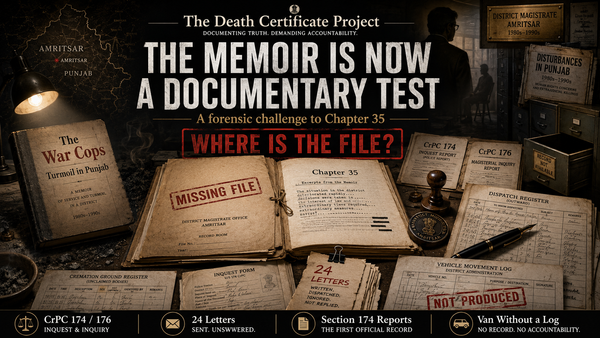
Second: in the same chapter, Singh records that he repeatedly asked his Senior Superintendents of Police — naming BUA Singh and Mohammad Izhar Alam — to send him Section 174 reports. He records further that he sent at least twenty-four separate communications to the Home Ministry at both Punjab State and central government levels, addressing his understanding of his obligations regarding inquiry into deaths and disappearances. He states no response was received. He produces no dak numbers, no file references, no dispatch register entries, no dates, and no identifiable addressees for any of those twenty-four communications. He acknowledges that the Senior Superintendents of Police in the three police districts under his revenue district were under his general supervision under the Police Act.
These disclosures sit in direct and irreducible documentary contradiction. Section 174 is the statutory reporting gateway through which unnatural and suspicious deaths enter the civil-magisterial accountability structure. Section 176 is the independent magisterial inquiry mechanism whose activation is triggered, or in police-custody deaths mandated, by what that gateway discloses. A District Magistrate who repeatedly requested Section 174 reports recognized, by that act of requesting, that the deaths those reports would document belonged within the statutory chain whose institutional downstream consequence is the inquiry he simultaneously maintains was not required.
This article is a forensic audit of an established documentary contradiction. It is not a criminal accusation. It does not allege that Ramesh Inder Singh personally ordered, authorized, or concealed any unlawful killing or cremation. It demands what any forensic audit demands: the file. Not the memoir, not the recollection, not the retroactive legal position — the administrative file that recorded what the DC/DM's office did, or did not do, when the statutory obligation arrived at its desk.
The body was present before the fire. The law was present before the fire. The file should have been created before the smoke rose.
Opening: The Contradiction Is Chapter 35's Own
This article does not construct a contradiction and hold it against the memoir. It reads the contradiction Chapter 35 constructs within itself — and holds the author to the evidentiary obligations of his own disclosures.
Ramesh Inder Singh Mandher, IAS — DC/DM of Amritsar from 4 June 1984 to 6 July 1987 — states in Chapter 35 of Turmoil in Punjab that his contemporaneous legal understanding was this: in the absence of a dead body, no Section 176 inquest was required or appropriate. [PF — Turmoil in Punjab, Chapter 35 ("The War Cops"); personally and repeatedly verified by this Project's editorial director.] This is not a casual aside. It is a considered legal proposition offered as the understanding that governed his conduct as the chief civil administrative authority of Amritsar district during the post-Blue Star period — the period in which the machinery of illegal cremations that the CBI and NHRC would later document was set in motion. The proposition is advanced in the memoir as contemporaneous belief, and it is attributed to a consultation with legal counsel, identified in the memoir only as "the District Attorney."
In the same chapter, the same author records the following:
That he repeatedly asked his Senior Superintendents of Police — naming BUA Singh and Mohammad Izhar Alam — to send him Section 174 reports. [PF — ibid.]
That he sent at least twenty-four separate communications to the Home Ministry, at both the Punjab State and central government levels, regarding the question of his obligations and expectations in relation to the conduct of inquiry into deaths and disappearances under his tenure. [PF — ibid.]
That no response was received from the Home Ministry to any of those communications. [PF — ibid., Singh's own stated claim.]
That none of those twenty-four communications is supported in the memoir by a single dak number, file reference, dispatch register entry, date, or identifiable addressee. [PF — ibid., established by the absence of any such documentation in the published text.]
That the Senior Superintendents of Police in his three police districts were under his general supervision under the Police Act. [PF — ibid.]
These are not this Project's characterizations of the memoir. They are the memoir's own content, in the author's own words, in a chapter he published under his own name, as a record of his own conduct in public office. They have been personally and repeatedly verified.
The contradiction they produce does not require inferential construction. It sits on the face of Chapter 35. The same document that advances the legal position that no body meant no Section 176 inquiry records that its author repeatedly requested Section 174 reports — which are, in the statutory grammar of the Code of Criminal Procedure, the reporting instrument that places deaths into the civil-magisterial field in which Section 176 inquiry is the next institutional step.
An officer who requests Section 174 reports is an officer who has recognized that the deaths those reports would document belong in the statutory reporting chain. An officer who simultaneously maintains that no body means no Section 176 cannot coherently have been requesting the reports that feed the statutory mechanism he claims was inapplicable. He cannot simultaneously pursue the trigger and disclaim the consequence.
That is the contradiction this article is built on. It is Chapter 35's own contradiction. This Project's task is only to read it.
Part I: The Legal Position and Its Constitutional Limits — When "May" Becomes "Must"
The no-body/no-Section-176 position, as it appears in Chapter 35, has surface legal support from the pre-2005 statutory text. Before the 2005 amendment introduced Section 176(1A) — which expressly mandates Judicial or Metropolitan Magistrate inquiry where a person dies or disappears in police or other authorized custody — Section 176(1) used the word "may": a Magistrate so empowered "may hold an inquiry into the cause of death either instead of, or in addition to, the investigation held by the police officer." [PF — CrPC Section 176(1), pre-2005 text.] A reading of that word in isolation produces a discretionary power, not a mandatory duty.
This article does not apply the 2005 amendment retroactively to the 1984–1987 period. [Note: the 2005 amendment is referenced in this article only as Parliament's subsequent legislative acknowledgment that the structural gap exposed by exactly this kind of administrative silence was real and required explicit statutory remedy.] The legal argument advanced here rests entirely on the law as it stood during the relevant period, interpreted through established constitutional doctrine.
The doctrine of power coupled with duty.
In Julius v. Lord Bishop of Oxford (1880) 5 App Cas 214, the House of Lords articulated a principle of statutory construction that Indian administrative and constitutional law has received and applied: where Parliament grants a power to a public authority for the specific purpose of protecting individuals from injury, that power cannot be treated as unlimited discretion. Where conditions exist that call for the exercise of that power in furtherance of its protective purpose, "may" imposes a duty. The word "may" becomes "must" when the circumstances triggering the protective function of the power are present. [AI — this is the established constitutional law argument available to this Project; it is an inference from doctrine, not a citation to a specific Indian judicial holding addressing this precise administrative scenario.]
Section 176 was not designed as an administrative convenience. It was designed to prevent the police from exercising final, uncontested narrative control over deaths occurring within their sphere of custody, contact, or operational action. Its protective purpose is explicit in its structure: it creates a magisterial inquiry mechanism that operates independently of and parallel to the police investigation, empowered precisely because the police cannot be trusted to investigate themselves. When Section 174 reports arrive at the DC/DM's office — or when the DC/DM's office seeks to receive them, as Chapter 35 records it did — describing suspicious or unnatural deaths in which police involvement is present or suspected, the "may" of Section 176(1) does not permit the empowered magistrate to do nothing. Not without recording a reason. Not without making a documented determination. Not without leaving a file that shows what the civil-magisterial node did when the deaths of human beings arrived at its statutory desk.
Where mass suspicious deaths with documented police involvement in disposal reached a DC/DM's office through the very Section 174 report requests the memoir records, the constitutional doctrine of power coupled with duty transformed the textual "may" into a constitutional obligation. To hold otherwise would be to permit the State to extinguish the procedural rights created by Article 21 — the right not to be deprived of life without due process — through the act of body destruction that is itself the alleged violation. Indian constitutional law does not permit that circularity.
The police-custody mandatory category.
The pre-2005 Section 176 was not uniformly discretionary across all categories of death. Where deaths occurred in police custody under circumstances the pre-2005 text addressed, mandatory inquiry applied. The CBI/NHRC proceedings documented that 2,097 bodies were cremated as unidentified or unclaimed in Amritsar district, with substantial police involvement in their transport and disposal. [PF — CBI investigation; NHRC proceedings; Supreme Court of India, 12 December 1996.] In the record of those proceedings, the police-custody mandatory category of Section 176 was unambiguously engaged for a significant portion of the documented deaths — and that category applied even under the pre-2005 statutory text.
The no-body defense, applied to deaths in which police were involved in the transport, classification, and cremation of bodies before any magisterial record was created, is not a neutral interpretation of the Code's "may." It is an interpretation that removes from the civil-magisterial structure exactly the function that structure was designed to perform: the independent, non-police recording and examination of suspicious and custodial deaths. The Constitution does not authorize that removal.
Part II: The Statutory Architecture — Section 174 as Gateway, Section 176 as Obligation, Punjab Police Rules as the Reporting Bond
Section 174, CrPC — the gateway.
Section 174, as it stood during the relevant period, required a police officer discovering a person who had apparently died under suspicious, violent, unnatural, or unknown circumstances to: notify the nearest empowered Executive Magistrate; draw up a written report describing the circumstances; and forward that report to the District Magistrate or Sub-Divisional Magistrate. [PF — CrPC Section 174, pre-amendment.] The notification obligation was not confined to deaths clearly in police custody. It extended to every suspicious or unnatural death within the officer's knowledge. The District Magistrate was the civil-administrative node where the death formally entered the structure of legal accountability — and where the determination about the State's statutory next step was required to be made.
The gateway metaphor is precise. Section 174 is not merely a reporting form. It is the instrument that places a death before the civil-magisterial structure with the implicit demand that the structure respond. The response might be a Section 176 inquiry. It might be a recorded decision that inquiry is not warranted and the reason why. But the absence of any response — no inquiry, no recorded reason, no file notation — is not a permissible outcome in a legally disciplined office. It is administrative silence where the law requires documentation.
Section 176, CrPC — the independent inquiry.
Section 176, pre-2005, empowered specified magistrates to hold an inquiry into the cause of death independently of any police investigation — without waiting for a police request, without a complainant's petition, on the magistrate's own authority wherever awareness of a suspicious or unnatural death existed. [PF — CrPC Section 176, pre-amendment.] The Section's independence from the police reporting chain was not procedural elegance. It was the constitutional premise of the provision. A magistrate who requires police cooperation to activate Section 176 has misread the Section's design at its foundation. The Section exists precisely because police cooperation cannot be assumed where police involvement in a death is possible.
The legal discipline the Section imposed on the DC/DM's office was this: a Section 174 report received requires a determination. Inquiry — in which case the inquiry file is created. Or no inquiry — in which case the decision not to inquire, and the reason for it, becomes part of the administrative record. The absence of both is not a neutral outcome. It is a failure of the institutional record-keeping obligation the office carried.
Chapter XXV, Punjab Police Rules, 1934 — the reporting bond between SSP and DM.
The CrPC did not operate in administrative isolation. The Punjab Police Rules, 1934 — the subordinate legislative framework governing police conduct in Punjab throughout the relevant period — imposed specific obligations on the reporting chain between police stations, the SSP, and the DC/DM's office in relation to unnatural deaths and inquest procedure. Chapter XXV of the Punjab Police Rules addressed this chain directly. [Note: specific rule numbers within Chapter XXV will be cited when confirmed from a primary source; the characterization of Chapter XXV as governing the SSP-to-DM reporting architecture for unnatural deaths and inquest matters is established from secondary and legal literature reviewed by this Project.] [PF pending precise rule citation; [AI] as to operational implications below.]
The Rules bound the SSP to the reporting hierarchy running upward toward the DC/DM's supervisory jurisdiction. A systematic failure by the SSP to produce required reports on unnatural deaths was not an insulated police-internal failure. It was a breakdown in the civil-administrative reporting chain that the DC/DM's general supervisory authority — acknowledged by Singh in Chapter 35 — was structurally positioned to detect, document, and address. [AI]
The legal consequence, stated clearly: if the SSPs under Ramesh Inder Singh's supervision failed to send Section 174 reports as required under the CrPC and the Punjab Police Rules, that failure was itself a DC/DM accountability event — an event requiring documentation, escalation, and a file record showing the civil administration's response to police non-compliance with statutory obligations. An office that merely kept asking, without recording the requests, without documenting non-receipt, without escalating the failure, without producing a trail that shows what happened when the police did not comply — is not an office that can point to the asking as a discharge of its institutional obligations. [AI]
Part III: The Trigger He Requested, The Inquiry He Did Not Initiate — The Contradiction at the Heart of Chapter 35
The documented contradiction can now be stated with forensic precision.
Chapter 35 of Turmoil in Punjab records: Singh understood that no body meant no Section 176 inquest. [PF — as verified.] Chapter 35 also records: he repeatedly requested Section 174 reports from SSPs BUA Singh and Mohammad Izhar Alam. [PF — as verified.]
Section 174 is the gateway. Section 176 is the inquiry beyond the gateway. An officer who repeatedly walked to the gateway and asked for it to be opened cannot simultaneously maintain that he believed the passage it led to did not apply. The act of requesting the Section 174 reports is the documented acknowledgment that the deaths those reports would capture belonged within the statutory chain. The simultaneous maintenance of a no-Section-176 position means that the DC/DM believed the chain should stop at the gateway — that bodies should be reported to his office and then administratively absorbed without inquiry, without file, without recorded disposition.
If that is the correct reading of Chapter 35's disclosures, it is more damning than any external allegation this Project might construct. It means the DC/DM's office was positioned as the place where the statutory accountability chain terminated by design, not by oversight — a place where Section 174 reports arrived and the legal accountability they were meant to initiate was administratively absorbed.
The three logical implications of the established facts:
Implication One: Section 174 reports were received. The DC/DM's office received reports documenting deaths under suspicious or unnatural circumstances. Those reports were then not converted into Section 176 inquiries or into recorded decisions explaining why inquiry was declined. If this is what happened, there is a Section 174 register. It shows which reports arrived. And there is no corresponding Section 176 inquiry file or reason-for-declination record alongside them. That gap is the administrative record of the decision to absorb rather than inquire. The gap must be produced — not to prove guilt, but because a public office does not get to claim it acted lawfully while declining to show what it did.
Implication Two: Section 174 reports were not received because the police did not send them. The DC/DM's repeated requests were systematically ignored or unfulfilled. If this is what happened, the DC/DM's office recorded the non-receipt, documented the requests that went unanswered, escalated the police's non-compliance through the administrative chain, and produced a paper trail showing what the civil administration did when the police failed to comply with their statutory reporting obligations under both the CrPC and the Punjab Police Rules. That trail must be produced.
Implication Three: The requests were made as a matter of administrative form without expectation or intent of receipt — a procedural gesture that would allow the memoir, decades later, to record that the DC/DM had tried. [AI — this inference is drawn from the structural pattern of the memoir's account; it is not asserted as proved and is labeled accordingly.] If this is what happened, it is the most direct challenge to the memoir's credibility as an administrative account — and the one that only the contemporaneous administrative record can answer.
In every implication, the answer is the same: the file must be produced. Not the memoir's account of what the DC/DM did. The contemporaneous administrative record of what the DC/DM's office did.
Part IV: The Unnamed District Attorney — A Legal Opinion Whose Author Cannot Be Named Is Not a Legal Opinion
Chapter 35 records that Singh consulted the District Attorney regarding his obligations under Section 176 and that this consultation informed his understanding that no body meant no inquest. [PF — as verified.] The memoir does not name this person. It does not provide the date of the consultation. It does not reproduce the opinion, summarize its reasoning, identify a file reference, or cite a dak register entry. [PF — established by the absence of these identifiers in the published text.]
Consider the structural significance of that omission in the context of the chapter that contains it.
Chapter 35 is a chapter that names people. It names BUA Singh and Mohammad Izhar Alam. It describes specific interactions. It attributes specific actions to specific individuals. The chapter is not characterized by vagueness about the human beings Singh dealt with during his tenure. It is characterized by specificity — the kind of specificity that a retired administrator produces when he wants the reader to understand that his account is grounded, particular, and verifiable.
Against that backdrop of named officers and specific interactions, the decision not to name the District Attorney whose legal opinion supposedly justified the most consequential administrative choice of Singh's tenure — the choice that no body meant no inquiry, that suspicious deaths occurring under police-adjacent circumstances did not require independent civil-magisterial examination — is a structural omission that this Project cannot overlook.
A District Attorney's formal legal opinion rendered to a District Magistrate on a question of this magnitude would not have been a verbal aside quickly forgotten. It would have been the legal foundation for a policy of non-inquiry that governed the DC/DM's office's response to dozens, potentially hundreds, of Section 174 reports over more than three years. It would have been recorded, retained, and cited — precisely because any competent administrator who chooses not to conduct inquiries into mass suspicious deaths on the basis of a legal interpretation wants that interpretation on file, in case the question is ever asked.
The question is now being asked. The opinion is not on file — not in any public record this Project has been able to review. The person who rendered it cannot be named. The date cannot be given. The file reference does not exist in the memoir. [PF — established by absence.]
A legal opinion that cannot be attributed to a named author, cannot be dated, cannot be located in a file, and cannot be reproduced beyond the self-serving conclusion the memoir attributes to it forty years later is not, in this Project's evidentiary framework, a legal opinion in the sense that the law requires. It is a memoir claim about a legal opinion. And memoir claims about legal opinions are not legal authority for the administrative decisions they are now offered to justify.
This Project's demand is direct: name the District Attorney. Produce the date of consultation. Produce the written opinion or the file notation recording any advice given. Produce the file number and the dak register entry. If none of these exists in recoverable form, the legal foundation for the no-body/no-Section-176 position is unsupported by any verifiable record — and the administrative decisions made on the basis of that position stand unjustified by anything other than the author's personal recollection.
Part V: Twenty-Four Communications Without a Single Dispatch Entry
Chapter 35 records that Singh sent at least twenty-four communications to the Home Ministry — at the Punjab State and central government levels — regarding his understanding and expectations in relation to conducting inquiries into deaths and disappearances during his tenure, which included a period under President's Rule. [PF — as verified.] He states that no response was received from the Home Ministry. [PF — ibid., his own claim.] The memoir supplies no dak numbers, no dates, no file references, no dispatch register entries, and no identifiable addressees for any of those twenty-four communications. [PF — established by absence of such documentation in the published text.]
This Project addresses these claimed communications not to assert that they did not occur, but to establish what their occurrence — if it occurred as described — would require the administrative record to show. And what the administrative record's silence, if that is what the record now shows, would mean.
A District Magistrate's office in Punjab in the 1980s maintained a dispatch register as a fundamental instrument of administrative record-keeping. Every formal communication leaving the DC/DM's office — every letter, every telegram, every signal, every official correspondence — was entered in that register with a serial number, a date, a designation, and an addressee. The dispatch register was not optional. It was the administrative spine of the office's outgoing correspondence. It was subject to inspection. It was maintained as a matter of standard IAS administrative practice.
Twenty-four formal communications dispatched from the DC/DM's office to the Home Ministry — at two levels of government, on a question of this constitutional significance, during a period when the district was under President's Rule and therefore in a state of heightened formal administrative accountability — would generate twenty-four entries in the dispatch register. Those entries are not subject to the fallibility of memory. They are contemporaneous inscriptions on a document maintained at the time of dispatch. They are independently verifiable without reference to the author's recollection. They either exist or they do not.
The claim that twenty-four such communications were sent and received no response at either level of government also requires an administrative reckoning. In the culture of IAS administrative correspondence, a formal query sent to the Home Ministry on a question of the DC/DM's statutory obligations during an active counterinsurgency in a district under President's Rule would be expected to generate a reply — or would require explicit escalation when a reply was not received. The non-receipt of a response to a single such communication would be noted in the file. The non-receipt of responses to twenty-four such communications — a number the memoir records with evident precision — would represent a documented pattern of governmental non-response that would itself demand escalation, formal record, and administrative consequence. The silence on the other end would not simply be absorbed into the DC/DM's private knowledge. It would be part of the file.
If twenty-four dispatch register entries exist, this Project formally requests their production. If they do not exist, the public record does not contain the documentary foundation for the claim the memoir advances, and the claim remains unverifiable personal recollection. Neither outcome is administratively neutral for a retired public official offering these communications as evidence of the diligence and good faith with which he discharged his office.
Part VI: "General Supervision" — The Memoir's Concession and Its Institutional Weight
Chapter 35 records that the Senior Superintendents of Police in the three police districts falling within Singh's revenue district of Amritsar were under his general supervision under the Police Act. [PF — as verified.]
This is a concession, not a defense.
The Police Act, 1861, and the Punjab Police Rules, 1934, supply the legal content of general supervision. Under this framework, the District Magistrate exercised general control and direction over police administration within the local jurisdiction — a supervisory relationship that included the authority to call for and inspect the station general diary, to require reports on law-and-order situations, to receive and act on unnatural death intimations under the CrPC-rules framework, and to document and escalate police non-compliance with civil-administrative directives. General control and direction did not make the DC/DM the operational author of every police act, and this Project does not assert that it did. What general control and direction established was that the DC/DM's office was the legally positioned supervisory and accountability node in the civil-administrative structure — the place where police non-compliance with statutory reporting obligations was not simply absorbed but was required to generate a documented administrative response. [AI]
The memoir confirms that this supervisory relationship was operationally real, not merely titular. Chapter 35 names the SSPs. It describes specific interactions with named officers. It records specific requests made to those officers in the author's supervisory capacity. [PF — as verified.] An operationally real supervisory relationship, confirmed by the author's own published account of the specific interactions it generated, carries the legal implications of that relationship's statutory basis. It cannot be claimed in the memoir as evidence of administrative engagement and simultaneously disclaimed when the question turns to what that supervisory engagement required the office to do when the police responded inadequately or not at all. [AI]
General supervision over SSPs who were responsible for — or directly involved in — the transport, classification, and disposal of unidentified bodies in Amritsar district made the systematic absence of Section 174 reports not a police-insulated failure but a DC/DM institutional accountability event. The failure to receive the reports, if that is what occurred, required documentation. The documentation of that failure — the record of requests made and reports not received, of the escalation that followed, of the administrative consequence visited on the reporting failure — would be part of the file that this Project is demanding. The supervisory relationship the memoir acknowledges is the institutional bridge between what the police did and what the DC/DM's office was obligated to respond to, document, and escalate. That bridge was built on both sides. The failure to produce the file that shows how it was used is a failure on the civil side of the structure — the side that Ramesh Inder Singh occupied from 4 June 1984 to 6 July 1987.
Part VII: Administrative Custody of the Dead — The Firewood Voucher Is Part of the File
The no-body/no-Section-176 position assumes that the DC/DM's administrative contact with the bodies disposed of as unidentified was essentially zero — that the State's handling of those bodies occurred in a law-enforcement silo with no civil-administrative interface that would have brought the disposals within the DC/DM's statutory field of knowledge or responsibility.
That assumption cannot survive examination of the administrative infrastructure through which those disposals occurred.
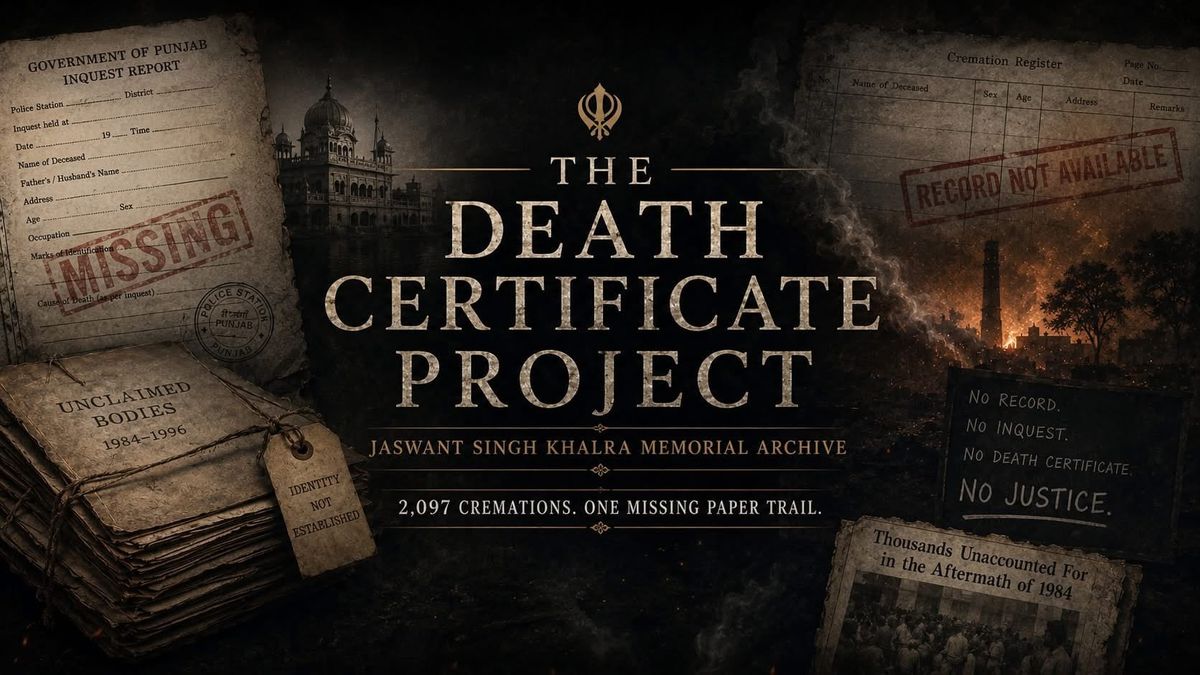
The CBI and NHRC proceedings established that 2,097 bodies were cremated as unidentified or unclaimed in Amritsar district, with substantial police involvement in their transport and delivery to cremation grounds. [PF — CBI/NHRC proceedings; Supreme Court record.] Cremations at municipal cremation grounds in India during this period did not occur without generating an administrative paper trail. Each cremation generated — or was required to generate — the following:
A cremation register entry at the cremation ground, recording the date, a description of the body, the source authority presenting the body for cremation, any identification details noted, and the recorded disposition. A firewood purchase record, because firewood was procured — from police or municipal budgets — for each cremation, and those procurements appeared in accounts that were audited. An administrative authorization for disposal at public expense, because unidentified or unclaimed bodies cremated at public cost required authorization from some point in the institutional chain. Budget entries at the police or municipal level, creating an expenditure trail that existed within the audit and oversight structures of the district's administrative apparatus.
These records were not generated in a vacuum sealed from civil-administrative oversight. The cremation ground was a municipal or state-managed facility operating within the district's civil administration. The budget from which firewood was purchased was subject to audit oversight that ran through the administrative structure of which the DC/DM's office was the apex civil node. The authorization for disposal of a body at public expense was an administrative act that took place within the institutional field the DC/DM supervised.
A DC/DM who exercised general supervision over the SSPs — who by Chapter 35's own account interacted with named superintendents about the handling of deaths and inquiries in his district — was not administratively insulated from the institutional paper trail of the disposals those SSPs were overseeing. The firewood vouchers were administrative documents. The cremation register was an institutional record. The body disposal authorizations were acts within the administrative field. [AI] Their existence, if they were properly maintained, would fall within the audit and oversight reach of the DC/DM's office. Their absence from any public accounting is not an administrative neutral event — it is a forensic question. [AI]
This Project demands: the cremation registers for the period of Ramesh Inder Singh's tenure; the firewood purchase records; the body disposal authorizations; the budget entries recording cremation expenditures; and any DC/DM office inspection, audit, or notation pertaining to cremation ground operations, unidentified body registrations, or municipal disposal records during the period 4 June 1984 to 6 July 1987.
Part VIII: The 2,097 — The Numbers That Require the Register
The CBI/NHRC proceeding concerning illegal cremations in Amritsar district documented 2,097 cremations of bodies in circumstances that the Supreme Court of India characterized, on 12 December 1996, as disclosing a flagrant violation of human rights on a mass scale. [PF — CBI investigation; NHRC proceedings; Supreme Court of India, 12 December 1996.] The early classification within the proceeding reported 585 fully identified, 274 partially identified, and 1,238 entirely unidentified bodies. Later NHRC relief proceedings reported 1,513 identified and 532 remaining unidentified. [PF — NHRC record; Ensaaf documentation.]
Ramesh Inder Singh's tenure ran from 4 June 1984 to 6 July 1987. [PF — official Amritsar Deputy Commissioner chronological list.] The period immediately following Operation Blue Star, through which his tenure extended, encompasses the beginning of the systematic counterinsurgency apparatus whose institutional output the CBI and NHRC proceedings later documented at mass scale. The three DC/DM tenures that bracket the full 2,097 record are: Ramesh Inder Singh Mandher (4 June 1984 to 6 July 1987), Sarabjit Singh (7 July 1987 to 10 May 1992), and K.B.S. Sidhu (11 May 1992 to 11 August 1996). [PF — official Amritsar DC chronological list.]
This Project does not assert, and will not assert without specific documentary support, the precise number of the 2,097 cremations that falls within Ramesh Inder Singh's specific tenure. That determination requires the cremation registers — documents this Project is formally demanding. What the scale and timing of the documented cremations make clear is that the institutional apparatus producing those cremations was operational from the beginning of the period these three DC/DM tenures cover, and that the civil-administrative office occupying the DC/DM position from the first day of that period was the statutory supervisory node through which the Section 174 reporting chain ran, and to which the Section 176 inquiry authority was assigned. [AI]
The 2,097 is not a rhetorical number. It is the CBI and NHRC's documented count of bodies that moved through Amritsar district's institutional infrastructure — through police custody, transport, delivery to cremation grounds, cremation register entry, and firewood consumption — without the Section 174/176 process creating the legal record that would have converted those disposals from administrative erasure into documented accountability. The question is not whether this happened. The question is who held the civil-administrative office through which that process was legally required to pass, and what that office did.
Part IX: Why Compensation Is Not a Death Certificate
The NHRC relief proceedings have produced monetary awards for a number of families. This Project acknowledges those awards as partial advances in an accountability record that remains profoundly incomplete.
Compensation is not a death certificate. The difference between them is not merely semantic, and it is not merely legal. It is civilizational.
A death certificate is the State's minimum documentary admission that a specific named person existed, died, on a specific date, under specific circumstances, in a manner that the State has formally recorded and to which the State has attached its institutional authority. It is the document that converts a person's death from a private catastrophe or an administrative entry into a fact of public legal record — a fact that carries accountability implications for whoever the record shows was responsible for the circumstances of that death.
Without a death certificate founded on an inquest or its legal equivalent, the following remain legally unresolved for the 532 bodies still unidentified in the NHRC's final count, and for every body whose cause of death was never formally established through Section 176 or any equivalent inquiry: What was the cause of death? What were the circumstances? Who last had custody of the person before death? Was the death the product of a lawful act or an unlawful one? Which officer, which institution, which administrative decision is legally connected to the moment of death?
Compensation closes the financial claim without answering any of these questions. Identification achieved decades later through litigation gives a name — but it is not the same as identification achieved through the statutory process designed to operate before disposal. The statutory process, had it operated, would have linked the name, the cause, the custody, and the circumstances into a contemporaneous legal record that could then be used in criminal proceedings, civil suits, administrative accountability inquiries, or at minimum, the historical record that families and communities deserve to hold.
Section 176, had it operated as it was constitutionally required to operate, would have generated exactly that record. The magistrate's findings might have been inconclusive — evidence might have been sparse, witness access limited, police cooperation absent. But a recorded finding that a death occurred, that circumstances were suspicious, that identification was not achieved despite efforts, that cause of death could not be determined without further inquiry — even that inadequate finding would have been more than what families received. Which was nothing. Not even the official acknowledgment that the inquiry was attempted.
Money does not close that gap. The missing file does.
Part X: The Three-DC Corridor — The Institutional Accountability That Outlasts Any Individual Memoir
This article focuses on Ramesh Inder Singh's tenure because the documentary contradiction originates in his own published chapter. But the archive's fundamental accountability question is institutional before it is personal, and the three DC/DM tenures cannot be treated as isolated biographical episodes.
The DC/DM office of Amritsar was a continuous civil-administrative institution from 4 June 1984 to 11 August 1996 and beyond. It operated under the same statutory framework throughout. It carried the same Section 174/176 obligations throughout. It exercised the same general supervisory authority over the police throughout. The Section 174 register, the Section 176 inquiry file, the unidentified body register, the cremation authorization records, and the Home Department correspondence are institutional records — they belong to the office, not to any individual officer, and they cover all three tenures.
Sarabjit Singh, IAS (7 July 1987 to 10 May 1992) occupied the same desk, held the same statutory obligations, and supervised the same police districts through the most intensive period of the counterinsurgency — the period that accounts for the largest share of the 2,097 documented cremations. K.B.S. Sidhu, IAS (11 May 1992 to 11 August 1996) occupied the same desk through the period's final phase and has published extensively on his public role during that tenure, providing this Project with a parallel evidentiary archive examined in prior articles in this series.
The institutional file does not close when one DC/DM departs and another arrives. It accumulates. The Section 174 register for the period 4 June 1984 to 11 August 1996 contains entries — or gaps where entries should be — across all three tenures. The Section 176 inquiry file, if it exists, spans all three. The unidentified body register, if it was maintained, covers the full period. These documents belong to an office, not to three individuals writing separate memoirs. The RTI request must be directed to the institution. The document demand covers the full corridor.
Ramesh Inder Singh's memoir has created a documentary opening in this corridor because Chapter 35 discloses, by the author's own hand, facts that generate demands the file must answer. This Project reads that opening for what it is: not a personal indictment, but an institutional audit trigger. The audit is now formally opened.
Part XI: Formal Interrogatories
The Death Certificate Project places the following interrogatories on the public record, addressed to the retired DC/DM Ramesh Inder Singh Mandher, IAS; to his successors Sarabjit Singh, IAS and K.B.S. Sidhu, IAS; to the District Records Room, Amritsar; and to the Home Department, Government of Punjab.
To Ramesh Inder Singh Mandher, IAS — DC/DM Amritsar, 4 June 1984 to 6 July 1987:
- Chapter 35 of Turmoil in Punjab records your understanding that no body meant no Section 176 inquest. Name the District Attorney you consulted in forming this position.
- Provide the date of that consultation.
- Produce the written legal opinion or the file notation recording any verbal legal advice received, with file number and dak register entry.
- If the opinion was given verbally, identify the file note recording it, the officer who prepared that note, and the file in which it is retained.
- State the precise question you put to the District Attorney and reproduce the answer you received as accurately as any contemporaneous record permits.
- Produce the Section 174 report register for the period of your tenure: 4 June 1984 to 6 July 1987.
- How many Section 174 reports were received by the DC/DM office during that period?
- For each Section 174 report received, what was the DC/DM office's documented disposition — inquiry initiated, recorded reason given for non-inquiry, or no disposition made?
- If no Section 176 inquiry was held for any suspicious or unnatural death reported during your tenure, produce the recorded reason: who made it, on what date, in which file.
- Chapter 35 records that you repeatedly requested Section 174 reports from BUA Singh and Mohammad Izhar Alam. How many such requests were made?
- On what dates were those requests made, in what form, and under what file reference?
- Produce the records of each such request.
- How many Section 174 reports were withheld, delayed, or never provided in response to your requests?
- Was the police's failure to provide required Section 174 reports documented by your office?
- Was that failure escalated? To whom? On what date? In what form? Produce the escalation record.
- Chapter 35 records that you sent at least twenty-four communications to the Home Ministry during your tenure. Produce the date, file number, dak register entry, and specific addressee for each.
- Produce the copies of those communications retained in the DC/DM office file.
- Produce the file notation or escalation record documenting the absence of a Home Ministry reply.
- Chapter 35 records that the SSPs were under your general supervision under the Police Act. What specific written supervisory directions did you issue regarding the police's handling of unnatural deaths — including transport, classification, and disposal of bodies as unidentified or unclaimed?
- Produce those written supervisory directions.
- Were any SSPs under your supervision directed in writing to halt the disposal of bodies as unidentified until identification procedures were completed?
- How many unidentified or unclaimed bodies were cremated in Amritsar district during your tenure?
- Who authorized each such cremation, and what administrative record was generated at the point of authorization?
- Produce the cremation registers for the period of your tenure.
- Produce the firewood purchase vouchers for cremations conducted during your tenure.
- Produce the body handover records for the period of your tenure.
- Produce the budget entries recording cremation expenditures during your tenure.
- Were postmortem examinations conducted on any bodies prior to cremation during your tenure?
- Were photographs taken of bodies prior to cremation?
- Were fingerprints taken?
- Were personal effects — clothing, kara, religious articles, documents, weapons — inventoried at the time of body receipt?
- Was family notification attempted for any body disposed of as unidentified?
- Were death certificates issued for any person cremated as unidentified during your tenure? If not, who recorded the reason for non-issuance, in which file, on what date?
- Produce any DC/DM office audit or inspection records pertaining to cremation ground operations, unidentified body registers, or police records relating to unnatural deaths during the period of your tenure.
To the District Records Room, Amritsar, and the Home Department, Government of Punjab:
- Does the DC/DM office, Amritsar, maintain a Section 174 report register for the period 4 June 1984 to 11 August 1996?
- Does it maintain a Section 176 inquiry register for the same period?
- Does it maintain a register of unidentified or unclaimed bodies received, held, or cremated during this period?
- Does it maintain cremation authorization files or body disposal authorization records for this period?
- Does it maintain firewood purchase records for cremations conducted during this period?
- Does the Home Department file contain any record of communications from the Amritsar DC/DM's office regarding Section 174 or 176 obligations during the period 4 June 1984 to 6 July 1987?
- If any of these records have been destroyed, produce the retention certificate authorizing destruction, the statutory provision under which they were destroyed, the date of destruction, the authorizing officer, and the location of the destruction certificate itself.
Conclusion: The Ash Is Not the End
The body was cremated. The doctrine survived the fire.
The doctrine says: without a body, there is no Section 176. Without Section 176, there is no inquiry. Without an inquiry, there is no file. Without a file, there is no death certificate. Without a death certificate, there is no legal cause of death. Without a legal cause of death, there is no institutional accountability. The dead of Amritsar remain, permanently, in the administrative condition the firewood created: unnamed, unrecorded, uncertified, erased from the legal history the State controls.
This Project rejects that doctrine. It rejects it not from principle alone but from the memoir that, in attempting to defend one chapter of that history, has disclosed the facts that make the rejection inescapable.
Chapter 35 of Turmoil in Punjab records that Ramesh Inder Singh Mandher, IAS, DC/DM of Amritsar from 4 June 1984 to 6 July 1987, understood that no body meant no Section 176. It records further that he consulted a District Attorney whose name he cannot provide. It records that he asked named SSPs for Section 174 reports. It records that he sent twenty-four undocumented communications to the Home Ministry. It records that the SSPs were under his general supervision. It records all of this in a chapter whose author presents it as a defense of his tenure.
This Project reads it differently. It reads it as the authored record of the civil-magisterial office's relationship with the statutory obligations it held during the years in which 2,097 bodies moved through Amritsar's institutional infrastructure — police to cremation ground, body to firewood, person to ash — without the legal record that Section 174 and Section 176 were designed to create. The memoir has made the DC/DM's office's relationship to those statutory obligations a matter of public disclosure. The disclosure creates the demand.
The pre-2005 "may" of Section 176 was not an unlimited discretion in the face of mass suspicious deaths. The doctrine of power coupled with duty transformed it into a constitutional obligation wherever the conditions justifying the Section's protective purpose were present. The Punjab Police Rules imposed a reporting hierarchy that made SSP non-compliance a DC/DM accountability event requiring documentation and escalation. The administrative infrastructure of the disposals — cremation registers, firewood vouchers, body disposal authorizations, budget entries — existed within the civil-administrative supervisory field. None of these obligations dissolved because the police did not cooperate. They existed independently of police cooperation. They were the civil side of the accountability structure — the side that cannot point across the aisle at the police and call its own silence a defense.
The file behind Chapter 35 has not been produced. The District Attorney has not been named. The twenty-four communications have not been documented. The Section 174 registers have not been released. The Section 176 inquiry file — or the record of why no such inquiry was held — does not appear in any public accounting. The cremation registers remain unproduced. The firewood vouchers have not surfaced. The body disposal authorizations are not in the public domain.
A memoir is not these documents. A memoir is the author's account of what he did. These documents are the institutional record of what actually happened. They are not the same thing, and in a forensic accountability proceeding, only one of them is the file.
This Project is asking for the file. It will keep asking.
The State cannot allow the body to disappear from the legal process and then use that disappearance as the reason no inquiry was required. The body was present before the fire. The law was present before the fire. The file should have existed before the smoke rose.
The ash is not the end of the inquest. The ash is the reason the inquest must begin.
ਗੁਰਸ਼ਬਦ ਤੋਂ ਪਹਿਲਾਂ, ਸ਼ਮਸ਼ਾਨਘਾਟ
Before the Gurshabad, the cremation ground.
Right of Reply
The Death Certificate Project acknowledges that Ramesh Inder Singh Mandher, IAS, or any officer, institution, or record custodian in possession of documents relevant to the questions raised in this article, may submit a documentary response — including page citations from Turmoil in Punjab, file numbers, legal opinions, dispatch register entries, cremation authorization records, Section 174 registers, or evidentiary corrections. Any such submission will be reviewed, assessed against the Project's evidentiary standards, and incorporated into this Project's public record by name and date of receipt. Where a produced document resolves or modifies a question raised above, the record will reflect it.
The archive remains open.
Evidentiary Tier Key
[PF] Proved Finding — statutory text, official record, judicial/NHRC record, authenticated document, subject's own published writing, or facts personally verified by this Project's editorial director through direct review.
[DA] Documented Allegation — serious sourced allegation not yet adjudicated to final proof.
[AI] Analytical Inference — reasoned conclusion from pattern, omission, sequence, institutional structure, or document absence.
[PM] Panthic Memory — Sikh collective memory and moral register; never used as substitute for legal proof.
Title: No Body ≠ No Section 176: Ramesh Inder Singh's Chapter 35, the Documented Contradiction, and the Inquest File Amritsar Still Owes
SEO Slug: no-body-no-section-176-ramesh-inder-singh-chapter-35-amritsar-inquest
Meta Description: Chapter 35 of Ramesh Inder Singh's memoir Turmoil in Punjab simultaneously records his no-body/no-Section-176 understanding and his repeated requests for the Section 174 reports that feed that inquiry. The Death Certificate Project demands the statutory file trail — Section 174 registers, Section 176 inquiry records, cremation authorizations — for the period 4 June 1984 to 6 July 1987.
Tags: Ramesh Inder Singh | DC DM Amritsar | Section 174 CrPC | Section 176 CrPC | Turmoil in Punjab | Chapter 35 | The War Cops | Punjab Mass Cremations | Jaswant Singh Khalra | Operation Blue Star | Death Certificate Project | Illegal Cremations | Administrative Accountability | K.B.S. Sidhu | Sarabjit Singh IAS | No Body No 176 | BUA Singh | Mohammad Izhar Alam | NHRC | CBI | Punjab Counterinsurgency | Punjab Police Rules 1934 | Power Coupled With Duty | District Magistrate Amritsar | Inquest File