THE SARBAT DA BHALA AFFIDAVIT

A Public Cross-Examination of K.B.S. Sidhu’s Sikh Governance Claims, Civil-Service Ethics, and Missing Administrative Record, 1989–1996
Article Ten of the series The Cross-Examination of K.B.S. Sidhu — ten long-form forensic articles measuring his present writings on Gurbani, Sikh governance, due process, and civil-service ethics against the administrative record he personally claims for Batala and Amritsar, 1989–1996.
The Affidavit He Wrote Without Knowing It
Every cross-examination requires the construction of two documents. The first is the one the witness is given — the set of questions, the demand for admissions, the confrontation with the record. The second is the one the witness already wrote — the prior statements, the published positions, the biographical claims and moral declarations that have, over time, assembled themselves into the standard against which the conduct is measured.
K.B.S. Sidhu has, across decades of public writing, interviews, and biography, assembled the second document with exceptional thoroughness. He has told us what he values. He has told us what he believes. He has told us what offices he held, what achievements he claims, what principles he regards as binding. He has written on Gurbani and its internal discipline, on Naam and its ethical demands, on Article 21 and the fragility of liberty, on the SPO power and the danger of deniable force, on satkar and its constitutional defensibility, on Sarbat da Bhala as the governing aspiration of the civil servant who holds his calling seriously. He has claimed the beautification of Amritsar’s sacred geography as a monument to his tenure. He has authored the national handbook on the magistrate’s multi-functional authority. He has earned the Prime Minister’s commendation for the conduct of a crisis.
He has, in other words, written the affidavit himself — the document that establishes the standard, names the offices, and claims the competence. This series has done no more than read it carefully. What follows is the cross-examination that the affidavit has earned: the admissions it compels, the questions it generates, and the demand it makes inescapable.
Sarbat da Bhala — the welfare of all — is the prayer with which the Sikh Ardas closes its petition. It is not a sentiment. It is not a benediction. It is a burden of proof. The welfare of all includes the dead, the disappeared, the uncounted, the unnamed — those who cannot reward their protector, who cannot attend the ceremony that honours him, who cannot read the Substack that claims their city as a spiritual achievement. The Sarbat — the all — is tested most severely at precisely the point where it costs the most to honour and confers no benefit on the one who pays the cost. That is the point the cross-examination has been pressing across nine preceding articles. This final article gathers the entire examination into a single public document.
The format is a prosecutor’s request for admissions. Each item is either an Admission — a fact drawn from the subject’s own published record — or a Question — a forensic demand for a document or an answer. Nothing here is invented. Everything is grounded in the record established across this series.
A Note on Evidentiary Tiers
[PF] Proved Finding — official records, court findings, statutory text, or admitted facts.
[DS] Direct Statement — the subject’s own published words.
[AI] Analytical Inference — reasoned conclusion from office, duty, chronology, and the structure of the record.
[QF] Question for File — a demand for a document whose presence or absence settles a question of fact.
PART I — ADMISSIONS FROM THE SUBJECT’S OWN PUBLIC RECORD
The first ten items are admissions — facts drawn entirely from Sidhu’s own published words, his biographical claims, and the official record. They are not contested. They are offered here because they establish the foundation on which the cross-examination rests.
1. [PF/DS] Admit that you are an officer of the 1984 Punjab cadre of the Indian Administrative Service, that you entered the Service near the top of the national merit list, and that you retired in August 2021 as Special Chief Secretary, Government of Punjab, after approximately 37 years of service.
2. [PF/DS] Admit that among the offices you held, you rose to be Additional Chief Secretary (Home) of Punjab — the senior-most civil officer of the department that superintends the Punjab Police.
3. [PF/DS] Admit that in 1989, the Government of India published, through its Department of Personnel and Training, a handbook you authored under the title Sub-Divisional Magistrate: A Multi-functional Authority, which began as a cyclostyled document and was issued as an official DOPT publication applicable, in your own description, across the country.
4. [DS] Admit that you claim, in your own published biography and in published interviews, to have held magisterial charge of the Police District of Batala in 1989.
5. [PF] Admit that you served as Additional Deputy Commissioner (Rural Development) of Amritsar from May 1990 to May 1992 — a posting confirmed by your own service record — and that you have described yourself as Additional District Magistrate of Amritsar for those years, thereby claiming magisterial authority for the period.
6. [PF] Admit that you served as Deputy Commissioner and District Magistrate of Amritsar from 11 May 1992 to 11 August 1996, as recorded on the official list of Deputy Commissioners of the district maintained by the Government of Punjab.
7. [DS] Admit that you served as Project Director of the Golden Temple Beautification Project — the Galliara — during your Amritsar tenure; that you transformed the post-Blue Star security belt around Darbar Sahib into the beautification corridor in consultation with the SGPC; that you describe the project as having been executed despite terrorist opposition and political sensitivity; and that your contribution has been acknowledged in the published history of Sikhism.
8. [DS] Admit that during your Amritsar tenure you successfully handled two aircraft hijackings at Amritsar’s international airport in April–May 1993, and that you received the commendation of the Prime Minister of India for this achievement.
9. [DS] Admit that you publicly frame your civil service and your Amritsar tenure through a Sikh moral vocabulary that includes: Sarbat da Bhala, Nirbhau, Nirvair, Seva, Sach Aachaar, Miri-Piri, and the duty to protect life and liberty — and that you have described Naam as a reality that must be lived through truthful conduct in the world, not confined to private devotion.
10. [DS] Admit that in your retirement writing you have articulated, on multiple occasions, the following propositions: that the executive magistrate holds coercive and protective powers that cannot be reduced to clerical functions; that Article 21 protects life, liberty, and speedy trial, and that detention without timely judicial process corrodes constitutional democracy; that the SPO power is a civil-magisterial power, and that auxiliaries who operate without the civil signature and supervision the law requires constitute deniable force; that the numbers at the end of every shabad in the Guru Granth Sahib are not liturgy but a guarantee; that the Satkar Act is constitutionally defensible and that reverence for Sri Guru Granth Sahib Ji carries legal consequences; and that Punjab’s own experience cautions against the seductive shortcuts of deniable force.
PART II — QUESTIONS ABOUT BATALA
The following questions concern the posting you claim at the Police District of Batala in 1989. They are framed to hold on either fork of the discrepancy this series has documented: whether the posting was real or whether it was not.
11. [QF] Your own author biography and your own SikhNet interview claim that you served as District Magistrate of the Police District of Batala in 1989. Your formal service record, as documented in the official biodata of record, does not show this posting; it records you as Additional Deputy Commissioner of Patiala through September 1989. Produce the posting order of the Government of Punjab that appointed you to the Batala charge, and the order that relieved you. These documents would resolve, definitively and on paper, whether the posting occurred as you claim.
12. [QF] If the Batala posting was real: in what precise capacity did you hold it? Was it as District Magistrate, or as Additional District Magistrate stationed at Batala — and what powers were delegated to you by the posting order? Produce the instrument.
13. [QF] If the Batala posting was real: who was the Senior Superintendent of Police of the Police District of Batala during your charge, and what was the documented relationship between the civil magistracy and the SSP?
14. [QF] If the Batala posting was real: were Special Police Officers appointed in the Police District of Batala during your charge? Under what instrument, over whose signature, for what term, and with what supervision and arms-accounting?
15. [QF] If the Batala posting was real: did the police district generate inquest reports, Section 174 reports, or other records of suspicious, unnatural, or custodial deaths that were transmitted to the executive magistracy? Produce those reports, or produce the record showing no such deaths were reported.
16. [QF] If the Batala posting was real: did unidentified bodies appear in the records of the police district’s cremation grounds during your charge? Produce the cremation registers and any magisterial inquiry files.
17. [AI/QF] If the Batala posting was not real — if your formal service record is accurate and the Batala charge as you describe it did not occur — then the question is a different one: why does your published biography, in multiple iterations, assert a counterinsurgency command at a police district that your service record does not corroborate? The answer to this question bears directly on the reliability of all other biographical claims in your public record.
PART III — QUESTIONS ABOUT ADC AMRITSAR
The following questions concern your two-year posting as Additional Deputy Commissioner (Rural Development) of Amritsar, May 1990 to May 1992 — a posting confirmed by your own service record and by your own accounts.
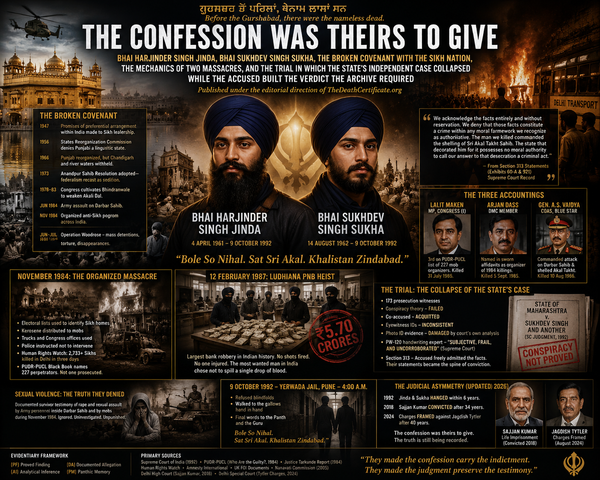
18. [QF] Your portfolio as Additional Deputy Commissioner (Rural Development) covered the rural development administration of Amritsar district — its panchayats, village infrastructure, local bodies, and development works. Amritsar’s rural geography included the areas of Patti and Tarn Taran, where the Central Bureau of Investigation would later confirm the illegal cremation of bodies as unidentified. What did the rural development administration see of those areas, and what did its files reflect?
19. [QF] Municipal and panchayat bodies maintain death registers — the civic record of who has died in their jurisdiction. These bodies fell within the local-government sphere of the development administration. What did the death registers of Amritsar district show in the years 1990–92 — and did their volume of recorded deaths reflect or conceal the violence of the district?
20. [QF] Cremation grounds are civic infrastructure, administered through the municipal and panchayat bodies you superintended as ADC Development. Did any development or local-body file of your tenure reflect the volume of cremation occurring at the district’s grounds — the fuel purchases, maintenance records, or cremation-ground accounts that would document the burning?
21. [QF] You have described the period 1990–92 in your own memoir writing as one of severe violence and danger — a posting that “not many officers were opting for” on account of the disturbed conditions, requiring armoured security. Did the rural development administration you conducted in this period ever intersect with the disappearances from the villages it administered — did the panchayats report missing men through the civil channel? If so, what did the civil administration do?
22. [AI/QF] You were promoted from Additional Deputy Commissioner to Deputy Commissioner of the same district on 11 May 1992. This promotion was not a transfer to unfamiliar territory; it was an elevation within a district you had administered at the second rank for two years. What did you carry into the DC’s office from those two years — what knowledge of the district’s machinery, police climate, cremation geography, and administrative patterns — and what record of that accumulated knowledge exists?
23. [QF] You have described yourself as Additional District Magistrate of Amritsar for the 1990–92 period, thereby claiming magisterial authority. As ADM, did you receive any inquest reports, preventive-detention files, or police custody records that touched on deaths or disappearances in the district? Produce any such records, or confirm by sworn statement that none were received.
24. [QF] The ADC Development had routine contact with the district’s block-level machinery. Was the block machinery ever used, during your tenure, as a channel for reporting the disappearance or suspicious death of rural residents? If so, what happened to those reports?
25. [QF] Your two-year Additional Deputy Commissionership and your four-year Deputy Commissionership constitute a continuous six-year Amritsar tenure. The continuity thesis of this series holds that you cannot have arrived at the DC office as a stranger. If the death archive of the district was already in formation during your ADC years, what awareness did the second civil officer of Amritsar hold of it — and what steps did he take before he became its first?
PART IV — QUESTIONS ABOUT DC AMRITSAR
The following questions are the core of the cross-examination. They concern your four years as Deputy Commissioner and District Magistrate of Amritsar — the office documented by the official record, the office claimed in your biography, and the office whose record must be measured against the archive of the district’s losses.
26. [PF/QF] As District Magistrate of Amritsar, you held the executive-magisterial office that the Code of Criminal Procedure places at the apex of the district’s civil-judicial authority over public order, detention, death, and the protection of liberty. This is not the office of a passive administrator. It is the office you yourself codified in 1989 as a multi-functional authority. Produce the record of your office’s exercise of its multi-functional authority in each of its protective dimensions across the four years of your tenure.
27. [QF] Section 174 of the Code of Criminal Procedure requires the police to report unnatural and suspicious deaths to the executive magistracy. How many Section 174 reports did the office of the District Magistrate of Amritsar receive during your tenure? Were any of those reports followed by magisterial inquiry under Section 176? Produce the register and the inquiry files.
28. [QF] Section 176 of the Code requires magisterial inquiry specifically into deaths in or after police custody. Amritsar’s documented death archive involves, on the Central Bureau of Investigation’s confirmed record, bodies cremated at three cremation grounds of the district — Patti, Tarn Taran, and Durgiana. How many Section 176 inquiries did your office conduct into deaths that occurred in or after police custody during your tenure? Produce the inquiry orders and the findings.
29. [QF] Section 97 of the Code empowers the executive magistracy to issue search warrants for persons believed to be wrongfully or secretly confined. How many such warrants did your office issue during your four years as District Magistrate of Amritsar? For whose confinement, in whose custody, and with what result?
30. [QF] Jaswant Singh Khalra — a bank officer who had documented the illegal cremation of thousands of bodies in Amritsar district — was abducted on 6 September 1995 in the Kabir Park locality of Amritsar, within your district and during your tenure as District Magistrate. Did your office open any file in response to his abduction? Was any inquiry initiated, any direction issued to the Senior Superintendent of Police, any process issued for his production? Produce the file.
31. [QF] Khalra was held in unlawful custody for approximately forty-nine days before his death. A habeas corpus petition was filed before the courts during this period. Did the office of the District Magistrate of Amritsar receive any communication — from the courts, from his family, from his colleagues, from any human-rights organization — concerning his disappearance? What did the office do in response?
32. [AI/QF] Your 1993 hijacking record proves that your office could generate a dense documentary trail — wireless logs, situation reports, inter-agency communications, a post-incident report sufficient to earn a Prime Ministerial commendation — within hours. The Khalra matter offered a window of forty-nine days in which he was alive. Where is the comparable documentary record from your office for those forty-nine days?
33. [QF] The cremation grounds of Amritsar district received, on the CBI’s confirmed record, thousands of bodies delivered without proper inquest and cremated as unidentified. The cremation grounds are civic infrastructure within the municipal and local-government sphere of the district. Did the District Magistrate’s office ever require an accounting from the cremation grounds of the bodies they received — their number, their origin, the authority under which they were delivered, the documentation accompanying them? Produce any such accounting or the order requiring it.
34. [QF] Death registration is a civic function administered through local bodies. A functioning civil administration reconciles the deaths registered in the civil record against the bodies cremated in the district’s cremation grounds. Did your office ever conduct this reconciliation — matching the registered dead against the cremated bodies and identifying the gap that is the administrative signature of the disappearances? Produce the reconciliation, or confirm that it was never performed.
35. [QF] You have described yourself as Project Director of the Golden Temple Beautification Project during your Amritsar tenure. This project required — and generated — land records, demolition orders, compensation proceedings, SGPC consultation records, security coordination files, architectural surveys, and financial sanctions. Produce the complete Galliara project file. It will establish the documentary sophistication of your administration and make inescapable the question of why comparable documentation does not exist for the district’s death archive.
36. [QF] The Galliara project required coordination with the SGPC and with the security apparatus concerning the geography immediately around Darbar Sahib. Did this security coordination ever extend to the question of what the security apparatus was doing with bodies elsewhere in the district? If so, produce the record. If not, explain why the coordination that was sufficient to beautify sacred space was insufficient to inquire into the fate of the district’s dead.
37. [QF] Special Police Officers — civil-magisterially appointed auxiliary police — operated in Punjab during the insurgency. The power of appointment was, as you yourself have written, a magisterial power. Were Special Police Officers appointed in Amritsar district during your tenure? Produce the appointment orders, supervision records, arms registers, and withdrawal orders. Or confirm, by admission, that no such records exist — which would itself be the answer to the civil-signature question.
38. [QF] The National Security Act and the Terrorist and Disruptive Activities (Prevention) Act governed preventive detention during your tenure. Did the District Magistrate’s office maintain a register of persons detained under these statutes in your district? Did it reconcile the detention register against the release and production records? Did any person detained under these statutes later appear — or fail to appear — in the cremation records the CBI would confirm? Produce the reconciliation.
39. [QF] You have acknowledged, in your own retrospective writing, that the civil administration was expected to retain a supervisory role over the functioning of the police in Punjab, and that the danger lay in granting the police unchecked powers. What documented exercise of that supervisory role exists in your tenure as District Magistrate? Produce the correspondence in which you directed the Senior Superintendent of Police to account for deaths, productions, detentions, or auxiliary forces under the civil magistracy’s supervisory authority.
40. [QF] You rose subsequently to Additional Chief Secretary (Home) — the civil apex of police oversight in Punjab. In that capacity, did the question of the illegal cremations, the missing inquiry files, or the death archive of Amritsar ever come before your office? If so, what did it do? If not, how is that possible — that the officer who governed Amritsar in the relevant years rose to superintend the police of the state without ever being confronted, in an official capacity, with the record of what occurred?
41. [QF] The 1993 hijacking response involved direct coordination with K.P.S. Gill, the then Director General of Police of Punjab, whose presence you have acknowledged at the scene of the hijacker’s surrender. K.P.S. Gill’s conduct in relation to Jaswant Singh Khalra is the subject of trial testimony. What was the documented relationship between your office and Gill’s during your Amritsar tenure — the correspondence, the coordination meetings, the public-order communications — and does that documentation touch on the matter of the district’s missing persons?
42. [QF] How many unidentified bodies were received at each of the three cremation grounds confirmed by the CBI — Patti, Tarn Taran, and Durgiana — during your tenure? What was the procedure by which those bodies arrived, and what civil-magisterial authorization, if any, accompanied their cremation?
43. [QF] The families of the disappeared filed complaints, representations, and petitions throughout this period. Were any such complaints received by the District Magistrate’s office? What did the office do with them?
44. [QF] Produce the annual administrative reports or inspection notes of the District Magistrate of Amritsar for the years 1992–96. Administrative reports of this kind are standard instruments of district governance, and their contents would establish what the office itself regarded as the major matters of its tenure.
45. [QF] Produce any communication between the District Magistrate of Amritsar and the state government — the Chief Secretary, the Home Secretary, the Governor — that touched on the matter of disappearances, illegal cremations, missing persons, or custodial deaths in the district during your tenure.
PART V — QUESTIONS ABOUT CURRENT WRITING
The following questions apply the standards Sidhu has himself articulated in his retirement writing to the district he governed. They are questions for the writer, not only the officer — for the man whose published positions have created the moral standard against which the cross-examination presses.
46. [DS/QF] You have written that ADM Jabalpur — the 1976 Habeas Corpus case — was a low point in the history of Indian democracy because it left detained persons beyond the protection of Article 21. The Punjab disappearances achieved something structurally worse: not the suspension of the remedy, but the dissolution of the subject — persons abducted into unacknowledged custody, so that habeas corpus had no body to call for. How do you distinguish the constitutional gravity of what you condemn in ADM Jabalpur from what occurred in the district you governed?
47. [DS/QF] You have written that both NSA preventive detention and UAPA anti-terror frameworks must remain firmly tethered to constitutional values and due process. The disappeared of Amritsar were held in custody not under the NSA or the UAPA — both of which at least leave records — but under no statutory instrument at all, in custody the State would not acknowledge. Is it your position that the constitutional standard you require of the NSA and UAPA did not apply to the extra-statutory disappearances of your district?
48. [DS/QF] You have written that Punjab’s experience cautions against the seductive shortcuts of deniable force. Which specific aspects of Punjab’s counterinsurgency experience do you have in mind, and does your own district’s record fall within that cautionary lesson?
49. [DS/QF] You have written that the numbers at the end of every shabad in the Guru Granth Sahib are not liturgy but a guarantee — a self-auditing system that makes erasure detectable. Jaswant Singh Khalra performed, for the dead of Amritsar, the equivalent act: he restored the count by reconciling the cremation records against the custody records, establishing the scale of the erasure. He was disappeared for doing so. What is your accounting of Khalra’s work and its fate, and what was your office’s response to the audit he performed?
50. [DS/QF] You have written that the intelligible differentia between Sri Guru Granth Sahib Ji and other texts is that the Guru Granth Sahib is not a text accorded special reverence — it is the Guru. You defend the Satkar Act on this ground. You have also written that a law prescribing life imprisonment for future sacrilege lacks moral credibility while the State’s own violence against Sikhs goes unaccounted — naming specifically the Behbal Kalan killings of 2015. By your own stated principle, how does the anti-sacrilege regime carry moral credibility while the illegal cremation of the Guru’s Sikhs in Amritsar — a deeper and more irreversible desecration than any the Satkar Act targets — remains unaccounted?
51. [DS/QF] You have written that Naam reduced to private devotion loses its ethical power. You have described Naam as the centre of Sikh spirituality precisely because it joins theology, inner practice, ethics, and social responsibility. Did the Naam you invoked as the moral foundation of your Amritsar service extend to the social responsibility of protecting the disappeared? If so, where is its documented exercise? If the ethical dimension of Naam requires truthful conduct in the world, what truthful conduct did the world of Amritsar receive from your office on behalf of its missing dead?
52. [DS/QF] You write, under the heading of Sarbat da Bhala, of the welfare of all as the governing aspiration of Sikh public service. In the Ardas, this prayer follows the commemoration of the Sikh martyrs — those who gave their lives for the Panth, who were tortured and killed and who did not waver. The Ardas prays for the welfare of all while holding the memory of the dead who could not be saved. The disappeared of Amritsar are within that memory, and their welfare — which can now mean only the truth of their deaths and the accounting owed their families — is part of the Sarbat that the prayer claims. Does your Sarbat da Bhala reach them? Or does it stop at the edge of the politically comfortable, the historically convenient, and the professionally safe?
53. [QF] You have described the Galliara project as one in which “no new high-rise structure should be visible from within the Parikrama.” This is a principle of spatial integrity — the protection of the sacred view against intrusion. What is the equivalent principle you applied, as District Magistrate, to the integrity of the district’s death records? What principle governed the protection of the dead against the intrusion of administrative erasure?
54. [DS/QF] You have written that the District Magistrate is not a ceremonial post. You have written this in your own national handbook on the magistracy, and you have repeated it in various forms across your retirement writing. If the office is not ceremonial, then what it does and does not do is substantive. What substantive acts of the non-ceremonial District Magistrate of Amritsar can be documented in relation to the disappearances, illegal cremations, and missing death certificates of the district’s counterinsurgency years?
55. [QF] You have acknowledged the civil administration’s supervisory role over the police in explicit terms. You have described the danger of granting the police unchecked powers. You eventually held the Additional Chief Secretary (Home) portfolio — the civil apex of that supervisory authority. At any point in your career — as DM of Amritsar, as Additional Chief Secretary (Home) — did the supervisory authority you held ever produce a documented intervention in the pattern of illegal cremation, disappearance, or death without inquest in Amritsar district? Produce the intervention, or confirm its absence.
56. [QF] Your Salwa Judum essay closes with the observation that Punjab’s experience teaches the danger of deniable force. What lesson, specifically, do you believe Punjab taught — and does the lesson you draw require you to address the role of the civil magistracy in either authorizing or failing to prevent the deniable force you name?
57. [QF] You have translated and extensively commented on Sukhmani Sahib — the Guru’s psalm of peace — and you have described its theology as a pathway to inner peace through Naam. Sukhmani Sahib prays, among other things, for those who are suffering, imprisoned, and alone. The families of the disappeared are within that suffering. What does Sukhmani Sahib’s ethical dimension — the dimension you have spent years translating and expounding — require of the officer who governed the district where that suffering was produced?
58. [AI/QF] You have described your Amritsar tenure as imbued with the spirit of the city — the pool of nectar, the Naam, the Guru’s presence. You have made that spiritual atmosphere a feature of your public identity. The pool of nectar gives the city its name because it offers healing to all who approach it. The disappeared of Amritsar were denied that city’s promise. Their families approached the civil administration — the officer whose office the pool’s city is named — and received nothing. What does the spirit of the city require of an officer who claims its atmosphere as his own?
PART VI — THE FINAL DEMAND
The cross-examination ends not with a verdict but with the demand that the record makes unavoidable. These final items are addressed to the officer and the writer simultaneously, as the two are inseparable.
59. [QF] Produce the posting order for the Batala charge — the instrument that would confirm or refute the claim your biography has repeatedly made.
60. [QF] Produce the copy of the 1989 DOPT publication Sub-Divisional Magistrate: A Multi-functional Authority that you authored. Its table of contents will establish, in your own published words, what the multi-functional magistrate was obliged to do — and the remainder of this series will measure that obligation against the record of Amritsar.
61. [QF] Produce the Section 174 register of the District Magistrate of Amritsar, 1992–96.
62. [QF] Produce any Section 176 inquiry file opened by your office into a custodial or suspicious death in Amritsar district during your tenure.
63. [QF] Produce any Section 97 search process issued by your office for a person wrongfully confined in Amritsar district during your tenure.
64. [QF] Produce any file, communication, or record from your office concerning the disappearance of Jaswant Singh Khalra.
65. [QF] Produce the complete Galliara project file — land, demolition, compensation, SGPC consultation, security coordination, survey, budget, completion — so that the documentary sophistication of your administration may be established against the silence of the death archive.
66. [QF] Produce the SPO appointment and supervision registers for Amritsar district, 1992–96.
67. [QF] Produce the detention register and its reconciliation against release, production, and death records for Amritsar district, 1992–96.
68. [QF] Produce the cremation-ground registers for Patti, Tarn Taran, and Durgiana for the years of your tenure, along with any civil-magisterial correspondence concerning the bodies received at those grounds.
69. [QF] Produce the death register of Amritsar district for the years 1992–96, and the reconciliation of that register against the cremation records.
70. [QF] Produce any communication between your office and the state government concerning disappearances, illegal cremations, or missing persons in the district.
FINAL STATEMENT: SARBAT DA BHALA AS BURDEN OF PROOF
There is a way of invoking Sarbat da Bhala that empties it of content: the way in which a public figure repeats it as a closing slogan, a ritual gesture that signals Sikh seriousness without requiring anything of the person who makes it. K.B.S. Sidhu has invoked it in the richer sense — as a genuine moral commitment, as the aspiration by which he asks his civil service to be judged. This series has taken him at that word.
Sarbat da Bhala — the welfare of all — is not a prayer for the welfare of the recognizable. It is not the welfare of those who can be photographed, commended, cited in the Khushwant Singh history, or thanked at the conclusion of a successful hijacking negotiation. The prayer asks for something harder: the welfare of those whose claim on protection has no reward attached to it, who confer no credential upon the officer who honours it, who cannot applaud and cannot testify. The welfare of the dead. The welfare of the disappeared. The welfare of the men who were abducted into unacknowledged custody in the district the Guru’s city was named for, and who were burned as unidentified at cremation grounds within its boundaries, and whose families were denied the knowledge of their deaths and the certificate that would name them in the civil record of the world.
The welfare of those men and their families is the hardest version of Sarbat da Bhala. It is the version the Ardas was built to make compulsory, by naming it at the close of the prayer that commemorates the Sikh martyrs — the ones who suffered and were not saved in their lifetimes, whose claim on the community is retrospective and permanent. The prayer does not let us choose the welfare of those whose welfare is convenient. It requires the welfare of all.
The cross-examination holds K.B.S. Sidhu to this requirement — not because it is harsh, but because it is his. He claimed Sarbat da Bhala as the aspiration of his service. He claimed Nirbhau as the spirit of his tenure in the most dangerous district of Punjab. He claimed Seva as the ideal that sustained him. He claimed Sach Aachaar as the conduct by which truth is honored in the world. He published the doctrine of the magistracy’s multi-functional authority. He earned the Prime Minister’s commendation for protecting the passengers of a grounded aircraft. He beautified the approach to the Guru’s shrine and earned a place in Sikh historiography for doing so.
He has, in sum, claimed everything the office can offer: the competence, the achievement, the moral vocabulary, the spiritual atmosphere of the holy city. The cross-examination asks only that he account for everything the office required: the inquiry, the record, the protection of the disappeared, the dignity of the dead, the welfare of those whose welfare cost everything and conferred nothing.
The burden of that accounting is his. It is the burden of every admission he has made across this series, every document demand his own record has generated, every question that the standard he set for himself has made inescapable. The series does not render a verdict. It was never its purpose to do so. Its purpose was to establish, with documentary discipline and against the grain of premature closure, that the accounting has never been given.
The final demand is therefore not to this cross-examination but to the public record that must, eventually, absorb it.
Produce the files. Correct the record. Or let the silence stand as evidence — the evidence that the man who wrote the manual on the magistrate’s protective authority, who governed the Guru’s city for six years, who claimed the sacred atmosphere of the pool of nectar as the spirit of his service, could not produce, when the cross-examination came, a single document showing that the office he claimed reached the disappeared with the same competence, the same determination, and the same care that it reached the marble of the Galliara, the passengers of the grounded aircraft, and the sight lines of the Parikrama.
The Ardas closes with Sarbat da Bhala. The cross-examination closes with the same words — not as benediction, but as demand. Sarbat da Bhala requires the welfare of all. The disappeared are within the all. The accounting is owed.
ਵਾਹਿਗੁਰੂ ਜੀ ਕਾ ਖ਼ਾਲਸਾ, ਵਾਹਿਗੁਰੂ ਜੀ ਕੀ ਫ਼ਤਹਿ।
This is the tenth and final article in the series The Cross-Examination of K.B.S. Sidhu. It gathers the full evidentiary record assembled across nine preceding articles into a single public document — admissions from the subject’s own record, questions grounded in his own published claims, and demands for documents whose existence or absence must be answered by the record. It asserts no criminal culpability against any individual. It asserts that the standard K.B.S. Sidhu has set for himself — in his writings on Gurbani, on Article 21, on the magistracy’s authority, on Sarbat da Bhala — is the standard against which the silence of his district’s death archive must now be measured. The cross-examination is complete. The filing is permanent. The demand stands.