THE INDIVISIBLE HYPHEN

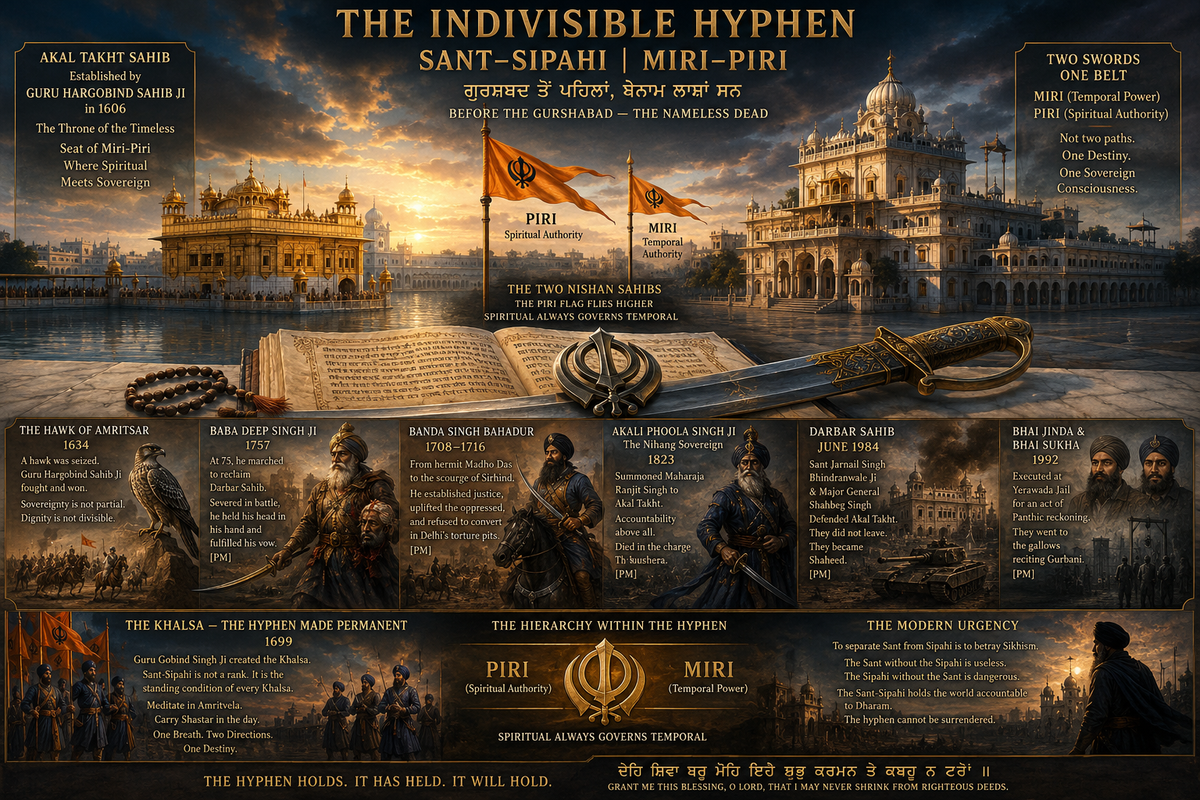
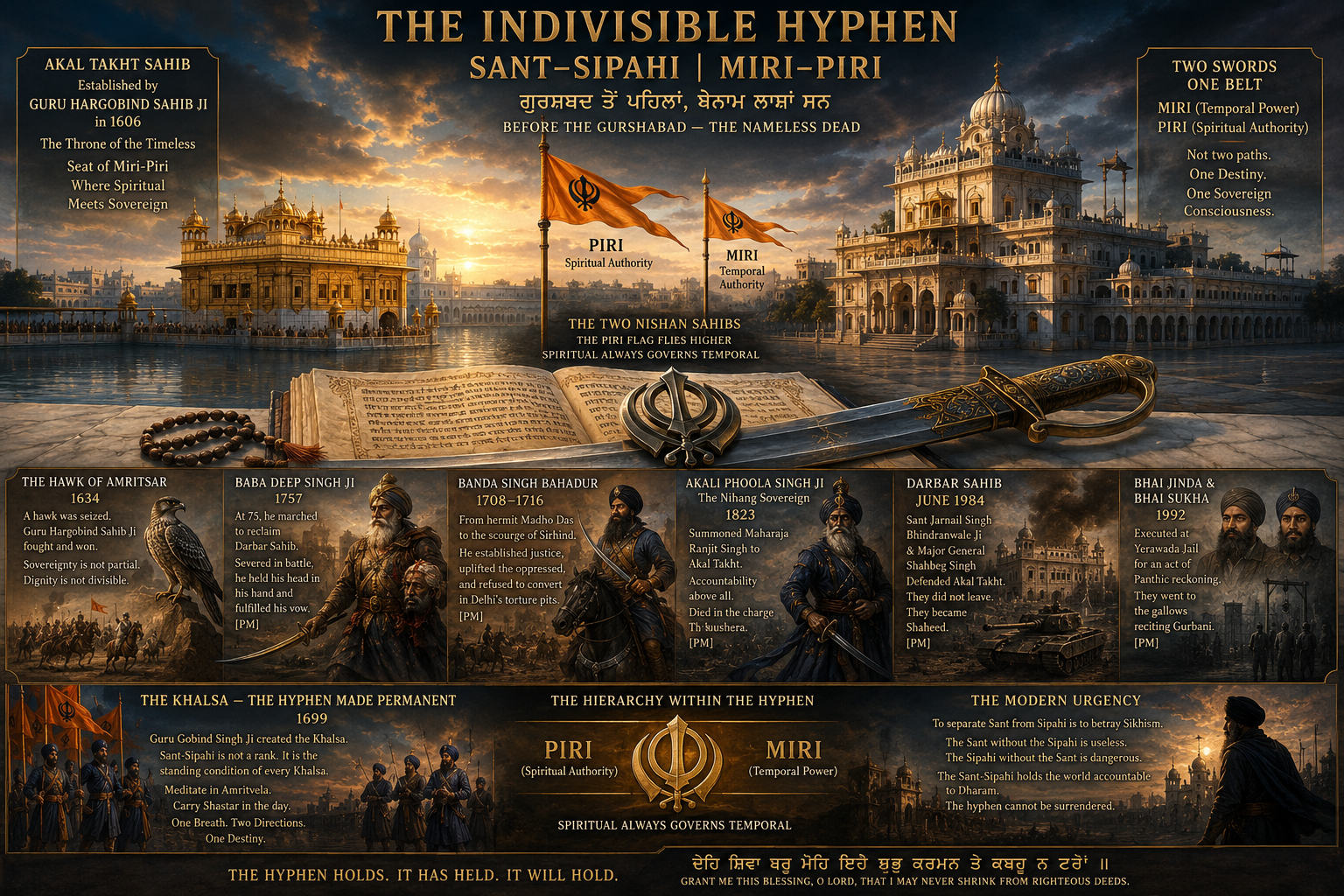
Theology, Sovereignty, and the Living Archive of the Sant-Sipahi
ਗੁਰਸ਼ਬਦ ਤੋਂ ਪਹਿਲਾਂ, ਬੇਨਾਮ ਲਾਸ਼ਾਂ ਸਨ
The history of spiritual thought is largely a history of false dichotomies. Across civilizations and centuries, a persistent wall has been erected between the contemplative and the active, the mystic and the warrior, the interior life of the soul and the exterior theater of political power. Humanity has long operated under a tragic governing assumption: to seek God, one must retreat from the world; and to engage the world seriously, one must inevitably compromise God.
Sikhism refused this assumption with historic force. Not as a compromise. Not as a pragmatic accommodation between competing demands. But as a structural, theological, and civilizational declaration: the Sant-Sipahi — the Saint-Soldier — is not a contradiction in terms. It is the resolution of the deepest contradiction in human history.
This essay does not merely examine the Sant-Sipahi as doctrine. It examines it as a living archive — a record that stretches from the forge of Guru Hargobind’s court in Amritsar, through the dying march of Baba Deep Singh at seventy-five, through the transformation of a Deccan hermit into the scourge of Sirhind, through the fearless austerity of the Nihang Jathedar, and into the sacred precincts of the Akal Takht in June 1984 and the gallows of Yerawada Jail in October 1992. The hyphen connecting Sant and Sipahi has been drawn, generation after generation, in history’s most contested ink: sacrifice, accountability, and the refusal to accept the separation of the sacred from the sovereign.
I. The Grammar of a Revolution
Begin with the word itself.
Sant-Sipahi. Two syllabic clusters, joined by a character of extraordinary philosophical density: the hyphen.
In ordinary grammar, when two nouns are linked by the conjunction “and,” they remain independent entities. They coexist. They may cooperate. But they retain their separate ontologies, their distinct borders, their individual definitions. “The saint and the soldier” is a sentence about duality — about two people, two roles, two separate moral vocabularies that happen to share a paragraph. They may admire each other. They may collaborate. But they do not fuse.
The hyphen destroys this separateness entirely.
In a hyphenated compound, the constituent terms do not merely coexist — they interpenetrate. They surrender their individual isolation to constitute a third thing: a new atomic identity whose properties cannot be predicted from either component alone. The hyphen is not a bridge between two shores. It is the fusion of two shorelines into a single continental mass.
Sant-Sipahi is therefore not a description of a person who is sometimes a saint and sometimes a soldier — a psychological toggle switch, a costume change between the prayer hall and the battlefield. It is not a schedule, a role-rotation, or a spiritual compromise. It is a new category of human being, one in whom the internal realization of the saint and the external sovereignty of the soldier occur in the exact same heartbeat, are sustained by the exact same breath, and are answerable to the exact same God.
To understand the full depth of this formulation, one must recognize that this hyphen does not stand alone in Sikh theology. It mirrors — exactly, with the economy of a well-drafted theorem — the hyphen that joins Miri-Piri: temporal power (Miri) and spiritual authority (Piri). The Sant-Sipahi is the individual embodiment of what Miri-Piri represents institutionally. The personal is the political. The inner is the outer. The blade and the prayer are the same gesture, exhaled in two different directions. You cannot have one without the other. You cannot sever the hyphen without destroying both components.
This essay traces the living archive of that hyphen — its theological genesis, its institutional crystallization, and the remarkable succession of human beings who carried it across three centuries of Punjabi history, each in their own way demonstrating that the compound identity survives what would shatter any single component: imprisonment, torture, military assault, the gallows.
II. The Forge: What Guru Nanak Actually Laid
The bifurcation theory of Sikh history — the colonial and secular-administrative reading that presents Guru Nanak’s movement as quietly contemplative and its subsequent “militarization” as a defensive response to Mughal persecution — is not merely incorrect. It is the kind of misreading that an imperial administration would find administratively useful: it locates the source of Sikh sovereignty in external threat rather than internal theology. It reduces the Sant-Sipahi from a revelation to a reaction. It makes the sword borrowed rather than inherent, contingent rather than constitutive.
The record is more radical than that.
When Guru Nanak Dev Ji declared —
“If you desire to play the game of love with me, then step onto my path with your head placed upon your palm. When you place your foot on this path, give up your life, and do not pay heed to public opinion.”
— this was not the language of a mystic seeking personal transcendence in a mountain cave. This was the language of total accountability, of fearless engagement with the world, of a love so complete that it included the willingness to die. The internal revolution demanded of the Sant — the absolute eradication of fear, ego, and the social conditioning that makes human beings complicit in their own subjugation — was the exact psychological prerequisite for the Sipahi.
You cannot be a soldier in the Sikh theological sense until you have become a saint. The sword cannot be wielded without trembling unless the hand that holds it belongs to someone who has made peace with death. Fear is the greatest disqualifier from sovereignty, and Guru Nanak’s entire project was the elimination of fear at its source: the ego’s attachment to its own survival. The Sant does not produce the Sipahi despite having renounced the world. The Sant produces the Sipahi precisely because of that renunciation — because a person who has released attachment to survival, status, and comfort has become, for the first time, genuinely free. And genuine freedom is the only stable foundation for genuine sovereignty.
The trajectory from Guru Nanak to Guru Hargobind is not a detour or a deviation. It is a direct line, inscribed with mathematical precision across six Guruships.
III. The Hawk of Amritsar: Sovereignty Is Indivisible
In the year 1634, near Amritsar, a dispute arose that might seem — to the inattentive eye, or the eye trained to measure conflicts by the apparent scale of their cause — almost trivially minor.
A hawk. A hunting bird. An imperial bird of prey, prized by the Mughal court, brought down by the Guru’s hawk and taken into Sikh custody in the field.
History remembers the incident as the spark behind the Battle of Amritsar, but the battlefield must be named with precision: Lohgarh. The confrontation did not unfold as an assault inside the sacred precinct of the Harmandir Sahib or before the Akal Takht itself. It unfolded at Qila Lohgarh, the defensive Sikh position on the edge of Amritsar — the fort of iron, the place where doctrine left architecture and entered the field.
The Akal Takht had already declared the principle. Lohgarh tested whether the principle could be defended.
The Mughal hunting party demanded the bird’s return. The demand was not made as a humble request between equals. It carried the tone of empire: the presumption that what the imperial hand claimed, others were required to surrender. The Guru’s Sikhs refused. The confrontation escalated. Mughal force moved against the Guru’s position at Lohgarh.
But the battle’s significance has nothing to do with the bird.
What the hawk represented was the first great field test of the hyphen.
When the Mughal soldiers demanded the return of the imperial hawk — whether through arrogance, deliberate provocation, or through the ordinary imperial habit of treating everything within reach as subject to imperial entitlement — they were asking a question: Will you accept this hierarchy? Will you surrender because the object is small? Will the Sant’s commitment to peace render the Sipahi passive? Will the spiritual man swallow humiliation in order to preserve outward calm?
Guru Hargobind’s institutional answer was unambiguous. His Sikhs did not convert humility into submission. When Mughal force moved against Lohgarh, the Guru’s order did not yield to imperial entitlement.
This is not a trivial observation. The decision to resist over what might be framed as an insignificant cause contains within it the entire doctrine of Sikh sovereignty. Sovereignty is not partial. Dignity is not divisible. The same imperial logic that teaches you to surrender a hawk teaches you to surrender your scripture, your gurdwara, your right to exist on your own land without administrative permission. Every acquiescence is a precedent. Every precedent is a surrender. The imperial project requires that you begin by accepting the small humiliation gracefully, and end by accepting the large humiliation without the vocabulary to name what has been done to you.
Guru Hargobind had, by 1634, already institutionalized the hyphen with physical and architectural precision. He had donned the two swords of Miri and Piri — temporal and spiritual authority — on a single belt, at a single ceremony, resting against a single body, guided by a single consciousness. He had established the Akal Takht Sahib — the Throne of the Timeless — directly facing the Harmandir Sahib, erecting in stone and mortar what the hyphen represents in language: that the sacred and the sovereign are not in tension, but in permanent dialogue, and that this dialogue happens in a specific place, with specific rules, and with a specific hierarchy. The Piri flag flies higher. The spiritual always governs the temporal. But both are present. Both are asserted. Neither is available for imperial subtraction.
Lohgarh was the field expression of that architecture.
The Akal Takht announced that the Panth was not merely a congregation of worshippers, but a sovereign moral order under the Timeless One. Lohgarh proved that this was not ceremonial language. It was not metaphor. It was not devotional theater. It was a claim capable of defense.
The Battle of Amritsar over the hawk was therefore not a quarrel over property. It was the first armed examination of Miri-Piri after its institutionalization. The question was whether imperial command would be obeyed merely because it called itself imperial.
At Lohgarh, the answer was no.
IV. Baba Deep Singh: The Hyphen Held in a Severed Hand
If the Battle of Amritsar represents the hyphen as institutional declaration — the formal announcement that Sikh sovereignty is indivisible — the life and death of Baba Deep Singh Shahid represents the hyphen as bodily testimony: carried to its most extreme and most luminous conclusion, past the ordinary limits of what a human body can sustain.
Born in 1682, Baba Deep Singh came of age in direct proximity to Guru Gobind Singh Ji. He was a scholar before he was a soldier — a scribe and custodian of the Guru Granth Sahib, a keeper of its textual integrity, a man whose hands had touched the Word with the reverence of someone who understood that Gurbani is not merely literature but the architecture of consciousness itself. He established and presided over the scriptorium at Damdama Sahib — the Guru’s own academy, the place where the final recension of the Guru Granth Sahib was completed under the Guru’s personal supervision. In the precise institutional sense, Baba Deep Singh was a Sant of the highest order: a scholar-devotee whose spiritual formation was complete, whose mastery of the Granth was legendary, and whose internal life was organized around the Word in the most literal possible way.
He was also, across decades of campaigns and engagements, a soldier of extraordinary capability and proven courage.
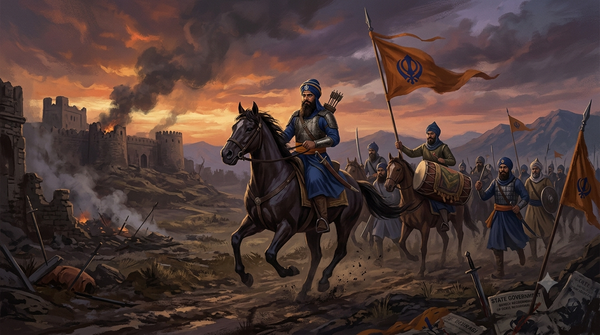
By 1757, Baba Deep Singh was in his mid-seventies. Ahmad Shah Durrani’s Afghan forces had desecrated the Golden Temple complex: defiled the sacred sarovar with the remains of slaughtered animals, violated the sanctity of the precinct, and killed or terrorized pilgrims and Sikhs who sought access to the shrine. When the news of this sacrilege reached Damdama Sahib, Baba Deep Singh’s response was the Sant-Sipahi response: he picked up his double-edged sword — his khanda, said to weigh approximately forty seers — and began the march toward Amritsar.
Before departing, he reportedly drew a line on the ground and issued the declaration that became one of the defining utterances of Sikh martial theology: that all who wished to give their lives in service of the Guru’s sacred precincts should step across. The line was not a boundary of exclusion. It was an invitation to the full compound identity — the promise that those who crossed it were choosing the Sant-Sipahi’s covenant: complete surrender of the self in service of Dharam.
What followed, at the battlefield near Amritsar, has been preserved across three centuries of Sikh textual and oral tradition with a specificity that conveys its theological rather than merely its historical weight. Baba Deep Singh was dealt a mortal wound — his neck very nearly severed from his body. A companion called to him: a man who had pledged to reach the Harmandir Sahib had now fallen short of it. The accounts — transmitted through near-contemporaneous sources, preserved in gurdwara murals across the Sikh world, and sustained in Panthic memory with the consistency of events that a civilization has decided will not be forgotten — hold that Baba Deep Singh placed his severed or near-severed head in his own left hand, and with his right hand continued to wield his sword, fighting forward until he collapsed at the parikrama of the Golden Temple, his vow fulfilled. [PM]
The historian’s obligation is to note that this account carries the evidentiary weight of Panthic Memory — [PM] — transmitted through sources whose reliability in their specific details cannot be verified against the standards of contemporaneous documentary record, but whose moral truth has been received, preserved, and perpetuated by a civilization as something essential rather than ornamental. The specific mechanics of Baba Deep Singh’s final march belong to that category: not in the sense of being dismissed, but in the sense of being received as testimony of a particular kind — the kind that encodes in narrative form what a people have decided to know about what human beings are capable of when the Sant fully governs the Sipahi.
The question the story poses is theological, not merely evidentiary: what is the hyphen capable of sustaining? How far can the saint’s inner commitment carry the soldier’s body past the ordinary limits of human endurance?
Baba Deep Singh’s answer, in the tradition that has preserved his image on every gurdwara wall across the Sikh world, is: further than you can imagine. The spiritual resolve of the saint sustains the physical action of the soldier past the point where the body has technically exhausted its capacity for motion. The hyphen is stronger than the wound. The compound is more durable than either of its components alone.
This is the doctrine of chardi kala — the Sikh concept of eternal optimism, the spirit that rises rather than falls under the most extreme pressure — in its most literally embodied expression. Baba Deep Singh at Amritsar in 1757 is the hyphen held in a hand that by every ordinary measure of physiology should have stopped moving. And yet it moved. The Sant had already answered the deepest question. The Sipahi’s body simply followed.
V. Banda Singh Bahadur: The Hyphen as Transformation
Banda Singh Bahadur’s biography is one of history’s most extraordinary accounts of human transformation — not despite the Sant-Sipahi archetype but because of it.
He was born Lachhman Das in 1670 near Rajouri, in the Jammu region of present-day Jammu and Kashmir. As a young man, he became a Hindu ascetic, taking the name Madho Das and establishing a hermitage at Nanded on the banks of the Godavari River in the Deccan. He was, by every conventional religious categorization, a Sant of the Hindu sadhu tradition: he had renounced the world, practiced austerity, cultivated supernatural powers according to the accounts, and devoted himself to the interior life. He owned nothing of consequence. He sought nothing of consequence. He was, in the vocabulary of renunciation, complete.
Then, in 1708, Guru Gobind Singh Ji arrived at Nanded.
The encounter between the Guru and the hermit is one of the pivotal episodes in Sikh history. By the accounts preserved in the tradition, the Guru took possession of the hermitage with a kind of sovereign ease — consuming provisions, rearranging the space — and when the hermit returned and confronted this remarkable visitor, the confrontation resolved not in anger or in expulsion but in the capitulation of a soul that recognizes, with a shock it cannot explain, its own Guru. Madho Das reportedly fell before Guru Gobind Singh and said simply: “I am your banda” — I am your servant, your possession, yours. The Guru accepted the surrender and renamed him accordingly: Banda Singh Bahadur.
The theological mechanics of this transformation deserve precise attention. Banda Singh Bahadur did not abandon his spirituality when he became a soldier. His years of contemplative formation — the dissolution of ego through austerity, the development of inner discipline through renunciation, the radical detachment from worldly comfort — were precisely what made him capable of the military and administrative achievements that followed. He could punish Sirhind — the seat of the regime under which the younger Sahibzade of Guru Gobind Singh had been immured alive and martyred at the orders of Nawab Wazir Khan — with the calculated force of righteous accountability rather than the contaminating fury of personal vengeance. He could establish what amounted to the first Sikh political administration on Punjabi soil, striking coins in the names of the Gurus, articulating a program of justice for the cultivating classes who had been ground under feudal Mughal extraction, enforcing Khalsa discipline against intoxicants, and delivering a justice that the region had not known under the nawabs.
The Sant did not disappear when the Sipahi emerged. The Sant became the governing intelligence behind the Sipahi’s force.
His end was of a piece with his formation. Captured by the Mughals in 1716 after the siege at Gurdas Nangal, Banda Singh Bahadur was brought to Delhi in a cage, displayed in the manner of a captured wild animal through the streets of the imperial capital. The Mughals offered him his life in exchange for conversion to Islam. He refused, without deliberation, in the manner of a man for whom the question had already been answered long before it was formally asked. What followed was among the most deliberately theatrical acts of state terror in Mughal history: his infant son was killed before him; his own execution was extended over days of systematic torture to maximize its spectacle and its deterrent effect. He died in June 1716, without converting and without breaking.
The Sant’s equanimity in the face of death. The Sipahi’s refusal to submit under the most extreme compulsion. The hyphen held intact under conditions designed specifically to break it.
VI. Akali Phoola Singh: The Nihang Sovereign
If Banda Singh Bahadur represents the hyphen’s capacity for transformation — the hermit who became the general through the alchemy of the Guru’s touch — Akali Phoola Singh represents its most austere and uncompromising institutional expression: the hyphen as vocation, as lifelong discipline, as the governing principle of every waking hour.
As the Jathedar of the Akali Nihangs — the order of warrior-ascetics who traced their lineage directly to the Khalsa of Guru Gobind Singh Ji — Akali Phoola Singh embodied the Sant-Sipahi in the form it takes when it has been refined by institutional inheritance over several generations: a human being so completely devoted to the divine that personal comfort, personal safety, personal glory, and personal survival have become entirely beside the point, as matters of genuine rather than performed indifference.
The Nihangs were the Sant-Sipahis in their most concentrated institutional form. They owned nothing. They accumulated nothing. They sought nothing from the world’s definitions of success and status. They roamed the Punjab as the Guru’s own cavalry, maintaining the traditions of the Khalsa in a period — the late eighteenth and early nineteenth centuries — when the Sikh Misls were consolidating into political formations that brought their own temptations of worldly power, dynastic interest, and the gradual compromises that always accompany the institutionalization of sovereignty.
The Nihangs resisted this institutionalization not through protest but through lifestyle: by remaining exactly what the Khalsa of 1699 was designed to be, in the face of every pressure to become something more comfortable and more legible to the emerging political economy of the Sikh polity.
Akali Phoola Singh’s most famous intervention was not a battle. It was a judicial proceeding.
Maharaja Ranjit Singh — the Lion of the Punjab, the architect of the Sikh Empire, the most powerful indigenous ruler in the subcontinent outside the shrinking Maratha sphere — had conduct judged unworthy of a Khalsa initiate. According to Sikh tradition, Akali Phoola Singh summoned him before the Akal Takht to answer for it. This was not a gesture or a formality. It was the institutional architecture of Miri-Piri working exactly as designed: the temporal sovereign held accountable by the spiritual authority, in the physical space constructed for precisely this purpose. The tradition records that Ranjit Singh appeared and submitted to the judgment of the Akal Takht. The prescribed punishment was corporal; it was reportedly about to be administered before the Maharaja negotiated a commutation through the payment of substantial religious endowments.
The significance is structural and permanent: the most powerful Sipahi in the Sikh world bowed before the most austere Sant in the Sikh world, in the precise precincts designed for this hierarchy to operate. The Piri flag flies higher. This is not decoration. It is the constitutional order of Sikh sovereignty, enforced by a warrior-ascetic who had no worldly stake in the outcome and no fear of the consequences of enforcing it against the most powerful man in the Punjab.
Akali Phoola Singh died at the Battle of Naushera in 1823, fighting the Afghan forces of Azim Khan. He died in the charge — leading his Nihangs into battle in a state of complete spiritual exaltation, reciting Gurbani, without the self-preservation instinct that ordinarily makes soldiers careful. He was not killed because he fought poorly. He was killed because he fought in the manner that the Sant-Sipahi fights at the fullest expression of the compound: with the interior already at peace, and therefore the exterior completely unencumbered by the fear that compromises every lesser form of combat.
He had already made his peace with God. The sword was simply the final argument, and he made it without hesitation.
VII. Darbar Sahib, June 1984: The Hyphen Under Assault
To understand the events of June 1984 — Operation Blue Star, the Indian Army’s sustained military assault on the Golden Temple complex at Amritsar — through the lens of the Sant-Sipahi is not merely to impose historical categories on contemporary events. It is to recognize that the assault itself was structured, in part, as an assault on the hyphen: on the theological and political claim that a Sikh leader could be simultaneously a spiritual authority and a political sovereign, simultaneously a preacher and a commander, simultaneously the head of a seminary and the voice of a people’s irreducible assertion of dignity.
The Indian state’s framing of Jarnail Singh Bhindranwale was carefully constructed to sever the hyphen. The official and semi-official narrative oscillated between two positions, both of which served the same purpose. In one version, he was presented as purely a Sipahi — a militant, a gunman, an agitator — with any Sant authenticity regarded as either manipulated or performed. In the other version, when that framing was inconvenient, he was presented as a Sant who had been cynically used by political actors, stripped of genuine political or moral agency. Both framings accomplished the same administrative goal: to make the compound identity illegible, to deny that a person could be, without contradiction, a preacher and a sovereign.
The record sustains neither simplification.
Jarnail Singh Bhindranwale was, by formation and by institutional lineage, a Sant in the most precise sense. He was the head of the Damdami Taksal — the Sikh seminary whose lineage traces directly to Baba Deep Singh Shahid, whose scriptorium at Damdama Sahib was the founding institution of the Taksal’s scholarly tradition. He was a kathavachak — an expounder of Gurbani — whose oratory drew enormous crowds not through political theater but through the depth and force of his theological address. His critique of the Indian state was expressed consistently through the categories of Dharam — righteousness, duty, the moral order — rather than through the categories of secular ethnic nationalism. His spiritual authority, in the eyes of a substantial portion of the Sikh population, rested on the same institutional foundation as every Taksal head before him: mastery of the scripture, command of the tradition, and the capacity to speak in the voice of conscience rather than the voice of interest.
He was also, by 1984, a man who carried weapons, who was surrounded by armed Singhs, who had made the strategic and spiritual decision to remain within the Harmandir Sahib complex rather than surrender to the Indian state on terms he regarded as designed for institutional humiliation rather than genuine legal process. He was, in the full Sikh theological sense, a Sipahi who understood that the sword is sometimes the last argument — and that the tradition of Guru Hargobind at Lohgarh in 1634, of Baba Deep Singh’s march in 1757, of Banda Singh Bahadur’s refusal at Delhi in 1716, did not counsel submission when Dharam demanded otherwise.
Alongside him in those final months was Major General Shabeg Singh — a figure whose presence at the Akal Takht constituted, in itself, one of the most historically charged manifestations of the Sant-Sipahi compound in the modern era.
Shabeg Singh had been among the most distinguished officers of the Indian Army: one of the key officers involved in training and organizing the Mukti Bahini, the guerrilla force that accomplished the liberation of Bangladesh from Pakistani rule in 1971. His strategic and tactical expertise were not in question by anyone who understood military operations — indeed, the Indian Army’s own experience during Operation Blue Star reflected, in its sustained casualties and its failure to achieve rapid or clean victory, the quality of the defensive arrangements that Shabeg Singh had organized. He had been dismissed from the Army without a court-martial, under circumstances that he and many others regarded as institutional injustice — a degradation on the eve of retirement that denied him the honors and pension his career had earned.
He came to the Akal Takht not as a mercenary looking for employment and not as a man without alternatives. He came as a man who had found, in the Khalsa cause and in the specific crisis of the moment, the alignment between his martial expertise and his moral convictions that the Indian Army had denied him. He organized the defenses of the Akal Takht with the professionalism of a trained soldier and the commitment of a believer. The fortifications that delayed the Indian Army’s advance for days of sustained combat were the work of a man who had chosen, clearly and deliberately, which side of history to stand on.
Bhindranwale and Shabeg Singh together constituted, in their final weeks at the Akal Takht, a living instantiation of the institutional Miri-Piri — the Sant in his role as the head of a theological institution, the Sipahi in his role as the commander of its defense, in the exact architectural precincts designed for their coexistence, in the building that is the Miri pole of the entire Sikh sacred geography, refusing the state’s demand for their submission.
The Indian Army’s assault on the Akal Takht Sahib on the night of June 5–6, 1984, employing tanks and rocket fire against the Throne of the Timeless, was the most dramatic act of violence against Sikh institutional sovereignty since Ahmad Shah Durrani’s desecration in 1757. Both Bhindranwale and Shabeg Singh died in the Akal Takht / Darbar Sahib combat zone during the assault. Many Sikh and journalistic accounts place their final stand within or immediately around the Akal Takht Sahib; the specific circumstances of their deaths remain disputed across multiple accounts, and independent forensic investigation has been systematically prevented.
What is not disputed: they were killed within the sacred precincts of the Miri pole of Sikh sovereignty, during a military assault ordered by the Indian state, and they did not leave.
The assault did not extinguish the hyphen. It added two more names to the shahid-naama that begins with Guru Arjan Dev Ji and runs, through every century of Sikh history, to the present day.
VIII. The Gallows as Gurdwara: Bhai Harjinder Singh Jinda and Bhai Sukhdev Singh Sukha
There is a tradition in Sikh martyrology that asks of every shahid not merely what they did but how they died. Not what were the political circumstances, not what was the formal legal verdict, but: what was the person’s relationship to death at the moment of dying? Was the ego present? Was fear present? Was the mind attached to the world it was leaving, or was it located in the shabad — the Word that transcends death because it was never born?
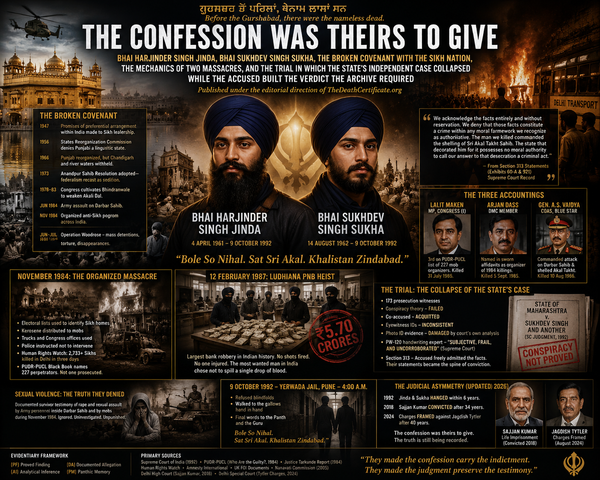
By this measure, the deaths of Bhai Harjinder Singh Jinda and Bhai Sukhdev Singh Sukha at Yerawada Central Jail, Pune, on October 9, 1992, belong to the long lineage of Sikh shahids who transformed the site of their execution into a place of worship.
Their responsibility for the killing was not something they sought to deny. On August 10, 1986, in Pune, they shot and killed General Arun Shridhar Vaidya — the former Chief of Army Staff who had commanded Operation Blue Star: the military assault on the Golden Temple complex that had produced the deaths of hundreds of Sikh pilgrims trapped in the sacred precincts, the near-total destruction of the Akal Takht Sahib, and the desecration of the most sacred site in the Sikh world. They were identified, arrested, tried, and sentenced to death. The sentence was upheld through the appellate process. They were hanged.
They acknowledged the act and framed it as righteous accountability for Operation Blue Star — performed in the tradition that holds that the sacrilege of June 1984 created a debt that the institutions of the Indian state had neither the will nor, in their view, the moral standing to discharge. The assassination of General Vaidya was, in their framing and in the framing of Sikh collective memory that received them as shahids, not an act of personal vengeance — not an expression of grief discharged as violence — but an act of Panthic reckoning. The distinction matters enormously within the Sant-Sipahi framework: the Sipahi acts, but the Sant governs the motivation. The sword is drawn not because the ego demands satisfaction but because Dharam demands accountability.
At Yerawada Jail, in the hours before the execution, the accounts preserved in Panthic memory — [PM] transmitted by those present and by those who received testimony from those present — describe men who faced death in the manner of the Khalsa: reciting Gurbani, maintaining the stillness of those for whom the deepest question has already been answered. There was, by these accounts, no theater of despair, no performance of regret designed to produce clemency, no last-minute accommodation with the verdict of the state they had judged. They went to the gallows in the manner that the Sant-Sipahi goes to every final reckoning: with the interior already at peace and the exterior following without trembling.
The gallows of Yerawada did not break the hyphen. The Sant within held the Sipahi steady at the ultimate moment, as it had held Banda Singh Bahadur in Delhi in 1716, as it had held Baba Deep Singh’s arm in the field outside Amritsar in 1757, as it had held Akali Phoola Singh in the charge at Naushera in 1823.
The consistency of this pattern across nearly three centuries is not accidental. It is not coincidence, and it is not hagiographic manufacture. It is the structural consequence of a theological formation that treats death not as an interruption of life but as its natural culmination — the moment when the Sant within finally proves what the Sipahi has always asserted: that the consciousness which animated this body was never, at its foundation, afraid.
“Death that men call terrible appears blissful to me. It is only through death that perfect peace is found.” — Guru Granth Sahib
IX. The Khalsa: The Hyphen Made Permanent
The permanent institutional crystallization of the Sant-Sipahi archetype occurred on Vaisakhi 1699, at Anandpur Sahib, when Guru Gobind Singh Ji constituted the Khalsa Panth — and the event’s dramaturgy is as important as its doctrine.
Guru Gobind Singh emerged from a tent holding a drawn sword, his demand — the heads of five Sikhs, presented to him one by one — producing a silence that was, in its way, the last silence before the hyphen became permanent. Five men stepped forward across a span of time that tradition has measured in the length of a held breath. Five times the Guru entered the tent with one of them and emerged apparently alone, the sword blooded. Five times the theater of sacrifice was performed before the assembled multitude, until the assembly was certain it had witnessed five executions.
Then all five emerged, transformed. What had appeared to be execution was initiation. The Panj Pyare — the Five Beloved Ones — had offered their lives completely, without reservation, and in that complete offering had been reborn. They had died as the merely devout and been resurrected as the Khalsa: the Pure, the Complete, the ones in whom the hyphen had been irrevocably sealed.
Guru Gobind Singh then asked the Panj Pyare to initiate him in return. The Guru became a disciple of his own creation. This single gesture contains the entire architecture of Khalsa sovereignty: the Sant-Sipahi is not a rank conferred on the exceptional. It is the standing condition — the minimum condition, the default condition — of every member of the Khalsa Panth, including the Guru himself.
The Rehit Maryada — the Khalsa code of conduct — encodes the hyphen in the structure of every day. The Amritvela, the pre-dawn hours of meditation and Gurbani recitation, is the Sant’s foundation for every waking hour that follows. The Shastar — the weapons that a Khalsa carries — are the Sipahi’s constant readiness. The Kirpan is not an accessory or a symbol in the decorative sense. It is an article of faith. It is spirituality materialized in steel. The Gurbani recited at dawn and the sword worn through the day are not sequential activities. They are the same breath, moving in different directions.
When the Khalsa meditates, it is an act of preparation for cosmic responsibility. When the Khalsa fights against oppression, it is a visceral act of worship. The hyphen has welded them permanently shut.
“Khalsa mero roop hai khaas. Khalse meh hau karo nivaas.”
(The Khalsa is my distinct form. Within the Khalsa, I infuse my very spirit.)
X. The Hierarchy Within the Hyphen
The Sant-Sipahi is not a relationship of equals between two autonomous identities, each contributing equally to a balanced partnership. There is a hierarchy within the hyphen, and Sikh theology is precise about what that hierarchy is and why it is non-negotiable.
The physical instantiation of this hierarchy is at the Akal Takht Sahib. The two Nishan Sahibs flying before the Throne of the Timeless — one representing Piri, one representing Miri — are not flown at the same height. The pole of Piri, spiritual authority, is flown higher than the pole of Miri, temporal power. The margin is six inches in some accounts; the principle is universal. This is not ceremonial detail. This is institutional theology, enacted in public space, visible from the parikrama of the Harmandir Sahib: temporal power is permanently and structurally subordinate to spiritual authority. The Sipahi always takes direction from the Sant. The sword is always in service of the Word, never the reverse.
This hierarchy is what distinguishes the Sant-Sipahi from every secular theory of the warrior-statesman. The warrior-statesman of conventional political theory derives legitimacy from sovereign power — from force, from mandate, from the capacity to compel. The Sant-Sipahi derives legitimacy from Dharam — from righteousness, from the divine will as understood through the Guru’s teaching, from accountability to a standard that stands above both the individual and the state.
This hierarchy is also what prevented the Khalsa tradition from degenerating into the ethnic militarism or authoritarian nationalism that has destroyed so many other liberation movements. When Akali Phoola Singh summoned Maharaja Ranjit Singh before the Akal Takht, he was enforcing the hierarchy of the hyphen institutionally: the most powerful Sipahi in the Sikh world was answerable to the institution that held the Piri mandate. The Piri flag flies higher. Always.
Without this hierarchy, the hyphen becomes something dangerous: a license for violence dressed in theological language, a sword that answers to no authority above its wielder’s own conviction. With it, the hyphen is what Guru Gobind Singh designed it to be: the most precise instrument in human history for the application of lethal force in the service of righteousness, restrained and governed by a moral formation that precedes the weapon and survives it.
XI. The Modern Urgency: Why the Hyphen Cannot Be Surrendered
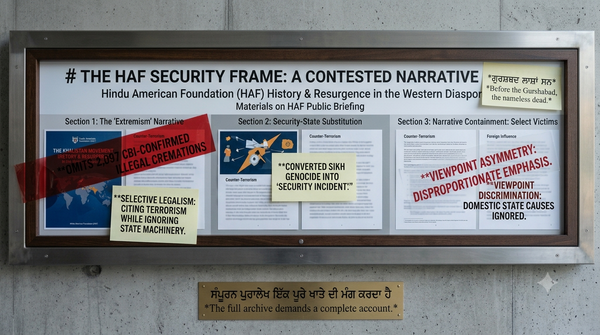
The contemporary securitization of Sikh identity — the systematic framing of Sikh political assertion, historical memory, demand for accountability, and diaspora solidarity as presumptive terrorism under the rubric of “Khalistan” — is, at its structural core, an assault on the hyphen.
It rests on a particular and deliberate severance. The argument, made explicitly by state institutions and implicitly by their media auxiliaries, is this: Sikh spiritual identity is legitimate, even picturesque — the turbaned volunteer at the langgar, the devotional singer at the gurdwara, the interfaith dialogue participant who offers wisdom about compassion. But Sikh political sovereignty — the claim to self-determination, the assertion that 1984 requires accountability rather than administrative closure, the refusal to accept the state’s own framing of its own crimes against its own citizens — is illegitimate, even dangerous. The Sant is acceptable. The Sipahi is a threat.
This is precisely the dichotomy that Sikhism was constituted, from Guru Nanak’s first declaration, to reject.
The Sant-Sipahi does not recognize the state’s right to determine which aspects of Sikh identity are permissible and which are seditious. The Akal Takht does not require the Ministry of Home Affairs to approve a hukamnama before it carries institutional authority. The Khalsa does not submit its understanding of Dharam to external administrative review for political legitimacy. The tradition of Guru Hargobind at Lohgarh — where imperial demand over a hawk became the test of Sikh sovereignty — does not offer the modern state a different answer merely because the encroachment now arrives in the language of national security rather than imperial entitlement.
The alternative — the complete separation of the sant from the sipahi, the spiritual from the political, the interior life from the exterior claims of sovereignty — produces, with historical reliability, the two failures that Sikh theology identified centuries ago. The sant without the sipahi: the beautiful, useless ascetic who has achieved personal peace while the world burns around him, who has made a private arrangement with God that does not disturb the powerful. The sipahi without the sant: the mercenary, the ethnic partisan, the soldier who has replaced Dharam with group interest and calls the result righteousness. Neither of these is the Khalsa. Neither of these is the Sant-Sipahi. Neither of these is what the hyphen was designed to produce.
The Sant-Sipahi demands the full compound. The saint who will fight. The soldier who will pray. The human being in whom the sword and the scripture are the same gesture — exhaled in two different directions, inseparable at their origin.
Conclusion: The Governance of the Hyphened Self
The Sant-Sipahi is, in the final analysis, a doctrine of self-governance that has political implications only because it refuses to stop at the boundaries of the self.
A person who has genuinely internalized the Sant’s formation — who has truly dissolved the ego’s attachment to its own survival, status, and comfort — is structurally ungovernable by the tools of ordinary political power. You cannot threaten a person who does not fear death. You cannot bribe a person who has no attachment to worldly comfort. You cannot shame a person who has no social reputation to protect. You cannot manipulate a person whose identity is not located in the categories that manipulation requires. The compound identity is the most durable form of sovereignty ever devised, because its anchor is internal rather than external — it does not depend on territory, legal status, administrative recognition, or the goodwill of the state.
This is why every imperial formation that has encountered the Sant-Sipahi has found it, ultimately, ungovernable. The Mughals discovered this. The Afghans discovered this. The colonial British — whose administrative intelligence was considerable — discovered this, and documented their discovery with the frustration of people who understood the tactical problem but could not find its strategic solution. The postcolonial Indian state, at Yerawada Jail in 1992 and at the Akal Takht in 1984, discovered it again.
The pattern across three and a half centuries is legible and consistent: the compound holds under the most extreme conditions that power can devise to break it. Banda Singh Bahadur held it in the torture pits of Delhi in 1716. Baba Deep Singh held it in his severed hand in the field outside Amritsar in 1757. Akali Phoola Singh held it in the charge at Naushera in 1823. Jarnail Singh Bhindranwale and Shabeg Singh held it in the ruins of the Akal Takht in June 1984. Bhai Jinda and Bhai Sukha held it on the gallows at Yerawada in October 1992.
The hyphen did not break. It does not break. It cannot be broken by external force, because its integrity is internal — governed by the Sant within, who has already resolved the question that breaking power requires to be unresolved: what happens when I die?
The answer, for the Sant-Sipahi, is the answer that the entire tradition, from Guru Nanak’s first declaration to the shahid-naama’s most recent entry, has offered without variation: nothing that changes the righteousness of this cause.
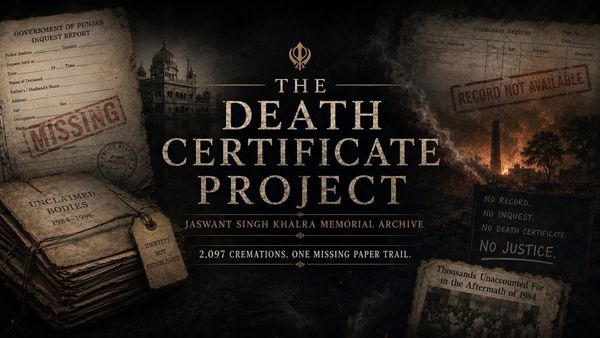
Before the Gurshabad, the cremation ground. Before we recite Gurbani over the names of the dead, we go to the shamshan. We see what happened. We say it clearly. We do not dress the wound in language that protects the powerful from accountability. And then we do not put down the sword until the standard of Dharam has been met.
The hyphen demands it. The tradition sustains it. The shahids have paid for it, generation after generation, in the most serious currency history accepts.
ਗੁਰਸ਼ਬਦ ਤੋਂ ਪਹਿਲਾਂ, ਬੇਨਾਮ ਲਾਸ਼ਾਂ ਸਨ
Before the Gurshabad — the nameless dead.
This essay draws on the editorial and evidentiary discipline of TheDeathCertificate.org and KPSGILL.COM. Historical claims are distinguished, where necessary, from theological interpretation, analytical inference, and Panthic Memory.