Who Sent Him? Banda Singh Bahadur, the Guru's Perfect Commission, and the Campaign to De-Sikhize the Khalsa's First Sovereign

ਗੁਰਸ਼ਬਦ ਤੋਂ ਪਹਿਲਾਂ, ਸ਼ਮਸ਼ਾਨਘਾਟ
Before the Gurshabad, the cremation ground.
TheDeathCertificate.org | KPSGILL.COM
Published from Fresno, California, under the protections of the First Amendment to the Constitution of the United States.
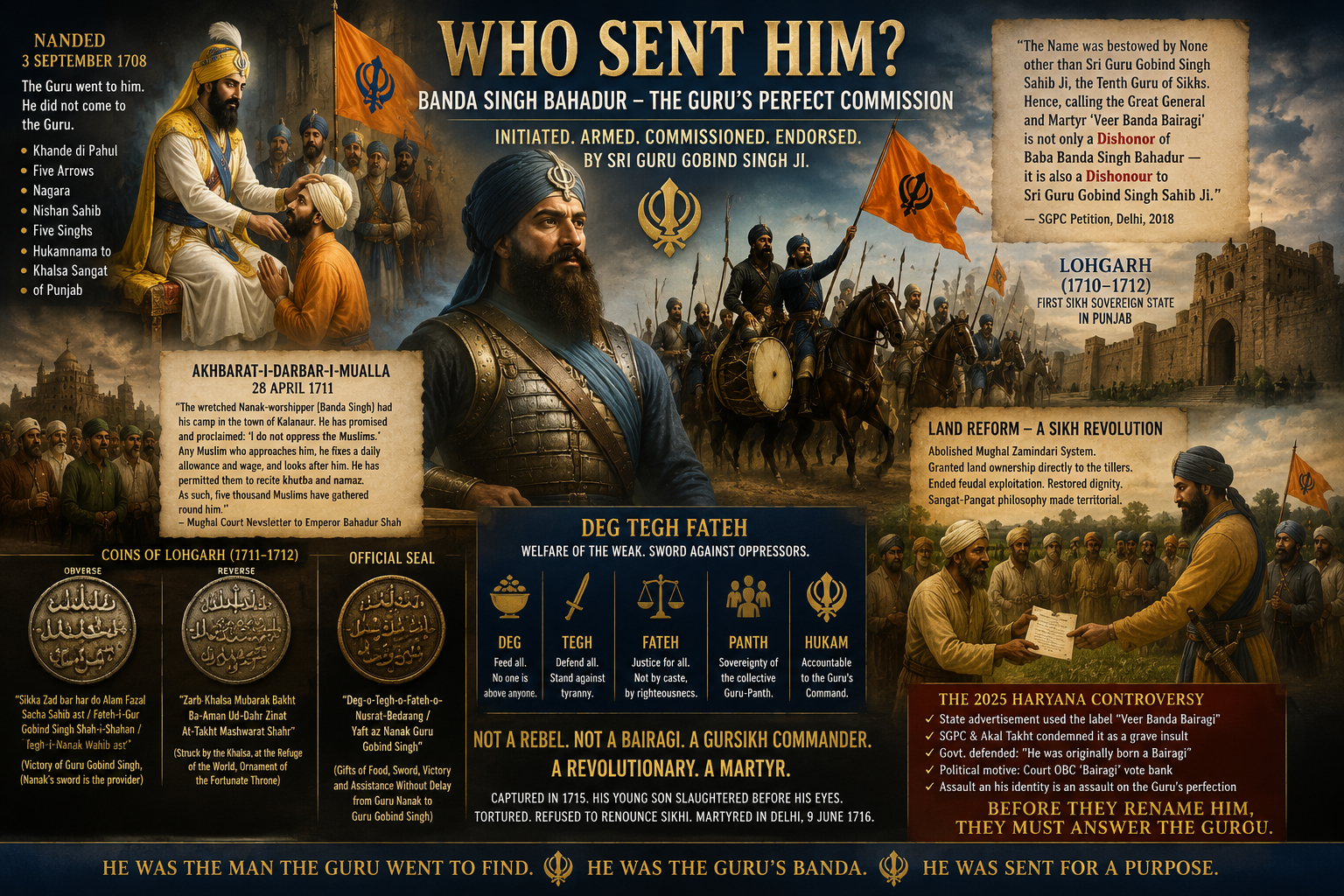
"The Name was bestowed by None other than Sri Guru Gobind Singh Sahib Ji, the Tenth Guru of Sikhs. Hence, calling the Great General and Martyr 'Veer Banda Bairagi' is not only a Dishonor of Baba Banda Singh Bahadur — it is also a Dishonour to Sri Guru Gobind Singh Sahib Ji."
— Sikh Community Petition, Delhi Road Renaming, 2018
Evidentiary Classification Notice
Consistent with the evidentiary framework governing this publication, claims throughout this article carry the following classifications:
- [PF] Proved Finding — Established by judicial record, official documents, contemporaneous sources, or convergent documentary evidence
- [DA] Documented Allegation — Serious, grounded in identified sources, not conclusively adjudicated
- [AI] Analytical Inference — Reasoned conclusion from institutional pattern, omissions, or cumulative record
- [PM] Panthic Memory — The preserved moral, civilizational, and institutional memory of the Sikh Panth
Preamble: The 2025 Case That Opens the Record
On 25 June 2025 — the martyrdom anniversary of Baba Banda Singh Bahadur — the Haryana state government's Department of Information and Public Relations published advertisements in leading Indian dailies and released coordinated social media posts marking the occasion. The label attached to the martyr's name in every government communication read: "Veer Banda Bairagi."
The Shiromani Gurdwara Parbandhak Committee and the Acting Jathedar of Sri Akal Takht Sahib responded within hours.
SGPC President Advocate Harjinder Singh Dhami described the advertisement as a "violation of Sikh principles" and a deliberate misrepresentation of the Khalsa general's identity. Giani Kuldeep Singh Gargaj, Acting Jathedar of Sri Akal Takht Sahib and Takht Sri Kesgarh Sahib, called the advertisement a "conspiracy to erase Baba Banda Singh Bahadur's Sikh identity," and urged Sikh representatives in Haryana to collectively resist such narratives. Both demanded a formal government apology and the withdrawal of the advertisements. The social media posts were subsequently modified. [[PF] — Source: The Print, 25 June 2025]
The Haryana government's media coordinator defended the label. Calling the SGPC's objection "unwarranted" and "politically motivated," Ashok Chhabra stated: "He was originally born a Bairagi, also known as Banda Bairagi. The SGPC's protest is for political reasons." Political analysts noted that Bairagi communities are classified under Haryana's Backward Class "A" bloc — a numerically significant vote bank the BJP was actively courting. The appropriation, stripped of its rhetorical veneer, was electoral. [[PF] — Source: The Print, 25 June 2025]
The controversy was not an accident of careless bureaucratic wordsmithing. It was not an error of historical enthusiasm. It was a structured act of memory management, precisely timed to the martyrdom anniversary, precisely calibrated to the electoral composition of a state, and precisely designed to use pre-Guru identity as a hammer against Guru-given identity.
This article places the entire assimilationist campaign — not any community, not any individual, but the ideological narrative itself — in the witness box. It cross-examines that narrative across four domains: Sikh theology, law, history, and political science. It does so with the conviction that the answers to those cross-examinations are not close questions. They are settled questions. The record is extensive. The instruments are preserved. The Guru's action is beyond dispute.
The date of the Haryana controversy — 25 June — is today's anniversary. One year on, the case must be made in full.
The Method of This Article: Evidentiary Architecture and Source Hierarchy
This article does not begin by asking the Brahminical archive for permission to remember a Sikh martyr. It does not begin by deferring to colonial historiography, Mughal court vocabulary, or Hindu nationalist narrative conventions. It begins where Sikh memory begins: with the Guru, the Panth, the Khalsa, the Akal Takht, and the vocabulary through which Sikhs have preserved their own sovereignty across three centuries.
The evidentiary method is therefore deliberate, and its hierarchy is explicit.
First comes Guru-Panth memory: the Sikh account of the transformation at Nanded, Khande di Pahul, the Guru's Hukam, the arrows from the Guru's quiver, the Nishan Sahib, the Nagara, the five chosen Singhs, and the Hukamnama directing the Khalsa of Punjab to receive their new commander. This is the foundational layer. No other source has standing to override it on the question of Banda Singh Bahadur's Sikh identity.
Second comes institutional Sikh authority: the SGPC and Akal Takht, which have repeatedly and formally treated "Banda Bairagi" as a dangerous distortion when deployed as his controlling commemorative name. The 2025 intervention is not the first. It reflects a consistent institutional position anchored in Panthic theological understanding.
Third come Sikh-authored and Sikh-vetted scholarly works: principally the foundational historical scholarship of Dr. Ganda Singh, whose Life of Banda Singh Bahadur: Based on Contemporary and Original Records (1935, available at Internet Archive) remains the standard scholarly treatment, and whose engagement with the Akhbarat-i-Darbar-i-Mualla — the Mughal court's own contemporaneous newsletters — provides the adversarial evidentiary confirmation the secular historian requires. The early Panthic chronicler Rattan Singh Bhangu's Prachin Panth Prakash (1843) is the earliest internal Sikh historical account of Banda Singh Bahadur's command.
Fourth come material state records: the coinage, official seals, and Hukamname issued under Banda Singh Bahadur's own authority at Lohgarh. These are not interpretive sources. They are the state's own voice. They speak in a language that admits no ambiguity.
Fifth come adversarial records: specifically the Mughal court's Akhbarat-i-Darbar-i-Mualla, which are especially powerful precisely because they record facts against the institutional interest of the empire that was attempting to destroy Banda Singh Bahadur.
A people who allow hostile categories to define their heroes have already surrendered the first battlefield: vocabulary. Banda Singh Bahadur must therefore be read first as the Guru's Banda, then as Khalsa commander, then as sovereign revolutionary, and only then through the external archives that attempted to classify, fear, or absorb him.
PART ONE: THE CONTROLLING QUESTION AND THE FLOOR OF THE RECORD
I. Who Was at Nanded? What the Guru Did There
The assimilationist campaign never confronts one question directly. It cannot afford to. Because the moment the question is answered, every subsequent argument about birth identity, prior tradition, pre-Khalsa biography, and Bairagi vocabulary collapses into irrelevance.
The question is not complex. It does not require specialist knowledge. It requires only reading the record honestly.
Who was at Nanded? What did the Guru do there?
In 1708, Guru Gobind Singh Ji was at Nanded in the Deccan, having accompanied Emperor Bahadur Shah I southward. [[PF] — Source: Sikhiwiki on Banda Singh Bahadur] At Nanded, there was a settled dera — a Bairagi monastery — established by one Madho Das on the banks of the Godavari river. By every account, Madho Das had no particular reason to expect what was coming. He was not seeking initiation. He was not searching for the Guru. He was not present at any Panthic gathering. He was conducting the life of an ascetic, practicing the disciplines of his Bairagi tradition, exercising whatever spiritual powers years of practice had accumulated.
The Guru arrived at his dera. [[PF] — Source: Wikipedia on Banda Singh Bahadur] The Guru sat upon Madho Das's own seat. The Guru's mere presence nullified every attempt by the Bairagi to manifest his powers — demonstrating that no spiritual capacity acquired outside Guru's grace can hold against the Guru's arrival. And when Madho Das fell before the Guru and declared "Main banda haan tere da" (I am your slave/servant), what followed was not an alliance, not a military contract, not a political arrangement between parties of roughly equal standing.
What followed was initiation.
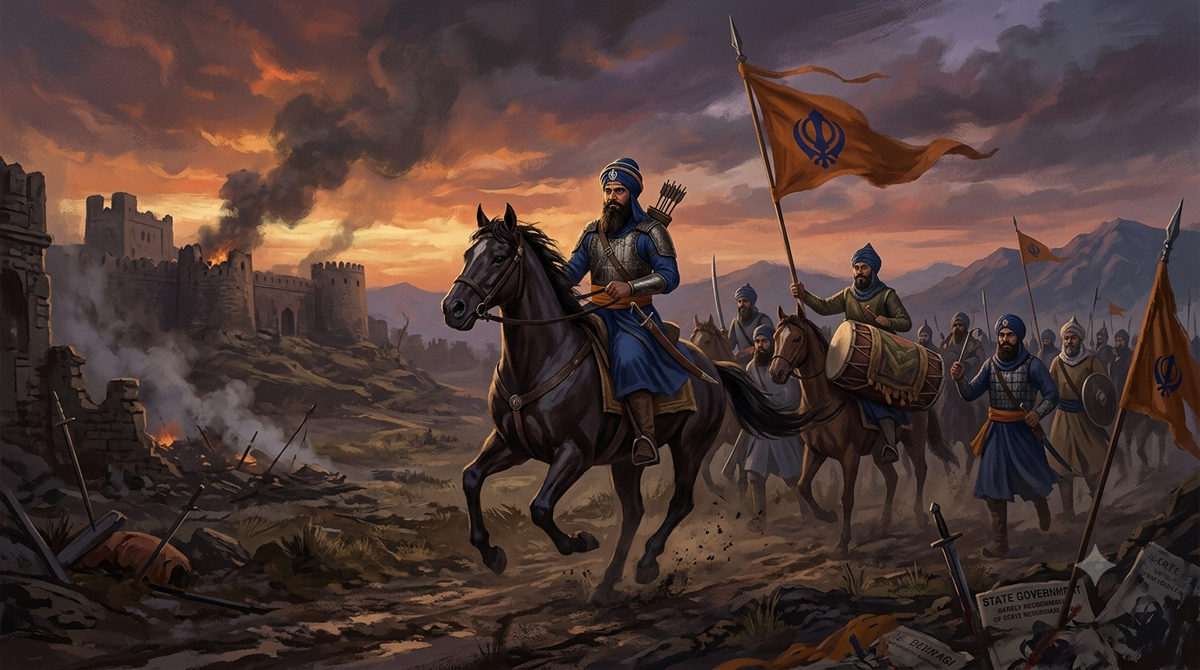
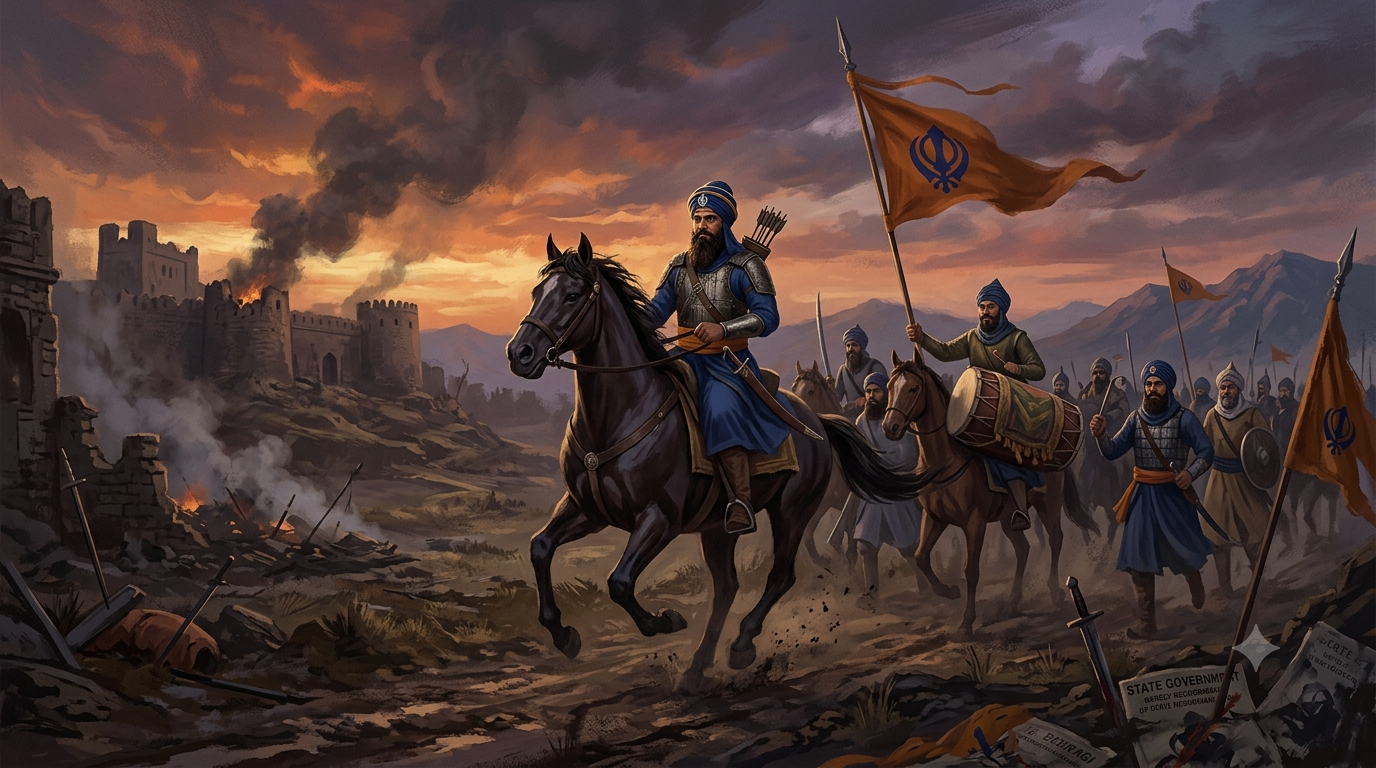
On 3 September 1708, Guru Gobind Singh Ji administered Khande di Pahul — the Khalsa's initiation rite — to Madho Das. [[PF] — Source: SikhCoin.blogspot citing Saran Singh and Dalwinder Singh] Madho Das received a new name: Banda Singh Bahadur. The Guru invested him with formal instruments of Panthic temporal authority: five arrows drawn from the Guru's personal quiver; a war drum (Nagara) — the audible announcement of sovereign Khalsa presence; the battle standard of the Khalsa (Nishan Sahib); and a personal escort of five initiated Singhs. The Guru then composed Hukamname — formal sovereign edicts issued under the Guru's own authority — directing the Khalsa Sangat of Punjab to receive this man and serve under his command. [[PF] — Source: Sikhiwiki on Banda Singh Bahadur; SikhCoins.in — Official Seals and Hukamname]
From Nanded, the Guru sent him north. Toward Sirhind. Toward the machinery of imperial tyranny that had buried the Guru's youngest sons within its walls.
This is the controlling fact. Every argument about Banda Singh Bahadur's identity must answer this sequence before it may proceed to anything else. Not: what was he born as? Not: what did his prior tradition call itself? Not: how does a modern state government prefer to remember him for electoral purposes?
The only question that controls the entire case:
Who initiated him? Who armed him? Who wrote to the Khalsa and said: receive this man?
Guru Gobind Singh Ji did.
That is the floor of the record. Everything built upon that floor is Sikh history. Everything that attempts to excavate beneath it is political archaeology in the service of assimilation.
II. Revealed Selection vs. Direct Commission: The Distinction Between the Panj Pyare and Banda Singh Bahadur
To understand why the Guru's active selection of Banda Singh Bahadur carries its particular theological weight within Sikh history, it is necessary to first understand the nature of the Panj Pyare's emergence at Anandpur Sahib — and then to place Banda Singh Bahadur's commission in precise relation to it. This distinction has not been placed at the center of the debate with sufficient clarity. Doing so now changes the character of the argument entirely.
At Anandpur Sahib on Vaisakhi of 1699, Guru Gobind Singh Ji called out to an assembled Sangat of thousands. He raised his sword and asked who would give their head. The Guru did not announce in advance which five souls had been chosen. He did not summon them by name. He did not walk through the assembled Sangat and place his hand upon specific shoulders. He issued the call, and he waited. [[PF] — Source: Amrit Sanskar — Wikipedia; SikhRI Nash Doctrine article]
What followed was one of the most sacred acts of surrender in all of Sikh history. Bhai Daya Singh came forward. Then Bhai Dharam Singh. Then Bhai Himmat Singh, Bhai Mohkam Singh, and Bhai Sahib Singh. They came from Lahore, Hastinapur, Dwarka, Jagannath Puri, and Bidar — from five different castes, five different occupational traditions, five different corners of the subcontinent. They came because they heard the Guru's call and answered it with their lives. The Guru then initiated them, and in the ritual drama of that day, they became the nucleus of the Khalsa — the casteless, armed, sovereign fellowship that would govern Sikh political theology for all generations following. [[PF] — Source: SikhNet — The Khalsa: What It Stands For]
The Panj Pyare represent revealed selection through surrender. The Guru created conditions under which specific souls could reveal themselves, and the Guru recognized what those souls offered. They are the Khalsa's most sacred nucleus, and nothing in what follows diminishes their place.
Now examine what happened at Nanded in 1708 with complete precision.
Madho Das Bairagi did not go looking for Guru Gobind Singh Ji. He did not volunteer. He did not step forward from a crowd. He did not hear a call issued to an assembly. He was not present at any Panthic gathering. He was at his dera in the Deccan, living the settled life of a Bairagi ascetic. He was not searching for the Guru.
The Guru sought him.
The Guru identified him. The Guru traveled to find him. The Guru arrived at his dera. The Guru nullified his powers. And only after this sovereign prior initiative — entirely the Guru's, entirely unprompted by Madho Das — did the declaration of surrender ("Main banda haan tere da") become possible.
Then the Guru initiated him. Armed him specifically. Commissioned him specifically. Wrote to the Panth specifically. And sent him north with a mission that was particular to this moment and particular to the capacities the Guru had perceived in this specific person.
This is the distinction:
- With the Panj Pyare: the Guru issued a sovereign call, souls revealed themselves, the Guru initiated the Khalsa nucleus. The initiative began with the Guru's call but required human response to complete.
- With Banda Singh Bahadur: the initiative, the identification, the selection, the commissioning, and the public endorsement to the Panth were entirely and unambiguously the Guru's sovereign acts from first to last. There was no crowd. There was no call to which someone stepped forward. There was only: the Guru chose this man, traveled to him, and made him.
Banda Singh Bahadur represents direct personal commission for a specific post-1708 mission. The Guru went to find him. Which means that everything that followed — every battle, every state decree, every coin, every land distribution, every act of Khalsa sovereignty — was already the Guru's will before it was Banda Singh Bahadur's action.
That is the difference. That is the distinction that has not been stated loudly enough. And it has direct implications for every argument that attempts to question his Sikh legitimacy, because questioning the legitimacy of the Guru's personally commissioned agent is questioning the Guru's own knowledge of who was needed.
III. The Doctrine of the Guru's Perfection: Why Every Assault Is an Indirect Assault
The distinction between the Panj Pyare's revealed selection and Banda Singh Bahadur's direct commission carries a theological implication that cannot be evaded without abandoning Sikh theology in its entirety.
The Sikh understanding of the Guru is not a sentimental attachment to a great teacher. It is a precise theological claim about the source and nature of divine authority operative in the temporal world. The Guru is understood as the vessel through whom Akaal Purakh's Hukam expresses itself in time. The Guru's decision is Hukam. The Guru's action is not the fallible preference of a gifted person — it is the expression of infinite knowledge in finite historical circumstance.
Guru Gobind Singh Ji — the Guru who sent his own sons to martyrdom rather than compromise, who inherited the martyrdom tradition of Guru Tegh Bahadur Ji, Bhai Mati Das Ji, Bhai Sati Das Ji, and Bhai Dayala Ji, and who then carried that tradition into the Khalsa's sovereign form — traveled to Nanded with full knowledge of Madho Das's prior Bairagi life. The Guru knew. This is not a theological assertion about divine omniscience requiring separate proof. It is the simple and obvious reading of the record: the Guru arrived at the dera, sat upon the Bairagi's seat, waited for him, and acted. The Guru did not encounter Madho Das by accident and improvise a solution. The Guru went to him.
Given this, one question follows that the assimilationist narrative can never afford to ask directly:
Was Guru Gobind Singh Ji mistaken?
To claim that Banda Singh Bahadur's pre-initiation Bairagi identity remains the controlling identity — that it outranks the Guru-given name, the Guru-issued commission, the Guru-written Hukamnama, the Guru's personal arrows — is to assert one of the following:
- That the Guru's Khande di Pahul could not fully transform a person the Guru himself chose to transform. This collapses the theology of Khalsa initiation entirely.
- That the Guru's knowledge of Madho Das's suitability was incomplete or in error. This imputes fallibility to Guru Gobind Singh Ji's judgment.
- That the Guru's Hukamnama to the Khalsa Sangat of Punjab endorsing Banda Singh Bahadur carried less authority than a modern state advertisement or an electoral caste calculation. This is so self-evidently absurd it requires no extended refutation.
None of these positions is available to anyone who accepts Sikh theology. In Sikhi, the Guru is perfect. The Guru's choices are perfect. The Guru's knowledge — which found Madho Das before Madho Das found himself — is perfect.
Every assault on Banda Singh Bahadur's Sikh identity is therefore, at its theological root, an indirect assault on Guru Gobind Singh Ji's perfection.
This is not hyperbole. It is the logical chain of the argument, stated clearly. The SGPC's formal description of the "Banda Bairagi" label as a "grave insult" is not institutional sensitivity. It is institutional recognition of exactly this chain. [[PF] — Source: The Print, 25 June 2025]
When the Delhi road renaming petition captured it precisely — "This is Also a Dishonour to Sri Guru Gobind Singh Sahib Ji" — it was not making a rhetorical point. [[DA] — Source: Change.org Petition — Rename Veer Banda Bairagi Marg] It was stating the theological fact. An attack on the Guru's choice is an attack on the Guru.
PART TWO: THE THEOLOGICAL CROSS-EXAMINATION
IV. The Radical Subversion of "Banda": A Title Not of Submission But of Emancipation
The witness takes the stand. The assimilationist witness claims that the title "Banda" — as in "Banda Bairagi" — represents the continuation of a Vaishnavite tradition of spiritual servitude that predates and ultimately outlasts the Khalsa initiation.
The theology expert objects. And the objection destroys the entire premise.
In the Vaishnavite and Bairagi ascetic traditions, declaring oneself a das (servant) or banda (bound one) of a deity is a vertical act of mystical surrender that leaves all earthly social hierarchies completely intact. The Bairagi ascetic may subordinate himself to Vishnu or to a lineage of saints while remaining embedded within the Brahminical caste framework. His renunciation is inward and metaphysical. It does not question zamindari. It does not challenge the Mughal coin. It does not redistribute land. It does not command armies of the oppressed. The Bairagi banda is a devotional category that sustains, rather than disrupts, the existing social and political order.
Now examine what happened when Madho Das said "Main banda haan tere da" to Guru Gobind Singh Ji and the Guru accepted.
The Guru did not receive the declaration as a Vaishnavite devotional surrender. The Guru received it as a Khalsa initiation. In the Khalsa paradigm — in the revolutionary theology of the Guru who had created an armed, casteless, sovereign fellowship specifically to answer tyranny — becoming the Guru's Banda means something categorically different from becoming a deity's devotee within conventional hierarchy. In the Khalsa framework:
To be the Guru's Banda is to be instantaneously and permanently emancipated from every earthly master, every imperial potentate, every priestly mediator, every caste superior, and every feudal landlord.
The Guru's Banda answers to Hukam alone. Not to Mughal authority. Not to zamindari privilege. Not to Brahminical hierarchy. Not to birth identity. Not to the approval of courts. The Guru's Banda fights tyranny. He governs for the oppressed. He carries Deg Tegh Fateh — the welfare of the weak and the sword against oppressors — as his state mandate.
This is why "Banda Bairagi" is not merely an inaccurate label. It is a category inversion. It takes a title of cosmic, anti-imperial emancipation and converts it back into a marker of sectarian Vaishnavite submission. It strips the word of its Khalsa meaning — sovereign freedom under Hukam — and reinstalls the Bairagi meaning: devotional subjugation within a conventional religious framework that challenges nothing about the social order.
The Guru's subversion was total. He did not merely add a Sikh dimension to Madho Das's existing identity. He reversed the direction of the word itself. Banda under the Guru's definition is not a servant of sectarian tradition. Banda under the Guru's definition is the Guru's sovereign instrument in the world — free from every human master, accountable only to the Infinite.
To call him Banda Bairagi is to undo the Guru's subversion and restore the sectarian meaning. That is the theological crime at the heart of the assimilationist project.
V. The Five Nash and the Impossibility of Partial Initiation
The doctrine of Nash — the five liberations operative in Khande di Pahul — is the technical theological mechanism by which the assimilationist case fails completely. [[PF] — Source: SikhRI — Nash Doctrine: Five Freedoms of Vaisakhi 1699]
The five Nash operate together as follows, in their standard formulation drawn from Mughal court records of Guru Gobind Singh Ji's own address to the Sangat after the first initiations of 1699:
Dharam Nash — Freedom from previous religious identity and ritual bondage. The prior creed is annihilated. The Bairagi tradition's theological claims upon Madho Das are ended at initiation.
Karam Nash — Freedom from accumulated karmic account. Whatever Madho Das had built across decades of Bairagi practice is released. He does not carry his ascetic capital into Banda Singh Bahadur's life.
Kul Nash — Severance from caste, lineage, clan, and all hereditary social claims. Madho Das's pre-Guru lineage — Rajput or Brahmin depending on which account is credited — exercises no claim upon Banda Singh Bahadur.
Bharam Nash — Eradication of superstition, ritual belief, and every cosmological framework that operated before the Guru's initiation transformed the person.
Krit Nash — Freedom from the occupational and vocational identity that preceded initiation. The ascetic occupation is abandoned. [[PF] — Sources: SikhRI Nash Doctrine; SikhNet — The Khalsa: What It Stands For; Amrit Sanskar — Wikipedia]
The assimilationist witness must now be asked, with precision:
Which of the five Nash do you claim failed to operate in the case of Madho Das?
Did Dharam Nash fail? Then you are claiming that Guru Gobind Singh Ji's initiation could not annihilate a prior religious identity — which means Khande di Pahul does not accomplish what Sikh theology says it accomplishes.
Did Kul Nash fail? Then you are claiming that Madho Das's pre-initiation lineage survives the Guru's transformative act — which means that birth continues to determine identity after Khalsa initiation, which is precisely the hierarchical logic the Khalsa was created to destroy.
Did Bharam Nash fail? Then you are claiming the Guru's initiation left the Bairagi cosmological framework intact. This is not only theologically untenable — it is historically contradicted by the direction of Banda Singh Bahadur's entire post-Nanded life, which was the opposite of ascetic withdrawal.
Not one of the five Nash can be said to have partially operated or conditionally applied. The Nash doctrine does not contain escape clauses based on the pre-initiation depth of a person's prior tradition. If it did, the Khalsa could never have been built from the diversity of prior identities that the Guru drew upon. Every Singh who came from a prior Hindu, Muslim, or other background would remain partially tethered to that background by the same logic.
The Nash doctrine's meaning is absolute, or it is meaningless.
The theology expert therefore delivers the first verdict: Madho Das Bairagi ceased to exist at Nanded. Banda Singh Bahadur was born there. The prior identity has no standing in any Sikh theological framework to override, supplement, or characterize the Guru-given identity.
VI. The Direction of Travel: Bairagi Sannyas vs. Khalsa Dharam Yudh
A second and independent theological argument confirms the first. It requires no reference to doctrine at all. It requires only reading the subsequent record.
Bairagi theology is oriented inward and upward: renunciation of the material world, withdrawal from political entanglement, retreat into ascetic discipline, cultivation of inner powers, personal liberation through inner conquest. The ideal Bairagi state is the dera, the forest, the hermitage — withdrawal from the noise of political life and the entanglements of governance.
Khalsa theology is oriented outward and forward: active engagement with oppression, resistance to tyranny, defense of the helpless, establishment of Sach Achar in the temporal world, sovereignty under Hukam. The Khalsa seeks Fateh not by leaving the world but by entering the world's disorder and transforming it through Dharam Yudh. Miri-Piri is not a metaphor. It is an institutional reality, established in physical form by Guru Hargobind Sahib Ji's construction of the Akal Takht — the seat of temporal Sikh authority — as an explicit counter to the exclusive inwardness of conventional devotional religion.
When Madho Das left Nanded under Banda Singh Bahadur's name, he did not retreat further into ascetic withdrawal. He did not deepen his Bairagi practice. He did not return to contemplation in the hills of the Deccan. He marched north at the head of an army toward the most powerful imperial administration in the subcontinent. He dismantled feudal arrangements. He seized territory. He issued state decrees. He distributed land. He established the first sovereign Sikh governance in Punjab.
Which theological framework explains this trajectory?
Not the Bairagi framework. Bairagi practice does not produce territorial governance. Bairagi withdrawal does not produce agrarian land reform. Bairagi cosmology does not produce coins inscribed in the names of Guru Nanak and Guru Gobind Singh. Bairagi spirituality does not produce the official seal "Deg Tegh Fath, Nusrat Bedarang; Yaft az Nanak Guru Gobind Singh."
Only the Khalsa framework explains this. Only Miri-Piri — only Dharam Yudh, only the sovereign mission of the Guru-Panth expressed in temporal governance — explains why a man who had lived as a Bairagi ascetic became the first architect of Khalsa sovereignty, minted coins in the Guru's names, and died at Delhi in 1716 refusing to renounce his Sikh identity.
The direction of travel is the biographical proof that Khande di Pahul worked exactly as Sikh theology says it works.
PART THREE: THE JURIDICAL CROSS-EXAMINATION
VII. The State Spoke in the Name of the Gurus: Coinage, Seal, and the Official Record
The theological arguments above are sufficient to establish Banda Singh Bahadur's Sikh identity for those who accept the authority of Sikh theology. But the case does not rest only there. For the secular historian, the legal analyst, the non-Sikh reader who requires material evidence independent of theological framing — there is a second evidentiary layer that stands on its own, requires no theological premise, and answers the assimilationist case from entirely within the state's own documentary record.
Banda Singh Bahadur's government issued two instruments of sovereignty that have survived: coins and official seals. These are not devotional texts. They are state documents. They are what the state spoke, in the state's own voice, about the source and nature of its own authority.
The Coins of Lohgarh (1711–1712)
Following the conquest of Sirhind in May 1710, Banda Singh Bahadur established Lohgarh (formerly Mukhlispur) as the seat of the first Khalsa governance and minted coins — the first coins ever struck in the name of the Khalsa, the first expression of Sikh sovereign authority in metal. [[PF] — Source: SikhCoins.in — Coinage of Banda Singh Bahadur; SikhCoins.in — History]
Two coin types survive: Year 2 and Year 3 of his brief sovereignty. The Year 2 rupee is a unique specimen. The legends on both are entirely in Persian — the administrative and literary language of the Mughal world — making them a deliberate assertion of sovereignty proclaimed in the very language of the empire being displaced.
The obverse inscription reads:
"Sikka Zad bar har do Alam Fazal Sacha Sahib ast / Fateh-i-Gur Gobind Singh Shah-i-Shahan / Tegh-i-Nanak Wahib ast"
Translation: "Coin struck through each of the two worlds — spiritual and temporal — by the grace of the True Lord. Of the victory of Guru Gobind Singh, King of Kings, Nanak's sword is the provider."
The reverse inscription reads:
"Zarb Khalsa Mubarak Bakht Ba-Aman Ud-Dahr Zinat At-Takht Mashwarat Shahr"
Translation: "Struck by the Khalsa, at the Refuge of the World, the Walled City, Ornament of the Fortunate Throne."
[[PF] — Sources: SikhCoins.in; Sikh Coinage — Wikipedia; The Sikh Encyclopedia — Sikh Coins; Eurasia Review — First Khalsa Coins of Banda Singh Bahadur; Lohgarh.com — Pioneer of Nanak Shahi Coins]
The Official Seal (Gobindshahi Legend)
The official seal used by Banda Singh Bahadur on all Hukamname and state decrees carried the following Persian inscription:
"Deg-o-Tegh-o-Fateh-o-Nusrat-Bedarang / Yaft az Nanak Guru Gobind Singh"
Translation: "Food, Sword, Victory, and Assistance Without Delay are the gifts received from Guru Nanak to Guru Gobind Singh."
[[PF] — Sources: SikhCoins.in — Banda Bahadur seals; SikhiWiki — Sikh Coins; Lohgarh.com citing Ganda Singh, Life of Banda Singh Bahadur, pp. 82–83]
The court is now asked to observe — with complete attention to the evidentiary stakes — what is present and what is absent in these state documents.
Present: Guru Nanak. Guru Gobind Singh. The Guru's sword. Waheguru's grace. The Khalsa as sovereign issuing authority. Deg Tegh Fateh — the Sikh political theology of welfare and defense.
Absent: Every Hindu deity. Every Rajput lineage. Every Brahminical sanction. Every Vaishnav tradition. Every temple authority. Every prior royal Hindu dynasty. Every Bairagi vocabulary. Every invocation of personal glory or dynastic right. Not one element of the state record speaks a language other than the Sikh Guru's language.
The SikhCoins.in analysis captures the significance precisely: Banda Singh Bahadur was "the first ruler in world history to issue coins in the names of the Gurus rather than in his own name," establishing a tradition of Khalsa sovereignty that was followed by every Sikh political entity that came after him — the Dal Khalsa, Maharaja Ranjit Singh, the Phulkian states — across 238 years of Sikh political sovereignty. [[PF] — Source: SikhCoins.in — History]
The assimilationist witness is therefore placed before this evidentiary reality:
If Banda Singh Bahadur understood his political legitimacy in Hindu nationalist, Brahminical, or Bairagi terms, his state's own currency would say so. It does not. It says: Guru Nanak. It says: Guru Gobind Singh. It says: Khalsa. It says: Deg Tegh Fateh.
This is not a matter of interpretation. This is the state speaking in its own voice. The state's voice is Sikh. The case is closed at the documentary layer before any theological argument need be engaged.
VIII. Two Sovereignty Models in Collision: Zill-e-Ilahi vs. Khalsa Patshahi
To understand the full legal-political significance of the Lohgarh coinage, it must be placed against the sovereign framework it was explicitly displacing.
The Mughal state derived its legal authority from the concept of Zill-e-Ilahi — the Shadow of God on Earth, concentrated in the physical person of the Emperor. Mughal coinage was a declaration of personal, dynastic sovereignty: the Emperor's name, the Emperor's titles, the Emperor's monopoly over legitimate violence and revenue extraction. The coin announced who held the body of sovereignty. It was personal, hierarchical, inherited, and monopolistic.
Now examine what the Lohgarh coin introduces into the same numismatic and legal space:
| State Element | Mughal Imperial Framework | Lohgarh Khalsa Framework |
|---|---|---|
| Source of Legality | Dynastic right / Zill-e-Ilahi | Direct Divine lineage: Guru Nanak to Guru Gobind Singh |
| Locus of Sovereignty | The person of the Emperor | The collective Guru-Panth |
| Instrument of Authority | Emperor's name on coin | Guru's name on coin — no ruler named |
| Economic Basis | Zamindari / feudal extraction | Direct title to the tiller (Malikana Haq) |
| Legitimating Framework | Mughal court and imperial appointment | Khalsa Hukamnama and Guru's commission |
The Lohgarh coin does not merely replace one king's name with another. It introduces an entirely new jurisprudential category to the subcontinent: sovereignty belongs to the Divine, is mediated through the Guru's word, and is executed collectively by the Panth. The ruler is not named because the ruler is not the point. The Guru is the point. The Khalsa is the sovereign body. No human king — not even Banda Singh Bahadur — places his name above the Guru's name.
This jurisprudential revolution cannot be accommodated within a Brahminical or Hindu nationalist frame. It is not a Hindu rebellion mimicking Mughal legal structures. It is the total replacement of those legal structures with a Panthic model of collective, divine-mediated sovereignty that has no precedent in either the Mughal or the Rajput or the Brahminical political tradition.
The legal expert therefore delivers this verdict: Banda Singh Bahadur's state instruments establish, beyond any reasonable contestation, that his government understood its authority as deriving exclusively from the Sikh Guru lineage and expressing itself through the Khalsa Panth. No other authority is invoked. No other framework is employed. The jurisprudence of Lohgarh is Sikh jurisprudence.
IX. Burden of Proof, Standing, and the Ideological Misnomer of "Banda Bairagi"
The legal expert now frames the evidentiary standard for the wider debate.
The burden of proof in this matter falls entirely on those who contest the Guru's commission.
This is not an assertion of Sikh triumphalism. It is a basic evidentiary principle. Once it is established — as it has been, through the Hukamnama record, the coinage record, the seal record, and the Akhbarat record — that Guru Gobind Singh Ji personally initiated, armed, commissioned, and publicly endorsed Banda Singh Bahadur to the Khalsa Sangat of Punjab, the burden shifts to the contestant. The contestant must produce evidence that:
- The Guru's Khande di Pahul did not operate fully in this case.
- The pre-initiation identity controls over the Guru-given identity.
- The state records speak a language other than the Sikh language they visibly speak.
- The Khalsa of Punjab who followed him did so in defiance of Panthic authority rather than in obedience to the Guru's Hukamnama.
No such evidence exists. The case therefore fails at the level of burden before any cross-examination of specific claims begins.
The legal expert then addresses standing.
Who has standing to name a Sikh martyr within Sikh memory? The Panth, through its own tradition, institutions, vocabulary, and historical record. The SGPC and Akal Takht — the primary institutional custodians of Khalsa memory and Panthic governance — have both formally and repeatedly exercised that standing. Their formal objection to "Banda Bairagi" as a commemorative identity is not lobbying. It is the authorized institutional exercise of jurisdictional authority over a figure who belongs to the Sikh tradition.
The legal expert then addresses the misnomer itself.
"Banda Bairagi" as a commemorative identity is a misnomer with ideological purpose and no evidentiary anchor in Banda Singh Bahadur's own documented record.
A name in history is not merely a sound. It is a jurisdictional act. It assigns the named person to a category, a tradition, a community, a set of inheritors, and a set of interpretive frameworks. "Banda Singh Bahadur" assigns him to the Sikh record: Guru, Khalsa, Panth, Rehat, Miri-Piri, Sirhind, Fateh, Shahadat, Deg Tegh, land reform, first Sikh sovereignty. "Banda Bairagi" removes every one of these assignments and substitutes a pre-Guru category, a Vaishnavite vocabulary, a caste-inflected social identity, and a historical arrest at the point before the Guru's transformative act.
That is not historical accuracy. It is jurisdictional transfer executed under the cover of historical language.
PART FOUR: THE HISTORICAL CROSS-EXAMINATION
X. The Miri-Piri Arc: Why Banda Singh Bahadur Is the Consequence, Not the Cause
The assimilationist narrative requires Banda Singh Bahadur to appear as a standalone phenomenon — a Bairagi ascetic who attached himself to the Sikh cause for reasons of personal grievance or political opportunity, operating largely independently of the Panthic tradition. This narrative collapses immediately when the Miri-Piri arc is properly traced. Banda Singh Bahadur does not appear at its beginning. He appears at its necessary consequence.
The arc begins not in 1708 but in 1606.
Guru Hargobind Sahib Ji and the Akal Takht (1606)
In 1606, Guru Hargobind Sahib Ji constructed the Akal Takht at Amritsar. This was not an architectural project. It was a civilizational declaration with consequences stretching across centuries. The Akal Takht established, in permanent institutional form, that Sikhi would not confine itself to the private spiritual domain. The Guru donned two swords simultaneously: Miri (temporal sovereignty) and Piri (spiritual authority). These were not worn sequentially or occasionally. They were worn together, permanently, as a single statement: the Sikh is both sant and sipahi, both devotee and sovereign, both seeker and protector.
The Akal Takht became the seat from which the Guru could issue commands on matters of political, military, social, and temporal concern. Not as an occasional supplement to spiritual teaching but as an integral and permanent dimension of Sikh institutional life.
Guru Tegh Bahadur Ji and the Universality of Sikh Defense (1675)
Guru Tegh Bahadur Ji offered shahadat in 1675 — martyred not for a specifically Sikh grievance but for refusing to permit the forced conversion of Kashmiri Pandits. The Guru died in defense of another community's right to practice their faith. The Sikh sword, even in its sacrificial mode, was not communal. It was universal in its application of justice — Sarbat da Bhala in martyrological form.
The Guru who inherited and crystallized this tradition was Guru Gobind Singh Ji. The Khalsa, created in 1699, was the sovereign arm of Panthic Miri-Piri: a casteless, armed, politically engaged fellowship that would answer tyranny wherever it arose and defend the helpless regardless of their origin. The Nash doctrine's five liberations were specifically designed to dissolve every boundary that had previously constrained the community of righteous response.
Sirhind and the Specific Crime That Demanded a Specific Answer
By 1705, the crime of Sirhind was complete. The Guru's youngest sons — Sahibzada Zorawar Singh Ji and Sahibzada Fateh Singh Ji — had been bricked alive within Sirhind's walls by the order of Nawab Wazir Khan, the Subedar of Sirhind. This was not political conflict in the abstract. This was the state murder of children — an act whose moral weight demanded a moral answer, an act that entered Sikh memory as a wound requiring sovereign justice.
Into this arc — from Guru Hargobind Sahib Ji's Akal Takht, through Guru Tegh Bahadur Ji's universal shahadat, through Guru Gobind Singh Ji's Khalsa, through the crime of Sirhind — Banda Singh Bahadur does not arrive from outside. He arrives as the Miri-Piri arc made territorial. He is the arc's consequence, not its aberration.
He was not a spontaneous phenomenon. He was not an isolated rebel. He was the direct, deliberate, Guru-commissioned executor of a political-spiritual tradition that had been developing in Sikh institutional form since 1606. Every element of his campaign — the Nagara, the Nishan Sahib, the Hukamnama, the Fateh — was already embedded in Panthic vocabulary before he arrived to deploy it.
XI. The Hostile-Source Confirmation: What the Mughal Court Saw
The evidentiary structure of this article now reaches its most powerful external layer: the adversarial confirmation.
The best evidence against the anti-Muslim caricature of Banda Singh Bahadur's campaign — and therefore against the assimilationist narrative's attempt to convert him into a proto-Hindutva communal warrior — comes not from Sikh devotional memory but from the Mughal court's own hostile contemporaneous archive. The Akhbarat-i-Darbar-i-Mualla were the official court newsletters of the Mughal administration, circulated from the imperial court to provincial administrators. They recorded what the empire itself observed and feared.
The entry dated 28 April 1711 — dispatched to Emperor Bahadur Shah from Kalanaur (District Gurdaspur) — reads:
"The wretched Nanak-worshipper [Banda Singh] had his camp in the town of Kalanaur. He has promised and proclaimed: 'I do not oppress the Muslims.' Any Muslim who approaches him, he fixes a daily allowance and wage, and looks after him. He has permitted them to recite khutba and namaz. As such, five thousand Muslims have gathered round him."
[[PF] — Sources: Sikhiwiki on Banda Singh Bahadur citing Akhbarat-i-Darbar-i-Mualla, 28 April 1711; Sikh Philosophy Network — Banda Singh Bahadur's Great Feat citing same primary source; Dr. Ganda Singh, Life of Banda Singh Bahadur Based on Contemporary and Original Records, pp. 82–83]
This is the enemy's document. This is not Sikh hagiography. This is the imperial court, hostile to Banda Singh Bahadur's entire enterprise, recording what its own intelligence sources observed in his military camps. And what they observed was:
- A formal, public declaration that the campaign did not target Muslims as such.
- An active policy of receiving Muslim fighters, paying them state wages, and caring for them within Khalsa command.
- A formal institutional guarantee of the right to perform Islamic religious worship — khutba (sermon) and namaz (prayer) — within Sikh military encampments.
- Five thousand Muslims choosing to join the Khalsa forces — not as conscripts, not under duress, but through voluntary affiliation attracted by the published guarantee of justice and pay.
Furthermore, contemporaneous Muslim historian Khafi Khan — no admirer of the Sikhs — recorded that the Sufi saints who accompanied Banda Singh Bahadur's forces were present and visible within the Khalsa camp. [[PF] — Source: Sikh Philosophy Network thread citing Khafi Khan; Dr. Ganda Singh, Life of Banda Singh Bahadur, p. 158]
The assimilationist witness who claims Banda Singh Bahadur's campaign was a communal war against Muslims is now placed in the following evidentiary position: they must produce evidence stronger than the Mughal court's own contemporaneous reports to sustain the communal characterization. No such evidence exists. The Mughal court's own intelligence — recorded in the Akhbarat-i-Darbar-i-Mualla, the primary administrative record of the very government Banda Singh Bahadur was fighting — confirms a multi-religious coalition under Khalsa command, operating with formal institutional protections for Muslim religious practice.
The Sikh tradition does not need to argue against the communal caricature. The empire's own hostile archive has already refuted it.
XII. The Panthic Chronicles and the Internal Institutional Memory of Gursikh Command
Two early Sikh chronicles provide the internal Panthic evidentiary layer that confirms and contextualizes the record established above.
Sainapati's Sri Gur Sobha is among the earliest contemporaneous Sikh accounts of the period surrounding Banda Singh Bahadur's commission. Written by a court poet who was present during Guru Gobind Singh Ji's final years, Sri Gur Sobha preserves the Panthic memory of the Guru's selection and commission from the perspective of those who witnessed the Guru's own actions.
Rattan Singh Bhangu's Prachin Panth Prakash (1843) is the foundational early Sikh historical chronicle, written within living memory of the events of the early eighteenth century. Bhangu's text is significant not only for its historical content but for its institutional stance. He records that the Guru explicitly warned Banda Singh Bahadur that his authority was conditional upon his fidelity to the Khalsa Rehat and the Khalsa commonwealth — that he was sent as a commander (Jathedar), not as an autocrat, and that the Khalsa's institutional sanction was the source of his legitimacy, not his personal power. [[DA] — Source: SikhNet — Banda Singh Bahadur or Veer Banda Bairagi citing Bhangu's Prachin Panth Prakash]
This is a document that the assimilationist narrative rarely cites and rarely discusses. It should. Because Bhangu's account — however complex in its treatment of later internal Khalsa disputes — establishes one thing with complete clarity: the Panth itself maintained strict institutional oversight over Banda Singh Bahadur's actions, precisely because his authority derived from the Guru's commission and was accountable to the Khalsa's institutional standards.
He was not an independent operator. He was not a Hindu leader who happened to lead Sikhs. He was a Gursikh commander whose conduct was measured against Khalsa Rehat by Khalsa institutions that understood themselves as the continuing body of Guru Gobind Singh Ji's mandate.
The later tensions that arose between the Tat Khalsa (those who adhered strictly to traditional Khalsa Rehat) and the Bandai Khalsa (those who followed modified practices sometimes attributed to Banda Singh Bahadur's influence) were an internal Sikh theological debate about the preservation of Rehat under siege conditions — a debate conducted entirely within Sikh vocabulary, entirely within Sikh institutional frameworks, and entirely irrelevant to the question of whether Banda Singh Bahadur was Sikh. [[DA/AI] — Source: SikhNet — Banda Singh Bahadur or Veer Banda Bairagi; Wikipedia — Banda Singh Bahadur]
Internal Sikh debates about conduct, practice, and institutional authority are conducted by Sikhs about Sikhs within Sikh frameworks. They are not invitations for external parties to declare the subject insufficiently Sikh. A debate about Rehat compliance presupposes that Rehat is the operative standard — which presupposes the person is Sikh.
PART FIVE: THE POLITICAL SCIENCE CROSS-EXAMINATION
XIII. The Machinery of Majoritarian Memory Management
The political scientist is called. The political scientist does not ask what happened at Nanded in 1708. The political scientist asks what is happening in Haryana in 2025, and why it is happening in that specific form at that specific moment.
The answer is not mystery.
Modern electoral politics in India operates substantially through caste arithmetic. The Bairagi community is a recognized social grouping within the OBC (Other Backward Class) framework. Haryana's Backward Class "A" bloc includes Bairagi communities alongside several other numerically significant groups. A BJP state government that designates the martyrdom anniversary commemoration of Banda Singh Bahadur as "Veer Banda Bairagi" is performing a precise electoral calculation: deliver a figure of historical greatness to a specific vote bank, by the simple mechanism of naming. [[PF] — Source: The Print, 25 June 2025]
The mechanism requires a prior step that the political scientist must make visible: the figure must be extracted from his own tradition before he can be delivered to the recipient tradition. This extraction cannot be accomplished by ignoring him. That would invite protest. It must be accomplished by praising him, while simultaneously replacing the vocabulary in which he is praised.
The political scientist describes the complete six-stage operation:
- The figure is praised. The praise disarms objection by appearing positive. No one can object to honoring a martyr.
- The figure is renamed. The pre-initiation identity is deployed as though it were the primary or controlling identity.
- The original tradition is characterized as oversensitive for objecting. The SGPC and Akal Takht's formal institutional objection is characterized as "political reasons" by government spokespersons. The theological substance of the objection is never addressed.
- The new name spreads through state infrastructure. Government advertisements, commemorative events, official social media accounts, and state-funded textbook content all amplify the renamed identity at public expense.
- The next generation encounters the renamed identity first. Children learn "Veer Banda Bairagi" before they learn "Banda Singh Bahadur." The correction, when it arrives through Sikh institutional channels, must fight against an identity that has already taken residence.
- The correction is framed as sectarian interference. By the time the Sikh objection reaches the public square, the renamed identity has been naturalized as "national heritage," and the Sikh correction is treated as communal pressure on secular national commemoration.
This is not careless history. It is memory management executed with considerable institutional sophistication. It understands exactly what it is doing and exactly why it must be resisted.
XIV. Why the Land Reform Cannot Be Absorbed: The Brahmadeya-Zamindari Nexus
The political scientist then turns to what is perhaps the most revealing dimension of the entire controversy: the systematic reluctance of assimilationist Hindu nationalist narrative to engage seriously with Banda Singh Bahadur's land reform.
For centuries, the material reality of the Brahminical social order was sustained by the Zamindari-feudal nexus — a system in which land ownership was historically tethered to caste privilege, descended in many cases from ancient Brahmadeya land grants to priestly families and Jagirdari systems that kept lower-caste peasants (Mujarian) in structural, generational servitude. Land was not merely an economic resource. It was the primary site where caste supremacy was enforced daily — where the social hierarchy declared itself in the most material possible terms.
When Banda Singh Bahadur established his sovereignty, he did not merely reallocate tax revenues or appoint new administrators. SGPC President Dhami described his land reforms precisely: he abolished the Mughal zamindari system and granted land ownership directly to the farmers. [[PF] — Source: The Print, 25 June 2025, quoting SGPC President Dhami]
He confiscated the massive agrarian estates of the ruling elites. He dismantled the legal right of intermediaries to extract from the cultivator. He distributed Malikana Haq — ownership rights — directly to the actual tillers of the soil, regardless of their caste or social standing. He converted persons who had been objects of revenue extraction into subjects of Khalsa justice.
This act anticipated modern land-to-the-tiller movements by more than two centuries. [[AI] — based on convergent historical record; Source: Lohgarh.com citing Dr. Ganda Singh, pp. 82–83]
It was also the direct governance expression of Sikh egalitarianism.
The langar hall had already established for generations before Banda Singh Bahadur that no person would be served differently based on caste or social standing — all would sit together, all would eat together, all would be equal before the Guru's table. Pangat (sitting in line together) was not a social custom. It was a political declaration of human equality made edible. Banda Singh Bahadur applied that same principle to the ownership of earth. He made the langar permanent, material, and irrevocable by encoding it in land law.
The Brahminical social order relies on structural, graded inequality to sustain itself. It depends on the concentration of economic resources in hands that caste hierarchy has deemed appropriate. The zamindari system was not merely feudal — it was the material infrastructure through which caste superiority expressed itself in daily economic life.
Banda Singh Bahadur destroyed that infrastructure.
This is precisely why the assimilationist narrative must either ignore the land reforms or detach them from Sikhi. It can praise his bravery against the Mughals. It can celebrate his military genius. It can even, with some rhetorical gymnastics, absorb his martyrdom. But it cannot comfortably absorb an anti-feudal, anti-caste, egalitarian agrarian revolution without confronting the fact that the revolution was directed precisely against the economic foundations upon which Brahminical social hierarchy rests.
The assimilationist narrative can celebrate a Hindu warrior who fights a Muslim king. It cannot tolerate a Sikh revolutionary who destroys the structural hierarchy of land ownership that keeps the majoritarian social pyramid intact.
That is the real reason the land reforms are consistently underemphasized in BJP and Hindutva-adjacent commemorations of Banda Singh Bahadur. The land reforms are where the Sikh identity is most economically uncomfortable. And they are where the Khalsa theology of Sangat-Pangat — equality in the Guru's presence, equality at the Guru's table, equality before the Guru's land policy — is most visibly and materially confirmed.
XV. The 2025 Haryana Initiative as Electoral Arithmetic in Historical Disguise
The political scientist closes with the explicit anatomy of the 2025 controversy.
The Haryana government's advertisement was published on 25 June 2025 — the martyrdom anniversary. Its timing was not coincidental. Martyrdom anniversaries are moments of maximum community emotional engagement. If the renamed identity can be successfully attached to the emotional gravity of martyrdom, it achieves an association far more powerful than any ordinary commemorative event could produce.
The BJP's media coordinator's defense of the "Banda Bairagi" label was revealing in its candor: "He was originally born a Bairagi." This confirms that the government's position is explicitly premised on pre-initiation identity — the exact premise that Sikh theology, Sikh institutional authority, material state records, and the Mughal court's hostile archive have all independently refuted. [[PF] — Source: The Print, 25 June 2025]
The political science professor quoted in The Print's coverage — Kushal Pal of Indira Gandhi National College, Kurukshetra — stated the calculation directly: "Mentioning Banda Singh Bahadur as Bairagi serves a dual purpose for the BJP, wooing Sikhs while reinforcing its OBC push." [[PF] — Source: The Print, 25 June 2025]
The political verdict is therefore unambiguous: the "Banda Bairagi" label in the 2025 Haryana context serves electoral caste arithmetic and the Hindu nationalist project of minority-hero absorption. It is not historical preservation. It is political memory management. The SGPC and Akal Takht's formal condemnation of it is the legitimate exercise of jurisdictional authority over a figure who belongs to the Sikh tradition and whose own state records invoke no other.
PART SIX: THE CROSS-EXAMINATION OF SPECIFIC CLAIMS
XVI. "Banda Bairagi Is Simply Historical Accuracy"
The claim: We are only being historically accurate. He was born Lachman Dev. He became Madho Das Bairagi. These are historical facts.
The cross-examination: Historical accuracy requires the full sequence. No Sikh disputes that Lachhman Dev existed, that Madho Das Bairagi existed, or that the Bairagi phase of his life was real. The dispute is not about whether those prior identities existed. The dispute is about which identity controls the public commemorative designation — and why the public commemorative name must stop before Nanded.
Historical accuracy, properly applied, requires: Lachhman Dev, then Madho Das Bairagi, then — by Guru Gobind Singh Ji's Khande di Pahul at Nanded — Banda Singh Bahadur. The full sequence belongs to biography. The selective arrest at "Bairagi" belongs to political choice.
The Guru Panth Prakash (Giani Gian Singh) records the transformation with precision: "Shahr Nanded Godavari Tat, Othare Joi Jay Bande Ko Nij Sikh Kar Pathae Punjab Desaye" — "At the city of Nanded on the bank of the Godavari, the Guru made Banda his own Sikh and sent him to Punjab." [[PF] — Source: SikhNet — Banda Singh Bahadur or Veer Banda Bairagi citing Guru Panth Prakash]
Historical accuracy that ends before Nanded is not historical accuracy. It is historical arrest in the service of political purpose.
XVII. "Pre-Khalsa Identity Outweighs Guru-Given Identity"
The claim: Whatever title the Guru gave him, his fundamental nature remained shaped by his prior formation.
The cross-examination: This claim contains a premise that must be stated before it can be evaluated: that birth identity and prior social formation are more durable and determinative than spiritual-political transformation through the Guru's initiation.
This premise is the exact premise that the Khalsa was created to destroy.
The Nash doctrine, as recorded in the Mughal court's own transcription of Guru Gobind Singh Ji's address to the Sangat after the first initiations of 1699, is explicit: the five Nash liberations sever the initiated person from kul (lineage), dharam (prior religious identity), karam (accumulated prior action), bharam (prior superstition), and krit (prior occupation). [[PF] — Source: SikhRI — Nash Doctrine] These severances are not conditional upon the depth of the prior formation. They are not partial if the prior identity was strongly held. They are complete because the Guru's transformative power is complete.
If pre-Khalsa identity outweighs Khalsa identity for Banda Singh Bahadur, then it outweighs it for every Sikh. Every Singh born into a caste household would remain primarily defined by that caste identity. Every Sikh from a prior non-Sikh family would remain partially the prior tradition's inheritor. This is precisely the hierarchy the Khalsa abolished. The Panj Pyare came from five castes and five regions. The Guru's initiation made them one identity: Khalsa. No argument that pre-Khalsa identity outweighs Guru-given identity can survive contact with the founding event of the Khalsa itself.
XVIII. "His Campaign Was Anti-Muslim Communal War"
The claim: Banda Singh Bahadur fought to avenge Hindu suffering under Mughal rule. His campaign was communal in character.
The cross-examination: The Mughal court's own hostile archive has already answered this claim. [[PF] — Source: Akhbarat-i-Darbar-i-Mualla, 28 April 1711, via Sikhiwiki on Banda Singh Bahadur] Five thousand Muslims in Banda Singh Bahadur's forces, under formal institutional guarantee of the right to perform khutba and namaz within Khalsa military camps, recorded in the Mughal court's own intelligence dispatches to the Emperor.
The assimilationist witness must produce counter-evidence from a source equally hostile to produce a communal characterization. No such evidence exists. The Mughal court — the institution most motivated to characterize Banda Singh Bahadur's forces as hostile to all Muslims — instead recorded Muslim volunteers seeking and receiving protection and wages within his command.
The Sikh vocabulary for Banda Singh Bahadur's campaign is dharam yudh against tyranny. The target was specific: the criminal administration of Sirhind and the Mughal machinery that had murdered the Guru's sons. The method was Khalsa sovereignty. The principle was Sarbat da Bhala — welfare for all.
The tradition from which Banda Singh Bahadur operated had already demonstrated, through Guru Tegh Bahadur Ji's shahadat for Kashmiri Pandits' freedom of conscience, that the Sikh sword protects without regard to the religious identity of those protected. Banda Singh Bahadur's multi-religious coalition was not an anomaly. It was the operating principle of Sikh dharam yudh, expressed at scale.
XIX. "Banda Was a False Guru or an Illegitimate Leader"
The claim: Some Sikh historical accounts suggest Banda Singh Bahadur arrogated to himself Guru-like status. This undermines his legitimacy.
The cross-examination: This claim requires a precise distinction that the assimilationist witness conflates to serve its purpose.
Banda Singh Bahadur was not a Guru. This must be stated with full clarity. The line of personal Guruship concluded with Guru Gobind Singh Ji. Guruship resides eternally in Guru Granth Sahib Ji and operates through the living Guru Panth. Banda Singh Bahadur was not the eleventh Guru, not a replacement Guru, not a successor Guru, not a source of independent Guruship. Dr. Ganda Singh's scholarship is clear on this: he was nominated by Guru Gobind Singh Ji as commander of Khalsa forces, not as a Guru. [[PF] — Source: SikhNet — Banda Singh Bahadur or Veer Banda Bairagi citing Dr. Ganda Singh]
But this precision does not diminish his status. It correctly locates it.
Sikh tradition has a third and correct category that the witness refuses to employ, because employing it would destroy the illegitimacy argument: Gursikh under Hukam, commander under commission, sovereign under the Guru's explicit and public authorization.
That category — Gursikh under Hukam — is what Banda Singh Bahadur was. It is honored. It is legitimate. It is the category in which every Khalsa general who has ever served the Panth has operated. Later disputes about whether some followers overstated his authority are internal Sikh discussions about Rehat compliance, conducted in Sikh vocabulary, by Sikh institutions. They presuppose rather than negate his Sikh identity.
To use internal Sikh debates about his conduct as external grounds for denying his Sikh identity is to confuse criticism of a Sikh with denial of his Sikhness. They are not the same thing. A Sikh can be criticized, and remain a Sikh. A Gursikh commander can be held accountable by Khalsa institutions, and remain a Gursikh commander.
XX. "His Land Reforms Were Not Specifically Sikh"
The claim: Land reform is social policy, not Sikh theology. Banda Singh Bahadur's agrarian actions can be separated from his religious identity.
The cross-examination: This claim reveals the depth of the assimilationist misunderstanding of what Sikhi is.
Sikhi was never merely private devotion. Langar is social policy. Pangat is social policy. Sangat is social policy. The rejection of caste is social policy. The defense of the oppressed is social policy. Miri-Piri is social policy. The Akal Takht is social policy. Khalsa sovereignty is social policy.
Banda Singh Bahadur's land reforms were not secular accident detached from Sikh theology. They were the governance expression of Khalsa egalitarianism. The langar hall had already established, through six Guru's lifetimes before Banda Singh Bahadur, that no person would be served differently based on caste or social standing. Banda Singh Bahadur applied that principle to the ownership of earth. He made the langar's egalitarianism territorial, permanent, and legally enforceable.
The Brahminical order is structured through hierarchy. It grades human beings by birth. It sanctifies difference as divinely ordained. Feudalism enacts this in economic form: the landlord above the tiller, inherited privilege above labor, extraction above dignity. Banda Singh Bahadur's reforms attacked this arrangement at its material root. He moved land toward the tiller. He made the cultivator a subject of justice rather than an object of extraction.
This is Sangat-Pangat philosophy applied to land law. It is not separable from Sikhi. It is among the most structurally Sikh things Banda Singh Bahadur did.
XXI. "He Should Be Honored as a National Hero Without Sikh Qualification"
The claim: Why argue about names? He is a national hero. Everyone can claim him.
The cross-examination: A Sikh can be a national figure without ceasing to be Sikh. A Sikh martyr can be honored by all without being absorbed by all. Universal respect does not require identity transfer.
The test is simple and must be applied with consistency:
Can you call him Banda Singh Bahadur — the name the Guru gave him?
Can you say Guru Gobind Singh Ji initiated and commissioned him?
Can you say his campaign belongs to the Panthic arc from the Akal Takht through the Khalsa?
Can you say his reforms expressed the Sikh attack on caste and feudal hierarchy?
Can you say he died as a Sikh martyr under the Nishan Sahib?
If yes — then the honor is sincere, and the Panth has no objection.
If no — if the honor requires first removing all of these facts, renaming him with a pre-Guru label, and then celebrating him under that renamed identity — then the honor is annexation after renaming. And annexation after renaming is not solidarity. It is cultural appropriation.
Respect says: Banda Singh Bahadur was a Sikh martyr and a figure of national significance, and we honor him.
Appropriation says: He was really ours before he became theirs, and the Sikh claim is secondary.
The first is solidarity. The second is the expropriation of memory.
PART SEVEN: CONTROLLED CONCESSIONS — WHAT FORENSIC DISCIPLINE ACKNOWLEDGES
A forensic article that acknowledged no complexity would not deserve the name. The following concessions are made not as retreats from the argument but as demonstrations of its strength: an argument that can absorb complexity without collapsing is stronger than one that depends on the suppression of difficulty.
First concession: Banda Singh Bahadur had a real, documented pre-Khalsa Bairagi phase. Lachhman Dev existed. Madho Das Bairagi existed. The dera at Nanded was real. These historical facts are not in dispute.
Second concession: Some followers of Banda Singh Bahadur subsequently developed practices and beliefs that diverged from mainstream Khalsa Rehat, giving rise to the Bandai Khalsa controversy. This is a real internal Sikh historical debate, and it involved genuine tensions within the Khalsa community. [[DA] — Source: Wikipedia — Banda Singh Bahadur]
Third concession: Banda Singh Bahadur was not a Guru. His authority was the authority of a Gursikh commander under Guru's commission, not the authority of Guruship itself. Making this distinction does not weaken his legacy. It accurately locates it.
Fourth concession: His campaign involved violence, siege, military reprisal, territorial conquest, and state formation under extraordinary conditions of ongoing Mughal military pressure. It was not a modern liberal democratic enterprise. It was an eighteenth-century armed revolution against imperial tyranny. Judging it by twenty-first century humanitarian law standards is anachronistic.
Fifth concession: His rule was brief and ultimately fell to Mughal military superiority. He was captured, his infant son was killed before his eyes, and he was executed in Delhi in 1716 after refusing to renounce his faith. [[PF] — Source: Sikhiwiki on Banda Singh Bahadur]
The controlling observation: Not one of these concessions de-Sikhizes him. Not one of them moves the controlling fact from Nanded. Not one of them provides grounds for renaming him with a pre-Guru label. They prevent hagiography. They do not permit character assassination or identity theft. The controlling fact remains: Guru Gobind Singh Ji personally initiated, armed, commissioned, and publicly endorsed him. Every legitimate discussion of his legacy begins from that fact and works outward. No legitimate discussion begins from his birth identity and attempts to arrest the record before Nanded.
PART EIGHT: THE FOUR EXPERT VERDICTS
The Theologian concludes:
Guru Gobind Singh Ji's Khande di Pahul is total and operates without conditional exceptions based on the depth of prior identity. The five Nash liberations are not partial for deeply formed prior identities — they are complete because the Guru's transformative power is complete. Madho Das Bairagi died at Nanded. Banda Singh Bahadur was born there. The word "Banda" was subverted from Vaishnavite submission into Khalsa emancipation by the Guru's act of initiation and commission. No prior identity holds theological authority in any Sikh framework to override a Guru-given identity. The direction of Banda Singh Bahadur's entire post-Nanded life confirms that the Nash operated exactly as Sikh theology says it operates: he moved not further into ascetic withdrawal, but into territorial sovereignty, anti-feudal governance, and Sikh command.
The Legal Expert concludes:
The burden of proof rests entirely on those who contest the Guru's commission, and that burden has not been met. The coinage of Lohgarh, the administrative seal, and the Hukamname establish Sikh sovereignty as Banda Singh Bahadur's operative framework in his own official and material record. No other framework is invoked in any surviving state document of his governance. "Banda Bairagi" as a public commemorative identity is a misnomer performing a jurisdictional transfer without evidentiary foundation in Banda Singh Bahadur's own documented record. The SGPC and Akal Takht's formal objection is the legitimate exercise of standing by the institutions with primary jurisdictional authority over Sikh memory.
The Historian concludes:
Banda Singh Bahadur is the direct and necessary consequence of the Miri-Piri arc institutionalized by Guru Hargobind Sahib Ji at the Akal Takht and crystallized by Guru Gobind Singh Ji in the Khalsa. He is not a standalone phenomenon. His multi-religious coalition of five thousand Muslim soldiers, formally guaranteed freedom of Islamic worship within Khalsa military camps, is recorded in the Mughal court's own hostile contemporaneous archive — the Akhbarat-i-Darbar-i-Mualla — and demolishes the communal characterization at its most authoritative possible source. His land reforms are the governance expression of Khalsa egalitarianism. Every documented element of his post-Nanded career is consistent with the Khalsa theological framework and inconsistent with any Brahminical, Bairagi, or Hindu nationalist interpretive frame.
The Political Scientist concludes:
The "Banda Bairagi" label in modern state discourse serves electoral caste arithmetic and the Hindutva project of minority-hero absorption within a majority civilizational narrative. The 2025 Haryana state initiative is a case study in deliberate, politically calculated memory management, timed to martyrdom anniversary for maximum emotional impact and designed to deliver electoral benefit by renaming a Sikh sovereign for a non-Sikh vote bank. Sikh institutional objection through the SGPC and Akal Takht is the legitimate exercise of jurisdictional authority over a figure whose own state records invoke no tradition other than the Sikh Guru lineage. The land reforms — the most structurally anti-hierarchical dimension of his legacy — are systematically underemphasized in assimilationist commemoration precisely because they are directed against the economic infrastructure that the Brahminical social order requires to sustain itself.
All four experts have examined the record independently and reached identical conclusions: Banda Singh Bahadur cannot be de-Sikhized. Every route to his pre-Guru identity requires either the erasure of the Guru's act or the imputation of imperfection to the Guru's choice. Neither is available to anyone operating within the framework of intellectual honesty.
PART NINE: THE PROPER VOCABULARY OF MEMORY
A tradition that loses its vocabulary loses its history by translation. The following is not a semantic exercise. It is a declaration of jurisdictional primacy: the Sikh Panth's memory holds this man, and the Panth's vocabulary — not the vocabulary of Hindutva absorption, Mughal report, colonial classification, or electoral caste arithmetic — describes him.
Do not call him merely a rebel. Say: Khalsa commander under the Guru's direct personal commission.
Do not call him Bairagi as his controlling or final identity. Say: Madho Das Bairagi was transformed by Guru Gobind Singh Ji's Khande di Pahul into Banda Singh Bahadur, and that transformation is the decisive biographical fact.
Do not call his campaign revenge. Say: dharam yudh against specific tyranny, conducted under Khalsa discipline, with a multi-religious coalition, in the tradition of Guru Tegh Bahadur Ji's universal defense of conscience.
Do not call his death an execution. Say: shahadat — martyrdom chosen over apostasy, mirroring the Guru's own sons, with his infant child killed before his eyes before his own death.
Do not call his land reforms administrative policy. Say: the Khalsa's anti-feudal, anti-caste agrarian justice expressed in governance — Sangat-Pangat philosophy made territorial and permanent.
Do not call his rule a temporary principality. Say: the first assertion of Khalsa sovereignty in Punjab, established under the Nishan Sahib the Guru personally placed in his hands, minted on coins that invoked no name but the Guru's.
Do not call his authority disputed without first establishing who authorized it. Say: Guru Gobind Singh Ji authorized him. Then discuss whatever disputes arose after that authorization.
Do not call him Guru. Say: Gursikh. Guru's Banda.
Do not call him a volunteer who stepped forward. Say: the man the Guru went to find — because the Guru's initiative preceded his own, and the Guru's choice preceded his surrender.
Do not use "Banda Bairagi" as though it were neutral. Say: it is a jurisdictional misnomer performing identity expropriation, condemned by the SGPC and the Akal Takht, lacking evidentiary anchor in Banda Singh Bahadur's own state record, and incompatible with every layer of Sikh theological, historical, juridical, and political analysis.
This is not semantics. This is the boundary between memory that preserves and memory that surrenders.
Closing Argument: Before They Rename Him, They Must Answer the Guru
Before the witness exits the stand, before the court adjourns, before the debate concludes — one question must be placed on the record and left there until it is honestly answered.
Not about birth. Not about the Bairagi tradition. Not about later internal disputes. Not about modern electoral politics. Not about Mughal court characterizations. Not about how majority nationalism prefers to remember him.
The one question that controls the entire case:
Who sent him?
The answer is not obscure. It is not contested among those who have read the record. It does not require specialist knowledge to state.
Guru Gobind Singh Ji sent him.
And the manner of that sending matters.
Unlike the Panj Pyare, who stepped forward from the assembled Sangat in response to the Guru's call — which was its own sacred miracle of willing surrender that the Panth will honor for all time — Banda Singh Bahadur did not step forward. He did not volunteer. He did not come to the Guru. He was not present at any Panthic gathering. He was not searching for the Guru. He was at his dera in the Deccan, living the life of a settled Bairagi ascetic.
The Guru came to him.
The Guru sought him. The Guru found him. The Guru sat upon his seat. The Guru nullified his powers. The Guru received his surrender. The Guru administered Khande di Pahul. The Guru gave him a name. The Guru drew five arrows from his personal quiver and placed them in Banda Singh Bahadur's hands. The Guru gave him a war drum. The Guru gave him the Khalsa's battle standard. The Guru gave him five initiated Singhs as escort. The Guru wrote formally to the Khalsa Sangat of Punjab saying: this man is coming; receive him; follow him.
Every act of initiative, from beginning to end, was the Guru's.
Which means: everything that followed — Sirhind, Lohgarh, the coins that bore no king's name, the seals that spoke only in the Guru's vocabulary, the Muslim soldiers who received wages and freedom of worship, the land reform that gave the tiller his title, the shahadat that chose death over apostasy — all of it was already the Guru's will before it was Banda Singh Bahadur's action.
Now the assimilationist witness is asked the one question it can never answer without abandoning its own premises:
Was Guru Gobind Singh Ji mistaken?
If the Guru was mistaken to go to him — then the Guru's knowledge is imperfect.
If the Guru was mistaken to initiate him — then Khande di Pahul is insufficient.
If the Guru was mistaken to arm him — then the Guru's power is conditional.
If the Guru was mistaken to commission him — then the Guru's judgment can be overridden by a modern state advertisement.
If the Guru was mistaken to write to the Khalsa Panth endorsing him — then the Guru's authority over the Panth is subordinate to caste electoral arithmetic.
Not one of these positions is available in Sikh theology. Not one of them is available to anyone who takes the historical record seriously. Not one of them can be sustained by any evidence produced from any archive, Mughal, colonial, Hindu nationalist, or secular.
The argument fails at its root. The argument has always failed at its root.
The Guru is perfect. The Guru's choices are perfect. The Guru's act at Nanded is perfect.
Banda Singh Bahadur was not a Hindu warrior temporarily borrowed by Sikh history.
He was not a Bairagi accidentally remembered by the Khalsa.
He was not a false Guru.
He was not a communal avenger.
He was not a national mascot available for electoral renaming.
He was the Guru's Banda — a title of sovereign emancipation, not ascetic submission.
He was a Gursikh of Guru Gobind Singh Ji, initiated personally, armed personally, commissioned personally, and publicly endorsed personally.
He was commander of the Khalsa under the most direct and unambiguous personal authorization in Khalsa military history.
He was the first great sovereign revolutionary of the post-Guru Panth — the man who carried the Guru's egalitarian vision from the langar hall and the sangat into the territory of Punjab, the courtroom of history, and the weight of minted metal.
He was the one who carried the wound of Sirhind into the court of history and answered it not only with the sword, but with land, dignity, justice, and the first assertion of Sikh rule in Punjab.
He was the man the Guru went to find.
Which means the Guru's will was active before his own.
Which means every controversy must answer the Guru before it may answer Banda Singh Bahadur.
Before they rename him, they must answer the Guru.
Before they reclaim him, they must answer the Panth.
Before they reduce him, they must answer the coins of Lohgarh — which bear no king's name, only the Guru's.
Before they absorb him into a majoritarian narrative, they must explain why his state's official seal reads: "Deg Tegh Fath, Nusrat Bedarang; Yaft az Nanak Guru Gobind Singh" — not a single syllable of any tradition other than the Sikh Guru lineage, from the state's own documents, in the state's own hand, at the state's own moment of greatest sovereign power.
That is the whole case.
Everything else is noise.
Consolidated Source Reference
| Source | Description | URL |
|---|---|---|
| The Print, 25 June 2025 | Primary news report on Haryana "Veer Banda Bairagi" controversy and SGPC/Akal Takht condemnation | Link |
| SikhCoins.in — Banda Bahadur | Definitive numismatic analysis of Banda Singh Bahadur's coinage; Persian inscriptions, seals, Hukamname | Link |
| SikhCoins.in — History | The arc of Sikh sovereign coinage from Lohgarh to 1948 | Link |
| SikhiWiki — Banda Singh Bahadur | Comprehensive Sikh encyclopedic account including Akhbarat citation (April 28, 1711) | Link |
| SikhiWiki — Sikh Coins | Sikh numismatic record including Lohgarh coin inscriptions | Link |
| Wikipedia — Banda Singh Bahadur | Encyclopedic overview including historiographic debates | Link |
| Wikipedia — Sikh Coinage | Full Persian inscriptions of Banda Singh Bahadur's coins | Link |
| Wikipedia — Amrit Sanskar | Full account of Khalsa initiation rite and Nash doctrine | Link |
| SikhRI — Nash Doctrine (Harinder Singh) | Authoritative SikhRI analysis of the five Nash freedoms of Vaisakhi 1699 | Link |
| SikhRI — Dr. Ganda Singh biography | Scholarly biography and bibliography of Dr. Ganda Singh | Link |
| Internet Archive — Life of Banda Singh Bahadur (1935) | Dr. Ganda Singh's foundational historical monograph, digitized | Link |
| SikhNet — Banda Singh Bahadur or Veer Banda Bairagi | SikhNet analysis of the naming controversy; cites Guru Panth Prakash and Ganda Singh | Link |
| SikhNet — The Khalsa: What It Stands For | Analysis of Panj Pyare and the Nash doctrine | Link |
| Sikh Philosophy Network — Banda Singh Bahadur's Great Feat | Akhbarat-i-Darbar-i-Mualla citations, Muslim soldiers, Sufi presence in Khalsa camp | Link |
| Eurasia Review — First Khalsa Coins | Dr. Gursharan Singh Kainth's analysis of the first Sikh coinage | Link |
| Lohgarh.com — Pioneer of Nanak Shahi Coins | Detailed coinage analysis citing Ganda Singh, Life of Banda Singh Bahadur, pp. 82–83 | Link |
| The Sikh Encyclopedia — Sikh Coins | Persian inscriptions of Banda Singh Bahadur's obverse and reverse | Link |
| Sikhiwiki — Tilak (Five Nash) | The five Nash freedoms: Dharam, Karam, Kul, Bharam, Sharam | Link |
| SikhiCoin.blogspot — First Coins of the Sikhs | Saran Singh and Dalwinder Singh's numismatic account of initiation and coinage | Link |
| Sikhmuseum.com — Sikh Art (Coins) | Obverse and reverse Persian inscriptions in full | Link |
| Change.org — Rename Banda Bairagi Marg | Delhi road renaming petition; captures theological argument about dishonor to Guru | Link |
| ResearchGate — Syad Muhammad Latif on Banda Singh Bahadur | Academic journal article with additional bibliographic references | Link |
| Wikiquote — Banda Singh Bahadur | Quotes from Ganda Singh and historical sources including martyrdom account | Link |
| Sikh Missionary Society — Understanding Sikhism | Five Nash formulation: Krit Nash, Kul Nash, Dharam Nash, Karam Nash, Bharam Nash | Link |
| Encyclopedia.com — Sikhism | Encyclopedic account of Amrit Sanskar and the Khalsa fellowship | Link |
ਗੁਰਸ਼ਬਦ ਤੋਂ ਪਹਿਲਾਂ, ਸ਼ਮਸ਼ਾਨਘਾਟ
Before the Gurshabad, the cremation ground.
TheDeathCertificate.org | KPSGILL.COM
Kanwar Partap Singh Gill, M.D.
Published from Fresno, California, under the protections of the First Amendment to the Constitution of the United States.
© 2026 TheDeathCertificate.org / KPSGILL.COM. All rights reserved. Material may be quoted with attribution. The evidentiary framework governing this publication ([PF] Proved Finding / [DA] Documented Allegation / [AI] Analytical Inference / [PM] Panthic Memory) is applied throughout. Nothing in this article constitutes legal advice.