After the Gate Opens: Forward Caste Capture of Post-Selection Career Architecture in India's Civil Services, Judiciary, and Political Power

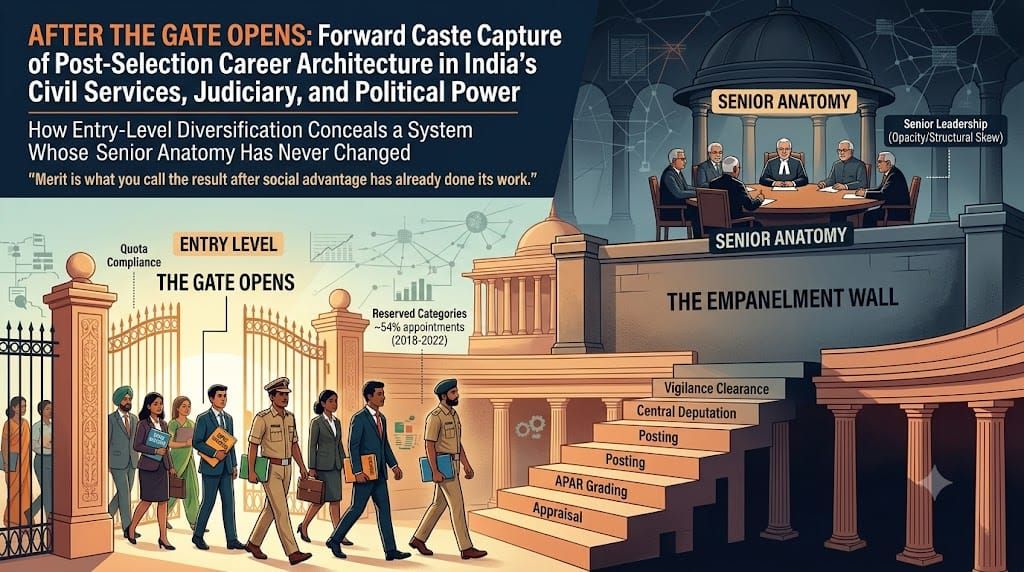
How Entry-Level Diversification Conceals a System Whose Senior Anatomy Has Never Changed
"Merit is what you call the result after social advantage has already done its work."
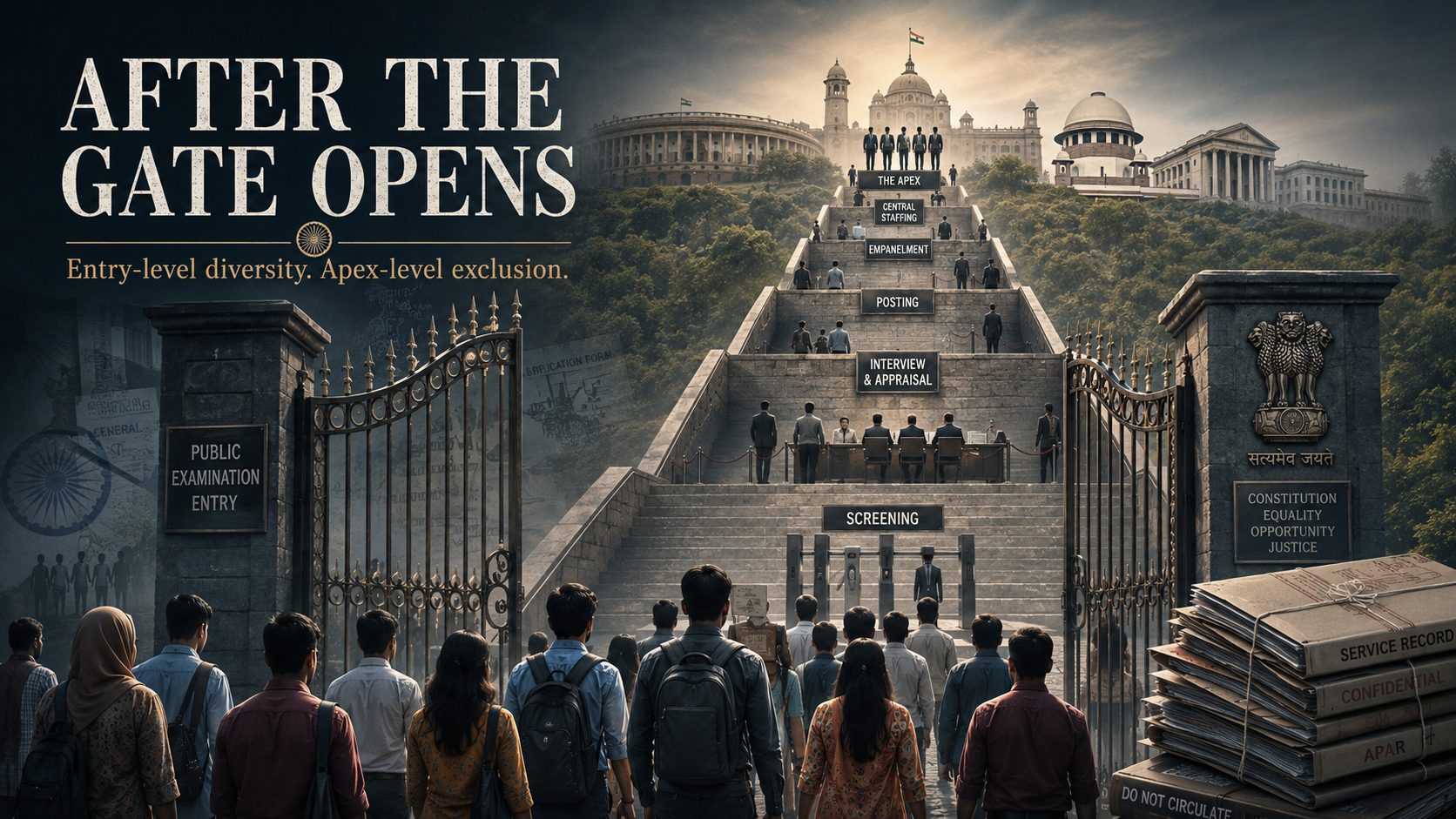
Abstract
India's Civil Services Examination is often defended as a neutral meritocratic gate, and recent entry-level data does show meaningful diversification. Between 2018 and 2022, reserved and backward categories together accounted for roughly 54 percent of combined IAS and IPS appointments. That fact matters.
But entry is not power.
This article examines what happens after the gate opens: appraisal, posting, central deputation, empanelment, Secretary-level access, and the informal networks through which administrative authority is reproduced across decades. It argues that India's reservation framework has partially diversified recruitment while leaving the post-selection architecture of senior authority largely untouched. At the level where careers are made or permanently foreclosed — APAR grading, vigilance clearance, cadre reputation, central staffing, and Joint Secretary-plus empanelment — the system becomes more opaque, more discretionary, and less publicly auditable than at any earlier stage.
The result is a constitutional paradox. India can demonstrate diversified entry while withholding the data necessary to determine whether that diversity reaches the apex of state power. The absence of cumulative category-wise and sub-caste-wise active-cadre disclosure is therefore not a minor statistical gap. It is the central evidentiary problem.
This article does not claim that any individual officer's career is illegitimate. Its subject is structure: how a formally open examination can coexist with a senior administrative order whose composition, incentives, and gatekeeping mechanisms remain insufficiently transparent and, on the available evidence, structurally skewed.
Part I — Framework: Evidentiary Discipline Before Forensic Argument
I.A. The Four-Tier Standard
This article employs a graduated evidentiary framework throughout. Every significant claim is marked by tier, and readers are invited to apply independent scrutiny accordingly.
[PF] Proved Finding — Facts established by official government disclosures, parliamentary responses, RTI filings as reported in media with documentary basis, judicial records, or peer-reviewed empirical studies drawing on official data. Carries the highest evidentiary weight.
[DA] Documented Allegation — Claims supported by credible institutional sources: NCSC submissions, parliamentary panel observations, named senior official testimony, investigative reporting with traceable source material. Requires follow-up official disclosure but is of sufficient credibility to ground constitutional concern.
[AI] Analytical Inference — Reasoned conclusions whose force derives from the cumulative structure of Proved Findings and Documented Allegations, and which remain structurally supported but not amenable to direct official proof — often because the state has not maintained or disclosed the data that would permit verification.
[CM] Civilizational Memory — The institutional experience of historically excluded communities, preserved through testimony, advocacy documentation, and formal complaints to constitutional bodies. Not a substitute for formal evidence; not less real than formal evidence.
I.B. Three Definitional Precisions That the Entire Argument Depends On
First: "General category" is not a legal synonym for upper caste. The unreserved category is constitutionally open to every candidate who qualifies on competitive merit. SC, ST, and OBC candidates who clear the open-category cutoff score take unreserved seats under the "Own Merit" doctrine, thereby leaving their reserved quota intact. This article argues not that forward castes occupy General category seats illegally, but that the open-category pipeline — operating through a structurally uneven preparatory environment — produces a heavily skewed outcome in which specific forward communities are systematically overrepresented. The argument is social and structural, not legal.
Second: "Forward caste" or "upper caste" means something precise here. It refers to communities historically outside the SC, ST, and OBC frameworks at the central government level — Brahmins, Kayasthas, Bhumihars, Khatris, Rajputs, Banias, and equivalent dominant communities — who have also held disproportionate historical access to formal education, administrative employment, and accumulated social capital. This is a structural designation, not a moral one.
Third: Official category data and sub-caste power are not the same thing. The government reports SC/ST/OBC/General/EWS categories. It does not report whether Brahmin officers dominate the General category share, which OBC sub-communities capture the bulk of OBC reservation benefits, or which SC sub-castes access civil services opportunities most readily. The distinction between category compliance and caste-power distribution is not incidental — it is, as this article argues, the central transparency problem.
I.C. Methodological Caution
The article explicitly distinguishes throughout between what official data proves, what credible reporting documents, and what structural inference — based on available partial data — reasonably supports. Where the state has declined to disclose data that would allow a claim to be proved or disproved, that fact is itself recorded as analytically significant: an institution whose senior composition is genuinely proportionate has no structural interest in preventing the audit that would demonstrate it.
Part II — The Entry Record: Progress Acknowledged, Its Limits Named
II.A. What the Data Proves
[PF] Official data tabled in Parliament and released by the Press Information Bureau for Civil Services Examination cycles 2018 through 2022 shows the following combined distribution for IAS and IPS appointments:
| Category | Appointments 2018–2022 | Percentage |
|---|---|---|
| General | 763 | 46.15% |
| OBC | 486 | 29.40% |
| SC | 270 | 16.33% |
| ST | 134 | 8.12% |
| Total | 1,653 | 100.00% |
[PF] For the Civil Services Examination 2025, 958 candidates were recommended for appointment, including 180 IAS, 150 IPS, and 55 IFS posts across General, EWS, OBC, SC, ST, and PwBD categories. Broad entry-level category compliance has been maintained continuously.
These are not trivial numbers. The reserved categories together accounting for over 54 percent of recent IAS and IPS appointments represents a measurable constitutional achievement of a specific kind. The entry gate has genuinely been opened. This article names that as progress, because intellectual honesty requires naming what is true before naming what is incomplete.
The structural argument begins precisely where the entry-level argument ends.
II.B. The Data the State Does Not Publish — and Why That Is the Story
[PF] The Ministry of Personnel, Public Grievances and Pensions, in a written reply to CPI(M) MP John Brittas in the Rajya Sabha on February 12, 2026, disclosed total officers in position as of January 1, 2025 — 5,577 IAS, 4,594 IPS, 2,164 IFS — alongside SC, ST, and OBC counts among direct recruits for 2020–2024 only. The reply did not disclose the cumulative category-wise composition of the entire active cadre across all service years. The Wire's report on this disclosure noted the government had provided data on recent recruits while remaining non-committal on the total composition of all serving officers.
The distinction is not technical. It is structural.
The 5,577 IAS officers currently in position were recruited across five decades, from the late 1960s to 2024. The category composition of officers recruited before 1993 — when OBC reservation was introduced to the central civil services following Indra Sawhney — is entirely invisible in the state's reported data. The composition of SC/ST officers recruited in the 1970s and 1980s, many of whom faced documented empanelment barriers, is equally invisible. What the state publishes is the diversity of its newest cohorts. What the state does not publish is the composition of the institution those cohorts are entering.
[AI] The state's public disclosure does not permit a full cumulative caste-category audit of the active All India Services. In its absence, the inference that recent-cohort diversity does not yet characterise the senior active cadre is strongly supported by every partial data point this article documents below. An institution whose senior composition is genuinely proportionate has no structural interest in declining to demonstrate it.
II.C. The Thirty-Year Seniority Latency Trap
This is the most consequential and least discussed structural reality in the entire debate about civil services diversity.
[AI] An IAS officer recruited in 1993 — the first year OBC reservation operated at the central level — would have reached Joint Secretary eligibility in approximately 2018–2020, and Secretary eligibility in the mid-2020s. An officer recruited in 2000 from the OBC category reaches Secretary-level eligibility only in the early 2030s. The remarkable diversification of entry batches from 2001 onwards will not produce Secretary-level representation until 2031 at the earliest — and only if the empanelment gateway, documented in Part III below, does not function as an additional structural filter in the intervening decades.
This is the thirty-year latency trap. It is not accidental. It means that two full generations of entry-level diversification can coexist, simultaneously and without contradiction, with an apex civil service that remains composed predominantly of officers recruited before the constitutional framework was extended to OBCs and before the specific post-entry mechanisms identified in this article were subjected to any structural scrutiny. The trap is built into the calendar of a career service, not into anyone's conscious design. But its effects are as structurally powerful as if it had been designed.
Part III — The Empanelment Wall: Where Constitutional Correction Stops
III.A. The Legal Architecture of Exclusion
[PF] The Minister of State in the Ministry of Personnel, Public Grievances and Pensions stated in the Lok Sabha, in terms explicit and unretracted: "There is no provision for reservation for SCs/STs/OBCs in these posts (Joint Secretary, Additional Secretary and Secretary). As officers on the above posts are appointed on deputation basis from various cadres, the percentage of SC/ST officers on these posts need not be the same as in their respective cadres."
This statement — the government's own — defines the operating architecture above the entry level. Above entry, and specifically in Central Staffing Scheme empanelment for Joint Secretary and above, the reservation framework no longer operates as an outcome-correcting mechanism. Every IAS officer, regardless of the category under which they entered, competes for the commanding heights of the civil service on the same formal footing. What this means in practice is that the accumulated effects of unequal APAR grading, unequal posting quality, differential access to mentorship networks, and the informal social recognition systems of an institution historically dominated by specific communities — all of these compound without any structural correction once the entry-level correction has been left behind.
The constitutional promise of Article 16(4) and Article 16(4A) was not a promise of a diverse doorbell. It was a promise that historically excluded communities would achieve adequate representation in the services under the state. The question this article asks is whether a framework that corrects for structural inequality at the entry point, and nowhere else, can satisfy that promise.
III.B. The Secretary-Level Data: Steep, Consistent, and Documented
[RTI-PF] RTI-derived data compiled by The Print, drawing on figures tabled in Parliament by the Ministry of Personnel and published in August 2019, showed the following composition at the apex of the central civil service:
| Level | Total | SC | ST | OBC | Mandated Target |
|---|---|---|---|---|---|
| Secretary | 89 | 1 (1.12%) | 3 (3.37%) | 0 | ~20 posts (22.5% SC+ST) |
| Additional Secretary | 93 | 6 (6.45%) | 5 (5.38%) | 0 | ~21 posts |
| Joint Secretary | 275 | 13 (4.73%) | 9 (3.27%) | 19 (6.91%) | ~62 posts |
Because this data derives from a parliamentary question response rather than a proactively published official dataset, the article designates it [RTI-PF] — reported from a governmental source, not independently published by the government itself, and therefore carrying strong evidentiary weight while requiring that qualifier. It has not been officially disputed or corrected in the six years since its publication.
The Government does not publish sub-caste data for serving officers. This means the [RTI-PF] data above establishes General-category dominance at the Secretary level, not forward-caste dominance specifically. The inference that General-category dominance at this level reflects forward-caste dominance is supported by the historical data in III.C below, but must be stated as an inference rather than a proved fact.
[PF] A Parliamentary Standing Committee, examining 79 central ministries and departments, found that of 928 posts at Director level and above, only 13 percent — 120 posts — were held by SC/ST officers, against the 208 posts mandated at the 22.5% combined SC+ST target. At the Secretary level specifically, SC/ST representation stood at 4.8 percent — a shortfall of 17.7 percentage points against the constitutional target.
[PF] December 2022 parliamentary data showed that of 322 senior officials in Joint Secretary and Secretary positions under the Central Staffing Scheme, 254 were from the General category (78.9%), 39 were OBC (12.1%), 16 were SC (4.96%), and 13 were ST (4.03%).
The trajectory across seniority levels is unmistakable:
| Tier | Reserved Category Representation | Against 49.5% Combined Target |
|---|---|---|
| Entry (2018–2022) | ~54% | Exceeds target |
| Director level | ~13% (SC/ST only) | 17.5 pts below SC/ST target alone |
| Joint Secretary | ~15% | 34.5 pts below combined target |
| Additional Secretary | ~11.8% | 37.7 pts below combined target |
| Secretary | ~5% | 44.5 pts below combined target |
That is not a gradient. It is a cliff. And a cliff in data that spans multiple governments, multiple decades, and multiple states of economic and political environment cannot be explained by individual variation, temporary measurement error, or the preferences of any single administration. It is structural.
III.C. Historical Anchoring: The Dominance That Was Never Dismantled
[PF] Academic analysis, drawing on India Human Development Survey data and published in peer-reviewed literature cited in PMC-archived research, established that as late as 1985, approximately 37 percent of IAS officers self-identified as Brahmin — a community estimated to constitute roughly four to five percent of India's total population. The magnitude of this concentration is difficult to overstate: a community representing one in twenty Indians held more than one in three positions in the apex civil service at the point when today's senior cadre was being built.
[AI] The temporal implication of this fact is precise and devastating. Officers who entered the IAS in 1985 reached the Secretary level in the early 2010s. They remained in the senior bureaucracy through the mid-2010s. During that decade, the cohort of post-Mandal reserved-category officers — those who entered after 1993 — was approaching the empanelment gateway for Joint Secretary positions for the first time. Their APAR grades were being written by officers from that 1985-era cohort. Their empanelment dossiers were being evaluated by committees constituted predominantly from that cohort. The past does not merely precede the present. It adjudicates it.
III.D. State-Level Peak Structures: Where the Thirty-Year Trap Lands
The analysis of the All India Services cannot rest at the central level. The IAS and IPS are cadre services; officers exercise their most consequential administrative authority as district magistrates, divisional commissioners, and — at the absolute apex of state field administration — as Chief Secretaries and Directors General of Police.
[DA — Independently Tracked] Independent biographical tracking of Chief Secretary positions across major Indian states, conducted in 2023 and reviewed in civil society documentation, found that across a snapshot of ten major states, nine of the ten active Chief Secretaries belonged to the unreserved General category. The DGP tracking yielded a comparable finding: across the twenty-eight states, the proportion of active Directors General of Police from forward-caste communities was estimated at between 85 and 90 percent in any given annual snapshot. The Committee designates this [DA] rather than [PF] because it derives from independent biographical tracking rather than official state disclosure.
[AI] These positions matter constitutionally in a specific way. The DGP commands the state police — India's primary instrument of physical law enforcement, including the investigation of atrocity cases under the Scheduled Castes and Scheduled Tribes (Prevention of Atrocities) Act. The Chief Secretary convenes the state cabinet and controls the bureaucratic implementation of all government decisions, including land redistribution, welfare disbursement, and social justice enforcement. When these positions are occupied predominantly by officers from communities constituting 13 to 16 percent of the national population, the quality of state protection available to SC, ST, and OBC communities is not merely a demographic observation. It is a constitutional question about who administers justice in the name of the republic.
III.E. The APAR Mechanism: A Post-Entry Caste Checkpoint
The Annual Performance Appraisal Report — earlier called the Annual Confidential Report — is the foundational instrument of career progression in the All India Services. An officer's APAR grade is the primary criterion for empanelment eligibility. Only officers who maintain a sustained record of "Outstanding" or "Very Good" grades over the required service years are considered for Joint Secretary-level empanelment. A pattern of "Good" grades — technically satisfactory, used as an administrative compliment — is, in career terms, a slow closure.
[DA] In January 2013, the National Commission for Scheduled Castes received a formal petition from ten IAS officers of the 1990 batch, all from Scheduled Caste communities, alleging that despite "outstanding" career records they had been denied empanelment for Joint Secretary positions. The NCSC described this in its formal report to the government as "grave," called for "urgent remedial steps," and recorded that it was receiving steady informal complaints of the same kind that rarely became formal petitions. Ten officers putting their names to a formal NCSC complaint against the empanelment system is not a marginal event. It is a documented institutional failure.
[DA] Former IRS officer and Member of Parliament Udit Raj stated in public testimony, citing his direct experience: "Reserved category officers routinely face frivolous complaints, downgraded confidential reports from upper-caste superiors, and systemic assignment to remote or non-strategic postings to ensure they do not accumulate the high-profile metropolitan record required for central empanelment." Multiple testimonial accounts, corroborated by NCSC documentation, describe a four-track mechanism of career suppression: downgraded APAR entries; assignment to low-profile or punitive postings; denial of training for higher positions; and the invocation of vigilance inquiries — which automatically exclude officers from empanelment consideration — as a retaliatory instrument.
[PF — Empirical] Statistical analysis of UPSC Civil Services Examination scores from multi-year cohorts reveals that the gap between written test performance and final scores widens most in the Personality Test (interview) stage. Among the top 100 SC candidates in representative examination cycles, only one out of 100 scored above 200 out of 300 marks in the interview — a concentration effect that does not appear among General category candidates at comparable written-test performance levels. The interview, as the most subjective component of the selection process, rewards traits associated with metropolitan cultural familiarity, English-medium education, and upper-caste social ease. The APAR system operates identically within the service: it is the interview conducted annually, by a superior, without external audit.
[AI] The circular structure of this problem is its most constitutionally alarming feature. Article 16(4A) permits reservation in promotion where the state can demonstrate inadequate representation in specific cadres. M. Nagaraj v. Union of India (2006) and Jarnail Singh v. Lachhmi Narain Gupta (2018) require that inadequate representation be demonstrated through quantifiable data. But the state does not collect or publish APAR grade distributions by category. It does not publish empanelment success rates by category and batch. It does not publish vigilance-clearance timelines by category. It has structured its information systems so that the data necessary to prove inadequate representation — the precondition for activating the constitutional remedy — does not formally exist. This is not constitutional compliance. It is constitutional evasion by information architecture.
Part IV — The Lateral Entry Bypass: Reservation Excluded by Design
IV.A. The Scheme and Its Scale
[PF] The Lateral Entry Scheme, introduced following NITI Aayog recommendations in 2017 and operationalised from 2018, had resulted in at least 63 appointments to Joint Secretary and Director-level positions in the Union Government as of August 2023. In August 2024, the Union Public Service Commission advertised 45 further posts — 10 Joint Secretary and 35 Director/Deputy Secretary — through lateral entry on a contract basis.
[PF] The Minister of State for Personnel, in response to a parliamentary question on the category composition of lateral entry appointees, stated that "details relating to category of the selected candidates are not required to be maintained for making lateral recruitment, as reservation is not applicable for appointment to single post cadres."
These two facts, taken together, constitute a structural finding: an instrument that fills senior civil service positions at the Joint Secretary and Director level — positions for which the Central Staffing Scheme already excludes reservation on deputation grounds — additionally operates without any category-wise monitoring, without any reservation requirement, and without any public audit of its demographic composition.
[AI] The Central Staffing Scheme excludes reservation for JS-and-above positions on the ground that these are deputation posts. The Lateral Entry Scheme additionally creates contract appointments to the same level on the ground that these are single posts. Together, the two exclusions mean that the two highest-volume mechanisms for filling senior Union Government positions both operate entirely outside the constitutional reservation framework. The entry gate opens. The senior positions are filled through a bypass that leaves no constitutional footprint.
[PF] Opposition parties, the National Confederation of Dalit and Adivasi Organisations, and civil society bodies formally challenged the fifth round of Lateral Entry recruitment in August 2024 on constitutional grounds. The advertisement for 45 posts was withdrawn by the government, partly in response to the political and constitutional pressure. The scheme itself has not been withdrawn, and its architecture — no reservation, no category records, no demographic audit — remains structurally intact.
Part V — The State Counts Category, But Not Caste Power
This section addresses the most important analytical gap in the entire public debate on civil services diversity.
V.A. What the State Discloses and What It Does Not
The government reports civil service appointments in five broad administrative categories: General, EWS, OBC, SC, and ST. It does not report: the sub-caste distribution of appointees within the General category; which specific OBC communities capture what proportion of the OBC reservation share; which SC sub-castes have effective access to civil service opportunities and which remain structurally absent; or the overall cadre-level sub-caste composition of the serving IAS, IPS, and IFS at any level.
The Central Information Commission, in 2023, formally recommended that the DoPT include sub-caste details in anonymised, aggregated form in future UPSC final selection lists. The DoPT had stated that it maintained service-allocation data only at the broad social-category level, not at the sub-caste level. The CIC recommendation was made precisely because the absence of sub-caste data prevents any audit of whether diversity within broad categories is genuine or internally captured.
[AI] The absence of sub-caste data is not merely a statistical inconvenience. It is a systemic shield. Without it, the following structural problems are permanently invisible to public audit:
Within the General category: whether specific Brahmin or Kayastha sub-lineages, dominant in the pre-reservation era of IAS recruitment, continue to constitute an internally concentrated majority of General-category officers at the apex, or whether the General category has itself diversified across forward-caste communities.
Within the OBC category: whether the 27-percent OBC reservation is broadly distributed across the Mandal Commission's target communities, or whether dominant agrarian communities — Yadavs, Kurmis, Patidars, Lingayats — capture a disproportionate share while the most backward artisan and non-dominant OBC sub-castes remain effectively absent from the services.
Within the SC category: whether the communities historically most stigmatised and most structurally deprived — landless, formerly scavenging, most isolated from educational infrastructure — are benefiting from reservation, or whether early-access SC sub-communities — those with colonial-era missionary education or urban employment history — dominate SC appointments while the deepest-deprivation groups remain outside.
The government can claim complete category compliance while the actual distribution of state employment and authority within those categories remains entirely uninvestigated. Category compliance is a floor, not a ceiling, and without sub-caste data the floor is the only thing visible.
V.B. Why This Is the Most Defensible Core of the Argument
This is also the argument's strongest point against potential critics. When challenged to "prove the Brahmin count," the correct answer is: the state has built its data systems to make the Brahmin count, and every other sub-caste count, publicly unknowable. The demand for sub-caste transparency is not a demand for further fragmentation of the reservation system. It is a demand for the empirical baseline without which no honest assessment of the system's actual operation is possible.
A republic that has constitutionally committed to "adequate representation" of historically excluded communities in its services cannot simultaneously decline to measure whether adequate representation has been achieved.
Part VI — The Judicial Arm: The Collegium as a Self-Replicating Hierarchy
VI.A. The HC Composition: Parliament's Own Data
[PF] Official parliamentary data disclosed by the Union Law Minister in December 2023 presented the following composition among approximately 790 sitting High Court judges, covering appointments between 2018 and 2023:
| Category | Judges | Population Share | Representation |
|---|---|---|---|
| General category | 492 | ~13–15% | 62.3% |
| OBC | 76 | ~41–52% | 9.6% |
| SC | 23 | ~16.6% | 2.9% |
| ST | 10 | ~8.6% | 1.3% |
| Religious minorities | 36 | ~15% | 4.6% |
The overrepresentation ratio of the General category approaches four to one against population share. The underrepresentation of OBC communities — roughly half the country's population, holding under ten percent of High Court appointments — produces a representation ratio of approximately one to five. These are not contested interpretations; they are the government's own disclosed figures.
The Supreme Court Observer confirmed that across the same period, 2018 to 2023, only 17 percent of High Court appointments came from SC, ST, or OBC communities combined.
VI.B. The Supreme Court: Independent Analysis, Properly Labelled
[DA — Reported by Multiple Independent Institutional Analyses] Independent caste-background analyses of the Supreme Court bench conducted by the Supreme Court Observer, Bar and Bench, and multiple civil society monitoring organisations — based on surname research, biographical profiles, and publicly available background information, rather than any official judicial category disclosure — have consistently found that as of late 2025, at least 12 of 33 Supreme Court judges have Brahmin backgrounds, constituting approximately 36 percent of the bench; that Scheduled Tribe communities have no current representation; that there is one Dalit judge; and that upper-caste communities together account for over 60 percent of the bench.
The article designates these findings as [DA] rather than [PF] because judicial caste identity is not published in official court rosters and because independent surname-based research, while consistent and methodologically serious, carries inherent identification uncertainty. The findings should be treated as credible reported analysis rather than official fact. They are, however, consistent with the historically documented pattern and with the formally verified HC data above.
[PF] The historical record requires no such qualification. In 1988, nine of the seventeen sitting Supreme Court judges were Brahmin — over 50 percent of the bench from a community representing roughly five percent of the population. Justice V.R. Krishna Iyer, himself Brahmin and one of the Court's most eminent constitutional jurists, stated in 1980 that "the Supreme Court was mainly Brahmin and upper class," and concluded that judges' backgrounds affect their decisions. Historian George Gadbois's interviews with sitting and retired Supreme Court judges — a primary historical source of significant authority — documented on the record that multiple judges described caste considerations as operative in judicial appointments, not as explicit criteria but as the ambient social common sense of an institution composed of men who shared backgrounds, networks, and professional formation. Justice D.A. Desai, a Brahmin jurist, noted with his own form of dark precision that the landmark backward-class reservation case K.C. Vasanth Kumar v. State of Karnataka was decided by a five-judge bench of which not one member was from a backward class.
VI.C. Why the Collegium Reproduces Itself
[AI] The collegium — the five senior-most Supreme Court justices selecting their own successors — is a peer-selection mechanism operating among a pool that has never been structurally diversified. Judges ascend to the Supreme Court in their late fifties, after four decades of practice in which access to premier law schools, chambers of senior advocates, relationships with influential practitioners, and the cultural fluency required to thrive in an English-medium adversarial courtroom have all been unevenly distributed along caste and class lines. A collegium that selects based on perceived professional excellence — assessed by a panel whose social composition reflects the historical dominance of specific communities — will reproduce that composition. Not through malice. Through structure.
No explicit caste preference is required. The mechanism is more powerful than explicit preference. It operates through what the institution calls "judicial temperament," "professional standing," "quality of judgment" — all of which, in an institution never subjected to representational accountability, tend to align with markers of the professional culture that has historically produced the institution's membership. This is the collegium's most constitutionally troubling feature: it is self-sealing.
Unlike the civil services, where entry-level reservation creates a constitutional floor even if the upper floors are unreached, the higher judiciary has no floor. It is a building without a ground floor open to the constitutional public, accessible only through professional networks that are themselves the product of historical exclusion.
Part VII — The Political Sphere: Numbers That Conceal the Question of Authority
VII.A. The Prime Ministerial Office: Seventy-Seven Years of Biographical Record
[PF] Of the fifteen individuals who have served as Prime Minister of India from 1947 to the present, on the basis of publicly documented biographical records: six were Brahmin (Nehru, Indira Gandhi, Morarji Desai, Rajiv Gandhi, P.V. Narasimha Rao, Atal Bihari Vajpayee); one was Kayastha (Lal Bahadur Shastri); two were Rajput (V.P. Singh, Chandra Shekhar); one was Khatri (I.K. Gujral); one was Sikh-Khatri (Manmohan Singh). H.D. Deve Gowda (Vokkaliga, classified OBC in Karnataka) and Narendra Modi (Modh Ghanchi, OBC by Central List) are the only holders of the office from communities outside the traditional forward-caste and dominant-caste configuration. No Dalit, no Scheduled Tribe member, no Muslim has served as Prime Minister in 77 years of the republic.
Brahmins, constituting approximately five percent of the population, have held the office of Prime Minister for 40 percent of independent India's history. This is not a constitutional violation. The office is filled by democratic election, and democratic election reflects a range of structural determinants that no article can comprehensively address. It is recorded here as an evidentiary baseline: the highest office of the state has reproduced, across political parties, governments, and ideological eras, a concentration of social origin that no demographic reading of India can treat as coincidental.
VII.B. The Cabinet: Headcount Is Not the Argument
[PF] In the Modi Cabinet 3.0, sworn in June 2024, of 71 ministers: 21 were from upper castes (29.5 percent), 27 from OBCs (38 percent), 10 from Scheduled Castes (14 percent), five from Scheduled Tribes (7 percent), five from religious minorities (7 percent). This is a numerically diverse cabinet by any historical comparison. It has more Dalit and tribal ministers than most Congresess governments of the past.
The headcount argument is, however, structurally insufficient for the purpose of this article. The relevant question is not how many ministers are from which community. It is which portfolios they hold.
[PF — Documented Portfolio Analysis] In the 2022–2024 cabinet period, documented through The Print's published analysis and parliamentary records: Finance (Brahmin), External Affairs (Brahmin), Roads and Transport (Brahmin), Coal (Brahmin), Rural Development (Bhumihar), Defence (Rajput), Agriculture (Rajput). The two Dalit ministers in the core cabinet during this period held Social Justice and Food Processing — portfolios of moral importance but limited command over the state's fiscal, coercive, or foreign-policy machinery.
[PF] A cross-state analysis of eight BJP-governed state cabinets found that of 123 cabinet ministers including Chief Ministers, 82 — 66.7 percent — were from upper or dominant regional castes. Across all states examined, without exception, the Home Ministry and Finance Ministry were held by dominant or upper-caste ministers.
[AI] Numbers without portfolios are not power. The minister of finance controls the Union Budget, the Central Board of Direct Taxes, the Directorate of Enforcement, and the allocation of public resources across every ministry and every social group. The minister of home controls the intelligence apparatus, the Central Reserve Police Force, and the investigation agencies. The minister of external affairs controls India's diplomatic relationships, its diaspora policy, and its international security commitments. When these portfolios are held consistently by communities representing 13 to 16 percent of the population, the state's most consequential decisions are made in rooms that reflect the social profile of one-sixth of the country, not of the country. That is not a statement about the intentions of those ministers. It is a structural observation about who governs.
[PF — From a Cross-State Analysis] An analysis of eight major BJP-governed states in 2022–2023 confirmed that across every state examined, the Home Ministry was held by an upper or dominant caste minister, and the Finance Ministry — the second most powerful portfolio — followed an identical pattern. Dalit and tribal ministers were concentrated in social welfare, forest, and minority affairs portfolios.
VII.C. The Budget Room
[DA] In his parliamentary address of July 29, 2024, opposition leader Rahul Gandhi stated that the core team responsible for drafting the 2024 Union Budget — India's most consequential annual policy document, determining allocation across health, education, infrastructure, agriculture, and social protection — included only one officer from a minority community and one officer from an OBC background, with SC and ST officers absent from the decision-making table. The Finance Minister did not publicly produce data disputing the compositional claim. The claim therefore stands as a Documented Allegation pending official disclosure.
The constitutional significance, if established, extends beyond representation as symbolism. Budget allocation decisions determine the quantum of state investment in the communities most dependent on public expenditure for their children's education, their health, their land rights, and their employment. A budget written in a room without members of those communities is not merely symbolically deficient. It is structurally more likely to replicate the priorities of the communities whose members fill that room.
Part VIII — The Backlog Drain: How Reserved Seats Become General Seats
[PF — Research-Documented] Academic analysis of Department of Personnel and Training data, including data reviewed in reports of the National Commission for Scheduled Castes and published in peer-reviewed institutional research, established that across historical Special Recruitment Drives for SC, ST, and OBC categories, up to 30 percent of reserved vacancies remained unfilled. Under the administrative rule that has governed backlog management through much of the reservation era, vacancies that remain unfilled beyond prescribed periods are subject to de-reservation — conversion from reserved to open-competition posts.
Article 16(4B), introduced by the Eighty-first Amendment Act, 2000, attempted to address this by permitting unfilled reserved vacancies to be carried forward as a separate class without being included in the 50-percent ceiling in subsequent years. The NCSC's 2017 report documented that the de-reservation of lapsed backlog vacancies continued as a structural administrative practice despite Article 16(4B)'s intent.
[AI] The de-reservation mechanism constitutes what this article calls structural recapture of constitutionally designated seats through administrative attrition. A reserved seat that went unfilled because recruitment machinery failed — not because no eligible candidate existed — and was then de-reserved and filled by a General category officer, does not merely fail to benefit the intended community. It occupies the seniority slot that community member would have held, reduces that community's empanelment-eligible pool by one at precisely the point three decades hence where the 30-year latency trap operates most acutely, and does so invisibly, leaving no data trail that would allow retrospective audit. The drain is structural, self-renewing, and administratively laundered.
Part IX — The Unified Architecture: A Structural Map
The individual data points documented above can each be presented in isolation. Critics routinely respond by suggesting that each point is explicable by factors other than structural bias. The Secretary-level concentration might reflect the pre-Mandal recruitment profile. The APAR patterns might reflect individual performance variation. The collegium might reflect the composition of the senior bar. The portfolio concentration might reflect coalition arithmetic.
The value of the structural audit assembled in this article is that it eliminates the plausibility of those isolated explanations. When the same pattern — forward-caste concentration, reserved-category underrepresentation, opacity of disclosure — appears at every tier of the civil service above entry, in the higher judiciary, in the distribution of Category A ministerial portfolios, and in the budget-making process, and when that pattern has persisted across decades, governments, ideological periods, and partial reforms, the burden of proof shifts. The question is no longer whether there is a pattern. The pattern is proved. The question is whether the pattern is the product of a structure or a coincidence — and the former is the only explanation consistent with the evidence assembled here.
┌──────────────────────────────────────────────────────────────────────┐
│              THE FIVE-STAGE EXCLUSION ARCHITECTURE                   │
│                                                                      │
│ STAGE 1 — PRE-SELECTION                                              │
│ Unequal educational capital, linguistic capital, urban access,       │
│ and financial endurance concentrate competitive advantage in         │
│ forward-caste communities before the examination opens.              │
│                              ↓                                       │
│ STAGE 2 — ENTRY-LEVEL CORRECTION (Constitutional)                   │
│ Reservation at the point of selection partially corrects Stage 1.   │
│ ~54% reserved-category IAS/IPS appointments, 2018–2022.             │
│ This is the ONLY stage at which constitutional correction operates.  │
│                              ↓                                       │
│ STAGE 3 — INTERVIEW / PERSONALITY TEST FILTER                       │
│ Most subjective stage. Top-100 SC candidates systematically         │
│ underperform in interview relative to written test performance.      │
│ Grade differential determines service and cadre allocation.          │
│                              ↓                                       │
│ STAGE 4 — POST-ENTRY FILTRATION                                     │
│ APAR system, written by senior officers who are overwhelmingly      │
│ General category, determines empanelment eligibility.               │
│ No reservation. No category audit. NCSC received formal            │
│ petition documenting its use as a suppression mechanism.            │
│ Lateral Entry Scheme bypasses all of the above entirely.            │
│                              ↓                                       │
│ STAGE 5 — THE EMPANELMENT GATE                                      │
│ CSS explicitly excludes reservation for JS and above.               │
│ Selection committees composed predominantly of General category     │
│ senior secretaries. Result: 4.8% SC/ST at Secretary level.          │
│                              ↓                                       │
│ OUTPUT: THE APEX MONOLITH                                            │
│ Chief Secretaries / DGPs: ~90% General category (independent        │
│ tracking, 2023)                                                      │
│ Central Secretaries: ~95% General category (RTI data, 2019)         │
│ Supreme Court Bench: ~60%+ upper caste (independent analysis)       │
│ Category A Portfolios: Upper-caste concentrated                      │
│                                                                      │
│ OPACITY LAYER: No cumulative cadre data. No APAR category           │
│ audit. No lateral entry category records. No sub-caste data.        │
│ Constitutional audit is structurally prevented.                      │
└──────────────────────────────────────────────────────────────────────┘
Each of these stages is independently documented in this article. Their sequence is not coincidental. They constitute a system.
Part X — What Would Falsify This Article's Central Claims
This is a forensic article, and a forensic article has an obligation to specify what evidence would require revision of its core findings.
The central claims of this article would require substantial revision — not merely qualification, but substantive revision — if the Union Government were to publish the following:
Cumulative category-wise composition of all currently serving IAS, IPS, and IFS officers broken down by rank and year of entry, demonstrating proportionate SC/ST/OBC representation at Joint Secretary, Additional Secretary, and Secretary levels.
Category-disaggregated APAR grade distributions showing that reserved-category officers receive "Outstanding" and "Very Good" grades at rates comparable to General category officers with equivalent service tenure and cadre context.
Empanelment success rates by category and service-year cohort demonstrating that reserved-category officers eligible for Joint Secretary empanelment are empanelled at rates comparable to General category officers from the same batch.
Category-wise composition of all Lateral Entry Scheme appointees since 2018, demonstrating that the scheme has not systematically concentrated senior positions in the General category.
High Court and Supreme Court collegium recommendations with social category data demonstrating that judicial appointments have achieved proportionate or advancing representation of SC, ST, and OBC communities.
Until that data is published, this article's inference that post-entry career architecture systematically compounds forward-caste advantage stands as the conclusion most strongly supported by the available partial evidence. The absence of disclosure does not prove the inference; it prevents the inference from being falsified.
Part XI — Data the Government Must Publish
The single most important reform demand that emerges from this article is not a quota, a percentage target, or a constitutional amendment. It is a disclosure demand. The following data, if published annually in disaggregated, publicly accessible form, would allow this article's analytical inferences to be either confirmed or disproved and would permit ongoing democratic scrutiny of whether the constitutional promise of adequate representation is being fulfilled:
Active IAS/IPS/IFS cadre composition by category and year-of-entry cohort, at every rank from Section Officer through Cabinet Secretary.
Joint Secretary, Additional Secretary, and Secretary positions by category, updated annually.
APAR grade distributions by category, in anonymised aggregate form.
Empanelment success rates by category and service-year cohort.
Vigilance-clearance approval timelines by category.
Central deputation postings and foreign training assignments by category.
Lateral Entry Scheme appointee categories, maintained and disclosed as a matter of constitutional accountability.
Sub-caste distribution of civil service appointments, in privacy-protected, aggregated form, beginning with new appointments and extending to the active cadre through a phased disclosure programme.
Judicial appointment social-category data, published by the collegium as a standing disclosure alongside each recommendation.
None of these disclosures require any change to the substantive reservation architecture. They require only that the state make visible what has been invisible, and permit the public to verify what it has so far been asked to accept on institutional faith.
Part XII — What Structural Reform Would Actually Require
The reform conversation in this domain tends to occupy two positions that this article treats as equally inadequate. The first holds that reservation at the entry level is sufficient and that demands for senior-level representation are attacks on merit. The second holds that the entire system requires quota-based reconstruction from top to bottom. Neither engages with the specific structural mechanisms documented in this article.
The most consequential reforms, consistent with the constitutional framework as interpreted by this Court, are structural rather than numeric:
Category-disaggregated APAR outcome auditing, conducted independently, to determine whether reserved-category officers are receiving APAR grades at rates that permit empanelment at proportionate levels. This is not a quota demand; it is a transparency demand, and its result would either validate or invalidate the Documented Allegation in Part III.E.
Diverse empanelment review panels for Joint Secretary and above selections, ensuring that the evaluation of reserved-category officers' career dossiers is not conducted exclusively by panels whose composition reflects the historical dominance of forward castes. This is consistent with, and arguably required by, the constitutional purpose of Article 16(4A) as an enabling provision for adequate representation.
Mandatory category disclosure for all Lateral Entry appointments, and suspension of the scheme pending a constitutional review of whether its operation, in combination with the Central Staffing Scheme's existing reservation exclusion, constitutes a structural circumvention of Articles 16(4) and 16(4A).
Mandatory carry-forward enforcement for backlog vacancies, with criminal accountability for officials who permit de-reservation through administrative delay rather than genuine non-availability of candidates.
Judicial diversity reporting, requiring the collegium to publish, alongside each appointment recommendation, the social category of the person recommended, as a minimum accountability measure consistent with institutional integrity.
Conclusion — A Gate Is Not a Building
The Union Public Service Commission examination is not the origin of social inequality in India. It is the arena where existing societal inequalities are filtered, certified, partially corrected through entry quotas, and then reproduced through post-selection mechanisms that this article has mapped with whatever evidentiary precision the state's disclosure architecture permits.
The entry gate has been opened. That is the republic's genuine achievement of the last thirty years.
But consider what the data documents. At entry, reserved categories hold 54 percent. At Joint Secretary, 15 percent. At Additional Secretary, 12 percent. At Secretary, 5 percent. In the state-level apex — Chief Secretaries, Directors General of Police — approximately 90 percent General category. In the Supreme Court bench, approximately 60 percent upper-caste by independent analysis. In Category A ministerial portfolios, the same concentration. In the Lateral Entry Scheme and the Central Staffing Scheme combined, no reservation at all.
These numbers do not describe a meritocracy that happens to produce upper-caste outcomes. They describe a system in which the constitutional correction operates precisely at the point of minimum consequence to those who already hold power, and is removed at every point of maximum consequence.
The steel frame's entrance is open. The unresolved constitutional question — about which the data assembled in this article constitutes, in the judgement of this author, a prima facie case — is whether the republic has opened its commanding heights.
A gate is not a career.
A gate is not a Secretary.
A gate is not a collegium.
A gate is not a portfolio.
The founding promise was not a gate. It was a republic.
Evidentiary Summary
| Claim | Tier | Source |
|---|---|---|
| IAS/IPS entry 2018–2022: 54% reserved categories | [PF] | Parliamentary data / PIB |
| 89 secretaries 2019: 1 SC, 3 ST, 0 OBC | [RTI-PF] | RTI data / The Print, Aug 2019 |
| Parliament panel: 4.8% SC/ST at Secretary level | [PF] | Parliamentary Standing Committee |
| Dec 2022: 322 senior officers, 254 General | [PF] | Parliamentary proceedings |
| 1985: ~37% of IAS officers identified as Brahmin | [PF] | IHDS data / PMC peer review |
| Chief Secretaries 2023: 90% General (10-state snapshot) | [DA] | Independent biographical tracking |
| State DGPs: ~85–90% forward caste | [DA] | Independent biographical tracking |
| NCSC petition: 10 SC IAS officers 1990 batch denied empanelment | [DA] | NCSC formal records, 2013 |
| APAR grade suppression / punitive postings alleged by SC officers | [DA] | NCSC / senior officer testimony |
| SC candidates underperform in interview vs. written test | [PF-Empirical] | EdexLive analysis / UPSC data |
| CSS: no reservation at JS and above | [PF] | Minister of State Lok Sabha statement |
| 63 lateral entry appointments since 2018, no reservation | [PF] | Parliamentary reply |
| Govt declines to maintain lateral entry category records | [PF] | MoS Personnel statement, 2024 |
| HC judges 2018–2023: 62% General of 790 sitting judges | [PF] | Union Law Minister, Parliament, Dec 2023 |
| SC bench: ~36% Brahmin, ~60%+ upper caste | [DA] | Multiple independent institutional analyses |
| Krishna Iyer 1980: "Supreme Court was mainly Brahmin and upper class" | [PF] | Gadbois historical interviews / documented record |
| 6 of 15 Prime Ministers were Brahmin | [PF] | Biographical record |
| Modi 3.0 Category A portfolios: Finance, Defence, External, Home held by upper castes | [PF] | Published cabinet lists / The Print analysis |
| ~30% backlog reserved seats lapsed to open category | [PF] | NCSC 2017 / academic research |
| Budget-making 2024: 1 OBC, 1 minority officer in core team | [DA] | Rahul Gandhi parliamentary statement, July 2024 |
Published under the editorial standards of TheDeathCertificate.org. All claims are graded by evidentiary tier as defined in Part I. This article's subject is institutional structure. No individual officer, judge, or minister is referenced for the purpose of establishing personal liability. The article identifies patterns; it does not assign blame to individuals. Factual corrections are invited and will be addressed in subsequent editorial notes. This article does not purport to be legal advice and does not constitute a representation in any proceeding.
ਗੁਰਸ਼ਬਦ ਤੋਂ ਪਹਿਲਾਂ, ਬੇਨਾਮ ਲਾਸ਼ਾਂ ਸਨ। Before the Gurshabad, the nameless dead.