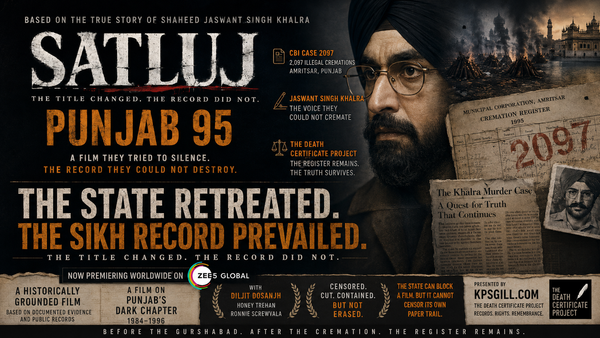
THE TITLE CHANGED, NOT THE RECORD

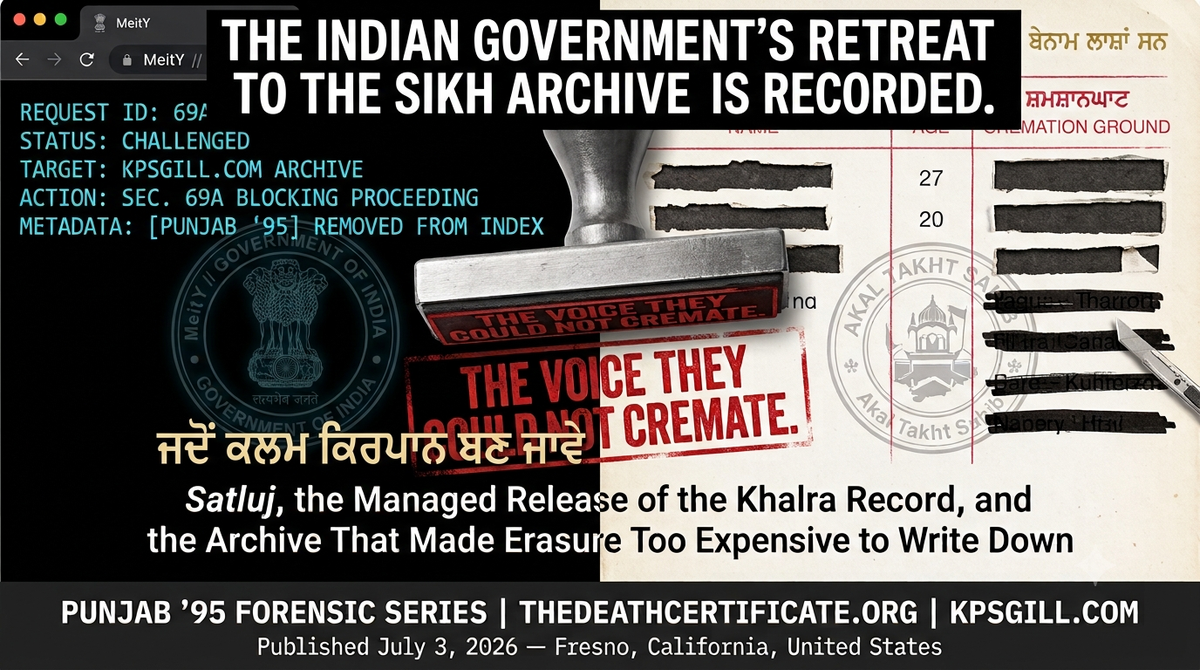
FOR IMMEDIATE RELEASE
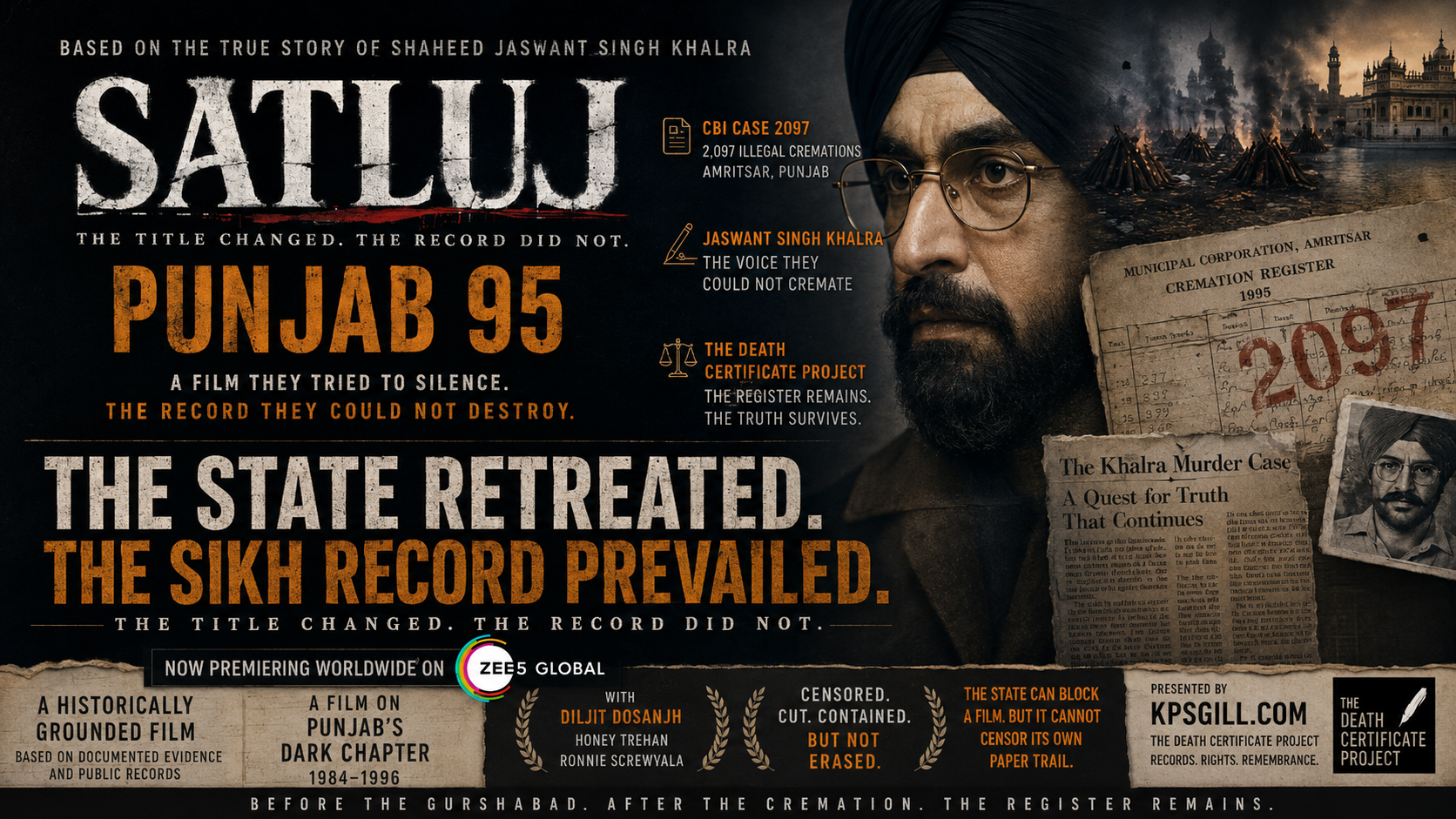
The Death Certificate Project Marks the Uncut Release of Satluj and Calls for Transparency in India's Certification of Historically Grounded Films
An Independent Forensic Archive's Statement on Satluj, the Section 69A Blocking Framework, and the Comparative Record of How India Certifies Cinema That Touches Official Power
FRESNO, CALIFORNIA / AMRITSAR, PUNJAB / NEW DELHI — July 3, 2026
Satluj — the film formerly titled Punjab '95, and before that Ghallughara — began streaming today, uncut, on ZEE5 and ZEE5 Global, more than three and a half years after its December 2022 submission to India's Central Board of Film Certification. Directed by Honey Trehan and starring Diljit Dosanjh, the film dramatizes the life and 1995 custodial killing of Jaswant Singh Khalra, the Amritsar bank director and human rights investigator whose discovery of municipal cremation registers led the Central Bureau of Investigation to confirm 2,097 illegal cremations in Amritsar district alone. Across multiple on-record interviews given at different stages of the fight, Trehan has described a censorship process whose demanded modifications never converged toward a certificate but instead climbed — variously reported at 21, 37, 45, 65, 85, and finally a widely reported 127 — including demands to remove Khalra's name, delete the words "Punjab" and "Tarn Taran," excise Gurbani, alter real dates, and disclaim any basis in fact.
The Death Certificate Project, an independent forensic public archive documenting Punjab's illegal cremations and the administrative record of 1984–1996, states its position plainly: the film lost its title. It did not lose its evidence. This Project does not claim to have released Satluj, negotiated its certification, or influenced ZEE5's decision to carry it uncut. It claims something narrower and, it believes, considerably more durable — that its own April 29, 2026 written opposition to a Section 69A blocking notice (the Indian law that allows the government to order websites blocked nationwide) against its sister archive, KPSGILL.com, helped place the Khalra record inside a live administrative file that any future act of digital erasure must now confront in writing.
Satluj's release should not be mistaken for a complete defeat of censorship, and this Project will not present it as one. The film reached viewers uncut, but not unchanged. The title was altered. The theatrical public square was avoided. The word "Punjab" was removed from the marquee before a single frame reached an audience. This is a managed release — the state's most survivable exit from a stalemate it allowed to run for three and a half years, achieved by trading the marquee for the manuscript.
And it did not happen in isolation. As this statement documents in detail below, when Indian cinema in recent years has flattered state power or dramatized majoritarian grievance, certification has typically moved in weeks. When it has implicated a living chain of police and administrative command, it has moved — in this case — in years, through a cut list without precedent in the comparative record this Project assembled, and by a route that, according to the film's own director speaking on the record, at one point closed off even the international festival and market release the makers had planned.
"Satluj is a historic release, but it is also a managed one," said Dr. Kanwar Partap Singh Gill, M.D., founder of The Death Certificate Project. "The film survived. The evidence survived. But the route it was forced to take tells us something serious about how India certifies historically grounded cinema when the record implicates the state's own police and administrative conduct — and the comparative record we have assembled shows this was not an isolated case of an overcautious board. It was a pattern, and the pattern has a shape."
IF YOU ARE ARRIVING FROM COVERAGE OF THE FILM: WHO WE ARE AND WHY WE ARE WRITING THIS
Most readers coming to this statement will have arrived because they searched for news about Satluj — not because they already know The Death Certificate Project. This section exists for that reader, in plain terms, before anything else.
The Death Certificate Project is an independent, non-governmental research archive. It was founded by Dr. Kanwar Partap Singh Gill, a physician, to document a specific unresolved historical record: the mass secret cremation of bodies by Punjab Police in the 1980s and 1990s, and the fact that many of the dead were never issued a death certificate, never received an inquest, and in most cases were never identified at all. The Project's website is TheDeathCertificate.org; its companion site, examining the civil administrators who governed the affected districts, is KPSGILL.com.
We are commenting on a Bollywood censorship story because the two records are the same record. Satluj dramatizes the life of Jaswant Singh Khalra, the man who first uncovered the cremation registers this Project has spent years cataloguing. In April 2026 — months before the film reached streaming — an arm of the Indian government tried to have this Project's own website blocked inside India under the same law used to censor online content generally. We are one of the few organizations positioned to explain, from direct experience, what that kind of pressure looks like from the inside, and how it connects to what happened to this film.
In one sentence, our claim is this: we did not release this film, and we say so directly — but we believe our own fight to keep this archive online, fought in the same months the film's fate was being decided, helped make it harder for the Government of India to erase either the film or the archive quietly. The rest of this statement explains exactly what we can prove, what we can only allege, and what is simply our analysis — because we think readers, including skeptical ones, deserve to know the difference.
EVIDENTIARY FRAMEWORK GOVERNING THIS STATEMENT
Everything below is labeled with one of four tags, so a reader can see at a glance how solid each claim is — this is not a legal formality, it is a transparency tool, and we use it because we do not want anyone to have to take our word for anything they can instead verify. [PF] Proved Finding — established by judgment, statute, official report, or convergent contemporaneous reporting from independent sources: the strongest tier. [DA] Documented Allegation — serious, sourced, and attributed to a named party, but not independently verified by this Project beyond the sourcing itself. [AI] Analytical Inference — our own reasoned conclusion, drawn from pattern, timing, or institutional conduct — clearly marked as analysis, not fact. [PM] Panthic Memory — the moral and historical record the Sikh community carries independent of any court's finding. Readers, including hostile ones, are invited to test every tier against the citation it rests on.
I. THE FACTS OF TODAY'S RELEASE
[PF] Public reporting from Variety, PTI, ANI, IANS, and the Indian trade press confirms that Satluj began streaming on ZEE5 domestically and ZEE5 Global internationally on July 3, 2026, without a theatrical run and without a title reflecting its original subject matter — but, according to on-record statements by Trehan, producer Ronnie Screwvala, and ZEE5's own Hindi content leadership, without a single cut from the completed film. [PF] The cast includes Diljit Dosanjh in the role inspired by Khalra, alongside Arjun Rampal, Kanwaljit Singh, Suvinder Vicky, and Geetika Vidya Ohlyan. [PF] The film was withdrawn from its planned 2023 premiere at the Toronto International Film Festival amid the ongoing certification dispute. [AI] That withdrawal, occurring in the same country where Khalra delivered his final public testimony in April 1995, five months before his abduction, suggests that domestic certification pressure was not confined to the domestic market — a suggestion this statement returns to and substantiates further in Part VI below.
This Project's institutional position is that a historic act of cultural survival has occurred, and it deserves to be named as such without inflation and without premature triumphalism. What follows is the record beneath the headline.
II. WHO JASWANT SINGH KHALRA WAS, STATED ONCE, COMPLETELY, WITH SOURCES THE STATE CANNOT DISOWN
[PF] Jaswant Singh Khalra was a bank director in Amritsar and a human rights investigator with the Akali Dal's human rights wing. In 1994–95, searching for disappeared colleagues, he located municipal cremation and firewood-purchase registers documenting the mass secret cremation of bodies logged by the Punjab Police as "unidentified" or "unclaimed." He made this evidence public in India in January 1995 and carried it before an international audience in Canada in April 1995. On September 6, 1995, he was abducted from outside his Amritsar home while washing his car, held illegally at Jhabal police station in Tarn Taran, and killed in custody in October 1995. No FIR of his arrest exists. No inquest was filed at the time. No death certificate was ever issued for him — the fact from which this Project takes its name.
[PF] The Central Bureau of Investigation, acting under Supreme Court direction, confirmed in its December 1996 report 2,097 illegal cremations across three grounds in Amritsar district — Durgiana Mandir, Patti, and Tarn Taran — of which 585 were fully identified, 274 partially identified, and 1,238 remain nameless to this day. The Supreme Court of India, in the appellate record of the Khalra murder case, described the underlying findings as disclosing a flagrant violation of human rights on a mass scale. [PF] Five Punjab Police officers were convicted for Khalra's abduction and murder; the Punjab and Haryana High Court enhanced their sentences to life imprisonment in October 2007; the Supreme Court of India upheld those life sentences on November 4, 2011.
[DA] Khalra's own public estimate — that the pattern, extended statewide, implied roughly 25,000 illegal killings and cremations — has never been judicially confirmed or denied, because no government in the thirty years since has opened the remaining districts' municipal registers to permit either finding. [AI] A state confident the Amritsar pattern was exceptional has had three decades to prove it by audit. It has not conducted that audit. The refusal to look is itself part of the record.
This is not contested territory. This is the Government of India's own investigative agency, confirmed by the Government of India's own Supreme Court. It is the record the Central Board of Film Certification spent years and a still-unresolved cut count trying to make un-filmable.
III. THE CENSORSHIP RECORD, STATED WITH THE PRECISION THE STATE AVOIDED
[PF] Punjab '95 was submitted to the CBFC in December 2022. Over the following three and a half years, the Board's demanded modifications did not converge toward a certificate; they diverged. Trehan's own account of the escalation has varied slightly across interviews given at different points in the dispute — an escalation from 21 to 37 to 45 reported at one stage, a climb through 45 to 65 to 85 reported in a December 2025 interview with New Lines Magazine, and a widely reported final figure of 127 by the eve of the film's eventual path to release. [AI] The inconsistency across interviews is not a flaw in the record; it is a feature of it — the number kept moving because, as Trehan told New Lines, "with this many cuts, it is not my film," and a moving target is what a divergent, bad-faith negotiation produces.
[PF, per the Khalra family's own public letter and reporting including The Wire] The modifications demanded across the life of the dispute included: removing the name Jaswant Singh Khalra from the protagonist; deleting the words "Punjab" and "Tarn Taran"; excising Gurbani; removing the numeric figures for extrajudicial killings; altering the real dates on which recorded events occurred; removing the flags of India, Canada, and the United Kingdom; and requiring a disclaimer that the film has no basis in real events.
[AI] Read as a pattern rather than a list, the demands target one thing consistently: identifiability. Not one demand concerns obscenity or incitement in the ordinary sense. Every demand concerns the viewer's ability to connect the drama to the record — the martyr's name to the martyr, the district to the CBI's own findings, the date to the case file, the flag to Khalra's international testimony, the scripture to the faith in which he is mourned. A censor does not fear a scene it can cut once. It fears an index it must keep cutting forever.
[PF] In April 2021, the Government of India abolished the Film Certification Appellate Tribunal, removing the specialized, film-literate appellate body to which a producer facing an escalating cut list could once turn, and leaving only High Court writ litigation — slower, costlier, and without subject-matter expertise — as recourse. Punjab '95 entered certification the following year, into a system already rebuilt in the censor's favor. [PF] Trehan has stated on the record that at one point, with a single hearing remaining before the Bombay High Court and the presiding judge having told the Board that any law-and-order concern was a matter for the Punjab state government rather than a certification issue, producer Ronnie Screwvala was instead summoned to an emergency meeting in New Delhi, after which — in Trehan's words — "more and more changes were suggested by the CBFC, with no space for negotiation." [AI] A litigation posture that was winning on the law, followed immediately by an unexplained escalation in administrative demands after a closed-door meeting whose contents were never shared with the director, is most parsimoniously read as evidence that the certification track and a separate, informal political track were operating on the same file simultaneously — with the informal track controlling the outcome. Part VI of this statement documents this account, and its limits, in full.
IV. THE ASYMMETRIC LENS: WHAT GETS CLEARED IN WEEKS, AND WHAT GETS HELD FOR YEARS
A single film's censorship history can always be explained away as a special case — a difficult subject, a cautious board, an unlucky timeline. A pattern cannot be explained away so easily. This Project compared, plainly and on the public record, how India's certification apparatus has treated Satluj / Punjab '95 against comparably prominent, similarly "based on real events" Indian films of the same period. Every figure below has been checked against primary trade reporting, and each is stated with the qualification the record actually supports — including where that qualification cuts against the cleanest version of this argument.
Summary comparison
| Film | Core subject | Certification timeline | Outcome |
|---|---|---|---|
| The Kashmir Files (2022) | Killing and exodus of Kashmiri Pandits by non-state militants | Certificate issued after roughly two months of negotiation; 7 minor cuts (a falling-flag shot, a photo, a muted slur, a university renamed) | Released on schedule; praised by the Prime Minister; made tax-free by multiple state governments within days |
| Article 370 (2024) | The 2019 revocation of Jammu and Kashmir's special status, with characters read by critics as depicting the sitting Prime Minister and Home Minister | Straightforward U/A certificate; no reported cut dispute | Released on schedule ahead of the general election |
| The Kerala Story (2023) | Alleged trafficking of Kerala women into ISIS after religious conversion | Certified and released on schedule; Supreme Court later ordered a disclaimer after the film's own "32,000" claim was shown to be unsubstantiated | Nationally released; only West Bengal imposed a state-level ban, later contested |
| The Kerala Story 2: Goes Beyond (2026) | Sequel, alleged trafficking/radicalization network | 16 modifications, largely to violence and one demolition sequence; a one-day judicial stay imposed February 26, 2026 was lifted February 27, 2026 by a Division Bench | Released on its original date, February 27, 2026 |
| Dhurandhar (2025) / Dhurandhar: The Revenge (2026) | Espionage thriller loosely drawing on IC-814, the 2001 Parliament attack, and the 2008 Mumbai attacks | Minor modifications (words muted, minutes trimmed); a court challenge from a real officer's family was resolved via CBFC clarification that the film bore no connection to him | Released on schedule both installments; became one of the highest-grossing Indian film franchises of the decade |
| The Bengal Files (2025) | Direct Action Day and the Noakhali riots of 1946 | Initial Examining Committee referral to a Reviving Committee; conditions on disclaimer strength, photo replacement, and documentary proof — certificate issued June 25, 2025 | Released nationally September 5, 2025; blocked only at state level in West Bengal, not by the CBFC |
| Emergency (2025) | Indira Gandhi and the 1975–77 Emergency, including the depiction of Jarnail Singh Bhindranwale | Roughly four-month delay (September 2024 to January 2025) following objections from Sikh organizations including bodies associated with Akal Takht Sahib and the SGPC; roughly 13–17 modifications, not affecting runtime | Released January 17, 2025 |
| Satluj / Punjab '95 (2022–2026) | Indictment of Punjab Police custodial killing and the civil administration's inquest failures, 1984–1996 | Three and a half years; a demanded modification count that climbed without settling, reported at various stages as 21, 37, 45, 65, 85, and finally 127 | Released without a theatrical run, under a changed title, on July 3, 2026 |
The films that flattered or merely dramatized without implicating a living chain of command. The Kashmir Files did undergo certification friction — seven cuts, two months of negotiation, more than two dozen cuts initially proposed and fought off — and it is important to state that plainly rather than imply the film sailed through untouched. But every one of its cuts was surgical: a flag shot, a muted slur, a renamed university invented to avoid a separate defamation dispute with a real institution. None touched the identity of the persecuted community, the year, the place, or the number of dead. It was certified within roughly two months and released to state-sponsored tax exemptions within days. Article 370 underwent no reported cut dispute at all, depicting characters critics widely read as the sitting Prime Minister and Home Minister, released on schedule months before a general election. The one comparator with genuine judicial friction, The Kerala Story 2, saw its stay imposed and lifted within twenty-four hours — the fastest possible correction the Indian judicial system can produce, and a useful demonstration that when the system wants to move quickly, it can move in a single business day.
The nature-of-evidence distinction. Note what each of these films is actually built on. The Kashmir Files and The Kerala Story rest substantially on testimony, oral history, and — in the Kerala Story's case — a statistical claim (32,000 conversions) that the Supreme Court itself found unauthenticated and ordered disclaimed. Article 370 is contemporary political drama built around a policy decision, not a criminal record. Satluj is the only film in this comparison set built entirely on adjudicated fact: CBI findings the Government of India's own investigative agency produced, a Supreme Court judgment the Government of India's own apex court issued, and municipal registers the Government of India's own local administration generated. This is the paradox at the center of the entire affair: the single most severely censored film in this comparison is the only one whose factual foundation was independently investigated, confirmed, and judicially affirmed before a single frame was shot. Films built on unverified projection were disciplined, correctly, with a disclaimer narrowing an unproven number. The one film built on a verified number was told to disclaim that the number was true at all.
Emergency — the case that complicates, and thereby strengthens, this record. Intellectual honesty requires including the one film in this survey whose certification was genuinely delayed by Sikh community concern, and stating plainly why the comparison still favors this Project's thesis rather than undermining it. Emergency's September 2024 release was delayed to January 17, 2025 after Sikh organizations, including bodies associated with Akal Takht Sahib and the Shiromani Gurdwara Parbandhak Committee, publicly objected that its depiction of Jarnail Singh Bhindranwale risked misrepresenting the community; the Bombay High Court became involved; the CBFC ultimately required roughly thirteen to seventeen modifications that its own counsel told the court would not reduce the film's runtime by even a minute. Set this beside Punjab '95 — a film the Khalra family had approved, the SGPC had screened and praised, and no Sikh institution ever sought to ban — and the asymmetry sharpens rather than softens. The single fastest-moving certification dispute in this entire comparison set that was driven by a Sikh community's own stated concern for its dignity still resolved roughly twelve times faster than the dispute over a film Sikh institutions actively wanted released. If the system can move in months when a community's dignity is the stated concern, its multi-year immobility when the state's own administrative and police record is at stake cannot be explained by process. It can only be explained by whose exposure the process was built to prevent.
The director's own comparison, on the record. This Project did not construct this comparative argument in a vacuum; Trehan made a version of it himself. Speaking to New Lines Magazine in December 2025, he asked why his film was treated as a law-and-order threat when, in his words, "so many state-based volatile propaganda films — The Kashmir Files, The Kerala Story, The Bengal Files — are released and the decorum is still maintained in those states." [DA, attributed to Trehan] This Project independently verified the certification and release facts of all three films Trehan named, and the verification supports his complaint rather than merely repeating it.
The closing insight. [AI] The ultimate failure of the theatrical blockade to kill the film reveals a structural shift in the economics of information containment in the digital era: when the underlying source material is anchored in public law — in CBI findings, court judgments, and municipal registers rather than testimony alone — suppression stops being a one-time editorial decision and becomes a compounding financial and administrative liability. The state could pressure a foreign festival and strip names from a theatrical marquee, but it could not, in the end, afford to write down a formal Section 69A justification that would have required declaring the Supreme Court's own record a threat to public order. The uncut digital premiere on ZEE5 represents an institutional triage: the state surrendering the content of the film in order to preserve the appearance of control over its public square.
V. THE INTERNATIONAL VALVE — AND WHY THIS FILM WAS THE EXCEPTION TO IT
There is a second, older pattern in the record, distinct from the certification-speed comparison in Part IV, and it concerns not domestic certification but what happens to Punjabi-language, Punjab-insurgency-themed films in the international market once an Indian ban or certification denial has been imposed. In plain terms: does a film blocked in India also get blocked from reaching audiences abroad? This Project examined three prior cases to answer that question honestly — and the honest answer is more precise, and more useful, than a simple claim that Sikh-identified productions are always waved through overseas.
A crucial caution before the comparison: these three films are not equivalent to one another, or to Satluj, in what they depict — and treating them as equivalent would be dishonest. Satluj dramatizes a nonviolent human rights investigator — a bank officer who exposed a crime and was murdered for it, never accused of, let alone convicted of, any act of violence. The three comparison films below dramatize very different subjects: two depict men who carried out or were associated with armed killings, and were tried, convicted, or killed by security forces as a result. This Project draws a comparison here about process and jurisdiction only — what an Indian government body did procedurally, and where its writ did and did not reach — not about whether the underlying subjects of these films deserve comparable moral standing to Khalra's. Readers should hold that distinction firmly throughout this section.
[PF] Sadda Haq (2013), a fictionalized social drama following a Canadian Sikh graduate student researching the causes of the Punjab insurgency, was cleared for release with a U/A certificate by the Film Certification Appellate Tribunal — the very appellate body the Government of India abolished in 2021. On April 4–5, 2013, days before its scheduled worldwide release, the film was banned not by the CBFC but by the state governments of Punjab, Haryana, Delhi, and Jammu & Kashmir, citing communal harmony and public order. [PF] The international release proceeded on schedule on April 5, 2013, with theatrical distribution in Canada, the United States, and the United Kingdom — including an official distribution partnership with the Canadian Sikh Coalition — and went on to gross more than $397,000 overseas, with UK collections alone exceeding £229,000 according to trade press reporting. [PF] A former CBFC chairperson publicly alleged at the time that the Ministry of Information and Broadcasting, then headed by Manish Tewari, had pushed for the film's suppression despite its tribunal clearance — an early, on-record precedent for the kind of informal ministerial pressure this statement documents in Trehan's account in Part VI. [PF] The Supreme Court of India, after a special in-court screening on April 26, 2013, lifted the state bans, and the film released nationwide with its original certificate on May 10, 2013 — meaning the entire domestic dispute, ban to vindication, resolved in roughly five weeks.
[PF] The Mastermind Jinda Sukha (2015), dramatizing letters exchanged in prison between Bhai Harjinder Singh Jinda and Bhai Sukhdev Singh Sukha — the two men convicted and executed for the 1986 assassination of Indian Army General Arun Vaidya — was cleared by the CBFC on July 24, 2015. On September 9, 2015, two days before its scheduled worldwide release, that certification was withdrawn after the Ministry of Home Affairs was alerted by the Intelligence Bureau. [PF] The film's director stated at the time, without contradiction from the Board, that no objection whatsoever had been raised to the film's overseas release, which proceeded as scheduled on September 11, 2015.
[PF] Toofan Singh (2017), dramatizing the life of Jugraj Singh Toofan, an armed militant with the Khalistan Liberation Force killed in a police encounter in 1990, was denied certification twice — first by the CBFC's revising committee in July 2017, which found the film "glorifies the Khalistan movement," and again the following month by a newly constituted board under chairperson Prasoon Joshi, which cited "excessive violence" and an uncritical comparison of its protagonist to the independence-era revolutionary Bhagat Singh. [PF] The film never obtained Indian certification and was eventually released domestically only through YouTube; its international release proceeded on schedule on August 4, 2017, receiving what trade press at the time described as positive overseas reviews.
[AI] The honest reading of this three-film pattern is not that the Indian state is indifferent to how any Punjab-insurgency narrative is received abroad, regardless of content. It is narrower and more precise: for an independently financed Punjabi-language production without mainstream Hindi-audience crossover, an India-only ban has historically cost the state nothing, because the film's foreign release does not loop back into the domestic narrative the ban exists to protect. The state has tolerated the international release of even a film glorifying an armed militant, Toofan Singh, because that film's reach never threatened to cross back into India's own mainstream audience.
This is precisely the pattern Punjab '95 broke — and it broke in the opposite direction, which is itself the finding. Because the film carried Diljit Dosanjh, an actor with genuine crossover reach into the mainstream Hindi-language audience and a global following independent of Punjab, and because it was headed for a marquee Western festival slot rather than a diaspora circuit, the usual India-only containment logic no longer applied. [PF] The film was withdrawn from its 2023 Toronto International Film Festival premiere amid the certification dispute — the one instance across all four films in this comparison where the state's reach extended to a Punjab-insurgency film's international release, rather than the state tolerating an overseas release as a cost-free pressure valve. [AI] The inference is not that Sikh producers enjoy a general exemption from Indian censorship abroad, and this Project does not claim they do. It is that the exemption, where it has existed, has existed only so long as a film's international reach did not threaten to loop back into the domestic mainstream — and that Punjab '95, precisely because of its scale and its star, was the first film in this comparative set for which that condition failed. When the valve stopped being cost-free, the state closed it — for the first time in this record, at an international film festival, before a single frame had reached an Indian screen.
VI. THE DELHI CALL: WHAT THE DIRECTOR HAS SAID ON THE RECORD, AND WHAT THIS PROJECT CAN AND CANNOT CONFIRM
This section requires more procedural care than any other in this statement, because the underlying allegation — that an organ of the Indian state pressured a producer, mid-litigation, to abandon both the domestic court fight and the international release — is serious, and this Project will not overstate what it has verified.
[DA — attributed entirely to Honey Trehan, on the record, in an interview published by New Lines Magazine in December 2025] Trehan has stated that with one hearing remaining in the Bombay High Court — at a point when, according to Trehan, the presiding judge had rejected the Board's law-and-order argument by noting that any such concern was a matter for the Punjab state government, not the certification process — producer Ronnie Screwvala was summoned to an emergency meeting in New Delhi. Trehan states that Screwvala told him afterward, "we have to do an out-of-court settlement. We cannot fight the government," and that the details of the meeting itself were never shared with him. Trehan further states that Screwvala separately received a call from what Trehan describes as "a higher authority," conveying that pursuing the film's international festival and market release — leveraging Dosanjh's global recognition — "will not be taken in good taste." Trehan's own comment, on the record: "Technically, the law cannot stop me — then who is trying to stop the film?"
What this Project can confirm: that this account was given by name, on the record, by the film's director, and published by an independent international magazine with no evident stake in the Satluj release. What this Project cannot confirm: the identity of the "higher authority" described; whether the account of the meeting's content is complete or precisely accurate, since Trehan states he was not present and was not given the meeting's details; and whether any part of this account was entered into the formal record of the Bombay High Court proceeding as sworn testimony or documentary evidence, as opposed to existing solely as a subsequent media account. This Project has not located a published court order or petition reproducing this account, and it will not represent the account as judicially established until such a document is identified and reviewed. If a specific case number, order, or filing exists in which this sequence of events was placed on record — including, potentially, under seal or in a portion of the proceeding not yet public — this Project invites the producers, Trehan, or counsel of record to provide it, and will update this statement accordingly with full attribution.
[AI] Even confined strictly to what is confirmed — a named director's on-record, published account, unrebutted by the producer or the Ministry in the seven months since publication — the allegation is significant on its own terms. An account in which a litigant winning on the law is redirected, through an informal channel outside the courtroom, toward a settlement that happens to coincide with the certification demands escalating afterward, is exactly the kind of informal pressure that formal appellate and judicial safeguards exist to prevent from mattering. That the safeguards may have been circumvented by a phone call rather than a written order is not a reason for less scrutiny. It is the reason scrutiny is needed at all.
VII. THE THEATRE THAT NEVER OPENED
[AI] A theatrical release is not a distribution format; it is a public event with legal architecture — posters, advance bookings, opening-weekend assembly, screenings inside Punjab itself, press conferences, box-office numbers that quantify public appetite, and the specific civic experience of a community watching its own history together in the dark. Satluj has none of this. It streams into private homes, on private accounts, through a subscription relationship — watched, but not assembled around. The absence of a theatrical release, and specifically the absence of any release inside Punjab's own cinema halls under the film's own historical title, is the second half of the settlement, as consequential as the title change itself. The public square was not defended. It was declined to be built.
VIII. SECTION 69A AND THE ARCHITECTURE OF DIGITAL PRESSURE
This Project's own encounter with Section 69A of India's Information Technology Act is a single data point. The pattern it fits into is not. [PF] Section 69A permits the Central Government to direct the blocking of online content on enumerated grounds — sovereignty and integrity of India, defence, security of the State, friendly relations with foreign States, public order, or the prevention of incitement to a related cognizable offence — and requires the reasons for any such direction to be recorded in writing. [PF] The 2009 Blocking Rules require a nodal-officer request, committee examination, and, outside emergencies, an opportunity for the affected party to respond; even emergency blocking requires written reasons and review within 48 hours. [PF] The Supreme Court upheld the provision in Shreya Singhal v. Union of India (2015) specifically because of these safeguards.
[AI] In practice, the threat of a blocking proceeding functions independently of whether the proceeding is ever completed or upheld. A notice imposes cost — legal fees, reputational uncertainty, platform anxiety — regardless of its eventual merits, and a publisher without institutional backing frequently cannot outlast a proceeding no matter how strong its underlying position. A blocking notice can impose legal cost, reputational uncertainty, hosting anxiety, and operational pressure well before any final order is ever tested in court. This is the precise mechanism by which a narrowly drawn national-security instrument can function, in practice, as general-purpose leverage against publishers, filmmakers, and archives — not because the statute authorizes that use, but because its own safeguards take time and resources to invoke that a respondent may not have.
This Project does not ask for Section 69A's repeal; national-security blocking has legitimate uses. It asks for something narrower: that the written-reasons requirement the Supreme Court relied upon to uphold the law be enforced as a genuine, substantive, checkable obligation, and that publishers facing such notices have access to a fast, low-cost, specialized review forum — analogous to the film-certification appellate tribunal the Government abolished in 2021 and has not replaced. Until such a forum exists, Section 69A will continue to function, for under-resourced creators and archives, less as a national-security safeguard and more as pressure with no fixed price and no fixed timeline.
IX. THE APRIL 2026 RECORD: WHAT THIS PROJECT ACTUALLY DID, STATED WITHOUT INFLATION
[PF] In April 2026, KPSGILL.com, this Project's sister archive, became the subject of a Section 69A blocking proceeding initiated by the Ministry of Electronics and Information Technology under Request ID 69A/2026/MIT/11078. On April 29, 2026, the Project filed a 73-page principal written opposition, as part of a larger 155-page submission package including annexures and a twenty-sheet URL audit workbook, contesting the proceeding as overbroad, contesting the absence of passage-specific written reasoning as required by Shreya Singhal, and contesting the underlying classification of forensic historical documentation — CBI findings, judicial holdings, municipal cremation records, and administrative tenure data — as a threat to public order.
The submission did not ask the Government of India to agree with Sikh memory. It forced the Government of India to process Sikh memory as public record. Understand this filing not merely as an opposition brief but as legal inoculation: by entering 155 pages of CBI reports, Supreme Court judgments, and municipal documentation into MeitY's own administrative file, the Project made it substantially harder for any future officer to authorize a block of this material under a public-order theory without that officer's written reasons directly confronting — and needing to explain away — the Supreme Court's own findings sitting in the same file.
This Project's claim is precise, and it will not be inflated for a better headline. The Project claims: that it built a timestamped administrative record before MeitY defending the Khalra documentary corpus; that it placed CBI findings, judicial holdings, and municipal-register evidence directly into the state's active censorship file; and that it thereby raised the evidentiary and litigation cost of any future Section 69A action against Khalra-related material. The Project does not claim that MeitY, the Ministry of Home Affairs, or the Ministry of Information and Broadcasting declined to block Satluj because of this filing; that ZEE5, RSVP, or MacGuffin Pictures relied on or were even aware of the Project's submission; or that the Government of India has conceded any position in the 69A proceeding, which remains pending and unresolved.
The formulation that will survive scrutiny: the Death Certificate Project did not release Satluj. It helped ensure that Satluj was released into an administrative field that had already been forced to confront the state's own records — a field in which any future order of erasure, against the film or the archive, must be written down, in reviewable form, against a file that answers back.
X. WHY THE STATE'S OWN PAPER TRAIL IS THE HARDEST THING TO CENSOR
[AI] A film can be called inflammatory. A speech can be called separatist. A website can be called a security threat. But a municipal cremation register, a CBI report, a Punjab and Haryana High Court judgment, and a Supreme Court affirmance cannot be made fictional by ministerial discomfort, because they were not authored by anyone this Project represents — they were authored by the Government of India itself. To block a dramatization of the Khalra record under Section 69A, an officer of the state would have to write, in a file a court can later read, a justification for treating the state's own confirmed findings as a threat to the state's own public order. That written sentence is where the paradox lives, and it has proved itself twice in 2026: once in the film's survival, once in the archive's.
XI. WHAT THE STATE WAS ACTUALLY PROTECTING
[AI] The censorship of one film for three and a half years is never really about that film. A faithful Khalra film threatens the counterinsurgency legitimacy on which India's internal-security doctrine still rests — the "Punjab model" cited whenever extraordinary policing powers are sought elsewhere. It threatens institutional continuity, because the officers who administered the districts where the cremations occurred were not punished as a class; many were promoted, and some spent their retirements as columnists and memoirists whose accounts of the period remain unchallenged in the mainstream press. It threatens a judicial record that convicted five men for the murder of the witness and, thirty years on, has convicted no one for the killings he witnessed. And it threatens an international narrative India has spent 2023–2026 trying to manage amid foreign governmental findings on transnational repression against Sikh diaspora figures.
[PF] This Project's parallel body of work documents, across more than a dozen long-form forensic publications, the specific administrative chain of the district magistracy of Amritsar across the relevant period — Ramesh Inder Singh (1984–1987), Sarabjit Singh (1987–1992), and Karanbir Singh Sidhu (1992–1996) — officers whose statutory inquest duties under Sections 174 and 176 of the Code of Criminal Procedure governed the very cremation grounds where the CBI's 2,097 confirmed cases occurred, and for whom the corresponding inquest files have never been produced, thirty years on. This Project does not allege that any of the three ordered a killing. It documents the absence of the paper the law required them to generate — an absence that has outlasted every one of their careers and pensions. The full documentary record, including a 467-question cross-examination framework and a twelve-category document-production demand, is available in this Project's published archive on request.
XII. THE KHALRA FAMILY: THE RECORD THIS PROJECT WILL NOT ALLOW TO BE MISSTATED
[PF] The film's rights were secured from the family, who read and approved the script over three years before its eventual release and, per Trehan's own account, were shown the completed film for final approval under its original title. [PF] When the CBFC's cut demands reached approximately 120, Bibi Paramjit Kaur Khalra, Navkiran Kaur Khalra, and Janmeet Singh Khalra issued a public open letter to the Board, the makers, and Sikh institutions, recording their approval of the finished film's fidelity to the historical record, their objection to the demanded name change, the Gurbani removal, and the alteration of real dates and places, their express reservation of the legal right to review the final film before consenting to any theatrical or OTT release, and their request that the SGPC and Sri Akal Takht Sahib view the film and offer their assessment. [PF] In December 2024, the SGPC did so, and its General Secretary publicly praised the film's honesty; in January 2025, following that screening, Navkiran Kaur Khalra publicly welcomed the prospect of an uncut release.
[AI] The family's single, consistently stated condition — release in original form — is the only condition an uncut release satisfies. This Project states, as a standing editorial commitment: the family's assessment of today's release, once given, will be recorded here verbatim and without gloss, and this statement will be corrected in any particular where their position differs from what is inferred above. A woman who stood outside a police station in September 1995 demanding her husband's body back has earned the right to the last word on his film, and this archive will not allow any other voice — including its own — to be substituted for hers.
XIII. THE ARCHIVE THAT ANSWERS WHAT THE FILM CANNOT
[AI] A two-hour film can carry a voice to a household. It cannot carry a footnote apparatus, a document-production matrix, or a thirty-year chain of administrative custody. That is the function this Project exists to serve: the evidentiary core quantifying the 2,097 cremations and the case for a far larger uncounted total; the civil-magistracy audits of the three Amritsar tenures; the custodial-violence record; the Panthic and doctrinal record situating Khalra's shahadat within the Sant-Sipahi tradition; the transnational-repression record connecting 1984–1996 to 2020–2026; the institutional-capture record examining the SGPC and Punjab's political dynasties; the counter-narrative record dismantling the securitized "Khalistan" frame; and now, this record — the censorship dossier itself, from the CBFC's escalating demands to the April 2026 Section 69A filing to this statement. The state's containment strategy relies on the public's questions dissipating into an unindexed void once the news cycle moves on. This archive exists precisely so they cannot.
XIV. A REFORM AGENDA
This Project calls on the Government of India, the Ministry of Information and Broadcasting, the Ministry of Electronics and Information Technology, and the Central Board of Film Certification to adopt, at minimum: publication of the complete, unredacted cut-and-modification history for any historically grounded film once certified and released; restoration of an independent, specialized appellate mechanism for certification disputes to replace the tribunal abolished in 2021; a clear rule that a film's basis in official records — court judgments, statutory investigative findings, NHRC proceedings, municipal documentation — cannot itself be treated as a certification liability, and that any demand to disclaim such a basis must be recorded in writing and subject to appellate review; enforcement of the Shreya Singhal written-reasons requirement for Section 69A blocking as a genuine, checkable standard, paired with a fast, low-cost, specialized review forum for publishers facing overbroad notices; a single consistent evidentiary standard applied to films and archives addressing minority historical trauma — Sikh, Kashmiri, Northeast Indian, Adivasi, and others — rather than the asymmetric standard this statement has documented; and, specific to this matter, the reopening of the inquest question left unresolved by three decades of civil-magistracy silence, completion of the NHRC's unfinished causation determination for the 1,238 nameless dead, and RTI extraction and publication of the CBFC's complete internal cut history for Punjab '95, so the next filmmaker addressing this history does not begin the fight the makers of this one just ended.
XV. ABOUT THE DEATH CERTIFICATE PROJECT
The Death Certificate Project is an independent forensic public archive founded by Dr. Kanwar Partap Singh Gill, M.D., documenting Punjab's illegal cremations, the missing death certificates of the disappeared, custodial disappearance, administrative and command responsibility, and the enduring public-law legacy of Jaswant Singh Khalra's investigation. Its sister publication, KPSGILL.com, extends the same evidentiary method to the broader civil-administrative record of the period. Both publications operate under the four-tier evidentiary framework applied throughout this statement, designed to permit forceful argument without collapsing the distinction between what is proved and what is remembered.
SELECTED STATEMENTS FOR ATTRIBUTION
The following may be quoted in full or in part, with attribution to Dr. Kanwar Partap Singh Gill, M.D., Founder, The Death Certificate Project.
"This moment belongs first to Shaheed Jaswant Singh Khalra, his family, the filmmakers, and the audiences who waited three and a half years for the truth to reach a screen. We do not claim to have released this film. We claim that the record Khalra died defending has become harder to erase."
"The title changed. The record did not. Ghallughara named this story in the register the Panth reserves for its massacres. Punjab '95 named it in the forensic register — a place and a year. Satluj names a river."
"We built our comparison film by film, cut by cut, so that no one would need to take our word for the pattern. When cinema flatters state power, certification moves in weeks. When it indicts the state's own police and civil record, it can take years — and the single fastest case in our entire comparison driven by a community's own concern for its dignity still moved twelve times faster than this one."
"Section 69A is supposed to be a file-making machine — the state writing its reasons where a court can read them. Too often it functions instead as pressure with no fixed price, extracting silence from publishers who cannot afford to outlast a proceeding, whatever its ultimate merits."
"A film can be called controversial. A CBI finding and a Supreme Court judgment cannot be made fictional merely because they have become inconvenient. Khalra found the state's handwriting in the cremation ground. This Project exists to keep that handwriting legible."
"The widow who stood outside a police station in September 1995 asking for her husband's body has earned the last word on his film. We will record her assessment of this release exactly as she gives it."
"The cremation ground was supposed to be the end of the evidence. It became the evidence. The censor was supposed to be the end of the story. He became a chapter in it. The title changed. The record did not."
MEDIA CONTACT
Dr. Kanwar Partap Singh Gill, M.D. Founder, The Death Certificate Project TheDeathCertificate.org | KPSGILL.com Media@TheDeathCertificate.org
Source documentation available on request: the April 29, 2026 Section 69A opposition and URL audit filed under Request ID 69A/2026/MIT/11078; the film-by-film certification comparison underlying Part IV; the consolidated forensic bibliography on the civil magistracy of Amritsar, 1984–1996; and the full citation index supporting every [PF] and [DA] finding in this statement. Any party able to provide the specific case number or filing in which the account described in Part VI was placed on judicial record is invited to contact this office; the statement will be updated with full attribution upon review.
This statement will be updated to reflect the Khalra family's public position on the July 3, 2026 release once given, and to reflect the outcome of Request ID 69A/2026/MIT/11078 once the proceeding concludes.
ਗੁਰਸ਼ਬਦ ਤੋਂ ਪਹਿਲਾਂ, ਬੇਨਾਮ ਲਾਸ਼ਾਂ ਸਨ। Before the Gurshabad, the nameless dead.
#Satluj #Punjab95 #Punjab95Film #Ghallughara #JaswantSinghKhalra #ShaheedJaswantSinghKhalra #KhalraFilm #KhalraRecord #KhalraArchive #DiljitDosanjh #HoneyTrehan #RonnieScrewvala #ZEE5 #ZEE5Global #OTTReleaseIndia #SatlujOnZEE5 #SatlujUncut #TheTitleChangedNotTheRecord #TheRegisterRemains #TheVoiceTheyCouldNotCremate #DeathCertificateProject #TheDeathCertificateProject #TheDeathCertificateOrg #KPSGILL #KPSGILLCOM #DrKanwarPartapSinghGill #PunjabIllegalCremations #IllegalCremationsPunjab #AmritsarCremations #CBI2097 #PunjabDisappeared #SikhDisappeared #DeathCertificatesPunjab #MissingDeathCertificates #UnidentifiedBodies #MunicipalCremationRegisters #FirewoodRegisters #TarnTaran #DurgianaMandir #Patti #PunjabHumanRights #SikhHumanRights #PunjabCounterinsurgency #Punjab1984 #Punjab1995 #Punjab1984To1996 #PunjabPolice #CustodialKilling #CustodialDisappearance #EnforcedDisappearances #HumanRightsCinema #HistoricallyGroundedCinema #IndianFilmCensorship #FilmCensorshipIndia #CBFC #CBFCCuts #Punjab95Censorship #SatlujCensorship #127Cuts #Section69A #Section69AIndia #Section69ACensorship #DigitalCensorshipIndia #InternetCensorshipIndia #WebsiteBlockingIndia #MeitY #MIBIndia #MHAIndia #ShreyaSinghal #ITActIndia #BlockingRules2009 #OTTRegulation #MetadataCensorship #TitleChangeCensorship #ManagedRelease #TheatricalRelease #OTTContainment #PublicSquareCinema #CollectiveWitness #PrivateStreaming #TorontoInternationalFilmFestival #TIFFWithdrawal #Punjab95TIFF #SikhCinema #PunjabCinema #SikhDiaspora #DiasporaMemory #PanthicMemory #Gurbani #GurbaniCensorship #AkalTakht #SGPC #KhalraFamily #ParamjitKaurKhalra #NavkiranKaurKhalra #JanmeetSinghKhalra #NHRC #SupremeCourtIndia #PunjabAndHaryanaHighCourt #KhalraCase #KhalraMurderCase #PublicLawArchive #ForensicArchive #StatePaperTrail #EvidenceSurvives #TheStateCannotCensorItsOwnRecords #CremationGroundEvidence #TheCensorBecameAChapter #BeforeTheGurshabad #NamelessDead #TheKashmirFiles #TheKeralaStory #Article370Film #Dhurandhar #TheBengalFiles #EmergencyFilm #MastermindJindaSukha #SaddaHaq #ToofanSingh #ComparativeCensorship #AsymmetricCensorship #SelectiveCensorship #StatePowerAndCinema #MinorityHistoricalTrauma #SikhHistoricalMemory #CivilMagistracy #AmritsarDistrictMagistrate #AdministrativeAccountability #Section174CrPC #Section176CrPC #InquestDeficit #MissingInquests #CivilSignatureOfImpunity #JusticeForPunjabDisappeared #RegisterRemains #TruthCannotBeCremated
Satluj, Satluj film, Satluj movie, Satluj ZEE5, Satluj OTT release, Satluj uncut release, Satluj ZEE5 Global, Punjab 95, Punjab ’95, Punjab 95 film, Punjab ’95 movie, Ghallughara, Ghallughara film, Jaswant Singh Khalra, Shaheed Jaswant Singh Khalra, Jaswant Singh Khalra film, Jaswant Singh Khalra movie, Khalra film, Khalra movie, Khalra record, Khalra archive, Khalra human rights, Diljit Dosanjh, Diljit Dosanjh Satluj, Diljit Dosanjh Punjab 95, Honey Trehan, Honey Trehan Satluj, Ronnie Screwvala, RSVP Movies, MacGuffin Pictures, ZEE5, ZEE5 Global, OTT release India, Indian OTT censorship, digital release India, uncut OTT release, managed release, metadata censorship, title change censorship, Punjab 95 to Satluj, Ghallughara to Punjab 95, title changed not the record, the register remains, The Death Certificate Project, Death Certificate Project, TheDeathCertificate.org, KPSGILL.com, KPS Gill, Dr Kanwar Partap Singh Gill, Kanwar Partap Singh Gill MD, Punjab death certificates, death certificates Punjab, missing death certificates, Punjab disappeared, Sikh disappeared, Punjab unidentified bodies, unidentified cremations Punjab, Punjab illegal cremations, illegal cremations Punjab, Amritsar cremations, Amritsar illegal cremations, CBI 2097, CBI 2,097, 2,097 illegal cremations, Durgiana Mandir cremations, Patti cremations, Tarn Taran cremations, municipal cremation registers, firewood registers Punjab, Punjab Police cremations, Punjab Police custodial killing, Punjab Police human rights, Punjab counterinsurgency, Punjab 1984 1996, Punjab human rights record, Sikh human rights, Sikh human rights archive, Sikh historical memory, Panthic memory, Gurbani censorship, Sikh cinema censorship, Punjab cinema censorship, film censorship India, Indian film censorship, CBFC, Central Board of Film Certification, CBFC cuts, CBFC Punjab 95, CBFC Satluj, 127 cuts Punjab 95, historically grounded cinema, historical films India, censorship of historical films, censorship of human rights films, public order censorship, national security censorship, India public order law, Section 69A, Section 69A India, Section 69A blocking, Section 69A notice, Section 69A censorship, Section 69A misuse, MeitY, Ministry of Electronics and Information Technology, MIB India, Ministry of Information and Broadcasting, MHA India, Ministry of Home Affairs, Shreya Singhal, Shreya Singhal v Union of India, IT Act India, 2009 Blocking Rules, digital censorship India, website blocking India, internet censorship India, content blocking India, OTT regulation India, Information Technology Rules 2021, Film Certification Appellate Tribunal, FCAT abolition, film certification India, certification delay India, asymmetric censorship India, selective censorship India, state power and cinema, state violence cinema, court records cinema, CBI findings cinema, NHRC Punjab cremations, Supreme Court Khalra, Punjab and Haryana High Court Khalra, Jaswant Singh Khalra case, Khalra murder case, Khalra convictions, Khalra family, Paramjit Kaur Khalra, Navkiran Kaur Khalra, Janmeet Singh Khalra, SGPC Satluj, Akal Takht, Sikh institutions, Punjab theatres, theatrical release denial, OTT containment, public square cinema, collective witness, private streaming, Toronto International Film Festival, TIFF withdrawal, Punjab 95 TIFF, international film festival withdrawal, diaspora Sikh cinema, Sikh diaspora, Canada Sikh human rights, transnational repression Sikh, Sikh diaspora memory, The Kashmir Files, The Kerala Story, Article 370 film, Dhurandhar, The Bengal Files, Emergency Kangana Ranaut, Mastermind Jinda Sukha, Sadda Haq, Toofan Singh, Punjab insurgency films, Sikh political cinema, comparative film certification, Indian censorship comparison, government aligned cinema, minority historical trauma, Sikh historical trauma, Kashmir films, Punjab films, human rights cinema India, civil magistracy Punjab, Amritsar district magistracy, Amritsar Deputy Commissioner, Ramesh Inder Singh, Sarabjit Singh IAS, KBS Sidhu IAS, Karanbir Singh Sidhu, Section 174 CrPC, Section 176 CrPC, inquest deficit Punjab, missing inquests Punjab, administrative accountability Punjab, civil signature of impunity, custodial disappearance Punjab, enforced disappearances India, public records India, archival accountability, forensic public archive, state paper trail, state records as evidence, public law archive, documentary evidence Punjab, evidence survives censorship, voice they could not cremate, cremation ground evidence, the censor became a chapter, before the Gurshabad, nameless dead, before the Gurshabad nameless dead.