THE VAN WITHOUT A LOG

Operation Blue Star, the District Administration’s Unproved Warning, and the Birth of Amritsar’s Paperless Death Regime
Punjab ’84 Forensic Series | The Death Certificate Project
I. The Question Is Not Whether a Van Made Noise
The official story of Operation Blue Star has always required one small vehicle to carry a weight far beyond its machinery.
A van.
A district-administration van.
A public-relations van.
A loudspeaker vehicle.
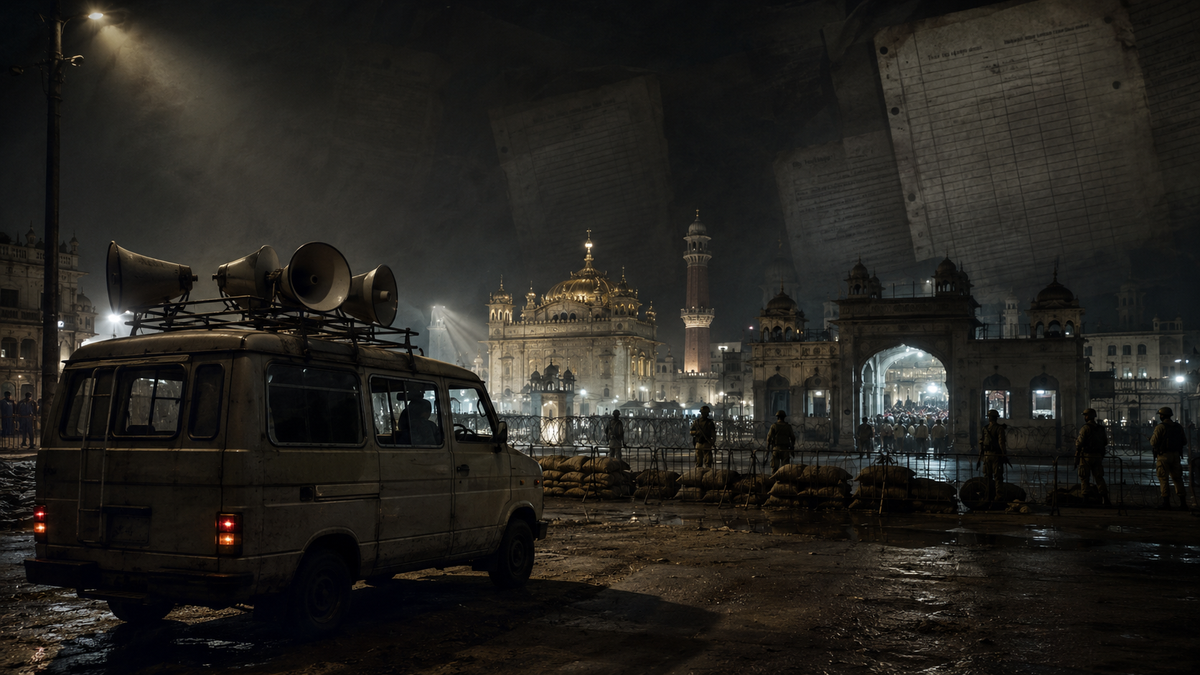
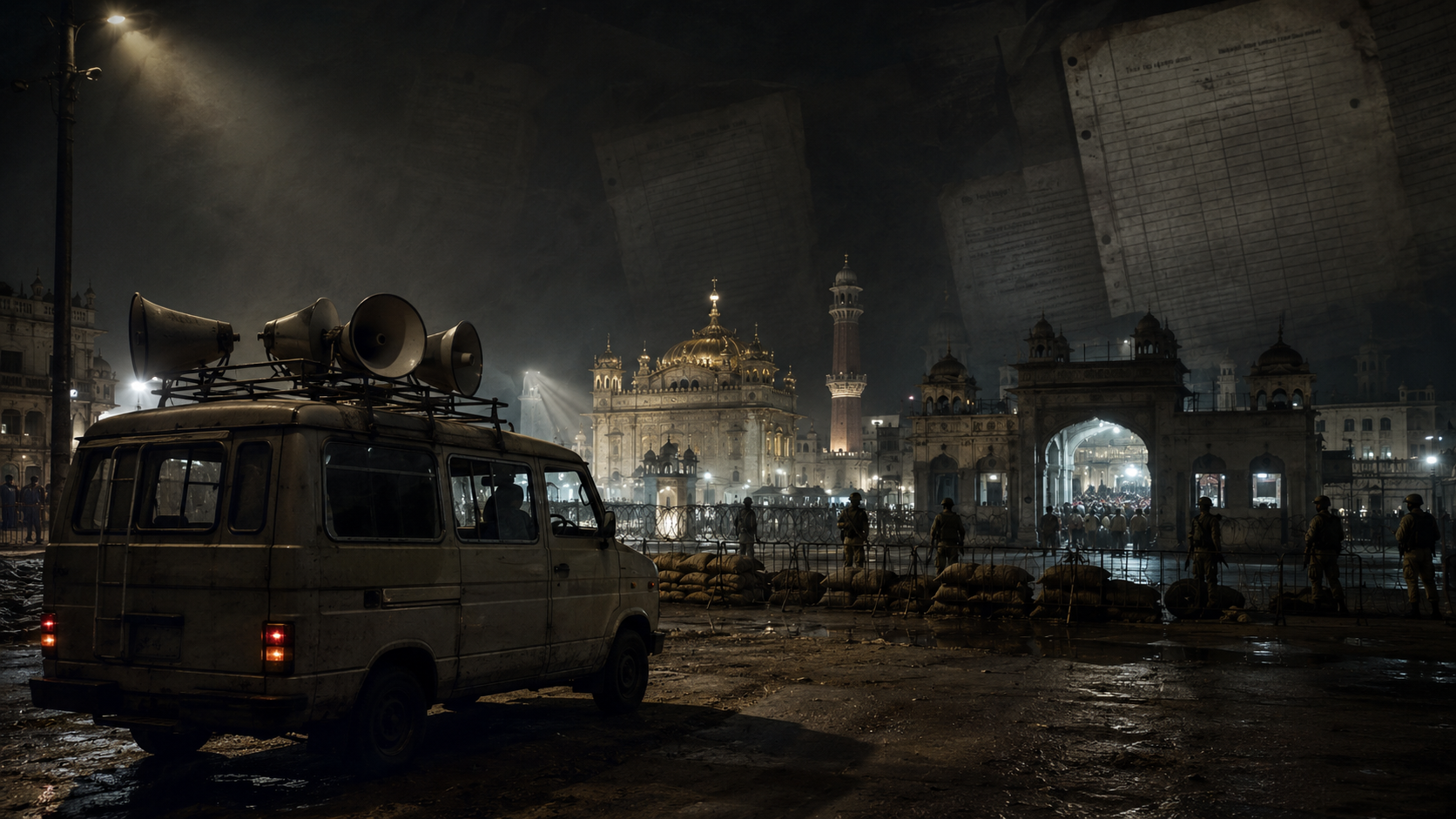
A vehicle said to have stood outside the Darbar Sahib complex in early June 1984, broadcasting an appeal in Punjabi to those inside: come out, hands raised, and you will not be fired upon.
In the state’s preferred version of events, that van performs an enormous legal function. It becomes proof that the Indian state gave civilians an opportunity to leave. It becomes proof that pilgrims were warned. It becomes proof that women, children, elderly devotees, sevadars, ragis, SGPC employees, Akali leaders, residents of the sarais, and ordinary civilians were not trapped inside a besieged sacred complex when the Army opened full force.
But a van is not a warning merely because a loudspeaker is attached to it.
A warning is not lawful merely because sound was made.
A public announcement is not proved merely because an officer later remembers one.
A civil evacuation attempt is not established by memoir, reputation, or administrative self-description.
The question is not simply whether some vehicle physically existed somewhere outside the Golden Temple complex.
The real question is more precise, more legal, and more dangerous to the official narrative:
Did the van exist in the way the state needs it to exist?
Did it exist as an authorized civil-administration instrument?
Did it exist as a legally meaningful evacuation warning?
Did it exist as a documented attempt to save civilians?
Did it exist as an audible, timely, route-recorded, officer-supervised, file-backed, safe-exit mechanism?
Or did it exist only as a post-facto administrative alibi — a weak sound, placed outside effective hearing range, later inflated into a legal defense that the state never supported with a file?
That distinction is the entire case.
The van may have existed as an object.
It has not been proven to exist as a lawful warning.
II. The State’s Smallest Alibi
Operation Blue Star is usually remembered in the language of command, betrayal, artillery, desecration, and political calculation. The names invoked are large: Indira Gandhi, General A.S. Vaidya, Lt. Gen. K. Sundarji, Maj. Gen. K.S. Brar, Jarnail Singh Bhindranwale, Shahbeg Singh, President’s Rule, the Army, the Home Ministry, the intelligence agencies, the Akal Takht, the Darbar Sahib complex.
But the smallest official alibi may be the most revealing.
The van.
Because if the state claims that civilians were warned before lethal force was used, then the warning must be capable of proof. Not devotional proof. Not political proof. Not the proof of an officer’s later recollection. Administrative proof.
That proof should have been ordinary.
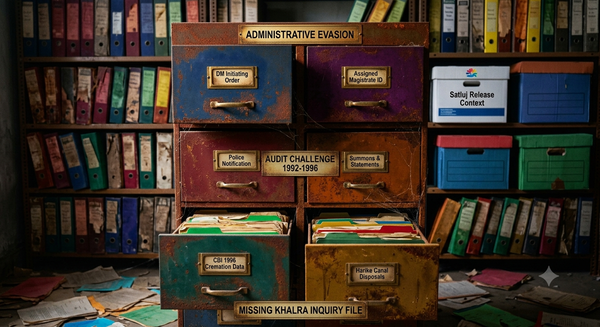
A file.
An order.
A vehicle log.
A driver’s name.
An officer-in-charge.
A route.
A timing sheet.
An approved text.
A record of the announcement language.
A map of safe exits.
A receiving point.
A register of civilians who came out.
A handover list.
A civil report after completion.
A warning that separates lawful force from indiscriminate force cannot live only in memory. If it is real as law, it leaves a record. If it leaves no record, then the law has a problem — and so does the officer whose office was responsible for the civil machinery of the district.
The van is therefore not an anecdote. It is the first forensic sign of a method that would later become familiar across Punjab: coercive power performed in public, accountability withheld from paper.
III. Ramesh Inder Singh and the Office That Should Have the File
The name must be stated precisely: Ramesh Inder Singh.
Not as a slogan. Not as a substitute for the Army. Not as an accusation that he personally ordered the assault. But because he held the office whose records should answer the van question.
Ramesh Inder Singh took charge as Deputy Commissioner of Amritsar on June 4, 1984, replacing Gurdev Singh Brar. He later wrote and spoke as an insider witness to the Punjab crisis, presenting himself as a civil servant caught at the center of one of the most consequential moments in modern Indian history.
That status cuts both ways.
If he was close enough to narrate the crisis, the office he held was close enough to preserve the record.
If a district-administration vehicle was deployed, it fell within the administrative universe of the Deputy Commissioner and District Magistrate.
If the vehicle belonged to the Public Relations Department, it still required district coordination.
If it was requisitioned by the Army, the requisition should exist.
If it was sent by the district administration, the dispatch order should exist.
If it was operated during curfew, the curfew exception should exist.
If it carried an official message, the approved text should exist.
If it was meant to save civilian lives, the time, place, route, language, officer-in-charge, vehicle number, and receiving mechanism should exist.
If civilians came out in response, their names should exist.
If no such file exists, the issue is not merely the Army’s conduct. It is the civil administration’s evidentiary collapse.
Ramesh Inder Singh may argue that he inherited a military operation already in motion. He may argue that the Army had effectively taken over. He may argue that the civilian administration was bypassed. He may argue that the military chain of command treated the district magistracy as ornamental. He may argue that the operation was badly planned, politically driven, and executed under conditions that no district officer could control.
Those arguments may explain pressure.
They do not answer the missing file.
A District Magistrate’s office cannot become invisible precisely when its records matter most.
IV. The Correct Test: Physical Existence vs. Legal Existence
The article must refuse the trap of the simple question.
A defender of the state can say:
“There was a van.”
A military memoir can say:
“Announcements were made.”
A retired civil servant can say:
“The district administration tried.”
A White Paper can say:
“People were appealed to.”
None of these statements answers the legal question.
The proper question is this:
Was there a legally sufficient, documented, audible, timely, and safe evacuation warning issued by the civil administration before the use of overwhelming force?
On that standard, the official position fails.
A van parked outside effective hearing range is not an evacuation warning. It is an administrative performance.
A warning without a safe exit route is not a warning. It is theater.
A warning without a log is not a warning. It is a later memory.
A warning without an order is not civil administration. It is deniability.
A warning without a receiving register is not evacuation. It is propaganda.
A warning without proof of audibility is not notice. It is a sound made somewhere else.
The phrase “The Van Without a Log” does not require denial that some vehicle physically existed. It denies the state the right to convert an unlogged, inaudible, undocumented vehicle into legal absolution.
V. The Three Possible Vans
There are three possible versions of the van.
Only one is supported by the current public record.
1. The Van Never Existed
This is possible, but it is not the strongest position.
The reason is simple: Brigadier Onkar Goraya’s account, as reported by The Caravan, says he saw a district-administration van outside the complex broadcasting announcements in Punjabi. His account should not be ignored merely because it creates difficulty for the official story. A serious forensic article does not deny evidence that can be used more precisely.
The stronger position is not that the van was fictional.
The stronger position is that the van, even if physically present, has never been proven to have functioned as a lawful warning.
2. The Van Physically Existed But Was Operationally Useless
This is the most defensible conclusion.
Under this version, the van existed as a physical vehicle. It may have had a microphone. It may have carried a loudspeaker. It may have broadcast a message in Punjabi. But it was positioned outside effective hearing range. It was too far, too weak, too late, too uncoordinated, too undocumented, and too disconnected from any safe civilian-exit plan to carry the legal meaning later assigned to it.
This version is devastating because it uses the state’s own partial evidence against it.
The van existed only enough to create an alibi.
It did not exist enough to save civilians.
3. The Van Became a Retrospective Legal Fiction
This is the most serious inference.
Under this version, later references to the van function as a substitute for missing records. The memory of a vehicle becomes a bureaucratic ghost. It permits officials to say, “Announcements were made,” while avoiding the actual questions:
By whom?
Under whose order?
At what time?
From what route?
Through what vehicle?
At what volume?
To what audience?
With what exit plan?
With what receiving register?
With what result?
The careful formulation is therefore this:
The van may have existed. What has not been proven is the official warning the van is now asked to represent.
VI. What Goraya Actually Proves
Brigadier Onkar Goraya’s account is important because it does not help the state as much as the state might think.
According to the account reported by The Caravan, a day before the operation began, Goraya saw a district-administration van outside the complex broadcasting Punjabi announcements. The announcement reportedly asked those stranded inside the Darbar Sahib complex to come out with their hands raised over their heads and assured them they would not be fired upon.
At first glance, that sounds like evidence for the state.
It is not.
It is evidence against the legal sufficiency of the state’s warning.
The same account places the van outside the complex, about eighty yards from the main entrance, while the people for whose benefit the announcement was supposedly being made were well beyond its reach.
That is not notice.
That is a legal failure disguised as a broadcast.
If a person inside the sarais could not hear it, it was not a warning.
If a woman sheltering with children could not hear it, it was not a warning.
If an elderly pilgrim trapped after curfew could not hear it, it was not a warning.
If SGPC employees, ragis, sevadars, ordinary devotees, and trapped civilians could not hear it, it was not a warning.
If the route out was not safe, it was not a warning.
If the warning did not identify a safe gate, a receiving officer, a protected corridor, or a non-fire instruction to troops, it was not an evacuation.
Goraya does not prove that the state warned civilians.
Goraya proves that the alleged warning, even if made, was structurally defective.
The van’s sound may have existed.
The notice did not.
VII. The 2017 Court Finding
The legal anchor is the 2017 finding of the Amritsar District and Sessions Court in the Jodhpur detainees matter.
The court did not merely record a factual dispute about whether some people heard or did not hear an announcement.
It identified an evidentiary void.
The court found no evidence that the Army made announcements asking ordinary civilians to leave the Golden Temple complex before the operation. More importantly for the civil-administration question, the court found no written record of any public announcement by civil authorities requesting people to come out of the complex. It also found no log of the vehicle allegedly used for making such announcements.
That is the center of the case.
The van is not merely “without a log” as a rhetorical phrase.
The court found the log absent.
The court did not say the announcement was merely ineffective.
It said the state could not produce the record by which such an announcement would ordinarily be proved.
That matters because bureaucracies protect themselves through paper. When the state wants to prove ration distribution, it produces a register. When it wants to prove land acquisition, it produces notifications. When it wants to prove curfew, it produces an order. When it wants to prove arrests, it produces custody records. When it wants to prove vehicle movement, it produces a log.
But when asked to prove that trapped civilians were warned before one of the most consequential military actions in postcolonial India, the state had no written civil record and no vehicle log.
That absence is not neutral.
It is evidence of the administrative character of the operation.
VIII. The Five-Part Legal Test the Van Fails
An evacuation warning before lethal state action must satisfy at least five requirements.
The alleged van warning fails each one on the public record.
1. Authority
Who ordered the announcement?
Was it the District Magistrate?
Was it the Army commander?
Was it the Home Department?
Was it the Public Relations Department?
Was it an oral direction?
Was it written?
If written, where is it?
If oral, who recorded compliance?
A warning without authority is not civil administration. It is improvisation.
2. Timing
When was the announcement made?
Before curfew?
After curfew?
Before firing?
After firing began?
Before artillery?
After the complex was already sealed?
Before civilians could safely leave?
Or only after the state had already turned the sacred complex into a cage?
A warning issued after civilians are trapped by curfew, gunfire, panic, and military enclosure is not a meaningful opportunity to leave. It is an announcement into confinement.
3. Audibility
Could the intended audience hear it?
Was the vehicle close enough?
Were the loudspeakers powerful enough?
Was there firing, shelling, blackout, panic, or structural obstruction?
Was the announcement made from outside the main entrance while people were inside sarais, rooms, basements, corridors, parikrama, langar areas, and enclosed spaces?
A warning unheard by the people it purports to protect is not notice. It is a performance of notice.
4. Safe Exit
Were safe corridors identified?
Were civilians told which gate to use?
Were they told where to assemble?
Were troops instructed not to fire?
Were women, children, elderly pilgrims, and wounded persons separately handled?
Were SGPC intermediaries used?
Were Akali leaders asked to assist?
Were white flags, religious intermediaries, or neutral observers used?
A warning without a safe route is not evacuation. It is exposure.
5. Record
Where is the order?
Where is the log?
Where is the route map?
Where is the driver’s name?
Where is the vehicle registration number?
Where is the officer’s name?
Where is the announcement text?
Where is the timing sheet?
Where is the receiving register?
Where are the statements of those who heard it?
Where are the names of those who came out?
Where is the civil file?
This is where the state fails completely.
The court found no written civil record and no vehicle log. That means the official warning story fails at the level where the bureaucracy normally speaks: the file.
IX. The Curfew Cage
The van must be understood against the timeline.
The people inside the Darbar Sahib complex were not standing in an open bazaar with ordinary freedom of movement. They were inside a sacred complex that had become the center of military enclosure, curfew, communications blackout, and escalating fire.
June 1984 was not a situation in which civilians could casually decide to leave after hearing a distant loudspeaker. The state had already altered the ordinary conditions of life. Transport was restricted. Communication was severed. Movement was controlled. The city was under coercive closure. Pilgrims had entered for the martyrdom anniversary of Guru Arjan Dev Ji. Many were not combatants. Many were not political actors. Many were simply trapped.
A warning under such circumstances carries a heightened burden.
It must be clear.
It must be loud.
It must be repeated.
It must be recorded.
It must identify a safe path.
It must be coordinated with the troops who control fire.
It must be capable of being heard by the persons whose lives depend on it.
It must be followed by receiving arrangements.
A warning into a curfew cage is not enough.
The state cannot first close the doors and then claim that the people inside were free to leave because a van outside made a sound they could not hear.
X. The Van as the First Death Certificate Problem
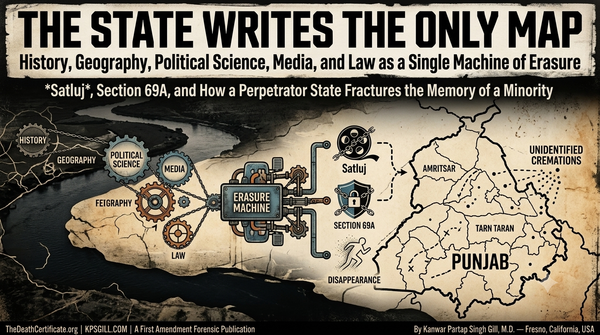
The van belongs inside The Death Certificate Project because it is the first visible sign of the later death-record regime.
The same administrative pattern appears again and again:
A state action occurs.
A civilian body is exposed to lethal force.
A legal duty arises.
The file disappears.
The state later claims necessity.
The family receives no record.
The public is left with memoir, rumor, and denial.
In 1984, the missing file is the van log.
In the late 1980s and 1990s, the missing files become inquest reports, cremation registers, death certificates, Section 174 reports, Section 176 inquiries, custody records, police handover receipts, unidentified-body records, municipal disposal registers, and post-mortem documentation.
The van without a log is not separate from the death certificate without a name.
It is the opening chapter.
The state first learned that it could say, “We warned them,” without producing the warning file.
Later, it could say, “They were unidentified,” without producing the identification file.
It could say, “They were militants,” without producing the custody file.
It could say, “They were cremated lawfully,” without producing the inquest file.
It could say, “No one complained,” while mothers, wives, fathers, children, and siblings searched police stations, courts, cremation grounds, and district offices for proof that the state had even acknowledged the human being it had taken.
The van is where the method first becomes visible.
Not because it killed anyone by itself.
But because it shows the administrative habit that made later erasures possible.
Act publicly.
Record selectively.
Deny structurally.
Remember only what helps the state.
Forget everything that would let the victim sue, mourn, inherit, prosecute, identify, or demand a death certificate.
XI. Ramesh Inder Singh’s Administrative Cross-Examination
The public question to Ramesh Inder Singh is not whether he personally fired a weapon.
The question is whether the office he held can produce the file that proves the state’s claimed warning.
The cross-examination is administrative.
It is narrow.
It is documentary.
Questions for Ramesh Inder Singh
- Did the district administration deploy a public-relations van outside the Darbar Sahib complex on June 4 or June 5, 1984?
- If yes, under whose order?
- Was the order written or oral?
- If written, where is the order?
- If oral, who recorded compliance?
- Who drafted the announcement?
- Who approved the language?
- Was the message addressed to militants, civilians, pilgrims, women, children, SGPC employees, Akali leaders, or all persons inside?
- Was the phrase “hands raised above the head” approved by the civil administration or the Army?
- Which department owned the van?
- What was the registration number of the van?
- Who was the driver?
- Who operated the loudspeaker?
- Who was the officer-in-charge?
- What time did the announcement begin?
- What time did it end?
- How many rounds of announcements were made?
- What route did the vehicle take?
- Why was it positioned outside effective hearing range?
- Did any officer enter the complex to ensure that civilians actually received the message?
- Did the district administration attempt to use SGPC intermediaries?
- Did the district administration attempt to use Akali leaders trapped inside?
- Were safe exits identified?
- Were civilians guaranteed protection upon exit?
- Were troops instructed not to fire upon those exiting?
- Were women, children, elderly pilgrims, and wounded persons separately received?
- Was there a register of those who exited?
- Was the civil administration given custody of those who exited?
- Where is the vehicle log?
- Where is the route chart?
- Where is the announcement text?
- Where is the receiving register?
- Where is the after-action report?
- If these records do not exist, why should the public accept the van as proof that civilians were warned?
A retired officer’s memory cannot substitute for the missing record of a District Magistrate’s office.
XII. The Civil Administration Cannot Borrow the Army’s Fog
A common defense of June 1984 is confusion.
The situation was chaotic.
The Army was under pressure.
The militants were armed.
The complex was fortified.
The government faced a national-security crisis.
Commanders made decisions under stress.
Civil officers were sidelined.
The operation unfolded in fog, fear, and violence.
Even if each of those points is accepted, they do not erase the civil record.
In fact, they make the civil record more necessary.
The more dangerous the operation, the greater the duty to document.
The more sacred the site, the greater the duty to record.
The more civilians trapped inside, the greater the duty to preserve warnings, exits, handovers, injuries, deaths, arrests, and bodies.
The more the Army controlled force, the more the District Magistrate needed to preserve civil accountability.
The civil administration cannot borrow the Army’s fog and then use that fog to hide its own missing paperwork.
A military assault may create battlefield confusion.
It does not abolish the duty of the district office to keep records.
XIII. The Birth of the Amritsar Template
The van without a log matters because it introduced a structure that would later reappear with terrible consistency.
A person disappears.
The police deny custody.
The family searches.
The body is cremated as unidentified.
The inquest is missing.
The death certificate is not issued.
The magistrate’s office produces no meaningful intervention.
The state later says there is no proof.
This is the Amritsar template.
It did not begin in the cremation grounds of the 1990s. It began earlier, in the logic of June 1984, when state power learned that the appearance of procedure could survive without procedure itself.
The alleged announcement became the prototype.
A warning without a file.
A public act without a record.
A life-or-death administrative step preserved only as state memory.
Once that method was accepted, the later cremation regime required no new moral invention. It only required repetition.
No warning log.
No custody log.
No inquest.
No death certificate.
No name.
No body returned.
No file.
The van without a log became the body without a certificate.
XIV. The Magistrate After Ramesh Inder Singh
The question does not end with Ramesh Inder Singh.
Every District Magistrate who later inherited Amritsar inherited more than a district.
He inherited a method.
He inherited a record culture.
He inherited the precedent that extraordinary state violence could occur in Amritsar while the civil file remained thin, missing, inaccessible, or blank.
That is why the question moves from 1984 to the late 1980s and 1990s.
It moves to Sarabjit Singh.
It moves to K.B.S. Sidhu.
It moves to every officer who sat in the District Magistrate’s chair after the state had already tested the paperless model in the sacred geography of Amritsar.
The question for them is not whether they personally planned Operation Blue Star.
They did not.
The question is whether they inherited a paperless regime and dismantled it — or whether they administered within it, benefited from it, and allowed it to continue.
When secret cremations were later exposed, where were the corrective files?
When families searched for sons, where were the magistrate’s inquiries?
When bodies were marked unidentified, where were the reconciliation registers?
When human-rights defenders named the dead, where were the death certificates?
When Jaswant Singh Khalra disappeared, where was the civil file?
The van without a log is not only a 1984 question.
It is the first question in a chain.
XV. The Legal Sentence
The cleanest conclusion is also the most difficult for the state to answer:
The van may have existed physically; it did not exist legally.
It did not exist legally because the public record has not shown the order.
It did not exist legally because the public record has not shown the vehicle log.
It did not exist legally because the public record has not shown the route.
It did not exist legally because the public record has not shown the timing.
It did not exist legally because the public record has not shown the receiving register.
It did not exist legally because the public record has not shown that the trapped civilians could hear it.
It did not exist legally because the public record has not shown that the people inside were given a real, safe, protected opportunity to leave.
The state may have wanted the benefit of a warning.
It did not preserve the proof of one.
That is why the van belongs not to the law of notice but to the mythology of state justification.
It is a ghost vehicle in the history of Amritsar: seen by some, invoked by others, but unsupported by the file that would make it lawful.
XVI. Produce the File
The public demand is narrow.
Produce the van file.
Not the memoir.
Not the recollection.
Not the interview.
Not the explanation.
The file.
Produce the order authorizing the announcement.
Produce the text of the announcement.
Produce the vehicle log.
Produce the route.
Produce the driver’s name.
Produce the officer-in-charge.
Produce the timing sheet.
Produce the safe-exit plan.
Produce the receiving register.
Produce the after-action report.
Produce the civil note sent to the state government.
Produce the district magistrate’s record.
If the van existed as the state needs it to exist, the record should show it.
If the record does not show it, then the van cannot bear the legal burden placed upon it.
The final question is not emotional.
It is administrative.
It is documentary.
It is the same question that follows every missing death certificate, every unidentified cremation, every unproduced inquest, every denied custody, every vanished file:
Where is the record?
Until that record is produced, the van remains what the public file says it is:
a vehicle without a log,
a warning without proof,
a civil defense without civil documentation,
and the first ghost of Amritsar’s paperless death regime.