THE DOCTRINE THAT COULD NOT BE CREMATED : From Custodial Erasure in Punjab to Transnational Repression Against the Sikh Diaspora, 1984–2026

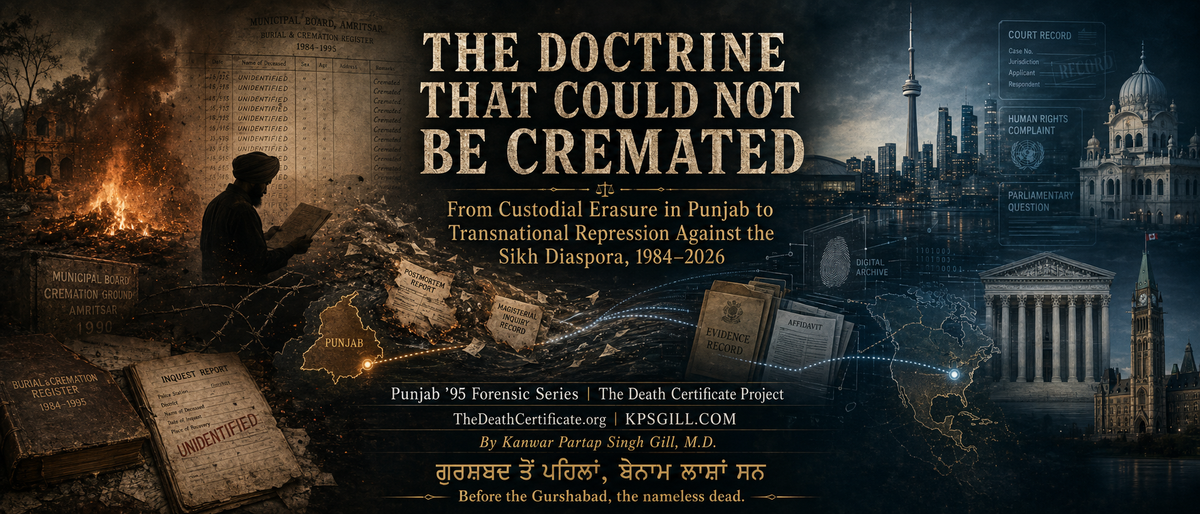
Punjab ’95 Forensic Series | The Death Certificate Project
TheDeathCertificate.org | KPSGILL.COM | A First Amendment Forensic Publication
By Kanwar Partap Singh Gill, M.D.
Published June 14, 2026 — Fresno, California, United States of America
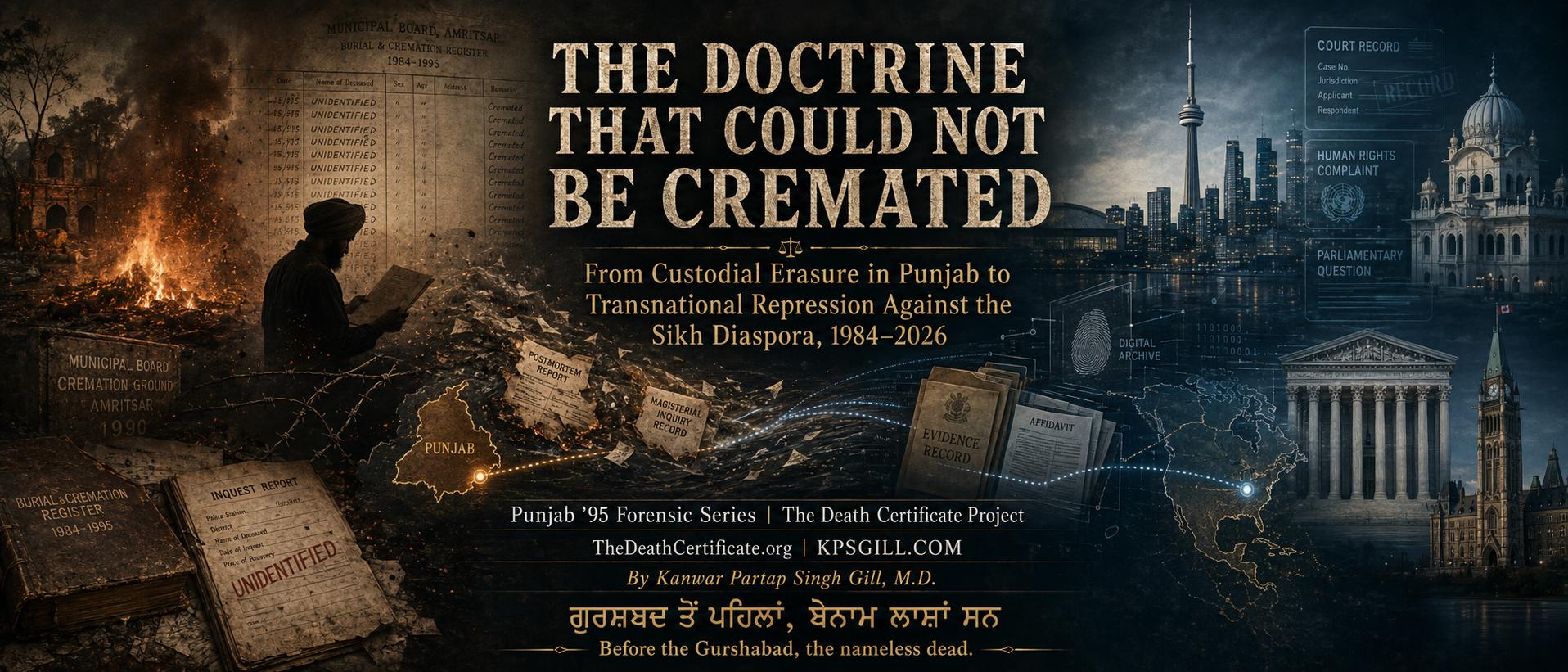
ਗੁਰਸ਼ਬਦ ਤੋਂ ਪਹਿਲਾਂ, ਬੇਨਾਮ ਲਾਸ਼ਾਂ ਸਨ
Before the Gurshabad, the nameless dead.
⚠️ CONTENT NOTICE: This article contains forensic documentation of custodial torture, sexualized violence against women and men, enforced disappearances, and extrajudicial killing. All material is drawn from judicial proceedings, official investigative findings, internationally recognized human rights documentation, and United States and Canadian court records. The purpose is accountability, not sensation. The graphic character of some material described is the character of the record itself — a record the state constructed and then attempted to destroy.
LEGAL PUBLICATION NOTICE
This article is authored and published from Fresno, California, under the full protection of the First Amendment to the Constitution of the United States. It is a publication of TheDeathCertificate.org, a U.S.-registered First Amendment forensic accountability publication, and KPSGILL.COM, its private companion archive. Both publications are operated by Dr. Kanwar Partap Singh Gill, M.D., a physician and forensic historical analyst.
This article does not constitute legal advice. It is public-interest historical and forensic journalism prepared at prosecution-standard evidentiary discipline, distinguishing proved findings, official charging allegations, official government findings, documented human rights allegations, analytical inferences, and formal document demands throughout. No claim is stated at a higher evidentiary level than the primary record supports.
Every living official, institution, diplomatic entity, or government body cited in or implicated by this article retains a standing right of documentary reply. The archive will publish corrections where established by primary evidence. It will record denials. It will record silence. All three responses are evidentiary.
This publication is the subject of an ongoing Indian Ministry of Electronics and Information Technology Section 69A blocking proceeding (Request ID 69A/2026/MIT/11078). This archive filed a 73-page opposition to that proceeding on April 29, 2026. The proceeding itself is treated by this publication as evidence of the archive’s evidentiary significance.
EVIDENTIARY FRAMEWORK
This article applies seven distinct evidentiary classifications. Every load-bearing claim in the body of the text carries one of the following labels. No claim is presented at a higher level than its source record supports.
| Label | Definition | Standard Applied |
|---|---|---|
| [PF] | Proved Finding | Court judgment, guilty plea, NHRC compensation order, Supreme Court order, official undisputed administrative date or posting, undisputed official record. |
| [OCA] | Official Charging Allegation | DOJ indictment, FBI wanted notice, RCMP charge, official law-enforcement filing or prosecutor allegation not yet adjudicated to final verdict. Official and fully citeable, but not a judicial finding unless admitted, stipulated, or adjudicated. |
| [OGF] | Official Government Finding | Public inquiry finding (Hogue Commission), official commission report, official government diplomatic statement (expulsions, executive declarations), official parliamentary statement. |
| [HR] | Human Rights Documentation | Reports by internationally recognized documentation organizations: Human Rights Watch, Amnesty International, Physicians for Human Rights, Ensaaf, HRDAG, PUCL, PUDR, PDAP, whose methodology has been accepted in Indian judicial and international human rights proceedings. |
| [DA] | Documented Allegation | Named survivor testimony, family affidavit, contemporaneous press reporting, or sourced allegation not yet finally adjudicated at the highest standard. |
| [AI] | Analytical Inference | This archive’s own reasoned conclusion from institutional pattern, timing, statutory duty, jurisdictional responsibility, convergent evidence, or the cumulative structure of the record. Stated explicitly as inference. Not presented as judicial proof. |
| [QF] | Question for File | A formal, published demand for a specific document or class of documents whose production or non-production constitutes a fact in the evidentiary record of this archive. |
FORENSIC STATUS OF THE CORE RECORD: A PRELIMINARY TABLE
Before the argument begins, the following table states precisely what the record proves, alleges, and infers as of June 14, 2026.
| Claim | Status | Primary Source |
|---|---|---|
| 2,097 illegal cremations in Amritsar district | [PF] | CBI report disclosed December 1996; NHRC proceedings 1997–2012; Supreme Court mass cremations case |
| Three cremation grounds: Durgiana Mandir, Patti, Tarn Taran | [PF] | CBI record; NHRC proceedings |
| 1,513 identified victims, monetary compensation ordered | [PF] | NHRC final order 2012; Rs. 27.94 crore total |
| 532 unidentified — permanently erased from record | [PF] | NHRC 2012; reported in Hindustan Times summary |
| 195 cases — Category A (deemed police custody) | [PF] | NHRC classification |
| 1,318 cases — Category B (wrongful non-procedural cremation) | [PF] | NHRC classification |
| Punjab Police torture was state policy, not rogue conduct | [HR] | HRW/Asia Watch 1991; Ensaaf/HRDAG 2009 |
| Custodial rape systematic and underprosecuted | [HR] | HRW/PHR 1994; AI 1991, 2003 |
| Zero Section 174 CrPC inquests produced for the 2,097 confirmed cases | [PF (duty)] + [AI (deliberate)] | Statutory text; CBI finding; absence of any produced inquest |
| Khalra abducted September 6, 1995 | [PF] | CBI record; criminal proceedings |
| Khalra held in illegal custody, tortured, murdered, never seen again | [PF] | CBI criminal proceedings |
| Multiple Punjab Police officials convicted in Khalra murder case | [PF] | CBI Special Court conviction; upheld Punjab & Haryana High Court; upheld India Supreme Court |
| Nijjar killed June 18, 2023, Surrey BC gurdwara | [PF] | Canadian criminal proceedings; official statements |
| Four accused arrested May 3, 2024 by RCMP IHIT | [PF] | RCMP official press release |
| Gupta guilty plea February 13, 2026, all three counts | [PF] | U.S. court record |
| $15,000 transmitted, $100,000 total contract | [PF] | Gupta plea factual basis |
| Yadav directed the conspiracy — CC-1 identified as Vikash Yadav | [OCA] | DOJ superseding indictment; FBI wanted notice |
| Yadav former CRPF officer deputed to R&AW | [OCA] | DOJ indictment description |
| MEA confirmed Yadav no longer employed by Government of India | [PF] | Official MEA statement |
| Yadav at large, subject to FBI wanted notice | [PF — wanted notice exists; OCA — allegations underlying it] | FBI official record |
| Gupta communicated Nijjar “was also the target” | [PF — communication is in court filings] + [AI — operational significance] | U.S. court filings |
| Canada expelled six Indian diplomats/consular officers, October 2024 | [OGF] | Canadian government official statement |
| RCMP linked homicides and extortion to agents of Government of India | [OGF] | RCMP official October 2024 statement |
| India denied all allegations and conducted reciprocal expulsions | [PF] | Indian government official statements |
| Gupta sentencing adjourned from June 26, 2026 to September 25, 2026 | [PF] | U.S. court scheduling record |
| India does not differentiate lawful Khalistani advocacy from violent extremism | [OGF] | Hogue Commission Final Report, Vol. 1, January 28, 2025 |
| India designated as second most active foreign interference actor in Canada | [OGF] | Hogue Commission Final Report |
| Approximately 800,000 Sikh diaspora members targeted by Indian interference | [OGF] | Hogue Commission Final Report, Volume 1 |
| The two operations (Pannun and Nijjar) linked in Gupta’s operational understanding | [AI from court record] | Gupta’s admitted communication; context |
| Domestic custodial violence and transnational repression express a single recurring institutional method | [AI — the article’s core thesis] | Convergent pattern across all above |
PRIMARY SOURCE RECORD
The following primary sources form the documentary spine of this article. Readers are directed to these sources directly for independent verification of all factual claims.
Judicial and Official Indian Records:
- National Human Rights Commission of India (NHRC) — Punjab Mass Cremations Case, Reference No. 1/97/NHRC (proceedings 1997–2012)
- Supreme Court of India — Writ Petition (Criminal) No. 447 of 1995 (Khalra case and related)
- CBI Special Court, Patiala — Khalra murder case conviction record
- Punjab and Haryana High Court — appeal record in Khalra conviction
- India Supreme Court — final appeal record in Khalra conviction
U.S. Judicial Records:
- U.S. Department of Justice — Indictment against Nikhil Gupta (November 2023; superseding indictment naming Vikash Yadav, October 2024)
- U.S. District Court, Southern District of New York — Gupta guilty plea record, February 13, 2026
- FBI — Vikash Yadav wanted notice
Canadian Official Records:
- Royal Canadian Mounted Police (RCMP) IHIT — Press release May 3, 2024
- Global Affairs Canada — Official statement on diplomatic expulsions, October 2024
- RCMP — Official statement October 2024 linking investigation to agents of Government of India
- Hogue Commission (Public Inquiry into Foreign Interference) — Final Report, January 28, 2025 (multiple volumes)
Human Rights Documentation:
- Human Rights Watch / Asia Watch, Punjab in Crisis: Human Rights in India (1991)
- Human Rights Watch / Physicians for Human Rights, Dead Silence: The Legacy of Abuses in Punjab (1994)
- Human Rights Watch & Ensaaf, Protecting the Killers: A Policy of Impunity in Punjab, India (2007)
- Amnesty International, India: Break the Cycle of Impunity and Torture in Punjab (2003)
- Physicians for Human Rights, Medical documentation of torture survivors, Punjab (1994)
- Ensaaf & HRDAG, Violent Deaths and Enforced Disappearances During the Counterinsurgency in Punjab, India (2009)
- Ensaaf — Crimes Against Humanity Data Project (ongoing)
TABLE OF CONTENTS
PART ONE: THE PROPOSITION
- Section I: The Unifying Argument — One Doctrine, Two Phases
- Section II: What This Article Argues and What It Does Not
- Section III: The Forensic Architecture of the Continuity Thesis
PART TWO: THE DOMESTIC RECORD — PHASE ONE (1984–1996)
- Section IV: Enforced Disappearance as State Technology — The Legal Framework
- Section V: The Administrative Architecture of Disappearance — From Thana to Fire
- Section VI: The Three Cremation Grounds — What the CBI Record Establishes
- Section VII: The Statutory Framework That Was Systematically Violated
- Section VIII: The Inquest That Was Never Conducted — Section 174 CrPC as the Missing Document
- Section IX: The Magistracy’s Silence — The Three-DC Triad and What Should Have Existed
- Section X: Custodial Torture as State Policy — The Pattern Evidence and the Intelligence Nexus
- Section XI: The Sexual Violence Architecture — Institutional Function, Legal Framework, and the Missing Medico-Legal Record
- Section XII: The Political Authorization Chain — Civil Command Above the DC
- Section XIII: The Promotion Record as the State’s Own Testimony
PART THREE: THE HINGE — JASWANT SINGH KHALRA AND THE MOMENT DOCTRINE BECAME TRANSNATIONAL (1993–1996)
- Section XIV: The Research That Changed Everything — How Khalra Built the Record
- Section XV: The International Dimension — Why His Work Threatened a Jurisdiction the State Could Not Control
- Section XVI: September 6, 1995 — The Abduction and Its Administrative Anatomy
- Section XVII: The Murder and the Conviction — What the Judicial Record Establishes
- Section XVIII: What Khalra’s Killing Proved About the Doctrine’s Next Phase
- Section XIX: The Incomplete Record — What the State Could Not Suppress
PART FOUR: THE SILENCE PRESERVATION APPARATUS (1996–2020)
- Section XX: The Post-Counterinsurgency State — The Apparatus That Was Not Dismantled
- Section XXI: The Badal Custodial Era — Political Governance as Impunity Management
- Section XXII: The Diaspora Documentation Threat — How the Record Was Rebuilt Abroad
- Section XXIII: The UAPA Designation Architecture — Extraterritorial Lawfare as Suppression
- Section XXIV: The Operational Reorientation — What the Indictments Imply
PART FIVE: THE TRANSNATIONAL RECORD — PHASE TWO (2020–2026)
- Section XXV: The Pannun Conspiracy — A Complete Forensic Account
- Section XXVI: Vikash Yadav — The Official Charging Allegation and What It Establishes
- Section XXVII: Nikhil Gupta’s Guilty Plea — Every Admitted Fact and Its Legal Significance
- Section XXVIII: The “Also the Target” Statement — The Seam in the Architecture of Deniability
- Section XXIX: The Nijjar Murder — From Surrey to British Columbia Supreme Court
- Section XXX: The RCMP Investigation and the Four Accused
- Section XXXI: The Canadian Government’s Executive Response — Expulsions and Their Legal Weight
- Section XXXII: The Hogue Commission — A Sovereign Government’s Own Findings in Full
- Section XXXIII: The European Dimension — Germany and the Broader Pattern
- Section XXXIV: The India Denial Record — What the Government of India Has Said and What It Has Not
PART SIX: THE CONTINUOUS DOCTRINE — FORENSIC ANALYSIS
- Section XXXV: The Five Characteristics — A Detailed Comparative Analysis
- Section XXXVI: The Sexual Violence Through-Line — From Thana to Information Warfare
- Section XXXVII: The Documenter as Target — A Forty-Year Pattern
- Section XXXVIII: The Deniability Architecture — How It Was Designed and How It Fails
- Section XXXIX: The Legal Mechanism Disability — From Missing FIRs to National-Security Privilege
- Section XL: The Management-Not-Answer Pattern — From Punjab Commissions to MEA Press Releases
PART SEVEN: COMMAND RESPONSIBILITY — THE LEGAL ANALYSIS
- Section XLI: The International Framework for Superior Responsibility
- Section XLII: The Yamashita Principle Applied to Punjab’s Civil Administration
- Section XLIII: The Rome Statute Article 28 Analytical Framework
- Section XLIV: The Civilian Component — DC Amritsar’s Statutory Position in the Chain
- Section XLV: What the Convictions Establish and What They Leave Open
PART EIGHT: FORMAL DEMANDS AND ARCHIVE STATUS
- Section XLVI: The Complete Formal Demand List — Twenty-One Questions for File
- Section XLVII: The Right of Reply — Terms and Scope
- Section XLVIII: The Section 69A Proceeding and the Archive’s Legal Posture
PART NINE: CLOSING
- Section XLIX: The Doctrine That Could Not Be Cremated
- Section L: The Archive’s Mission — Why This Document Exists
PART ONE: THE PROPOSITION
Section I: The Unifying Argument — One Doctrine, Two Phases
This article argues — with the evidentiary discipline stated above and the limitations explicitly acknowledged — that the custodial violence, enforced disappearances, sexual terror, and torture deaths deployed by the Indian state against Sikh communities in Punjab between 1984 and 1996, and the transnational repression directed against Sikh diaspora communities between 2020 and June 2026, are best understood as expressions of a single, recurring institutional doctrine.
The word doctrine requires precise definition. This article does not use it to mean a written policy document that connects Punjab’s cremation grounds to a kill order against a Sikh advocate in North America. No such document has been produced or made public. What this article means by doctrine is something more durable and, ultimately, more dangerous than a policy memo: it is a recurring institutional method that has been applied, across multiple administrative periods and multiple geographic jurisdictions, with sufficient consistency of structure to support an analytical inference of institutional continuity.
The method, stated at its most basic, is this:
When a Sikh individual or institution possesses documentation, political organization, legal standing, or institutional memory that threatens the state’s narrative control over the events of the counterinsurgency era — or over the broader history of state violence against Sikh communities — the state acts to suppress that individual or institution through the following sequence:
- Target the documenter — not merely the armed actor, not merely the political organizer in the conventional sense, but specifically the person or institution whose work threatens to place the domestic record inside a jurisdiction the state cannot control.
- Build deniability architecturally — not as an afterthought, but as the foundational design principle of the suppression operation, so that each component of the state apparatus can disclaim knowledge of the others.
- Weaponize the victim’s identity retroactively — convert the rights-holder into a security subject, apply a label that transforms victimhood into complicity, and use that label to preemptively discredit the legal claim the victim might otherwise make.
- Disable the legal mechanism before it can be invoked — suppress the document that would trigger accountability, prevent the body from being examined before it is burned, prevent the FIR from being registered before the witness is available to file it, prevent the international proceeding from receiving the testimony before the witness is eliminated.
- Manage the aftermath without answering it — substitute procedural motion for substantive accountability, produce commissions rather than prosecutions, issue denials rather than produce files, and wait for witnesses to age, memories to fragment, and public attention to migrate.
These five elements appear in the Punjab domestic record of 1984 to 1996. They appear in the transnational repression record of 2020 to 2026. They appear in the intermediate period — 1996 to 2020 — as an apparatus of institutional management whose structure connects the two active phases. [AI — throughout; anchored in specific [PF], [OCA], [OGF], [HR] evidence examined across the remainder of this article]
This article does not claim that a single signed order connects a cremation authorization in Amritsar in 1991 to a murder contract discussed in New York in 2023. It claims something narrower, and more sustainable under evidentiary scrutiny: the public record now reveals a pattern sufficiently consistent across two eras and multiple jurisdictions that the inference of institutional continuity is the most coherent explanation available. Alternative explanations — coincidence of method, independent convergence on identical suppression architectures, organizational memory without organizational continuity — are available but require more improbable assumptions than the continuity thesis.
Section II: What This Article Argues and What It Does Not
What this article argues:
This article argues that the institutional method documented in Punjab’s counterinsurgency record — the targeting of documenters, the architectural construction of deniability, the retroactive criminalization of victims, the systematic disability of legal mechanisms, and the management of aftermath without accountability — is the same method documented in the transnational repression record now established in Canadian commission findings, Canadian criminal proceedings, and U.S. federal court records.
It argues that Jaswant Singh Khalra’s abduction, illegal detention, torture, murder, and disappearance in September and October of 1995 constitutes the hinge event of this continuity: the first clearly documented instance in which the state applied its domestic suppression methodology to eliminate a person specifically because he was about to cross the border between domestic record and international jurisdiction.
It argues that Khalra’s murder is therefore not merely a historical atrocity — however grave — but the foundational act of what has become a transnational repression architecture targeting Sikh documentation, advocacy, and community organization outside India’s borders.
It argues that the custodial sexual violence record and the illegal cremation record, examined together, reveal identical institutional mechanisms: the same offices held the same statutory duties; the same officers received the same institutionalized impunity; and the same civilian magistracy maintained the same curated silence across both categories of crime.
What this article does not argue:
This article does not claim that a single command structure, provable to the standard of a criminal verdict, links Punjab’s police officers of the 1990s to R&AW’s alleged operations of the 2020s. That claim exceeds the current evidentiary record.
This article does not claim that the Government of India has been convicted of ordering any of the acts described in Part Five. No such conviction exists. The Gupta guilty plea is a judicial finding as to Gupta’s own criminal conduct; the characterization of the directing party in that plea rests on charging allegations that remain to be fully adjudicated as to the directing party’s identity, authority, and institutional authorization. [OCA remains the appropriate label for the Yadav allegations]
This article does not claim that India’s government officials named in this document have committed crimes. It claims that specific statutory duties were not performed, that specific legal obligations were violated, that specific administrative omissions are unexplained, and that the pattern of those omissions is consistent with institutional method rather than coincidental failure.
The safer and stronger thesis:
The strongest version of this article’s argument does not require a single proven command line. It requires only what the public record now establishes: a recurring institutional method, documented across two eras, that in both instances targeted Sikh documentation, built deniability, weaponized victim identity, disabled legal mechanisms, and managed aftermath without accountability. The method predicts each instance. Each instance confirms the method.
Section III: The Forensic Architecture of the Continuity Thesis
The continuity thesis rests on three distinct analytical pillars, each independently supported by the evidentiary record.
Pillar One: Institutional Method Consistency
The five characteristics identified in Section I appear with structural regularity across both the Punjab domestic record and the transnational repression record. The probability that these five characteristics — each individually complex, institutionally sophisticated, and legally expensive to construct — would appear in both records as a matter of coincidence is significantly lower than the probability that they appear as a matter of institutional transmission. [AI] The characteristics are examined in detail in Part Six.
Pillar Two: Personnel and Institutional Continuity
The intelligence apparatus built for Punjab’s counterinsurgency — the CIA staff units, the human asset networks, the informer structures, the surveillance protocols — was not formally dismantled when the counterinsurgency ended. [AI] Its personnel transitioned through normal career progressions into other institutional roles, including roles with external intelligence mandates. The agencies that ran internal counterinsurgency operations have institutional knowledge, including knowledge of the diaspora communities whose members participated in the documentation projects that emerged after 1996. The transition from domestic counterinsurgency to diaspora surveillance does not require a formal written policy; it requires only that institutional knowledge accumulated in one context be applied in another context by the same or successor institutional actors. This is not a claim of proved fact. It is an inference, labeled as such, from the institutional landscape the public record documents.
Pillar Three: The Khalra Hinge
The clearest evidence for the continuity thesis is not inferential. It is the Khalra murder conviction. The judicial record establishes that Punjab Police officials killed a human rights documenter in September 1995 specifically in the context of his documentation work and his preparation to move that work into international forums. [PF for the conviction; DA for the specific motive as characterized in proceedings] The killing therefore establishes — at the level of a criminal conviction — that by 1995, the state was already applying its domestic suppression methodology to the transnational accountability threat. The question the continuity thesis asks is not whether that logic was ever applied. It asks whether, once applied in 1995, it was ever retired. The answer the public record now provides — through the Gupta guilty plea, the Nijjar murder prosecution, the Hogue Commission findings, and the Canadian diplomatic expulsions — is that it was not. [AI]
PART TWO: THE DOMESTIC RECORD — PHASE ONE (1984–1996)
Section IV: Enforced Disappearance as State Technology — The Legal Framework
The term enforced disappearance is not rhetorical. It is a precise legal concept with a definition established in international law and with specific elements that the Punjab counterinsurgency record satisfies at documented evidentiary levels.
The United Nations Declaration on the Protection of All Persons from Enforced Disappearances (1992) defines an enforced disappearance as occurring when “persons are arrested, detained or abducted against their will or otherwise deprived of their liberty by officials of different branches or levels of Government, or by organized groups or private individuals acting on behalf of, or with the support, direct or indirect, consent or acquiescence of the Government, and who subsequently refuse to disclose the fate or whereabouts of the persons concerned or refuse to acknowledge the deprivation of their liberty, thereby placing such persons outside the protection of the law.” [PF — UN Declaration text]
The International Convention for the Protection of All Persons from Enforced Disappearance (2006), to which India is not a party, adds that enforced disappearance constitutes a crime against humanity when practiced as part of a widespread or systematic attack against a civilian population. India’s non-ratification of the Convention does not affect the legal and moral force of the definition as an analytical framework.
Applied to Punjab, the elements of enforced disappearance are satisfied as follows:
Element One: Deprivation of liberty by government agents. [PF] The CBI established that the 2,097 confirmed illegal cremations in Amritsar district resulted from bodies delivered to cremation grounds by police and security force units. The delivery of a body to a cremation ground by police units is the terminal act in a chain that necessarily began with police custody. You cannot deliver someone’s body to a cremation ground without having had their body.
Element Two: Refusal to disclose fate or whereabouts. [PF — as established in pattern across the 532 unidentified cases; DA across the broader record] Families of the disappeared received no official notification. In 532 confirmed cremation cases, no identification was ever established despite judicial proceedings. In the broader documented record, families’ inquiries to police stations produced denials of custody that were later contradicted by the CBI’s own records.
Element Three: Placement outside the protection of law. [PF] The systematic non-production of Section 174 CrPC inquest reports for the 2,097 confirmed cases means that each victim was excluded from the legal mechanism that would have triggered an official investigation into their death. A person whose death has not been officially recorded has not merely been physically eliminated. They have been legally eliminated: removed from the procedural framework that would have converted their death into a case. Without the inquest, there is no case. Without the case, there is no prosecution. Without the prosecution, the officer who delivered the body walks back to his post, files no report, and receives, in multiple documented instances, a promotion and a performance commendation.
This is not a figure of speech. This is the administrative mechanics of state impunity. [AI — characterization; PF for the specific statutory obligation and its non-performance]
The Domestic Constitutional Framework
India’s own Constitution provides the framework against which the Punjab record must be measured, independent of international definitions.
Article 21 guarantees that no person shall be deprived of their life or personal liberty except according to procedure established by law. [PF — constitutional text] The Supreme Court has consistently held that Article 21’s guarantee of life encompasses the right to die with dignity, the right to a proper funeral, and the right of family members to receive the body of the deceased. The burning of a body without identification, without notification to the family, and without an inquest violates Article 21 not once but across every dimension: the killing violates the right to life, the illegal cremation violates the right to a dignified death, the concealment violates the family’s right to know, and the missing death certificate violates every subsequent legal relationship the deceased person’s estate, widow, and children would have had.
Article 22 guarantees that no person arrested shall be detained without being informed of the grounds of arrest, denied the right to consult legal counsel, or held beyond 24 hours without production before a magistrate. [PF — constitutional text] The CBI’s finding that arrest memos were systematically not produced for persons whose bodies later appeared in cremation ground records is prima facie evidence of Article 22 violations at industrial scale.
Section V: The Administrative Architecture of Disappearance — From Thana to Fire
Understanding the Punjab enforced disappearance record requires understanding the precise institutional chain through which each disappearance moved. This chain is not speculative. Its existence is established by the CBI’s own record, the NHRC proceedings, and the Supreme Court’s characterization of the evidence as constituting “flagrant violations of human rights on a mass scale.” [PF — SC characterization cited in HRW/Ensaaf 2007]
The chain has six links. Each link is a distinct institutional actor. Each institutional actor had specific legal obligations. Each institutional actor’s failure to perform those obligations is part of the same administrative act.
Link One: The Thana (Police Station)
The thana is where custody begins and where the first documentary obligation is triggered. Under Section 41A of the CrPC (then in force in modified form throughout the counterinsurgency period) and under Punjab Police Standing Orders, a person brought into police custody must be recorded in the station diary — the Roznamcha — which serves as the contemporaneous official record of all persons received, all significant events, and all departures. [PF — statutory requirement]
For each of the 2,097 confirmed illegal cremations, a station diary entry should exist recording the person’s arrival in police custody. [AI — the logical implication of the confirmed custody established by the CBI; if police transported the body, police had the person] For the 532 permanently unidentified victims, the station diary entry may be the only surviving record of their identity. The demand for these station diary entries is a formal part of the archive’s document demand in Section XLVI.
Under Section 57 of the CrPC, every person in police custody must be produced before the nearest Magistrate within 24 hours of arrest, excluding travel time. [PF — statutory requirement] Production before the Magistrate would have created the second documentary record in the chain: the remand record, signed by a Judicial Magistrate, recording the name, age, address, alleged offence, and date of production of the detainee. For none of the 2,097 confirmed cases has such a remand record been produced. The alternative explanations are two: either all 2,097 were killed within 24 hours of arrest (making this a record of mass custodial killing on an almost industrial timeline), or production before the Magistrate was systematically bypassed. Both alternatives are devastating to any claim of administrative normalcy. [AI]
Link Two: The Interrogation Center or Black Site
[HR] HRW, Amnesty International, Ensaaf, and PUDR documentation all describe the extensive network of unofficial interrogation facilities operating alongside official police stations in Punjab during the counterinsurgency period. These facilities — CIA staff complexes, police farms, political buildings converted to detention purposes, private premises occupied by police units — fell outside the formal inspection and monitoring regime that notionally applied to official police lockups. Detainees held in these facilities were invisible in the official record from the moment of arrival.
[HR] Human Rights Watch documented that persons taken to these facilities were held for days, weeks, or in some cases months before either being released, produced (after substantial delay and usually with fabricated arrest dates), or disappearing from all official record. The torture documented across hundreds of independent testimonies — the roller applied to thighs and lower limbs, electric current to genitalia and extremities, water submersion, stress positions — occurred overwhelmingly in these unofficial facilities rather than in official lockups where the inspection regime, however inadequate, might have produced some documentary trace.
Link Three: The Transportation Chain
Between custody and cremation ground, there is a transportation chain. Bodies were transported from police facilities to municipal cremation grounds in vehicles. The vehicles were official or unofficial state assets. The transportation required fuel, authorization, coordination, and knowledge of the destination. It required, at minimum, the cooperation of the facility from which the body was transported, the personnel who transported it, and the cremation ground that received it. [AI — from the logistical necessities of the established fact of transportation]
The transportation chain is the point at which the police-custody record meets the municipal record. If the police records denying custody were credible — if the person had truly never been in police custody — then the police had no body to transport. The CBI’s finding of police units delivering bodies to cremation grounds is therefore simultaneously a refutation of the custody denials and an establishment of the transportation chain. [PF — CBI record as characterization in subsequent proceedings]
Link Four: The Municipal Cremation Ground
At the municipal cremation ground, the state’s two ledgers diverge in the manner Jaswant Singh Khalra first identified.
The first ledger — the one the family needed — records name, age, father’s name, village, date of death, cause of death, officer authorizing cremation, death certificate issued, family notified. That ledger was systematically not produced. [PF — for the confirmed cremations: zero death certificates issued, zero family notifications in the identified-victim record before the NHRC proceedings]
The second ledger — the one the state needed to balance its municipal accounts — records wood received, kerosene or ghee consumed, fees paid, bodies received, number of cremations conducted, date, expense total, reimbursement source. That ledger survived because the state could not balance its municipal accounts without it. [PF — the CBI’s ability to cross-reference municipal records with family reports to identify the 2,097 confirms the existence and survival of these expense records]
The legal authorization for cremation in India requires a death certificate. The characterization of the 2,097 cremations as “illegal” by the CBI means, by definition, that either no cremation authorization based on a death certificate was obtained, or that any such authorization was based on fraudulent documentation. [PF — “illegal” characterization implies procedural bypass or fraud] Where are the cremation authorizations? If they exist, produce them. If they were obtained fraudulently, by whom? And how did the municipal officer who received a fraudulent authorization fail to detect the fraud? Or did he detect the fraud and authorize the cremation regardless? [QF — incorporated in Section XLVI]
Link Five: The Treasury and Reimbursement Chain
The municipal expense of 2,097 cremations — wood, fuel, labor, facility — was absorbed into the state’s budgetary apparatus. The expense was reimbursed through public funds. There are budget line items, vouchers, payment orders, counter-signatures, and audit records that connect the cremation expense to specific administrative accounts.
These records did not disappear into the fire. Fire destroys bodies. It does not destroy ledgers filed in administrative offices. The budget records of the Amritsar municipal apparatus for the years 1984 to 1996 exist in physical form somewhere in the Government of Punjab’s administrative structure. Their production is a formal demand of this archive. [QF — Section XLVI]
The reimbursement chain is significant beyond the administrative audit it implies. Every signature on every reimbursement voucher is a civil servant who had official knowledge that the municipal cremation grounds were receiving bodies at the rate that the 2,097 figure implies. A municipal account officer who processes reimbursements for cremation expenses at rates substantially exceeding the normal municipal death rate has knowledge — constructive at minimum, actual in the more plausible reading — that something extraordinary is occurring in the cremation grounds under the fiscal jurisdiction of his office.
Link Six: The DC’s Office — The Capstone of the Architecture
At the top of the civil administrative chain sits the District Magistrate, the District Collector, the Deputy Commissioner: one office, multiple titles, one statutory responsibility. The DC is not a passive observer of the events described in Links One through Five. The DC is the statutory officer whose office activates the most important legal mechanism in the entire chain.
Under Section 174 of the Code of Criminal Procedure, 1973 — as it stood throughout the period from 1984 to 1996 — the nearest Magistrate, upon receiving information that a person has died under suspicious or unnatural circumstances, is required to immediately proceed to the place where the body is, have the body examined by a medical officer, send for the nearest police officer, and draw up a report of the apparent cause of death, describing the wounds or marks of violence upon the body, and the weapon or instrument, if any, by which the injuries appear to have been inflicted. [PF — Section 174 CrPC statutory text]
Under Section 176(1) of the CrPC, in its version operative throughout 1984–1996, the District Magistrate — not merely the nearest Magistrate — is specifically empowered and required to hold an inquiry into the cause of any death which occurs in police custody. [PF — Section 176(1) CrPC statutory text, as applicable in Punjab 1984–1996; note: Section 176(1A), requiring inquiry by a Judicial Magistrate for certain deaths in custody, was introduced only in 2006 and is not applied retroactively in this analysis]
For 2,097 confirmed illegal cremations in Amritsar district: zero Section 174 reports. Zero Section 176(1) inquiry orders. Zero medico-legal examinations ordered by the Magistrate’s office for suspicious deaths delivered by police units to municipal cremation grounds. [PF — the CBI’s characterization of the cremations as illegal implies the absence of the legally required documentation; the specific zero-count is the archive’s inference from the systematic character of the non-performance, documented as a pattern in NHRC proceedings]
The zero is not a number. It is a statement of institutional posture.
Section VI: The Three Cremation Grounds — What the CBI Record Establishes
The three cremation grounds at the center of the Punjab mass cremations case — Durgiana Mandir, Patti, and Tarn Taran — are not abstract administrative designations. They are physical places where specific institutional events occurred across a specific period, and the CBI’s investigation of those places produced the floor of the evidentiary record.
Durgiana Mandir Cremation Ground — Urban Amritsar
The Durgiana Mandir cremation ground in the city of Amritsar served the urban core of the district. Its significance in the record lies partly in its location: it is within the municipal limits of Amritsar city, blocks from the administrative offices of the DC, the municipal corporation, the police lines, and the civil secretariat complex. The institutional actors who had the legal duty to monitor what occurred at this cremation ground were geographically proximate to it. The claim that the DC Amritsar did not know that police units were delivering unidentified bodies to a cremation ground within walking distance of his office requires an explanation that no occupant of that office has provided in forty years.
The municipal records of the Durgiana Mandir cremation ground — the register of cremations, the expense records, the identification or non-identification entries — constitute a primary evidentiary source for the district’s administrative record. The CBI accessed these records. This archive has not independently accessed them. The demand for their production is formal and public. [QF]
Patti Cremation Ground — Sub-Divisional Border Area
Patti is a sub-divisional town in Tarn Taran district (then part of Amritsar district during the relevant period), situated near the international border with Pakistan. The border geography matters: the sub-divisional area around Patti was among the zones of most intense counterinsurgency activity, given the alleged infiltration routes and the concentration of militant infrastructure that police intelligence identified in the border belt. [DA — characterization of the security context] The concentration of illegal cremations in this area is therefore consistent with its being a zone of heightened police operation and correspondingly heightened risk of the custodial killing and body-disposal pattern.
Tarn Taran Cremation Ground — Heart of the Counterinsurgency Zone
Tarn Taran, home to the historic Darbar Sahib of Sri Guru Ram Dass Ji, was among the most intensely affected areas during the counterinsurgency period. It subsequently became its own district in 2006, carved out of Amritsar district. During the 1984–1996 period, it fell within the Amritsar DC’s jurisdiction. The concentration of illegal cremations at the Tarn Taran ground reflects the intensity of security-force operations in the area.
Ajit Singh Sandhu — the SSP of Tarn Taran who was one of the officers named in the Khalra murder case criminal proceedings — operated within this geography. [PF — his role in the Khalra case proceedings] The connection between the Tarn Taran cremation record and the SSP whose unit delivered Khalra into the illegal detention that ended in his murder is one of the most direct administrative links in the entire archive. [AI — the geographic and institutional overlap]
The 2,097 Number: Floor, Not Ceiling
The archive restates this critical framing for clarity, because it is consistently misunderstood in public discourse about the Punjab record.
The 2,097 is the judicially surfaced floor — not the total — of the Punjab disappearance record. [PF — NHRC proceedings; CBI record disclosed December 1996]
It is the number of illegal cremations documented at three cremation grounds in one district — Amritsar — over approximately a twelve-year period. It does not include:
- Cremations at other cremation grounds in Amritsar district that were not covered by the CBI inquiry’s scope
- Illegal cremations in other districts of Punjab: Ludhiana, Jalandhar, Gurdaspur, Ferozepur, Patiala, Sangrur, Bathinda, Ropar, Hoshiarpur, and the dozens of sub-divisional and tehsil-level sites across the state
- Bodies disposed of by methods other than municipal cremation: canal dumping, field burial, private cremation, disposal across the border
- Deaths in custody that were covered up within police stations without the body ever reaching a municipal facility
[HR] The Ensaaf/HRDAG 2009 statistical analysis, drawing on more than 20,000 records from multiple independent sources and applying capture-recapture methodology, concluded that the total number of enforced disappearances and unlawful killings across all of Punjab during the counterinsurgency period substantially exceeded the 2,097 floor from the three Amritsar cremation grounds. The statistical estimate’s upper range is substantially higher. This archive does not present the statistical estimate as a proved finding. It presents it as the output of a peer-reviewed methodology applied by a credible organization, labeled [HR], and offered to give context to the 2,097 floor figure.
The 2,097 is the minimum proved administrative footprint of a wider pattern whose full dimensions remain incompletely documented because the state whose conduct produced the pattern has not opened its archives and because Khalra — the man most positioned to extend the documented record — was murdered before he could do so. [AI]
Section VII: The Statutory Framework That Was Systematically Violated
The Punjab counterinsurgency record is not merely a record of physical violence. It is a record of the systematic violation of statutory obligations imposed by Indian law — obligations that, if performed, would have converted each custodial death from an administrative blank into a judicially cognizable event with a named victim, a named custodian, and a documentary chain of accountability.
This section catalogs the specific statutory obligations that were violated. It does so not as a technical exercise but as a forensic demand: each statutory violation represents a document that should have been created, and its absence is itself an evidentiary exhibit.
Section 57 CrPC: Production Before the Magistrate
Text: “No police officer shall detain in custody a person arrested without warrant for a longer period than under all the circumstances of the case is reasonable, and such period shall not, in the absence of a special order of a Magistrate under section 167, exceed twenty-four hours exclusive of the time necessary for the journey from the place of arrest to the Magistrate’s Court.” [PF — statutory text]
Violation: For each of the 2,097 confirmed illegal cremations, if police custody preceded the death (which the CBI record implies), a production order before the Magistrate was either bypassed or falsified. No such production orders have been produced for the confirmed cremation cases. [AI — from systematic character of the non-production]
Document that should exist: Remand application by police; Magistrate’s order on remand; station diary entry of production. For 2,097 cases.
Section 154 CrPC: Registration of First Information Report
Text: “Every information relating to the commission of a cognizable offence, if given orally to an officer in charge of a police station, shall be reduced to writing by him or under his direction, and be read over to the informant; and every such information, whether given in writing or reduced to writing as aforesaid, shall be signed by the person giving it, and the substance thereof shall be entered in a book to be kept by such officer in such form as the State Government may prescribe in this behalf.” [PF — statutory text]
Application: Custodial killing is a cognizable offence. When a family member reports that their relative has been taken into police custody and disappeared, the police officer who receives that report is legally obligated to register an FIR and investigate. [PF — statutory requirement] The systematic refusal to register FIRs in response to family reports of disappearances is among the most consistently documented practices in the HRW, AI, and PUDR/PUCL records. [HR]
Application to sexual violence: Rape is a cognizable offence under Section 376 IPC. When a woman reports custodial rape to a police station, the police officer must register an FIR and investigate. The systematic refusal to register FIRs for custodial rape complaints is documented by AI (2003) and HRW (1991, 1994) as near-total across the entire counterinsurgency period. [HR] The failure to register FIRs for custodial rape is in law a cognizable offence itself. Officers who refused FIR registration were committing a separate statutory crime, not merely performing an administrative omission.
Section 156/157 CrPC: Investigation and Reporting
Text (Section 156): “Any officer in charge of a police station may, without the order of a Magistrate, investigate any cognizable case which a court having jurisdiction over the local area within the limits of such station would have power to inquire into or try under the provisions of Chapter XIII.” [PF — statutory text]
Text (Section 157): “If, from information received or otherwise, an officer in charge of a police station has reason to suspect the commission of an offence which he is empowered under section 156 to investigate, he shall forthwith send a report of the same to a Magistrate empowered to take cognizance of such offence upon a police report, and shall proceed in person, or shall depute one of his subordinate officers not being below such rank as the State Government may, by general or special order, prescribe in this behalf, to proceed, to the spot to investigate the facts and circumstances of the case, and if necessary, to take measures for the discovery and arrest of the offender.” [PF — statutory text]
Violation: Each death in custody that produced a body delivered to a municipal cremation ground involved the commission of a cognizable offence (whether the death was by extrajudicial execution or occurred in the course of illegal detention and torture). Section 157 required the officer in charge of the relevant police station to immediately send a report to the Magistrate. No such reports were produced. [AI — from systematic non-production established in the CBI/NHRC record]
Section 174 CrPC: Inquest for Suspicious Deaths — The Primary Instrument
Text (abridged): “When the officer in charge of a police station or some other police officer specially empowered by the State Government in that behalf has reason to suspect the commission of suicide, or the commission by some other person of a criminal offence as the cause of a person’s death… shall immediately give intimation thereof to the nearest Executive Magistrate empowered to hold inquests, and, unless otherwise directed by any rule prescribed by the State Government, or by any general or special order of the District or Sub-divisional Magistrate, shall proceed to the place where the body of such deceased person is, and there, in the presence of two or more respectable inhabitants of the neighbourhood, shall make an investigation, and draw up a report of the apparent cause of death, describing such wounds, fractures, bruises, and other marks of injury as may be found on the body, and stating in what manner, or by what weapon or instrument (if any) such marks appear to have been inflicted.” [PF — Section 174 CrPC statutory text]
The Executive Magistrate’s role: The “nearest Executive Magistrate empowered to hold inquests” in Amritsar district is, at the sub-divisional level, the Sub-Divisional Magistrate, and at the district level, the District Magistrate — the DC Amritsar. The DC holds direct supervisory authority over all Sub-Divisional Magistrates exercising inquest powers within the district.
Zero for 2,097: The CBI’s characterization of the 2,097 cremations as “illegal” encompasses, at minimum, the absence of legally mandated inquest documentation. If any one of the 2,097 had been attended by a proper Section 174 inquest, the inquest report would have identified the person, described the injuries, and provided a basis for investigation. The existence of 2,097 uninvestigated cremations is itself proof that 2,097 Section 174 inquests were not conducted. [AI — the logical implication of the “illegal” characterization; PF for the statutory duty]
Section 176(1) CrPC: District Magistrate Inquiry for Deaths in Custody
Text (as operative throughout 1984–1996, prior to the 2006 amendment adding subsection 1A): “The District Magistrate or the Sub-divisional Magistrate or any other Executive Magistrate empowered by the State Government or the District Magistrate in this behalf may, and where an inquiry is requested by the police, shall hold an inquiry into the cause of any death, disappearance, or rape which occurs in the custody of the police.” [PF — Section 176(1) CrPC as operative in the relevant period]
Critical note on Section 176(1A): The provision requiring inquiry by a Judicial Magistrate (not merely an Executive Magistrate) for deaths in custody was introduced by amendment effective June 23, 2006. This article does not apply Section 176(1A) retroactively to the 1984–1996 period. Section 176(1) as quoted above was in force throughout the counterinsurgency and imposed its own unambiguous obligation on the DC and SDMs. The 2006 amendment confirms, rather than creates, the underlying principle: the magistracy must formally investigate custodial deaths. [AI — the 2006 amendment as confirmation, not creation, of the principle]
Note on Section 164A CrPC: The provision requiring medical examination of rape victims in investigations was also added by the 2005 amendment, effective 2006. This article therefore does not cite it as the applicable standard for 1984–1996. The applicable standards for medico-legal examination of detainees in the relevant period derived from: the duty to produce before a Magistrate under Section 57 (which would have triggered observation of injuries); the duty to register FIRs for cognizable offences including rape; the duty to investigate; the duty under the Prisons Act 1894 for medical examination of persons entering or leaving custody; and the general medico-legal examination practices of the period. The later statutory provisions confirm the principle rather than introduce it.
The Punjab Police Rules: Identification Obligation
Punjab Police Rule 25.56, operative throughout the relevant period, required that when an “unclaimed body” was received for cremation or burial, identification procedures — including fingerprinting, photography, and a 72-hour holding period to allow family identification — were mandatory before disposal. [PF — Rule text] These procedures were systematically bypassed for the 2,097 confirmed cremations. [AI — from the CBI’s confirmation of illegal cremation without identification] The 72-hour holding period alone, if enforced, would have given families the opportunity to identify their relatives and triggered the FIR registration process.
Section VIII: The Inquest That Was Never Conducted
The Section 174 inquest is the pivotal legal document in this archive’s demand record, because it is the document whose existence would have made everything else either unnecessary or automatic.
A Section 174 inquest report, if conducted for any one of the 2,097 confirmed cremations, would have:
- Identified the presiding Magistrate — creating a named responsible officer in the institutional record
- Described the body — including all external wounds, marks of torture, ligature marks, injuries from electric shock, and any evidence of sexual violence
- Established the apparent cause of death — creating a basis for investigation of homicide rather than natural death
- Required two witnesses — “respectable inhabitants of the neighbourhood” who would have signed the report and been available for subsequent investigation
- Preserved the chain of custody — the report would travel from the presiding Magistrate through the police hierarchy and into the judicial record
- Triggered mandatory medical examination — the presence of the Magistrate at the body is the standard triggering event for ordering a postmortem
- Created a permanent public record — inquest reports are official documents retained in district records
None of these documents were produced for the 2,097 confirmed cases. The implications are not ambiguous.
If zero inquests were conducted because the DC’s office had zero knowledge that police units were delivering bodies to cremation grounds — despite the municipal records, the expense vouchers, and the geographic concentration of these events within the district under the DC’s command — then the DC’s office maintained a state of administrative blindness that is simply not credible given the scale, the duration (twelve years), and the geographic concentration of the events within a single district. [AI]
If zero inquests were conducted because the DC’s office knew but chose not to act — which is the alternative explanation that the scale, duration, and geographic concentration of events makes more analytically credible — then the DC’s office made a series of institutional choices across the full twelve-year period to not perform a statutory obligation whose performance would have disrupted the administrative machinery of the counterinsurgency. [AI]
There is no third explanation available that is consistent with the DC’s office being competently staffed and functionally operational across the same twelve-year period in which it managed elections, administered revenue records, processed development projects, maintained law and order correspondence, and executed the hundreds of other statutory functions the DC’s office performs in any normal district year.
This is why the Three-DC Triad analysis is not peripheral to the archive’s mission. It is its center. [AI]
Section IX: The Magistracy’s Silence — The Three-DC Triad and What Should Have Existed
The Three-DC Triad — the succession of Ramesh Inder Singh (June 4, 1984 to July 6, 1987), Sarabjit Singh (July 7, 1987 to May 10, 1992), and Karan Bir Singh Sidhu (May 11, 1992 to August 11, 1996) — constitutes an unbroken institutional continuity across the full twelve years of the Punjab counterinsurgency’s most intensive phase. [PF — tenures established from official records] This archive has published three major articles examining each tenure individually — The Van Without a Log (Ramesh Inder Singh), The Middle Corridor (Sarabjit Singh), and The People Against Silence / The Civil Signature of Impunity (K.B.S. Sidhu). This section does not reproduce those articles’ detailed analysis. It provides the summary institutional picture that is necessary to establish the present article’s continuity argument.
What Should Have Existed Across All Three Tenures:
For each year of each tenure, the following categories of documents were legally required to have been created and retained in the DC Amritsar’s office or in offices under its supervision:
Category One — Inquest Records: Section 174 reports for every death occurring in suspicious or violent circumstances. For twelve years, across 2,097 confirmed illegal cremations plus an unknown number of additional deaths. None produced.
Category Two — Lockup Inspection Records: The DC and SDMs were required to periodically inspect police lockups to ensure humane conditions and proper custody procedures. Inspection records should document what was found in the lockups — including the number of persons held, their condition, and any signs of injury — during each inspection across twelve years. If these records exist, they would document either: (a) that the DC inspected and found nothing, which would be impossible given the scale of documented torture; or (b) that the DC did not conduct inspections, which is its own statutory violation.
Category Three — FIR Receipt Records: Every FIR received at the DC’s office — from families of the disappeared, from petitioners alleging illegal detention, from witnesses to police violence — should be in the district record. How many FIRs alleging custodial killing, custodial torture, or custodial rape were received by the DC Amritsar between June 1984 and August 1996? How many were forwarded to investigating agencies? How many were acted upon?
Category Four — NSA and TADA Detention Records: The DC Amritsar’s office authorized preventive detentions under the National Security Act (NSA) throughout this period and processed TADA detentions during its operative period. Each detention order should have been accompanied by a dossier on the detainee and should have been tracked through the administrative record. Courts quashed hundreds of NSA detentions as illegal, producing court orders that passed through the district record. [PF — High Court orders on file in judicial record; cross-reference to archive’s Article 21 for Everyone Except the Disappeared]
Category Five — Law-and-Order Correspondence: The DC’s daily, weekly, and monthly law-and-order reports to the Divisional Commissioner and to the Home Department, and the correspondence received from the same, should document the administrative picture of the district as the DC reported it upward. These reports would show what the DC claimed to know about law-and-order conditions in the district at regular intervals across twelve years.
The complete absence of any of these document categories from the public record — across all three tenures, continuously — is itself the evidentiary record. [AI] Documents are destroyed, misfiled, and genuinely lost. But the systematic absence of every category of document that would have connected the DC’s office to the counterinsurgency’s human toll, across three administrations, twelve years, and 2,097 confirmed cases, is not consistent with accidental loss. It is consistent with institutional design. [AI]
Section X: Custodial Torture as State Policy — The Pattern Evidence and the Intelligence Nexus
The characterization of custodial torture in Punjab as state policy rather than rogue officer conduct is not this archive’s own claim. It is the documented conclusion of three internationally recognized human rights organizations whose methodology has been tested and accepted in judicial settings.
[HR] Human Rights Watch / Asia Watch, in Punjab in Crisis: Human Rights in India (1991): “India is a State Party to the International Covenant on Civil and Political Rights, which prohibits torture and other cruel, inhuman or degrading treatment. The abuses documented here were carried out as a matter of state policy.”
[HR] Ensaaf / HRDAG, in Violent Deaths and Enforced Disappearances During the Counterinsurgency in Punjab, India (2009): “The geographic and temporal patterns of violations suggest that human rights violations were not random acts of violence but rather part of a specific plan or set of widespread practices used by security forces during the counterinsurgency.”
[HR] Amnesty International, in India: Break the Cycle of Impunity and Torture in Punjab (2003): The report documents the continuation of torture across the post-counterinsurgency period and notes that officers against whom torture allegations had been substantiated continued to serve, to be promoted, and to receive state recognition.
The claim that torture was state policy rests on three evidentiary pillars, each of which must be examined in turn.
Pillar One: Geographic and Temporal Consistency
[HR] The methods documented across hundreds of independent testimonies from different districts, different police facilities, different years, and different reporting organizations are strikingly consistent. The roller applied to the thighs — specifically a heavy wooden or iron cylinder rolled across the upper legs by officers standing at each end while the detainee lies prone, designed to cause maximum pain and internal bleeding without leaving easily visible external marks — appears in testimony from Ludhiana, Amritsar, Jalandhar, Tarn Taran, Gurdaspur, and Ferozepur. [HR — HRW 1991; AI 1991; PHR 1994 medical documentation] Electric current applied to genitalia — specifically to the toes, ears, and genitalia using wet cloth to enhance conductivity — appears with identical technical description across independent testimonies from multiple districts. [HR — PHR 1994 medical confirmation]
The probability that hundreds of officers across multiple districts and multiple years, operating independently, would independently arrive at the same technical torture protocols is not credible. What is credible — and what the Ensaaf statistical analysis supports — is that these methods were taught. They were part of a counterinsurgency curriculum transmitted through the police training and operational culture. [AI — building on [HR]]
Pillar Two: The Intelligence-Torture Nexus
This pillar is the most legally significant for establishing command responsibility.
Torture in the Punjab counterinsurgency was not conducted as an end in itself. Its primary operational purpose was intelligence extraction: obtaining names of militant networks, locations of weapons caches, meeting schedules of underground organizations, identifying information about persons sought by police units. [HR — HRW 1991 characterizes this as the primary operational purpose of the detention-and-torture cycle]
The intelligence product of torture — the names, the locations, the schedules — was not retained in the thana. It traveled upward through the operational chain: to the SSP, to the DIG, to the DGP, to senior IPS officers of increasing seniority, and in some cases to the Intelligence Bureau and through the civil-police interface to the DC’s law-and-order portfolio. [AI — from the operational structure of the intelligence system as documented in India’s police hierarchy]
A senior officer who receives and acts upon intelligence product — who deploys resources based on information, who targets operations based on named individuals provided in intelligence reports, who reviews the operational outcomes and assesses the intelligence quality — and who knows, or by the professional standards of their office must know, how that intelligence was obtained, is not a passive recipient of illicit information. The senior officer is the institutional beneficiary and authorizer of the system that produced it. [AI — command responsibility analysis; see Part Seven for full legal framework]
The Intelligence-Torture Nexus as the Proof of Command Knowledge
The most direct evidence that senior officers knew about torture is not whistleblower testimony or investigative reports, though those exist. It is the fact that they acted on the product. [AI] An SSP who reads a field intelligence report and issues operational orders based on the names it contains knows — cannot not know — that those names were obtained in an interrogation center by methods that have been documented across hundreds of independent testimonies as torture. The SSP who then writes the DC’s ACR — the annual confidential assessment of the SSP’s law-and-order performance — may receive a commendation for effective intelligence gathering.
The DC who writes a strong ACR for an SSP whose district produced effective intelligence results cannot plausibly claim ignorance of how that intelligence was produced. [AI — within the context of the institutional knowledge available to the DC through his statutory role, his daily law-and-order correspondence, his lockup inspection duty, and the habeas corpus petitions that passed through his district’s administrative record]
Pillar Three: The Promotion Record as Institutional Evidence
The state’s institutional response to documented torture is the most direct evidence of state policy available.
If torture were rogue conduct, the state would discipline, prosecute, and remove officers associated with it. The documented response was the opposite.
[HR — AI 2003; HRW 2007] Officers against whom documented torture allegations had been lodged — in some cases pending before the courts — were promoted into senior command positions. They received postings to prestigious districts. They received civilian honors. They received Prime Ministerial recognitions. The scale and consistency of this response across multiple state governments and multiple decades is not consistent with administrative error or individual patronage decisions. It is consistent with an institutional incentive structure in which custodial violence was a career asset. [AI — the inference from the promotion record to the incentive structure]
Section XI: The Sexual Violence Architecture — Institutional Function, Legal Framework, and the Missing Medico-Legal Record
The custodial sexual violence record in Punjab requires its own extended forensic analysis for two reasons. First, it has been treated, in most historical and journalistic accounts, as a subsidiary element of the torture record — a form of “torture” that receives a footnote but not the structural analysis it requires. Second, and more importantly for this article’s argument, the institutional mechanism for suppressing the sexual violence record is structurally identical to the mechanism for suppressing the cremation record — and the analysis of that mechanism reveals the same pattern of statutory obligation, institutional failure, and administrative design across both categories.
A. The Applicable Legal Framework — 1984 to 1996
This section is careful to apply the law as it stood during the relevant period, without retroactive application of later statutory reforms.
Rape as a cognizable offence: Section 375 and 376 of the Indian Penal Code, 1860, defined and prohibited rape throughout the counterinsurgency period. Rape in custody — whether by a police officer of a person in custody, or by multiple officers, or in the presence of superior officers who failed to intervene — was a cognizable offence mandating mandatory FIR registration, investigation, and prosecution. [PF — IPC statutory text]
Section 154 CrPC — mandatory FIR: As described in Section VII above, every report of a cognizable offence to a police officer in charge of a station requires immediate FIR registration. There is no discretion. There is no threshold to meet. The officer who receives a verbal or written complaint of rape must register the FIR. The officer who refuses to register the FIR is committing a statutory crime. [PF — Section 154 CrPC text and settled interpretation]
Section 156/157 CrPC — mandatory investigation: Once an FIR is registered for a cognizable offence including rape, the investigation is mandatory. The investigating officer must proceed to the scene, record statements, and forward an initial report to the Magistrate. [PF — statutory text]
Production before Magistrate and observation of injuries: Every person brought before a Magistrate under Section 57 is observed by the Magistrate. If the Magistrate observes signs of physical injury, the Magistrate has both the power and the duty to order a medico-legal examination and to record the observation. A Magistrate who observes a detainee bearing visible injuries — contusions, rope marks, burns, walk disabilities — and fails to note them is performing a deficient judicial function. If Magistrates were routinely producing persons into custody without observing or recording injuries, the question of what the Magistrate observed and failed to record is itself a forensic question. [AI — from the statutory framework]
The Prisons Act, 1894 — medical examination in custody: The Prisons Act, operative throughout Punjab in the relevant period, required that every person entering and leaving custody undergo a medical examination by a registered medical officer. [PF — Prisons Act, 1894, relevant provisions] If this statutory requirement had been performed for every person who passed through official custody, a medical examination record would exist for each person who was subsequently found in the illegal cremation record. The absence of such records — combined with the systematic bypassing of official custody procedures documented by the CBI’s finding of unofficial detention facilities — is itself evidence of the deliberate exclusion of the torture record from the legal system.
The critical point on Section 164A and Section 176(1A): Section 164A CrPC, requiring medical examination of rape victims by a registered medical practitioner in cases where the examining officer has reason to believe that the offence of rape has been committed, was inserted into the CrPC by the Criminal Law (Amendment) Act, 2005, effective 2006. This provision did not exist in the 1984–1996 period. However, the underlying principle — that a rape victim who reports to police must be medically examined — was already implicit in the duty to investigate a cognizable offence, the duty to preserve evidence, and medico-legal standards of the period. The absence of the statutory mandate did not create a legal vacuum; it meant that the duty derived from the general obligation to investigate rather than from a specific provision. The 2005/2006 amendments confirm and codify what was already derivable from the existing framework.
B. Four Institutional Functions of Sexual Violence
[HR throughout this section; specific [DA] markers where attributing to specific testimony; [AI] for the functional analysis]
Function One: Intelligence Extraction Within the Torture Protocol
[DA, HR] Sexual violence in the Punjab counterinsurgency was not a byproduct of the interrogation process. It was deployed within the interrogation process as a specific method of intelligence extraction, alongside and integrated with the other documented methods. Human Rights Watch (1991) and Physicians for Human Rights (1994 medical documentation) both confirm the use of electric shock applied to genitalia in the context of interrogation — not as gratuitous violence after the interrogation but as a tool during it. The integration of sexual violence into the interrogation protocol is evidence that it was taught alongside other interrogation methods, applied by officers who understood its role in the intelligence-extraction process, and evaluated by supervisors based on the quality of the intelligence product it produced.
The intelligence extracted through these methods — names, locations, schedules, organizational structures — traveled upward through the command chain in the same reports that carried intelligence extracted through other methods. There was no separate file marked “information obtained by rape.” There was one intelligence product file, and the senior officers who read it knew, or were required to know, how intelligence was gathered. [AI — command knowledge inference, same analysis as in Section X]
Function Two: Community Demoralization and Organizational Suppression
[DA, HR, AI] The geographic concentration of custodial rape in villages and sub-districts with known or suspected militant organizational structures is documented across multiple HRW and AI reports as a pattern rather than a random distribution. [HR — HRW 1991; AI 1991] The pattern is not consistent with rogue conduct by individual officers making individual decisions. It is consistent with a targeted strategy of community terror designed to suppress the social and organizational infrastructure that supported militant activity, or was believed to support it.
By sexually violating women in communities believed to harbor or support militancy, security forces sent a message to the entire community — not merely to the individual victim — that participation in, tolerance of, or failure to report militant activity would have consequences for the women of the community. The intended effect was not only the immediate violation. It was the generalized chilling of organizational activity across the entire village or sub-district. The community that knows this has occurred, and knows that no officer will face any consequence, draws a rational conclusion about the state’s power and its own vulnerability.
Function Three: Patriarchal Shame as an Automated Evidence-Suppression Tool
[DA, AI] The social dynamics of shame in Punjabi patriarchal culture — where sexual violence against women produces consequences for the survivor and her family rather than for the perpetrator — function as a second-order suppression mechanism that the state neither created nor controlled, but that operated reliably in its interest.
A woman raped in custody who does not report to official channels because of the social stigma and the consequent harm to her family’s honor requires no additional police intimidation to remain outside the legal record. The social mechanism performs, at zero institutional cost to the state, the same evidence-suppression function that witness intimidation, false arrest, and direct threats perform in other contexts.
This is not an observation about Punjabi culture intended as a critique of it. It is an observation about how the state operationalized — deliberately or in conscious awareness of the effect — a pre-existing social structure for institutional purposes. [AI] The systematic use of sexual violence in communities where the predictable social response to it was the survivor’s silence is the institutional harvest of a social dynamic the state understood and used.
Function Four: The Missing Medico-Legal Record as the Structural Parallel to the Missing Death Certificate
[AI — the central analytical observation of this section]
The most forensically significant dimension of the sexual violence record is not the horror of the individual acts, which exceeds what prose can adequately represent. It is this: there exists no official investigation, no state-ordered medico-legal examination, no registered FIR, no Magistrate’s inquiry, and no prosecution arising from the systematic custodial sexual violence documented by three independent internationally recognized organizations across multiple reports spanning more than a decade.
The Physicians for Human Rights medically documented torture survivors in 1994 and found gynecological findings consistent with rape testimony. [HR — PHR 1994] The medical findings existed. The physical evidence existed on the bodies of the survivors. But the official mechanism that would have converted those physical findings into a legal record did not produce any output.
The structural parallel is exact: A person killed in custody produces a body. An inquest converts the body into a legal record. Without the inquest, the body is ash and the person is administratively erased. A woman raped in custody survives. A medico-legal examination converts the physical evidence of rape into a legal record. Without the examination — because the FIR was not filed, because no investigation was ordered, because no Magistrate directed an examination — the physical evidence disappears when the body heals, and the survivor’s testimony becomes unaccompanied by the clinical confirmation that would have elevated it in evidentiary weight.
The same statutory officers who held the duty to conduct Section 174 inquests for custodial deaths held the duty to register FIRs for custodial rape, order investigations, present the survivor to a medical officer, and report to the Magistrate. The DC Amritsar — across all three tenures — was the head of the civil administration that held these statutory obligations. The zero-count of prosecutions for custodial rape across twelve years in Amritsar district is the sexual violence record’s answer to the zero-count of Section 174 inquests for custodial deaths.
The same silence. The same statutory failure. The same institutional design. [AI]
Section XII: The Political Authorization Chain — Civil Command Above the DC
The Three-DC Triad analysis in this archive focuses on the district level because the DC is the most legally visible civil actor in the counterinsurgency record — the statutory officer whose specific duties are clearest, whose geographic jurisdiction is most specific, and whose personal accountability is most directly traceable through the paper trail that should have existed.
But the civil administrative chain above the DC also requires examination, both for the completeness of the accountability record and for the institutional context that the DC operated within.
The Divisional Commissioner
The DC Amritsar reported upward to the Divisional Commissioner of Jalandhar Division (within which Amritsar district fell during the relevant period). The Divisional Commissioner held a supervisory role over the DCs in the division and received the DCs’ law-and-order reports. The Divisional Commissioner also held an independent role in the review of NSA detentions and was the reviewing authority for certain other administrative actions in the district.
The Divisional Commissioner’s office is, accordingly, a second civil administrative layer with statutory obligations relevant to the counterinsurgency accountability record. The law-and-order correspondence between the DC Amritsar and the Divisional Commissioner for the period 1984 to 1996 is a document category whose production this archive demands. [QF — Section XLVI]
The Governor and President’s Rule
Punjab was placed under President’s Rule — direct Central Government administration — on multiple occasions during the counterinsurgency period:
- October 1983 to September 1985 (covering Operation Blue Star and its aftermath)
- May 1987 to February 1992 (the longest and most intensive direct rule period, covering the period of Sarabjit Singh’s DC tenure in its entirety)
- June to November 1992 (briefly after the Beant Singh government’s installation)
[PF — President’s Rule proclamations are official gazette notifications]
During the President’s Rule periods, the Governor of Punjab exercised powers on behalf of the President of India, and the Central Government — through the Home Ministry — had direct administrative authority over Punjab. This means that during the period most intensively associated with the counterinsurgency’s worst documented excesses (1987–1992, the entire tenure of Sarabjit Singh as DC Amritsar), the civil administration of Punjab was directly accountable not to the Punjab state government but to the Government of India.
The Governors of Punjab during the counterinsurgency period — in particular S.S. Ray, who served from 1986 to 1989 and is widely credited in contemporaneous and subsequent accounts with designing the security-force approach to the counterinsurgency — were aware of, and in some analyses were architects of, the approach that produced the documented atrocities. [DA — based on contemporaneous reporting and subsequent accounts; clearly labeled] The question of Governor-level knowledge and authorization is not this article’s primary focus, but it is a dimension of the accountability record that this archive treats as formally open. [QF — the complete record of Governor’s communications with the Home Ministry during President’s Rule periods is a formal document demand]
The IB and the Intelligence Apparatus
The Intelligence Bureau — the Central Government’s domestic intelligence service — maintained an extensive presence in Punjab throughout the counterinsurgency period. IB reports on the security situation, on militant organization, and on the effectiveness of counterinsurgency operations were transmitted to the Home Ministry, the Prime Minister’s Office, and the relevant Cabinet committees. [AI — from the publicly known structure of the IB’s role in domestic security situations]
These IB reports constitute the Central Government’s independent documentary record of what was occurring in Punjab. The demand for their declassification is a formal demand of this archive. The information they contain about the methods being used — the intelligence products derived from torture, the reports of encounters, the body counts — would establish what the Central Government knew and when it knew it. [QF — Section XLVI]
Section XIII: The Promotion Record as the State’s Own Testimony
There is a form of evidence that is harder to contest than any external allegation and more revealing than any single documentary exhibit: the state’s own behavior in the face of allegations it claims are false.
If the allegations of systematic custodial torture, custodial rape, illegal cremation, and deliberate destruction of the evidentiary record were false, the state’s rational institutional response would be to welcome investigation, prosecute false accusers, and vindicate the accused officers with documented exonerations. The state’s actual response is the opposite of this.
[PF] Ramesh Inder Singh received the Padma Shri — India’s fourth-highest civilian honor — in 1986. He was thirty-six years old. He was actively serving as the District Magistrate of Amritsar. The award was granted twenty months after Operation Blue Star and during the early phase of the counterinsurgency when the illegal cremation infrastructure was being established. The Padma Shri requires a formal nomination process, official recommendation, and approval at the senior levels of the Government of India. The Government of India formally certified, in 1986, that the conduct of the DC Amritsar during the opening period of the counterinsurgency was worthy of national recognition.
[AI — the institutional significance]: The 1986 Padma Shri is not merely a biographical fact. It is the state’s own evidentiary exhibit. It marks — formally, officially, irreversibly — the state’s certification of Ramesh Inder Singh’s administrative record during the period in question. If his record is subsequently found to include the administrative omissions this archive documents, the Padma Shri is itself evidence of the rewarded silence model: the state honoring the civil official who maintained the administrative posture the counterinsurgency required.
[PF] K.B.S. Sidhu received a Prime Minister’s Commendation in 1993 for his management of aircraft hijackings during that year. He was serving as the District Magistrate of Amritsar. The commendation was awarded by the Government of India and formally entered into his service record, where it constitutes a performance certification of the highest caliber.
[AI — the competence paradox]: The Prime Minister’s Commendation specifically recognized Sidhu’s capacity for decisive, effective administrative action in a crisis. This is precisely the competence that makes his administrative silence on the counterinsurgency’s human toll inexplicable on grounds of inability. A state that formally certified his capacity for decisive action in 1993 cannot simultaneously credit his claim — if ever made — that he lacked the administrative capacity or situational awareness to detect systematic illegal cremations, illegal detention, custodial torture, and custodial rape occurring within his district across the preceding year and the four subsequent years of his tenure.
[HR — AI 2003; HRW 2007] Officers against whom human rights organizations documented specific torture allegations were promoted into senior police commands, appointed as Directors General of Police, awarded police medals and commendations, and in some cases received national civilian honors. The 2007 HRW/Ensaaf report Protecting the Killers documents this pattern in detail: the specific promotion decisions, the specific officers involved, and the specific allegations that should, under any reasonable institutional accountability framework, have precluded rather than enabled those promotions.
The collective weight of the promotion record is not admissible in a criminal trial as proof of individual guilt. It is, however, precisely admissible as evidence of institutional posture — of what the state valued, rewarded, and chose to protect. An institution that consistently promotes officers with documented torture allegations over officers without such allegations is an institution that has made a choice about the conduct it wishes to incentivize. [AI]
PART THREE: THE HINGE — JASWANT SINGH KHALRA AND THE MOMENT DOCTRINE BECAME TRANSNATIONAL
Section XIV: The Research That Changed Everything — How Khalra Built the Record
Jaswant Singh Khalra was not a lawyer. He was not a CBI officer. He was not a trained forensic investigator. He was a community leader — the joint secretary of the Shiromani Akali Dal (Amritsar) and the vice-president of the Punjab Human Rights Organization — who applied a straightforward insight to the administrative records of his own city and produced the most devastating single evidentiary document in the Punjab accountability record.
The insight was this: the state that denied custody could not deny the expense.
Khalra’s methodology, as reconstructed from the subsequent CBI investigation and the public record of the Supreme Court proceedings, involved cross-referencing three independent administrative datasets:
Dataset One: Voter Registration Records
Voter registration records list names, ages, addresses, and family relationships of registered voters in each polling booth area. They are public records, available at the district level, and their purpose — electoral identification — means they are relatively complete for adult male residents of villages and urban neighborhoods.
Dataset Two: Missing Persons Reports and Family Accounts
Families of the disappeared had been filing petitions, visiting police stations, writing to the DC’s office, and in some cases filing writ petitions in the High Court. This network of families — who found each other through community connections, human rights organizations, and the Akali party network — collectively possessed detailed information about disappearances across Amritsar district: names, ages, villages, dates of disappearance, and the police units or facilities they had last been seen near.
Dataset Three: Municipal Cremation Ground Records
This was Khalra’s critical insight: municipal cremation grounds maintained expense records for operational purposes — to balance accounts, to claim reimbursement from the police or the district administration, to account for fuel consumption. These records were not maintained as evidence of criminal activity. They were maintained as ordinary municipal accounting. But they recorded, in sparse administrative language, the dates, the number of bodies, the fuel consumed, and sometimes fragmentary information about who had brought the body.
The Cross-Reference
By matching the dates and locations in the cremation records with the dates and locations of disappearances in the family testimony network, and by further cross-referencing against voter records to establish the identities of persons whose disappearances had been reported at approximately the right time and place, Khalra was able to — painstakingly, family by family, record by record — begin to name the unnamed.
The state’s strategy of erasing identity through the manipulation of the cremation record began to fail at the point where an independent researcher cross-referenced the expense record against an independent identity record. Khalra was not working with classified documents. He was working with public records and family testimony. The state’s documentation of the fire cost it its deniability of the deaths.
What He Found — and What the CBI Subsequently Confirmed
By the time of his abduction in September 1995, Khalra had documented several hundred cases of apparent illegal cremation of identified individuals in the Amritsar district records. [DA — based on accounts of his work preserved in human rights documentation and the families’ testimony in subsequent proceedings] He was continuing to work to extend the documented record.
Following Khalra’s murder and the Supreme Court petition filed by his family and colleagues, the CBI took up the investigation using Khalra’s methodology and extending it with the full investigative resources of a national agency. The CBI’s December 1996 report to the Supreme Court disclosed the 2,097 illegal cremations at the three cremation grounds. [PF — CBI report, December 1996]
The CBI completed, with the resources of a national investigative agency, what Khalra had begun with voter rolls and community testimony. The 2,097 is the CBI’s number. But the methodology is Khalra’s.
Section XV: The International Dimension — Why His Work Threatened a Jurisdiction the State Could Not Control
The critical question about Khalra’s murder is not the factual question of what happened — that has been established in criminal proceedings. The critical question is the institutional question: why did the state calculate that Khalra had to be stopped in September 1995, at that specific moment, in that specific way?
The answer, this article argues, is found in what Khalra was about to do rather than only in what he had already done.
By 1995, Khalra had done something that was genuinely unprecedented in the Punjab accountability context: he had converted community testimony and municipal records into a format suitable for submission to international human rights bodies. He had engaged with Amnesty International. He had connected with international human rights researchers. He was preparing to submit documentation to UN mechanisms. [DA — based on accounts preserved in human rights records and by the Khalra family; the specific international engagements are documented in the human rights archive]
The significance of this is best understood through the specific procedural mechanism Khalra was approaching.
The UN Special Procedures Mechanism
The UN Special Rapporteur on Extrajudicial, Summary or Arbitrary Executions, and the UN Special Rapporteur on Torture, operate under a mandate from the UN Human Rights Commission (now Council) that empowers them to send communications to governments regarding alleged violations and to receive formal government responses. These communications are official: the government of India would be required to formally respond to a Special Rapporteur communication, the response would be published, and non-response or inadequate response would be noted in the Special Rapporteur’s annual report to the Human Rights Commission.
A government can ignore a domestic human rights organization. It can deny the organization access to records, intimidate its members, prosecute its leaders. But a UN Special Rapporteur communication addressed to the Permanent Representative of India at Geneva requires a formal diplomatic response. India’s ability to suppress the record domestically — through FIR refusals, through intimidation of witnesses, through the DC’s statutory silence, through the cremation ground’s administrative anonymity — has no traction against a formal UN communication.
Once Khalra’s documentation crossed the institutional threshold of a formal submission to a UN Special Procedures mechanism, the domestic architecture of impunity would face a challenge from a jurisdiction it could not own. [AI — the institutional analysis of the UN mechanism; the specific procedural threat is precisely the reason the domestic mechanism works and the international mechanism represents a different institutional problem for the state]
The state had managed the domestic record for eleven years. It had not managed — could not manage — the international record that Khalra was building toward.
This is why he was killed before he crossed the border.
Not before he physically crossed a border — he was killed in Amritsar. But before his documentation crossed the jurisdictional border between a domestic human rights complaint that India could dismiss and an international human rights proceeding that India would be required to formally answer.
The Institutional Logic of the Preemptive Elimination
This analysis is labeled [AI] because it requires inferring institutional motive from institutional behavior. But the inference is supported by the following considerations:
First, the timing: Khalra was abducted in September 1995, at a point when his documentation project was sufficiently advanced to constitute a serious evidentiary submission to international bodies, but before he had actually submitted it.
Second, the method: his abduction was not a staged encounter — the preferred method for disposing of active militants and for individuals whose deaths could be easily justified under the encounter frame. It was a secret custody that denied, for months, even the fact of arrest. This suggests the institutional objective was not merely his elimination but the suppression of the information about what he had been working on.
Third, the target: Khalra was not organizing armed resistance, leading political protests, or engaging in activities that could have been addressed through conventional law-enforcement or even through the counter-insurgency’s own encounter framework. He was documenting. The choice to disappear a documenter — rather than arrest him openly, prosecute him, or discredit him through other means — reflects an institutional assessment that his documentation itself was the threat, and that the documentation could survive his arrest and prosecution in a way that it might not survive his disappearance.
Fourth, the international dimension: the timing of the abduction coincides precisely with the period in which Khalra was most actively engaged with international human rights networks. [DA — the engagement with international organizations is established in the human rights documentation; the timing is the archive’s inference]
Section XVI: September 6, 1995 — The Abduction and Its Administrative Anatomy
The factual record of Khalra’s abduction, established through the CBI investigation and the criminal proceedings that followed, can be stated with the following evidentiary grades:
[PF] Jaswant Singh Khalra was abducted on or about September 6, 1995, from outside his residence in Amritsar by persons subsequently identified as Punjab Police officers.
[PF] No arrest memo was produced. No station diary entry recording his arrival in police custody has been produced in any subsequent judicial or investigative proceeding. No production before a Magistrate occurred within the legally required 24-hour window. His family received no official notification. [All established through the criminal proceedings and their absence in the official record]
[DA] Khalra was taken to Jhabal police station in the Tarn Taran sub-district of Amritsar district, where he was held in illegal custody. This is documented in the CBI investigation findings and established as part of the criminal proceedings.
The Jurisdictional Irony
Jhabal police station falls within Amritsar district. [PF] Amritsar district, in September 1995, was under the command of District Magistrate and Deputy Commissioner K.B.S. Sidhu, who had been in office since May 11, 1992. [PF]
The abduction of Punjab’s most prominent human rights documenter occurred within the jurisdiction of the DC whose administrative accountability this archive’s Third Corridor analysis addresses. Within the DC’s own district, his own police apparatus was holding a prominent public figure in illegal custody. The DC had the following statutory tools available to him, each of which would have disrupted the illegal custody if applied:
- Section 97 CrPC: search for person wrongfully confined, on application to the Magistrate
- Section 174 CrPC: inquest if death occurred in custody
- Section 176(1) CrPC: Magistrate inquiry into custodial death
- Habeas corpus machinery through the High Court on petition from the family
Khalra’s family petitioned after his disappearance. Human rights organizations petitioned. The petitions were received by the administrative and judicial machinery. The illegal custody was denied. The person within the illegal custody died before the machinery could function in the absence of the police unit’s cooperation. [DA — the denial of custody and its consequences are established in the legal record]
What the DC’s Office Should Have Done
This is the question this archive asks of K.B.S. Sidhu, precisely, and not rhetorically. The DC Amritsar in September 1995 received, or should have received through the normal administrative channels of a district that processes petitions from its residents, notice that a prominent human rights documenter had disappeared and that his family was alleging police custody.
The DC had the power to:
- Order an immediate investigation of the allegation of wrongful custody
- Direct the SSP of Amritsar Rural and the SSP of Tarn Taran to produce the person or account for his whereabouts
- File a report upward to the Divisional Commissioner and the Home Department
- Refer the matter to the State Human Rights Commission (NHRC in its state-level form)
- Request the High Court’s suo motu intervention based on the administration’s knowledge of the allegation
None of these actions are on the public record as having been taken by the DC’s office in response to Khalra’s abduction. [AI — from the absence of any such record in the public domain; the demand for the DC’s September 1995 correspondence on this matter is a formal QF demand in Section XLVI]
The archive does not claim, as a proved finding, that K.B.S. Sidhu knew Khalra was in custody at Jhabal. It claims, as an analytical inference grounded in the DC’s statutory knowledge and administrative proximity, that the question of what the DC knew, when he knew it, and what he did with that knowledge, is an open administrative question that has never been answered. It remains open. [AI; QF]
Section XVII: The Murder and the Conviction — What the Judicial Record Establishes
The Khalra murder case proceeded through the Indian criminal justice system across more than fifteen years, producing convictions that constitute proved findings and that establish certain facts about the crime with judicial finality.
What the Convictions Establish as Proved Findings:
[PF] Multiple Punjab Police officials were convicted in the Khalra murder case by the CBI Special Court. The convictions were upheld on appeal by the Punjab and Haryana High Court and subsequently by the Supreme Court of India. The convictions establish:
- That Jaswant Singh Khalra was in the custody of Punjab Police officers
- That he was killed while in that custody
- That the killing was a criminal act for which specific officers bear criminal responsibility
- That the official denial of custody was false
What the Convictions Do Not Establish as a Proved Finding:
The convictions of specific police officers do not, by themselves, constitute a proved finding that any officer above the level of the convicted officers authorized, directed, or knew in advance of the plan to kill Khalra. Criminal convictions speak only to the individual liability of the convicted person. The question of authorization at higher levels — the SSP level, the DC level, the state government level, or the central government level — is answered by the convictions only to the extent that the convictions’ factual findings about the circumstances of the killing are examined for what they imply about institutional knowledge. [AI — the distinction between individual conviction and institutional accountability is explicit and important]
The SSP Sandhu Connection
SSP Ajit Singh Sandhu of Tarn Taran — the officer under whose territorial command Jhabal police station operated — was named as an accused in the Khalra murder case proceedings and appeared prominently in the CBI investigation. [PF — established in proceedings] Sandhu died before the final verdict was entered. [PF — his death is a matter of public record in the proceedings]
SSP Ajit Singh Sandhu is also documented in the Ensaaf Crimes Against Humanity Data Project and in human rights reports in connection with the broader pattern of disappearances and illegal cremations in the Tarn Taran sub-district. [HR — Ensaaf; HRW/Ensaaf 2007] The overlap between the individual most prominently associated with the illegal custody of Khalra and the geographic zone most heavily represented in the illegal cremation record is not merely biographical coincidence. It is an institutional data point: the same command produced both the mass cremation pattern and the individual targeting of the man who documented it. [AI — the inference from geographic and institutional overlap]
Section XVIII: What Khalra’s Killing Proved About the Doctrine’s Next Phase
The institutional logic of Khalra’s murder contains an analytical paradox that this archive considers central to understanding the doctrine’s subsequent evolution.
Khalra’s murder did not suppress the documentation. It metastasized it.
The murder created a Supreme Court petition. The petition compelled the CBI investigation. The CBI investigation produced the 2,097 figure. The NHRC proceedings confirmed 1,513 identified victims and awarded compensation. International attention to the Punjab accountability record increased after Khalra’s murder rather than decreasing. The documentation Khalra had built was preserved by his family, his colleagues, and the human rights organizations he had worked with. It entered the legal record and the international human rights record in a form more durable and more authoritative than it would have been had he merely submitted it to the UN mechanisms he was approaching.
The state killed the documenter and created the documentation.
This is the institutional paradox.
But the institutional lesson the state drew from this paradox is not the lesson an accountability-oriented institution would draw. [AI — inferred from subsequent behavior] An accountability-oriented institution, observing that the elimination of a human rights documenter caused the documentation record to expand rather than contract, would conclude that documentation cannot be suppressed through violence and would change its approach accordingly.
The state’s subsequent behavior — documented in Part Four and Part Five — suggests a different institutional lesson: that the problem with Khalra’s elimination was not the elimination itself but the detectability of the method. The mistake was not killing him; the mistake was using a method attributable to identifiable police officers operating within a traceable command structure, in circumstances where the Supreme Court could compel a CBI investigation. [AI — the inference from the subsequent adoption of more sophisticated and deniable transnational methods]
The evolution from Khalra’s disappearance (police officers, identifiable station, traceable custody) to the Pannun conspiracy (former intelligence officer, criminal intermediary, encrypted communication, hawala-adjacent money routing, international jurisdiction, undercover law enforcement, still-at-large directing officer) is the evolution of a suppression methodology learning from its own failures. [AI — building on OCA and OGF record in Part Five]
Section XIX: The Incomplete Record — What the State Could Not Suppress
Khalra was never seen again. [PF — established in criminal proceedings; his body is not part of the recovered record in the public domain]
This matters.
Khalra’s own fate — his disappearance into the same category of the officially unaccountable — is not merely tragic in the personal sense. It is structurally significant. The man who proved that the state could burn bodies without acknowledging deaths was himself burned or disposed of in a manner that the state has never formally accounted for. The 532 unidentified permanent gaps in the NHRC record now includes, in a civilizational and moral sense if not in the formal NHRC record, the man who first identified them. [PM]
But the documentary record Khalra built was not destroyed with him. It is the foundation of the CBI’s 2,097 figure. It is the foundation of the NHRC’s sixteen-year proceeding. It is the foundation of the Supreme Court’s characterization of the Punjab cremation record as a “flagrant violation of human rights on a mass scale.” It is the foundation of this archive. [PM, PF]
This is what the title of this article means.
The doctrine that the state applied against Khalra — target the documenter, destroy the evidence, deny custody, disappear the body — could not be applied to the documentation itself. The documentation crossed into the public record and into the legal record in a form that the state’s domestic suppression apparatus could not reach.
The doctrine that could not be cremated is the record.
And the record’s survival is precisely what required the doctrine to evolve — to extend itself across borders, to adopt new tools, to target new documenters in new jurisdictions — in order to continue performing the function it had performed in Punjab: the suppression of Sikh accountability documentation before it reaches a jurisdiction the state cannot control. [AI — the continuity thesis, now fully grounded in the preceding analysis]
PART FOUR: THE SILENCE PRESERVATION APPARATUS (1996–2020)
Section XX: The Post-Counterinsurgency State — The Apparatus That Was Not Dismantled
The formal period of the Punjab counterinsurgency is conventionally dated as ending around 1996 — with the normalization of political life, the installation of elected governments, and the reduction in documented security-force violence to levels approaching those of other Indian states. This dating is correct as a description of the conflict’s operational phase. It is misleading as a description of the institutional apparatus the conflict produced.
An apparatus built for counterinsurgency has specific institutional characteristics: it possesses human asset networks cultivated over years; surveillance protocols developed and refined through operational experience; informer structures embedded in targeted communities; records of community organization, individual profiles, family connections, and organizational hierarchies; and the institutional knowledge — residing in the minds of officers, in files, in operational patterns — of how to collect intelligence on a target population, how to conduct operations within a target population, and how to maintain deniability for those operations.
When a counterinsurgency formally ends, none of this institutional capital disappears. It can be dissolved (through formal disbandment and personnel transfer), redirected (to other targets within the domestic security environment), or reoriented (to the same target population in new geographic contexts). [AI — from general institutional theory; applied to Punjab with the following anchor]
The specific institutional components most relevant to the reorientation thesis are:
The CIA Staff Units and Special Operations Units
The Counterintelligence and Special Operations units that conducted many of the most intense operations of the Punjab counterinsurgency were not formally disbanded in 1996. Their personnel either remained in Punjab Police service, transitioned to other state police services, or were absorbed into central security and intelligence structures. The operational culture and the human networks they had developed did not evaporate with the institutional restructuring. [AI — from the structure of Indian police personnel management; officers transfer between postings but retain institutional knowledge]
The IB and State Intelligence Networks
The Intelligence Bureau maintained a substantial Punjab desk throughout the counterinsurgency and continued to operate it thereafter. The transition from counterinsurgency to post-conflict monitoring is a standard intelligence function. The Punjab IB desk’s archives — the individual files, the organizational charts, the informer networks — were not dissolved in 1997. They were maintained and updated.
The External Dimension: R&AW and Diaspora Surveillance
As Sikh diaspora communities became increasingly prominent in the international human rights documentation of the Punjab counterinsurgency — and as the Supreme Court proceedings and NHRC record developed in ways that generated international attention — the justification for R&AW interest in diaspora community organization increased rather than decreased.
R&AW’s mandate is the collection of foreign intelligence and the protection of India’s national security interests outside its borders. The growth of diaspora advocacy for accountability in the Punjab record — manifested in Ensaaf’s statistical work, in diaspora human rights organizations’ submissions to international bodies, in diaspora community members’ engagement with elected representatives in Canada, the UK, the US, and elsewhere — constituted, from the perspective of R&AW’s institutional mandate, a foreign policy and national security concern requiring intelligence attention. [AI — the analytical inference about institutional mandate application; clearly labeled]
The transition from domestic counterinsurgency intelligence to diaspora surveillance is not therefore a departure from institutional mandate. It is, within the institutional self-understanding of the relevant agencies, an extension of it. [AI]
Section XXI: The Badal Custodial Era — Political Governance as Impunity Management
The post-counterinsurgency political history of Punjab is, for the purposes of this archive’s analysis, a history of successive governments’ management of the unresolved human rights record — specifically of the CBI Special Court proceedings, the NHRC proceedings, the NHRC compensation distribution, the witness protection failures, and the career management of officers against whom serious allegations remained pending.
[PF] Parkash Singh Badal and the Shiromani Akali Dal governed Punjab from 1997 to 2002, from 2007 to 2012, and from 2012 to 2017 — five terms in total, making the Badal-era administrations the custodial governments most directly responsible for the management of the post-counterinsurgency accountability record through its most critical period.
[PF — documented in HRW/Ensaaf 2007 and subsequent reporting] During the Badal-era administrations, officers against whom serious human rights allegations were pending — including allegations connected to the illegal cremation record and the encounter-death record — were retained in senior police commands, appointed to the highest law enforcement positions in the state, and in some cases given civilian police medals. The 2007 HRW/Ensaaf report documents this pattern in detail: named officers, named positions, named allegations. The report characterized this as a policy of protecting the killers.
[DA] Witnesses in pending counterinsurgency accountability cases experienced, during the Badal-era period, a pattern of intimidation, withdrawal of testimony, and in some cases reported threats. While specific incidents of intimidation are documented allegations rather than proved findings, the pattern of witness attrition across the CBI Special Court proceedings during this period is a documented dimension of the accountability record.
The Commission-as-Sedative Model
The Badal administrations’ management of demands for accountability characteristically employed the commission model — the appointment of sitting or retired judicial officers to examine specific incidents or patterns, with the commission’s report and proceedings absorbing the political pressure for accountability without producing criminal prosecutions.
The commission model is not unique to the Badal administrations. It predates them and has been employed by every Punjab government and by the central government in relation to Punjab. But its systematic deployment across the Badal era — as the primary institutional response to demands for accountability for counterinsurgency-era abuses — constitutes what this archive designates the commission-as-sedative: the formal production of the apparatus of inquiry without the substantive output of accountability. [AI]
A commission reports. The report is received. The report’s recommendations are not implemented in full. A new demand for accountability arises. A new commission is appointed. The cycle repeats. Across five Badal-era terms, covering the most critical period of the CBI Special Court proceedings, the pattern produced no senior officer conviction connected to the illegal cremation record, no senior civil administrator accountability, and no systematic truth process for the families of the disappeared.
The NHRC Compensation Without Accountability
The NHRC’s ordering of monetary compensation — Rs. 27.94 crore for 1,513 identified victims — is a proved finding that the state violated constitutional rights. [PF] It is not the accountability that the victims’ families sought.
The distinction matters because it is frequently conflated in official discourse. The payment of compensation by the state is an acknowledgment of liability without an attribution of individual criminal responsibility. It is the difference between a civil settlement and a criminal conviction. The families of the 1,513 received or were ordered to receive financial compensation. Not one family received the prosecution, conviction, and punishment of the officer who carried their relative to the cremation ground, the officer who supervised the carrying, the officer who authorized the operation, the Magistrate whose inquest would have prevented the illegal cremation, or the DC whose statutory performance would have created an evidentiary record making prosecution possible.
Compensation without prosecution is accountability in form and impunity in substance. [AI]
Section XXII: The Diaspora Documentation Threat — How the Record Was Rebuilt Abroad
The survival and development of the Punjab accountability record after 1996 is primarily attributable to the Sikh diaspora communities of North America, the United Kingdom, and Europe, and to the human rights organizations they supported, funded, and staffed.
The specific organizations that produced the most significant accountability documentation in the post-1996 period include:
Ensaaf — a California-based nonprofit whose statistical and evidentiary work on the Punjab counterinsurgency produced, in collaboration with the Human Rights Data Analysis Group, the most rigorous quantitative analysis of the scale of the atrocities ever conducted. Ensaaf’s Crimes Against Humanity Data Project continues to maintain a primary-source record of individual cases.
The Punjab Disappeared Archive Project (PDAP) — which collected and preserved primary-source testimony from survivors and family members.
The Sikh diaspora human rights advocacy network — which engaged with elected representatives, international bodies, and foreign government agencies in the UK, Canada, the US, and the European Parliament.
The Khalra family and the post-Khalra human rights community — which sustained the Supreme Court and NHRC proceedings and kept the institutional memory of Khalra’s methodology alive in the advocacy community.
The significance of these organizations to the present article’s argument lies in their geographic location: they operated outside India. Their documentation was created in jurisdictions the Indian state’s domestic impunity apparatus could not reach. The files they maintained were not in offices the Punjab Police could raid. The witnesses they interviewed could not be arrested by officers who had orders to deny custody. The submissions they made to international human rights bodies were not FIRs that the police station could refuse to register.
The diaspora, by rebuilding the accountability record in jurisdictions outside India’s domestic legal control, had done — in the post-Khalra period, by different means — exactly what Khalra had been doing in the summer of 1995: crossing the jurisdictional line between a domestic record the state could suppress and an international record it could not.
The state’s response to this jurisdictional challenge is the subject of Parts Four and Five. [AI — leading into the subsequent analysis]
Section XXIII: The UAPA Designation Architecture — Extraterritorial Lawfare as Suppression
The Unlawful Activities (Prevention) Act, 1967, as significantly amended in 2004, 2008, and 2019, provides the Government of India with authority to designate organizations and, since the 2019 amendment, individuals as “terrorists” or “terrorist organizations” for purposes of Indian domestic law.
For diaspora advocacy on Punjab accountability, the UAPA designation architecture has functioned as a transnational suppression tool operating through several distinct mechanisms.
Mechanism One: The Label as Preemptive Criminalization
A UAPA designation against a diaspora individual or organization converts their political advocacy — which is constitutionally protected in their country of residence — into a security matter in Indian diplomatic and intelligence framing. The designated person is characterized, in every communication from the Government of India and its representatives, as a “terrorist” rather than as a political advocate or human rights worker.
This characterization has practical consequences in the host country even where the designation has no domestic legal force. It becomes the framing through which Indian diplomatic officials approach the host country’s law enforcement and security agencies. It becomes the lens through which the Indian government’s communications about the designated person are received by western governments that maintain intelligence-sharing and security cooperation with India. It converts a conversation about accountability for documented human rights violations into a conversation about terrorism prevention. [AI — the institutional effect of the designation in diplomatic communications; DA where specific incidents of this framing are documented in investigative reporting]
Mechanism Two: The Asset Freeze and Organizational Disruption
UAPA designations can trigger asset freezes, banking restrictions, and organizational disruption for entities with any Indian financial nexus. For organizations conducting advocacy in India, or with supporters in India, the designation creates legal and financial vulnerability that constrains the scope of their work. [PF — UAPA statutory provisions]
Mechanism Three: The Diplomatic Pressure Channel
Indian diplomatic missions in western capitals — High Commissions and Consulates — regularly engage with host country government agencies on matters related to Indian national security concerns. The UAPA designation provides a formal legal instrument through which these diplomatic engagements can frame Sikh advocacy organizations as security threats requiring attention from the host country’s law enforcement agencies. [AI — from the structure of diplomatic engagement; DA where specific reported instances corroborate]
Mechanism Four: The Intelligence-Gathering Justification
A designated individual or organization provides a national security justification for intelligence collection that can be used to authorize surveillance, source cultivation, and information gathering within the host country. The designation is not merely a legal instrument; it is an intelligence authorization. [AI — from the institutional logic of how designations are used within intelligence frameworks]
The UAPA Designation as the Heir of the Encounter Label
The structural parallel to the Punjab domestic record is exact. [AI]
In Punjab, 1984–1996: a person taken into custody was labeled “militant” or “terrorist” after the fact — retroactively converting their victimhood into a security framing that rendered the illegal custody and killing administratively justifiable rather than accountable. The label was applied after the act to insulate the act from accountability.
In the transnational context, 2019–2026: a diaspora advocate is labeled “terrorist” in advance of any violent act — preemptively converting their advocacy into a security framing that renders any subsequent state action against them administratively justifiable rather than politically accountable. The label is applied before the act to enable the act. The temporal direction of the labeling differs. The institutional function — converting a rights-holder into a security object — is identical.
Section XXIV: The Operational Reorientation — What the Indictments Imply
No declassified policy document has been produced showing a formal transition from domestic counterinsurgency operations to transnational diaspora targeting. This section therefore presents an analytical inference, explicitly and consistently labeled [AI], drawn from the cumulative pattern of the public record.
The analytical inference is as follows:
The human and institutional capital built for Punjab counterinsurgency intelligence — the human source networks, the surveillance protocols, the organizational knowledge, the operational culture of deniability — was not dissolved when the counterinsurgency ended. It persisted in the institutional memory of the officers, units, and agencies that had built it. As the accountability threat migrated from domestic documentation (Khalra) to international documentation (diaspora organizations), the institutional orientation of the intelligence apparatus followed the threat. [AI]
The specific implication of the Gupta/Yadav indictments — if the allegations are eventually proved — is that by 2023, this reorientation had produced not merely surveillance and intelligence collection but an active operational program targeting specific diaspora individuals with violence. [OCA — the indictments’ characterization of what occurred]
The trajectory from the Khalra abduction (1995) — conducted by identifiable Punjab Police officers using direct custody — to the alleged Pannun/Nijjar operations (2023) — conducted through alleged intelligence agency officers using criminal intermediaries and encrypted communication — describes an institutional evolution in operational sophistication. The objectives of the two operations were identical: suppress the person who poses the documentation and advocacy threat. The methods diverged precisely in the dimension of deniability: the 2023 alleged method was designed to be more deniable than the 1995 method. [AI — the evolution of method as institutional learning]
Germany’s prosecution of an Indian national for intelligence-gathering activities on behalf of R&AW targeting Sikh community members and Kashmir-linked activists adds a geographic dimension to the pattern: the operational activities were not confined to North America but were extending across Europe. [DA — based on investigative reporting; not yet fully adjudicated]
PART FIVE: THE TRANSNATIONAL RECORD — PHASE TWO (2020–2026)
Section XXV: The Pannun Conspiracy — A Complete Forensic Account
Gurpatwant Singh Pannun is a dual U.S.-Canadian citizen, a lawyer by training, a Sikh political advocate, and the general counsel of Sikhs for Justice, a U.S.-based advocacy organization that promotes the cause of an independent Sikh homeland through political and legal means in western democratic contexts. [PF — citizenship and professional identity established in U.S. court record]
The Government of India designated Pannun as a terrorist under the UAPA in 2020 — the same year India reclassified Sikhs for Justice as an unlawful organization under the same statute. [PF — Indian government designation] Pannun has consistently denied the basis for the designation and has engaged in legal proceedings to challenge it in available forums.
In the United States, Pannun is a citizen engaged in political advocacy that is fully protected under the First Amendment to the U.S. Constitution. Whatever the Government of India’s characterization of his activities, his advocacy in the United States constitutes protected political speech. The constitutional protection of his advocacy in the United States is the jurisdictional fact that makes the alleged conspiracy against him a federal crime in the United States — targeting a U.S. citizen on U.S. soil.
The Alleged Conspiracy — As Established in Court Filings
[OCA for the elements involving CC-1/Yadav’s direction; PF for the elements admitted in Gupta’s guilty plea]
In or around the summer of 2023, Nikhil Gupta — then 52, an Indian national with reported connections to organized crime networks — was allegedly approached by an Indian government employee (designated CC-1 in the original indictment, identified as Vikash Yadav in the superseding indictment) to assist in arranging the killing of Gurpatwant Singh Pannun in the United States. [OCA — allegations from DOJ filings]
Gupta was recruited as the operative who would identify and hire the actual killer. He sought to contact criminal networks he believed could supply a person to conduct the killing. The person he contacted was, in fact, a confidential informant working with the U.S. Drug Enforcement Administration. The DEA source reported the approach to law enforcement, and Gupta’s subsequent communications with the source were monitored by U.S. federal law enforcement agencies. [PF — established in guilty plea factual basis]
The Financial Transaction — Proved Finding
[PF] While in India in 2023, Gupta transmitted $15,000 electronically to an account controlled by the DEA confidential source, as a down payment toward a promised total fee of $100,000 for Pannun’s killing. This transmission is the core financial act underlying the money-laundering conspiracy count. [PF — Gupta’s guilty plea factual admission]
The Foiling of the Plot
The undercover operation foiled the conspiracy before any harm was done to Pannun. Gupta was arrested on June 30, 2023, at Prague’s Václav Havel Airport while in transit. He was subsequently extradited to the United States following Czech court proceedings. [PF — U.S. and Czech court records]
The Timing Coincidence That Is Not a Coincidence
Gupta’s arrest at Prague Airport on June 30, 2023, occurred twelve days after Hardeep Singh Nijjar was shot dead in Surrey, British Columbia, on June 18, 2023. The proximity of these two dates — one Sikh advocate killed in Canada, one Sikh advocate’s alleged would-be assassin arrested in Europe — is not, this article argues, a temporal coincidence. It reflects the operation of what appears to have been a simultaneous or near-simultaneous targeting of two prominent Sikh political advocates in two different western countries. [AI — building into the “also the target” analysis in Section XXVIII]
Section XXVI: Vikash Yadav — The Official Charging Allegation and What It Establishes
[OCA — all characterizations of Yadav’s role in this section rest on the DOJ superseding indictment and FBI wanted notice; these are official charging allegations, not judicial findings; Yadav has not been convicted of any offense in connection with the Pannun plot]
The DOJ superseding indictment, unsealed in October 2024, identifies “CC-1” from the original indictment as Vikash Yadav — alleged to be a former officer of the Central Reserve Police Force who had been deputed to the Research and Analysis Wing, India’s external intelligence service. [OCA]
What the Official Charging Allegation Alleges:
The DOJ’s charging documents allege that Yadav, in his capacity as a government employee at the time of the alleged conspiracy, directed the hiring of a person to kill Pannun, communicated with Gupta regarding the arrangement, and was the specific government employee on whose direction the $15,000 was transmitted. [OCA]
The FBI Wanted Notice
The FBI has published an official wanted notice for Vikash Yadav in connection with the charges in the DOJ superseding indictment. [PF — the wanted notice exists; OCA — the allegations underlying it] As of June 14, 2026, Yadav remains at large and subject to the wanted notice. [PF]
The MEA’s Response — What It Says and What It Does Not Say
[PF] India’s Ministry of External Affairs confirmed, in a public statement following the unsealing of the superseding indictment, that the individual named in the U.S. indictment was no longer a government employee. The MEA described this as establishing the non-current nature of any government connection.
What the MEA’s statement does not say is equally significant: it does not state that Yadav was not employed by any organ of the Government of India at the time of the alleged conspiracy. The statement speaks to his current status. The superseding indictment speaks to his status at the time of the alleged acts. The gap between these two time periods — the period during which the alleged conspiracy occurred and the present — is precisely the period the accountability record requires the Government of India to address. [AI — the significance of the MEA statement’s temporal gap]
Why the Yadav Allegation Is Analytically Significant Even Before Adjudication
The OCA label is applied to the Yadav allegations because they have not been adjudicated. But the existence of the official charging allegation — issued by the United States Department of Justice, the world’s most powerful law enforcement agency, in a formal court filing subject to the professional obligations of federal prosecutors — is itself an evidentiary fact. [PF — the indictment and wanted notice exist]
Federal prosecutors who file indictments do so under professional obligations of good faith and legal sufficiency. The issuance of a superseding indictment naming a specific individual by name and characterizing their institutional affiliation represents the DOJ’s good-faith determination, based on available evidence, that those allegations are supportable in court. This is not the same as a judicial finding. But it is substantially more than an advocacy allegation or a media report. [AI — the institutional significance of a federal indictment within the U.S. legal system]
Section XXVII: Nikhil Gupta’s Guilty Plea — Every Admitted Fact and Its Legal Significance
On February 13, 2026, in a federal courtroom in the Southern District of New York, Nikhil Gupta entered pleas of guilty to all three counts of the Second Superseding Indictment before U.S. Magistrate Judge Sarah Netburn. [PF]
On February 17, 2026, Senior District Judge Victor Marrero formally accepted the guilty plea, finding it to be knowing, voluntary, and supported by an adequate factual basis. [PF]
The Three Counts and Their Legal Significance
Count One — Murder-for-Hire (18 U.S.C. § 1958): This count requires proof that the defendant used a facility of interstate or foreign commerce (here, the electronic transfer of funds) with intent that a murder be committed in violation of the laws of any State or the United States, as consideration for receipt of, or promise of, payment. [PF — statutory text; PF — Gupta’s guilty plea to this count]
The factual basis of Gupta’s plea to this count establishes: (a) that he transmitted money internationally via electronic means; (b) that the purpose of the transmission was to pay for a killing; (c) that the killing was of a specific named U.S. citizen (Pannun) within the United States. These three elements, admitted under oath by Gupta, are proved findings as to Gupta’s own conduct. [PF]
Count Two — Conspiracy to Commit Murder-for-Hire (18 U.S.C. § 1958): This count requires proof of an agreement between two or more persons to commit murder-for-hire. The factual basis of Gupta’s plea establishes: (a) that he was in communication with another person — CC-1, alleged to be Yadav — who directed him; (b) that together they agreed on the scheme to kill Pannun; (c) that Gupta took overt acts in furtherance of the conspiracy. These elements, as they pertain to Gupta’s own participation and his communications with a directing party, are proved findings as to Gupta’s own role. [PF] The characterization of the directing party remains an OCA element until Yadav is apprehended and tried.
Count Three — Conspiracy to Commit Money Laundering (18 U.S.C. § 1956): This count requires proof of an agreement to conduct financial transactions involving proceeds of specified unlawful activity with intent to promote the unlawful activity. The $15,000 transmission established in Count One provides the factual basis for this count. [PF]
The Factual Admissions Under Oath
The following specific facts were admitted by Gupta under oath as the factual basis of his guilty plea:
[PF — each item below admitted in the guilty plea proceeding]
- That he was in India when the alleged conspiracy began and progressed
- That he was in communication with an Indian government employee (CC-1) who directed the plot
- That he sought to identify and recruit a person to kill Pannun in New York City
- That the person he contacted was, in fact, a DEA confidential source
- That he transferred $15,000 electronically from India to the DEA source’s account as a down payment
- That the total agreed fee for the killing was $100,000
- That the $15,000 was paid as consideration for the murder
Each of these admissions is now a permanent part of the federal record of the United States District Court for the Southern District of New York. The admissions cannot be withdrawn. They cannot be retracted by Gupta or contested by the Government of India in any subsequent proceeding in which they are cited. They are the evidentiary floor of what the court record now establishes about this conspiracy.
The Sentencing Status as of June 2026
[PF] Gupta’s sentencing was scheduled initially for June 26, 2026, and has been adjourned to September 25, 2026. As of this article’s publication date of June 14, 2026, Gupta is in custody at a federal detention facility awaiting sentencing. He has not yet been sentenced. The guilty plea is the proved finding. The sentence remains pending.
Section XXVIII: The “Also the Target” Statement — The Seam in the Architecture of Deniability
Within the court filings related to the Gupta prosecution — not in his guilty plea but in the government’s charging documents — the following allegation appears: that after Hardeep Singh Nijjar was killed in Surrey on June 18, 2023, Gupta communicated to the DEA confidential source that Nijjar “was also the target,” and that there was accordingly no need to wait further before proceeding with the Pannun killing. [PF — this allegation appears in U.S. court filings and is part of the case record]
This statement is the forensic seam of the entire multi-jurisdictional record. It requires careful evidentiary grading.
What the Statement Establishes as a Proved Finding:
[PF] The allegation that Gupta made this statement is in U.S. court filings. The court has accepted Gupta’s guilty plea, which implicitly incorporates a factual basis consistent with the superseding indictment. The statement is therefore part of the record the court has accepted as adequately supported.
What the Statement Does Not Prove as a Proved Finding:
[AI] The statement does not prove, at judicial standard, that the Nijjar assassination was directed by the same person or command structure that allegedly directed the Pannun plot. Gupta’s statement reflects his understanding of the operational environment — that Nijjar was “also” a target within the same broader operational program. But Gupta’s understanding is not the same as a judicial finding about who ordered Nijjar’s killing. The Canadian criminal proceedings regarding Nijjar’s murder are ongoing and will ultimately be the venue in which the question of who directed that killing is adjudicated. The Gupta statement illuminates the relationship between the two operations as understood by a participant; it does not adjudicate it.
The Analytical Significance of the Statement:
[AI] The statement is analytically significant for the following reason: it shows that, within Gupta’s operational understanding of what he was participating in, the Pannun conspiracy and the Nijjar assassination were not independent operations happening to coincide in time. They were, in his understanding, two components of a broader targeting program directed at Sikh political advocates in North America. His reference to Nijjar as “also the target” implies prior awareness that Nijjar was a target — not a reference to Nijjar’s death as an unexpected external event but as an anticipated occurrence within an operational program Gupta understood himself to be part of.
If this understanding is accurate — which the Canadian proceedings will ultimately address — then the two operations were not coincidentally parallel. They were institutionally linked at some level of command. [AI — inference from Gupta’s statement about his operational understanding; explicitly conditional]
This is why the statement is the seam in the architecture of deniability: it is the moment where the two-country, two-operation architecture briefly appeared, in the words of a participant, as one. The architecture was designed to make each component deniable in isolation. Gupta — speaking to what he believed was a co-conspirator — allowed the architecture to be visible as a unified program, from the inside, for one recorded sentence.
Section XXIX: The Nijjar Murder — From Surrey to British Columbia Supreme Court
Hardeep Singh Nijjar was born in India, immigrated to Canada in 1997, and became a Canadian citizen in 2015. He was, at the time of his killing, the president of the Guru Nanak Sikh Gurdwara in Surrey, British Columbia — a religious and community institution. [PF — citizenship and community role established in Canadian record]
India had designated him a terrorist under the UAPA in 2020, accusing him of connections to Sikh separatist organizations. He publicly denied the designation and its factual basis. His legal status in Canada was that of a Canadian citizen engaged in constitutionally protected political and religious activity. [PF — designation exists in Indian official record; denial is on public record]
June 18, 2023: The Killing
Nijjar was shot multiple times in the parking lot of the Guru Nanak Sikh Gurdwara in Surrey, British Columbia, on June 18, 2023. He died at the scene. [PF — established in Canadian criminal proceedings] The killing occurred in a place of worship on Canadian soil. The victim was a Canadian citizen. The investigation was assigned to the RCMP’s Integrated Homicide Investigation Team (IHIT). [PF]
September 18, 2023: Trudeau’s Parliamentary Statement
Prime Minister Justin Trudeau told the Canadian Parliament on September 18, 2023, that there were “credible allegations” of a potential link between agents of the Government of India and Nijjar’s killing. [OGF — Trudeau’s statement is an official executive statement by the head of government; it is not a judicial finding]
The Government of India rejected Trudeau’s statement immediately, characterizing it as “absurd” and “politically motivated.” [PF — Government of India official response] India has maintained its denial consistently throughout all subsequent developments.
The archive records both the Trudeau statement and India’s denial, and characterizes them according to their appropriate evidentiary grades. Neither the executive statement nor the denial is a judicial finding. The question of what the evidence ultimately shows is before the British Columbia Supreme Court.
Section XXX: The RCMP Investigation and the Four Accused
The Arrests — May 3, 2024
[PF] On May 3, 2024, the Royal Canadian Mounted Police’s Integrated Homicide Investigation Team arrested four individuals and charged them with first-degree murder and conspiracy to commit murder in connection with Nijjar’s killing:
- Karan Brar
- Kamalpreet Singh
- Karanpreet Singh
- Amandeep Singh
All four are described in official RCMP materials as Indian nationals who had been residing in the Edmonton, Alberta, area. All four are alleged to have been members of a coordinated hit team. [PF — RCMP official arrest announcement]
The RCMP announced the arrests on the same day — May 3, 2024 — that Commissioner Marie-Josée Hogue released the interim report of the Public Inquiry into Foreign Interference. [PF — dates of both events] This simultaneous release was almost certainly not coincidental, but this archive makes no inference about the coordination of the two announcements beyond noting their temporal proximity.
The Direct Indictment and BC Supreme Court Proceedings
The Crown Prosecution Service moved for a direct indictment — bypassing the preliminary inquiry that had been underway in Surrey Provincial Court — and sent the matter directly to the British Columbia Supreme Court, where the case is now proceeding in its pre-trial phase. [PF — reported in public proceedings record]
The pre-trial phase includes applications under the Canada Evidence Act relating to materials whose disclosure is sought by the defense and resisted by the Crown on national security grounds. [PF — as publicly reported] These applications reflect the intersection of the criminal proceedings with classified intelligence materials related to the investigation — materials that, if disclosed in open court, could reveal intelligence sources, methods, or international relationships that the Canadian government seeks to protect. The existence of these applications indicates that the underlying evidentiary basis of the prosecution includes intelligence product, not only traditional criminal investigation evidence. [AI — the analytical implication of national-security privilege applications]
The Custody Status of the Four Accused
[PF] As of the most recent public official statement available to this archive, all four accused remain in custody. The British Columbia Prosecution Service publicly confirmed this after news reports had incorrectly suggested otherwise.
Section XXXI: The Canadian Government’s Executive Response — Expulsions and Their Legal Weight
October 2024: The Expulsion of Six Indian Diplomats
[OGF] In October 2024, the Government of Canada expelled six Indian diplomats and consular officials, including individuals described as senior officials, from Canadian territory. The official Canadian government statement accompanying the expulsion identified the basis as the Government of Canada’s determination that the individuals were persons of interest in a wider investigation into activities conducted by agents linked to the Government of India that targeted Canadian citizens, including through homicides, extortions, and other acts of violence targeting the South Asian diaspora. [OGF — official statement by Global Affairs Canada]
The simultaneous expulsion of six accredited senior diplomatic personnel — an action that constitutes one of the most severe diplomatic sanctions available short of breaking formal relations — is an act with no precedent in the bilateral history of Canada and India. Diplomatic expulsions at this scale require a predicate of evidentiary seriousness that exceeds what the Canadian government would risk for strategic or political reasons alone, given the bilateral economic and security relationships at stake. [AI — the institutional analysis of the evidentiary threshold implied by the scale of the expulsions]
India conducted reciprocal expulsions of an equivalent number of Canadian diplomatic personnel and formally rejected all underlying allegations. [PF — Indian government official statement]
The RCMP October 2024 Public Statement
Separately from the diplomatic expulsions, the RCMP issued an official public statement in October 2024 describing the evidentiary basis of its investigation as having established linkages between the investigation into violent criminal activity — including homicides — and agents of the Government of India. [OGF — RCMP official statement] The RCMP statement is significant because it represents an operational law enforcement finding, not merely a political executive statement. The RCMP characterizes itself as having gathered information establishing such linkages, not merely as having “credible allegations” in the diplomatic sense of Trudeau’s September 2023 statement.
The Proper Evidentiary Weight of Executive Actions vs. Judicial Findings
The diplomatic expulsions and the RCMP statement are labeled [OGF] — Official Government Findings — rather than [PF] — Proved Findings — because they are executive and investigative in character rather than judicial. They represent the conclusions of governmental institutions operating with access to classified intelligence materials, applied through the processes appropriate to executive and law enforcement action. They are substantially more than advocacy allegations or journalistic reports. They are substantially less than judicial verdicts. The criminal proceedings before the British Columbia Supreme Court will produce the judicial findings. The executive actions and official statements are the institutional predicate for those proceedings.
Section XXXII: The Hogue Commission — A Sovereign Government’s Own Findings in Full
The Public Inquiry into Foreign Interference in Federal Electoral Processes and Democratic Institutions — known as the Hogue Commission after its presiding commissioner, Justice Marie-Josée Hogue of the Quebec Court of Appeal — released its final report on January 28, 2025. [PF]
The report runs to multiple volumes. Its findings constitute the most authoritative and comprehensive official government assessment of foreign interference in Canadian democratic institutions ever published by any western democracy. [OGF — the report exists and contains the findings described below; the characterization of its significance is [AI]]
Key Findings Relevant to This Article:
[OGF — all findings below are drawn from the Hogue Commission Final Report, January 28, 2025]
Finding One — India as Second Most Active Foreign Interference Actor: The Commission found that India was the second most active country engaging in electoral foreign interference in Canada, after the People’s Republic of China. India conducted foreign interference through “state officials in Canada and through proxies.”
Finding Two — The “No Differentiation” Finding: The Commission found that India “does not appear to differentiate between lawful, pro-Khalistani political advocacy and the relatively small Canada-based Khalistani violent extremism.” This finding — that India treats constitutionally protected political advocacy and actual violent extremism as a single, undifferentiated category — is the most directly relevant finding for this article’s central argument.
Finding Three — The Sikh Diaspora as the Primary Target Community: Volume 1 of the final report characterizes the approximately 800,000 members of the Sikh diaspora in Canada as the community primarily targeted by India’s interference activities.
Finding Four — Proxy Agents and Political Finance: The Commission found that a body of intelligence indicated that proxy agents may have clandestinely provided financial support to Canadian politicians to support their electoral campaigns, with the candidates potentially unaware that such support was being channeled their way on India’s behalf.
Finding Five — The Nijjar Killing and the Commission’s Scope: The Commission acknowledged the Nijjar killing as a clear example of transnational repression while stating that this fell beyond its specific mandate to investigate democratic processes. The Commission explicitly distinguished its non-conclusion about the Nijjar killing from the ongoing criminal proceedings, noting that the criminal court — not the Commission — is the appropriate venue for the determination of criminal responsibility.
The Significance of the “No Differentiation” Finding
[OGF] The Hogue Commission’s finding that India does not differentiate between lawful Khalistani political advocacy and violent extremism is not an activist claim. It is the formally published conclusion of a public inquiry convened by the Government of Canada, operating under statutory authority, with access to classified intelligence, and chaired by a sitting appellate court judge.
This finding is the official governmental articulation — from a jurisdiction external to India, with intelligence access, and through a formal quasi-judicial process — of the precise proposition this archive has advanced from its founding: that the Indian state treats Sikh political documentation, advocacy, and organization as threats requiring suppression regardless of whether the specific activity targeted involves violence.
When a government inquiry reaches this conclusion with access to classified intelligence, it transforms the proposition from an advocacy claim into an official government finding. The distinction is not cosmetic. It determines the evidentiary weight the proposition carries in future proceedings, in diplomatic discussions, and in the historical record. [AI — the institutional significance of the [OGF] label over the [DA] or [AI] label]
India’s Response to the Hogue Commission
[PF — India’s official response] India’s official representatives characterized the Hogue Commission’s findings as politically motivated and pointed to India’s religious diversity as evidence incompatible with religious discrimination against Sikhs. The MEA spokesperson rejected the findings while offering substantive engagement with India’s religious diversity statistics rather than with the specific evidentiary basis of the Commission’s findings.
This response pattern — addressing the framing rather than the evidentiary predicate — is itself one of the five structural characteristics of the continuous doctrine identified in Section XXXV. The state manages the aftermath. It does not answer the record. [AI — the parallel is noted explicitly as an inference]
Section XXXIII: The European Dimension — Germany and the Broader Pattern
[DA — based on investigative reporting; not yet fully adjudicated; labeled clearly throughout]
German law enforcement and prosecutorial authorities have separately charged an Indian national with intelligence-gathering activities on behalf of India’s Research and Analysis Wing, targeting Sikh community members and Kashmir-linked activists in Germany. [DA — as reported in investigative journalism and official reporting from German proceedings]
If these proceedings confirm the allegations, they would establish that the operational footprint of the alleged diaspora surveillance and targeting program extended across continental Europe — beyond the North American theaters of the Pannun and Nijjar cases. The significance of the Germany case, if established, is geographic: it would show that the targeting of Sikh diaspora advocates was not a North America-specific operation but was running simultaneously across multiple western democratic jurisdictions.
The archive treats the Germany case as [DA] and notes that the German prosecution’s existence is publicly reported in credible media. The final evidentiary outcome of those proceedings will determine the appropriate upgrade of that label.
Section XXXIV: The India Denial Record — What the Government of India Has Said and What It Has Not Said
This archive has a standing commitment to record India’s denials alongside the allegations. Fairness requires it, legal defensibility benefits from it, and the character of the denials is itself analytically significant.
What India Has Said:
[PF — official statements on record]
- India denied that any agent of the Government of India was involved in the killing of Hardeep Singh Nijjar.
- India characterized Trudeau’s parliamentary statement as “absurd” and “politically motivated.”
- India rejected the Hogue Commission’s findings.
- India’s MEA confirmed that the individual named in the U.S. DOJ indictment as Vikash Yadav was no longer employed by the Government of India.
- India characterized the U.S. Commission on International Religious Freedom’s recommendations regarding India and R&AW as “biased and politically motivated.”
- India conducted an internal high-level inquiry following the U.S. allegations, whose full findings and recommendations have not been made public. [DA — existence of inquiry reported; findings not disclosed]
What India Has Not Said:
[AI — the significance of specific absences in the official record]
India has not:
- Produced any evidence that the person named as Vikash Yadav in the U.S. superseding indictment was not employed by any organ of the Government of India during the period of the alleged conspiracy.
- Stated, in a legally cognizable form (affidavit, diplomatic note, official submission to any court or tribunal), that no officer or agent of the Government of India directed, authorized, or was aware of the alleged conspiracy against Pannun.
- Provided any account of what, if anything, its internal inquiry found regarding the alleged conspiracy.
- Presented any evidence to any court or commission regarding its intelligence activities in Canada, the U.S., or Germany.
- Challenged any specific factual claim in the Gupta guilty plea record.
- Presented an alternative account of how Gupta came to transfer $15,000 toward the killing of Pannun, if not at the direction of an Indian government employee.
The structure of India’s denial is the structure of every element of the doctrine this article analyzes: respond to framing, not to factual predicate. Challenge the legitimacy of the questioning institution, not the specific facts the institution has found. [AI — the analogy is explicitly labeled and its limitations acknowledged: India’s denial strategy reflects legitimate diplomatic self-protection as well as the institutional pattern this archive identifies]
PART SIX: THE CONTINUOUS DOCTRINE — FORENSIC ANALYSIS
Section XXXV: The Five Characteristics — A Detailed Comparative Analysis
This section examines each of the five characteristics of the continuous doctrine in detail, providing the specific evidentiary support for the parallel between Phase One (Punjab, 1984–1996) and Phase Two (Diaspora, 2020–2026).
| Characteristic | Punjab Phase | Diaspora Phase | Evidentiary Status |
|---|---|---|---|
| Target the Documenter | Khalra; family petitioners; habeas lawyers; rights investigators | Pannun; Nijjar; diaspora platforms and organizations | [PF/DA/AI] |
| Build Deniability | Custody denied; body transported; inquest skipped; expense absorbed | Proxy criminals; deputed officer; diplomatic insulation; intermediaries disowned | [PF/OCA/AI] |
| Weaponize Identity | “Unidentified”; “militant”; “encounter killing” | UAPA designation; “terrorist”; “extremist front” | [PF/DA/AI] |
| Disable Law Early | No arrest memo; no inquest; no FIR; no MLR; Section 174 bypassed | UAPA designations; diplomatic pressure; national-security privilege in court | [PF/OCA/AI] |
| Manage, Never Answer | Commissions; SIT formation; delayed trials; witness attrition | Internal inquiry; MEA denials; framing responses; non-public findings | [PF/OGF/AI] |
Characteristic One: Target the Documenter
[AI, grounded in [PF] for the Khalra conviction and [OCA] for the Pannun/Nijjar targeting]
In Phase One, the systematic pattern of targeting is most clearly established in the Khalra case, where the criminal conviction confirms that a human rights documenter was killed specifically in the context of his documentation work. The broader pattern — targeting of PUCL/PUDR investigators, family petitioners who appeared at administrative offices, lawyers who filed habeas corpus petitions, journalists who reported on counterinsurgency abuses — is documented across multiple human rights reports as a pattern of counter-documentation suppression. [HR — HRW 1991, AI 1991, 2003]
In Phase Two, the U.S. DOJ charging documents identify both Pannun and Nijjar as targets. Both are political advocates whose work consisted of community organization, political advocacy, and the maintenance of international platforms for Sikh accountability claims. The UAPA designations applied to both prior to the alleged targeting operations converted their constitutionally protected advocacy activities into designated-terrorist activity in Indian domestic law — the Phase Two equivalent of the “militant” label applied to Phase One victims. [OCA for the alleged targeting; PF for the designations; AI for the functional parallel]
The pattern across both phases is consistent: the person who poses the documentation or advocacy threat — not the armed actor, not the conventional political opponent — becomes the institutional priority. [AI]
Characteristic Two: Build Deniability Architecturally
[AI, grounded in [PF] for Phase One and [OCA] for Phase Two]
Phase One: The deniability architecture in Punjab operated through the multiplication of institutional layers each capable of disclaiming knowledge of the others. The thana denies custody. The cremation ground denies identity. The municipal treasury records the expense. The DC’s office neither inquires nor records. Each layer, examined individually, can deny knowledge of the others’ conduct. The architecture succeeds in blocking accountability because accountability requires proof of the complete chain, and the architecture is specifically designed to interrupt any such proof.
Phase Two: The alleged deniability architecture in the transnational operations is more sophisticated but structurally parallel. The directing intelligence officer is characterized as operating independently of the state — the MEA’s statement that he is “no longer employed” serves the same deniability function as the police station’s denial of custody. The criminal intermediary — Gupta — is presented as an independent criminal actor motivated by profit rather than as a state agent. Each layer disclaims the other. The architecture fails when a confidential DEA source penetrates the outer criminal layer and records the communications that link the criminal layer to the alleged intelligence layer. [OCA — the alleged architecture; PF — the point of its failure in the Gupta case]
Characteristic Three: Weaponize Identity Retroactively
[PF for the designations; DA for the specific application to victims; AI for the functional parallel]
Phase One: The standard characterization of a person killed in a Punjab encounter or cremated as “unidentified” after being in police custody is the retroactive weaponization of identity: converting a victim into a security object after the act to insulate the act from accountability. The forensic evidence of torture on the body is recharacterized as evidence of militant activity. The family’s grief is recharacterized as potential subversion. The human rights organization documenting the death is recharacterized as a front for militancy.
Phase Two: The UAPA terrorist designation — applied before any violent act by the designated person — is the preemptive weaponization of identity: converting a rights-holder into a security threat before the targeted act, so that the act, when it occurs, appears as security enforcement rather than political violence. The design is more sophisticated than the Phase One retroactive label because it operates before rather than after the targeted act. But the institutional function is identical: the victim’s identity is managed to insulate the perpetrator from accountability. [AI — the functional parallel, clearly labeled]
Characteristic Four: Disable the Legal Mechanism Before It Can Be Invoked
[PF for Phase One; OCA/AI for Phase Two]
Phase One: The inquest is not conducted before the body is burned. The FIR is not registered before the witness is available to file. The habeas corpus petition is filed after the custody has ended in death. The legal mechanism is consistently disabled by the timing of the state’s actions: each step is completed before the corresponding legal mechanism can be triggered. [PF — the zero-count of inquests; the absence of FIR registration documented in [HR]; the sequence of events that defeats habeas corpus]
Phase Two: UAPA designations are imposed prior to any legal claim, converting the potential claimant into a security subject. Diplomatic pressure is applied to host country government processes before formal findings are made. National-security privilege is invoked in the Canadian proceedings to limit the evidentiary record available to defense and to the public. Each mechanism functions to constrain the legal process before it can produce findings adverse to the state’s position. [OCA — the diplomatic pressure characterization rests on reporting; PF for the Canada Evidence Act applications; AI for the functional parallel]
Characteristic Five: Manage the Aftermath Without Answering It
[PF for the domestic commission record; OGF/AI for the transnational response pattern]
Phase One: The commission is appointed. The SIT is formed. The trial drags across decades. The witnesses age and die or withdraw. The DGP-level officer facing allegations is given a senior posting. The state pays compensation without prosecuting. The families are told the law is moving. The spinning wheel is the institutional answer to the demand for accountability. [PF for the commission formations; AI for the characterization of their function]
Phase Two: India’s internal inquiry produces recommendations not made public. The MEA issues statements addressing framing. International commissions are characterized as biased. Diplomatic channels are used to contest host country findings before they reach formal institutional conclusions. India expels Canadian diplomats in a reciprocal action that reframes a specific evidentiary finding as a bilateral diplomatic dispute. Each response substitutes institutional management for substantive factual engagement. [OGF for the Hogue Commission response; PF for the diplomatic expulsions; AI for the characterization of the response pattern]
Section XXXVI: The Sexual Violence Through-Line — From Thana to Information Warfare
[AI throughout — this section is explicitly analytical inference; the factual predicates it rests on are labeled [HR] and [DA] as applicable]
The connection between custodial sexual violence in Punjab’s thanas and the information-warfare dimension of transnational repression is not physical or direct. It is structural and historical. This section draws the connection explicitly, labels it as analytical inference throughout, and offers it as a contribution to understanding the doctrine’s continuity that goes beyond the more easily documented operational parallels.
The Shared Institutional Objective
Custodial sexual violence in Punjab served a specific institutional objective: the suppression of the target population’s capacity for organized resistance through the strategic production of permanent, intimate, socially reinforced trauma. The rape of a woman in custody was not, in the institutional calculus of the counterinsurgency, simply a physical act. It was a message addressed to the community as a whole, delivered through the most intimate possible medium, designed to produce an effect — the self-silencing of a community out of fear and shame — that would persist long after the individual act.
Diaspora information warfare — the systematic surveillance of community organization, the cultivation of informers within diaspora institutions, the production and placement of narratives designed to discredit diaspora advocacy — serves the same institutional objective by different means. It suppresses the target community’s capacity for organized advocacy and documentation through the production of distrust, uncertainty, and institutional fragmentation. The person who does not know whether the person they are speaking with is an intelligence source cannot organize freely. The organization that does not know whether its communications are monitored cannot advocate without self-censorship. The community that does not know who among its leaders is being targeted cannot support its leaders without vulnerability.
The method has evolved from intimate physical violence to structural psychological and informational suppression. The institutional objective — the suppression of the community’s capacity to document, organize, and advocate — has not. [AI]
The Silence That Crossed the Ocean
The women who were raped in the thanas of Tarn Taran, Ajnala, and Batala between 1989 and 1994 are not metaphorically connected to the diaspora advocates targeted by the alleged assassination plots of 2023. They are historically connected.
Their silence — produced through the combination of physical violation, social shame, and institutional non-response — is part of the documentary gap that the diaspora advocacy community has spent thirty years trying to fill. The absence of their voices from the official record is the absence that groups like Ensaaf have spent thirty years trying to address through the methodologically rigorous collection of testimony from the few survivors who were willing and able to speak.
When the diaspora advocacy community attempts to fill that documentary gap — through statistical work, through witness collection, through international advocacy, through submissions to foreign governments and international bodies — it is doing exactly what the state’s institutional design was intended to prevent. The state’s response to this attempt is the doctrine in its second-phase form. [AI]
The silence that crossed the ocean is not a poetic formulation. It is a historical description of what happened: the institutional suppression of a domestic record created a diaspora documentation movement; the documentation movement created an international accountability threat; the accountability threat generated the transnational repression whose current form appears in Gupta’s guilty plea and the Nijjar murder prosecution. The chain is not metaphorical. It is causal. [AI — the causal chain is an inference, explicitly labeled]
Section XXXVII: The Documenter as Target — A Forty-Year Pattern
[AI — the pattern analysis; [PF]/[DA]/[OCA] for specific instances]
The targeting of documenters — as distinguished from the targeting of armed combatants, political opponents, or organizational leaders in the conventional sense — is the most consistent element of the continuous doctrine across the entire forty-year period.
Phase One Instances of Documenter Targeting (1984–1996):
[HR, DA] Journalists reporting on counterinsurgency abuses in Punjab experienced threats, physical attacks, and in some cases were killed or disappeared during the counterinsurgency period. Human rights investigators from PUCL and PUDR faced intimidation and threats when conducting field investigations. Lawyers who filed habeas corpus petitions on behalf of the disappeared received warnings. Family members who petitioned the DC’s office or the High Court found themselves subjected to additional police attention following their petitions.
The apex instance is Khalra: the person who developed the most rigorous, most comprehensive, and most internationally actionable documentation of the state’s conduct was the person who was killed. [PF — conviction for Khalra’s murder]
Phase Two Instances of Documenter Targeting (2020–2026):
[OCA/OGF/DA] The two individuals named as targets in the documented U.S. and Canadian cases — Pannun and Nijjar — were among the most prominent organizational leaders of diaspora Sikh political advocacy. Both were engaged in maintaining and building international platforms for Sikh accountability claims. Both had been formally designated as terrorists by India prior to the alleged targeting operations.
The Hogue Commission’s finding that India targets the Sikh diaspora community as a whole — and particularly its political advocacy organizations — extends the pattern beyond two named individuals to a community-wide targeting of organized political expression. [OGF]
The Inverse Relationship: Documentation Quality and Targeting Intensity
[AI] There is an inverse relationship, visible across the forty-year record, between the quality and reach of the documentation and the intensity of the targeting. This relationship is the most direct evidence for the “target the documenter” characteristic as an institutional mechanism rather than a coincidence.
Khalra was not a casual human rights observer. He was developing the most rigorous evidentiary methodology the accountability record had yet produced, and he was moving that methodology toward international forums. He was killed at exactly the point at which his documentation became maximally threatening. [DA/PF]
Pannun and Nijjar were not marginal advocates. Pannun leads a legal organization with the capacity to bring cases in western courts. Nijjar led a major community institution with international connections. The alleged operations against them were alleged at exactly the point in the diaspora advocacy trajectory where the international accountability infrastructure was reaching maturity. [OCA — the alleged operations; AI — the targeting-at-peak-threat observation]
The relationship between documentation quality and targeting intensity is not coincidental. It is consistent with an institutional logic that evaluates the threat posed by a documentation source and deploys suppression resources in proportion to the assessed threat. [AI]
Section XXXVIII: The Deniability Architecture — How It Was Designed and How It Fails
[AI for the architectural analysis; [PF] for specific points of documentary evidence]
The deniability architecture is the most technically sophisticated element of the continuous doctrine. It explains why the doctrine has persisted across forty years despite extensive international scrutiny: it is designed to survive the level of scrutiny that the available institutional mechanisms can deliver.
Phase One Architecture:
The Punjab deniability architecture rested on the multiplication of institutional gaps — each gap being the space between one institutional actor’s knowledge and the next. Between the police station and the body: the transportation chain with no documented order. Between the body and the cremation ground: the unauthorized delivery with no receiving record identifying the delivering unit. Between the cremation and the treasury: the expense record that records the cost without recording the custody chain. Between the treasury and the DC’s office: the budgetary reimbursement that moves without the inquest that would have connected the expense to the institutional chain.
The architecture is designed so that any single institutional actor, audited in isolation, can deny knowledge of what occurred at the adjacent links in the chain. It requires a coordinated examination of all links simultaneously to reveal the chain. The CBI was able to conduct such a coordinated examination because it was granted judicial authority to compel production across multiple agencies simultaneously. Individual investigators — and certainly individual family members — could not replicate this coordination. [AI — the architectural analysis; PF for the CBI’s examination as the mechanism that revealed the chain]
Phase Two Architecture:
The transnational deniability architecture is more sophisticated in three specific dimensions:
First, the geographic dispersion: by using criminal intermediaries in multiple countries, the directing layer achieves multiple jurisdictional layers between itself and the operational act. A murder in Canada involves a Canadian criminal prosecution; a directing U.S. conspiracy charge in New York; an Indian government employment question addressed to New Delhi. Each jurisdiction can, and did, proceed in partial isolation from the others.
Second, the intermediary layer: the use of criminal actors — persons with established criminal connections, criminal motivations, and criminal deniability — as the operational layer insulates the alleged directing layer from direct evidentiary connection to the operational act. The criminal acts are attributable to the criminal actors. The connection to the alleged directing layer requires evidence that the criminal actor was directed rather than acting independently. That evidence was, in the Gupta case, provided by the undercover operation.
Third, the status severance: the characterization of the alleged directing officer as “no longer employed” creates a potential severance between any institutional authorization that may have existed during the conspiracy and the current institutional accountability of the Government of India. [AI — the architectural analysis of the severance strategy]
How the Architecture Fails:
The architecture failed in the Gupta case because of a single vulnerability it could not design around: an undercover law enforcement penetration of the criminal intermediary layer. Once the DEA confidential source was in communication with Gupta, every communication between Gupta and the source was recorded and became part of the federal evidence record. The architecture’s assumption — that the criminal intermediary layer would remain opaque — was defeated by the undercover penetration.
The architecture also failed because the intermediary himself lacked operational security discipline: his post-Nijjar communication stating that Nijjar was “also the target” was made to a person he believed was a co-conspirator but was in fact a law enforcement agent. The architecture’s outer layer was penetrated, and the inner layer — Gupta’s understanding of the broader operation — was then recorded in federal evidence. [PF — the communication is in court filings; AI — the architectural analysis of how the failure occurred]
Section XXXIX: The Legal Mechanism Disability — From Missing FIRs to National-Security Privilege
[PF for Phase One statutory obligations; OCA/AI for Phase Two]
The systematic disability of legal mechanisms — before the victim can invoke them — is perhaps the most legally significant of the five characteristics because it explains why the doctrine has persisted despite the availability of legal remedies that should, in principle, be able to address it.
Phase One Mechanism Disability:
The inquest is the mechanism that converts a suspicious death into a legal case. The FIR is the mechanism that converts a report of a cognizable offense into a criminal investigation. The habeas corpus petition is the mechanism that converts an allegation of illegal custody into a judicial inquiry. The medico-legal examination is the mechanism that converts the physical evidence of torture and rape into admissible forensic evidence.
Each mechanism has a specific triggering condition, a specific institutional actor responsible for triggering it, and a specific document that must be produced at the moment of triggering. Each mechanism in Punjab was disabled by the same strategy: the state actor responsible for triggering it either did not trigger it or produced a false triggering document (such as a false death certificate for an encounter killing) that substituted a fabricated record for the truthful one the mechanism required.
The cumulative result was a systematic disability of the entire apparatus of legal accountability — not because the apparatus failed but because its triggering mechanisms were one by one suppressed by the state actors who were supposed to be triggering them. [PF — statutory duty; AI — the systematic and deliberate character of the suppression]
Phase Two Mechanism Disability:
The transnational legal mechanisms available to diaspora victims and accountability advocates include: civil litigation in western courts, criminal complaints to western law enforcement agencies, submissions to international human rights bodies, engagement with western legislative committees, and cooperation with western government investigations.
Each mechanism has been subjected to a specific disability strategy:
Civil litigation: the designated-terrorist label creates financial and reputational obstacles to bringing civil claims; Indian government assets in western jurisdictions are limited; sovereign immunity defenses complicate claims against foreign governments.
Criminal complaints: western law enforcement agencies face jurisdictional limitations on investigating conduct by foreign government agents on foreign soil; intelligence-sharing protocols with India may create institutional reluctance; the standard of proof for criminal prosecution is high.
International human rights bodies: India is not a party to the International Criminal Court; the mechanisms that would compel India to respond — UN Special Rapporteur communications — are the same mechanisms Khalra was approaching in 1995; India’s responses to such communications are diplomatic rather than evidentiary.
National-security privilege in Canadian court: the invocation of the Canada Evidence Act to limit disclosure of intelligence materials in the Nijjar prosecution constrains the public evidentiary record available to document the full picture of the operation, even as the criminal prosecution proceeds on the evidence available.
None of these disabilities prevents accountability from ultimately emerging through the legal mechanisms available. But each disability slows, complicates, and increases the cost of accountability. And the doctrine does not need to prevent accountability permanently; it needs only to defer it long enough for witnesses to age, institutional attention to migrate, and political will to fade. [AI]
Section XL: The Management-Not-Answer Pattern — From Punjab Commissions to MEA Press Releases
[AI for the pattern characterization; [PF] for the specific instances]
The most durable element of the continuous doctrine is the substitution of management for accountability in every domain and at every institutional level. Understanding why this element is so durable requires understanding what makes it institutionally sustainable.
Management without accountability is institutionally sustainable because it satisfies the formal requirements of accountability — a commission was appointed, a report was produced, an inquiry was conducted, a statement was issued — while delivering none of the substantive requirements: prosecution, conviction, sentence, removal from office, compensation, truth.
The commission model produces the appearance of accountability while avoiding the substance. The formal process — appointment, testimony, deliberation, report — consumes the institutional energy that might otherwise have been directed toward prosecution. The report itself, by existing, can be cited as evidence that the matter was “investigated.” The fact that the investigation produced no prosecutions can be attributed to the evidence standard rather than to the absence of institutional will. The wheel turns. Nothing moves.
Punjab Domestic Instances:
The post-counterinsurgency accountability record in Punjab is substantially a record of commissions appointed, reports produced, recommendations ignored, and the specific accountability the reports and proceedings demanded delivered nowhere. [PF for the formation of commissions and production of reports; AI for the characterization of their practical function]
The NHRC proceedings produced compensation orders. The CBI prosecutions produced convictions of police officers. But no senior civil officer — no DC, no Divisional Commissioner, no Home Secretary — has faced criminal prosecution for the administrative omissions that enabled the 2,097 illegal cremations. The compensation without prosecution is the formal resolution that leaves the institutional architecture of accountability untouched. [PF — no senior civil officer has been prosecuted in connection with the illegal cremations; AI — the significance of this gap]
Transnational Instances:
India’s internal inquiry into the alleged transnational operations — reportedly convened after the U.S. allegations became public — has produced no public findings, no public accountability, and no publicly announced consequences for any named individual. [DA — the existence of the inquiry is reported; its findings have not been publicly disclosed] The MEA’s responses to western government findings and legal proceedings address framing rather than factual predicate. The diplomatic expulsions are met with reciprocal diplomatic expulsions that reframe the evidentiary dispute as a bilateral diplomatic confrontation. The legal proceedings in Canada and the U.S. are characterized as politically motivated or as falling outside India’s legal obligations.
Each response is institutionally defensible in isolation. The cumulative pattern of institutional management without accountability is what the record documents across forty years. [AI]
PART SEVEN: COMMAND RESPONSIBILITY — THE LEGAL ANALYSIS
Section XLI: The International Framework for Superior Responsibility
The doctrine of command responsibility — also called superior responsibility — establishes the legal principle that a commanding officer or superior may be held criminally liable for crimes committed by subordinates when the superior knew or should have known of the crimes and failed to prevent them or to punish the perpetrators. [PF — international law doctrine, established across multiple international criminal law instruments]
The foundational sources of this doctrine include:
The Hague Regulations of 1907 (Article 1): Established that armed forces must be commanded by a responsible commander. [PF — treaty text]
The United States Military Commission in the Yamashita Case (1945–1946): Applied the principle that a commanding general is responsible for the conduct of his troops. The case is examined in detail in Section XLII. [PF — case record]
The Geneva Conventions of 1949 and Additional Protocols: Article 87 of Additional Protocol I requires commanders to prevent breaches of the Conventions by persons under their command. [PF — treaty text; note: India ratified the Geneva Conventions]
The Rome Statute of the International Criminal Court, Article 28 (1998): Codified the doctrine for military commanders and civilian superiors. India is not a party to the Rome Statute. The analytical significance of Article 28 for this article is explained in Section XLIII. [PF — treaty text]
The ICTY Jurisprudence: The International Criminal Tribunal for the Former Yugoslavia developed the most extensive body of case law on command responsibility, including the Čelebići case (Prosecutor v. Delalić et al., Trial Chamber, 1998) which established the specific elements of the doctrine as applied in international criminal proceedings. [PF — case citation]
Section XLII: The Yamashita Principle Applied to Punjab’s Civil Administration
The 1945–1946 case of General Tomoyuki Yamashita of the Imperial Japanese Army is the foundational precedent for command responsibility in modern international law. It is analytically instructive for the Punjab context in ways that go beyond the military/civilian distinction.
General Yamashita commanded Japanese forces in the Philippines in the final months of the Second World War. Under his nominal command, Japanese soldiers committed widespread atrocities against Filipino civilians and prisoners of war. Yamashita argued that he had no effective control over the forces committing the atrocities, that the chaos of the military situation made effective control impossible, and that he had no knowledge of the specific incidents. The military commission rejected these arguments and convicted him.
The principle established is: a commanding officer’s failure to take measures to prevent and punish atrocities committed by troops under his command constitutes a criminal delinquency, irrespective of whether the officer knew of the specific acts. The officer’s position of command carries with it the duty to know. A commander who claims ignorance of systematic crimes committed by troops under his command — when the scale, duration, and geographic concentration of those crimes make ignorance implausible — is invoking ignorance as a defense against a duty to know that his position imposed on him. [PF — Yamashita case principle]
Application to DC Amritsar:
The DC Amritsar is not a military commander. The Yamashita principle is not directly applicable to a civilian administrator under Indian domestic law. But its underlying logic is analytically applicable as a framework for assessing the credibility of administrative ignorance claims.
The DC of Amritsar between 1984 and 1996 held “general control and direction” over law-and-order administration in the district under Section 4 of the Police Act, 1861, as applicable in Punjab. [PF — statutory text] The DC wrote the law-and-order portion of the Annual Confidential Reports of the SSPs serving within the district. [PF — the ACR system is established administrative practice] The DC received law-and-order correspondence from the district police hierarchy. [AI — from the structure of the administrative system] The DC was required to conduct or direct lockup inspections. [PF — statutory duty] The DC was required to initiate inquests for suspicious deaths under Section 174 CrPC. [PF — statutory duty]
A DC who claims no knowledge of systematic illegal cremation of police-delivered bodies at three cremation grounds within the district, across twelve years, when the municipal expense of those cremations appeared in the district’s administrative budget, is making a claim of ignorance that the Yamashita principle’s underlying logic subjects to rigorous scrutiny. [AI — the application of the principle; clearly labeled]
The DC’s position carried with it the institutional tools to know. The use of those tools was legally required. The failure to use those tools was itself a statutory violation. A statutory violation that produces ignorance is not an exculpatory claim. It is part of the culpable conduct. [AI]
Section XLIII: The Rome Statute Article 28 Analytical Framework
India is not a party to the Rome Statute. The International Criminal Court therefore has no jurisdiction over the conduct described in this article, absent a Security Council referral that India’s Security Council veto position would preclude. This article does not claim otherwise.
Article 28 of the Rome Statute is cited in this article not as an applicable legal instrument but as the most authoritative modern codification of the superior responsibility doctrine as it applies to both military commanders (Article 28(a)) and civilian superiors (Article 28(b)). [PF — Rome Statute text]
Article 28(b) — Civilian Superior Responsibility:
“With respect to superior and subordinate relationships not described in paragraph (a), a superior shall be criminally responsible for crimes within the jurisdiction of the Court committed by subordinates under his or her effective authority and control, as a result of his or her failure to exercise control properly over such subordinates, where:
(i) The superior either knew, or consciously disregarded information which clearly indicated, that the subordinates were committing or about to commit such crimes;
(ii) The crimes concerned activities that were within the effective responsibility and control of the superior; and
(iii) The superior failed to take all necessary and reasonable measures within his or her power to prevent or repress their commission or to submit the matter to the competent authorities for investigation and prosecution.” [PF — Rome Statute Article 28(b)]
Application as Analytical Framework:
Each element of Article 28(b) is analytically applicable to the DC Amritsar’s accountability question:
“Consciously disregarded information which clearly indicated”: The scale and duration of the illegal cremation pattern — 2,097 cases over twelve years at three cremation grounds within the district — constitutes “information which clearly indicated” that crimes were being committed. The DC need not have had a specific briefing; the scale of the events, observable through the municipal budget, the law-and-order correspondence, and the community petitions reaching the administrative office, constituted constructive notice. The claim of ignorance requires affirmative evidence of ignorance, not merely the absence of a specific document proving knowledge. [AI — application of the analytical framework]
“Activities within effective responsibility and control”: The DC Amritsar’s effective responsibility and control over law and order — including custody procedures, criminal investigation, and the conduct of police units within the district — is established by statutory text (Section 4, Police Act, 1861 as applicable in Punjab). [PF — statutory authority]
“Failure to take all necessary and reasonable measures”: The failure to conduct Section 174 inquests, to order FIR registrations for custodial deaths and rapes, to conduct lockup inspections that would have revealed conditions of detention, and to exercise the statutory authority to demand production of persons in illegal custody — each failure is a specific measure that was “necessary and reasonable” and that was not taken. [PF for the statutory obligations; AI for the characterization of the failure as a failure of the analytical Article 28(b) standard]
Section XLIV: The Civilian Component — DC Amritsar’s Statutory Position in the Accountability Chain
This section restates, with maximum specificity, the statutory position of the DC Amritsar within the accountability chain for the illegal cremation and custodial violence record. It is intended to serve as a precise legal reference for any future accountability mechanism that may be established with jurisdiction over the period.
The DC’s Statutory Authorities and Duties Relevant to the Accountability Record:
[PF — all statutory authorities cited below are established in their respective statutory texts]
| Statutory Authority | Source | Relevance to Accountability Record |
|---|---|---|
| General control and direction over law and order in the district | Section 4, Police Act, 1861 (as applicable in Punjab) | Establishes the DC as the head of the civil administration responsible for police conduct in the district |
| Law-and-order assessment of SSPs in Annual Confidential Reports | Service rules and ACR system | Establishes the DC as the institutional assessor of the SSPs whose units conducted the illegal cremations |
| Power to order search for persons wrongfully confined | Section 97 CrPC | Available tool to locate disappeared persons within the district, not used |
| Inquest for suspicious/unnatural deaths | Section 174 CrPC | The primary statutory obligation that was systematically not performed |
| Magistrate inquiry into custodial deaths | Section 176(1) CrPC (as operative pre-2006) | Explicit statutory obligation for deaths in police custody |
| Receipt of Section 57 production reports | Section 58 CrPC | The DC should have received reports of persons held beyond 24 hours without production |
| Approval of detention orders under NSA | National Security Act, 1980 | The DC authorized preventive detentions; the same individuals were sometimes subsequently killed |
| Supervision of SDMs exercising inquest powers | Administrative hierarchy | The DC supervised the Sub-Divisional Magistrates who had independent inquest powers |
| Receipt of petitions from citizens | General administrative practice | Families of the disappeared petitioned the DC’s office; their petitions are part of the administrative record |
Section XLV: What the Convictions Establish and What They Leave Open
The convictions in the Khalra murder case — upheld by the Punjab and Haryana High Court and by the Supreme Court of India — establish specific proved findings and leave specific questions open. [PF for what they establish; AI for the significance of what remains open]
Proved Findings from the Convictions:
[PF]
- That Jaswant Singh Khalra was in the custody of Punjab Police officers following his abduction on or about September 6, 1995
- That he was killed while in that custody
- That specific named Punjab Police officials are criminally responsible for his murder
- That the official denial of custody was false
- That the state’s investigative machinery (CBI), when compelled by judicial authority, was able to establish these facts
What the Convictions Leave Open:
The convictions of specific police officers do not, by themselves, adjudicate the following questions:
[Questions remain open — labeled [AI] or [QF] as appropriate]
- Whether any officer above the rank of the convicted officers — at the SSP level, the DIG level, the DGP level, or the state government level — authorized, directed, or had advance knowledge of the plan to kill Khalra [QF — the accountability question for the command chain above the convicted officers]
- Whether the DC Amritsar was informed of Khalra’s custody in the district and, if so, what action was taken [QF — the specific administrative question for the Third Corridor]
- Whether the killing of Khalra was an isolated decision or reflected an institutional policy decision about the handling of human rights documenters [AI — the continuity thesis depends on this question]
- Whether the intelligence knowledge that Khalra possessed — the documentation he had built — was transmitted upward through the police hierarchy and reached civil or political officers before his abduction [AI — a question the conviction record does not address]
These open questions are not rhetorical. They are specific evidentiary questions whose answers exist in official files that have not been produced in any public proceeding. The production of those files is a formal demand of this archive. [QF — Section XLVI]
PART EIGHT: FORMAL DEMANDS AND ARCHIVE STATUS
Section XLVI: The Complete Formal Demand List — Twenty-One Questions for File
The following demands are placed formally and publicly on the record as of June 14, 2026. They constitute this archive’s specific evidentiary demands addressed to the Government of Punjab, the Government of India, and relevant successor institutions. Each demand identifies a specific document or class of documents whose production or non-production is itself a fact in the evidentiary record of this archive.
Silence will be noted. A document produced in response to any demand will be published and incorporated into the archive. A document whose existence is confirmed but whose production is refused will be noted as a refusal. A denial that a document exists will be treated as a statement of fact that this archive will hold against subsequent developments.
[QF-1] Section 174 CrPC Inquest Reports
To: Government of Punjab (Home Department); DC Amritsar (Collector’s Office, Historical Record)
Produce all Section 174 CrPC inquest reports prepared in connection with any death in Amritsar district that resulted in or was accompanied by cremation at Durgiana Mandir, Patti, or Tarn Taran cremation grounds, for the period June 4, 1984 to August 11, 1996.
If no such reports were prepared: produce any official document — file note, correspondence, internal memorandum, administrative order — that addresses the reason for non-preparation of inquest reports for persons whose bodies were delivered to these cremation grounds by police units.
Identify by name, designation, and period of service the District Magistrate whose office held the statutory duty to initiate or supervise the preparation of each such report.
[QF-2] Section 176(1) CrPC Inquiry Orders
To: Government of Punjab (Home Department); DC Amritsar (Collector’s Office, Historical Record)
Produce all orders and reports prepared under Section 176(1) CrPC (as operative throughout 1984–1996) directing or recording Magistrate inquiry into any death occurring in police custody in Amritsar district during the period June 4, 1984 to August 11, 1996.
If no such orders or reports were prepared: provide an official explanation for the failure to initiate inquiries into custodial deaths during this period.
[QF-3] Annual Confidential Reports — SSP Law-and-Order Assessments
To: Government of Punjab (Home Department); Government of India (Ministry of Personnel)
Produce the Annual Confidential Reports (ACRs) of each Senior Superintendent of Police serving Amritsar, Tarn Taran, Majitha, and Amritsar Rural for the period 1984 to 1996.
Specifically: produce the Law-and-Order assessment portion of each ACR, identify the reporting officer (DC or SDM) and reviewing officer (Divisional Commissioner) who completed each assessment, and provide the performance rating awarded in the Law-and-Order domain for each SSP in each assessed year.
[QF-4] FIRs for Custodial Violence
To: Government of Punjab (Home Department); Government of India (Ministry of Home Affairs)
Produce the aggregate count of FIRs registered against Punjab Police officers, paramilitary personnel, or other security force members for custodial rape, custodial sexual violence, custodial torture, or custodial death across all districts of Punjab during the period 1984 to 1996. Produce separately: the count of FIRs forwarded to investigating agencies; the count of chargesheets filed; the count of trials commenced; the count of convictions obtained.
If the count in any category is zero or near-zero, state that explicitly.
[QF-5] Station Diary Entries for Persons Subsequently Found in Illegal Cremation Record
To: Government of Punjab (Home Department)
For each of the 1,513 individuals identified in the NHRC’s 2012 compensation proceedings — specifically, those whose deaths are attributed to police custody under Category A of the NHRC classification — produce the station diary entry (Roznamcha entry) recording the person’s arrival in police custody, the arresting officer’s identity, the stated reason for arrest, and the supervising officer at the time of arrival.
If no station diary entries were made for any of these persons: explain, with reference to any official file, why no station diary entry was made.
[QF-6] Cremation Authorization Records
To: Government of Punjab (Home Department); Municipal Corporations and Panchayats of Amritsar, Tarn Taran, and Patti
Produce all cremation authorization documents — whether based on death certificates, police certifications, or other documents — issued in connection with cremations at Durgiana Mandir, Patti, and Tarn Taran cremation grounds during the period 1984 to 1996 that were subsequently characterized by the CBI as illegal cremations.
If no such authorizations were issued: explain the legal basis upon which the cremations were conducted without the required authorization documentation.
[QF-7] Municipal Budget and Expense Records
To: Municipal Corporation of Amritsar; Panchayats of Patti and Tarn Taran; Government of Punjab (Finance Department)
Produce the budget records, vouchers, payment orders, and reimbursement records for cremation expenses at Durgiana Mandir, Patti, and Tarn Taran cremation grounds for the period 1984 to 1996, including records identifying the source of funds used for cremation expenses and the administrative authority that approved each reimbursement.
[QF-8] DC Amritsar Law-and-Order Reports to Divisional Commissioner
To: Government of Punjab (Home Department); Office of the Divisional Commissioner, Jalandhar (Historical Record)
Produce the weekly and monthly law-and-order reports submitted by the DC Amritsar to the Divisional Commissioner of Jalandhar Division for the period June 4, 1984 to August 11, 1996.
Produce the corresponding responses, directions, or acknowledgments from the Divisional Commissioner.
[QF-9] DC’s Correspondence Regarding the Khalra Abduction
To: Government of Punjab (Home Department); Office of the DC Amritsar (Historical Record)
Produce all correspondence received by or sent from the office of the DC Amritsar (at the relevant time, K.B.S. Sidhu, IAS) regarding the disappearance and alleged illegal custody of Jaswant Singh Khalra following his reported abduction on or about September 6, 1995.
Specifically: produce any petition received from Khalra’s family or human rights organizations; any inquiry initiated by the DC’s office; any correspondence with the SSP of Amritsar Rural or the SSP of Tarn Taran regarding Khalra’s whereabouts; any report submitted upward to the Divisional Commissioner or the Home Department regarding the allegation of illegal custody.
[QF-10] Governor’s Communications with the Home Ministry During President’s Rule
To: Government of India (Ministry of Home Affairs); Governor’s Secretariat, Punjab (Historical Record)
Produce the communications between the Governor of Punjab and the Ministry of Home Affairs regarding the law-and-order situation in Punjab during the President’s Rule period of May 1987 to February 1992.
Specifically: produce any communication that addresses the practice of custodial killing, the disposal of bodies, the use of cremation grounds for disposal of persons killed in custody, or the human rights documentation that was being produced by organizations including Amnesty International, Human Rights Watch, PUCL, and PUDR during this period.
[QF-11] IB Reports on Punjab Counterinsurgency for Declassification
To: Government of India (Cabinet Secretariat / Ministry of Home Affairs); Intelligence Bureau
Declassify and produce Intelligence Bureau reports on the Punjab counterinsurgency situation, specifically those addressing: the methods used by security forces in counterinsurgency operations; the disposal of persons killed in custody; the human rights allegations being documented by national and international organizations; and the counterinsurgency intelligence product and the means by which it was obtained.
[QF-12] NHRC Compensation Disbursement Ledger
To: National Human Rights Commission of India; Government of India (Ministry of Home Affairs); Government of Punjab (Finance Department)
Produce the complete compensation disbursement record for the NHRC’s 2012 compensation orders in the Punjab mass cremations case, including: the total amount disbursed to date; the number of families that have received payment; the number of cases in which payment orders have not yet been executed; the specific reason for non-execution in each outstanding case; and the current status of any appeal by the Government of Punjab against compensation orders.
[QF-13] K.B.S. Sidhu Vigilance Bureau Record
To: Government of Punjab (Vigilance Bureau)
Produce the complete current status of any investigation, inquiry, or proceeding initiated by the Punjab Vigilance Bureau in connection with K.B.S. Sidhu, IAS (Retd.), including: the specific charges or allegations under inquiry; any chargesheet filed or proposed; the status of any proceedings before the Punjab and Haryana High Court; and the specific interim relief orders outstanding.
Note: This demand is directed at K.B.S. Sidhu’s vigilance record in relation to his administrative tenure. It does not conflate the irrigation project inquiry with the human rights accountability record examined in this archive, which concerns his DC tenure from 1992 to 1996.
[QF-14] Ramesh Inder Singh ACR Record and Padma Shri Nomination File
To: Government of India (Ministry of Home Affairs / Ministry of Personnel)
Produce the Annual Confidential Reports of Ramesh Inder Singh, IAS, for the period June 4, 1984 to July 6, 1987.
Produce the Padma Shri nomination file for Ramesh Inder Singh (awarded 1986), including the nomination form, the recommending authority, the supporting documentation, and any assessment of his service record that was considered in connection with the award.
[QF-15] Sarabjit Singh IAS Administrative Record
To: Government of Punjab (Home Department)
Produce the law-and-order correspondence files of Sarabjit Singh, IAS, as DC Amritsar for the period July 7, 1987 to May 10, 1992.
Specifically: any correspondence with SSPs of Amritsar, Tarn Taran, Majitha, or Amritsar Rural; any report addressed to the DC regarding persons in custody; any file note or correspondence regarding the administration of the cremation grounds under the district’s jurisdiction during this period.
[QF-16] TADA and NSA Detention Records
To: Government of Punjab (Home Department)
Produce the complete record of preventive detentions authorized by the DC Amritsar under the Terrorist and Disruptive Activities (Prevention) Act (TADA) and the National Security Act (NSA) during the period 1984 to 1996.
Cross-reference: the records should be compared against the NHRC’s 1,513 identified illegal cremation victims to identify whether any of the NHRC-identified victims appear in the TADA/NSA detention record with dates of detention preceding their deaths.
[QF-17] Vikash Yadav Employment Record
To: Government of India (Ministry of External Affairs; Ministry of Home Affairs; Cabinet Secretariat)
Provide a formal affidavit or diplomatic note — submitted to the U.S. District Court for the Southern District of New York or to this archive — stating with specificity: (a) the date on which the individual identified in the U.S. DOJ superseding indictment as Vikash Yadav ceased to be employed by any organ of the Government of India in any capacity; (b) the nature of his employment and the agency employing him at the time of the acts alleged in the U.S. indictment; (c) whether any officer or agency of the Government of India directed, authorized, or was aware of the alleged conspiracy described in the U.S. DOJ indictment.
[QF-18] Internal Inquiry Findings on the Alleged Pannun Conspiracy
To: Government of India (Cabinet Secretariat / Prime Minister’s Office / Ministry of External Affairs)
Produce the findings and recommendations of the internal high-level inquiry committee reported to have been convened following the U.S. DOJ’s November 2023 unsealing of the indictment against Nikhil Gupta. Produce the committee’s membership, terms of reference, findings, and recommendations, and the Government of India’s response to those recommendations.
[QF-19] RCMP Investigation Materials — Public Disclosure
To: Royal Canadian Mounted Police (IHIT); BC Prosecution Service
Produce — consistent with the requirements of the ongoing criminal proceedings and without prejudice to those proceedings — any public statements, official disclosures, or other materials establishing the evidentiary basis of the RCMP’s October 2024 statement linking the investigation into Nijjar’s murder to agents of the Government of India.
[QF-20] Hogue Commission’s Complete Intelligence Assessment
To: Public Safety Canada; Hogue Commission Secretariat
Produce — in any form consistent with applicable statutory disclosure limitations — the most complete version of the intelligence assessment reviewed by the Hogue Commission regarding India’s activities targeting the Sikh diaspora in Canada, including the basis for the Commission’s finding regarding India’s failure to differentiate between lawful Khalistani advocacy and violent extremism.
[QF-21] Lockup Inspection Records for Amritsar District, 1984–1996
To: Government of Punjab (Home Department); DC Amritsar (Collector’s Office, Historical Record)
Produce all lockup inspection reports prepared by District Magistrates, Sub-Divisional Magistrates, and judicial officers for police lockups within Amritsar district during the period June 4, 1984 to August 11, 1996.
Produce the name, designation, and date of each inspection conducted; the condition of the facility found during inspection; the number of persons found in custody; and any observations regarding physical injuries, inadequate conditions, or irregular custody made by the inspecting officer.
If no such inspection reports were prepared during any portion of this twelve-year period: provide an official explanation for the absence of the mandated inspection record.
Section XLVII: The Right of Reply — Terms and Scope
This archive operates as an adversarial forensic publication. It is not closed to correction.
The following persons, institutions, and entities retain a standing right to submit documentary responses to any claim made in this or any other article in this archive:
- Karan Bir Singh Sidhu, IAS (Retd.)
- The legal estate of Ramesh Inder Singh, IAS (Deceased)
- The legal estate of Sarabjit Singh, IAS (Deceased)
- The Government of Punjab (Home Department)
- The Government of India (Ministry of Home Affairs, Ministry of External Affairs, Ministry of Personnel)
- The National Human Rights Commission of India
- The Government of Canada (Global Affairs Canada, RCMP, BC Prosecution Service)
- The U.S. Department of Justice
Terms of Reply:
Documentary replies must be grounded in primary evidence: official documents, authenticated records, judicial orders, or sworn statements. Narrative rebuttals, reputational challenges, or general denials unaccompanied by documentary evidence will be recorded as received and assessed accordingly.
Corrections supported by verified documentary evidence will be published in a corrections notice and incorporated into the relevant article. The corrected version will note the nature of the correction, the source of the correcting evidence, and the date of correction.
Silence — the failure to reply to a formal document demand within a reasonable period after publication — will be noted in subsequent publications as evidentiary silence. Evidentiary silence is not proof of the adverse inference. It is itself a fact in the record: the institution that received the demand made no response.
Section XLVIII: The Section 69A Proceeding and the Archive’s Legal Posture
In April 2026, the Indian Ministry of Electronics and Information Technology (MeitY) issued a blocking request under Section 69A of the Information Technology Act, 2000, seeking to block access to this archive from within India. The request is identified in this archive’s records as Request ID 69A/2026/MIT/11078.
This archive filed a 73-page opposition to the blocking request on April 29, 2026. The opposition argued, among other grounds, that:
- The archive is a U.S. First Amendment publication operated from the United States; Indian law does not have jurisdiction over the content of a U.S. publication.
- The blocking request is itself evidence of the archive’s evidentiary significance to the Government of India — which would not request the blocking of content it regarded as without evidentiary basis.
- The blocking mechanism, if implemented, cannot prevent the archive’s content from being accessed outside India or from being republished, cited, and incorporated into legal and journalistic records in other jurisdictions.
- The blocking request is consistent with this archive’s documentation of the state’s pattern of disabling legal and informational mechanisms before they can be fully invoked.
[PF — the blocking request and the 73-page opposition both exist and have been filed]
The Section 69A proceeding is treated by this archive as confirmation of the archive’s evidentiary significance. A government that finds it necessary to request the blocking of a human rights documentation archive — under a statute that requires a finding that the content “threatens the sovereignty and integrity of India, defence of India, security of the State, friendly relations with foreign States, or public order” — is a government that has assessed the archive’s content as threatening to something it is protecting.
This archive regards what the Government of India is protecting — through the blocking request, through the Section 69A proceeding, through forty years of commission-as-sedative, through the promotion of officers with pending human rights allegations — as the precise subject of this archive’s documentation.
The doctrine. The record. The silence.
The archive will not be blocked from outside India’s borders. The record it is building will not be cremated by a blocking order any more than the record Khalra built was cremated with him.
PART NINE: CLOSING
Section XLIX: The Doctrine That Could Not Be Cremated
The state that burns a body cannot burn the method that produced the burning.
It can burn the name. It can burn the family’s copy of a death certificate the state never issued. It can burn the inquest report the Magistrate never prepared. It can burn the police record of an arrest that was never officially made. It can burn the medico-legal report of a rape that was never officially investigated. It can burn the FIR that the police station refused to register. It can burn the Section 174 report that was never written for any of 2,097 confirmed cases across twelve years in one district.
But the method survives.
The method is not a document. It is an institutional logic: a learned and transmitted understanding, embedded in an apparatus and rewarded through decades of promotions, honors, post-retirement respectability, and the official certification of cleanliness, that when Sikh documentation threatens state narrative control, both the documentation and the documenter must be suppressed through the five-element approach that this article has documented in detail: target, deny, weaponize, disable, manage.
Institutional logic, once embedded in an apparatus and consistently rewarded, does not disappear when the conditions that first produced it are formally declared over. It remains available. It remains practiced by the personnel who developed it. It is transmitted through institutional culture to personnel who were not present at its creation. And it is deployed when the institutional threat — the documentation that must be suppressed, the advocate who is about to cross the border — reappears.
As of June 14, 2026 — the forty-second anniversary of Operation Blue Star having passed eight days earlier — the following is the status of the unfinished record:
[PF throughout this closing passage where facts are cited]
The 2,097 illegal cremations remain confirmed. The 532 permanently unidentified victims remain unidentified. Zero Section 174 inquest reports have been produced for any of the 2,097 confirmed cases. Zero prosecutions of any senior civil officer — no DC, no Divisional Commissioner, no Home Secretary, no Governor — have been initiated in connection with the administrative omissions that enabled the 2,097 illegal cremations. The NHRC’s compensation orders — Rs. 27.94 crore for 1,513 identified victims — are the formal resolution of a proceeding that produced financial relief without producing the prosecution that the relief was supposed to accompany.
Jaswant Singh Khalra remains missing. The multiple Punjab Police officers convicted of his murder are the institutional resolution of a case that answered the question of who physically carried out the killing while leaving open the question of who authorized it and what the DC of Amritsar knew when Khalra was being held in illegal custody within his district. These open questions remain formally open. This archive holds them open.
Nikhil Gupta is in federal custody in the United States awaiting sentencing, deferred until September 25, 2026. His guilty plea is in the permanent federal record. Vikash Yadav is the subject of an FBI wanted notice and has not been apprehended as of this writing. Four men face first-degree murder charges in British Columbia Supreme Court in connection with the killing of Hardeep Singh Nijjar, a Canadian citizen, in the parking lot of a gurdwara in Surrey on June 18, 2023. The Hogue Commission has formally found that India does not differentiate between lawful Khalistani political advocacy and violent extremism. Canada has expelled six senior Indian diplomats. The RCMP has officially linked its homicide investigation to agents of the Government of India.
The state’s space for denial has contracted. But the state has not yet answered any of the questions this archive has put to it.
This is where the record stands on June 14, 2026.
Section L: The Archive’s Mission — Why This Document Exists
This archive exists because Jaswant Singh Khalra understood something that every institution working in the field of human rights accountability understands but that the state he was investigating had not anticipated: the record, once placed in a form that can be replicated, verified, and distributed, cannot be destroyed by the destruction of the original.
Khalra’s original research notes, his primary cross-references, his annotated copies of voter rolls — these may not have survived. The municipal records he accessed may have been subsequently destroyed or rendered inaccessible. But the methodology he developed, and the evidence he assembled from it, was transmitted to the human rights organizations he worked with, to his family, to the Supreme Court petitioners, and ultimately to the CBI that completed the work he had begun. The record survived him.
This archive is, in a direct institutional lineage, the continuation of Khalra’s work.
It does not use voter rolls and municipal records. It uses publicly accessible online court filings, government reports, human rights databases, U.S. and Canadian judicial records, and the digital permanence of a First Amendment publication hosted in the United States. But the underlying methodology is the same: cross-reference the records the state produced against the record the state attempted to suppress, and build the account that the state’s own documents make possible but that the state has chosen not to assemble.
The archive is not the record of what happened. The archive is the instrument for assembling the record from the surviving pieces the state could not destroy.
The state cremated the bodies. It could not cremate the voter rolls. It cremated the people. It could not cremate the expense vouchers. It disappeared Khalra. It could not disappear the CBI’s subsequent investigation. It allegedly targeted Pannun. It could not prevent the DEA undercover source from documenting the conversation. It allegedly arranged Nijjar’s killing. It could not prevent the RCMP from identifying four accused. It denied all of it. It could not prevent the Hogue Commission from finding that it treats Sikh advocacy as a security threat.
The doctrine that attempted to cremate the record is the record’s subject. And the record has not been cremated.
It is here.
It is indexed.
It is searchable.
It is filed in a jurisdiction the Government of India has requested be blocked and cannot reach.
And it will be added to, and extended, and updated, and cited, until the questions this archive has formally placed on the record are answered not by a press release, not by a commission, not by an expulsion, not by a denial, not by a court-ordered stay — but by the documents the state has been asked to produce.
Where are the Section 174 inquest reports?
Where are the station diary entries?
Where are the medico-legal reports for the custodial rape survivors?
Where are the SSP ACRs with the DC’s law-and-order assessments?
Where are the lockup inspection records?
Where is the DC’s correspondence when Khalra was in custody in his district?
Where is the Governor’s communication to the Home Ministry?
Where is the IB’s assessment of the methods being used?
Where is Vikash Yadav?
Where is the answer?
The second ledger is open. It will close only when those questions have been answered with documents, not with denials.
Until then, the doctrine endures.
And so does this archive.
Waheguru Ji Ka Khalsa, Waheguru Ji Ki Fateh.
A Note on the Archive’s Published Record
This article integrates and extends the forensic record established in the following prior publications of TheDeathCertificate.org and KPSGILL.COM, each of which is incorporated by reference:
- The Body as Jurisdiction: Torture, Sexualized Violence, and Economic Annihilation as Instruments of Punjab State Policy, 1984–1996 (May 2026) — The prosecution-standard documentation of torture methods and sexual violence
- The Global Chilling Effect: An Autopsy of Transnational Repression, Coercion by Proxy, and Diasporic Lawfare (June 13, 2026) — The comprehensive transnational repression timeline
- The Middle Corridor: The Administrative Accountability of Sarabjit Singh, IAS (June 10, 2026) — The 188-minute forensic examination of the Second Corridor
- The Civil Signature of Impunity (June 6, 2026) — The comparative accountability audit of Ramesh Inder Singh and K.B.S. Sidhu
- The People Against Silence: A Comprehensive Forensic Cross-Examination of K.B.S. Sidhu, IAS (June 6, 2026) — The 467-question cross-examination
- The Van Without a Log (June 5, 2026) — Operation Blue Star and the DC’s administrative silence
- The Second Ledger (June 14, 2026) — The foundational statement of this archive’s mission
This article’s specific and original contribution is the Continuous Doctrine thesis: the analytical argument that the domestic custodial violence record and the transnational repression record are expressions of the same recurring institutional method, connected at their historical hinge by the abduction, torture, murder, and disappearance of Jaswant Singh Khalra on and after September 6, 1995.
About the Author
Kanwar Partap Singh Gill, M.D. is a board-certified family medicine physician practicing in Fresno, California. He is the publisher and editorial director of TheDeathCertificate.org and KPSGILL.COM, both First Amendment forensic accountability publications of the United States of America. He was born in Amritsar in 1977 and has a personal and familial connection to the administrative history documented in this archive.
All publications are protected under the First Amendment to the Constitution of the United States.
TheDeathCertificate.org | KPSGILL.COM
June 14, 2026 | Fresno, California
ਗੁਰਸ਼ਬਦ ਤੋਂ ਪਹਿਲਾਂ, ਬੇਨਾਮ ਲਾਸ਼ਾਂ ਸਨ
Before the Gurshabad, the nameless dead.