The Shrinking Denominator, Forty-Five Years, Two Rivers, One Author: A Consistency Audit of K.B.S. Sidhu’s Water Corpus, 1981–2026

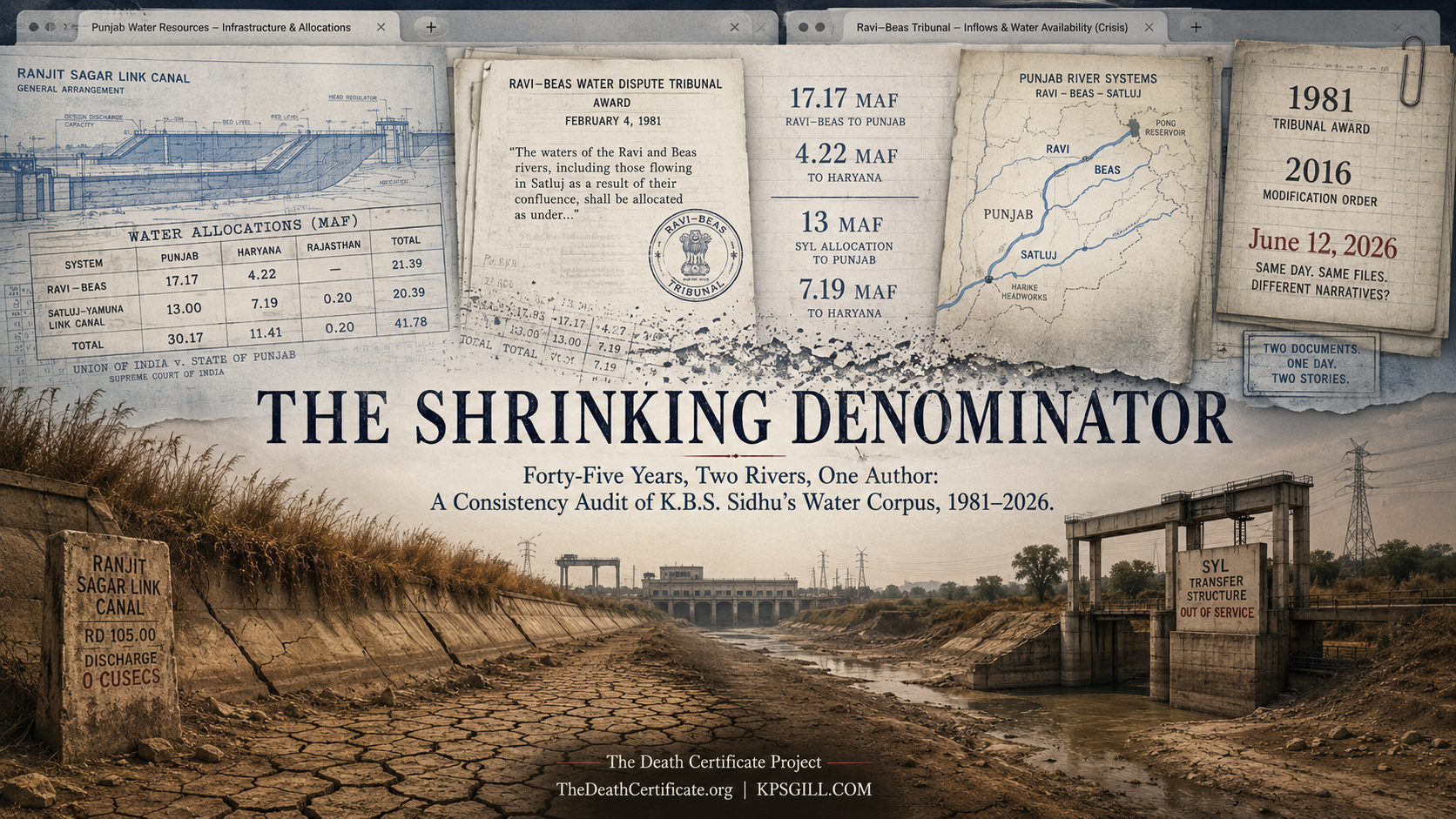
A consistency audit of a public record runs on two axes. The first is internal: does an author’s account of an event match what the same author said about that event at an earlier time? The second is external: does the account match the documentary record that exists independently of the author — agreements, judgments, statutes, parliamentary answers, and, increasingly, same-day reporting the author himself cites? K.B.S. Sidhu’s water-policy writing can be tested on both. This piece does so across forty-five years of external record and three and a half years of his own — from his first detailed Substack treatment of the Sutlej-Yamuna Link (SYL) dispute in mid-2023 through a pair of pieces published, hours apart, on June 12, 2026.
The aim is not to catch a careful writer in a lie. On the evidence assembled here, he has not told one. The aim is to lay a forty-five-year dispute out end to end — its numbers, its violence, its court orders, its administrative fixes, and now its newest and most ambitious proposals — and to show what becomes visible only when all of it sits on the same page. As will become clear, the single sharpest piece of evidence in this entire audit did not require forty-five years of archival work. It required reading two articles published on the same day.
I. The Ledger Before Sidhu
The dispute did not begin with a canal. It began with a number, and the number was contested before the canal’s first shovel of earth was turned.
After the 1966 reorganisation split Punjab into Punjab and Haryana, the new state’s claim to a share of the undivided Punjab’s river waters was settled — provisionally — by a central government notification of 24 March 1976, issued under Section 78 of the Punjab Reorganisation Act, which gave Haryana 3.5 million acre-feet (MAF) from the Ravi-Beas system. Punjab disputed the basis of that figure from the outset, and the matter remained in litigation through the late 1970s.
On 31 December 1981, Prime Minister Indira Gandhi brought the Chief Ministers of Punjab, Haryana, and Rajasthan to Delhi and produced a tripartite agreement that is still, in 2026, the baseline every subsequent document argues about. It fixed the “net surplus” of Ravi-Beas waters — flow available over and above pre-Partition utilisation — at 17.17 MAF, divided as 4.22 MAF to Punjab, 3.50 MAF to Haryana, 8.60 MAF to Rajasthan, 0.20 MAF to Delhi’s water supply, and 0.65 MAF to Jammu & Kashmir. The agreement also let Punjab continue drawing an additional 1.32 MAF from Rajasthan’s allocation until Punjab could deliver Haryana’s share — which in practice meant until the SYL canal was built. Punjab undertook to complete its 122-kilometre portion “in a time-bound manner… within a maximum period of two years.”
Four months later, on 8 April 1982, Prime Minister Gandhi inaugurated construction at Kapuri village in Patiala district. The Chief Minister standing beside her was Darbara Singh of the Congress, whose government had accepted the agreement’s terms and broken ground on a 214-kilometre canal — 122 km in Punjab, 92 km in Haryana — on a two-year clock. Within months, that same government would face the Akali Dal’s Dharam Yudh Morcha, whose grievances included Punjab’s river-water rights among a wider set of demands. The canal was, from its first day, simultaneously a federal commitment Punjab’s Congress government had signed and a grievance the opposition was organising against. Both halves of that sentence remain true of every government that has touched the file since.
A note on numbers, sounded early because it recurs throughout: three figures have already appeared — 17.17 MAF (the 1981 total surplus), 4.22 MAF (Punjab’s 1981 surplus share), and 1.32 MAF (Punjab’s conditional additional draw, pending SYL). None of these is interchangeable with the others, none of them is the ~13 MAF “current availability” figure Sidhu cites in 2026, and none of them is the 7.19 MAF figure he separately attributes to “Punjab’s share… fixed by the 1981 award.” We return to that last discrepancy in Section VI.
II. The Decade the Canal Died
The two-year clock from 1981 never restarted after 1984. What follows is the hardest part of the record to write about, and — as we will see — the part most often elided, including by Sidhu himself.
The 1985 Rajiv–Longowal Accord, signed in the aftermath of Operation Blue Star and Indira Gandhi’s assassination, re-promised the canal and added a tribunal to revisit the underlying allocation: the Ravi-Beas Waters Tribunal, constituted in 1986 under Justice V. Balakrishna Eradi, which submitted an interim report in January 1987. That report is reported elsewhere to have proposed revised shares — roughly 5 MAF for Punjab and 3.83 MAF for Haryana — but it was never formally notified, because clarification petitions filed that year have never been resolved. Forty years later, as Sidhu’s own May 2026 writing documents, the Tribunal — now under Justice Vineet Saran — is still in the field trying to finish the job.
It was in this window that the canal became a target. In 1988, a militant attack on the construction site near Majat, in Ropar district, killed thirty labourers. In 1990, the Punjab-side works’ Chief Engineer, M.L. Sekhri, and his deputy, A.S. Aulakh, were killed. Sidhu’s own October 2023 account is direct about the consequence: this violence, he wrote, “forced the Punjab Government to halt the nearly completed construction,” after which the canal “remained untouched” — through a failed 1991 attempt to transfer the work to the Border Roads Organisation, and into the decade that followed.
That violence belongs to the much larger and still fiercely contested history of the Punjab counterinsurgency years — a history with its own extensive documentary record, its own disputed questions of command responsibility and state conduct, and its own forensic literature, none of which is adjudicated here. What belongs in this record is narrower, and it is not contested by anyone, including Sidhu: whatever the fuller history of 1988–1990 ultimately establishes, the SYL canal’s construction stopped because of it, and — on Sidhu’s own telling, written in his own voice in 2023 — never meaningfully resumed. The 1990s did not produce a decision about SYL. They produced an absence of one, and that absence hardened into the default.
III. Litigation Without End: 2002–2016
The file did not stay quiet. It moved from the construction site to the courts — and this is the period in which the cast of characters starts to include names that recur in Sidhu’s own career.
In 2002, the Supreme Court, in State of Haryana v. State of Punjab, recorded that the Union had already advanced ₹499.12 crore to Punjab toward SYL construction “till March, 1994” — establishing that by the mid-1990s the canal was not a line on a map but a part-built, part-funded structure sitting idle. The proceedings pushed toward an order for completion.
Punjab’s response, in 2004, was the Punjab Termination of Agreements Act — legislation purporting to unilaterally void the 1981 agreement and every related instrument. The Act provoked a Presidential Reference under Article 143. In 2016, the Court’s advisory opinion held the 2004 Act constitutionally untenable. As Sidhu’s own May 2026 writing puts it, the Act “has never been formally struck down on a direct legal challenge” — an advisory opinion is not, technically, a strike-down — which is precisely why he calls the result a “complex legal grey zone.”
It is what happened next, in the closing weeks of 2016, that puts Sidhu’s own name in the file. Facing the advisory opinion and an election four months away, the Shiromani Akali Dal–BJP government — Chief Minister Parkash Singh Badal, in the final months of his fifth term — issued an executive notification returning land acquired for the Punjab-side SYL works to its original owners. Sidhu, as Financial Commissioner (Revenue), was the senior bureaucrat at the centre of that action. This is the episode his 2023 writing would later describe as Punjab having, “with great difficulty,” thwarted Haryana — a word that only makes sense if the thing being thwarted was an entitlement Haryana had just been handed, which is exactly what the 2016 advisory opinion had done.
Put the chronology in one line: a Congress government breaks ground in 1982 under a two-year deadline it cannot meet; the canal is halted by violence in 1990 and never resumes; a Supreme Court ruling in 2016 revives Haryana’s claim to the now-thirty-four-year-old promise; and an Akali-BJP government, with Sidhu as the implementing officer, spends its final weeks converting the physical absence of a canal into a legal absence of the land it would have occupied. Three governments, four decades, one unfinished sentence.
IV. What Sidhu’s Own Record Already Said
Set this external chronology next to what Sidhu wrote about it in 2023, and the fit is close — closer, in fact, than his most recent framing might suggest.
In a 2023 post recapped in his October 4, 2023 piece Exorcising the SYL Ghost, Sidhu stated flatly: “SYL Canal is dead, for all intents and purposes.” Narrating his own role in November 2016 in the same piece, he did not describe Punjab as having won anything; he described Punjab as having, with great difficulty, thwarted Haryana from getting the canal completed — explicit that Haryana was in a position to press the point only because the Supreme Court had just ruled in Haryana’s favour. Three days later, in The River Waters Issue (SYL), he supplied the causal account: the 1990 killings “forced the Punjab Government to halt the nearly completed construction.”
Read together, Sidhu’s own 2023 corpus already distinguishes four things that looser commentary collapses into “2016”: the physical stoppage of construction (1990, caused by violence); the practical death of the project as a going concern (sometime in the 1990s, a fact rather than an event); the legal jeopardy created by the 2016 advisory opinion (a court ruling reviving a 1981-vintage entitlement); and the administrative response to that jeopardy (the land-restoration notification, executed with Sidhu’s own participation). That four-part ordering is the single most useful thing in his entire corpus. It is the baseline against which the next thirty days should be read — and, as it turns out, against which the next thirty days mostly aren’t read, including by their author.
V. The Run: May 18 – June 12
Against that baseline, the seven-piece run that opens on May 18, 2026 and closes — twice, on the same day — on June 12 reads less like a departure than a zoom. Each piece takes one of the four 2023 categories and enlarges it to fill the frame. In doing so, each piece also lets the other three drift out of it. By the end of the run, the frame has been enlarged so far that the canal which gave the dispute its name is no longer in the picture at all.
May 18 – 19: the legal-entitlement register. The Ghost of the Eradi Tribunal Resurrected and The Untold Story of How Punjab Was Robbed of Its Own River Waters make the same core argument from two media — a Substack essay and an English summary of a Punjabi video interview. The 17.17 MAF baseline is obsolete; current availability is closer to 13 MAF; Punjab’s strongest move is to litigate the number, not the canal. “SYL is politically resonant but legally narrow,” and fighting over the canal alone is “disputing the bill while someone else quietly changes the menu.” The second piece supplies the verdict on the whole 1981–2026 record: “accumulated concessions, weak drafting, outdated data, poor anticipation, and repeated failures by successive political establishments.” That verdict is correct. It is also a verdict that requires naming the concessions, the drafting, the establishments — which neither piece does. The 1981 agreement appears only as a number to be revised, not as an instrument whose signatories’ political successors are still, in 2026, running the state.
May 23: infrastructure-as-solution, and a legal question nobody asks. The Tunnel and the Indus Waters Treaty moves from the Ravi-Beas formula to the Chenab — a western river under the 1960 Indus Waters Treaty, where Pakistan holds primary rights and India’s are limited to non-consumptive, run-of-river uses, held in abeyance since the Pahalgam attack of April 2025. The piece describes the ₹2,352 crore Chenab–Beas Link Tunnel — diverting Chandra River water (a Chenab headwater) westward into the Beas at Pandoh, through Dehar, into Gobind Sagar behind Bhakra — and the ₹268 crore Salal sediment-rehabilitation. Citing Senior Advocate Mohan Katarki, it notes the tunnel’s sub-1 MAF capacity, against the Chenab’s 26.2 MAF annual yield in India, will have only “bounded” impact on Pakistan — “minor summer-season issues.” The piece closes: “Water will not be weaponised. But it will be priced.”
Here is the question the piece does not ask. Once Chenab-origin water — water that was never part of the “Ravi-Beas surplus” as defined in 1981 — enters the Beas and flows into the exact pool the Eradi Tribunal exists to divide, under what legal head does it count? Is it an addition to the 17.17 MAF figure, a separate and un-litigated quantity, or something the Tribunal simply absorbs into “current availability” without anyone having argued about its provenance? A piece confident about engineering is silent on a point of administrative law that its own May 18 companion piece insists the Tribunal cares about.
There is also a numbers-discipline problem here. The piece states Punjab’s “share of Ravi-Beas waters” was “fixed at 7.19 MAF by the 1981 award and the Rajiv-Longowal Accord.” The 1981 agreement, however — per the Supreme Court’s 2002 judgment and every contemporaneous account — allocated Punjab a surplus share of 4.22 MAF, not 7.19. The two figures may describe different quantities (7.19 MAF could be Punjab’s total entitlement, pre-Partition use plus the 1981 surplus share, rather than the surplus share alone) — but that distinction is drawn in neither the May 18 nor the May 23 piece, and a reader moving between them five days apart has no way to know “Punjab’s share” meant two different things. May 18’s own standard — verified figures, not talking points — should apply to the standard-setter too.
June 4 – 6: infrastructure-as-problem. Bhakra Dam Is Tilting Beyond Safe Limits and The Silent Thief of Precious Waters: Evaporation? are, on their own technical terms, the strongest writing in the run. Gobind Sagar has not been drawn down to its designated minimum of 1,472 feet in ten years; the reservoir has lost a quarter of its original storage — 6 billion to 4.5 billion cubic metres — to silt; the dead-storage buffer is gone. On evaporation: the real thief is “a compound offender: obsolete infrastructure, perverse incentives, neglect of maintenance.” Both pieces identify failures that are institutionally diffuse rather than individually signed — “ten years without a drawdown” is a failure distributed across a decade, several governments, and an inter-state board whose own accountability is diffuse. That diffusion is real and is itself a finding. It is also a different kind of finding from “who signed the 2016 notification,” and the run never says so.
June 12: both directions, the same day. And then, on the same date, two pieces appear that between them do more work than the previous five combined.
Not a Drop Shall Flow — But Which Projects Will Stop It, Mr Minsiter? is the corpus’s most ambitious infrastructure piece, and its argument is, on its own terms, sound: Union Minister C.R. Patil’s pledge that no water bound for India will reach Pakistan, on an eighteen-month timeline, is politically and morally serious but engineeringly unaccounted-for, and Sidhu supplies the accounting — roughly a dozen named projects across the Indus (Ladakh), Jhelum (Kashmir), and Chenab (Jammu), from the Leh Arch Dam (4–5.7 MAF, 2 GW) and Zanskar Cascade on the Indus, through a redesigned Kishanganga and the Jhelum–Ravi Gravity Tunnel (1 MAF/yr) on the Jhelum, to Bursar (1.2 MAF, 800 MW), Sawalkot (1.8 MAF, 1,856 MW), the already-funded Chenab–Beas Link Tunnel, and a newly named Marhu Tunnel (4 MAF/yr, Chenab to “the Ravi-Beas system”) on the Chenab. The piece closes by calling for a “National Reclaimed Waters Act” and a “National Indus Basin Authority.”
Nowhere in this piece does SYL, the Eradi Tribunal, 1981, 2004, or 2016 appear. Twenty-six days after “make the 1981 numbers the central target,” the corpus’s most ambitious infrastructure piece does not mention 1981 at all. The recession traced across this Section — from the canal, to the formula, to the pipeline, to the dam, to the incentive structure — reaches its endpoint here. And yet the destination has not changed: the Baramulla Lift Scheme (1.2 MAF/yr, Jhelum to Pong) and the Marhu Tunnel together are said to add “over 5 MAF to the Ravi-Beas system.” Whatever vocabulary is used, the water still empties into Gobind Sagar — the pool the Eradi Tribunal exists to allocate, and the subject of every page that preceded this one.
The second piece, Bhakra’s Inflow Crisis: When Climate Stress Meets Structural Neglect and Poor Maintenance, is built on a same-day Tribune report (Lalit Mohan): Bhakra’s inflow on June 11 stood at 16,527 cusecs against a seasonal average of 32,706 — essentially half — with cumulative inflow from May 21 to June 11 at 0.74 BCM against a historical average of 1.45 BCM, also essentially half, driven by a Sutlej snowpack of 2.2 BCM against a normal 4 BCM. The more consequential section concerns Dehar: the Beas-Sutlej Link’s six 165 MW Francis turbines (990 MW total, commissioned 1977, with maintenance needs “known… since commissioning”) have all been down since March 4, 2026 — two on scheduled maintenance, a third failed in February from vibration, a fourth in March from leakage — meaning “no water diversion through the BSL system” for over a hundred days. BBMB’s response to Punjab’s demand for a repair timeline: a report on “Renovation, Modernisation, Uprating and Life Extension.” In Sidhu’s own words: “A planning document is not a repair schedule.”
VI. Same Day, Same Author, Two Verdicts on BBMB’s Capacity
Here is the juxtaposition, stated as plainly as the two pieces state their halves of it.
Not a Drop Shall Flow proposes adding more than 5 MAF annually to the Ravi-Beas/Bhakra system via two new inter-basin transfer structures — a lift scheme from the Jhelum and a 42-kilometre tunnel from the Chenab — most of which are, by Sidhu’s own description in the same piece, at the stage of “clearances advancing,” “long delayed,” or “approved in principle” with “progress… episodic.” The proposal is explicitly time-bound: eighteen months, “zero tolerance for procedural delay,” administered by a national authority and a Central Act that do not yet exist.
Bhakra’s Inflow Crisis, published the same day, is a case study in what happens to an existing inter-basin transfer structure of the same kind — a powerhouse-and-tunnel system moving water from the Beas basin into the Sutlej/Bhakra system — under the management of the very institution (BBMB) any new structure would also depend on. Dehar is younger than the Eradi Tribunal’s founding mandate by nine years; its maintenance needs were understood at commissioning; and it has nonetheless been completely non-operational for over a hundred days, with the responsible board’s documented response being a planning report rather than a repair.
Sidhu’s own Section IX in the first piece — “The Test of Seriousness” — anticipates exactly this objection in the abstract: India’s record on large water infrastructure is not a record of swift execution; Shahpur Kandi took decades, the Ujh project has been “approved and re-approved without materialising,” and the Eradi Tribunal’s own extensions have become routine. What the second piece supplies is not an abstract instance of that pattern. It is a live one, dated the same day, involving the same institution and the same river system, concerning a structure barely older than the dispute itself.
This is not “the author asserted X and also not-X.” Both pieces are accurate on their own terms. It is that the evidence bearing most directly on whether BBMB-administered transfer infrastructure can be built, maintained, and kept running on a tight timeline was published, by the same author, on the same day — and it answers in the negative, about an existing structure, before the new ones have broken ground.
VII. “An Engineering Fact That No Tribunal Can Reverse”
There is a second thread in the June 12 pair, and it is where Sidhu names — for Pakistan, not for Haryana or Rajasthan — the dynamic this audit has been tracing inferentially since Section V.
Of the Marhu Tunnel, Sidhu writes that once operational, Pakistan’s agricultural economy faces a permanent reduction in available water, not as a political threat but as “an engineering fact that no tribunal can reverse.” That is a precise articulation of a principle: built infrastructure can produce outcomes that outrun, and then foreclose, the legal or treaty process meant to govern the underlying allocation. Stated for the Indus Waters Treaty and the Permanent Court of Arbitration, it reads as hard-nosed realism about international law’s limits. The structural question is narrower: does the same principle, stated about the same river system one basin downstream, describe anything about the Eradi Tribunal and the Chenab–Beas Link Tunnel?
The geography suggests it might. Chenab-origin water — whether via the smaller Chenab–Beas Link Tunnel (under 1 MAF, already funded) or the larger Marhu Tunnel (4 MAF, newly proposed) — arrives in the same place: the Beas above Pandoh, then Dehar, then Gobind Sagar, the pool the Eradi Tribunal has spent forty years trying to divide and is still dividing in 2026. A tribunal convened to determine how much water exists and who is entitled to it is, by definition, in the business of producing a number. Infrastructure that changes how much water arrives at the pool before that number is finalised changes what the number will be about — which is functionally what Sidhu describes the Marhu Tunnel doing to Pakistan’s position before the Hague.
There is a numbers-discipline footnote here too. Katarki is cited in both pieces — in May, assessing the sub-1 MAF Chenab–Beas Link Tunnel as having “bounded,” “minor” impact on Pakistan; in June, assessing the 4 MAF Marhu Tunnel as the project “most capable of converting the IWT’s abeyance from a diplomatic signal into a hydrological reality.” These need not be inconsistent — different projects, different scale, different verdicts from the same expert is plausible. But a reader encountering “Chenab–Beas diversion” in May and “Marhu Tunnel” in June, both routed to the same pool, both invoking the same advocate, has no signal in either piece that these are different projects of very different magnitude — precisely the kind of unflagged figure Section V’s numbers-discipline standard exists to catch.
None of this requires believing the Chenab–Beas Link Tunnel was conceived as a move against the Eradi Tribunal, any more than the Marhu Tunnel need have been conceived primarily as a move against Pakistan rather than the water-security project Sidhu describes. The point is what the sentence does once it exists. “An engineering fact that no tribunal can reverse” is now part of this author’s analytical vocabulary, applied with approval to one river boundary. Whether it should also be applied — by Sidhu, by the Eradi Tribunal’s bench, or by counsel for Haryana and Rajasthan — to the other one is a question the corpus has, as of June 12, supplied the language for but not yet asked.
VIII. The Shrinking Denominator, and the Expanding Numerator, on the Same Day
If the real Ravi-Beas figure has been closer to 13 MAF than 17.17 for some meaningful stretch — and Sidhu is the one making this case — then the gap was not created by the Tribunal’s 2026 field visits. It existed, and was very likely widening, across the entire chronology in Sections I–IV. Every administrative act in that chronology — the 1981 agreement and its conditional 1.32 MAF; the unnotified 1987 Eradi recommendation; the 2004 Act; the 2016 advisory opinion and the “thwarting” that followed — was negotiated, litigated, or executed against a denominator that may already have been smaller than the number on the page, and shrinking further with every year the file stayed open.
June 12 sharpens this in a way the May–June run, read piece by piece, could not. On one side of the ledger, measured that day: Bhakra receiving half its normal inflow, Dehar completely silent for over a hundred days, BBMB’s response a planning document. On the other side, proposed that day: more than 5 MAF in new transfers into the same pool, on an eighteen-month political timeline, via projects mostly at the DPR-or-approved-in-principle stage, administered by an authority and an Act that do not yet exist. The shrinking side is current and documented. The expanding side is future and contingent — contingent, among other things, on the same BBMB whose same-day report is a planning document, not a repair schedule.
This cuts against easy villains on every side. The 1981 figure of 17.17 MAF was not necessarily a deliberate overstatement — flow-series estimation in 1981 was a harder problem than it is with forty-five more years of gauge data. But every subsequent actor who relied on that figure without revisiting it — Punjab governments arguing for 4.22 MAF, Haryana for 3.5, Rajasthan for 8.6 — was litigating over water the rivers were less and less able to supply. The “paper water” problem this corpus’s 2026 writing implies did not begin with anyone’s bad faith. It is what thirty-plus years of unresolved litigation guaranteed, because litigation is slow and rivers do not wait for verdicts — a point Sidhu’s own June 12 closing line makes about a different river the same day: water does not pause for committees.
IX. Who Wrote the Ledger: Darbara Singh, Badal, and a Bipartisan Architecture
If the question is vested interest, the honest answer is not a single name or party. It is a structure both major Punjab political traditions have operated, in turn, for four decades — and Sidhu’s own June writing, without quite saying so, points at one of its load-bearing pillars.
Darbara Singh’s Congress government accepted the 1981 agreement’s two-year deadline and broke ground in 1982 — a commitment no government since has been able either to fulfil or formally renounce. That is the ledger’s opening entry, and it is a Congress entry.
Parkash Singh Badal’s governments appear at two connected points. The first is February 1997, weeks into Badal’s term, when Punjab shifted agricultural electricity from flat-rate to fully free — a policy change the academic literature (Gupta, Agricultural Economics, 2023, using Haryana as a control group) credits with measurably accelerating groundwater depletion across the state. This is the policy substrate beneath the very groundwater collapse that the May 19, 2026 piece cites as evidence that “Punjab alone cannot bear the entire burden” of scarcity. The free-power regime was not unique to Badal — Congress governments maintained and at times expanded it, and a 2009 statute (the Punjab Preservation of Sub-Soil Water Act) was a bipartisan attempt to mitigate its worst effects — but its introduction, and its most consequential expansion, sits inside his tenure. The second point is November 2016: the land-restoration notification at the close of Badal’s final term, with Sidhu as the implementing Financial Commissioner — the episode his own 2023 writing calls “thwarting,” situated in Section III’s chronology.
The honest finding is therefore not “Badal did this” or “Congress did that.” It is that both traditions, across four decades, have consistently chosen the politically legible action over the structurally necessary one — breaking ground under a deadline neither side could meet; subsidising the extraction that hollows out the resource everyone fights over; answering an adverse ruling with an executive notification rather than a renegotiated settlement. The May 18, 2026 diagnosis — “accumulated concessions, weak drafting, outdated data, poor anticipation, and repeated failures by successive political establishments” — is, read this way, a description of the form Punjab water politics has taken under every government that has held the file, the author’s own period of service included. And the June 12 proposal for a “National Reclaimed Waters Act” — designed explicitly to “pre-empt the litigation vacuum” that has consumed the Ravi-Beas dispute “for half a century” — is itself an acknowledgment, from inside the corpus, of exactly how costly that form has been. The remedy proposed for the next forty-five years is, in essence, a better-drafted version of the agreement that produced the last forty-five.
X. The Missing Synthesis
Sidhu’s corpus, read end to end, contains nearly every piece of a complete account: the 1981 ledger and its contested arithmetic; the 1982 groundbreaking and the government that performed it; the 1988–1990 violence that stopped construction and the decade of silence that followed; the 2002–2016 litigation arc and the administrative response at its end; the free-power policy quietly devouring the resource everyone litigates over; the hydrological case that the entire 17.17 MAF architecture may never have described a river that existed in the quantities claimed; and, as of June 12, both a measured account of that architecture’s central reservoir running on half its water with its transfer infrastructure dead, and a proposal to pour five more MAF into the same reservoir within eighteen months.
What the corpus does not yet contain, in any single piece, is the synthesis those parts make possible: that the shrinking denominator does not replace the question of who wrote, defended, and periodically re-papered the numerator — it raises the stakes on that question, because every year spent arguing about the numerator was a year in which the denominator kept falling, and because the institution asked to receive the next numerator is the same one whose existing transfer infrastructure sat idle, by its own author’s same-day account, while the proposal was being written. Hydrology cannot substitute for accountability, and a history of agreements, court orders, and executive notifications cannot be understood without the hydrology eroding underneath it the whole time. Sidhu has, at different times, written every clause of this sentence. As of June 12, 2026, two of its clauses were sitting in browser tabs open at the same time, written by the same hand. The sentence itself remains unwritten — and a forty-year-old Tribunal, currently taking what may be its final round of evidence, is precisely the forum where it is overdue.
Numbers Discipline — Complete Reference Table
| Figure | What it measures | Source / status |
|---|---|---|
| 17.17 MAF | Total “surplus” Ravi-Beas flow above pre-Partition use, as estimated in 1981 | 1981 tripartite agreement; State of Haryana v. Punjab (2002) |
| 4.22 MAF | Punjab’s surplus share under the 1981 agreement | 1981 agreement / 2002 SC judgment |
| 3.50 MAF | Haryana’s surplus share (matches the 1976 notification) | 1981 agreement / 1976 GoI notification |
| 8.60 MAF | Rajasthan’s surplus share under the 1981 agreement | 1981 agreement / 2002 SC judgment |
| 0.20 / 0.65 MAF | Delhi water supply / J&K shares under the 1981 agreement | 1981 agreement |
| 1.32 MAF | Punjab’s additional draw, conditional on SYL completion | 1981 agreement, Clause IV |
| ~5 / ~3.83 MAF | Reportedly recommended revised shares, Punjab / Haryana | Eradi Tribunal interim report, 1987 — never notified |
| ₹499.12 crore | Central funds advanced for SYL construction to March 1994 | State of Haryana v. Punjab, 2002 SC judgment |
| ~13 MAF | Sidhu’s estimate of current (2021-era) Ravi-Beas availability | Eradi Tribunal Resurrected, May 18, 2026 — his analytical estimate |
| 7.19 MAF | Figure Sidhu gives as Punjab’s share “fixed by the 1981 award” | Tunnel and the IWT, May 23, 2026 — does not match the 4.22 MAF figure above; reconciliation unexplained |
| 26.2 MAF | Chenab’s total annual yield in Indian territory | Mohan Katarki, cited May 23, 2026 |
| < 1 MAF | Chenab–Beas Link Tunnel capacity (“bounded” impact on Pakistan, per Katarki) | May 23, 2026 |
| 4 MAF/yr | Marhu Tunnel (Chenab → Ravi-Beas system) — distinct project, distinct scale | Not a Drop Shall Flow, Jun 12, 2026 |
| 1.2 MAF/yr | Baramulla Lift Scheme (Jhelum → Pong) | Jun 12, 2026 |
| “Over 5 MAF” | Combined claimed addition to “the Ravi-Beas system” from the two June 12 proposals | Jun 12, 2026 |
| 4–5.7 MAF / 2 GW | Proposed Leh Arch Dam (Indus, Ladakh) | Jun 12, 2026 |
| 1.2 MAF / 800 MW | Proposed Bursar Storage (Chenab tributary, Kishtwar) | Jun 12, 2026 |
| 1.8 MAF / 1,856 MW | Proposed Sawalkot HEP (Chenab) | Jun 12, 2026 |
| 16,527 vs. 32,706 cusecs | Bhakra inflow, Jun 11, 2026, vs. seasonal average | The Tribune (Lalit Mohan), cited Bhakra’s Inflow Crisis, Jun 12, 2026 |
| 0.74 vs. 1.45 BCM | Cumulative Bhakra inflow, May 21–Jun 11, vs. historical average | Same |
| 2.2 vs. 4 BCM | Sutlej catchment snowpack, winter 2025–26, vs. normal | Same |
| 990 MW / 6 × 165 MW | Dehar Powerhouse installed capacity, commissioned 1977 | Bhakra’s Inflow Crisis |
| Since Mar 4, 2026 | Date all Beas-Sutlej Link transfer via Dehar ceased | Bhakra’s Inflow Crisis, citing Tribune (Mar 2026) |
Sources Consulted
Sidhu corpus, retrieved directly from The KBS Chronicle (kbssidhu.substack.com):
- Please Don’t Resurrect the SYL Canal Ghost (2023), recapped in Exorcising the SYL Ghost: Charting a Path Forward for Punjab’s Waters (Oct 4, 2023)
- The River Waters Issue (SYL): A Chronicle of Continuous Injustices against Punjab (Oct 7, 2023)
- Punjab-Haryana SYL Canal Dispute Reignited (May 2025 context)
- The Ghost of the Eradi Tribunal Resurrected (May 18, 2026)
- The Untold Story of How Punjab Was Robbed of Its Own River Waters (~May 19, 2026)
- The Tunnel and the Indus Waters Treaty: What the Chenab–Beas Diversion Really Means (May 23, 2026)
- Bhakra Dam Is Tilting Beyond Safe Limits — And the Clock Is Ticking (Jun 4, 2026)
- The Silent Thief of Precious Waters: Evaporation? (~Jun 6, 2026)
- Not a Drop Shall Flow — But Which Projects Will Stop It, Mr Minsiter? (Jun 12, 2026)
- Bhakra’s Inflow Crisis: When Climate Stress Meets Structural Neglect and Poor Maintenance (Jun 12, 2026)
External legal/historical record:
- State of Haryana v. State of Punjab, Original Suit, Supreme Court of India, 2002 (text via IELRC)
- BBMB / Parliamentary record on the 31 December 1981 agreement (bbmb.gov.in)
- India TV and ThePrint explainers, Punjab-Haryana water dispute timeline (2025–2026)
- Gupta, D., “Free Power, Irrigation and Groundwater Depletion: Impact of the Farm Electricity Policy of Punjab, India,” Agricultural Economics, 2023
- EAC-PM Working Paper, “Addressing Groundwater Depletion in India” (on the Punjab Preservation of Sub-Soil Water Act, 2009)
- The Tribune (Lalit Mohan), Bhakra inflow report and Dehar Power Plant reporting, June 2026 and March 2026, as cited within Sidhu’s June 12, 2026 piece
A note on scope. This piece does not adjudicate the events of 1988–1990 beyond what Sidhu’s own published account states; the broader counterinsurgency-era record is a separate and extensive documentary subject in its own right and is not summarised or resolved here. It treats no proposed project — on either river system — as built or delivering water unless the source material says so; the distinction between proposed, approved-in-principle, funded, under-construction, and operational is preserved throughout, including in the reference table above.