Placeholder draft- The Police Brought the Body. Who Opened the Municipal Gate?

ਗੁਰਸ਼ਬਦ ਉੱਠਣ ਤੋਂ ਪਹਿਲਾਂ, ਸ਼ਮਸ਼ਾਨਘਾਟ ਸੜ ਚੁੱਕਾ ਸੀ Before the Gurshabad could rise, the cremation ground had already burned.
The Death Certificate Project
Evidentiary key: [PF] Proved Finding · [OR] Official Record · [DA] Documented Allegation · [AI] Analytical Inference · [PM] Panthic Memory
In 1994, a man named Dara Singh — a friend of Jaswant Singh Khalra's — was killed by Punjab Police in what Khalra determined to be an extrajudicial encounter. His body was cremated at Durgiana Mandir in Amritsar, entered into the ground's records as "unidentified and unclaimed." [PF] He was neither. Khalra knew who he was. This single case, more than any statistic, is the right place to begin an inquiry into a question the larger cremation figures tend to obscure: a police vehicle arriving at a cremation ground with a body did not, by itself, produce a cremation. Someone at that gate had to receive the body, decide to accept it, and either record or fail to record what had arrived. This article is about that someone — not as an individual to be named and blamed, but as a position in an institutional chain that this archive intends to trace link by link.
The Chain, Reconstructed
A lawfully handled unnatural death in this period should have moved through a recognizable sequence: recovery of the body, typically by police; preparation of police paperwork recording the circumstances; a postmortem examination, ordinarily required for any death not attributable to natural causes; transportation to a cremation ground; acceptance of the body by ground staff; an entry in the ground's own register; the cremation itself; disposal of the ashes; and, at some point in the sequence, registration of the death with civil authorities. Each link in that chain implies a responsible office and an expected document. Khalra's own interviews with cremation-ground attendants — the closest thing to direct testimony this archive has from inside the process — indicate that at multiple points this chain was compressed or skipped entirely: postmortems were, by his account, at times dispensed with, and on occasion multiple bodies were cremated using the firewood allotment ordinarily required for one. [DA] Both of those are, if accurate, breaks in the chain with a specific location: the first at the postmortem link, which sits with the medical and magisterial system rather than the cremation ground itself; the second at the gate, where an attendant or supervisor made — or was made to make — a decision that a functioning register should have caught.
The Institutional Question This Archive Is Actually Asking
None of the three cremation grounds at issue — Durgiana Mandir, Patti, Tarn Taran — was an informal clearing. Each operated under some combination of municipal regulation, trust governance, and staffing, meaning each had, in principle, an operating body, a gate procedure, and a custodian of its own registers. [PF] Was the staff at these grounds actively deceived about what they were receiving — told a body was a genuinely unidentified indigent when it was not? Were they coerced by an armed police presence into asking no questions? Did an informal, cooperative arrangement develop over time, in which police cremations at these three sites simply became routine and unremarkable to the staff handling them? Was the institution administratively indifferent — technically following procedure while asking nothing beyond what the procedure required? Or had a formal, if unwritten, standing practice developed at the command level, of which individual attendants were merely the final, powerless executors? This archive presents these as competing hypotheses, deliberately, because the evidence available to it does not yet resolve which is correct — and because the honest answer may differ by site, by year, and by which individual was on duty. [AI]
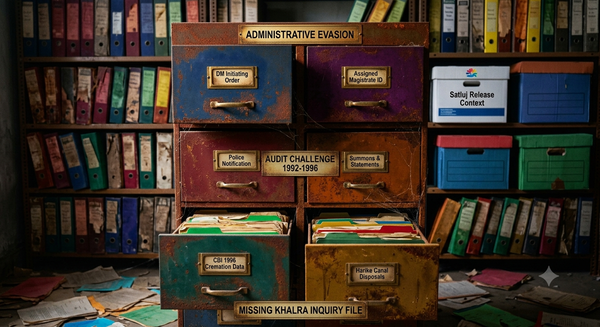
What Should Exist and Has Not Been Produced
Gate books and receipt books for each of the three grounds across the relevant years; staff attendance records; any surviving police delivery slips or body-identification forms; and whatever correspondence, if any, passed between the grounds' operating authorities and the municipal or district administration concerning the volume or nature of police-delivered bodies.
The Strongest Defense, Stated Fairly
A cremation-ground attendant is, structurally, among the least powerful figures in this entire chain — a low-ranking municipal or trust employee, unarmed, facing a police escort with a body and, implicitly or explicitly, an instruction. This archive does not treat an attendant's compliance as proof that the operating institution bore full knowing responsibility, any more than it treats an attendant's subordinate status as proof the institution bore none. The honest position, on the evidence currently available, is that culpability at the institutional level — as opposed to the individual, coerced level — requires a demonstrated pattern reaching above the gate: repeated instances, over time, reported upward or acquiesced in by supervisors, rather than a single employee's single decision under duress. [AI] That pattern is precisely what the missing registers, not this article, would have to establish.
Right of Reply
The Durgiana Committee, the Municipal Corporation of Amritsar, and the municipal committees of Patti and Tarn Taran are each invited to produce or account for the gate and receipt records described above, and to state what procedure, if any, governed the acceptance of police-delivered bodies at each site during the relevant years. Any substantive response will be appended to this archive in full.
The Human Being Behind the Gate
Dara Singh had a name before he had a file, and a file before he had a false label. Somewhere between the second and the third of those, a gate opened, a decision was made by someone whose name this archive does not yet know, and a register recorded a lie small enough that no one who wrote it thought they were making history. They were. This archive exists to make them answer for the sentence, not the war.
This is not a verdict. It is a summons to the record.
Sources: Dara Singh case and Khalra's cremation-ground interviews per sikhchic.com; CBI-confirmed cremation figures per Paramjit Kaur v. State of Punjab, Supreme Court of India, order dated 12.12.1996.