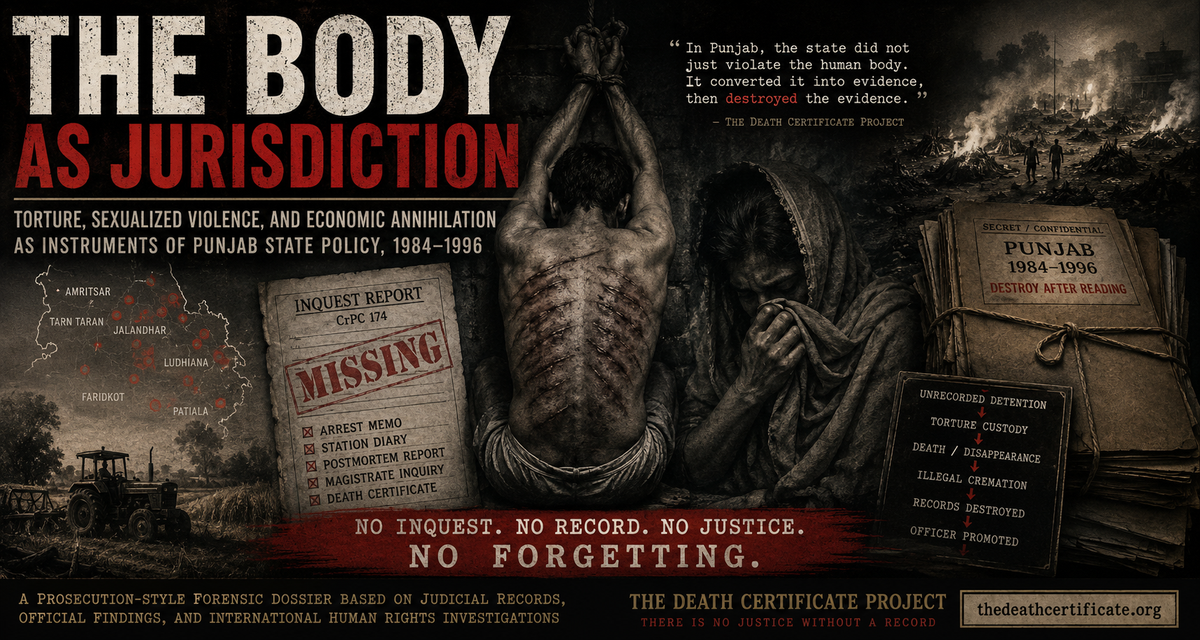
THE BODY AS JURISDICTION Torture, Sexualized Violence, and Economic Annihilation as Instruments of Punjab State Policy, 1984–1996 — In Global Comparative Context

THE DEATH CERTIFICATE PROJECT · TheDeathCertificate.org · kpsgill.com Punjab '95 Forensic Series · U.S. First Amendment Publication · Fresno, California
⚠️ CONTENT NOTICE — READ BEFORE PROCEEDING This article contains explicit forensic documentation of custodial torture methods, sexualized violence against men and women, economic annihilation of households, illegal cremation, and systematic administrative erasure — drawing on the Punjab counterinsurgency record (1984–1996), Operation Blue Star (June 1984), the November 1984 Delhi genocide, the Gujarat 2002 pogrom, the Kashmir human rights record, and comparative global documentation of state-sponsored torture including Nazi Germany, CIA detention operations, and Indian operations in Nagaland and the Northeast. Every statement of fact is drawn from judicial proceedings, official investigative findings, and internationally recognised human rights organisations. The graphic nature of this record belongs to the record itself. The purpose of this publication is accountability. It is a purpose that does not yield.
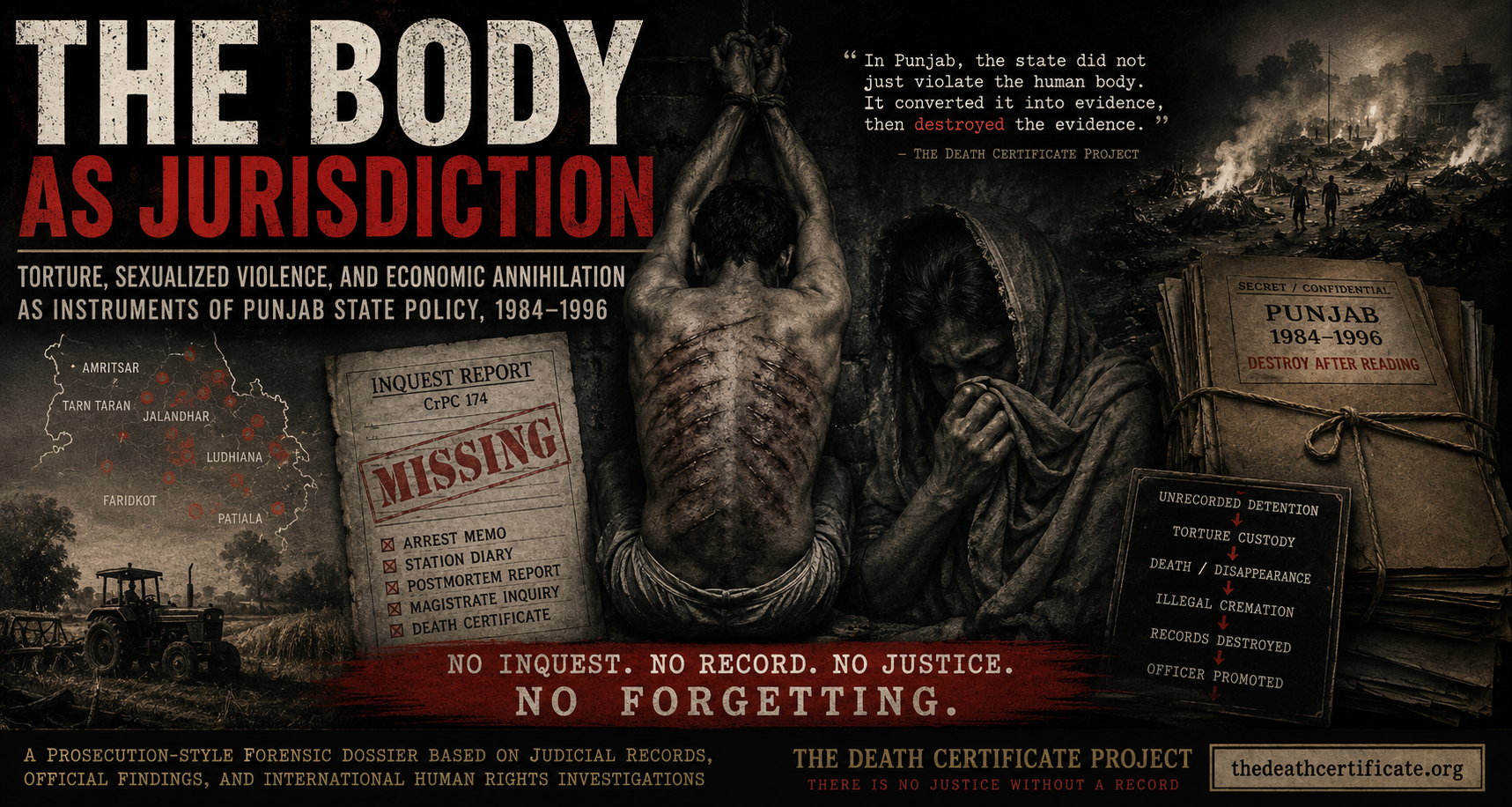
THE BODY AS JURISDICTION
Torture, Sexualized Violence, and Economic Annihilation as Instruments of Punjab State Policy, 1984–1996 — In Global Comparative Context
A prosecution-style forensic dossier on custodial torture, sexualized violence, agricultural and economic annihilation, secret cremation, missing Section 174 inquest records, magistrate silence, police command authority, political reward, and the administrative machinery that converted the Sikh body into evidence — then destroyed the evidence. Establishing Punjab's counterinsurgency as one of the most comprehensive, institutionalized, and deliberately erased programs of state torture in post-1945 democratic governance — examined against the global record of state-sanctioned violence from Nazi Germany through CIA black sites, from the Kashmir mass rape record to the Gujarat pogrom. Punjab 1984–1996 is the center of this archive. It will not be summarized. It will not be abbreviated. It will be documented in the complete forensic detail that the bodies of the Sikh men and women who endured it are owed.
By Dr. Kanwar Partap Singh Gill, M.D. Publisher and Editorial Director, kpsgill.com TheDeathCertificate.org · May 2026 · Fresno, California, United States of America
ਸ਼ਬਦ ਤੋਂ ਪਹਿਲਾਂ, ਸ਼ਮਸ਼ਾਨਘਾਟ — Before the Word, the cremation grounds. The archive goes there first.
Punjab was not merely tortured by men with lathis, rollers, wires, and guns. Punjab was tortured by paperwork that was never created, by magistrates who never asked, by files that disappeared, and by honours that arrived where indictments should have been.
The body was tortured. The record was erased. The cremation was hidden. The officer was promoted. The administrator retired. The Republic decorated the office. The Death Certificate Project exists to reverse that chain — body by body, file by file, name by name, death by death.
THE LEGAL NON-EXCUSE
Before this article proceeds, it makes one statement that the Indian establishment has never been required to answer directly, and which this archive states plainly and without qualification.
Sikh militant violence existed. It was real. It included targeted assassinations, bombings of civilian infrastructure, sectarian executions, and attacks against elected officials, civil servants, and members of both Sikh and Hindu communities. This archive does not deny it, minimize it, or omit it. The Death Certificate Project is an accountability archive, not a propaganda operation, and it does not require the falsification of the historical record to make its case. Militant violence is acknowledged here not as a caveat but as a statement of forensic completeness: the archive includes it because honesty requires it, and because the argument this article makes does not require the falsification of history to stand.
The legal point is this: no militant act suspended Article 21 of the Constitution of India. No insurgency repealed the production duties of the Code of Criminal Procedure. No counterinsurgency order authorized custodial rape, electric shock to the genitals, illegal cremation, or the destruction of death records. No state of emergency lawfully converted the police station into a torture chamber and the cremation ground into an administrative solution.
The State of India had the power to investigate, arrest, prosecute, charge, try, and convict. That power existed within the rule of law. It existed within statutes including TADA, 1987 and the National Security Act. Those statutes gave the state enormous coercive authority — preventive detention without trial for extended periods, admissibility of confessions made to police officers, strict bail conditions. The state did not need to disappear, torture, cremate without record, and erase the official trace of a human being's existence. It chose to.
The United Nations Convention Against Torture (UNCAT) — to which India is a signatory — states without qualification in Article 2(2): "No exceptional circumstances whatsoever, whether a state of war or a threat of war, internal political instability or any other public emergency, may be invoked as a justification of torture." India signed UNCAT. India ratified UNCAT. The Punjab counterinsurgency invoked the counter-terrorism emergency as its justification for what this article documents. UNCAT does not recognise that justification. Indian constitutional law does not recognise that justification. The Code of Criminal Procedure does not recognise that justification.
What occurred in Punjab between 1984 and 1996 was the deliberate conversion of police custody into a parallel jurisdiction where the body replaced the courtroom, where confession extracted by electric shock replaced evidence, and where the cremation ground replaced the death register. This systematic deployment of torture in Punjab stands as one of the most gruesome, ruthless, and flagrant institutionalized violations of human rights ever executed within independent India's democratic framework — a constitutional democracy that claimed the rule of law while its security apparatus operated a system of administrative extermination that left 2,097 confirmed illegal cremations in a single district, zero inquest reports, and decades of impunity for every officer who commanded the system that produced them.
That conversion was a crime. This article names it as a crime. It names those who administered it. It names those who rewarded the administrators. And it will not soften that naming by a single word.
EVIDENTIARY PROOF LADDER
This article operates at the standard of a senior counsel's closing submission in a crimes against humanity proceeding. Every factual claim is graded at one of five evidentiary tiers. No claim is stated at a higher evidentiary level than the source record supports. This discipline is not a limitation of the argument. It is the argument's prosecutorial foundation — and the reason the Indian state cannot attack the archive without attacking its own records.
| Tier | Definition | Function in This Article |
|---|---|---|
| [PF] Proved Finding | Supreme Court / High Court orders; CBI findings; Official gazette notifications; NHRC adjudicated records; Judicial convictions; Official government documents | Establishes the indisputable material reality: the dead bodies, the illegal cremations, the named appointments, the judicial findings, the formal honours — facts the Indian state's own records confirm |
| [DA] Documented Allegation | Amnesty International; Human Rights Watch; PHR; NHRC proceedings; Khalra investigation record; PUCL/PUDR documentation; Ensaaf reports | Serious, sourced, judicially-relevant record commanding evidentiary weight pending full adjudication — sourced from organisations whose work has been accepted by courts and international bodies |
| [DT] Documented Testimony | Named and anonymized survivor accounts entering the judicial and human rights record; testimony before the NHRC; testimony preserved in human rights investigations | The intimate human reality: specific methods, specific locations, specific officers named by surviving witnesses — corroborated where possible by independent medical evidence |
| [AI] Analytical Inference | Reasoned conclusions drawn from cross-verified data patterns, institutional logic, statutory analysis, and convergent documentation | Establishes command responsibility from the pattern; destroys the "rogue officer" defense as a structural impossibility given the scale, duration, geographic distribution, and institutional character of documented violations |
| [PM] Panthic Memory | Living community testimony, oral record, family accounts preserved in Sikh institutional memory | Community civilizational record held with full moral seriousness; distinguished from documentary proof without diminishment of its dignity, moral weight, or historical significance |
Primary Sources — All Publicly Accessible, All Verified
| Source | URL |
|---|---|
| NHRC Punjab Mass Cremations Case, Reference No. 1/97/NHRC | nhrc.nic.in |
| Supreme Court of India — Writ Petition (Crl.) No. 447 of 1995 | main.sci.gov.in |
| HRW / Asia Watch, Punjab in Crisis: Human Rights in India (1991) | hrw.org/reports/1991/india |
| HRW & PHR, Dead Silence: The Legacy of Abuses in Punjab (1994) | hrw.org/reports/India0594.pdf |
| HRW & Ensaaf, Protecting the Killers (2007) | hrw.org/report/2007/10/17/protecting-killers |
| Amnesty International, Break the Cycle of Impunity and Torture in Punjab (2003) | amnesty.org/en/documents/asa20/002/2003/en |
| Amnesty International, Torture, Rape and Deaths in Custody (1992) | amnesty.org — ASA20/011/1992 |
| Physicians for Human Rights, Punjab medical documentation (1994) | phr.org/our-work/resources/dead-silence |
| Ensaaf & HRDAG, Violent Deaths and Enforced Disappearances (2009) | hrdag.org — full PDF |
| Ensaaf Crimes Against Humanity Data Project | data.ensaaf.org |
| Ensaaf — Jaswant Singh Khalra investigative record | ensaaf.org/jaswant-singh-khalra |
| Ensaaf — Operation Blue Star documentation | ensaaf.org/photo-essays/operation-blue-star |
| Ensaaf — Honoring Khalra / 30th anniversary | ensaaf.org/article/honoring-jaswant-singh-khalra |
| HRW — 1984 Anti-Sikh massacre (2014) | hrw.org/news/2014/10/29/india-no-justice-1984 |
| HRW — 1984 Anti-Sikh massacre (2009) | hrw.org/news/2009/11/02/india-prosecute |
| Nanavati Commission Report on 1984 | mha.gov.in — full PDF |
| PUCL & PUDR, Who Are the Guilty? (1984) | pucl.org |
| HRW, Gujarat: We Have No Orders to Save You (2002) | hrw.org/reports/2002/india |
| Bilkis Bano v. State of Gujarat | indiankanoon.org/doc/184131238 |
| HRW, Rape in Kashmir / Kunan Poshpora (1993) | hrw.org — INDIA935.PDF |
| Amnesty International, Kunan Poshpora (1991) | amnesty.org — ACT 77/10/91 |
| US Senate SSCI CIA Torture Report (2014) | govinfo.gov — PDF |
| HRW: Senate Report Slams CIA Torture (2014) | hrw.org/news/2014/12/10/us-senate-report |
| Center for Constitutional Rights — SSCI Report | ccrjustice.org |
| UN Convention Against Torture (UNCAT) | ohchr.org — UNCAT |
| Rome Statute of the ICC | icc-cpi.int/resource-library/rome-statute |
| ICTY — Čelebići / command responsibility | icty.org/case/mucic |
| Nuremberg Charter / IMT (1945) | un.org — IMT Charter |
| Nuremberg Principles (ILC, 1950) | legal.un.org — ILC Principles |
| Armed Forces (Special Powers) Act, 1958 | indiankanoon.org/doc/1758509 |
| Article 21, Constitution of India | indiankanoon.org/doc/1199182 |
| Article 22, Constitution of India | indiankanoon.org/doc/1009042 |
| Section 174 CrPC | indiankanoon.org/doc/1662489 |
| Section 176 CrPC | indiankanoon.org/doc/1669914 |
| Section 167 CrPC | indiankanoon.org/doc/1555804 |
| Section 58 CrPC | indiankanoon.org/doc/1105582 |
| Section 41A CrPC | indiankanoon.org/doc/1279834 |
| Section 201 IPC | indiankanoon.org/doc/1305820 |
| Section 330 IPC | indiankanoon.org/doc/1955926 |
| Section 331 IPC | indiankanoon.org/doc/1019614 |
| Section 376 IPC | indiankanoon.org/doc/1279834 |
| TADA 1987 | indiankanoon.org/doc/1017103 |
| Hindu Succession Act, 1956 | indiankanoon.org/doc/1589138 |
| Registration of Births and Deaths Act, 1969 | indiankanoon.org/doc/1247788 |
| Protection of Human Rights Act, 1993 | indiankanoon.org/doc/1502963 |
| PUCL Documentation | pucl.org |
| PUDR Documentation | pudr.org |
| Sumedh Saini — 1994 triple murder case | tribuneindia.com |
| Sumedh Saini — Anticipatory bail proceedings | outlookindia.com |
| Sumedh Saini — Balwant Singh Multani case | sikhsiyasatnews.net |
| Jaswant Singh Khalra — Wikipedia | en.wikipedia.org/wiki/Jaswant_Singh_Khalra |
| Operation Blue Star — Britannica | britannica.com/topic/Operation-Blue-Star |
| Operation Blue Star — Wikipedia | en.wikipedia.org/wiki/Operation_Blue_Star |
| 1984 Anti-Sikh riots — Wikipedia | en.wikipedia.org/wiki/1984_anti-Sikh_riots |
| Kunan Poshpora — Wikipedia | en.wikipedia.org/wiki/1991_Kunan_Poshpora_incident |
| Auzar TV interview — K.B.S. Sidhu IAS (retd.) | In the documentary record |
| Punjab '95 (dir. Honey Trehan, 2022) | imdb.com/title/tt14821594 |
| UN Special Rapporteur on Torture | ohchr.org/en/special-procedures/sr-torture |
PREFATORY STATEMENT: FOUR PROPOSITIONS THE RECORD ESTABLISHES
This article establishes four propositions that the documentary record — drawn exclusively from the Indian state's own investigative findings, its own judicial proceedings, its own gazette notifications, and internationally recognised human rights organisations whose reports have been accepted by courts and international bodies — supports at the evidentiary tiers specified.
First Proposition: Torture in Punjab between 1984 and 1996 was not the conduct of rogue officers acting outside their authority. It was the institutional method of a counterinsurgency machinery authorised at the highest levels of the civil and police administrations of Punjab and India, supervised by named senior officers, processed into operational intelligence that senior commanders received and acted upon, and rewarded through promotions, postings, and civilian honours by successive governments of both the Indian National Congress and the Shiromani Akali Dal. Torture was state policy. The evidence for this proposition is not inferential. It is structural. The identical methods documented across hundreds of independent testimonies from different districts, different police stations, different officers, and different years cannot be produced by rogue individuals acting without coordination. They are produced by institutions. They are produced by training. They are produced by systems that rewarded results without asking the method that obtained them. [DA, AI]
Second Proposition: The torture was directed against the body in its most intimate and most culturally devastating dimensions. Through electric shock applied to the genitals until testicular tissue was destroyed. Through rape and gang rape of women in custody and in the home. Through the systematic anal violation of male detainees with rifle barrels and metal rods. Through the destruction of reproductive capacity that was designed to be permanent and to follow the survivor from the interrogation room into his family and his community for the rest of his life. It was directed against the household — through the deliberate pre-harvest destruction of crops across consecutive years, calibrated to destroy the maximum possible economic value at the moment of maximum vulnerability; through extortion that accumulated debt beyond the family's capacity to service; through the denial of death certificates, birth certificates, and land registration documents that left widows and orphans in perpetual administrative incompleteness; through the administrative erasure of the dead that converted the family's grief into permanent legal uncertainty. It was designed to produce permanent damage: to the body, to the social identity constituted by that body, to the family, and to the community's capacity to organise, resist, or sustain its connection to anyone who might continue the movement. [DA, DT, PF for specific documented instances]
Third Proposition: The civil administration of Punjab — specifically the successive Deputy Commissioners and District Magistrates of Amritsar and the Divisional Commissioners above them — was not unaware of this program. The specific content of the Auzar TV interview given by K.B.S. Sidhu, IAS (retd.), the DC and DM of Amritsar from 1992 to 1996, establishes that awareness of what was happening to Sikh men and women in Amritsar district existed within his knowledge during his tenure. The systematic non-production of Section 174 CrPC inquest reports for each of the 2,097 deaths that the CBI confirmed were illegally cremated in Amritsar district alone is not administrative negligence. It is not bureaucratic failure. It is the mechanism of the cover-up — the deliberate non-exercise of a mandatory statutory duty whose exercise would have created the official documentary record that would have served as the forensic trigger for criminal prosecution. [PF for the statutory duty; PF for the CBI findings; DA for the awareness from the Auzar TV interview; AI for deliberate non-performance drawn from scale, duration, and institutional pattern]
Fourth Proposition: The political establishment of Punjab — specifically Parkash Singh Badal and the Shiromani Akali Dal across multiple terms of government — institutionalised impunity by making specific, named, documented decisions to promote the officers most directly associated with documented torture to the apex of the Punjab Police, by conferring formal political recognition on those officers and their families through party tickets and public endorsements, and by deploying the counterinsurgency security apparatus's institutional loyalty as a political resource in the elections that followed. Impunity was not the incidental failure of accountability mechanisms. It was the deliberate product of political choices by named individuals who exercised the power of government. It was a policy. [PF for the appointments and political acts; AI for the institutional significance of the pattern]
This article does not ask the reader to accept every testimony as an adjudicated verdict. It asks a narrower and stronger question: why do hundreds of independent testimonies, medical findings, NHRC proceedings, CBI cremation records, Supreme Court orders, and judicial proceedings converge on the same institutional pattern — arrest without record, torture without inspection, death without inquest, cremation without certificate, promotion without accountability? The convergence is the case. The convergence is the policy. The convergence is what no establishment has been required to explain, and what this archive will not stop demanding that it explain.
THE STATE'S FIVE-STEP CRIME ARCHITECTURE
Before the methods are documented and before the officers are named, this article establishes the structural framework within which each individual act of torture, each illegal cremation, and each missing death certificate must be understood.
Punjab's counterinsurgency did not produce torture as an incidental byproduct of difficult security operations. It produced torture through a sequential administrative architecture in which each step flowed logically from the previous one and each step required the institutional cooperation — or the deliberate institutional silence — of named officers in named offices. The architecture is not inferred. It is proved from the pattern of what the record contains and what it deliberately does not contain.
Step One — Unrecorded Detention. A person is arrested. No arrest memo is prepared under the applicable provisions of the CrPC. No entry is made in the station diary. No Section 58 CrPC report is submitted to the Magistrate within 24 hours as the statute requires. No family is notified of the arrest. No legal counsel is informed. The person does not officially exist in the custody of the state. This is a direct violation of Article 22 of the Constitution of India, which guarantees the right to be informed of the grounds of arrest and the right to consult a legal practitioner. The absence of the arrest record is not administrative negligence. It is the structural precondition for everything that follows — because a person who has not been officially arrested cannot be officially tortured, cannot officially die, and does not officially require a death certificate. The unrecorded detention is the gateway through which the entire architecture passes. Without it, every subsequent step triggers a mandatory statutory response. With it, every subsequent step is administratively invisible. [DA, DT across all districts and years of the counterinsurgency period]
Step Two — Torture Custody. The person is held in a police station, an unofficial facility, a former army camp, or a rural farmhouse that has been converted into an interrogation site. The person's body becomes the interrogation site. The methods documented in Sections V through VIII of this article are applied — not randomly, not in the heat of emotion, but systematically, in sequence, with instruments that were prepared in advance, by officers who had been taught the techniques, in facilities that had been configured for their application. The torture produces one of three outcomes: a confession, operational intelligence, or death. In all three outcomes, the absence of the Step One arrest record means the state has no official obligation to account for the person's condition, whereabouts, or fate. The person who was never officially arrested cannot officially have been officially tortured. The person who was never officially arrested cannot have died in official custody. The system is designed from the beginning to produce this result. [DA, DT, PF for the pattern established by the convergent documentation]
Step Three — Death or Permanent Injury Without Independent Medical Record. If the person dies under torture, there is no official death because there was no official detention. If the person is released — sometimes as a deliberate act of terror, releasing a permanently damaged survivor into the community as a message to other families — there is no medico-legal examination ordered by the Magistrate whose duty under Section 176 CrPC was triggered the moment a detainee with visible injuries was brought before him. The injuries that Physicians for Human Rights documented in medical examination of torture survivors in 1994 — the circular burn scars of electrical contact at the fingertips, earlobes, and scrotal skin; the ruptured tympanic membranes consistent with bilateral barotrauma; the deep muscle contusions of the roller; the rotator cuff injuries of prolonged suspension; the testicular atrophy consistent with electrical injury — were never entered into the official medical record of the State of Punjab. They exist only in the human rights documentation record. They do not exist in the official record because the official record was never created. [PF for the PHR medical findings; AI for the deliberate non-examination inference drawn from the consistent and system-wide absence of medico-legal records across hundreds of documented detention incidents]
Step Four — Illegal Cremation and the Destruction of the Physical Evidence. The body of the person who died in custody — the body that carries in its tissues and its bones the physical evidence of the torture that killed it; the burn scars of cigarettes and electrical contacts, the micro-fractures of the roller, the shoulder injuries of prolonged suspension, the perimortem injuries of the manner of death — is transported to one of twenty-five cremation grounds in Amritsar district and cremated without identification, without a death certificate, without an inquest, without notification to the family, and without any official record of the cremation's occurrence. The physical evidence of the torture — the only forensic evidence that, had it been preserved, examined, and documented, would have established the manner and cause of death independently of any confession or witness — is destroyed completely and irreversibly. The CBI confirmed that this occurred 2,097 times in Amritsar district alone. The systematic nature of the illegal cremations — their distribution across twenty-five cremation grounds, their occurrence across the full eleven-year period, their concentration in periods of intensified counterinsurgency operations as the Ensaaf / HRDAG statistical analysis confirmed — is inconsistent with sporadic individual conduct and consistent only with an institutional system of body disposal that operated across the district for over a decade. This constitutes a structural conspiracy to cause the disappearance of evidence under Section 201 of the Indian Penal Code. [PF for the CBI finding; PF for the NHRC acknowledgment; PF for the statistical analysis]
Step Five — Administrative Reward. The officer whose station produced the torture and the killing receives a positive annual confidential report from his superior. He is recommended for promotion to the next rank. He is decorated. He is appointed to the most senior position in the state's police establishment. The civil administrator whose office issued no inquest report, conducted no magisterial inquiry, and asked no question about the condition of the detainees in the police stations of his district receives a Padma Shri — published in the Gazette of India, conferred by the President of India on the recommendation of successive governments — for distinguished service to the nation. The politician who appointed and promoted the whole apparatus is re-elected on the strength of having "solved" the Punjab problem, is celebrated in the political establishment as a statesman who brought peace to a troubled state, and dies in office having never answered a single specific question about the 2,097 families still waiting for death certificates in Amritsar district. The Republic decorates the office. [PF for the appointments, promotions, and awards from the Gazette of India and the judicial record; AI for the causal connection between Step Four impunity and Step Five reward]
The five steps are not sequential incidents. They are the architecture of a single crime. A crime whose perpetrators are alive, identifiable, traceable, and — in several documented cases — still exercising public authority or public commentary in the Republic of India. A crime whose administrative record was deliberately and systematically not created, so that this archive — drawing only on the Indian state's own confirmed findings and the internationally recognised human rights documentation record — is the closest thing to a forensic account of that crime that exists.
SECTION I: THE MISSING SECTION 174 REPORT IS THE CRIME SCENE
The conventional understanding of a crime scene is physical: the location where the violence occurred, the body, the forensic traces left on and around that body. In Punjab's counterinsurgency, the crime scene is also a document — or rather, the deliberate absence of a document. The crime scene is the missing inquest file. The crime scene is the death register entry that does not exist. The crime scene is the magistrate's inspection note that was never written. The crime scene is the cremation authorisation that was never produced. The crime scene is the arrest memo that was never created at the moment the person was taken from their home.
In Punjab, the absence of paperwork is not the absence of evidence. The absence of paperwork is the evidence of the system. It is the system's signature. It is the one mark that every killing, every disappearance, and every illegal cremation left behind — not in spite of the perpetrators' intentions, but because of them.
A. What Section 174 CrPC Required — The Full Statutory Analysis
Section 174 of the Code of Criminal Procedure, 1973 — enacted by the Parliament of India, applicable throughout the territory of India, containing no emergency exception, no counterinsurgency qualification, and no provision permitting its suspension during periods of civil disturbance, military operations, or declared emergency — imposed the following mandatory duty on the Executive Magistrate of every district in India.
The statutory text is unambiguous. When the officer in charge of a police station or some other police officer specially empowered by the State Government receives information that a person has committed suicide, or has been killed by another, or by an animal, or by machinery, or by an accident, or has died under circumstances raising a reasonable suspicion that some other person has committed an offence, he shall immediately give intimation thereof to the nearest Executive Magistrate empowered to hold inquests. The Magistrate shall proceed to the place where the body of such deceased person is. In the presence of two or more respectable inhabitants of the neighbourhood, the Magistrate shall make an investigation, and draw up a report of the apparent cause of death, describing such wounds, fractures, bruises, and other marks of injury as may be found on the body, and stating in what manner, or by what weapon or instrument (if any), such marks appear to have been inflicted.
The report shall state who the deceased was, how they came by their death, and the apparent cause of death. The report shall be signed by the Magistrate and by the two witnesses in whose presence the investigation was made.
This is not a permissive provision. It uses the mandatory "shall" at every operative point. The duty to give intimation is "shall." The duty to proceed to the place where the body is located is "shall." The duty to make an investigation in the presence of two witnesses is "shall." The duty to draw up a report is "shall." The duty to state who the deceased was, how they came by their death, and the apparent cause of death is "shall." The duty is not qualified by the identity of the person who caused the death. It is not qualified by the security classification of the operation that produced the body. It is not qualified by the instructions of any superior officer — civil, police, or political. It is not qualified by the counter-insurgency emergency, the existence of TADA, the deployment of the army, the existence of President's Rule, or any other legal or administrative framework. The duty attaches to the office. It is mandatory. It is continuous across the entire period 1984–1995. It does not yield to a counterinsurgency.
The Executive Magistrate empowered to hold inquests in Amritsar district — the officer to whom the police were required to give immediate intimation when they received information of a suspicious death, and who was required to proceed to the place where the body was, make an investigation, draw up a signed report, and have it signed by two witnesses — was the Deputy Commissioner of Amritsar, in his capacity as District Magistrate. Between 1992 and 1996, that officer was K.B.S. Sidhu, IAS. For the years before his posting, successive District Magistrates held the same duty and the same obligation.
Additionally, Section 176 CrPC imposed a separate and stronger obligation specifically for deaths in police custody: when a person dies while in the custody of the police, the inquiry shall be held by the District Magistrate or Sub-Divisional Magistrate. This is not merely a right. It is a mandatory duty triggered specifically by custodial death. For every one of the 2,097 confirmed illegal cremations in which the deceased had been in police custody prior to their death — and the CBI's finding of "illegal" cremation implies in every case that proper procedures were not followed, which in turn implies that the deceased was not brought before a magistrate, which in turn is consistent with the deceased having been held in unofficial custody rather than formally produced — a Section 176 magisterial inquiry was mandated by statute. Zero Section 176 inquiries appear in the accountability proceedings. Zero.
B. The Three-Stage Erasure Mechanism — Full Analysis
The Punjab counterinsurgency's management of custodial killing operated through a three-stage erasure mechanism. Each stage must be understood not as an independent administrative failure but as a deliberate and necessary component of the other two.
Stage One — The Torture and the Death. A person is arrested — off-record, in the manner described in Step One of the Five-Step Architecture — and subjected to the methods documented in the subsequent sections of this article. The person dies in custody from the injuries sustained during torture, or is killed in a staged encounter in which the person's prior custody and the extrajudicial nature of the killing is concealed, or is released in a state of permanent physical and psychological damage. [DA, DT — established by the convergent documentation of hundreds of cases across Amritsar and other Punjab districts]
Stage Two — The Illegal Cremation. The body is transported — by police personnel, under police authority, in the course of police operations — to one of twenty-five cremation grounds in Amritsar district. The CBI confirmed that at these cremation grounds, the Punjab Police conducted 2,097 illegal cremations. They were "illegal" in a specific and legally precise sense: the bodies were cremated without identification of the deceased, without a death certificate having been issued, without a Section 174 inquest having been conducted, without family notification, and without any of the legal requirements that Indian law places on the disposition of a human body. The cremation ground records that were subsequently examined by the CBI showed entries that identified the bodies only as "unidentified" or as claimed militants — without names, without addresses, without family information, and without any of the documentation that would have enabled subsequent identification or accountability. [PF — established by the CBI's findings submitted to the Punjab and Haryana High Court and subsequently supervised by the Supreme Court of India]
Stage Three — The Missing Section 174 Report. No Section 174 inquest report was produced for any of the 2,097 confirmed illegal cremations. No signed Magistrate's report. No two witnesses. No record of the identity of the deceased. No statement of the apparent cause of death. No description of the wounds, fractures, bruises, and other marks of injury found on the body. The document that Section 174 CrPC mandatorily required to be created for every one of these 2,097 deaths does not exist in the official record. It has not been produced in the account ability proceedings that have been running before the Supreme Court and the NHRC for decades. It has not been produced because it was never created. [PF for the CBI finding that establishes the 2,097 deaths; PF for the statutory duty that required the Section 174 report to exist; AI for the deliberate non-production inference drawn from the scale, duration, and institutional pattern of non-production]
The three stages are an integrated system, not three independent failures. The torture produces the body. The illegal cremation destroys the physical evidence that the body carries. The missing Section 174 report ensures that no official document — signed by a named Magistrate, witnessed by named persons, stating the cause of death and the identity of the deceased — exists to serve as the forensic trigger for prosecution. Each stage depends on the others for its protective effect. A Section 174 inquest report conducted before the cremation would have preserved, in official form, the forensic evidence of the cause of death that the illegal cremation was intended to destroy. A criminal investigation triggered by the Section 174 report would have exposed the illegal cremation. A proper death certificate issued before the cremation would have required an inquest, which would have identified the deceased, which would have enabled the family to trace the death back to the police custody where it occurred. The absence of the inquest report is not a bureaucratic oversight at the end of a chain of events. It is the administrative completion of the killing — the final act in a system designed from the beginning to ensure that no official document would ever establish who died, how they died, and under whose authority they were held when they died.
C. The Complete Statutory Record That Must Now Be Produced
For each of the 2,097 confirmed illegal cremations in Amritsar district, and for each of the undetermined but substantial number of custodial deaths across all Punjab districts during the same period, the following official documents were required by the law of India to have been created, maintained, and preserved. Their non-existence is a formal finding. Their production now — in the ongoing proceedings before the Supreme Court of India, the National Human Rights Commission, and this archive — is a formal legal demand placed on the official record.
📁 THE FILES THAT WOULD CONVICT THE SYSTEM
Arrest memo — required at the moment of arrest under the applicable provisions of the CrPC, specifically to record the name of the arrested person, the date and time of arrest, the grounds for arrest, and the officer making the arrest. Should exist for every person whose illegal cremation was subsequently confirmed by the CBI.
Section 58 CrPC report — required within 24 hours of arrest, submitted to the nearest Magistrate, reporting the fact of the detention, the grounds for it, and the authority under which it was made. Should exist for every person held in custody and subsequently killed.
Station diary / Roznamcha entry — required under the Police Act, 1861 for every significant event that occurs in or is managed by the police station: every person brought in, every departure, every transfer, every operational communication. For each of 2,097 confirmed illegal cremations, there should be a station diary entry recording the person's arrival at the station and their subsequent disposal.
Wireless log — required to record all operational communications, including the wireless messages directing the arrest operations, the transit of the person between facilities, and the disposal of the body. The wireless log is the paper trail of the operation and should record every step from arrest to cremation.
Custody register — required to record by name, date, time, and authority every person held in the police lockup. For every person whose illegal cremation was confirmed: a custody register entry should exist recording the period of their detention.
Interrogation note — any record of questioning conducted: questions asked, responses obtained, the identity of the interrogating officer, and the method by which the session was conducted. The complete absence of interrogation notes from Punjab police stations is itself evidence that the interrogation methods used were not ones that any officer would record.
Medico-legal examination report — required when an arrested person is produced before a Magistrate with visible injuries. The testimony record from Punjab consistently documents the production of visibly injured detainees before magistrates who signed remand orders without ordering medico-legal examination. Each such instance is a documented instance of a DM failing a mandatory duty.
Remand application and Magistrate's order — required for every detention beyond 24 hours under Section 167 CrPC. The remand application is the official document through which the police request extended detention from the Magistrate; the Magistrate's order either grants or refuses it. For persons held for extended torture periods — multiple days, in many documented cases — these documents should exist.
Magistrate production order — the order directing the production of the arrested person before the court. Its existence establishes that the person was in official custody; its absence confirms unrecorded detention.
Jail admission record or refusal record — if the person was transferred to formal judicial custody, the jail admission record establishes the transfer; if jail admission was refused and the person was returned to police custody, that refusal also requires documentation.
Section 174 CrPC inquest report — the apex mandatory statutory document for every death in suspicious circumstances in the district: signed by the District Magistrate, witnessed by two named persons, stating the identity of the deceased, the circumstances and apparent cause of death, and the description of all wounds, marks, and injuries found on the body. For 2,097 confirmed illegal cremations in Amritsar district between 1984 and 1995: zero produced in any accountability proceeding.
Section 176 CrPC magisterial inquiry record — mandatory specifically when a person dies in police custody: a formal inquiry conducted by the District Magistrate or Sub-Divisional Magistrate into the circumstances of the custodial death. For every custodial death within the 2,097 illegal cremations: zero Section 176 inquiries in the accountability record.
Post-mortem report — required when a person dies in or immediately following police custody: a forensic medical examination of the body conducted by a qualified doctor, documenting the cause and manner of death. The absence of post-mortem reports for the 2,097 confirmed illegal cremations means that the medical evidence of the manner of death — the only independent forensic evidence that would have established whether each death was consistent with the "encounter" narrative — was deliberately destroyed before it could be examined.
Cremation authorisation — required from the municipal authority before any cremation can be conducted: premised on the production of a death certificate establishing that the deceased has been properly identified, that the cause of death has been officially recorded, and that the legal requirements for death documentation have been satisfied. The CBI's characterisation of the 2,097 cremations as "illegal" means precisely that these authorisations were either not obtained or obtained through fraudulent misrepresentation.
Municipal death register entry — required for every death occurring in the municipal area under the Registration of Births and Deaths Act, 1969: a permanent official record of the fact of death, the identity of the deceased, and the date and place of death.
Death certificate — the foundational document of the Death Certificate Project's mandate: required under the Registration of Births and Deaths Act, 1969 for every death occurring in India; required to enable families to inherit, to settle debts, to access legal remedies, to obtain government documentation for surviving dependents. For 2,097 confirmed illegal cremations: zero issued.
NHRC correspondence file — required under the Protection of Human Rights Act, 1993 for every complaint received by the government from the NHRC: recording the complaint, the government's response, and the outcome of the government's investigation.
Compensation file — records of any compensation ordered, sanctioned, or paid to the families of the deceased: the administrative record of the state's acknowledgment of liability.
Destruction order — if any of the above records were created and subsequently destroyed, the destruction order and the authority who issued it must exist as an official record: destruction of official government records requires documented authority, and that authority document is itself evidence of the decision to destroy.
Transfer and posting recommendation — the annual confidential report and promotion recommendation for the officer under whose command the detention and killing occurred: the official record of the state's evaluation of that officer's performance during the period when the custodial killing took place.
Gallantry citation or service award recommendation — any recommendation for award submitted in connection with operations during which custodial deaths occurred: the official record of the state's commendation of conduct that resulted in those deaths.
For 2,097 confirmed illegal cremations in Amritsar district between 1984 and 1995: none of the above categories has been produced in the accountability proceedings before the Supreme Court of India or the National Human Rights Commission. The absence of each of these documents is a separate legal finding. Together, they constitute a proved finding of the systematic, deliberate, and comprehensive non-creation of the official record that Indian law required to be created for each of these 2,097 deaths.
D. The Three Possibilities Test — A Framework the Establishment Cannot Escape
For every missing death record in Amritsar district between 1984 and 1995, only three possibilities exist. There is no fourth. The establishment must choose one. This archive will record the choice — or the continued silence — as part of the permanent record.
Possibility One: The records were lawfully created and are being withheld. If the Section 174 inquest reports, the Section 176 magisterial inquiry records, the post-mortem reports, the cremation authorisations, the death certificates, the arrest memos, the station diary entries, and the custody registers were all created as the law required, and are being withheld from the accountability proceedings, then: every person responsible for withholding them from the court proceedings in which the CBI submitted its findings has been committing ongoing contempt of court since those proceedings commenced; every person responsible for withholding them from the Supreme Court's supervisory jurisdiction has been committing contempt of the Supreme Court of India for decades; and the Government of Punjab, the Government of India, and every named civil servant in whose custody those records sit is engaged in active and ongoing obstruction of justice in proceedings before the highest court in the land.
Possibility Two: The records were unlawfully destroyed. If the records were created and subsequently destroyed, then the destruction of official judicial and government records — records required by statute to be maintained and preserved — constitutes multiple serious criminal offences under Indian law, including Section 204 IPC (destruction of document to prevent its production as evidence), Section 201 IPC (causing disappearance of evidence of offence), and Section 466 IPC (forgery of records of court or public register). The destruction was committed by named persons who exercised official authority at the time: the records belong to named offices, and the officers who held those offices bear the responsibility for their fate.
Possibility Three: The records were never created, because the killings were never meant to enter the record of law. If the Section 174 inquest reports do not exist because they were never created — because the District Magistrates of Amritsar who held the mandatory statutory duty never performed it — then every District Magistrate who served in Amritsar during the relevant period violated Section 174 CrPC and Section 176 CrPC a total of 2,097 times across their respective tenures. The Republic of India, with full knowledge of the CBI's findings about what occurred in those officers' jurisdictions during their tenures, awarded civilian honours to those officers for distinguished service to the nation. The Republic awarded distinguished service honours to officers who systematically violated the mandatory provisions of the Code of Criminal Procedure 2,097 times, whose violations enabled the concealment of 2,097 extrajudicial killings, and whose administrative passivity was the institutional cooperation without which the counterinsurgency's killing apparatus could not have operated with the impunity it maintained for eleven years.
All three possibilities indict the State. The establishment must choose which it prefers to acknowledge. This archive will enter the chosen answer into the permanent record. If no answer is given, the silence will itself be entered into the permanent record — as evidence of the establishment's understanding that no answer is available that does not indict it.
SECTION II: THE GLOBAL TAXONOMY OF STATE TORTURE — WHERE PUNJAB STANDS
A. The Universal Architecture of State Torture Across Historical Cases
State torture — as distinct from the violence of non-state actors — shares five structural features across every documented historical case: the creation of a legal exception zone; the intelligence-torture nexus; the destruction of the evidentiary record; the reward of perpetrators; and the political protection of the architecture. Punjab 1984–1996 satisfies all five features with a completeness unmatched by most documented cases of state torture within a formally democratic framework.
B. The Nazi Architecture — The Administrative Erasure Precedent
The Nuremberg trials of 1945–1946 established the foundational legal framework — crimes against humanity, war crimes, command responsibility — within which all subsequent accountability proceedings for state atrocity have been conducted. The Nuremberg Principles, codified by the International Law Commission in 1950, establish: "Any person who commits an act which constitutes a crime under international law is responsible therefor and liable to punishment. The nationality of the perpetrator, and the fact that the act was committed under orders of a government or a superior, do not relieve the person of responsibility."
The Rome Statute of the International Criminal Court, Article 7, defines crimes against humanity to include "torture," "rape, sexual slavery, enforced prostitution...or any other form of sexual violence of comparable gravity," "enforced disappearance of persons," and "other inhumane acts of a similar character intentionally causing great suffering." Every category of crime documented in this article falls within Article 7's definition. Every crime was committed within independent India's democratic framework, against Indian citizens, by agents of the Indian state.
The specific structural comparison between Nazi administrative methods and Punjab's counterinsurgency centres on the Nacht und Nebel (Night and Fog) decree of December 7, 1941, by which Hitler ordered that persons arrested in occupied territories for resistance activities were to disappear "into the night and the fog" — held without information to their families, without official acknowledgment of arrest, and without any record that would allow their fate to be traced. The decree's explicit purpose was to terrorize the population through disappearance while ensuring no accountability record existed.
The Punjab Police's systematic conduct of unrecorded detention, off-record torture, and illegal cremation is the functional Indian equivalent of the Nacht und Nebel system — applied not to an occupied foreign territory but to the domestic population of an Indian state. In one specific dimension, Punjab's administrative erasure was more complete than the Nazi one: the Nazis created documentation because their bureaucratic coordination required it; the Punjab Police solved the documentation problem at the source — by never creating the mandatory records, they ensured that nothing could be discovered. The Wannsee Conference protocols survived because a single copy was preserved in a Foreign Office archive. No equivalent document exists for Punjab because no equivalent document was created.
C. The CIA Enhanced Interrogation Program — The Democratic State's Paper Trail
The United States Senate Select Committee on Intelligence's 2014 report on the CIA's Detention and Interrogation Program — produced after review of more than 6.3 million pages of CIA and government documents — provides the most thoroughly documented official examination of a democratic state's systematic torture program ever published.[^cia1]
[^cia1]: US Senate Select Committee on Intelligence, Committee Study of the CIA's Detention and Interrogation Program, December 9, 2014. Available at govinfo.gov. See also HRW analysis and Center for Constitutional Rights resources.
The CIA's "enhanced interrogation techniques" included waterboarding (forced submersion to the point of aspiration); walling (slamming the detainee against a specially constructed false wall); stress positions; sleep deprivation for up to 180 hours; confinement in small boxes; and what the CIA documented as "rectal feeding" — identified by the SSCI report and independent medical assessment as a coercive assault technique.
| Comparative Dimension | CIA Program | Punjab Police Program |
|---|---|---|
| Legal cover | DOJ OLC "Torture Memos" | TADA preventive detention + practical unrecorded detention |
| Drowning-based torture | Waterboarding: simulated, clinical controls | Forced submersion + chilli-water: no controls, maximised trauma |
| Anal violation | "Rectal feeding" — documented coercive instrument | Rifle barrels, broken bottles, metal rods — no clinical pretext |
| Sensory deprivation | Darkness, white noise, sleep deprivation | Mock executions, sustained noise, enforced stress positions |
| Medical monitoring | CIA psychologists present to prevent death | No monitoring; deaths occurred and were illegally cremated |
| Oversight evasion | CIA misled Congress, DOJ, and White House | DC's office conducted no inquest; zero magisterial inquiries |
| Destruction of records | CIA destroyed 92 videotapes in 2005 | Records were never created — more complete erasure than destruction after the fact |
| Accountability | No criminal prosecution of architects | DGP position awarded to most documented officers |
The critical distinction: the CIA program generated a paper trail that Congress ultimately obtained and published. The Punjab Police program generated no paper trail because the detention was off-record from the beginning. The CIA ultimately faced incomplete Congressional accountability. The Punjab Police and civil administration have faced accountability for one murder and zero accountability for 2,097 confirmed illegal cremations.
D. Operation Blue Star, June 1984 — The Founding Event
On June 1, 1984, Prime Minister Indira Gandhi ordered the Indian Army to launch Operation Blue Star — a military assault on Harmandir Sahib (the Golden Temple complex) and more than forty other gurdwaras across Punjab simultaneously.[^blue1]
[^blue1]: Ensaaf documentation at ensaaf.org/photo-essays/operation-blue-star. See also Wikipedia and Encyclopaedia Britannica.
The operation was conducted on the anniversary of the martyrdom of Guru Arjan Dev Ji — a sacred pilgrimage occasion when the Golden Temple complex was at maximum pilgrimage capacity. Thousands of Sikh pilgrims with no connection to militancy were inside the complex when the Army launched its assault with tanks, artillery, helicopters, and tens of thousands of soldiers. The choice of this date — noted and condemned by Sikhs worldwide — is consistent with a deliberate choice to maximise civilian casualties at the holiest site in Sikhism, on the day most associated with Sikh sacrifice.
Independent casualty estimates place total deaths significantly above the government's official count of 492 civilian deaths. Eyewitnesses documented execution-style killings: doctors who conducted post-mortems reported that the hands of many of the dead had been tied behind their backs with their own turbans before they were shot at point-blank range. The Sikh Reference Library — containing irreplaceable historical manuscripts and artifacts of Sikh civilizational heritage — was burned by Army troops after they took control of the building. Following the operation, the Army hastily cremated many of the dead — the same administrative erasure mechanism that would be applied systematically for the following decade in Amritsar district's police stations and cremation grounds.
Operation Blue Star established three foundational facts for everything that follows:
The template of impunity: The media was expelled from Punjab before the assault; no independent oversight was possible; no accountability proceeding was initiated for the civilian killings; no officer was prosecuted for the execution-style killing of bound prisoners.
The political context: The assault on the holiest site in Sikhism on a sacred pilgrimage day produced the political alienation and organisational fragmentation of the Sikh community that fueled the decade of militancy, which in turn provided the security justification within which the counterinsurgency torture program was constructed and normalised.
The administrative precedent: The Army's hasty cremation of the dead at Harmandir Sahib was the first application, at scale, of the administrative erasure mechanism that the CBI would confirm was applied 2,097 times in Amritsar district between 1984 and 1995.
E. November 1984 — The Delhi Genocide
Between October 31 and November 4, 1984, following the assassination of Prime Minister Indira Gandhi, mobs organised by Indian National Congress leaders conducted a systematic pogrom against the Sikh population of Delhi and other cities across India. Government estimates confirm at least 2,733 Sikhs killed in Delhi alone. Human rights organisations place the total nationally at 8,000 or higher.[^1984]
[^1984]: Human Rights Watch, India: No Justice for 1984 Anti-Sikh Bloodshed, October 29, 2014, hrw.org. HRW, India: Prosecute Those Responsible for 1984 Massacre of Sikhs, November 2, 2009, hrw.org. See also the Nanavati Commission Report.
The PUCL and PUDR joint report Who Are the Guilty? — published within weeks of the killings — concluded the violence was "a well-organised plan marked by acts of both deliberate commissions and omissions by important politicians of the Congress (I) at the top and by authorities in the administration." Mobs were armed with voter lists identifying Sikh households. The Delhi Police had received instructions not to intervene.
The methods documented in the Delhi genocide include: burning Sikh men alive through "necklacing" — rubber tyres drenched in kerosene pinned around the chest and arms and ignited while the victim was alive inside; gang rape of Sikh women by organised mobs; the deliberate cutting of unshorn Sikh hair as a specific act of religious desecration and community humiliation; the systematic destruction of Sikh property, gurdwaras, and businesses by organised mobs using kerosene, acid, and arson; and the police-facilitated delivery of weapons to the organised killers.
The Delhi Police filed only 587 FIRs for three days of violence that killed 2,733 people, then closed 241 of those cases without investigation. Ten government commissions were constituted across four decades, producing minimal prosecution. In December 2018 — thirty-four years after the massacre — Congress leader Sajjan Kumar received the first high-profile life imprisonment conviction. The counterinsurgency torture program this article documents has produced exactly five convictions, all for the single murder of Jaswant Singh Khalra, and zero for 2,097 confirmed illegal cremations.
F. Gujarat 2002 — The RSS-BJP Architecture of State-Facilitated Communal Violence
Human Rights Watch's report We Have No Orders to Save You: State Participation and Complicity in Communal Violence in Gujarat documents a systematic pogrom against the Muslim population of Gujarat in February–March 2002, organised by cadres of the RSS, VHP, and Bajrang Dal, with the active facilitation of the Gujarat state administration and police.[^gujarat]
[^gujarat]: Human Rights Watch, We Have No Orders to Save You, April 2002. Available at hrw.org/reports/2002/india.
The forensic parallels between Gujarat 2002 and Punjab 1984–1996 are structural and specific. The civil administration as shield: in Gujarat, local police officers actively facilitated violence by refusing FIR registration and directing mobs to Muslim properties. In Punjab, the DC's office facilitated violence by not exercising its statutory oversight powers, not conducting magisterial inquiries, and not producing inquest reports. Different mechanisms of facilitation, identical outcome. Sexual violence as organised weapon: the landmark case of Bilkis Yakub Rasool v. State of Gujarat established judicial proof of organised gang rape of Muslim women as an instrument of the pogrom — the same deployment of systematic sexualised violence against a minority community's women that is documented in the Punjab record. The impunity of the instigators: Chief Minister Narendra Modi — who presided over the political environment in which the Gujarat pogrom occurred — became Prime Minister of India in 2014. The architect of the Gujarat impunity now governs the Republic of India. This is the Gujarat equivalent of Parkash Singh Badal appointing Sumedh Saini as DGP.
G. Kashmir — The Armed Forces' Parallel Jurisdiction and the Kunan Poshpora Mass Rape
The Armed Forces (Jammu and Kashmir) Special Powers Act, 1990 created in Kashmir the legal equivalent of what the Punjab Police created in practice through unrecorded detention: a jurisdiction outside ordinary legal accountability in which the body could be processed from arrest through abuse to death without prosecution of the perpetrating officer.
The Kunan Poshpora incident of February 23, 1991 is the most documented single event in the Kashmir sexual violence record. Personnel of the Indian Army's 4th Rajputana Rifles, conducting a cordon-and-search operation, removed all men from the twin villages of Kunan and Poshpora and held them in a field overnight. The women who remained in their homes were subjected to systematic rape — 23 women reported rape to the local magistrate, and Human Rights Watch assessed the actual number as up to 100.[^kp] Victims ranged in age from 13 to 80.
[^kp]: Human Rights Watch, Rape in Jammu and Kashmir, May 1993. Available at hrw.org. See also Amnesty International documentation and Wikipedia.
The operational method of the Kunan Poshpora assault — removal of male members from the household before systematic rape of the remaining women — is structurally identical to the documented method of the Alam Sena's household operations in rural Amritsar, Gurdaspur, and Tarn Taran districts. The same taught procedure. Applied by different security forces. In different states. Ten years apart. The same institutional character is the forensic proof that the method was institutional rather than individual in both cases.
H. Nagaland and the Northeast — The AFSPA Template
The Armed Forces (Special Powers) Act, 1958 — first applied in Nagaland — created the legal template for the Punjab counterinsurgency's practical equivalent. Its Section 7 immunity from prosecution without Central Government sanction created in the Northeast what unrecorded detention created in Punjab: a zone of operation outside ordinary legal accountability. The Northeast operations also established the administrative precedent for forced villagisation and collective economic punishment — both of which appear directly in the Punjab counterinsurgency record documented in subsequent sections.
SECTION III: TORTURE AS STATE POLICY — THE INSTITUTIONAL PROOF
A. "As a Matter of State Policy" — The Primary Source Finding
The Human Rights Watch / Asia Watch report of 1991, Punjab in Crisis: Human Rights in India, states with direct and unqualified clarity that the abuses documented in Punjab were carried out "as a matter of state policy" — not as the random conduct of individual officers, not as the excess of men under operational stress, not as the isolated aberrations of a few rogue actors within an otherwise law-abiding institution.[^hrw91] This characterisation was arrived at through the systematic documentation of a pattern that extended across every district of Punjab, every category of police facility, and the entire eleven-year period under examination. It was the conclusion compelled by the evidence.
[^hrw91]: Human Rights Watch / Asia Watch, Punjab in Crisis: Human Rights in India, New York, 1991. Available at hrw.org/reports/1991/india.
The Ensaaf / HRDAG statistical analysis (2009) — drawing on more than 20,000 records from independent sources across four different data streams — found that the dispersal of human rights violations across all districts of Punjab after 1992 "suggests that human rights violations were not random acts of violence but rather part of a specific plan or set of widespread practices used by security forces during the counterinsurgency."[^ensaaf09] The statistical correlation found between the intensification of counterinsurgency operations and the increase in illegal cremations is scientifically inconsistent with the "aberrations" characterisation that the Indian government has consistently advanced. [PF]
[^ensaaf09]: Ensaaf and HRDAG, Violent Deaths and Enforced Disappearances During the Counterinsurgency in Punjab, India, January 2009, p. 2. Available at hrdag.org.
The pattern of identical methods — the roller, the electric shock to the genitals, the water submersion with and without chilli water, the pre-harvest crop destruction, the deliberate separation of women from male family members before assault — appearing consistently across hundreds of independent testimonies from different districts, different police stations, different years, and different categories of detainee is not consistent with rogue individual conduct. Rogue individuals do not develop identical, geographically dispersed interrogation protocols. Rogue individuals do not apply identical agricultural destruction techniques in different districts in different years. Rogue individuals do not, across an eleven-year period involving hundreds of officers across dozens of police stations, consistently and systematically fail to produce the same specific mandatory statutory documents in the same systematic way. Institutions do. The pattern is the institutional signature. The methods are the curriculum. [AI]
B. Command Responsibility Without the Excuse of Distance
Senior officers of the Punjab Police did not need to personally hold the wire, the roller, the rifle, or the matchstick to carry command responsibility for what occurred under their authority. The doctrine of command responsibility — established in international humanitarian law, applied by the International Criminal Tribunal for the Former Yugoslavia in Prosecutor v. Delalić et al. (the Čelebići case, 1998) and codified in Article 28 of the Rome Statute of the International Criminal Court — does not require personal presence at the scene of the abuse.[^icty]
[^icty]: Prosecutor v. Delalić et al. (Čelebići case), ICTY Trial Chamber II, Judgment of 16 November 1998, Case No. IT-96-21-T, paras. 333–343. Available at icty.org/case/mucic.
Command responsibility attaches when three conditions are satisfied: the commander held effective command and control over the subordinates who committed the abuses; the commander knew or should have known that the subordinates were committing or about to commit the abuses; and the commander failed to take the necessary and reasonable measures to prevent the abuses or to punish the perpetrators after the fact.
The Punjab record satisfies all three elements for the DGP level of the command chain. The DGP commanded the SSP, who commanded the SHO, who commanded the officers conducting the interrogations — the chain is documented in the organisational record of the Punjab Police. The DGP received intelligence products extracted through interrogation methods that Amnesty International documented as abusive in reports available to senior Punjab Police and state government officials — a DGP who receives and acts upon that intelligence cannot claim ignorance of the methods that produced it. Not one senior Punjab Police officer was prosecuted for custodial torture during the entire period from 1984 to 1995 — the culture of non-prosecution was itself the policy, and its absence is the documented failure to punish.
A commander cannot claim victory from the machinery and innocence from its methods. [AI]
C. The Intelligence-Torture Nexus
Torture was conducted to extract intelligence. That intelligence was compiled into operational files and transmitted up the chain of command from the interrogating officer to the SHO, from the SHO to the SSP, from the SSP to the DIG, from the DIG to the DGP. Senior officers who received and acted upon that intelligence knew — or by the professional and legal standards of their office were required to know — what methods were used to extract it.
When a DGP reviews an intelligence report obtained through interrogation and issues operational orders based on it, and when that DGP knows or should know that the intelligence was extracted through custodial methods that Article 21 of the Constitution of India and the CrPC absolutely prohibit, the DGP is not a passive recipient of illicit information. The DGP is the beneficiary and the institutional authoriser of the system that produced it. The intelligence product is the evidence of the command's knowing participation. The DGP's daily operational diary is the daily record of the torture program's output, received, read, and acted upon by the officer who carried ultimate command authority over the apparatus that produced it. [AI]
D. The Promotion Record as Systemic Incentive Structure
If torture were the conduct of rogue officers acting outside their authority, the institutional response of a state governed by law would be investigation, prosecution, dismissal, and criminal sanction under provisions including Section 330 IPC (voluntarily causing hurt to extort confession) and Section 331 IPC (voluntarily causing grievous hurt to extort confession). The documented institutional response of successive Punjab and central governments was the opposite: promotion, further senior posting, and the conferral of civilian honours on officers whose counterinsurgency records included documented torture allegations and, in multiple cases, pending criminal proceedings.
When the state promotes officers facing documented torture allegations over officers with clean records — when it places them at the apex of the police establishment and confers the Republic's civilian honours upon them — the state is constructing a systemic incentive structure in which custodial violence is a career accelerant. Every officer in the Punjab Police who observed this outcome drew the rational professional conclusion: this conduct does not prevent advancement. It produces it. The promotion record is the policy document, more revealing than any written directive. [AI for the systemic incentive analysis; PF for the specific promotion facts documented in Section IX]
E. The Amnesty Continuity Finding
Amnesty International's 2003 report Break the Cycle of Impunity and Torture in Punjab provides the definitive evidentiary response to the establishment's claim that torture was a product of the specific exigencies of the militant period and ended when the militancy ended.[^ai2003] Amnesty documented that torture in Punjab continued after the militancy's effective defeat in 1995 — using the same methods, in the same facilities, against persons with no militant connections whatsoever.
[^ai2003]: Amnesty International, India: Break the Cycle of Impunity and Torture in Punjab, AI Index ASA 20/002/2003, January 2003. Available at amnesty.org.
The continuation of identical torture methods after the militancy's end is the structural proof that impunity had converted from a counterinsurgency policy into an institutional culture. When the officers who conducted torture were promoted and awarded rather than prosecuted, the message to the Punjab Police as an institution was permanent and unambiguous. The torture did not end with the militancy. It became the standard operating procedure. [DA based on Amnesty 2003; AI for the institutional culture inference]
SECTION IV: THE CIVILIAN SHIELD — HOW MAGISTRACY BECAME COVER
The most durable institutional defense available to the civil administrators of the Punjab counterinsurgency is the claim of separation: the police acted, the civil administration administered, and what happened in the interrogation rooms was the police's sphere, not the civil administration's. This defense requires the falsification of Indian constitutional law. It is demolished by the text of the Code of Criminal Procedure, 1973. The CrPC does not recognise the separation that the counterinsurgency apologetics assert. The CrPC places specific, mandatory, non-delegable duties on the District Magistrate in relation to suspicious deaths and custodial conduct in the district. The DC's office was not a bystander to the killing. By the operation of the statute, it was the mandatory institutional check on that killing — and it did not perform that function.
A. The District Magistrate Was Not an Ornament
The office of District Magistrate was created as a structural check on police power — the specific constitutional mechanism by which the executive civil administration was assigned mandatory oversight authority over police conduct in relation to the deprivation of liberty and the disposition of suspicious deaths. The DC's office was the institutional wall between the police's coercive power and the rule of law's requirements. When that wall chose not to stand — when it issued remand orders for visibly injured detainees without ordering medico-legal examination, when it conducted no inspections of the facilities whose conditions it was required to know, when it produced no inquest reports for 2,097 suspicious deaths in its jurisdiction — the wall became the architecture of impunity rather than the architecture of accountability.
Where detention, torture, death, and cremation occurred without inquiry — where the police operated a parallel jurisdiction in which the body was processed from arrest through torture to cremation without any official record — the failure of the District Magistrate's office was not passive absence. It was structural permission. A magistracy that does not ask for the body becomes part of the disappearance. An office that does not inspect the lockup becomes a wall behind which the lockup operates freely. An officer who signs the remand order for a detainee with visible injuries has made himself an instrument of the torture that produced those injuries. The civil administration's passivity was not bystander status. It was the institutional cooperation without which the torture architecture could not have operated at the scale it did for the duration it did.
B. What the District Magistrate Was Required by Law to Do
Periodic inspections of police lockups and detention facilities. The inspection requirement is not aspirational. It is a statutory duty under the Police Act and the CrPC framework. If the DM did not conduct these inspections during 1984–1995, that failure is itself a violation — not a basis for a defense of ignorance about conditions in the facilities he was required to inspect, but evidence of a choice not to know what the statute required him to know. [PF for the statutory duty; AI for the non-inspection inference drawn from the complete absence of inspection records in the accountability proceedings]
Receipt and evaluation of remand applications. A DM who authorised remand for a detainee showing visible injuries — documented as occurring in multiple testimony accounts across the NHRC proceedings and the human rights record — had direct personal knowledge of the condition of the person he was ordering returned to the custody that produced those injuries. The remand authorisation is an act of knowing participation in the ongoing detention and the ongoing torture. Each remand signature by a DM for a visibly injured detainee is a provable point of institutional cooperation with the torture apparatus.
Receipt of intimation of every suspicious death and supervision of the inquest process under Section 174 CrPC. If the police failed to give the required intimation for 2,097 deaths — as the CBI's confirmed illegal cremations imply — the DM had an independent statutory duty to inquire into that systematic failure of the police to comply with their own Section 174 reporting obligation. The DM who receives no intimation for 2,097 suspicious deaths in his district over eleven years is not an innocent victim of police non-compliance. He is the officer whose independent statutory duty to inquire into that non-compliance was triggered by the first unreported suspicious death, and whose choice not to exercise that duty enabled the second, and the third, and all the way to the 2,097th. The DM's silence is not ignorance. It is the exercise of a choice not to ask.
Conduct of magisterial inquiries under Section 176 CrPC for every custodial death. For every one of the 2,097 confirmed illegal cremations in which the deceased had been in police custody prior to their death, a Section 176 magisterial inquiry was mandated by statute. It was not optional. It was not discretionary. It was the DM's specific mandatory duty when a person died in police custody. Zero Section 176 inquiries appear in the accountability proceedings for the counterinsurgency period.
C. K.B.S. Sidhu's Auzar TV Interview — The Documentary Record of Awareness
K.B.S. Sidhu, IAS (retd.), the Deputy Commissioner and District Magistrate of Amritsar from 1992 to 1996, has given a recorded television interview to Auzar TV in which he made statements that are directly and specifically relevant to the question of what the civil administration knew about the torture and violation of Sikh men and women in Amritsar district during his tenure. The interview, which is in the public documentary record, contains statements by Sidhu regarding his awareness of conditions in Amritsar district during the counterinsurgency period — including awareness of what was happening to women within the district under police operations.
K.B.S. Sidhu's own statements establish that the awareness existed. Not the inference. Not the analytical conclusion from the volume of complaints his office received. His own words, in a recorded interview, establish that the DC of Amritsar was aware of conditions in Amritsar district under the counterinsurgency operations. His interview places him in a categorically different position from civil administrators who claim total ignorance. The accountability question the Death Certificate Project places on the record is therefore not whether the DC's office knew. It is: what did the DC's office do with that knowledge? [DA for the interview content; PF for the existence of the Auzar TV interview in the documentary record; AI for the deliberate non-action inference drawn from the established statutory duties, the CBI findings, and the complete absence of the records that the statutory duties required]
K.B.S. Sidhu, IAS — The Full Accountability Format
What is proved [PF]:
- Sidhu served as DC and District Magistrate of Amritsar from 1992 to 1996.
- He held the Section 174 CrPC inquest duty for every suspicious death in Amritsar district during his tenure.
- He held the Section 176 CrPC magisterial inquiry duty for every custodial death in Amritsar district during his tenure.
- The CBI confirmed 2,097 illegal cremations in Amritsar district; a substantial portion of those cremations occurred during his tenure.
- The 49-day silence following Jaswant Singh Khalra's abduction on September 6, 1995 — during which Khalra was held in police custody and then killed — fell entirely within his period of office.
- No Section 174 inquest reports, no Section 176 magisterial inquiry records, no magistrate inspection notes, and no medico-legal reports from his tenure have been produced in any accountability proceeding before the Supreme Court or the NHRC.
- His Auzar TV interview exists in the documentary record and contains statements about his awareness of conditions in Amritsar district during the counterinsurgency.
What is documented [DA]:
- The content of the Auzar TV interview, including statements regarding awareness of the treatment of Sikh men and women in Amritsar district, is documented in the interview record.
- Human rights organisations including Amnesty International, HRW, PUCL, and PUDR documented the systematic non-performance of the District Magistrate's statutory oversight duties in Amritsar district across the counterinsurgency decade.
- The habeas corpus petitions filed for disappeared persons in Amritsar district during Sidhu's tenure are in the public court record.
What is alleged:
- That the DC's office received complaints about custodial torture and disappearances during Sidhu's tenure and did not act on them.
- That the DC's office was aware of the Khalra investigation and its findings before Khalra's abduction and took no protective or investigative action.
- That the DC's office was in contact with senior Punjab Police officers who were conducting the counterinsurgency operations during the 49 days following Khalra's abduction and chose not to exercise its independent magisterial authority to inquire into the detention of a named human rights activist.
What Sidhu has never publicly accounted for:
- What the DC's office did when habeas corpus petitions for disappeared persons in Amritsar district were filed in court during his tenure.
- What his magisterial inspection notes of Amritsar district police stations during 1992–1996 contain, and where those records are now.
- Why no Section 176 CrPC magisterial inquiry was initiated for any custodial death in Amritsar district during his tenure.
- What specific actions the DC's office took — if any — in the 49 days following Jaswant Singh Khalra's abduction on September 6, 1995.
- What the DC's office knew about the Alam Sena and the Black Cats operating in his district and what actions it took in response to that knowledge.
What records must now be produced:
- Every Section 174 and Section 176 CrPC record from the Amritsar District Magistracy for the period 1992–1996.
- Every magistrate inspection note for every police station in Amritsar district for the period 1992–1996.
- The complaints register of the DC's office for the period 1992–1996, showing every complaint received relating to custodial detention, disappearance, or death.
- Every remand order signed by the DC's office for the period 1992–1996.
- Every medico-legal examination report ordered by the DC's office in connection with the production of arrested persons during the period 1992–1996.
This archive invites K.B.S. Sidhu to provide this account publicly. His Substack audience has engaged with his reflections on Punjab governance. They are entitled to these answers. The families of 2,097 are more than entitled. They have been waiting thirty years.
D. Ramesh Inder Singh, IAS — The Divisional Commissioner and the Padma
What is proved [PF]: Ramesh Inder Singh served as Divisional Commissioner of Amritsar — the administrative authority above the DC, covering Amritsar division, exercising supervisory authority over multiple District Magistrates. The CBI's confirmed 2,097 illegal cremations occurred within his administrative jurisdiction during a period overlapping significantly with his tenure. He received a Padma Shri — published in the Gazette of India — for distinguished service to the nation.
What is alleged: That the Divisional Commissioner's office received no escalated complaint from any District Magistrate in Amritsar division about the systematic non-performance of inquest duties; conducted no divisional-level inquiry into the pattern of suspicious deaths and illegal cremations confirmed within his jurisdiction; and issued no directive requiring the DC's office to comply with its statutory inquest and magisterial inquiry duties — across the full period of the counterinsurgency.
What records must now be produced: The same demand list as for the DC's office, at the divisional level — every Section 174 and Section 176 record, every inspection note, every complaint register entry, every remand order, for the relevant period.
Apar Singh Bajwa carried the bodies. K.B.S. Sidhu carried the DC's office. Ramesh Inder Singh carried the Divisional Commissioner's office. The Republic of India rewarded the offices. This is not political commentary. It is the documentary record of the Indian state, read against itself.
SECTION V: THE METHODS — A FULL PROSECUTION-STANDARD FORENSIC TAXONOMY OF CUSTODIAL TORTURE IN PUNJAB, 1984–1996
What follows is the documented taxonomy of torture methods employed by the Punjab Police between 1984 and 1996. Each method is drawn from the evidentiary record specified in the Proof Ladder above. Where medical documentation corroborates survivor testimony, that corroboration is specifically identified and classified at the appropriate tier. Each method is described in the clinical precision that the medical and legal record requires, and in the specific detail that the bodies of the people who endured these methods are owed by any archive that claims to document their experience.
The language of this section is the language of the medical record, the human rights report, and the courtroom. Precision is not gratuitous. Precision is not chosen for effect. Precision is what the bodies that survived these methods, and the bodies that did not, are owed by any archive that claims to document them accurately.
This section covers the methods applied to the general category of detainees — male and female, of various ages, detained for various alleged connections to the militant movement or for no discernible reason at all. The specific methods of sexualised torture — applied to both male and female detainees in ways designed to produce not only physical injury but permanent social damage — are documented separately in Section VI because their design logic and their documented purpose extend beyond physical pain into the destruction of social identity and family structure.
A. Beating: The Universal Entry Method and Its Specific Techniques
Beating was the entry point — the first and most universal method documented across every police station, every district, and every year of the Punjab torture record. Its universality is itself evidence of standardisation. This was not the spontaneous violence of stressed officers hitting a person in the heat of the moment. It was the first protocol in an interrogation sequence that had a specific internal logic: establish dominance, inflict immediate pain, disorient, and create the psychological condition in which the subsequent techniques would be applied to maximum effect.
The following specific beating techniques are documented across independent testimony sources and corroborated where specifically noted by the Physicians for Human Rights (PHR) medical examination record of 1994:
The tympanic rupture technique. Simultaneous cupped-palm blows to both ears, producing bilateral barotrauma and rupture of the tympanic membranes. This is a specific trained technique — not a spontaneous blow — requiring both hands cupped and both striking simultaneously to produce the maximum pressure differential in the ear canal. The technique requires deliberate coordination between both hands. It cannot be applied by accident. It cannot be applied by someone who has not been shown how to apply it. The PHR medical examination record (1994) documents healed tympanic membrane perforations in multiple subjects examined, consistent with this mechanism.[^phrbeat] The immediate effect is extreme pain in both ears, disorientation from bilateral vestibular trauma, temporary or permanent hearing loss, and in documented cases, tinnitus that persists for years or for life. The auditory disorientation produced by this technique specifically reduces the detainee's capacity to maintain spatial orientation and resistance during the subsequent stages of interrogation. [PF for PHR medical documentation; DT for survivor testimony]
[^phrbeat]: Human Rights Watch and Physicians for Human Rights, Dead Silence: The Legacy of Abuses in Punjab, May 1994, pp. 3–4. Available at hrw.org/reports/India0594.pdf.
Falaka — beating of the soles of the feet. Sustained beating of the soles of the feet with a lathi (bamboo or wooden rod), a wooden board, or a thick leather belt, while the detainee is restrained in a position with the feet elevated and immobilised. Documented across multiple independent testimony sources from Amritsar, Ludhiana, Patiala, Gurdaspur, and Ferozepur districts. The falaka technique is documented in the human rights literature of multiple jurisdictions — it was used in British colonial prisons, in Turkish police detention, in Palestinian Authority detention — because it produces the same specific combination of effects that makes it optimal for the interrogation environment: excruciating pain from the extreme concentration of pain receptors in the soles of the feet; painful swelling that makes standing and walking acutely painful for days after the beating; and minimal visible surface injury to the upper body that would be noticeable at magistrate production. The non-marking quality of falaka is a design feature, not an accident. It is the technique of persons who understand that detainees may be seen by magistrates and that visible injuries might prompt inquiry. [DT]
Belt beating. A folded thick leather belt — doubled over and held tightly to produce a rigid instrument — applied with full force across the back, buttocks, and backs of the thighs. Documented in testimony accounts from Amritsar, Ludhiana, Gurdaspur, and Patiala districts. The folded leather belt produces wide surface bruising in the muscle tissue beneath the skin without breaking the skin surface — again, the non-marking quality that is specifically useful in the interrogation context.
Rifle butt and chained instrument beating. Documented in testimony from Amritsar and Ludhiana district records specifically: the use of the rifle butt, applied with force to the back, the shoulders, the joints, and in some documented accounts to the skull; and the use of bicycle chains and electrical cables, which produce distinctive patterned injury to the skin consistent with the chain link or cable cross-section.
Stamping with booted feet. Documented across multiple testimony sources: officers in police or military boots stamping on the torso, the abdomen, the hands, and the feet of a prone detainee — producing blunt trauma to the internal organs of the abdomen, fractured ribs, and crush injuries to the small bones of the hands. The documented cases of abdominal injury from boot-stamping include splenic and hepatic bruising and in some documented cases rupture of the spleen, which would have been the cause of death in cases where no formal medical cause of death was established.
Survivor testimony, Amritsar district, PHR documentation, 1994 [DT]: "They beat the soles of my feet for — I don't know how long. I couldn't stand for a week. When they finally put me before the magistrate, I walked with my hands against the wall. He looked at my feet. He wrote nothing. He signed the remand."
The magistrate's observation of the survivor's foot injuries without documentation or inquiry is documented in multiple testimony accounts from the NHRC proceedings. It is direct evidence of the civil administration's deliberate non-awareness — the remand signature is the documented moment at which the District Magistrate's office exercised a choice, in full view of visible evidence of torture, not to ask the question that the statute required it to ask. [DT for the testimony; DA for the magistrate conduct pattern]
B. The Roller (Ghotna) — Systematic Bone and Tissue Destruction Without Surface Evidence
The ghotna technique is among the most consistently and specifically documented methods in the Punjab torture record. Its consistent documentation across independent testimony sources from six or more districts, across the full eleven-year period, with sufficient specificity of description to constitute a recognisable technical protocol, establishes it as a standardised institutional technique.
The mechanism: a heavy wooden or iron roller — described across testimony sources as ranging from a thick wooden rolling pin to a solid iron cylinder — is placed across the thighs or the shins of a prone detainee. Two or more officers stand at the ends of the roller and apply their full body weight, rolling the cylinder back and forth across the soft tissue of the thighs or lower legs with the full weight of two adult males bearing down on the contact surface. The mechanical effect is repeated severe compressive trauma to the soft tissue, producing deep bruising in the muscle tissue — specifically the quadriceps muscle group, the anterior tibial muscles, and the adductor muscle group of the inner thigh — and in sustained application, micro-fractures of the bones beneath: specifically, fibular fractures from roller application across the lower shin, and compression fractures of the femoral shaft in cases of extremely sustained application.
The Physicians for Human Rights team that conducted medical examination of Punjab torture survivors in 1994 documented physical findings consistent with roller injury in multiple subjects examined — specifically, patterns of deep contusion injury in the quadriceps and anterior tibial muscle groups that were not consistent with ordinary beating but were consistent with repeated compressive trauma from a cylindrical instrument. In several cases, the contusion patterns suggested underlying micro-fractures of the fibula consistent with repeated roller application to the lower shin. These medical findings constitute independent corroboration of the survivor testimony at the level of [PF]. [PF for PHR medical documentation]
The ghotna was applied specifically to the thighs and lower legs because the bruising in these large muscle groups is deep in the tissue beneath the skin. The surface skin may show no lacerations, no puncture wounds, and in the early stages of bruising, no visible discoloration. This is a design feature. This is the technique of persons who have been trained in a method that produces maximum pain, maximum tissue damage, and the potential for permanent disability from vascular and nerve injury — while leaving no visible surface marks that would be apparent to a magistrate conducting a superficial inspection of an arrested person presented to the court. [AI for the non-marking design feature inference]
The long-term effects of ghotna application documented in the survivor testimony and medical records include: chronic pain in the affected muscle groups, particularly during cold weather or prolonged standing; permanent reduction in range of motion of the knee joint from scar tissue formation in the quadriceps; intermittent claudication from vascular damage in the lower limb; and in cases of fibular fracture, permanent alteration of the gait from the healed fracture.
C. Electric Shock Torture — Medical Evidence and Full Survivor Documentation
Electric shock torture is documented across every category of source in the Punjab record — survivor testimony, PHR medical examination, NHRC proceedings, Amnesty International, and Human Rights Watch — with sufficient consistency of description across independent sources to constitute one of the strongest single bodies of corroborated torture evidence in the entire Punjab documentation archive.
The apparatus documented across independent testimony accounts: A hand-cranked generator, locally described as a "ghanti machine" (bell machine) or "telephone," producing alternating current whose voltage and amperage could be varied by the speed of cranking; or a converted car battery with a variable resistance control allowing the operator to regulate the current delivered; or in some documented accounts, a direct connection to the mains electricity supply through a variable transformer. The consistency of the three-variant description across independent accounts from different police stations and different districts is itself evidence of institutional provision of the equipment rather than improvisation by individual officers.
The electrodes documented across independent testimony accounts: Metal clamps — similar to the alligator clips used in automotive battery work — that could be attached to the skin or to fabric; wetted cloth pads that improved electrical contact and increased the conductance at the contact site; or bare copper wire loops that could be wrapped around a body part and secured. The use of wetted cloth or saline solution to improve contact is consistent with a technique in which the operator sought to maximise the current delivered to the specific body part while minimising the risk of visible burn injury at the contact site — again, a technique designed with the dual objectives of maximum pain and minimal visible physical evidence.
Body parts targeted, in their documented frequency of application and their specific documented effects:
The fingers and finger joints, particularly the fingernails. The concentration of mechanoreceptor nerve endings in the fingertips — the highest sensory nerve density in the human body outside the oral mucosa — means that electric shock applied to the fingertips produces maximum pain response at minimum electrical input. The current transmitted through the fingertip also causes involuntary and extremely painful contraction of the intrinsic hand muscles, producing a gripping, crushing sensation in the hand that survivors consistently describe as among the most intense pain experiences of the detention. In sustained application, electric shock to the fingers produces persistent peripheral neuropathy — specifically, small-fibre neuropathy in the digital nerves — that manifests as chronic numbness, tingling, burning pain, and loss of fine motor control in the affected hand. The PHR medical record documents this specifically: the persistent hand tremor and inability to hold a pen described in the survivor testimony above is consistent with small-fibre neuropathy from repeated electrical insult to the digital nerves. [PF for PHR documentation; DT for testimony]
The earlobes and the wet skin of the temples. Application of current to the earlobes and temples produces immediate, severe disorientation from the direct stimulation of the cochlear and vestibular nerves at the base of the auditory canal. In prolonged application, or in applications using higher current, electric shock to this region produces audiological damage ranging from temporary threshold shift in hearing to permanent sensorineural hearing loss; vertiginous episodes that can persist for weeks after the single application; and in documented cases, generalised convulsive seizures consistent with electrical stimulation of the cortical tissue through the thin temporal bone. The PHR documentation includes audiological findings consistent with sensorineural hearing loss in multiple examined subjects. [PF for PHR documentation; DT for testimony]
The nipples. Documented in testimony accounts from both male and female detainees. Electric shock applied to the nipple produces extreme pain from the concentration of sensory nerve endings, involuntary muscle contraction in the pectoral muscles, and in sustained application, permanent desensitisation of the nipple from nerve damage.
The genitals — addressed in full in Section VI. This is the most extensively documented application of electric shock torture in the Punjab record and is treated separately because of the specific design logic of its application: not merely to produce pain but to produce permanent reproductive damage and permanent social-psychological damage through the violation of bodily boundaries considered foundational to personal and social identity.
The wet soles of the feet in conjunction with wrist restraints, completing a full-body current circuit. When electrodes are applied to the wet soles of the feet and to metal restraints on the wrists, the electrical current passes through the entire body between the two contact points. The effect of this full-body circuit is generalised involuntary muscle contraction throughout the body — the entire musculature contracts simultaneously and uncontrollably — producing a sensation that survivors consistently describe as qualitatively different from and more terrifying than localised shock: a total loss of voluntary muscular control, a sense that the body has been taken over by an external force, and in sustained application, stress fractures of the vertebrae from the violent simultaneous contraction of the spinal muscle groups.
The PHR medical documentation (1994) identified small circular burn scars at electrode contact sites on multiple examined subjects — at the fingertip pads, the earlobes, and in several cases on the scrotal skin. The location pattern of these scars is consistent with the electrode placement described in the testimony record and is not consistent with any other known cause of circular scar formation in those locations. This is independent medical corroboration at the level of proved finding that is not available for most forms of torture documented in the Punjab record. [PF]
Survivor testimony, PUCL documentation, Amritsar district, 1993 [DT]: "When they applied the current to the fingers I heard myself making sounds I had never made before. It was not screaming — it was something that came from before I could think. My hands were shaking for six months after. I could not hold a pen. I could not work. They knew this — the shaking is what they wanted. It marks you when you go home."
Survivor testimony, identity withheld, human rights documentation record [DT]: "After the electricity, everything was changed. The sounds I heard were different. My balance was different. I would be standing and suddenly not know which way was up. For two years after, I could not walk in a straight line without holding onto something. They never touched my legs. They put it on my ears. I was 24 when they arrested me. I have been 24 years old in my body ever since."
D. Suspension and Stress Positions — Joint and Nerve Destruction in Detail
Multiple forms of suspension and stress position torture appear across the Punjab documentation record with sufficient consistency across independent sources to establish them as standardised institutional techniques taught within the Punjab Police interrogation culture.
Reverse strappado. The detainee's hands are bound together behind the back — sometimes with rope, sometimes with the detainee's own clothing or turban — and the body is lifted off the ground and suspended from a ceiling hook, beam, or iron ring by the bound hands, with the full body weight bearing on the shoulder joints in hyperextension. The anatomical effect is immediate: the shoulder joints are pulled into extreme hyperextension with the full gravitational weight of the body, exceeding the normal range of motion by a significant margin and placing the rotator cuff tendons, the glenohumeral joint capsule, and the brachial plexus under severe tension simultaneously. The immediate pain is extreme and radiates from the shoulder down the entire arm. As the suspension continues, the brachial plexus — the network of nerves supplying the arm — undergoes progressive compression, producing first tingling and burning pain in the forearm and hand, then progressive numbness as conduction in the compressed nerves fails, and ultimately complete loss of sensation and motor function in the suspended hand. Survivors consistently describe the moment when the hands go completely numb as among the most frightening experiences of the torture, because the hand that can no longer be felt raises the fear that it will never be felt again. PHR medical examination findings include healed rotator cuff injury and chronic shoulder instability consistent with this mechanism in multiple subjects examined. The chronic shoulder instability — the sensation that the shoulder is about to dislocate with reaching movements — persists for years to decades after the acute injury. [PF for PHR documentation; DT for testimony]
The chauki position. The detainee is bound — with rope, cable ties, or improvised restraints — spread-eagle to the frame of an iron cot (charpoy) in the position in which a person sleeps: arms extended above the head and legs spread, with the wrists and ankles secured to the corners of the frame. The detainee is left in this position for extended periods — documented as ranging from several hours to multiple days — with intermittent beating applied to the helplessly exposed surface of the body. The progressive vascular and neurological effects of prolonged immobilisation in the spread-eagle position include: oedema in the hands and feet from dependent positioning; deep vein thrombosis from venous stasis in the lower extremities, with the potentially fatal consequence of pulmonary embolism; pressure necrosis of the skin at the restraint contact points; and ischaemic injury to the peripheral nerves from sustained compression at the wrist and ankle.
The back-fold. The detainee is bent forward at the waist until the chest makes contact with or closely approaches the knees, with both wrists then bound to the ankles from behind in this acutely flexed position. Officers hold the detainee in the back-fold position — sometimes by sitting on the back of the detainee's head or pushing down on the back to increase the flexion — while other officers beat the helplessly exposed back, buttocks, and backs of the thighs. The position prevents the detainee from making any protective movement with either the hands or the upper body, ensuring that the full force of each blow reaches the target without deflection. Multiple testimony accounts describe this position as being maintained specifically to achieve complete vulnerability during the beating.
E. Water Torture — Near-Drowning and Chemical Variants in Detail
Forced submersion. The detainee's head is forced below the surface of water held in a bucket, drum, tub, or tank. The submersion is maintained until the detainee loses voluntary control of the breath-holding reflex and begins to aspirate water — at or near the point of unconsciousness from hypoxia. At this point, the head is withdrawn from the water, and the interrogation is conducted in the moments of gasping recovery before the next submersion. The interrogator exploits the detainee's assessment, in the recovery moment, that the next submersion may not end in withdrawal — that this time the officer may continue the submersion until the detainee drowns. This assessment is not irrational: in documented cases from Punjab, it proved correct. The psychological effects of near-drowning — documented in the medical literature on torture sequelae specifically — include a form of post-traumatic stress disorder in which the experience of drowning is re-experienced with exceptional intensity and vividness, producing a somatic re-living of the terror and the physical sensation of suffocation that is qualitatively more intense and more treatment-resistant than the PTSD associated with other forms of trauma. Survivors from Punjab consistently describe the near-drowning experience as the most persistently disabling aspect of their detention experience years and decades after the fact. Documented from Amritsar, Ludhiana, and Patiala districts specifically.
The chilli-water variant. Water mixed with ground red chilli — specifically the lal mirch (red chilli pepper) that is a staple of Punjabi cooking and is present in every household and every police station canteen — poured directly into the nostrils while the detainee's head is held back and the mouth is held shut, forcing the chilli-water mixture directly into the nasal passages and upper airways. The capsaicin in the red chilli — the same compound responsible for the burning sensation of eating chilli — produces when applied to the nasal mucosa and the upper airway a chemical burning of extraordinary intensity: the mucous membranes of the nasal passages, the nasopharynx, and the upper larynx are exposed directly to capsaicin at concentrations far higher than those encountered in food, producing a burning, choking sensation that the detainee experiences as being on fire from the inside. The capsaicin also stimulates violent, involuntary choking and coughing reflexes that the detainee cannot control, producing aspiration of the chilli-water mixture into the lower airways. In documented cases, this produced aspiration pneumonia — a severe and potentially fatal lung infection — in the days following the interrogation. Documented specifically from Amritsar district.
Survivor testimony, Amritsar district, Amnesty International documentation, 1994 [DT]: "They poured the water with the chilli into my nose while I was held down. My whole face was burning from the inside. I could not breathe. I was trying to get up and they held me down. I would have agreed to anything. I would have said I was any name they gave me. That is what confessions made at this time are worth."
F. Burns and Chemical Torture
Cigarette burns. The application of lit cigarettes held against the skin. Amnesty International's 1992 report describes cigarette burn scarring observed on released detainees by medical practitioners in Punjab as "a routine feature of the interrogation process" — the specific phrasing indicating not isolated incidents but a standard element of the interrogation protocol.[^ai92] Documented locations of cigarette burns include: the inner surface of the forearms; the chest; the inner thighs; and the genitals. The specific pattern of burn location in these areas — areas that are covered by clothing and not visible to a casual observer — is consistent with a deliberate choice of burn location that minimises the visibility of the injury while maximising the pain.
[^ai92]: Amnesty International, India: Torture, Rape and Deaths in Custody, AI Index ASA 20/011/1992. Available at amnesty.org.
Application of heated metal objects. Iron rods heated in a fire or on a stove until they are too hot to touch, applied to the skin. In some documented accounts, a heated wire loop — a simple instrument that could be heated rapidly and applied with precision to small areas of the body. Documented from multiple Punjab districts. The heated metal contact produces a full-thickness burn at the contact site — destroying all layers of the skin and producing the characteristic depressed scar of a contact burn that persists for life.
Burning material applied to the genital area. Documented specifically from Amritsar district as burning kerosene-soaked cotton applied to the perineum and scrotal area during interrogation — addressed in full in Section VI as part of the documented pattern of sexualised torture. [DT, DA]
Application of chemical irritants. The application of mustard oil or chilli paste to the eyes, nasal passages, or genitals — producing intense chemical burning in the affected mucous membranes. Documented from multiple testimony sources. The application to the eyes produces temporary or permanent corneal damage from chemical exposure; application to the genitals produces severe burning of the penile and scrotal mucosa.
G. Joint Destruction — The Mundia and Kandala in Detail
The mundia. Forced hyperextension of the finger, wrist, elbow, or knee joint beyond the joint's normal range of motion to the point of ligamentous tearing, dislocation, or fracture. The technique is applied either manually — by an officer gripping the joint and forcing it into extreme hyperextension — or using improvised lever instruments such as a short rod placed in the joint space and used to amplify the force applied. Documented from Amritsar, Ludhiana, Gurdaspur, Patiala, and Ropar districts. The specific design purpose is the production of permanent joint damage — not merely pain that will resolve after the detainee's release, but a structural injury to the joint that will manifest as chronic pain, instability, and reduced function for the rest of the detainee's life. The permanent disability serves two purposes: it is a permanent reminder to the individual of the detention that produced it; and it functions as a community-visible mark — the person who cannot straighten their arm, or cannot walk without a limp, is a walking message from the Punjab Police to the community about the consequences of involvement with the movement.
The kandala. The placing of the fingers between two sticks or rods — specifically, between a narrow wooden stick or metal bar and a flat surface — and the twisting of the sticks until the finger joints are fractured. Documented specifically from Amritsar and Gurdaspur districts. The kandala is applied specifically to the fingers of the working hand, and its specific documented purpose is the disabling of the hand's working function: preventing the survivor from writing, from performing agricultural work, from using tools, from earning a livelihood through manual craft. Permanent economic and functional disability by design. The targeting of the hand — the instrument of writing, farming, tool use, and daily economic life — is consistent with a technique whose design purpose was not only immediate pain but the conversion of the detainee's body into a permanent economic liability for their family. [AI for the design purpose inference; DT for testimony accounts]
The PHR medical record documents cases of irreversible joint damage requiring surgical intervention in released detainees: specifically, permanent elbow deformity from the mundia and permanent loss of finger function from the kandala, in subjects who described the specific mechanism of these injuries.
H. Sleep Deprivation, Sensory Assault, and Mock Execution
Sleep deprivation. Documented periods of three to seven continuous days without sleep, achieved through: sustained noise from metal objects beaten against the cell walls throughout the night; periodic beatings applied to the cell bars or to the detainee themselves at intervals calculated to prevent any period of uninterrupted sleep of more than a few minutes; enforced stress positions that made sleep physically impossible; bright lights maintained continuously; and exposure to the sounds of other detainees being tortured in adjacent rooms. The neurological and psychological effects of sustained sleep deprivation are well-documented in the medical and torture sequelae literature: at 72 hours of deprivation, cognitive function — including memory, reasoning, and reality-testing — degrades dramatically; hallucinations begin; the capacity to distinguish between threat and safety, between interrogator suggestion and genuine memory, collapses. The sleep deprivation was not a separate technique from the interrogation. It was the creation of the cognitive condition in which the interrogation could most effectively operate. The false confession produced after 72 hours of sleep deprivation is not a product of resistance overcome; it is a product of the neurological collapse of the distinction between what the interrogator says happened and what the detainee actually knows.
The mock execution. Taking the detainee outside at night — from the cell, across a courtyard, through a gate, into a field or against a wall — forcing them to kneel in the posture of a person about to be shot; telling them to recite the Waheguru Waheguru — the Sikh name of God, spoken in prayer and in the moment of death; placing a gun barrel against the back of the head; then telling them "today is not your day" and returning them to the cell. Documented in Amnesty International accounts from Punjab specifically. The mock execution is not distinguished from an actual execution by anything the detainee can know or experience in the moment: the neural and hormonal response to imminent death is identical whether or not the execution actually occurs. The terror is identical. The physiological response — the adrenaline cascade, the vasovagal response, the loss of voluntary bladder and bowel control that many survivors describe — is identical. The psychological damage is permanent: the specific terror of the mock execution is the most persistently recurring feature of survivors' post-detention psychological experience, returning in sleep and in moments of stress for years and decades after release. One survivor described it: the mock execution does not stay in the past. It stays in the present.
The staging of auditory torture. Placing the detainee in a cell adjacent to the cell or room in which another detainee is being tortured, so that the sounds of the torture are fully audible to the first detainee. Multiple testimony accounts from the Punjab record describe this as deliberate and calculated: the detainee could hear exactly what was being done to the person in the next room, knew that the same had been or would be done to them, and was interrogated during or immediately after the period of forced auditory exposure to the torture of another person. In documented cases where the person being tortured in the adjacent room was a family member of the detainee — specifically, a wife or mother — the auditory exposure to the assault was itself a deliberate interrogation technique. This is addressed fully in Section VI.
SECTION VI: SEXUALISED TORTURE AND GENDER-BASED VIOLENCE — THE COMPLETE DOCUMENTED RECORD
Sexualised torture and gender-based violence in the Punjab counterinsurgency were documented by every major human rights organisation that investigated the period. They were documented in the NHRC proceedings. They were documented in the PHR medical examination record. They were documented in survivor testimony that entered the judicial record. They were documented in Paramjit Kaur Khalra's personal testimony before the NHRC — testimony given by the wife of the man who was killed for documenting the system that produced these acts. They have never been subjected to criminal prosecution proportionate to the scale of what the documentary record establishes.
Sexual Violence as Counterinsurgency Messaging — The Structural Argument
Before the specific methods are documented, this archive states the structural argument within which those methods must be understood.
Sexualised torture was not only inflicted on individual bodies. It was designed to send a message — calibrated with precision to the specific dimensions of Punjabi Sikh social and familial organisation — to families, to villages, to caste networks, to extended kin communities, and to the broader religious community. The message was this: the State can enter the home, violate bodily sanctity, reach into the most private dimensions of the person's physical and social existence, and make shame itself a weapon of governance. The State is everywhere. The State is inside the body. The State can make what happens inside the body unreportable, unspeakable, and permanent. And the State will reward those who do this.
The sexualised torture of male detainees was designed to produce a specific and irreversible form of social death — not only physical injury, but the destruction of the detainee's capacity for reintegration into his family and community through a violation that he could not speak of to his wife, his parents, or his community without becoming himself the source of shame in the telling. In Punjabi Sikh social culture, male identity is partly constituted by bodily inviolability and by the patriarchal responsibility to protect the household's women. The anal violation with a rifle barrel and the electric shock to the testicles were not random cruelties applied to the genitals because they happened to be convenient. They were precision instruments of social annihilation — applied to the specific anatomical sites whose violation would produce the specific social-psychological damage that would follow the survivor out of the detention cell and into his family and community for the rest of his life. [AI grounded in DT across multiple testimony accounts]
The sexualised assault of women was designed to destroy the family's social standing in the community through a violation that the culture of honour imposed silence upon — ensuring that the assault would compound its damage through shame, isolation, and the inability of the surviving family to speak publicly of what had been done to them. The perpetrator's continued protection was written into the cultural mechanism of the community's silence. The woman's survival became, in this framework, a continuation of the assault — because the shame that attached to her survival prevented the assault from becoming a public accusation that could be documented, litigated, and prosecuted. The State did not simply torture the body. It tortured the social fabric within which the body existed, and it used that social fabric as the instrument of its own continued impunity. [AI grounded in DT]
A. Sexualised Torture of Male Detainees — The Full Documented Record
The HRW / PHR report Dead Silence (1994) describes sexualised torture of male detainees as a routine component of the standard interrogation protocol — not an occasional escalation reserved for particular detainees or particular occasions, but a regular element of the standard interrogation sequence applied early and often to virtually all detainees held for any significant period.[^dsmale]
[^dsmale]: Human Rights Watch and Physicians for Human Rights, Dead Silence: The Legacy of Abuses in Punjab, May 1994, p. 2. Available at hrw.org/reports/India0594.pdf.
Electric shock to the genitals. Electrodes — bare wire loops, metal clamps, or wetted cloth pads — applied directly to the penis and scrotum; the deliberate and sustained delivery of electrical current to the genitals. Survivors describe this as producing an experience qualitatively different from the electric shock applied to the fingers or the earlobes — a total-body convulsion in which every muscle in the body contracts simultaneously, loss of voluntary muscular control including the sphincters producing immediate incontinence, and a specific quality of pain radiating from the groin through the entire pelvis and abdomen that survivors describe as beyond the ordinary vocabulary of pain. PHR medical examination (1994) found burn scars on the scrotal skin at locations and in patterns consistent with electrical contact in multiple subjects examined, and documented several cases of apparent testicular atrophy — the progressive shrinkage of testicular tissue following thermal or electrical injury — consistent with electrical injury to the testicular tissue itself. The testicular atrophy documented by PHR represents the most significant permanent physical consequence of this form of torture: the destruction of the tissue that produces male sex hormones and spermatozoa, resulting in permanent hormonal disruption and infertility. The survivor who cannot have children because his testicles were destroyed by a police officer applying electrical current during interrogation carries that consequence — the destruction of his reproductive capacity — for the rest of his life. His children who were never born do not mourn him. His parents, who never knew why the grandchildren they expected never came, were never told. [PF for PHR medical documentation; DT for testimony]
Blunt trauma to the genitals. Sustained and repeated beating of the testicles with a baton, boot, or open palm — documented in testimony accounts from Amritsar, Ludhiana, and Gurdaspur districts specifically. Multiple testimony accounts describe this as applied repeatedly across multiple interrogation sessions spanning several days, producing progressive swelling, bruising, and haematoma formation, followed by the progressive testicular damage from ischaemia as the haematoma compressed the blood supply to the testicular tissue. Several released detainees documented in the human rights record were subsequently found by their personal physicians to have reproductive injuries consistent with testicular torsion or direct blunt trauma to the testicular tissue — findings that the physicians, in the absence of official medical records, could not connect to specific events but that the human rights documentation places in the context of the documented detention period.
Anal violation. The insertion of foreign objects into the rectum of male detainees — described in testimony accounts specifically and consistently as including: broken bottle necks, selected and prepared for use as instruments of violation by the officers involved; metal rods of various diameters; and the barrel of a rifle, inserted directly into the rectum and in some documented accounts used as the conduit for electric current delivery directly to the rectal mucosa and the surrounding pelvic structures. This technique was deployed as both a severe physical injury mechanism — producing anal sphincter damage, rectal mucosa laceration, pelvic floor trauma, and in some documented cases perineal fistula requiring surgical repair — and as the specific instrument of the most extreme sexual humiliation available to the interrogator in a social context where bodily inviolability is a foundational dimension of male identity and social standing. The design purpose — to destroy the detainee's capacity for social reintegration by producing a violation that he could not speak of to his wife, his family, or his community without becoming himself the subject of social shame — is documented in the testimony itself. Survivors consistently describe the long-term consequence of the anal violation not primarily in terms of the physical injury, but in terms of the permanent isolation it produced: the violation that could never be spoken, that created a secret carried alone, that separated the survivor from his family with a barrier made of shame that could never be crossed. [DT]
Burning material applied to the genital area. Documented in accounts from Amritsar district specifically as burning kerosene-soaked cotton — cotton wool or fabric soaked in kerosene and ignited — applied directly to the perineum and scrotal area during interrogation sessions. The burning produces full-thickness burns of the perineal skin and scrotal skin, with the potential for extension into the underlying testicular tissue if the burn duration is extended. The scarring from perineal burns is permanent and — from its anatomical location — effectively concealed by clothing, visible only in the most intimate physical examination. [DT]
Forced nudity and sexualised humiliation as the environmental baseline. The mandatory removal of all clothing on arrival at the interrogation facility, the conduct of all interrogations in a state of forced nudity regardless of the ambient temperature (documented cases of midwinter interrogations in unheated facilities in a state of forced nudity), degrading language specifically referencing the detainee's body and genitals directed at him throughout the interrogation session, and the deliberate performance of sexual humiliation — groping, manual assault, and degrading acts directed at the genitals by officers — in front of multiple officers as an audience. This environmental baseline of forced nudity and sexualised humiliation is documented in virtually all of the detailed testimony accounts from the Punjab record. It was not the prelude to the interrogation. It was the constant condition of the detention, established from the moment of arrival and maintained throughout the period of custody. The design purpose was to strip from the detainee, from the first moment of his arrival in the facility, every physical marker of social identity — clothing, dignified bearing, bodily privacy — and to substitute for those markers a condition of complete physical vulnerability and constant sexual exposure that would persist for the entire duration of his detention. [DT]
Survivor testimony, NHRC proceedings, identity withheld [DT]: "The worst thing they did — I cannot have children now. The doctors told my wife that it was an injury. I have never been able to tell my parents how it happened. This is what they designed it to do. Not just to hurt me then. To follow me forever. To make me a man who can never fully come back to his family."
Survivor testimony, human rights documentation record, identity withheld [DT]: "When they were doing these things, I could not think about the future. I could not think that I would ever leave that room. I could not think that I would ever be in a normal room again with my wife. I could only think that if I could make them stop, I would say anything. Later, when I was back at home, I discovered that I had traded something I could not get back for something that they never used anyway. The confession was not the point. I was the point."
B. Sexual Violence Against Women — Three Documented Mechanisms and Their Institutional Character
Sexual violence against Sikh women during the Punjab counterinsurgency operated through three documented institutional mechanisms. The documentation of each mechanism appears in all categories of source material — Amnesty International, Human Rights Watch, NHRC proceedings, the Khalra investigation record, Paramjit Kaur Khalra's personal testimony before the NHRC, and survivor testimony collected by PUCL and PUDR. The convergence of independent sources across all three mechanisms is the structural proof that sexual violence against women was an institutional tool of the Punjab counterinsurgency rather than individual excess by isolated officers. Individual excess does not produce consistent operational patterns across different units, different districts, and different years. Institutional practice does. [DA, DT; AI for the institutional practice inference drawn from the convergence of independent documentation]
Mechanism One — Direct Custodial Sexual Violence
Women were detained in Punjab police custody across the counterinsurgency period in documented numbers that human rights organisations consistently characterised as significant. They were not detained because they were themselves accused of militant activities in most documented cases. They were detained because their fathers, husbands, brothers, or sons were accused or suspected — they were detained as leverage, as pressure instruments, as hostages held against the return or the confession of the men in their families. In the process of that detention — which the law required to be conducted under the same safeguards as any other arrest, with the same rights to notification of family, production before a Magistrate, and protection from mistreatment — the documented pattern of their treatment in custody includes:
Sexual harassment and forced nudity during the arrest and initial booking process. Documented across multiple testimony accounts from Amritsar and Gurdaspur districts: the forced removal of clothing during the arrest itself, before transport to the police station; the strip-search conducted not for weapons or concealed items but as an act of humiliation; the degrading remarks about the woman's body made by the arresting officers in the presence of her family members.
Rape by individual officers during interrogation. Documented across multiple testimony accounts: rape by a single officer during the interrogation session, used as both an interrogation technique and as a punishment for non-compliance with the interrogator's demands.
Gang rape by multiple officers. Documented in specific accounts from Amritsar and Gurdaspur district records: the coordinated assault of a detained woman by multiple officers acting simultaneously or in succession, documented in the testimony record as occurring in a specific room of the police station designated for the purpose, with additional officers standing guard outside.
The case of Gurdeep Kaur of Tarn Taran, documented in the Amnesty International 1994 report, is the most specifically documented individual account in the published human rights record. She was detained alongside her husband Kuldeep Singh in 1993. The two were separated immediately upon arrival at the police facility. Kuldeep Singh was taken to a separate room for interrogation. Gurdeep Kaur was kept with multiple officers and subjected to repeated sexual assault over a period of two days. She was released after two days. Kuldeep Singh was never seen again. His cremation was subsequently identified in the CBI's documentation of illegal cremations in Amritsar district. This is the forensic connection between the sexual violence against his wife and the killing of her husband within the same police operation, recorded in two independent evidentiary streams — her testimony and the CBI's cremation record — without either stream needing the other for its validity. [DT for her testimony; PF for the CBI cremation finding of Kuldeep Singh]
Gurdeep Kaur, Tarn Taran, Amnesty International documentation, 1994 [DT]: "I was taken to a room with four men. I will not say all of what happened. I filed a complaint with the police the following week. The SHO was one of the men from that room. He told me to think about my remaining children before I said anything more. I went home. I have not stopped thinking about what he said to me."
Survivor testimony, village near Amritsar, Khalra investigation record, 1994, name withheld [DT]: "They came at two in the morning. They took my husband and my two sons — my sons were fifteen and seventeen — and locked them in the cattle shed. Four of them came inside the house. I was alone inside with my mother-in-law, who is old, and my daughter, who was twelve. I will not say what they did. My daughter has not been the same since that night. Neither have I."
When women attempted to file FIRs after their release, the documented responses across multiple cases include: the SHO of the receiving police station was identified as one of the assailants; the FIR was refused registration on the grounds that no offence had been committed; threats were made specifically against the woman's children, invoking the fate of the male family members who had already disappeared; and in multiple documented cases, the attempt to file the FIR resulted in further detention of the woman and further assault. The complaint mechanism was closed to these women by the same hands that had violated them. The FIR system — the foundational document of the Indian criminal justice system — was not merely inaccessible to these women. It was weaponised against them. [DA, DT]
Mechanism Two — The Household Search Operation as Organised Sexual Assault
The documented operational pattern of the household search operations conducted by the Punjab Police, the Black Cats, and the Alam Sena across the counterinsurgency period: officers arrive at the house, typically at night — between 10 PM and 3 AM in the majority of documented accounts — in vehicles without official markings, in either uniform or plainclothes, and in some documented cases wearing no identifying insignia at all. Upon arrival, the male members of the household above a certain age — typically adult men and male adolescents — are immediately separated from the women and either arrested and removed from the premises or locked into an outbuilding, a cattle shed, or a locked inner room. The women remaining in the house — wives, mothers, daughters, sisters, mothers-in-law, daughters-in-law — are then subjected to sexual violence by the officers remaining inside.
The deliberate separation of women from male protection before the assault is the forensic signature of a taught operational method. It cannot occur by accident. It requires specific coordination between the officers entering the house: one group managing the men and ensuring their separation and immobilisation, another group managing the women and conducting the assault. This coordination is not consistent with spontaneous individual conduct. It is consistent with a trained unit executing a practised, institutionally approved operational procedure — a procedure that had been applied often enough, in enough different locations and by enough different units, to have become a standard operating method. [DA, DT; AI for the taught operational method inference drawn from the consistent documentation of the separation-before-assault pattern across independent testimony accounts from multiple districts]
Paramjit Kaur Khalra's testimony before the NHRC specifically documents this pattern: in the accounts she collected from women across the villages of Amritsar district during the Khalra investigation, the separation of the men before the assault on the women was described consistently enough across independent accounts to constitute a documented operational pattern rather than a coincidence of individual conduct.
Mechanism Three — Proxy Detention and the Orchestration of Sexual Violence as an Interrogation Instrument
When a male target of the security forces could not be located — because he had gone underground, because he had fled the district, or because the intelligence was incorrect — or when a detained male was not providing the information sought by his interrogators despite the application of the standard torture protocol, his wife, mother, or sister was detained in a separate room or separate facility and subjected to sexual violence. The specific nature and extent of the sexual violence being inflicted upon the woman was then communicated to the male detainee through one of several documented mechanisms: sounds made audible through a wall or a door — specifically, the sounds of the woman's cries and the voices of the officers assaulting her — made audible in the male detainee's interrogation cell; explicit verbal description by the interrogating officers of what was being done to the woman, delivered during the interrogation itself; or the display of photographic or other direct evidence of the assault. The purpose was to produce, in the male detainee, a psychological condition in which his own physical endurance of the torture applied to his own body was irrelevant to whether he would confess, because the cost of continued refusal had been transferred from his own body to the body of a woman whose welfare he was responsible for protecting.
This mechanism is documented in Paramjit Kaur Khalra's testimony to the NHRC; in HRW Dead Silence (1994); in the PUCL testimony record collected from multiple witnesses across Amritsar district; and in multiple survivor accounts preserved in the human rights documentation record. The convergence of these independent sources across this specific mechanism — the orchestration of the sexual assault of a woman as a direct interrogation instrument applied to the man who loves her — elevates it from documented allegation to the threshold of institutional practice. [DA for specific incidents; AI for the institutional practice inference]
Survivor testimony, identity withheld, NHRC proceedings [DT]: "There was a wall between us. They told me what they were doing on the other side of it. I told them everything. Everything I knew and everything I did not know, I told them. A man will do this. They knew a man will do this. They had done it before. They would do it again. This was not the first time they used a wall that way."
C. The Alam Sena — Command, Documented Conduct, and Accountability
The Alam Sena — the auxiliary counterinsurgency unit whose designation carries Mohammed Izhar Alam's name — operated under police command authority but outside the formal accountability structures of the district police, its extra-institutional character ensuring that the civil administration's oversight mechanisms were even less effective against its operations than they were against the regular police. A unit that does not officially exist cannot be officially inspected. A unit without an official chain of command in the formal police hierarchy cannot have its records officially subpoenaed. The Alam Sena's operational structure was designed to be invisible to the accountability mechanisms that the DM's office was required to apply to the regular police — and the DM's office, which chose not to apply those mechanisms even to the regular police, chose even more completely not to apply them to the Alam Sena.
The documented operational method of the Alam Sena in rural Punjab households — as established across multiple independent testimony accounts from Amritsar, Gurdaspur, and Tarn Taran districts — is the deliberate separation of male household members from women before assault on the women remaining: Mechanism Two documented above, applied systematically across the rural areas of northwestern Punjab throughout the counterinsurgency period. [DA for the specific assault allegations; PF for the existence and documented presence of the Alam Sena in the NHRC proceedings and the human rights record; AI for command responsibility drawn from the documented pattern, Alam's institutional position, and the naming of the unit after him]
Mohammed Izhar Alam's subsequent elevation to Director General of Police, Punjab under the Badal government — with the award of Punjab's apex police command to the officer in whose name the auxiliary unit that conducted documented household-level sexual violence was known — and the grant of the Shiromani Akali Dal party ticket first to Alam himself and then to his wife Farzana Alam, is documented in Punjab's political record. [PF]
SECTION VII: THE FIELD AS A TORTURE CHAMBER — ANOKH SINGH BABBAR, AGRICULTURAL ANNIHILATION, AND THE COMPLETE ECONOMICS OF HOUSEHOLD DESTRUCTION
In Punjab, land is not only property. In the Jat Sikh farming household that forms the social and economic foundation of the Majha and Malwa regions, land is the material record of the family's existence across generations. It is the site where ancestors are buried in the fields they worked. It is the security against which marriages are arranged, daughters are sent to their husbands' homes with dowries that reflect the land's value, and sons inherit the standing and social identity that the land represents. To destroy a standing crop in the days before harvest is not an act of property damage. It is torture administered without touching the body — pain delivered through debt, hunger, dispossession, and the destruction of everything a man has spent his life protecting for his family and his children.
The case of Anokh Singh Babbar and his family is the most completely documented single household case in the economic annihilation record of the Punjab counterinsurgency. It is exemplary rather than exceptional. The specific combination of methods applied to the Babbar household — the sequential custodial killing of the male line, the pre-harvest crop destruction across consecutive years, the debt cascade, and the bureaucratic blockade — was applied, with variation of degree and in varying sequence, to hundreds of Sikh farming families across Punjab whose male members were identified as having militant connections.
A. The Sequential Custodial Killing of the Babbar Male Line
The documented record of the Babbar family's experience during the Punjab counterinsurgency begins with what is common to every targeted household: the arrival of the police, typically at night, and the arrest of the adult males. In the Babbar household, as in hundreds of documented comparable cases, the arrests were conducted without formal arrest memos, without production before a magistrate within the statutory 24-hour period, without notification to the family, and without any of the protections that Article 22 of the Constitution mandated. The male members of the family were held in custody — in the facilities documented in Sections V and VI of this article, subjected to the methods documented in those sections — and killed. The killings were officially classified as encounters or escape attempts.
The specific forms of torture inflicted on the Babbar family's male members before their killing — including the roller, electric shock, and stress position techniques documented in Section V — are preserved in family testimony in the human rights documentation record. The bodies were not returned to the family. The deaths were not officially acknowledged. The bodies were cremated in the manner the CBI subsequently confirmed across Amritsar district — without identification, without inquest, without death certificates, without family notification. [DT for torture accounts; PF for the cremation pattern]
The sequential character of the killings — male members taken in separate operations across months or years — is a specific feature of the pressure campaign designed not only to punish the household for its alleged militant connection but to eliminate the household's capacity to reconstitute itself around new male leadership. A family that loses one adult male can survive through the labour of surviving members. A family that loses multiple adult males across an extended period — losing the capacity to work the land, to service the debts, to protect the women and children, to press legal claims or file complaints — is progressively reduced to a condition of total social and economic dissolution. This progressive dissolution is the design of the sequential killing strategy. [AI grounded in DT]
B. The Pre-Harvest Crop Destruction — Full Forensic Analysis
The deliberate destruction of the Babbar family's standing wheat and paddy crops, across three consecutive years in the three to five days immediately before harvest, is the most forensically precise example of calculated state cruelty in the Punjab economic annihilation record — because the timing of the destruction is, itself, the proof of intent.
Punjab's wheat harvest cycle is one of the most precisely dated agricultural events in India. The harvest window for wheat in the Amritsar-Gurdaspur belt of the Majha region opens in the last week of April and extends through the first two weeks of May. By the first days of May — or by the last week of April in years when the winter rains have extended the growing season — the wheat is standing at full height, the grain heads are filled and golden, the stalks are dry enough to cut, and the combine harvesters and manual reapers are ready to begin. The crop is at the precise moment of maximum value: every day of delay risks loss to rain, hailstorm, or fire; but every day of standing grain is a day when the full season's investment is concentrated in the standing stalks waiting to be cut.
Police vehicles arriving in the Babbar family's fields in the three to five days before harvest did not arrive during planting. They did not arrive during the growing season when the investment was a few kilograms of seed and a few weeks of irrigation. They arrived when the investment was a full year's worth of seed, fertiliser, water, and family labour — when the harvest was so close the family could calculate the exact number of bags of wheat they would cut within the week. The decision to arrive at that specific moment, with that specific intent — police vehicles driven back and forth through the standing wheat until it is flat; animals brought to graze; fire applied to the dry stalks in some documented cases — was not accidental. It was not coincidental. It required a specific command instruction: go to that family's fields now, before they can cut the wheat, and destroy the crop.
The timing is the forensic proof of intent. Destruction during the growing season, when the investment is modest and recoverable, would produce a fraction of the economic damage that destruction at the pre-harvest moment produces. The selection of the pre-harvest moment — the moment of maximum economic value and maximum economic vulnerability — is the selection of the moment when the maximum punishment can be delivered at minimum operational cost. It requires no weapons, no violence, no arrests, and no body to conceal. It requires only police vehicles, a field, and a command instruction. And it produces, across three consecutive years, the cascade described below. [DT for specific accounts; DA for the institutional pattern across hundreds of similarly targeted families]
Family member of Anokh Singh Babbar, documented by human rights researcher, 1996 [DT]: "Three years in a row they came before the harvest. The third year I knew when I heard the jeeps. I went out and stood in the field. The officer looked at me and drove in anyway. My father sat down in the wheat and cried. He had not cried when they took his brother. He had not cried when they killed my uncle. He cried when they drove over the wheat. A man's land is his dignity. His whole life is in that wheat. They knew this. They came for his dignity when his brother was already gone and his fields were the last thing left."
C. The Debt Cascade — The Full Mechanics of Economic Annihilation
The pre-harvest destruction does not stand alone. It is the triggering event in a deliberate financial cascade whose mechanics, once understood, reveal the precision of the economic warfare being conducted.
Year One. The harvest is destroyed three to five days before cutting. The family has no income from the crop. The agricultural loan from the Punjab and Sind Bank or the cooperative credit society — taken out at planting time to purchase seed, fertiliser, and fuel for the pump set — comes due at harvest time. The family cannot pay. The loan goes into default. The bank charges penalty interest. The moneylender from the village — who has extended informal credit for household expenses during the growing season — compounds at the informal market rate, which in the Punjab of the late 1980s and early 1990s was typically 24 to 36 percent per annum on informal loans. By the time the rabi (winter) season planting cycle begins again in October, the family is carrying the full principal of the destroyed harvest's loan plus three months of penalty interest and informal debt.
Year Two. The family plants again — because there is nothing else to do, because the only path out of the accumulated debt is a successful harvest, because the land is the only economic asset the family has left. The planting is financed partly by the bank's willingness to extend further credit to cover the defaulted loan, and partly by informal borrowing that deepens the informal debt. The crop grows through the winter and spring. The family watches it grow knowing that the jeeps may come again. In the three to five days before harvest, the jeeps come again.
The second destroyed harvest does not simply double the first year's loss. It compounds it. The interest on the defaulted first-year loan has been accumulating for twelve months. The informal debt from the second year's cultivation has been added. The penalty interest on both has been accruing. By the time the second harvest is destroyed, the total debt — bank loan plus accumulated interest plus informal borrowing — may already approach the assessed value of the land itself.
Year Three. The family plants a third time. They plant because they cannot afford not to. The only asset that could service the accumulated debt is a successful harvest. But the family is now so deeply indebted that the moneylender is reluctant to extend further credit; he is already calculating whether the debt exceeds the forced-sale value of the land that is his collateral. The family plants using the last of their savings, borrowing from relatives, pawning the women's gold jewellery. The crop grows. The family hopes. In the three to five days before harvest, the jeeps come a third time.
After the third destroyed harvest, the arithmetic is irrevocable. The accumulated debt — bank loan principal and penalty interest plus informal lending at compound rates over three years — exceeds the market value of the land at forced sale. The bank calls the loan. The moneylender enforces his security. The land is sold — not at its true agricultural value but at the depressed forced-sale value that buyers in a market where everyone knows why the land is being sold command. The family is dispossessed of its ancestral land. Not through a court order finding them guilty of any crime. Not through any legal process in which their rights as landowners were adjudicated. Through debt compounded on destruction compounded on destruction, administered with police vehicles and a command instruction. [DT for specific accounts; AI for the deliberate cascade design inference]
D. The Bureaucratic Blockade — Administrative Documentation as a Weapon
The physical and economic destruction of the Babbar household and hundreds of similar targeted households was completed through a third instrument that required no physical violence, no police presence, and no official acknowledgment: the systematic denial of the administrative documentation without which the surviving family members could not exercise their legal rights, access welfare protections, or reconstitute their lives.
No death certificates. When the male members of the family were killed in custody, no death certificates were issued. The body was not returned. The family was not notified of the death. The CBI found 2,097 such cases in Amritsar district alone — 2,097 families who never received the single sheet of official paper that would have allowed the surviving members to establish their legal relationship to the dead.
Without a death certificate, the widow of a killed man cannot establish her legal status as a widow before any government authority in India. She cannot stand before a civil court as the legal heir of the land her husband owned. She cannot approach the bank to close the agricultural loan in her husband's name and transfer the liability to herself in a form that the bank's processes can accommodate. She cannot access the widow welfare schemes administered by the Government of Punjab or the Government of India — schemes explicitly designed to support women in exactly this circumstance. She cannot register with the revenue authorities as the legal head of the household. She cannot — under the Hindu Succession Act, 1956 as it applied to Sikh households before the 2005 amendment — establish her inheritance rights without official documentation of the death.
She exists in a condition of permanent legal incompleteness. Her husband is neither officially alive nor officially dead. He simply disappeared — into the administrative void that the Five-Step Crime Architecture designed specifically to produce this result. [DA for the institutional pattern; DT for specific family accounts]
No birth certificates for children born after the father's disappearance. Local revenue and administrative officials — the patwari, the sarpanch, the block development officer — who administered the documentation processes for births, land records, and government schemes in areas identified as "militant-affected" understood, from the implicit institutional culture of the counterinsurgency period, that facilitating the administrative normalisation of families identified as "militant families" was inconsistent with the pressure campaign's objectives. Birth certificates for children born after the father's disappearance were denied, delayed, or registered without the father's name — producing children who would grow up without the administrative identity that Indian citizenship requires and without the paternal lineage documentation that land inheritance, education access, and marriage registration require. [DA; DT]
No land mutation. When a landowner dies, the land title must be "mutated" — transferred in the revenue records to the legal heir — through a process administered by the local revenue administration (patwari and Revenue Officer). The mutation cannot occur without a death certificate. Without mutation, the widow cannot sell the land, cannot use it as security for a bank loan, cannot register a lease agreement, and has no legal standing as the land's owner in any court or administrative proceeding. The combination of the debt cascade and the inability to mutate the land title produced, across the counterinsurgency period, hundreds of cases in which families were dispossessed of land they could not legally transfer, in proceedings before courts and banks that could not acknowledge the death of the person whose name was on the title. [DA; DT]
Collective punishment of the village community. In documented cases, entire villages identified as having supported or sheltered militant activity were subjected to collective punishment extending beyond the targeted households: water supply cut off, access roads blocked, markets closed, grain stores seized, and — in the most intensively documented cases — the police making clear to the village's other residents that continued association with the targeted family would extend the collective punishment to their households as well. The state converted the community into the instrument of its own pressure campaign — ensuring that the targeted family's neighbours had a direct personal incentive to isolate, shun, and suppress any family member who might continue contact with the movement. [DA, DT]
SECTION VIII: THE POLITICAL ARCHITECTURE OF IMPUNITY — BADAL, SAINI, ALAM, AND THE INSTITUTIONAL REWARD SYSTEM
Torture does not persist for eleven years in a formally democratic state without the active, deliberate protection of political authority. The counterinsurgency's torture program continued as long as it did — and the impunity of its perpetrators has persisted for thirty years — because the political leadership of Punjab made specific, documented, named decisions to protect, promote, and reward the officers whose conduct the human rights record establishes. This is not inference. The appointment record, the promotion record, and the political record of the Badal governments is public, official, and documented in the gazette notifications and election records of the Republic of India.
A. Parkash Singh Badal and the Architecture of Deliberate Reward
Parkash Singh Badal served as Chief Minister of Punjab in multiple terms: in the 1970s; from 1977 to 1980; from 1997 to 2002; and from 2007 to 2017. His governments' relationship with the senior officers of the counterinsurgency period is documented through the appointment, promotion, and political reward record with a consistency that eliminates coincidence as an explanation. The pattern, across multiple terms of government spanning the period from the late 1990s through 2017, is this: the officers whose counterinsurgency records are most extensively documented in the human rights literature received the most extensive political and institutional support from the Badal administration.
The appointment of an officer as Director General of Police — the apex of the Punjab Police hierarchy, commanding every officer and every station in the state — requires an active, deliberate political decision by the Chief Minister's government. The appointment is not made by a bureaucratic committee operating at arm's length from political oversight. It is made by, or with the explicit approval of, the Chief Minister. To select, for this apex position, an officer with pending Supreme Court-directed proceedings for custodial killing over officers without that legal burden is not bureaucratic routine. It is not the product of administrative default or oversight. It is a deliberate statement of institutional priority, made by persons with full access to the official record, including the CBI's findings, the NHRC's proceedings, and the human rights documentation. [AI; PF for the specific appointment facts]
B. Sumedh Singh Saini, IPS — The Full Accountability Format
What is proved [PF]:
Saini served as Senior Superintendent of Police in multiple Punjab districts, including Amritsar and Ludhiana, across the counterinsurgency period. He served as SSP of Ludhiana in 1994, the year in which the Vinod Kumar, Ashok Kumar, and Mukhtiar Singh abductions and killings occurred from the parking lot of the Punjab and Haryana High Court, Chandigarh — a case whose specific forum distinguishes it from other counterinsurgency killings in that it occurred not in rural Punjab but on the premises of the institution responsible for enforcing the law in Punjab and Haryana.
The Punjab and Haryana High Court subsequently ordered the CBI to register a criminal case against Saini for the three killings. The case was transferred to Delhi by the Supreme Court and remains in active trial proceedings. Saini was subsequently appointed Director General of Police, Punjab under the Badal government — after the Supreme Court-directed CBI case was on the official record. [PF]
The Punjab and Haryana High Court dismissed Saini's anticipatory bail application in the Balwant Singh Multani custodial killing case (1991), finding sufficient grounds to proceed to trial for his alleged involvement in the custodial disappearance and killing of Multani. Saini went underground to avoid arrest following the High Court's order, and the Supreme Court refused to interfere with the fresh FIR registered in the Multani case. [PF]
What is documented [DA]:
Dead Silence (HRW/PHR, 1994) names Saini in connection with documented abuses during his SSP posting. The report states that he was named by eyewitnesses as "dispatching" — the specific word used in the report — personnel involved in specific incidents during the counterinsurgency operations in his area of command. Amnesty International, Human Rights Watch, and Ensaaf all identified Saini as among the officers most extensively documented in connection with the most severe abuses of the counterinsurgency period.
What is alleged:
That the torture documented across the areas of command under his SSP tenures — in the facilities under his command authority, conducted by officers whose career advancement depended on his annual confidential reports — was conducted with his knowledge, with his approval, and consistent with the operational priorities he had communicated to his command. That the intelligence products produced through those methods were reviewed, used, and incorporated into operational planning by his office.
What Saini has never publicly accounted for:
What intelligence products his office received during his SSP tenures and what methods he knew, or by the professional standards of his office was required to know, were used to extract them. What happened to the station diaries, arrest registers, custody records, and remand applications from the police stations under his command during the counterinsurgency period.
What records must now be produced:
Every station diary, arrest register, custody record, Section 58 CrPC report, remand application, and magistrate production order from every police station under his command during his SSP tenures in Amritsar and Ludhiana districts. Every annual confidential report he submitted for the officers under his command during those tenures. Every intelligence report his office submitted to the DIG or DGP during those tenures.
C. Mohammed Izhar Alam, IPS — The Full Accountability Format
What is proved [PF]:
Mohammed Izhar Alam served as a senior Punjab Police officer across the counterinsurgency period and rose to the position of Director General of Police, Punjab under the Badal government. Parkash Singh Badal offered the Shiromani Akali Dal's party ticket first to Alam himself and, after the transfer was declined or otherwise not concluded, to Alam's wife Farzana Alam. This political reward — documented in Punjab's electoral record and in the public record of the Akali Dal's candidate selection process — is a formal, public act of institutional recognition by the Chief Minister toward an officer whose counterinsurgency record had never been formally examined in any accountability proceeding. [PF]
What is documented [DA]:
The Alam Sena — the auxiliary counterinsurgency unit whose operational designation bears Mohammed Izhar Alam's name — is documented in the testimony record, the NHRC proceedings, and the human rights documentation record as having been deployed in operations across rural Punjab, specifically in the districts of Amritsar, Gurdaspur, and Tarn Taran, that included systematic household-level violence against women. The naming of the unit after Alam places him in a specific institutional relationship to the unit that a commander of his rank and institutional standing in the Punjab Police could not claim to be unaware of.
What is alleged:
That the conduct of the Alam Sena — the systematic deployment of the household search operation described in Section VI as Mechanism Two — occurred under his command authority and with his knowledge, consistent with the command responsibility doctrine documented in Section III of this article.
What Alam has never publicly accounted for:
The operational mandate, command structure, deployment orders, and accountability reporting arrangements governing the Alam Sena's operations in Amritsar, Gurdaspur, and Tarn Taran districts. What complaints were received about Alam Sena conduct during the counterinsurgency period and what action was taken on those complaints.
What records must now be produced:
All operational orders, deployment records, roster documents, and complaint records relating to the Alam Sena for the period 1984–1995.
D. The Badal–Saini–Alam Triangle and the Akali Dal's Account to the Panth
The Shiromani Akali Dal was founded in 1920 as the political instrument of the Sikh Panth's political will — to protect Sikh religious, political, and constitutional interests, and to represent the Sikh community's collective demand for dignity, autonomy, and justice within the Indian constitutional framework. The Akali Dal's historical legitimacy rests on its claimed identity as the party of the Sikh people, the custodian of Sikh political interest, and the institutional voice of a community that has suffered, organised, and demanded justice for more than a century.
That the Akali Dal under Badal's leadership appointed as apex police commander of Punjab the officer most extensively documented in the human rights record of Sikh counterinsurgency abuse — and offered its party ticket to the officer whose named auxiliary unit is documented in the NHRC proceedings for household-level violence against the women of the Sikh community — is a fact that the Panthic record cannot absorb without demanding account.
The claim to represent the Panth is incompatible, on the record this archive has built, with the specific political decisions this article documents. These are not allegations. These are the appointment records, the electoral records, and the political decisions of named individuals exercising the power of government in the name of the Sikh Panth. The Panth is owed the account. The families of 2,097 are owed the account. The archive will maintain the demand until the account is given.
SECTION IX: FROM TORTURE CHAMBER TO ILLEGAL CREMATION — THE COMPLETE ADMINISTRATIVE ERASURE AND THE 1.4 PERCENT PROSECUTION RATE
Human Rights Watch's Dead Silence (1994) characterises the Punjab counterinsurgency's "success" as having been achieved at the cost of leaving behind "a corrupt and brutal police force whose recourse to murder and torture has been sanctioned by the state as an acceptable means of combatting political violence." This characterisation was published in 1994, while the counterinsurgency was still in its final stages. It has not been superseded, retracted, or credibly disputed in the three decades since.[^ds1]
[^ds1]: Human Rights Watch and Physicians for Human Rights, Dead Silence: The Legacy of Abuses in Punjab, May 1994, p. 1. Available at hrw.org/reports/India0594.pdf.
The 2007 HRW / Ensaaf Protecting the Killers report established the most specific and damning single accountability metric in the entire Punjab record: the CBI, despite confirming 2,097 illegal cremations in Amritsar district alone, registered only thirty criminal cases arising from those findings. Thirty cases from 2,097 confirmed illegal disposals of human bodies. A prosecution rate of 1.4 percent — and that figure refers only to the initiation of cases, not to convictions. The actual conviction rate from the 2,097 confirmed illegal cremations, for the act of illegal cremation itself, is zero.[^ptk]
[^ptk]: Human Rights Watch and Ensaaf, Protecting the Killers: A Policy of Impunity in Punjab, India, October 2007. Available at hrw.org/report/2007/10/17/protecting-killers.
The 1.4 percent figure is not a product of insufficient evidence. The CBI had confirmed the illegal cremations. It had the cremation ground records. It had the documentary trail of the police's involvement in transporting the bodies. The evidence threshold for registration of criminal cases was met 2,097 times. The 1.4 percent prosecution rate is not an evidentiary failure. It is a deliberate institutional choice — the choice to allow 98.6 percent of confirmed illegal cremations to proceed without criminal accountability for any officer involved in producing the bodies that required illegal disposal. [AI for the deliberate institutional choice inference; PF for the prosecution rate from the HRW/Ensaaf report]
The Ensaaf / HRDAG statistical analysis (2009) — drawing on more than 20,000 records across four independent data streams: the Tribune newspaper's event reporting, Khalra cremation ground records, NHRC-acknowledged cremation data, and the Ensaaf Crimes Against Humanity Database's reported disappearances — found a strong statistical correlation between the intensification of counterinsurgency operations and the increase in illegal cremations. The correlation is specifically inconsistent with the "aberrations" characterisation that the Indian government has consistently advanced, and specifically consistent with the hypothesis that the illegal cremations were a systematic operational response to the production of bodies that the Five-Step Crime Architecture required to be disposed of without official record.[^stat]
[^stat]: Ensaaf and HRDAG, Violent Deaths and Enforced Disappearances During the Counterinsurgency in Punjab, India, January 2009, p. 2. Available at hrdag.org/wp-content/uploads/2018/03/ensaaf-report_50pp_2009.pdf.
The torture was the front end. The illegal cremation was the back end. The missing Section 174 report was the administrative mechanism that converted each killing into an officially invisible event. The three stages are a single crime. This article has now placed the full human content of Stage One — what the torture actually was, body by body, method by method, officer by officer, district by district — into the permanent record alongside the established institutional analysis of Stages Two and Three.
The complete chain is now documented. What remains is accountability.
SECTION X: THE FILMS, THE CENSORSHIP APPARATUS, AND WHAT THE STATE FEARED
Punjab '95 (dir. Honey Trehan, 2022)
Punjab '95 is the most significant cinematic engagement with the Punjab counterinsurgency's human rights record yet produced. The film follows the investigation conducted by Jaswant Singh Khalra — based in Amritsar, in the district administered by K.B.S. Sidhu as DC — into the illegal cremations that the CBI would subsequently confirm numbered 2,097 in Amritsar district alone. It depicts the methods by which the Punjab Police identified, targeted, abducted, tortured, and killed Khalra to suppress the investigation. The Supreme Court of India upheld the life imprisonment convictions of five Punjab Police officers for Khalra's abduction, torture, and murder in 2011, finding a "flagrant violation of human rights on a mass scale" in the Punjab counterinsurgency record.[^punjab95]
[^punjab95]: Supreme Court of India, Prithipal Singh etc. v. State of Punjab & Anr., Criminal Appeals No. 523–527 of 2009, Judgment dated November 4, 2011. See Ensaaf documentation at ensaaf.org/jaswant-singh-khalra.
The Central Board of Film Certification demanded modifications to Punjab '95 before certification could be granted. The specific nature of the demanded modifications is instructive about what the Indian certification apparatus is actually designed to protect. The CBFC demanded modifications not because the film contained gratuitous violence that violated community standards — Indian commercial cinema routinely contains graphic violence in contexts the state finds politically comfortable. The CBFC demanded modifications because the film established an institutional chain connecting the torture at the police station level to the senior police and civil administration that supervised, benefited from, and rewarded the officers who conducted it. The removal of references to specific named police stations, the removal of specific named officers, and the general softening of the institutional accountability argument are not cosmetic modifications. They are the specific modifications designed to convert the film from an institutional indictment into an individual aberration narrative — the precise conversion that transforms a prosecutable case for command responsibility into a story about bad men doing bad things, which is acceptable, from a story about an institution doing what it was designed and rewarded to do, which is not.
The censorship proves the institutional argument. If the torture were the rogue conduct of isolated officers acting without command sanction, there would be nothing to certify around. The institutional argument would not be there to modify. The certification apparatus activates at exactly the institutional claim this archive makes and that Punjab '95 made cinematically: the torture was supervised, the supervisors were promoted, the state that promoted them is still governing, and no one in that chain of supervision and promotion has been held accountable.
The written forensic record — documented at the evidentiary tiers specified above, graded with the prosecutorial precision that the record requires, sourced to the primary documents whose content cannot be modified by a certification board, and published under the full protection of the First Amendment to the Constitution of the United States — is not subject to CBFC certification, OTT platform pressure, distribution negotiations with the Indian state, or Section 69A blocking orders from the Ministry of Electronics and Information Technology. It exists in a jurisdiction that the Indian government's certification and content administration apparatus cannot reach. It is the permanent record. It will remain the permanent record.
SECTION XI: ACCOUNTABILITY — THE FORMAL DEMANDS
To the Government of India
Produce every Section 174 and Section 176 CrPC record from every district of Punjab for the period 1984–1995. This production is not a request. It is the fulfilment of a statutory obligation that successive Indian governments have been required to perform since the CBI submitted its cremation findings to the Supreme Court. If these records do not exist, provide a formal account — on the official record, before the Supreme Court — of when they were destroyed, by whom, under whose authority, and pursuant to what legal power.
Instruct the CBI to register criminal cases arising from each of the remaining 2,067 confirmed illegal cremations from which no criminal case has been registered. The evidentiary threshold for criminal case registration was met 2,097 times by the CBI's own confirmed findings. The decision not to register cases in 2,067 of those instances is a decision that the Government of India must formally justify or reverse.
Commission a formal public inquiry into the promotion of officers with active judicial proceedings for custodial killing to the rank of DGP Punjab. The inquiry should examine every DGP appointment made in Punjab between 1984 and 2020 and formally establish whether each appointment was consistent with the integrity standards that the office of DGP requires. Rescind or formally review every Padma award conferred on officers and civil administrators whose statutory compliance records for the 1984–1995 period have not been established to the standard that the country's highest civilian honour requires.
To the Government of Punjab
Open the official records of every police station in Amritsar district — station diaries, arrest registers, custody records, remand applications, and magistrate inspection notes — for the period 1984 to 1996 to independent human rights investigators and to the ongoing court proceedings. These records are the property of the people of Punjab and the property of the families of 2,097 people who were illegally cremated in Amritsar district. They must be produced.
Commission a formal inquiry — with independent judicial oversight, with authority to compel the production of documents and the testimony of witnesses — into the recruitment, command structure, operational mandate, and documented conduct of the Alam Sena and the Black Cat auxiliary units during the counterinsurgency period. These units operated in Punjab with police command authority and without police accountability structures. Every document relating to their operation must be produced.
Initiate criminal proceedings against every living officer named in the documented record of custodial torture, extrajudicial killing, and illegal cremation who has not yet faced criminal accountability. The statute of limitations for murder does not apply. The ongoing court proceedings before the Supreme Court and the Punjab and Haryana High Court establish the continuing jurisdiction. The only reason these proceedings have not produced criminal accountability for the 2,097 confirmed illegal cremations is the deliberate institutional choice not to pursue them.
To K.B.S. Sidhu, IAS (Retd.)
Your Auzar TV interview has been reviewed. Your own statements establish that awareness of what was happening to Sikh men and women in Amritsar district existed within your knowledge during your tenure as DC and District Magistrate of Amritsar from 1992 to 1996. The questions this archive addresses to you are on the public record and are addressed to you directly:
What did the DC's office know about custodial torture and disappearances in Amritsar district during your tenure, and when did you acquire that knowledge? What specific actions did the DC's office take — if any — in response to that knowledge? What did the DC's office do when habeas corpus petitions relating to disappeared persons in Amritsar district were filed in court during your tenure? What do your magisterial inspection notes of Amritsar district police stations during 1992–1996 contain, and where are those records now? Why was no Section 176 CrPC magisterial inquiry initiated for any custodial death in Amritsar district during your tenure? What specific actions did the DC's office take in the 49 days following Jaswant Singh Khalra's abduction from in front of his home in Amritsar on September 6, 1995?
This archive invites you to answer these questions publicly. Your Substack audience has engaged with your reflections on Punjab governance. They are entitled to these answers. The families of 2,097 are more than entitled. They have been waiting thirty years.
To the Shiromani Akali Dal
The Shiromani Akali Dal was founded as the political instrument of the Sikh Panth's political will — the party of Sikh interests, founded to protect Sikh religious, political, and constitutional dignity. This archive asks the Akali Dal to account publicly for the appointment of Sumedh Singh Saini as DGP Punjab under the Badal government, for the offer of party ticket to Mohammed Izhar Alam, for the institutional relationship between successive Akali Dal governments and the officers whose counterinsurgency records this article documents, and for the Akali Dal's position on the 2,097 families in Amritsar district who have been waiting thirty years for the death certificates that the officers rewarded and promoted under Akali Dal governments failed to ensure were created.
The claim to represent the Panth is incompatible, on the record this archive has built, with the specific political decisions this article documents. The Panth is owed the account.
To the UN Special Rapporteur on Torture and the Human Rights Council
This article, together with the full Death Certificate Project archive at TheDeathCertificate.org, constitutes a documented human rights submission regarding the systematic use of torture as state policy in Punjab, India, between 1984 and 1996 — including torture methods documented to medical examination standard, sexualised violence against men and women documented by convergent independent sources across all categories of available evidence, systematic economic annihilation of households documented through testimony and documentary record, and a political architecture of impunity protecting perpetrators for thirty years.
This submission invites formal engagement by the UN Special Rapporteur on Torture and the Human Rights Council in the context of India's Universal Periodic Review proceedings, and invites referral to the Special Rapporteur on Enforced or Involuntary Disappearances in connection with the 2,097 confirmed illegal cremations and the continuing absence of death certificates for the families of those killed.
CLOSING STATEMENT
ਸ਼ਬਦ ਤੋਂ ਪਹਿਲਾਂ, ਸ਼ਮਸ਼ਾਨਘਾਟ
Before the Word, the cremation grounds. The archive goes there first. The archive was always going to go there first.
Jaswant Singh Khalra counted the bodies when the state wished no bodies to be counted. He counted them from the cremation ground records of Amritsar district — the records that the Punjab Police believed had made the evidence disappear — and he found in those records the evidence the state had been trying to destroy. He presented his findings publicly, in June 1995, at a press conference in Amritsar district. He was abducted from in front of his home at 175 Gali Chowk Premi, Amritsar, on September 6, 1995, while K.B.S. Sidhu was the District Magistrate of Amritsar. He was tortured in custody. He was killed. His body was recovered from the Harike Headworks. Five Punjab Police officers were convicted and sentenced to life imprisonment. The Supreme Court of India upheld those convictions in 2011 and found a "flagrant violation of human rights on a mass scale" in the Punjab counterinsurgency record.
K.P.S. Gill — the Director General of Punjab Police who publicly denied that Khalra had ever been in police custody, who stated at a press conference that Khalra had simply "gone underground," and who was subsequently revealed to have been lying about the custody of a man who was at that moment being tortured and killed by officers under his command authority — died in 2017 without facing trial. The Čelebići case's command responsibility framework, which this article has applied to the Punjab record, would have placed K.P.S. Gill at the apex of the command responsibility chain for the conduct of his subordinate officers. He died without being required to answer for it.
Sumedh Singh Saini remains in legal proceedings before the courts of India, in multiple cases, more than thirty years after the offences alleged against him. The proceedings continue because of the work of lawyers, human rights organisations, and families who have refused to accept the administrative erasure of the record as the final word.
The 2,097 families in Amritsar district are still waiting for the death certificates. The families in Ludhiana, Patiala, Gurdaspur, Ferozepur, Ropar, Kapurthala, and every other district of Punjab whose illegal cremations were not confirmed by the CBI because the CBI's investigation was limited to Amritsar district are still waiting.
This article does not speak of the Punjab counterinsurgency from a position of abstraction. It is the record that Jaswant Singh Khalra began to build and that Paramjit Kaur Khalra, Ensaaf, the NHRC proceedings, the PHR medical team, and the human rights organisations cited throughout this article have continued to build. It is the record of what was done. It does not soften what was done. It does not abbreviate what was done. It does not compare what was done to other atrocities in order to diminish it. It places what was done in global context so that the global accountability frameworks — the Nuremberg Principles, the Rome Statute, the UNCAT, the command responsibility doctrine — can be applied to it with the precision those frameworks require.
Punjab was not alone among the victims of state torture in the history of independent India. The November 1984 genocide, the Kunan Poshpora mass rape, the Gujarat 2002 pogrom, the decades of AFSPA impunity in Nagaland and the Northeast — all of these demonstrate the same five-step architecture, the same administrative erasure mechanism, the same political reward system, and the same thirty-year impunity that this article documents for Punjab. The global record — from Nuremberg to the Senate Intelligence Committee's CIA torture report — establishes that state torture is a crime, that command responsibility is established by the pattern of intelligence products received and acted upon, that administrative erasure through deliberate non-documentation does not eliminate liability, and that the passage of time does not eliminate the obligation to account.
This archive does not accept that the passage of time has eliminated any obligation in Punjab.
The body was tortured. The record was erased. The cremation was hidden. The officer was promoted. The administrator retired. The Republic decorated the office. The Death Certificate Project exists to reverse that chain — body by body, file by file, name by name, death by death.
The archive does not close.
COMPLETE CITATION REFERENCES
| # | Source | URL |
|---|---|---|
| 1 | HRW / Asia Watch, Punjab in Crisis: Human Rights in India (1991) | hrw.org/reports/1991/india |
| 2 | HRW & PHR, Dead Silence: The Legacy of Abuses in Punjab (1994) | hrw.org/reports/India0594.pdf |
| 3 | PHR, Dead Silence documentation page | phr.org/our-work/resources/dead-silence |
| 4 | HRW & Ensaaf, Protecting the Killers: A Policy of Impunity in Punjab, India (2007) | hrw.org/report/2007/10/17/protecting-killers |
| 5 | Amnesty International, Break the Cycle of Impunity and Torture in Punjab (2003) | amnesty.org/en/documents/asa20/002/2003/en |
| 6 | Amnesty International, Torture, Rape and Deaths in Custody (1992) | amnesty.org — ASA20/011/1992 |
| 7 | Ensaaf & HRDAG, Violent Deaths and Enforced Disappearances During the Counterinsurgency in Punjab, India (2009) | hrdag.org — full PDF |
| 8 | Ensaaf, Crimes Against Humanity Data Project | data.ensaaf.org |
| 9 | Ensaaf, Jaswant Singh Khalra investigative record | ensaaf.org/jaswant-singh-khalra |
| 10 | Ensaaf, Honoring Khalra — 30th anniversary article | ensaaf.org/article/honoring-jaswant-singh-khalra |
| 11 | Ensaaf, Operation Blue Star documentation | ensaaf.org/photo-essays/operation-blue-star |
| 12 | Ensaaf, Statistical analysis summary | ensaaf.org/publications/reports/descriptiveanalysis-summary |
| 13 | HRDAG India project page | hrdag.org/india |
| 14 | NHRC India — Punjab Mass Cremations Case, Ref. 1/97/NHRC | nhrc.nic.in |
| 15 | Supreme Court of India — Writ Petition (Crl.) No. 447 of 1995 | main.sci.gov.in |
| 16 | HRW / OHCHR UPR submission on Punjab impunity | ohchr.org — full PDF |
| 17 | Section 174, CrPC 1973 | indiankanoon.org/doc/1662489 |
| 18 | Section 176, CrPC 1973 | indiankanoon.org/doc/1669914 |
| 19 | Section 167, CrPC 1973 | indiankanoon.org/doc/1555804 |
| 20 | Section 58, CrPC 1973 | indiankanoon.org/doc/1105582 |
| 21 | Section 41A, CrPC 1973 | indiankanoon.org/doc/1279834 |
| 22 | Article 21, Constitution of India | indiankanoon.org/doc/1199182 |
| 23 | Article 22, Constitution of India | indiankanoon.org/doc/1009042 |
| 24 | Section 201, Indian Penal Code | indiankanoon.org/doc/1305820 |
| 25 | Section 204, Indian Penal Code | indiankanoon.org/doc/1305820 |
| 26 | Section 330, Indian Penal Code | indiankanoon.org/doc/1955926 |
| 27 | Section 331, Indian Penal Code | indiankanoon.org/doc/1019614 |
| 28 | Section 376, Indian Penal Code | indiankanoon.org/doc/1279834 |
| 29 | TADA, 1987 | indiankanoon.org/doc/1017103 |
| 30 | Armed Forces (Special Powers) Act, 1958 | indiankanoon.org/doc/1758509 |
| 31 | Hindu Succession Act, 1956 | indiankanoon.org/doc/1589138 |
| 32 | Registration of Births and Deaths Act, 1969 | indiankanoon.org/doc/1247788 |
| 33 | Protection of Human Rights Act, 1993 | indiankanoon.org/doc/1502963 |
| 34 | PUCL Documentation, Punjab | pucl.org |
| 35 | PUDR Documentation | pudr.org |
| 36 | Sumedh Saini — 1994 triple murder case (The Tribune India) | tribuneindia.com |
| 37 | Sumedh Saini — Anticipatory bail proceedings (Outlook India) | outlookindia.com |
| 38 | Sumedh Saini — Balwant Singh Multani case (Sikh Siyasat) | sikhsiyasatnews.net |
| 39 | Jaswant Singh Khalra — Wikipedia | en.wikipedia.org/wiki/Jaswant_Singh_Khalra |
| 40 | Operation Blue Star — Encyclopaedia Britannica | britannica.com/topic/Operation-Blue-Star |
| 41 | Operation Blue Star — Wikipedia | en.wikipedia.org/wiki/Operation_Blue_Star |
| 42 | November 1984 — HRW: No Justice for 1984 (2014) | hrw.org/news/2014/10/29/india-no-justice-1984 |
| 43 | November 1984 — HRW: Prosecute Those Responsible (2009) | hrw.org/news/2009/11/02/india-prosecute |
| 44 | 1984 anti-Sikh riots — Wikipedia | en.wikipedia.org/wiki/1984_anti-Sikh_riots |
| 45 | Nanavati Commission Report on 1984 | mha.gov.in — full PDF |
| 46 | Gujarat 2002 — HRW: We Have No Orders to Save You | hrw.org/reports/2002/india |
| 47 | Bilkis Bano v. State of Gujarat | indiankanoon.org/doc/184131238 |
| 48 | Kunan Poshpora — HRW: Rape in Kashmir (1993) | hrw.org — INDIA935.PDF |
| 49 | Kunan Poshpora — Amnesty International (1991) | amnesty.org — ACT 77/10/91 |
| 50 | Kunan Poshpora — Wikipedia | en.wikipedia.org/wiki/1991_Kunan_Poshpora_incident |
| 51 | US Senate SSCI CIA Torture Report (2014) — full PDF | govinfo.gov |
| 52 | HRW: Senate Report Slams CIA Torture (2014) | hrw.org/news/2014/12/10/us-senate-report |
| 53 | Center for Constitutional Rights — SSCI Report Resources | ccrjustice.org |
| 54 | UN Convention Against Torture (UNCAT) | ohchr.org — UNCAT |
| 55 | Rome Statute of the ICC | icc-cpi.int/resource-library/rome-statute |
| 56 | ICTY — Čelebići case (command responsibility) | icty.org/case/mucic |
| 57 | Nuremberg Charter / IMT (1945) | un.org — IMT Charter |
| 58 | Nuremberg Principles (ILC, 1950) | legal.un.org — ILC Principles |
| 59 | UN Special Rapporteur on Torture | ohchr.org/en/special-procedures/sr-torture |
| 60 | Punjab '95 (dir. Honey Trehan, 2022) | imdb.com/title/tt14821594 |
EDITORIAL STATEMENT
TheDeathCertificate.org is a project of kpsgill.com — a United States First Amendment forensic history and Sikh accountability publication. Publisher and Editorial Director: Dr. Kanwar Partap Singh Gill, M.D., Fresno, California, U.S.A.
This article is published under the full protection of the First Amendment to the United States Constitution. It is produced outside the jurisdiction of the Republic of India. It will not be altered in response to any administrative, governmental, political, or legal pressure from any government, including the Government of India and the Government of Punjab.
Corrections of demonstrable factual error — with full source citation to a primary document — may be submitted to the editorial office at kpsgill.com. No correction will be made in response to political pressure, legal threats from any party named herein in their official capacity, or the institutional displeasure of any government whose documented conduct is the subject of this article.
All named officers are identified exclusively in their official and public capacities.
The archive will not be closed.