THERE WAS NO WAR. THERE WAS A DISTRICT MAGISTRATE. Ramesh Inder Singh, "The War Cops," and the Manufacture of a Legacy: A Complete Forensic Cross-Examination of Chapter 35

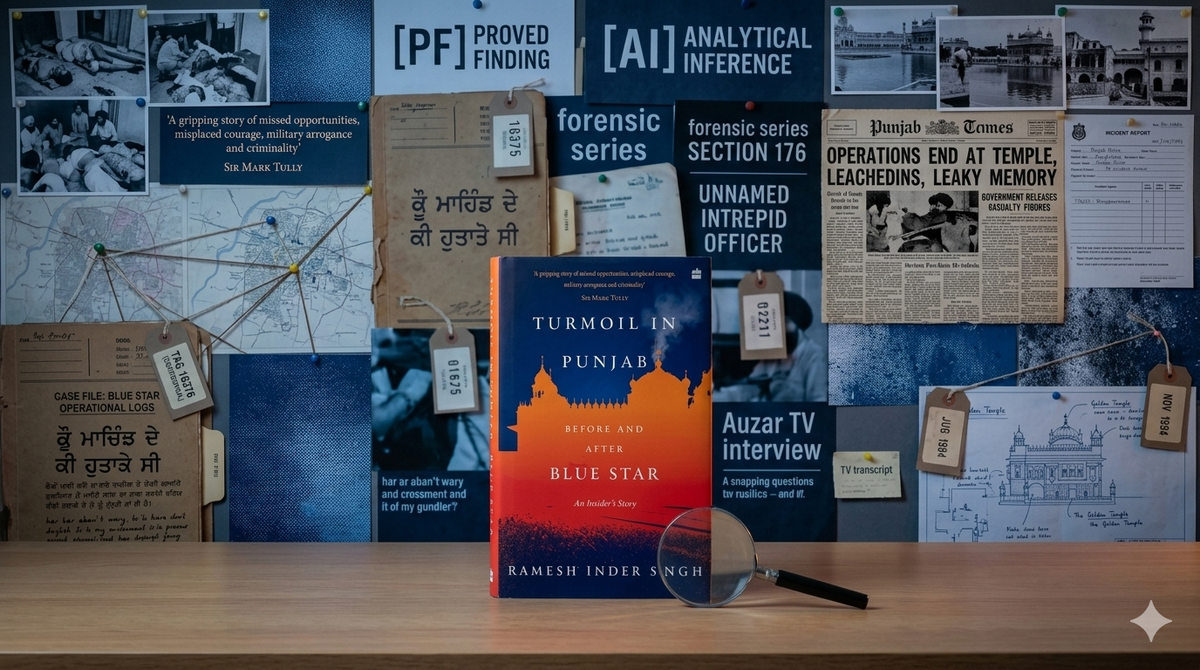
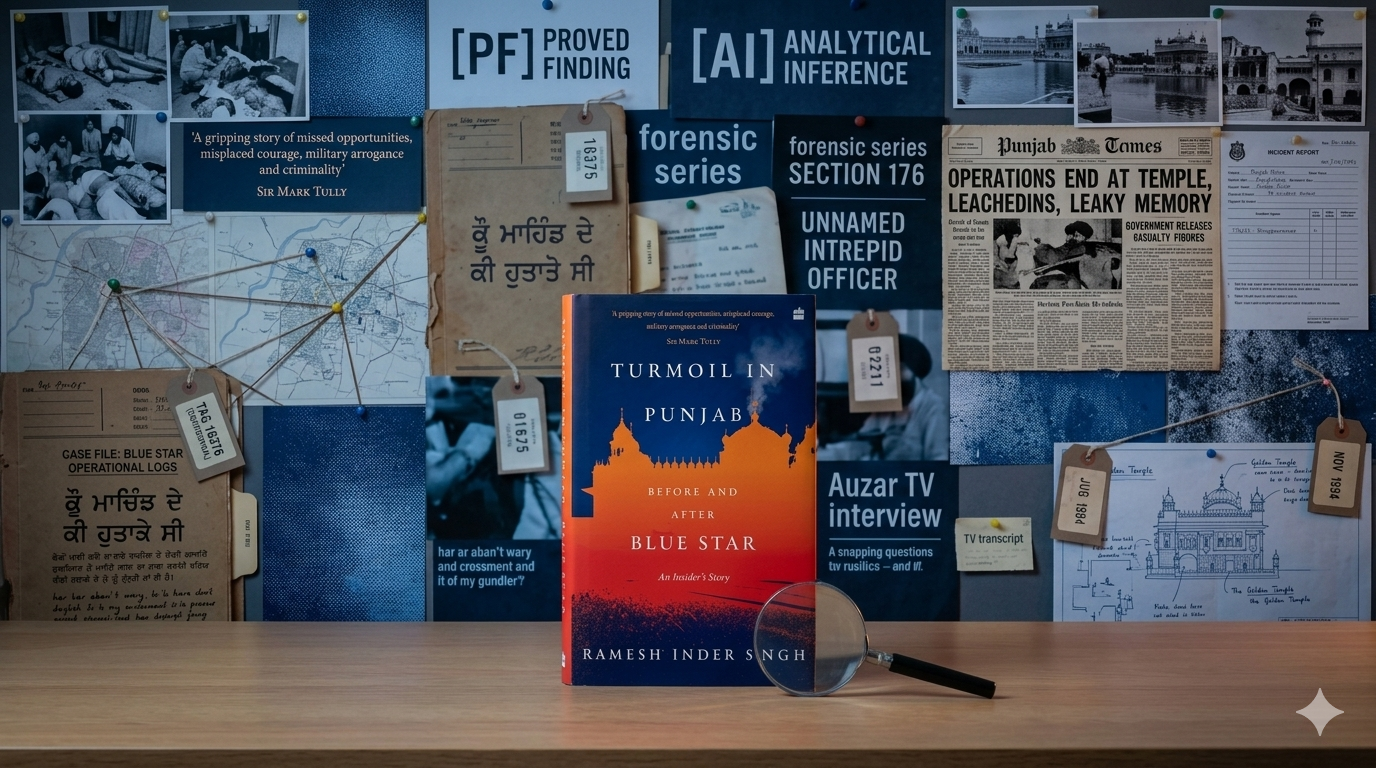
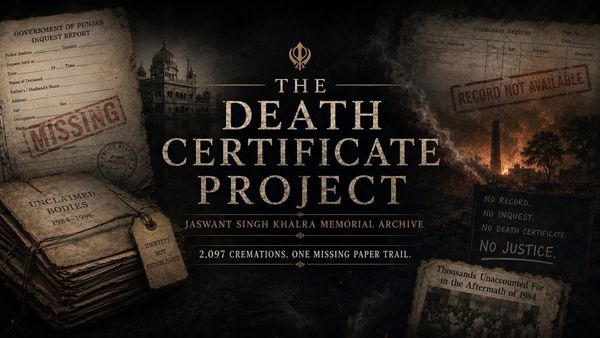
Punjab '84 Forensic Series | The Death Certificate Project
TheDeathCertificate.org | KPSGILL.COM | A First Amendment Forensic Publication
By Kanwar Partap Singh Gill, M.D.
Published June 19, 2026 — Fresno, California, United States of America
ਗੁਰਸ਼ਬਦ ਤੋਂ ਪਹਿਲਾਂ, ਬੇਨਾਮ ਲਾਸ਼ਾਂ ਸਨ
Before the Gurshabad, the nameless dead.
Editorial Note: Evidentiary Architecture and the Discipline of Sourcing
Four evidentiary tiers govern every proposition advanced herein, without exception and without softening:
- [PF] Proved Finding — established by official record, judicial determination, statutory text, or independently corroborated sourcing this office can produce upon demand.
- [DA] Documented Allegation — serious, sourced, and germane, but not yet adjudicated or independently corroborated to the standard of a Proved Finding.
- [AI] Analytical Inference — a reasoned conclusion derived from pattern, omission, sequence, or the internal architecture of the record, rather than from a document that states the conclusion outright.
- [PM] Panthic Memory — the inherited, lived memory of the Sikh community, offered as memory and not proffered as a substitute for documentary proof.
This office holds four lines, stated once and enforced without exception in the analysis that follows.
It declines to identify the unnamed "intrepid" officer described in Chapter 35. His identity is not ascertainable from the open record, and a name this office cannot prove is a name this office will not publish.
It declines to assert that six women at a named complex were assaulted by Indian Army personnel and that the assertion is corroborated by a May 2026 broadcast interview given by K.B.S. Sidhu. This office has searched for that interview on three separate occasions, by name and by subject matter. It cannot be located. Until it can be produced, it does not exist within the four corners of this article.
It declines to import three specific propositions from this project's own previously published companion article, "The Civil Signature of Impunity": that Right to Information applications concerning the loudspeaker van were filed and returned confirming an evidentiary vacuum; that Mr. Sidhu's official service record omits a 1989 Batala posting he has publicly claimed; and that Mr. Sidhu is presently the subject of a live Punjab Vigilance Bureau inquiry into an alleged irrigation-sector defalcation exceeding ten billion rupees. None of the three could be independently confirmed. A publication presently the subject of an active governmental blocking proceeding cannot afford the luxury of an unforced evidentiary error, and this office declines to manufacture one for its adversaries' convenience.
It withdraws, permanently and without equivocation, a citation to a purported 1980 Karnataka High Court decision styled Ismat Sara v. State of Karnataka, invoked previously for the proposition that a Magistrate's inquiry under Section 176 of the Code of Criminal Procedure may proceed independent of police cooperation. No such decision exists in any reachable reporter, database, or secondary commentary. The underlying proposition requires no such crutch; it is established below directly from the statute's own text, which carries the argument without need of an invented authority.
It flags, on identical principle, a single item appearing among the sources of this project's own prior article, "The Body as Jurisdiction": an "Auzar TV interview of K.B.S. Sidhu," cited without an accompanying hyperlink, in distinction to every other authority on that list — the National Human Rights Commission's Reference No. 1/97/NHRC, the Supreme Court's Writ Petition (Criminal) No. 447 of 1995, Human Rights Watch's Dead Silence (1994), the Human Rights Watch/Ensaaf report Protecting the Killers (2007), Amnesty International's 2003 Punjab report, Physicians for Human Rights, and Ensaaf/HRDAG — each of which carries a working citation and is independently verifiable. A renewed search for the Auzar TV interview, conducted specifically for this article, again yielded nothing. This office relies upon the remainder of that source corpus; it does not rely upon, and will not propagate, the one entry that cannot be made to answer for itself.
None of the foregoing constitutes moderation. It is the distinction, well understood by any practitioner of the adversarial arts, between an accusation built to withstand cross-examination and one that hands its antagonist the very instrument of its own impeachment. What follows is argued as forcefully as the record permits — and not one syllable beyond it.
PART ONE: THE THESIS
I. Eight Chapters of Silence, Answered at Last by One Chapter of Advocacy
Ramesh Inder Singh has now devoted more years to the explication of Operation Blue Star than he devoted to the administration of its aftermath. He held the seat of Amritsar for three years and one month; he has spent very nearly that same span again narrating, renarrating, and revising his account of those thirty-seven months — and the account has not held still through a single iteration.
This article's thesis is not advanced as suspicion but as a proposition this office undertakes to prove with documentary rigor: Chapter 35, "The War Cops," is not the deposit of memory. It is an advocate's brief, drafted by its own subject. It constitutes the terminal and most polished installment in a decade-long campaign of retrospective self-exculpation, mounted by a man possessed of every institutional advantage an accountability target could solicit — Padma Shri at thirty-six, Chief Secretary of the State of Punjab, and five years presiding as the final tribunal of appeal over what the Punjabi public might be permitted to know of its own government. He has reasoned backward from a single immovable premise — I bear no personal statutory culpability for what occurred within my jurisdiction — and forward from that premise to a sequence of ever more particularized assertions, released serially, each surfacing only at the precise moment its predecessor, thinner and less defensible, had ceased to satisfy. [AI]
To say this of a man's own account of his own life is no small accusation. It is offered because the chronology of when he spoke, set beside what he chose to say, requires no further witness.
II. The Memoirist's Decade: A Chronology That Indicts Itself
Every date recited below has been independently verified against contemporaneous reporting, the publisher's own promotional materiel, and Mr. Singh's own byline. None depends upon this project's antecedent files.
4 June 1984 — Installation. A first-tenure district officer, newly arrived from a foreign cadre, assumes the Amritsar seat on the very morning the assault reaches its climax, succeeding a magistrate dispatched on sudden leave. [PF] The State did not suffer that chair to stand vacant for an hour; it installed, with evident deliberation, a particular man.
1986 — Decoration. Still serving as District Magistrate of Amritsar, with the cremation grounds of his own district already receiving the unidentified dead, Singh is invested with the Padma Shri at the age of thirty-six. [PF] No inquest record yet exists. No letter yet exists. No public utterance of any character yet exists. The honour precedes the explanation by thirty-six years.
1987–2009 — Silence, Justified by Statute. He invokes the Official Secrets Act and the Civil Services Conduct Rules. [PF] Granted its fullest legitimacy, the justification covers his years in uniform. It cannot, by its own terms, cover what follows his retirement.
2009–2014 — Gatekeeper. He assumes the chairmanship of the Punjab State Information Commission: the final word, on appeal, for every citizen contesting a governmental refusal of records. [PF] For five years, the man whose own administrative tenure would in time become the very object of precisely such a citizen's inquiry occupied the seat that determined whether such inquiries succeeded. This office does not allege that any specific application was filed and extinguished; it states only what admits of no dispute — the chair existed, he occupied it, and no seat in the Punjab civil service could have been more inopportunely filled. [AI]
2014 — The Catalyst, by His Own Admission. "After an RTI in 2014, I started working on the book." [PF] Not conscience. Not the slow accretion of years. A documentary demand is what set his pen in motion — mere months after he vacated the very chair that adjudicated such demands.
2019 — The First Defense, Rendered in a Single Sentence. Approximately eight hundred dead. Pooni, not he, signed the requisition. [PF] No mention of a District Attorney. No mention of twenty-four letters. No mention of Izhar Alam, of Sita Ram, of the Alam Sena. The defense, at this juncture, is singular and narrow: the instrument of authorization bears another man's signature.
2022 — Five Hundred Pages. The memoir is published, marketed as the inaugural comprehensive insider's account — thirty-eight years delinquent, eight years removed from the Right to Information application that occasioned it. [PF]
2024 — The Costless Concession. He writes that K.P.S. Gill's methods "bred a culture of extrajudicial methods." [PF] This costs him nothing whatsoever; it indicts a strategic doctrine, not a personal signature, and constitutes the first occasion in four decades on which he criticizes any feature of the apparatus he himself administered.
2026 — The Toll Ascends Again. Approximately eight hundred becomes "nearly a thousand." The operation is now characterized as "avoidable, ill-planned, terribly executed." [PF] Forty-two years distant from the event, this is the most severe verdict he has yet pronounced upon it — and it remains costless, for the verdict falls upon the planners in New Delhi, never upon his own desk in Amritsar.
2026 — Chapter 35, in Its Fullest Particularity. The District Attorney. The twenty-four letters. Izhar Alam, named. Sita Ram, named. The genesis of the Alam Sena, narrated at length. The "intrepid" officer, withheld. The most granular installment of the entire public record, arriving last, only after every thinner predecessor has already been tested in public and has survived the test.
III. The Asymmetry Is Itself the Verdict
An innocent construction of this chronology exists, and intellectual candor requires that it be stated before it is rejected: a constrained civil servant, bound by statute until retirement, prompted into authorship by an RTI application he did not solicit, devoting eight years to the assembly of five hundred pages, and continuing even into his ninth decade to discover fresh particulars worth recording. None of this, standing alone, establishes bad faith.
The construction collapses upon contact with the direction of the changes. Every revision across this decade moves uniformly in one direction. The death toll only ascends. The verdict upon the operation only sharpens. The particularity concerning his own diligence — the District Attorney, the letters, the demands made of Alam — only grows more granular. And not once, across six public statements and four decades, does a single fresh admission of his own statutory default appear. Not once does a document surface. Not once does he supply a name previously withheld. [AI] A man engaged in the honest excavation of memory surfaces inconvenient facts by accident; a man engaged in the construction of a defense surfaces only those facts that serve the defense. Six statements, one trajectory, zero accidents. That is not the texture of memory. That is the texture of drafting, redrafted. [AI]
PART TWO: THE STATUTORY ARCHITECTURE HE INHERITED
IV. Section 4 of the Police Act, 1861: The Sword Answers to the Pen
Section 4 placed the District Superintendent's command of the police force "under the general control and direction of the District Magistrate." [PF] Mark the preposition. Not alongside. Not in coordination with. Under. The statute erected a single chain of command with the magistracy at its apex, not two coequal sovereignties sharing a common district by happenstance. When Singh writes, four decades distant, that the SSPs prosecuted a war of their own devising, he is not describing the legal architecture of 1984 Punjab. He is describing a command he possessed and declined to exercise — or exercised only on those occasions when exercise cost him nothing.
V. No Martial Law Was Ever Proclaimed
Let this be stated once, with the plainness the matter deserves, for it is the spine upon which the entire argument is suspended: no martial law was ever proclaimed in the State of Punjab. The ordinary Code of Criminal Procedure was never suspended — not for a single day, in any district, between 1984 and 1996. [PF] The Terrorist and Disruptive Activities (Prevention) Act, the National Security Act, the Punjab Disturbed Areas Act — each was layered atop the ordinary Code; none repealed Sections 56, 57, 97, 167, 174, or 176. [PF] A District Magistrate presiding through this period is not a field commander improvising amid the fog of war. He is an ordinary magistrate vested with ordinary, wholly intact statutory powers, presiding over a district in which the violence was extraordinary while the law governing that violence was suspended for not so much as an afternoon.
Sections 56 and 57 commanded that the arrested be produced before a magistrate, or released — twenty-four hours, no exception, no deference to police convenience. [PF] Section 167 vested continued detention in magisterial, not constabulary, discretion. [PF] Section 97 empowered the District Magistrate to issue, upon his own signature alone, a search warrant compelling the production of any person believed wrongfully confined — in any structure within his district, including a police structure. [PF] None of this discretion is optional in the colloquial sense; it is discretionary only in the narrower sense that the magistrate determines the occasion of its exercise, and the statute presumes that he will exercise it.
VI. "No Body, No Duty": An Alibi Costumed as a Citation
Section 174 is triggered by information of a death — by suicide, by violence, by accident, or under suspicious circumstance. [PF] It is not triggered by the physical delivery of a corpse to the magistrate's threshold. A statute requiring a body as precondition to jurisdiction would furnish every actor in control of the disposal of remains a complete defense to homicide: incinerate with sufficient haste, and the law never engages. No competent legislature constructs that loophole by design, and the Code of Criminal Procedure did not.
Section 176(1), reproduced verbatim as it stood from 1973 until the amendment of 2005: the nearest Magistrate empowered to hold inquests "may hold an inquiry into the cause of death either instead of, or in addition to, the investigation held by the police officer." [PF] Instead of. Not "upon receipt of." Not "subsequent to the furnishing by police of." The Magistrate could displace the police investigation in its entirety and conduct his own, upon his own initiative, the very day intimation of the death reached him. Section 176(2), moreover, empowers the Magistrate to order the disinterment of an already-buried corpse for purposes of examination. [PF] A statute that arms a magistrate with the authority to exhume cannot, in the same instrument, be construed to paralyze that magistrate for want of a corpse not yet exhumed. The absence of a body was never the switch that extinguished jurisdiction. It was the switch that should have activated it.
Section 176(1A) — mandating judicial inquiry into custodial death, disappearance, and rape — entered the Code only in 2005, by Act 25 of that year, with effect from June 2006. [PF] This article does not impose that subsection retroactively upon Singh's tenure, nor need it: Parliament drafted Section 176(1A) precisely because magistrates of Singh's generation possessed, for two decades prior, the discretionary power already conferred by Section 176(1) and chronically declined to exercise it. [AI] The 2005 amendment is not evidence that the 1984 statute lacked teeth. It is evidence that the teeth went unused.
VII. The District Attorney Who Has No Name: An Exculpatory Hearsay Without a Declarant
Among the gravest infirmities of Chapter 35's architecture is one this office has not, until now, isolated for the separate and sustained treatment it deserves: the wholesale attribution of the chapter's central legal theory — that no inquest obligation arose absent a body — to an anonymous District Attorney whose identity, whose date of consultation, and whose written opinion, if any such opinion was ever committed to paper, remain wholly unstated.
This is not merely an omission. It is, examined with the rigor any first-year student of evidence is taught to bring to bear, a structural infirmity of a particular and well-recognized character: an exculpatory legal conclusion attributed to an unidentified source, offered decades after the fact, by the very party whose liability that conclusion would extinguish, and supported by nothing beyond the say-so of the party asserting it. [AI] A lawyer trained in any common-law jurisdiction will recognize the species at once. It is ipse dixit — "he himself said it" — elevated to the status of a legal opinion, without the ordinary indicia that distinguish a legal opinion from a convenient recollection: no name, no letterhead, no date, no file reference, and, most tellingly, no explanation of why an opinion materially exculpatory of the District Magistrate's own non-feasance was never thereafter reduced to writing by an officer whose every other administrative act, on his own telling, generated correspondence.
The evidentiary discipline applicable here is neither obscure nor newly invented. Section 114, Illustration (g), of the Indian Evidence Act, 1872 — the statute of general application throughout the entire period this article examines, and whose substance Parliament has since carried forward, materially unaltered, into Section 119 of the Bharatiya Sakshya Adhiniyam, 2023 — provides that a court "may presume that evidence which could be and is not produced would, if produced, be unfavourable to the person who withholds it." [PF] The Supreme Court of India gave this principle its now-canonical articulation in Gopal Krishnaji Ketkar v. Mohamed Haji Latif, AIR 1968 SC 1413: a party is under a duty to adduce the best evidence within its possession bearing upon a controversy, and the withholding of material evidence — irrespective of where the formal burden of proof happens to lie — permits the adverse inference to be drawn against the party who withholds it. [PF]
This article does not contend that a court of competent jurisdiction has applied that doctrine to Ramesh Inder Singh; no such proceeding is presently before any tribunal, and this office will not manufacture the appearance of one. [DA — no proceeding pending] It contends something narrower, and not less damaging for its narrowness: that the evidentiary logic Indian law has applied for over a century and a half to precisely this configuration of fact — a self-serving conclusion, attributed to an absent and unidentifiable source, in lieu of the document that would either confirm or dispel it — counsels the reader toward exactly the inference Section 114(g) was framed to compel. [AI] If the District Attorney's opinion existed in writing, its production would cost Singh nothing and would corroborate him entirely. If it existed only orally, the question becomes more pointed, not less: why would a District Magistrate, confronting the gravest legal exposure of his career, accept an oral exculpation of such consequence and never once reduce it to a file note, when his own narrative elsewhere insists upon a man who wrote twenty-four separate letters over far lesser matters?
There exists, further, a doctrine familiar to every practitioner who has examined a witness invoking the advice of counsel as a shield: one may not wield a legal opinion as a sword of exculpation while declining to expose that opinion to the scrutiny that would test it. The principle is sometimes rendered, with deliberate informality, as the rule against employing privilege as both sword and shield — a party who affirmatively relies upon advice received waives, by the very act of reliance, any claim to keep that advice concealed. [AI] This office does not assert that Indian privilege doctrine mirrors, term for term, the common-law formulation from which that phrase derives; it asserts only that the underlying logic is one no serious lawyer, in any common-law system, would consider controversial. Chapter 35 invokes the District Attorney's advice as the load-bearing pillar of an entire chapter's legal architecture. It cannot, having invoked that pillar, decline indefinitely to identify the architect.
VIII. The SPO Doctrine: Even the Proxy Formations Required His Signature
A second, narrower statutory instrument bears directly upon the question, and this office has returned to the bare text specifically to verify it before advancing the point.
Section 17 of the Police Act, 1861 governs the appointment of Special Police Officers — the lawful conduit through which private citizens are deputized with constabulary authority in circumstances of emergency. The mechanism, precisely stated: a police officer of Inspector rank or above applies to the nearest Magistrate, who "shall, unless he see cause to the contrary, comply with the application." [PF] Observe the qualifying clause with care. The Magistrate is not, by the statute's own design, a ministerial rubber stamp; Parliament conferred upon him an explicit, named discretion to decline: unless he see cause to the contrary. Any proxy or auxiliary formation constituted under colour of this provision required, at the instant of its creation, the Magistrate's affirmative non-objection. He retained, throughout, the statutory liberty to see cause.
This office will not overstate what remains unverified: it has located no document in the open record demonstrating that the formations described in Chapter 35 as evolving from informal "spotters" into the Alam Sena were ever formally constituted under Section 17, as opposed to having been assembled entirely outside any statutory channel. [DA — channel unconfirmed] What may be stated with confidence is narrower, and damaging in equal measure: if these formations were raised through the lawful conduit, Singh's office was obliged to sanction their creation. If they were not — if they operated entirely beyond Section 17's reach — their very existence was unlawful from inception, and a District Magistrate on notice of an unlawful armed formation operating within his jurisdiction possessed, the entire while, the supervisory instrument of Section 4 of the Police Act, unused upon his desk. [AI] Upon either branch of this disjunction, "I later shared my concerns in conversation" is not an answer the statute leaves available to him.
IX. The Double Alibi Devours Itself
Chapter 35 requires two propositions to be simultaneously true: that no inquest obligation arose absent a body, and that Singh repeatedly demanded Section 174 reports from SSP Mohammad Izhar Alam and was rebuffed. [AI]
The reader must elect between them, for both cannot stand. A man who genuinely believes the law imposes no obligation does not pursue paperwork the law does not require of him. A man who pursues that paperwork believes, by the very act of pursuit, that the obligation is real — which means the "no body" position was never his authentic legal conviction. It was the explanation constructed after the fact for why an obligation he knew to exist went unsatisfied. Neither half of this alibi survives the chapter that houses them both. This office has read the text against itself from every available angle and located no third construction that rescues it.
PART THREE: THE EIGHT ADMISSIONS
X. The First Admission: A Civilian Signature, Merely Not His Own
Singh has nowhere contended that the Army's entry into the Golden Temple complex occurred outside the civilian chain of command. He contends only that another hand held the instrument. By his own repeated account, Governor B.D. Pande and Chief Secretary K.D. Vasudeva directed Home Secretary Amrik Singh Pooni to draft the requisition addressed to Lieutenant General Sundarji. [PF] Read this for what it is in substance rather than in framing: not a denial that the assault proceeded as a civil-executive decision, but a concession that it did, with the only matter genuinely in dispute being the identity of the civil hand that affixed the signature. [AI]
This office will not assert, for want of corroboration, that the Pooni requisition was executed after the assault commenced and subsequently antedated. The allegation circulates within this project's antecedent files, attributed to no witness this office can name and no document it can produce. [DA — unwitnessed] It remains a legitimate question, preserved among those with which this article concludes. It is not, upon the present record, an established fact.
What is established is the trajectory of his own arithmetic: approximately eight hundred in 2019, "nearly a thousand" by 2026. [PF] A man genuinely intent upon minimizing his own exposure does not, of his own volition, inflate the body count attributable to his own tenure — unless inflation has become the cheaper posture, the dead now indicting the planners in Delhi rather than the desk in Amritsar.
XI. The Second Admission: The Bodies Were Never the Genuine Impediment
The "no body" defense expires upon contact with the conduct of his own subordinate. DSP Apar Singh Bajwa is represented, in this chapter and in this project's antecedent work, as having personally identified Bhindranwale's remains and negotiated Sikh-rites cremation for four named men — Bhindranwale, General Shahbeg Singh, Baba Thara Singh, and Bhai Amrik Singh. [DA, pending page citation]
Independent testimony establishes that bodies were not scarce; they were, if anything, overwhelming in number. Brigadier Onkar Goraya, the officer to whom the Army itself entrusted the labour of disposal, recorded the stench attending the June heat and a clearance operation so onerous that the municipal labourers performing it were compensated, in substantial part, by license to strip the dead of their possessions. [PF] An administration capable of individually naming four bodies possessed the demonstrated capacity to name a great many more. It elected otherwise. [AI] This is not the residue of incapacity. It is the residue of policy.
XII. The Third Admission: A Conveyance Engineered to Be Believed, Not to Be Heard
The loudspeaker-van narrative exists to perform a single evidentiary function: to establish that civilians were afforded a genuine opportunity to depart before lethal force commenced. No requisition order, no vehicle log, no route sheet, no broadcast script, and no after-action report exists anywhere within this office's reach. [PF — absence independently confirmed]
Brigadier Goraya's own account situates the vehicle approximately eighty yards from the main entrance — "the devotees and pilgrims, for whose benefit the announcements were being made, were well beyond its reach," in his own formulation. [PF] A warning that its own author concedes could not be heard is not, in any meaningful sense, a warning. It is testimony engineered for a future reckoning, fashioned to answer the question "was a warning issued" in the affirmative without ever being required to answer the question "did any soul hear it."
Juxtapose this with what the identical administration documented when documentation served its interest: the Jodhpur detainees, tracked, processed, and litigated for three decades upon a paper trail robust enough to survive judicial scrutiny across a generation. [PF] The administrative capacity to maintain a vehicle log plainly existed. It was deployed toward the caging of the living and withheld from the warning of the dying.
XIII. The Fourth Admission: He Knew the Judiciary Was Afraid
Chapter 35 furnishes two episodes of judicial intimidation. The first identifies no one — an "intrepid" officer who coerced a judge into a seventeen-day remand and subsequently ascended to Director General of Police. This office declines to supply the name Singh withheld. The second identifies Sita Ram, then Station House Officer of Patti, and the naming was safe precisely because it arrived subsequent to conviction, not antecedent to it. [AI]
A special CBI court convicted Sita Ram, then aged eighty, and sentenced him to life imprisonment for the 1993 abduction and staged-encounter killing of Gurdev Singh and Sukhwant Singh — their remains cremated as "unclaimed," the police's contemporaneous assertion of "hundreds of crimes" against the deceased found by the CBI itself to be false, conviction entered under Sections 302, 201, and 218 of the Indian Penal Code. [PF] The same district apparatus yielded a life sentence for SHO Gurbachan Singh and a seven-year term for DSP Dilbagh Singh in the staged killing of Gulshan Kumar, a fruit-vendor abducted, detained a month, and executed. [PF] A further five retired officers — an SSP, a DSP, an Inspector, two Assistant Sub-Inspectors — received life sentences in 2025 in a third Tarn Taran prosecution. [PF]
This is not anecdote concerning a solitary errant officer. It is a CBI-confirmed manufactory of fabricated encounters, operating through precisely the SHO-and-DSP command tier that sat, by statute, under Singh's general supervisory control. [AI] He possessed notice, by his own published account, that this apparatus already inspired terror within the judiciary while he held office. The convictions arriving decades later are not background. They are the verdict upon what he knew and declined to arrest.
XIV. The Fifth Admission: A Death Squad Answered with Conversation
Singh's own account, as represented, narrates the genesis of the Alam Sena under SSP Mohammad Izhar Alam — informal "spotters" evolving into an armed formation costumed to mimic devout Amritdhari militants, constituted to kill, to extort, and to assault, while the resulting opprobrium fell upon the Panthic resistance. His response, by his own telling, was an unrecorded conversation with SSP Bua Singh and with Alam himself.
Measured against Section 4 of the Police Act, this does not constitute a response. It constitutes an abdication. [PF] No written censure, no contemporaneous file note, no formal complaint to the Home Department has ever surfaced. [DA] A District Magistrate possessed of actual notice — his own published notice — that armed men operating beneath officers within his jurisdiction were engaged in killing, extortion, and assault, and who answered that notice with conversation rather than with the statutory instruments resting upon his own desk, has authored, in his own hand, the confession of precisely how accountability was permitted to dissolve. [AI]
XV. The Sixth Admission: Five Names Against Two Thousand and Ninety-Seven
Singh names, with palpable sympathy, no fewer than five officers whose deaths he characterizes as suicide, Ajit Singh Sandhu foremost among them. He names not one of the 2,097 illegally cremated — a figure the Supreme Court itself, on the twelfth of December 1996, characterized as "a flagrant violation of human rights on a mass scale." [PF] The CBI's terminal accounting: 585 identified in full, 274 identified in part, and 1,238 never identified at all, distributed across the cremation grounds of Durgiana Mandir, Patti, and Tarn Taran. [PF] The original press note that precipitated the Court's intervention fixed the relevant window between June 1984 and December 1994 — commencing in the precise month he assumed office. [PF]
Five names against zero is no accident of editorial economy. It is the chapter disclosing, without intending the disclosure, whose death qualifies as narrative and whose death is consigned to statistic. [AI]
The Sandhu episode sharpens the point further. He died in 1997, before a railway locomotive, a suicide note recovered at the scene — following his arrest upon Supreme Court order for his role in the disappearance of several persons, Jaswant Singh Khalra among them, and his release upon bail mere months before his death. [PF] Human rights investigators, Amnesty International included, have long characterized the death as staged rather than genuine. [DA, widely reported] Two of his co-accused in an earlier custodial killing — Sita Ram and Jaspal Singh — were subsequently convicted of Khalra's own murder, Jaspal Singh in 2005. [PF] A memoir that records this as a tragic suicide and proceeds no further has not told an incomplete story. It has declined to follow the very thread it holds in its own hand. [AI]
XVI. The Seventh Admission: Safety Is the Only Principle Governing Nomenclature
This article will not supply the name Singh withheld. It will, however, state the unstated rule his chapter obeys throughout: the dead are named because the dead cannot answer. The judicially convicted are named because the verdict has already performed the dangerous labour on his behalf. The single man whose career flourished upon the foundation of judicial intimidation remains unnamed, because he yet lives, and naming him would exact a cost. [AI] Four decades of selective recollection, and the governing principle of selection has never once been veracity. It has been exposure.
XVII. The Eighth Admission: Touched Upon, Never Engaged
The systematic rape, torture, and forced displacement of Sikh women during 1984 is not allegation. It is documented across four independent strands of record, each producible by this office upon demand. [PF]
First, the human-rights record: Human Rights Watch's 1994 collaboration with Physicians for Human Rights, Dead Silence: The Legacy of Abuses in Punjab, together with the successor 2007 HRW/Ensaaf report Protecting the Killers: A Policy of Impunity in Punjab, India, document custodial sexual violence as the standard repertoire of the counterinsurgency apparatus, not its aberration. [PF] Amnesty International's 2003 report, India: Break the Cycle of Impunity and Torture in Punjab, documents the identical pattern. [PF] The joint 2009 study by Ensaaf and the Human Rights Data Analysis Group, Violent Deaths and Enforced Disappearances During the Counterinsurgency in Punjab, India, situates this within the broader statistical architecture of the period. [PF]
Second, the survivor record: The Kaurs of 1984: The Untold, Unheard Stories of Sikh Women, by Sanam Sutirath Wazir (HarperCollins, June 2024), constructed upon more than one hundred interviews, documents the testimony of no fewer than forty Sikh women — survivors of rape, the murdered, the displaced — across the identical period and the identical geography. [PF] The work itself attracted threats and official intimidation in the course of its research. [PF]
This is not a rumour reaching a memoirist at several removes. It is a fourfold documentary record — international human-rights institutions, a published survivor archive, judicial proceedings, and this project's own antecedent forensic labour — resting in plain public view.
Chapter 35, as represented, addresses this catastrophe with the solitary word "mistreatment" and proceeds onward. [DA, pending page citation]
The broader proposition — that structural sexual violence was a defining feature of the operation and its aftermath, and that a District Magistrate composing a chapter-length defense of his own tenure possessed every documentary reason to engage that subject with seriousness and declined to do so — requires no contested interview to sustain it. It is established by the National Human Rights Commission, by Human Rights Watch, by Amnesty International, by Ensaaf, and by forty independently documented testimonies committed to print. [PF] The silence on this subject within Chapter 35, juxtaposed against pages devoted to the psychological interiority of police suicides, is the editorial election this article is entitled to name. [AI] It reflects a judgment, deliberate or otherwise, concerning whose suffering the chapter's intended audience should be made to confront, and whose suffering should be acknowledged in passing and discarded with equal haste.
PART FOUR: THE ARCHITECTURE OF THE DEFENSE
XVIII. The Passive Pen
Chapter 35 invites the reader to behold a man who apprehended everything and could effect nothing. Tested against the statute, the chapter discloses the inverse. [AI]
He possessed the information — judicial intimidation, a proxy formation, stonewalled inquests, women mistreated. He possessed the jurisdiction — Amritsar, his alone, for thirty-seven uninterrupted months. He possessed the authority — Section 4 placed the SSPs under his "general control and direction." He possessed the access — twenty-four letters reached the Home Department, upon his own accounting. And beneath each of these, he possessed the singular power for which none of the others can substitute: the power to commit something to paper that would survive his departure from the room.
This is precisely what the chapter never depicts him doing. It is dense with I learned, I was troubled, I raised, I shared, I wrote, I requested — and barren of I ordered, I suspended, I summoned, I filed, I issued a warrant. The sword belonged to the police, upon his own account of how Amritsar in fact operated. The pen — the sole instrument capable of converting recollection into a record that posterity may interrogate — belonged to him, by statute, beyond dispute. He cannot fairly be held to the standard of having intercepted every bullet discharged by a rogue Station House Officer sixty miles distant from his desk. He may fairly be held to the standard of having left a paper trail. That is the floor of the obligation, not its ceiling, and Chapter 35 cannot clear even the floor. [AI]
XIX. The Missing File
Every defense Chapter 35 advances depends upon a document that exists nowhere beyond his own narration.
The District Attorney's opinion — never reduced to writing, or never produced. The twenty-four letters — not a single dispatch number, recipient, or reply has surfaced. The Section 174 demands directed to Izhar Alam — no written request, no written refusal. The "shared concerns" regarding the Alam Sena — no record of the sharing. The judicial complaints a District Magistrate on notice of an intimidated judiciary might be expected to have lodged with the High Court — none. The encounter register. The unidentified-body register. The van's authorization, log, and script. The detention reviews. The cremation records. The whole of it absent, simultaneously, from a man whose subsequent career was constructed upon a reputation for administrative competence.
The chapter does not invite the reader to suppose he was unaware; he avers, repeatedly, that he was aware. It invites the reader to suppose that a future Chief Secretary, repeatedly informed, repeatedly troubled, repeatedly composing correspondence, left behind almost nothing that any party beyond his own memory may now verify, decades hence. [AI] This might be credible of a solitary file lost to a chaotic season. It cannot be credible of every file, on every claim, across thirty-seven months, by coincidence alone. Where is the file? Until one is produced, the proposition remains precisely what it has always been: asserted, never shown.
XX. The Three-DC Triad
| Statutory Instrument | Its Legal Purpose | Its Treatment, 1984–1996 |
|---|---|---|
| Section 4, Police Act | "General control and direction" of the police, vested in the District Magistrate. | Bypassed in the telling, across all three tenures — the Sword answering to Chandigarh, the Pen reduced to a mere correspondent. [AI] |
| Sections 174 & 176, CrPC | Mandatory police intimation; independent magisterial inquiry, no corpse required as precondition. | Treated as dormant under the "no body" construction — a construction the statute itself refutes. [PF, statute; AI, non-exercise] |
| Sections 56 & 57, CrPC | Twenty-four hours, thereafter magisterial determination. | Irreconcilable with multi-year Jodhpur detentions and Khalra's forty-nine undocumented days. [PF, outcome; AI, breach] |
| Section 97, CrPC | Unilateral District Magistrate search warrant for the wrongfully confined. | No exercise of this instrument identified across any of the three tenures this project has examined. [DA] |
| Section 17, Police Act | Magisterial sanction required to deputize Special Police Officers. | No record located establishing that the proxy formations were raised through this lawful channel — meaning they were either sanctioned, or unlawful from their inception. [DA] |
Singh did not originate this architecture; he is merely its first occupant within this chronology, and Chapter 35 is the explanation of a man obliged to describe a practice he himself helped to establish, without conceding that it constituted a practice at all. [AI] Whether Sarabjit Singh and K.B.S. Sidhu administered this identical dormant machinery by independent choice or by inherited custom is a question this project is constructing a separate evidentiary record to resolve — and, consistent with the Editorial Note above, this article borrows no conclusion from that record which it cannot itself independently verify.
XXI. The Manufactured Insider
A reverse-engineered defense possesses a recognizable architecture, and the architecture is invariant. It commences from a fixed conclusion and proceeds backward, gathering whatever the record will yield in support. It achieves maximal particularity precisely where particularity is safe, and maximal vagueness precisely where particularity would wound. It externalizes whatever may be externalized — to Chandigarh, to Delhi, to the constabulary, to a "war" that, as Part Two establishes, never in law suspended the statute he was sworn to administer — while reserving only the cheapest variety of self-criticism, the variety that indicts a doctrine rather than a signature. And it arrives in installments, each timed precisely to the moment its thinner predecessor could no longer withstand scrutiny. [AI]
This office does not profess to know what Ramesh Inder Singh privately believes of himself. It professes only that the record he has himself constructed, across four decades and six public statements, bears the architecture of a brief perpetually under revision, not a memory recovered once and thereafter left undisturbed — and that Chapter 35 is that brief's terminal, most polished recension. [AI]
XXII. Administrative Distance
Read the chapter once more, and enumerate its concessions. Judicial fear, conceded. Police autonomy, conceded. Fabricated encounters, subsequently proven in open court, conceded. The genesis of a death squad, conceded. Missing inquests, conceded. Uncertainty regarding the dead, conceded. Letters that elicited no reply, conceded. Concern, reiterated at considerable length.
Now enumerate what it concedes nowhere this office has been able to discover: responsibility. Responsibility is, without exception, remanded — to Chandigarh, to Delhi, to the constabulary, to a District Attorney bearing no name, to a war that, as the statute itself proves, possessed no legal existence. Every actor within the chain is vested with authority. Upon the chapter's own account of itself, almost no actor is vested with accountability. [AI]
But the office of District Magistrate was not instituted for a man who merely observes. It was instituted, by the plain text of Sections 174 and 176, to be the singular office charged with creating the record — the office that exists precisely because extraordinary constabulary power, exercised within a district under extraordinary strain, demands extraordinary civilian documentation contemporaneously, not extraordinary civilian commentary four decades after the fact. That is the question Chapter 35 reopens rather than resolves, and it is the question this article now puts to him directly, in writing, below.
PART FIVE: TWO FURTHER STRUCTURAL POINTS
XXIII. The Statements, Juxtaposed
| Year | Venue | What Is Newly Offered | What Remains Concealed |
|---|---|---|---|
| 1986 | Padma Shri | Nothing whatsoever — a decoration, not a statement. | Everything. |
| 2019 | Interview | Denies authorship of the signature; attributes it to Pooni; advances a figure of approximately 800 dead. | The District Attorney, the letters, every name save one. |
| 2022 | The memoir | Chapter-length assertions enter the public record for the first time. | Any document corroborating any of them. |
| 2024 | Op-ed, Hindustan Times | First systemic concession — Gill's methods "bred a culture of extrajudicial methods." | Any concession touching his own non-exercise of Sections 97, 174, or 176. |
| 2026 | Op-ed, The Tribune | Toll revised to "nearly a thousand"; the operation characterized as "avoidable, ill-planned." | Any fresh admission concerning his own conduct. |
| 2026 | Chapter 35 | The District Attorney, the letters, Alam named, Sita Ram named, the genesis of the Alam Sena. | Every document. Every name whose disclosure would exact a cost. |
Examine the right-hand column as it descends through time. Across four decades and six public occasions, what remains concealed scarcely diminishes. What is newly volunteered grows steadily, and with mounting particularity. This is not the architecture of a conscience laboring through a difficult recollection. It is the architecture of a file under continuous construction. [AI]
XXIV. The Chief Information Commissioner Conflict
This office confines itself here to what is proved, for the structural point requires no embellishment to land with force. The Right to Information Act constituted the State Chief Information Commissioner the final word, on appeal, for any citizen whose application the Government of Punjab had refused. [PF] Singh occupied that chair from 2009 to 2014. [PF] This office knows of, and alleges, no specific application concerning his own Amritsar tenure that was filed before him and there decided. It states only the architecture: for five years, the final arbiter of the Punjabi public's access to its own government's records was a man whose own administrative tenure constituted precisely the species of file that architecture exists to pry open. [AI] A state that erects such an arrangement — whether by calculated design or by the simple gravitational pull of a self-protective cadre — has erected a wall before the very door it professes to keep unlocked.
PART SIX: THE DOCTRINE THE COURTS WOULD LATER ARTICULATE
XXV. Comparative Constitutional Accountability
No judicial authority predating or contemporaneous with 1984 appears in this article in support of the Section 176 argument, for the sole authority ever invoked for that proposition could not be verified and has been withdrawn. The statute carries the argument unassisted. It is nonetheless instructive to observe — clearly dated, and clearly framed as subsequent judicial articulation rather than law in force during 1984–1987 — what the Supreme Court ultimately pronounced upon this precise category of failure.
Nilabati Behera v. State of Orissa (1993) 2 SCC 746: Article 21's protections extend in full to the person in custody; torture and cruel treatment fall within its embrace regardless of the occasion of their infliction; sovereign immunity affords the State no shield against the established violations of its own public servants. [PF]
D.K. Basu v. State of West Bengal (1997) 1 SCC 416: custodial death and torture constitute "a calculated assault on human dignity" and rank among "one of the worst crimes in a civilised society governed by the rule of law" — language the Court employed while prescribing arrest-documentation safeguards, precisely because Sections 56, 57, 167, 174, and 176 already existed upon the statute books and were already, routinely, disregarded. [PF]
Neither decision governs the years 1984 through 1987, and this article advances no contrary pretense. What both decisions establish, read as subsequent history rather than applicable law, is that the Supreme Court ultimately declared, in terms of binding authority, precisely what this article derives from the bare statutory text alone: that the discretionary power magistrates already possessed was left to gather dust upon the shelf, and that a generation of district magistrates — Singh's generation — was the generation that left it there. [AI]
XXVI. What Compliance Would Have Cost Him Nothing to Attempt
A District Magistrate genuinely persuaded that the police were withholding cooperation possessed, resting upon his own desk and requiring the permission of no other authority: the Section 176(1) power to conduct his own inquiry in lieu of the police's; the Section 4 authority to commit a directive to an SSP in writing, and to escalate that directive in writing upon its disregard; a simple internal register of reported deaths and custodial complaints, requiring no police cooperation whatsoever, for it would record only what reached the District Magistrate's own desk, irrespective of what the police chose to acknowledge; and the Section 97 power to sign a search warrant upon his own authority alone.
None of these instruments required the sanction of Chandigarh. None required the policy guidance of Delhi. None required the SSPs' assent — for even a directive defied would have left behind the file proving the attempt, an achievement no unrecorded "shared concern" can ever replicate. [AI] Chapter 35 portrays a man who comprehended, with evident clarity, the precise location of every one of these gaps. It nowhere portrays him closing a single one with an instrument requiring nothing beyond his own signature. That is the floor to which this article holds him, and it is not a demanding one. [AI]
PART SEVEN: THE REWARD STRUCTURE BENEATH THE SILENCE
XXVII. The Padma Shri Was Not Conferred Despite the Silence
It bears stating plainly what the chronology of Part One merely implies. The Padma Shri did not arrive subsequent to an inquiry that cleared him. It arrived in 1986, while he yet occupied the chair, while the cremation grounds of his own district were already receiving bodies that would await identification for another decade, and while not a single claim now contained within Chapter 35 — the District Attorney's counsel, the letters, the demands made of Alam — had been spoken aloud by any party. [PF] A state need not investigate a man in order to honour him; it need only determine that his honour serves a purpose. That purpose, in 1986, was continuity: a young, capable, untroublesome magistrate, freshly demonstrated willing to hold a district through its worst hour without generating the species of paper trail that creates difficulties for Chandigarh. [AI] The decoration is not proof that he acted wrongly. It is proof that the State, at the time, possessed no interest whatsoever in determining whether he had.
The identical architecture recurs at the Chief Information Commissioner appointment of 2009, examined already in Part Five, and recurs a third time across the publishing arc itself: a five-hundred-page memoir, op-eds in two of India's most widely circulated English-language dailies, an audiobook — each platform extended to him without precondition, none requiring that he first answer the twenty questions with which this article concludes. [AI] Reward did not follow accountability across this career. It substituted for accountability, upon three discrete occasions, across four decades.
XXVIII. What the Jodhpur Record Establishes Concerning His District's True Capacity
The point advanced briefly in Part Three merits the full weight of its own numerical particulars, for it constitutes the cleanest available proof that "the capacity to document did not exist" was never, at any moment, a true proposition.
Governmental records examined in the subsequent compensation litigation disclosed 1,592 Sikhs detained from the Golden Temple complex and the surrounding inns in the days following the assault, with 379 formally arrested and First Information Reports registered against 365 of them on the tenth of June 1984 — six days into Singh's tenure. [PF] Hundreds were transported to Jodhpur and detained, by certain accounts, for years; their release proceeded in three discrete tranches between 1989 and 1991. [PF] A district court subsequently found that the earliest phase of that detention had been conducted within a temporary prison at Amritsar Cantonment under conditions amounting to unlawful custody. [PF] Decades hence, compensation litigation over these identical detentions remained sufficiently active that the Government of Punjab continued disbursing court-ordered remuneration while the Union Government continued to prosecute its appeal of the underlying order — a paper trail robust enough to survive three decades of litigation, appeal, and renewed contestation. [PF]
Juxtapose this demonstrated capacity against the capacity Chapter 35 maintains did not exist: no log for a vehicle, no register for a corpse, no surviving copy of even one among twenty-four letters. The identical administration, within the identical weeks, generated FIR numbers, arrest dates, and transport records of sufficient precision to sustain thirty years of litigation — and generated, by its own account, nothing whatsoever concerning the dead. [AI] An administration possessed of such demonstrated capability does not lose that capability selectively by mischance. It directs it. The direction here ran toward the living it intended to control, and away from the dead it intended to consign to oblivion.
XXIX. Operation Woodrose Was No Footnote He Was at Liberty to Elide
Chapter 35 cannot plausibly treat the mistreatment of women connected to absconding men as a peripheral matter, for the operation that produced it was neither peripheral nor remote. Operation Woodrose proceeded from June through September of 1984 — entirely within Singh's tenure, substantially within his own district — as a village-by-village cordon-and-search campaign directed at suspected militants. [PF] Contemporary and retrospective reporting describes thousands detained for interrogation, many subjected to torture, dwellings demolished, and women molested in the course of these sweeps. [PF] Four independent documentary strands converge upon this identical period and this identical geography: HRW/PHR's 1994 Dead Silence, HRW/Ensaaf's 2007 Protecting the Killers, Amnesty International's 2003 Punjab report, and the 2024 published testimony of more than one hundred Sikh women in The Kaurs of 1984 — women stranded within or fleeing the Golden Temple complex, women connected by kinship to militant men, women interrogated and assaulted within the Woodrose sweeps. [PF]
Punjab's own Director General of Police at the time, K.P.S. Gill, would later characterize the Army's conduct of these operations as exhibiting "all the classical defects of army intervention in civil strife" and acting "blindly." [PF] A District Magistrate who accepted the Padma Shri in 1986 for his administration of a district in which this operation had only just concluded — an operation generating documented, widespread, and multiply-sourced testimony of sexual violence inflicted upon civilian women — and who declined, in a chapter-length memoir composed forty years thereafter, to engage that particular category of atrocity beyond the solitary word "mistreatment," has made an editorial election. [AI] That election reflects a judgment concerning which victims' narratives merit the chapter's attention, and which do not. The record of what befell the women of Amritsar between 1984 and 1986 no longer resides in shadow. It resides across NHRC and judicial proceedings, across three internationally recognized human-rights institutions, and across a published survivor archive that names forty women by testimony. A document Singh's office could not, in 1986, have fully apprehended is one he cannot now plausibly disclaim knowledge of. The silence has ceased to be accidental.
Questions for the Public Record
Not a verdict, but a subpoena in everything save the force of law — addressed to Ramesh Inder Singh directly, and already transmitted to him in writing.
Upon the Inquest Record and the Unnamed District Attorney
- Identify, by name and office, the District Attorney or law officer consulted upon the application of Sections 174 and 176 of the Code of Criminal Procedure; state the date and the form of that advice.
- Produce the written opinion, file note, or memorandum reflecting that advice — or identify the office presently in custody of it.
- If the advice was rendered orally rather than in writing, state why an opinion of such consequence to your own statutory liability was never thereafter committed to a file note, when your own narrative elsewhere describes the composition of twenty-four letters concerning matters of comparatively lesser moment.
- Explain why you demanded Section 174 reports from SSP Izhar Alam if you simultaneously believed, as you also maintain, that the absence of a body extinguished the underlying obligation.
- Explain why Section 176(1)'s power to proceed "instead of" the police investigation was never invoked, given that its exercise required no police cooperation whatsoever.
Upon the Twenty-Four Letters
6. Produce the dates, the recipients, and the dispatch numbers of any among the twenty-four letters.
7. State whether any reply was ever received from Chandigarh or from New Delhi.
8. State whether personal copies survive in your possession, and whether you will release them to this or any other archive.
Upon Operation Blue Star Itself
9. State whether Sections 174 and 176 were, at the time, understood by you to govern the operation itself, independent of the "no body" rationale you apply to subsequent encounters.
10. State, to your personal knowledge, whether the Pooni requisition was signed antecedent or subsequent to the commencement of the assault, and identify any person capable of confirming the date.
11. Identify any inquest or post-mortem record generated for the remains processed by DSP Apar Singh Bajwa.
12. Produce any order, log, route sheet, or broadcast script pertaining to the loudspeaker van.
Upon the Judiciary and the Constabulary
13. Identify the "intrepid" officer. Identify the judge. Identify the case.
14. State what you did, in writing, upon learning that the judiciary feared Sita Ram.
15. Produce any written censure or complaint concerning the formations associated with Mohammad Izhar Alam.
16. State what you know of the circumstances surrounding Ajit Singh Sandhu's death, together with any contact maintained with him during his arrest and subsequent release upon bail.
Upon Special Police Officers
17. State whether the formations described in Chapter 35 were ever formally constituted as Special Police Officers under Section 17 of the Police Act, and, if so, produce the order by which your office sanctioned their creation.
Upon Women in Custody
18. State what was reported to your office concerning women connected to absconding men, including any request for, or denial of, forensic medical examination.
19. State whether any record exists corroborating claims this project has separately referenced concerning a named complex and a 2026 broadcast interview; produce it if such a record exists.
Upon the Memoir Itself
20. State when, between 2014 and 2022, each specific claim contained within Chapter 35 was first committed to writing, and whether any contemporaneous 1984–1987 notes or files were consulted in its composition, or whether the account proceeds from memory alone.
Any written reply this office receives shall be published in full, without abridgment, alongside this article.
Appendix: Dramatis Personae
Ramesh Inder Singh, IAS — District Magistrate/Deputy Commissioner, Amritsar, 4 June 1984–July 1987; subsequently Chief Secretary; Chief Information Commissioner of Punjab, 2009–2014; Padma Shri, 1986; author of Turmoil in Punjab. [PF]
Gurdev Singh Brar, IAS — the preceding District Magistrate; departed upon leave as the operation commenced. [PF] The contention that this departure was compelled by his refusal to authorize military entry remains unverified by this office. [DA]
Amrik Singh Pooni — Home Secretary, 1984; executed the Army requisition at the direction of the Governor and Chief Secretary. [PF] Deceased.
B.D. Pande — Governor of Punjab, 1984. [PF]
K.D. Vasudeva — Chief Secretary, 1984. [PF]
Lieutenant General K. Sundarji — General Officer Commanding-in-Chief, Western Command; recipient of the requisition. [PF]
DSP Apar Singh Bajwa — credited with the identification of Bhindranwale's remains and the procurement of named cremations for four leaders. [DA, pending page citation]
Brigadier Onkar Goraya — oversaw the disposal of remains for the 15th Infantry Division; author of Operation Bluestar and After. [PF]
Mohammad Izhar Alam, IPS — SSP, Tarn Taran/Amritsar; named in Chapter 35 in connection with stonewalled Section 174 reports; associated, within this project's files, with the genesis of the Alam Sena. [DA]
Sita Ram — SHO, Tarn Taran/Patti; convicted and sentenced to life imprisonment for the 1993 staged killing of Gurdev Singh and Sukhwant Singh. [PF]
Ajit Singh Sandhu, SSP — arrested upon Supreme Court order in connection with the Khalra disappearance; died 1997, reportedly by suicide; widely reported as staged. [PF, death; DA, staging]
Jaswant Singh Khalra — documented the illegal cremations; abducted September 1995; killed in custody; six officers subsequently convicted, 2005. [PF]
Jaspal Singh, DSP — convicted, 2005, of Khalra's murder; also associated with an earlier custodial killing alongside Sandhu and Sita Ram. [PF]
Gurbachan Singh / Dilbagh Singh — convicted, 2024, of the staged killing of Gulshan Kumar. [PF]
Sarabjit Singh, IAS — District Magistrate/Deputy Commissioner, Amritsar, 1987–1992; deceased 2019. [PF]
K.B.S. Sidhu, IAS — District Magistrate/Deputy Commissioner, Amritsar, 1992–1996, a tenure spanning the Khalra murder. Subject of separate forensic treatment; this article imports no unverified claim concerning him from this project's antecedent work. [DA, where so flagged]
Sanam Sutirath Wazir — human-rights researcher and author; documented the testimony of more than forty Sikh women who experienced sexual violence, detention, torture, and displacement during 1984, published as The Kaurs of 1984: The Untold, Unheard Stories of Sikh Women (HarperCollins, June 2024), the product of more than one hundred interviews conducted across north India. [PF]
Closing
Waheguru Ji Ka Khalsa, Waheguru Ji Ki Fateh.
Sources independently consulted: Hindustan Times, IANS, Sikh24, the Defence Journal, The Tribune, PTC News, Republic World, ThePrint, the Indian Express, Outlook India, The Caravan, Scroll.in, Asia Samachar; Sanam Sutirath Wazir's The Kaurs of 1984: The Untold, Unheard Stories of Sikh Women (HarperCollins, 2024); Human Rights Watch and Physicians for Human Rights, Dead Silence: The Legacy of Abuses in Punjab (1994); Human Rights Watch and Ensaaf, Protecting the Killers: A Policy of Impunity in Punjab, India (2007); Amnesty International, India: Break the Cycle of Impunity and Torture in Punjab (2003); Ensaaf and the Human Rights Data Analysis Group, Violent Deaths and Enforced Disappearances During the Counterinsurgency in Punjab, India (2009); the Supreme Court's Reference in Writ Petition (Criminal) No. 447/95; the NHRC's Punjab Mass Cremations record (Reference No. 1/97/NHRC); the Punjab Disappeared archive; the Indian Evidence Act, 1872, Section 114, Illustration (g), and its successor, the Bharatiya Sakshya Adhiniyam, 2023, Section 119; Gopal Krishnaji Ketkar v. Mohamed Haji Latif, AIR 1968 SC 1413; the bare text of the CrPC, 1973, cross-checked across independent legal publishers, including confirmation of the 2005 amendment (Act 25 of 2005) inserting Section 176(1A); the bare text of the Police Act, 1861, Sections 4 and 17, verified against the Indian Code; and Nilabati Behera v. State of Orissa (1993) 2 SCC 746 and D.K. Basu v. State of West Bengal (1997) 1 SCC 416. This article reviewed, and in specific identified respects declined to rely upon, this project's own prior published articles "The Civil Signature of Impunity" and "The Body as Jurisdiction"; it independently confirmed and incorporated this project's prior published "The Van Without a Log." See Editorial Note.
This article is part of the Punjab '84 Forensic Series, The Death Certificate Project, TheDeathCertificate.org. The Section 69A blocking proceeding (Request ID 69A/2026/MIT/11078) affecting this publication's India-facing distribution is actively contested.