A PAPERLESS DEMISE

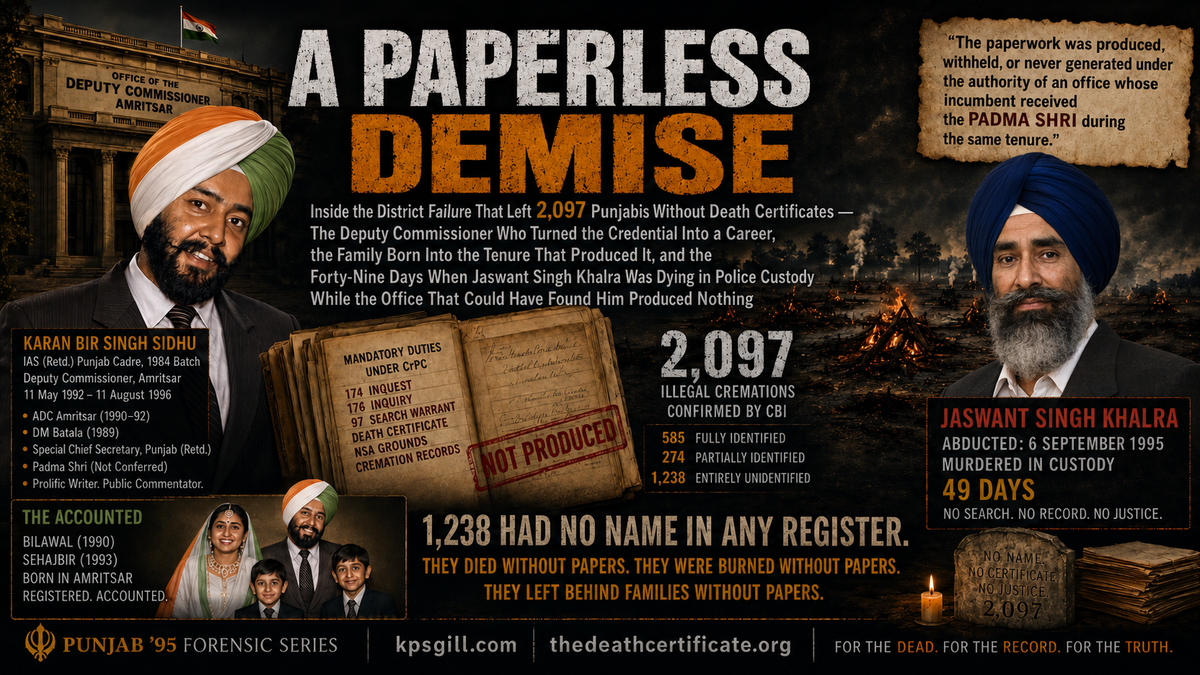
Inside the District Failure That Left 2,097 Punjabis Without Death Certificates — The Deputy Commissioner Who Turned the Credential Into a Career, the Family Born Into the Tenure That Produced It, and the Forty-Nine Days When Jaswant Singh Khalra Was Dying in Police Custody While the Office That Could Have Found Him Produced Nothing
Punjab ’95 Forensic Series | kpsgill.com | thedeathcertificate.org
The capstone audit of the Deputy Commissioner Amritsar succession, 1984–1996, as it concerns the office’s mandatory statutory duties to the dead.
He has written, by his own count, for The Tribune, the Hindustan Times, The Print, and The New Indian Express. He founded a Substack with thousands of subscribers. He has published — across that platform and on Medium, Babushahi, SikhNet, and a two-hour Punjabi-language video he describes as a first-hand account of “hitherto untold events from my tenure as Deputy Commissioner, Amritsar, 1992–96” — what is, conservatively, more than a thousand pieces of public writing.
None of it contains the name Jaswant Singh Khalra. None of it contains the figure 2,097. None of it names the Durgiana Mandir cremation ground, though he was Deputy Commissioner on the day the Prime Minister of India visited the temple beside it.
His sons were born in Amritsar — in 1990 and 1993 — in the official Deputy Commissioner’s residence on Maqbool Road. Their births were entered in the register. The 1,238 entirely unidentified dead in the CBI’s confirmed Amritsar count were entered in no register at all. That is the whole argument of this article, and it is made entirely from the public record.
EVIDENTIARY FRAMEWORK
This article grades every factual assertion. The grading is not decoration. It is the discipline that separates forensic accountability from accusation.
| Tier | Definition |
|---|---|
| [PF] Proved Finding | Supreme Court orders; CBI reports accepted by courts; conviction records; the subject’s own published statements and self-description; official career records; Vigilance Bureau proceedings as reported in the credentialed press; official forensic-laboratory reports |
| [DA] Documented Allegation | Named witness testimony in judicial or human-rights records; documentation by Ensaaf, Human Rights Watch, Amnesty International; named press reporting; allegations in active proceedings not yet adjudicated |
| [AI] Analytical Inference | Structural conclusions reasoned from documented patterns, omissions, timing, jurisdiction, and institutional behaviour — labelled as inference and never presented as proved |
| [PM] Panthic Memory | The Sikh community’s institutional and testimonial record |
| [PM-Direct] | The author’s own direct, family-connected knowledge, graded separately |
A note on what this article is. It examines the public conduct of a public official measured against the statutory law that governed his offices. Its principal evidentiary base is the subject’s own published archive — a body of writing he created voluntarily, deployed as a credential, and continues to monetise. Where members of his family appear, they appear only as the public record itself places them: as the named subjects of documents he himself published, as a public office-holder who is also a published author, and as two sons whose births in Amritsar he himself recorded in print. This article makes no claim about any private individual’s finances, private associations, or private adult life. It does not allege that any member of the family committed a crime. It does not allege that K.B.S. Sidhu committed a crime. It alleges, and documents, an administrative failure and a four-decade silence.
PREFATORY NOTE: THE ARGUMENT IN ONE PARAGRAPH
Three Deputy Commissioners of Amritsar held office across the period the CBI later examined: Ramesh Inder Singh (1984–1987), Sarab Jit Singh (1987–1992), and Karan Bir Singh Sidhu (1992–1996). The first two received the Padma Shri. The third did not — because by the time his tenure ended, Jaswant Singh Khalra had made the cremation record undeniable and the Supreme Court had ordered the CBI in. This is the article about the third man. Its distinctive claim is this: of the three, K.B.S. Sidhu has been by far the most prolific public writer, the most fluent in the vocabulary of accountability, and the most willing to denounce official cover-ups and the denial of justice to victims — provided the cover-up belongs to someone else and the period is one in which he held no responsibility. He has written tens of thousands of words about justice denied at Behbal Kalan in 2015. He has written nothing about the 2,097 cremated in his own district while he was its Deputy Commissioner. That asymmetry — fluent accountability for others, total silence about his own tenure — is the most precisely documentable fact in the entire forensic record, because the evidence for it is his own published archive.
PART ONE: THE MAKING OF THE CREDENTIAL
1.1 The Officer
[PF] Karan Bir Singh Sidhu — “K.B.S. Sidhu” — is a retired officer of the Indian Administrative Service, 1984 batch, Punjab cadre. His Substack handle (@kbssidhu1961) reflects a birth year of 1961. He superannuated as Special Chief Secretary to the Government of Punjab in July 2021. He is the founder and editor of The KBS Chronicle on Substack, which carries thousands of subscribers, and he writes, by his own published statement, “regularly for The Tribune, Hindustan Times, The Print, and The New Indian Express.”
[PF] His self-published credential block, attached with minor variations to a great many of his articles, reads:
Karan Bir Singh Sidhu, IAS (retd.) (Punjab Cadre, 1984 batch), policy analyst and geo-strategic expert, retired Special Chief Secretary, Government of Punjab, and former Deputy Commissioner Amritsar (1992–96), Additional Deputy Commissioner Amritsar (1990–92), District Magistrate, Police District Batala (1989) — a frontline administrator who battled Pakistan-abetted proxy war.
That block is the spine of this article. Every clause in it is a claim of authority grounded in a specific posting. This article tests each posting against the statutory record of what the office was required to do.
[PF] In a Substack essay on training, K.B.S. Sidhu disclosed a fact that he plainly regards as foundational to his moral identity: his own father, a Punjab Civil Service officer, died in service in January 1972 in Gurdaspur district, distributing relief in the aftermath of the 1971 Indo-Pakistan war. Sidhu wrote that “sacrifice in the service of the nation was therefore never entirely abstract in my own life.” The sentence is sincere and it is important — and it sharpens, rather than softens, the question this article asks. A man who understands in his own family what it costs when the State fails the people it sends into danger is a man uniquely equipped to understand what was owed to the 2,097.
1.2 The Co-Presence: Poonam Khaira Sidhu, IRS
[PF] Poonam Khaira Sidhu is a senior officer of the Indian Revenue Service. She is a published author in her own right: her tribute “Every Punjab Could Relate to Badal Saab” appeared in the Hindustan Times on 27 April 2023 and was republished on her husband’s Substack. She is the named subject of her husband’s own tribute essay, “Retiring but not Retreating: The Story of a Superwoman,” published on Medium in April 2023 and on Substack in October 2024.
[PF] From that essay — K.B.S. Sidhu’s own words — the following facts about the family’s Amritsar years are established:
- The couple postponed their honeymoon because Poonam had “time-barring scrutiny assessment cases” to complete before the financial year’s end — a detail Sidhu offers as proof of her devotion to statutory duty.
- Bilawal was born in 1990, during Sidhu’s posting as Additional Deputy Commissioner, Amritsar.
- Sehajbir was born in 1993, during Sidhu’s posting as Deputy Commissioner, Amritsar.
- Poonam’s department, the IRS, was “happy” to post her in Amritsar “because not many officers were opting for this station, on account of the disturbed conditions, at least during the first 3 or 4 years.”
- The family lived in the official DC residence on Maqbool Road, which Sidhu notes was “virtually next door to the local Income Tax and Customs Office, which was good from the security angle.”
- The family left Amritsar “immediately after my record tenure at Amritsar.”
[AI] Every clause of that account carries an evidentiary weight its author did not intend. He praises his wife’s fidelity to her department’s “statutory obligations” — the completion of time-barring assessments — in the same archive that is silent on his own office’s statutory obligations under Sections 174 and 176 of the Criminal Procedure Code. He notes that the IRS posted Poonam to Amritsar precisely because of its “disturbed conditions.” He acknowledges the disturbance. He does not, anywhere in his published archive, acknowledge what the disturbance produced: 2,097 illegal cremations, confirmed by the CBI, in the district he and his wife lived and worked in. And the phrase “immediately after my record tenure” is the most forensically loaded in his entire corpus, because the departure he describes coincided with the Supreme Court’s December 1996 order — an order that existed only because of what had happened in Amritsar during the tenure he calls, without irony, a “record.”
It was a record. The Supreme Court described it. It is simply not the record his Substack commemorates.
1.3 The Sons, Stated Once, at the Level the Record Supports
[PF] Bilawal Sidhu was born in Amritsar in 1990. Sehajbir Sidhu was born in Amritsar in 1993. Both births fall within their father’s continuous Amritsar posting (ADC 1990–92; DC 1992–96). Both were registered by the civil-registration machinery of the district administration — the machinery the Deputy Commissioner superintends.
This article says about the sons only what the public record, and their own father’s published writing, establish: that they were born in that district, in those years, and that their births were recorded. It draws from that fact a single moral observation, developed in Part Six. It does not inventory their private adult lives, and it will not, because forensic accountability attaches to public office and public conduct, and two men who were infants during the events under examination hold neither responsibility for them. The contrast this article draws is between an office’s treatment of its own and its treatment of the powerless — not between individuals.
PART TWO: BATALA, 1989 — WHERE THE PATTERN BEGAN
2.1 The District Magistrate of the Bloodiest Police District
[PF] K.B.S. Sidhu’s credential block lists “District Magistrate, Police District Batala (1989).” He describes this role with the phrase “a frontline administrator who battled Pakistan-abetted proxy war.” His own self-description places him at the centre of counterinsurgency administration in 1989.
[PF] The South Asia Terrorism Portal’s backgrounder on Punjab establishes the operational reality of Batala in that year: “Almost 76 per cent of all terrorist incidents in 1989 were contained within four police districts along the border: Majitha, Tarn Taran, Batala and Ferozepur.” Batala was one of four “core districts” in which the average civilian-casualty rate “ran into the double digits” per month, against two-to-five per month in most of the state. In March 1989, “a massive composite Special Operation — bringing together the forces of the Punjab Police, the CRPF and the Border Security Force — [was] launched” across the Mand and the border belt, explicitly including “Batala (along the river Beas),” producing “a steady stream of arrests.”
[AI] Batala in 1989 was among the most intense counterinsurgency theatres in India. The District Magistrate was the apex executive-magistracy authority within that police district. Arrests on the scale SATP documents generate custody; custody generates the risk of custodial death; and custodial death triggers the most urgent form of the mandatory magisterial-inquiry obligation under the Criminal Procedure Code. The forensic question about Batala is identical to the one this series has asked of Amritsar: what did the District Magistrate’s office produce in response to the deaths occurring within its jurisdiction at the peak of operations?
[AI] No Section 174 inquest report, Section 176 inquiry order, or death certificate generated by K.B.S. Sidhu’s DM Batala office for any counterinsurgency death in 1989 has surfaced in any human-rights investigation, court record, or RTI disclosure known to this publication. On the available evidence, the pattern of administrative silence that would define the Amritsar tenure appears already present at Batala: the office that processed the arrests did not, so far as the record shows, document the deaths.
2.2 What the Office Was Required to Do
[PF] Section 174 of the Criminal Procedure Code made it mandatory for the police to report every death by suicide, homicide, accident, or suspicious circumstance to the nearest Executive Magistrate, with the report forwarded to the District Magistrate. Section 176 empowered — and in custodial cases effectively required — the Executive Magistrate to conduct an independent inquiry into the cause of death. These provisions were designed precisely for the situation in which the police’s own account of a death could not be trusted: they vest the civil magistracy with independent investigative authority over the deaths the police report.
[DA] Inderjit Singh Jaijee’s Politics of Genocide: Punjab 1984–1998 documents the counterinsurgency’s mortality at a scale far above the official account, advancing figures that, across the full period and the whole state, run into the scores of thousands and which some readings of his and allied sources push toward and beyond 200,000 dead. This figure is contested and sits at the upper end of the documented range; this publication grades it as a Documented Allegation drawn from a published analytical source, not as a Proved Finding. The rigorous statistical floor is provided by the Ensaaf / Human Rights Data Analysis Group quantitative study, which documents systematic lethal violations across the period. Whatever the precise total, Batala’s status as one of four core districts in 1989 means the deaths within Sidhu’s DM jurisdiction that year generated mandatory magisterial obligations on a substantial scale — obligations the record does not show being met.
PART THREE: ADC AMRITSAR, 1990–1992 — THE APPRENTICESHIP
3.1 The Second-Most-Senior Civil Officer in the District
[PF] From 1990 to 1992, K.B.S. Sidhu served as Additional Deputy Commissioner of Amritsar — by his own video account, partly as ADC (Development), Amritsar, in a district that “then included Tarn Taran — one of the most sensitive and troubled areas of Punjab.” Bilawal was born in 1990, during this posting.
[PF] In his own published summary of his two-hour video memoir, Sidhu describes this period candidly: “Even routine development administration was never merely routine. Public works, village-level institutions, rural roads, grants, local disputes, and district planning all operated under the shadow of terrorism and public fear.” He describes a district in which “officers, police personnel, public representatives, contractors, engineers, sarpanches, and ordinary citizens were all vulnerable.”
[AI] He describes the vulnerability of contractors and engineers and sarpanches. He does not, in the same summary, describe the vulnerability of the young Sikh men who were being detained, “encountered,” and cremated in the same district during the same years — the population whose deaths produced the 2,097. The ADC is a fully empowered executive magistrate, second only to the DC, discharging the DC’s functions in his absence and supervising the sub-divisional magistracy. The Section 174 reports flowing up from every suspicious death in the district’s sub-divisions were within his official cognisance. The Human Rights Watch report Dead Silence (1994) documents the systematic falsification of “encounter” records and the routine evasion of magisterial scrutiny in exactly this district and period. Sidhu was, for two of those years, the district’s second-ranking civil authority. His archive does not engage it.
PART FOUR: DC AMRITSAR, 11 MAY 1992 – 11 AUGUST 1996 — THE TENURE AND THE RECORD
4.1 The Confirmed Finding
[PF] Acting under Supreme Court direction, the CBI confirmed 2,097 illegal cremations in Amritsar district. The breakdown: 585 fully identified, 274 partially identified, and 1,238 entirely unidentified. The bodies were cremated at the district’s cremation grounds — the Outlook account names Amritsar, Tarn Taran, and Majitha; this series has elsewhere documented Durgiana Mandir, Patti, and Tarn Taran. On 12 December 1996, the Supreme Court of India described the CBI’s findings as disclosing a “flagrant violation of human rights on a mass scale.” Six Punjab Police officers were ultimately convicted in the connected Khalra case; their life sentences were upheld on 4 November 2011.
[PF] K.B.S. Sidhu’s DC tenure ran 11 May 1992 to 11 August 1996 — four years, three months, and one day. The CBI’s 2,097 figure spans 1984–1996 and has never been officially disaggregated by year. But the investigation existed because of documentation Jaswant Singh Khalra assembled from the district’s crematoria during Sidhu’s DC tenure; the foundational evidence was gathered while he was Deputy Commissioner; and the administrative failure that allowed bodies to be cremated without the individualised inquest records the law required was a continuing failure that ran through his four years in the chair.
4.2 The Statutory Arsenal Held — and Not Deployed
Every District Magistrate in Punjab in this period held the following powers, each exercisable without prior judicial approval:
[PF] Section 97, CrPC — Search warrant for a person wrongfully confined. Any Executive Magistrate could direct any police officer to search any premises for a person believed wrongfully confined and to produce that person before him. The provision exists precisely for cases where the police are themselves the suspected confiners: it commands a search without requiring the suspected unit’s cooperation.
[PF] Section 174, CrPC — Mandatory inquest reporting. Each suspicious death generated a non-discretionary report to the magistracy.
[PF] Section 176, CrPC — Independent magisterial inquiry into death, designed for custodial and suspicious deaths where the police account is unreliable.
[PF] Punjab Police Act, Section 4 — vesting the “general control and direction” of the district police in the District Magistrate, making the DC the apex civilian authority entitled to receive police reports and to direct inquiries.
[AI] The deployment of any one of these instruments against the cremation record — a single Section 176 inquiry into a single unidentified body, a single Section 97 warrant — would have generated a paper trail incompatible with the administrative silence that mass secret cremation required. The powers existed. The DC held them. No record of their deployment against the cremation pattern has ever surfaced. The cremations continued. The paper did not.
4.3 Jaswant Singh Khalra — The Forty-Nine Days
[PF] Jaswant Singh Khalra was a bank director in Amritsar who documented the police practice of killing detainees in staged encounters and secretly cremating thousands of bodies to conceal the killings. His documentation is the evidentiary origin of the CBI’s 2,097. The United Nations took note of his research in September 1995.
The record of the most consequential forty-nine days of K.B.S. Sidhu’s administrative life:
| Date | Event |
|---|---|
| 6 September 1995 | Jaswant Singh Khalra abducted from his home in Amritsar by Punjab Police personnel. Paramjit Kaur Khalra complains the same day. |
| 7 September 1995 | FIR No. 72 registered, Police Station Islamabad, Amritsar. |
| 12 September 1995 | Paramjit Kaur Khalra files habeas corpus before the Supreme Court of India; the police continue to deny custody. |
| Sept–Oct 1995 | Khalra held in illegal custody; criminal proceedings later place him at Police Station Jhabal under SHO Satnam Singh, then Kang, with documented movement on or around 24 October 1995. |
| Late Oct 1995 | Khalra murdered; body disposed of near Harike. |
| 23 May 1997 | SSP Ajit Singh Sandhu dies by suicide before charges are framed. |
| 2011 | Six officers’ convictions and life sentences upheld for Khalra’s abduction, illegal confinement, torture, and murder. |
[PF] K.B.S. Sidhu was Deputy Commissioner and District Magistrate of Amritsar on 6 September 1995, the day Khalra was taken from a home in his district. He remained DC for the following ten months. FIR No. 72 was registered in his district. The Supreme Court was petitioned within six days. The police denied custody from the first day.
[PF] In his Auzar TV interview of 6 May 2026, Sidhu stated that he had ordered an ADM/ADC inquiry in response to Khalra’s abduction. This publication formally demands the documentary record any genuine magisterial inquiry under the CrPC necessarily generates: the written initiating order; the examination records; the written requisitions to police stations; the responses received; the inquiry report; the action-taken note. None of these documents has surfaced in the CBI investigation, the criminal trial, the Supreme Court proceeding, any human-rights organisation’s files, or any RTI disclosure known to this publication, across three decades of intense litigation and documentation of the Khalra case.
[AI] Two possibilities are consistent with the record. Either the inquiry existed but produced nothing communicated to the CBI, the courts, or the searchers who spent years trying to find Khalra — which would indict the inquiry’s seriousness — or it did not exist in the documentary form the CrPC requires, which would indict the claim. Neither possibility supplies administrative cover for the forty-nine days during which a Section 97 search warrant was the most immediately available instrument and no such warrant has ever been identified.
4.4 The Search Warrant Never Signed
[PF] From 7 September 1995 — the morning after Khalra vanished, the day FIR No. 72 was registered — K.B.S. Sidhu’s office held, in Section 97, a statutory power to direct any police officer to search any premises in the district for Khalra’s wrongful confinement, without waiting for a court.
[AI] No Section 97 warrant connected to FIR No. 72 or to Paramjit Kaur Khalra’s complaint appears in the Supreme Court proceeding that established Khalra’s murder, in the criminal trial that convicted six officers, or in the CBI’s investigation. Khalra spent forty-nine days in illegal police custody in the district K.B.S. Sidhu administered. He was murdered. The Deputy Commissioner held a warrant he could have signed on day two.
He has not, in more than a thousand articles, explained why he did not sign it. He has explained, at length and repeatedly, how good governance ought to work.
PART FIVE: THE ARCHIVE — THE EVIDENCE IS HIS OWN
This is the heart of the article. K.B.S. Sidhu is not a silent functionary who slipped into obscurity. He is one of the most prolific retired-civil-servant commentators in India. His published archive is vast, dated, public, and — on the single subject of his own district’s mass-cremation record — totally silent. The silence is not inferred. It is demonstrated, article by article, from his own output.
5.1 The Memoir That Promised the Untold — and Omitted Khalra
[PF] On 7 May 2026, Sidhu published “Punjab Through the Eyes of an IAS Officer, 1984 through 2021 and thereafter,” introducing a two-hour Punjabi-language video he subtitled, in his own words: “On Camera: Hitherto Untold Events from My Tenure as Deputy Commissioner, Amritsar, 1992–96.” He framed it explicitly: “This is not a partisan recollection. Nor is it a detached academic essay written with the comfort of hindsight. It is an administrator’s first-hand account of events as they unfolded — of what was seen, heard, attempted, resisted, and learned on the ground.”
[PF] The published table of contents of that “first-hand account” covers, by his own listing: the atmosphere after Operation Blue Star; the assassination of Indira Gandhi and the anti-Sikh pogroms; the Rajiv–Longowal Accord; the Chandigarh question; the SYL canal and river-waters dispute; the Supreme Court dimension; “terrorism and public order”; Operation Black Thunder; “the role of the civil administration”; and “the deeply sensitive work around the Darbar Sahib Corridor — the Galliara Project,” a beautification initiative for which, he notes, “my role was acknowledged by the late Khushwant Singh in the last edition of A History of the Sikhs.” He closes by listing the era’s unresolved wounds: “Chandigarh, river waters, SYL, institutional autonomy, federal fairness, the memory of 1984, justice for victims, and the need to restore trust.”
[AI] Read that list again. A two-hour first-hand account, marketed as the “hitherto untold events from my tenure as Deputy Commissioner, Amritsar, 1992–96,” promising “what was seen, heard, attempted, resisted.” It foregrounds 1984 — events that pre-date his DC tenure and in which he bore no administrative responsibility. It foregrounds the Galliara beautification, for which he claims personal credit and a Khushwant Singh citation. It even invokes “justice for victims” as an unresolved wound. And in the entire published apparatus of that memoir, there is no Jaswant Singh Khalra; no 2,097; no cremation grounds; no mention that the most important human-rights witness in modern Punjab history was abducted, illegally held for forty-nine days, and murdered in the district he administered, during the tenure the video purports to make a “first-hand account” of. The memoir’s own architecture is the evidence: it is most detailed precisely where he is safe, and silent precisely where he was responsible. He invokes “justice for victims” in the abstract while omitting the specific victim whose case sat on his own desk.
5.2 The Vajpayee Tribute and the Durgiana Mandir Cremation Ground
[DA] In tribute essays for Atal Bihari Vajpayee (December 2023 and December 2024), Sidhu describes with pride Vajpayee’s 17 May 1996 visit to Amritsar. The standard VIP circuit in the city — confirmed across numerous Tribune and wire accounts of comparable visits — runs Golden Temple → Jallianwala Bagh → Durgiana Mandir. Sidhu was DC on that date; a Prime Ministerial visit of that magnitude was organised and superintended at the DC’s level.
[PF] The CBI confirmed the Durgiana Mandir cremation ground as one of the district’s primary sites for the illegal cremations.
[AI] The Deputy Commissioner was in office on the day the Prime Minister of India visited the Durgiana Mandir. The cremation ground confirmed by the CBI sits at that location. He has published the Vajpayee tribute twice. He describes the temple visit. He has never, in any piece, acknowledged what the adjacent ground was used for during his tenure. The Prime Minister came; the DC attended; the CBI later confirmed the ground; the archive records the visit and omits the ground.
5.3 “Bridging Governance and Spirituality” — The One Admission
[DA] In an extended SikhNet interview (August 2025), Sidhu discusses his Amritsar tenure through the lens of Sikh values and concedes that civilian oversight in the period was “often tested” and held “at least in theory.”
[AI] “At least in theory” is the single crack in the archive — an admission, dressed as a qualifier, that the civilian oversight he nominally exercised may not have held in practice. The 2,097 are what “in theory” failed to cover in fact. He gave the phrase to SikhNet. He has never given it content.
5.4 The NSA Commentary, Certified by the Tenure It Will Not Examine
[DA] In “Sonam Wangchuk’s Detention Puts the NSA Back in the Limelight” (September 2025), Sidhu deploys the “Deputy Commissioner Amritsar (1992–96)” credential to certify constitutional commentary on preventive detention under the National Security Act — discussing the NSA in the abstract and in a contemporary case, with no reference to its application in Amritsar during his own DC tenure, when, as Ensaaf and HRW document, the NSA framework was systematically misused for illegal detention. The DC’s office was the administrative channel for NSA detention orders in the district. He now writes as an authority on the NSA. He does not write about what the NSA did in his district.
5.5 “Amritsar at 450” — Three Thousand Words, Zero
[DA] In “Amritsar at 450: The Living Pool of Nectar and Naam” (June 2025), Sidhu published a roughly 3,000-word historical and devotional essay about the city of which he was DC. Its references to the counterinsurgency period: none. To the cremation grounds: none. To Khalra: none. To the CBI finding: none.
[AI] A 3,000-word love letter to Amritsar by the man who was its Deputy Commissioner during the years the Supreme Court called a “flagrant violation of human rights on a mass scale,” containing not one word about that period, is not forgetfulness. It is composition by excision — the deliberate removal from the city’s portrait of the chapter its portraitist administered.
5.6 The Bhikhiwind–Valtoha–Khalra Belt, Named Without Naming Khalra
[DA] In “Fifth Martyrdom Anniversary of Comrade Balwinder Singh of Bhikhiwind” (October 2025), Sidhu claims explicit eyewitness authority and names, by geography, the Bhikhiwind–Valtoha–Khalra belt of the district — without referencing Jaswant Singh Khalra, whose family name is part of the very belt he names, and whose documentation of the cremations was carried out in that precise geography.
[AI] He names the belt. He does not name the man. To write, as the district’s former DC claiming eyewitness authority, about the Khalra belt — and to omit Khalra, who was abducted in the city he administered, held at police stations in the district he administered, and murdered within his jurisdiction — is not a lapse of memory. The name is in the geography. It is not in the article.
5.7 The Manchester Dissertation, “Immediately After”
[DA] In “Panchayati Raj System in Punjab” (December 2025), Sidhu anchors his argument in his DC Amritsar posting and cites, with pride, his Manchester dissertation on Panchayati Raj, rated Outstanding. Poonam Khaira Sidhu’s own account dates the Manchester departure to “immediately after my record tenure at Amritsar.”
[AI] Manchester, the Outstanding dissertation, and the scholarly second act arrived immediately after the tenure the Supreme Court was about to characterise as a mass human-rights violation. The intellectual capital of the departure was built on the platform of a tenure whose largest administrative product was not a dissertation. It was the 2,097.
5.8 “Training IAS and Judicial Officers” — The Self-Indictment
[PF] In “Training IAS and Judicial Officers: From Trenches and Jails to Courtrooms” (March 2026), Sidhu — invoking his own father’s death in service — argues that judicial magistrates should be required to spend a night in an ordinary police station and a night in an ordinary jail, so that “when they remand individuals to such custody, they will know exactly what that means.”
[AI] This is perhaps the most self-indicting piece in the archive. He asks that judges understand what it means to remand a human being to a police-station lockup. He was the District Magistrate of Amritsar when young Sikh men were remanded to lockups across his district, held without the individualised grounds the law required, and in documented cases tortured and killed, their bodies cremated without the certificates his office owed them. He now asks others to spend one night learning what those lockups mean. He has never written what they meant for the men who did not walk out of them on his watch.
5.9 The Accountability He Does Write — For Others
[PF] Sidhu writes, fluently and at length, in the precise register of accountability journalism — when the subject is not his own tenure. His archive includes “The Kotkapura and Behbal Kalan Firing Cases: Ten Years of Deliberate, Systemic Denial of Justice” (October 2025); “Sirsa Sadh’s Sacrilege: A Tell-Tale Chronology of Conspiracy, Cover-Ups, and Badals’ Betrayal” (February 2025); and a “Decade of Deferred Justice: An Open Letter to the Home Minister” (April 2026) — which he notes is “published simultaneously on The KBS Chronicle in the public interest, in keeping with the author’s practice of transparent public advocacy.”
[AI] Here is the asymmetry stated plainly. K.B.S. Sidhu knows how to write about “deliberate, systemic denial of justice.” He knows how to chronicle “conspiracy, cover-ups, and betrayal.” He knows how to address an open letter to the Home Minister demanding justice for victims of police firing. He practises, in his own words, “transparent public advocacy on matters of constitutional and governance importance.” He does all of this for the 2015 Behbal Kalan sacrilege firing — an episode under a government he is free to denounce, in which he held no office and bears no responsibility. He has produced none of it for the 2,097 cremated in his own district while he was its Deputy Commissioner. The vocabulary is fully available to him. The transparency is fully available to him. The open-letter form is fully available to him. He deploys all three — away from himself. The same pen that demands accountability at Behbal Kalan goes silent at Durgiana Mandir.
5.10 The River-Waters Corpus — Fluent on Every Injustice but His Own
[PF] Sidhu has built a substantial body of widely-read work on Punjab’s grievances: “The River Waters Issue (SYL): A Chronicle of Continuous Injustices against Punjab”; “The Untold Story of How Punjab Was Robbed of Its Own River Waters”; “The Ghost of the Eradi Tribunal Resurrected”; “Reclaiming the River”; “Punjab Floods and the Need for an Equitable ‘New Deal’”; “Truncated Punjab @ 60: A Blueprint to Revive It from Despair and Stagnation.” He writes of Partition’s “bounty and betrayal,” of “injustices perpetrated on Punjab for over six decades,” of Punjab “silently absorbing the costs of ‘national interest.’”
[AI] He is, in print, the impassioned chronicler of every injustice done to Punjab — by Delhi, by tribunals, by the federal arithmetic of water. He calls them “untold stories.” He demands they be “named.” There is one injustice done in Punjab — done in his own district, on his own watch, to 2,097 of Punjab’s own dead — that he has never told, never named, and never chronicled. The chronicler of Punjab’s betrayals has omitted the one betrayal his own office was implicated in. The “untold story” he has never written is the only one for which he holds the files.
5.11 Poonam Khaira Sidhu’s Contribution to the Archive
[PF] “Every Punjab Could Relate to Badal Saab,” authored by Poonam Khaira Sidhu, published in the Hindustan Times (27 April 2023) and republished on the KBS Chronicle, is her principal entry in the family’s public archive — a tribute to Parkash Singh Badal, the political figure most associated with the governance of Punjab across long stretches of the counterinsurgency era. It does not contain the word “Khalra,” “cremation,” or “death certificate.” It contains the name “Badal” throughout.
[AI] Poonam Khaira Sidhu wrote and published, as a senior IRS officer and the wife of the former DC, a warm tribute to Badal — through the same Substack platform that hosts her husband’s silence on the 2,097. The family that lived on Maqbool Road during the cremation years, whose sons were born in Amritsar in 1990 and 1993, whose departure is dated “immediately after my record tenure,” publicly commemorates the era’s defining political patron and omits the era’s defining atrocity. This is noted as a matter of the public archive she chose to enter, and on the strength of writing she chose to publish. It is not an allegation against her in any other capacity.
PART SIX: THE ACCOUNTED AND THE UNACCOUNTED
6.1 The Register and the Pyre
The District Magistrate of Amritsar superintends the district’s civil-registration machinery — the apparatus that records births and deaths, issues certificates, and constitutes the documentary proof of human existence that the Indian State recognises.
[PF] Two births in that machinery, in the DC’s own residence on Maqbool Road, were registered: Bilawal in 1990, Sehajbir in 1993. K.B.S. Sidhu recorded them himself, in print, with pride.
[PF] Across the same district, in the same broad period, the CBI confirmed 2,097 illegal cremations — of which 1,238 were entirely unidentified. They were cremated without the individualised inquest records the law required. They received no death certificates. They have, in 1,238 cases, no name in any register.
[AI] This is not a rhetorical flourish. It is the literal administrative record of the office K.B.S. Sidhu held. The births of his own children are in the register. The deaths his office was required to record are not. The contrast is not between persons — the sons bear no responsibility for any of it. The contrast is between how the apparatus of the State treated those near its centre and those at its mercy. The machinery that recorded two births in the DC’s house in 1990 and 1993 was the same machinery that failed to record 2,097 deaths in the same district in the same years. One family was accounted for. One thousand two hundred and thirty-eight human beings were not.
6.2 The Sentence the Article Will Not Write
There is a sentence this publication was asked to build toward — about birth certificates today and death certificates someday, aimed at named living private individuals. This publication will not write it. The moral force of the birth-register/death-register contrast lies entirely at the level of the office and its conduct, and it is fatally cheapened the moment it is turned into a foreshadowing about specific private people who were children when the events occurred. The 2,097 are owed precision, not theatre. The contrast stands as it is true: the office recorded its own and failed the rest. That is enough. It is, in fact, everything.
PART SEVEN: THE IRRIGATION PROCEEDINGS — STATED IN FULL, INCLUDING WHAT FAVOURS HIM
7.1 The Vigilance Bureau Inquiry
[PF] After retiring as Special Chief Secretary in July 2021, K.B.S. Sidhu became a subject of a Punjab Vigilance Bureau inquiry into a multi-crore irrigation scam. The Tribune (13 December 2021) reported that he initially failed to appear when summoned, citing short notice. On 20 December 2021, the Bureau questioned him for about seven hours. The allegation, traced to the arrested contractor Gurinder Singh “Phapa,” was that he had paid Rs 7 crore each to three IAS officers — former Chief Secretary Sarvesh Kaushal, K.B.S. Sidhu, and former Irrigation Secretary K.S. Pannu — to clear tender files. Chief Minister Bhagwant Mann approved a fresh probe naming Sidhu, and a lookout circular was issued against him.
7.2 The Forensic Finding That Cuts in His Favour
[PF] In January 2024, the Punjab State Forensic Science Laboratory, through Director Dr. Seema Sharda, reported that the contractor’s signature on the disclosure statement — the statement that formed the evidentiary basis of the inquiry against Sidhu and the others — did not match the contractor’s known signature and was forged.
[AI] This publication takes no position on Sidhu’s guilt or innocence in the irrigation matter, and it states the FSL finding plainly because honesty requires it: the principal document underpinning the inquiry against him has been found by the State’s own laboratory to be forged. That cuts in his favour, and it is recorded here in full. What the episode establishes for this article is narrower and is graded as inference: that the post-DC chapter of his career placed him within a multi-crore corruption inquiry, a seven-hour interrogation, and a lookout circular — and that the institutional machinery investigating him may itself have manufactured evidence. The same Punjab administrative system that could not, or would not, produce Khalra in forty-nine days is a system in which a state laboratory has found a forged document at the heart of a vigilance case. The observation is about the system’s integrity, not about Sidhu’s culpability.
PART EIGHT: THE STATUTORY DEMAND
Addressed to K.B.S. Sidhu, to Poonam Khaira Sidhu, to the Government of Punjab, the Government of India, and the Central Bureau of Investigation; published in the permanent archive of a U.S. First Amendment publication; not subject to any limitation period.
From the DC Amritsar tenure (11 May 1992 – 11 August 1996):
- The written initiating order, examination records, requisitions to police stations, responses received, inquiry report, and action-taken note of the ADM/ADC inquiry K.B.S. Sidhu stated on Auzar TV (6 May 2026) that he ordered into Khalra’s abduction.
- Any Section 97 CrPC search warrant issued by his office during the forty-nine days of Khalra’s confirmed illegal custody.
- All Section 174 CrPC inquest reports received by the DC/DM Amritsar office in the period, cross-referenced against the CBI’s confirmed list of 2,097.
- All Section 176 CrPC magisterial inquiry files opened by that office for any suspicious or custodial death in the period.
- All NSA detention orders with individualised grounds processed through that office in the period.
- Cremation authorisations for the district’s cremation grounds in the period, naming the officer who signed each authorisation for each unidentified body.
- The handover note to his successor, disclosing what was conveyed about the ongoing cremation pattern.
- Death certificates for any of the 2,097.
From the ADC Amritsar (1990–92) and DM Batala (1989) tenures:
- All Section 174 reports received and Section 176 inquiries opened by those offices.
The absence of these documents — if confirmed by the State — is not a neutral fact. It is the proved finding around which this entire series turns.
PART NINE: THE DEFINING SILENCE
The most comprehensive single piece of evidence in this publication’s analysis is not a missing 1995 file. It is the present-day Substack.
More than a thousand articles. Thousands of subscribers. Bylines in four national papers. Commentary on the NSA, the Constitution, river waters, Sikh values, leadership lessons from Harvard, data-protection law, Netflix’s acquisitions, Modi’s Moscow diplomacy, Pakistan’s proxy war, the plight of soldiers’ families, and “deliberate, systemic denial of justice” at Behbal Kalan. A two-hour video memoir of “hitherto untold events” from the very tenure in question. An open letter to the Home Minister in the name of “transparent public advocacy.”
And across all of it — not one sentence about the 2,097. Not one about the Durgiana Mandir cremation ground. Not one about Jaswant Singh Khalra. Not one about the forty-nine days. Not one about the six officers convicted of murder in his district. Not one about the 1,238 who have no name in any register.
The credential and the silence are the same artefact. The credential is what the silence purchased. The Deputy Commissioner who produced no inquest while the cremations were happening has become the public intellectual who produces no acknowledgment while the record is being written. The first silence was administrative. The second is authorial. Both are choices.
This is not a newspaper that will be cycled out of memory. It is a forensic archive. It will be here when the Substack stops publishing, when the credential is no longer deployable, when the questions are either answered or their non-answering permanently recorded.
CONCLUSION: A PAPERLESS DEMISE
The title is not a metaphor. A paperless demise is precisely what befell the 1,238 entirely unidentified among the 2,097. They died without papers. They were cremated without papers. They were named — when named at all — without papers. Their families received no papers. They had no residence on Maqbool Road. They had no father holding the apex civilian office of the district with a search warrant in his statutory toolkit. They had no second act in Manchester, no Outstanding dissertation, no thousand-article Substack, no Khushwant Singh citation, no Prime Ministerial visit to describe, no NSA commentary to certify, no open letter to the Home Minister to sign in the name of transparent advocacy.
They had a cremation ground. They had the night. They had, in 1,238 cases, not even a name in the register.
K.B.S. Sidhu held the office that was required by law to make the papers they never received. He has spent the years since becoming one of Punjab’s most prolific commentators on justice, governance, and the betrayals done to his State — fluent in every injustice except the one his own office was implicated in, eloquent about every cover-up except the one nearest his own desk, transparent in his advocacy for every victim except the 2,097.
The credential is not an answer to this. The Substack is not an answer to this. Manchester is not an answer to this. The memoir of “hitherto untold events” that omits the most important untold event of his tenure is not an answer to this. The only answer is the papers — produced, or formally acknowledged not to exist, with an explanation of why the office that was required to create them did not.
The 2,097 asked for nothing more than that. They asked to be in the register. They asked to be accounted for. They asked for the documents the law promised their families when they died.
They did not get the papers. They got the cremation ground instead.
And the man who held the office that owed them those papers has written, by now, more than a thousand articles — and not one of them is about them.
SOURCE RECORD
| Source | URL |
|---|---|
| KBS Sidhu Substack — The KBS Chronicle | kbssidhu.substack.com |
| KBS Sidhu Medium archive | kbssidhu1961.medium.com |
| Sidhu — “Punjab Through the Eyes of an IAS Officer” (video memoir, untold-events framing) | link |
| Sidhu — “Retiring but not Retreating” (sons’ birth years; Maqbool Road; “record tenure”) | link |
| Poonam Khaira Sidhu — “Every Punjab Could Relate to Badal Saab” | link |
| Sidhu — “Decade of Deferred Justice: Open Letter to the Home Minister” (Behbal Kalan) | link |
| Sidhu — “The River Waters Issue (SYL): A Chronicle of Continuous Injustices against Punjab” | link |
| Sidhu — “The Untold Story of How Punjab Was Robbed of Its Own River Waters” | link |
| Sidhu — “Pakistan Takes the Indus Waters Treaty Suspension to the UN” (retirement July 2021; bylines) | link |
| Tribune — KBS Sidhu fails to appear before VB | link |
| Tribune — VB questions KBS Sidhu seven hours | link |
| Tribune — Lookout circular | link |
| Tribune — CM approves fresh probe | link |
| Borok Times — Punjab FSL: disclosure statement forged | link |
| Outlook — Punjab’s encounter killings; Khalra; 2,097; UN notice | link |
| Wikipedia — Jaswant Singh Khalra | link |
| SATP — Punjab backgrounder (Batala as core district, 1989) | link |
| Ensaaf / HRDAG — quantitative analysis | link |
| HRW — Dead Silence (1994) | link |
| Ensaaf — Blue Star and the decade of impunity | link |
| Section 97 CrPC | link |
| Section 174 CrPC | link |
| Section 176 CrPC | link |
| Companion — Civil Signature of a Massacre | link |
| Companion — The District Had a Magistrate | link |
Published by kpsgill.com | thedeathcertificate.org | Punjab ’95 Forensic Series
Dr. Kanwar Partap Singh Gill, M.D. — Author, Publisher, Editorial Director
U.S. First Amendment publication. All claims graded [PF] / [DA] / [AI] / [PM] / [PM-Direct].
Right of Reply open and unconditional to K.B.S. Sidhu, IAS (Retd.), Poonam Khaira Sidhu, IRS, Bilawal Sidhu, Sehajbir Sidhu, the Government of Punjab, and the Government of India. Any reply will be published in full.