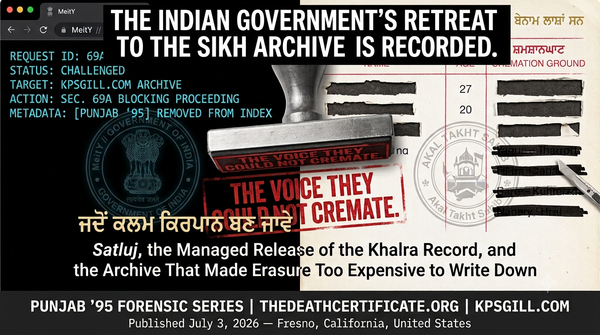
Jaswant Singh Khalra: THE VOICE THEY COULD NOT CREMATE

Satluj, the Managed Release of the Khalra Record, and the Archive That Made Erasure Too Expensive to Write Down
A Complete Forensic Account of the Making, Blocking, Retitling, and Release of the Jaswant Singh Khalra Film, 2020–2026 — the Government Angle, the Communal Angle, the Officer-Protection Angle, the International-Image Angle, the Economics of Containment, the Section 69A Front, and the Hub-and-Spoke Archive That Met the Film at the River
Punjab '95 Forensic Series | The Death Certificate Project
TheDeathCertificate.org | KPSGILL.COM | A First Amendment Forensic Publication
By Kanwar Partap Singh Gill, M.D.
Published July 3, 2026 — Fresno, California, United States of America
ਗੁਰਸ਼ਬਦ ਤੋਂ ਪਹਿਲਾਂ, ਬੇਨਾਮ ਲਾਸ਼ਾਂ ਸਨ
Before the Gurshabad, the nameless dead.
EVIDENTIARY FRAMEWORK
This article applies the following evidentiary tiers throughout, as it does across every publication of The Death Certificate Project:
[PF] Proved Finding — Facts established by official records, judicial findings, statutory text, contemporaneous documentation, admissions against interest, or convergent independent reporting.
[DA] Documented Allegation — Claims that are serious, relevant, and grounded in identifiable sources, but not conclusively adjudicated to the highest standard.
[AI] Analytical Inference — Reasoned conclusions drawn from patterns, omissions, timing, institutional behavior, contradictions, or the cumulative structure of the record.
[PM] Panthic Memory — The lived memory, inherited understanding, and moral record preserved by Sikh institutions, families, witnesses, and collective remembrance.
The distinction matters more in this article than in almost any other this publication has produced, because the article itself is about a state apparatus that spent three and a half years trying to force a film to abandon precisely these distinctions — to declare the proved unproven, the documented fictional, and the remembered forbidden.
PROLOGUE: JULY 3, 2026
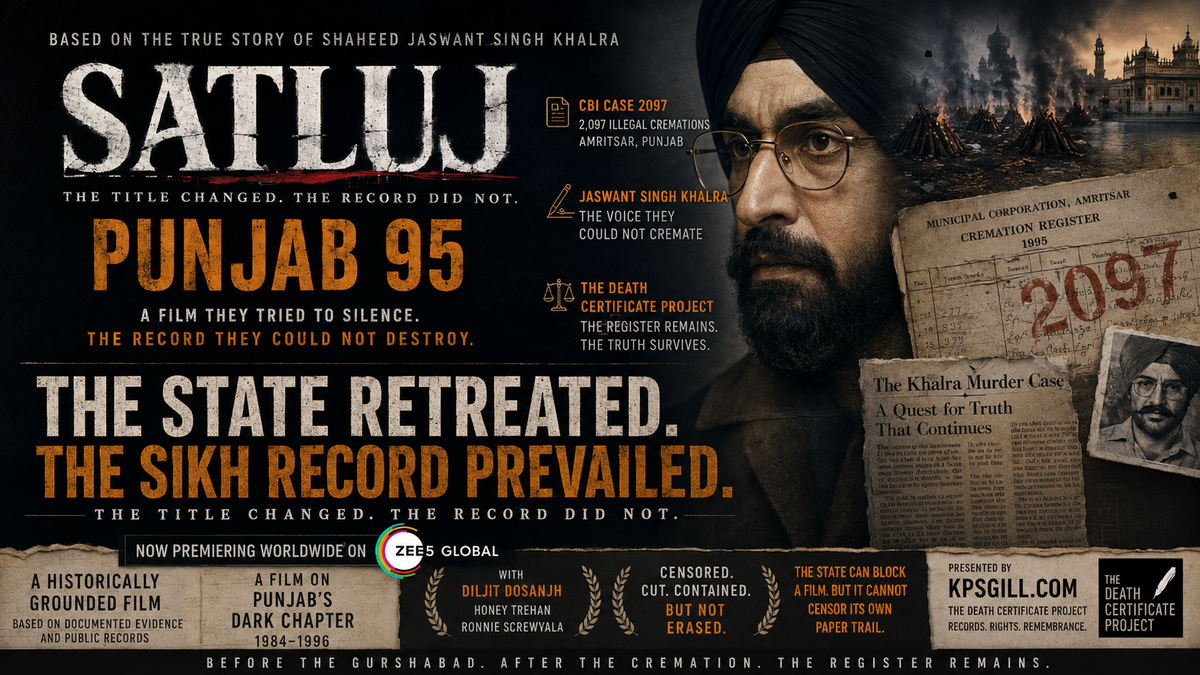
On the morning of July 3, 2026, without a trailer campaign, without a premiere, without a red carpet, without a single theatrical poster in Amritsar or Tarn Taran or anywhere else on earth, a film began streaming on ZEE5 in India and on ZEE5 Global for the diaspora. [PF] It was directed by Honey Trehan, produced by RSVP Movies and MacGuffin Pictures, and it starred Diljit Dosanjh, Arjun Rampal, Kanwaljit Singh, Suvinder Vicky, and Geetika Vidya Ohlyan. [PF] The platform and the producers confirmed, in near-identical language across Variety, PTI, ANI, and the trade press, that the film was streaming in its complete form — no cuts, no compromises on content. [PF]
The film was called Satluj.
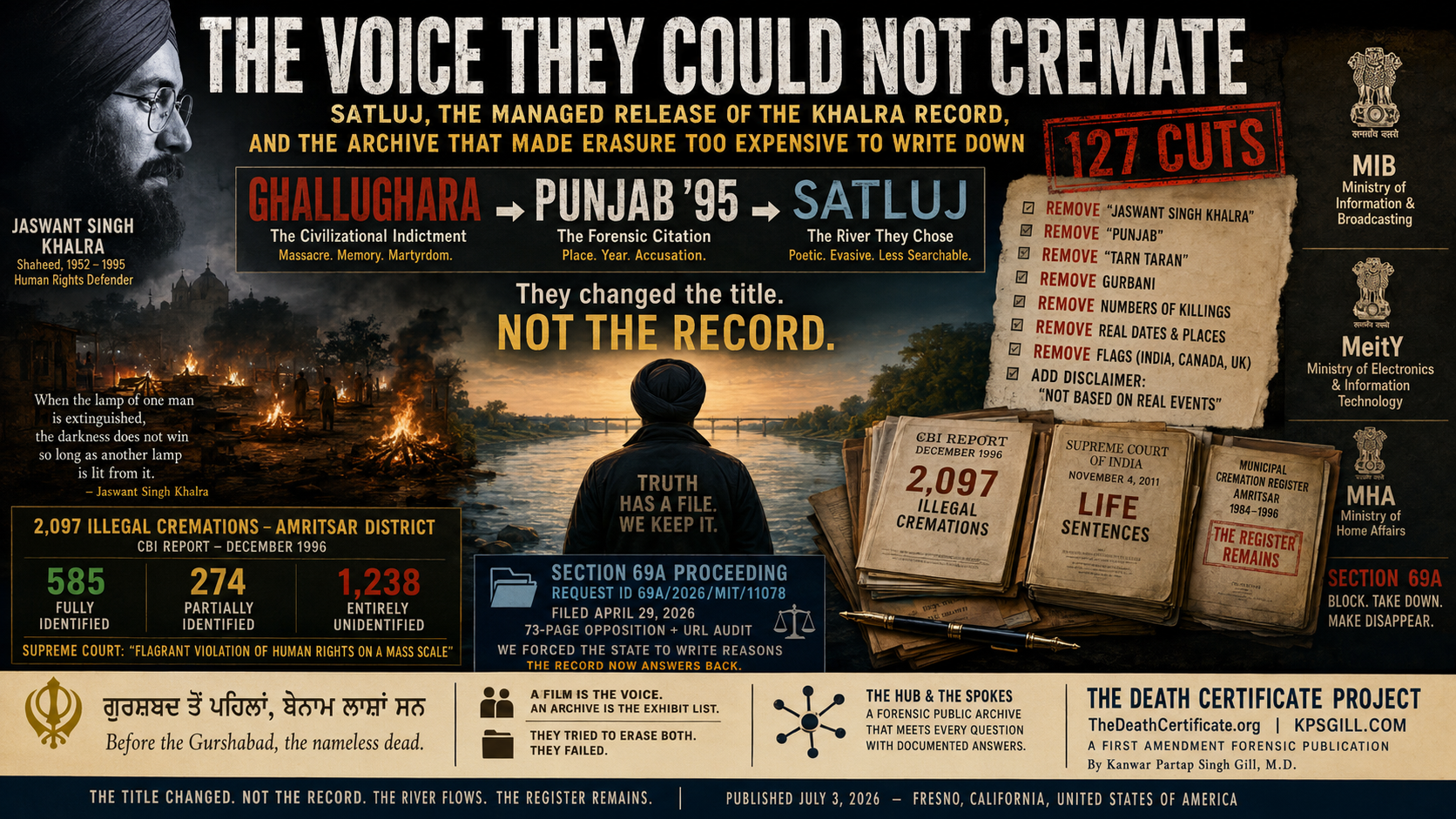
It had not been called Satluj when it was written. It had not been called Satluj when it was shot, or when it was edited, or when it was submitted to the Central Board of Film Certification in December 2022, or when it was selected for the Toronto International Film Festival in 2023 and then withdrawn under pressure, or when its director counted the censor's demands as they climbed from 21 to 37 to 45 to 85 and finally to 127 separate cuts. [PF] For most of its suppressed life the film was called Punjab '95 — a title that is not a metaphor but a case citation: a place, and the year in which a fifty-eight-kilogram bank director from village Khalra, Tarn Taran, was abducted from in front of his own house while washing his car, held illegally in a police station, and killed. [PF] Before that, the film had carried an older and heavier name still: Ghallughara — the word the Panth reserves for its massacres, for 1746, for 1762, for 1984. [PF]
Three titles. Each retreat in the title is a document. Ghallughara named the crime in the civilizational register. Punjab '95 named it in the forensic register — place and date, the two columns of every inquest form. Satluj names only a river.
And yet the river carried the file through.
Understand what happened on July 3, 2026, precisely, because both the celebration and the caution live inside the precision. The film that reached the public is, by the sworn public statements of its own director and platform, uncut — every scene, every name, every frame of Gurbani, every reference to Tarn Taran, every number the censor board demanded be removed is in it. [PF] What was surrendered was the marquee, the theatrical public square, and the searchable title. What was preserved was the record.
The state did not defeat this film. The state also did not simply release it. What occurred is best described as a managed release: a negotiated exit from a stalemate in which every institutional actor — the certification bureaucracy, the ministries behind it, the producers, the platform — found a lower-risk door out of a room that had become too expensive for anyone to remain inside. The title was taken. The truth was not.
This article is the longest single account The Death Certificate Project has published, and it is written to do what no entertainment-press story of July 3 will do: examine the Satluj affair from every angle at once — the government's angle, the communal and religious angle, the officer-protection angle, the international-image angle, the certification mechanics, the appellate vacuum, the economics, the platform politics, the metadata, the Khalra family's documented position, the fiction-disclaimer problem, and the parallel administrative war that this Project fought against the Government of India under Section 69A of the Information Technology Act during the very months the film's fate was being decided. [PF as to the Project's own filings; AI as to convergence]
Because here is the fact that the July 3 press releases will not print: in the same season that the Government of India was deciding whether the Khalra story could exist on a mainstream Indian streaming platform, the same government's Ministry of Electronics and Information Technology was running a formal Section 69A blocking proceeding — Request ID 69A/2026/MIT/11078 — against KPSGILL.COM, the sister archive of this publication, seeking to remove from Indian view the documentary record that the film dramatizes. [PF] On April 29, 2026, this Project answered that proceeding with a 73-page written opposition and a complete URL audit, filed directly into the ministry's own administrative record. [PF] The state attempted to erase the archive and manage the film in the same administrative season. Only one of those two efforts required the state to put its reasons in writing before a record it does not control. That asymmetry is the subject of this article.
The release of Satluj and the survival of this archive belong to the same story, and they should be celebrated together — not because this Project claims to have released the film (it does not, and the calibration of that claim is set out with full rigor in Part XIII), but because the film and the archive defend the same set of documents, name the same dead, confront the same administrative supervisors, and were targeted by the same erasure machinery in the same year. The film is the voice. The archive is the exhibit list. On July 3, 2026, the voice reached the living room. The exhibit list was already waiting there.
ਗੁਰਸ਼ਬਦ ਤੋਂ ਪਹਿਲਾਂ, ਬੇਨਾਮ ਲਾਸ਼ਾਂ ਸਨ. Before the Gurshabad, the nameless dead. Now, at last, the Gurshabad plays on the screen — and the nameless dead have both a film and a filing cabinet.
PART I. THE MAN THE FILM COULD NOT NAME
Every angle examined in this article radiates from a single evidentiary core, and that core must be stated first, completely, and with tier labels, because the entire censorship apparatus was built to blur it.
[PF] Jaswant Singh Khalra was a director of a bank in Amritsar and a human rights investigator affiliated with the Akali Dal's human rights wing. In 1994–95, while searching for disappeared colleagues, he located municipal records — firewood purchase registers and cremation entries at Amritsar's cremation grounds — showing that the Punjab Police had been secretly cremating bodies labeled "unidentified" or "unclaimed" on a mass scale.
[PF] Khalra took the evidence public, including in a January 1995 press conference and, in April 1995, in testimony delivered in Canada — carrying the Punjab record before an international audience, which is precisely the act the Indian state has never forgiven in any Sikh who performed it.
[PF] On September 6, 1995, Khalra was abducted by Punjab Police personnel from outside his home in Amritsar while washing his car. He was held illegally at Jhabal police station in Tarn Taran and killed in custody in October 1995. There was no FIR of his arrest, no custody record, no inquest, no post-mortem, and — with an irony that names this entire Project — no death certificate.
[PF] The Central Bureau of Investigation, acting under Supreme Court direction, investigated both Khalra's disappearance and the cremation grounds he had exposed. Its December 1996 report confirmed 2,097 illegal cremations at three cremation grounds in Amritsar district — Durgiana Mandir, Patti, and Tarn Taran — of which 585 bodies were fully identified, 274 partially identified, and 1,238 remain entirely unidentified to this day. The Supreme Court of India, in the words later recorded in the Khalra murder appeal, described the CBI's findings as disclosing a "flagrant violation of human rights on a mass scale."
[PF] For Khalra's own murder, Punjab Police officials were convicted in November 2005; in October 2007 the Punjab and Haryana High Court enhanced the sentences of the sub-inspectors and head constable to life imprisonment; and on November 4, 2011, the Supreme Court of India upheld life sentences for five Punjab Police officers. The convicted were not insurgents, not foreign agents, not private criminals. They were serving officers of the Indian state, convicted by the Indian state's own courts, on the Indian state's own investigation.
[DA] Khalra's larger public estimate — that the Amritsar pattern, extended across Punjab's police districts, implied on the order of 25,000 illegal killings and cremations statewide — has never been judicially fixed, because the National Human Rights Commission proceeding that inherited the matter was confined to the Amritsar figure and then spent decades processing compensation rather than causation. The 25,000 figure is a documented allegation resting on an extrapolation the state has refused, for thirty years, to either verify or falsify by the simple expedient of opening its own municipal registers in the remaining districts. The refusal is itself evidence.
[AI] A state confident that the Amritsar pattern was an aberration would have audited the other districts to prove it. A state that audited nothing, compensated narrowly, prosecuted five, promoted the rest, and then spent three and a half years trying to remove the words "Punjab," "Tarn Taran," and "Jaswant Singh Khalra" from a motion picture is a state whose conduct is most parsimoniously explained by the hypothesis that the pattern was not an aberration.
[PM] In the memory of the Panth, none of this was ever in doubt. The Panth counted its missing sons in the 1990s, house by house, pind by pind, long before any court did. Khalra is Shaheed Jaswant Singh Khalra in every Gurdwara where his name is spoken. The film's release is not, for the Panth, a revelation. It is an acknowledgment — late, partial, retitled, streamed rather than screened — that what the families always knew has now survived every instrument of official denial, including the last and pettiest instrument: the censor's pen.
This is the record the film dramatizes. Hold the tiers in mind. The censorship war of 2022–2026, examined next, was not a war over artistic license. It was a war over whether a proved finding could be depicted as one.
PART II. THE ANATOMY OF THE BLOCKING: 2022–2026
II.1 The submission and the escalation
[PF] The film was submitted to the Central Board of Film Certification in December 2022. What followed was not a certification process but a war of attrition conducted through arithmetic. Director Honey Trehan has publicly recounted, including to The Guardian, the escalation of demanded modifications: 21 cuts, then 37, then 45, then 85, then 127. Each round of compliance discussion produced not a certificate but a longer list. [AI] A certification body that genuinely seeks a releasable film converges toward a finite cut list. A body whose demands diverge — whose list grows each time the filmmaker approaches it — is not certifying. It is exhausting. Divergence is the signature of a process whose true objective is non-release without the political cost of a formal ban.
II.2 What the cuts actually targeted
The content of the demands is the confession. As reported by The Wire and confirmed in the Khalra family's own open letter [PF as to the letter's existence and contents; DA as to the full internal cut list, which the CBFC has never published], the board demanded, among its 120-plus modifications:
that the protagonist no longer be named Jaswant Singh Khalra; that the title Punjab '95 be dropped; that references to Punjab itself and to Tarn Taran — the district where the cremation grounds sit and where the CBI counted the bodies — be removed; that Gurbani be excised; that the numbers of extrajudicial killings be deleted; that real dates and place names of recorded events be altered; that imagery of the national flags of India, Canada, and the United Kingdom be removed; and that the film disclaim any basis in real events.
Read that list as a forensic examiner reads a wound pattern. Not one demand concerns obscenity, incitement, or violence as such. Every demand concerns identifiability. The name connects the character to the martyr. The district connects the story to the CBI's three cremation grounds. The dates connect the scenes to the inquest files that were never opened. The numbers connect the drama to the judicial record. The Gurbani connects the suffering to the Panth. The flags connect the story to the international witness — to Khalra's Canadian testimony, to the diaspora that carried his evidence when Punjab's own institutions would not.
The censor did not fear the scene. It feared the index. It was not editing a film; it was attempting to strip the metadata off a judicial record so that the record could no longer be cited.
[AI] And this is the inference that the entire cut list compels: a state that believed the film to be false would have had no reason to demand the removal of names, dates, districts, and numbers, because false names, dates, districts, and numbers defame no one and prove nothing. You do not demand the deletion of coordinates from a map of an imaginary country. The demand to delete the coordinates is an admission that the map is accurate.
II.3 The appellate vacuum
[PF] In April 2021, the Government of India abolished the Film Certification Appellate Tribunal — the specialized body to which filmmakers aggrieved by CBFC decisions had appealed for nearly four decades — through the Tribunals Reforms ordinance and subsequent Act. From that date, a filmmaker facing an abusive cut list had no appellate tribunal; the only recourse was writ litigation before the High Courts, with all the cost, delay, and uncertainty that entails. [AI] The timing matters. The FCAT was dismantled the year before Punjab '95 entered the certification pipeline. The film thus arrived in a system deliberately reconstructed so that certification abuse would have no fast, specialized, film-literate check. The 127 cuts were not merely demanded; they were demanded into a procedural void, where the only counter-move was years of litigation against a respondent with infinite time and the litigant's own capital burning in the vault. Exhaustion was not a side effect of the system. After April 2021, exhaustion was the system.
II.4 Toronto, 2023: the international suppression
[PF] The film was selected for the Toronto International Film Festival in 2023 and was withdrawn before its premiere; reporting, including the Indian Express account at the time of the ZEE5 release, records that the makers were informed the TIFF screening had to be pulled, in a period when the board's proposed cuts stood at 25 and the makers had refused them. [AI] A domestic certification body has no jurisdiction over a Canadian film festival. The withdrawal of an uncertified film from a foreign festival is therefore not a certification act at all; it is a diplomatic and coercive act routed through the certification relationship — the state using its power over the film's future in India to control its present abroad. And the choice of venue completes the pattern: Toronto. Canada. The country where Khalra delivered his final international testimony in April 1995, months before his abduction. The state that could not stop Khalra from testifying in Canada in 1995 stopped his film from screening in Canada in 2023. Twenty-eight years apart, the same reflex, the same geography, the same fear of the same witness.
The reader should hold this beside the material in Part X on transnational repression, and beside this Project's standing analysis in The Global Chilling Effect and The Doctrine That Could Not Be Cremated: the suppression of Punjab '95 at TIFF belongs to the same doctrinal family as every other instance in which the Indian state has treated the diaspora's sight of the Punjab record as a security threat. The film was not dangerous because Indians might see it. It was dangerous because the world might.
PART III. THE GOVERNMENT ANGLE: WHAT THE STATE WAS PROTECTING
The censorship of a film is never about the film. It is about what the film would set in motion. To understand why the Indian state spent three and a half years, five escalating cut lists, one festival withdrawal, and one title-by-title retreat on a single motion picture, one must inventory — soberly, without rhetoric — the specific state interests that a faithful Khalra film threatens. There are at least six, and they are not the same interest. Part of the reason the Punjab '95 file moved so slowly is that it sat at the intersection of six different protection projects, each with its own institutional constituency.
III.1 The counterinsurgency legitimacy interest
[PF] The official narrative of Punjab 1984–1995 is that the Indian state defeated a terrorist insurgency. That narrative is the founding myth of the modern Indian internal-security establishment: it is taught at the police academies, cited in every debate over extraordinary laws from TADA to UAPA, and invoked whenever a "Punjab model" is prescribed for Kashmir or the Northeast. [AI] A film in which the counterinsurgency's own municipal paperwork proves 2,097 illegal cremations in one district — in which the state's victory is shown to have been won partly against unarmed men whose bodies were burned as "unclaimed" — does not merely embarrass individual officers. It attacks the precedential value of the Punjab campaign. If Punjab was not a clean victory but a documented atrocity, then the "Punjab model" is not a model; it is a warning. The security establishment's investment in blocking this film was an investment in keeping its most-cited precedent citable.
III.2 The institutional-continuity interest
[PF] The men who administered Amritsar and Punjab in the relevant years did not vanish in 1995. They were promoted. Police officers of the era rose to head the Punjab Police and to advise on national security; the IAS officers who held the district magistracy of Amritsar rose to Chief Secretary rank, to information commissionerships, to comfortable and voluble retirements as columnists, memoirists, and Substack constitutionalists. [AI] The Indian state cannot concede that the Punjab machinery committed mass documented crime without conceding that it then staffed its own senior ranks with that machinery's supervisors. The protection of the era is therefore not nostalgia; it is the protection of the living reputational capital of the officer class that governed India for the three decades after — and, as Part V details, of specific, named, still-living men.
III.3 The judicial-embarrassment interest
[PF] The Khalra litigation record is a record of the Indian judicial system's own asymmetry: five convictions for one activist's murder after sixteen years of proceedings, against 2,097 confirmed illegal cremations for which not one officer has ever been convicted of a single underlying killing, and an NHRC proceeding that converted a mass-atrocity investigation into a compensation ledger while declining to identify perpetrators. [AI] A faithful film puts a mass audience inside that asymmetry. It makes the ordinary viewer ask the question this Project has asked in writing for years: where are the 2,097 prosecutions? The judiciary is the one Indian institution the censorship apparatus cannot openly say it is protecting. But an institution that certified the data, expressed its anguish, and then presided over thirty years of non-prosecution is an institution with an interest in the story staying untold.
III.4 The federal-narrative interest
[AI] Punjab's grievances — river waters, federal fiscal treatment, the memory of President's Rule, the unimplemented Rajiv–Longowal accord — are managed in New Delhi's preferred frame as "development issues." A Khalra film re-attaches the province's present distress to its past bleeding: it reminds the viewer that the state which now lectures Punjab on drugs and debt is the same state that ran its cremation grounds off the books. This Project's Punjab Waters Forensic Series — Jatana's Gun and Sidhu's Pen and A Planning Document Is Not a Repair Schedule — has documented how the water file and the blood file are processed by the same administrative reflex: acknowledge nothing, transfer the file, wait out the claimant. The film threatens to fuse the files in public memory. Fused files are harder to wait out.
III.5 The international-image interest
This deserves its own weight, because it explains the timing of the containment strategy. [PF] Between 2023 and 2026, the Government of India faced an unprecedented sequence of foreign governmental findings on transnational repression directed at Sikhs: the Canadian government's public attribution of the Hardeep Singh Nijjar assassination to agents of the Indian government; the United States federal indictment in the Pannun murder-for-hire matter, naming an Indian government employee; and a widening documentation of surveillance and coercion against diaspora Sikhs across five countries — a record this Project autopsied in The Global Chilling Effect. [AI] Against that backdrop, an outright ban of the Khalra film — a formal, written prohibition of a biopic about a human rights defender murdered by police, whose killers were convicted by India's own Supreme Court — would have been an own goal of historic proportions. It would have handed every foreign ministry, every parliamentary committee, every rapporteur, a one-sentence proof of the thesis: India is still afraid of Jaswant Singh Khalra. The state's international-image interest, paradoxically, became the film's shield. By 2026, banning the film had become more damaging abroad than releasing it. The rational bureaucratic move was neither certification nor prohibition but the third thing that actually happened: dilution. Change the title, avoid the theatres, route it to a compliant platform, and deny the film the martyrdom of a fresh ban. Part VI examines that settlement in full.
III.6 The precedent-control interest
[AI] Finally, and least discussed: the state was not managing one film. It was managing the next ten films. Punjabi cinema and the diaspora production ecosystem have an entire shelf of suppressed or unmade projects on 1984, the pogrom, the disappearances, and the Bandi Singhs. Whatever terms Punjab '95 released on would become the template. A theatrical, unretitled, uncut release would have told every producer in Mumbai and Toronto that the subject was now open. A managed OTT release under a softened title tells them something more ambiguous — and ambiguity, for a censorship system, is a renewable resource. The state lost the film but salvaged the chill. Whether the chill holds is now partly a function of what happens next — including what this archive does with the opening.
PART IV. THE COMMUNAL AND RELIGIOUS ANGLE: GURBANI, THE PANTH, AND THE FEAR OF SIKH MEMORY
IV.1 The demand to remove Gurbani
Of all the cuts demanded, one stands apart in kind, not merely degree: the demand, recorded in the Khalra family's open letter, that Gurbani be removed from the film. [PF as to the demand's documentation in the family's letter]
Consider what that demand is. Gurbani is not a political statement. It is not a separatist slogan, not a militant anthem, not a contested historical claim. It is the scripture of the Sikh faith — the recitation that accompanies a Sikh from Kirtan Sohila at night to Japji Sahib at dawn, and that accompanies the Sikh dead to the cremation ground. A certification body that demands the removal of scripture from the story of a Sikh martyr is not certifying content. It is ruling on theology. It is declaring that the sound of the Sikh faith is itself an aggravating element — that a Sikh who dies for human rights may perhaps be depicted, but not as a Sikh, not accompanied by the Shabad, not mourned in the register in which his own family mourned him.
[AI] The demand reveals the deepest layer of the censorship: what the state feared was not the depiction of violence but the depiction of Sikh suffering as Sikh suffering — suffering with its own scriptural voice, its own vocabulary of shahadat, its own continuity from Mirankot to the Ghallugharas to Tarn Taran. Strip the Gurbani and the film becomes a generic Indian police procedural in which a generic activist dies. Keep the Gurbani and the film joins the Panth's own unbroken account of itself. The censor understood, correctly, that the Shabad is the connective tissue of Sikh memory. That is why the original title — Ghallughara — had to die first, before any cut list was even drawn: the word placed 1984–95 in the lineage of 1746 and 1762, and the lineage is the threat.
This publication has built its entire editorial architecture on that same connective tissue — it is why every article carries a variant of the phrase ਸ਼ਬਦ ਤੋਂ ਪਹਿਲਾਂ, ਸ਼ਮਸ਼ਾਨਘਾਟ, and why the archive's doctrinal essays (The Indivisible Hyphen on the Sant-Sipahi, Sevadar, Not Sovereign on Panthic jurisdiction, Who Sent Him? on the de-Sikhization of Banda Singh Bahadur) sit in the same archive as the cremation-ground forensics. The state's campaign to de-Sikhize the Khalra film is the cinematic twin of the three-century campaign to de-Sikhize Banda Singh Bahadur: in both cases, the objective is to sever the sacrifice from the Guru's commission, so that the sacrifice can be reclassified as ordinary politics and then as ordinary crime.
IV.2 The SGPC and the institutional review
[PF] In December 2024, the Shiromani Gurdwara Parbandhak Committee convened a screening of the film with historians to assess its authenticity; SGPC General Secretary Gurcharan Singh Grewal stated publicly that the film targets no one, shows an unfiltered truth about Punjab, and moved him to tears, and Mid-Day's reporting credited SGPC engagement as instrumental in the push for an uncut release. [PF] The Khalra family itself, in its open letter, had requested that the SGPC and Sri Akal Takht Sahib view the film and provide their opinion — an act of profound institutional propriety, routing a matter of Panthic memory through the Panth's own institutions rather than around them.
[AI] This sequence deserves more attention than it has received, because it inverts the state's standard communal script. The censorship apparatus habitually justifies suppression of Punjab-related content as the prevention of "communal disharmony" — the theory being that Sikh historical memory is a public-order hazard requiring management by neutral officialdom. Here, the actual Sikh institutions reviewed the actual film and found it truthful, restrained, and fit for release; the actual Sikh family of the actual martyr endorsed it twice in writing; and the only institution insisting the film endangered public order was the one whose officers' conduct the film depicts. The "communal sensitivity" was never the Panth's. It was the state's — a sensitivity about its own record, dressed in the borrowed clothes of inter-community peace. The record of 2024–2026 now proves this with unusual cleanliness: the community whose trauma is depicted asked for the film uncut; the bureaucracy that inflicted the trauma asked for 127 cuts.
IV.3 What the release means in the Panthic register
[PM] For the Panth, July 3, 2026, is not a content-licensing event. It is the arrival, into the homes of millions, of a shahid whose name the state spent three decades trying to keep off every register it controls — the custody register at Jhabal, the inquest register at Amritsar, the death register of the municipal corporation, and finally the title register of the CBFC. The families of the 1,238 entirely unidentified will watch a film in which their sons' absence is, at last, the subject rather than the silence. That is not catharsis, and this publication will not insult those families by calling it closure. It is something more precise and more useful: corroboration at scale. Every viewer of Satluj becomes a person who can no longer say they did not know. And a population that knows is the precondition for everything in Part XII — the investigations, the inquests, and the accountability that the release must now be converted into.
PART V. THE OFFICER-PROTECTION ANGLE: THE POLICE, THE DISTRICT MAGISTRACY, AND THE CIVIL SIGNATURE
This is the part of the story that the entertainment press will never write, and it is the part this Project exists to write.
V.1 The uniformed layer
[PF] The convicted killers of Jaswant Singh Khalra were officers of the Punjab Police. The CBI's 1996 recommendation named nine officials; the courts ultimately fixed life sentences on five, upheld by the Supreme Court on November 4, 2011. [PF] SSP Ajit Singh Sandhu of Tarn Taran — the district officer most prominently associated with the era's custodial machinery, and a figure whose administrative record this archive has examined at length — died in 1997, officially by suicide, before any adjudication of the fuller record could reach him. [DA] Witness statements in the Khalra matter implicated the very top of the Punjab Police command of the period, including the Director General; no command-level prosecution was ever brought. [PF] For the 2,097 illegal cremations themselves — the underlying mass crime, as distinct from the murder of the man who exposed it — the number of police convictions after thirty years stands at zero.
The pattern is exact and must be stated exactly: the Indian legal system convicted the killers of the witness and no one for the killings he witnessed. The state could survive punishing five men for one murder. It could not survive an evidentiary process for 2,097 cremations, because such a process climbs. It climbs from the constables who drove the bodies, to the SHOs who signed the "unclaimed" designations, to the SSPs who ran the districts — and then it crosses the line that the entire officer-protection project exists to defend: the line between the uniformed services and the civil administration.
V.2 The civil layer: the district magistracy of Amritsar, 1984–1996
[PF] Under the Code of Criminal Procedure as it stood throughout the relevant period, deaths in police custody and deaths in suspicious circumstances engaged the inquest jurisdiction of the magistracy under Sections 174 and 176 CrPC; the disposal of unclaimed bodies engaged the supervisory machinery of the district administration; and the Deputy Commissioner of Amritsar was, at all material times, also the District Magistrate — the statutory head of the district's criminal administration, to whom the police's use of lethal force was legally answerable. This is not this Project's theory. It is the statutory architecture of British-Indian and independent-Indian district administration, and it is the architecture that the era's own administrators invoke — selectively — in their memoirs.
[PF] The district magistracy of Amritsar during the entire arc of the illegal cremations was held by three officers of the Indian Administrative Service, in unbroken succession: Ramesh Inder Singh (June 4, 1984 – July 6, 1987), Sarabjit Singh (July 7, 1987 – May 10, 1992), and Karanbir Singh Sidhu (May 11, 1992 – August 11, 1996). These tenure dates are locked across this archive and have never been disputed by any of the three officers, each of whom has been given, repeatedly and in writing, the opportunity to correct them.
[PF] The CBI's 2,097 confirmed illegal cremations at Durgiana Mandir, Patti, and Tarn Taran span this period. Jaswant Singh Khalra was abducted on September 6, 1995, and killed in October 1995 — within the third tenure. The cremation registers Khalra discovered were municipal documents — records of the very civil administration the District Magistrates headed.
[DA/AI] This Project has never alleged that any of the three District Magistrates personally ordered a killing, and it does not do so now. What it has documented, across a body of work that now exceeds a quarter-million words, is something that requires no such allegation and is in some ways graver: that the civil magistracy of Amritsar, vested with the statutory duty to inquire into custodial and suspicious deaths, presided over a district in which more than two thousand bodies passed through municipal cremation grounds as "unidentified" or "unclaimed" without the inquest files, the Section 176 inquiries, and the death certificates that the law required — and that not one of the three officers has ever produced, or been made to produce, the documentary account of what the district's inquest machinery was doing while the firewood registers filled. The wrong is not necessarily commission. The wrong that is already proved by omission is the four-decade absence of the paper.
That documented absence is the entire case file of this publication, developed article by article:
- The full cross-examination of the third tenure: The People Against Silence — A Comprehensive Forensic Cross-Examination of K.B.S. Sidhu, IAS, with its 467 numbered questions and twelve-category document production demand, and the monograph The Inquest That Never Was — A Sixty-Year Forensic Audit, 1966–2026.
- The full audit of the middle tenure: The Middle Corridor — The Administrative Accountability of Sarabjit Singh, IAS.
- The cross-examination of the first tenure and its memoir: There Was No War. There Was a District Magistrate., The Van Without a Log and its courtroom-style companion, and No Body ≠ No Section 176, which documents the retired DC's memoir simultaneously advancing the no-body/no-inquest position and recording the Section 174 requests that refute it.
- The synthesis: The Civil Signature of Impunity and the consolidated supervisory record in Illegal Cremations: Administrative Supervisors, Amritsar 1984–1996.
V.3 Why the film threatened the civil layer most
[AI] Here is the subtle point. The film's antagonists are police officers — in the released cut, the fictionalized SSP "Sugga" and the machinery around him. The police layer, in other words, absorbs the dramatic indictment. The civil layer — the District Magistrates, the inquest jurisdiction, the municipal registers — appears in the film only obliquely, in the very documents Khalra is shown discovering. And yet it was arguably the civil layer that had most to lose from the film's release with its proper nouns intact. The reason is jurisdictional. A viewer angry at a movie policeman has nowhere to take the anger; the convicted are convicted, the dead SSP is dead. But a viewer who registers that the fatal documents were municipal cremation registers — civil paper, magistracy paper — is a viewer one RTI application away from the question this archive has formalized: produce the inquest file. The police could survive the film as drama. The magistracy could only survive it as fiction. That is why, of all the CBFC's demands, the one insisting the film disclaim any basis in real events was the most important to the most protected constituency — and it is why Part XI of this article treats the fiction-disclaimer problem as a live legal front rather than a formality.
[PM] The Panth has its own name for what the three tenures share, and it is not an allegation; it is an observation older than the CrPC: the munshi's silence outlives the soldier's sword. The Panth buried its sons without paper for twelve years while the paper-keepers built careers. The film has now shown a hundred million households the firewood register. The register has a custodian. The custodian has a name, a tenure, and a pension. The questions follow the paper. They always have.
PART VI. THE VENUE SETTLEMENT: WHY THE THEATRE DIED SO THE FILM COULD LIVE
VI.1 What a theatrical release is, in India
A theatrical release is not a distribution format. In India it is a public event with legal architecture: posters on walls, advance bookings, opening-weekend crowds, screenings in Amritsar and Tarn Taran themselves, police bandobast applications, district-administration permissions, live audiences whose reactions become news, box-office numbers that quantify public appetite, and — above all — the physical assembly of Punjabis in a dark room to watch their own history together. Cinema halls produce collective witness. Streaming produces individual consumption.
[AI] The absence of a theatrical release for Satluj is therefore not an incidental detail of the July 3 announcement. It is the second half of the settlement, as consequential as the title change. A film called Punjab '95 in the theatres of Punjab would have generated a public archive around itself — queues, langar outside multiplexes, ardas before screenings, slogans after them, press conferences, protests if screens were pulled, litigation if permissions were denied. Every one of those events would have been a news cycle, and every news cycle would have re-litigated the record. The OTT route converts all of that into a private stream: watched inside homes, routed through subscription infrastructure, classified as "content" rather than assembly. The state did not merely lose a censorship fight. It converted a public event into a private transaction. The compromise was not cuts. The compromise was venue.
VI.2 The economics of containment
[PF] By 2026 the film represented years of trapped capital: a completed, star-led production sitting in the vault since 2022, with marketing value decaying and interest accruing. Industry analysis of direct-to-OTT economics (including Ormax's published work on the model) has long established that for a high-theatrical-risk film, a platform acquisition can recover the investment while eliminating prints-and-advertising spend, exhibitor negotiations, and law-and-order exposure. [AI] The commercial logic of July 3 was brutal but coherent, and every actor's incentive is legible:
The producers salvaged a stalled asset and honored their public commitment to release the film uncut — a commitment that had become, for Trehan and Screwvala, a matter of professional honor sustained through three public years of pressure. The platform acquired a politically charged exclusive with guaranteed diaspora demand and the reputational yield of "boldly championing" a suppressed film — its own executives' words in the release-day statements. The state avoided the international spectacle of formally banning a Khalra biopic (Part III.5), avoided theatrical assembly in Punjab, extracted the title, and retained deniability: no ban order exists, therefore nothing was ever suppressed. Everyone escaped the deadlock. But the reader should notice who paid the exit toll: the word Punjab left the marquee, and the theatres of Punjab never opened their doors. The toll was paid entirely in the currency of public memory.
VI.3 ZEE5: regulatorily legible distribution
This publication will state the platform point with precision, because overclaim here would be both unjust and analytically lazy. ZEE5 deserves genuine credit: it released the film uncut when no other mainstream Indian platform had been willing to touch it for three years, and its executives put their names to release-day statements calling the film bold and socially urgent. [PF]
But ZEE5 is not an underground platform or a dissident archive. It is a regulatorily legible, establishment-facing Indian media enterprise — part of the ZEE ecosystem founded by Subhash Chandra, a former Rajya Sabha member, and, per Economic Times reporting of July 2, 2026 (one day before release), a company whose board had just approved a ₹3,143.5 crore fundraising proposal designed to raise the promoter group's holding from under 4 percent toward 24 percent, subject to shareholder and regulatory approval, with ZEE5 itself having reached operating breakeven. [PF] [AI] The inference is not conspiratorial; it is structural. A platform with live regulatory business before the Government of India does not release a Khalra film as an act of rebellion. It releases it as calculated institutional risk — which means the risk had been calculated, and found acceptable, by an entity with every incentive to read the government's actual posture correctly. The release is therefore itself evidence of the state's position: by mid-2026, official Delhi had concluded that a retitled, non-theatrical, uncut Khalra film was survivable. The question this article answers in Parts VIII and IX is what changed the survivability calculus — and part of that answer runs through the administrative record built in April 2026.
PART VII. METADATA CENSORSHIP: GHALLUGHARA → PUNJAB '95 → SATLUJ
[AI] The state's most durable victory in this affair was won not on the screen but in the search bar, and it deserves its own analysis because it is the censorship technique of the coming decade.
Ghallughara was a civilizational indictment — a title that filed the events of 1984–95 in the Panth's ledger of massacres alongside 1746 and 1762. Punjab '95 was a forensic citation — place and year, the two fields of an inquest form, a title that functioned as a search query linking every review, every social post, every recommendation algorithm to a real province, a real decade, a real police era, a real disappeared human rights defender, and a still-open legal archive. Satluj is poetic geography. It is not false — the river runs through the story of Punjab as surely as the blood does — but it is evasive by design. It preserves the river and blurs the charge.
Understand what the title change does mechanically. A person who hears about the film and searches "Punjab 95" would have fallen into the record: Khalra, Tarn Taran, 2,097, the CBI, the convictions. A person who searches "Satluj" falls into hydrology, into other films, into disambiguation. Titles are search infrastructure. The CBFC's very first demand — before the cut lists even matured — was the retitling, because the bureaucracy understood earlier than the commentariat that in the digital era, to control the metadata is to control the memory. The film flows; the file is harder to find.
And this is precisely where The Death Certificate Project's function becomes visible, because this archive performs the exact inverse operation. Where the state stripped metadata, this Project restores it: names, dates, districts, tenure spans, request IDs, register entries, statutory sections. The state renamed Punjab '95 into a river; this archive's entire architecture — down to its domain names — exists to make sure that anyone who goes looking for the record behind the river finds it indexed, cited, tiered, and permanent. The film lost its title. The title's meaning lives here, and it is deliberately built so that search engines cannot be made to forget it. [PF as to the archive's design; AI as to function]
PART VIII. THE TRIANGLE AND THE FILE-MAKING MACHINE: MIB, MeitY, MHA, AND SECTION 69A
VIII.1 The mistake of thinking the film escaped the state at the CBFC's door
The popular account of July 3 — "the film beat the censor board by going to OTT" — is legally illiterate, and the illiteracy matters because it conceals both the true risk the film faced and the true nature of what restrained the state. When Punjab '95 left the theatrical pipeline, it did not leave the state's jurisdiction. It changed rooms. [PF] The Information Technology (Intermediary Guidelines and Digital Media Ethics Code) Rules, 2021 place "publishers of online curated content" — streaming platforms — under a three-tier oversight structure administered, for Part III purposes, by the Ministry of Information and Broadcasting, with escalation paths through grievance mechanisms, an inter-departmental committee, and, at the apex, the Central Government's power to direct deletion, modification, or blocking, including on public-order grounds and through the Section 69A machinery administered by the Ministry of Electronics and Information Technology, historically with inputs from the Ministry of Home Affairs. [PF]
For a Khalra film, the real architecture was never CBFC-versus-filmmaker. It was a triangle: the MIB holding theatrical certification and OTT content oversight; MeitY holding the technical blocking power of Section 69A; and the MHA holding the "public order" assessment that historically feeds both. The film escaped the first room only to stand in the second and third. An uncut Khalra film on a mainstream platform remained, on the day of release and remains today, formally blockable. Why, then, was it not blocked — and why does this publication assess that a block was never realistically going to come?
VIII.2 Section 69A is a file-making machine
[PF] Section 69A of the IT Act, 2000 permits the Central Government to direct the blocking of online content only on enumerated grounds — sovereignty and integrity of India, defence, security of the State, friendly relations with foreign States, public order, or preventing incitement to a cognizable offence relating to these — and it requires the reasons to be recorded in writing. The Blocking Rules of 2009 require a nodal-officer request, examination by a designated committee, and, except in emergencies, an opportunity for the originator or intermediary to respond; even emergency blocking requires written reasons and committee review within 48 hours. The Supreme Court in Shreya Singhal v. Union of India (2015) upheld Section 69A precisely because of these safeguards — narrow grounds, written reasons, and amenability to writ challenge.
[AI] This is the pivot of the entire legal analysis, so it will be stated as plainly as this publication knows how: Section 69A is not merely a censor's button; it is a file-making machine. It cannot lawfully operate in silence. To block, the state must write down why — and the written why becomes a document that a High Court can read, that a journalist can demand, that history can quote. A film can be called inflammatory in a press briefing. But to block a dramatization of the Khalra record under Section 69A, some officer of the Government of India would have to record, in writing, in a reviewable file, a justification for suppressing a story whose factual spine consists of the CBI's own December 1996 findings, the NHRC's own proceedings, the Punjab and Haryana High Court's own enhancements, and the Supreme Court's own November 2011 affirmance and its own recorded description of the underlying facts as a flagrant violation of human rights on a mass scale. The officer would have to declare the state's own paper trail a threat to public order — or declare it false while it sits, certified, in the state's own courts.
That is the paradox this Project has spent two years sharpening into doctrine: the state cannot easily call its own records propaganda. A municipal cremation register, a CBI report, an NHRC proceeding, and a Supreme Court judgment cannot be made fictional by ministerial order merely because they became politically inconvenient. The more official the archive, the more legally expensive the erasure. The more precisely the dead are named, the harder it becomes to write the sentence that erases them without the sentence itself becoming the scandal.
VIII.3 The Streisand calculus
[AI] Layer onto the legal cost the political cost. By 2026, Punjab '95 was no longer an obscure unreleased film; it was a censorship case study covered by The Guardian, The Caravan, Variety, and the global trade press, with a public record of 127 demanded cuts. A Section 69A order after release would have produced exactly what the state most needed to avoid: a written, contemporaneous, internationally reportable confession that Jaswant Singh Khalra remained too dangerous to name in 2026 — thirty-one years after his murder, fifteen years after the Supreme Court affirmed the life sentences of his killers. It would have handed the film the martyrdom of a fresh ban and handed every foreign parliament examining transnational repression a fresh exhibit. The wiser bureaucratic move was the one taken: dilution, not prohibition. But dilution was only the wiser move because the cost of prohibition had been raised — and the cost was raised, in measurable part, by the existence of exactly the kind of administrative record examined next.
PART IX. THE PARALLEL FRONT: THE DEATH CERTIFICATE PROJECT, REQUEST ID 69A/2026/MIT/11078, AND THE ADMINISTRATIVE INOCULATION OF THE KHALRA RECORD
IX.1 What happened, in the Project's own file
[PF] In April 2026 — while the Punjab '95 stalemate was entering its fourth year and two months before the film's eventual release — KPSGILL.COM, the sister publication of this archive, received a Section 69A blocking notice from the Ministry of Electronics and Information Technology under Request ID 69A/2026/MIT/11078, initiating a proceeding that contemplated blocking of the archive's content within India. On April 29, 2026, this Project filed its formal opposition: a 73-page written submission accompanied by a complete URL audit (the final package running to 155 pages of submission and annexures, with a twenty-sheet audit workbook), opposing domain-wide blocking, objecting to overbreadth, demanding passage-specific written reasoning as the statute and Shreya Singhal require, and challenging the foundational misclassification of forensic historical material — CBI findings, judicial holdings, municipal records, tenure dates — as a security threat.
The submission did not ask the Government of India to agree with Sikh memory. It forced the Government of India to process Sikh memory as public record — to receive, docket, and answer a file in which the 2,097 cremations, the three District Magistrate tenures, the Khalra convictions, and the inquest deficits were presented not as grievance but as the state's own paperwork, tiered and cited. From April 29, 2026 onward, any officer within the MeitY–MHA blocking apparatus contemplating Section 69A action against Khalra-related material — the archive's or anyone else's — would be contemplating it against the background of an active administrative record in which the factual foundation of that material had already been formally defended, and in which the state's own committee would have to write its reasons knowing those reasons would be met, preserved, and litigated. [PF as to the filings; AI as to the effect on the deliberative environment]
IX.2 The claim, calibrated to the last decimal
This is the section in which the reader is entitled to this publication's discipline at full strength, because the temptation to overclaim is real and the record deserves better than temptation.
What this Project claims, and can prove:
- That it built a formal, timestamped administrative record before MeitY in April 2026, opposing the blocking of the Khalra documentary corpus. [PF]
- That it placed the CBI findings, the judicial record, the municipal-register evidence, and the public-law arguments directly into the state's active censorship file, where they now sit as matter any future blocking committee must confront. [PF]
- That it thereby raised the evidentiary and litigation cost of any subsequent Section 69A action against Khalra-related material, by ensuring that written reasons for such action would have to engage — or conspicuously evade — a pre-existing, comprehensive, professionally drafted opposition. [AI, firmly grounded]
- That the film's uncut survival and the archive's survival through the same administrative season are convergent outcomes of the same structural fact: by 2026, erasing the Khalra record had become a project that required the Government of India to lie in writing, in multiple forums at once, against its own documents. [AI]
What this Project does not claim, because it cannot prove it and will not pretend to:
- That MeitY, the MHA, or the MIB refrained from blocking Satluj because of this Project's filings. No such internal deliberation is in the public record. [not claimed]
- That ZEE5, RSVP, or MacGuffin Pictures relied on, or were aware of, the Project's submissions in their release calculus. [not claimed]
- That the Government of India has conceded any position in the 69A proceeding, or that Section 69A has been "defeated" in any final legal sense. It has not. The machinery stands; only its price has changed. [not claimed]
The honest formulation — and it is stronger than the dishonest one, because it will survive cross-examination — is this: The Death Certificate Project did not release Satluj. It helped ensure that Satluj was released into an administrative field that had already been forced to confront the state's own records — and in which any order of erasure, against the film or the archive, would have to be written down, in reviewable form, against a file that answers back. The Project did not defeat Section 69A. It changed the evidentiary cost of using it. That is not a lesser claim dressed in modesty. It is the entire strategic innovation, and Part XIII states it as a transferable blueprint.
IX.3 Why the joint celebration is nonetheless legitimate
The user of history is entitled to ask: if causation is not claimed, what exactly is being celebrated jointly? The answer is not causation. It is convergence, and the vindication of a shared thesis.
The film and this archive assert the same proposition: that the Punjab record is not narrative but paper — that the truth of 1984–1996 does not rest on anyone's word, Sikh or otherwise, but on registers, findings, and judgments the state itself created and can no longer plausibly deny. In the same twelve months, the Government of India tested that proposition against both of us. It tested it against the film through the CBFC, the title, the venue. It tested it against the archive through Request ID 69A/2026/MIT/11078. In both theatres the state achieved its cosmetic objectives — a river for a title there, a pending file here — and in both theatres it failed at the objective that mattered: not one document was destroyed, not one finding was retracted, not one name was successfully unsaid. The uncut film streams. The archive publishes. The 2,097 remain counted. That double survival, in the same season, against the same machinery, is what July 3, 2026 jointly vindicates — and this publication celebrates it without needing to inflate its own role, because the role it actually played is the one it was built to play: the exhibit list held its ground while the voice broke through.
PART X. THE HUB AND THE SPOKES: HOW THE ARCHIVE MET THE FILM AT THE RIVER
Satluj is 140-odd minutes long. The record it dramatizes is forty-two years deep. A film, however faithful, can only be the hub's most public spoke — the one that reaches the household. The function of The Death Certificate Project, from its founding, has been the inverse geometry: to serve as the hub — the permanent, citable, tiered documentary core — from which every spoke of the Punjab record radiates, so that when any single spoke reaches the public (a film, a hearing, an anniversary, a foreign indictment), the viewer who turns to search for the substance behind it finds not fragments but an integrated archive.
On July 3, 2026, that architecture was tested at scale for the first time. What follows is the map — the archive as it stands, organized by the questions the film will now put into millions of minds. Every viewer of Satluj will finish the film with questions. The spokes below are where the questions land.
Spoke One — "Was it real? How many?" The evidentiary core. The founding corpus of the hub: the Where Are the Death Certificates? archive; Architecture of Impunity: Punjab 1975–1996; and the capstone, The Doctrine That Could Not Be Cremated, connecting the custodial-erasure method of 1984–1996 to the transnational repression of 2020–2026 across fifty sections. Here sit the 2,097, disaggregated: 585 fully identified, 274 partially identified, 1,238 nameless. Here sits the demonstration that the number is a floor, not a ceiling, and why the state has never permitted the audit that would fix the true figure.
Spoke Two — "Who supervised the districts?" The civil magistracy audits. The film's viewers will leave knowing the police committed the killings. The archive's task is the harder half: the civil administration that held the inquest jurisdiction while the cremation grounds filled. The three-tenure record — Ramesh Inder Singh (1984–1987), Sarabjit Singh (1987–1992), Karanbir Singh Sidhu (1992–1996) — is examined across The Middle Corridor, The Inquest That Never Was, The People Against Silence (the 467-question cross-examination), There Was No War. There Was a District Magistrate., The Van Without a Log, No Body ≠ No Section 176, The Civil Signature of Impunity, and the consolidated supervisory record. The Punjab '95 Forensic Series — seven articles, written in direct forensic response to the era's administrators' own retrospective essays — completes this spoke, including the response to the June 4, 2026 Substack essay examined in The Ashes He Did Not Count.
Spoke Three — "What was done to the bodies before the fire?" The custodial record. The Body as Jurisdiction — the archive's five-tier examination of custodial torture, sexualized violence, and economic annihilation in Punjab 1984–1996, with named-officer accountability in structured format. The film, bound by the medium, gestures at what this monograph documents. Viewers who need the record beneath the gesture will find it here, handled with the gravity it demands.
Spoke Four — "Who was Khalra to us?" The Panthic and doctrinal spoke. The Indivisible Hyphen on the Sant-Sipahi; Sevadar, Not Sovereign on Akal Takht Sahib's doctrinal supremacy; Who Sent Him? on Banda Singh Bahadur and the three-century campaign to de-Sikhize Sikh sacrifice; Hum Hindu Naheen; the shahid-naama of Bhai Anokh Singh Babbar; the Jinda–Sukha trial record and its judicial asymmetry against the unprosecuted organizers of November 1984. This spoke answers the CBFC's Gurbani cut with a library: the state demanded the Shabad be removed from the film; the archive keeps the Shabad attached to the record.
Spoke Five — "Is it still happening?" The transnational spoke. The Global Chilling Effect and the second half of The Doctrine That Could Not Be Cremated: Nijjar, the Pannun indictment, coercion-by-proxy, diasporic lawfare — the demonstration that the method that emptied Tarn Taran's cremation grounds did not retire; it acquired passports. The TIFF withdrawal of 2023 (Part II.4) belongs to this spoke.
Spoke Six — "Who captured the institutions that should have spoken?" The institutional-capture spoke. The Proxy Throne on the SGPC and the Badal dynasty; the Badal forensic audit; the sacrilege-law series, including the clause-by-clause audit of the citizen's draft sacrilege act and the defense of Akal Takht Sahib's jurisdiction against legislative substitution. The spoke that explains why the Panth's own institutions took until December 2024 to screen the film — and why, when they finally did, their verdict was unanimous.
Spoke Seven — "Who manufactures the counter-narrative?" The frame-analysis spoke. The Hindu American Foundation audit — reframed from "total omission" to the more damning "acknowledgment without accountability" — and the broader dismantling of the securitized "Khalistan" frame under which Sikh memory itself is processed as threat. Every attack on Satluj that will now issue from the narrative ecosystem was pre-answered in this spoke.
Spoke Eight — "What else does the same administrative reflex govern?" The waters and federalism spoke. Jatana's Gun and Sidhu's Pen and the SYL consistency audits: the demonstration that the file-transferring, claimant-exhausting reflex that governs the blood record also governs the water record, and that Punjab's material dispossession and its documentary dispossession are one jurisprudence.
Spoke Nine — the censorship spoke, which this article now completes. The Section 69A dossier: the CBFC censorship record of the film itself, the 73-page opposition of April 29, 2026, the URL audit, and now this account. The spoke that documents the erasure machinery in the act of reaching for both the film and the archive — and closing its hand on neither.
This is the hub-and-spoke model in operation, and July 3 is its proof of concept. The state's metadata strategy (Part VII) depends on the public's questions dissipating into an unindexed void. The archive exists so that they cannot. The film supplies the question at scale; the hub supplies the answer at depth; each spoke cites the others; and the whole is built on platforms and jurisdictions the blocking machinery cannot quietly reach. [PF as to the corpus; AI as to the strategic function]
Production note: all internal permalinks in this article are to be verified against the live archive index at TheDeathCertificate.org and KPSGILL.COM at layout stage, and each spoke paragraph hyperlinked to its constituent articles before publication.
PART XI. THE KHALRA FAMILY: THE DOCUMENTED RECORD, PRESERVED
No account of this film is complete — or honest — without the family, and this Part exists to preserve their documented position in the permanent record, exactly as stated, so that no future narrative manager can misstate it.
[PF] The rights to Jaswant Singh Khalra's story were obtained from the family before production; Honey Trehan has publicly recounted securing the family's cooperation, and Navkiran Kaur Khalra has described the family's initial hesitation — grounded not in reluctance about the story but in the informed conviction, born of thirty years inside the Indian system, that the government would never allow the facts to be shown — and her eventual confidence in Trehan's method.
[PF] When the CBFC's cut list reached 120, the family — Bibi Paramjit Kaur Khalra, Navkiran Kaur Khalra, and Janmeet Singh Khalra — issued a public open letter to the CBFC, the makers, and the Sikh institutions. The letter's documented contents deserve permanent preservation here: the family recorded that they had read and approved the script over three years earlier; that the makers had, as promised, shown them the completed film titled Punjab '95 for their final approval; that they found it upheld the Shaheed's legacy with respect and sensitivity, was well researched, and stayed true to the facts and details in official documents; that they objected to the demanded cuts — specifically naming the renaming of Jaswant Singh Khalra, the removal of Gurbani, the deletion of the extrajudicial-killing numbers, and the alteration of real dates and places such as Tarn Taran; that they reserved their legal right to review the final film before giving the go-ahead for release in theatres or on any OTT platform; that they requested the SGPC and Sri Akal Takht Sahib view the film and give their opinion; and that they urged release in the film's original form.
[PF] In January 2025, after the SGPC's screening, Navkiran Kaur Khalra publicly welcomed the prospect of an uncut release, telling Mid-Day it is a story that needs to be told and expressing the family's gratitude.
[AI] Read the family's reserved right together with the July 3 release and one conclusion follows with near-certainty: an uncut release — the family's single, consistently stated condition since the first open letter — is the only form of release consistent with the position they placed on the public record, and the producers' three-year refusal to release a mutilated version is best understood as fidelity to that condition as much as to their own artistic commitments. As of the date of this publication, the family's formal statement on the July 3 OTT release itself is awaited in the public record. This publication states, as standing editorial policy: the family's voice governs. The Death Certificate Project will record the position of Bibi Paramjit Kaur Khalra and her children on this release verbatim and without gloss the moment it is given, will correct this article if any element of their position differs from the inference drawn above, and will treat their assessment of the film — as it treats their thirty-one years of testimony — as belonging to the highest evidentiary register this archive recognizes. The widow who stood outside Jhabal police station in September 1995 asking for her husband's body has earned the last word on his film. She will have it here.
[PM] And the Panth will note what the family's conduct across this entire affair demonstrates: dignity as method. They approved a script, held a right of review, routed the dispute through the Panth's institutions, demanded nothing but fidelity to the record, and never once inflated a fact. The Khalra family litigated for sixteen years and won; corresponded with a censor board for three years and never overstated; and taught, by example, the exact discipline this publication's evidentiary tiers encode. The four-tier framework of this archive is, in a real sense, Khalra family jurisprudence, generalized.
PART XII. THE DISCLAIMER PROBLEM: A FICTION LABEL CANNOT AMEND A JUDGMENT
Among the CBFC's documented demands was this: that the film not claim to be based on real-life incidents. [PF as to the demand] Whatever disclaimer language ultimately travels with the released film — and streaming-era releases routinely carry dramatization disclaimers as boilerplate legal armor — the viewer and the record are owed the following clarifications, stated once and permanently.
First, a disclaimer is a shield for the filmmaker, not a finding about the world. Its legal function is to manage defamation and personality-rights exposure; it has no evidentiary force whatsoever as to historical fact. No disclaimer clause in a streaming master agreement can amend the CBI's December 1996 report, vacate the judgment of November 4, 2011, or de-register 2,097 municipal cremation entries. The facts the film dramatizes are not asserted by the film; they are asserted by the Government of India's own investigative agency and affirmed by its own Supreme Court. The film could carry a disclaimer in every frame and the record would not move an inch.
Second, in this specific case, the disclaimer is itself an artifact of the censorship — a demanded genuflection, part of the same cut list that sought to rename the martyr and silence the Gurbani. Where an ordinary film's disclaimer is prudence, this film's disclaimer, to whatever extent it reflects the certification-era demands, is a scar: physical evidence, embedded in the release print, of the state's attempt to convert a proved finding into an authored invention. Future historians should read it the way forensic examiners read a healed fracture — as proof of the blow.
Third, and this is the operative point for every viewer, journalist, and researcher who arrives at this archive from the film: the standing rebuttal to the disclaimer is the record itself, and the record is published, tiered, and cited here. This film is not fiction that resembles history. It is history that was forced to wear fiction's clothing to get past the guards. The clothing can now come off, spoke by spoke, in the hub the guards failed to burn. The Sikh struggle and suffering the film depicts is not a narrative position. It is a documentary corpus — and against a corpus, a disclaimer is just a sentence.
PART XIII. THE BLUEPRINT: HOW TO DEFEND HISTORY BEFORE THE BAN ARRIVES
The Satluj affair, read together with the Section 69A proceeding against this archive, yields a transferable method — the first genuinely new anti-censorship doctrine to emerge from the Indian digital-rights environment in a decade. For decades, creators and communities assumed censorship could be fought in only two ways: through the courts, after the blow; or through creative compromise, before it. The record of 2022–2026 demonstrates a third way — data-driven administrative advocacy — and it can be stated as six operational principles:
1. Build the archive before the censor arrives. The record must pre-exist the controversy. An archive assembled in response to a ban looks like advocacy; an archive that predates the ban is simply the record, and the ban must explain itself against it.
2. Anchor in the state's own paper. Moral argument is contestable; artistic-freedom argument is subjective; but a CBI report, a Supreme Court judgment, and a municipal register are the state's own handwriting. Build every claim, wherever possible, on documents the adversary authored. Khalra's genius — and it was genius — was precisely this: he did not allege a wound; he located the paperwork of the wound. He found the state's handwriting in the cremation ground. Everything this Project does is the systematization of that single insight.
3. File into the administrative record early and formally. Do not wait for the blocking order. When the machinery stirs — a notice, a request ID, a grievance escalation — answer it comprehensively, in writing, with annexures, so that the deliberative file is no longer the state's monologue.
4. Force the written reasons. Section 69A, the 2009 Blocking Rules, and Shreya Singhal together guarantee one thing: erasure must be justified in writing. Every procedural demand should be aimed at that guarantee. The written reason is where the contradiction lives, and the contradiction is the whole case.
5. Preserve everything. URLs, hashes, screenshots, notices, receipts, filing timestamps, audit workbooks. The chain of custody of the censorship record is as important as the censored record itself.
6. Publish continuously. An archive under threat that keeps publishing converts each new article into a fresh unit of blocking cost. Silence is what the machinery prices in; production is what it cannot.
The lesson of Satluj, stated as doctrine: when historical memory is grounded in the unyielding bedrock of official records, the state's erasure machinery does not become powerless — it becomes accountable, and accountability is friction, and friction, sustained long enough, is survival.
PART XIV. WHAT THE RELEASE MUST NOW PRODUCE: FROM DEPICTION TO INVESTIGATION
A film is not justice. A stream is not an inquest. If July 3, 2026 ends as a content event — reviewed, trended, and archived by the algorithm within a fortnight — then the state's managed-release strategy will have succeeded completely: memory vented, pressure released, record unchanged. This Part therefore sets out, with the specificity this publication owes its readers, the lawful documentary agenda that the film's audience, the press, the bar, and the Panth's institutions are now positioned to pursue. Every item below is a demand for paper, made through lawful process, grounded in the existing record. That is the only register in which this publication operates, and it is the register in which every one of these demands is unanswerable.
1. The inquest deficit, district by district. The central unclosed question of the entire era remains procedural and therefore reachable: where are the Section 174/176 CrPC inquest files corresponding to the 2,097 confirmed cremations — and to the uncounted cremations of the districts never audited? The demand is addressed to the record of the district magistracy of Amritsar across all three tenures, 1984–1996, and it is a demand the archive has already reduced to a formal document-production matrix. The film has now shown the public the firewood register; the public is entitled to ask the magistracy for the inquest register that the law required to sit beside it. [PF as to the statutory duty; PF as to the absence of produced files after three decades of proceedings]
2. The unfinished NHRC causation record. The NHRC proceeding that inherited the mass-cremations matter compensated families in the identified categories while declining to determine individual causation and perpetration. That determination was deferred, not extinguished. The release re-opens the public constituency for demanding its completion: the conversion of 1,238 nameless entries into names, and of names into findings. [PF as to the proceeding's structure]
3. Command responsibility, examined on the documents. Five convictions for the murder of the witness; zero for the killings he witnessed. The command layer of the Punjab Police of the period — the SSPs of the three police districts the NHRC record covers, and the supervisory chain above them — has never been made to answer the pattern evidence on the record. Witness statements in the Khalra matter itself reached the top of the force. [DA] The lawful instruments exist: reinvestigation applications on the existing CBI material, RTI demands for the case-diary and sanction records, and the documentation of every refusal as itself part of the record. [AI as to strategy]
4. The political and constitutional layer. Punjab spent much of the relevant period under President's Rule and Governor's administration; the district magistracy reported upward into an administrative and political chain that ran through Chandigarh to the Union Home Ministry. The archive's position is not that culpability is established at that layer — it is that the layer has never even been documented: the instructions, the review meetings, the intelligence summaries, the funds flows for the counterinsurgency apparatus remain unproduced. Declassification demands, now three to four decades ripe, are the appropriate instrument. [AI]
5. The judicial-delay audit. Sixteen years from abduction to final affirmance in the Khalra murder itself; three decades and counting for the underlying mass crime. The asymmetry between this timeline and the prosecution timelines the same system achieves in cases where the state is complainant rather than accused is itself a documentable finding, and this archive will produce it. [AI, on a documentary base already assembled]
6. The cinematic precedent. Finally, the release's own precedent must be consolidated. The next film — on the pogrom's organizers, on the Bandi Singhs, on the disappearances beyond Amritsar — will face the same machinery. The complete censorship record of Punjab '95/Satluj, including the full 127-item cut list that the CBFC has never published, should itself be extracted by RTI and placed in the public domain, so that the next filmmaker begins where this one ended rather than where this one began. [AI]
The voice of Jaswant Singh Khalra is now on the television. The task this archive sets itself, publicly, is to ensure that the voice does not remain entertainment: that it is converted, item by item, through lawful process, into the inquests, productions, declassifications, and adjudications that the record has awaited since the firewood was first purchased on the municipality's account. Khalra's final public warning — that when the lamp of one man is extinguished, the darkness does not win so long as another lamp is lit from it — was not a metaphor for remembrance. It was an operational instruction. The film is a lamp. This archive is a lamp. The paragraphs above are the wicks waiting.
PART XV. JOINT CELEBRATION, PROPERLY UNDERSTOOD
So let it be celebrated — precisely, and therefore durably.
Celebrate the filmmakers, who refused 127 times. Honey Trehan, who carried a Tarn Taran childhood into a Mumbai edit suite and would not surrender the name; Ronnie Screwvala and MacGuffin, who let capital sit in a vault for three years rather than release a mutilation; Diljit Dosanjh, who held the file to his forehead and said Waheguru, grew the beard, and lent the martyr the most recognizable Sikh face on earth. [PF as to the documented conduct]
Celebrate the family, whose two open letters and thirty-one years of testimony constitute the moral spine of the entire affair, and whose single condition — the original form — is the condition that was ultimately met.
Celebrate the Panth's institutions, which, when finally asked, answered in one voice that the truth was fit to be seen.
Celebrate the platform's decision for what it verifiably is — a mainstream Indian enterprise concluding, with its own regulatory exposure on the table, that the Khalra record had become safer to carry than to refuse. That conclusion is itself a measurement of how far the ground has shifted.
And celebrate — jointly, in the calibrated sense this article has earned the right to use — the survival of the archive through the same season, against the same machinery, in the same administrative theatre. The Government of India spent 2026 attempting two erasures: one cinematic, one documentary. It emerged from the year holding a retitled marquee and a pending file, while the uncut film streams into every household with a subscription and the complete record publishes from a jurisdiction where the First Amendment, not Rule 16 of the Blocking Rules, governs the outcome. The film and the Project did not coordinate. They converged — because they are downstream of the same source, which is neither Mumbai nor Fresno but a man with a bicycle and a bank ledger who read firewood registers in Tarn Taran and understood, before anyone else, that the state had written its own confession and filed it in the municipal record room.
Everything since — the CBI report, the convictions, the film, this archive — is the slow, unfinished publication of that confession.
CONCLUSION: THE RIVER AND THE REGISTER
The film lost the word Punjab from its title. It did not lose Punjab from its evidence.
That is the whole lesson of Satluj, and it should be stated one final time in the register this publication reserves for findings. Censorship can bargain over names. It can delay a release for three and a half years. It can pull a film from Toronto, demand that proper nouns disappear from a marquee, strip a title down from massacre to province to river. It can keep the theatres of Amritsar dark and route the memory through a subscription service. These are real powers, and nothing in this article pretends otherwise.
But the record of 2022–2026 establishes the boundary of those powers with documentary finality: when the dead have certificates, when the cremation ground has a register, when the CBI has counted the bodies, and when the Supreme Court has already seen the file, erasure must begin by lying in writing — and the lie must be filed in a record that answers back. The Central Board of Film Certification could not write that lie 127 different ways without the list itself becoming the scandal. The blocking machinery of MeitY and the MHA, confronted in April 2026 with a 73-page opposition built from the state's own documents, has not yet found a way to write it at all. The state's own paper trail has become the perimeter fence around the state's own censors.
Satluj is the river. The river was allowed to flow because rivers do not accuse. But beneath the river, unmoved, sits the register — 2,097 entries deep in one district alone, 1,238 of them still nameless — and the register does accuse, in the state's own handwriting, in ink the certification board could not reach and the blocking committee has not dared to justify burning.
The voice of Jaswant Singh Khalra is on the television tonight. Uncut. In the homes of the families who waited, in the homes of the officers who are named in this archive, in the homes of a generation that was told it never happened. The name they took from the title, the viewers will now speak in every language the film is subtitled in. And when they finish watching and go looking for the record behind the river — the names, the dates, the tenures, the inquest files that were never opened — they will find that the record was never lost. It was kept. It was tiered. It was defended, page by page, against the same ministry that wanted the film gone.
The cremation ground was supposed to be the end of the evidence. It became the evidence. The censor was supposed to be the end of the story. He became a chapter in it.
ਗੁਰਸ਼ਬਦ ਉੱਠਣ ਤੋਂ ਪਹਿਲਾਂ, ਸ਼ਮਸ਼ਾਨਘਾਟ ਸੜ ਚੁੱਕਾ ਸੀ।
Before the Gurshabad could rise, the cremation ground had already burned.
It rose anyway. It is rising on a hundred million screens tonight. And the register — the register remains.
SOURCE AND VERIFICATION NOTE
[PF] release facts: Variety, PTI (via ThePrint), ANI (via The Tribune and Babushahi), IANS, and Outlook reporting of July 3, 2026, uniformly confirming the ZEE5/ZEE5 Global uncut release, the retitling from Punjab '95 to Satluj, the cast, producers, and the on-record statements of Trehan, Dosanjh, Screwvala, and ZEE5 executives. [PF] censorship history: The Guardian's reporting of the 21→37→45→85→127 cut escalation; The Wire's and The Caravan's reporting of the cut contents; Scroll's June 2025 interview with Honey Trehan on the film's origins, the family rights, and the TIFF withdrawal; Mid-Day's January 2025 reporting on the SGPC screening and Navkiran Kaur Khalra's statement; the Khalra family open letter as circulated and reported. [PF] the Khalra record: the CBI's December 1996 findings as summarized by Ensaaf and Human Rights Watch; the Supreme Court's characterization as recorded in the appellate record; the conviction history of 2005–2011. [PF] statutory framework: IT Act Section 69A; the 2009 Blocking Rules; the 2021 IT Rules; Shreya Singhal v. Union of India (2015); the Tribunals Reforms Act, 2021 (FCAT abolition). [PF] the Project's proceedings: Request ID 69A/2026/MIT/11078 and the April 29, 2026 submission package, on file with this publication. [PF] ZEE corporate facts: Economic Times reporting of July 2, 2026, and ZEEL's published leadership record.
Editorial verification checklist before publication: (1) confirm all internal archive permalinks against the live index; (2) confirm whether the released print carries a disclaimer and quote it verbatim in Part XII if so; (3) solicit and incorporate the Khalra family's statement on the OTT release per the standing commitment in Part XI; (4) RTI extraction of the full CBFC cut list to be initiated and cross-referenced in a follow-up; (5) confirm the released film's runtime and fictionalized character names against the streaming print before finalizing Part V.3.
The Death Certificate Project | TheDeathCertificate.org | KPSGILL.COM
Jaswant Singh Khalra + 2,097. The register remains.