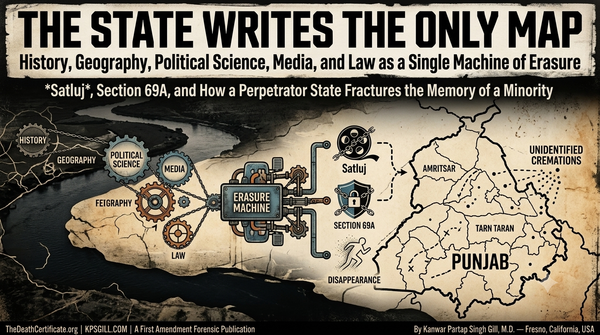
THE FILM WAS UNCUT. THE RECORD WAS COMPRESSED.

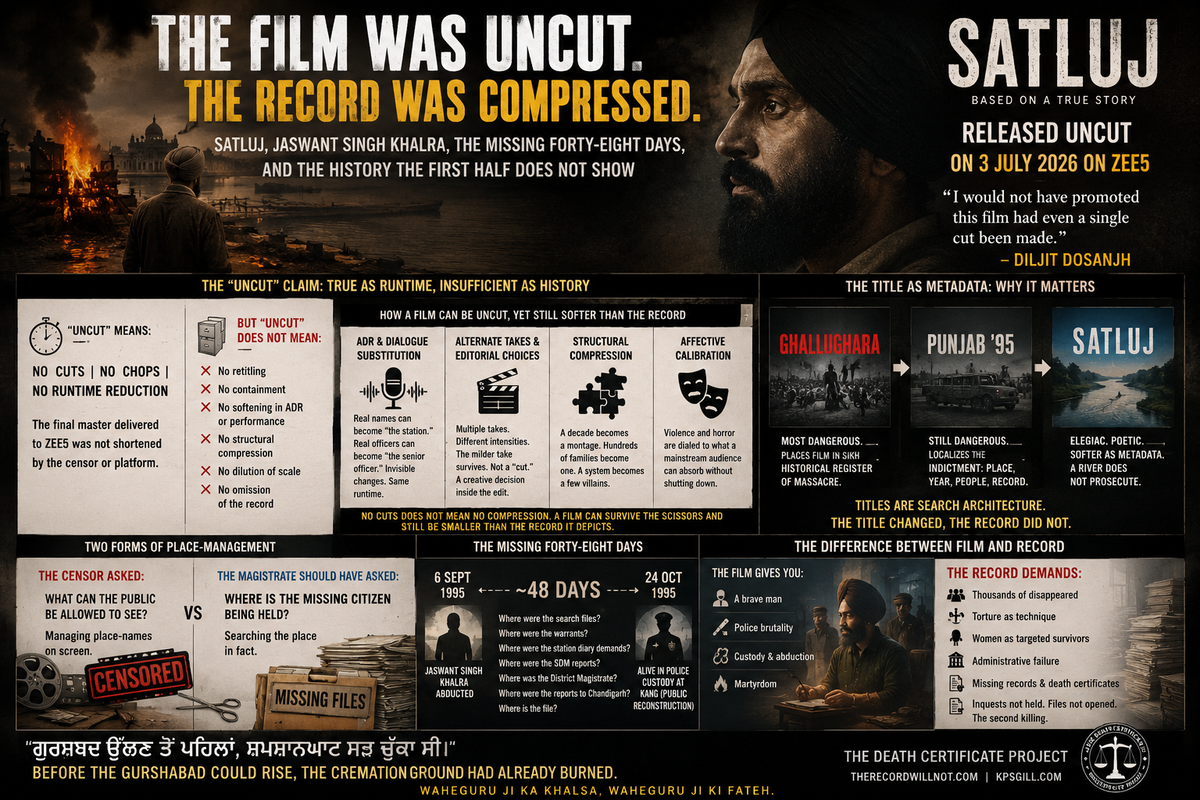
ਗੁਰਸ਼ਬਦ ਤੋਂ ਪਹਿਲਾਂ, ਸ਼ਮਸ਼ਾਨਘਾਟ
Before the Gurshabad, the cremation ground.
Satluj, Jaswant Singh Khalra, the Missing Forty-Eight Days, and the History the First Half Does Not Show
A forensic film-production, legal-history, and public-administration analysis of how a true story can survive censorship as cinema while still failing to carry the full scale of Punjab’s enforced disappearances, custodial torture, sexual violence, illegal cremations, and civil-magisterial collapse
By Dr. Kanwar Partap Singh Gill, M.D.
Publisher and Editorial Director, TheDeathCertificate.org and KPSGILL.COM
(No relation to the late Kanwar Pal Singh “K.P.S.” Gill, IPS, Director General of Police, Punjab.)
Evidentiary Framework
[PF] Proved Finding — established by judicial record, official report, statutory text, or a named party’s on-record public statement.
[DA] Documented Allegation — serious, sourced, and attributable, but not adjudicated or independently verified to the standard of a proved finding.
[AI] Analytical Inference — reasoned analysis drawn from pattern, statute, omission, chronology, public record, film form, and institutional conduct.
[PM] Panthic Memory — the moral, testimonial, and civilizational record carried by the Sikh community independent of formal state recognition.
I. Introduction: The Cremation Ground and the Screen
Satluj has arrived as a victory, but it must not be mistaken for a verdict.
The film’s global OTT release in July 2026 — after years of censorship battles under its earlier titles Punjab ’95 and Ghallughara — is culturally significant. Public reporting states that the film released on streaming platforms on July 3, 2026, after a prolonged fight with the Central Board of Film Certification, and that Diljit Dosanjh said he would not have promoted the film had even a single cut been made. Reports also describe the film’s progression through title changes from Ghallughara to Punjab ’95 and finally to Satluj.
That matters. The release puts the name of Jaswant Singh Khalra before a global audience. It gives dramatic form to a story that the Indian state, through delay, certification pressure, and title-management, clearly did not want to arrive in ordinary public form. It restores to popular memory a man who found the state’s handwriting in the cremation ground.
But after watching the film, the necessary conclusion is more complicated.
Satluj may be uncut as a released master. It may be broadly accurate in portraying Jaswant Singh Khalra’s courage, his discovery of cremation records, his abduction, the police custody geography of his final days, and the moral force of his martyrdom. But the film does not do justice to the cause he was working for. It does not fully carry the documented scale of the Punjab catastrophe. It does not show the structural relationship between enforced disappearance, torture, rape and sexualized violence, false encounters, municipal cremation records, missing inquests, absent death certificates, and district-magisterial silence.
It gives the audience Khalra.
It does not fully give the audience the world that made Khalra necessary.
That distinction is the subject of this essay.
II. The “Uncut” Claim: True as Runtime, Insufficient as History
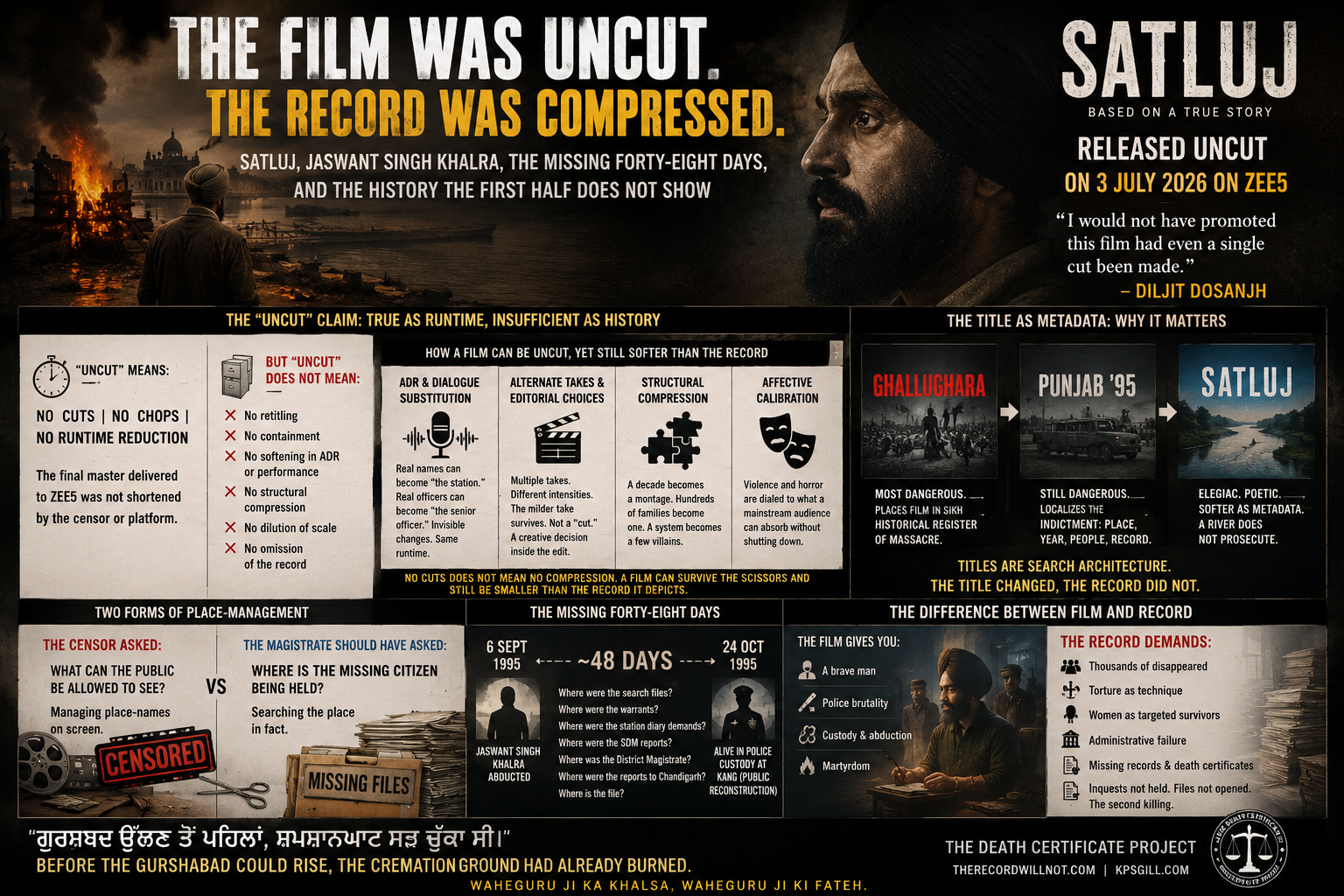
The central public claim around Satluj is that it released “uncut.” This claim should not be casually dismissed. In film-industry language, it most likely means that the final master delivered to ZEE5 was not shortened, chopped, or surgically reduced at the last stage by the platform or censor. Public reporting describes the final release as uncut and notes the makers’ insistence that the release did not carry the cuts they had resisted.
But “uncut” is a runtime claim. It is not a historical claim.
A film can be uncut and still retitled.
A film can be uncut and still released through a contained platform route rather than a theatrical public square.
A film can be uncut and still be structurally compressed by genre, budget, legal review, audience calibration, risk management, and the basic grammar of commercial cinema.
A film can be uncut and still fail to carry the full scale of the record.
The problem, therefore, is not that Diljit Dosanjh or Honey Trehan necessarily misrepresented the film. Their claim may be true within its own industry meaning. The problem is that audiences often hear “uncut” as if it means “uncompromised,” “historically complete,” “politically whole,” and “equal to the archive.” It means none of those things.
A released film is not the first draft. It is not the research file. It is not the censor file. It is not the court record. It is not the CBI report. It is not the death register. It is not the testimony of every mother whose son never came home.
It is a final audiovisual object.
That object may be intact. The history inside it may still be smaller than the history outside it.
The line, therefore, must be precise:
No cuts does not mean no compression. No deletion does not mean no dilution. A film can survive the censor’s scissors and still be smaller than the record it depicts.
III. The Production Reality: Why Softness Does Not Require a Secret Conspiracy
It is tempting, after watching the film, to explain its softness through secret production compromises: hidden ADR, softened dialogue, replaced officer names, removed station names, selected milder takes, or invisible post-production compliance. From a production standpoint, those mechanisms are real.
ADR — Automated Dialogue Replacement — can alter a film’s legal and political meaning without altering runtime. A line naming a police station can become “the station.” A real officer can become “the senior officer.” A district can become “this area.” If the actor’s face is turned away, the substitution may be invisible.
Editorial selection can also soften a film. Directors shoot multiple takes. A scene can be performed with different intensity: one raw, one moderate, one legally safer. Choosing the moderate take is not a “cut” in the public sense. It is a creative decision inside the edit.
Structural compression can do even more. A decade of violence can become a montage. A pattern can become one representative incident. A hundred families can become one composite mother. A police-state system can become a few villainous officers.
All of that is real filmmaking.
But this essay does not assert, as a proved finding, that Satluj was secretly softened through ADR, alternate takes, or covert post-production capitulation. There is no leaked earlier workprint. There is no published ADR sheet. There is no audio engineering analysis. There is no shot-by-shot comparison between Ghallughara, Punjab ’95, and Satluj. There is no production witness saying that specific real names were replaced.
That matters. The Death Certificate Project cannot demand evidentiary rigor from retired Deputy Commissioners, police officers, censors, and ministries while abandoning the same standard when speaking about filmmakers.
The better explanation is also the stronger one:
Satluj feels soft not because it must have been secretly betrayed in the editing room, but because commercial narrative cinema almost always compresses mass atrocity into individual drama.
This is not a small point. It moves the critique away from accusing filmmakers of bad faith and toward a more durable analysis of form, power, and historical scale.
Satluj is a biographical procedural. Its protagonist is Khalra. Its dramatic spine is investigation, discovery, threat, abduction, custody, martyrdom. That form can carry courage. It can carry grief. It can carry confrontation. What it cannot naturally carry, without deliberate documentary architecture, is the full ecology of a state atrocity: the hundreds of FIRs never written, the bodies logged as unidentified, the mothers turned away from police stations, the women used as leverage, the station diaries kept blank, the district files never opened, and the magistrates whose signatures never appear.
The film’s softness is therefore not primarily a technical defect.
It is a structural outcome.
IV. The Title as Metadata: From Ghallughara to Punjab ’95 to Satluj
The title history is itself evidence.
Ghallughara was the most dangerous title. It placed the film in the Sikh historical register of massacre, not merely as an episode of police brutality but as part of a civilizational memory of extermination and survival.
Punjab ’95 was still dangerous, but in a different way. It localized the indictment: a place and a year. It made the film searchable as a historical event. It placed the viewer near Amritsar, Tarn Taran, Khalra, the CBI, illegal cremations, and the police-state record.
Satluj is elegiac. It is poetic. It is culturally resonant. But it is also softer as metadata. A river does not prosecute. A river mourns.
Public reporting confirms the title changes and the final OTT release as Satluj. It also reports earlier CBFC demands for extensive cuts, with the figure of 127 widely reported in relation to the censorship dispute.
In contemporary media ecosystems, titles are not cosmetic. They are search architecture. They control indexing, discoverability, recommendation systems, keyword association, social circulation, and historical memory. A person searching “Punjab 1995 Khalra police cremations” may not instinctively search “Satluj.”
The title changed.
The record did not.
But the public object changed.
That is the first layer of containment.
V. What the First Half Does Not Show
The most serious limitation of Satluj lies in its first half.
The film introduces Khalra’s work, the fear in Punjab, the police threat, and the moral stakes. But it does not fully convey the scale, texture, and categories of violence that defined the period.
It does not make the viewer feel the repetition of enforced disappearance.
It does not fully show young men being pulled from buses, farms, homes, markets, and roads, then disappearing into police denial.
It does not fully show families moving from station to station, being told “he is not here,” while station diaries remained blank.
It does not fully show women being summoned, detained, humiliated, threatened, or used as leverage against male relatives.
It does not fully show sexualized violence as a tool of custody, intelligence extraction, and community humiliation.
It does not fully show torture as a calibrated technique designed to leave fewer marks.
It does not fully show false encounters as administrative performance.
It does not fully show the cremation ground as a bureaucratic endpoint.
It does not fully show the Deputy Commissioner’s office as the missing civilian checkpoint.
Instead, the first half gives the audience the atmosphere of danger and the moral clarity of Khalra’s investigation. That is not nothing. But it is not enough.
The documentary record is much larger. Amnesty International’s 2004 public statement noted that only a small minority of police officers responsible for torture, deaths in custody, extrajudicial killings, and disappearances in Punjab had been brought to justice, and it cited the Supreme Court-directed CBI finding that 2,097 people had been illegally cremated by police officials in Amritsar district between 1984 and 1994.
A film can show a man being beaten.
The record shows a system in which a body could be taken, denied, tortured, killed, cremated, and administratively erased.
That is the difference.
VI. Enforced Disappearance Was Not an Incident. It Was a System.
The first half of Satluj needed to do more than show fear. It needed to show enforced disappearance as method.
Amnesty’s 1991 reporting documented cases in which people were seen in police stations, then police later denied custody or claimed escape; it also described circumstances in which judicial intervention could locate people held in unacknowledged police custody when courts acted quickly.
That is crucial to understanding Punjab.
Enforced disappearance was not simply kidnapping by men in uniform. It was the use of state denial as a weapon. The police did not merely take a person. They erased the fact of taking. The family did not merely lose a son. It lost the legal ability to prove that the state had him. The court did not merely face a missing citizen. It faced a documentary void.
This is why Khalra’s work was so dangerous. He found the state’s handwriting where the state thought only ash remained. He found that the body denied in one file appeared indirectly in another: cremation registers, firewood vouchers, municipal entries.
HRDAG and Ensaaf’s quantitative report described correlations between reported lethal human-rights violations, reported encounter deaths, and mass illegal cremations; it also noted that after Operation Rakshak II, fewer bodies of the disappeared and extrajudicially executed were recovered by next of kin, while NHRC data acknowledged an increase in mass illegal cremations.
That is the world the film needed to make visible.
Not one disappearance.
A disappearance system.
VII. Torture as Technique, Not Spectacle
The violence in Satluj is far softer than the documented record of Punjab custodial torture.
That does not mean the film needed to become graphic exploitation. The issue is not gore. The issue is method.
The clinical survey by Ami Laws, published in Health and Human Rights, records specific methods reported by Sikh torture survivors: roller torture over thighs, electric shocks, beating of the soles, burning, suspension, forced positions, mock executions at canal banks, near-asphyxiation by water, chili peppers forced into the anus, fingernails and toenails pulled out, acid or gasoline poured on the body, rape, and being forced to watch relatives tortured. The survey also recorded that despite severe torture, only a minority of respondents had scars or physical findings on examination, illustrating how some methods inflicted extreme pain while leaving fewer visible traces.
This is a film-production problem as much as a historical one.
Conventional cinema knows how to show violence that is visible: punches, gunshots, blood, wounds, screams. Punjab’s torture record often involved violence designed to be deniable — internal, neurological, sexualized, humiliating, and medically evasive. The true horror was not merely pain. It was pain engineered to disappear from the file.
That is what the first half of Satluj does not fully convey.
The film shows cruelty.
The record shows technique.
The film shows danger.
The record shows procedure.
The film shows the body in pain.
The record shows the body converted into a file that never existed.
VIII. Sexualized Violence and the Gendered Archive
A major absence in Satluj is the gendered dimension of state and state-adjacent violence.
The historical archive of Punjab is often narrated through young men: sons taken from homes, fields, buses, farms, and streets; brothers tortured; fathers searching; bodies burned as unidentified. That is true and necessary. But it is incomplete.
Women were not merely mourners. They were targets, witnesses, pressure points, and survivors of a different kind of custody.
The record includes women brought into police spaces, threatened, humiliated, used to pressure male relatives, and exposed to custodial vulnerability. The Death Certificate Project’s own sexual-violence analysis frames the relevant CrPC duties: mandatory FIR registration, protections around female search, production before magistrate, District Magistrate notification, Section 97 search warrants, and Section 174 inquest obligations. The same analysis states that Section 58 reporting and Section 97 search-warrant mechanisms existed precisely to disrupt arrest denial and wrongful confinement.
This matters for film analysis.
If the first half of a film about Khalra shows disappearances without meaningfully showing women as targets of coercion, the social geography of the atrocity is narrowed. The viewer sees a masculine martyrdom archive. The real archive is familial, gendered, and intergenerational.
A son was taken.
A mother searched.
A wife begged.
A sister was threatened.
A daughter inherited silence.
The film’s first half does not fully stage that world.
That is not merely an omission of content. It is an omission of structure.
IX. Why Commercial Cinema Makes State Violence Smaller
An expert film-production analysis must distinguish between three types of reduction: narrative compression, institutional simplification, and affective calibration.
Narrative compression is unavoidable. A feature film has limited runtime. It must choose protagonists, scenes, turning points, and emotional arcs. It cannot show every victim.
Institutional simplification is more dangerous. This is where a system becomes a villain. A police-state ecology becomes a few officers. Civil administration disappears. Chandigarh disappears. The Home Department disappears. The Deputy Commissioner disappears. The magistrate disappears. The file disappears.
Affective calibration is what allows a mainstream audience to keep watching. The filmmaker must decide how much violence the viewer can absorb without shutting down, rejecting the film, or categorizing it as too heavy for mainstream circulation. This is not necessarily bad faith. It is audience design.
But these three forces, together, produce a predictable result: mass atrocity becomes biopic.
The audience is given one heroic man, one family, one police chain, one final tragedy.
The system becomes atmosphere.
That is why Satluj feels soft. Not because it lacks moral sincerity. It feels soft because its film form cannot carry the administrative vastness of the crime.
The cinematic camera loves faces.
The archive demands files.
X. The “Rogue Police” Trap
Mainstream films about state violence often survive by individualizing evil.
This is the “rogue police” trap.
If the viewer leaves thinking, “Those officers were cruel,” the film has delivered moral outrage but not structural accountability. If the viewer leaves asking, “Where was the District Magistrate’s file? Where were the search warrants? Where were the inquests? Where were the death certificates?” then the film has opened the archive.
Satluj succeeds more in the first task than the second.
That is why it is accurate as a Khalra film but incomplete as a Punjab film.
The Death Certificate Project’s own work repeatedly argues that the missing administrative record was not mere paperwork. One article states that for the 2,097 confirmed cremations, the absence of Section 174 inquest reports, Section 176 magisterial inquiries, and Section 58 arrest acknowledgments meant there was no official record that the person had ever been in state custody; it calls the administrative disappearance “the second killing.”
That is the missing layer.
Khalra did not die only because police were brutal.
He died because the state’s own records were more dangerous than testimony.
XI. What Satluj Gets Right: The Final Custody Geography
A fair analysis must also say what the film gets right.
Based on the viewing account developed here, Satluj does not fully erase the final custody geography. It appears to preserve the essential route:
Kang → Jhabal-linked safe house / custody space → Manawala farmhouse → Jhabal Police Station → murder → Harike.
That matters.
Earlier concerns that the film may have completely anonymized the custody route appear overstated if the film in fact shows Kang, Manawala, Jhabal, and Harike. Preserving those locations is significant because they are not symbolic. They are reviewable geography. They are the difference between “somewhere in Punjab” and a public-law map.
The public record around Khalra’s killing includes his abduction on September 6, 1995, later evidence that he had been held in Tarn Taran police custody, prosecution recommendations, convictions of Punjab police officials, and later appellate proceedings.
So the critique must be disciplined.
The film should not be attacked as if it invented the final route.
The stronger criticism is that the final route is not the whole story.
XII. The Missing Forty-Eight Days
The most dangerous part of the Khalra record is not only the final movement from Kang to Jhabal to Manawala to Jhabal to Harike.
The most dangerous part is the gap.
Khalra was abducted on September 6, 1995.
The later public reconstruction places him alive in police custody at Kang on October 24, 1995.
That is roughly forty-eight days.
Those forty-eight days are not empty time. They are the administrative indictment.
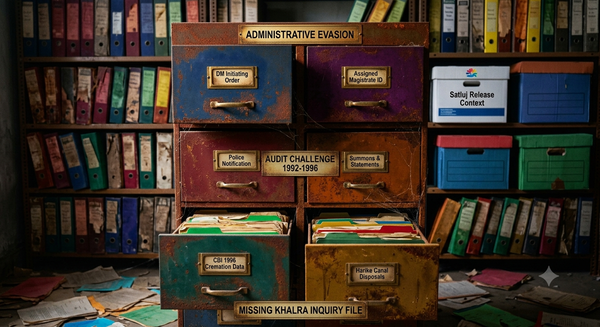
Where was the search file?
Where were the station-diary demands?
Where were the lockup inspections?
Where were the Section 97 warrants?
Where were the SDM reports?
Where were the written calls to the SSP?
Where were the reports to Chandigarh?
Where were the notes to the Home Department?
Where was the District Magistrate?
The film can dramatize the end of captivity. It cannot dramatize a file that has never been produced.
The Death Certificate Project’s own K.B.S. Sidhu analysis identifies the “arrest-denial architecture” of Punjab disappearances: arrest without warrant, no arrest recorded, no FIR filed, detention beyond twenty-four hours without magisterial production, police denial of custody, and eventual killing or disappearance outside formal custody. It argues that Section 58 and Section 97 were primary preventive instruments and that, on the available public record, neither was deployed at a scale corresponding to the documented disappearances.
That is the real missing scene.
Not a torture scene.
A file-opening scene.
XIII. The Deputy Commissioner / District Magistrate Question
This essay does not allege that Karanbir Singh Sidhu, IAS, personally ordered, desired, participated in, or had specific knowledge of the killing of Jaswant Singh Khalra. No available court record places him at Kang, Jhabal, Manawala, or Harike. That boundary must remain clear.
The question is not personal murder liability.
The question is civil-magisterial responsibility.
In the period under discussion, the Deputy Commissioner also functioned as District Magistrate. The police chain of command was not identical to the revenue chain. The SSP did not report to the DC in the same way a revenue subordinate did. Operational command ran through police hierarchy: SSP, DIG, DGP, Home Department, and state government.
But this does not give the District Magistrate a clean exit.
The District Magistrate was the civilian checkpoint between police power and civil liberty. In wrongful confinement cases, the office had statutory tools. In warrantless arrest cases, the office had reporting rights. In suspicious death and custodial death cases, the office had inquest and inquiry functions. In cases of police denial, the office had the authority to demand records, require explanation, and create a paper trail.
The Death Certificate Project’s sexual-violence and administrativen-duty analysis identifies CrPC Sections 56, 57, 58, 97, and 174 as forming part of the statutory architecture that should have produced records in cases of arrest, wrongful confinement, suspicious death, and police-brought bodies.
The question is therefore simple:
Did the District Magistrate’s office use the tools available to it when Khalra disappeared?
If yes, produce the file.
If no, the silence is not an accident of cinema.
It is an administrative fact.
XIV. Chandigarh, Awareness, and the Architecture of Passive Knowledge
The Punjab problem cannot be reduced to district-level failure alone. Chandigarh matters.
But here again, the article must be careful.
It is stronger to argue institutional awareness than to claim specific individual knowledge without proof.
By 1995, the problem of disappearances, illegal detention, torture, false encounters, and illegal cremations was not invisible. Amnesty had already documented unacknowledged police custody, habeas failures, and court interventions that found detainees alive when searches were ordered. Human-rights organizations, lawyers, journalists, families, and political actors had been reporting the pattern for years.
The civil administration cannot plausibly say that illegal custody was an unimaginable phenomenon.
Chandigarh cannot plausibly say that encounter killings, disappearances, and torture were unknown categories.
The stronger formulation is this:
The question is not whether every officer knew every location. The question is whether the state’s senior civil and police administration knew enough about the pattern to activate safeguards — and whether those safeguards were, in fact, activated.
The answer, on the public record, is grim.
The safeguards did not function at a scale corresponding to the abuses.
That is what makes the record systemic.
XV. The First Half and the Long Sikh Historical Arc
The film’s compression also narrows the historical arc.
The Death Certificate Project has repeatedly situated Khalra not as an isolated human-rights figure but as a witness in a much longer history: Sikh sovereignty, Miri-Piri, state confrontation, colonial and postcolonial management of Sikh political identity, the 1978 Nirankari killings, Operation Blue Star, November 1984, Operation Woodrose, the counterinsurgency period, illegal cremations, and then the censorship of the memory of those cremations.
The Project’s own Page 2 archive shows this broad architecture: essays on Miri-Piri and Panthic jurisdiction, Banda Singh Bahadur, forward-caste state architecture, Jinda and Sukha, HAF narrative framing, Ramesh Inder Singh, K.B.S. Sidhu, Sarabjit Singh, Operation Blue Star, water, Akal Takht capture, and administrative impunity.
That archive matters because Satluj does not begin far enough back.
Khalra’s story does not begin in 1995.
It begins in a state logic that repeatedly portrayed Sikh political assertion as threat, Sikh mourning as extremism, Sikh testimony as propaganda, and Sikh victims as perpetrators.
This inversion is central.
In 1984, the community attacked was narrated as the danger.
In the counterinsurgency period, the disappeared were narrated as militants.
In the cremation record, unidentified bodies were denied names.
In censorship battles, a film about the man who found the records was treated as a public-order problem.
The victim becomes the suspect.
The archive becomes the threat.
The death certificate becomes the disturbance.
That is the long arc Satluj does not fully show.
XVI. Why the First Half Should Have Been Harder
A stronger first half would not necessarily have been more graphic. It would have been more systemic.
It would have shown one young man pulled from a bus.
One taken from a field.
One taken from home.
One family turned away at a police station.
One woman brought in to pressure her husband.
One mother threatened.
One body entered as unidentified.
One municipal clerk recording firewood.
One doctor not allowed to document injury.
One magistrate not called.
One Deputy Commissioner’s office receiving no file, or not opening one.
One family waiting for a certificate that never came.
That would have changed the audience’s understanding of Khalra’s discovery.
The registers would not have appeared as an investigative device. They would have appeared as the skeletal remains of a whole destroyed world.
That is the difference between a film about a man and a film about the cause for which he died.
Satluj gives us the man.
The first half does not fully give us the cause.
XVII. Violence in Commercial Cinema and Violence Against the State Record
The user’s comparison to other films with more graphic violence is important as a viewer’s observation, but the deeper point is not simply that Satluj is less violent than some mainstream action films.
The point is that cinema often permits stylized violence more easily than documented state violence.
Fictional violence is safe because it does not name a file.
Gangster violence is safe because it does not demand an inquest.
Battle violence is safe because it can be absorbed into patriotism.
Revenge violence is safe because it resolves emotion.
But documented state violence is different. It points backward into records. It asks who signed, who denied, who saw, who failed to search, who failed to report, who failed to inquire.
That is why the film feels gentle even when it depicts brutality.
It does not fully activate the file.
XVIII. The Censor and the Magistrate: Two Forms of Place-Management
The CBFC’s anxiety over the film’s titles, place names, institutional identifiers, and historical specificity mirrors the district administration’s older failure.
The censor’s question was:
What can the public be allowed to see?
The magistrate’s question should have been:
Where is the missing citizen being held?
The censor sought to manage the place-name on screen.
The magistrate should have searched the place in fact.
Both involve geography.
One is cinematic geography.
The other is custodial geography.
One decides whether the viewer hears “Punjab,” “Tarn Taran,” “Kang,” “Jhabal,” and “Manawala.”
The other decides whether a living man is found before he becomes a body in a canal.
That is why the geography of Satluj matters. If the film preserves Kang, Jhabal, Manawala, and Harike, it preserves the map. But the map points beyond the film.
It points to the missing district file.
XIX. The File That Should Exist
A functioning civil administration response to Khalra’s disappearance should have produced records.
A district search file.
Written calls to the SSP.
Station-diary demands.
Lockup inspection orders.
SDM or Executive Magistrate reports.
Section 97 search warrants.
Reports to the Home Department.
Family communication.
Police non-cooperation memos.
Habeas compliance notes.
Post-abduction follow-up.
Inquest-trigger notes if death was suspected.
A handover note if unresolved.
These are not extraordinary documents. They are ordinary outputs of government.
The Death Certificate Project’s existing analysis of the Amritsar administrative record argues that each unidentified body cremated without medical examination reflected failures in Section 174 reporting, Section 176 magisterial inquiry, and Section 58 arrest acknowledgment. It also frames the missing postmortem and missing death certificate as part of the body-to-file chain that collapsed across the 2,097 confirmed cremations.
This is where film ends and law begins.
Satluj can show Harike.
Only the file can show who failed before Harike.
XX. What the Film Does and Does Not Do Justice To
The final judgment must be balanced.
Satluj does justice to Jaswant Singh Khalra as a moral figure.
It honors his courage.
It preserves his confrontation with police power.
It brings his story to viewers who may never read Amnesty, HRW, Ensaaf, HRDAG, or the Supreme Court record.
It keeps alive the emotional truth that the state tried to bury.
But the film does not fully do justice to the cause.
The cause was not merely that Khalra was killed.
The cause was that thousands disappeared.
The cause was that families were denied bodies.
The cause was that women bore violence and threat as part of the counterinsurgency’s social architecture.
The cause was that police stations became sites of denial.
The cause was that cremation grounds became archives.
The cause was that civil administration failed to generate the very documents that law required.
The cause was that death certificates were missing because the state needed death itself to remain unofficial.
Measured against that cause, the film is incomplete.
Not false.
Incomplete.
XXI. The Verdict: Accurate Biopic, Incomplete Archive
The clearest conclusion is this:
Satluj is accurate enough about Jaswant Singh Khalra to matter, but not large enough about Punjab to close the record.
It is a biopic, not a full indictment.
It shows martyrdom, but not enough machinery.
It shows police brutality, but not enough civil administration.
It shows custody, but not enough denial.
It shows violence, but not enough torture as method.
It shows women as family, but not enough women as targeted subjects of state and state-adjacent violence.
It shows the final route, but not the missing forty-eight days.
It shows the body’s disposal, but not the missing death certificate as the second killing.
That is why The Death Certificate Project must not allow the film’s release to become the final public settlement of Khalra’s story.
The release is an opening.
Not a closure.
XXII. Final Statement
Satluj did not need to lose minutes to lose scale.
It only had to become a film.
Cinema compressed what the archive cannot compress: the thousands, the women, the torture methods, the buses, the farms, the homes, the police stations, the station diaries, the magistrates, the warrants not issued, the inquests not held, the postmortems not performed, the death certificates never given.
The film is the voice.
The archive is the exhibit list.
The missing district file is the indictment.
Khalra’s story did not end at Harike. It did not end with the Supreme Court convictions. It did not end with Satluj streaming uncut. It will end only when the files behind the fire are produced: the district search file, the inquest file, the cremation file, the death-registration file, and the civil-magisterial record that should have existed while Jaswant Singh Khalra was still alive.
Until then, the title may change.
The record will not.
ਗੁਰਸ਼ਬਦ ਉੱਠਣ ਤੋਂ ਪਹਿਲਾਂ, ਸ਼ਮਸ਼ਾਨਘਾਟ ਸੜ ਚੁੱਕਾ ਸੀ।
Before the Gurshabad could rise, the cremation ground had already burned.
Waheguru Ji Ka Khalsa, Waheguru Ji Ki Fateh.
Publication Note / Sources Consulted
This essay draws on public reporting concerning the July 2026 OTT release of Satluj and statements attributed to Diljit Dosanjh, Honey Trehan, and the film’s production team; Amnesty International’s reporting on Punjab impunity and torture; Human Rights Watch and Ensaaf’s work on Punjab disappearances and impunity; HRDAG and Ensaaf’s quantitative analysis of enforced disappearances and illegal cremations; Ami Laws’s clinical work on torture survivors in Punjab; the public record of Jaswant Singh Khalra’s abduction and murder; and The Death Certificate Project’s prior publications on K.B.S. Sidhu, Ramesh Inder Singh, sexual violence, civil-magisterial accountability, and missing death certificates. Where this essay discusses the film as viewed by the author, it does so as film criticism and viewing-based analysis, not transcript-level authentication.