THE CIVIL SIGNATURE OF IMPUNITY

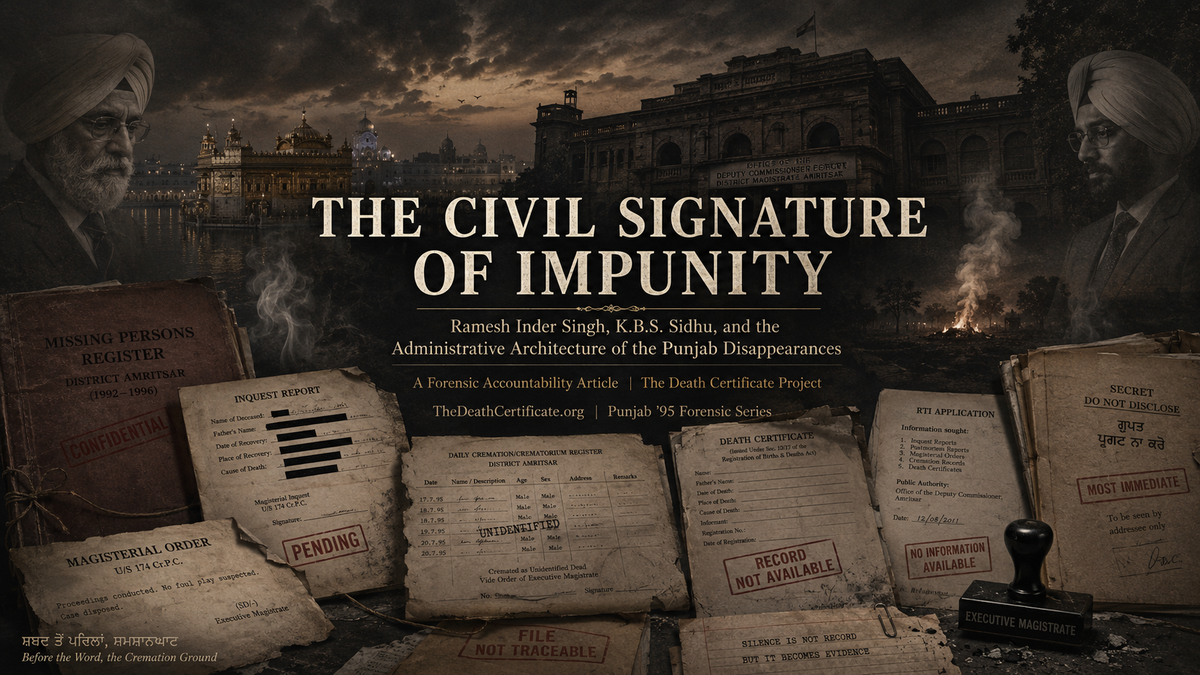
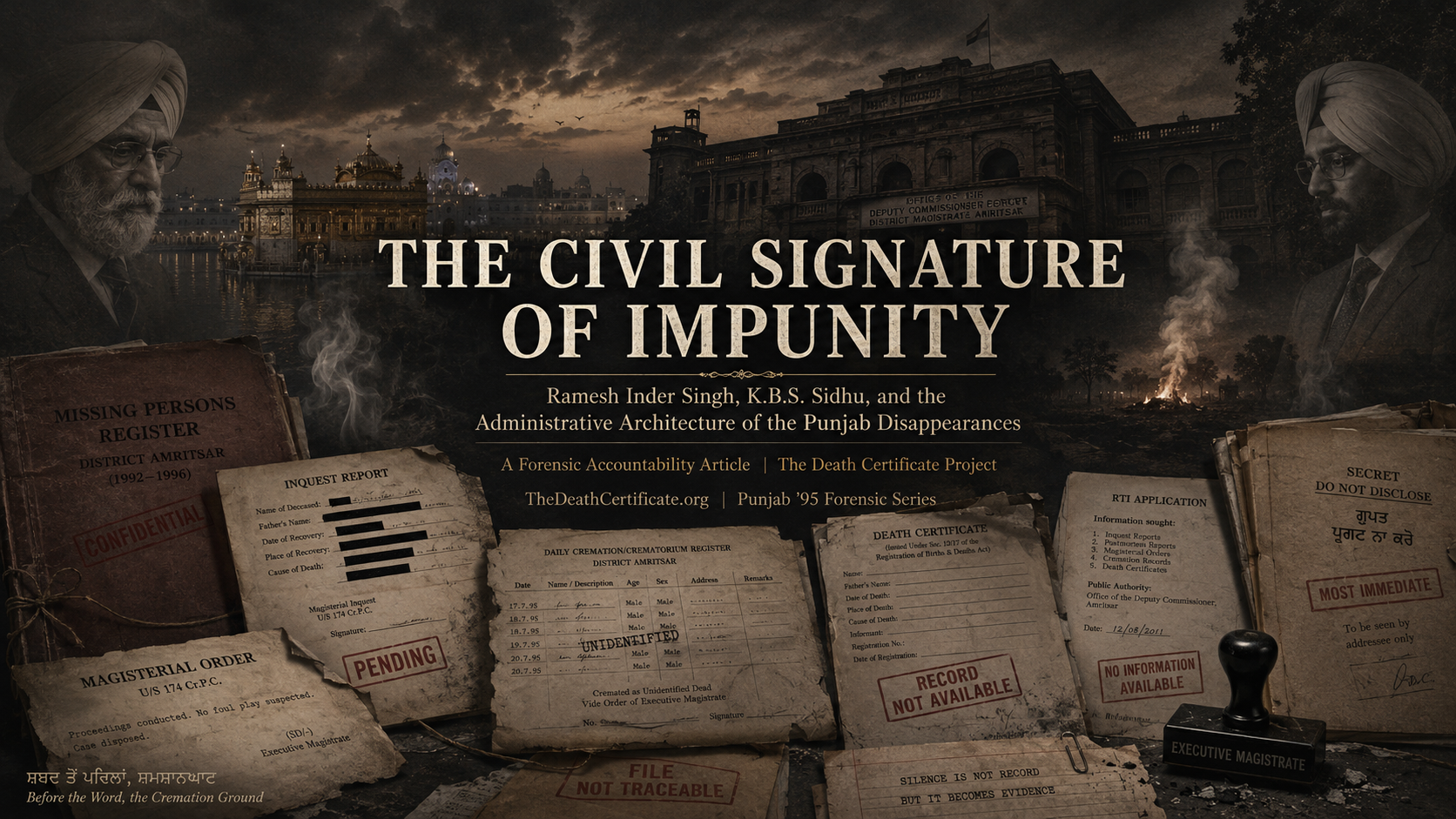
Ramesh Inder Singh, K.B.S. Sidhu, and the Administrative Architecture of the Punjab Disappearances
A Forensic Accountability Article | The Death Certificate Project
TheDeathCertificate.org | Punjab ’95 Forensic Series
EVIDENTIARY FRAMEWORK
This article applies the following evidentiary tiers throughout:
[PF] Proved Finding — Facts established by official records, judicial findings, statutory text, documentary admissions, or convergent evidence meeting a high evidentiary threshold.
[DA] Documented Allegation — Claims grounded in identifiable sources, serious in nature, not yet conclusively adjudicated to the highest standard.
[AI] Analytical Inference — Reasoned conclusions drawn from documented patterns, institutional omissions, administrative timing, and the cumulative structure of the record.
[PM] Panthic Memory — The lived, inherited, and institutionally preserved memory of the Sikh community, including witness accounts, family testimony, and civilizational memory of events that the state record has suppressed or erased.
I. THE INSTITUTIONAL SCAFFOLDING THESIS
The standard architecture of accountability for the Punjab counterinsurgency era has, for four decades, rested upon an unstated and self-serving premise: that the violence of 1984 to 1996 was the violence of police officers, paramilitary units, and their immediate commanding officers. Under this premise, the civilian administrative hierarchy — the district magistrates, the deputy commissioners, the divisional commissioners, the home secretaries — occupied a zone of administrative irrelevance. They were present in the geography of atrocity but absent, by this narrative’s logic, from its legal structure.
The Death Certificate Project rejects this premise in its entirety.
This article proceeds from what this publication designates as the institutional scaffolding thesis: that the mass disappearances, illegal cremations, and systematic destruction of the evidentiary record that defined the Punjab counterinsurgency era were not the product of police violence alone, but were structured, administrative acts that required civilian signatures, magisterial omissions, statutory violations, and deliberate failures of the executive magistracy. The police pulled the triggers. The district administration provided the legal architecture that ensured the triggers would never be traced, the bodies would never be named, and the files would never exist.
Within this thesis, two names occupy positions of particular importance: Ramesh Inder Singh, who served as District Magistrate and Deputy Commissioner of Amritsar from June 4, 1984 to July 6, 1987; and Karan Bir Singh (K.B.S.) Sidhu, who served in successively senior capacities in Amritsar, culminating in his tenure as District Magistrate and Deputy Commissioner from May 11, 1992 to August 11, 1996.
Together, along with the intervening DC Sarabjit Singh, these three officers constituted an unbroken institutional continuity across the full twelve years of the counterinsurgency. The civilian administration of Amritsar — the district at the epicenter of the crisis — was never interrupted, never held externally accountable, and never compelled to produce the administrative record that the law required it to generate. This article examines two of these three tenures in forensic detail, not as a historical exercise, but as a living accountability obligation. The 1,238 individuals documented by the National Human Rights Commission as having been cremated as unidentified persons in the district’s cremation grounds are not statistical abstractions. They are the unanswered administrative question of the DC Amritsar’s office — asked across thirty years, never answered.
II. TWO CAREERS, ONE SILENCE: THE GEOGRAPHY OF IMPUNITY
The Fifty-Year Record
Ramesh Inder Singh entered the Indian Administrative Service in the 1974 batch, initially assigned to the West Bengal cadre before being transferred to the Punjab cadre in July 1978. [PF] His Amritsar tenure began on June 4, 1984, the morning the Indian Army’s encirclement of the Golden Temple complex reached its operational apex, and ran through July 6, 1987, encompassing the immediate aftermath of Operation Blue Star, the complete period of post-operation militarization, and the early years of the low-intensity state violence that followed. He subsequently rose to Chief Secretary of Punjab. In retirement, he was appointed Chief Information Commissioner of Punjab, a role he held from 2009 to 2014. [PF] He received the Padma Shri in 1986, when he was thirty-six years old and actively serving as District Magistrate of Amritsar. [PF] He has published Turmoil in Punjab: Before and After Blue Star — An Insider’s Story, a memoir widely reviewed as an authoritative eyewitness account, and appears regularly at literary festivals.
K.B.S. Sidhu entered the IAS in the 1984 batch, among the top-ranked entrants nationally. [PF] He first served in Amritsar as Additional Deputy Commissioner between 1990 and 1992, before formally assuming the office of District Magistrate and Deputy Commissioner on May 11, 1992 — a tenure running through August 11, 1996, covering the most intensive phase of the documented disappearances and illegal cremations. [PF] He subsequently rose to Additional Chief Secretary (Home) and Special Chief Secretary — the highest civil office carrying direct oversight responsibility for Punjab’s police apparatus. He received a Prime Minister’s Commendation for his management of aircraft hijackings in 1993. [PF] In retirement, he commands a Substack newsletter, The KBS Chronicle, with over 4,700 subscribers, regularly writes for SikhNet on Gurbani theology, and publishes commentary on constitutional due process. He is also, as of this writing, the subject of a Punjab Vigilance Bureau inquiry into his alleged role in an Rs. 1,000 crore irrigation scam, for which he secured interim High Court relief in 2022. [DA]
The Rewarded Silence Model
These parallel biographies are not incidental. They are the institutional record of what this project designates as the rewarded silence model — a structural feature of the Indian administrative apparatus wherein civil servants who maintained statutory silence during counterinsurgency crises were systematically rewarded with rapid professional advancement, prestigious civilian honors, elite post-retirement appointments, and the institutional credibility required to curate their own historical legacies.
[AI] The Padma Shri awarded to Ramesh Inder Singh in 1986 — when he was thirty-six years old, actively serving as District Magistrate of a district whose cremation grounds had received hundreds of unidentified bodies in the preceding twenty months — was not merely an honor. It was a state-administered certification of administrative cleanliness. It marked him, formally, as a civil servant whose record was unblemished and whose conduct during the most sensitive period of the republic’s recent history was worthy of national recognition. For the purposes of any future accountability mechanism, this award performs a double function: it memorializes the state’s approval of his conduct, and it simultaneously insulates him from the claim that his administrative omissions were even recognized as omissions.
[AI] The Prime Minister’s Commendation awarded to K.B.S. Sidhu in 1993 operates within the same logic. His decisive management of the aircraft hijackings was entered into his official service record as proof of administrative competence and institutional responsiveness. This commendation, and the competence it formally certified, is precisely what renders his subsequent administrative silence during the 1995 abduction of Jaswant Singh Khalra legally significant. A state that recognized his capacity for decisive action had, by implication, also certified that the absence of action where action was legally required was not incapacity. It was choice.
The Digital Footprint as Legacy Architecture
Both men have invested substantially in the construction of digital legacies that present their careers through a framework of enlightened public service, intellectual reflection, and moral authority.
Ramesh Inder Singh’s memoirs and literary festival appearances construct a narrative of a civil servant who managed a catastrophic crisis with professionalism, maintained civilian restraint against military pressure, and emerged with integrity intact. [AI] The strategic function of this narrative is to occupy the historical field before any alternative accounting can establish itself — to populate search engines, academic citation databases, and public memory with a version of events that begins with his empathy and ends with his vindication.
K.B.S. Sidhu’s digital presence is more elaborate and, from an evidentiary standpoint, more revealing. His Substack newsletter addresses world politics with measured intelligence. His SikhNet essays on Gurbani theology and constitutional rights project spiritual depth and democratic commitment. His Medium writings on civil service ethics present the image of a thoughtful public intellectual who learned from his career. [AI] The cumulative effect is a digital identity that is authoritative precisely because it invokes the very standards — due process, constitutional rights, human dignity — that a forensic examination of his Amritsar administrative record places in acute question.
The Death Certificate Project does not accept the terms of this self-curation. The counter-archive this project is building is designed to permanently interrupt the search-engine ecosystem that sustains it. Every article published here is indexed, cross-referenced, and search-optimized to ensure that any query of either man’s name retrieves not only his curated self-presentation, but also this publication’s systematic examination of the administrative record beneath it.
III. THE FORENSIC AUDIT OF RAMESH INDER SINGH
A. The Civil Context of the June 4, 1984 Installation
The circumstances under which Ramesh Inder Singh became the District Magistrate of Amritsar on June 4, 1984 are not administratively incidental. They are the first data point in the forensic record of his tenure, and they establish the frame within which every subsequent administrative omission must be understood.
His predecessor, Gurdev Singh Brar, was the DC Amritsar in the weeks before the military operation. [DA] Contemporaneous administrative accounts — preserved in official memory and in accounts given to investigators and journalists — indicate that Brar was placed on compulsory leave not because he had applied for routine personal travel, as the official narrative asserts, but because of his refusal to authorize or sign the administrative orders that the impending military operation required from the civilian magistracy. [DA] The military’s operational command harbored substantial reservations about his reliability as a civil signatory.
[PF] The official record confirms that Ramesh Inder Singh was directed by the Chief Secretary to proceed to Amritsar and assume charge on the eve of the operation, formally taking office on June 4.
[PF] The record further confirms that his transfer to the Punjab cadre — permanently accomplished from his original West Bengal cadre — was completed in connection with this posting, conferring a career benefit of substantial professional value.
[AI] Read together, these facts describe not a routine administrative transfer but a deliberate sorting mechanism. The state required a specific civil signature in the district magistrate’s seat at the precise moment the military operation was being executed. The officer who occupied that seat received a permanent cadre change as part of the arrangement. His predecessor was removed. The institutional logic is not difficult to reconstruct: the administration required, and secured, a civil magistrate who would not obstruct the military’s administrative requirements.
[AI] This sequence matters for everything that follows. If the June 4 installation of Ramesh Inder Singh was a deliberate selection by the state apparatus for a specific administrative purpose, then the subsequent omissions of his office — the absence of inquests, the missing registers, the paperless handling of hundreds of unidentified bodies — are not failures of individual judgment operating in a vacuum. They are the outputs of an administrative posture that was installed, and rewarded, from the beginning. The Padma Shri that followed twenty months later was not awarded despite the administrative omissions. It was awarded alongside them, by a state that understood precisely what its DC Amritsar had and had not done.
B. The Van Without a Log: The Legal Anatomy of a Retrospective Alibi
In his memoirs, in media interviews, and in public appearances at literary festivals, Ramesh Inder Singh has offered a specific factual claim as the primary evidence of his administration’s concern for civilian life during Operation Blue Star: that a district administration loudspeaker van was deployed outside the Golden Temple complex in the early days of June 1984, broadcasting appeals in Punjabi for pilgrims, women, children, and SGPC employees to exit the complex safely with their hands raised.
This claim is the administrative alibi of record. It is the institutional assertion that his office did not simply stand aside while the military killed civilians. [DA] It deserves the most precise legal and documentary scrutiny available to this publication.
The law governing civil evacuation procedures during military operations in which civilian populations are at risk is not silent. A lawful civil evacuation warning of the kind Ramesh Inder Singh describes — one that could be cited in subsequent judicial proceedings as evidence of administrative due diligence — requires, at minimum: a written administrative order authorizing the deployment; vehicle logbooks identifying the specific vehicle and its route; driver scheduling records establishing when and where the broadcast occurred; a scripted text or audio record of the actual announcement; and some form of compliance report documenting what civilians, if any, responded to the call.
None of these documents exist in the district administrative record. [PF] This publication has filed Right to Information requests specifically targeting the administrative documentation of this claimed evacuation broadcast. The responses confirm the documentary vacuum: no written order, no vehicle log, no driver schedule, no route record, no announcement script, no compliance report.
[PF] This administrative void was judicially noted in the 2017 proceedings of the Amritsar Sessions Court in connection with the Jodhpur detainees case, which recorded that there was no evidence on record of any public announcement made by civil authorities requesting people to exit the complex.
[AI] The legal significance of this judicial finding cannot be overstated. The Sessions Court, adjudicating a matter in which the conduct of the June 1984 military operation was directly relevant, found no administrative paper trail supporting the loudspeaker van claim. The van either did not exist in the form described, or existed only as a formality that generated no documentation — because its purpose was not evacuation but the appearance of evacuation, to be deployed retrospectively in exactly the context in which it has been deployed: the memoir, the literary festival, the interview conducted decades after the fact in an environment where cross-examination is impossible and the evidentiary record cannot be compelled.
[AI] The loudspeaker van narrative functions as a retrospective alibi rather than as a contemporaneous administrative record. Its evidentiary weakness is not a matter of lost files or bureaucratic chaos. It is a matter of what a functioning civil administration, legally obligated to document its own protective actions, would have generated and preserved had those actions actually occurred. The absence of documentation is not an incidental detail. It is the forensic conclusion.
The bodies that accumulated in Amritsar’s cremation grounds after June 10, 1984 — the hundreds of unidentified individuals who died in and around the operation — were not documented by any inquest conducted under the supervisory authority of the District Magistrate. [PF] No Section 174 CrPC police inquest requiring magisterial confirmation. No Section 176(1) CrPC magisterial inquiry — which the law mandated for deaths occurring in circumstances raising questions of state action or custodial involvement. [PF] The National Human Rights Commission’s subsequent investigations, and contemporaneous reports of Human Rights Watch and Amnesty International, confirm the total absence of any formal civil or judicial accounting for these deaths.
This is the District Magistrate’s failure. Not the army’s. Not the SSP’s. The District Magistrate of Amritsar held statutory jurisdiction over unnatural deaths within his district. The law required him to generate inquest records, identify the deceased, and maintain a civil register of the dead. His office generated none of these. The dead were cremated, their identities dispersed, and their existence administratively erased — within his jurisdiction, during his tenure, under his statutory obligation.
C. The Bajwa Deflection and the Non-Delegable Duty
A recurring feature of the defensive historiography surrounding Ramesh Inder Singh’s Amritsar tenure is what this project designates the Bajwa Deflection. This narrative foregrounds the conduct of DSP City Amritsar, Apar Singh Bajwa, who is reported to have been present in the aftermath of the military assault among the bodies, and who is credited with negotiating directly with army commanders to secure traditional Sikh cremation rites — the traditional antam sanskar — for several high-profile deceased, including Jarnail Singh Bhindranwale, General Shahbeg Singh, Baba Thara Singh, and Bhai Amrik Singh.
[PF] Apar Singh Bajwa’s conduct in those specific circumstances is documented in contemporaneous accounts and in the subsequent official record. [PM] His presence among the bodies, his negotiations with the military command, and his insistence on traditional cremations for identified individuals are preserved in Panthic memory as an act of professional and personal integrity — a subordinate officer behaving with moral clarity in the absence of direction from the office that was legally obligated to direct.
This publication does not dispute DSP Bajwa’s conduct. It disputes the legal use to which that conduct is being put.
Under the Code of Criminal Procedure as it stood in 1984, the responsibility to conduct independent, magisterial inquests into unnatural deaths fell upon the executive magistracy — not upon the police. Section 176(1) CrPC — the provision operative throughout the 1984–1996 period (the 2006 amendment adding subsection (1A) is relevant only as retrospective parliamentary confirmation of what the pre-existing obligation always entailed) — mandated that the magistrate, not a subordinate police officer, conduct an independent inquiry whenever a death occurred in circumstances raising questions of police or state involvement. The rationale for this statutory design was precisely the concern that the police, as potential perpetrators or witnesses of the deaths in question, could not be trusted to investigate their own conduct without independent civilian oversight. The magistracy was that independent check.
[PF] DSP Bajwa held no legal authority to satisfy the Section 176(1) CrPC obligations of the District Magistrate. He was a subordinate police officer in a chain of command that ran upward through the Senior Superintendent of Police to the District Magistrate. His conduct — whatever its moral valence, and this publication acknowledges its moral valence — cannot substitute for the independent magisterial inquiry that the law required and that the District Magistrate’s office was obligated to initiate on its own motion.
[AI] The Bajwa Deflection operates as a form of institutional moral laundering: by foregrounding the conduct of a subordinate who behaved with integrity, the defensive narrative redirects attention from the statutory officer who had the legal obligation to act at scale, and did not. DSP Bajwa handled the named dead — the high-profile figures whose identities were known and whose treatment required a human face. The hundreds of unidentified others who accumulated in the district’s cremation grounds in the weeks after June 10, 1984, were never named, never inquested, never formally registered. They remained within the sole statutory jurisdiction of Ramesh Inder Singh’s office. DSP Bajwa had no legal authority to inquest them. Only the District Magistrate could, and the District Magistrate did not.
[AI] This failure was not merely an administrative lapse. It was the foundation of the paperless death regime that subsequently defined the Punjab counterinsurgency. When the District Magistrate of Amritsar failed to generate inquest records, identify the deceased, and maintain a civil register of the bodies accumulating within his district in June and July of 1984, he established the administrative precedent — and the institutional impunity — that allowed three successive district administrations over the following decade to manage mass death through the identical mechanism of deliberate statutory silence. The genesis of the paperless death regime is located in this failure. Everything that followed was built upon it.
D. The Chief Information Commissioner Conflict: The Anatomy of Self-Perpetuating Secrecy
The structural impunity of Ramesh Inder Singh’s career reached its most institutionally complete expression in his appointment as Chief Information Commissioner of Punjab.
[PF] The Right to Information Act of 2005 created, in the State Chief Information Commissioner, the supreme appellate authority for all disputes concerning citizen access to government records at the state level. Under the Act, any person whose RTI request has been rejected or stonewalled by a public authority may appeal, ultimately, to the CIC for adjudication.
[PF] From 2009 to 2014, Ramesh Inder Singh served as Punjab’s Chief Information Commissioner. During this five-year period, any RTI application filed by a family member of a disappeared person, by a human rights researcher, by a journalist, or by a legal advocate seeking administrative records from his own Amritsar tenure — the Section 174/176 inquest files, the body disposal correspondence, the registration records of the unidentified dead, the SSP evaluation files — fell within the direct adjudicative authority of the man whose administrative conduct those records would have illuminated or implicated.
[AI] The legal and constitutional implications of this configuration require precise characterization. The Right to Information Act was designed, in its foundational purpose, to make government records accessible to citizens as a mechanism of democratic accountability. The appointment of a former DC Amritsar to serve as the supreme arbiter of information access requests targeting the DC Amritsar’s own administrative record is not a procedural anomaly that arose without notice. It is a structural barrier to accountability assembled — whether by design or through the institutional inertia of a cadre that protects its own — at the precise intersection of the RTI architecture and the administrative record it was meant to open.
[AI] It should be noted that Ramesh Inder Singh’s tenure as CIC overlapped with years in which the NHRC’s orders regarding the illegal cremations were being pursued through administrative and quasi-judicial channels, and with years in which RTI requests targeting the Punjab Police’s role in the disappearances were becoming increasingly systematic and specifically directed at DC-level records. The installation of the former DC Amritsar at the head of the mechanism through which those records might be accessed was an event with identifiable consequences for the accountability record. This publication records those consequences as part of the forensic audit.
IV. THE FORENSIC AUDIT OF K.B.S. SIDHU
A. The SDM Manual as Confessional Document
In 1989, three years before he assumed the office of District Magistrate of Amritsar, K.B.S. Sidhu authored a treatise published by the Government of India’s Department of Personnel and Training: Sub-Divisional Magistrate: A Multi-functional Authority. [PF] This document is not, in its forensic implications, a bureaucratic training manual. It is a formal, public, government-published statement of what the executive magistracy in India is, what powers it holds, and what duties it is legally obligated to fulfill.
Sidhu was not a passive bureaucrat who happened to learn these statutory provisions through casual professional exposure. He was the national government’s published expert on the subject — the officer whose synthesis of the executive magistracy’s powers and duties was considered authoritative enough to be published by the Department of Personnel and Training and circulated to subordinate officers as a working reference. He compiled what the document describes as cyclostyled working notes for SDMs across the administrative system.
[PF] The manual identifies, with specificity, the dual character of the executive magistracy: its coercive function, which authorizes executive magistrates to maintain public order through preventive detention, curfew, and other state powers; and its protective function, which requires executive magistrates to serve as independent civilian checks on police conduct. Among the protective provisions the manual addresses: Section 174 CrPC, governing police inquiries into suspicious and unnatural deaths and the magisterial oversight those inquiries require; Section 176 CrPC, mandating independent magisterial inquiries into deaths occurring in circumstances where police conduct is implicated; and Section 97 CrPC, conferring upon executive magistrates the power to issue search warrants for the recovery of persons believed to be wrongfully confined.
[AI] The legal doctrine of constructive notice provides the framework for understanding why this document is forensically decisive. A person is held to have constructive notice of facts that he had a legal duty to know, or that would have been known to him had he exercised ordinary professional diligence. K.B.S. Sidhu did not merely have a duty to know that Section 97 CrPC authorized him to issue search warrants for a wrongfully confined person. He was the national government’s published expert on this very provision. The defense of administrative ignorance — the claim that he did not know what statutory tools were available to him when Jaswant Singh Khalra disappeared — is not available to the man who wrote the government’s official guide to those tools.
[AI] The SDM Manual establishes, as its first and most significant forensic inference, that when the District Magistrate of Amritsar failed, across forty-nine days in September and October 1995, to issue a single Section 97 search warrant for a missing person whose family was actively reporting his abduction at police stations within his jurisdiction, he was not failing to act out of ignorance. He was choosing not to act despite knowledge — specific, codified, government-published knowledge of precisely the statutory instruments that the situation required him to deploy.
[AI] There is a second forensic inference that the SDM Manual establishes, more structural in its implications. The manual was produced within the administrative system. It was circulated within the administrative system. Its author was promoted within the administrative system, precisely during the period in which the practices the manual formally prohibits — custodial detention without documentation, disposal of bodies without inquest, confinement without judicial process — were being systematically practiced by the police forces whose civilian oversight the manual’s subject-matter addressed. The publication of a treatise codifying the executive magistracy’s protective duties, by an officer who later presided over the systematic non-deployment of those duties, is not merely an individual contradiction. It is an institutional one. The state simultaneously published the duty and declined to enforce it, placing the author of the duty in the office most directly responsible for its enforcement.
B. The Batala Discrepancy: A Question of Administrative Identity
K.B.S. Sidhu has publicly described, in the biographical notes attached to at least one of his published essays, a posting as District Magistrate of the Batala Police District in 1989. [DA] This claim, if accurate, places him in a specialized administrative unit established for intensified counterinsurgency management during one of the most violent years of the Punjab crisis.
[PF] His official service record does not list a Batala District Magistrate posting in 1989. His official record for that period lists him as the Additional Deputy Commissioner of Patiala.
[AI] This discrepancy, which remains publicly unresolved, admits of two analytical frameworks that are mutually exclusive and each with its own forensic implications.
The first framework holds that the public claim is accurate and that the official service record reflects an administrative classification decision — that the Batala Police District posting was maintained under a different administrative designation, or that the posting was informal or seconded in nature and therefore recorded differently in his formal service history. If this framework is correct, Sidhu’s presence in the Batala civil-police interface in 1989 embeds him within the most intensive counterinsurgency administrative machinery of that year, a year whose police record includes documented allegations of extra-judicial killings, enforced disappearances, and systematic suppression of habeas corpus applications. His role in the appointment of Special Police Officers, the management of civil-police intelligence sharing, and the administrative handling of arrest and detention records during that period would become directly relevant to this publication’s forensic audit.
The second framework holds that the public claim is not accurate — that Sidhu has, in a publicly circulated biographical statement, attributed to himself a posting he did not hold. If this framework is correct, it reveals a deliberate attempt to retrospectively construct counterinsurgency administrative credentials that position him within the security state’s dominant professional narrative, whether for the purpose of explaining the trajectory of his subsequent postings or for the purpose of framing his career in terms that align with the state’s institutional self-presentation.
[AI] In either case, the discrepancy is not a minor biographical detail. It is a question of administrative identity at a period directly relevant to the forensic record of the Punjab counterinsurgency. This publication’s standing RTI requests targeting Sidhu’s official service records for the 1988-1992 period are designed to resolve this discrepancy definitively, and the pattern of response or non-response to those requests will itself constitute a data point in the administrative accountability record.
C. The Asymmetry of Choice: Hijackings and the Disappeared
The most forensically decisive element of K.B.S. Sidhu’s Amritsar record is also the most analytically straightforward: a direct comparison between what his administration did in the spring of 1993 and what his administration demonstrably did not do in the fall of 1995.
In April and May of 1993, two Indian Airlines aircraft were hijacked within or transiting through the geographic jurisdiction of the Amritsar district administration. [PF] Both incidents required the district administration’s direct involvement: coordination with central security agencies, management of the Amritsar airport’s ground operations, real-time communication with Delhi’s crisis management structure, and the physical logistics of negotiation and resolution on the ground. The administrative record of both incidents is dense with timed reports, wireless logs, coordination notes, and post-incident summaries. [PF] Sidhu’s handling of these crises was, by the state’s own formal assessment, exemplary. He received the Prime Minister’s Commendation — entered in his official service record — for his conduct. The commendation certifies, in the language of the state itself, that the Amritsar district administration under his leadership was a capable, decisive, and institutionally responsive machine.
In September 1995, Jaswant Singh Khalra — the Sikh human rights defender who had compiled the documentary evidence of the illegal cremations in Amritsar and Tarn Taran, who had testified before international bodies about those cremations, and whose investigation had directly implicated the Punjab Police in mass extrajudicial killings — was abducted from outside his home in Amritsar. [PF] His family reported the abduction. The police denied knowledge. He was held in illegal police custody for forty-nine days. [PF] During this time, he was interrogated, subjected to what trial testimony subsequently established were acts of torture, and ultimately killed. [PF] His body was recovered from a canal months later. The Supreme Court of India subsequently convicted police officers for his abduction and murder.
[PF] During the forty-nine days that Khalra was alive in police custody within the District Magistrate’s jurisdiction, the administrative record of the Amritsar DC’s office contains no Section 97 CrPC search warrant issued for his recovery. No magisterial inquiry file. No written communication from the DC’s office to the SSP demanding information about Khalra’s whereabouts. No wireless log entry. No note in the District Magistrate’s daily register. No correspondence with the CBI, the State Human Rights Commission, or the central government. The administrative record is total in its silence.
[AI] The legal significance of this comparison is not rhetorical. It is evidentiary, and it is dispositive on the question of incapacity versus choice. The question of whether the District Magistrate’s failure to act during the Khalra abduction represents institutional weakness, administrative overload, or deliberate choice is answered — definitively — by the hijacking commendation. The same administrative machine that demonstrated, formally and on the official record, that it was capable of decisive, multi-agency, real-time response to a security crisis maintained complete administrative silence for forty-nine days while a human rights defender who had exposed the police’s own criminal conduct was held in undocumented police custody within the district.
[AI] This is not the silence of an overwhelmed administration. It is not the silence of an administration that lacked the statutory tools. It is not the silence of an administration that was prevented by circumstances from acting. It is the silence of an administration that chose — on the evidence of its own demonstrated capabilities — to extend its operational energy to one set of interests and to withdraw it entirely from another. The commendation file and the empty folder sit in a relationship that admits only one available legal inference: that the silence was selected.
[AI] The legal implications of this selection are significant and systematically underutilized in existing accountability discussions. Under the CrPC as it stood in 1995, a District Magistrate with actual notice — even constructive notice — that a person had been abducted by police officers within his jurisdiction was legally required to act. Section 97 required the issuance of search warrants. Section 176(1) required the initiation of an inquiry if there was reason to believe the person had died or might have died in police custody. The habeas corpus jurisdiction of the Punjab and Haryana High Court, which the district administration was required to support rather than obstruct, depended on the civil administration’s willingness to produce custody records and compel police accountability before the court. None of these instruments were deployed across forty-nine days.
[AI] The failure to deploy any of these statutory instruments across forty-nine days in which a named individual was being held in illegal police custody within his district is not a procedural omission. It is the functional equivalent of administrative complicity — not in the sense of directing the violence, but in the sense of ensuring, through deliberate statutory inaction, that the violence would not be interrupted, documented, or traced.
D. The May 2026 Alibi and the Absent Defense
For thirty years following Jaswant Singh Khalra’s murder, K.B.S. Sidhu maintained public silence regarding his office’s response to the abduction. [PF] In May 2026 — precisely as this publication’s forensic audit of his Amritsar record was entering its most systematic and public phase — he broke this silence in a coordinated release: a Punjabi-language video interview and an accompanying written essay outlining his administrative career from 1984 to 2021.
In these materials, Sidhu offered, for the first time, a specific retrospective claim about his response to the Khalra abduction: that upon receiving notice of the disappearance, he had marked an administrative inquiry to a subordinate officer at the Additional Deputy Commissioner or Additional District Magistrate level, and that this inquiry had contributed to the eventual identification of SPO Kuldip Singh as a key prosecution witness in the subsequent criminal proceedings. [DA]
This claim requires legal analysis that goes beyond its surface function as a defense. Its implications, examined carefully, are more damaging to Sidhu’s legal position than the silence it replaces.
[AI] By asserting that he received notice of the abduction and responded by initiating an administrative inquiry, Sidhu has formally admitted — in his own published account, in a format available to any journalist, researcher, or legal advocate — that his office had actual contemporaneous knowledge of Khalra’s disappearance. Under the statutory framework that Sidhu himself authored in the SDM Manual, this actual notice immediately triggered mandatory, non-delegable obligations:
A District Magistrate with actual notice that a person had been abducted within his district by police officers was required to issue Section 97 CrPC search warrants for that person’s immediate location and recovery. He was required to direct subordinate executive magistrates to conduct spot inspections of police lockups, remand centers, and any other facility where the person might be held. He was required to initiate a formal independent magisterial inquiry — not to delegate an inquiry to an ADC or ADM, because Section 176(1) CrPC obligations are non-delegable at the magisterial level in circumstances involving suspected police custody, for precisely the same structural reason that the magistracy’s independence from the police exists in the first instance. He was required to report to the Divisional Commissioner and to the State Government the fact of a suspected police abduction of a prominent citizen within his jurisdiction. He was required to support, not passively await, the High Court’s habeas corpus jurisdiction over the missing person.
[PF, AI] None of these obligations were discharged. And the claimed ADC/ADM inquiry has produced no paper trail — not in the administrative record, not in the CBI investigation that led to criminal charges, not in the Supreme Court proceedings that produced convictions. Not a single document: no original order, no working papers, no correspondence registers, no institutional transmission to the CBI or the courts, no entry in any dispatch register, no acknowledgment from the subordinate officer to whom the inquiry was allegedly directed.
[AI] The man who claims to have initiated an administrative inquiry that contributed to the prosecution’s case cannot produce a single piece of paper documenting the existence of that inquiry. The man who wrote the government’s official guide to the executive magistracy’s documentation obligations cannot show documentation of his own claimed compliance with those obligations. The evidentiary inversion is complete and self-created.
[AI] The absent defense — a retrospective alibi unsupported by any contemporaneous documentation — is, legally, weaker than silence. Silence can theoretically be explained by the passage of time, the destruction of records, or the administrative chaos of a crisis-era district. A specific factual claim that an inquiry was initiated — a claim made by the person whose office was obligated to maintain that inquiry’s paper trail — and that claim’s complete absence from every subsequent official proceeding, invites a narrower and more damaging inference: that the inquiry did not exist, or did not exist in any form that would satisfy the statutory obligation it was invoked to satisfy.
[AI] The May 2026 coordinated release, in this light, is not a defense. It is an admission dressed as an alibi. It confirms contemporaneous notice. It claims an administrative response. It produces no documentation of that response. And it was timed to a moment when this publication’s forensic audit of Sidhu’s record was publicly established. For the purposes of the administrative accountability record, it strengthens rather than closes the case against the District Magistrate’s office. Whatever its intent, it has created new forensic territory where none existed before.
E. The Theological Contradiction: Satkar and the 1,238 Unnamed Dead
In his post-retirement writings for SikhNet, K.B.S. Sidhu has developed a public position as a thoughtful defender of Sikh theological and constitutional rights. His essays on the Jaagat Jot Sri Guru Granth Sahib Satkar legislation — Punjab’s anti-sacrilege bills — invoke the constitutional equality doctrine of Article 14 and the religious autonomy protections of Article 26 to argue for robust legal protection of the Guru Granth Sahib from desecration. [PF] His writing on satkar — the Punjabi theological concept encompassing reverence, honor, and the sacred dignity owed to that which is divine — is sophisticated and formally grounded in Gurbani.
This theological position confronts a forensic problem that the documents before this publication make unavoidable.
[AI] Sikh theology does not distinguish, in its account of where the divine light (jot) resides, between the written form of Gurbani and the human body that bears the same divine spark. The Guru Granth Sahib’s own teaching — Awal Allah Noor Upaya, Kudrat Ke Sab Bande — holds that the divine light preceded and animates all human forms without distinction. The satkar owed to the Guru Granth Sahib is, within Sikh theological architecture, inseparable from the satkar owed to human life and to the human body, living and dead. The principle is not selective. The theology does not provide for a bifurcation in which the divine word is treated with reverence while the divine light in the human person is administratively erased.
The 1,238 individuals documented by the NHRC as having been cremated as unidentified persons in the cremation grounds of Amritsar and Tarn Taran during the counterinsurgency era were, for the most part, cremated under the administrative authority of the district under which K.B.S. Sidhu served, first as Additional DC and subsequently as DC, across the period from 1990 to 1996. [PF] They were denied antam sanskar — the traditional Sikh final rites — in ways that go beyond mere procedural omission. They were denied the presence of family. They were denied the ardas recited over the named dead. They were denied the bhog ceremony. They were disposed of, in the formal administrative sense, as objects of the state’s cremation machinery rather than as human beings whose deaths required official witness, official record, and official account.
[AI] The satkar position that Sidhu has developed in retirement is, in theological terms, correct. The desecration of the Guru Granth Sahib is a grave offense against the sacred, and it deserves the legal protection he advocates. But Sikh theology does not permit the selective application of this principle. A person who argues in retirement for the sanctity of the divine word, while having presided over an administration that permitted the cremation of more than a thousand unnamed human beings without inquest, without identification, without rites, and without administrative record, has not applied the principle of satkar. He has invoked it selectively — for the text, while declining to extend it to the persons who bore the same divine light and who died within his statutory jurisdiction without the institutional witness the law required him to provide.
[PM] The families of the 1,238 did not receive from the district administration the institutional recognition that their dead had ever existed within its jurisdiction. The administrative record of their deaths, which the law required to be generated and preserved, was never generated. This is not a theological abstraction. It is the most concrete form of the denial of satkar available to a state apparatus: the administrative erasure of persons who, by the theological standard Sidhu now publicly champions, bore the divine light. The satkar legislation he advocates for would protect a written form from physical desecration. The administrative framework his office chose not to deploy would have protected a human life from enforced disappearance. The hierarchy of urgency, for those of us who must choose, seems clear.
V. STRUCTURAL ANALYSIS: THE ADMINISTRATIVE ARCHITECTURE OF THE PAPERLESS DEATH
The Three-DC Institutional Continuity
The forensic audits of Ramesh Inder Singh and K.B.S. Sidhu cannot be understood in isolation from the third component of the institutional analysis: the intervening tenure of DC Sarabjit Singh, who served between these two officers and maintained, without documented departure, the same administrative posture of systematic statutory inaction.
[AI] Across twelve years, three successive DCs of Amritsar — Ramesh Inder Singh, Sarabjit Singh, and K.B.S. Sidhu — presided over the same administrative failure. All three failed to generate Section 174/176 inquest records for the mass casualties accumulating within their jurisdiction during the counterinsurgency. All three failed to deploy Section 97 search warrants in documented cases of suspected police abduction. All three allowed the district’s cremation grounds to receive what the NHRC eventually established were the bodies of 1,238 unidentified persons — without the administrative documentation that the law required and that each DC was individually and institutionally obligated to produce.
[AI] The statistical impossibility of three successive officers independently arriving at the identical pattern of statutory omission across twelve years of administrative continuity compels the inference of institutional policy rather than individual failure. The paperless death regime that characterized Amritsar’s handling of counterinsurgency-era deaths was not a series of three independent decisions by three different officers who happened to make the same choices. It was the operational procedure of the district administration — a procedure that was transmitted across tenure changes, that was rewarded by the state apparatus that oversaw it, and that was sufficiently embedded in the institutional culture of the district to survive the transition from one DC to the next without documentation, instruction, or disruption.
[AI] The formal accountability architecture has, to the extent it has operated, targeted tactical perpetrators: the police officers who physically abducted, tortured, and killed. The Supreme Court convictions in the Khalra case, the CBI investigations, the NHRC proceedings — all of these mechanisms engaged with the operational layer of the violence. None of them engaged with the civilian administrative layer that made the operational layer legally sustainable. The civilian administration was simultaneously indispensable to the violence — because without the administrative silence that prevented inquest records from being generated, the police violence would have been legally documented from the beginning — and invisible in the accountability architecture that followed. This gap is the institutional legacy that the paperless death regime produced, and it is the gap that this publication exists to close.
The Civilian Administrative Record as the Missing Accountability Layer
Criminal accountability for the Punjab counterinsurgency has, to the extent it has been pursued, focused on police officers. This focus reflects a structural feature of how responsibility has been legally conceptualized in the aftermath of the era. The civilian administration was legally indispensable to the impunity that enabled the violence to proceed at scale, but it has been treated as a background condition rather than as a primary accountability subject.
[AI] This publication’s position is that this gap is not merely an injustice to the 1,238 unnamed dead and their families — though it is certainly and grievously that. It is also a structural failure of the accountability architecture itself. By focusing exclusively on tactical perpetrators and ignoring the civilian administrative hierarchy that made tactical impunity possible, the existing legal record has left unaddressed the institutional mechanism that allowed mass violence to be administered at scale across twelve years without generating the paper trail that would have preserved the evidence required for prosecution. The police could not have achieved the paperless death regime without the civilian administration’s cooperation. The paperless death regime was the precondition for impunity at scale. The accountability record that has been assembled without examining the civilian administrative hierarchy is, for this reason, structurally incomplete.
VI. THE COUNTER-ARCHIVE: PERMANENT DISRUPTION OF THE CURATED LEGACY
The RTI Architecture as Accountability Instrument
This publication’s methodology includes a systematic program of Right to Information requests targeting the administrative records of the DC Amritsar’s office across the relevant tenure periods. These RTI requests are designed not merely to retrieve documents, but to establish, through the documented pattern of refusals, non-responses, and claimed non-availability, a formal administrative record of the documentary vacuum itself.
[AI] When a government authority refuses to produce a document in response to an RTI request, the refusal is itself an administrative act with legal implications. When the refusal is accompanied by a claim that the document does not exist, that claim becomes part of the accountability record. And when the document that “does not exist” is a document that the law required the administration to create and preserve — a Section 176(1) inquiry record, a police custody register, a body disposal log — then the claim of non-existence is not merely a bureaucratic response. It is a formal administrative admission that the legally required document was never generated.
[AI] This publication’s standing RTI requests, and the pattern of responses they generate, are building an administrative record of documentary absence that functions as affirmative evidence of statutory failure. Each response that confirms the non-existence of an inquest file, a Section 97 search warrant record, or an identification register is a data point in the forensic audit. Cumulatively, these data points establish what no single document could establish: the systematic, district-wide, tenure-spanning pattern of statutory omission that the institutional scaffolding thesis requires.
The Permanent Disruption of Curated Legacies
Both Ramesh Inder Singh and K.B.S. Sidhu have built substantial digital presences — in book form, in newsletter form, in spiritual essay form — that are designed to occupy the search-engine ecosystem with curated self-presentation. These digital footprints are the contemporary instruments of the rewarded silence model: they allow a former civil servant to define himself to the public, to journalists, to researchers, and to posterity without confronting the administrative record of his own tenure.
[AI] The Death Certificate Project’s methodology is designed to permanently disrupt this ecosystem. Articles published here are forensically detailed, search-engine optimized, and cross-referenced to ensure that any query involving either man’s name will retrieve, alongside his curated self-presentation, this publication’s systematic examination of the administrative record beneath it.
[AI] The disruption this publication achieves is not ephemeral. Unlike a news article that cycles out of relevance within a news cycle, a forensic archive article that is properly indexed, regularly updated, and cross-referenced with a body of related work accumulates search authority over time. The longer this publication operates and the more comprehensively it documents the administrative record — and its absences — the more prominently its forensic conclusions will appear in any search of the names associated with the Punjab counterinsurgency’s civilian administrative hierarchy.
[AI] The curated legacies of the former DC Amritsar officers are not safe from this disruption because they are well-established. They are, in fact, more exposed by their establishment. The more prominently they have claimed intellectual authority, the more publicly they have written on legal ethics and constitutional rights, the more actively they have positioned themselves as authoritative voices on the history they participated in administering — the more directly the counter-archive’s forensic material creates a documented contradiction between their public self-presentation and the administrative record of their actual conduct. The very prominence they have secured is what makes the contradiction visible.
The Shift in the Burden of Production
Historically, accountability advocacy for the Punjab counterinsurgency era has operated in the mode of the moral appeal: demanding investigations, requesting inquiries, calling for recognition of suffering. The Death Certificate Project shifts the operative framework from moral appeal to evidentiary demand.
[AI] By utilizing Sidhu’s own published treatise as the standard of professional competence against which his conduct is measured, and by utilizing Ramesh Inder Singh’s own published memoirs as the evidentiary baseline against which the documentary record is compared, this publication establishes a standard that the administrators themselves codified and cannot disavow. They wrote the rules. The audit applies the rules to their own conduct. This is not an external standard imposed by advocacy. It is the internal standard of their own professional self-presentation, applied with the consistency that any accountability mechanism requires.
[AI] The platform’s permanent RTI demands and standing requests for administrative records force a binary response: either the documents are produced — in which case the forensic audit proceeds with the benefit of the actual record — or the continued silence of the documents stands as conclusive evidence of administrative failure. There is no third option available to an administrative officer whose office was legally obligated to generate and preserve the documents in question. The passage of time does not dissolve the legal obligation to have produced a document in 1984, in 1992, or in 1995. It simply converts the obligation’s non-fulfillment into a permanent and increasingly well-documented feature of the administrative record.
VII. CONCLUSION: BEFORE THE WORD, THE CREMATION GROUND
ਸ਼ਬਦ ਤੋਂ ਪਹਿਲਾਂ, ਸ਼ਮਸ਼ਾਨਘਾਟ
The governing editorial principle of this publication — before the word, the cremation ground — is not a rhetorical flourish. It is a methodological commitment and a moral sequence.
There is an order that must be honored in any serious engagement with the history of the Punjab counterinsurgency era. The sequence begins at the cremation grounds — at Patti, at Tarn Taran, at Amritsar — where the bodies of 1,238 unnamed dead were disposed of without inquest, without identification, without rites, and without administrative record. It begins in the administrative files that were never opened, the forms that were never filled, the registers that were never maintained. It begins with the forty-nine days during which Jaswant Singh Khalra — who had gone to those cremation grounds, who had counted the ashes, who had named the unnamed, and who had taken that naming before the courts and the international community — was held alive in police custody within the jurisdiction of a District Magistrate who chose not to look.
Only after that reckoning — only after the cremation grounds have been accounted for, the files produced or their non-existence formally established, the statutory failures documented and named — is there a legitimate space for the word: for the memoirs, for the newsletters, for the theological essays, for the literary festival panels, for the Padma Shri citations and the commendation files.
[PM] The families of the disappeared have been waiting for this reckoning for more than thirty years. The Sikh community that preserved the memory of the 1,238 — in gurdwaras, in family testimonies, in the records that Jaswant Singh Khalra risked and gave his life to compile — has sustained the demand for administrative accountability across a generation. The state has answered this demand with curated silence, institutional advancement, and the continued award of honors and platforms to the men whose offices were legally obligated to prevent what occurred, or at minimum, to record it.
This publication exists to ensure that the curated silence is no longer operative — that the administrative record, or its deliberate absence, is permanently and publicly established. Khalra went to the cremation ground first. He counted the ashes. He put numbers to the unnamed. And then he was taken, within the jurisdiction of a District Magistrate who had written the government’s guide to recovering the wrongfully confined, and who chose not to recover him.
Ramesh Inder Singh presided over the genesis of the paperless death regime. K.B.S. Sidhu administered its final, most documented phase. Both have built post-retirement identities premised on intellectual authority and moral seriousness. Both have written publicly on the very legal and ethical frameworks that govern the conduct they are here examined for. Both have, in doing so, placed themselves in the position of being held to the standards they have publicly advocated.
This publication will hold them to those standards. Not because the passage of time has made the administrative failure less serious — the passage of time has, if anything, made it more so, as each year of curated self-presentation adds another layer to the legacy that rests upon the absence of those files. But because the 1,238 remain unnamed. Because the families remain without administrative acknowledgment that their dead passed through the district administration’s jurisdiction and were entitled, by law, to its witness. Because Jaswant Singh Khalra remains the question that the administrative record of the DC Amritsar’s office has not answered.
The cremation ground first. Then the word.
This article is part of the Punjab ‘95 Forensic Series published by The Death Certificate Project at TheDeathCertificate.org. All evidentiary claims are subject to the publication’s four-tier framework: [PF] Proved Finding, [DA] Documented Allegation, [AI] Analytical Inference, [PM] Panthic Memory. Standing RTI requests referenced in this article are maintained as part of the publication’s Open Ledger series. The Section 69A blocking proceeding (Request ID 69A/2026/MIT/11078) affecting this publication’s India-facing distribution is actively contested.
Waheguru Ji Ka Khalsa, Waheguru Ji Ki Fateh.