Sevadar Codified — Addendum: Return to Whom?

On Gurjit Singh Sandhu's Call to "Repeal and Return," the Evidentiary Record That Makes Return Unsafe, and the Transnational Jurisdiction the Panth Already Holds
Kanwar Partap Singh Gill
03 Jul 2026 — long read
A note on method, continued from the two essays this addendum extends. Three registers of claim are held apart throughout, as before: proved findings — facts fixed by official commission, statutory text, judicial holding, or converging contemporaneous documentation; documented allegations — claims serious, sourced, and credible, but not adjudicated to the criminal standard; and doctrinal-analytical argument — this essay's own reasoning, built on the record rather than apart from it. The historical section below carries unusual weight, and is sourced accordingly, with each claim traced to the commission, statute, or human-rights investigation that established it, rather than to memory or to the general run of Panthic recollection.
I. The Exchange That Forced the Question
On 2 July 2026, beneath K.B.S. Sidhu's citizen's draft, a reader writing as Gurjit Singh Sandhu of PanthSeva raised an objection this archive's own audit — "Sevadar Codified" — had not addressed. His point was not about any clause. It was about the document's species. Sidhu's draft, however carefully built, remains a Punjab Act: enacted by the Legislature of the State of Punjab, extending only to Punjab, defining Sikh terms inside a State statute. No Assembly can bind the next. What one legislature repeals and re-enacts with care, a later one — less careful, less friendly, or simply differently composed — can amend by ordinary majority. Sandhu's conclusion was not "write a better Punjab Act." It was repeal and return: return the criminal offence to strengthened, religion-neutral national law; return Satkar itself to the Guru-Panth under Shabad Guru.
Sidhu's reply was candid about the political constraint: an all-India enactment is, in his assessment, "near impossibility," and Punjab therefore serves as the available steppingstone toward one. Sandhu's rejoinder pressed further — the stepping-stone has been tried before and failed in exactly this shape (he cites the faith-specific state bills of 2016, returned by the Centre for that reason), and Sidhu's own Section 16, distrusting the State's rule-making hand within the very field it occupies, already concedes the argument against occupying the field at all.
This archive's own comment closed the thread by declining to choose between the two positions, on the ground that both share a premise the evidentiary record does not support: that some legislature — Punjab now, or a hypothetical Union Parliament later — is a safe enough vessel to hold, even provisionally, the Panth's most sacred trust. This addendum sets out that record in full, and then sets out what follows from it: not a rejection of legislation as such, but a answer to Sandhu's own question — return to whom? — that neither Punjab nor Parliament can currently supply.
II. The Shared Premise, Stated Plainly
Sidhu's position and Sandhu's position disagree about sequencing and about geography, but they agree on something more fundamental: that the correct destination for this question is a legislature. Sidhu wants Punjab's legislature to hold the field provisionally, as a bridge to a national one. Sandhu wants no legislature to hold the field at all except a strengthened, religion-neutral national one, with Satkar itself withdrawn from any legislature's hands entirely.
Both, in other words, are litigating which State body should eventually be trusted. Neither has asked whether the State — Punjab's or India's — has, on its own documented conduct toward the Sikh Panth across the last four decades, earned the presumption of good faith either position requires. That is the question this addendum puts to the record.
III. The Evidentiary Record: What the Indian State Has Done With the Pen Before
June 1984. The Indian Army's operation to secure the Darbar Sahib complex struck the Akal Takht building itself — the seat whose authority this entire Satkar debate now invokes as the Panth's supreme forum. This is a proved finding, disputed by no serious account, Panthic or governmental.
31 October to 10 November 1984. Following the assassination of Prime Minister Indira Gandhi by her own Sikh bodyguards, organised violence against Sikhs killed, by the government's own official count, some 2,733 people in Delhi alone and roughly 3,350 nationwide; independent researchers and civil-society estimates have long placed the true figure considerably higher, in the range of 8,000 to 17,000. This too is a proved finding as to scale, even where the exact count remains contested. What is not seriously contested is character. A fact-finding inquiry jointly conducted by the People's Union for Democratic Rights and the People's Union for Civil Liberties, published on 17 November 1984 — ten days into the violence's immediate aftermath — concluded that the killings were "the outcome of a well-organised plan marked by acts of both deliberate commissions and omissions by important politicians of the Congress (I) at the top and by authorities in the administration." The report, titled Who Are the Guilty?, named 227 individuals, including thirteen police officers, as having led or enabled mobs. Time magazine's own contemporaneous reporting recorded that rioters had obtained access to electoral rolls identifying Sikh households, and that police in multiple locations were, in the words of eyewitnesses gathered by the PUCL-PUDR team, either absent, passive, or directly participant.
Sexual violence against Sikh women during those days is documented, though thinly, and the thinness is itself part of the record rather than an absence of one. Human Rights Watch's own later review of the episode notes explicitly that "most investigations conducted into the violence have been largely silent on violence against women," that few affidavits submitted to the various government commissions addressed it, and that many women who did come forward used euphemisms — "humiliation," "dishonour" — rather than direct testimony, owing to social stigma that operated as its own second layer of erasure on top of the violence itself. This is a documented allegation in the strict evidentiary sense: serious, sourced to a body of researchers and to the victims' own affidavits, not adjudicated case by case to a criminal standard — and the reason it was never adjudicated is precisely the subject of the next paragraph.
What followed is the more important part of this record for the present debate. The first commission of inquiry, the Marwah Commission, was wound up in 1985 once it became known to have gathered evidence directly indicting the Delhi police. Two subsequent committees — the Kusum Mittal Committee (1987) and the Jain-Aggarwal Committee (1990) — together indicted a combined 147 police personnel by name; no prosecutions of consequence followed either. The Nanavati Commission, convened in 2000 and the last and most extensively resourced of the inquiries, itself found that "but for the backing and help of influential and resourceful persons, killing of Sikhs so swiftly and in large numbers could not have happened" — and yet, per Human Rights Watch's review of the Commission's own aftermath, relied on departmental exonerations that left most of the officials it had found complicit untouched by any further action. One case makes the pattern concrete rather than abstract: Inspector Shoorvir Singh Tyagi, indicted by the later Dhingra Committee for his role in the Kalyanpuri massacre and initially suspended, was subsequently reinstated and promoted to Assistant Commissioner of Police. The first high-profile criminal conviction connected to the killings themselves — that of Congress leader Sajjan Kumar, sentenced to life imprisonment by the Delhi High Court — did not arrive until December 2018, thirty-four years after the violence it concerned.
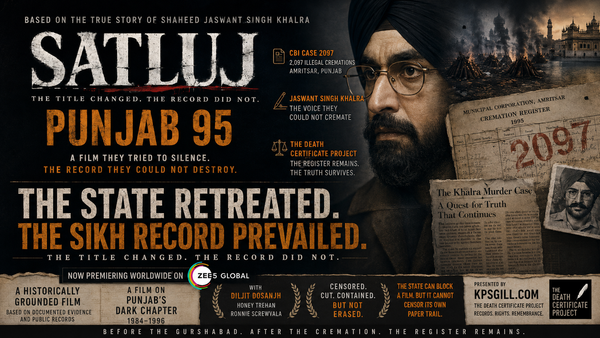
Punjab, 1984–1996, runs the same pattern on a different instrument. The CBI's own investigation, triggered by Jaswant Singh Khalra's documentation and later compelled by Supreme Court oversight, confirmed 2,097 illegal cremations carried out by Punjab's police and civil administration in Amritsar district alone — 585 fully identified, 274 partially identified, 1,238 never identified at all. Human Rights Watch and Physicians for Human Rights' joint 1994 investigation, Dead Silence: The Legacy of Human Rights Abuses in Punjab, documented torture, extrajudicial execution, and enforced disappearance by Punjab police as a systemic practice through the early 1990s, and stated plainly that there was "no indication that the government at the state or federal level has made any effort to investigate these abuses or prosecute the perpetrators, even though the identity of the latter is well-documented." Amnesty International's contemporaneous reporting on custodial practice across India's counterinsurgency-affected states — Punjab named specifically among them — recorded that women, "including young girls, are reportedly frequently raped in detention." And Amnesty's later, more detailed accounting identified the specific legal mechanism that made this pattern durable rather than incidental: Section 197 of the old Code of Criminal Procedure, which required prior sanction from the very government employing an officer before that officer — police or executive magistrate alike — could be prosecuted at all. This is not an accident of drafting. It is a structural shield, and it covered the Deputy Commissioners under whose statutory duty, per Sections 174 and 176 of the same Code, every one of those 2,097 bodies should have received a documented inquest, as completely as it covered the police who delivered the bodies to the cremation ground. Accountability for the entire architecture ultimately ran through one narrow channel: the abduction and murder of Khalra himself, for which the Supreme Court upheld convictions of five police officers in 2011. The civil administrative chain — the DC/DM office this archive has separately and extensively documented across three named tenures in Amritsar District between 1984 and 1996 — was never separately called to account for the statutory duty its own office held.
Graded honestly: the killings, the scale, the commissions' own findings of complicity, the CBI's cremation count, and the Khalra conviction are proved findings, fixed by official record and judicial holding. The extent of custodial sexual violence in both Delhi and Punjab is a documented allegation — serious, sourced to credible investigators, under-adjudicated for reasons the record itself explains. The inference that this pattern — commission, indictment, exoneration, promotion — constitutes the Indian state's characteristic mode of response to violence against Sikhs, rather than a series of unconnected failures, is this essay's own analytical conclusion, offered on a record that a reader is invited to check rather than take on faith.
IV. Why This Record Bears Directly on the Satkar Debate
It might be objected that this is a non sequitur — that the question of who should legislate sacrilege protection for the Guru Granth Sahib in 2026 has nothing to do with the conduct of a different generation of officials toward Sikh bodies between 1984 and 1996. This essay's own forensic method exists precisely to reject that objection, because it is the same method the Satkar debate itself depends on: an evaluation of institutional trustworthiness through the specific mechanics of who supervised, who was obligated to act, who did not, and who was held to account for it.
Satkar, at its narrowest, is a question about whether a State can be trusted to protect what it is asked to protect, and to define what it is asked not to define. The record above answers a closely related question directly: whether the same administrative and legislative apparatus, asked to protect the Panth's own dead through statutory duties already on the books — Sections 174 and 176 of the Code of Criminal Procedure, requiring documented inquest — discharged that duty. It did not, at scale, for years, and the mechanism that allowed it not to (Section 197's sanction requirement) is a structural feature of Indian criminal procedure, not a Punjab-specific or 1984-specific anomaly. A Panth asked to trust a national legislature with the definition of Satkar, on the promise that this time the definition will hold and the protection will be real, is entitled to ask what has changed about the machinery that produced this record — and the honest answer, on the evidence available in July 2026, is: nothing that has yet been tested.
V. Why a National, Religion-Neutral Law Is Not Coming Soon
Sandhu's "return" depends on a second, independent premise: that a strengthened, religion-neutral national sacrilege law is a realistic destination, even if not an immediate one. The record here is shorter but no less instructive.
Punjab's own government, by its own account, considered exactly this path as recently as July 2025 — a draft prescribing life imprisonment for sacrilege against the sacred texts of all major faiths, Sikh, Hindu, Muslim, and Christian alike, referred to a select committee for wider consultation. Less than a year later, in April 2026, the government abandoned that draft entirely and instead amended a 2008 Sikh-specific regulatory statute into the penal Act this whole controversy concerns. A state government could not sustain a religion-neutral draft through its own committee process for even a year. The case that a Union Parliament — accountable to a far more religiously and politically diverse electorate, on a subject considerably more sensitive at the national level than at the state one — will succeed where Punjab's own Assembly did not, is not strong on the evidence of the most recent and most directly comparable attempt.
It is weaker still once the deeper political geology is accounted for. Any national statute reaching into the definition, terminology, or protective architecture around Sikh scripture inevitably brushes against a question India's political class has spent more than fifty years trying not to answer: the relationship between Sikh religious distinctiveness and Sikh political autonomy, running back through the Anandpur Sahib Resolution of 1973 and its demand for greater federal devolution to Punjab. That resolution was, and remains, a document about federalism and Centre-State relations, not secession — but the militancy period and its aftermath fused, in the security establishment's own institutional memory, any assertion of Sikh religious or political distinctiveness with the spectre of Khalistan, a fusion this archive's companion work has separately documented and contested at length. A Parliament operating inside that institutional memory has strong incentive to avoid legislating specifically and visibly on Sikh religious protection at all — not because the protection is undeserved, but because the act of legislating it risks being read, by the same security apparatus, as reopening a settlement it considers closed. Forty-plus years without a religion-neutral national sacrilege law, across governments of every political stripe, is not evidence of oversight. It is evidence of a durable political calculation that the terrain is not worth entering.
VI. The Doctrine Already Available
None of this counsels despair, and none of it requires choosing between Sidhu's steppingstone and Sandhu's return, because both positions share a further, unexamined assumption: that a legislature — any legislature — is the only kind of authority capable of establishing a binding, durable Satkar protocol at all.
This archive's companion essay, "Sevadar, Not Sovereign," already established the doctrinal answer, a full day before Sidhu's citizen's draft existed. Sri Akal Takht Sahib's jurisdiction over Satkar, Maryada, and Sikh religious terminology is not a jurisdiction the Takht borrows from the State and must therefore wait on the State to exercise. It is a jurisdiction traced to Guru Hargobind's Miri-Piri in 1606, exercised continuously — with interruptions honestly acknowledged rather than smoothed over — through the Sarbat Khalsa of the Misl confederacy, tested and upheld against Maharaja Ranjit Singh himself, and recovered through the Gurdwara Reform Movement of 1920–1925. That jurisdiction, as this archive's earlier essay was careful to establish, binds not by territory but by the voluntary, sacramental claim of Sikh identity — which is precisely why it was never bounded by Punjab in the first place, and was never going to be bounded by the borders of India either. A Sikh in Southall, Brampton, Fresno, or Melbourne stands inside that jurisdiction exactly as a Sikh in Amritsar does, for exactly the same doctrinal reason: the obligation runs with the identity claimed, not with the soil stood on.
This has a direct, practical consequence for the present debate that neither Sidhu nor Sandhu has drawn out. A Punjab Act cannot protect a Paawan Saroop in Nanded, Patna Sahib, Delhi, or Toronto. A hypothetical Union Act — even if one somehow overcame the obstacles set out in Part V — would still stop at India's own borders, reaching none of the diaspora gurdwaras where a growing proportion of the Panth's institutional life now resides. A hukamnama issued from the Secretariat of Sri Akal Takht Sahib already reaches all of it, today, without amendment risk, without a Delhi select committee, without waiting on a Parliament that has had forty years and has not moved. The Jathedar does not require legislative permission to issue a single, transnational Panthic protocol — governing terminology, the non-seizure and in-situ documentation standard this archive's audit of Sidhu's Section 9 already worked out in detail, and an SGPC-administered Instigating Group process along the lines Section 5 of the citizen's draft attempted, but issued as Panthic law rather than State law. Such a protocol would bind every SGPC-administered institution and every diaspora gurdwara committee that recognises Akal Takht's authority — which is to say, the overwhelming majority of organised Sikh religious life worldwide — from the day it is issued.
This is not a claim to political sovereignty, and it should not be mistaken for one. It is, precisely, the claim this archive's earlier essay was careful to bound: a voluntary, denominational, Article 26-grounded authority over the Panth's own religious life, exercised by an institution with no claim to govern non-Sikhs, no claim to override any State's criminal jurisdiction over the underlying offence, and no claim to constitutional immunity of any kind. It is also not a new instrument improvised for this controversy. It is the same instrument that issued the one-month ultimatum of 29 June 2026, exercised at a scale that ultimatum did not attempt.
VII. What Survives From Both Positions
Read this way, the exchange between Sidhu and Sandhu is not a dispute to be won. It is two legitimate concerns wrongly addressed to the same body.
Sidhu's concern — that Punjab's crisis is live and cannot wait on a national process that may never arrive — survives fully intact. A repaired Punjab statute, along the lines this archive's audit has already proposed, remains the correct secular punishment layer within Punjab's own territorial competence: criminal liability for the act itself, investigative procedure, sentencing, all properly the business of a State legislature acting within its own constitutional field.
Sandhu's concern — that Satkar itself, the definition of the Guru, the vocabulary of reverence, must never sit inside any legislature's gift — survives fully intact, and is honoured more completely by a Panthic protocol issued this year than by a hope deferred to a Parliament that has not moved in forty. Both positions were right about what they were protecting. Neither had yet located the forum already equipped to protect it, immediately, everywhere the Panth exists, without asking either Chandigarh or Delhi for permission.
VIII. Rebuttal Architecture
A hukamnama has no force under Indian civil law; doesn't this proposal simply substitute a symbolic gesture for an enforceable one? Within a criminal prosecution, yes — a hukamnama cannot itself convict anyone, and the repaired Punjab statute remains necessary for that reason. But Satkar as this whole debate has defined it was never primarily about criminal enforcement; it was about who holds the authority to say what the Guru is, what a Saroop requires, and what vocabulary the Panth is permitted to use — the exact ground Sections 11 and 12 of Sidhu's own draft already concede belongs outside State hands. On that ground, a hukamnama is not a lesser instrument than a statute. It is the instrument this whole controversy has been arguing the State should never have picked up.
Doesn't reliance on the SGPC and Akal Takht simply reproduce the internal-capture risk "Sevadar Codified" already flagged in Section 13? Yes, and that risk does not disappear because the instrument is Panthic rather than statutory — it requires the same structural safeguards proposed there: defined consultation windows, transparent process, protection of the mechanism's function rather than a court-certified assessment of its factional purity. A transnational protocol issued carelessly carries the same capture risk as a badly drafted Section 13. This essay is an argument for the right forum, not an argument that the right forum is immune to the wrong process.
Does an argument built on 1984 and the Punjab counterinsurgency risk feeding the very "Khalistan" securitisation frame this archive has elsewhere worked to dismantle? No, and the distinction is worth stating precisely, because it is easy to blur. This argument does not conclude that Sikhs should seek political autonomy, separate statehood, or exemption from Indian constitutional order. It concludes that a specific, documented institutional record justifies specific, bounded scepticism about entrusting a specific religious question to specific legislative bodies — and that the remedy proposed is a wholly constitutional exercise of Article 26 denominational self-governance, expressly disclaiming any territorial or political sovereignty, precisely as this archive's companion essay disclaimed it a day before this debate began. Distrust of a legislature's good faith on one narrow religious question is not a claim against the constitutional order that legislature sits inside. Conflating the two is the securitisation error, not the correction of it.
IX. Conclusion
Gurjit Singh Sandhu asked the right question and gave it, in good faith, the wrong address. Return, yes — but not to a Parliament with no evident record of readiness for the task, and not by waiting on a steppingstone whose own architect distrusts the ground it is built on. The Panth does not need to choose between an imperfect Punjab statute and a national law that the last forty years give no reason to expect. It needs only to recognise that the authority both men were arguing about already exists, has already been exercised once this year, and was never, on four centuries of its own doctrine, waiting for either of them to finish the argument.
Sourcing note: The account of Operation Blue Star and the November 1984 violence draws on the PUCL-PUDR report "Who Are the Guilty?" (17 November 1984); Human Rights Watch, "India: No Justice for 1984 Anti-Sikh Bloodshed" (29 October 2014); the People's Union for Democratic Rights, "Justice for the Victims of the Anti-Sikh Genocide of 1984" (2020); and government and independent casualty estimates as compiled in standard historiography of the period. The account of Punjab custodial practice 1984–1996 draws on Human Rights Watch/Asia and Physicians for Human Rights, "Dead Silence: The Legacy of Human Rights Abuses in Punjab" (May 1994); Amnesty International, "India: Torture, Rape and Deaths in Custody" (1992) and "Break the Cycle of Impunity and Torture in Punjab" (AI Index: ASA 20/002/2003); and the CBI's confirmed finding of 2,097 illegal cremations in Amritsar district, as previously established in this archive's own body of work. The Section 197 CrPC sanction requirement and its role in shielding police and executive magistrates from prosecution is documented in Amnesty International's 2003 report cited above. The Khalra conviction is reported at the Supreme Court's 2011 affirmance of the trial court's findings. The account of the Substack exchange between K.B.S. Sidhu and Gurjit Singh Sandhu is drawn from the public comment thread beneath "A Citizen's Draft for Punjab's New Sacrilege Law," The KBS Chronicle (2 July 2026). The doctrinal argument in Part VI extends this archive's companion essay, "Sevadar, Not Sovereign" (1 July 2026), and "Sevadar Codified" (2 July 2026).
Related reading
Sevadar Codified — A Forensic-Theological Audit of the Citizen's Draft Punjab Prevention and Deterrence of Sacrilege Act, 2026
Sevadar, Not Sovereign — Miri-Piri, the Misl Precedent, and the Doctrine of Panthic Jurisdiction in the Satkar Act Crisis of 2026
The Global Chilling Effect — Indian State Transnational Repression and the Sikh Diaspora
The Proxy Throne — Institutional Capture of Sri Akal Takht Sahib