JATANA’S GUN AND SIDHU’S PEN

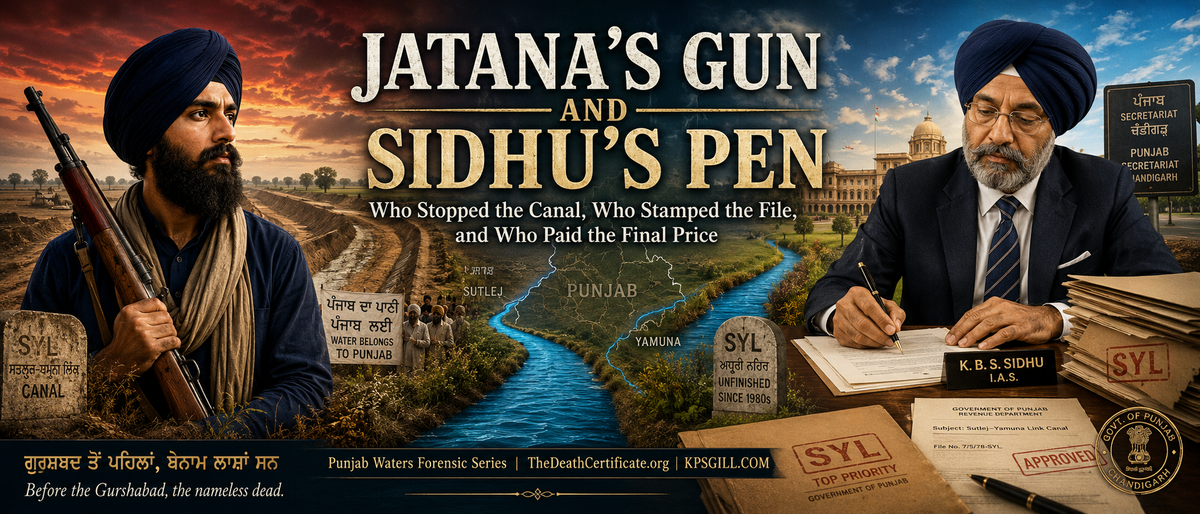
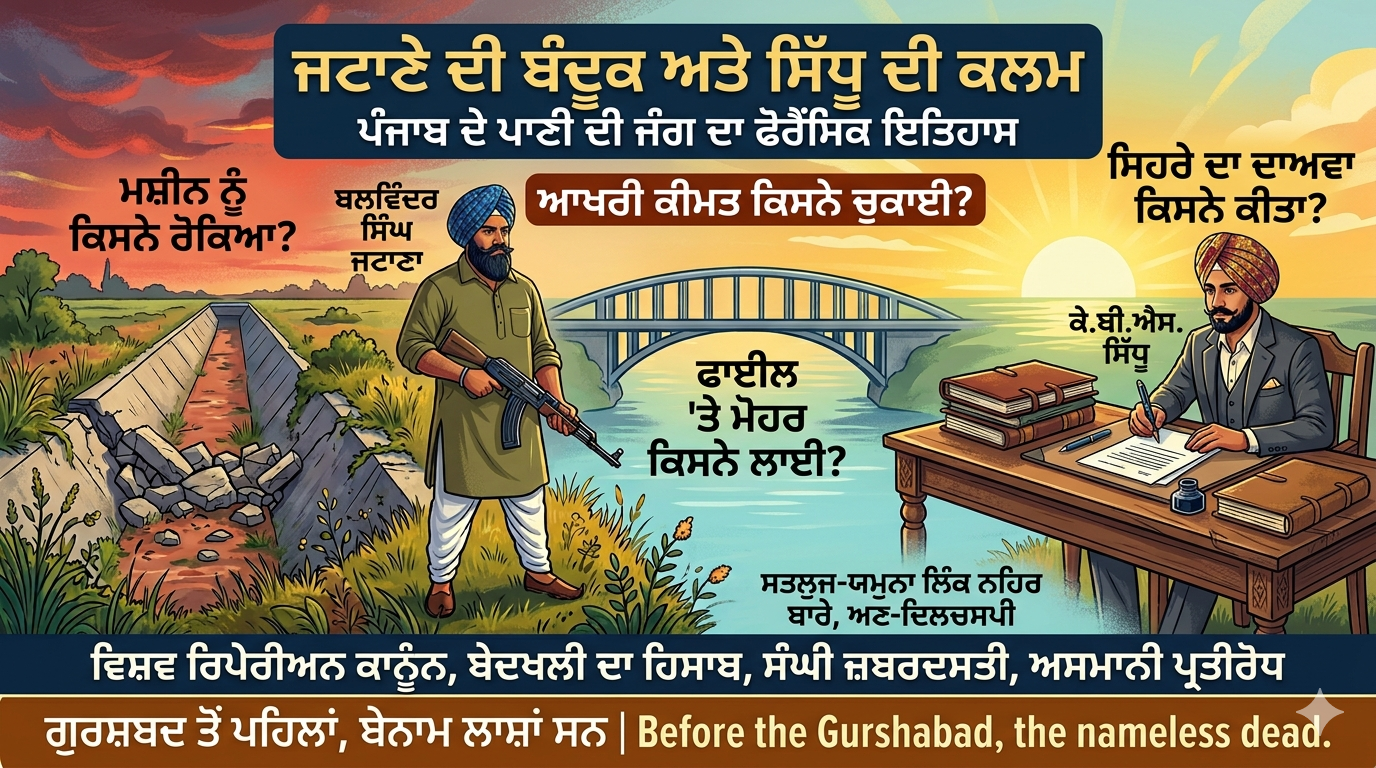
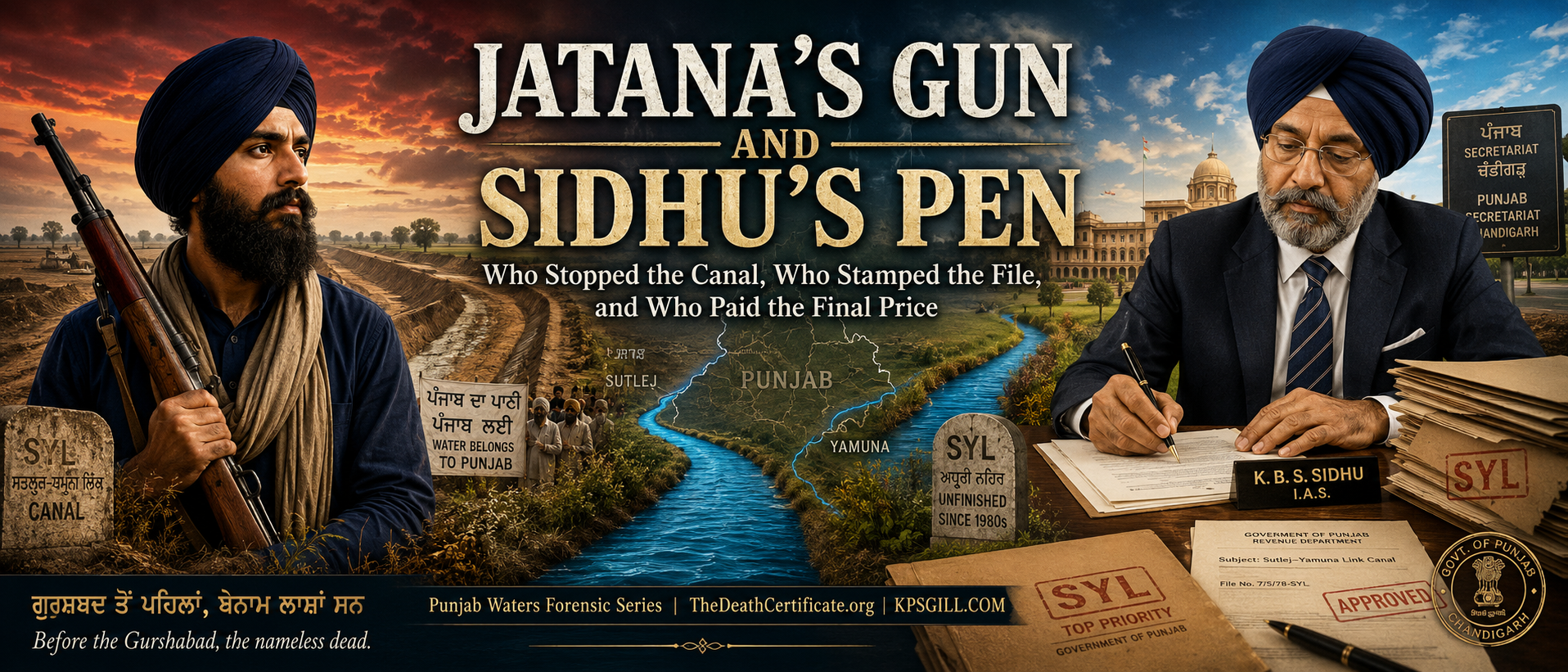
The Forensic World History of Punjab’s Water War — Who Stopped the Canal, Who Stamped the File, and Who Paid the Final Price
A Comprehensive Forensic-Historical Account of the Sutlej–Yamuna Link Canal Dispute: Global Riparian Law, the Arithmetic of Dispossession, Federal Coercion, and the Asymmetric Consequences of Resistance
The history of Punjab’s hydro-political struggle is etched in the irreconcilable chasm between raw grassroots resistance and the sterile paperwork of state authority. At one pole stands Balwinder Singh Jattana of the Babbar Khalsa, whose fatal defiance in 1990 physically ground the construction of the Sutlej–Yamuna Link (SYL) canal to a definitive halt—a radical act of disruption for which he and his family paid the ultimate, tragic price. At the opposing pole sits the sanitized, elite machinery of the state, epitomized by the "pen" of Karan Bir Singh (K.B.S.) Sidhu, IAS, the former Deputy Commissioner of Amritsar, whose administrative signatures routinely navigated, validated, and stamped the official files of governance. This account provides a forensic-historical dissection of these two parallel worlds, examining how global riparian law was weaponized through federal coercion to enforce an arithmetic of dispossession, while exposing the deeply asymmetric consequences borne by those who bled for Punjab's waters versus those who managed the crisis from the corridors of power.
The point of the piece is not that Sidhu did nothing. The point is that he did too little, too late, and now wants too much credit. His pen did not stop the SYL canal; it merely recorded, years later, a reality produced by men who had already paid for it in blood. In that sense, Sidhu’s claim is not administrative memory but reputational appropriation: the bureaucrat arriving after the battlefield, placing his initials on the ruins, and calling it history.
Punjab Waters Forensic Series | The Death Certificate Project
TheDeathCertificate.org | KPSGILL.COM
ਗੁਰਸ਼ਬਦ ਤੋਂ ਪਹਿਲਾਂ, ਬੇਨਾਮ ਲਾਸ਼ਾਂ ਸਨ
Before the Gurshabad, the nameless dead.
Editorial Note
This article is not about water.
It is about what happens when water becomes power, when power becomes arithmetic, when arithmetic becomes decree, and when decree encounters the irreducible resistance of a people who understand, with the clarity that only dispossession produces, that what is being taken from them is not a commodity but a civilizational future.
The Sutlej–Yamuna Link Canal dispute is habitually presented as an administrative question: two states, one river system, one unbuilt canal, a stack of Supreme Court judgments. This framing is the state’s preferred framing, because it keeps the question in the vocabulary of allocation tables and legal dockets, precisely where the human consequences are least visible and the administrative alibis are most portable.
This article refuses that framing.
The SYL Canal dispute is, at its core, a question about who exercises sovereign authority over the natural inheritance of a people — about whether that authority belongs to the people whose rivers they are, or to a federal government that has arrogated to itself the power to redistribute, at will, what nature placed within one jurisdiction and law placed within another. It is also a question about the methods by which that exercise of authority was resisted, the price paid by those who resisted it physically, the credit claimed by those who resisted it administratively, and the profound asymmetry between those two histories.
This article provides the forensic answers. It begins where the question actually begins — in the global crisis of water allocation, in the foundational principles of riparian law, and in the political arithmetic that has governed the misrepresentation of Punjab’s water for more than five decades — before returning to the specific moment in July 1990 when physical interruption became the only instrument that produced any lasting effect. It ends with a clear accounting of two men, two instruments, two families, and the profoundly different consequences of each.
Part I: When Rivers Run Dry — The Global Crisis of Water Allocation
The political economy of water is always, at its foundation, a fiction. Governments allocate rivers on paper at rates that rivers cannot consistently sustain in practice. Treaties are signed on the basis of flow estimates drawn from limited historical data. Tribunals establish “dependable yields” using nineteenth- and twentieth-century hydrological baselines that bear increasingly little resemblance to the physical reality of rivers altered by climate change, glacial retreat, upstream extraction, and agricultural over-commitment. And the paper water — the water that exists in notification and decree — always exceeds the wet water, the water that actually flows.
Fred Pearce’s landmark study When Rivers Run Dry (2006) mapped the scale of this global fiction with a precision that no government preferred to confront. Pearce’s central finding was structurally damning: across every major continent, humanity had committed the natural flows of rivers multiple times over to users whose aggregate demand far exceeded any hydrological reality. The Colorado River, the world’s most litigated watercourse, had been allocated in a 1922 compact based on a particularly wet decade that its twentieth-century negotiators mistook for its permanent character; by the end of the century, states were drawing from the Colorado what the Colorado could not consistently provide, and the river had ceased to reach the sea. The Yellow River in China — historically sacred, agriculturally foundational — ran dry for hundreds of kilometers across the North China Plain, a geological fact converted by administrative euphemism into a “reduced flow.” The Amu Darya and Syr Darya, allocated by Soviet central planners to Central Asian cotton agriculture with the casual confidence of a command economy, had by the close of the Soviet era effectively killed the Aral Sea, once the world’s fourth-largest lake, reducing it to a toxic saline remnant surrounded by pesticide-laden desert. The Nile, the subject of a 1959 Anglo-Egyptian agreement that assigned its flows between Egypt and Sudan without the participation of the nine upstream nations, remained in 2006 — as it remains today — an instrument of Egyptian sovereign anxiety and Ethiopian sovereign assertion, the former defending a treaty that reflects a colonial moment, the latter constructing the Grand Ethiopian Renaissance Dam in unapologetic assertion that no people can be permanently bound by a document signed for them without them.
The common thread across all these rivers is not hydrological. It is political. In every case, water was allocated by institutions that held political power at a particular historical moment, using data that reflected a particular historical baseline, in service of interests that were rarely those of the most affected populations. The agricultural-industrial complex, the federal planning apparatus, the upstream-downstream sovereignty game — these were the real actors in every river dispute. And in every case, the human cost of this allocation was ultimately absorbed by those least able to contest it: the downstream farmers, the displaced communities, the people whose civilizational relationship to a river was not reflected in a treaty clause because those people were not at the table when the treaty was written.
Pearce’s framework is indispensable for understanding Punjab, because Punjab’s water crisis is not a regional aberration. It is a variant of the universal pattern: rivers allocated on the basis of contested arithmetic, through instruments of federal power, at the expense of the territorially proximate population, for the benefit of politically constructed entities whose riparian credentials were always thin.
The Ravi and the Beas are among the rivers that run dry. The Ravi, in particular, has been progressively diminished as a consequence of the upstream-downstream dynamics that Pearce documents. What was once a river of consequence, capable of sustaining civilization, has been reduced in flow by a combination of Himalayan glacial retreat, upstream agricultural extraction, and the diversion structures that the SYL and Bhakra Nangal systems represent. The water that the Ravi-Beas Tribunal processed in 1987 was already, at that time, a figure derived from historical flows that the rivers could no longer reliably reproduce. The water being fought over in the SYL litigation is, in significant part, water that exists primarily on paper.
This is the foundational fact that every court filing, every political speech, every bureaucratic memoir, and every administrative notification has carefully avoided naming.
Part II: The Science of Riparian Law — From the Nile to the Ravi-Beas
The global history of river-water law has produced several competing doctrines, none of which has achieved universal legal supremacy, and all of which have been selectively invoked by states depending on whether they occupied the upstream or downstream position at any given moment. This comparative framework, drawn from international water law, is offered here as analytical architecture — not as controlling authority within India’s constitutional system, which operates under its own inter-state water regime — but as the lens that reveals why the SYL allocation is indefensible by any principled standard of water equity, domestic or international.
The oldest and most aggressive doctrine is the Harmon Doctrine, named for U.S. Attorney General Judson Harmon, who asserted in 1895, in the context of a dispute with Mexico over the Rio Grande, that an upstream state possesses absolute territorial sovereignty over the waters within its borders and may use those waters as it pleases without regard for downstream effects. The Harmon Doctrine was, even in 1895, a statement of raw power rather than principled law, and it has been largely rejected in subsequent international legal development — though it retains the quiet allegiance of upstream states whenever it is convenient.
At the opposite extreme stands the doctrine of absolute territorial integrity, which holds that a downstream state has the right to receive the full natural flow of a river unimpaired by upstream diversion or consumption. This doctrine is equally extreme and equally selective in its application; downstream states invoke it when it serves their purposes, then quietly abandon it when they find themselves in an upstream position on a different watercourse.
The dominant contemporary framework, developed through the UN Convention on the Law of Non-Navigational Uses of International Watercourses (1997) and the International Law Commission’s Articles on the Law of International Watercourses, is the doctrine of equitable and reasonable utilization, qualified by the no-significant-harm principle. Under this framework, states sharing a watercourse must utilize it in an equitable and reasonable manner, taking into account factors that include geographic and hydrological conditions, social and economic needs, existing uses, population dependence on the watercourse, and conservation and sustainability considerations. No single state has an absolute claim; but every state has a right to a share proportionate to its legitimate needs, geographic relationship to the watercourse, and existing use patterns.
The critical analytical fact for Punjab is this: under every serious contemporary formulation of riparian law and equitable allocation, geographic relationship to the watercourse — the question of whether you are, in fact, a riparian state — is among the foundational criteria for establishing a claim. A state that shares no geographic boundary with a river, through whose territory the river does not flow, and whose population did not historically depend on that river’s flow, occupies a fundamentally weaker position in any equitable allocation framework.
Haryana is not a riparian state for the Ravi and the Beas.
This is not a political assertion. It is a geographic fact — and it must be stated with precision. Both rivers rise in Himachal Pradesh. The Ravi flows through Punjab and then crosses into Pakistan; the Beas flows from Himachal Pradesh through Punjab and joins the Sutlej at Harike within Punjab’s territory. Neither river flows through Haryana at any point. Haryana’s agricultural landscape was not developed in historical relationship to the Ravi and the Beas; it developed in relationship to the Yamuna and the Western Yamuna Canal system. Haryana’s population centers, groundwater systems, and agricultural traditions are Yamuna-basin phenomena. Haryana’s claim to Ravi-Beas water is therefore not a riparian claim. It is a succession claim — a claim derived entirely from the argument that because Haryana was carved from the pre-1966 Punjab, it inherited a share of what the pre-1966 Punjab possessed in rivers that now flow through a neighboring state’s territory.
The succession claim is politically potent. It is analytically thin. And when it is examined against the principles of equitable utilization that govern every sophisticated water allocation framework in the contemporary world, it is foundationally problematic.
The Indus Waters Treaty of 1960 — itself one of the most sophisticated water agreements of the twentieth century, negotiated over nine years with World Bank mediation — illustrates by analogy the geographic logic that should govern the SYL question. Under the Treaty, the three eastern rivers (Ravi, Beas, Sutlej) were allocated to India and the three western rivers (Indus, Jhelum, Chenab) to Pakistan. While the Treaty was a negotiated political compromise between two independent states, and is not a legal precedent binding on Punjab-Haryana allocation under Indian constitutional law, its organizing geographic principle — that rivers are associated primarily with the territory within which they flow and which has historically depended on them — reflects sound riparian reasoning. It is precisely that reasoning which the SYL arrangement abandons: extracting water from rivers within Punjab’s territory and transferring them to a state with no geographic claim to those rivers whatsoever.
Within India’s federal system, this transfer is effected not by principled application of water law but by the exercise of federal legislative authority under Article 262 of the Constitution and Section 78 of the Punjab Reorganisation Act — instruments of central power, not instruments of hydrological equity.
Part III: The Arithmetic of Dispossession — The Numerator and Denominator Problem
Every water allocation calculation involves two essential variables: the total quantity of water available (the denominator) and each claimant’s proportionate share of that total (the numerator). The history of Punjab’s water allocation is, in the most precise technical sense, a history of the systematic manipulation of both variables — producing a calculation whose apparent legitimacy depends entirely on accepting figures that were always disputed, always self-serving, and in many cases physically indefensible.
The Inflated Denominator
The foundational figure embedded in Punjab’s water allocation framework is 17.17 Million Acre Feet per year — the estimated dependable yield of the Ravi-Beas river system drawn from the 1921-1960 historical flow series. This figure was incorporated into the 1981 Tripartite Agreement as the basis from which all allocations were calculated.
The Ravi-Beas Tribunal, which submitted its interim report in January 1987 under the chairmanship of Justice V. Balakrishna Eradi, then inflated this estimate further — to approximately 18.28 MAF — by utilizing a more recent data series covering 1965-1985 and incorporating previously unaccounted usages. The direction of the Eradi Tribunal’s revision is forensically significant: it did not subject the denominator to downward revision in light of increasing extraction, environmental degradation, and early evidence of glacial retreat. It moved it upward, widening the apparent gap between total availability and allocated shares, and in doing so made the allocation appear more generous to Punjab than the 1981 agreement had, while in practice the physical water available was if anything declining.
The river could not honor the ledger.
Punjab’s position, consistently maintained across successive governments, was that both the 17.17 MAF baseline and the Eradi upward revision were overestimates — figures drawn from favorable hydrological periods that did not represent the river system’s actual dependable capacity under conditions of increasing upstream extraction, deforestation, and what were already in the 1980s observable changes in Himalayan snowpack dynamics. Punjab further argued that neither baseline adequately accounted for existing prior appropriations — the water already committed to Punjab’s extensive historic canal network, which had been operating for over a century and which served the established agricultural needs of millions of existing farming families.
These objections were not irrational. They were, in fact, vindicated by subsequent hydrology. The actual annual flows of the Ravi-Beas system have, in many years since 1987, fallen significantly below either figure inscribed in the allocation framework. Glacial retreat in the Himalayan system has accelerated since the late twentieth century; the rivers that depend on glacial meltwater in their summer flows are experiencing both reduced glacier mass and altered flow timing that fundamentally disrupts the historical hydrological record used to construct the allocation figures.
The denominator was inflated at the point of origin and has continued to be undermined by physical reality. All allocations were calculated as fractions of a fictional total.
The Distorted Numerator
Even if the denominator had been correct, the allocation of numerators — the share assigned to each party — was distorted by a series of political interventions that had nothing to do with equitable utilization principles.
Under the 1976 notification issued during the Emergency period by the Indira Gandhi government, Punjab and Haryana were each allocated 3.5 MAF — equal shares, despite the fact that one party was a riparian state and the other was not. The equality of the allocation masked a profound inequality of entitlement. Haryana’s claim to 3.5 MAF from rivers it does not touch was not the product of any principled analysis of comparative need, historical use, geographic relationship, or agricultural dependency. It was the product of political calculation: the Congress government’s need to manage the emerging political tensions between Punjab and Haryana in the aftermath of the 1966 reorganization.
The 1981 tripartite agreement, signed by Darbara Singh’s Congress government in Punjab, revised the figures: Punjab to 4.22 MAF, Haryana to 3.5 MAF, Rajasthan to 8.6 MAF, Delhi to 0.2 MAF, and Jammu and Kashmir to 0.65 MAF. The aggregate of the allocated water — 17.17 MAF — consumed the entire 1981 flow-series estimate down to the last decimal. There was no genuine surplus. The denominator had been sized precisely to accommodate the political allocations demanded, and the allocations were then presented as the equitable distribution of a calculable resource. The two figures were not independently derived; they were jointly constructed to produce the appearance of mathematical balance over a political fait accompli. The allocation of Rajasthan’s enormous share of 8.6 MAF from a river system that does not flow within Rajasthan’s territory was another exercise in the same political arithmetic: rivers were being allocated not to the states in whose territory they flow, but to states that had the political leverage to claim them.
The numerator assigned to Punjab — 4.22 MAF — was further distorted by the failure to account for existing use. Punjab’s extensive historic canal system, much of it dating to British colonial-era construction, was already utilizing substantial portions of the Ravi-Beas flow for established agricultural purposes. The “allocation” of 4.22 MAF was not the assignment of new water to Punjab; it was, in many respects, a retrospective designation of water Punjab was already using, recast as a formal “share” so that the surplus could be declared and then removed. Punjab was given a numerator that represented water it already depended on, then asked to build a canal to divert another state’s share of that same water away from its own territory.
The combined effect of the inflated denominator and the distorted numerator is a water allocation structure in which Punjab was assigned rights to rivers within its territorial reach that were simultaneously constrained by the obligation to deliver water to a non-riparian state — on the basis of figures that were always contested, through a process conducted by a central government that treated Punjab’s interest as a variable to be managed rather than a right to be respected.
This is not an allocation. It is a confiscation dressed in the language of equity.
Part IV: The Federal Architecture — 1966, Section 78, Entry 17, Entry 56, and the Federalization of Punjab’s Rivers
The legal instrument that made the SYL possible — that converted what might have been a regional water negotiation into a federal mandate — is Section 78 of the Punjab Reorganisation Act, 1966.
Section 78 provided that the rights and liabilities of the existing State of Punjab in relation to major irrigation and power projects — including the Bhakra Nangal project and the Beas project — would, on and from the appointed day of reorganization, vest in the successor states and the Union in such proportion as might be fixed by agreement or, in default of agreement, by order of the Central Government.
The operational phrase is “in default of agreement, by order of the Central Government.”
This clause federalized the apportionment of Punjab’s project-linked water and power rights. It converted what would otherwise have been a negotiation between successor states within India’s federal structure — governed by principles of equitable utilization and subject to the mediating authority of an independent tribunal — into a process in which the Central Government acted simultaneously as mediator, adjudicator, and political beneficiary of the outcome. Section 78 did not literally nationalize the Ravi and Beas rivers — Punjab itself argued in the 2002 Supreme Court litigation that Section 78 did not expressly reach the Ravi — but its practical effect was more consequential than nationalization: it gave the Union a decisive, potentially unilateral role in determining how project-based water rights would be distributed among states whose governments could not agree. The Central Government’s interest in keeping Haryana — a politically critical state for Congress arithmetic — satisfied was not incidental to the allocation process. It was structurally embedded in it.
But the constitutional architecture that enabled Section 78’s operation runs deeper than the Reorganisation Act alone. Entry 17 of the State List (List II of the Seventh Schedule) assigns states comprehensive control over water: water supplies, irrigation, canals, drainage, embankments, water storage, and waterpower. Taken alone, Entry 17 would support Punjab’s claim to sovereign management of the Ravi and Beas within its territory. But Entry 56 of the Union List (List I) grants Parliament authority to regulate and develop inter-state rivers and river valleys to the extent Parliament by law declares such regulation and development to be expedient in the public interest. Parliament passed the Inter-State River Water Disputes Act, 1956 on precisely this basis. New Delhi did not merely exercise raw executive power; it exploited a structural ambiguity embedded in the Constitution itself — using Entry 56 to systematically hollow out Entry 17, converting Punjab’s guaranteed state-list water rights into a residual entitlement subject to perpetual federal override whenever two states shared a river system. The constitutional trap was sprung not by brute force but by legal architecture. Punjab was invited to assert the sovereignty that the Constitution appeared to guarantee it, and then found that the Union List had already quietly occupied the relevant ground.
The Bhakra Nangal Dam on the Sutlej — perhaps the most consequential water infrastructure project in independent India’s history, built with the displacement of thousands of Punjabi and Pahari families, bearing its full environmental and social costs in the territories of Punjab and Himachal Pradesh — provides the clearest illustration of how this federal architecture operated in practice. Punjab and Himachal Pradesh absorbed the displacement and the environmental consequences. Haryana and Rajasthan drew the water and the hydroelectric power. The federal allocation machinery ensured that those who paid the cost were separated, administratively and politically, from those who received the benefit.
What Punjab was entitled to do, had the constitutional balance been more equitable, was to negotiate its water position from a baseline of genuine territorial stake: these rivers flow through my territory; their primary utilization is committed to my existing agricultural users; any genuinely calculable surplus, after accounting for existing use and appropriate environmental flows, might be available for negotiation on a truly reciprocal basis. This is what any state with rivers flowing through it would assert as its baseline position.
What Punjab was required to do, under the architecture of Section 78 and the Entry 56 override, was to participate in a managed adjudication whose outcome was effectively predetermined by the federal government’s political priorities. What could not be controlled by legal order or tribunal finding was the physical interruption of construction on the ground.
Part V: Badal’s 1978 Documentary Trail — The First Great Betrayal
Against this background of federal architecture, what makes Prakash Singh Badal’s role in the SYL history so forensically significant is not that he faced an unfavorable legal environment — he did, and so did everyone else in that position. What makes it significant is that he converted a position of resistance, however circumscribed, into a position of active cooperation, and in doing so created the documentary record that would subsequently be used against Punjab in every major legal and political forum.
On 20 February 1978, the Parkash Singh Badal government — then serving its first term as Chief Minister, heading a Shiromani Akali Dal government that had come to power partly on the strength of its Panthic credentials and its opposition to Emergency-era Congress policies — issued land acquisition notifications bearing the numbers 113/5/SYL and 121/5/SYL under Section 4 of the Land Acquisition Act. The notifications initiated the formal acquisition of land in Punjab for the SYL corridor.
On 4 July 1978, Punjab demanded ₹3 crore from Haryana as reimbursement for land acquisition costs. The demand was not a refusal; it was a commercial transaction. Punjab was billing Haryana for the cost of dispossessing its own farmers to build a canal that would carry water from Punjab’s rivers into Haryana’s territory.
In March 1979, the Badal government accepted Haryana’s first instalment payment.
This sequence — notification, demand, acceptance of payment — is the documentary foundation of Haryana’s claim that Punjab voluntarily and commercially participated in SYL’s implementation. It is the evidence that subsequent Punjab governments were unable to overcome in any court or tribunal, because it reflected not compelled compliance under immediate duress but voluntary administrative execution. Badal did not merely acquiesce; he invoiced.
The forensic significance cannot be overstated. Every subsequent Punjab government’s legal position was weakened not only by the federal architecture of Section 78 but by the documented acquisition-and-payment sequence of 1978-79. Haryana’s lawyers did not need to construct an argument for Punjab’s consent. They could point to Punjab’s own files: the notifications issued by Punjab’s own government, the payment demanded by Punjab’s own Chief Minister, and the money accepted by Punjab’s own treasury.
The Badal dynasty subsequently spent decades performing resistance to the canal that its founding government helped implement. The political incoherence of this posture — claiming to be Punjab’s defender while having generated the very documentary trail that made defense impossible — is one of the defining contradictions of post-1966 Punjabi politics.
What Badal could have done, and chose not to do, was refuse. Refuse the land acquisition. Refuse the Haryana payment. Accept the consequences of non-cooperation, which would have been legally chaotic and politically costly, but which would have denied Haryana the crucial evidence of Punjab’s voluntary participation. The Akali Dal government of 1977-80, coming to power after the Emergency with strong popular legitimacy and the rhetoric of Punjabi rights, was in a position to make that choice. It made the other one.
Part VI: The 1981 Agreement — The Congress Seal on Punjab’s Diminishment
If Badal’s 1978 actions created the documentary foundation of Punjab’s legal vulnerability, the December 31, 1981 tripartite agreement sealed it.
Signed under Prime Minister Indira Gandhi’s direct supervision, and agreed to by Darbara Singh’s Congress government in Punjab, the 1981 agreement formalized the allocation that the 1976 Emergency-era notification had initiated. Punjab was assigned 4.22 MAF; Haryana received 3.5 MAF; Rajasthan received 8.6 MAF. The SYL canal was identified as the physical instrument through which Haryana’s share would be delivered.
The political context of the 1981 agreement is essential to its forensic assessment. Punjab in 1981 was at the height of the Akali Dal agitation for the Anandpur Sahib Resolution — for the devolution of central powers to states, for greater regional autonomy, for recognition of Punjabi political identity within a more equitable federal architecture. The Congress government in New Delhi was simultaneously engaged in negotiations with the Akali Dal, managing the growing prominence of Sant Jarnail Singh Bhindranwale as a political factor, and seeking to contain what it perceived as the destabilization of Punjab’s political environment.
Darbara Singh’s decision to sign the 1981 agreement was not a neutral administrative act. It was a political act of alignment with New Delhi’s priorities at the expense of Punjab’s medium-term interests. The Congress government in Punjab chose accommodation with the federal center over the defense of Punjab’s water position, and in doing so handed subsequent Punjab governments — including subsequent Akali governments — a fait accompli that could not be easily undone.
The 1981 agreement is the document that the Supreme Court repeatedly treated as a binding tripartite commitment in all subsequent litigation. It is the document that formed the basis of the 2002 mandatory direction to complete SYL construction. It is the document that Punjab’s 2004 Termination Act attempted to void — and the attempt to void it that the Supreme Court held to be unconstitutional in its 2016 advisory opinion.
Punjab signed its rivers into diminishment on December 31, 1981. The instrument was a political compromise. The consequences lasted for decades. The architects of that compromise served their political careers with considerable comfort; the people of Punjab absorbed the consequence.
Part VII: The Supreme Court’s Paradox — 2002 Mandatory Direction, 2004 Legislative Withdrawal, 2016 Constitutional Finding
By the time the SYL dispute reached the Supreme Court in sustained, serious litigation, it had accumulated a legal record that no subsequent government could cleanly escape.
In State of Haryana v. State of Punjab (2002, 2 SCC 507), the Supreme Court issued a mandatory direction to the Government of Punjab to complete the construction of the SYL Canal within its territory within one year — by September 2003. The Court’s majority opinion recorded, as part of the factual background that justified the direction, that Punjab had agreed to the canal, had participated in its initial implementation, and had failed to complete it not on principled grounds of revised water-rights analysis but because construction had been physically stopped — the Court’s own narrative noted that Punjab’s position included the stoppage of construction following the killing of a Chief Engineer and a Superintending Engineer. The Court treated this as a failure to comply with a legal obligation, not as a legitimate exercise of state authority.
This characterization — the physical interruption of construction as a “failure to comply” — is the Supreme Court’s own implicit acknowledgment that the only effective resistance to the canal had been extra-legal. The Court was aware that legal processes had not stopped SYL, could not have stopped SYL, and had not been designed to stop SYL. The Court’s direction was, in effect, an instruction to resume what had already been physically terminated. Punjab could not comply. Not because of legal incapacity, but because the political and physical environment made compliance impossible in any real sense.
In 2004, Captain Amarinder Singh’s government enacted the Punjab Termination of Agreements Act, which purported to terminate the 1981 water-sharing agreement and withdraw all pending cases from the Supreme Court. This was an extraordinary legislative move — a state assembly attempting to nullify a Supreme Court decree and terminate its own government’s prior binding commitment through retrospective legislation.
The Presidential Reference that followed — Reference No. 1 of 2004 — asked the Supreme Court whether the Termination Act was constitutionally valid. The Court’s 2016 advisory opinion was unambiguous: the Act was unconstitutional. A state legislature could not, through ordinary legislation, nullify a Supreme Court decree, terminate the judicial exercise of the court’s adjudicative functions, or override a tripartite agreement whose legal consequences were already the subject of pending judicial proceedings. The attempt to withdraw the case from the Supreme Court was itself found to be a violation of the separation of powers and an impermissible interference with the exercise of judicial authority.
This constitutional finding closed Punjab’s legislative exit from the SYL obligation. What remained was the administrative option that K.B.S. Sidhu (Karanbir Singh Sidhu IAS) subsequently exercised — and the physical fact that Balwinder Singh Jatana had established twenty-six years earlier.
Part VIII: 23 July 1990 — The Physical Rupture That Ended Construction
On 23 July 1990, M.L. Sekhri, the Chief Engineer of the SYL project, and Avtar Singh Aulakh, its Superintending Engineer, were killed. Public reporting attributed the act to a unit led by Balwinder Singh Jatana.
The immediate consequence was the cessation of construction.
Not a slowing. Not a pause pending review. A cessation.
The Supreme Court’s own litigation record, in its 2002 decision, noted that the State of Punjab’s own account of the construction stoppage cited the killing of the engineers as the event that ended construction activity on the Punjab stretch of the canal. This is a remarkable feature of the legal record: the court that was directing Punjab to complete the canal was simultaneously receiving, from Punjab itself, an explanation that the canal had been stopped not by legal maneuver, not by governmental policy, and not by any instrument available within the framework of law, but by an act that operated entirely outside that framework.
Every legal instrument had failed before July 1990. The Ravi-Beas Tribunal had found against Punjab’s water-surplus arguments. The 1981 agreement had bound Punjab contractually. The central government had backed Haryana’s claims with the full weight of federal authority. The courts had been available as forums, but the legal architecture — built on Section 78, on the tripartite agreement, on the Eradi report — did not favor Punjab’s position. Petitions, protests, and political agitation had generated noise without effect. The canal had been advancing.
The July 23, 1990 killings were the immediate physical rupture after which construction stopped and never resumed.
This is a forensic observation, not a moral one. The forensic record insists that this be stated clearly, because the alternative — the pretense that the canal was stopped by administrative cleverness, political pressure, or legal imagination — is contradicted by the documented chronology. Before July 1990, SYL existed as an active construction project. After July 1990, it became a stalled, litigated, guarded, and symbolically radioactive trench in Punjab’s soil. The Supreme Court’s own litigation narrative records the transition. Punjab’s own government explained it to the court. The before-and-after is the most elementary definition of causal efficacy: what was happening, and what ended, and what ended it.
Jatana’s action created a physical fact. Physical facts have a permanence that legal maneuvers do not.
Twenty-six years of legal and political resistance had not stopped the physical advance of the canal. The July 1990 killings did.
Part IX: The State’s Answer — The Annihilation of the Jatana Family, 31 August 1991
The Punjab counterinsurgency state had a characteristic response to the problem of an armed opponent it could not immediately capture: it liquidated the kinship network around him.
On 31 August 1991, members of Balwinder Singh Jatana’s family were killed at their residence in village Jatana, Rupnagar. Documentation compiled by the human rights organization Ensaaf — which applied systematic methodology to victim identification in the Punjab counterinsurgency period — records the killing of Manpreet Kaur, a 13-year-old student, non-combatant, and Kesdhari Sikh, alongside three other family members including an elderly grandmother and a disabled relative. Ensaaf’s records state that she was killed because her cousin was a wanted militant and the family’s home was the target of collective reprisal. Ensaaf implicates Chandigarh security forces, the state-sponsored “black cat” militia operative Ajit Singh Poohla, and SSP Sumedh Singh Saini in what it documents as an extrajudicial execution.
Manpreet Kaur was thirteen years old. She was a student. She had no role in any armed activity. She had no involvement in any political organization. She was killed because she was a family member of a man the state wished to punish.
The choice of target tells us everything about the architecture of the Punjab counterinsurgency state. The state did not merely pursue suspected militants through criminal process — a process that might have been visible, arguable, and subject to some minimal procedural accountability. It deployed a parallel machinery of collective punishment: identify the family, enter the home, kill the members, and in doing so communicate to every other family in Punjab that biological relationship to a wanted man is itself a capital offense.
This machinery — the black cat operations, the death squads, the state-sponsored informant militias — was not the creation of any single officer or any single incident. It was a systematic, institutionalized instrument of the Punjab counterinsurgency state during the period documented most extensively in the CBI’s own findings: the 2,097 illegal cremations, 585 identified bodies, 1,238 entirely unidentified — the forensic record of what the state did to the bodies it produced and then burned to remove the evidence of how those bodies had been produced.
The killing of the Jatana family — Manpreet Kaur among them — is not a footnote to the SYL story. It is the state’s signature on the SYL story. The canal was being defended by a state apparatus that treated Punjabi bodies as expendable administrative inputs. Water rights and the right to life were being adjudicated by the same institutional complex, using the same logic: extract, deny, suppress, and call the result “law and order.”
The Jatana family did not receive a notice of involvement. They did not receive a summons. They did not receive an opportunity to testify before a tribunal. They received, instead, the Punjab counterinsurgency state’s preferred instrument of communication with families it wished to punish: armed men at the door.
Part X: K.B.S. Sidhu’s Pen — The Executive Bypass and the Revenue Punctuation
Twenty-six years after Balwinder Singh Jatana created a physical fact, K.B.S. Sidhu created a legal annotation.
To understand the November 2016 executive action properly, it must be placed within the fuller timeline of the Badal government’s attempted resistance during that critical year. In March 2016, the Punjab Legislative Assembly had passed the Punjab Sutlej-Yamuna Link Canal Land (Transfer of Proprietary Rights) Bill, which would have transferred proprietary rights in the acquired SYL land back to original landowners through legislative authority. The bill went to the Governor for assent. The Governor delayed. The Supreme Court, alerted to the maneuver, ordered a status quo. The legislative route was blocked.
When the Supreme Court’s adverse advisory opinion arrived on 10 November 2016 — confirming that Punjab’s 2004 Termination Act was unconstitutional — the Badal government was in crisis. Already catastrophically weakened by the Guru Granth Sahib sacrilege crisis, the Behbal Kalan police shootings, sustained drug allegations, and the accumulated moral collapse of a political formation that had by then exhausted whatever legitimate authority it once possessed, it required a dramatic demonstration of Punjab-rights action that it could carry into the approaching 2017 Assembly elections. The legislative window had been closed by the Governor’s delay and the Supreme Court’s status quo order. What remained was the revenue window.
Sidhu, serving as Financial Commissioner Revenue, identified a route through the revenue machinery: treat the acquired SYL land as government land no longer serving its original designated public purpose, issue a revenue notification transferring it back to original landowners, and instruct the Deputy Commissioners to alter the field mutations accordingly. The notification was drafted, signed by Irrigation Secretary Kahan Singh Pannu, and gazetted on 16 November 2016 — a single day. 4,627 of the 5,376 acquired acres were formally returned. Mutations were entered into Patwari records.
Sidhu subsequently described this maneuver, in his own writing, as a “master stroke.” He acknowledged that senior legal advisors were terrified of contempt of court proceedings, that the atmosphere was charged, and that the operation was conducted with deliberate speed precisely to create facts on the ground before any court could intervene.
This is a description of administrative ingenuity operating under significant political pressure. It is not a description of strategic heroism. The risks Sidhu confronted were legal and professional: contempt of court, career consequences, political fallout if the maneuver miscarried. These are not trivial risks within the context of a civil servant’s career calculus. But they are not the risks that a man faces when the state is actively hunting him and his family has been identified as a target for collective punishment.
The 2016 maneuver created a legal annotation to a physical fact that already existed. The canal was already stopped. The land was already overgrown. Construction had already been terminated twenty-six years earlier. The SYL corridor was already a dead zone in Punjab’s political geography. Sidhu’s revenue notification did not create that reality; it attempted to convert it into a formal land-record entry before Haryana could obtain an injunction. It may have complicated Haryana’s ability to restore the canal corridor. It may have created additional legal difficulties for any future government attempting to resume construction. These are genuine, secondary contributions to Punjab’s water-rights position.
The distinction between creating a physical fact and annotating it matters enormously for any honest accounting of historical credit.
Part XI: The Comparative Reckoning — The Gun and the Pen
The comparison between Balwinder Singh Jatana’s action and K.B.S. Sidhu’s action is not a comparison between violence and legality, though it is that. It is not a comparison between the unauthorized and the authorized, though it is that. At its deepest level, it is a comparison between primary causation and secondary annotation — between the act that changed what was physically happening and the act that tried to describe what had already happened.
In July 1990, SYL construction was actively proceeding in Punjab. After July 1990, it was not. That before-and-after is the most elementary definition of causal efficacy: what was, what changed, and what changed it. The record is unambiguous. The Supreme Court’s own litigation narrative records it. The reporters who covered the SYL timeline recorded it. Punjab’s own government acknowledged it to the courts. The July 1990 killings were the first full stop in the only sense that the phrase “full stop” can meaningfully carry: the point at which the forward movement of the project permanently ceased.
Sidhu’s action in 2016 was not a full stop. It was a notarial entry made in the margin of a document that had already been effectively terminated. It may have complicated Haryana’s practical ability to restore the canal corridor. It may have created additional legal difficulties for any future government attempting to resume construction. These are genuine, if secondary, contributions to Punjab’s water-rights position. They should be credited accurately — which means credited as secondary contributions, not as the act that stopped the canal.
The difference in the nature of the two actions is reflected precisely in the state’s differential response to them.
The state’s response to Jatana was annihilatory: sustained pursuit, black-cat deployment, the killing of his family members including a 13-year-old girl, collective punishment of his kinship network, and the full mobilization of the Punjab counterinsurgency apparatus’s most lawless instruments. The state treated Jatana as an existential threat — because his action was existentially effective.
The state’s response to Sidhu was occupational: he continued to serve in his IAS posting, received subsequent postings, retired with his administrative career intact, and subsequently became the author of a prolific personal archive of administrative memoirs on Substack, YouTube, and other platforms, writing accounts of his own career with the confidence of a man whose professional identity was never at any point in danger of being physically liquidated.
The asymmetry of state response is the most reliable evidence of the asymmetry of threat. States do not annihilate families in response to administrative notations. They annihilate families in response to effective physical resistance. The Punjab counterinsurgency state’s treatment of the Jatana family, and its accommodation of K.B.S. Sidhu’s career, is the state’s own implicit ranking of which man’s action it genuinely feared.
Part XII: Two Families, Two Fates — The Price of Courage and the Comfort of Cleverness
The personal and familial consequence of Balwinder Singh Jatana’s action is inscribed in the Ensaaf documentation that records what happened to his family on 31 August 1991. Manpreet Kaur, thirteen years old, was killed in her home in village Jatana, Rupnagar. An elderly grandmother was killed. A disabled relative was killed. The home that contained them was entered by armed men operating under state authorization, and what was within it was destroyed. There was no trial. There was no notification. There was no legal process of any kind. There was only the state’s operational logic: when the wanted body is unavailable, the bodies that surround it become the penalty.
Jatana himself became hunted — a man living in a state that had demonstrated, at his family’s front door, that it recognized no limit in what it was willing to do to those associated with him. The Ensaaf record is his family’s death certificate, written in the register of the Punjab counterinsurgency state’s deepest institutional practices.
The consequence for K.B.S. Sidhu was a career trajectory of the kind that the Indian state reserves for officials whose actions remain within the framework of institutional loyalty. Sidhu served out his full career as an IAS officer of Punjab cadre, occupying senior postings including the position of Financial Commissioner Revenue. He retired with his administrative reputation intact. The state bore him no consequence, because the state does not punish officials for filing revenue notifications, even dramatic ones, and does not kill the families of officers who administer land-record mutations. Sidhu subsequently became an active chronicler of his own career on digital publishing platforms — Substack newsletters, video accounts of administrative episodes, published recollections of the SYL de-notification — a comfortable post-retirement archive of a man who lived out his professional career in its entirety, narrated it in his own words, and chose the register in which it would be remembered. The administrative memoir is the genre of those whose actions did not result in their families being killed.
The contrast between these two biographical trajectories is not incidental to the SYL story. It is the SYL story’s most revealing chapter. What the Punjab counterinsurgency state did to the Jatana family — and what it did not do to Sidhu — reflects, with merciless precision, the state’s own assessment of which man’s action was genuinely dangerous to its interests. States do not kill the families of officials who file administrative notifications. They kill the families of people who stop canals.
The historical record must sit with this asymmetry for long enough to feel its full weight.
Part XIII: The SGPC Recognition and the State’s Anxiety
When the SGPC installed Balwinder Singh Jatana’s portrait in the Central Sikh Museum at the Golden Temple complex in 2022, following the posthumous release of Sidhu Moosewala’s song “SYL,” the political backlash from the Indian government and from Haryana was immediate and intense. The installation was condemned. Demands were made for its removal. The song was restricted on YouTube in India. The episode became a fresh iteration of the state’s perennial anxiety about Sikh memory.
The state’s anxiety is intelligible only in the context of the causation analysis above. If Jatana were merely a historical curiosity — a peripheral actor in a primarily administrative and legal dispute — his portrait in a museum would present no particular threat to any political interest. The Indian state has generally shown considerable tolerance for the ambiguities of historical commemoration when the commemorated figure presents no active challenge to dominant narratives.
The state’s visceral response to Jatana’s commemoration reflects its recognition of precisely the causation argument this article is making: that the July 1990 killings were the effective physical rupture in the SYL dispute, and that commemorating Jatana as a historical figure is an implicit claim that what the state could not accomplish through a decade of legal and political process, and what no administrative official accomplished through administrative maneuver, was accomplished by an act outside all of those frameworks. This claim — grounded in the documented chronology as it is — is incompatible with the state’s preferred narrative that administrative process is the legitimate and sufficient framework for resolving water disputes.
The state must deny Jatana’s causal role precisely because acknowledging it would be an acknowledgment that the state’s own legal architecture was insufficient to protect Punjab’s interests, that the effective interruption came from outside that architecture, and that the families who paid the price — including Manpreet Kaur, thirteen years old, killed in her home — were destroyed by a state that simultaneously claimed to be the legitimate arbiter of Punjab’s water rights.
Part XIV: The Yamuna Reciprocity Argument — If Haryana Wants, Haryana Must Give
The most intellectually rigorous challenge to Haryana’s SYL claim has been systematically avoided by every party to the dispute — including Punjab’s governments, which have consistently preferred the posture of reluctant compliance or dramatic resistance to the posture of principled counter-claim.
The principled counter-claim runs as follows.
Haryana’s claim to Ravi-Beas waters rests on one of two possible foundations: either the succession-asset argument (Haryana, as a successor state to pre-1966 Punjab, inherited a share of what pre-1966 Punjab possessed in the Ravi-Beas basin, treating water as an undivided asset of the joint state) or the equitable-needs argument (Haryana, as an agricultural state with genuine water needs, is entitled to a share of the regional water resource regardless of riparian geography).
Haryana’s legal team successfully argued in court that water was an undivided asset of the joint state of Punjab under the 1966 Reorganisation Act, rather than a geographically bound resource of whichever successor state the river happened to flow through. This argument carried weight because of the infrastructure reality: the Western Yamuna Canal and associated irrigation works had long been integrated into the combined irrigation framework of the pre-1966 state, making clean geographic severance impractical. But the same argument, applied with equal consistency, generates a reciprocal claim that Haryana has never been willing to acknowledge.
If water is an undivided asset of the former joint state: pre-1966 Punjab possessed not only the Ravi and Beas in what is now Punjab, but also access to the Yamuna and the Western Yamuna Canal system in what is now Haryana. If Haryana’s status as successor to pre-1966 Punjab gives it a claim to water from the Ravi-Beas system — rivers that do not flow through Haryana — then Punjab’s status as the same successor-state partition gives it an equally valid claim to water from the Yamuna system — a river that flows through Haryana’s territory. The undivided-asset argument cannot be applied to the Ravi and Beas alone. Either all the water of the former united Punjab is an undivided asset to be shared among all successors — including the Yamuna — or none of it is, and geographic position governs.
Haryana’s federal advocates accepted the undivided-asset frame for Ravi-Beas precisely because the Yamuna’s infrastructure was already housed within Haryana’s new boundaries. They then argued, implicitly, that the Yamuna infrastructure belonged to Haryana by virtue of territorial succession while the Ravi-Beas water belonged to all successors by virtue of the undivided-asset principle. The two halves of this argument are irreconcilable. Haryana cannot be the territorial inheritor of one river’s infrastructure while being the succession-share beneficiary of another river’s water. The selection is not principled. It is political.
The Yamuna reciprocity argument is not currently a live legal claim before any tribunal. It is a principle that should be — but has not been — at the center of Punjab’s political discourse about the SYL. Its absence from that discourse reflects the degree to which Punjab’s political class has accepted the framework of the dispute as defined by the federal authority that designed the framework against Punjab’s interests.
Part XV: The Territorial Trap — Why Pre-1966 Arguments Cannot Be Used Selectively
The argument from the pre-1966 united Punjab is a two-edged sword that Haryana and the Central Government have wielded exclusively from the grip of their choosing, carefully avoiding the edge that faces them.
Haryana’s SYL claim rests on the proposition that its share of Ravi-Beas water is justified by its status as a successor state to pre-1966 Punjab. But Punjab’s post-1966 territory is also a successor to pre-1966 Punjab — a successor that received a smaller territory, lost the districts that became Haryana, and was left without Chandigarh, its historic cultural capital, which was converted into a Union Territory administered by the Centre. If succession to pre-1966 Punjab is the governing principle, the full ledger must be balanced: Punjab lost territory, lost its capital, and then was additionally required to share its rivers.
Punjab cannot meaningfully assert claims to water from the pre-1966 Yamuna basin, because its current geographic and legal identity does not include that territory, and the Yamuna infrastructure was always within what became Haryana. This is entirely correct as a statement of current law and current geography. But the same principle — that a state’s identity is defined by its current geographic boundaries and that claims beyond those boundaries require principled justification — should equally prevent Haryana from claiming water from rivers that flow through Punjab’s current territory and that Haryana’s current geographic identity does not encompass.
What is sauce for the Punjab goose must be sauce for the Haryana gander.
The failure to apply this principle symmetrically is not an oversight. It is the product of the same federal political architecture that managed the SYL allocation from the beginning: an architecture in which the Central Government’s interest was in satisfying Haryana’s water demand, which had powerful agricultural-electoral backing, rather than in principled application of riparian or equitable-allocation law.
Under the geographic-position principle, applied rigorously and symmetrically: Punjab is a Ravi-Beas riparian state. Haryana is a Yamuna riparian state. Neither has a primary geographic claim to the other’s rivers. The SYL transfer has no principled riparian-law foundation that survives symmetric application.
Part XVI: The Climate Emergency and the Disappearing Denominator
Every argument in this article — the riparian law argument, the geographic-succession argument, the equitable-allocation argument, the Yamuna reciprocity argument — is complicated and ultimately rendered more urgent by the physical reality that is now accelerating beyond the pace of any legal or political process: the rivers themselves are diminishing.
Fred Pearce’s observation in When Rivers Run Dry — that the world’s rivers are being allocated multiple times over on the basis of historical flows that no longer reliably obtain — applies with particular force to the Himalayan river system. The Ravi and the Beas, like all Himalayan rivers, depend in their summer flows on a combination of monsoon precipitation and glacial meltwater. The glacial component — which sustains river flow through the pre-monsoon dry season and moderates extreme variability — is in long-term structural decline.
The Himalayan glaciers are retreating at rates that have accelerated significantly since the 1980s. The implications for rivers like the Ravi and Beas are not speculative; they are being observed. The 17.17 MAF figure of the 1981 agreement and the Eradi Tribunal’s 18.28 MAF revision were both grounded in historical flow data from the mid-twentieth century. Both figures are being undermined in real time by the glacial-retreat trend. In the decades since 1987, actual annual flows have in many years fallen significantly short of the allocation baseline, and the direction of the long-term trend is unambiguous.
The SYL dispute is therefore a dispute about the allocation of water that, in the quantities assumed by every allocation framework in the record, may not consistently exist. The numerator — each party’s claimed share — is calculated from a denominator that is itself in structural decline. Both Punjab and Haryana are fighting over water that the physical world is progressively reducing.
This climate dimension is not merely an additional complication to the SYL dispute. It is a radical indictment of the entire allocation framework. The legal architecture — the 1981 agreement, the Eradi Tribunal’s report, the Supreme Court’s mandatory direction — was constructed on the assumption of a stable and quantifiable water supply. That assumption is no longer supportable. The physical water that the legal documents describe is, in important part, the water of a climatic era that is passing.
A genuinely equitable and forward-looking resolution of the SYL dispute would require, at minimum, a reconvening of the hydrological baseline — an honest accounting of what the Ravi-Beas system can actually and sustainably provide under current and projected climatic conditions. That accounting would almost certainly produce a revised denominator smaller than any figure embedded in the current legal architecture. A revised denominator would require revised numerators. And a genuine application of equitable utilization principles to revised numerators — one that accounted for each party’s geographic relationship to the relevant rivers, existing use patterns, agricultural commitments, and available alternative sources — would produce an outcome very different from the one inscribed in the documents currently operative.
Punjab has every incentive to demand that reconvening. The current framework, built on inflated denominators and distorted numerators, was constructed against Punjab’s interests. A hydrologically honest recalculation, conducted under principles of genuine riparian equity rather than federal coercion, would strengthen Punjab’s position and weaken Haryana’s.
Part XVII: The Forensic Architecture — A Summary of Findings
The findings that emerge from this analysis, organized by the evidentiary categories that govern this archive:
[PF] Proved Findings
Neither the Ravi nor the Beas flows through Haryana’s territory at any point. Both rivers rise in Himachal Pradesh; the Ravi flows through Punjab and then into Pakistan, the Beas flows through Punjab and joins the Sutlej at Harike within Punjab’s borders. Haryana is not, by any standard geographic or hydrological definition, a riparian state for the Ravi-Beas system. Haryana’s claim to these waters is a succession-and-allocation claim produced by reorganization, federal order, agreement, tribunal process, and judicial enforcement — not a claim rooted in geographic proximity to the rivers.
On 23 July 1990, M.L. Sekhri, Chief Engineer of the SYL project, and Avtar Singh Aulakh, Superintending Engineer, were killed. Construction of the Punjab portion of the SYL Canal stopped after this event. This stoppage is recorded in public reporting, in the Supreme Court’s 2002 litigation narrative, and in Punjab’s own submissions to that court.
On 31 August 1991, members of Balwinder Singh Jatana’s family were killed in village Jatana, Rupnagar. Ensaaf’s victim documentation records Manpreet Kaur, a 13-year-old student and non-combatant, as among those killed alongside three other family members. Ensaaf’s records implicate Chandigarh security forces, black cat operative Ajit Singh Poohla, and SSP Sumedh Singh Saini.
On 20 February 1978, the Parkash Singh Badal government issued land acquisition notifications 113/5/SYL and 121/5/SYL under Section 4 of the Land Acquisition Act. Punjab subsequently demanded ₹3 crore from Haryana for land acquisition costs and in March 1979 accepted Haryana’s first instalment payment. This documented acquisition-and-payment sequence formed part of the evidentiary basis for Haryana’s claim of Punjab’s voluntary participation in SYL’s implementation.
On 16 November 2016, a revenue notification was gazetted through the office of Financial Commissioner Revenue K.B.S. Sidhu, denotifying 4,627 of the 5,376 acres acquired for the SYL corridor. This action followed the blocking of the Punjab Legislative Assembly’s March 2016 Proprietary Rights Bill by the Governor’s delay and a Supreme Court status quo order. K.B.S. Sidhu has, in his own published accounts, described his role in preparing and executing this executive bypass.
[DA] Documented Allegations
The 17.17 MAF figure embedded in the 1981 allocation framework, and the Eradi Tribunal’s subsequent upward revision to approximately 18.28 MAF, have both been challenged by Punjab as overestimates based on historical flow baselines that do not reflect current and projected climatic conditions. The total allocation under the 1981 agreement — which exactly consumed the 17.17 MAF denominator — left no genuine surplus, suggesting the denominator was sized to accommodate the political allocation rather than derived independently.
The allocation framework governing the SYL dispute was produced through federal political processes that served the Central Government’s interest in managing Haryana as a political constituency rather than through any principled application of equitable-utilization or riparian-law principles.
The Punjab counterinsurgency operations of 1984–1996, of which the Jatana family killing is documented as an instance, were characterized by systematic collective punishment of families associated with suspected militants, often through state-sponsored or state-directed extra-legal execution.
[AI] Analytical Inferences
The state’s annihilatory response to Balwinder Singh Jatana — including the killing of family members documented by Ensaaf — and its occupational accommodation of K.B.S. Sidhu’s career, reflects the state’s own implicit assessment that Jatana’s action was the genuinely effective intervention in the SYL dispute, while Sidhu’s action was a secondary administrative maneuver that did not threaten the state’s fundamental interests.
The Badal dynasty’s 1978 acquisition-and-payment actions created documentary evidence that materially weakened Punjab’s subsequent legal positions in SYL litigation. This consequence was foreseeable and could have been avoided by refusal to implement, at the cost of political confrontation with the Centre.
A principled and symmetric application of Haryana’s succession-asset argument — whether framed as undivided water inheritance or equitable needs — would generate a reciprocal claim by Punjab to a share of Haryana’s Yamuna-basin water resources, a claim that Haryana and the Central Government have consistently declined to acknowledge because the Yamuna’s infrastructure geography made Haryana its territorial inheritor in a way that the allocation framework declined to treat as determinative for the Ravi-Beas.
[PM] Panthic Memory
The SGPC’s installation of Balwinder Singh Jatana’s portrait in the Central Sikh Museum at the Golden Temple complex represents an institutional acknowledgment, by the premier representative body of the Sikh panth, that Jatana’s action is considered by Sikh collective memory to constitute a form of defense of Punjab’s existential interests — water, land, sovereignty — at a time when legal and political instruments had failed to provide any effective defense.
The killing of Manpreet Kaur and other family members of Balwinder Singh Jatana is recorded in Sikh memory as an instance of the Punjab counterinsurgency state’s practice of treating Sikh bodies — including the bodies of children — as instruments of political communication and collective punishment, a practice documented across the CBI’s findings on illegal cremations and Ensaaf’s systematic victim documentation.
Closing: The Canal, the Corpse, and What History Owes the Record
Every state has a file. Every people has a memory. In the SYL dispute, the gap between these two archives is wider than in almost any comparable episode of post-Independence Indian administrative history.
The file says: notification, acquisition, agreement, decree, tribunal finding, mandatory direction, advisory opinion, denotification, mutation, status quo. The file attributes the stoppage of construction to a “failure to comply” with a legal obligation. The file makes no mention of Manpreet Kaur.
Memory says: water, land, dispossession, federal coercion, Badal’s invoice, Darbara Singh’s signature, Jatana’s gun, Manpreet Kaur’s name, burned houses, stopped canal, song, museum, and forty years of unresolved sovereignty.
A forensic archive’s obligation is not to choose between these two registers but to insist that neither be allowed to exist without the other — that the file answer for what it omits, and that memory be organized with enough evidentiary discipline to survive the file’s challenge.
The conclusions of this analysis are clear.
Balwinder Singh Jatana created the first full stop in the SYL sentence. He did so at a moment when no legal instrument had succeeded in stopping anything, in the age of live fire, when his family had no protection from what would follow. His family paid the price that the Punjab counterinsurgency state extracts from those it cannot immediately reach — a price it levied on a 13-year-old girl with no involvement in any armed activity, in a house in village Jatana, on the morning of 31 August 1991.
K.B.S. Sidhu filed a revenue notification in the margin of a sentence that physical events had already stopped. He did so with a pen, in the age of Cabinet meetings and election calendars, bypassing a stalled legislative bill through executive revenue powers, and his career continued and concluded without incident.
The Badal dynasty helped write the sentence in the first place — notified the land, demanded the payment, accepted the money — and then spent three subsequent decades performing its authorship of a resistance it did not originate.
The river continues to diminish. The denominator continues to shrink. The legal architecture continues to bind. And the physical canal corridor continues to lie overgrown and politically radioactive in Punjab’s soil — stopped not by any court’s wisdom, not by any government’s principle, and not by any official’s administrative ingenuity, but by a physical rupture that the state answered by killing a thirteen-year-old girl.
History should know the difference between the man who stopped the machine and the officer who later stamped the file.
History should also know the names of those who paid for each.
ਗੁਰਸ਼ਬਦ ਤੋਂ ਪਹਿਲਾਂ, ਬੇਨਾਮ ਲਾਸ਼ਾਂ ਸਨ
Before the Gurshabad, the nameless dead.
Punjab Waters Forensic Series | Article II
TheDeathCertificate.org | KPSGILL.COM
First Amendment Forensic Accountability Archive
Waheguru Ji Ka Khalsa, Waheguru Ji Ki Fateh