Before the Gurshabad, the Nameless Dead A Formal Forensic Response to the Hindu American Foundation's Khalistan Framing — Issued Following HAF's Failure to Answer the Open Letter of June 23, 2026

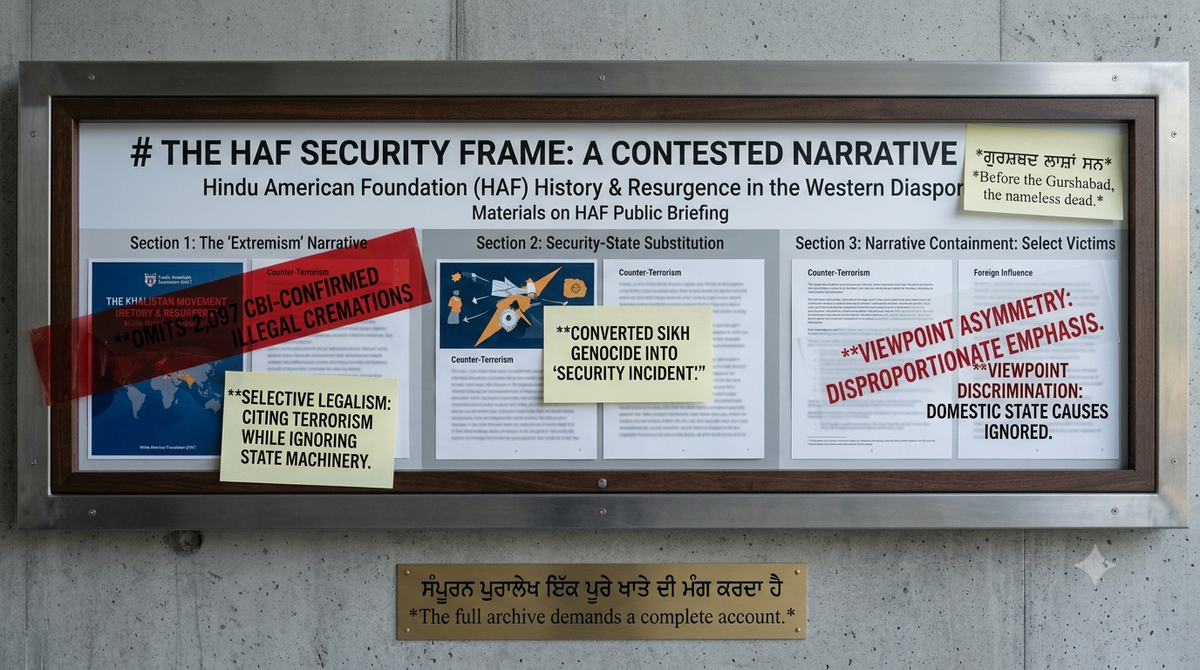
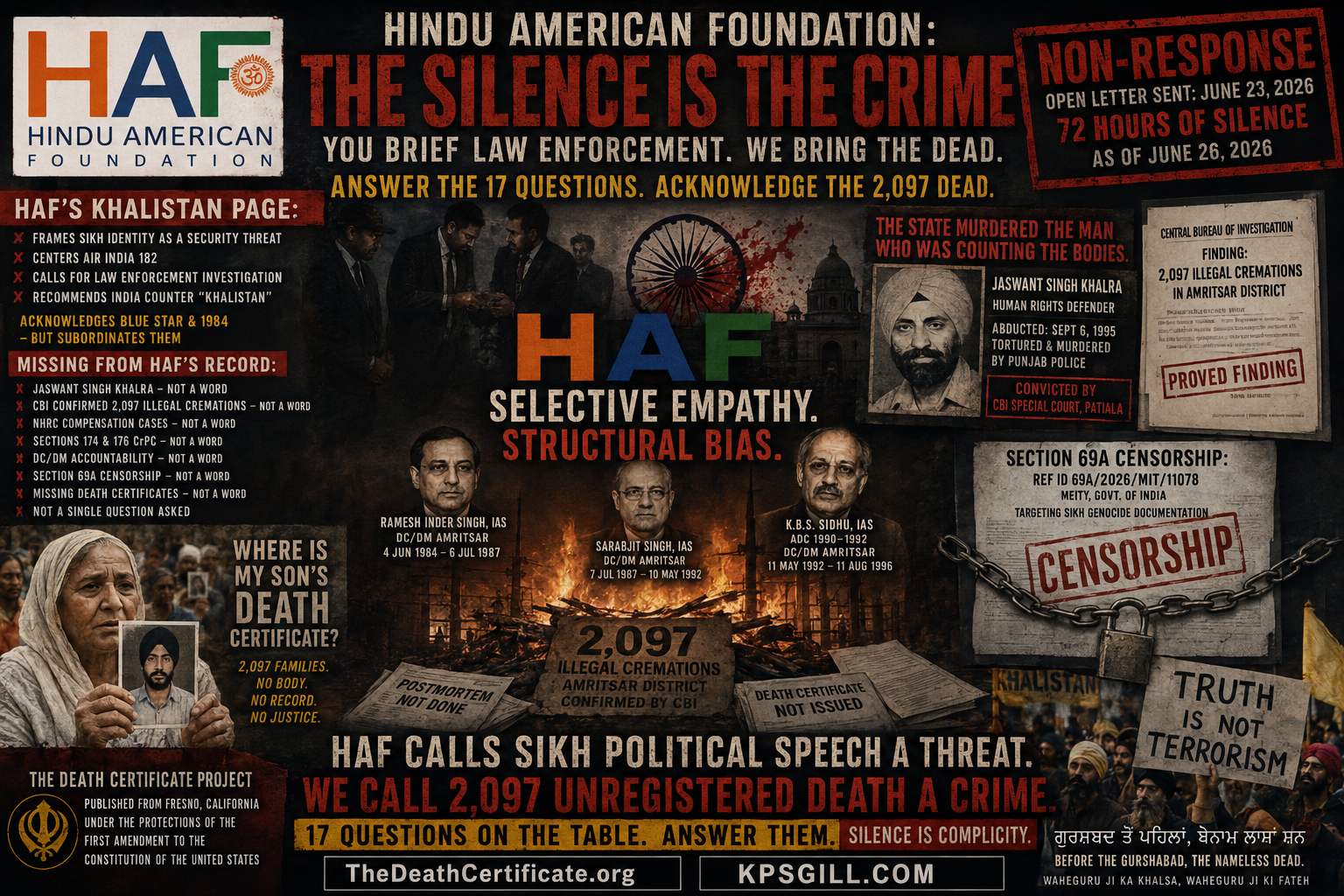
What Hindu American Foundation (HAF) Acknowledges, What HAF Subordinates, What the CBI Found, Who the Civil Administrators Were, Why the Missing Death Certificates Are a Judicial Record, Why Seventeen Questions Remain on the Table, and Why the Archive Will Not Be Cremated
ਗੁਰਸ਼ਬਦ ਤੋਂ ਪਹਿਲਾਂ, ਬੇਨਾਮ ਲਾਸ਼ਾਂ ਸਨ
Before the Gurshabad, the nameless dead.
TheDeathCertificate.org | KPSGILL.COM
Published from Fresno, California, under the protections of the First Amendment to the Constitution of the United States.
By Dr. Kanwar Partap Singh Gill, M.D.
Publisher and Editorial Director, The Death Certificate Project
Published June 26, 2026
Evidentiary Framework
This article applies the following evidentiary tiers throughout. They are not rhetorical hedges. They are the method.
[PF] Proved Finding — Facts established by official records, judicial findings, statutory text, administrative filings, government admissions, public institutional records, or convergent documentary evidence meeting an evidentiary threshold independent of disputed narrative.
[DA] Documented Allegation — Claims grounded in identifiable sources, filed complaints, sworn testimony, media records, human-rights reports, survivor accounts, or public filings that carry serious evidentiary weight but have not necessarily been conclusively adjudicated to the highest possible legal standard.
[AI] Analytical Inference — Reasoned conclusions drawn from patterns, institutional omissions, timing, documentary contradictions, statutory duties, comparative silence, and the cumulative architecture of the record.
[PM] Panthic Memory — The lived memory, inherited understanding, moral continuity, and historical testimony preserved by Sikh institutions, families, witnesses, survivors, shaheed traditions, and collective civilizational remembrance.
[PM-Direct] — Direct family memory, local testimony, or community memory documented under personal evidentiary standards and identified where applicable.
[PR] Project Record — A record, filing, transmission, article, response, correspondence, or archive entry maintained by The Death Certificate Project and identified as part of its own publication or administrative record.
The purpose of this framework is to demonstrate that even restricting the argument to proved findings alone — the most conservative possible evidentiary standard — the conclusions are legally untenable for an organization that claims a civil-rights identity while systematically subordinating the Sikh genocide record in its law-enforcement-facing advocacy.
Notice of Non-Response
On June 23, 2026, at 4:09 PM Pacific Daylight Time, The Death Certificate Project transmitted an open letter to the Hindu American Foundation via email to info@hinduamerican.org, cc'd to admin@hafsite.org, sheetal@hafsite.org, needhy@hafsite.org, K.B.S. Sidhu, Ramesh Inder Singh, and other parties. [PR]
The email was not returned undelivered. Its delivery is confirmed by the absence of a bounce notification. It contained the full substantive argument, seventeen specific questions, and a comprehensive index of the Death Certificate Project archive.
As of the publication of this article — June 26, 2026, seventy-two hours later — HAF has provided no written response, no acknowledgment of receipt, no request for clarification, no invitation to engage, and no public statement addressing the forensic record it was asked to engage. [PR]
That silence is noted. It is not final. But it is documented.
This article is the direct product of that silence.
When an organization that routinely briefs law enforcement on the alleged dangers of Sikh political speech declines to respond to a documented challenge to the completeness of its own evidentiary record, that silence is itself a datum. It is entered into the archive. [AI]
Abstract
The Hindu American Foundation (HAF), a registered U.S. 501(c)(3) nonprofit advocacy organization, maintains a public page titled "The Khalistan Movement: History & Resurgence in the Western Diaspora," which frames Sikh political identity and Khalistan-related advocacy primarily through the lens of extremism, terrorism, public-safety concern, diaspora radicalization, foreign influence, law-enforcement investigation, and the memory of Air India Flight 182. [PF — based on the publicly accessible content of HAF's Khalistan page]
This article is a formal, public, forensically grounded response to that framing.
The argument is not that Air India Flight 182 should be minimized. It must never be minimized. The murder of 329 innocent passengers and crew on June 23, 1985, was one of the gravest acts of aviation terrorism in modern history. The dead deserve full remembrance. The families deserve justice. Terrorism against civilians must be condemned without reservation and without qualification. [PF]
The argument is this: HAF's Khalistan page, as currently structured, produces an asymmetrical evidentiary archive. It acknowledges Operation Blue Star and the November 1984 anti-Sikh pogrom — but does so inside a larger architecture that returns the reader's attention to Khalistan as a security threat rather than to Sikh political alienation as the product of documented state violence, constitutional breakdown, enforced disappearance, illegal mass cremation, civil-administrative failure, torture, sexualized violence, federal coercion, cultural erasure, and the systematic suppression of the documentary record of the Sikh dead.
HAF acknowledges. It does not account for.
HAF mentions. It does not weigh.
HAF notes grievances. It does not follow them to their administrative conclusions.
This is the difference between acknowledgment and accountability. It is the difference between a footnote and a forensic record. And it is the difference between a civil-rights organization and a security-aligned advocacy organization that has selected which communities' suffering qualifies for equal institutional weight.
This brief traces the complete Sikh forensic record through The Death Certificate Project archive, establishes the statutory duties of three Deputy Commissioners and District Magistrates of Amritsar during the period of the CBI-confirmed 2,097 illegal cremations, examines the Section 69A blocking proceeding filed against Sikh genocide documentation before MeitY in April 2026 (Request ID 69A/2026/MIT/11078), identifies the constitutional asymmetry between HAF's protected advocacy and the suppression of Sikh counter-speech, and poses seventeen questions that have now been on the table for seventy-two hours without answer.
Part I: HAF's Khalistan Frame — What It Says, What It Does, and Why It Is Not Civil-Rights Analysis
I. The Right to Advocate and the Obligation of Completeness
HAF has every constitutional right, under the First Amendment to the Constitution of the United States, to advocate for Hindu Americans, to condemn terrorism, to recommend law-enforcement vigilance, to publish political analyses of South Asian affairs, and to participate in the full range of civic discourse available to American nonprofit organizations.
This article does not dispute any of those rights. They are absolute in their constitutional domain.
The issue arises when HAF exercises those rights specifically in the domain of another community's political identity — when it frames Sikh diaspora advocacy as a security matter, produces law-enforcement-facing briefing documents about Khalistan-linked activism, and enters the public arena with materials designed to shape how American government agencies and policymakers understand and respond to Sikh political expression.
At that point, HAF has incurred a corresponding obligation: the obligation of factual completeness.
An organization that chooses to brief law enforcement about a minority community's political speech assumes responsibility for the accuracy and completeness of that briefing. If the briefing is incomplete — if it presents a security narrative while omitting the documented historical record that produced the political expression it characterizes as dangerous — it is not merely editorially imperfect. It is potentially contributing to the unjust targeting of a minority community by government agencies. That is a civil-rights harm. And it is a harm that a civil-rights organization should be the first to recognize and the last to produce. [AI]
HAF's Khalistan materials do not currently meet the standard of completeness that its own civil-rights identity requires.
II. What HAF's Page Actually Says — A Forensic Inventory
A careful reading of HAF's Khalistan page reveals a specific structural architecture. Because HAF has entered this field and received a formal challenge to which it has not responded, its public materials are subject to forensic inventory here. [PR]
HAF's Khalistan page:
Frames "Khalistan" as a violent separatist movement with roots in Pakistani intelligence support and diaspora radicalization. [PF — based on public content]
References Air India Flight 182 as the defining event of Khalistan-linked terrorism. [PF]
Calls on U.S. authorities to investigate and prosecute radical Khalistan supporters. [PF]
Recommends that India counter Khalistan militancy and propaganda. [PF]
Does acknowledge Operation Blue Star. [PF — a critical concession that shapes the legal posture of this entire article]
Does acknowledge the November 1984 anti-Sikh pogrom. [PF — a second concession of identical legal significance]
Does not name Jaswant Singh Khalra. [PF — by absence]
Does not mention the CBI-confirmed 2,097 illegal cremations. [PF — by absence]
Does not name the NHRC compensation proceedings. [PF — by absence]
Does not identify Sections 174 or 176 of the Code of Criminal Procedure as operative legal provisions relevant to the accountability gap. [PF — by absence]
Does not name Ramesh Inder Singh, Sarabjit Singh, or K.B.S. Sidhu as civil administrative officers with statutory duties during the period of the illegal cremations. [PF — by absence]
Does not mention the Section 69A blocking proceeding against Sikh genocide documentation. [PF — by absence]
Does not contain a single question about the missing death certificates of Amritsar's dead. [PF — by absence]
III. The Legal Significance of HAF's Own Concessions
The two acknowledged facts — Blue Star and November 1984 — are the most legally significant elements of HAF's page, and they are not incidental. They foreclose the argument that HAF is simply unaware of the Sikh genocide record.
HAF knows Operation Blue Star occurred. HAF knows November 1984 occurred. HAF has nonetheless built its Khalistan framing around a security architecture in which those events are subordinated to the terrorism narrative. [AI]
This is not ignorance. This is selection. And selection, when made by a civil-rights organization that then briefs government agencies on the basis of the selected record, requires a higher standard of justification than ordinary editorial judgment.
The standard for a civil-rights organization briefing law enforcement is not "did we mention it?" It is: Did we give it appropriate institutional weight? Did our framing result in fair treatment of the community we were discussing? Did we distinguish between the political expression of a traumatized community and criminal conduct?
By the standard HAF would apply to any other civil-rights organization discussing any other minority community under comparable circumstances, HAF's Khalistan materials fail. [AI]
IV. Narrative Containment — The Specific Architecture of Asymmetry
The problem with HAF's framing is not that it mentions Blue Star and then stops discussing Sikh history. The problem is that it mentions Blue Star and immediately re-channels the reader's attention back to radicalization, terrorism, and security response. The historical injury enters the frame as context for militancy — not as the primary evidentiary record in its own right.
This technique — acknowledgment followed by recentering — is recognizable in the history of civil-rights analysis. It is the structure of selective empathy. It produces the impression of balanced consideration while delivering a fundamentally asymmetrical conclusion:
Sikh violence is primary. Sikh grievance is secondary.
State violence is context. Diaspora extremism is the story.
Air India 182 is the defining event. The 2,097 missing death certificates are not mentioned at all.
A civil-rights organization should be able to hold both simultaneously. HAF does not.
Part II: Air India 182 — Memory Without Weaponization
V. What Must Be Said Without Reservation
Air India Flight 182, destroyed over the Atlantic Ocean on June 23, 1985, killed 329 people. They were passengers of every background, nationality, religion, and age. Among the dead were families traveling home, children, and individuals who had no relation to Sikh politics of any kind. [PF]
The bombing was a crime of the most serious category. The perpetrators deserve no historical shelter, no political rationalization, and no civilizational protection under any framework. [editorial position of this publication]
The Death Certificate Project's position is without ambiguity: targeting civilians is always wrong. The Air India 182 victims deserve memory, justice, and institutional dignity commensurate with the scale of the crime committed against them.
VI. What Air India 182 Cannot Be Used to Do
What Air India 182 cannot be used to do is the following:
It cannot be used to flatten the history of a community of twenty-six million people into a single terrorism narrative.
It cannot convert Sikh self-determination discourse into inherently criminal activity when the vast majority of Sikh political expression in every country where Sikhs have organized has been non-violent, constitutional, and democratic.
It cannot render the Indian state's conduct between 1984 and 1996 as secondary to Sikh conduct when the Indian state was the sovereign apparatus holding the bodies, the registers, the files, the police stations, and the cremation grounds.
It cannot be used as the single interpretive event through which all Sikh political memory is filtered for American law enforcement and policymakers.
The argument that "Air India 182 proves Khalistan equals terrorism" is not a legal argument. It is a sequencing argument dressed as analysis. [AI] By identical logic, the 1984 pogrom, the custodial killings, the fake encounters, the illegal cremations, and the murder of Jaswant Singh Khalra prove that the Indian state equals a criminal enterprise — and that is a conclusion the Death Certificate Project does not draw, because it understands the difference between the conduct of specific state actors and the identity of a state.
The same distinction must apply to Sikh political expression and the Air India 182 bombing. The crime was committed by specific individuals. It does not define a community.
HAF, which has spent decades arguing that Hinduism and Hindu identity cannot be reduced to the violence of specific Hindu actors, should understand this principle better than anyone. The standard it claims for itself is the standard it must apply to Sikhs. [AI]
Part III: The Historical Record That "Khalistan" Cannot Be Understood Without
VII. The Timeline HAF Acknowledges and What It Means to Acknowledge It
The word "Khalistan" arrived inside a sequence of events. HAF has acknowledged two of the most significant: Blue Star and November 1984. The act of acknowledgment is, in legal terms, an admission that the sequence exists. What remains is HAF's obligation to follow that sequence to its forensic and administrative conclusions.
1973 — The Anandpur Sahib Resolution [PF]
The Shiromani Akali Dal adopted the Anandpur Sahib Resolution, a federalist document demanding greater autonomy for Punjab within the Indian constitutional framework, resolution of the Chandigarh and river-waters disputes, and protection of Sikh rights as a distinct religious community. The Resolution has been repeatedly mischaracterized as separatist. A careful textual reading does not support that characterization. [PF — text of the Resolution is publicly available; AI — the characterization as federalist rather than separatist is a textual analytical conclusion]
April 1978 — Amritsar [PF / PM]
Members of the Sant Nirankari Mission, escorted by police, opened fire on a Sikh religious procession in Amritsar, killing thirteen Sikhs. The Nirankari leader was subsequently acquitted. The combination of state police escort and acquittal left a wound in Sikh political consciousness that did not heal. [DA — the role of police escort; PF — the killing and the acquittal are documented]
June 1984 — Operation Blue Star [PF — acknowledged by HAF]
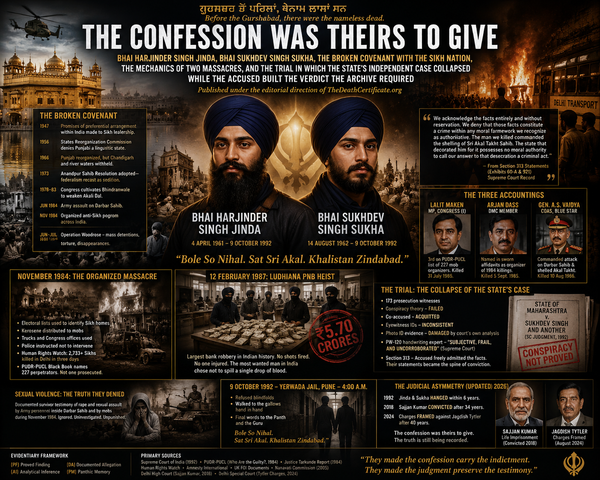
The Indian Army assaulted Sri Harmandir Sahib and the Akal Takht. Pilgrims were present. The Akal Takht was destroyed by tank fire. The Sikh Reference Library disappeared during or after the operation. [PF — the loss is documented; DA — the precise circumstances remain formally unresolved] The civilian death toll has never been independently established. [DA] HAF acknowledges Blue Star. HAF does not ask where the civilian dead were recorded, what became of the pilgrims, or what administrative record was generated for their deaths under Sections 174 and 176 CrPC.
October–November 1984 — The Anti-Sikh Pogrom [PF — acknowledged by HAF]
Following the assassination of Prime Minister Indira Gandhi, organized violence against Sikhs erupted across North India. The Nanavati Commission of Inquiry — a Government of India body — concluded that the violence was organized, not spontaneous; that Congress politicians were involved in leading mobs; and that police protection was systematically withheld. [PF — the Nanavati Commission Report is a government document] HAF acknowledges November 1984. HAF does not engage the Nanavati Commission's conclusions about who organized it.
1984–1996 — The Counterinsurgency Years [PF / DA / AI / PM]
Punjab's counterinsurgency involved police killings, custodial torture, fake encounters, enforced disappearances, mass cremations of unidentified bodies, and the systematic destruction or non-production of documentary records relating to the dead. [PF — confirmed at the level of judicial findings by the CBI Special Court, NHRC proceedings, and Human Rights Watch documentation]
TADA (Terrorist and Disruptive Activities Prevention Act) created a framework of preventive detention and special courts that human-rights organizations documented as enabling custodial abuse. [PF — statutory text; DA — specific abuse patterns documented in human-rights reporting] HAF does not engage TADA, its implementation, or its relationship to the enforced disappearance record.
VIII. What Changes When the Full Timeline Is on the Table
When Air India 182 is the primary event, the reader's question is: How do we stop Sikh terrorism?
When the full timeline is on the table, the reader's question becomes: What was the sequence? What happened to whom, in what order, by whose authority, under what statutory framework, with what civil-administrative oversight, and where are the files?
The second question is harder to answer. It is also the only honest question.
A law-enforcement brief that begins from the first question produces surveillance programs, community monitoring, and the conflation of political speech with criminal intent.
A law-enforcement brief that begins from the second question produces a more complex and accurate picture: a community whose political expression is substantially constituted by documented historical trauma, whose diaspora organizing is substantially an act of memory, and whose self-determination discourse is not equivalent to terrorism.
HAF's materials consistently begin from the first question. [AI]
Part IV: The CBI/NHRC Record — The Evidentiary Center That Cannot Be Avoided
IX. Jaswant Singh Khalra — What He Found and What Was Done to Him
Jaswant Singh Khalra was a Sikh human-rights defender and bank executive in Amritsar. Beginning approximately in 1994, he examined the cremation registers at three of Amritsar's municipal crematoria: Durgiana Mandir, Patti, and Village Tarn Taran.
What he found: thousands of bodies had been cremated as "unclaimed" or "unknown." When he cross-referenced the register entries against the names of individuals reported missing by families, and against community memory of disappearances, he found extensive matches. Bodies the police had presented as unidentified strangers were, in many cases, identifiable Sikh men whose families had been looking for them — and who had last been seen in police custody. [PF — the basic methodology is established from Khalra's own public statements, subsequent judicial proceedings, and CBI findings]
Khalra was not working from rumor. He was working from registers. He went to the crematoria. He read the entries. He compared names. He identified a pattern. He presented his findings to human-rights bodies and journalists. He named what he found.
On September 6, 1995, Jaswant Singh Khalra was abducted from in front of his home by a vehicle witnesses identified as belonging to the Punjab Police. He was held in illegal custody, tortured, and killed. [PF — abduction, illegal custody, torture, and murder are confirmed by CBI investigation and criminal convictions before the CBI Special Court in Patiala] Officers of the Punjab Police, led by the Tarn Taran district police, were convicted.
The men who killed the man who was counting the bodies were the men whose organization had disposed of those bodies.
This is not an allegation. It is a judicial finding. [PF]
X. The CBI Special Court Patiala — What the Court Found
Following CBI investigation, the CBI Special Court in Patiala convicted Punjab Police officers for the abduction, illegal custody, torture, and murder of Jaswant Singh Khalra. [PF — criminal conviction is a proved judicial finding]
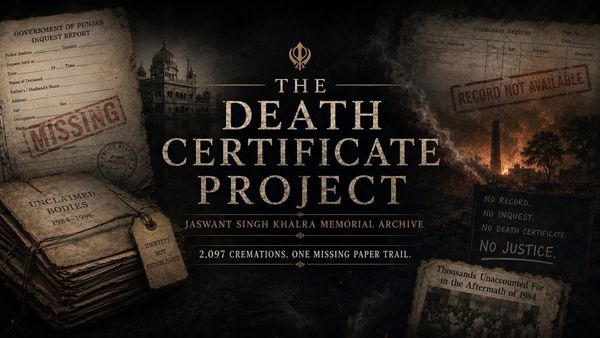
The CBI's investigation also produced findings on the illegal cremations Khalra had been documenting. The CBI confirmed that 2,097 bodies had been illegally cremated in Amritsar District. [PF — 2,097 is the CBI-confirmed figure for Amritsar District alone, as reflected in NHRC proceedings and Human Rights Watch documentation]
The legal significance of this finding cannot be overstated. The CBI is not a human-rights advocacy group. It is the Government of India's premier investigative agency. The CBI found 2,097 illegal cremations — cremations that violated the legal requirements for inquest, identification, family notification, and documentary recording that applied under the Code of Criminal Procedure. [PF]
When the Government of India's own investigative agency confirms 2,097 illegal cremations in one district, that is not a Sikh allegation. That is a Government of India finding.
HAF's Khalistan materials, which generally rely on Indian state institutional credibility for terrorism-related findings, cannot logically accept that authority on terrorism while refusing to acknowledge the Indian state's own judicial findings on mass illegal cremations. [AI]
XI. The NHRC Compensation Proceedings — Administrative Findings
The National Human Rights Commission of India, conducting proceedings parallel to the CBI investigation, awarded compensation to the families of 109 individuals in confirmed cases of illegal cremation. [PF — NHRC compensation awards are administrative findings on record]
Each compensation award is a proved administrative finding of state illegality in a specific case. The 109 compensated cases represent instances in which the evidentiary standard for the specific award was met. The remaining 1,988 confirmed illegal cremations in Amritsar District — confirmed by CBI but not individually compensated by NHRC — represent a documented accountability gap.
The families of those 1,988 individuals have not received compensation. They have not received acknowledgment. They have not received death certificates. [AI — based on the structural gap between CBI confirmation and NHRC compensation]
When HAF discusses "Khalistan" without these facts, it is not being incomplete about peripheral details. It is being incomplete about the evidentiary center of the matter. [AI]
XII. The 2,097 Number and Its Administrative Implications
Two thousand and ninety-seven confirmed illegal cremations in Amritsar District alone. Each implies, at minimum, specific administrative failures:
A body was received without proper identification documentation.
A Section 174 CrPC police report was either not filed, filed incompletely, filed falsely, or subsequently suppressed.
A Section 176 CrPC magisterial inquiry was either not triggered, not opened, not properly conducted, or not properly recorded.
The cremation was performed without a lawful order, without a death certificate, and without family notification.
A civil administrative officer — the Deputy Commissioner and District Magistrate — was the apex statutory authority responsible for ensuring that the Section 174/176 process functioned in his district.
For 2,097 confirmed illegal cremations, that statutory chain failed completely, systematically, and — given the pattern across years and DM tenures — structurally. [PF as to the failure; AI as to its structural and institutional character]
Part V: The Statutory Framework — What the Law Required and Who Was Responsible
XIII. Section 174 CrPC — The Police Duty [PF]
Section 174 of the Code of Criminal Procedure, 1973, required that whenever the officer in charge of a police station received information that a person had committed suicide, had been killed by another, had died under circumstances raising reasonable suspicion of the commission of an offense, or had died under other suspicious circumstances, the officer was required to immediately give intimation to the nearest Executive Magistrate empowered to hold inquests, proceed to the place where the body was lying, and prepare a report in the prescribed form.
This provision was non-discretionary. It did not exempt cases involving security operations. It did not create exceptions for counterinsurgency. The provision ran throughout 1984–1996 without any legislative amendment creating such exceptions. [PF]
XIV. Section 176 CrPC — The Magisterial Duty [PF]
Section 176 required that whenever a person died while in the custody of the police, the nearest Magistrate empowered to hold inquests shall — and in cases within the scope of Section 174, any District Magistrate or Sub-Divisional Magistrate may — hold an inquiry into the cause of death.
The word "shall" in relation to deaths in police custody made the magisterial inquiry mandatory — not discretionary — for that specific category. [PF — statutory text]
XV. Section 176(1A) CrPC — The 2006 Amendment as Retrospective Parliamentary Acknowledgment [PF / AI]
In 2006, Parliament enacted Section 176(1A), making magisterial inquiry mandatory for all cases of death or disappearance in police or other authorized custody. [PF — statutory text of amendment]
This amendment does not apply retrospectively to 1984–1996. The Death Certificate Project is precise about this: Section 176(1A) is cited not as a retroactive legal standard but as retrospective parliamentary confirmation that the pre-2006 framework was structurally inadequate in exactly the manner that produced the 2,097 illegal cremations. Parliament would not have been required to make mandatory by explicit amendment what was already mandatory in practice. The 2006 amendment is the statute speaking to its own prior failure. [AI — the inference from amendment to acknowledgment of prior inadequacy is a strong analytical conclusion from the legislative record]
XVI. The DC/DM as the Civil Apex — Why the Administrative Accountability Question Follows [AI]
The Deputy Commissioner and District Magistrate is the apex civil authority in a revenue district under the Indian administrative structure. The DC/DM holds concurrent responsibilities as:
The apex civil authority coordinating law-and-order administration.
The head of the district magistracy for CrPC purposes.
The supervising authority over Executive Magistrates within the district.
The officer to whom Section 174 police reports are transmitted and for whom Section 176 inquiries are triggered.
The officer with supervisory responsibility for cremation-ground oversight through municipal administration.
When the system under the DC/DM's supervisory authority fails at the level of 2,097 confirmed illegal cremations, the civil apex is the accountability apex. [AI — grounded in the structural definition of the DC/DM's role]
Part VI: The Three Civil Officers of Amritsar
XVII. Ramesh Inder Singh, IAS — DC/DM Amritsar, 4 June 1984 – 6 July 1987 [PF]
Ramesh Inder Singh assumed office as Deputy Commissioner and District Magistrate of Amritsar on June 4, 1984 — two days before Operation Blue Star commenced on June 6. [PF] His tenure covers the most consequential administrative rupture in modern Sikh history: the assault on Sri Harmandir Sahib, the curfew, civilian deaths, the immediate post-assault period, and the months in which the institutional architecture of the paperless death regime was first consolidated.
He held that office for over three years — through 1984, 1985, 1986, and into 1987 — a period during which the counterinsurgency was being institutionally structured and the Section 174/176 machinery was systematically failing.
The Chapter 35 Contradiction — A Proved Finding
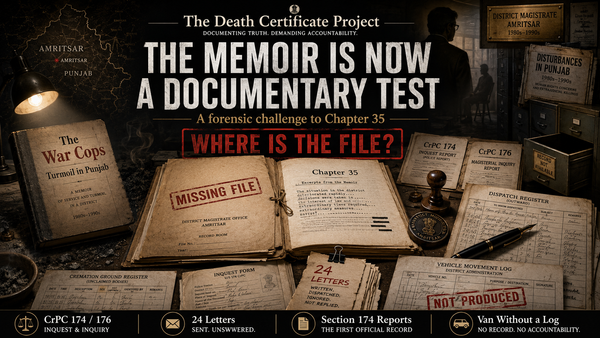
Ramesh Inder Singh published a memoir, Turmoil in Punjab (2022), containing Chapter 35 ("The War Cops"). The Death Certificate Project's forensic cross-examination has identified a specific, documented internal contradiction within the chapter itself — not an allegation from outside the text, but a contradiction within the author's own published words:
Chapter 35 simultaneously advances the legal position that without physical bodies there could be no Section 176 magisterial inquest, while also disclosing that during his tenure as DC/DM, Ramesh Inder Singh personally requested Section 174 reports from the police. [PF — established from the chapter's own text]
Why This Contradiction Is Legally Fatal:
Under the CrPC framework, the Section 174 report is the statutory trigger for the Section 176 inquiry. A District Magistrate who requests Section 174 reports thereby acknowledges that suspicious deaths were being reported within the district's administrative awareness. That acknowledgment activates — in relevant categories — the duty to inquire under Section 176. A District Magistrate cannot simultaneously:
(a) Request Section 174 reports from the police, thereby placing the suspicious death events within the administrative record of the DC/DM office; and
(b) Claim that the absence of physical bodies absolved his administration of the duty to hold Section 176 inquests into those same death events.
The requesting of a Section 174 report is proof that the DC/DM's office had knowledge of suspicious death events sufficient to trigger the statutory framework. The claim that no inquest was required because no body was in hand is legally inconsistent with the documented receipt of Section 174 reports about those same events. [PF as to the contradiction from the chapter's own text; AI as to its legal implications for the inquest duty]
📌 The Van Without a Log — A Real-Time Cross-Examination of Ramesh Inder Singh
📌 Blue Star's Unfinished Lesson Is Not Dialogue. It Is the Death Certificate.
Outstanding Documentary Questions for Ramesh Inder Singh:
Where are the Section 174 reports he acknowledges requesting?
What dispatch numbers or dak register entries accompanied those reports?
Where are the Section 176 inquiry files, if any were opened during his tenure?
Where is the legal opinion advising that the absence of physical bodies suspended the Section 176 duty?
Where is the administrative record of what the DC/DM's office communicated to Chandigarh, to the divisional commissioner, or to the Home Ministry about suspicious deaths during June 1984 – July 1987?
A memoir is not a file. A retirement narrative is not a register. The documentary deficit is the outstanding accountability question. [AI]
XVIII. The Pre-Blue Star Administrative Configuration [PM-Direct / PF]
Before Operation Blue Star could proceed as it did, the administrative configuration of Amritsar required adjustment. The DC/DM and SSP in place immediately before the assault were transferred or removed in the months before June 1984.
📌 The Unbroken Front — How Brar and Mann Blocked New Delhi's Backdoor to Amritsar
This article carries [PM-Direct] evidentiary weight regarding SSP Ajaypal Singh Mann (SSP Amritsar, October 1983–March 1984), who is an extended family elder on the author's maternal side, documented under personal evidentiary standards. [PM-Direct] designation is identified transparently. The evidentiary weight of this designation is specific and bounded; it does not prove the systemic claim but informs the specific personal dimension of the administrative record.
XIX. Sarabjit Singh, IAS — DC/DM Amritsar, 7 July 1987 – 10 May 1992 [PF]
Sarabjit Singh held the DC/DM role for nearly five full years — the longest single tenure in the accountability chain. [PF] His tenure substantially overlaps with the peak years of the counterinsurgency and the period from which the cremation-register entries that Jaswant Singh Khalra later documented are drawn. [PF — Khalra's investigation and the cremation register dates are documented in the CBI/NHRC proceedings]
The Death Certificate Project designates Sarabjit Singh's tenure as "The Middle Corridor" — the central, longest, and least publicly examined segment of the administrative accountability chain:
The forensic questions for Sarabjit Singh's tenure run parallel to those for Ramesh Inder Singh, with the additional weight that his administration covered the period in which the illegal cremation practice appears to have been most systemically embedded. The crematoria registers that Khalra found in the mid-1990s documented entries going back to precisely this period.
XX. K.B.S. Sidhu, IAS — ADC Amritsar 1990–1992; DC/DM Amritsar, 11 May 1992 – 11 August 1996 [PF]
K.B.S. Sidhu served as Additional Deputy Commissioner from 1990, then assumed the DC/DM role on May 11, 1992, holding it through August 11, 1996. [PF] His combined presence in Amritsar's administrative leadership spans 1990 to 1996 — a period that includes both the height of the cremation-register period that Khalra documented and the period in which Khalra himself conducted his investigation, was publicly known to be compiling the cremation records, and was ultimately abducted and murdered.
Jaswant Singh Khalra was abducted in September 1995. K.B.S. Sidhu was the Deputy Commissioner and District Magistrate of Amritsar in September 1995. [PF]
This juxtaposition is presented with evidentiary precision: it is an [AI] Analytical Inference that the DC/DM of Amritsar in September 1995 cannot be treated as having had no administrative context for the disappearance of Amritsar's most prominent human-rights documentarian from a public street in his district. It is not a claim of direct coordination; it is an observation about administrative context and proximity that any serious accountability inquiry must address.
K.B.S. Sidhu has since become an active public writer — publishing on Substack, in newspapers, and in public-facing essays — on topics including Punjab water disputes, administrative governance, and the counterinsurgency period. The Death Certificate Project has cross-examined that self-presentation against the documentary record of his administrative tenure:
📌 The People Against Silence — A Comprehensive Forensic Cross-Examination of K.B.S. Sidhu, IAS
The forensic principle applied to K.B.S. Sidhu's public writing is precise and constitutionally grounded: a public official who shapes public memory through published prose after his tenure has invited public scrutiny of the relationship between that prose and his administrative record. A man who writes movingly about his father's noble character, while the families of 2,097 illegal cremation victims in his former district remain without death certificates, is exercising a right — in a public forum that is now also part of the documentary record of his administrative tenure. A public memoir cannot outrank a missing inquest. [AI]
Part VII: The Architecture of Impunity
XXI. Beyond Police Officers to the Full Institutional Structure
Punjab's illegal-cremation regime was not sustained by police violence alone. It was sustained through a full institutional architecture that included: police who killed; cremation-ground operators who burned without documentation; civil magistrates who did not open Section 176 inquiries; District Magistrates who did not demand Section 174 compliance; state government officials who received or did not receive reporting; security-state academics who constructed alternative narratives minimizing the human-rights record; post-retirement memoirists who have since attempted to rationalize the record; and advocacy organizations — including potentially organizations in the United States — that reproduce the security-state narrative without acknowledging the documentary deficit it creates.
Each element of that architecture matters. The civil administrative element — the DC/DM as the statutory apex — is the one that has received least public attention and the one that The Death Certificate Project has most systematically developed.
XXII. The Security-State Archive as Narrative Substitute
📌 Ajai Sahni, K.P.S. Gill, and the Truth They Blocked
The dominant English-language security-state literature on Punjab's counterinsurgency has become the reference archive for Western analysts, advocacy organizations, and law-enforcement educators discussing Khalistan. It counts militants killed, weapons recovered, and attacks prevented. It does not give equal dignity to bodies disappeared, families terrorized, women violated, youth tortured, or death certificates denied. [AI]
The result is that organizations like HAF, drawing on this literature, can discuss Khalistan for thousands of words without naming Jaswant Singh Khalra, without consulting the CBI Special Court record, and without once asking whether the state whose security narrative they reproduce has itself been found by its own judiciary to have illegally cremated 2,097 bodies. [AI]
Nomenclature Note: Dr. Kanwar Partap Singh Gill, M.D., publisher of The Death Certificate Project, has no familial, institutional, professional, or ideological relationship to the late K.P.S. Gill, IPS, Director General of Punjab Police, who died in 2017. Any conflation of the two identities is factually false. [PF / PR]
Part VIII: The Body as Jurisdiction
XXIII. Torture, Sexualized Violence, and Economic Annihilation
📌 Sexual Violence Against Sikh and Muslim Women in India
The argument is that the Sikh body during 1984–1996 was made into a jurisdiction of the Indian state — not metaphorically but operationally. The body was the site of intelligence extraction (through torture), social discipline (through family targeting), communal deterrence (through sexualized violence), and economic disruption (through seizure of family assets). Human-rights documentation — Amnesty International, Human Rights Watch, Physicians for Human Rights — documented patterns of custodial abuse sufficiently systematic and consistent across geography, time, and police jurisdiction to constitute institutional practice rather than individual excess. [DA — the characterization as institutional practice is an analytical inference from the pattern documentation; PF as to the occurrence of documented abuses]
HAF's security frame treats Sikh political mobilization as ideology detached from bodily injury. But communities do not remember only ideas. They remember screams. They remember missing sons. They remember bodies that came back broken. They remember bodies that never came back at all. [PM]
The archive of Sikh political memory is, at its core, an archive of bodies. That is why the death certificate matters.
Part IX: The Federal Wounds — What Khalistan Contains Beyond Religion
XXIV. Water, Territory, Language, and Chandigarh
📌 Jatana's Gun and Sidhu's Pen — The Forensic World History of Punjab's Water War
📌 Power, Water, and Forensic Reality
Sikh political alienation is not reducible to religion or ideology. The federalist, territorial, economic, linguistic, and environmental grievances of Punjab are the material substrate of the political crisis that produced the formations HAF characterizes as extremist. Punjab's demands for Chandigarh, for fair water allocation, for resolution of the Sutlej-Yamuna Link Canal dispute, for linguistic recognition — these were constitutional demands made within the framework of the Indian state. They were refused, deferred, or manipulated for decades.
A law-enforcement brief on Khalistan that does not include these federal wounds is not helping law enforcement understand the community it may interact with. It is training law enforcement to see the community through a security lens that misreads the political situation. [AI]
Part X: Censorship, Section 69A, and the Constitutional Asymmetry
XXV. The MeitY Blocking Proceeding [PF / PR]
In April 2026, The Death Certificate Project received a blocking order from the Government of India under Section 69A of the Information Technology Act, 2000, targeting publications at TheDeathCertificate.org. The proceeding was assigned Reference ID 69A/2026/MIT/11078. [PF / PR]
On April 29, 2026, a 73-page legal opposition — accompanied by a 20-sheet URL audit — was filed before the Secretary, Ministry of Electronics and Information Technology, Government of India. [PF / PR]
XXVI. The Constitutional Symmetry Argument — Hard to Counter
Proposition 1: HAF, a U.S. nonprofit, may publish materials framing Sikh political expression as terrorism and brief American law enforcement on the alleged dangers of Khalistan-linked activism. This is protected First Amendment speech. [PF]
Proposition 2: The Death Certificate Project, a U.S. publication, publishes Sikh genocide documentation, forensic civil administrative analysis, and evidentiary cross-examination of public officials' public records — all under the protection of the First Amendment. This is equally protected. [PF]
Proposition 3: The Government of India has initiated a Section 69A proceeding against The Death Certificate Project's publications. [PF / PR]
Proposition 4: HAF's advocacy is structurally aligned with Indian state positions on Sikh political expression. HAF has not, to the knowledge of this publication, faced any Indian state censorship action in relation to its Khalistan materials. [AI — based on the absence of any publicly available record of such action]
The Resulting Constitutional Question: If both are equally protected under the First Amendment, why is the Indian state attempting to suppress one while leaving the other unimpeded? And what is the obligation of a civil-rights organization that operates in First Amendment jurisdiction when it becomes aware that its own ideological alignment coincides with the censorship preferences of a foreign government? [AI]
XXVII. The FARA Question
The Foreign Agents Registration Act (FARA), 22 U.S.C. § 611 et seq., requires persons acting in the United States at the direction of, or in coordination with, foreign principals — including foreign governments — in furtherance of those principals' political interests to register and disclose those activities. [PF — statutory text]
The Death Certificate Project does not assert that HAF is an unregistered foreign agent. That requires a specific factual predicate and an appropriate federal investigation. What this publication notes is that HAF's Khalistan advocacy aligns with Indian state positions; HAF briefs American law enforcement on a subject matter the Indian state has sought to characterize as a security threat; and HAF has received but not answered the direct question asking whether it has received "funding, coordination, or substantive communication from Government of India entities, Indian diplomatic missions, or affiliated organizations in connection with its Khalistan-related advocacy materials." [PR]
The unanswered FARA-adjacent question sits on the public record. HAF may answer it. Until it does, the question stands. [AI]
XXVIII. The 501(c)(3) Standard
A 501(c)(3) organization that characterizes itself as a civil-rights organization and enters the domain of another community's political expression assumes obligations beyond simple advocacy. When HAF briefs law enforcement on the alleged dangers of Khalistan-linked Sikh activism, it is presenting itself to those agencies as a civil-rights-credentialed source of community intelligence. If the briefing is structurally incomplete — presenting the security archive without the human-rights archive — then the civil-rights credentialing is being used to deliver a security-state briefing in civil-rights packaging. That is something HAF's own civil-rights commitments should prohibit. [AI]
Part XI: Transnational Repression — The Doctrine That Could Not Be Cremated
XXIX. The Structural Continuity of Erasure
The doctrine that produced Punjab's illegal cremations migrated into the diaspora context. The core logic — that Sikh political memory is a threat to be managed rather than a record to be accounted for — found new instruments: visa pressure against family members in Punjab to deter diaspora advocacy; intelligence surveillance of Sikh community organizations abroad; diplomatic pressure on host countries; Section 69A censorship applied to Sikh digital publication; coordination with Western security agencies to frame Sikh self-determination discourse as terrorist adjacent.
The diaspora's political memory is not manufactured by Pakistan in a vacuum. It is the inherited record of families who knew someone who disappeared, who received no body, who applied for a death certificate and were refused. To treat that memory as a security threat is to reproduce, on American soil, the same institutional logic that produced the missing death certificates in the first place. [AI]
Part XII: Sikh Civilizational Memory
XXX. Banda Singh Bahadur and the De-Sikhization Campaign
The 2025 Haryana government advertisement campaign designating Banda Singh Bahadur as "Veer Banda Bairagi" — a Hindu ascetic — is an act of state-sponsored erasure of Sikh identity from one of the most historically significant figures in Sikh history, performed through public institutional advertising by a government ideologically aligned with Hindu nationalist political formations.
Banda Singh Bahadur was baptized into the Khalsa by Guru Gobind Singh Ji. He commanded the Khalsa military. He ruled Punjab's territories under the Khalsa sovereignty framework. He stamped official correspondence with Sikh governance formulae. He is recognized in the unbroken Panthic tradition as one of the first Sikh sovereigns. [PF — established through convergent theological, historical, juridical, and archival sources organized into a 24-source cross-examination]
To relabel him "Bairagi" is not a semantic preference. It is the same logic — that Sikh identity can be absorbed, managed, or redefined by a majoritarian state apparatus — that produces the security-state treatment of Sikh political expression.
XXXI. Ardas — The Living Legal Archive [PM]
📌 ਅਰਦਾਸ: The Living Constitution of Sikh Memory
The Sikh Ardas carries within its liturgical structure the names of the ghallugharas — the great massacres — the names of specific martyrs, and the record of sacred geography defended. When a Sikh family recites Ardas in the presence of the Guru Granth Sahib Ji, they are performing the most basic act of civilizational memory — the transmission of historical record through liturgical form. Any law-enforcement brief that fails to understand Ardas fails to understand the most basic architecture of Sikh community life.
XXXII. The Sant-Sipahi and Political Misreading [PM]
📌 The Indivisible Hyphen — Theology, Sovereignty, and the Living Archive of the Sant-Sipahi
The Sant-Sipahi is not a metaphor for militancy. It is the defining anthropological category of Sikh self-understanding: the human being simultaneously committed to the spiritual and equipped for the righteous defense of the defenseless. When the security frame treats the Sikh tradition's commitment to self-defense as inherently militaristic, it misreads the theological architecture of the tradition it is purporting to analyze. Officers trained on the security frame without understanding the Sant-Sipahi doctrine will misinterpret ordinary community self-organization, ceremonial displays of martial heritage, and political memory as threat signals. [AI]
XXXIII. The Proxy Throne — Why Diaspora Memory Carries What Punjab Cannot [PF / AI]
📌 The Proxy Throne — How New Delhi Captured the Akal Takht Without Entering It
Through the Badal family's transactional relationship with successive Union governments and the management of SGPC electoral mechanisms, the formal institutions of Sikh religious governance within India have been progressively subordinated to political arrangements that constrain their ability to carry the full Sikh historical record. When the institutions that nominally represent a community are captured, the community's memory migrates to where it is not captured — to the diaspora, to independent publications, to community archives outside state jurisdiction. This is not radicalization. This is the ordinary behavior of communities whose institutional voice has been domesticated. [AI]
Part XIII: The Human Face
XXXIV. I Am Anokh Singh
📌 I Am Anokh Singh — A Testimony: From the Golak of the Guru to the Rooms Without Records
Behind the 2,097 number is a human being. Behind each administrative failure is a family. Behind each missing death certificate is a mother who waited.
Bhai Anokh Singh Babbar, Waring Suba Singh, Amritsar District, Punjab. August 30, 1987. Taken. Not returned. Cremated under a register entry that said "unclaimed." [DA / PM]
He was not unclaimed. He was claimed by the Guru, by his sangat, by his family. The state unclaimed him through fire and administrative absence. When HAF's law-enforcement briefing documents discuss Khalistan-linked community organizations, they contain no equivalent name. They contain the security apparatus's characterization of a community without the community's own record of what that apparatus did to its members. [AI]
A community does not demand memory because it is radical. A community demands memory because the state burned the file. [PM / AI]
Part XIV: Forensic Contrast Matrix
| HAF's Public Frame | The Forensic Reality | Evidentiary Grade | Consequence for Law Enforcement |
|---|---|---|---|
| Khalistan is primarily foreign-funded extremist movement. | Sikh political alienation is rooted in Blue Star, 1984, 2,097 CBI-confirmed illegal cremations, water rights deprivation, and federal coercion — documented by Indian state institutions. | [PF / DA / AI] | Law enforcement trained on this frame will misidentify legitimate Sikh political speech as security threat. |
| HAF acknowledges Blue Star and 1984 as "grievances that fueled militancy." | Blue Star and 1984 are primary events in their own right, not secondary context for a security narrative. Their civil-administrative implications — missing death certificates, missing inquest files — remain completely unresolved and unaddressed by HAF. | [PF] | Subordinating Blue Star and 1984 to the security narrative trains analysts to see Sikh memory as radicalization rather than response to documented state atrocity. |
| The counterinsurgency was a law-enforcement response to terrorism. | The counterinsurgency produced 2,097 CBI-confirmed illegal cremations in Amritsar District alone, NHRC compensation findings in 109 specific cases, and the murder of the human-rights defender documenting those cremations — by police officers who were subsequently convicted. | [PF — CBI/NHRC/judicial findings] | Presenting counterinsurgency as simple law enforcement obscures the Indian state's own documented criminality. |
| Sikh diaspora activism is linked to foreign influence and radicalization. | Diaspora activism is substantially driven by community memory of state violence, institutional suppression of that memory under Section 69A, and the absence of justice for documented atrocities. | [PF / DA / AI / PM] | Treating diaspora memory as foreign-manufactured radicalization miscategorizes protected political expression and produces unjust surveillance. |
| Air India 182 is the defining event of Khalistan history. | Air India 182 is a crime that must be acknowledged fully. It cannot be the exclusive interpretive lens for a community of twenty-six million people's political history in law-enforcement briefings. | [PF / AI] | Single-event framing produces disproportionate surveillance based on community identity rather than individual conduct. |
| HAF does not ask about the death certificates. | 2,097 families remain without death certificates. The statutory mechanism for producing those certificates was systematically bypassed under the civil authority of named, identifiable DC/DM officers. | [PF] | Law enforcement not informed of this record cannot provide adequate civil-rights protection to Sikh community members targeted by Indian-state transnational repression. |
| HAF's advocacy is First Amendment-protected. | The Death Certificate Project's genocide documentation is equally protected. The Indian state filed a Section 69A blocking action against the latter while leaving the former unimpeded. | [PF / PR] | This constitutional asymmetry defines the present civil-rights landscape for the Sikh community in America. |
Part XV: The Seventeen Questions — Expanded with Legal Stakes
The following questions were transmitted to HAF on June 23, 2026. As of June 26, 2026, they remain unanswered. They are reproduced here with the legal stakes of the non-response made fully explicit.
Question 1: Does HAF acknowledge that Punjab between 1978 and 1996 involved documented mass human-rights violations against Sikhs, including enforced disappearances, custodial torture, extrajudicial killings, and illegal cremations confirmed by the Central Bureau of Investigation?
Legal Stake: HAF has already acknowledged Blue Star and 1984 on its public page. Refusing to acknowledge the CBI cremation finding — a Government of India judicial proceeding — would require HAF to apply a lower evidentiary standard to Indian state criminal conduct than it applies to any other matter it discusses. An acknowledgment forces the question of why that finding does not appear in HAF's law-enforcement briefing materials.
Question 2: Does HAF acknowledge the CBI/NHRC mass-cremation record — the 2,097 confirmed illegal cremations in Amritsar District alone — associated with Jaswant Singh Khalra's investigative work?
Legal Stake: The CBI finding is a proved finding of an Indian government investigative agency. An organization that cites Indian institutional credibility for terrorism-related findings but refuses to credit Indian institutional findings on state criminality is applying a selective institutional standard inconsistent with honest civil-rights analysis.
Question 3: Does HAF acknowledge that Sikh families remain without bodies, death certificates, inquest records, and lawful closure for those 2,097 confirmed cases?
Legal Stake: The absence of legal closure is derivable directly from the CBI/NHRC record. If HAF acknowledges the CBI finding, it must logically acknowledge the resulting accountability gap. If it refuses, it must explain why confirmed illegal cremations do not imply the existence of families without legal closure.
Question 4: Does HAF acknowledge that Sikh political alienation cannot be explained solely through "extremism," "Pakistan," or "foreign influence," and that the constitutional, territorial, water-rights, and administrative failures of the Indian state contributed causally to that alienation?
Legal Stake: Causal completeness is a standard requirement of serious policy analysis. A law-enforcement brief that identifies only foreign-influence causes for Sikh political mobilization, while ignoring domestic causes rooted in documented state conduct, is analytically incomplete and produces skewed policy responses.
Question 5: Does HAF acknowledge that Sikh diaspora concern about transnational repression is rooted in a documented history of state violence, intelligence surveillance, cross-border family pressure, and narrative management — not merely propaganda?
Legal Stake: This is directly relevant to law-enforcement practice. If law enforcement understands diaspora organizing as foreign-manufactured radicalization, it responds with surveillance. If it understands that diaspora organizing is partly driven by transnational repression and family pressure from a foreign government, it responds with civil-rights protection. The briefing determines the response; the briefing must be accurate.
Question 6: Does HAF agree that any law-enforcement brief on Khalistan must clearly distinguish, as separate legally distinct categories: Sikh religious identity; Sikh cultural practice; Sikh human-rights advocacy; Sikh genocide remembrance; Sikh self-determination advocacy; protected political speech; and actual criminal conduct?
Legal Stake: Failure to make these distinctions in law-enforcement contexts creates the conditions for community profiling based on political expression, religious practice, or ethnic identity — all constitutionally protected under the First, Fourth, and Fourteenth Amendments.
Question 7: Does HAF agree that Sikh genocide documentation — specifically including TheDeathCertificate.org — should not be suppressed under Indian censorship mechanisms while HAF's own advocacy remains protected?
Legal Stake: If HAF claims First Amendment protection for its advocacy, it cannot decline to apply that principle to Sikh genocide documentation. A civil-rights organization that selectively endorses free speech produces an asymmetry inconsistent with its own foundational commitments.
Question 8: Does HAF agree that the Government of India should clarify whether it treats HAF advocacy differently from Sikh counter-speech in Section 69A or similar censorship contexts?
Legal Stake: Transparency is basic. If the Indian state applies different censorship standards to U.S.-based advocacy organizations based on alignment with Indian state interests, that is a matter of significant public interest for American civil society and the U.S.-India relationship.
Question 9: Does HAF agree that if it briefs American law enforcement on Khalistan-linked Sikh political expression, it should also brief American law enforcement on Indian-state violence against Sikhs, illegal cremations, enforced disappearances, and Indian transnational surveillance of the Sikh diaspora?
Legal Stake: Completeness in law-enforcement briefing is a civil-rights standard. An incomplete briefing that trains law enforcement to see a community as a threat, without providing the context that would establish appropriate civil-rights boundaries, has institutional and legal consequences.
Question 10: Does HAF agree that Air India Flight 182 should be remembered without reducing all of Sikh political history to a single terrorism narrative?
Legal Stake: The use of a single tragedy as the interpretive frame for an entire community's political identity is, in the American civil-rights tradition, recognized as a form of collective condemnation inconsistent with constitutional equal protection principles.
Question 11: Does HAF acknowledge the legal position of Ramesh Inder Singh, Sarabjit Singh, and K.B.S. Sidhu as DC/DM officers of Amritsar during the period of the CBI-confirmed illegal cremations, and their statutory duties under Sections 174 and 176 CrPC?
Legal Stake: Naming the civil administrators and their statutory duties is the predicate to any serious administrative accountability discussion. HAF's silence on civil administrative accountability — while focusing exclusively on police and militant conduct — structurally shields the civil apex from the accountability question.
Question 12: Does HAF agree that the Haryana government's designation of Banda Singh Bahadur as "Veer Banda Bairagi" constitutes state-sponsored erasure of Sikh identity that a civil-rights organization should be willing to name?
Legal Stake: An organization that claims to defend religious minority identity but cannot identify the erasure of a Sikh historical figure's religious identity by a state government is applying its civil-rights principles asymmetrically.
Question 13: Does HAF agree that institutional capture of SGPC and Akal Takht through political mechanisms is relevant to understanding why Sikh diaspora organizations often carry political memory that Punjab-based institutions cannot carry?
Legal Stake: Understanding structural reasons for diaspora political intensity — rather than attributing it to foreign influence — changes the appropriate law-enforcement response from surveillance to protection.
Question 14: Does HAF agree to publicly disclose whether it has received funding, coordination, or substantive communication from Government of India entities, Indian diplomatic missions, or affiliated organizations in connection with its Khalistan-related advocacy?
Legal Stake: This is the FARA-adjacent question. The public interest in the answer is clear regardless of what that answer is.
Question 15: Does HAF agree that Sikh human-rights documentation — including The Death Certificate Project, Ensaaf, Human Rights Watch, Amnesty International, and Khalra-related materials — should be presented to law enforcement alongside, and with equal institutional weight as, HAF's own Khalistan security materials?
Legal Stake: Equal weight in law-enforcement briefing is a civil-rights standard, not merely an editorial preference.
Question 16: Does HAF acknowledge that Section 176(1A) CrPC's 2006 enactment reflects parliamentary acknowledgment of structural inadequacy in the prior custodial death inquiry framework — and that this inadequacy is the operative evidentiary gap for 1984–1996?
Legal Stake: Accepting the 2006 amendment as retrospective confirmation of the statutory gap is necessary to any intellectually honest engagement with the civil administrative accountability question. Refusing to acknowledge it forecloses the administrative argument without engaging it on its merits.
Question 17: Does HAF agree that the Sikh dead should not be disappeared twice — first by fire and administrative erasure, and then by narrative reduction to "Khalistan terrorism"?
Legal Stake: This is the civil-rights question that subsumes all others. The answer — and the failure to answer — is part of the permanent public record.
Part XVI: The Complete Archive Index — All Articles from TheDeathCertificate.org/page/2/
The full archive is indexed at: https://www.thedeathcertificate.org/page/2/
Every article in this archive is incorporated by reference into this forensic response. The following complete index appears in the order articles appear on the archive page.
A. The Sikh Sovereign Identity Record
📌 Who Sent Him? Banda Singh Bahadur, the Guru's Perfect Commission, and the Campaign to De-Sikhize the Khalsa's First Sovereign
Published June 25, 2026. 24-source cross-examination. Documents the majoritarian erasure logic that operates in HAF's security frame at the level of Sikh historical identity.
B. The Ramesh Inder Singh Series
📌 The Van Without a Log — A Real-Time Cross-Examination of Ramesh Inder Singh
📌 Blue Star's Unfinished Lesson Is Not Dialogue. It Is the Death Certificate.
C. The K.B.S. Sidhu Series
D. The Water, Federal Grievance, and Transnational Repression Series
📌 Power, Water, and Forensic Reality
📌 A Planning Document Is Not a Repair Schedule
📌 Jatana's Gun and Sidhu's Pen — The Forensic World History of Punjab's Water War
E. The Middle Corridor
F. Sikh Civilizational Memory and Theology
📌 ਗੁਰਮਤਿ ਅਤੇ ਤਵਾਰੀਖ਼: The Sacred Library
📌 The Proxy Throne — How New Delhi Captured the Akal Takht Without Entering It
📌 The Indivisible Hyphen — Theology, Sovereignty, and the Living Archive of the Sant-Sipahi
📌 The Unbroken Front — How Brar and Mann Blocked New Delhi's Backdoor to Amritsar
📌 ਅਰਦਾਸ: The Living Constitution of Sikh Memory
G. The Civil Signature and Human Face
📌 I Am Anokh Singh — A Testimony: From the Golak of the Guru to the Rooms Without Records
H. The Comprehensive Cross-Examinations
📌 The People Against Silence — A Comprehensive Forensic Cross-Examination of K.B.S. Sidhu, IAS
📌 The Van Without a Log — A Real-Time Cross-Examination of Ramesh Inder Singh
I. Additional Archive Articles Referenced in This Brief
📌 The Architecture of Impunity: Punjab 1975–1996
📌 Ajai Sahni, K.P.S. Gill, and the Truth They Blocked
📌 Sexual Violence Against Sikh and Muslim Women in India
Conclusion: The Archive Will Not Be Cremated
The Hindu American Foundation received this publication's open letter on June 23, 2026. It has not responded. Seventy-two hours of institutional silence in the face of seventeen specific, documented, evidentiary questions is itself a form of answer. It is entered into the record. [PR]
Let the legal structure of the argument be stated one final time in its clearest possible form:
The State Murdered the Man Who Was Counting the Bodies. That is a proved judicial finding of the CBI Special Court, Patiala. The murder was committed by officers of the Punjab Police. The victim was Jaswant Singh Khalra. The bodies he was counting were 2,097 illegal cremations in Amritsar District alone. [PF]
The Civil Administrators Had Statutory Duties That Were Not Performed. Sections 174 and 176 CrPC required police and District Magistrate to report, record, and inquire into suspicious and custodial deaths. For 2,097 confirmed illegal cremations, that chain failed completely. The civil apex — the DC/DM — was Ramesh Inder Singh (1984–1987), Sarabjit Singh (1987–1992), and K.B.S. Sidhu (1992–1996). Their tenures are proved findings. Their statutory duties are proved findings. The failure of the system under their authority is a proved finding. [PF]
The Security State Made Itself the Only Archive. The dominant literature on Punjab's counterinsurgency has consistently underweighted the human-rights archive, the cremation record, the Khalra investigation, and the civil administrative accountability question. Every downstream analysis that draws on that literature without auditing it inherits its distortions. [AI]
The Indian State Is Now Attempting to Suppress the Counter-Archive. Section 69A Reference ID 69A/2026/MIT/11078 is the Indian state's attempt to extend the cremation logic — burn the body, destroy the file — into the digital domain. [PF / PR]
HAF's Advocacy, in Its Current Form, Assists That Suppression. Not because HAF has explicitly coordinated with the Indian state — the Death Certificate Project does not assert that without proof — but because HAF's security frame, presented to American law enforcement without the counter-archive, produces a picture of Sikh political expression that is structurally aligned with the narrative preferences of the party that killed Jaswant Singh Khalra. [AI]
The bodies were burned.
The files were hidden.
The officers received medals.
The security archive was constructed.
The human-rights archive was documented.
The Indian state filed a Section 69A order.
HAF received the open letter on June 23, 2026, and has not responded.
And still, the archive stands.
Before reconciliation, there must be record.
Before public harmony, there must be public honesty.
Before any serious discussion of Khalistan, there must be the full Sikh archive.
The dead deserve names.
The families deserve records.
The community deserves memory.
The archive will not be cremated.
Dr. Kanwar Partap Singh Gill, M.D.
Publisher and Editorial Director
The Death Certificate Project
https://www.thedeathcertificate.org/
https://www.kpsgill.com/
media@kpsgill.com
Complete archive: https://www.thedeathcertificate.org/page/2/
ਵਾਹਿਗੁਰੂ ਜੀ ਕਾ ਖ਼ਾਲਸਾ, ਵਾਹਿਗੁਰੂ ਜੀ ਕੀ ਫ਼ਤਹਿ