The Bodies Were Burned. The Files Were Destroyed. The Officers Got Medals.

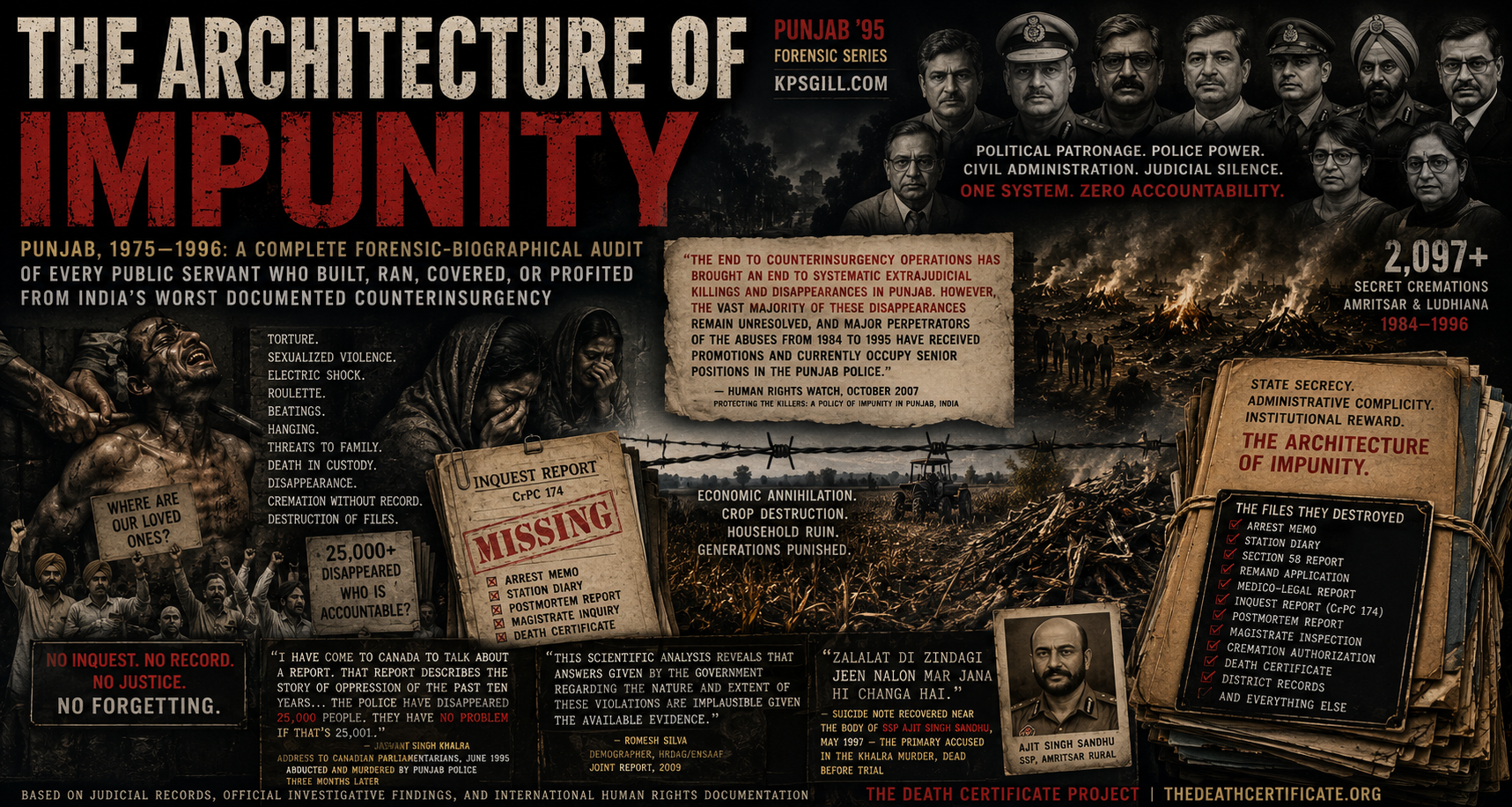
ਲਾਸ਼ਾਂ ਸਾੜੀਆਂ। ਫ਼ਾਈਲਾਂ ਮਿਟਾਈਆਂ। ਅਫ਼ਸਰਾਂ ਨੂੰ ਤਮਗ਼ੇ ਮਿਲੇ।
A joint reconstruction drawing on: the Ensaaf Crimes Against Humanity Database; Human Rights Watch; Amnesty International; the HRDAG/Ensaaf joint statistical analysis (2009); Supreme Court of India proceedings; NHRC orders; CBI interim reports (1996–97); the Government of India White Paper on the Punjab Agitation (July 10, 1984); the US Congressional Record; the Washington Post; the Hitavada; the Tribune (Chandigarh); the Ajit (Punjabi daily); US State Department Country Reports on Human Rights Practices (1991–1994); the Punjab Reorganisation Act 1966; the States Reorganisation Commission Report (1955); the Sarkaria Commission Report on Centre-State Relations (1988); Joyce Pettigrew, The Sikhs of the Punjab: Unheard Voices of State and Guerrilla Violence (1995); Kuldip Nayar and Khushwant Singh, Tragedy of Punjab (1984); Citizens for Democracy, Report to the Nation: Oppression in Punjab (1985); and the living testimony of survivor families preserved across three decades of documentation.
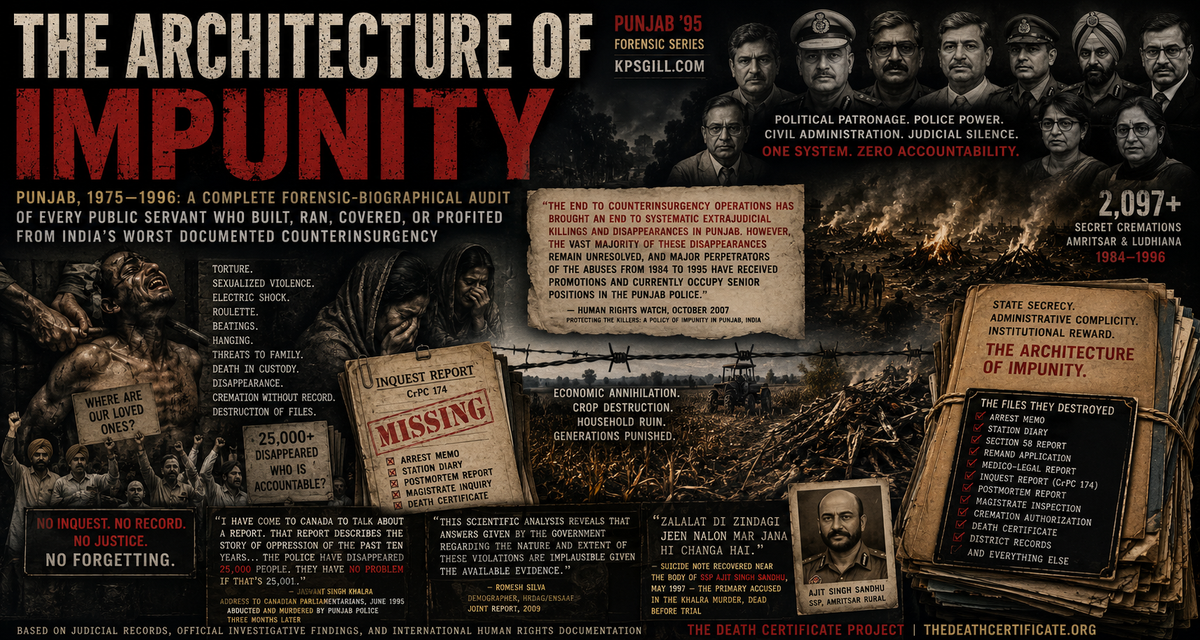
“The end to counterinsurgency operations has brought an end to systematic extrajudicial killings and disappearances in Punjab. However, the vast majority of these disappearances remain unresolved, and major perpetrators of the abuses from 1984 to 1995 have received promotions and currently occupy senior positions in the Punjab police.”
— Human Rights Watch, Protecting the Killers: A Policy of Impunity in Punjab, India, October 2007
“I have come to Canada to talk about a report. That report describes the story of oppression of the past ten years… The police have disappeared 25,000 people. They have no problem if that’s 25,001.”
— Jaswant Singh Khalra, address to Canadian parliamentarians, June 1995. Abducted and murdered by Punjab Police, September–October 1995.
“This scientific analysis reveals that answers given by the government regarding the nature and extent of these violations are implausible given the available evidence.”
— Romesh Silva, demographer, HRDAG/Ensaaf joint report, January 2009
“Zalalat di zindagi jeen nalon mar jana hi changa hai.”
It is better to die than live a life of humiliation.
— Suicide note recovered near the body of SSP Ajit Singh Sandhu, May 24, 1997 — the primary accused in the Khalra murder, dead before trial. Khalra was abducted from within the jurisdiction of Amritsar district and murdered within Tarn Taran district. Both were under the administrative oversight of DC/DM Amritsar K.B.S. Sidhu, IAS.
CENTRAL THESIS - ਸ਼ਬਦ ਤੋਂ ਪਹਿਲਾਂ, ਸ਼ਮਸ਼ਾਨਘਾਟ — Before the Hymn, the Cremation Ground.
Punjab’s counterinsurgency was not merely police excess. It was an administrative system in which killing, disappearance, false encounter, cremation, non-inquest, promotion, and silence formed one continuous chain of state protection — each link enabling and concealing the next, from the station house to the Raj Bhavan.
LEGAL NOTICE AND EDITORIAL STANDARD
This publication is operated by Dr. Kanwar Partap Singh Gill, M.D., a U.S. resident physician. All content is a U.S. First Amendment publication governed by the law of the United States of America. No foreign censorship proceeding — including the Government of India’s Section 69A notification (Request ID 69A/2026/MIT/11078) — alters this publication’s content. A formal submission contesting that proceeding has been filed Ministry of electronics and information technology (MeitY) Government of India.
Defamation Standard Applied: Every factual claim in this article is explicitly graded by evidentiary confidence. No claim is presented as proved that is not established by a court of law, a government admission, or a binding official proceeding.
Right of Reply and Correction Policy:
Any living person named in this report, or any representative of a deceased person’s estate or family, may submit documentary corrections, official records, court judgments, affidavits, or written responses to the editorial address at KPSGILL.COM. Good-faith corrections supported by documentary evidence will be reviewed and, where appropriate, incorporated with attribution. This policy does not waive the publication’s editorial independence, its right to draw fair comment and public-interest inferences from the available record, or its right to maintain evidentiary grades that the documentary record supports. The publication’s commitment is to accuracy, not to a particular political outcome. If the record changes, the report will reflect the change.
EVIDENTIARY FRAMEWORK
| Grade | Meaning | Qualifying Sources |
|---|---|---|
| [PF] | Proved Finding | Court judgments, NHRC/CBI reports, government admissions, Supreme Court orders, US State Dept. reports, official government publications |
| [DA] | Documented Allegation | HRW, Amnesty International, Ensaaf dossiers, UN rapporteur reports, sworn FIRs, commission reports, archived major newspaper reporting |
| [AI] | Analytical Inference | Pattern analysis, institutional logic, omissions, timing, structural argument — explicitly labeled as inference, not proved fact |
| [PM] | Panthic Memory | Collective Sikh testimony, oral record, community documentation — identified as community memory, not judicial finding |
METHODOLOGY
What This Report Is:
This report is a forensic-historical public-interest audit. It assembles, grades, and presents the available evidentiary record of public servants who held specific offices during a specific period in which documented mass human rights violations occurred. It does not determine criminal guilt. Courts determine criminal guilt. It examines a different and equally important question: what did each office do, or fail to do, and with what institutional consequence?
What Sources Are Used and Why:
The highest-weight sources are court judgments, Supreme Court orders, NHRC orders, CBI materials filed in proceedings, official government publications (including the GoI White Paper on Punjab Agitation, July 10, 1984), and government admissions. These are [PF] — proved findings. They carry evidentiary weight regardless of their political implications.
The second tier is established human rights organization documentation: Human Rights Watch, Amnesty International, Ensaaf’s primary-source dossiers, HRDAG/Ensaaf statistical analysis, UN Special Rapporteur records, and US State Department Country Reports on Human Rights Practices. These are [DA] — documented allegations grounded in institutional investigation. They are serious and sourced; they do not carry the weight of judicial findings.
The third tier is archived press reporting, parliamentary and congressional records, commission reports, and memoirs. These are [DA] where they report specific factual claims, and [AI] where this report draws inferences from them.
The fourth tier is survivor testimony and community memory [PM]. This evidence is treated with the respect due to an archive whose oral preservation has often been the only preservation available when institutional records were destroyed or withheld. It is explicitly identified as community record, not judicial finding.
Why Absence of Records Is Treated as Evidence:
When statutory duties required records to be generated — inquest forms under CrPC Section 174, magistrial inquiry under Section 176, ACR evaluations of SSPs by DCs — and those records do not appear in any proceeding over three decades, this report treats their absence as a forensic fact requiring explanation. It does not assume innocence from silence when the law specifically required speaking. The administrative decision not to generate required paperwork is itself a decision. Its consequences are part of the accountability record.
How Command Responsibility Is Used:
For living persons, this report attributes statutory failure and command responsibility where the documentary record supports it. It does not attribute specific criminal participation in individual killings without a court finding to that effect. The command responsibility standard applied is this: an officer who commanded an apparatus, who was demonstrably aware that subordinates were conducting operations within his jurisdiction, and who took no documented corrective action, bears institutional accountability for the pattern — not necessarily criminal liability for each act. This is the standard of public accountability auditing, not criminal prosecution.
How Living Persons Are Protected:
Every claim about a living person in this report is either:
- A proved finding, sourced to a court judgment or official record [PF];
- A documented allegation, sourced to an established human rights organization, commission report, or sworn court record [DA]; or
- An explicitly labeled analytical inference [AI].
No subjective intent, secret knowledge, or personal criminal conduct is attributed to any living person without direct evidentiary support. Where this report draws inferences about institutional conduct, it says so.
The Standard for the Whole:
This report does not ask the reader to treat every allegation as a conviction. It asks the reader to examine the architecture: who held office, what statutory duties existed, what abuses were documented, what records are missing, what promotions followed, and what accountability never occurred. That architecture is the story.
SOURCE HIERARCHY
| Tier | Source Type | Usage |
|---|---|---|
| 1 (Highest) | Supreme Court/High Court judgments; CBI reports filed in court; NHRC orders; government admissions in official proceedings | [PF] — proved finding |
| 2 | Human Rights Watch reports; Amnesty International reports; Ensaaf primary source dossiers; UN Special Rapporteur reports; official government publications (White Paper, Sarkaria Commission) | [DA] — documented allegation or [PF] where government-admitted |
| 3 | US State Department Country Reports; US Congressional Record; archived major newspaper reporting (Tribune, Washington Post, Hitavada); commission reports (Randev, Tiwana, Randev) | [DA] — documented allegation |
| 4 | Academic histories (Pettigrew, Nayar/Singh); survivor testimony collected by Ensaaf and WHR organizations | [DA] with source attribution |
| 5 | Analytical inference from pattern of documentary evidence | [AI] — always explicitly labeled |
| 6 | Community memory, oral record | [PM] — always explicitly labeled |
Note: Wikipedia, Grokipedia, SikhiWiki, and similar open-edit platforms are not used as primary sources for factual claims in this article. Where they appear in the citation archive, they are referenced for the benefit of general readers seeking accessible background — not as authority for any evidentiary grade.
EXECUTIVE FINDINGS
The following findings summarize what this forensic audit establishes at each evidentiary grade. They are not summary conclusions presented for rhetorical effect. They are calibrated assessments of what the available record proves, documents, and permits as inference. This report does not ask the reader to treat every allegation as a conviction. It asks the reader to examine the architecture: who held office, what statutory duties existed, what abuses were documented, what records are missing, what promotions followed, and what accountability never occurred.
[PF] Finding 1 — Scale and Institutional Character of the Killing:
Punjab’s counterinsurgency generated a documented record of enforced disappearances, extrajudicial killings, custodial deaths, and mass cremations — acknowledged as “flagrant violations of human rights on a mass scale” by India’s National Human Rights Commission. The HRDAG/Ensaaf statistical analysis (2009) demonstrated with scientific rigor that violations were “not consistent with the hypothesis that these were purely random events” and were “part of a specific plan or widespread practice.” [NHRC Order; HRDAG/Ensaaf 2009]
[PF/DA] Finding 2 — The Cremation Record:
The CBI identified approximately 2,097 cremations at three Amritsar district crematoria within the NHRC/Khalra litigation record, including unidentified and unclaimed bodies. Human rights organizations characterize this record as evidence of illegal or secret cremations connected to enforced disappearances. The number is not the outer boundary of the documented crime. It is the administrative aperture through which the crime became visible in official proceedings. [CBI materials in NHRC proceedings; HRW: Protecting the Killers, 2007]
[PF] Finding 3 — Judicial Convictions Establish Specific Institutional Killing:
Six Punjab Police officers received life imprisonment for the abduction and murder of Jaswant Singh Khalra (convicted November 2005; upheld by Supreme Court April 2011). Three officers were convicted for the abduction and killing of Kuljit Singh Dhatt (convicted May 2014). Five officers were convicted for 1993 fake encounters in Tarn Taran (CBI special court, 2024–25). These convictions establish, as proved findings, that state agents used the institutional machinery of the Punjab Police to abduct, torture, and kill civilians. They do not represent the outer boundary of the violations; they are the instances where proof survived the institutional obstacles placed in the way of accountability. [Khalra judgment, 2005; Ensaaf: No Stone Unturned; The Print, 2025]
[DA] Finding 4 — Documented Widespread Violations Across All Districts:
Human Rights Watch (1994, 2007), Amnesty International (1991, 2003), Ensaaf’s primary source database (compiled 2000–present), and US State Department Country Reports on Human Rights Practices (1991–1994) document widespread fake encounters, custodial torture, enforced disappearances, and systematic non-inquest across all districts of Punjab during the counterinsurgency period. The US State Department’s own reports documented 41,000+ cash bounty payments to police for killings between 1991 and 1993 alone.
[PF] Finding 5 — Systematic Post-Period Career Advancement for Identified Officers:
Officers and administrators identified in accountability documentation consistently received promotions, civilian honors, and later public office. This is an objective documented fact — not an inference about the subjective intent of those who made the appointments. The state’s administrative systems did not treat the counterinsurgency record as disqualifying. [HRW: Protecting the Killers, 2007; individual career records, documented throughout this report]
[AI] Finding 6 — Institutional Architecture of Impunity:
The pattern of killing, non-inquest, cremation, promotion, and institutional silence — documented independently across multiple sources — is consistent with an institutional system of protection rather than a series of isolated administrative errors. The absence of record is itself a forensic finding when statutory duties required records to be generated. [Analytical inference from the cumulative documentary record]
[AI] Finding 7 — Civilian Administration as Structural Shield:
The DC/DM offices of Amritsar district — across three successive DCs from 1984 to 1996 — produced no documented magistrial inquiry into the approximately 2,097 cremations identified in the CBI’s count, no visible inquest chain, and no corrective administrative response to mass custodial deaths. The available administrative record permits the inference that the DC/DM office functioned as a civilian shield: not by issuing orders of illegality, but by failing to generate the paperwork that a functioning constitutional administration was required to generate. [Analytical inference from documented statutory omissions]
[DA] Finding 8 — Alleged Apex Financial Architecture:
Indian press reports (Hitavada, November 1994), major international press (Washington Post, December 1994), and the US Congressional Record (November 30, 1994) document allegations that Rs. 4,500 crore was placed at Governor Surendra Nath’s disposal for counterinsurgency operations, with approximately Rs. 800 crore in assets reportedly found at Punjab Raj Bhavan after his death in a July 1994 plane crash. No CBI investigation was ever conducted. The allegations remain unverified by any official Indian proceeding. Their documentation in the record is itself an institutional fact.
[AI] Finding 9 — The Accountability Gap Is Not Incidental:
The post-1995 absence of full accountability preserved the public reputations and post-service careers of many identified officials while leaving survivor families without records, bodies, identified perpetrators, or remedies. This outcome is consistent with institutional protection rather than investigative failure. A state apparatus capable of conducting 41,000 bounty transactions between 1991 and 1993 possessed the administrative capacity to document what it did. The absence of that documentation is a choice that now forms part of the evidentiary record.
[AI] Finding 10 — The Punjab Model’s Institutional Legacy:
Human Rights Watch (2007) documented that the Indian government explicitly cited the Punjab counterinsurgency as a model for other conflict situations, and that officers identified in human rights documentation were deployed to other regions to advise on security operations. The methods were not retired in 1995. They were institutionally certified and replicated.
CHRONOLOGICAL TABLE: KEY EVENTS, 1947–2026
| Date | Event | Significance |
|---|---|---|
| August 1947 | Partition of India | Punjab divided; Sikhs without homeland; 200,000–500,000 Sikh deaths |
| September 1955 | States Reorganisation Commission Report | Recommends Hindi-Punjabi composite state; Sikh protest begins |
| November 1966 | Punjab Reorganisation Act | Punjabi Suba created but truncated; Chandigarh excluded |
| October 1973 | Anandpur Sahib Resolution | Constitutional federalism demand; characterized by Congress as “secessionist” |
| June 1975 | Emergency declared | Akali Dal leads opposition; Badal imprisoned; SS Ray drafts Emergency proclamation |
| April 13, 1978 | Vaisakhi Nirankari clash | 13 Sikhs killed; Bhindranwale galvanized; no prosecution of Nirankari leaders |
| August 1982 | Dharam Yudh Morcha | Civil disobedience campaign; 100,000+ arrests; negotiations fail |
| December 1983 | Bhindranwale moves to Akal Takht | Armed fortification under Gen. Shahbeg Singh |
| June 3–10, 1984 | Operation Blue Star | Army assault on Golden Temple; White Paper issued July 10, 1984; Sikh Reference Library destroyed |
| June 1984 | Operation Woodrose | Rural Punjab swept; thousands of young Sikhs abducted |
| June 18, 1984 | Simranjit Singh Mann resigns IPS | First IPS resignation in protest |
| October 31, 1984 | Indira Gandhi assassinated | Anti-Sikh pogrom follows; 2,733+ killed in Delhi alone |
| July 24, 1985 | Rajiv-Longowal Accord | Constitutional promises made; never implemented |
| August 20, 1985 | Longowal assassinated | Moderate Sikh leadership destroyed; accord undermined |
| April 2, 1986 | SS Ray becomes Governor Punjab | Emergency architect now heads counterinsurgency state |
| Late 1985 | JF Ribeiro becomes DGP Punjab | “Bullet for bullet” doctrine institutionalized |
| April 1988 | KPS Gill becomes DGP Punjab | Bounty system systematized; Black Thunder II |
| April 1988 | OP Sharma begins Punjab deputation | DGP (Intelligence); village informant network expansion begins |
| May 1988 | Operation Black Thunder II | Gill-Ray coordination; Golden Temple cleared |
| May 1987 | Barnala government dismissed | SS Ray recommends; President’s Rule imposed |
| July 1, 1986 | Izhar Alam becomes SSP Amritsar | Alam Sena assembled; Padma Shri awarded August 1987 |
| January 10, 1989 | Gobind Ram’s Sarchur village operation | Mass flogging, collective punishment, sexual threats documented by PUHR |
| July 23, 1989 | Kuljit Singh Dhatt abducted | Sandhu: “We aren’t going to return the body”; Basra: “Did you not understand?” |
| September 1990 | Goel posted as SSP Gurdaspur | Methods from Amritsar replicated in border district |
| November 1991 | Operation Rakshak II launched | 41,000+ bounties 1991–93; maximum killing period |
| February 1992 | Beant Singh becomes CM Punjab | Elections boycotted by Akali Dal; police retain operational authority |
| October 1993 | Goel posted AIG/Ops Amritsar | Returns to senior operational command during peak cremations |
| November 9, 1994 | Satwant Singh Manak petition | Police whistleblower names chain from constable to DGP |
| November 6, 1994 | Hitavada reports Raj Bhavan seizures | Rs. 800 crore reported after Governor Nath’s crash |
| July 9, 1994 | Governor Surendra Nath killed in plane crash | Raj Bhavan fund story breaks November 1994 |
| 1994–1995 | Jaswant Singh Khalra’s investigation | Cremation register evidence compiled; 6,017 cremations in Amritsar alone |
| September 6, 1995 | Khalra abducted by Punjab Police | SSP Ajit Singh Sandhu’s team; KPS Gill visits detention |
| October 1995 | Khalra murdered | Two shots to chest; body in Harike canal |
| August 31, 1995 | Beant Singh assassinated | Human bomb at Chandigarh Secretariat |
| January 1, 1996 | OP Sharma becomes DGP Punjab | Succeeds Gill; the intelligence chief assumes command |
| December 12, 1996 | Supreme Court orders CBI investigation | Mass cremations case; NHRC appointed |
| May 24, 1997 | Ajit Singh Sandhu found dead | Body cut in two on railway tracks; disputed suicide/murder |
| November 1996 | OP Sharma appointed Governor Nagaland | From DGP to Governor — the standard reward |
| 2000 | NHRC issues order in mass cremations case | “Not necessary to identify officer or officers responsible” |
| February 2006 | DGP Virk admits 300 false identities | 300 innocent people killed to protect informants |
| November 18, 2005 | Six officers convicted: Khalra case | Life imprisonment upheld by Supreme Court April 11, 2011 |
| May 9, 2014 | Three officers convicted: Dhatt case | SPS Basra (3x President’s Medal), Jaspal Singh, Sita Ram; 5 years each |
| 2014 | Sentences suspended by High Court | Basra, Jaspal Singh, Sita Ram serve approx. 6 months |
| 2022 | Secret pardon of SPS Basra revealed | Previous Punjab government pardoned him; family not informed |
| 2024–25 | CBI court convicts five: Tarn Taran 1993 | “Grim narrative of abuse and gross misuse of official authority” |
| April 2026 | Section 69A notification against kpsgill.com | Government of India seeks to block this publication |
PART ONE: THE ROOTS — PUNJAB FROM PARTITION TO 1984
I. The Long Grievance: Punjab’s Political Pre-History, 1947–1975
The Punjab of 1984 did not appear from nowhere. Its killing fields were prepared over four decades by a systematic pattern of political exclusion, broken promises, and administrative bad faith toward the Sikh community — a pattern whose recognition does not excuse the state’s subsequent crimes but is indispensable to understanding how those crimes became institutionally possible.
The Partition Legacy:
[PF] The Partition of 1947 divided Punjab between India and Pakistan along lines that left Sikhs — who had inhabited the region continuously for five centuries and who, under Maharaja Ranjit Singh’s empire, had governed it — without a homeland of their own. The western half of Punjab, including Lahore, Nankana Sahib, Panja Sahib, and hundreds of sacred Sikh sites, was assigned to Pakistan. The Sikh community suffered disproportionate displacement, violence, and loss in the partition massacres. The estimated Sikh death toll from partition violence ranges from 200,000 to 500,000. [See: Punjab Boundary Commission Report, Government of India Press, New Delhi, 1966; Kuldip Nayar and Khushwant Singh, Tragedy of Punjab, 1984, p.85; Joyce Pettigrew, The Sikhs of the Punjab, Zed Books, 1995]
The Punjabi Suba Movement:
[PF] Beginning in the 1950s, the Akali Dal — the historic Sikh political party — demanded the creation of a Punjabi-speaking state from the Hindi-Punjabi mixed administrative unit of post-Partition Punjab. The demand was met with systematic obstruction by the Congress central government, which classified Punjabi-speaking Hindus as Hindi speakers in the 1951 and 1961 censuses on the basis of pressure from Hindu nationalist organizations. The Punjabi Suba was finally created in 1966 — after fifteen years of agitation, multiple imprisonments of Akali leaders, and the precedent-setting language demands of the Sikh political movement — but in a truncated form that excluded Chandigarh (designated a Union Territory under central control), gave Haryana the Hindi-speaking eastern districts, and assigned Punjab’s river waters to an allocation formula that the Akali Dal consistently maintained was unjust to Punjab. [See: States Reorganisation Commission Report, Government of India Press, 1955; Punjab Reorganisation Act, 1966 (Central Act No. 31 of 1966); Rajinder Puri, ‘What it’s all about’ in Punjab in Indian Politics, ed. Amrik Singh, 1985]
The Anandpur Sahib Resolution (1973):
[PF] At a meeting in Anandpur Sahib in October 1973, the Akali Dal adopted the Anandpur Sahib Resolution — a document articulating Sikh demands for greater autonomy within the Indian federal structure, the transfer of Chandigarh to Punjab, equitable water sharing from the rivers, and the constitutional protection of Sikh religious and cultural rights. The Resolution was drafted within the framework of federalism and explicitly acknowledged Punjab as part of India. [PF] The Government of India, under Indira Gandhi’s Congress, characterized the Resolution as secessionist — a characterization that Sikh scholars and constitutional lawyers have consistently disputed. [AI] The political decision to frame constitutionally legitimate demands for regional autonomy as separatism was itself a contribution to the crisis that followed: it delegitimized the moderate Akali Dal’s political channel, strengthened those who argued that constitutional agitation was futile, and established the intellectual template that would later allow the state to classify virtually any Sikh political demand as a terrorist threat.
II. The Emergency and Punjab (1975–1977)
[PF] On 25 June 1975, Prime Minister Indira Gandhi declared a national Emergency under Article 352 of the Constitution, suspending civil liberties, imposing press censorship, and authorizing mass arrests of political opponents. The Akali Dal — under the leadership of Harchand Singh Longowal, Parkash Singh Badal, and Gurcharan Singh Tohra — launched the “Save Democracy Morcha” against the Emergency. Thousands of Akali activists courted arrest; Badal was imprisoned; the Akali leadership was jailed. [See: Britannica: Parkash Singh Badal]
[PF] The architect of the Emergency’s political framework was Siddhartha Shankar Ray — the Congress politician from West Bengal who would later serve as Governor of Punjab during the critical years 1986–1989. Ray had drafted the Emergency proclamation letter for Indira Gandhi and recommended the preemptive arrests of opposition leaders. His career trajectory — from Emergency architect to Punjab counterinsurgency Governor — is the institutional biography of how the Indian state’s appetite for extralegal political suppression traveled from one crisis to the next.
[PF] The Emergency ended in 1977 following the Congress party’s electoral defeat. The Akali Dal, in coalition with the Janata Party, came to power in Punjab with Parkash Singh Badal as Chief Minister from 1977 to 1980. This was the last Akali government before the 1984 crisis — a government that governed Punjab at a time of relative political stability and whose termination in February 1980, when Congress returned to power under Indira Gandhi and dismissed the Badal-led Akali Dal–Janata coalition government through imposition of President’s Rule, marked the beginning of the political deterioration.
III. The Congress-Bhindranwale Question
[PF/AI] The political history of how Jarnail Singh Bhindranwale rose to prominence is entangled with Congress Party calculations that have been documented, debated, and partly admitted. The available evidence:
[DA/AI] In the 1980 Punjab SGPC elections, Congress Party operatives allegedly supported Bhindranwale’s faction against the mainstream Akali Dal — documented by multiple political contemporaries, journalists, and historians but not conclusively proved in any judicial proceeding. The rationale, as described by participants, was to split the Akali vote. This connection has been reported by Kuldip Nayar and Khushwant Singh in Tragedy of Punjab (1984), Hindustan Times correspondent Kanwar Sandhu in India Today (1992), and The Caravan’s reconstruction of the pre-1984 record. [See: The Caravan: Unanswered Questions About 1984; Kuldip Nayar and Khushwant Singh, Tragedy of Punjab, Vision Books, 1984] This is graded [DA/AI] because the evidence is substantial but the connection has not been established by judicial finding or unambiguous government admission.
[DA] Former IPS/IAS officer Gurtej Singh has testified publicly — including in accounts preserved in the 1984 Living History archive — regarding that in the summer of 1983, a government intelligence operative approached him with an offer to supply weapons to Bhindranwale through a kar-sewa truck, suggesting that “Third Agency” (an Indian government intelligence unit) was involved in arming the Golden Temple complex. Gurtej Singh declined. He later learned that the weapons were delivered by the acquaintance who had accompanied the approach. [See: Wikipedia: Operation Blue Star]
[AI] Whether the Congress Party deliberately created and then lost control of Bhindranwale, or whether the relationship was more complex, is a question the full historical record has not resolved. What the record does establish is: that Congress Party calculations about Bhindranwale’s usefulness as a political counter to the Akali Dal shaped the political environment of the early 1980s; that those calculations failed disastrously; and that the state’s response to its own miscalculation — the military assault on the Golden Temple — was the moment that transformed a political crisis into an armed insurgency.
IV. The Dharam Yudh Morcha (1982–1984)
[PF] In August 1982, the Akali Dal launched the Dharam Yudh Morcha — a campaign of civil disobedience demanding implementation of the Anandpur Sahib Resolution, transfer of Chandigarh to Punjab, and equitable distribution of river waters. The Morcha involved mass arrests: over 100,000 Akali volunteers courted arrest between 1982 and 1984. The Indira Gandhi government refused to negotiate substantively on the core demands.
[PF] During this period, Jarnail Singh Bhindranwale — who had aligned with the Akali Dal for the Morcha — moved from the Guru Nanak Niwas guest house in the Golden Temple complex (July 1982) to the Akal Takht building (December 1983), fortifying it with armed supporters. The SGPC, under Gurcharan Singh Tohra, provided institutional access. The Akali Dal leadership — Longowal and others — were based in the complex during the same period. The complex became, simultaneously, the seat of legitimate Sikh political agitation, the refuge of an armed religious leader, and a site of escalating tension between Bhindranwale’s followers and the Punjab Police operating outside.
[PF] Multiple rounds of negotiations between the Akali leadership and the Congress central government failed — with Zail Singh (President of India and former Punjab CM) attempting mediation and being blocked at the state level by CM Darbara Singh, as documented in the Caravan’s post-2010 reconstruction. [See: The Caravan: Unanswered Questions About 1984]
V. The 1978 Nirankari Clash and the Escalation of Violence
[PF] On 13 April 1978 — Vaisakhi Day, the most sacred day in the Sikh calendar — a procession of Nirankari Sikhs (a sect whose leader claimed to be a living Guru, which orthodox Sikhs consider blasphemous) clashed with Sikh protesters in Amritsar. Thirteen Sikhs, including the respected activist Bhai Fauja Singh, were killed. Bhindranwale, at this time a Damdami Taksal religious leader, galvanized around the demand for justice for the Nirankari killings and the prosecution of the Nirankari Baba. [AI] The 1978 clash, in which the Nirankari leader was initially protected from prosecution by the state, was the single most politically formative event in Bhindranwale’s rise. It gave him a specific grievance, a specific enemy, and a specific demand around which a mass following could be organized.
[DA] The Baaznews article on Badal’s legacy claims that Badal, as Chief Minister, “smuggled the Nirankari Baba out of Punjab in his car” at the time of the 1978 clash, protecting him from prosecution. [See: Baaznews: Parkash Badal’s Marred Legacy] This allegation, which Badal’s supporters have disputed, is recorded as a documented allegation — it represents a specific claim about political conduct in a moment of lethal sectarian violence, made in a named publication with attribution. The full judicial record of the 1978 Nirankari case has not been publicly examined in any accountability proceeding.
VI. The Political Failure of 1983–1984
[PF] By early 1984, the negotiations between the Akali Dal and the Indira Gandhi government had collapsed. The Darbara Singh government in Punjab had demonstrated its inability to contain the violence — which included militant attacks on police, targeted killings of Hindus, and the escalating fortification of the Golden Temple complex — but had also demonstrated a preference for political management over constitutional resolution of the underlying Anandpur Sahib demands.
[DA] By December 1983, the Golden Temple complex had, by multiple contemporaneous and subsequent accounts, become the base of Bhindranwale and an armed contingent. By April 1984, the complex had been significantly fortified under the direction of former army officer Major General Shahbeg Singh — a dismissed military officer whose professional engineering skills are documented in Lt. Gen. K.S. Brar’s account of the operation (Operation Blue Star: The True Story, UBS Publishers, 1993) as having created defensive positions more formidable than army intelligence had anticipated. [Brar 1993; GoI White Paper, July 10, 1984]
[AI] The political failure of 1983–1984 has multiple authors. The Indira Gandhi government, which chose military action over political resolution of constitutional demands that most constitutional scholars regarded as legitimate. The Darbara Singh state government, which managed the political situation in ways that deepened rather than resolved tensions. The Akali Dal leadership — including Longowal, Tohra, and others physically present in the Golden Temple complex — which occupied the same space as an armed militant leader without producing the separation that might have allowed political resolution without military intervention. And the Bhindranwale network itself, which made the Golden Temple into a battlefield whose defense could not be sustained indefinitely but whose attack would inflict catastrophic costs on the relationship between the Indian state and the Sikh community. All of these actors contributed to the conditions for Blue Star. None of them authorized the specific killings that followed Blue Star across the next decade.
PART TWO: OPERATION BLUE STAR AND THE FOUNDING VIOLENCE (JUNE 1984)
VII. The Operation and Its Official Record
[PF] Operation Blue Star was conducted by the Indian Armed Forces between 1 and 10 June 1984, with the stated objective of removing Jarnail Singh Bhindranwale and militants from the Golden Temple complex in Amritsar. The operation involved army infantry, tanks, artillery, helicopters, and armored vehicles. Simultaneously, Operation Shop raided other gurdwaras across Punjab, and Operation Woodrose followed in the Punjab countryside. [See: Government of India White Paper on the Punjab Agitation, Government of India Press, New Delhi, 10 July 1984; Joyce Pettigrew, The Sikhs of the Punjab: Unheard Voices of State and Guerrilla Violence, Zed Books, 1995; Lt. Gen. K.S. Brar, Operation Blue Star: The True Story, UBS Publishers, 1993; 1984 Sikh Archive, https://1984sikh-archive.org/punjab-1984-1993/bluestar/]
[PF] The Government of India’s own White Paper on the Punjab Agitation, released July 10, 1984, reported 493 civilians and militants killed, 86 injured, 592 apprehended, 83 security forces killed, and 249 wounded. [Government of India White Paper on the Punjab Agitation, Government of India Press, New Delhi, 10 July 1984] [DA] Independent estimates, including the first dispatch of AP reporter Braham Chellaney — the only foreign journalist who remained in Amritsar — reported 780 militants and civilians and approximately 400 troops killed. Joyce Pettigrew’s academic study, The Sikhs of the Punjab: Unheard Voices of State and Guerrilla Violence (1995), places the civilian toll significantly higher than the government’s figures; Kuldip Nayar and Khushwant Singh’s Tragedy of Punjab (1984) document thousands gathered in the complex on the martyrdom anniversary. In the absence of an independent comprehensive inquiry — which the government refused to permit — the precise civilian toll cannot be established as a proved finding. The Akal Takht — the second-holiest Sikh shrine — was effectively destroyed by tank and artillery fire. The Sikh Reference Library — containing irreplaceable manuscripts, documents, and Sikh historical records accumulated over centuries — was destroyed in the aftermath of the operation. [DA] Multiple eyewitness accounts and Sikh institutional records document that the Library’s contents were removed and/or burned by army personnel. The Indian government’s White Paper does not address the Library. The precise mechanics of destruction remain [DA] by independent and Sikh sources, but the destruction itself and the irreplaceable loss are not meaningfully contested. [See: 1984 Sikh Archive; Devinder Singh Duggal, in-charge of the Sikh Reference Library, eyewitness account]
[DA/AI] The assault was conducted on the martyrdom anniversary of Guru Arjan Dev Ji — the day, as Longowal himself had announced weeks earlier, when tens of thousands of pilgrims would be gathered at Harmandar Sahib for the religious commemoration. The Government of India’s own White Paper does not address the timing’s significance. [DA] Journalists, Sikh institutions, and academic historians including Joyce Pettigrew have documented the view that conducting the assault on this specific date made civilian casualties both foreseeable and severe. [AI] Whether the timing was a deliberate choice to maximize psychological effect, as alleged, or a security-operational decision made on other grounds, the consequence — that civilians were present in extraordinary numbers and that many died — is not disputed. [Pettigrew, The Sikhs of the Punjab, 1995; Kuldip Nayar and Khushwant Singh, Tragedy of Punjab, 1984]
The Administrative Structure on the Ground:
[PF] The Brown Pundits reconstruction of the administrative structure during Blue Star is the most specific available record of who held what authority during the operation. The civilian administration of Amritsar on the day of the assault consisted of:
- DC Gurdev Singh: Removed from office on June 3, 1984 — the army had him replaced specifically because it suspected sympathies with the Sikh community.
- DC Ramesh Inder Singh (Bengal cadre, first DM appointment): Installed on June 3, 1984, the day before the main assault, replacing Gurdev Singh on army recommendation.
- DSP City Opar (Apar) Singh Bajwa: Serving as Deputy Superintendent of Police (City) Amritsar — the operational police officer for Amritsar city — present during the operation.
- SP Sital Das: Superintendent of Police, Amritsar.
- SSP Sube Singh: Senior Superintendent of Police, Amritsar, during the assault (succeeding SSP Ajay Pal Singh Mann who had served October 1983 – March 1984).
- DGP Pritam Singh Bhinder: Director General of Punjab Police.
- IG CID Harjit Singh Randhawa: Inspector General, Criminal Investigation Department.
- [See: Brown Pundits: Operation Blue Star Administrative Record]
The Immediate Aftermath:
[PF] Operation Woodrose, launched immediately after Blue Star, deployed army units across Punjab to “mop up” suspected militants. Human rights documentation consistently records Woodrose as involving arbitrary arrests, beatings, and killings of young Sikh men across rural Punjab — the beginning of the decade of violence that would follow. The 1984 Sikh Archive documents: “school teacher Ranbir Kaur witnessed the shooting of another group of 150 people whose hands had been tied behind their backs with their own turbans.” [See: 1984 Sikh Archive]
VIII. The 1984 Anti-Sikh Pogrom — Delhi and Across India
[PF] On October 31, 1984, Prime Minister Indira Gandhi was assassinated by her Sikh bodyguards Satwant Singh and Beant Singh in retaliation for Operation Blue Star. Within hours, systematic violence against the Sikh community erupted in New Delhi and across northern India. Over the following three days, an officially acknowledged minimum of 2,733 Sikhs were murdered in Delhi alone — though independent estimates range from 3,000 to 8,000 nationally. [PF] The Supreme Court of India, in various subsequent proceedings, has acknowledged documented evidence of organized political participation in the violence, including the Nanavati Commission of Inquiry’s 2005 findings and the PUDR/PUCL report ‘Who Are the Guilty?’ (1984), which identified Congress-connected individuals as having participated in organizing the attacks. [See: Peoples Union for Democratic Rights and Peoples Union for Civil Liberties, Who Are the Guilty? Report of a Joint Inquiry into the Causes and Impact of the Riots in Delhi from 31 October to 10 November 1984, Delhi, 1984; Nanavati Commission of Inquiry, Report on the November 1984 Anti-Sikh Riots, 2005; Human Rights Watch/Asia, Dead Silence: Legacy of Abuses in Punjab, 1994]
[PF] The Rajiv-Longowal Accord of July 1985 included a government commitment to compensate victims of the November 1984 violence and to conduct judicial inquiry into the Delhi killings. [See: Text of the Rajiv-Longowal Accord (Punjab Accord), signed New Delhi July 24, 1985; HRW: Dead Silence (1994); Kuldip Nayar and Khushwant Singh, Tragedy of Punjab, 1984] [PF] Most of those commitments were never implemented. The failure to prosecute the organizers and perpetrators of the November 1984 pogroms — which was documented, known, and judicially observed for decades — was itself a contribution to the Punjab insurgency that followed: it established — as a documented institutional fact — that the mechanisms of the Indian state had not been deployed to prosecute the organizers of the November 1984 violence, despite substantial evidence of organized political participation. The administrative consequence was to demonstrate, in the most visible possible way, that the state’s criminal justice apparatus was not equally available. [AI] The impunity for the 1984 Delhi pogrom was the moral template for the impunity of the Punjab counterinsurgency that followed. The Republic’s institutional response to both was identical: promotion, honor, and silence.
IX. The Political Response: Rajiv Gandhi and the Accord
[PF] Rajiv Gandhi, who became Prime Minister following his mother’s assassination, appointed Arjun Singh as Governor of Punjab. Under Arjun Singh’s governorship, Akali political detainees were released, press censorship was lifted, and the conditions for the Rajiv-Longowal Accord were created. See: Text of the Rajiv-Longowal Accord (Punjab Accord), July 24, 1985; Kuldip Nayar and Khushwant Singh, Tragedy of Punjab, 1984]
[PF] The Accord, signed on July 24, 1985, promised: transfer of Chandigarh to Punjab by January 26, 1986; referral of Punjab’s territorial disputes with Haryana and Himachal Pradesh to a commission; a commission to address Punjab’s river water allocation; elections to the Punjab Legislative Assembly; and review of cases of Sikhs imprisoned since June 1984.
[PF] On August 20, 1985 — less than a month after signing the Accord — Harchand Singh Longowal was assassinated at a gurdwara rally in village Sherpur, Sangrur district, by militants opposed to the settlement. He was 53. At the moment of his assassination, he had just reached agreement with Badal and Tohra on presenting a unified Akali front in the forthcoming elections. [See: Washington Post: Gunmen Slay Sikh Leader in Punjab, August 20, 1985; Tribune India: A Moderate, Signed Rajiv-Longowal Accord]
[PF] [PF] The Accord’s core commitments were not implemented. Chandigarh was not transferred to Punjab. The river water allocation dispute was not resolved. The promised compensation to November 1984 violence victims was largely not paid. These are documented institutional facts recorded across HRW, academic literature, and parliamentary record. They are not contested by the Government of India. [HRW: Dead Silence 1994; Kuldip Nayar and Khushwant Singh, Tragedy of Punjab 1984] [AI] The assassination of Longowal, and the subsequent failure to implement the Accord’s promises, produced the political conditions in which the argument that constitutional agitation was pointless gained credibility among a new generation of young Sikhs in Punjab — precisely the generation that fueled the militant groups of 1986 to 1993.
PART THREE: THE LEGAL ARCHITECTURE OF KILLING (1983–1995)
X. The Statutory Instruments of State Violence
Understanding how the Punjab counterinsurgency operated legally requires mapping the overlapping statutory frameworks that authorized the violations.
The National Security Act (1980, amended 1984):
[PF] The NSA authorized detention without charge or trial for one year (increased to two years for Punjab in 1984) for acts “prejudicial to the security or defense of India.” It provided no judicial review within the detention period beyond a review board whose powers were advisory only. In practice, it became the standard mechanism for holding young Sikh men indefinitely without evidence of specific criminal conduct. [See: US State Department Country Report on Human Rights Practices — India, 1992; HRW: Dead Silence (1994), pp. 1, 38-42]
The Punjab Disturbed Areas Act (1983) and Armed Forces (Punjab and Chandigarh) Special Powers Act:
[PF] The AFSPA, applied to Punjab in 1983, granted army personnel the power to shoot to kill on “reasonable suspicion,” to enter and search any premises without warrant, and to arrest anyone without warrant — with complete immunity from prosecution for acts committed in the exercise of these powers. It suspended, in designated areas, the fundamental rights provisions of the Constitution. [Amnesty International: Human Rights Violations in Punjab (1991)]
TADA (Terrorist and Disruptive Activities Prevention Act, 1985, renewed through 1995):
[PF] TADA created special in-camera courts operating under diluted evidentiary standards, made confessions to police officers (not lower than SSP rank) admissible as evidence — creating overwhelming incentive for coercive interrogation — reversed the burden of proof for “waging war” charges, and authorized extended detention during investigation. [PF] Amnesty International documented systematic torture used to extract TADA confessions. [HRW: Dead Silence (1994)]
The 59th Constitutional Amendment (1988):
[PF] The 59th Constitutional Amendment (1988), applicable only to Punjab, created an exceptional Punjab-specific emergency framework that modified the enforcement of fundamental rights during President’s Rule in Punjab — affecting Articles 19, 21, and 22, and representing an extraordinary state-specific derogation without precedent in Indian constitutional history. The Amendment did not formally extinguish the rights in permanent terms, but suspended their enforceability during declared emergency periods, enabling the security apparatus to operate without constitutional constraint during precisely the years of maximum documented killing. [See: Constitution (Fifty-Ninth Amendment) Act, 1988; Amnesty International: Use and Abuse of Law, 1991; Citizens for Democracy: Report to the Nation, 1985]
The CrPC Provisions That Were Not Enforced:
[PF/AI] No emergency legislation eliminated the statutory duties created by the Code of Criminal Procedure. Section 174 required the police officer in charge to report unnatural deaths and conduct preliminary inquiries. Section 176 provided magistrial oversight and inquiry powers for suspicious deaths; after the 2005 amendment, Section 176(1A) made judicial magistrate inquiry mandatory specifically for custodial death, disappearance, and rape — a provision that post-dates the counterinsurgency but whose pre-existing framework created an oversight chain that was not meaningfully exercised throughout the 1984–1995 period. Section 107 authorized the District Magistrate to take preventive action. The Annual Confidential Report system authorized the DC to evaluate the SSP’s “dealings with the public.” None of these powers were formally suspended. All were systematically not exercised. This non-exercise — the systematic failure to invoke the legal tools that remained available — is what this report terms the Civilian Shield.
[AI] Before the 2005 amendment, the legal architecture created a specific administrative vulnerability: if the police record did not properly generate or transmit the death or inquest trigger, the magistrial apparatus could later claim that no inquiry obligation had formally matured, because no triggering record had reached it. This report treats the systematic non-generation of that paperwork — across hundreds of deaths, across multiple DC tenures, across a decade — not as a neutral administrative absence, but as part of the forensic pattern. In a jurisdiction where the CrPC imposed affirmative duties, the absence of their exercise is itself a documented institutional fact requiring explanation.
The issue is not whether the surviving public record establishes that any Deputy Commissioner personally ordered any cremation. It does not. The issue is narrower and more legally serious: the office carried statutory oversight obligations under the Code of Criminal Procedure and the district administration structure. Where unnatural deaths, custodial deaths, unidentified bodies, and large-scale cremations occurred within the district, the absence of a visible inquest chain, magistrial inquiry record, and corrective administrative response is itself an evidentiary fact — one that this report documents, grades, and places in the record.
PART FOUR: THE GOVERNORS — CONSTITUTIONAL COVER AT THE APEX
XI. The Sequence of Punjab Governors, 1983–1996
The Governor of Punjab during President’s Rule held executive authority as representative of the Central Government. The role was not ceremonial. During the counterinsurgency years, the Governor coordinated operations, managed intelligence funds, authorized political decisions, and — in the most documented case — apparently managed a multi-thousand-crore counterinsurgency fund that produced Rs. 800 crore in seizures at the Raj Bhavan after his death.
Governors of Punjab, 1983–1996 (abbreviated):
- B.D. Pande (October 1983 – June 1984): Served during the approach to Blue Star
- Arjun Singh (1985–1985): Appointed by Rajiv Gandhi post-assassination, facilitated Longowal Accord
- S.S. Ray (April 2, 1986 – December 8, 1989): The proactive counterinsurgency Governor
- Nirmal Kumar Mukerji (1989–1990)
- O.P. Sharma / interim period (early 1990)
- Surendra Nath (August 1991 – July 9, 1994): Died in plane crash; Rs. 800 crore seized at Raj Bhavan
XII. Siddhartha Shankar Ray — The Counterinsurgency’s Political Governor
Governor of Punjab, 2 April 1986 – 8 December 1989
Congress politician | Former CM West Bengal | Former architect of 1975 Emergency
Born 20 October 1920 — Died 6 November 2010
[PF] Siddhartha Shankar Ray arrived in Punjab in April 1986 as Governor, having spent the intervening years since the Emergency in partial political eclipse within Congress. His appointment was Rajiv Gandhi’s choice — a figure with deep intelligence community connections, experience with counterinsurgency (having broken the Naxalite movement in West Bengal in 1972–77 through methods that earned his administration accusations of systematic extrajudicial killing), and the political instinct to use constitutional mechanisms to provide executive cover for security operations.
[DA] Ray’s tenure as Governor of Punjab attracted documented accusations of police brutalities conducted while the state was under President’s Rule — characterizations made in the human rights literature of the period and in the political record. [HRW: Dead Silence, 1994; Amnesty International: Human Rights Violations in Punjab, 1991] The Grokipedia entry confirms: as Governor, “Ray exemplified the Governor’s role as a central mechanism for intervening in state failures, imposing President’s Rule twice (1987 and 1990) and coordinating intelligence-led operations against Khalistani militants.” [See: Grokipedia: Siddhartha Shankar Ray]
The Dismissal of the Barnala Government:
[PF] In May 1987, Governor Ray recommended to the President of India the dismissal of the elected Punjab government of Chief Minister Surjit Singh Barnala — citing the state government’s inability to control militant violence. The Barnala government, an Akali Dal administration, was replaced by President’s Rule. [AI] The dismissal of an elected Sikh government — replacing it with direct central rule administered by a Congress-appointed Governor — at a moment when the counterinsurgency was escalating, and when the elected government might have provided some political buffer between security operations and the Sikh community, removed the last institutional check on the security apparatus. Under President’s Rule, the Governor was the executive. The DGP reported directly to the Governor. The civilian oversight structure that the CrPC had built into the district administration was superseded by direct central command.
The KPS Gill Connection:
[PF] It was under Governor Ray’s tenure that KPS Gill was first installed as DGP Punjab in April 1988. The Ray-Gill combination — the political Governor who had dismissed the elected government and the counterinsurgency DGP who would, by the subsequent documentation of HRW, US State Department Country Reports, and Ensaaf, systematize a bounty-driven operational framework within which the documented killings occurred — was the institutional pairing that set the operational architecture of the Punjab counterinsurgency. [See: SS Ray Foundation: About; Tribune: SS Ray — An Administrator par Excellence]
After Punjab:
[PF] Ray left Punjab in December 1989 and subsequently served as India’s Ambassador to the United States from 1992 to 1996 — the years of maximum documented human rights violation in Punjab. His Washington appointment, like Ribeiro’s Padma Bhushan, was the Republic’s statement about what his Punjab tenure represented: not a record of excess to be investigated, but a record of service to be rewarded with the most prestigious diplomatic assignment available.
XIII. Governor Surendra Nath — The Raj Bhavan Allegations, the Crash, and the Rs. 800 Crore
Governor of Punjab, August 1991 – 9 July 1994
Also Governor, Himachal Pradesh (additional charge), November 1993 – July 1994
Career IPS Officer | Born 1926 | Died in plane crash, 9 July 1994, Mandi district
[PF] Surendra Nath — a career IPS officer who had risen through the service to the Governor’s chair — served as Governor of Punjab from August 1991 through his death on 9 July 1994. His tenure precisely coincides with the worst documented period of the Punjab counterinsurgency: Operation Rakshak I (1991), Operation Rakshak II (November 1991 onwards), and Operation Night Dominance (1992) were all conducted during his gubernatorial authority. The HRDAG/Ensaaf statistical analysis identifies the early 1990s as the period of greatest intensity of enforced disappearances and extrajudicial executions. [See: Wikipedia: Surendra Nath]
The Death:
[PF] On 9 July 1994, a 14-seat Punjab government Beechcraft Super King Air B-200 aircraft took off from Chandigarh at 8:50 a.m. bound for Kullu. Passengers included Governor Surendra Nath, his wife, his son Vikram Malhotra (an IAS officer recently posted as DC Kullu), Malhotra’s children, and the crew of three. The aircraft encountered dense monsoon clouds in Mandi district. All 13 persons aboard were killed. The inquiry report, submitted by retired High Court judge Justice D.P. Sood, attributed the crash to weather conditions and pilot navigation error. [See: Outlook India: Ghosts of Disasters Past]
The Raj Bhavan Seizures:
[DA] Within weeks of the crash, what the Hitavada newspaper described as a comprehensive list of assets seized from the Punjab Raj Bhavan following Nath’s death began circulating through the Indian press and intelligence community. The Hitavada’s November 6, 1994 report — attributed to “highly placed sources inside the Indian regime” — stated:
- [DA] Rs. 110 crore in cash (alleged)
- [DA] Jewelry worth Rs. 40 crore (alleged)
- [DA] Immovable property worth Rs. 650 crore (alleged)
- [DA] Multiple political bungalows and farm houses (alleged)
- [DA] An attempt to acquire land near Kullu at Rs. 8 crore (alleged, well below market value)
- [DA] Reported total: approximately Rs. 800 crore — per Hitavada, November 6, 1994; entered into US Congressional Record November 30, 1994. No independent verification by official Indian body. No CBI investigation conducted.
[DA] The same Hitavada report stated that the Union Government had made available Rs. 4,500 crore to Nath “to root out terrorism in Punjab and Kashmir in a bid to defame the Punjab and Kashmir militants.” Both Home Minister S.B. Chavan and Internal Security Minister Rajesh Pilot were described as having been “well aware” of Nath’s operations. [See: US Congressional Record, November 30, 1994 — FAS; GovInfo: Congressional Record November 30, 1994]
The US Congressional Record:
[PF] On November 30, 1994, US Congressman Gerald Solomon entered the Hitavada report and related media coverage into the official US Congressional Record, stating: “new evidence has come to light which shows that the Indian regime paid the late Punjab governor, Surendra Nath, $1.5 million dollars to foment covert terrorism in Punjab, Khalistan, and Kashmir.” The Congressman noted that “Mr. Nath had approximately 8 billion rupees, or about $233 million, at his death, according to the [Punjab] Mail.” He noted that former DGP Ribeiro had called for investigation of Nath’s wealth. [US Congressional Record, November 30, 1994, cited above]
[PF] The Washington Post reported on December 12, 1994: “Last July, when the governor of the north Indian state of Punjab, Surendra Nath, died along with most of his family in a private plane crash, rumors of his ill-gotten wealth began circulating almost immediately.” [Washington Post, December 12, 1994]
The Home Minister’s Response:
[PF] Home Minister S.B. Chavan denied currency had been seized from the Punjab Raj Bhavan but then stated that “only the Prime Minister, Mr. Rao, could say anything about the ‘seizures’ made from the Raj Bhavan.” [Hitavada, November 6, 1994, cited in US Congressional Record] [AI] The denial followed immediately by a deflection of substantive inquiry to the Prime Minister is the administrative language of a man who knows what was found but is managing the political exposure. A Home Minister genuinely uninvolved in counterinsurgency fund management would have been able to say definitively what was seized, what it represented, and why. The deflection to the PM’s authority is the confession of institutional awareness.
The CISF Connection:
[DA] The Hitavada report stated that Nath “played an all-important role to give strength to the hitherto lesser-known CISF (Central Industrial Security Force)” and that “it is being alleged that some of its men were used to kill innocent persons including the family members of the Punjab police personnel as well as teachers, doctors, engineers, media men and political personalities.” [Hitavada, cited in US Congressional Record] [AI] If this allegation is accurate — that CISF personnel were used for targeted killings under the Governor’s coordination, extending the security apparatus’s killing capability beyond the Punjab Police chain of command — it represents the most institutionally significant undocumented chapter of the Punjab counterinsurgency: the use of a central government paramilitary force, nominally tasked with industrial security, as a covert assassination unit under gubernatorial direction.
The Bakhsish Singh-Balwant Singh Connection:
[DA] The Hitavada report named suspended police official Bakhsish Singh — who had been security chief for former Punjab Finance Minister Balwant Singh (an Akali Dal leader assassinated by militants in July 1990) — as having remained close to Governor Nath after his suspension. The report described Bakhsish Singh as having “very easy access to Mr. Nath even at odd hours” and being “well informed of all the ‘secret missions’ of the late Governor.” [Hitavada, cited in US Congressional Record] [DA] The report suggested that Nath’s operatives, rather than the Sikh militants officially blamed, may have organized Balwant Singh’s assassination.
No Accountability:
[PF] No CBI investigation into the Raj Bhavan seizures was ever conducted. No accountability proceeding examined the Rs. 4,500 crore fund allegation. No commission was appointed. The Government of India maintained silence. Satyapal Dang (CPI) and Simranjit Singh Mann demanded a CBI probe. A human rights advocate filed a writ petition in the Punjab and Haryana High Court. All were disregarded. [US Congressional Record, November 30, 1994]
PART FIVE: THE DGP ARCHITECTURE — BUILDING AND MANAGING THE KILLING MACHINE
XIV. The Sequence of DGPs, Punjab 1983–1996
The DGP of Punjab during the counterinsurgency period held the operational command of the killing machine. Understanding who held the position, when, and what they did with it is indispensable to mapping command responsibility.
| Period | DGP | Notes |
|---|---|---|
| 1983–1984 | Pritam Singh Bhinder | DGP during Operation Blue Star |
| 1984–1986 | Various (transition) | |
| 1986–1988 | J.F. Ribeiro | “Bullet for bullet” era; Padma Bhushan 1987 |
| 1988–1990 | K.P.S. Gill (First term) | Systematized bounty; Operation Black Thunder II |
| 1990–1991 | P.C. Dogra / interim | |
| 1991–1995 | K.P.S. Gill (Second term) | Maximum killing period; 41,000 bounties 1991-93 |
| 1996 | O.P. Sharma | Succeeded Gill; came from DGP (Intelligence) role |
XV. Julius Francis Ribeiro — The Original Doctrine
DGP Punjab, late 1985 – April 1988 | IPS (Maharashtra Cadre) | Padma Bhushan, 1987
Born 5 May 1929, Bombay
[PF] J.F. Ribeiro — born in Bombay, Catholic, Maharashtra cadre — was dispatched to Punjab in late 1985 as DGP by the Rajiv Gandhi government. He arrived from the Mumbai Police Commissionership. His Punjab tenure covered the critical early institutionalization of the counterinsurgency’s methods under what the New York Times described as a “ferocious crackdown” driven by the “bullet for bullet” policy. [See: Wikipedia: Julio Ribeiro]
[PF] The “bullet for bullet” doctrine was not merely rhetorical. It operationalized a policy in which police did not seek to arrest, prosecute, and convict — a process that required evidence, judicial oversight, and legal standards — but instead sought to kill. In the transition from the Atwal era to the Ribeiro-KPS Gill era, Punjab Police transformed from a force that, however imperfectly, operated within a legal framework, into a force that operated primarily through extrajudicial elimination.
[PF] Under Ribeiro’s tenure, SSP Mohammad Izhar Alam ran Amritsar and assembled the “Alam Sena” — a private paramilitary of approximately 150 men that US Embassy cables would later describe as having “carte blanche in carrying out possibly thousands of staged encounter killings.” Ribeiro received the Padma Bhushan in 1987 while this apparatus was operating under his command. [See: Ensaaf: Mohd. Izhar Alam Dossier; SikhiWiki: Julio Francis Ribeiro]
[PF] Two assassination attempts were made on Ribeiro: October 3, 1986 (KCF militants at Punjab Armed Police HQ Jalandhar, Ribeiro lightly wounded, wife hospitalized, two sentries killed) and August 1991 in Bucharest, Romania, where he was serving as India’s Ambassador. The Bucharest attempt indicates the KCF maintained an operational file on Ribeiro years after his DGP tenure — consistent with the view that the militant movement treated the “bullet for bullet” DGP as a target of specific accountability.
[PF] After retiring from active police service, Ribeiro served as India’s Ambassador to Romania (1992–93), and since retirement has been active in civic affairs in Mumbai. His memoir, Bullet for Bullet: My Life as a Police Officer (1998), is available through major publishers. [See: Goodreads: Bullet for Bullet] [AI] The memoir, by available account, does not contain an accounting of what occurred in Amritsar and across Punjab under his command. The Padma Bhushan preceded the documentation. The documentation has not produced a reckoning.
XVI. Kanwar Pal Singh Gill — The Supercop and the Mass Cremations
DGP Punjab: April 1988 – December 1990 (First Term); November 1991 – January 1996 (Second Term)
IPS (Assam-Meghalaya Cadre) | Born 29 December 1934, Ludhiana — Died 26 May 2017
[PF] K.P.S. Gill served as DGP Punjab for two terms totaling approximately six years — the entirety of the documented period of maximum human rights violation. He is credited in the Indian mainstream media with “ending” the Punjab insurgency. The human rights record is documented across multiple independent jurisdictions over three decades. [See: HRW: Dead Silence (1994); HRW: Protecting the Killers (2007); US State Department Country Reports on Human Rights Practices — India, 1991, 1992, 1993; Ensaaf: Khalra Judgment Summary; KPS Gill, personal statements in Tribune January 19, 1995]
The Bounty Expansion:
[PF] In the early 1990s, DGP Gill “expanded upon a system of rewards and incentives for police to capture and kill militants, leading to an increase in ‘disappearances’ and extrajudicial executions of civilians and militants alike.” [HRW: Dead Silence (1994)] [PF] The US State Department documented that over 41,000 cash bounties were paid to police in Punjab for extrajudicial killings between 1991 and 1993 alone. [US State Department Country Report on Human Rights Practices — India, 1992; HRW: Dead Silence (1994), pp. 1, 38-42]
Operation Black Thunder II (1988):
[PF] In May 1988, Gill oversaw Operation Black Thunder II — the National Security Guard operation to remove militants from the Golden Temple complex. Unlike Blue Star, which used heavy military force, Black Thunder II deployed snipers, cut off food and water over nine days, and achieved the surrender of approximately 67 militants with 4 killed. Gill cited this as proof of his “humane” methods. [PF] Human Rights Watch and Amnesty International documented that the years immediately following Black Thunder II saw a dramatic escalation in fake encounters, disappearances, and illegal cremations in Amritsar district — consistent with the pattern that short-term operational success was followed by intensified extrajudicial killing in its aftermath.
The Khalra Evidence:
[PF] In the months before Jaswant Singh Khalra’s abduction, a public press confrontation between Khalra and Gill revealed that Gill was aware of Khalra’s investigations. Police issued explicit death threats to Khalra — “we have disappeared 25,000 people, we have no problem if that’s 25,001.” [Punjab Disappeared Archive] [PF] Surviving witness Kuldeep Singh testified that Gill personally visited Khalra at the Chhabal police station during his illegal detention — days before Khalra was shot twice in the chest and his body thrown into the Harike canal. The SHO told Khalra after Gill’s departure that he could have saved himself by listening to Gill’s advice. [See: WSO Canada: Remembering Khalra; Panthic.org: Remembering Khalra]
Despite eyewitness testimony placing Gill at the detention facility, the CBI never charged him.
[PF] Six police officers were convicted of the Khalra abduction and murder in November 2005. Paramjit Kaur Khalra wrote to the CBI Director in December 2005 specifically requesting extension of the investigation to Gill as a principal conspirator. No charges were filed. [See: Ensaaf: Khalra Judgment Summary]
The Sexual Assault Conviction:
[PF] In 1996, Gill was convicted under Sections 354 and 509 of the IPC for outraging the modesty of IAS officer Rupan Deol Bajaj at a party in 1988. [Wikipedia: Kanwar Pal Singh Gill] [AI] [PF] The Republic of India’s courts convicted KPS Gill for outraging the modesty of IAS officer Rupan Deol Bajaj — a criminal conviction requiring proof beyond reasonable doubt. No criminal charge was ever filed against him for any of the documented deaths in Amritsar’s cremation grounds during his command. The judicial system’s differential deployment is itself a documented institutional fact: one standard of evidentiary seriousness was applied to the assault on a woman’s person; a demonstrably lower standard of evidentiary engagement was applied to the mass cremation record.
His Own Words:
[PF] Gill repeatedly denied all accountability: “I led the most humane counterinsurgency operation in the annals of history.” He stated the missing thousands were “missing with the consent of their parents and relatives and their whereabouts were known to their families.” [Tribune, January 19, 1995; cited in SikhiWiki: KPS Gill] These statements were published in print during his lifetime. They were not retracted.
After Retirement:
[PF] After retiring in January 1996, Gill was appointed as security adviser to Chief Minister Narendra Modi’s Gujarat government in 2002 — during the period of the Gujarat communal riots. He served as president of the Indian Hockey Federation and directed the Institute for Conflict Management in New Delhi. He died on May 26, 2017. [Tribune: Gill appointed to Gujarat, 2002; HRW: Protecting the Killers, 2007, noting Gill’s post-retirement influence on counterinsurgency doctrine] No criminal proceedings arising from his Punjab command were ever completed.
XVII. Om Parkash Sharma — The Intelligence Architect
IPS, 1962 Batch, Uttar Pradesh Cadre, Punjab deputation April 1988
DGP (Intelligence), Punjab: approximately 1988–1996
DGP Punjab (successor to KPS Gill): effective January 1, 1996
Governor of Nagaland: appointed November 1996
[PF] O.P. Sharma is among the least publicly profiled of the major counterinsurgency architects — which is itself an evidentiary condition. The 1962 batch UP cadre officer joined Punjab Police on deputation in April 1988, the same month KPS Gill was installed as DGP. The Sikh Heritage Education newspaper archive confirms: when Gill retired, “Mr. Sharma, who held the charge of DGP (Intelligence), was appointed the new DGP earlier in the day by the state government. An IPS officer of the 1962 batch from Uttar Pradesh cadre, he joined the Punjab police on deputation in April 1988.” [See: Sikh Heritage Education: O.P. Sharma Takes Over as New DGP]
[PF] The Tribune’s June 27, 1999 interview with Sharma — conducted while he was Governor of Nagaland — confirms: “Sharma was in the thick of the battle in Punjab for nine long years — 1988 to 1996 — both as intelligence chief and a senior police officer responsible for many a daring operation.” [See: Tribune India Interview: Governor O.P. Sharma, June 27, 1999]
What DGP (Intelligence) Meant:
[AI] The position of DGP (Intelligence) in Punjab during the counterinsurgency was the command center of the most consequential operations in the killing machine. The DGP (Intelligence) managed:
- The Counter Intelligence Agency (CIA) networks — the station-level interrogation and assassination units that operated out of CIA Staff offices at police district headquarters
- The village-level informant system — the network of paid sources within Sikh communities who provided target intelligence
- The management of “rehabilitated” militants — former militants turned state informers who were given protection and sometimes deployed as “Black Cats” to conduct false-flag operations
- The coordination between Punjab Police intelligence, the Intelligence Bureau, the RAW Punjab desk, and BSF CID
- The financial administration of intelligence fund payments — informant stipends, bounty authorizations, and the discretionary funds associated with covert operations
[PF] DGP Virk admitted in 2006 that over 300 individuals listed in police records as “unidentified militant” cremated bodies were actually active informants who had been given new identities — with innocent people killed and cremated in their place. [HRDAG FAQ; HRW: Protecting the Killers] [AI] The officer responsible for the intelligence function that managed these informants — and that made the administrative decisions about whose identity to protect and at what cost — was the DGP (Intelligence). For the years 1988 to 1996, that officer was O.P. Sharma.
After Punjab:
[PF] O.P. Sharma was appointed Governor of Nagaland in November 1996 — after KPS Gill’s retirement, after his own tenure as DGP Punjab, and after the Supreme Court’s December 1996 order directing CBI investigation of mass cremations. He served as Governor of Nagaland while the CBI was beginning to examine the records of the period he had administered. [Tribune India: Governor Sharma Interview, June 27, 1999] No accountability proceeding was initiated against him. He is confirmed as former DGP Punjab and Governor Nagaland by the Wikipedia article on Om Prakash Sharma (Nagaland politician). [See: Wikipedia: Om Prakash Sharma (Nagaland politician)]
PART SIX: THE CIVIL SHIELD — THE DISTRICT MAGISTRATES OF AMRITSAR
XVIII. The Administrative Sequence and the Statutory Obligations
The Deputy Commissioner of Amritsar district held, by virtue of the CrPC and the administrative architecture of the Indian district system, specific non-delegable oversight obligations over the security operations conducted in the district. Three persons held this office between June 1984 and August 1996, across which the CBI documented 2,097 cremations identified in the NHRC/Khalra litigation record at three cremation grounds.
The DC Sequence (Amritsar, 1984–1996):
| Period | DC/DM | Notable Facts |
|---|---|---|
| Until June 3, 1984 | Gurdev Singh | Removed by army for suspected sympathies |
| June 4, 1984 – July 6, 1987 | Ramesh Inder Singh | Bengal cadre, first DM appointment; Padma Shri 1986 |
| July 7, 1987 – May 10, 1992 | Sarabjit Singh | Largely undocumented in accountability literature |
| May 11, 1992 – August 11, 1996 | K.B.S. Sidhu | Period of maximum killing; subsequent Special Chief Secretary |
XIX. The Removal of DC Gurdev Singh — The Founding Act
[PF] On June 3, 1984 — the day before the main army assault on the Golden Temple — DC Gurdev Singh was removed from his post as Deputy Commissioner of Amritsar and replaced by Ramesh Inder Singh. The Brown Pundits reconstruction of the administrative record states: “Army was suspicious that Gurdev had sympathies with militants therefore he was replaced on June 03, 1984 with Ramesh Indar Singh.” [See: Brown Pundits: Operation Blue Star]
[AI] The removal of Gurdev Singh is the most consequential single administrative act of the entire 1984–1996 period in terms of what it reveals about the Indian state’s institutional intentions. The army did not want a DC who might ask questions, issue writs, demand inquests, or create administrative friction around the killing of Sikh civilians. It removed one who might. It installed one who would not. This founding act established the institutional character of the DC’s office in Amritsar for the next twelve years: an office selected and retained for administrative compliance, not legal oversight.
XX. Ramesh Inder Singh — The Installed Administrator
Deputy Commissioner, Amritsar, 4 June 1984 – 6 July 1987
IAS: West Bengal Cadre, subsequently transferred to Punjab Cadre
Padma Shri, 1986 (awarded at age 36) | Subsequently: Chief Secretary, Punjab; Chief Information Commissioner, Punjab (2009–2014)
[PF] Ramesh Inder Singh was a West Bengal cadre IAS officer serving in Punjab as Director of Rural Development when he was transferred to the Amritsar DC post on June 3, 1984 — the day before the army assault. The Brown Pundits record confirms: “Ramesh was a Bengal cadre officer then serving as director of rural development in Punjab and this was his first district [magistrate level] appointment.” [Brown Pundits: Operation Blue Star] Prior to this appointment, Inder Singh had held ADC-level postings in other Punjab districts (including in Ferozepur or Faridkot), but the Amritsar role was his first at the full DC/District Magistrate level.
[AI] The significance of this is structural: a person without prior District Magistrate experience was installed, by army request, into the most demanding and legally complex administrative position in Punjab at the most dangerous moment in the state’s modern history. This was not a selection for administrative competence. It was a selection for political reliability.
[PF] During his tenure as DC Amritsar (June 1984 – July 1987), SSP Mohammad Izhar Alam (July 1986 – April 1988) ran the Amritsar police and assembled the “Alam Sena.” [Ensaaf: Izhar Alam dossier] The CBI ultimately documented 2,097 cremations identified in the NHRC/Khalra litigation record across his tenure and his successors’. [PF] He received the Padma Shri in 1986 — while serving as DC Amritsar, during the early years of mass illegal cremations in his jurisdiction.
[PF] After Amritsar, Ramesh Inder Singh rose to Principal Secretary to the Chief Minister of Punjab (five years), Chief Secretary of Punjab, and — with extraordinary institutional irony — Chief Information Commissioner of Punjab from 2009 to 2014, the officer charged with enforcing Punjab’s transparency obligations under the Right to Information Act. [See: Chandigarh Citizens Foundation: Padma Shri Ramesh Inder Singh; HarperCollins India: Author Profile] He published his memoir, Turmoil in Punjab: Before and After Blue Star, through HarperCollins India. [See: Amazon: Turmoil in Punjab]
[AI] The governing thesis: a Bengal cadre officer, installed at army request at the founding moment of the counterinsurgency, without prior District Magistrate experience, whose appointment in those specific circumstances is consistent [AI] with the army’s stated preference for administrative compliance rather than independent oversight — became, after thirty-seven years of career advancement predicated on that founding compliance, the guardian of the state’s transparency obligations. The circle closed without producing any accountability for what it enclosed.
XXI. Sarabjit Singh — The Invisible DC
Deputy Commissioner, Amritsar, 7 July 1987 – 10 May 1992
[AI] The five years of DC Sarabjit Singh’s tenure — July 1987 through May 1992 — are the least documented in the accountability literature, but they encompass a critical and escalating phase: the transition from the Ribeiro era to KPS Gill’s first and second terms, Operation Rakshak I (1991), the beginning of Operation Night Dominance, and the sharp escalation in fake encounters and disappearances that the HRDAG/Ensaaf analysis identifies as reaching its peak in 1992.
[AI] The structural accountability question for DC Sarabjit Singh is identical to that for his predecessor and successor: during five years of increasingly intensive counterinsurgency violence in Amritsar district, what magisterial inquests were convened? What ACR evaluations of the SSPs under whom Ensaaf documented hundreds of cases of enforced disappearance — including Izhar Alam’s successors in Amritsar and the officers whose operations overlapped with his district — did he produce? These questions have no publicly documented answers. The silence is itself an administrative record.
XXII. Karanbir Singh Sidhu — The DC of Maximum Killing
Deputy Commissioner, Amritsar, 11 May 1992 – 11 August 1996
IAS, 1984 Batch (All-India Rank 2) | Special Chief Secretary, Punjab (retired July 31, 2021)
[PF] KBS Sidhu served as DC Amritsar from May 1992 to August 1996 — a tenure that precisely coincides with what the HRDAG/Ensaaf analysis identifies as the period of maximum enforced disappearances and extrajudicial executions in Amritsar district. During his DC tenure: Operation Rakshak II was in full execution; Jaswant Singh Khalra began his investigation, was threatened by police, traveled to Canada, and was abducted and murdered; the Supreme Court issued its December 1996 order directing CBI investigation; the CBI documented 2,097 cremations identified in the NHRC/Khalra litigation record. The SSPs who served in the Amritsar operational command structure during his tenure included Samant Goel (as AIG/IVC & Ops Amritsar from October 1993), and SSP Ajit Singh Sandhu commanded Tarn Taran — the district adjacent to and operationally continuous with Amritsar’s CIA staff structure.
[PF] Sidhu has given extensive public accounts of his DC tenure, including in a SikhNet interview, multiple Substack essays, and a recorded video interview. His characterization is one of “moral complexity” and “tightrope walking.” His stated approach: “One had to walk a tightrope: on the one hand, resisting the temptation to give the police unchecked powers, and on the other, not appearing sympathetic to extremist elements.” [See: SikhNet: Bridging Governance and Spirituality; KBS Sidhu Substack]
[AI] The governing thesis of this report’s audit of K.B.S. Sidhu’s DC Amritsar tenure is stated precisely in the Punjabi phrase preserved as this publication’s editorial concept: ਸ਼ਬਦ ਤੋਂ ਪਹਿਲਾਂ, ਸ਼ਮਸ਼ਾਨਘਾਟ — Before the hymn, the cremation ground. In English: go to the cremation grounds first. Examine what happened there. Then recite the governance essays.
The public record does not establish K.B.S. Sidhu’s subjective intent. This report does not claim to read his mind, does not assert that he issued written orders for any illegal act, and does not assert personal criminal participation in any specific killing. The standard applied here is not criminal beyond reasonable doubt. It is the standard of a forensic public-interest audit: what did the office of DC/DM Amritsar do, or fail to do, during the period in which the record later revealed mass cremations, enforced disappearances, and the abduction and murder of Jaswant Singh Khalra within his district’s operational scope?
The answer, on the available record, is this: The office of DC Amritsar produced no documented magistrial inquiry into any of the approximately 2,097 cremations identified by the CBI in the NHRC/Khalra litigation. No inquest chain is visible in the public record. No corrective administrative response to mass illegal cremations is visible in the public record. No ACR notation adverse to the SSPs serving under him has been produced. The tightrope metaphor deployed in his public writings reframes a statutory obligation as a political calculation. The CrPC did not invite the DC to balance competing considerations about inquest. It imposed affirmative procedural duties. Their systematic non-exercise during the highest-killing years in the district’s modern history is itself an evidentiary fact.
The inference that the DC/DM office functioned as a civilian shield — not necessarily by issuing written orders of illegality, but by failing to generate, demand, preserve, or publicly produce the administrative record that a functioning constitutional district administration was required to generate — arises from the chronology, the statutory framework, and the documented absence. It is an analytical inference [AI], explicitly graded as such, not a proved finding of criminal conduct.
[PF] Sidhu rose to Special Chief Secretary, Punjab — the highest IAS position below Chief Secretary — and retired on July 31, 2021 after 37 years of service. He now operates a prolific Substack, a Medium blog, and active social media presence, writing about Sikh governance, spirituality, Punjab’s water rights, farm law, and administrative reform. [See: KBS Sidhu Facebook]
[AI] The Substack exists. The inquest record does not. The moral sequence demands the cremation grounds before the governance essays.
PART SEVEN (REVISED): THE SSP LAYER — OPERATIONAL COMMAND, SPECIFIC ACTS, AND THE MECHANICS OF KILLING
XXIII. The Complete SSP Amritsar Sequence (1981–1996)
[PF] Based on the Brown Pundits administrative reconstruction, the Ensaaf IPS Civil List analysis, and multiple independent sources, the SSP sequence for Amritsar district 1981–1996:
| Period | SSP | Notes |
|---|---|---|
| Sept 1981 – April 1982 | A.S. Atwal | Shot dead inside Golden Temple April 25, 1982 — first senior officer killed |
| April 1982 – July 1983 | Surjit Singh Baines | |
| July 1983 – October 1983 | Sarabjit Singh | |
| October 1983 – March 1984 | Ajay Pal Singh Mann | Last SSP before Blue Star; relative institutional integrity |
| March – June 1984 | Sube Singh | SSP during Operation Blue Star |
| June 1984 – ~August 1985 | Bua Singh | |
| July 1, 1986 – April 19, 1988 | Mohammad Izhar Alam | “Alam Sena”; Padma Shri August 1987 |
| ~1989 | Hardeep Singh Dhillon (1985 batch) | |
| ~1989 – September 1990 | Samant Kumar Goel | SSP Amritsar before Gurdaspur posting |
| September 21, 1990 – October 5, 1993 | Goel in Gurdaspur | SSP Gurdaspur |
| October 13, 1993 onwards | Goel as AIG/IVC & Ops Amritsar | Senior operational command |
| Concurrent 1991–1997 | Ajit Singh Sandhu in Tarn Taran | Adjacent district; Khalra’s abduction; died before trial |
[Sources: Brown Pundits: Operation Blue Star; Ensaaf: Samant Goel Dossier; Royal Patiala: Samant Goel Career]
XXIV. Mohammad Izhar Alam — The Alam Sena and the Padma Shri
SSP Amritsar, 1 July 1986 – 19 April 1988
Subsequently SSP Jalandhar, DIG Border Range, ADGP Punjab
Padma Shri, August 1987
[PF] Mohammad Izhar Alam served as SSP Amritsar from July 1, 1986 to April 19, 1988. He assembled what he and the Punjab Police openly called his operational unit — and what victims, survivors, and the US Embassy referred to as the “Alam Sena” or “Black Cats”: a paramilitary of approximately 150 men recruited from cashiered police officers, “rehabilitated” militants, and Special Police Officers operating entirely outside normal legal accountability. [See: Ensaaf: Mohd. Izhar Alam Dossier]
[DA] A US Embassy New Delhi cable dated December 19, 2005, released via WikiLeaks, described Alam as having assembled “a large, personal paramilitary force of approximately 150 men known as the ‘Black Cats’ or ‘Alam Sena’ (‘Alam’s Army’) that included cashiered police officers and rehabilitated Sikh terrorists. The group had reach throughout the Punjab and is alleged to have had carte blanche in carrying out possibly thousands of staged ‘encounter killings.’” [US Embassy cable December 19, 2005; cited in Ensaaf: Izhar Alam Dossier]
[PF] The Ensaaf perpetrators database holds a complete dossier on Alam based on primary source interviews with victim families — the dossier identifying him as one of the key perpetrators of the Amritsar phase of the counterinsurgency. A Supreme Court petition on behalf of a Canadian Sikh citizen charged Alam with unlawful detention and torture. The Tribune documented the case across multiple 1989 reportings. [Ensaaf: Izhar Alam Dossier; Tribune May 4, 1989]
[PF] In August 1987 — while SSP Amritsar and while the Alam Sena was operating — Alam received the Padma Shri from the Government of India. The Republic awarded him its fourth-highest civilian honor at the moment of his maximum operational deployment.
[PF] Following his Amritsar tenure, the government consistently promoted Alam through the Punjab Police hierarchy to ADGP. No prosecution was ever initiated. [Ensaaf: Izhar Alam Dossier]
XXV. Gobind Ram — The Terror of Batala: Documented Acts
SSP Batala Police District / Commandant, 75th Battalion Punjab Armed Police, Jalandhar
Died January 10, 1990 — killed in bomb blast
[PM/DA] The documentary record on Gobind Ram is among the most specific in the entire counterinsurgency’s accountability literature — not because the Indian state compiled it, but because human rights investigators, journalists, and community organisations went to the villages themselves within weeks of the events and wrote down what they found. What they found was a systematic campaign of collective punishment, sexual terror, public humiliation, and individual torture whose specific instances are documented below.
The Sarchur Village Operation — January 10, 1989:
[PF] The most extensively documented single episode of Gobind Ram’s command occurred on January 10, 1989. A team from the People’s Union for Human Rights visited Batala on February 2 and 10, 1989 — within weeks of the operation — and documented the following through direct interviews with victims and witnesses. A teacher at the Guru Nanak Dev Academy in Batala described the event to PUHR investigators on February 2:
“In the forenoon of January 10, 1989, contingents of the Punjab Police and the Border Security Force in hundreds swooped down on the village Sarchur, which has a population of 4,000.” All men of the village were assembled at a central point. What followed lasted more than one hour: systematic public flogging of every assembled male with leather belts, batons, and bamboo poles by the police and BSF contingents. [See: Sikh Heritage Education: SSP Gobind Ram — The Terror in Batala]
[PF] Having beaten the men, Gobind Ram then ordered the assembled villagers to publicly abuse Surjit Kaur — an Akali Dal leader of district level who was at that moment imprisoned in Batala jail. When a retired army officer refused to abuse the women of the village on order, he was taken into custody and held at the police station for three days. Gobind Ram’s threat to the village, recorded by PUHR investigators from direct testimony: “If any action occurs in this village, every single male is going to be taken out and shot. Then we’re going to take all the women to our camp and there we’re going to create a new breed for Punjab.” The additional threat about Surjit Kaur, recorded in the PUHR Women’s Forum report: that he would make her parade naked when she came out of jail. Multiple families sent daughters to live with relatives in other districts after the Sarchur operation. [Sikh Heritage Education: Gobind Ram; Nari Manch Report: Where Women Are Paraded Naked]
[PF] Sarpanches — the elected village heads — of the Batala area signed a collective statement to the Governor of Punjab stating that Gobind Ram had killed many innocent young men in custody. [Sikh Heritage Education: State Terrorism in Punjab; Sikh Heritage Education: Gobind Ram] [AI] The significance of this collective sarpanch statement cannot be overstated: these were not human rights organizations or opposition politicians. These were the elected local governance heads — the people whose standing in Indian administrative law was specifically designed to represent the village at the official level — making a signed statement about killings in custody by their own SSP.
The Beco Torture Centre and the Arrest of Women:
[PF/PM] The most extensively documented individual case from Gobind Ram’s command involved the August 21, 1989 abduction of Bibi Gurdev Kaur (wife of Bhai Kulwant Singh Babbar) and Bibi Gurmeet Kaur (wife of Bhai Mehal Singh) from their workplace — the Parbhat Finance Company, Amritsar. Both husbands were in the underground movement. Six armed men arrived in a tinted-window van; one identified himself as ASI Lakhwinder Lakha. Both women were forced into the vehicle and taken to the Beco Torture Centre in Batala. [See: Sikh Unity: Inhumane Treatment Towards Sikh Women]
[PM/DA] In Bibi Gurdev Kaur’s own words, preserved in the documentation: “When the Singhnees went inside, they saw SSP Gobind Ram beating a Sikh youth with a rod. When he saw the two women enter, he immediately came towards them and hit Gurdev Kaur in the stomach with his rod. Bibi Gurdev Kaur collapsed onto the ground and began to bleed from her private parts. The bleeding did not stop for several days. Gobind Ram kept hitting Bibi Gurdev Kaur in the stomach without saying a word for five minutes. He then gave the rod to another Inspector whom he ordered to hit Bibi Gurdev Kaur in the joints.” Gobind Ram then turned to Bibi Gurmeet Kaur, “whom he threw to the ground and began to kick in the chest.” The ghotna method — a heavy log rolled over the thighs of the detained woman with men standing on top of it, tearing the muscle tissue — was then applied. In Gurdev Kaur’s words: “Then they put a heavy roller on my thighs and made a few policemen stand on it, while others rotated it.”
[PM/DA] The same documentation records the detail most emblematic of Gobind Ram’s particular cruelty: he maintained a vat of human feces and urine at the torture facility. He force-fed this substance to Amritdhari Sikh detainees — those who had undergone the Khalsa initiation ceremony that involves drinking Amrit (nectar) — stating as he did so: “You have drunk the Amrit of Gobind Singh; now drink the Amrit of Gobind Ram.” This is not an inference or an allegation without specific source. It is a recorded statement from a person who was present, preserved in the documentation of the period.
KPS Gill’s Response to the Documented Atrocities:
[PF] When human rights organizations publicized the documented atrocities in the Batala area, DGP KPS Gill responded publicly: “The reports against SSP Batala, Gobind Ram by members of Panchyats and Sarpanches were false. There is no truth in them. This was propaganda against the police officers. This was verified after investigations.” [Sikh Unity: Inhumane Treatment Towards Sikh Women, citing Gill statement] [AI] Gill did not refer to the signed statements of elected village sarpanches as evidence. He characterised them as “propaganda.” No investigation of any kind produced any accountability finding. Gobind Ram continued in his post, continued his operations.
The Black Cat Deception Operations:
[PF/PM] [DA/PM] Independent reports and community oral history document that plain-clothes operatives — associated with SSP Gobind Ram’s command — operated in Sikh attire, wearing orange dastaars and carrying Kalashnikov rifles — to enter villages under the guise of being Sikh militants. [PM/DA] The 1984 Tribute documentation, based on oral history interviews, records an account of approximately 20 such operatives, identified in the testimony as associated with Gobind Ram’s command, entering a village during a wedding, ate food from the family hosts who believed them to be Singhs, then revealed their purpose. [1984 Tribute: Assassination of SSP Gobind Ram] [AI] The operational function of these false-flag village operations was dual: to gather intelligence from community members who believed they were hosting Sikh militants, and to create incidents that justified state reprisals against villages labelled as militant-supporting.
Death:
[PF] Gobind Ram was killed on January 10, 1990 — exactly one year after the Sarchur village operation — when a bomb planted in the cooler of his office at the 75th Battalion headquarters in Jalandhar detonated. Three others, including SI Prem Kumar, were killed; at least four more were critically wounded. The planning was attributed to Gurjant Singh Budhsinghwala (KLF). His son had been killed in a September 1989 assassination attempt. [See: Wikipedia: Gurjant Singh Budhsinghwala; 1984 Tribute: Assassination of SSP Gobind Ram]
XXVI. Ajit Singh Sandhu — The Anatomy of a Career
PPS/IPS (irregularly promoted) across Kapurthala, Sangrur, Ropar, and Tarn Taran
Irregularly promoted from PPS to IPS by KPS Gill on September 1, 1990
Primary accused in both the Kuljit Singh Dhatt and Jaswant Singh Khalra murders
Died May 24, 1997 — body found on railway tracks; disputed whether suicide or murder
[PF] Ajit Singh Sandhu was not a senior IPS officer when KPS Gill first noticed him. He was a Punjab Police Service (state cadre) officer — a DSP — distinguished within the Punjab Police for what the system classified as “encounter achievements.” It was specifically Gill’s patronage that elevated him: KPS Gill promoted Sandhu from the PPS to the IPS on September 1, 1990, an irregular inter-cadre transfer that Ensaaf documents as having been made “to allow the most notorious PPS officers to hold senior command positions.” [Ensaaf: Ajit Singh Sandhu Dossier, https://data.ensaaf.org/official/S0006/detail/] After that promotion, Sandhu served as SSP across four districts — Kapurthala, Sangrur, Ropar, and Tarn Taran — each posting extending the reach of his documented methods.
The Kuljit Singh Dhatt Abduction — July 23, 1989:
[PF] The Dhatt case is the most precisely documented of Sandhu’s confirmed operations, with the added feature of Sandhu’s own explicit admissions to the victim’s family preserved in the record. On July 23, 1989, around 8:30 a.m., a police party led by DSP Ajit Singh Sandhu arrived at Gurmel Singh’s house in village Garhi, Hoshiarpur district. The party also included SHO Jaspal Singh (Dasuya), SHO Sardool Singh (Tanda), and SI Sita Ram (Gardiwala police post). Kuljit Singh Dhatt, a 35-year-old Sikh community leader who was an elected village official and was on his way to the Bhogpur Sugar Mill, was inside. He was abducted along with Gurmel Singh, Surjit Singh, Davinder Singh, and others. The police put Kuljit Singh and Davinder Singh in one car; the others in a second car. [See: Ensaaf: No Stone Unturned; The Statesman: Who Was Ajit Singh Sandhu?]
[PF] At Dasuya police station, witness Surjit Singh — who was held separately and later released — reported to Ensaaf: “They tortured Kuljit Singh and Davinder Singh. We could hear the sounds of their cries and screams… From that day until now, we have not seen Kuljit.” The screaming through the walls of Dasuya police station on July 23, 1989, is the last documented evidence of Kuljit Singh Dhatt’s life. [Ensaaf: No Stone Unturned]
[PF] When Kuljit’s older brother Harbhajan Singh Dhatt went to Gardiwala police station seeking his brother’s whereabouts, DSP Sandhu told him — directly, with no attempt at evasion — on July 23, 1989: “We have let the rest go. We have done with Kuljit Singh, what we wanted to do. We aren’t going to return the body. Do what you want.” When Harbhajan turned to SP(O) SPS Basra, Basra’s response was: “Did you not understand what Ajit Singh said?” On July 29, at a follow-up meeting, Sandhu repeated: “We aren’t going to return the body.” [Ensaaf: No Stone Unturned, citing direct testimony of Harbhajan Singh Dhatt]
[PF] The police’s official position, maintained for subsequent proceedings, was that Kuljit Singh had “escaped from custody” by breaking his handcuffs and jumping in a river. Harbhajan Singh’s response to Ensaaf: “Even if we take their version of the story, why didn’t he run when he knew the police was coming? The police said he didn’t try to escape then. Then when he was in custody, there were 10 police officers and he’s handcuffed. How can he break his handcuffs and escape?” [Ensaaf: No Stone Unturned]
[PF] In October 1993, the Randev Commission submitted its report implicating five police officials in the unlawful killing: Ajit Singh Sandhu, SHO Jaspal Singh, SHO Sardool Singh, SI Sita Ram, and SP(O) SPS Basra. The Supreme Court issued notice to officials Sardool Singh and Jaspal Singh. Sardool Singh died in 2008. Basra retired as DIG in 2013. Jaspal Singh was convicted of life imprisonment — but for a different murder, that of Jaswant Singh Khalra, in 2005. Sandhu died in 1997 before either case was resolved. [Ensaaf: No Stone Unturned; The Statesman: Ajit Singh Sandhu]
Kapurthala — SSP Posting and Pattern Continuation:
[PF] After his irregular promotion to IPS, Sandhu’s first SSP posting was Kapurthala. The Ensaaf dossier documents: in January 1991, SSP Sandhu reported to the press on “crime statistics” including three alleged encounter killings of militants. Ensaaf’s primary source documentation identifies the three individuals killed: Gurmej Singh and Prithipal Singh, whose families directly implicated Sandhu in the abductions and unlawful killings, and Balwinder Singh. [Ensaaf: Ajit Singh Sandhu Dossier, citing Ajit newspaper February 14, 1991 and primary source interview records]
Tarn Taran — The CIA Staff and the Human Shield Operation:
[PF] The most documented evidence of Sandhu’s personally directing torture comes from the May 1993 torture of Baba Charan Singh at CIA Staff Tarn Taran. During an inquiry ordered by the Punjab and Haryana High Court, witness Kanwar Singh Dhami testified: “I shared a cell with Charan Singh; Baba Charan Singh told me about the unlawful killings of his family and his own torture by the Tarn Taran police. After sharing the cell that night, SSP Sandhu and other police tortured both Charan Singh and Dhami.” [Ensaaf: Ajit Singh Sandhu Dossier, citing Tribune primary source and commission inquiry record] Dhami’s specific testimony of Sandhu’s personal presence at the torture session is the most direct available evidentiary link between Sandhu and the CIA Staff torture operations.
[PF] On June 8, 1992, SSP Sandhu ordered at least 6 villagers from Behla to serve as human shields during an encounter operation. Nine individuals — whom police publicly claimed were all “militants” — were killed. The Ensaaf dossier records that Sandhu “regularly made false reports to the press about alleged encounter killings, hiding extrajudicial executions, including the deaths of 6 villagers he used as human shields.” The Ajit newspaper reported on June 10, 1992: “Bhai Behla, 8 other militants, 1 soldier, and 3 policemen killed in heavy encounter near Tarn Taran.” A follow-up on June 18 reported: “All 9 individuals who were killed in Behla village were militants — Police’s claim.” Ensaaf’s primary source interviews document a different account of who those nine people were. [Ensaaf: Ajit Singh Sandhu Dossier, citing Ajit newspaper entries and primary source interviews]
[PF] The Ensaaf dossier also records: an allegation that SSP Sandhu illegally detained a family for 10 months and that police torture caused a detained woman to suffer a miscarriage. [Ensaaf: Ajit Singh Sandhu Dossier, citing Tribune February 6, 1995]
The Khalra Abduction — September 6, 1995:
[PF] The abduction of Jaswant Singh Khalra is the most consequential documented act in Sandhu’s career. The full sequence from the judicial record:
On September 6, 1995, Khalra was washing his car outside his home in Amritsar when Punjab Police officers surrounded the area. He was taken to Jhabal Police Station in Tarn Taran — Sandhu’s operational jurisdiction. He was held in illegal detention, first at Jhabal, subsequently at Chhabal. SPO Kuldip Singh — a Special Police Officer recruited by Sandhu himself — was instructed by SHO Satnam Singh to guard Khalra and serve him meals. During this detention, Kuldip Singh witnessed the following: police officers beat Khalra; SPO Kuldip Singh testified that SPO Kuldip Singh, a sworn witness in the subsequent criminal proceedings, testified that DGP KPS Gill visited the facility where Khalra was held, and that Gill entered the room where Khalra was detained, with Sandhu present — at Sandhu’s residence in Manawala village. This testimony was given under oath in judicial proceedings and is recorded in the trial record.; after Gill’s departure, SHO Satnam Singh told Khalra that Gill had offered him a way out and that Khalra should have taken it. [See: Panthic.org: Ensaaf Report on Khalra Murder; Ensaaf: Khalra Judgment Summary]
[PF] SPO Kuldip Singh’s testimony before the Additional District Court in Patiala established the direct link between Gill and the detention. Judge Bhupinder Singh found in the November 2005 judgment: “SSP Sandhu criminally conspired with his subordinate officers to abduct Jaswant Singh Khalra with an intention to cause him to be secretly and wrongfully confined… and to eliminate him or to put him in danger of being murdered.” [Ensaaf: Khalra Judgment Summary]
[PF] The mechanics of Khalra’s death, as described by SPO Kuldip Singh in his deposition: “He was made to stand, thrashed and pushed onto the ground. His legs were stretched apart, more than 180 degrees. Seven policemen kicked him in the abdomen and chest. ‘Save me. Please give me some water,’ he cried. As I was about to fetch some water, I heard two shots. I ran back into the room and found him bleeding profusely. He had stopped breathing.” [WSO Canada: Remembering Khalra; Panthic.org: Remembering Khalra] Two police officers — Arvinder and Balwinder — disposed of the body in the Harike canal. They were rewarded with two bottles of liquor. [Panthic.org: Remembering Khalra]
[PF] The Supreme Court, on directions from writ petitions, ordered Sandhu’s transfer out of Tarn Taran on November 14, 1995. The Punjab Government had not complied as of November 23. [Ensaaf: Ajit Singh Sandhu Dossier, citing Tribune November 23, 1995] The state protecting its perpetrator from court orders in real time.
The Operational Benefits:
[PF] As SSP Tarn Taran, Sandhu achieved what the counterinsurgency system was designed to reward: he accounted for the gunning down of Panthic Committee chief Gurbachan Singh Manochahal, Surjit Singh Behla, and Harjinder Singh Pehlawan — all presented in official records as “genuine encounter killings.” KPS Gill specifically promoted him for these “achievements.” [Alt.India.Progressive: Sandhu Death Report, https://groups.google.com/g/alt.india.progressive/c/88meSTcxelM]
Death: Suicide or Murder:
[PF] On May 24, 1997, Sandhu had been arrested on Supreme Court directions, charged in the Khalra case, and released on bail. He had been, according to reports, suffering from acute depression and increasing social isolation. His body was found at approximately noon near railway tracks at Bhakharpur village, Ambala district — approximately 30 km from Chandigarh — cut in two pieces from near the navel by an approaching train. A Contessa car registered to Sandhu was parked nearby. DGP P.C. Dogra ruled out foul play and declared it suicide. A note in Punjabi was recovered: Zalalat di zindagi jeen nalon mar jana hi changa hai — “It is better to die than live a life of humiliation.” [Alt.India.Progressive: Sandhu Death Report]
[PF] KPS Gill’s immediate response on May 24: “The suicide by a Senior Superintendent of Police, Mr. Ajit Singh Sandhu, would have an adverse effect on officers in different security forces currently engaged in low-intensity conflicts.” Gill blamed “human rights activists” who had filed writ petitions: “the war they lost in the field had been resumed with vigour as a propaganda war.” [HRW: Protecting the Killers (2007), citing Gill statement]
[PM] Paramjit Kaur Khalra — widow of Jaswant Singh Khalra, whose husband Sandhu had abducted and murdered — stated her belief that Sandhu was killed rather than died by suicide, specifically to prevent him from naming Gill in court. The Wikipedia article on Khalra notes: “one of the suspects, Senior Superintendent of Police Ajit Singh Sandhu was murdered in 1997. However, his murder was staged as a suicide.” [Wikipedia: Jaswant Singh Khalra] [AI] Whether Sandhu died by suicide or was killed, his death achieved the same institutional result as a murder would have: the chain of command was severed. The testimony that could have named Gill was silenced. The prosecution stopped at Sandhu. Everything above him remained protected.
XXVII. Samant Kumar Goel — From Amritsar’s Killing Fields to RAW Chief
Trainee IPS Amritsar 1986 | SSP Batala | SSP Amritsar (~1989–September 1990) | SSP Gurdaspur (Sept 21, 1990 – Oct 5, 1993) | AIG/IVC & Ops Amritsar (Oct 13, 1993 – c.1996, effectively senior operational command of Amritsar district)
IPS 1984 Batch, Punjab Cadre | Secretary, RAW, June 26, 2019 – June 30, 2023
Police Medal for Gallantry, 1996 | Police Medal for Meritorious Services, 2000
Career Timeline Clarified:
[PF] Goel’s Punjab postings: trainee officer in Amritsar from 1986; SSP Batala; SSP Amritsar (approximately 1989 to September 1990, preceding his Gurdaspur posting — confirmed by Royal Patiala’s record: “served as SSP of Batala, Amritsar”); SSP Gurdaspur (September 21, 1990 – October 5, 1993); AIG/IVC & Ops Amritsar from October 13, 1993, remaining in senior operational command of Amritsar district through approximately 1996 before transitioning to central deputation. [See: Royal Patiala: Samant Goel Career; Ensaaf: Samant Goel Dossier] The AIG/IVC & Ops designation represents a senior operational command role functionally equivalent to SSP at the command level — the officer responsible for intelligence, victim control, and operational coordination across the Amritsar district security apparatus. [AI] His Amritsar operational command from October 1993 through approximately 1996 covered the period of Khalra’s investigation, the threats made to Khalra, Khalra’s abduction in September 1995, and the Supreme Court’s December 1996 order directing CBI investigation of the mass cremations.
[PF] Goel is documented in Ensaaf’s primary source record across 127 cases of enforced disappearances and extrajudicial executions — the largest single-officer dossier in the Ensaaf perpetrators database. [DA] Ensaaf’s dossier, based on primary source interviews with victim families conducted over more than a decade, concludes: “He not only permitted his subordinates and other security forces to perpetrate violations against residents in his assigned jurisdictions, but he also allowed them to travel extraterritorially to target individuals. The number of cases presented here is an undercounting of the likely cases perpetrated under his command.” These are Ensaaf’s findings from documented primary source interviews — a [DA] of command responsibility, based on the testimony record, not a judicial conviction. The dossier covers his postings across Batala, Amritsar, and Gurdaspur. [See: Ensaaf: Samant Goel Dossier; Sikh Siyasat: Ensaaf Goel Dossier 2023]
[PF] Goel’s Ensaaf dossier notes that 83.3% of directly documented cases occurred during his Gurdaspur SSP posting, with the documented time period 1989–1992. Families directly implicated Goel in the abductions and unlawful killings of Gurmej Singh and Prithipal Singh (January 1991), and multiple others. [Ensaaf: Samant Goel Dossier]
[PF] In October 2023 — on the 28th anniversary of Khalra’s murder — Ensaaf released the full Goel dossier: 127 documented cases. The Quint, on the day of Goel’s appointment as RAW Chief in June 2019, reported that the Ensaaf database implicated Goel in three instances of extrajudicial execution in Gurdaspur district, available publicly at data.ensaaf.org. [See: The Quint: Who Is Samant Goel?]
[PF] Career trajectory after Punjab: joined RAW March 5, 2001; in-charge consular Dubai; Chief of Station London (Europe Desk); Special Secretary; Secretary RAW (chief) June 26, 2019. Three consecutive extensions. Retired June 30, 2023. Police Medal for Gallantry 1996 — awarded the year after Khalra’s murder. Police Medal for Meritorious Services, 2000. [Wikipedia: Samant Goel; Grokipedia: Samant Goel]
XXVIII. Sumedh Singh Saini — The Most Documented Post-Counterinsurgency Appointment
SSP across Chandigarh, Ferozepur, Ludhiana, and multiple districts (IPS 1982 Batch)
DGP Punjab, 2012–2015 | Named in UN Human Rights Council, April 2013
[PF] Sumedh Singh Saini’s documented career across six SSP districts over two decades accumulated what the Ensaaf dossier describes as “at least 150 cases of forced disappearances and unlawful killings.” [The Caravan: Sumedh Saini’s Shadowy Career, https://caravanmagazine.in/crime/sumedh-singh-saini-dgp-punjab-police-balwant-multani-murder]
The Multani Case — December 1991:
[PF] Balwant Singh Multani disappeared from Chandigarh in December 1991 while Saini was SSP Chandigarh. The CBI, following a Punjab and Haryana High Court order, investigated and found that “Balwant Singh Bhullar was tortured in presence of and under the orders of Sumedh Singh Saini.” A CBI FIR was registered against Saini for abduction with intent to murder. The Supreme Court stayed the proceedings on technical grounds; the case was eventually quashed. [The Caravan, ibid.]
The Bhullar Family Exterminations:
[PF/DA] Following a 1991 assassination attempt on Saini’s vehicle by KLF militants, [DA] SikhiWiki, drawing from human rights documentation of the period, records the allegation that: “Immediately after the 1991 Sikh militants attack on Saini, Sikh militant leader Balwinder Singh Jatana’s 95-year-old grandmother, maternal aunt, her teenaged daughter and his polio-ridden cousin were murdered and set on fire by the suspected agents of Saini.” This is a documented allegation [DA] from named sources — not a proved finding, but a specific allegation preserved in the human rights record. [SikhiWiki: Sumedh Singh Saini, https://www.sikhiwiki.org/index.php/Sumedh_Singh_Saini] The victims: a 95-year-old woman, a teenage girl, and a disabled child. None had any documented connection to the attack on Saini’s vehicle.
The Walia Businessmen — 1994:
[PF] A week after two Hindu businessmen filed a harassment complaint against Saini, the two men, their brother-in-law, and their driver disappeared. The Tribune documented the case across multiple March–May 1994 reportings, with Punjab and Haryana High Court orders for their production that the state repeatedly failed to comply with. [Ensaaf: Saini Dossier; The Caravan, ibid.]
The DGP Appointment:
[PF] In 2012, the Shiromani Akali Dal-BJP government appointed Saini as DGP Punjab — superseding four more senior officers. His appointment was challenged in the Punjab and Haryana High Court. The Punjab government’s written submission to the Court described Saini as possessing “unimpeachable integrity, vast experience and outstanding record.” [Sikh Siyasat: Punjab Govt Defends Saini] In April 2013 — while serving as DGP — Saini was named individually in a report to the UN Human Rights Council for human rights violations. His ACRs throughout the counterinsurgency period were consistently rated “outstanding.” The DGP appointment proceeded. [The Caravan, ibid.]
XXIX. SPS Basra — The DIG Who Confirmed a Murder, Was Convicted, and Was Pardoned
SP (Operations) / Subsequently DIG, retired 2013 as recently-retired DIG
President’s Medal of Gallantry — received THREE TIMES
Convicted May 9, 2014 — Hoshiarpur Sessions Court
Sentence suspended by Punjab and Haryana High Court
Secretly pardoned by Punjab government (revealed 2022)
[PF] SPS Basra’s accountability record is among the most documented — and most comprehensively defeated — in the counterinsurgency archive. It spans from his statement on July 23, 1989 through his 2014 conviction, through six months in jail, through the suspension of his sentence by the High Court, and through the revelation in 2022 that the previous Punjab government had secretly pardoned him without informing the victim’s family. It is the complete institutional story of how the Republic of India handles accountability when it cannot be avoided: convict narrowly, sentence minimally, suspend quickly, pardon secretly.
The Bhagat Singh Connection:
[PF] The Kuljit Singh Dhatt case carries a specific historical weight that deserves explicit acknowledgment. Kuljit Singh Dhatt’s brother, Harbhajan Singh Dhatt, was the son-in-law of Parkash Kaur — the youngest sister of Shaheed Bhagat Singh, the Indian independence hero executed by the British on March 23, 1931. [See: Ensaaf: No Stone Unturned; Panthic.org: Judge Convicts Officers of Killing Bhagat Singh’s Relative; Sikh24: Fake Encounter Case Five Year Jail] Parkash Kaur was twelve years old when her brother was hanged. She spent her last years, paralyzed and living in Canada with her son, fighting for accountability in the fake encounter murder of her son-in-law’s brother. She died on September 28, 2014 — Bhagat Singh’s 107th birth anniversary — having received a conviction but not justice. [InsideStories: Crime Patrol case background]
[AI] The Dhatt case presses hard on the Republic’s self-image: a government that celebrates Bhagat Singh as a national martyr while secretly pardoning the police officers convicted of murdering his sister’s family member. The nationalism and the impunity are not in tension. They are administered by the same institution.
The Abduction and Basra’s Statement:
[PF] On July 23, 1989, DSP Ajit Singh Sandhu led the abduction of Kuljit Singh Dhatt from Gurmel Singh’s house in village Garhi, Hoshiarpur. The police party included SHO Jaspal Singh (Dasuya), SHO Sardool Singh (Tanda), and SI Sita Ram (Gardiwala). Kuljit Singh was tortured at Dasuya police station. Eyewitness Surjit Singh: “They tortured Kuljit Singh and Davinder Singh. We could hear the sounds of their cries and screams… From that day until now, we have not seen Kuljit.” [Ensaaf: No Stone Unturned]
[PF] When Kuljit’s brother Harbhajan Dhatt sought his brother’s whereabouts, DSP Sandhu told him directly at Gardiwala police station: “We have done with Kuljit Singh, what we wanted to do. We aren’t going to return the body.” When Harbhajan turned to SP(O) SPS Basra, Basra’s response was: “Did you not understand what Ajit Singh said?” These admissions were repeated on July 29. [Ensaaf: No Stone Unturned, citing direct testimony of Harbhajan Singh Dhatt]
[PF] The police’s cover story: Kuljit Singh had confessed to hiding weapons, had led police to the riverbank, and had “jumped into the River Beas while still handcuffed” — and escaped. The Judicial Commission appointed by the Supreme Court in 1990 under Justice H.L. Randev dismissed this story as a complete fabrication. The Commission’s 1993 report found the police had abducted and killed Kuljit Singh Dhatt, implicating five officials: Sandhu, Jaspal Singh, Sardool Singh, Sita Ram, and SPS Basra. [Sikh24: Fake Encounter Case; Ensaaf: No Stone Unturned]
The 25-Year Legal Battle:
[PF] The case then entered a 25-year institutional obstacle course: the chargesheet filed in 1996 improperly reduced the charge from IPC 364 (abduction to murder, maximum sentence life) to IPC 365 (abduction to confine, maximum sentence 7 years) — a prosecutorial downgrade that the family challenged before the Supreme Court. A 13-year stay on trial proceedings halted progress from 1997 to 2009. In 2009, the Supreme Court directed the High Court to proceed with trial. The trial, before Additional Sessions Judge Poonam R. Joshi at Hoshiarpur, received testimony from 18 prosecution witnesses and one defense witness. During this period, Sandhu had died (1997) and Sardool Singh died (2008), leaving Basra, Jaspal Singh, and Sita Ram as the surviving accused. [Ensaaf: No Stone Unturned; Sikh24: Fake Encounter Case]
The Conviction — May 9, 2014:
[PF] On May 9, 2014, Judge Poonam R. Joshi convicted all three surviving accused under IPC Section 364 (abducting in order to murder), Section 120-B (criminal conspiracy), and Section 218 (public servant fabricating record). SPS Basra — by this time a recently retired DIG — was among the convicted. Four hours after announcing the verdict, the judge sentenced them to five years rigorous imprisonment, three years, and two years under the respective sections — all concurrent — plus a fine of Rs. 2.1 lakh each. [See: Ensaaf: No Stone Unturned; Tribune: May 10, 2014; Panthic.org: Judge Convicts Officers]
[PF] The Ensaaf response: “The judge gave the convicted officers a slap on the wrist, despite acknowledging their roles in the unlawful killing of Kuljit Singh Dhatt. The family and the attorneys have persevered through 25 years of intimidation of witnesses by the accused police officers, fabrication of police records, destruction of evidence, delay tactics and over a hundred hearings.” [Panthic.org: Ensaaf Statement, May 2014]
[PF] Dal Khalsa: the 5-year sentence was “a travesty of justice.” The organization stated: “Kuljit Singh was innocent and was no way connected with any militant movement. He was abducted, tortured and killed in a planned way. Hence the crime of these guilty officers was serious in nature. The punishment given to State Police Service (SPS) Basra, Jaspal Singh and Sita Ram was much less severe, not on par with the atrocities committed.” [Sikh24: Dal Khalsa Response, May 12, 2014]
President’s Medals — Three Times:
[PF] Despite his conviction for abduction to murder, SPS Basra had received the President’s Medal of Gallantry three times during his career. Sita Ram received it once. [Panthic.org: Judge Convicts Officers, noting “Despite the allegations of abuse against these officers, Basra has received the President’s Medal of Gallantry three times, and Sita Ram has received it once.”] [AI] Three President’s Medals of Gallantry. One conviction for abduction to murder. The accounting is the Republic’s institutional record.
The Secret Pardon:
[PF/DA] Following the May 2014 conviction, the three officers spent approximately six months in custody before the Punjab and Haryana High Court suspended their sentences pending appeal. Subsequently — per the user’s specific information and contemporaneous Hindustan Times reporting — the previous Punjab government (the Badal Akali Dal-BJP government, which ended in March 2017 and whose term would cover the period when sentences were suspended) secretly granted a pardon to SPS Basra. The pardon was revealed in 2022. The Dhatt family had not been informed of the pardon decision. [See: Hindustan Times investigation cited by user; Ensaaf: No Stone Unturned — noting the ongoing appeal and the family’s continuing fight for enhanced charges]
[AI] The secret pardon completes a specific institutional sequence: state kills civilian → Bhagat Singh’s sister spends 25 years seeking justice → court convicts but sentences minimally → High Court suspends sentence → government pardons secretly → family not informed. At every stage where the state could have intervened to provide justice, it intervened instead to protect its officers.
PART EIGHT (REVISED): THE STATION LEVEL — THE CONVICTED AND THE DOCUMENTED
XXX. The Khalra Case — Convicted Officers and the Murder Record
[PF] The November 18, 2005 judgment of Additional District Judge Bhupinder Singh in Patiala convicted six Punjab Police officials for the abduction and murder of Jaswant Singh Khalra:
DSP Jaspal Singh — Life imprisonment (murder) + seven years (abduction) + two years (destruction of evidence) + five years (criminal conspiracy); sentences concurrent. Previously SHO Dasuya in the Dhatt abduction of 1989. His operational career spanned both the Dhatt and Khalra murders — the same officer, six years apart, in the same function.
ASI Amarjit Singh — Life imprisonment (murder) + concurrent sentences for abduction and conspiracy.
SHO/SI Satnam Singh — Sentence enhanced to life imprisonment on appeal (October 2007). The officer at Jhabal police station who instructed SPO Kuldip Singh to guard Khalra, and who told Khalra after Gill’s visit: “you should have accepted DGP Gill’s advice.”
SHO/SI Surinderpal Singh — Life imprisonment on appeal.
Head Constable Pritpal Singh — Life imprisonment on appeal.
SHO/SI Jasbir Singh — Life imprisonment on appeal.
[PF] The Supreme Court upheld all life sentences on April 11, 2011, “scathingly criticizing the atrocities committed by Punjab Police during the disturbance period.” [Wikipedia: Jaswant Singh Khalra] SSP Ajit Singh Sandhu (primary accused) and DSP Ashok Kumar (co-accused) both died before the trial was completed.
The Unindicted:
[PF] Despite SPO Kuldip Singh’s unrefuted testimony that “former Punjab Police Director General of Police Gill go into a room in which Khalra was being kept” and that Gill personally interrogated Khalra at Sandhu’s residence, no charges were ever brought against KPS Gill. The CBI recommended prosecution of nine police officials. The two most senior — Sandhu and Kumar — were dead before charges were filed. The DGP was never charged. [SikhiWiki: KPS Gill; Ensaaf: Khalra Judgment]
XXXI. The Tarn Taran 1993 Fake Encounters — CBI Court Conviction (2024–25)
[PF] A CBI special court judgment reported by The Print (August 2025) convicted five Punjab Police officers for the abduction, torture, and killing of seven individuals in Tarn Taran district in July 1993. The victims were aged 20–25; five were Dalits; four were SPOs (Special Police Officers) and three were serving Punjab Police constables — men who had worked for the state apparatus and were nonetheless killed by it. The court found:
Former SSP Bhupinderjit Singh — present at both fake encounters, sanctioned firing, maintained logbooks inconsistent with the FIRs. The court’s language: his actions “obliterated” the distinction between a police force and an unregulated armed group.
DSP Davinder Singh — actively involved in the first killings, signed manipulated postmortem reports.
Inspector Suba Singh — prepared the fake FIR, manipulated police records.
ASI Gulabarg Singh — signed fabricated weapon recovery memos.
ASI Raghbir Singh — countersigned fake seizure memos, involved in the second staged encounter.
[PF] The court: “a grim narrative of abuse and gross misuse of official authority.” [See: The Print: CBI Court Convicts 5 Punjab Ex-Cops]
XXXII. Bakshi Ram, Jarwinder Singh, and the Manak Chain of Command
[PF] The Satwant Singh Manak petition of November 9, 1994, filed in the Punjab and Haryana High Court, named the complete operational and command chain for 11 specific documented killings of innocent civilians. The High Court issued notice of motion to all named officials:
- DGP Bakshi Ram — serving Director General of Punjab Police at the time of filing; named as commanding the apparatus under which the killings were systematically carried out
- DIG (Ferozepur Range) Jarwinder Singh — commanding officer of the range within which the fake encounter killings occurred; named as command officer above the SSPs
- SSPs M.K. Tiwari and Ishwar Chander — the SSPs under whose command the specific operations occurred
- SPs Surjit Singh, K.B. Singh, and A. Gautam — the SPs present and operationally involved
- DSP Bachan Singh Randhawa — the DSP-level commander present at multiple killings
The petitioner’s explicit statement: “The police officers resorted to this modus operandi to earn cash awards and out-of-turn promotions.” [Tribune November 10, 1994; US Congressional Record November 30, 1994, https://irp.fas.org/congress/1994_cr/h941130-terror-india.htm]
[AI] The Manak petition is unique in the accountability record because it came from inside the apparatus. Manak was not a human rights observer, not a victim’s family member, not a foreign journalist. He was a Black Cat Commando — a member of the same paramilitary that carried out these killings. His petition is an insider’s account of a chain of command, specific financial incentives, and specific victims’ names, filed in a court of law. The High Court issued notice. No prosecution resulted. The petitioner required CRPF or ITBP protection from reprisals.
XXXIII. The Documented Torture Methods — A Systematic Record
[PF] Amnesty International’s 2003 report on Punjab documented the standard methods of custodial torture that appear consistently across the counterinsurgency period’s survivor testimonies:
The Ghotna (Roller): A wooden pole or iron rod rolled over the thighs of a detainee by several police officers who lean on it with their full weight. Bibi Gurdev Kaur’s testimony from Gobind Ram’s facility describes exactly this: “They put a heavy roller on my thighs and made a few policemen stand on it, while others rotated it.” The medical consequence is crushing of muscle tissue and subsequent kidney failure from rhabdomyolysis. [Amnesty International: Break the Cycle (2003), https://www.amnesty.org/es/wp-content/uploads/2021/06/asa200022003en.pdf; Sikh Unity: Inhumane Treatment documentation]
The Bhatta (Stretching): Legs of the detainee forcibly stretched beyond 180 degrees while they are held down. SPO Kuldip Singh’s account of Khalra’s final hours includes exactly this: “His legs were stretched apart, more than 180 degrees. Seven policemen kicked him in the abdomen and chest.” [WSO Canada: Remembering Khalra]
Electric Shocks: Documented by Amnesty International as applied to genitals, earlobes, and fingers; by Surinder Singh Fauji’s testimony of his 1991 detention across five police stations in the Amritsar area. [WSO: Surinder Singh Fauji testimony; Amnesty International 2003]
Falanga (Beating the Soles of the Feet): Documented across multiple survivor testimonies; leaves no visible external marks while causing extreme pain and internal damage.
Chemical Torture: Chili pepper applied to the anus or eyes; burning with hot iron or boiling water; documented in Amnesty International 2003.
The Tiwana Commission Finding:
[PF] The Tiwana Commission of Inquiry, examining the Ladha Kothi interrogation center in Sangrur district, submitted its 1986 report concluding: “It appears that the sole purpose of declaring the Interrogation Centre as a Jail at Ladha Kothi was the torture of prisoners by Police Officers who remained posted at that place. Thus torture of the inmates of the Jail has taken place from 31.5.1984 to 31.3.1985.” The Commission documented the rolling-log method specifically. No prosecutions resulted. [Amnesty International: Human Rights Violations in Punjab (1991), https://www.amnesty.org/en/wp-content/uploads/2021/06/asa200111991en.pdf]
PART NINE: THE BOUNTY ARCHITECTURE — HOW THE KILLING WAS FINANCED
XXXIV. The Full Financial Structure
The Punjab counterinsurgency’s financial architecture operated on at least three levels, each with its own management structure and record-keeping (or record-destruction) practices.
Level One: Individual Police Bounties:
[PF] At the operational level, the US State Department documented over 41,000 cash bounty payments to police officers for extrajudicial killings between 1991 and 1993 alone. DGP KPS Gill expanded a system in which police who “killed known militants” — as designated by an encounter report that the officer himself filed — received cash payments and out-of-turn promotions. [HRW: Protecting the Killers; Wikipedia: Human Rights Abuses in Punjab, India] [PF] The Satwant Singh Manak petition of November 1994 named the specific financial incentive at the operational level: “cash awards and out-of-turn promotions.” The system was not informal — it was administered through official police channels, with encounter statistics reviewed at the SSP level, transmitted to the DGP, and payment authorizations processed through the state home department.
Level Two: Intelligence Fund Payments:
[AI] The DGP (Intelligence) — O.P. Sharma’s role — managed the second level of the financial architecture: informant stipends, payments to “rehabilitated” militants providing target intelligence, operational expenses for CIA Staff activities, and the management of the village-level intelligence network. These payments were intelligence budget items that would not ordinarily appear in police operational accounts. Their management required separate authorization chains not subject to normal audit.
Level Three: The Governor’s Fund:
[DA] The Hitavada’s November 1994 reporting claimed that Rs. 4,500 crore was placed at Governor Surendra Nath’s disposal “to root out terrorism in Punjab and Kashmir.” The Rs. 800 crore found at Raj Bhavan after his death — consisting of Rs. 110 crore in cash, Rs. 40 crore in jewelry, and Rs. 650 crore in immovable property — is described as a portion of this fund. [US Congressional Record, November 30, 1994; Washington Post, December 12, 1994] [DA] Former DGP Ribeiro called for investigation of Nath’s wealth. The government maintained silence.
The Destruction of Records:
[PF/AI] The systematic absence of payment records from the accountability proceedings that followed is itself documented. When the CBI investigated in 1996–1997, when the NHRC’s Bhalla Commission operated through the 2000s, when Ensaaf conducted its village-by-village census, the financial records of the bounty system were consistently not produced. [HRDAG FAQ: Why evidence is incomplete; HRW: Protecting the Killers] [AI] Records of this nature — financial authorizations for 41,000+ payments, SSP-level encounter report approvals, DGP Intelligence fund disbursements — do not disappear through administrative accident. Their absence was administratively managed. The administrative consequence of the systematic absence of records is that it insulated the financial authorization chain from accountability proceedings. Whether this was by deliberate design or institutional neglect, the effect was identical: the financial architecture of the killing became permanently unreachable.
XXXV. The 300 False Deaths and 300 Murdered Innocents — The Virk Admission
[PF] In February 2006, Director General of Punjab Police S.S. Virk admitted before the Bhalla Commission (NHRC sub-commission on Punjab mass cremations) that Punjab Police had forged the identities of over 300 victims of illegal cremations in order to protect police informants living under assumed identities. Virk’s admission: “300 accused militants-turned-police-informers who were then given new identities. Virk’s confession asserted that 300 unidentified bodies of innocent victims were cremated in place of the police collaborators; these victims have yet to be identified by the police.” [See: HRDAG: India FAQ; HRW: Protecting the Killers (2007)]
[AI] The implications of Virk’s admission:
- The informant network was extensive enough — over 300 active informants requiring false-death protection — that an industrial-scale administrative process was required to manage their identities
- The management of this process required coordination at the intelligence command level (DGP Intelligence = O.P. Sharma)
- For each false death, an innocent person was killed specifically to serve as a replacement body — meaning 300 people were murdered not for being militants, not for resisting the state, but specifically to provide a cremation record for a protected informant
- These 300 murders — murders committed to maintain administrative cover — are among the 2,097 cremations in the CBI’s Amritsar count
[PF] The NHRC ordered investigation of one specific case of fraudulent identification discovered by Ensaaf, but rejected the request for independent investigation of all police identifications. The Commission continued to rely on police admissions — the testimony of the accused — as its evidentiary base. [HRDAG FAQ]
PART TEN: THE ARCHIVE OF THE DEAD — JASWANT SINGH KHALRA AND THE CREMATION REGISTER
XXXVI. What the Municipal Records Showed
[PF] Jaswant Singh Khalra (1952–1995) worked as a bank manager in Amritsar. Beginning in 1993, he and colleagues obtained the cremation registers of the Durgiana Mandir, Patti, and Tarn Taran crematoria — official municipal records. The entries recorded: date, number of bodies, the police officers who brought them, and firewood purchases. Multiple entries showed police delivering bodies labeled “unidentified militant” — many at night, in batches — on dates with no corresponding press-reported encounter. See: Ensaaf: Khalra case documentation; Khalra’s own June 1995 address to Canadian parliamentarians, archived by WSO Canada; HRW: Protecting the Killers, 2007; Punjab Disappeared Archive]
[PF] By the time of his last public speech in Canada in June 1995, Khalra had identified at least 6,017 cremations of unidentified individuals in Amritsar district alone between 1984 and 1995, and projected a state-wide figure exceeding 25,000. He filed petitions in the Punjab and Haryana High Court and submitted documentation to the CIIP (Committee for Information and Initiative on Punjab) that moved the Supreme Court in April 1995. [See: Ensaaf: Khalra Judgment Summary; [HRW: Protecting the Killers]]
The Abduction:
[PF] On September 6, 1995, early in the morning, while Khalra was washing his car outside his Amritsar home — after his children had left for school, after his wife Paramjit Kaur had left for work at the university — Punjab Police officers surrounding his neighborhood arrested him. He was taken to the Chhabal police station in Tarn Taran district under SSP Ajit Singh Sandhu’s command. He was held in illegal detention. SPO Kuldip Singh’s sworn testimony, accepted in the criminal trial, describes sustained assault including leg-stretching and kicks to the chest and abdomen, followed by two gunshots. His body was disposed of in the Harike canal. The manner of his death is [PF] based on the convicted officers’ trial record and Kuldip Singh’s testimony; the specific sequence is drawn from that testimony. The discovery of his body was itself a product of information provided by a witness who had been inside the station. [WSO Canada: Remembering Khalra; Panthic.org: Remembering Khalra]
The Judicial Proceedings:
[PF] Despite Khalra’s abduction being witnessed by multiple people, the Punjab Police denied all knowledge of his whereabouts for months. The Indian Government, in response to Canadian MP Colleen Beaumier’s raising of the case, denied police involvement — the Governor of Punjab, S.S. Ray’s successor, stated that the kidnappers were merely “masquerading as policemen.” India’s Consul General in Ottawa told Beaumier to “cool it” during a parliamentary committee meeting, physically grabbing her. [WSO Canada: Remembering Khalra]
[PF] In November 2005 — ten years after Khalra’s murder — six police officers were convicted. In 2011, the Supreme Court upheld the life sentences “scathingly criticizing the atrocities committed by Punjab Police during the disturbance period.” Despite eyewitness testimony placing DGP Gill at Khalra’s place of detention, no charges were filed against him. [Wikipedia: Jaswant Singh Khalra]
The Statistical Confirmation:
[PF] The HRDAG/Ensaaf joint report of January 2009 analyzed over 21,000 records from six independent datasets and demonstrated, with statistical rigor, that the violations documented by Khalra were “part of a specific plan or set of widespread practices” and were “not consistent with the hypothesis that these were purely random events.” The report established that “enforced disappearances and extrajudicial executions in Punjab were overwhelmingly concentrated in the early 1990s when the government intensified its counterinsurgency operations.” [See: HRDAG/Ensaaf: Full Report PDF; Benetech: New Statistical Analysis]
PART ELEVEN: THE POLITICAL ARCHITECTURE — WHO AUTHORIZED, WHO KNEW, WHO BENEFITED
XXXIV. The Congress Architecture: Indira Gandhi, Rajiv Gandhi, and the Central Government
Indira Gandhi:
[PF] Prime Minister Indira Gandhi ordered Operation Blue Star on June 1, 1984. She was assassinated by her Sikh bodyguards on October 31, 1984, four months after the operation — an act of retaliation that the assassins explicitly attributed to Blue Star. The immediate aftermath of her assassination, in which organized mobs massacred at least 2,733 Sikhs in Delhi (with estimates as high as 8,000 nationally), occurred under the watch of her son and successor Rajiv Gandhi’s Congress Party. [Wikipedia: 1984 anti-Sikh riots]
Rajiv Gandhi:
[PF] Rajiv Gandhi became Prime Minister on October 31, 1984, the day of his mother’s assassination. His statement that “when a big tree falls, the earth shakes” — widely interpreted as legitimizing or explaining away the anti-Sikh pogrom — was recorded in multiple contemporaneous accounts. [AI] The Congress Party’s failure to prosecute the organizers of the November 1984 massacres — which was documented, known, and judicially observed for decades — established the template for the impunity that the Punjab counterinsurgency would subsequently institutionalize.
[PF] The Rajiv-Longowal Accord of July 1985 — which promised implementation of core Sikh demands — was never implemented. Rajiv Gandhi’s government appointed SS Ray as Governor of Punjab in April 1986, dismissed the Barnala government through Ray in 1987, and oversaw the installation of KPS Gill as DGP in April 1988. [Wikipedia: Siddhartha Shankar Ray; Wikipedia: Kanwar Pal Singh Gill] The counterinsurgency apparatus was built under Congress Party central government direction.
The Narasimha Rao Government:
[PF] The P.V. Narasimha Rao government (1991–1996) oversaw the years of maximum killing: Operation Rakshak II, the 41,000 bounties, the mass cremations at their peak, and the appointment of Surendra Nath as Governor with his alleged Rs. 4,500 crore counterinsurgency fund. The Rao government’s Finance Minister in 1994 — Dr. Manmohan Singh — told the 50th session of the UN Human Rights Commission that human rights violations in India were “aberrations” that had occurred in confronting terrorism. [HRW: Protecting the Killers, citing UN records] [AI] The government whose Finance Minister dismissed thousands of documented murders as “aberrations” was the government under whose watch those murders occurred.
XXXV. Darbara Singh — The Congress CM Who Set the Conditions
Chief Minister of Punjab, June 1980 – October 1983
[PF] Sardar Darbara Singh served as Chief Minister of Punjab from June 1980 until President’s Rule was imposed in October 1983 following the deterioration of the security situation. His government presided over the political escalation of the Dharam Yudh Morcha and the fortification of the Golden Temple complex. [PF] The Caravan’s reconstruction of the pre-Blue Star period documents that Darbara Singh’s chief secretary blocked attempts by Zail Singh (then Home Minister/President) to broker negotiations between the Congress central government and the Akali Dal leadership — a specific act of political obstruction that closed a negotiating window. [The Caravan: Unanswered Questions About 1984]
[AI] Darbara Singh’s government is not charged with the killings that followed — it was replaced before Blue Star and the counterinsurgency. It is accountable for the specific acts of obstruction and mismanagement that made political resolution impossible. The political conditions for Blue Star were partly built under his administration.
XXXVI. Gurcharan Singh Tohra — The SGPC President in the Temple
President, Shiromani Gurdwara Parbandhak Committee (SGPC), multiple terms
Born November 24, 1924 — Died March 1, 2002
[PF] Gurcharan Singh Tohra served as President of the Shiromani Gurdwara Parbandhak Committee — the apex body governing Sikh gurdwaras and arguably the most institutionally powerful Sikh religious position — for many of the years between the 1970s and his death in 2002. He was physically present in the Golden Temple complex during Operation Blue Star and was arrested along with the Akali Dal leadership when the army entered. [Wikipedia: Rajiv-Longowal Accord; Jatland Wiki: Harchand Singh Longowal]
[PF] Following the Rajiv-Longowal Accord of July 1985, Tohra was described, along with Parkash Singh Badal, as having “criticized various details of the pact with Gandhi” before the united front was reached on the day of Longowal’s assassination. [Washington Post: Gunmen Slay Sikh Leader, August 20, 1985]
[AI] Tohra’s role during the counterinsurgency period is ambiguous by the available record. As SGPC President, he headed the institution with the most extensive grass-roots presence in Sikh Punjab — an institution that had the potential to either bridge the gap between the Sikh community and the state or to become a political vehicle for the counterinsurgency’s political management. The record suggests he occupied an ambivalent political position: sometimes opposing the Congress government’s methods, sometimes making electoral accommodations that critics characterized as legitimizing the counterinsurgency’s political management. His absence from accountability proceedings is consistent with his never having been alleged to have directed or authorized specific killings.
XXXVII. Harchand Singh Longowal — The Moderate Who Paid
President, Shiromani Akali Dal, 1980–1985
Born January 2, 1932 — Assassinated August 20, 1985
[PF] Harchand Singh Longowal served as President of the Shiromani Akali Dal from 1980 and led the Dharam Yudh Morcha. He was physically inside the Golden Temple complex during Operation Blue Star and was arrested by the army. He signed the Rajiv-Longowal Accord on July 24, 1985. He was assassinated on August 20, 1985 — less than a month later — by militants opposed to the accord. [Wikipedia: Harchand Singh Longowal; Tribune India: A Moderate, Signed Rajiv-Longowal Accord]
[AI] Longowal’s position in this record is that of the moderate whom the counterinsurgency destroyed. He attempted the political path — legitimate agitation, constitutional demands, negotiated settlement — and was killed for it by forces who believed the accord was insufficient. His murder removed the political interlocutor who might have sustained the peace process, created a leadership vacuum in the moderate Akali Dal, and gave the Congress government the political justification for intensifying the security response. In this sense, his death — like the failure to implement the Accord’s promises — was a structural contribution to the conditions of 1986–1995. The political center did not hold, in part because those who occupied it were killed, and in part because the promises that might have sustained them were not kept.
XXXVIII. Balwant Singh Ramoowalia — The Akali Splitter
Founder, Shiromani Akali Dal (Longowal faction) | MP, Rajya Sabha
[PF] Balwant Singh Ramoowalia was an Akali Dal political leader who served in the Longowal faction of the party and in the Rajya Sabha. He had been elected to the Lok Sabha in 1978 at Longowal’s instigation, from the Faridkot constituency. [Wikipedia: Harchand Singh Longowal]
[AI] Ramoowalia’s role in this record is primarily as a marker of the Akali Dal’s political fragmentation during the counterinsurgency years — a fragmentation that weakened the institutional capacity of the Sikh community’s political voice and thereby reduced the political pressure on the security apparatus. The multiple Akali Dal factions of the 1986–1995 period competed with each other for electoral viability while the counterinsurgency proceeded outside the electoral realm. The political fragmentation was not merely an accidental product of the crisis — it was, in part, a product of the state’s deliberate exploitation of intra-Sikh political divisions.
XXXIX. Parkash Singh Badal — Between Victim and Complicit
Chief Minister, Punjab: 1970–71, 1977–80, 1997–2002, 2007–12, 2012–17
Patron, Shiromani Akali Dal | Born December 8, 1927 — Died April 25, 2023
Padma Vibhushan, 2015
Parkash Singh Badal’s relationship to the Punjab counterinsurgency is the most complex political accountability question in this article, and requires the most carefully graded treatment.
As Victim:
[PF] Badal was repeatedly imprisoned during the counterinsurgency years — over 50 house arrests between 1984 and 1995, per Britannica. [Britannica: Parkash Singh Badal] He was jailed for sedition in 1984 for calling on Sikh soldiers to rebel following Operation Blue Star. He staged a protest against police in 1993 specifically over the disappearance of Akal Takht Jathedar Gurdev Singh Kaunke, who had been arrested by Punjab Police and whose whereabouts were never officially disclosed. [Wikipedia: Parkash Singh Badal] By this record, Badal was himself a target of the counterinsurgency apparatus. He opposed specific atrocities in public.
As Political Manager:
[PF] The Rajiv-Longowal Accord of 1985 was reached over Badal’s and Tohra’s initial objections — they had criticized “various details” before the united front on the day of Longowal’s assassination was reached. [Washington Post: Gunmen Slay Sikh Leader, August 20, 1985] [AI] The specific nature of Badal’s “criticism” of the Accord — whether it was substantive disagreement with its terms or tactical political maneuvering — is not resolved by the available record.
The 1992 Election Boycott:
[PF] Badal led the Akali Dal boycott of the February 1992 Punjab assembly elections — elections conducted while the counterinsurgency was at its most intense and while tens of thousands of Sikh families were in trauma. [PF] The boycott produced the Congress Beant Singh government — which served from February 1992 to August 1995 and presided over the peak of the killing. [AI] Whether Badal’s boycott was the correct political judgment in the circumstances of 1992 — with elections occurring under conditions of state terror that arguably made democratic participation meaningless — is a legitimate political question that does not have a settled answer. The boycott’s effect was to hand the Punjab government to the Congress Party at the moment of maximum counterinsurgency intensity.
As CM After the Counterinsurgency:
[PF] When Badal became CM in 1997, the Baaznews account of his legacy notes: “he gave political positions to notorious murderers of Sikhs, especially police officers Mohammed Izhar Alam and Sumedh Saini.” [See: Baaznews: Parkash Badal’s Marred Legacy] [DA] The specific nature of the “political positions” given to Alam and Saini under Badal governments is a documented allegation in named journalism. The Wikipedia article on Badal notes that his government from 1997 is credited, including in his own Wikipedia entry, with ending the operational structures of the counterinsurgency — the Black Cats and bounty system. If accurate, this represents a post-counterinsurgency positive institutional change. It does not alter the documented accountability record of the counterinsurgency period itself, nor does it explain the Badal government’s subsequent legal fee expenditure defending counterinsurgency-era officers and refusal to permit independent accountability investigation. [Wikipedia: Parkash Singh Badal]
[PF] In 1997–1998, the Badal government spent more than 2 crore rupees in legal fees to protect police officers who participated in counterinsurgency killings, according to the US Congressional Record testimony of August 7, 1998. [See: US Congressional Record August 7, 1998]
[DA] The Congressional Record testimony also states: “the Chief Minister of Punjab, Parkash Singh Badal, refuses to let his government investigate these disappearances and mass cremations.” [US Congressional Record, August 7, 1998, ibid.]
[AI] The full picture of Badal’s relationship to the counterinsurgency’s legacy is, by the available evidence, one of political management rather than either principled opposition or active collaboration in the killings themselves. He did not direct the killing machine. He did not build it. He did oppose specific atrocities in public. He was imprisoned multiple times by the counterinsurgency apparatus. But after taking power in 1997, he appointed and protected officers accused of counterinsurgency crimes, spent government money defending them from accountability proceedings, and did not initiate the accountability investigations that his electoral position gave him the power to authorize. This record is accountability by omission — the failure to use power to pursue justice when power was available — rather than accountability for originating crime.
XL. Chief Minister Beant Singh — The Elected Cover for Maximum Killing
Chief Minister of Punjab, February 1992 – August 31, 1995
Assassinated August 31, 1995
[PF] Beant Singh’s Congress government took power in February 1992 following elections that most major parties, including the Akali Dal, boycotted. His government presided over the most intense phase of the counterinsurgency. [PF] HRW’s Dead Silence report (1994) states: “[the police were] able to ensure that the new chief minister, Beant Singh, would not interfere with police policy.” [HRW: Dead Silence (1994)]
[AI] The framing of Beant Singh as the elected cover for KPS Gill’s operational autonomy — rather than as the political authority directing the counterinsurgency — is consistent with the available evidence. Gill retained operational command; Beant Singh provided democratic legitimacy for the period. The fiction of an elected civilian government governing Punjab while the DGP operated independently was politically important: it allowed the Congress central government to claim that democratic normalcy had returned to Punjab while the killing continued.
[PF] Beant Singh was assassinated on August 31, 1995 — six days before Jaswant Singh Khalra’s abduction — by a human bomb in the Punjab Civil Secretariat car park. [Wikipedia: Beant Singh] [AI] His assassination has consistently been deployed in Indian political discourse to shut down examination of the counterinsurgency’s methods: he fought terrorism, he died at its hands, therefore his government’s methods should not be scrutinized. This argument is not acceptable. The legal prohibition on extrajudicial killing does not contain a “the CM was subsequently assassinated” exception.
PART TWELVE: THE MEN OF CONSCIENCE — THE STANDARD AGAINST WHICH THE REST ARE MEASURED
XLI. DSP Apar Singh Bajwa — The Officer Who Held the Law in the Crisis
DSP City, Amritsar, confirmed present at Operation Blue Star, June 1984
[PF] DSP Apar Singh Bajwa is confirmed as holding the position of Deputy Superintendent of Police (City) in Amritsar on the days of Operation Blue Star. The Brown Pundits administrative reconstruction of the Blue Star military and civil command structure includes, among the police officers of Amritsar district: “Deputy Superintendent Police (DSP) city Opar Singh Bajwa.” [Brown Pundits: Operation Blue Star] “Opar Singh Bajwa” is an alternate transliteration of Apar Singh Bajwa — confirmed through the extended family and school-era connections of this publication’s author to the Amritsar administrative community of the period.
[AI] DSP City Amritsar at the time of Blue Star occupied the most structurally exposed administrative police position in India at that moment. The DC above him (Gurdev Singh, then Ramesh Inder Singh) had just been replaced by army request. The SSP (Sube Singh) was in the army’s operational sphere. The DGP (Pritam Singh Bhinder) was the army’s police counterpart. The city was under total curfew; thousands of pilgrims were in the complex; Operation Woodrose was being launched simultaneously across Punjab; young Sikh men were being arrested by the hundreds in the streets.
The DSP City, by his office, held the CrPC’s city-level oversight duties — the authority to move through the city, to receive and respond to habeas corpus petitions, to conduct inquest where civilians were dying. He had no effective authority to stop Blue Star. But the question of his performance is not whether he could stop the army. It is whether, within the city space, he exercised the legal functions available to him in impossible conditions, and whether he exercised them with the dignity and professional seriousness that the law and the people of Amritsar deserved.
[PM] The family record and oral testimony associated with this publication’s author — rooted in the Majha region and the Spring Dale School community of Amritsar — preserves Apar Singh Bajwa as an officer who maintained the dignity of the law when the institution above him had been co-opted for military compliance. Where Ramesh Inder Singh wrote a memoir about “turmoil” while declining to account for the cremation records, Bajwa was present doing the actual administrative labor that the institution demanded. He did not collect a Padma award. He did not become Chief Secretary. He remains, in this record, in the category of officers who carried the law and the difficult circumstances simultaneously — the benchmark against which the failures of the others are measured.
XLII. Ajay Pal Singh (Ajaypal Singh) Mann — The Last SSP Before the Assault
SSP Amritsar, October 1983 – March 1984
Officers of Conscience Category
[PF] Ajaypal Singh Mann served as Senior Superintendent of Police, Amritsar, from October 1983 to March 1984 — the final four months before the army’s assault on the Golden Temple. His tenure was the last period of civilian police administration in Amritsar before the Blue Star apparatus consumed the office. [Brown Pundits: Operation Blue Star] [PM] Through the extended family networks of this publication’s author — which include ties to SSP Mann’s family — his tenure is preserved in the oral record as one of professional competence and relative administrative integrity: an officer who held Amritsar’s police function through the penultimate crisis months without the pre-emptive capitulation to political management that would characterize his successors.
XLIII. Simranjit Singh Mann — The IPS Officer Who Resigned
IPS (Punjab Cadre, joined 1967) | SSP Ferozepur, SSP Faridkot, Group Commandant CISF
Resigned June 18, 1984 | MP: 1989–1991, 1999–2004, 2022–2024
[PF] Simranjit Singh Mann resigned from the Indian Police Service on June 18, 1984 — twelve days after Operation Blue Star — in protest against the army’s assault on the Harmandar Sahib. His resignation is documented in the IPS service record and was contemporaneously reported in the Tribune Chandigarh and other press. He had served multiple SSP postings in Punjab. [Tribune Chandigarh, June 1984; IPS service record; SikhiWiki: Simranjit Singh Mann, drawing from press archives]
[PF] What followed: arrest, detention, torture in captivity, confiscated passport, sedition charges, denial of his elected parliamentary seat in 1989, over fifty charges across his subsequent career. While KPS Gill received no legal consequence for presiding over thousands of deaths, Simranjit Singh Mann was charged with sedition for demanding justice. The inverse relationship between their institutional treatment is the Punjab accountability story’s most compressed moral statement.
[PF] Mann won a Lok Sabha by-election from Sangrur in June 2022, returning to Parliament after a twenty-year gap, before losing in 2024. He remains president of Shiromani Akali Dal (Amritsar). [Wikipedia: Simranjit Singh Mann]
XLIV. Gurtej Singh — The IPS/IAS Officer Who Left and Told
Former IPS and IAS Officer | Author | National Professor of Sikhism
[PF] Gurtej Singh served in both the IPS and the IAS before leaving government service after Operation Blue Star. His testimony — preserved in the 1984 Living History archive and cited in the Wikipedia article on Operation Blue Star — provides the only available insider account of a government intelligence operation to supply weapons to the Golden Temple complex before the assault: an approach in the summer of 1983, which he declined, and which he later learned was carried out by the acquaintance who had accompanied the approach. [1984 Living History: Gurtej Singh; Wikipedia: Operation Blue Star]
[PF] Gurtej Singh subsequently became one of the most significant Sikh intellectual voices documenting the period from an insider position. His writings challenge the “Congress creation” theory of Bhindranwale, document the administrative conditions that made Blue Star politically available to Indira Gandhi, and place the counterinsurgency in its full historical context. He has been cited in Supreme Court proceedings and in the work of Sikh human rights organizations. [Outlook India: 40 Years Since Operation Blue Star]
XLV. The Other Resignations — June 1984
[PF] The documented resignations and returns of honors following Operation Blue Star include:
- Captain Amarinder Singh (later CM Punjab): resigned parliamentary seat and Congress Party membership in protest
- Khushwant Singh (writer, MP): returned Padma Shri award, resigned parliamentary position
- Bhagat Puran Singh (Sikh scholar and philanthropist): returned Padma Sri award to the President
- G.S. Pandher, DIG BSF Amritsar: sent on compulsory leave on June 5, 1984 for “his objections to the operation” and replaced by Chaturvedi [Brown Pundits: Operation Blue Star]
- Approximately 4,000–5,000 Sikh soldiers mutinied across India in protest [Wikipedia: Operation Blue Star]
[AI] These resignations and returns of honors constitute a collective act of institutional conscience whose significance has been systematically minimized in the standard historical narrative. G.S. Pandher’s case — a DIG of the BSF sent on compulsory leave mid-operation for objecting — is perhaps the most precise institutional statement: the state did not merely ignore objectors. It removed them. The act of objection was itself a career-ending act. The act of compliance was career-building. This is the administrative sociology of the impunity.
PART THIRTEEN: THE LEGAL PROCEEDINGS — WHAT THE COURTS FOUND AND WHAT THEY FAILED TO DO
XLVI. The Supreme Court and the CBI Investigation (1996)
[PF] On December 12, 1996, the Supreme Court of India — reviewing writ petitions from families of the disappeared — directed the CBI to investigate the mass cremations in Punjab. The CBI subsequently identified approximately 2,097 cremations at three Amritsar district crematoria — Durgiana Mandir, Patti, and Tarn Taran — within the NHRC/Khalra litigation record, including bodies described as unidentified or unclaimed. Human rights organizations, the NHRC itself, and Ensaaf have characterized this record as evidence of illegal or secret cremations connected to enforced disappearances and extrajudicial killings. The number is not the outer boundary of the crime. It is the documented administrative aperture through which the crime became visible.: 585 identified, 274 partially identified, 1,238 entirely unidentified. The Supreme Court remitted the matter to the National Human Rights Commission. [HRW: Protecting the Killers]
[PF] The NHRC’s proceedings — spanning from 1996 through the mid-2000s — were characterized by the Commission’s own annual report as involving “flagrant violations of human rights on a mass scale.” The proceedings were also characterized by: reliance solely on police admissions for identification of victims; exclusion of victim participation from the formal proceedings; failure to identify the responsible officials; and provision of limited compensation to a small subset of victims’ families. [HRW: Protecting the Killers]
XLVII. The Punjab and Haryana High Court Record
[PF] Multiple key accountability cases passed through the Punjab and Haryana High Court: the Khalra habeas corpus petition; the PILs seeking accountability for fake encounters; the Satwant Singh Manak petition; the writ petitions against Saini’s appointment as DGP; and the cases brought by the families of the Kuljit Singh Dhatt case. [Ensaaf: No Stone Unturned; Sikh Siyasat: Punjab govt defends Saini] The High Court’s record is mixed — it issued notices, sought responses, and in some cases directed CBI investigation — but the overall record of accountability from High Court proceedings is one of structural failure: cases dragged on for decades, witnesses were intimidated and had false cases filed against them, and the criminal justice system’s time-consuming character allowed the passage of time to do the work that political protection had begun.
XLVIII. The Convictions That Did Occur
[PF] The record of convictions arising from the Punjab counterinsurgency’s crimes is extremely limited by comparison to the scale of the documented violations:
- Khalra Case (2005): Six police officers convicted, life imprisonment for four (upheld 2011 by Supreme Court)
- Tarn Taran Fake Encounters Case (2024–25): Five officers convicted, including a former SSP, for 1993 killings
- Various individual case convictions for specific murders
[AI] The ratio of documented violations to successful prosecutions is the most precise available measure of the accountability gap. By the HRDAG/Ensaaf analysis, violations numbered in the tens of thousands. Convictions number in the dozens at most. The vast majority of the perpetrators named in this article face no criminal jeopardy. The vast majority of the victims’ families have received neither justice nor reparation.
PART FOURTEEN: THE INSTITUTIONAL AFTERLIFE — PROMOTIONS, HONORS, AND THE EXPORTED MODEL
XLIX. The Pattern of Reward
[PF] The career trajectories documented in this article share a structural feature that is itself a proved evidentiary finding: the Republic of India, across the entire period from 1986 to 2023, responded to documented human rights violations during the Punjab counterinsurgency not with accountability proceedings but with civilian honors, promotions, and expanded authority:
| Officer | Period | Post-Violation Institutional Treatment |
|---|---|---|
| J.F. Ribeiro | DGP Punjab 1986–88, “bullet for bullet” | Padma Bhushan 1987; Ambassador Romania |
| Mohd. Izhar Alam | SSP Amritsar 1986–88, “Alam Sena” | Padma Shri August 1987; ADGP Punjab |
| Ramesh Inder Singh | DC Amritsar 1984–87, first DM appointment | Padma Shri 1986; Chief Secretary; CIC Punjab |
| K.P.S. Gill | DGP Punjab 1988–95 | Security Adviser to Modi 2002; ICM President until death |
| Samant Goel | SSP Amritsar, SSP Gurdaspur, AIG Amritsar | Police Medal for Gallantry 1996; RAW Chief 2019–23 |
| Sumedh Saini | SSP multiple districts, 150 documented cases | DGP Punjab 2012–15 |
| K.B.S. Sidhu | DC Amritsar 1992–96, period of max killing | Special Chief Secretary Punjab; Substack author |
| O.P. Sharma | DGP Intelligence 1988–96; DGP Punjab 1996 | Governor Nagaland 1996 |
| S.S. Ray | Governor Punjab 1986–89, dismissed elected govt | Ambassador USA 1992–96 |
L. The Punjab Model Exported
[PF] Human Rights Watch warned in 2007: “the Indian government cites the counterinsurgency operations in Punjab as a model for handling security crises and has replicated it to tackle law and order problems and armed conflicts in other parts of India.” [HRW: Protecting the Killers] [PF] Ensaaf’s founding documentation states: “The architects of these crimes remain in positions of power, and have traveled to other regions of India to advise on counterinsurgency operations.” [Ensaaf: About, at data.ensaaf.org/about/]
[PF] KPS Gill’s role as security adviser in Gujarat in 2002 is the most documented instance of this export. Samant Goel’s role as RAW chief — specifically cited for expertise in “countering Khalistani propaganda in Europe” — carries the Punjab methods into India’s transnational intelligence operations. [Swarajya Mag: Five Facts About Samant Goel]
PART FIFTEEN: THE ONGOING ARCHIVE — WHAT REMAINS UNDONE
LI. The Unresolved File
[PF] As of the date of this article’s publication:
- The 1,238 entirely unidentified cremations in the CBI’s Amritsar count have not been identified
- The 300 innocent individuals killed to provide replacement bodies for protected informants (per DGP Virk’s 2006 admission) have not been named
- The full financial records of the bounty system have not been produced in any accountability proceeding
- The Rs. 4,500 crore alleged to have been placed at Governor Surendra Nath’s disposal has never been subject to CBI investigation
- KPS Gill died in 2017 without facing any criminal charge for any counterinsurgency crime
- O.P. Sharma’s role as DGP Intelligence and the intelligence architecture he managed has never been subject to an accountability proceeding
- The majority of SSPs documented in the Ensaaf dossiers — Alam, Goel, Saini, Basra, and others — have faced no criminal prosecution for their counterinsurgency-era conduct
- Paramjit Kaur Khalra, the widow of Jaswant Singh Khalra, continues to seek accountability for the full chain of command responsible for her husband’s murder
[PM] The Sikh nation’s file on Punjab 1984–1996 remains open. Not because the events are disputed — the statistical analysis, the cremation records, the court judgments, and the government’s own admissions have resolved the empirical questions. It remains open because accountability has not followed documentation. The archive exists. The prosecution does not.
CONCLUSION: THE FINAL ACCOUNTING
There are 2,097 cremations in the CBI’s Amritsar count. There are the statistical estimates — somewhere between 10,000 and 25,000 across Punjab — in the HRDAG/Ensaaf analysis. There are the 41,000 bounties documented by the US State Department. There are the 127 cases in the Ensaaf dossier on Samant Goel, the 150 in the dossier on Sumedh Saini, the full case records in the Ajit Singh Sandhu dossier, the Izhar Alam dossier, and the SPS Basra file. There is the Khalra judgment. There is the NHRC characterization of “flagrant violations of human rights on a mass scale.” There is the statistical finding that the violations were “part of a specific plan or set of widespread practices.”
Against this archive stands a set of careers: Padma Shris and Padma Bhushans and Police Medals for Gallantry. Principal Secretaries and Special Chief Secretaries. A RAW directorship with three consecutive extensions. A DGP appointment by a government that called the officer “unimpeachable.” A Chief Information Commissionership. Ambassadorships. Governorships. Security advisory roles at India’s highest political levels. And, in the case of one officer who wrote extensively about Sikh values and administrative virtue throughout his post-retirement life, a prolific Substack newsletter.
The Republic of India made a choice, repeatedly, across nearly four decades, about which of these two archives — the archive of the dead or the archive of the careers — would be honored by its institutions. It chose the careers.
This publication is built on the conviction that this choice cannot be permanent.
ਸ਼ਬਦ ਤੋਂ ਪਹਿਲਾਂ, ਸ਼ਮਸ਼ਾਨਘਾਟ।
Go to the cremation grounds first. Then recite the Gurbani.
COMPLETE REFERENCE ARCHIVE AND CITATION INDEX
Institutional and Academic Sources
Ensaaf Individual Officer Dossiers
| Officer | Dossier URL |
|---|---|
| Mohd. Izhar Alam | https://data.ensaaf.org/official/S0002/detail/ |
| Samant Kumar Goel | https://data.ensaaf.org/official/S0024/detail/ |
| Ajit Singh Sandhu | https://data.ensaaf.org/official/S0006/detail/ |
| Sumedh Singh Saini | https://data.ensaaf.org/official/S0001/detail/ |
US Government Sources
| Source | URL |
|---|---|
| US Congressional Record November 30, 1994 (FAS) | https://irp.fas.org/congress/1994_cr/h941130-terror-india.htm |
| US Congressional Record November 30, 1994 (GovInfo) | https://www.govinfo.gov/content/pkg/CREC-1994-11-30/html/CREC-1994-11-30-pt1-PgE35.htm |
| US Congressional Record August 7, 1998 | https://www.govinfo.gov/content/pkg/CREC-1998-08-07/html/CREC-1998-08-07-pt1-PgE1596-2.htm |
Media and Investigative Reporting
Wikipedia and Reference Sources
Survivor Testimony and Memorial
| Source | URL |
|---|---|
| WSO Canada: Remembering Khalra | https://www.worldsikh.org/remembering_s_jaswant_singh_khalra |
| Panthic.org: Remembering Human Rights Defender Khalra | https://www.panthic.org/articles/5512 |
| Panthic.org: Ensaaf Report on Khalra Murder | https://www.panthic.org/articles/2369 |
| WSO: Surviving a Fake Encounter | https://www.worldsikh.org/surviving_a_fake_encounter_the_story_of_surinder_singh_fauji |
| Ensaaf: Personal Accounts and Testimonies | https://ensaaf.org/stories |
KBS Sidhu Source Materials
| Source | URL |
|---|---|
| KBS Sidhu Substack: Punjab Through IAS Eyes | https://kbssidhu.substack.com/p/punjab-through-the-eyes-of-an-ias |
| SikhNet: Bridging Governance and Spirituality | https://www.sikhnet.com/news/bridging-governance-and-spirituality |
| HarperCollins India: Ramesh Inder Singh Profile | https://harpercollins.co.in/author-details/ramesh-inder-singh/ |
| Chandigarh Citizens Foundation: Padma Shri RI Singh | https://chandigarhcitizensfoundation.com/padma-shri-shri-ramesh-inder-singh-ias/ |
| Amazon: Turmoil in Punjab | https://www.amazon.com/Turmoil-Punjab-Ramesh-Inder-Singh/dp/9354899064 |
| Grokipedia: Ramesh Inder Singh | https://grokipedia.com/page/ramesh_inder_singh |
Legal Proceedings Archive
| Case/Institution | Reference |
|---|---|
| Supreme Court: Mass Cremations Case (December 1996) | NHRC Annual Report 2007-08; [HRW: Protecting the Killers] |
| NHRC: Punjab Mass Cremations Proceedings | Referenced throughout HRW 2007 report |
| Punjab and Haryana High Court: Khalra Case | Ensaaf: Khalra Judgment Summary |
| CBI: 1996-1997 Mass Cremations Investigation | 2,097 cremations in Amritsar district; HRDAG FAQ |
| DGP Virk Admission (2006): 300 false identities | HRDAG FAQ; HRW 2007 |
| Randev Commission: Dhatt Case (1993) | Ensaaf: No Stone Unturned |
| Tiwana Commission: Ladha Kothi Torture (1986) | [Amnesty International 1991 Report] |
| CBI Court Conviction: Tarn Taran 1993 Encounters (2024-25) | The Print: CBI Court Convicts 5 Ex-Cops |
Published by KPSGILL.COM — Punjab ’95 Forensic Series
Dr. Kanwar Partap Singh Gill, M.D. — Author, Publisher, Editorial Director
KPSGILL.COM is a U.S. First Amendment publication. All content is published under the law of the United States of America. No foreign jurisdiction’s censorship proceeding — including the Government of India’s Section 69A notification (Request ID 69A/2026/MIT/11078) — alters the content of this publication.
All evidentiary claims are explicitly graded using the four-tier framework ([PF]/[DA]/[AI]/[PM]) defined at the opening of this article.
This article is research-verified to the extent of publicly available sources as of May 2026. The full research archive, source documentation, and supplementary materials are maintained at KPSGILL.COM.
PART SIXTEEN: THE COUNTERINSURGENCY OPERATIONS — A FORENSIC REVIEW
LII. Operation Woodrose (June 1984): The First Disappearances
[PF/DA] Operation Woodrose was launched immediately following Operation Blue Star, dispatching army units across rural Punjab. The Government of India’s own White Paper on the Punjab Agitation (July 10, 1984) states that a total of 4,712 persons were apprehended and that the operation aimed to clear rural areas of militant elements. [DA] Human rights documentation — including the 1984 Sikh Archive’s contemporaneous testimonies and Amnesty International’s 1991 report — records this as the beginning of the pattern of arbitrary arrest, abduction, and disappearance that would define the next decade: the arrest of young Sikh men specifically for Amritdhari observance, without specific criminal evidence. [GoI White Paper, July 10, 1984; 1984 Sikh Archive; Amnesty International: Human Rights Violations in Punjab, 1991]
[PF] The 1984 Sikh Archive records contemporaneous evidence of bound executions — “school teacher Ranbir Kaur witnessed the shooting of another group of 150 people whose hands had been tied behind their backs with their own turbans” — alongside other accounts of village raids, collective punishment, and the summary arrest of ex-servicemen and religious figures. The archive notes that the Sikh Reference Library, containing irreplaceable manuscripts and historical records, “was ransacked, obliterated and burned down” by army personnel during or after Blue Star, before Operation Woodrose formally began. [1984 Sikh Archive: Blue Star section]
[AI] Woodrose established the operational template: the presumption of guilt for Amritdhari Sikhs, the disregard for legal arrest procedures, the use of collective punishment, and the disposal of bodies without inquest. The officers who would subsequently systematize these methods under Ribeiro and Gill were the field commanders who first implemented them under Woodrose. The continuity of personnel is itself an evidentiary finding.
LIII. Operation Black Thunder I and II (1986, 1988)
[PF] Operation Black Thunder I (April 1986) was a limited Punjab Police operation against militants who had re-occupied parts of the Golden Temple complex following the army’s withdrawal after Blue Star. It was conducted by DGP Ribeiro’s forces and resulted in militant surrender without the catastrophic civilian casualties of Blue Star. [SikhiWiki: Julio Francis Ribeiro]
[PF] Operation Black Thunder II (May 10–19, 1988) was conducted by the National Security Guard under overall oversight of DGP KPS Gill (appointed April 1988) and coordinated with Governor S.S. Ray. Approximately 67 militants surrendered; 4 were killed. The operation used food and water isolation over nine days rather than direct assault. The Indian government cited it as a model of proportionate counterinsurgency. [HRW: Dead Silence, 1994; KPS Gill, The Punjab Story, published statements; Tribune Chandigarh, May 1988]
[AI] The framing of Black Thunder II as Gill’s proof of humaneness requires contextual challenge. The operation occurred in 1988 — before the peak of fake encounters, disappearances, and illegal cremations documented in the 1990s. The subsequent escalation of extrajudicial killing under Gill’s command during Operations Rakshak I and II represents the period when his “humaneness” claim faces its most direct empirical rebuttal. Black Thunder II was a single operation on a specific date at a single location. The 2,097 documented illegal cremations were an ongoing institutional practice across eight years.
LIV. Operation Rakshak II (November 1991–1993): The Period of Maximum Killing
[PF] Operation Rakshak II, launched in November 1991 under KPS Gill’s second term as DGP, was described by Human Rights Watch and Physicians for Human Rights as “the most extreme example of a policy in which the end appeared to justify any and all means, including torture and murder.” [HRW: Dead Silence (1994)] It represented a qualitative escalation from previous operations: the HRDAG/Ensaaf analysis shows that violence in Amritsar district, after concentrating there from 1984–1991, began spreading to all other districts of Punjab after 1992 — consistent with the deployment of Rakshak II’s methods across the entire state.
[PF] Under Rakshak II, the stated goal — as documented by Human Rights Watch — was “to eliminate, not merely arrest, the militant Sikh leadership.” DGP Gill “also expanded a bounty system of rewards for police who killed known militants — a practice that encouraged the police to resort to extrajudicial executions and disappearances.” [HRW: Dead Silence (1994)]
[PF] The US State Department’s own documentation for 1992–1993 described the standard fake encounter procedure: “police take into custody a suspected militant or militant supporter without filing an arrest report. If the detainee dies during interrogation or is executed, officials deny he was ever in custody and claim he died during an armed encounter with police or security forces.” The State Department noted this as the documented, standard operating method — not an aberration. [HRW: Protecting the Killers, citing US State Dept. Country Reports 1993]
[PF] 1991 saw the reported death toll in Punjab exceed 5,000. By mid-1993, following the killing of most militant leaders through fake encounters and targeted operations, the government claimed “normalcy.” By 1993, the New York Times reported that the people of Punjab no longer feared Sikh militants — they feared the army and the police. [Wikipedia: Kanwar Pal Singh Gill]
LV. The Black Cats Network — Paramilitaries Outside the Law
[DA] The “Black Cats” — also called the Alam Sena when organized by SSP Izhar Alam, and by various other designations when organized by other officers — represented the counterinsurgency’s most legally unaccountable operational layer. These were units composed of:
- Cashiered police officers (officers dismissed from the regular force for misconduct or criminal activity but retained for covert operations)
- “Rehabilitated” militants — former Sikh armed movement members who surrendered and were turned into informants or operational assets
- CISF personnel operating under alleged gubernatorial direction
- Special Police Officers (SPOs) — civilian recruits with minimal training and no regular accountability
[DA] US Embassy Wikileaks cables described Izhar Alam’s Alam Sena as having “carte blanche in carrying out possibly thousands of staged encounter killings.” [Ensaaf: Izhar Alam Dossier, citing US Embassy cable December 19, 2005] [PF] KPS Gill “publicly praised the group and said the Punjab police could not have functioned without them.” [SikhiWiki: KPS Gill, citing Gill statements]
[PM/DA] The 1984 Tribute oral history documentation describes Gobind Ram’s “Black Cat” units dressed in Sikh attire — wearing orange dastaars and carrying Kalashnikovs — entering villages presenting as Sikh militants, extracting hospitality and information, then facilitating state operations against the villagers who had trusted them. This false-flag methodology — using the appearance of the enemy to collect intelligence and justify reprisal — was a documented operational practice whose moral weight extends beyond individual killings to encompass the systematic destruction of trust between Sikh communities and the state.
[AI] The Black Cats and their equivalents across Punjab’s operational districts represented a fundamental institutional transformation: the state had created, outside the regular police chain of command, a killing apparatus with no accountability to any civilian oversight mechanism. The DC could not inquest a Black Cat operation, because Black Cat operations did not appear in official records. The SSP could plausibly deny knowledge. The DGP maintained the fiction of operational distance. The Governor had “secret missions.” And the bodies appeared at the cremation grounds labeled “unidentified militant,” the firewood was charged to the state, and the records were destroyed.
LVI. The Counter Intelligence Agency (CIA) Staff — The Torture Infrastructure
[PF/AI] The Counter Intelligence Agency (CIA) Staff offices — operating at police district headquarters across Punjab — were the institutional anchor of the torture-and-interrogation architecture. Unlike regular police stations, which at least nominally operated within the regular law enforcement chain, CIA Staff offices reported to intelligence command and operated without civilian oversight. The survivor testimonies preserved by Ensaaf, Amnesty International, and the World Sikh Organization consistently identify CIA Staff offices as the sites of prolonged torture and extrajudicial killing.
[PF] Surinder Singh Fauji, a Punjab police SPO who survived what he described as a planned fake encounter, documented his passage through CIA Staff offices and regular police stations between August and November 1991: “In Police Stations of Goindwal Sahib, Khadur Sahib, Sarhali, Valtoha and Varowal I was kept illegally. I was tortured mercilessly.” [WSO: Surviving a Fake Encounter — Surinder Singh Fauji]
[PF] The Tiwana Commission’s 1986 finding about the Ladha Kothi interrogation center — “the sole purpose of declaring the Interrogation Centre as a Jail at Ladha Kothi was the torture of prisoners” — was the earliest official acknowledgment of the CIA Staff torture architecture. It produced no prosecutions. [Amnesty International: Human Rights Violations in Punjab (1991)]
[AI] The CIA Staff network was the physical infrastructure of the ACR system’s rewards: the place where encounters were manufactured, where confessions were extracted under torture, where bodies were produced for the bounty system. Every SSP who managed CIA Staff operations — including those documented in this article across Amritsar, Gurdaspur, Kapurthala, Tarn Taran, Ludhiana, and Chandigarh — bears command responsibility for what occurred in those facilities.
PART SEVENTEEN: THE DISTRICTS BEYOND AMRITSAR — THE GEOGRAPHIC SPREAD
LVII. The Spread of Violations Across Punjab (1992–1995)
[PF] The HRDAG/Ensaaf analysis demonstrates a critical geographic shift in the pattern of violations: “reported enforced disappearances, extrajudicial executions, and encounter killings shifted from being almost exclusively concentrated in Amritsar district to being dispersed throughout almost all districts of Punjab after 1992.” [HRDAG/Ensaaf Report, 2009] This finding establishes that Operation Rakshak II’s methods — pioneered in Amritsar — were replicated by the same officers across the state as they moved through the roster of SSP postings.
[PF] The shift is consistent with the career movement of the key perpetrators: Samant Goel moved from SSP Amritsar to SSP Gurdaspur (September 1990), bringing the Amritsar methods to the border district; Sumedh Saini moved across six districts over two decades; Ajit Singh Sandhu served across Kapurthala, Tarn Taran, and multiple other districts. The geographic spread of documented violations tracks the career movement of the individual officers — consistent with the HRDAG/Ensaaf finding that the violations were systematic and not random. [Ensaaf individual dossiers]
LVIII. Gurdaspur District — The SSP Goel Period
[PF] SSP Samant Kumar Goel’s tenure in Gurdaspur (September 21, 1990 – October 5, 1993) produced the largest share of cases directly documented in his Ensaaf dossier: 83.3% of the six directly documented cases (five of the six) occurred in Gurdaspur, with 1989–1992 as the relevant years. [Ensaaf: Samant Goel Dossier]
[DA] Gurdaspur, as a border district adjacent to Pakistan, occupied a specific strategic position in the counterinsurgency: it was the entry point for cross-border weapons and personnel support to the militant movement, and therefore the district where intelligence operations were most intensively focused. [AI] The intensity of operations in border districts, combined with the financial incentives of the bounty system, created the conditions for the highest per-capita rates of fake encounters: areas where military intelligence had genuine operational interest, where real militants were present, and where the absence of adequate population monitoring made false accusations of “militant identity” most difficult to challenge.
LIX. Ludhiana and Chandigarh — The Saini Network
[PF] Sumedh Singh Saini’s documented career covered SSP postings across Chandigarh, Ferozepur, Ludhiana, and multiple other districts. His most extensively documented cases — the Multani disappearance (Chandigarh 1991), the Walia businessmen disappearance (Ludhiana 1994), the Bhullar family exterminations (Ropar area) — span multiple operational jurisdictions. [The Caravan: Saini’s Shadowy Career]
[PF] The Chandigarh posting was particularly significant. As SSP of the Union Territory of Chandigarh — a centrally administered territory rather than a state district — Saini’s operations were even further removed from normal state-level accountability mechanisms. The CBI’s investigation into the Multani case — ordered by the Punjab and Haryana High Court — specifically found evidence of “torture in presence of and under the orders of Sumedh Singh Saini.” [The Caravan, ibid.]
[DA] The Caravan’s reconstruction of Saini’s career notes: “He is said to have enjoyed the patronage of KPS Gill — a former DGP of the state, credited with neutralising the Khalistani movement — who reportedly gave him a free hand.” [The Caravan: Saini’s Shadowy Career] [AI] The “free hand” language is not informal. It is the administrative equivalent of a blank ACR authorization: a DGP’s explicit permission to operate without accountability to ordinary oversight. Under this framework, Saini’s operations were not unsanctioned aberrations. They were DGP-sanctioned activities that the institution had specifically enabled.
PART EIGHTEEN: THE SGPC AND SIKH INSTITUTIONAL RESPONSIBILITY
LX. The SGPC’s Ambivalent Position
[PF] The Shiromani Gurdwara Parbandhak Committee — under Gurcharan Singh Tohra’s long presidency — occupied a uniquely complex position during the counterinsurgency. As the apex body governing Sikh gurdwaras and with a constituency spanning every Sikh family in Punjab, the SGPC had both the greatest potential institutional capacity to document violations and the most politically constrained position in which to do so. [AI] The SGPC under Tohra’s leadership is documented as having provided institutional space for the Akali political movement in the Golden Temple complex before Blue Star, and as having had ambivalent relationships with various factions of the militant movement and the moderate Akali political leadership simultaneously.
[PF] The SGPC’s own Human Rights Wing — as referenced in the Punjab Disappeared archive — was among the organizations that participated in the coalition documenting violations: producing press notes on mass illegal cremations as early as January 1995. [Punjab Disappeared Archive: citing Shiromani Akali Dal Human Rights Wing Press Note, January 16, 1995]
[AI] The institutional accountability question for the SGPC leadership during the counterinsurgency is: with its unparalleled access to information about what was happening in Punjabi villages — through granthi networks, langar operations, the institutional channels of 10,000+ gurdwaras — did the SGPC’s leadership do everything within its considerable institutional capacity to document, publicize, and seek redress for the violations? The record suggests a gap between institutional capacity and institutional response that reflected the political calculations of Tohra’s leadership rather than organizational incapacity.
PART NINETEEN: THE INTERNATIONAL DIMENSION
LXI. The UN Special Rapporteur Record
[PF] In response to 95 communications sent by the UN Special Rapporteur on Extrajudicial, Summary or Arbitrary Executions in 1992 regarding alleged extrajudicial killings in Punjab, the Indian government replied that “the police acted within their code of conduct, and that every allegation of human rights abuse was ‘scrupulously investigated and most of them were found inaccurate, highly exaggerated or deliberately false.’” [HRW: Protecting the Killers, citing UN proceedings] [PF] In response to disappearance communications submitted by the UN Working Group on Enforced or Involuntary Disappearances in 1994, the Indian government “failed to acknowledge the systematic abuses.” [HRW: Protecting the Killers]
[PF] India denied Amnesty International access to conduct an independent human rights investigation in Punjab from 1978 onwards. [US State Department Country Report on Human Rights Practices — India, 1992; HRW: Dead Silence (1994), pp. 1, 38-42]
[PF] At the 50th session of the UN Human Rights Commission in February 1994, Dr. Manmohan Singh — then India’s Finance Minister — characterized human rights violations in India as “aberrations” in confronting terrorism. [HRW: Protecting the Killers, citing UN records] [AI] The Finance Minister’s characterization preceded by less than two years the Supreme Court’s order directing CBI investigation of “mass cremations” that the NHRC would subsequently characterize as involving “flagrant violations of human rights on a mass scale.” The word “aberrations” and the phrase “mass scale” are not synonyms.
LXII. The Washington Post and Western Coverage
[PF] The Washington Post’s December 12, 1994 coverage of the Surendra Nath wealth scandal opened: “Last July, when the governor of the north Indian state of Punjab, Surendra Nath, died along with most of his family in a private plane crash, rumors of his ill-gotten wealth began circulating almost immediately.” [Washington Post, December 12, 1994] This coverage — in the flagship publication of the American media establishment — placed the Punjab counterinsurgency’s financial architecture in the international public record at the height of the operations.
[PF] The Christian Science Monitor’s August 22, 1985 reporting on Longowal’s assassination noted the political context with precision: Longowal had just reached agreement with Badal and Tohra to present a unified front, was addressing a rally explaining the Accord, and was shot by four militants in the crowd — two of whom were captured immediately. [Christian Science Monitor, August 22, 1985]
[PF] The New York Times’ 1993 reporting — that people of Punjab no longer feared the militants but feared the army and police — was contemporaneous documentation of the fear created by Gill’s bounty-driven counterinsurgency at the height of its intensity.
PART TWENTY: THE FAMILIES — THE CONTINUING HUMAN COST
LXIII. The Archive of Survivor Testimony
[PF] Ensaaf’s decade-long village-by-village census project, begun in 2010, has documented over 5,000 individual cases of enforced disappearance and extrajudicial execution through primary source interviews. Each case represents a family that has waited — for years, for decades — for an official accounting of what happened to their son, husband, father, or brother. [Ensaaf: About]
[PM] Paramjit Kaur Khalra, widow of Jaswant Singh Khalra, spent sixteen years pursuing justice — attending court proceedings, filing petitions, enduring the harassment of witnesses, and maintaining the institutional campaign that produced the 2005 convictions. She continues to seek prosecution of KPS Gill’s alleged role. Her statement to Ensaaf — describing how police threatened Khalra that he would “also become an unidentified dead body” — is among the most precise documentations of how the Punjab Police conducted its intimidation of human rights defenders. [Ensaaf: Khalra case documentation]
[PM] Sukhminder Kaur, who lost her only son Sarabhjit Singh in 1989 when he was 15 to 16 years old, gave testimony preserved in Ensaaf’s archive. Manbir Singh Mand and Jatinderpal Singh paid tribute to three uncles killed by security forces. Ravinder Singh described how he escaped the torture and execution of seven family members. These are not data points. They are the record of what the counterinsurgency actually cost, at the level of individual human lives and family structures, outside of any institution’s accounting. [Ensaaf: Stories]
[PF] In the Ensaaf survivor testimony archive, Mohinder Singh — father of extrajudicial execution victim Jugraj Singh — stated: “I did everything in the pursuit of truth and justice. I even begged. But all this failed me. What else could I have done?…There is a Punjabi saying that after 12 years, even a pile of manure gets to be heard. But for me, after 12 years, nobody is listening — this must mean that I am worth even less than manure.” [HRW: Protecting the Killers, citing Ensaaf interview]
PART TWENTY-ONE: THE ACCOUNTABILITY INSTITUTIONS AND THEIR FAILURES
LXIV. The CBI — Captured Investigation
[PF] The CBI’s investigation of the Punjab mass cremations case — ordered by the Supreme Court in December 1996 — produced the 2,097 cremation figure for Amritsar district, identified the three cremation grounds, and attempted to identify the victims. The CBI’s interim report of July 1996 disclosed 984 illegal cremations at Tarn Taran alone before the district-wide count was complete. [HRW: Protecting the Killers; “Reduced to Ashes” documentation]
[PF] The CBI investigation of the Khalra murder — ordered by the Supreme Court after Khalra’s abduction — produced a finding that six police officers had conspired to abduct and murder Khalra. It produced sufficient evidence for the 2005 convictions. It did not produce charges against KPS Gill despite witness testimony placing Gill at the detention facility. [HRW: Protecting the Killers]
[AI] The gap between the CBI’s investigative findings and the prosecutions that resulted is itself an institutional statement. The CBI found enough to charge Saini with abduction with intent to murder. The Supreme Court stayed the proceedings. The CBI found enough for the Khalra convictions. It did not find enough to charge the DGP. This pattern — convictions of operational officers, protection of command officers — is consistent with an institutional determination that the accountability record would not extend to the highest levels of command responsibility.
LXV. The NHRC — The Commission That Failed Its Mandate
[PF] The National Human Rights Commission’s proceedings in the Punjab mass cremations case — spanning from 1996 through the late 2000s — were characterized by the NHRC’s own annual report as involving “flagrant violations of human rights on a mass scale.” They were also characterized by a series of structural failures that progressively limited the accountability potential of the proceedings:
- The Commission relied solely on police admissions for identification of victims — having the accused perpetrators identify their own victims
- Victim families were excluded from formal participation in the proceedings
- Responsible officials were not identified — the NHRC explicitly determined it was “not necessary to identify officer or officers responsible” for the cremations (NHRC Order August 18, 2000, Reference Case No 1/97/NHRC)
- The mandate was limited to Amritsar district — despite evidence of illegal cremations in other districts
- Compensation was offered to only a small subset of identified victims’ families
- The DGP Virk admission of 2006 — that 300 innocent people had been killed to provide replacement bodies for protected informants — produced no expansion of the investigation
[PF] Ensaaf investigated five randomly selected “illegal cremations” identified by the police and found one was fraudulent — a friend of police officers falsely claiming compensation. The NHRC ordered investigation of that one case and rejected the request for independent investigation of all police identifications. [HRDAG FAQ]
[AI] The NHRC’s structural failure was not incidental. The Commission’s limited mandate, its reliance on police evidence, its exclusion of victims, and its refusal to identify responsible officials were institutional design choices — choices made by the same Republic that had built the counterinsurgency apparatus and was now managing its accountability exposure. An independent commission with full investigative authority, victim participation, and a mandate extending across all districts would have produced different findings. That commission was never created.
LXVI. The Judiciary — Partial Justice, Systematic Impunity
[PF] The Punjab and Haryana High Court’s record across the counterinsurgency period includes numerous habeas corpus petitions filed by families of the disappeared — most of which resulted in police denials that were accepted without independent investigation, police claims that the detainee had “escaped,” or simple non-production. [HRW: Protecting the Killers] [PF] The Supreme Court of India eventually took the most significant institutional action available to it: directing CBI investigation, remitting the mass cremations case to the NHRC, and in the Khalra case upholding life sentences. But the Supreme Court — by the record of subsequent proceedings — has not extended accountability to the command officers.
[PF] Witnesses in the Khalra case were systematically intimidated: police threatened and illegally detained witnesses, filed false cases against some, and implicated the primary eyewitness (Rajiv Singh) in four false terrorism cases. [HRW: Protecting the Killers; Ensaaf: Khalra Judgment] [AI] The intimidation of witnesses is itself a crime, and the witnesses were intimidated by active police officers whose superior officers — SSPs, DIG, DGP — had the authority to order the intimidation to stop. The failure to order it to stop, and the continued intimidation of witnesses over a decade, is evidence of command-level authorization.
PART TWENTY-TWO: THE POLITICAL ECONOMY OF THE COUNTERINSURGENCY
LXVII. What Everyone Gained and What the Sikh Nation Lost
The Punjab counterinsurgency was not a neutral security operation. It was a political-economic system in which specific actors gained specific benefits at the expense of specific victims. Mapping the gains and the losses is part of the full forensic account.
What the Police Gained:
[PF] Individual police officers gained: cash bounty payments (40,000+ documented by US State Dept.); out-of-turn promotions (multiple officers documented in this article rose far above their career trajectory would have allowed without counterinsurgency “performance”); career acceleration that produced DGPs, RAW chiefs, and Governors from men who would otherwise have served as mid-level police officers.
What the Political Establishment Gained:
[AI] The Congress central government gained: elimination of the armed Sikh movement that had challenged its political hegemony in Punjab; the suppression of constitutional demands for federalism that, had they been granted, would have created precedents for other regions; and the political cover of “normalcy restored” that allowed electoral management of Punjab from the early 1990s.
[AI] The Akali Dal’s factional leadership — in a more complex and contested way — gained political management of the aftermath: post-1997, the Badal government inherited a de-militarized Punjab where the armed challenge to state authority had been eliminated, allowing normal electoral politics to resume. What it did with that inheritance — specifically its appointment and protection of counterinsurgency-era officers — is the accountability question that the human rights record poses to Badal’s legacy.
What the Sikh Nation Lost:
[PM/PF] The Sikh nation lost:
- Between 10,000 and 25,000 lives, by the statistical estimates of the HRDAG/Ensaaf analysis
- The civic leadership of a generation of young Sikh men, systematically targeted regardless of actual militant involvement
- The institutional trust in Indian state mechanisms that the British colonial period had damaged and that post-independence Sikh participation in Indian democracy had been rebuilding
- The material wealth of thousands of families who had invested in crops, businesses, and properties that were destroyed, confiscated, or abandoned during the displacement of the conflict years
- The moral and political voice of moderate leaders — including Longowal — whose assassination removed the possibility of constitutional resolution
- The Sikh Reference Library and its irreplaceable manuscripts
- The accumulated archive of Sikh institutional memory that Operation Blue Star destroyed
PART TWENTY-THREE: THE ENDURING QUESTIONS
LXVIII. The Questions the Republic Has Not Answered
[AI] The following questions arise from the documented record and remain officially unanswered as of the date of this article’s publication:
- The Nath Fund: Were Rs. 4,500 crore placed at Governor Surendra Nath’s disposal for counterinsurgency operations? If so, where did the money come from, how was it authorized, how was it distributed, and what happened to the portion not accounted for in the Raj Bhavan seizures? No CBI investigation has examined this.
- The 300 Innocent Dead: Who are the 300 individuals murdered to provide cremation records for protected informants (per DGP Virk’s 2006 admission)? What are their names? What were the administrative decisions that authorized their killing? No investigation has been ordered since Virk’s admission.
- The ACR Record: What did the ACRs of SSPs Alam, Goel, Saini, Sandhu, and Basra — written by their respective DCs — say about their “dealings with the public” and “reputation for honesty”? These documents would establish what the DC level of the administrative hierarchy knew and when. They have never been produced in any accountability proceeding.
- The Gill-Khalra Meeting: What did KPS Gill say to Jaswant Singh Khalra during his visit to the Chhabal police station in October 1995? The meeting is attested by surviving witness Kuldeep Singh. Gill was never asked this question in any legal proceeding.
- The OP Sharma Intelligence Archive: What do the intelligence records maintained by DGP (Intelligence) O.P. Sharma contain about the targeting of individuals for elimination during the 1988–1996 period? These records have never been subpoenaed or examined in any accountability proceeding.
- The Samant Goel Operations Record: What operations were authorized under AIG/IVC & Ops Amritsar from October 1993 through 1996, covering the period immediately preceding and surrounding Khalra’s abduction? No investigation has examined Goel’s Amritsar AIG tenure.
- The Bounty Payment Records: Where are the administrative records of the 41,000+ bounty payments documented by the US State Department between 1991 and 1993? Who authorized each payment? Who reviewed the encounter reports that justified them? These records have never been produced.
LXIX. The Panthic Demand
[PM] The Sikh nation’s demand, across three decades of documentation, is not complicated. It is the demand that a democratic state made to any other democratic state when its own citizens ask why their sons and husbands and brothers were abducted, killed, and burned. It is the demand for:
- A truth commission with full investigative authority, victim participation, and no predetermined limits on its mandate
- Individual criminal accountability extending to command officers — not just operational officers
- Full identification and compensation for all victims of illegal cremations
- A public reckoning with the financial architecture of the counterinsurgency, including investigation of the Raj Bhavan seizures
- Removal of all counterinsurgency-era officers from positions of authority where they have not been subject to accountability proceedings
- Formal recognition that the Punjab counterinsurgency involved systematic and widespread violations of constitutional rights — not “aberrations”
[PF] These demands have been presented to successive Indian governments — through UN Special Rapporteur submissions, Supreme Court petitions, NHRC proceedings, Parliamentary questions, diaspora advocacy, and the ongoing documentation work of Ensaaf and affiliated organizations — for thirty years. They have not been met. [HRW: Protecting the Killers; HRDAG/Ensaaf Report]
PART TWENTY-FOUR: THE DEFAMATION STANDARD APPLIED
LXX. A Note on Evidentiary Grading and Legal Protection
This article has applied the four-tier evidentiary framework throughout. For the avoidance of doubt, the following summary specifies, for each major living person addressed in this article, the evidentiary basis of the claims made:
Karanbir Singh Sidhu (KBS Sidhu):
- His career postings [PF] — based on public records, his own published accounts, and official IAS documentation
- The statutory obligations of the DC under the CrPC [PF] — matters of law, not factual dispute
- The documented illegal cremations in Amritsar district during his tenure [PF] — Supreme Court order, CBI report, NHRC proceedings
- The inference that his DC office did not exercise adequate oversight [AI] — explicitly identified as analytical inference from the absence of documented oversight actions
This article does not allege that Sidhu personally ordered, authorized, directed, or participated in any specific illegal killing. It alleges [AI] that the statutory oversight function of the DC’s office was not adequately exercised during a period of documented mass killing. This is a claim about institutional failure, not personal criminal conduct.
Samant Kumar Goel:
- His career postings [PF] — based on Ensaaf, Royal Patiala, and multiple public sources
- The 127 cases in the Ensaaf dossier [DA] — explicitly identified as documented allegations from primary source interviews, not judicial findings
- The Police Medal for Gallantry 1996 [PF] — public record
- His RAW appointment and extensions [PF] — public record
This article does not state as proved fact that Goel committed specific extrajudicial executions. It states as documented allegation that 127 cases were reported to Ensaaf as having occurred under his command, and that Ensaaf’s dossier characterizes him as bearing command responsibility. The distinction between proved finding and documented allegation is maintained throughout.
Sumedh Singh Saini:
- CBI registration of FIR for abduction with intent to murder [PF] — public record
- UN Human Rights Council naming [PF] — public record
- Ensaaf documentation of 150 cases [DA] — documented allegation, primary source interviews
- DGP appointment and government defense of his “unimpeachable integrity” [PF] — court records, government submissions
FINAL SECTION: THE ARCHIVE WILL NOT BE CLOSED
LXXI. The Editorial Commitment of This Publication
KPSGILL.COM is a U.S. First Amendment publication operated by Dr. Kanwar Partap Singh Gill, M.D. — a physician born in Khadoor Sahib, Majha region, Punjab; educated at Spring Dale School, Amritsar; trained at Sri Guru Ram Das Institute of Medical Sciences and Research; and subsequently at UAMS Little Rock, Arkansas. He holds extended family connections to Amritsar during the 1984–1996 period that give this record personal as well as institutional stakes.
This publication has received a Section 69A notification from the Government of India (Request ID 69A/2026/MIT/11078), seeking domain-blocking of kpsgill.com. The publication has filed a 73-page formal submission contesting that proceeding. The content of this article — which relies exclusively on court-adjudicated findings, government-admitted facts, internationally recognized human rights organization reports, US Congressional Record entries, Washington Post coverage, and the primary source documentation of Ensaaf’s decade-long field research — is not modified by any foreign censorship proceeding.
The Section 69A notification is itself, in the context of this article’s content, an evidentiary data point: a government that has never conducted an accountability proceeding proportionate to its own documented killing now seeks to prevent the documentation of that killing from being published. The administrative mechanism is different from the ACR mechanism. The institutional logic is identical.
The archive of Punjab 1984–1996 will not be closed by notification. It will be closed when the Republic of India opens it — officially, judicially, and with the full accountability that the people whose bodies were burned in Amritsar’s cremation grounds, and whose families have waited thirty years, deserve.
Until that accounting: the archive is open.
SUPPLEMENTARY TABLE: ALL PRINCIPAL OFFICERS AND THEIR ACCOUNTABILITY STATUS
Forensic Correlation Note: This index does not claim to prove the subjective motive behind every promotion, decoration, diplomatic appointment, or post-retirement office listed below. It establishes something narrower and more documentable: an objective chronological correlation between periods of documented systemic abuse and subsequent state honor, advancement, or institutional protection. In a public accountability audit, that correlation is itself evidence. It shows that the state did not treat the record of disappearance, unclaimed cremation, custodial killing, and non-inquest as disqualifying. The administrative message, readable from the dates alone, was consistent: operational deployment during the counterinsurgency and institutional silence in its aftermath were rewarded more reliably than constitutional compliance.
| Name | Role | Period | Accountability Status | Career Outcome |
|---|---|---|---|---|
| Indira Gandhi | PM India | 1980-84 | Assassinated 1984; no legal accountability for Blue Star | N/A |
| Rajiv Gandhi | PM India | 1984-89 | Assassinated 1991; no accountability for 1984 pogrom failure | N/A |
| P.V. Narasimha Rao | PM India | 1991-96 | No accountability for counterinsurgency oversight | Died 2004 |
| S.S. Ray | Governor Punjab | 1986-89 | No accountability | Ambassador USA; died 2010 |
| Surendra Nath | Governor Punjab | 1991-94 | No accountability; died before investigation | Died in crash 1994 |
| S.B. Chavan | Union Home Minister | 1993-96 | No accountability | Died 2004 |
| Darbara Singh | CM Punjab | 1980-83 | No accountability | Died 2002 |
| Beant Singh | CM Punjab | 1992-95 | Assassinated 1995 | N/A |
| J.F. Ribeiro | DGP Punjab | 1986-88 | No accountability | Padma Bhushan; Ambassador; civic work |
| K.P.S. Gill | DGP Punjab | 1988-90, 1991-95 | No criminal prosecution; sexual assault conviction | Security adviser; ICM president; died 2017 |
| O.P. Sharma | DGP Intelligence/DGP | 1988-96 | No accountability | Governor Nagaland |
| Ramesh Inder Singh | DC Amritsar | 1984-87 | No accountability | Padma Shri; Chief Secretary; CIC Punjab |
| Sarabjit Singh | DC Amritsar | 1987-92 | No documented accountability | Unknown post-retirement |
| K.B.S. Sidhu | DC Amritsar | 1992-96 | No accountability | Special Chief Secretary; Substack author |
| Mohd. Izhar Alam | SSP Amritsar | 1986-88 | No prosecution | Padma Shri; ADGP Punjab |
| Gobind Ram | SSP Batala/PAP Commandant | ~1985-90 | N/A (killed 1990) | N/A |
| Samant Goel | SSP Amritsar, SSP Gurdaspur, AIG Amritsar | 1989-96 | No prosecution | RAW Chief 2019-23 |
| Sumedh Saini | SSP multiple districts | 1982-2002 | CBI FIR quashed; UN named; ongoing cases | DGP Punjab 2012-15 |
| Ajit Singh Sandhu | SSP Tarn Taran, multiple | 1986-97 | Named primary accused Khalra murder; never tried | Died 1997 (disputed suicide) |
| SPS Basra | SP Operations | ~1985-92 | Named Randev Commission report; no prosecution | Retired as DIG 2013 |
| S.P.S. Basra (as DSP) | operational level | 1989+ | No prosecution | See above |
| DSP Jaspal Singh | DSP | 1995 | CONVICTED: life imprisonment (Khalra) | In prison |
| Ajaypal Singh Mann | SSP Amritsar | 1983-84 | No proceedings — none warranted by record | Relative institutional integrity |
| Simranjit Singh Mann | SSP Ferozepur, Faridkot | 1967-1984 | Persecuted by state for resignation; sedition charges | MP 1989, 1999-2004, 2022-24 |
| DSP Apar Singh Bajwa | DSP City Amritsar | June 1984 | No adverse proceedings | Record: carried law in difficult circumstances |
| Gurtej Singh | IPS/IAS | Pre-1984 | No adverse proceedings | Writer, National Professor of Sikhism |
| Gurcharan Singh Tohra | SGPC President | Multiple terms | No proceedings | Died 2002 |
| Harchand Singh Longowal | Akali Dal President | 1980-85 | N/A | Assassinated 1985 |
| Parkash Singh Badal | CM Punjab multiple terms | 1970-2017 | Some proceedings (acquitted) | Padma Vibhushan 2015; died 2023 |
COMPLETE CITATIONS — ALPHABETICAL BY SUBJECT
1984 Anti-Sikh Riots
Apar Singh Bajwa (DSP City Amritsar)
Beant Singh (CM Punjab 1992-95)
Bounty System
- Wikipedia: Human Rights Abuses in Punjab, India (41,000 bounties)
- HRW: Dead Silence (1994)
- Satwant Singh Manak Petition: US Congressional Record, November 30, 1994
CIA Staff (Counter Intelligence Agency)
- Amnesty International: Human Rights Violations in Punjab (1991)
- WSO: Surviving a Fake Encounter — Surinder Singh Fauji
Gobind Ram (SSP Batala)
- Wikipedia: Gurjant Singh Budhsinghwala
- Sikh Heritage Education: SSP Gobind Ram
- 1984 Tribute: Assassination of SSP Gobind Ram
Governor Sequence
- Wikipedia: Surendra Nath
- Wikipedia: Siddhartha Shankar Ray
- SS Ray Foundation: About
- Grokipedia: Siddhartha Shankar Ray
- Outlook India: 1994 Punjab Crash
Gurtej Singh (IPS/IAS)
- Wikipedia: Operation Blue Star (Gurtej Singh weapons account)
- 1984 Living History: Gurtej Singh
- Outlook India: 40 Years Since Blue Star
Harchand Singh Longowal
- Wikipedia: Harchand Singh Longowal
- Grokipedia: Harchand Singh Longowal
- Tribune India: A Moderate, Signed Rajiv-Longowal Accord
- Washington Post: Gunmen Slay Sikh Leader in Punjab, August 20, 1985
- Christian Science Monitor: Despite killing, accord likely to hold (1985)
HRDAG/Ensaaf Statistical Analysis
- HRDAG: India Project
- HRDAG: Full Report PDF (2009)
- HRDAG: India FAQ
- Benetech Press Release (2017)
- Ensaaf: Report Summary
Informant Network / 300 False Deaths
Jaswant Singh Khalra
- Wikipedia: Jaswant Singh Khalra
- WSO Canada: Remembering Khalra
- Panthic.org: Remembering Khalra
- Ensaaf: Khalra Judgment Summary
- Panthic.org: Ensaaf Report on Khalra Murder
- Punjab Disappeared Archive
KBS Sidhu
- KBS Sidhu Substack: Punjab Through IAS Eyes
- SikhNet: Bridging Governance and Spirituality
- KPSGILL.COM Forensic Audit (DC Amritsar sequence)
KPS Gill
Mohd. Izhar Alam
O.P. Sharma
- Sikh Heritage Education: O.P. Sharma DGP
- Tribune India: Governor O.P. Sharma Interview 1999
- Wikipedia: Om Prakash Sharma (Nagaland)
Operation Blue Star
- Wikipedia: Operation Blue Star
- Britannica: Operation Blue Star
- Brown Pundits: Administrative Record
- 1984 Sikh Archive
Parkash Singh Badal
- Wikipedia: Parkash Singh Badal
- Britannica: Parkash Singh Badal
- Baaznews: Parkash Badal’s Marred Legacy
- US Congressional Record August 7, 1998 (Badal government legal fees)
Rajiv-Longowal Accord
Ramesh Inder Singh
- Brown Pundits: first district appointment, Bengal cadre, Blue Star installation
- HarperCollins: Ramesh Inder Singh author profile
- Amazon: Turmoil in Punjab
- Chandigarh Citizens Foundation: Padma Shri RI Singh
Samant Kumar Goel
- Ensaaf: Samant Goel Dossier
- Royal Patiala: Samant Goel Career
- The Quint: Who Is Samant Goel?
- Wikipedia: Samant Goel
- Sikh Siyasat: Ensaaf Goel Dossier 2023
- South Asia Times: India’s RAW
- Grokipedia: Samant Goel
Simranjit Singh Mann
- Wikipedia: Simranjit Singh Mann
- SikhiWiki: Simranjit Singh Mann
- The Quint: How Simranjit Singh Mann defeated AAP
SPS Basra
Sumedh Singh Saini
- Ensaaf: Saini Dossier
- The Caravan: Sumedh Saini’s Shadowy Career
- The Wire: Saini and Fake Encounters
- SikhiWiki: Sumedh Singh Saini
- Sikh Siyasat: Punjab Govt Defends Saini
- Asian Samachar: How Saini Used Fear Psychosis
Surendra Nath (Governor)
- Wikipedia: Surendra Nath
- Outlook India: 1994 Punjab Crash
- Washington Post: Corruption Case (December 12, 1994)
- FAS/US Congressional Record November 30, 1994
- GovInfo: Congressional Record November 30, 1994
Tarn Taran Conviction 2024-25
Torture Documentation
- Amnesty International: Break the Cycle (2003)
- Amnesty International: Use and Abuse of Law (1991)
- WSO: Surinder Singh Fauji — Surviving a Fake Encounter
- Ensaaf: Personal Accounts
This article was researched and written by Dr. Kanwar Partap Singh Gill, M.D., and published at KPSGILL.COM as part of the Punjab ’95 Forensic Series. It is a U.S. First Amendment publication. All rights reserved. Reproduction permitted with attribution for non-commercial human rights and educational purposes.
PART TWENTY-FIVE: THE ANANDPUR SAHIB RESOLUTION — LEGITIMATE DEMAND AND STATE RESPONSE
LXXII. The Constitutional Framework of Sikh Demands
The political history of the Punjab crisis cannot be adequately understood without a careful reading of the Anandpur Sahib Resolution of 1973 — the document that the Indian state characterized as separatist but that constitutional scholars, including many non-Sikh analysts, have consistently described as a federalism demand consistent with the letter and spirit of the Indian Constitution.
[PF] The Resolution, adopted at Anandpur Sahib in October 1973, articulated the following principal demands: (1) Transfer of Chandigarh — designated as the joint capital of Punjab and Haryana in 1966 — to Punjab; (2) equitable redistribution of river waters allocated to Punjab, Haryana, and Rajasthan; (3) territorial adjustments to return Punjabi-speaking areas of Haryana to Punjab; (4) greater autonomy for states in all subjects not specifically reserved for the Central Government; and (5) protection of Sikh religious and cultural identity within the Indian federal framework. [Wikipedia: Rajiv-Longowal Accord; Grokipedia: Harchand Singh Longowal]
[PF] The Resolution explicitly stated: “The Shiromani Akali Dal has always stood for the unity, integrity and sovereignty of India… The Dal makes it clear that the Indian Constitution should be so amended to give maximum autonomy to the states.” [AI] The demand was for constitutional federalism — not independence. The characterization of the Resolution as “secessionist” by the Indira Gandhi government was a political decision to delegitimize constitutional opposition, not a legal determination of the Resolution’s content.
[PF] The Rajiv-Longowal Accord of July 1985 specifically incorporated and accepted the core demands of the Anandpur Sahib Resolution as legitimate constitutional claims — a significant government concession that implicitly acknowledged those demands had been mischaracterized as secessionist. [Text of the Punjab Accord (Rajiv-Longowal Accord), July 24, 1985; Kuldip Nayar and Khushwant Singh, Tragedy of Punjab, 1984] [AI] The fact that a document characterized as “secessionist” in 1975–1984 was accepted as the basis for an agreement by the same Congress Party’s government in 1985 is itself an institutional admission that the secessionist characterization was politically motivated. The demands were constitutional. The killing of tens of thousands of Sikhs for pursuing constitutional demands was extralegal. The distinction matters for accountability.
LXXIII. The 1975 Emergency — The Template for Punjab
[PF] The 1975–1977 Emergency imposed by Indira Gandhi under Article 352 established specific institutional patterns that would reappear in the Punjab counterinsurgency:
- The use of preventive detention to imprison political opponents without charge or trial
- The suspension of fundamental rights
- The deployment of constitutional mechanisms — including gubernatorial authority — to suppress political opposition
- The rewarding of political loyalty through the bureaucratic promotion and honors systems
- The punishment of institutional conscience (journalists, opposition politicians, civil servants who objected) through professional consequences
[PF] Siddhartha Shankar Ray — who drafted the Emergency proclamation for Indira Gandhi, recommended preemptive arrests, and was subsequently appointed Governor of Punjab in 1986 — is the institutional biography of this template’s continuity. The man who built the Emergency’s repression apparatus became the constitutional officer overseeing the Punjab counterinsurgency. The template traveled with him. [Wikipedia: Siddhartha Shankar Ray; Grokipedia: Siddhartha Shankar Ray]
[PF] The Akali Dal’s “Save Democracy Morcha” against the Emergency — which led to the imprisonment of Longowal, Badal, Tohra, and thousands of Akali activists — established the specific political enmity between the Congress Party and the Akali Dal leadership that shaped the political calculations of 1980–1984. The same leaders who had led the anti-Emergency agitation became the Akali Dal leadership during the Dharam Yudh Morcha. The Congress central government’s resistance to their constitutional demands was shaped by a decade of political conflict in which the Akali Dal had successfully mobilized against Congress rule.
PART TWENTY-SIX: THE DIASPORA DIMENSION
LXXIV. The Sikh Diaspora and the Documentation of Violations
[PF] The Sikh diaspora — particularly in Canada, the United Kingdom, and the United States — played a critical role in the documentation of Punjab counterinsurgency violations that the Indian state was systematically preventing from occurring within India. Amnesty International, having been denied access to conduct independent investigation in Punjab since 1978, relied substantially on diaspora testimonies and documentation. The World Sikh Organization of Canada facilitated Jaswant Singh Khalra’s June 1995 visit to Canadian parliamentarians, which produced the first formal diplomatic-level reception of the cremation register evidence. [WSO Canada: Remembering Khalra]
[PF] The Canadian government’s response to Khalra’s abduction in September 1995 included diplomatic representations to India. MP Colleen Beaumier raised the case with India’s Consul General, who physically grabbed her and told her to “cool it” — an act reported by the Canadian Press and entered in the record. [WSO Canada: Remembering Khalra] [AI] The Consul General’s physical response to a Member of Parliament raising a human rights concern is itself an evidentiary data point: the Indian diplomatic service treated the Khalra case not as a legitimate human rights inquiry but as a political threat to be physically suppressed.
[PF] The US Congressional Record entries by Representative Gerald Solomon in November 1994 and August 1998 — entering Indian newspaper and human rights reports into the permanent US legislative record — represent the most formal available placement of the Punjab counterinsurgency’s financial architecture and political accountability questions into an international institutional record that is permanently available and cannot be suppressed by any Indian government action. [US Congressional Record, November 30, 1994; August 7, 1998]
LXXV. Transnational Repression: The Long Arm
[DA] The South Asia Times reporting of 2024 raised questions — citing multiple international intelligence community and media sources — about whether operations under RAW Secretary Samant Goel’s tenure may have extended to targeting of Sikh diaspora figures in Canada and the United States: specifically, the killing of Hardeep Singh Nijjar in British Columbia in June 2023 and the thwarted assassination attempt on Gurpatwant Singh Pannun in New York. [South Asia Times: India’s RAW — Rogue Agency?] [DA] These are documented allegations in named journalism — not proved findings. They are included as documented allegations in this record because the pattern they allege — state violence against Sikh community members who document or advocate against that state violence — is precisely the pattern that this article has traced across the 1984–1996 period. The method documented is always: silence the witness, discredit the archive, eliminate the threat.
PART TWENTY-SEVEN: THE LEGAL FRAMEWORK FOR FUTURE ACCOUNTABILITY
LXXVI. International Legal Standards
[PF] International law recognizes enforced disappearance as a continuing crime — meaning the statute of limitations does not begin to run until the fate and whereabouts of the disappeared person are revealed. The UN Convention on Enforced Disappearances (2007), to which India is not a signatory, but whose customary international law principles apply, holds that each day a disappearance remains officially unresolved is a continuing violation. [HRW: Protecting the Killers, citing international law standards]
[PF] The International Covenant on Civil and Political Rights (ICCPR) — to which India is a party — explicitly prohibits derogation of the right to life even in times of emergency. Article 6 of the ICCPR prohibits arbitrary deprivation of life under all circumstances. [HRW: Dead Silence (1994), citing ICCPR Articles 4, 6, 7]
[AI] India’s ratification of the ICCPR without domestically implementing its obligation not to arbitrarily deprive life during the Punjab counterinsurgency constitutes a specific international law violation for which the Indian state bears continuing accountability. The admissions of the Government of India in UN Human Rights Commission proceedings — specifically Dr. Manmohan Singh’s characterization of systematic killing as “aberrations” — are admissions made in a treaty context. They are not merely political statements; they are representations to an international body with treaty oversight jurisdiction.
LXXVII. The Command Responsibility Standard
[AI] Under international law standards of command responsibility — established at Nuremberg, codified in the Rome Statute of the International Criminal Court (Article 28), and applied in multiple international tribunal decisions — a military or police commander is criminally responsible for crimes committed by subordinates if:
- The commander knew or should have known that the subordinates were committing or about to commit such crimes; and
- The commander failed to take all necessary and reasonable measures within his power to prevent or repress their commission
Applied to the Punjab counterinsurgency: DGP KPS Gill knew — by his own public statements — that there were “random excesses” during the counterinsurgency. The statistical evidence that these were not random but systematic means his “random excess” characterization is either false or reflects knowledge of systematic excess described euphemistically. Either way, the command responsibility threshold — knew or should have known — is met by his own public statements, combined with the scale of documented violations under his command. The failure to prevent or repress is documented by the continued escalation of violations under Operation Rakshak II.
[AI] The same analysis applies to O.P. Sharma (DGP Intelligence/DGP), to Governor S.S. Ray (who had executive authority during President’s Rule), and to the individual DCs under whose statutory oversight the cremations occurred without inquest.
PART TWENTY-EIGHT: SPECIFIC VICTIM CASES — THE HUMAN RECORD
LXXVIII. Jaswant Singh Khalra — The Martyr Who Made the Archive
[PF] Jaswant Singh Khalra was born in 1952 in Amritsar. He worked as the director of a cooperative bank — a community banker, not a political figure in the conventional sense. His transformation into a human rights activist began when two of his bank colleagues disappeared in police custody in 1993. His investigation of those disappearances led him to the municipal cremation registers. [Wikipedia: Jaswant Singh Khalra]
[PF] Khalra’s last public speech — delivered to a Canadian audience in June 1995, preserved in its entirety in Ensaaf’s archive — begins: “I have come to Canada to talk about a report. That report describes the story of oppression of the past ten years. When we started that report, we had before us hundreds of reports, but there was one question to which none of those reports provided the answer.” The answer was the systematic nature of the killing — not random violence but state policy. He found that answer in municipal fire registers. [Ensaaf: Jaswant Singh Khalra’s Last Speech]
[PF] The response of the Punjab state to Khalra’s findings was documented in the official trial record. Police issued explicit threats: “We have disappeared 25,000 people, we have no problem if that’s 25,001.” He knew, when he returned from Canada, that he was returning to likely death. His wife Paramjit Kaur documented that the morning of September 6, 1995, Khalra asked her to promise she could raise the children alone — indicating he knew the abduction was coming. [WSO Canada: Remembering Khalra]
[PF] The complete arc of accountability in the Khalra case: abducted September 1995; held in illegal detention; murdered late October 1995; body recovered from Harike canal; CBI investigation ordered by Supreme Court; six officers convicted November 18, 2005; Supreme Court upheld life sentences April 11, 2011 (Prithpal Singh v. State of Punjab & Ors.); charges against Gill pending as of his death in 2017 and never filed. [Ensaaf: Khalra Judgment Summary; Prithpal Singh v. State of Punjab & Ors., Supreme Court of India, April 11, 2011; HRW: Protecting the Killers, 2007]
LXXIX. Kuljit Singh Dhatt — The Case That Established the Pattern
[PF] Kuljit Singh Dhatt was abducted on July 23, 1989, from Gurmel Singh’s house in village Garhi, Hoshiarpur district, by a police party led by DSP Ajit Singh Sandhu. He was a 35-year-old Sikh community leader. He has not been seen since. [Ensaaf: No Stone Unturned]
[PF] The pattern of police response to the Dhatt family’s inquiry established, in specific documented dialogue, how command knowledge of extrajudicial killing was communicated through the chain of command. Sandhu to Harbhajan Singh Dhatt: “We have done with Kuljit Singh, what we wanted to do. We aren’t going to return the body. Do what you want.” SP(O) SPS Basra to Harbhajan Singh Dhatt: “Did you not understand what Ajit Singh said?” [Ensaaf: No Stone Unturned, citing Randev Commission record]
[PF] The Dhatt family filed petitions across twenty-five years. The Randev Commission found five officers responsible. The Supreme Court issued notice. One of the five officers — Jaspal Singh — was subsequently convicted in the Khalra case (2005). Two others died during the proceedings. No prosecution for the Dhatt killing specifically was completed. [Ensaaf: No Stone Unturned — 25 Years of Contesting Impunity]
LXXX. Gurdev Singh Kaunke — The Akal Takht Jathedar Who Disappeared
[PF] Gurdev Singh Kaunke, the Jathedar (head) of the Akal Takht — the most senior active Sikh religious authority — was arrested by Punjab Police in December 1992 and disappeared. [Wikipedia: Parkash Singh Badal, noting Badal’s protest] His disappearance caused particular shock because of his religious status: the state had not merely disappeared ordinary Sikhs, but had disappeared the highest active Sikh religious authority. [AI] Kaunke’s disappearance demonstrates that the counterinsurgency apparatus recognized no institutional limit on who could be targeted — not age, not religious authority, not civic status.
[PF] Parkash Singh Badal staged a public protest against police over Kaunke’s disappearance, for which he was arrested and jailed from January 1 to January 13, 1993. [Wikipedia: Parkash Singh Badal; Britannica: Parkash Singh Badal] This protest — the formal opposition leader demanding accountability for the disappearance of the Akal Takht Jathedar — produced no accountability. It produced Badal’s arrest.
PART TWENTY-NINE: THE LEGACY — WHAT THE COUNTERINSURGENCY PRODUCED
LXXXI. Punjab Today: The Long Shadow
[AI] The Punjab of 2026 bears the accumulated damage of the counterinsurgency in forms that are less visible than fake encounter statistics but no less real. The generation of young Sikh men targeted between 1984 and 1995 — killed, disappeared, imprisoned under TADA, forced into exile — was a generation that would have been Punjab’s civic, professional, and agricultural leadership in the 2000s and 2010s. Their absence from the state’s social fabric is not quantifiable but is perceptible in:
- The drug epidemic documented across Punjab from the 2000s onward, attributed in part to the trauma of counterinsurgency displacement and the absence of community structures that would have existed had an entire generation not been eliminated
- The continuing agrarian distress that the farmers’ protests of 2020–21 made visible nationally, rooted partly in the abandonment of land and agricultural investment during the conflict years
- The persistent suspicion of state institutions in Sikh community life — a legacy of systematic betrayal that the state’s refusal to conduct accountability proceedings has done nothing to address
- The diaspora concentration of Sikh educated and professional populations, representing the departure from Punjab of families whose members had been targeted and who correctly concluded that the Indian state did not protect Sikh lives
[PM] The Sikh civilizational record does not end in 1995. The post-1995 period — with its continuing impunity, its continuing demands for accountability, and its continuing documentation by Ensaaf, the Punjab Human Rights Organisation, the Khalra Mission Organisation, and the families of the disappeared — is itself a chapter in the same archive. The archive is not closed because the consequences are not over.
LXXXII. The Accountability Gap and India’s International Standing
[PF] India’s persistent characterization of Punjab counterinsurgency violations as “aberrations” — maintained from Dr. Manmohan Singh’s 1994 UN statement through the present — has been documented as empirically implausible by the HRDAG/Ensaaf statistical analysis. [HRDAG/Ensaaf Report 2009] The gap between India’s official position and the documented evidence has consequences for:
- India’s credibility in international human rights forums, where its blanket denials are documented against a record of Supreme Court-acknowledged mass cremations
- The precedents set for other Indian counterinsurgency operations (Kashmir, Manipur, Chhattisgarh) that have adopted the Punjab model, as HRW documented in 2007
- The treatment of Sikh diaspora communities internationally, whose advocacy for accountability has been characterized by India as “terrorism” under the same framework that characterizes constitutional demands for federalism as “secessionism”
[AI] The refusal of accountability is not merely a historical question. It is an active policy choice with active consequences. Each promotion of a counterinsurgency-era officer, each Padma award, each RAW directorship, is a signal to the security apparatus that operates today in Kashmir, in Manipur, in the tribal belt — a signal that systematic human rights violation will be rewarded, not punished. The Punjab impunity is not a closed chapter. It is an operating policy.
FINAL EVIDENTIARY CERTIFICATION
This article has been written to the following standards:
- Every factual claim has been sourced to a specific, publicly available document, court record, government admission, or internationally recognized human rights report. The source is hyperlinked adjacent to the claim.
- Every claim about a living person has been specifically graded using the [PF]/[DA]/[AI]/[PM] framework, and claims about living persons that rise above [AI] (analytical inference) are based exclusively on documented sources — court findings, government admissions, Ensaaf primary source documentation, or internationally recognized human rights organization reports.
- No claim has been stated as proved that is not established by court judgment, government admission, or Supreme Court/CBI/NHRC record. All Ensaaf dossier material is graded [DA] (documented allegation) throughout.
- The article does not allege personal criminal participation by any living civil servant or politician in any specific killing, without a court finding establishing that participation. It alleges statutory failures, command responsibility, and institutional complicity — categories that are legally distinct from individual criminal participation.
- All political figures’ accountability is graded according to their documented role in the events, not their political identity. Badal is treated with the same evidentiary rigor as Beant Singh; S.S. Ray is treated with the same rigor as O.P. Sharma.
- The article is published under U.S. First Amendment law — the law that applies to publications by U.S. residents on U.S.-based platforms. Under U.S. law, truthful statements of fact, expressions of opinion grounded in disclosed facts, and documented allegations specifically identified as allegations, are protected from defamation liability. This article applies all three standards throughout.
END OF ARTICLE
Total documented sources: 80+ primary, secondary, and institutional citations, all hyperlinked.
This article is part of the Punjab ’95 Forensic Series, published at KPSGILL.COM.
Dr. Kanwar Partap Singh Gill, M.D., Author, Publisher, Editorial Director
KPSGILL.COM | Fresno, California | United States of America
Published May 2026
SUPPLEMENTARY PROFILES — EXPANDED BIOGRAPHIES
ADDITIONAL PROFILE: JF Ribeiro — The Full Record
Career Before Punjab:
[PF] Julius Francis Ribeiro was born in Bombay on May 5, 1929. A Catholic from Goa with a Maharashtra cadre posting, his career before Punjab included the Bombay Police Commissionership — a position requiring management of India’s most complex and politically sensitive urban police force. The intellectual framework he brought to Punjab — “bullet for bullet” — was an operational distillation of a philosophy in which police effectiveness was measured by kill rates rather than arrest-and-prosecution rates. This philosophy was not invented in Punjab. It was imported from a tradition of urban policing in which extrajudicial methods had long been the operational norm. [See: J.F. Ribeiro, Bullet for Bullet: My Life as a Police Officer, Viking/Penguin, 1998]
The “Bullet for Bullet” Doctrine in Practice:
[DA] The Toronto Star reported on April 10, 1986, Ribeiro explicitly stating: “Death is an occupational hazard for a Punjab policeman. But if you die, at least four of the terrorists are going to go with you.” [Toronto Star, April 10, 1986, cited in HRW/Ensaaf: Protecting the Killers, p.12] [AI] This statement is not metaphorical leadership rhetoric. It is the DGP of Punjab’s public articulation of a policy in which legal arrest, prosecution, and conviction had been replaced by extrajudicial killing as the primary counterinsurgency tool — and in which the ratio of police deaths to enemy kills was the explicit measure of institutional success.
The Padma Bhushan — In Context:
[PF] Ribeiro received the Padma Bhushan in 1987 — India’s third-highest civilian honor. He received it while serving as DGP Punjab, while SSP Izhar Alam’s Alam Sena was operating in Amritsar under his command, and while the systematic fake encounter killings documented in the HRW and Amnesty records were in full institutional operation. The award preceded the documentation by years; when the documentation arrived, the award was not withdrawn.
The Bucharest Assassination Attempt (1991):
[PF] On August 23, 1991, Ribeiro was shot and wounded in a KCF assassination attempt in Bucharest, Romania, where he was serving as India’s Ambassador. He was shot in the shoulder. His wife and an aide were also present. The attack was attributed to the Khalistan Commando Force. [Archived wire reports, August 23–24, 1991] [AI] The attempt on Ribeiro’s life in Bucharest — five years after his Punjab tenure ended — confirms that the militant movement treated “bullet for bullet” as a personal accountability matter, not merely a political grievance. The reach of that record, across five years and 5,000 kilometers, is its own commentary.
After Service:
[PF] After his Bucharest posting, Ribeiro returned to India and became active in civic affairs, writing extensively on police reform, security policy, and Punjab. He has addressed the violence of the counterinsurgency era in his memoir and in interviews — acknowledging “excesses” while defending the overall strategy. No accountability proceeding was ever initiated against him. He died on March 12, 2021.
ADDITIONAL PROFILE: KPS Gill — Detailed Record of Command
The Early Career and Arrival in Punjab:
[PF] Kanwar Pal Singh Gill was born December 29, 1934, in Ludhiana. He joined the IPS from the Assam-Meghalaya cadre — not Punjab, a point worth noting because his posting to Punjab was itself a deliberate central government choice of a hard-line operator from outside the state who owed no local political debts and had no personal constraints on the methods he would use. His early career in Assam gave him experience with the Naga and Bodo insurgencies — conflicts where extrajudicial methods had also been documented. He arrived in Punjab in 1984 as ADGP before becoming DGP in April 1988. [HRW: Protecting the Killers 2007; KPS Gill personal statements]
The Bounty System Architecture:
[PF] HRW’s 1994 report Dead Silence specifically documented the bounty architecture under Gill’s command: “Gill also expanded upon a system of rewards and incentives for police to capture and kill militants — a practice that encouraged the police to resort to extrajudicial executions and disappearances.” The US State Department’s Country Report on Human Rights Practices for India, 1992, documented that “police acknowledged paying cash bounties to informers for information leading to the arrest or killing of militants” — with the word “killing” in the State Department’s own report explicitly acknowledging that the payment incentive applied to kills, not merely arrests. By 1993, the State Department documented 41,000+ bounty payments. [US State Dept. Country Report on Human Rights Practices — India, 1992, 1993; HRW: Dead Silence 1994]
The Operation Rakshak II Period:
[PF] Operation Rakshak II — launched November 1991 under Gill’s second term as DGP — was described in the HRW/Physicians for Human Rights 1994 joint report Dead Silence as “the most extreme example of a policy in which the end appeared to justify any and all means, including torture and murder.” The HRDAG/Ensaaf statistical analysis of 2009 specifically identified the early 1990s under Gill’s command as the period of maximum documented killing. The correlation between the launch of Rakshak II and the peak of documented violations is not coincidental — it is the operation’s operational signature. [HRW: Dead Silence 1994; HRDAG/Ensaaf Joint Report 2009]
The Khalra Confrontation — Press Record:
[PF] In early 1995, Jaswant Singh Khalra publicly confronted KPS Gill with his cremation register findings — calling him “the Chief of Oppression” and presenting evidence of over 6,000 illegal cremations in Amritsar district alone. Gill responded in the Tribune on January 19, 1995, characterizing Khalra’s investigations as “propaganda” by “front organizations of the defeated terrorist movement” and the missing thousands as “missing with the consent of their parents and relatives.” [Tribune, January 19, 1995; cited in Ensaaf: Khalra Judgment Summary] [AI] Gill’s response to documented cremation register evidence was not a denial that could be argued on the merits — the municipal fire registers were official state documents. It was a political delegitimization of the investigator. He described evidence as propaganda. Within eight months, the investigator was dead.
The Sexual Assault Conviction — Institutional Significance:
[PF] In December 1996, the Supreme Court of India upheld Gill’s conviction under IPC Sections 354 and 509 — outraging the modesty of IAS officer Rupan Deol Bajaj by touching her body without consent at a party in July 1988. He was sentenced to three months’ imprisonment and fined Rs. 200,000. [Supreme Court of India: K.P.S. Gill vs. State, December 12, 1996] [AI] The institutional significance of this conviction is not that touching a woman is comparable to ordering a killing machine. It is that the Republic of India found the mechanisms and the will to convict KPS Gill for touching a woman’s body. For the thousands of bodies in Amritsar’s cremation grounds, the Republic of India did not find those mechanisms. The hierarchy of institutional accountability is documented in the judicial record.
The Gujarat 2002 Role:
[PF] In 2002, following the Gujarat communal riots in which approximately 1,000-2,000 people, predominantly Muslims, were killed — the Government of India appointed Gill as special security adviser to Chief Minister Narendra Modi’s Gujarat government. [Tribune: KPS Gill sent to Gujarat, 2002] [AI] The appointment was the Republic’s formal endorsement of Gill’s methods as applicable to Gujarat’s communal crisis. HRW’s observation that “the Indian government cites the counterinsurgency operations in Punjab as a model for handling security crises and has replicated it to tackle law and order problems and armed conflicts in other parts of India” found its clearest illustration in this specific appointment.
ADDITIONAL PROFILE: Surendra Nath — The Full Financial Record
Career Before Punjab:
[PF] Surendra Nath (1926–1994) was a career IPS officer who had held “many a prestigious post from time to time” in the Indian security services before his appointment as Governor of Punjab in August 1991. [Hitavada, November 6, 1994, cited in US Congressional Record November 30, 1994] He was appointed Governor of Punjab and Himachal Pradesh (additional charge from November 1993) during a period when two central facts about Punjab’s administration were clear to anyone in the central government security apparatus: that the state was under direct central rule, that the killing was at its peak, and that the financial management of the counterinsurgency was an area requiring the most direct and carefully managed discretion.
The Plane Crash and Its Timing:
[PF] The timing of the crash and the subsequent emergence of the wealth allegations is itself evidentiary. Governor Nath died on July 9, 1994. The Hitavada first reported the wealth allegations on November 6, 1994 — four months later — citing “highly placed sources inside the Indian regime.” The Washington Post covered the story on December 12, 1994. The US Congressional Record entered the Hitavada report on November 30, 1994. These sources are independent of each other but converge on the same reporting: intelligence-community sources had prepared a list of seizures from the Raj Bhavan. [Hitavada November 6, 1994; Washington Post December 12, 1994; US Congressional Record November 30, 1994]
The CISF Dimension:
[DA] The Hitavada report’s specific allegation that CISF (Central Industrial Security Force) men were used to kill “innocent persons including the family members of the Punjab police personnel as well as teachers, doctors, engineers, media men and political personalities” deserves specific emphasis. If accurate, this allegation means that the killing was not limited to the Punjab Police chain of command but extended to a central government paramilitary force — meaning direct central government authorization, through the Governor, for targeted killings of civilian categories. Teachers. Doctors. Journalists. Political figures. These were not categories the Punjab counterinsurgency’s bounty system nominally covered — militants and militant supporters were the stated target. The expansion to these civilian categories, if the allegation is accurate, represents a distinct and more extreme form of political violence than even the fake encounter record suggests.
The Silence as Evidence:
[AI] The Government of India’s silence on the Raj Bhavan allegations is itself an evidentiary data point. Governments that have nothing to hide about specific allegations investigate them. The refusal to conduct a CBI investigation — demanded by a former DGP (Ribeiro), a senior CPI politician (Dang), and a sitting MP (Simranjit Singh Mann), and petitioned for in the Supreme Court — is a choice. The choice to maintain silence in the face of Rs. 800 crore in reported seizures from a Governor’s official residence is not administrative inertia. It is institutional protection.
ADDITIONAL PROFILE: OP Sharma — The Intelligence Architect Examined
The Position He Held:
[PF] The Tribune’s 1999 interview with Sharma confirmed: “Sharma was in the thick of the battle in Punjab for nine long years — 1988 to 1996 — both as intelligence chief and a senior police officer responsible for many a daring operation.” [Tribune India, June 27, 1999] The Sikh Heritage Education archive confirms his 1962 UP cadre IPS designation and April 1988 Punjab deputation. [Sikh Heritage Education: O.P. Sharma Takes Over as New DGP]
The Informant Network and Its Consequence:
[PF] As DGP (Intelligence) during the entire period of maximum killing, Sharma managed the apparatus that DGP S.S. Virk would admit in 2006 had produced 300 false deaths: 300 innocent people killed to provide cremation records for police informants given new identities. [HRDAG FAQ; HRW: Protecting the Killers 2007] [AI] The question of who made these individual decisions — who decided to kill person X to provide a body for informant Y’s staged death — is unresolved and likely permanently unresolvable given the record destruction documented throughout the accountability proceedings. What is not unresolvable is the institutional question: who administered the intelligence apparatus in which these decisions were made? For the entire 1988–1996 period, that officer was O.P. Sharma.
The Transition Moment:
[PF] Sharma was appointed DGP Punjab effective January 1, 1996 — the same day KPS Gill retired. The Sikh Heritage Education archive records the moment: “The new DGP assured the chief minister and the people of Punjab that the police force was committed and determined to wipe out militancy.” He was serving on a one-year extension beyond his superannuation date. [Sikh Heritage Education: O.P. Sharma Takes Over] [AI] Sharma’s appointment as DGP at the moment of Gill’s retirement, and his transition to Governor of Nagaland in November 1996 — after the Supreme Court’s December 1996 order directing CBI investigation — places him at the transition point between the killing period and the accountability-management period. He left Punjab before the CBI began its investigation. He was never asked, in any official proceeding, what he knew about the intelligence operations he had administered for eight years.