ਗੁਰਮਤਿ ਅਤੇ ਤਵਾਰੀਖ਼: The Sacred Library

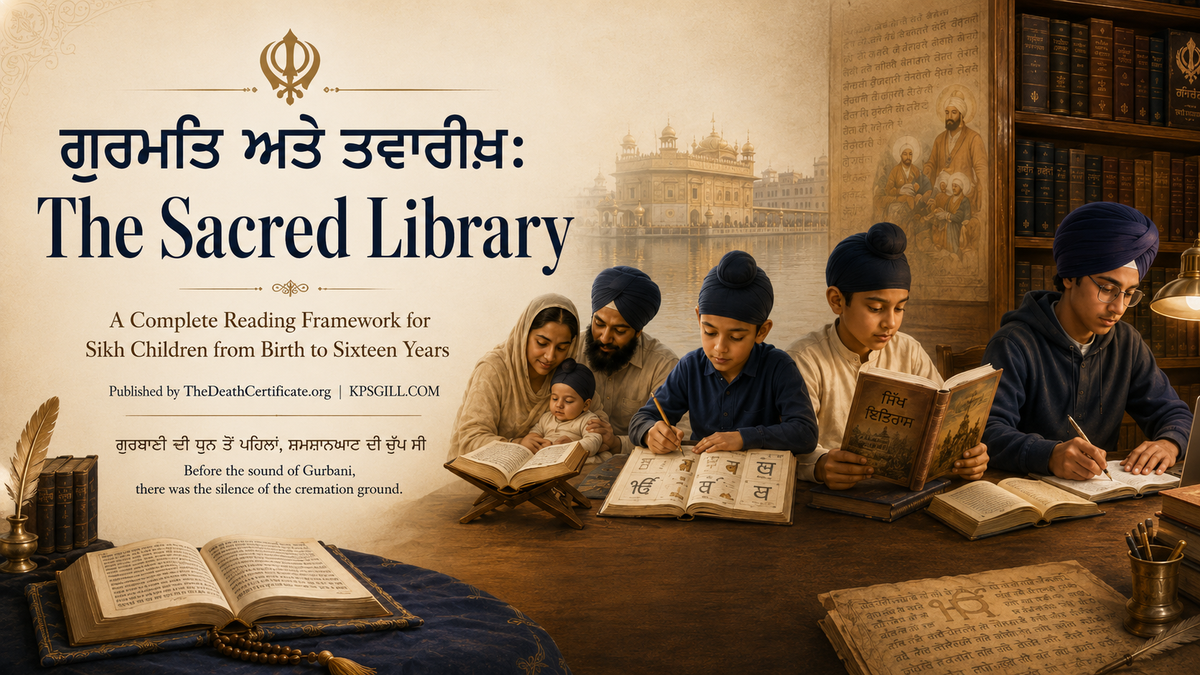
A Complete Reading Framework for Sikh Children from Birth to Sixteen Years
Published by TheDeathCertificate.org | KPSGILL.COM
ਗੁਰਬਾਣੀ ਦੀ ਧੁਨ ਤੋਂ ਪਹਿਲਾਂ, ਸ਼ਮਸ਼ਾਨਘਾਟ ਦੀ ਚੁੱਪ ਸੀ
Before the sound of Gurbani, there was the silence of the cremation ground.
Introduction: The Crisis of Sikh Memory and the Child Who Must Carry It
Every generation of Sikh children inherits an enormous obligation and an enormous gift. The obligation is to carry a civilization — its theology, its history, its martyrdom, its institutional achievement, its ongoing demand for justice — forward into a world that does not always wish it well and does not always tell the truth about what happened to it. The gift is the civilization itself: five and a half centuries of revolutionary theological thought, of institutional genius, of political courage in the face of catastrophic persecution, of survival against impossible odds, and of the Guru’s word — stitched into every morning prayer, every shared meal at the Langar, every act of Seva — as the inexhaustible source of clarity and orientation.
The crisis is that too many Sikh children receive the gift without the obligation. They receive the Gurbani through hearing without comprehension, the Guru stories in simplified forms designed to protect rather than to form, and the history of the community’s suffering in fragments too partial and emotionally ungrounded to equip them for the world. By the time they are sixteen, they may know that 1984 was a catastrophe without knowing its dimensions. They may know that Operation Blue Star happened without knowing what the Akal Takht represents or what its destruction signified. They may have heard the phrase “Khalsa” a thousand times without understanding the specific theological and political claims it makes.
This is not merely a spiritual deficiency. It is a strategic one. A Sikh community whose young people cannot argue the distinction between the Anandpur Sahib Resolution’s actual content and how it was characterized by the Indian state; who cannot cite the CBI’s confirmed finding of 2,097 illegal cremations in Amritsar District as the proved finding it is; who cannot explain why November 1984 was a pogrom rather than a riot — this community is poorly equipped for the ongoing advocacy that justice demands.
This curriculum is designed to address that deficiency. It is a reading framework, organized from birth to sixteen years, that integrates the spiritual and the historical, the devotional and the forensic, the theological and the political, in a single coherent arc. It recognizes that Sikh education cannot be purely secular — that the Guru’s word is not merely a cultural heritage to be appreciated but a living framework for understanding everything else, including history, politics, and justice — and it insists that Sikh children deserve the full weight of their inheritance, not a managed, protective version of it.
The framework centers on five primary books — Patwant Singh’s The Sikhs, Macauliffe’s The Sikh Religion, Khushwant Singh’s A History of the Sikhs, Joyce Pettigrew’s The Sikhs of the Punjab, and Cynthia Mahmood’s Fighting for Faith and Nation — supplemented by the Gurbani itself at every stage, by selected additional scholarship where relevant, and by the family’s own memory and the community’s living testimony.
By the age of sixteen, a Sikh child who has followed this framework should be able to pray and to argue. To remember liturgically and to document evidentially. To understand what the tradition has faced and what has sustained those who faced it. To carry the civilization forward not as a burden but as what it is: the most demanding and the most liberating inheritance imaginable.
Part One: The Philosophy of Sikh Reading
Reading as a Sikh Practice
The Sikh tradition does not separate the devotional from the intellectual. The Guru Granth Sahib Ji — the living Guru of the Sikh Panth — is itself a text: an object of devoted reading, of careful study, of sustained engagement. The Gurmat tradition has always honored those who bring full attention to the Shabad, who work to understand what the Guru says and what it demands, who do not rest content with sound without meaning or with routine without comprehension.
This means that a reading curriculum for Sikh children is not an import from secular educational culture into religious life. It is an expression of the tradition’s own deepest commitments. The child who reads Sikh history with the same seriousness they bring to the Nitnem is doing something that the Guru’s tradition requires: connecting the Shabad to the world it speaks to, understanding what the tradition has faced and what it offers in response.
The governing principle of this curriculum is a sequence the tradition has always lived but rarely articulated as doctrine: Shabad → History → Justice. The Guru’s word first — as the foundation, the frame of reference, the source of clarity that makes everything else comprehensible. Then history — the specific record of what the community has faced, survived, built, and lost, read in light of the Guru’s teaching. Then justice — the specific demand that the record of injustice be acknowledged, documented, and addressed, as the tradition has always demanded of those who carry its truth.
The Four Dimensions of Sikh Knowledge
A complete Sikh education, at the age of sixteen, should have developed four distinct but inseparable dimensions of knowledge:
Spiritual: The Gurbani — Japji Sahib through Kirtan Sohila, the major Banis of the Nitnem, the specific Shabads that carry the tradition’s deepest teachings on truth, justice, ego, seva, and the divine — known not merely as recited sounds but as understood language with moral and spiritual content that informs daily life and historical understanding.
Historical: The complete arc of Sikh political and cultural history from 1469 to the present: the Guru period, the Khalsa creation, the eighteenth-century survival, the Sikh Empire, British annexation, the Singh Sabha movement, Partition, the Punjabi Suba movement, the Anandpur Sahib Resolution, Operation Blue Star, November 1984, the counterinsurgency, and the forensic record of what was done to the Sikh community and what accountability has been achieved.
Political: The specific claims the Sikh community has made and continues to make — for justice regarding November 1984, for full accounting of the counterinsurgency’s illegal killings, for political recognition in forms adequate to the tradition’s understanding of Miri-Piri — and the evidentiary basis on which those claims rest, distinguished carefully from unproved allegations or emotional assertion.
Forensic: The specific proved findings that anchor the community’s claims in official documentation: the CBI’s confirmed 2,097 illegal cremations in Amritsar District; the judicial findings in the Khalra case; the commission findings regarding November 1984’s organized violence; the primary record of the Anandpur Sahib Resolution’s actual content versus its official mischaracterization.
The Language of the Curriculum
This is an English-language curriculum, and this is an honest acknowledgment of diaspora Sikh reality. But it insists on Gurmukhi literacy as a structural requirement from age four — not optional, not supplementary, but foundational — because a Sikh who cannot access the Guru Granth Sahib Ji in its original script is permanently dependent on translators for the most important document in their tradition. Every section of this curriculum that deals with Gurbani should be engaged in both English and Gurmukhi; and parents should maintain Punjabi conversation in the home as the living complement to the written curriculum.
Part Two: The Five Essential Books — A Complete Analysis
The five books at the center of this curriculum were selected not because they are the only books worth reading — there is a rich and growing Sikh studies literature in English — but because together they provide exactly what the curriculum requires: the civilizational sweep, the sacred biographical narrative, the scholarly historical foundation, the ground-level human testimony of state violence, and the militant perspective rendered human and comprehensible. No single book provides all of this. These five together provide it.
Book One: Patwant Singh — The Sikhs (Knopf, 2000)
What the Book Is and Why It Opens the Curriculum
Patwant Singh’s The Sikhs, published by Alfred A. Knopf in 2000, is the single most important book for introducing a Sikh child — or any reader — to the full sweep of Sikh civilization. At approximately 250 pages of narrative text, it is not a textbook and it is not an academic monograph. It is a work of civilizational advocacy: a sustained, eloquent argument that the Sikh tradition deserves to be taken seriously on the world historical stage, and that it has been consistently misrepresented, minimized, and subjected to political distortion that requires active correction.
Patwant Singh was a Delhi-based architect, journalist, and public intellectual who spent decades working on this book. His prose has the quality that the best public history achieves: it is written for the intelligent general reader, it does not require specialist knowledge, but it does not condescend. It assumes a reader who can engage seriously with ideas, who wants to understand both the spiritual depth and the political history, and who is capable of moral response to documented injustice.
The book covers the full arc from Guru Nanak Dev Ji to the aftermath of 1984, organized chapter by chapter through the Guru period, the Khalsa, the Sikh Empire and its annexation, the Singh Sabha movement and colonial era, Partition, the post-independence political history, Operation Blue Star, and November 1984.
Its Distinctive Contribution: Civilizational Dignity
What Patwant Singh gives that no other book in this curriculum gives in quite the same way is a sense of the Sikh tradition as a civilization — as a comprehensive human achievement that has contributed to the world’s stock of political thought, social organization, devotional life, and institutional innovation in ways that deserve to be recognized alongside any other civilization’s contributions. He is explicit and unembarrassed about this claim, and his explicitness is part of what makes the book so valuable for Sikh children specifically.
A Sikh child who reads this book will understand that their tradition did not produce merely a set of religious practices or a community defined by ethnic solidarity. It produced a systematic critique of caste hierarchy four centuries before most of the world’s constitutional orders addressed it; a theological declaration of gender equality in the sixteenth century; a sacred text that includes the voices of Dalit, Muslim, and low-caste Hindu saints alongside its own Gurus, declaring the universality of truth against the exclusivism of any single tradition; an institutional embodiment of those principles in the Langar, the Sangat, and the democratic practices of the Khalsa; and a political tradition that produced, in the Sikh Empire of Maharaja Ranjit Singh, one of the most sophisticated and genuinely plural polities in nineteenth-century South Asia.
None of this is hagiography. Patwant Singh is honest about failures, limitations, and complexities. But he does not pretend to false neutrality about a tradition whose achievements are genuine and whose sufferings are documented. He is an advocate who argues from the record, and the record supports his advocacy.
The 1984 Chapters — A Special Note
The chapters on Operation Blue Star and November 1984 are among the most important in the book. Patwant Singh, who was in Delhi during November 1984 and who had connections to the political world of the period, writes about these events from the position of a horrified witness who also has the historical and political context to understand what produced them.
His account of November 1984 uses the word pogrom — correctly and without hesitation — and provides the specific evidence that justifies it: the use of voter rolls to identify Sikh homes, the organized transportation of attackers, the police stand-down, the involvement of political figures whose names the community knows. He places these events in the full context of the preceding political failure — the Anandpur Sahib Resolution’s decade of neglect, the refusal to engage with legitimate Sikh political claims — that gave the subsequent crisis its structural shape.
For a parent guiding a child through Stage Five and Stage Six of this curriculum, Patwant Singh’s 1984 chapters are the essential complement to Pettigrew’s ground-level testimony: Patwant Singh gives the political-historical frame; Pettigrew gives the human texture.
How and When to Read Patwant Singh
Begin at Stage Three (ages 8-10): chapters on Guru Nanak Dev Ji, Guru Gobind Singh Ji, and the Khalsa creation — read with a parent, discussed at each chapter’s end. The prose is accessible to a motivated ten-year-old with parental engagement.
Complete at Stage Four (ages 10-12): the Ranjit Singh chapters and the British annexation — extending into the Singh Sabha and colonial period.
Return at Stage Five (ages 12-14): the Punjabi Suba chapters and the political context of the 1970s and 1980s.
Stage Six (ages 14-16): the 1984 chapters — read after Pettigrew, as the political-historical frame for what Pettigrew’s fieldwork documented.
The book can then be reread in its entirety at sixteen: having the full historical foundation, the teenager will find the entire narrative differently weighted, earlier chapters acquiring additional significance they could not have had on first encounter.
Book Two: Max Arthur Macauliffe — The Sikh Religion (Six Volumes, Oxford University Press, 1909)
What the Book Is
Max Arthur Macauliffe’s The Sikh Religion: Its Gurus, Sacred Writings and Authors is the most important early English-language sacred account of the Sikh tradition in existence. Published in six volumes by Oxford University Press in 1909, it is the product of thirty years of immersive engagement by a British civil servant who learned Punjabi and Gurmukhi from the inside, who worked with Sikh scholars at the Darbar Sahib, and whose drafts were formally reviewed and endorsed by the Sikh scholarly community of his time.
This endorsement — remarkable for any outsider’s account — speaks to the quality of Macauliffe’s engagement. He was not a sympathetic tourist. He was a student who understood that his function was to render the sacred narrative faithfully, not to impose European scholarly categories onto it.
The six volumes cover:
Volume I: The life of Guru Nanak Dev Ji — birth, childhood, the four great Udasis (journeys), teaching, and passing. The Janamsakhis’ narrative in full devotional detail, rendered in prose that carries the warmth and reverence of the tradition it serves.
Volume II: Guru Angad Dev Ji, Guru Amar Das Ji, Guru Ram Das Ji — the institutional development of the Panth: Gurmukhi standardized, the Langar established, the city of Amritsar founded.
Volume III: Guru Arjan Dev Ji — the compilation of the Adi Granth and the first great martyrdom of the tradition.
Volume IV: Guru Hargobind Sahib Ji, Guru Har Rai Ji, Guru Har Krishan Ji — Miri-Piri declared, the Akal Takht built, the tradition’s martial-defensive posture established.
Volume V: Guru Tegh Bahadur Ji — the second great martyrdom, the Guru who died for Hindu religious freedom.
Volume VI: Guru Gobind Singh Ji — the Khalsa creation, the great battles, the Sahibzade’s martyrdom, the Zafarnama.
Why Macauliffe Is Irreplaceable
Every other book in this curriculum is primarily a history book. Macauliffe is primarily a sacred account. This distinction is crucial. History books explain what happened and why in terms of efficient causes — political pressures, military forces, social structures. Macauliffe gives the child the tradition in its own voice: the sacred biographical narrative, the theological significance, the devotional warmth, the moral weight of each Guru’s life. Reading Macauliffe is like receiving the tradition as the tradition has always transmitted itself — through sacred story, with the recognition that what is being transmitted is not merely information but wisdom.
A Sikh child who has read Macauliffe’s account of Guru Nanak Dev Ji’s encounter at Haridwar — where the Guru poured water toward his Punjab fields while pilgrims threw water toward their deceased ancestors in the east — and who has understood what the Guru was saying: this child carries a teaching in their imagination that enriches every subsequent historical reading in ways that no history book can provide.
Key Volumes for Each Stage
Volume I is the foundation. Introduce in selected passages from age six, read aloud by a parent. Prioritize:
The river encounter and the three-day disappearance: the declaration “There is no Hindu, there is no Muslim.” Ask the child: what is the Guru saying? If there is no Hindu and no Muslim, what is there?
The encounter at Haridwar with the water-throwing pilgrims. Ask: what is the Guru saying about ritual? What does he want us to direct our attention toward?
The encounter at Mecca, the Guru’s feet facing the Kaaba, the reply to the challenge: point my feet in the direction where God is not. Ask: can the divine be contained in a direction?
Volume III: appropriate from age nine. The compilation of the Adi Granth — specifically the theological significance of including the Bhagats: Kabir the Muslim weaver, Ravidas the Dalit cobbler, Sheikh Farid the Sufi saint. A sacred text that includes the voices of low-caste Hindus and Muslims alongside its own Gurus is making the most radical statement possible about the universality of truth and the location of the divine.
The martyrdom of Guru Arjan Dev Ji: the hot iron plate, the boiling water, the declaration ਤੇਰਾ ਕੀਆ ਮੀਠਾ ਲਾਗੈ — what the Lord does seems sweet to me. Read this slowly. After it, sit in silence before discussion.
Volume V: appropriate from age twelve. Guru Tegh Bahadur Ji’s martyrdom in its full detail — the Kashmiri Pandits’ petition, the Guru’s decision, the arrest, the torture of companions before him, his refusal to convert, his execution in Chandni Chowk. Ask the teenager: why did the Guru die for Hindus? What does this tell us about how the Sikh tradition defines justice?
Volume VI: appropriate from age thirteen onward. The Khalsa creation — the call for five who were willing to die, the five who came forward, the Amrit ceremony, the five K’s as declarations of identity. The deaths of the Sahibzade. The Zafarnama: a letter declaring moral victory from the position of apparent military annihilation.
Macauliffe’s Limitations
Victorian prose that requires parental simplification for younger children. Some translation choices reflect nineteenth-century conventions rather than strict fidelity to the Punjabi. Occasional notes of colonial-era condescension that a teenager should be prepared to notice and name. These do not undermine the book’s essential value; they are simply honest limitations to acknowledge.
Book Three: Khushwant Singh — A History of the Sikhs (Two Volumes, Princeton University Press / Oxford University Press)
What the Book Is
Khushwant Singh’s A History of the Sikhs — Volume I covering 1469 to 1839, Volume II covering 1839 to 1988 — is the most formally historical of the five books, and the most thorough in its scholarly apparatus. Khushwant Singh was one of India’s foremost English-language journalists and public intellectuals, and this work represents decades of research into primary sources, archives, and the Sikh scholarly literature of his time.
The book’s great strength is its continuity: it treats Sikh history as a single connected narrative from Guru Nanak Dev Ji to the aftermath of 1984, showing how each period produced the conditions of the next. It does not fragment the history into isolated episodes but traces the causal chains that run from the Guru period through the eighteenth century through the Empire through colonialism through Partition through the post-independence political failures to the crisis of 1984.
Khushwant Singh was himself a Sikh by background though secular in orientation, and this position shapes the book in ways the reader should understand. He writes with genuine respect for the tradition but without the devotional engagement that Macauliffe carries. For the historical content — chronology, political events, institutional developments, specific episodes — he is reliable and detailed. For the spiritual and theological dimensions of the tradition, he is thinner, and Macauliffe must supplement him.
Volume I: 1469-1839 — The Guru Period Through the Sikh Empire
Volume I is the indispensable companion to Stage Three through Stage Four of this curriculum. Its chapter structure gives a manageable entry point for a motivated ten-to-twelve-year-old:
The chapters on each Guru, from Nanak through Gobind Singh, provide the historical political context for the spiritual narrative that Macauliffe gives in devotional detail. Reading Macauliffe and Khushwant Singh on the same Guru — Macauliffe for the sacred narrative, Khushwant Singh for the political and institutional context — gives a richer picture than either alone.
The eighteenth-century chapters — covering Banda Singh Bahadur, the period of persecution, the Dal Khalsa, and the Ghallugharas — are essential for Stage Three parents who want to tell these stories accurately. The Ghallugharas specifically: the Chhota Ghallughara of 1746 and the Vadda Ghallughara of 1762, in which tens of thousands of Sikhs were killed in systematic state violence. Every Sikh child must know these events by name, by approximate date, and by consequence. Khushwant Singh gives the clearest scholarly account of them in English.
The Ranjit Singh chapters constitute one of the most detailed English-language treatments of the Sikh Empire’s political, military, and administrative achievements. The Sikh Empire under Ranjit Singh was plural, sophisticated, cosmopolitan, and militarily formidable — a polity that employed Hindus, Muslims, Europeans, and Sikhs at every level of its administration, that deployed one of the most effective armies in Asia, and that expressed in political form the Khalsa ideal’s universalism. Knowing this history is essential for understanding what was lost in 1849 and what that loss meant for the subsequent political history.
Volume II: 1839-1988 — Annexation, Singh Sabha, Partition, Crisis
Volume II is the essential text for Stage Five of this curriculum, and its treatment of the 1947-1984 period deserves specific attention.
The Singh Sabha chapters: Khushwant Singh gives a clear account of the Singh Sabha movement’s origins, achievements, and significance — the educational institutions, the Gurmukhi print culture, the theological scholarship, the reform of Gurdwara practice — that is accessible to a thirteen-year-old with parental guidance.
The Partition chapters: Khushwant Singh’s account of Partition is one of the most personally engaged passages in the book — he lost his ancestral village and witnessed the violence directly. He gives the statistics (twelve to fifteen million displaced, estimates of two hundred thousand to two million dead) alongside the specific human texture of what displacement meant for Punjabi Sikh families. This is essential reading at Stage Five.
The Anandpur Sahib Resolution chapters: Khushwant Singh’s analysis of the Resolution and its political context is precise and fair — he is not a partisan for the Akali Dal’s claims but he gives an accurate account of what the Resolution demanded and why characterizing it as separatist misrepresents it. Read this alongside the Resolution itself.
The 1984 chapters: Khushwant Singh was personally horrified by November 1984, and this shows. His account of Operation Blue Star includes his resignation from the Padma Bhushan — India’s civilian honor — in protest. His account of November 1984 names it accurately as organized violence, supported by his specific knowledge of the Delhi political world.
Using Khushwant Singh With the Curriculum
At Stage Three-Four (ages 8-12): Volume I in selected chapters, parent-guided. The Guru period chapters, the eighteenth century chapters (especially Banda Singh Bahadur and the Ghallugharas), and the Ranjit Singh chapters.
At Stage Five (ages 12-14): Volume II’s Singh Sabha, Partition, and Anandpur Sahib Resolution chapters.
At Stage Six (ages 14-16): Volume II’s 1984 chapters, read alongside Pettigrew’s account of the counterinsurgency that followed.
Book Four: Joyce Pettigrew — The Sikhs of the Punjab: Unheard Voices of State and Guerrilla Violence (Zed Books, 1995)
What the Book Is
Joyce Pettigrew’s The Sikhs of the Punjab is the most important ground-level account of the Punjab crisis of the 1980s and early 1990s available in any language accessible to the English-reading Sikh diaspora. Published by Zed Books in 1995, it is the product of fieldwork by a social anthropologist who had lived in Punjab before the crisis, who returned during the years of maximum violence, who spent time in Sikh villages and spoke at length with the ordinary people whose lives were being destroyed by the conflict, and who refused the dominant narratives — both the Indian state’s counterterrorism frame and the diaspora’s Khalistan frame — because neither captured the reality she witnessed.
The title is both literal and exact. Pettigrew’s subjects are the people whose voices are systematically absent from official accounts: the farming families who lost sons to fake encounters, the women who spent years searching for disappeared husbands, the village leaders navigating between militants and police, the witnesses who knew what had happened and could not speak publicly without endangering themselves. These are the unheard voices.
Why This Book Is Necessary
Every other account of the Punjab crisis — Patwant Singh’s political narrative, Khushwant Singh’s historical survey, media coverage from any angle — necessarily operates at a level of generalization that distances the reader from specific human experience. Pettigrew refuses that distance. She puts faces and voices onto what other accounts render as statistics and categories.
The result is difficult reading — difficult in the right way. A Sikh teenager who reads this book will understand what state violence feels like from inside the community experiencing it: the constant vigilance, the calculated silences, the cost of knowing things that are dangerous to know, the erosion of community trust that organized state terror deliberately produces. They will understand why the decision to take up arms in the circumstances Pettigrew documents was not the product of religious fanaticism but of accumulated specific injustice.
Pettigrew’s Three Central Arguments
First: the Punjab crisis had structural roots deeper than religious mobilization. Sikh political mobilization in the late 1970s and 1980s was substantially produced by specific economic and political disappointments — the Green Revolution’s unfulfilled promises, the resulting debt burden, the sense that Punjab’s agricultural surplus was being extracted while Punjab received inadequate political and economic returns. The Indian state’s refusal to engage with these structural causes, and its preference for securitizing Sikh grievance as religious extremism, was itself part of what produced the crisis.
Second: the Indian state’s counterinsurgency was characterized by systematic human rights violations that were deliberately invisible to the outside world. Pettigrew documents — through specific testimony from people who were present — the practice of fake encounters (civilians or detainees killed outside any legal process, presented as combat deaths), disappearances (detention and killing without legal process or official acknowledgment), collective punishment (attacks on families and villages to pressurize communities), and administrative cover (official records systematically falsified to ensure no traceable paper trail).
Third: the most important voices for understanding what happened in Punjab are the voices of ordinary Sikh people who were neither militants nor their enthusiastic supporters — who wanted to live their lives in peace and were caught between competing forces of violence. By centering these voices, Pettigrew does what both the Indian state’s narrative and the diaspora’s political discourse failed to do: she restores the human being to the center of the account.
The Counterinsurgency Record in Detail
For a Sikh teenager reading Pettigrew, the most important specific content is the account of how the counterinsurgency operated at ground level.
Fake encounters: The killing of civilians or detainees and presentation of those killings as combat encounters was systematic and widespread. Families received notification that their son had been “killed in an encounter” when in fact he had been detained days or weeks earlier, held without legal process, tortured, and killed. The falsification of official records — police reports, post-mortem documents, witness statements — was standard procedure. The family who knew their son had been detained before the alleged encounter had no effective recourse.
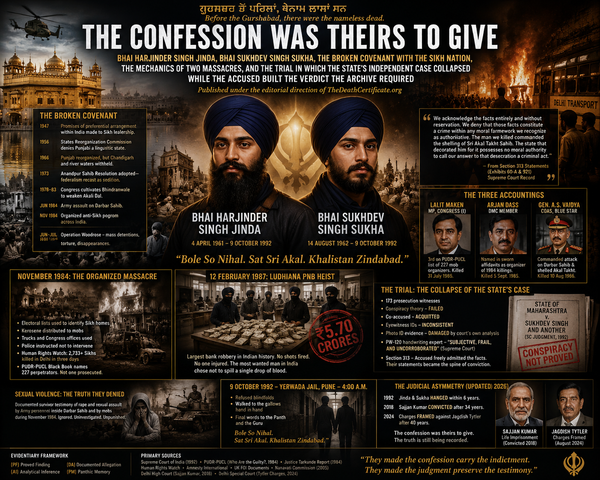
Illegal cremations: Bodies that could not be returned to families — because returning them would have required explaining the circumstances of death — were cremated as “unidentified” and never returned to families. The scale of this practice was confirmed by the Central Bureau of Investigation in proceedings that followed from Jaswant Singh Khalra’s forensic work: 2,097 illegal cremations in Amritsar District alone. This is not a community allegation. It is a proved finding established by the Indian state’s own investigative body in official legal proceedings.
The Khalra Case — What Pettigrew’s Work Prepared
Jaswant Singh Khalra’s 1995 investigation — obtaining cremation ground records from Amritsar District and cross-referencing them with accounts of disappeared Sikhs — was the forensic endpoint of exactly what Pettigrew had documented from the ground up. Khalra found the bodies. He brought the evidence to the Supreme Court of India and to international audiences. In September 1995 — the same year Pettigrew’s book was published — Khalra was abducted by plainclothes Punjab Police officers, tortured, and killed in custody.
In court proceedings that extended over many years, it was established that Khalra had been detained and killed by Punjab Police officers while in their custody. Several officers were convicted of his killing — one of the very few instances in which the counterinsurgency’s extrajudicial killing practices produced criminal accountability.
How to Use Pettigrew in the Curriculum
Introduce at Stage Six, age fourteen, after the child has completed Patwant Singh’s 1984 chapters and Khushwant Singh Volume II’s crisis section. The book requires a historical foundation to be properly contextualized.
Read it with the child, or at minimum be available for sustained discussion chapter by chapter. Ask, after each chapter: what does the Guru’s teaching say about this? When Guru Tegh Bahadur Ji accepted death rather than compromise another community’s religious freedom, and when the families in Pettigrew’s account searched for disappeared sons and found official silence — what is the tradition’s answer to that silence?
Book Five: Cynthia Keppley Mahmood — Fighting for Faith and Nation: Dialogues with Sikh Militants (University of Pennsylvania Press, 1996)
What the Book Is
Cynthia Keppley Mahmood’s Fighting for Faith and Nation is the product of extended personal interviews with Sikh militants during the Punjab crisis, conducted by a cultural anthropologist who took her subjects seriously as human beings with comprehensible beliefs and coherent histories rather than as pathological agents of irrational violence. Published by the University of Pennsylvania Press in 1996, it gives the Sikh militant perspective from the inside — in the militants’ own words, through their own theological and moral framework.
This is the book that does something no other English-language account of the Punjab crisis does: it gives voice to the people who took up arms, in their own terms, without either romanticizing them or reducing them to the “terrorist” category that official narrative consistently applied.
Why This Book Is Necessary
A Sikh teenager who reads this book will understand something that media accounts — Indian, international, and often diaspora — systematically obscure: the people who took up arms in Punjab in the 1980s and early 1990s were not random criminals, religious psychopaths, or foreign agents. They were, very often, young men from ordinary Sikh farming families who had personally experienced specific acts of state violence and who had concluded, after evaluating available alternatives, that armed resistance was the only form of response that might be heard.
This does not mean their choices were always right. Mahmood herself does not claim this. The militant movement was internally divided, sometimes violent against Sikh civilians who did not support it, and ultimately unsuccessful in its stated political aims. These complexities are present in her account.
But the human beings she depicts are comprehensible human beings. They prayed before operations. They articulated sophisticated theological frameworks about martyrdom and divine will. They carried genuine grievances produced by genuine injustices. The Sikh teenager who knows them as the human beings Mahmood depicts will never again be able to accept the “terrorist” caricature as an adequate characterization of what happened in Punjab.
The Theology of Shahidi in Mahmood’s Account
One of Mahmood’s most important contributions is her serious engagement with the Sikh theology of shahidi — martyrdom. She does not merely observe this theology from outside; she attempts to understand why it was compelling to the people who held it, what specifically Sikh theological resources they drew on, and how those resources shaped their choices.
This is valuable for a Sikh teenager because it connects the contemporary events of the Punjab crisis to the long tradition of Sikh martyrdom that began with Guru Arjan Dev Ji in 1606. The willingness to accept death rather than compromise the truth — the tradition of shahidi that runs from the first Guru-martyr through Guru Tegh Bahadur Ji to the Sahibzade to the eighteenth-century shahids — is not a historical curiosity. It is a living theological resource that shaped how Sikh militants in the 1980s and 1990s understood their own choices.
How to Use Mahmood in the Curriculum
Introduce at Stage Six, age fifteen to sixteen, after Pettigrew has been read. Mahmood should be read alongside Pettigrew, not instead of it: the two books together provide what neither provides alone — the civilian experience and the militant experience, the ground-level wound and the theological response, the comprehensive human picture of a community in crisis.
The Supplementary Library: Five Additional Books to Know
Beyond the five primary texts, five additional books belong in any serious Sikh reading household.
J.S. Grewal — The Sikhs of the Punjab (Cambridge University Press): The most academically rigorous single-volume Sikh history, organized around Punjab as its geographic and social frame, with extraordinary attention to social structure and institutional development. Introduce at age fourteen to fifteen, after Patwant Singh has been completed. Grewal gives scholarly precision that deepens and sometimes complicates what Patwant Singh gives with civilizational sweep.
Hari Ram Gupta — History of the Sikhs (Multi-volume, Munshiram Manoharlal): The most detailed scholarly English-language account of eighteenth-century Sikh history — the Ghallugharas, Banda Singh Bahadur, the Sikh Misls, the Dal Khalsa. Essential for post-fourteen readers interested in the eighteenth century.
Joseph Davey Cunningham — A History of the Sikhs (1849): A British political officer who witnessed the Anglo-Sikh Wars and wrote with unusual sympathy and honesty about Sikh civilization, including criticism of British annexation that cost him his career. Introduce at age fourteen alongside the Anglo-Sikh Wars content in Khushwant Singh.
Eleanor Nesbitt — Sikhism: A Very Short Introduction (Oxford University Press): A structured academic overview useful as an introduction to religious studies frameworks at age twelve to thirteen. Good for the diaspora dimensions of Sikh practice and for structured academic vocabulary.
The Oxford Handbook of Sikh Studies (Pashaura Singh and Louis Fenech, eds.): Comprehensive reference work containing approximately fifty chapters covering every major dimension of Sikh history, theology, and practice. Use as a reference work from age fifteen onward.
Part Three: The Curriculum — Stage by Stage from Birth to Sixteen
Stage Zero: From Birth to Age Four — Before the Books
The most important stage of this curriculum involves no books at all. Before a Sikh child opens any text, before they can decode a single word in any script, they receive their deepest formation through sound, story, and the warmth and seriousness with which the adults around them hold their tradition.
Gurbani from Birth
The tradition of exposing Sikh children to Gurbani from birth is not merely devotional sentiment — it is the deepest pedagogical practice available. The Nitnem prayers should be heard daily from infancy: Japji Sahib in the morning, Rehras Sahib in the evening, Kirtan Sohila at night. They do not need to be recited at volume; they can be spoken softly as the child drifts to sleep, as part of the morning routine. The regularity matters more than the formality.
Take the infant to the Gurdwara regularly. Let the sound of the Sangat’s combined voice — the massed recitation, the rising Kirtan, the collective Ardas — become familiar before any other public institution’s sound becomes familiar. The child who falls asleep in the Sangat is absorbing something that no book can later fully provide: the felt knowledge that this tradition is a place of seriousness, beauty, and communal belonging.
Oral Stories
Begin the Guru stories from age two. Not as theological instruction but as stories — with moral weight, with courage and love and sacrifice, rendered in language a small child can hold in their imagination:
Guru Nanak and Sacha Sauda: The young Guru is given money by his father for profitable trade. He meets starving people and spends all the money feeding them. The truest trade, he tells his father: I gave material things to feed hungry bodies.
The Khalsa Creation: The Guru called for five who were willing to die for him. Five came forward, one by one. They were all alive. Those five became the first of the Khalsa. Even a four-year-old can hold this story.
The Younger Sahibzade: Guru Gobind Singh Ji’s youngest sons — Baba Zorawar Singh Ji and Baba Fateh Singh Ji — were captured by the Mughal forces. They were given the choice to change their faith or face death. They chose death. They were not afraid. Tell this story with truth and without graphic detail. A child of four understands what it means to be brave when something frightening is asked of you.
What a Child Should Have Absorbed by Age Four
The sound and rhythm of Gurbani. Several Guru stories well enough to retell them. The names of the ten Gurus in order. The words Waheguru, Khalsa, Guru Granth Sahib Ji, Gurdwara, Langar. The knowledge that they belong to a tradition of extraordinary courage and sacrifice. And an association of that tradition with warmth, beauty, and the love of the adults around them.
Stage One: Ages Four to Six — First Books
The entry into reading gives the Sikh child their first opportunity to encounter the tradition in print. At Stage One, reading should be visually rich, narratively simple, organized around the stories already known from the oral tradition, and accompanied always by parental reading aloud rather than solitary reading.
What to Read
Illustrated Guru story books: Books that tell individual Guru lives with age-appropriate text and respectful illustrations. Selection criteria for parents: Does the book tell the story honestly, without sanitizing the difficult parts? Does it treat the Guru with reverence? Does it convey the moral meaning, not just the surface narrative?
Stories to find in book form: Guru Nanak and Sacha Sauda. The Adi Granth’s compilation — in simplified form. The Panj Pyare and the Khalsa creation. The Younger Sahibzade. Each told with the child’s age in mind but without falsifying the moral weight.
Gurmukhi instruction: From age four, formal Gurmukhi alphabet instruction begins. Simultaneously with English literacy, not instead of it. Begin with the 35 basic letters of the Gurmukhi alphabet — through structured exercises, songs, and daily practice. The goal by age six: confident recognition of all Gurmukhi letters and beginning phonetic reading.
What Parents Do
Read aloud at every opportunity. Every book at Stage One should be read to or with the child. The shared experience — the parent’s voice giving the story its seriousness, the child’s questions received with patience, the parent’s explanation connecting the story to the child’s lived experience — is itself an essential part of the curriculum.
Ask open questions rather than questions with correct answers. “Why do you think the first Pyara came forward?” “What do you think Guru Gobind Singh Ji felt when he came?” These invite the child into the moral imagination of the tradition. The discussion that follows is more valuable than any correct answer.
Connect the stories to Gurbani. When reading about Guru Arjan Dev Ji’s martyrdom, play or sing ਤੇਰਾ ਕੀਆ ਮੀਠਾ ਲਾਗੈ. Even if the child cannot yet understand the Punjabi words, they begin to feel the connection between story and sound.
Stage Two: Ages Six to Eight — The Guru Stories in Depth
At ages six to eight, a child can sustain engagement with longer texts and more complex narratives. The reading remains focused on the Gurus’ lives but goes deeper: into the theological significance of each Guru’s contribution and the specific ways each Guru’s work built on the previous one.
Primary Reading: Selected Passages from Macauliffe
At this stage, selected passages from Macauliffe’s The Sikh Religion should be introduced — read aloud by a parent, not yet as independent reading. Macauliffe’s Victorian prose requires a reader alongside for most children at this age, but the content is precisely appropriate.
From Volume I (Guru Nanak Dev Ji): The four Udasis. Focus on the encounters with different religious and social authorities — the Muslim qazi, the Hindu pilgrims, the Siddhas on their mountain. After each encounter: what is the Guru saying? What is he challenging?
The encounter at Haridwar: the Guru pouring water toward his Punjab fields while pilgrims pour water toward their eastern ancestors. This simple, irrefutable act dismantles ritual directed toward the dead at the expense of the living.
The encounter at Mecca: feet facing the Kaaba, the challenge, the reply. What is the Guru teaching about the nature of the sacred?
From Volume III (Guru Arjan Dev Ji): The Adi Granth’s compilation — now in Macauliffe’s fuller account. Focus on the Bhagats: Kabir the Muslim weaver, Ravidas the Dalit cobbler, Sheikh Farid the Sufi saint. A sacred text that includes these voices is making the most radical statement possible about truth’s universality.
The martyrdom — given in fuller detail now. The Guru’s acceptance of torture, the declaration ਤੇਰਾ ਕੀਆ ਮੀਠਾ ਲਾਗੈ. Read this slowly. Sit in silence after it before discussing.
From Volume V (Guru Tegh Bahadur Ji): Even at age seven to eight, introduce the ninth Guru’s martyrdom. The Kashmiri Pandits’ petition. The Guru’s decision to go to Delhi. His execution defending the religious freedom of people who were not Sikhs. Ask: why would a Sikh Guru die for Hindus? What does this tell us about how the tradition defines justice?
Gurbani Deepening
By age six, specific Nitnem prayers should be learned with developing comprehension alongside continuing practice of hearing them. Begin exploring the Mool Mantar: what does Ik Onkar mean? What does Satnam mean? What does Nirbhau — without fear — mean, and what would it take to live that way?
Introduce: ਨੀਚਾ ਅੰਦਰਿ ਨੀਚ ਜਾਤਿ — “Among the low, the lowest of the low.” The Guru declares he stands with the lowest. This Shabad is the theological foundation of the social revolution the child has been reading about in the biographical stories.
And: ਤੇਰਾ ਕੀਆ ਮੀਠਾ ਲਾਗੈ — heard and beginning to be understood in the context of Guru Arjan Dev Ji’s martyrdom.
What a Child Should Know by Age Eight
The lives and contributions of all ten Gurus in meaningful narrative detail. The compilation of the Adi Granth and its theological significance. The first and second great martyrdoms and what each tells us about the tradition’s understanding of justice. Beginning Gurmukhi reading ability. The Mool Mantar by heart with beginning understanding. A grounded sense that their tradition is one of both spiritual depth and political courage.
Stage Three: Ages Eight to Ten — The Khalsa Ideal
At ages eight to ten, the child is ready for longer, more historically organized reading. The Khalsa ideal — what it means, where it came from, what it demands — becomes the organizing theme, and the primary vehicle is Patwant Singh’s The Sikhs, read in selected sections with parental guidance.
Primary Reading: Patwant Singh, Chapters 1-8
Begin with the Guru Nanak chapter. The child already knows the stories; Patwant Singh’s prose gives those stories a civilizational sweep and moral authority that children’s versions could not fully convey. Read selected passages aloud, discussing as you go.
The key discussions to have as you proceed chapter by chapter:
On the Langar: The Langar is not merely a practice of feeding people. It is an institutional expression of the most radical social theology of the sixteenth century: that caste hierarchy is a lie, that every human being is equally the expression of the One, and that the most concrete way of demonstrating this is to sit together and eat together regardless of social station. In a society where communal eating was a primary marker of caste, the Guru’s insistence that everyone sit together and eat the same food was a civilizational revolution. Ask the child: is there anything in your world that is like the old caste distinction? What does the Guru’s example demand of us in that situation?
On Guru Hargobind Ji and the Akal Takht: The Guru came to his investiture wearing two swords — Miri and Piri, temporal authority and spiritual authority. He built the Akal Takht directly facing the Harmandir Sahib, to embody this dual sovereignty in architectural form. Ask: why do you think the Guru wanted Sikhs to be involved in the worldly and political world, not just the spiritual world?
On the Khalsa Creation: Read Patwant Singh’s account over multiple sessions. Ask the child to imagine being at Anandpur Sahib in 1699. The Guru called for five willing to give their lives. What would you feel? Would you come forward?
The five K’s as declarations, not rules: Kesh is the statement that the Sikh accepts the body as the Guru gave it. Kara is the statement of being bound to the Guru. Kangha is the statement of discipline. Kachera is the statement of moral continence and readiness. Kirpan is the statement that the Sikh is committed to protecting the helpless and standing against injustice. Together they constitute a walking declaration of sovereignty.
The Eighteenth Century — Parent Narration
At Stage Three, introduce the eighteenth century through parent narration drawn from Khushwant Singh and Gupta, told at an age-appropriate level.
Banda Singh Bahadur: A disciple of Guru Gobind Singh Ji who received the Guru’s mandate, led campaigns that captured significant Punjab territory, abolished the feudal land system in areas he controlled, and was eventually captured by the Mughal Emperor. In Delhi, he was tortured. His infant son was killed before him. He remained composed and steady. He was executed with hundreds of his companions, each offered conversion as the alternative to death, each choosing death. Tell this story with truth, conveying the moral weight without graphic detail.
The Ghallugharas: Introduce the concept now — the great massacres of Sikhs in the eighteenth century. The Chhota Ghallughara of 1746. The Vadda Ghallughara of 1762, in which Ahmad Shah Durrani killed an estimated twenty to thirty thousand Sikhs in a single engagement. Present these alongside the survival: within three years of the Vadda Ghallughara, Sikh forces had taken Lahore. That is the story of the Khalsa.
Gurbani at Stage Three
Chaupai Sahib: learn in full with developing understanding. The Guru calls on the One — not for military victory specifically but for protection, guidance, and the capacity to serve.
The Zafarnama — in prose summary. Written after the loss of Anandpur, the deaths of the Sahibzade, the dispersal of Sikh forces. The letter declares moral triumph and the Emperor’s fundamental dishonor. Ask: what kind of strength does it take to write that letter in those circumstances?
Stage Four: Ages Ten to Twelve — Sovereignty and Empire
At ages ten to twelve, the child is ready for the full sweep of Sikh political history: from the eighteenth-century Misls through Maharaja Ranjit Singh’s empire to the catastrophe of British annexation.
Primary Reading: Patwant Singh (Complete) and Khushwant Singh Volume I (Selected)
Complete Patwant Singh — including the Ranjit Singh chapters and British annexation chapters. Simultaneously, introduce Volume I of Khushwant Singh’s A History of the Sikhs, specifically the eighteenth-century and Ranjit Singh chapters.
Maharaja Ranjit Singh — Essential Knowledge
Every Sikh child must understand Ranjit Singh’s life, achievements, and the significance of the Sikh Empire before reaching the age of twelve.
His rise: By age twenty, Ranjit Singh had unified the competing Sikh Misls under his authority and established effective control of Lahore. His political genius was primarily organizational and diplomatic: the ability to build coalitions, manage diverse constituencies, and create institutional structures that outlasted individual loyalties.
His administration: The Sikh Empire was one of the most sophisticated and genuinely plural polities in nineteenth-century South Asia. He employed Fakir Azizuddin — a Muslim — as his Foreign Minister. He employed European officers — Ventura, Allard, Avitabile — to train the Khalsa Army’s infantry and artillery. This administration was itself an expression of the Khalsa ideal’s universalism.
His military: The Khalsa Army — disciplined by European officers, equipped with modern artillery, animated by the Khalsa tradition — was one of the most formidable armies in Asia. Never defeated on the battlefield during Ranjit Singh’s lifetime. It held the Afghans at bay, captured Multan and Kashmir, and projected Sikh power from the Indus to the Sutlej.
His vulnerability: Ranjit Singh’s greatest weakness was institutional. The empire was built around his personal authority rather than around sustainable structures capable of continuing without him. When he died in 1839, it collapsed into factional conflict within years. The lesson: sovereign polities require institutions, not merely leaders.
British annexation: Following Ranjit Singh’s death, two Anglo-Sikh Wars ended in British annexation in 1849. The Koh-i-Noor diamond was transferred to the British Crown. The Khalsa Army was disbanded. The capacity for Sikh political self-governance was destroyed. Ask the child: what does it mean when the victor takes the symbols of the defeated as trophies? What was lost in 1849 that was more than territory?
Gurbani at Stage Four
Guru Gobind Singh Ji’s Chandi di Var: even in selected passages, introduce this epic poem of the cosmic battle between good and evil. The Goddess Chandi as divine power deployed against darkness. The theological frame for the Sikh tradition’s martial dimension: the struggle against injustice is not merely political but sacred, continuous with the cosmic struggle between truth and falsehood that the divine itself conducts.
The Zafarnama — now in greater depth, reading selected verses in translation alongside the historical account of the fall of Anandpur Sahib.
Stage Five: Ages Twelve to Fourteen — Partition and the Road to Crisis
At ages twelve to fourteen, the child is ready for the most politically complex stage of the pre-sixteen curriculum. The events of 1947 through 1984 — Partition, post-independence political trajectory, the Punjabi Suba movement, the Anandpur Sahib Resolution — require careful historical and theological attention.
Primary Reading: Khushwant Singh Volume II; the Anandpur Sahib Resolution (Primary Text)
What a Child Must Understand About Partition
The division of British India in August 1947 was, for the Sikh community, a catastrophe without parallel in the modern period. The Sikh community was concentrated in western Punjab — which became Pakistan. Approximately twelve to fifteen million people were displaced across the Punjab border in both directions. Estimates of total dead across all communities range from two hundred thousand to two million. The Sikh community paid a disproportionate price: its ancestral villages, agricultural lands, historic Gurdwaras, and commercial infrastructure — gone.
The assurances: Sikh leaders in 1947 were given commitments by senior Congress leaders that Sikh political and cultural rights would be protected in independent India, that the community’s distinct identity would be honored. These assurances were not formalized in constitutional guarantees. They were political commitments. The subsequent political history is, in significant part, the history of those commitments being honored in the breach.
The Anandpur Sahib Resolution — Reading the Primary Text
This is the most important document for a twelve-to-thirteen-year-old Sikh child to read directly, rather than through an intermediary’s description. The Resolution is freely available online. A parent and child should read it together.
What the Resolution actually asked for:
Greater autonomy for Indian states — consistent with the original constitutional vision of Indian federalism. Standard constitutional politics, not separatism.
Chandigarh as Punjab’s exclusive capital — fulfillment of a specific prior commitment made by the central government.
Transfer to Punjab of Punjabi-speaking areas still attached to Haryana and Himachal Pradesh after the 1966 reorganization — completion of the linguistic reorganization India itself had adopted as its organizing principle.
Fairer river water allocation — economic equity within the federal system.
Protection of Sikh religious and cultural rights and Gurdwaras across India.
Nothing in this list is secessionist. Nothing is constitutionally extraordinary. Multiple other Indian states — Tamil Nadu, West Bengal, Maharashtra — have made comparable federalist claims without being characterized as separatist threats. A Sikh child who reads the Resolution directly will understand, in a way that no summary can fully convey, how profound the misrepresentation of these demands in official Indian state discourse was and continues to be.
Gurbani at Stage Five
Guru Tegh Bahadur Ji’s Shabads on Nirbhau — fearlessness:
ਭੈ ਕਾਹੂ ਕਉ ਦੇਤ ਨਹਿ ਨਹਿ ਭੈ ਮਾਨਤ ਆਨ — “Fear no one, frighten no one.” This Shabad, by the Guru who accepted death rather than compromise another community’s religious freedom, is one of the most demanding and most liberating declarations in the tradition. What does fearlessness mean? Not the absence of danger — the Guru faced the greatest of dangers — but the absence of the fear that makes a person compromise the truth.
Sukhmani Sahib: Begin systematic engagement with this 24-Ashtpadi composition, the Guru Granth Sahib Ji’s most comprehensive meditation on the nature of the divine and the path of the gurmukh.
Stage Six: Ages Fourteen to Sixteen — 1984 and the Forensic Record
This is the most difficult and most essential stage of the curriculum. A Sikh child who reaches sixteen without having engaged seriously and specifically with the events of 1984 — Operation Blue Star, the November pogrom, and the subsequent decade of counterinsurgency — has been sheltered from a truth that is central to their tradition and to their identity as members of a specific historical community.
How to Begin
Before introducing Pettigrew, the parent should name what is being asked. Tell the teenager directly: “We are going to read about what happened in Punjab from 1984 through approximately 1995. This material is difficult. It involves serious violence against our community. You are old enough to encounter it and you need to encounter it, because it is part of your inheritance, and knowing it is the beginning of being able to do something about it.”
Frame it theologically before the reading begins: “The Guru’s tradition has always faced this kind of violence — Guru Arjan Dev Ji, Guru Tegh Bahadur Ji, the Sahibzade, the Vadda Ghallughara — and it has always survived. The people whose stories we will read were carrying the same tradition. What happened to them was wrong. Naming that wrongness and demanding accountability for it is itself a Sikh obligation.”
Primary Reading: Pettigrew; Mahmood; Khushwant Singh Volume II (1984 Chapters)
Operation Blue Star — What the Teenager Must Know
Operation Blue Star, June 1984: an assault on the holiest site in the Sikh world — the Harmandir Sahib and the Akal Takht complex — conducted by the Indian Army on the anniversary of Guru Arjan Dev Ji’s martyrdom, when the complex was filled with thousands of pilgrims.
The Akal Takht was subjected to tank fire and heavily damaged. The Sikh Reference Library — containing irreplaceable manuscripts of the Guru period — was destroyed and its contents removed by army personnel and never returned in full. Civilians who had come for religious observance were trapped in a combat zone. The precise scale of civilian deaths remains disputed; community investigations have consistently found higher numbers than official accounts.
The symbolic weight: the Akal Takht is not merely a building. It was built by Guru Hargobind Sahib Ji to embody the inseparability of temporal and spiritual authority — the institution from which the Panth has historically issued its most significant collective pronouncements. An assault on the Akal Takht by the state is a statement — whether intended or not — about the Sikh community’s place in the polity and about the state’s willingness to use the most extreme means against Sikh political claims.
November 1984 — Naming What Happened Accurately
Following Prime Minister Indira Gandhi’s assassination on October 31, 1984, organized violence against Sikh civilians broke out in Delhi and other North Indian cities. This violence continued for three days, November 1-3, 1984, resulting in the deaths of several thousand Sikhs.
The word that accurately describes what happened is pogrom: organized, large-scale violence against members of a specific community, conducted with official complicity or active participation. The word most frequently used in mainstream accounts — “riot” — is inaccurate and constitutes a falsification of the historical record. A riot is spontaneous and mutual. What happened in Delhi in November 1984 was neither spontaneous nor mutual.
The evidence for organized violence:
Electoral rolls were used to identify Sikh homes. Transportation was provided to bring attackers to specific neighborhoods. Congress party workers and local political leaders were identified by survivors as organizers. Police were ordered to stand down in many areas; police that attempted to protect Sikhs were overruled. Senior political figures were named by witnesses and investigative commissions as having organized or directed the violence.
Multiple judicial commissions have been established. Several have found evidence of organized violence and political direction. Some convictions have eventually resulted, decades later. The political figures most directly implicated have largely faced no criminal consequences.
The Counterinsurgency Period — Proved Findings
The decade following 1984 saw armed insurgency in Punjab confronting an Indian security apparatus characterized by systematic human rights violations.
The specific practices, now established by official findings:
Fake encounters: The killing of civilians or detainees and the presentation of those killings as combat encounters. Families received notification that their son had been “killed in an encounter” when in fact he had been detained earlier, held without legal process, and killed in custody. Official records were systematically falsified.
Disappearances: Detention and killing entirely outside any legal process, with no official acknowledgment. Families who sought information were met with denials, silence, or threats.
Illegal cremations: Bodies that could not be returned to families — because returning them would have required explaining the circumstances of death — were cremated as “unidentified” in district cremation grounds. The scale was confirmed by the Central Bureau of Investigation in proceedings following from Jaswant Singh Khalra’s forensic investigation: 2,097 illegal cremations in Amritsar District alone.
This is a [Proved Finding] — not a community allegation. Established by the Government of India’s own Central Bureau of Investigation in official legal proceedings. The Sikh teenager who knows this number and what it represents — 2,097 families whose members were killed in extrajudicial custody and whose bodies were cremated and never returned — has an evidentiary anchor that no amount of official counter-narrative can remove.
Jaswant Singh Khalra — The Forensic Witness
Jaswant Singh Khalra, a Sikh human rights activist from Amritsar, obtained records from multiple cremation grounds in Amritsar District in the early 1990s. He found that hundreds of bodies had been cremated as “unidentified” in a period when hundreds of Sikh families were searching for disappeared relatives. He cross-referenced the cremation records with family accounts of disappearances and found systematic correlation. He brought this evidence to the Supreme Court of India and to international audiences.
In September 1995, Khalra was abducted from outside his home by individuals identified in accounts as plainclothes police officers. He was never returned to his family. His wife, Paramjit Kaur Khalra, spent years demanding accounting. Eventually, through court proceedings extending over many years, it was established that Khalra had been detained and killed by Punjab Police officers while in their custody. Several officers were convicted of his killing — one of the very few instances in which the counterinsurgency’s extrajudicial killing practices produced criminal accountability.
What Khalra’s case shows: the system was designed to make itself unknowable. Bodies cremated as unidentified left no trace. Disappearances without official acknowledgment left no official record. Khalra saw through the architecture by going directly to the documentary source — the cremation ground registers — and treating those documents with the rigorous attention they deserved. He paid with his life for that rigor.
For a Sikh teenager, Khalra’s story is not merely historical. It is a moral example and a moral demand: look at what happened to your community, document it with care, refuse to be silenced, bear witness to the price.
What a Child Should Know at Age Sixteen
By the end of Stage Six, a Sikh child of sixteen should be able to:
Give a full and accurate account of Operation Blue Star — its context, its execution, its damage to the Akal Takht and the Sikh Reference Library, its civilian casualties, its symbolic significance.
Explain why November 1984 was a pogrom and not a riot, with specific evidence: the electoral rolls, the organized transportation, the police stand-down, the witness accounts of political direction.
Name and explain the counterinsurgency practices: fake encounters, disappearances, illegal cremations, and the administrative cover designed to make them invisible to official record.
Explain who Jaswant Singh Khalra was, what he found, what happened to him, what his case eventually established, and what his example demands.
Cite the CBI’s confirmed finding of 2,097 illegal cremations in Amritsar District as a proved finding — not an allegation, not a community claim, but a finding established by the Indian state’s own investigative body in legal proceedings.
Engage with hostile narratives — the counterterrorism frame, the militancy reductionism — from a position of evidentiary confidence, citing specific documented facts that the hostile narrative cannot accommodate.
Connect all of this to the Sikh theological tradition in a way that gives it meaning rather than merely making it a catalogue of injuries.
Part Four: The Parent as Teacher
The Irreplaceable Function
No curriculum operates by itself. The books in this framework do not read themselves to children, and children do not automatically extract from the books what they need to know, or connect it to the living tradition, or place it in the moral framework that the Guru’s teaching provides. The parent — or the trusted elder, the community teacher who carries the full tradition — is essential at every stage.
This does not mean the parent needs to be a scholar. It means the parent needs to be present, engaged, willing to learn alongside the child, and honest when they do not know something. “I don’t know the full answer to that. Let’s find out together.” This is one of the most powerful educational sentences a parent can say, because it models intellectual humility, the commitment to truth over comfortable ignorance, and the willingness to search the record rather than rest content with received formulations.
The Parent’s Own Reading
This curriculum requires parents to read the books it recommends — ideally before or alongside the child. It is a significant ask. Many parents are busy; many are not habitual readers of historical non-fiction; some have substantial gaps in their own knowledge of Sikh history. The suggestion here is not that parents transform themselves into scholars overnight. It is that they commit to reading alongside their children rather than delegating the entire project to the books.
The parent who reads Patwant Singh’s The Sikhs as their eleven-year-old reads it — who marks passages they want to discuss, who looks up questions they cannot answer, who connects what they read to what they know from family memory — is not just facilitating a curriculum. They are modeling the kind of engaged, historically grounded Sikh identity the curriculum is designed to build.
For parents who feel their knowledge is insufficient: begin with Patwant Singh. Then Khushwant Singh Volume I. This is enough to support Stages One through Four. For Stages Five and Six, add Volume II and Pettigrew. None of this is beyond any willing adult reader.
Integrating Family Memory
One of the most important educational resources available to any Sikh family is its own memory: the specific things experienced, witnessed, and transmitted within the lineage of this particular family. Every Sikh family has a history — ancestors who farmed specific land in western Punjab and fled in 1947; relatives who lived through 1984 in specific cities; grandparents who participated in the Gurdwara reform movement; elders who have knowledge of the counterinsurgency period they have not spoken about in decades.
This family memory is not supplementary to the formal curriculum. It is essential. The books provide structural, documented, historical knowledge — the backbone of understanding. The family’s own testimony provides the lived, specific, embodied knowledge that connects abstract history to the concrete reality of this family, these people, this lineage.
Create specific occasions for elders to speak. Grandparents who lived through Partition or 1984 carry testimony that is irreplaceable and that disappears when they die. A family gathering organized specifically so that a grandparent can tell their story — recorded, if possible — is not merely a family occasion. It is an act of historical preservation.
The Question of Anger
Parents sometimes fear that teaching Sikh children the full truth about 1984 and the counterinsurgency decade will produce anger that is destructive — anger that will isolate children from non-Sikh peers or make them sympathetic to violent responses to injustice.
The response is direct: a child taught to know their history with care, within a robust theological framework, and alongside the development of evidentiary tools to argue from the record rather than from emotion, does not become an angry child. They become a clear-eyed child.
The Sikh tradition does not counsel bitterness or hatred. The Guru Granth Sahib Ji counsels truth, justice, and the recognition that all human beings are expressions of the same One. A Sikh child who knows the full history of 1984 and who has the Nitnem in their body and the Khalsa tradition in their identity will not emerge hating Indian people or Hindu people or any people. They will emerge demanding justice — which is not hatred but its opposite.
Grief is the right response to genuine loss and genuine injustice. It is not bitterness. It becomes bitterness only when it is denied a framework for understanding and a path toward accountability. This curriculum provides both.
The Dinner Table as Classroom
One of the most powerful educational tools available to a Sikh family is the shared meal — where questions can be raised without formality, where a child can disagree with a parent without consequences, where family memory and book knowledge and current events are woven together naturally.
Stage One (ages 4-6): “Tell me your favorite Guru Nanak story. What did you learn?”
Stage Two (ages 6-8): “Why do you think Guru Arjan Dev Ji accepted torture without fighting back? Was that weakness or strength?”
Stage Three (ages 8-10): “What does it mean that the Guru created the Khalsa? What changed for Sikhs after 1699?”
Stage Four (ages 10-12): “What kind of country did Maharaja Ranjit Singh build? What made it strong? What made it vulnerable?”
Stage Five (ages 12-14): “We read the Anandpur Sahib Resolution together. Which of its demands seem reasonable to you? Why do you think the Indian government called it secessionist?”
Stage Six (ages 14-16): “Jaswant Singh Khalra found what he found and kept going even knowing he was at risk. What do you think sustained him? What does the tradition offer to someone in that situation?”
Part Five: Gurbani as the Spine
Why Gurbani Is Not Supplementary
Many Sikh reading curricula make a specific structural error: they treat Gurbani as a supplement to historical reading. The history books are the main event; the Gurbani is added as devotional flavoring. This curriculum rejects that framing absolutely. Gurbani is not supplementary to the curriculum. It is the spine. The historical reading is the elaboration and evidence; the Gurbani is the organizing framework within which that evidence acquires meaning.
The Guru Granth Sahib Ji is the living Guru of the Sikh Panth. Its teaching is the ultimate frame of reference for understanding the Sikh experience. A child who understands what happened in 1984 but does not understand it in light of the Guru’s teaching has information without wisdom — the most dangerous possible combination.
The Nitnem as Daily Encounter with History
Each of the Nitnem prayers addresses specific dimensions of the Sikh historical and spiritual experience, and each connects to specific historical moments and moral demands in ways that a historically educated Sikh child can recognize.
Japji Sahib: The opening Salok — Aad Sach, Jugaad Sach, Hai Bhi Sach, Nanak Hosi Bhi Sach — is a declaration that the divine was true before creation, is true in every age, is true now, and will always be true. For a child who has read about the Ghallugharas, about Partition, about 1984 — events that seemed to threaten the very survival of the tradition — this declaration that truth persists through every catastrophe carries specific historical weight.
Chaupai Sahib: Written, according to tradition, after the deaths of the Sahibzade and the fall of Anandpur Sahib. A prayer of protection and trust — not trust that physical safety will be provided, but trust that the divine accompanies the devotee through whatever comes. For a teenager who has read about the Ghallugharas and the counterinsurgency, Chaupai Sahib is not a prayer against difficulty. It is a prayer for the capacity to remain Sikh within difficulty.
Anand Sahib: The Guru’s hymn of joy — the joy of having found the Guru’s word, of being free from the ego’s relentless demands. This joy is not the joy of worldly victory; it is available precisely in moments of worldly defeat. The tradition’s martyrs have always demonstrated this. A child who has read about the Sahibzade, about Banda Singh Bahadur, about the shahids of the Ghallugharas, and who then hears Anand Sahib, understands something about what sustained those people through the unsurvivable.
Specific Shabads Paired with Each Stage
Stage Two (ages 6-8):
ਨੀਚਾ ਅੰਦਰਿ ਨੀਚ ਜਾਤਿ — the theological foundation of the Guru’s social revolution.
ਤੇਰਾ ਕੀਆ ਮੀਠਾ ਲਾਗੈ — the first martyrdom’s response to torture.
Stage Three (ages 8-10):
Anand Sahib opening: ਅਨੰਦੁ ਭਇਆ ਮੇਰੀ ਮਾਏ — what kind of joy does the Guru describe?
Chaupai Sahib — learned in full with developing understanding.
Stage Four (ages 10-12):
Chandi di Var selected verses — the cosmic battle between good and evil as theological frame for Sikh martial tradition.
Zafarnama in translation — moral victory declared from military devastation.
Stage Five (ages 12-14):
ਭੈ ਕਾਹੂ ਕਉ ਦੇਤ ਨਹਿ — Guru Tegh Bahadur Ji’s declaration of fearlessness. What does fearlessness mean? Not the absence of danger, but the absence of the fear that makes a person compromise the truth.
Sukhmani Sahib — systematic engagement begins.
Stage Six (ages 14-16):
Asa di Var — the Guru’s comprehensive critique of social and religious hypocrisy. Read selected verses alongside discussions of the political and institutional failures documented in the historical texts.
ਮਿਤ੍ਰ ਪਿਆਰੇ ਨੂੰ — Guru Gobind Singh Ji’s Shabad of separation and longing, written during the siege of Anandpur. Read alongside the 1984 chapters: the Sikh community’s separation from its sacred geography has specific historical instances.
Part Six: The Post-Sixteen Reading Path
A Sikh child who completes this curriculum at sixteen has not finished. They have begun. The foundation built through these seven stages equips them for adult-level engagement with the full range of Sikh scholarship.
Immediate priorities at sixteen and after:
Brian Keith Axel — The Nation’s Tortured Body (Duke University Press, 2001): A theoretical account of how images of the tortured Sikh body — the damaged Akal Takht, the bodies of martyrs, the visual record of state violence — circulated through the Sikh diaspora and became organizing symbols for Sikh political identity. Illuminates something important about collective political consciousness and the relationship between historical violence, visual representation, and community formation.
Darshan Singh Tatla — The Sikh Diaspora: The Search for Statehood (UCL Press, 1999): The most comprehensive political science account of Sikh diaspora politics and the Khalistan movement. Traces the development of diaspora political organization, the debates within the movement, and the eventual decline of organized Khalistan-oriented politics after the Punjab insurgency was suppressed.
Gurharpal Singh and Giorgio Shani — Sikh Nationalism (2024): The most current political science account of Sikh nationalism and its evolution, covering both historical development and contemporary manifestations. Situates Sikh political claims in a comparative framework of minority nationalism and diaspora politics.
W.H. McLeod alongside J.S. Grewal’s critical response: Having built a solid foundation in Sikh self-understanding, the young adult is now equipped to engage with McLeod’s historical-critical methodology productively — understanding what historical-critical scholarship can and cannot tell us about the Sikh tradition, and developing the capacity to engage with scholarly debates from a position of informed confidence rather than defensive rejection.
Harjot Oberoi — The Construction of Religious Boundaries (University of Chicago Press, 1994): Encountered from the position of a well-formed Sikh identity, Oberoi’s argument about the fluidity and constructedness of nineteenth-century Sikh identity can be engaged with genuine critical scrutiny.
Bhai Gurdas’s Vars: Bhai Gurdas was a scribe and scholar who was a contemporary of multiple Gurus and whose Vars — lengthy devotional-theological poems — are considered one of the most important keys to understanding the Guru Granth Sahib Ji. For a Sikh young adult who has studied the Gurus’ lives through Macauliffe, Bhai Gurdas’s account — written by a contemporary, from deep within the tradition — adds a dimension of immediacy that no later account can provide.
The Dasam Granth in systematic engagement: The collection of writings attributed to Guru Gobind Singh Ji — Bachittar Natak, Chandi di Var, Jaap Sahib, Tav Prasad Savaiye, Chaupai Sahib, the Zafarnama, and other compositions — approached now with scholarly guidance and the full foundation the curriculum has built.
Part Seven: Caution — Books That Require Active Critical Engagement
Outsider Academic Frameworks and Their Distortions
As discussed in the analyses of McLeod and Oberoi, Western academic religious studies has developed methodological frameworks that, applied to Sikh tradition, tend to produce characteristic distortions.
The first is the deconstruction of distinctive identity. The constructivist academic tendency to argue that Sikh distinctiveness is “constructed” rather than inherent, that the boundaries between Sikh and Hindu identity were historically more fluid than contemporary Sikh community understanding allows, has political implications: if Sikh identity is “merely constructed,” then Sikh political claims based on that identity can be challenged as artificial. This is not an innocent methodological stance; it has specific political uses, and a Sikh reader should recognize those uses.
The second is the elevation of minority positions. Academic studies sometimes highlight the most heterodox or marginal expressions of Sikh tradition as evidence of inherent internal diversity in ways that challenge the authority of the Khalsa or mainstream Sikh self-understanding.
The third is historical-critical reduction of sacred narrative — treating the Janamsakhis through the lens of biblical criticism, asking whether events as described actually occurred, in ways that miss the sacred narratives’ genre and function.
A Sikh student who has built the foundation this curriculum provides is equipped to engage with these distortions critically — accepting what is valuable, identifying what is distorted — without either uncritical acceptance or defensive rejection.
Indian State-Aligned Narratives
A Sikh young adult will encounter accounts of the Punjab crisis that present events primarily through the counterterrorism and law enforcement frame, that minimize or deny the pattern of state violence documented by Pettigrew and Mahmood, and that characterize Sikh political memory as communal grievance rather than a response to documented historical fact.
These accounts should be read. Knowing the best version of the opposing argument is essential for effective advocacy. But they should be read with explicit awareness of their framing choices and evidentiary gaps.
The specific evidentiary anchors this curriculum builds — the CBI’s confirmed findings on illegal cremations, the court proceedings in the Khalra case, the multiple commission findings on November 1984’s organized violence — are not subject to the state-aligned narrative’s reframing. They are documented facts established by official Indian institutions in official legal proceedings. A Sikh teenager who has those anchors cannot be dislodged by reframing. That is the point of building them.
Hagiography Without Evidence
On the opposite end from secular reductionism, some Sikh hagiographical accounts present the tradition’s history in ways that minimize complexity, avoid difficult internal questions, and produce a version of Sikh history so comprehensively positive that it cannot survive contact with serious historical reading.
The Sikh tradition is strong enough to bear the full weight of historical complexity. The Guru period was politically complex. The Sikh community has made historical mistakes alongside its achievements. The counterinsurgency period saw violence that the militant movement also committed, not only violence committed against the community. A Sikh education that obscures these complexities produces a child poorly equipped when they encounter them in the world.
This curriculum charts the middle path: honest historical complexity alongside theological depth, evidentiary rigor alongside spiritual warmth, the full record alongside the Guru’s framework for understanding it.
Conclusion: The Sacred Obligation of Memory
What the Ardas Requires
The Ardas — recited at the beginning and end of every formal Sikh gathering — contains, in its middle section, a systematic remembrance of the community’s history. It names the ten Gurus. It recalls the Guru Granth Sahib Ji. It remembers the Panj Pyare and the Sahibzade. It remembers those who were sawn apart alive, who were scalped, who were broken on the wheel, who were bricked alive, who gave their heads for their faith without flinching. And it asks the entire community gathered to say: Waheguru Ji Ka Khalsa, Waheguru Ji Ki Fateh.
This remembrance is not optional. It is not nostalgic. It is not merely devotional. It is a theological act: a declaration that these people, these martyrdoms, these sacrifices are present — not past tense, not historical curiosity, but present — in this community’s self-understanding and in this moment of gathering. The Ardas is one of the most radical acts of historical memory in world religion: a community that, at every gathering, compels itself to remember not its victories first but its martyrs.
The curriculum proposed in this document ensures that Sikh children know what they are remembering when they say the Ardas. That the words are not empty formulas but dense with historical and moral content. That behind each category of martyrs remembered there are specific human beings, specific events, specific acts of injustice and specific acts of sovereign courage. That the community that gathers and says these words together is not performing a ritual but making a promise: we remember, and because we remember, we continue.
What a Sikh Child Deserves
A Sikh child deserves to know their inheritance in full. Not the truncated version — the community defined by its injuries. Not the hagiographical version — the tradition scrubbed of difficulty. The real thing, in its full weight and full depth: the revolutionary theology of Guru Nanak Dev Ji; the institutional genius of the successive Gurus; the terrible beauty of the martyrdoms; the organizational genius of the Khalsa’s survival in the eighteenth century; the achieved sovereignty of Maharaja Ranjit Singh’s empire; the catastrophe and communal response of Partition; the legitimate political claims of the Anandpur Sahib Resolution; the full truth about 1984 and what followed; the forensic courage of Jaswant Singh Khalra; and the CBI’s own confirmed findings that give the community’s memory an evidentiary anchor in official documentation.
A child who has this inheritance is not burdened. They are equipped. They know what their tradition has survived. They know what the Khalsa ideal is made of. They know what the Guru’s word says about suffering and sovereignty and the obligations of those who carry the truth. They know how to argue from evidence and how to pray. They carry a civilization in their memory — not in the abstract sense, but in the specific sense of five and a half centuries of human experience, moral decision-making, institutional creation, catastrophic loss, and remarkable survival, all organized around the most demanding and most liberating theological vision: that every human being is an expression of the One, that truth is the nature of the divine, and that those who align themselves with truth cannot finally be defeated by those who serve power at the expense of truth.
The Guru’s promise is this: those who serve the divine serve something more permanent than any empire, any state, any institution that has ever existed. The Sikh Empire fell. The Mughal Empire fell. The British Empire fell. Guru Nanak Dev Ji’s theological revolution has not fallen; it is present in every Gurdwara, in every Langar, in every Nitnem, in every Khalsa who wears the five K’s and stands where the Guru requires them to stand.
The child who knows this — who really knows it, in their bones and in their mind simultaneously — is equipped for whatever the world brings.
ਵਾਹਿਗੁਰੂ ਜੀ ਕਾ ਖਾਲਸਾ, ਵਾਹਿਗੁਰੂ ਜੀ ਕੀ ਫ਼ਤਹਿ
Appendix A: Master Reading List by Stage
Stage Zero (Birth–4): Nitnem prayers heard daily; Shabad Kirtan from Gurdwara and recordings; oral stories of Guru Nanak Dev Ji, Guru Gobind Singh Ji, the Sahibzade; names of the ten Gurus; Mool Mantar.
Stage One (Ages 4–6): Illustrated Sikh children’s books on individual Gurus; Gurmukhi alphabet instruction; continued Nitnem hearing and oral stories.
Stage Two (Ages 6–8): Macauliffe Vol. I selected passages (parent-read); Macauliffe Vol. III selected passages (parent-read); Macauliffe Vol. V selected passages (parent-read); Gurmukhi literacy development; beginning Nitnem comprehension.
Stage Three (Ages 8–10): Patwant Singh, The Sikhs, Chapters 1–8 (parent-guided); parent narration of Banda Singh Bahadur and the Ghallugharas; Macauliffe Vol. VI selected passages; Chaupai Sahib; Zafarnama in prose summary.
Stage Four (Ages 10–12): Patwant Singh, The Sikhs, complete; Khushwant Singh Vol. I, Ranjit Singh and eighteenth-century chapters (parent-guided); Chandi di Var in selected passages; Bachittar Natak selected passages.
Stage Five (Ages 12–14): Eleanor Nesbitt, Sikhism: A Very Short Introduction (independent); Khushwant Singh Vol. II, Singh Sabha through 1984 chapters (parent-guided); the Anandpur Sahib Resolution (primary text); Sukhmani Sahib systematic engagement; Guru Tegh Bahadur Ji’s Nirbhau Shabads.
Stage Six (Ages 14–16): Joyce Pettigrew, The Sikhs of the Punjab (parent-involved); Cynthia Mahmood, Fighting for Faith and Nation (parent-involved); J.S. Grewal, The Sikhs of the Punjab (independent); Human Rights Watch reports on Punjab counterinsurgency (public domain); documentation on the Khalra case; CBI findings on illegal cremations.
Post-Sixteen: Brian Keith Axel; Darshan Singh Tatla; Gurharpal Singh and Giorgio Shani; Hari Ram Gupta (full scholarly text); Macauliffe complete; W.H. McLeod alongside Grewal’s critique; Harjot Oberoi; Oxford Handbook of Sikh Studies (by chapter); Bhai Gurdas’s Vars; Dasam Granth (selected with scholarly guidance).
Appendix B: Essential Proved Findings — What the Curriculum Establishes as Documented Fact
The following are proved findings — established through official investigations, court proceedings, or documentary records — that every Sikh teenager completing this curriculum should know and be able to cite.
1. [PF] The CBI Confirmed 2,097 Illegal Cremations in Amritsar District.
The Central Bureau of Investigation of India, in proceedings before Indian courts, confirmed that 2,097 illegal cremations took place in Amritsar District during the counterinsurgency period. Bodies cremated without proper identification, without family notification, and without legal procedure — the bodies of individuals killed in extrajudicial custody. Not a community allegation. A finding by the Government of India’s own investigative body in official legal proceedings.
2. [PF] Jaswant Singh Khalra Was Killed in Punjab Police Custody.
In court proceedings before Indian courts, it was established that Jaswant Singh Khalra was detained and killed by Punjab Police officers while in their custody. Officers were convicted of his killing. A judicial finding.
3. [PF] November 1984 Violence Was Organized, Not Spontaneous.
Multiple judicial commissions found evidence of organized violence: the use of voter rolls to identify Sikh homes, organized transportation of attackers to targeted neighborhoods, the participation or stand-down of police in multiple documented instances, and the involvement of political party workers in organizing violence. Established in official commission proceedings.
4. [PF] The Akal Takht Was Damaged by Indian Army Tank Fire in Operation Blue Star.
Documented by multiple independent sources including journalists, official government accounts, and military records. The Sikh Reference Library was also destroyed and its contents removed.
5. [PF] The Anandpur Sahib Resolution Did Not Demand Secession.
The text is a public document. Its contents — demanding greater state autonomy, fair water allocation, Chandigarh as Punjab’s capital, and protection of Sikh religious rights — are entirely within the framework of Indian constitutional federalism. Verifiable by reading the document directly.
Appendix C: Gurbani Quick Reference — Shabads by Stage
The Mool Mantar (memorized by age 5):
ੴ ਸਤਿ ਨਾਮੁ ਕਰਤਾ ਪੁਰਖੁ ਨਿਰਭਉ ਨਿਰਵੈਰੁ ਅਕਾਲ ਮੂਰਤਿ ਅਜੂਨੀ ਸੈਭੰ ਗੁਰ ਪ੍ਰਸਾਦਿ ॥
Opening Salok of Japji Sahib (by age 6):
ਆਦਿ ਸਚੁ ਜੁਗਾਦਿ ਸਚੁ ॥ ਹੈ ਭੀ ਸਚੁ ਨਾਨਕ ਹੋਸੀ ਭੀ ਸਚੁ ॥
Guru Arjan Dev Ji — Martyrdom Shabad (Stage Two):
ਤੇਰਾ ਕੀਆ ਮੀਠਾ ਲਾਗੈ ॥ ਹਰਿ ਨਾਮੁ ਪਦਾਰਥੁ ਨਾਨਕ ਮਾਂਗੈ ॥
Guru Nanak Dev Ji — Caste theology (Stage Two):
ਨੀਚਾ ਅੰਦਰਿ ਨੀਚ ਜਾਤਿ ਨੀਚੀ ਹੂ ਅਤਿ ਨੀਚੁ ॥ ਨਾਨਕੁ ਤਿਨ ਕੈ ਸੰਗਿ ਸਾਥਿ ਵਡਿਆ ਸਿਉ ਕਿਆ ਰੀਸ ॥
Opening of Anand Sahib (Stage Three):
ਅਨੰਦੁ ਭਇਆ ਮੇਰੀ ਮਾਏ ਸਤਿਗੁਰੂ ਮੈ ਪਾਇਆ ॥
Guru Tegh Bahadur Ji — Fearlessness (Stage Five):
ਭੈ ਕਾਹੂ ਕਉ ਦੇਤ ਨਹਿ ਨਹਿ ਭੈ ਮਾਨਤ ਆਨ ॥ ਕਹੁ ਨਾਨਕ ਸੁਨਿ ਰੇ ਮਨਾ ਗਿਆਨੀ ਤਾਹਿ ਬਖਾਨਿ ॥
Guru Gobind Singh Ji — Separation (Stage Six):
ਮਿਤ੍ਰ ਪਿਆਰੇ ਨੂੰ ਹਾਲ ਮੁਰੀਦਾਂ ਦਾ ਕਹਿਣਾ ॥
Appendix D: Discussion Questions by Stage
Stage Two (Ages 6–8):
- Why did Guru Arjan Dev Ji accept suffering without fighting back? Was this weakness or strength? What kind of power was the Guru showing?
- Why would Guru Tegh Bahadur Ji give his life for Hindus who were not Sikhs? What does this tell us about how the Guru defined justice?
Stage Three (Ages 8–10):
- What did it mean that the Guru called for five willing to give their lives? What made each of the Panj Pyare come forward?
- The five K’s are declarations of identity. What is each one declaring? What does the Kirpan say about the Sikh’s obligations to others?
Stage Four (Ages 10–12):
- Maharaja Ranjit Singh built an empire that included people of many faiths. What principle guided him? Where does that principle come from in the Sikh tradition?
- What did the Sikh community lose when Punjab was annexed in 1849 — just territory, or something more? What was the Akal Takht and what did controlling it mean?
Stage Five (Ages 12–14):
- Read the Anandpur Sahib Resolution directly. Which of its demands seem reasonable? Why do you think the Indian government called it secessionist?
- What did Partition cost the Sikh community? What do you know about our own family in 1947?
Stage Six (Ages 14–16):
- The CBI confirmed 2,097 illegal cremations in Amritsar District alone. What does this number represent? What does it demand of us as Sikhs today?
- Jaswant Singh Khalra knew he was at risk and continued. What sustained him? How does his choice connect to the tradition of Guru Tegh Bahadur Ji and the other martyrs the Ardas remembers?
- What is the difference between the Indian state’s narrative about the Punjab crisis and what Pettigrew’s fieldwork documents? Which claims can be supported with proved findings? What specific evidence would you cite?
Appendix E: A Note on Language
Gurmukhi is the sacred script of the Sikh Panth. The Guru Granth Sahib Ji is written in Gurmukhi. A Sikh child who cannot read Gurmukhi is permanently dependent on translators for access to their most foundational text. This dependence is a vulnerability.
The curriculum specifies Gurmukhi instruction from age four. This is not an optional add-on. It is a structural requirement for a Sikh education that aspires to completeness.
The goal by age ten: confident Gurmukhi reading ability sufficient to follow along with the Guru Granth Sahib Ji during Gurdwara services.
The goal by age fourteen: sufficient Gurmukhi fluency to engage independently with Gurbani translations and to begin primary engagement with the Guru Granth Sahib Ji in the original.
Parents who read Punjabi should supplement this English-language curriculum with Punjabi-language resources — histories, family accounts, oral testimonies, and the vast tradition of Sikh devotional literature available in Punjabi that no English-language curriculum can fully capture. The community’s future scholars, lawyers, journalists, and advocates will need both. This curriculum is designed to give them the foundation for both.
This document was prepared as a comprehensive guidance framework for Sikh families, educators, and Gurdwara educational programs committed to the full transmission of Sikh civilization to the coming generation.
Published: TheDeathCertificate.org | KPSGILL.COM
Concurrent with the 42nd anniversary of Operation Blue Star, June 2026.
ਗੁਰਸ਼ਬਦ ਤੋਂ ਪਹਿਲਾਂ, ਸ਼ਮਸ਼ਾਨਘਾਟ
Before the Gurshabad, the cremation ground.
ਵਾਹਿਗੁਰੂ ਜੀ ਕਾ ਖਾਲਸਾ, ਵਾਹਿਗੁਰੂ ਜੀ ਕੀ ਫ਼ਤਹਿ