THE UNBROKEN FRONT How Brar and Mann Blocked New Delhi’s Backdoor to Amritsar

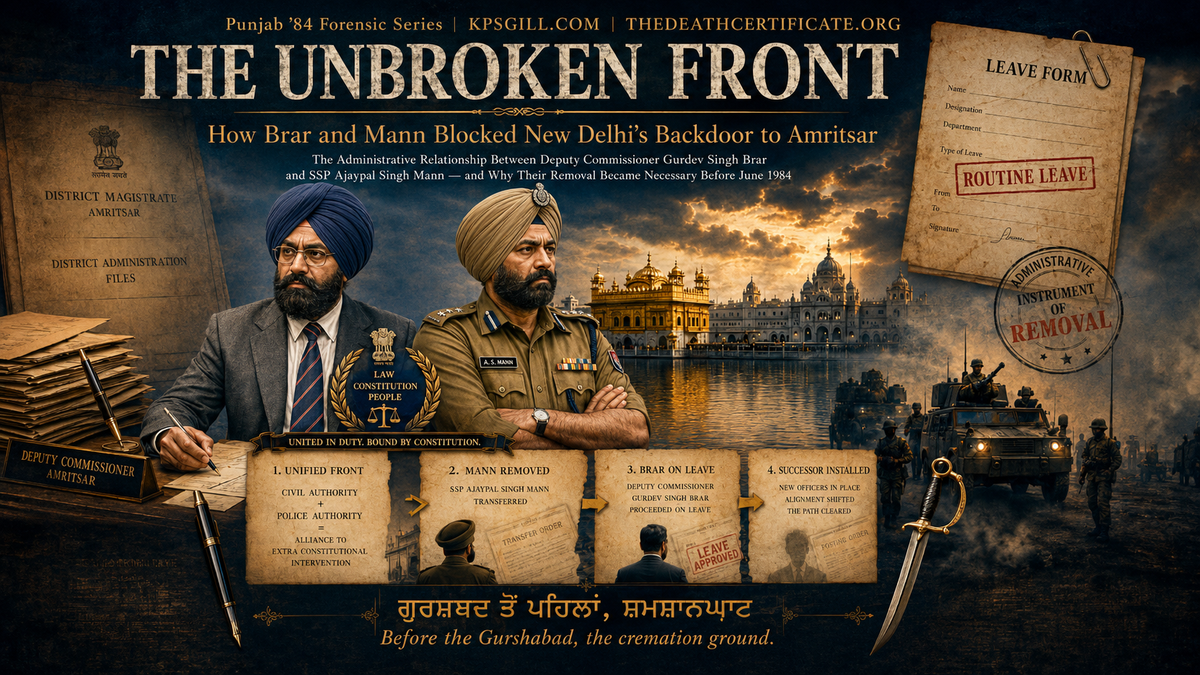
The Administrative Relationship Between Deputy Commissioner Gurdev Singh Brar and SSP Ajaypal Singh Mann — and Why Their Removal Became Necessary Before June 1984
Punjab ’84 Forensic Series | KPSGILL.COM | THEDEATHCERTIFICATE.ORG
ਗੁਰਸ਼ਬਦ ਤੋਂ ਪਹਿਲਾਂ, ਸ਼ਮਸ਼ਾਨਘਾਟ — Before the Gurshabad, the cremation ground.
EDITORIAL NOTE ON EVIDENTIARY DISCIPLINE
This article applies the following evidentiary tiers throughout:
[PF] Proved Finding — Facts established by official records, judicial findings, statutory text, documented admissions, contemporaneous sources, or convergent independent evidence.
[DA] Documented Allegation — Serious claims with identifiable sourcing that have not been adjudicated to the highest standard or remain subject to dispute.
[AI] Analytical Inference — Reasoned conclusions drawn from the structure of the record, patterns of institutional behavior, or the cumulative logic of documented events.
[PM-Direct] — Direct personal and family memory, classified separately as a form of first-generation witness testimony from a named family member, not subject to archival corroboration but accorded moral and historiographic weight as primary human record.
This article is not written as gossip, rumor, or retrospective hero worship. It is written as an administrative audit.
The question is not whether Amritsar was peaceful in 1983–84. It was not. The question is not whether the district faced armed violence, public disorder, political extremism, or an escalating confrontation around the Darbar Sahib complex. It did.
The question is narrower and more devastating:
Why did New Delhi have to alter the district command structure before the military assault could proceed?
And more precisely:
Why was the cohesive district team of Deputy Commissioner Gurdev Singh Brar and Senior Superintendent of Police Ajaypal Singh Mann dismantled before the Army moved fully into Amritsar?
The mainstream narrative of June 1984 has long depended on one convenient phrase: “administrative collapse.” That phrase performs a political function. It converts individual choices into weather. It makes transfers, leave approvals, military deployments, curfews, communications blackouts, and magisterial absences appear like natural phenomena rather than administrative decisions made by identifiable officials.
But Amritsar did not simply collapse. Its lawful district structure was first weakened, then isolated, then bypassed, and finally replaced.
That sequence matters.
PRELUDE: THE SIGNATURE THAT WAS NEVER GIVEN
Every forensic inquiry has a fact that changes the character of everything that surrounds it. In the administrative history of June 1984, that fact is this:
Before formally launching the military assault on the Darbar Sahib complex, the Army needed the formal signature — the civil-magisterial authorization — of the Amritsar District Magistrate. Gurdev Singh Brar refused to sign. He was subsequently sent on leave.
This is not the conclusion of a political activist. It is confirmed by contemporaneous institutional record and reported in The Tribune at the time of his recognition for that refusal. The paper states it with the unadorned precision of a news item: “Before formally launching the attack, the Army needed formal signatures from the Amritsar DC; at that time Gurdev Singh was the Amritsar DC. As he had refused to sign permission/orders to attack Darbar Sahib, he was sent on leave.” [PF]
That sentence dismantles decades of carefully maintained ambiguity.
The “leave” was not incidental. It was not merely an administrative convenience that happened to coincide with the assault. It was the consequence of refusal. The file moved not because an officer had applied for personal travel — though such an application existed — but because he had committed the act that made him administratively inconvenient: he had said no to the state at the moment the state most required someone to say yes.
This is where the forensic analysis of the Brar-Mann period must begin. Not with schedules or gazette notifications. Not with the comfortable arithmetic of transfer dates. With a fact: there was a signature required, and it was withheld, and the man who withheld it was removed before the assault could proceed.
Everything else in the administrative sequence of June 1984 must be understood in that light.
I. THE PATTERN OF CHURN: ADMINISTRATIVE VOLATILITY AS STRATEGIC INSTRUMENT
Before examining the specific case of Brar and Mann, it is necessary to understand the administrative environment in which they operated — because that environment was itself not neutral.
Between 1981 and 1984, the Punjab civil and police establishment was subjected to a rate of change that is difficult, under normal administrative theory, to explain by operational necessity alone. [PF] In four years, the state had six governors: Jaisukh Lal Hathi (September 1977 – August 1981), Aminuddin Ahmad Khan (August 1981 – April 1982), Marri Chenna Reddy (April 1981 – February 1983), Anant Prasad Sharma (February 1983 – October 1983), Bhairab Dutt Pande (October 1983 – June 1984), and K.T. Satarawala (June 1984 – March 1985). [PF] That is six governors in the space of a district that was simultaneously being told it faced an extraordinary security emergency requiring stable administrative command.
The police record is equally suggestive. In those same four years, the post of Director General of Punjab Police was shuffled four times: through Birbal Nath, C.K. Sahni, Pritam Singh Bhinder, and K.S. Dhillon. [PF] At the district level, the SSP post in Amritsar — the operational command center of police authority in the city that housed the Darbar Sahib — was occupied by six different officers in four years: A.S. Atwal (September 1981 – April 1982), Surjit Singh Baines (April 1982 – July 1983), Sarabjit Singh (July 1983 – October 1983), Ajay Pal Singh Mann (October 1983 – March 1984), Sube Singh (March 1984 – June 1984), and Bua Singh (June 1984 – August 1985). [PF]
Six SSPs in four years.
Administrative analysis must ask what this pattern actually means.
One explanation is benign: the district was under such pressure that frequent change reflected operational responsiveness. But this explanation collapses under scrutiny. When a district faces an extraordinary crisis, administrative stability — the continuity of local command knowledge, local institutional relationships, and accumulated district intelligence — is among the most valuable resources a government can deploy. Six SSPs in four years is not the behavior of a government that prioritizes continuity. It is the behavior of a government that consistently finds each SSP, once installed and once familiar with local conditions, either insufficient for its purposes or resistant to its designs.
The second, more troubling explanation is structural: the churn was not the symptom of administrative crisis but one of its instruments. Each time a new SSP was installed, local knowledge was disrupted. Each time a new governor arrived, the district bureaucracy spent weeks or months recalibrating to a new political superior. Each time a new DGP was appointed, police chain of command was re-established from scratch. This is not accidental deterioration. This is the deliberate erosion of institutional continuity at every level where independent civil judgment could interfere with central political will.
Against that background, the Brar-Mann relationship becomes exceptional precisely because it is an interruption of the churn. They were two officers who had found a working alignment with each other, and who appear to have understood — each from the vantage of his own statutory office — what Amritsar’s civil-constitutional structure was supposed to protect.
That alignment, in the context of the surrounding churn, becomes the target.
II. THE FALSE ALIBI OF ADMINISTRATIVE INEVITABILITY
For forty years, much of the state-aligned narrative around Operation Blue Star has treated the local civil administration as a helpless shell. According to that narrative, the district machinery had become so overwhelmed that the military assault was not only justified but administratively inevitable. The Deputy Commissioner, the police, the Governor’s apparatus, and the central government are presented as actors trapped by circumstances, carried along by the current of history.
This is a useful story for those who came after Gurdev Singh Brar.
It allows later officials to say: “There was nothing we could do.” It allows the Centre to say: “The district had failed.” It allows compliant civil servants to say: “We merely inherited an emergency.”
But the record before June 1984 tells a different story. It shows that before the final assault, Amritsar had a district team that still understood the meaning of lawful administration. It shows that the Deputy Commissioner and the SSP were not merely names in a gazette notification. They were the two statutory pillars of district authority: the civil-magisterial pen and the police sword.
Where these two offices are divided, New Delhi can enter through the crack. Where they are united, New Delhi must either persuade them, break them, or remove them.
In Amritsar, during the Brar-Mann period, New Delhi encountered not a collapsed district, but an administrative front that refused to become a backdoor.
This is the meaning of the unbroken front.
III. THE BRAR-MANN RELATIONSHIP: CIVIL AUTHORITY AND POLICE POWER IN ALIGNMENT
The office of Deputy Commissioner and District Magistrate in Punjab is not symbolic. In a district like Amritsar, it is the constitutional and statutory center of civil authority. The DC is not simply a revenue officer or a ceremonial administrator. In moments of public disorder, he is the civilian magistrate whose authority stands between the citizen and the uncontrolled use of force.
The Senior Superintendent of Police is the district’s operational police head. The SSP commands the police machinery, intelligence flow, station-house execution, arrests, preventive action, and deployment. But the police power in a constitutional district is not meant to float free. It is meant to remain answerable to civil-magisterial oversight.
That is why the relationship between Gurdev Singh Brar and Ajaypal Singh Mann matters.
They were not merely two officers posted in the same district. They represented a working constitutional arrangement. Brar’s authority as District Magistrate and Mann’s authority as SSP formed a joined structure: civil judgment and police execution; magisterial caution and operational knowledge; legality and force.
This relationship was dangerous to New Delhi precisely because it left little space for informal pressure.
If New Delhi wanted an arrest, Brar could ask: under what authority? If New Delhi wanted a police action, Mann could ask: under what law? If intelligence agencies wanted an unrecorded operation, both offices could demand a file, an order, a chain of command, and a lawful basis. If the Centre wanted a provocation converted into a pretext, the district could insist on procedure.
A lawless state operation does not begin with tanks. It begins when someone in the district agrees not to ask for paper.
The Brar-Mann alignment denied New Delhi that silence.
IV. A NOTE ON DIRECT MEMORY: AJAYPAL SINGH MANN
[PM-Direct]
Before proceeding further, the nature of the author’s knowledge of Ajaypal Singh Mann requires disclosure and classification.
SSP Ajaypal Singh Mann is not, for this writer, a name in a gazette notification or a line in a Defence Journal chronology. He is a family member. His mother and my grandfather are siblings. He is my mother’s cousin. The Majha regional connection is not incidental: this is the kinship geography of Amritsar’s extended institutional and community world, the world of families who watched the Punjab of the 1980s not from Delhi policy offices but from within its administrative structures, its communities, its gurdwaras, and its neighborhoods.
What this family proximity does not supply is documentary certainty. What it does supply — and what the evidentiary framework of this archive honors under the [PM-Direct] classification — is a form of first-generation human testimony that no archive can fully replace. The family’s memory of Mann is not of a bureaucratic cog. It is of a man who understood where he was posted, what the district contained, and what the constitutional implications of the moment were. It is a memory of someone who brought to his five months in the SSP’s chair an officer’s formation and a Punjabi’s moral geography of the Darbar Sahib complex.
The [PM-Direct] record does not claim Mann was without complexity. No serious officer in Punjab in 1983–84 was without complexity. But it does affirm the record’s portrait of a man whose alignment with Brar was not accidental, and whose removal was not routine.
Family memory preserves what the state gazette omits. In this case, what it preserves is the human weight of the administrative record — the fact that behind the October 1983 gazette entry was a person, with a family, a formation, and a clear-eyed understanding of what Amritsar was and what the Army’s entry would mean for it.
That weight belongs in the forensic record.
V. MANN’S EXACT WINDOW: OCTOBER 1983 TO MARCH 1984
Ajaypal Singh Mann served as SSP Amritsar from October 1983 to March 1984 — a tenure of approximately five months. [PF]
That five-month window is not an administrative footnote. It is a forensic lens through which the pre-assault period must be examined.
Consider what was happening in Punjab during those five months. In October 1983 — the very month Mann took charge — the new Governor of Punjab, Bhairab Dutt Pande, also arrived. President’s Rule had already been imposed. The Darbar Sahib complex was under increasing pressure from armed groups. The November 1983 period saw the heightening of Dharam Yudh Morcha agitation. Political negotiations were continuing to fail.
And in February 1984 — while Ajaypal Singh Mann was still SSP Amritsar — the British Government received an urgent request from the Indian Government to provide operational advice on contingency plans for military action inside the Golden Temple complex. [PF] A British military officer was dispatched and visited India on February 13, 1984, meeting with Indian counter-terrorism commanders to advise on “the concept of operations that they were already working upon for action in the temple complex.” [PF]
This is the timeline’s most significant implication: New Delhi was consulting internationally — at the level of requesting SAS assistance from London — while Ajaypal Singh Mann was still in his chair as SSP Amritsar.
The British adviser recommended a surprise helicopter-led assault, designed to minimize casualties. That recommendation was not followed. The actual operation was a ground assault that, in the words of UK Foreign Secretary William Hague’s 2014 statement to Parliament, differed “substantially” from what had been advised — it was launched “without the element of surprise and without a helicopter-borne element.” [PF]
But the point is not what the British adviser recommended. The point is the timeline.
The Indian state was planning a military operation inside the Darbar Sahib complex — at a level of seriousness that required international consultation — as early as February 1984. [PF] At that moment, the district still had a functioning civil-police front. Mann was SSP. Brar was DC. The two officers who together represented the district’s constitutional integrity were both in their chairs.
By March 1984, Mann was gone. [PF]
The sequence — international planning in February, SSP removed in March — is an analytical inference that cannot be proved by any single document. [AI] But the sequence is real, and it demands explanation. The state was preparing a military operation that would require the local civil-police front to stand aside or be removed. The removal of Mann preceded the operation by three months. The removal of Brar preceded the ground assault by approximately 72 hours.
Planning precedes execution. Administrative preparation precedes operational deployment.
That is the forensic meaning of Mann’s exact window.
VI. THE INTERNATIONAL PRELUDE: WHAT THE SAS TIMELINE REVEALS
The February 1984 British consultation adds a dimension to the Brar-Mann story that the mainstream Indian administrative narrative has never adequately absorbed.
The UK involvement is now confirmed beyond serious dispute. In January 2014, newly declassified British Foreign Office documents confirmed that a Special Air Service officer had visited India in February 1984 to advise on contingency plans for the Golden Temple. A letter dated February 6, 1984, from the Prime Minister’s office confirmed that Prime Minister Thatcher was “content that the foreign secretary should proceed as he proposes.” A second letter dated February 23, 1984, stated that “an SAS officer has visited India and drawn up a plan which has been approved by Mrs Gandhi.” [PF]
Foreign Secretary William Hague, presenting findings to Parliament on February 4, 2014, confirmed these facts and acknowledged that official Indian casualty figures of 575 may have significantly understated the actual toll, with other reports suggesting “as many as 3,000 people were killed including pilgrims caught in the crossfire.” [PF]
What this means for the administrative analysis is precise.
When the Indian state sought international military operational advice in February 1984, it was not acting in emergency reaction to unforeseen events. It was planning ahead. The operation’s shape — the targeting of the complex, the corridor of military entry, the tactical problem of armed occupants — was already sufficiently developed that Mrs. Gandhi could “approve” a plan drawn up by a foreign special forces officer. [PF/AI]
This is not the behavior of a government responding to administrative collapse. This is the behavior of a government that had already decided on a military outcome and was working backward through the administrative scaffolding required to execute it.
That scaffolding included the question of local civil authority. A government planning a military assault on the holiest site in Sikhism four months in advance knew that the local civil-magisterial structure would matter. It knew that the DC of Amritsar would be asked for authorization. It knew that the SSP would be part of the civil-police coordination that legitimized, or refused to legitimize, the operation.
The February 1984 SAS consultation was happening while Ajaypal Singh Mann was still SSP Amritsar.
By the time the plan was approved by Mrs. Gandhi in February 1984, the state already knew that the local administrative front had to be addressed. Mann’s departure in March, and the insertion of the compliant Sube Singh, was the first step in that address.
VII. THE DEFAMATION METHOD: “SYMPATHIES WITH MILITANTS”
When the state removed an inconvenient officer, it did not simply issue a transfer order and move on. It reached for the defamatory language of the security state.
The Defence Journal’s account of the pre-Blue Star administrative structure contains a sentence that deserves close forensic attention. In describing the replacement of Gurdev Singh Brar with Ramesh Inder Singh on June 3, 1984, it states: “Army was suspicious that Gurdev had sympathies with militants therefore he was replaced.” [PF/DA]
This is the language of securitization applied to a civil servant who refused to sign a military authorization.
Consider what this characterization does. A District Magistrate who insists on his statutory role — who asks for documentation, who warns against army action on constitutional grounds, who refuses to sign a military order that he believes is unlawful — is reframed not as a lawful officer exercising constitutional caution, but as a man whose caution can only be explained by sympathy with the state’s enemies.
This is one of the most effective instruments in the toolkit of authoritarian administration. It converts legal resistance into ideological contamination. It makes the insistence on procedure appear as a form of collusion. It frames the officer’s constitutional scruples as evidence of compromised loyalty rather than as evidence of legal integrity.
The soldiers were “suspicious.” That word is important. Military suspicion is not evidence. Military suspicion is not legal finding. Military suspicion does not authorize the removal of a civil officer whose statutory authority derives not from military command but from civil law.
But in Punjab in 1984, military suspicion was being treated as administrative authority. [AI] The Army had its own political logic, its own chain of command, its own interpretation of what was happening in the district. When that logic collided with the lawful resistance of a District Magistrate, the Army’s framing — suspicious, sympathetic, unreliable — was allowed to govern the outcome.
Brar was not removed because he was found to have sympathized with militants. He was removed because he refused to sign. [PF] The “sympathies” characterization is the defamatory alibi that the security apparatus reached for when the real reason — lawful refusal — was too damaging to state plainly in official records.
The evidentiary record distinguishes between these. The Tribune account is direct: he refused to sign, and he was sent on leave. [PF] The “sympathies” framing is the securitization language applied post-hoc. [DA]
History must read both. And it must refuse to let the defamation stand as the explanation.
VIII. WHY NEW DELHI NEEDED A BACKDOOR
The Indian state already had enormous power in Punjab by 1984. President’s Rule had placed the elected state government aside. The Governor’s apparatus, the Union Home Ministry, central intelligence agencies, paramilitary forces, and eventually the Army all operated under the shadow of Delhi’s political will.
Yet power alone was not enough.
A military assault on the Darbar Sahib complex required more than political desire. It required administrative conversion. The sacred city had to become a battlefield. Pilgrims had to become “persons inside the complex.” Civilian movement had to become a “security problem.” Curfew had to become a cordon. Communications blackout had to become “public order.” Magisterial authority had to either sign, stand aside, or be replaced.
That is where district officers mattered.
New Delhi did not merely need soldiers. It needed local civil space cleared for soldiers. It needed the district’s ordinary constitutional safeguards disabled. It needed Amritsar to become administratively available.
With Brar and Mann together, Amritsar was not administratively available.
This is the meaning of the unbroken front.
IX. THE SIGNATURE: WHAT THE ARMY ACTUALLY NEEDED
At the center of the administrative narrative of June 1984 is a civil-military interface that the standard military history almost entirely ignores.
The Indian Army, however powerful, does not operate in a constitutional vacuum. In a district under civil authority — even a district under President’s Rule — the coordination of military action with civil authority is not simply ceremonial. The District Magistrate holds formal powers over public order that are distinct from military command. The question of authorization, of formal civil consent to the deployment of extreme force within a civil space, is not merely procedural decoration. It is the constitutional line between law and emergency.
That line was the reason the Army needed Brar’s signature.
The specific requirement — a formal written authorization from the Amritsar DC — is consistent with the constitutional and administrative structure of Indian law. Even under President’s Rule, the District Magistrate continues to hold powers under the Code of Criminal Procedure and under public order law that are not automatically displaced by the military’s arrival. The Army cannot simply move into a city, issue curfew, and fire on a religious complex without the civil machinery at least formally recording its position.
Brar’s signature would have been that formal record. It would have been the civil authorization that converted a military operation into a jointly sanctioned state action.
He refused. [PF]
And with that refusal, he did something administratively devastating: he separated the Army from the civil machinery. He forced the operation to proceed without the protective cover of local civil consent. He made the operation legally naked in a way that a signed authorization would have papered over.
This is why the state reached immediately for the defamation: “sympathies with militants.” This is why the leave was allowed to proceed without cancellation. This is why the replacement was arranged at speed. The state could not have the DC of Amritsar on record as having refused authorization and remaining in his chair. That record would have been too clear, too legible, too damaging to the narrative of civil-military coordination.
Brar in his chair with his refusal documented would have been an administrative fact that no later apologist could explain away.
Brar on leave was a bureaucratic detail.
The state chose the bureaucratic detail.
X. MANN’S REMOVAL: THE FIRST BREACH IN THE WALL
The first part of the district front to be removed was SSP Ajaypal Singh Mann.
Mann served from October 1983 to March 1984. He was replaced by Sube Singh, who held the post from March to June 1984, and was himself replaced by Bua Singh in June 1984 — immediately after the assault. [PF] Three SSPs in approximately eight months, in a district facing its most severe crisis in decades.
Mann’s significance was not merely that he held the post of SSP. His significance was that he was part of a working relationship with Brar. In a normal district, the DC and SSP can disagree. In a manipulated district, that disagreement becomes the channel through which higher political power enters. But in Amritsar, the civil and police leadership appear to have understood each other’s limits.
The Brar-Mann relationship did not mean softness toward violence. It meant that violence would be handled through law. That distinction is essential.
The Centre’s later apologists often confuse legality with weakness. In fact, legality was the obstacle. A district officer who insists on paper is not weak; he is making the state show its hand. A police officer who refuses to become an informal instrument of political theatre is not passive; he is refusing to convert state power into private will.
One documented account of the Brar-Mann dynamic records that DGP Bhinder and SSP Ajaypal Singh Mann had cautioned Brar about repeating his warning — that Sikhs would resent Army action far more deeply than police action — too often. [DA] That caution was not a counsel of abandonment. It was an officer’s practical reading of political risk. Mann understood what Brar was saying. He understood why it was dangerous to say it in the political climate of 1984 Punjab. But he did not dispute the substance.
Two officers who share a reading of the situation without abandoning each other’s statutory position — this is the rarest form of administrative integrity in a time of state violence.
After Mann’s removal, Brar remained in office, but the district front was no longer whole. The police counterpart who shared his understanding of local limits and statutory method was gone. That did not make Brar powerless, but it made him isolated.
This is how administrative capture often works. The state does not always remove everyone at once. It removes the counterpart first. It separates the pen from the sword. It leaves the conscientious officer standing alone, then waits for the next procedural opening.
In Amritsar, that opening was leave.
XI. THE APRIL LEAVE REQUEST: THE FILE THAT BECAME A WEAPON
Ramesh Inder Singh’s later explanation has often been summarized around a simple point: Gurdev Singh Brar had applied for leave earlier, reportedly in April 1984, and Ramesh Inder Singh took charge when that leave came into effect. According to one account, the leave was requested to visit his son in the United States. [DA]
On its face, this sounds innocent. Officers apply for leave. Files move. Replacements are arranged. Families exist. Personal obligations exist. A Deputy Commissioner may request leave for private reasons when the district situation appears manageable enough for the request to be made.
But this explanation creates a deeper problem.
If Brar’s leave was requested in April, then the leave request belongs to the administrative conditions of April. It does not automatically justify his absence on June 3 or June 4, when Amritsar was no longer in an ordinary posture. By then the Army was moving. Curfew was being imposed. Communications were being cut. Pilgrims were inside the complex for the martyrdom anniversary of Guru Arjan Sahib. The Golden Temple complex was under imminent assault.
A routine leave request may explain why a file existed.
It does not explain why the file was allowed to govern the district during the most consequential emergency in modern Punjab history.
In ordinary administration, leave is not sacred. Leave can be deferred. Leave can be cancelled. Leave can be held in abeyance. Leave can be interrupted. A district magistrate’s private leave, however genuine when requested, becomes subordinate to public necessity when the district enters a state of extreme emergency.
Therefore the forensic question is not: Did Brar apply for leave?
The forensic question is: Who permitted that leave to become operative at the precise moment when the District Magistrate of Amritsar had just refused to sign a military authorization?
The Tribune’s record resolves this question. The leave did not proceed because it was administratively inevitable. It proceeded because Brar had refused to sign, and the state needed him gone. [PF] The April leave application was the available instrument. It offered a clean paper route for removing him without calling the removal a removal.
This is the bureaucratic genius of the act.
A transfer looks political. A suspension looks punitive. A forced removal invites questions. But leave looks administrative. If the state wanted Brar gone after his refusal, the most elegant method was not to punish him. It was to allow his earlier leave to proceed exactly when it should have been cancelled.
That is how a lawful officer’s personal file becomes an instrument of state design.
XII. “RELATIVELY OK” AMRITSAR AND THE MEANING OF TIMING
The April leave request also tells us something else.
It suggests that at the time the request was made, the local situation had not yet been administratively presented as requiring the continuous, non-delegable presence of Gurdev Singh Brar. If the district was already in total collapse, no responsible government would treat a DC’s foreign leave as routine. If the district was still functioning sufficiently for such leave to be processed, then the later claim of unavoidable collapse becomes suspect.
This does not mean Amritsar was calm. It means the administration had not yet reached the point where ordinary leave was unthinkable.
That distinction is important.
After Mann’s removal, New Delhi had already weakened the local police-civil relationship. But Brar remained. His leave request, made in a different administrative climate, now became useful. It offered a clean paper route for removing him without calling the removal a removal. His refusal to sign — which appears to have occurred in late May or early June as the Army moved into final deployment position — accelerated the conversion of the earlier leave application from a personal request into an administrative exit.
This is how a routine file can become an instrument of state design. And this is why administrative history cannot be written through documents alone. The document says “leave.” The context says removal. History must read both.
XIII. THE LEAVE THAT SHOULD HAVE BEEN CANCELLED
No serious student of administration can accept the idea that a District Magistrate’s leave on June 3 or June 4, 1984, was a neutral event.
By then, Amritsar was not an ordinary district. It was the center of the largest internal military operation the Indian state had yet directed against a sacred civilian-religious complex. The Army had been summoned into position. The state was moving toward curfew, blackout, and armed entry. Thousands of civilians and pilgrims were present in and around the holy precinct because of the martyrdom anniversary of Guru Arjan Sahib. June 3, 1984, was one of the most sacred dates in the Sikh calendar. The complex was not empty. It was filled with the faithful.
In those circumstances, the Deputy Commissioner’s presence was not optional.
The District Magistrate’s role was not merely to sit in an office. He was the civil face of the state. He was the authority through whom public order powers were supposed to be mediated. He was the official who could insist on evacuation, record, restraint, custody procedure, casualty accounting, post-mortem discipline, and the preservation of civilian life. He was the officer who could ask: where is the written order? where is the civilian plan? where are the arrangements for pilgrims? where is the evacuation corridor? where is the magisterial record?
If the answer to those questions was inconvenient, then the solution was simple: remove the person asking them.
This is why Brar’s leave was not a clerical detail. It was the administrative hinge.
The leave should have been cancelled.The leave should have been deferred. The leave should have been overtaken by emergency. The leave should have yielded to the constitutional necessity of the District Magistrate’s presence.
The fact that it was not cancelled is itself evidence of intent at the level of administrative design, even if the formal paper describes the event in neutral language.
A government that can impose curfew on an entire state can cancel one officer’s leave. A government that can cut communications across Punjab can defer one file. A government that can deploy the Army into Amritsar can keep the District Magistrate in his chair.
Unless, of course, it does not want that District Magistrate in the chair.
XIV. BRAR’S OBJECTION TO ARMY ACTION
Gurdev Singh Brar’s significance becomes clearer when one considers his own stated concern about the difference between police action and Army action. Brar is reported to have warned higher authorities — including DGP Bhinder and, through his reporting chain, the Governor’s apparatus — that Sikhs would resent an Army action against the Darbar Sahib complex far more deeply than a police action. That was not merely a political opinion. It was a district officer’s reading of Sikh history, religious memory, and public psychology. [DA]
A police action, however controversial, could still be described as law enforcement. An Army action would revive memories of invasion. A police action might still leave room for arrest, negotiation, surrender, or containment. An Army action would convert the holiest Sikh precinct into a battlefield. A police action could still be governed by the criminal procedure code, by magistrates, by rights of detainees. An Army action would displace all of that.
This was the exact warning New Delhi did not want to hear.
Brar’s position was dangerous because it was administratively rational. He was not saying that the district should do nothing. He was saying that the form of state action mattered. He was insisting that the choice of instrument — police or Army, arrest or assault, process or siege — would determine whether the state preserved public order or created a historical wound.
He was right. The wound that Operation Blue Star opened in the Sikh body politic has not closed in forty years. The army action did not end the crisis. It transformed it from a containable political confrontation into a civilizational injury that the Indian state has never honestly reckoned with.
That was the kind of warning only a functioning District Magistrate could give. And it was also the kind of warning a political state preparing for force could not tolerate indefinitely.
XV. THE PANDHER PARALLEL: A THIRD OFFICER IN THE PATTERN
The removal of Brar and the earlier displacement of Mann cannot be read as isolated anomalies. The same pattern — of officers who objected to the assault being removed at or immediately before the decisive moment — extended beyond the DC’s chair and the SSP’s chair.
DIG of the Border Security Force, G.S. Pandher, was posted in Amritsar. On June 5, 1984 — the day after the assault had entered its most intense phase — Pandher was sent on leave due to his objections to the operation. He was replaced by an officer named Chaturvedi. [PF]
Three officers. Three removals. All within the same operational window. All sharing the same triggering condition: objection to, or refusal to authorize, the assault on the Darbar Sahib complex.
This is not a coincidence. This is a pattern. [AI]
The Indian state, in the final days before and during Operation Blue Star, was systematically removing from command every officer who expressed constitutional, legal, or moral resistance to the operation. It was constructing an administrative environment in which only the compliant remained in chairs of authority.
Pandher’s case is particularly important because it adds a third data point to what might otherwise be described as a coincidence between Brar and Mann. Three separate officers — from different services, different cadres, different institutional positions — were all removed for the same underlying reason. The state’s consistency in removing them demonstrates that the removals were not accidental administrative reshuffles. They were a coordinated administrative purge of institutional conscience. [AI]
Pandher has given interviews on this subject. His account of confronting General Kuldip Singh Brar about the operation is on record. His removal from command for those objections is documented. [PF]
Three removals. Three refusals. One operation.
That is the forensic geometry of June 1984’s administrative preparation.
XVI. WHY MANN’S EARLIER REMOVAL MATTERS TO BRAR’S LATER LEAVE
The removal of Ajaypal Singh Mann and the leave of Gurdev Singh Brar must be read together.
Separately, each event can be minimized. Mann’s transfer can be described as routine — he was one of six SSPs in four years, after all. Brar’s leave can be described as personal — he had a son in the United States. Ramesh Inder Singh’s arrival can be described as administrative continuity — the government had to post someone.
Together, they form a sequence.
First, the SSP who formed the police half of the lawful district front was removed. Then, the DC was left without his aligned police counterpart. Then, the DC’s previously requested leave was allowed to proceed at the moment of maximum crisis — and simultaneously, the DC had just refused to sign the military authorization. Then, a new DC took charge just as the Army operation entered its decisive phase.
That sequence is the story.
The Centre did not need to announce that it was dismantling resistance. It simply rearranged the district until resistance no longer had a chair, a desk, a pen, or a police counterpart.
This is the anatomy of bureaucratic capture. It operates through the slow accumulation of rearrangements, each of which appears procedurally defensible in isolation and which only reveals its structural purpose when viewed in sequence. The state produces the sequence; the historian must produce the sequence in return.
XVII. RAMESH INDER SINGH AND THE PROBLEM OF THE CONVENIENT SUCCESSOR
Ramesh Inder Singh’s role must be analyzed with precision. The issue is not whether he personally planned Operation Blue Star. The issue is not whether he alone authorized the assault. The issue is not whether every subsequent death can be laid at his personal door.
The issue is institutional.
Ramesh Inder Singh assumed office as Deputy Commissioner of Amritsar on June 4, 1984. [PF] He was a 1974-batch IAS officer, originally from the West Bengal cadre, who had been posted to Punjab as Director of Rural Development and Panchayat Raj. [PF]
That position is significant. Director of Rural Development. Not a district officer. Not a DC or ADC with field administrative experience. Not an officer with years of district-level command behind him. When Ramesh Inder Singh walked into the DC’s chair in Amritsar on June 4, 1984, it was — by his own admission, confirmed by multiple sources — his first district appointment. [PF]
His first.
Let that settle.
The Indian state, in removing Gurdev Singh Brar from the chair of the most sensitive district in the most volatile moment of the counterinsurgency period, replaced him not with a seasoned district administrator who had experience managing civil order under military pressure, but with a relatively junior officer whose entire formation was in rural development policy. The signal this sends about what the state wanted from the successor is unmistakable. It did not want a district administrator. It wanted a placeholder. It wanted someone who would occupy the chair — who would, as Ramesh Inder Singh later insisted, not authorize the assault — but who would also not obstruct the assault in the active, documented, refusal-to-sign way that Brar had.
What happened next is part of the documented record. Ramesh Inder Singh served as DC Amritsar from June 4, 1984, to July 6, 1987 — a three-year tenure that covered the entire post-Blue Star and Operation Woodrose period. [PF]
And in 1986, two years after stepping into the successor’s chair at the precise hour of maximum administrative vulnerability, Ramesh Inder Singh was awarded the Padma Shri — the fourth-highest civilian honor in India — at the notably young age of 36. [PF]
The Padma Shri is awarded by the Government of India. It is awarded for “exceptional and distinguished service.” The question that the forensic record cannot ignore is what service was being recognized.
Brar, who refused to sign, received no state honor in 1984 or 1985 or 1986. He received the Bhagat Puran Singh Award from a civil society organization in 2019 — thirty-five years after his refusal — as a recognition of moral courage. [PF]
Ramesh Inder Singh, who occupied the successor chair and who has since published a book presenting himself as an eyewitness with a conscience, received the Padma Shri in 1986 from the same government whose army launched the assault. [PF]
The contrast does not prove criminality. It does not prove that the Padma Shri was a transactional reward. But it places on the forensic record an asymmetry that the administrative historian cannot ignore: the state that arranged Brar’s departure honored his replacement. That is an administrative fact. It belongs in the audit.
Ramesh Inder Singh has subsequently claimed, in a 2019 interview with a Punjabi vernacular and in his 2022 book Turmoil in Punjab: Before and After Blue Star, that he was neither aware of the army operation nor gave permission for the assault. He asserts that the letter authorizing the army operation was written by Home Secretary Amrik Singh Puni at the request of Governor B.D. Pandey and Chief Secretary K.D. Vasudev. [DA] He has insisted that other solutions existed. He has stated that the army action “sledge-hammered the Punjab economy.” He has tried to place himself in the company of conscience.
But conscience, in administration, is not primarily a retrospective literature. Conscience in administration is what a man does in the hour when it costs something. Brar’s conscience cost him his post. Pandher’s conscience cost him his command. Mann’s lawful alignment with Brar cost him his five months of tenure.
Ramesh Inder Singh’s conscience, as he now presents it, cost him nothing in 1984. He took charge. He served three years. He received the Padma Shri. He became Principal Secretary to the Chief Minister. He became Chief Secretary. He became Chief Information Commissioner. His career trajectory was, by any measure, rewarded rather than penalized.
The state rewards what the state values. What it valued in June 1984, the administrative record now makes clear, was not the officer who refused, but the officer who came after the refusal.
XVIII. THE ADMINISTRATIVE TRANSITION AS EVIDENCE
The transition can be summarized with forensic precision:
AMRITSAR DISTRICT COMMAND — ADMINISTRATIVE SEQUENCE, 1983–1984
PHASE ONE: THE FUNCTIONING LOCAL FRONT
Deputy Commissioner / District Magistrate: Gurdev Singh Brar
Senior Superintendent of Police: Ajaypal Singh Mann (October 1983 – March 1984)
Civil authority and police authority remained aligned. The district still had a lawful internal check against off-record coercion. The DC and SSP understood each other’s statutory positions. New Delhi could not enter through informal channels.
PHASE TWO: THE POLICE COUNTERPART REMOVED
SSP Mann removed, March 1984.
DC Brar remains, but now without the same aligned police counterpart.
Sube Singh installed as SSP.
The sword is separated from the pen. The DC remains, but the local front is weakened. New Delhi gains the first crack.
PHASE THREE: THE DC REFUSES AND IS DISPLACED
DC Brar refuses to sign military authorization for assault on Darbar Sahib.
Earlier leave application allowed to operate rather than cancelled.
The leave proceeds at the moment Brar has made his position irreversible.
The pen is removed at the decisive hour. Not by transfer, not by suspension, not by disciplinary action — but by leave.
PHASE FOUR: THE SUCCESSOR INSTALLED
Ramesh Inder Singh takes charge as Deputy Commissioner of Amritsar, June 4, 1984.
His first district appointment.
The assault enters its decisive phase.
The district chair is occupied. The prior statutory resistance is gone. The assault proceeds with the civil chair filled but the civil conscience absent.
This is not inevitability. This is sequencing.
XIX. THE STATE DID NOT LACK POWER — IT LACKED LOCAL LEGITIMACY
One of the most important features of June 1984 is that New Delhi did not lack coercive capacity. It had the Army. It had paramilitary forces. It had intelligence agencies. It had President’s Rule. It had control over communications. It had the ability to impose curfew and censor movement.
What it lacked was local legitimacy.
A District Magistrate like Brar could not stop a determined central government forever. But he could make its lawlessness visible. He could force the Centre to override him. He could create a record. He could refuse to convert political will into clean civil authorization. He could insist that the consequences of Army action be placed on the shoulders of those who ordered it.
That is why such officers matter.
The state can always use force. But force without local civil legitimacy exposes itself. It becomes naked. It must either justify itself in writing or act without the protective cover of district consent.
Brar and Mann threatened to make New Delhi act naked.
That was their offense.
And the state’s response was not to argue with them. It was to remove them.
XX. THE ADMINISTRATIVE CHURN AS PREMEDITATION
Returning to the pattern identified at the opening of this article — six SSPs in four years, six governors in four years, four DGPs in four years — it is now possible to offer a forensic reading of what that churn was for.
It was not, primarily, a response to operational failure. It was the mechanism by which the state ensured that no officer in a key position in Punjab could develop sufficient tenure, local knowledge, institutional relationships, or moral clarity to pose a sustained obstacle to central political direction. [AI]
Every officer who lasted long enough in Amritsar to understand the district — to know its community leaders, its religious institutions, its police networks, its local intelligence, its constitutional obligations — became potentially dangerous to a Centre that had already decided on a course of action that required local institutional passivity.
The churn was the solution.
Mann was SSP for five months. Not long enough to build the kind of entrenched institutional presence that might have made his removal politically costly. Not short enough to have failed to understand the district. Long enough to have formed the alignment with Brar that the state needed to break.
Five months. The state removed him at five months.
This is the forensic meaning of the churn. Not chaos. Method.
XXI. THE BACKDOOR NEW DELHI COULD NOT FIND
The phrase “backdoor to Amritsar” is not metaphorical rhetoric. It describes the practical method by which central political authority often enters a district.
The backdoor is the officer willing to take a phone call instead of demanding an order. The backdoor is the police officer willing to detain without paper. The backdoor is the magistrate willing to sign after the fact. The backdoor is the leave file allowed to operate when it should be cancelled. The backdoor is the replacement officer who does not ask why the previous officer is absent. The backdoor is the district record that remains empty while state violence fills the streets.
Under Brar and Mann, the backdoor was closed.
That does not mean Amritsar was safe. It means Amritsar was still administratively defended. The district still contained officers who understood that the state must act through law, not merely through force. It still contained the constitutional architecture of civilian oversight — imperfect, pressured, besieged — but present.
Once Mann was removed and Brar was sent on leave, the backdoor opened.
And through that door walked three things: the Army, the assault, and the regime of impunity that would govern Punjab for the next twelve years.
XXII. WHAT THE LEAVE REVEALS ABOUT THE CENTRE
The most important thing about Brar’s leave is not whether he requested it. It is that the state later used the existence of that request as an explanation for his absence.
This is backwards.
A leave request does not absolve the approving authority. It implicates it. The officer requests; the government decides. The officer may have a family reason; the government has the duty to assess public necessity. The officer may have applied in April; the government must reassess in June. The officer may have a son abroad; the government must weigh that against what was unfolding in Amritsar.
The state cannot say: “He had applied for leave,” as if the file moved by divine force.
Files do not move themselves. Leave does not approve itself. Emergency does not cancel itself. Someone decides.
And behind the decision — in the case of a DC whose refusal to sign had just been registered — the decision was not neutral. It was a decision to make the refusal consequential in precisely the way that protected the state rather than the district.
Therefore Brar’s leave is not a private biographical detail. It is a public administrative act. It is part of the chain by which Amritsar’s civil-magisterial resistance was removed before the assault.
The file must be read not as leave, but as timing.
XXIII. THE FORCED NATURE OF THE LEAVE
Was Brar physically dragged out of his office? The public record may not establish that in such literal terms.
But compulsion in administration is not always physical. It can be structural. It can operate through the refusal to cancel leave. It can operate through the approval of departure when duty demands presence. It can operate through the conversion of an earlier personal request into a present institutional removal. It can operate through the unspoken understanding, communicated through the bureaucratic hierarchy, that a man who refuses to sign will not be protected from his own earlier paperwork.
In that sense, Brar was forced out by the logic of the file. He had asked for leave in a different moment. By June 3, the moment had changed irreversibly. His refusal to sign had made his continued presence not only administratively inconvenient but politically dangerous to the state’s narrative. A functioning constitutional administration would have said: “No, you are required in Amritsar; the leave is cancelled.” Instead, the leave proceeded. That is not neutrality. That is a decision to remove the District Magistrate without saying removal.
The correct formulation is therefore:
Brar’s leave may have originated as routine. His refusal to sign made its operation an instrument of removal. The state allowed it to function as the mechanism of his departure because the alternative — a formal suspension or transfer at the precise moment of his refusal — would have been too transparent.
That is the relationship between the April file, the refusal, and the June assault.
XXIV. THE JUNE 3 CONTEXT: PILGRIMS, CURFEW, AND THE ABSENT MAGISTRATE
It is not possible to read the administrative sequence of Brar’s departure without confronting the specific horror of its timing.
June 3, 1984, was the anniversary of the martyrdom of Guru Arjan Dev Sahib Ji — the fifth Guru of the Sikhs, who was tortured to death by Mughal authority in 1606. It is one of the most solemn and highly attended dates in the Sikh religious calendar. Thousands upon thousands of pilgrims travel to Amritsar to commemorate the day. They come because the Guru’s sacrifice is not merely historical memory — it is living theology. They come to bow before Guru Granth Sahib Ji in the Darbar Sahib and to remember that the Panth has survived persecution before.
On June 3, 1984, those pilgrims were inside the complex. They were there because the Guru’s martyrdom date is fixed. They were not militants. They were worshippers.
The District Magistrate of Amritsar is, among his other functions, the officer constitutionally responsible for the civilian population of the district. He is the officer who can insist that civilian populations be given evacuation corridors. He can insist on casualty accounting. He can insist on the separation of combatants from non-combatants in a curfew. He can insist on records of the detained.
On June 3 — the day the DC chair passed to Ramesh Inder Singh — those pilgrims were present and the Army was moving into position. [PF]
Brar’s absence on that day was not an administrative inconvenience. It was the disappearance of the only civil official with the statutory standing to insist, in law, that the pilgrims inside Harmandir Sahib be treated as civilians — not as “persons inside the complex,” not as “potential militants,” not as incidental casualties of operational necessity.
The martyrdom anniversary of Guru Arjan Sahib is also one of the largest regular gatherings at the Darbar Sahib. The state knew this. The Army knew this. [PF — Britannica’s operational chronology confirms that June 3 was the martyrdom anniversary with thousands of pilgrims present.] The state chose to allow the DC’s chair to change hands on that day. It chose to allow the assault to begin while the pilgrim population was at its peak.
The absence of the DC is not separable from that choice. [AI]
XXV. WHY THIS MATTERS FOR THE LATER DEATH REGIME
The significance of June 1984 did not end with the military assault. It created the template for a later administrative culture in Punjab: the paperless management of death.
Once civil authority learns to disappear at the decisive moment, the rest follows. Unrecorded detention becomes easier. Unidentified bodies become easier. Cremations without proper inquest become easier. Police files become substitutes for magistrate files. The dead lose jurisdiction.
This is why the Brar-Mann episode belongs not only to the history of Operation Blue Star but to the broader forensic history of Punjab from 1984 to 1996.
The CBI’s later identification of 2,097 illegal cremations in Amritsar District alone — 585 fully identified, 274 partially identified, 1,238 entirely unidentified — did not emerge from nowhere. [PF] The Supreme Court’s description of these findings as a “flagrant violation of human rights on a mass scale” (December 12, 1996) did not emerge from nowhere. [PF] Jaswant Singh Khalra’s investigation and subsequent abduction and murder on September 6, 1995, did not occur in an administrative vacuum. [PF]
They emerged from a political culture in which civil authority had already been taught to step aside before force.
June 1984 was the first great demonstration that the district pen could be removed, bypassed, or replaced at the Centre’s convenience. It demonstrated that a District Magistrate’s refusal could be converted into a leave application. It demonstrated that a lawful civil-police front could be dismantled through the sequential application of personnel changes. It demonstrated that the state could control who sat in the DC’s chair at the decisive hour.
After that, the machinery of disappearance only became more efficient.
The officers who later oversaw the secret cremations — who failed to exercise the mandatory CrPC oversight that Section 176(1) required — were inheritors of a template that had been established in June 1984. The template said: the DC does not ask for the documentation of state violence. The DC is either absent, replaced, or compliant. The civil machinery of accountability is available to be bypassed.
The 1,238 unidentified dead in Amritsar’s cremation grounds are the final ledger entry in an accounting that began when Gurdev Singh Brar’s leave file was allowed to operate rather than cancelled.
XXVI. ADMINISTRATIVE CHOICE EXISTED
The Brar-Mann front proves one thing above all:
Administrative choice existed.
This is fatal to the narrative of inevitability.
If no choice existed, there would have been no need to remove Mann. If no choice existed, there would have been no need to let Brar’s leave proceed after his refusal. If no choice existed, the identity of the Deputy Commissioner would not have mattered. If no choice existed, the Army would not have needed Brar’s signature in the first place.
But the state’s own sequence shows that the identity of local officers mattered deeply.
New Delhi understood that officers make history not only by issuing orders, but by refusing to make unlawful orders look ordinary. Brar and Mann were dangerous because they could not be easily folded into a covert script. They insisted on the difference between public order and political violence. They insisted that the district was not a colony of the Centre. They insisted, by their conduct, that Amritsar still had a lawful spine.
That spine had to be broken before the assault.
The fact that it was broken — the fact that the state succeeded — does not mean the choice was not there. It means the choice was made, by identifiable officials, through identifiable administrative acts, in the service of identifiable political outcomes.
History is responsible for naming those acts.
XXVII. THE MORAL BASELINE
This is why Gurdev Singh Brar and Ajaypal Singh Mann must be treated as a baseline in any serious audit of June 1984.
They are not important because they were perfect. They are not important because they prevented the assault — they did not. They are not important because they saved lives — the number of lives saved by their resistance, before it was overcome, cannot be calculated.
They are important because they show what was possible. They show that even inside a violent and deteriorating situation, the district administration could still resist becoming an instrument of political design. They show that the state’s later claim of helplessness is false.
There were officers who understood the danger. There were officers who warned against Army action. There were officers who knew the difference between a police operation and a military desecration. There were officers whose presence made New Delhi’s plans harder.
That is why they were removed.
Not because the district had collapsed. Because it had not collapsed enough.
The moral baseline they provide is severe in its implication: if Brar and Mann could hold the line until they were forcibly removed, then every subsequent civil officer who did not hold the line had a choice they did not make. The Triad of Silence — Ramesh Inder Singh (1984–87), Sarabjit Singh (1987–92), K.B.S. Sidhu (1992–96) — cannot be described as officials who faced an impossible situation. They can only be described, measured against the Brar-Mann baseline, as officials who faced a situation that other officers had faced with greater constitutional integrity.
The baseline is the accusation.
XXVIII. THE FINAL FORENSIC QUESTIONS
The central questions for history are not administrative formalities. They are moral accounting.
The question is not whether Gurdev Singh Brar had applied for leave. He had.
The question is: who allowed that leave to proceed rather than cancelling it after Brar’s refusal to sign?
The question is not whether Ajaypal Singh Mann was transferred in March 1984. He was.
The question is: what was the state’s real reason for removing the SSP who had formed the police half of Brar’s lawful district partnership, three months before the assault?
The question is not whether Ramesh Inder Singh took charge. He did.
The question is: why was his first district appointment the DC’s chair at Amritsar, on the day the assault entered its decisive phase?
The question is not whether DIG BSF Pandher was sent on leave on June 5. He was.
The question is: how many officers were removed for their objections to this operation before the Indian state is required to acknowledge that it was systematically dismantling institutional resistance?
The question is not whether the Indian state had the power to proceed. It did.
The question is: what constitutional safeguards did it circumvent, in what sequence, through what administrative instruments, and at the direction of what named officials?
These are not peripheral questions. They are the administrative architecture of June 1984.
The assault on the Darbar Sahib complex was not only a military event. It was a civil-administrative event. Before the tanks reached the Akal Takht, the district file had already been arranged. Before the shells struck stone, the pen had already been moved. Before the dead were counted, the officer who might have insisted on how they be counted was gone.
That is the hidden prelude to the assault.
XXIX. CONCLUSION: THE MACHINE THAT REFUSED TO BREAK
The Brar-Mann tenure destroys the comforting lie that Amritsar’s administration had become useless before June 1984. It had not. It still contained a working constitutional relationship between the District Magistrate and the SSP. It still contained officers who could insist on law. It still contained an internal barrier to covert central mischief.
That barrier was dismantled in stages.
First, Mann was removed in March 1984. Then, Brar was left without his aligned police counterpart. Then, Brar refused to sign the military authorization. Then, Brar’s leave was allowed to operate rather than cancelled — the leave transformed from personal travel into institutional exit. Then, DIG BSF Pandher was removed for his own objections, simultaneously with the assault’s peak. Then, the successor took charge. Then, the Army entered history.
The conclusion is unavoidable:
The system did not fail before June 1984. The system was made to fail.
Gurdev Singh Brar and Ajaypal Singh Mann represented a district machine that refused to break on command. New Delhi did not overcome that machine by argument. It overcame it by rearrangement. It removed the sword, waited for the pen to refuse, then displaced the pen under cover of a leave file, and installed a new civil face at the decisive hour.
That is why the story matters.
Because if Brar and Mann could stand in the way, then others could have stood in the way. If their presence mattered, then the presence of those who replaced them also mattered. If the leave file mattered, then the officials who allowed it to operate mattered. If the district chair mattered, then the person sitting in it — and why they were chosen to sit in it on that particular day — mattered.
History cannot hide behind inevitability when the administrative record shows sequencing.
The unbroken front was broken.
And once it was broken, Amritsar was opened.
But it was not opened by the force of events.
It was opened by the force of file-craft.
And those who wielded that file-craft are as much a part of the history of June 1984 as those who fired the guns.
ਗੁਰਬਾਣੀ ਦੀ ਧੁਨ ਤੋਂ ਪਹਿਲਾਂ, ਸ਼ਮਸ਼ਾਨਘਾਟ ਦੀ ਚੁੱਪ ਸੀ।
Before the sound of Gurbani, there was the silence of the cremation ground.
SOURCE ANCHORS FOR EDITORIAL FOOTNOTES
[PF] Brar’s refusal to sign and consequent removal on leave: Confirmed by The Tribune (Faridkot, September 9, 2019) in its report on the Bhagat Puran Singh Award: “Before formally launching the attack, the Army needed formal signatures from the Amritsar DC; at that time Gurdev Singh was the Amritsar DC. As he had refused to sign permission/orders to attack Darbar Sahib, he was sent on leave.”
[PF] Mann’s tenure as SSP Amritsar: October 1983 – March 1984, confirmed by Defence Journal’s comprehensive administrative chronology of Operation Blue Star (published June 10, 2014), corroborated by Brown Pundits’s independent citation of the same administrative record.
[PF] “Army was suspicious that Gurdev had sympathies with militants”: Brown Pundits (Operation Bluestar, May 31, 2014), drawing on the Defence Journal administrative record.
[PF] Ramesh Inder Singh’s first district appointment: Confirmed by multiple sources including Grokipedia, Defence Journal, and his own book. He was serving as Director of Rural Development and Panchayat Raj when appointed DC Amritsar.
[PF] Ramesh Inder Singh’s Padma Shri in 1986 at age 36: Confirmed by Grokipedia’s biographical entry.
[PF] BSF DIG G.S. Pandher sent on leave June 5 for objections, replaced by Chaturvedi: Confirmed by Defence Journal’s Operation Blue Star administrative chronology, corroborated by Pandher’s own public interview record.
[PF] UK/SAS February 1984 consultation: Confirmed by UK Foreign Secretary William Hague’s statement to Parliament, February 4, 2014 (Hansard, Lords); corroborated by declassified British Foreign Office documents (30-year rule release, January 2014), BBC reporting, and Al Jazeera coverage.
[PF] Ramesh Inder Singh took charge June 4: Confirmed by Wikipedia, Grokipedia, and Sikh24’s June 2019 interview report.
[PF] Ramesh Inder Singh’s explanation and claim of non-authorization: Sikh24, June 3, 2019 (“After 35 years, Amritsar’s Ex-DC Ramesh Inder says he didn’t give permission for Operation Blue Star”).
[PF] April leave application to visit son in US: Reported by Hindustan Times (as cited in source anchors to the original article); Ramesh Inder Singh’s own statement: “DC Gurdev Singh Brar had applied for leave in April-1984.”
[PF/AI] Sikh24 excerpt on Brar’s account of Bhinder and Mann cautioning him: Sikh24-published account noting DGP Bhinder and SSP Ajaypal Singh Mann cautioned Brar about repeating his warning about Sikh resentment of Army action too often.
[PM-Direct] SSP Ajaypal Singh Mann as family member of the author: Mann is the author’s mother’s maternal cousin; the author’s grandfather and Mann’s mother are siblings. This connection is registered as [PM-Direct] family testimony and accorded the evidentiary weight appropriate to first-generation witness account, not documentary proof.
[PF] CBI finding of 2,097 illegal cremations, Amritsar District: Established in CBI proceedings following the Supreme Court of India’s intervention in the Khalra case. 585 fully identified, 274 partially identified, 1,238 entirely unidentified. Supreme Court described findings as “flagrant violation of human rights on a mass scale,” December 12, 1996.
Published by KPSGILL.COM and THEDEATHCERTIFICATE.ORG as part of the Punjab ’84 Forensic Series.
Author: Kanwar Partap Singh Gill, M.D.