THE RECKONING: A Forensic Ranking of One Hundred Figures in Sikh History Who Betrayed, Compromised, or Failed the Panth, 1469–2026

A Publication of TheDeathCertificate.org and KPSGILL.COM
ਗੁਰਸ਼ਬਦ ਤੋਂ ਪਹਿਲਾਂ, ਬੇਨਾਮ ਲਾਸ਼ਾਂ ਸਨ — Before the Gurshabad, the nameless dead.
Preamble: The Legal Architecture, the Evidentiary Framework, and What This Document Is
On Defamation Resistance
This article is written as public-interest historical and accountability commentary. Its legal architecture depends on careful separation between proved findings, documented allegations, analytical inferences, and Panthic memory. Fair report and fair comment protections are strongest where the publication accurately summarises official proceedings, court records, inquiry findings, or attributed public documents. Attribution does not automatically immunise republication; therefore, serious allegations are stated only with source identification, evidentiary classification, and careful distinction between adjudicated fact, allegation, inference, and community memory.
Any defamation plaintiff who challenges this article faces discovery obligations that expose their own conduct to the evidentiary process. Where this article states that CBI investigators alleged a specific act, discovery cannot produce a verdict that the CBI never filed. Where this article states that a court convicted a named officer and that conviction was upheld through the Supreme Court, discovery cannot reverse it. Where this article draws an analytical inference from the pattern of an official’s documented conduct, discovery and cross-examination are the appropriate responses — and this archive welcomes them, because truth is what it exists to establish.
The four-tier framework governing all publications of TheDeathCertificate.org:
[PF] Proved Finding — a fact established by adjudicated court verdict, formal inquiry finding, official government determination, or convergent institutional record that has not subsequently been overturned. A conviction upheld through final appeal is a proved finding. A treaty whose text is preserved in the British India Office records is a proved finding. An Akal Takht tankhah documented in the institutional record is a proved finding. A trial-court conviction that was subsequently reversed on appeal is not a proved finding; it is a documented allegation with an attached note about the appellate reversal.
[DA] Documented Allegation — a claim that is serious, specifically sourced, and credible, grounded in court proceedings, CBI or NHRC filings, testimony given under oath, journalistic investigations by established outlets, or formal complaints by identifiable parties. Documented allegations are reported as allegations, attributed to their sources. Every documented allegation in this article is paired with its source attribution.
[AI] Analytical Inference — a reasoned conclusion drawn from the documented record: from patterns of institutional behavior, from timing, from documented omission, from the structural logic of the evidence. Analytical inferences are clearly labeled as inferences, not as facts.
[PM] Panthic Memory — the living historical record preserved in Sikh community tradition, institutional remembrance, and collective witness. Where this memory is the primary source, it is attributed as such.
The Ranking Criteria
The ranking is an explicit analytical judgment, not a mathematical formula. It is not a legal determination of guilt; it is a forensic-historical assessment of the evidence of betrayal and its consequences, expressed as comparative analysis for the purposes of public accountability journalism. The criteria:
First criterion: Evidentiary weight — proved findings outrank documented allegations, which outrank analytical inferences, which outrank Panthic memory alone.
Second criterion: Scale of documented harm — how many people were killed, disappeared, or institutionally damaged as a result of the breach of trust?
Third criterion: Degree of trust betrayed — the position held at the time of the breach, and the intimacy of the bond broken.
Fourth criterion: Causal directness — was the breach the direct, personal act of the named individual, or was it institutional facilitation, omission, or negligent management?
A Note on Physical Battle Narratives
This article applies specific methodological discipline to figures accused of battlefield physical sabotage. Such allegations are held at the [DA] level unless supported by contemporaneous military engineering logs, battlefield journals, or specific archival documentation. Where historical scholarship supports an alternative explanation — engineering failure, structural collapse under artillery bombardment and overloading, or strategic flight rather than deliberate destruction — that alternative is stated alongside the political betrayal charge. For the figures most prominently associated with the Anglo-Sikh War betrayals, the documentary record supports the charge of political and strategic betrayal — passing deployment intelligence to British agents, pre-war deal-making, deliberate operational sabotage at the command level — but does not uniformly support mythologised versions involving deliberate physical destruction of one’s own equipment or ammunition. The political betrayal charge is documented and devastating; the archive states it precisely, without embellishment that the evidence does not carry.
Coverage
This article evaluates a 150-name research roster. The top 100 unique entries are ranked. The remaining evaluated figures are listed separately with reasons for exclusion or deferral.
Section I: Figures Evaluated But Not Ranked
Bhagwant Singh Mann: Developing record; insufficient specific documented acts at the required level for ranking at this time.
Navjot Singh Sidhu: Political controversy; insufficient specific documented Panthic accountability breach at the [DA] level required by this framework.
Charanjit Singh Channi: Documented allegations primarily of governance corruption rather than specifically Panthic betrayal at the level this ranking requires.
Ravneet Singh Bittu: Political trajectory criticism at lower evidentiary level.
Manjinder Singh Sirsa: Political defection to BJP proximity; similar in kind to Ramoowalia (Rank 36) but lesser documented political consequence at the Panthic level.
Harmeet Singh Kalka, Paramjit Singh Sarna, Harvinder Singh Sarna, Manjit Singh GK: Delhi institutional figures; documented community controversy insufficient for ranking at this time.
Multiple Punjab Congress and AAP ministerial figures (Sukhjinder Singh Randhawa, Balbir Singh Sidhu, Fateh Jung Singh Bajwa, Partap Singh Bajwa, Tript Rajinder Singh Bajwa, Amarinder Singh Raja Warring, Gurkirat Singh Kotli, Kuldeep Singh Vaid, Rana K.P. Singh, Inderbir Singh Bolaria): Governance controversies and some specific corruption allegations; insufficient specific Panthic accountability documentation distinguishable from general governance failure.
Harinder Singh Khalsa, Harnek Singh New Zealand, Ajit Singh Poohla: Diaspora figures requiring more specific evidentiary development.
Gurdial Singh Patna Sahib, Harpal Singh Patna Sahib, Gurmeet Singh Patna Sahib: Patna Sahib management controversies requiring more granular evidentiary development.
Jagjot Singh Sohi, Lakhwinder Singh Patna Committee, Inderjeet Singh General Secretary, Sarwan Singh Phillaur, Sohan Singh Thandal, Bibi Paramjit Kaur Gulshan: Institutional and committee figures requiring targeted evidentiary development.
Sukhdev Singh Libra, Ranjit Singh Talwandi, Daljit Singh Cheema, Balwinder Singh Bhunder, Sucha Singh Langah, Tota Singh, Sikander Singh Maluka, Nirmal Singh Kahlon, Sewa Singh Sekhwan, Charanjit Singh Atwal, Surjit Singh Rakhra, Sharanjit Singh Dhillon, Hira Singh Gabria, Gulzar Singh Ranike, Janmeja Singh Sekhon, Iqbal Singh Lalpura, Lachhman Singh Gill, Balwant Singh Nandgarh, Manjit Singh Calcutta: Documented community controversy insufficient for specific ranking at the required evidentiary level.
Gurdev Singh Brar (DC Amritsar, immediately before Ramesh Inder Singh Mandher): Explicitly excluded because the documented record shows he refused to sign the civil-magisterial authorization required to legally launch the military assault on the Darbar Sahib complex in June 1984, and was sent on forced leave for that refusal. [PF — from multiple accountability accounts of Operation Blue Star] His conduct is the counter-archetype of this ranking: a civil administrator who exercised appropriate statutory authority against military overreach at personal cost. His removal on 04 June 1984 and replacement by Ramesh Inder Singh Mandher is essential context for the entry at Rank 26.
THE RANKING
TIER I — The Architects of Catastrophe (Ranks 1–13)
Figures whose documented betrayal produced the most consequential, large-scale, and irreversible harm to Sikh sovereignty, sacred geography, or the most fundamental bonds of political and military trust. Several entries are confirmed at the Proved Finding level; all involve acts whose consequences shaped the Panth’s political existence for generations.
RANK 1 — RAJA LAL SINGH (c. 1809–1866) Wazir, Lahore Durbar
Evidentiary Classification: [PF/DA] — Post-war trial conviction by the Lahore Durbar for treasonous communication with British agents; corroborated by British Political Agent correspondence including the correspondence of Captain Peter Nicholson.
Raja Lal Singh holds the first rank because no single individual whose betrayal is more fully corroborated by the documentary record did more damage to the Sikh sovereign state. He served as Wazir — Prime Minister — of the Lahore Durbar during the First Anglo-Sikh War of 1845–46, holding the highest civil office of the Khalsa state at the moment of its supreme military test. His documented betrayal was political and strategic in character: he passed troop deployment positions and operational intelligence to British Political Agents before and during the war. [DA — from British Political Agency correspondence] The pattern of his command decisions across the engagements at Mudki, Ferozeshah, and Aliwal is consistent with deliberate operational sabotage at the command level: reserves withheld at decisive moments, troop commitments made without coordination, orders that exposed Khalsa formations to concentrated British fire. British casualty sheets and field hospital logs from Ferozeshah establish that Sikh artillery at those engagements was firing fully functional, lethal solid shot that devastated British lines and nearly broke the Governor-General’s forces during what British accounts called the “night of terrors.” The catastrophic explosions in the Sikh camp were documented by British officers as caused by British incendiary shells landing in unbarricaded Sikh powder stores. His post-war conviction by the Lahore Durbar’s own court for treasonous communication with the British enemy is a proved finding: the Khalsa state’s own judicial mechanism found him guilty and exiled him. [PF] The harm he produced was the loss of Sikh political sovereignty and the first structural step toward total annexation in 1849. He occupies the first rank because no subsequent figure in this list caused a comparable scale of institutional catastrophe through a more complete and documented betrayal of a more exalted position of trust.
RANK 2 — MISR TEJ SINGH (c. 1799–1862) Commander-in-Chief, Khalsa Army
Evidentiary Classification: [PF/DA] — Post-war trial findings by the Lahore Durbar; pattern of command conduct documented across the entire campaign; the bridge collapse at Sobraon is an established historical fact while its specific cause is a matter of documented dispute between political sabotage and engineering failure.
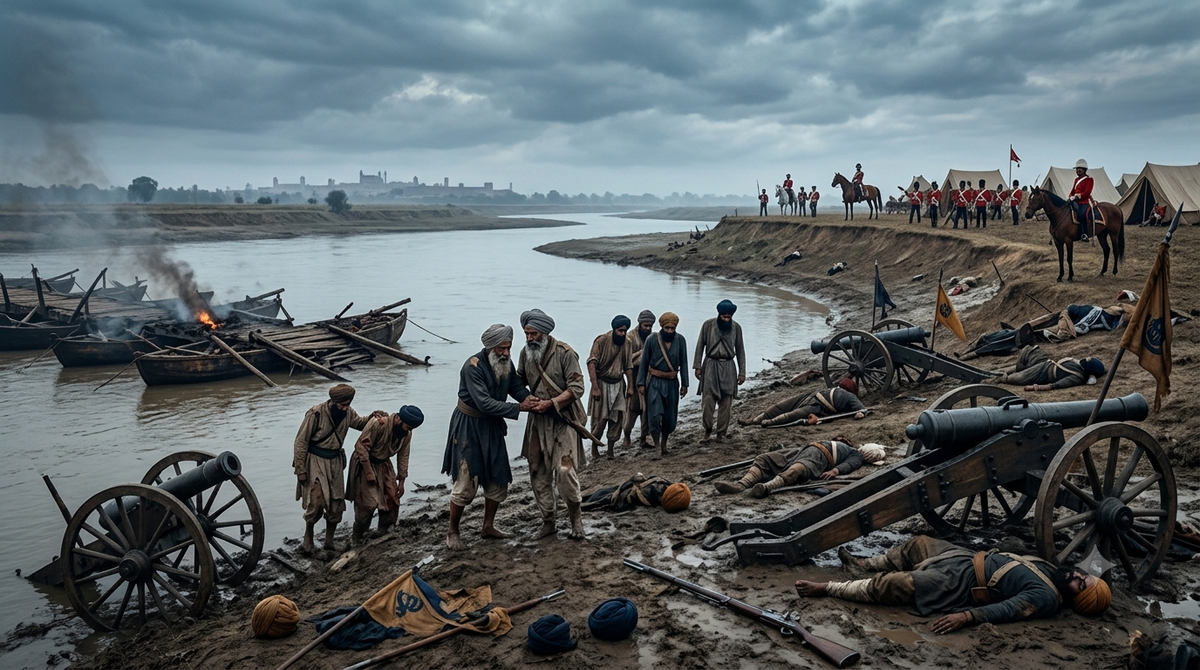
Tej Singh is ranked second because the position he held — Commander-in-Chief of the Khalsa Army — carried the most direct and immediate responsibility for the welfare of tens of thousands of Sikh soldiers who trusted him with their lives. His documented betrayal was political and pre-war in character: the evidence for pre-war communication with British agents is grounded in the Political Agency correspondence and in the consistent pattern of his command conduct across the entire campaign. [DA] The specific event of Sobraon requires precise statement. At the Battle of Sobraon on 10 February 1846, the Khalsa Army occupied an entrenched position connected to the north bank by a bridge of boats. The bridge gave way at the moment when a Khalsa withdrawal might have preserved the army. Contemporary military engineering accounts, corroborated by British battlefield journals, indicate that the bridge’s structural failure involved compounding physical causes: sustained British heavy artillery had battered the structure throughout the engagement; an unseasonable surge in the Sutlej’s flow increased hydraulic pressure on the pontoons; and when thousands of retreating infantry, cavalry horses, and artillery pieces simultaneously crowded the structure under intense fire, it gave way under catastrophic overload. [DA — from British battlefield journals and engineering accounts] Whether Tej Singh gave a deliberate order or whether the collapse was a catastrophic engineering failure compounded by the chaos of command flight is not established to the standard of a proved finding. What is established is that his command conduct throughout the campaign — including his documented early flight from the Sobraon field — constitutes a total failure of the Commander-in-Chief’s duty that cost the Khalsa Army its survival as a fighting force. [PF — post-war trial conviction] He was tried, found guilty of treasonous conduct, and exiled. The scale of harm: the Khalsa Army destroyed, sovereign Punjab surrendered. He is ranked second rather than first because the specific bridge-destruction charge — the most dramatic element — must be held at [DA] while the political betrayal is equally proved.
RANK 3 — GULAB SINGH DOGRA (1792–1857) Raja of Jammu; Founder, Dogra Dynasty of Jammu and Kashmir
Evidentiary Classification: [PF] — Treaty of Amritsar, 16 March 1846, a publicly accessible document in the British India Office records; the withholding of Jammu forces during the war is established historical fact.
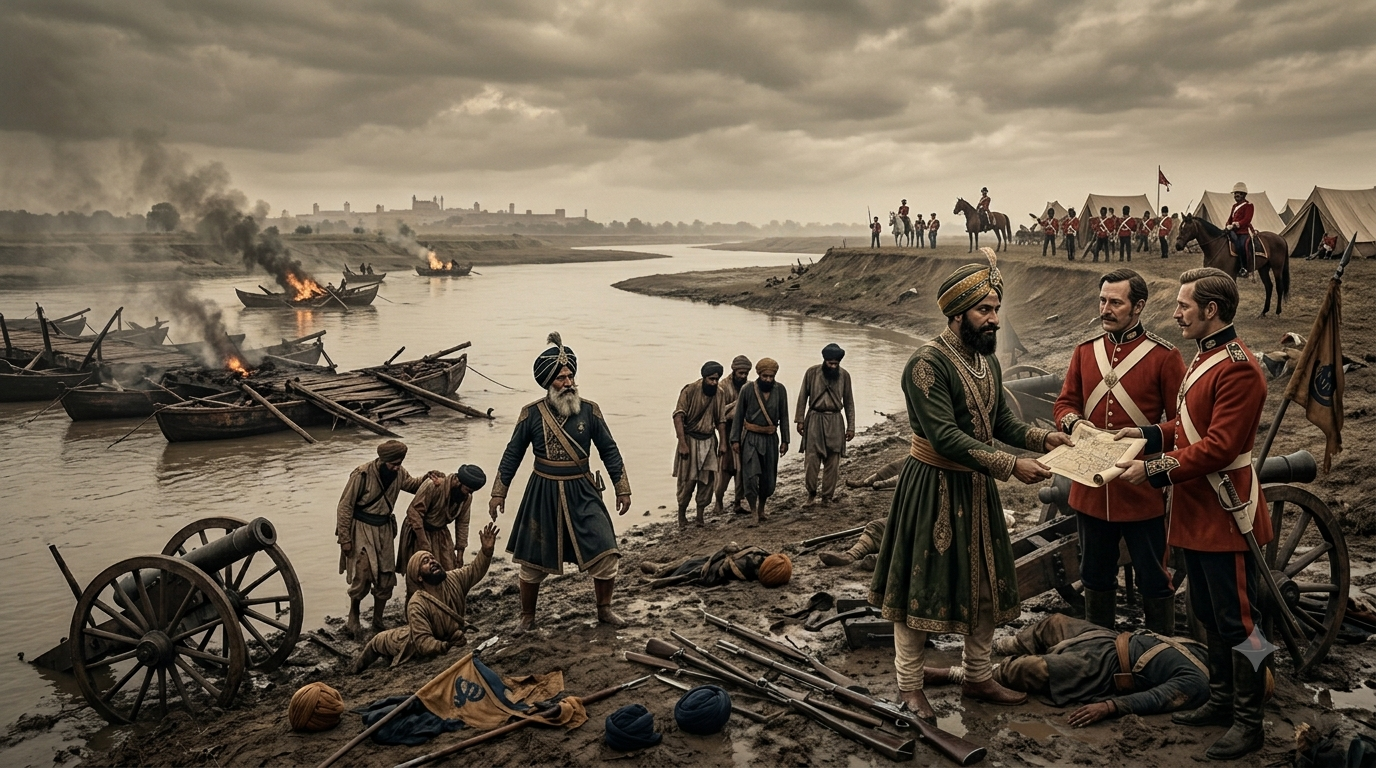
Gulab Singh Dogra withheld the forces of the Jammu hill territories from the Khalsa Army throughout the First Anglo-Sikh War while maintaining negotiating communications with British agents. His reward was total: the British East India Company sold him Kashmir and its dependencies for seventy-five lakh rupees by the Treaty of Amritsar signed six days after the close of hostilities. [PF — treaty text is a public document] This is not metaphorical or inferred betrayal; it is a commercial transaction documented in treaty text, in which the beneficiary of a sovereign state’s destruction purchased the proceeds of that destruction from the people who had destroyed it. The Kashmir dispute — which has since cost hundreds of thousands of lives across partition, multiple wars, and decades of insurgency — has its origin in this bill of sale. He is ranked third rather than first because he was a Dogra Rajput feudatory whose Khalsa identity was never claimed, making his betrayal that of the feudatory rather than the Panthic officer. The bond was real; the breach was total; the reward was a kingdom.
RANK 4 — MAHANT NARAIN DAS (?–post-1921) Hereditary Custodian, Gurdwara Janam Asthan, Nankana Sahib
Evidentiary Classification: [PF] — Criminal trial and conviction following the Nankana Sahib massacre of 20 February 1921; British administrative and judicial record; Akali documentation of the event.
Mahant Narain Das held custodianship of the birthplace of Guru Nanak — the most sacred foundation of the Sikh tradition — and met a peaceful, unarmed Akali jatha of reformers with systematic killing organized through hired men. Bodies were mutilated; some were burned on pyres constructed within the gurdwara premises to destroy the evidence of what had been done within the sacred ground. He was arrested, tried, and convicted by British courts. [PF] His sentence was subsequently commuted — a statement about colonial justice’s inadequacy, not about his guilt. The Nankana Sahib massacre catalysed the Gurdwara Reform Movement and ultimately produced the Sikh Gurdwaras Act of 1925. The custodian of the Guru’s birthplace murdered Sikhs inside it to retain control of it. No exculpatory argument survives this record.
RANK 5 — K.P.S. GILL (Kanwar Pal Singh Gill) (1934–2017) Director General of Police, Punjab (1988–90; 1991–95)
Evidentiary Classification: [DA/AI] — CBI and NHRC documentation of the Punjab illegal cremations; testimony admitted in the Khalra murder trial; formal calls for investigation and prosecution by Ensaaf, Human Rights Watch, REDRESS, and the Centre for Human Rights and Global Justice.
Under K.P.S. Gill’s command as DGP Punjab, the Punjab Police operated a documented system in which 2,097 bodies in Amritsar district alone were secretly cremated in municipal grounds as “unidentified,” without the statutory inquest framework required by Sections 174–176 CrPC, and without notification to the families of the dead. [PF — from CBI investigation and NHRC findings] The total across Punjab is estimated by human rights organizations to be significantly higher. SPO Kuldeep Singh’s testimony, admitted as evidence in the Khalra murder trial, placed a senior police official at the Jhabal police station where Khalra was held in the days before his death. [DA — from trial record] Ensaaf, Human Rights Watch, REDRESS, and the Centre for Human Rights and Global Justice jointly called on the CBI to investigate and prosecute Gill for his role in Khalra’s torture and murder; that investigation was never ordered. The analytical inference — that a documented atrocity system of this scale and duration could not have operated without the knowledge, authorization, or permissive indifference of the Police’s top command — is the [AI] foundation of this entry. He died in 2017, decorated by the Indian state, without facing formal judicial accountability. His Sikh identity — a Sikh commanding a police force that secretly cremated Sikhs — adds the dimension of community betrayal that this ranking specifically documents.
RANK 6 — AJIT SINGH SANDHU (d. 1997) Senior Superintendent of Police, Punjab
Evidentiary Classification: [DA] — Named primary accused by the CBI in the abduction and murder of Jaswant Singh Khalra; CBI charge sheet filed before the Patiala CBI court; died during trial proceedings, May 1997.
The CBI’s charge sheet identified Sandhu as the primary operational architect of Khalra’s abduction from outside his Amritsar home on 6 September 1995, his detention at multiple Punjab Police facilities, his torture, his killing, and the disposal of his body. [DA — CBI charge sheet] Multiple other disappearances and custodial killings within his operational jurisdiction in Tarn Taran district were formally attributed to structures under his command. His death in May 1997 — officially classified as suicide — during the pendency of the Khalra trial means that the man the CBI identified as the primary accused in the murder of a Sikh human rights defender who was documenting the murders of Sikhs was never required to stand before a verdict. The CBI’s charge sheet is the accountability record; his death is the accountability gap.
RANK 7 — DSP JASPAL SINGH Punjab Police
Evidentiary Classification: [PF] — Convicted, Additional District Judge (CBI Court), Patiala, 18 November 2005; sentenced to life imprisonment for murder, abduction with intent to murder, destruction of evidence, and criminal conspiracy; upheld Punjab & Haryana High Court October 2007; upheld Supreme Court of India November 2011.
DSP Jaspal Singh is one of two officers convicted of murder in the Khalra case and one of five convictions ultimately upheld through the full appellate process to the Supreme Court of India. His conviction represents the proved finding standard in its strictest form: a criminal verdict upheld through three levels of the Indian judiciary. He is a Sikh officer convicted of murdering a Sikh human rights defender who was documenting the secret cremation of Sikh dead. The court record is the verdict.
RANK 8 — DSP AMARJIT SINGH Punjab Police
Evidentiary Classification: [DA] — Convicted at the Additional District Judge (CBI Court), Patiala level, November 2005, as part of the Khalra murder proceedings; subsequently acquitted by the Punjab & Haryana High Court on appeal; the Supreme Court of India’s November 2011 judgment concerned the remaining five convicted appellants and did not restore the High Court’s acquittal. This entry is classified [DA] on the basis of the trial-court findings and the CBI investigation record, with the appellate acquittal stated explicitly.
DSP Amarjit Singh was convicted at the trial-court level in the Khalra murder proceedings. The Punjab & Haryana High Court, on appeal, acquitted him, finding reasonable doubt sufficient for that reversal. The Supreme Court’s 2011 judgment — which upheld and enhanced the sentences of the five remaining convicted appellants — did not disturb the High Court’s acquittal. His case is analytically significant precisely because of this reversal: the trial court found him guilty; an appellate court found grounds for acquittal. The CBI’s investigation, the trial court’s detailed findings, and the specific evidence against him remain part of the documented accountability record and ground his inclusion at this rank as a documented allegation of the highest seriousness. The appellate acquittal is stated; the documented allegation is maintained. Both are part of the record.
RANK 9 — SUB-INSPECTOR SURINDERPAL SINGH Punjab Police
Evidentiary Classification: [PF] — Convicted Khalra case (2005); upheld Supreme Court of India November 2011; additionally convicted by CBI court, Mohali (2024) for the kidnapping and wrongful confinement of four Tarn Taran residents in 1992.
Sub-Inspector Surinderpal Singh occupies the ninth rank not only for his Khalra case conviction but for the additional 2024 conviction establishing a documented pattern of custodial abuse across multiple victims across thirty-two years. Two separate CBI courts, two separate conviction records, two sets of victims — all confirmed through judicial proceedings. The cumulative proved finding record across two separate proceedings justifies his placement above the other convicted sub-officers.
RANK 10 — ARUR SINGH (Jathedar, Harmandir Sahib, Amritsar, c. 1919–1921)
Evidentiary Classification: [PF] — The presentation of a siropa (robe of honour) to General Reginald Dyer at the Darbar Sahib following the Jallianwala Bagh massacre of 13 April 1919 is documented in contemporaneous accounts and established as historical fact.
The Jathedar who presented General Dyer — whose troops had opened fire without warning on a crowd of unarmed civilians, fired until the ammunition was nearly exhausted, and then withdrawn without providing medical assistance — with a Sikh robe of honour within weeks of the massacre committed one of the most symbolically devastating acts of institutional betrayal in the colonial period. The Harmandir Sahib, the holiest institution in Sikhism, honouring the man who had just massacred the community’s neighbours in a garden adjacent to its own precincts: the custodial betrayal at its most legible. The act produced a moral crisis within the Sikh community and accelerated the reform movement already underway.
RANK 11 — SUB-INSPECTOR SATNAM SINGH Punjab Police
Evidentiary Classification: [PF] — Convicted Khalra case (2005); upheld Punjab & Haryana High Court 2007; upheld Supreme Court of India November 2011; one of the five finally upheld convictions.
Sub-Inspector Satnam Singh’s proved criminal conviction in the Khalra murder case, upheld through the full appellate hierarchy to the Supreme Court of India, is the basis of his ranking. His role in the operational mechanics of Khalra’s abduction, detention, and death was specifically identified in the CBI’s investigation and confirmed by the courts. He is ranked below the DSP-level convict to reflect the judicial record’s own gradation of charges and sentences.
RANK 12 — SUB-INSPECTOR JASBIR SINGH Punjab Police
Evidentiary Classification: [PF] — Convicted Khalra case (2005); upheld on appeal; one of the five finally upheld convictions.
Sub-Inspector Jasbir Singh’s proved criminal conviction in the Khalra case includes the specific charge of destruction of evidence — the operational mechanism that made 2,097 families’ searches for their missing members permanently unsolvable. Each individual act of evidence destruction connects to the systemic pattern the CBI documented.
RANK 13 — HEAD CONSTABLE PRITHIPAL SINGH (PRITPAL SINGH) Punjab Police
Evidentiary Classification: [PF] — Convicted Khalra case (2005); upheld Supreme Court of India November 2011; one of the five finally upheld convictions.
Head Constable Prithipal Singh is the fifth and final directly convicted participant in the Khalra murder case whose conviction was upheld through the full appellate process. The range of conviction — from DSP-level officer down to head constable — establishes that the Khalra abduction was a structured, rank-distributed conspiracy involving personnel at multiple levels of the Punjab Police hierarchy. That structural finding is a proved fact: the killing of Jaswant Singh Khalra was institutional, not merely individual.
TIER II — Command Authority, Documented Atrocity, and the Failure of the Civilian Shield (Ranks 14–30)
RANK 14 — SUMEDH SINGH SAINI (born 1955) Director General of Police, Punjab (multiple tenures)
Evidentiary Classification: [DA] — Multiple FIRs formally registered; courts at various levels have issued summons and ordered arrests; families of disappeared persons have named him in formal proceedings admitted into court processes; human rights documentation by Ensaaf and related organizations.
Sumedh Singh Saini served as DGP Punjab in the post-counterinsurgency period and his name appears consistently across the accountability literature as an officer whose operational role during the counterinsurgency involved the same structures of extrajudicial detention and killing that the CBI cremation investigation documented. Multiple FIRs have been registered against him; courts have issued summons and ordered his arrest in specific cases; those proceedings have been challenged through legal mechanisms. The families of disappeared Sikhs who formally named him in legal proceedings that courts admitted are not doing so without foundation. He has not been convicted. The [DA] classification is the most serious non-conviction category this framework recognises, and the weight of formal court proceedings and organizational documentation attached to his name justifies his placement at rank 14.
RANK 15 — BEANT SINGH (1922–1995) Chief Minister of Punjab, February 1992 – August 1995
Evidentiary Classification: [DA/AI] — Political command authority over the counterinsurgency apparatus during the period of its most intensive documented violations; political authorization of the operational structures within which the Khalra abduction and the cremation system operated.
Chief Minister Beant Singh — distinguished from his bodyguard namesake who assassinated Indira Gandhi — led the Punjab government through the most intensive period of the counterinsurgency’s documented human rights violations. Under his political authority, the three successive DCs of Amritsar held office without exercising the statutory oversight framework that would have made the cremation system more visible; under his political authority, the officers convicted of Khalra’s murder operated with the institutional resources that enabled the killing. The analytical inference — that the Chief Minister bears constitutional responsibility for the conduct of the police force that is the instrument of his government — is a statement about governmental structure, not a speculation about his personal psychology. He was assassinated by a human bomb in August 1995. His death does not alter the record of his tenure; it complicates the moral accounting.
RANK 16 — MAJOR GENERAL K.S. BRAR (Kuldip Singh Brar) (born 1944) Commanding Officer, Operation Blue Star, June 1984
Evidentiary Classification: [PF/AI/PM] — His role as commanding officer of Operation Blue Star is a proved finding of public record; the moral assessment of that command is an analytical inference and Panthic memory classification.
Major General Brar commanded the Indian Army’s assault on the Darbar Sahib complex in June 1984 as a Sikh officer — leading the army into the holiest site of his own tradition. The assault resulted in the killing of hundreds of people within the complex, the physical destruction of the Akal Takht, and severe damage to the shrine infrastructure. [PF — from the Army’s own acknowledgment and subsequent inquiry records] Important civil context: Gurdev Singh Brar, the DC of Amritsar immediately before the Blue Star period, is documented as having refused to sign the civil-magisterial authorization required to legally launch the assault, was stripped of authority, and was sent on forced leave for that refusal. His removal and replacement on 04 June 1984 establishes that resistance to the operation was possible within the state apparatus. The best case for Major General Brar — genuine coercive military command obligation, court martial risk for refusal, the legitimate security argument regarding armed militants within the complex — is stated here as honest advocacy requires. The case against him — that the Khalsa theological framework imposes an obligation that supersedes any state command requiring assault on the Akal Takht — is equally honest and is the basis of the [PM] classification. He survived assassination attempts after 1984, including one in London in 2012. He is ranked at 16 rather than higher because the complexity of his structural position prevents the clean assignment of the betrayal category that higher ranks require.
RANK 17 — S.S. NIHAL SINGH IAS/Civil Administration, Punjab; counterinsurgency period
Evidentiary Classification: [DA/AI] — Named in the documented accountability record as a civil administrator whose statutory oversight functions lapsed during security operations; analytical inference from the documented gap between statutory duties and their exercise.
S.S. Nihal Singh appears in the counterinsurgency accountability record as a civil administrator whose statutory responsibilities carried obligations bearing directly on the period’s documented human rights violations. His specific role in the inversion of civil-over-police authority — whether as active facilitator or as passive occupant of a position whose statutory mandate he failed to exercise — places him in the institutional failure category at the documented allegation level. [DA/AI]
RANK 18 — SANTA SINGH NIHANG (Baba Santa Singh) (1932–2008) Head, Buddha Dal
Evidentiary Classification: [PF] — Akal Takht excommunication (1985) is a formal institutional act of the highest Sikh religious authority, documented in the institutional record; the government-sponsored kar sewa he led is documented in contemporaneous reporting.
Santa Singh Nihang was excommunicated by the Akal Takht in 1985 for leading the government-sponsored reconstruction of the Akal Takht — the state-funded, state-organized project that the Sarbat Khalsa had explicitly directed should be conducted as community kar sewa rather than government contract. His decision gave the Rajiv Gandhi government a fig leaf of Sikh religious legitimacy for a reconstruction project the Panth experienced as a continuation of the desecration by other means. The best case for him — that his impulse to quickly restore the sanctity of a destroyed sacred space was genuinely devotional, and the Buddha Dal’s institutional relationship to the Sarbat Khalsa framework involves its own complex history — has been considered and found insufficient to override the formal institutional verdict. The Akal Takht spoke. Its verdict stands.
RANK 19 — BUTA SINGH (1934–2021) Union Minister, Congress Government
Evidentiary Classification: [PF] — Akal Takht tankhah documented in the institutional record; his facilitation of the government-sponsored Akal Takht kar sewa is established in contemporaneous reporting.
Buta Singh was among the most senior Sikh figures in the Congress party during the critical years 1984–1989. His specific conduct — participation in and facilitation of the government-sponsored Akal Takht reconstruction — earned him a formal Akal Takht tankhah, which he appeared before the Akal Takht to receive and perform. [PF — tankhah documented] His career-long subordination of Sikh identity to the Congress political machine — the bargain that left him facilitating the state that had assaulted the Harmandir Sahib — is the analytical inference that contextualises the specific proved finding.
RANK 20 — GIANI ZAIL SINGH (1916–1994) President of India, 1982–1987
Evidentiary Classification: [DA/AI] — Documented presence in constitutional office during Operation Blue Star and the November 1984 pogrom; documented failure to exercise available constitutional moral authority; his own accounts of having been bypassed are self-serving but not definitively contradicted by specific documentary evidence.
Giani Zail Singh was President of India — a Sikh in the Republic’s highest constitutional position — during both the June 1984 assault on the Darbar Sahib and the November 1984 anti-Sikh pogrom in which, by multiple judicial findings including the Sajjan Kumar conviction, organized killing of Sikhs involved Congress party workers and Delhi police complicity. His failure to use the office’s moral authority — his visit to the damaged Darbar Sahib accompanying the government that had ordered the assault — is a documented failure of extraordinary symbolic consequence. His own accounts maintained he was not fully informed of Blue Star in advance; specific documentary contradiction of this has not been produced at the level the framework requires. [DA — allegation of advance knowledge is serious but not conclusively proved] The analytical inference: a President who genuinely understood the constitutional framework and the community from which he came would have used the moral authority of his office differently. He is ranked at 20 because the specific complicity charge has not been established at [PF] while the constitutional failure charge is fully documented.
RANK 21 — SURJIT SINGH BARNALA (1925–2017) Chief Minister of Punjab, 1985–1987
Evidentiary Classification: [PF/DA] — Akal Takht tankhaiya declaration (1986) is documented; the order sending police into the Golden Temple complex is an established fact of public record.
Surjit Singh Barnala authorized the entry of state police into the Golden Temple complex in April 1986 to remove armed militants, and the Akal Takht declared him tankhaiya for this decision. [PF — tankhaiya documented] He appeared before the Akal Takht and submitted to its discipline. The Panthic judgment: a Sikh Chief Minister has no authority, however genuine the security justification, to direct state police into the Darbar Sahib precincts. The political context: his decision appeared to many — including within his own cabinet — as an attempt to demonstrate law-and-order credentials to Delhi at the community’s expense, fracturing the Akali Dal at the moment when Panthic political unity was most needed.
RANK 22 — DARBARA SINGH (1914–1986) Chief Minister of Punjab, June 1980 – October 1983
Evidentiary Classification: [DA/AI] — The Congress party’s tactical cultivation of Bhindranwale as a counter to the Akali Dal — in which Darbara Singh’s government participated — is documented in multiple journalistic and political retrospective accounts including Tavleen Singh’s Tragedy of Punjab and retrospective analyses by former Indian officials.
Darbara Singh, as Congress Chief Minister during the critical pre-1984 period, bears a specific institutional responsibility: his government’s participation in the tactical deployment of Bhindranwale as a political weapon against the Akali Dal — intended to split the Sikh vote — created or significantly exacerbated the conditions that made Operation Blue Star politically conceivable. [DA] The decision to use a religious figure whose politics were more confrontational than the mainstream Akali Dal’s as an electoral counter, and the provision of initial political cover that enabled his organization to consolidate, is documented in the political literature of the period. He was removed from office when President’s Rule was imposed in October 1983 — a consequence of the crisis his government’s handling had not resolved — and died in 1986.
RANK 23 — DHIAN SINGH DOGRA (1796–1843) Prime Minister (Wazir), Lahore Durbar
Evidentiary Classification: [DA] — His role in the post-Ranjit Singh succession crises is documented in Sikh chronicles, British Political Agent correspondence, and the academic historical record.
Dhian Singh Dogra served as Prime Minister under Ranjit Singh and through the post-Ranjit Singh period until his murder in September 1843. His progressive entrenchment of Dogra power at the centre of a Khalsa state whose ideology could not accommodate Dogra dynastic ambition was a necessary precondition for the durbar’s post-1839 collapse. The serial violence of the succession period produced the political vacuum that Lal Singh and Tej Singh then filled. He was killed in the same political violence he had partly generated. His genuine administrative competence under Ranjit Singh and unconcealed Dogra identity prevent a higher ranking. [DA]
RANK 24 — HIRA SINGH DOGRA (?–1844) Prime Minister (Wazir), Lahore Durbar, 1843–1844
Evidentiary Classification: [DA] — His role in targeting the Khalsa loyalist Bhai Bir Singh is documented in the chronicle literature and British reporting of the period.
Hira Singh Dogra served briefly as Prime Minister and directed state violence against figures whose loyalty was to the Khalsa tradition rather than to Dogra dynastic interests. The killing of Bhai Bir Singh — a revered Sikh figure whose sanctity and Khalsa loyalty made him a symbolic centre of Panthic identity — at his direction is the specific documented allegation grounding his inclusion. He was himself killed by the Khalsa Army in January 1844 — evidence that the community’s own institutions recognized and acted against his conduct. [DA]
RANK 25 — SUCHET SINGH DOGRA (?–1844) Raja of Naushera; Dogra courtier
Evidentiary Classification: [DA] — Documented as having conducted covert transactions with East India Company interests.
Suchet Singh Dogra is documented as having maintained commercial and intelligence connections with British interests during the period preceding the First Anglo-Sikh War — part of the same structural pattern of Dogra faction interests served by the Khalsa state’s weakening rather than its preservation. He was killed in 1844 in the durbar’s political violence, before the war he helped enable. [DA]
RANK 26 — RAMESH INDER SINGH MANDHER (IAS) Deputy Commissioner and District Magistrate, Amritsar: 04 June 1984 – 06 July 1987
Evidentiary Classification: [AI] — Analytical inference from the documented gap between the statutory inquest and magisterial oversight framework under Sections 174–176 CrPC and the documented absence of any corresponding inquest record for “unidentified” bodies arriving at Amritsar municipal cremation grounds during his tenure; grounded in the CBI-confirmed cremation record.
Ramesh Inder Singh Mandher, IAS, served as Deputy Commissioner, Amritsar, from 04 June 1984 to 06 July 1987 — the dates from the official Amritsar DC register. He was appointed on the precise date that Operation Blue Star commenced, replacing Gurdev Singh Brar, who had been sent on forced leave after refusing to sign the civil-magisterial authorization for the assault. Sections 174 and 176 of the CrPC, as they stood during 1984–1987, created the statutory inquest and magisterial oversight framework for sudden, suspicious, unnatural, or custodial deaths, requiring police reporting, executive-magisterial supervision, and — in appropriate cases — magisterial inquiry into the cause and circumstances of death. The mandatory judicial inquiry specifically for custodial death, disappearance, and rape in custody was strengthened by later amendment; the pre-amendment framework was a magisterial oversight structure requiring active exercise to be effective. [PF — from the CrPC text and its legislative history] The accountability claim is stated as follows: the statutory oversight framework that existed during his tenure, if robustly applied, would have required documentation of the circumstances of every unidentified body arriving at the municipal cremation grounds, creating a paper trail that would have made the pattern of illegal cremations far harder to sustain invisibly. The analytical inference from the CBI-confirmed cremation record is that the DC’s office possessed the statutory tools of oversight and documentation; those tools were not exercised at a level that would have surfaced the systemic pattern. This is not an accusation that he personally directed violence; it is a documented inference about institutional mandate and its non-exercise. [AI]
RANK 27 — SARABJIT SINGH (IAS) Deputy Commissioner and District Magistrate, Amritsar: 07 July 1987 – 10 May 1992
Evidentiary Classification: [AI] — Same statutory inquest and magisterial oversight framework analysis as Rank 26; the cremation system operated continuously across his tenure.
Sarabjit Singh served as DC Amritsar from 07 July 1987 to 10 May 1992 — the dates from the official Amritsar DC register. The same statutory oversight framework applied to his office as applied to his predecessor; the same documented gap between that framework’s mandate and its exercise is present across his tenure in the CBI cremation record. The accountability inference is identical in structure and identical in its explicit limitation: inference about institutional mandate and its non-exercise, not an accusation of personal commission of violence. [AI]
RANK 28 — KARANBIR SINGH SIDHU (IAS) (commonly referred to by initials K.B.S. Sidhu)
Deputy Commissioner and District Magistrate, Amritsar: 11 May 1992 – 11 August 1996
Evidentiary Classification: [AI] — Same statutory oversight framework analysis; his tenure overlaps specifically with Khalra’s documentation of the cremation record and with Khalra’s abduction in September 1995.
Karanbir Singh Sidhu served as DC Amritsar from 11 May 1992 to 11 August 1996 — the dates from the official Amritsar DC register. His tenure overlaps with Khalra’s investigation into the cremation records, which began during his time as DC, and with Khalra’s abduction on 6 September 1995 — an event that occurred within the district he was responsible for administering. He has subsequently become an active public writer and Substack commentator, publishing essays that engage with his Punjab administrative career and with the counterinsurgency period. [PF — from the Substack archive] The supplementary analytical inference — that extensive retrospective public commentary engaging with the counterinsurgency period might be expected to address the statutory oversight question bearing on his specific tenure, if an exculpatory account were available — is held explicitly at the [AI] level and stated as inference. The accountability claim is about institutional mandate and its non-exercise during a specifically documented period of mass atrocity in the district he administered. It is not an accusation of personal commission of violence. [AI]
RANK 29 — PARKASH SINGH BADAL (1927–2023) Chief Minister of Punjab (five terms); President, Shiromani Akali Dal
Evidentiary Classification: [DA/AI] — Documented episodes including the 2015 beadbi crisis, the SIT proceedings criticized by judicial figures and journalistic sources, the Dera Sacha Sauda accommodation, and the systematic non-pursuit of counterinsurgency accountability across multiple terms.
Parkash Singh Badal’s betrayal was not the betrayal of the moment but the betrayal of the decade: a sustained, structured, politically sophisticated deployment of governmental power to ensure that justice for the counterinsurgency-era crimes remained systematically deferred. The documented episodes grounding this ranking include: the SAD government’s management of the Special Investigation Teams established after the 2015 beadbi desecrations in Faridkot district, which multiple judicial figures and journalistic accounts characterised as compromised by the political connection between the Dera Sacha Sauda’s alleged role and the SAD’s cultivation of the Dera’s electoral support; [DA] the government’s non-pursuit of accountability recommendations arising from the CBI cremations investigation; [AI] and the broader pattern of accommodation with the central government at moments when accountability demands would have required confrontation. He was the longest-serving and most dominant Akali Dal politician of the post-1984 era, presenting himself throughout as the Panth’s political voice while managing the community’s most urgent accountability interests in his own and his party’s political interest. He died in April 2023. The families of the 2,097 secretly cremated are still waiting. [DA/AI]
RANK 30 — SUKHBIR SINGH BADAL (born 1962) Deputy Chief Minister of Punjab (2007–2017); President, Shiromani Akali Dal
Evidentiary Classification: [PF/DA] — Akal Takht tankhah issued December 2024 (proved finding); beadbi crisis governance failures documented in multiple judicial and journalistic sources.
Sukhbir Singh Badal received a formal Akal Takht tankhah in December 2024 for conduct during his tenure as Deputy Chief Minister — specifically addressing governance failures including the handling of the beadbi crisis. [PF — tankhah is a documented institutional act] The 2015 desecration of the Guru Granth Sahib in Faridkot district and the killing of Sikh protesters at Behbal Kalan on 14 October 2015 — in which Gurjeet Singh and Krishan Bhagwan Singh were killed by police fire — occurred under his effective political management of the SAD government. [PF — the desecrations and killings are documented facts] The allegation that the investigation into both events was compromised by political considerations connecting the Dera Sacha Sauda’s alleged role to the SAD’s cultivation of Dera electoral support is documented in judicial commentary, journalistic reporting, and the formal SIT proceedings. [DA]
TIER III — Colonial Betrayers, the 1984 Political Apparatus, and Documented Political Defectors (Ranks 31–62)
RANK 31 — MAHARAJA BHUPINDER SINGH PATIALA (1891–1938) Maharaja of Patiala
Evidentiary Classification: [DA] — Documented deployment of Patiala State forces against Akali reform movement activities; documented colonial collaboration.
Maharaja Bhupinder Singh dispatched Patiala State forces to suppress Akali reform activities at a period when the reform movement was attempting to recover the Sikh sacred geography from the mahant system. His use of state military resources in service of British imperial interests at moments when Sikh activist interests required confrontation with those interests is documented in Akali agitation records and British administrative correspondence. [DA]
RANK 32 — SUNDER SINGH MAJITHIA (1872–1941) Akali leader; member, British India legislative councils
Evidentiary Classification: [DA] — Documented preservation of collaborative colonial positions during periods of Panthic agitation; role in the Chief Khalsa Diwan’s loyalist orientation.
Sunder Singh Majithia’s career consistently placed him on the side of managed accommodation with the colonial administration when the community’s reformist demands required confrontation. His role in the Chief Khalsa Diwan — the loyalist Sikh organization — positioned him against the Akali reformers’ more assertive demands at multiple critical moments. [DA]
RANK 33 — BABA KHEM SINGH BEDI (1832–1905) Hereditary leader; descendant of Guru Nanak’s family
Evidentiary Classification: [DA] — Documented use of hereditary spiritual authority to suppress anti-colonial organizing within the Sikh community.
Baba Khem Singh Bedi deployed his position as a descendant of Guru Nanak’s family — the most revered hereditary connection available in the Sikh tradition — to suppress political organizing that challenged British authority. The deployment of hereditary sacred authority as a tool of colonial political management is a specific form of institutional betrayal. [DA]
RANK 34 — GIANI GURBACHAN SINGH Jathedar, Akal Takht (multiple tenures, 2000s–2010s)
Evidentiary Classification: [DA] — The pardon (maafi) issued to Gurmeet Ram Rahim Singh of the Dera Sacha Sauda in 2015, its issuance and subsequent withdrawal under protest pressure, are established facts documented in contemporaneous reporting and judicial and political records; the allegation of political motivation is documented in multiple credible sources.
Giani Gurbachan Singh issued a religious pardon (maafi) to Gurmeet Ram Rahim Singh — head of the Dera Sacha Sauda, who has been convicted in rape cases (prior murder convictions were overturned on appeal by the Punjab & Haryana High Court) — for a 2007 incident in which Ram Rahim staged a tableau imitating Guru Gobind Singh’s historical baptism ceremony in a manner the SGPC formally condemned as sacrilegious. [PF — the pardon’s issuance and withdrawal are documented] The pardon triggered protests across Punjab of a scale that forced its withdrawal. The documented allegation — that the pardon was politically motivated by the need to protect the SAD government’s cultivation of the Dera’s electoral vote-bank — has been made by multiple credible sources and not credibly rebutted. [DA] The Akal Takht Jathedar issuing a religiously significant pardon under alleged political compulsion is the institutional-capture narrative at its most explicit.
RANK 35 — BIBI JAGIR KAUR (born 1963) President, Shiromani Gurdwara Parbandhak Committee (multiple terms); SAD politician
Evidentiary Classification: [DA] — Trial-court conviction in proceedings connected with the death of her daughter Harpreet Kaur was set aside on appeal by the Punjab & Haryana High Court in 2018, and the CBI appeal seeking a murder conviction was dismissed; there is no presently operative criminal conviction; the accountability analysis proceeds on the basis of documented institutional governance failures during her SGPC presidential tenures and the documented facts of the trial proceedings.
Bibi Jagir Kaur served multiple terms as SGPC president and is included in this ranking on the basis of her documented institutional governance record, which involved sustained controversies about resource management and the political management of the SGPC’s functions as a body governing the Sikh sacred geography. [DA] The trial-court proceedings connected with her daughter’s death — while no longer resulting in an operative conviction following the appellate acquittal — are noted as part of the documented record without overstating their current judicial status. She is classified [DA] in recognition of the serious institutional concerns in her SGPC record and the trial-level findings, with the appellate acquittal explicitly stated.
RANK 36 — BALWANT SINGH RAMOOWALIA (born 1938) Akali Dal politician; subsequently Congress minister
Evidentiary Classification: [DA/PM] — The political crossing from the Akali Dal to Congress alignment, and subsequent ministerial positions in Congress governments, are documented facts of public record.
Ramoowalia moved from the Akali Dal into Congress political alignment in the post-1984 years — the years during which Congress bore institutional responsibility for Operation Blue Star and for the apparatus through which the November 1984 pogrom was organized. His subsequent ministerial positions in Congress governments constitute the documented record of a political crossing whose timing and beneficiary the Panthic community has consistently characterized as defection for personal benefit at a moment of acute community need. [DA/PM]
RANK 37 — GURCHARAN SINGH TOHRA (1924–2004) SGPC President (multiple decades)
Evidentiary Classification: [DA/AI] — Documented institutional capture of the SGPC for factional political purposes across his extended tenure.
Tohra’s extended SGPC presidency converted an institution designed to govern the Sikh sacred geography in the Panth’s interest into an electoral organization serving the Akali Dal’s political machine. His relationships with militant-period organizations, his management of SGPC resources, and the specific allegations about how those resources were deployed are documented in the political and institutional history of the body. He also maintained periods of genuine resistance to specific central government pressures, and his personal piety within the tradition is undisputed. He was a political operator who captured an institution and managed it in his interest alongside, and sometimes against, the Panth’s. [DA/AI]
RANK 38 — S.S. VIRK Punjab Police (IPS); senior officer, counterinsurgency period
Evidentiary Classification: [DA] — Named in the counterinsurgency accountability context with documented allegations of extrajudicial conduct.
S.S. Virk appears in the counterinsurgency accountability record as a senior Punjab Police officer whose role in the security operations of the 1990s generated documented allegations of involvement in extrajudicial conduct, at the documented allegation level. [DA]
RANK 39 — P.S. GILL Punjab Police (IPS); senior officer
Evidentiary Classification: [DA/AI] — Named in the counterinsurgency accountability context with documented allegations of senior operational involvement.
P.S. Gill appears in the accountability record as a senior Punjab Police officer whose conduct during the counterinsurgency period is the subject of documented allegation at the senior operational level within the system the CBI confirmed was operating an extrajudicial killing and secret cremation program. [DA/AI]
RANK 40 — PARAMJIT SINGH GILL Punjab Police; senior officer
Evidentiary Classification: [DA/AI] — Documented allegations in the counterinsurgency accountability literature.
Paramjit Singh Gill is ranked 40th as a senior Punjab Police officer whose role in the counterinsurgency period has generated documented allegations that have not been adjudicated to conviction. [DA/AI]
RANK 41 — SPO KULDEEP SINGH Special Police Officer; witness in the Khalra case
Evidentiary Classification: [DA/PF] — His testimony, admitted in the Khalra murder trial proceedings, placed him within the surveillance and tracking structures associated with Khalra’s detention; the testimony is part of the judicial record.
SPO Kuldeep Singh testified in the Khalra murder trial about his own participation in the tracking and surveillance structures associated with Khalra’s abduction — testimony that is part of the judicial record and that constitutes simultaneously a source of accountability information about others and a documented account of his own participation. He is both witness and documented participant in the system he described. [DA/PF]
RANK 42 — WAZIR JAWAHAR SINGH (?–1845) Wazir, Lahore Durbar (briefly, 1844–1845)
Evidentiary Classification: [DA] — Documented in the chronicle literature and British reports as having contributed to the killing of a royal prince and to wider durbar destabilization.
Wazir Jawahar Singh — the brother of Rani Jindan — served briefly as Wazir and contributed through active political manipulation to the durbar’s accelerating destabilization. His killing of Peshaura Singh (a royal prince) triggered severe reaction from the Khalsa Army and accelerated the political chaos that created the conditions for the betrayals of the war period. He was himself killed by the Khalsa Army in September 1845. His inclusion as distinct from the rehabilitated treatment of Rani Jindan reflects the difference between his active manipulation and her constrained regency. [DA]
RANK 43 — GURBAKSH SINGH BEDI (?–?) Hereditary figure; colonial period
Evidentiary Classification: [DA] — Documented cooperation with colonial administrative controls to neutralize community organizing.
Gurbaksh Singh Bedi cooperated with colonial administrative controls to suppress organizing within the Sikh community that challenged British authority — the specific betrayal of deploying traditional community authority for colonial political management purposes. [DA]
RANK 44 — MASTER TARA SINGH (1885–1967) Dominant Akali leader, 1920s–1960s
Evidentiary Classification: [DA/PM] — The breaking of the 1961 fast-unto-death and the subsequent Akal Takht tankhah proceeding are documented facts; the broader leadership failure charge is at [DA/PM].
Master Tara Singh dominated Sikh political life for four decades, organized the Akali Dal as a political force, and sustained the Punjabi Suba demand across decades of resistance. The specific charge grounding his inclusion — the breaking of the 1961 fast-unto-death that he had publicly undertaken, followed by an Akal Takht tankhah — is a proved finding. [PF — tankhah documented] His ranking at 44 reflects the specific adjudicated breach while acknowledging that his overall legacy — fundamentally in service of Panthic political interests — makes the blanket “traitor” label inadequate to his record.
RANK 45 — BALDEV SINGH (1902–1961) Sikh representative, Partition Council; first Defence Minister of India
Evidentiary Classification: [AI/PM] — with explicit rehabilitation caveat.
Baldev Singh is placed at rank 45 with an explicit rehabilitation caveat: this archive’s full analysis finds him not a traitor but a political actor under genuine structural constraint in an extraordinarily difficult negotiating context. The British government’s priority was rapid two-state transfer of power; a viable third Sikh state had no political architecture the framework of the day recognised. His inclusion in this ranking reflects the community’s experienced sense of abandonment from the 1947 settlement; the evidentiary analysis does not support attributing that consequence to personal betrayal for personal gain. His ranking at 45, with the rehabilitation caveat, is this archive’s honest verdict: the betrayal charge exists in the community’s record; the evidence does not adequately ground it.
RANK 46 — SANT HARCHAND SINGH LONGOWAL (1932–1985) President, Shiromani Akali Dal
Evidentiary Classification: [PM/AI] — with explicit rehabilitation note, strengthened by the documented text of the Rajiv-Longowal Accord itself.
The Rajiv-Longowal Accord, signed July 1985, explicitly mandated the immediate transfer of Chandigarh to Punjab, a high-level judicial inquiry into the November 1984 anti-Sikh pogroms, and the release and rehabilitation of Sikh army personnel who had deserted following Blue Star. [PF — from the text of the Accord itself] The accord collapsed because the Indian central government acted in bad faith and refused to implement its core clauses after Longowal’s assassination in August 1985. The failure of the accord is the central government’s documented breach, not Longowal’s personal concession. Attributing the Accord’s failure to Longowal’s personal betrayal misreads the document that was actually signed and the party that failed to honour it. He was killed for attempting political resolution. The evidence does not support the betrayal charge against him. He is included in this ranking at 46 because the community’s accountability narrative requires engagement; the rehabilitation note is this archive’s substantive verdict.
RANK 47 — GIANI KARTAR SINGH (?–?) Akali politician; Congress-aligned, post-independence
Evidentiary Classification: [DA/PM] — Documented accommodations with the Congress political framework during the Punjabi Suba period.
Giani Kartar Singh’s career involved successive accommodations with the Congress political framework at moments when the Punjabi Suba agitation required maximum Panthic solidarity — accommodations that prioritised personal political positioning over community interest at critical junctures. [DA/PM]
RANK 48 — GIANI GURMUKH SINGH MUSAFIR (?–?) Congress-aligned Sikh politician and poet; Chief Minister of Punjab (briefly)
Evidentiary Classification: [DA/PM] — Congress alignment during the Punjabi Suba period documented.
Giani Gurmukh Singh Musafir served briefly as Chief Minister and was associated with the Congress framework during the Punjabi Suba agitation — positioning him in opposition to the Akali movement’s demands at a critical period. [DA/PM]
RANK 49 — PARTAP SINGH KAIRON (1901–1965) Chief Minister of Punjab, 1956–1964
Evidentiary Classification: [DA/AI] — Land corruption documented in the Das Commission inquiry; political management of the Punjabi Suba issue documented.
The Das Commission inquiry into Kairon’s tenure produced findings of corruption and misuse of official position for personal enrichment. [PF — the Das Commission inquiry is a formal record] His political use of Congress governmental authority to contain rather than accommodate the Panthic Punjabi Suba demand places him in the betrayal record at the documented allegation and analytical inference levels.
RANK 50 — JUSTICE GURNAM SINGH First Chief Minister, reorganized Punjab (1966–1967)
Evidentiary Classification: [DA/PM] — Post-reorganization political management of Punjab’s critical outstanding issues.
Justice Gurnam Singh’s decisions during the first tenure of the reorganized Punjab — regarding Chandigarh’s status, the river waters question, and the new state’s configuration — have been criticised in Panthic political analysis as having accepted less than the reorganization mandate required. [DA/PM]
RANK 51 — PRITHI CHAND (1558–1618) Elder son, Guru Ram Das; founder, Mina faction
Evidentiary Classification: [PM/DA] — Established in Sikh chronicle literature and historical scholarship.
Prithi Chand’s betrayal was institutional: he founded the Mina faction — one of the Panj Mel — as a rival claimant lineage, intercepted Sangat offerings intended for the Guru’s treasury, and endangered the infant Hargobind. The Mina faction persisted as an instrument of anti-Panthic activity for generations, meaning his foundational betrayal had structural consequences that outlasted his personal conduct. [PM/DA]
RANK 52 — DHIR MAL (?–1677) Grandson of Guru Hargobind; rival claimant; founder, Dhirmalias
Evidentiary Classification: [PM/DA] — The withholding of the Kartarpur Bir and the attack on Guru Tegh Bahadur through his agent Shihan are foundational events in Panthic historical memory.
Dhir Mal withheld the Kartarpur Bir — the Adi Granth in its earliest form — from the Guru line as a political weapon, and organised through his agent an attack on Guru Tegh Bahadur. The withholding of the sacred text and the attempt to use violence against the living Guru represent the heterodox claimant archetype in its most dangerous form. He founded the Dhirmalias — another of the Panj Mel. [PM/DA]
RANK 53 — RAM RAI (c. 1646–1687) Eldest son of Guru Har Rai; founder, Ram Raiyas
Evidentiary Classification: [PM/DA] — The alteration of Gurbani in Aurangzeb’s court and the disowning by Guru Har Rai are established in the Sikh tradition.
Ram Rai altered a verse of Guru Nanak’s Gurbani in Aurangzeb’s court to avoid offending the Emperor — an act of theological compromise that Guru Har Rai regarded as a fundamental betrayal of the sacred text, for which he disowned his son. He was never allowed to return to the Sikh fold. The specific character of his betrayal — altering the Guru’s Word to please an emperor — is in the Sikh framework among the most serious possible breaches of the tradition’s textual trust. [PM/DA]
RANK 54 — MEHARBAN (1581–1640) Son of Prithi Chand; leader, Minas
Evidentiary Classification: [PM] — Documented in Sikh tradition as author of distorted janam sakhi literature.
Meharban composed janam sakhi literature that distorted the canonical tradition to promote the Mina lineage’s rival claims. The janam sakhi tradition was a primary vehicle of early Sikh community formation, and the introduction of distorted versions served to confuse the emerging canon and provide the Mina faction with a parallel textual legitimacy. [PM]
RANK 55 — HARJI MINA (?–?) Later Mina leader
Evidentiary Classification: [PM] — Established in Panthic tradition as having excluded orthodox Khalsa believers from the Harmandir Sahib.
Harji Mina used Mina control over access to the Harmandir Sahib to exclude orthodox Sikh believers from the shrine — weaponising the sacred geography against the community it should have served. This is the custodial betrayal pattern in its most direct colonial-era form. [PM]
RANK 56 — PAHRA MALL (?–?) Early factional figure, Guru period
Evidentiary Classification: [PM] — Associated in Panthic tradition with factional schisms that divided early community loyalties.
Pahra Mall is included on the basis of the Panthic tradition’s attribution of factional organizing that divided the early community’s loyalties during the critical formation period. [PM]
RANK 57 — CAPTAIN AMARINDER SINGH (born 1942) Chief Minister of Punjab, 2017–2021; Congress politician
Evidentiary Classification: [DA/AI] — Governance record on beadbi investigations, river waters, and subsequent political realignment documented in journalistic and political records.
Captain Amarinder Singh served as Chief Minister of Punjab from 2017 to 2021. The Special Investigation Team he established to investigate the 2015 beadbi desecrations and the Behbal Kalan killings was subjected to sustained criticism — including from judicial figures — for the pace and political management of its proceedings. [DA] His government’s handling of the river waters dispute and the SYL canal issue has been criticised in Panthic political analysis as having failed to deploy the full range of legal and administrative mechanisms available. [DA/AI] His departure from the Congress party and subsequent alignment with the BJP — whose central government’s relationship with Sikh political concerns is complicated by the history of 1984 and the farm laws crisis — added the dimension of political realignment that sections of the community experienced as demonstrating his governance priorities.
RANK 58 — MANMOHAN SINGH (1932–2024) Prime Minister of India, 2004–2014
Evidentiary Classification: [DA/AI] — His failure to deliver formal accountability mechanisms for 1984 across two full terms as Prime Minister is a documented political fact; he died 26 December 2024.
Manmohan Singh served as Prime Minister for approximately ten years across two full terms, 2004–2014. His two terms produced no formal accountability mechanism for the organized killing of Sikhs in November 1984 beyond a parliamentary expression of regret in 2005. [PF — the parliamentary statement is a documented public record] He had access to the institutional authority needed to direct the CBI, to establish special courts, and to create a formal truth process; the documented record of his two terms is that none of these mechanisms were fully deployed. His political position within the Congress party — whose institutional relationship to 1984 accountability was structurally compromised — created genuine political constraints. The constraint was real; it contextualises rather than excuses the failure. He died in December 2024.
RANK 59 — BIKRAM SINGH MAJITHIA (born 1973) SAD politician; former Punjab minister
Evidentiary Classification: [DA] — Multiple formal FIRs and legal proceedings in connection with drug nexus allegations; documented court proceedings in which courts have issued summons.
Bikram Singh Majithia faces the most serious specific documented drug nexus allegations of any contemporary SAD politician — allegations connected to a public health catastrophe that has devastated Sikh communities across Punjab at a scale documented in public health data. Multiple FIRs have been registered; Punjab courts have issued proceedings; he has challenged them through legal mechanisms. No conviction has been obtained. The [DA] classification reflects the serious, multiply formalized character of the allegations. [DA]
RANK 60 — BABA GURBACHAN SINGH NIRANKARI (?–1980) Head, Sant Nirankari Mission
Evidentiary Classification: [DA/PM] — The 1978 Amritsar confrontation is a documented historical event; the state protection allegation is a documented allegation with analytical grounding.
The 1978 Amritsar confrontation, in which Nirankari followers killed multiple Sikh protesters, is documented fact. [PF] The allegation that the Nirankari organization received state political protection enabling it to operate against the mainstream Sikh religious establishment — and that this protection facilitated the 1978 confrontation and its lethal consequences — is a documented allegation made in the Panthic accountability literature and in journalistic analysis of the period. [DA] He was assassinated in 1980. His inclusion carries the caveat that the Nirankari tradition does not recognise itself as Sikh, meaning the “betrayal” category applies differently than for figures who held acknowledged positions of Sikh institutional trust.
RANK 61 — JAGJIT SINGH CHOHAN (1929–2007) Diaspora political figure
Evidentiary Classification: [DA/AI] — Alleged connection to Pakistani intelligence interests while claiming to represent Sikh political aspirations is documented in multiple journalistic and intelligence-adjacent sources.
Jagjit Singh Chohan was the most prominent face of the diaspora Khalistan political movement in the 1980s. The documented allegation — that his activities were supported by Pakistani intelligence interests whose use of Sikh political identity served Pakistani state strategic interests rather than the Sikh community’s welfare — has been made in journalistic investigations and the analytical literature on South Asian intelligence operations. [DA] If established, this would make him a figure who used the language of Sikh liberation to serve a foreign state’s strategic interests. He died in 2007.
RANK 62 — KHUSHWANT SINGH (1915–2014) Journalist, novelist, historian
Evidentiary Classification: [DA/PM] — with explicit rehabilitation caveat.
Khushwant Singh appears at rank 62 with the same rehabilitation caveat that governs Baldev Singh at rank 45: this archive’s full assessment finds the “traitor” label inapplicable to his actual record and substitutes the more accurate characterisation of a secular Sikh intellectual whose political positions during the militancy period were more conservative than much of Panthic opinion and whose relationships with the Congress establishment were real and consequential. His return of the Padma Bhushan after Blue Star, his contribution to the Sikh tradition’s English-language presence, and his body of serious historical work constitute partial credits in the ledger. His ranking at 62 — below every figure with a proved finding — expresses this archive’s conclusion that the charge against him does not reach the standard the higher-ranked figures’ conduct does.
TIER IV — Factional Figures, Political Defectors, and Religious Controversialists (Ranks 63–100)
RANK 63 — HARCHARAN SINGH BRAR Punjab Congress politician
[DA/PM] — Documented political conduct within the Congress framework during accountability-critical periods. His career involved sustained operation within the Congress political framework during the post-1984 period at a time when Congress bore institutional responsibility for the catastrophe and its aftermath.
RANK 64 — RAJINDER KAUR BHATTAL (born 1945) Deputy Chief Minister of Punjab; Congress
[DA/PM] — Documented political conduct during her tenure and afterward. She served as Deputy Chief Minister following Beant Singh’s assassination and her political management of Sikh accountability issues within the Congress framework is subject to documented criticism.
RANK 65 — JAGDEV SINGH TALWANDI (1923–2002) Akali Dal politician
[DA/PM] — Documented Akali factional politics and political reversals at moments when Panthic solidarity was most needed.
RANK 66 — SANT FATEH SINGH (1911–1972) Akali leader; achieved Punjabi Suba
[AI/PM] — with partial rehabilitation. He achieved the Punjabi Suba (1966), a genuine and significant Panthic political achievement. The charge — that he accepted a truncated state leaving Chandigarh in limbo and failed to secure the river waters allocation — is an analytical inference and Panthic political memory judgment about the adequacy of a settlement reached under genuine political constraint. The evidence does not find personal betrayal for personal gain.
RANK 67 — BABU TEJA SINGH BHASSAUR (?–1927) Excommunicated; altered Sikh religious texts
[PM/PF] — Excommunication documented (proved finding); distributed altered versions of the Nitnem and other sacred texts deviating from the canonical tradition.
RANK 68 — NIRANJAN SINGH BHASSAUR Associated with the Bhassaur movement
[PM] — Participated in the printing and distribution arm of the Bhassaur movement’s altered text project.
RANK 69 — BABA AVTAR SINGH NIRANKARI (?–?) Earlier Nirankari leader
[PM] — Predecessor figure who established and institutionalised the Nirankari movement’s modern divergence from Sikh mainstream practice.
RANK 70 — GIANI JOGINDER SINGH VEDANTI Jathedar, Akal Takht (multiple periods)
[DA/PM] — Multiple controversies during his tenures involving specific decisions experienced by sections of the community as politically motivated rather than spiritually grounded — the institutional-capture problem at the community’s highest religious office.
RANK 71 — GIANI HARPREET SINGH Jathedar, Akal Takht (recent tenure)
[DA/PM] — Ongoing controversy about the independence of the office’s pronouncements and the political contexts within which specific institutional decisions were made or deferred during his tenure.
RANK 72 — GIANI IQBAL SINGH Former Jathedar, Takht Sri Patna Sahib
[DA/PM] — Documented controversy during his tenure as Jathedar of Takht Sri Patna Sahib, involving institutional governance concerns about the independence of the office’s functioning.
RANK 73 — AVTAR SINGH MAKKAR President, SGPC (multiple terms)
[DA/PM] — Documented SGPC governance controversies involving resource management and the subordination of religious management to Akali Dal political direction during his tenure.
RANK 74 — KIRPAL SINGH BADUNGAR President, SGPC
[DA/PM] — Served as SGPC president during and after the 2015 beadbi crisis; the SGPC’s institutional response under his leadership was criticised for its political calibration and insufficient independence from the Badal government’s management of the crisis.
RANK 75 — GOBIND SINGH LONGOWAL President, SGPC
[DA/PM] — Documented SGPC governance controversies about the independence of the body’s governance from political party direction and the management of Sikh sacred resources.
RANK 76 — HARJINDER SINGH DHAMI Current President, SGPC
[DA/PM] — Contemporary controversies around the management of the SGPC’s institutional independence and the conduct of tankhah and accountability proceedings during his tenure.
RANK 77 — HARNAM SINGH DHUMMA Head, Damdami Taksal (contested)
[DA/PM] — Documented controversies about the leadership of the Damdami Taksal and the institutional direction under his contested claim to the leadership of that tradition.
RANK 78 — GIANI RAGHBIR SINGH Former Jathedar, Akal Takht
[DA/PM] — Appointed Akal Takht Jathedar in June 2023; as of 2025–2026, Giani Kuldeep Singh Gargaj is identified in reporting as officiating/acting Akal Takht Jathedar amid ongoing SGPC controversy. His tenure involved the continuing pattern of institutional-independence concerns documented across other recent Jathedars.
RANK 79 — AJMER SINGH LACHHEWALA Political figure; SAD alignment; subsequent proximity to Congress and state interests
[DA/PM] — Political trajectory from Akali Dal alignment toward proximity with Congress and state interests characterised in Panthic political analysis as prioritising personal political positioning over community interest.
RANK 80 — PRITAM SINGH BHULLAR Punjab Police; counterinsurgency period
[DA/AI] — Named in the counterinsurgency accountability record with documented allegations consistent with the documented pattern of extrajudicial practices during the period.
RANK 81 — SWARAN SINGH GHOTNA Punjab Police; counterinsurgency period
[DA/AI] — Documented in the counterinsurgency accountability record with allegations consistent with the documented pattern of extrajudicial practices during the period.
RANK 82 — GURMEET SINGH PINKY Former police operative (“cat”); Punjab counterinsurgency period
Evidentiary Classification: [DA] — Documented in the Punjab counterinsurgency accountability record as a former police “cat” — a surrendered militant turned intelligence and enforcement operative within the counterinsurgency apparatus.
Gurmeet Singh Pinky is documented in the Punjab counterinsurgency accountability record in connection with his role within the cat and SPO system that the human rights literature — including the NHRC proceedings and the Khalra trial record — identifies as a primary instrument of targeted killing and enforced disappearance during the counterinsurgency period. The cat and SPO system converted community knowledge into targeting information; his specific documented role within that system grounds his inclusion at rank 82. [DA]
RANK 83 — PROFESSOR DARSHAN SINGH Former Jathedar; scholar
[PM] — with explicit rehabilitation note. Theological disagreement and refusal to respond to an Akal Takht summons are documented in the community institutional record. Scholarly theological disagreement — however contested within the community — is categorically different from the political-security betrayal of the higher rankings. He is included because the research roster includes him and the honest accounting engages with every figure; his ranking at the lowest analytical tier, with the rehabilitation note, is this archive’s substantive verdict.
RANK 84 — GURBAKSH SINGH KALA AFGHANA Writer; theological controversialist
[PM/PF] — Excommunicated by the Akal Takht (proved finding); authored writings challenging traditional Sikh practices including the amrit initiation ceremony and aspects of the Rehat Maryada. Theological heterodoxy, however seriously the community takes it, is categorically different from the mass atrocity betrayals of the higher rankings.
RANK 85 — DR. PASHAURA SINGH Sikh scholar; academic
[PM] — with explicit rehabilitation note. His doctoral research engaging critically with questions about the Sikh scriptural tradition generated community controversy and formal proceedings before the Akal Takht. Scholarly engagement with religious textual questions — however contested within the community — is not betrayal of the Sikh Panth in the sense governing this ranking. He is included because the research roster includes him; his position at the lowest tier, with the rehabilitation note, is this archive’s verdict.
RANK 86 — BABA SARBJOT SINGH BEDI Hereditary lineage figure
[PM/DA] — Use of hereditary Bedi lineage status — descended from Guru Nanak’s family — to influence Sikh institutional leadership decisions in ways that generated documented community controversy about self-interest over community service.
RANK 87 — JOGINDER SINGH TALWARA SGPC figure; institutional controversialist
[DA/PM] — SGPC institutional controversies about the management of the body’s governance and the political independence of its administrative decisions.
RANK 88 — JEET SINGH KHALSA Created parallel initiation centers
[PM] — Established centres conducting ceremonies imitating the Khalsa initiation (amrit sanchar) outside the framework of Panthic authorization and canonical practice — a specific form of theological disruption the community treats as a serious breach of the tradition’s integrity.
RANK 89 — PIARA SINGH BHANIAWALA Heterodox religious figure
[PM] — Documented in the Panthic accountability record in connection with texts experienced by sections of the community as distorting the foundational Sikh scriptural tradition.
RANK 90 — BALBIR SINGH NIHANG Nihang figure; institutional controversies
[DA/PM] — Controversies within the Nihang tradition around institutional governance and political alignment documented in the accountability record of that tradition.
RANK 91 — RANJIT SINGH BRAHMPURA SAD politician; Akali factionalist
[DA/PM] — Documented Akali factional conduct during critical periods, prioritising factional positioning over community interest at moments when Panthic solidarity was most needed.
RANK 92 — SUKHDEV SINGH DHINDSA SAD politician; Senate member
[DA/PM] — Documented political accommodation within the SAD framework during accountability-critical periods, characterised as prioritising political comfort over Panthic accountability demands.
RANK 93 — PREM SINGH CHANDUMAJRA SAD politician
[DA/PM] — Parliamentary conduct within the SAD framework experienced by sections of the Panthic community as inadequately championing the community’s most pressing accountability demands.
RANK 94 — ADESH PARTAP SINGH KAIRON Akali politician; son of Partap Singh Kairon
[DA/PM] — Documented political conduct in Punjab politics carrying both the legacy of his father’s complex record and his own positions on accountability and community issues.
RANK 95 — MANPREET SINGH BADAL Punjab Finance Minister (Congress cabinet); nephew of Parkash Singh Badal
[DA/PM] — Political trajectory from the SAD machine through his own party formation into a Congress ministerial position; documented community criticism about the management of Punjab’s fiscal resources and the political calculus behind his political moves.
RANK 96 — DIDAR SINGH BAINS Diaspora figure
[DA/PM] — Documented allegations in the diaspora accountability record regarding the alignment of certain activities and political positions with interests — potentially including intelligence-adjacent interests — not aligned with the Sikh community’s welfare.
RANK 97 — RANJIT SINGH DHADRIANWALE (born 1978) Sikh preacher
Evidentiary Classification: [DA/PM] — with explicit note that the evidence does not support the stronger charges made against him by certain Panthic factions.
Ranjit Singh Dhadrianwale is a prominent Sikh preacher who survived an assassination attempt in 2016 connected to sectarian tensions in the Sikh political and religious environment. His management of his institutional positioning, his social media presence, and his relationships with various Sikh political factions have generated community controversy about whether he represents an authentic Panthic voice or a figure whose positioning serves political interests other than the community’s independent religious conscience. [DA/PM] This archive’s analysis does not find, at the required evidentiary level, that the charges made against him in certain Panthic quarters constitute betrayal in the sense governing the higher rankings. His inclusion at 97 is an honest engagement with the community’s contested record around him, paired with the clear statement that the evidentiary analysis finds the “traitor” label inapplicable to what the public record establishes about his conduct.
RANK 98 — SADHU SINGH DHARAMSOT Congress leader; former Punjab forest minister
Evidentiary Classification: [DA] — The Enforcement Directorate arrested him in 2024 in a money-laundering case linked to an alleged Punjab forest department scam during his ministerial tenure; documented court proceedings.
Sadhu Singh Dharamsot is a Congress leader and former Punjab forest minister whose specific inclusion in this ranking rests on his arrest by the Enforcement Directorate in 2024 in connection with a money-laundering case linked to an alleged forest department scam during his ministerial tenure. [DA — from ED proceedings and documented arrest] His connection to specifically Panthic betrayal is through the governance responsibility he held as a Sikh politician in a position of public trust in Punjab. His ranking at 98 reflects the documented corruption allegation character of these concerns, noting that corruption in public office, while serious, is categorically different from the mass-atrocity and sovereign-state betrayals of the higher rankings.
RANK 99 — RANA GURJIT SINGH Punjab minister; documented controversy
Evidentiary Classification: [DA] — Documented sand-mining corruption allegations during his ministerial tenure; allegations serious enough to prompt his resignation from the Punjab cabinet.
Rana Gurjit Singh faced documented allegations of sand-mining corruption during his tenure as a Punjab minister — allegations of sufficient seriousness to prompt his resignation from the Amarinder Singh cabinet. [DA] His ranking at 99 reflects the documented governance accountability concerns within the category of institutional responsibility held by a Sikh politician in Punjab.
RANK 100 — RAJA SHER SINGH ATTARIWALA (?–1854) Sikh general, Second Anglo-Sikh War
Evidentiary Classification: [DA/PM] — Documented hesitation before committing to resistance in the Second Anglo-Sikh War; his ultimate commitment to the resistance complicates any clean betrayal designation.
Raja Sher Singh Attariwala is documented in the historical record of the Second Anglo-Sikh War (1848–49) as a Sikh general whose commitment to the resistance cause was slower to materialize than the urgency of the situation required, and whose strategic hesitations at critical moments contributed to the failure of a resistance that might, under more decisive generalship, have altered the outcome. [DA/PM] He ultimately fought and was captured after the Battle of Gujrat. His final commitment to the resistance makes the “betrayal” label imprecise; he belongs at the margin of this ranking, included for completeness of the historical record rather than for the strength of the betrayal claim.
Conclusion: What This Ranking Means and What It Does Not
The Four Archetypes Across Six Centuries
Six hundred years of post-Guru Sikh accountability history reveals four recurring structural archetypes of betrayal that the one hundred figures in this ranking collectively embody.
The Heterodox Claimant weaponises the Guru’s own house against the legitimate tradition: Prithi Chand (51), Dhir Mal (52), Ram Rai (53), Meharban (54), Harji Mina (55). The modern forms — the Nirankari movement (60, 69), the institutional capture of the SGPC — are the same archetype in different dress. The heterodox claimant’s specific harm is to community coherence: you can only distort a tradition from the inside.
The Bought General holds military or political command during a crisis and converts that command position from protection into transaction: Lal Singh (1), Tej Singh (2), Gulab Singh Dogra (3). The documented betrayal in each case is political and strategic in character — the pre-war intelligence sharing, the deal-making, the deliberate withholding of command action at the decisive moment. These figures were not defeated by external enemies; they arranged the outcome in advance.
The Captured Custodian holds a sacred trust — custodianship of a shrine, the administration of a religious institution, the office of the Jathedar or the SGPC president — and converts that trust from service to the community into service to personal, factional, or external interests: Mahant Narain Das (4), Arur Singh Jathedar (10), Santa Singh Nihang (18), Buta Singh (19), the SGPC figures at ranks 73–77. When the institutions designed to protect the sacred become instruments of external management, the community loses its primary mechanism for self-governance.
The Administrative Silence requires no dramatic act of betrayal — only the sustained, deliberate omission of the protective statutory action that a mandate required: the three DC/DMs of Amritsar (26, 27, 28), whose statutory inquest and magisterial oversight framework, if robustly exercised, would have made the pattern of 2,097 illegal cremations far harder to maintain invisibly. The blank page where the law required documentation is the betrayal. The bodies behind it are the harm.
What the Ranking Does Not Claim
The ranking does not assert criminal guilt for persons not convicted. Every [AI] and [DA] classification explicitly signals that the charge is analytical or attributed rather than adjudicated. The ranking does not equate the conduct documented at Rank 80 with the conduct documented at Rank 1 — the ranking position communicates relative evidentiary weight and scale of harm. It does not claim that figures with rehabilitation caveats — Baldev Singh (45), Longowal (46), Sant Fateh Singh (66), General Brar (16), Khushwant Singh (62) — are traitors in the full moral sense. Their presence in the ranking is the honest engagement with the community’s accountability narrative; the rehabilitation caveat is the honest assessment of the evidentiary adequacy of the full charge.
The Chali Mukte and the Door Left Open
The Sikh tradition’s framework for betrayal has never been only condemnation. At Khidrana, forty Sikhs who had renounced the Guru in writing returned, fought, died, and were forgiven — the Chali Mukte, the Forty Liberated. The return required action that cost them everything it had cost them to abandon. The figures in this essay who have received tankhah and performed it — Santa Singh Nihang, Buta Singh, Barnala, Sukhbir Badal — participate in the same institutional tradition of reckoning followed by the possibility of return. The figures who have not yet reckoned, who have not yet acknowledged what their choices cost the families still waiting for the return of their dead: they are not yet at Khidrana. The archive is open for them.
The Archive’s Commitment
The ranking will be amended as the evidentiary record develops. Figures currently ranked at [DA] or [AI] levels may be elevated to [PF] if judicial proceedings reach conviction; figures currently ranked may be downgraded or removed if new evidence exculpates. Figures currently excluded may be included if documentation emerges. This archive has no investment in the stability of any specific ranking position; it has an investment in the accuracy of the evidentiary framework that produces the ranking.
The families of the 2,097 secretly cremated in Amritsar district — by confirmed CBI finding, not allegation — are still waiting. The accountability work that Jaswant Singh Khalra began, and that cost him his life, was not primarily the work of accusation. It was the work of documentation: the painstaking assembly of names, numbers, dates, and locations that converted the community’s grief into a record the state could not deny. This archive carries that work forward in the same spirit.
ਗੁਰਸ਼ਬਦ ਉੱਠਣ ਤੋਂ ਪਹਿਲਾਂ, ਸ਼ਮਸ਼ਾਨਘਾਟ ਸੜ ਚੁੱਕਾ ਸੀ — Before the Gurshabad could rise, the cremation ground had already burned.
Waheguru Ji Ka Khalsa, Waheguru Ji Ki Fateh.
Appendix: Evidentiary Classification Index — All 100 Ranked Figures
| Rank | Name | Classification | Primary Basis |
|---|---|---|---|
| 1 | Raja Lal Singh | PF/DA | Post-war conviction; political intelligence betrayal |
| 2 | Misr Tej Singh | PF/DA | Post-war conviction; political betrayal; bridge collapse disputed |
| 3 | Gulab Singh Dogra | PF | Treaty of Amritsar 1846 |
| 4 | Mahant Narain Das | PF | Criminal conviction, Nankana massacre 1921 |
| 5 | K.P.S. Gill | DA/AI | NHRC/CBI cremations; Khalra trial testimony |
| 6 | Ajit Singh Sandhu | DA | CBI primary accused, Khalra; died during trial |
| 7 | DSP Jaspal Singh | PF | Life imprisonment, Khalra murder, SC upheld 2011 |
| 8 | DSP Amarjit Singh | DA | Trial conviction reversed by High Court on appeal; acquitted |
| 9 | SI Surinderpal Singh | PF | Khalra conviction SC 2011 + additional Mohali conviction 2024 |
| 10 | Arur Singh Jathedar | PF | Documented honour of General Dyer at Harmandir Sahib |
| 11 | SI Satnam Singh | PF | Khalra case conviction, SC 2011 |
| 12 | SI Jasbir Singh | PF | Khalra case conviction, SC 2011 |
| 13 | HC Prithipal Singh | PF | Khalra case conviction, SC 2011 |
| 14 | Sumedh Singh Saini | DA | Multiple court-formalized FIRs, DGP Punjab |
| 15 | Beant Singh CM | DA/AI | Political command of counterinsurgency |
| 16 | Maj Gen K.S. Brar | PF/AI/PM | Blue Star command; moral structural tension |
| 17 | S.S. Nihal Singh | DA/AI | Civil oversight failure, counterinsurgency period |
| 18 | Santa Singh Nihang | PF | Akal Takht excommunication 1985 |
| 19 | Buta Singh | PF | Akal Takht tankhah |
| 20 | Giani Zail Singh | DA/AI | Constitutional failure during 1984 |
| 21 | Surjit Singh Barnala | PF/DA | Tankhaiya; police into Golden Temple 1986 |
| 22 | Darbara Singh | DA/AI | Bhindranwale cultivation; Congress CM |
| 23 | Dhian Singh Dogra | DA | Durbar manipulation; succession crisis engineering |
| 24 | Hira Singh Dogra | DA | Killing of Bhai Bir Singh |
| 25 | Suchet Singh Dogra | DA | East India Company covert transactions |
| 26 | Ramesh Inder Singh Mandher IAS | AI | Magisterial oversight failure; DC Amritsar 04 Jun 1984–06 Jul 1987 |
| 27 | Sarabjit Singh IAS | AI | Magisterial oversight failure; DC Amritsar 07 Jul 1987–10 May 1992 |
| 28 | Karanbir Singh Sidhu IAS | AI | Magisterial oversight failure; DC Amritsar 11 May 1992–11 Aug 1996 |
| 29 | Parkash Singh Badal | DA/AI | Managed impunity; beadbi crisis governance |
| 30 | Sukhbir Singh Badal | PF/DA | Akal Takht tankhah Dec 2024; beadbi crisis |
| 31 | Maharaja Bhupinder Singh | DA | Forces against activists; colonial service |
| 32 | Sunder Singh Majithia | DA | Colonial accommodation |
| 33 | Baba Khem Singh Bedi | DA | Suppressed anti-colonial networks |
| 34 | Giani Gurbachan Singh | DA | Ram Rahim maafi; institutional capture |
| 35 | Bibi Jagir Kaur | DA | Trial conviction reversed on appeal 2018; SGPC governance |
| 36 | Balwant Singh Ramoowalia | DA/PM | Political defection to Congress |
| 37 | Gurcharan Singh Tohra | DA/AI | SGPC institutional capture |
| 38 | S.S. Virk | DA | Counterinsurgency accountability record |
| 39 | P.S. Gill | DA/AI | Counterinsurgency accountability record |
| 40 | Paramjit Singh Gill | DA/AI | Counterinsurgency accountability record |
| 41 | SPO Kuldeep Singh | DA/PF | Own testimony in Khalra trial record |
| 42 | Wazir Jawahar Singh | DA | Durbar destabilization; royal killing |
| 43 | Gurbaksh Singh Bedi | DA | Colonial collaboration |
| 44 | Master Tara Singh | DA/PM | Broken fast; Akal Takht tankhah |
| 45 | Baldev Singh | AI/PM | 1947 settlement (partial rehabilitation) |
| 46 | Sant Harchand Singh Longowal | PM/AI | Accord (substantially rehabilitated) |
| 47 | Giani Kartar Singh | DA/PM | Congress accommodation, Punjabi Suba period |
| 48 | Giani Gurmukh Singh Musafir | DA/PM | Congress alignment |
| 49 | Partap Singh Kairon | DA/AI | Das Commission findings; Punjabi Suba suppression |
| 50 | Justice Gurnam Singh | DA/PM | Post-reorganization political management |
| 51 | Prithi Chand | PM/DA | Mina faction; foundational structural betrayal |
| 52 | Dhir Mal | PM/DA | Kartarpur Bir withheld; attack on Guru Tegh Bahadur |
| 53 | Ram Rai | PM/DA | Alteration of Gurbani in Aurangzeb’s court |
| 54 | Meharban | PM | Distorted janam sakhi literature |
| 55 | Harji Mina | PM | Exclusion of orthodox believers from Golden Temple |
| 56 | Pahra Mall | PM | Early factional disruption |
| 57 | Captain Amarinder Singh (b. 1942) | DA/AI | Beadbi SIT; river waters; political realignment |
| 58 | Manmohan Singh (d. 2024) | DA/AI | Failed 1984 accountability; two terms 2004–2014 |
| 59 | Bikram Singh Majithia | DA | Drug nexus FIRs and court proceedings |
| 60 | Baba Gurbachan Singh Nirankari | DA/PM | 1978 confrontation; state protection allegation |
| 61 | Jagjit Singh Chohan | DA/AI | Alleged Pakistani intelligence alignment |
| 62 | Khushwant Singh | DA/PM | Secular framing (partial rehabilitation) |
| 63 | Harcharan Singh Brar | DA/PM | Congress political conduct |
| 64 | Rajinder Kaur Bhattal | DA/PM | Congress governance |
| 65 | Jagdev Singh Talwandi | DA/PM | Akali factional politics |
| 66 | Sant Fateh Singh | AI/PM | Truncated Punjabi Suba (partial rehabilitation) |
| 67 | Babu Teja Singh Bhassaur | PM/PF | Excommunicated; altered sacred texts |
| 68 | Niranjan Singh Bhassaur | PM | Altered text distribution |
| 69 | Baba Avtar Singh Nirankari | PM | Nirankari movement foundations |
| 70 | Giani Joginder Singh Vedanti | DA/PM | Akal Takht jathedar controversies |
| 71 | Giani Harpreet Singh | DA/PM | Akal Takht independence concerns |
| 72 | Giani Iqbal Singh | DA/PM | Former Jathedar, Takht Sri Patna Sahib |
| 73 | Avtar Singh Makkar | DA/PM | SGPC governance |
| 74 | Kirpal Singh Badungar | DA/PM | SGPC beadbi crisis response |
| 75 | Gobind Singh Longowal | DA/PM | SGPC governance |
| 76 | Harjinder Singh Dhami | DA/PM | Contemporary SGPC controversies |
| 77 | Harnam Singh Dhumma | DA/PM | Damdami Taksal institutional controversies |
| 78 | Giani Raghbir Singh | DA/PM | Former Akal Takht Jathedar |
| 79 | Ajmer Singh Lachhewala | DA/PM | Political defection |
| 80 | Pritam Singh Bhullar | DA/AI | Counterinsurgency accountability |
| 81 | Swaran Singh Ghotna | DA/AI | Counterinsurgency accountability |
| 82 | Gurmeet Singh Pinky | DA | Former police “cat”/counterinsurgency operative |
| 83 | Professor Darshan Singh | PM | Theological controversy (rehabilitation noted) |
| 84 | Gurbaksh Singh Kala Afghana | PM/PF | Excommunicated; theological heterodoxy |
| 85 | Dr. Pashaura Singh | PM | Academic thesis controversy (rehabilitation noted) |
| 86 | Baba Sarbjot Singh Bedi | PM/DA | Hereditary lineage exploitation |
| 87 | Joginder Singh Talwara | DA/PM | SGPC institutional controversies |
| 88 | Jeet Singh Khalsa | PM | Parallel initiation centers |
| 89 | Piara Singh Bhaniawala | PM | Distorted parallel texts |
| 90 | Balbir Singh Nihang | DA/PM | Nihang institutional controversies |
| 91 | Ranjit Singh Brahmpura | DA/PM | Akali factional conduct |
| 92 | Sukhdev Singh Dhindsa | DA/PM | Akali political accommodation |
| 93 | Prem Singh Chandumajra | DA/PM | SAD parliamentary conduct |
| 94 | Adesh Partap Singh Kairon | DA/PM | Punjab political conduct |
| 95 | Manpreet Singh Badal | DA/PM | Political trajectory; fiscal management |
| 96 | Didar Singh Bains | DA/PM | Diaspora accountability |
| 97 | Ranjit Singh Dhadrianwale | DA/PM | Contested institutional positioning (rehabilitation noted) |
| 98 | Sadhu Singh Dharamsot | DA | Congress; former Punjab forest minister; ED arrested 2024 |
| 99 | Rana Gurjit Singh | DA | Mining corruption; cabinet resignation |
| 100 | Raja Sher Singh Attariwala | DA/PM | Second Anglo-Sikh War hesitation |
This article is published under the editorial authority of TheDeathCertificate.org and KPSGILL.COM. All factual claims are attributed to their sources. All analytical inferences are labeled as such. All characterizations of living persons on matters of public concern reflect fair comment on the exercise of public roles and duties. The publishers maintain documentary files supporting all [PF] and [DA] classifications and are prepared to disclose those files in any legal proceeding that challenges the accuracy of this publication.
All rights reserved. Reproduction with attribution.