BLUE STAR’S UNFINISHED LESSON IS NOT DIALOGUE. IT IS THE DEATH CERTIFICATE.

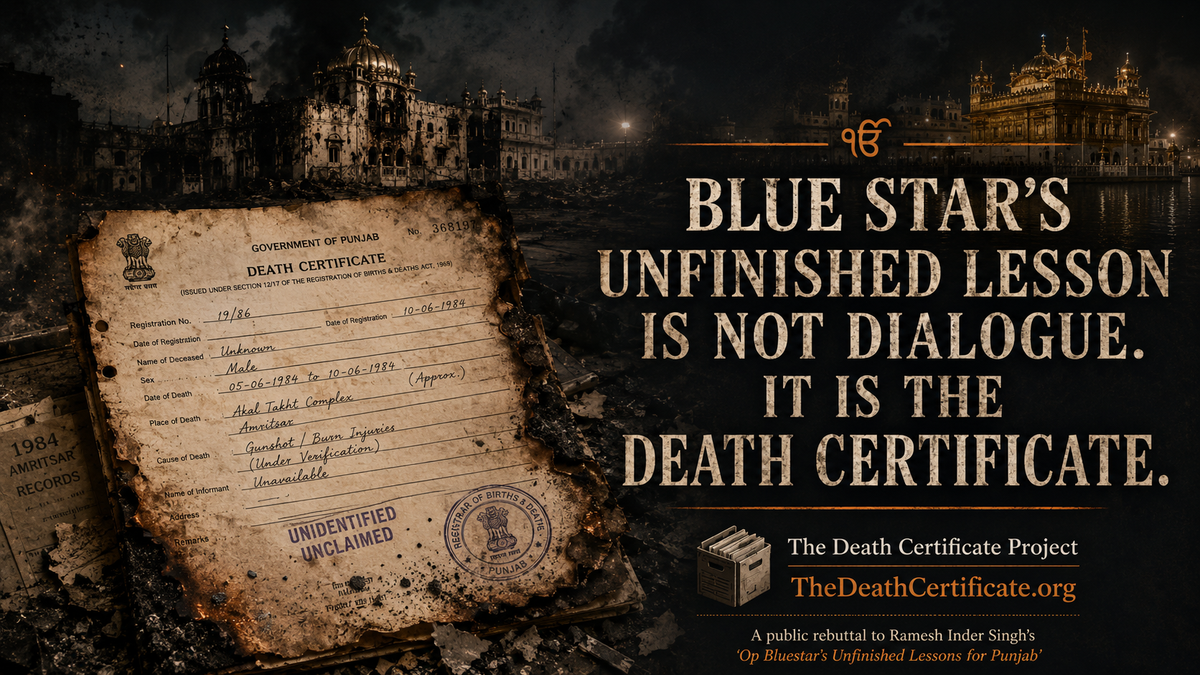
A Public Rebuttal to Ramesh Inder Singh’s “Op Bluestar’s Unfinished Lessons for Punjab”
Response to:
https://www.tribuneindia.com/news/comment/op-bluestars-unfinished-lessons-for-punjab/
Punjab ’95 Forensic Series | The Death Certificate Project
TheDeathCertificate.org
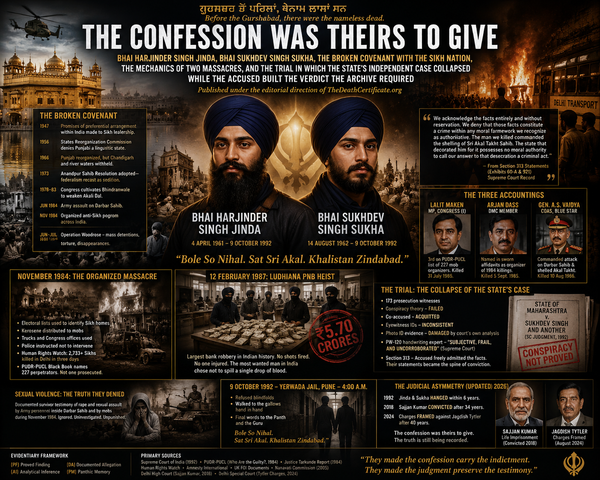
ਗੁਰਸ਼ਬਦ ਤੋਂ ਪਹਿਲਾਂ, ਬੇਨਾਮ ਲਾਸ਼ਾਂ ਸਨ
Before the Gurshabad, the nameless dead.
NOTE : Ramesh Inder Singh must answer before Sri Akal Takht Sahib why, when at least six women reportedly came forward alleging rape and gang rape by Army personnel after Blue Star, he allegedly failed to order immediate medical examinations, preserve forensic evidence, or protect their testimony — and whether his later Padma Shri represented administrative merit or the reward system of Delhi’s silence.
There are essays that clarify history.
There are essays that confess history.
And then there are essays that come close to confession, stop at the threshold, and ask the dead to accept a lesson instead of a record.
Ramesh Inder Singh’s Tribune essay, “Op Bluestar’s Unfinished Lessons for Punjab,” published on June 8, 2026, is one such essay.
It is valuable because it says aloud what the Indian state, its apologists, and many of its retired functionaries avoided saying for decades: Operation Blue Star was avoidable, ill-planned, terribly executed, and catastrophic. It destroyed the Akal Takht, left deep psychological scars, and transformed what was framed as a security operation into a wound that has outlived governments, generals, commissions, accords, and editorials.
On these admissions, Mr. Singh deserves to be read carefully.
But he also deserves to be answered carefully.
Because the central problem with his essay is not that it says too little about Blue Star.
It is that it stops too early.
It treats the unfinished lesson of Blue Star as a lesson in conflict resolution.
For Sikhs, for families of the disappeared, for survivors of November 1984, for the mothers who never received bodies, and for the children who inherited absence as evidence, the unfinished lesson is not merely dialogue.
The unfinished lesson is documentation.
Who was killed?
Who was arrested?
Who was taken alive?
Who died in custody?
Who was cremated as unidentified?
Who signed the register?
Who received the body?
Who issued the death certificate?
Who refused to issue one?
And why, forty-two years later, does the archive remain incomplete?
That is the question Mr. Singh’s essay does not confront.
That is the question The Death Certificate Project exists to confront.
I. WHAT MR. RAMESH INDER SINGH I.A.S. GETS RIGHT
A rebuttal must begin with fairness.
Mr. Singh is correct that Operation Blue Star is now widely understood as avoidable. He is correct that the operation was badly planned and terribly executed. He is correct that the destruction of the Akal Takht was not a collateral detail but a civilizational rupture. He is correct that the military action deepened the very conflict it claimed to suppress. He is correct that political negotiation was still possible. He is correct that the Rajiv–Longowal Accord of July 1985 proves that many demands later treated as negotiable could have been treated as negotiable before June 1984.
These are important admissions.
But they are no longer enough.
Because the Sikh grievance is not simply that New Delhi failed to negotiate.
The Sikh grievance is that New Delhi first militarized a political crisis, then criminalized memory, then administered the dead without accountability.
To say now that Blue Star was avoidable is not a conclusion.
It is the beginning of cross-examination.
If it was avoidable, who made it unavoidable?
If negotiations were possible, who converted negotiation into choreography while troops were already moving?
If the demands were later acceptable in 1985, why were bodies necessary in 1984?
If the operation was badly executed, where is the complete list of those killed by that bad execution?
If the state now admits the wound, why does it still resist the inventory?
II. THE FAILURE WAS NOT ONLY A “FAILURE TO PARLEY”
Mr. Singh calls Operation Blue Star “a classic instance of the failure to parley.”
That phrase is elegant.
It is also insufficient.
A failure to parley suggests misjudgment.
A failure to count the dead suggests something more serious.
Negotiation failure explains how violence begins.
Record failure explains how impunity survives.
The Indian state did not merely fail to talk. It failed to preserve the most basic duties of a constitutional state: identification, custody records, death records, arrest registers, postmortem integrity, body release protocols, and public accountability.
A state may sometimes claim necessity.
It may claim emergency.
It may claim that it confronted armed actors.
It may claim that extraordinary force was required.
But after the firing stops, every constitutional state has one duty that cannot be suspended: account for the human beings under its control.
Not militants.
Not pilgrims.
Not suspects.
Not “collateral.”
Human beings.
The first forensic duty of a state is not to explain its strategy.
It is to name the dead.
III. “NEARLY 1,000” IS NOT A DEATH TOLL. IT IS AN UNFINISHED FILE.
Mr. Singh writes of nearly one thousand dead, including Army personnel.
That number may function in a newspaper column.
It cannot function as historical closure.
For four decades, casualty figures surrounding Operation Blue Star have remained contested. Official figures, independent estimates, Sikh institutional accounts, foreign parliamentary references, eyewitness accounts, and human-rights documentation have never converged into a single reliable civilian register.
Why?
Because the conditions necessary for verification were deliberately absent.
Punjab was placed under curfew.
Journalists were removed or restricted.
Communications were cut or controlled.
The operation occurred during the martyrdom anniversary of Guru Arjan Sahib, when pilgrims were present.
The dead were handled by the state whose conduct was itself at issue.
The public was asked to accept numbers from an apparatus that controlled the site, the bodies, the information channels, and the narrative.
That is not verification.
That is custody of the evidence by the accused institution.
A serious reckoning cannot begin with “nearly 1,000.”
It must begin with names.
A death toll without names is administrative smoke.
A number without certificates is not closure.
It is a placeholder.
IV. THE QUESTION IS NOT WHETHER BLUE STAR WAS A MISTAKE. THE QUESTION IS WHETHER THE STATE EVER PERFORMED THE DUTIES THAT FOLLOW DEATH.
The moral debate over Blue Star often collapses into predictable binaries.
Was Bhindranwale responsible?
Was Indira Gandhi responsible?
Were militants armed?
Was the Army provoked?
Was Pakistan involved?
Were foreign actors exploiting Punjab?
These questions are not irrelevant.
But they are not the first questions a forensic archive asks.
The first questions are simpler and more difficult to evade:
Was the person alive when last seen in state custody?
Was the person arrested?
Was the person detained?
Was the person injured?
Was the person removed?
Was the person identified before cremation?
Was the family informed?
Was a death certificate issued?
Was the cause of death recorded?
Was the body released?
If not, why not?
That is where the Blue Star debate must move.
Because a state can debate ideology forever.
It cannot debate a missing death certificate forever.
V. THE RAJIV–LONGOWAL ACCORD IS NOT ONLY A MISSED OPPORTUNITY. IT IS AN EXHIBIT.
Mr. Singh correctly notes the cruel irony: demands associated with the Dharam Yudh Morcha were substantially accepted a year later in the Rajiv–Longowal Accord.
This point is devastating.
But Mr. Singh does not follow it to its logical end.
If the demands could be accepted in July 1985, then June 1984 was not the inevitable collision between civilization and chaos.
It was a political decision.
It was a decision to use military force before exhausting constitutional settlement.
It was a decision to let troops answer questions that ministers later answered with signatures.
This is why the Accord is not merely a failed peace document.
It is evidence.
It demonstrates that the state had political room.
It demonstrates that negotiation was not fantasy.
It demonstrates that federal issues, river waters, Chandigarh, detainees, rehabilitation, and center-state concerns could be discussed within the constitutional framework.
The question, therefore, is not simply why the Accord failed after it was signed.
The question is why its logic was not allowed to prevent the assault before it began.
Why were signatures possible after bodies, but impossible before them?
VI. THE ESSAY’S LARGEST OMISSION: NOVEMBER 1984
No serious discussion of Blue Star’s unfinished lessons can stop in June.
The assault on Darbar Sahib was followed by the assassination of Prime Minister Indira Gandhi in October 1984 and then by organized anti-Sikh massacres in Delhi and other parts of India.
For Sikh memory, June and November are not separate compartments.
They are linked historical wounds.
June was the entry of the Army into the Sikh sacred center.
November was the public hunting of Sikh bodies in the capital of the republic.
If Blue Star taught the Sikh community that the shrine was not safe from the state, November taught them that the Sikh body was not safe in the street.
Any official or retired official who asks Punjab to learn the lessons of 1984 must confront both.
Dialogue cannot substitute for justice.
Conflict resolution cannot substitute for prosecution.
Political moderation cannot substitute for accountability.
And memory cannot be healed by asking the victim community to display restraint while the state’s own records remain incomplete.
VII. THE SECOND OMISSION: THE DECADE AFTER BLUE STAR
Mr. Singh says Blue Star unleashed violence worse than what it aimed to end.
This is true.
But then the essay moves quickly toward present-day law-and-order anxieties: drones, drugs, gangs, weapons, border infiltration, extortion, grenade blasts, and email threats.
Again, these matters may be real.
But the speed of the transition is revealing.
The article moves from 1984 to contemporary security without dwelling on the intervening archive of Punjab’s counterinsurgency: disappearances, custodial deaths, alleged fake encounters, illegal cremations, and the long struggle of families to obtain recognition that their loved ones were not simply “missing.”
This is the missing middle.
This is where the moral center of the debate now lies.
It is no longer enough to say that militancy caused suffering.
It did.
It is no longer enough to say that police and officials were targeted.
They were.
But a constitutional state is not judged only by whether its officers were under threat.
It is judged by whether, under threat, it remained constitutional.
Did it keep records?
Did it produce detainees before courts?
Did it return bodies?
Did it punish custodial killing?
Did it distinguish between armed combatant, political dissenter, relative, student, farmer, bystander, and pilgrim?
Did it investigate its own officers?
Did it permit families to testify?
Did it preserve evidence?
Did it identify the dead?
Those are the questions that remain unfinished.
VIII. THE MASS CREMATION RECORD IS THE FORENSIC HEART OF THE MATTER
The central record that cannot be wished away is the Punjab mass cremations record.
The Supreme Court of India referred the matter of illegal cremations to the National Human Rights Commission after the Central Bureau of Investigation documented 2,097 cremations in three cremation grounds in the Amritsar area.
Later proceedings identified many bodies, compensated families in many cases, and still left bodies unidentified.
But compensation is not the same as truth.
Identification is not the same as accountability.
A monetary award is not a death certificate.
And a death certificate is not merely a piece of paper.
It is the state’s admission that a human being existed, died, and must be accounted for.
The mass cremation record tells us something profound: the crisis after Blue Star was not merely a conflict between militancy and the state. It was also a conflict between memory and disposal.
Between the family and the register.
Between the mother and the cremation ground.
Between the living and the missing file.
The dead were not only killed.
Many were administratively erased.
That is why the archive matters.
That is why The Death Certificate Project exists.
IX. WHY “THE ETHNO-NATIONAL MOVEMENT FIZZLED OUT” DOES NOT END THE MATTER
Mr. Singh writes that the ethno-national movement has long fizzled out, while small overseas remnants continue to exploit criminal activity under ideological cover.
This framing is politically familiar.
It reduces unresolved Sikh memory into a law-and-order residue.
But the survival of memory is not the survival of militancy.
A family asking for a death certificate is not a militant remnant.
A researcher documenting an illegal cremation is not a drug smuggler.
A diaspora Sikh asking why the Akal Takht was shelled is not operating a gang.
A child of the disappeared asking where his father’s body went is not a foreign conspiracy.
The Indian state has repeatedly made the same category error: it treats unresolved documentation as unresolved separatism.
It treats memory as threat.
It treats inquiry as agitation.
It treats archives as insurgency.
This is precisely why the lessons remain unfinished.
The state cannot heal a wound it continues to police as sedition.
X. “VAKAR” REQUIRES RECORDS
Mr. Singh writes that the administrative system runs on vakar — honour and credibility — not merely electoral legitimacy.
This is perhaps the most important sentence in his essay.
But it cuts in the opposite direction from the one he intends.
Administrative honour is not created by force.
Administrative credibility is not created by surveillance.
Administrative legitimacy is not created by invoking drones, gangs, borders, and threats.
Administrative honour is created when the citizen believes that the state will tell the truth even when the truth indicts the state.
In Punjab, vakar was not lost because citizens asked too many questions.
It was lost because too many questions were never answered.
Where are the missing?
Where are the arrest records?
Where are the cremation registers?
Where are the postmortems?
Where are the death certificates?
Where are the officers’ orders?
Where are the custody logs?
Where are the files?
Where are the names?
A state that cannot answer these questions cannot demand vakar.
It must earn it.
XI. ARTICLE 26 AND SIKH INSTITUTIONAL AUTONOMY
Mr. Singh’s reference to Article 26(b) of the Constitution is significant. He correctly notes that religious communities possess the right to manage their own affairs in matters of religion.
That principle cannot be invoked only when discussing contemporary sacrilege legislation.
It must also be applied retrospectively to 1984.
What does Article 26 mean when the state enters the central shrine of a religious community with military force?
What does religious autonomy mean when the Akal Takht is destroyed?
What does the right to manage religious affairs mean when the community’s highest temporal seat is treated as a battlefield objective?
What does constitutional pluralism mean if the state can later call the episode a failure of dialogue without producing a complete accounting of the dead?
Blue Star cannot be sanitized into a policy error.
For Sikhs, it was an invasion of sacred jurisdiction.
The Akal Takht was not simply damaged property.
It was the throne of Miri-Piri.
The assault was not merely on a building.
It was on the Sikh constitutional imagination.
XII. THE FALSE COMFORT OF “LESSONS”
Every few years, India produces another reflection on 1984.
The vocabulary changes.
The structure does not.
We are told lessons must be learned.
We are told dialogue is important.
We are told extremism is dangerous.
We are told Punjab must remain peaceful.
We are told foreign forces exploit discontent.
We are told the state must be effective.
But the families of the dead are not asking for lessons.
They are asking for records.
Lessons are what officials offer when files remain closed.
Lessons are what institutions prefer when accountability is inconvenient.
Lessons are safe because they are abstract.
Names are dangerous because they are specific.
A name creates a file.
A file creates a question.
A question creates responsibility.
Responsibility creates liability.
That is why states prefer lessons to lists.
The Death Certificate Project rejects that substitution.
No lesson can replace a name.
No editorial can replace a certificate.
No commemoration can replace a body.
XIII. QUESTIONS FOR RAMESH INDER SINGH
Because Mr. Singh served as Deputy Commissioner of Amritsar during Operation Blue Star, his reflections carry special weight.
They also invite special questions.
Not accusatory questions.
Administrative questions.
Forensic questions.
Questions that belong in any serious public archive.
What civilian death records were created by the Amritsar district administration during and immediately after Operation Blue Star?
What instructions were issued regarding identification of bodies?
What role did the civil administration play in receiving, counting, transporting, or documenting the dead?
Were postmortems conducted?
If so, where are the reports?
Were bodies photographed?
Were personal effects catalogued?
Were families notified?
Were cremation records maintained?
Were unidentified bodies cremated?
If yes, under whose authorization?
Did the district administration maintain a list of pilgrims trapped inside the complex?
Did any civil authority object to the timing of the operation during a major religious observance?
Were any written objections, warnings, or administrative notes created before the Army action?
If records existed, where are they now?
If records did not exist, why not?
These are not hostile questions.
They are the minimum questions that history is entitled to ask of administration.
A Deputy Commissioner’s memory is important.
A Deputy Commissioner’s records are more important.
XIV. FROM THE VAN WITHOUT A LOG TO THE BODY WITHOUT A CERTIFICATE
The recurring pattern in Punjab’s official memory is not silence alone.
It is the absence of logs.
The missing movement register.
The absent custody entry.
The unexplained transfer.
The unidentified body.
The cremation without family notice.
The death without certificate.
The state asks the public to trust its conclusions while withholding the paperwork that would permit verification.
That is not governance.
That is narrative control.
The Death Certificate Project insists on a different rule:
Where the state had custody, the state bears the burden.
Where the state cremated, the state bears the burden.
Where the state failed to identify, the state bears the burden.
Where the state asks for closure, the state must produce the file.
XV. WHAT A REAL LESSON WOULD LOOK LIKE
If India truly wished to learn the unfinished lessons of Blue Star, it would not begin with another editorial.
It would begin with an archive.
It would release all records concerning civilian deaths during Operation Blue Star.
It would release all district-level correspondence from Amritsar before, during, and after the operation.
It would release all military-civil administration communications concerning body handling.
It would disclose all cremation records related to June 1984.
It would publish a consolidated list of those killed, injured, detained, released, transferred, and unidentified.
It would open the records of Operation Woodrose and related actions.
It would create an independent process for families to submit testimony.
It would treat the 2,097 Amritsar cremations not as a closed compensation matter but as an unfinished truth matter.
It would expand review beyond three cremation grounds.
It would examine statewide disappearances.
It would preserve and digitize records.
It would issue corrected death certificates where possible.
It would acknowledge uncertainty where certainty is no longer possible.
And it would apologize not only for the assault, but for the archive that never came.
That would be a lesson.
Anything less is management.
XVI. THE DEAD ARE NOT A LAW-AND-ORDER PROBLEM
Punjab does not need to be lectured about violence.
Punjab has buried enough sons to understand violence.
Punjab has seen state violence, militant violence, communal violence, police violence, and political betrayal.
The issue is not whether violence occurred.
The issue is whether the state may use the existence of violence to exempt itself from recordkeeping.
The answer is no.
The dead are not a law-and-order problem.
The dead are a constitutional obligation.
The unidentified dead are an indictment.
The disappeared are a standing question.
The cremation register is not a clerical artifact.
It is a crime scene document.
XVII. A RESPONSE TO THE TRIBUNE ESSAY
So let the response to Mr. Singh be clear.
Yes, Operation Blue Star was avoidable.
Yes, it was ill-planned.
Yes, it was terribly executed.
Yes, it destroyed the Akal Takht.
Yes, it sowed the seeds of a larger conflict.
Yes, dialogue should have prevailed.
But these admissions, though important, are no longer enough.
The real unfinished lesson of Blue Star is not that the Indian state should have talked before firing.
The real unfinished lesson is that after firing, it never fully counted.
It never fully identified.
It never fully disclosed.
It never fully certified.
It never fully answered.
It asks Punjab to remember responsibly while it remembers selectively.
It asks Sikhs to move on while records remain missing.
It asks the world to accept “nearly 1,000” where families still ask for one name at a time.
That is not closure.
That is the continuation of injury by administrative means.
XVIII. CONCLUSION: BEFORE RECONCILIATION, THE REGISTER
There can be no reconciliation without a register.
There can be no healing without names.
There can be no peace built on unidentified ashes.
There can be no final lesson from Blue Star while the death certificate remains missing.
Mr. Singh’s essay is useful because it confirms that even within the old administrative class, the official certainties of 1984 have collapsed. The operation once defended as necessary is now described as avoidable. The strategy once presented as decisive is now remembered as catastrophic. The state action once justified as order is now recognized as the beginning of greater disorder.
But recognition without record is not justice.
It is only regret.
Punjab does not need another sermon on the dangers of extremism.
Punjab needs the files.
The Sikh dead do not need another lesson.
They need their names restored.
Until then, Blue Star remains unfinished.
Not because Sikhs refuse to forget.
But because the state still refuses to fully remember.
ਗੁਰਸ਼ਬਦ ਤੋਂ ਪਹਿਲਾਂ, ਬੇਨਾਮ ਲਾਸ਼ਾਂ ਸਨ.
Before the Gurshabad, the nameless dead.