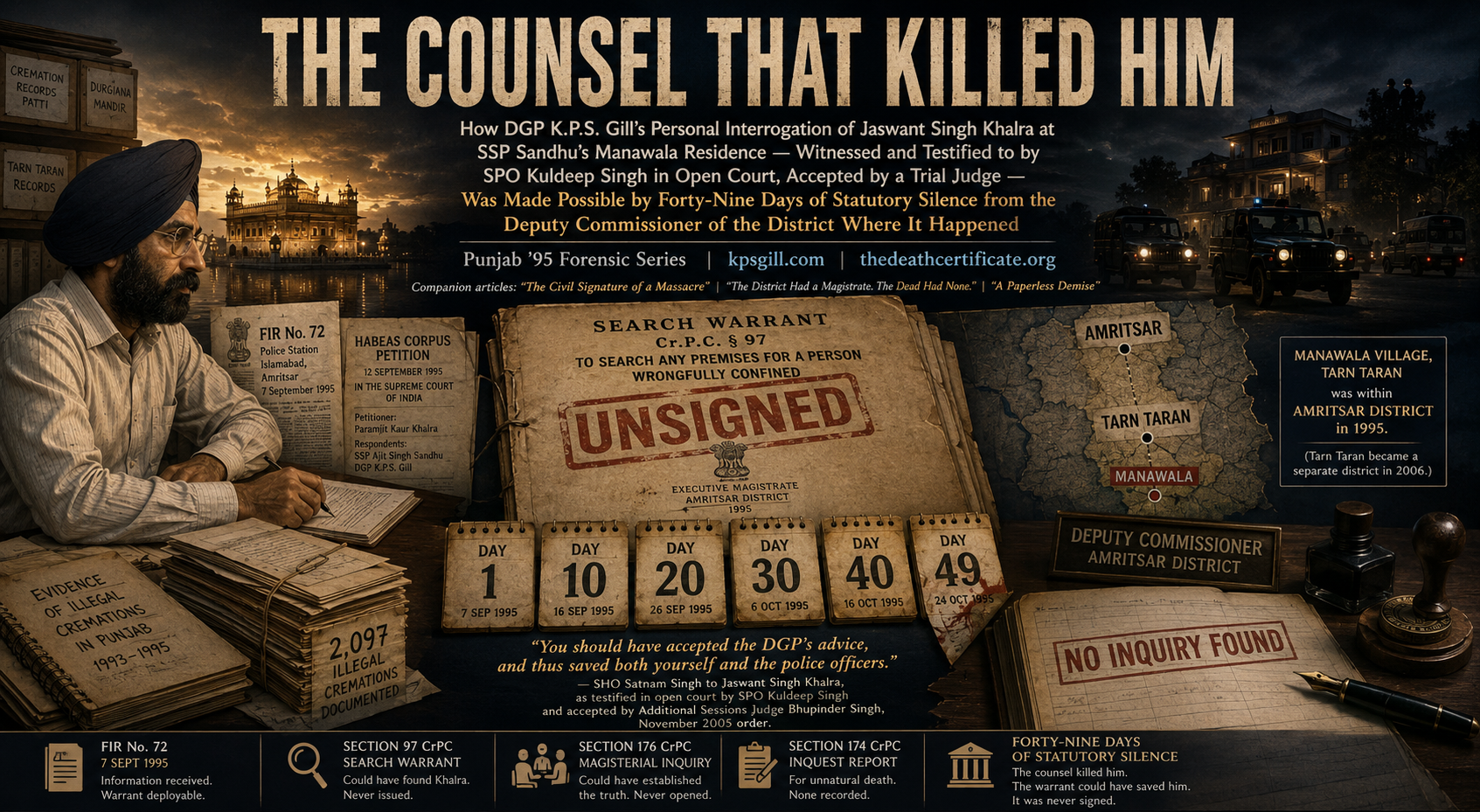
THE COUNSEL THAT KILLED HIM

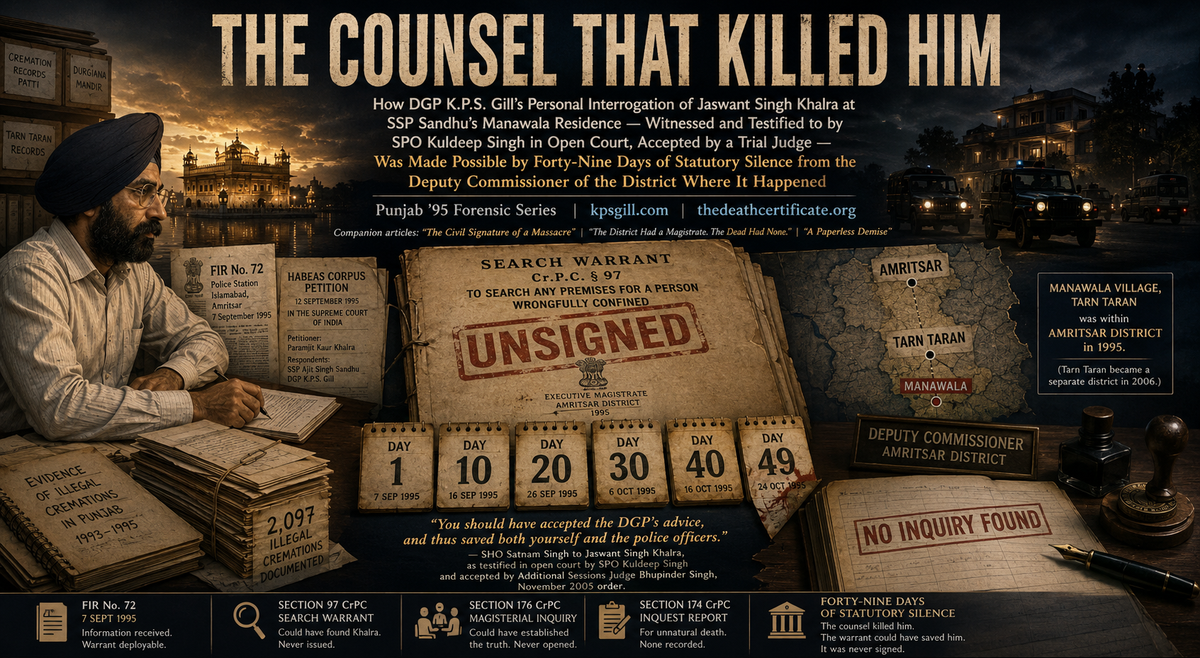
How DGP K.P.S. Gill’s Personal Interrogation of Jaswant Singh Khalra at SSP Sandhu’s Manawala Residence — Witnessed and Testified to by SPO Kuldeep Singh in Open Court, Accepted by a Trial Judge — Was Made Possible by Forty-Nine Days of Statutory Silence from the Deputy Commissioner of the District Where It Happened
Punjab ’95 Forensic Series | kpsgill.com | thedeathcertificate.org
Companion articles: “The Civil Signature of a Massacre” | “The District Had a Magistrate. The Dead Had None.” | “A Paperless Demise”
“You should have accepted the DGP’s advice, and thus saved both yourself and the police officers.”
— SHO Satnam Singh to Jaswant Singh Khalra, on the return journey from SSP Sandhu’s house in Manawala, Tarn Taran, to Police Station Jhabal, as testified in open court by SPO Kuldeep Singh and accepted by Additional Sessions Judge Bhupinder Singh in his November 2005 order.
Khalra refused the counsel. Within days he was dead. Between the counsel and the death stood forty-nine days. In those forty-nine days the Deputy Commissioner of Amritsar district — the district in which Sandhu’s house stood, in which the DGP conducted his interrogation, in which the FIR had been registered — issued no search warrant and opened no inquiry. The counsel killed Khalra. The warrant could have saved him. It was never signed.
EVIDENTIARY FRAMEWORK
| Tier | Definition |
|---|---|
| [PF] Proved Finding | Trial court orders and judgments; convictions; named officers’ career records; official documents; the subjects’ own published statements; the convicted officers’ identified roles |
| [DA] Documented Allegation | Testimony accepted by a trial court but not resulting in charge; named witness accounts in judicial proceedings; Ensaaf, HRW, and Amnesty documentation; named contemporaneous press reports |
| [AI] Analytical Inference | Structural and causal arguments drawn from documented facts — explicitly labeled, never presented as proved |
| [PM] Panthic Memory | The Sikh community’s institutional and testimonial record |
| [PM-Direct] | The author’s direct family-connected knowledge of specific officers |
A note on what this article is doing. It connects three documented facts through one structural argument. The three facts: (1) SPO Kuldeep Singh testified in open court, with the testimony accepted by the trial judge, that KPS Gill personally interrogated Khalra at SSP Sandhu’s house in Manawala, Tarn Taran, during the forty-nine days of illegal confinement; (2) Manawala village, Tarn Taran, was within Amritsar district in 1995 — Tarn Taran did not become a separate district until 2006; (3) the DC of Amritsar, K.B.S. Sidhu, issued no search warrant under Section 97 CrPC, opened no magisterial inquiry under Section 176, and produced no document traceable to the forty-nine days. The structural argument: the DGP personally managing an illegal detention in the DC’s own district required, as its indispensable operational precondition, the DC’s complete statutory inertia. That inertia was provided. This article documents it.
PART ONE: THE WITNESS — SPO KULDEEP SINGH AND THE TRUTH THAT WAITED FOR A DEATH
1.1 The Man Who Knew
[PF] Kuldeep Singh — also rendered in the trial record as Kuldip Singh — was a Special Police Officer recruited into the Punjab Police by SSP Ajit Singh Sandhu. His role was that of a gunman: he accompanied Sandhu, served at his direction, and was stationed at Jhabal police station in Tarn Taran during the relevant period. In 1995, he was a young man working for one of the most feared police officers in Punjab — promoted by DGP K.P.S. Gill, credited with eliminating senior militant commanders, and reposted to Tarn Taran at the specific operational moment when Jaswant Singh Khalra had gone public with his cremation documentation.
[PF] What Kuldeep Singh witnessed in the autumn of 1995 placed him at the precise intersection of every accountability question this series asks. He was handed the keys to the room where Khalra was held. He was instructed to provide food to the prisoner. He watched police officers beat Khalra. He was present when Khalra was transported to SSP Sandhu’s residence in Manawala village. He was in the building when DGP K.P.S. Gill entered the room and spent approximately half an hour with Khalra. He heard what SHO Satnam Singh said to Khalra on the return journey. He watched Balwinder Singh Ghora and Arvinder Singh throw Khalra’s bleeding body into the trunk of a vehicle. He knew where that body went — into the Harike canal.
1.2 The Silence That Sandhu’s Life Required
[PF] Kuldeep Singh said nothing for years. He explained why, in his own words, after his deposition: “I kept quiet because I was mortally afraid of Ajit Singh Sandhu (then SSP) and only decided to speak up after he committed suicide.” SSP Ajit Singh Sandhu — who had been arrested on Supreme Court orders and released on bail, who had been the primary accused in the Khalra disappearance case, who had been promoted by KPS Gill in appreciation of his achievements in Tarn Taran — was found dead near a railway track near Bhakharpur village in May 2000. His death was ruled a suicide.
[AI] The chronology of Kuldeep Singh’s silence is itself an accountability document. From 1995 to 2000 — five years — he said nothing. The man he feared was alive and, despite the Supreme Court’s intervention and the CBI’s investigation, remained dangerous. The moment Sandhu’s life ended, the architecture of fear that had sealed Kuldeep Singh’s account collapsed at its foundation. He began to speak. He deposed before the CBI in 1998 under Section 161 CrPC — already naming KPS Gill. He eventually testified in open court. The relationship between one man’s willingness to give testimony and another man’s continuing to live is not incidental. It is the key structural fact about how accountability works — and fails to work — in the Punjab counterinsurgency record.
1.3 The Pressure Applied to Stop Him from Speaking
[PF] Once Kuldeep Singh began to speak, the system he was speaking against attempted to silence him by every means available. The documented record of these attempts, drawn from the Harvard human rights trial archive, the Tribune, and the Ensaaf/Panthic summary of the judgment:
After he deposed before the CBI in 1998, the accused police officials met him and claimed “the CBI officials who had recorded my deposition had already apologised to K.P.S. Gill for the same.” The claim — whether true or false — was designed to convince Kuldeep Singh that his testimony had been retracted on his behalf, that the powerful had already arranged his silence, and that he had no choice but to ratify that arrangement. He initially gave a statement that Khalra’s widow had paid him — an attempt, apparently under this pressure, to discredit both himself and Paramjit Kaur Khalra’s case. A false case was registered against another prosecution witness. When Kuldeep Singh’s own security personnel from the CRPF arrived at the District Courts complex on March 3 (during defense cross-examination), Punjab Police officers denied them entry while permitting the security personnel of the accused officers to pass freely. This delay required CBI lawyers and Kuldeep Singh’s own lawyer, Brijinder Singh Sodhi, to argue with police before the witness could enter the building where he was about to testify against police officers. The intimidation was so systematic and documented that human rights organizations wrote to Prime Minister Manmohan Singh in January 2005 demanding the removal of Patiala Inspector-General Rajinder Singh for harassing and intimidating witnesses.
[PF] Despite all of this, Kuldeep Singh testified. He stood in the court of the Additional Sessions Judge in Patiala and described what he had seen. He said afterward that “trying to speak the truth has been the most difficult decision of my life.” He has been under CRPF protection since because he fears liquidation by officials of the Punjab Police.
[AI] The systematic intimidation of the key witness in a criminal trial by serving and former police officers — documented in press reporting, acknowledged in the human rights record, requiring the intervention of lawyers to allow a CRPF-protected witness into a courthouse — is not a peripheral detail. It is itself evidence about the operational awareness that the testimony existed and what it would say. Systems do not mobilize to intimidate witnesses whose evidence they believe is false. They mobilize to intimidate witnesses whose evidence they know to be true. The pressure applied to Kuldeep Singh throughout the trial was an implicit confirmation of what he was saying about what he had seen.
PART TWO: THE PRESS BATTLE — KHALRA AGAINST GILL, MONTHS BEFORE THE ABDUCTION
2.1 The Auditor and the Chief
[PF] Jaswant Singh Khalra was not an anonymous figure who stumbled into danger. He was a director of a bank in Amritsar, a community leader, and a systematic researcher who had spent months cross-referencing cremation records from the district’s three cremation grounds — Durgiana Mandir, Patti, and Tarn Taran — with police reports, habeas corpus petitions, and family testimony to document the scale of the illegal cremation practice. By 1994 and into 1995, he had assembled evidence of 2,097 bodies cremated without the certificates, the documentation, or the legal process the law required. He had taken this evidence to the United Nations, to human rights organizations, to the Canadian parliament, and to the international press.
[PF] K.P.S. Gill was, at that time, the Director General of Police of Punjab — the state’s highest-ranking police officer, the man who had directed the counterinsurgency from its most intense period through its formal conclusion, the man who had been celebrated by the Indian state as the architect of Punjab’s “return to peace.” He had promoted Ajit Singh Sandhu. He commanded the officers who had conducted the operations that produced the bodies Khalra was counting. The confrontation between them was not incidental. It was structural: Khalra’s documentation was the systematic evidentiary challenge to everything Gill’s career had been built on.
[PF] The ENSAAF summary of the Khalra judgment documents: “In the months before his disappearance, a press battle ensued between Khalra and Director General of Police (DGP) KPS Gill over Khalra’s investigations into police abductions leading to illegal cremations.” This was a public, documented confrontation — not a private grievance but an adversarial evidentiary debate between a human rights researcher and the state’s senior police officer, conducted in the public press.
2.2 The Death Threats and the Name in the Nomination
[PF] Before Khalra’s abduction, the police had already signaled exactly how they regarded his work. Per the ENSAAF/Panthic summary: “Prior to Khalra’s murder, police issued death threats to him, warning Khalra that he would also become an unidentified dead body if he did not cease his investigations.” The specific phrase — “an unidentified dead body” — is not generic. It is the precise administrative category the 2,097 occupied: bodies cremated without documentation, without identity, without a death certificate, without a trace. Threatening Khalra that he would become what the victims he was counting had become was the police’s own inadvertent admission of what they had been doing.
[PF] Khalra had specifically criticized in public the reposting of SSP Ajit Singh Sandhu to Tarn Taran — carried out after Khalra went public with his findings. Sandhu was posted to Tarn Taran SSP specifically in the period when Khalra was actively documenting the cremation records of that district. The posting placed the officer most closely associated with the death-squad operations back in the geographic zone Khalra was documenting. Whether understood as intimidation, operational management, or both, the reposting was noted by Khalra himself and was part of his public testimony about the threat environment he was operating in.
[AI] The reposting of Sandhu to Tarn Taran SSP, by whichever authority in the state police hierarchy approved it, placed him within the Amritsar district administered by Deputy Commissioner K.B.S. Sidhu. SSP Tarn Taran operated under the DC of Amritsar’s nominal “general control and direction” under Punjab Police Act Section 4. The officer who was about to abduct, hold, and kill Khalra operated within the DC’s jurisdictional chain. The DC’s “general control and direction” did not prevent the abduction. It did not result in the Section 97 warrant that would have required Sandhu to produce Khalra before the civil authority. It resulted in nothing visible to the public record.
PART THREE: THE ABDUCTION — 6 SEPTEMBER 1995
3.1 The Morning
[PF] On 6 September 1995, Punjab Police personnel abducted Jaswant Singh Khalra from his home in Amritsar. The abduction was carried out in broad daylight. Paramjit Kaur Khalra lodged a complaint the same day.
[PF] On 7 September 1995, FIR No. 72 was registered at Police Station Islamabad, Amritsar — in the city, in the district, within the DC’s administrative jurisdiction.
[PF] On 12 September 1995 — six days after the abduction — Paramjit Kaur Khalra filed a habeas corpus petition before the Supreme Court of India. That petition, as subsequently established in the trial judge’s order, named the commanding officers: SSP Ajit Singh Sandhu and DGP K.P.S. Gill. Within six days of the abduction, the Supreme Court of India had before it a document naming the SSP of Tarn Taran district — within Amritsar district, under the DC’s jurisdiction — and the state’s DGP, in connection with the disappearance of a man from an address in Amritsar.
[AI] The habeas corpus petition’s naming of Sandhu and Gill within six days of the abduction is one of the most consequential facts in the accountability analysis of K.B.S. Sidhu’s DC tenure. From September 12 onward, the DC of Amritsar was administering a district in which the Supreme Court had been petitioned naming his own subordinate SSP and the state’s DGP as persons connected to the disappearance of a named individual from an address in his city. The DC’s Section 97 warrant was deployable from September 7. After September 12, its non-issuance was not merely a failure to respond to FIR No. 72. It was a failure to respond to a situation the Supreme Court itself had been informed about, with his own subordinate officer named.
PART FOUR: THE HOUSE IN MANAWALA — THE GEOGRAPHY OF ILLEGALITY
4.1 The Location
[PF] SPO Kuldeep Singh testified before the Additional Sessions Judge that Khalra was held in a room at SSP Ajit Singh Sandhu’s house in Manawala village, Tarn Taran. The Tribune (Jangveer Singh, February 16, 2005) reported the testimony precisely: “He told the court of the Additional Sessions Judge here that it was Sandhu’s house in Manawala village in Taran Tarn, which was visited by K.P.S. Gill and other ‘clean shaven official’ a few days before Khalra was murdered in 1995.”
[PF] This testimony was not given in the abstract. The trial judge — Additional Sessions Judge Bhupinder Singh, Patiala — reviewed the testimony and accepted it. The ENSAAF report states: “Judge Singh also refuted the defense’s attempts to discredit witnesses Kulwant Singh, who saw Khalra in detention, and SPO Kuldip Singh.” The judge did not discredit Kuldeep Singh’s account of the Manawala house. He did not discredit his identification of DGP Gill. He accepted the testimony and, in convicting six officers, incorporated Kuldeep Singh’s full account of the illegal confinement into his evidentiary findings.
[PF — geographic] Tarn Taran was a sub-division and tehsil of Amritsar district in 1995. It did not become a separate district until 2006. Manawala village falls within the Tarn Taran sub-division. In 1995, the DC of Amritsar — K.B.S. Sidhu — was the senior civilian authority over the entire Amritsar district, which included Tarn Taran and its villages. SSP Ajit Singh Sandhu was SSP Tarn Taran within Amritsar district. Sandhu operated within the DC’s jurisdictional authority under Punjab Police Act Section 4. Sandhu’s house in Manawala village was within the DC’s district.
[AI] The Section 97 CrPC was deployable by the DC of Amritsar against any premises within his district where a person was believed to be wrongfully confined. Sandhu’s house in Manawala, Tarn Taran, was within Amritsar district. The FIR about Khalra’s wrongful confinement was registered in Amritsar city. The habeas corpus petition named the Tarn Taran SSP who owned the house. The DC of Amritsar held a warrant he could have directed against that house from September 7. At no point in the forty-nine days did he direct it there or anywhere else.
4.2 The Room and What Happened in It
[PF] SPO Kuldeep Singh was handed the keys to the room where Khalra was kept. He was instructed to guard Khalra and to provide food. What he witnessed in that capacity, and testified to in court: police officers beat Khalra during his illegal confinement. The confinement was not passive. It was active torture, administered in a private house belonging to the SSP of a district within the DC’s administrative authority.
[PF] The Ensaaf/Panthic summary of the judgment: “SPO Kuldip Singh was instructed by SHO Satnam Singh to guard and serve meals to Khalra during his secret detention. During this time, he witnessed police officers beat Khalra.”
PART FIVE: THE HALF HOUR — WHAT THE DGP WENT TO MANAWALA TO DO
5.1 The Arrival
[DA — SPO trial testimony, accepted by trial judge; Tribune February 16, 2005; ENSAAF; WSO Canada; Congressional Record 1998] SPO Kuldeep Singh testified that the police took Khalra to SSP Sandhu’s residence in Manawala village. At that residence, DGP K.P.S. Gill arrived. He was accompanied by another “clean-shaven official” — unidentified in the testimony that has reached the public record. He entered the room where Khalra was being held. He remained for approximately half an hour.
[DA] What occurred during that half hour was not torture, as SPO Kuldeep Singh’s account presents it. It was interrogation. The DGP questioned Khalra. This distinction is itself significant: the DGP did not come to Manawala to supervise a beating. He came to negotiate — or to attempt to. The beatings were a background condition. The DGP’s visit was a specific mission. He wanted something from Khalra that required direct conversation.
[DA] What he wanted from Khalra can be inferred from what SHO Satnam Singh said to Khalra immediately afterward. But it can also be inferred from the context: Khalra was, at that moment, the most dangerous document producer in Punjab. His ledger — the 2,097, the cross-referenced cremation records, the identified families, the forensic methodology — was already in international circulation. It had been presented to the United Nations in September 1995. It had been presented in Canada. The DGP of Punjab could not uninvent Khalra’s evidence. But he could, perhaps, convince Khalra to stop speaking about it, to recant, to accept some arrangement that would make the evidence legally inoperable or publicly discredited. The counsel was an attempt to close Khalra’s account before the account closed the DGP’s career.
5.2 The Intelligence About the Visit
[PF] The trial record establishes that the DGP’s visit was known up and down the chain of command. SHO Satnam Singh’s statement — made on the return journey to the police station, to Khalra directly — specifically references “the DGP’s advice” as something Khalra “should have accepted.” This phrasing is not that of a junior officer guessing about events in a room he did not witness. It is the language of someone who knew what had been offered in that room and was communicating its weight to the man who had declined it.
[AI] The SHO’s sentence on the return trip is the clearest window into the operation’s command structure. It establishes: (a) that the DGP’s visit was not a rogue act by a lone officer but part of an operation whose parameters were communicated to subordinate officers; (b) that the offer made in the room — “the advice” — was understood by at least SHO Satnam Singh as the operative framework for Khalra’s continued existence; (c) that Khalra’s refusal of the advice was understood to have consequences, and that those consequences were described to Khalra directly; and (d) that “both yourself and the police officers” were stakeholders in Khalra’s decision — the SHO’s concern for “the police officers” alongside Khalra’s life reveals the operation’s shared vulnerability. The officers below the DGP understood that if Khalra kept talking, they were exposed. The DGP’s visit was an attempt to protect the entire chain from the auditor who was counting them.
PART SIX: THE SENTENCE THAT EXPLAINS EVERYTHING
6.1 What Satnam Singh Said
[DA — SPO trial testimony; ENSAAF judgment summary] On the return from Sandhu’s house in Manawala to the police station, SHO Satnam Singh said to Jaswant Singh Khalra: “You should have accepted the DGP’s advice, and thus saved both yourself and the police officers.”
This sentence, spoken by a convicted police officer to a man who was about to be murdered, is the most important single utterance in the forty-nine-day record. It requires careful forensic attention because it answers, in seven clauses, the questions this series has been asking about the structure of the state operation.
6.2 Decoding the Seven Clauses
“You should have accepted” — establishes that Khalra had declined something. The DGP’s visit was not a simple interrogation or intelligence-gathering mission. It was an offer. Khalra heard it and rejected it.
“the DGP’s advice” — confirms that the offer came from the DGP personally, not from Sandhu or his subordinates. Gill went to Manawala to deliver something that was explicitly his own — his “advice.” The possessive is crucial.
“and thus saved” — establishes the consequence: the rejection of the DGP’s advice was the operative cause of what was about to follow. Satnam Singh is describing a causal chain. The failure to accept the advice produced the outcome.
“both” — the conjunction identifies two parties who needed saving simultaneously.
“yourself” — Khalra’s life. The price of refusing the DGP’s advice was Khalra’s death, and the SHO is here confirming that this was the known consequence before it occurred.
“and the police officers” — this is the sentence’s most revelatory component. The police officers who had abducted Khalra, who had tortured him, who had held him in a private house in Manawala, needed saving from his documentation. Khalra’s refusal of the DGP’s advice meant that his documentation — already in international circulation — would continue. It meant he would eventually reach a court, or an international forum, or a future government willing to use his evidence. The police officers’ exposure required Khalra’s silence. When he declined to be silent, he had to be eliminated.
“police officers” — plural. Not Satnam Singh alone. Not Sandhu alone. The entire chain of those implicated in what Khalra had documented. The DGP’s advice, if accepted, would have saved them all. Its refusal condemned them all — though the system ultimately protected most of them.
[AI] The sentence establishes that the DGP’s visit was the state’s last attempt to negotiate its way out of accountability for the 2,097. Khalra’s answer — his refusal — was the most consequential act of civic courage in modern Punjabi history. He knew what refusal meant. He knew, as he told Canadian Sikhs who urged him to seek refugee status in Canada, that he might be killed. He declined the Canadian exit. He declined the DGP’s advice. He stayed. The sentence Satnam Singh said to him on the way back to the police station was, in every meaningful sense, his death warrant.
PART SEVEN: THE SECTION 97 WARRANT THAT WOULD HAVE BROKEN THE CHAIN
7.1 The Statutory Mechanism
[PF] Section 97 of the Criminal Procedure Code provided that any Executive Magistrate, if satisfied from information that any person was confined in any premises in circumstances amounting to an illegal confinement or wrongful confinement, could issue a warrant authorizing any person named in the warrant to search any place and, if the person confined was found, to convey that person before the magistrate. The provision was deployable without prior judicial review. It was issuable by the DM/DC directly. It required only satisfaction from information that a person was wrongfully confined.
[PF] FIR No. 72 was registered at Police Station Islamabad, Amritsar, on 7 September 1995 — the day after Khalra’s abduction. From that morning, the DC of Amritsar possessed formal information that a named person had been wrongfully confined by police officers. The Section 97 warrant was deployable against any premises in the district from that moment.
[PF] By 12 September 1995, the habeas corpus petition before the Supreme Court named SSP Sandhu and DGP Gill as commanding officers. The DC of Amritsar was the direct administrative superior of SSP Sandhu under Punjab Police Act Section 4. The information available to the DC’s office now included: the formal FIR, the Supreme Court petition naming his SSP, and the public knowledge of the confrontation between Khalra and KPS Gill in the months preceding the abduction.
[AI] In this context, a Section 97 warrant directed against any premises in Tarn Taran sub-district — including SSP Sandhu’s house in Manawala, the police station at Jhabal, Police Station Chabbal — would have been legally deployable, constitutionally appropriate, and operationally decisive. Had such a warrant been issued, and had Khalra been found at Sandhu’s house during the DGP’s half-hour visit or at any point in the forty-nine days, the entire operation would have collapsed. A Section 97 warrant would have required Sandhu to produce Khalra before the DC — the DC who was simultaneously Sandhu’s nominal administrative superior. The DC would have been confronted with the physical reality of the state’s most documented human rights researcher in illegal police custody in the DC’s own district. The DGP’s visit, the beatings, the “advice” — all of it would have been interrupted by a document the DC held the power to issue.
[PF] No Section 97 warrant issued by K.B.S. Sidhu in connection with FIR No. 72 or Paramjit Kaur’s complaint has appeared in the Khalra criminal trial record, the CBI investigation files, the Supreme Court proceedings, or any human rights organization’s documentation. It was not there in 1995. It was not produced in 2005. It has not appeared in any RTI disclosure known to this publication. The warrant that would have broken the chain was never signed.
7.2 The ADM/ADC Inquiry — The Claim and Its Record
[PF] In his Auzar TV interview of 6 May 2026, K.B.S. Sidhu stated that he ordered an ADM/ADC inquiry in response to Khalra’s abduction. This claim was made thirty years after the event, in a broadcast interview, not in a sworn proceeding.
[AI] The inquiry he claims to have ordered would necessarily have produced: a written initiating order; examination records; written requisitions to police stations; responses from those stations; an inquiry report; and an action-taken note. None of these documents has appeared in the Khalra murder case — which proceeded through CBI investigation, criminal trial, and Supreme Court over three decades. No such document was cited by Paramjit Kaur’s legal team. No such document was referenced by the trial judge. No such document was produced in any RTI request of which this publication is aware. The claim exists in a 2026 broadcast. The document it describes exists nowhere in the accountability record of a case that produced hundreds of pages of judicial output.
PART EIGHT: THE VERTICAL ARCHITECTURE — THE DC AS CIVILIAN INSULATION
8.1 The Chain That Required His Silence
[AI] The structural argument of this article does not require proving that K.B.S. Sidhu knew KPS Gill was in the room at Manawala. It requires only that the documented record be read for what it shows about the operational function of the DC’s statutory inertia within a vertical command structure that extended from the DGP to the SSP to the SHO to the SPO with the keys to the room.
At the top of that chain: DGP Gill, who personally went to Manawala to offer Khalra a deal, who had promoted Sandhu, and who characterized the subsequent accountability process as an enemy “propaganda war” directed against the police. In the middle of the chain: SSP Sandhu, who operated Khalra’s illegal confinement from his own house in a village within the DC’s district, and whose subordinates received specific instructions about guarding and feeding the prisoner. At the lowest end: SHO Satnam Singh and the other convicted officers, who were implicated in every stage from abduction to disposal of the body.
Running parallel to the police chain, at the district level, was the civil administrative authority: DC K.B.S. Sidhu. Under the law, his “general control and direction” covered the district police. Under the law, FIR No. 72 generated a mandatory reporting chain that reached his office. Under the law, the Section 97 warrant was his to issue. Under the law, the Section 174 inquest requirements were his to enforce. Under the law, he was the civilian authority through whose documented non-action the police chain could operate without civil accountability.
[AI] The question is not whether the DC was party to a criminal conspiracy. The question is what function his statutory inertia served within the operation that was occurring. And the answer, on the documented structural analysis, is precise: the DC’s non-action was the civilian insulation without which an operation managed at the DGP level and executed at the SSP level within the DC’s own district could not have proceeded with the complete absence of civil administrative paper that the 2,097 required. The DGP needed the DC to do nothing. The SSP needed the DC to do nothing. The SHO needed the DC to do nothing. Everyone in the chain below Khalra and above the canal needed the DC to do nothing. He did nothing.
8.2 The “General Control and Direction” That Was Never Exercised
[PF] Punjab Police Act Section 4 vested in the DC/DM “general control and direction” of the district police. This provision made the DC the civilian apex authority over the SSP and the police chain below him. The provision existed precisely to maintain the principle that the police operated under civil authority — that an elected and accountable civilian government, working through the civil magistracy, retained supervisory authority over the uniformed forces.
[AI] In 1995, the DC of Amritsar held “general control and direction” over SSP Ajit Singh Sandhu — the officer who was simultaneously holding Jaswant Singh Khalra in illegal confinement at his private house in Manawala village, within the DC’s own district. The “general control and direction” was never exercised in a manner that produced a written demand for Khalra’s whereabouts, a written inquiry into what Sandhu was doing in Manawala, or a written record of any kind that would have placed the civil administration on record as having attempted to locate the most prominent disappearance case in its district. The civil authority was present. It was silent. Its silence was the operational environment the police chain required.
PART NINE: THE FORTY-NINE DAYS — A COMPLETE CALENDAR OF STATUTORY INACTION
[PF] The following is the documented record of what the DC of Amritsar produced during the forty-nine days of Khalra’s illegal confinement in his district, cross-referenced against what he was required to produce:
| Day | Date | What existed | What DC was required to do | What DC did |
|---|---|---|---|---|
| Day 1 | 6 Sept 1995 | Abduction; Paramjit Kaur’s same-day complaint | Begin receiving information | [No record] |
| Day 2 | 7 Sept 1995 | FIR No. 72 registered | Receive FIR; Section 97 warrant deployable | [No warrant documented] |
| Day 6 | 12 Sept 1995 | Supreme Court habeas petition naming Sandhu and Gill | Full awareness of Supreme Court involvement | [No documented response] |
| Days 2–49 | Sept 7 – Oct 24 | Continuous illegal confinement in DC’s district | Section 97 warrant against any premises; Section 176 inquiry | [No warrant; no inquiry] |
| ~Day 49 | Late Oct 1995 | Khalra murdered; body disposed in Harike canal | Section 174 report for unnatural death in district | [No report documented] |
| Post-murder | Oct–Dec 1995 | Body recovered; case in Supreme Court | Section 176 inquiry into death in district | [No inquiry documented] |
[AI] The table above is not constructed from what the DC should ideally have done. It is constructed from what the law mandated. Each entry in the “What DC did” column — the uniform “[No record]” — is a proved finding about an absence. The law required the document. The document does not exist. The forty-nine days produced, in the DC’s office, precisely nothing visible to any accountability process three decades later.
PART TEN: THE CONVICTION AND THE IMPUNITY GAP
10.1 November 18, 2005 — Six Officers Convicted
[PF] On November 18, 2005, Additional Sessions Judge Bhupinder Singh in Patiala convicted six Punjab Police officers in the Khalra murder case. The sentences: DSP Jaspal Singh and ASI Amarjit Singh, life imprisonment for murder, seven years for abduction with intent to murder, two years for destruction of evidence, five years for criminal conspiracy. SHO Satnam Singh, SHO Surinderpal Singh, HC Pritpal Singh, and SHO Jasbir Singh, seven years for abduction with intent to murder and five years for criminal conspiracy. All sentences to run concurrently. The convictions were upheld on appeal in 2011.
[PF] The trial judge defined four questions: motive; criminal conspiracy; abduction with intent to murder; murder. He answered all four in the affirmative. He accepted all prosecution witness testimony. He specifically refuted the defense’s attempts to discredit SPO Kuldeep Singh. His judgment incorporated SPO Kuldeep Singh’s account of the Manawala house, the DGP’s visit, the beatings, and the body’s disposal in the Harike canal.
[PF] The trial judge did not charge or summon K.P.S. Gill. Despite SPO Kuldeep Singh’s accepted testimony that the DGP had personally interrogated Khalra at the location of his illegal confinement, no charge was framed against the DGP. Six lower-ranking officers were convicted. The man whose visit SPO testimony placed at the scene was never called to account.
10.2 Paramjit Kaur’s December 2005 Letter — The Gap Documented
[PF] On December 10, 2005, Paramjit Kaur Khalra wrote to the Director of the Central Bureau of Investigation requesting that the investigation be concluded and charges brought against KPS Gill. Her letter stated: “evidence emerged during the trial indicating that Gill was one of the main conspirators, and was also guilty of criminal omission to save Khalra’s life while her habeas corpus petition was pending before the Supreme Court. Kuldip Singh’s unrefuted testimony that KPS Gill interrogated Khalra directly implicates Gill in Khalra’s abduction, illegal detention, torture and murder. Further, she wrote, the participation of so many senior officers in the conspiracy to abduct and murder Khalra would not have been possible without Gill’s sanction.”
[PF] The word “unrefuted” in her letter has specific meaning in a legal context. The testimony was not successfully challenged, not undermined by the defense, not discredited by the trial judge. It stood — and the highest-ranking officer it implicated walked away from the trial without being summoned, without being charged, and without the CBI pursuing her December 2005 request.
PART ELEVEN: THE RELIEF — A STRUCTURAL ANALYSIS OF CONVERGENT INTERESTS
This section applies [AI] throughout. It does not allege that any named individual experienced any particular emotional state. It analyzes the structural interests served by specific events.
11.1 Who Had an Interest in Khalra’s Silence
[AI] By September 1995, Khalra’s documentation had created a converging accountability crisis for multiple actors at multiple levels of the Punjab administrative and police system. His ledger — the 2,097, the cross-referenced cremation records, the three district cremation grounds — was already at the United Nations. It was in the Canadian parliamentary record. It was in the international press. It was, most dangerously, in his possession as a live witness who could testify to the methodology of its construction and its evidentiary adequacy.
The actors for whom Khalra’s continued documentation represented the most immediate institutional threat were:
The police chain of the illegal cremations: Every officer who had participated in the killings that produced the 2,097, or who had supervised the cremation operations, or who had falsified the encounter reports that disguised extrajudicial executions as legitimate encounters — all of these officers faced criminal accountability if Khalra’s documentation reached a criminal court with his live testimony attached. His death did not destroy the documentation. But it severed its most authoritative human link. The 2,097 is not less documented because Khalra was killed. But it became harder to prosecute without the witness who had built the record.
The command structure above the field officers: Khalra had specifically identified Sandhu’s reposting to Tarn Taran as operationally connected to the cremation practice he was documenting. Sandhu’s operations had been conducted under a command structure that extended upward. The DGP’s personal visit to negotiate with Khalra established that the command structure understood what was at stake — not as an abstract institutional matter but as a live personal threat.
The civil administrative chain: The DC who had issued no Section 174 reports, no Section 176 inquiries, and no Section 97 warrants for the entire period of the cremation practice was not at risk of criminal prosecution for those omissions under the laws as they operated. But the emergence of a formal commission of inquiry, or a Supreme Court-directed CBI investigation into the full administrative chain, would have made the civil administrative record visible in a way it had not been. Khalra’s documentation would have been, in the hands of a determined inquiry commission, the starting point for precisely such an administrative audit.
[AI] The structural analysis of interests does not require proving coordination. It requires only identifying whose institutional exposure was reduced by Khalra’s death. That analysis is unambiguous across all three levels of the chain: the field officers who committed the killings, the command structure that directed them, and the civil administrative apparatus whose statutory silence had insulated the entire operation. Khalra’s death did not eliminate any of these exposures completely — the CBI investigation ultimately confirmed the 2,097, the conviction established the murder, and this series is still asking the administrative questions his documentation opened. But his death was the moment of maximum temporary relief for the maximum number of actors with the maximum convergent interest in his silence.
11.2 The Public Record of That Relief
[PF] The most extraordinary public expression of the relief Khalra’s death produced came not from the field officers but from the DGP himself — after Sandhu’s death, not Khalra’s, but in language that reveals the mindset. KPS Gill wrote to the Prime Minister of India, upon returning from Sandhu’s funeral, that: “Had this [writ petition] assault no motive other than justice, one would merely say, ‘Let the law take its own course.’ But when it claimed its first life, that of SSP Ajit Singh Sandhu, I was shaken by the success of those who had failed so abjectly against us in open conflict. The war they lost in the field had been resumed with vigour as a propaganda war.” (HRW, “Protecting the Killers,” 2007)
[AI] Gill’s framing reveals the structure of his emotional and political reality. The legal accountability process — habeas corpus petitions, Supreme Court orders, CBI investigation — is characterized as a “propaganda war” by forces who “failed so abjectly against us in open conflict.” The human rights litigation is understood by Gill as a continuation of the militancy by other means. Sandhu’s death, on this framing, is the first “life” claimed by this “war.” The framing is significant not because it establishes criminal liability — it does not — but because it establishes how Gill understood the accountability process and how he characterized those who pursued it. A man who understands accountability for illegal detention and cremation as equivalent to militant warfare is a man for whom the system’s protection of those accountabilities would have felt precisely like the relief this section analyzes structurally.
PART TWELVE: THE DEATH OF SSP AJIT SINGH SANDHU — THE LOOP AND ITS CLOSING
12.1 What Sandhu Knew
[PF] Ajit Singh Sandhu was the primary accused in the Khalra murder case. He had been arrested on Supreme Court orders and released on bail. Per the news reporting of the period, he had been suffering from depression after his arrest and release. He had, allegedly, been beaten in prison by a militant — a detail KPS Gill would later reference in his political framing of events. He faced trial in both the Khalra case and the Kuljit Singh Dhatt case. As of early 2000, charges had not been formally framed.
[PF — confirmed in multiple sources] SSP Ajit Singh Sandhu’s body was recovered from near a railway track near Bhakharpur village, approximately 30 kilometres from Chandigarh, in May 2000. The death was officially ruled a suicide. He was the primary accused who died during the trial, before charges were framed — a status confirmed in the November 2005 conviction order and in the Ensaaf documentation.
[AI] What Sandhu knew, and what he could have testified to in a formal criminal trial, was the precise question that his death closed. The chain of command above Sandhu — the specific individuals who had authorized, directed, or sanctioned the operation against Khalra — was a subject on which Sandhu was uniquely positioned to give evidence. He had been promoted by KPS Gill. He had conducted his operations within a command structure that reached the DGP. He had organized Khalra’s illegal confinement at his private house. He had been present in the operational chain throughout the forty-nine days. He was the person best placed to describe, from inside the command structure, how high the authorization for the Khalra operation went.
12.2 The Structural Beneficiary of Sandhu’s Death
[AI] Sandhu’s death before charges were formally framed in the Khalra case produced a specific structural consequence: the most direct evidentiary bridge between the convicted field officers and the command level above them was eliminated. The six officers ultimately convicted were convicted for their participation in the operation. Their testimony about who authorized the operation — particularly the central accountability question of whether the DGP’s personal visit to Manawala was part of a sanctioned operation or a unilateral act — was never formally elicited in a way that reached the trial record as testimony of a co-accused.
[AI] The structural beneficiary of this gap is not difficult to identify. It is the level of the command structure above Sandhu. Sandhu was between the field officers and the DGP. His death removed the person best positioned to describe the DGP’s operational involvement from below — to corroborate, contradict, or contextualize SPO Kuldeep Singh’s testimony about the Manawala visit from the perspective of the host. The trial proceeded. Six officers were convicted. The man above Sandhu was never charged.
12.3 Gill’s Extraordinary Letter — The Politics of the Death
[PF] KPS Gill’s letter to the Prime Minister, written on returning from Sandhu’s funeral, is published in the human rights record and is a document of striking political significance. Gill characterized the human rights legal campaign as a “propaganda war” equivalent to the militancy “we” had defeated in the field. He described Sandhu’s death as the first life that campaign had claimed. He warned that it would have an adverse effect on officers “engaged in low-intensity conflicts.”
[AI] Read alongside the SPO’s accepted trial testimony that the DGP personally visited Khalra’s illegal confinement site, Gill’s letter takes on a specific resonance. The man who — on accepted testimony — went to Sandhu’s house to offer the “advice” that Khalra refused is the man who wrote to the Prime Minister framing the accountability process for that refusal’s consequences as an act of warfare by enemy forces. The letter is not a legal admission of anything. But it is a political document that reveals how the DGP of Punjab understood his own institutional position vis-à-vis the legal accountability process for events he was personally connected to. It reveals a man who did not accept the legitimacy of accountability — who understood scrutiny as attack and judicial process as propaganda. That understanding is itself the accountability finding.
PART THIRTEEN: KPS GILL — DEATH WITHOUT ACCOUNTABILITY
13.1 The Public Record of His Position
[PF] K.P.S. Gill publicly maintained that Khalra “must have been killed by terrorists.” (Outlook India) This denial is part of the permanent public record and is noted here as such. It is contradicted by the accepted testimony of SPO Kuldeep Singh in a formal criminal trial. Both the denial and the testimony are in the record; the trial judge’s treatment of Kuldeep Singh’s testimony — accepted, not discredited — is also in the record.
[PF] Ensaaf demanded a CBI probe against KPS Gill. Paramjit Kaur Khalra petitioned the Punjab and Haryana High Court seeking action against Gill. Paramjit Kaur’s December 2005 letter to the CBI requested charges specifically, citing the unrefuted trial testimony. The CBI did not bring charges. KPS Gill died in 2017 without facing prosecution in the Khalra case.
[AI] The institutional architecture of Gill’s impunity is, by 2026, fully visible. A trial judge accepted testimony implicating him, in 2005. Charges were not brought. He died twelve years later. The institutional path by which a DGP, whose visit to an illegal confinement site was documented in accepted trial testimony, was never charged for his role in the abduction, torture, and murder of the man he visited — that path runs through the same administrative system whose DC issued no warrant, no inquiry, and no inquest in the forty-nine days of Khalra’s life.
PART FOURTEEN: THE CONVERGENCE — READING THE RECORD AS A SINGLE OPERATION
14.1 The Structural Unity
[AI] The title of this article — The Counsel That Killed Him — operates in two simultaneous registers. The first is literal: the DGP’s “counsel” — his advice, his negotiation in the Manawala room — was the transaction whose failure produced Khalra’s murder. The second is structural: the counsel Khalra most needed, and did not receive, was the civil counsel of a magistrate who had been informed by FIR No. 72 that a person was wrongfully confined in his district and who had, under Section 97, the power to direct a search and produce that person before him. That civil counsel — the Section 97 warrant, the Section 176 inquiry, the formal civil engagement with the disappearance — was the intervention that could have broken the chain. It was not provided. The absence of civil counsel, in the statutory sense, created the space in which the DGP’s “counsel” — his negotiation — was the only counsel Khalra received.
[AI] Reading the record as a single operation rather than as a series of disconnected institutional failures produces the following structural picture: An operation to silence Punjab’s most dangerous accountability researcher was managed at the level of the DGP, who personally visited the site of illegal confinement to negotiate the researcher’s silence. That operation proceeded for forty-nine days without interruption from the civil administrative authority whose statutory obligations would, if discharged, have produced a paper trail incompatible with the operation’s continuation. The civil authority’s statutory inertia was the operational precondition without which the DGP-level management of an illegal detention could not have proceeded within the DC’s own district for six weeks without creating a civil administrative record. Whether this inertia was actively coordinated or structurally produced by the incentive environment the DC operated in is a question this publication’s evidence cannot definitively answer. What the evidence can answer is: the inertia existed, the operation required it, and the operation proceeded.
14.2 The Publication’s Position
[AI, explicitly stated] This publication does not allege that K.B.S. Sidhu knew of the DGP’s visit to Manawala. It does not allege that he was criminally complicit in the Khalra operation. It does not allege that SSP Sandhu’s death was anything other than what its official ruling established. It does not allege that KPS Gill is criminally guilty of any specific act beyond what the trial testimony establishes at [DA] standard. What it alleges — and documents — is that the DC’s statutory obligations were not discharged in the forty-nine days during which the operation managed at the DGP level proceeded within his district; that the non-discharge of those obligations was functionally indispensable to the operation’s success; and that this analysis is demonstrated from the trial record, the statutory framework, and the geographic facts that are all independently confirmed. The inference that the DC’s silence served the operation does not require proving his knowledge of the operation. It requires only the structural analysis that the prior eight parts of this article have conducted.
PART FIFTEEN: STATUTORY DEMAND — THE COMPLETE LIST
Addressed to K.B.S. Sidhu IAS (Retd.), the Government of Punjab, the Government of India, and the Central Bureau of Investigation. Published in the permanent archive of a U.S. First Amendment-protected publication.
- The written Section 97 CrPC warrant (or evidence of its absence) issued or not issued by DC/DM Amritsar in connection with FIR No. 72, Khalra’s abduction, or the habeas corpus petition naming SSP Sandhu and DGP Gill.
- The complete written record of the ADM/ADC inquiry K.B.S. Sidhu claimed on Auzar TV (6 May 2026) to have ordered — initiating order, examination records, requisitions to police stations, responses, inquiry report, action-taken note.
- All Section 174 inquest reports received by the DC/DM Amritsar office from any police station in the district during the forty-nine days of Khalra’s confirmed illegal confinement.
- Any Section 176 magisterial inquiry ordered by the DC/DM Amritsar into the circumstances of Jaswant Singh Khalra’s disappearance, confinement, or death.
- The DC/DM Amritsar’s written record of any communication to or from SSP Tarn Taran Ajit Singh Sandhu during the period 6 September 1995 to 11 August 1996 (the end of K.B.S. Sidhu’s DC tenure) concerning Khalra’s disappearance.
- Any written direction from the DC/DM Amritsar to the SSP Tarn Taran requiring explanation for Khalra’s whereabouts under the “general control and direction” provision of Punjab Police Act Section 4.
- The CBI’s response to Paramjit Kaur Khalra’s December 10, 2005 letter requesting charges against KPS Gill — the written response, not a summary.
- Any Vigilance inquiry or administrative inquiry conducted by the Punjab government into the circumstances of SSP Ajit Singh Sandhu’s death in May 2000, and the findings of any such inquiry.
CONCLUSION: THE COUNSEL AND THE WARRANT
Jaswant Singh Khalra received, in the autumn of 1995, two forms of counsel. The first was delivered personally by the DGP of Punjab in a private house in Manawala village, Tarn Taran, over approximately half an hour: cease the investigation, accept the arrangement, live. The second was available to him from the DC of Amritsar, whose office held a search warrant deployable from day two of the FIR and a suite of inquiry powers whose exercise would have produced Khalra before a civil magistrate and placed the full weight of civil administrative authority between him and the men who held him: but this counsel — the only counsel that could have saved him — was never delivered.
Khalra refused the first counsel. He never received the second. He is dead. The DGP who delivered the first lived until 2017 without prosecution. The DC who failed to deliver the second built a Substack on the credential of the tenure during which he failed, and has published more than a thousand articles about governance, justice, and the long injustices done to Punjab, without once addressing the forty-nine days during which the state’s highest-ranking police officer managed Khalra’s illegal detention within his own district, within his own jurisdictional reach, without the slightest visible intervention from the civil authority the law required.
The trial of six officers produced justice. It also produced a gap — the gap between the six who were convicted and the man whose accepted trial testimony placed him in the room where Khalra was held. That gap was closed, in 2017, by Gill’s death. The accountability loop below the DGP was partially closed by the conviction. The loop at the DGP level was closed, without accountability, by death. The loop at the civil administrative level has never been opened.
This publication is opening it.
SOURCE RECORD
| Source | URL |
|---|---|
| Tribune: K.P.S. Gill visited Khalra in jail, says witness (Feb 16, 2005) | link |
| ENSAAF/Panthic: Murder of Jaswant Singh Khalra — Summary of November 2005 Order | link |
| Harvard Human Rights Archive: Key witness testifies (Feb 23, 2005) | link |
| Harvard Human Rights Archive: Trial developments (Feb 11, 2005) | link |
| Harvard Human Rights Archive: Conviction Nov 2005 | link |
| SikhiWiki: KPS Gill (SPO testimony; visit to room) | link |
| World Sikh Organization Canada: Remembering Khalra (DGP visit; half hour) | link |
| Congressional Record, August 7, 1998: Edolphus Towns (Indian Express/SPO CBI deposition) | link |
| HRW: Protecting the Killers — Policy of Impunity in Punjab, India (KPS Gill letter to PM; Sandhu death) | link |
| Ensaaf: Ajit Singh Sandhu dossier | link |
| Ensaaf: Ajit Singh Sandhu — Asia Samachar landmark dossier (Dec 2025) | link |
| The Statesman: Who was Ajit Singh Sandhu? (suicide before trial) | link |
| Wikipedia: Jaswant Singh Khalra | link |
| Outlook India: Punjab’s encounter killings (2,097; Gill denial) | link |
| Section 97 CrPC | link |
| Section 174 CrPC | link |
| Section 176 CrPC | link |
| Punjab Monitor: KPS Gill letter to Prime Minister (re: Sandhu funeral) | link |
Published by kpsgill.com | thedeathcertificate.org | Punjab ’95 Forensic Series
Dr. Kanwar Partap Singh Gill, M.D. — Author, Publisher, Editorial Director
All claims graded [PF] / [DA] / [AI] / [PM] / [PM-Direct]. Right of Reply open to all named living parties.
U.S. First Amendment publication. Permanent archive.