THE DISTRICT HAD A MAGISTRATE. THE DEAD HAD NONE.

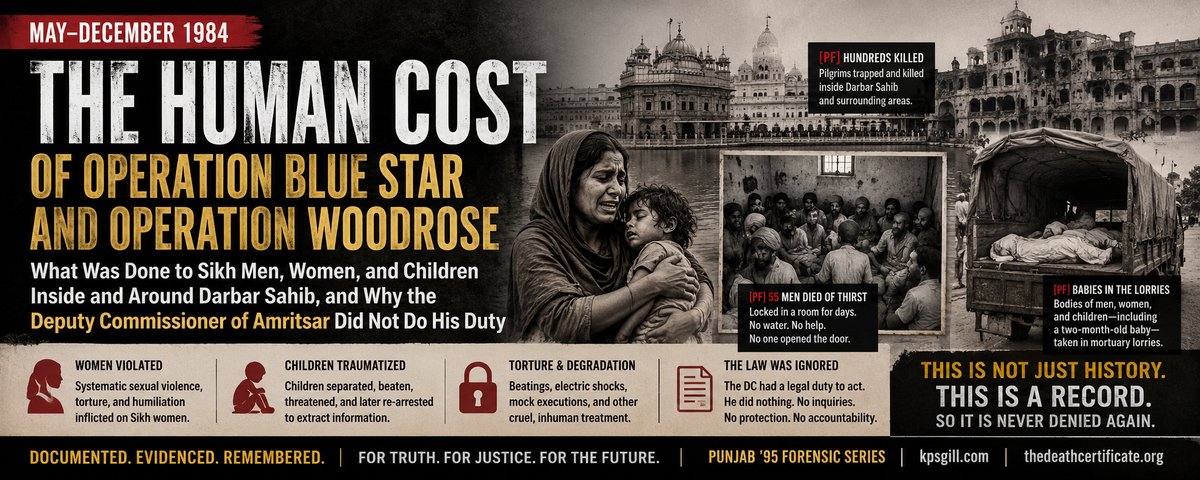
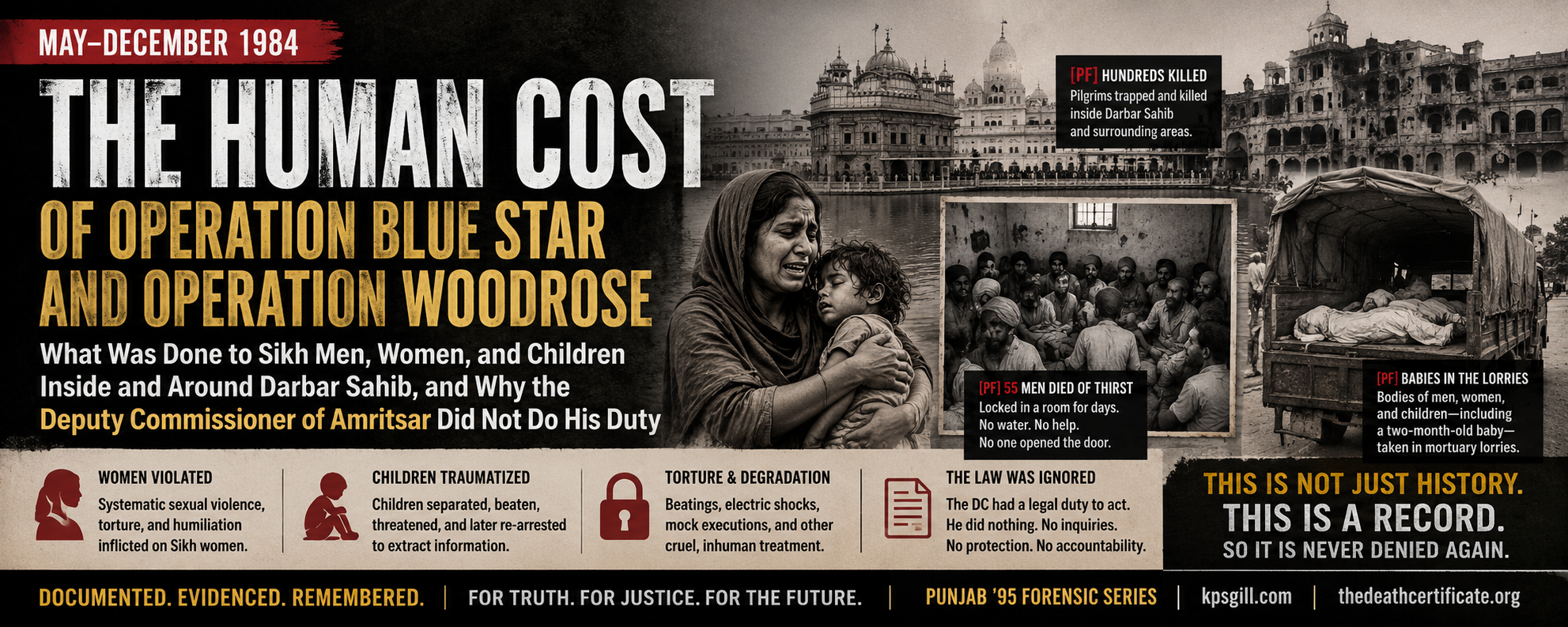
The Human Cost of Operation Blue Star and Operation Woodrose, May–December 1984: What Was Done to Sikh Men, Women, and Children Inside and Around Darbar Sahib, and Why the Deputy Commissioner of Amritsar Did Not Do His Duty
Punjab '95 Forensic Series | kpsgill.com | thedeathcertificate.org
Companion article to: "Apar Singh Bajwa Carried the Bodies. Ramesh Inder Singh Carried the Office. The Republic Rewarded the Office."
Everybody talks about the gun battle. Nobody talks about the locked room where fifty-five men died of thirst in the June heat because no army soldier opened the door. Nobody talks about the women. Nobody talks about the children under five. Nobody talks about the two-month-old baby in the mortuary lorry. Nobody talks about what the office of the District Magistrate was required — by the law of the Indian republic — to do about every single one of them, and did not.
EVIDENTIARY FRAMEWORK
[PF] — Proved Finding: Court judgments, government admissions, official post-mortem reports, the subject's own published statements, credentialed contemporaneous press reportage confirmed by multiple independent sources.
[DA] — Documented Allegation: Named witness testimony in judicial proceedings, human rights organization documentation, military memoirs, survivor accounts in academic record, credible independent press reports — serious, sourced, not conclusively adjudicated.
[AI] — Analytical Inference: Reasoned structural conclusions from documented patterns, timing, institutional behavior, and the logic of the administrative record — explicitly labeled, never presented as proved.
[PM] — Panthic Memory: The living community testimonial and institutional record preserved by Sikh families, gurdwara institutions, and civilizational memory — graded separately, not diminished.
[PM-Direct] — Direct Family Contact: The author's personal family-connected oral knowledge of specific officers and their accounts — explicitly identified and graded separately from all other categories.
PREFATORY NOTE: WHAT THIS ARTICLE IS AND IS NOT ABOUT
Every discussion of Operation Blue Star defaults, within minutes, to the gun battle. How many fighters Bhindranwale had. What weapons were used. Whether tanks were necessary. How many army soldiers died. The disputes over the military's tactical decisions consume the intellectual space that should be occupied by a different set of questions entirely.
This article is not about the gun battle. The gun battle, however tragic and however contested its tactical necessities, involved combatants on both sides who had, to varying degrees, made choices that placed them in a combat situation. This article is about the people who made no such choice. It is about the pilgrims who arrived at Darbar Sahib on the morning of June 3, 1984 to observe the martyrdom gurpurab of Guru Arjan Dev Ji, and who were not allowed to leave. It is about what was done to them between June 3 and June 10. It is about the babies in the lorries. It is about the fifty-five men who died of thirst in a locked room. It is about the women. It is about the children who survived only to be re-arrested and tortured at interrogation centers for information about their relatives who had "probably been killed." And it is, throughout, about the office of the Deputy Commissioner of Amritsar — the single statutory authority required by Indian criminal procedure law to document each of these deaths, to order inquiries, to preserve evidence, to protect the living from further injury, and to ensure that the dead were returned to their families with the dignity the law guaranteed.
This article will establish, at the evidentiary tier appropriate to each claim, that what was done to civilians inside and around Darbar Sahib in June 1984 was not the inevitable friction of counter-insurgency. It was a series of specific acts of mass killing, torture, sexual violence, and degradation directed at a civilian population that had no military role. And it will establish that the office of the Deputy Commissioner of Amritsar — which had both the legal authority and the mandatory statutory duty to respond to each of these acts with the full institutional weight of the civil administration — did nothing.
PART ONE: THE CITY IN THE SPRING — AMRITSAR, MAY 1984
To understand what the Deputy Commissioner's office was responsible for in June 1984, one must understand what Amritsar looked like in the months before. This is not background. This is the establishing context for the statutory failure.
[PF] By May 1984, Amritsar was already a city administered in emergency conditions. Punjab was under President's Rule administered through Governor B.D. Pande. The elected government was absent. The bureaucratic chain ran directly from New Delhi through the Raj Bhawan to the state secretariat. The DC of Amritsar reported to the state's chief secretary in a constitutional vacuum — no elected chief minister, no cabinet, no democratic political accountability for administrative decisions.
The SSP of Amritsar had been changed six times in four years. Ajaypal Singh Mann had served as SSP from October 1983 to March 1984. He was replaced by Sube Singh in March 1984 — barely two months before the operation. The instability of the district's senior police leadership in the runup to the largest military operation in the city's post-independence history was not coincidental. It was the institutional sorting mechanism: officers whose dispositions were aligned with whatever was coming were retained and promoted; those whose dispositions were not were moved.
[PM-Direct] The author of this publication grew up in the extended family orbit of SSP Ajaypal Singh Mann, whose sister lived in the author's neighbourhood in Amritsar. Mann's account of why he was removed from the SSP Amritsar post before Operation Blue Star, preserved in the family's oral memory and known directly to this author from Khalsa College years, is consistent with what the documentary record shows: that the officers positioned in Amritsar immediately before Blue Star were specifically chosen for the quality of their administrative disposition toward what was about to happen.
[PF] On May 25, the government announced the deployment of approximately 100,000 army troops throughout Punjab, encircling forty-two important Gurdwaras including Darbar Sahib. On May 31, Major General Kuldip Singh Brar was summoned to Western Command and instructed to lead Operation Blue Star. On May 27, XI Corps' training exercise was abruptly cut short and troops ordered to return to their permanent locations. The operational preparations for the assault were complete before June began.
[AI] The civil administrative implications of this military buildup were not invisible to anyone working in the Amritsar DC's office. An army cordon around the holiest Sikh shrine, a 100,000-troop deployment across the state, a curfew that would begin June 1 and tighten continuously — these were not background conditions. They were an administrative crisis that the DC's office was simultaneously required to manage (curfew orders, press movement passes, public order notifications) and constitutionally required to remain legally distinct from (the DC's statutory duties under the CrPC did not merge with military operational authority). The dual nature of this responsibility — both facilitating the administrative apparatus the operation needed and maintaining independent statutory obligations for civilian protection — was the specific institutional tension that June 1984 would resolve entirely in favor of the former and entirely against the latter.
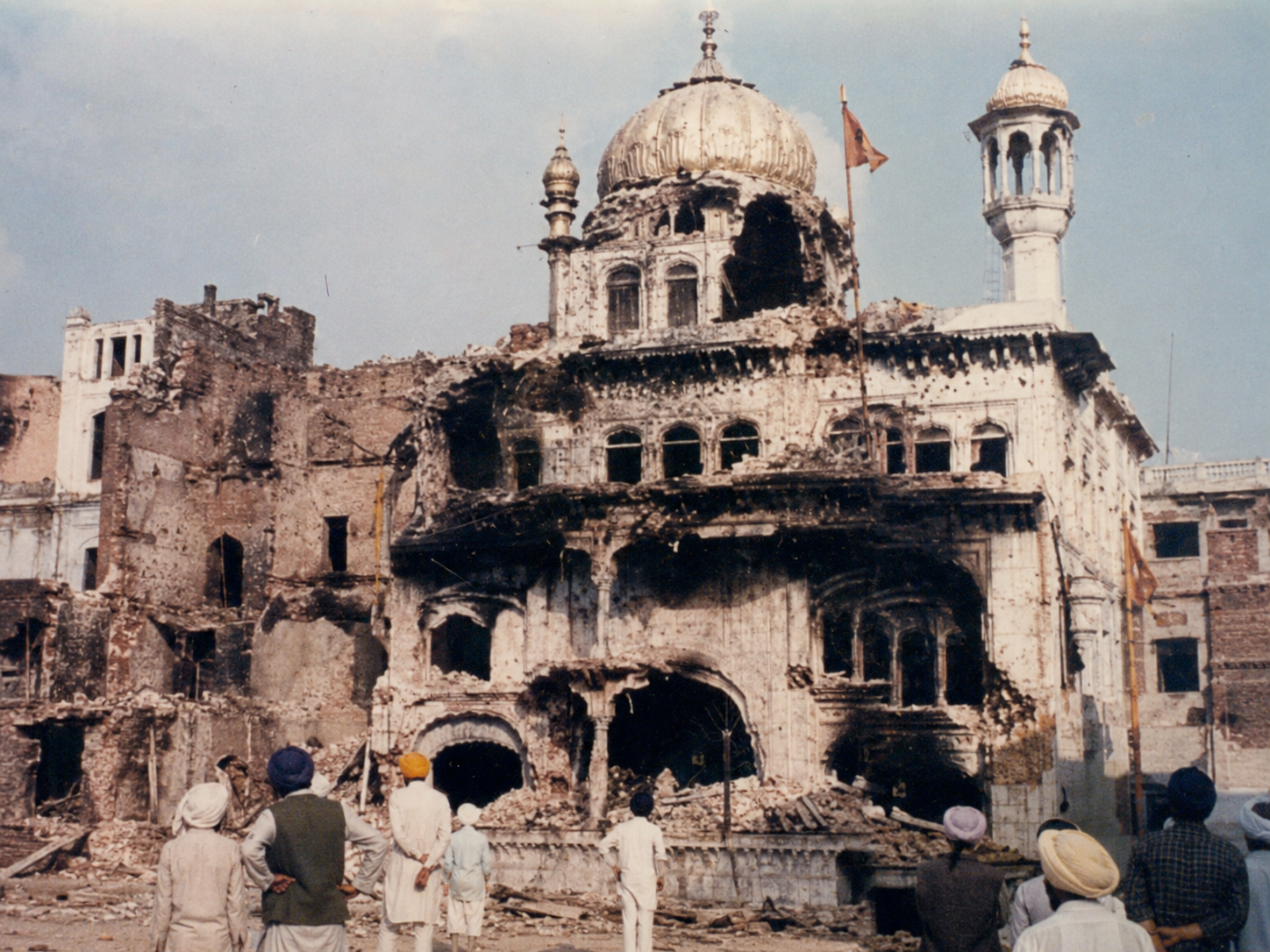
PART TWO: THE TRAP — HOW TEN THOUSAND PILGRIMS BECAME HOSTAGES
[PF] June 3, 1984 was the Shaheedi Gurpurab of Guru Arjan Dev Ji — the martyrdom anniversary of the fifth Sikh Guru, who was put to death on June 16, 1606. It is among the most solemn and widely observed dates in the Sikh liturgical calendar. Darbar Sahib, the Guru's own gift to the Sikh nation, is the most sacred location to observe it. Thousands of pilgrims — from the Majha region, from across Punjab, from Delhi, from abroad — came to Amritsar as they did every year. They came by train, by bus, on foot. They came to observe a day of prayer, of ardas, of langar, of community. They were, in the oldest sense of the word, pilgrims.
[PF] By nightfall on June 3, 1984, as established in the Mark Tully and Satish Jacob account, the curfew had been reimposed absolutely. All outgoing trains from Amritsar had left by noon. Rail, road, and air services in Punjab were suspended. The army replaced the CRPF outside the temple and was taking into custody anyone attempting to leave the complex. A pilgrim who survived told investigators that he did not try to leave because visitors who did try to exit were being detained by the army. He stayed. Not knowing that staying was entering the kill zone.
[PF] In the morning of June 3, the curfew was relaxed to allow pilgrims to go inside the complex to observe the gurpurab. This relaxation — a civil administrative decision, subject to the District Magistrate's authority over curfew management — allowed the last wave of pilgrims to enter. They entered on the morning of a holy day. They could not leave by the evening of the same day. The curfew that had been managed by Gurdev Singh Brar as DC was by this point transitioning to the incoming DC, with Ramesh Inder Singh directed by the chief secretary to proceed to Amritsar on June 3. The curfew that trapped the pilgrims was maintained by the civil administration of a district whose DC was in the process of changing.
[PF] A 2017 ruling by Amritsar District and Sessions Judge Gurbir Singh found, after examining the available records: "There is no evidence that army made any announcements asking ordinary civilians to leave Golden Temple complex before launching the operation in 1984… There is no written record of any public announcement by the civil authorities requesting the people to come out of the complex." This judicial finding — produced thirty-three years after the events — establishes that the civil administration, whose authority over public announcements, curfew relaxation, and movement orders was unambiguous, produced not a single written document warning the trapped pilgrims of what was about to happen.
The curfew trapped them. The press expulsion ensured no witness would see them. The absence of any civil warning from the DC's office ensured that the thousands inside had no advance knowledge of the military operation. They had come to pray. They were processed, by the machinery of the civil administration and the army together, into a closed zone from which they could not emerge until the army permitted it — or until they were carried out.
PART THREE: INSIDE DARBAR SAHIB — WHAT SOLDIERS DID TO PILGRIMS BEYOND THE GUN BATTLE
A. The Locked Room: Fifty-Five Deaths by Deliberate Abandonment
[DA] The most specific and forensically detailed account of what happened to civilians inside the Guru Ram Das Serai — the hostel complex adjacent to Darbar Sahib — during Operation Blue Star is contained in the testimony of Ranbir Kaur, a schoolteacher who was inside with a group of children she was responsible for. Her account is preserved in Mark Tully and Satish Jacob's "Amritsar: Mrs Gandhi's Last Battle," a contemporaneous journalistic account begun in 1984 itself before Indira Gandhi's assassination, and is among the most thoroughly cross-verified survivor accounts in the Blue Star record.
Ranbir Kaur had locked herself in Room 141 of the Guru Ram Das Hostel with twelve children in her care. The Kumaon Regiment entered the hostel at approximately one o'clock in the morning of June 6. Orders were given for everyone to come out. Ranbir Kaur describes the night:
"We were all huddled together. We didn't know what was happening. The noise was terrifying. We had not been out of the room for more than twenty-four hours and we had no food or water. It was a very hot summer night. I told the children that we must be ready to die. They kept on crying."
When the army ordered everyone out on the early morning of June 6, this was not the end of the ordeal. Tully and Jacob's account, drawn from direct survivor testimony, records the following:
[DA] Army soldiers took sixty of the young men found in the hostel complex and locked them in a single room. The electric supply to the room was disconnected. It was an intensely hot June night in Amritsar — the city sits at 234 meters above sea level, and June temperatures regularly exceed 45 degrees Celsius. The sixty men inside, deprived of air circulation and water, began to suffer from heat, dehydration, and lack of oxygen. They knocked on the locked door and asked for water. The army men on duty outside gave them abuse. No water came. The door remained locked.
By eight o'clock in the morning of June 6, when the door was finally opened, fifty-five of the sixty men were dead. They had died during the night — of dehydration, of heat exhaustion, of suffocation in an overcrowded, unventilated room in peak summer heat without water. The remaining five men were barely alive. All five survivors were arrested by the army and taken away to interrogation camps.
[AI] The death of fifty-five men in a locked room — men who had surrendered, who were unarmed, who were demonstrably not combatants, who had been found in the hostel complex and not in the Akal Takht — is not a casualty of the gun battle between the army and Bhindranwale's fighters. It is the direct result of a decision to lock human beings in a room and not provide them with water, in an environment whose temperature made death from dehydration and heat stroke a predictable outcome within hours. It is not recorded in any official count. It is not one of the 492 "terrorists" listed in the government's White Paper. It is fifty-five deaths that the DC of Amritsar's district was legally required to investigate, document, and account for — and that the administrative record shows he did not.
B. The Executed: Bound Prisoners, Shot at Point-Blank Range
[PF] The post-mortem record — the most forensically incontrovertible category of evidence — establishes the execution of bound prisoners as a documented fact, not an allegation. The post-mortem reports appended to multiple independent investigative accounts, including the compilation preserved in the SikhiWiki "Operation Blue Star: The Untold Story," contain two specific forensic findings of extraordinary legal weight:
First: most of the dead bodies had their hands tied behind their backs with their own turbans. This physical finding distinguishes death-in-combat from execution-after-capture. A person killed in combat does not have his hands tied. A person whose hands are bound behind his back with his own turban before he is shot has been captured, restrained, and then executed. The turban — the visible article of Sikh religious identity — used as the binding instrument is not incidental.
Second: the bodies were in a putrid and highly decomposed state when brought for post-mortem — having been held for approximately seventy-two hours before the examination. This finding is not merely a comment on the state of preservation. It is the forensic fingerprint of administrative delay. Bodies held for seventy-two hours before post-mortem in June heat in Punjab are deliberately held. The decomposition that destroys forensic evidence — wounds, contusions, ligature marks, evidence of ante-mortem injury — is accelerated precisely by that delay.
[PF] Brahma Chellaney of the Associated Press, the only foreign correspondent who remained in Amritsar during the operation, reported in his dispatches — front-paged by the New York Times, The Times of London, and The Guardian — that several Sikhs inside the Golden Temple complex had been shot with their hands tied. Chellaney's dispatch, after the first paragraph reference to "several" such deaths, specified "about eight to ten" men shot in that fashion. He also interviewed a doctor who had been forcibly pressed into service by the army to conduct post-mortem examinations — despite having never performed a post-mortem examination before. That doctor told Chellaney directly that the hands of those killed inside the temple had been tied before the soldiers shot them.
[DA] School teacher Ranbir Kaur, cited in "Reduced to Ashes: The Insurgency and Human Rights in Punjab" (2003), witnessed the shooting of a group of approximately one hundred and fifty people whose hands had been tied behind their backs with their own turbans. She was present inside the complex as a pilgrim. She survived. Her testimony is documented in academic record.
[DA] The Ensaaf documentation of Operation Blue Star records that Ranbir Kaur "witnessed the execution of over 150 people who had been locked inside the basement." Her testimony was gathered and documented by human rights researchers in the years following the operation. It has not been adjudicated in any Indian court — because no investigation of these specific deaths has ever been ordered by the civil administration or any court.
[DA] A named Indian Army Naik (Corporal) of the Kumaon Regiment — one of the regiments deployed inside the complex — gave an account quoted in Probe India in August 1984, one of the few Indian publications to publish such material in the period: "The army stormed Teja Singh Samundri hall and the rooms in the Parkarma and behaved like savages, they raped women, looted, killed children, burnt people alive, set the rooms on fire and tied the hands of devotees behind their backs and shot them." This account is remarkable for its source: a soldier of the Indian Army, describing his own regiment's conduct in terms that constitute a direct admission of war crimes. The publication of this account in Probe India in August 1984 — within weeks of the events — establishes it as near-contemporaneous documentation.
[DA] Harminder Kaur's 2006 book, "Blue Star over Amritsar," contains, as documented in The Caravan magazine's account of 2015, the post-mortem report of a specific young man — named in the post-mortem — who was shot through the chest with his hands tied behind his back. This is a specific, identified post-mortem report of a specific individual who was executed after capture. It is the documentation in an official medical record — a post-mortem form signed by an authorized examiner — of a summary execution.
C. The Women: Rape, Strip-Search, and the Medical Record That Was Not Created
[DA] The Indian Army Naik's Probe India account, cited above, includes rape explicitly. "They raped women." The same account includes looting, the killing of children, burning people alive. This is not a claim from advocacy material or from an outside observer. It is a combat participant's own characterization of his unit's conduct.
[DA] The National Sikh Youth Federation's "10 Days of Terror" report documents: "The account of a Naik (Corporal) of Kumaon Regiment who participated in Blue Star as quoted in Probe India, August 1984: 'The army stormed Teja Singh Samundri hall and the rooms in the Parkarma and behaved like savages, they raped women, looted, killed children, burnt people alive, set the rooms on fire and tied the hands of devotees behind their backs and shot them.'"
[DA] The University of London Pro Bono Group's 1984 study documents the testimony of Jasmeet Kaur, then sixteen years old, who was inside the complex during the operation with her mother and brother. Within hours of the operation beginning, the family was detained. Her brother was stripped naked and beaten in front of his mother and sister. Her mother was stripped naked in front of her. Jasmeet Kaur witnessed her mother being raped by three police officers before her mother died. She was released three days later. Her brother was never located.
[DA] The Sikhnet account drawn from multiple sources records that "many Sikh women were molested" and that "women were raped by Indian army officers." The specific institutional context for the rape allegations within the temple complex — as distinct from the broader Operation Woodrose period — is the chaos of the post-battle phase, when soldiers who had suffered heavy casualties moved through the hostel complex ordering survivors out and subjecting them to what the sources uniformly describe as extreme violence.
[AI] The critical forensic analysis here is not about the rape allegations themselves — which are documented across multiple independent sources at the Documented Allegation level. It is about what was not done in response to those allegations. Under the Indian Penal Code and the criminal procedure applicable in 1984, allegations of rape required, at minimum: a medical examination of the complainant by an authorized physician, conducted as soon as possible after the alleged act; a record of the medical findings; a magistrate's recording of the complainant's statement under Section 164 CrPC; and the registration of a First Information Report.
None of this happened. The curfew prevented women from reaching police stations independently. The press exclusion ensured no outside observer could document what survivors were reporting. The medical infrastructure of Amritsar — hospitals, doctors — was, according to contemporaneous reporting by the Christian Science Monitor, operating under army threat. Medical workers in Amritsar said soldiers had threatened to shoot them if they gave food or water to Sikh pilgrims wounded in the attack and lying in hospitals. If medical workers were being threatened by soldiers for providing basic treatment to the wounded, the practical conditions for any rape investigation requiring medical examination simply did not exist within the military-controlled zone.
[AI] The Deputy Commissioner of Amritsar was the executive magistrate of the district. He had the authority to protect the medical infrastructure from military interference. He had the authority to direct that examination of sexual assault survivors be conducted under civil authority. He had the authority to establish a civil-administered reception point, outside the army's direct operational zone, where survivors could present themselves for documentation. None of this authority was exercised in any documented form. The rape allegations were processed by no civil authority. They were neither investigated nor formally denied. They existed in the space that the administrative silence of the DC's office had created — the space between what the law required and what the administration did.
D. The Children
[PF] The Indian Express reported on June 18, 1984 — from sources inside the Amritsar medical system — that of approximately 400 bodies brought to medical facilities and cremation grounds from inside and near the temple complex, 100 were women and between fifteen and twenty were children under the age of five. One was a two-month-old baby.
This is not Sikh advocacy literature. It is the Indian Express, June 18, 1984. The figure of a two-month-old infant — whose mother presumably brought her child to the most sacred site of her faith on the most sacred day of the Sikh year, and both were killed — does not belong in the government's "terrorists killed" column of 492. The government's White Paper has no column for two-month-old babies.
[DA] Bibi Pritam Kaur's account — documented in a video interview available online and reprinted in the Punjab Times — records the deaths of her husband and their eighteen-month-old child. Both were shot dead. The video interview is primary testimony of a named survivor about the killing of a named infant during Operation Blue Star. No inquest was ordered for that child's death. No case was registered. No cause of death was officially documented. The eighteen-month-old baby has no death certificate from the state that killed it.
[DA] The 1984 Sikh Archive documents that twenty-two children who had been present inside the complex as pilgrims were held at Ludhiana jail after the operation. A court order — issued by a judge — ruled that there was no justification for detaining them as they were pilgrims visiting the Golden Temple during Operation Bluestar, and ordered their release. The police released them. Then re-arrested most of them. And tortured them at interrogation centers "for information on their relatives who had probably been killed during the Army operation."
[AI] The sequence deserves full forensic weight: children held as prisoners after Blue Star, released by court order as unlawfully detained pilgrims, then re-arrested and tortured for intelligence about family members the state had already killed. This is not incidental cruelty. It is a structured administrative program: use the detained children to fill intelligence gaps created by the killing of the adults whose information the army needed but could no longer extract because the army had killed them. The torture of children to extract information about dead relatives is, in every framework of international human rights law, a crime against humanity. It occurred in the aftermath of Blue Star. It occurred within the jurisdiction of the DC of Amritsar. No magisterial inquiry was ordered.
E. The Burning of the Sikh Reference Library
[DA] The Sikh Reference Library inside the Darbar Sahib complex housed one of the most significant collections of historical Sikh manuscripts, artifacts, and rare texts in existence — materials accumulated over centuries, irreplaceable by definition. According to the head librarian's account, documented in Ensaaf's Blue Star record, army troops burned the Sikh Reference Library after they had taken control of the building.
[AI] The destruction of a library — the deliberate destruction of irreplaceable textual heritage — is not a casualty of artillery fire or military necessity. The Sikh Reference Library's books did not pose a military threat. The act of burning them was a statement: we are destroying what you preserve. It is the civilizational dimension of Operation Blue Star — the assault not merely on physical space and human bodies but on the Sikh nation's historical memory. The DC of Amritsar had no authority over the army during the active assault phase. But the physical preservation of the remains, the documentation of what had been destroyed, the administrative record of cultural heritage loss — all of this fell within the ordinary functions of the district administration in the aftermath of the operation. No such record was produced.
PART FOUR: THE BODIES — HOW THE DEAD BECAME ADMINISTRATIVE SILENCE
A. The Lorry That Spoke When the Files Could Not
[PF] Brahma Chellaney's AP dispatches — transmitted by telex from Amritsar while the press exclusion was in effect, published internationally, and subsequently used as the basis for the Indian government's sedition charges against him — describe what he personally witnessed during the days following the assault. He saw dead bodies being transported in municipal garbage trucks continuously around the clock. At the cremation grounds, he spoke with an attendant who told him there was not enough wood to burn the bodies individually. He saw approximately fifty corpses in a single large garbage lorry — masculine legs protruding from the back, the forehead with long hair of an apparently male Sikh hanging from the side. He also saw the bodies of at least two women and a child in the same lorry.
[PF] This is not hearsay. This is the Associated Press South Asia correspondent's eyewitness account, published in front-page stories in the New York Times and The Times of London, whose factual accuracy was so damaging to the Indian government that the government prosecuted him for it. The prosecution's existence — and the Supreme Court of India's eventual dismissal of the charges — is itself a proved finding about the authenticity of the reportage. You do not prosecute a journalist for fabrication in front of the Supreme Court and then lose. The bodies were in the lorries. The attendant said there was not enough wood. The dead were burned in heaps of twenty.
[DA] Brigadier Onkar Goraya — an Indian Army officer whose memoir "Operation Bluestar and After, An Eyewitness Account" (2013) provides, as The Caravan noted, "for the first time, some clarity on the number of pilgrims inside the complex during the operation" — confirms that the task of disposing of the bodies was so onerous that municipal workers cleared them away only because they were permitted to strip the bodies of their belongings. Let that detail rest in the analytical record. The bodies of Sikh pilgrims killed inside Darbar Sahib were stripped of their belongings by municipal workers as payment — as the labor exchange for doing the work that the civil administration should have processed through a formal identification and documentation system. The stripping was the wage.
[DA] The All About Sikhs documentation, drawing on contemporaneous press reports from The Times and the Indian Express, records: of approximately 400 bodies processed through medical facilities, 100 were women and between fifteen and twenty were children under five years old. One was a two-month-old baby. The doctor at the facility told reporters that one person found in the pile of bodies turned out to be alive. A soldier shot and killed him on the spot.
[DA] A police officer — described as a local journalist source in Chellaney's reporting, and corroborated in multiple secondary accounts — states that a lorry load of elderly Sikh men who had surrendered on the first day of the military operation was brought to the main city police station of Amritsar and tortured there by the army. Old men. Surrendered. Brought to the city's central police station — an institution within the administrative domain of the district's civil administration — and tortured there by army personnel operating within a civilian facility.
[DA] Chellaney also observed and reported that Sikh youths who had been arrested inside the temple complex were forced to pull their trousers above their knees, kneel, and march on the hot June road surface — the tarmac temperature in Amritsar in June often exceeds 60 degrees Celsius — while army soldiers repeatedly kicked and punched them. This was done publicly, in the streets of Amritsar, during curfew hours when no civilians were permitted to be present to witness it.
B. The Seventy-Two Hours: Why the Bodies Decomposed Before the Post-Mortems
[PF] The post-mortem records appended to the Blue Star accountability documentation establish that the dead bodies brought for examination were in a "putrid and highly decomposed state" — and had been held for approximately seventy-two hours before examination. This forensic finding has one specific medical implication: in Amritsar's June heat, a human body begins active decomposition within twenty-four to forty-eight hours. At seventy-two hours without refrigeration, the body's exterior will show significant decomposition effects that obscure surface wounds, contusions from ante-mortem beating, ligature marks, and other forensic evidence of the manner of death.
[AI] The decomposition of the bodies before post-mortem is not a neutral fact of logistics. It is a forensic observation with a specific implication: seventy-two hours of delay in a June climate, without refrigeration, systematically degrades the physical evidence that a post-mortem examination is designed to preserve. A post-mortem examination conducted at seventy-two hours on a body in Amritsar's June heat will produce significantly less forensic information than an examination conducted within twelve to twenty-four hours. The delay favored the narrative that there was no systematic evidence to find. The delay was administrative — a product of when the bodies were moved, when the doctors were pressed into service, and what access the examining physicians had to the bodies.
[AI] The doctor pressed into service by the army — reported by Chellaney — had never conducted a post-mortem examination before. This is not an incidental detail. The proper conduct of a forensic post-mortem examination in cases of suspicious or unnatural death required, under the CrPC framework and the medical protocols of the Indian health system, an authorized forensic physician — not a general practitioner commanded at gunpoint to sign forms. The substitution of an unqualified and coerced physician for an authorized forensic examiner further degraded the evidentiary quality of the post-mortem record. And this substitution occurred within the jurisdiction of the DC of Amritsar, who had the authority to direct that authorized medical examiners conduct the examinations — and who used no such authority.
C. No Photographs. No Identification. No Record.
[PF] The families of those killed inside Darbar Sahib in June 1984 were given no notification of deaths. The curfew that was under civil administrative control prevented families from reaching the cremation grounds. By the time any relaxation of movement occurred, the bodies had been cremated. There were no photographs of the dead taken before cremation — or if there were, none has ever been produced. There was no systematic identification process. There was no family-notification protocol.
[AI] The absence of photographs is not a neutral fact. In any legitimate death documentation process — whether military or civil — the photographing of unidentified or mass-casualty dead before cremation or burial is a standard forensic practice. It preserves the possibility of later identification, later family notification, later legal proceedings. The absence of photographs means that the dead of June 1984 inside Darbar Sahib cannot be individually identified from the administrative record — because no administrative record was created that would make identification possible.
The decision not to photograph, not to identify, not to notify, not to document — and to instead load bodies into garbage trucks and burn them in heaps — was not forced by military necessity. The fighting was largely over by June 6-7. The bodies were being disposed of in the days following. The administrative machinery of the district was intact. The municipal services were functioning — they were, in fact, being used to transport the bodies. The only missing element was a civil administrator who would exercise the authority to insist on lawful procedure.
PART FIVE: DSP APAR SINGH BAJWA AND THE ANATOMY OF THE DEFLECTION
A. Who Bajwa Was and What He Did
[PF] DSP Apar Singh Bajwa was the Deputy Superintendent of Police (City), Amritsar during Operation Blue Star. He is confirmed in the Brown Pundits administrative record of the Blue Star command structure as among the named police officers of Amritsar district, alongside SP Sital Das and SP CID Harjeet Singh.
[DA] The Damdami Taksal honored DSP Bajwa at a public ceremony on June 2, 2005 — twenty-one years after Operation Blue Star — specifically for two acts during the operation's immediate aftermath: he personally identified the body of Sant Jarnail Singh Bhindranwale in the basement of the destroyed Akal Takht; and he negotiated directly and personally with Indian Army commanders to secure Sikh rites cremation for four specifically named martyrs — Jarnail Singh Bhindranwale, Major General Shabeg Singh, Baba Thara Singh, and Bhai Amrik Singh. The Damdami Taksal's public recognition of this act, conducted on the twenty-first anniversary in front of the Sikh sangat, is documented in the Sikh Formations journal (Vol. 6, No. 2, 2010).
[PM-Direct] The Bajwa family account, known to this author through direct contact with DSP Bajwa's son — a Khalsa College acquaintance whose home the author visited multiple times during his Khalsa College years in Amritsar — confirms that Bajwa specifically negotiated for Sikh rites for the four named martyrs and that his request was partially granted. He secured the four named cremations with Sikh rites. The remaining bodies — described in multiple accounts as more than 800 — were cremated en masse, without the religious rites Bajwa had sought for all of them.
[AI] The moral significance of what DSP Bajwa did cannot be overstated in the context of the institutional environment of June 1984. He was a subordinate police officer — a Deputy Superintendent of Police, the sixth or seventh tier of the district police hierarchy. He had no operational authority over the army. He had no power to compel anything. He negotiated as a moral agent, not as a statutory authority. He secured what he could within the space the army permitted. He received no Padma Shri for it. The Damdami Taksal honored him twenty-one years later.
B. The Deflection: What Ramesh Inder Singh Has Done With Bajwa's Name
[AI] Ramesh Inder Singh — in his memoir, his public statements, and his KSLF 2022 literary festival panel appearance — has consistently attributed the ground-level management of the body-disposal and post-assault period to subordinate officers, including DSP Bajwa. The structural argument he advances is that the army controlled everything, that the DC had no authority over what the military did, and that the actual handling of the dead and the wounded was managed by officers like Bajwa who were on the ground.
This attribution is legally and institutionally insufficient for three specific reasons that the CrPC framework makes unavoidable.
First: DSP Bajwa was a subordinate police officer whose chain of command ran through the SSP and upward to the DC/DM. The DC's statutory obligations under Section 176 of the CrPC are not dischargeable by attribution to a DSP. The law placed the mandatory inquest function at the executive magistrate level — specifically, at or above the sub-divisional magistrate level — not at the DSP level. A DSP cannot satisfy the DC's legal obligations regardless of how heroically or morally the DSP performs.
Second: Bajwa acting as a moral agent in the administrative vacuum left by the DC's inaction is not evidence of DC authority delegation. It is evidence of a subordinate officer filling an institutional vacuum that the statutory authority failed to fill. The vacuum itself — the absence of civil administrative control over the body-disposal process, the absence of inquest orders, the absence of authorized forensic examiners, the absence of family notification — was the DC's omission. Bajwa's presence in that vacuum does not retroactively satisfy the DC's statutory obligation.
Third: The 800-plus bodies for which Bajwa could not secure Sikh rites — because the army did not grant his request for all of them — remained in Amritsar district's administrative jurisdiction after the army's direct operational control of specific sites eased. What the DC's office did about those bodies in the days, weeks, and months following the main assault is precisely the question the Bajwa deflection forecloses. The deflection points downward in the administrative hierarchy to a heroic subordinate. It points away from the statutory authority whose mandatory duties were never discharged.
PART SIX: OPERATION WOODROSE — THE DISTRICT CONTINUES, MAY-DECEMBER 1984
A. The Scale and Method
[PF] Operation Woodrose was launched immediately following Operation Blue Star, running from June 1984 through September 1984 as the primary operation, with its effects continuing through December 1984 and beyond. Its formal purpose was described as preventing "the outbreak of widespread public protest" following Blue Star. Its operational method was the systematic sweep of Punjab's villages and towns for Sikh men who had been associated with Bhindranwale's movement or who were suspected of potential militancy.
[PF] Sangat Singh, who served in the Joint Intelligence Committee of the Government of India in the 1970s, estimated that approximately 100,000 youth were taken into custody within the first four to six weeks of Woodrose — many of whom were not heard from again. The Wikipedia account of Woodrose, drawing on multiple documented sources, establishes: "The operation consisted of the rounding up of thousands of Sikh youth and civilians. Troops would lay siege to targeted villages in the early-morning hours, confining the inhabitants to their houses and stopping all movement out of the village while conducting house-to-house raids. Some villages experienced repeated sieges."
[PF] All amritdhari Sikh men — baptized Sikhs identifiable by the outward signs of their faith: the kesh, the kara, the turban — between the ages of fifteen and sixty, and particularly between fifteen and thirty-five, were referred to in Indian Army communiqués as "potential terrorists" and specifically targeted. The wearing of the articles of the Sikh faith — articles whose protection is guaranteed by Articles 25 and 26 of the Indian Constitution — was treated as a criterion of suspicion sufficient to justify detention.
[PF] The methods of Woodrose are documented in the Wikipedia account, the SikhiWiki account, and multiple human rights reports as including: "cordon operations, mass arrests, torture, sexual harassment and assaults, and disappearances." The government subsequently arrested all prominent members of the Shiromani Akali Dal and banned the All India Sikh Students Federation, the largest Sikh student body in India.
B. Woodrose in Amritsar District: The DC's Jurisdiction
[PF] Amritsar district — including the city and its surrounding Majha villages — was among the primary operational areas of Woodrose. The "border districts" were specifically prioritized, and Amritsar, adjacent to the international border with Pakistan and the site of the now-captured Darbar Sahib, was the geographic center of the Woodrose operational theater.
[AI] Every Woodrose arrest in Amritsar district that resulted in detention under the National Security Act (NSA) required an NSA detention order — signed by the detaining authority (police), reviewed and authorized by the DC/DM's office. The NSA is an executive detention mechanism: it allows detention without trial for up to twelve months on executive order, with the DM's authority both implied and formal in the authorization chain. The mass NSA detentions of Woodrose — affecting thousands of young men across Amritsar district — were processed through the administrative machinery of the DC's office.
[AI] The NSA also required that the grounds of detention be communicated to the detainee "as soon as may be." This procedural requirement — one of the minimal due process protections built into even the draconian NSA framework — required a written statement of grounds, which in turn required the DC's office to articulate a basis for each individual detention. The mass nature of Woodrose — arresting amritdhari Sikh men as a class rather than based on individual evidence of specific conduct — is structurally incompatible with the NSA's individual-detention-grounds requirement. How the DC's office processed this structural incompatibility — whether by generating individual detention orders with individualized grounds, or by producing pro forma standardized orders, or by simply not generating the required documentation — is precisely the administrative question for which the public record has produced no answer.
C. The Rural Terror: Pre-Dawn Sieges, Family Destruction, and the Children Who Were Left
[PF] The Woodrose operational method — pre-dawn sieges of villages, house-to-house searches, mass arrests of adult Sikh men — produced a specific demographic consequence that the district's civil administration was both responsible for and required to manage. When adult men were taken, families were left without their primary economic provider, without any information about where the men had been taken, without any documentation of the arrest, and — in cases where the detained men did not return — without death certificates, without the legal status of widowhood, without the documentary basis for inheritance, land claims, or government services.
[DA] Human rights documentation from the Woodrose period records that families in affected villages were given no information about their detained relatives. Habeas corpus writs — the constitutional mechanism for challenging detention — were suspended or effectively unavailable because the courts were operating under Emergency-era constraints and because detained individuals were frequently held in military rather than civil facilities, where judicial oversight was minimal.
[DA] SikhiWiki's Woodrose documentation records that "thousands of young Sikhs in the countryside were tortured and murdered" and that "an atmosphere of fear and suspicion continued in the countryside for several months" after the formal end of the operation. Human rights organizations documented that Woodrose significantly increased Sikh recruitment into militant organizations — precisely because young men who returned from detention, having been tortured, or whose family members did not return, had been given every possible reason to believe that peaceful engagement with the Indian state was impossible.
[AI] The DC of Amritsar's administrative duties during Woodrose were not suspended by the army's operational authority in the field. The administrative infrastructure of detention, the rights of families to information, the mandatory CrPC obligations for deaths occurring in custody, the inspection obligations of the DC/DM for police lockups — all of these remained in force. The DC who was receiving the Padma Shri for "contributions to public administration" in 1986 was presiding, during the period for which he received the award, over the administrative infrastructure of a rural sweeping operation that had detained approximately 100,000 people in its first six weeks and that resulted in disappearances whose families are still waiting for death certificates forty years later.
PART SEVEN: THE CrPC AUDIT — A STATUTORY DEMAND LIST FOR AMRITSAR DISTRICT, 1984
The following is a formal statutory audit of what the office of the Deputy Commissioner of Amritsar was required to produce, under the Code of Criminal Procedure as it stood in June 1984, in relation to each of the documented deaths, detentions, and injuries that occurred within its jurisdiction between June 3 and December 31, 1984.
Section 174 CrPC — Police Report to Executive Magistrate of Unnatural Deaths: Required for every death under suspicious or unnatural circumstances. Each of the documented deaths inside Darbar Sahib during June 4-10, 1984 — each of the fifty-five men who died in the locked room, each of the bodies with bound hands in the Parikrama, each of the women, each of the children under five — triggered a mandatory Section 174 reporting obligation. The Executive Magistrate at the highest rank in the district — the DC — was the recipient of these reports. Where are the Section 174 reports for the deaths inside Darbar Sahib between June 4 and June 10, 1984?
Section 176 CrPC — Magisterial Inquiry into Deaths in Custody or Suspicious Circumstances: Triggered by the same deaths. The post-mortem evidence of bound hands and point-blank range executions constitutes "suspicious circumstances" as a matter of law. Deaths in custody — including the deaths of the sixty men locked in a room by army soldiers — constitute deaths "in the custody of any officer of the law" for purposes of the pre-2005 Section 176 framework. Where are the Section 176 inquiry orders for the deaths documented by post-mortem evidence, eyewitness testimony, and military participant admission?
Section 58 CrPC — Magistrate Report of Persons Arrested: Required that magistrates receive reports of persons arrested within their jurisdiction within twenty-four hours. The mass arrests of Woodrose — approximately 100,000 in the first six weeks, spanning Amritsar district — required these reports. Where are the Section 58 reports for even one percent of the Woodrose arrests in Amritsar district between June and September 1984?
NSA Detention Orders — Individual Grounds: Required that each NSA detention order articulate individualized grounds communicated to the detainee. For the thousands of Woodrose detentions within Amritsar district: where are the individualized grounds of detention? Were any ever produced?
Death Certificates — Mandatory for Every Death: Required for every individual death; the basis for inheritance, pension, government documentation, land records. For the hundreds killed inside Darbar Sahib in June 1984, and for the thousands who disappeared or died in Woodrose operations within Amritsar district: where are the death certificates?
DC/DM Lockup Inspection Records: Required periodic inspection of police lockups by the magistracy. For the Woodrose period, during which Amritsar district's lockups were processing thousands of detainees: where are the DC's lockup inspection records? What did the DC find when he inspected?
These are not rhetorical questions. They are a formal statutory demand — published in a U.S. First Amendment-protected archive — for the production of documents whose existence is required by Indian law and whose absence requires explanation. The absence itself is an administrative fact. The absence of 174 reports for hundreds of deaths, the absence of 176 inquiry orders, the absence of death certificates, the absence of lockup inspection records — this absence, documented in its totality, is the evidentiary record of the DC's failure of mandatory statutory duty.
PART EIGHT: WHY THE DC DID NOT DO HIS DUTY — THREE COMPETING EXPLANATIONS AND THEIR EVIDENTIARY STATUS
Three explanations have been offered or implied, by Ramesh Inder Singh and by his supporters, for why the DC's mandatory statutory duties were not discharged during June-December 1984. Each deserves forensic assessment.
Explanation One: The Army Had All Authority.
Ramesh Inder Singh stated at the KSLF 2022 panel: "The entire administrative system was handed over to the Army in the entire state and the entire communication system was paralysed overnight to give full power to the Army."
[AI-Refutation]: This explanation is legally insufficient for the following reason: the army had operational authority over the conduct of the military operations. It did not have authority over the DC's statutory obligations under the CrPC. The CrPC is a parliamentary enactment. It does not contain a provision for suspension by military operational declaration. The Armed Forces (Punjab and Chandigarh) Special Powers Act, 1983 — the AFSPA under which the army operated in Punjab — granted army personnel extraordinary powers of arrest, search, and use of force. It did not extinguish the DC's obligation to order inquests into deaths in his district. The DC's duties and the army's powers are not mutually exclusive legal regimes. Both existed simultaneously. The army's authority over the Akal Takht did not eliminate the DC's authority over the cremation grounds. "The army had all authority" explains the DC's inability to stop the killing. It does not explain the DC's failure to order inquests after the killing.
Explanation Two: The DC Followed Service Rules.
Ramesh Inder Singh stated at the KSLF 2022 panel that he had a choice between following service rules and resignation. He chose service rules. He notes, with what the direct observer of the panel records as humor, that others chose differently and went to Parliament.
[AI-Refutation]: The service rules defense admits that resignation was a real and available option in June 1984. It admits that other officers of comparable standing — Simranjit Singh Mann (IPS), who resigned on June 18, 1984 — took it. It confirms that the choice was made with conscious awareness of the alternative. And it explains the choice in terms of career outcomes rather than statutory obligations. The service rules framework required the DC to follow lawful orders. It did not authorize him to follow unlawful ones. The failure to order inquests for hundreds of deaths was not required by service rules. The failure to ensure authorized forensic examiners conducted post-mortems was not a service rule. The failure to document the mass cremations was not a lawful order the DC received. Service rules did not require any of these omissions. They required only compliance with lawful orders. The DC's mandatory CrPC duties were not suspended by any lawful order. They were simply not discharged.
Explanation Three: Bajwa Was Handling It.
The attribution of ground-level events to DSP Bajwa is addressed in Part Five of this article. The structural refutation is three-part: Bajwa was a subordinate whose actions could not satisfy the DC's statutory obligations; Bajwa's moral heroism in a vacuum is evidence of the vacuum, not of its satisfaction; and the 800-plus bodies for which Bajwa could not secure Sikh rites remained in the DC's jurisdiction after the army's direct control eased.
[AI-Conclusion]: The most honest available explanation — more honest than any of the three offered — is the one that Kanwar Sandhu, veteran journalist and former Punjab MLA, provided at the same KSLF panel where Ramesh Inder Singh offered his defenses: "The civil administration failed to discharge its duty during the operation and abjured all its powers and responsibilities to allow the Army." Sandhu used the word "abjured" — actively renounced, deliberately withheld. This is the administrative record's own language. The DC did not lack the authority. He withheld it. And two years later, the Republic rewarded the withholding with a Padma Shri.
PART NINE: FROM JUNE TO DECEMBER 1984 — THE ADMINISTRATIVE CONTINUUM
October 31, 1984: Prime Minister Indira Gandhi was assassinated by two of her Sikh bodyguards in her New Delhi garden. Her assassination triggered, within hours, the organized anti-Sikh pogroms of Delhi and other Indian cities — three to four days of coordinated violence in which approximately 3,000 Sikhs were killed, women were raped, and entire Sikh neighborhoods were destroyed.
The November pogroms were not a Punjab event. The DC of Amritsar had no responsibility for the administrative failures of Delhi. But the period between June and December 1984 — which is the scope of this article's mandate — includes the October assassination and its aftermath as context for what the Amritsar district administration was managing through the rest of the year.
[AI] In Amritsar district, the assassination of Indira Gandhi added a new administrative dimension to the DC's challenges. The Sikh population of Amritsar — already traumatized by Blue Star, by Woodrose, by the mass detention of young men, by the absence of any information about the fates of those who did not return — now faced the additional threat of anti-Sikh violence in the days following October 31. The DC's role in managing civil order, protecting minority communities from communal violence, and maintaining the administrative functions of a district under extraordinary stress was, through October-December 1984, in addition to whatever duties remained outstanding from the summer's events.
The administrative record of what the Amritsar DC did to protect the Sikh population from anti-Sikh violence in the October-November period has not been the subject of systematic documentation in the public record. What is clear is that Ramesh Inder Singh remained DC through July 1987, presiding through the entire period in which Operation Woodrose's detained men were being processed — or disappearing — and through the 1984 pogroms' aftermath.
CONCLUSION: THE DISTRICT MAGISTRATE IS THE STATE'S MORAL CONSCIENCE — UNLESS HE IS NOT
The district magistrate of an Indian district is, under the constitutional and legal framework that governs him, the state's primary guarantee to its citizens that the machinery of the executive will not consume them without record. He is the officer to whom the police must report unnatural deaths. He is the officer who orders inquiries when people die in custody. He is the officer who inspects the lockups. He is the officer who issues the death certificates. He is the officer whose administrative record is, in a functional republic, the documentary witness to what the state did in his district during his tenure.
Ramesh Inder Singh was that officer in Amritsar district from June 4, 1984 to July 1987. During his tenure: hundreds of civilians were killed inside Darbar Sahib and its surrounding complex, including women and children under five and a two-month-old baby; fifty-five men died in a locked room overnight; unarmed prisoners were executed with their hands bound behind their backs with their own turbans; women were raped inside the holiest site of the Sikh faith; the bodies of the dead were stripped of their belongings, loaded into municipal garbage trucks, and burned in heaps of twenty at Amritsar's cremation grounds; a doctor with no forensic experience was pressed into service to sign post-mortem reports; the medical infrastructure of the district was subjected to military threats; twenty-two children who had been present as pilgrims were detained, released by court order, re-arrested, and tortured; and approximately 100,000 Sikh young men across Punjab — with Amritsar district as the primary operational theater — were subjected to the cordon-and-search village sieges, mass arrests, torture, and disappearances of Operation Woodrose.
For all of this, the mandatory administrative response required by the Code of Criminal Procedure was: inquest reports, authorized post-mortems, death certificates, individual NSA detention grounds, lockup inspections, and magistrate oversight.
The response that was produced was: a Padma Shri in 1986. And eventually a Chief Secretaryship. And eventually the post of Chief Information Commissioner — where the officer whose administrative record was the accountability question held the authority to determine which records Punjab's citizens could see.
[PF] The district had a magistrate. The dead had none. Their families are still waiting for the death certificates that the law of the Indian republic required, and that the office of the Deputy Commissioner of Amritsar was required to generate, and that were never produced.
This article is the public record of that demand. It will not be withdrawn. It will not be archived quietly. It will remain, in this First Amendment-protected archive, for the families who are still waiting.
The Punjab '95 Forensic Series at kpsgill.com and thedeathcertificate.org maintains the four-tier evidentiary framework — [PF], [DA], [AI], [PM], [PM-Direct] — across all publications. No category is collapsed for rhetorical effect. Right of reply is extended to Ramesh Inder Singh, the Government of Punjab, and the Government of India. The production of the administrative records demanded in Part Seven would constitute the most complete possible right of reply.
Primary sources for this article: Mark Tully and Satish Jacob, "Amritsar: Mrs Gandhi's Last Battle" (1985); Brahma Chellaney, AP dispatches, June 1984; Probe India, August 1984 (Kumaon Regiment Naik account); Indian Express, June 18, 1984 (morgue figures); Harminder Kaur, "Blue Star over Amritsar" (2006) (post-mortem report of bound-hands execution); Ranbir Kaur survivor testimony in "Reduced to Ashes: The Insurgency and Human Rights in Punjab" (2003); Ensaaf, "Operation Blue Star: The Launch of a Decade of Systematic Abuse and Impunity"; NSYF, "10 Days of Terror" report; Sikh Formations journal, Vol. 6, No. 2, 2010 (DSP Bajwa/Damdami Taksal recognition); Brown Pundits administrative record of Blue Star (2014); Brigadier Onkar Goraya, "Operation Bluestar and After, An Eyewitness Account" (2013); 1984 Sikh Archive; Wikipedia: Operation Woodrose; Judge Gurbir Singh ruling, 2017; KSLF 2022 panel transcript (Tribune India; Punjab Story); Author's PM-Direct family connection to SSP Ajaypal Singh Mann and DSP Apar Singh Bajwa.
© kpsgill.com / thedeathcertificate.org | Punjab '95 Forensic Series | U.S. First Amendment Publication