Placeholder draft Every Police District Had a District Magistrate

ਗੁਰਸ਼ਬਦ ਤੋਂ ਪਹਿਲਾਂ, ਸ਼ਮਸ਼ਾਨਘਾਟ Before the Gurshabad, the cremation ground.
The Death Certificate Project
Evidentiary key: [PF] Proved Finding · [OR] Official Record · [DA] Documented Allegation · [AI] Analytical Inference · [PM] Panthic Memory
Every serious account of Punjab's counterinsurgency has its recurring cast: the Director General of Police, the Senior Superintendent, the militant commander, the Army officer, the Governor under President's Rule. What almost none of them mention by name is the office that sat, without interruption, at the civilian head of Amritsar district for the entire span of years in which the Central Bureau of Investigation would later confirm 2,097 illegal cremations at three sites within that district. That office is the Deputy Commissioner and District Magistrate. It was never vacant. It was never suspended. For twelve years, three men held it in unbroken succession, and this article is not about what any one of them ordered — it is about what the office itself was required, by the general law of the land, to know, to record, and to report.
The Unbroken Chair: A Verified Tenure Chart
The Amritsar DC/DM office's chronology across this period is established from the official district posting record and is treated here as a Proved Finding: Ramesh Inder Singh Mandher, DC/DM Amritsar, June 4, 1984 to July 6, 1987. Sarabjit Singh, DC/DM Amritsar, July 7, 1987 to May 10, 1992. K.B.S. Sidhu, DC/DM Amritsar, May 11, 1992 to August 11, 1996. [PF] There is no gap between these three tenures; each begins the day after its predecessor ends. Sidhu's institutional presence in the district in fact predates his own DC/DM appointment — he served as Additional Deputy Commissioner of Amritsar from approximately 1990, meaning he was Sarabjit Singh's immediate second-in-command for the final two years of that tenure before assuming the top civilian post himself. [PF]
Laid end to end, these three tenures cover June 4, 1984 to August 11, 1996 without interruption — a corridor of civilian succession that maps almost exactly onto the period the CBI's December 9, 1996 report addresses. Jaswant Singh Khalra's January 16, 1995 press note and his September 6, 1995 abduction both fall inside the Sidhu tenure specifically; the CBI's final report and the Supreme Court's December 12, 1996 order arrived four months after that tenure ended. [PF] This article draws no conclusion from that sequencing beyond what it plainly shows: whoever eventually answers for the district's paper trail during those years will be answering, at different points, to one of three names, and the office itself was never without an occupant capable of receiving a report.
What the Office Was — and Was Not
The Deputy Commissioner of a district in Punjab holds, concurrently, the office of District Magistrate under the Code of Criminal Procedure — the senior executive magistrate of the district, responsible for the maintenance of public order, the exercise of preventive and emergency powers, the supervision of subordinate magistrates, and the district administration's general oversight functions. This is a genuinely powerful office. It is not, however, the operational command of the police. The Senior Superintendent of Police in each district reports, in matters of police operations and investigation, up the police chain of command to the Deputy Inspector General and ultimately the Director General of Police — not to the Deputy Commissioner. This distinction matters, and this archive states it plainly rather than eliding it for rhetorical effect: the correct question about the DC/DM's office during this period is not "did it command the killings," which the evidence available to this archive does not establish and which this archive does not allege. [PF] The correct question is narrower and, this archive will argue, harder to answer innocently: what did the office's own, independent statutory functions — magisterial inquiry into unnatural deaths, oversight of unidentified-body procedures, receipt and forwarding of complaints — generate in the way of a paper trail, and where is that paper trail now.
The Institutional Questions Each Tenure Must Answer
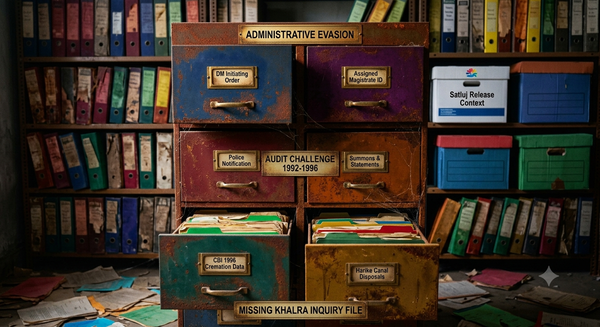
For each of the three tenures, the same set of questions applies, and this archive puts them on the record for each office-holder or their institutional successors to answer. What complaints, formal or informal, reached the DC/DM's office during each tenure concerning disappearances, encounter deaths, or irregular cremations at Durgiana Mandir, Patti, or Tarn Taran? What law-and-order meetings, of the kind district administrations routinely convened and minuted, addressed the volume of bodies being cremated as "unidentified" at municipally regulated cremation grounds inside the district? Did the office ever request, from the Senior Superintendent of Police, an accounting of the pattern the municipal firewood registers would have made visible to anyone who compared them against arrest and encounter statistics? [AI] None of these questions presupposes an answer. Each of them presupposes only that a functioning civilian administration generates a record when it asks — or fails to ask — a question of this kind, and that the record, whichever way it points, has not been made public for any of the three tenures.
The Institutional Reward That Followed
Two of the three officers who held this office are documented, through official Gazette notification, to have received the Padma Shri — India's fourth-highest civilian honor — for service that included their Amritsar tenures. [OR] This archive states that fact and immediately states its limit: a Padma Shri does not, on its own, establish knowledge, complicity, or wrongdoing, and this archive rejects any reading of this article that treats the award as a finding of guilt. What remains a legitimate subject of institutional-memory inquiry — addressed at length elsewhere in this series — is the precise citation basis for each award and the timing of its recommendation relative to the documented cremation record; that basis has not, to this archive's knowledge, been made public. [DA] Sarabjit Singh died on August 1, 2019; any inquiry into his tenure's documentary record must now proceed through Punjab's own institutional archives rather than through the officer himself. [PF]
The Strongest Defense, Stated Fairly
A fair-minded defender of all three officers has real ground to stand on. Punjab in this period was, for long stretches, under President's Rule or Governor's Rule, arrangements that concentrate authority away from the ordinary civil administration and toward the Union government and its security apparatus. Militants killed civil servants; the danger to any official who pressed too visibly on police conduct was neither abstract nor rare. The DC/DM's formal, day-to-day command over an SSP determined to conceal a pattern was genuinely limited by the design of the policing structure itself, whatever the office's other powers. These are not excuses this archive is required to accept as adequate. They are, however, real institutional facts the record must be read against, and this archive states them because a case that survives scrutiny is stronger than a case that ignores its own best counterargument.
What Should Now Be Produced
For each of the three tenures: the district dak and complaint registers; tour diaries and inspection-book entries touching police stations and cremation grounds; minutes of district law-and-order meetings; any surviving correspondence between the DC/DM's office and the SSP concerning unidentified bodies; and the citation file and nomination record underlying the Padma Shri awards where they exist.
Right of Reply
K.B.S. Sidhu, whose tenure most directly overlaps the period of Khalra's investigation and abduction, is invited — as he has been invited through separate correspondence from this archive — to identify or produce any surviving district file from his 1992–1996 tenure bearing on these questions. The Government of Punjab, as institutional custodian of the district record, and the estate and public representatives of Ramesh Inder Singh and the late Sarabjit Singh are each invited to respond on the same terms. Any substantive reply will be appended to this archive in full.
The Human Being Behind the Chair
An office is not a person, and this article has deliberately kept its focus on the office rather than on the three men who filled it, because the force of the argument comes from the chair's permanence, not from any individual's presumed guilt. But a chair that was never empty for twelve years, sitting atop a district where 2,097 bodies were burned and mislabeled, is not a neutral administrative fact either. It is the precise shape of the question this archive is asking the Republic to answer: not who pulled a trigger, but who was required, by the ordinary law already on the books, to ask what happened to the dead — and did.
This is not a verdict. It is a summons to the record.
Sources: tenure dates cross-verified against the Project's own prior published corpus (The Middle Corridor; the K.B.S. Sidhu cross-examination series) and the official Amritsar Deputy Commissioner chronological posting list. CBI/NHRC figures per Paramjit Kaur v. State of Punjab, Supreme Court of India, order dated 12.12.1996. Padma Shri award facts marked [OR] as to the fact of conferral; citation basis and process marked [DA] pending documentary confirmation.