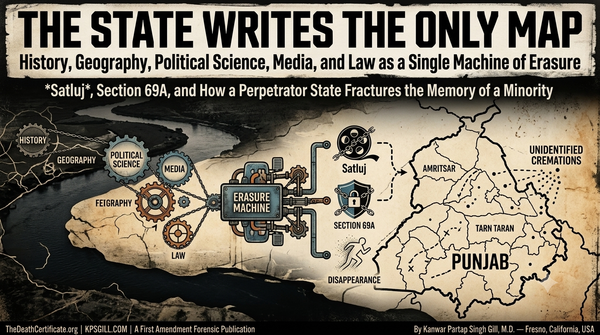
Placeholder draft They Removed Satluj. Now Open the Registers.

ਗੁਰਸ਼ਬਦ ਤੋਂ ਪਹਿਲਾਂ, ਬੇਨਾਮ ਲਾਸ਼ਾਂ ਸਨ Before the Gurshabad, the nameless dead.
The Death Certificate Project
Evidentiary key used throughout this series: [PF] Proved Finding · [OR] Official Record · [DA] Documented Allegation · [AI] Analytical Inference · [PM] Panthic Memory
Somewhere in rural Punjab this week, a projector is throwing light onto a bedsheet hung between two poles in a gurdwara courtyard, or a laptop screen is angled toward a circle of plastic chairs, and a film the Indian state will not let its own citizens watch on a licensed platform is being watched anyway. [DA] Elderly viewers who remember 1995 without needing subtitles sit beside teenagers who know Jaswant Singh Khalra's name only because a Punjabi pop star said it in a film. Journalists have reported these unofficial community screenings spreading through Sikh temples, homes and village gathering spaces in the days since Satluj vanished from ZEE5's Indian catalogue, organized by Sikh institutions, local activists and ordinary residents circulating whatever copies they can find. [DA]
It is a genuinely moving image. It is also, for the purposes of this archive, not the evidence.
The film is a dramatization — a two-hour narrative object built by a director, a studio and a cast, subject to the ordinary compressions and inventions of cinema. What happened in Amritsar district between 1984 and 1996 is not a story that requires a film to be true. It is a matter of official record: a Central Bureau of Investigation report, a Supreme Court order, a National Human Rights Commission docket carrying thirty-five hundred claims. That record existed in full before Satluj was ever titled, and it will still exist in full if every copy of the film is deleted tomorrow. The question this article puts to the Government of India, to ZEE5, and to the Punjab administration is simple: if the dramatization is this dangerous to control, why has the underlying documentary record — the registers the film is based on — never been fully opened to the public it belongs to?
What Actually Happened to the Film
Strip away the controversy of the past week and the certification history is, on its own, a serious accountability story. The production entered India's certification pipeline in December 2022 under the title Ghallughara — a word drawn from Sikh historiography for the eighteenth century massacres of 1746 and 1762, deliberately invoking their twentieth-century echo. [PF] The Central Board of Film Certification's initial review process ran roughly six months and concluded with a demand for cuts and a mandated title change; Variety reported that stage of the process alone produced twenty-one required cuts. [DA] What followed, across further rounds with the Examining and Revising Committees over the next three years, is reported with real variation in the press — some accounts put the cumulative total in the eighties, others above one hundred, others at exactly one hundred twenty. The figure that has converged across multiple outlets reporting on the July 2026 release is one hundred twenty-seven cumulative cut requests. [DA] This archive will not manufacture false precision by picking one number and presenting it as settled; what is consistent across every account is the direction of travel — a demand list that grew, not shrank, and that at various points sought removal of the word "Ghallughara," substitution of "Police" for "Punjab Police," and excision of the specific geography — Amritsar, Tarn Taran — of a crime that occurred, provably, in Amritsar and Tarn Taran. [DA]
The producers did not accept a sanitized cut. The film lost its planned 2023 Toronto International Film Festival premiere and its theatrical release entirely, and its cut order became the subject of litigation before the Bombay High Court, a proceeding whose outcome has not been publicly resolved in reporting available to this archive. [DA] Retitled Satluj — trading the theological charge of Ghallughara for the geographic neutrality of a river's name — the film was ultimately acquired for streaming by ZEE5 and released, uncut, on ZEE5 and ZEE5 Global on July 3, 2026, more than three and a half years after its first submission to the CBFC. [PF]
Less than forty-eight hours later, on the evening of July 5, ZEE5 posted a statement to Instagram confirming the film's removal from its Indian catalogue "until further notice," citing only unspecified "current developments" and declining to state a reason. [PF] Star Diljit Dosanjh, who plays Khalra, said in a video statement that he had anticipated the takedown before it happened and had structured the film's release without advance promotion for that reason. [DA] Director Honey Trehan later told Forbes, on the record, that ZEE5 had communicated to him directly that the platform was acting because of "pressure from the government." [DA] Separately, Sunday Guardian Live reported, citing PTI and an unnamed government official, that the platform had been directed to remove the film over "security concerns" tied to obligations under the IT Rules, 2021. [DA] More than fifty journalists and film critics have since written to the Union Minister for Information and Broadcasting seeking transparency; as of this writing, neither ZEE5 nor the Ministry has issued a substantive on-record explanation. [DA]
No formal blocking order has been made public. This archive addresses the legal architecture of that specific problem — a takedown that functions like state censorship while carrying none of the paperwork state censorship is required to carry — in the companion piece to this article, "The Censor's Scissors Failed. The Invisible Switch Did Not." What matters here is narrower: whatever combination of government pressure and platform judgment produced this outcome, it changed what is visible. It did not change what is proved.
What Is Proved, Independent of Any Film
Jaswant Singh Khalra was a bank official in Amritsar who, following the 1994 death of an associate named Dara Singh — killed, Khalra determined, in a police encounter and cremated at Durgiana Mandir under the label "unidentified and unclaimed" despite being known to authorities — began systematically working through municipal cremation-ground records, chiefly the firewood-purchase registers that Punjab's municipal committees were required to maintain for audit purposes. [PF] On January 16, 1995, he released a press note describing what he had found: that the cremation grounds at Durgiana Mandir in Amritsar, at Patti, and at Tarn Taran held records of thousands of bodies cremated by police as "unidentified" — a figure Khalra himself placed above six thousand for Amritsar district alone. [PF] He was abducted from outside his home in Kabir Park, Amritsar, on September 6, 1995, and never resurfaced. [PF]
His wife, Paramjit Kaur Khalra, filed a habeas corpus petition; on November 15, 1995, the Supreme Court of India directed the CBI to investigate both her husband's abduction and the facts in his press note. [PF] The CBI's fifth and final report was filed with the Court on December 9, 1996. It confirmed 2,097 illegal cremations at the three cremation grounds Khalra had identified — 582 bodies fully identified, 278 partially identified, and 1,238 that the CBI itself could not identify. [PF] On December 12, 1996, the Supreme Court recorded that the CBI's findings disclosed a "flagrant violation of human rights on a mass scale" and, in Paramjit Kaur v. State of Punjab, directed the National Human Rights Commission to examine the matter and "determine all the issues" — designating the NHRC, under its Article 32 authority, a sui generis body for this case alone, free of the Protection of Human Rights Act's normal one-year limitation bar. [PF]
That is the floor of what is established, and no film — released, cut, uncut, banned, or streamed anywhere in the world — adds or subtracts a single body from it.
What Remains Unresolved — and Why the Gap Matters More Than the Film
The NHRC, after preliminary objections from the Union government, limited its own inquiry to Amritsar district alone, ultimately receiving 3,500 claims of illegal cremation from that district. [PF] In November 2004 it issued its first compensation order — Rs 2.5 lakh (roughly US $5,500 at the time) to 109 families in cases where police had admitted custody of the deceased prior to cremation, without a finding of individual responsibility. [PF] A further order on October 10, 2006, extended compensation to 1,245 families and appointed a retired Punjab and Haryana High Court judge, Justice K.S. Bhalla, to attempt identification of the remaining bodies. [PF] The CBI, for its part, registered only thirty criminal cases in connection with the 2,097 admitted cremations; as of a 1999 submission, twelve had been finalized and eighteen remained pending. [DA]
Sit with that arithmetic. Thirty cases opened against a confirmed 2,097 illegal cremations. Twelve other districts of Punjab's then-thirteen — later reorganized further — were never brought within the NHRC's inquiry at all, despite human rights organizations documenting that secret cremations occurred statewide and that cremation was only one of several methods used to dispose of bodies. [DA] And even within Amritsar, the original petitioners alleged something the CBI's clean count of 2,097 cannot capture: cremation-ground workers told Khalra that multiple bodies were, at times, burned on the firewood allotment for one — meaning the true number of dead moving through those three grounds may exceed the register's own count. [DA] This is analytical inference, not proof, and this archive labels it as such [AI] — but it is the kind of inference that a full accounting of the surviving municipal firewood and procurement registers, addressed at length in the next article in this series, could resolve one way or the other.
This is the actual unresolved record: not "was the film accurate," but "why, thirty years on, does the Indian state still not know — or will not say — who the other 1,238 were, and what happened in the sixteen districts nobody counted."
The Strongest Defense, Stated Fairly
Any institutional defender of this record has real arguments, and this archive states them plainly rather than pretending they don't exist. Punjab in this period was fighting an armed insurgency that killed thousands of civilians, police and security personnel; officials operated under threat of assassination, and several were in fact killed. Identification of decomposed or mutilated remains recovered from encounter sites was often genuinely difficult, particularly where no family came forward to claim a body. The state did not entirely evade legal process — the CBI investigated, the Supreme Court intervened, the NHRC did award some compensation, and that machinery, however slow and however narrow, is a documented fact, not a fiction this archive is inventing to make the state look worse than it was. [PF]
The defense explains delay and difficulty. It does not explain scope. Operational chaos in 1991 does not account for an NHRC inquiry in 2006 that still declined to extend beyond one district. Danger to officials in 1995 does not account for a CBI casework rate of thirty registered cases against 2,097 admitted cremations. The record shows genuine legal engagement with a fraction of the problem, sustained for over a decade, and then an effective stop.
The Records That Should Now Be Produced
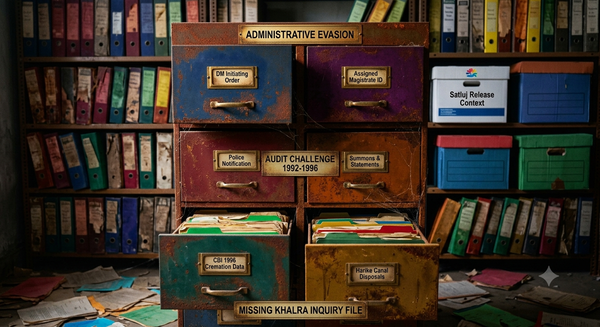
This archive formally requests, and will continue to request in each installment of this series where relevant, production or public accounting of the following: the CBI's complete case file across all thirty registered prosecutions, including final disposition of the eighteen that remained pending as of 1999; the NHRC's full 3,500-claim register from Amritsar district, individually adjudicated, not aggregated; the Section 174 and 176 inquest files, where any exist, for each of the 1,238 bodies the CBI itself could not identify; and a statement from the National Human Rights Commission or the Union Ministry of Home Affairs on whether any inquiry was ever opened into secret cremations in Punjab's other districts.
Right of Reply
The Ministry of Information and Broadcasting, ZEE5, the National Human Rights Commission, and the Government of Punjab are each invited to respond to this article with any documentation bearing on the matters above — including, specifically, any written instrument that authorized the removal of Satluj from India, and any record of investigative activity into illegal cremations outside Amritsar district. Any substantive response received will be appended to this archive in full, without alteration to the original publication.
The Human Being Behind the Paperwork
A cremation register is, on its surface, the least dramatic document imaginable — a ledger, a date, a weight of firewood, a word like "unidentified" entered in a clerk's hand because no better word was required of him. It is also, for 1,238 families in Amritsar district alone, the last administrative trace of a human being who had a name, and whose name the state either never recorded or has never released. A government can pressure a streaming platform into pulling a film in forty-eight hours. It cannot, by the same act, make that register speak, or make it fall silent. The register was never the film's to protect, and it is not the film's removal to answer for.
This is not a verdict. It is a summons to the record.
Sources consulted: Forbes · Forbes, director interview · Variety · Sunday Guardian Live · Madhyamam · Paramjit Kaur v. State of Punjab, Supreme Court of India, order dated 12.12.1996, via Casemine · Human Rights Watch, letter to NHRC, Nov. 2005 and Protecting the Killers, 2007 · sikhchic.com · Outlook India. Tenure and CBI figures cross-verified against the Project's own prior published corpus. Figures reported by secondary press (cut counts, community-screening detail) are marked [DA] pending primary-document confirmation.